
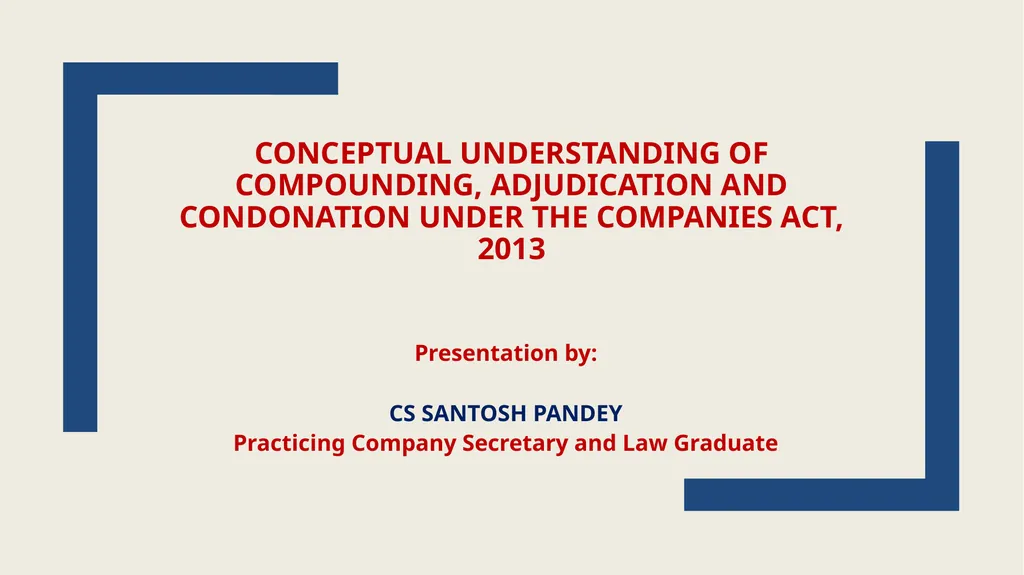
CONCEPTUAL UNDERSTANDING OF COMPOUNDING,
T
Published · 48 slides · 0 views
1 / 1






Description
CONCEPTUAL UNDERSTANDING OF COMPOUNDING, ADJUDICATION AND CONDONATION UNDER THE COMPANIES ACT, 2013 Presentation by: CS SANTOSH PANDEY Practicing Company Secretary and Law Graduate Disclaimer VIEWS EXPRESSED IN THIS PRESENTATION ARE
Related Topics
Share
Embed code
Download this presentation From Below
"CONCEPTUAL UNDERSTANDING OF COMPOUNDING," is the property of its rightful owner. Permission is granted to download and print the materials on this website for personal, non-commercial use only, and to display it on your personal computer provided you do not modify the materials and that you retain all copyright notices contained in the materials. By downloading content from our website, you accept the terms of this agreement.
Presentation Transcript
01
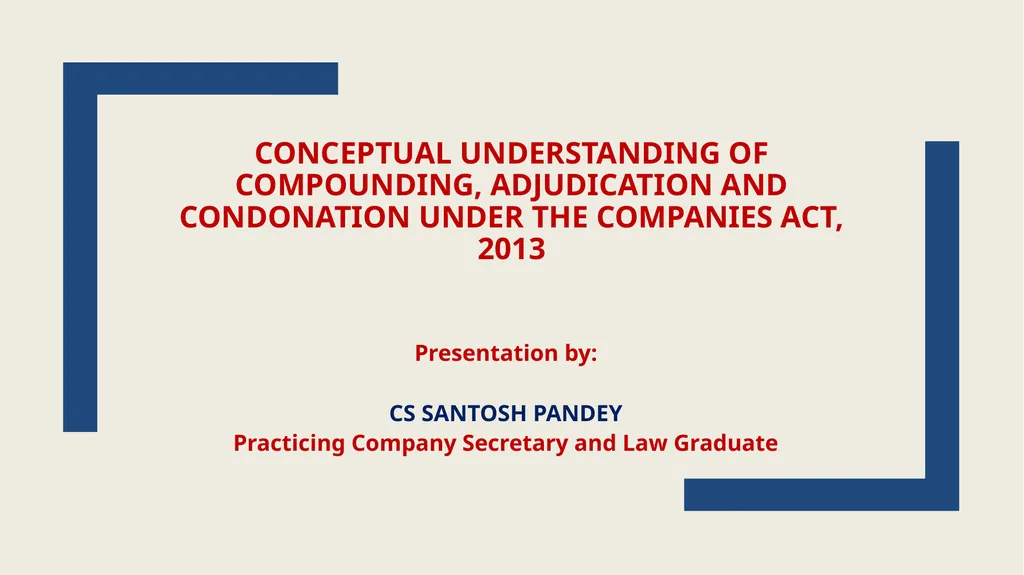
CONCEPTUAL UNDERSTANDING OF COMPOUNDING, ADJUDICATION AND CONDONATION UNDER THE COMPANIES ACT, 2013 Presentation by:
CS SANTOSH PANDEY
Practicing Company Secretary and Law Graduate<br>
CS SANTOSH PANDEY
Practicing Company Secretary and Law Graduate<br>
02
Disclaimer VIEWS EXPRESSED IN THIS PRESENTATION ARE STRICTLY PERSONAL.
IN SHORT FORMAL OPINION MAY DIFFER DEPENDING UPON THE FACTS OF THE CASE AND CIRCUMSTANCES PREVAILING AT PARTICULAR POINT OF TIME.<br>
IN SHORT FORMAL OPINION MAY DIFFER DEPENDING UPON THE FACTS OF THE CASE AND CIRCUMSTANCES PREVAILING AT PARTICULAR POINT OF TIME.<br>
03
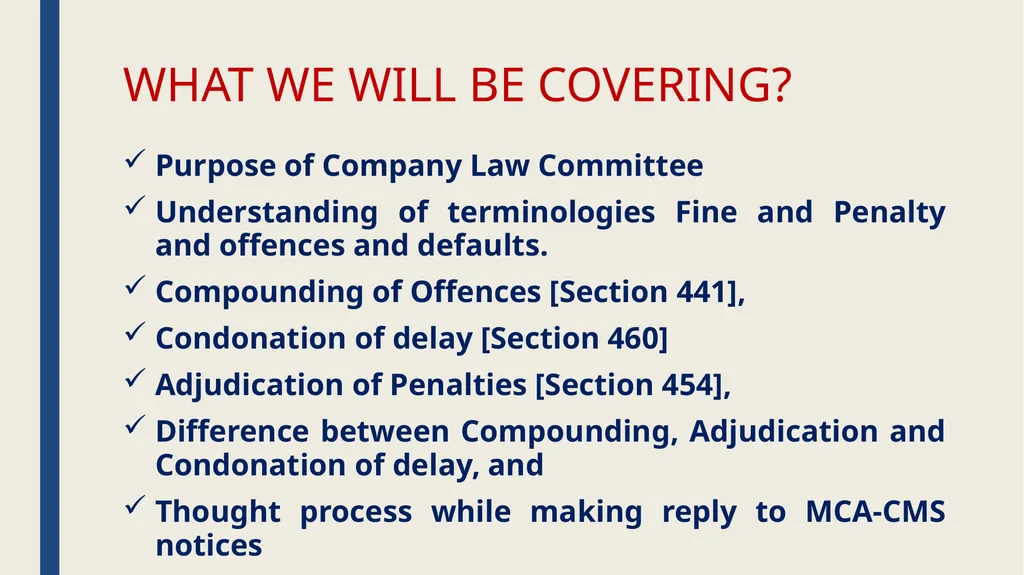
WHAT WE WILL BE COVERING? Purpose of Company Law Committee
Understanding of terminologies Fine and Penalty and offences and defaults.
Compounding of Offences [Section 441],
Condonation of delay [Section 460]
Adjudication of Penalties [Section 454],
Difference between Compounding, Adjudication and Condonation of delay, and
Thought process while making reply to MCA-CMS notices<br>
Understanding of terminologies Fine and Penalty and offences and defaults.
Compounding of Offences [Section 441],
Condonation of delay [Section 460]
Adjudication of Penalties [Section 454],
Difference between Compounding, Adjudication and Condonation of delay, and
Thought process while making reply to MCA-CMS notices<br>
04
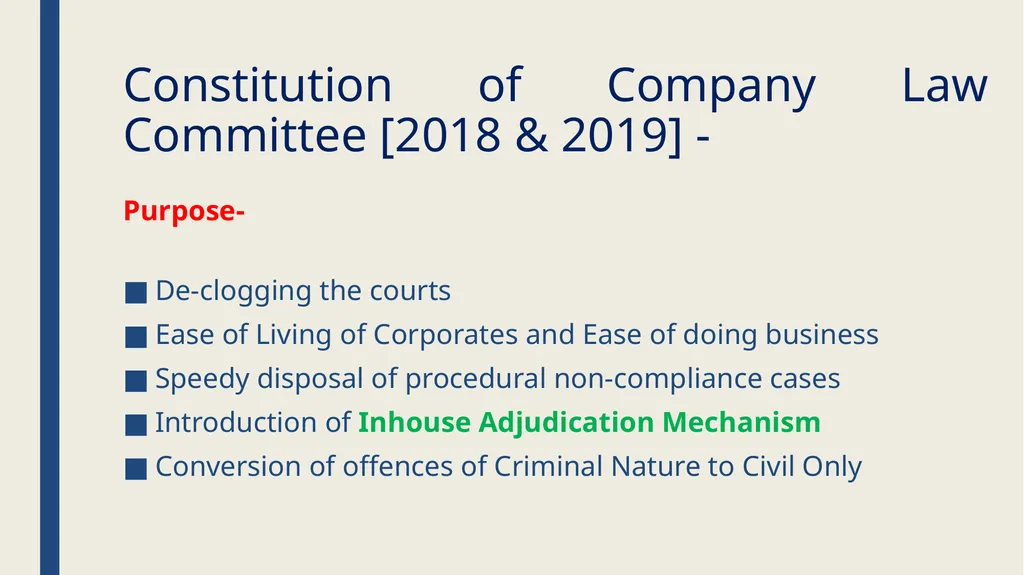
Constitution of Company Law Committee [2018 & 2019] - Purpose-
De-clogging the courts
Ease of Living of Corporates and Ease of doing business
Speedy disposal of procedural non-compliance cases
Introduction of Inhouse Adjudication Mechanism
Conversion of offences of Criminal Nature to Civil Only<br>
De-clogging the courts
Ease of Living of Corporates and Ease of doing business
Speedy disposal of procedural non-compliance cases
Introduction of Inhouse Adjudication Mechanism
Conversion of offences of Criminal Nature to Civil Only<br>
05
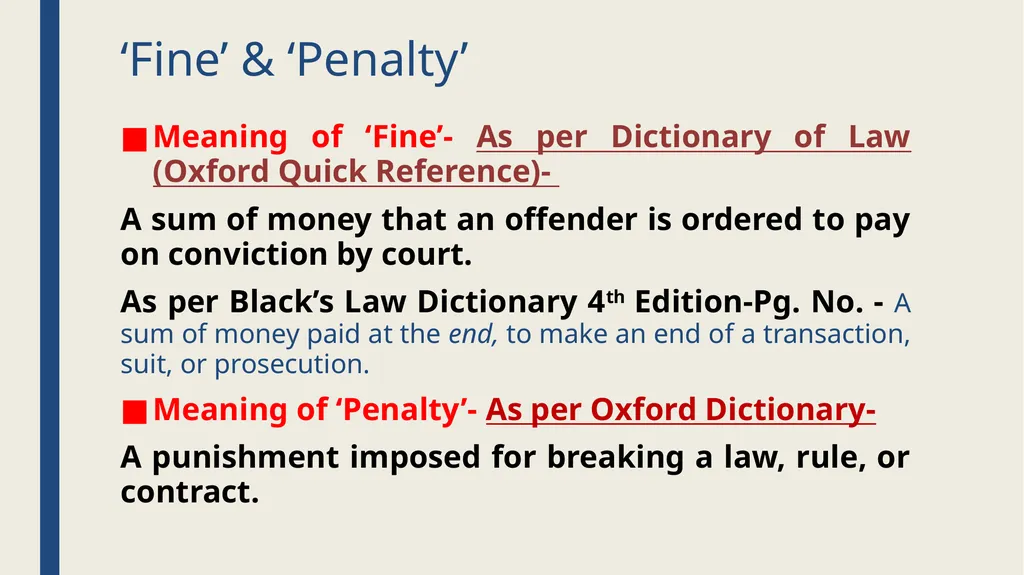
‘Fine’ & ‘Penalty’ Meaning of ‘Fine’- As per Dictionary of Law (Oxford Quick Reference)-
A sum of money that an offender is ordered to pay on conviction by court.
As per Black’s Law Dictionary 4th Edition-Pg. No. - A sum of money paid at the end, to make an end of a transaction, suit, or prosecution.
Meaning of ‘Penalty’- As per Oxford Dictionary-
A punishment imposed for breaking a law, rule, or contract.<br>
A sum of money that an offender is ordered to pay on conviction by court.
As per Black’s Law Dictionary 4th Edition-Pg. No. - A sum of money paid at the end, to make an end of a transaction, suit, or prosecution.
Meaning of ‘Penalty’- As per Oxford Dictionary-
A punishment imposed for breaking a law, rule, or contract.<br>
06
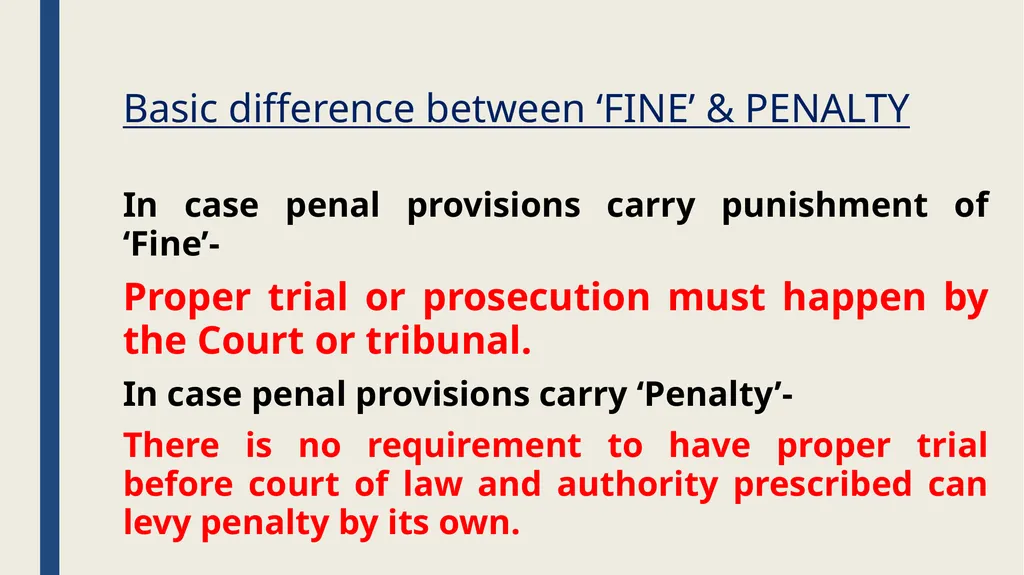
Basic difference between ‘FINE’ & PENALTY In case penal provisions carry punishment of ‘Fine’-
Proper trial or prosecution must happen by the Court or tribunal.
In case penal provisions carry ‘Penalty’-
There is no requirement to have proper trial before court of law and authority prescribed can levy penalty by its own.<br>
Proper trial or prosecution must happen by the Court or tribunal.
In case penal provisions carry ‘Penalty’-
There is no requirement to have proper trial before court of law and authority prescribed can levy penalty by its own.<br>
07
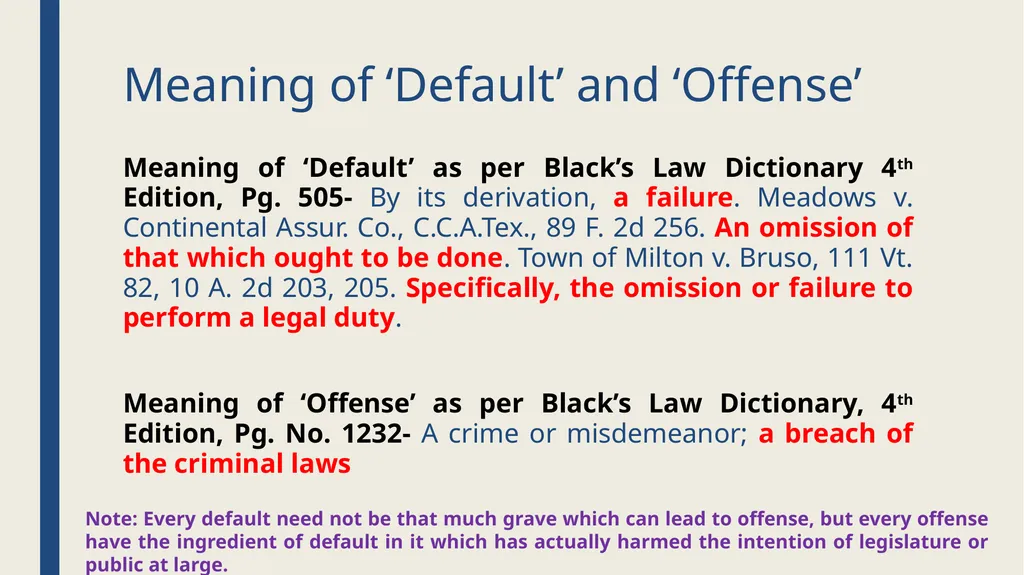
Meaning of ‘Default’ and ‘Offense’ Meaning of ‘Default’ as per Black’s Law Dictionary 4th Edition, Pg. 505- By its derivation, a failure. Meadows v. Continental Assur. Co., C.C.A.Tex., 89 F. 2d 256. An omission of that which ought to be done. Town of Milton v. Bruso, 111 Vt. 82, 10 A. 2d 203, 205. Specifically, the omission or failure to perform a legal duty.
Meaning of ‘Offense’ as per Black’s Law Dictionary, 4th Edition, Pg. No. 1232- A crime or misdemeanor; a breach of the criminal laws Note: Every default need not be that much grave which can lead to offense, but every offense have the ingredient of default in it which has actually harmed the intention of legislature or public at large.<br>
Meaning of ‘Offense’ as per Black’s Law Dictionary, 4th Edition, Pg. No. 1232- A crime or misdemeanor; a breach of the criminal laws Note: Every default need not be that much grave which can lead to offense, but every offense have the ingredient of default in it which has actually harmed the intention of legislature or public at large.<br>
08
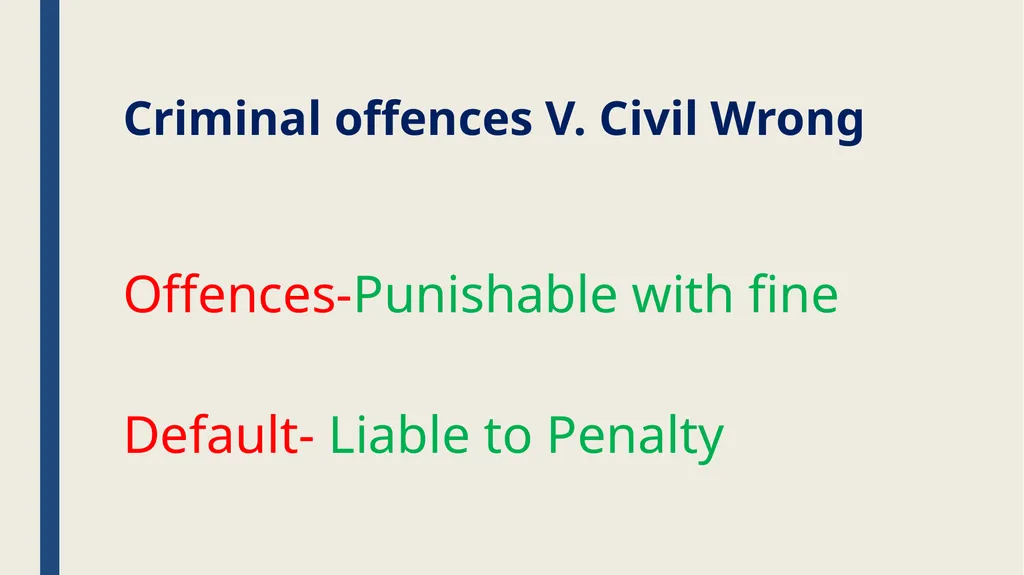
Criminal offences V. Civil Wrong Offences-Punishable with fine
Default- Liable to Penalty<br>
Default- Liable to Penalty<br>
09
COMPOUNDING OF OFFENCES<br>
10
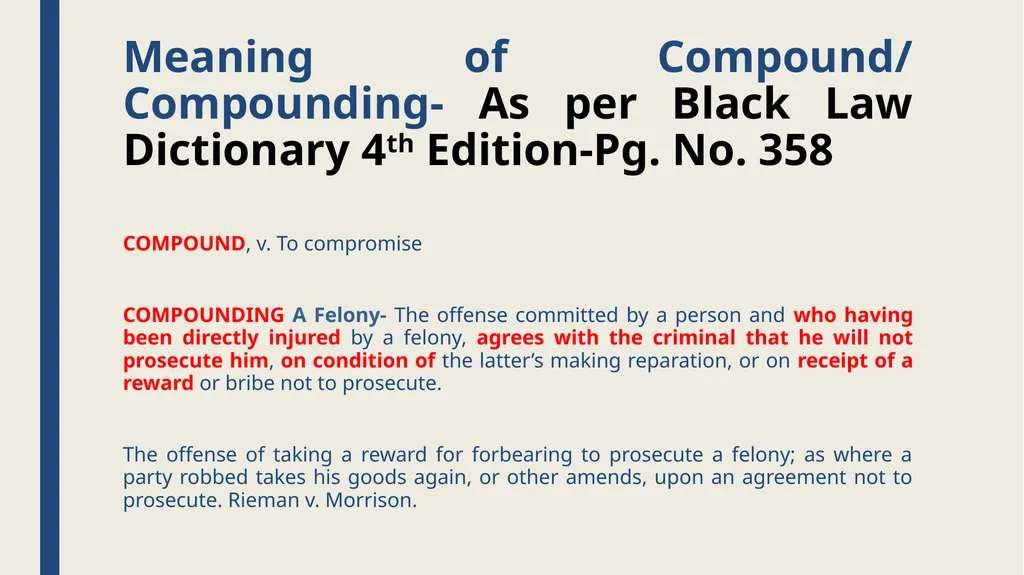
Meaning of Compound/ Compounding- As per Black Law Dictionary 4th Edition-Pg. No. 358 COMPOUND, v. To compromise
COMPOUNDING A Felony- The offense committed by a person and who having been directly injured by a felony, agrees with the criminal that he will not prosecute him, on condition of the latter’s making reparation, or on receipt of a reward or bribe not to prosecute.
The offense of taking a reward for forbearing to prosecute a felony; as where a party robbed takes his goods again, or other amends, upon an agreement not to prosecute. Rieman v. Morrison.<br>
COMPOUNDING A Felony- The offense committed by a person and who having been directly injured by a felony, agrees with the criminal that he will not prosecute him, on condition of the latter’s making reparation, or on receipt of a reward or bribe not to prosecute.
The offense of taking a reward for forbearing to prosecute a felony; as where a party robbed takes his goods again, or other amends, upon an agreement not to prosecute. Rieman v. Morrison.<br>
11
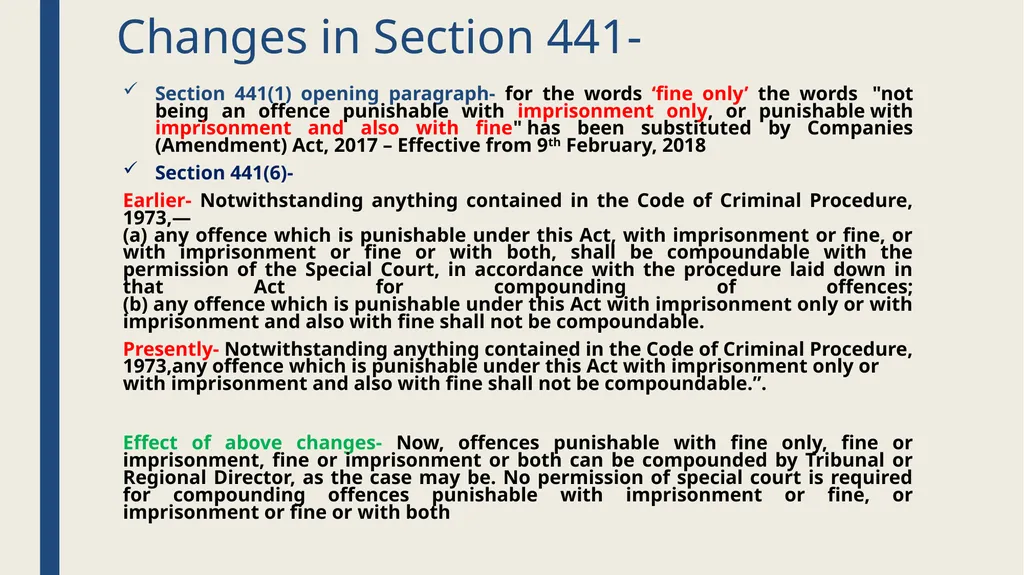
Changes in Section 441- Section 441(1) opening paragraph- for the words ‘fine only’ the words "not being an offence punishable with imprisonment only, or punishable with imprisonment and also with fine" has been substituted by Companies (Amendment) Act, 2017 – Effective from 9th February, 2018
Section 441(6)-
Earlier- Notwithstanding anything contained in the Code of Criminal Procedure, 1973,— (a) any offence which is punishable under this Act, with imprisonment or fine, or with imprisonment or fine or with both, shall be compoundable with the permission of the Special Court, in accordance with the procedure laid down in that Act for compounding of offences; (b) any offence which is punishable under this Act with imprisonment only or with imprisonment and also with fine shall not be compoundable.
Presently- Notwithstanding anything contained in the Code of Criminal Procedure, 1973,any offence which is punishable under this Act with imprisonment only or with imprisonment and also with fine shall not be compoundable.”.
Effect of above changes- Now, offences punishable with fine only, fine or imprisonment, fine or imprisonment or both can be compounded by Tribunal or Regional Director, as the case may be. No permission of special court is required for compounding offences punishable with imprisonment or fine, or imprisonment or fine or with both<br>
Section 441(6)-
Earlier- Notwithstanding anything contained in the Code of Criminal Procedure, 1973,— (a) any offence which is punishable under this Act, with imprisonment or fine, or with imprisonment or fine or with both, shall be compoundable with the permission of the Special Court, in accordance with the procedure laid down in that Act for compounding of offences; (b) any offence which is punishable under this Act with imprisonment only or with imprisonment and also with fine shall not be compoundable.
Presently- Notwithstanding anything contained in the Code of Criminal Procedure, 1973,any offence which is punishable under this Act with imprisonment only or with imprisonment and also with fine shall not be compoundable.”.
Effect of above changes- Now, offences punishable with fine only, fine or imprisonment, fine or imprisonment or both can be compounded by Tribunal or Regional Director, as the case may be. No permission of special court is required for compounding offences punishable with imprisonment or fine, or imprisonment or fine or with both<br>
12
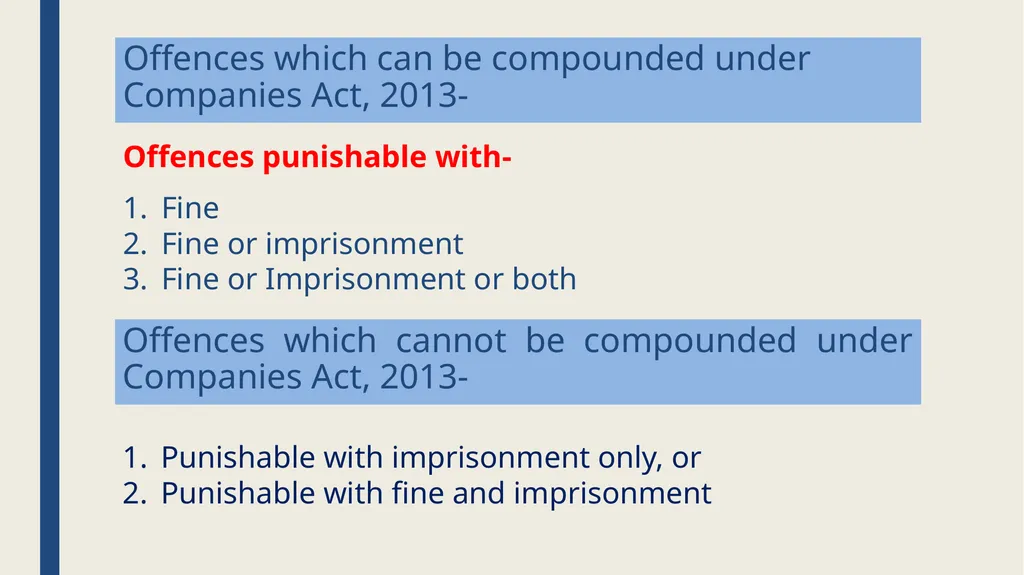
Offences which can be compounded under Companies Act, 2013- Offences punishable with-
Fine
Fine or imprisonment
Fine or Imprisonment or both Offences which cannot be compounded under Companies Act, 2013- Punishable with imprisonment only, or
Punishable with fine and imprisonment<br>
Fine
Fine or imprisonment
Fine or Imprisonment or both Offences which cannot be compounded under Companies Act, 2013- Punishable with imprisonment only, or
Punishable with fine and imprisonment<br>
13
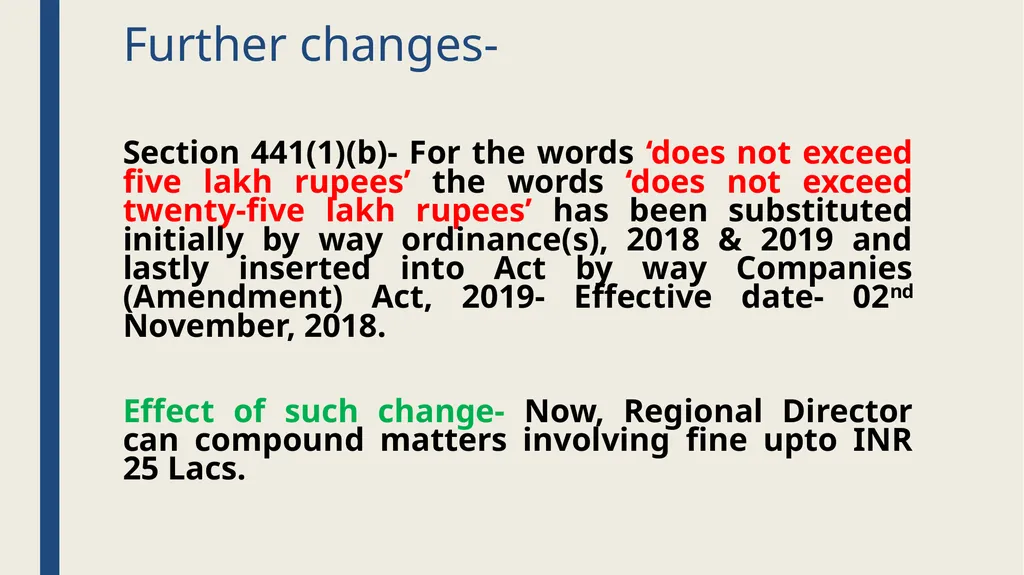
Further changes- Section 441(1)(b)- For the words ‘does not exceed five lakh rupees’ the words ‘does not exceed twenty-five lakh rupees’ has been substituted initially by way ordinance(s), 2018 & 2019 and lastly inserted into Act by way Companies (Amendment) Act, 2019- Effective date- 02nd November, 2018.
Effect of such change- Now, Regional Director can compound matters involving fine upto INR 25 Lacs.<br>
Effect of such change- Now, Regional Director can compound matters involving fine upto INR 25 Lacs.<br>
14
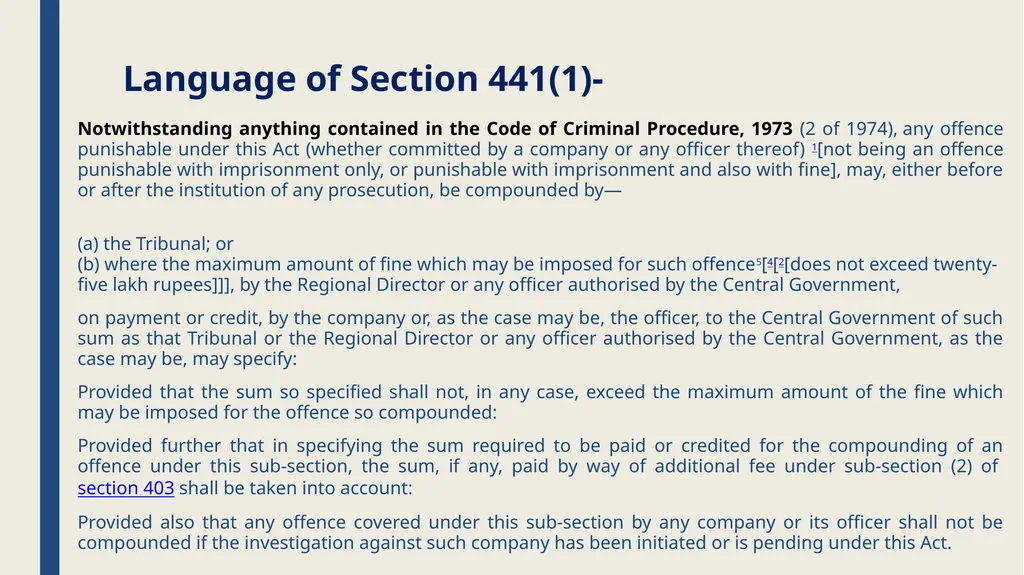
Language of Section 441(1)- Notwithstanding anything contained in the Code of Criminal Procedure, 1973 (2 of 1974), any offence punishable under this Act (whether committed by a company or any officer thereof) 1[not being an offence punishable with imprisonment only, or punishable with imprisonment and also with fine], may, either before or after the institution of any prosecution, be compounded by—
(a) the Tribunal; or (b) where the maximum amount of fine which may be imposed for such offence5[4[2[does not exceed twenty-five lakh rupees]]], by the Regional Director or any officer authorised by the Central Government,
on payment or credit, by the company or, as the case may be, the officer, to the Central Government of such sum as that Tribunal or the Regional Director or any officer authorised by the Central Government, as the case may be, may specify:
Provided that the sum so specified shall not, in any case, exceed the maximum amount of the fine which may be imposed for the offence so compounded:
Provided further that in specifying the sum required to be paid or credited for the compounding of an offence under this sub-section, the sum, if any, paid by way of additional fee under sub-section (2) of section 403 shall be taken into account:
Provided also that any offence covered under this sub-section by any company or its officer shall not be compounded if the investigation against such company has been initiated or is pending under this Act.<br>
(a) the Tribunal; or (b) where the maximum amount of fine which may be imposed for such offence5[4[2[does not exceed twenty-five lakh rupees]]], by the Regional Director or any officer authorised by the Central Government,
on payment or credit, by the company or, as the case may be, the officer, to the Central Government of such sum as that Tribunal or the Regional Director or any officer authorised by the Central Government, as the case may be, may specify:
Provided that the sum so specified shall not, in any case, exceed the maximum amount of the fine which may be imposed for the offence so compounded:
Provided further that in specifying the sum required to be paid or credited for the compounding of an offence under this sub-section, the sum, if any, paid by way of additional fee under sub-section (2) of section 403 shall be taken into account:
Provided also that any offence covered under this sub-section by any company or its officer shall not be compounded if the investigation against such company has been initiated or is pending under this Act.<br>
15
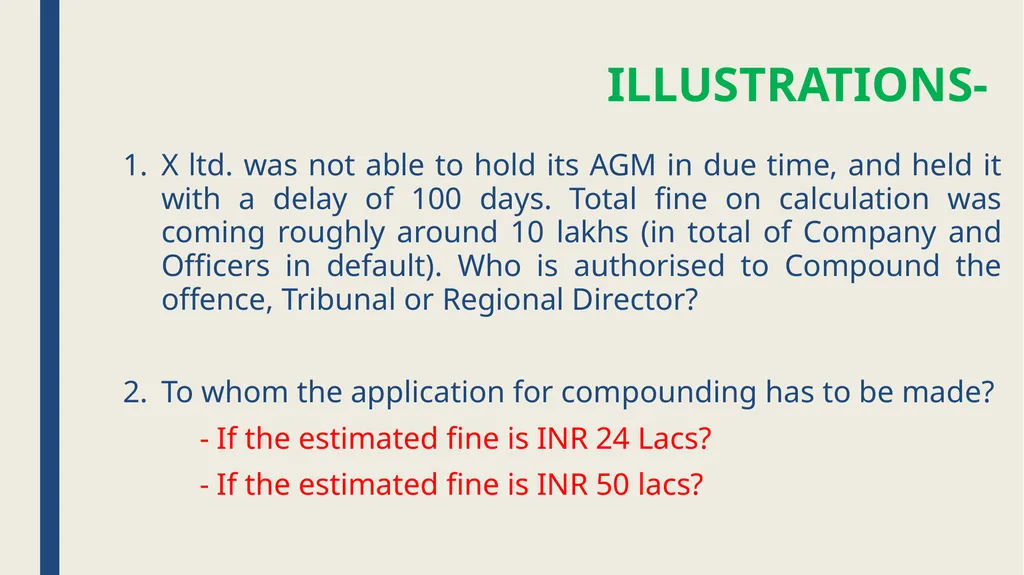
ILLUSTRATIONS- X ltd. was not able to hold its AGM in due time, and held it with a delay of 100 days. Total fine on calculation was coming roughly around 10 lakhs (in total of Company and Officers in default). Who is authorised to Compound the offence, Tribunal or Regional Director?
To whom the application for compounding has to be made?
- If the estimated fine is INR 24 Lacs?
- If the estimated fine is INR 50 lacs?<br>
To whom the application for compounding has to be made?
- If the estimated fine is INR 24 Lacs?
- If the estimated fine is INR 50 lacs?<br>
16
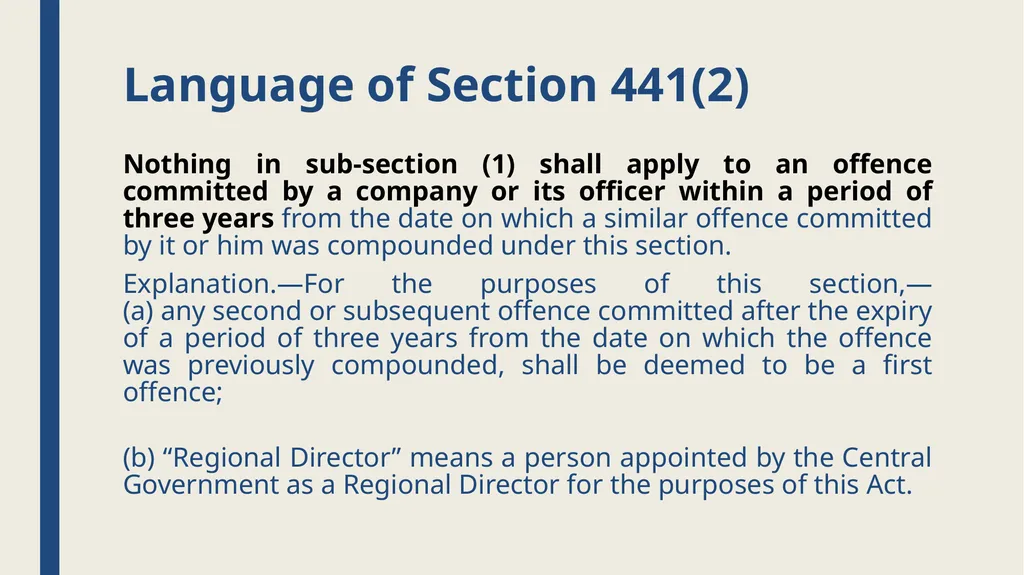
Language of Section 441(2) Nothing in sub-section (1) shall apply to an offence committed by a company or its officer within a period of three years from the date on which a similar offence committed by it or him was compounded under this section.
Explanation.—For the purposes of this section,— (a) any second or subsequent offence committed after the expiry of a period of three years from the date on which the offence was previously compounded, shall be deemed to be a first offence;
(b) “Regional Director” means a person appointed by the Central Government as a Regional Director for the purposes of this Act.<br>
Explanation.—For the purposes of this section,— (a) any second or subsequent offence committed after the expiry of a period of three years from the date on which the offence was previously compounded, shall be deemed to be a first offence;
(b) “Regional Director” means a person appointed by the Central Government as a Regional Director for the purposes of this Act.<br>
17
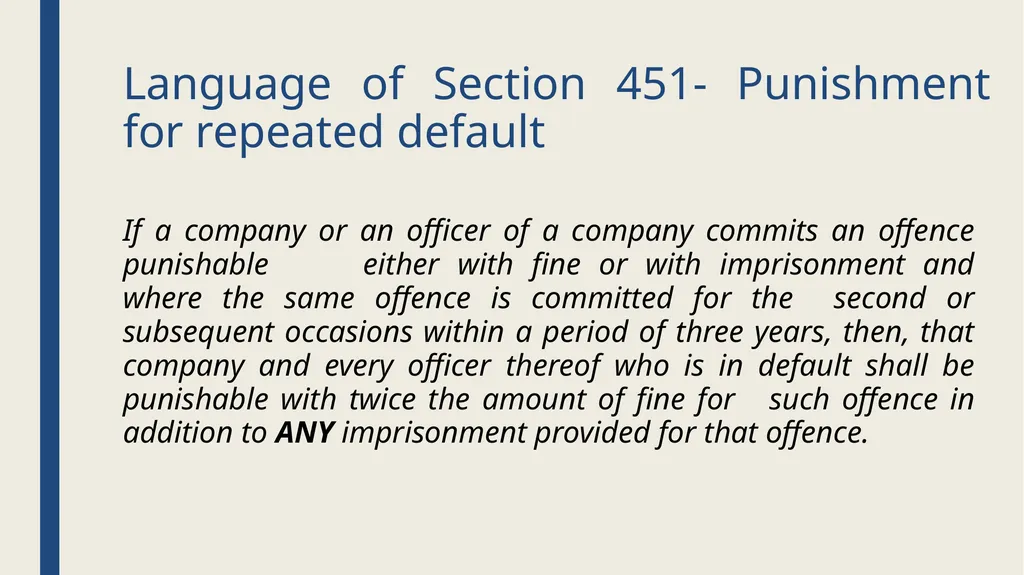
Language of Section 451- Punishment for repeated default If a company or an officer of a company commits an offence punishable either with fine or with imprisonment and where the same offence is committed for the second or subsequent occasions within a period of three years, then, that company and every officer thereof who is in default shall be punishable with twice the amount of fine for such offence in addition to ANY imprisonment provided for that offence.<br>
18
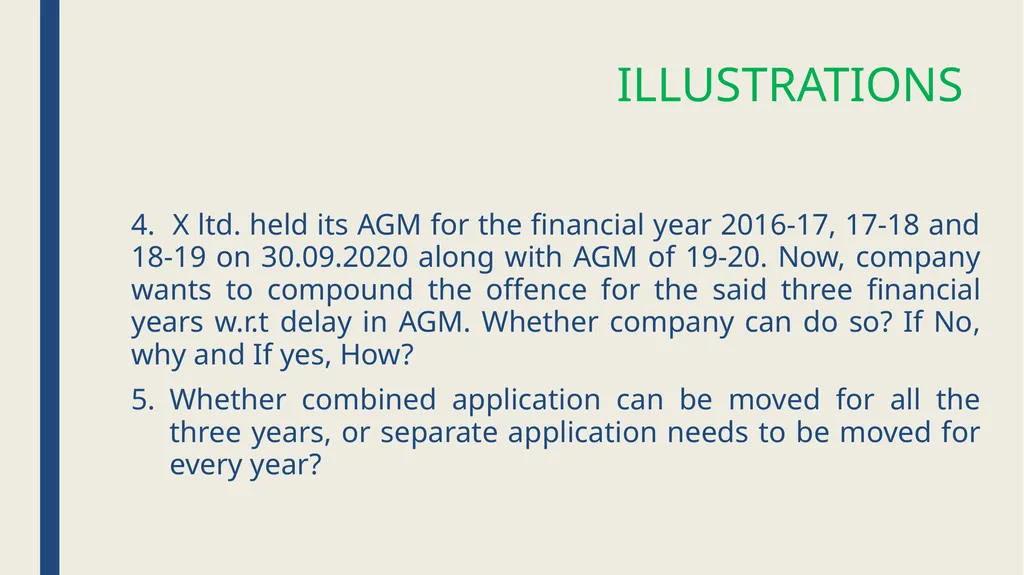
ILLUSTRATIONS 4. X ltd. held its AGM for the financial year 2016-17, 17-18 and 18-19 on 30.09.2020 along with AGM of 19-20. Now, company wants to compound the offence for the said three financial years w.r.t delay in AGM. Whether company can do so? If No, why and If yes, How?
Whether combined application can be moved for all the three years, or separate application needs to be moved for every year?<br>
Whether combined application can be moved for all the three years, or separate application needs to be moved for every year?<br>
19
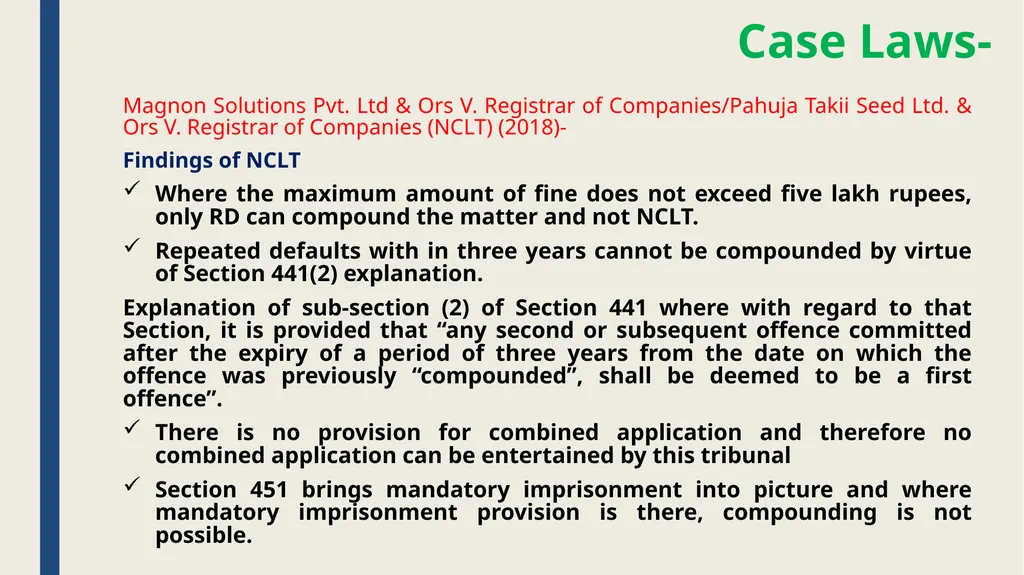
Case Laws- Magnon Solutions Pvt. Ltd & Ors V. Registrar of Companies/Pahuja Takii Seed Ltd. & Ors V. Registrar of Companies (NCLT) (2018)-
Findings of NCLT
Where the maximum amount of fine does not exceed five lakh rupees, only RD can compound the matter and not NCLT.
Repeated defaults with in three years cannot be compounded by virtue of Section 441(2) explanation.
Explanation of sub-section (2) of Section 441 where with regard to that Section, it is provided that “any second or subsequent offence committed after the expiry of a period of three years from the date on which the offence was previously “compounded”, shall be deemed to be a first offence”.
There is no provision for combined application and therefore no combined application can be entertained by this tribunal
Section 451 brings mandatory imprisonment into picture and where mandatory imprisonment provision is there, compounding is not possible.<br>
Findings of NCLT
Where the maximum amount of fine does not exceed five lakh rupees, only RD can compound the matter and not NCLT.
Repeated defaults with in three years cannot be compounded by virtue of Section 441(2) explanation.
Explanation of sub-section (2) of Section 441 where with regard to that Section, it is provided that “any second or subsequent offence committed after the expiry of a period of three years from the date on which the offence was previously “compounded”, shall be deemed to be a first offence”.
There is no provision for combined application and therefore no combined application can be entertained by this tribunal
Section 451 brings mandatory imprisonment into picture and where mandatory imprisonment provision is there, compounding is not possible.<br>
20
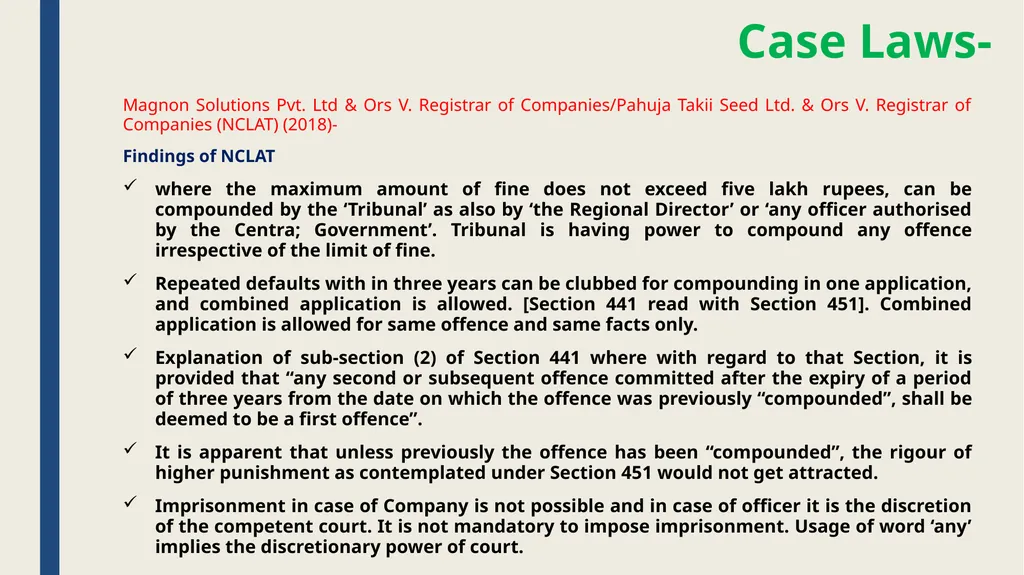
Case Laws- Magnon Solutions Pvt. Ltd & Ors V. Registrar of Companies/Pahuja Takii Seed Ltd. & Ors V. Registrar of Companies (NCLAT) (2018)-
Findings of NCLAT
where the maximum amount of fine does not exceed five lakh rupees, can be compounded by the ‘Tribunal’ as also by ‘the Regional Director’ or ‘any officer authorised by the Centra; Government’. Tribunal is having power to compound any offence irrespective of the limit of fine.
Repeated defaults with in three years can be clubbed for compounding in one application, and combined application is allowed. [Section 441 read with Section 451]. Combined application is allowed for same offence and same facts only.
Explanation of sub-section (2) of Section 441 where with regard to that Section, it is provided that “any second or subsequent offence committed after the expiry of a period of three years from the date on which the offence was previously “compounded”, shall be deemed to be a first offence”.
It is apparent that unless previously the offence has been “compounded”, the rigour of higher punishment as contemplated under Section 451 would not get attracted.
Imprisonment in case of Company is not possible and in case of officer it is the discretion of the competent court. It is not mandatory to impose imprisonment. Usage of word ‘any’ implies the discretionary power of court.<br>
Findings of NCLAT
where the maximum amount of fine does not exceed five lakh rupees, can be compounded by the ‘Tribunal’ as also by ‘the Regional Director’ or ‘any officer authorised by the Centra; Government’. Tribunal is having power to compound any offence irrespective of the limit of fine.
Repeated defaults with in three years can be clubbed for compounding in one application, and combined application is allowed. [Section 441 read with Section 451]. Combined application is allowed for same offence and same facts only.
Explanation of sub-section (2) of Section 441 where with regard to that Section, it is provided that “any second or subsequent offence committed after the expiry of a period of three years from the date on which the offence was previously “compounded”, shall be deemed to be a first offence”.
It is apparent that unless previously the offence has been “compounded”, the rigour of higher punishment as contemplated under Section 451 would not get attracted.
Imprisonment in case of Company is not possible and in case of officer it is the discretion of the competent court. It is not mandatory to impose imprisonment. Usage of word ‘any’ implies the discretionary power of court.<br>
21
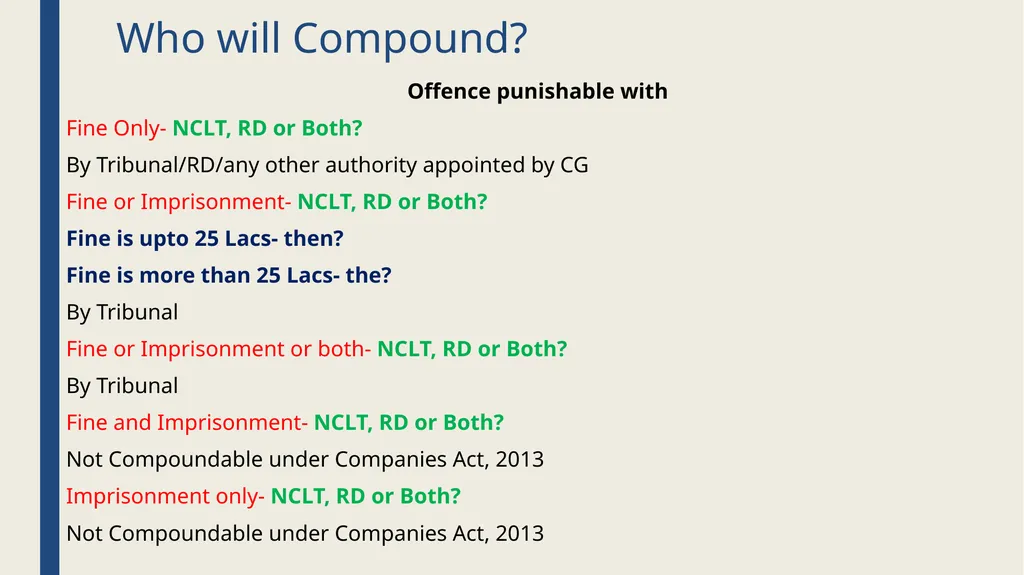
Who will Compound? Offence punishable with
Fine Only- NCLT, RD or Both?
By Tribunal/RD/any other authority appointed by CG
Fine or Imprisonment- NCLT, RD or Both?
Fine is upto 25 Lacs- then?
Fine is more than 25 Lacs- the?
By Tribunal
Fine or Imprisonment or both- NCLT, RD or Both?
By Tribunal
Fine and Imprisonment- NCLT, RD or Both?
Not Compoundable under Companies Act, 2013
Imprisonment only- NCLT, RD or Both?
Not Compoundable under Companies Act, 2013<br>
Fine Only- NCLT, RD or Both?
By Tribunal/RD/any other authority appointed by CG
Fine or Imprisonment- NCLT, RD or Both?
Fine is upto 25 Lacs- then?
Fine is more than 25 Lacs- the?
By Tribunal
Fine or Imprisonment or both- NCLT, RD or Both?
By Tribunal
Fine and Imprisonment- NCLT, RD or Both?
Not Compoundable under Companies Act, 2013
Imprisonment only- NCLT, RD or Both?
Not Compoundable under Companies Act, 2013<br>
22
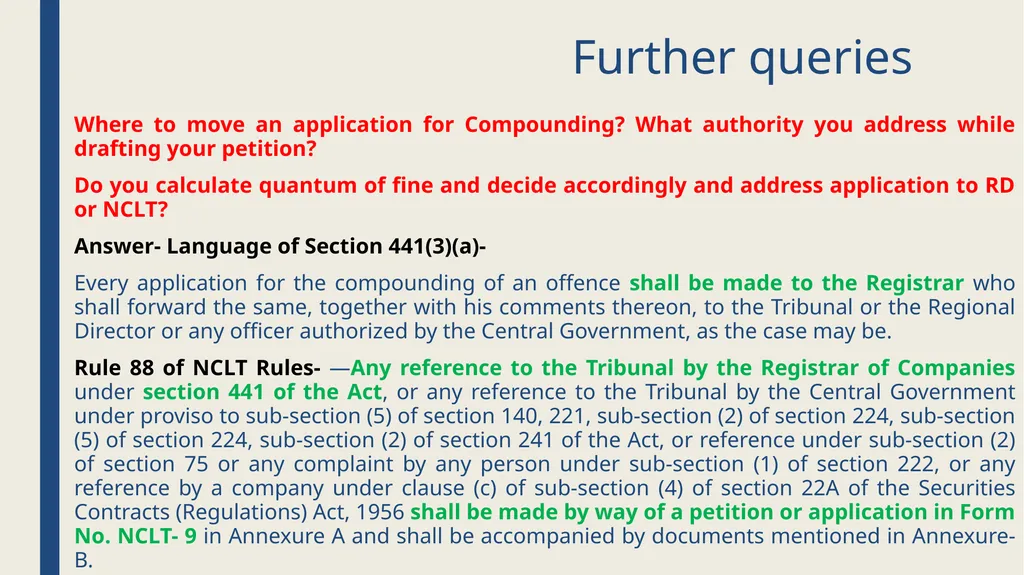
Further queries Where to move an application for Compounding? What authority you address while drafting your petition?
Do you calculate quantum of fine and decide accordingly and address application to RD or NCLT?
Answer- Language of Section 441(3)(a)-
Every application for the compounding of an offence shall be made to the Registrar who shall forward the same, together with his comments thereon, to the Tribunal or the Regional Director or any officer authorized by the Central Government, as the case may be.
Rule 88 of NCLT Rules- —Any reference to the Tribunal by the Registrar of Companies under section 441 of the Act, or any reference to the Tribunal by the Central Government under proviso to sub-section (5) of section 140, 221, sub-section (2) of section 224, sub-section (5) of section 224, sub-section (2) of section 241 of the Act, or reference under sub-section (2) of section 75 or any complaint by any person under sub-section (1) of section 222, or any reference by a company under clause (c) of sub-section (4) of section 22A of the Securities Contracts (Regulations) Act, 1956 shall be made by way of a petition or application in Form No. NCLT- 9 in Annexure A and shall be accompanied by documents mentioned in Annexure-B.<br>
Do you calculate quantum of fine and decide accordingly and address application to RD or NCLT?
Answer- Language of Section 441(3)(a)-
Every application for the compounding of an offence shall be made to the Registrar who shall forward the same, together with his comments thereon, to the Tribunal or the Regional Director or any officer authorized by the Central Government, as the case may be.
Rule 88 of NCLT Rules- —Any reference to the Tribunal by the Registrar of Companies under section 441 of the Act, or any reference to the Tribunal by the Central Government under proviso to sub-section (5) of section 140, 221, sub-section (2) of section 224, sub-section (5) of section 224, sub-section (2) of section 241 of the Act, or reference under sub-section (2) of section 75 or any complaint by any person under sub-section (1) of section 222, or any reference by a company under clause (c) of sub-section (4) of section 22A of the Securities Contracts (Regulations) Act, 1956 shall be made by way of a petition or application in Form No. NCLT- 9 in Annexure A and shall be accompanied by documents mentioned in Annexure-B.<br>
23
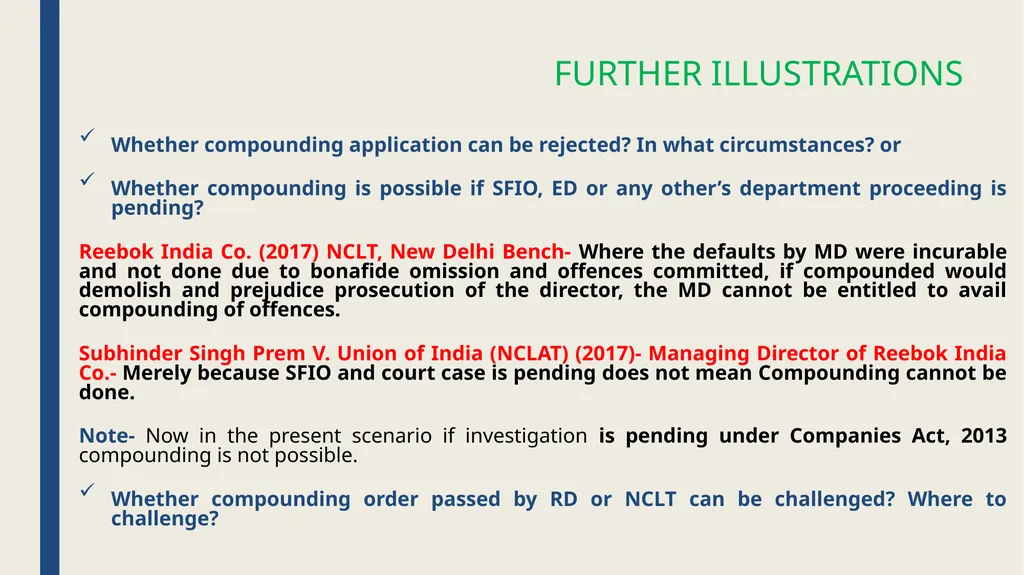
FURTHER ILLUSTRATIONS Whether compounding application can be rejected? In what circumstances? or
Whether compounding is possible if SFIO, ED or any other’s department proceeding is pending?
Reebok India Co. (2017) NCLT, New Delhi Bench- Where the defaults by MD were incurable and not done due to bonafide omission and offences committed, if compounded would demolish and prejudice prosecution of the director, the MD cannot be entitled to avail compounding of offences.
Subhinder Singh Prem V. Union of India (NCLAT) (2017)- Managing Director of Reebok India Co.- Merely because SFIO and court case is pending does not mean Compounding cannot be done.
Note- Now in the present scenario if investigation is pending under Companies Act, 2013 compounding is not possible.
Whether compounding order passed by RD or NCLT can be challenged? Where to challenge?<br>
Whether compounding is possible if SFIO, ED or any other’s department proceeding is pending?
Reebok India Co. (2017) NCLT, New Delhi Bench- Where the defaults by MD were incurable and not done due to bonafide omission and offences committed, if compounded would demolish and prejudice prosecution of the director, the MD cannot be entitled to avail compounding of offences.
Subhinder Singh Prem V. Union of India (NCLAT) (2017)- Managing Director of Reebok India Co.- Merely because SFIO and court case is pending does not mean Compounding cannot be done.
Note- Now in the present scenario if investigation is pending under Companies Act, 2013 compounding is not possible.
Whether compounding order passed by RD or NCLT can be challenged? Where to challenge?<br>
24
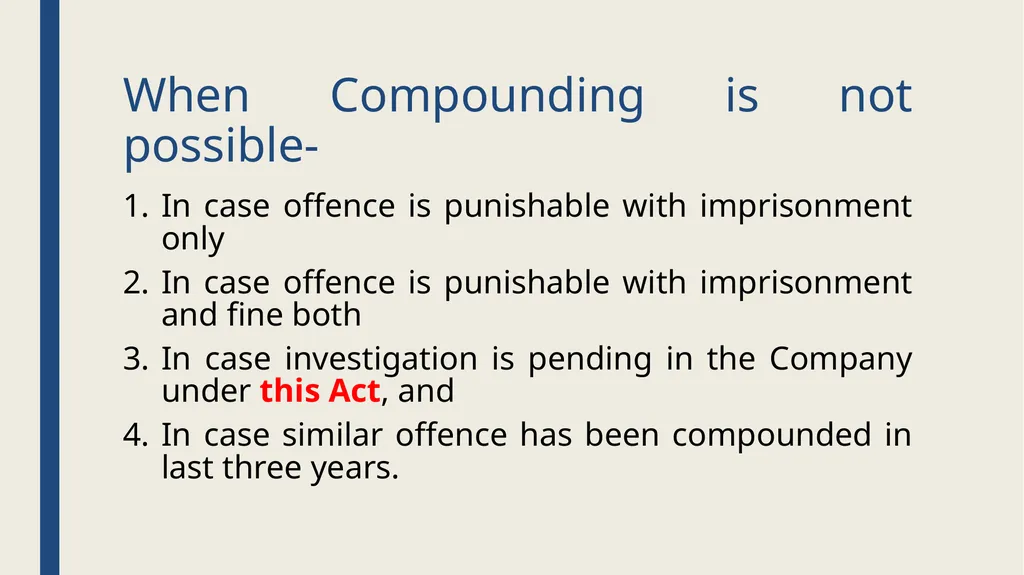
When Compounding is not possible- In case offence is punishable with imprisonment only
In case offence is punishable with imprisonment and fine both
In case investigation is pending in the Company under this Act, and
In case similar offence has been compounded in last three years.<br>
In case offence is punishable with imprisonment and fine both
In case investigation is pending in the Company under this Act, and
In case similar offence has been compounded in last three years.<br>
25
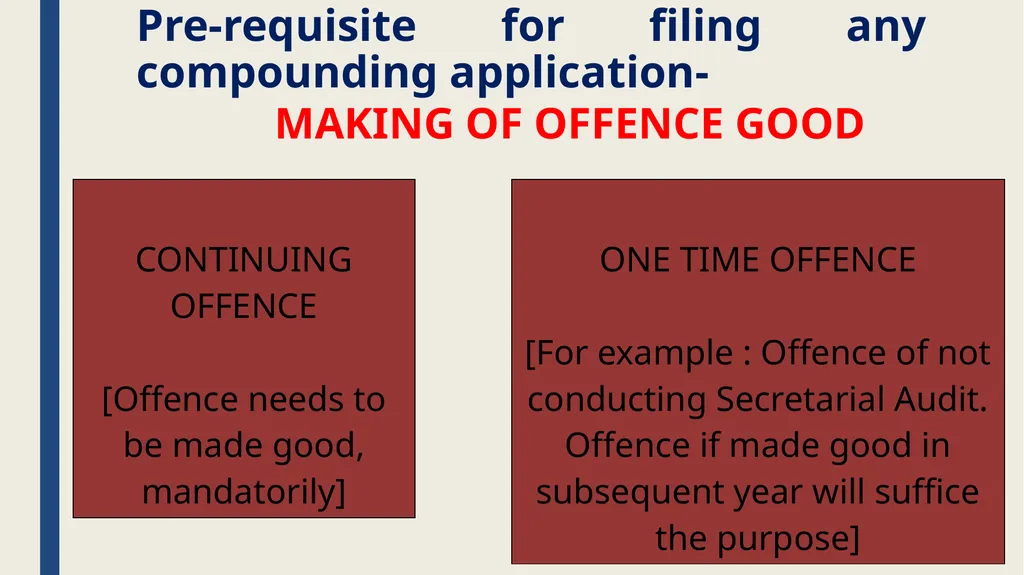
Pre-requisite for filing any compounding application- MAKING OF OFFENCE GOOD<br>
26
CONDONATION OF DELAY<br>
27
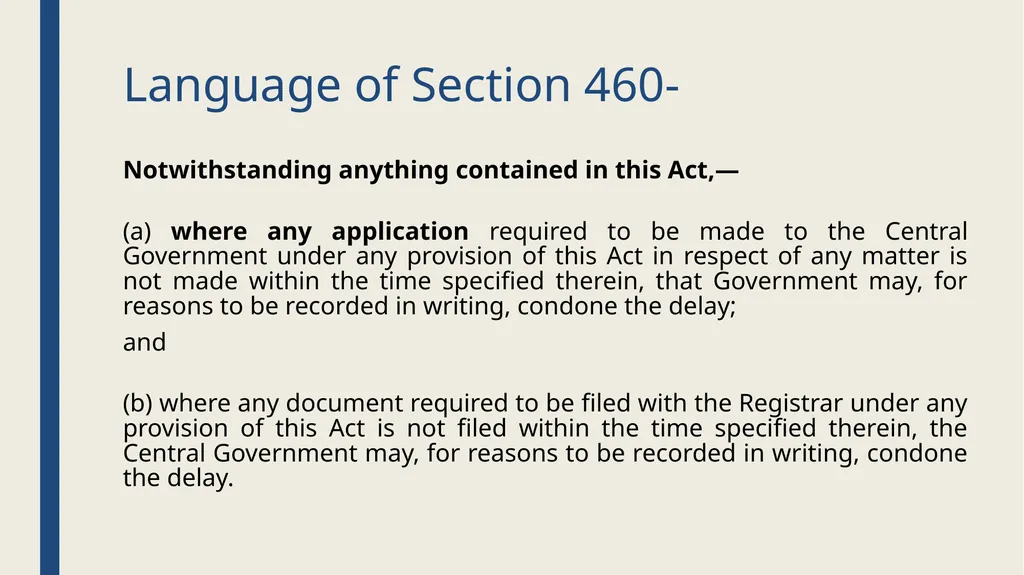
Language of Section 460- Notwithstanding anything contained in this Act,—
(a) where any application required to be made to the Central Government under any provision of this Act in respect of any matter is not made within the time specified therein, that Government may, for reasons to be recorded in writing, condone the delay;
and
(b) where any document required to be filed with the Registrar under any provision of this Act is not filed within the time specified therein, the Central Government may, for reasons to be recorded in writing, condone the delay.<br>
(a) where any application required to be made to the Central Government under any provision of this Act in respect of any matter is not made within the time specified therein, that Government may, for reasons to be recorded in writing, condone the delay;
and
(b) where any document required to be filed with the Registrar under any provision of this Act is not filed within the time specified therein, the Central Government may, for reasons to be recorded in writing, condone the delay.<br>
28
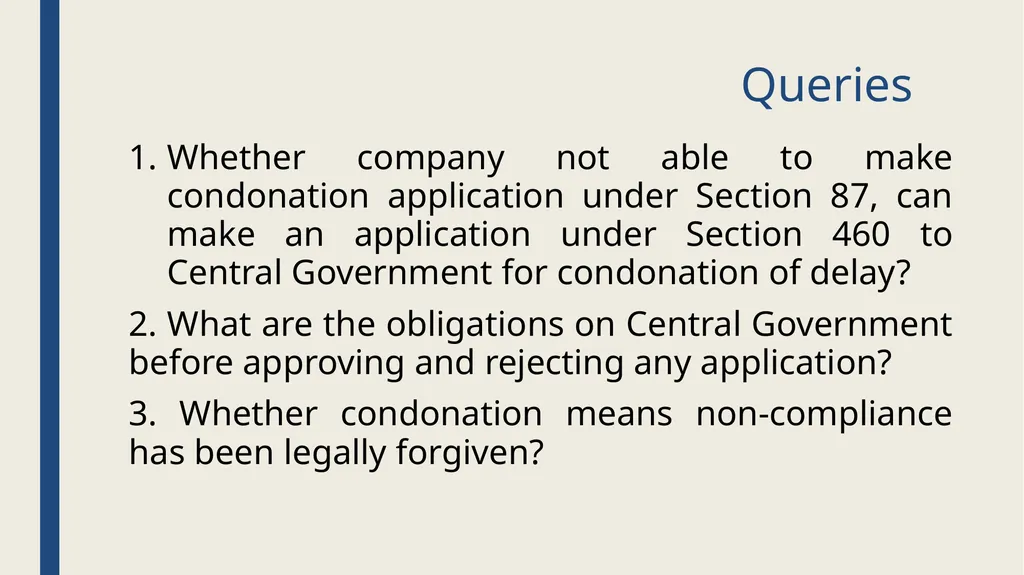
Queries Whether company not able to make condonation application under Section 87, can make an application under Section 460 to Central Government for condonation of delay?
2. What are the obligations on Central Government before approving and rejecting any application?
3. Whether condonation means non-compliance has been legally forgiven?<br>
2. What are the obligations on Central Government before approving and rejecting any application?
3. Whether condonation means non-compliance has been legally forgiven?<br>
29
ADJUDICATION OF PENALTIES<br>
30
Meaning of Adjudication Adjudication is the process by which the Authority imposes the penalty on the non-compliance after examining your data and information filed with them and giving you reasonable opportunity of being heard.<br>
31
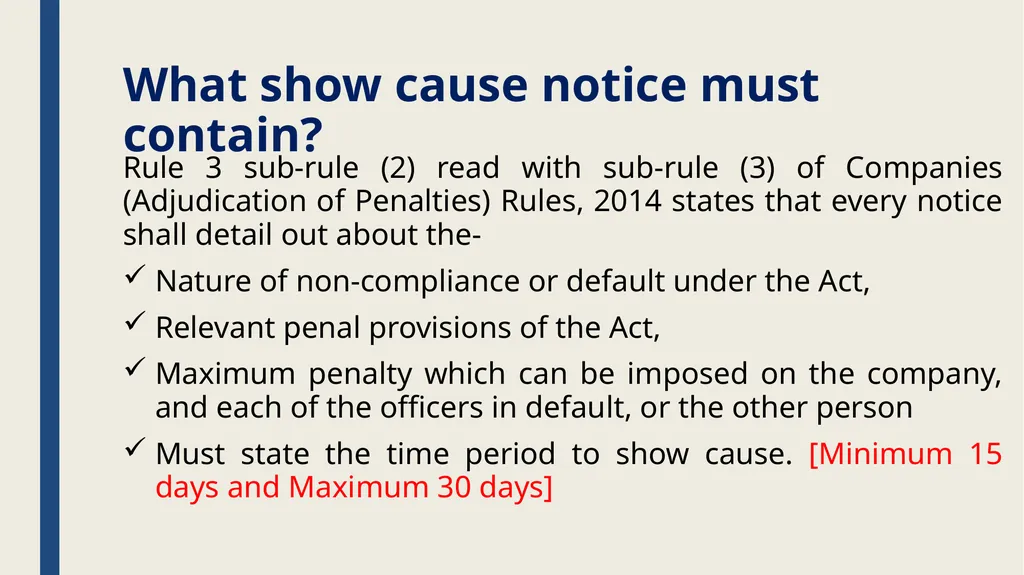
What show cause notice must contain? Rule 3 sub-rule (2) read with sub-rule (3) of Companies (Adjudication of Penalties) Rules, 2014 states that every notice shall detail out about the-
Nature of non-compliance or default under the Act,
Relevant penal provisions of the Act,
Maximum penalty which can be imposed on the company, and each of the officers in default, or the other person
Must state the time period to show cause. [Minimum 15 days and Maximum 30 days]<br>
Nature of non-compliance or default under the Act,
Relevant penal provisions of the Act,
Maximum penalty which can be imposed on the company, and each of the officers in default, or the other person
Must state the time period to show cause. [Minimum 15 days and Maximum 30 days]<br>
32
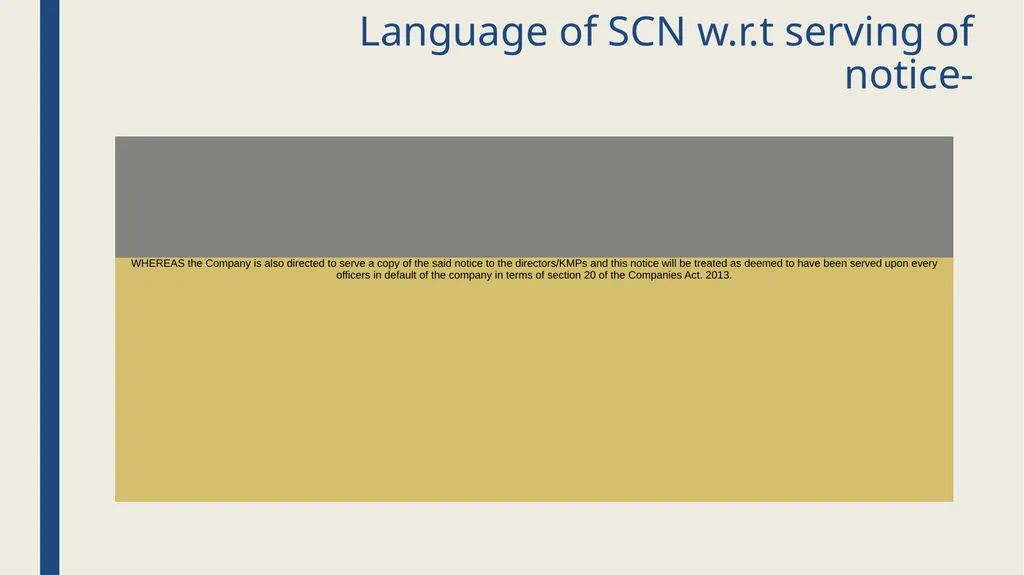
Language of SCN w.r.t serving of notice-<br>
33
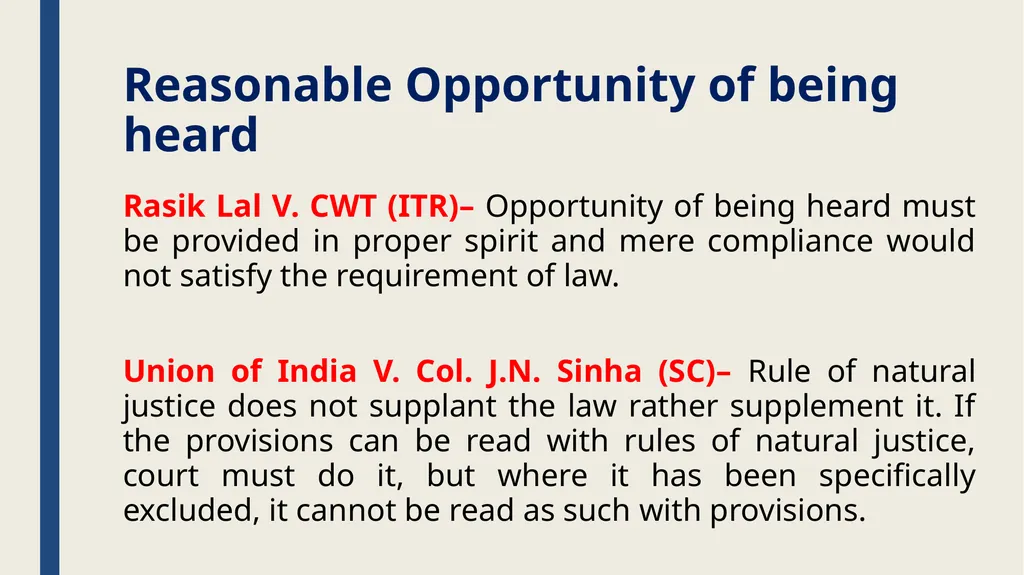
Reasonable Opportunity of being heard Rasik Lal V. CWT (ITR)– Opportunity of being heard must be provided in proper spirit and mere compliance would not satisfy the requirement of law.
Union of India V. Col. J.N. Sinha (SC)– Rule of natural justice does not supplant the law rather supplement it. If the provisions can be read with rules of natural justice, court must do it, but where it has been specifically excluded, it cannot be read as such with provisions.<br>
Union of India V. Col. J.N. Sinha (SC)– Rule of natural justice does not supplant the law rather supplement it. If the provisions can be read with rules of natural justice, court must do it, but where it has been specifically excluded, it cannot be read as such with provisions.<br>
34
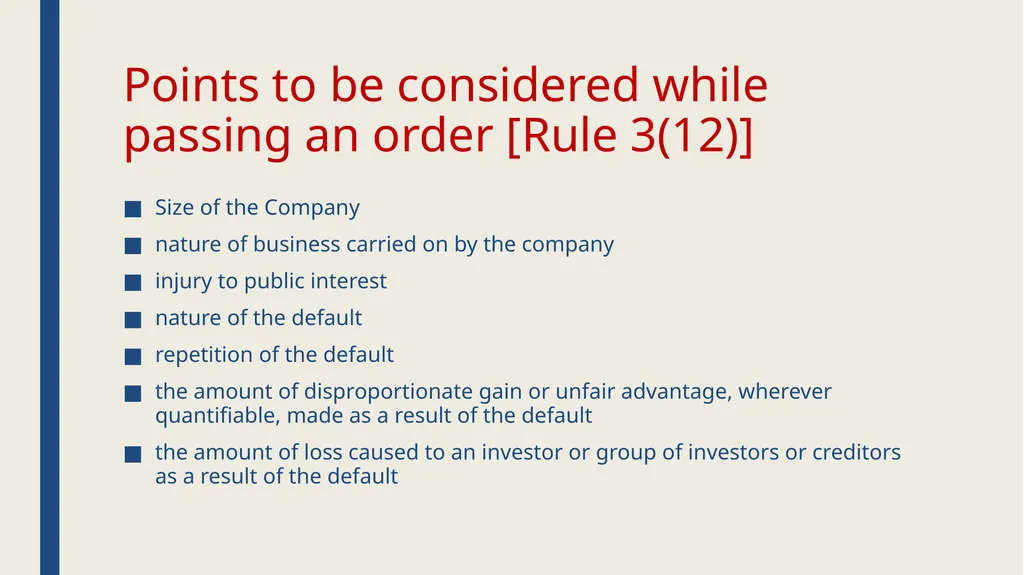
Points to be considered while passing an order [Rule 3(12)] Size of the Company
nature of business carried on by the company
injury to public interest
nature of the default
repetition of the default
the amount of disproportionate gain or unfair advantage, wherever quantifiable, made as a result of the default
the amount of loss caused to an investor or group of investors or creditors as a result of the default<br>
nature of business carried on by the company
injury to public interest
nature of the default
repetition of the default
the amount of disproportionate gain or unfair advantage, wherever quantifiable, made as a result of the default
the amount of loss caused to an investor or group of investors or creditors as a result of the default<br>
35
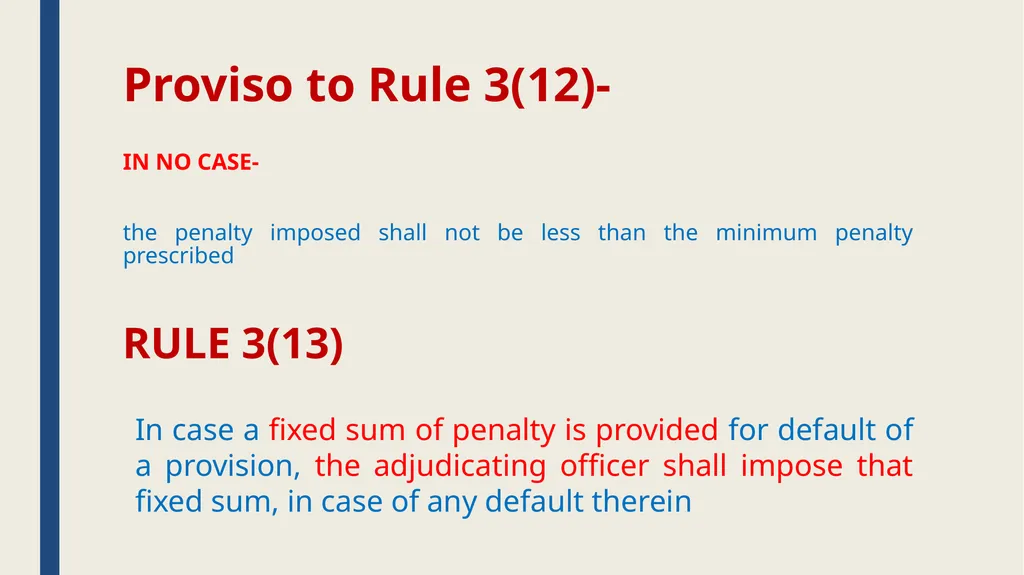
Proviso to Rule 3(12)- IN NO CASE-
the penalty imposed shall not be less than the minimum penalty prescribed RULE 3(13) In case a fixed sum of penalty is provided for default of a provision, the adjudicating officer shall impose that fixed sum, in case of any default therein<br>
the penalty imposed shall not be less than the minimum penalty prescribed RULE 3(13) In case a fixed sum of penalty is provided for default of a provision, the adjudicating officer shall impose that fixed sum, in case of any default therein<br>
36
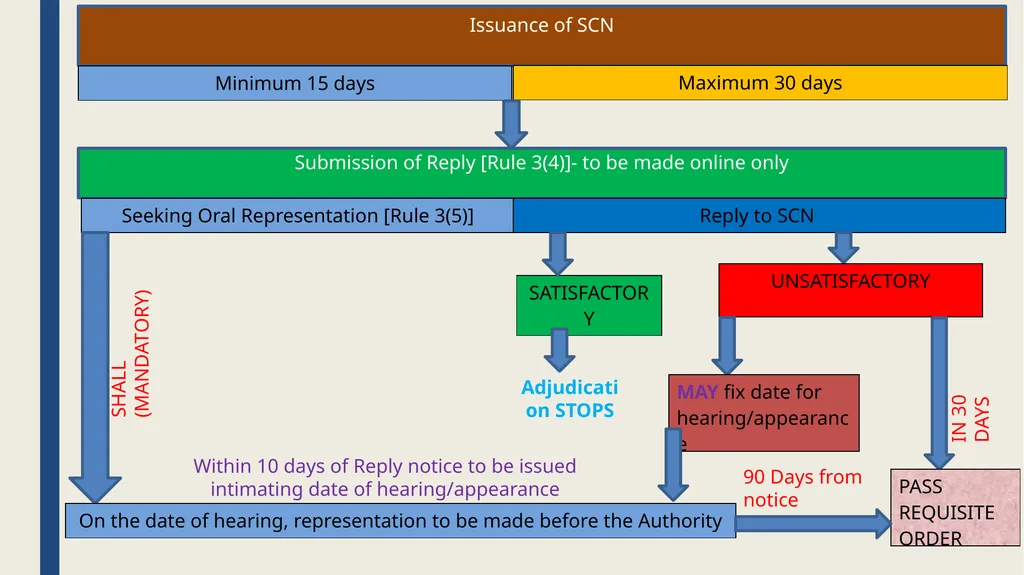
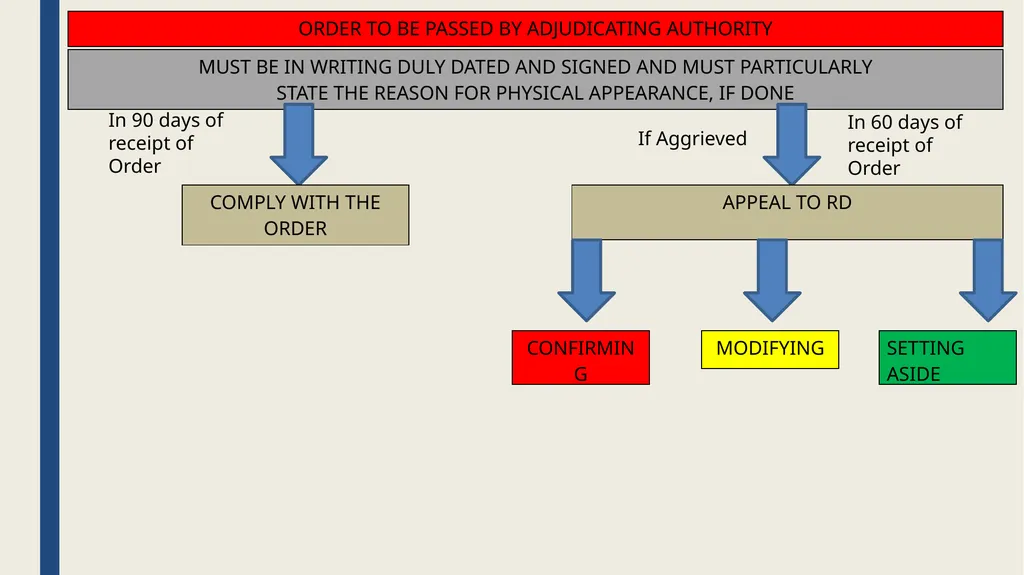
Process of Adjudication and Appeal against the Order of Adjudicating Authority<br>
37
Issuance of SCN Submission of Reply [Rule 3(4)]- to be made online only Adjudication STOPS Within 10 days of Reply notice to be issued intimating date of hearing/appearance SHALL (MANDATORY) IN 30 DAYS 90 Days from notice<br>
38
If Aggrieved In 60 days of receipt of Order In 90 days of receipt of Order<br>
39
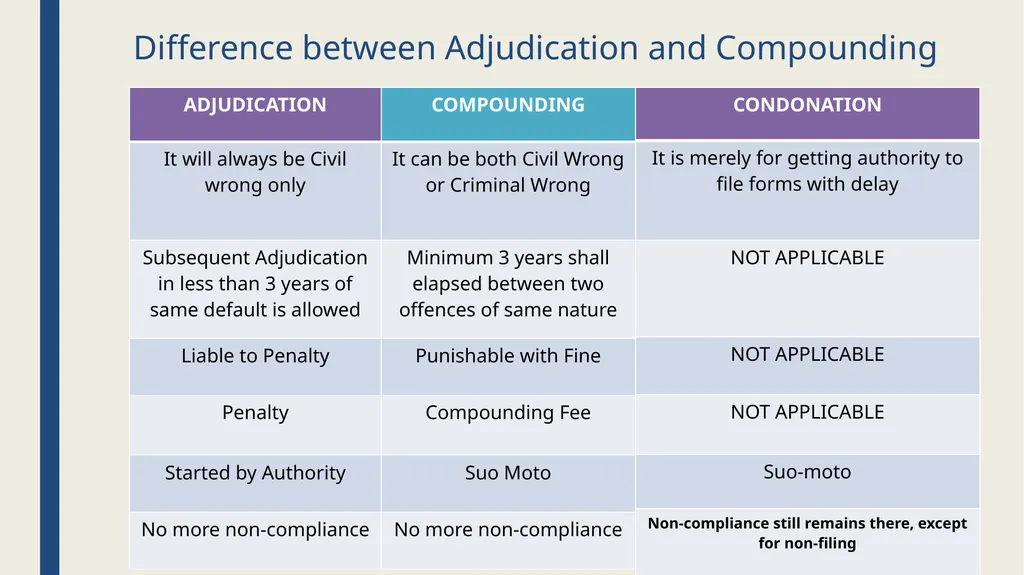
Difference between Adjudication and Compounding<br>
40
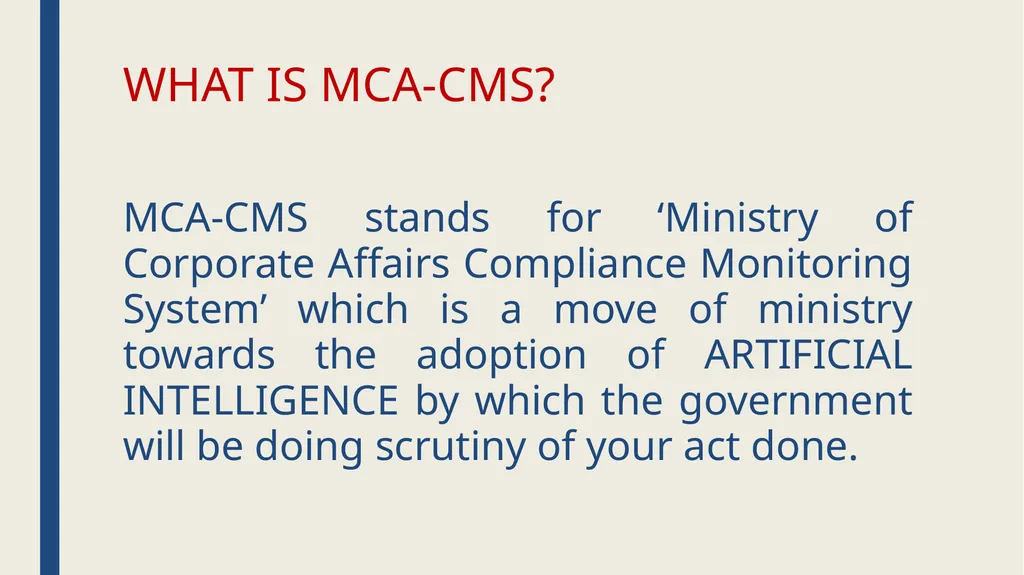
WHAT IS MCA-CMS? MCA-CMS stands for ‘Ministry of Corporate Affairs Compliance Monitoring System’ which is a move of ministry towards the adoption of ARTIFICIAL INTELLIGENCE by which the government will be doing scrutiny of your act done.<br>
41
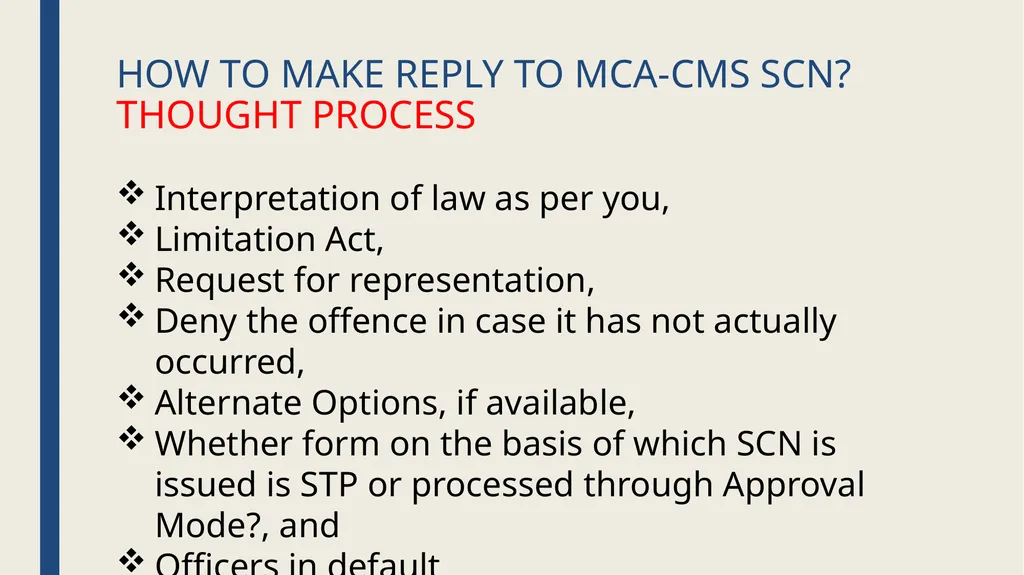
HOW TO MAKE REPLY TO MCA-CMS SCN? THOUGHT PROCESS Interpretation of law as per you,
Limitation Act,
Request for representation,
Deny the offence in case it has not actually occurred,
Alternate Options, if available,
Whether form on the basis of which SCN is issued is STP or processed through Approval Mode?, and
Officers in default<br>
Limitation Act,
Request for representation,
Deny the offence in case it has not actually occurred,
Alternate Options, if available,
Whether form on the basis of which SCN is issued is STP or processed through Approval Mode?, and
Officers in default<br>
42
WHAT IF YOU DON’T REPLY TO SCN TO NOTICES U/S 96 AND 204 NOW?<br>
43
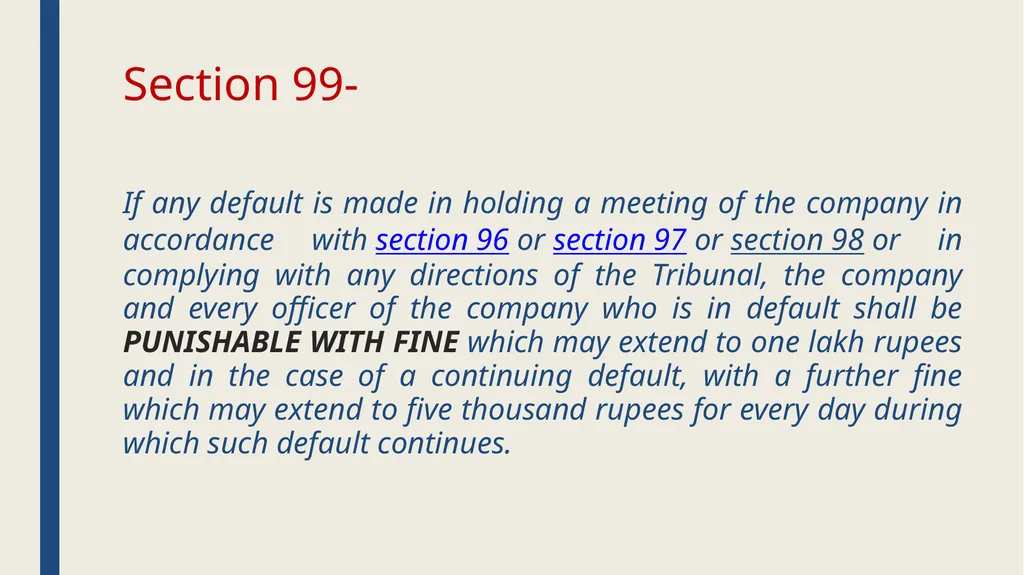
Section 99- If any default is made in holding a meeting of the company in accordance with section 96 or section 97 or section 98 or in complying with any directions of the Tribunal, the company and every officer of the company who is in default shall be PUNISHABLE WITH FINE which may extend to one lakh rupees and in the case of a continuing default, with a further fine which may extend to five thousand rupees for every day during which such default continues.<br>
44
Language of SCN-<br>
45
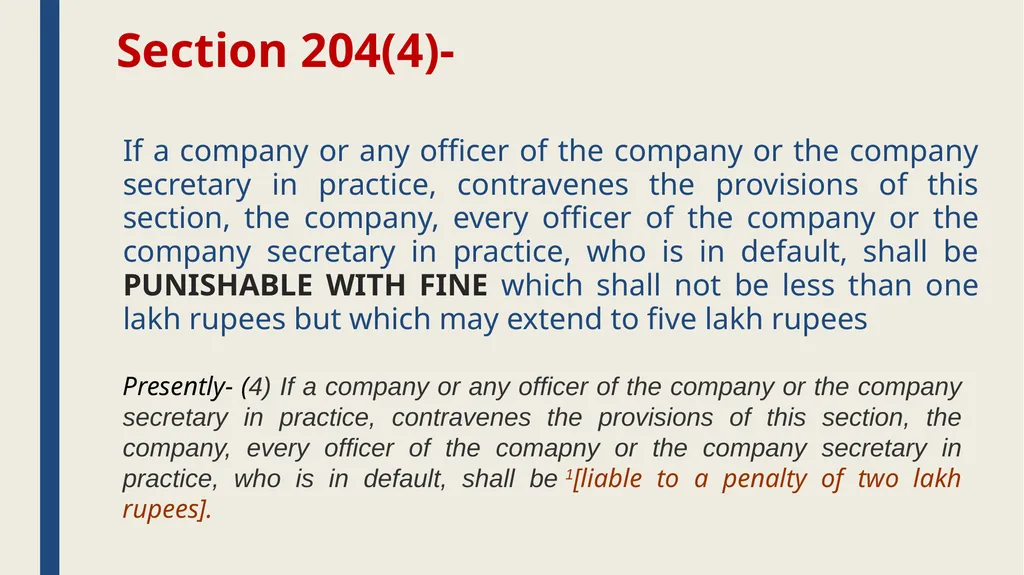
Section 204(4)- If a company or any officer of the company or the company secretary in practice, contravenes the provisions of this section, the company, every officer of the company or the company secretary in practice, who is in default, shall be PUNISHABLE WITH FINE which shall not be less than one lakh rupees but which may extend to five lakh rupees Presently- (4) If a company or any officer of the company or the company secretary in practice, contravenes the provisions of this section, the company, every officer of the comapny or the company secretary in practice, who is in default, shall be 1[liable to a penalty of two lakh rupees].<br>
46
Whether directly fine can be imposed?<br>
47
QUERIES<br>
48
THANK YOU….
Faridabad CS SANTOSH PANDEY
S-5, 2nd Floor, Manish Mega Plaza, Plot No. 13, Sector-5, Dwarka, New Delhi-110075
9999202268, 7417271727
info@spcounsels.com, pcs.santosh07@gmail.com
www.spcounsels.com<br>
Faridabad CS SANTOSH PANDEY
S-5, 2nd Floor, Manish Mega Plaza, Plot No. 13, Sector-5, Dwarka, New Delhi-110075
9999202268, 7417271727
info@spcounsels.com, pcs.santosh07@gmail.com
www.spcounsels.com<br>