
CONCERTO and BRAVO Experiences with practical,
PT
Published · 28 slides · 0 views
1 / 1
Description
CONCERTO and BRAVO Experiences with practical, full implementations of Network Coding systems 2013 BAE Systems 1 Victor Firoiu 11 March 2013 Projects in Networking and Communications 2006 2007 2008 2009 2010 2011 DARPA CBMANET CONCERTO
Related Topics
Share
Embed code
Download this presentation From Below
"CONCERTO and BRAVO Experiences with practical," is the property of its rightful owner. Permission is granted to download and print the materials on this website for personal, non-commercial use only, and to display it on your personal computer provided you do not modify the materials and that you retain all copyright notices contained in the materials. By downloading content from our website, you accept the terms of this agreement.
Presentation Transcript
01
CONCERTO and BRAVO
Experiences with practical, full implementations
of Network Coding systems © 2013 BAE Systems 1 Victor Firoiu 11 March 2013<br>
02
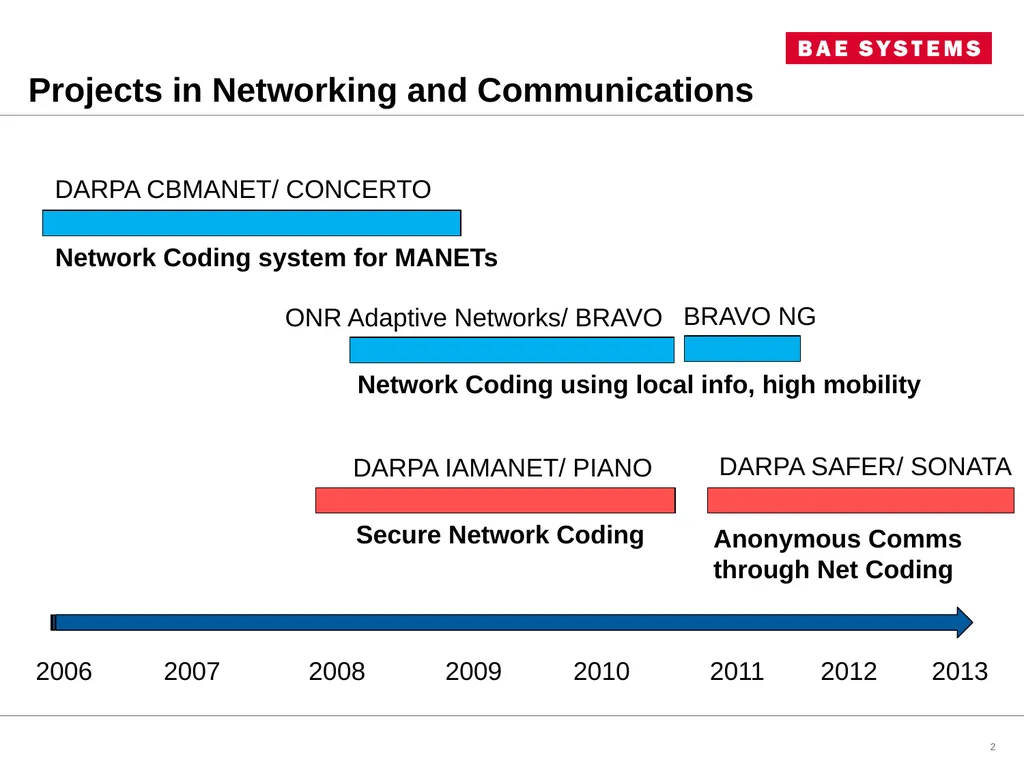
Projects in Networking and Communications 2006 2007 2008 2009 2010 2011 DARPA CBMANET/ CONCERTO ONR Adaptive Networks/ BRAVO DARPA IAMANET/ PIANO DARPA SAFER/ SONATA Network Coding system for MANETs Secure Network Coding 2 2012 2013 BRAVO NG Anonymous Comms
through Net Coding Network Coding using local info, high mobility<br>
through Net Coding Network Coding using local info, high mobility<br>
03
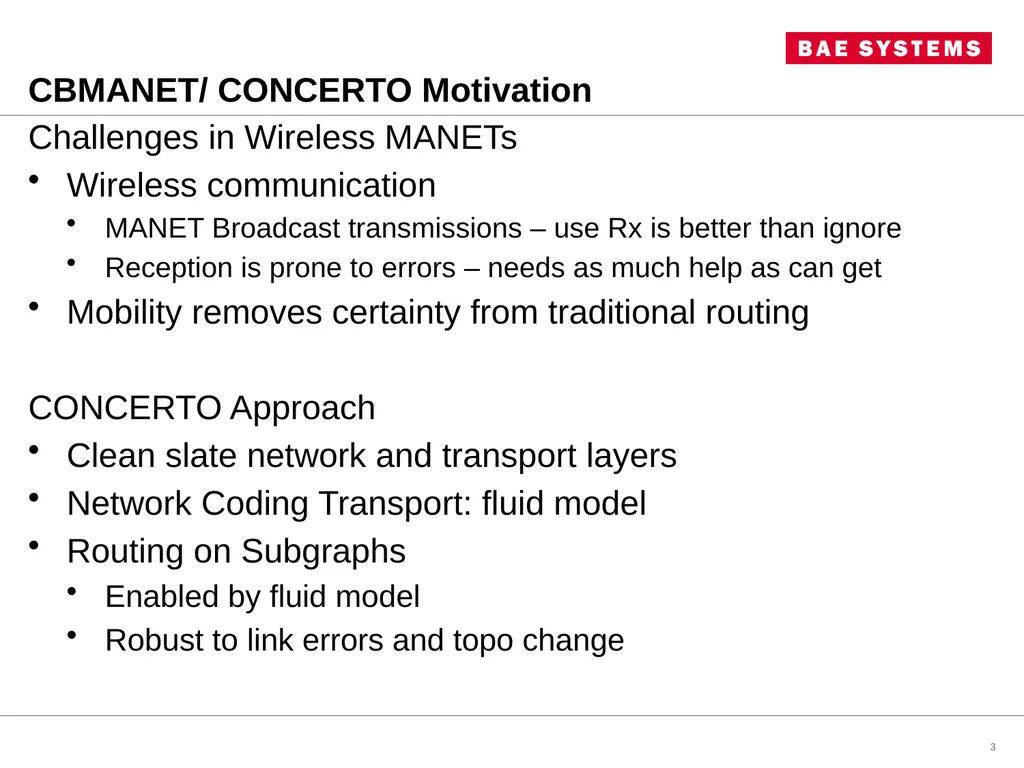
CBMANET/ CONCERTO Motivation Challenges in Wireless MANETs
Wireless communication
MANET Broadcast transmissions – use Rx is better than ignore
Reception is prone to errors – needs as much help as can get
Mobility removes certainty from traditional routing
CONCERTO Approach
Clean slate network and transport layers
Network Coding Transport: fluid model
Routing on Subgraphs
Enabled by fluid model
Robust to link errors and topo change 3<br>
Wireless communication
MANET Broadcast transmissions – use Rx is better than ignore
Reception is prone to errors – needs as much help as can get
Mobility removes certainty from traditional routing
CONCERTO Approach
Clean slate network and transport layers
Network Coding Transport: fluid model
Routing on Subgraphs
Enabled by fluid model
Robust to link errors and topo change 3<br>
04
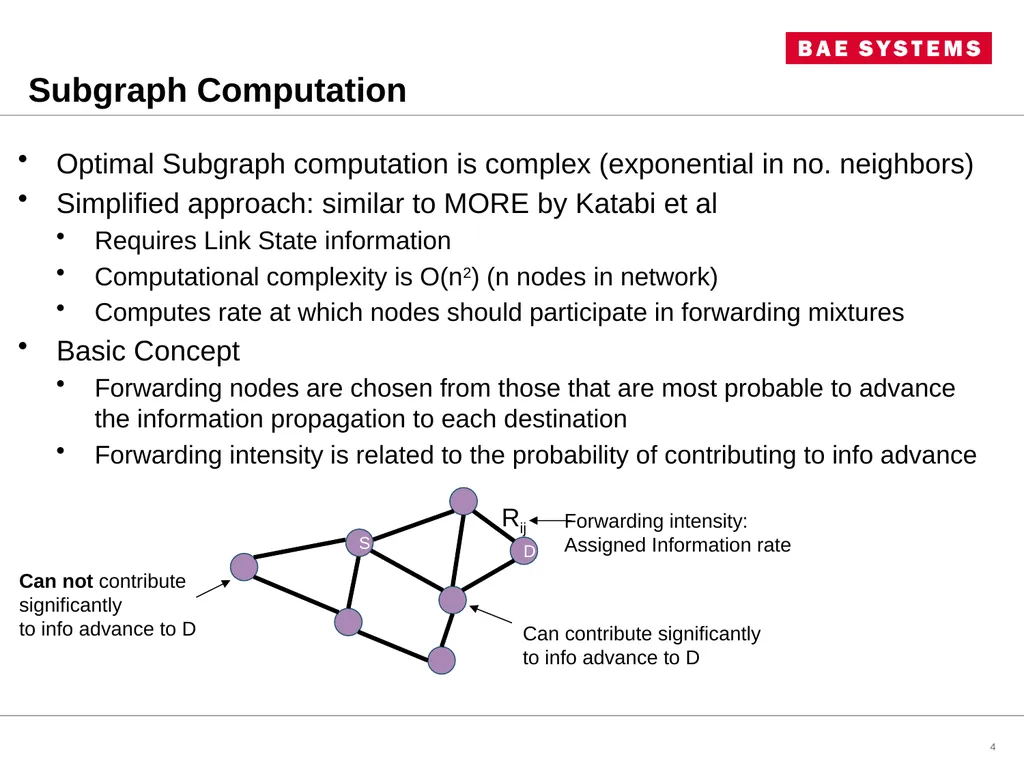
Subgraph Computation Optimal Subgraph computation is complex (exponential in no. neighbors)
Simplified approach: similar to MORE by Katabi et al
Requires Link State information
Computational complexity is O(n2) (n nodes in network)
Computes rate at which nodes should participate in forwarding mixtures
Basic Concept
Forwarding nodes are chosen from those that are most probable to advance the information propagation to each destination
Forwarding intensity is related to the probability of contributing to info advance D S Can contribute significantly
to info advance to D Can not contribute
significantly
to info advance to D 4 Rij Forwarding intensity:
Assigned Information rate<br>
Simplified approach: similar to MORE by Katabi et al
Requires Link State information
Computational complexity is O(n2) (n nodes in network)
Computes rate at which nodes should participate in forwarding mixtures
Basic Concept
Forwarding nodes are chosen from those that are most probable to advance the information propagation to each destination
Forwarding intensity is related to the probability of contributing to info advance D S Can contribute significantly
to info advance to D Can not contribute
significantly
to info advance to D 4 Rij Forwarding intensity:
Assigned Information rate<br>
05
Packet Forwarding Packet Forwarding
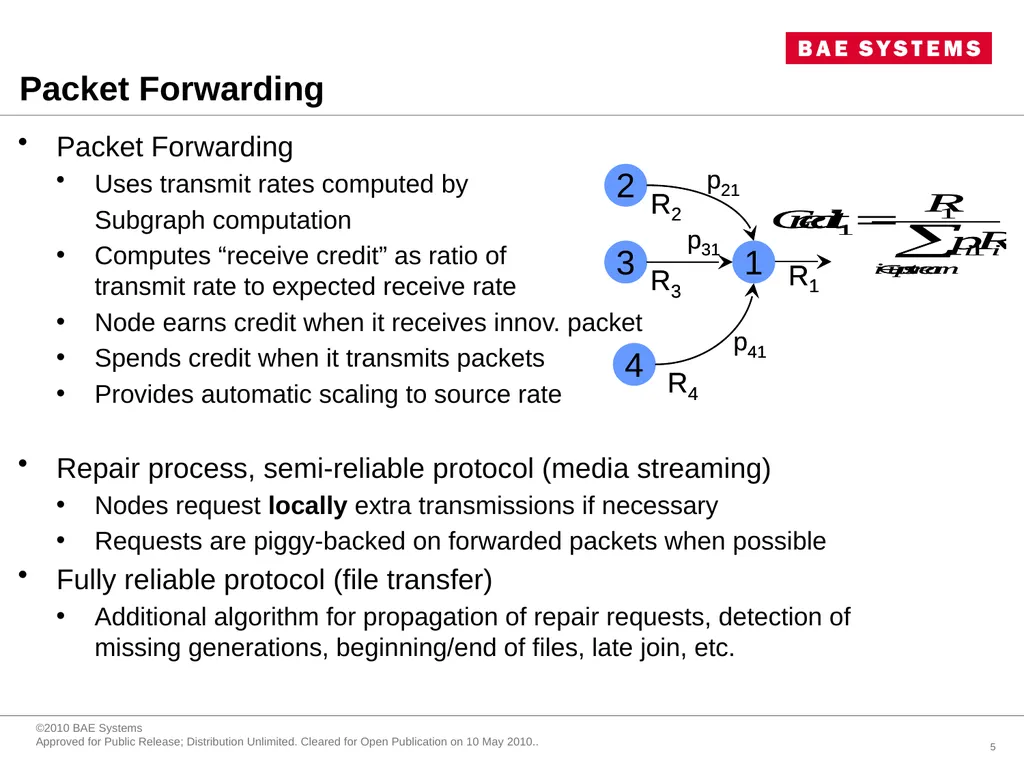
Uses transmit rates computed by
Subgraph computation
Computes “receive credit” as ratio of transmit rate to expected receive rate
Node earns credit when it receives innov. packet
Spends credit when it transmits packets
Provides automatic scaling to source rate
Repair process, semi-reliable protocol (media streaming)
Nodes request locally extra transmissions if necessary
Requests are piggy-backed on forwarded packets when possible
Fully reliable protocol (file transfer)
Additional algorithm for propagation of repair requests, detection of missing generations, beginning/end of files, late join, etc. 5<br>
Uses transmit rates computed by
Subgraph computation
Computes “receive credit” as ratio of transmit rate to expected receive rate
Node earns credit when it receives innov. packet
Spends credit when it transmits packets
Provides automatic scaling to source rate
Repair process, semi-reliable protocol (media streaming)
Nodes request locally extra transmissions if necessary
Requests are piggy-backed on forwarded packets when possible
Fully reliable protocol (file transfer)
Additional algorithm for propagation of repair requests, detection of missing generations, beginning/end of files, late join, etc. 5<br>
06
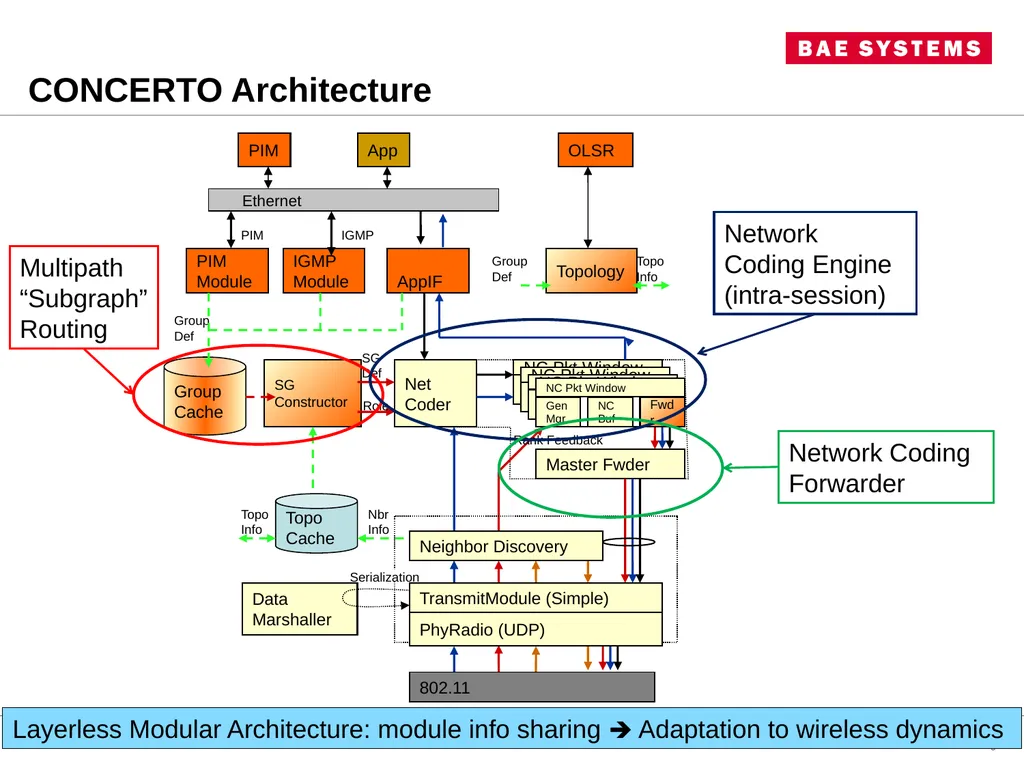
6 CONCERTO Architecture Multipath
“Subgraph”
Routing Network Coding Engine
(intra-session) Network Coding Forwarder Layerless Modular Architecture: module info sharing Adaptation to wireless dynamics<br>
“Subgraph”
Routing Network Coding Engine
(intra-session) Network Coding Forwarder Layerless Modular Architecture: module info sharing Adaptation to wireless dynamics<br>
07
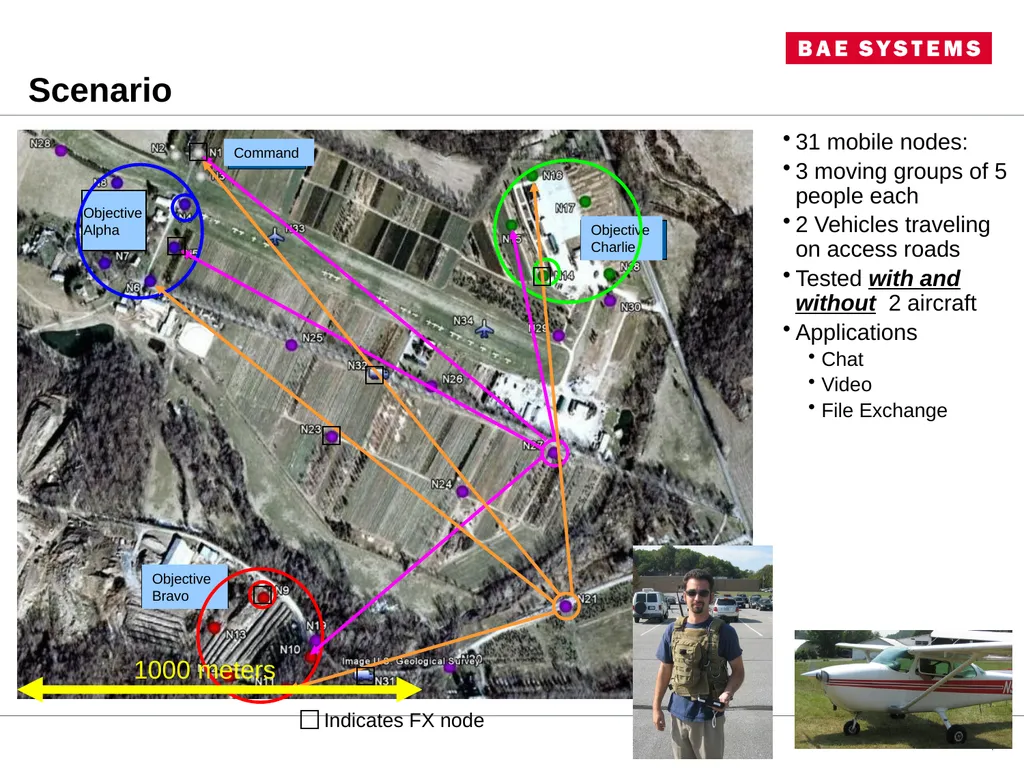
7 Scenario 31 mobile nodes:
3 moving groups of 5 people each
2 Vehicles traveling on access roads
Tested with and without 2 aircraft
Applications
Chat
Video
File Exchange Objective Alpha Objective Charlie Objective Bravo Command Indicates FX node 7 1000 meters<br>
3 moving groups of 5 people each
2 Vehicles traveling on access roads
Tested with and without 2 aircraft
Applications
Chat
Video
File Exchange Objective Alpha Objective Charlie Objective Bravo Command Indicates FX node 7 1000 meters<br>
08
8 533 MHz ARM Processor
256 MByte memory
5 Watts average power 800 MHz ARM Processor
256 MByte (20 Mbytes used)
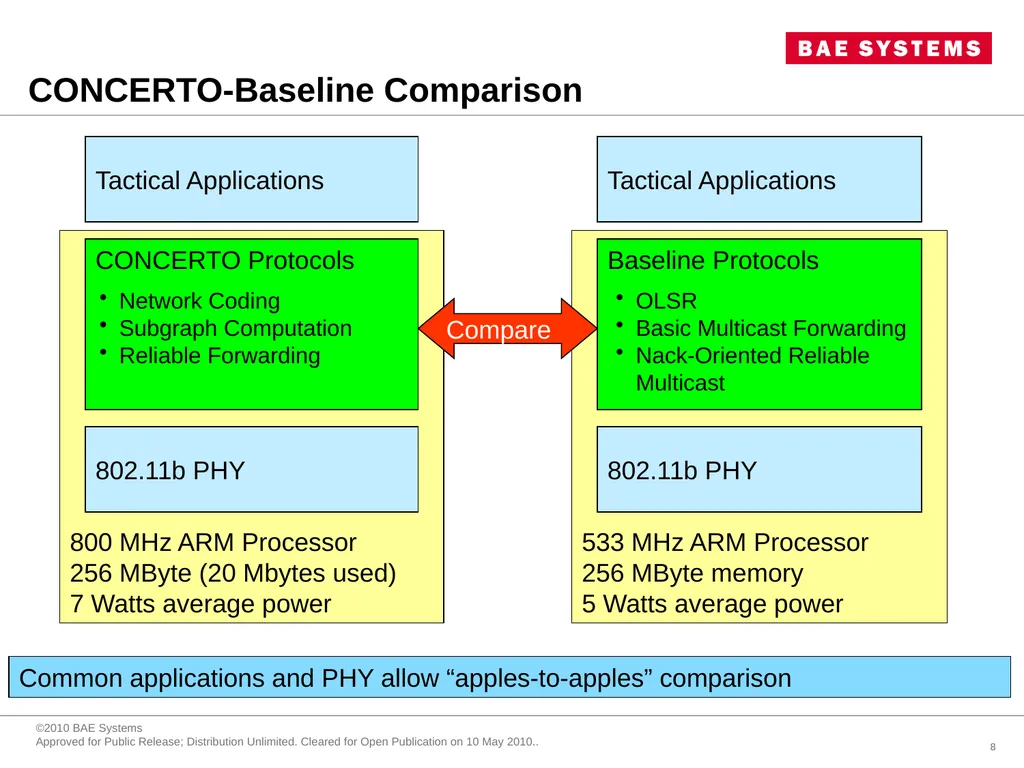
7 Watts average power CONCERTO-Baseline Comparison Tactical Applications Tactical Applications 802.11b PHY 802.11b PHY CONCERTO Protocols Baseline Protocols Network Coding
Subgraph Computation
Reliable Forwarding OLSR
Basic Multicast Forwarding
Nack-Oriented Reliable Multicast Compare Common applications and PHY allow “apples-to-apples” comparison<br>
256 MByte memory
5 Watts average power 800 MHz ARM Processor
256 MByte (20 Mbytes used)
7 Watts average power CONCERTO-Baseline Comparison Tactical Applications Tactical Applications 802.11b PHY 802.11b PHY CONCERTO Protocols Baseline Protocols Network Coding
Subgraph Computation
Reliable Forwarding OLSR
Basic Multicast Forwarding
Nack-Oriented Reliable Multicast Compare Common applications and PHY allow “apples-to-apples” comparison<br>
09
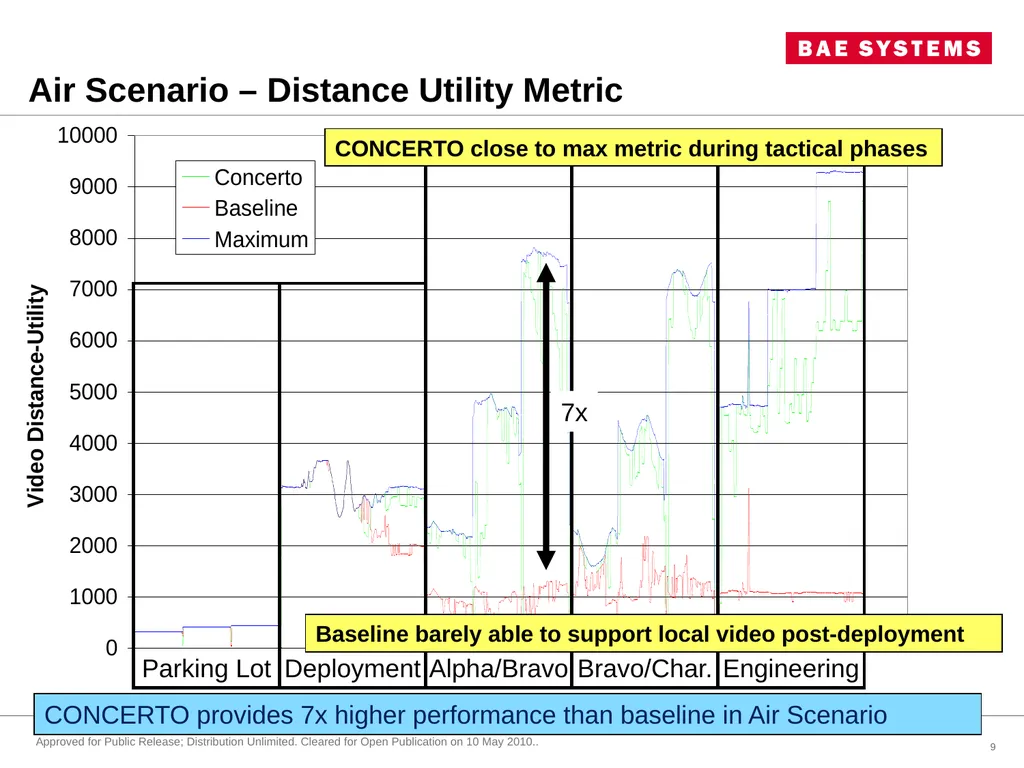
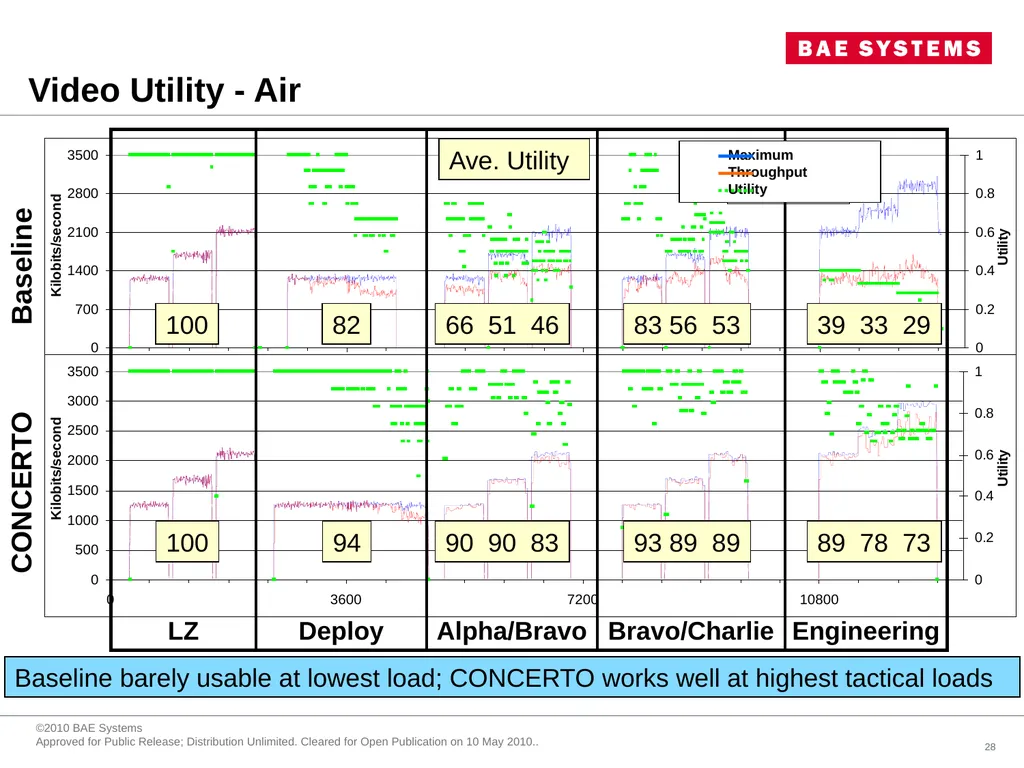
Air Scenario – Distance Utility Metric Parking Lot Deployment Alpha/Bravo Bravo/Char. Engineering CONCERTO close to max metric during tactical phases Baseline barely able to support local video post-deployment 7x 9 CONCERTO provides 7x higher performance than baseline in Air Scenario<br>
10
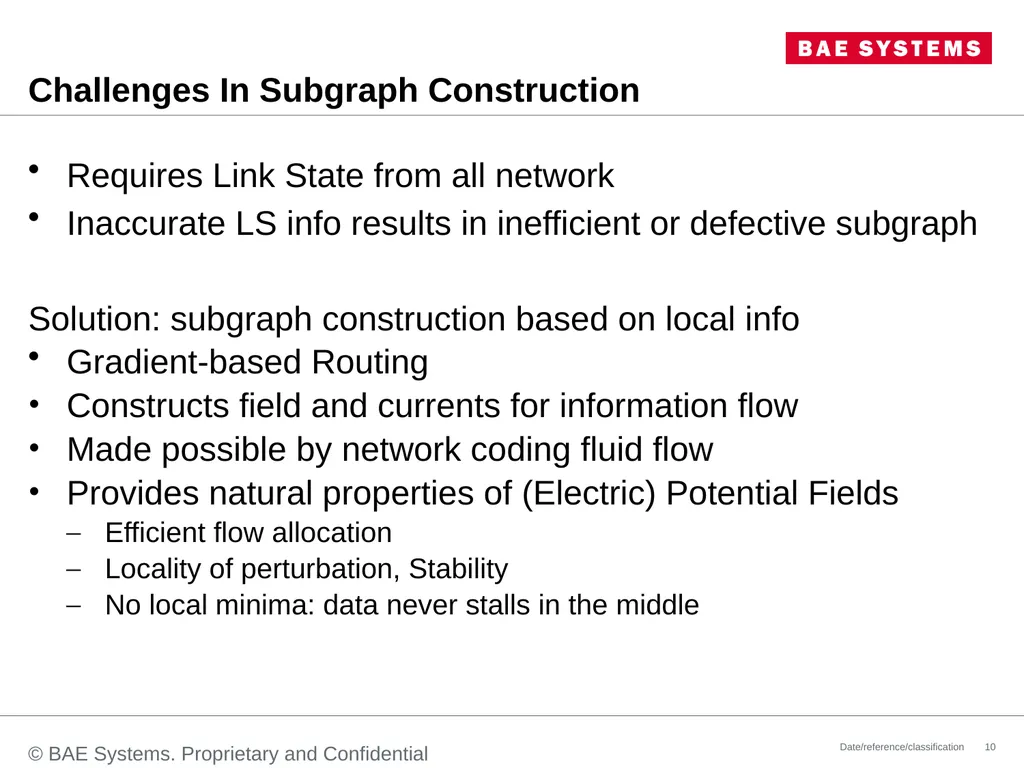
Challenges In Subgraph Construction Requires Link State from all network
Inaccurate LS info results in inefficient or defective subgraph
Solution: subgraph construction based on local info
Gradient-based Routing
Constructs field and currents for information flow
Made possible by network coding fluid flow
Provides natural properties of (Electric) Potential Fields
Efficient flow allocation
Locality of perturbation, Stability
No local minima: data never stalls in the middle Date/reference/classification © BAE Systems. Proprietary and Confidential 10<br>
Inaccurate LS info results in inefficient or defective subgraph
Solution: subgraph construction based on local info
Gradient-based Routing
Constructs field and currents for information flow
Made possible by network coding fluid flow
Provides natural properties of (Electric) Potential Fields
Efficient flow allocation
Locality of perturbation, Stability
No local minima: data never stalls in the middle Date/reference/classification © BAE Systems. Proprietary and Confidential 10<br>
11
Gradient-based Routing
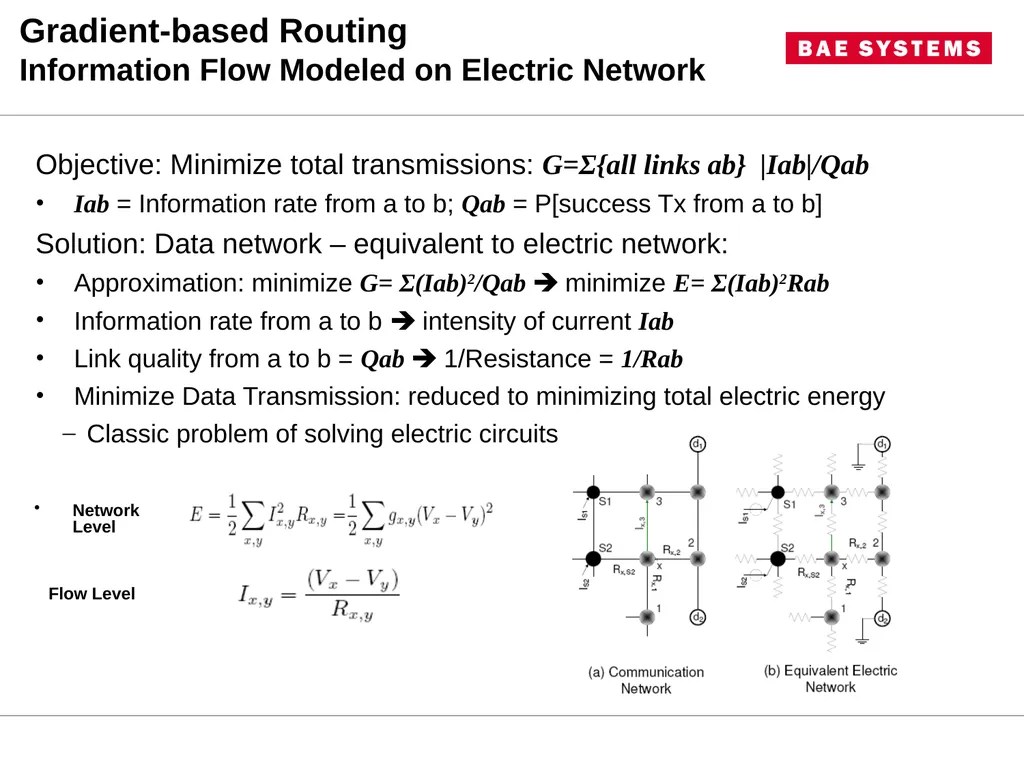
Information Flow Modeled on Electric Network Network Level Flow Level Objective: Minimize total transmissions: G=Σ{all links ab} |Iab|/Qab
Iab = Information rate from a to b; Qab = P[success Tx from a to b]
Solution: Data network – equivalent to electric network:
Approximation: minimize G= Σ(Iab)2/Qab minimize E= Σ(Iab)2Rab
Information rate from a to b intensity of current Iab
Link quality from a to b = Qab 1/Resistance = 1/Rab
Minimize Data Transmission: reduced to minimizing total electric energy
Classic problem of solving electric circuits<br>
Iab = Information rate from a to b; Qab = P[success Tx from a to b]
Solution: Data network – equivalent to electric network:
Approximation: minimize G= Σ(Iab)2/Qab minimize E= Σ(Iab)2Rab
Information rate from a to b intensity of current Iab
Link quality from a to b = Qab 1/Resistance = 1/Rab
Minimize Data Transmission: reduced to minimizing total electric energy
Classic problem of solving electric circuits<br>
12
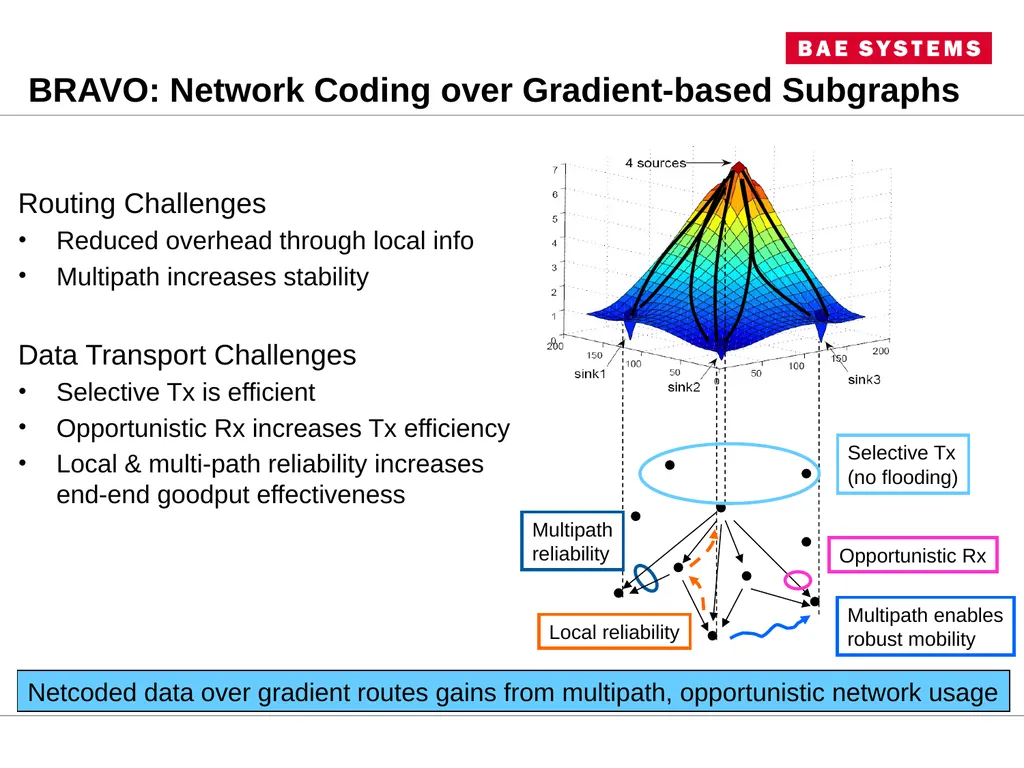
BRAVO: Network Coding over Gradient-based Subgraphs Netcoded data over gradient routes gains from multipath, opportunistic network usage Selective Tx
(no flooding) Opportunistic Rx Multipath
reliability Local reliability Multipath enables
robust mobility Routing Challenges
Reduced overhead through local info
Multipath increases stability
Data Transport Challenges
Selective Tx is efficient
Opportunistic Rx increases Tx efficiency
Local & multi-path reliability increases end-end goodput effectiveness<br>
(no flooding) Opportunistic Rx Multipath
reliability Local reliability Multipath enables
robust mobility Routing Challenges
Reduced overhead through local info
Multipath increases stability
Data Transport Challenges
Selective Tx is efficient
Opportunistic Rx increases Tx efficiency
Local & multi-path reliability increases end-end goodput effectiveness<br>
13
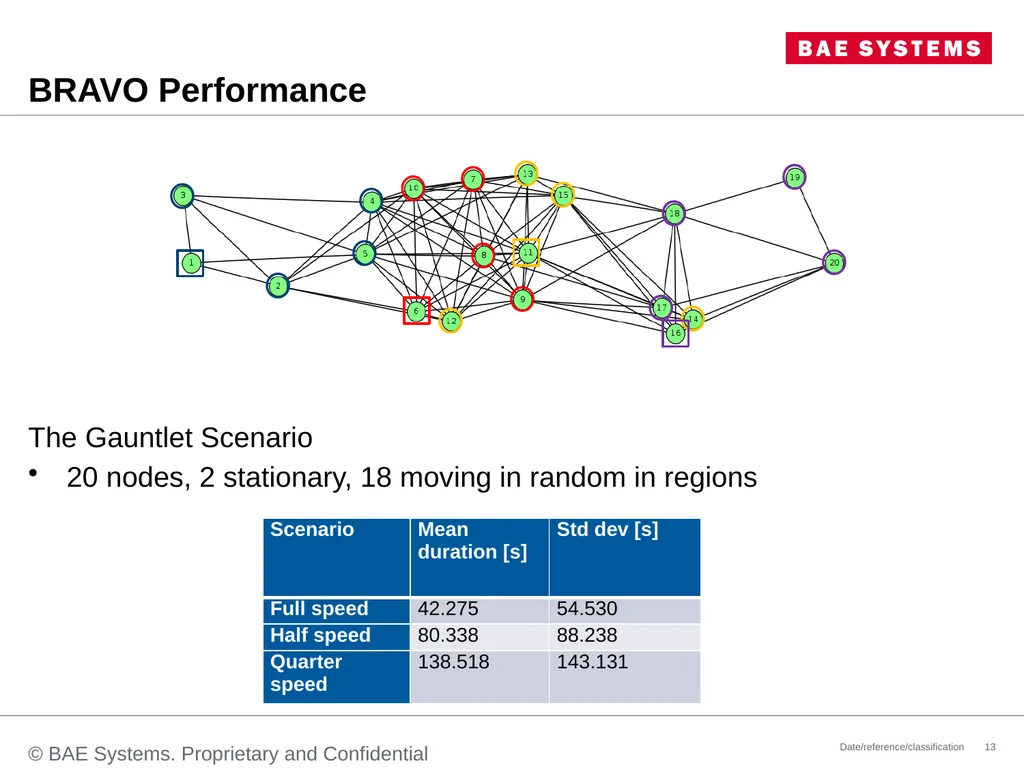
BRAVO Performance The Gauntlet Scenario
20 nodes, 2 stationary, 18 moving in random in regions Date/reference/classification © BAE Systems. Proprietary and Confidential 13<br>
20 nodes, 2 stationary, 18 moving in random in regions Date/reference/classification © BAE Systems. Proprietary and Confidential 13<br>
14
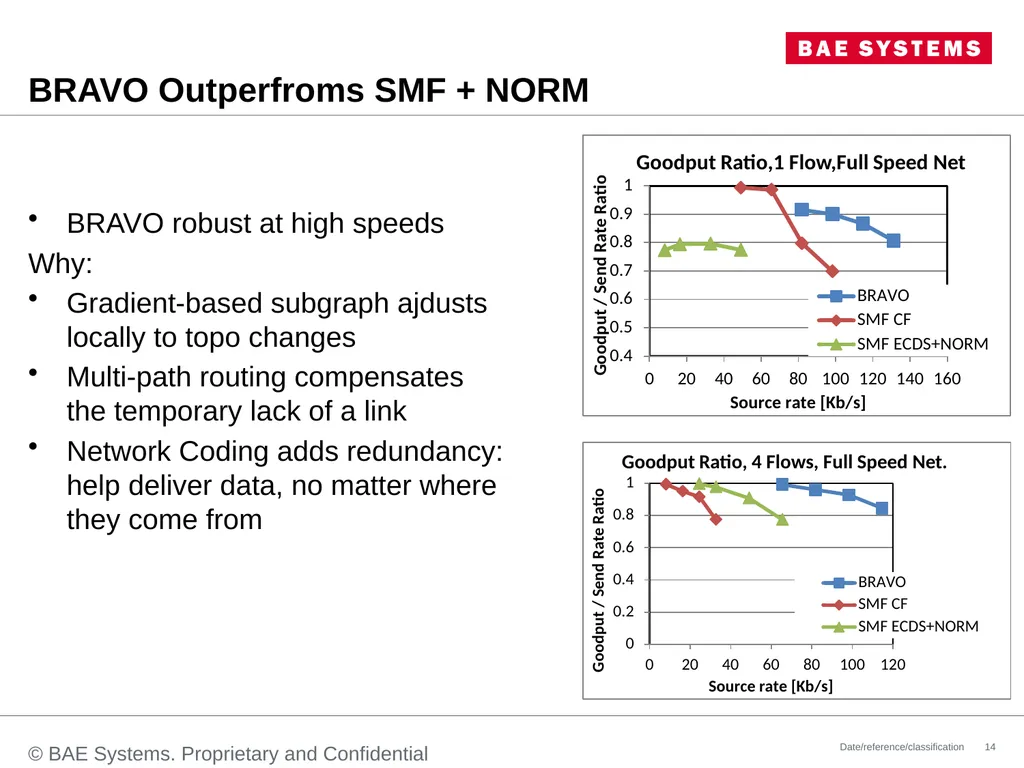
BRAVO Outperfroms SMF + NORM BRAVO robust at high speeds
Why:
Gradient-based subgraph ajdusts locally to topo changes
Multi-path routing compensates the temporary lack of a link
Network Coding adds redundancy: help deliver data, no matter where they come from Date/reference/classification © BAE Systems. Proprietary and Confidential 14<br>
Why:
Gradient-based subgraph ajdusts locally to topo changes
Multi-path routing compensates the temporary lack of a link
Network Coding adds redundancy: help deliver data, no matter where they come from Date/reference/classification © BAE Systems. Proprietary and Confidential 14<br>
15
Conclusions Gains achieved besides information theoretical
Network Coding enables multi-path reliability
Network Coding enables hop-by-hop reliability
Gradient-based subgraph routing
More efficient and scalable multipath routing Date/reference/classification © BAE Systems. Proprietary and Confidential 15<br>
Network Coding enables multi-path reliability
Network Coding enables hop-by-hop reliability
Gradient-based subgraph routing
More efficient and scalable multipath routing Date/reference/classification © BAE Systems. Proprietary and Confidential 15<br>
16
BACKUP Date/reference/classification © BAE Systems. Proprietary and Confidential 16<br>
17
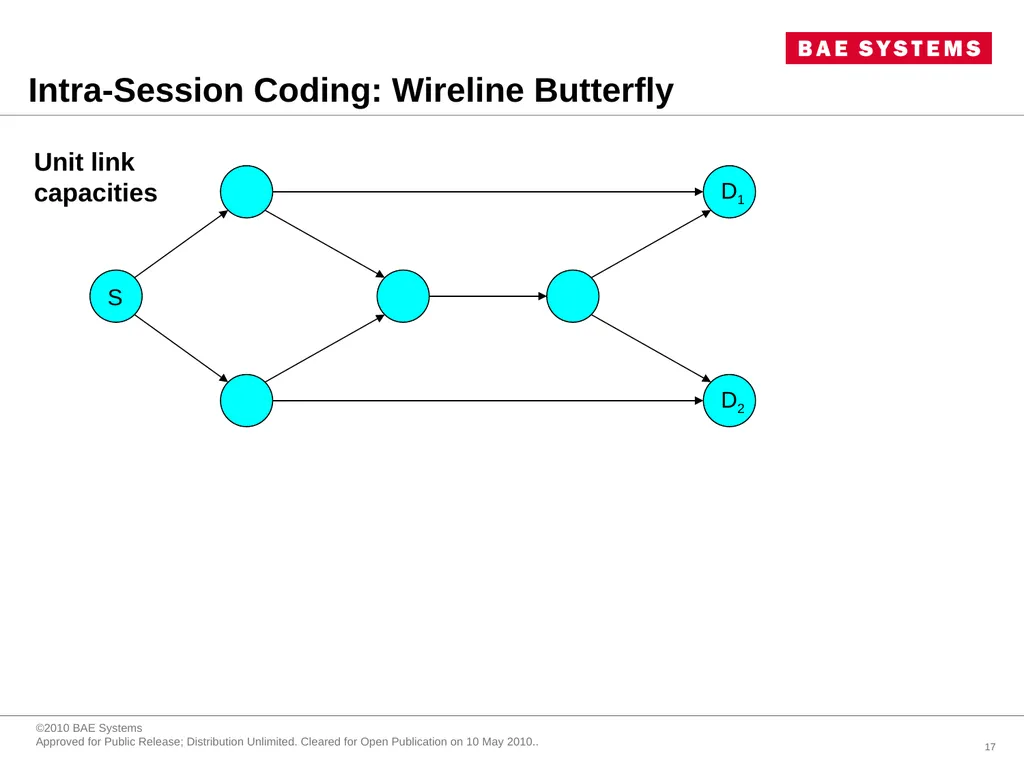
Intra-Session Coding: Wireline Butterfly 17 Unit link
capacities<br>
18
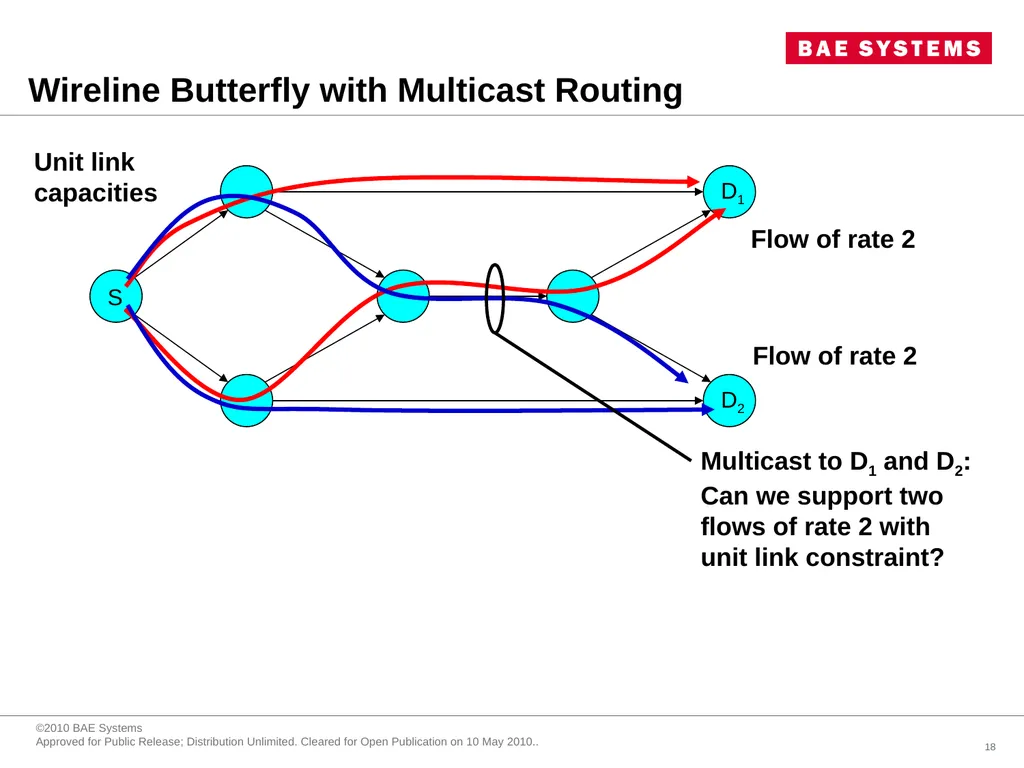
Wireline Butterfly with Multicast Routing 18 Unit link
capacities Flow of rate 2 Flow of rate 2<br>
19
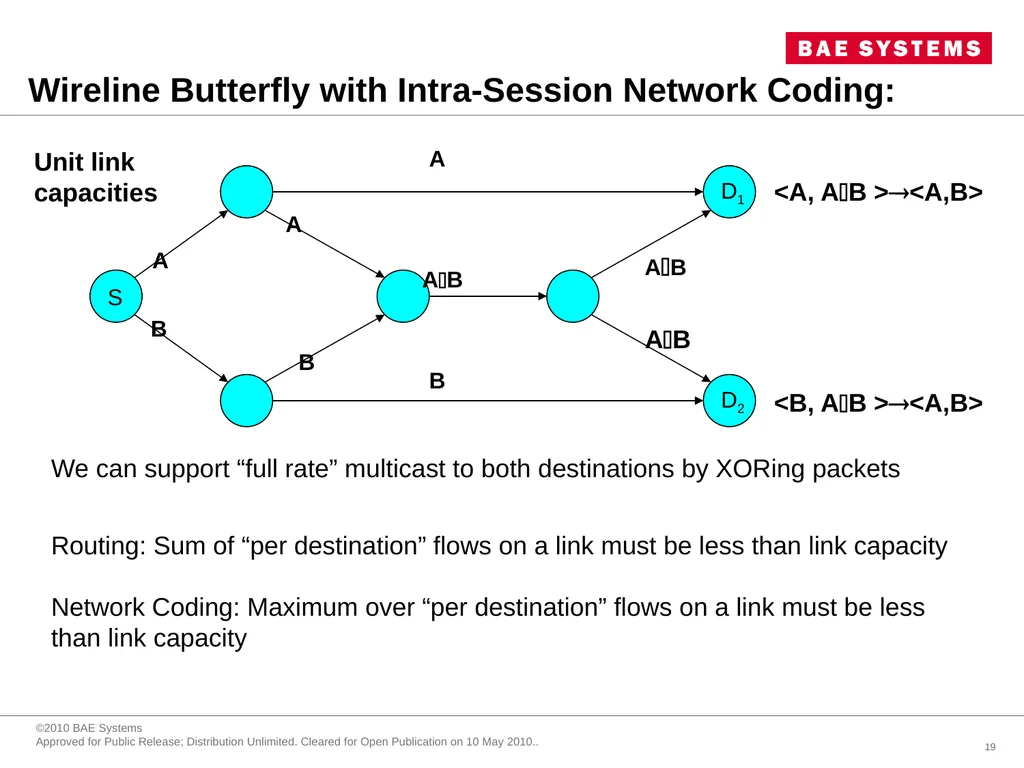
Wireline Butterfly with Intra-Session Network Coding: 19 Unit link
capacities <A, AB ><A,B> <B, AB ><A,B> A A B B B A AB AB AB Routing: Sum of “per destination” flows on a link must be less than link capacity
Network Coding: Maximum over “per destination” flows on a link must be less than link capacity We can support “full rate” multicast to both destinations by XORing packets<br>
Network Coding: Maximum over “per destination” flows on a link must be less than link capacity We can support “full rate” multicast to both destinations by XORing packets<br>
20
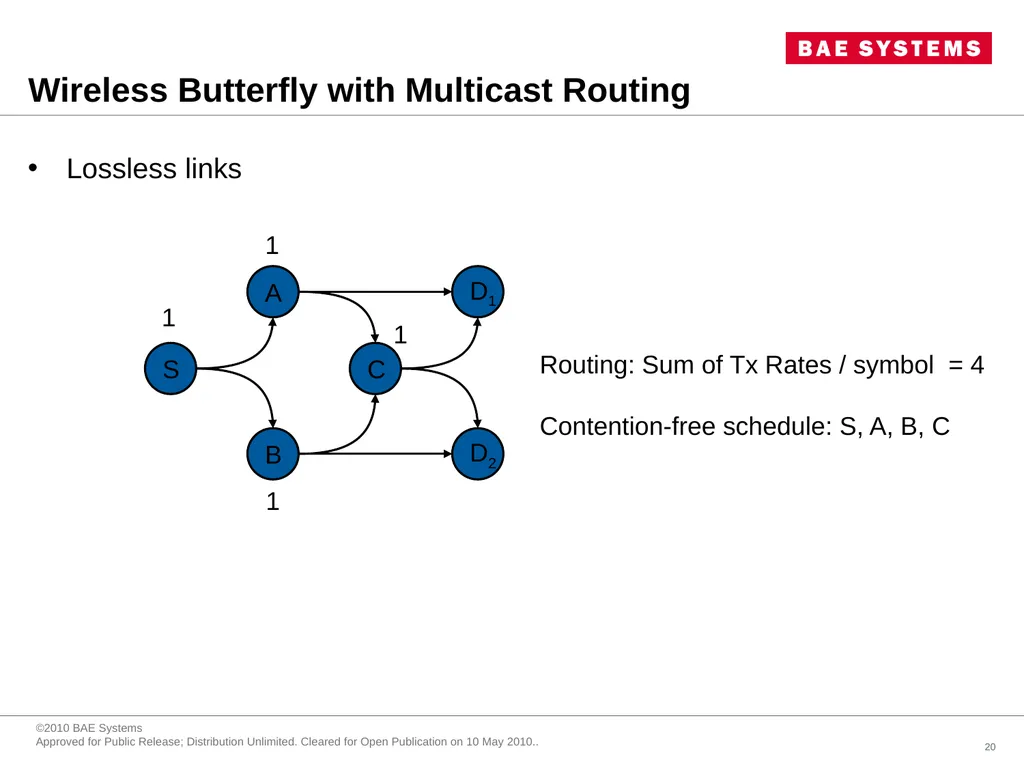
Wireless Butterfly with Multicast Routing 20 Lossless links Routing: Sum of Tx Rates / symbol = 4
Contention-free schedule: S, A, B, C 1 1 1 1<br>
Contention-free schedule: S, A, B, C 1 1 1 1<br>
21
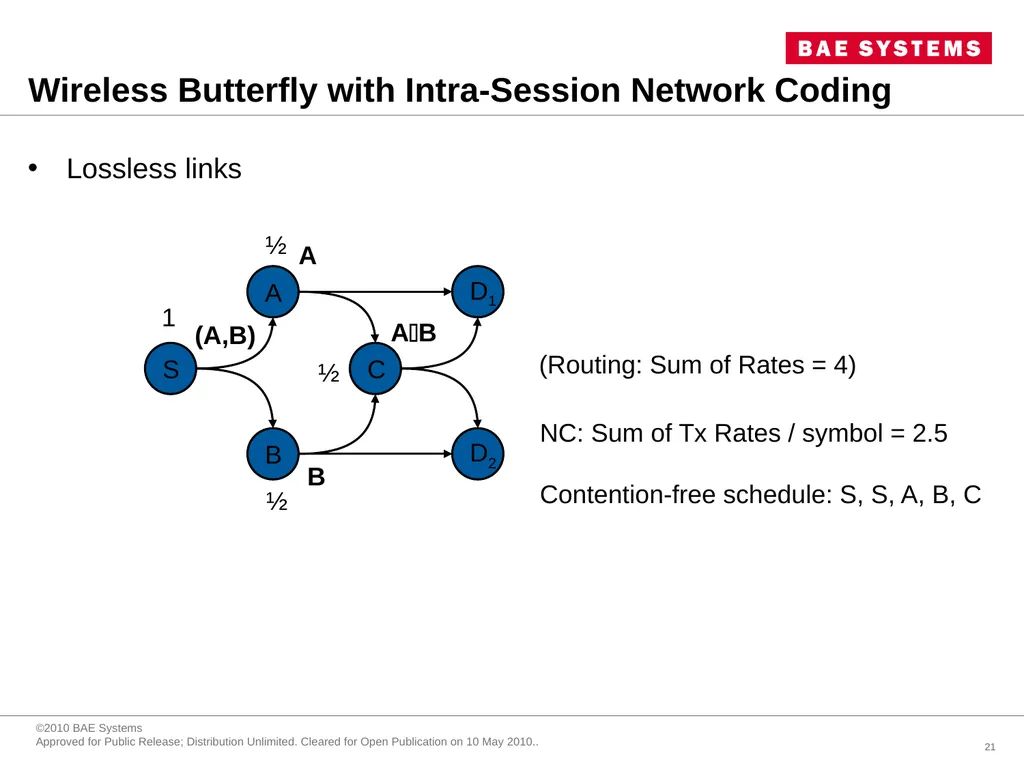
Wireless Butterfly with Intra-Session Network Coding 21 Lossless links NC: Sum of Tx Rates / symbol = 2.5
Contention-free schedule: S, S, A, B, C (Routing: Sum of Rates = 4) AB B A ½ ½ ½ 1 (A,B)<br>
Contention-free schedule: S, S, A, B, C (Routing: Sum of Rates = 4) AB B A ½ ½ ½ 1 (A,B)<br>
22
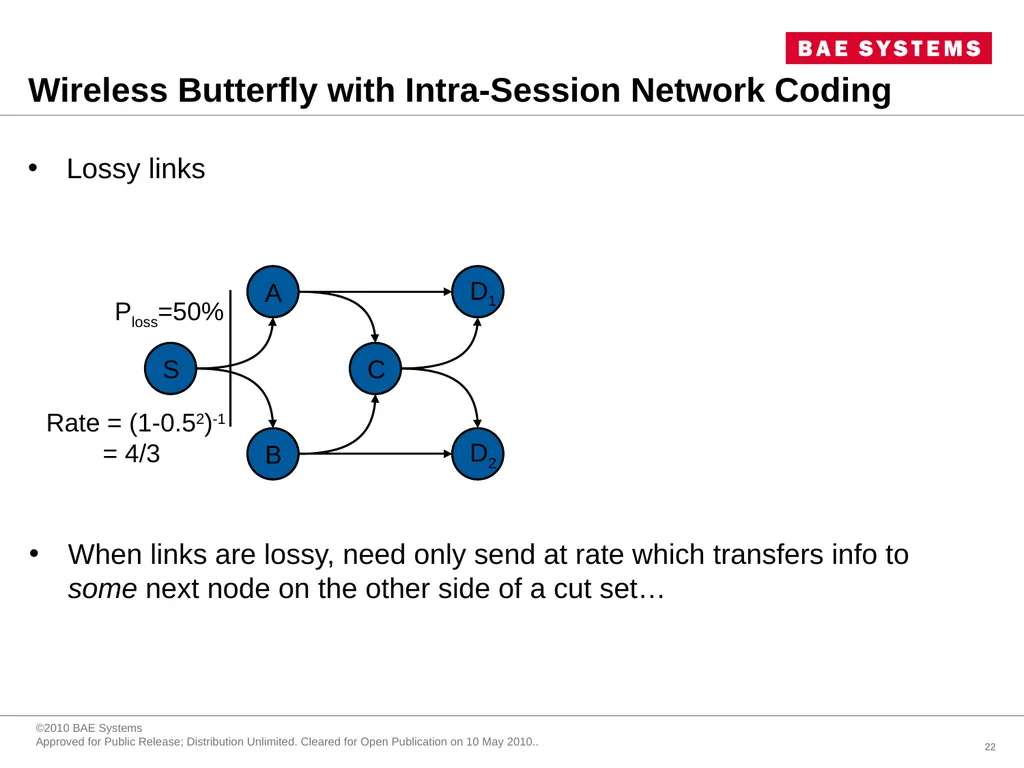
Wireless Butterfly with Intra-Session Network Coding 22 Lossy links When links are lossy, need only send at rate which transfers info to some next node on the other side of a cut set…<br>
23
Intra-Session Network Coding Ahlswede et al. proved that for a single multicast session, network coding achieves the maximum possible rate allowed in the network
Problem Decomposition
Computing Mixtures
How to combine packets into mixtures that “work”
Subgraph Construction
Which nodes forward mixtures and how much do they participate 23<br>
Problem Decomposition
Computing Mixtures
How to combine packets into mixtures that “work”
Subgraph Construction
Which nodes forward mixtures and how much do they participate 23<br>
24
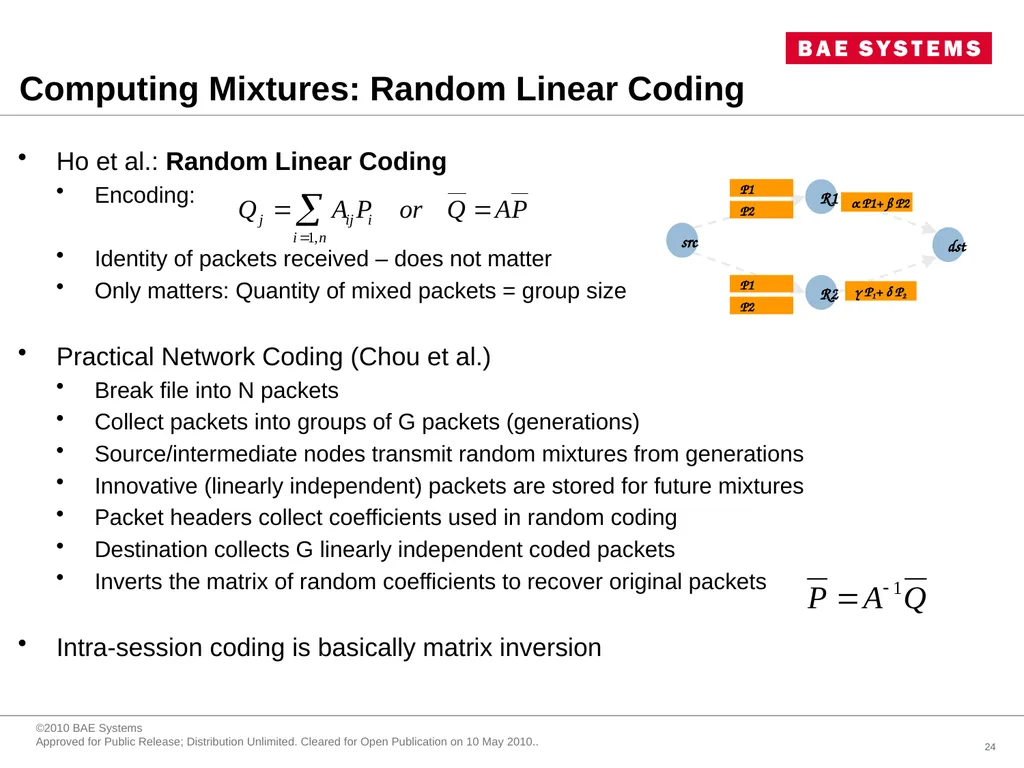
Computing Mixtures: Random Linear Coding Ho et al.: Random Linear Coding
Encoding:
Identity of packets received – does not matter
Only matters: Quantity of mixed packets = group size
Practical Network Coding (Chou et al.)
Break file into N packets
Collect packets into groups of G packets (generations)
Source/intermediate nodes transmit random mixtures from generations
Innovative (linearly independent) packets are stored for future mixtures
Packet headers collect coefficients used in random coding
Destination collects G linearly independent coded packets
Inverts the matrix of random coefficients to recover original packets
Intra-session coding is basically matrix inversion 24<br>
Encoding:
Identity of packets received – does not matter
Only matters: Quantity of mixed packets = group size
Practical Network Coding (Chou et al.)
Break file into N packets
Collect packets into groups of G packets (generations)
Source/intermediate nodes transmit random mixtures from generations
Innovative (linearly independent) packets are stored for future mixtures
Packet headers collect coefficients used in random coding
Destination collects G linearly independent coded packets
Inverts the matrix of random coefficients to recover original packets
Intra-session coding is basically matrix inversion 24<br>
25
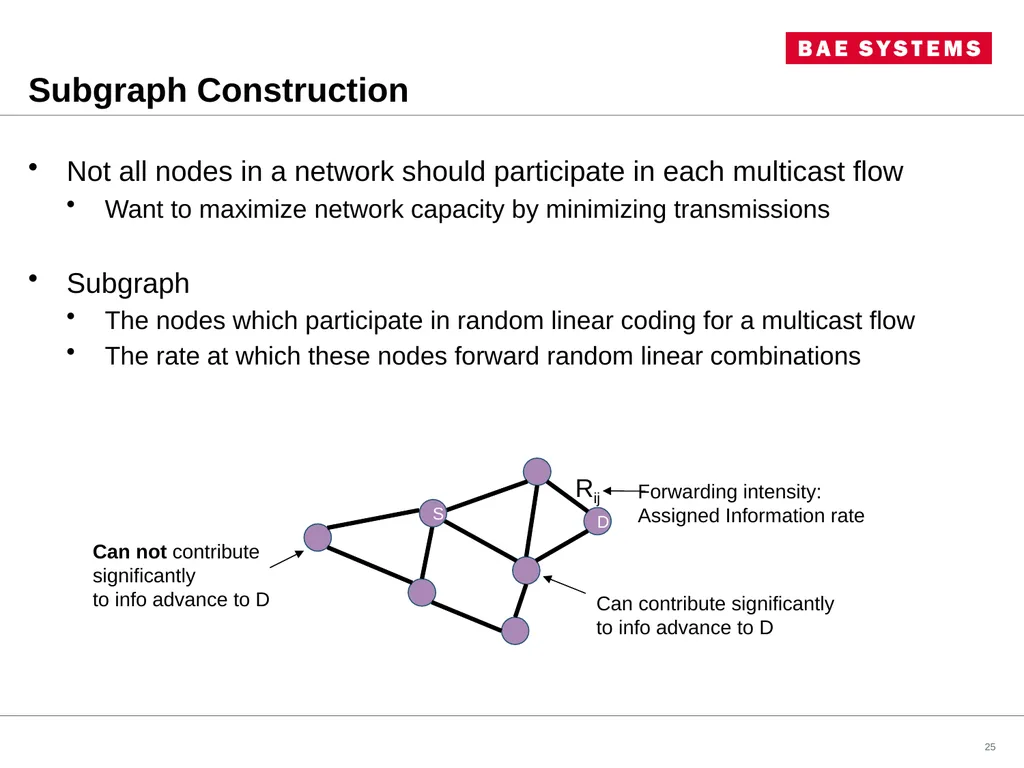
25 Subgraph Construction Not all nodes in a network should participate in each multicast flow
Want to maximize network capacity by minimizing transmissions
Subgraph
The nodes which participate in random linear coding for a multicast flow
The rate at which these nodes forward random linear combinations D S Can contribute significantly
to info advance to D Can not contribute
significantly
to info advance to D Rij Forwarding intensity:
Assigned Information rate<br>
Want to maximize network capacity by minimizing transmissions
Subgraph
The nodes which participate in random linear coding for a multicast flow
The rate at which these nodes forward random linear combinations D S Can contribute significantly
to info advance to D Can not contribute
significantly
to info advance to D Rij Forwarding intensity:
Assigned Information rate<br>
26
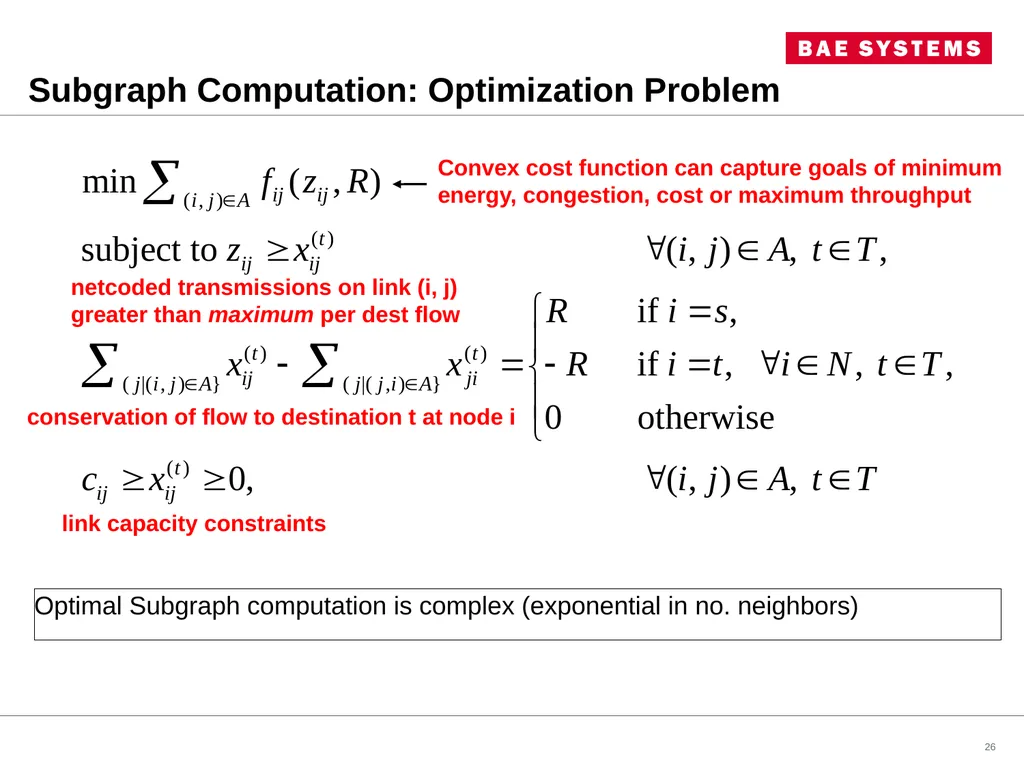
Subgraph Computation: Optimization Problem Optimal Subgraph computation is complex (exponential in no. neighbors) netcoded transmissions on link (i, j)
greater than maximum per dest flow conservation of flow to destination t at node i link capacity constraints Convex cost function can capture goals of minimum
energy, congestion, cost or maximum throughput 26<br>
27
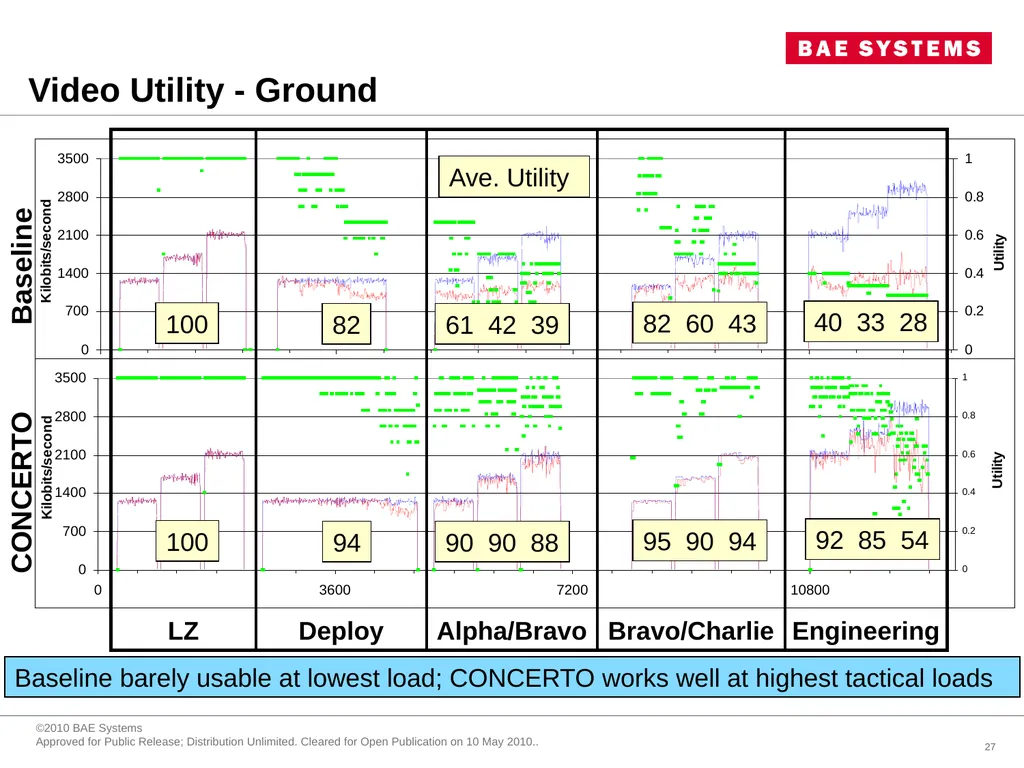
Video Utility - Ground Baseline CONCERTO LZ Deploy Alpha/Bravo Bravo/Charlie Engineering 100 100 82 94 61 42 39 90 90 88 82 60 43 95 90 94 40 33 28 92 85 54 Ave. Utility Baseline barely usable at lowest load; CONCERTO works well at highest tactical loads 27<br>
28
Video Utility - Air Baseline LZ Deploy Alpha/Bravo Bravo/Charlie Engineering 100 100 82 94 66 51 46 90 90 83 83 56 53 93 89 89 39 33 29 89 78 73 Ave. Utility 28 CONCERTO Baseline barely usable at lowest load; CONCERTO works well at highest tactical loads<br>