01
Concomitant Temozolomide Plus Radiotherapy for High-grade and Recurrent Meningioma: A Retrospective Chart Review Katherine Belanger BS1, Timothy H. Ung MD1, Denise Damek MD2, Kevin O. Lillehei MD1, D. Ryan Ormond, MD, PhD1
Department of Neurosurgery, University of Colorado School of Medicine, Aurora, CO, USA
Department of Neurology, University of Colorado School of Medicine, Aurora, CO, USA Conclusion References Introduction Meningiomas comprise about 30% of all intracranial tumors making them the most common primary intracranial neoplasm of middle to late adulthood
80-90% are WHO Grade 1
10-20% are Who Grade 2 & 3
First Line Treatment = Surgical Resection
Second Line Treatment = Adjuvant Radiation Therapy
For higher grade or recurrent meningiomas
No current systemic chemotherapy guidelines
Temozolomide
Alkylating agent that interferes with DNA-repair enzymes – synergistic relationship with radiation therapy to make tumors more radiosensitive
Currently used to treat glioblastomas and brain metastases
Low toxicity profile, ability to be orally administered, stable pharmacokinetics and ability to cross the blood brain barrier
Temozolomide Use in Meningiomas
A prospective phase II trial resulted in none of the patients remaining progression free six months post initiation of adjuvant TMZ therapy
Two case reports have identified patients that have achieved remarkable halting of disease progression lasting over a year on adjuvant TMZ therapies Methods Results: Demographics Results: Survival Analysis Chamberlain MC, Tsao-Wei DD, Groshen S. Temozolomide for treatment-resistant recurrent meningioma. Neurol. 2004;62:1210-1212. doi:10.1212/01.Wnl.0000118300.82017.F4
Dasanu CA, Samara Y, Codreanu I, et al. Systemic therapy for relapsed/refractory meningioma: is there potential for antiangiogenic agents? J Oncol Pharm Pract. 2019;25:638-647. doi:10.1177/1078155218799850
Le Rhun E, Taillibert S, Chamberlain MC. Systemic therapy for recurrent meningioma. Expert Rev Neurother. 2016;16:889-901. doi:10.1080/14737175.2016.1184087
Scorsetti M, Alongi F, Clerici E, et al. Temozolomide combined with radiotherapy in the treatment of recurrent cranial meningioma previously treated with multiple surgical resections and two sessions of radiosurgery: a case report and literature review. Tumori J. 2012;98:e67-e71. doi:10.1177/030089161209800321
Zhu H, Bi WL, Aizer A, et al. Efficacy of adjuvant radiotherapy for atypical and anaplastic meningioma. Cancer Med. 2019;8:13-20. doi.org/10.1002/cam4.1531
Bi WL, Dunn IF. Current and emerging principles in surgery for meningioma. Chin Clin Oncol. 2017;6:S7. doi:10.21037/cco.2017.06.10
Goldbrunner R, Minniti G, Preusser M, et al. EANO guidelines for the diagnosis and treatment of meningiomas. Lancet Oncol. 2016;17:e383-e391. doi.org/10.1016/S1470-2045(16)30321-7
Cui C, Zhou L, Lian B, et al. Safety and efficacy of apatinib combined with temozolomide in advanced melanoma patients after conventional treatment failure. Transl Oncol. 2018;11:1155-1159. doi.org/10.1016/j.tranon.2018.07.009
Li J, Chai X, Cao Y, et al. Intensity‑modulated radiation therapy combined with concomitant temozolomide for brain metastases from lung adenocarcinoma. Oncol Lett. 2018;16:4285-4290. doi:10.3892/ol.2018.9171
Stupp R, Mason WP, van den Bent MJ, et al. Radiotherapy plus concomitant and adjuvant temozolomide for glioblastoma. N Engl J of Med. 2005;352:987-996. doi:10.1056/NEJMoa043330 C C C D Median age was 56 years (range, 22-82 years) at time of TMZ treatment initiation
All patients had at least 1 prior surgical resection
Intensity-modulated radiation therapy (IMRT): median dose of 60 Gy (range, 48.6-65 Gy) on a 1.8-2 Gy per treatment fractionated schedule
TMZ dosing: 75mg/m2/day administered at night for 42 days
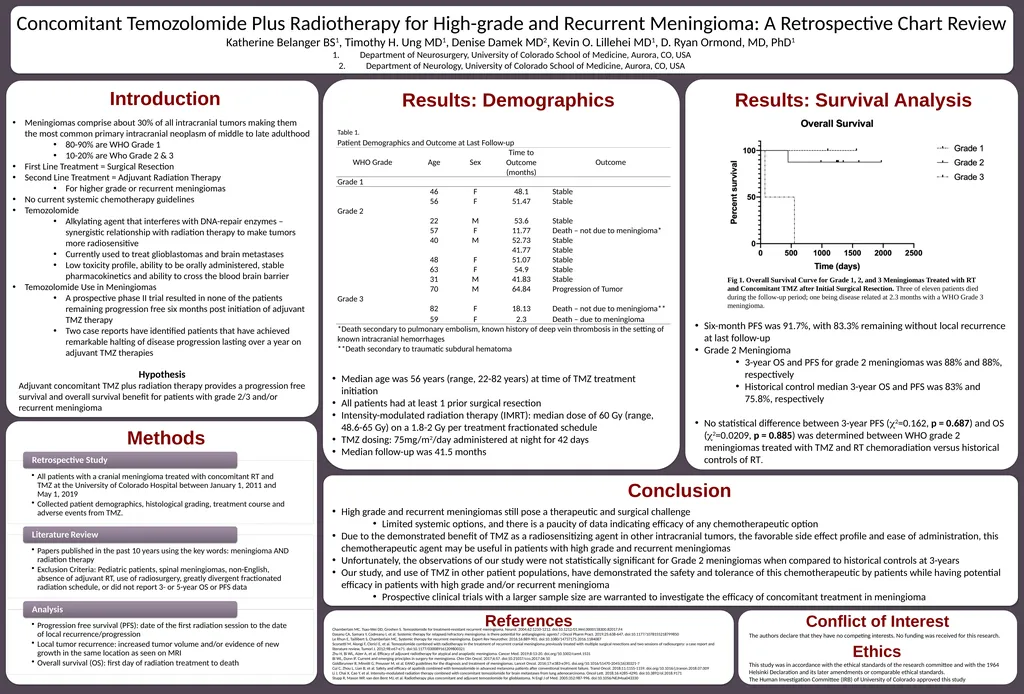
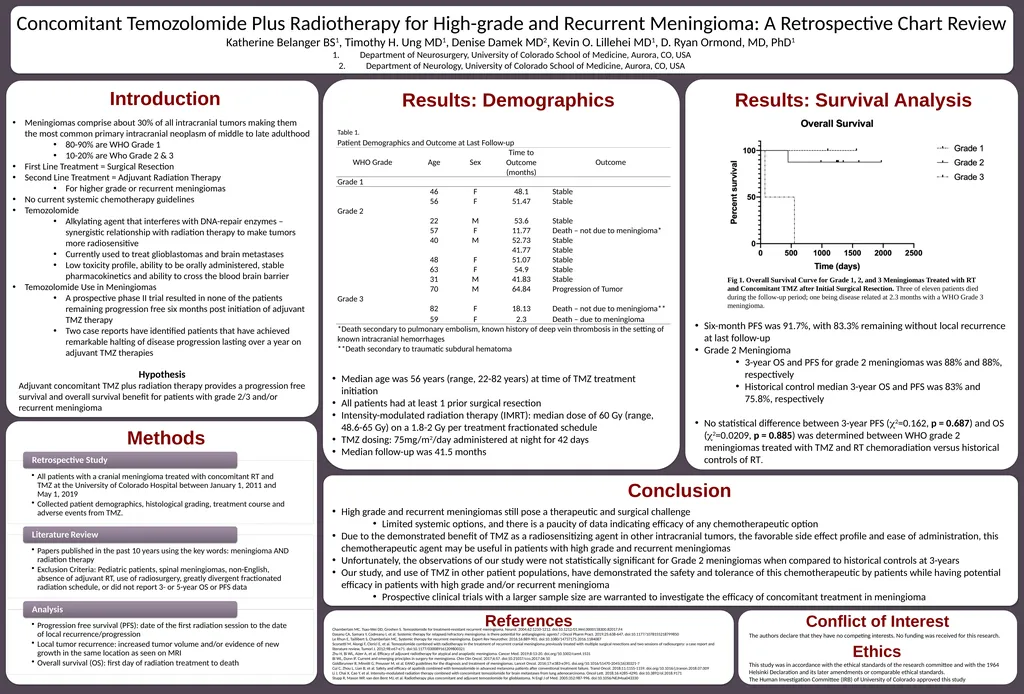
Median follow-up was 41.5 months Six-month PFS was 91.7%, with 83.3% remaining without local recurrence at last follow-up
Grade 2 Meningioma
3-year OS and PFS for grade 2 meningiomas was 88% and 88%, respectively
Historical control median 3-year OS and PFS was 83% and 75.8%, respectively
No statistical difference between 3-year PFS (2=0.162, p = 0.687) and OS (2=0.0209, p = 0.885) was determined between WHO grade 2 meningiomas treated with TMZ and RT chemoradiation versus historical controls of RT. High grade and recurrent meningiomas still pose a therapeutic and surgical challenge
Limited systemic options, and there is a paucity of data indicating efficacy of any chemotherapeutic option
Due to the demonstrated benefit of TMZ as a radiosensitizing agent in other intracranial tumors, the favorable side effect profile and ease of administration, this chemotherapeutic agent may be useful in patients with high grade and recurrent meningiomas
Unfortunately, the observations of our study were not statistically significant for Grade 2 meningiomas when compared to historical controls at 3-years
Our study, and use of TMZ in other patient populations, have demonstrated the safety and tolerance of this chemotherapeutic by patients while having potential efficacy in patients with high grade and/or recurrent meningioma
Prospective clinical trials with a larger sample size are warranted to investigate the efficacy of concomitant treatment in meningioma Conflict of Interest The authors declare that they have no competing interests. No funding was received for this research.
This study was in accordance with the ethical standards of the research committee and with the 1964 Helsinki Declaration and its later amendments or comparable ethical standards.
The Human Investigation Committee (IRB) of University of Colorado approved this study Ethics Hypothesis
Adjuvant concomitant TMZ plus radiation therapy provides a progression free survival and overall survival benefit for patients with grade 2/3 and/or recurrent meningioma<br>