
Concurrency Control Chp 15, Database Systems,
KL
Published · 20 slides · 0 views
1 / 1
Description
Concurrency Control Chp 15, Database Systems, Korth , 6th edition Lock Based Protocols There are various modes in which a data item may be locked. Shared. If a transaction Ti has obtained a shared-mode lock (denoted by S) on item Q, then Ti
Related Topics
Share
Embed code
Download this presentation From Below
"Concurrency Control Chp 15, Database Systems," is the property of its rightful owner. Permission is granted to download and print the materials on this website for personal, non-commercial use only, and to display it on your personal computer provided you do not modify the materials and that you retain all copyright notices contained in the materials. By downloading content from our website, you accept the terms of this agreement.
Presentation Transcript
01
Concurrency Control Chp 15, Database Systems, Korth , 6th edition<br>
02
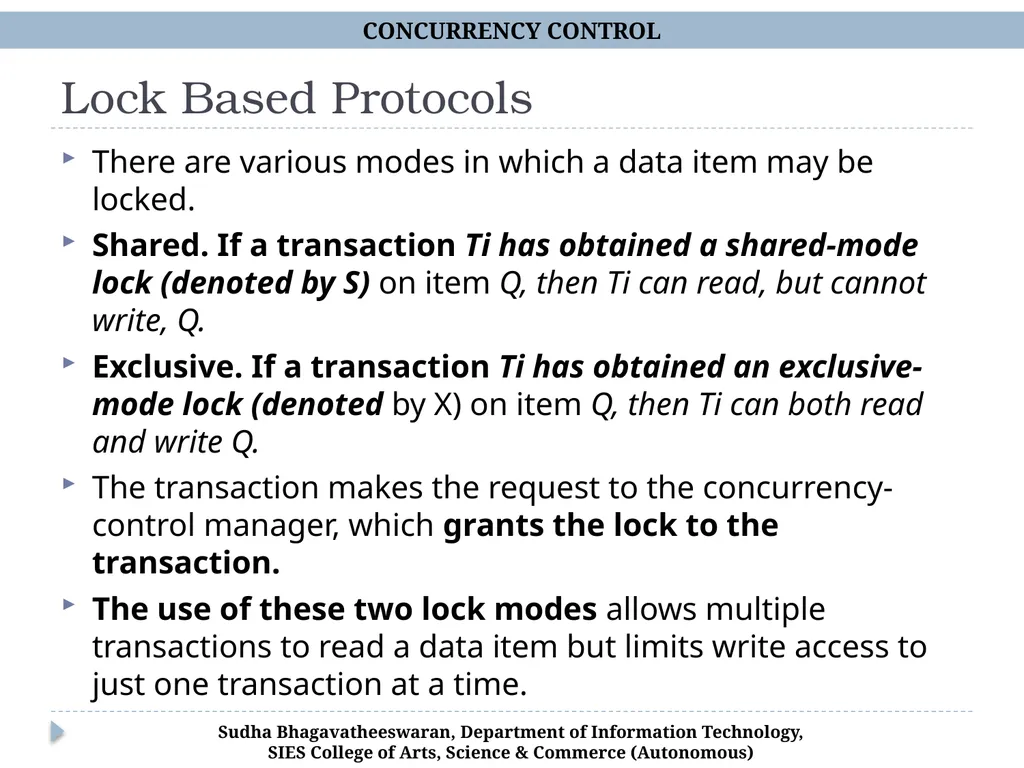
Lock Based Protocols There are various modes in which a data item may be locked.
Shared. If a transaction Ti has obtained a shared-mode lock (denoted by S) on item Q, then Ti can read, but cannot write, Q.
Exclusive. If a transaction Ti has obtained an exclusive-mode lock (denoted by X) on item Q, then Ti can both read and write Q.
The transaction makes the request to the concurrency-control manager, which grants the lock to the transaction.
The use of these two lock modes allows multiple transactions to read a data item but limits write access to just one transaction at a time. CONCURRENCY CONTROL Sudha Bhagavatheeswaran, Department of Information Technology,
SIES College of Arts, Science & Commerce (Autonomous)<br>
Shared. If a transaction Ti has obtained a shared-mode lock (denoted by S) on item Q, then Ti can read, but cannot write, Q.
Exclusive. If a transaction Ti has obtained an exclusive-mode lock (denoted by X) on item Q, then Ti can both read and write Q.
The transaction makes the request to the concurrency-control manager, which grants the lock to the transaction.
The use of these two lock modes allows multiple transactions to read a data item but limits write access to just one transaction at a time. CONCURRENCY CONTROL Sudha Bhagavatheeswaran, Department of Information Technology,
SIES College of Arts, Science & Commerce (Autonomous)<br>
03
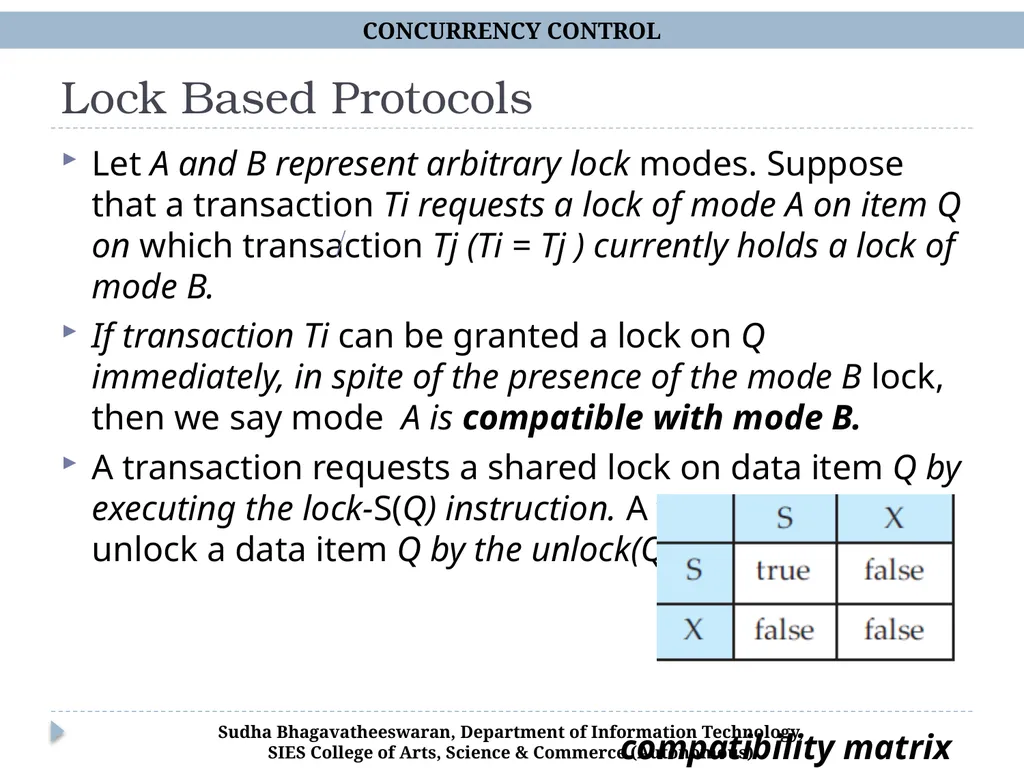
Lock Based Protocols Let A and B represent arbitrary lock modes. Suppose that a transaction Ti requests a lock of mode A on item Q on which transaction Tj (Ti = Tj ) currently holds a lock of mode B.
If transaction Ti can be granted a lock on Q immediately, in spite of the presence of the mode B lock, then we say mode A is compatible with mode B.
A transaction requests a shared lock on data item Q by executing the lock-S(Q) instruction. A transaction can unlock a data item Q by the unlock(Q)instruction.
compatibility matrix CONCURRENCY CONTROL Sudha Bhagavatheeswaran, Department of Information Technology,
SIES College of Arts, Science & Commerce (Autonomous)<br>
If transaction Ti can be granted a lock on Q immediately, in spite of the presence of the mode B lock, then we say mode A is compatible with mode B.
A transaction requests a shared lock on data item Q by executing the lock-S(Q) instruction. A transaction can unlock a data item Q by the unlock(Q)instruction.
compatibility matrix CONCURRENCY CONTROL Sudha Bhagavatheeswaran, Department of Information Technology,
SIES College of Arts, Science & Commerce (Autonomous)<br>
04
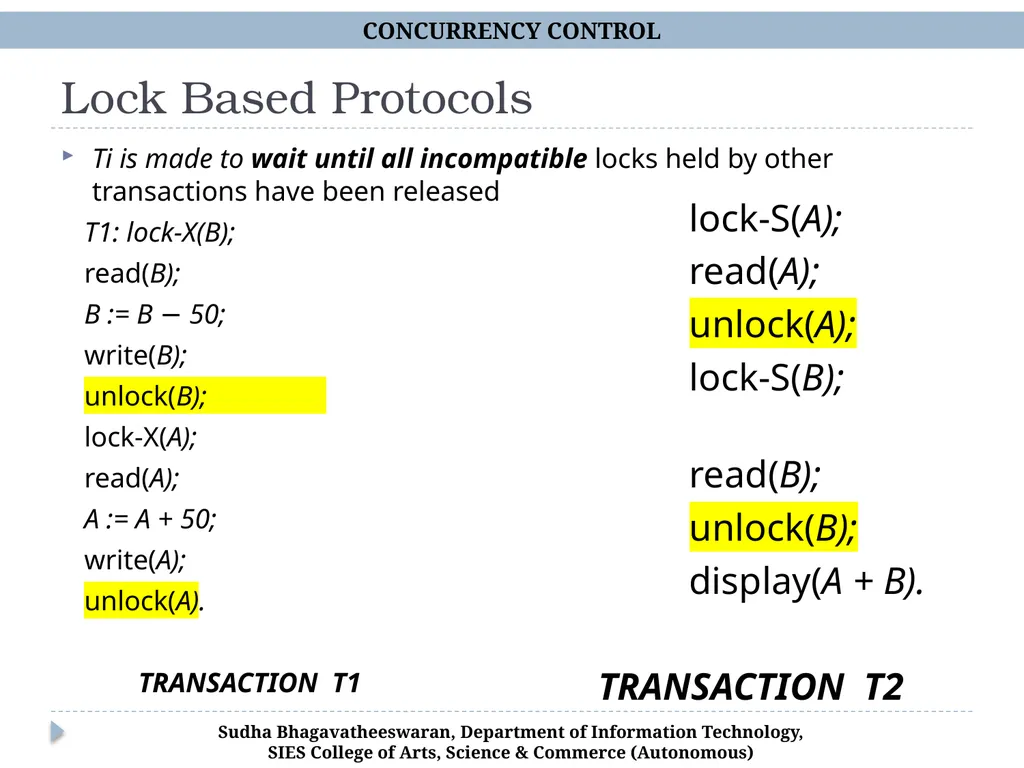
Lock Based Protocols Ti is made to wait until all incompatible locks held by other transactions have been released
T1: lock-X(B);
read(B);
B := B − 50;
write(B);
unlock(B);
lock-X(A);
read(A);
A := A + 50;
write(A);
unlock(A).
TRANSACTION T1 lock-S(A);
read(A);
unlock(A);
lock-S(B);
read(B);
unlock(B);
display(A + B).
TRANSACTION T2 CONCURRENCY CONTROL Sudha Bhagavatheeswaran, Department of Information Technology,
SIES College of Arts, Science & Commerce (Autonomous)<br>
T1: lock-X(B);
read(B);
B := B − 50;
write(B);
unlock(B);
lock-X(A);
read(A);
A := A + 50;
write(A);
unlock(A).
TRANSACTION T1 lock-S(A);
read(A);
unlock(A);
lock-S(B);
read(B);
unlock(B);
display(A + B).
TRANSACTION T2 CONCURRENCY CONTROL Sudha Bhagavatheeswaran, Department of Information Technology,
SIES College of Arts, Science & Commerce (Autonomous)<br>
05
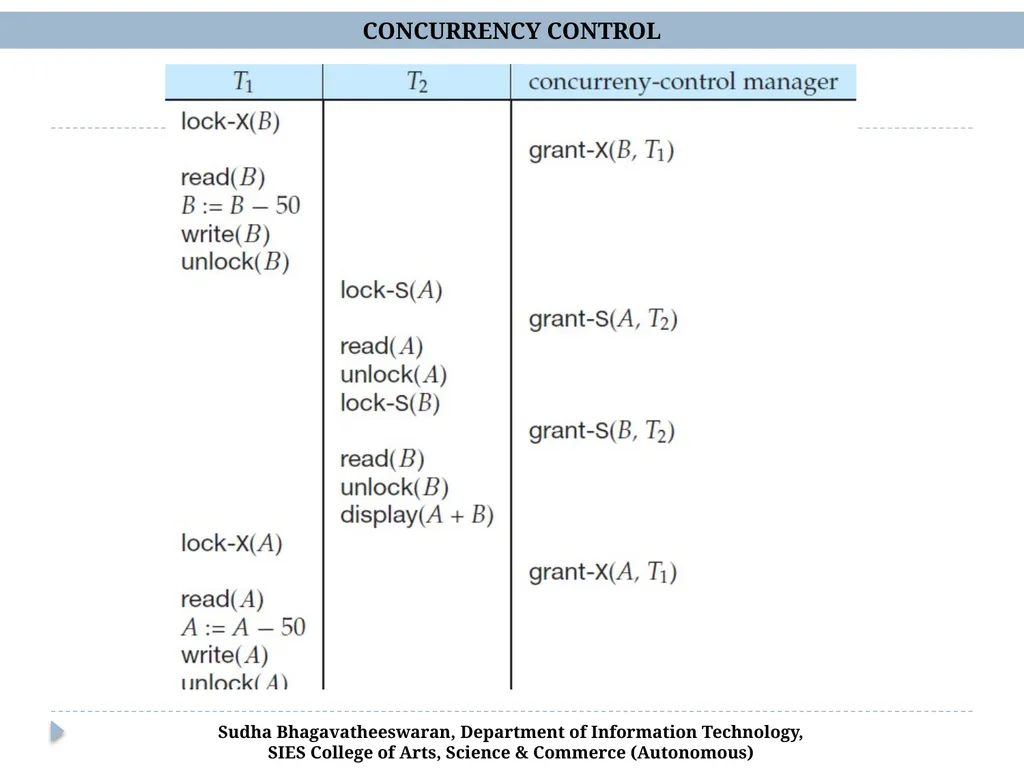
CONCURRENCY CONTROL Sudha Bhagavatheeswaran, Department of Information Technology,
SIES College of Arts, Science & Commerce (Autonomous)<br>
SIES College of Arts, Science & Commerce (Autonomous)<br>
06
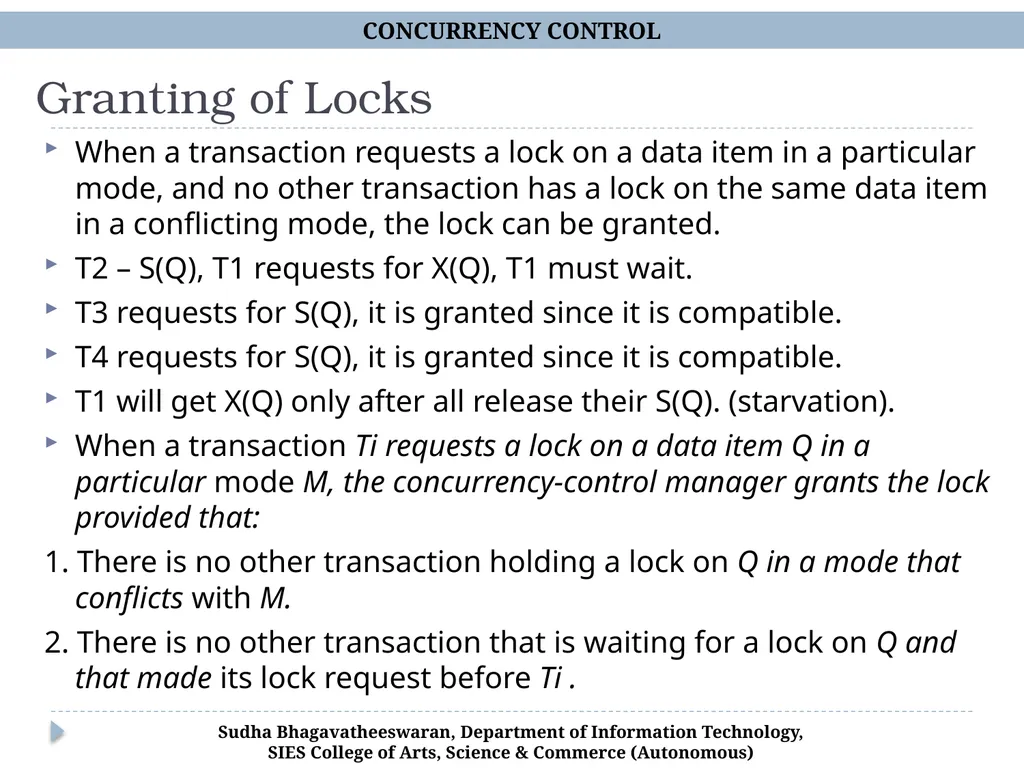
Granting of Locks When a transaction requests a lock on a data item in a particular mode, and no other transaction has a lock on the same data item in a conflicting mode, the lock can be granted.
T2 – S(Q), T1 requests for X(Q), T1 must wait.
T3 requests for S(Q), it is granted since it is compatible.
T4 requests for S(Q), it is granted since it is compatible.
T1 will get X(Q) only after all release their S(Q). (starvation).
When a transaction Ti requests a lock on a data item Q in a particular mode M, the concurrency-control manager grants the lock provided that:
1. There is no other transaction holding a lock on Q in a mode that conflicts with M.
2. There is no other transaction that is waiting for a lock on Q and that made its lock request before Ti . CONCURRENCY CONTROL Sudha Bhagavatheeswaran, Department of Information Technology,
SIES College of Arts, Science & Commerce (Autonomous)<br>
T2 – S(Q), T1 requests for X(Q), T1 must wait.
T3 requests for S(Q), it is granted since it is compatible.
T4 requests for S(Q), it is granted since it is compatible.
T1 will get X(Q) only after all release their S(Q). (starvation).
When a transaction Ti requests a lock on a data item Q in a particular mode M, the concurrency-control manager grants the lock provided that:
1. There is no other transaction holding a lock on Q in a mode that conflicts with M.
2. There is no other transaction that is waiting for a lock on Q and that made its lock request before Ti . CONCURRENCY CONTROL Sudha Bhagavatheeswaran, Department of Information Technology,
SIES College of Arts, Science & Commerce (Autonomous)<br>
07
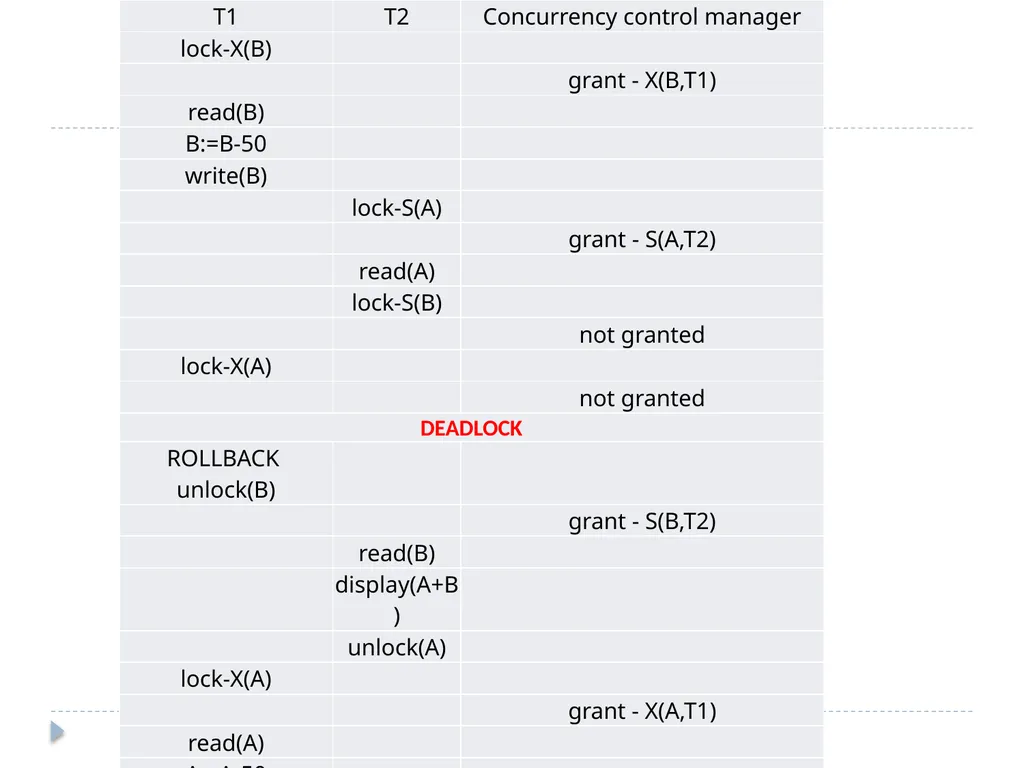
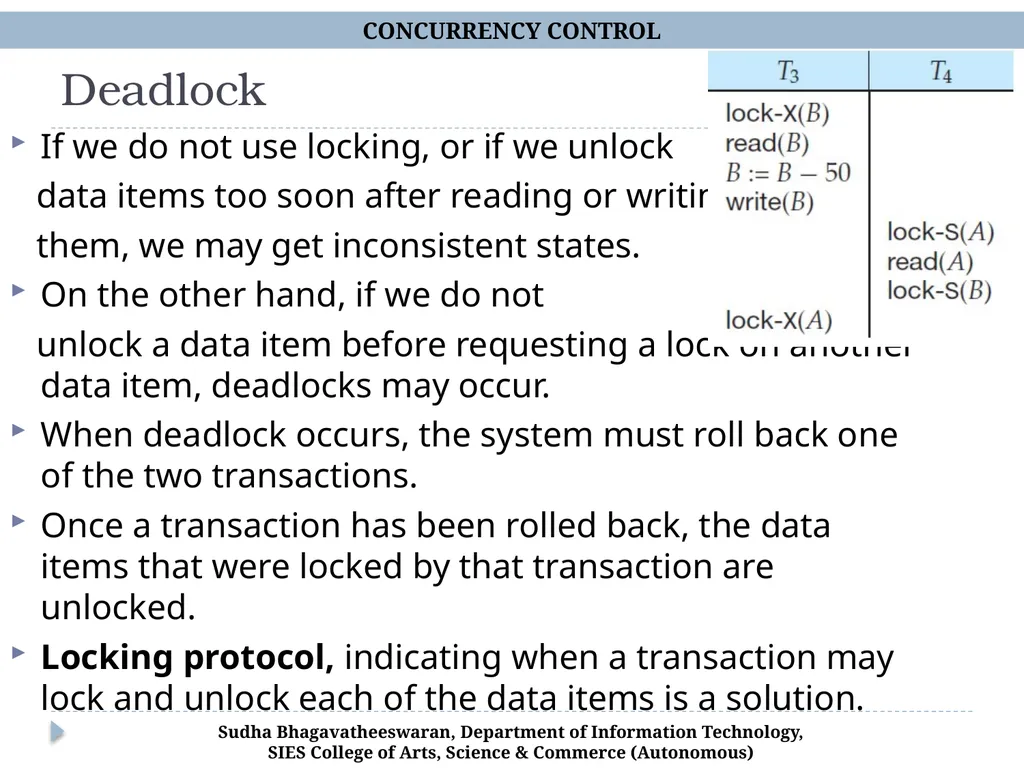
Deadlock If we do not use locking, or if we unlock
data items too soon after reading or writing
them, we may get inconsistent states.
On the other hand, if we do not
unlock a data item before requesting a lock on another data item, deadlocks may occur.
When deadlock occurs, the system must roll back one of the two transactions.
Once a transaction has been rolled back, the data items that were locked by that transaction are unlocked.
Locking protocol, indicating when a transaction may lock and unlock each of the data items is a solution. CONCURRENCY CONTROL Sudha Bhagavatheeswaran, Department of Information Technology,
SIES College of Arts, Science & Commerce (Autonomous)<br>
data items too soon after reading or writing
them, we may get inconsistent states.
On the other hand, if we do not
unlock a data item before requesting a lock on another data item, deadlocks may occur.
When deadlock occurs, the system must roll back one of the two transactions.
Once a transaction has been rolled back, the data items that were locked by that transaction are unlocked.
Locking protocol, indicating when a transaction may lock and unlock each of the data items is a solution. CONCURRENCY CONTROL Sudha Bhagavatheeswaran, Department of Information Technology,
SIES College of Arts, Science & Commerce (Autonomous)<br>
08
Two-Phase Locking Protocol ensures serializability; does not avoid deadlock
Each transaction issue lock and unlock requests in two phases:
Growing phase. A transaction may obtain locks, but may not release any lock.
Shrinking phase. A transaction may release locks, but may not obtain any new locks.
Initially, a transaction is in the growing phase. The transaction acquires locks as needed.
Once the transaction releases a lock, it enters the shrinking phase, and it can issue no more lock requests. CONCURRENCY CONTROL Sudha Bhagavatheeswaran, Department of Information Technology,
SIES College of Arts, Science & Commerce (Autonomous)<br>
Each transaction issue lock and unlock requests in two phases:
Growing phase. A transaction may obtain locks, but may not release any lock.
Shrinking phase. A transaction may release locks, but may not obtain any new locks.
Initially, a transaction is in the growing phase. The transaction acquires locks as needed.
Once the transaction releases a lock, it enters the shrinking phase, and it can issue no more lock requests. CONCURRENCY CONTROL Sudha Bhagavatheeswaran, Department of Information Technology,
SIES College of Arts, Science & Commerce (Autonomous)<br>
09
Two-Phase Locking Protocol The point in the schedule where the transaction has
obtained its final lock (the end of its growing phase) is called the lock point of the transaction.
transactions can now be ordered according to their lock points— this ordering is a serializability ordering for the transactions. CONCURRENCY CONTROL Sudha Bhagavatheeswaran, Department of Information Technology,
SIES College of Arts, Science & Commerce (Autonomous)<br>
obtained its final lock (the end of its growing phase) is called the lock point of the transaction.
transactions can now be ordered according to their lock points— this ordering is a serializability ordering for the transactions. CONCURRENCY CONTROL Sudha Bhagavatheeswaran, Department of Information Technology,
SIES College of Arts, Science & Commerce (Autonomous)<br>
10
Two-Phase Locking Protocol In addition to being serializable,
schedules should be cascadeless.
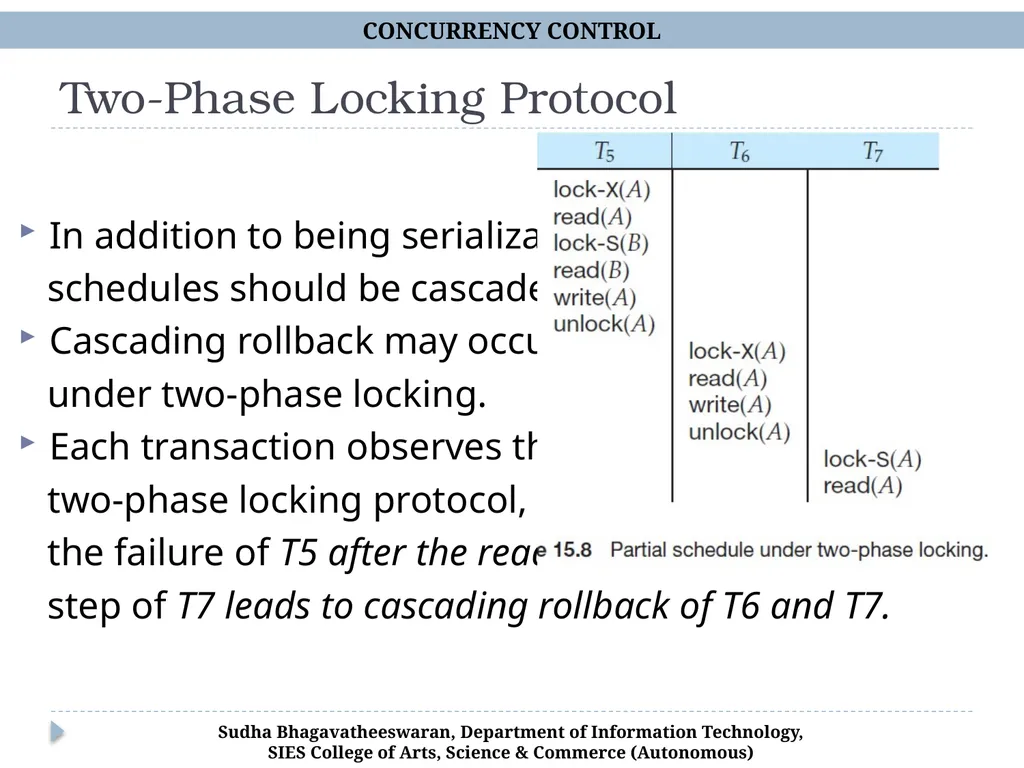
Cascading rollback may occur
under two-phase locking.
Each transaction observes the
two-phase locking protocol, but
the failure of T5 after the read(A)
step of T7 leads to cascading rollback of T6 and T7. CONCURRENCY CONTROL Sudha Bhagavatheeswaran, Department of Information Technology,
SIES College of Arts, Science & Commerce (Autonomous)<br>
schedules should be cascadeless.
Cascading rollback may occur
under two-phase locking.
Each transaction observes the
two-phase locking protocol, but
the failure of T5 after the read(A)
step of T7 leads to cascading rollback of T6 and T7. CONCURRENCY CONTROL Sudha Bhagavatheeswaran, Department of Information Technology,
SIES College of Arts, Science & Commerce (Autonomous)<br>
11
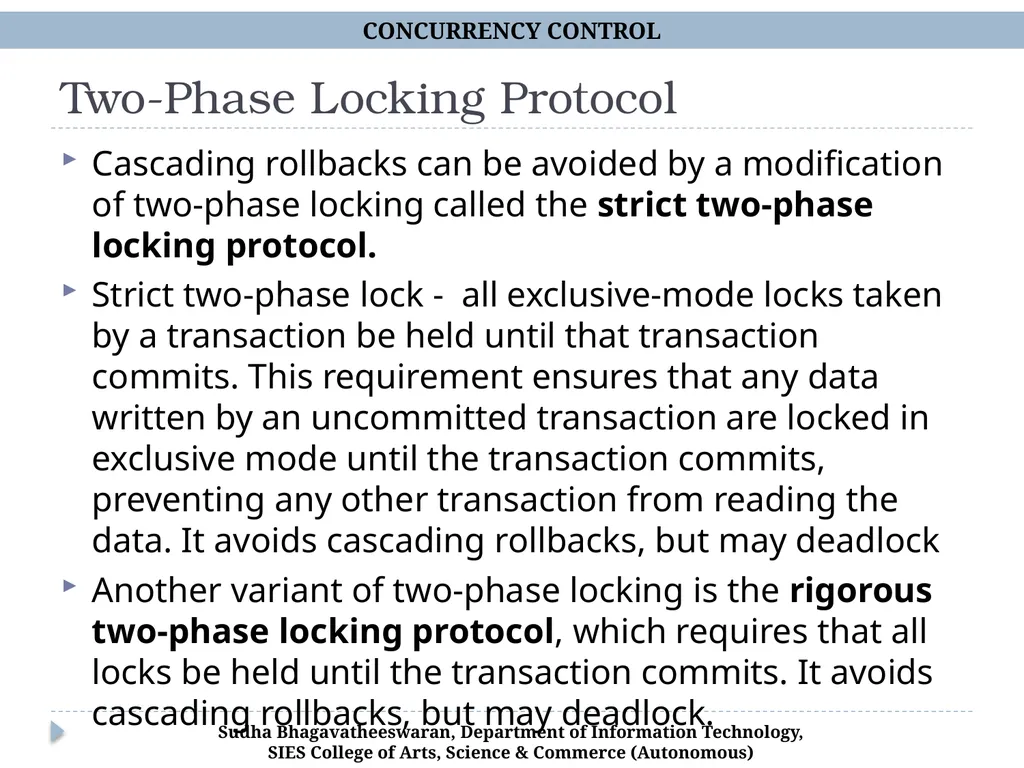
Two-Phase Locking Protocol Cascading rollbacks can be avoided by a modification of two-phase locking called the strict two-phase locking protocol.
Strict two-phase lock - all exclusive-mode locks taken by a transaction be held until that transaction commits. This requirement ensures that any data written by an uncommitted transaction are locked in exclusive mode until the transaction commits, preventing any other transaction from reading the data. It avoids cascading rollbacks, but may deadlock
Another variant of two-phase locking is the rigorous two-phase locking protocol, which requires that all locks be held until the transaction commits. It avoids cascading rollbacks, but may deadlock. CONCURRENCY CONTROL Sudha Bhagavatheeswaran, Department of Information Technology,
SIES College of Arts, Science & Commerce (Autonomous)<br>
Strict two-phase lock - all exclusive-mode locks taken by a transaction be held until that transaction commits. This requirement ensures that any data written by an uncommitted transaction are locked in exclusive mode until the transaction commits, preventing any other transaction from reading the data. It avoids cascading rollbacks, but may deadlock
Another variant of two-phase locking is the rigorous two-phase locking protocol, which requires that all locks be held until the transaction commits. It avoids cascading rollbacks, but may deadlock. CONCURRENCY CONTROL Sudha Bhagavatheeswaran, Department of Information Technology,
SIES College of Arts, Science & Commerce (Autonomous)<br>
12
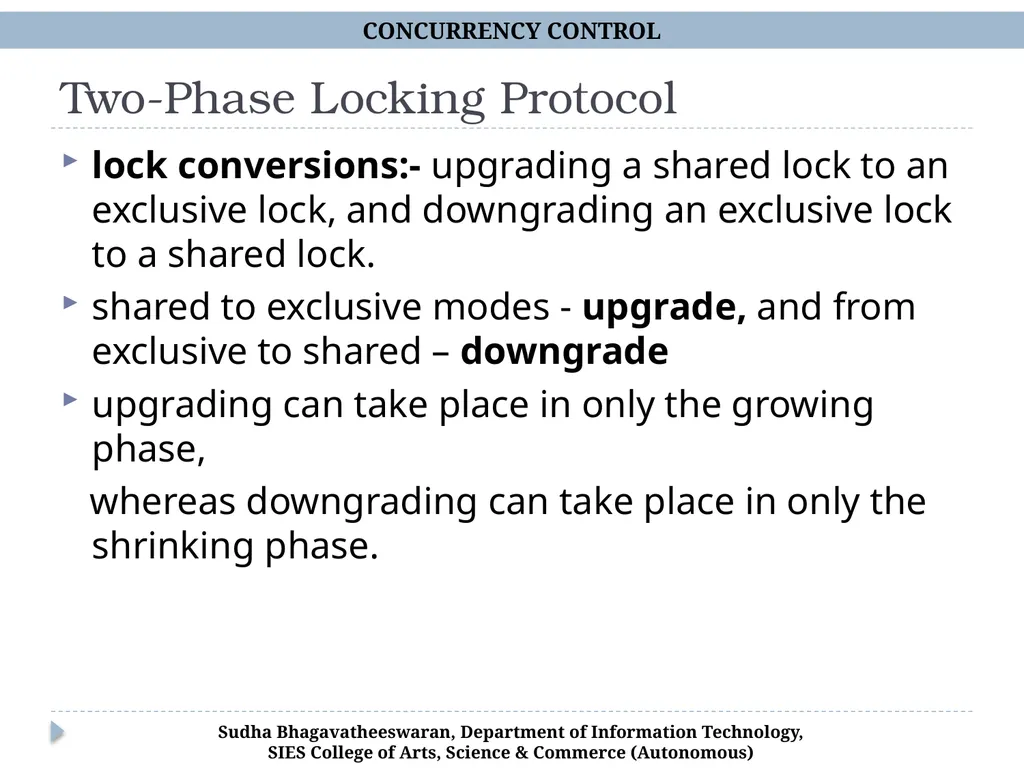
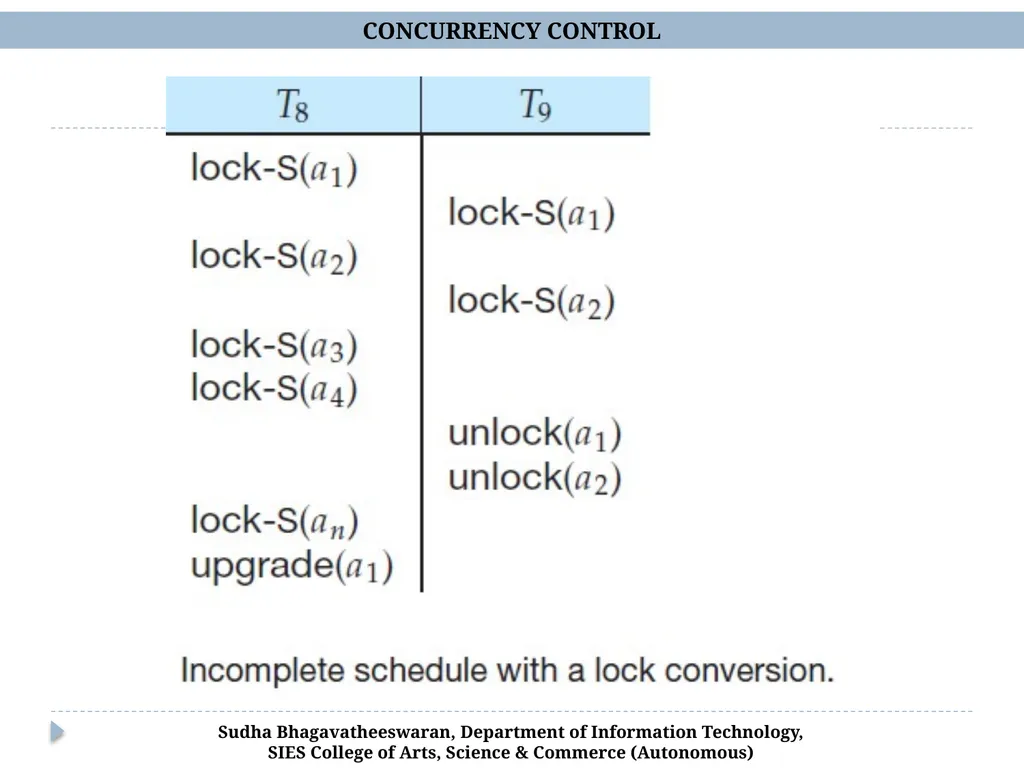
Two-Phase Locking Protocol lock conversions:- upgrading a shared lock to an exclusive lock, and downgrading an exclusive lock to a shared lock.
shared to exclusive modes - upgrade, and from exclusive to shared – downgrade
upgrading can take place in only the growing phase,
whereas downgrading can take place in only the shrinking phase. CONCURRENCY CONTROL Sudha Bhagavatheeswaran, Department of Information Technology,
SIES College of Arts, Science & Commerce (Autonomous)<br>
shared to exclusive modes - upgrade, and from exclusive to shared – downgrade
upgrading can take place in only the growing phase,
whereas downgrading can take place in only the shrinking phase. CONCURRENCY CONTROL Sudha Bhagavatheeswaran, Department of Information Technology,
SIES College of Arts, Science & Commerce (Autonomous)<br>
13
CONCURRENCY CONTROL Sudha Bhagavatheeswaran, Department of Information Technology,
SIES College of Arts, Science & Commerce (Autonomous)<br>
SIES College of Arts, Science & Commerce (Autonomous)<br>
14
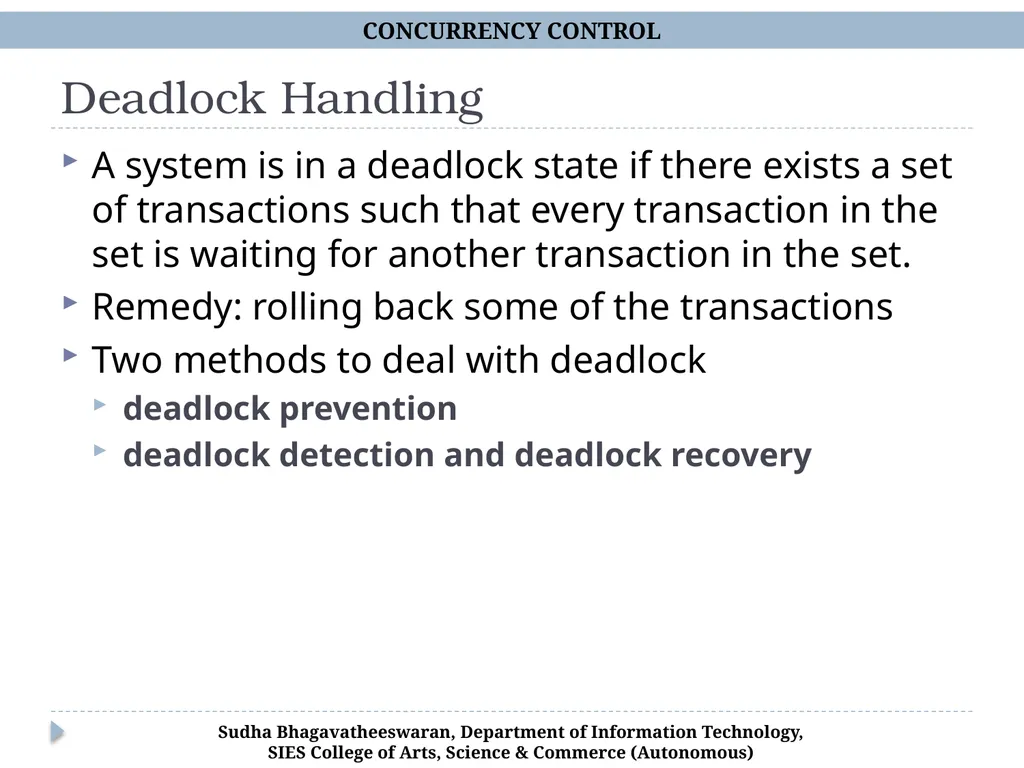
Deadlock Handling A system is in a deadlock state if there exists a set of transactions such that every transaction in the set is waiting for another transaction in the set.
Remedy: rolling back some of the transactions
Two methods to deal with deadlock
deadlock prevention
deadlock detection and deadlock recovery CONCURRENCY CONTROL Sudha Bhagavatheeswaran, Department of Information Technology,
SIES College of Arts, Science & Commerce (Autonomous)<br>
Remedy: rolling back some of the transactions
Two methods to deal with deadlock
deadlock prevention
deadlock detection and deadlock recovery CONCURRENCY CONTROL Sudha Bhagavatheeswaran, Department of Information Technology,
SIES College of Arts, Science & Commerce (Autonomous)<br>
15
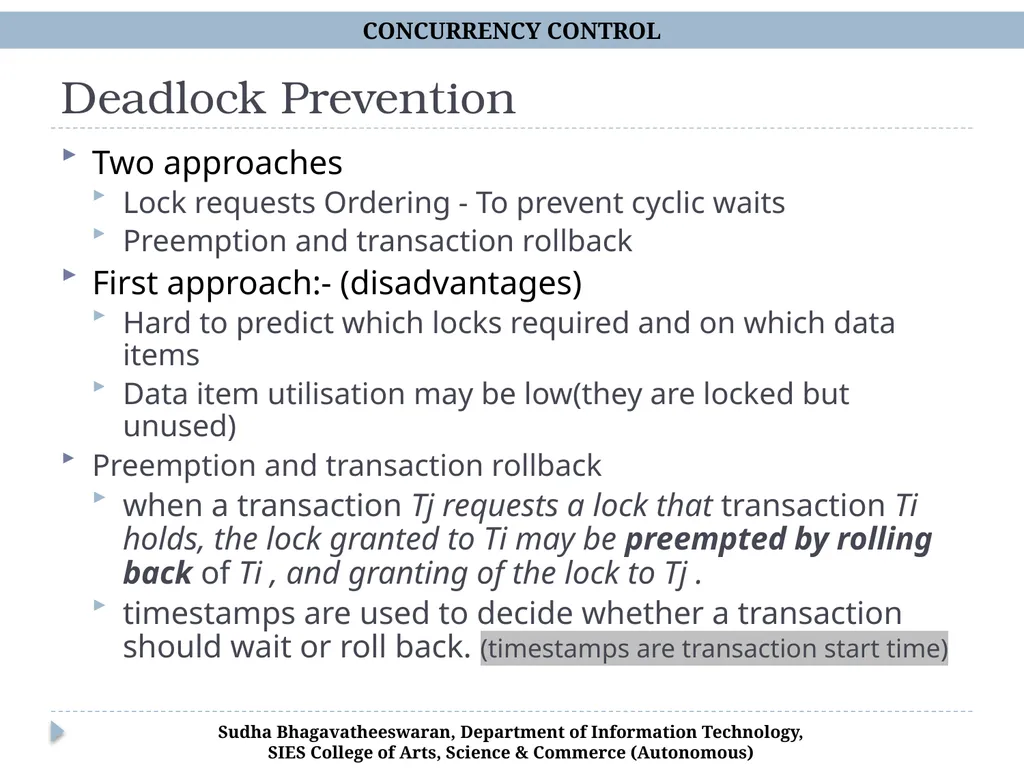
Deadlock Prevention Two approaches
Lock requests Ordering - To prevent cyclic waits
Preemption and transaction rollback
First approach:- (disadvantages)
Hard to predict which locks required and on which data items
Data item utilisation may be low(they are locked but unused)
Preemption and transaction rollback
when a transaction Tj requests a lock that transaction Ti holds, the lock granted to Ti may be preempted by rolling back of Ti , and granting of the lock to Tj .
timestamps are used to decide whether a transaction should wait or roll back. (timestamps are transaction start time) CONCURRENCY CONTROL Sudha Bhagavatheeswaran, Department of Information Technology,
SIES College of Arts, Science & Commerce (Autonomous)<br>
Lock requests Ordering - To prevent cyclic waits
Preemption and transaction rollback
First approach:- (disadvantages)
Hard to predict which locks required and on which data items
Data item utilisation may be low(they are locked but unused)
Preemption and transaction rollback
when a transaction Tj requests a lock that transaction Ti holds, the lock granted to Ti may be preempted by rolling back of Ti , and granting of the lock to Tj .
timestamps are used to decide whether a transaction should wait or roll back. (timestamps are transaction start time) CONCURRENCY CONTROL Sudha Bhagavatheeswaran, Department of Information Technology,
SIES College of Arts, Science & Commerce (Autonomous)<br>
16
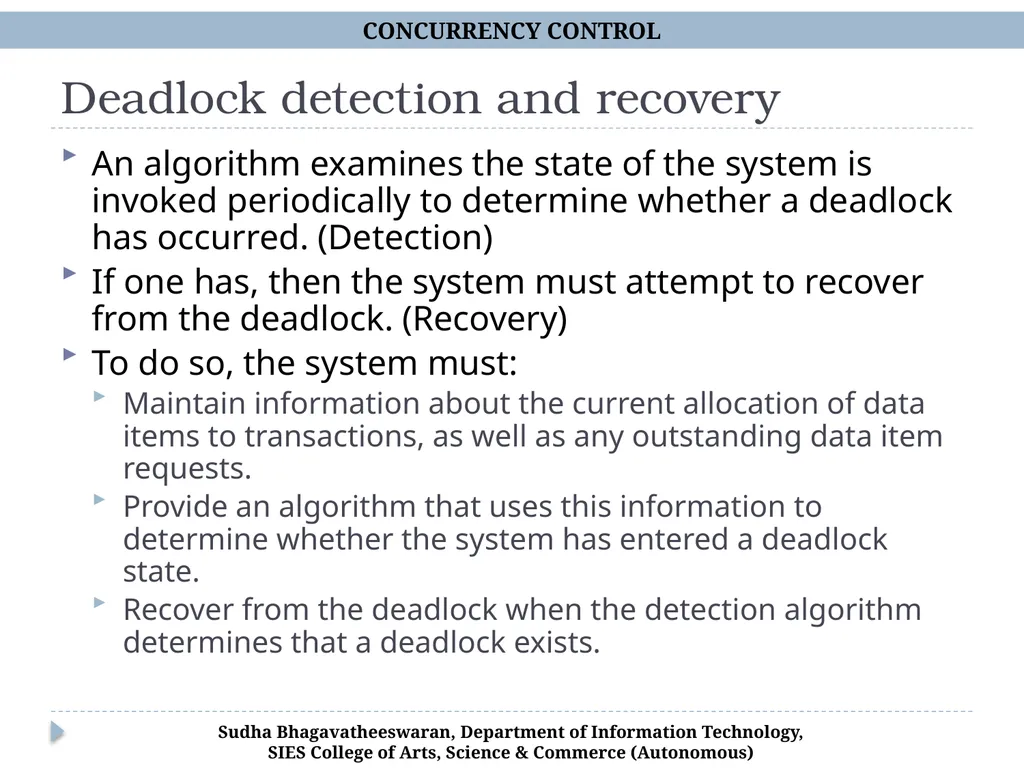
Deadlock detection and recovery An algorithm examines the state of the system is invoked periodically to determine whether a deadlock has occurred. (Detection)
If one has, then the system must attempt to recover from the deadlock. (Recovery)
To do so, the system must:
Maintain information about the current allocation of data items to transactions, as well as any outstanding data item requests.
Provide an algorithm that uses this information to determine whether the system has entered a deadlock state.
Recover from the deadlock when the detection algorithm determines that a deadlock exists. CONCURRENCY CONTROL Sudha Bhagavatheeswaran, Department of Information Technology,
SIES College of Arts, Science & Commerce (Autonomous)<br>
If one has, then the system must attempt to recover from the deadlock. (Recovery)
To do so, the system must:
Maintain information about the current allocation of data items to transactions, as well as any outstanding data item requests.
Provide an algorithm that uses this information to determine whether the system has entered a deadlock state.
Recover from the deadlock when the detection algorithm determines that a deadlock exists. CONCURRENCY CONTROL Sudha Bhagavatheeswaran, Department of Information Technology,
SIES College of Arts, Science & Commerce (Autonomous)<br>
17
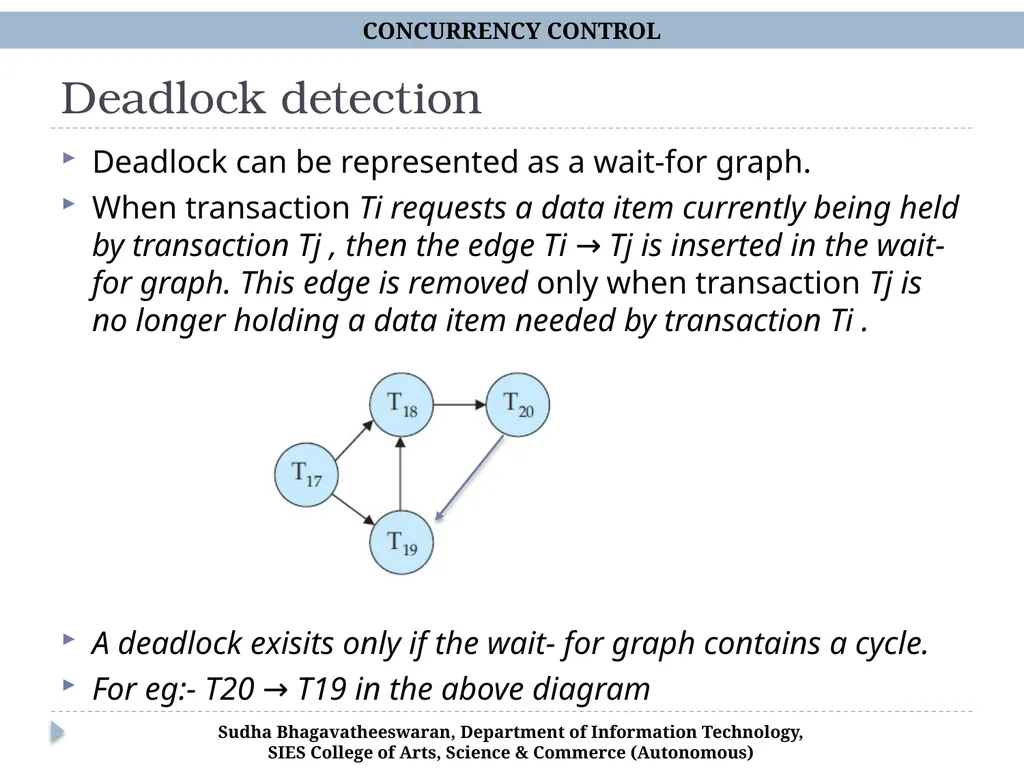
Deadlock detection Deadlock can be represented as a wait-for graph.
When transaction Ti requests a data item currently being held by transaction Tj , then the edge Ti → Tj is inserted in the wait-for graph. This edge is removed only when transaction Tj is no longer holding a data item needed by transaction Ti .
A deadlock exisits only if the wait- for graph contains a cycle.
For eg:- T20 → T19 in the above diagram CONCURRENCY CONTROL Sudha Bhagavatheeswaran, Department of Information Technology,
SIES College of Arts, Science & Commerce (Autonomous)<br>
When transaction Ti requests a data item currently being held by transaction Tj , then the edge Ti → Tj is inserted in the wait-for graph. This edge is removed only when transaction Tj is no longer holding a data item needed by transaction Ti .
A deadlock exisits only if the wait- for graph contains a cycle.
For eg:- T20 → T19 in the above diagram CONCURRENCY CONTROL Sudha Bhagavatheeswaran, Department of Information Technology,
SIES College of Arts, Science & Commerce (Autonomous)<br>
18
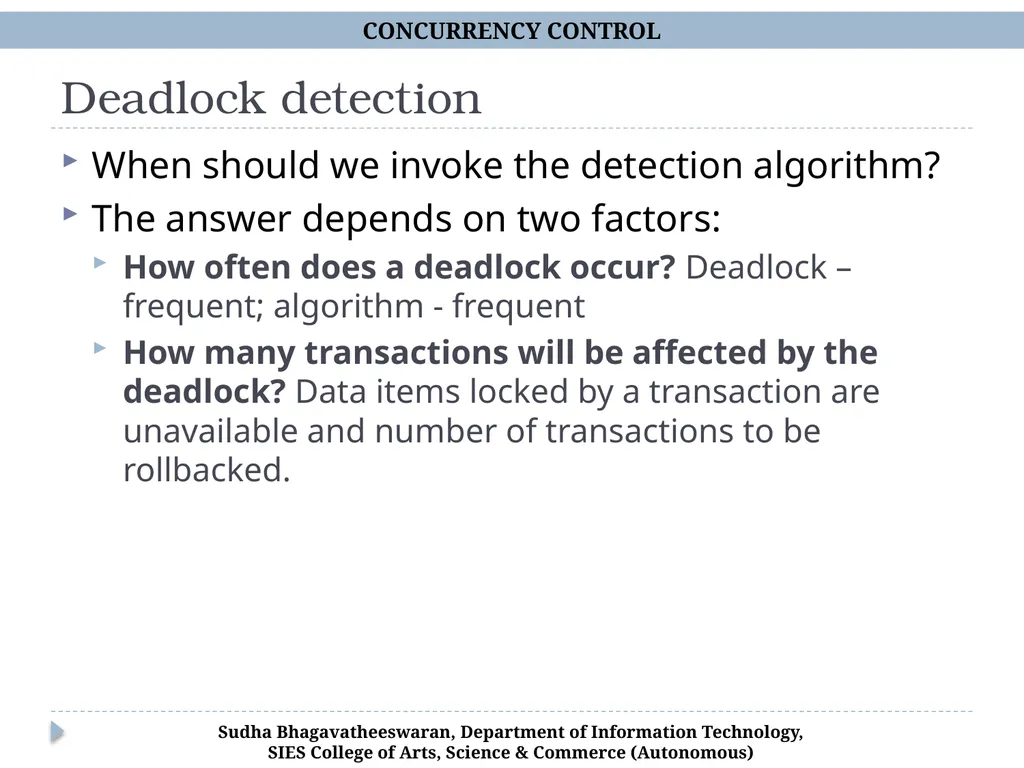
Deadlock detection When should we invoke the detection algorithm?
The answer depends on two factors:
How often does a deadlock occur? Deadlock – frequent; algorithm - frequent
How many transactions will be affected by the deadlock? Data items locked by a transaction are unavailable and number of transactions to be rollbacked. CONCURRENCY CONTROL Sudha Bhagavatheeswaran, Department of Information Technology,
SIES College of Arts, Science & Commerce (Autonomous)<br>
The answer depends on two factors:
How often does a deadlock occur? Deadlock – frequent; algorithm - frequent
How many transactions will be affected by the deadlock? Data items locked by a transaction are unavailable and number of transactions to be rollbacked. CONCURRENCY CONTROL Sudha Bhagavatheeswaran, Department of Information Technology,
SIES College of Arts, Science & Commerce (Autonomous)<br>
19
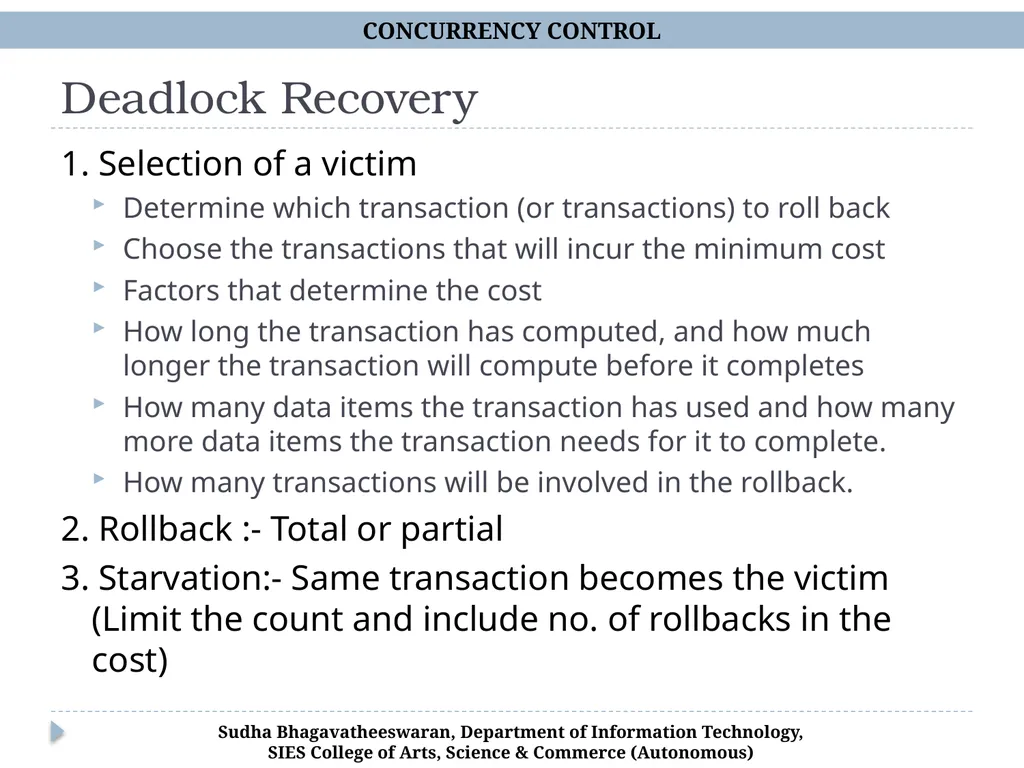
Deadlock Recovery 1. Selection of a victim
Determine which transaction (or transactions) to roll back
Choose the transactions that will incur the minimum cost
Factors that determine the cost
How long the transaction has computed, and how much longer the transaction will compute before it completes
How many data items the transaction has used and how many more data items the transaction needs for it to complete.
How many transactions will be involved in the rollback.
2. Rollback :- Total or partial
3. Starvation:- Same transaction becomes the victim (Limit the count and include no. of rollbacks in the cost) CONCURRENCY CONTROL Sudha Bhagavatheeswaran, Department of Information Technology,
SIES College of Arts, Science & Commerce (Autonomous)<br>
Determine which transaction (or transactions) to roll back
Choose the transactions that will incur the minimum cost
Factors that determine the cost
How long the transaction has computed, and how much longer the transaction will compute before it completes
How many data items the transaction has used and how many more data items the transaction needs for it to complete.
How many transactions will be involved in the rollback.
2. Rollback :- Total or partial
3. Starvation:- Same transaction becomes the victim (Limit the count and include no. of rollbacks in the cost) CONCURRENCY CONTROL Sudha Bhagavatheeswaran, Department of Information Technology,
SIES College of Arts, Science & Commerce (Autonomous)<br>