
Concurrent Processes and Programming Topic 2
DP
Published · 47 slides · 0 views
1 / 1

Description
Concurrent Processes and Programming Topic 2 Hartmut Kaiser https:teaching.hkaiser.orgfall2026csc7103 Processes Process (or task) a program in execution: Is an active entity a program is a passive entity until it is in execution Is
Related Topics
Share
Embed code
Download this presentation From Below
"Concurrent Processes and Programming Topic 2" is the property of its rightful owner. Permission is granted to download and print the materials on this website for personal, non-commercial use only, and to display it on your personal computer provided you do not modify the materials and that you retain all copyright notices contained in the materials. By downloading content from our website, you accept the terms of this agreement.
Presentation Transcript
01
Concurrent Processes and Programming Topic 2
Hartmut Kaiser
https://teaching.hkaiser.org/fall2026/csc7103/<br>
Hartmut Kaiser
https://teaching.hkaiser.org/fall2026/csc7103/<br>
02
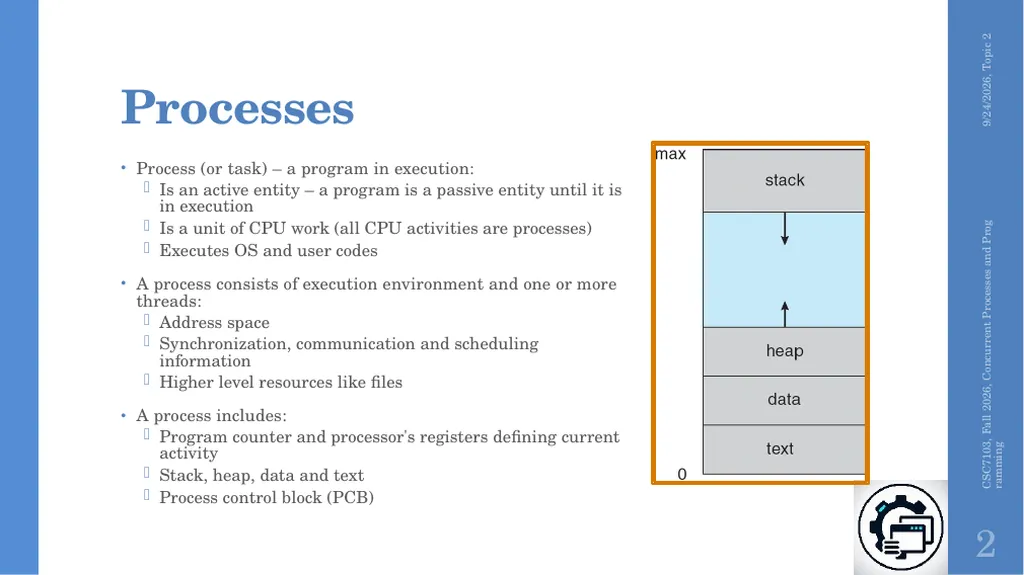
Processes Process (or task) – a program in execution:
Is an active entity – a program is a passive entity until it is in execution
Is a unit of CPU work (all CPU activities are processes)
Executes OS and user codes
A process consists of execution environment and one or more threads:
Address space
Synchronization, communication and scheduling information
Higher level resources like files
A process includes:
Program counter and processor's registers defining current activity
Stack, heap, data and text
Process control block (PCB) 9/24/2026, Topic 2 CSC7103, Fall 2026, Concurrent Processes and Programming 2<br>
Is an active entity – a program is a passive entity until it is in execution
Is a unit of CPU work (all CPU activities are processes)
Executes OS and user codes
A process consists of execution environment and one or more threads:
Address space
Synchronization, communication and scheduling information
Higher level resources like files
A process includes:
Program counter and processor's registers defining current activity
Stack, heap, data and text
Process control block (PCB) 9/24/2026, Topic 2 CSC7103, Fall 2026, Concurrent Processes and Programming 2<br>
03
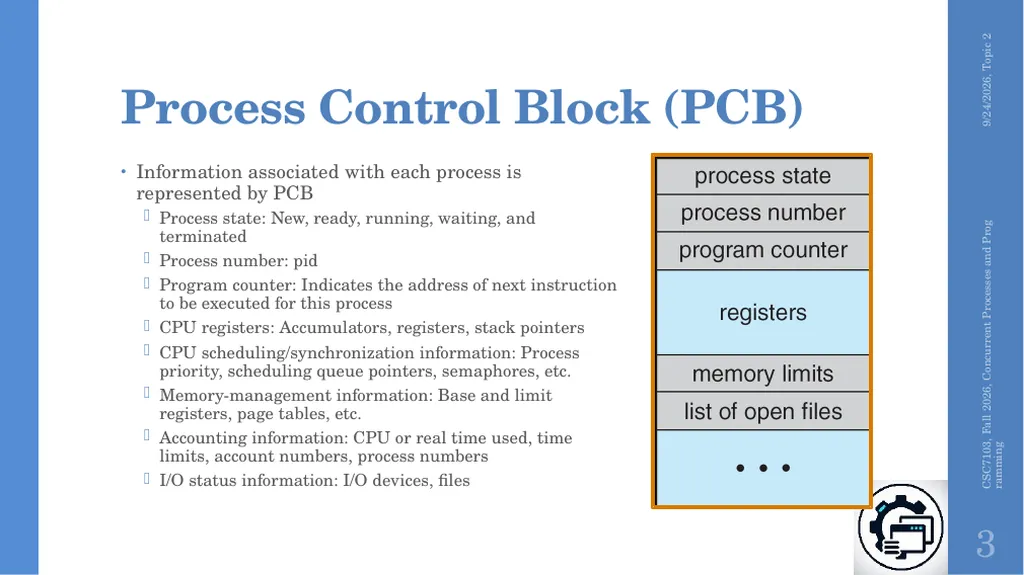
Process Control Block (PCB) Information associated with each process is represented by PCB
Process state: New, ready, running, waiting, and terminated
Process number: pid
Program counter: Indicates the address of next instruction to be executed for this process
CPU registers: Accumulators, registers, stack pointers
CPU scheduling/synchronization information: Process priority, scheduling queue pointers, semaphores, etc.
Memory-management information: Base and limit registers, page tables, etc.
Accounting information: CPU or real time used, time limits, account numbers, process numbers
I/O status information: I/O devices, files 9/24/2026, Topic 2 CSC7103, Fall 2026, Concurrent Processes and Programming 3<br>
Process state: New, ready, running, waiting, and terminated
Process number: pid
Program counter: Indicates the address of next instruction to be executed for this process
CPU registers: Accumulators, registers, stack pointers
CPU scheduling/synchronization information: Process priority, scheduling queue pointers, semaphores, etc.
Memory-management information: Base and limit registers, page tables, etc.
Accounting information: CPU or real time used, time limits, account numbers, process numbers
I/O status information: I/O devices, files 9/24/2026, Topic 2 CSC7103, Fall 2026, Concurrent Processes and Programming 3<br>
04
Operations on Processes Processes can execute concurrently, may be created and deleted dynamically
Mechanisms for process creation and termination
Parent process can create child processes, which, in turn create other processes, forming a tree of processes
Creation of a new process:
fork() copies execution environment
exec() loads an executing program
Process termination:
Normal (exit) or abnormal (abort), cascading termination
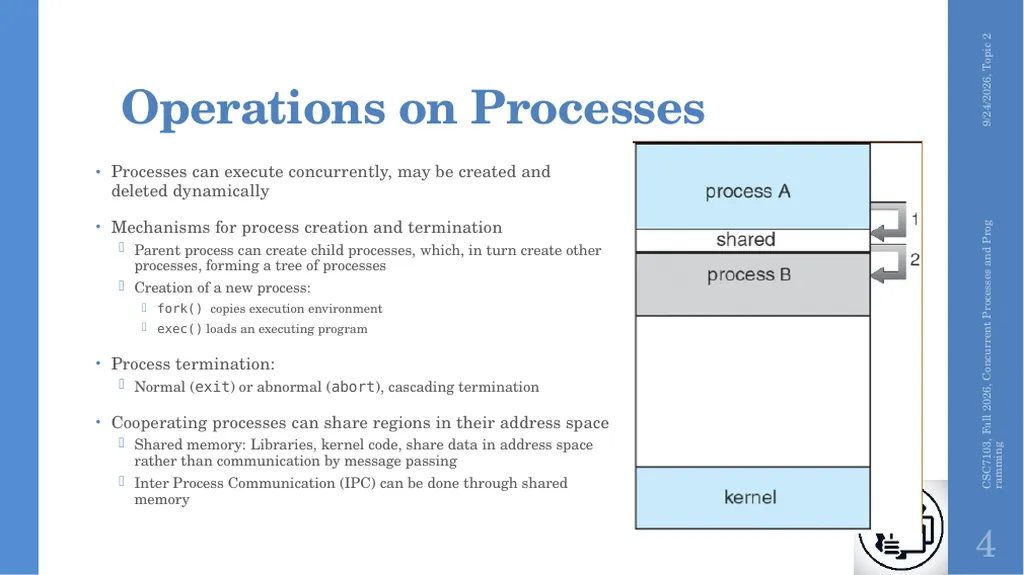
Cooperating processes can share regions in their address space
Shared memory: Libraries, kernel code, share data in address space rather than communication by message passing
Inter Process Communication (IPC) can be done through shared memory 9/24/2026, Topic 2 CSC7103, Fall 2026, Concurrent Processes and Programming 4<br>
Mechanisms for process creation and termination
Parent process can create child processes, which, in turn create other processes, forming a tree of processes
Creation of a new process:
fork() copies execution environment
exec() loads an executing program
Process termination:
Normal (exit) or abnormal (abort), cascading termination
Cooperating processes can share regions in their address space
Shared memory: Libraries, kernel code, share data in address space rather than communication by message passing
Inter Process Communication (IPC) can be done through shared memory 9/24/2026, Topic 2 CSC7103, Fall 2026, Concurrent Processes and Programming 4<br>
05
Threads Process can have
Single or multiple thread(s) of control or activity (strand of execution)
A thread is a flow of control within a process
Basic computational unit – originally called a LWP (lightweight process)
Thread control block (TCB) consisting of thread ID, program counter, register set and stack
All threads share the same address space of their process
Thread support has become an integral part of any modern OS
Multithreaded computer systems are common (e.g., desktop PCs)
Web browser: one thread for display and the other for data retrieving
Benefits:
Economical (ease of creation, cheaper/quicker context switching)
Increased responsiveness
Simple and efficient resource sharing
Concurrency (multiprocessor architecture) 9/24/2026, Topic 2 CSC7103, Fall 2026, Concurrent Processes and Programming 5<br>
Single or multiple thread(s) of control or activity (strand of execution)
A thread is a flow of control within a process
Basic computational unit – originally called a LWP (lightweight process)
Thread control block (TCB) consisting of thread ID, program counter, register set and stack
All threads share the same address space of their process
Thread support has become an integral part of any modern OS
Multithreaded computer systems are common (e.g., desktop PCs)
Web browser: one thread for display and the other for data retrieving
Benefits:
Economical (ease of creation, cheaper/quicker context switching)
Increased responsiveness
Simple and efficient resource sharing
Concurrency (multiprocessor architecture) 9/24/2026, Topic 2 CSC7103, Fall 2026, Concurrent Processes and Programming 5<br>
06
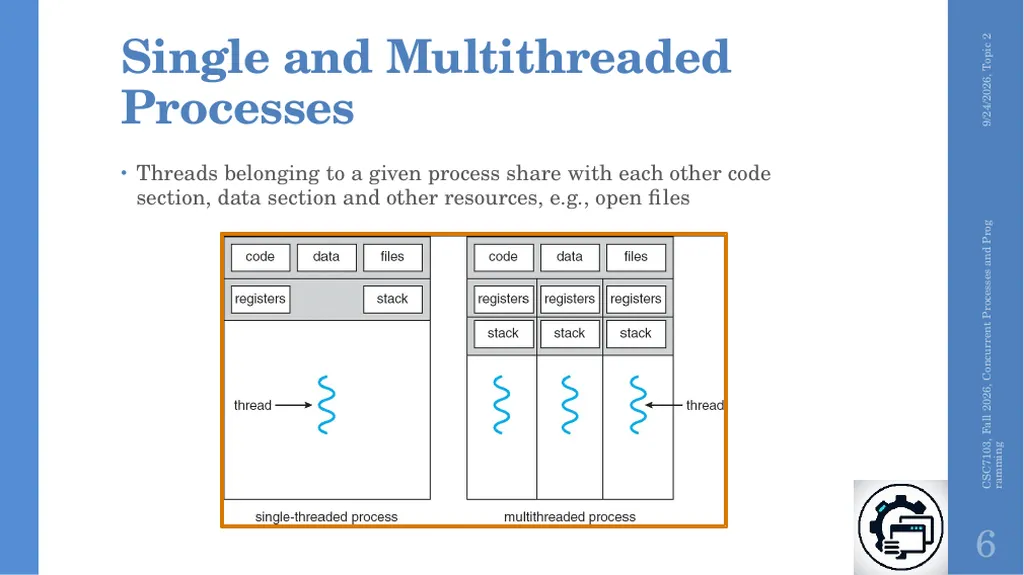
Single and Multithreaded Processes Threads belonging to a given process share with each other code section, data section and other resources, e.g., open files 9/24/2026, Topic 2 CSC7103, Fall 2026, Concurrent Processes and Programming 6<br>
07
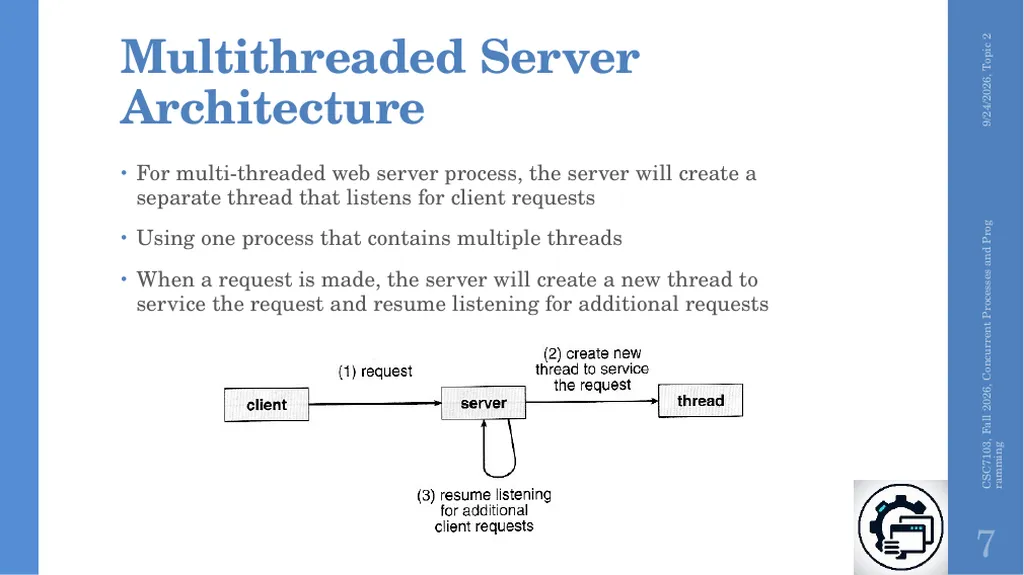
Multithreaded Server Architecture For multi-threaded web server process, the server will create a separate thread that listens for client requests
Using one process that contains multiple threads
When a request is made, the server will create a new thread to service the request and resume listening for additional requests 9/24/2026, Topic 2 CSC7103, Fall 2026, Concurrent Processes and Programming 7<br>
Using one process that contains multiple threads
When a request is made, the server will create a new thread to service the request and resume listening for additional requests 9/24/2026, Topic 2 CSC7103, Fall 2026, Concurrent Processes and Programming 7<br>
08
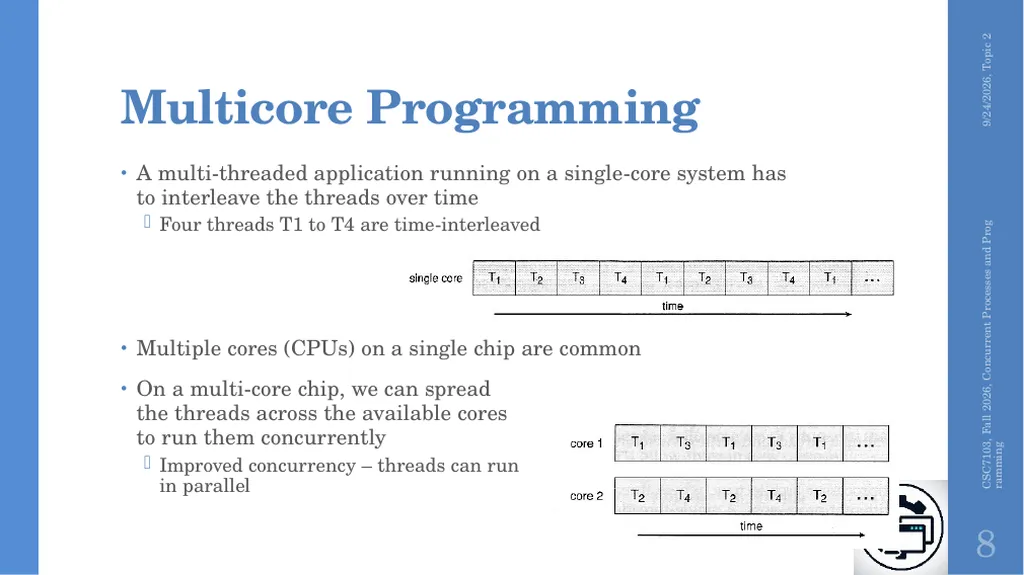
Multicore Programming A multi-threaded application running on a single-core system has to interleave the threads over time
Four threads T1 to T4 are time-interleaved
Multiple cores (CPUs) on a single chip are common
On a multi-core chip, we can spread the threads across the available cores to run them concurrently
Improved concurrency – threads can run in parallel 9/24/2026, Topic 2 CSC7103, Fall 2026, Concurrent Processes and Programming 8<br>
Four threads T1 to T4 are time-interleaved
Multiple cores (CPUs) on a single chip are common
On a multi-core chip, we can spread the threads across the available cores to run them concurrently
Improved concurrency – threads can run in parallel 9/24/2026, Topic 2 CSC7103, Fall 2026, Concurrent Processes and Programming 8<br>
09
Kernel Space Thread Implementation Threads can be implemented at the kernel level
Blocking and scheduling of threads are treated normally by OS
Thread can be preempted easily
Thread issuing system call can be blocked without blocking other threads
Each thread competes for processor cycles on equal basis with processes
Disadvantages
Two-level abstraction for concurrency becomes blurred
Context switching requires larger overhead
Portability becomes more difficult
Examples: All operating systems support kernel threads - POSIX, Win32, Linux threads 9/24/2026, Topic 2 CSC7103, Fall 2026, Concurrent Processes and Programming 9<br>
Blocking and scheduling of threads are treated normally by OS
Thread can be preempted easily
Thread issuing system call can be blocked without blocking other threads
Each thread competes for processor cycles on equal basis with processes
Disadvantages
Two-level abstraction for concurrency becomes blurred
Context switching requires larger overhead
Portability becomes more difficult
Examples: All operating systems support kernel threads - POSIX, Win32, Linux threads 9/24/2026, Topic 2 CSC7103, Fall 2026, Concurrent Processes and Programming 9<br>
10
User Space Thread Implementation Thread support as an add-on package implemented on many systems
Threads run on top of a run-time library and visible to users
Thread library include thread primitives:
Thread management (creation, suspension, termination)
Assignment of priority (scheduling) and other thread attributes
Synchronization and communication support
User threads are easy to create and manage, and are portable
The run-time procedure performs context switching from one thread to another, and handles blocking system call
Fast context switching as it involves saving and restoring only the program counter and stack pointers
Users have the option of setting thread scheduling criteria
Allocated processor time for a process is multiplexed among its all threads
Examples: DCE thread package, Sun LWP package, POSIX 9/24/2026, Topic 2 CSC7103, Fall 2026, Concurrent Processes and Programming 10<br>
Threads run on top of a run-time library and visible to users
Thread library include thread primitives:
Thread management (creation, suspension, termination)
Assignment of priority (scheduling) and other thread attributes
Synchronization and communication support
User threads are easy to create and manage, and are portable
The run-time procedure performs context switching from one thread to another, and handles blocking system call
Fast context switching as it involves saving and restoring only the program counter and stack pointers
Users have the option of setting thread scheduling criteria
Allocated processor time for a process is multiplexed among its all threads
Examples: DCE thread package, Sun LWP package, POSIX 9/24/2026, Topic 2 CSC7103, Fall 2026, Concurrent Processes and Programming 10<br>
11
Combined (Hybrid) Implementation A combined user and kernel space implementation of threads captures the advantages of both approaches
Single-threaded versus multiple-thread kernel
Operations internal to the kernel and all kernel services for user space applications can be implemented as threads
Advantages
Support concurrent kernel services
Kernel space threads are multiplexed on the underlying multiprocessor system
Thread executions are truly parallel and can be preemptive
Synchronization among kernel threads is necessary and can be done through shared memory 9/24/2026, Topic 2 CSC7103, Fall 2026, Concurrent Processes and Programming 11<br>
Single-threaded versus multiple-thread kernel
Operations internal to the kernel and all kernel services for user space applications can be implemented as threads
Advantages
Support concurrent kernel services
Kernel space threads are multiplexed on the underlying multiprocessor system
Thread executions are truly parallel and can be preemptive
Synchronization among kernel threads is necessary and can be done through shared memory 9/24/2026, Topic 2 CSC7103, Fall 2026, Concurrent Processes and Programming 11<br>
12
Multithreading Models Three common ways of establishing a relationship between user-level threads and kernel-level threads 9/24/2026, Topic 2 CSC7103, Fall 2026, Concurrent Processes and Programming One-to-One Many-to-One Many-to-Many 12<br>
13
Interface Between User and Kernel Threads Communication between the user-thread library and the kernel threads – scheduler activation
An intermediate data structure known as LWP (light- weight process)
LWPs serve as a bridge between user thread and kernel thread
User thread runs on a virtual processor (LWP)
Each LWP is connected to a kernel thread
Corresponding kernel thread runs on a physical processor
Each application gets a set of virtual processors (LWPs) from OS
Application schedules (user-level) threads on these processors
When attached to a LWP, thread becomes executable
Kernel informs an application about certain events issuing upcalls, handled by thread library 9/24/2026, Topic 2 CSC7103, Fall 2026, Concurrent Processes and Programming LWP 13<br>
An intermediate data structure known as LWP (light- weight process)
LWPs serve as a bridge between user thread and kernel thread
User thread runs on a virtual processor (LWP)
Each LWP is connected to a kernel thread
Corresponding kernel thread runs on a physical processor
Each application gets a set of virtual processors (LWPs) from OS
Application schedules (user-level) threads on these processors
When attached to a LWP, thread becomes executable
Kernel informs an application about certain events issuing upcalls, handled by thread library 9/24/2026, Topic 2 CSC7103, Fall 2026, Concurrent Processes and Programming LWP 13<br>
14
Multithreaded Kernel Most OS kernels are now multithreaded
Each thread performing a specific task such as managing memory, interrupt handling, managing devices
A preemptive multithreaded kernel with three levels of concurrency
User threads are multiplexed on LWPs in same process. LWPs are multiplexed on kernel threads, and kernel threads are multiplexed on multiple processors 9/24/2026, Topic 2 CSC7103, Fall 2026, Concurrent Processes and Programming 14<br>
Each thread performing a specific task such as managing memory, interrupt handling, managing devices
A preemptive multithreaded kernel with three levels of concurrency
User threads are multiplexed on LWPs in same process. LWPs are multiplexed on kernel threads, and kernel threads are multiplexed on multiple processors 9/24/2026, Topic 2 CSC7103, Fall 2026, Concurrent Processes and Programming 14<br>
15
Concurrent Processes A process is sequential if a single thread of control regulates its execution
Concurrent processes are simultaneous interacting sequential processes
They are asynchronous and each has its own logical address space
Disjoint components can be executed concurrently whereas others need to communicate and/or have synchronization between the processes
A concurrent system supports more than one task (process) by allowing all tasks to make progress unlike a parallel system where tasks actually run simultaneously
Allowing multiple threads of control in a process introduces a new level of concurrency in the system
A process may create new processes, thus creating multiple threads of execution 9/24/2026, Topic 2 CSC7103, Fall 2026, Concurrent Processes and Programming 15<br>
Concurrent processes are simultaneous interacting sequential processes
They are asynchronous and each has its own logical address space
Disjoint components can be executed concurrently whereas others need to communicate and/or have synchronization between the processes
A concurrent system supports more than one task (process) by allowing all tasks to make progress unlike a parallel system where tasks actually run simultaneously
Allowing multiple threads of control in a process introduces a new level of concurrency in the system
A process may create new processes, thus creating multiple threads of execution 9/24/2026, Topic 2 CSC7103, Fall 2026, Concurrent Processes and Programming 15<br>
16
Process Representation To analyze the performance requirements, the processes should be represented in abstract ways, hiding unnecessary details
Processes are related by their need for synchronization and/or communication – cooperating processes
Different models for process representation:
Graph models:
Synchronous process graph
Asynchronous process graph
Process graph models are suitable for performance analysis
Space-time model: Useful for describing the detail interaction among the processes
Language constructs or OS supports for concurrent processing:
cobegin/coend control structure
fork/join system calls 9/24/2026, Topic 2 CSC7103, Fall 2026, Concurrent Processes and Programming 16<br>
Processes are related by their need for synchronization and/or communication – cooperating processes
Different models for process representation:
Graph models:
Synchronous process graph
Asynchronous process graph
Process graph models are suitable for performance analysis
Space-time model: Useful for describing the detail interaction among the processes
Language constructs or OS supports for concurrent processing:
cobegin/coend control structure
fork/join system calls 9/24/2026, Topic 2 CSC7103, Fall 2026, Concurrent Processes and Programming 16<br>
17
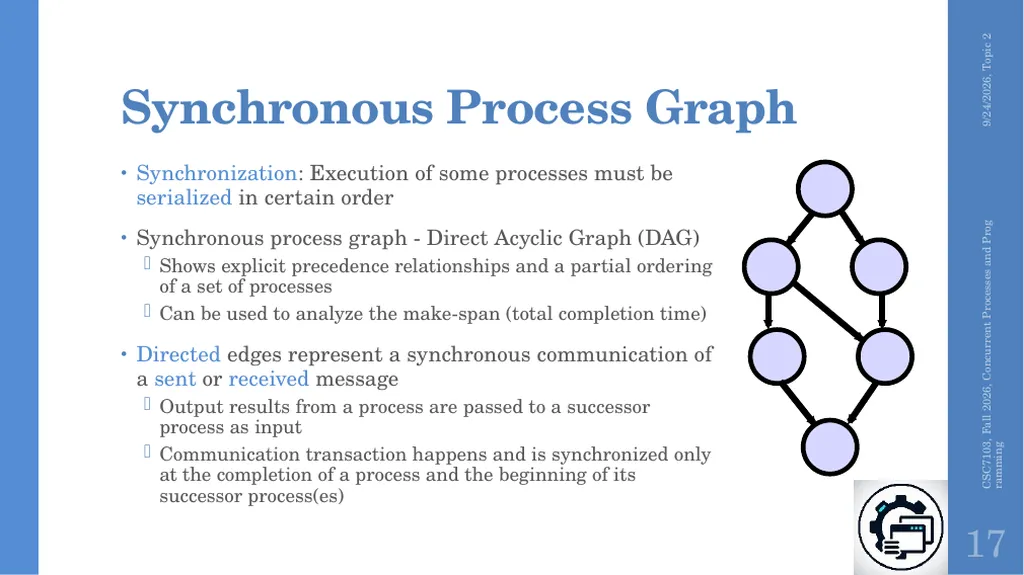
Synchronous Process Graph Synchronization: Execution of some processes must be serialized in certain order
Synchronous process graph - Direct Acyclic Graph (DAG)
Shows explicit precedence relationships and a partial ordering of a set of processes
Can be used to analyze the make-span (total completion time)
Directed edges represent a synchronous communication of a sent or received message
Output results from a process are passed to a successor process as input
Communication transaction happens and is synchronized only at the completion of a process and the beginning of its successor process(es) 9/24/2026, Topic 2 CSC7103, Fall 2026, Concurrent Processes and Programming 17<br>
Synchronous process graph - Direct Acyclic Graph (DAG)
Shows explicit precedence relationships and a partial ordering of a set of processes
Can be used to analyze the make-span (total completion time)
Directed edges represent a synchronous communication of a sent or received message
Output results from a process are passed to a successor process as input
Communication transaction happens and is synchronized only at the completion of a process and the beginning of its successor process(es) 9/24/2026, Topic 2 CSC7103, Fall 2026, Concurrent Processes and Programming 17<br>
18
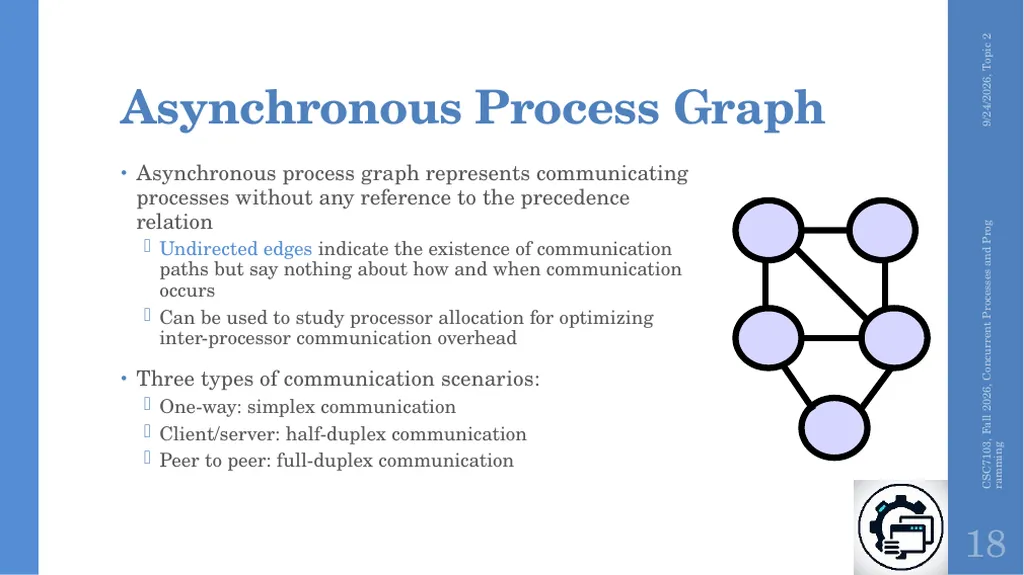
Asynchronous Process Graph Asynchronous process graph represents communicating processes without any reference to the precedence relation
Undirected edges indicate the existence of communication paths but say nothing about how and when communication occurs
Can be used to study processor allocation for optimizing inter-processor communication overhead
Three types of communication scenarios:
One-way: simplex communication
Client/server: half-duplex communication
Peer to peer: full-duplex communication 9/24/2026, Topic 2 CSC7103, Fall 2026, Concurrent Processes and Programming 18<br>
Undirected edges indicate the existence of communication paths but say nothing about how and when communication occurs
Can be used to study processor allocation for optimizing inter-processor communication overhead
Three types of communication scenarios:
One-way: simplex communication
Client/server: half-duplex communication
Peer to peer: full-duplex communication 9/24/2026, Topic 2 CSC7103, Fall 2026, Concurrent Processes and Programming 18<br>
19
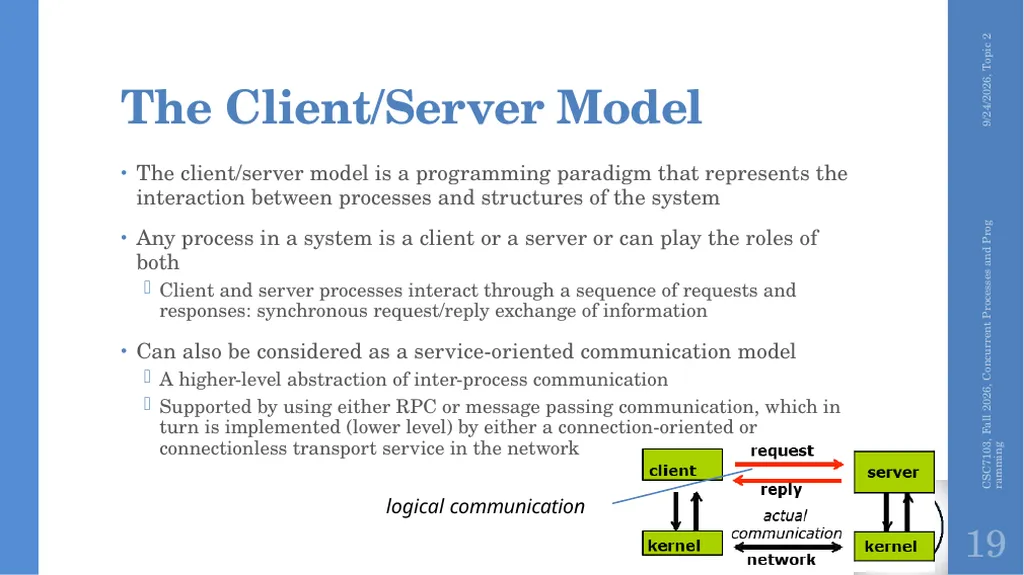
The Client/Server Model The client/server model is a programming paradigm that represents the interaction between processes and structures of the system
Any process in a system is a client or a server or can play the roles of both
Client and server processes interact through a sequence of requests and responses: synchronous request/reply exchange of information
Can also be considered as a service-oriented communication model
A higher-level abstraction of inter-process communication
Supported by using either RPC or message passing communication, which in turn is implemented (lower level) by either a connection-oriented or connectionless transport service in the network 9/24/2026, Topic 2 CSC7103, Fall 2026, Concurrent Processes and Programming logical communication 19<br>
Any process in a system is a client or a server or can play the roles of both
Client and server processes interact through a sequence of requests and responses: synchronous request/reply exchange of information
Can also be considered as a service-oriented communication model
A higher-level abstraction of inter-process communication
Supported by using either RPC or message passing communication, which in turn is implemented (lower level) by either a connection-oriented or connectionless transport service in the network 9/24/2026, Topic 2 CSC7103, Fall 2026, Concurrent Processes and Programming logical communication 19<br>
20
Time Services 9/24/2026, Topic 2 CSC7103, Fall 2026, Concurrent Processes and Programming 20<br>
21
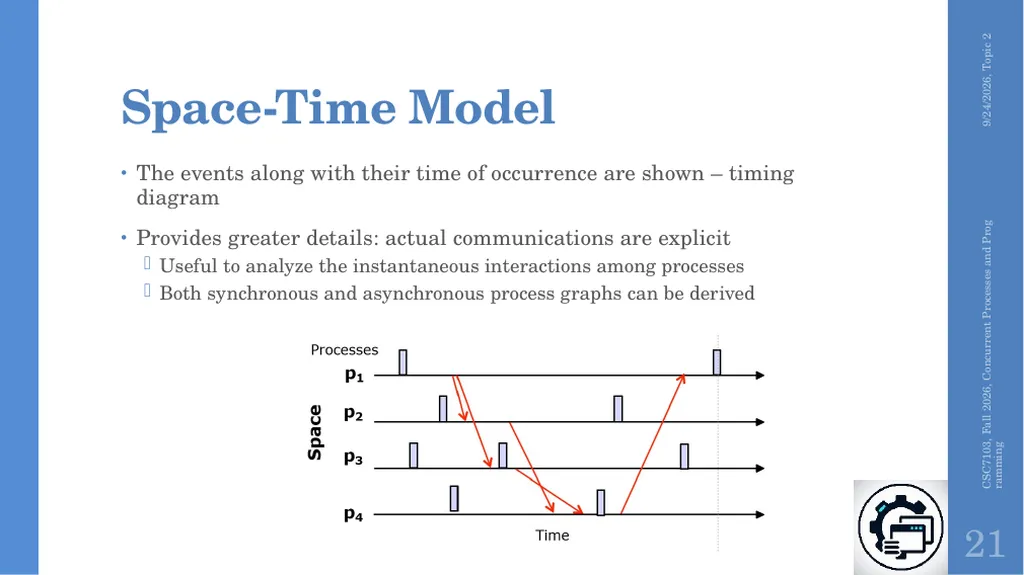
Space-Time Model The events along with their time of occurrence are shown – timing diagram
Provides greater details: actual communications are explicit
Useful to analyze the instantaneous interactions among processes
Both synchronous and asynchronous process graphs can be derived 9/24/2026, Topic 2 CSC7103, Fall 2026, Concurrent Processes and Programming 21<br>
Provides greater details: actual communications are explicit
Useful to analyze the instantaneous interactions among processes
Both synchronous and asynchronous process graphs can be derived 9/24/2026, Topic 2 CSC7103, Fall 2026, Concurrent Processes and Programming 21<br>
22
Time Services In the space-time model, events are recorded with respect to each process’s own clock time
Many applications need timing information: clocks are used to specify time and timers needed for describing the occurrences of events:
When an event occurs, how long it takes, and which event occurs first
Computer example: When a file was last modified, how long a client should access a server, and which update of a data object happened first
Two processes updating a file: The file server received two simultaneous write requests. Without a time stamp, it is not possible for the server to determine which request is older
It is not possible to precisely synchronize clocks in a distributed system because different computers have their own (local) clocks
Even if the clocks may be synchronized, physical clocks will not run at the same pace so clock skew (clock drift) will develop over time
To ensure that different computer clocks in reasonable agreement need clock synchronization protocols 9/24/2026, Topic 2 CSC7103, Fall 2026, Concurrent Processes and Programming 22<br>
Many applications need timing information: clocks are used to specify time and timers needed for describing the occurrences of events:
When an event occurs, how long it takes, and which event occurs first
Computer example: When a file was last modified, how long a client should access a server, and which update of a data object happened first
Two processes updating a file: The file server received two simultaneous write requests. Without a time stamp, it is not possible for the server to determine which request is older
It is not possible to precisely synchronize clocks in a distributed system because different computers have their own (local) clocks
Even if the clocks may be synchronized, physical clocks will not run at the same pace so clock skew (clock drift) will develop over time
To ensure that different computer clocks in reasonable agreement need clock synchronization protocols 9/24/2026, Topic 2 CSC7103, Fall 2026, Concurrent Processes and Programming 22<br>
23
Two Types of Clocks In centralized OS, the same system clock and time/timer are used to coordinate all processes/events
In distributed OS, without a global time consensus, it is difficult to coordinate distributed processes/events
Two fundamental clock concepts for specifying time in distributed systems
Physical clock: a close approximation of real life clock that measures both a point and intervals of time, i.e., time and timer
Used to synchronize and schedule hardware activities
Logical clock: preserves only the ordering of events
Different algorithms to synchronize physical and logical locks 9/24/2026, Topic 2 CSC7103, Fall 2026, Concurrent Processes and Programming 23<br>
In distributed OS, without a global time consensus, it is difficult to coordinate distributed processes/events
Two fundamental clock concepts for specifying time in distributed systems
Physical clock: a close approximation of real life clock that measures both a point and intervals of time, i.e., time and timer
Used to synchronize and schedule hardware activities
Logical clock: preserves only the ordering of events
Different algorithms to synchronize physical and logical locks 9/24/2026, Topic 2 CSC7103, Fall 2026, Concurrent Processes and Programming 23<br>
24
Physical Clocks An absolute global physical time is theoretically impossible to obtain in a distributed environment
All machines try to reach a consensus of time
Many standard Universal Coordinated Time (UTC) sources are available for computers:
NIST short wave radio, GPS satellites
Using these time services are generally costly and/or complicated. A few time services access the UTC sources directly, and most computers obtain the timing information from one or more time servers (TS)
Accessing a TS via network requires a non-deterministic message exchange time – a delay in reporting or acquiring UTC
Approaches to compensate the delay and reduce time discrepancies:
Christian’s Algorithm
Berkeley Algorithm
Averaging Algorithm 9/24/2026, Topic 2 CSC7103, Fall 2026, Concurrent Processes and Programming 24<br>
All machines try to reach a consensus of time
Many standard Universal Coordinated Time (UTC) sources are available for computers:
NIST short wave radio, GPS satellites
Using these time services are generally costly and/or complicated. A few time services access the UTC sources directly, and most computers obtain the timing information from one or more time servers (TS)
Accessing a TS via network requires a non-deterministic message exchange time – a delay in reporting or acquiring UTC
Approaches to compensate the delay and reduce time discrepancies:
Christian’s Algorithm
Berkeley Algorithm
Averaging Algorithm 9/24/2026, Topic 2 CSC7103, Fall 2026, Concurrent Processes and Programming 24<br>
25
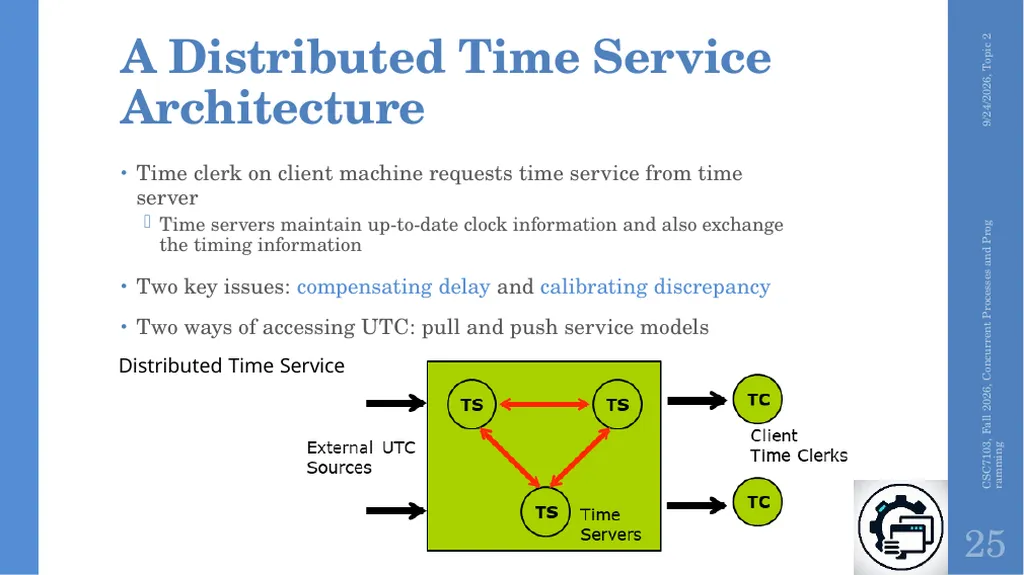
A Distributed Time Service Architecture Time clerk on client machine requests time service from time server
Time servers maintain up-to-date clock information and also exchange the timing information
Two key issues: compensating delay and calibrating discrepancy
Two ways of accessing UTC: pull and push service models 9/24/2026, Topic 2 CSC7103, Fall 2026, Concurrent Processes and Programming Distributed Time Service 25<br>
Time servers maintain up-to-date clock information and also exchange the timing information
Two key issues: compensating delay and calibrating discrepancy
Two ways of accessing UTC: pull and push service models 9/24/2026, Topic 2 CSC7103, Fall 2026, Concurrent Processes and Programming Distributed Time Service 25<br>
26
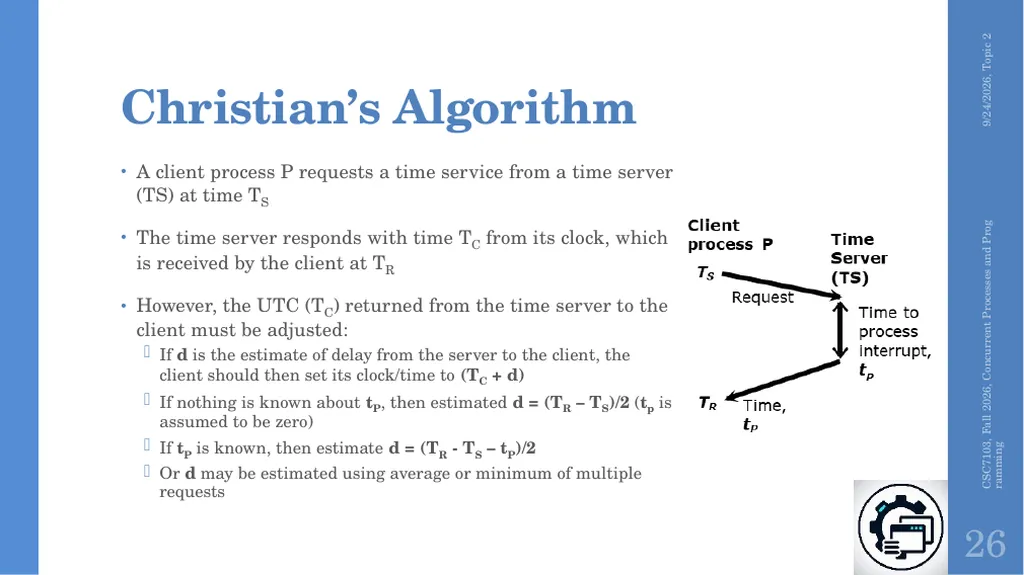
Christian’s Algorithm A client process P requests a time service from a time server (TS) at time TS
The time server responds with time TC from its clock, which is received by the client at TR
However, the UTC (TC) returned from the time server to the client must be adjusted:
If d is the estimate of delay from the server to the client, the client should then set its clock/time to (TC + d)
If nothing is known about tP, then estimated d = (TR – TS)/2 (tp is assumed to be zero)
If tP is known, then estimate d = (TR - TS – tP)/2
Or d may be estimated using average or minimum of multiple requests 9/24/2026, Topic 2 CSC7103, Fall 2026, Concurrent Processes and Programming 26<br>
The time server responds with time TC from its clock, which is received by the client at TR
However, the UTC (TC) returned from the time server to the client must be adjusted:
If d is the estimate of delay from the server to the client, the client should then set its clock/time to (TC + d)
If nothing is known about tP, then estimated d = (TR – TS)/2 (tp is assumed to be zero)
If tP is known, then estimate d = (TR - TS – tP)/2
Or d may be estimated using average or minimum of multiple requests 9/24/2026, Topic 2 CSC7103, Fall 2026, Concurrent Processes and Programming 26<br>
27
Berkeley Algorithm This algorithm does not use the actual time for the time server (TS) but rather maintains a global time
The time server periodically gathers time data from all other computers (clients) in the distributed system and determines the average time. Then the server communicates this global average time (in fact the difference) to all machines
All clients adjust their local clocks accordingly
Suitable for systems which can not access any UTC server 9/24/2026, Topic 2 CSC7103, Fall 2026, Concurrent Processes and Programming 27<br>
The time server periodically gathers time data from all other computers (clients) in the distributed system and determines the average time. Then the server communicates this global average time (in fact the difference) to all machines
All clients adjust their local clocks accordingly
Suitable for systems which can not access any UTC server 9/24/2026, Topic 2 CSC7103, Fall 2026, Concurrent Processes and Programming 27<br>
28
Averaging Algorithm The Berkeley algorithm is centralized and has single point of failure
Every computer broadcasts its time information at a regular interval known system wide
Every machine then averages the broadcast information to compute its own time and reset its internal clock accordingly
Both the Berkeley and averaging algorithms considers the fact that local clocks not only contain different times but they also have rates.
Any times (or UTCs) that are suspiciously small or large (differing by a value outside of a given tolerance) are excluded from the computation
This prevents the overall system time from being drastically skewed due to one or more erroneous clocks
Timing discrepancies can be significantly reduced but a small degree of uncertainty is inherent in UTC or global time: tP ± Δl 9/24/2026, Topic 2 CSC7103, Fall 2026, Concurrent Processes and Programming 28<br>
Every computer broadcasts its time information at a regular interval known system wide
Every machine then averages the broadcast information to compute its own time and reset its internal clock accordingly
Both the Berkeley and averaging algorithms considers the fact that local clocks not only contain different times but they also have rates.
Any times (or UTCs) that are suspiciously small or large (differing by a value outside of a given tolerance) are excluded from the computation
This prevents the overall system time from being drastically skewed due to one or more erroneous clocks
Timing discrepancies can be significantly reduced but a small degree of uncertainty is inherent in UTC or global time: tP ± Δl 9/24/2026, Topic 2 CSC7103, Fall 2026, Concurrent Processes and Programming 28<br>
29
Clock Adjustment Note that the clock of the system can not be set backwards. Doing so may result in an inconsistent system state
To solve the problem the clock is slowed down for a certain period of time until the system clock reaches the desired state
If the local time in the client is higher than the new UTC, its clock speed is slowed by the software
Problem with a slower clock is less serious
Increase clock speed to allow it catch up the UTC gradually
How often to synchronize:
It is possible to put an upper bound (Δ) on the rate at which the clock skew develops. That means, the clock in a system may deviate at most Δt from the real clock over time period t
Therefore, if two clocks are synchronized at time 0, then they will differ by at most 2Δt at the end of time period t (one slower, one faster) 9/24/2026, Topic 2 CSC7103, Fall 2026, Concurrent Processes and Programming 29<br>
To solve the problem the clock is slowed down for a certain period of time until the system clock reaches the desired state
If the local time in the client is higher than the new UTC, its clock speed is slowed by the software
Problem with a slower clock is less serious
Increase clock speed to allow it catch up the UTC gradually
How often to synchronize:
It is possible to put an upper bound (Δ) on the rate at which the clock skew develops. That means, the clock in a system may deviate at most Δt from the real clock over time period t
Therefore, if two clocks are synchronized at time 0, then they will differ by at most 2Δt at the end of time period t (one slower, one faster) 9/24/2026, Topic 2 CSC7103, Fall 2026, Concurrent Processes and Programming 29<br>
30
Logical Clocks Physical clocks can generally tell whether an event happens before another
Problem arises when two events occur very closely
The uncertainty of UTC is high or UTC intervals of events overlap with each other
This can be the case in distributed systems
Logical clocks can be used to indicate the ordering information for events
The ordering of event execution can be determined without scheduling/ synchronizing the events with respect to the real-time clock
Three levels of logical clocks can be used:
Lamport’s logical clocks
Vector logical clocks
Matrix logical clocks 9/24/2026, Topic 2 CSC7103, Fall 2026, Concurrent Processes and Programming 30<br>
Problem arises when two events occur very closely
The uncertainty of UTC is high or UTC intervals of events overlap with each other
This can be the case in distributed systems
Logical clocks can be used to indicate the ordering information for events
The ordering of event execution can be determined without scheduling/ synchronizing the events with respect to the real-time clock
Three levels of logical clocks can be used:
Lamport’s logical clocks
Vector logical clocks
Matrix logical clocks 9/24/2026, Topic 2 CSC7103, Fall 2026, Concurrent Processes and Programming 30<br>
31
Lamport’s Logical Clock 9/24/2026, Topic 2 CSC7103, Fall 2026, Concurrent Processes and Programming 31<br>
32
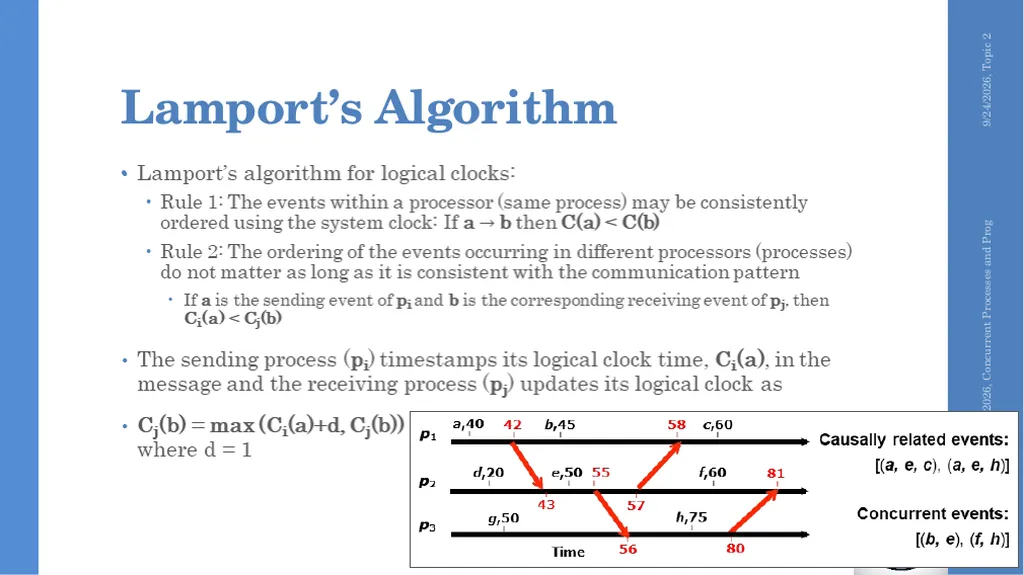
32 Lamport’s Algorithm 9/24/2026, Topic 2 CSC7103, Fall 2026, Concurrent Processes and Programming<br>
33
Partial and Total Ordering of Events 9/24/2026, Topic 2 CSC7103, Fall 2026, Concurrent Processes and Programming 33<br>
34
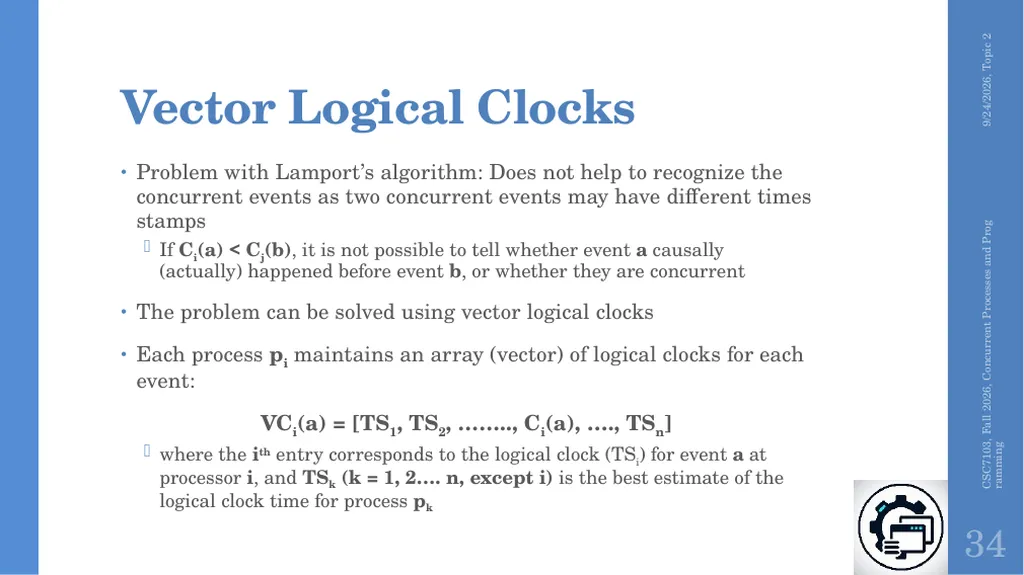
Vector Logical Clocks Problem with Lamport’s algorithm: Does not help to recognize the concurrent events as two concurrent events may have different times stamps
If Ci(a) < Cj(b), it is not possible to tell whether event a causally (actually) happened before event b, or whether they are concurrent
The problem can be solved using vector logical clocks
Each process pi maintains an array (vector) of logical clocks for each event:
VCi(a) = [TS1, TS2, …….., Ci(a), …., TSn]
where the ith entry corresponds to the logical clock (TSi) for event a at processor i, and TSk (k = 1, 2…. n, except i) is the best estimate of the logical clock time for process pk 9/24/2026, Topic 2 CSC7103, Fall 2026, Concurrent Processes and Programming 34<br>
If Ci(a) < Cj(b), it is not possible to tell whether event a causally (actually) happened before event b, or whether they are concurrent
The problem can be solved using vector logical clocks
Each process pi maintains an array (vector) of logical clocks for each event:
VCi(a) = [TS1, TS2, …….., Ci(a), …., TSn]
where the ith entry corresponds to the logical clock (TSi) for event a at processor i, and TSk (k = 1, 2…. n, except i) is the best estimate of the logical clock time for process pk 9/24/2026, Topic 2 CSC7103, Fall 2026, Concurrent Processes and Programming 34<br>
35
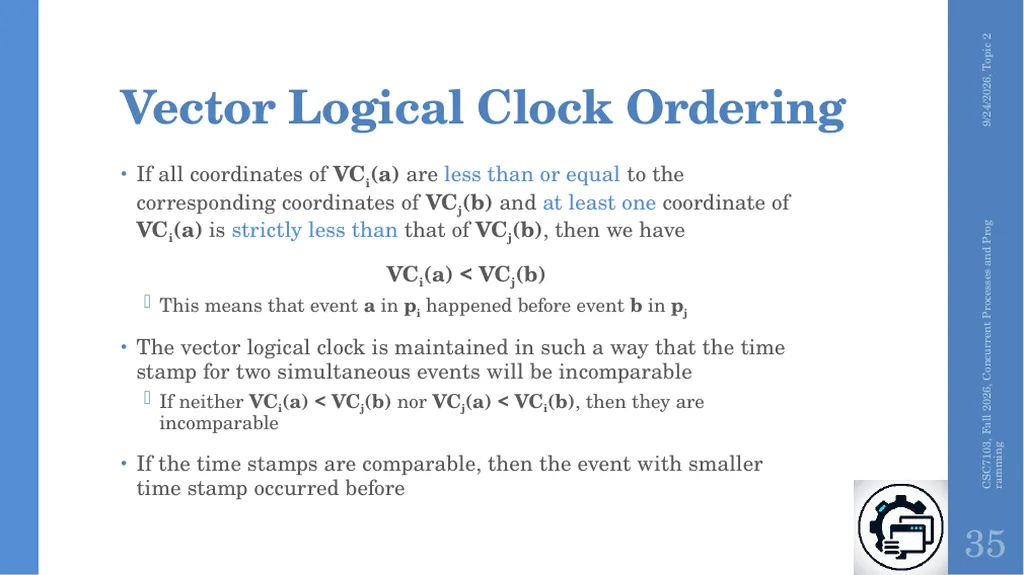
Vector Logical Clock Ordering If all coordinates of VCi(a) are less than or equal to the corresponding coordinates of VCj(b) and at least one coordinate of VCi(a) is strictly less than that of VCj(b), then we have
VCi(a) < VCj(b)
This means that event a in pi happened before event b in pj
The vector logical clock is maintained in such a way that the time stamp for two simultaneous events will be incomparable
If neither VCi(a) < VCj(b) nor VCj(a) < VCi(b), then they are incomparable
If the time stamps are comparable, then the event with smaller time stamp occurred before 9/24/2026, Topic 2 CSC7103, Fall 2026, Concurrent Processes and Programming 35<br>
VCi(a) < VCj(b)
This means that event a in pi happened before event b in pj
The vector logical clock is maintained in such a way that the time stamp for two simultaneous events will be incomparable
If neither VCi(a) < VCj(b) nor VCj(a) < VCi(b), then they are incomparable
If the time stamps are comparable, then the event with smaller time stamp occurred before 9/24/2026, Topic 2 CSC7103, Fall 2026, Concurrent Processes and Programming 35<br>
36
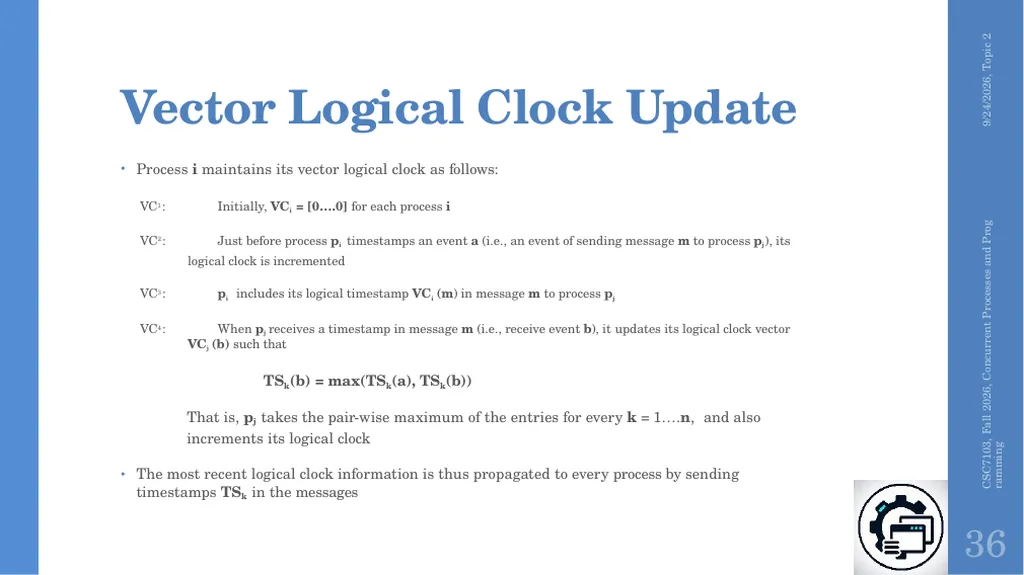
Vector Logical Clock Update Process i maintains its vector logical clock as follows:
VC1: Initially, VCi = [0….0] for each process i
VC2: Just before process pi timestamps an event a (i.e., an event of sending message m to process pj), its logical clock is incremented
VC3: pi includes its logical timestamp VCi (m) in message m to process pj
VC4: When pj receives a timestamp in message m (i.e., receive event b), it updates its logical clock vector VCj (b) such that
TSk(b) = max(TSk(a), TSk(b))
That is, pj takes the pair-wise maximum of the entries for every k = 1….n, and also increments its logical clock
The most recent logical clock information is thus propagated to every process by sending timestamps TSk in the messages 9/24/2026, Topic 2 CSC7103, Fall 2026, Concurrent Processes and Programming 36<br>
VC1: Initially, VCi = [0….0] for each process i
VC2: Just before process pi timestamps an event a (i.e., an event of sending message m to process pj), its logical clock is incremented
VC3: pi includes its logical timestamp VCi (m) in message m to process pj
VC4: When pj receives a timestamp in message m (i.e., receive event b), it updates its logical clock vector VCj (b) such that
TSk(b) = max(TSk(a), TSk(b))
That is, pj takes the pair-wise maximum of the entries for every k = 1….n, and also increments its logical clock
The most recent logical clock information is thus propagated to every process by sending timestamps TSk in the messages 9/24/2026, Topic 2 CSC7103, Fall 2026, Concurrent Processes and Programming 36<br>
37
Vector Logical Clock Example Logical vector clock in space-time diagram is updated every time a process progresses with an event
When processor executes an event, it assigns the timestamp to the event
Processor attaches its timestamp to all messages that it sends
VC1(a) = [100,…,…], VC1(b) = [300,…,…]
VC2(e) = […,230,…], VC2(f) = […,260,…]
VC3(h) = […,…243]
VC1 (a) < VC2 (e) < VC3 (h) so events (a, e, h) are causally related
Neither VC1 (b) < VC2 (f) nor VC2 (f) < VC1 (b) holds for disjoint objects (b, f) 9/24/2026, Topic 2 CSC7103, Fall 2026, Concurrent Processes and Programming 37<br>
When processor executes an event, it assigns the timestamp to the event
Processor attaches its timestamp to all messages that it sends
VC1(a) = [100,…,…], VC1(b) = [300,…,…]
VC2(e) = […,230,…], VC2(f) = […,260,…]
VC3(h) = […,…243]
VC1 (a) < VC2 (e) < VC3 (h) so events (a, e, h) are causally related
Neither VC1 (b) < VC2 (f) nor VC2 (f) < VC1 (b) holds for disjoint objects (b, f) 9/24/2026, Topic 2 CSC7103, Fall 2026, Concurrent Processes and Programming 37<br>
38
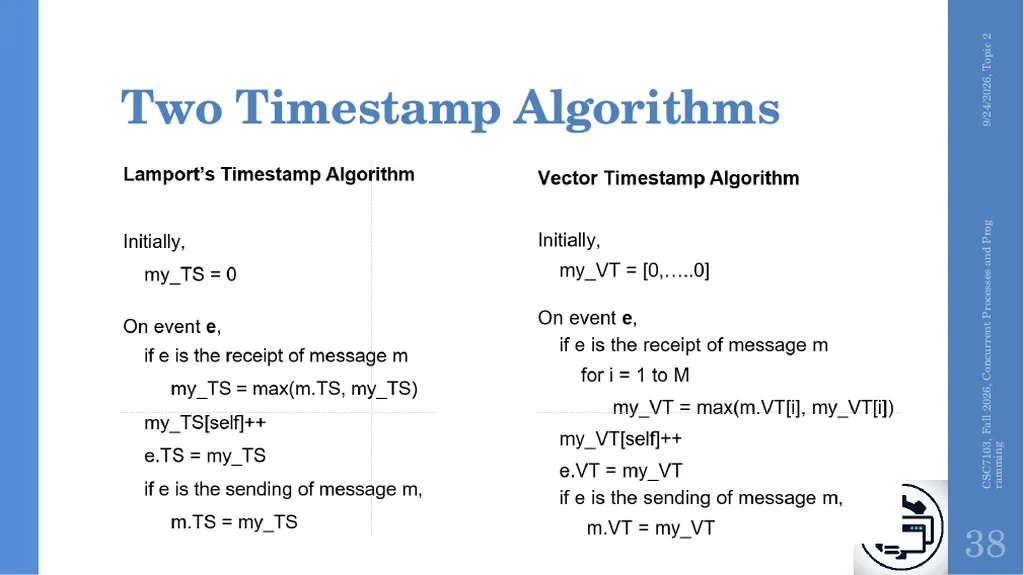
Two Timestamp Algorithms 9/24/2026, Topic 2 CSC7103, Fall 2026, Concurrent Processes and Programming 38<br>
39
Matrix Logical Clock The concept of vector logical clock can be extended to matrix logical clock
Instead of an array of logical clocks, an array (vector) of vector logical clocks is maintained
A matrix clock at process Pi is an n by n matrix:
MCi [k, i]
where ith row MCi [i, 1…n] is the vector logical clock of pi
The jth row is the knowledge process pi has about the vector logical clock of process pj
The matrix thus obtained is used to stamp messages
Logical clock within a process is incremented for each local event
Upon receipt of a message, the matrix clock is updated by taking the pair-wise maximum 9/24/2026, Topic 2 CSC7103, Fall 2026, Concurrent Processes and Programming 39<br>
Instead of an array of logical clocks, an array (vector) of vector logical clocks is maintained
A matrix clock at process Pi is an n by n matrix:
MCi [k, i]
where ith row MCi [i, 1…n] is the vector logical clock of pi
The jth row is the knowledge process pi has about the vector logical clock of process pj
The matrix thus obtained is used to stamp messages
Logical clock within a process is incremented for each local event
Upon receipt of a message, the matrix clock is updated by taking the pair-wise maximum 9/24/2026, Topic 2 CSC7103, Fall 2026, Concurrent Processes and Programming 39<br>
40
Causality 9/24/2026, Topic 2 CSC7103, Fall 2026, Concurrent Processes and Programming 40<br>
41
Causality The lack of a global system state – fundamental property of a distributed system
Most of the time distributed systems are asynchronous
Distributed systems are causal – the cause precedes the effect
The sending of a message precedes the receipt of a message
The distributed system is composed of the set of processors and there are multiple sets of events that occur on these processors
Events include message send, message receipt, user input receipt, signal raising, output creation, etc.
How to define the ordering among different events:
We write e1 < e2 if we know that event e1 occurred before event e2
In distributed systems, it is difficult to deduce which event came first
Need to combine information from different sources to determine the ordering. If information source I tells us that e1 occurred before e2, we write e1 <I e2 9/24/2026, Topic 2 CSC7103, Fall 2026, Concurrent Processes and Programming 41<br>
Most of the time distributed systems are asynchronous
Distributed systems are causal – the cause precedes the effect
The sending of a message precedes the receipt of a message
The distributed system is composed of the set of processors and there are multiple sets of events that occur on these processors
Events include message send, message receipt, user input receipt, signal raising, output creation, etc.
How to define the ordering among different events:
We write e1 < e2 if we know that event e1 occurred before event e2
In distributed systems, it is difficult to deduce which event came first
Need to combine information from different sources to determine the ordering. If information source I tells us that e1 occurred before e2, we write e1 <I e2 9/24/2026, Topic 2 CSC7103, Fall 2026, Concurrent Processes and Programming 41<br>
42
Causality Definitions Event e1 causally happened before event e2 (that is, e1 <H e2):
Transitive closure of the processor orderings and the message orderings
Processor ordering: e1 occurred before e2 in the same process/processor p
e1 <P e2
Events that occur on the same processor are totally ordered
Message ordering: A message (m) sent by the process pi after e1 occurred is received by the process pj before e2 occurred
e1 <m e2
Simply, e1 is the sending of message m and e2 is the receipt of message m
Transitive closure property: if e1 causally happened before e2 and e2 causally happened before e3, then
e1 <C e3 9/24/2026, Topic 2 CSC7103, Fall 2026, Concurrent Processes and Programming 42<br>
Transitive closure of the processor orderings and the message orderings
Processor ordering: e1 occurred before e2 in the same process/processor p
e1 <P e2
Events that occur on the same processor are totally ordered
Message ordering: A message (m) sent by the process pi after e1 occurred is received by the process pj before e2 occurred
e1 <m e2
Simply, e1 is the sending of message m and e2 is the receipt of message m
Transitive closure property: if e1 causally happened before e2 and e2 causally happened before e3, then
e1 <C e3 9/24/2026, Topic 2 CSC7103, Fall 2026, Concurrent Processes and Programming 42<br>
43
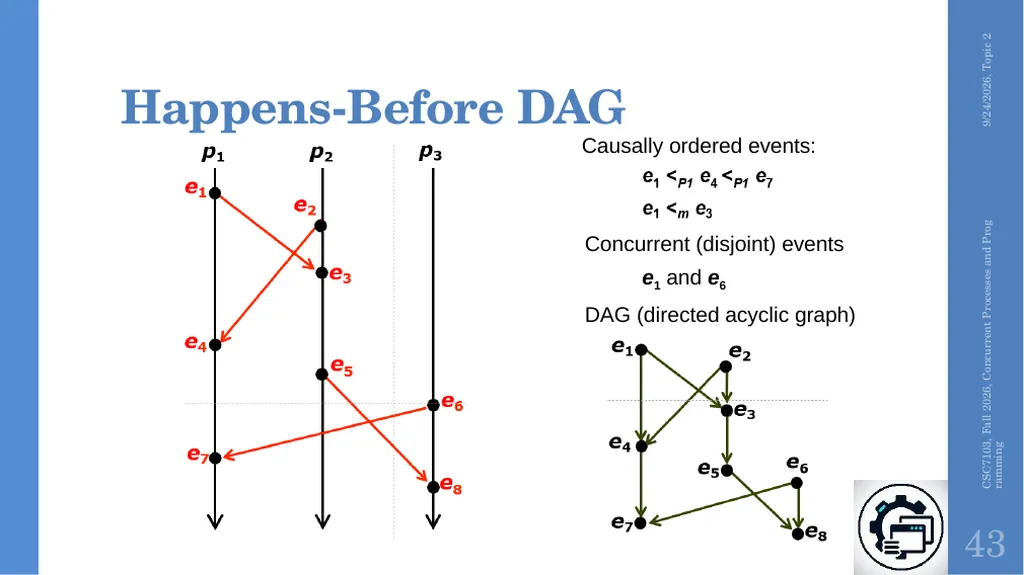
Happens-Before DAG 9/24/2026, Topic 2 CSC7103, Fall 2026, Concurrent Processes and Programming Causally ordered events: Concurrent (disjoint) events
e1 and e6
DAG (directed acyclic graph) 43<br>
e1 and e6
DAG (directed acyclic graph) 43<br>
44
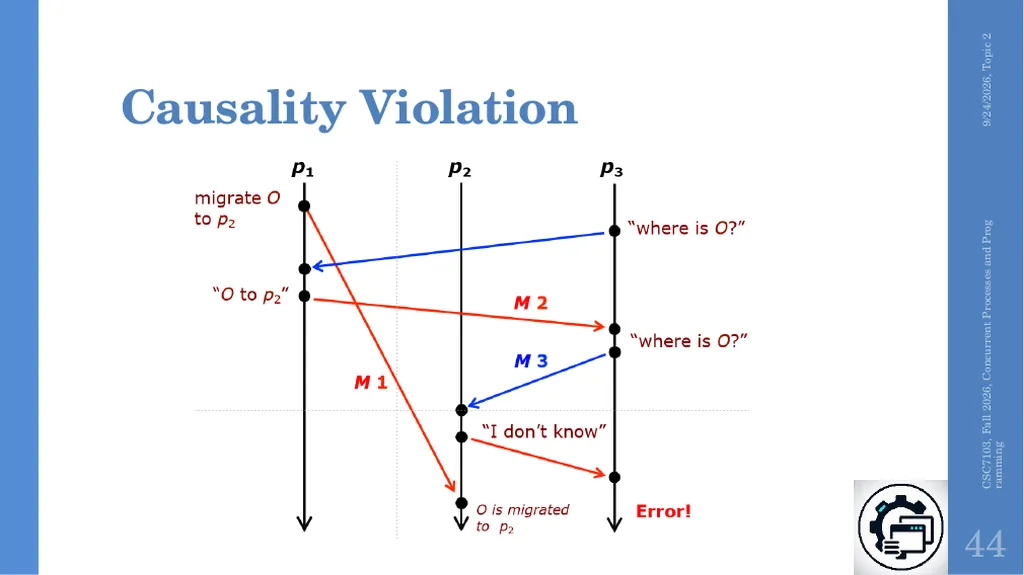
Causality Violation 9/24/2026, Topic 2 CSC7103, Fall 2026, Concurrent Processes and Programming 44<br>
45
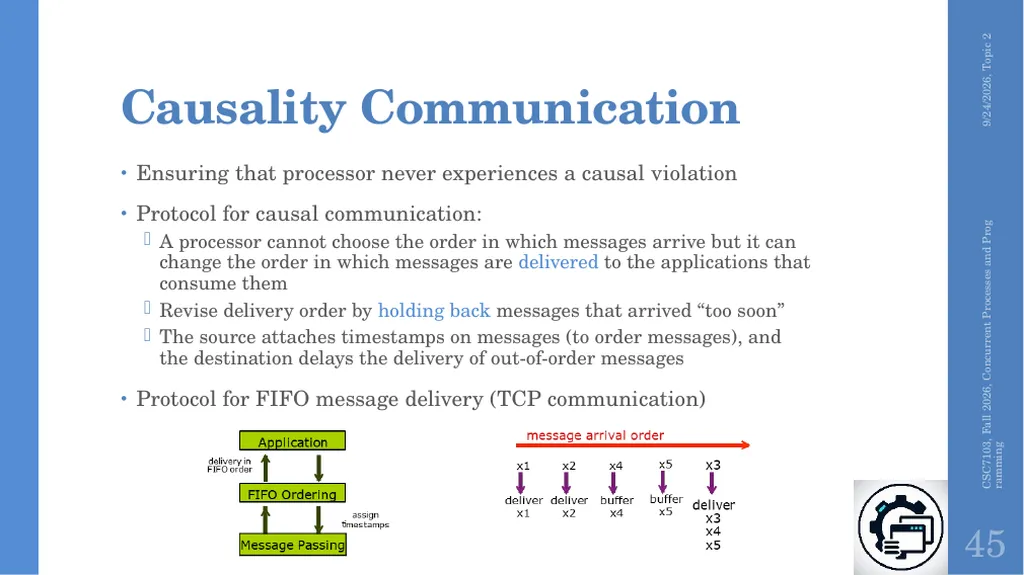
Causality Communication Ensuring that processor never experiences a causal violation
Protocol for causal communication:
A processor cannot choose the order in which messages arrive but it can change the order in which messages are delivered to the applications that consume them
Revise delivery order by holding back messages that arrived “too soon”
The source attaches timestamps on messages (to order messages), and the destination delays the delivery of out-of-order messages
Protocol for FIFO message delivery (TCP communication) 9/24/2026, Topic 2 CSC7103, Fall 2026, Concurrent Processes and Programming 45<br>
Protocol for causal communication:
A processor cannot choose the order in which messages arrive but it can change the order in which messages are delivered to the applications that consume them
Revise delivery order by holding back messages that arrived “too soon”
The source attaches timestamps on messages (to order messages), and the destination delays the delivery of out-of-order messages
Protocol for FIFO message delivery (TCP communication) 9/24/2026, Topic 2 CSC7103, Fall 2026, Concurrent Processes and Programming 45<br>
46
IPC and Synchronization 9/24/2026, Topic 2 CSC7103, Fall 2026, Concurrent Processes and Programming 46<br>
47
Language Mechanisms for Synchronization A concurrent programming language supports:
Specification of concurrent processing
Synchronization of processes
Interprocess communication
Non-deterministic execution of processes
How the normal OS approaches can be extended to the distributed OS
Various synchronization mechanisms
Shared-variable approaches: Semaphore, monitor, conditional critical region, serializer, path expression
Message passing approaches: Communicating sequential processes, remote procedure call, rendezvous
Classic synchronization example: Concurrent readers/exclusive writer problem 9/24/2026, Topic 2 CSC7103, Fall 2026, Concurrent Processes and Programming 47<br>
Specification of concurrent processing
Synchronization of processes
Interprocess communication
Non-deterministic execution of processes
How the normal OS approaches can be extended to the distributed OS
Various synchronization mechanisms
Shared-variable approaches: Semaphore, monitor, conditional critical region, serializer, path expression
Message passing approaches: Communicating sequential processes, remote procedure call, rendezvous
Classic synchronization example: Concurrent readers/exclusive writer problem 9/24/2026, Topic 2 CSC7103, Fall 2026, Concurrent Processes and Programming 47<br>
48
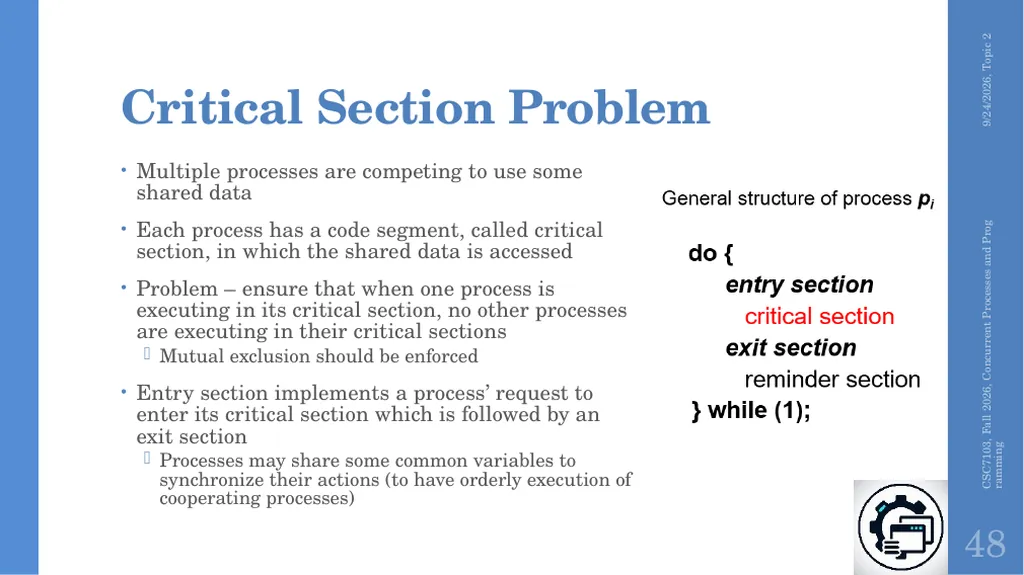
Critical Section Problem Multiple processes are competing to use some shared data
Each process has a code segment, called critical section, in which the shared data is accessed
Problem – ensure that when one process is executing in its critical section, no other processes are executing in their critical sections
Mutual exclusion should be enforced
Entry section implements a process’ request to enter its critical section which is followed by an exit section
Processes may share some common variables to synchronize their actions (to have orderly execution of cooperating processes) 9/24/2026, Topic 2 CSC7103, Fall 2026, Concurrent Processes and Programming 48<br>
Each process has a code segment, called critical section, in which the shared data is accessed
Problem – ensure that when one process is executing in its critical section, no other processes are executing in their critical sections
Mutual exclusion should be enforced
Entry section implements a process’ request to enter its critical section which is followed by an exit section
Processes may share some common variables to synchronize their actions (to have orderly execution of cooperating processes) 9/24/2026, Topic 2 CSC7103, Fall 2026, Concurrent Processes and Programming 48<br>
49
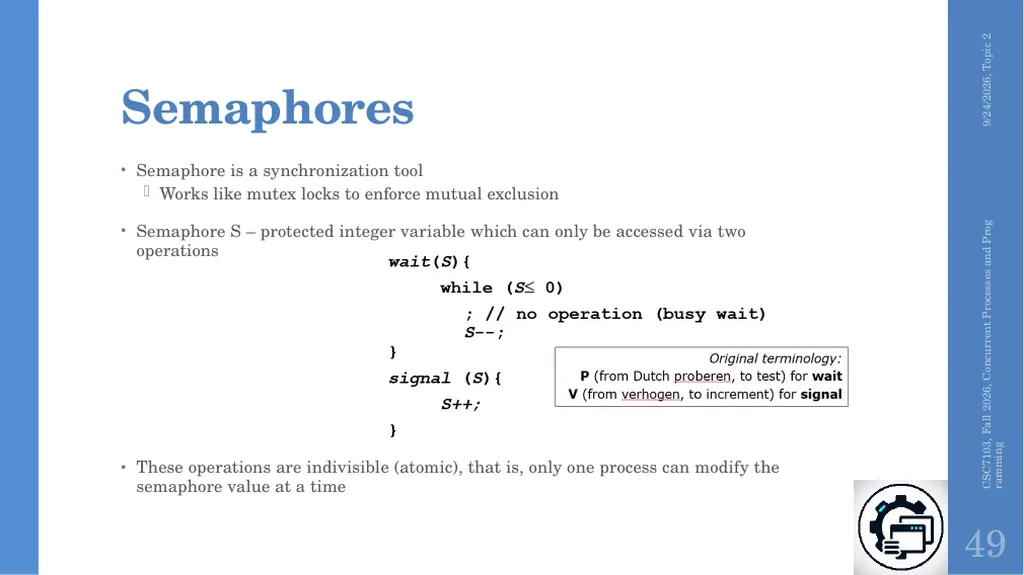
Semaphores Semaphore is a synchronization tool
Works like mutex locks to enforce mutual exclusion
Semaphore S – protected integer variable which can only be accessed via two operations
These operations are indivisible (atomic), that is, only one process can modify the semaphore value at a time 9/24/2026, Topic 2 CSC7103, Fall 2026, Concurrent Processes and Programming 49<br>
Works like mutex locks to enforce mutual exclusion
Semaphore S – protected integer variable which can only be accessed via two operations
These operations are indivisible (atomic), that is, only one process can modify the semaphore value at a time 9/24/2026, Topic 2 CSC7103, Fall 2026, Concurrent Processes and Programming 49<br>
50
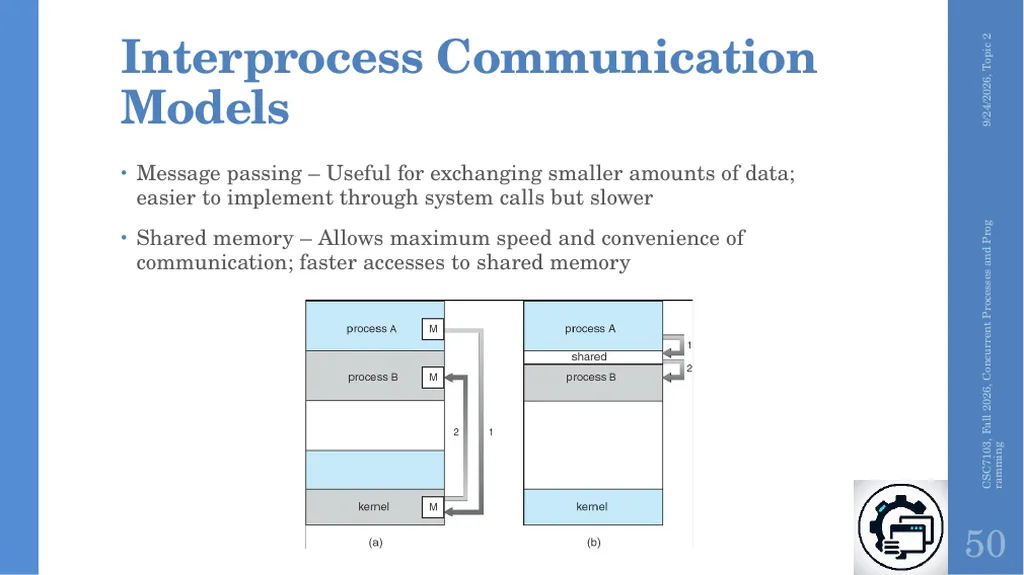
Interprocess Communication Models Message passing – Useful for exchanging smaller amounts of data; easier to implement through system calls but slower
Shared memory – Allows maximum speed and convenience of communication; faster accesses to shared memory 9/24/2026, Topic 2 CSC7103, Fall 2026, Concurrent Processes and Programming 50<br>
Shared memory – Allows maximum speed and convenience of communication; faster accesses to shared memory 9/24/2026, Topic 2 CSC7103, Fall 2026, Concurrent Processes and Programming 50<br>
51
Message-Passing Synchronization A mechanism for cooperating processes to communicate and to synchronize their actions without sharing the same address space
The only means of communication in distributed systems without shared memory
Message-passing facility provides two operations:
send(message) – message size fixed or variable
receive(message)
Two processes wishing to communicate need to establish a communication link between them and exchange messages via
send/receive
Implementation of communication link physical (e.g., shared memory, hardware bus or network) or logical
Message can be asynchronous or synchronous 9/24/2026, Topic 2 CSC7103, Fall 2026, Concurrent Processes and Programming 51<br>
The only means of communication in distributed systems without shared memory
Message-passing facility provides two operations:
send(message) – message size fixed or variable
receive(message)
Two processes wishing to communicate need to establish a communication link between them and exchange messages via
send/receive
Implementation of communication link physical (e.g., shared memory, hardware bus or network) or logical
Message can be asynchronous or synchronous 9/24/2026, Topic 2 CSC7103, Fall 2026, Concurrent Processes and Programming 51<br>
52
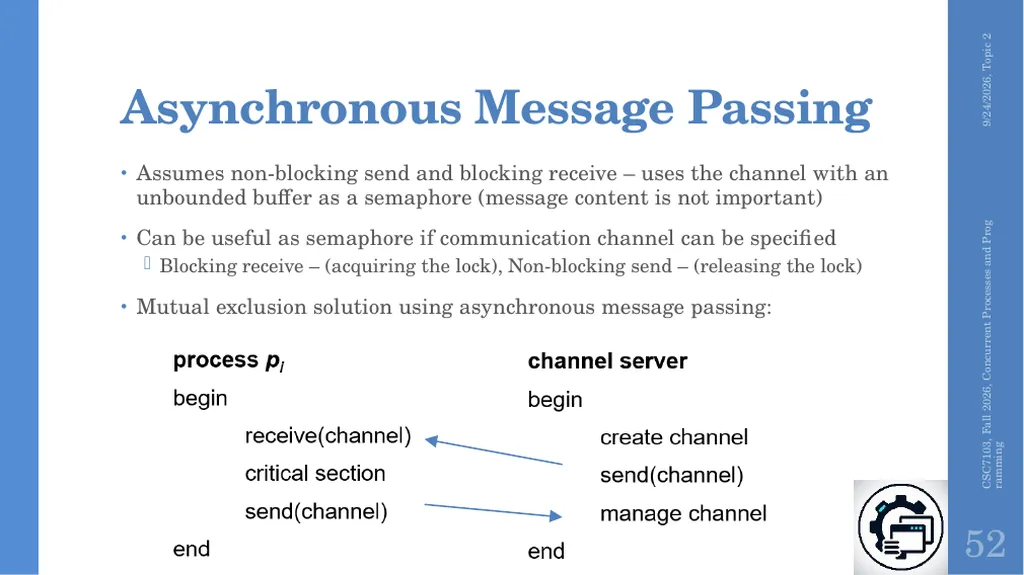
Asynchronous Message Passing Assumes non-blocking send and blocking receive – uses the channel with an unbounded buffer as a semaphore (message content is not important)
Can be useful as semaphore if communication channel can be specified
Blocking receive – (acquiring the lock), Non-blocking send – (releasing the lock)
Mutual exclusion solution using asynchronous message passing: 9/24/2026, Topic 2 CSC7103, Fall 2026, Concurrent Processes and Programming 52<br>
Can be useful as semaphore if communication channel can be specified
Blocking receive – (acquiring the lock), Non-blocking send – (releasing the lock)
Mutual exclusion solution using asynchronous message passing: 9/24/2026, Topic 2 CSC7103, Fall 2026, Concurrent Processes and Programming 52<br>
53
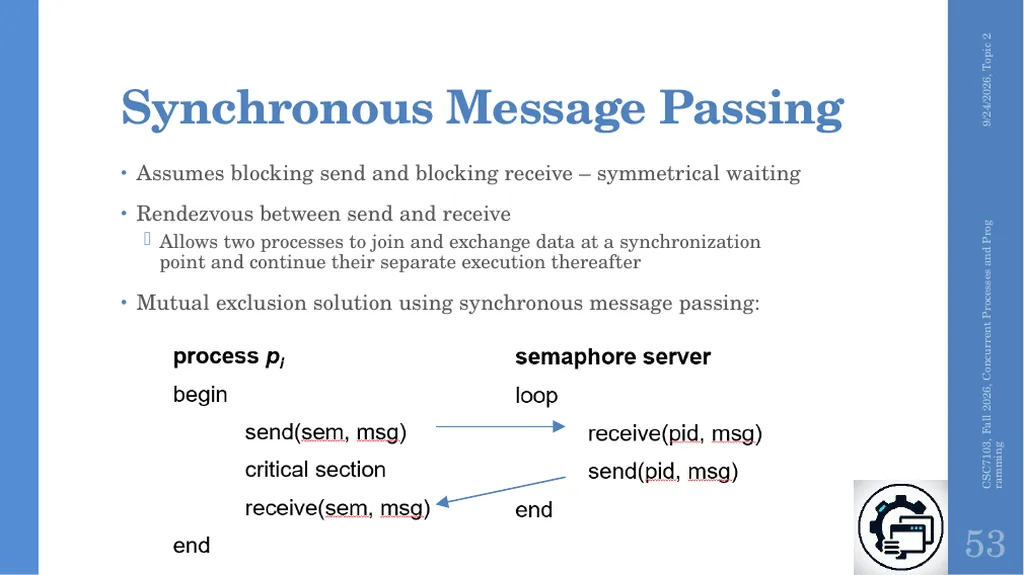
Synchronous Message Passing Assumes blocking send and blocking receive – symmetrical waiting
Rendezvous between send and receive
Allows two processes to join and exchange data at a synchronization point and continue their separate execution thereafter
Mutual exclusion solution using synchronous message passing: 9/24/2026, Topic 2 CSC7103, Fall 2026, Concurrent Processes and Programming 53<br>
Rendezvous between send and receive
Allows two processes to join and exchange data at a synchronization point and continue their separate execution thereafter
Mutual exclusion solution using synchronous message passing: 9/24/2026, Topic 2 CSC7103, Fall 2026, Concurrent Processes and Programming 53<br>
54
9/24/2026, Topic 2 CSC7103, Fall 2026, Concurrent Processes and Programming 54<br>