CONDITIONALS CONDITIONALS structure A clause consists of a subject and a predicate. Main clauses are those that can be alone as a sentence. A comma separates the two clauses only if the result clause goes first in the sentence. types There
"CONDITIONALS CONDITIONALS structure A clause" is the property of its rightful owner. Permission is granted to
download and print the materials on this website for personal, non-commercial use only, and to display it
on your personal computer provided you do not modify the materials and that you retain all copyright
notices contained in the materials. By downloading content from our website, you accept the terms of this
agreement.
Presentation Transcript
01
CONDITIONALS<br>
02
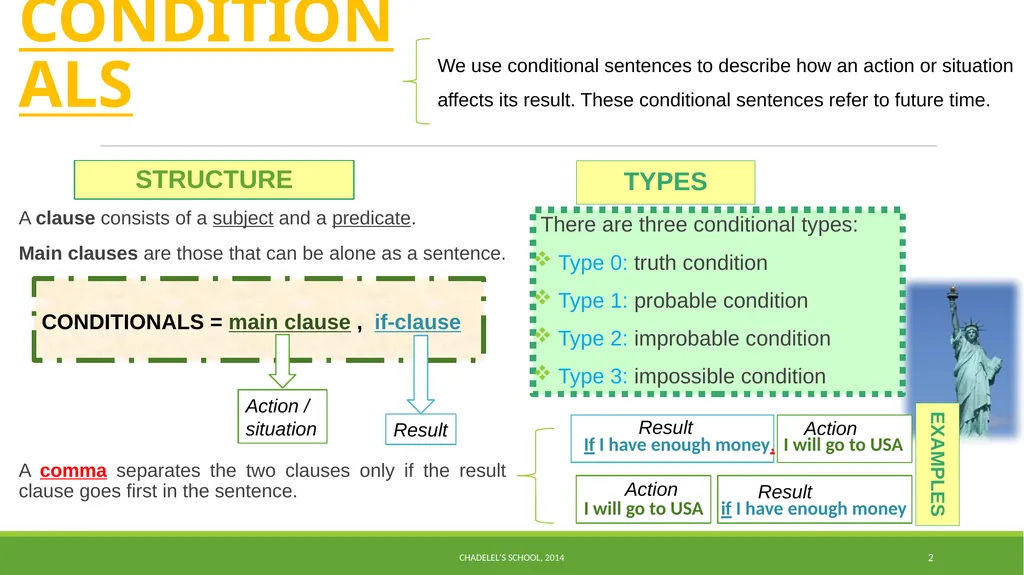
CONDITIONALS structure A clause consists of a subject and a predicate.
Main clauses are those that can be alone as a sentence.
A comma separates the two clauses only if the result clause goes first in the sentence. types There are three conditional types:
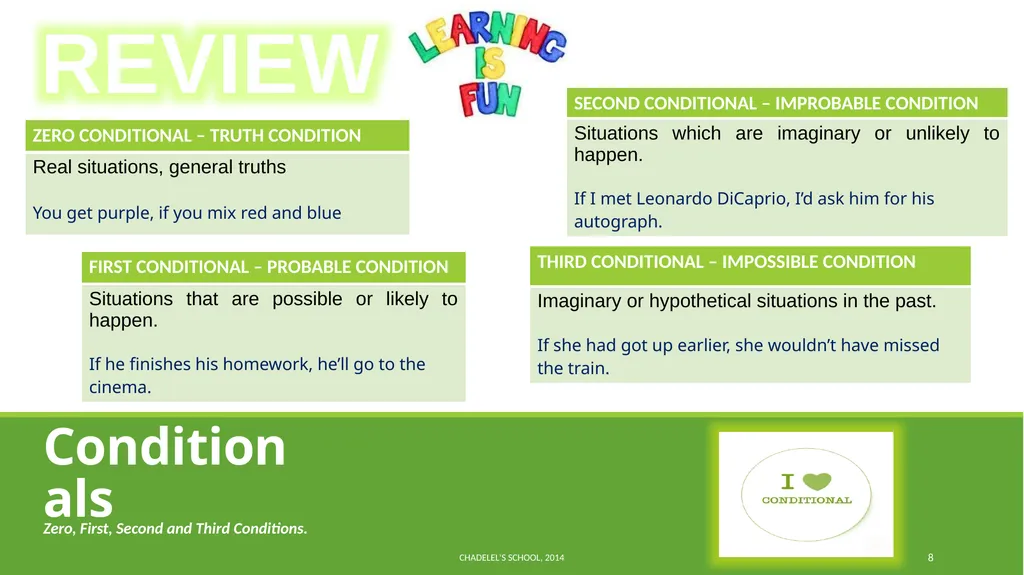
Type 0: truth condition
Type 1: probable condition
Type 2: improbable condition
Type 3: impossible condition We use conditional sentences to describe how an action or situation affects its result. These conditional sentences refer to future time. CONDITIONALS = main clause , if-clause Action / situation Result If I have enough money, I will go to USA I will go to USA if I have enough money Result Result Action Action Examples CHADELEL'S SCHOOL, 2014 2<br>
03
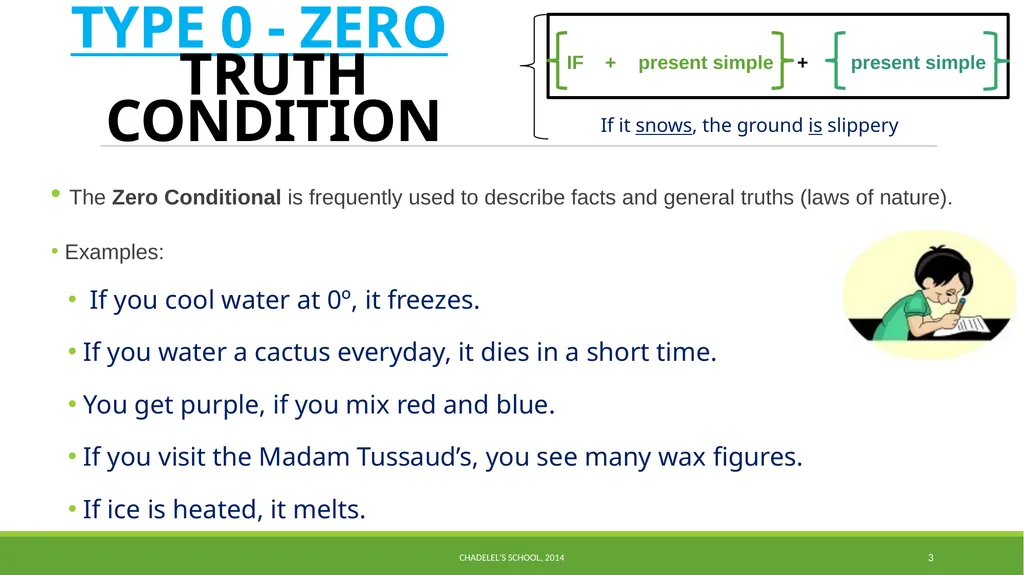
TYPE 0 - ZERO TRUTH CONDITION The Zero Conditional is frequently used to describe facts and general truths (laws of nature).
Examples:
If you cool water at 0º, it freezes.
If you water a cactus everyday, it dies in a short time.
You get purple, if you mix red and blue.
If you visit the Madam Tussaud’s, you see many wax figures.
If ice is heated, it melts. IF + present simple + present simple If it snows, the ground is slippery CHADELEL'S SCHOOL, 2014 3<br>
04
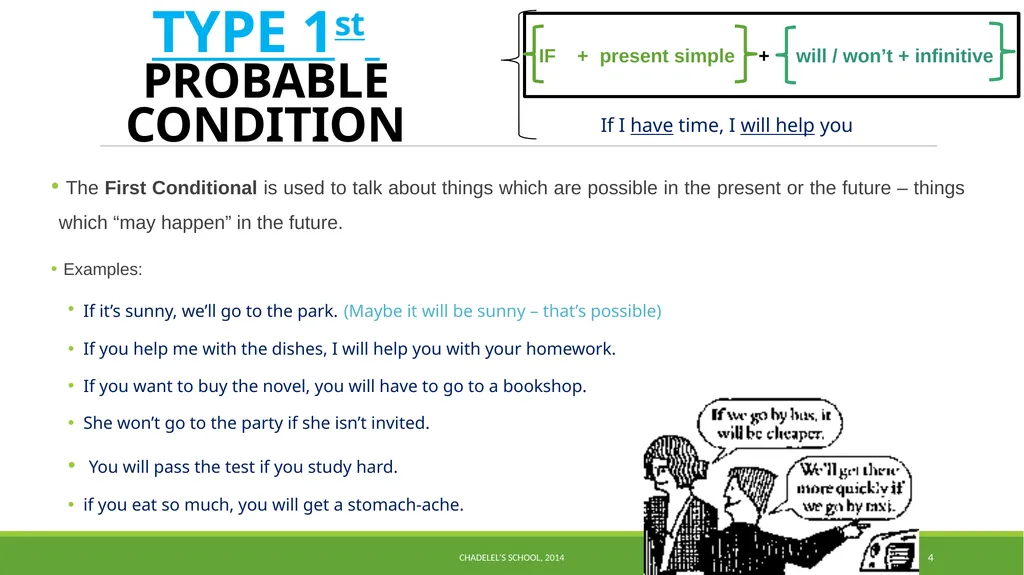
TYPE 1st PROBABLE CONDITION The First Conditional is used to talk about things which are possible in the present or the future – things which “may happen” in the future.
Examples:
If it’s sunny, we’ll go to the park. (Maybe it will be sunny – that’s possible)
If you help me with the dishes, I will help you with your homework.
If you want to buy the novel, you will have to go to a bookshop.
She won’t go to the party if she isn’t invited.
You will pass the test if you study hard.
if you eat so much, you will get a stomach-ache. IF + present simple + will / won’t + infinitive If I have time, I will help you CHADELEL'S SCHOOL, 2014 4<br>
05
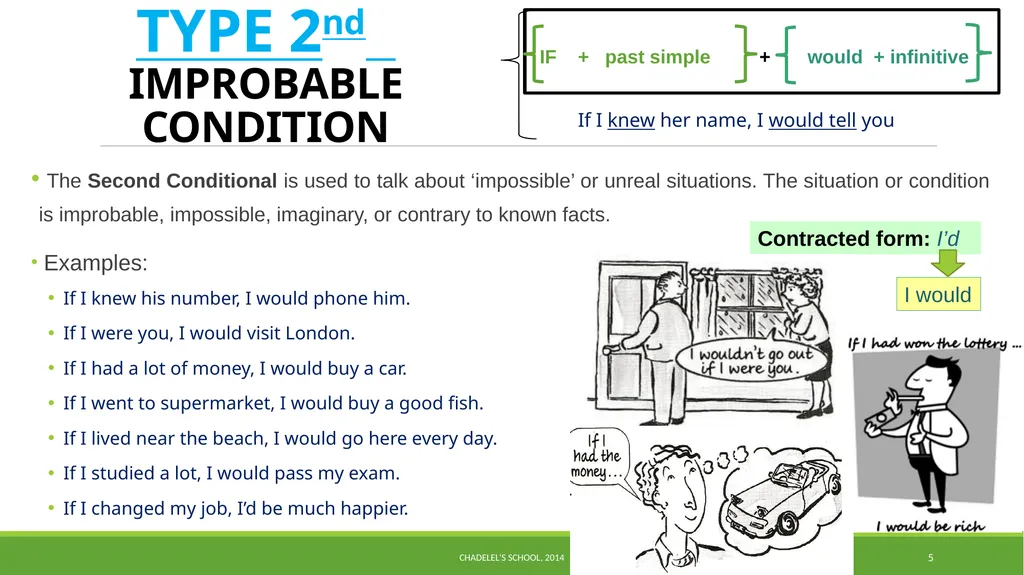
TYPE 2nd IMPROBABLE CONDITION The Second Conditional is used to talk about ‘impossible’ or unreal situations. The situation or condition is improbable, impossible, imaginary, or contrary to known facts.
Examples:
If I knew his number, I would phone him.
If I were you, I would visit London.
If I had a lot of money, I would buy a car.
If I went to supermarket, I would buy a good fish.
If I lived near the beach, I would go here every day.
If I studied a lot, I would pass my exam.
If I changed my job, I’d be much happier. IF + past simple + would + infinitive If I knew her name, I would tell you Contracted form: I’d I would CHADELEL'S SCHOOL, 2014 5<br>
06
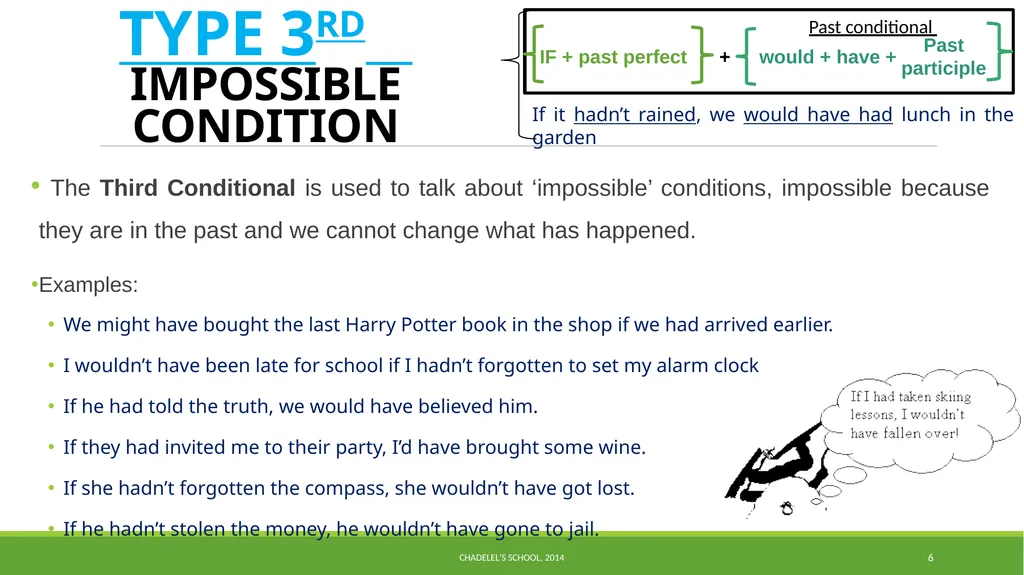
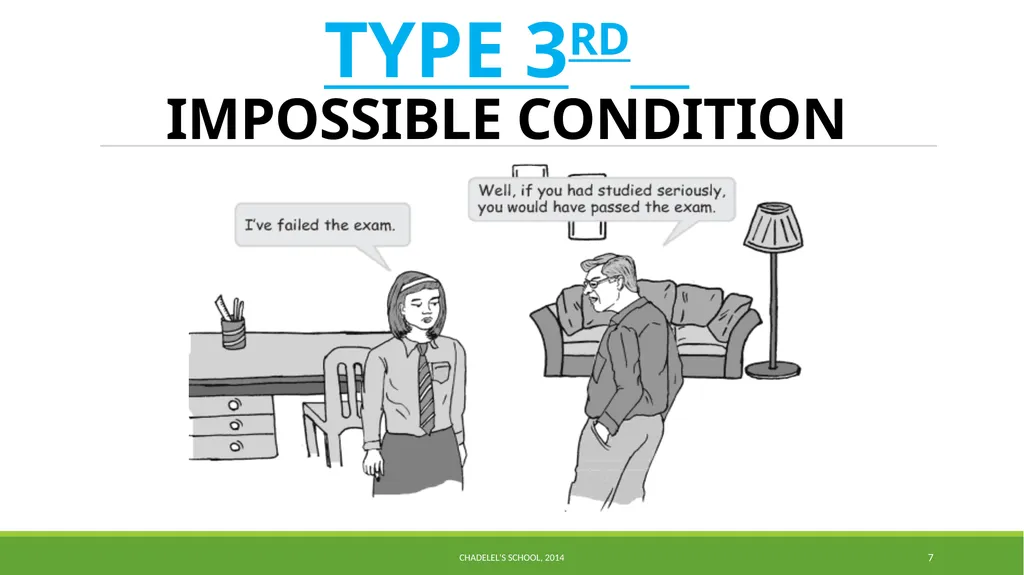
TYPE 3RD IMPOSSIBLE CONDITION The Third Conditional is used to talk about ‘impossible’ conditions, impossible because they are in the past and we cannot change what has happened.
Examples:
We might have bought the last Harry Potter book in the shop if we had arrived earlier.
I wouldn’t have been late for school if I hadn’t forgotten to set my alarm clock
If he had told the truth, we would have believed him.
If they had invited me to their party, I’d have brought some wine.
If she hadn’t forgotten the compass, she wouldn’t have got lost.
If he hadn’t stolen the money, he wouldn’t have gone to jail. IF + past perfect + would + have + If it hadn’t rained, we would have had lunch in the garden Past
participle Past conditional CHADELEL'S SCHOOL, 2014 6<br>
07
TYPE 3RD IMPOSSIBLE CONDITION CHADELEL'S SCHOOL, 2014 7<br>
08
Conditionals Zero, First, Second and Third Conditions. REVIEW CHADELEL'S SCHOOL, 2014 8<br>