
Connecting Care Ensuring Quality Referrals and
CM
Published · 52 slides · 0 views
1 / 1
Description
Connecting Care Ensuring Quality Referrals and Effective Care Coordination Carol Greenlee MD FACP Beth Neuhalfen the Medical Neighborhood Action Step 3 Ensure Others Get What They Need ACP SAN special project for implementing High Value
Related Topics
Share
Embed code
Download this presentation From Below
"Connecting Care Ensuring Quality Referrals and" is the property of its rightful owner. Permission is granted to download and print the materials on this website for personal, non-commercial use only, and to display it on your personal computer provided you do not modify the materials and that you retain all copyright notices contained in the materials. By downloading content from our website, you accept the terms of this agreement.
Presentation Transcript
01
Connecting Care
Ensuring Quality Referrals and Effective Care Coordination Carol Greenlee MD FACP & Beth Neuhalfen the Medical Neighborhood Action Step #3
Ensure Others Get What They Need ACP SAN special project
for implementing
High Value Care Coordination<br>
Ensure Others Get What They Need ACP SAN special project
for implementing
High Value Care Coordination<br>
02
The ACP SAN
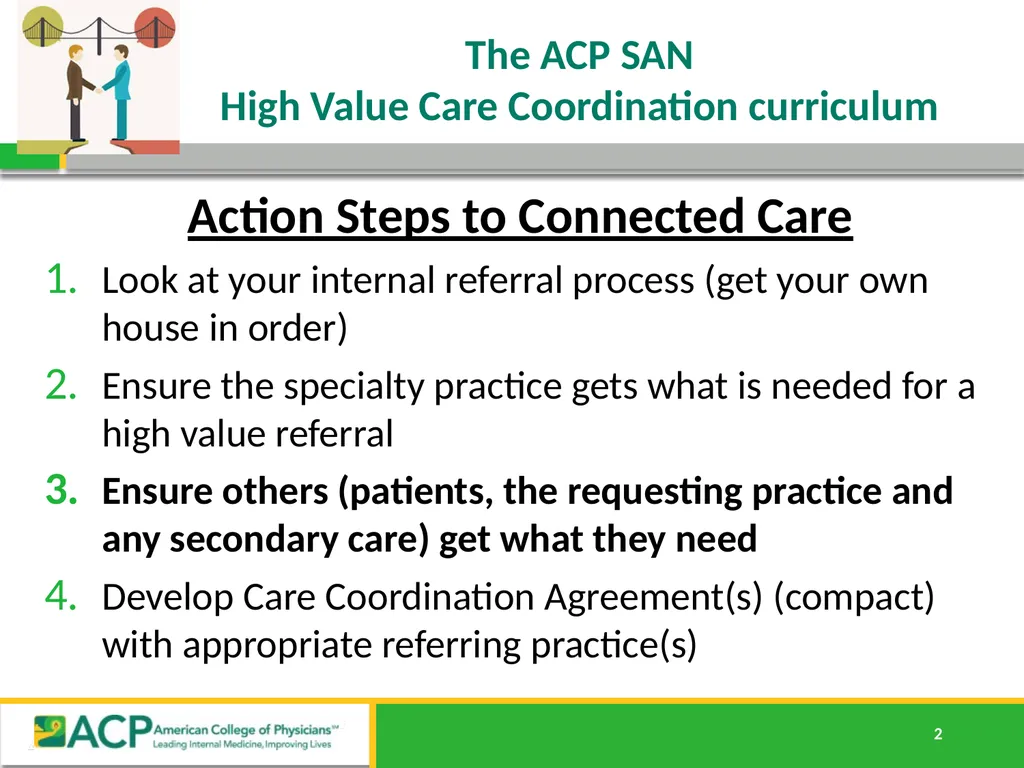
High Value Care Coordination curriculum Action Steps to Connected Care
Look at your internal referral process (get your own house in order)
Ensure the specialty practice gets what is needed for a high value referral
Ensure others (patients, the requesting practice and any secondary care) get what they need
Develop Care Coordination Agreement(s) (compact) with appropriate referring practice(s)<br>
03
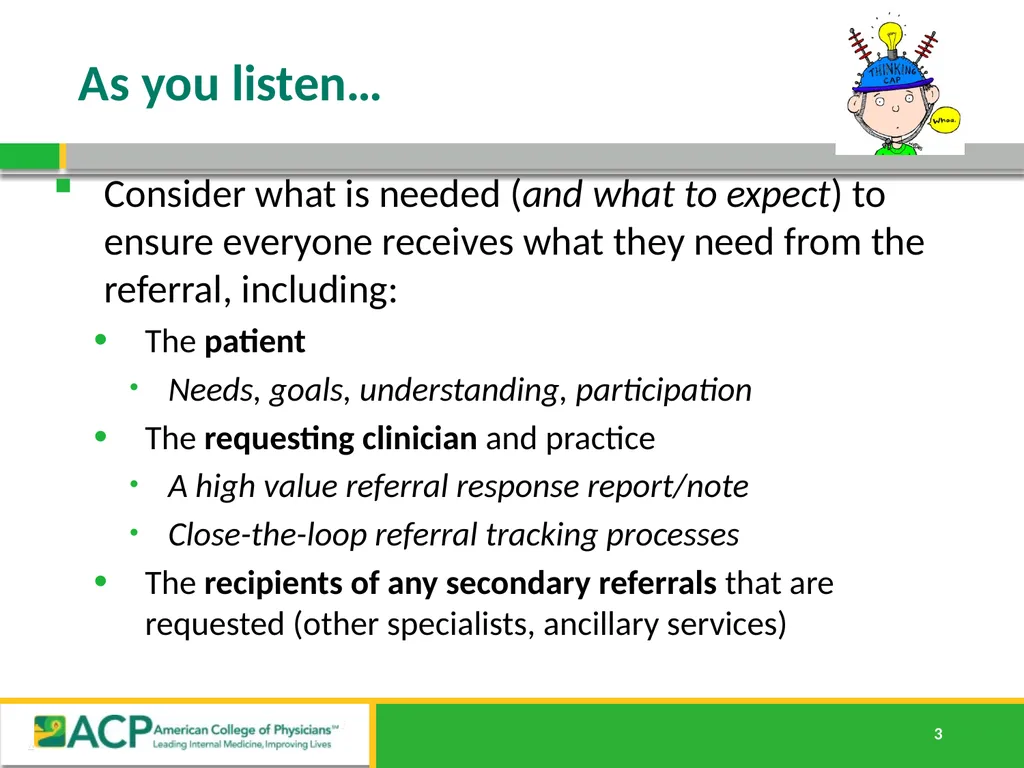
As you listen… Consider what is needed (and what to expect) to ensure everyone receives what they need from the referral, including:
The patient
Needs, goals, understanding, participation
The requesting clinician and practice
A high value referral response report/note
Close-the-loop referral tracking processes
The recipients of any secondary referrals that are requested (other specialists, ancillary services)<br>
The patient
Needs, goals, understanding, participation
The requesting clinician and practice
A high value referral response report/note
Close-the-loop referral tracking processes
The recipients of any secondary referrals that are requested (other specialists, ancillary services)<br>
04
Case: Non-Patient-Centered Referral Experience Pt is given a paper for an intermediate referral for worsening XXX but doesn’t really understand why he is being sent.
Waits to hear from someone to schedule for 2 weeks but doesn’t hear and decides to call his PCP.
Specialist office finally calls the patient to schedule in a month but didn’t know it was an intermediate referral.
When the pt. arrives, the specialist doesn’t know why the patient was sent and proceeds to order labs and tests.
The patient leaves confused and not sure if he will return because he didn’t feel listened to and didn’t understand the reason for seeing a specialist to begin with.
3 months later when the patient visits his PCP, the PCP finds out he never went back to specialist ; he did go to the ED with complaints of his condition but his care team was not notified by the ED of the visit.<br>
05
Case: Patient-Centered Referral Experience Patient is referred by his PCP for an intermediate referral for worsening XXX after discussing the goals of the referral and how the appointment will be scheduled
The specialist office calls the patient the next day to schedule.
The patient is seen within two weeks and when he arrives, the specialist seems to know all about his case.
The specialist even knows that his goal is to be active and play with his grandchildren again.
They review the labs and tests that were completed prior to the appointment and discuss next steps which involve his PCP.
The patient leaves with an understanding of next steps and the specialist sends a report including the plan of care to the PCP.
Patient makes his next appointment and feels confidence in his healthcare team.<br>
06
The Patient Experience in the Referral Process “My doctor told me why he sent me to see you but I was so upset about the news he gave me that I don’t remember what he said.”
“I was supposed to call to schedule with that specialist? I thought her office was supposed to contact me.”
“I understood I was here to have the procedure today, not just to talk about my stomach pain!”
“I had that MRI last month. You mean I was supposed to bring the report and the films with me to this visit? I assumed you had that information.”
“I took the day off of work, drove 2 hours to get here and now you tell me this is not the right doctor for my problem?”<br>
07
Patient-Centered Care is more than caring Caring about the patient is central & crucial
but
Patient (Person & Family)-Centered care also requires
delivering care in a Patient-Centered way
What does that mean?<br>
but
Patient (Person & Family)-Centered care also requires
delivering care in a Patient-Centered way
What does that mean?<br>
08
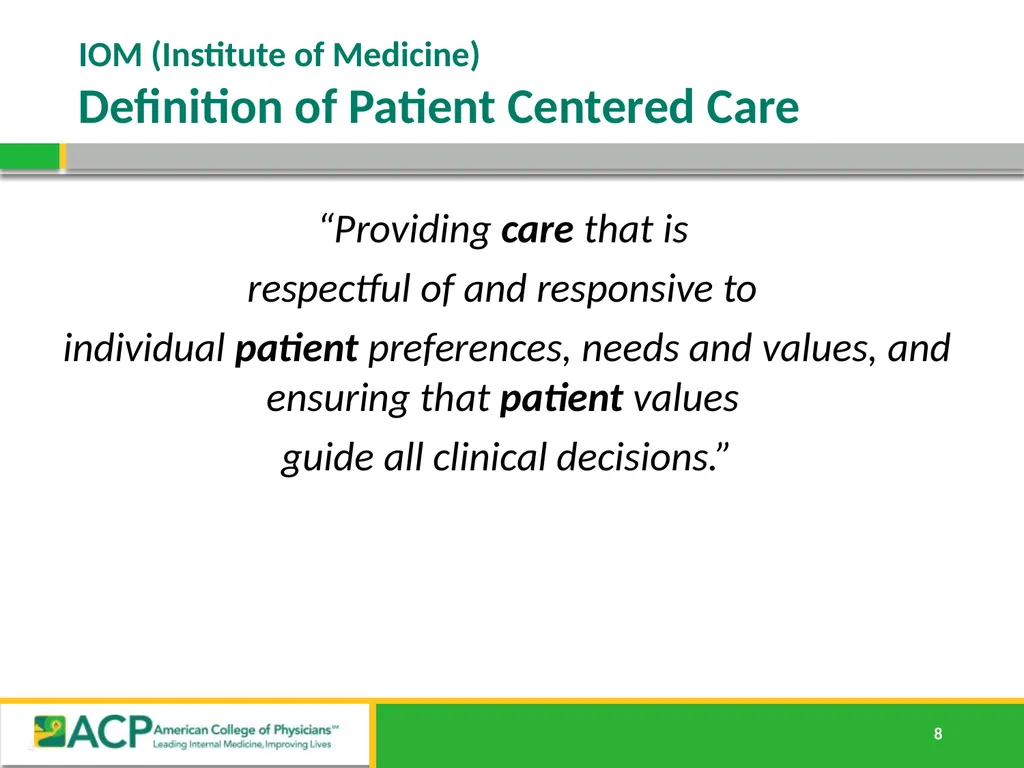
IOM (Institute of Medicine)
Definition of Patient Centered Care “Providing care that is
respectful of and responsive to
individual patient preferences, needs and values, and ensuring that patient values
guide all clinical decisions.”<br>
respectful of and responsive to
individual patient preferences, needs and values, and ensuring that patient values
guide all clinical decisions.”<br>
09
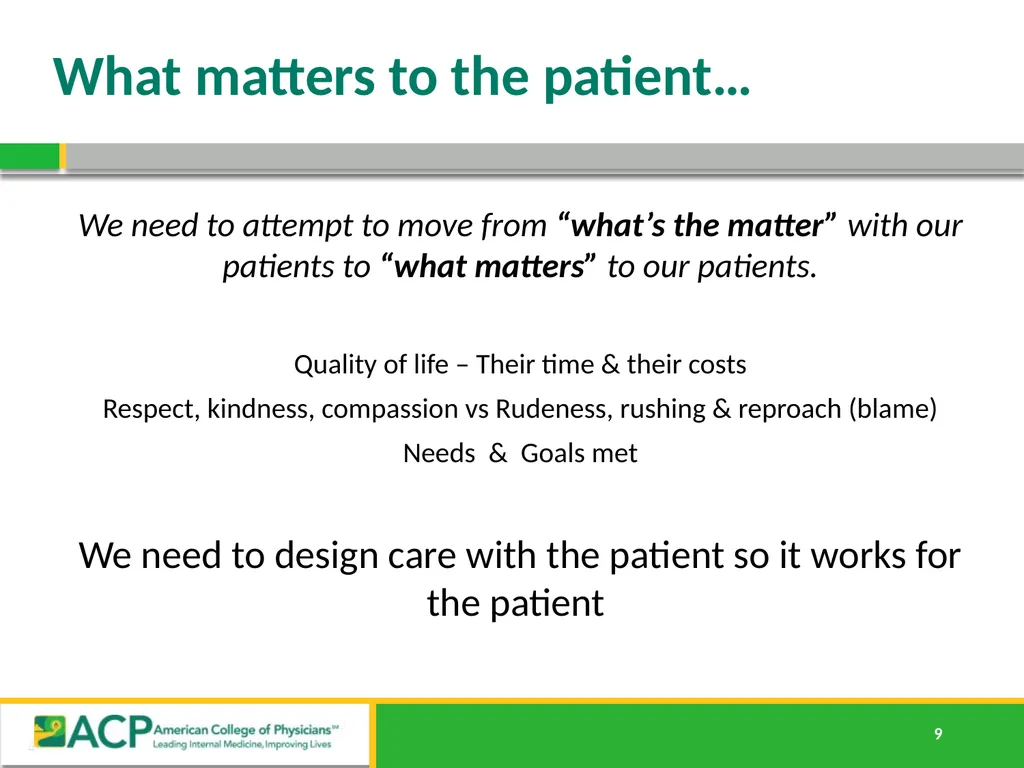
What matters to the patient… We need to attempt to move from “what’s the matter” with our patients to “what matters” to our patients.
Quality of life – Their time & their costs
Respect, kindness, compassion vs Rudeness, rushing & reproach (blame)
Needs & Goals met
We need to design care with the patient so it works for the patient<br>
Quality of life – Their time & their costs
Respect, kindness, compassion vs Rudeness, rushing & reproach (blame)
Needs & Goals met
We need to design care with the patient so it works for the patient<br>
10
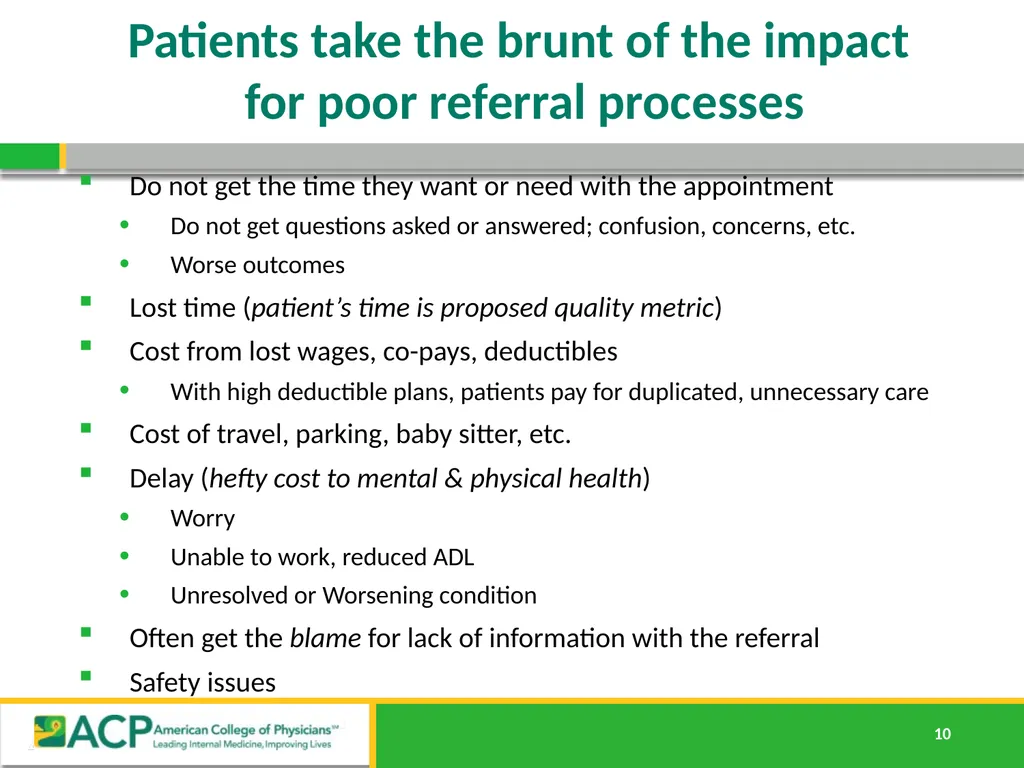
Patients take the brunt of the impact
for poor referral processes Do not get the time they want or need with the appointment
Do not get questions asked or answered; confusion, concerns, etc.
Worse outcomes
Lost time (patient’s time is proposed quality metric)
Cost from lost wages, co-pays, deductibles
With high deductible plans, patients pay for duplicated, unnecessary care
Cost of travel, parking, baby sitter, etc.
Delay (hefty cost to mental & physical health)
Worry
Unable to work, reduced ADL
Unresolved or Worsening condition
Often get the blame for lack of information with the referral
Safety issues<br>
11
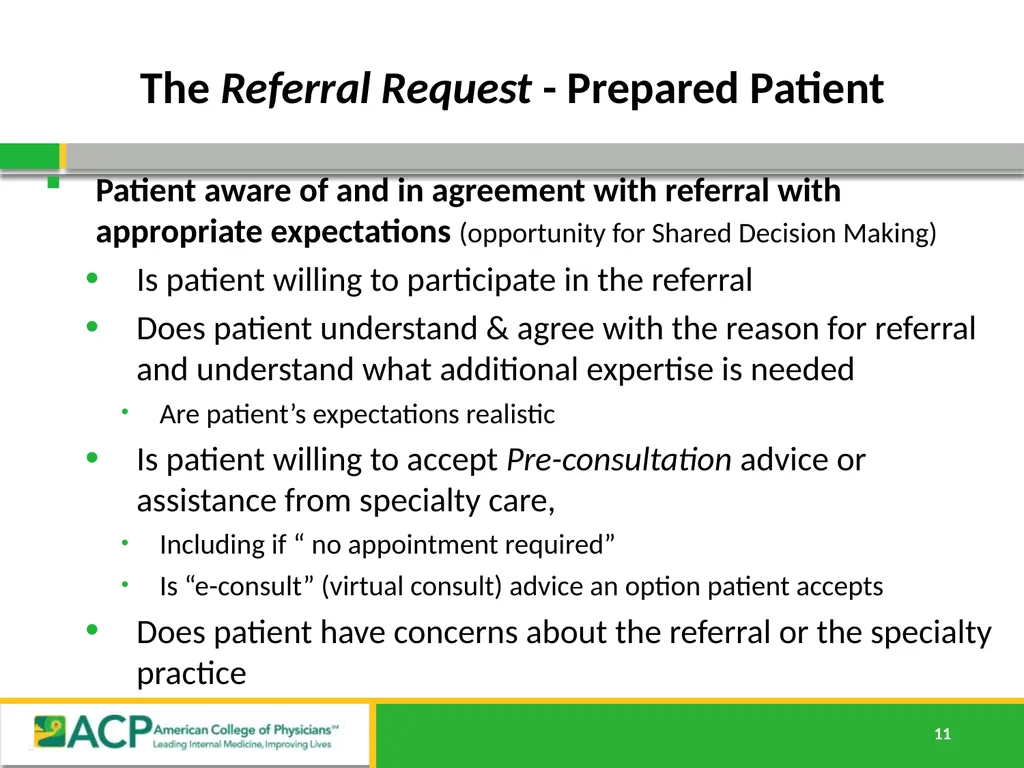
The Referral Request - Prepared Patient Patient aware of and in agreement with referral with appropriate expectations (opportunity for Shared Decision Making)
Is patient willing to participate in the referral
Does patient understand & agree with the reason for referral and understand what additional expertise is needed
Are patient’s expectations realistic
Is patient willing to accept Pre-consultation advice or assistance from specialty care,
Including if “ no appointment required”
Is “e-consult” (virtual consult) advice an option patient accepts
Does patient have concerns about the referral or the specialty practice<br>
12
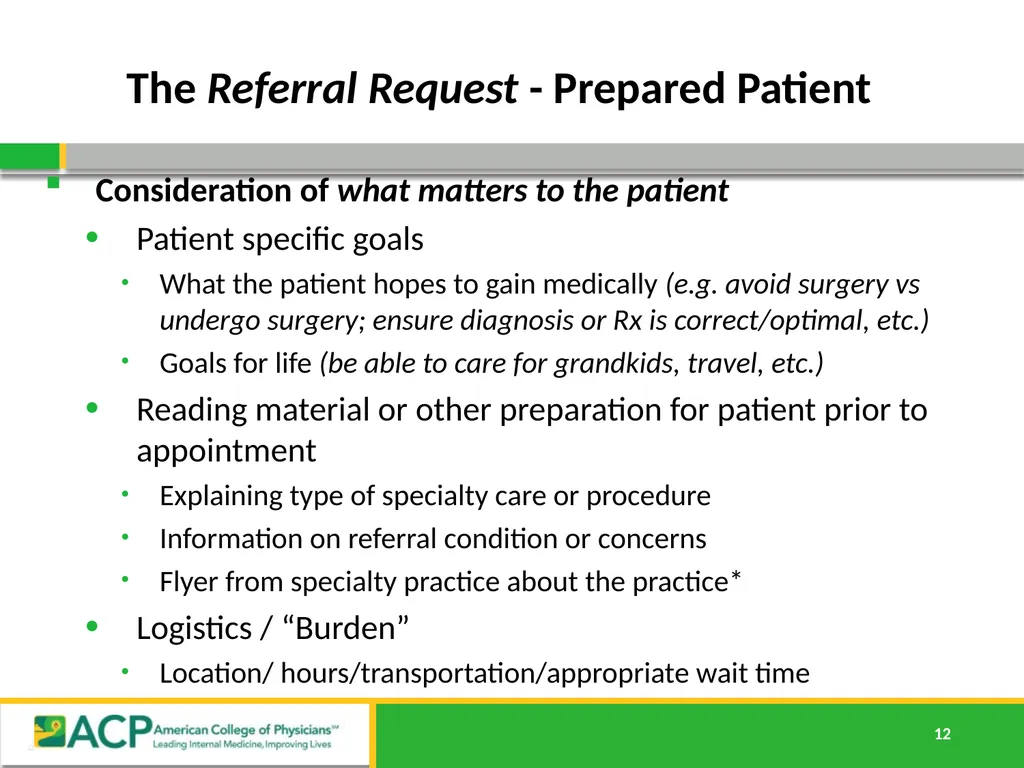
The Referral Request - Prepared Patient Consideration of what matters to the patient
Patient specific goals
What the patient hopes to gain medically (e.g. avoid surgery vs undergo surgery; ensure diagnosis or Rx is correct/optimal, etc.)
Goals for life (be able to care for grandkids, travel, etc.)
Reading material or other preparation for patient prior to appointment
Explaining type of specialty care or procedure
Information on referral condition or concerns
Flyer from specialty practice about the practice*
Logistics / “Burden”
Location/ hours/transportation/appropriate wait time<br>
13
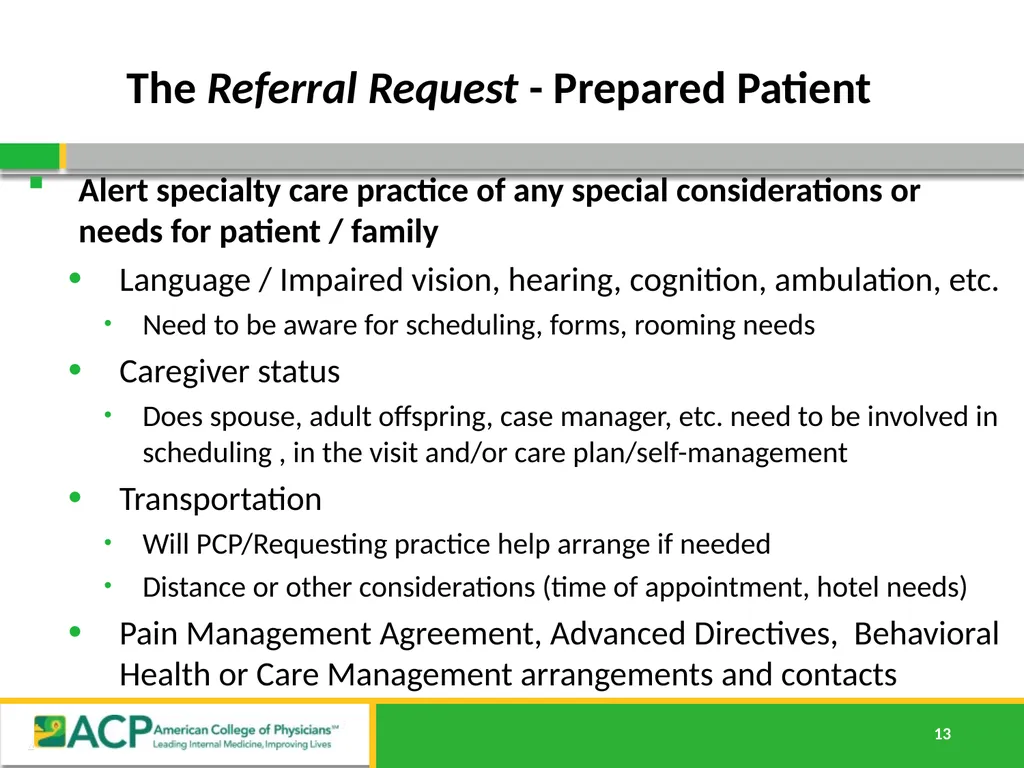
The Referral Request - Prepared Patient Alert specialty care practice of any special considerations or needs for patient / family
Language / Impaired vision, hearing, cognition, ambulation, etc.
Need to be aware for scheduling, forms, rooming needs
Caregiver status
Does spouse, adult offspring, case manager, etc. need to be involved in scheduling , in the visit and/or care plan/self-management
Transportation
Will PCP/Requesting practice help arrange if needed
Distance or other considerations (time of appointment, hotel needs)
Pain Management Agreement, Advanced Directives, Behavioral Health or Care Management arrangements and contacts<br>
14
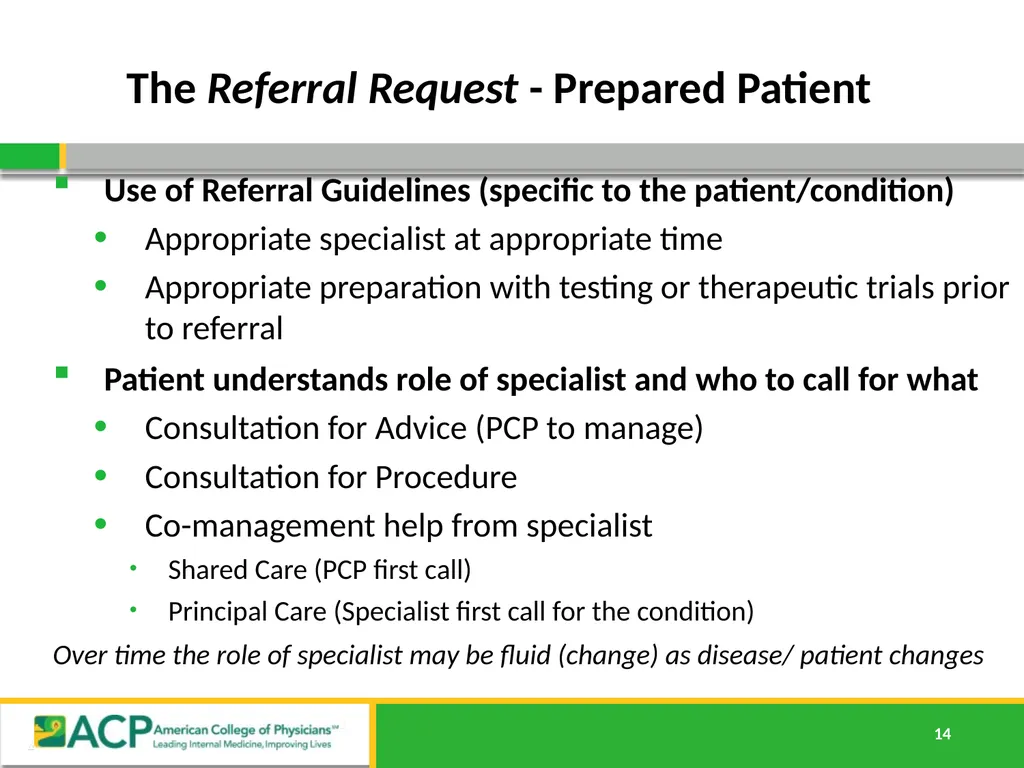
The Referral Request - Prepared Patient Use of Referral Guidelines (specific to the patient/condition)
Appropriate specialist at appropriate time
Appropriate preparation with testing or therapeutic trials prior to referral
Patient understands role of specialist and who to call for what
Consultation for Advice (PCP to manage)
Consultation for Procedure
Co-management help from specialist
Shared Care (PCP first call)
Principal Care (Specialist first call for the condition)
Over time the role of specialist may be fluid (change) as disease/ patient changes<br>
15
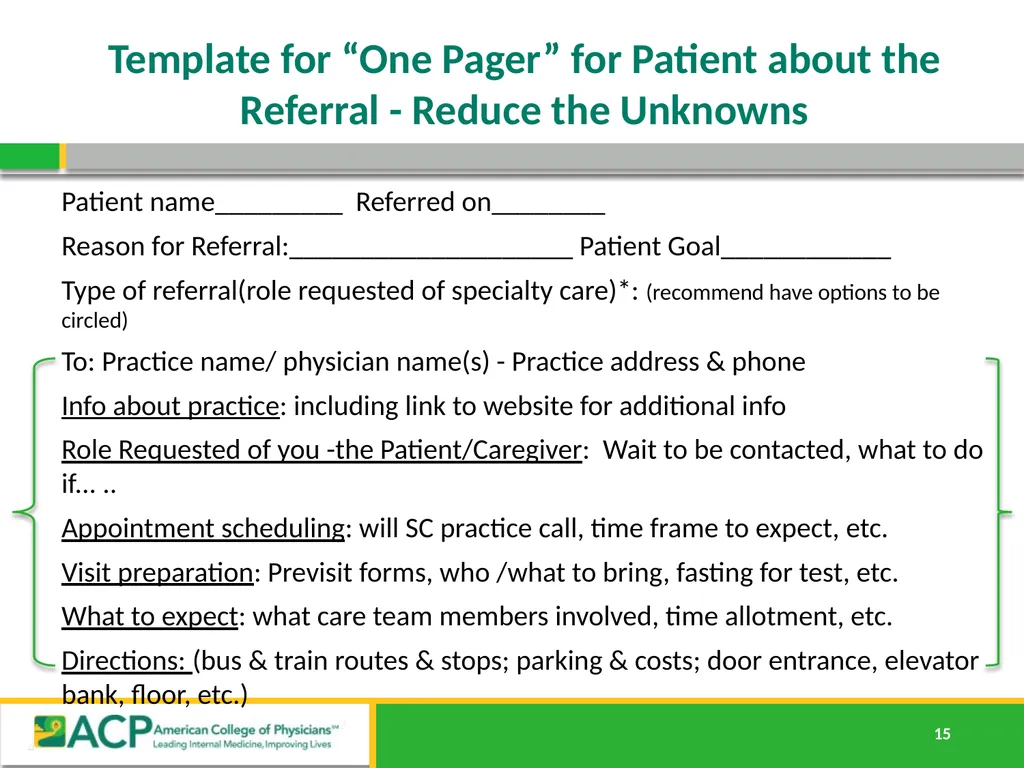
Template for “One Pager” for Patient about the Referral - Reduce the Unknowns Patient name_________ Referred on________
Reason for Referral:____________________ Patient Goal____________
Type of referral(role requested of specialty care)*: (recommend have options to be circled)
To: Practice name/ physician name(s) - Practice address & phone
Info about practice: including link to website for additional info
Role Requested of you -the Patient/Caregiver: Wait to be contacted, what to do if... ..
Appointment scheduling: will SC practice call, time frame to expect, etc.
Visit preparation: Previsit forms, who /what to bring, fasting for test, etc.
What to expect: what care team members involved, time allotment, etc.
Directions: (bus & train routes & stops; parking & costs; door entrance, elevator bank, floor, etc.)<br>
16
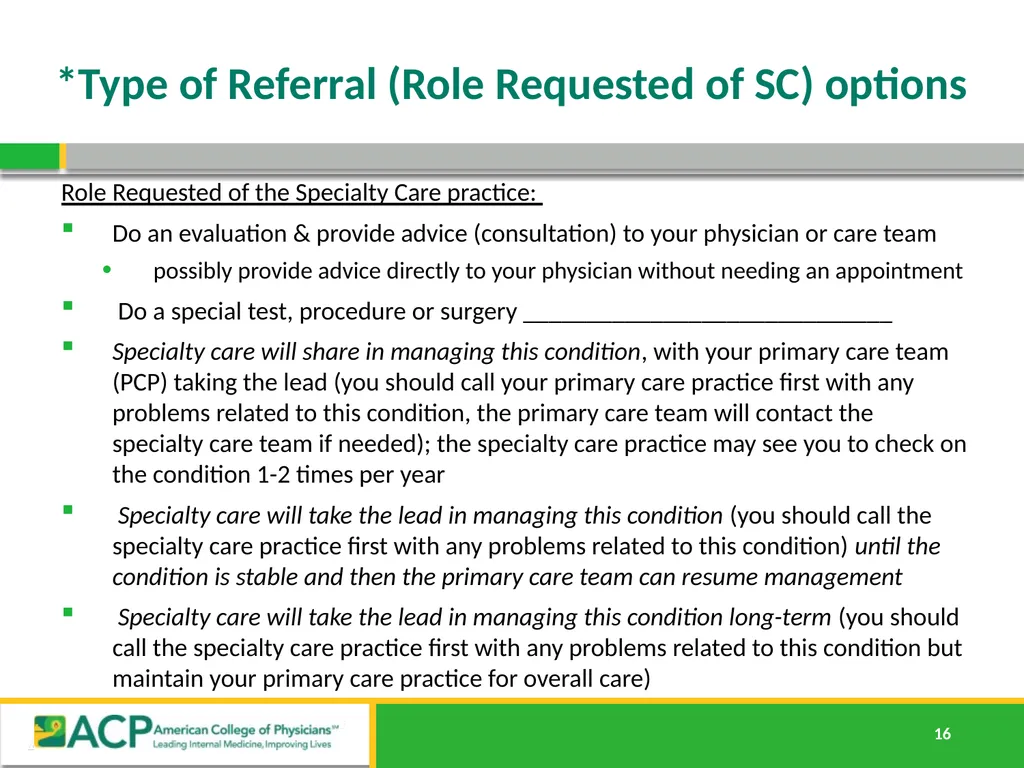
*Type of Referral (Role Requested of SC) options Role Requested of the Specialty Care practice:
Do an evaluation & provide advice (consultation) to your physician or care team
possibly provide advice directly to your physician without needing an appointment
Do a special test, procedure or surgery _____________________________
Specialty care will share in managing this condition, with your primary care team (PCP) taking the lead (you should call your primary care practice first with any problems related to this condition, the primary care team will contact the specialty care team if needed); the specialty care practice may see you to check on the condition 1-2 times per year
Specialty care will take the lead in managing this condition (you should call the specialty care practice first with any problems related to this condition) until the condition is stable and then the primary care team can resume management
Specialty care will take the lead in managing this condition long-term (you should call the specialty care practice first with any problems related to this condition but maintain your primary care practice for overall care)<br>
17
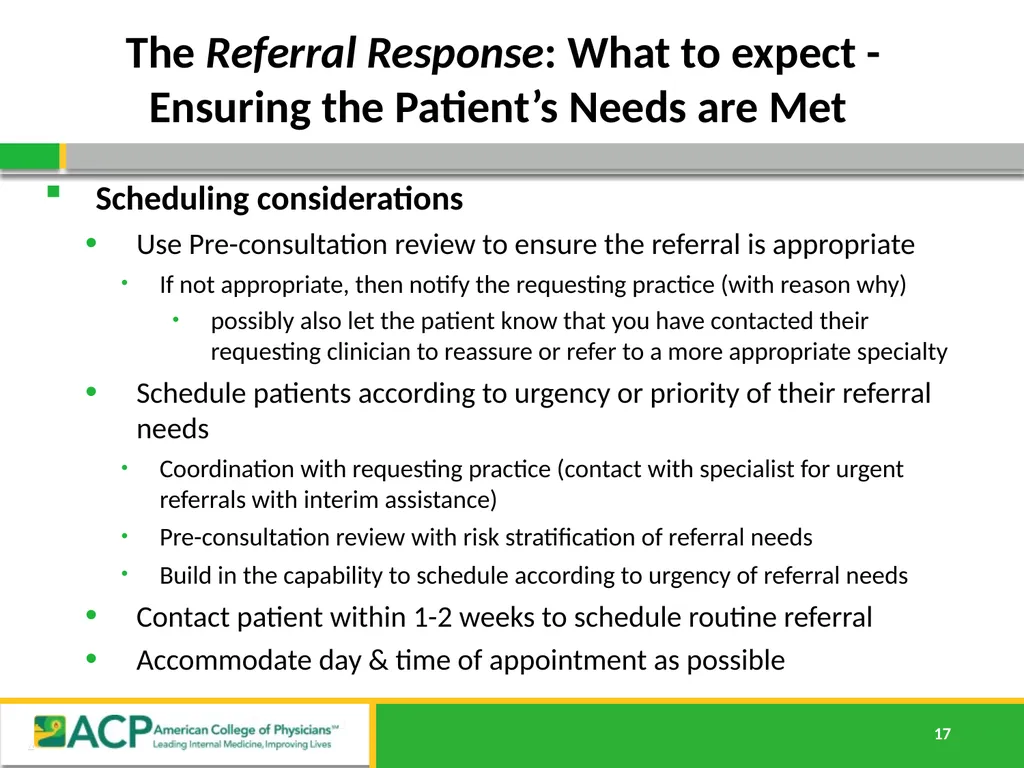
The Referral Response: What to expect - Ensuring the Patient’s Needs are Met Scheduling considerations
Use Pre-consultation review to ensure the referral is appropriate
If not appropriate, then notify the requesting practice (with reason why)
possibly also let the patient know that you have contacted their requesting clinician to reassure or refer to a more appropriate specialty
Schedule patients according to urgency or priority of their referral needs
Coordination with requesting practice (contact with specialist for urgent referrals with interim assistance)
Pre-consultation review with risk stratification of referral needs
Build in the capability to schedule according to urgency of referral needs
Contact patient within 1-2 weeks to schedule routine referral
Accommodate day & time of appointment as possible<br>
18
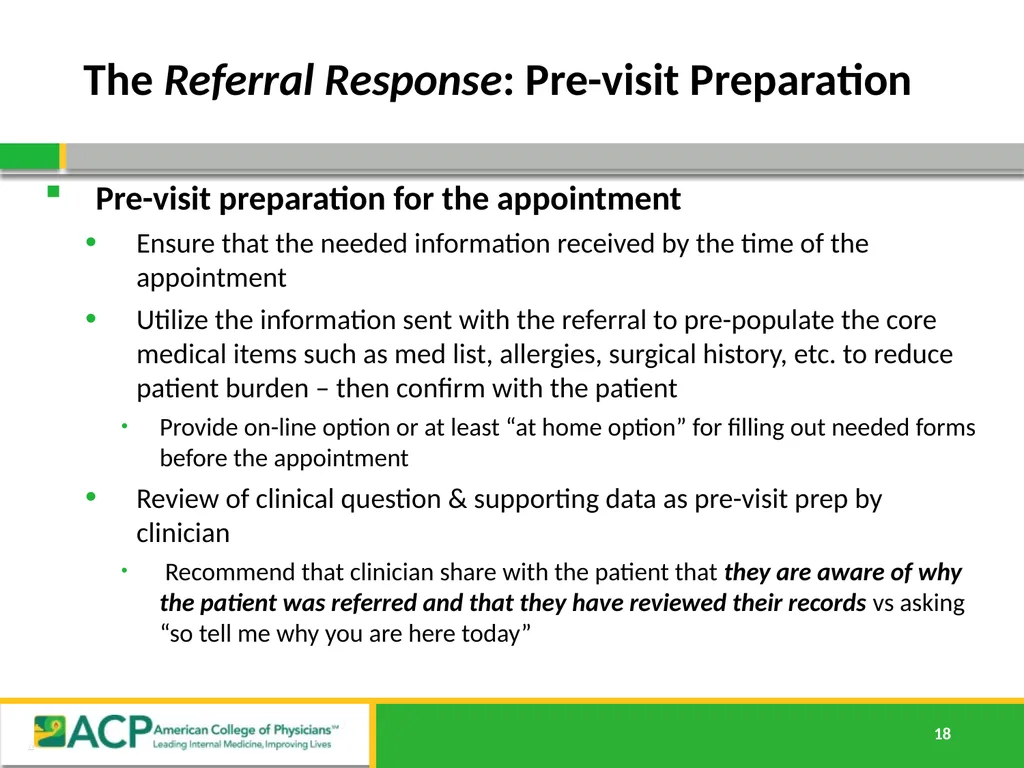
The Referral Response: Pre-visit Preparation Pre-visit preparation for the appointment
Ensure that the needed information received by the time of the appointment
Utilize the information sent with the referral to pre-populate the core medical items such as med list, allergies, surgical history, etc. to reduce patient burden – then confirm with the patient
Provide on-line option or at least “at home option” for filling out needed forms before the appointment
Review of clinical question & supporting data as pre-visit prep by clinician
Recommend that clinician share with the patient that they are aware of why the patient was referred and that they have reviewed their records vs asking “so tell me why you are here today”<br>
19
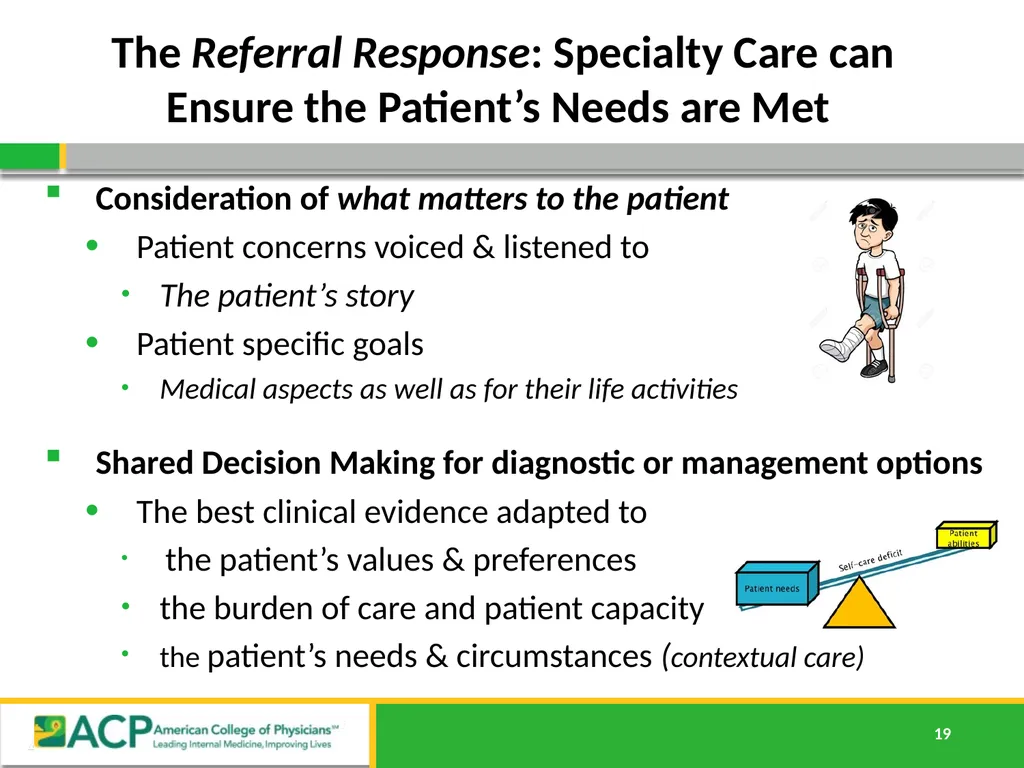
The Referral Response: Specialty Care can Ensure the Patient’s Needs are Met Consideration of what matters to the patient
Patient concerns voiced & listened to
The patient’s story
Patient specific goals
Medical aspects as well as for their life activities
Shared Decision Making for diagnostic or management options
The best clinical evidence adapted to
the patient’s values & preferences
the burden of care and patient capacity
the patient’s needs & circumstances (contextual care)<br>
20
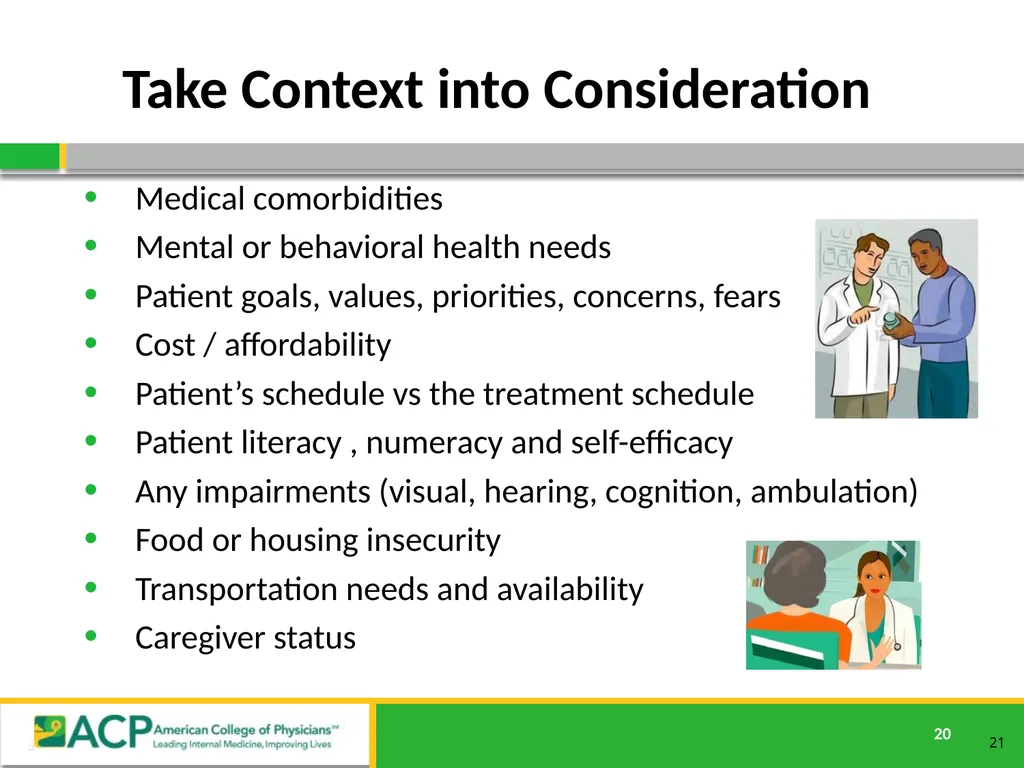
Take Context into Consideration Medical comorbidities
Mental or behavioral health needs
Patient goals, values, priorities, concerns, fears
Cost / affordability
Patient’s schedule vs the treatment schedule
Patient literacy , numeracy and self-efficacy
Any impairments (visual, hearing, cognition, ambulation)
Food or housing insecurity
Transportation needs and availability
Caregiver status 21<br>
21
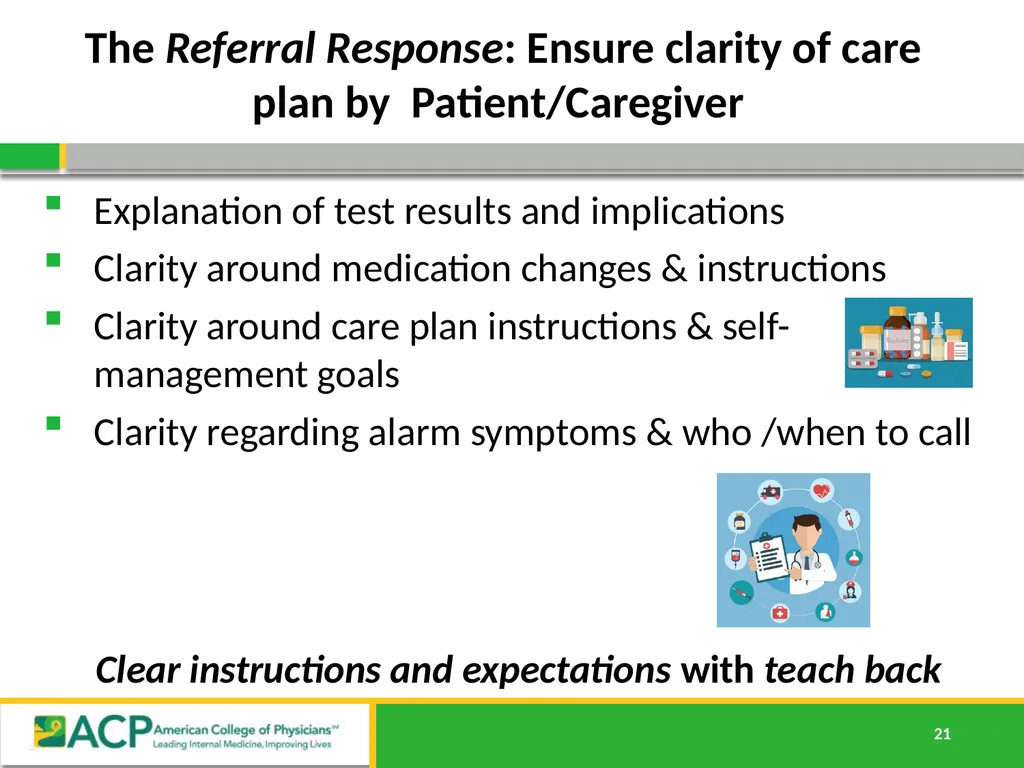
The Referral Response: Ensure clarity of care plan by Patient/Caregiver Explanation of test results and implications
Clarity around medication changes & instructions
Clarity around care plan instructions & self-management goals
Clarity regarding alarm symptoms & who /when to call
Clear instructions and expectations with teach back<br>
Clarity around medication changes & instructions
Clarity around care plan instructions & self-management goals
Clarity regarding alarm symptoms & who /when to call
Clear instructions and expectations with teach back<br>
22
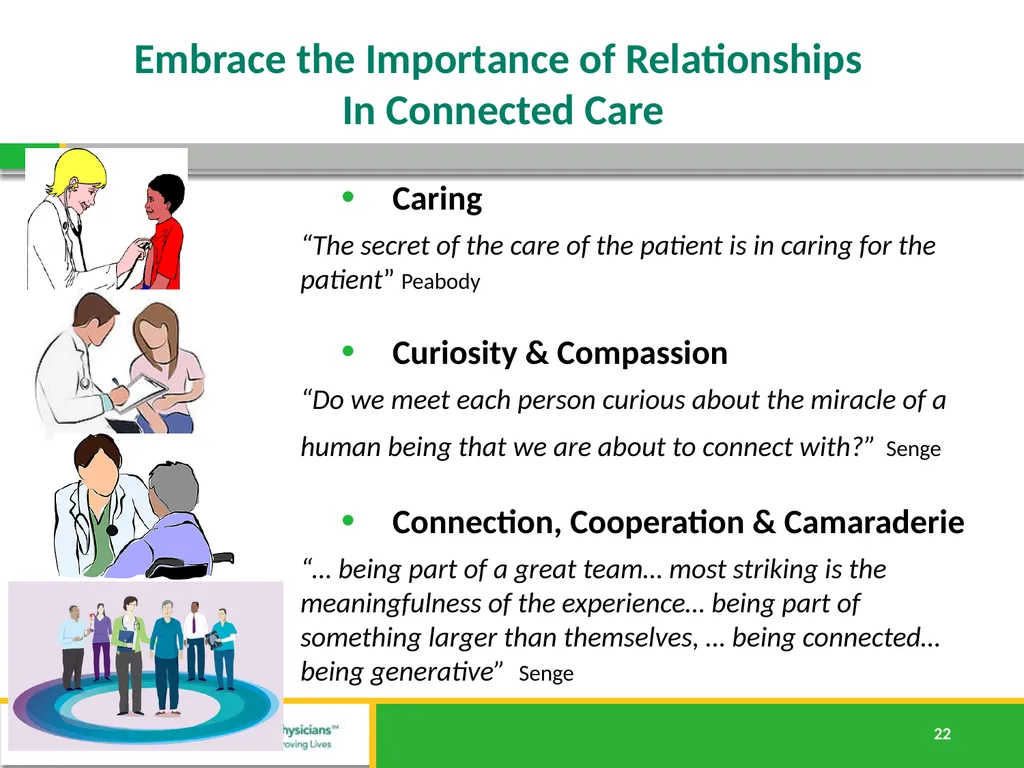
Embrace the Importance of Relationships
In Connected Care Caring
“The secret of the care of the patient is in caring for the patient” Peabody
Curiosity & Compassion
“Do we meet each person curious about the miracle of a human being that we are about to connect with?” Senge
Connection, Cooperation & Camaraderie
“… being part of a great team… most striking is the meaningfulness of the experience… being part of something larger than themselves, … being connected… being generative” Senge<br>
23
Put it into action…. Primary care practice identify how they can include the patient’s goal(s) in the referral request
Encourage Specialty Care practices to develop a “one pager” on their practice for the primary care practice to provide to patients when the referral is made
Consider having practice do a patient experience survey about the referral process or solicit patient input on the practice’s referral process<br>
24
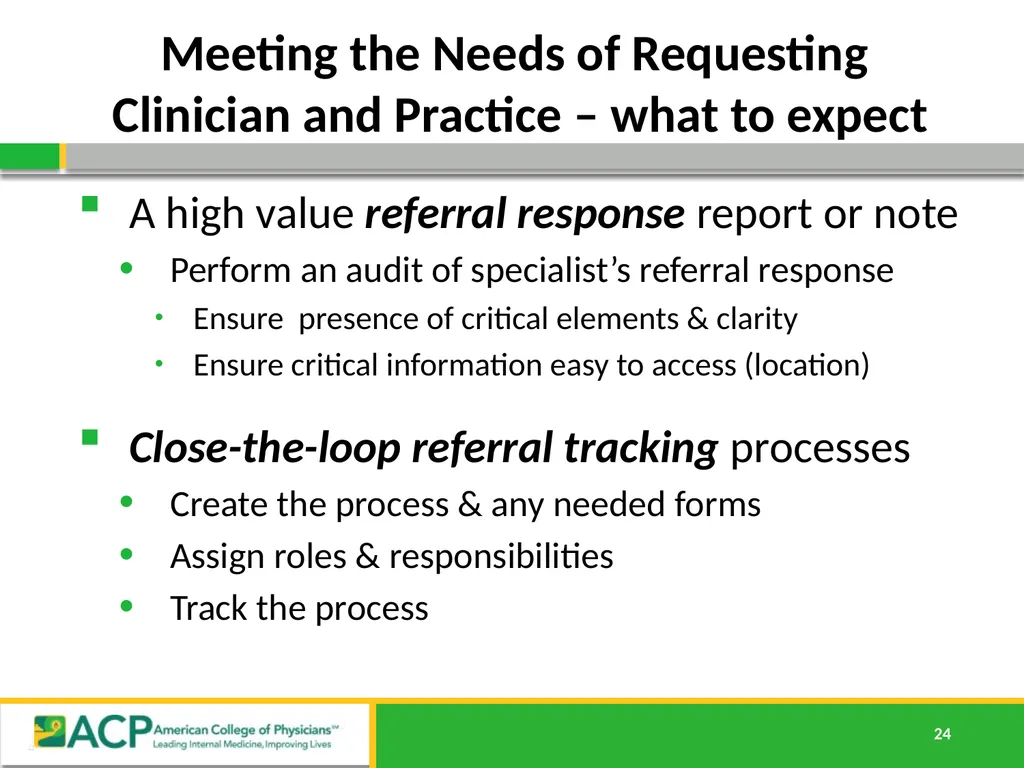
Meeting the Needs of Requesting
Clinician and Practice – what to expect A high value referral response report or note
Perform an audit of specialist’s referral response
Ensure presence of critical elements & clarity
Ensure critical information easy to access (location)
Close-the-loop referral tracking processes
Create the process & any needed forms
Assign roles & responsibilities
Track the process<br>
Perform an audit of specialist’s referral response
Ensure presence of critical elements & clarity
Ensure critical information easy to access (location)
Close-the-loop referral tracking processes
Create the process & any needed forms
Assign roles & responsibilities
Track the process<br>
25
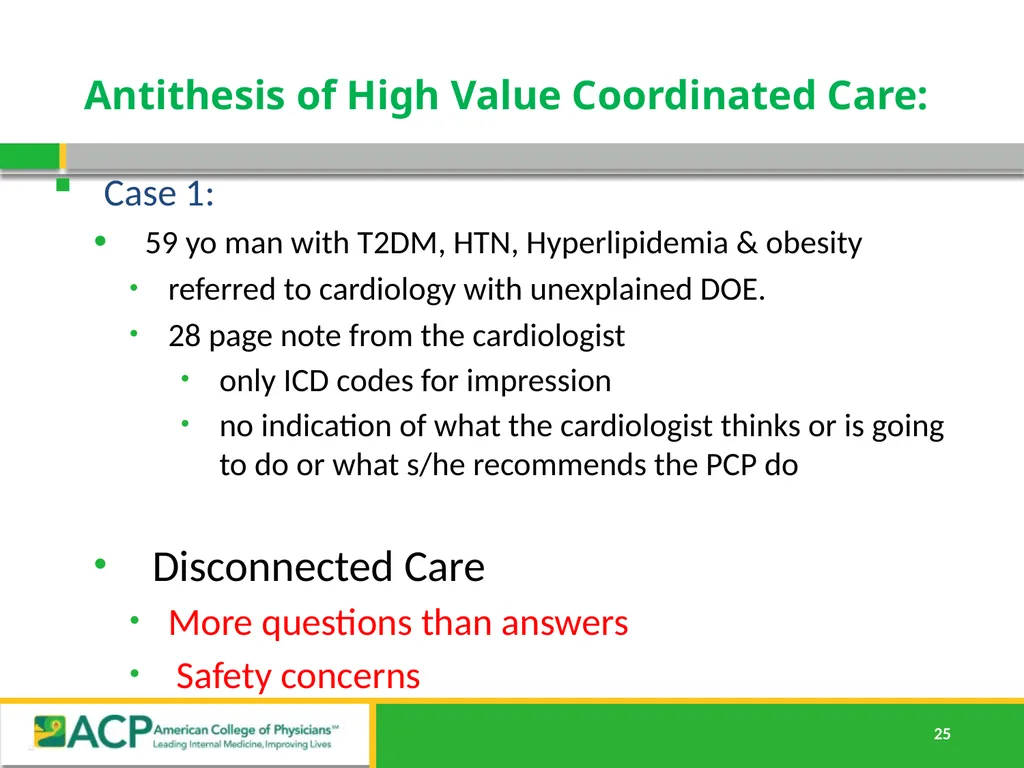
Antithesis of High Value Coordinated Care: Case 1:
59 yo man with T2DM, HTN, Hyperlipidemia & obesity
referred to cardiology with unexplained DOE.
28 page note from the cardiologist
only ICD codes for impression
no indication of what the cardiologist thinks or is going to do or what s/he recommends the PCP do
Disconnected Care
More questions than answers
Safety concerns<br>
26
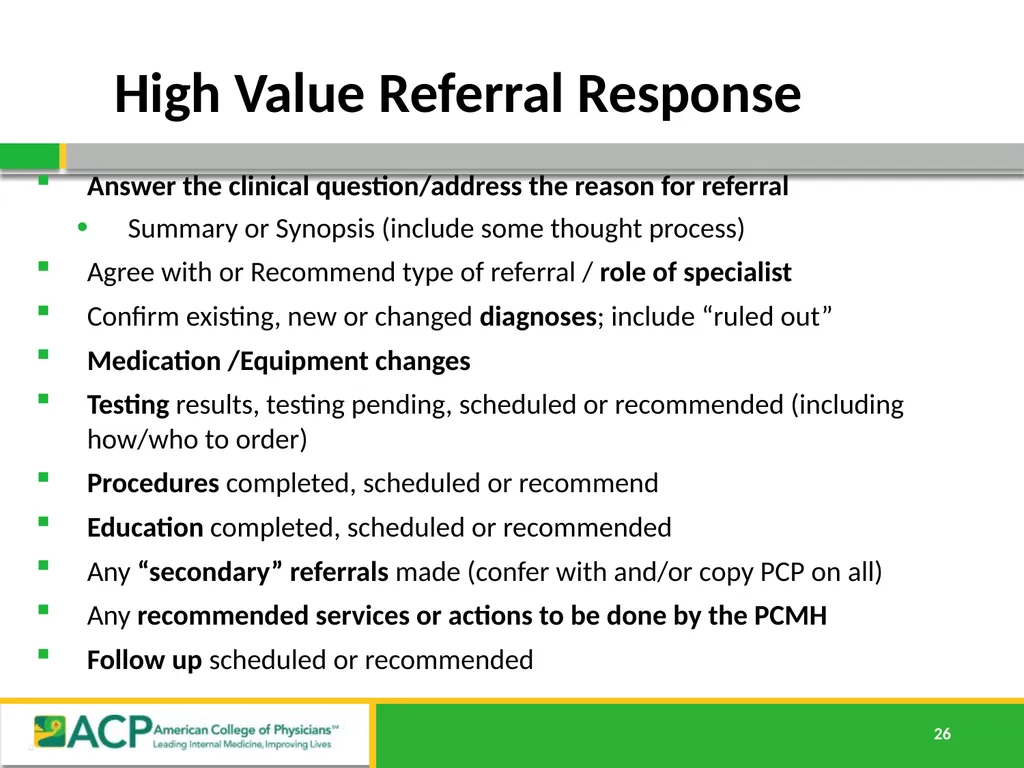
High Value Referral Response Answer the clinical question/address the reason for referral
Summary or Synopsis (include some thought process)
Agree with or Recommend type of referral / role of specialist
Confirm existing, new or changed diagnoses; include “ruled out”
Medication /Equipment changes
Testing results, testing pending, scheduled or recommended (including how/who to order)
Procedures completed, scheduled or recommend
Education completed, scheduled or recommended
Any “secondary” referrals made (confer with and/or copy PCP on all)
Any recommended services or actions to be done by the PCMH
Follow up scheduled or recommended<br>
27
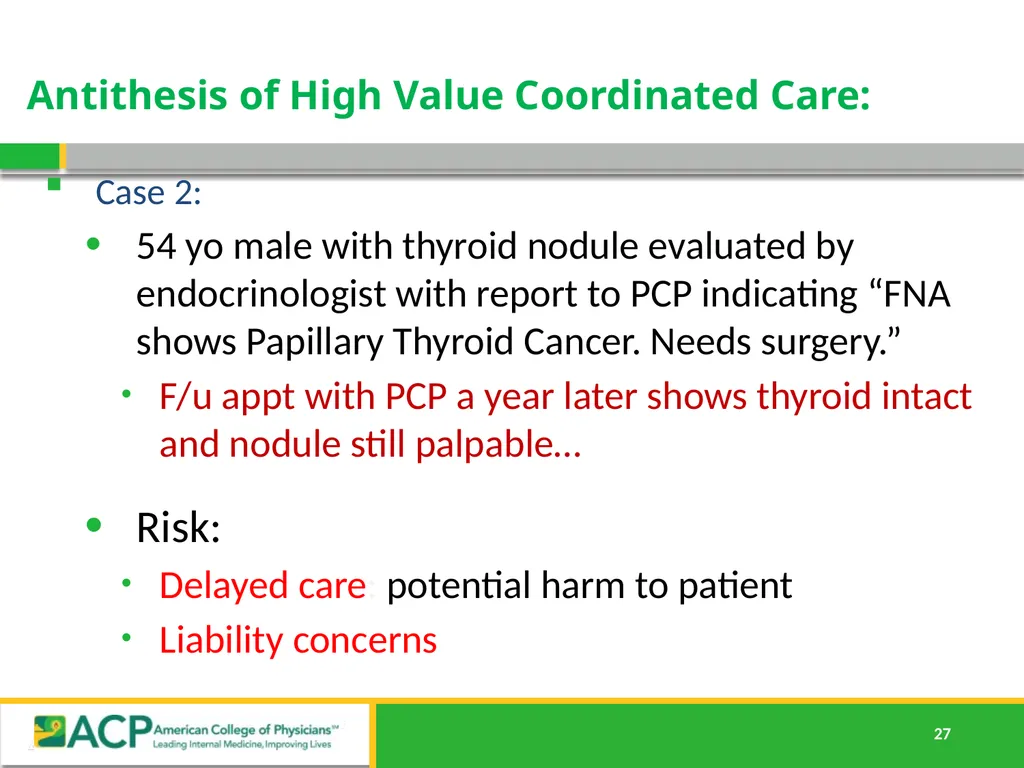
Antithesis of High Value Coordinated Care: Case 2:
54 yo male with thyroid nodule evaluated by endocrinologist with report to PCP indicating “FNA shows Papillary Thyroid Cancer. Needs surgery.”
F/u appt with PCP a year later shows thyroid intact and nodule still palpable…
Risk:
Delayed care: potential harm to patient
Liability concerns<br>
54 yo male with thyroid nodule evaluated by endocrinologist with report to PCP indicating “FNA shows Papillary Thyroid Cancer. Needs surgery.”
F/u appt with PCP a year later shows thyroid intact and nodule still palpable…
Risk:
Delayed care: potential harm to patient
Liability concerns<br>
28
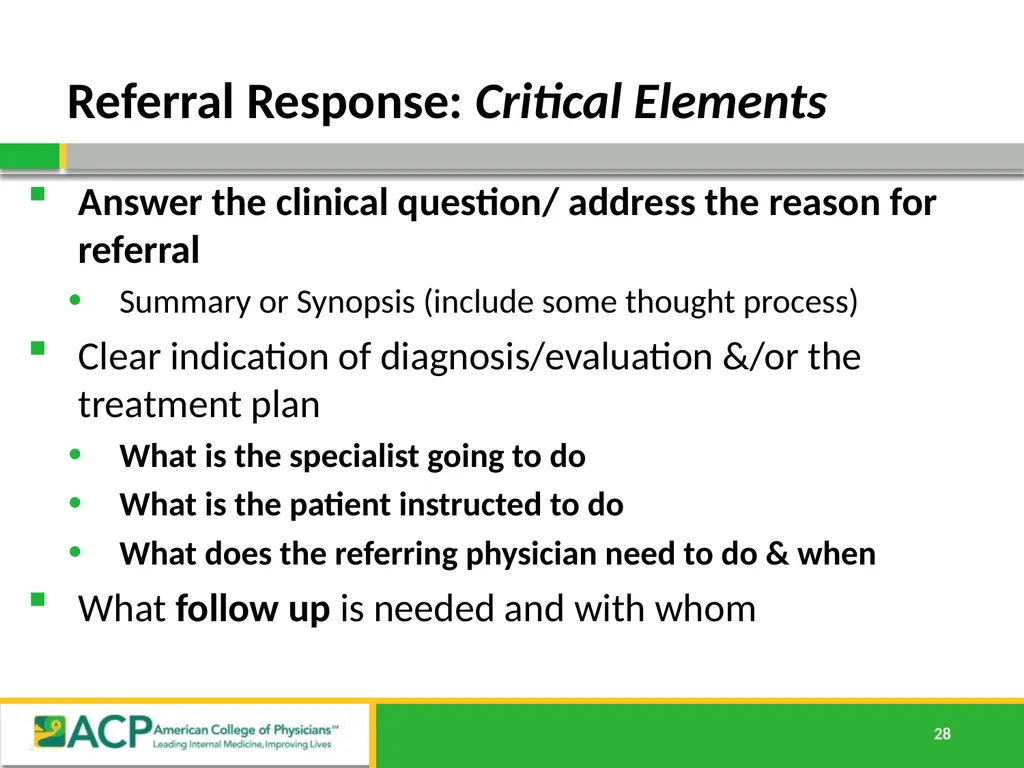
Referral Response: Critical Elements Answer the clinical question/ address the reason for referral
Summary or Synopsis (include some thought process)
Clear indication of diagnosis/evaluation &/or the treatment plan
What is the specialist going to do
What is the patient instructed to do
What does the referring physician need to do & when
What follow up is needed and with whom<br>
Summary or Synopsis (include some thought process)
Clear indication of diagnosis/evaluation &/or the treatment plan
What is the specialist going to do
What is the patient instructed to do
What does the referring physician need to do & when
What follow up is needed and with whom<br>
29
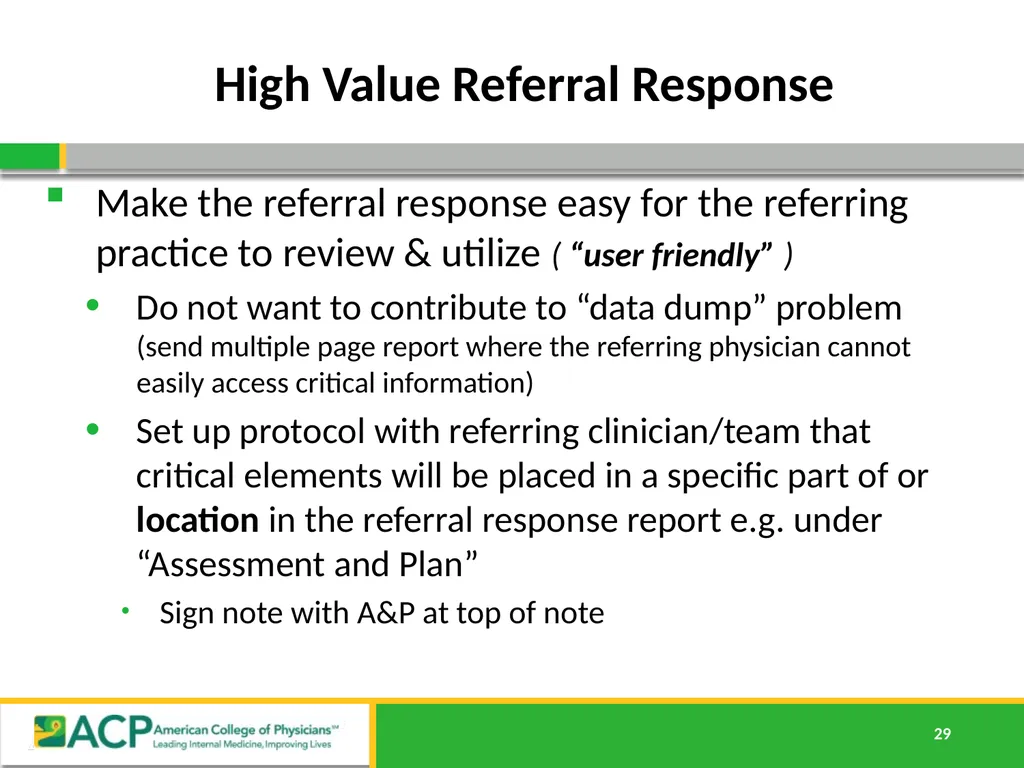
High Value Referral Response Make the referral response easy for the referring practice to review & utilize ( “user friendly” )
Do not want to contribute to “data dump” problem (send multiple page report where the referring physician cannot easily access critical information)
Set up protocol with referring clinician/team that critical elements will be placed in a specific part of or location in the referral response report e.g. under “Assessment and Plan”
Sign note with A&P at top of note<br>
30
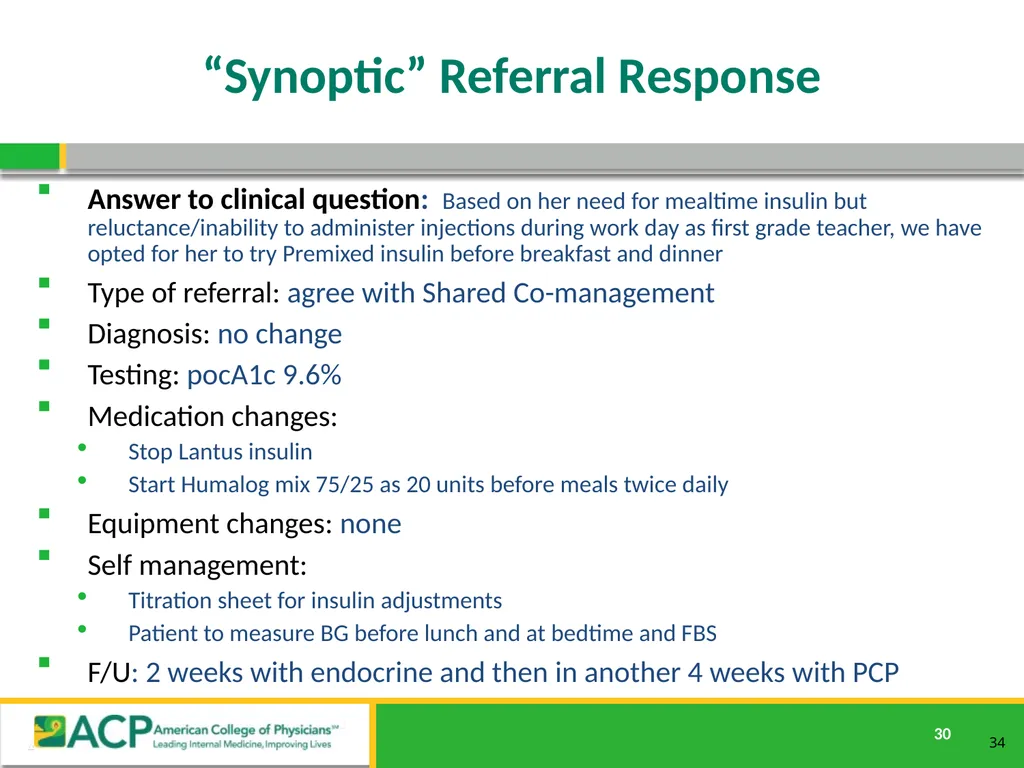
“Synoptic” Referral Response Answer to clinical question: Based on her need for mealtime insulin but reluctance/inability to administer injections during work day as first grade teacher, we have opted for her to try Premixed insulin before breakfast and dinner
Type of referral: agree with Shared Co-management
Diagnosis: no change
Testing: pocA1c 9.6%
Medication changes:
Stop Lantus insulin
Start Humalog mix 75/25 as 20 units before meals twice daily
Equipment changes: none
Self management:
Titration sheet for insulin adjustments
Patient to measure BG before lunch and at bedtime and FBS
F/U: 2 weeks with endocrine and then in another 4 weeks with PCP 34<br>
31
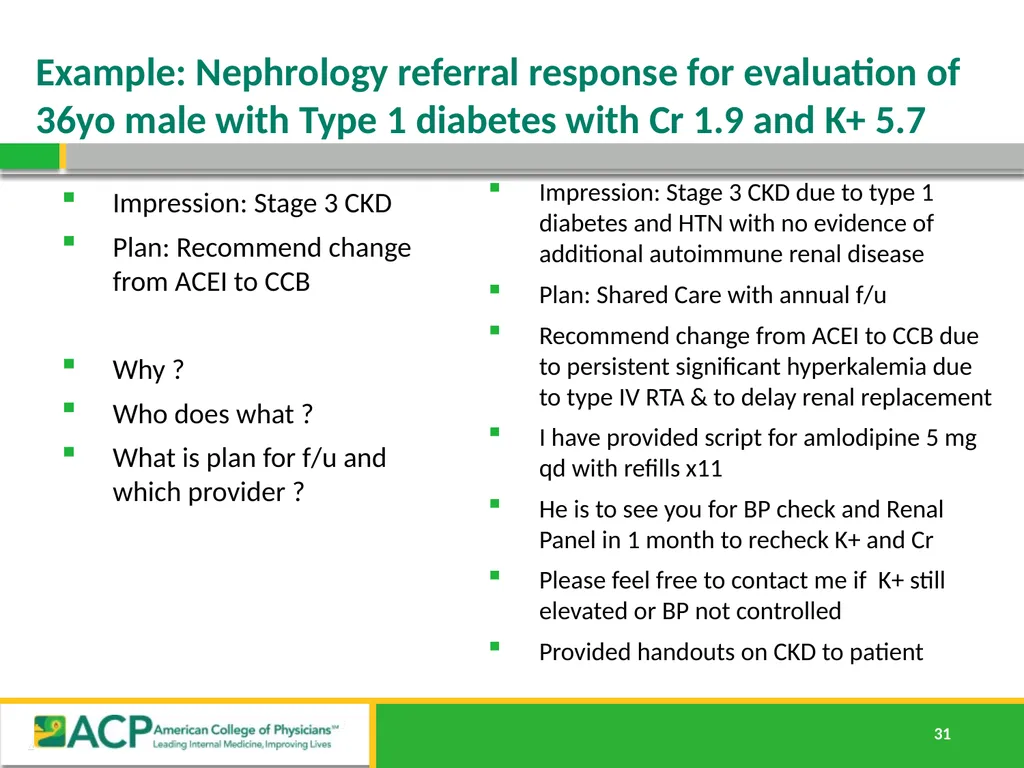
Example: Nephrology referral response for evaluation of 36yo male with Type 1 diabetes with Cr 1.9 and K+ 5.7 Impression: Stage 3 CKD
Plan: Recommend change from ACEI to CCB
Why ?
Who does what ?
What is plan for f/u and which provider ? Impression: Stage 3 CKD due to type 1 diabetes and HTN with no evidence of additional autoimmune renal disease
Plan: Shared Care with annual f/u
Recommend change from ACEI to CCB due to persistent significant hyperkalemia due to type IV RTA & to delay renal replacement
I have provided script for amlodipine 5 mg qd with refills x11
He is to see you for BP check and Renal Panel in 1 month to recheck K+ and Cr
Please feel free to contact me if K+ still elevated or BP not controlled
Provided handouts on CKD to patient<br>
32
Take a minute … For Referral Response notes that you receive
How/where do they come in?
Who reviews?
How are recommendations incorporated?
Consider what you might need to request from the specialty care practices that you refer patients to
Are the critical elements included?
Is the rational for the recommendations explained?
Is critical information easy to find in the note?<br>
33
Open Loop – Open Ended 53 year old man had skin lesion resected by PCP
Pathology showed melanoma
Referred to Dermatology for the needed further management
Patient was No Show for Dermatology appointment
…and neither clinician was aware…<br>
Pathology showed melanoma
Referred to Dermatology for the needed further management
Patient was No Show for Dermatology appointment
…and neither clinician was aware…<br>
34
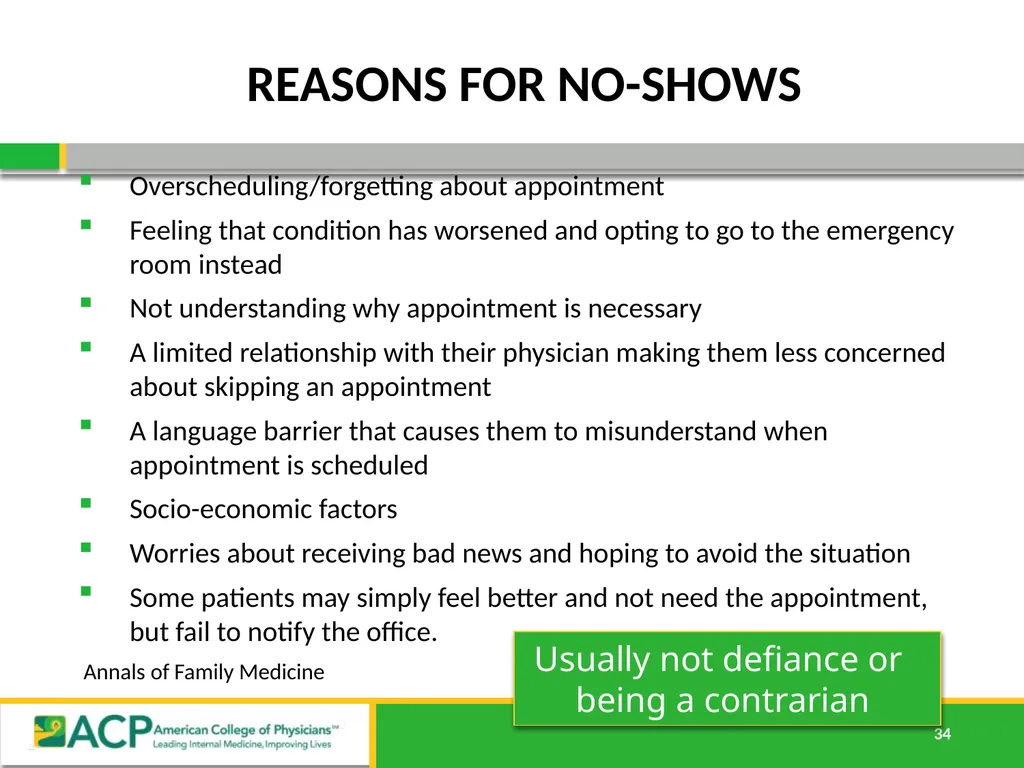
REASONS FOR NO-SHOWS Overscheduling/forgetting about appointment
Feeling that condition has worsened and opting to go to the emergency room instead
Not understanding why appointment is necessary
A limited relationship with their physician making them less concerned about skipping an appointment
A language barrier that causes them to misunderstand when appointment is scheduled
Socio-economic factors
Worries about receiving bad news and hoping to avoid the situation
Some patients may simply feel better and not need the appointment, but fail to notify the office.
Annals of Family Medicine Usually not defiance or
being a contrarian<br>
35
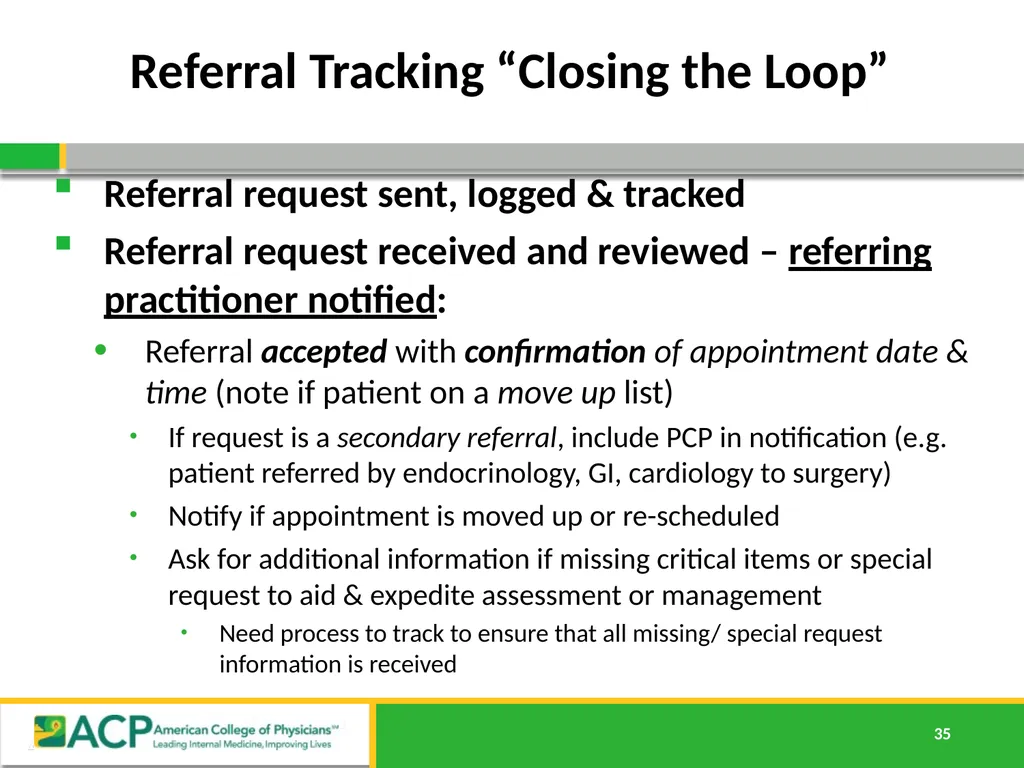
Referral Tracking “Closing the Loop” Referral request sent, logged & tracked
Referral request received and reviewed – referring practitioner notified:
Referral accepted with confirmation of appointment date & time (note if patient on a move up list)
If request is a secondary referral, include PCP in notification (e.g. patient referred by endocrinology, GI, cardiology to surgery)
Notify if appointment is moved up or re-scheduled
Ask for additional information if missing critical items or special request to aid & expedite assessment or management
Need process to track to ensure that all missing/ special request information is received<br>
36
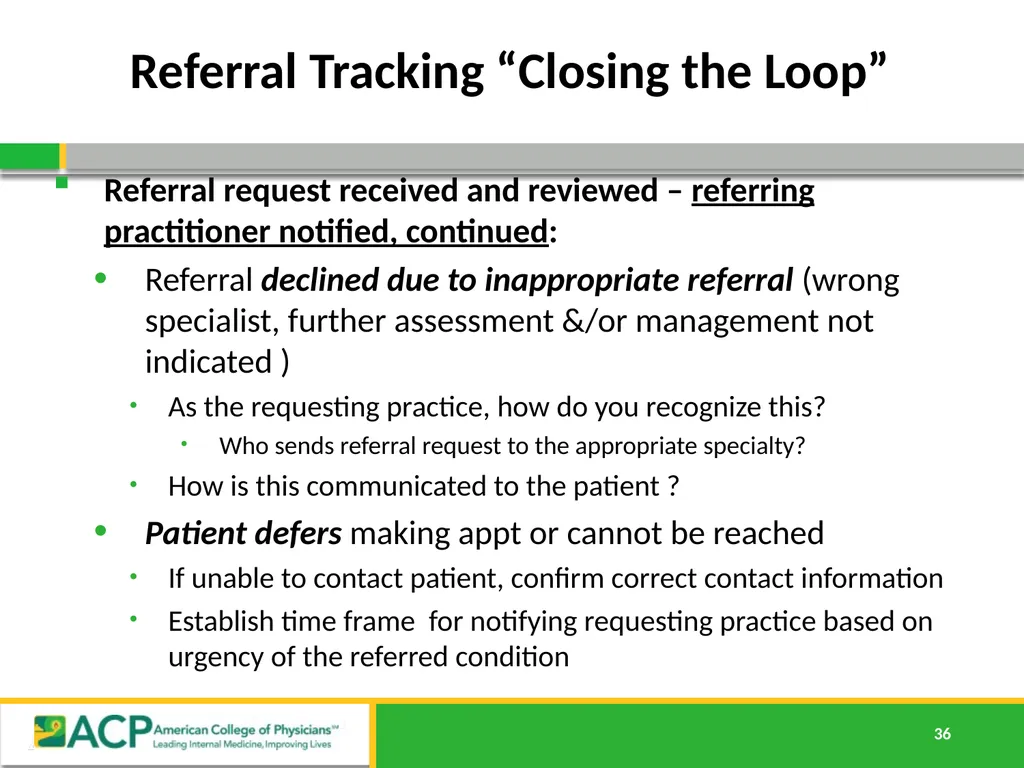
Referral Tracking “Closing the Loop” Referral request received and reviewed – referring practitioner notified, continued:
Referral declined due to inappropriate referral (wrong specialist, further assessment &/or management not indicated )
As the requesting practice, how do you recognize this?
Who sends referral request to the appropriate specialty?
How is this communicated to the patient ?
Patient defers making appt or cannot be reached
If unable to contact patient, confirm correct contact information
Establish time frame for notifying requesting practice based on urgency of the referred condition<br>
37
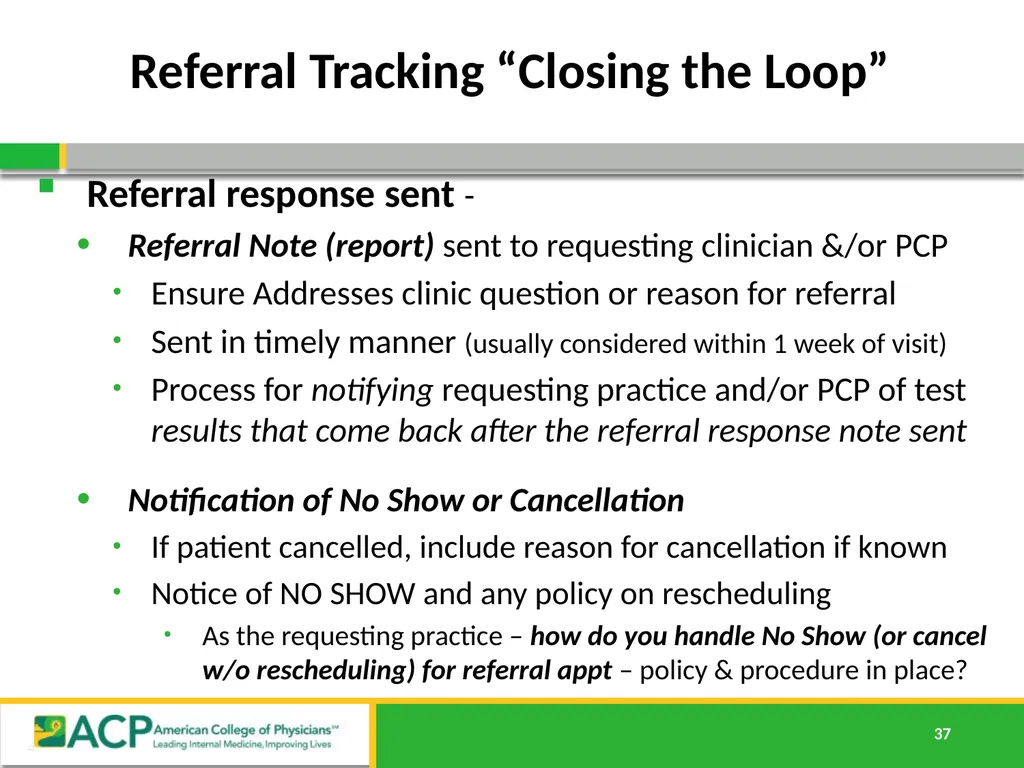
Referral Tracking “Closing the Loop” Referral response sent -
Referral Note (report) sent to requesting clinician &/or PCP
Ensure Addresses clinic question or reason for referral
Sent in timely manner (usually considered within 1 week of visit)
Process for notifying requesting practice and/or PCP of test results that come back after the referral response note sent
Notification of No Show or Cancellation
If patient cancelled, include reason for cancellation if known
Notice of NO SHOW and any policy on rescheduling
As the requesting practice – how do you handle No Show (or cancel w/o rescheduling) for referral appt – policy & procedure in place?<br>
38
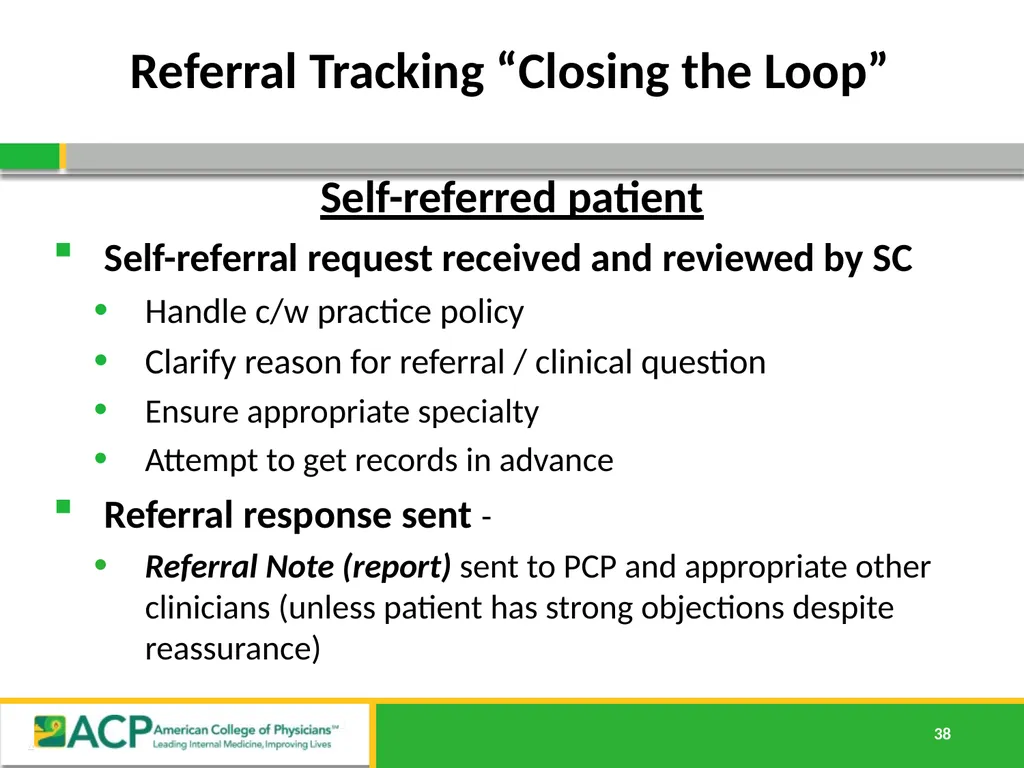
Referral Tracking “Closing the Loop” Self-referred patient
Self-referral request received and reviewed by SC
Handle c/w practice policy
Clarify reason for referral / clinical question
Ensure appropriate specialty
Attempt to get records in advance
Referral response sent -
Referral Note (report) sent to PCP and appropriate other clinicians (unless patient has strong objections despite reassurance)<br>
39
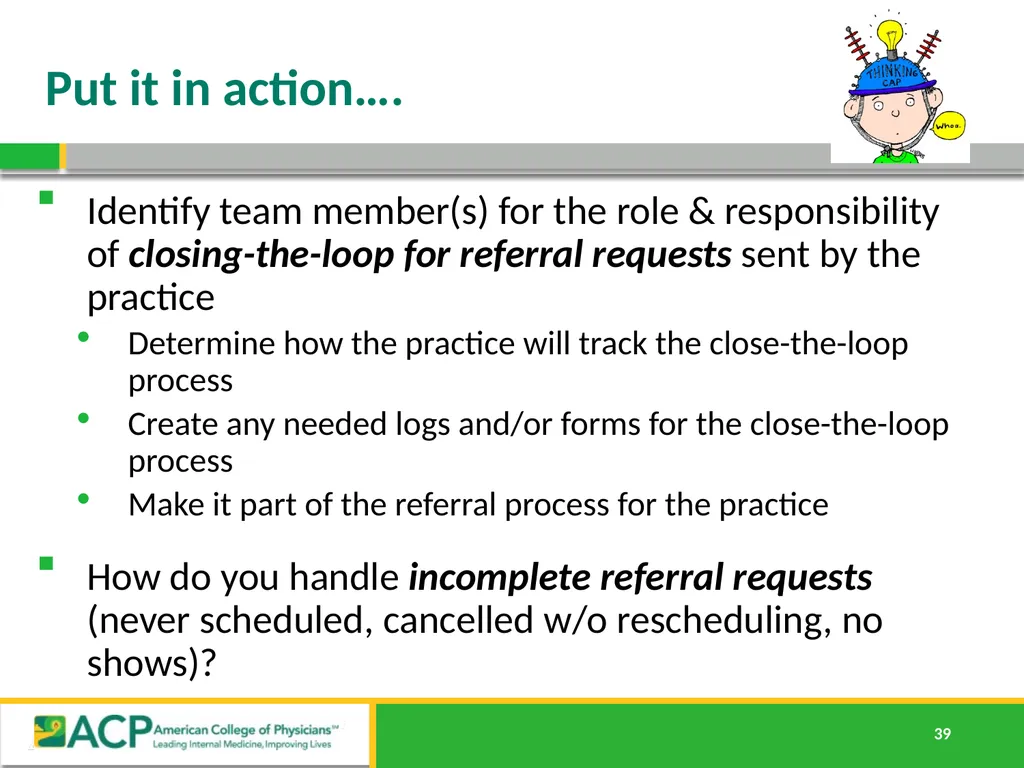
Put it in action…. Identify team member(s) for the role & responsibility of closing-the-loop for referral requests sent by the practice
Determine how the practice will track the close-the-loop process
Create any needed logs and/or forms for the close-the-loop process
Make it part of the referral process for the practice
How do you handle incomplete referral requests (never scheduled, cancelled w/o rescheduling, no shows)?<br>
Determine how the practice will track the close-the-loop process
Create any needed logs and/or forms for the close-the-loop process
Make it part of the referral process for the practice
How do you handle incomplete referral requests (never scheduled, cancelled w/o rescheduling, no shows)?<br>
40
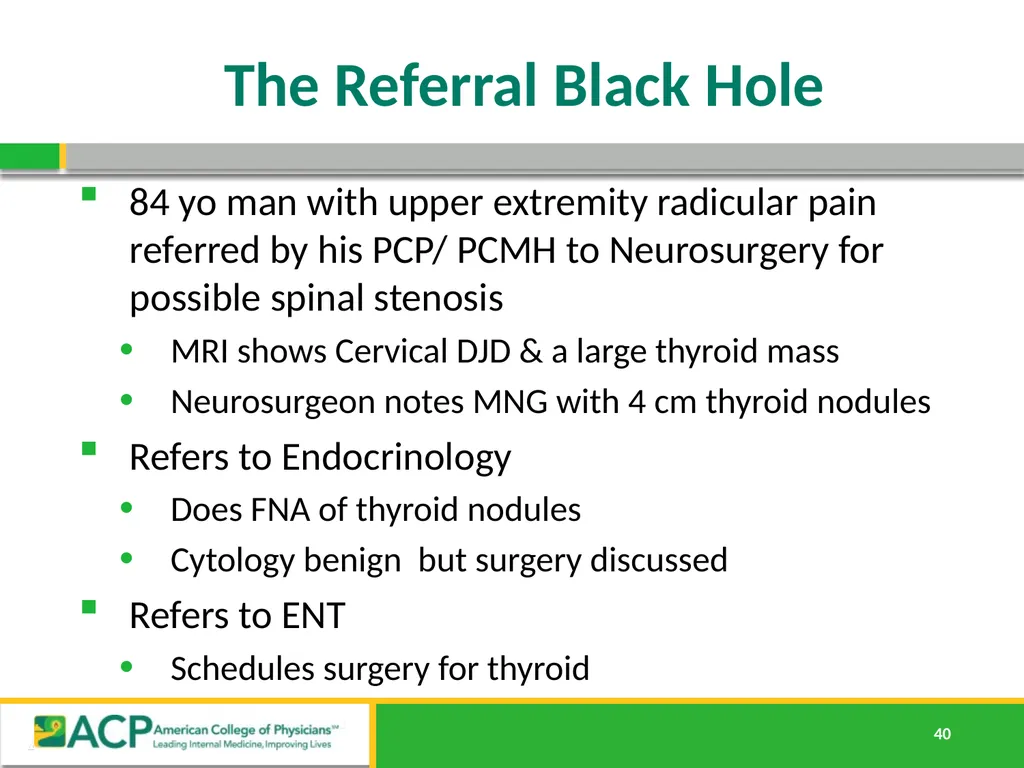
The Referral Black Hole 84 yo man with upper extremity radicular pain referred by his PCP/ PCMH to Neurosurgery for possible spinal stenosis
MRI shows Cervical DJD & a large thyroid mass
Neurosurgeon notes MNG with 4 cm thyroid nodules
Refers to Endocrinology
Does FNA of thyroid nodules
Cytology benign but surgery discussed
Refers to ENT
Schedules surgery for thyroid<br>
MRI shows Cervical DJD & a large thyroid mass
Neurosurgeon notes MNG with 4 cm thyroid nodules
Refers to Endocrinology
Does FNA of thyroid nodules
Cytology benign but surgery discussed
Refers to ENT
Schedules surgery for thyroid<br>
41
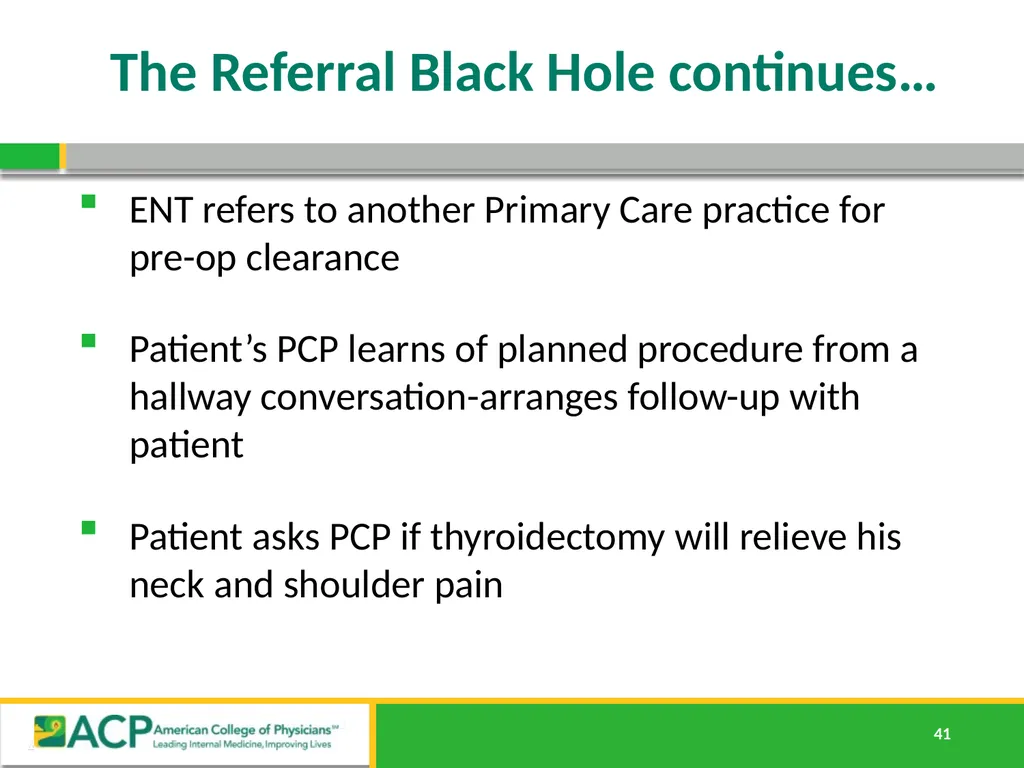
The Referral Black Hole continues… ENT refers to another Primary Care practice for pre-op clearance
Patient’s PCP learns of planned procedure from a hallway conversation-arranges follow-up with patient
Patient asks PCP if thyroidectomy will relieve his neck and shoulder pain<br>
Patient’s PCP learns of planned procedure from a hallway conversation-arranges follow-up with patient
Patient asks PCP if thyroidectomy will relieve his neck and shoulder pain<br>
42
Secondary Diagnoses Another disorder related to or unrelated to the reason for referral
Can be diagnosed during evaluation of referral condition
Can be related to the specialty area or not
Can be brought up by patient complaint or history
Can be related to the specialty area or not<br>
Can be diagnosed during evaluation of referral condition
Can be related to the specialty area or not
Can be brought up by patient complaint or history
Can be related to the specialty area or not<br>
43
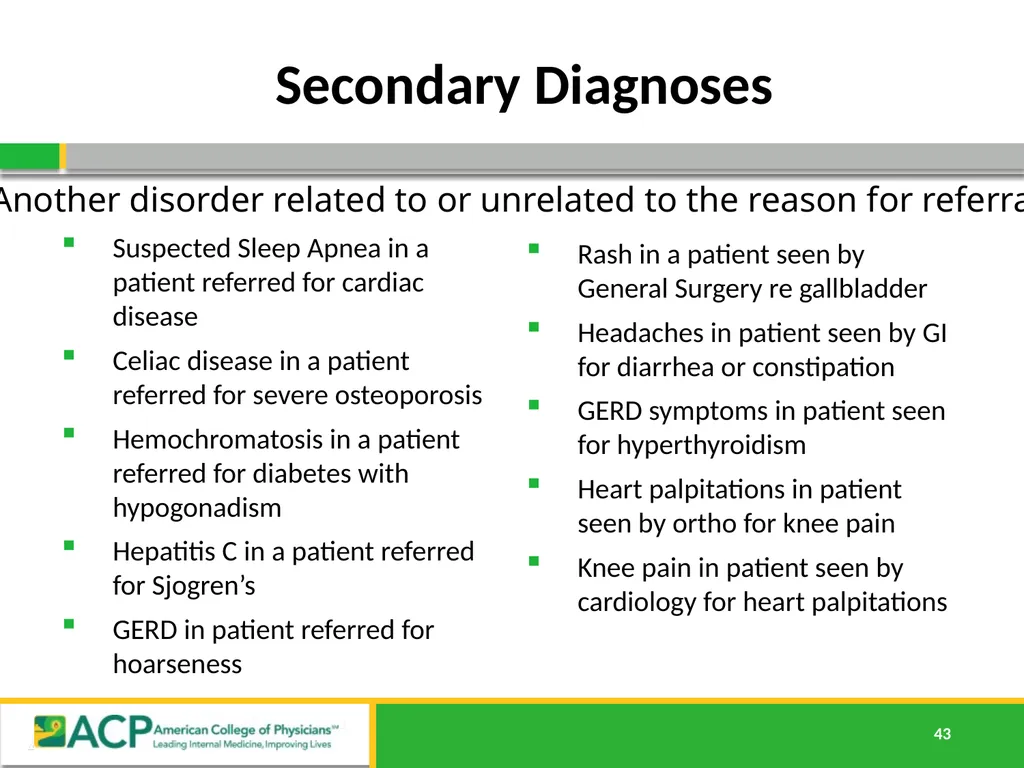
Secondary Diagnoses Suspected Sleep Apnea in a patient referred for cardiac disease
Celiac disease in a patient referred for severe osteoporosis
Hemochromatosis in a patient referred for diabetes with hypogonadism
Hepatitis C in a patient referred for Sjogren’s
GERD in patient referred for hoarseness Rash in a patient seen by General Surgery re gallbladder
Headaches in patient seen by GI for diarrhea or constipation
GERD symptoms in patient seen for hyperthyroidism
Heart palpitations in patient seen by ortho for knee pain
Knee pain in patient seen by cardiology for heart palpitations Another disorder related to or unrelated to the reason for referral<br>
44
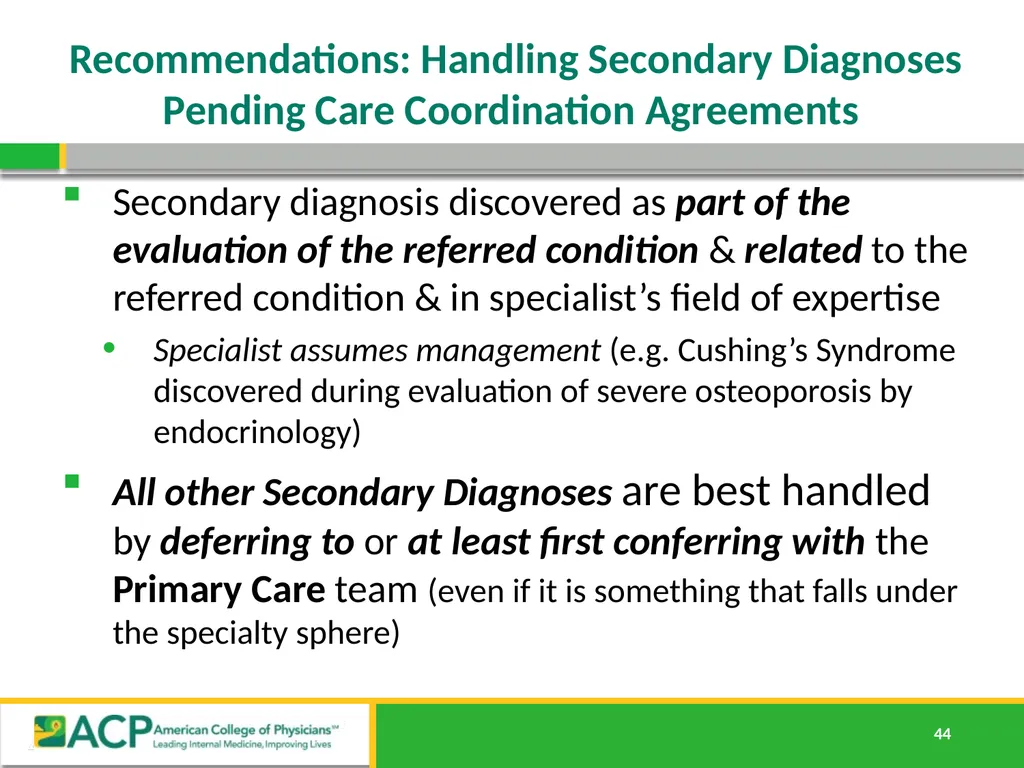
Recommendations: Handling Secondary Diagnoses Pending Care Coordination Agreements Secondary diagnosis discovered as part of the evaluation of the referred condition & related to the referred condition & in specialist’s field of expertise
Specialist assumes management (e.g. Cushing’s Syndrome discovered during evaluation of severe osteoporosis by endocrinology)
All other Secondary Diagnoses are best handled by deferring to or at least first conferring with the Primary Care team (even if it is something that falls under the specialty sphere)<br>
45
Ensure Appropriate & High Value
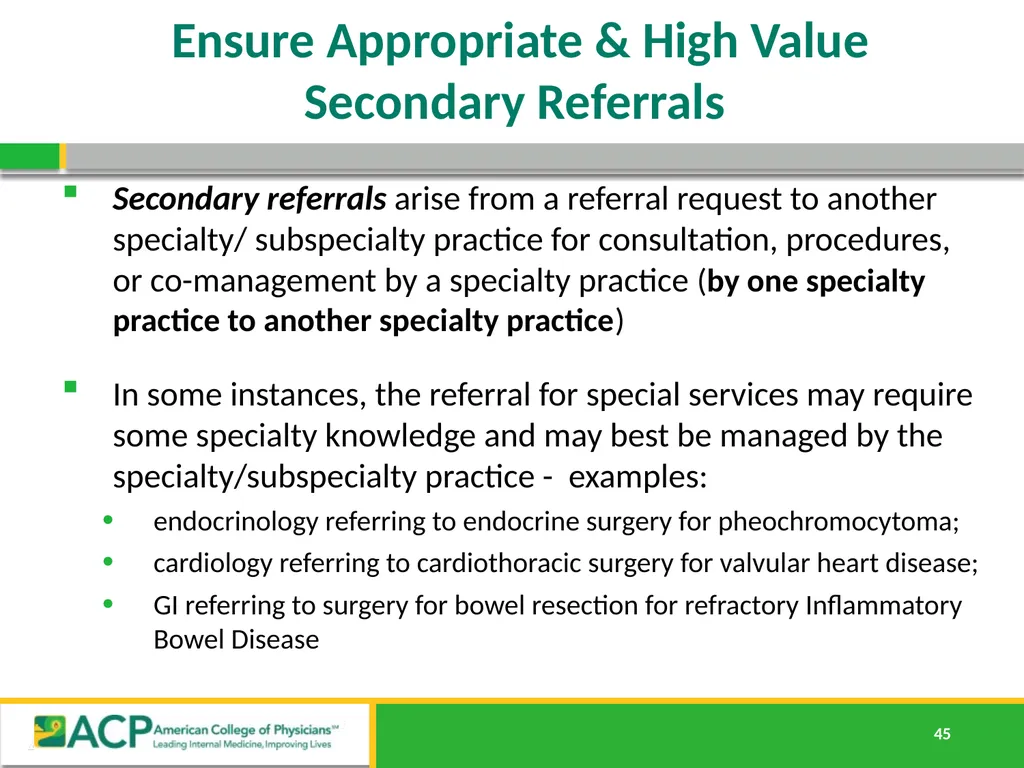
Secondary Referrals Secondary referrals arise from a referral request to another specialty/ subspecialty practice for consultation, procedures, or co-management by a specialty practice (by one specialty practice to another specialty practice)
In some instances, the referral for special services may require some specialty knowledge and may best be managed by the specialty/subspecialty practice - examples:
endocrinology referring to endocrine surgery for pheochromocytoma;
cardiology referring to cardiothoracic surgery for valvular heart disease;
GI referring to surgery for bowel resection for refractory Inflammatory Bowel Disease<br>
46
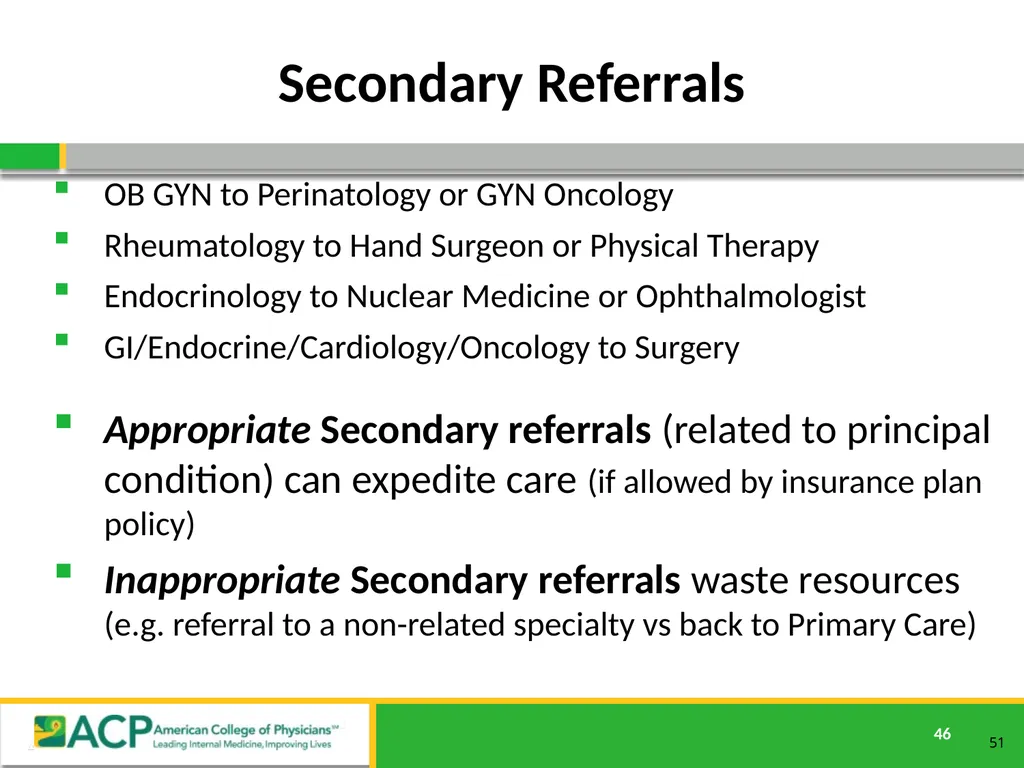
Secondary Referrals OB GYN to Perinatology or GYN Oncology
Rheumatology to Hand Surgeon or Physical Therapy
Endocrinology to Nuclear Medicine or Ophthalmologist
GI/Endocrine/Cardiology/Oncology to Surgery
Appropriate Secondary referrals (related to principal condition) can expedite care (if allowed by insurance plan policy)
Inappropriate Secondary referrals waste resources (e.g. referral to a non-related specialty vs back to Primary Care) 51<br>
47
Communicate to Ensure Appropriate
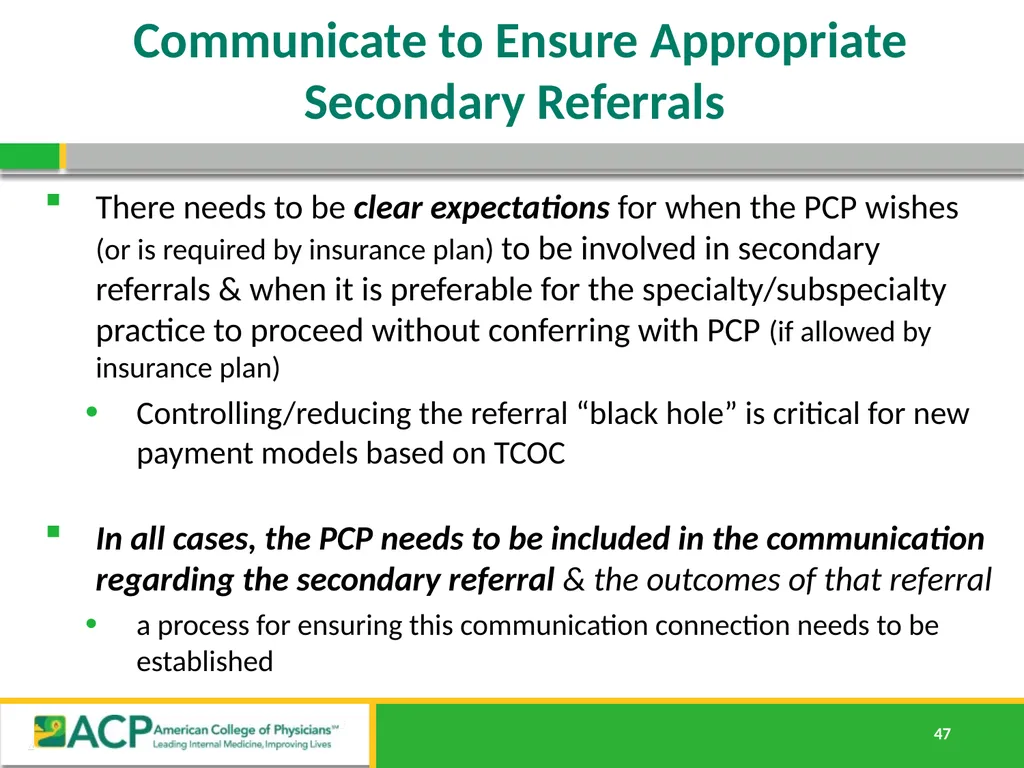
Secondary Referrals There needs to be clear expectations for when the PCP wishes (or is required by insurance plan) to be involved in secondary referrals & when it is preferable for the specialty/subspecialty practice to proceed without conferring with PCP (if allowed by insurance plan)
Controlling/reducing the referral “black hole” is critical for new payment models based on TCOC
In all cases, the PCP needs to be included in the communication regarding the secondary referral & the outcomes of that referral
a process for ensuring this communication connection needs to be established<br>
48
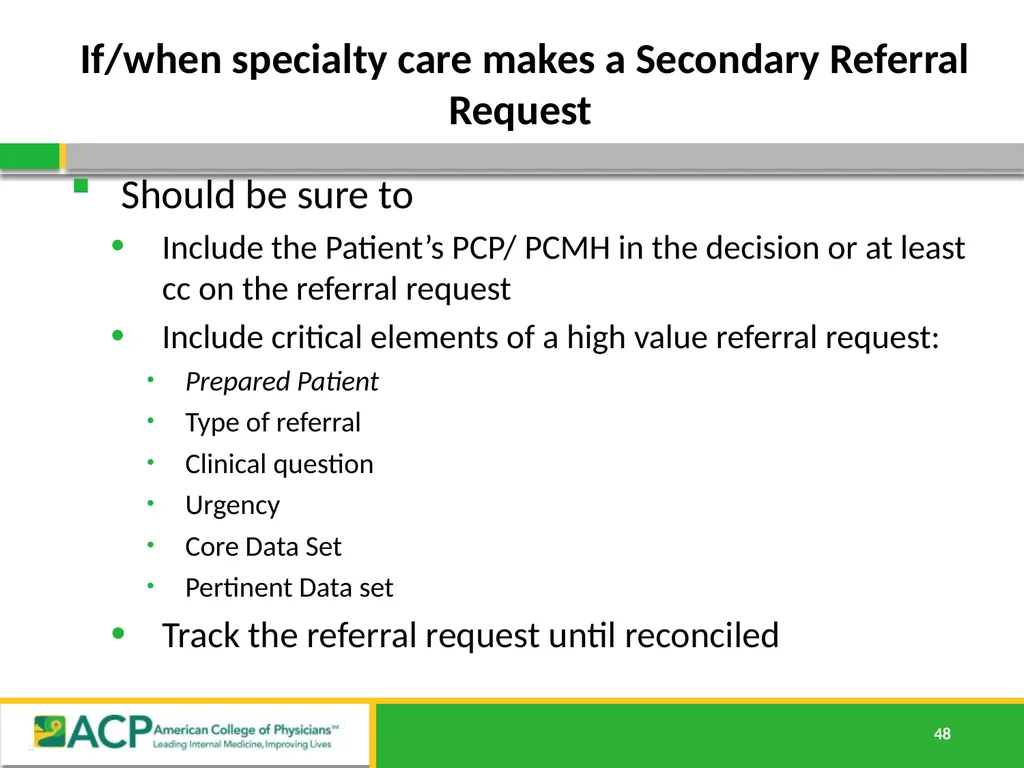
If/when specialty care makes a Secondary Referral Request Should be sure to
Include the Patient’s PCP/ PCMH in the decision or at least cc on the referral request
Include critical elements of a high value referral request:
Prepared Patient
Type of referral
Clinical question
Urgency
Core Data Set
Pertinent Data set
Track the referral request until reconciled<br>
Include the Patient’s PCP/ PCMH in the decision or at least cc on the referral request
Include critical elements of a high value referral request:
Prepared Patient
Type of referral
Clinical question
Urgency
Core Data Set
Pertinent Data set
Track the referral request until reconciled<br>
49
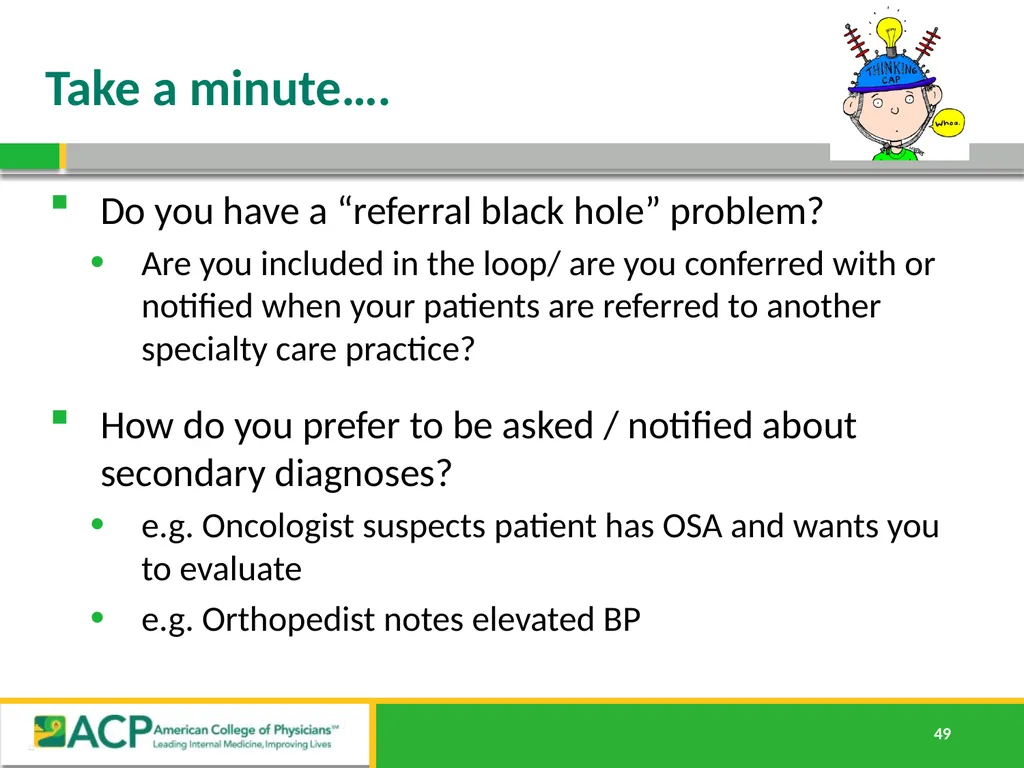
Take a minute…. Do you have a “referral black hole” problem?
Are you included in the loop/ are you conferred with or notified when your patients are referred to another specialty care practice?
How do you prefer to be asked / notified about secondary diagnoses?
e.g. Oncologist suspects patient has OSA and wants you to evaluate
e.g. Orthopedist notes elevated BP<br>
50
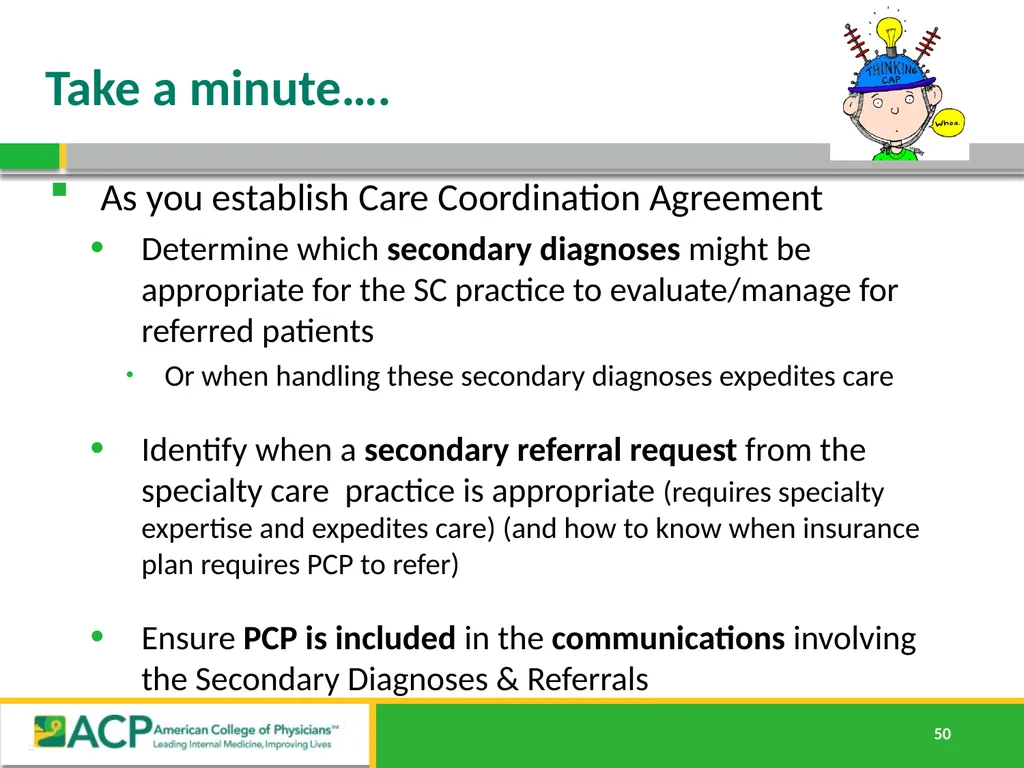
Take a minute…. As you establish Care Coordination Agreement
Determine which secondary diagnoses might be appropriate for the SC practice to evaluate/manage for referred patients
Or when handling these secondary diagnoses expedites care
Identify when a secondary referral request from the specialty care practice is appropriate (requires specialty expertise and expedites care) (and how to know when insurance plan requires PCP to refer)
Ensure PCP is included in the communications involving the Secondary Diagnoses & Referrals<br>
51
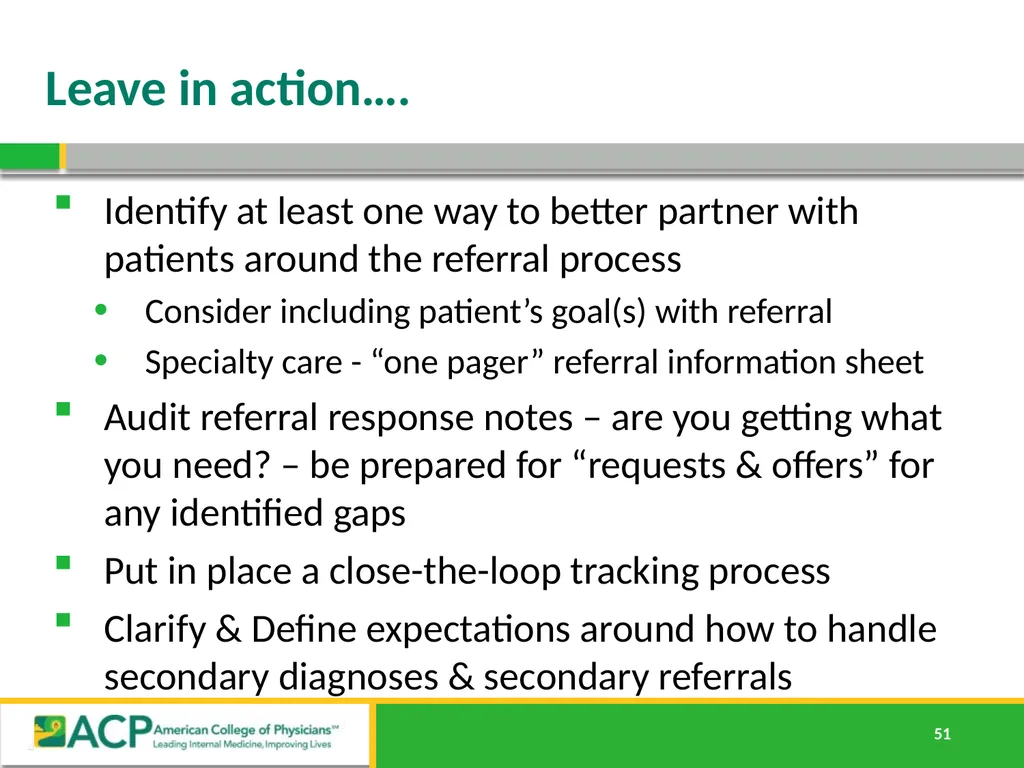
Leave in action…. Identify at least one way to better partner with patients around the referral process
Consider including patient’s goal(s) with referral
Specialty care - “one pager” referral information sheet
Audit referral response notes – are you getting what you need? – be prepared for “requests & offers” for any identified gaps
Put in place a close-the-loop tracking process
Clarify & Define expectations around how to handle secondary diagnoses & secondary referrals<br>
52
Materials for Action Step 3 Recommendations for a Patient-Centered Referral
Patient Experience Surveys
New – Template for “one pager” info sheet on specialty care referral to give to patient
Outpatient Referral Response Checklist
Referral Response Audit tools
www.acponline.org/hvcc-training<br>
Patient Experience Surveys
New – Template for “one pager” info sheet on specialty care referral to give to patient
Outpatient Referral Response Checklist
Referral Response Audit tools
www.acponline.org/hvcc-training<br>