
Constitutional and Practical Issues in Nonparent
OM
Published · 28 slides · 0 views
1 / 1



Description
Constitutional and Practical Issues in Nonparent Custody and Visitation Hon. Greg Sakall What is the role of grandparents and third parties, other than parents, in raising children today? What legally enforceable rights do grandparents and
Related Topics
Share
Embed code
Download this presentation From Below
"Constitutional and Practical Issues in Nonparent" is the property of its rightful owner. Permission is granted to download and print the materials on this website for personal, non-commercial use only, and to display it on your personal computer provided you do not modify the materials and that you retain all copyright notices contained in the materials. By downloading content from our website, you accept the terms of this agreement.
Presentation Transcript
01
Constitutional and Practical Issues in Nonparent Custody and Visitation Hon. Greg Sakall<br>
02
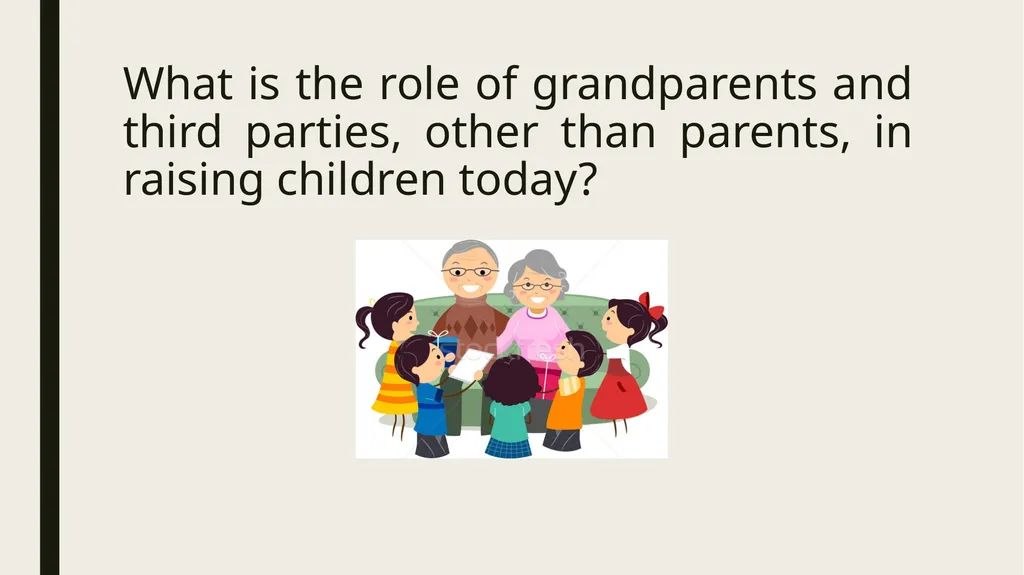
What is the role of grandparents and third parties, other than parents, in raising children today?<br>
03
What legally enforceable rights do grandparents and others who have a substantial relationship with children have? State law
“Absent a constitutional defect, delineating third-party visitation rights is for the Legislature, not this court.”
Doty-Perez v. Doty-Perez, 2018 WL 3722411, ¶22 (App. 2018) citing Marco C. v. Sean C., 218 Ariz. 216, 219 ¶ 9 (App. 2008)<br>
“Absent a constitutional defect, delineating third-party visitation rights is for the Legislature, not this court.”
Doty-Perez v. Doty-Perez, 2018 WL 3722411, ¶22 (App. 2018) citing Marco C. v. Sean C., 218 Ariz. 216, 219 ¶ 9 (App. 2008)<br>
04
States are the Laboratories of Democracy State laws are all over the map on the rights of third parties, and include a combination of statutory and caselaw
Some are very broad
Some are fairly restrictive and address only stepparents and grandparents
Parness, J., Nonparental Childcare and Child Contact Orders for Grandparents, 120 W. Va. L. Rev. 95 (2017)
Goldberg, M., A Survey of Fifty States’ Grandparent Visitation Statutes, 10 Marq. Elder’s Advisor (2009).
Victor, Daniel, Grandparent Visitation: A Survey of History, Jurisprudence, and Legislative Trends Across the United States in the Past Decade, 22 J. Am. Acad. Martrim. Law 391 (2009)<br>
Some are very broad
Some are fairly restrictive and address only stepparents and grandparents
Parness, J., Nonparental Childcare and Child Contact Orders for Grandparents, 120 W. Va. L. Rev. 95 (2017)
Goldberg, M., A Survey of Fifty States’ Grandparent Visitation Statutes, 10 Marq. Elder’s Advisor (2009).
Victor, Daniel, Grandparent Visitation: A Survey of History, Jurisprudence, and Legislative Trends Across the United States in the Past Decade, 22 J. Am. Acad. Martrim. Law 391 (2009)<br>
05
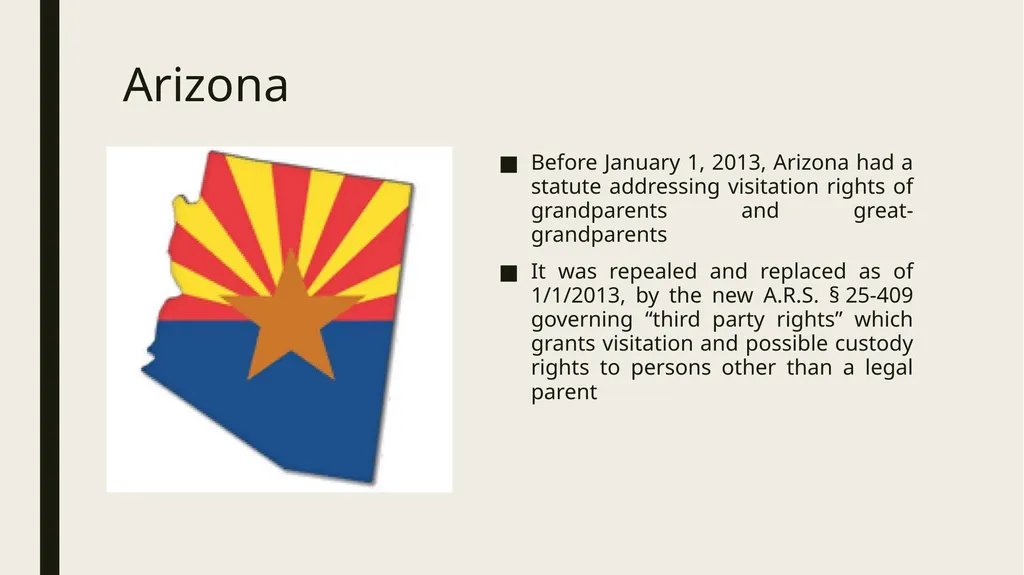
Arizona Before January 1, 2013, Arizona had a statute addressing visitation rights of grandparents and great-grandparents
It was repealed and replaced as of 1/1/2013, by the new A.R.S. § 25-409 governing “third party rights” which grants visitation and possible custody rights to persons other than a legal parent<br>
It was repealed and replaced as of 1/1/2013, by the new A.R.S. § 25-409 governing “third party rights” which grants visitation and possible custody rights to persons other than a legal parent<br>
06
Arizona: Third-party custody Nonparent must prove the following:
Person stands in loco parentis to the child
Defined as “a person who has been treated as a parent by a child and who has formed a meaningful parental relationship with a child for a substantial period of time” A.R.S. § 25-401(1)
It would be significantly detrimental to the child to remain or be placed in care of either legal parent who wishes to keep or acquire legal decision-making; and
No parenting plan in last year unless reason to believe the child’s present environment may seriously endanger the child’s physical, mental, moral or emotional health.
One of the following must apply:
One of the legal parents id deceased;
Child’s legal parents are not married at time of filing; or
A dissolution or legal separation petition is pending at time of filing<br>
Person stands in loco parentis to the child
Defined as “a person who has been treated as a parent by a child and who has formed a meaningful parental relationship with a child for a substantial period of time” A.R.S. § 25-401(1)
It would be significantly detrimental to the child to remain or be placed in care of either legal parent who wishes to keep or acquire legal decision-making; and
No parenting plan in last year unless reason to believe the child’s present environment may seriously endanger the child’s physical, mental, moral or emotional health.
One of the following must apply:
One of the legal parents id deceased;
Child’s legal parents are not married at time of filing; or
A dissolution or legal separation petition is pending at time of filing<br>
07
Arizona: Third-party Visitation A.R.S. § 25-409(B): Deference to a parent’s decision
Nonparent must show one of the following:
One of legal parents deceased or missing for at least 3 months;
Child was born out of wedlock and parents are not now married;
For grandparent or great-grandparent visitation, the parent’s marriage has been dissolved for at least 3 months; or
For in loco parentis visitation, a dissolution or separation case is pending
A.R.S. § 25-409(E): specific factors for the court to consider
A.R.S. § 25-409(F): coordinate grandparent or great-grandparent time with parent’s parenting time
A.R.S. § 25-409(G): visitation rights on adoption or placement for adoption<br>
Nonparent must show one of the following:
One of legal parents deceased or missing for at least 3 months;
Child was born out of wedlock and parents are not now married;
For grandparent or great-grandparent visitation, the parent’s marriage has been dissolved for at least 3 months; or
For in loco parentis visitation, a dissolution or separation case is pending
A.R.S. § 25-409(E): specific factors for the court to consider
A.R.S. § 25-409(F): coordinate grandparent or great-grandparent time with parent’s parenting time
A.R.S. § 25-409(G): visitation rights on adoption or placement for adoption<br>
08
Adopted Children Sheets v. Mead, 238 Ariz. 44, 356 P.3d 341 (App. 2015): Adopted child is not eligible for nonparent visitation
Doty-Perez v. Doty-Perez, 2018 WL 3722411 (Ariz. App. 2018): same-sex couple where under the-existing state law, only one could be a legal parent via adoption
Court notes the harshness of the statute but finds it constitutional<br>
Doty-Perez v. Doty-Perez, 2018 WL 3722411 (Ariz. App. 2018): same-sex couple where under the-existing state law, only one could be a legal parent via adoption
Court notes the harshness of the statute but finds it constitutional<br>
09
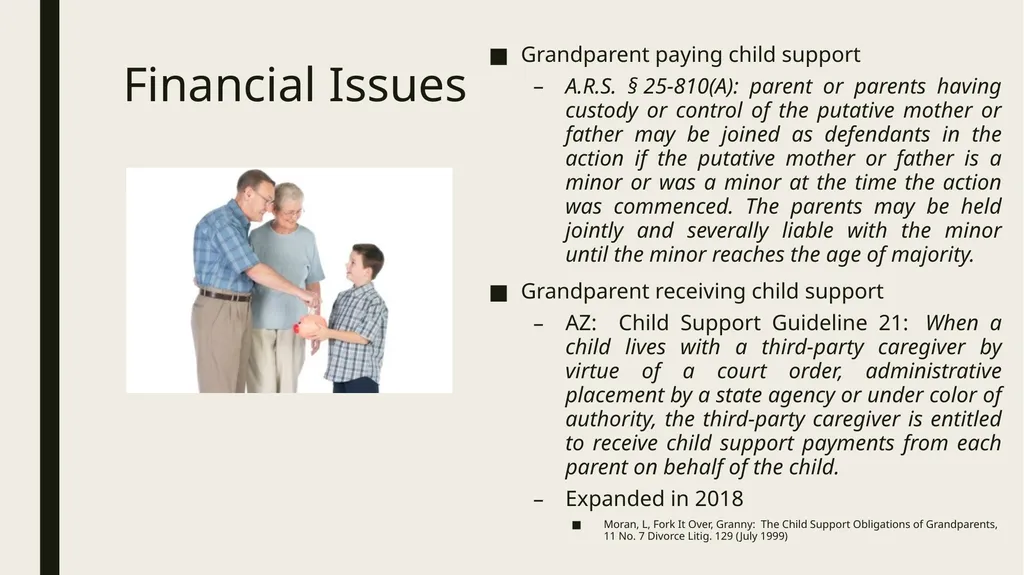
Financial Issues Grandparent paying child support
A.R.S. § 25-810(A): parent or parents having custody or control of the putative mother or father may be joined as defendants in the action if the putative mother or father is a minor or was a minor at the time the action was commenced. The parents may be held jointly and severally liable with the minor until the minor reaches the age of majority.
Grandparent receiving child support
AZ: Child Support Guideline 21: When a child lives with a third‑party caregiver by virtue of a court order, administrative placement by a state agency or under color of authority, the third‑party caregiver is entitled to receive child support payments from each parent on behalf of the child.
Expanded in 2018
Moran, L, Fork It Over, Granny: The Child Support Obligations of Grandparents, 11 No. 7 Divorce Litig. 129 (July 1999)<br>
A.R.S. § 25-810(A): parent or parents having custody or control of the putative mother or father may be joined as defendants in the action if the putative mother or father is a minor or was a minor at the time the action was commenced. The parents may be held jointly and severally liable with the minor until the minor reaches the age of majority.
Grandparent receiving child support
AZ: Child Support Guideline 21: When a child lives with a third‑party caregiver by virtue of a court order, administrative placement by a state agency or under color of authority, the third‑party caregiver is entitled to receive child support payments from each parent on behalf of the child.
Expanded in 2018
Moran, L, Fork It Over, Granny: The Child Support Obligations of Grandparents, 11 No. 7 Divorce Litig. 129 (July 1999)<br>
10
What are the Constitutional limitations on state law in this area?<br>
11
Parents & the US Constitution: The Basics Parents have a fundamental liberty interest, under the Constitution, “to direct the upbringing and education of children under their control.” Pierce v. Soc’y of Sisters of the Holy Names, 268 U.S. 510, 534-35 (1925). See also Meyer v. Nebraska, 262 U.S. 390, 399 (1923) (holding that the liberty guaranteed by the 14th Amendment includes freedom to “establish a home and bring up children”).<br>
12
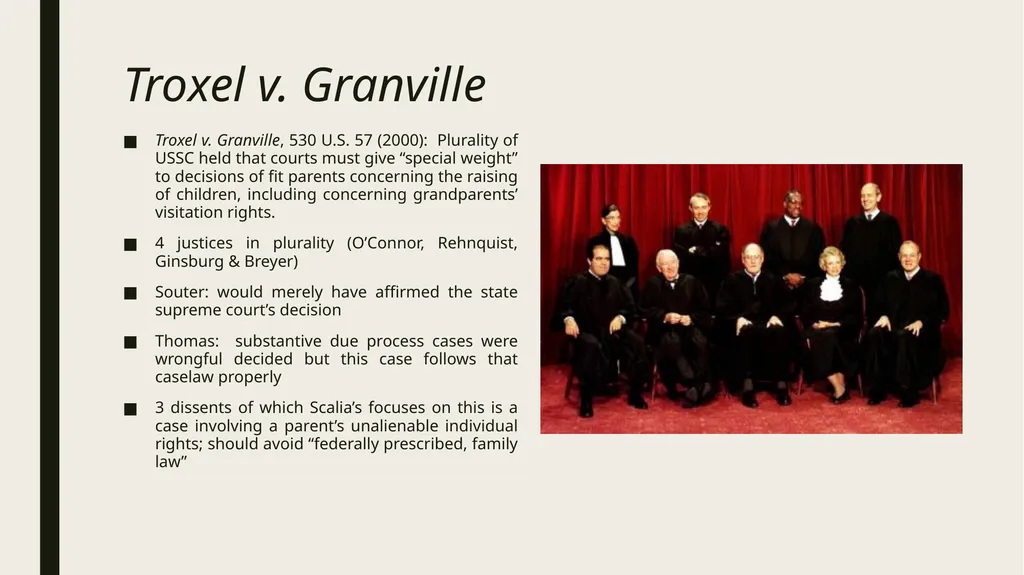
Troxel v. Granville Troxel v. Granville, 530 U.S. 57 (2000): Plurality of USSC held that courts must give “special weight” to decisions of fit parents concerning the raising of children, including concerning grandparents’ visitation rights.
4 justices in plurality (O’Connor, Rehnquist, Ginsburg & Breyer)
Souter: would merely have affirmed the state supreme court’s decision
Thomas: substantive due process cases were wrongful decided but this case follows that caselaw properly
3 dissents of which Scalia’s focuses on this is a case involving a parent’s unalienable individual rights; should avoid “federally prescribed, family law”<br>
4 justices in plurality (O’Connor, Rehnquist, Ginsburg & Breyer)
Souter: would merely have affirmed the state supreme court’s decision
Thomas: substantive due process cases were wrongful decided but this case follows that caselaw properly
3 dissents of which Scalia’s focuses on this is a case involving a parent’s unalienable individual rights; should avoid “federally prescribed, family law”<br>
13
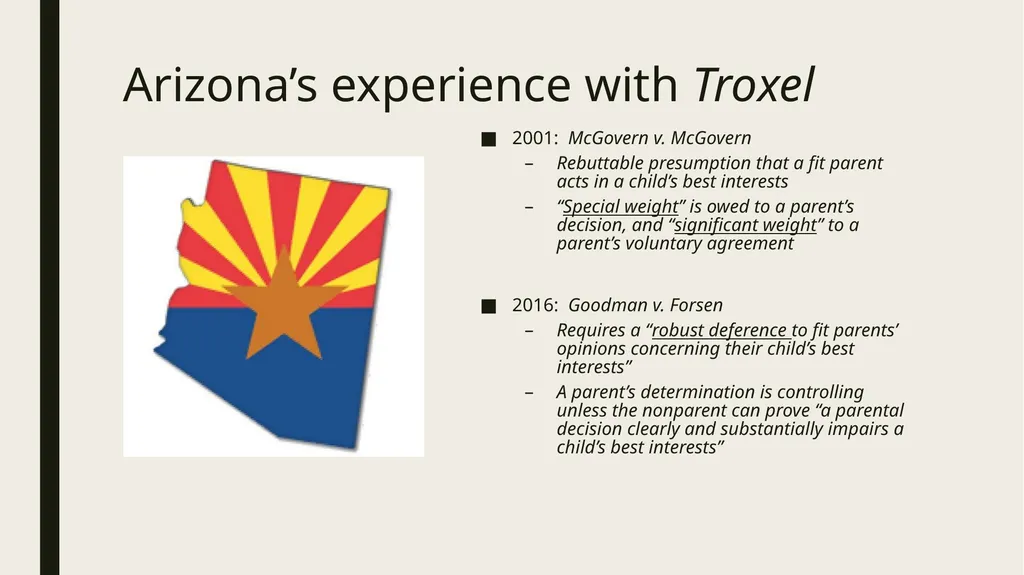
Arizona’s experience with Troxel 2001: McGovern v. McGovern
Rebuttable presumption that a fit parent acts in a child’s best interests
“Special weight” is owed to a parent’s decision, and “significant weight” to a parent’s voluntary agreement
2016: Goodman v. Forsen
Requires a “robust deference to fit parents’ opinions concerning their child’s best interests”
A parent’s determination is controlling unless the nonparent can prove “a parental decision clearly and substantially impairs a child’s best interests”<br>
Rebuttable presumption that a fit parent acts in a child’s best interests
“Special weight” is owed to a parent’s decision, and “significant weight” to a parent’s voluntary agreement
2016: Goodman v. Forsen
Requires a “robust deference to fit parents’ opinions concerning their child’s best interests”
A parent’s determination is controlling unless the nonparent can prove “a parental decision clearly and substantially impairs a child’s best interests”<br>
14
2018: Arizona In re Marriage of Friedman and Roels, 244 Ariz. 111, 418 P.3d 884 (June 2018)
Paternal grandparents seeking visitation with 2 children
Mother has sole legal decision-making; Father has only supervised parenting time 8 hours per week
Overrules Goodman’s “robust deference”
If 2 fit parents disagree, even if one has very little and even supervised parenting time, they cancel out, and the Court should determine issues based on child’s best interests.<br>
Paternal grandparents seeking visitation with 2 children
Mother has sole legal decision-making; Father has only supervised parenting time 8 hours per week
Overrules Goodman’s “robust deference”
If 2 fit parents disagree, even if one has very little and even supervised parenting time, they cancel out, and the Court should determine issues based on child’s best interests.<br>
15
What’s ahead?<br>
16
Uniform Nonparent Custody and Visitation Act (UNCVA) The Uniform Law Commission touts that it provides states with non-partisan, well conceived, and well drafted legislation that brings clarity and stability to critical areas of state statutory law.
Since 2015, a committee has been drafting a Nonparent Custody and Visitation Act.
Its goal has been to draft an act concerning the rights of third parties other than parents to custody of or visitation with a child.
In July 2018, its draft Act was approved.
http://www.uniformlaws.org/Committee.aspx?title=Nonparent%20Custody%20and%20Visitation%20Act<br>
Since 2015, a committee has been drafting a Nonparent Custody and Visitation Act.
Its goal has been to draft an act concerning the rights of third parties other than parents to custody of or visitation with a child.
In July 2018, its draft Act was approved.
http://www.uniformlaws.org/Committee.aspx?title=Nonparent%20Custody%20and%20Visitation%20Act<br>
17
UNCVA Next step
From Uniform Law Commission: The Act is officially promulgated for consideration by the states. Legislatures are urged to adopt Uniform Acts exactly as written, to “promote uniformity in the law among the states.” Model Acts are designed to serve as guideline legislation, which states can borrow from or adapt to suit their individual needs and conditions.<br>
From Uniform Law Commission: The Act is officially promulgated for consideration by the states. Legislatures are urged to adopt Uniform Acts exactly as written, to “promote uniformity in the law among the states.” Model Acts are designed to serve as guideline legislation, which states can borrow from or adapt to suit their individual needs and conditions.<br>
18
UNCVA Highlights Section 3: Scope – attempts to narrow scope of UNCVA to family law type of case where a parent is a party to the proceeding
E.g., not guardianships or juvenile cases
Suggestion not to allow foster parents to have custody or visitation rights
Section 4: Those entitled to make a claim for custody or visitation
Major division between those who have been either a consistent caretaker, or one who has a substantial relationship and denial would result in harm to the child
Either way the order must in the child’s best interests<br>
E.g., not guardianships or juvenile cases
Suggestion not to allow foster parents to have custody or visitation rights
Section 4: Those entitled to make a claim for custody or visitation
Major division between those who have been either a consistent caretaker, or one who has a substantial relationship and denial would result in harm to the child
Either way the order must in the child’s best interests<br>
19
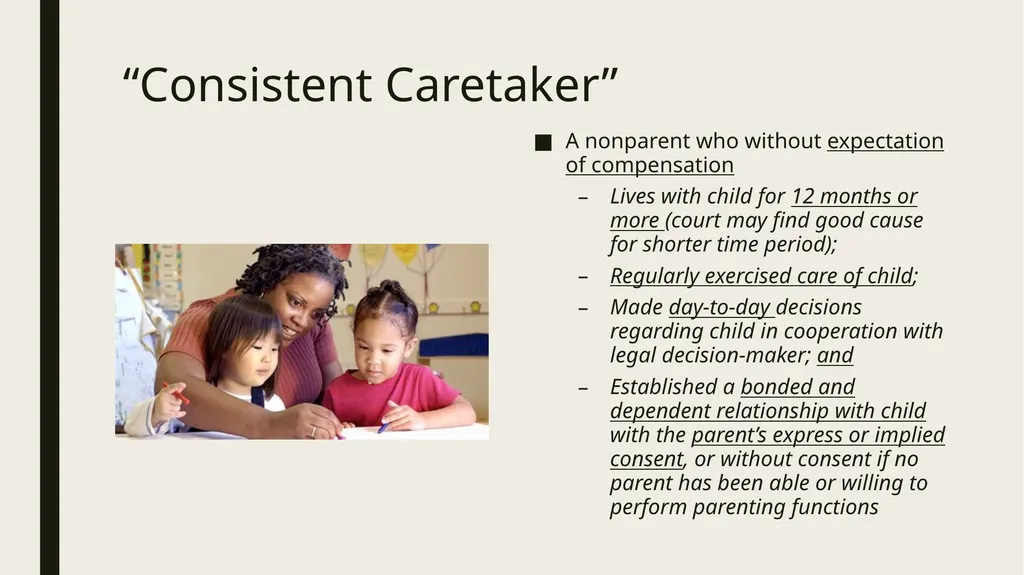
“Consistent Caretaker” A nonparent who without expectation of compensation
Lives with child for 12 months or more (court may find good cause for shorter time period);
Regularly exercised care of child;
Made day-to-day decisions regarding child in cooperation with legal decision-maker; and
Established a bonded and dependent relationship with child with the parent’s express or implied consent, or without consent if no parent has been able or willing to perform parenting functions<br>
Lives with child for 12 months or more (court may find good cause for shorter time period);
Regularly exercised care of child;
Made day-to-day decisions regarding child in cooperation with legal decision-maker; and
Established a bonded and dependent relationship with child with the parent’s express or implied consent, or without consent if no parent has been able or willing to perform parenting functions<br>
20
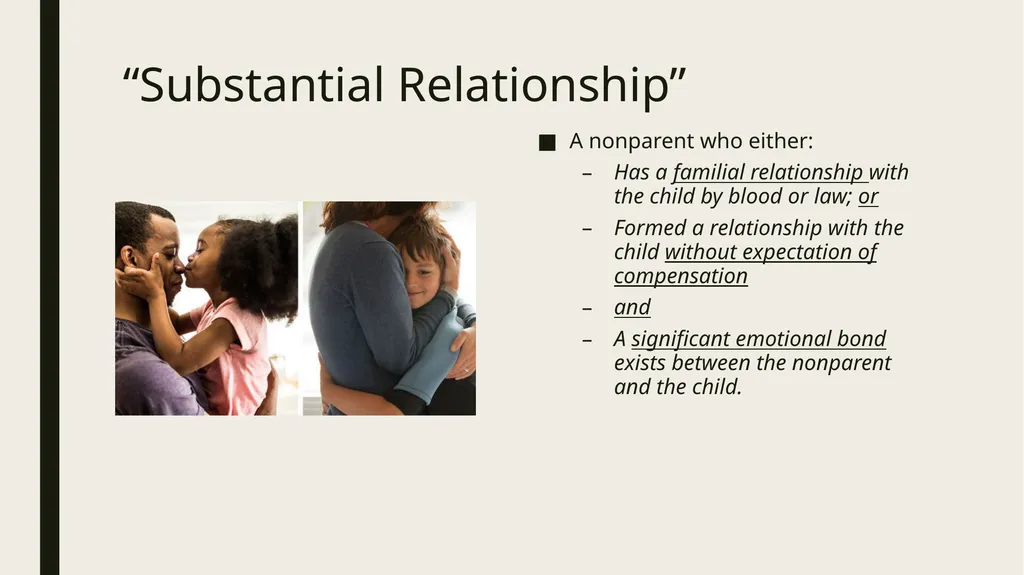
“Substantial Relationship” A nonparent who either:
Has a familial relationship with the child by blood or law; or
Formed a relationship with the child without expectation of compensation
and
A significant emotional bond exists between the nonparent and the child.<br>
Has a familial relationship with the child by blood or law; or
Formed a relationship with the child without expectation of compensation
and
A significant emotional bond exists between the nonparent and the child.<br>
21
Section 5: Parental Decisions In light of existing case law, the NCVA presumes that a parent’s decision “regarding a request for custody or visitation by a nonparent is presumed to be in the best interest of the child.”
Nonparent must rebut the presumption by clear-and-convincing evidence
Nonparent need not show the parent’s “unfitness”<br>
Nonparent must rebut the presumption by clear-and-convincing evidence
Nonparent need not show the parent’s “unfitness”<br>
22
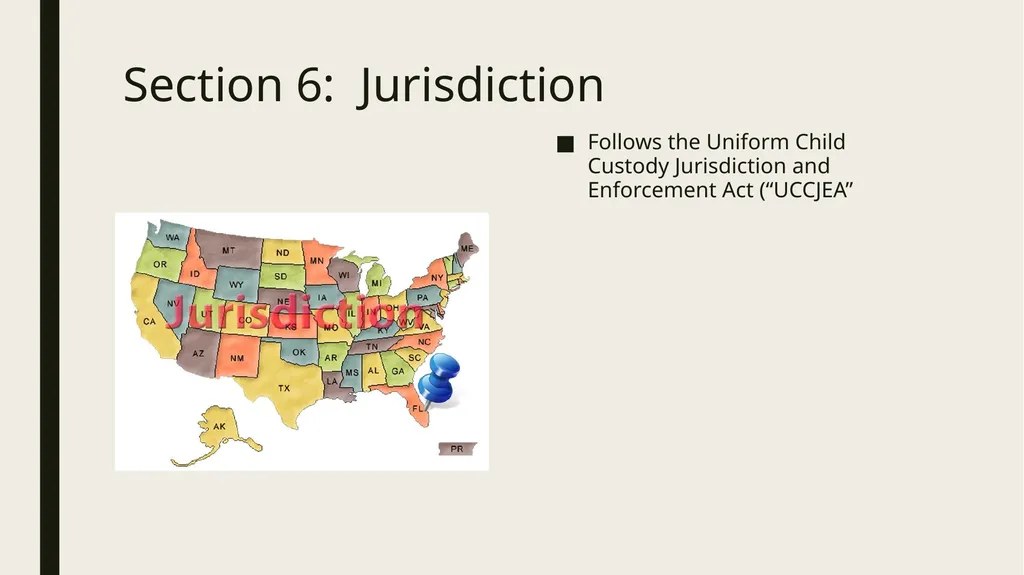
Section 6: Jurisdiction Follows the Uniform Child Custody Jurisdiction and Enforcement Act (“UCCJEA”<br>
23
Sections 7 & 8: Verified Petition & Initial Court Review Requires a verified petition alleging “specific facts” as to the following:
Duration and nature of relationship
The parties’ agreement, if any, as to custody, visitation, and contact
The parent(s)’ position as to custody, visitation, and contact
Information as to compensation or any expectation of compensation for child care
UCCJEA
Reasons why custody or visitation is in the child’s best interests
If relevant, why harm would result to child if custody or visitation is denied
If Court finds no prima facie case has been made, court shall dismiss the petition.<br>
Duration and nature of relationship
The parties’ agreement, if any, as to custody, visitation, and contact
The parent(s)’ position as to custody, visitation, and contact
Information as to compensation or any expectation of compensation for child care
UCCJEA
Reasons why custody or visitation is in the child’s best interests
If relevant, why harm would result to child if custody or visitation is denied
If Court finds no prima facie case has been made, court shall dismiss the petition.<br>
24
Section 12: Best interest of child NCVA provides the following non-exclusive list of factors that the Court must consider in determining the best interest of the child:
Nature and extent of the relationship between child and the parent;
Nature and extent of the relationship between child and the non-parent;
Child’s views considering age and maturity;
Past or present conduct by a party or individual living with a party which poses a risk to the physical, emotional, or psychological well-being of the child;
Likely impact on the requested order on the relationship between the child and the parent; and
Other relevant state-specific factors.<br>
Nature and extent of the relationship between child and the parent;
Nature and extent of the relationship between child and the non-parent;
Child’s views considering age and maturity;
Past or present conduct by a party or individual living with a party which poses a risk to the physical, emotional, or psychological well-being of the child;
Likely impact on the requested order on the relationship between the child and the parent; and
Other relevant state-specific factors.<br>
25
Section 13: DV, Sexual Assault or Stalking NCVA would create a presumption that ordering custody or visitation to a nonparent is not in the best interest of the child if the court finds that the nonparent or one living with the nonparent has committed child abuse, child neglect, DV, sexual assault, stalking …
Prove by conviction, civil judgment, or preponderance of the evidence
Rebuttable with clear-and-convincing evidence that the order would not endanger the health, safety, or welfare of child<br>
Prove by conviction, civil judgment, or preponderance of the evidence
Rebuttable with clear-and-convincing evidence that the order would not endanger the health, safety, or welfare of child<br>
26
Additional Provisions Section 14: Order – permissible provisions of order
Section 15: Modification of Order
Section 16: Findings of fact and conclusions of law required
Section 17: Adoption - Order for visitation or custody remains in place if there is an adoption by a relative, including a stepparent, until modified
Section 18: Allocating costs of visitation
Section 19: Child Support<br>
Section 15: Modification of Order
Section 16: Findings of fact and conclusions of law required
Section 17: Adoption - Order for visitation or custody remains in place if there is an adoption by a relative, including a stepparent, until modified
Section 18: Allocating costs of visitation
Section 19: Child Support<br>
27
Section 20: Other Rights/Avenues Preserves any equitable right or remedy available under state law
De facto parent
Psychological parent
In loco parentis<br>
De facto parent
Psychological parent
In loco parentis<br>