
Constructing Hypothesis Week 7 Department of RS

Description: Constructing Hypothesis Week 7 Department of RS and GISc, Institute of Space Technology What is a Hypothesis? Educated guessassumption Tentative predictionpreposition Possible outcome Good hunchesspeculations Basis of an inquiry!!!!!
Related Topics
Download Presentation
"Constructing Hypothesis Week 7 Department of RS" is the property of its rightful owner. Permission is granted to download and print the materials on this website for personal, non-commercial use only, and to display it on your personal computer provided you do not modify the materials and that you retain all copyright notices contained in the materials. By downloading content from our website, you accept the terms of this agreement.
Presentation Transcript
slide1. Constructing Hypothesis Week 7
Department of RS and GISc, Institute of Space Technology<br>
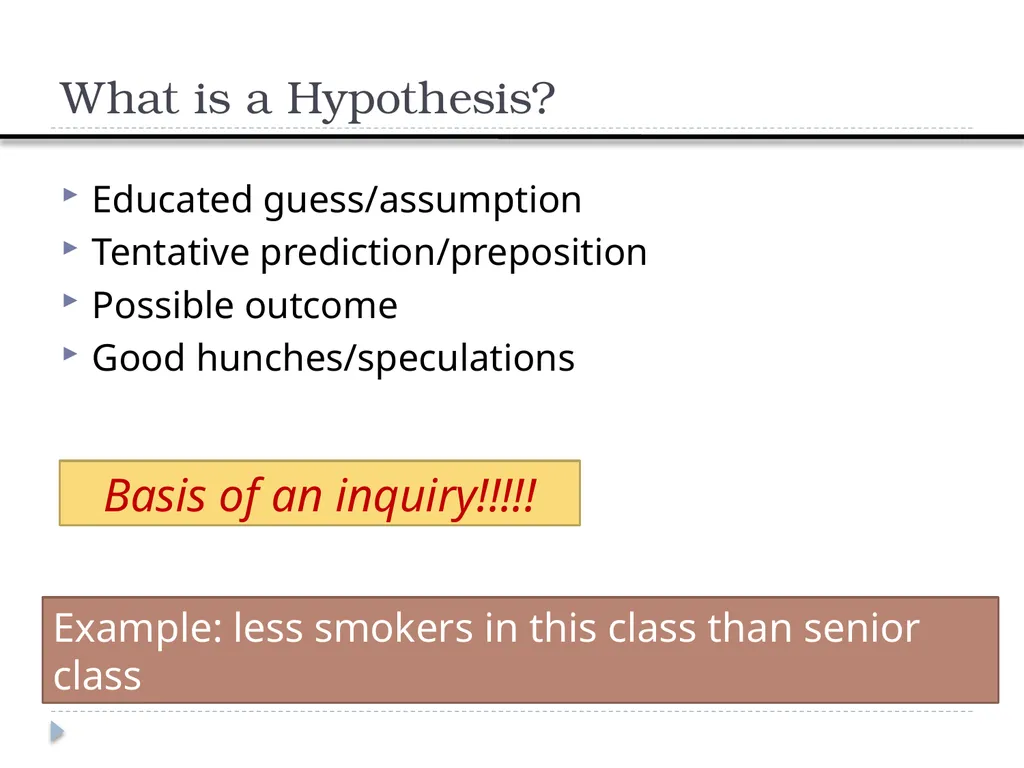
slide2. What is a Hypothesis? Educated guess/assumption
Tentative prediction/preposition
Possible outcome
Good hunches/speculations Basis of an inquiry!!!!! Example: less smokers in this class than senior class<br>
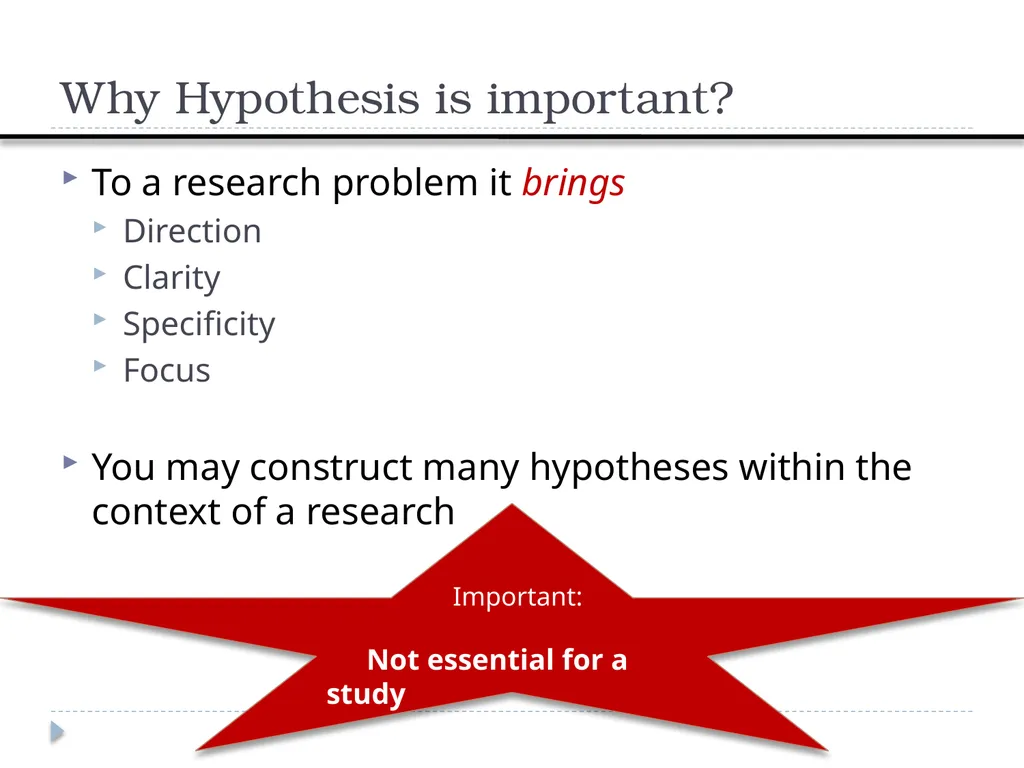
slide3. Why Hypothesis is important? To a research problem it brings
Direction
Clarity
Specificity
Focus
You may construct many hypotheses within the context of a research Important:
Not essential for a study<br>
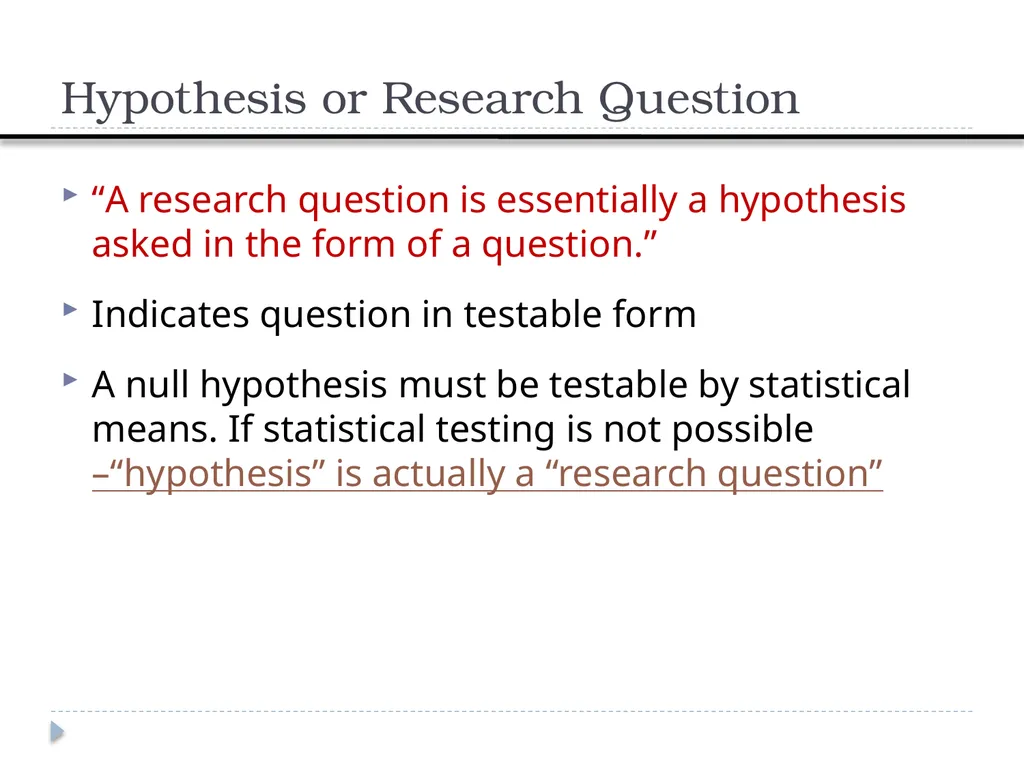
slide4. Hypothesis or Research Question “A research question is essentially a hypothesis asked in the form of a question.”
Indicates question in testable form
A null hypothesis must be testable by statistical means. If statistical testing is not possible –“hypothesis” is actually a “research question”<br>
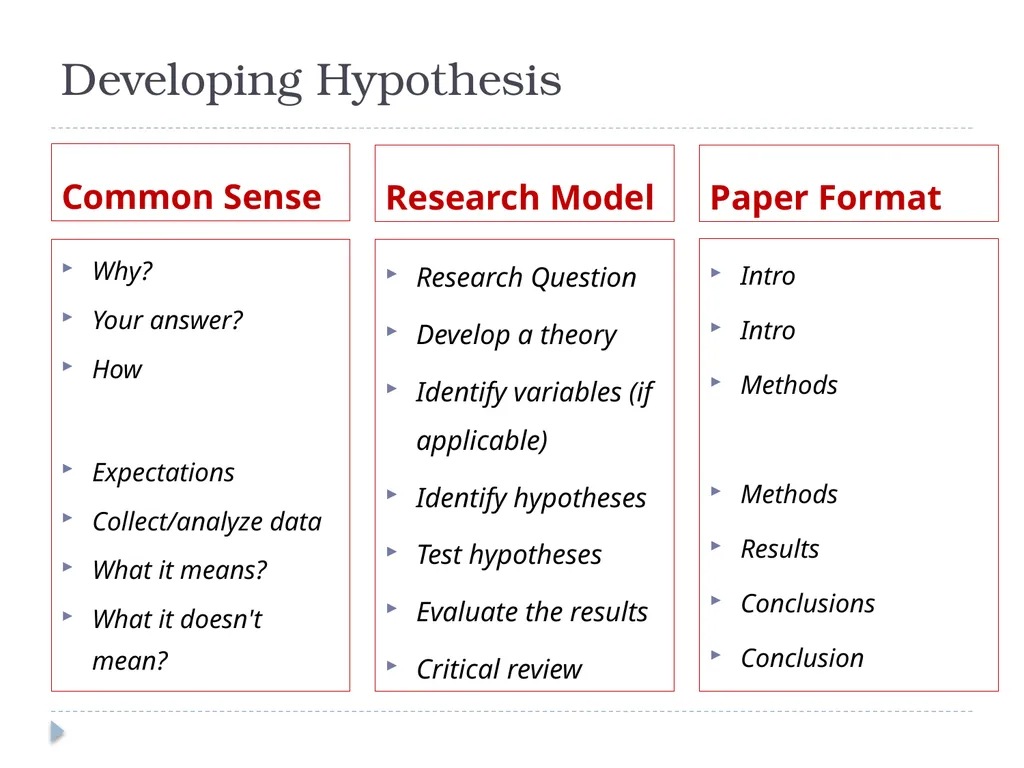
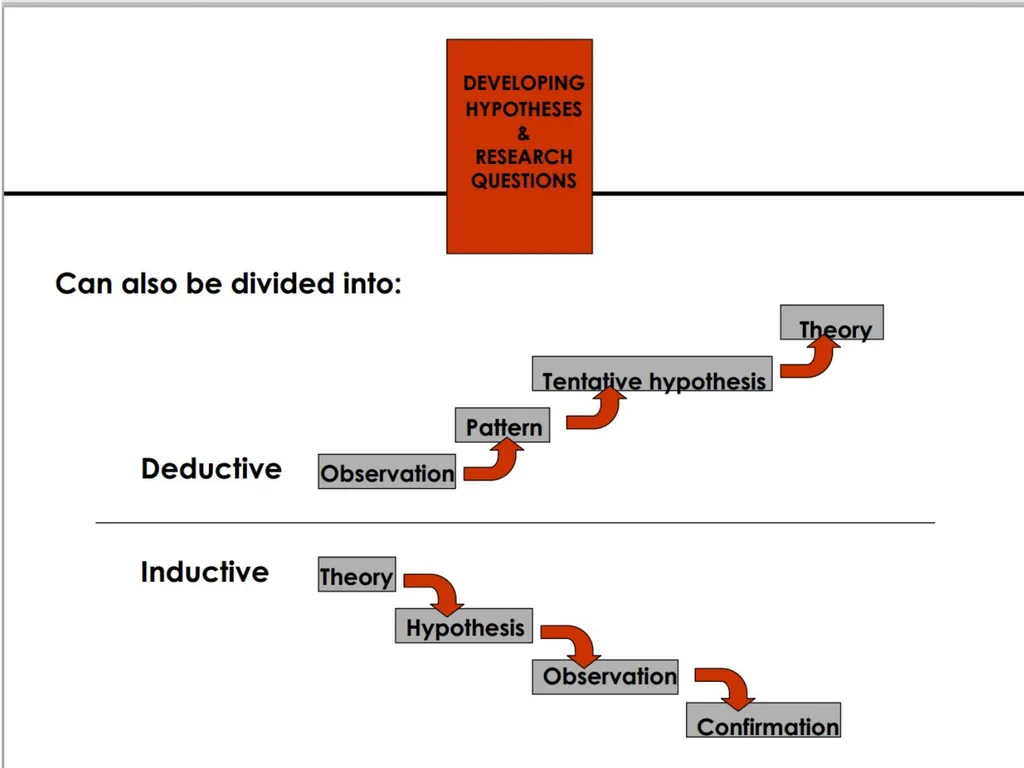
slide5. Developing Hypothesis Common Sense Research Model Why?
Your answer?
How
Expectations
Collect/analyze data
What it means?
What it doesn't mean? Research Question
Develop a theory
Identify variables (if applicable)
Identify hypotheses
Test hypotheses
Evaluate the results
Critical review Intro
Intro
Methods
Methods
Results
Conclusions
Conclusion Paper Format<br>
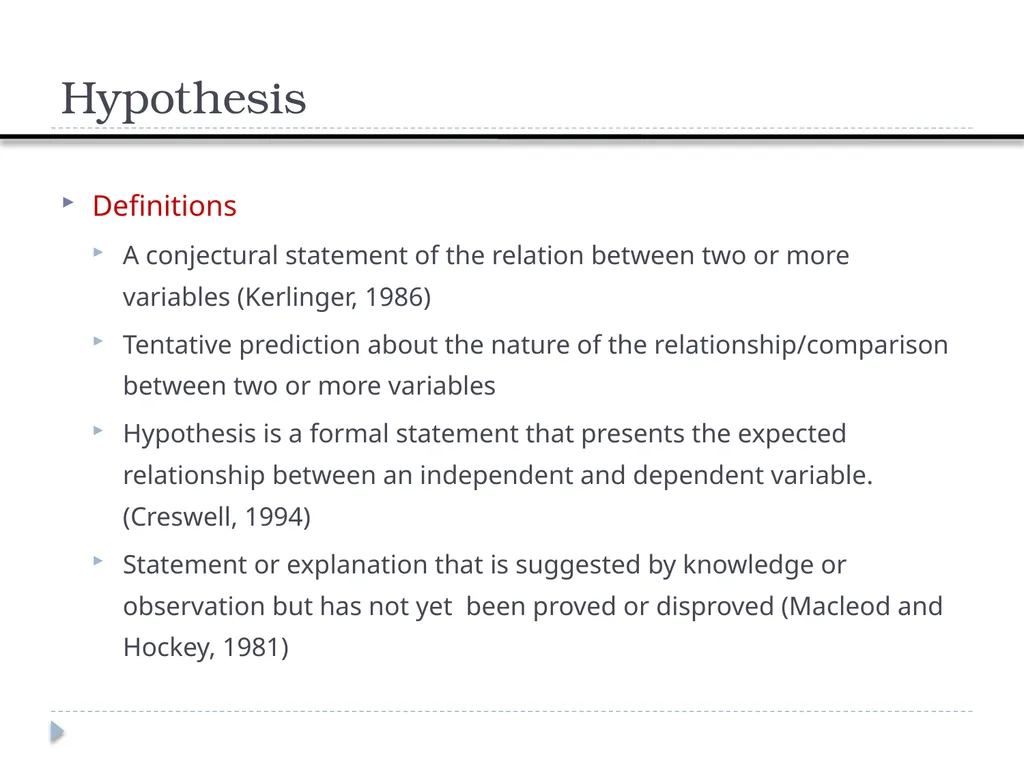
slide6. Hypothesis Definitions
A conjectural statement of the relation between two or more variables (Kerlinger, 1986)
Tentative prediction about the nature of the relationship/comparison between two or more variables
Hypothesis is a formal statement that presents the expected relationship between an independent and dependent variable.(Creswell, 1994)
Statement or explanation that is suggested by knowledge or observation but has not yet been proved or disproved (Macleod and Hockey, 1981)<br>
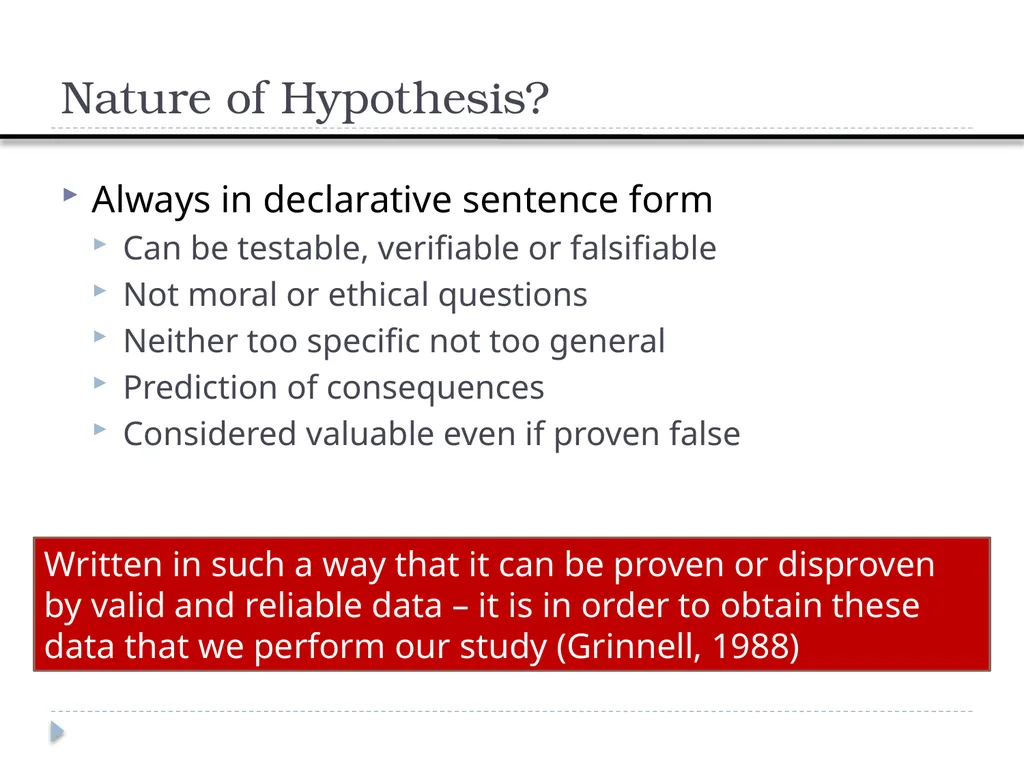
slide7. Nature of Hypothesis? Always in declarative sentence form
Can be testable, verifiable or falsifiable
Not moral or ethical questions
Neither too specific not too general
Prediction of consequences
Considered valuable even if proven false Written in such a way that it can be proven or disproven by valid and reliable data – it is in order to obtain these data that we perform our study (Grinnell, 1988)<br>
slide8. Characteristics of a Hypothesis? It is a tentative proposition
Its validity is unknown
In most cases, it specifies a relationship between two or more variables<br>
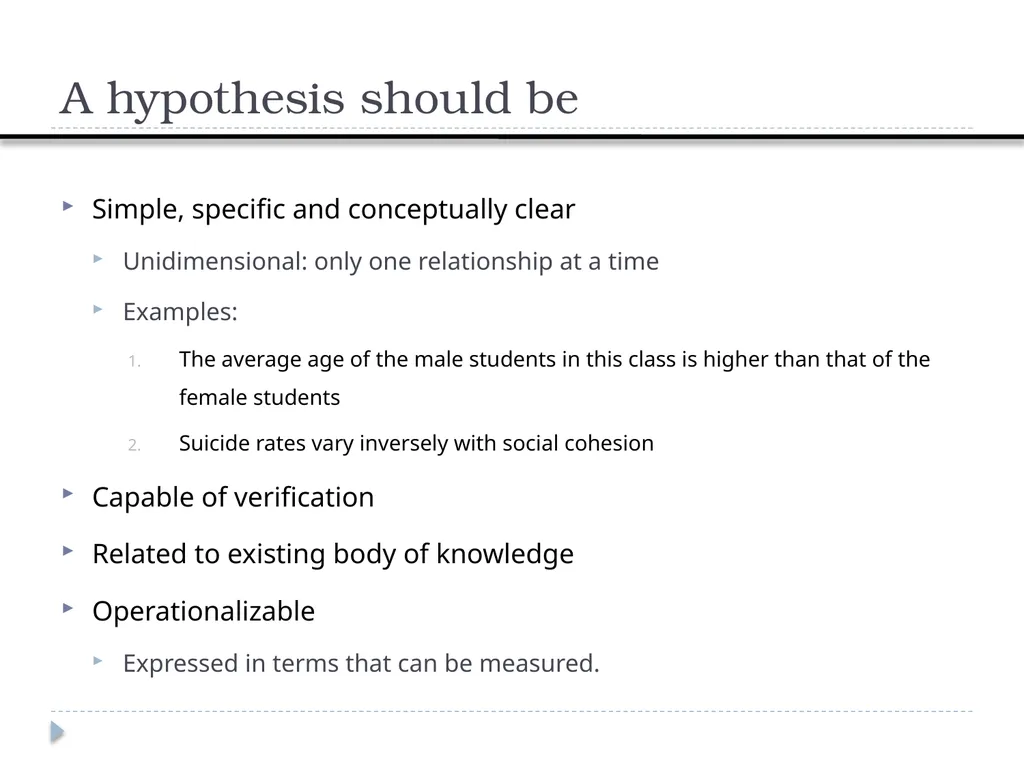
slide9. A hypothesis should be Simple, specific and conceptually clear
Unidimensional: only one relationship at a time
Examples:
The average age of the male students in this class is higher than that of the female students
Suicide rates vary inversely with social cohesion
Capable of verification
Related to existing body of knowledge
Operationalizable
Expressed in terms that can be measured.<br>
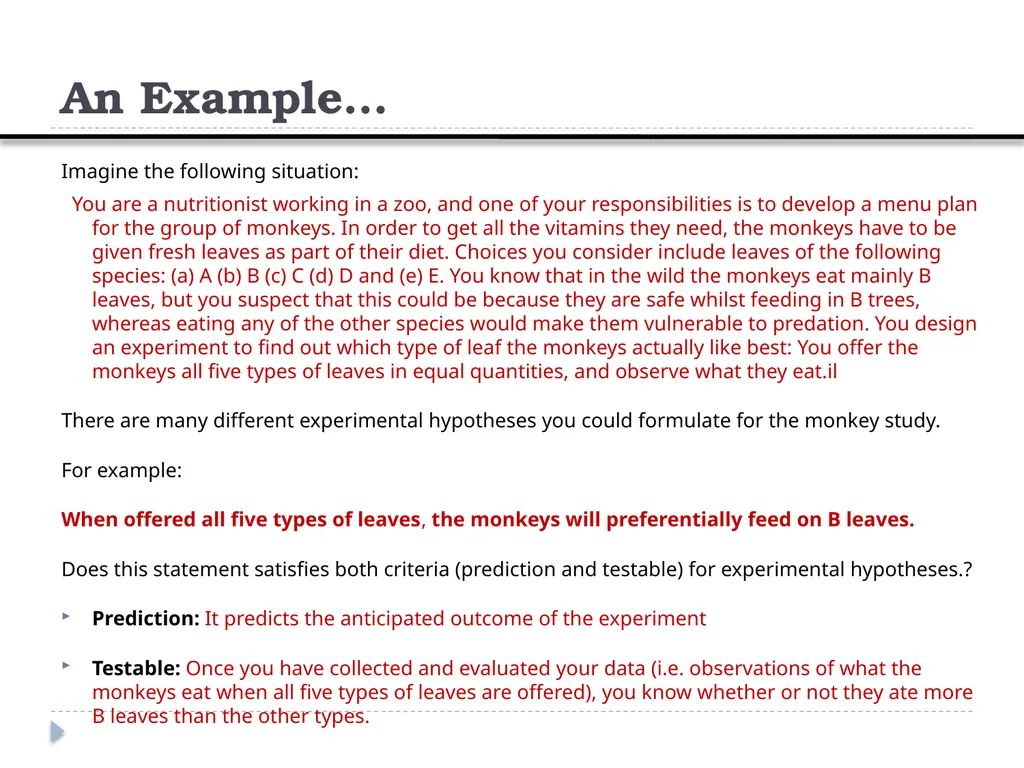
slide10. An Example… Imagine the following situation:
You are a nutritionist working in a zoo, and one of your responsibilities is to develop a menu plan for the group of monkeys. In order to get all the vitamins they need, the monkeys have to be given fresh leaves as part of their diet. Choices you consider include leaves of the following species: (a) A (b) B (c) C (d) D and (e) E. You know that in the wild the monkeys eat mainly B leaves, but you suspect that this could be because they are safe whilst feeding in B trees, whereas eating any of the other species would make them vulnerable to predation. You design an experiment to find out which type of leaf the monkeys actually like best: You offer the monkeys all five types of leaves in equal quantities, and observe what they eat.il
There are many different experimental hypotheses you could formulate for the monkey study.
For example:
When offered all five types of leaves, the monkeys will preferentially feed on B leaves.
Does this statement satisfies both criteria (prediction and testable) for experimental hypotheses.?
Prediction: It predicts the anticipated outcome of the experiment
Testable: Once you have collected and evaluated your data (i.e. observations of what the monkeys eat when all five types of leaves are offered), you know whether or not they ate more B leaves than the other types.<br>
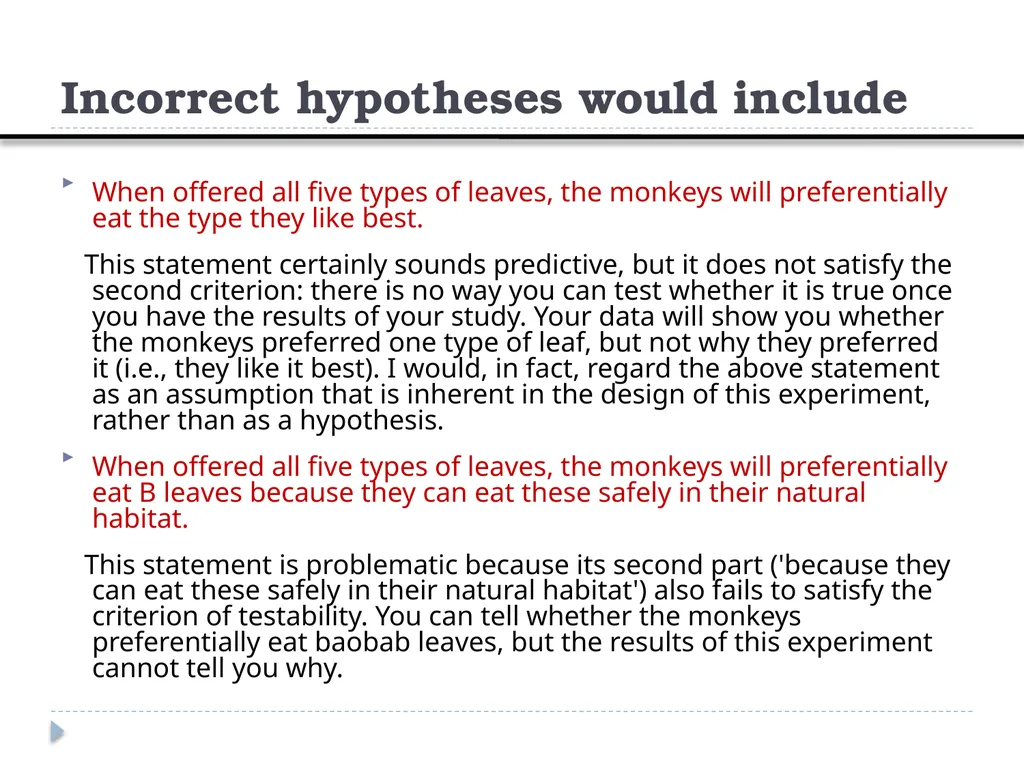
slide11. Incorrect hypotheses would include When offered all five types of leaves, the monkeys will preferentially eat the type they like best.
This statement certainly sounds predictive, but it does not satisfy the second criterion: there is no way you can test whether it is true once you have the results of your study. Your data will show you whether the monkeys preferred one type of leaf, but not why they preferred it (i.e., they like it best). I would, in fact, regard the above statement as an assumption that is inherent in the design of this experiment, rather than as a hypothesis.
When offered all five types of leaves, the monkeys will preferentially eat B leaves because they can eat these safely in their natural habitat.
This statement is problematic because its second part ('because they can eat these safely in their natural habitat') also fails to satisfy the criterion of testability. You can tell whether the monkeys preferentially eat baobab leaves, but the results of this experiment cannot tell you why.<br>
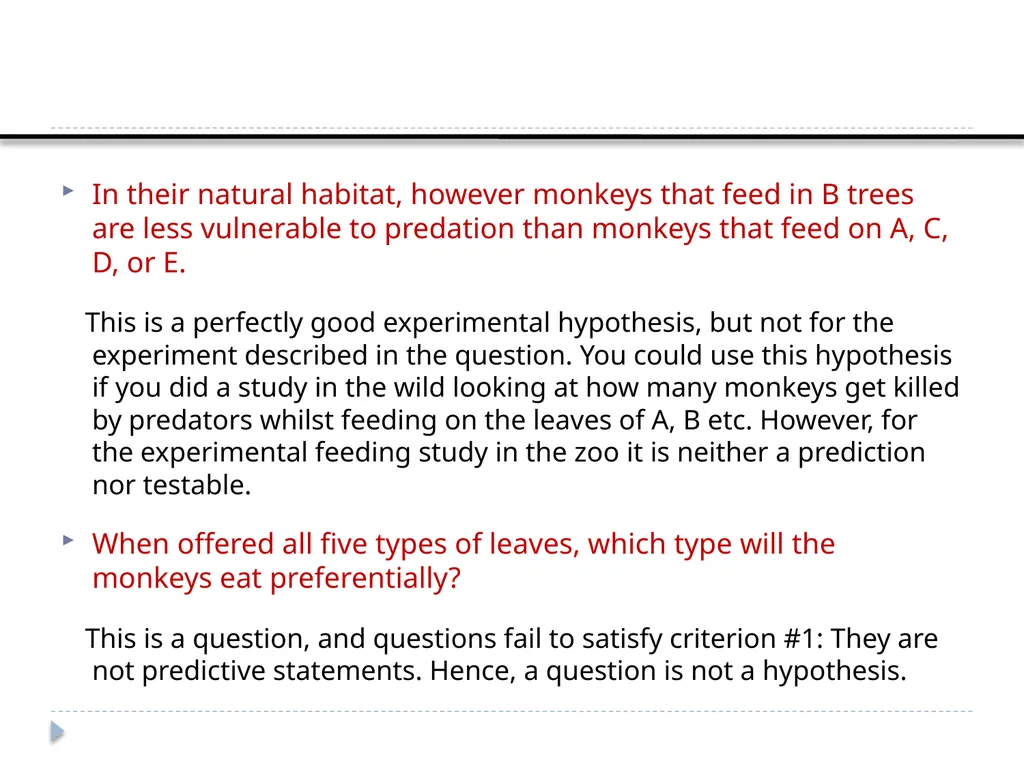
slide12. In their natural habitat, however monkeys that feed in B trees are less vulnerable to predation than monkeys that feed on A, C, D, or E.
This is a perfectly good experimental hypothesis, but not for the experiment described in the question. You could use this hypothesis if you did a study in the wild looking at how many monkeys get killed by predators whilst feeding on the leaves of A, B etc. However, for the experimental feeding study in the zoo it is neither a prediction nor testable.
When offered all five types of leaves, which type will the monkeys eat preferentially?
This is a question, and questions fail to satisfy criterion #1: They are not predictive statements. Hence, a question is not a hypothesis.<br>
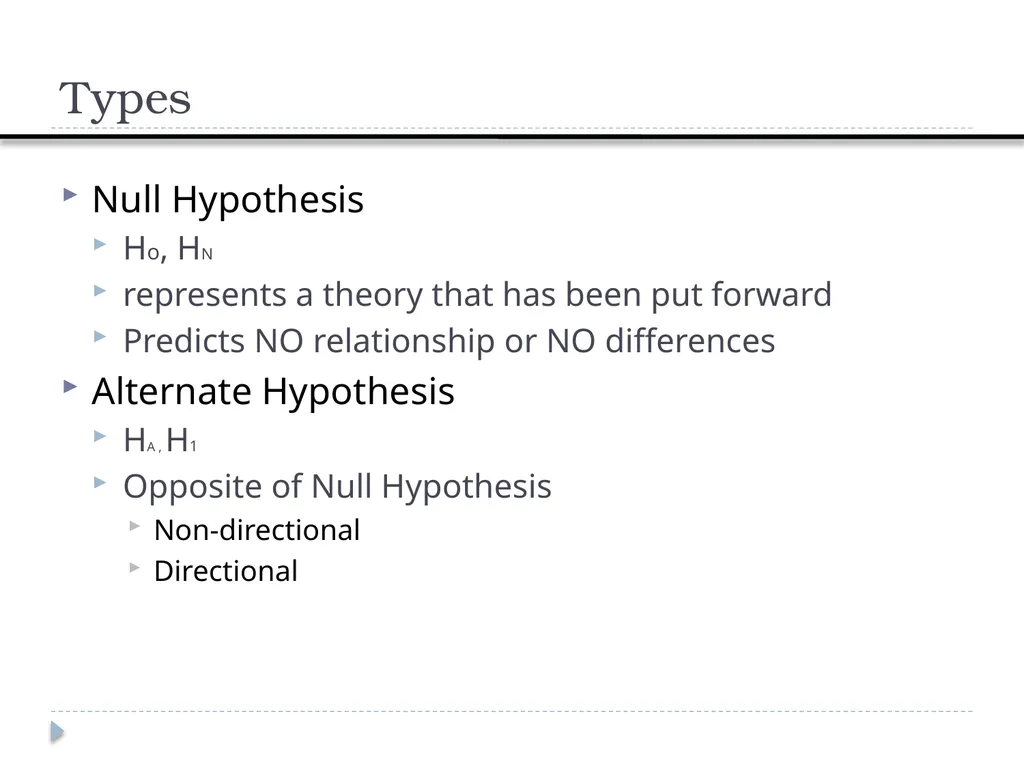
slide13. Types Null Hypothesis
Ho, HN
represents a theory that has been put forward
Predicts NO relationship or NO differences
Alternate Hypothesis
HA , H1
Opposite of Null Hypothesis
Non-directional
Directional<br>
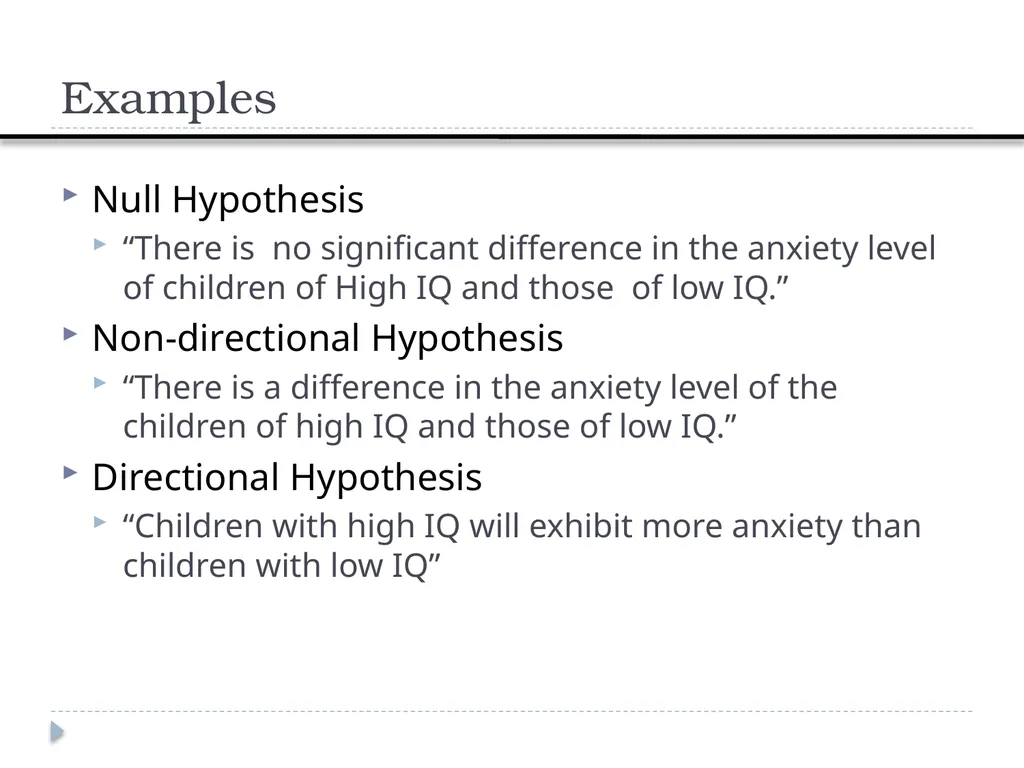
slide14. Examples Null Hypothesis
“There is no significant difference in the anxiety level of children of High IQ and those of low IQ.”
Non-directional Hypothesis
“There is a difference in the anxiety level of the children of high IQ and those of low IQ.”
Directional Hypothesis
“Children with high IQ will exhibit more anxiety than children with low IQ”<br>
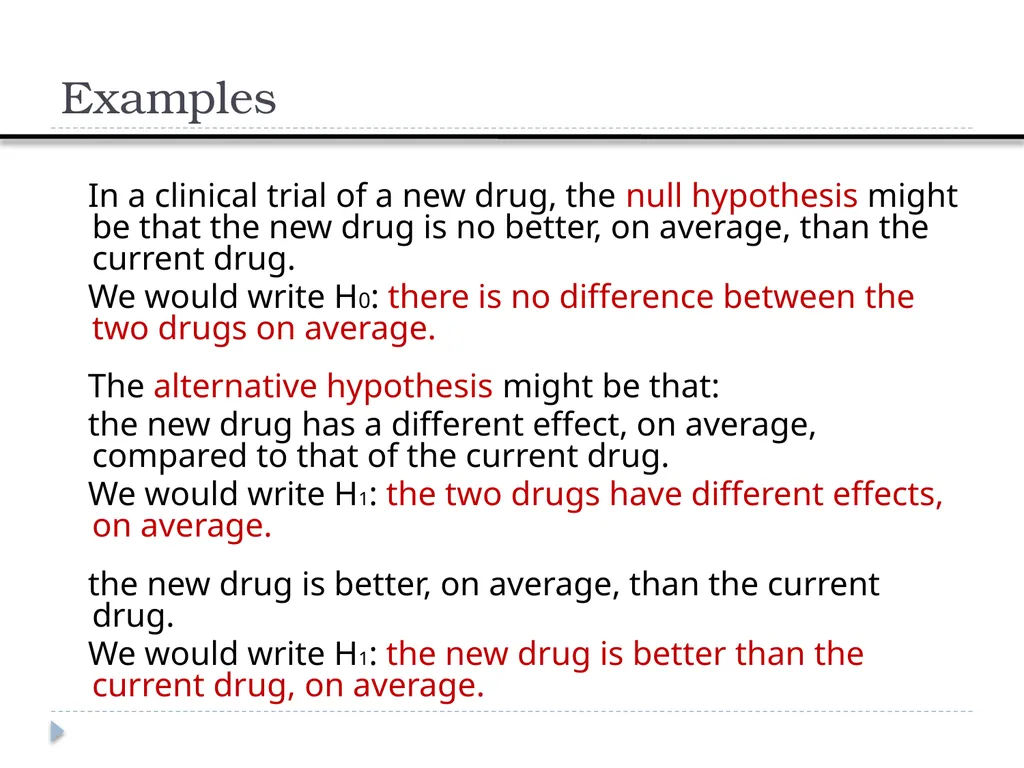
slide15. Examples In a clinical trial of a new drug, the null hypothesis might be that the new drug is no better, on average, than the current drug.
We would write H0: there is no difference between the two drugs on average.
The alternative hypothesis might be that:
the new drug has a different effect, on average, compared to that of the current drug.
We would write H1: the two drugs have different effects, on average.
the new drug is better, on average, than the current drug.
We would write H1: the new drug is better than the current drug, on average.<br>
slide16. Formulating Hypothesis<br>
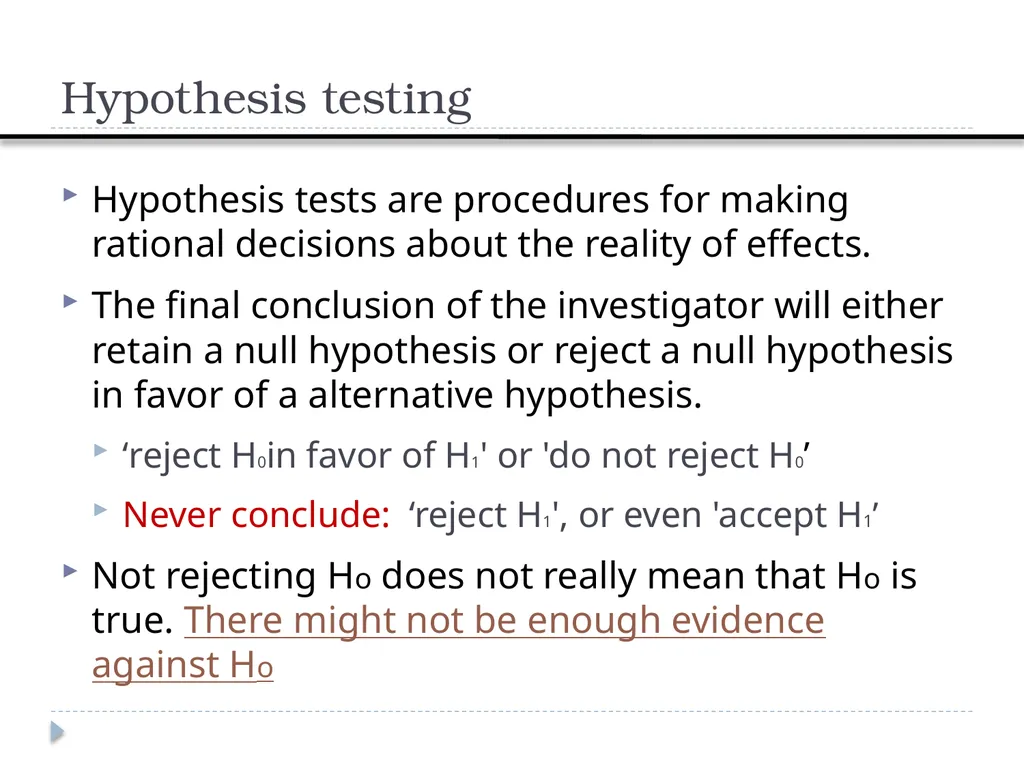
slide18. Hypothesis testing Hypothesis tests are procedures for making rational decisions about the reality of effects.
The final conclusion of the investigator will either retain a null hypothesis or reject a null hypothesis in favor of a alternative hypothesis.
‘reject H0in favor of H1' or 'do not reject H0’
Never conclude: ‘reject H1', or even 'accept H1’
Not rejecting Ho does not really mean that Ho is true. There might not be enough evidence against Ho<br>
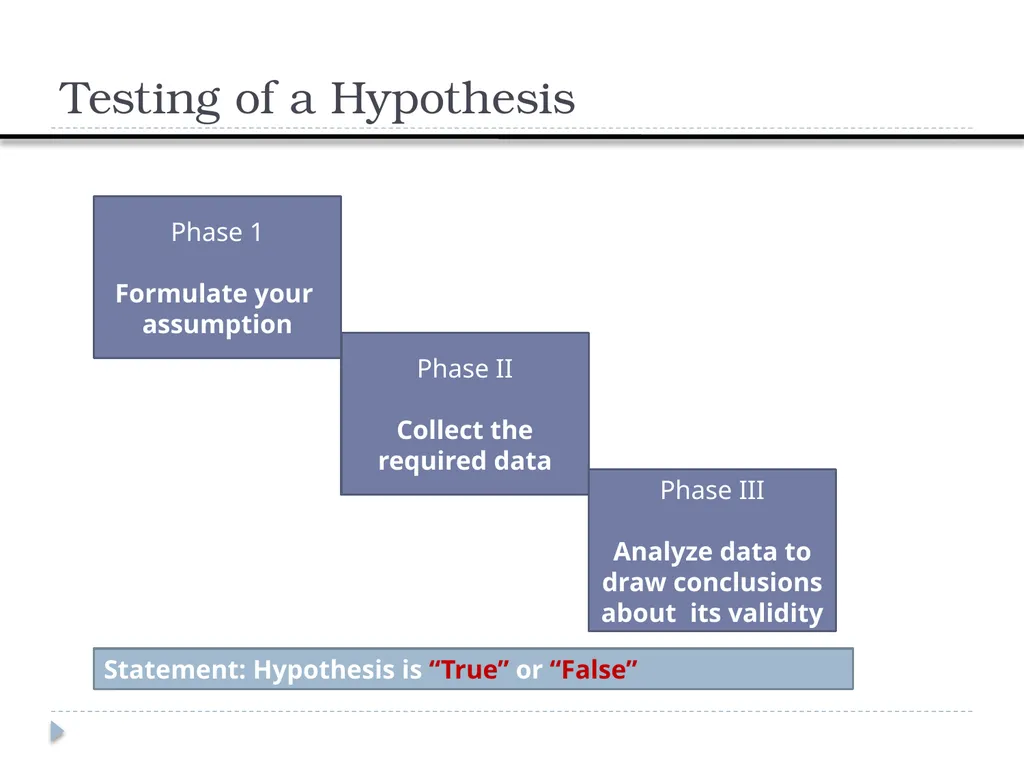
slide19. Testing of a Hypothesis Phase 1
Formulate your assumption Phase II
Collect the required data Phase III
Analyze data to draw conclusions about its validity Statement: Hypothesis is “True” or “False”<br>
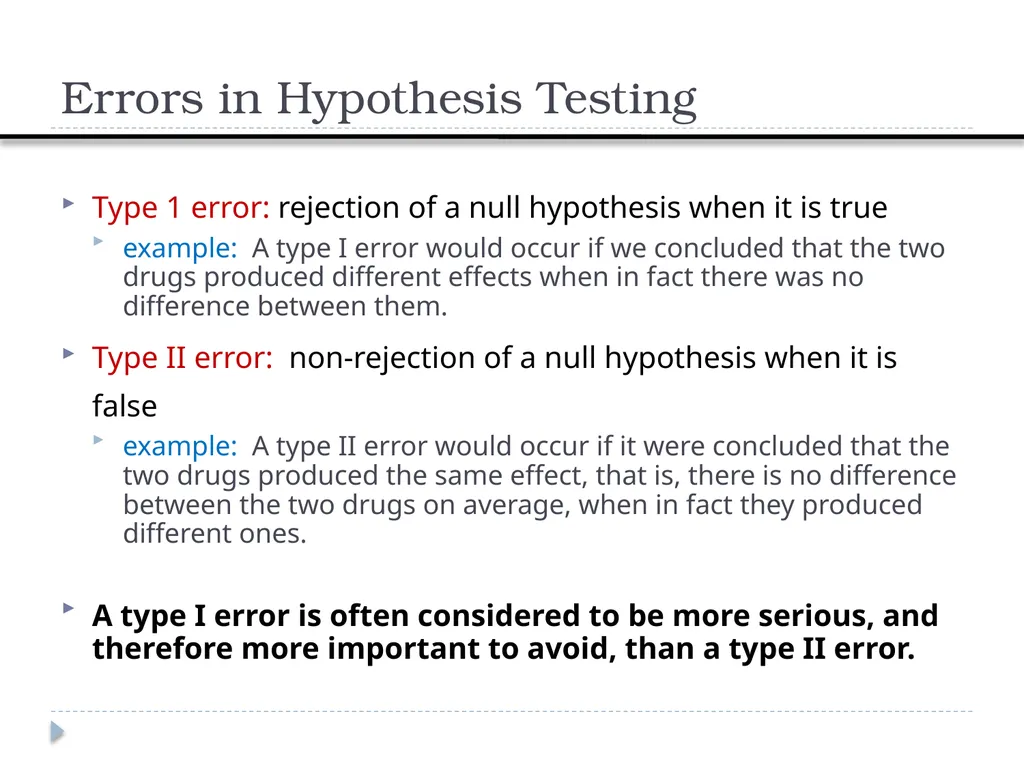
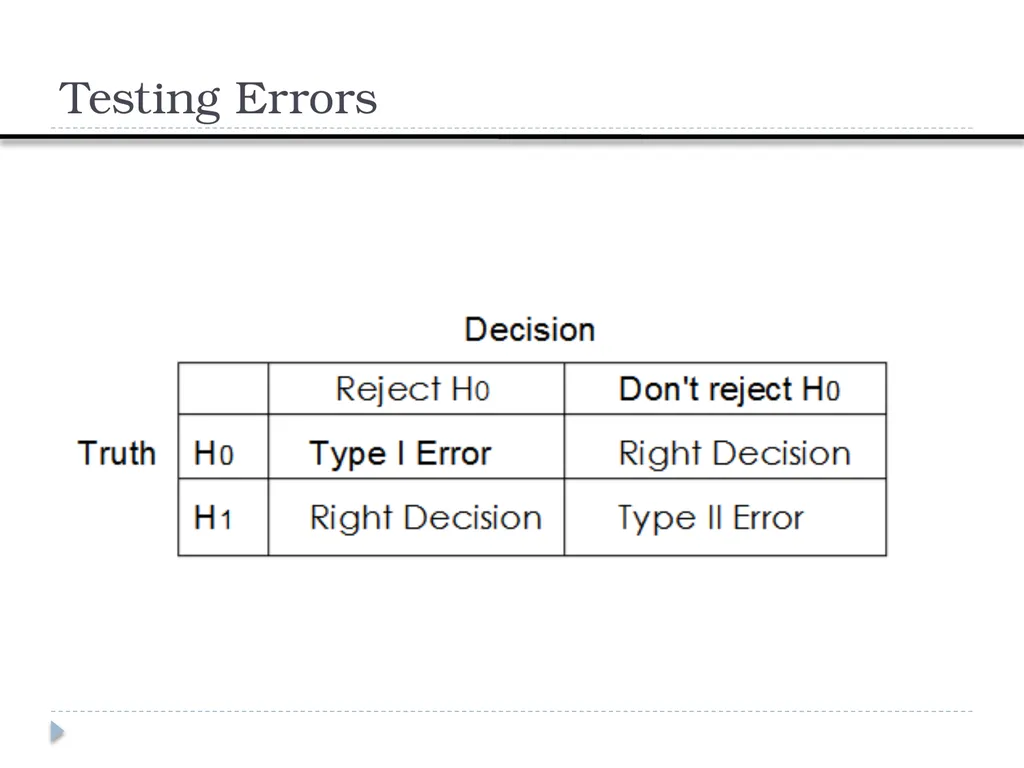
slide20. Errors in Hypothesis Testing Type 1 error: rejection of a null hypothesis when it is true
example: A type I error would occur if we concluded that the two drugs produced different effects when in fact there was no difference between them.
Type II error: non-rejection of a null hypothesis when it is false
example: A type II error would occur if it were concluded that the two drugs produced the same effect, that is, there is no difference between the two drugs on average, when in fact they produced different ones.
A type I error is often considered to be more serious, and therefore more important to avoid, than a type II error.<br>
slide21. Testing Errors<br>
slide22. Hypothesis needs to be structured before the data-gathering and interpretation phase of the research: Gives direction to the collection and interpretation of data
Finding the data first and then formulating the hypothesis is like.... throwing the dice first and then betting<br>
Department of RS and GISc, Institute of Space Technology<br>
slide2. What is a Hypothesis? Educated guess/assumption
Tentative prediction/preposition
Possible outcome
Good hunches/speculations Basis of an inquiry!!!!! Example: less smokers in this class than senior class<br>
slide3. Why Hypothesis is important? To a research problem it brings
Direction
Clarity
Specificity
Focus
You may construct many hypotheses within the context of a research Important:
Not essential for a study<br>
slide4. Hypothesis or Research Question “A research question is essentially a hypothesis asked in the form of a question.”
Indicates question in testable form
A null hypothesis must be testable by statistical means. If statistical testing is not possible –“hypothesis” is actually a “research question”<br>
slide5. Developing Hypothesis Common Sense Research Model Why?
Your answer?
How
Expectations
Collect/analyze data
What it means?
What it doesn't mean? Research Question
Develop a theory
Identify variables (if applicable)
Identify hypotheses
Test hypotheses
Evaluate the results
Critical review Intro
Intro
Methods
Methods
Results
Conclusions
Conclusion Paper Format<br>
slide6. Hypothesis Definitions
A conjectural statement of the relation between two or more variables (Kerlinger, 1986)
Tentative prediction about the nature of the relationship/comparison between two or more variables
Hypothesis is a formal statement that presents the expected relationship between an independent and dependent variable.(Creswell, 1994)
Statement or explanation that is suggested by knowledge or observation but has not yet been proved or disproved (Macleod and Hockey, 1981)<br>
slide7. Nature of Hypothesis? Always in declarative sentence form
Can be testable, verifiable or falsifiable
Not moral or ethical questions
Neither too specific not too general
Prediction of consequences
Considered valuable even if proven false Written in such a way that it can be proven or disproven by valid and reliable data – it is in order to obtain these data that we perform our study (Grinnell, 1988)<br>
slide8. Characteristics of a Hypothesis? It is a tentative proposition
Its validity is unknown
In most cases, it specifies a relationship between two or more variables<br>
slide9. A hypothesis should be Simple, specific and conceptually clear
Unidimensional: only one relationship at a time
Examples:
The average age of the male students in this class is higher than that of the female students
Suicide rates vary inversely with social cohesion
Capable of verification
Related to existing body of knowledge
Operationalizable
Expressed in terms that can be measured.<br>
slide10. An Example… Imagine the following situation:
You are a nutritionist working in a zoo, and one of your responsibilities is to develop a menu plan for the group of monkeys. In order to get all the vitamins they need, the monkeys have to be given fresh leaves as part of their diet. Choices you consider include leaves of the following species: (a) A (b) B (c) C (d) D and (e) E. You know that in the wild the monkeys eat mainly B leaves, but you suspect that this could be because they are safe whilst feeding in B trees, whereas eating any of the other species would make them vulnerable to predation. You design an experiment to find out which type of leaf the monkeys actually like best: You offer the monkeys all five types of leaves in equal quantities, and observe what they eat.il
There are many different experimental hypotheses you could formulate for the monkey study.
For example:
When offered all five types of leaves, the monkeys will preferentially feed on B leaves.
Does this statement satisfies both criteria (prediction and testable) for experimental hypotheses.?
Prediction: It predicts the anticipated outcome of the experiment
Testable: Once you have collected and evaluated your data (i.e. observations of what the monkeys eat when all five types of leaves are offered), you know whether or not they ate more B leaves than the other types.<br>
slide11. Incorrect hypotheses would include When offered all five types of leaves, the monkeys will preferentially eat the type they like best.
This statement certainly sounds predictive, but it does not satisfy the second criterion: there is no way you can test whether it is true once you have the results of your study. Your data will show you whether the monkeys preferred one type of leaf, but not why they preferred it (i.e., they like it best). I would, in fact, regard the above statement as an assumption that is inherent in the design of this experiment, rather than as a hypothesis.
When offered all five types of leaves, the monkeys will preferentially eat B leaves because they can eat these safely in their natural habitat.
This statement is problematic because its second part ('because they can eat these safely in their natural habitat') also fails to satisfy the criterion of testability. You can tell whether the monkeys preferentially eat baobab leaves, but the results of this experiment cannot tell you why.<br>
slide12. In their natural habitat, however monkeys that feed in B trees are less vulnerable to predation than monkeys that feed on A, C, D, or E.
This is a perfectly good experimental hypothesis, but not for the experiment described in the question. You could use this hypothesis if you did a study in the wild looking at how many monkeys get killed by predators whilst feeding on the leaves of A, B etc. However, for the experimental feeding study in the zoo it is neither a prediction nor testable.
When offered all five types of leaves, which type will the monkeys eat preferentially?
This is a question, and questions fail to satisfy criterion #1: They are not predictive statements. Hence, a question is not a hypothesis.<br>
slide13. Types Null Hypothesis
Ho, HN
represents a theory that has been put forward
Predicts NO relationship or NO differences
Alternate Hypothesis
HA , H1
Opposite of Null Hypothesis
Non-directional
Directional<br>
slide14. Examples Null Hypothesis
“There is no significant difference in the anxiety level of children of High IQ and those of low IQ.”
Non-directional Hypothesis
“There is a difference in the anxiety level of the children of high IQ and those of low IQ.”
Directional Hypothesis
“Children with high IQ will exhibit more anxiety than children with low IQ”<br>
slide15. Examples In a clinical trial of a new drug, the null hypothesis might be that the new drug is no better, on average, than the current drug.
We would write H0: there is no difference between the two drugs on average.
The alternative hypothesis might be that:
the new drug has a different effect, on average, compared to that of the current drug.
We would write H1: the two drugs have different effects, on average.
the new drug is better, on average, than the current drug.
We would write H1: the new drug is better than the current drug, on average.<br>
slide16. Formulating Hypothesis<br>
slide18. Hypothesis testing Hypothesis tests are procedures for making rational decisions about the reality of effects.
The final conclusion of the investigator will either retain a null hypothesis or reject a null hypothesis in favor of a alternative hypothesis.
‘reject H0in favor of H1' or 'do not reject H0’
Never conclude: ‘reject H1', or even 'accept H1’
Not rejecting Ho does not really mean that Ho is true. There might not be enough evidence against Ho<br>
slide19. Testing of a Hypothesis Phase 1
Formulate your assumption Phase II
Collect the required data Phase III
Analyze data to draw conclusions about its validity Statement: Hypothesis is “True” or “False”<br>
slide20. Errors in Hypothesis Testing Type 1 error: rejection of a null hypothesis when it is true
example: A type I error would occur if we concluded that the two drugs produced different effects when in fact there was no difference between them.
Type II error: non-rejection of a null hypothesis when it is false
example: A type II error would occur if it were concluded that the two drugs produced the same effect, that is, there is no difference between the two drugs on average, when in fact they produced different ones.
A type I error is often considered to be more serious, and therefore more important to avoid, than a type II error.<br>
slide21. Testing Errors<br>
slide22. Hypothesis needs to be structured before the data-gathering and interpretation phase of the research: Gives direction to the collection and interpretation of data
Finding the data first and then formulating the hypothesis is like.... throwing the dice first and then betting<br>