
Constructivism Indu.H Learning through real-world
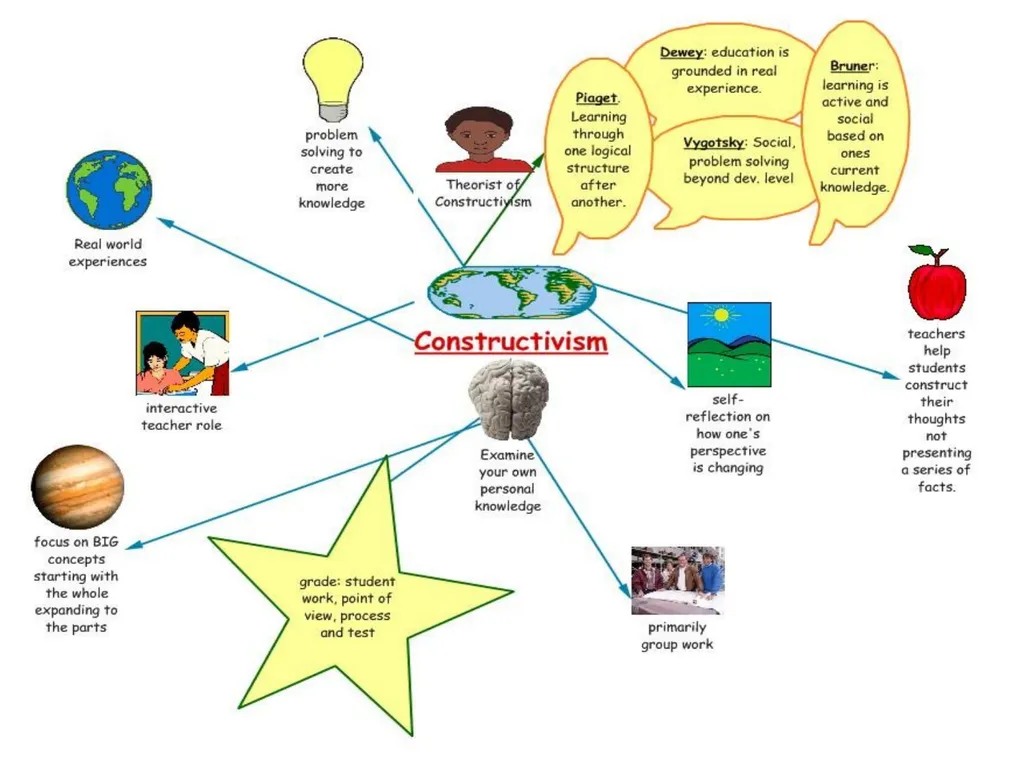
Description: Constructivism Indu.H Learning through real-world experiences with others allows students to grow and understand things more easily. Jean Piaget is considered one of the first constructivism theorists Constructivism says that people
Related Topics
Download Presentation
"Constructivism Indu.H Learning through real-world" is the property of its rightful owner. Permission is granted to download and print the materials on this website for personal, non-commercial use only, and to display it on your personal computer provided you do not modify the materials and that you retain all copyright notices contained in the materials. By downloading content from our website, you accept the terms of this agreement.
Presentation Transcript
slide1. Constructivism Indu.H<br>
slide2. Learning through real-world experiences with others allows students to grow and understand things more easily.<br>
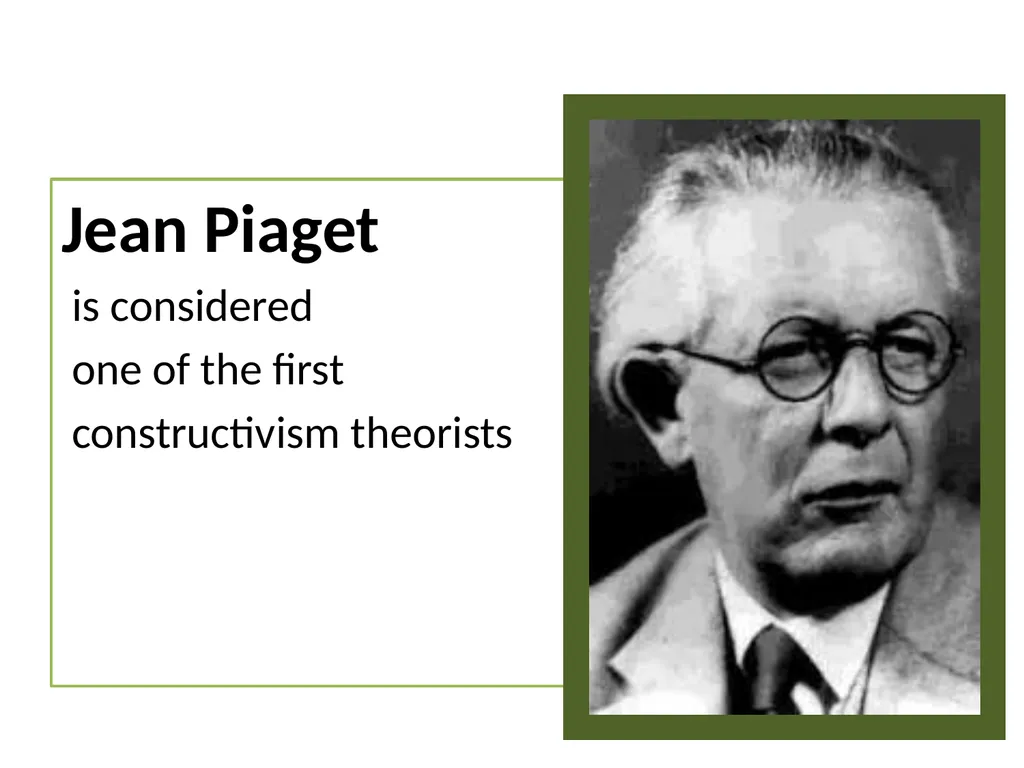
slide3. Jean Piaget
is considered
one of the first
constructivism theorists<br>
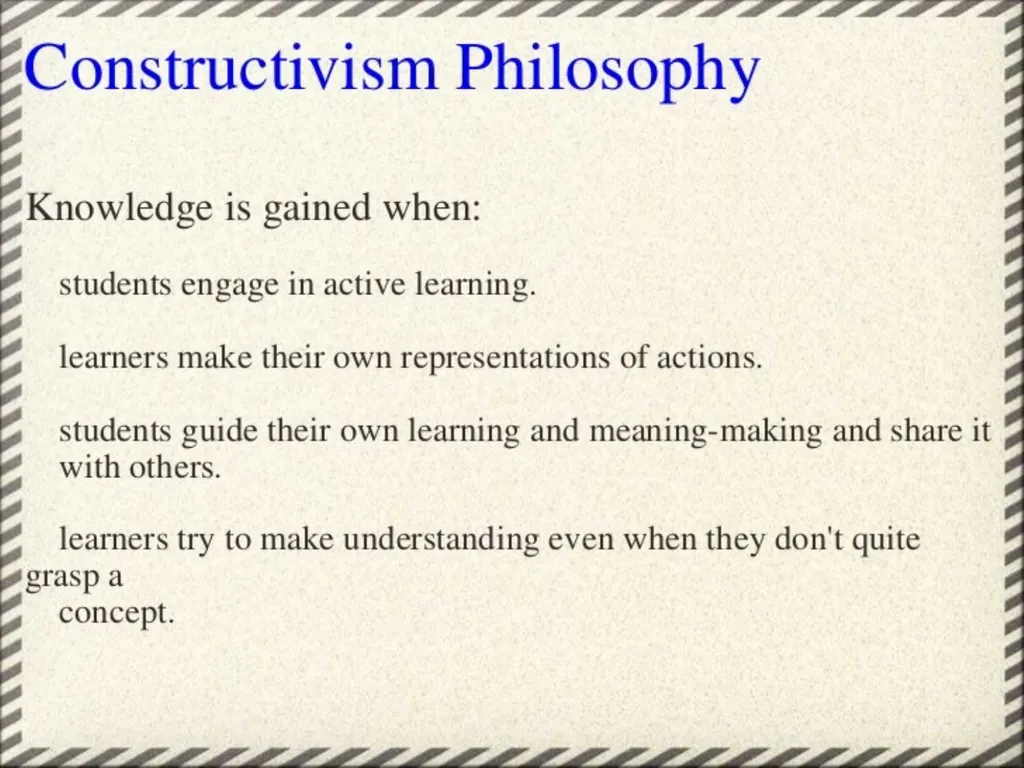
slide4. Constructivism says that people construct their own understanding and knowledge of the world, through experiencing things and reflecting on those experiences.<br>
slide5. It is a philosophy of education that says that people construct knowledge through their experiences and interactions with the world.
Essentially, it says that people learn through experience, not through hearing someone give a lecture.
For example, Meenu doesn't really understand physics when her teacher tries to explain it. But if she was faced with a physics problem in her everyday life (say, trying to figure out how hard to push on the gas pedal to get her car to accelerate up a steep hill), she might understand it better.<br>
slide6. Teaching philosophy based on the concept that learning (cognition) is the result of 'mental construction' - students construct their own understanding by reflecting on their personal experiences, and by relating the new knowledge with what they already know.
Each student creates his or her own 'schemas' or mental-models to make sense of the world, and accommodates the new knowledge (learns) by adjusting them. One of its main principles is that learning is search for meaning, therefore, to be effective, a teacher must help the student in discovering his or her own meaning. Although based on cognitive psychology research, its history goes back to the ancient Greece, the Socratic method.<br>
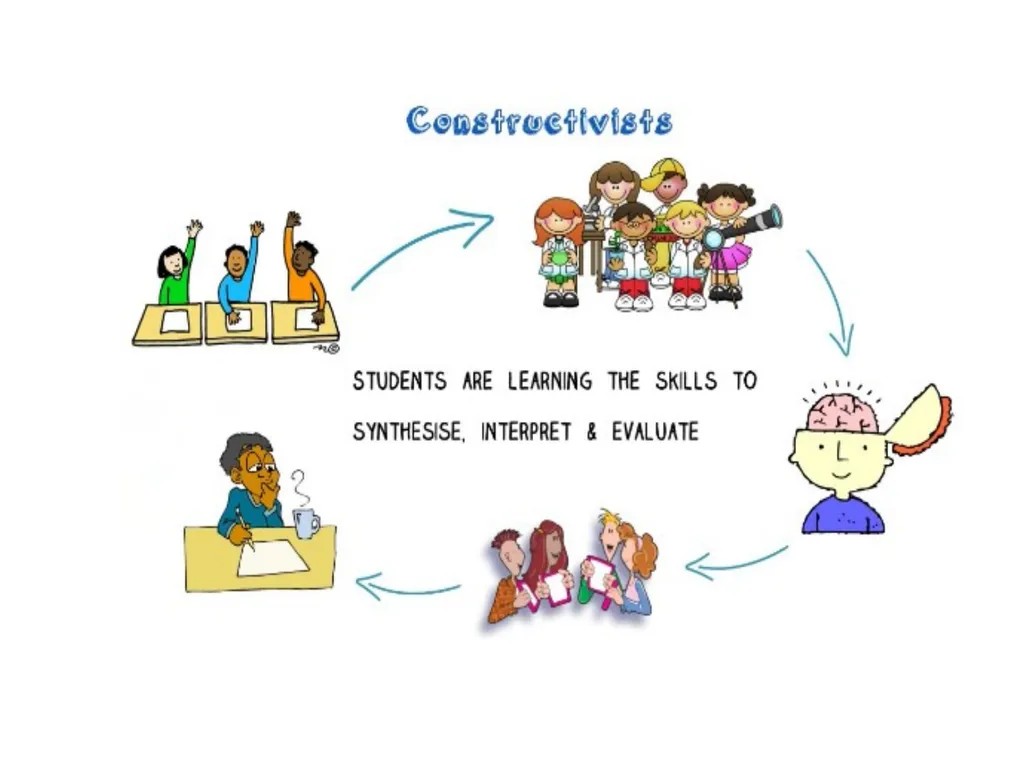
slide7. For example: Groups of students in a science class are discussing a problem in physics. Though the teacher knows the "answer" to the problem, she focuses on helping students restate their questions in useful ways. She prompts each student to reflect on and examine his or her current knowledge. When one of the students comes up with the relevant concept, the teacher seizes upon it, and indicates to the group that this might be a fruitful avenue for them to explore. They design and perform relevant experiments. Afterward, the students and teacher talk about what they have learned, and how their observations and experiments helped (or did not help) them to better understand the concept.<br>
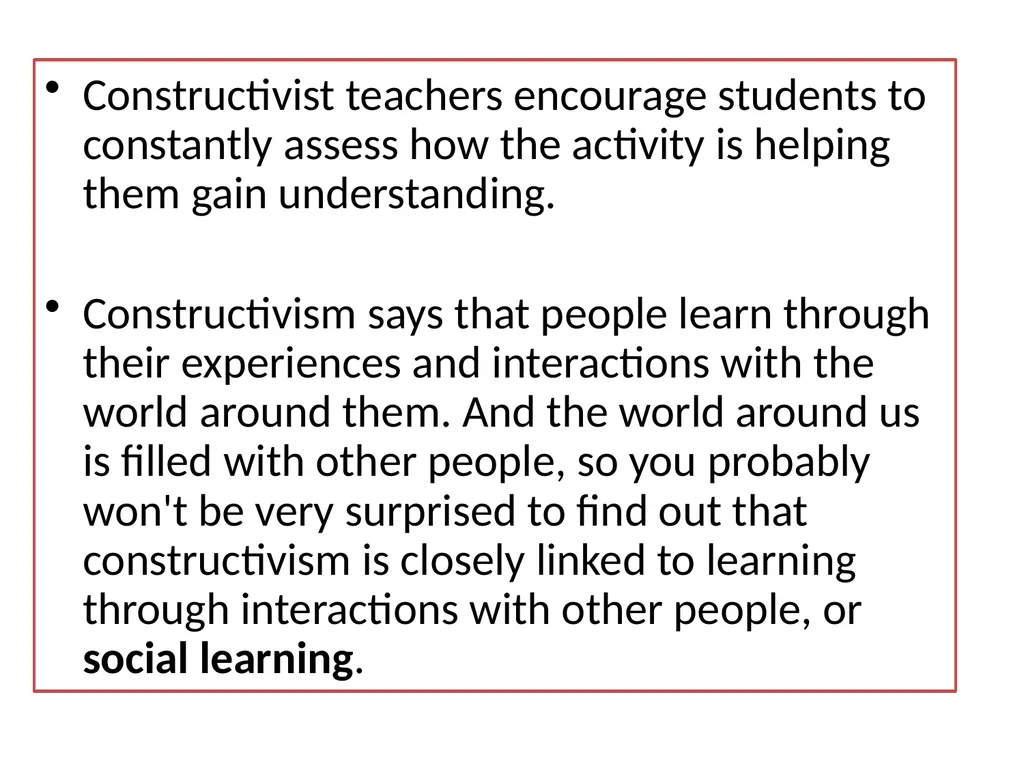
slide8. Constructivist teachers encourage students to constantly assess how the activity is helping them gain understanding.
Constructivism says that people learn through their experiences and interactions with the world around them. And the world around us is filled with other people, so you probably won't be very surprised to find out that constructivism is closely linked to learning through interactions with other people, or social learning.<br>
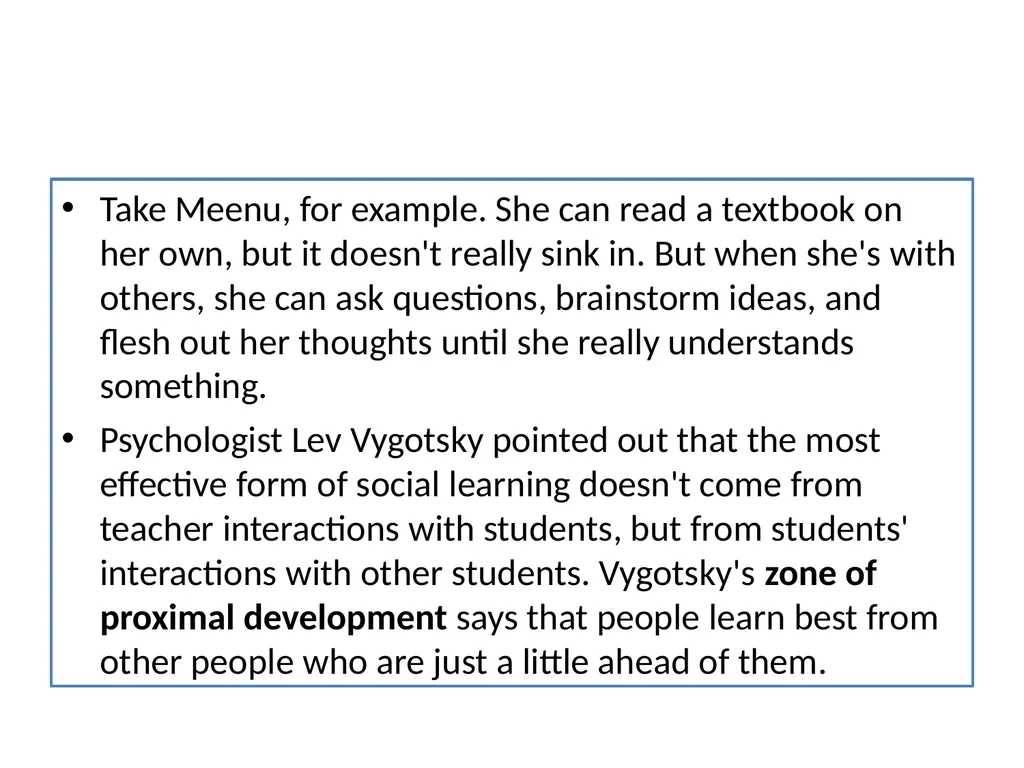
slide9. Take Meenu, for example. She can read a textbook on her own, but it doesn't really sink in. But when she's with others, she can ask questions, brainstorm ideas, and flesh out her thoughts until she really understands something.
Psychologist Lev Vygotsky pointed out that the most effective form of social learning doesn't come from teacher interactions with students, but from students' interactions with other students. Vygotsky's zone of proximal development says that people learn best from other people who are just a little ahead of them.<br>
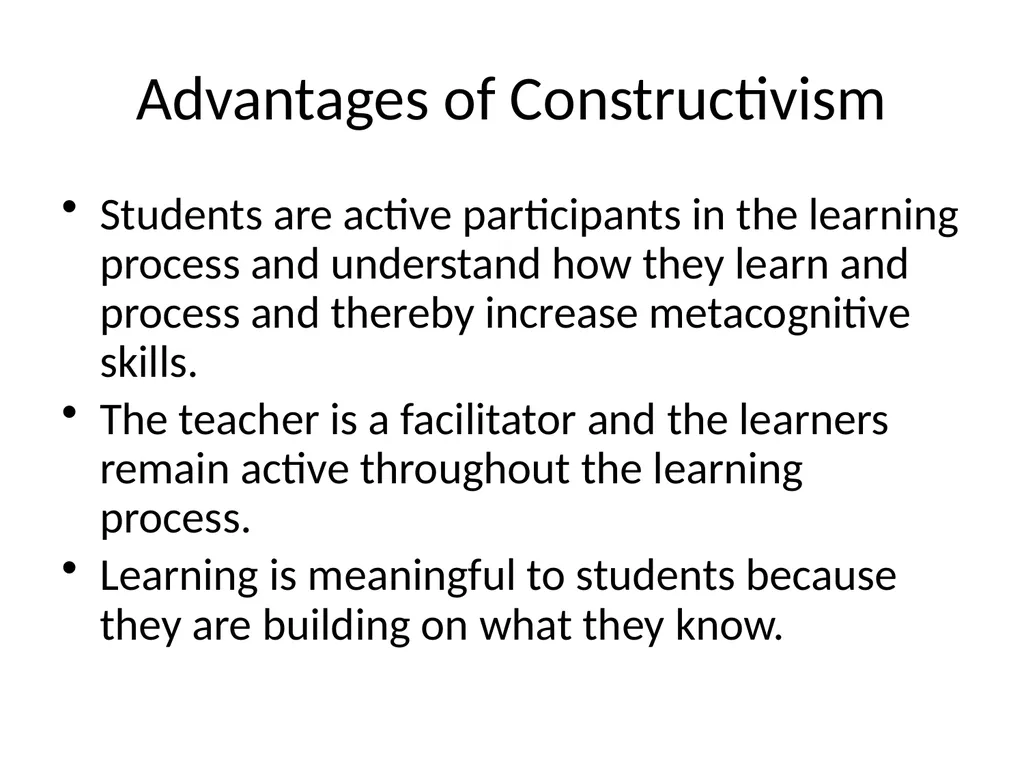
slide14. Advantages of Constructivism Students are active participants in the learning process and understand how they learn and process and thereby increase metacognitive skills.
The teacher is a facilitator and the learners remain active throughout the learning process.
Learning is meaningful to students because they are building on what they know.<br>
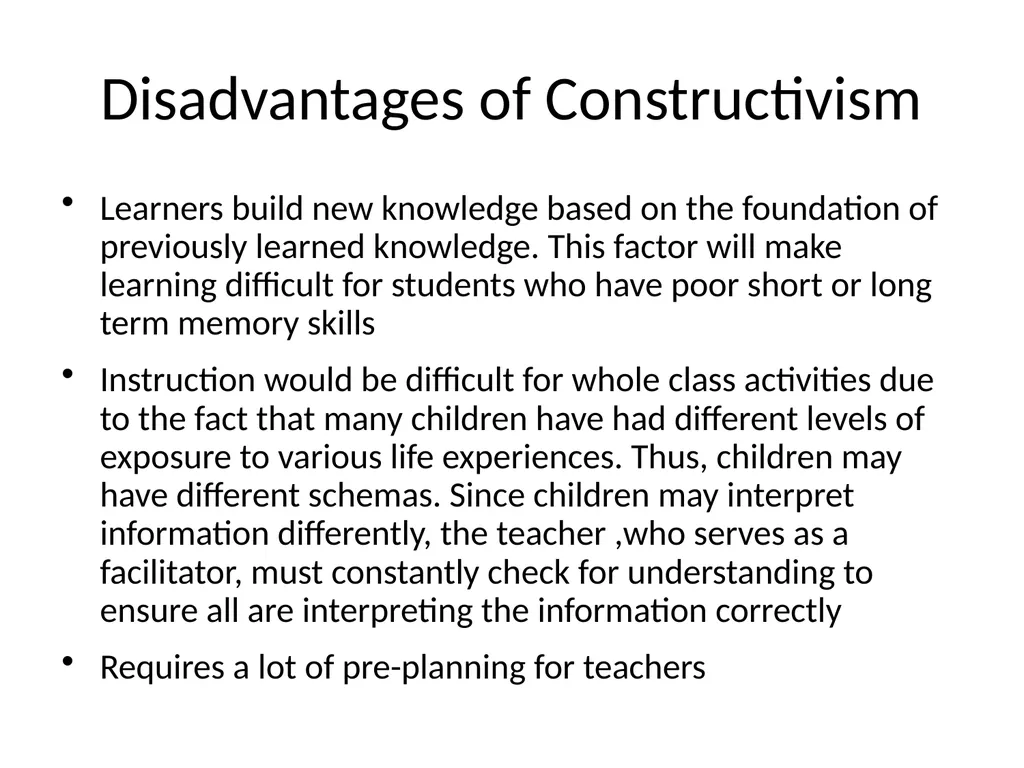
slide15. Disadvantages of Constructivism Learners build new knowledge based on the foundation of previously learned knowledge. This factor will make learning difficult for students who have poor short or long term memory skills
Instruction would be difficult for whole class activities due to the fact that many children have had different levels of exposure to various life experiences. Thus, children may have different schemas. Since children may interpret information differently, the teacher ,who serves as a facilitator, must constantly check for understanding to ensure all are interpreting the information correctly
Requires a lot of pre-planning for teachers<br>
slide2. Learning through real-world experiences with others allows students to grow and understand things more easily.<br>
slide3. Jean Piaget
is considered
one of the first
constructivism theorists<br>
slide4. Constructivism says that people construct their own understanding and knowledge of the world, through experiencing things and reflecting on those experiences.<br>
slide5. It is a philosophy of education that says that people construct knowledge through their experiences and interactions with the world.
Essentially, it says that people learn through experience, not through hearing someone give a lecture.
For example, Meenu doesn't really understand physics when her teacher tries to explain it. But if she was faced with a physics problem in her everyday life (say, trying to figure out how hard to push on the gas pedal to get her car to accelerate up a steep hill), she might understand it better.<br>
slide6. Teaching philosophy based on the concept that learning (cognition) is the result of 'mental construction' - students construct their own understanding by reflecting on their personal experiences, and by relating the new knowledge with what they already know.
Each student creates his or her own 'schemas' or mental-models to make sense of the world, and accommodates the new knowledge (learns) by adjusting them. One of its main principles is that learning is search for meaning, therefore, to be effective, a teacher must help the student in discovering his or her own meaning. Although based on cognitive psychology research, its history goes back to the ancient Greece, the Socratic method.<br>
slide7. For example: Groups of students in a science class are discussing a problem in physics. Though the teacher knows the "answer" to the problem, she focuses on helping students restate their questions in useful ways. She prompts each student to reflect on and examine his or her current knowledge. When one of the students comes up with the relevant concept, the teacher seizes upon it, and indicates to the group that this might be a fruitful avenue for them to explore. They design and perform relevant experiments. Afterward, the students and teacher talk about what they have learned, and how their observations and experiments helped (or did not help) them to better understand the concept.<br>
slide8. Constructivist teachers encourage students to constantly assess how the activity is helping them gain understanding.
Constructivism says that people learn through their experiences and interactions with the world around them. And the world around us is filled with other people, so you probably won't be very surprised to find out that constructivism is closely linked to learning through interactions with other people, or social learning.<br>
slide9. Take Meenu, for example. She can read a textbook on her own, but it doesn't really sink in. But when she's with others, she can ask questions, brainstorm ideas, and flesh out her thoughts until she really understands something.
Psychologist Lev Vygotsky pointed out that the most effective form of social learning doesn't come from teacher interactions with students, but from students' interactions with other students. Vygotsky's zone of proximal development says that people learn best from other people who are just a little ahead of them.<br>
slide14. Advantages of Constructivism Students are active participants in the learning process and understand how they learn and process and thereby increase metacognitive skills.
The teacher is a facilitator and the learners remain active throughout the learning process.
Learning is meaningful to students because they are building on what they know.<br>
slide15. Disadvantages of Constructivism Learners build new knowledge based on the foundation of previously learned knowledge. This factor will make learning difficult for students who have poor short or long term memory skills
Instruction would be difficult for whole class activities due to the fact that many children have had different levels of exposure to various life experiences. Thus, children may have different schemas. Since children may interpret information differently, the teacher ,who serves as a facilitator, must constantly check for understanding to ensure all are interpreting the information correctly
Requires a lot of pre-planning for teachers<br>