
Consumer Law 2021 Guiding Principles Consumer and
MJ
Published · 27 slides · 0 views

1 / 1


Description
Consumer Law 2021 Guiding Principles Consumer and debt collection issues exist in good economic times and in bad. All consumers have the right to be free from harassment in debt collection. All consumers have the right to make the choices
Related Topics
Share
Embed code
Download this presentation From Below
"Consumer Law 2021 Guiding Principles Consumer and" is the property of its rightful owner. Permission is granted to download and print the materials on this website for personal, non-commercial use only, and to display it on your personal computer provided you do not modify the materials and that you retain all copyright notices contained in the materials. By downloading content from our website, you accept the terms of this agreement.
Presentation Transcript
01
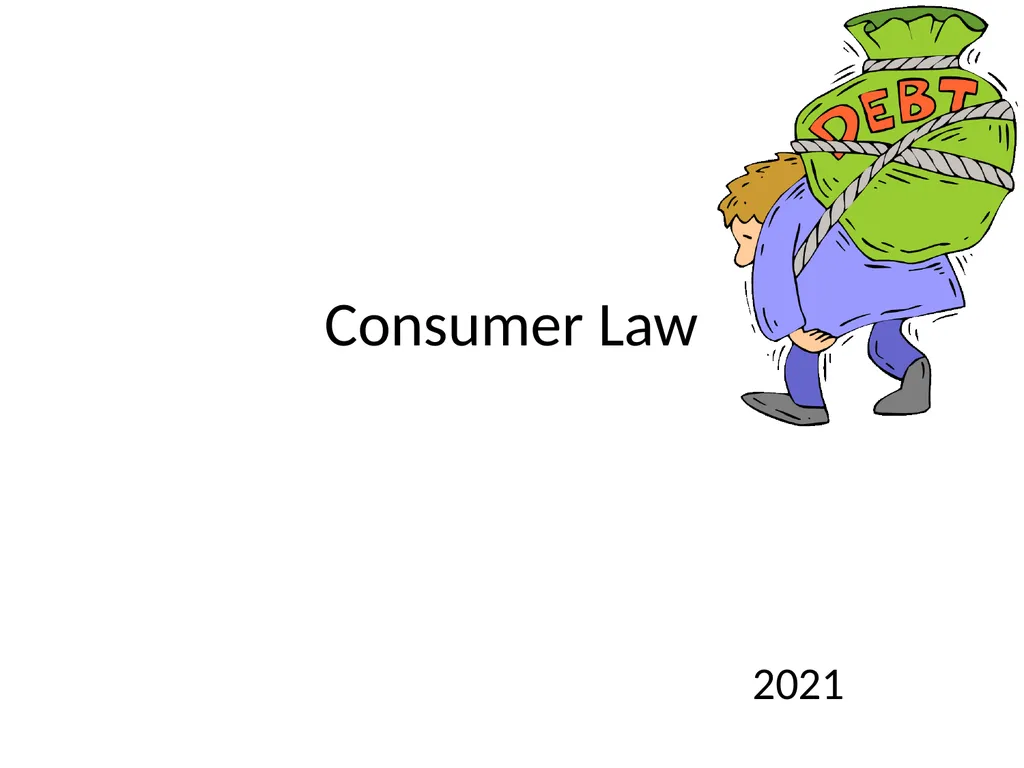
Consumer Law 2021<br>
02
Guiding Principles Consumer and debt collection issues exist in good economic times and in bad.
All consumers have the right to be free from harassment in debt collection.
All consumers have the right to make the choices that are best suited to their economic situation.<br>
All consumers have the right to be free from harassment in debt collection.
All consumers have the right to make the choices that are best suited to their economic situation.<br>
03
Role of EBS Assist in ghost-writing cease and desist letters
Encourage prioritization of debt
GWAAR will consider representing clients in small claims matters on a case-by-case basis. Contact your supervising attorney
Assistance with post-judgment financial disclosure forms upon discussions with your supervising attorney
Assist with discharge of student loan debt on basis of disability
Provide accurate information about legal processes and any local resources that might be able to help<br>
Encourage prioritization of debt
GWAAR will consider representing clients in small claims matters on a case-by-case basis. Contact your supervising attorney
Assistance with post-judgment financial disclosure forms upon discussions with your supervising attorney
Assist with discharge of student loan debt on basis of disability
Provide accurate information about legal processes and any local resources that might be able to help<br>
04
Key Terms Debtor: Individual who owes the debt. Spouses in Wisconsin are financially responsible for most debts of the other spouse.
Creditor: Person or entity to whom a debt is owed or who offers or extends credit creating a debt.
Secured Debt: Debt for which specific collateral has been pledged by the debtor.
Unsecured Debt: Debt for which no specific collateral has been pledged by the debtor.
Debt Collector: Any person or entity where the principal purpose is to collect debts or attempt to collect debts owed to another – includes law firms and third parties hired by creditors.
Judgment: Court order that requires payment of money or delivery of property to satisfy debt; enables creditor to force payment through various means.
Garnishment: Legal proceeding in which judgment creditor obtains court order to require a third party (bank or employer) to pay the creditor from the consumer’s income or account.<br>
Creditor: Person or entity to whom a debt is owed or who offers or extends credit creating a debt.
Secured Debt: Debt for which specific collateral has been pledged by the debtor.
Unsecured Debt: Debt for which no specific collateral has been pledged by the debtor.
Debt Collector: Any person or entity where the principal purpose is to collect debts or attempt to collect debts owed to another – includes law firms and third parties hired by creditors.
Judgment: Court order that requires payment of money or delivery of property to satisfy debt; enables creditor to force payment through various means.
Garnishment: Legal proceeding in which judgment creditor obtains court order to require a third party (bank or employer) to pay the creditor from the consumer’s income or account.<br>
05
Sources of Law - FDCPA Fair Debt Collection Practices Act (FDCPA) – Federal law governing communication and conduct of third-party debt collectors (not creditors) when collecting debts from consumers.
Prohibits debt collectors from using abusive, unfair or deceptive practices to collect from a consumer
If a consumer believes their rights under FDCPA have been violated (contact your supervising attorney) and a complaint may be filed with the Consumer Financial Protection Bureau and the Wisconsin Dept. of Financial Institutions<br>
Prohibits debt collectors from using abusive, unfair or deceptive practices to collect from a consumer
If a consumer believes their rights under FDCPA have been violated (contact your supervising attorney) and a complaint may be filed with the Consumer Financial Protection Bureau and the Wisconsin Dept. of Financial Institutions<br>
06
Sources of Law - WCA Wisconsin Consumer Act (WCA) – State law governing debt collection practices in Wisconsin. This law applies to debt collectors as well as creditors
Overlaps with FDCPA – prohibits harassing or abusive conduct
Applies to any entity attempting to collect a consumer debt<br>
Overlaps with FDCPA – prohibits harassing or abusive conduct
Applies to any entity attempting to collect a consumer debt<br>
07
Verifying Debt FDCPA: 30 days from initial notice from collection agency
After 30 days, agency assumes debt is valid & begins collection activity (does not mean that consumer admits liability)
If consumer request verification within 30 days, collections agency must cease collection until verification is mailed to consumer
No deadline for collection agency to respond<br>
After 30 days, agency assumes debt is valid & begins collection activity (does not mean that consumer admits liability)
If consumer request verification within 30 days, collections agency must cease collection until verification is mailed to consumer
No deadline for collection agency to respond<br>
08
Cease and Desist Letters Used to stop the calls and letters from debt collectors
After letter is sent, only communication can be that they are going to file a lawsuit
Best practice is to have an initial conversation with the collector to 1) verify the debt and 2) see if the debt can be resolved (payment plan, lump sum payment, etc.)<br>
After letter is sent, only communication can be that they are going to file a lawsuit
Best practice is to have an initial conversation with the collector to 1) verify the debt and 2) see if the debt can be resolved (payment plan, lump sum payment, etc.)<br>
09
Lawsuit Creditor may file a claim in court (small claims if $10k or less) in attempt to collect unpaid debt
Lawsuit is initiated when a complaint is filed with county courthouse
Debtor will be served with summons and complaint and have set amount of time to respond
Default judgment will be entered if debtor does not respond or show up at designate court date<br>
Lawsuit is initiated when a complaint is filed with county courthouse
Debtor will be served with summons and complaint and have set amount of time to respond
Default judgment will be entered if debtor does not respond or show up at designate court date<br>
10
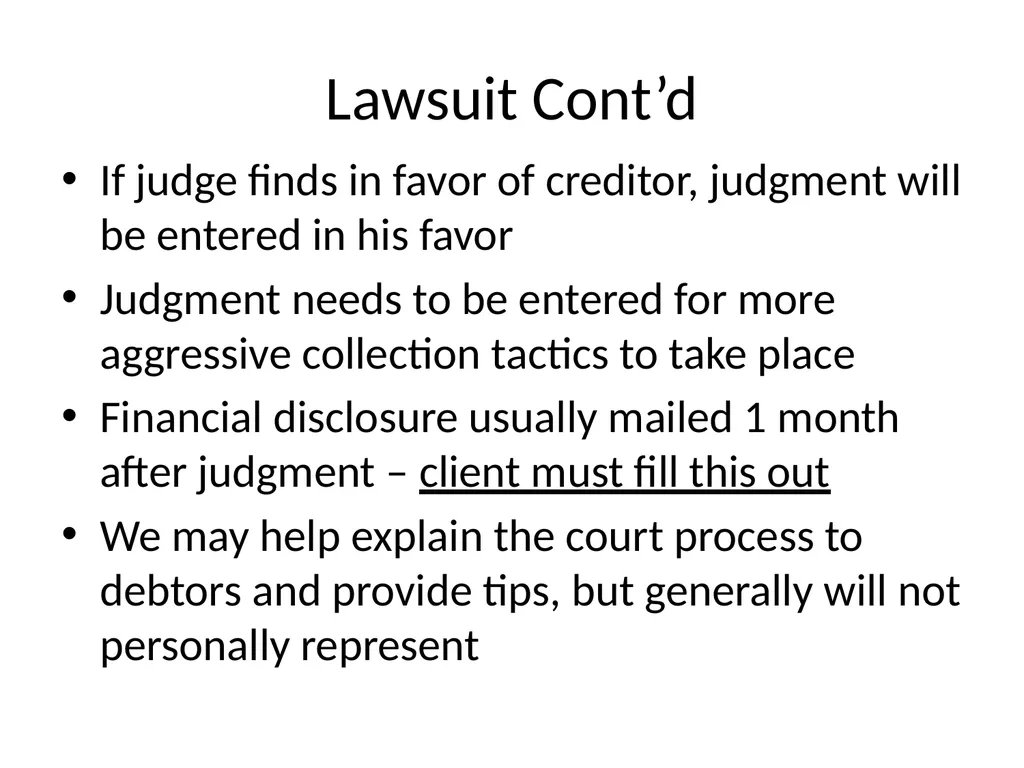
Lawsuit Cont’d If judge finds in favor of creditor, judgment will be entered in his favor
Judgment needs to be entered for more aggressive collection tactics to take place
Financial disclosure usually mailed 1 month after judgment – client must fill this out
We may help explain the court process to debtors and provide tips, but generally will not personally represent<br>
Judgment needs to be entered for more aggressive collection tactics to take place
Financial disclosure usually mailed 1 month after judgment – client must fill this out
We may help explain the court process to debtors and provide tips, but generally will not personally represent<br>
11
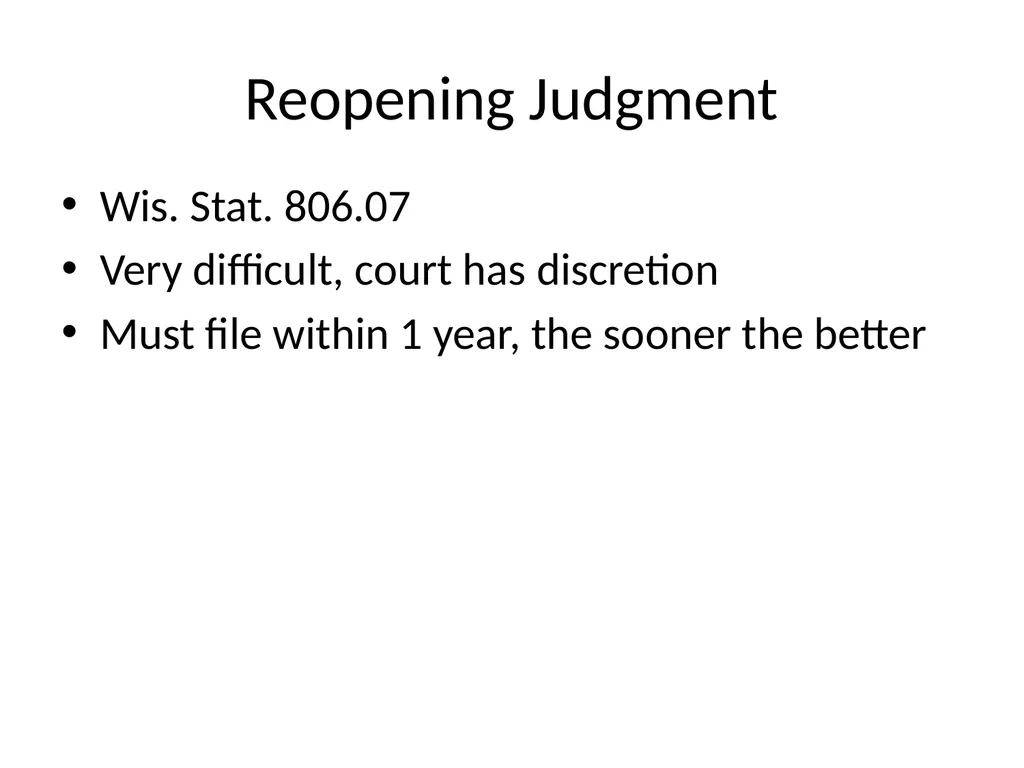
Reopening Judgment Wis. Stat. 806.07
Very difficult, court has discretion
Must file within 1 year, the sooner the better<br>
Very difficult, court has discretion
Must file within 1 year, the sooner the better<br>
12
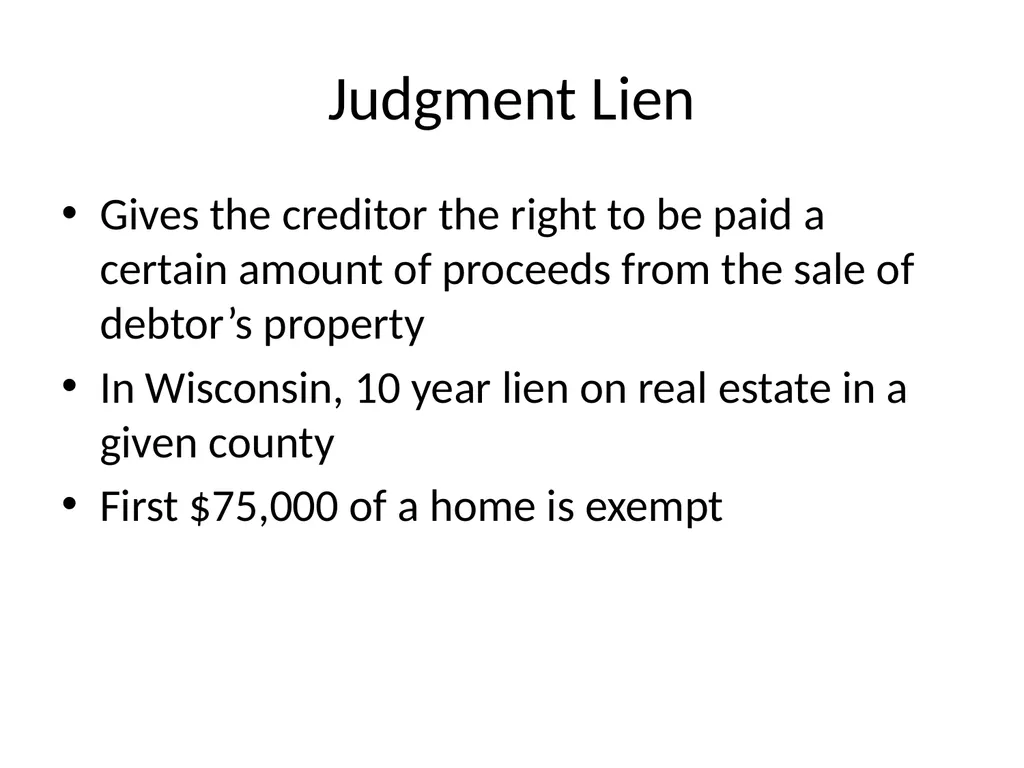
Judgment Lien Gives the creditor the right to be paid a certain amount of proceeds from the sale of debtor’s property
In Wisconsin, 10 year lien on real estate in a given county
First $75,000 of a home is exempt<br>
In Wisconsin, 10 year lien on real estate in a given county
First $75,000 of a home is exempt<br>
13
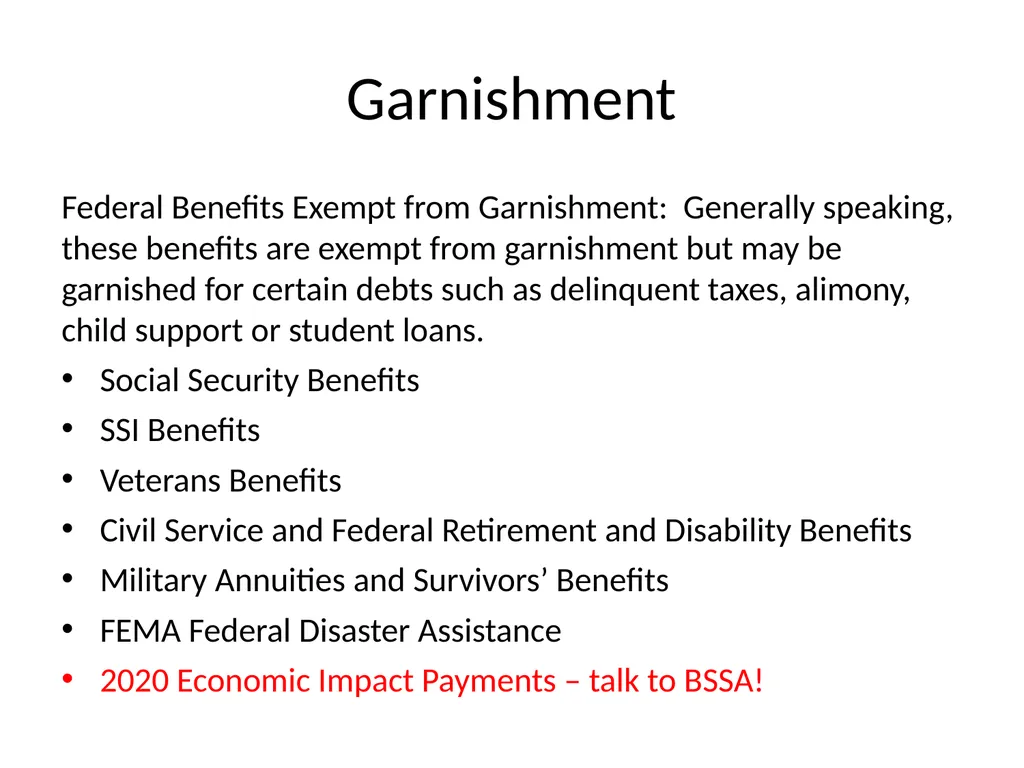
Garnishment Federal Benefits Exempt from Garnishment: Generally speaking, these benefits are exempt from garnishment but may be garnished for certain debts such as delinquent taxes, alimony, child support or student loans.
Social Security Benefits
SSI Benefits
Veterans Benefits
Civil Service and Federal Retirement and Disability Benefits
Military Annuities and Survivors’ Benefits
FEMA Federal Disaster Assistance
2020 Economic Impact Payments – talk to BSSA!<br>
Social Security Benefits
SSI Benefits
Veterans Benefits
Civil Service and Federal Retirement and Disability Benefits
Military Annuities and Survivors’ Benefits
FEMA Federal Disaster Assistance
2020 Economic Impact Payments – talk to BSSA!<br>
14
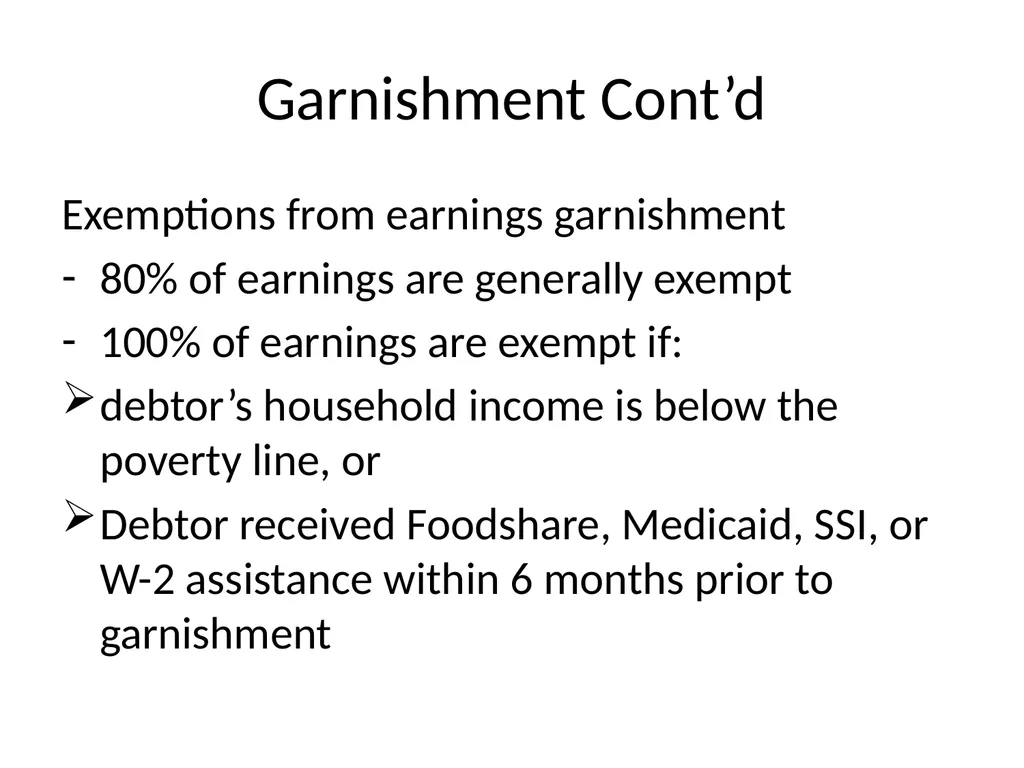
Garnishment Cont’d Exemptions from earnings garnishment
80% of earnings are generally exempt
100% of earnings are exempt if:
debtor’s household income is below the poverty line, or
Debtor received Foodshare, Medicaid, SSI, or W-2 assistance within 6 months prior to garnishment<br>
80% of earnings are generally exempt
100% of earnings are exempt if:
debtor’s household income is below the poverty line, or
Debtor received Foodshare, Medicaid, SSI, or W-2 assistance within 6 months prior to garnishment<br>
15
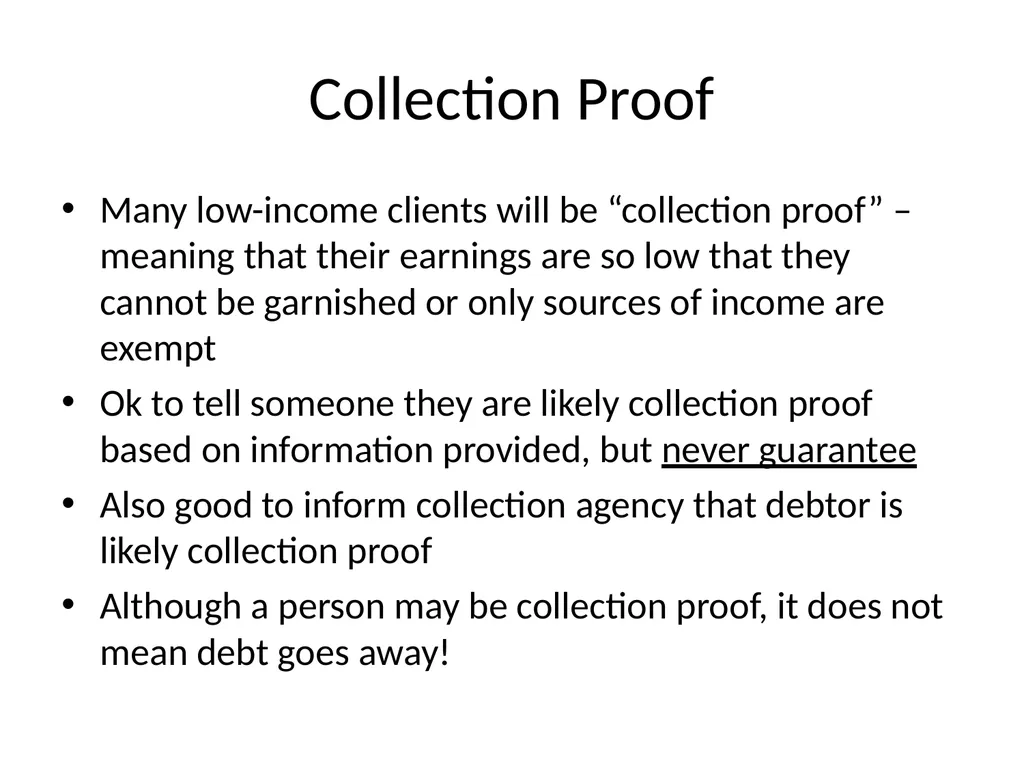
Collection Proof Many low-income clients will be “collection proof” – meaning that their earnings are so low that they cannot be garnished or only sources of income are exempt
Ok to tell someone they are likely collection proof based on information provided, but never guarantee
Also good to inform collection agency that debtor is likely collection proof
Although a person may be collection proof, it does not mean debt goes away!<br>
Ok to tell someone they are likely collection proof based on information provided, but never guarantee
Also good to inform collection agency that debtor is likely collection proof
Although a person may be collection proof, it does not mean debt goes away!<br>
16
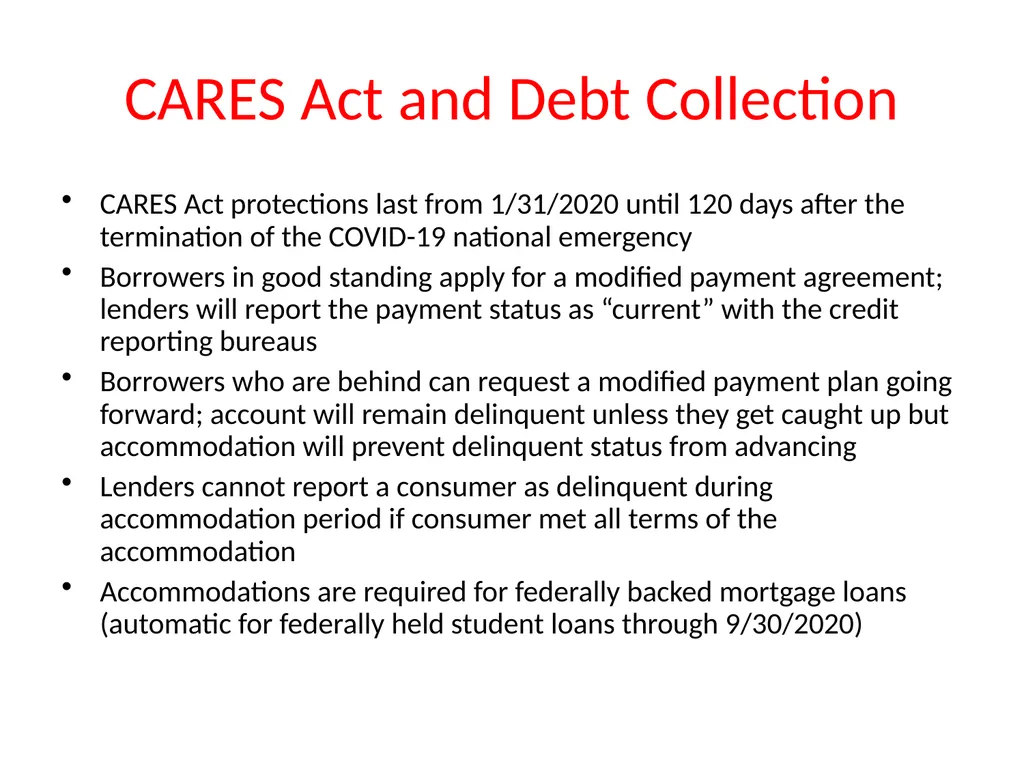
CARES Act and Debt Collection CARES Act protections last from 1/31/2020 until 120 days after the termination of the COVID-19 national emergency
Borrowers in good standing apply for a modified payment agreement; lenders will report the payment status as “current” with the credit reporting bureaus
Borrowers who are behind can request a modified payment plan going forward; account will remain delinquent unless they get caught up but accommodation will prevent delinquent status from advancing
Lenders cannot report a consumer as delinquent during accommodation period if consumer met all terms of the accommodation
Accommodations are required for federally backed mortgage loans (automatic for federally held student loans through 9/30/2020)<br>
Borrowers in good standing apply for a modified payment agreement; lenders will report the payment status as “current” with the credit reporting bureaus
Borrowers who are behind can request a modified payment plan going forward; account will remain delinquent unless they get caught up but accommodation will prevent delinquent status from advancing
Lenders cannot report a consumer as delinquent during accommodation period if consumer met all terms of the accommodation
Accommodations are required for federally backed mortgage loans (automatic for federally held student loans through 9/30/2020)<br>
17
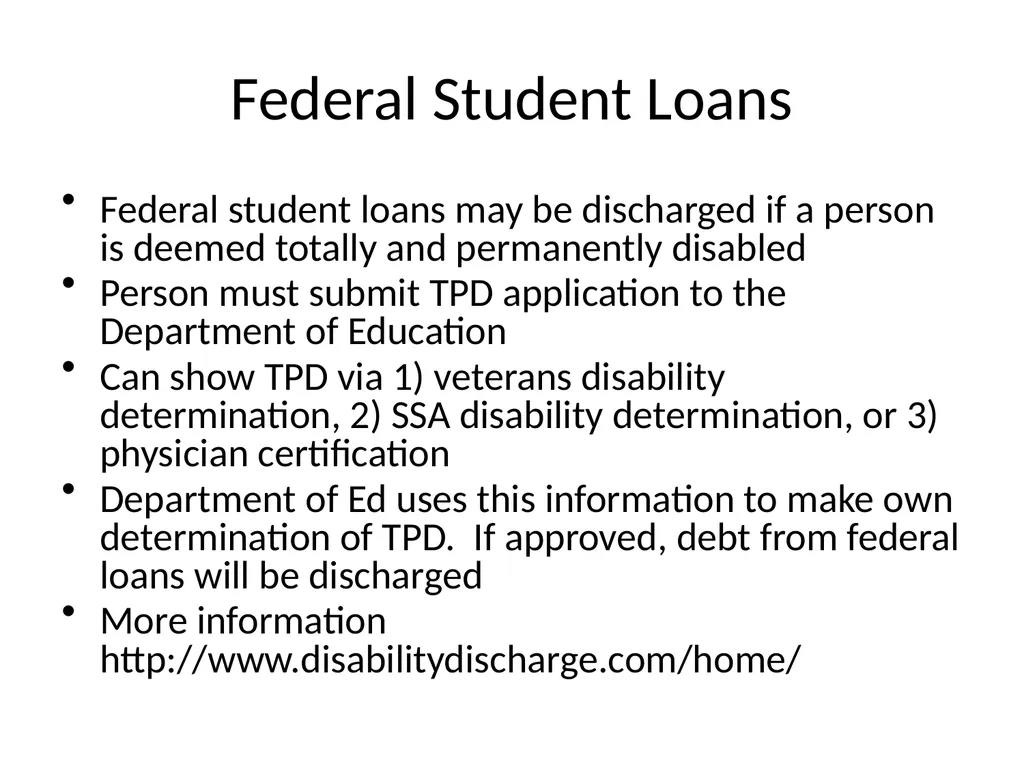
Federal Student Loans Federal student loans may be discharged if a person is deemed totally and permanently disabled
Person must submit TPD application to the Department of Education
Can show TPD via 1) veterans disability determination, 2) SSA disability determination, or 3) physician certification
Department of Ed uses this information to make own determination of TPD. If approved, debt from federal loans will be discharged
More information http://www.disabilitydischarge.com/home/<br>
Person must submit TPD application to the Department of Education
Can show TPD via 1) veterans disability determination, 2) SSA disability determination, or 3) physician certification
Department of Ed uses this information to make own determination of TPD. If approved, debt from federal loans will be discharged
More information http://www.disabilitydischarge.com/home/<br>
18
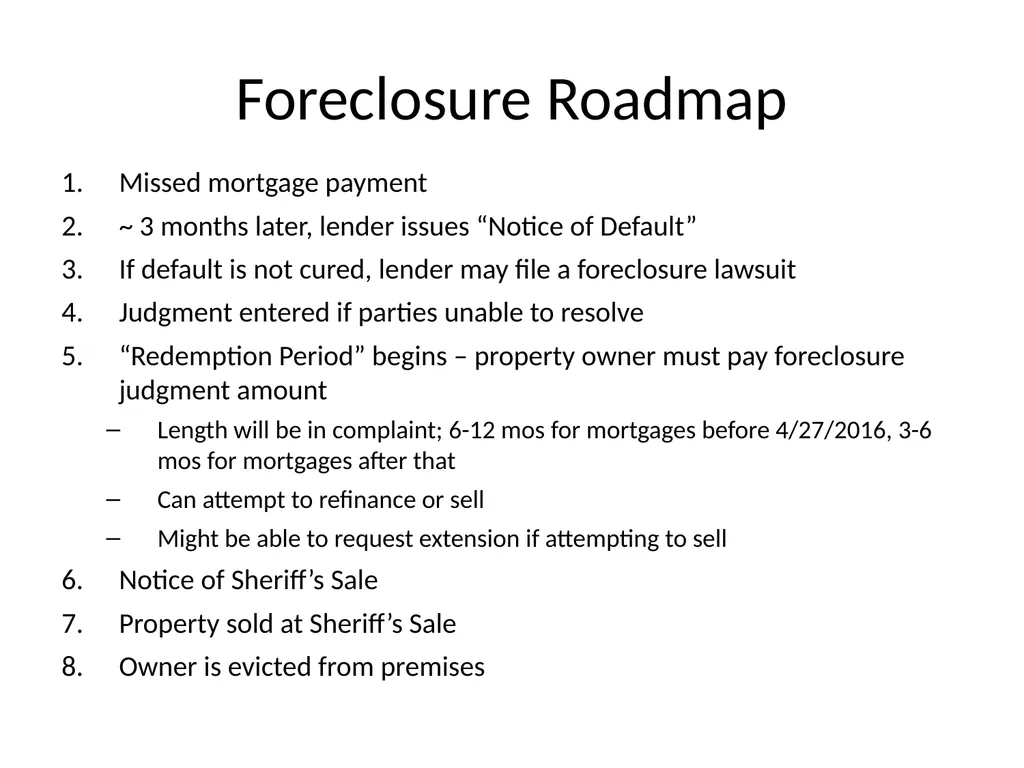
Foreclosure Roadmap Missed mortgage payment
~ 3 months later, lender issues “Notice of Default”
If default is not cured, lender may file a foreclosure lawsuit
Judgment entered if parties unable to resolve
“Redemption Period” begins – property owner must pay foreclosure judgment amount
Length will be in complaint; 6-12 mos for mortgages before 4/27/2016, 3-6 mos for mortgages after that
Can attempt to refinance or sell
Might be able to request extension if attempting to sell
Notice of Sheriff’s Sale
Property sold at Sheriff’s Sale
Owner is evicted from premises<br>
~ 3 months later, lender issues “Notice of Default”
If default is not cured, lender may file a foreclosure lawsuit
Judgment entered if parties unable to resolve
“Redemption Period” begins – property owner must pay foreclosure judgment amount
Length will be in complaint; 6-12 mos for mortgages before 4/27/2016, 3-6 mos for mortgages after that
Can attempt to refinance or sell
Might be able to request extension if attempting to sell
Notice of Sheriff’s Sale
Property sold at Sheriff’s Sale
Owner is evicted from premises<br>
19
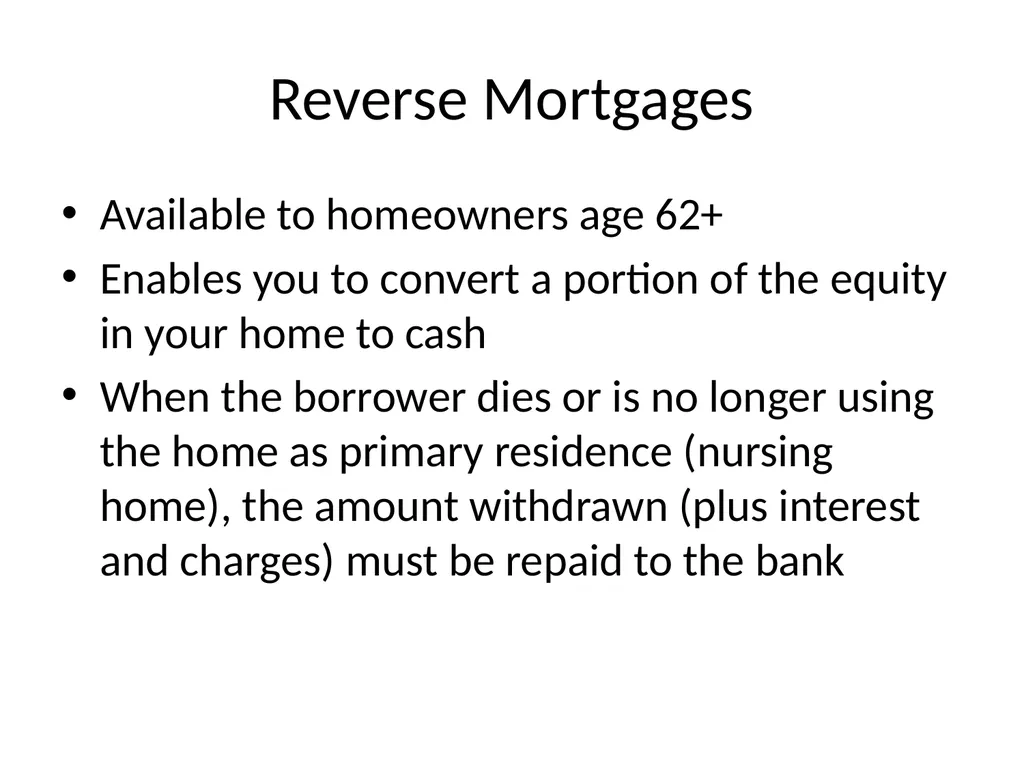
Reverse Mortgages Available to homeowners age 62+
Enables you to convert a portion of the equity in your home to cash
When the borrower dies or is no longer using the home as primary residence (nursing home), the amount withdrawn (plus interest and charges) must be repaid to the bank<br>
Enables you to convert a portion of the equity in your home to cash
When the borrower dies or is no longer using the home as primary residence (nursing home), the amount withdrawn (plus interest and charges) must be repaid to the bank<br>
20
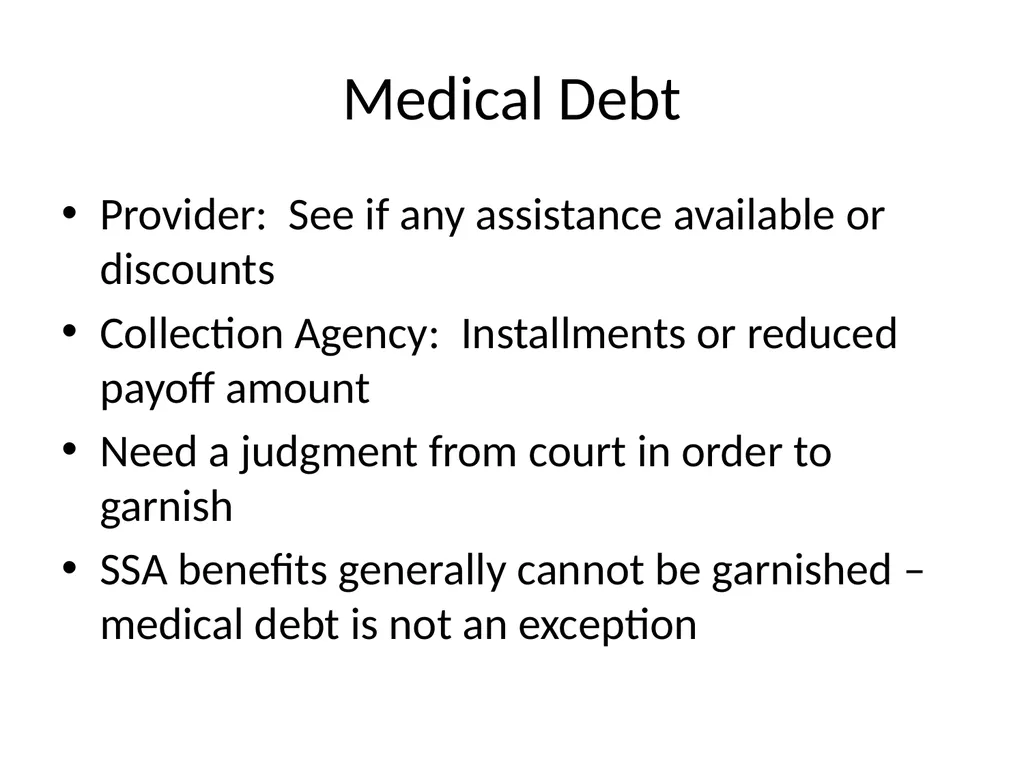
Medical Debt Provider: See if any assistance available or discounts
Collection Agency: Installments or reduced payoff amount
Need a judgment from court in order to garnish
SSA benefits generally cannot be garnished – medical debt is not an exception<br>
Collection Agency: Installments or reduced payoff amount
Need a judgment from court in order to garnish
SSA benefits generally cannot be garnished – medical debt is not an exception<br>
21
Scams<br>
22
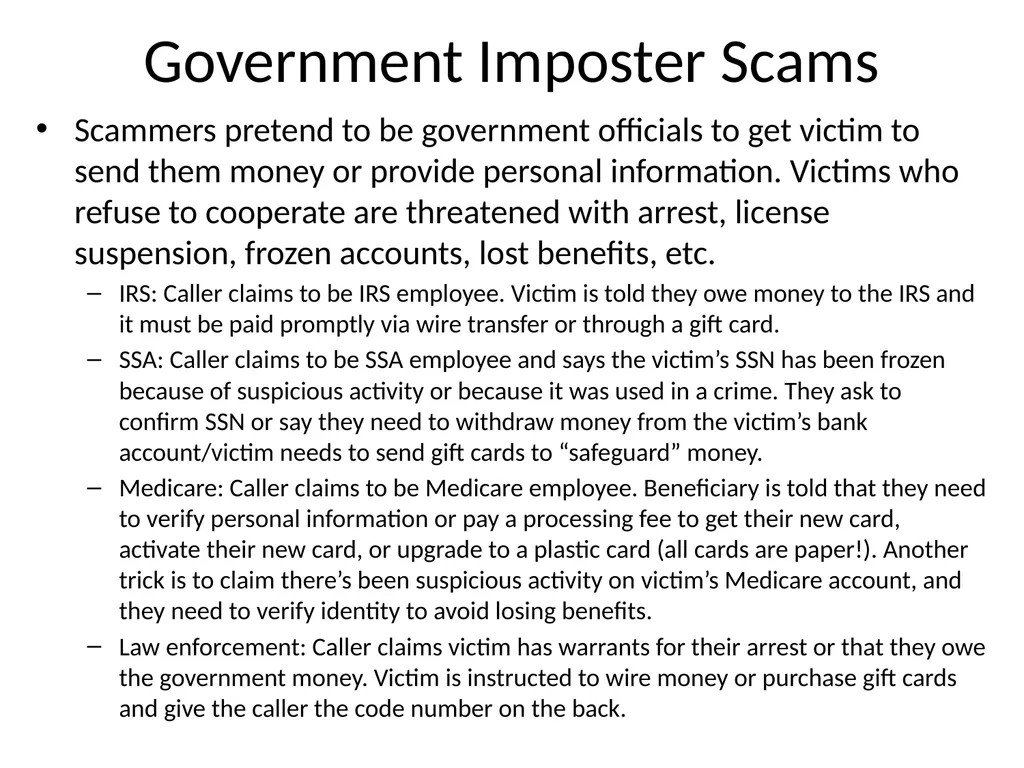
Government Imposter Scams Scammers pretend to be government officials to get victim to send them money or provide personal information. Victims who refuse to cooperate are threatened with arrest, license suspension, frozen accounts, lost benefits, etc.
IRS: Caller claims to be IRS employee. Victim is told they owe money to the IRS and it must be paid promptly via wire transfer or through a gift card.
SSA: Caller claims to be SSA employee and says the victim’s SSN has been frozen because of suspicious activity or because it was used in a crime. They ask to confirm SSN or say they need to withdraw money from the victim’s bank account/victim needs to send gift cards to “safeguard” money.
Medicare: Caller claims to be Medicare employee. Beneficiary is told that they need to verify personal information or pay a processing fee to get their new card, activate their new card, or upgrade to a plastic card (all cards are paper!). Another trick is to claim there’s been suspicious activity on victim’s Medicare account, and they need to verify identity to avoid losing benefits.
Law enforcement: Caller claims victim has warrants for their arrest or that they owe the government money. Victim is instructed to wire money or purchase gift cards and give the caller the code number on the back.<br>
IRS: Caller claims to be IRS employee. Victim is told they owe money to the IRS and it must be paid promptly via wire transfer or through a gift card.
SSA: Caller claims to be SSA employee and says the victim’s SSN has been frozen because of suspicious activity or because it was used in a crime. They ask to confirm SSN or say they need to withdraw money from the victim’s bank account/victim needs to send gift cards to “safeguard” money.
Medicare: Caller claims to be Medicare employee. Beneficiary is told that they need to verify personal information or pay a processing fee to get their new card, activate their new card, or upgrade to a plastic card (all cards are paper!). Another trick is to claim there’s been suspicious activity on victim’s Medicare account, and they need to verify identity to avoid losing benefits.
Law enforcement: Caller claims victim has warrants for their arrest or that they owe the government money. Victim is instructed to wire money or purchase gift cards and give the caller the code number on the back.<br>
23
Family Emergency Scams Scammers pose as relatives (grandchildren) or friends, calling or sending messages to ask you to send money immediately.
They’ll say they need cash to help with an emergency, like getting out of jail, paying a hospital bill, or needing to leave a foreign country.
The goal is to trick victims into sending money before they realize it’s a scam.<br>
They’ll say they need cash to help with an emergency, like getting out of jail, paying a hospital bill, or needing to leave a foreign country.
The goal is to trick victims into sending money before they realize it’s a scam.<br>
24
Tech Support Scams Phone call from someone claiming to be a computer technician or an internet pop-up message warning about non-existent computer problems (viruses, malware, hacking attempt, etc.)
Ask victim to give them remote access to his or her computer and then:
Install malware that gives them access to computer and sensitive data
Try to sell software or repair services that are worthless or available elsewhere for free
Try to enroll you in a worthless computer maintenance or warranty program
Ask for credit card information so they can bill for phony services or services available elsewhere for free
Direct victim to websites and ask them to enter credit card, bank account, or other personal information<br>
Ask victim to give them remote access to his or her computer and then:
Install malware that gives them access to computer and sensitive data
Try to sell software or repair services that are worthless or available elsewhere for free
Try to enroll you in a worthless computer maintenance or warranty program
Ask for credit card information so they can bill for phony services or services available elsewhere for free
Direct victim to websites and ask them to enter credit card, bank account, or other personal information<br>
25
Romance Scams Scammers use fake profiles on dating sites or social media sites to meet potential victims.
They usually say they’re living or traveling outside of the United States (work in construction or oil industry, in the military, a doctor with an international organization, etc.).
They build relationship with their targets to build their trust, sometimes talking or chatting several times a day – but never want to meet in person.
Eventually, they convince victims to send money.<br>
They usually say they’re living or traveling outside of the United States (work in construction or oil industry, in the military, a doctor with an international organization, etc.).
They build relationship with their targets to build their trust, sometimes talking or chatting several times a day – but never want to meet in person.
Eventually, they convince victims to send money.<br>
26
Reporting Scams Federal Trade Commission
https://www.ftccomplaintassistant.gov/#crnt&panel1-1
WI Dept. of Agriculture, Trade, & Consumer Protection
https://datcp.wi.gov/Pages/Programs_Services/FileConsumerComplaint.aspx
Local law enforcement<br>
https://www.ftccomplaintassistant.gov/#crnt&panel1-1
WI Dept. of Agriculture, Trade, & Consumer Protection
https://datcp.wi.gov/Pages/Programs_Services/FileConsumerComplaint.aspx
Local law enforcement<br>
27
Identity Theft Happens when someone steals victim’s personal information and uses it without your permission, can wreak havoc on a person’s finances and credit history.
Advice to Offer Victim of Identity Theft
Place an initial fraud alert: ask 1 of 3 credit reporting companies to put out a fraud alert on credit report. They must tell the other 2 companies and this will make it more difficult for the thief to open accounts in their name.
Order a credit report: This should be free (1) after an initial fraud alert is placed. (Free weekly through April 2021.)
Contact related businesses if person knows which accounts have been tampered with. Contact the fraud department of the business and follow-up with a certified letter.
Create an identity theft report with the Federal Trade Commission
Consider placing a free freeze on credit report – contact each credit reporting company<br>
Advice to Offer Victim of Identity Theft
Place an initial fraud alert: ask 1 of 3 credit reporting companies to put out a fraud alert on credit report. They must tell the other 2 companies and this will make it more difficult for the thief to open accounts in their name.
Order a credit report: This should be free (1) after an initial fraud alert is placed. (Free weekly through April 2021.)
Contact related businesses if person knows which accounts have been tampered with. Contact the fraud department of the business and follow-up with a certified letter.
Create an identity theft report with the Federal Trade Commission
Consider placing a free freeze on credit report – contact each credit reporting company<br>