
CONSUMER PROTECTION IN ZIMBABWE Presentation by



Description: CONSUMER PROTECTION IN ZIMBABWE Presentation by Miss R. Siyachitema Executive Director of the Consumer Council of Zimbabwe The formation of the Consumer Council of Zimbabwe can be traced as far back as 1955 and was spurred by economic
Related Topics
Download Presentation
"CONSUMER PROTECTION IN ZIMBABWE Presentation by" is the property of its rightful owner. Permission is granted to download and print the materials on this website for personal, non-commercial use only, and to display it on your personal computer provided you do not modify the materials and that you retain all copyright notices contained in the materials. By downloading content from our website, you accept the terms of this agreement.
Presentation Transcript
slide1. CONSUMER PROTECTION IN ZIMBABWE Presentation by Miss R. Siyachitema
Executive Director of the Consumer Council of Zimbabwe<br>
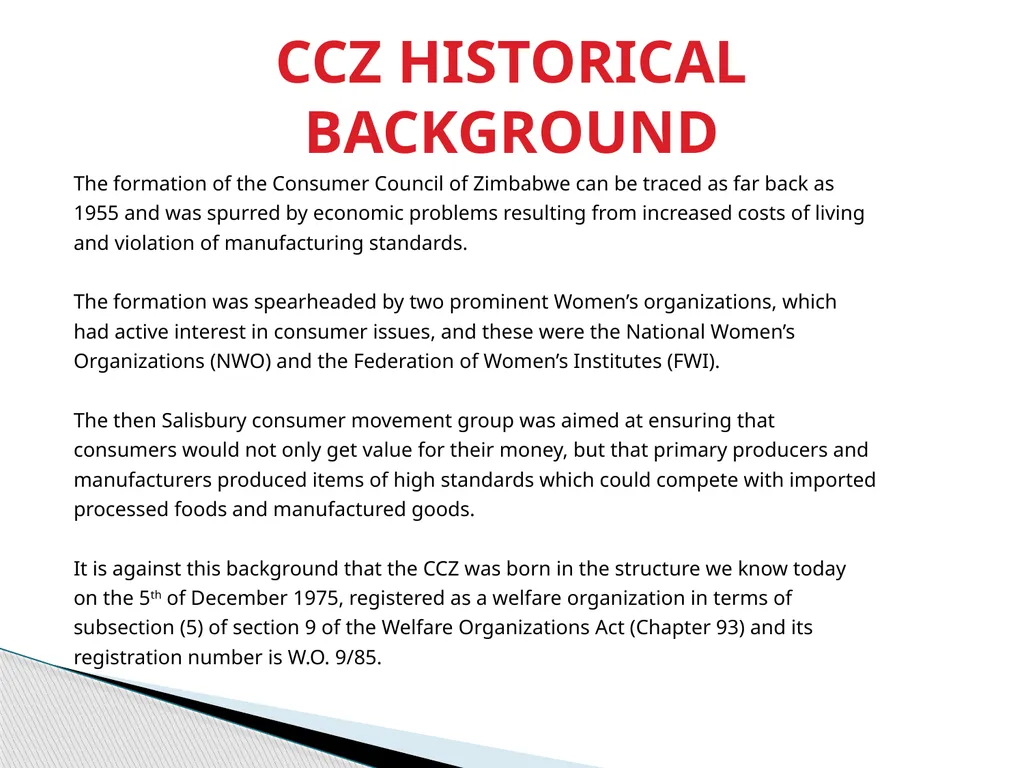
slide2. The formation of the Consumer Council of Zimbabwe can be traced as far back as
1955 and was spurred by economic problems resulting from increased costs of living
and violation of manufacturing standards.
The formation was spearheaded by two prominent Women’s organizations, which
had active interest in consumer issues, and these were the National Women’s
Organizations (NWO) and the Federation of Women’s Institutes (FWI).
The then Salisbury consumer movement group was aimed at ensuring that
consumers would not only get value for their money, but that primary producers and
manufacturers produced items of high standards which could compete with imported
processed foods and manufactured goods.
It is against this background that the CCZ was born in the structure we know today
on the 5th of December 1975, registered as a welfare organization in terms of
subsection (5) of section 9 of the Welfare Organizations Act (Chapter 93) and its
registration number is W.O. 9/85. CCZ HISTORICAL BACKGROUND<br>
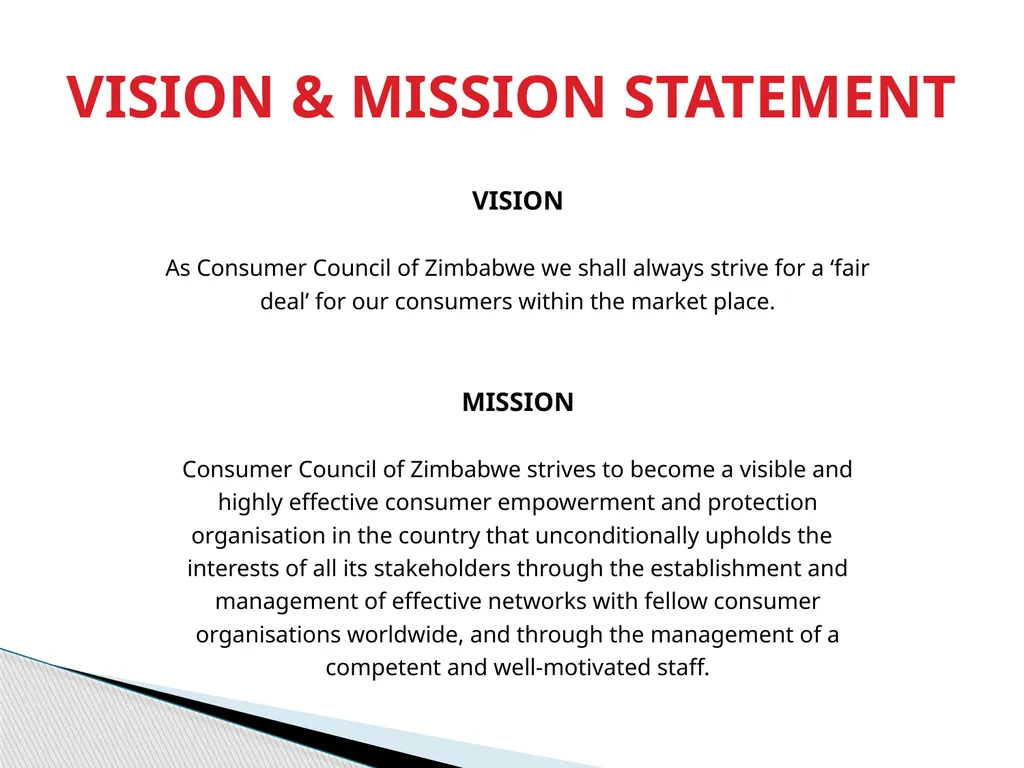
slide3. VISION
As Consumer Council of Zimbabwe we shall always strive for a ‘fair
deal’ for our consumers within the market place.
MISSION
Consumer Council of Zimbabwe strives to become a visible and
highly effective consumer empowerment and protection
organisation in the country that unconditionally upholds the
interests of all its stakeholders through the establishment and
management of effective networks with fellow consumer
organisations worldwide, and through the management of a
competent and well-motivated staff. VISION & MISSION STATEMENT<br>
slide4. The CCZ has successfully clamoured for the enactment
of legislation such as:
Consumer Contract Act
Competition Act
Class Action Act
Small Claims Court Act
Patients Charter
National Incomes and Pricing Commission Act (2007)
Currently, CCZ is in the forefront of pushing for the
Zimbabwe Consumer Protection Act. LEGISLATION<br>
slide5. “Consumers by definition, include us all,” Kennedy said in his congregational statement, ‘they are the largest economic group affecting and affected by almost every public and private economic decision. Yet they are the only important group.....whose views are often not heard’.
Over time, the consumer movement has developed this vision into a set of eight basic consumer rights that now define and inspire much of the work CCZ do. Who is a consumer?<br>
slide6. What we do
We work with our members and partners globally, to empower and champion the rights of consumers, and ensure they are treated safely, fairly and honestly.
There are eight basic consumer rights which define and determine our principles. You can also read about our work to protect and empower consumers everywhere.
With over 240 Member organisations in 120 countries, we are building a powerful international movement to help protect and empower consumers everywhere.
Founded in 1960, we are fighting for a fair, safe and sustainable future for all consumers in a global marketplace increasingly dominated by international corporations.
CI is a not-for-profit company limited by guarantee and registered in the UK (company no. 04337865). We are also a registered UK charity (no. 1122155). Consumers International<br>
slide7. World Consumer Rights Day is an annual occasion for celebration and solidarity within the international consumer movement. But more importantly it is a time for promoting the basic rights of all consumers, for demanding that those rights are respected and protected, and for protesting the market abuses and social injustices which undermine them.
World Consumer Rights Day was first observed on March 15, 1983, and has since become an important occasion for mobilizing citizen action. Consumer organizations, such as Consumer Council of Zimbabwe (CCZ), around the world use materials produced by Consumers International (CI), which is the worldwide federation of consumer organizations, representing over 230 agencies in 113 countries. Consumer organizations generate local initiatives and media coverage for their work over the coming year.
World Consumer Rights Day was established to promote the basic rights of consumers everywhere, on the 15th of March every year, the global consumer movement unites around a common theme to deliver exciting array of campaigning activities. WORLD CONSUMER RIGHTS DAY (wcrd)<br>
slide8. CCZ has celebrated WCRD since its inception and the following have been some of the
themes:
2003 – Corporate control of the food chain: the GM link
2004 – Consumers and Water
2005 – Call for Action on GMOs
2006 – Energy – Sustainable Access for All
2007 – Unethical Drug Promotion
2008 – Junk Food Generation
2009 – Junk Food Generation
2010 – Our Money, Our Rights
2011 – Consumers for fair financial services
2012 – Our Money, Our Rights (Campaigning for real choice in financial services)
2013 – Consumer Justice Now
2014 – Consumer Rights in the Digital Age - Fix our phone rights
2015 – Healthy Diets
2016 – Antibiotic Resistance
2017 – Building a Digital World Consumers can trust Wcrd themes<br>
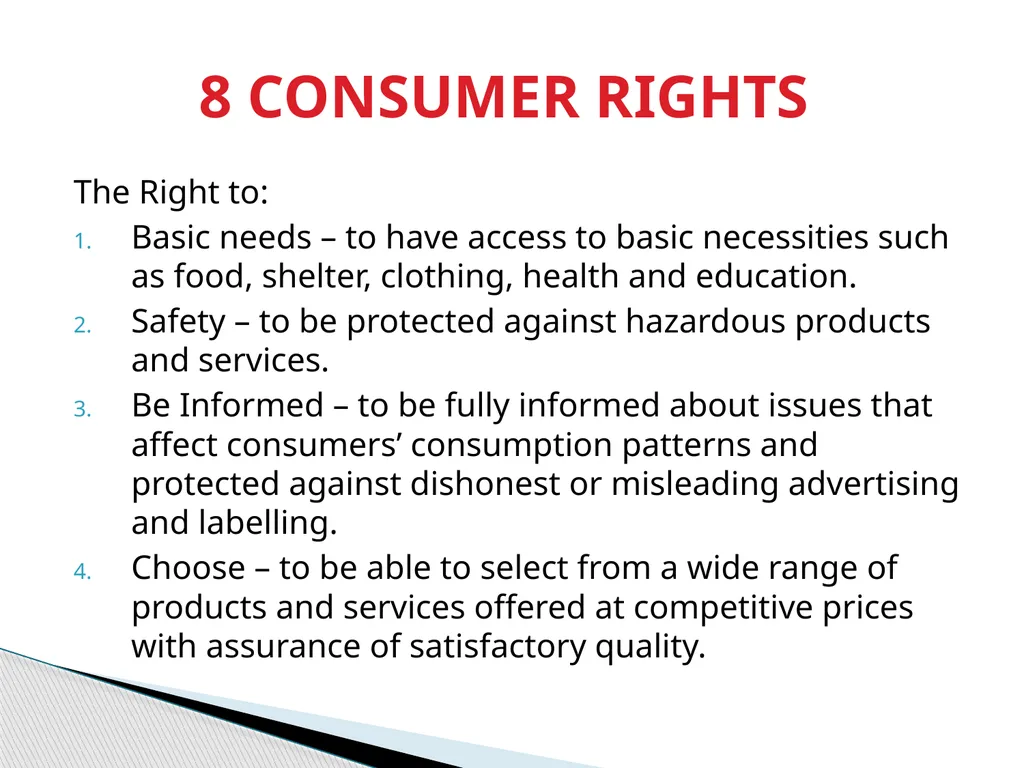
slide10. 8 CONSUMER RIGHTS The Right to:
Basic needs – to have access to basic necessities such as food, shelter, clothing, health and education.
Safety – to be protected against hazardous products and services.
Be Informed – to be fully informed about issues that affect consumers’ consumption patterns and protected against dishonest or misleading advertising and labelling.
Choose – to be able to select from a wide range of products and services offered at competitive prices with assurance of satisfactory quality.<br>
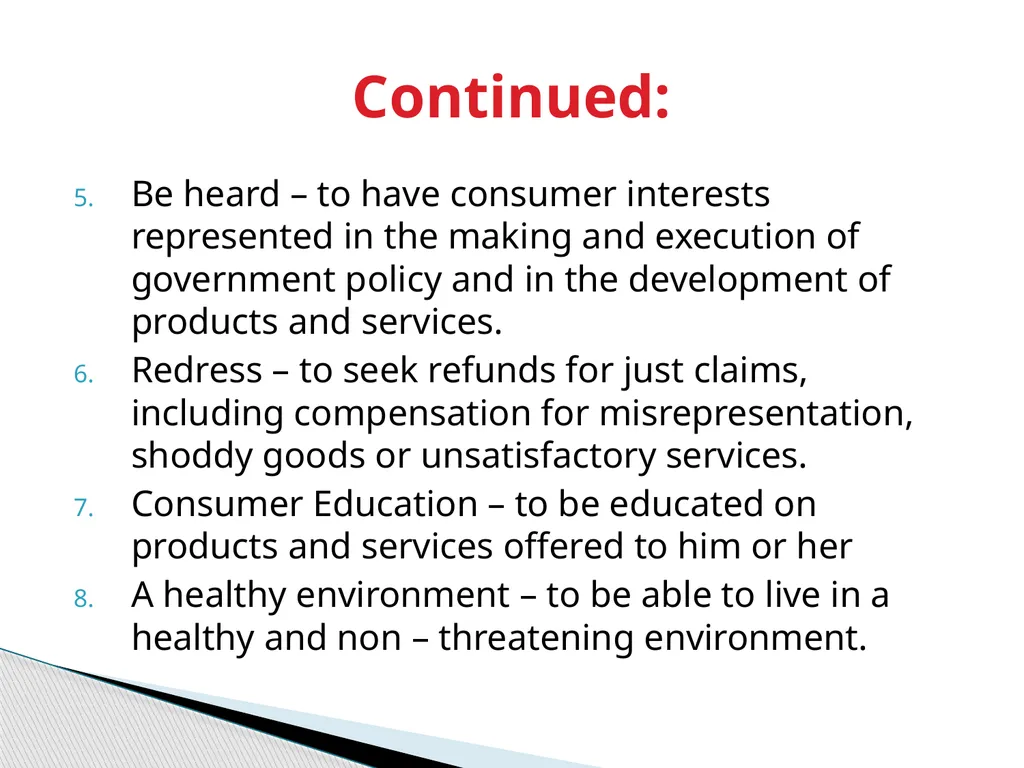
slide11. Be heard – to have consumer interests represented in the making and execution of government policy and in the development of products and services.
Redress – to seek refunds for just claims, including compensation for misrepresentation, shoddy goods or unsatisfactory services.
Consumer Education – to be educated on products and services offered to him or her
A healthy environment – to be able to live in a healthy and non – threatening environment. Continued:<br>
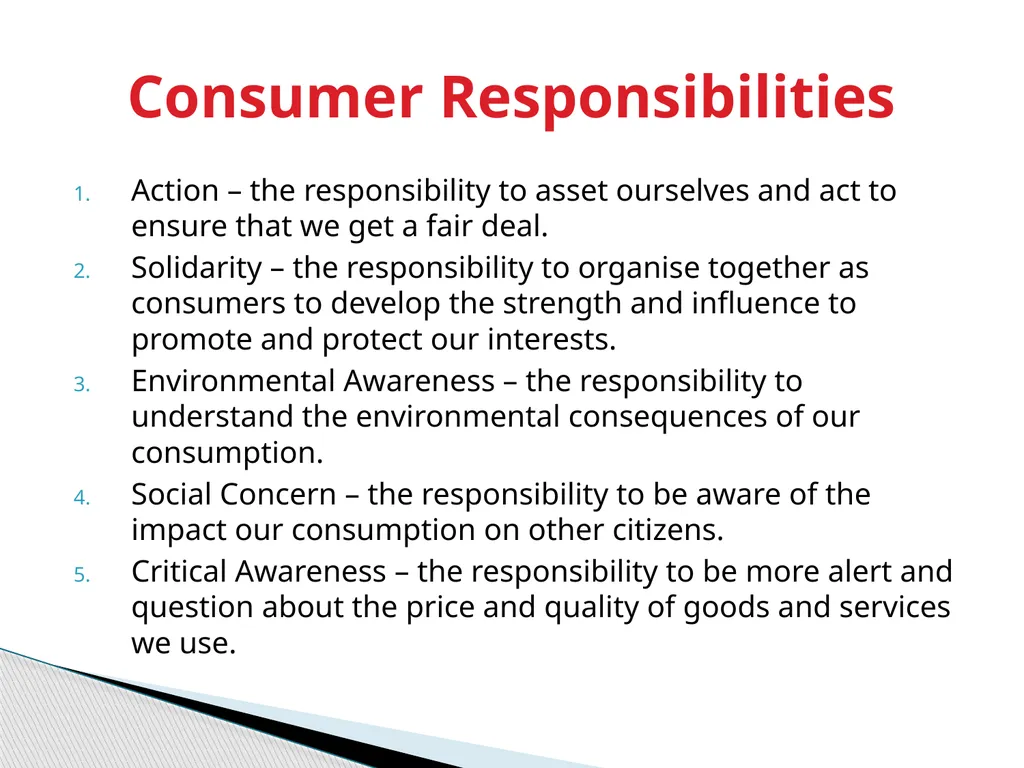
slide12. Action – the responsibility to asset ourselves and act to ensure that we get a fair deal.
Solidarity – the responsibility to organise together as consumers to develop the strength and influence to promote and protect our interests.
Environmental Awareness – the responsibility to understand the environmental consequences of our consumption.
Social Concern – the responsibility to be aware of the impact our consumption on other citizens.
Critical Awareness – the responsibility to be more alert and question about the price and quality of goods and services we use. Consumer Responsibilities<br>
slide13. Consumer education / Public Awareness Raising – entails education and information dissemination on consumer rights and responsibilities nationwide.
Complaints handling – involves receiving, advising and arbitrating on behalf of consumers on issues of unfair trade which includes the safety of consumer products.
Lobbying and Advocacy – making recommendations for amendments on existing or proposed new legislation, which may be considered to affect the consumer. Representing and or securing representation of consumer interests at all levels on appropriate organizations locally and internationally.
Research – involves conducting investigations on issues that affect, and are of interest to consumers, and publicizing for consumer information and policymaking. CORE PRIORITY AREAS<br>
slide14. Complaints Handling
Consumer Education
Networking
Lobbying and Advocacy
Research
Current Activities:
Focus Desks
Participation at ZITF and Agricultural Shows
Consumer Action Clubs
Radio Programmes
Joint Consumer Education with ZERA, ZETDC, RBZ and Nestle Zimbabwe FUNCTIONS OF THE CCZ<br>
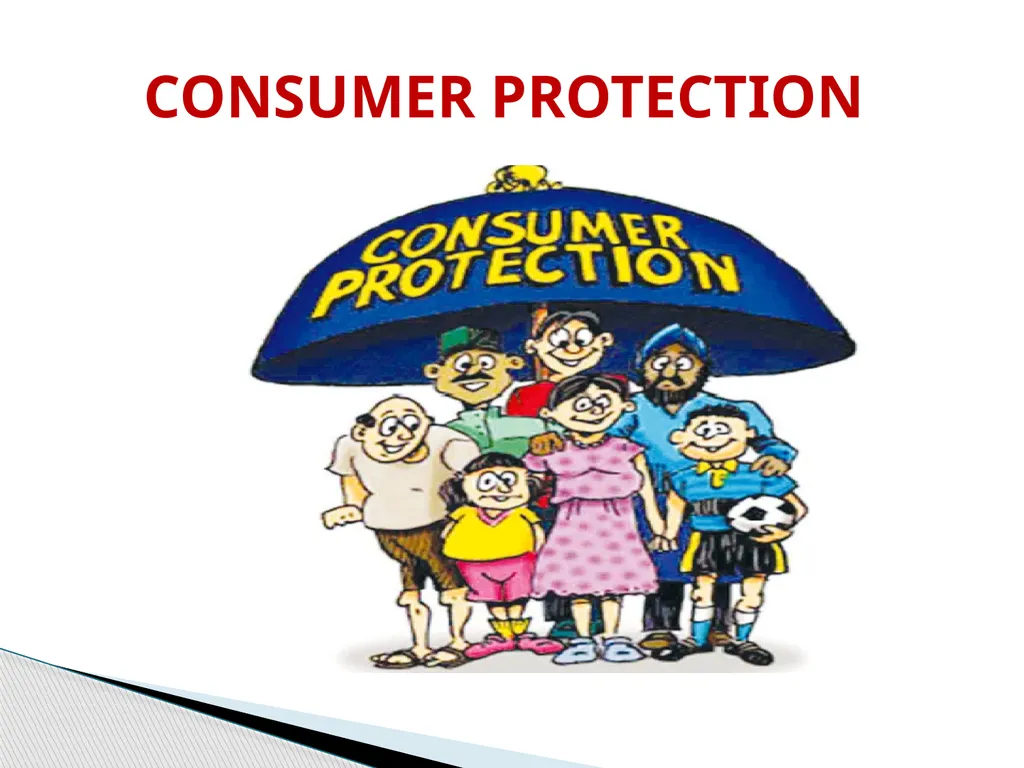
slide15. CONSUMER PROTECTION<br>
slide16. The UN Guidelines for consumer protection is a declaration of best practices in consumer protection law and policy.
The guidelines are not binding, but do provide a set of basic consumer protection objectives upon which governments have agreed, thereby serving as a policy framework for implementation at a national level.
Whilst directed primarily at governments, some provisions of the Guidelines are also directed at businesses. UN GUIDELINES ON CONSUMER PROTECTION - definition<br>
slide17. The CPA is meant to:
Be as comprehensive as possible to ensure that regulators, legislation and policy do not perennially play catch up
Create a platform wherein business practices operate from a standard in relation to consumer rights.
Be alive to the emerging markets and technologies with the view of protecting the consumer.
Encourage competition, while simultaneously discouraging market domination bordering on monopolies.
Pay particular attention to the services sector, ensuring that the sector adheres to consumer friendly modes of operation. the consumer protection ACT - Continued 17<br>
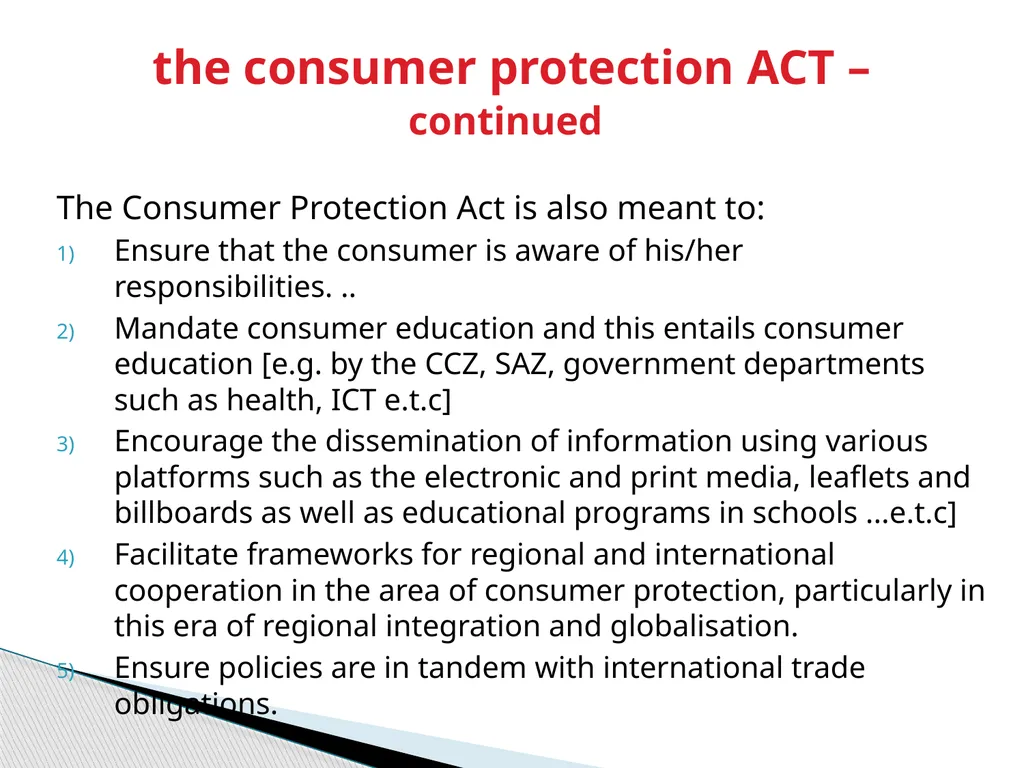
slide18. The Consumer Protection Act is also meant to:
Ensure that the consumer is aware of his/her responsibilities. ..
Mandate consumer education and this entails consumer education [e.g. by the CCZ, SAZ, government departments such as health, ICT e.t.c]
Encourage the dissemination of information using various platforms such as the electronic and print media, leaflets and billboards as well as educational programs in schools ...e.t.c]
Facilitate frameworks for regional and international cooperation in the area of consumer protection, particularly in this era of regional integration and globalisation.
Ensure policies are in tandem with international trade obligations. the consumer protection ACT – continued<br>
slide19. Thank you, Tatenda, Siyabonga
For further information visit our website and Facebook page
Our Offices
35 Rhodesville Road, Eastlea Harare
Telfax: 263 4 498441
E-mail: ccz2@mweb.co.zw<br>
Executive Director of the Consumer Council of Zimbabwe<br>
slide2. The formation of the Consumer Council of Zimbabwe can be traced as far back as
1955 and was spurred by economic problems resulting from increased costs of living
and violation of manufacturing standards.
The formation was spearheaded by two prominent Women’s organizations, which
had active interest in consumer issues, and these were the National Women’s
Organizations (NWO) and the Federation of Women’s Institutes (FWI).
The then Salisbury consumer movement group was aimed at ensuring that
consumers would not only get value for their money, but that primary producers and
manufacturers produced items of high standards which could compete with imported
processed foods and manufactured goods.
It is against this background that the CCZ was born in the structure we know today
on the 5th of December 1975, registered as a welfare organization in terms of
subsection (5) of section 9 of the Welfare Organizations Act (Chapter 93) and its
registration number is W.O. 9/85. CCZ HISTORICAL BACKGROUND<br>
slide3. VISION
As Consumer Council of Zimbabwe we shall always strive for a ‘fair
deal’ for our consumers within the market place.
MISSION
Consumer Council of Zimbabwe strives to become a visible and
highly effective consumer empowerment and protection
organisation in the country that unconditionally upholds the
interests of all its stakeholders through the establishment and
management of effective networks with fellow consumer
organisations worldwide, and through the management of a
competent and well-motivated staff. VISION & MISSION STATEMENT<br>
slide4. The CCZ has successfully clamoured for the enactment
of legislation such as:
Consumer Contract Act
Competition Act
Class Action Act
Small Claims Court Act
Patients Charter
National Incomes and Pricing Commission Act (2007)
Currently, CCZ is in the forefront of pushing for the
Zimbabwe Consumer Protection Act. LEGISLATION<br>
slide5. “Consumers by definition, include us all,” Kennedy said in his congregational statement, ‘they are the largest economic group affecting and affected by almost every public and private economic decision. Yet they are the only important group.....whose views are often not heard’.
Over time, the consumer movement has developed this vision into a set of eight basic consumer rights that now define and inspire much of the work CCZ do. Who is a consumer?<br>
slide6. What we do
We work with our members and partners globally, to empower and champion the rights of consumers, and ensure they are treated safely, fairly and honestly.
There are eight basic consumer rights which define and determine our principles. You can also read about our work to protect and empower consumers everywhere.
With over 240 Member organisations in 120 countries, we are building a powerful international movement to help protect and empower consumers everywhere.
Founded in 1960, we are fighting for a fair, safe and sustainable future for all consumers in a global marketplace increasingly dominated by international corporations.
CI is a not-for-profit company limited by guarantee and registered in the UK (company no. 04337865). We are also a registered UK charity (no. 1122155). Consumers International<br>
slide7. World Consumer Rights Day is an annual occasion for celebration and solidarity within the international consumer movement. But more importantly it is a time for promoting the basic rights of all consumers, for demanding that those rights are respected and protected, and for protesting the market abuses and social injustices which undermine them.
World Consumer Rights Day was first observed on March 15, 1983, and has since become an important occasion for mobilizing citizen action. Consumer organizations, such as Consumer Council of Zimbabwe (CCZ), around the world use materials produced by Consumers International (CI), which is the worldwide federation of consumer organizations, representing over 230 agencies in 113 countries. Consumer organizations generate local initiatives and media coverage for their work over the coming year.
World Consumer Rights Day was established to promote the basic rights of consumers everywhere, on the 15th of March every year, the global consumer movement unites around a common theme to deliver exciting array of campaigning activities. WORLD CONSUMER RIGHTS DAY (wcrd)<br>
slide8. CCZ has celebrated WCRD since its inception and the following have been some of the
themes:
2003 – Corporate control of the food chain: the GM link
2004 – Consumers and Water
2005 – Call for Action on GMOs
2006 – Energy – Sustainable Access for All
2007 – Unethical Drug Promotion
2008 – Junk Food Generation
2009 – Junk Food Generation
2010 – Our Money, Our Rights
2011 – Consumers for fair financial services
2012 – Our Money, Our Rights (Campaigning for real choice in financial services)
2013 – Consumer Justice Now
2014 – Consumer Rights in the Digital Age - Fix our phone rights
2015 – Healthy Diets
2016 – Antibiotic Resistance
2017 – Building a Digital World Consumers can trust Wcrd themes<br>
slide10. 8 CONSUMER RIGHTS The Right to:
Basic needs – to have access to basic necessities such as food, shelter, clothing, health and education.
Safety – to be protected against hazardous products and services.
Be Informed – to be fully informed about issues that affect consumers’ consumption patterns and protected against dishonest or misleading advertising and labelling.
Choose – to be able to select from a wide range of products and services offered at competitive prices with assurance of satisfactory quality.<br>
slide11. Be heard – to have consumer interests represented in the making and execution of government policy and in the development of products and services.
Redress – to seek refunds for just claims, including compensation for misrepresentation, shoddy goods or unsatisfactory services.
Consumer Education – to be educated on products and services offered to him or her
A healthy environment – to be able to live in a healthy and non – threatening environment. Continued:<br>
slide12. Action – the responsibility to asset ourselves and act to ensure that we get a fair deal.
Solidarity – the responsibility to organise together as consumers to develop the strength and influence to promote and protect our interests.
Environmental Awareness – the responsibility to understand the environmental consequences of our consumption.
Social Concern – the responsibility to be aware of the impact our consumption on other citizens.
Critical Awareness – the responsibility to be more alert and question about the price and quality of goods and services we use. Consumer Responsibilities<br>
slide13. Consumer education / Public Awareness Raising – entails education and information dissemination on consumer rights and responsibilities nationwide.
Complaints handling – involves receiving, advising and arbitrating on behalf of consumers on issues of unfair trade which includes the safety of consumer products.
Lobbying and Advocacy – making recommendations for amendments on existing or proposed new legislation, which may be considered to affect the consumer. Representing and or securing representation of consumer interests at all levels on appropriate organizations locally and internationally.
Research – involves conducting investigations on issues that affect, and are of interest to consumers, and publicizing for consumer information and policymaking. CORE PRIORITY AREAS<br>
slide14. Complaints Handling
Consumer Education
Networking
Lobbying and Advocacy
Research
Current Activities:
Focus Desks
Participation at ZITF and Agricultural Shows
Consumer Action Clubs
Radio Programmes
Joint Consumer Education with ZERA, ZETDC, RBZ and Nestle Zimbabwe FUNCTIONS OF THE CCZ<br>
slide15. CONSUMER PROTECTION<br>
slide16. The UN Guidelines for consumer protection is a declaration of best practices in consumer protection law and policy.
The guidelines are not binding, but do provide a set of basic consumer protection objectives upon which governments have agreed, thereby serving as a policy framework for implementation at a national level.
Whilst directed primarily at governments, some provisions of the Guidelines are also directed at businesses. UN GUIDELINES ON CONSUMER PROTECTION - definition<br>
slide17. The CPA is meant to:
Be as comprehensive as possible to ensure that regulators, legislation and policy do not perennially play catch up
Create a platform wherein business practices operate from a standard in relation to consumer rights.
Be alive to the emerging markets and technologies with the view of protecting the consumer.
Encourage competition, while simultaneously discouraging market domination bordering on monopolies.
Pay particular attention to the services sector, ensuring that the sector adheres to consumer friendly modes of operation. the consumer protection ACT - Continued 17<br>
slide18. The Consumer Protection Act is also meant to:
Ensure that the consumer is aware of his/her responsibilities. ..
Mandate consumer education and this entails consumer education [e.g. by the CCZ, SAZ, government departments such as health, ICT e.t.c]
Encourage the dissemination of information using various platforms such as the electronic and print media, leaflets and billboards as well as educational programs in schools ...e.t.c]
Facilitate frameworks for regional and international cooperation in the area of consumer protection, particularly in this era of regional integration and globalisation.
Ensure policies are in tandem with international trade obligations. the consumer protection ACT – continued<br>
slide19. Thank you, Tatenda, Siyabonga
For further information visit our website and Facebook page
Our Offices
35 Rhodesville Road, Eastlea Harare
Telfax: 263 4 498441
E-mail: ccz2@mweb.co.zw<br>