
Contact: LearningLab@learningforaction.com Equity
Description: Contact: LearningLablearningforaction.com Equity Learning Lab Feb 2021 Organizational Equity Reflection Tool Developed by Learning for Action and Public Equity Group With funding from Robert Wood Johnson Foundation This document is
Related Topics
Download Presentation
"Contact: LearningLab@learningforaction.com Equity" is the property of its rightful owner. Permission is granted to download and print the materials on this website for personal, non-commercial use only, and to display it on your personal computer provided you do not modify the materials and that you retain all copyright notices contained in the materials. By downloading content from our website, you accept the terms of this agreement.
Presentation Transcript
slide1. Contact: LearningLab@learningforaction.com Equity Learning Lab Feb 2021 Organizational Equity Reflection Tool Developed by
Learning for Action and Public Equity Group With funding from Robert Wood Johnson Foundation This document is licensed under a Creative Commons Attribution-No Derivatives 4.0 International License. We grant permission for the distribution and reproduction of copies of this material in its entirety with original attribution.<br>
slide2. 2 Equity is both a means (what work, and how the work is done) and an end (elimination of disparities in outcomes based on identity-based traits). Engaging in deep equity work means “working toward outcomes in ways that model dignity, justice, and love without recreating harm in our structures, strategies and working relationships.”
(Source: ChangeElemental) How the Equity Learning Lab Defines Equity:<br>
slide3. Introduction: Organizational Equity Reflection Tool Overview The Organizational Equity Reflection Tool provides:
an opportunity for teams to understand where their organizations sits with respect to equity, across a number of key organizational dimensions
a springboard for understanding, reviewing, and advancing organizational equity work Equity Learning Lab<br>
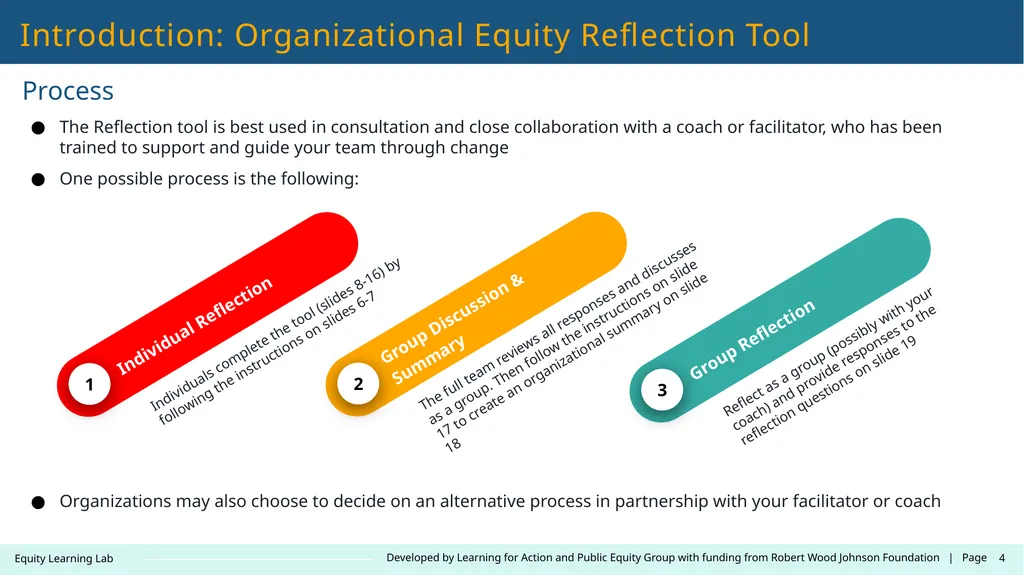
slide4. Introduction: Organizational Equity Reflection Tool Process The Reflection tool is best used in consultation and close collaboration with a coach or facilitator, who has been trained to support and guide your team through change
One possible process is the following: Organizations may also choose to decide on an alternative process in partnership with your facilitator or coach Equity Learning Lab<br>
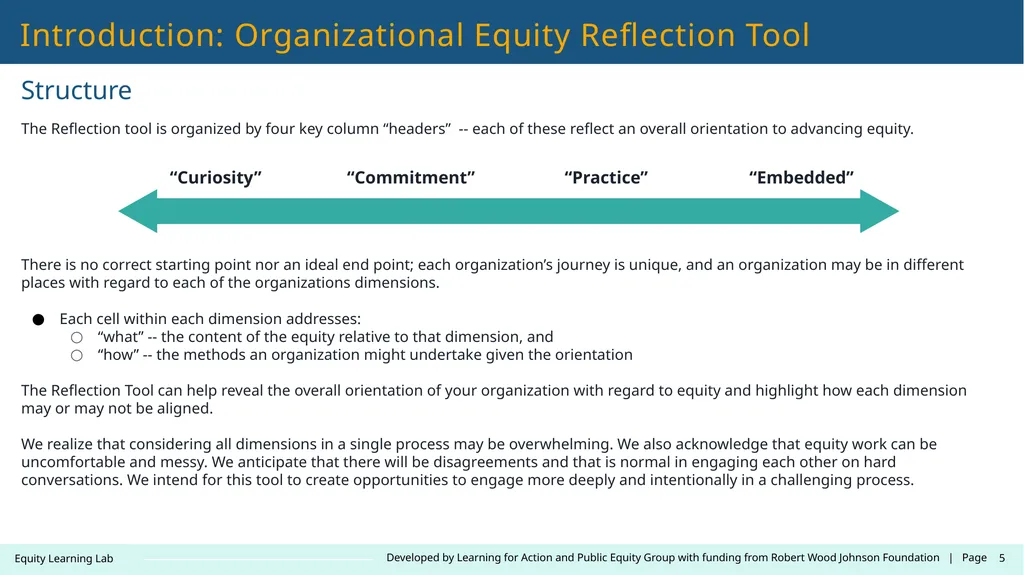
slide5. Introduction: Organizational Equity Reflection Tool Structure The Reflection tool is organized by four key column “headers” -- each of these reflect an overall orientation to advancing equity.
There is no correct starting point nor an ideal end point; each organization’s journey is unique, and an organization may be in different places with regard to each of the organizations dimensions.
Each cell within each dimension addresses:
“what” -- the content of the equity relative to that dimension, and
“how” -- the methods an organization might undertake given the orientation
The Reflection Tool can help reveal the overall orientation of your organization with regard to equity and highlight how each dimension may or may not be aligned.
We realize that considering all dimensions in a single process may be overwhelming. We also acknowledge that equity work can be uncomfortable and messy. We anticipate that there will be disagreements and that is normal in engaging each other on hard conversations. We intend for this tool to create opportunities to engage more deeply and intentionally in a challenging process. Equity Learning Lab<br>
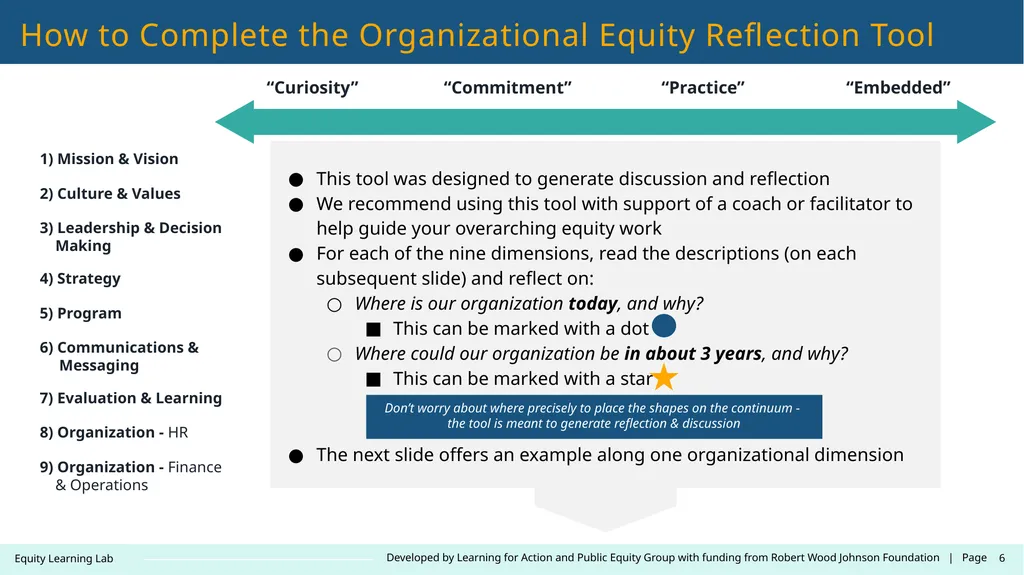
slide6. This tool was designed to generate discussion and reflection
We recommend using this tool with support of a coach or facilitator to help guide your overarching equity work
For each of the nine dimensions, read the descriptions (on each subsequent slide) and reflect on:
Where is our organization today, and why?
This can be marked with a dot
Where could our organization be in about 3 years, and why?
This can be marked with a star
The next slide offers an example along one organizational dimension How to Complete the Organizational Equity Reflection Tool 1) Mission & Vision 8) Organization - HR 9) Organization - Finance
& Operations 2) Culture & Values 3) Leadership & Decision
Making 4) Strategy 6) Communications &
Messaging 7) Evaluation & Learning 5) Program Don’t worry about where precisely to place the shapes on the continuum - the tool is meant to generate reflection & discussion Equity Learning Lab<br>
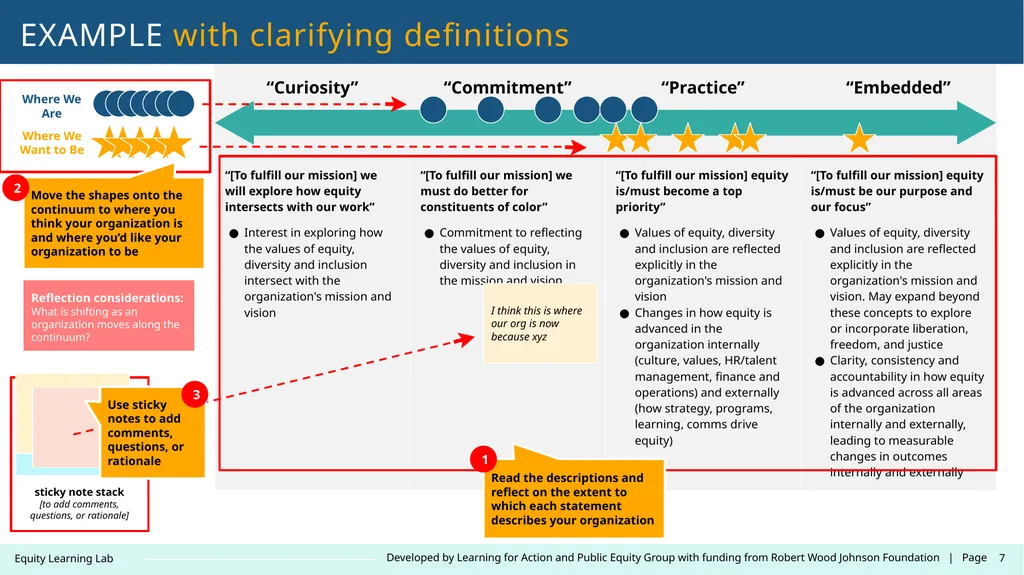
slide7. EXAMPLE with clarifying definitions sticky note stack
[to add comments, questions, or rationale] I think this is where our org is now because xyz Read the descriptions and reflect on the extent to which each statement describes your organization 1 Reflection considerations:
What is shifting as an organization moves along the continuum? Move the shapes onto the continuum to where you think your organization is and where you’d like your organization to be 2 Where We Are Where We Want to Be Use sticky notes to add comments, questions, or rationale 3 Equity Learning Lab<br>
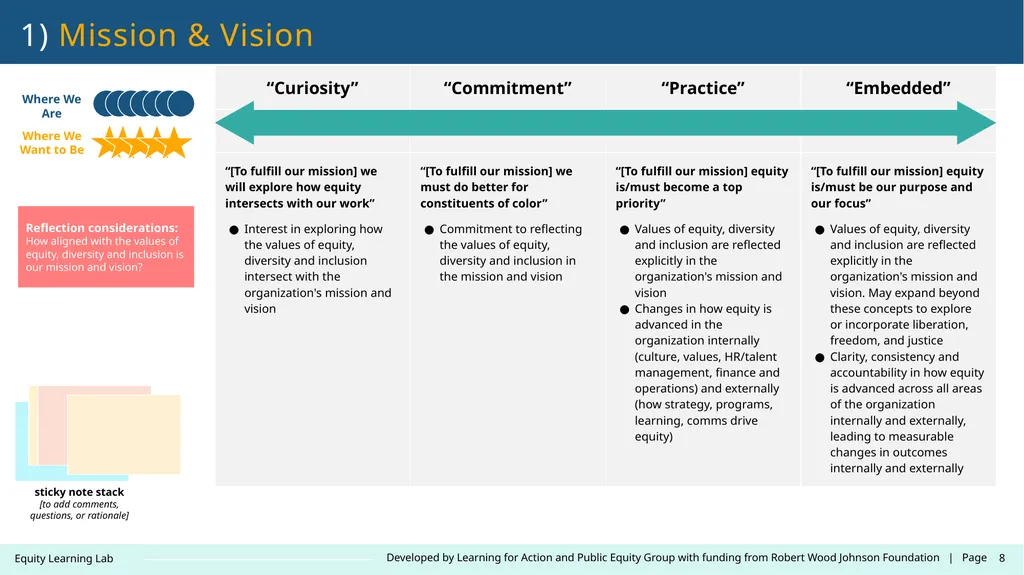
slide8. 1) Mission & Vision Reflection considerations:
How aligned with the values of equity, diversity and inclusion is our mission and vision? Where We Are Where We Want to Be sticky note stack
[to add comments, questions, or rationale] Equity Learning Lab<br>
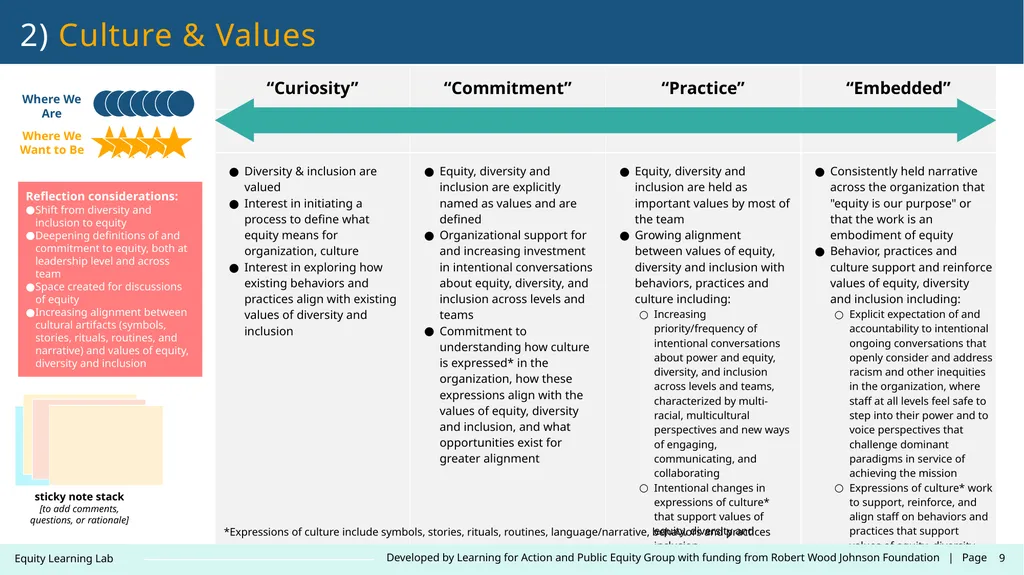
slide9. 2) Culture & Values Reflection considerations:
Shift from diversity and inclusion to equity
Deepening definitions of and commitment to equity, both at leadership level and across team
Space created for discussions of equity
Increasing alignment between cultural artifacts (symbols, stories, rituals, routines, and narrative) and values of equity, diversity and inclusion *Expressions of culture include symbols, stories, rituals, routines, language/narrative, behaviors and practices sticky note stack
[to add comments, questions, or rationale] Where We Are Where We Want to Be Equity Learning Lab<br>
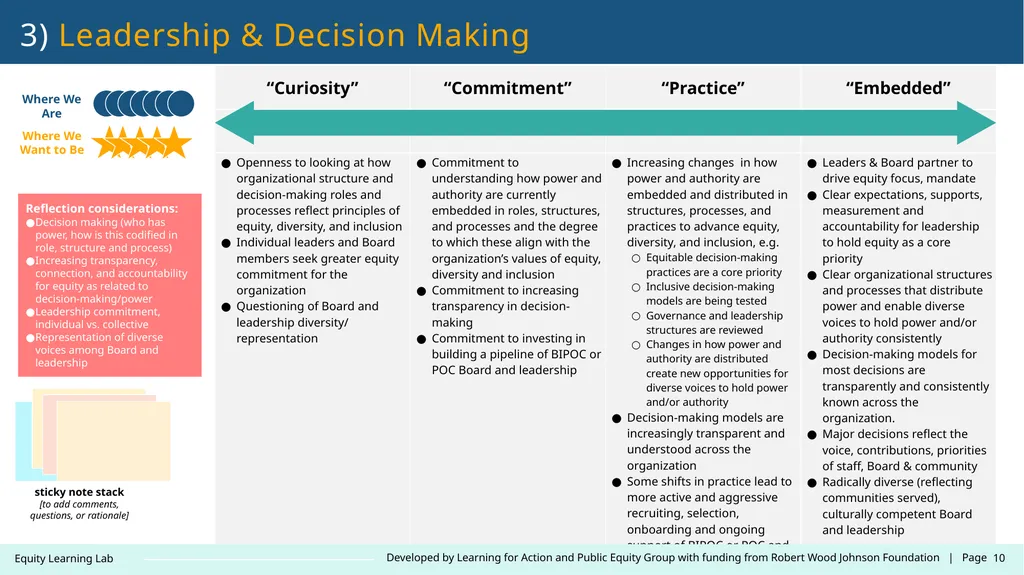
slide10. 3) Leadership & Decision Making Reflection considerations:
Decision making (who has power, how is this codified in role, structure and process)
Increasing transparency, connection, and accountability for equity as related to decision-making/power
Leadership commitment, individual vs. collective
Representation of diverse voices among Board and leadership sticky note stack
[to add comments, questions, or rationale] Where We Are Where We Want to Be Equity Learning Lab<br>
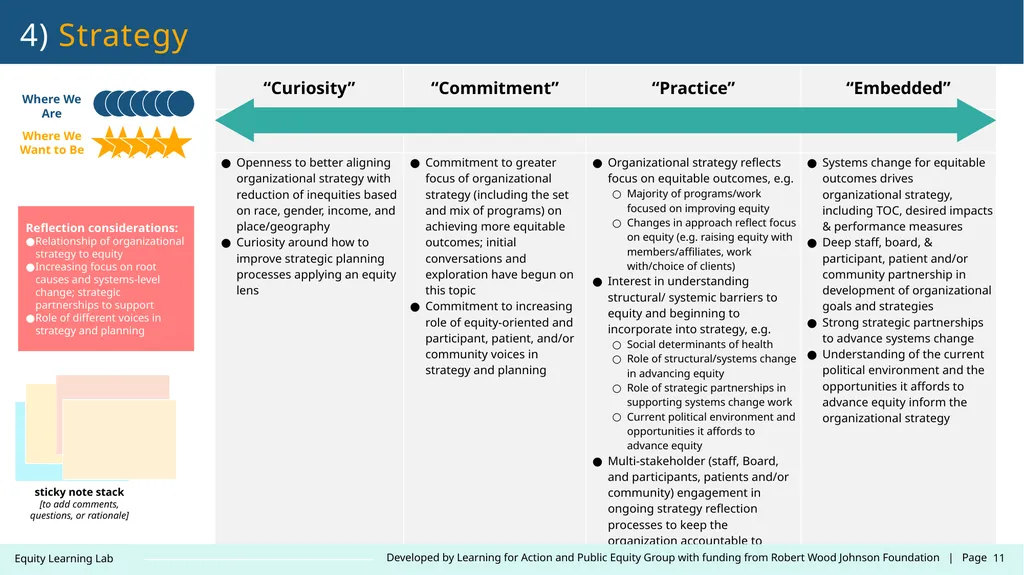
slide11. 4) Strategy Reflection considerations:
Relationship of organizational strategy to equity
Increasing focus on root causes and systems-level change; strategic partnerships to support
Role of different voices in strategy and planning sticky note stack
[to add comments, questions, or rationale] Where We Are Where We Want to Be Equity Learning Lab<br>
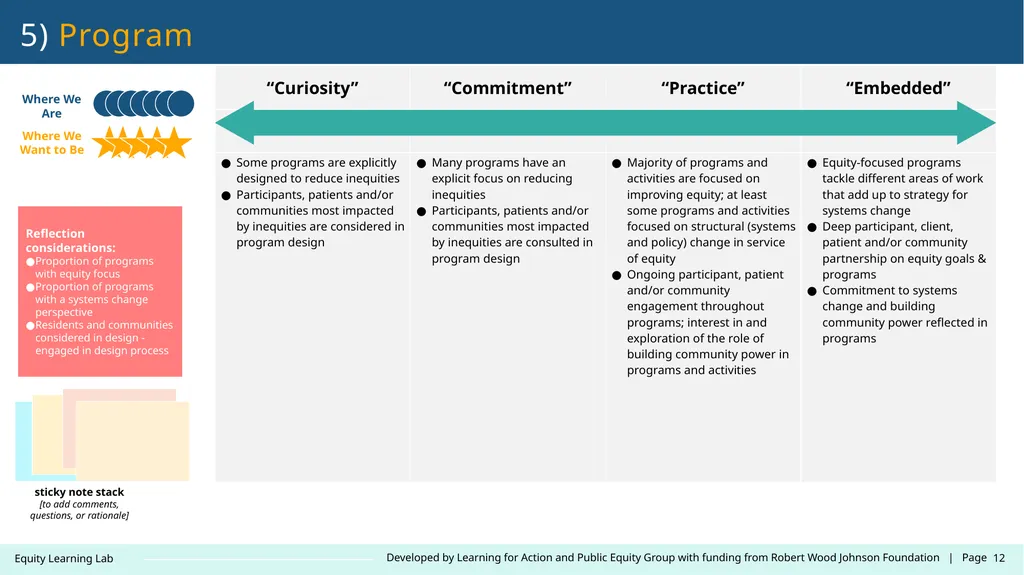
slide12. 5) Program Reflection considerations:
Proportion of programs with equity focus
Proportion of programs with a systems change perspective
Residents and communities considered in design - engaged in design process sticky note stack
[to add comments, questions, or rationale] Where We Are Where We Want to Be Equity Learning Lab<br>
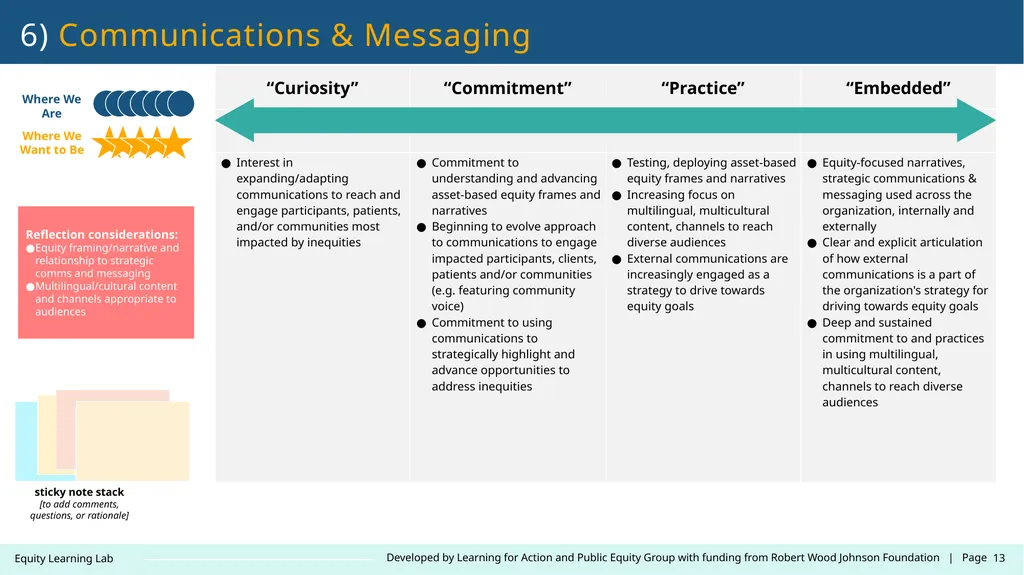
slide13. 6) Communications & Messaging Reflection considerations:
Equity framing/narrative and relationship to strategic comms and messaging
Multilingual/cultural content and channels appropriate to audiences sticky note stack
[to add comments, questions, or rationale] Where We Are Where We Want to Be Equity Learning Lab<br>
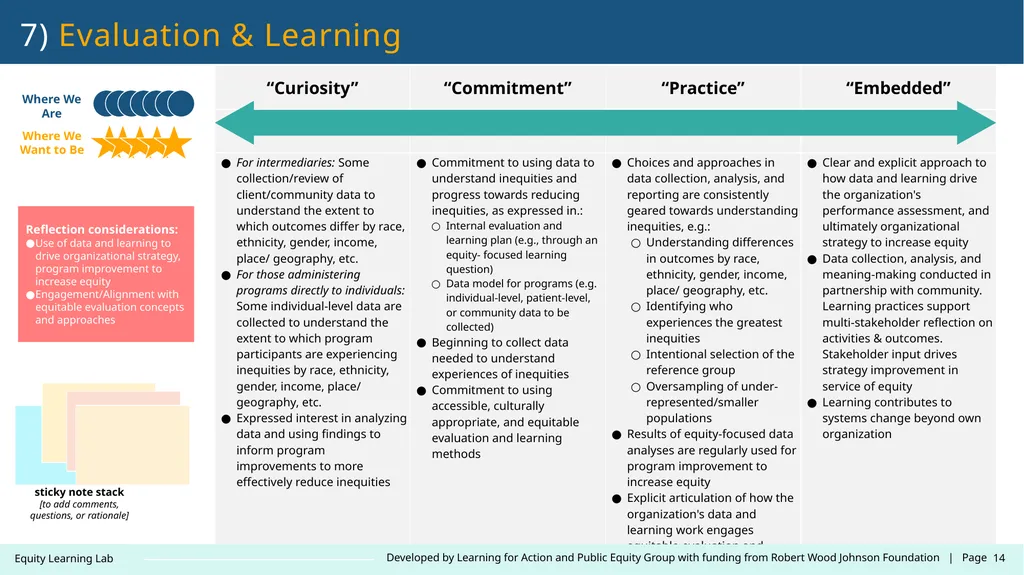
slide14. 7) Evaluation & Learning Reflection considerations:
Use of data and learning to drive organizational strategy, program improvement to increase equity
Engagement/Alignment with equitable evaluation concepts and approaches sticky note stack
[to add comments, questions, or rationale] Where We Are Where We Want to Be Equity Learning Lab<br>
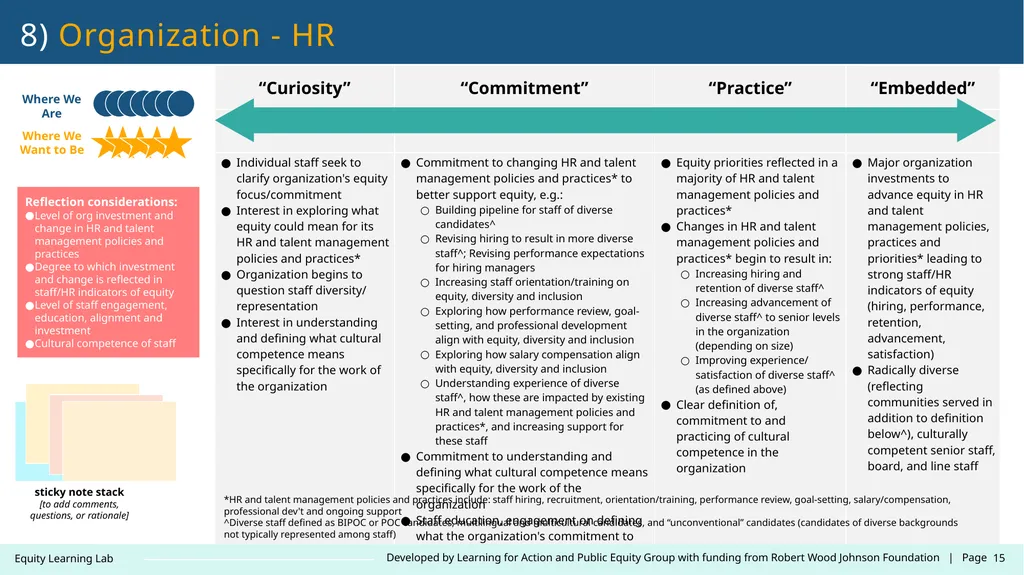
slide15. 8) Organization - HR Reflection considerations:
Level of org investment and change in HR and talent management policies and practices
Degree to which investment and change is reflected in staff/HR indicators of equity
Level of staff engagement, education, alignment and investment
Cultural competence of staff *HR and talent management policies and practices include: staff hiring, recruitment, orientation/training, performance review, goal-setting, salary/compensation, professional dev't and ongoing support
^Diverse staff defined as BIPOC or POC candidates, multilingual and multicultural candidates, and “unconventional” candidates (candidates of diverse backgrounds not typically represented among staff) sticky note stack
[to add comments, questions, or rationale] Where We Are Where We Want to Be Equity Learning Lab<br>
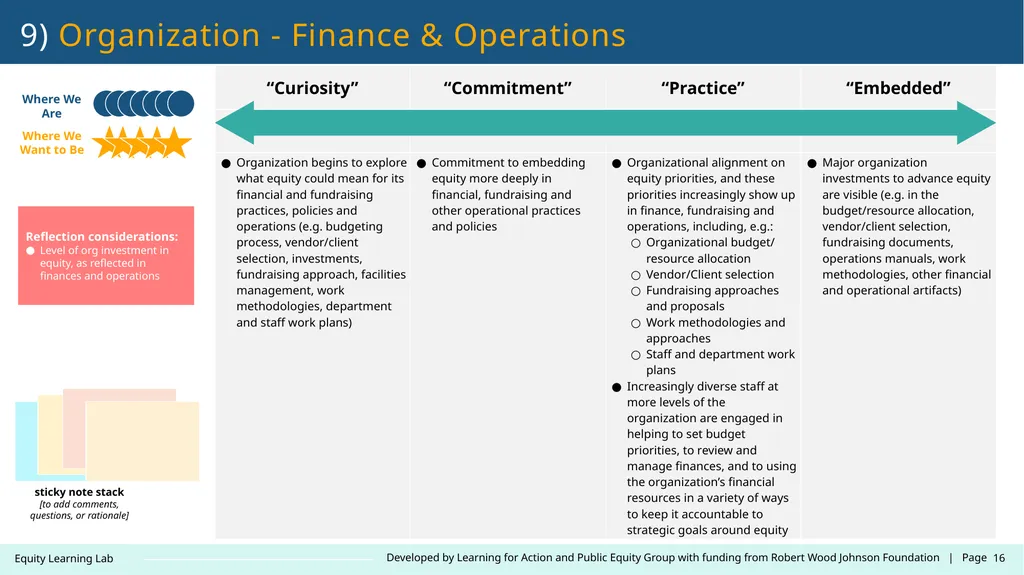
slide16. 9) Organization - Finance & Operations Reflection considerations:
Level of org investment in equity, as reflected in finances and operations sticky note stack
[to add comments, questions, or rationale] Where We Are Where We Want to Be Equity Learning Lab<br>
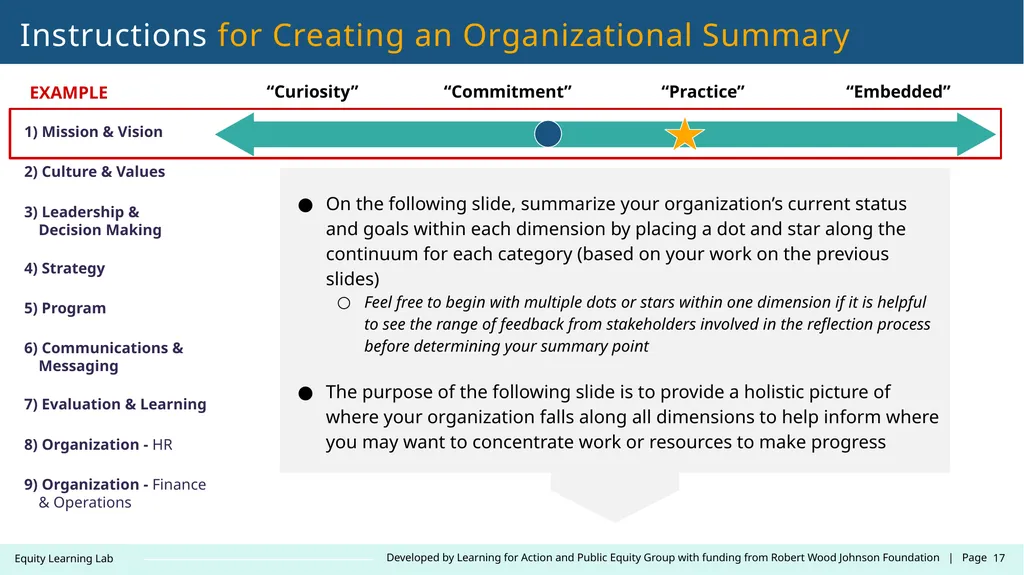
slide17. On the following slide, summarize your organization’s current status and goals within each dimension by placing a dot and star along the continuum for each category (based on your work on the previous slides)
Feel free to begin with multiple dots or stars within one dimension if it is helpful to see the range of feedback from stakeholders involved in the reflection process before determining your summary point
The purpose of the following slide is to provide a holistic picture of where your organization falls along all dimensions to help inform where you may want to concentrate work or resources to make progress Instructions for Creating an Organizational Summary 1) Mission & Vision 8) Organization - HR 9) Organization - Finance & Operations 2) Culture & Values 3) Leadership & Decision Making 4) Strategy 6) Communications & Messaging 7) Evaluation & Learning 5) Program EXAMPLE Equity Learning Lab<br>
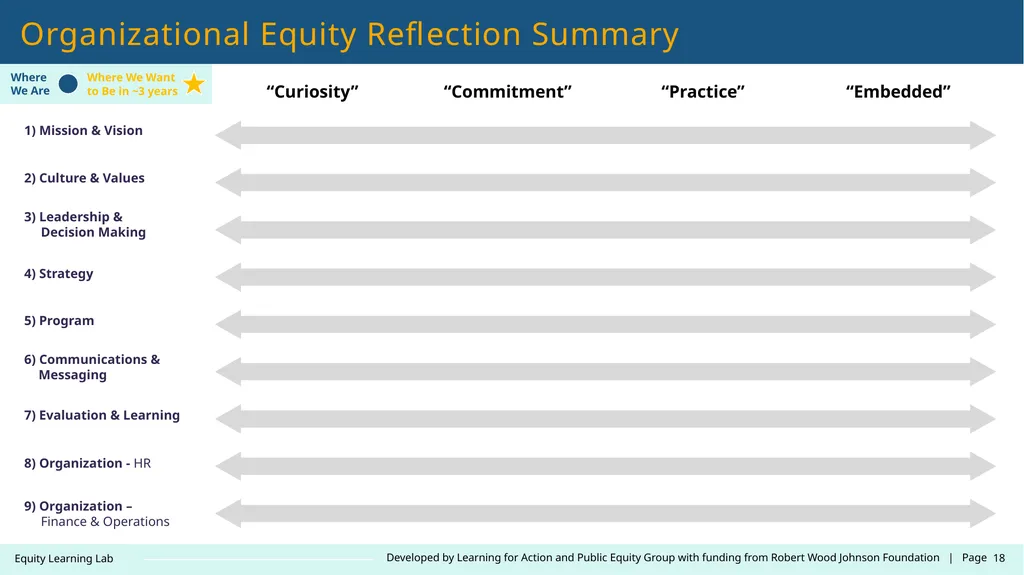
slide18. 1) Mission & Vision 8) Organization - HR 9) Organization –
Finance & Operations 2) Culture & Values 3) Leadership &
Decision Making 4) Strategy 6) Communications & Messaging 7) Evaluation & Learning 5) Program Organizational Equity Reflection Summary Where We Are Where We Want
to Be in ~3 years Equity Learning Lab<br>
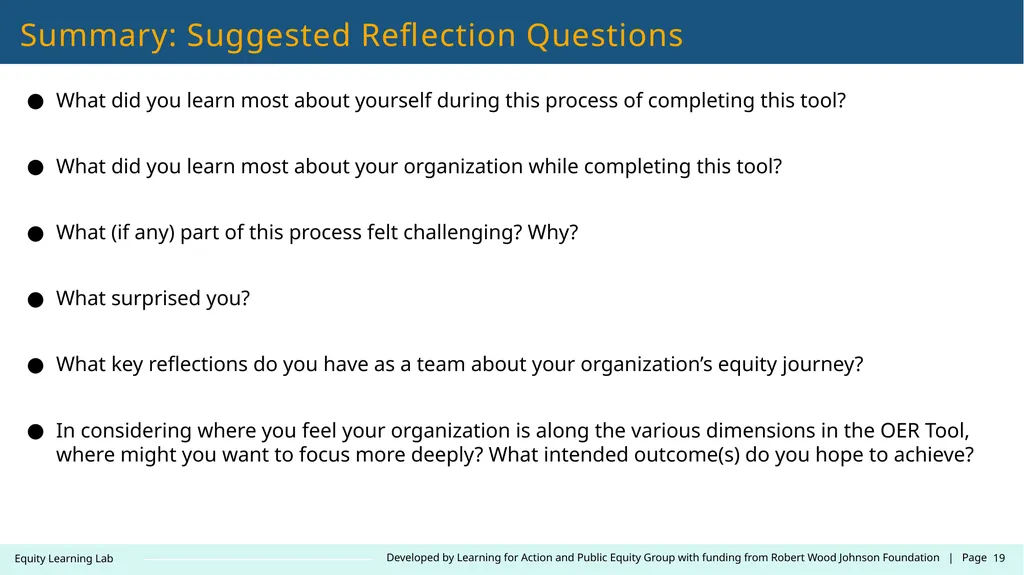
slide19. Summary: Suggested Reflection Questions What did you learn most about yourself during this process of completing this tool?
What did you learn most about your organization while completing this tool?
What (if any) part of this process felt challenging? Why?
What surprised you?
What key reflections do you have as a team about your organization’s equity journey?
In considering where you feel your organization is along the various dimensions in the OER Tool, where might you want to focus more deeply? What intended outcome(s) do you hope to achieve? Equity Learning Lab<br>
slide20. The Equity Continuum Plan (ECP) Template Equity Learning Lab<br>
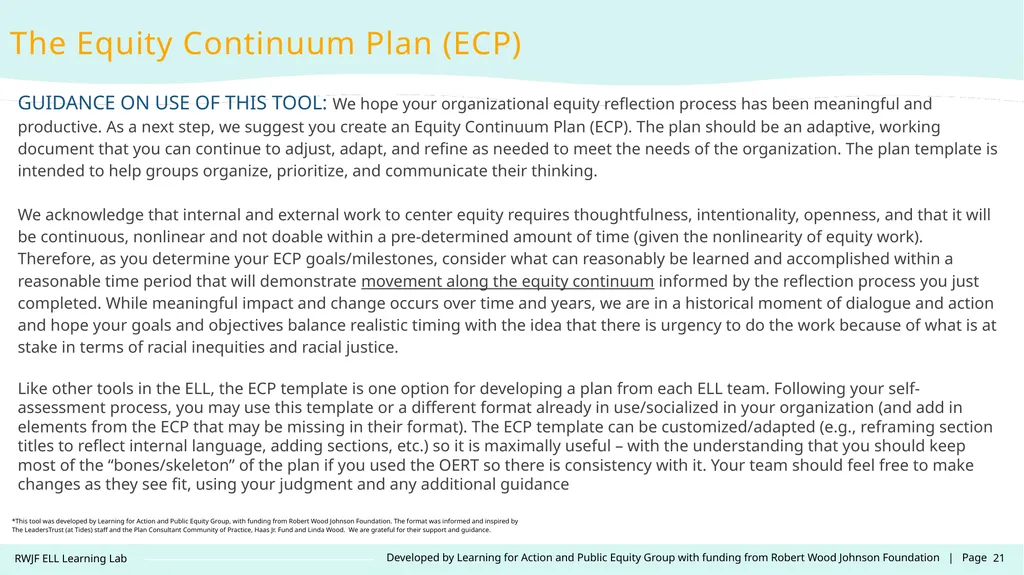
slide21. The Equity Continuum Plan (ECP) GUIDANCE ON USE OF THIS TOOL: We hope your organizational equity reflection process has been meaningful and productive. As a next step, we suggest you create an Equity Continuum Plan (ECP). The plan should be an adaptive, working document that you can continue to adjust, adapt, and refine as needed to meet the needs of the organization. The plan template is intended to help groups organize, prioritize, and communicate their thinking.
We acknowledge that internal and external work to center equity requires thoughtfulness, intentionality, openness, and that it will be continuous, nonlinear and not doable within a pre-determined amount of time (given the nonlinearity of equity work). Therefore, as you determine your ECP goals/milestones, consider what can reasonably be learned and accomplished within a reasonable time period that will demonstrate movement along the equity continuum informed by the reflection process you just completed. While meaningful impact and change occurs over time and years, we are in a historical moment of dialogue and action and hope your goals and objectives balance realistic timing with the idea that there is urgency to do the work because of what is at stake in terms of racial inequities and racial justice.
Like other tools in the ELL, the ECP template is one option for developing a plan from each ELL team. Following your self-assessment process, you may use this template or a different format already in use/socialized in your organization (and add in elements from the ECP that may be missing in their format). The ECP template can be customized/adapted (e.g., reframing section titles to reflect internal language, adding sections, etc.) so it is maximally useful – with the understanding that you should keep most of the “bones/skeleton” of the plan if you used the OERT so there is consistency with it. Your team should feel free to make changes as they see fit, using your judgment and any additional guidance *This tool was developed by Learning for Action and Public Equity Group, with funding from Robert Wood Johnson Foundation. The format was informed and inspired by
The LeadersTrust (at Tides) staff and the Plan Consultant Community of Practice, Haas Jr. Fund and Linda Wood. We are grateful for their support and guidance.<br>
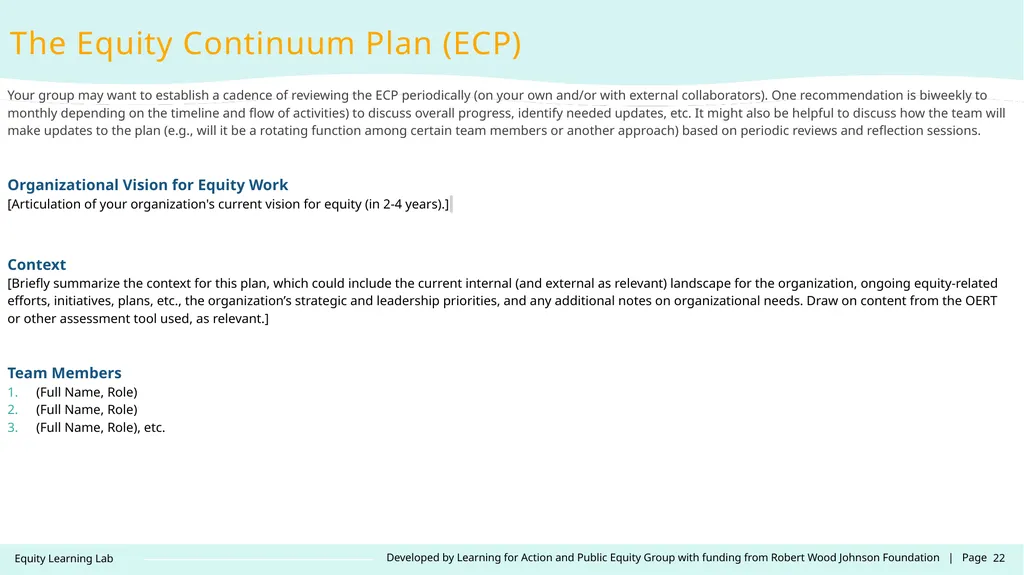
slide22. The Equity Continuum Plan (ECP) Your group may want to establish a cadence of reviewing the ECP periodically (on your own and/or with external collaborators). One recommendation is biweekly to monthly depending on the timeline and flow of activities) to discuss overall progress, identify needed updates, etc. It might also be helpful to discuss how the team will make updates to the plan (e.g., will it be a rotating function among certain team members or another approach) based on periodic reviews and reflection sessions.
Organizational Vision for Equity Work
[Articulation of your organization's current vision for equity (in 2-4 years).]
Context
[Briefly summarize the context for this plan, which could include the current internal (and external as relevant) landscape for the organization, ongoing equity-related efforts, initiatives, plans, etc., the organization’s strategic and leadership priorities, and any additional notes on organizational needs. Draw on content from the OERT or other assessment tool used, as relevant.]
Team Members
(Full Name, Role)
(Full Name, Role)
(Full Name, Role), etc. Equity Learning Lab<br>
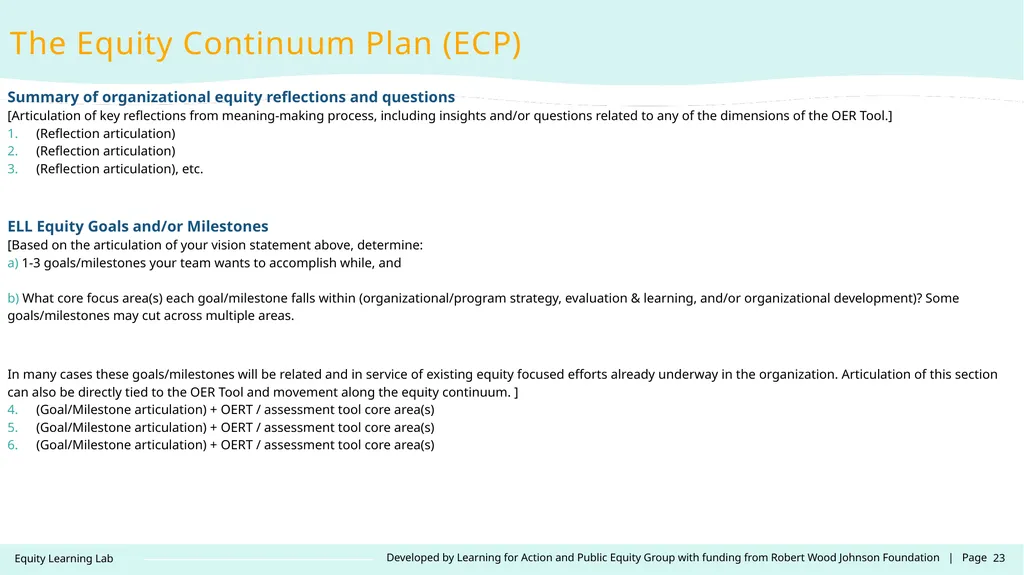
slide23. The Equity Continuum Plan (ECP) Summary of organizational equity reflections and questions
[Articulation of key reflections from meaning-making process, including insights and/or questions related to any of the dimensions of the OER Tool.]
(Reflection articulation)
(Reflection articulation)
(Reflection articulation), etc.
ELL Equity Goals and/or Milestones
[Based on the articulation of your vision statement above, determine:
a) 1-3 goals/milestones your team wants to accomplish while, and
b) What core focus area(s) each goal/milestone falls within (organizational/program strategy, evaluation & learning, and/or organizational development)? Some goals/milestones may cut across multiple areas.
In many cases these goals/milestones will be related and in service of existing equity focused efforts already underway in the organization. Articulation of this section can also be directly tied to the OER Tool and movement along the equity continuum. ]
(Goal/Milestone articulation) + OERT / assessment tool core area(s)
(Goal/Milestone articulation) + OERT / assessment tool core area(s)
(Goal/Milestone articulation) + OERT / assessment tool core area(s) Equity Learning Lab<br>
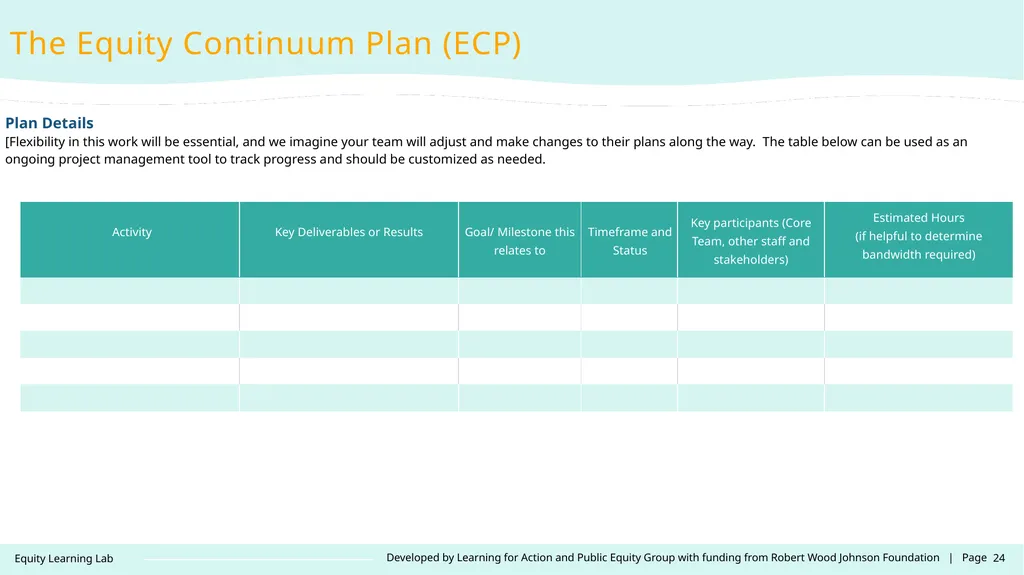
slide24. The Equity Continuum Plan (ECP) Plan Details
[Flexibility in this work will be essential, and we imagine your team will adjust and make changes to their plans along the way. The table below can be used as an ongoing project management tool to track progress and should be customized as needed. Equity Learning Lab<br>
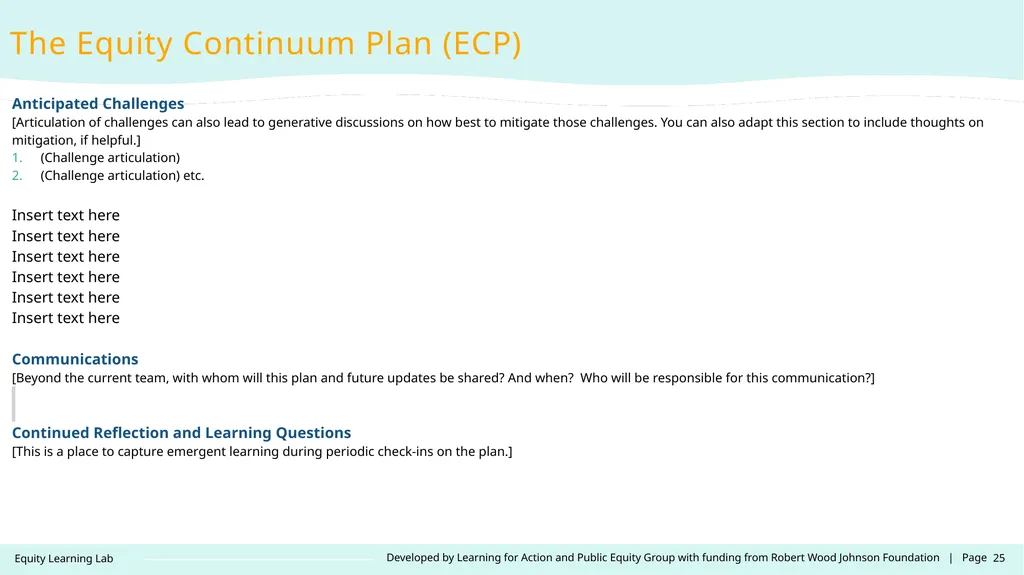
slide25. The Equity Continuum Plan (ECP) Anticipated Challenges
[Articulation of challenges can also lead to generative discussions on how best to mitigate those challenges. You can also adapt this section to include thoughts on mitigation, if helpful.]
(Challenge articulation)
(Challenge articulation) etc.
Insert text here
Insert text here
Insert text here
Insert text here
Insert text here
Insert text here
Communications
[Beyond the current team, with whom will this plan and future updates be shared? And when? Who will be responsible for this communication?]
Continued Reflection and Learning Questions
[This is a place to capture emergent learning during periodic check-ins on the plan.] Equity Learning Lab<br>
slide26. The Equity Continuum Plan (ECP) Plan Acknowledgements
We gratefully acknowledge the following people who contributed to both the initial and ongoing development of this plan: Developed by Learning for Action and Public Equity Group With funding from
Robert Wood Johnson Foundation Equity Learning Lab<br>
Learning for Action and Public Equity Group With funding from Robert Wood Johnson Foundation This document is licensed under a Creative Commons Attribution-No Derivatives 4.0 International License. We grant permission for the distribution and reproduction of copies of this material in its entirety with original attribution.<br>
slide2. 2 Equity is both a means (what work, and how the work is done) and an end (elimination of disparities in outcomes based on identity-based traits). Engaging in deep equity work means “working toward outcomes in ways that model dignity, justice, and love without recreating harm in our structures, strategies and working relationships.”
(Source: ChangeElemental) How the Equity Learning Lab Defines Equity:<br>
slide3. Introduction: Organizational Equity Reflection Tool Overview The Organizational Equity Reflection Tool provides:
an opportunity for teams to understand where their organizations sits with respect to equity, across a number of key organizational dimensions
a springboard for understanding, reviewing, and advancing organizational equity work Equity Learning Lab<br>
slide4. Introduction: Organizational Equity Reflection Tool Process The Reflection tool is best used in consultation and close collaboration with a coach or facilitator, who has been trained to support and guide your team through change
One possible process is the following: Organizations may also choose to decide on an alternative process in partnership with your facilitator or coach Equity Learning Lab<br>
slide5. Introduction: Organizational Equity Reflection Tool Structure The Reflection tool is organized by four key column “headers” -- each of these reflect an overall orientation to advancing equity.
There is no correct starting point nor an ideal end point; each organization’s journey is unique, and an organization may be in different places with regard to each of the organizations dimensions.
Each cell within each dimension addresses:
“what” -- the content of the equity relative to that dimension, and
“how” -- the methods an organization might undertake given the orientation
The Reflection Tool can help reveal the overall orientation of your organization with regard to equity and highlight how each dimension may or may not be aligned.
We realize that considering all dimensions in a single process may be overwhelming. We also acknowledge that equity work can be uncomfortable and messy. We anticipate that there will be disagreements and that is normal in engaging each other on hard conversations. We intend for this tool to create opportunities to engage more deeply and intentionally in a challenging process. Equity Learning Lab<br>
slide6. This tool was designed to generate discussion and reflection
We recommend using this tool with support of a coach or facilitator to help guide your overarching equity work
For each of the nine dimensions, read the descriptions (on each subsequent slide) and reflect on:
Where is our organization today, and why?
This can be marked with a dot
Where could our organization be in about 3 years, and why?
This can be marked with a star
The next slide offers an example along one organizational dimension How to Complete the Organizational Equity Reflection Tool 1) Mission & Vision 8) Organization - HR 9) Organization - Finance
& Operations 2) Culture & Values 3) Leadership & Decision
Making 4) Strategy 6) Communications &
Messaging 7) Evaluation & Learning 5) Program Don’t worry about where precisely to place the shapes on the continuum - the tool is meant to generate reflection & discussion Equity Learning Lab<br>
slide7. EXAMPLE with clarifying definitions sticky note stack
[to add comments, questions, or rationale] I think this is where our org is now because xyz Read the descriptions and reflect on the extent to which each statement describes your organization 1 Reflection considerations:
What is shifting as an organization moves along the continuum? Move the shapes onto the continuum to where you think your organization is and where you’d like your organization to be 2 Where We Are Where We Want to Be Use sticky notes to add comments, questions, or rationale 3 Equity Learning Lab<br>
slide8. 1) Mission & Vision Reflection considerations:
How aligned with the values of equity, diversity and inclusion is our mission and vision? Where We Are Where We Want to Be sticky note stack
[to add comments, questions, or rationale] Equity Learning Lab<br>
slide9. 2) Culture & Values Reflection considerations:
Shift from diversity and inclusion to equity
Deepening definitions of and commitment to equity, both at leadership level and across team
Space created for discussions of equity
Increasing alignment between cultural artifacts (symbols, stories, rituals, routines, and narrative) and values of equity, diversity and inclusion *Expressions of culture include symbols, stories, rituals, routines, language/narrative, behaviors and practices sticky note stack
[to add comments, questions, or rationale] Where We Are Where We Want to Be Equity Learning Lab<br>
slide10. 3) Leadership & Decision Making Reflection considerations:
Decision making (who has power, how is this codified in role, structure and process)
Increasing transparency, connection, and accountability for equity as related to decision-making/power
Leadership commitment, individual vs. collective
Representation of diverse voices among Board and leadership sticky note stack
[to add comments, questions, or rationale] Where We Are Where We Want to Be Equity Learning Lab<br>
slide11. 4) Strategy Reflection considerations:
Relationship of organizational strategy to equity
Increasing focus on root causes and systems-level change; strategic partnerships to support
Role of different voices in strategy and planning sticky note stack
[to add comments, questions, or rationale] Where We Are Where We Want to Be Equity Learning Lab<br>
slide12. 5) Program Reflection considerations:
Proportion of programs with equity focus
Proportion of programs with a systems change perspective
Residents and communities considered in design - engaged in design process sticky note stack
[to add comments, questions, or rationale] Where We Are Where We Want to Be Equity Learning Lab<br>
slide13. 6) Communications & Messaging Reflection considerations:
Equity framing/narrative and relationship to strategic comms and messaging
Multilingual/cultural content and channels appropriate to audiences sticky note stack
[to add comments, questions, or rationale] Where We Are Where We Want to Be Equity Learning Lab<br>
slide14. 7) Evaluation & Learning Reflection considerations:
Use of data and learning to drive organizational strategy, program improvement to increase equity
Engagement/Alignment with equitable evaluation concepts and approaches sticky note stack
[to add comments, questions, or rationale] Where We Are Where We Want to Be Equity Learning Lab<br>
slide15. 8) Organization - HR Reflection considerations:
Level of org investment and change in HR and talent management policies and practices
Degree to which investment and change is reflected in staff/HR indicators of equity
Level of staff engagement, education, alignment and investment
Cultural competence of staff *HR and talent management policies and practices include: staff hiring, recruitment, orientation/training, performance review, goal-setting, salary/compensation, professional dev't and ongoing support
^Diverse staff defined as BIPOC or POC candidates, multilingual and multicultural candidates, and “unconventional” candidates (candidates of diverse backgrounds not typically represented among staff) sticky note stack
[to add comments, questions, or rationale] Where We Are Where We Want to Be Equity Learning Lab<br>
slide16. 9) Organization - Finance & Operations Reflection considerations:
Level of org investment in equity, as reflected in finances and operations sticky note stack
[to add comments, questions, or rationale] Where We Are Where We Want to Be Equity Learning Lab<br>
slide17. On the following slide, summarize your organization’s current status and goals within each dimension by placing a dot and star along the continuum for each category (based on your work on the previous slides)
Feel free to begin with multiple dots or stars within one dimension if it is helpful to see the range of feedback from stakeholders involved in the reflection process before determining your summary point
The purpose of the following slide is to provide a holistic picture of where your organization falls along all dimensions to help inform where you may want to concentrate work or resources to make progress Instructions for Creating an Organizational Summary 1) Mission & Vision 8) Organization - HR 9) Organization - Finance & Operations 2) Culture & Values 3) Leadership & Decision Making 4) Strategy 6) Communications & Messaging 7) Evaluation & Learning 5) Program EXAMPLE Equity Learning Lab<br>
slide18. 1) Mission & Vision 8) Organization - HR 9) Organization –
Finance & Operations 2) Culture & Values 3) Leadership &
Decision Making 4) Strategy 6) Communications & Messaging 7) Evaluation & Learning 5) Program Organizational Equity Reflection Summary Where We Are Where We Want
to Be in ~3 years Equity Learning Lab<br>
slide19. Summary: Suggested Reflection Questions What did you learn most about yourself during this process of completing this tool?
What did you learn most about your organization while completing this tool?
What (if any) part of this process felt challenging? Why?
What surprised you?
What key reflections do you have as a team about your organization’s equity journey?
In considering where you feel your organization is along the various dimensions in the OER Tool, where might you want to focus more deeply? What intended outcome(s) do you hope to achieve? Equity Learning Lab<br>
slide20. The Equity Continuum Plan (ECP) Template Equity Learning Lab<br>
slide21. The Equity Continuum Plan (ECP) GUIDANCE ON USE OF THIS TOOL: We hope your organizational equity reflection process has been meaningful and productive. As a next step, we suggest you create an Equity Continuum Plan (ECP). The plan should be an adaptive, working document that you can continue to adjust, adapt, and refine as needed to meet the needs of the organization. The plan template is intended to help groups organize, prioritize, and communicate their thinking.
We acknowledge that internal and external work to center equity requires thoughtfulness, intentionality, openness, and that it will be continuous, nonlinear and not doable within a pre-determined amount of time (given the nonlinearity of equity work). Therefore, as you determine your ECP goals/milestones, consider what can reasonably be learned and accomplished within a reasonable time period that will demonstrate movement along the equity continuum informed by the reflection process you just completed. While meaningful impact and change occurs over time and years, we are in a historical moment of dialogue and action and hope your goals and objectives balance realistic timing with the idea that there is urgency to do the work because of what is at stake in terms of racial inequities and racial justice.
Like other tools in the ELL, the ECP template is one option for developing a plan from each ELL team. Following your self-assessment process, you may use this template or a different format already in use/socialized in your organization (and add in elements from the ECP that may be missing in their format). The ECP template can be customized/adapted (e.g., reframing section titles to reflect internal language, adding sections, etc.) so it is maximally useful – with the understanding that you should keep most of the “bones/skeleton” of the plan if you used the OERT so there is consistency with it. Your team should feel free to make changes as they see fit, using your judgment and any additional guidance *This tool was developed by Learning for Action and Public Equity Group, with funding from Robert Wood Johnson Foundation. The format was informed and inspired by
The LeadersTrust (at Tides) staff and the Plan Consultant Community of Practice, Haas Jr. Fund and Linda Wood. We are grateful for their support and guidance.<br>
slide22. The Equity Continuum Plan (ECP) Your group may want to establish a cadence of reviewing the ECP periodically (on your own and/or with external collaborators). One recommendation is biweekly to monthly depending on the timeline and flow of activities) to discuss overall progress, identify needed updates, etc. It might also be helpful to discuss how the team will make updates to the plan (e.g., will it be a rotating function among certain team members or another approach) based on periodic reviews and reflection sessions.
Organizational Vision for Equity Work
[Articulation of your organization's current vision for equity (in 2-4 years).]
Context
[Briefly summarize the context for this plan, which could include the current internal (and external as relevant) landscape for the organization, ongoing equity-related efforts, initiatives, plans, etc., the organization’s strategic and leadership priorities, and any additional notes on organizational needs. Draw on content from the OERT or other assessment tool used, as relevant.]
Team Members
(Full Name, Role)
(Full Name, Role)
(Full Name, Role), etc. Equity Learning Lab<br>
slide23. The Equity Continuum Plan (ECP) Summary of organizational equity reflections and questions
[Articulation of key reflections from meaning-making process, including insights and/or questions related to any of the dimensions of the OER Tool.]
(Reflection articulation)
(Reflection articulation)
(Reflection articulation), etc.
ELL Equity Goals and/or Milestones
[Based on the articulation of your vision statement above, determine:
a) 1-3 goals/milestones your team wants to accomplish while, and
b) What core focus area(s) each goal/milestone falls within (organizational/program strategy, evaluation & learning, and/or organizational development)? Some goals/milestones may cut across multiple areas.
In many cases these goals/milestones will be related and in service of existing equity focused efforts already underway in the organization. Articulation of this section can also be directly tied to the OER Tool and movement along the equity continuum. ]
(Goal/Milestone articulation) + OERT / assessment tool core area(s)
(Goal/Milestone articulation) + OERT / assessment tool core area(s)
(Goal/Milestone articulation) + OERT / assessment tool core area(s) Equity Learning Lab<br>
slide24. The Equity Continuum Plan (ECP) Plan Details
[Flexibility in this work will be essential, and we imagine your team will adjust and make changes to their plans along the way. The table below can be used as an ongoing project management tool to track progress and should be customized as needed. Equity Learning Lab<br>
slide25. The Equity Continuum Plan (ECP) Anticipated Challenges
[Articulation of challenges can also lead to generative discussions on how best to mitigate those challenges. You can also adapt this section to include thoughts on mitigation, if helpful.]
(Challenge articulation)
(Challenge articulation) etc.
Insert text here
Insert text here
Insert text here
Insert text here
Insert text here
Insert text here
Communications
[Beyond the current team, with whom will this plan and future updates be shared? And when? Who will be responsible for this communication?]
Continued Reflection and Learning Questions
[This is a place to capture emergent learning during periodic check-ins on the plan.] Equity Learning Lab<br>
slide26. The Equity Continuum Plan (ECP) Plan Acknowledgements
We gratefully acknowledge the following people who contributed to both the initial and ongoing development of this plan: Developed by Learning for Action and Public Equity Group With funding from
Robert Wood Johnson Foundation Equity Learning Lab<br>