Contexts: A Grounding Perspective Fumiaki Toyoshima JOWO 2019 Graz, Austria September 23, 2019 Background Ontologies provide a general representation of reality. But our knowledge is mostly context-dependent. Classifications of contexts
"Contexts: A Grounding Perspective Fumiaki" is the property of its rightful owner. Permission is granted to
download and print the materials on this website for personal, non-commercial use only, and to display it
on your personal computer provided you do not modify the materials and that you retain all copyright
notices contained in the materials. By downloading content from our website, you accept the terms of this
agreement.
Presentation Transcript
01
Contexts: A Grounding Perspective Fumiaki Toyoshima
JOWO 2019 @ Graz, Austria
September 23, 2019<br>
02
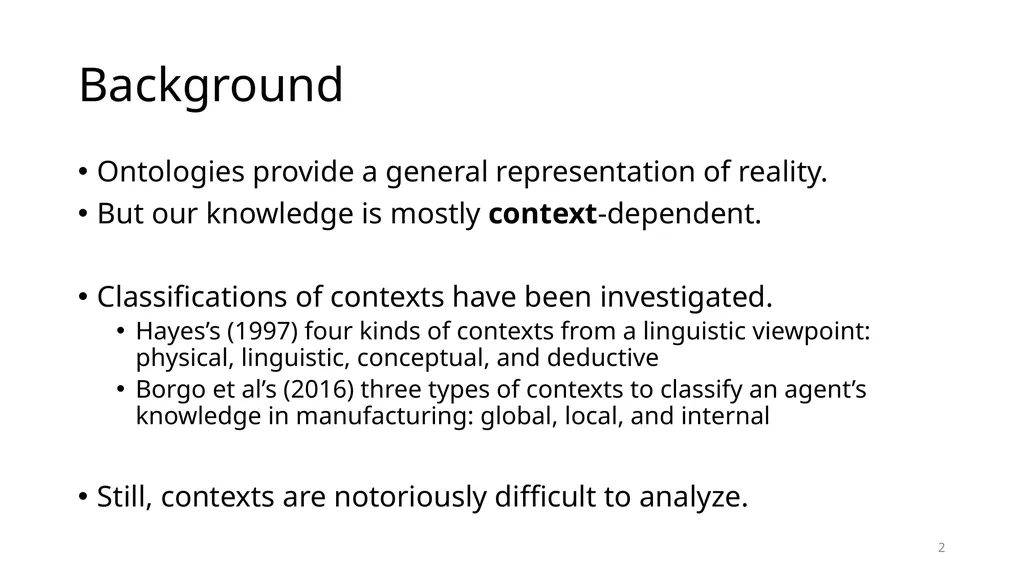
Background Ontologies provide a general representation of reality.
But our knowledge is mostly context-dependent.
Classifications of contexts have been investigated.
Hayes’s (1997) four kinds of contexts from a linguistic viewpoint: physical, linguistic, conceptual, and deductive
Borgo et al’s (2016) three types of contexts to classify an agent’s knowledge in manufacturing: global, local, and internal
Still, contexts are notoriously difficult to analyze. 2<br>
03
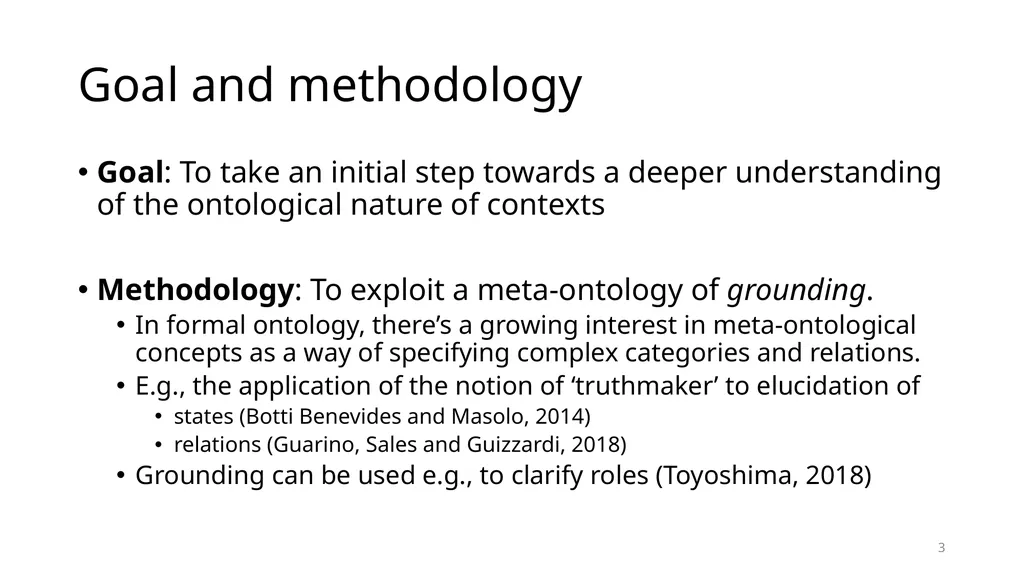
Goal and methodology Goal: To take an initial step towards a deeper understanding of the ontological nature of contexts
Methodology: To exploit a meta-ontology of grounding.
In formal ontology, there’s a growing interest in meta-ontological concepts as a way of specifying complex categories and relations.
E.g., the application of the notion of ‘truthmaker’ to elucidation of
states (Botti Benevides and Masolo, 2014)
relations (Guarino, Sales and Guizzardi, 2018)
Grounding can be used e.g., to clarify roles (Toyoshima, 2018) 3<br>
04
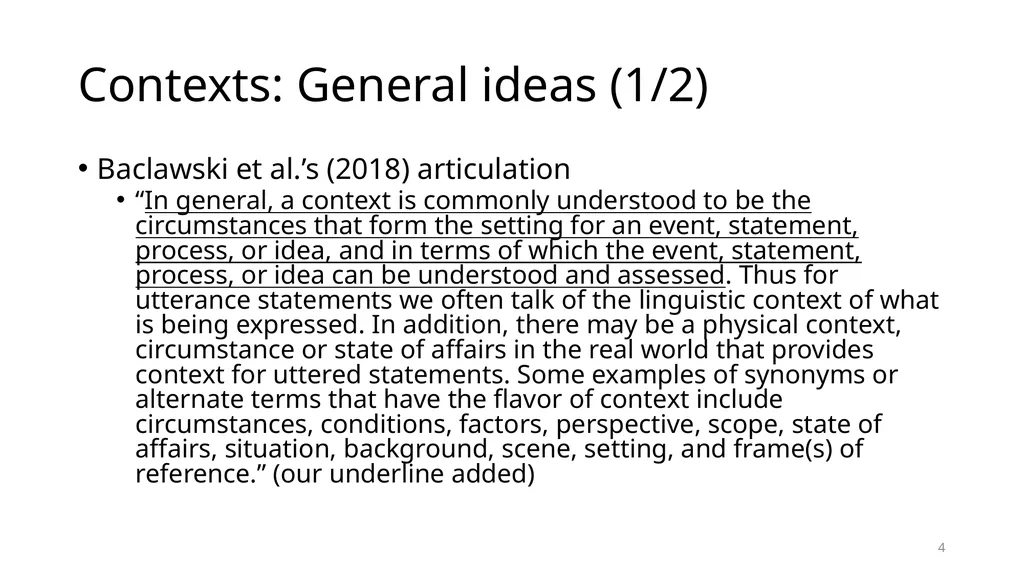
Contexts: General ideas (1/2) Baclawski et al.’s (2018) articulation
“In general, a context is commonly understood to be the circumstances that form the setting for an event, statement, process, or idea, and in terms of which the event, statement, process, or idea can be understood and assessed. Thus for utterance statements we often talk of the linguistic context of what is being expressed. In addition, there may be a physical context, circumstance or state of affairs in the real world that provides context for uttered statements. Some examples of synonyms or alternate terms that have the flavor of context include circumstances, conditions, factors, perspective, scope, state of affairs, situation, background, scene, setting, and frame(s) of reference.” (our underline added) 4<br>
05
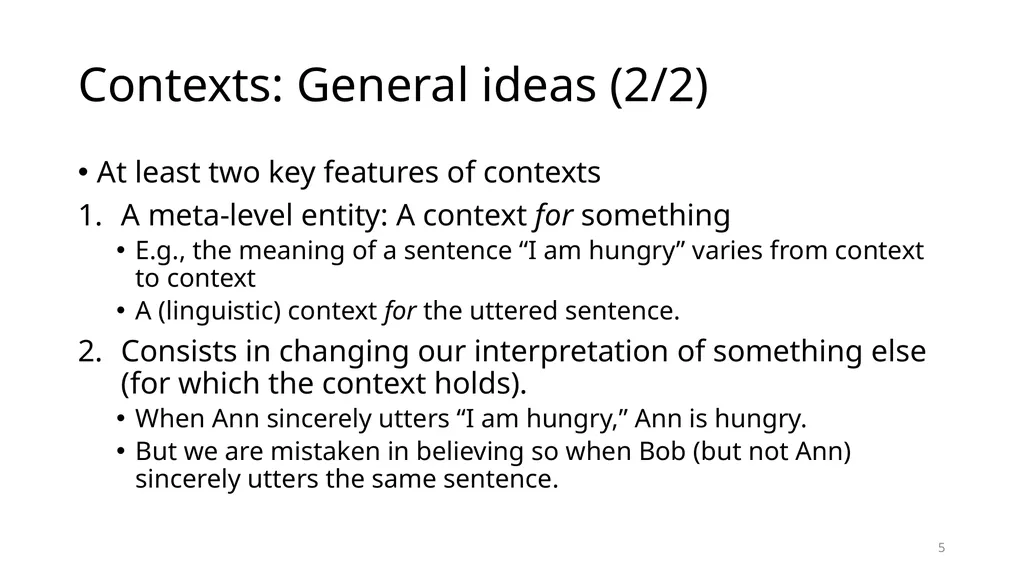
Contexts: General ideas (2/2) At least two key features of contexts
A meta-level entity: A context for something
E.g., the meaning of a sentence “I am hungry” varies from context to context
A (linguistic) context for the uttered sentence.
Consists in changing our interpretation of something else (for which the context holds).
When Ann sincerely utters “I am hungry,” Ann is hungry.
But we are mistaken in believing so when Bob (but not Ann) sincerely utters the same sentence. 5<br>
06
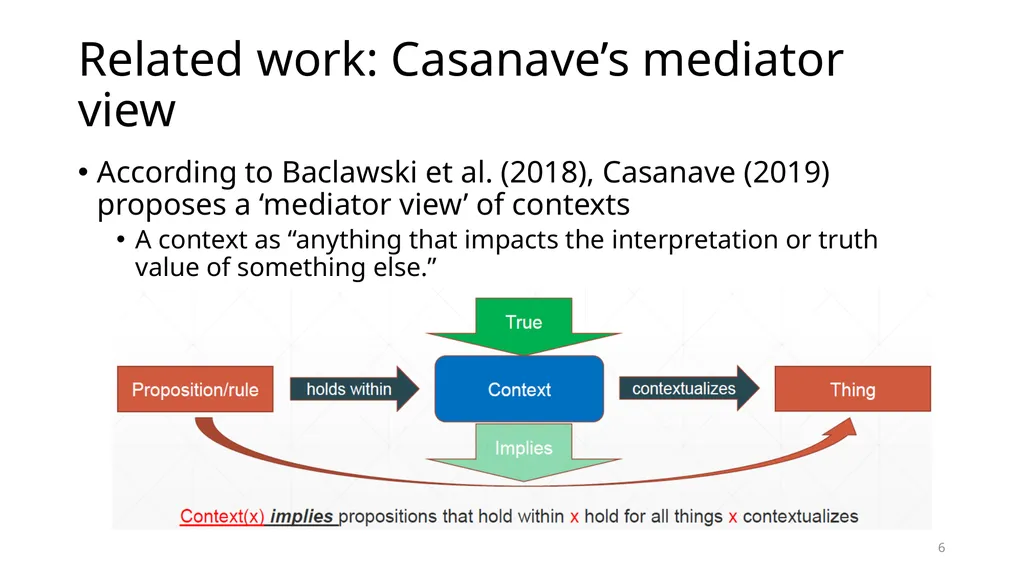
Related work: Casanave’s mediator view According to Baclawski et al. (2018), Casanave (2019) proposes a ‘mediator view’ of contexts
A context as “anything that impacts the interpretation or truth value of something else.” 6<br>
07
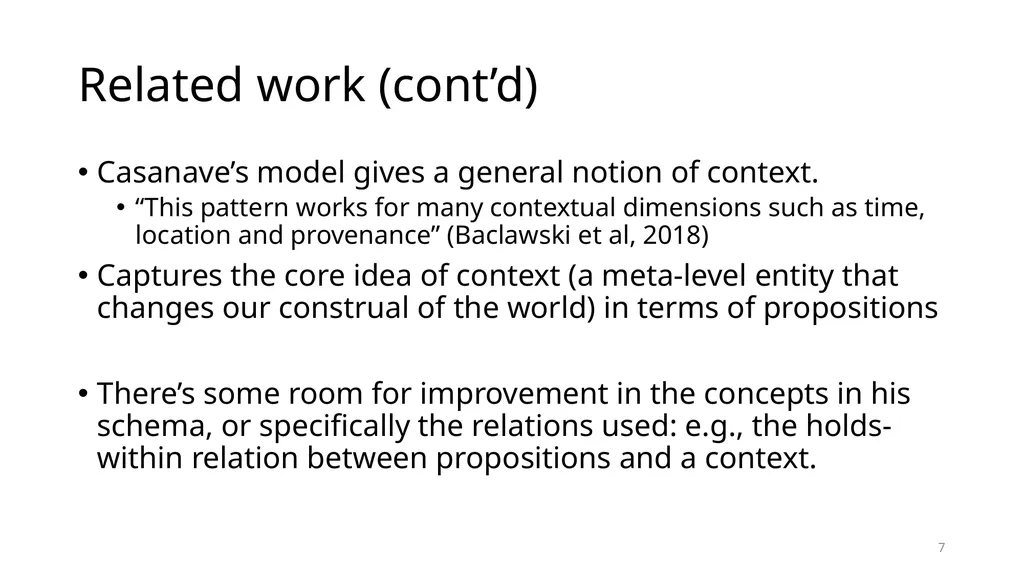
Related work (cont’d) Casanave’s model gives a general notion of context.
“This pattern works for many contextual dimensions such as time, location and provenance” (Baclawski et al, 2018)
Captures the core idea of context (a meta-level entity that changes our construal of the world) in terms of propositions
There’s some room for improvement in the concepts in his schema, or specifically the relations used: e.g., the holds-within relation between propositions and a context. 7<br>
08
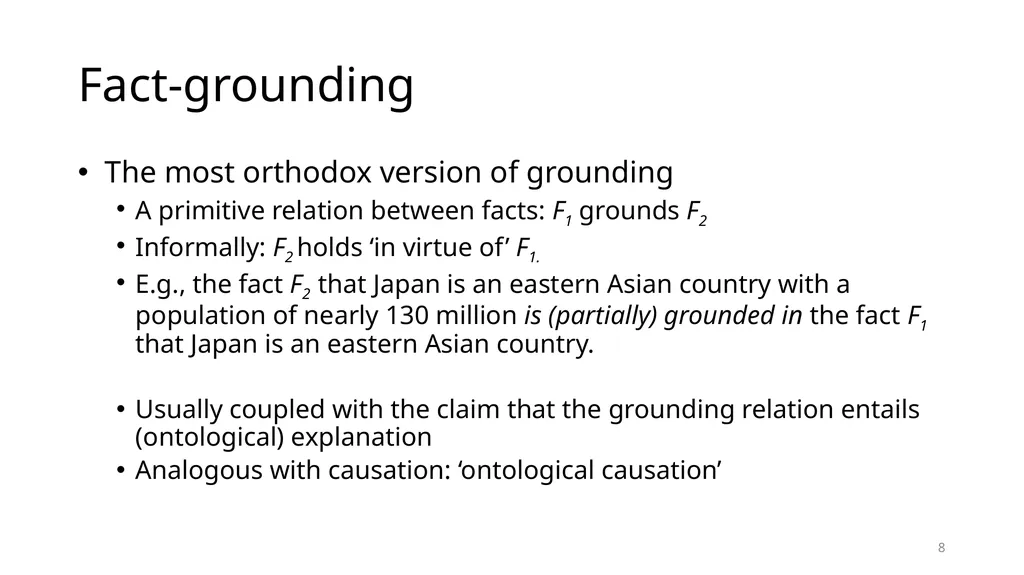
Fact-grounding The most orthodox version of grounding
A primitive relation between facts: F1 grounds F2
Informally: F2 holds ‘in virtue of’ F1.
E.g., the fact F2 that Japan is an eastern Asian country with a population of nearly 130 million is (partially) grounded in the fact F1 that Japan is an eastern Asian country.
Usually coupled with the claim that the grounding relation entails (ontological) explanation
Analogous with causation: ‘ontological causation’ 8<br>
09
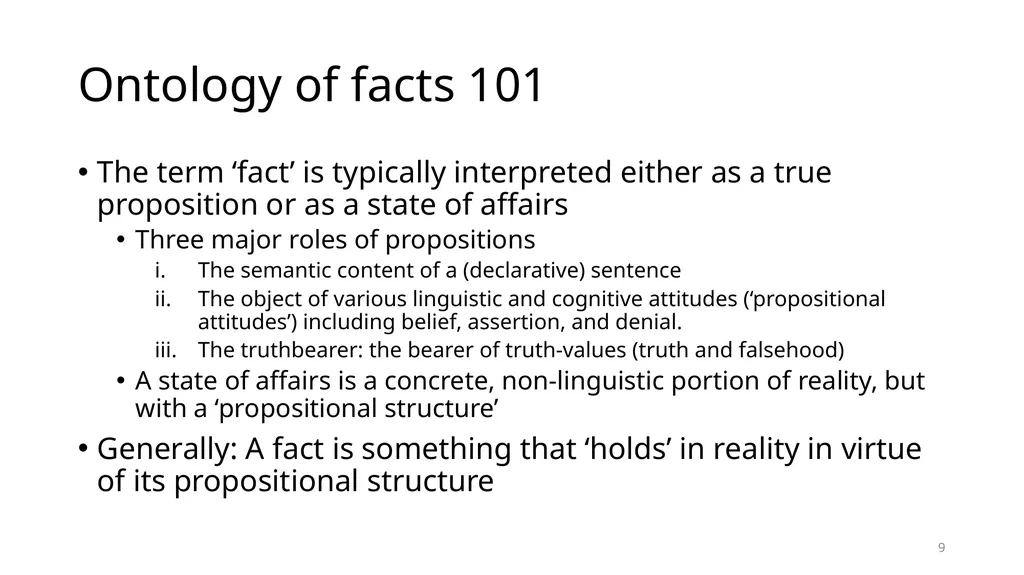
Ontology of facts 101 The term ‘fact’ is typically interpreted either as a true proposition or as a state of affairs
Three major roles of propositions
The semantic content of a (declarative) sentence
The object of various linguistic and cognitive attitudes (‘propositional attitudes’) including belief, assertion, and denial.
The truthbearer: the bearer of truth-values (truth and falsehood)
A state of affairs is a concrete, non-linguistic portion of reality, but with a ‘propositional structure’
Generally: A fact is something that ‘holds’ in reality in virtue of its propositional structure 9<br>
10
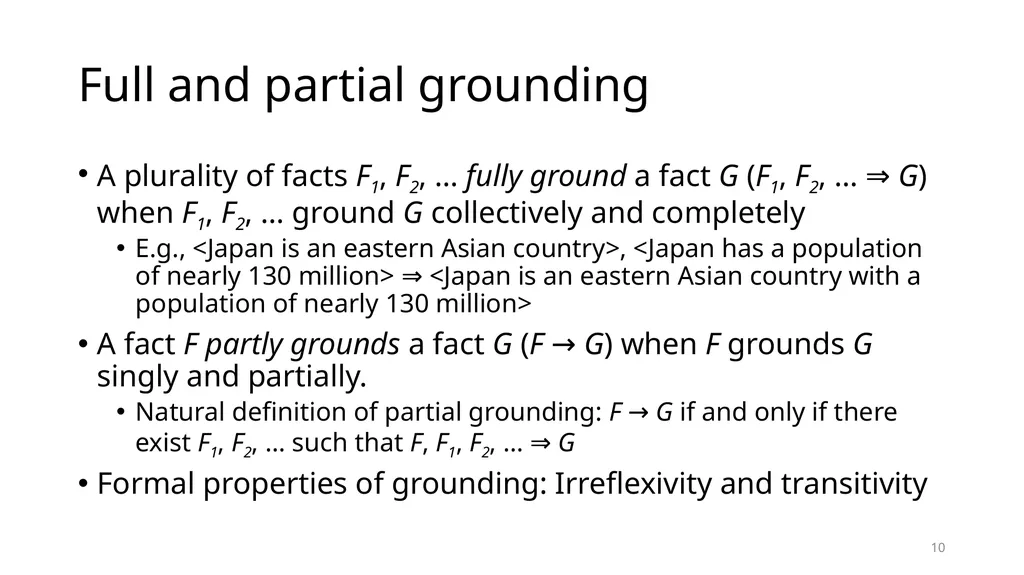
Full and partial grounding A plurality of facts F1, F2, … fully ground a fact G (F1, F2, … ⇒ G) when F1, F2, … ground G collectively and completely
E.g., <Japan is an eastern Asian country>, <Japan has a population of nearly 130 million> ⇒ <Japan is an eastern Asian country with a population of nearly 130 million>
A fact F partly grounds a fact G (F → G) when F grounds G singly and partially.
Natural definition of partial grounding: F → G if and only if there exist F1, F2, … such that F, F1, F2, … ⇒ G
Formal properties of grounding: Irreflexivity and transitivity 10<br>
11
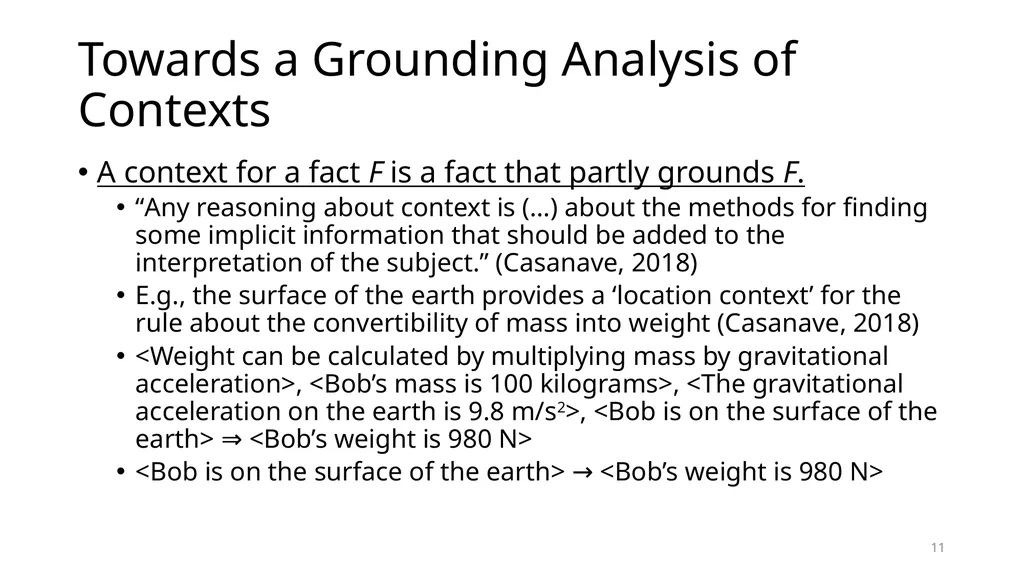
Towards a Grounding Analysis of Contexts A context for a fact F is a fact that partly grounds F.
“Any reasoning about context is (…) about the methods for finding some implicit information that should be added to the interpretation of the subject.” (Casanave, 2018)
E.g., the surface of the earth provides a ‘location context’ for the rule about the convertibility of mass into weight (Casanave, 2018)
<Weight can be calculated by multiplying mass by gravitational acceleration>, <Bob’s mass is 100 kilograms>, <The gravitational acceleration on the earth is 9.8 m/s2>, <Bob is on the surface of the earth> ⇒ <Bob’s weight is 980 N>
<Bob is on the surface of the earth> → <Bob’s weight is 980 N> 11<br>
12
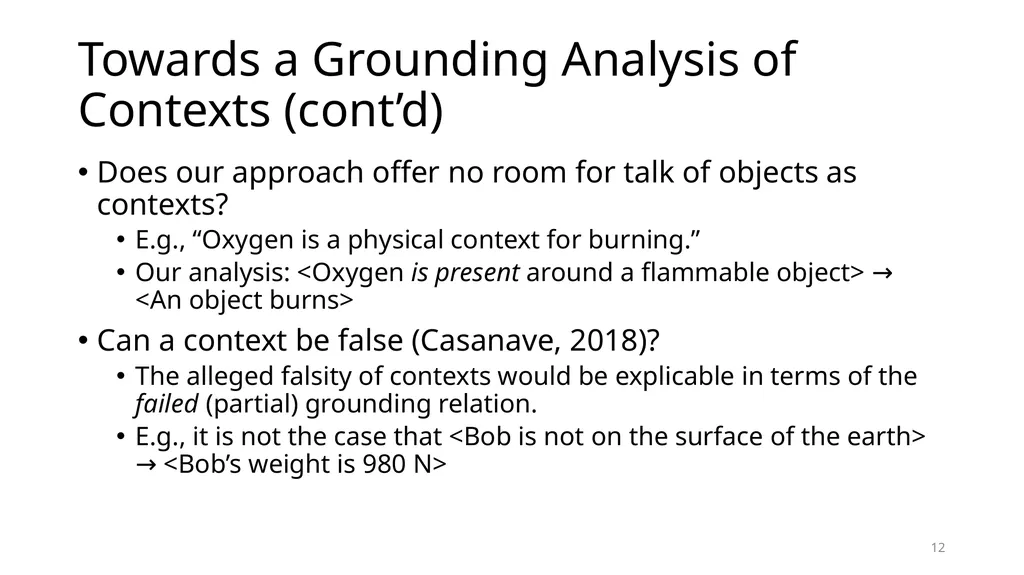
Towards a Grounding Analysis of Contexts (cont’d) Does our approach offer no room for talk of objects as contexts?
E.g., “Oxygen is a physical context for burning.”
Our analysis: <Oxygen is present around a flammable object> → <An object burns>
Can a context be false (Casanave, 2018)?
The alleged falsity of contexts would be explicable in terms of the failed (partial) grounding relation.
E.g., it is not the case that <Bob is not on the surface of the earth> → <Bob’s weight is 980 N> 12<br>
13
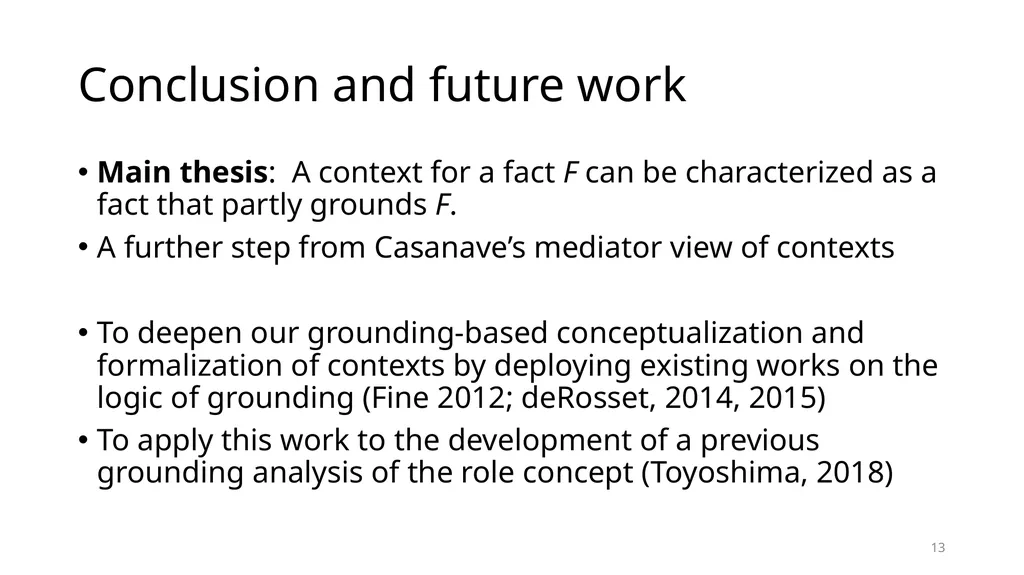
Conclusion and future work Main thesis: A context for a fact F can be characterized as a fact that partly grounds F.
A further step from Casanave’s mediator view of contexts
To deepen our grounding-based conceptualization and formalization of contexts by deploying existing works on the logic of grounding (Fine 2012; deRosset, 2014, 2015)
To apply this work to the development of a previous grounding analysis of the role concept (Toyoshima, 2018) 13<br>
14
Thank you for your attention! Fumiaki Toyoshima: toyo.fumming@gmail.com
(Note: All the abbreviated references in this presentation can be found in our paper.) 14<br>