
Continuous Auditing Technology Adoption in Leading
Description: Continuous Auditing Technology Adoption in Leading Internal Audit Organizations Miklos A. Vasarhelyi Siripan Kuenkaikaew Objectives This study involve field research studies from 9 leading internal audit organizations. Examines the status
Related Topics
Download Presentation
"Continuous Auditing Technology Adoption in Leading" is the property of its rightful owner. Permission is granted to download and print the materials on this website for personal, non-commercial use only, and to display it on your personal computer provided you do not modify the materials and that you retain all copyright notices contained in the materials. By downloading content from our website, you accept the terms of this agreement.
Presentation Transcript
slide1. Continuous Auditing
Technology Adoption in Leading
Internal Audit Organizations Miklos A. Vasarhelyi
Siripan Kuenkaikaew<br>
slide2. Objectives This study involve field research studies from 9 leading internal audit organizations.
Examines the status of continuous auditing and continuous control monitoring adoption of the organizations.
How internal auditors adopt audit-aid technology in their work.<br>
slide3. Methodology Interviews with internal auditors, IT internal auditors and internal audit management.
The interviews were conducted face-to-face through site visits.
Interviewees were selected from the internal audit department. At least four employees were interviewed per organization to ensure validity, information completeness, and a range of points of view.<br>
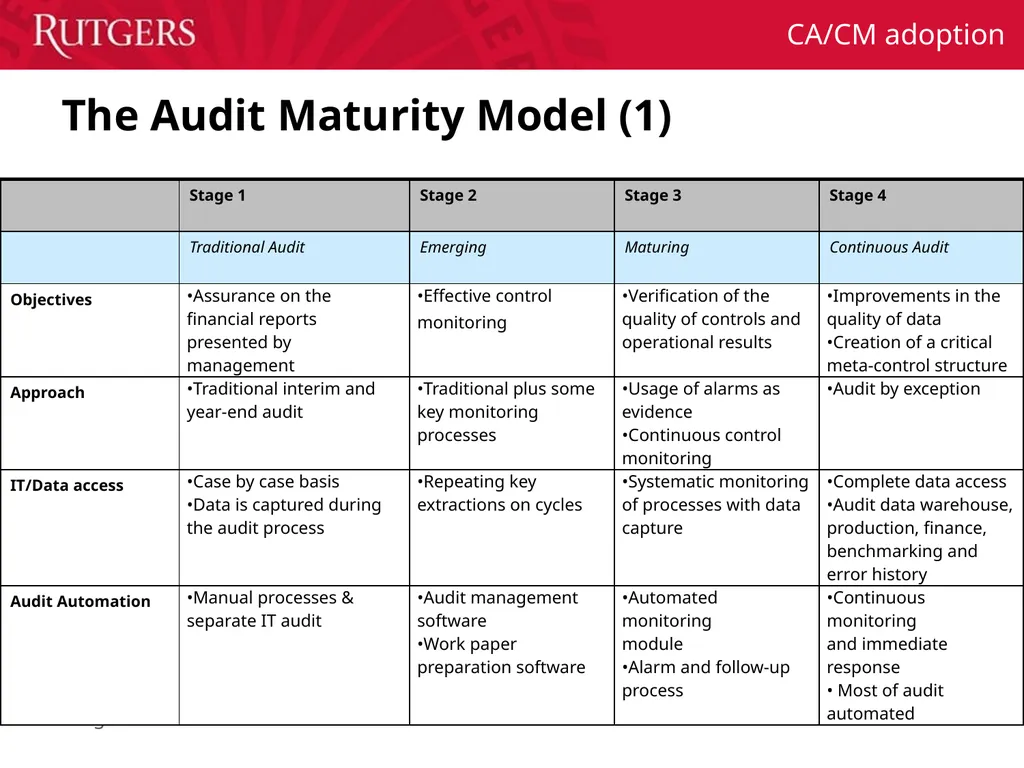
slide4. The Audit Maturity Model (1)<br>
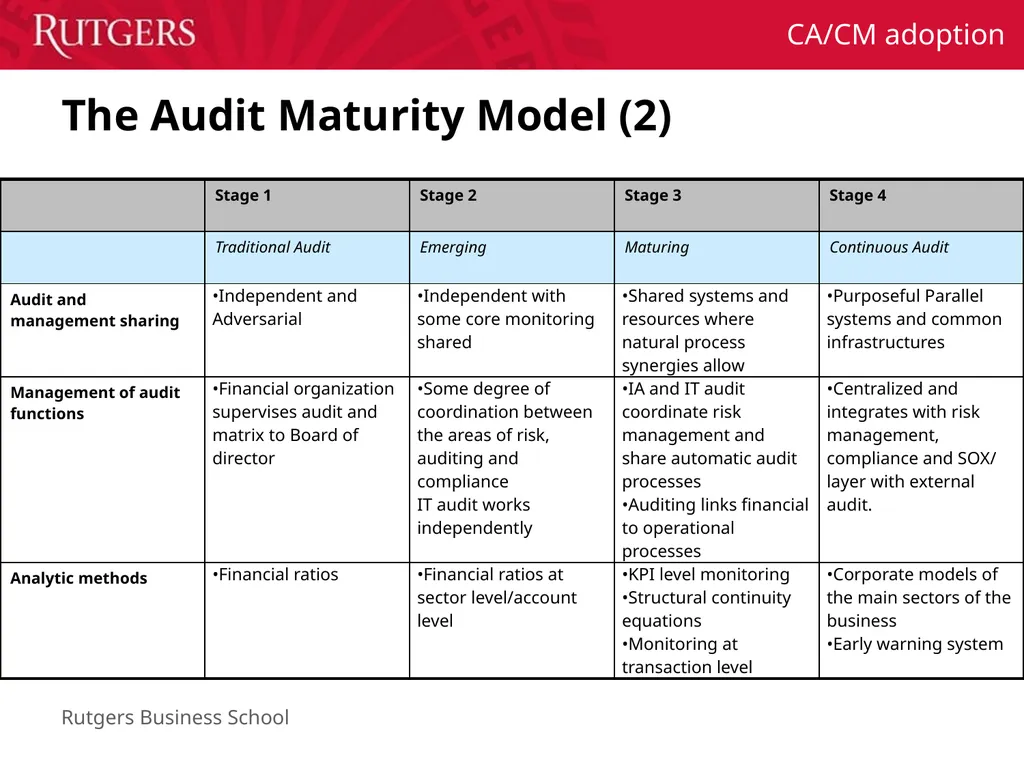
slide5. The Audit Maturity Model (2)<br>
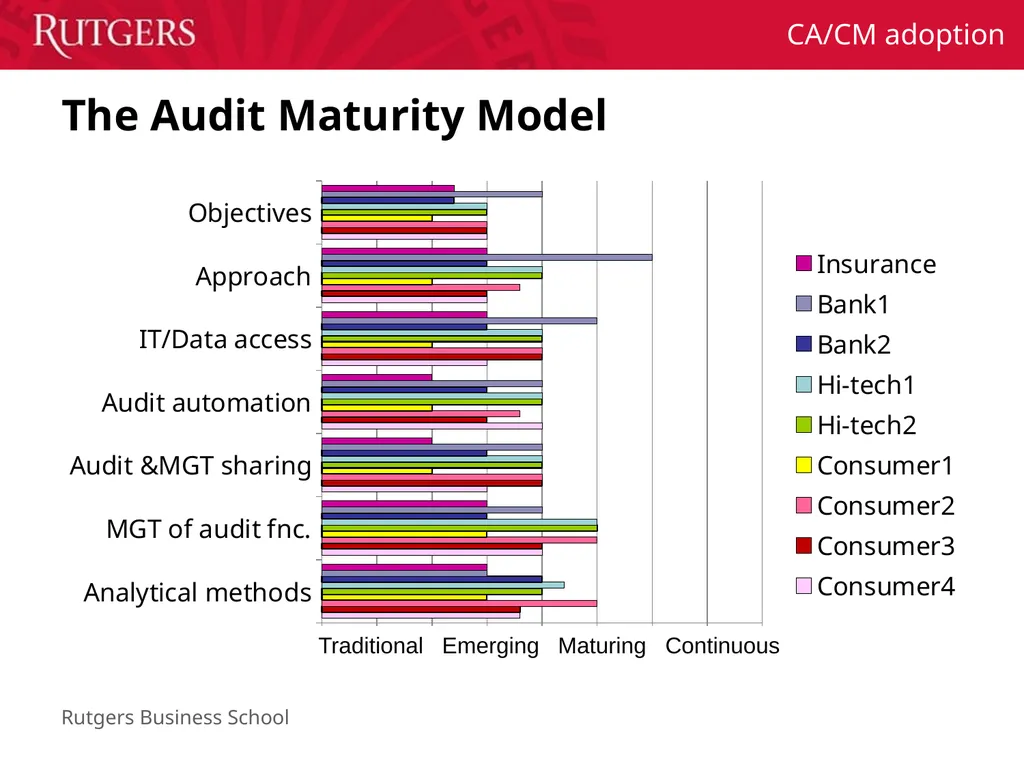
slide6. The Audit Maturity Model Traditional Emerging Maturing Continuous<br>
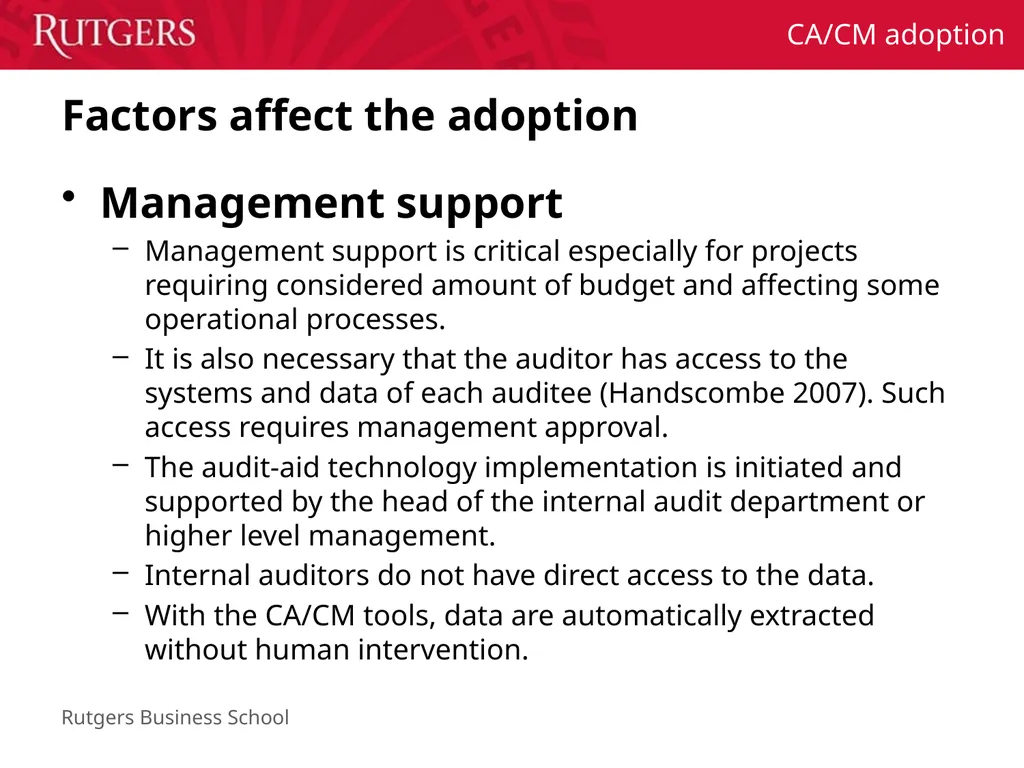
slide7. Factors affect the adoption Management support
Management support is critical especially for projects requiring considered amount of budget and affecting some operational processes.
It is also necessary that the auditor has access to the systems and data of each auditee (Handscombe 2007). Such access requires management approval.
The audit-aid technology implementation is initiated and supported by the head of the internal audit department or higher level management.
Internal auditors do not have direct access to the data.
With the CA/CM tools, data are automatically extracted without human intervention.<br>
slide8. Factors affect the adoption Employee knowledge
Hall and Khan (2003) posited that an adoption of new invention might be slow if a success of the implementation requires complex new skills.
Continuous auditing and continuous control monitoring relies on advance technology.
The tools and systems are varied across/within the company, so that an internal auditor needs some basic knowledge or skills for those systems, audit-aid technology and tools.
Standard training, customized training, MBA program
Prefer experienced auditors
Staff rotational program<br>
slide9. Factors affect the adoption Perceived cost
In this context, cost is not the monetary value but the perception of the adoption cost.
Taylor and Murphy (2004) suggested that high set-up and ongoing costs could be barriers to the implementation of technology.
Searcy and Woodroof(2001): Continuous auditing is increasingly adopted because of a dramatically fallen in a cost of implementation and an availability of support technology.
Cost is not the barrier for the adoption of technology. It was not identified as a top challenge for the implementation.<br>
slide10. Factors affect the adoption Regulation and compliance
Many of the executives are thinking of continuous auditing as one of the solutions that assist them to comply with the regulation (Handscombe 2007).
SEC 33-8128 (accelerate the submission of financial report), SOX 404 (internal control quality and on-time report), bank regulation
Although there is no explicit relationship between CA/CM implementation with regulation and compliance, the interviewees report that CA/CM supports SOX fulfillment.
It facilitates the review activities and reduces time allocated to SOX compliance.<br>
slide11. Analysis Most of the companies are at the foundation stage of CA/CM adoption.
Contrasts with the findings and internal audit surveys previously conducted.
Lacking audit aid tools such as working paper management and data analysis tools.
i.e. Consumer 1
Lack of training for Audit aid tools
Consumer 1 is not successful with the ACL data analysis adoption.
Audit like organization<br>
slide12. Analysis IA wants to improve audit competency and technology skill set.
Bank 2 hires Big4 as a consultant to help in internal audit areas.
Some companies have a certain level of CA/CM technology adoption such as Hi-tech1, Hi-tech 2 and Bank 1.
External auditor can rely on internal audit work at some level.
With advanced auditing technology, sufficient access to data is facilitated; for instance, the continuous monitoring system of Bank 1 and the audit tools of Hi-tech 1.
Analyze data in various dimensions and at a deeper level<br>
slide13. Conclusion Several companies have implemented some advanced audit technologies, however, none of them really has continuous auditing.
Most of them are ranked between stage 1, traditional audit, and stage 2, emerging.
There is opportunity for development in the future.<br>
Siripan Kuenkaikaew<br>
slide2. Objectives This study involve field research studies from 9 leading internal audit organizations.
Examines the status of continuous auditing and continuous control monitoring adoption of the organizations.
How internal auditors adopt audit-aid technology in their work.<br>
slide3. Methodology Interviews with internal auditors, IT internal auditors and internal audit management.
The interviews were conducted face-to-face through site visits.
Interviewees were selected from the internal audit department. At least four employees were interviewed per organization to ensure validity, information completeness, and a range of points of view.<br>
slide4. The Audit Maturity Model (1)<br>
slide5. The Audit Maturity Model (2)<br>
slide6. The Audit Maturity Model Traditional Emerging Maturing Continuous<br>
slide7. Factors affect the adoption Management support
Management support is critical especially for projects requiring considered amount of budget and affecting some operational processes.
It is also necessary that the auditor has access to the systems and data of each auditee (Handscombe 2007). Such access requires management approval.
The audit-aid technology implementation is initiated and supported by the head of the internal audit department or higher level management.
Internal auditors do not have direct access to the data.
With the CA/CM tools, data are automatically extracted without human intervention.<br>
slide8. Factors affect the adoption Employee knowledge
Hall and Khan (2003) posited that an adoption of new invention might be slow if a success of the implementation requires complex new skills.
Continuous auditing and continuous control monitoring relies on advance technology.
The tools and systems are varied across/within the company, so that an internal auditor needs some basic knowledge or skills for those systems, audit-aid technology and tools.
Standard training, customized training, MBA program
Prefer experienced auditors
Staff rotational program<br>
slide9. Factors affect the adoption Perceived cost
In this context, cost is not the monetary value but the perception of the adoption cost.
Taylor and Murphy (2004) suggested that high set-up and ongoing costs could be barriers to the implementation of technology.
Searcy and Woodroof(2001): Continuous auditing is increasingly adopted because of a dramatically fallen in a cost of implementation and an availability of support technology.
Cost is not the barrier for the adoption of technology. It was not identified as a top challenge for the implementation.<br>
slide10. Factors affect the adoption Regulation and compliance
Many of the executives are thinking of continuous auditing as one of the solutions that assist them to comply with the regulation (Handscombe 2007).
SEC 33-8128 (accelerate the submission of financial report), SOX 404 (internal control quality and on-time report), bank regulation
Although there is no explicit relationship between CA/CM implementation with regulation and compliance, the interviewees report that CA/CM supports SOX fulfillment.
It facilitates the review activities and reduces time allocated to SOX compliance.<br>
slide11. Analysis Most of the companies are at the foundation stage of CA/CM adoption.
Contrasts with the findings and internal audit surveys previously conducted.
Lacking audit aid tools such as working paper management and data analysis tools.
i.e. Consumer 1
Lack of training for Audit aid tools
Consumer 1 is not successful with the ACL data analysis adoption.
Audit like organization<br>
slide12. Analysis IA wants to improve audit competency and technology skill set.
Bank 2 hires Big4 as a consultant to help in internal audit areas.
Some companies have a certain level of CA/CM technology adoption such as Hi-tech1, Hi-tech 2 and Bank 1.
External auditor can rely on internal audit work at some level.
With advanced auditing technology, sufficient access to data is facilitated; for instance, the continuous monitoring system of Bank 1 and the audit tools of Hi-tech 1.
Analyze data in various dimensions and at a deeper level<br>
slide13. Conclusion Several companies have implemented some advanced audit technologies, however, none of them really has continuous auditing.
Most of them are ranked between stage 1, traditional audit, and stage 2, emerging.
There is opportunity for development in the future.<br>