
Continuous Learning for Administrators of
OM
Published · 45 slides · 0 views
1 / 1

Description
Continuous Learning for Administrators of Sponsored Programs (CLASP) Annual Update 2025 Agenda Topics 2 CFR 200 (April 2024 Revision) New Policies and Policy Changes Definition of a Sponsored Program Effort Reporting Policy Equipment Policy
Related Topics
Share
Embed code
Download this presentation From Below
"Continuous Learning for Administrators of" is the property of its rightful owner. Permission is granted to download and print the materials on this website for personal, non-commercial use only, and to display it on your personal computer provided you do not modify the materials and that you retain all copyright notices contained in the materials. By downloading content from our website, you accept the terms of this agreement.
Presentation Transcript
01
Continuous
Learning for
Administrators of
Sponsored
Programs
(CLASP) Annual Update 2025<br>
02
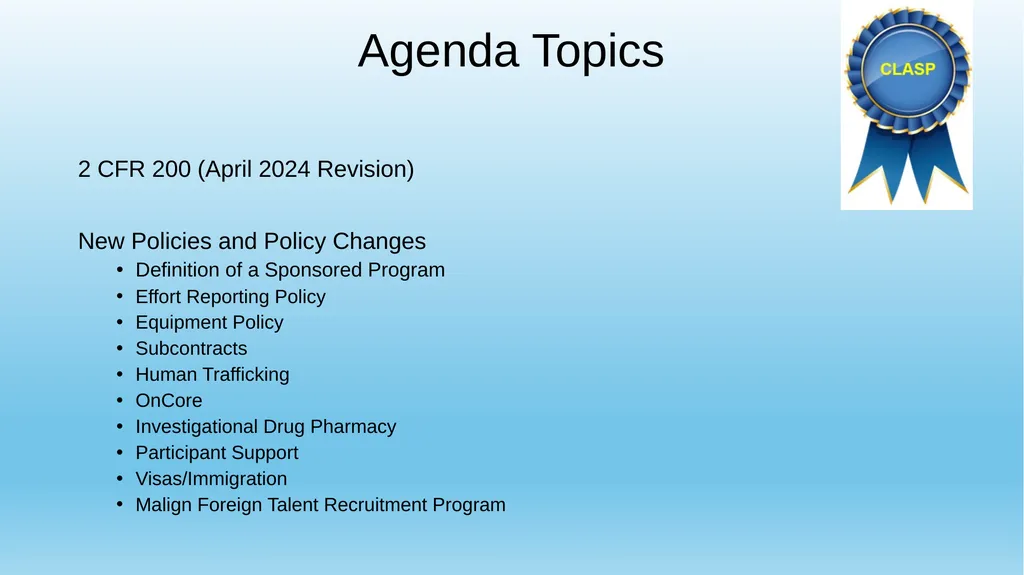
Agenda Topics 2 CFR 200 (April 2024 Revision)
New Policies and Policy Changes
Definition of a Sponsored Program
Effort Reporting Policy
Equipment Policy
Subcontracts
Human Trafficking
OnCore
Investigational Drug Pharmacy
Participant Support
Visas/Immigration
Malign Foreign Talent Recruitment Program<br>
New Policies and Policy Changes
Definition of a Sponsored Program
Effort Reporting Policy
Equipment Policy
Subcontracts
Human Trafficking
OnCore
Investigational Drug Pharmacy
Participant Support
Visas/Immigration
Malign Foreign Talent Recruitment Program<br>
03
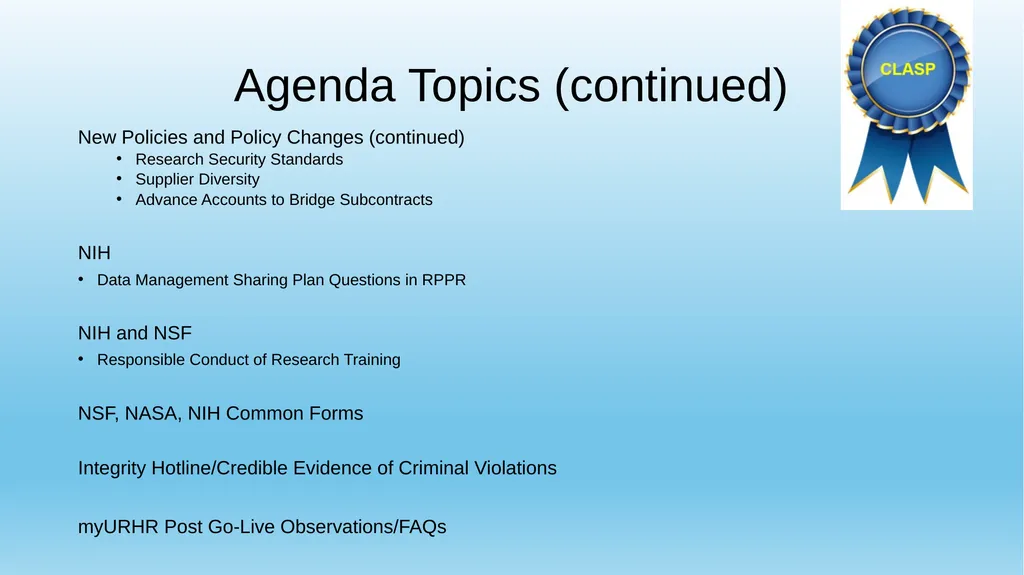
Agenda Topics (continued) New Policies and Policy Changes (continued)
Research Security Standards
Supplier Diversity
Advance Accounts to Bridge Subcontracts
NIH
Data Management Sharing Plan Questions in RPPR
NIH and NSF
Responsible Conduct of Research Training
NSF, NASA, NIH Common Forms
Integrity Hotline/Credible Evidence of Criminal Violations
myURHR Post Go-Live Observations/FAQs<br>
Research Security Standards
Supplier Diversity
Advance Accounts to Bridge Subcontracts
NIH
Data Management Sharing Plan Questions in RPPR
NIH and NSF
Responsible Conduct of Research Training
NSF, NASA, NIH Common Forms
Integrity Hotline/Credible Evidence of Criminal Violations
myURHR Post Go-Live Observations/FAQs<br>
04
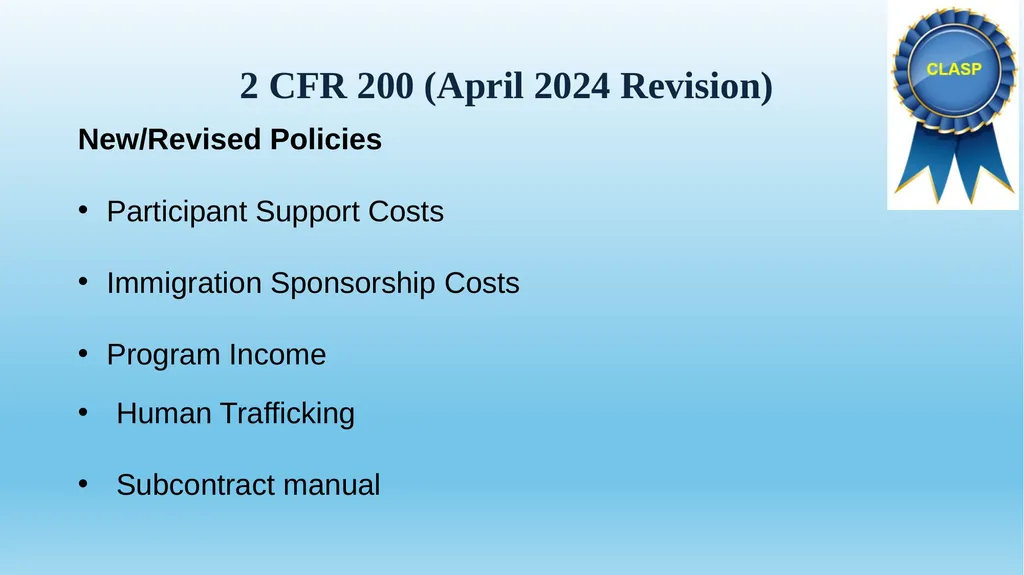
2 CFR 200 (April 2024 Revision) New/Revised Policies
Participant Support Costs
Immigration Sponsorship Costs
Program Income
Human Trafficking
Subcontract manual<br>
Participant Support Costs
Immigration Sponsorship Costs
Program Income
Human Trafficking
Subcontract manual<br>
05
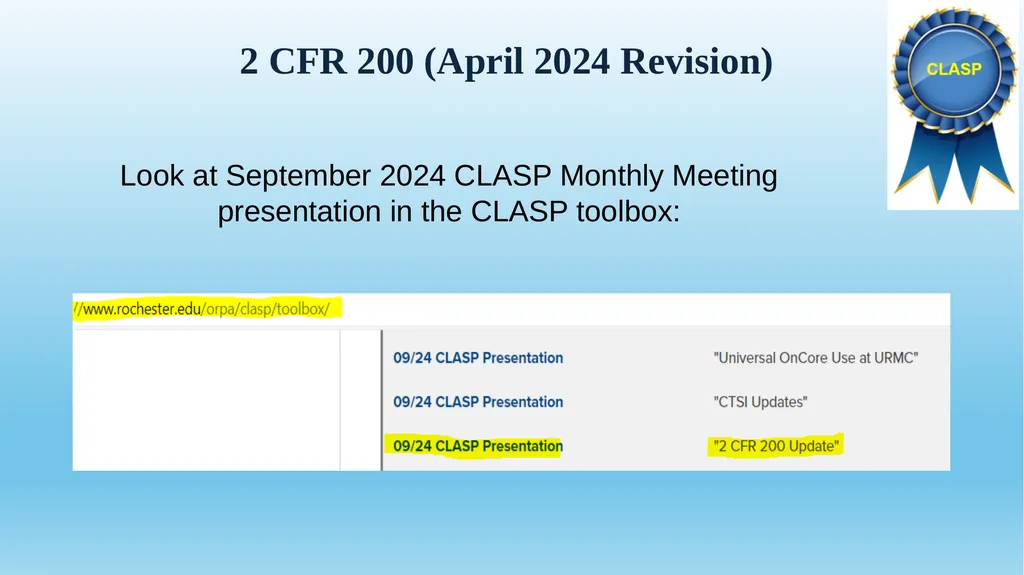
2 CFR 200 (April 2024 Revision) Look at September 2024 CLASP Monthly Meeting presentation in the CLASP toolbox:<br>
06
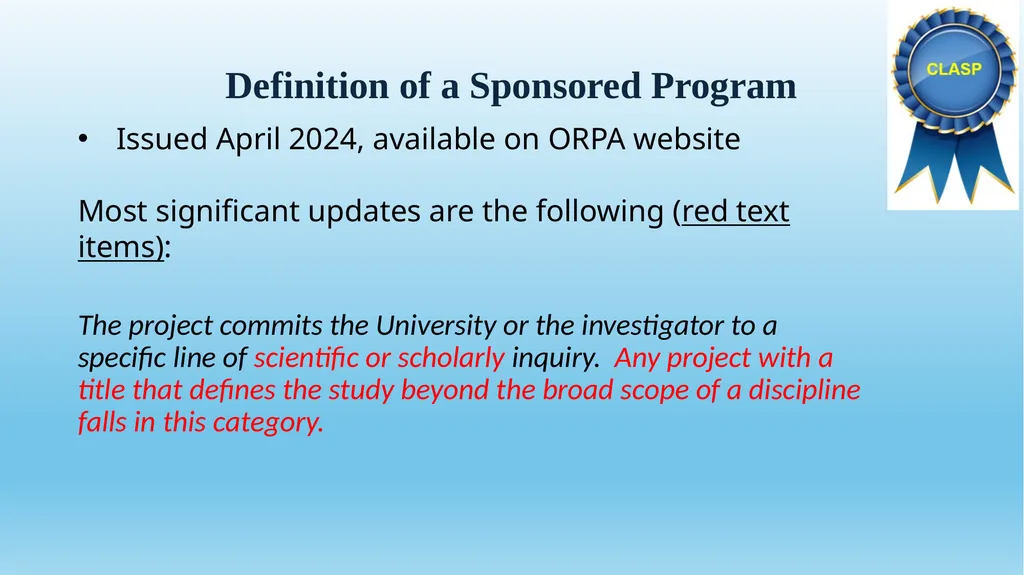
Definition of a Sponsored Program Issued April 2024, available on ORPA website
Most significant updates are the following (red text items):
The project commits the University or the investigator to a specific line of scientific or scholarly inquiry. Any project with a title that defines the study beyond the broad scope of a discipline falls in this category.<br>
Most significant updates are the following (red text items):
The project commits the University or the investigator to a specific line of scientific or scholarly inquiry. Any project with a title that defines the study beyond the broad scope of a discipline falls in this category.<br>
07
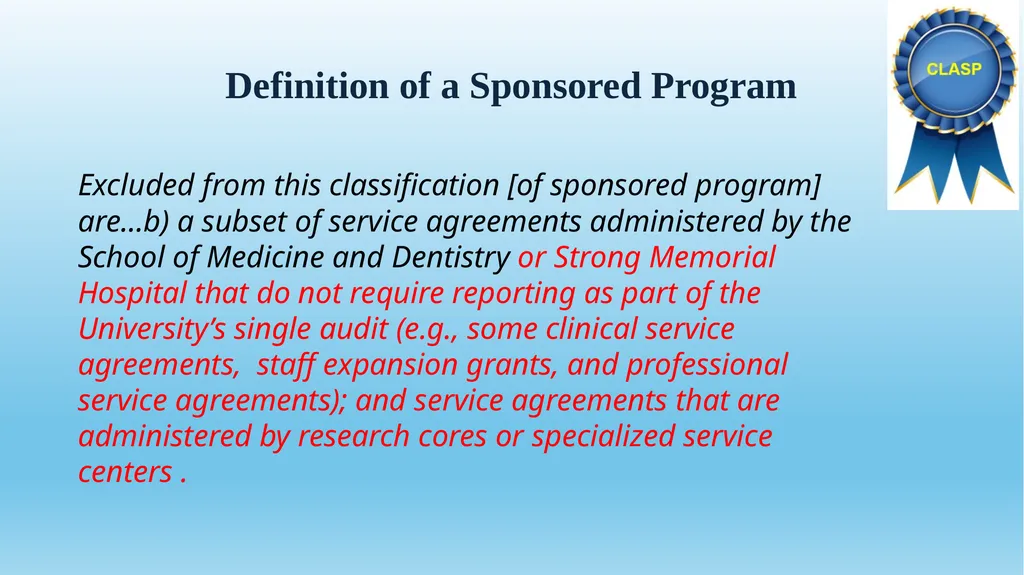
Definition of a Sponsored Program Excluded from this classification [of sponsored program] are…b) a subset of service agreements administered by the School of Medicine and Dentistry or Strong Memorial Hospital that do not require reporting as part of the University’s single audit (e.g., some clinical service agreements, staff expansion grants, and professional service agreements); and service agreements that are administered by research cores or specialized service centers .<br>
08
Definition of a Sponsored Program All research and teaching activities, whether or not considered a sponsored project, which involve human subjects, laboratory animals, use of regulated materials must be reviewed by the appropriate University committees for compliance with University policies and governmental regulations.
The Vice President for Research website should be consulted for further information about sponsored programs that include international collaborations
Related Guidance: Guidelines on Gifts from Corporations<br>
The Vice President for Research website should be consulted for further information about sponsored programs that include international collaborations
Related Guidance: Guidelines on Gifts from Corporations<br>
09
Effort Reporting Policy UR-internal control (Appendix to policy) will no longer be associated with Progress Report submissions;
rather, it will expect the Effort Verification Spreadsheet (or equivalent) to be created at least every three months (four times/year)
to assist with timely PCA processing
reduce the need for PAAs, and
help identify effort reductions needing sponsor approval (e.g., 3 months disengagement from project; 25% reduction in effort).<br>
rather, it will expect the Effort Verification Spreadsheet (or equivalent) to be created at least every three months (four times/year)
to assist with timely PCA processing
reduce the need for PAAs, and
help identify effort reductions needing sponsor approval (e.g., 3 months disengagement from project; 25% reduction in effort).<br>
10
Effort Reporting Policy
Effort Certifications Non-academic River Campus
and School Of Nursing and all Medical Center
January – June
July – December
Academic River Campus
and School Of Nursing
January – May
June – August
September- December<br>
and School Of Nursing and all Medical Center
January – June
July – December
Academic River Campus
and School Of Nursing
January – May
June – August
September- December<br>
11
Effort Reporting Policy Salary Cap
Salary cap levels will be automatically applied by the
system.
The system automatically computes and applies salary
caps for persons whose annualized 9-month Institutional
Base Salary exceeds the salary cap.
The system will not automatically adjust amounts related to
salary caps when a Payroll Accounting Adjustment (PAA) is
processed.<br>
Salary cap levels will be automatically applied by the
system.
The system automatically computes and applies salary
caps for persons whose annualized 9-month Institutional
Base Salary exceeds the salary cap.
The system will not automatically adjust amounts related to
salary caps when a Payroll Accounting Adjustment (PAA) is
processed.<br>
12
Effort Reporting Policy Administrative and Clerical Salaries
Administrative and Clerical Staff salaries no longer need to be explicitly included in a proposal nor be explicitly approved by the federal sponsor.<br>
Administrative and Clerical Staff salaries no longer need to be explicitly included in a proposal nor be explicitly approved by the federal sponsor.<br>
13
Equipment Policy As of July 1, 2024, the University’s capitalization guidelines apply to purchased items having a unit cost of $5,000 or greater and a useful life of greater than one year.<br>
14
2 CFR 200 (April 2024 Revision) Subcontracts
MTDC (Modified Total Direct Costs) Base
Overhead will be applied to the first $50,000 of each subaward
$25,000 was the last threshold
Cannot be implemented until our Overhead Cost Agreement is approved by HHS
After approval, start using the $50,000 threshold in proposals from that date forward.
Likely existing awards/subawards will be grandfathered.<br>
MTDC (Modified Total Direct Costs) Base
Overhead will be applied to the first $50,000 of each subaward
$25,000 was the last threshold
Cannot be implemented until our Overhead Cost Agreement is approved by HHS
After approval, start using the $50,000 threshold in proposals from that date forward.
Likely existing awards/subawards will be grandfathered.<br>
15
2 CFR 200 (April 2024 Revision) Subcontracts
Changes to “Policies and Procedures for the Administration of Subagreements Issued to A Third Party” – see ORPA website
Communicate to the sponsor any special terms we place in a
subaward based upon the internal risk assessment.
Raises threshold from $250,000 to $500,000 for when fixed awards need
sponsor approval.<br>
Changes to “Policies and Procedures for the Administration of Subagreements Issued to A Third Party” – see ORPA website
Communicate to the sponsor any special terms we place in a
subaward based upon the internal risk assessment.
Raises threshold from $250,000 to $500,000 for when fixed awards need
sponsor approval.<br>
16
2 CFR 200 (April 2024 Revision) Subcontracts
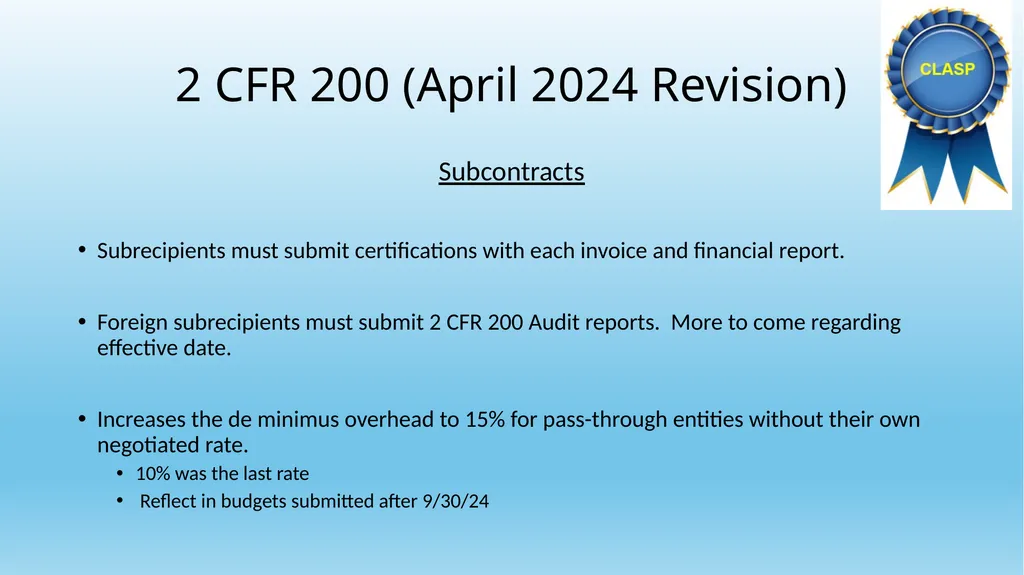
Subrecipients must submit certifications with each invoice and financial report.
Foreign subrecipients must submit 2 CFR 200 Audit reports. More to come regarding effective date.
Increases the de minimus overhead to 15% for pass-through entities without their own negotiated rate.
10% was the last rate
Reflect in budgets submitted after 9/30/24<br>
Subrecipients must submit certifications with each invoice and financial report.
Foreign subrecipients must submit 2 CFR 200 Audit reports. More to come regarding effective date.
Increases the de minimus overhead to 15% for pass-through entities without their own negotiated rate.
10% was the last rate
Reflect in budgets submitted after 9/30/24<br>
17
Human Trafficking Trafficking in Persons
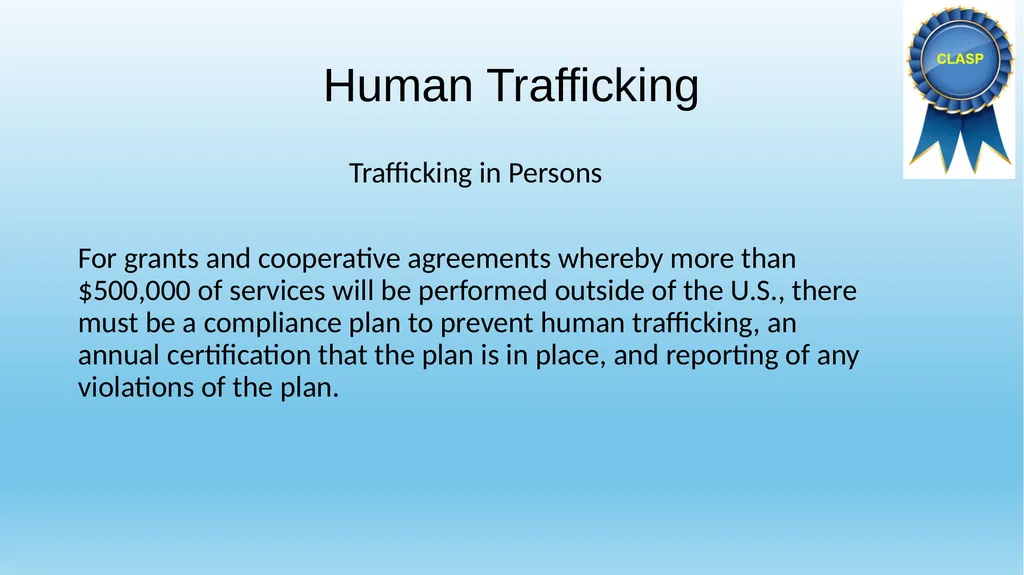
For grants and cooperative agreements whereby more than $500,000 of services will be performed outside of the U.S., there must be a compliance plan to prevent human trafficking, an annual certification that the plan is in place, and reporting of any violations of the plan.<br>
For grants and cooperative agreements whereby more than $500,000 of services will be performed outside of the U.S., there must be a compliance plan to prevent human trafficking, an annual certification that the plan is in place, and reporting of any violations of the plan.<br>
18
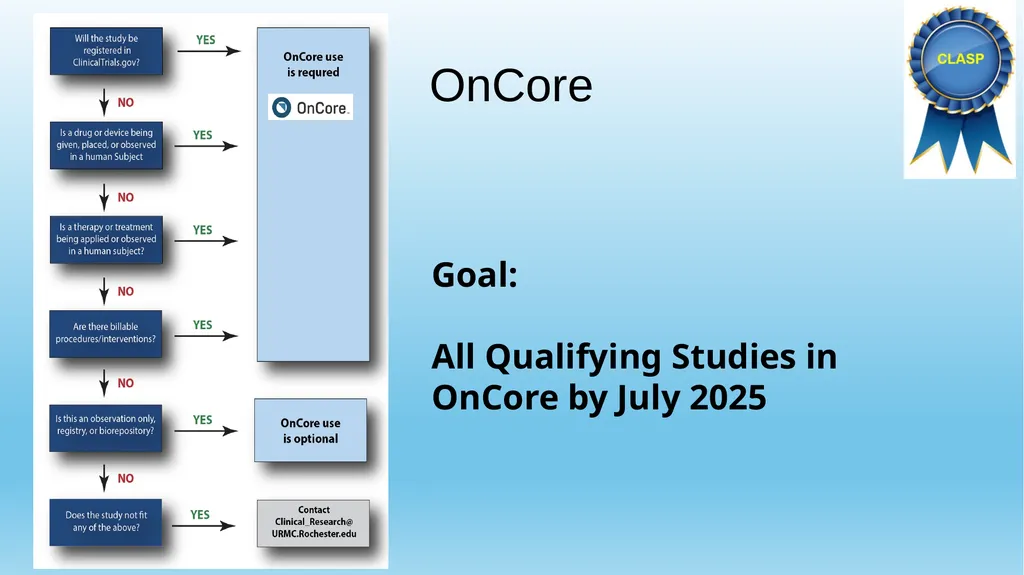
OnCore Goal:
All Qualifying Studies in OnCore by July 2025<br>
19
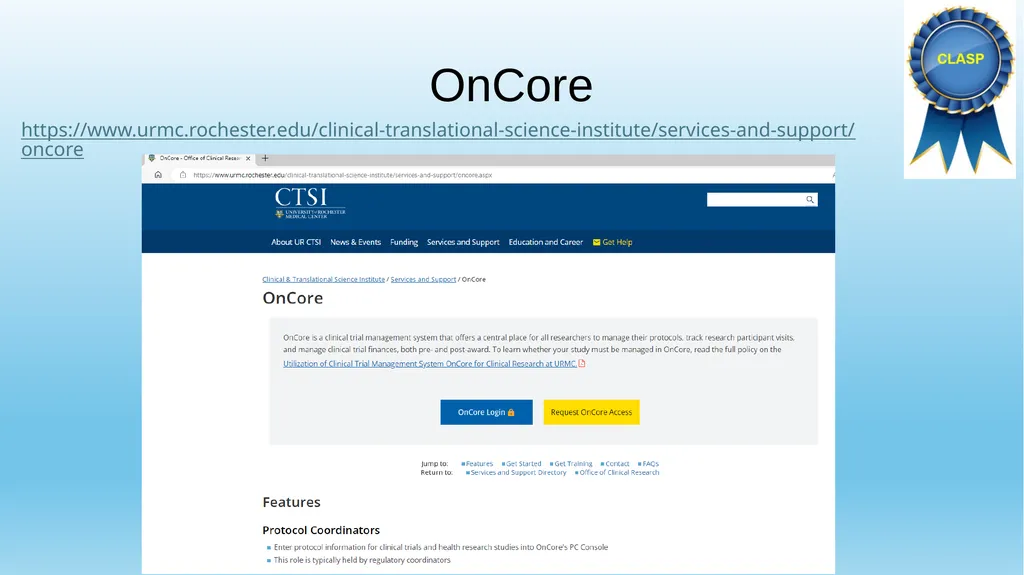
OnCore https://www.urmc.rochester.edu/clinical-translational-science-institute/services-and-support/oncore<br>
20
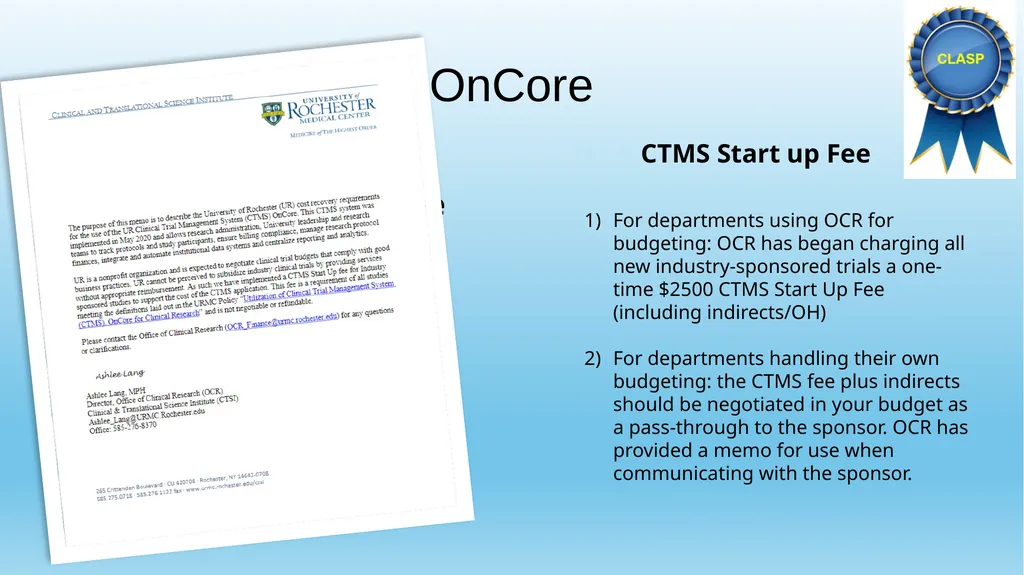
OnCore NEW CTMS Start up Fee For departments using OCR for budgeting: OCR has began charging all new industry-sponsored trials a one-time $2500 CTMS Start Up Fee (including indirects/OH)
For departments handling their own budgeting: the CTMS fee plus indirects should be negotiated in your budget as a pass-through to the sponsor. OCR has provided a memo for use when communicating with the sponsor. NEW CTMS Start up Fee<br>
For departments handling their own budgeting: the CTMS fee plus indirects should be negotiated in your budget as a pass-through to the sponsor. OCR has provided a memo for use when communicating with the sponsor. NEW CTMS Start up Fee<br>
21
Investigational Drug Pharmacy The policy applies to all prospective therapeutic interventional human subject research conducted or supported by employees of the University of Rochester (UR) involving investigational drugs.
It is an expectation that the PI will delegate drug management responsibilities to the IDS and documents the delegated responsibilities via a delegation of authority form.
A PI may submit a request for an exemption to use the IDS as outlined in IDS Waiver Procedure for a clinical trial protocol that uses an investigational product.
The request for exemption to use the IDS will be study-specific and will not be considered or granted for all studies conducted by an investigator or within a division or department. https://sites.mc.rochester.edu/departments/pharmacy/strong-memorial-hospital-inpatient-service-locations/investigational-drug-services/<br>
It is an expectation that the PI will delegate drug management responsibilities to the IDS and documents the delegated responsibilities via a delegation of authority form.
A PI may submit a request for an exemption to use the IDS as outlined in IDS Waiver Procedure for a clinical trial protocol that uses an investigational product.
The request for exemption to use the IDS will be study-specific and will not be considered or granted for all studies conducted by an investigator or within a division or department. https://sites.mc.rochester.edu/departments/pharmacy/strong-memorial-hospital-inpatient-service-locations/investigational-drug-services/<br>
22
Participant Support Prior approval is typically required if:
Participant Support Costs will be charged and were not already budgeted and approved for the award
Funds will be moving out of any Participant Support Cost budget category and into a non-Participant Support Cost budget category
Prior approval is not typically required if:
The rebudget is solely amongst Participant Support Cost categories (stipends, travel, subsistence allowances, registration fees), as long as the scope of work remains the same and the Participant Support Cost category was approved prior to the rebudget (at proposal or award stage)
Funds are moving out of a non-Participant Support Cost category and into a Participant Support Cost category (so that more may be expended on Participant Support Costs), as long as the scope of work remains the same and the Participant Support Cost category existed prior to the rebudget (at proposal or award stage).
As always, check the award and sponsor terms to confirm whether prior approval is needed.<br>
Participant Support Costs will be charged and were not already budgeted and approved for the award
Funds will be moving out of any Participant Support Cost budget category and into a non-Participant Support Cost budget category
Prior approval is not typically required if:
The rebudget is solely amongst Participant Support Cost categories (stipends, travel, subsistence allowances, registration fees), as long as the scope of work remains the same and the Participant Support Cost category was approved prior to the rebudget (at proposal or award stage)
Funds are moving out of a non-Participant Support Cost category and into a Participant Support Cost category (so that more may be expended on Participant Support Costs), as long as the scope of work remains the same and the Participant Support Cost category existed prior to the rebudget (at proposal or award stage).
As always, check the award and sponsor terms to confirm whether prior approval is needed.<br>
23
Visas/Immigration If a non-citizen person’s appointment benefits the University through contribution toward achievement of a sponsored project’s scope of work, the costs associated with immigration sponsorship of such person may be directly charged to the project.
These costs must be attributed to initial recruitment and filing of the initial petition with the immigration service or the Department of State. Costs are allowable on sponsored projects for the following immigration categories:
H-1B and O-1 Visas - Expenses related to H-1B and O-1 sponsorship are allowable for new recruits. Costs are not allowable for extensions of existing H-1B or O-1 visas or amended petitions.
J-1 Visas - If the purpose of the scholar is to work on a specific sponsored project, the sponsoring department may use sponsored project funds to either pay or reimburse the cost of the Student Exchange Visitor Information System (SEVIS) and visa fees.<br>
These costs must be attributed to initial recruitment and filing of the initial petition with the immigration service or the Department of State. Costs are allowable on sponsored projects for the following immigration categories:
H-1B and O-1 Visas - Expenses related to H-1B and O-1 sponsorship are allowable for new recruits. Costs are not allowable for extensions of existing H-1B or O-1 visas or amended petitions.
J-1 Visas - If the purpose of the scholar is to work on a specific sponsored project, the sponsoring department may use sponsored project funds to either pay or reimburse the cost of the Student Exchange Visitor Information System (SEVIS) and visa fees.<br>
24
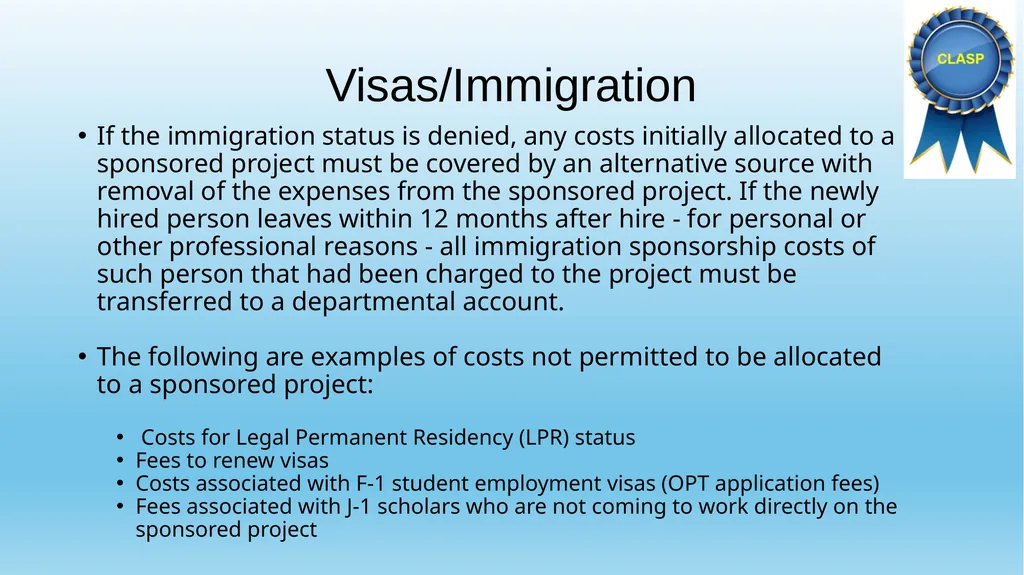
Visas/Immigration If the immigration status is denied, any costs initially allocated to a sponsored project must be covered by an alternative source with removal of the expenses from the sponsored project. If the newly hired person leaves within 12 months after hire - for personal or other professional reasons - all immigration sponsorship costs of such person that had been charged to the project must be transferred to a departmental account.
The following are examples of costs not permitted to be allocated to a sponsored project:
Costs for Legal Permanent Residency (LPR) status
Fees to renew visas
Costs associated with F-1 student employment visas (OPT application fees)
Fees associated with J-1 scholars who are not coming to work directly on the sponsored project<br>
The following are examples of costs not permitted to be allocated to a sponsored project:
Costs for Legal Permanent Residency (LPR) status
Fees to renew visas
Costs associated with F-1 student employment visas (OPT application fees)
Fees associated with J-1 scholars who are not coming to work directly on the sponsored project<br>
25
Malign Foreign Talent
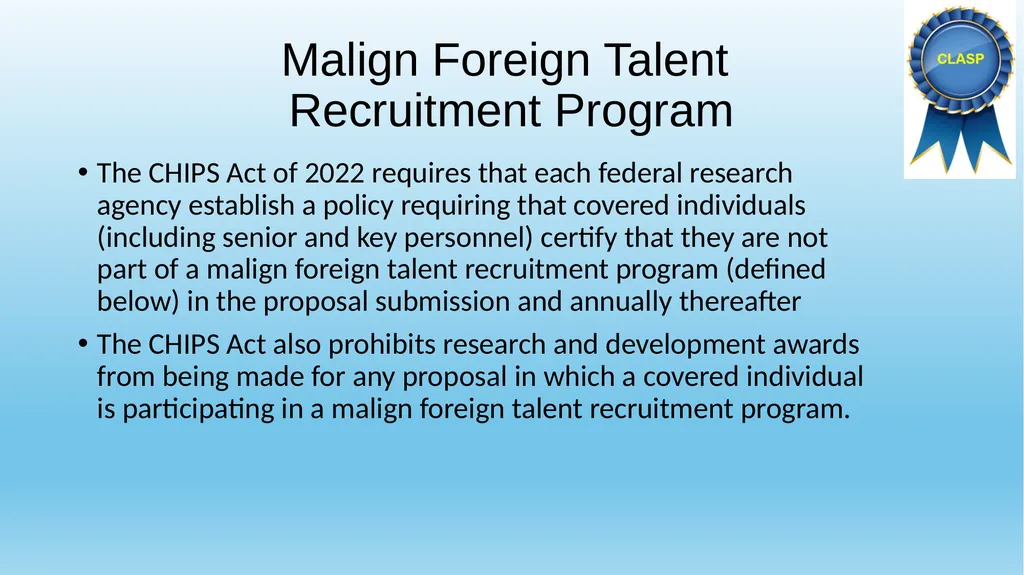
Recruitment Program The CHIPS Act of 2022 requires that each federal research agency establish a policy requiring that covered individuals (including senior and key personnel) certify that they are not part of a malign foreign talent recruitment program (defined below) in the proposal submission and annually thereafter
The CHIPS Act also prohibits research and development awards from being made for any proposal in which a covered individual is participating in a malign foreign talent recruitment program.<br>
The CHIPS Act also prohibits research and development awards from being made for any proposal in which a covered individual is participating in a malign foreign talent recruitment program.<br>
26
Malign Foreign Talent
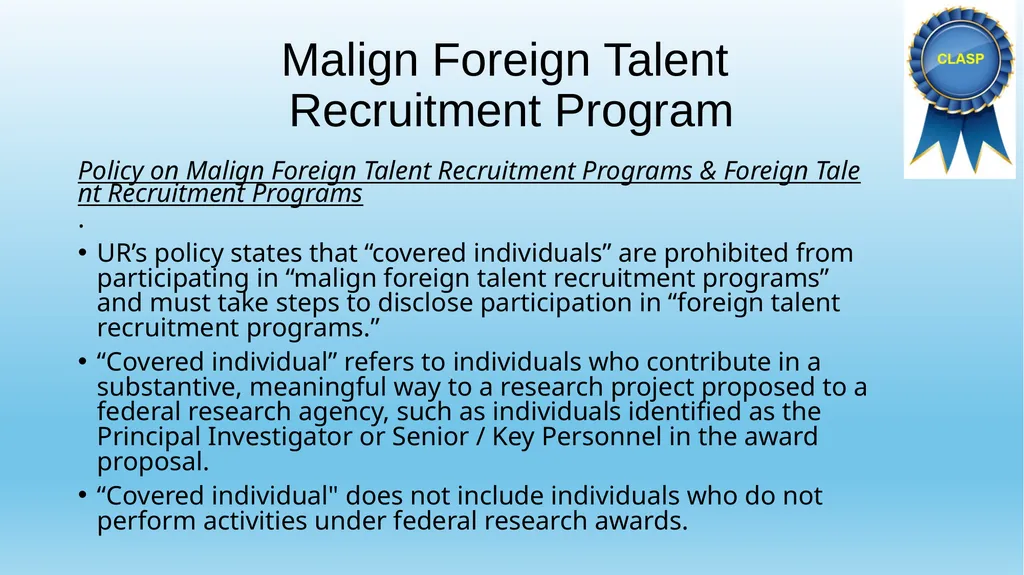
Recruitment Program Policy on Malign Foreign Talent Recruitment Programs & Foreign Talent Recruitment Programs.
UR’s policy states that “covered individuals” are prohibited from participating in “malign foreign talent recruitment programs” and must take steps to disclose participation in “foreign talent recruitment programs.”
“Covered individual” refers to individuals who contribute in a substantive, meaningful way to a research project proposed to a federal research agency, such as individuals identified as the Principal Investigator or Senior / Key Personnel in the award proposal.
“Covered individual" does not include individuals who do not perform activities under federal research awards.<br>
UR’s policy states that “covered individuals” are prohibited from participating in “malign foreign talent recruitment programs” and must take steps to disclose participation in “foreign talent recruitment programs.”
“Covered individual” refers to individuals who contribute in a substantive, meaningful way to a research project proposed to a federal research agency, such as individuals identified as the Principal Investigator or Senior / Key Personnel in the award proposal.
“Covered individual" does not include individuals who do not perform activities under federal research awards.<br>
27
Malign Foreign Talent
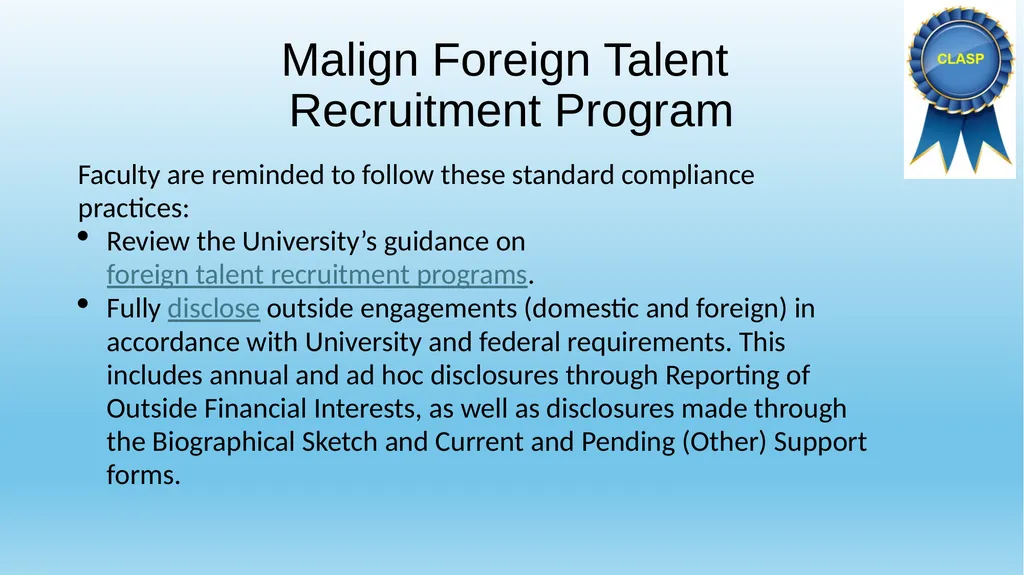
Recruitment Program Faculty are reminded to follow these standard compliance practices:
Review the University’s guidance on foreign talent recruitment programs.
Fully disclose outside engagements (domestic and foreign) in accordance with University and federal requirements. This includes annual and ad hoc disclosures through Reporting of Outside Financial Interests, as well as disclosures made through the Biographical Sketch and Current and Pending (Other) Support forms.<br>
Review the University’s guidance on foreign talent recruitment programs.
Fully disclose outside engagements (domestic and foreign) in accordance with University and federal requirements. This includes annual and ad hoc disclosures through Reporting of Outside Financial Interests, as well as disclosures made through the Biographical Sketch and Current and Pending (Other) Support forms.<br>
28
Malign Foreign Talent
Recruitment Program Faculty are reminded to follow these standard compliance practices:
Carefully consider the acceptance of an international appointment or affiliation, particularly in foreign countries of concern (defined by law as including China, Russia, North Korea, and Iran), as these appointments or affiliations may meet the CHIPS Act definition of a malign foreign talent recruitment program.
Review Guidance and Advice for Faculty who Engage in Outside Consulting.
Review other guidance on research security topics.<br>
Carefully consider the acceptance of an international appointment or affiliation, particularly in foreign countries of concern (defined by law as including China, Russia, North Korea, and Iran), as these appointments or affiliations may meet the CHIPS Act definition of a malign foreign talent recruitment program.
Review Guidance and Advice for Faculty who Engage in Outside Consulting.
Review other guidance on research security topics.<br>
29
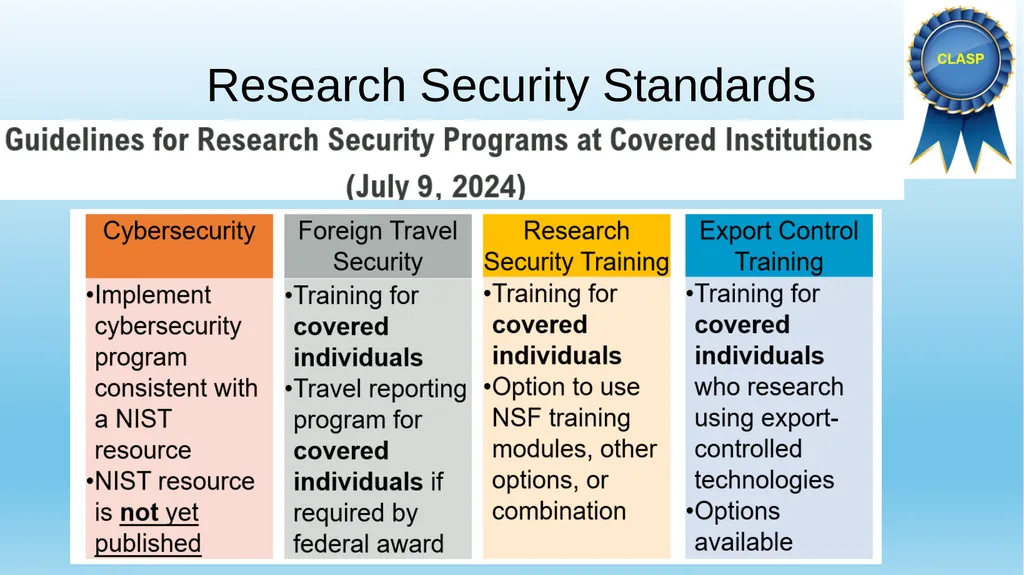
Research Security Standards<br>
30
Research Security Standards Concept of “Covered Individual”
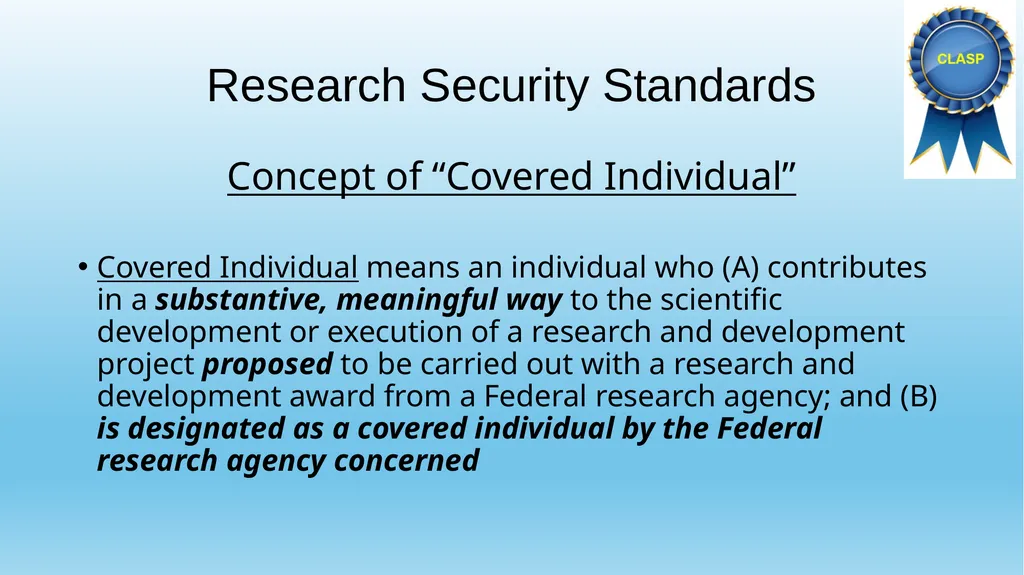
Covered Individual means an individual who (A) contributes in a substantive, meaningful way to the scientific development or execution of a research and development project proposed to be carried out with a research and development award from a Federal research agency; and (B) is designated as a covered individual by the Federal research agency concerned<br>
Covered Individual means an individual who (A) contributes in a substantive, meaningful way to the scientific development or execution of a research and development project proposed to be carried out with a research and development award from a Federal research agency; and (B) is designated as a covered individual by the Federal research agency concerned<br>
31
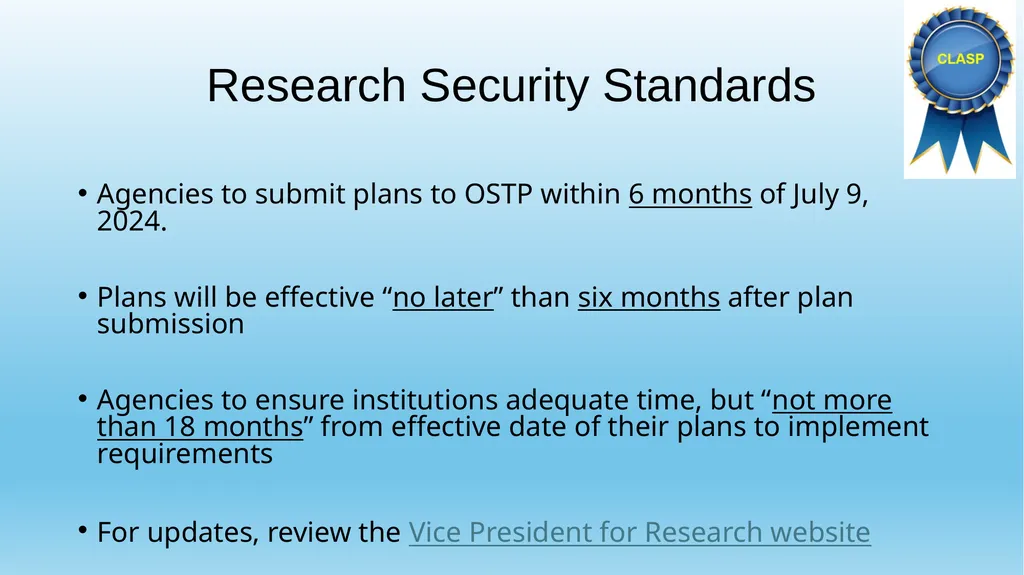
Research Security Standards Agencies to submit plans to OSTP within 6 months of July 9, 2024.
Plans will be effective “no later” than six months after plan submission
Agencies to ensure institutions adequate time, but “not more than 18 months” from effective date of their plans to implement requirements
For updates, review the Vice President for Research website<br>
Plans will be effective “no later” than six months after plan submission
Agencies to ensure institutions adequate time, but “not more than 18 months” from effective date of their plans to implement requirements
For updates, review the Vice President for Research website<br>
32
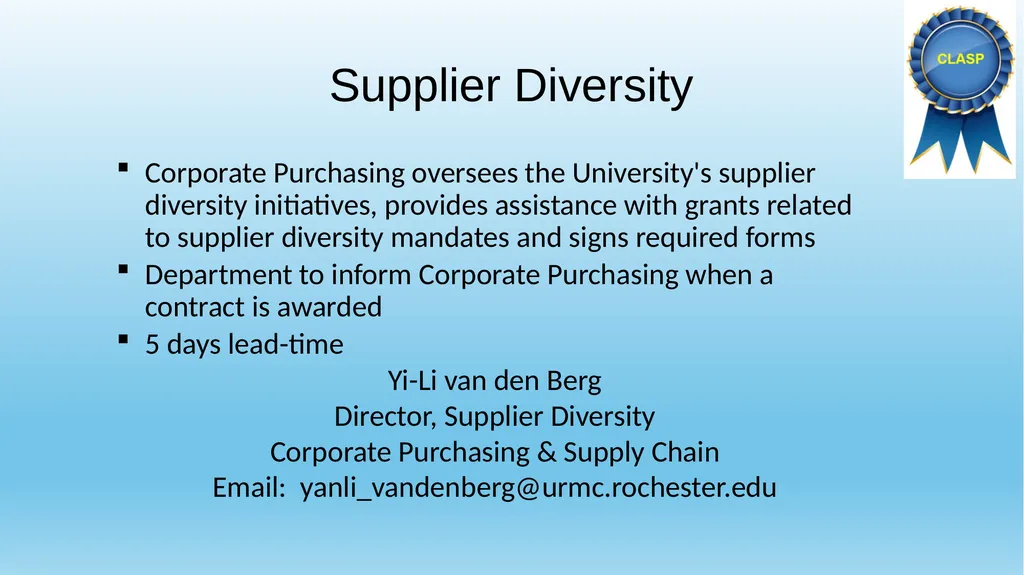
Supplier Diversity Corporate Purchasing oversees the University's supplier diversity initiatives, provides assistance with grants related to supplier diversity mandates and signs required forms
Department to inform Corporate Purchasing when a contract is awarded
5 days lead-time
Yi-Li van den Berg
Director, Supplier Diversity
Corporate Purchasing & Supply Chain
Email: yanli_vandenberg@urmc.rochester.edu<br>
Department to inform Corporate Purchasing when a contract is awarded
5 days lead-time
Yi-Li van den Berg
Director, Supplier Diversity
Corporate Purchasing & Supply Chain
Email: yanli_vandenberg@urmc.rochester.edu<br>
33
Advance Accounts to “Bridge” Subcontracts If we are participating as a subcontract institution, but there is a delay in receipt of the subcontract amendment/extension for a subsequent project year, then request an Advance Account.
The Advance Account will allow continued accounting of project spend without the need to transfer the costs upon ultimate receipt of the updated subcontract from the flow through institution.<br>
The Advance Account will allow continued accounting of project spend without the need to transfer the costs upon ultimate receipt of the updated subcontract from the flow through institution.<br>
34
Data Management Sharing Plans Data storage guidance for the University’s research community is centrally
located for easy reference.
It stipulates safe and approved options for faculty members, researchers and students to store, access and collaborate with specific research data types.
These investments and changes are foundational in our effort to safeguard
all sensitive information from landing in the hands of cybercriminals
You can find data storage solutions in one central location on
tech.rochester:
https://tech.rochester.edu/services/university-wide-research-resources/<br>
located for easy reference.
It stipulates safe and approved options for faculty members, researchers and students to store, access and collaborate with specific research data types.
These investments and changes are foundational in our effort to safeguard
all sensitive information from landing in the hands of cybercriminals
You can find data storage solutions in one central location on
tech.rochester:
https://tech.rochester.edu/services/university-wide-research-resources/<br>
35
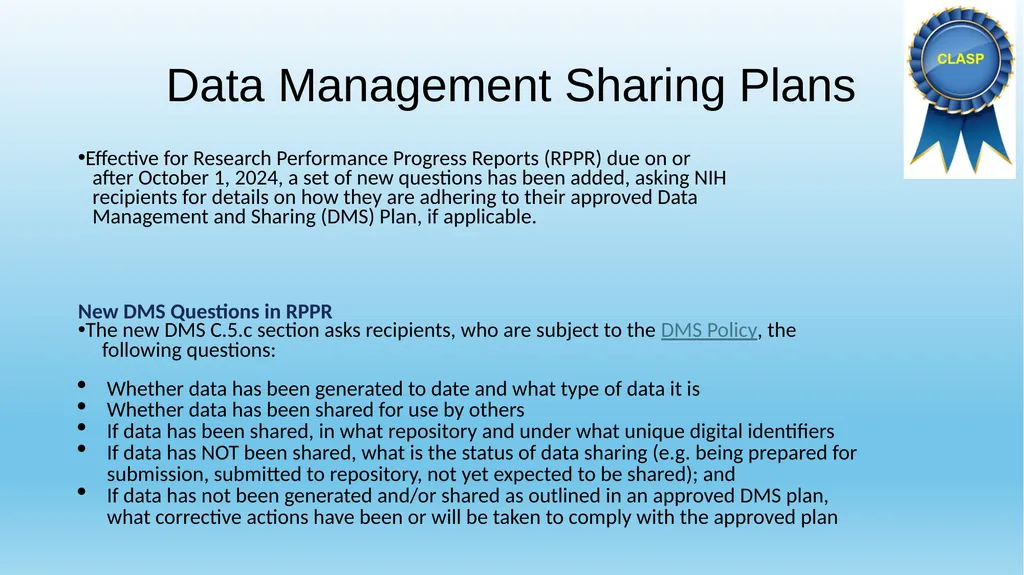
Data Management Sharing Plans Effective for Research Performance Progress Reports (RPPR) due on or
after October 1, 2024, a set of new questions has been added, asking NIH
recipients for details on how they are adhering to their approved Data
Management and Sharing (DMS) Plan, if applicable.
New DMS Questions in RPPR
The new DMS C.5.c section asks recipients, who are subject to the DMS Policy, the
following questions:
Whether data has been generated to date and what type of data it is
Whether data has been shared for use by others
If data has been shared, in what repository and under what unique digital identifiers
If data has NOT been shared, what is the status of data sharing (e.g. being prepared for
submission, submitted to repository, not yet expected to be shared); and
If data has not been generated and/or shared as outlined in an approved DMS plan,
what corrective actions have been or will be taken to comply with the approved plan<br>
after October 1, 2024, a set of new questions has been added, asking NIH
recipients for details on how they are adhering to their approved Data
Management and Sharing (DMS) Plan, if applicable.
New DMS Questions in RPPR
The new DMS C.5.c section asks recipients, who are subject to the DMS Policy, the
following questions:
Whether data has been generated to date and what type of data it is
Whether data has been shared for use by others
If data has been shared, in what repository and under what unique digital identifiers
If data has NOT been shared, what is the status of data sharing (e.g. being prepared for
submission, submitted to repository, not yet expected to be shared); and
If data has not been generated and/or shared as outlined in an approved DMS plan,
what corrective actions have been or will be taken to comply with the approved plan<br>
36
Responsible Conduct of
Research Training The National Institutes of Health (NIH) and the National Science Foundation (NSF)
have issued specific requirements for training in RCR within the last two years
affecting all NSF awards and select categories of NIH awards.
In order to meet these requirements, the University offers programs through CITI
for RCR training and we encourage you to review all RCR resources and trainings,
including federal requirements, on the VPR website.
The RCR trainings include topics such as research misconduct, data management,
authorship, mentorship, peer review, conflicts of interest and commitment, and
collaborative research.<br>
have issued specific requirements for training in RCR within the last two years
affecting all NSF awards and select categories of NIH awards.
In order to meet these requirements, the University offers programs through CITI
for RCR training and we encourage you to review all RCR resources and trainings,
including federal requirements, on the VPR website.
The RCR trainings include topics such as research misconduct, data management,
authorship, mentorship, peer review, conflicts of interest and commitment, and
collaborative research.<br>
37
Responsible Conduct of
Research Training NIH requires a RCR Plan for certain proposal types; this plan must meet NIH-defined requirements in terms of format, subject matter, faculty participation, duration and frequency of instruction. The University’s RCR training through CITI also meets these NIH requirements.
The Office of the Vice President for Research in conjunction with the
Offices of Graduate Education and Postdoctoral Affairs will be tracking the
completion of RCR training on an annual basis.
The PI is ultimately responsible for monitoring and ensuring that trainees
working on their NIH and NSF grants complete the RCR requirement.<br>
The Office of the Vice President for Research in conjunction with the
Offices of Graduate Education and Postdoctoral Affairs will be tracking the
completion of RCR training on an annual basis.
The PI is ultimately responsible for monitoring and ensuring that trainees
working on their NIH and NSF grants complete the RCR requirement.<br>
38
Common Forms The goal is to provide greater standardization of Biosketch and “Other Support” forms, across federal agencies.
Each agency is implementing the Common Forms on their own timeline and may include agency related mandatory requirements.
NSF adopted Common Forms in May 2024, NASA adopted Common Forms in October 2024 and NIH is adopting Common Forms in May 2025.<br>
Each agency is implementing the Common Forms on their own timeline and may include agency related mandatory requirements.
NSF adopted Common Forms in May 2024, NASA adopted Common Forms in October 2024 and NIH is adopting Common Forms in May 2025.<br>
39
Common Forms NSF
Common Forms are required for all proposals and progress reports (effective 5/2024).
Common Forms are completed in SciENcv, must include a persistent identifier (ORCID ID) and must be certified that the information is current, accurate and complete, and that the individual is not a party to a malign foreign talent recruitment program.<br>
Common Forms are required for all proposals and progress reports (effective 5/2024).
Common Forms are completed in SciENcv, must include a persistent identifier (ORCID ID) and must be certified that the information is current, accurate and complete, and that the individual is not a party to a malign foreign talent recruitment program.<br>
40
Common Forms NASA
As of 10/1/24 NASA has adopted the Common Disclosure Forms through its implementation of updated NASA Biosketch and Current and Pending Support fillable forms that can be found on the NASA Grants Policy and Compliance website.
NASA applicants MUST digitally sign their NASA disclosure forms. However, if a form with a digital signature is submitted to NASA via NSPIRES, the system will remove the certification data associated with that digital signature. As such, NASA applicants and award recipients must maintain original disclosure forms with digital signatures and make them accessible to NASA upon request.
NASA is also actively exploring SciENcv as an option for electronic implementation of the Common Disclosure Forms in the latter half of calendar 2025.<br>
As of 10/1/24 NASA has adopted the Common Disclosure Forms through its implementation of updated NASA Biosketch and Current and Pending Support fillable forms that can be found on the NASA Grants Policy and Compliance website.
NASA applicants MUST digitally sign their NASA disclosure forms. However, if a form with a digital signature is submitted to NASA via NSPIRES, the system will remove the certification data associated with that digital signature. As such, NASA applicants and award recipients must maintain original disclosure forms with digital signatures and make them accessible to NASA upon request.
NASA is also actively exploring SciENcv as an option for electronic implementation of the Common Disclosure Forms in the latter half of calendar 2025.<br>
41
Common Forms NIH
NIH is adopting Common Forms for applications and RPPRs with due dates of 5/25/25 and beyond.
SciENcv is mandated for completion of the forms, and therefore require a certification.
As of 5/25/25, all Senior/Key Personnel listed on an application must have an ORCID ID which is linked to their eRA Commons Personal Profile and it must be entered in the Persistent Identifier section of the Common Forms.<br>
NIH is adopting Common Forms for applications and RPPRs with due dates of 5/25/25 and beyond.
SciENcv is mandated for completion of the forms, and therefore require a certification.
As of 5/25/25, all Senior/Key Personnel listed on an application must have an ORCID ID which is linked to their eRA Commons Personal Profile and it must be entered in the Persistent Identifier section of the Common Forms.<br>
42
Common Forms NIH
NIH plans to continue collecting NIH specific data elements (i.e., Personal Statement, Contributions to Science, and Honors) separately from the Common Forms on a new NIH Biographical Sketch Supplement.
Additional guidance will be forthcoming.<br>
NIH plans to continue collecting NIH specific data elements (i.e., Personal Statement, Contributions to Science, and Honors) separately from the Common Forms on a new NIH Biographical Sketch Supplement.
Additional guidance will be forthcoming.<br>
43
myURHR Post Go-Live Observations/FAQs Jeffery Sullivan, ORACS<br>
44
CLASPinfo@ur.Rochester.edu
Penguin This Photo by Unknown Author is licensed under CC BY-SA<br>