
Contraceptive methods: overview Raqibat Idris,
OM
Published · 24 slides · 0 views
1 / 1





Description
Contraceptive methods: overview Raqibat Idris, MBBS, DO, MPH Geneva Foundation for Medical Education and Research Family Planning: An Online Evidence-based Course 2021 Outline Definitions Key facts about contraception family planning
Related Topics
Share
Embed code
Download this presentation From Below
"Contraceptive methods: overview Raqibat Idris," is the property of its rightful owner. Permission is granted to download and print the materials on this website for personal, non-commercial use only, and to display it on your personal computer provided you do not modify the materials and that you retain all copyright notices contained in the materials. By downloading content from our website, you accept the terms of this agreement.
Presentation Transcript
01
Contraceptive methods: overview Raqibat Idris, MBBS, DO, MPH
Geneva Foundation for Medical Education and Research "Family Planning”: An Online Evidence-based Course 2021<br>
Geneva Foundation for Medical Education and Research "Family Planning”: An Online Evidence-based Course 2021<br>
02
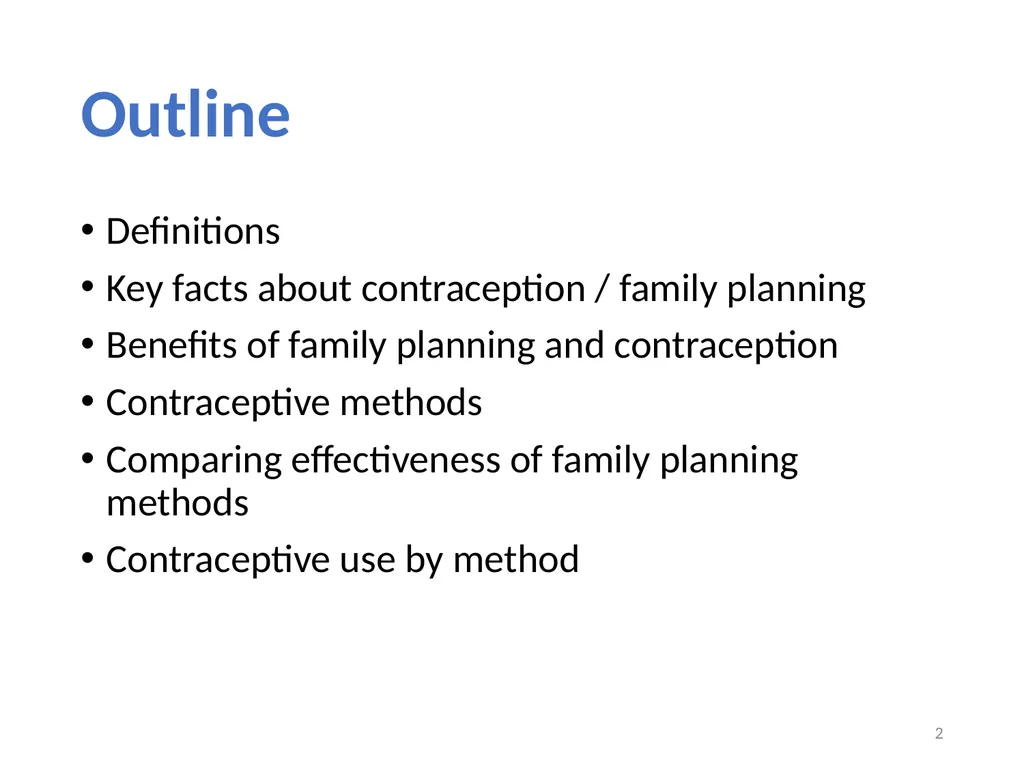
Outline Definitions
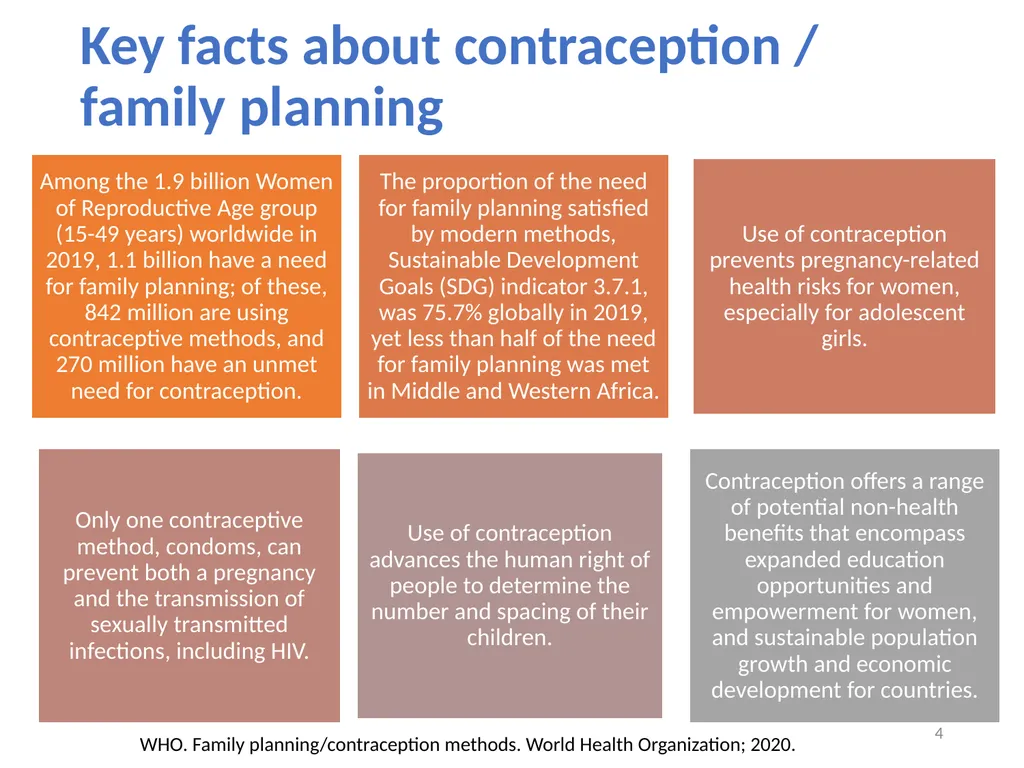
Key facts about contraception / family planning
Benefits of family planning and contraception
Contraceptive methods
Comparing effectiveness of family planning methods
Contraceptive use by method 2<br>
Key facts about contraception / family planning
Benefits of family planning and contraception
Contraceptive methods
Comparing effectiveness of family planning methods
Contraceptive use by method 2<br>
03
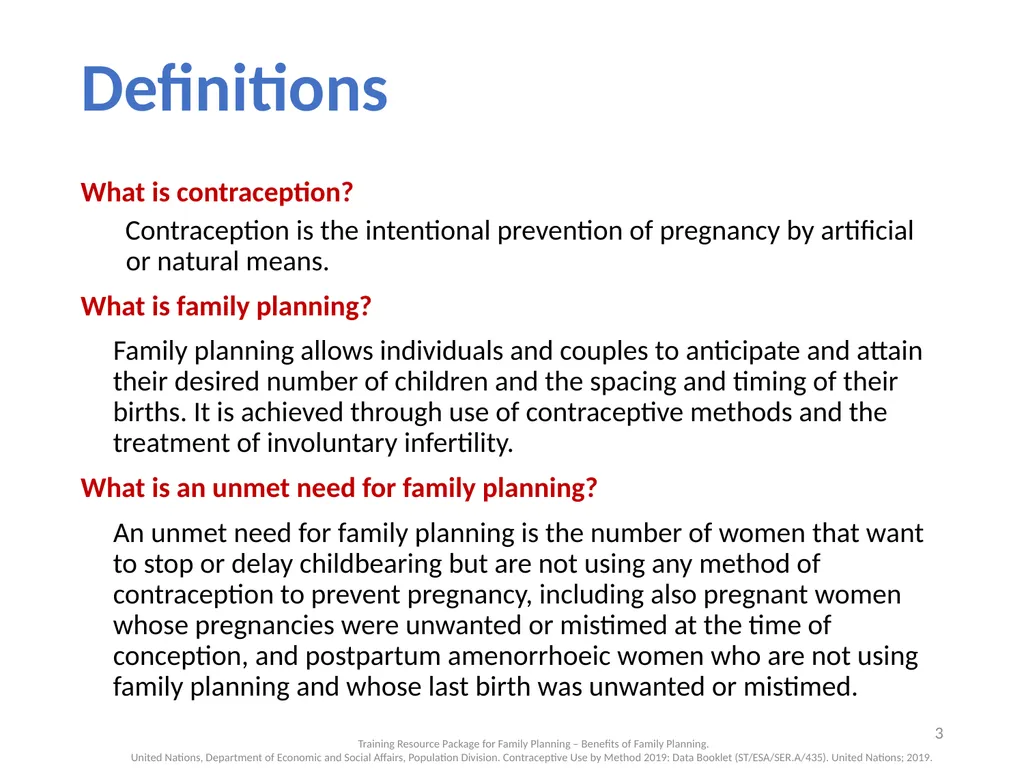
Definitions What is contraception?
Contraception is the intentional prevention of pregnancy by artificial or natural means.
What is family planning?
Family planning allows individuals and couples to anticipate and attain their desired number of children and the spacing and timing of their births. It is achieved through use of contraceptive methods and the treatment of involuntary infertility.
What is an unmet need for family planning?
An unmet need for family planning is the number of women that want to stop or delay childbearing but are not using any method of contraception to prevent pregnancy, including also pregnant women whose pregnancies were unwanted or mistimed at the time of conception, and postpartum amenorrhoeic women who are not using family planning and whose last birth was unwanted or mistimed. Training Resource Package for Family Planning – Benefits of Family Planning.
United Nations, Department of Economic and Social Affairs, Population Division. Contraceptive Use by Method 2019: Data Booklet (ST/ESA/SER.A/435). United Nations; 2019. 3<br>
Contraception is the intentional prevention of pregnancy by artificial or natural means.
What is family planning?
Family planning allows individuals and couples to anticipate and attain their desired number of children and the spacing and timing of their births. It is achieved through use of contraceptive methods and the treatment of involuntary infertility.
What is an unmet need for family planning?
An unmet need for family planning is the number of women that want to stop or delay childbearing but are not using any method of contraception to prevent pregnancy, including also pregnant women whose pregnancies were unwanted or mistimed at the time of conception, and postpartum amenorrhoeic women who are not using family planning and whose last birth was unwanted or mistimed. Training Resource Package for Family Planning – Benefits of Family Planning.
United Nations, Department of Economic and Social Affairs, Population Division. Contraceptive Use by Method 2019: Data Booklet (ST/ESA/SER.A/435). United Nations; 2019. 3<br>
04
Key facts about contraception / family planning 4 WHO. Family planning/contraception methods. World Health Organization; 2020.<br>
05
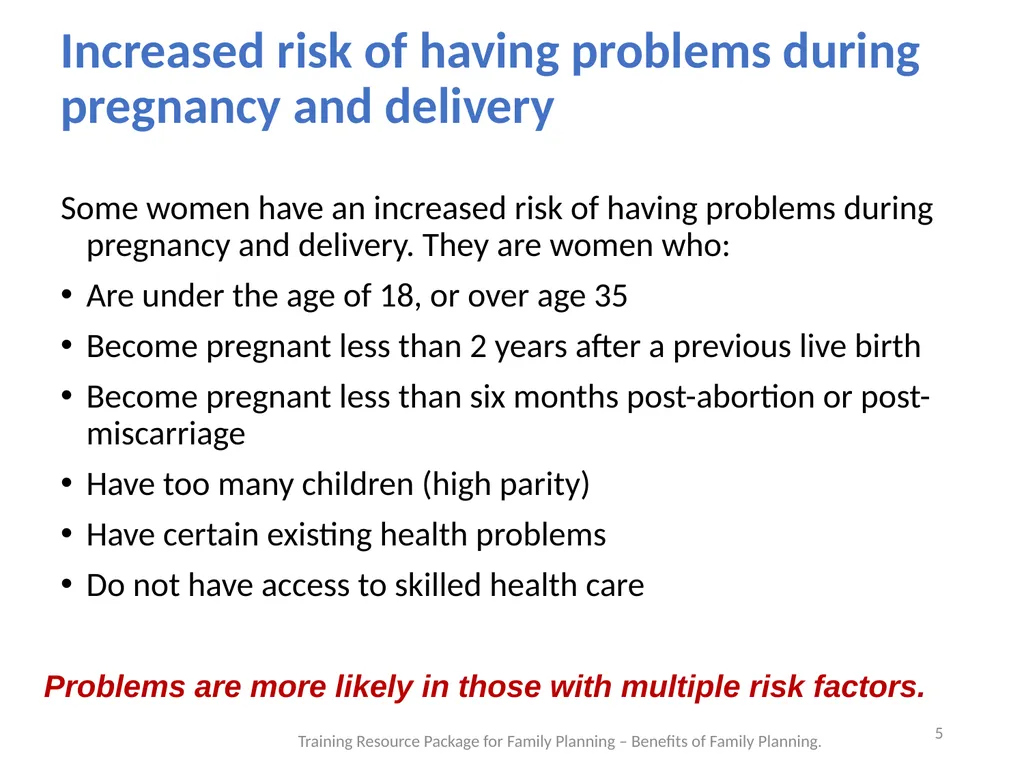
Increased risk of having problems during pregnancy and delivery Some women have an increased risk of having problems during pregnancy and delivery. They are women who:
Are under the age of 18, or over age 35
Become pregnant less than 2 years after a previous live birth
Become pregnant less than six months post-abortion or post-miscarriage
Have too many children (high parity)
Have certain existing health problems
Do not have access to skilled health care Problems are more likely in those with multiple risk factors. Training Resource Package for Family Planning – Benefits of Family Planning. 5<br>
Are under the age of 18, or over age 35
Become pregnant less than 2 years after a previous live birth
Become pregnant less than six months post-abortion or post-miscarriage
Have too many children (high parity)
Have certain existing health problems
Do not have access to skilled health care Problems are more likely in those with multiple risk factors. Training Resource Package for Family Planning – Benefits of Family Planning. 5<br>
06
Benefits of family planning and contraception 6 WHO. Contraception: Evidence brief. World Health Organization; 2019.<br>
07
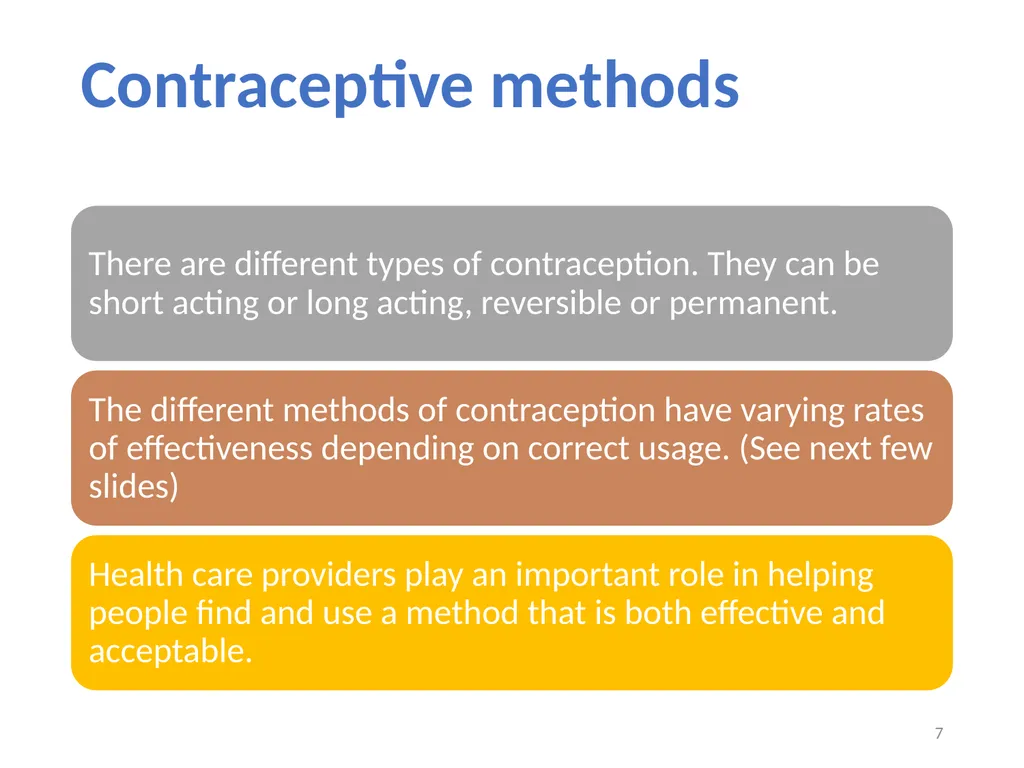
Contraceptive methods 7<br>
08
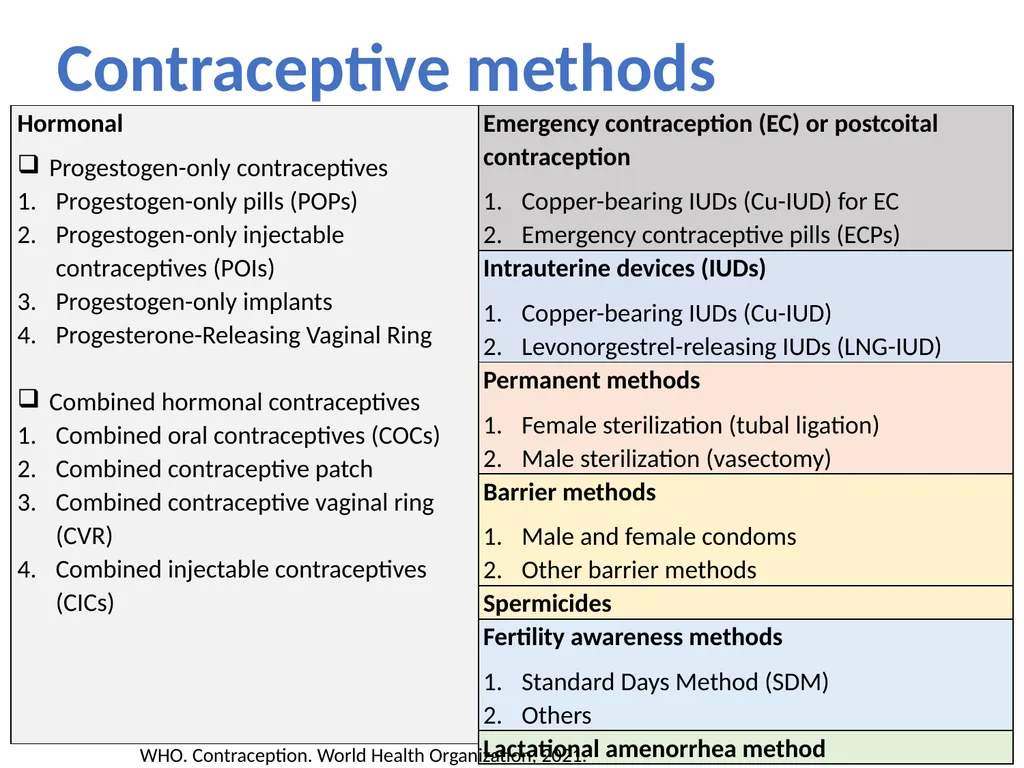
Contraceptive methods 8 WHO. Contraception. World Health Organization; 2021.<br>
09
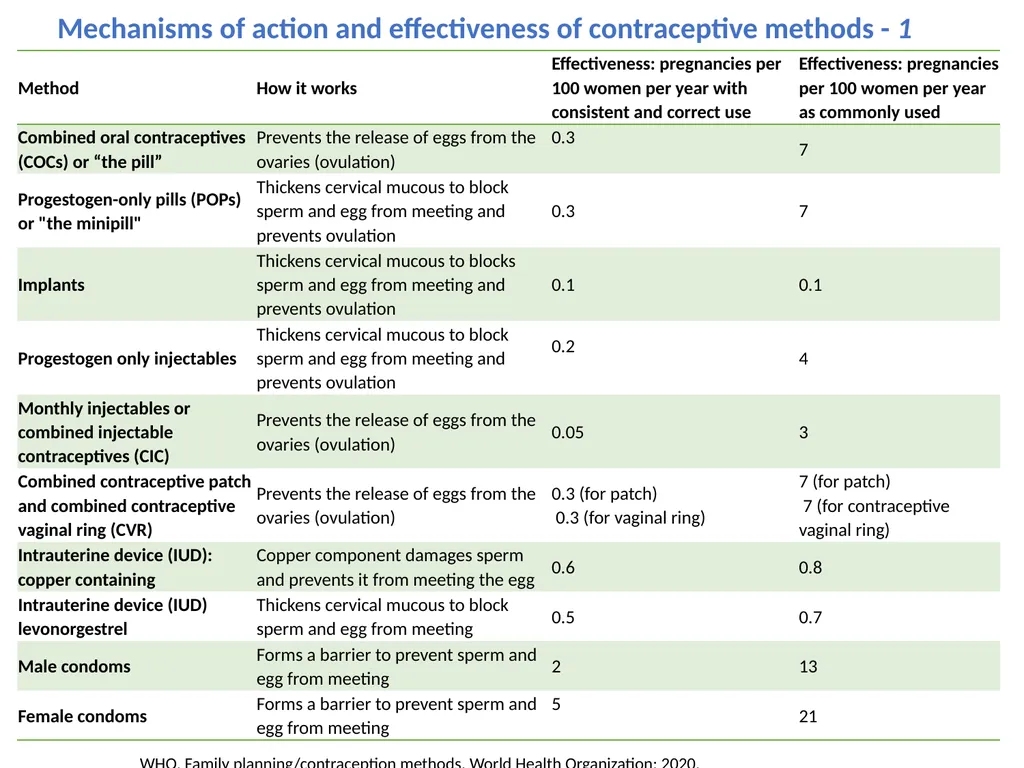
Mechanisms of action and effectiveness of contraceptive methods - 1 9 WHO. Family planning/contraception methods. World Health Organization; 2020.<br>
10
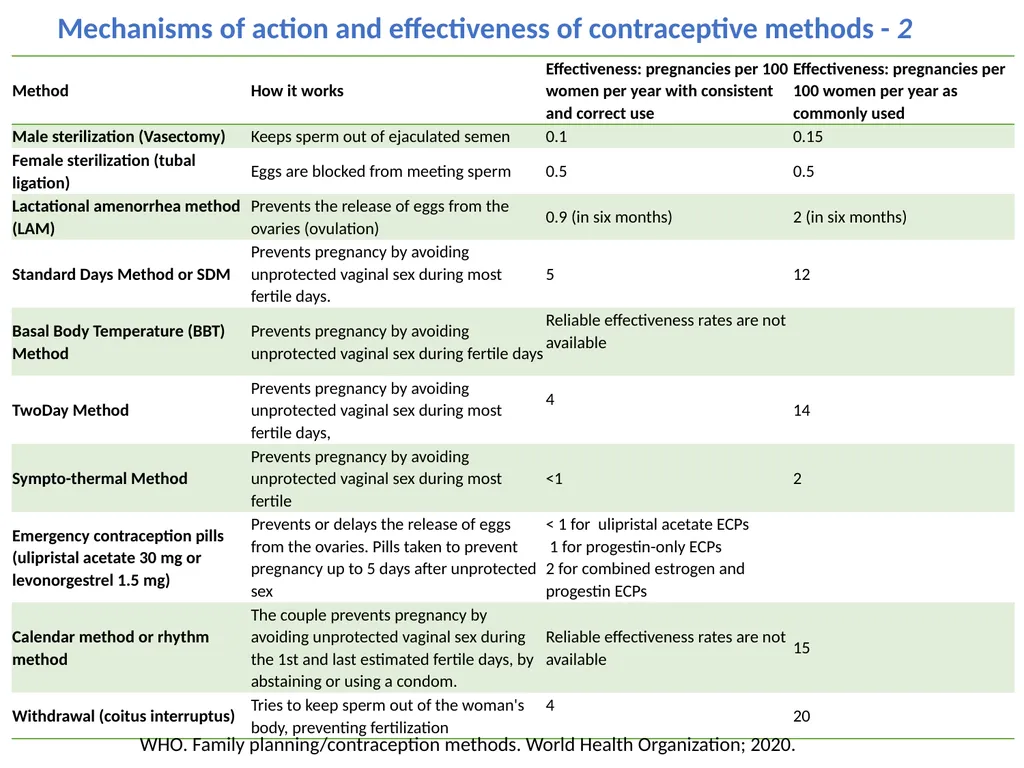
Mechanisms of action and effectiveness of contraceptive methods - 2 10 WHO. Family planning/contraception methods. World Health Organization; 2020.<br>
11
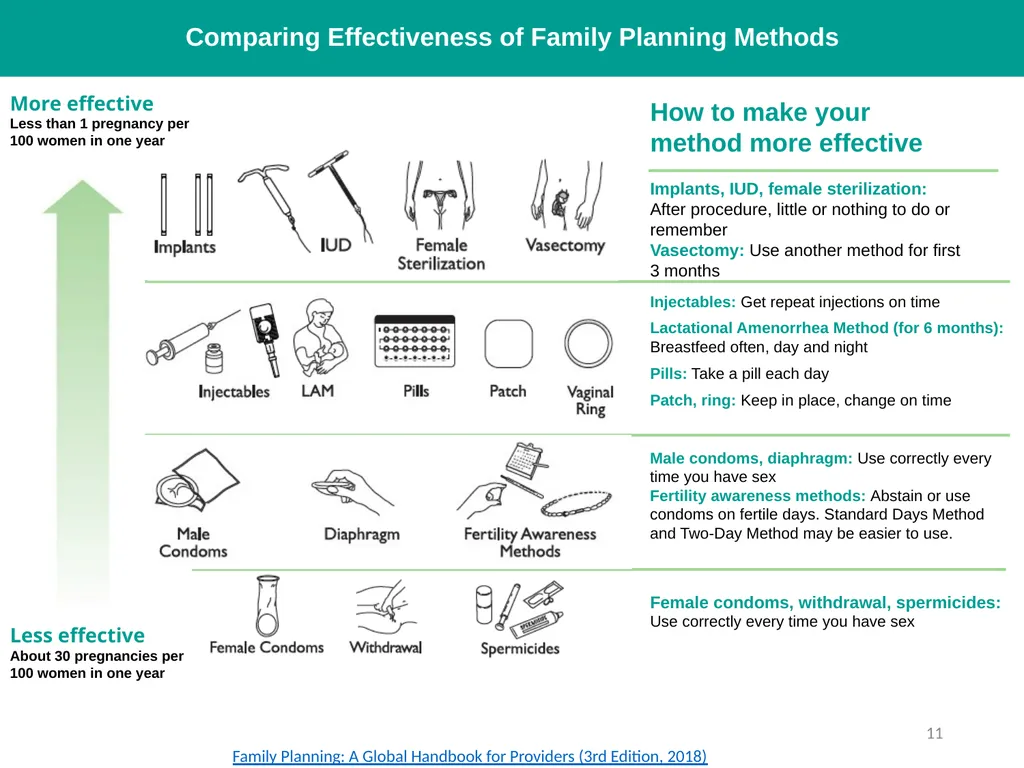
Comparing Effectiveness of Family Planning Methods How to make your
method more effective Implants, IUD, female sterilization:
After procedure, little or nothing to do or remember
Vasectomy: Use another method for first
3 months Injectables: Get repeat injections on time
Lactational Amenorrhea Method (for 6 months): Breastfeed often, day and night
Pills: Take a pill each day
Patch, ring: Keep in place, change on time Male condoms, diaphragm: Use correctly every time you have sex
Fertility awareness methods: Abstain or use condoms on fertile days. Standard Days Method and Two-Day Method may be easier to use. More effective
Less than 1 pregnancy per
100 women in one year Less effective
About 30 pregnancies per
100 women in one year Female condoms, withdrawal, spermicides: Use correctly every time you have sex 11 Family Planning: A Global Handbook for Providers (3rd Edition, 2018)<br>
method more effective Implants, IUD, female sterilization:
After procedure, little or nothing to do or remember
Vasectomy: Use another method for first
3 months Injectables: Get repeat injections on time
Lactational Amenorrhea Method (for 6 months): Breastfeed often, day and night
Pills: Take a pill each day
Patch, ring: Keep in place, change on time Male condoms, diaphragm: Use correctly every time you have sex
Fertility awareness methods: Abstain or use condoms on fertile days. Standard Days Method and Two-Day Method may be easier to use. More effective
Less than 1 pregnancy per
100 women in one year Less effective
About 30 pregnancies per
100 women in one year Female condoms, withdrawal, spermicides: Use correctly every time you have sex 11 Family Planning: A Global Handbook for Providers (3rd Edition, 2018)<br>
12
Estimated numbers of women of reproductive age (15-49 years) using modern and traditional contraceptive methods, having an unmet need for family planning and no need for family planning, worldwide, 2019 Contraceptive use by method 12 Contraceptive Use by Method 2019: Data Booklet (ST/ESA/SER.A/435). United Nations; 2019.<br>
13
Estimated numbers of women of reproductive age (15-49 years) using various contraceptive methods, worldwide, 2019 Contraceptive use by method 13 Contraceptive Use by Method 2019: Data Booklet (ST/ESA/SER.A/435). United Nations; 2019.<br>
14
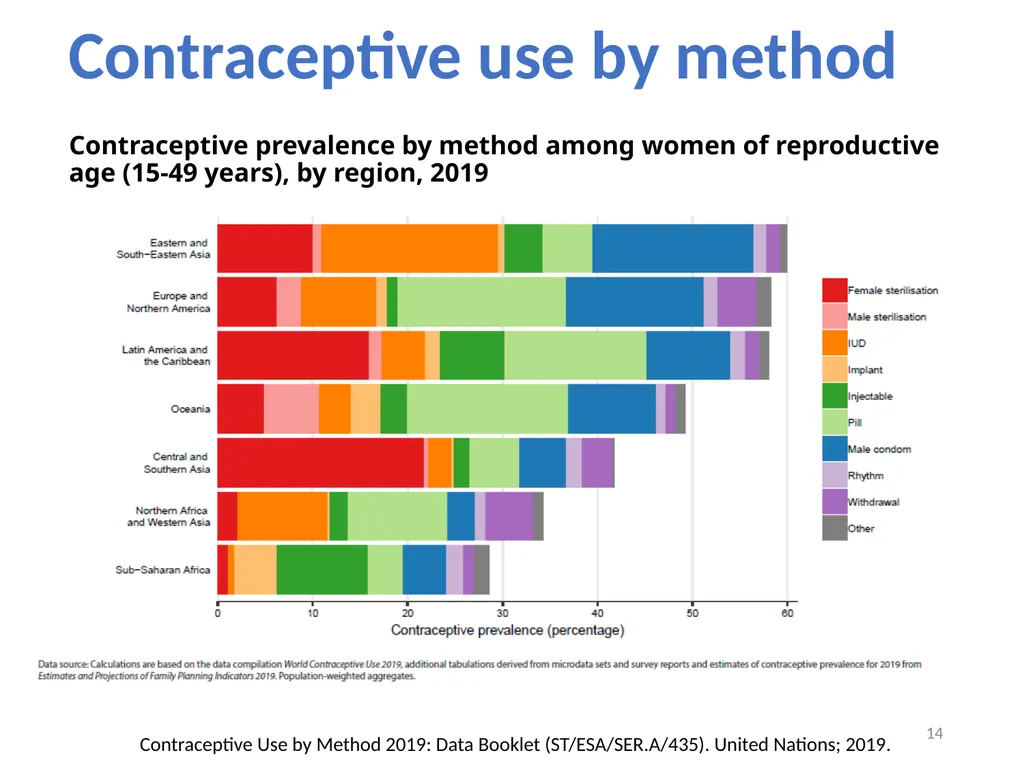
Contraceptive prevalence by method among women of reproductive age (15-49 years), by region, 2019 Contraceptive use by method 14 Contraceptive Use by Method 2019: Data Booklet (ST/ESA/SER.A/435). United Nations; 2019.<br>
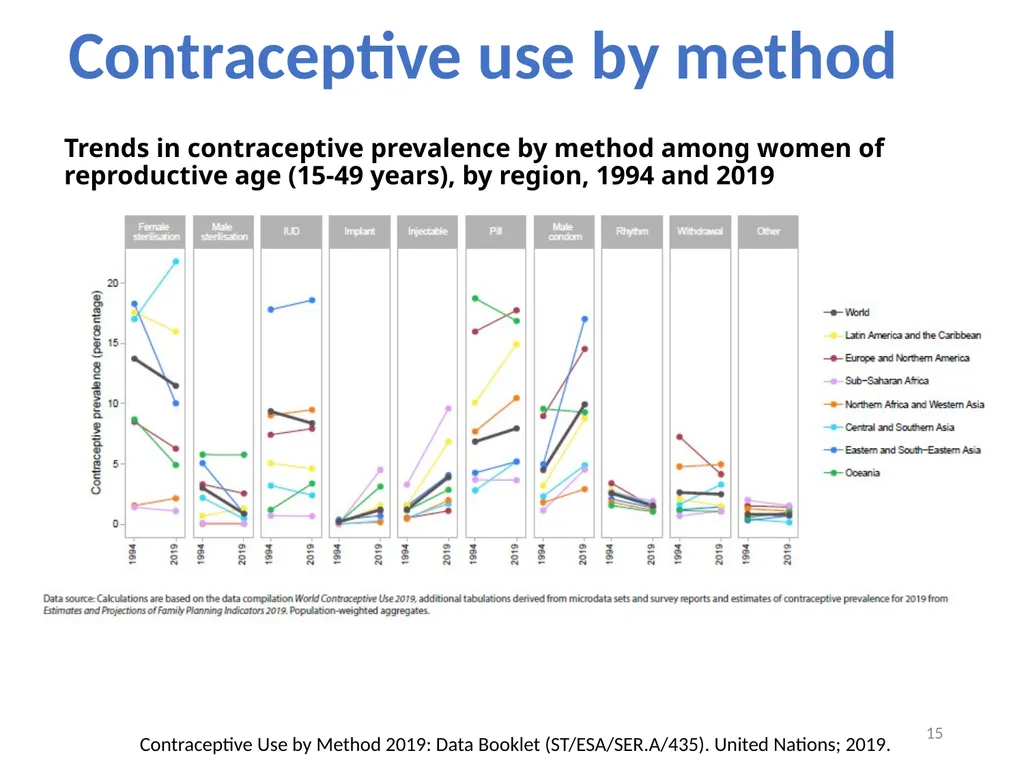
15
Trends in contraceptive prevalence by method among women of reproductive age (15-49 years), by region, 1994 and 2019 Contraceptive use by method 15 Contraceptive Use by Method 2019: Data Booklet (ST/ESA/SER.A/435). United Nations; 2019.<br>
16
Estimated numbers of women of reproductive age (15-49 years) using various contraceptive methods, 1994 and 2019 Contraceptive use by method 16 Contraceptive Use by Method 2019: Data Booklet (ST/ESA/SER.A/435). United Nations; 2019.<br>
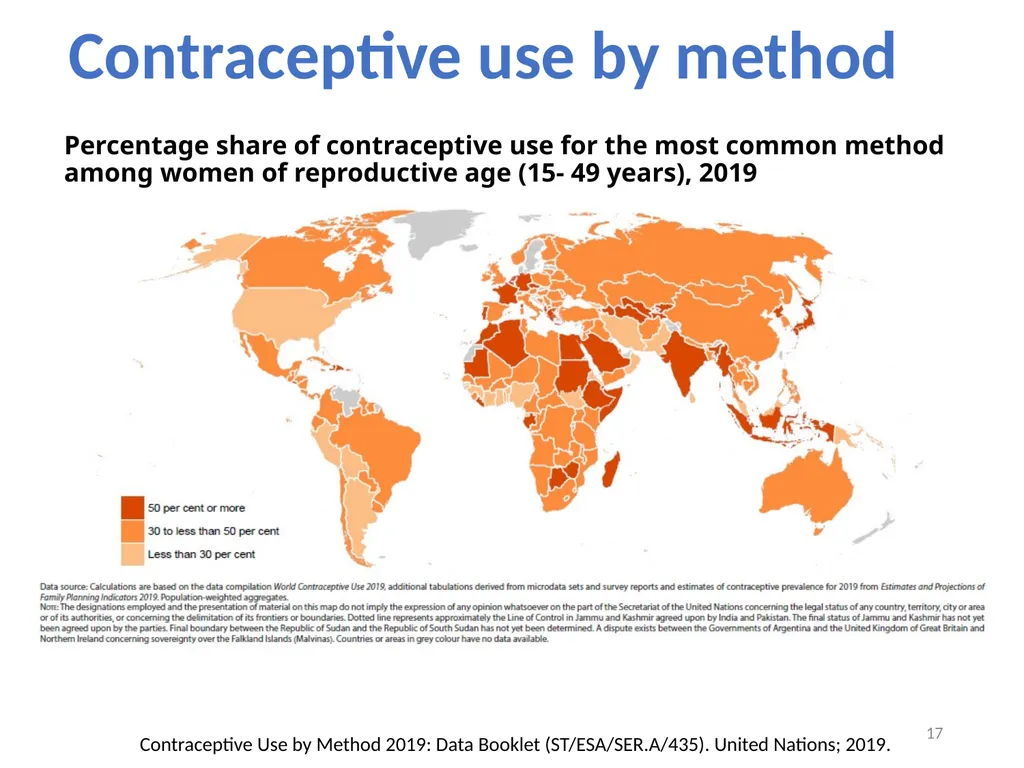
17
Percentage share of contraceptive use for the most common method among women of reproductive age (15- 49 years), 2019 Contraceptive use by method 17 Contraceptive Use by Method 2019: Data Booklet (ST/ESA/SER.A/435). United Nations; 2019.<br>
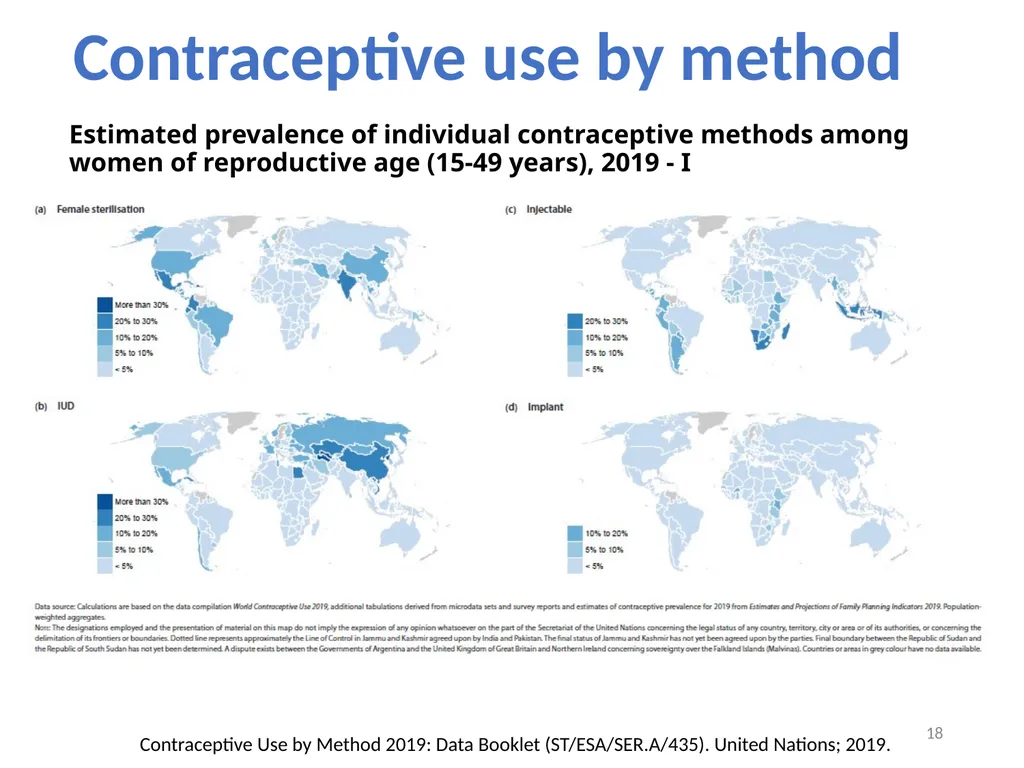
18
Estimated prevalence of individual contraceptive methods among women of reproductive age (15-49 years), 2019 - I Contraceptive use by method 18 Contraceptive Use by Method 2019: Data Booklet (ST/ESA/SER.A/435). United Nations; 2019.<br>
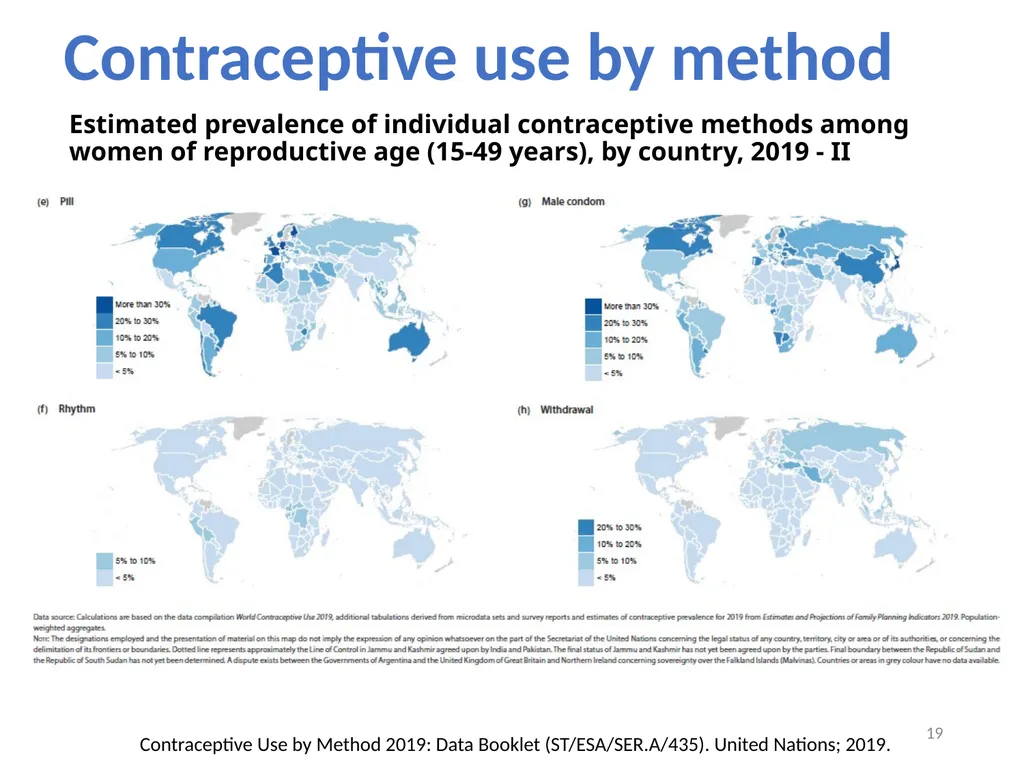
19
Estimated prevalence of individual contraceptive methods among women of reproductive age (15-49 years), by country, 2019 - II Contraceptive use by method 19 Contraceptive Use by Method 2019: Data Booklet (ST/ESA/SER.A/435). United Nations; 2019.<br>
20
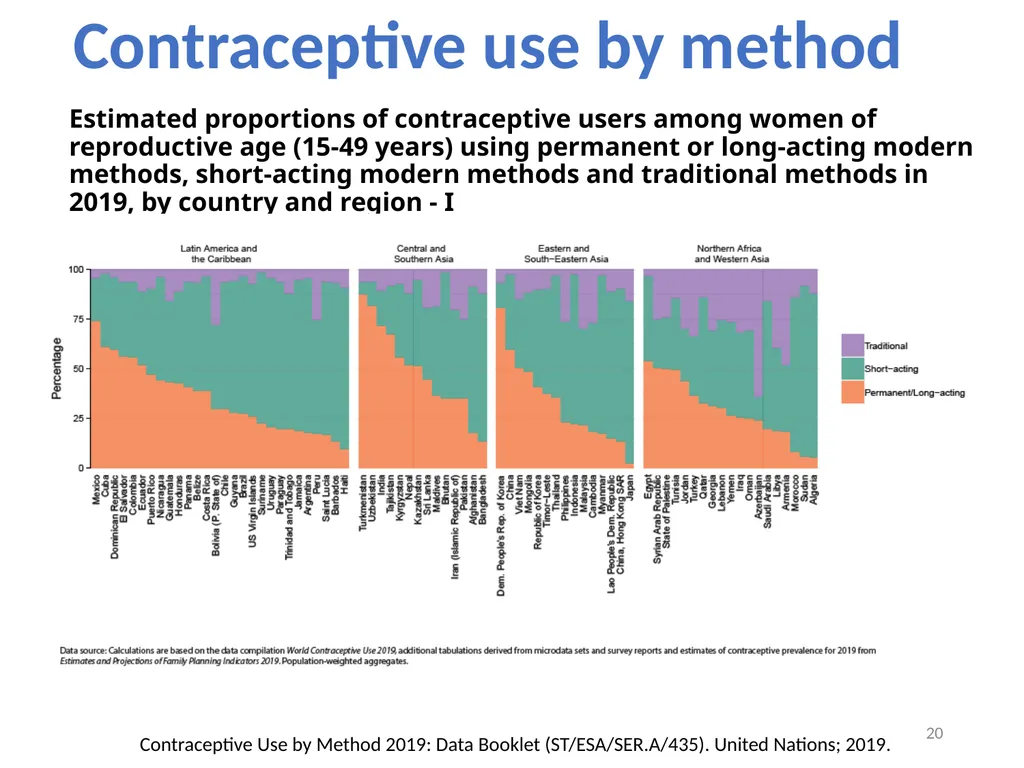
Estimated proportions of contraceptive users among women of reproductive age (15-49 years) using permanent or long-acting modern methods, short-acting modern methods and traditional methods in 2019, by country and region - I Contraceptive use by method 20 Contraceptive Use by Method 2019: Data Booklet (ST/ESA/SER.A/435). United Nations; 2019.<br>
21
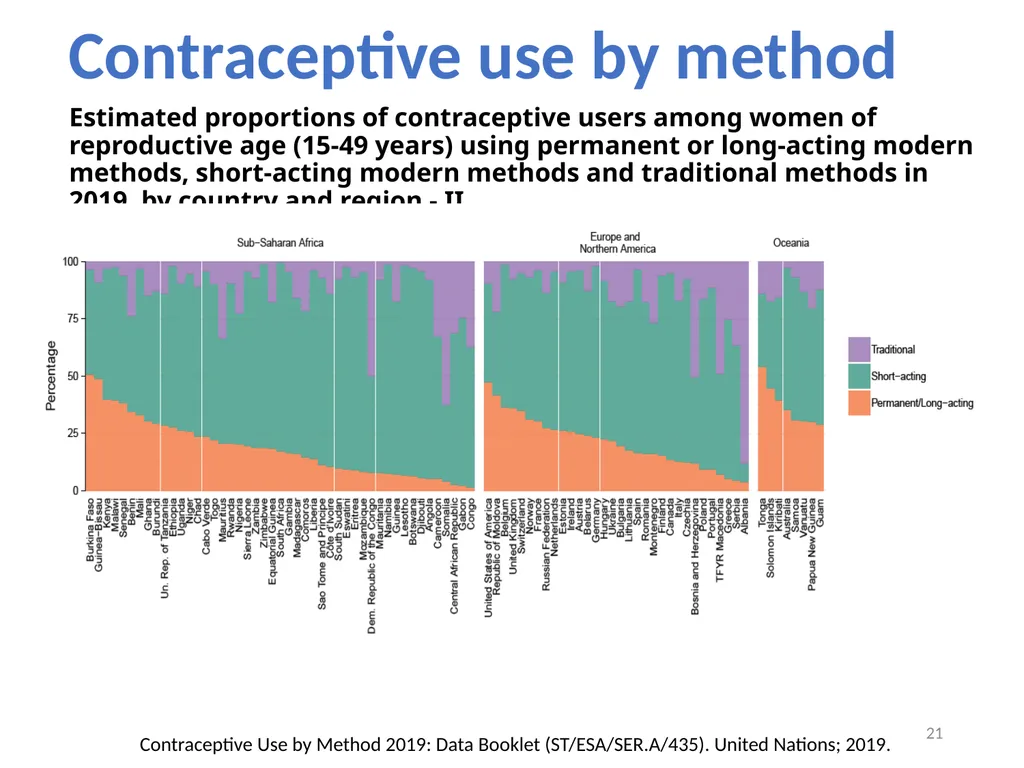
Estimated proportions of contraceptive users among women of reproductive age (15-49 years) using permanent or long-acting modern methods, short-acting modern methods and traditional methods in 2019, by country and region - II Contraceptive use by method 21 Contraceptive Use by Method 2019: Data Booklet (ST/ESA/SER.A/435). United Nations; 2019.<br>
22
Estimated numbers of women of reproductive age (15-49 years) using various contraceptive methods, by marital status, 2019 Contraceptive use by method 22 Contraceptive Use by Method 2019: Data Booklet (ST/ESA/SER.A/435). United Nations; 2019.<br>
23
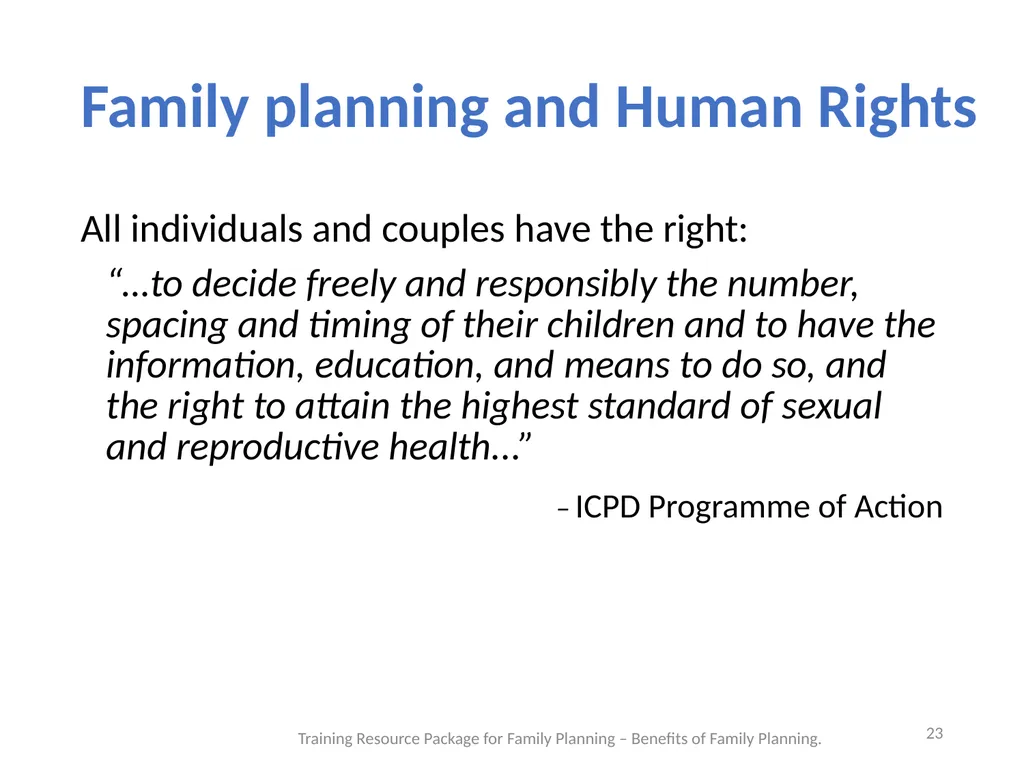
Family planning and Human Rights All individuals and couples have the right:
“…to decide freely and responsibly the number, spacing and timing of their children and to have the information, education, and means to do so, and the right to attain the highest standard of sexual and reproductive health...”
– ICPD Programme of Action Training Resource Package for Family Planning – Benefits of Family Planning. 23<br>
“…to decide freely and responsibly the number, spacing and timing of their children and to have the information, education, and means to do so, and the right to attain the highest standard of sexual and reproductive health...”
– ICPD Programme of Action Training Resource Package for Family Planning – Benefits of Family Planning. 23<br>
24
References Guttmacher Institute. Adding It Up - Investing in Sexual and Reproductive Health in Low- and Middle-Income Countries. Fact Sheet. Guttmacher Institute, 2020 Jul. Available from: https://www.guttmacher.org/sites/default/files/factsheet/adding-it-up-investing-in-sexual-reproductive-health.pdf.
Training Resource Package for Family Planning - Benefits of Family Planning. Fptraining.org; c2021. Available from: https://apps.who.int/iris/bitstream/handle/10665/260156/9780999203705-eng.pdf?sequence=1
United Nations, Department of Economic and Social Affairs, Population Division. Contraceptive Use by Method 2019: Data Booklet (ST/ESA/SER.A/435). United Nations; 2019. Available from: https://www.un.org/development/desa/pd/sites/www.un.org.development.desa.pd/files/files/documents/2020/Jan/un_2019_contraceptiveusebymethod_databooklet.pdf
World Health Organization Department of Reproductive Health and Research (WHO/RHR) and Johns Hopkins Bloomberg School of Public Health/Center for Communication Programs (CCP), Knowledge for Health Project. Family Planning: A Global Handbook for Providers (2018 update). Baltimore and Geneva: CCP and WHO; 2018. Available from: https://www.fphandbook.org/
WHO. Contraception: Evidence brief. World Health Organization; 2019. Available from: https://apps.who.int/iris/bitstream/handle/10665/329884/WHO-RHR-19.18-eng.pdf?ua=1
WHO. Family planning/contraception methods. World Health Organization; 2020. Available from: https://www.who.int/news-room/fact-sheets/detail/family-planning-contraception
WHO. Contraception. World Health Organization; 2021. Available from: https://www.who.int/health-topics/contraception#tab=tab_3 24<br>
Training Resource Package for Family Planning - Benefits of Family Planning. Fptraining.org; c2021. Available from: https://apps.who.int/iris/bitstream/handle/10665/260156/9780999203705-eng.pdf?sequence=1
United Nations, Department of Economic and Social Affairs, Population Division. Contraceptive Use by Method 2019: Data Booklet (ST/ESA/SER.A/435). United Nations; 2019. Available from: https://www.un.org/development/desa/pd/sites/www.un.org.development.desa.pd/files/files/documents/2020/Jan/un_2019_contraceptiveusebymethod_databooklet.pdf
World Health Organization Department of Reproductive Health and Research (WHO/RHR) and Johns Hopkins Bloomberg School of Public Health/Center for Communication Programs (CCP), Knowledge for Health Project. Family Planning: A Global Handbook for Providers (2018 update). Baltimore and Geneva: CCP and WHO; 2018. Available from: https://www.fphandbook.org/
WHO. Contraception: Evidence brief. World Health Organization; 2019. Available from: https://apps.who.int/iris/bitstream/handle/10665/329884/WHO-RHR-19.18-eng.pdf?ua=1
WHO. Family planning/contraception methods. World Health Organization; 2020. Available from: https://www.who.int/news-room/fact-sheets/detail/family-planning-contraception
WHO. Contraception. World Health Organization; 2021. Available from: https://www.who.int/health-topics/contraception#tab=tab_3 24<br>