
Contraceptive methods - Part 4 Raqibat Idris,
TG
Published · 113 slides · 0 views

1 / 1










Description
Contraceptive methods - Part 4 Raqibat Idris, MBBS, DO, MPH Geneva Foundation for Medical Education and Research Family Planning: An Online Evidence-based Course 2022 Outline and objectives Description of the method Mechanism of action
Related Topics
Share
Embed code
Download this presentation From Below
"Contraceptive methods - Part 4 Raqibat Idris," is the property of its rightful owner. Permission is granted to download and print the materials on this website for personal, non-commercial use only, and to display it on your personal computer provided you do not modify the materials and that you retain all copyright notices contained in the materials. By downloading content from our website, you accept the terms of this agreement.
Presentation Transcript
01
Contraceptive methods - Part 4 Raqibat Idris, MBBS, DO, MPH
Geneva Foundation for Medical Education and Research "Family Planning”: An Online Evidence-based Course 2022<br>
Geneva Foundation for Medical Education and Research "Family Planning”: An Online Evidence-based Course 2022<br>
02
Outline and objectives Description of the method
Mechanism of action
Effectiveness
Eligibility criteria
Benefits and side effects
Interventions for associated effects 2<br>
Mechanism of action
Effectiveness
Eligibility criteria
Benefits and side effects
Interventions for associated effects 2<br>
03
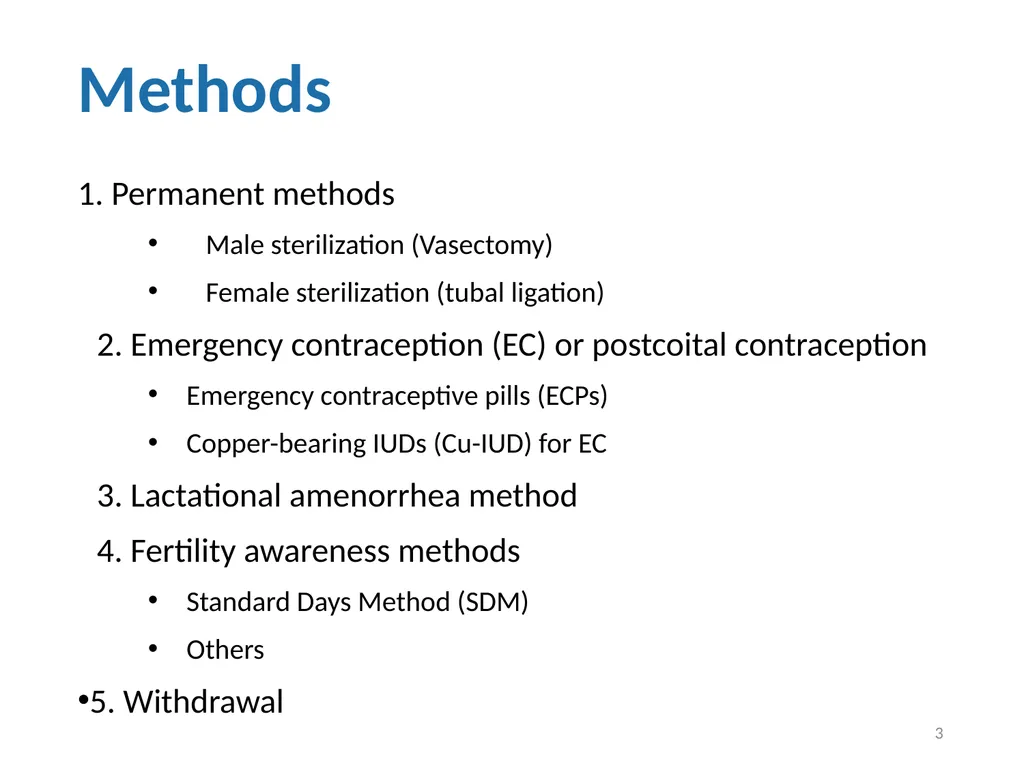
Methods 1. Permanent methods
Male sterilization (Vasectomy)
Female sterilization (tubal ligation)
2. Emergency contraception (EC) or postcoital contraception
Emergency contraceptive pills (ECPs)
Copper-bearing IUDs (Cu-IUD) for EC
3. Lactational amenorrhea method
4. Fertility awareness methods
Standard Days Method (SDM)
Others
5. Withdrawal 3<br>
Male sterilization (Vasectomy)
Female sterilization (tubal ligation)
2. Emergency contraception (EC) or postcoital contraception
Emergency contraceptive pills (ECPs)
Copper-bearing IUDs (Cu-IUD) for EC
3. Lactational amenorrhea method
4. Fertility awareness methods
Standard Days Method (SDM)
Others
5. Withdrawal 3<br>
04
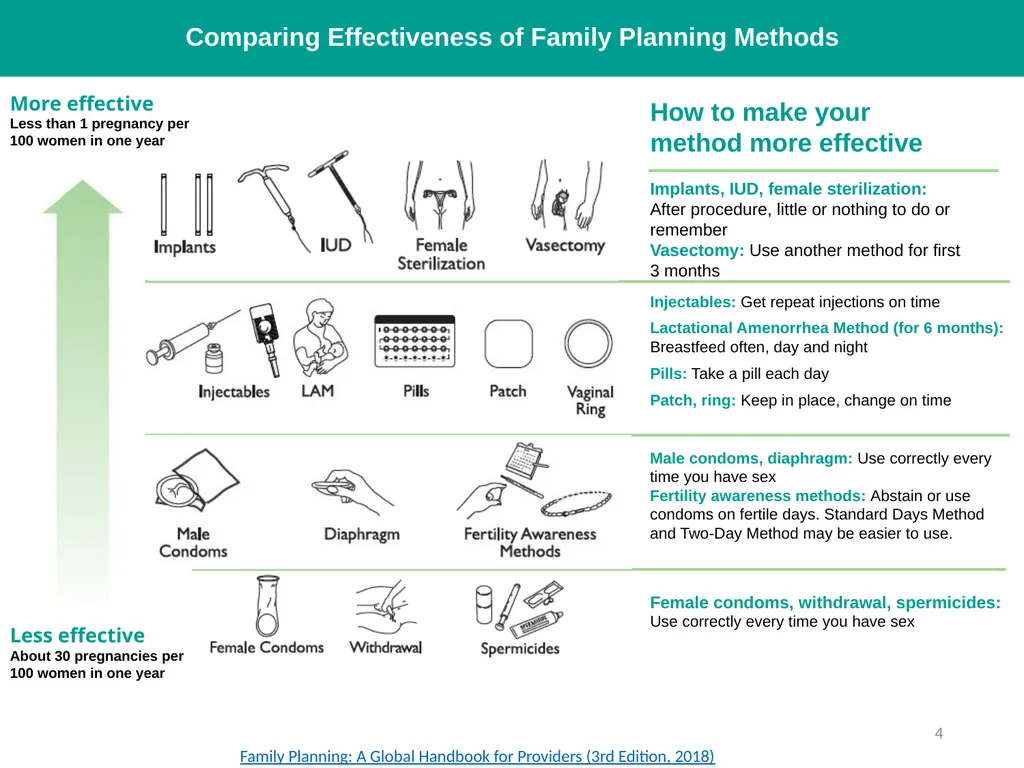
Comparing Effectiveness of Family Planning Methods How to make your
method more effective Implants, IUD, female sterilization:
After procedure, little or nothing to do or remember
Vasectomy: Use another method for first
3 months Injectables: Get repeat injections on time
Lactational Amenorrhea Method (for 6 months): Breastfeed often, day and night
Pills: Take a pill each day
Patch, ring: Keep in place, change on time Male condoms, diaphragm: Use correctly every time you have sex
Fertility awareness methods: Abstain or use condoms on fertile days. Standard Days Method and Two-Day Method may be easier to use. More effective
Less than 1 pregnancy per
100 women in one year Less effective
About 30 pregnancies per
100 women in one year Female condoms, withdrawal, spermicides: Use correctly every time you have sex Family Planning: A Global Handbook for Providers (3rd Edition, 2018) 4<br>
method more effective Implants, IUD, female sterilization:
After procedure, little or nothing to do or remember
Vasectomy: Use another method for first
3 months Injectables: Get repeat injections on time
Lactational Amenorrhea Method (for 6 months): Breastfeed often, day and night
Pills: Take a pill each day
Patch, ring: Keep in place, change on time Male condoms, diaphragm: Use correctly every time you have sex
Fertility awareness methods: Abstain or use condoms on fertile days. Standard Days Method and Two-Day Method may be easier to use. More effective
Less than 1 pregnancy per
100 women in one year Less effective
About 30 pregnancies per
100 women in one year Female condoms, withdrawal, spermicides: Use correctly every time you have sex Family Planning: A Global Handbook for Providers (3rd Edition, 2018) 4<br>
05
Vasectomy
(Male Sterilization)<br>
06
What Is Vasectomy? A permanent method of contraception for men who do not want any more children
A safe, simple, and short surgical procedure
Also referred to as male sterilization or male surgical contraception
Procedure requires a trained health care provider
Two techniques for performing vasectomy
Conventional or incisional vasectomy
No-scalpel vasectomy (NSV) Adapted from Training Resource Package for Family Planning: https://www.fptraining.org/ 6<br>
A safe, simple, and short surgical procedure
Also referred to as male sterilization or male surgical contraception
Procedure requires a trained health care provider
Two techniques for performing vasectomy
Conventional or incisional vasectomy
No-scalpel vasectomy (NSV) Adapted from Training Resource Package for Family Planning: https://www.fptraining.org/ 6<br>
07
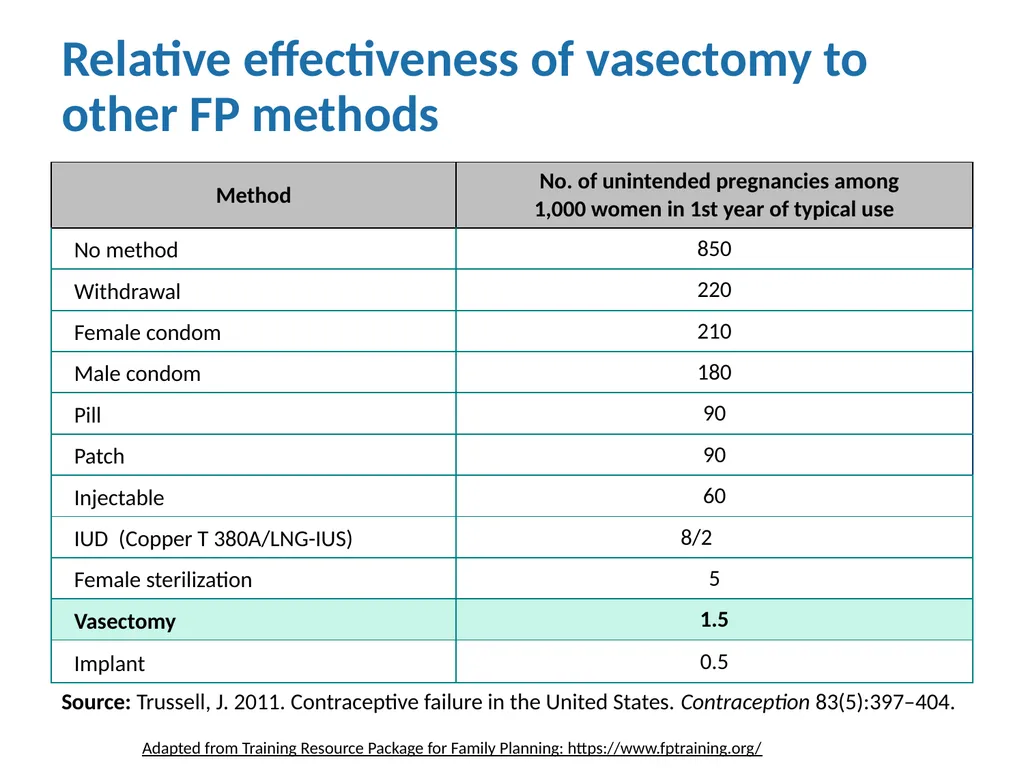
Relative effectiveness of vasectomy to other FP methods Adapted from Training Resource Package for Family Planning: https://www.fptraining.org/<br>
08
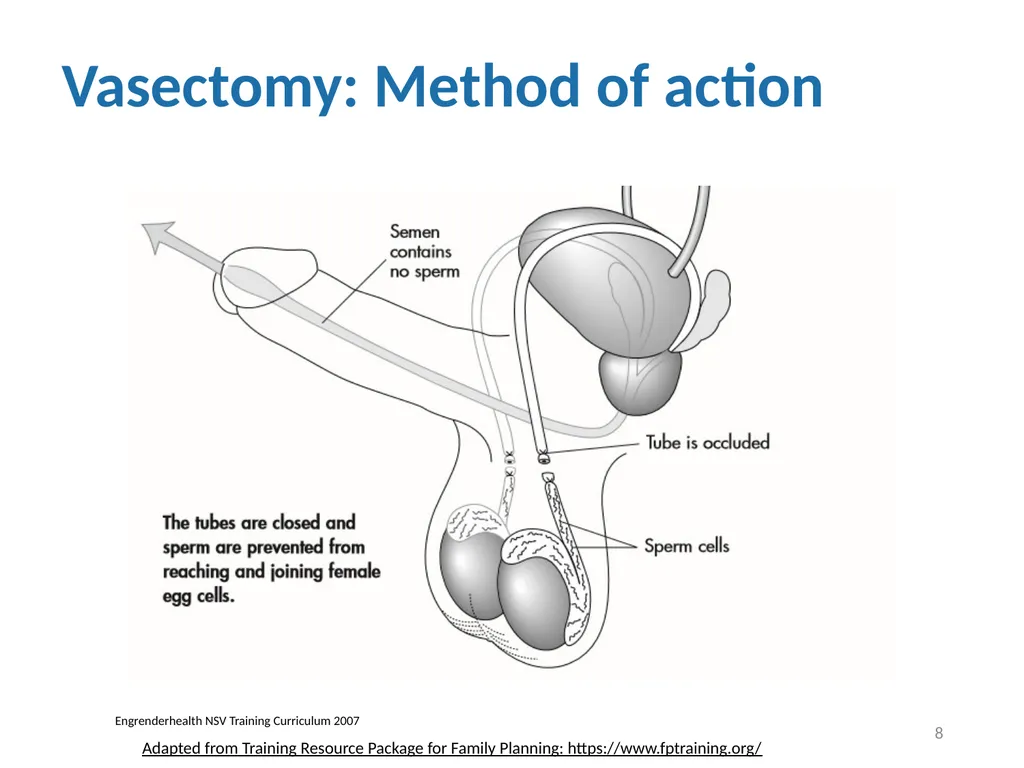
Vasectomy: Method of action Engrenderhealth NSV Training Curriculum 2007 Adapted from Training Resource Package for Family Planning: https://www.fptraining.org/ 8<br>
09
Characteristics of vasectomy The method must be offered by a provider and involves a simple surgical procedure.
The procedure is much simpler than female sterilization.
No user action is required.
The procedure can be performed at any time the man makes an informed and voluntary decision.
After the procedure, there may be discomfort or some pain during recovery.
It may require semen analysis to measure effectiveness.
It is not reversible. (Where such reversal services are offered, it is expensive, and success is not always guaranteed.) Adapted from Training Resource Package for Family Planning: https://www.fptraining.org/<br>
The procedure is much simpler than female sterilization.
No user action is required.
The procedure can be performed at any time the man makes an informed and voluntary decision.
After the procedure, there may be discomfort or some pain during recovery.
It may require semen analysis to measure effectiveness.
It is not reversible. (Where such reversal services are offered, it is expensive, and success is not always guaranteed.) Adapted from Training Resource Package for Family Planning: https://www.fptraining.org/<br>
10
Health benefits, non-health benefits and risks of vasectomy Is a cost-effective, one-off event, with no need for resupply
Does not interfere with sex
May enhance enjoyment and frequency of sex
Allows man to play significant role in FP
Is a safe procedure
Carries a small risk of failure
Carries risk associated with pain management drugs and surgical procedure Adapted from Training Resource Package for Family Planning: https://www.fptraining.org/ 10<br>
Does not interfere with sex
May enhance enjoyment and frequency of sex
Allows man to play significant role in FP
Is a safe procedure
Carries a small risk of failure
Carries risk associated with pain management drugs and surgical procedure Adapted from Training Resource Package for Family Planning: https://www.fptraining.org/ 10<br>
11
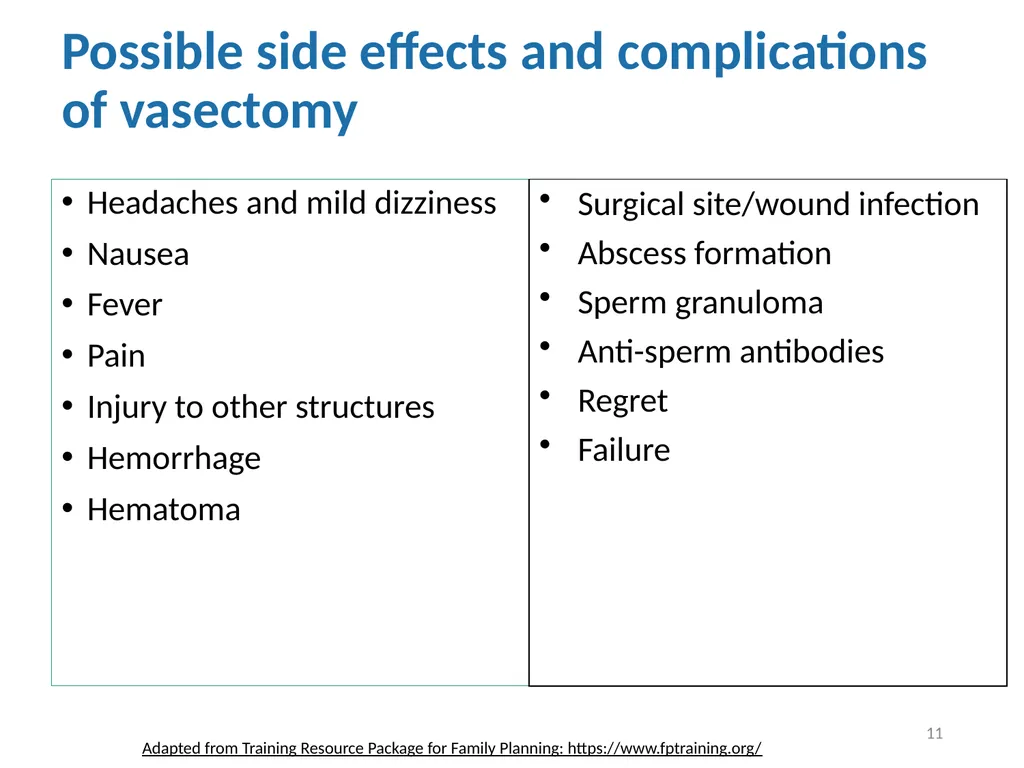
Possible side effects and complications of vasectomy Headaches and mild dizziness
Nausea
Fever
Pain
Injury to other structures
Hemorrhage
Hematoma Surgical site/wound infection
Abscess formation
Sperm granuloma
Anti-sperm antibodies
Regret
Failure Adapted from Training Resource Package for Family Planning: https://www.fptraining.org/ 11<br>
Nausea
Fever
Pain
Injury to other structures
Hemorrhage
Hematoma Surgical site/wound infection
Abscess formation
Sperm granuloma
Anti-sperm antibodies
Regret
Failure Adapted from Training Resource Package for Family Planning: https://www.fptraining.org/ 11<br>
12
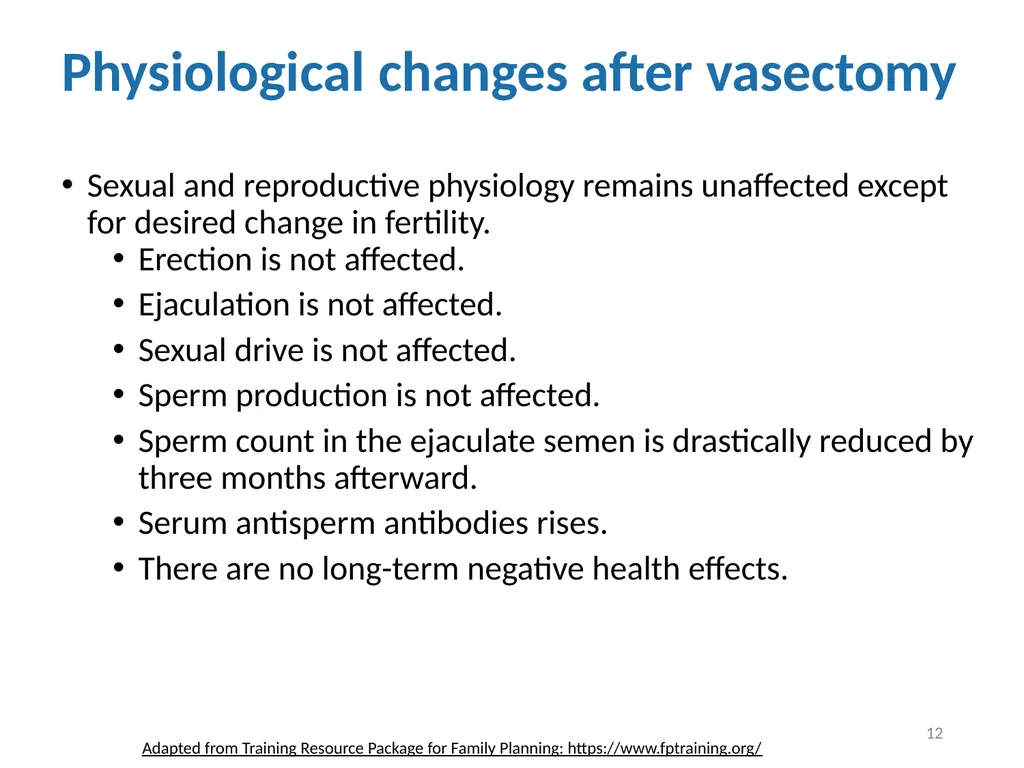
Physiological changes after vasectomy Sexual and reproductive physiology remains unaffected except for desired change in fertility.
Erection is not affected.
Ejaculation is not affected.
Sexual drive is not affected.
Sperm production is not affected.
Sperm count in the ejaculate semen is drastically reduced by three months afterward.
Serum antisperm antibodies rises.
There are no long-term negative health effects. Adapted from Training Resource Package for Family Planning: https://www.fptraining.org/ 12<br>
Erection is not affected.
Ejaculation is not affected.
Sexual drive is not affected.
Sperm production is not affected.
Sperm count in the ejaculate semen is drastically reduced by three months afterward.
Serum antisperm antibodies rises.
There are no long-term negative health effects. Adapted from Training Resource Package for Family Planning: https://www.fptraining.org/ 12<br>
13
MEC categories for male sterilization (vasectomy) Most men can have a vasectomy.
But they may need to wait if:
They have problems with their genitals, such as infections, swellings or lumps, or injuries in the penis or scrotum.
They have other serious health conditions or infections (e.g., diarrhea). Who can have vasectomy? Adapted from Training Resource Package for Family Planning: https://www.fptraining.org/ 13<br>
But they may need to wait if:
They have problems with their genitals, such as infections, swellings or lumps, or injuries in the penis or scrotum.
They have other serious health conditions or infections (e.g., diarrhea). Who can have vasectomy? Adapted from Training Resource Package for Family Planning: https://www.fptraining.org/ 13<br>
14
Eligibility criteria for vasectomy Adapted from Training Resource Package for Family Planning: https://www.fptraining.org/ 14<br>
15
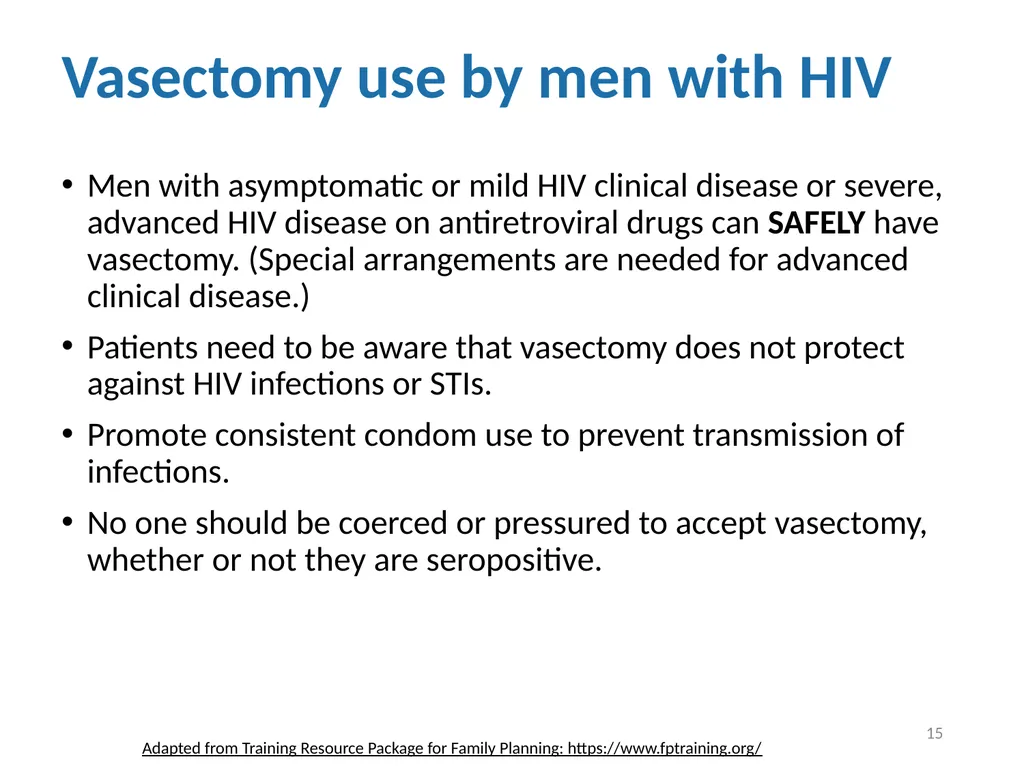
Vasectomy use by men with HIV Men with asymptomatic or mild HIV clinical disease or severe, advanced HIV disease on antiretroviral drugs can SAFELY have vasectomy. (Special arrangements are needed for advanced clinical disease.)
Patients need to be aware that vasectomy does not protect against HIV infections or STIs.
Promote consistent condom use to prevent transmission of infections.
No one should be coerced or pressured to accept vasectomy, whether or not they are seropositive. Adapted from Training Resource Package for Family Planning: https://www.fptraining.org/ 15<br>
Patients need to be aware that vasectomy does not protect against HIV infections or STIs.
Promote consistent condom use to prevent transmission of infections.
No one should be coerced or pressured to accept vasectomy, whether or not they are seropositive. Adapted from Training Resource Package for Family Planning: https://www.fptraining.org/ 15<br>
16
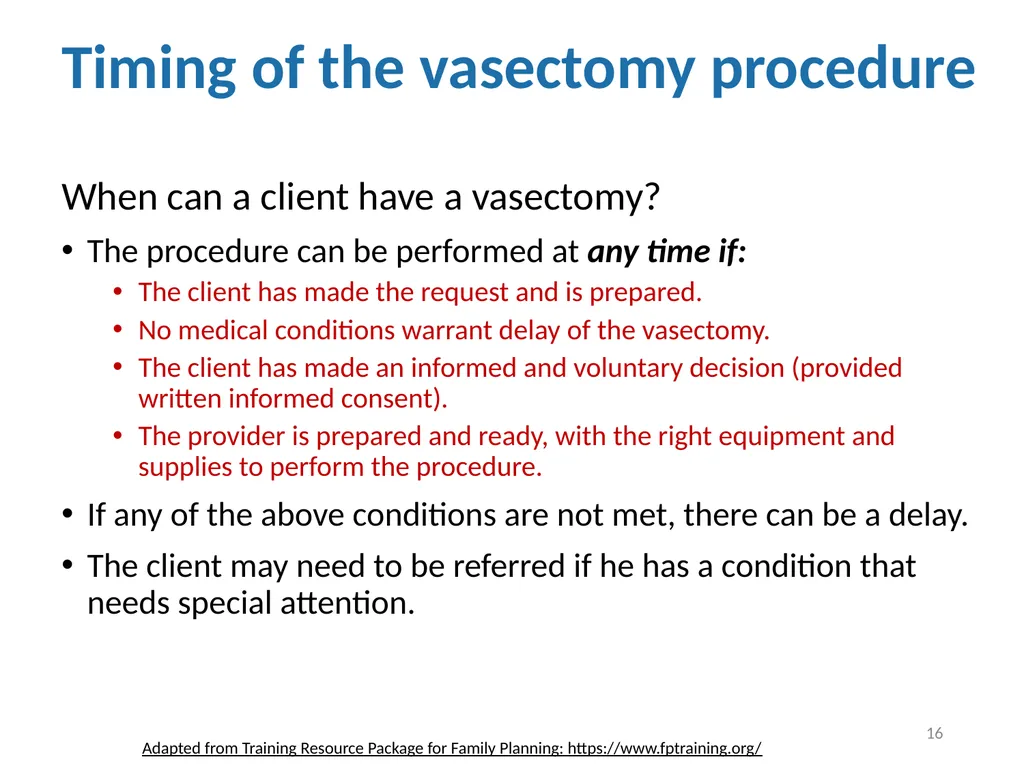
Timing of the vasectomy procedure When can a client have a vasectomy?
The procedure can be performed at any time if:
The client has made the request and is prepared.
No medical conditions warrant delay of the vasectomy.
The client has made an informed and voluntary decision (provided written informed consent).
The provider is prepared and ready, with the right equipment and supplies to perform the procedure.
If any of the above conditions are not met, there can be a delay.
The client may need to be referred if he has a condition that needs special attention. Adapted from Training Resource Package for Family Planning: https://www.fptraining.org/ 16<br>
The procedure can be performed at any time if:
The client has made the request and is prepared.
No medical conditions warrant delay of the vasectomy.
The client has made an informed and voluntary decision (provided written informed consent).
The provider is prepared and ready, with the right equipment and supplies to perform the procedure.
If any of the above conditions are not met, there can be a delay.
The client may need to be referred if he has a condition that needs special attention. Adapted from Training Resource Package for Family Planning: https://www.fptraining.org/ 16<br>
17
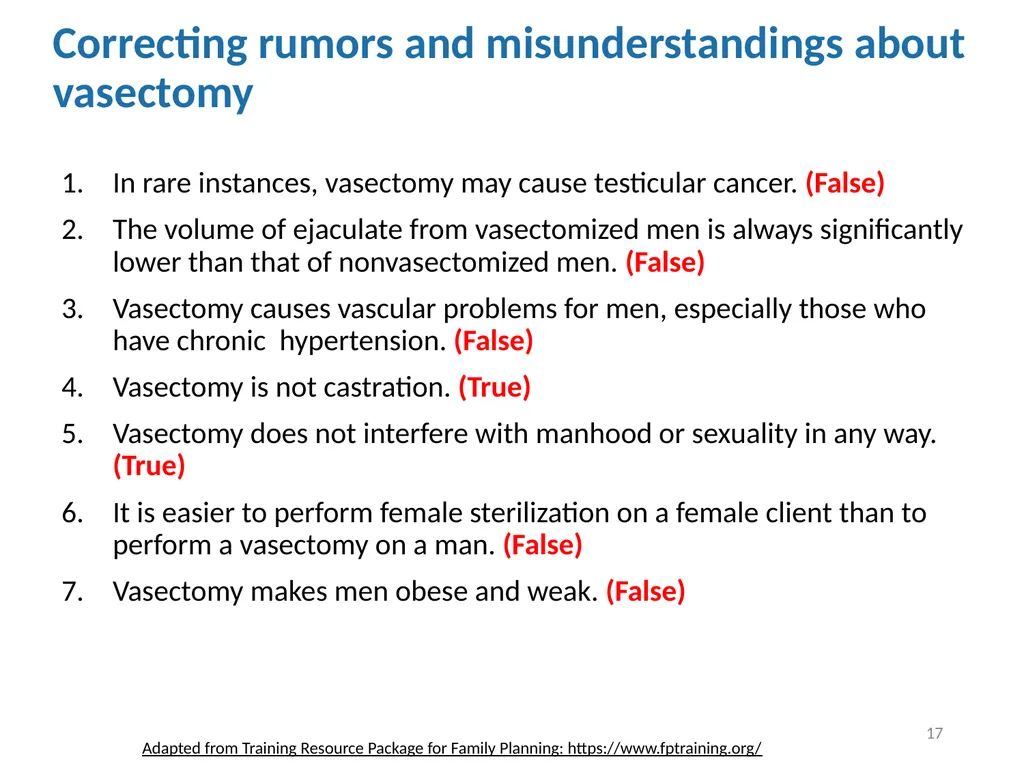
Correcting rumors and misunderstandings about vasectomy In rare instances, vasectomy may cause testicular cancer. (False)
The volume of ejaculate from vasectomized men is always significantly lower than that of nonvasectomized men. (False)
Vasectomy causes vascular problems for men, especially those who have chronic hypertension. (False)
Vasectomy is not castration. (True)
Vasectomy does not interfere with manhood or sexuality in any way. (True)
It is easier to perform female sterilization on a female client than to perform a vasectomy on a man. (False)
Vasectomy makes men obese and weak. (False) Adapted from Training Resource Package for Family Planning: https://www.fptraining.org/ 17<br>
The volume of ejaculate from vasectomized men is always significantly lower than that of nonvasectomized men. (False)
Vasectomy causes vascular problems for men, especially those who have chronic hypertension. (False)
Vasectomy is not castration. (True)
Vasectomy does not interfere with manhood or sexuality in any way. (True)
It is easier to perform female sterilization on a female client than to perform a vasectomy on a man. (False)
Vasectomy makes men obese and weak. (False) Adapted from Training Resource Package for Family Planning: https://www.fptraining.org/ 17<br>
18
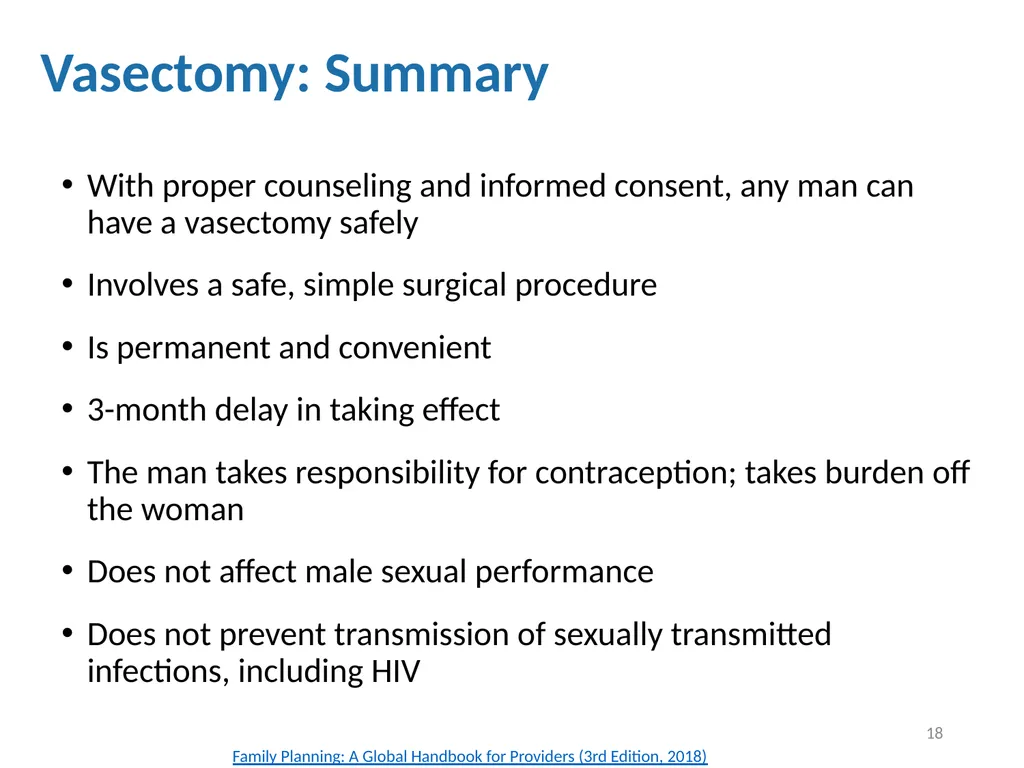
Vasectomy: Summary With proper counseling and informed consent, any man can have a vasectomy safely
Involves a safe, simple surgical procedure
Is permanent and convenient
3-month delay in taking effect
The man takes responsibility for contraception; takes burden off the woman
Does not affect male sexual performance
Does not prevent transmission of sexually transmitted infections, including HIV Family Planning: A Global Handbook for Providers (3rd Edition, 2018) 18<br>
Involves a safe, simple surgical procedure
Is permanent and convenient
3-month delay in taking effect
The man takes responsibility for contraception; takes burden off the woman
Does not affect male sexual performance
Does not prevent transmission of sexually transmitted infections, including HIV Family Planning: A Global Handbook for Providers (3rd Edition, 2018) 18<br>
19
Tubal Ligation
(Female Sterilization)<br>
20
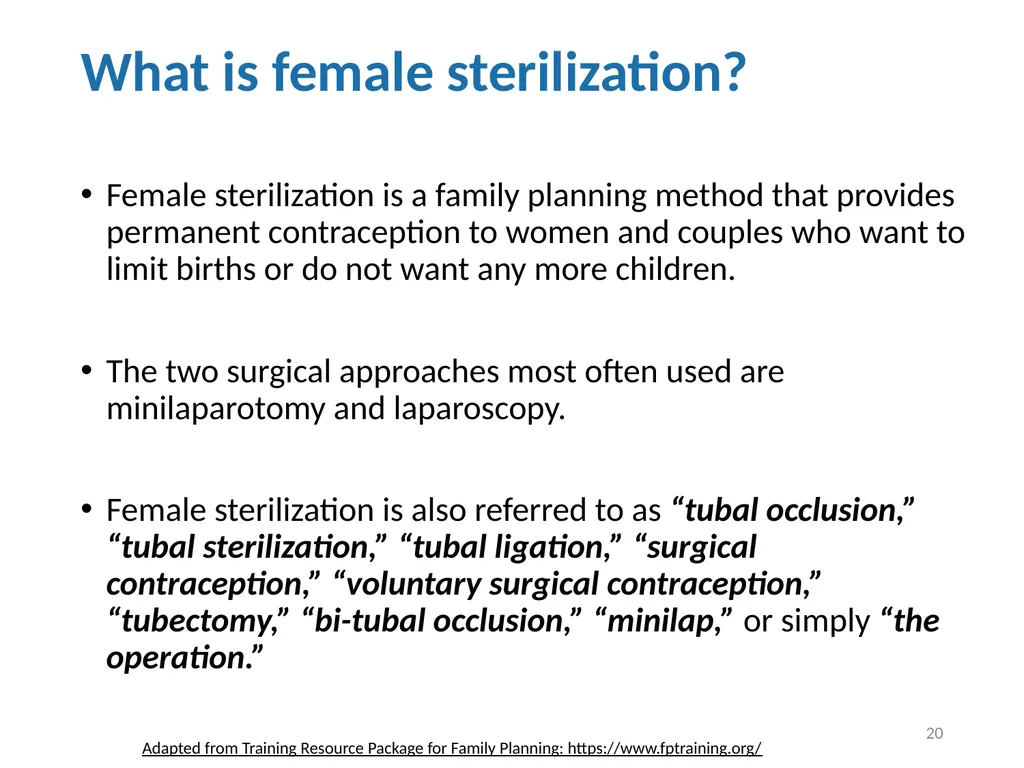
What is female sterilization? Female sterilization is a family planning method that provides permanent contraception to women and couples who want to limit births or do not want any more children.
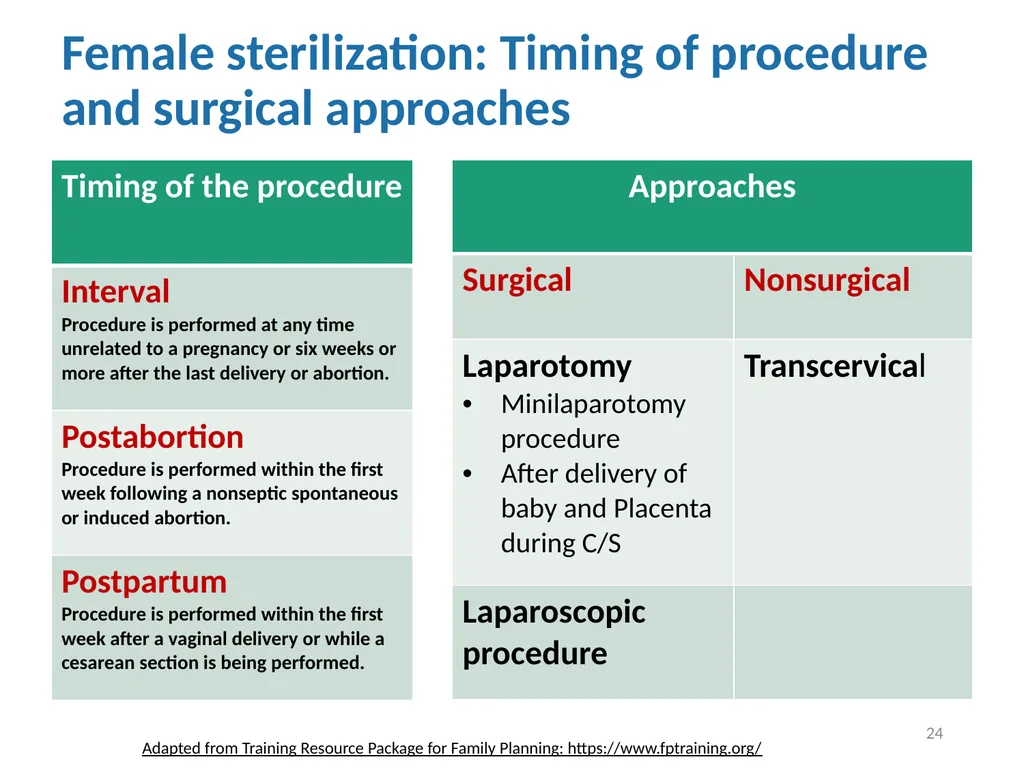
The two surgical approaches most often used are minilaparotomy and laparoscopy.
Female sterilization is also referred to as “tubal occlusion,” “tubal sterilization,” “tubal ligation,” “surgical contraception,” “voluntary surgical contraception,” “tubectomy,” “bi-tubal occlusion,” “minilap,” or simply “the operation.” Adapted from Training Resource Package for Family Planning: https://www.fptraining.org/ 20<br>
The two surgical approaches most often used are minilaparotomy and laparoscopy.
Female sterilization is also referred to as “tubal occlusion,” “tubal sterilization,” “tubal ligation,” “surgical contraception,” “voluntary surgical contraception,” “tubectomy,” “bi-tubal occlusion,” “minilap,” or simply “the operation.” Adapted from Training Resource Package for Family Planning: https://www.fptraining.org/ 20<br>
21
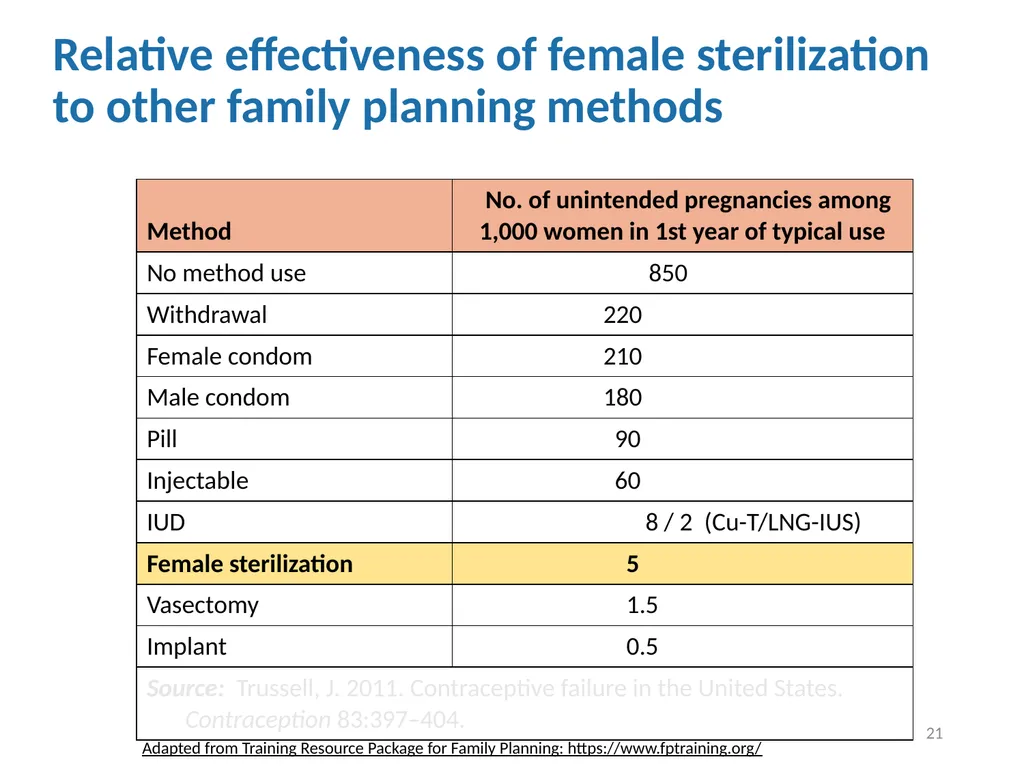
Relative effectiveness of female sterilization to other family planning methods Adapted from Training Resource Package for Family Planning: https://www.fptraining.org/ 21<br>
22
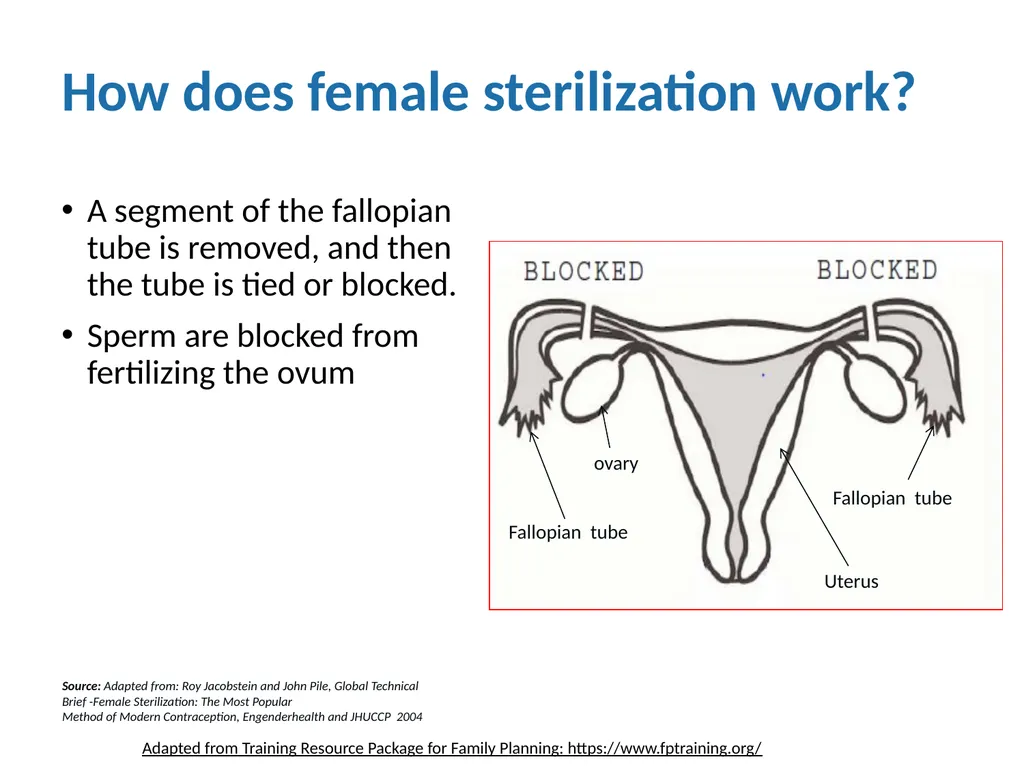
How does female sterilization work? A segment of the fallopian tube is removed, and then the tube is tied or blocked.
Sperm are blocked from fertilizing the ovum Fallopian tube ovary Fallopian tube Uterus Source: Adapted from: Roy Jacobstein and John Pile, Global Technical Brief -Female Sterilization: The Most Popular
Method of Modern Contraception, Engenderhealth and JHUCCP 2004 Adapted from Training Resource Package for Family Planning: https://www.fptraining.org/<br>
Sperm are blocked from fertilizing the ovum Fallopian tube ovary Fallopian tube Uterus Source: Adapted from: Roy Jacobstein and John Pile, Global Technical Brief -Female Sterilization: The Most Popular
Method of Modern Contraception, Engenderhealth and JHUCCP 2004 Adapted from Training Resource Package for Family Planning: https://www.fptraining.org/<br>
23
Female sterilization: Health benefits Protects against risks of pregnancy and childbirth
Lower risks of ectopic pregnancy
May lower risks of developing ovarian cancers Adapted from Training Resource Package for Family Planning: https://www.fptraining.org/ 23<br>
Lower risks of ectopic pregnancy
May lower risks of developing ovarian cancers Adapted from Training Resource Package for Family Planning: https://www.fptraining.org/ 23<br>
24
Female sterilization: Timing of procedure and surgical approaches Adapted from Training Resource Package for Family Planning: https://www.fptraining.org/ 24<br>
25
Female sterilization: Side effects and complications Complications of female sterilization are rare.
Immediate side effects of minilaparotomy are transient and include nausea, vomiting, and minor abdominal discomfort.
Complications may be:
Surgical
Injuries to other viscera
Bleeding or hemorrhage/ hematoma formation
Infection
Small risk of failure leading to pregnancy (ectopic or intrauterine)
Anesthesia-related
Respiratory depression
Drug overdose Long-term effects are rare:
Risk of ectopic pregnancy
Potential for regret Adapted from Training Resource Package for Family Planning: https://www.fptraining.org/ 25<br>
Immediate side effects of minilaparotomy are transient and include nausea, vomiting, and minor abdominal discomfort.
Complications may be:
Surgical
Injuries to other viscera
Bleeding or hemorrhage/ hematoma formation
Infection
Small risk of failure leading to pregnancy (ectopic or intrauterine)
Anesthesia-related
Respiratory depression
Drug overdose Long-term effects are rare:
Risk of ectopic pregnancy
Potential for regret Adapted from Training Resource Package for Family Planning: https://www.fptraining.org/ 25<br>
26
Who can have female sterilization? With proper counseling and informed consent, any woman can safely have a female sterilization procedure, including women who:
Are not married
Have no children or few children
Do not have spousal permission
Are young
Just gave birth (within the last seven days)
Are breastfeeding
Are infected with HIV, whether or not they are receiving antiretroviral therapy But they may need to wait if they:
Gave birth 1–6 weeks ago
May be pregnant
Have an infection or other problem
Have some other serious health condition Female sterilization is safe for all women. Adapted from Training Resource Package for Family Planning: https://www.fptraining.org/ 26<br>
Are not married
Have no children or few children
Do not have spousal permission
Are young
Just gave birth (within the last seven days)
Are breastfeeding
Are infected with HIV, whether or not they are receiving antiretroviral therapy But they may need to wait if they:
Gave birth 1–6 weeks ago
May be pregnant
Have an infection or other problem
Have some other serious health condition Female sterilization is safe for all women. Adapted from Training Resource Package for Family Planning: https://www.fptraining.org/ 26<br>
27
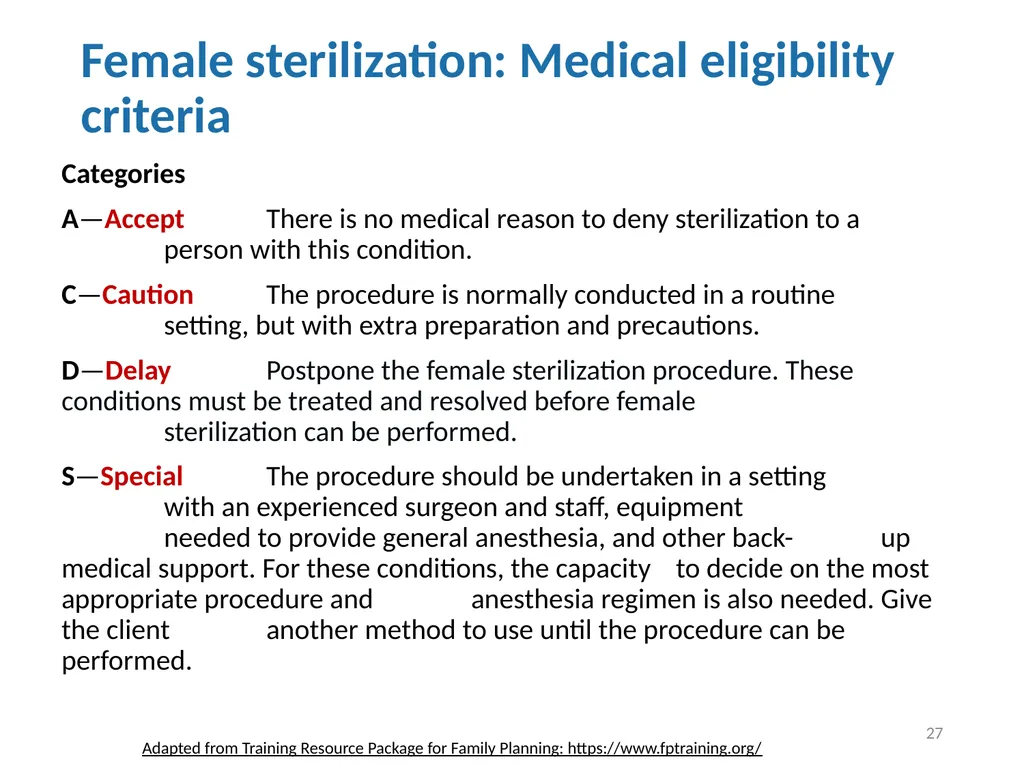
Female sterilization: Medical eligibility criteria Categories
A—Accept There is no medical reason to deny sterilization to a person with this condition.
C—Caution The procedure is normally conducted in a routine setting, but with extra preparation and precautions.
D—Delay Postpone the female sterilization procedure. These conditions must be treated and resolved before female sterilization can be performed.
S—Special The procedure should be undertaken in a setting with an experienced surgeon and staff, equipment needed to provide general anesthesia, and other back- up medical support. For these conditions, the capacity to decide on the most appropriate procedure and anesthesia regimen is also needed. Give the client another method to use until the procedure can be performed. Adapted from Training Resource Package for Family Planning: https://www.fptraining.org/ 27<br>
A—Accept There is no medical reason to deny sterilization to a person with this condition.
C—Caution The procedure is normally conducted in a routine setting, but with extra preparation and precautions.
D—Delay Postpone the female sterilization procedure. These conditions must be treated and resolved before female sterilization can be performed.
S—Special The procedure should be undertaken in a setting with an experienced surgeon and staff, equipment needed to provide general anesthesia, and other back- up medical support. For these conditions, the capacity to decide on the most appropriate procedure and anesthesia regimen is also needed. Give the client another method to use until the procedure can be performed. Adapted from Training Resource Package for Family Planning: https://www.fptraining.org/ 27<br>
28
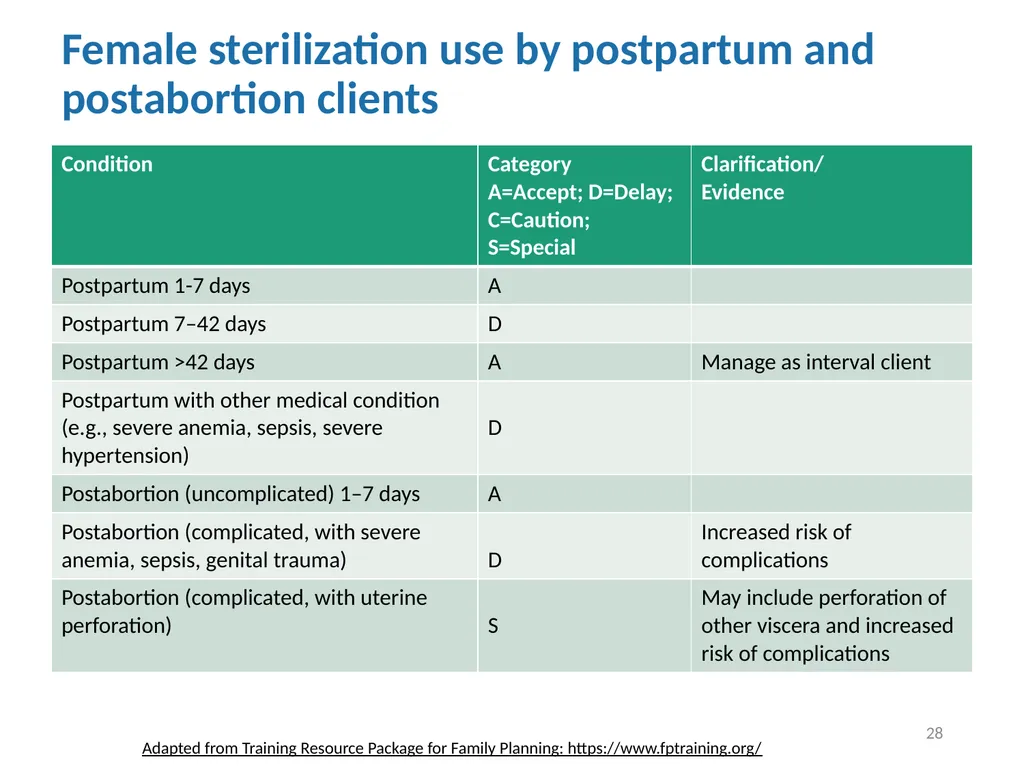
Female sterilization use by postpartum and postabortion clients Adapted from Training Resource Package for Family Planning: https://www.fptraining.org/ 28<br>
29
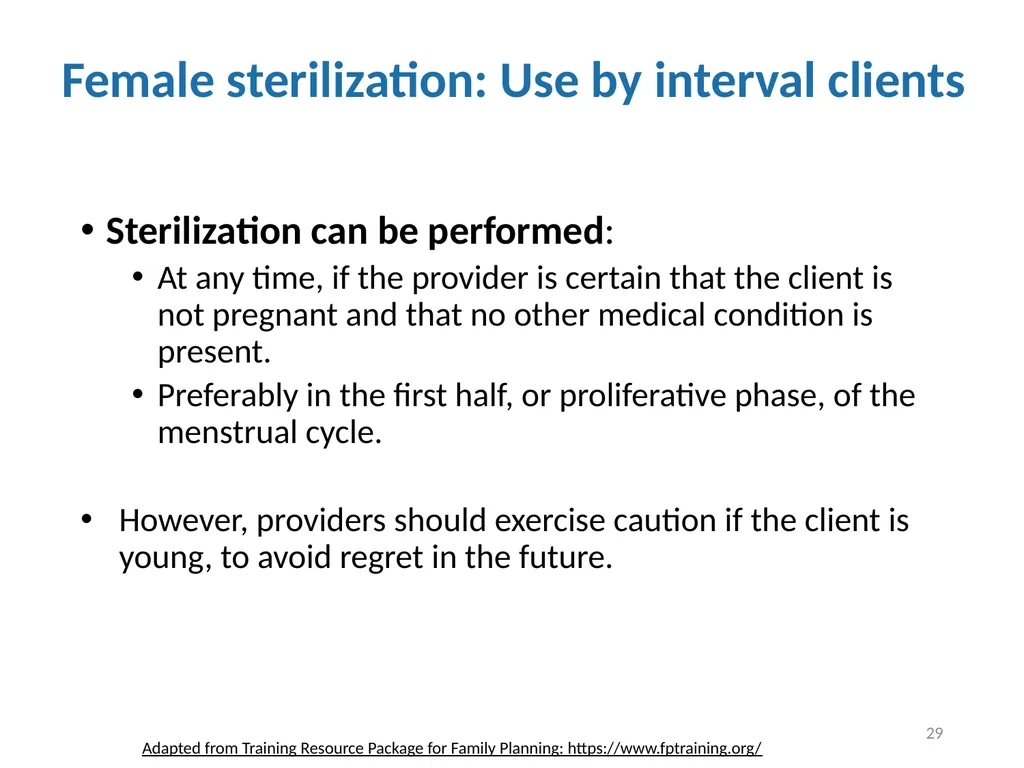
Female sterilization: Use by interval clients Sterilization can be performed:
At any time, if the provider is certain that the client is not pregnant and that no other medical condition is present.
Preferably in the first half, or proliferative phase, of the menstrual cycle.
However, providers should exercise caution if the client is young, to avoid regret in the future. Adapted from Training Resource Package for Family Planning: https://www.fptraining.org/ 29<br>
At any time, if the provider is certain that the client is not pregnant and that no other medical condition is present.
Preferably in the first half, or proliferative phase, of the menstrual cycle.
However, providers should exercise caution if the client is young, to avoid regret in the future. Adapted from Training Resource Package for Family Planning: https://www.fptraining.org/ 29<br>
30
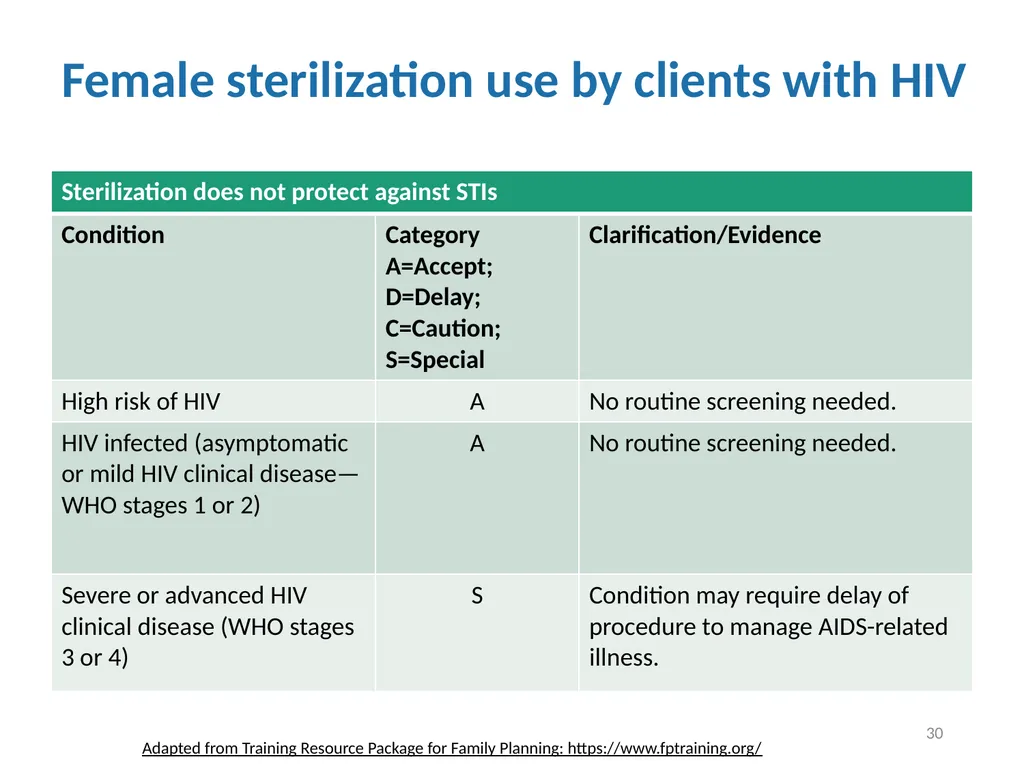
Female sterilization use by clients with HIV Adapted from Training Resource Package for Family Planning: https://www.fptraining.org/ 30<br>
31
Female sterilization: Correcting myths and misunderstandings Female sterilization does not:
Make a woman weak
Cause lasting pain in the back, uterus, or abdomen
Remove a woman’s uterus or lead to a need to have it removed, or turn the womb inside out
Cause a hormonal imbalance
Cause heavier bleeding
Produce changes in weight, appetite, or appearance
Change sexual behavior or sex drive Adapted from Training Resource Package for Family Planning: https://www.fptraining.org/ 31<br>
Make a woman weak
Cause lasting pain in the back, uterus, or abdomen
Remove a woman’s uterus or lead to a need to have it removed, or turn the womb inside out
Cause a hormonal imbalance
Cause heavier bleeding
Produce changes in weight, appetite, or appearance
Change sexual behavior or sex drive Adapted from Training Resource Package for Family Planning: https://www.fptraining.org/ 31<br>
32
Female sterilization: Summary Permanent method
Involves a physical examination and surgery.
The procedure is done by a specifically trained provider
No long-term side effects
Does not prevent transmission of sexually transmitted infections, including HIV Family Planning: A Global Handbook for Providers (3rd Edition, 2018) 32<br>
Involves a physical examination and surgery.
The procedure is done by a specifically trained provider
No long-term side effects
Does not prevent transmission of sexually transmitted infections, including HIV Family Planning: A Global Handbook for Providers (3rd Edition, 2018) 32<br>
33
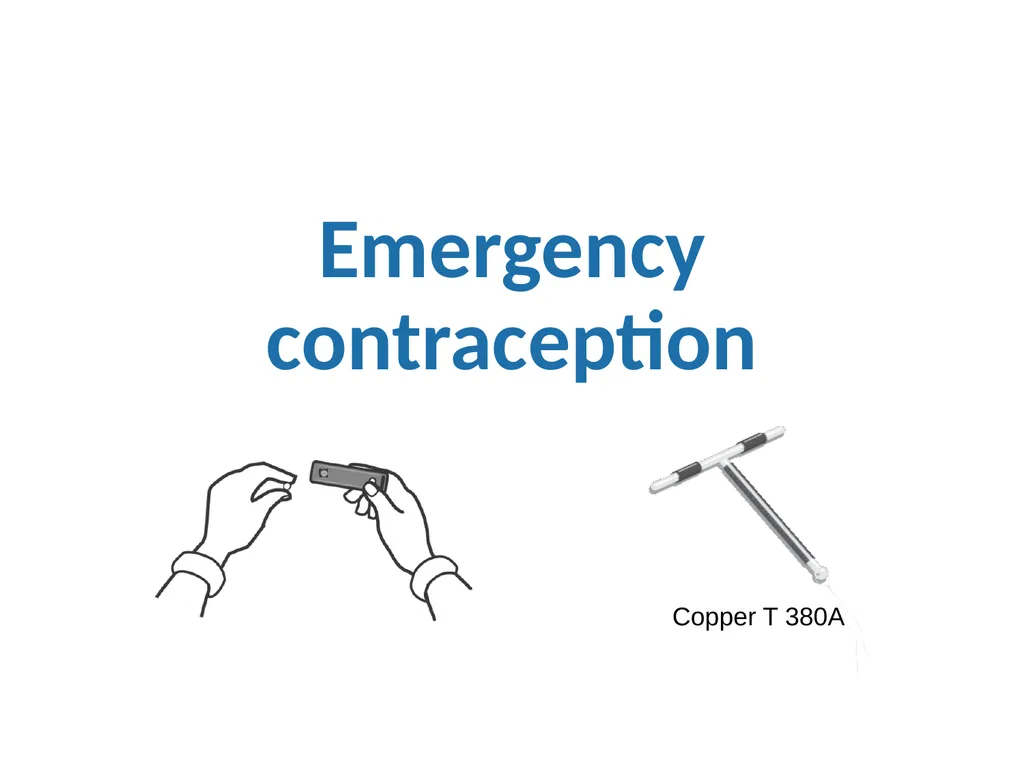
Emergency contraception<br>
34
What is emergency contraception? Contraceptive methods that are used to prevent pregnancy after sexual intercourse.
Recommended for use within 5 days but their effectiveness increases when used as early as possible after the act of intercourse.
Can prevent up to over 95% of pregnancies when taken within 5 days after intercourse. 34 Emergency contraception: Key facts. World Health Organization; 2021.<br>
Recommended for use within 5 days but their effectiveness increases when used as early as possible after the act of intercourse.
Can prevent up to over 95% of pregnancies when taken within 5 days after intercourse. 34 Emergency contraception: Key facts. World Health Organization; 2021.<br>
35
Methods of emergency contraception Emergency contraceptive pills (ECPs)
Dedicated ECP Products
ECPs containing ulipristal acetate (UPA)
ECPs containing levonorgestrel (LNG)
Progestin-only pills with levonorgestrel or norgestrel
Combined oral contraceptive pills (COCs) with estrogen and a progestin- levonorgestrel, norgestrel, or norethindrone (also called norethisterone)
Copper-bearing intrauterine devices Family Planning: A Global Handbook for Providers (3rd Edition, 2018) 35<br>
Dedicated ECP Products
ECPs containing ulipristal acetate (UPA)
ECPs containing levonorgestrel (LNG)
Progestin-only pills with levonorgestrel or norgestrel
Combined oral contraceptive pills (COCs) with estrogen and a progestin- levonorgestrel, norgestrel, or norethindrone (also called norethisterone)
Copper-bearing intrauterine devices Family Planning: A Global Handbook for Providers (3rd Edition, 2018) 35<br>
36
Indications for emergency contraception - 1 Emergency contraception can be used in the following situations following sexual intercourse:
When no contraceptive has been used.
Sexual assault when the woman was not protected by an effective contraceptive method.
When there is concern of possible contraceptive failure, from improper or incorrect use. A woman may be given advance supplies of ECPs to ensure their availability when needed and they can be used as soon as possible after unprotected intercourse. 36 Emergency contraception: Key facts. World Health Organization; 2021.<br>
When no contraceptive has been used.
Sexual assault when the woman was not protected by an effective contraceptive method.
When there is concern of possible contraceptive failure, from improper or incorrect use. A woman may be given advance supplies of ECPs to ensure their availability when needed and they can be used as soon as possible after unprotected intercourse. 36 Emergency contraception: Key facts. World Health Organization; 2021.<br>
37
Condom breakage, slippage, or incorrect use
3 or more consecutively missed combined oral contraceptive pills
More than 3 hours late from the usual time of intake of the progestogen-only pill (minipill), or more than 27 hours after the previous pill
More than 12 hours late from the usual time of intake of the desogestrel-containing pill (0.75 mg) or more than 36 hours after the previous pill
More than 2 weeks late for the norethisterone enanthate (NET-EN) progestogen-only injection
More than 4 weeks late for the depot-medroxyprogesterone acetate (DMPA) progestogen-only injection
More than 7 days late for the combined injectable contraceptive (CIC)
Dislodgment, breakage, tearing, or early removal of a diaphragm or cervical cap
Failed withdrawal (e.g. ejaculation in the vagina or on external genitalia)
Failure of a spermicide tablet or film to melt before intercourse
Miscalculation of the abstinence period, or failure to abstain or use a barrier method on the fertile days of the cycle when using fertility awareness based methods
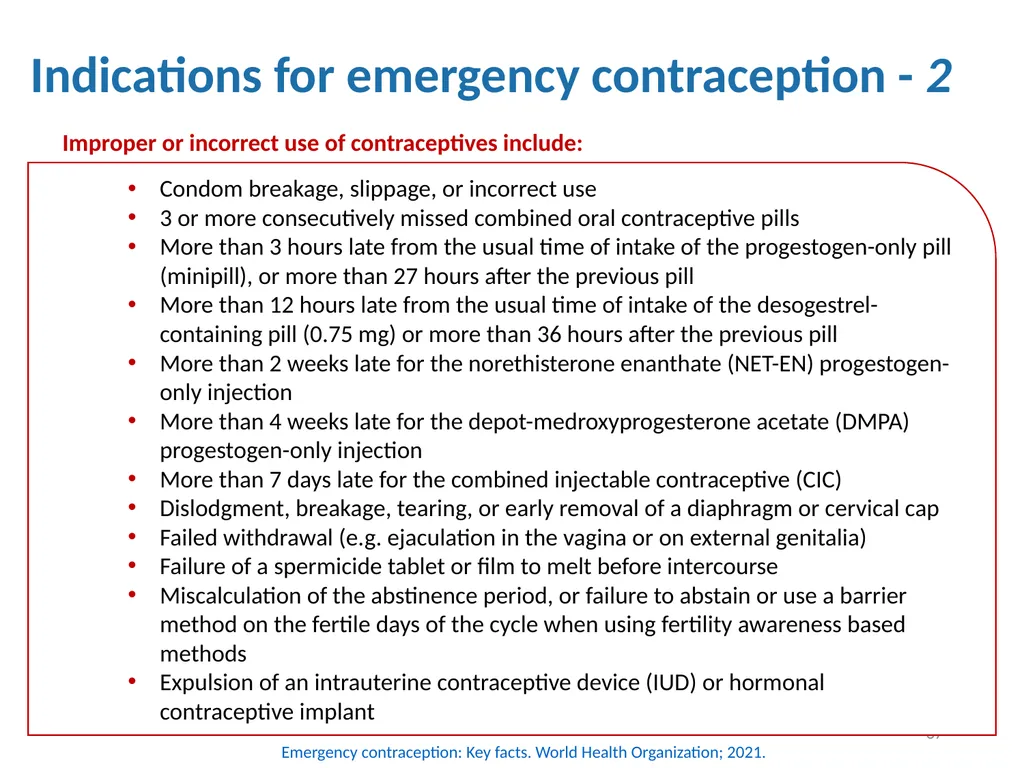
Expulsion of an intrauterine contraceptive device (IUD) or hormonal contraceptive implant Improper or incorrect use of contraceptives include: Indications for emergency contraception - 2 37 Emergency contraception: Key facts. World Health Organization; 2021.<br>
3 or more consecutively missed combined oral contraceptive pills
More than 3 hours late from the usual time of intake of the progestogen-only pill (minipill), or more than 27 hours after the previous pill
More than 12 hours late from the usual time of intake of the desogestrel-containing pill (0.75 mg) or more than 36 hours after the previous pill
More than 2 weeks late for the norethisterone enanthate (NET-EN) progestogen-only injection
More than 4 weeks late for the depot-medroxyprogesterone acetate (DMPA) progestogen-only injection
More than 7 days late for the combined injectable contraceptive (CIC)
Dislodgment, breakage, tearing, or early removal of a diaphragm or cervical cap
Failed withdrawal (e.g. ejaculation in the vagina or on external genitalia)
Failure of a spermicide tablet or film to melt before intercourse
Miscalculation of the abstinence period, or failure to abstain or use a barrier method on the fertile days of the cycle when using fertility awareness based methods
Expulsion of an intrauterine contraceptive device (IUD) or hormonal contraceptive implant Improper or incorrect use of contraceptives include: Indications for emergency contraception - 2 37 Emergency contraception: Key facts. World Health Organization; 2021.<br>
38
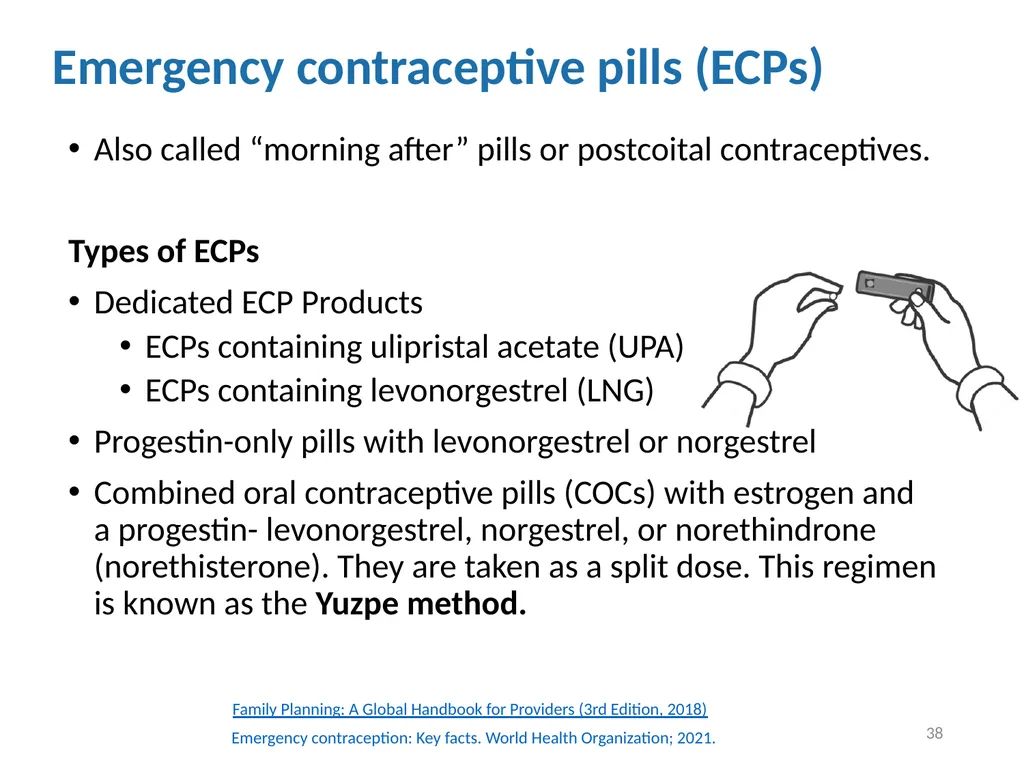
Emergency contraceptive pills (ECPs) Also called “morning after” pills or postcoital contraceptives.
Types of ECPs
Dedicated ECP Products
ECPs containing ulipristal acetate (UPA)
ECPs containing levonorgestrel (LNG)
Progestin-only pills with levonorgestrel or norgestrel
Combined oral contraceptive pills (COCs) with estrogen and a progestin- levonorgestrel, norgestrel, or norethindrone (norethisterone). They are taken as a split dose. This regimen is known as the Yuzpe method. Family Planning: A Global Handbook for Providers (3rd Edition, 2018) 38 Emergency contraception: Key facts. World Health Organization; 2021.<br>
Types of ECPs
Dedicated ECP Products
ECPs containing ulipristal acetate (UPA)
ECPs containing levonorgestrel (LNG)
Progestin-only pills with levonorgestrel or norgestrel
Combined oral contraceptive pills (COCs) with estrogen and a progestin- levonorgestrel, norgestrel, or norethindrone (norethisterone). They are taken as a split dose. This regimen is known as the Yuzpe method. Family Planning: A Global Handbook for Providers (3rd Edition, 2018) 38 Emergency contraception: Key facts. World Health Organization; 2021.<br>
39
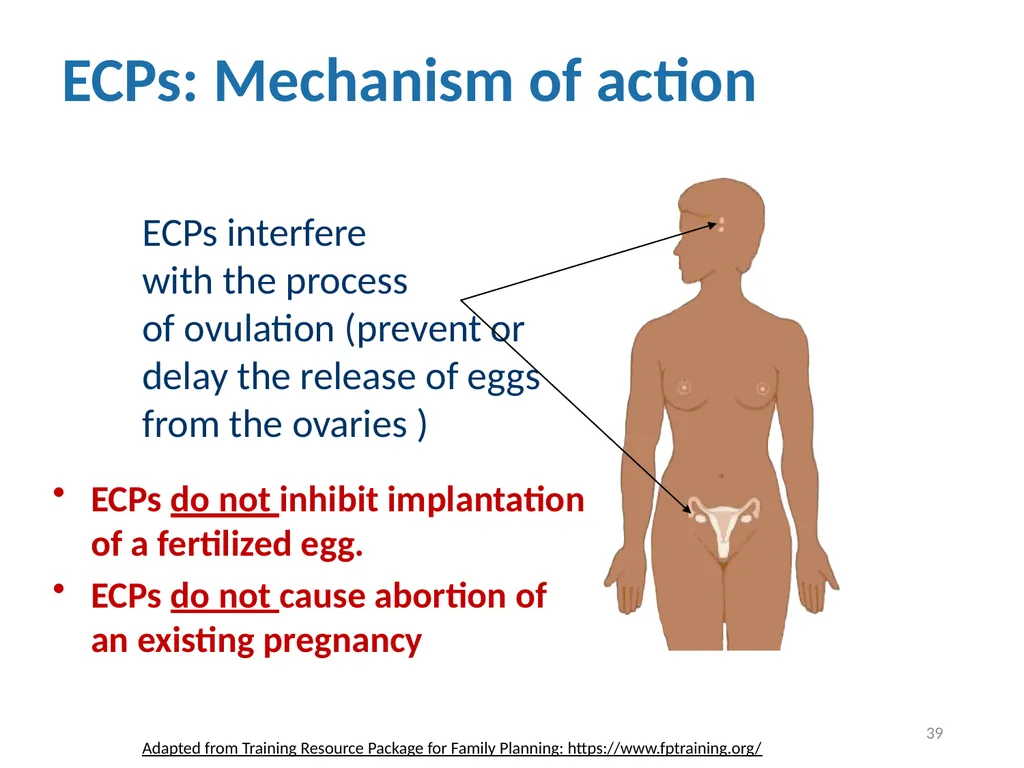
ECPs: Mechanism of action ECPs interfere
with the process
of ovulation (prevent or delay the release of eggs from the ovaries ) ECPs do not inhibit implantation of a fertilized egg.
ECPs do not cause abortion of an existing pregnancy
do not Adapted from Training Resource Package for Family Planning: https://www.fptraining.org/ 39<br>
with the process
of ovulation (prevent or delay the release of eggs from the ovaries ) ECPs do not inhibit implantation of a fertilized egg.
ECPs do not cause abortion of an existing pregnancy
do not Adapted from Training Resource Package for Family Planning: https://www.fptraining.org/ 39<br>
40
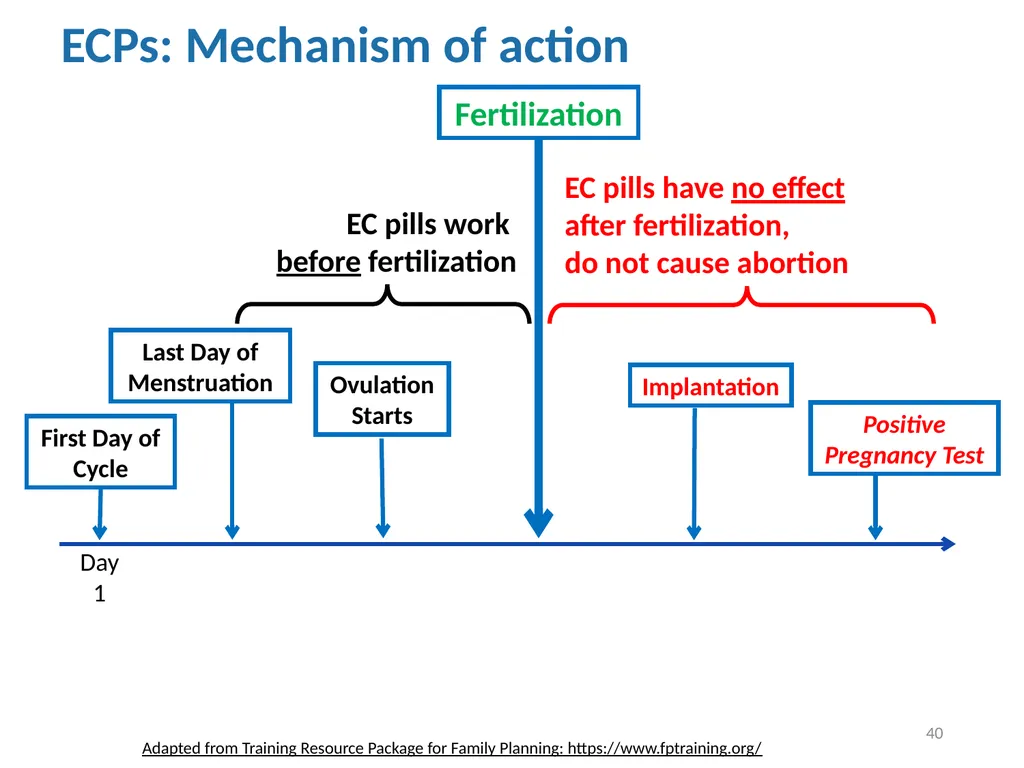
ECPs: Mechanism of action Adapted from Training Resource Package for Family Planning: https://www.fptraining.org/ 40<br>
41
Effectiveness of ECPs If 100 women each had sex once during the 2nd or 3rd week of the menstrual cycle without using contraception, 8 would likely become pregnant.
If all 100 women used uliprital acetate ECPs, less than one would likely become pregnant.
If all 100 women used progestin (LNG)-only ECPs, one would likely become pregnant.
Effectiveness depends on where a woman is in her menstrual cycle, when she had unprotected sex and when she used ECPs.
Some types of ECP such as ulipristal acetate (UPA) or mifepristone are more effective than LNG-only ECPs and some (regular contraceptives- the Yuzpe regimen) less effective.
Effectiveness may be affected by use of certain medications.
Evidence suggests that ECPs may be less effective in women with higher weight and/or BMI. UPA seems to be more effective in these women than LNG. Adapted from Training Resource Package for Family Planning: https://www.fptraining.org/ 41<br>
If all 100 women used uliprital acetate ECPs, less than one would likely become pregnant.
If all 100 women used progestin (LNG)-only ECPs, one would likely become pregnant.
Effectiveness depends on where a woman is in her menstrual cycle, when she had unprotected sex and when she used ECPs.
Some types of ECP such as ulipristal acetate (UPA) or mifepristone are more effective than LNG-only ECPs and some (regular contraceptives- the Yuzpe regimen) less effective.
Effectiveness may be affected by use of certain medications.
Evidence suggests that ECPs may be less effective in women with higher weight and/or BMI. UPA seems to be more effective in these women than LNG. Adapted from Training Resource Package for Family Planning: https://www.fptraining.org/ 41<br>
42
Medical eligibility criteria (MEC) for ECPs No medical precautions or contraindications; all women are medically eligible to use ECPs including women who cannot use hormonal contraceptives as regular methods because they are used for a short term.
When taken frequently and repeatedly, ECPs may be harmful for women who have MEC category 2, 3 or 4 conditions for combined hormonal contraception or Progestin-only contraceptives. Family Planning: A Global Handbook for Providers (3rd Edition, 2018) 42 Emergency contraception: Key facts. World Health Organization; 2021.<br>
When taken frequently and repeatedly, ECPs may be harmful for women who have MEC category 2, 3 or 4 conditions for combined hormonal contraception or Progestin-only contraceptives. Family Planning: A Global Handbook for Providers (3rd Edition, 2018) 42 Emergency contraception: Key facts. World Health Organization; 2021.<br>
43
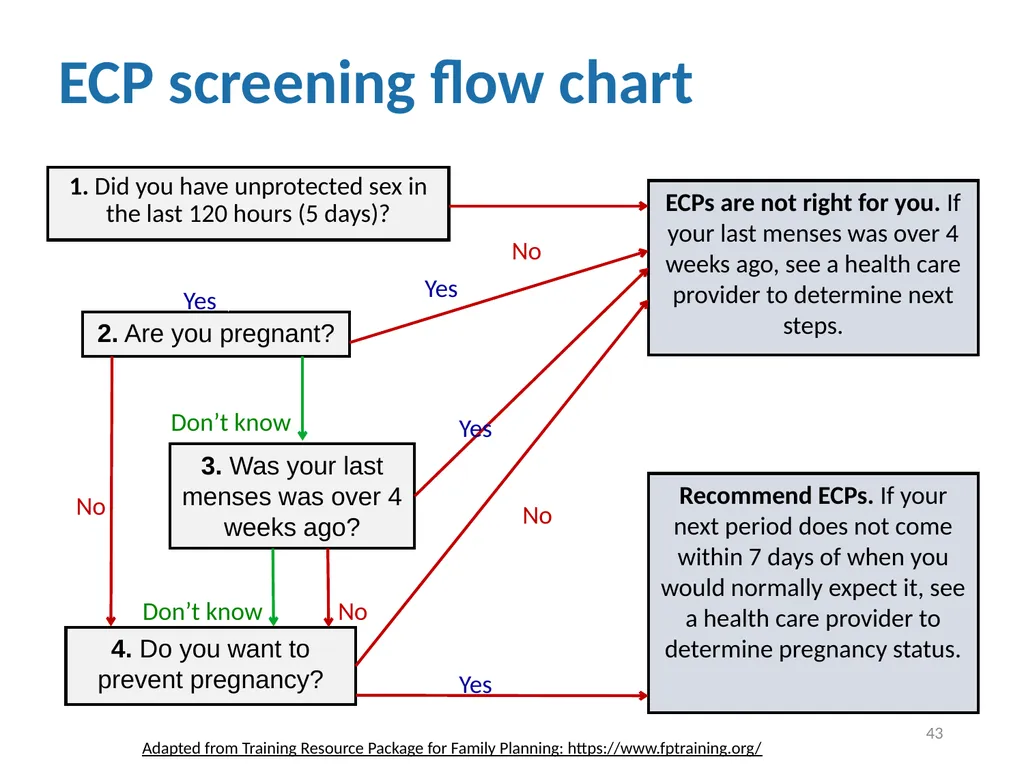
ECP screening flow chart 1. Did you have unprotected sex in the last 120 hours (5 days)? Yes 2. Are you pregnant? 4. Do you want to prevent pregnancy? Recommend ECPs. If your next period does not come within 7 days of when you would normally expect it, see a health care provider to determine pregnancy status. ECPs are not right for you. If your last menses was over 4 weeks ago, see a health care provider to determine next steps. No Yes Don’t know No Yes No 3. Was your last menses was over 4 weeks ago? Yes Don’t know No Adapted from Training Resource Package for Family Planning: https://www.fptraining.org/ 43<br>
44
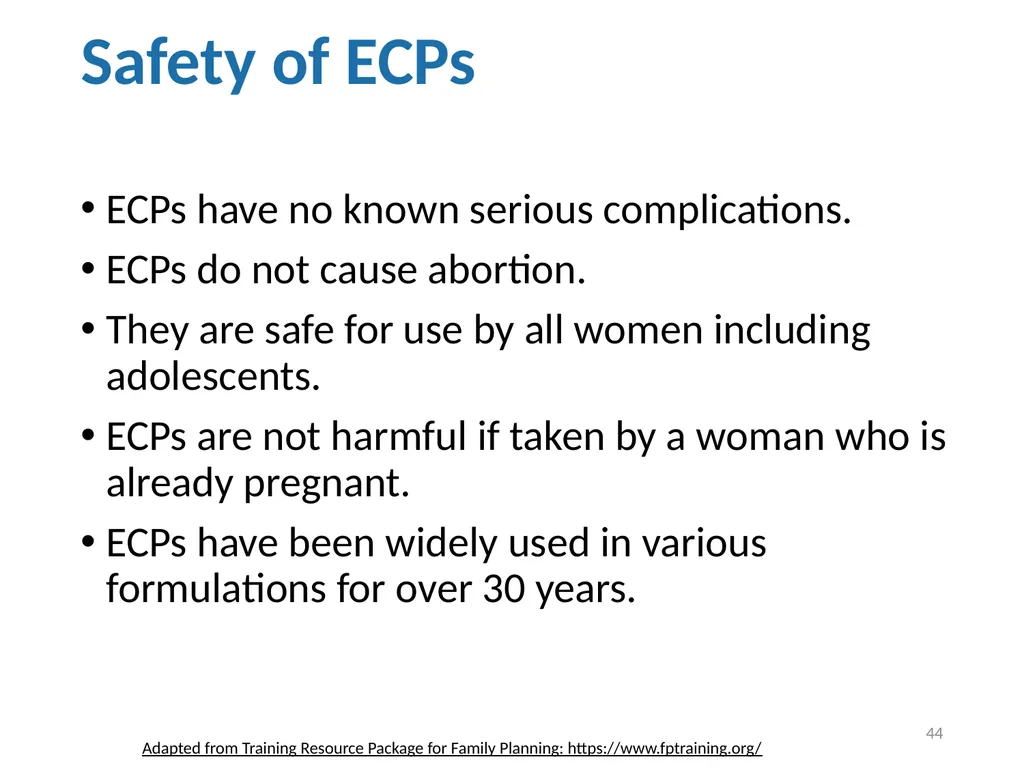
Safety of ECPs ECPs have no known serious complications.
ECPs do not cause abortion.
They are safe for use by all women including adolescents.
ECPs are not harmful if taken by a woman who is already pregnant.
ECPs have been widely used in various formulations for over 30 years. Adapted from Training Resource Package for Family Planning: https://www.fptraining.org/ 44<br>
ECPs do not cause abortion.
They are safe for use by all women including adolescents.
ECPs are not harmful if taken by a woman who is already pregnant.
ECPs have been widely used in various formulations for over 30 years. Adapted from Training Resource Package for Family Planning: https://www.fptraining.org/ 44<br>
45
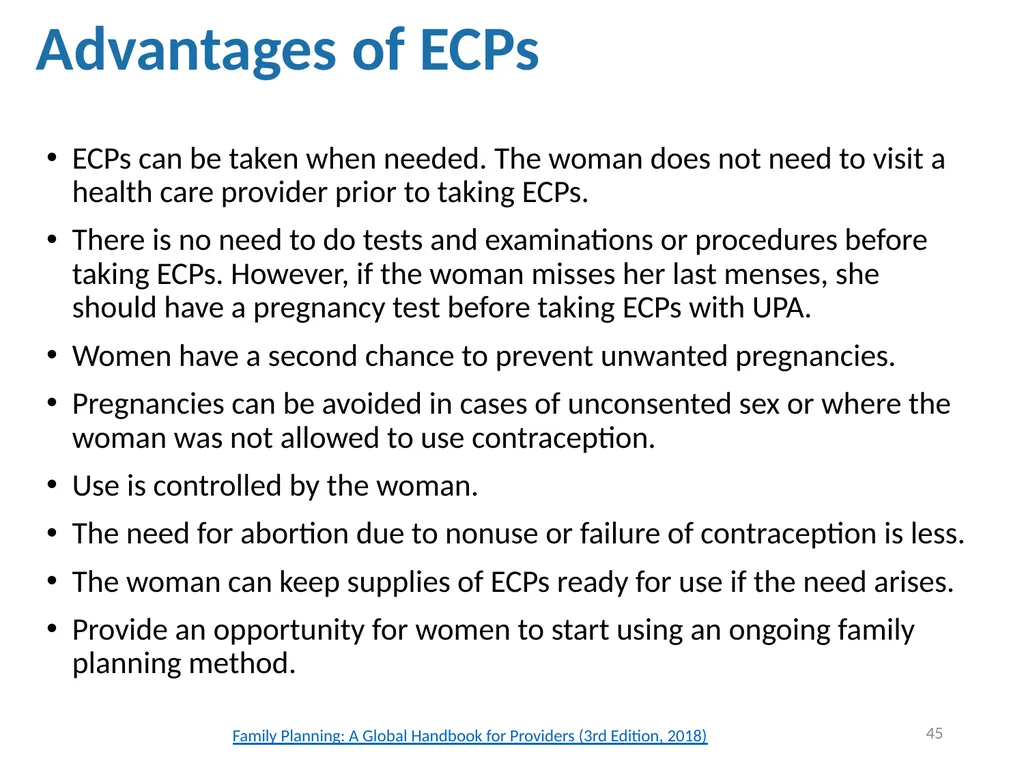
Advantages of ECPs ECPs can be taken when needed. The woman does not need to visit a health care provider prior to taking ECPs.
There is no need to do tests and examinations or procedures before taking ECPs. However, if the woman misses her last menses, she should have a pregnancy test before taking ECPs with UPA.
Women have a second chance to prevent unwanted pregnancies.
Pregnancies can be avoided in cases of unconsented sex or where the woman was not allowed to use contraception.
Use is controlled by the woman.
The need for abortion due to nonuse or failure of contraception is less.
The woman can keep supplies of ECPs ready for use if the need arises.
Provide an opportunity for women to start using an ongoing family planning method. Family Planning: A Global Handbook for Providers (3rd Edition, 2018) 45<br>
There is no need to do tests and examinations or procedures before taking ECPs. However, if the woman misses her last menses, she should have a pregnancy test before taking ECPs with UPA.
Women have a second chance to prevent unwanted pregnancies.
Pregnancies can be avoided in cases of unconsented sex or where the woman was not allowed to use contraception.
Use is controlled by the woman.
The need for abortion due to nonuse or failure of contraception is less.
The woman can keep supplies of ECPs ready for use if the need arises.
Provide an opportunity for women to start using an ongoing family planning method. Family Planning: A Global Handbook for Providers (3rd Edition, 2018) 45<br>
46
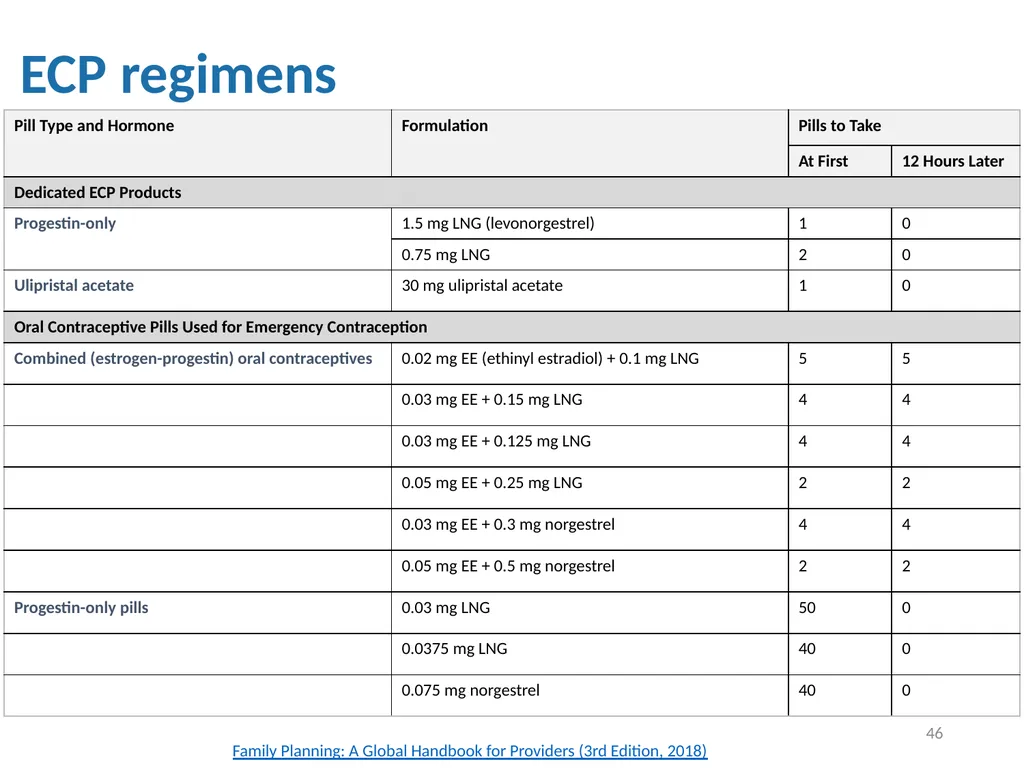
ECP regimens Family Planning: A Global Handbook for Providers (3rd Edition, 2018) 46<br>
47
Timing of ECPs Anytime up to 5 days (120 hours) after an unprotected sex.
ECPs protect from pregnancy from sexual intercourse that took place in the preceding 5 days.
To better prevent pregnancy, ECPs should be taken as soon as possible after unprotected sex.
There is no delay in return of fertility.
They do not prevent pregnancy if the sexual intercourse happens more than 24 hours after taking ECPs. Family Planning: A Global Handbook for Providers (3rd Edition, 2018) 47<br>
ECPs protect from pregnancy from sexual intercourse that took place in the preceding 5 days.
To better prevent pregnancy, ECPs should be taken as soon as possible after unprotected sex.
There is no delay in return of fertility.
They do not prevent pregnancy if the sexual intercourse happens more than 24 hours after taking ECPs. Family Planning: A Global Handbook for Providers (3rd Edition, 2018) 47<br>
48
Side effects of ECPs Side effects of ECPs are uncommon, mild, and in general will resolve without further medications. ECPs with progestin-only or with UPA are much less likely to cause nausea and vomiting compared with ECPs containing estrogen and progestin (COCs). Other side effects are:
Changes in bleeding patterns:
slight irregular vaginal bleeding for 1 to 2 days after taking ECPs
early or delayed monthly bleeding In the first several days there may be:
Nausea
Abdominal pain
Fatigue
Headaches
Breast tenderness
Dizziness
Vomiting Family Planning: A Global Handbook for Providers (3rd Edition, 2018) 48 Emergency contraception: Key facts. World Health Organization; 2021.<br>
Changes in bleeding patterns:
slight irregular vaginal bleeding for 1 to 2 days after taking ECPs
early or delayed monthly bleeding In the first several days there may be:
Nausea
Abdominal pain
Fatigue
Headaches
Breast tenderness
Dizziness
Vomiting Family Planning: A Global Handbook for Providers (3rd Edition, 2018) 48 Emergency contraception: Key facts. World Health Organization; 2021.<br>
49
Managing side effects of ECPs - 1 Nausea
Routine use of anti-nausea medications is not recommended.
For nausea occurring with previous ECP use or with the first dose of a 2 dose regimen, anti-nausea medication like 25-50 mg meclizine hydrochloride (Agyrax, Anitvert, Bonine, Postafene) can be taken 30 minutes to one hour before using ECPs.
Vomiting
If vomiting occurs within 2 hours of taking progestin-only or combined ECPs, the dose should be repeated.
If vomiting occurs within 3 hours of taking ulipristal acetate ECPs, the dose should be repeated. Anti-nausea medication can be used with this repeat dose as described above.
If vomiting continues, repeat dose of progestin-only or combined ECPs can be used by placing the pills high in the vagina.
If vomiting occurs more than 2 hours after taking progestin-only or combined ECPs, or more than 3 hours after taking UPA-ECPs, there is no need to repeat the dose. Family Planning: A Global Handbook for Providers (3rd Edition, 2018) 49<br>
Routine use of anti-nausea medications is not recommended.
For nausea occurring with previous ECP use or with the first dose of a 2 dose regimen, anti-nausea medication like 25-50 mg meclizine hydrochloride (Agyrax, Anitvert, Bonine, Postafene) can be taken 30 minutes to one hour before using ECPs.
Vomiting
If vomiting occurs within 2 hours of taking progestin-only or combined ECPs, the dose should be repeated.
If vomiting occurs within 3 hours of taking ulipristal acetate ECPs, the dose should be repeated. Anti-nausea medication can be used with this repeat dose as described above.
If vomiting continues, repeat dose of progestin-only or combined ECPs can be used by placing the pills high in the vagina.
If vomiting occurs more than 2 hours after taking progestin-only or combined ECPs, or more than 3 hours after taking UPA-ECPs, there is no need to repeat the dose. Family Planning: A Global Handbook for Providers (3rd Edition, 2018) 49<br>
50
Irregular vaginal bleeding
Reassure that it is not a sign of illness or pregnancy.
It usually resolves without treatment.
Early or delayed monthly bleeding
Reassure that it is not a sign of illness or pregnancy.
Assess for pregnancy if the monthly bleeding is late by more than 7 days after the use of ECPs.
Reassure that there are no known risks to the fetus if ECPs do not prevent pregnancy. Managing side effects of ECPs – 2 Family Planning: A Global Handbook for Providers (3rd Edition, 2018) 50<br>
Reassure that it is not a sign of illness or pregnancy.
It usually resolves without treatment.
Early or delayed monthly bleeding
Reassure that it is not a sign of illness or pregnancy.
Assess for pregnancy if the monthly bleeding is late by more than 7 days after the use of ECPs.
Reassure that there are no known risks to the fetus if ECPs do not prevent pregnancy. Managing side effects of ECPs – 2 Family Planning: A Global Handbook for Providers (3rd Edition, 2018) 50<br>
51
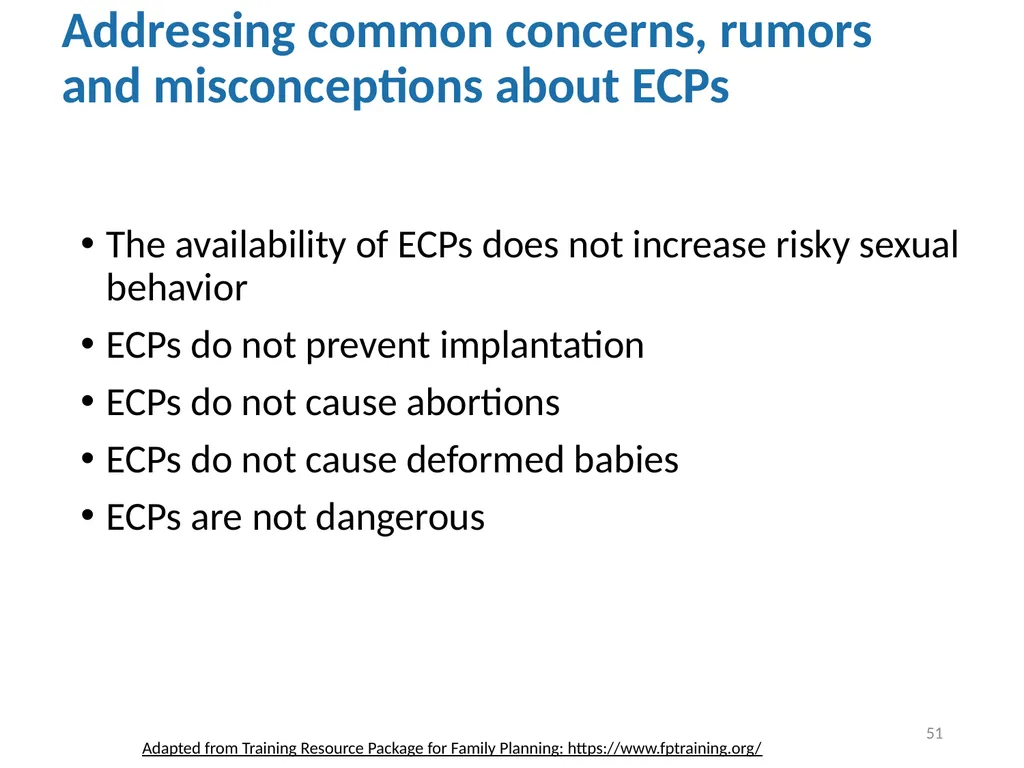
Addressing common concerns, rumors and misconceptions about ECPs The availability of ECPs does not increase risky sexual behavior
ECPs do not prevent implantation
ECPs do not cause abortions
ECPs do not cause deformed babies
ECPs are not dangerous Adapted from Training Resource Package for Family Planning: https://www.fptraining.org/ 51<br>
ECPs do not prevent implantation
ECPs do not cause abortions
ECPs do not cause deformed babies
ECPs are not dangerous Adapted from Training Resource Package for Family Planning: https://www.fptraining.org/ 51<br>
52
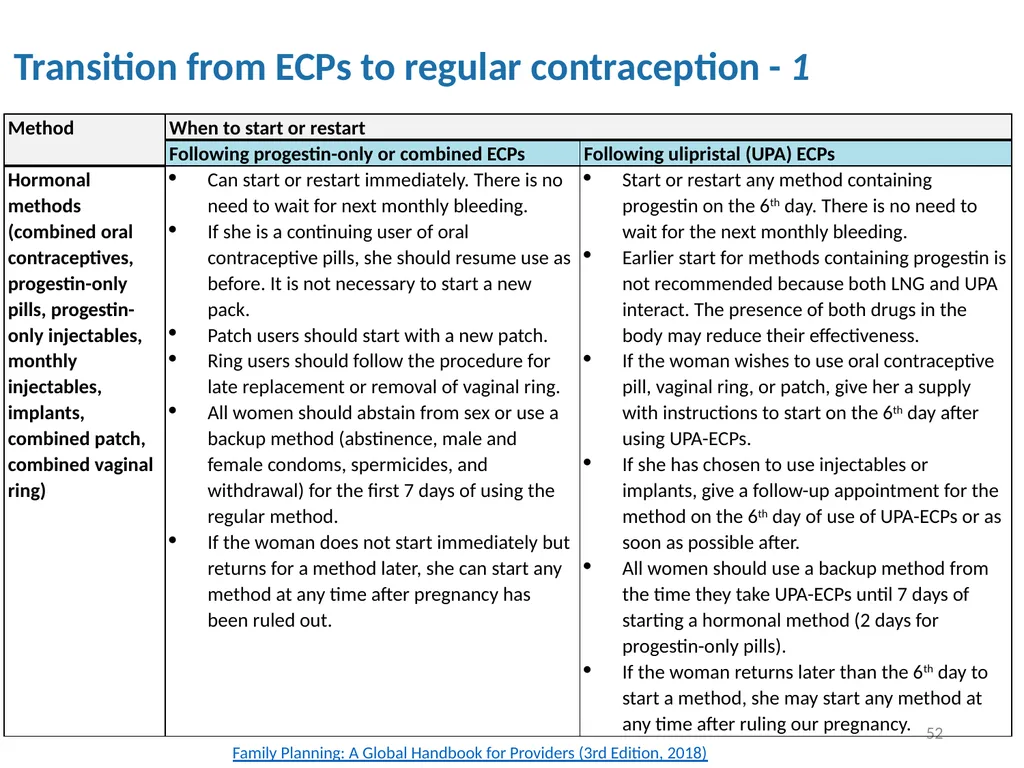
Transition from ECPs to regular contraception - 1 Family Planning: A Global Handbook for Providers (3rd Edition, 2018) 52<br>
53
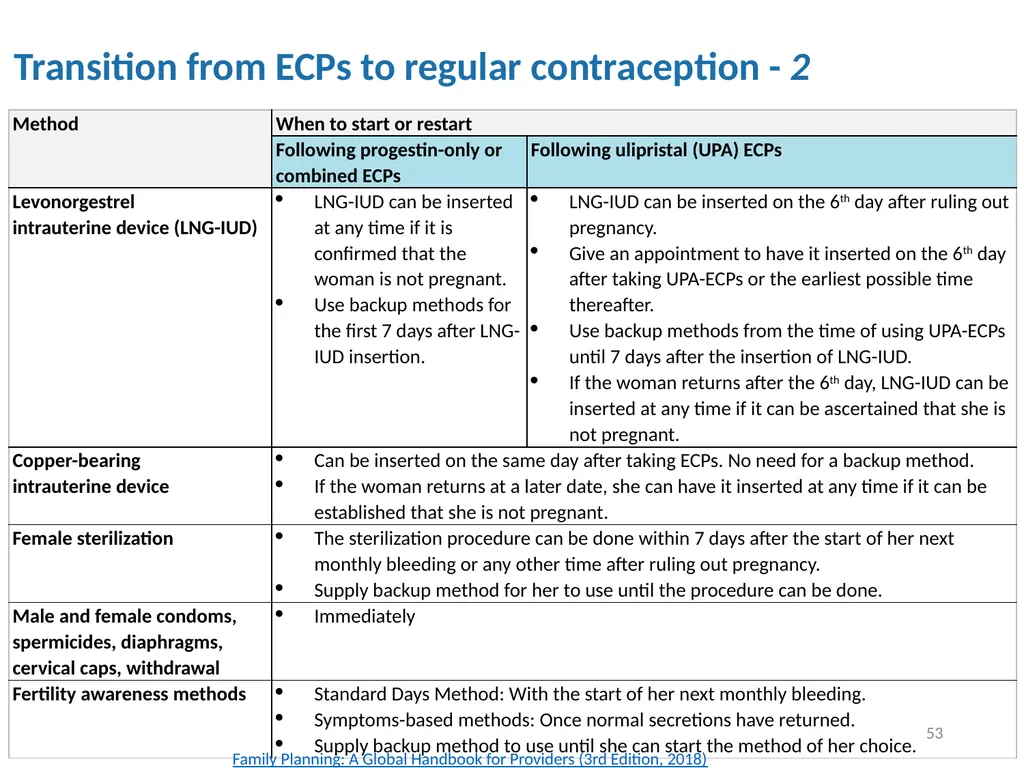
Transition from ECPs to regular contraception - 2 Family Planning: A Global Handbook for Providers (3rd Edition, 2018) 53<br>
54
ECPs follow up and referral for clients If the client reports no menses within 4 weeks of ECP use, she may be pregnant.
Invite client to tell her story, including the number of sex partners. If her story suggests STI exposure, refer for treatment. Discuss use of condoms if appropriate.
If at risk for STIs, discuss dual protection from pregnancy AND from STIs/HIV/AIDS
If story suggests coercion or violence, provide more help if possible.
Can start another method right away. If client chooses no regular method now, offer ECPs and male or female condoms with instructions for use.
Contraceptive use should never be made a condition for ECP use. Women who use ECPs as a main method of contraception or for any other reason should be counselled on the appropriateness, effectiveness and the correct usage of more regular contraceptive methods. Adapted from Training Resource Package for Family Planning: https://www.fptraining.org/ 54 Emergency contraception: Key facts. World Health Organization; 2021.<br>
Invite client to tell her story, including the number of sex partners. If her story suggests STI exposure, refer for treatment. Discuss use of condoms if appropriate.
If at risk for STIs, discuss dual protection from pregnancy AND from STIs/HIV/AIDS
If story suggests coercion or violence, provide more help if possible.
Can start another method right away. If client chooses no regular method now, offer ECPs and male or female condoms with instructions for use.
Contraceptive use should never be made a condition for ECP use. Women who use ECPs as a main method of contraception or for any other reason should be counselled on the appropriateness, effectiveness and the correct usage of more regular contraceptive methods. Adapted from Training Resource Package for Family Planning: https://www.fptraining.org/ 54 Emergency contraception: Key facts. World Health Organization; 2021.<br>
55
Copper-bearing intrauterine devices (IUDs) emergency contraception Particularly beneficial to women who want to use a highly effective, long-acting and reversible contraceptive method.
Timing:
As an emergency contraceptive method, copper-bearing IUD should be inserted within 5 days of unprotected intercourse.
If the time of ovulation can be estimated, the IUD can be inserted up to 5 days after ovulation. This may be more than 5 days after unprotected sex. Family Planning: A Global Handbook for Providers (3rd Edition, 2018) 55 Emergency contraception: Key facts. World Health Organization; 2021.<br>
Timing:
As an emergency contraceptive method, copper-bearing IUD should be inserted within 5 days of unprotected intercourse.
If the time of ovulation can be estimated, the IUD can be inserted up to 5 days after ovulation. This may be more than 5 days after unprotected sex. Family Planning: A Global Handbook for Providers (3rd Edition, 2018) 55 Emergency contraception: Key facts. World Health Organization; 2021.<br>
56
Copper-bearing intrauterine devices (IUDs) emergency contraception: Mechanism of action Copper-bearing intrauterine devices (IUDs)
Cause a chemical change in sperm and egg before they meet to prevent fertilization and thus, pregnancy. Emergency contraception DOES NOT interrupt an established pregnancy and DOES NOT harm a developing embryo. 56 Emergency contraception: Key facts. World Health Organization; 2021.<br>
Cause a chemical change in sperm and egg before they meet to prevent fertilization and thus, pregnancy. Emergency contraception DOES NOT interrupt an established pregnancy and DOES NOT harm a developing embryo. 56 Emergency contraception: Key facts. World Health Organization; 2021.<br>
57
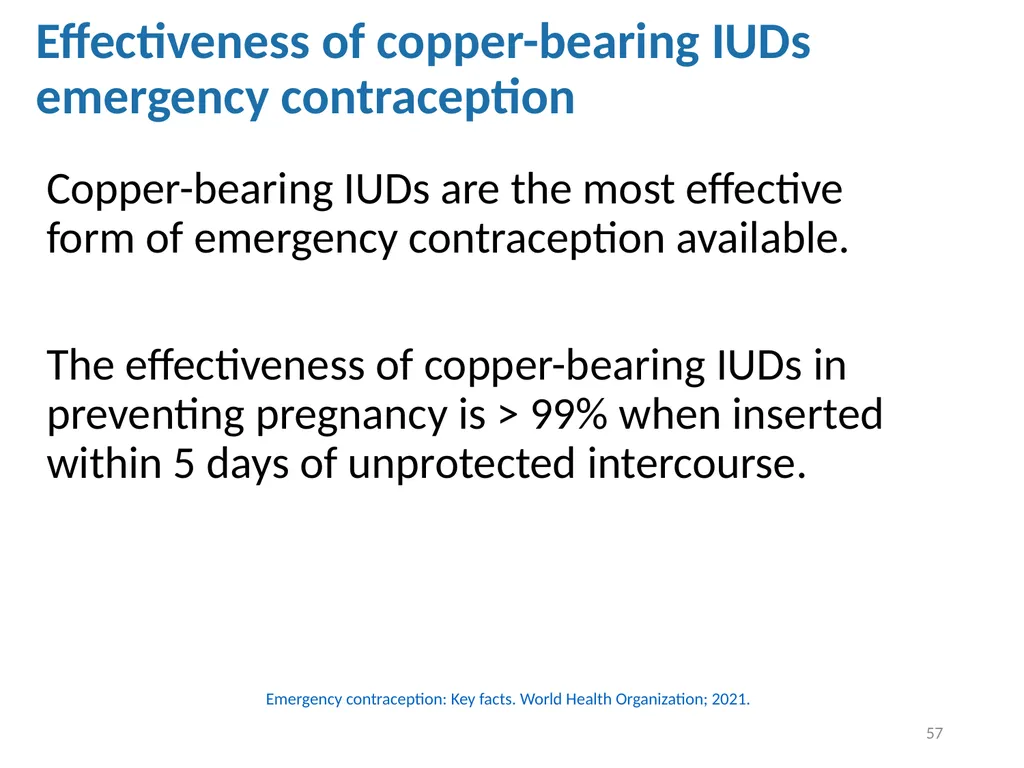
Effectiveness of copper-bearing IUDs emergency contraception Copper-bearing IUDs are the most effective form of emergency contraception available.
The effectiveness of copper-bearing IUDs in preventing pregnancy is > 99% when inserted within 5 days of unprotected intercourse. 57 Emergency contraception: Key facts. World Health Organization; 2021.<br>
The effectiveness of copper-bearing IUDs in preventing pregnancy is > 99% when inserted within 5 days of unprotected intercourse. 57 Emergency contraception: Key facts. World Health Organization; 2021.<br>
58
Safety of copper-bearing IUDs emergency contraception Copper-bearing IUD is a safe method of emergency contraception.
The occurrence of Pelvic Inflammatory Disease (PID) may be < 2 cases per 1000 users.
Risks of expulsion or perforation are low. 58 Emergency contraception: Key facts. World Health Organization; 2021.<br>
The occurrence of Pelvic Inflammatory Disease (PID) may be < 2 cases per 1000 users.
Risks of expulsion or perforation are low. 58 Emergency contraception: Key facts. World Health Organization; 2021.<br>
59
Emergency contraception: Medical eligibility criteria for copper-bearing IUDs - 1 Eligibility criteria for the general use of a copper IUD apply to its use as an emergency contraceptive method.
IUD insertion may further increase the risk of PID among women at increased risk of sexually transmitted infections (STIs), though this risk may be low. The risk of STIs varies depending on the behaviour of the individual and prevalence of STI in the local setting. In general, women at increased risk of STI can use IUD.
Situations when a copper IUD should not be used as emergency contraception are listed in the next slide. 59 Emergency contraception: Key facts. World Health Organization; 2021.<br>
IUD insertion may further increase the risk of PID among women at increased risk of sexually transmitted infections (STIs), though this risk may be low. The risk of STIs varies depending on the behaviour of the individual and prevalence of STI in the local setting. In general, women at increased risk of STI can use IUD.
Situations when a copper IUD should not be used as emergency contraception are listed in the next slide. 59 Emergency contraception: Key facts. World Health Organization; 2021.<br>
60
Copper IUDs should not be used as emergency contraception in the following situations:
In women with MEC category 3 or 4 conditions for copper IUD. This includes women with ongoing PID, puerperal sepsis, unexplained vaginal bleeding, cervical cancer, or severe thrombocytopenia.
In women who are victims of sexual assault due to a high risk of STIs like chlamydia and gonorrhea.
In women who are already pregnant.
In women with very high risks of STIs. Appropriate testing and treatment should be done first before inserting IUD in this category of women. Emergency contraception: Medical eligibility criteria for copper-bearing IUDs - 2 60 Emergency contraception: Key facts. World Health Organization; 2021.<br>
In women with MEC category 3 or 4 conditions for copper IUD. This includes women with ongoing PID, puerperal sepsis, unexplained vaginal bleeding, cervical cancer, or severe thrombocytopenia.
In women who are victims of sexual assault due to a high risk of STIs like chlamydia and gonorrhea.
In women who are already pregnant.
In women with very high risks of STIs. Appropriate testing and treatment should be done first before inserting IUD in this category of women. Emergency contraception: Medical eligibility criteria for copper-bearing IUDs - 2 60 Emergency contraception: Key facts. World Health Organization; 2021.<br>
61
Transition from copper-bearing IUDs emergency contraception to regular contraception There is no need for additional contraceptive protection if a copper IUD is used for emergency contraception.
Copper-bearing IUD can be continued as an ongoing method of contraception or the woman may change to another contraceptive method of her choice. 61 Emergency contraception: Key facts. World Health Organization; 2021.<br>
Copper-bearing IUD can be continued as an ongoing method of contraception or the woman may change to another contraceptive method of her choice. 61 Emergency contraception: Key facts. World Health Organization; 2021.<br>
62
Emergency contraception: Summary The only currently available contraceptive method that prevents pregnancy after sexual intercourse and before implantation.
Can be used by any woman or girl of reproductive age
No absolute medical contraindications- eligibility criteria for general use of a copper IUD apply when they are used for emergency contraception
The sooner they are used, the more effective they appear to be.
Do not affect an existing pregnancy if used when a woman is already pregnant.
Provide an opportunity for women to start using an ongoing family planning method. 62 Emergency contraception: Key facts. World Health Organization; 2021.<br>
Can be used by any woman or girl of reproductive age
No absolute medical contraindications- eligibility criteria for general use of a copper IUD apply when they are used for emergency contraception
The sooner they are used, the more effective they appear to be.
Do not affect an existing pregnancy if used when a woman is already pregnant.
Provide an opportunity for women to start using an ongoing family planning method. 62 Emergency contraception: Key facts. World Health Organization; 2021.<br>
63
Lactational Amenorrhea Method (LAM) 63<br>
64
What is LAM? LAM is:
A family planning method based on breastfeeding. Provides contraception for the mother and best feeding for the baby.
Can be effective for up to 6 months after childbirth, as long as monthly bleeding has not returned and the woman is fully or nearly fully breastfeeding.
A “gateway” to other modern methods of contraception.
Requires breastfeeding often, day and night. Almost all of the baby’s feedings should be breast milk. Adapted from Training Resource Package for Family Planning: https://www.fptraining.org/ 64<br>
A family planning method based on breastfeeding. Provides contraception for the mother and best feeding for the baby.
Can be effective for up to 6 months after childbirth, as long as monthly bleeding has not returned and the woman is fully or nearly fully breastfeeding.
A “gateway” to other modern methods of contraception.
Requires breastfeeding often, day and night. Almost all of the baby’s feedings should be breast milk. Adapted from Training Resource Package for Family Planning: https://www.fptraining.org/ 64<br>
65
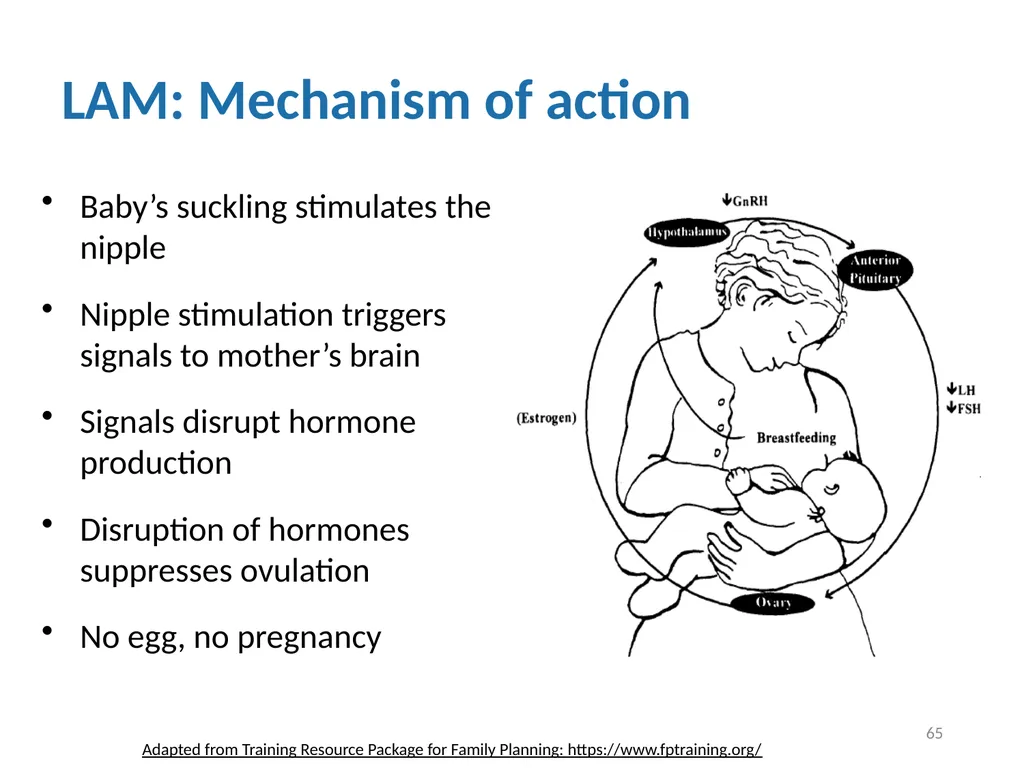
LAM: Mechanism of action Baby’s suckling stimulates the nipple
Nipple stimulation triggers signals to mother’s brain
Signals disrupt hormone production
Disruption of hormones suppresses ovulation
No egg, no pregnancy Adapted from Training Resource Package for Family Planning: https://www.fptraining.org/ 65<br>
Nipple stimulation triggers signals to mother’s brain
Signals disrupt hormone production
Disruption of hormones suppresses ovulation
No egg, no pregnancy Adapted from Training Resource Package for Family Planning: https://www.fptraining.org/ 65<br>
66
Adapted from Training Resource Package for Family Planning: https://www.fptraining.org/ 66<br>
67
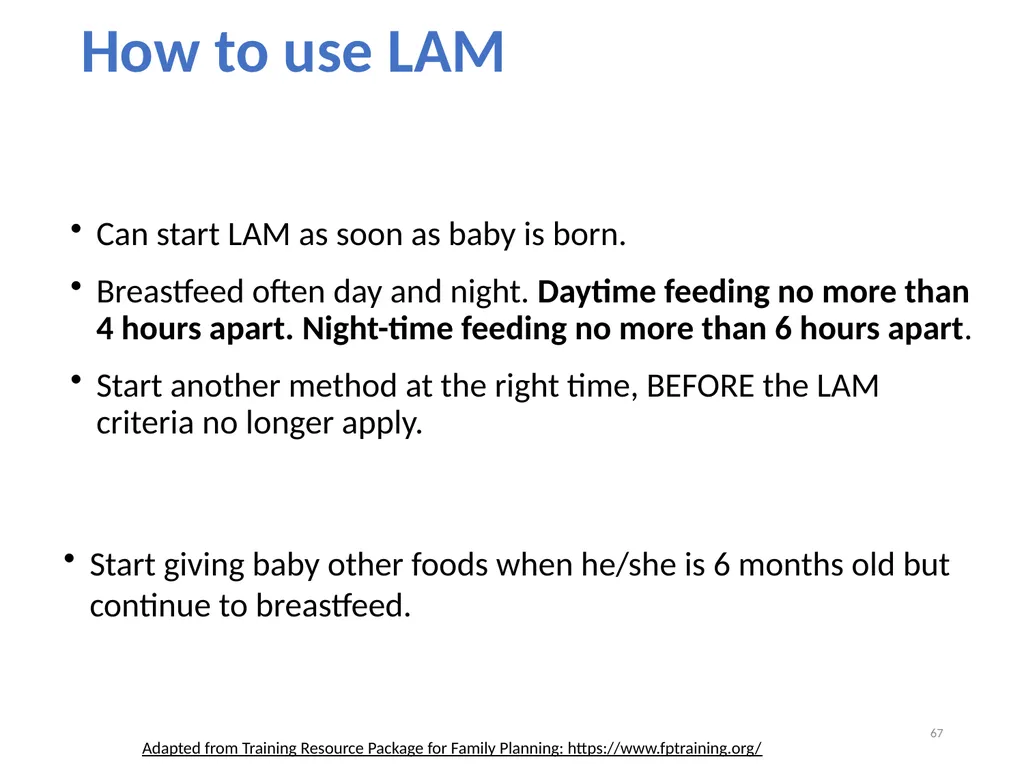
How to use LAM 67 Can start LAM as soon as baby is born.
Breastfeed often day and night. Daytime feeding no more than 4 hours apart. Night-time feeding no more than 6 hours apart.
Start another method at the right time, BEFORE the LAM criteria no longer apply. Start giving baby other foods when he/she is 6 months old but continue to breastfeed. Adapted from Training Resource Package for Family Planning: https://www.fptraining.org/<br>
Breastfeed often day and night. Daytime feeding no more than 4 hours apart. Night-time feeding no more than 6 hours apart.
Start another method at the right time, BEFORE the LAM criteria no longer apply. Start giving baby other foods when he/she is 6 months old but continue to breastfeed. Adapted from Training Resource Package for Family Planning: https://www.fptraining.org/<br>
68
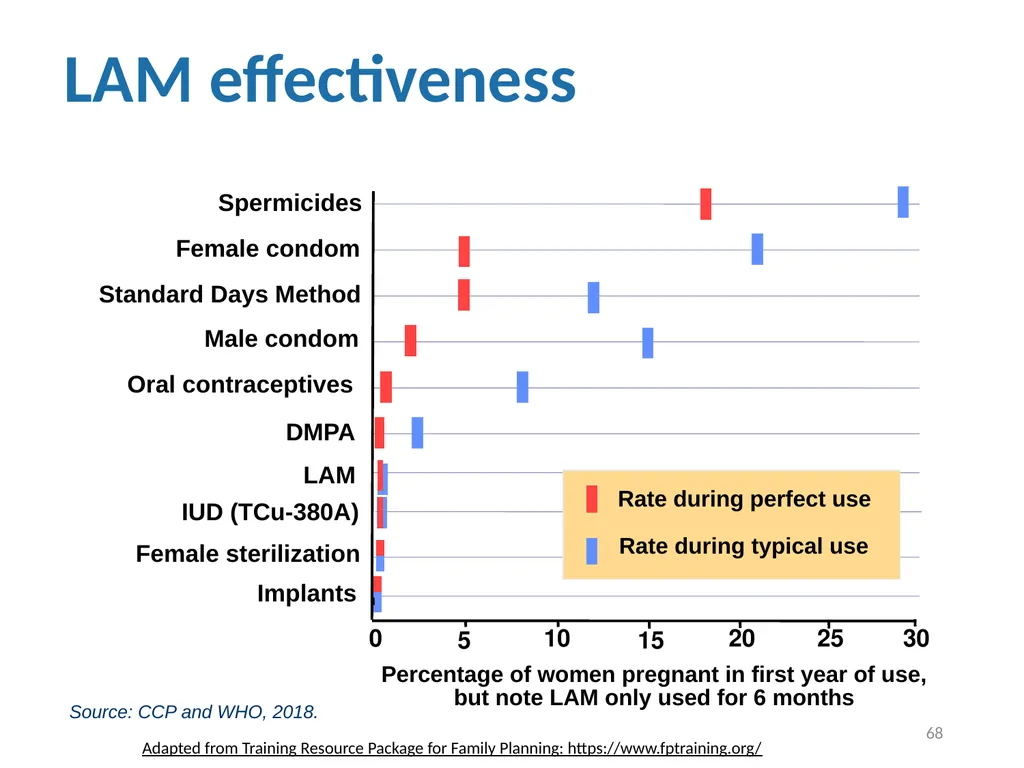
LAM effectiveness Source: CCP and WHO, 2018. Oral contraceptives Percentage of women pregnant in first year of use, but note LAM only used for 6 months Rate during typical use Rate during perfect use Female condom Female sterilization Implants DMPA Spermicides Standard Days Method Male condom LAM 0 10 15 20 25 5 30 IUD (TCu-380A) Adapted from Training Resource Package for Family Planning: https://www.fptraining.org/ 68<br>
69
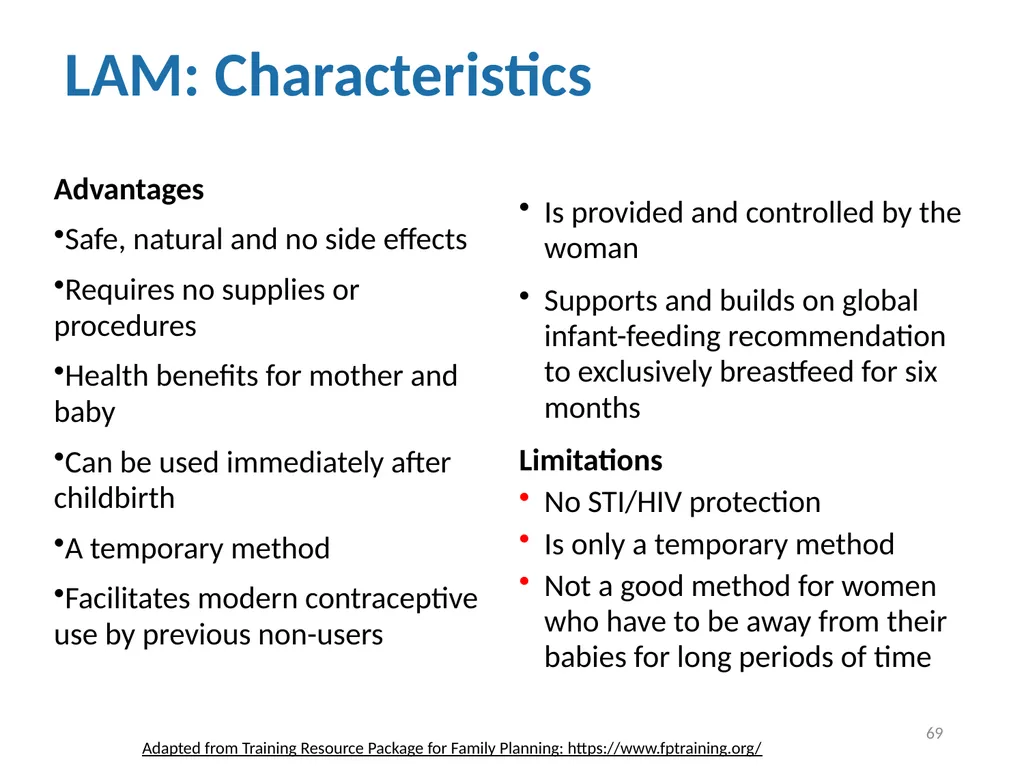
LAM: Characteristics Advantages
Safe, natural and no side effects
Requires no supplies or procedures
Health benefits for mother and baby
Can be used immediately after childbirth
A temporary method
Facilitates modern contraceptive use by previous non-users Is provided and controlled by the woman
Supports and builds on global infant-feeding recommendation to exclusively breastfeed for six months
Limitations
No STI/HIV protection
Is only a temporary method
Not a good method for women who have to be away from their babies for long periods of time Adapted from Training Resource Package for Family Planning: https://www.fptraining.org/ 69<br>
Safe, natural and no side effects
Requires no supplies or procedures
Health benefits for mother and baby
Can be used immediately after childbirth
A temporary method
Facilitates modern contraceptive use by previous non-users Is provided and controlled by the woman
Supports and builds on global infant-feeding recommendation to exclusively breastfeed for six months
Limitations
No STI/HIV protection
Is only a temporary method
Not a good method for women who have to be away from their babies for long periods of time Adapted from Training Resource Package for Family Planning: https://www.fptraining.org/ 69<br>
70
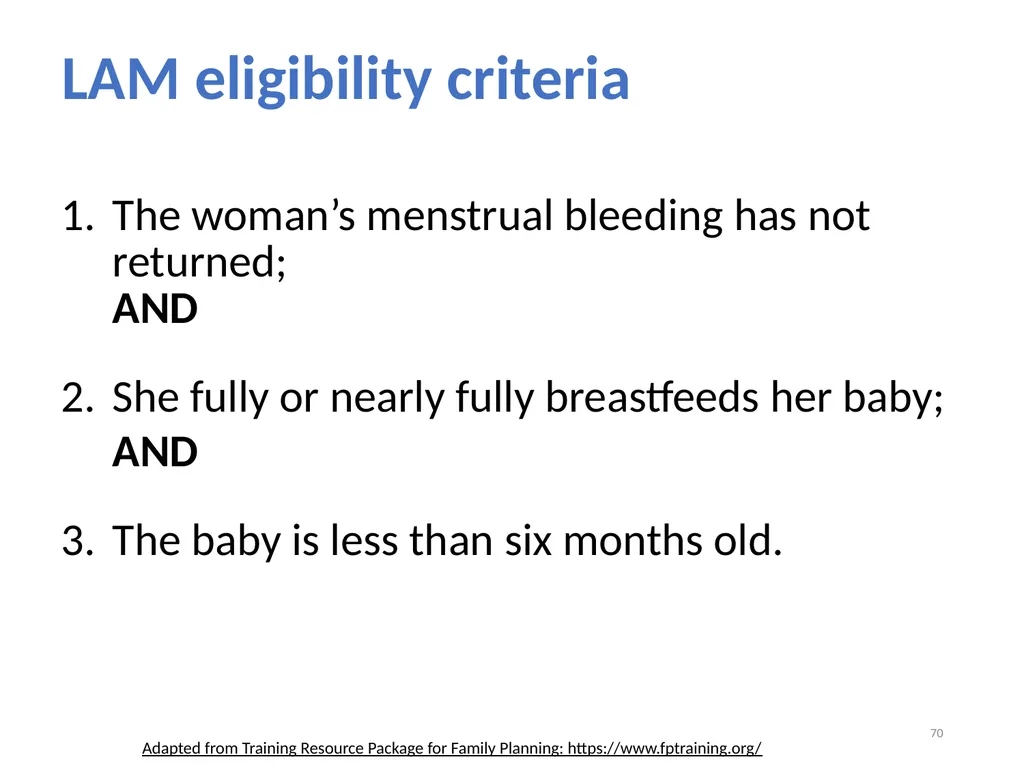
LAM eligibility criteria The woman’s menstrual bleeding has not returned;
AND
She fully or nearly fully breastfeeds her baby; AND
The baby is less than six months old. Adapted from Training Resource Package for Family Planning: https://www.fptraining.org/ 70<br>
She fully or nearly fully breastfeeds her baby; AND
The baby is less than six months old. Adapted from Training Resource Package for Family Planning: https://www.fptraining.org/ 70<br>
71
Importance of LAM Criteria -1 The woman’s menstrual bleeding has not returned (“amenorrhea”) Menstrual bleeding signals return of fertility—the woman can become pregnant again. Remember: bleeding before
two months postpartum is
NOT considered menstruation. Adapted from Training Resource Package for Family Planning: https://www.fptraining.org/<br>
72
Importance of LAM Criteria - 2, 3 2. She fully or nearly fully breastfeeds her baby If baby receives food or liquids other than breast milk:
The baby becomes full and will not want the breast as often
Infrequent suckling will cause the mother to produce less and her fertility to return
She can become pregnant again. 3. The baby is less than six months old. Six months is a biologically appropriate cut-off point to start supplemental foods. Breastfeeding should continue beyond LAM and until baby is two years old. Adapted from Training Resource Package for Family Planning: https://www.fptraining.org/<br>
The baby becomes full and will not want the breast as often
Infrequent suckling will cause the mother to produce less and her fertility to return
She can become pregnant again. 3. The baby is less than six months old. Six months is a biologically appropriate cut-off point to start supplemental foods. Breastfeeding should continue beyond LAM and until baby is two years old. Adapted from Training Resource Package for Family Planning: https://www.fptraining.org/<br>
73
Who Can Start LAM
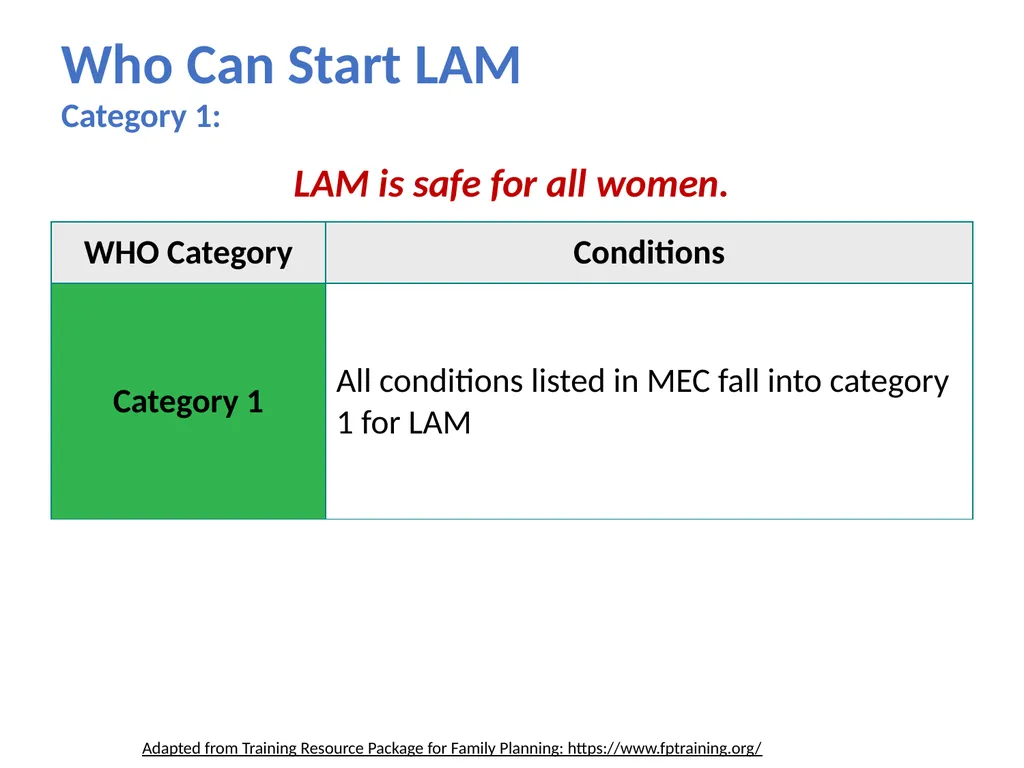
Category 1: LAM is safe for all women. Adapted from Training Resource Package for Family Planning: https://www.fptraining.org/<br>
Category 1: LAM is safe for all women. Adapted from Training Resource Package for Family Planning: https://www.fptraining.org/<br>
74
LAM: Return of fertility and risk of pregnancy In women not breastfeeding, ovulation will occur at 45 days postpartum on average; may occur as early as 21 days.
Breastfeeding women not practicing LAM are likely to ovulate before return of menses.
Between 5% and 10% of women conceive within the first year postpartum. Adapted from Training Resource Package for Family Planning: https://www.fptraining.org/ 74<br>
Breastfeeding women not practicing LAM are likely to ovulate before return of menses.
Between 5% and 10% of women conceive within the first year postpartum. Adapted from Training Resource Package for Family Planning: https://www.fptraining.org/ 74<br>
75
Transition to another method: An essential component of LAM LAM can be a bridge to other modern methods of contraception.
LAM provides the couple time to decide on another modern method to use after LAM.
When LAM counseling is initiated, the provider should discuss transition from LAM to another contraceptive method with the client:
Another method should be started as soon as any one of three LAM criteria is not met.
Transition method should be selected before this occurs. 75 Adapted from Training Resource Package for Family Planning: https://www.fptraining.org/<br>
LAM provides the couple time to decide on another modern method to use after LAM.
When LAM counseling is initiated, the provider should discuss transition from LAM to another contraceptive method with the client:
Another method should be started as soon as any one of three LAM criteria is not met.
Transition method should be selected before this occurs. 75 Adapted from Training Resource Package for Family Planning: https://www.fptraining.org/<br>
76
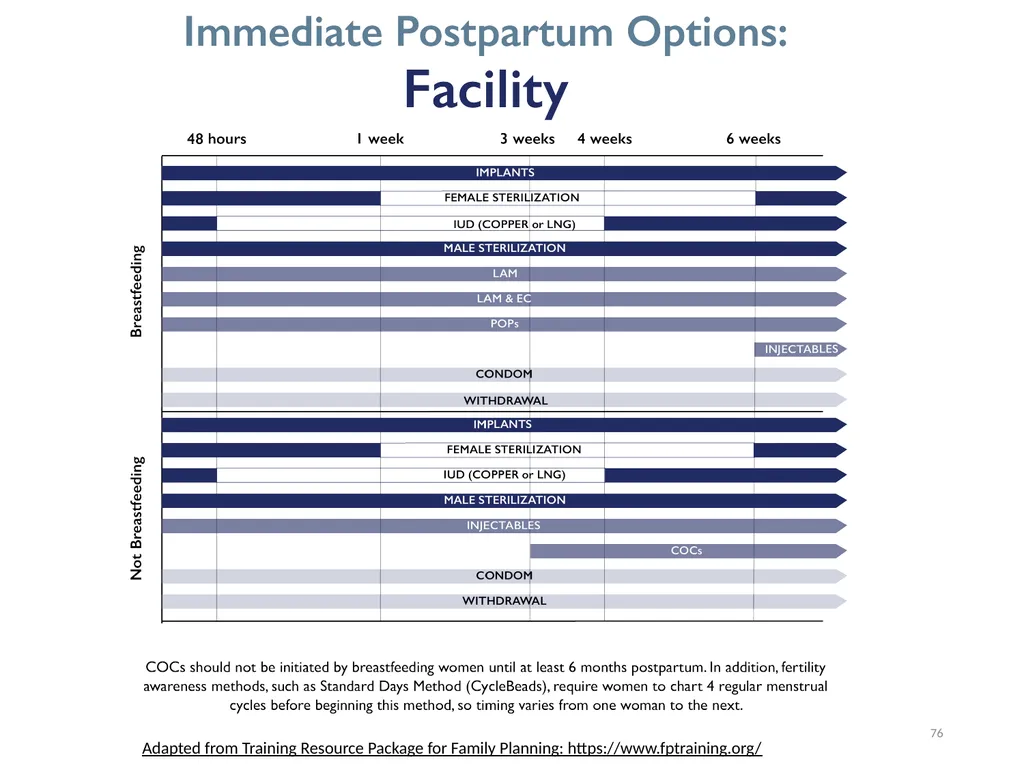
Adapted from Training Resource Package for Family Planning: https://www.fptraining.org/ 76<br>
77
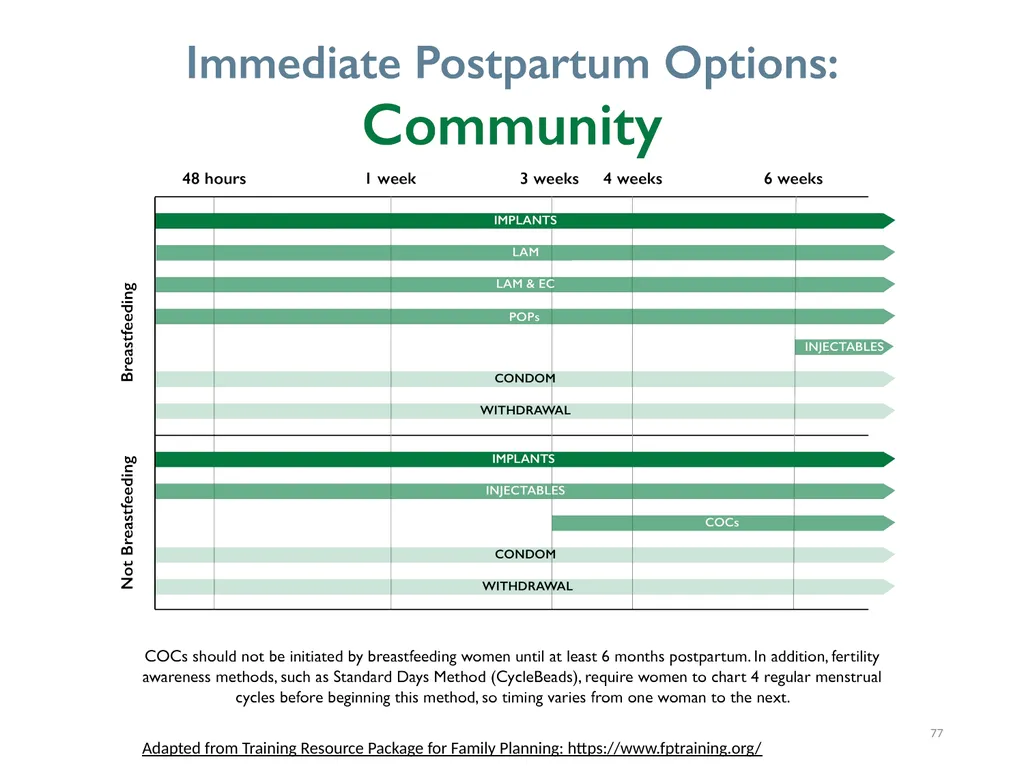
Adapted from Training Resource Package for Family Planning: https://www.fptraining.org/ 77<br>
78
Opportunities to provide LAM counseling Antenatal clinic
Child health (well-baby) clinic
Postpartum ward
Postpartum clinic
Family planning clinic
Labor ward (during early labor or following birth)
Community health visits Adapted from Training Resource Package for Family Planning: https://www.fptraining.org/ 78<br>
Child health (well-baby) clinic
Postpartum ward
Postpartum clinic
Family planning clinic
Labor ward (during early labor or following birth)
Community health visits Adapted from Training Resource Package for Family Planning: https://www.fptraining.org/ 78<br>
79
Health benefits breastfeeding Mother
Stimulates uterine contractions in early postpartum period
Promotes involution (return of uterus to pre-pregnancy state)
Leads to less anemia because of less iron depletion (due to amenorrhea)
Strengthens mother–baby bonding Baby
Adapts to needs of growing infant
Promotes optimal brain development
Provides passive immunity and protects from infections
Provides some protection against allergies Adapted from Training Resource Package for Family Planning: https://www.fptraining.org/ 79<br>
Stimulates uterine contractions in early postpartum period
Promotes involution (return of uterus to pre-pregnancy state)
Leads to less anemia because of less iron depletion (due to amenorrhea)
Strengthens mother–baby bonding Baby
Adapts to needs of growing infant
Promotes optimal brain development
Provides passive immunity and protects from infections
Provides some protection against allergies Adapted from Training Resource Package for Family Planning: https://www.fptraining.org/ 79<br>
80
Limitations of LAM Offers only temporary contraceptive protection (up to six months).
Is not usually appropriate if mother will be separated from baby for periods of time.
HIV-positive mothers may worry about HIV transmission through breastfeeding. Adapted from Training Resource Package for Family Planning: https://www.fptraining.org/ 80<br>
Is not usually appropriate if mother will be separated from baby for periods of time.
HIV-positive mothers may worry about HIV transmission through breastfeeding. Adapted from Training Resource Package for Family Planning: https://www.fptraining.org/ 80<br>
81
There are many misconceptions about LAM that need to be addressed, including:
LAM is not effective – FALSE It ss highly effective when a woman meets all 3 LAM criteria
Women who work away from home cannot use LAM - FALSE
Women with HIV cannot use LAM - FALSE
Concerns that if used for 6 months the woman will run out of milk - FALSE
Fat/thin women cannot use LAM - FALSE
Special foods are needed by women - FALSE
Babies need more than just breastmilk in their first six months - FALSE LAM: correcting rumors and misunderstandings 81 Adapted from Training Resource Package for Family Planning: https://www.fptraining.org/<br>
LAM is not effective – FALSE It ss highly effective when a woman meets all 3 LAM criteria
Women who work away from home cannot use LAM - FALSE
Women with HIV cannot use LAM - FALSE
Concerns that if used for 6 months the woman will run out of milk - FALSE
Fat/thin women cannot use LAM - FALSE
Special foods are needed by women - FALSE
Babies need more than just breastmilk in their first six months - FALSE LAM: correcting rumors and misunderstandings 81 Adapted from Training Resource Package for Family Planning: https://www.fptraining.org/<br>
82
LAM and HIV - 1 Every woman should be supported in her infant-feeding decision and in her contraceptive choice.
Breastfeeding will not make HIV worse.
Early and exclusive breastfeeding is the best way to promote the child’s survival, including for women with HIV.
Giving ART to an HIV-infected mother or an HIV-exposed infant significantly reduces the risk of HIV transmission through breastfeeding
Mothers living with HIV and their infants should receive appropriate ART and exclusively breastfeed their infants for the first 6 months of life, then introduce appropriate complementary foods and continue breastfeeding for at least 12 months and up to 24 months or more while being fully supported to keep taking ART. 82 Adapted from Training Resource Package for Family Planning: https://www.fptraining.org/<br>
Breastfeeding will not make HIV worse.
Early and exclusive breastfeeding is the best way to promote the child’s survival, including for women with HIV.
Giving ART to an HIV-infected mother or an HIV-exposed infant significantly reduces the risk of HIV transmission through breastfeeding
Mothers living with HIV and their infants should receive appropriate ART and exclusively breastfeed their infants for the first 6 months of life, then introduce appropriate complementary foods and continue breastfeeding for at least 12 months and up to 24 months or more while being fully supported to keep taking ART. 82 Adapted from Training Resource Package for Family Planning: https://www.fptraining.org/<br>
83
LAM and HIV - 2 A mother with HIV who chooses to breastfeed or use LAM should:
Receive care and treatment for herself to minimize the risk of transmission to the infant and keep herself healthy.
Use condoms consistently.
If she experiences cracked nipples or other breast problems, instruct her to feed from unaffected breast (and express and discard milk from affected breast).
Seek immediate care for baby with thrush or other lesions in mouth. Breastfeeding should then only stop once a nutritionally adequate and safe diet without breast milk can be provided.
When HIV-infected mothers decide to stop breastfeeding (at any time) they should do so gradually within one month. Adapted from Training Resource Package for Family Planning: https://www.fptraining.org/ 83<br>
Receive care and treatment for herself to minimize the risk of transmission to the infant and keep herself healthy.
Use condoms consistently.
If she experiences cracked nipples or other breast problems, instruct her to feed from unaffected breast (and express and discard milk from affected breast).
Seek immediate care for baby with thrush or other lesions in mouth. Breastfeeding should then only stop once a nutritionally adequate and safe diet without breast milk can be provided.
When HIV-infected mothers decide to stop breastfeeding (at any time) they should do so gradually within one month. Adapted from Training Resource Package for Family Planning: https://www.fptraining.org/ 83<br>
84
LAM: Summary Over 98% effective as long as all three criteria are met:
No menses
Breastfeeding only
Baby less than 6 months
Can be a bridge to other modern methods of family planning
Provides important health benefits to the mother and child
Natural and no side effects Adapted from Training Resource Package for Family Planning: https://www.fptraining.org/<br>
No menses
Breastfeeding only
Baby less than 6 months
Can be a bridge to other modern methods of family planning
Provides important health benefits to the mother and child
Natural and no side effects Adapted from Training Resource Package for Family Planning: https://www.fptraining.org/<br>
85
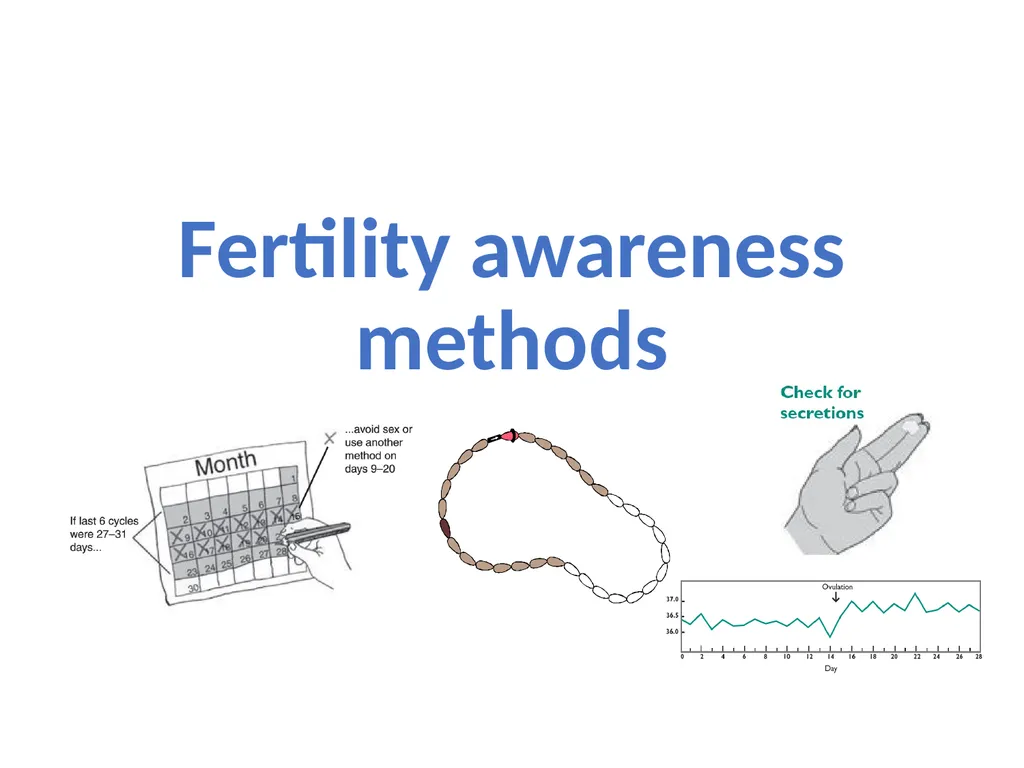
Fertility awareness
methods<br>
86
What are fertility awareness methods? “Fertility awareness” means that a woman knows how to tell when the fertile time of her menstrual cycle starts and ends. (The fertile time is when she can become pregnant.)
Sometimes called periodic abstinence or natural family planning.
A woman can use several ways, alone or in combination, to tell when her fertile time begins and ends. 86 Calendar-based methods
Standard Days Method Symptoms-based methods:
TwoDay Method
Ovulation method
Symptothermal method Family Planning: A Global Handbook for Providers (3rd Edition, 2018)<br>
Sometimes called periodic abstinence or natural family planning.
A woman can use several ways, alone or in combination, to tell when her fertile time begins and ends. 86 Calendar-based methods
Standard Days Method Symptoms-based methods:
TwoDay Method
Ovulation method
Symptothermal method Family Planning: A Global Handbook for Providers (3rd Edition, 2018)<br>
87
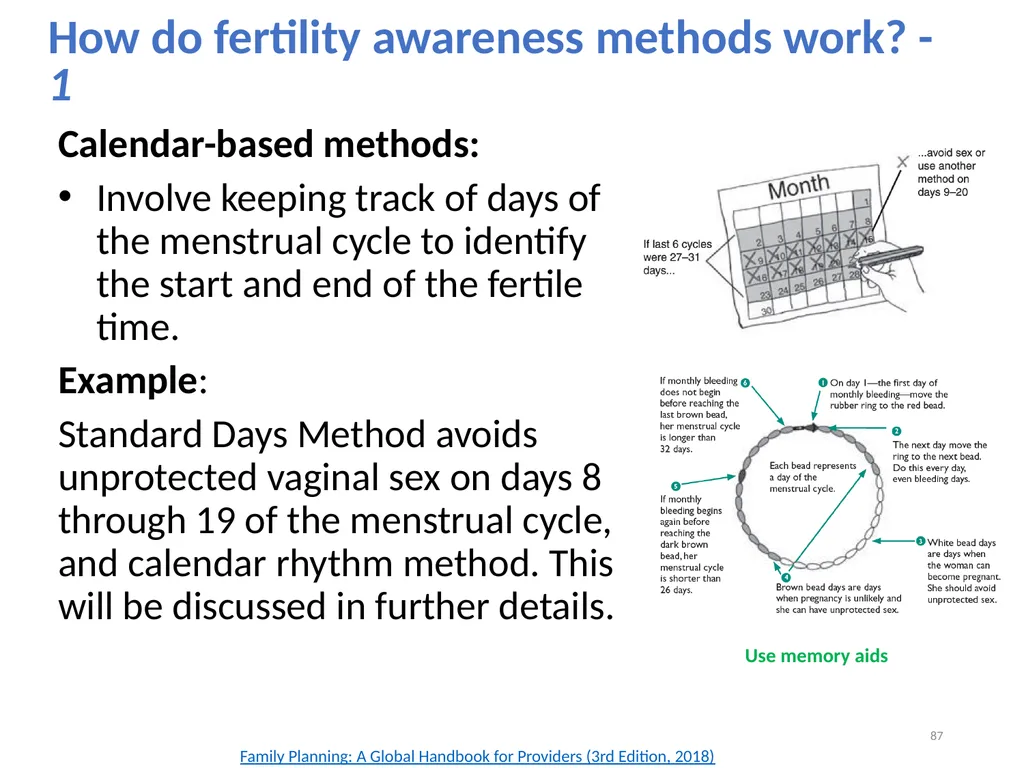
How do fertility awareness methods work? - 1 87 Calendar-based methods:
Involve keeping track of days of the menstrual cycle to identify the start and end of the fertile time.
Example:
Standard Days Method avoids unprotected vaginal sex on days 8 through 19 of the menstrual cycle, and calendar rhythm method. This will be discussed in further details. Use memory aids Family Planning: A Global Handbook for Providers (3rd Edition, 2018)<br>
Involve keeping track of days of the menstrual cycle to identify the start and end of the fertile time.
Example:
Standard Days Method avoids unprotected vaginal sex on days 8 through 19 of the menstrual cycle, and calendar rhythm method. This will be discussed in further details. Use memory aids Family Planning: A Global Handbook for Providers (3rd Edition, 2018)<br>
88
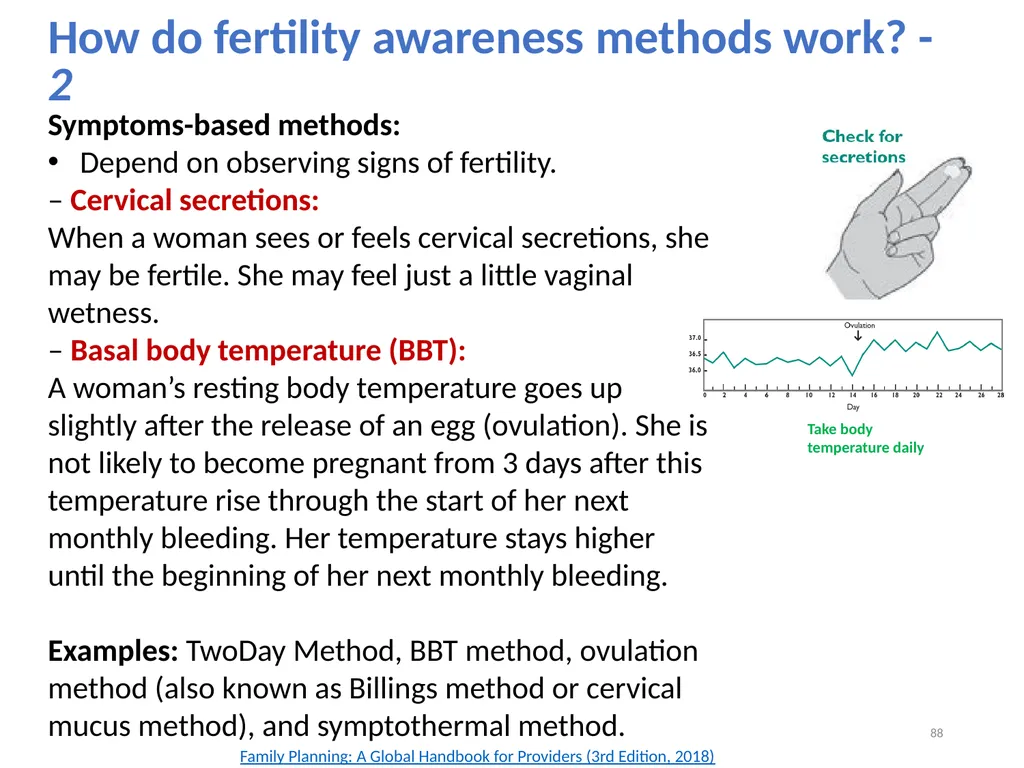
How do fertility awareness methods work? - 2 88 Symptoms-based methods:
Depend on observing signs of fertility.
– Cervical secretions:
When a woman sees or feels cervical secretions, she may be fertile. She may feel just a little vaginal wetness.
– Basal body temperature (BBT):
A woman’s resting body temperature goes up slightly after the release of an egg (ovulation). She is not likely to become pregnant from 3 days after this temperature rise through the start of her next monthly bleeding. Her temperature stays higher until the beginning of her next monthly bleeding.
Examples: TwoDay Method, BBT method, ovulation method (also known as Billings method or cervical mucus method), and symptothermal method. Take body
temperature daily Family Planning: A Global Handbook for Providers (3rd Edition, 2018)<br>
Depend on observing signs of fertility.
– Cervical secretions:
When a woman sees or feels cervical secretions, she may be fertile. She may feel just a little vaginal wetness.
– Basal body temperature (BBT):
A woman’s resting body temperature goes up slightly after the release of an egg (ovulation). She is not likely to become pregnant from 3 days after this temperature rise through the start of her next monthly bleeding. Her temperature stays higher until the beginning of her next monthly bleeding.
Examples: TwoDay Method, BBT method, ovulation method (also known as Billings method or cervical mucus method), and symptothermal method. Take body
temperature daily Family Planning: A Global Handbook for Providers (3rd Edition, 2018)<br>
89
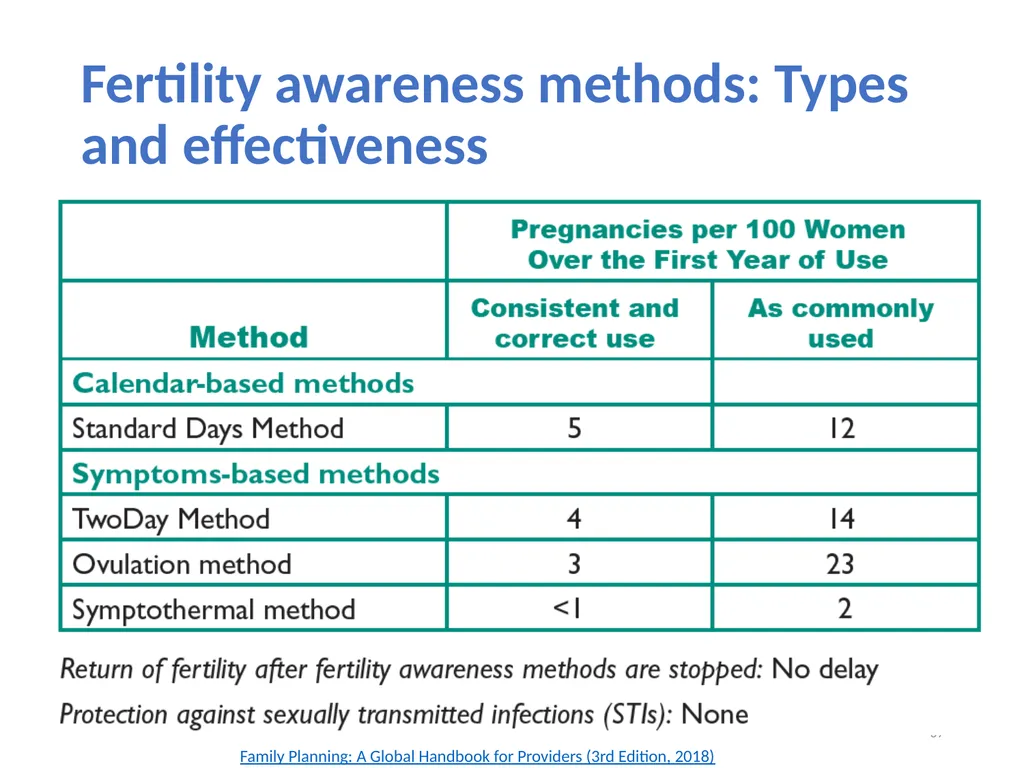
Fertility awareness methods: Types and effectiveness 89 Family Planning: A Global Handbook for Providers (3rd Edition, 2018)<br>
90
Advantages of fertility awareness methods No side effects
No known health risks
Do not require procedures and usually do not require supplies
Help protect against risks of pregnancy
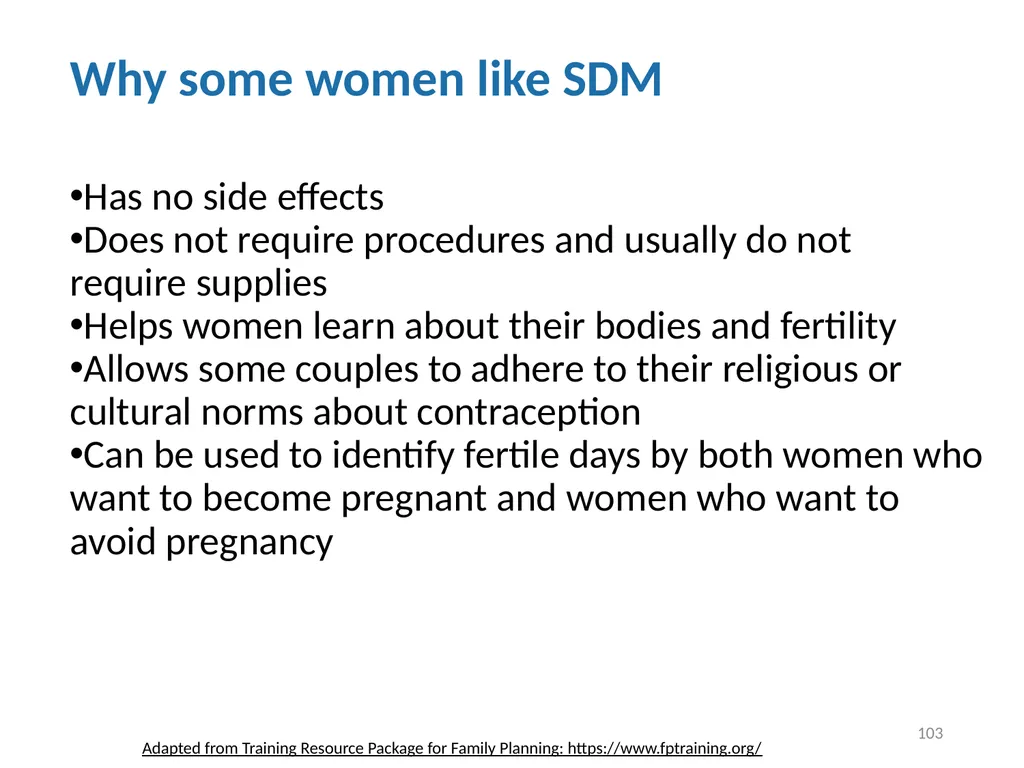
Help women learn about their bodies and fertility
Allow some couples to adhere to their religious or cultural norms about contraception
Can be used to identify fertile days by both women who want to become pregnant and women who want to avoid pregnancy
Can be safely used by women who are living with HIV or are on antiretroviral (ARV) therapy 90 Family Planning: A Global Handbook for Providers (3rd Edition, 2018)<br>
No known health risks
Do not require procedures and usually do not require supplies
Help protect against risks of pregnancy
Help women learn about their bodies and fertility
Allow some couples to adhere to their religious or cultural norms about contraception
Can be used to identify fertile days by both women who want to become pregnant and women who want to avoid pregnancy
Can be safely used by women who are living with HIV or are on antiretroviral (ARV) therapy 90 Family Planning: A Global Handbook for Providers (3rd Edition, 2018)<br>
91
Fertility awareness methods: Correcting misunderstandings Fertility awareness methods:
Can be effective if used consistently and correctly.
Do not require literacy or advanced education.
Do not harm men who abstain from sex.
Do not work when a couple is mistaken about when the fertile time occurs, such as thinking it occurs during monthly bleeding. 91 Family Planning: A Global Handbook for Providers (3rd Edition, 2018)<br>
Can be effective if used consistently and correctly.
Do not require literacy or advanced education.
Do not harm men who abstain from sex.
Do not work when a couple is mistaken about when the fertile time occurs, such as thinking it occurs during monthly bleeding. 91 Family Planning: A Global Handbook for Providers (3rd Edition, 2018)<br>
92
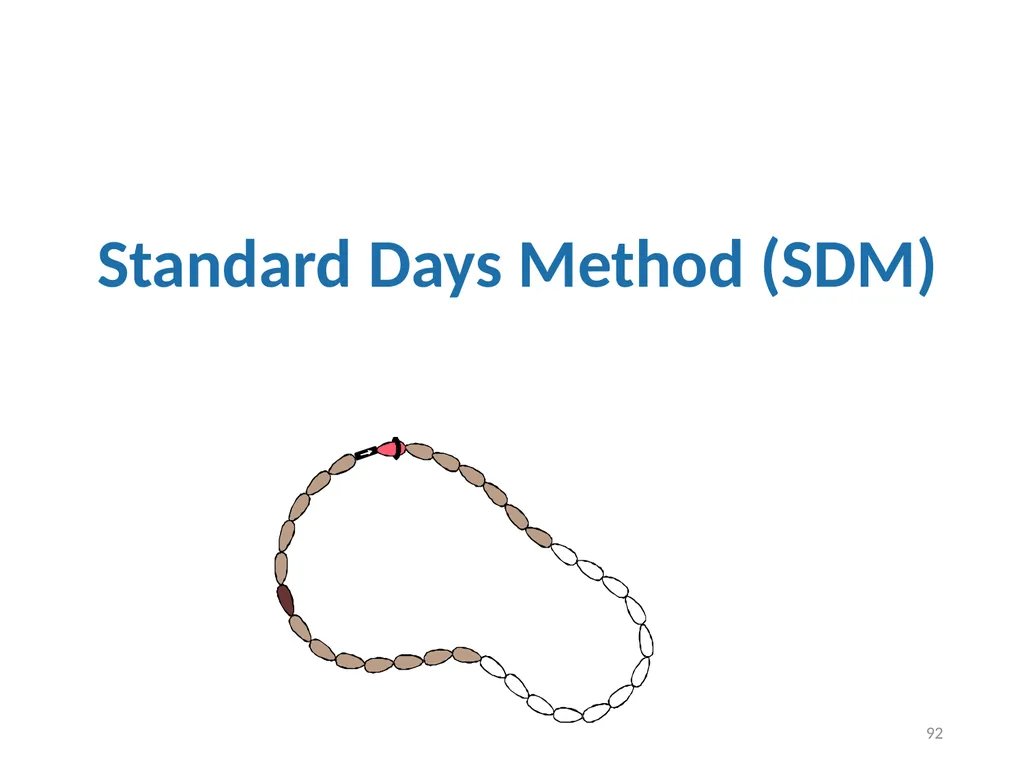
Standard Days Method (SDM) 92<br>
93
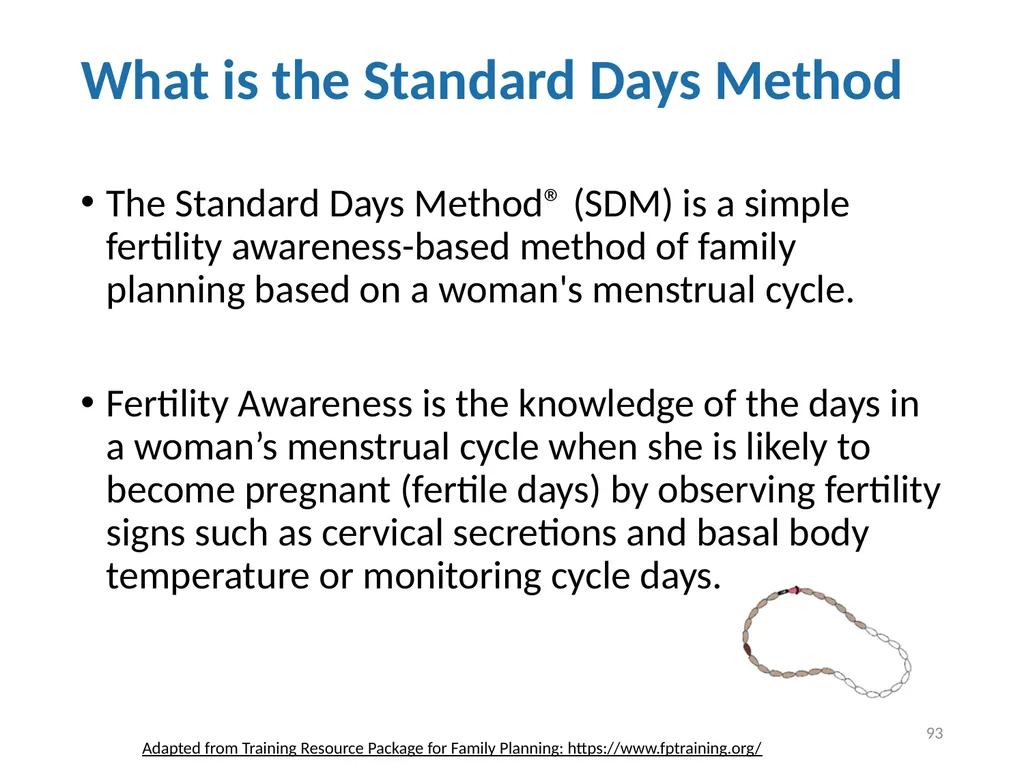
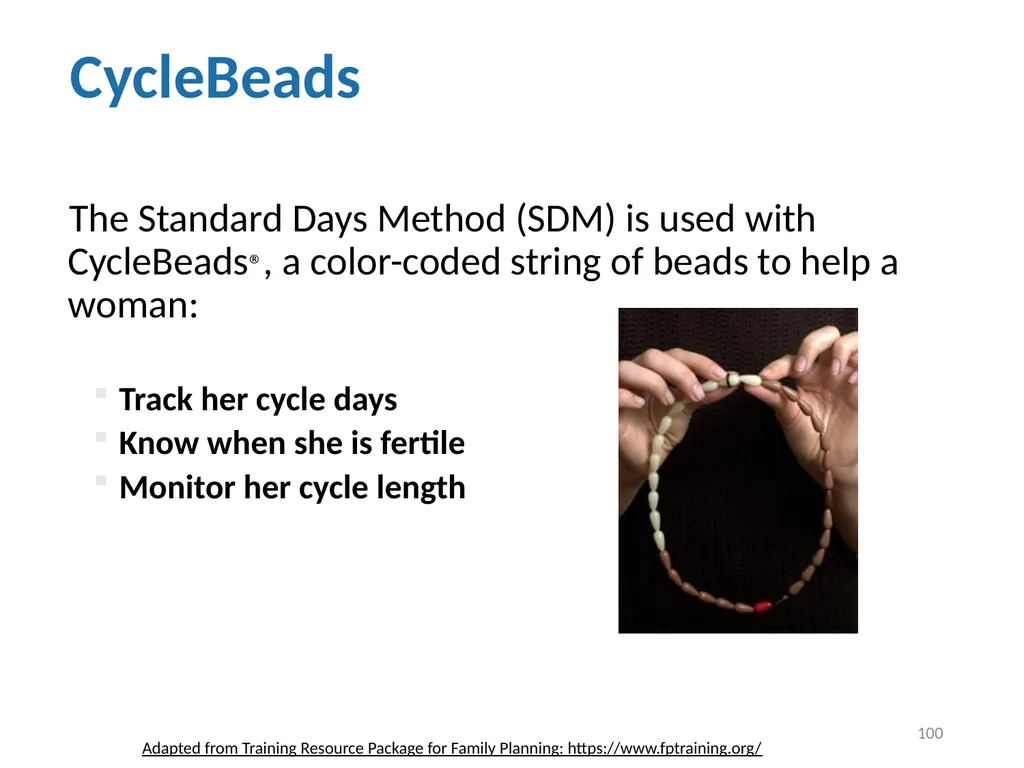
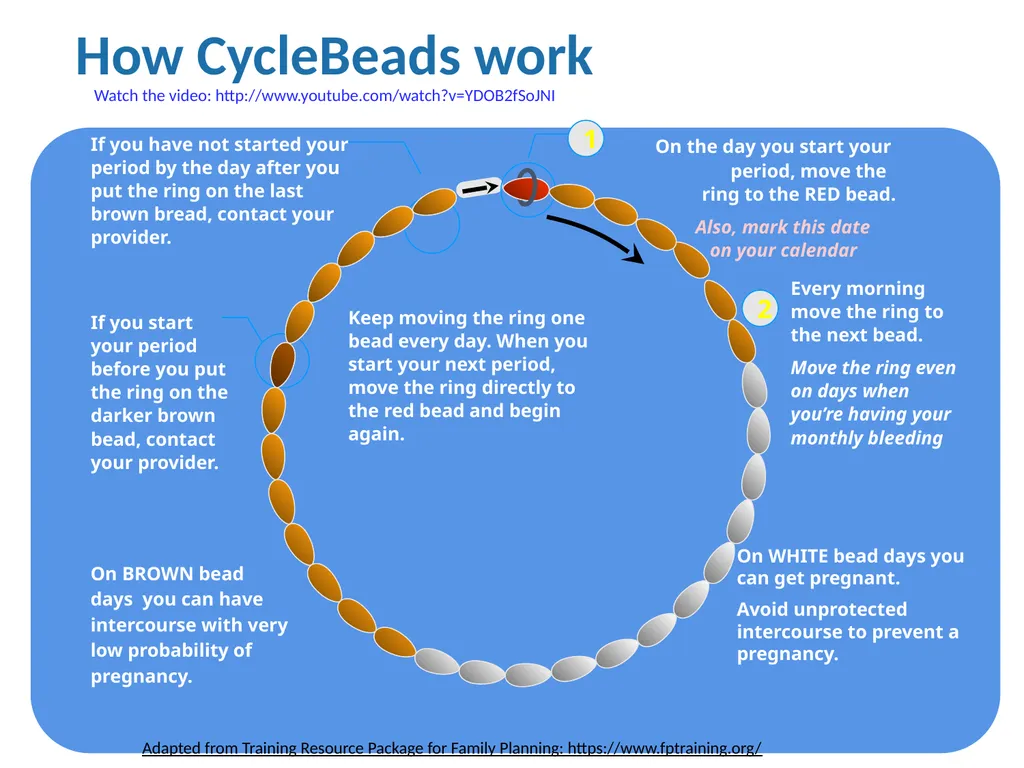
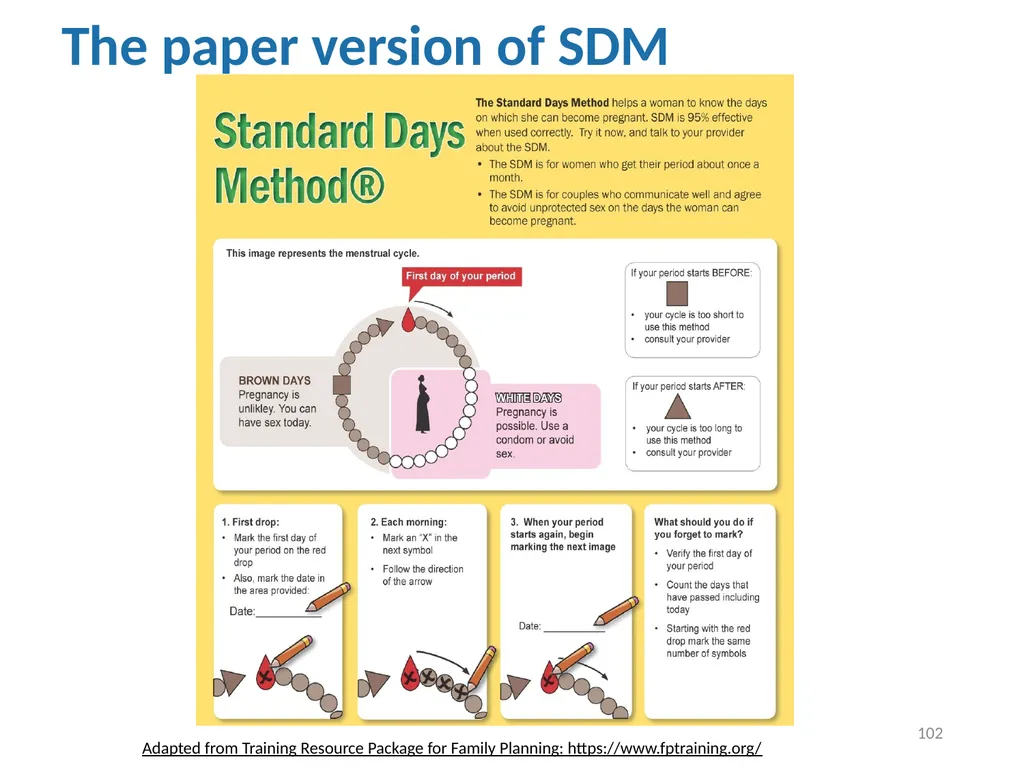
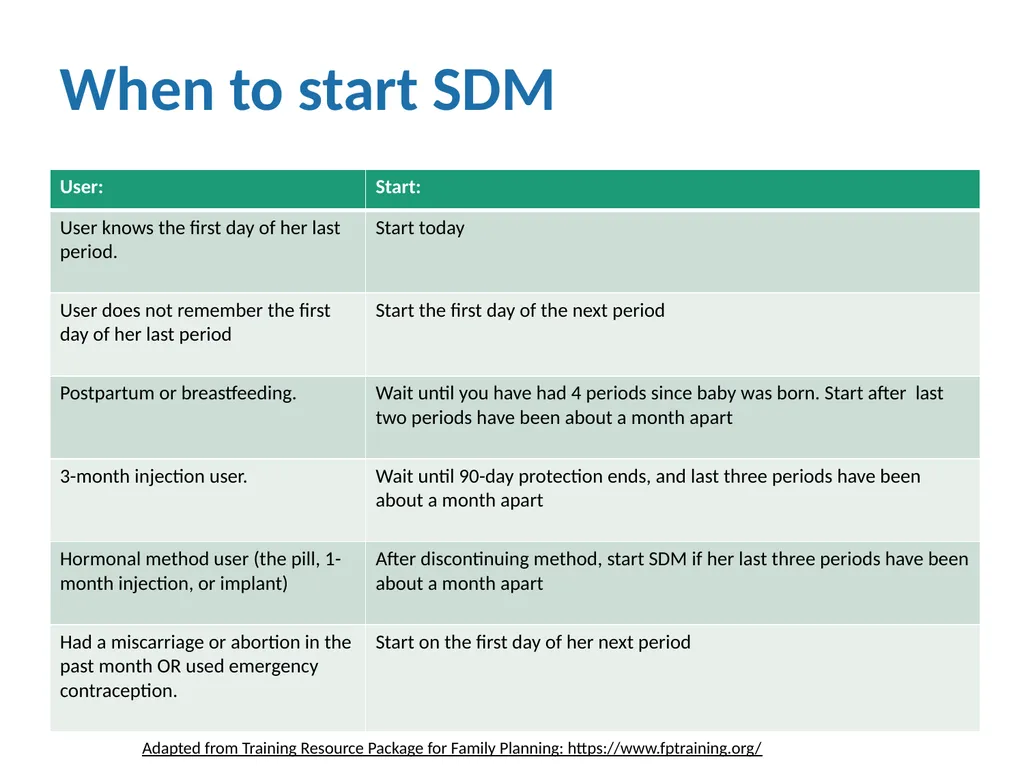
What is the Standard Days Method The Standard Days Method® (SDM) is a simple fertility awareness-based method of family planning based on a woman's menstrual cycle.
Fertility Awareness is the knowledge of the days in a woman’s menstrual cycle when she is likely to become pregnant (fertile days) by observing fertility signs such as cervical secretions and basal body temperature or monitoring cycle days. Adapted from Training Resource Package for Family Planning: https://www.fptraining.org/ 93<br>
Fertility Awareness is the knowledge of the days in a woman’s menstrual cycle when she is likely to become pregnant (fertile days) by observing fertility signs such as cervical secretions and basal body temperature or monitoring cycle days. Adapted from Training Resource Package for Family Planning: https://www.fptraining.org/ 93<br>
94
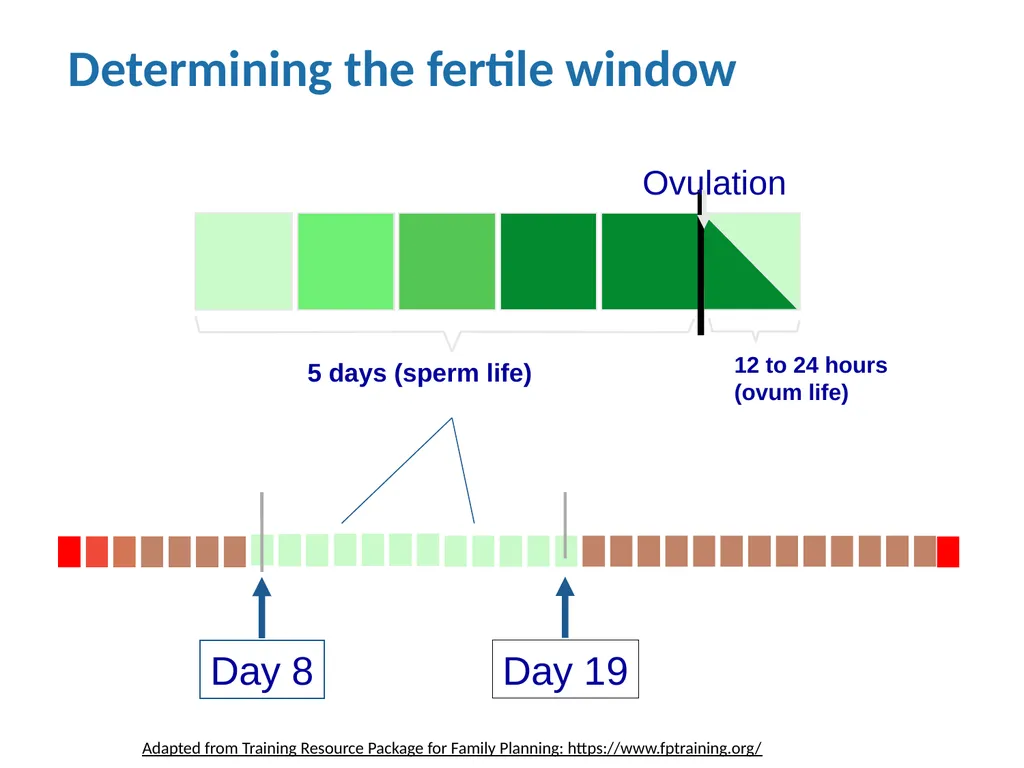
Standard Days Method characteristics Identifies days 8 to19 of the menstrual cycle as fertile days
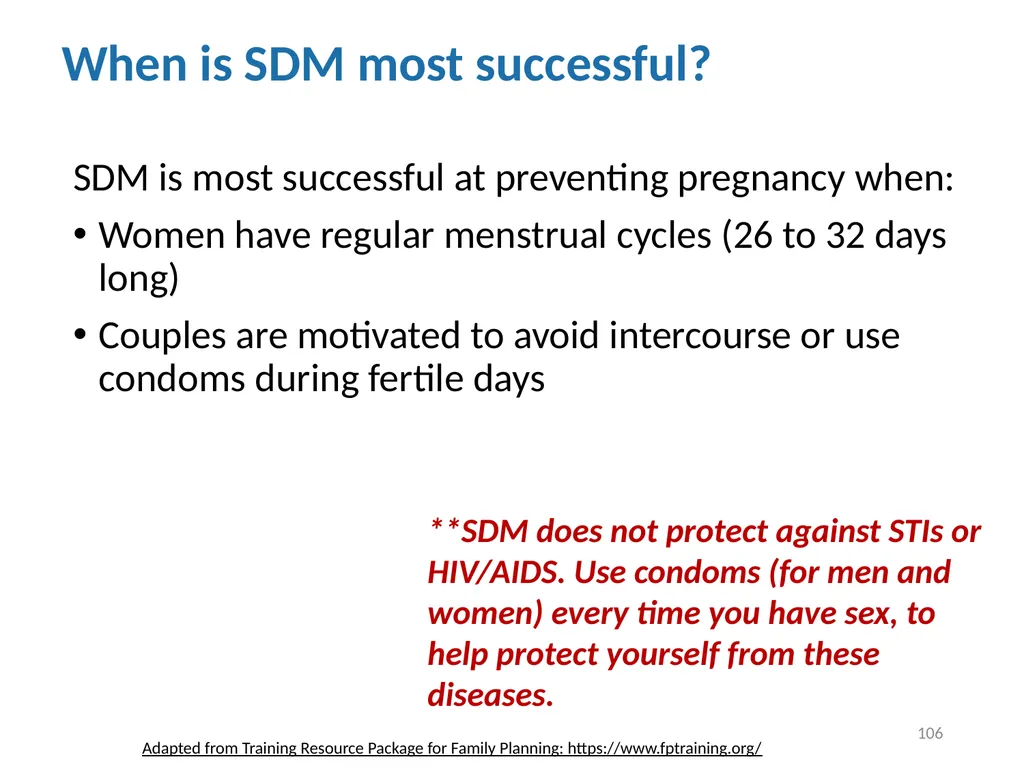
Is appropriate for women with menstrual cycles between 26 and 32 days long (women who have their periods about once a month fit within this range. If a woman has a cycle outside this range more than once in a given year she should use a different family planning method.)
Helps a couple avoid unplanned pregnancy by knowing which days they should not have unprotected sex
Helps a couple plan a pregnancy by knowing which days they should have sex
Does not protect against STIs/HIV Adapted from Training Resource Package for Family Planning: https://www.fptraining.org/ 94<br>
Is appropriate for women with menstrual cycles between 26 and 32 days long (women who have their periods about once a month fit within this range. If a woman has a cycle outside this range more than once in a given year she should use a different family planning method.)
Helps a couple avoid unplanned pregnancy by knowing which days they should not have unprotected sex
Helps a couple plan a pregnancy by knowing which days they should have sex
Does not protect against STIs/HIV Adapted from Training Resource Package for Family Planning: https://www.fptraining.org/ 94<br>
95
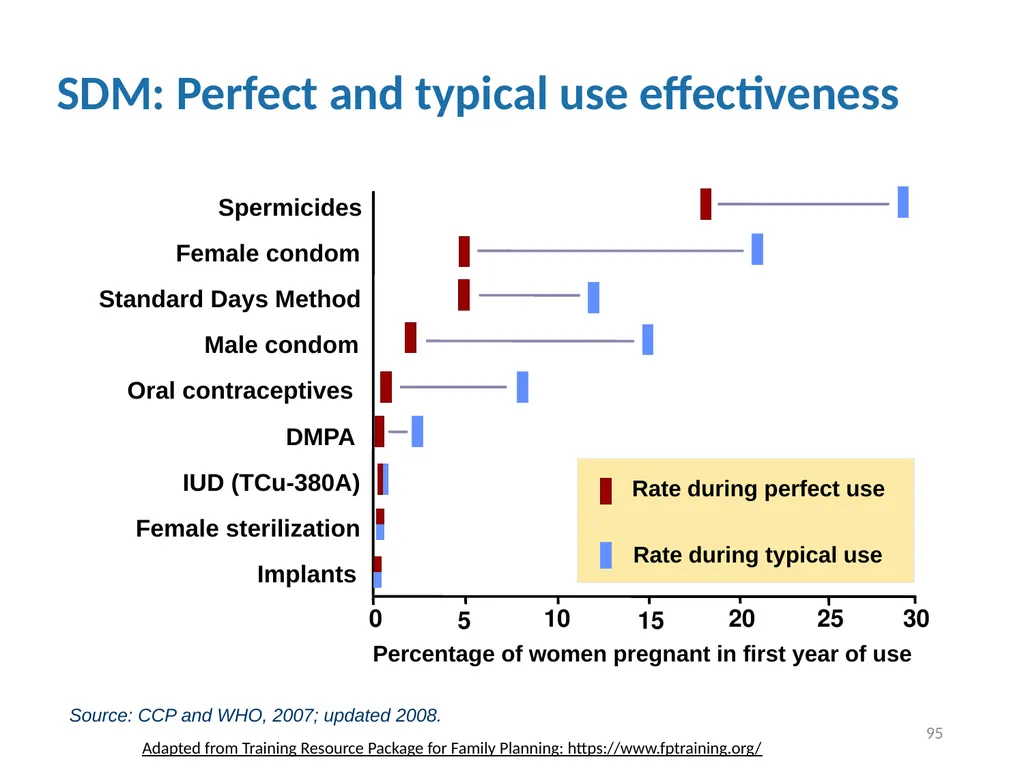
SDM: Perfect and typical use effectiveness Source: CCP and WHO, 2007; updated 2008. Oral contraceptives Percentage of women pregnant in first year of use Rate during typical use Rate during perfect use Female condom Female sterilization Implants DMPA Spermicides Standard Days Method Male condom IUD (TCu-380A) 0 10 15 20 25 5 30 Adapted from Training Resource Package for Family Planning: https://www.fptraining.org/ 95<br>
96
Efficacy study of SDM Multi-site prospective study
Services provided in existing programs
Clients were followed monthly for 13 cycles
Couples used the method correctly in 97% of cycles
478 women in the study, 43 got pregnant
With correct use, the failure rate is 4.8
With typical use the failure rate is 12.0 Adapted from Training Resource Package for Family Planning: https://www.fptraining.org/ 96<br>
Services provided in existing programs
Clients were followed monthly for 13 cycles
Couples used the method correctly in 97% of cycles
478 women in the study, 43 got pregnant
With correct use, the failure rate is 4.8
With typical use the failure rate is 12.0 Adapted from Training Resource Package for Family Planning: https://www.fptraining.org/ 96<br>
97
How does SDM prevent pregnancy? Women are fertile between day 8 and day 19 of their menstrual cycle.
SDM helps couples identify days 8 to19 of the cycle as fertile days by using CycleBeads® or a paper-based version of CycleBeads® .
Couples avoid unprotected sex, either by abstaining from sex or using a condom. Adapted from Training Resource Package for Family Planning: https://www.fptraining.org/ 97<br>
SDM helps couples identify days 8 to19 of the cycle as fertile days by using CycleBeads® or a paper-based version of CycleBeads® .
Couples avoid unprotected sex, either by abstaining from sex or using a condom. Adapted from Training Resource Package for Family Planning: https://www.fptraining.org/ 97<br>
98
Standard Days Method is based on: Menstrual Cycle mid-point ± 3 days Viable sperm – up to 5 days
Viable egg – up to 24 hours The probability of pregnancy relative to ovulation. Timing of ovulation. Adapted from Training Resource Package for Family Planning: https://www.fptraining.org/<br>
Viable egg – up to 24 hours The probability of pregnancy relative to ovulation. Timing of ovulation. Adapted from Training Resource Package for Family Planning: https://www.fptraining.org/<br>
99
Determining the fertile window Ovulation Adapted from Training Resource Package for Family Planning: https://www.fptraining.org/<br>
100
CycleBeads The Standard Days Method (SDM) is used with CycleBeads®, a color-coded string of beads to help a woman:
Track her cycle days
Know when she is fertile
Monitor her cycle length Adapted from Training Resource Package for Family Planning: https://www.fptraining.org/ 100<br>
Track her cycle days
Know when she is fertile
Monitor her cycle length Adapted from Training Resource Package for Family Planning: https://www.fptraining.org/ 100<br>
101
On WHITE bead days you can get pregnant.
Avoid unprotected intercourse to prevent a pregnancy. On the day you start your period, move the ring to the RED bead. Every morning move the ring to the next bead.
Move the ring even on days when you’re having your monthly bleeding Also, mark this date on your calendar Keep moving the ring one bead every day. When you start your next period, move the ring directly to the red bead and begin again. On BROWN bead days you can have intercourse with very low probability of pregnancy. If you have not started your period by the day after you put the ring on the last brown bread, contact your provider. If you start your period before you put the ring on the darker brown bead, contact your provider. 1 2 Watch the video: http://www.youtube.com/watch?v=YDOB2fSoJNI How CycleBeads work Adapted from Training Resource Package for Family Planning: https://www.fptraining.org/ 101<br>
Avoid unprotected intercourse to prevent a pregnancy. On the day you start your period, move the ring to the RED bead. Every morning move the ring to the next bead.
Move the ring even on days when you’re having your monthly bleeding Also, mark this date on your calendar Keep moving the ring one bead every day. When you start your next period, move the ring directly to the red bead and begin again. On BROWN bead days you can have intercourse with very low probability of pregnancy. If you have not started your period by the day after you put the ring on the last brown bread, contact your provider. If you start your period before you put the ring on the darker brown bead, contact your provider. 1 2 Watch the video: http://www.youtube.com/watch?v=YDOB2fSoJNI How CycleBeads work Adapted from Training Resource Package for Family Planning: https://www.fptraining.org/ 101<br>
102
The paper version of SDM Adapted from Training Resource Package for Family Planning: https://www.fptraining.org/ 102<br>
103
Why some women like SDM Has no side effects
Does not require procedures and usually do not require supplies
Helps women learn about their bodies and fertility
Allows some couples to adhere to their religious or cultural norms about contraception
Can be used to identify fertile days by both women who want to become pregnant and women who want to avoid pregnancy 103 Adapted from Training Resource Package for Family Planning: https://www.fptraining.org/<br>
Does not require procedures and usually do not require supplies
Helps women learn about their bodies and fertility
Allows some couples to adhere to their religious or cultural norms about contraception
Can be used to identify fertile days by both women who want to become pregnant and women who want to avoid pregnancy 103 Adapted from Training Resource Package for Family Planning: https://www.fptraining.org/<br>
104
Conditions relating to Fertility Awareness Methods *Delay until drug’s effect has been determined, then use caution Adapted from Training Resource Package for Family Planning: https://www.fptraining.org/ 104<br>
105
Who should delay or use caution in beginning SDM Circumstances that can affect cycle length and regularity are recent pregnancy or recent use of a hormonal method of contraception Adapted from Training Resource Package for Family Planning: https://www.fptraining.org/<br>
106
When is SDM most successful? SDM is most successful at preventing pregnancy when:
Women have regular menstrual cycles (26 to 32 days long)
Couples are motivated to avoid intercourse or use condoms during fertile days **SDM does not protect against STIs or HIV/AIDS. Use condoms (for men and women) every time you have sex, to help protect yourself from these diseases. 106 Adapted from Training Resource Package for Family Planning: https://www.fptraining.org/<br>
Women have regular menstrual cycles (26 to 32 days long)
Couples are motivated to avoid intercourse or use condoms during fertile days **SDM does not protect against STIs or HIV/AIDS. Use condoms (for men and women) every time you have sex, to help protect yourself from these diseases. 106 Adapted from Training Resource Package for Family Planning: https://www.fptraining.org/<br>
107
When to start SDM Adapted from Training Resource Package for Family Planning: https://www.fptraining.org/<br>
108
Withdrawal<br>
109
What is withdrawal? Just before ejaculation, the man withdraws his penis from his partner’s vagina and ejaculates outside the vagina, keeping his semen away from her external genitalia.
Also known as coitus interruptus and “pulling out.”
Works by keeping sperm out of the woman’s body.
No side effects, health benefits and health risks.
Can be used at any time and by all men.
May be especially appropriate for couples who:
– have no other method available at the time
– are waiting to start another method
– have sex infrequently
– have objections to using other methods 109 Family Planning: A Global Handbook for Providers (3rd Edition, 2018)<br>
Also known as coitus interruptus and “pulling out.”
Works by keeping sperm out of the woman’s body.
No side effects, health benefits and health risks.
Can be used at any time and by all men.
May be especially appropriate for couples who:
– have no other method available at the time
– are waiting to start another method
– have sex infrequently
– have objections to using other methods 109 Family Planning: A Global Handbook for Providers (3rd Edition, 2018)<br>
110
Effectiveness of withdrawal Depends on the user.
One of the least effective methods, as commonly used.
As commonly used, about 20 pregnancies per 100 women whose partners use withdrawal over the first year. This means that 80 of every 100 women whose partners use withdrawal will not become pregnant.
When used correctly with every act of sex, about 4 pregnancies per 100 women whose partners use withdrawal over the first year.
No delay in return of fertility.
No protection against sexually transmitted infections. 110 Effectiveness depends on the willingness and ability of the couple to use withdrawal with every act of intercourse. Family Planning: A Global Handbook for Providers (3rd Edition, 2018)<br>
One of the least effective methods, as commonly used.
As commonly used, about 20 pregnancies per 100 women whose partners use withdrawal over the first year. This means that 80 of every 100 women whose partners use withdrawal will not become pregnant.
When used correctly with every act of sex, about 4 pregnancies per 100 women whose partners use withdrawal over the first year.
No delay in return of fertility.
No protection against sexually transmitted infections. 110 Effectiveness depends on the willingness and ability of the couple to use withdrawal with every act of intercourse. Family Planning: A Global Handbook for Providers (3rd Edition, 2018)<br>
111
111 Family Planning: A Global Handbook for Providers (3rd Edition, 2018)<br>
112
Acknowledgement This training presentation was adapted from the following resources:
Training Resource Package for Family Planning https://www.fptraining.org/
World Health Organization Department of Reproductive Health and Research (WHO/RHR) and Johns Hopkins Bloomberg School of Public Health/Center for Communication Programs (CCP), Knowledge for Health Project. Family Planning: A Global Handbook for Providers (2018 update). Baltimore and Geneva: CCP and WHO; 2018. Available from: https://www.fphandbook.org/
World Health Organization. Emergency contraception: Key facts. WHO; 2021. Available from: http://www.who.int/en/news-room/fact-sheets/detail/emergency-contraception 112<br>
Training Resource Package for Family Planning https://www.fptraining.org/
World Health Organization Department of Reproductive Health and Research (WHO/RHR) and Johns Hopkins Bloomberg School of Public Health/Center for Communication Programs (CCP), Knowledge for Health Project. Family Planning: A Global Handbook for Providers (2018 update). Baltimore and Geneva: CCP and WHO; 2018. Available from: https://www.fphandbook.org/
World Health Organization. Emergency contraception: Key facts. WHO; 2021. Available from: http://www.who.int/en/news-room/fact-sheets/detail/emergency-contraception 112<br>
113
WHO Medical Eligibility Criteria (MEC) for Contraceptive Use, Fifth edition. WHO, 2015. Available from: https://www.who.int/publications/i/item/9789241549158 113 WHO Selected Practice Recommendations for Contraceptive Use (3rd edition 2016). WHO, 2016. Available from: https://www.who.int/publications/i/item/9789241565400 For all the latest publications on contraception visit: https://www.who.int/health-topics/contraception Implementation Guide for the Medical Eligibility Criteria and Selected Practice Recommendations for Contraceptive Use Guidelines. WHO, 2018. Available from: http://apps.who.int/iris/bitstream/handle/10665/272758/9789241513579-eng.pdf?ua=1 Additional resources<br>