
Contract Types OCTOBER | 2023 HUD TECHNICAL
A
Published · 38 slides · 0 views

1 / 1

Description
Contract Types OCTOBER 2023 HUD TECHNICAL ASSISTANCE Agenda Contract Management Overview General Contracting Principles Contract Type Selection Considerations Contract Types and Scenarios Fixed Price Cost Reimbursement Time and Materials
Related Topics
Share
Embed code
Download this presentation From Below
"Contract Types OCTOBER | 2023 HUD TECHNICAL" is the property of its rightful owner. Permission is granted to download and print the materials on this website for personal, non-commercial use only, and to display it on your personal computer provided you do not modify the materials and that you retain all copyright notices contained in the materials. By downloading content from our website, you accept the terms of this agreement.
Presentation Transcript
01
Contract Types
OCTOBER | 2023
HUD TECHNICAL ASSISTANCE<br>
OCTOBER | 2023
HUD TECHNICAL ASSISTANCE<br>
02
Agenda Contract Management Overview
General Contracting Principles
Contract Type Selection Considerations
Contract Types and Scenarios
Fixed Price
Cost Reimbursement
Time and Materials
Intergovernmental Agency Agreements/Memorandums of Understanding
Prohibited Contracts<br>
General Contracting Principles
Contract Type Selection Considerations
Contract Types and Scenarios
Fixed Price
Cost Reimbursement
Time and Materials
Intergovernmental Agency Agreements/Memorandums of Understanding
Prohibited Contracts<br>
03
What is Contract Management? Contracts govern your organization’s relationships with vendors and subrecipients. Effective contract management ensures these relationships are efficient and cost-effective—that your organization receives benefit from every agreement in a timely and cost-effective manner. It also ensures that the implementation or delivery of contracts is satisfactory to all parties.
Efficient contract management includes agreeing to, documenting, and reporting on changes from all parties, so you face no disputes or surprises.<br>
Efficient contract management includes agreeing to, documenting, and reporting on changes from all parties, so you face no disputes or surprises.<br>
04
The Importance of Effective and Compliant Contract Management Improves the process for generating, negotiating, signing, and renewing contracts.
Reduces expenses and administrative time by creating a standardized contract process.
Creates strong relationships with your partners and vendors because you monitor contract performance and quickly identify problem areas.
Ensures your suppliers are cooperative and responsive to your organization’s needs.
Helps you assess, monitor, and mitigate financial, legal, and procurement risks.<br>
Reduces expenses and administrative time by creating a standardized contract process.
Creates strong relationships with your partners and vendors because you monitor contract performance and quickly identify problem areas.
Ensures your suppliers are cooperative and responsive to your organization’s needs.
Helps you assess, monitor, and mitigate financial, legal, and procurement risks.<br>
05
Contract Management in Government Government contracts also have considerations that are not typical in private-sector contract management:
Agencies must comply with strict contract requirements related to evaluation guidelines, spending, and performance oversight.
While there are additional considerations, most goods and services have a precedent or parallel for how to procure.
Key considerations include:
Billing structure.
Performance requirements and penalties.
Terms.
Practicality to operationalize.<br>
Agencies must comply with strict contract requirements related to evaluation guidelines, spending, and performance oversight.
While there are additional considerations, most goods and services have a precedent or parallel for how to procure.
Key considerations include:
Billing structure.
Performance requirements and penalties.
Terms.
Practicality to operationalize.<br>
06
General Contracting Principles There should be clear alignment between the core components of procurement and contracting, including:
Scope of services.
Payment terms.
Performance expectations and associated penalties.
Project schedule/contract term.
Require expenditure and performance benchmarks.
Reimbursement requests should be submitted timely.
Contract for the time needed.
Regularly scheduled reporting is a must.
Read and understand your contract terms.
Ensure your vendors and subrecipients understand their obligations. “All funds disbursed under this Contract are subject to recapture and repayment for
non-compliance.”<br>
Scope of services.
Payment terms.
Performance expectations and associated penalties.
Project schedule/contract term.
Require expenditure and performance benchmarks.
Reimbursement requests should be submitted timely.
Contract for the time needed.
Regularly scheduled reporting is a must.
Read and understand your contract terms.
Ensure your vendors and subrecipients understand their obligations. “All funds disbursed under this Contract are subject to recapture and repayment for
non-compliance.”<br>
07
Contract Type Selection Considerations What am I seeking to procure?
What is the best procurement method?
What is the most appropriate billing structure?
What is the most appropriate payment structure and terms?
What systems, tracking, and monitoring are in place?
What is the level of controls and oversight required?
Administration of fixed price vs. cost reimbursement are different.
What is the staffing capacity and capability to manage more complex contracts?
Ability to manage the contract as written.<br>
What is the best procurement method?
What is the most appropriate billing structure?
What is the most appropriate payment structure and terms?
What systems, tracking, and monitoring are in place?
What is the level of controls and oversight required?
Administration of fixed price vs. cost reimbursement are different.
What is the staffing capacity and capability to manage more complex contracts?
Ability to manage the contract as written.<br>
08
Contract Type: Fixed Price<br>
09
Contract Type: Fixed Price Characteristics
Detailed specifications and requirements with clear outcomes, deliverables, and quantities.
Performance regardless of cost.
Total price does not fluctuate unless both parties agree to a change.
Lower contract administration on the part of the grantee.
More contract administration on the part of the contractor.<br>
Detailed specifications and requirements with clear outcomes, deliverables, and quantities.
Performance regardless of cost.
Total price does not fluctuate unless both parties agree to a change.
Lower contract administration on the part of the grantee.
More contract administration on the part of the contractor.<br>
10
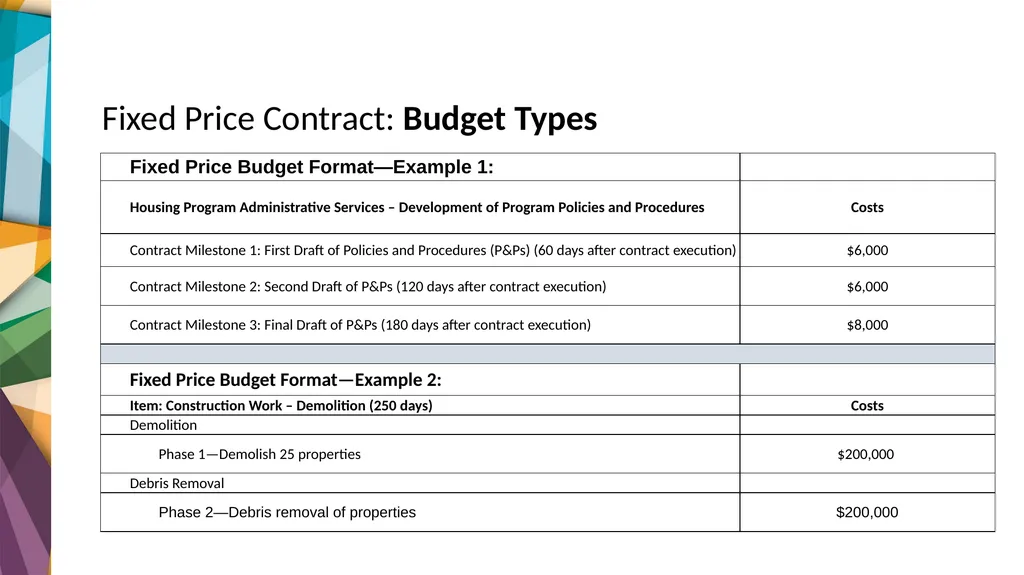
Fixed Price Contract: Budget Types<br>
11
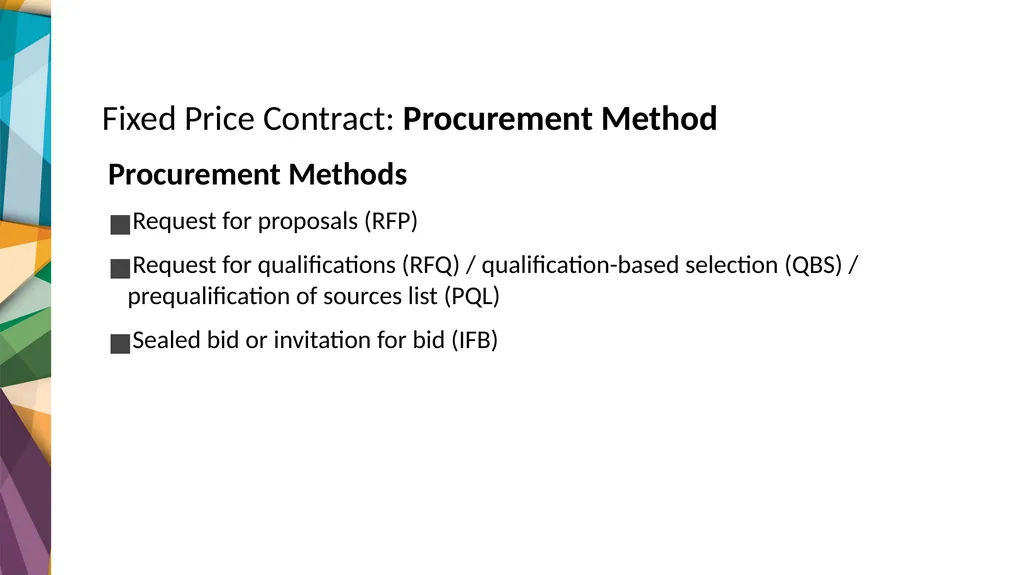
Fixed Price Contract: Procurement Method Procurement Methods
Request for proposals (RFP)
Request for qualifications (RFQ) / qualification-based selection (QBS) / prequalification of sources list (PQL)
Sealed bid or invitation for bid (IFB)<br>
Request for proposals (RFP)
Request for qualifications (RFQ) / qualification-based selection (QBS) / prequalification of sources list (PQL)
Sealed bid or invitation for bid (IFB)<br>
12
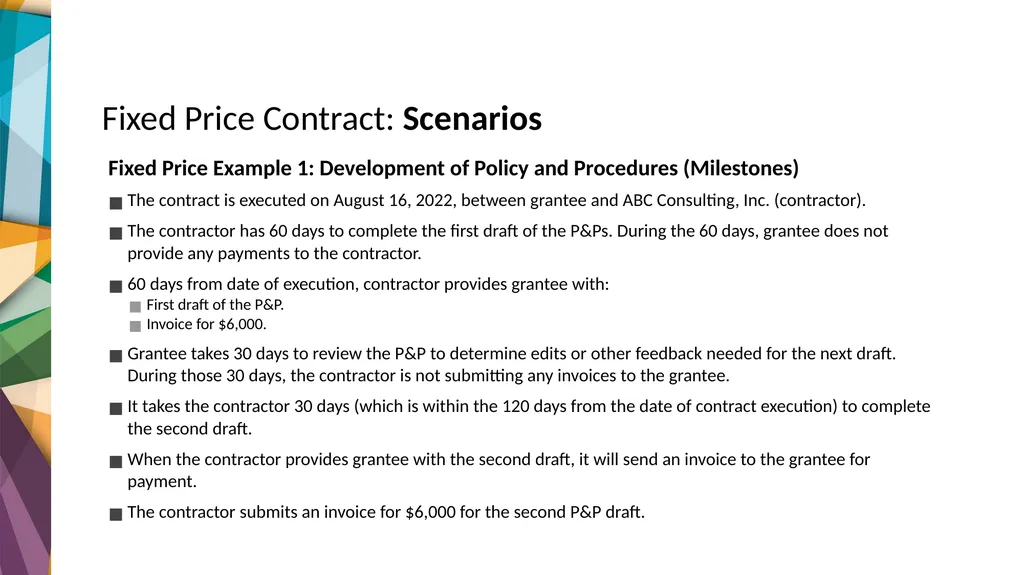
Fixed Price Contract: Scenarios Fixed Price Example 1: Development of Policy and Procedures (Milestones)
The contract is executed on August 16, 2022, between grantee and ABC Consulting, Inc. (contractor).
The contractor has 60 days to complete the first draft of the P&Ps. During the 60 days, grantee does not provide any payments to the contractor.
60 days from date of execution, contractor provides grantee with:
First draft of the P&P.
Invoice for $6,000.
Grantee takes 30 days to review the P&P to determine edits or other feedback needed for the next draft. During those 30 days, the contractor is not submitting any invoices to the grantee.
It takes the contractor 30 days (which is within the 120 days from the date of contract execution) to complete the second draft.
When the contractor provides grantee with the second draft, it will send an invoice to the grantee for payment.
The contractor submits an invoice for $6,000 for the second P&P draft.<br>
The contract is executed on August 16, 2022, between grantee and ABC Consulting, Inc. (contractor).
The contractor has 60 days to complete the first draft of the P&Ps. During the 60 days, grantee does not provide any payments to the contractor.
60 days from date of execution, contractor provides grantee with:
First draft of the P&P.
Invoice for $6,000.
Grantee takes 30 days to review the P&P to determine edits or other feedback needed for the next draft. During those 30 days, the contractor is not submitting any invoices to the grantee.
It takes the contractor 30 days (which is within the 120 days from the date of contract execution) to complete the second draft.
When the contractor provides grantee with the second draft, it will send an invoice to the grantee for payment.
The contractor submits an invoice for $6,000 for the second P&P draft.<br>
13
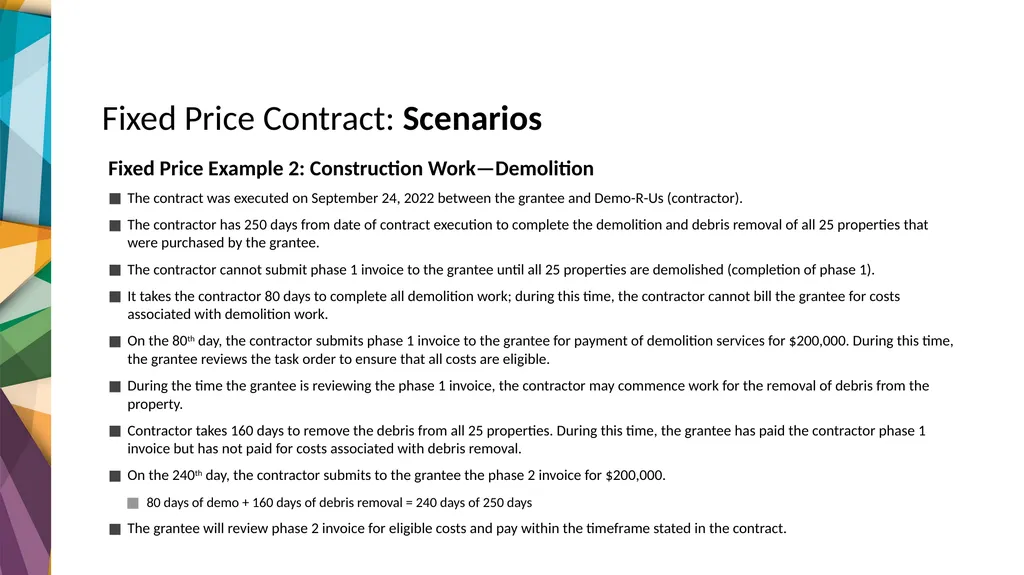
Fixed Price Contract: Scenarios Fixed Price Example 2: Construction Work—Demolition
The contract was executed on September 24, 2022 between the grantee and Demo-R-Us (contractor).
The contractor has 250 days from date of contract execution to complete the demolition and debris removal of all 25 properties that were purchased by the grantee.
The contractor cannot submit phase 1 invoice to the grantee until all 25 properties are demolished (completion of phase 1).
It takes the contractor 80 days to complete all demolition work; during this time, the contractor cannot bill the grantee for costs associated with demolition work.
On the 80th day, the contractor submits phase 1 invoice to the grantee for payment of demolition services for $200,000. During this time, the grantee reviews the task order to ensure that all costs are eligible.
During the time the grantee is reviewing the phase 1 invoice, the contractor may commence work for the removal of debris from the property.
Contractor takes 160 days to remove the debris from all 25 properties. During this time, the grantee has paid the contractor phase 1 invoice but has not paid for costs associated with debris removal.
On the 240th day, the contractor submits to the grantee the phase 2 invoice for $200,000.
80 days of demo + 160 days of debris removal = 240 days of 250 days
The grantee will review phase 2 invoice for eligible costs and pay within the timeframe stated in the contract.<br>
The contract was executed on September 24, 2022 between the grantee and Demo-R-Us (contractor).
The contractor has 250 days from date of contract execution to complete the demolition and debris removal of all 25 properties that were purchased by the grantee.
The contractor cannot submit phase 1 invoice to the grantee until all 25 properties are demolished (completion of phase 1).
It takes the contractor 80 days to complete all demolition work; during this time, the contractor cannot bill the grantee for costs associated with demolition work.
On the 80th day, the contractor submits phase 1 invoice to the grantee for payment of demolition services for $200,000. During this time, the grantee reviews the task order to ensure that all costs are eligible.
During the time the grantee is reviewing the phase 1 invoice, the contractor may commence work for the removal of debris from the property.
Contractor takes 160 days to remove the debris from all 25 properties. During this time, the grantee has paid the contractor phase 1 invoice but has not paid for costs associated with debris removal.
On the 240th day, the contractor submits to the grantee the phase 2 invoice for $200,000.
80 days of demo + 160 days of debris removal = 240 days of 250 days
The grantee will review phase 2 invoice for eligible costs and pay within the timeframe stated in the contract.<br>
14
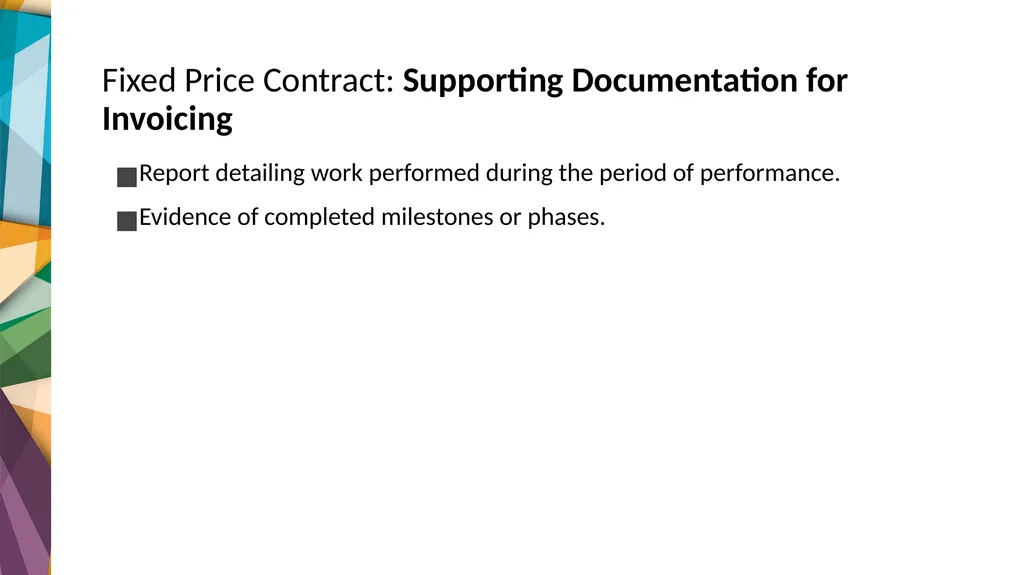
Fixed Price Contract: Supporting Documentation for Invoicing Report detailing work performed during the period of performance.
Evidence of completed milestones or phases.<br>
Evidence of completed milestones or phases.<br>
15
Contract Type: Cost Reimbursement<br>
16
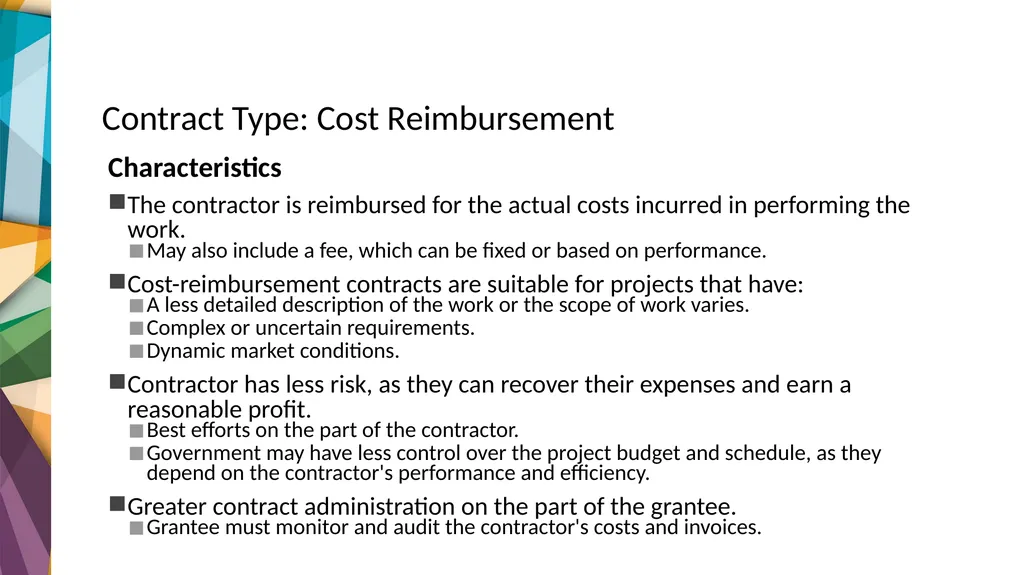
Contract Type: Cost Reimbursement Characteristics
The contractor is reimbursed for the actual costs incurred in performing the work.
May also include a fee, which can be fixed or based on performance.
Cost-reimbursement contracts are suitable for projects that have:
A less detailed description of the work or the scope of work varies.
Complex or uncertain requirements.
Dynamic market conditions.
Contractor has less risk, as they can recover their expenses and earn a reasonable profit.
Best efforts on the part of the contractor.
Government may have less control over the project budget and schedule, as they depend on the contractor's performance and efficiency.
Greater contract administration on the part of the grantee.
Grantee must monitor and audit the contractor's costs and invoices.<br>
The contractor is reimbursed for the actual costs incurred in performing the work.
May also include a fee, which can be fixed or based on performance.
Cost-reimbursement contracts are suitable for projects that have:
A less detailed description of the work or the scope of work varies.
Complex or uncertain requirements.
Dynamic market conditions.
Contractor has less risk, as they can recover their expenses and earn a reasonable profit.
Best efforts on the part of the contractor.
Government may have less control over the project budget and schedule, as they depend on the contractor's performance and efficiency.
Greater contract administration on the part of the grantee.
Grantee must monitor and audit the contractor's costs and invoices.<br>
17
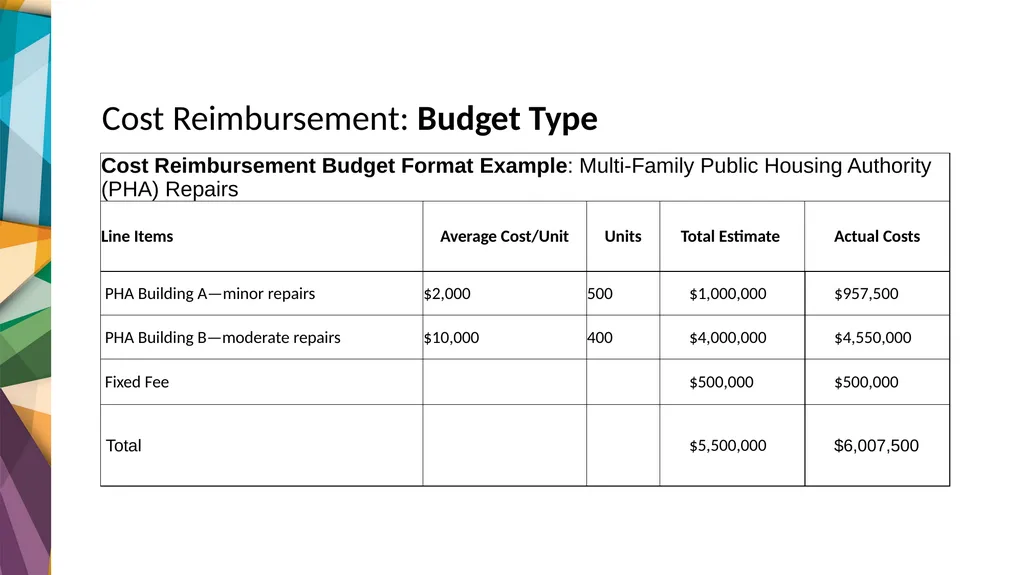
Cost Reimbursement: Budget Type<br>
18
Cost Reimbursement: Procurement & Scenario Procurement Methods
RFP
RFQ/QBS/PQL
Scenario
A PHA needs repairs completed across two of its buildings. Units are in various stages of occupancy and have varying levels of repair needs. PHA needs on-call repair services to ensure units are meeting health and safety standards. Work will occur over a matter of years, during which some repairs may worsen.<br>
RFP
RFQ/QBS/PQL
Scenario
A PHA needs repairs completed across two of its buildings. Units are in various stages of occupancy and have varying levels of repair needs. PHA needs on-call repair services to ensure units are meeting health and safety standards. Work will occur over a matter of years, during which some repairs may worsen.<br>
19
Cost Reimbursement: Supporting Documentation for Invoicing Reimbursement of actual costs.
Reimbursements can occur at different stages of the contract term.
Documentation:
Invoices and receipts for materials, payroll records, subcontractors invoices.
Direct or travel expenses, such as gas receipts or mileage log, meal receipts, and hotel receipts (if included in contract).
Reports on progress to outcomes.<br>
Reimbursements can occur at different stages of the contract term.
Documentation:
Invoices and receipts for materials, payroll records, subcontractors invoices.
Direct or travel expenses, such as gas receipts or mileage log, meal receipts, and hotel receipts (if included in contract).
Reports on progress to outcomes.<br>
20
Contract Type: Time and Materials (T&M)<br>
21
Contract Type: T&M Characteristics
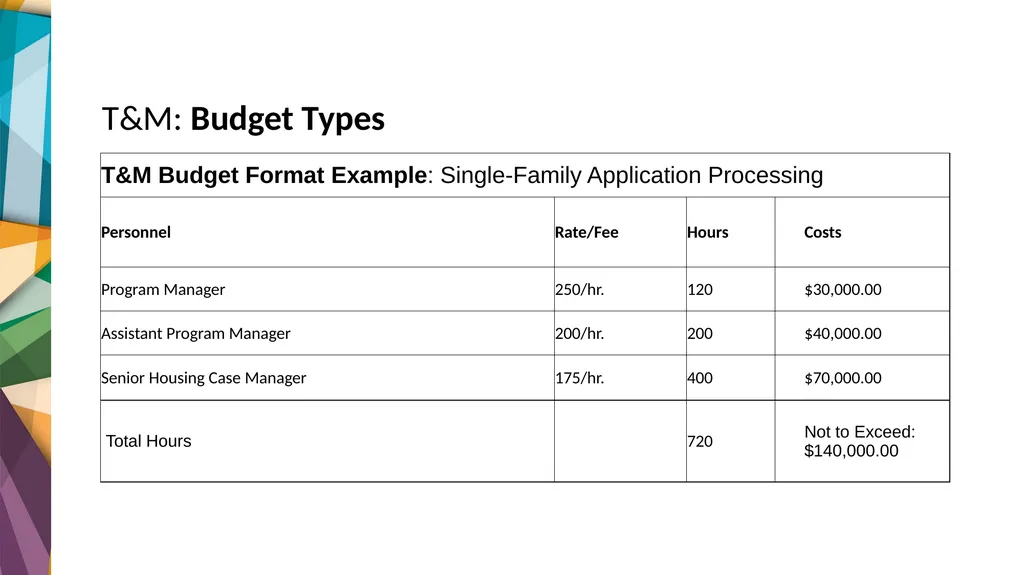
T&M contracts are used when the scope of work is variable and a fixed price cannot be predetermined.
Services (time) and materials charged are consistent with the rate (fee) schedule contained in the contract.
Contracts must include a maximum contract amount, also known as a “not to exceed” amount.
T&M contractors can only charge for the services and the associated costs listed in the rate/fee schedule.
Contractor has less risk, as they can recover their expenses and earn a reasonable profit.
Best efforts on the part of the contractor.
Grantee may have less control over the project budget and schedule, as they depend on the contractor's performance and efficiency.
Greater contract administration responsibilities on the part of the grantee.<br>
T&M contracts are used when the scope of work is variable and a fixed price cannot be predetermined.
Services (time) and materials charged are consistent with the rate (fee) schedule contained in the contract.
Contracts must include a maximum contract amount, also known as a “not to exceed” amount.
T&M contractors can only charge for the services and the associated costs listed in the rate/fee schedule.
Contractor has less risk, as they can recover their expenses and earn a reasonable profit.
Best efforts on the part of the contractor.
Grantee may have less control over the project budget and schedule, as they depend on the contractor's performance and efficiency.
Greater contract administration responsibilities on the part of the grantee.<br>
22
T&M: Budget Types<br>
23
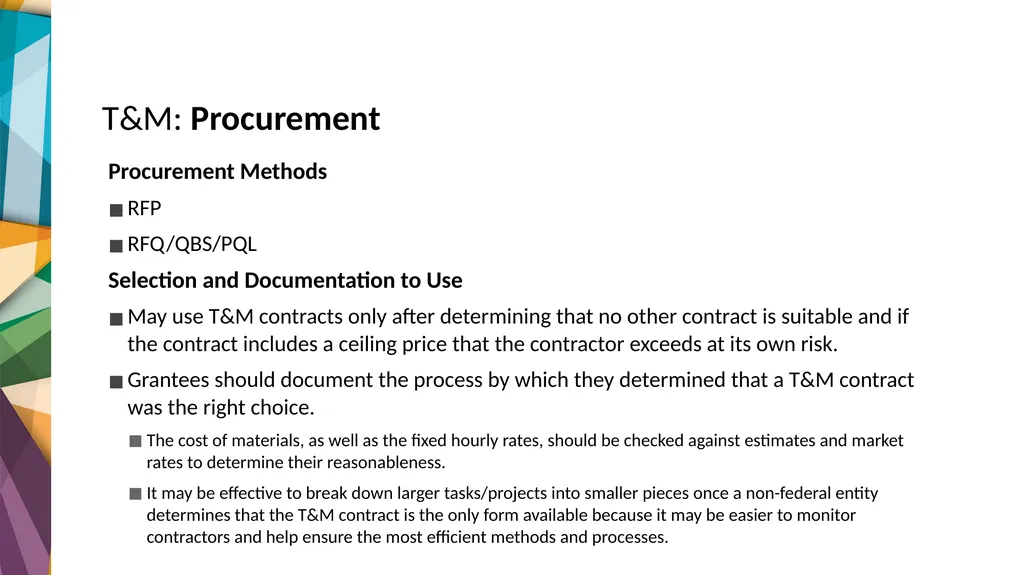
T&M: Procurement Procurement Methods
RFP
RFQ/QBS/PQL
Selection and Documentation to Use
May use T&M contracts only after determining that no other contract is suitable and if the contract includes a ceiling price that the contractor exceeds at its own risk.
Grantees should document the process by which they determined that a T&M contract was the right choice.
The cost of materials, as well as the fixed hourly rates, should be checked against estimates and market rates to determine their reasonableness.
It may be effective to break down larger tasks/projects into smaller pieces once a non-federal entity determines that the T&M contract is the only form available because it may be easier to monitor contractors and help ensure the most efficient methods and processes.<br>
RFP
RFQ/QBS/PQL
Selection and Documentation to Use
May use T&M contracts only after determining that no other contract is suitable and if the contract includes a ceiling price that the contractor exceeds at its own risk.
Grantees should document the process by which they determined that a T&M contract was the right choice.
The cost of materials, as well as the fixed hourly rates, should be checked against estimates and market rates to determine their reasonableness.
It may be effective to break down larger tasks/projects into smaller pieces once a non-federal entity determines that the T&M contract is the only form available because it may be easier to monitor contractors and help ensure the most efficient methods and processes.<br>
24
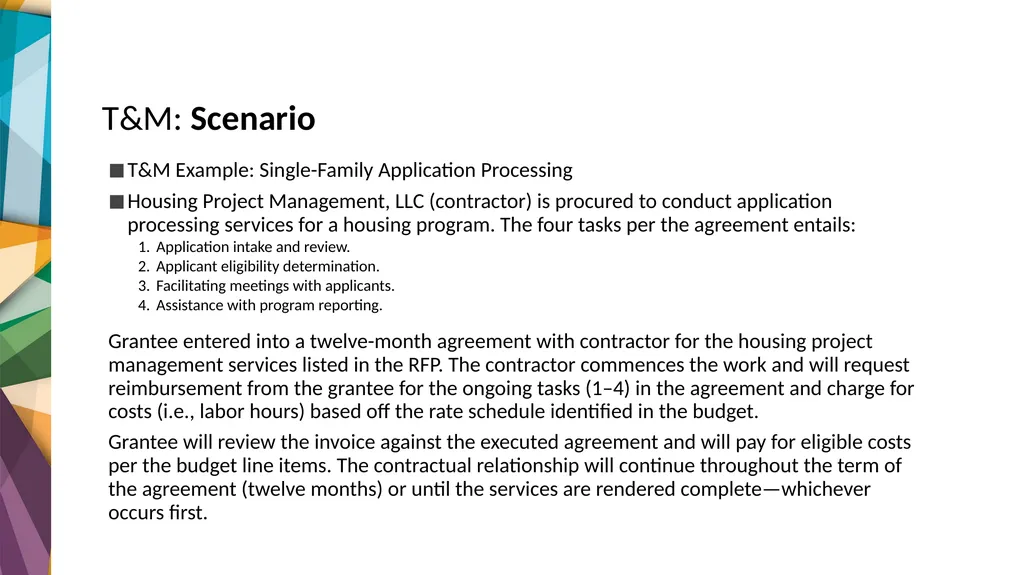
T&M: Scenario T&M Example: Single-Family Application Processing
Housing Project Management, LLC (contractor) is procured to conduct application processing services for a housing program. The four tasks per the agreement entails:
Application intake and review.
Applicant eligibility determination.
Facilitating meetings with applicants.
Assistance with program reporting.
Grantee entered into a twelve-month agreement with contractor for the housing project management services listed in the RFP. The contractor commences the work and will request reimbursement from the grantee for the ongoing tasks (1–4) in the agreement and charge for costs (i.e., labor hours) based off the rate schedule identified in the budget.
Grantee will review the invoice against the executed agreement and will pay for eligible costs per the budget line items. The contractual relationship will continue throughout the term of the agreement (twelve months) or until the services are rendered complete—whichever occurs first.<br>
Housing Project Management, LLC (contractor) is procured to conduct application processing services for a housing program. The four tasks per the agreement entails:
Application intake and review.
Applicant eligibility determination.
Facilitating meetings with applicants.
Assistance with program reporting.
Grantee entered into a twelve-month agreement with contractor for the housing project management services listed in the RFP. The contractor commences the work and will request reimbursement from the grantee for the ongoing tasks (1–4) in the agreement and charge for costs (i.e., labor hours) based off the rate schedule identified in the budget.
Grantee will review the invoice against the executed agreement and will pay for eligible costs per the budget line items. The contractual relationship will continue throughout the term of the agreement (twelve months) or until the services are rendered complete—whichever occurs first.<br>
25
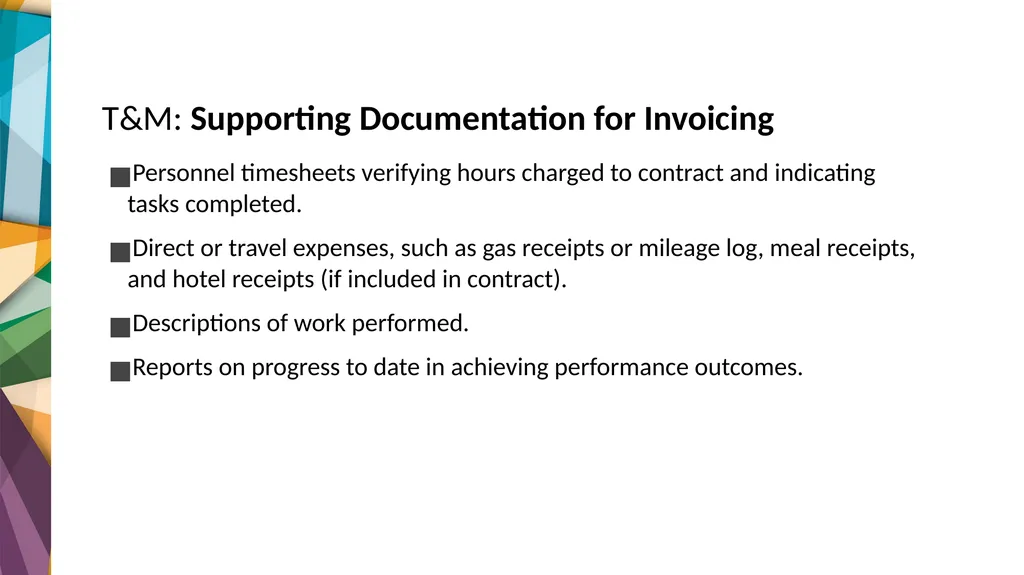
T&M: Supporting Documentation for Invoicing Personnel timesheets verifying hours charged to contract and indicating tasks completed.
Direct or travel expenses, such as gas receipts or mileage log, meal receipts, and hotel receipts (if included in contract).
Descriptions of work performed.
Reports on progress to date in achieving performance outcomes.<br>
Direct or travel expenses, such as gas receipts or mileage log, meal receipts, and hotel receipts (if included in contract).
Descriptions of work performed.
Reports on progress to date in achieving performance outcomes.<br>
26
Contracts with Fixed Cost and T&M Characteristics
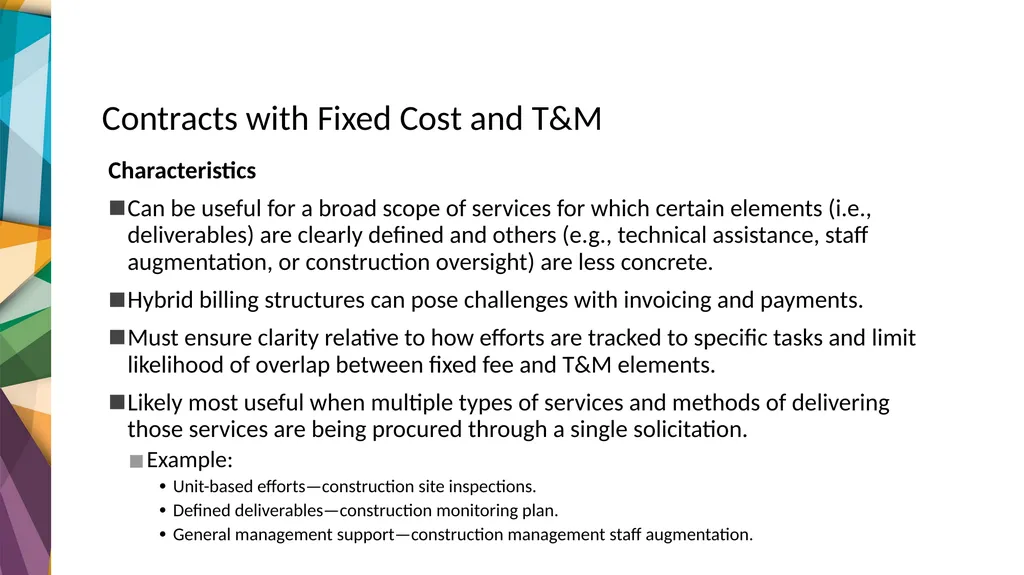
Can be useful for a broad scope of services for which certain elements (i.e., deliverables) are clearly defined and others (e.g., technical assistance, staff augmentation, or construction oversight) are less concrete.
Hybrid billing structures can pose challenges with invoicing and payments.
Must ensure clarity relative to how efforts are tracked to specific tasks and limit likelihood of overlap between fixed fee and T&M elements.
Likely most useful when multiple types of services and methods of delivering those services are being procured through a single solicitation.
Example:
Unit-based efforts—construction site inspections.
Defined deliverables—construction monitoring plan.
General management support—construction management staff augmentation.<br>
Can be useful for a broad scope of services for which certain elements (i.e., deliverables) are clearly defined and others (e.g., technical assistance, staff augmentation, or construction oversight) are less concrete.
Hybrid billing structures can pose challenges with invoicing and payments.
Must ensure clarity relative to how efforts are tracked to specific tasks and limit likelihood of overlap between fixed fee and T&M elements.
Likely most useful when multiple types of services and methods of delivering those services are being procured through a single solicitation.
Example:
Unit-based efforts—construction site inspections.
Defined deliverables—construction monitoring plan.
General management support—construction management staff augmentation.<br>
27
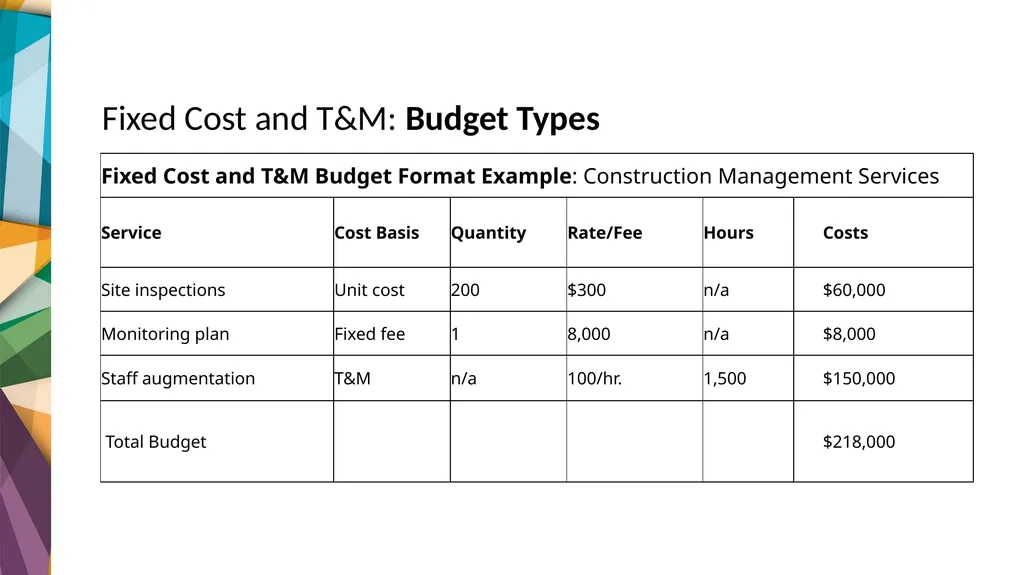
Fixed Cost and T&M: Budget Types<br>
28
Contract Type: Intergovernmental Agency Agreements<br>
29
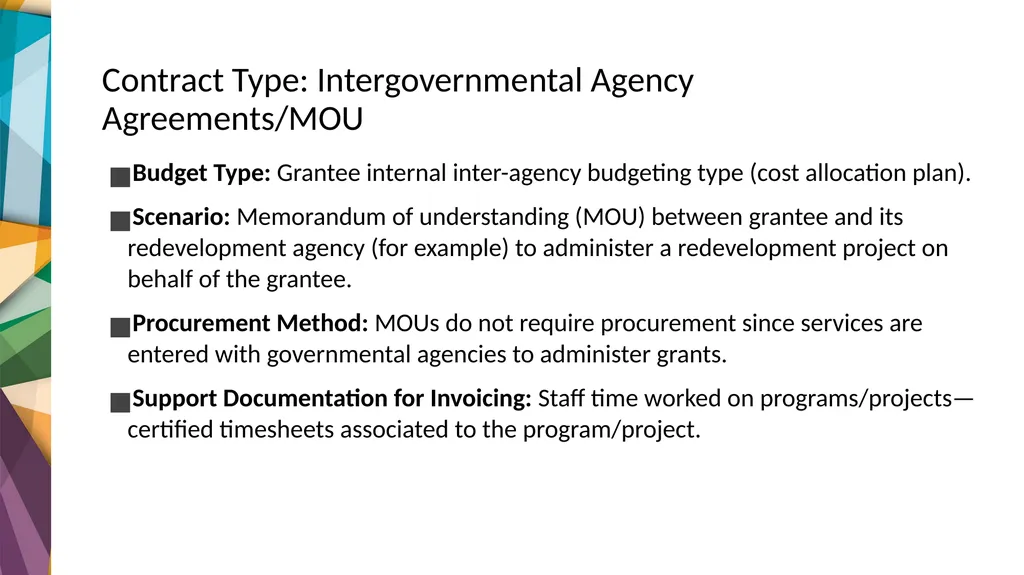
Contract Type: Intergovernmental Agency Agreements/MOU Budget Type: Grantee internal inter-agency budgeting type (cost allocation plan).
Scenario: Memorandum of understanding (MOU) between grantee and its redevelopment agency (for example) to administer a redevelopment project on behalf of the grantee.
Procurement Method: MOUs do not require procurement since services are entered with governmental agencies to administer grants.
Support Documentation for Invoicing: Staff time worked on programs/projects—certified timesheets associated to the program/project.<br>
Scenario: Memorandum of understanding (MOU) between grantee and its redevelopment agency (for example) to administer a redevelopment project on behalf of the grantee.
Procurement Method: MOUs do not require procurement since services are entered with governmental agencies to administer grants.
Support Documentation for Invoicing: Staff time worked on programs/projects—certified timesheets associated to the program/project.<br>
30
Prohibited Contract Type: Cost Plus as a Percentage of Cost<br>
31
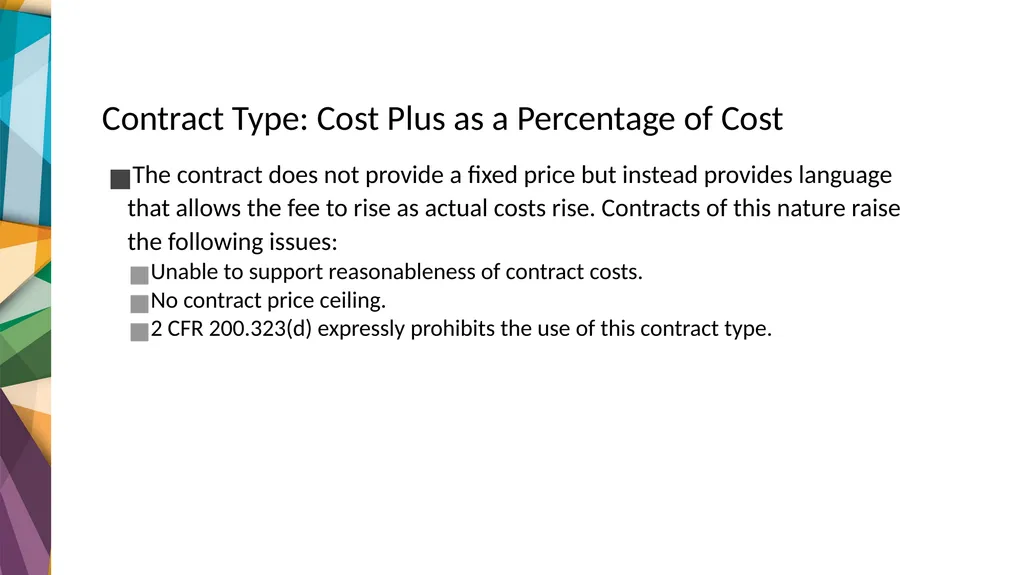
Contract Type: Cost Plus as a Percentage of Cost The contract does not provide a fixed price but instead provides language that allows the fee to rise as actual costs rise. Contracts of this nature raise the following issues:
Unable to support reasonableness of contract costs.
No contract price ceiling.
2 CFR 200.323(d) expressly prohibits the use of this contract type.<br>
Unable to support reasonableness of contract costs.
No contract price ceiling.
2 CFR 200.323(d) expressly prohibits the use of this contract type.<br>
32
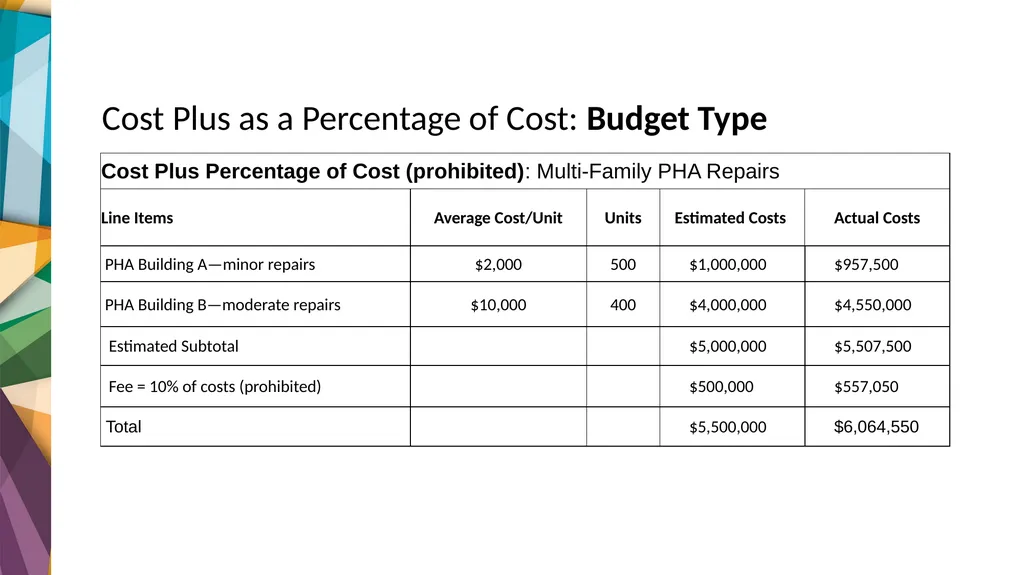
Cost Plus as a Percentage of Cost: Budget Type<br>
33
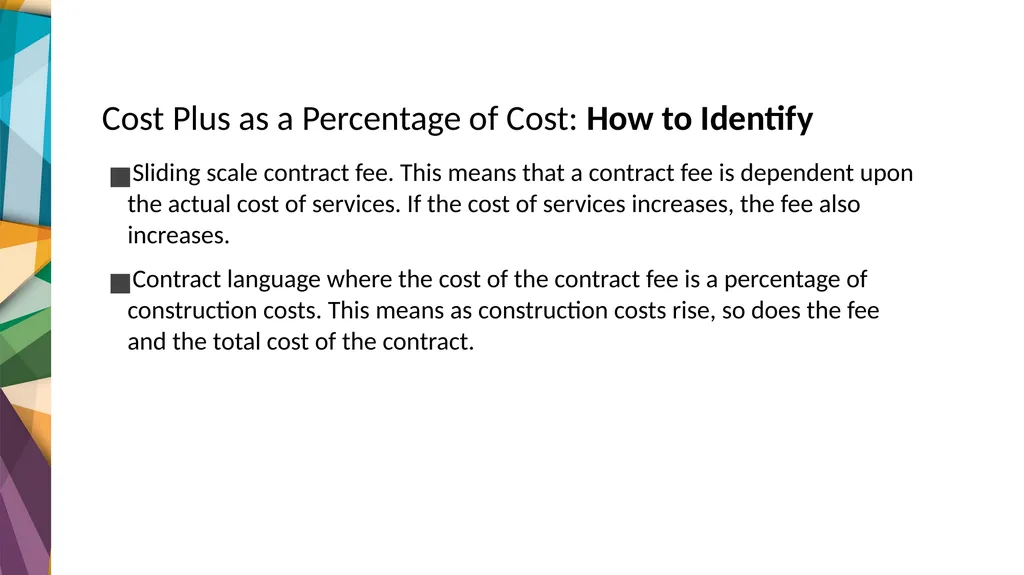
Cost Plus as a Percentage of Cost: How to Identify Sliding scale contract fee. This means that a contract fee is dependent upon the actual cost of services. If the cost of services increases, the fee also increases.
Contract language where the cost of the contract fee is a percentage of construction costs. This means as construction costs rise, so does the fee and the total cost of the contract.<br>
Contract language where the cost of the contract fee is a percentage of construction costs. This means as construction costs rise, so does the fee and the total cost of the contract.<br>
34
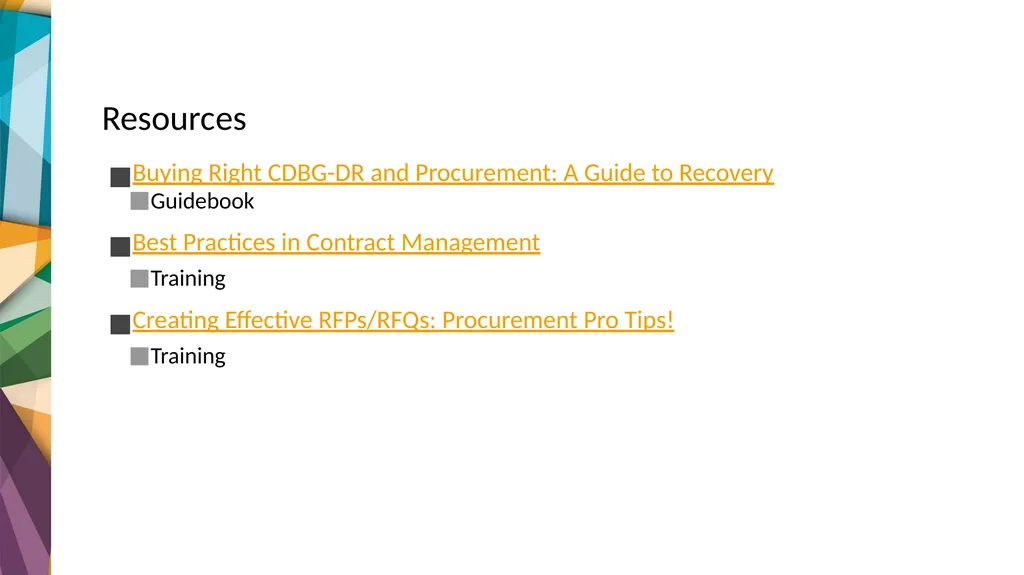
Resources Buying Right CDBG-DR and Procurement: A Guide to Recovery
Guidebook
Best Practices in Contract Management
Training
Creating Effective RFPs/RFQs: Procurement Pro Tips!
Training<br>
Guidebook
Best Practices in Contract Management
Training
Creating Effective RFPs/RFQs: Procurement Pro Tips!
Training<br>
35
Contract Type: Purchase Order (PO)<br>
36
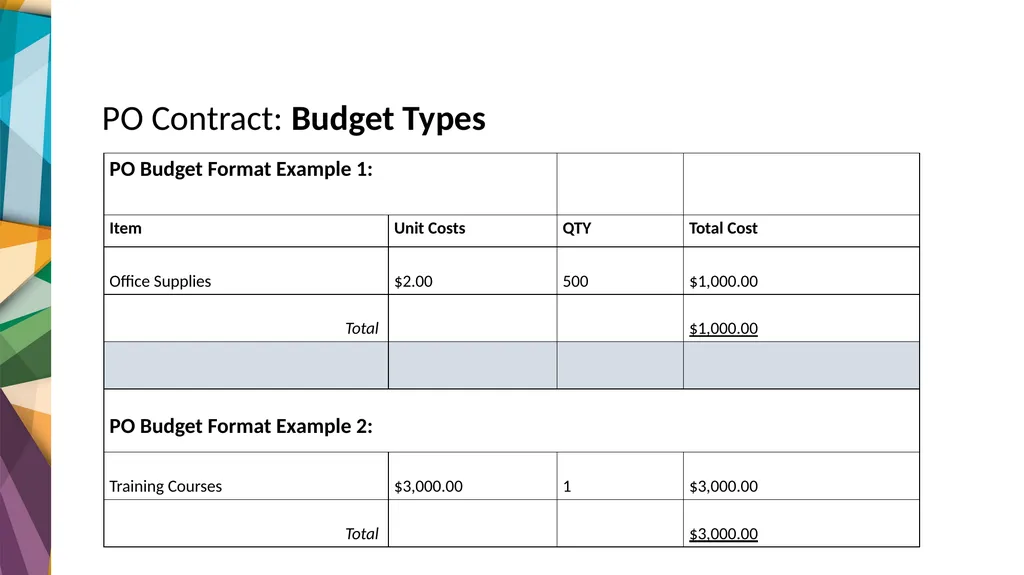
PO Contract: Budget Types<br>
37
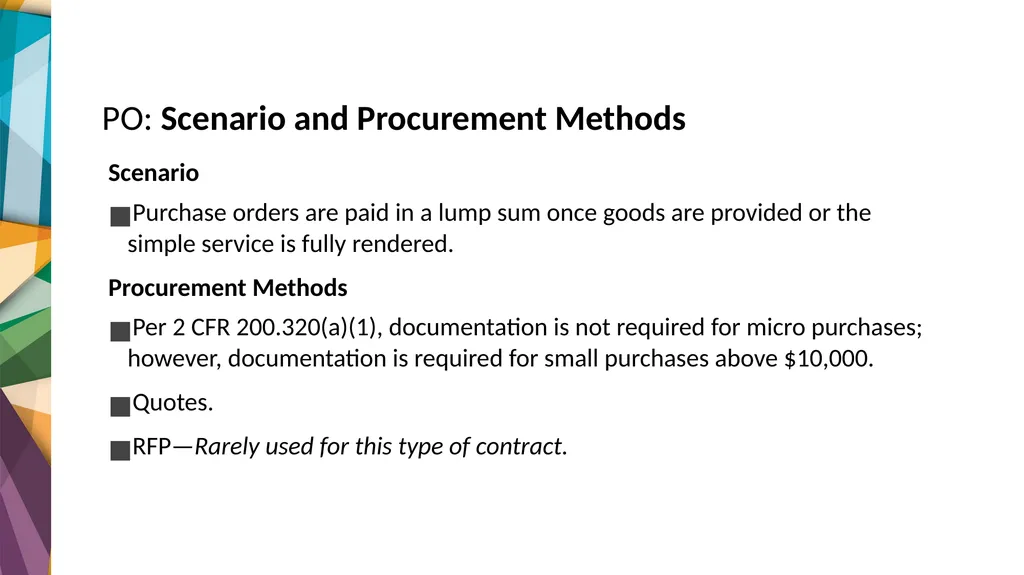
PO: Scenario and Procurement Methods Scenario
Purchase orders are paid in a lump sum once goods are provided or the simple service is fully rendered.
Procurement Methods
Per 2 CFR 200.320(a)(1), documentation is not required for micro purchases; however, documentation is required for small purchases above $10,000.
Quotes.
RFP—Rarely used for this type of contract.<br>
Purchase orders are paid in a lump sum once goods are provided or the simple service is fully rendered.
Procurement Methods
Per 2 CFR 200.320(a)(1), documentation is not required for micro purchases; however, documentation is required for small purchases above $10,000.
Quotes.
RFP—Rarely used for this type of contract.<br>
38
PO: Supporting Documentation for Invoicing PO Example 1
Quote from selected vendor.
Print out of the product (typically from the website or source document).
Final invoice for products.
PO Example 2
Quote from selected vendor.
Invoice for training service.<br>
Quote from selected vendor.
Print out of the product (typically from the website or source document).
Final invoice for products.
PO Example 2
Quote from selected vendor.
Invoice for training service.<br>