Control hijacking attacks Attacker’s goal: Take
Description: Control hijacking attacks Attackers goal: Take over target machine (e.g. web server) Execute arbitrary code on target by hijacking application control flow This lecture: three examples. Buffer overflow attacks Integer overflow attacks
Related Topics
Download Presentation
"Control hijacking attacks Attacker’s goal: Take" is the property of its rightful owner. Permission is granted to download and print the materials on this website for personal, non-commercial use only, and to display it on your personal computer provided you do not modify the materials and that you retain all copyright notices contained in the materials. By downloading content from our website, you accept the terms of this agreement.
Presentation Transcript
slide1. Control hijacking attacks Attacker’s goal:
Take over target machine (e.g. web server)
Execute arbitrary code on target by hijacking application control flow
This lecture: three examples.
Buffer overflow attacks
Integer overflow attacks
Format string vulnerabilities<br>
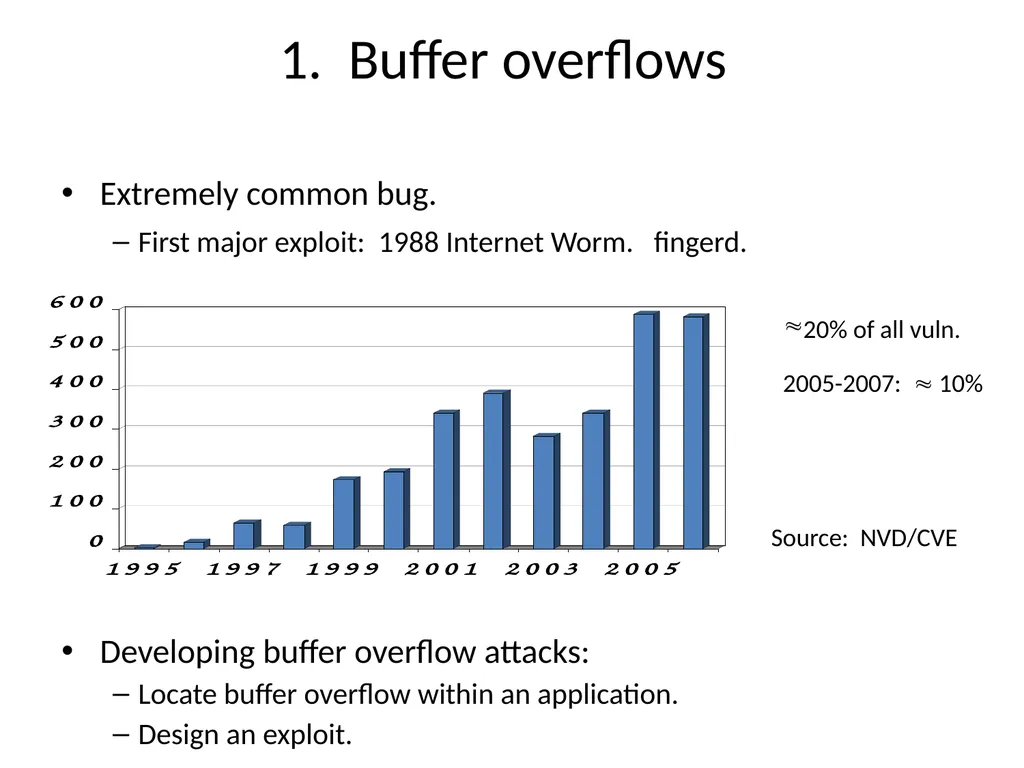
slide2. 1. Buffer overflows Extremely common bug.
First major exploit: 1988 Internet Worm. fingerd.
Developing buffer overflow attacks:
Locate buffer overflow within an application.
Design an exploit. Source: NVD/CVE 20% of all vuln.
2005-2007: 10%<br>
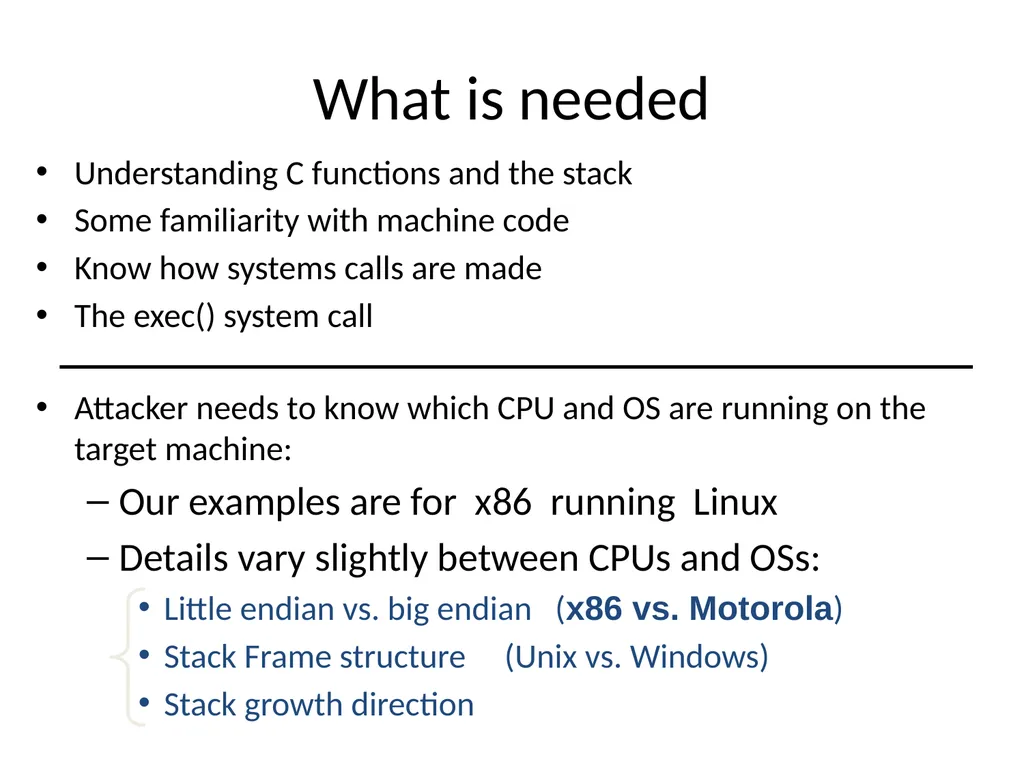
slide3. What is needed Understanding C functions and the stack
Some familiarity with machine code
Know how systems calls are made
The exec() system call
Attacker needs to know which CPU and OS are running on the target machine:
Our examples are for x86 running Linux
Details vary slightly between CPUs and OSs:
Little endian vs. big endian (x86 vs. Motorola)
Stack Frame structure (Unix vs. Windows)
Stack growth direction<br>
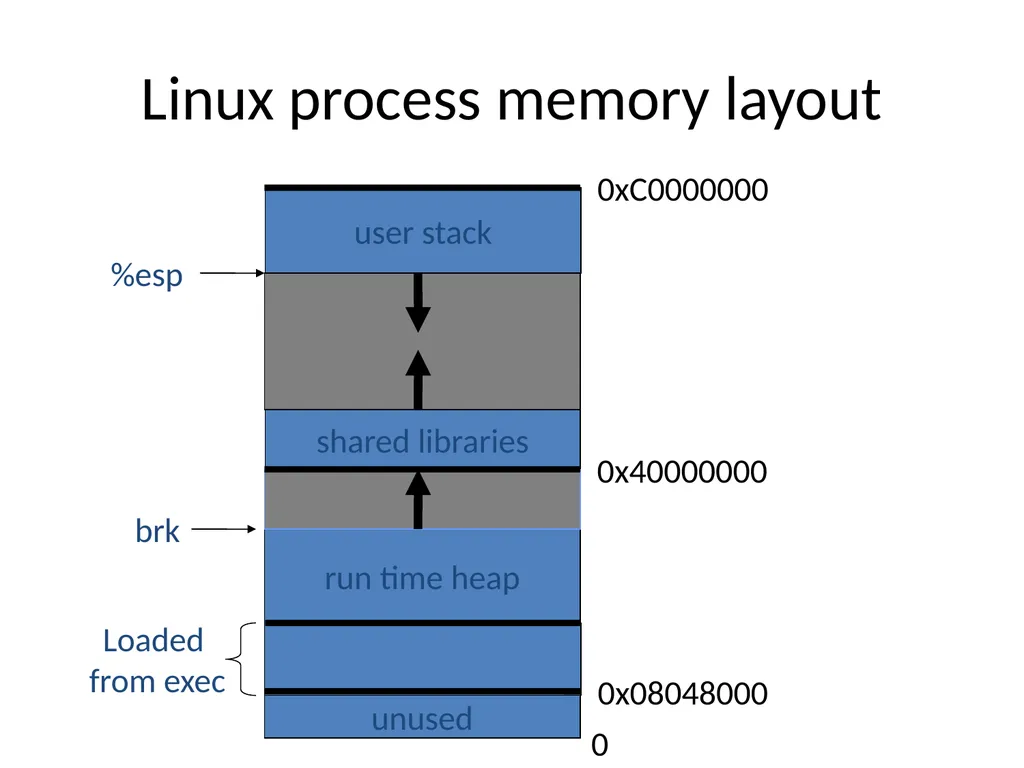
slide4. Linux process memory layout unused 0x08048000 run time heap shared libraries user stack 0x40000000 0xC0000000 %esp brk Loaded from exec 0<br>
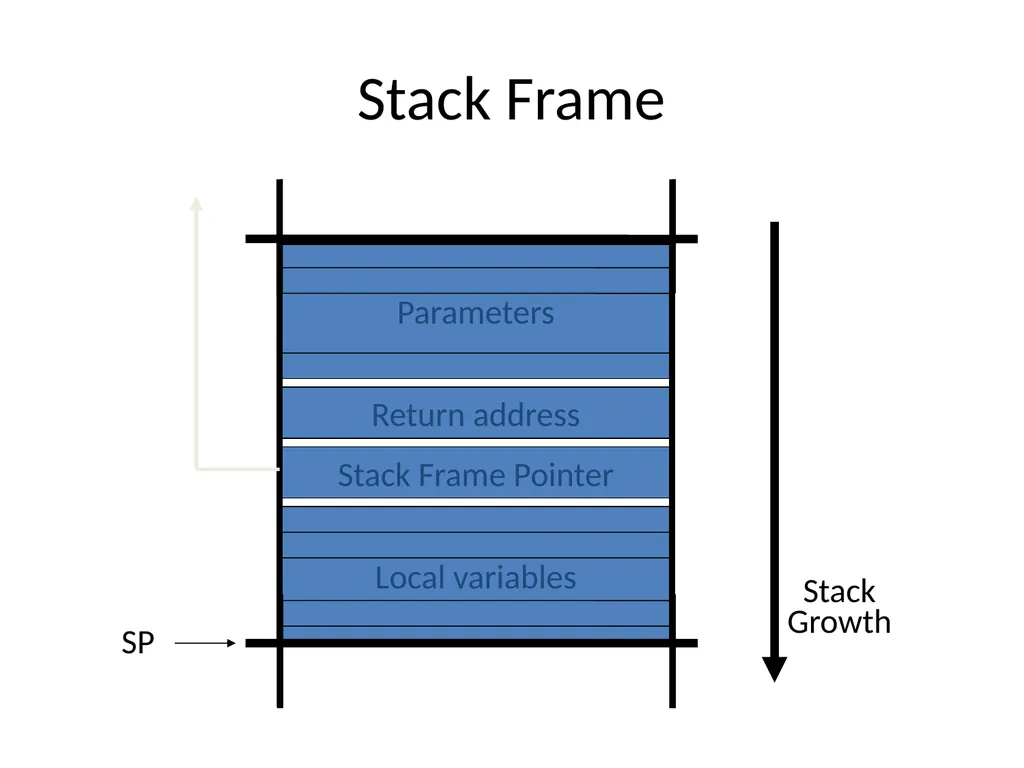
slide5. Stack Frame Parameters Return address Stack Frame Pointer Local variables SP Stack
Growth<br>
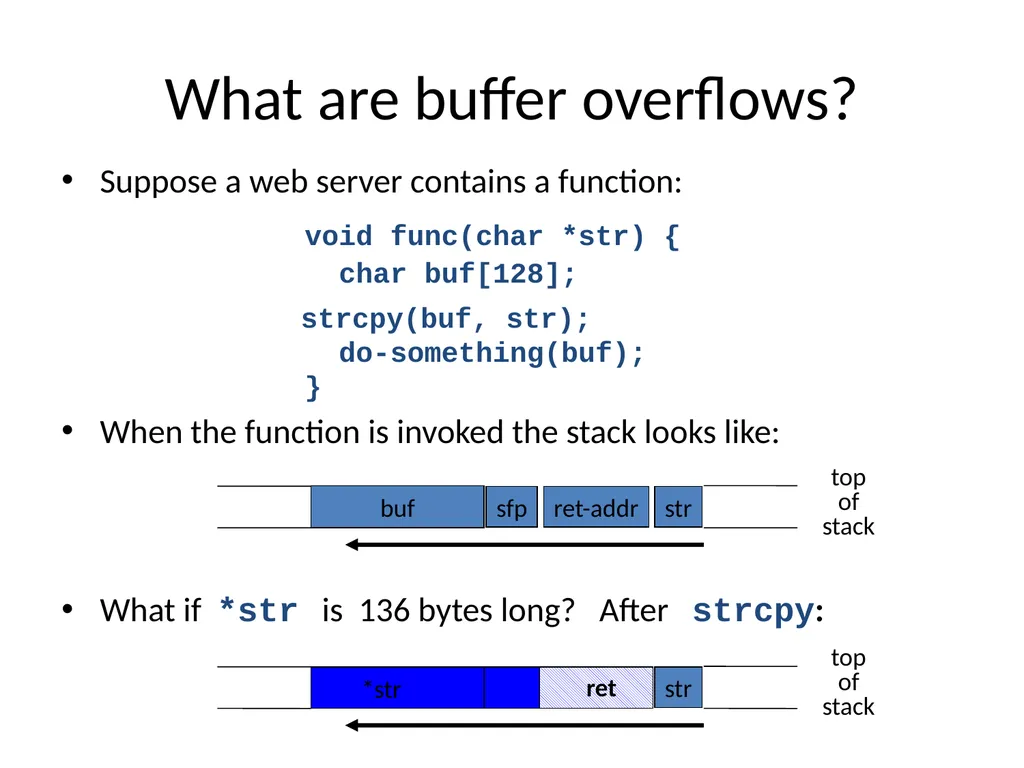
slide6. What are buffer overflows? Suppose a web server contains a function: void func(char *str) { char buf[128];
strcpy(buf, str); do-something(buf); }
When the function is invoked the stack looks like:
What if *str is 136 bytes long? After strcpy:<br>
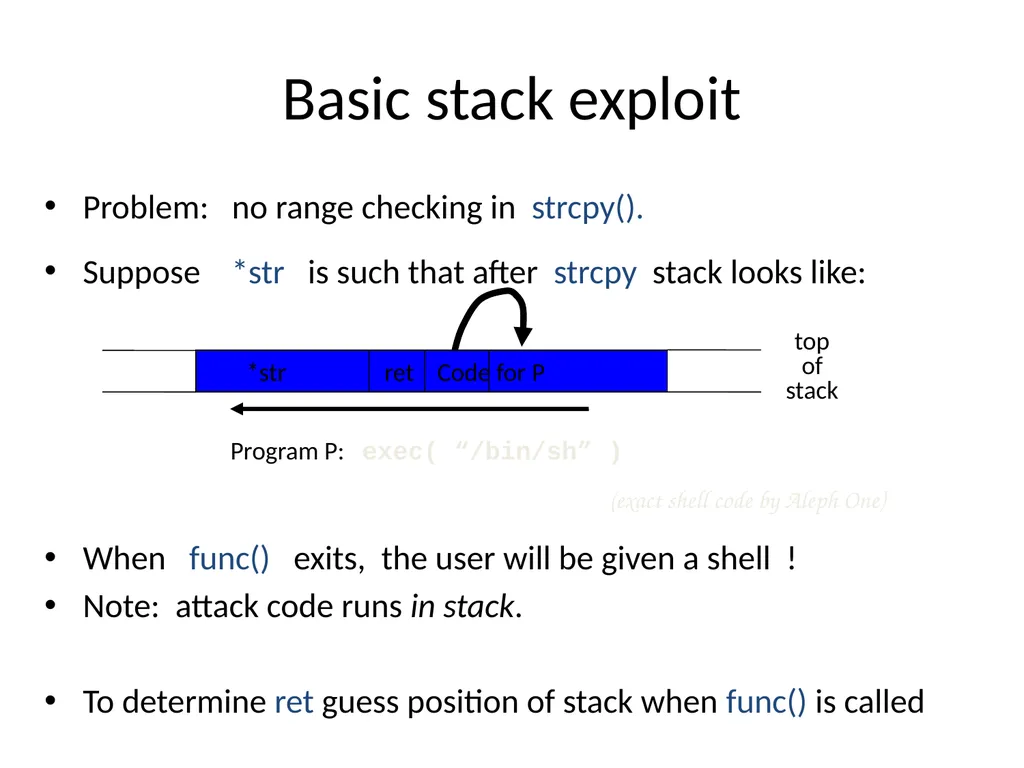
slide7. Basic stack exploit Problem: no range checking in strcpy().
Suppose *str is such that after strcpy stack looks like:
When func() exits, the user will be given a shell !
Note: attack code runs in stack.
To determine ret guess position of stack when func() is called (exact shell code by Aleph One)<br>
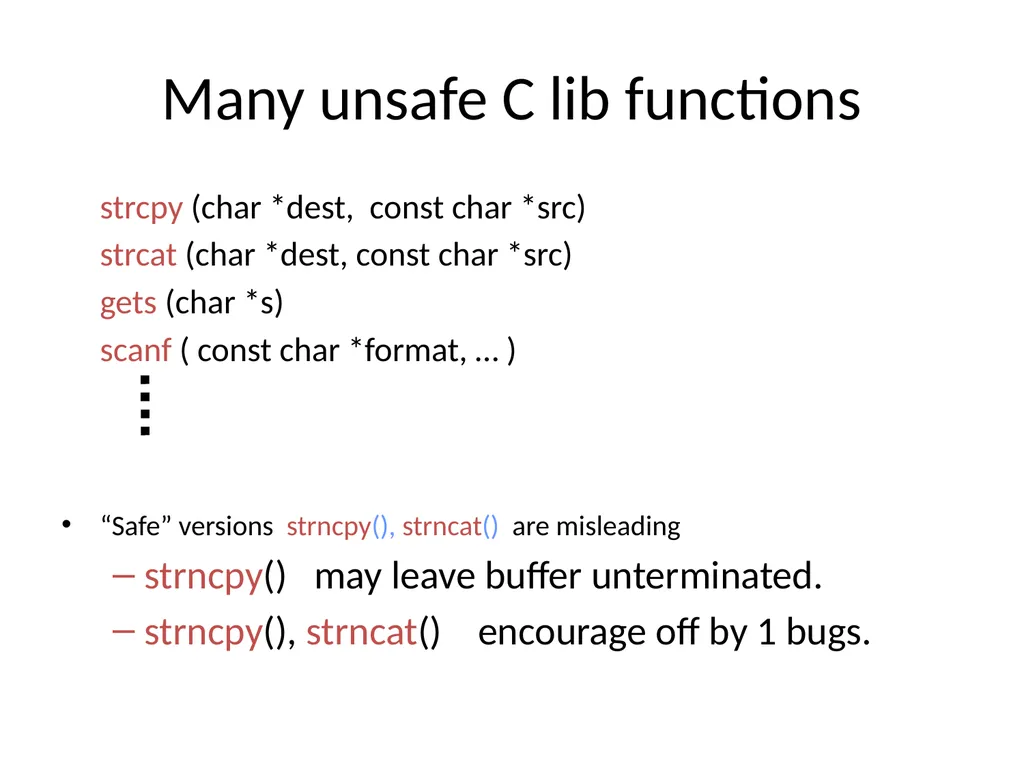
slide8. Many unsafe C lib functions strcpy (char *dest, const char *src)
strcat (char *dest, const char *src)
gets (char *s)
scanf ( const char *format, … )
“Safe” versions strncpy(), strncat() are misleading
strncpy() may leave buffer unterminated.
strncpy(), strncat() encourage off by 1 bugs.<br>
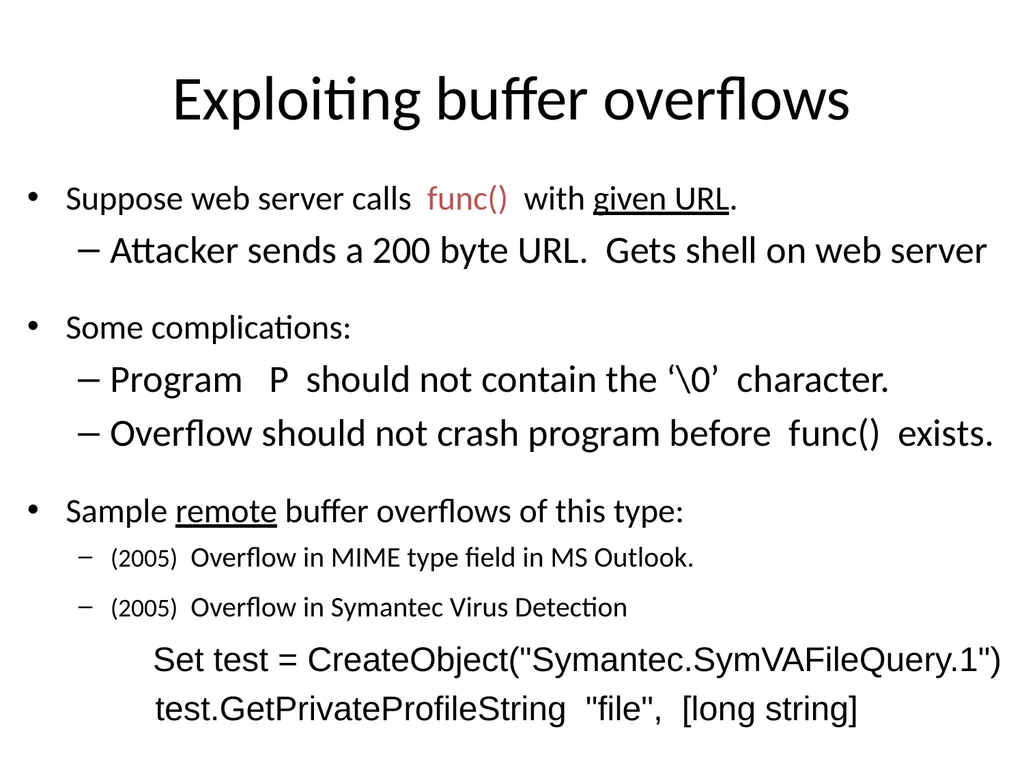
slide9. Exploiting buffer overflows Suppose web server calls func() with given URL.
Attacker sends a 200 byte URL. Gets shell on web server
Some complications:
Program P should not contain the ‘\0’ character.
Overflow should not crash program before func() exists.
Sample remote buffer overflows of this type:
(2005) Overflow in MIME type field in MS Outlook.
(2005) Overflow in Symantec Virus Detection
Set test = CreateObject("Symantec.SymVAFileQuery.1") test.GetPrivateProfileString "file", [long string]<br>
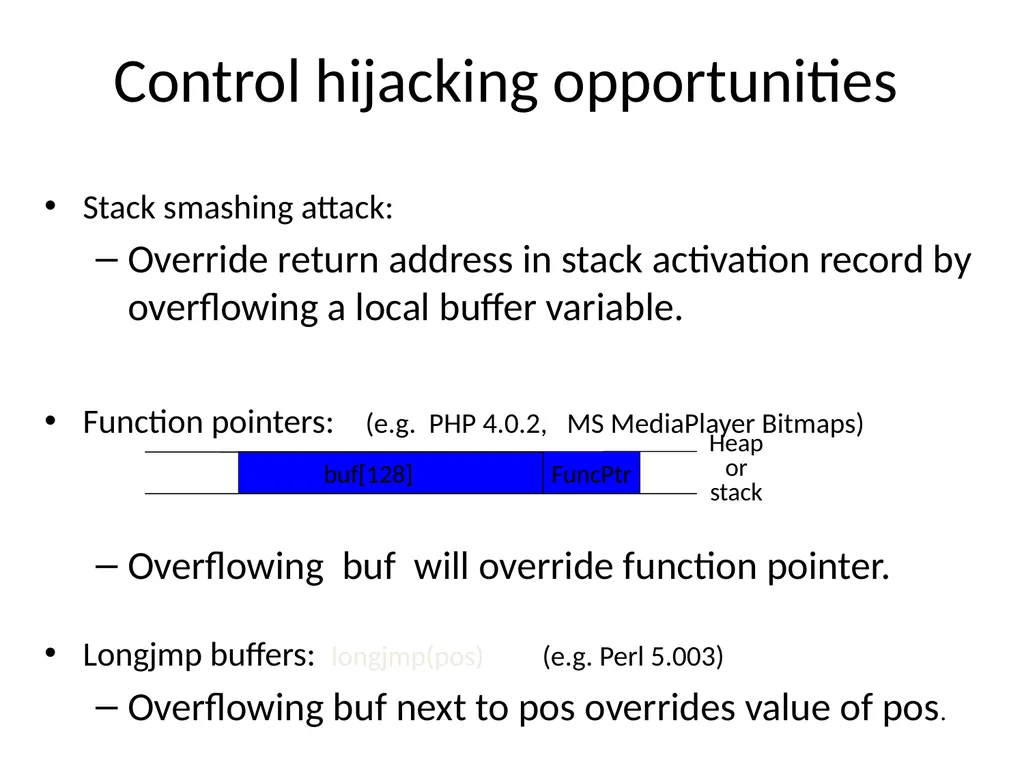
slide10. Control hijacking opportunities Stack smashing attack:
Override return address in stack activation record by overflowing a local buffer variable.
Function pointers: (e.g. PHP 4.0.2, MS MediaPlayer Bitmaps)
Overflowing buf will override function pointer.
Longjmp buffers: longjmp(pos) (e.g. Perl 5.003)
Overflowing buf next to pos overrides value of pos.<br>
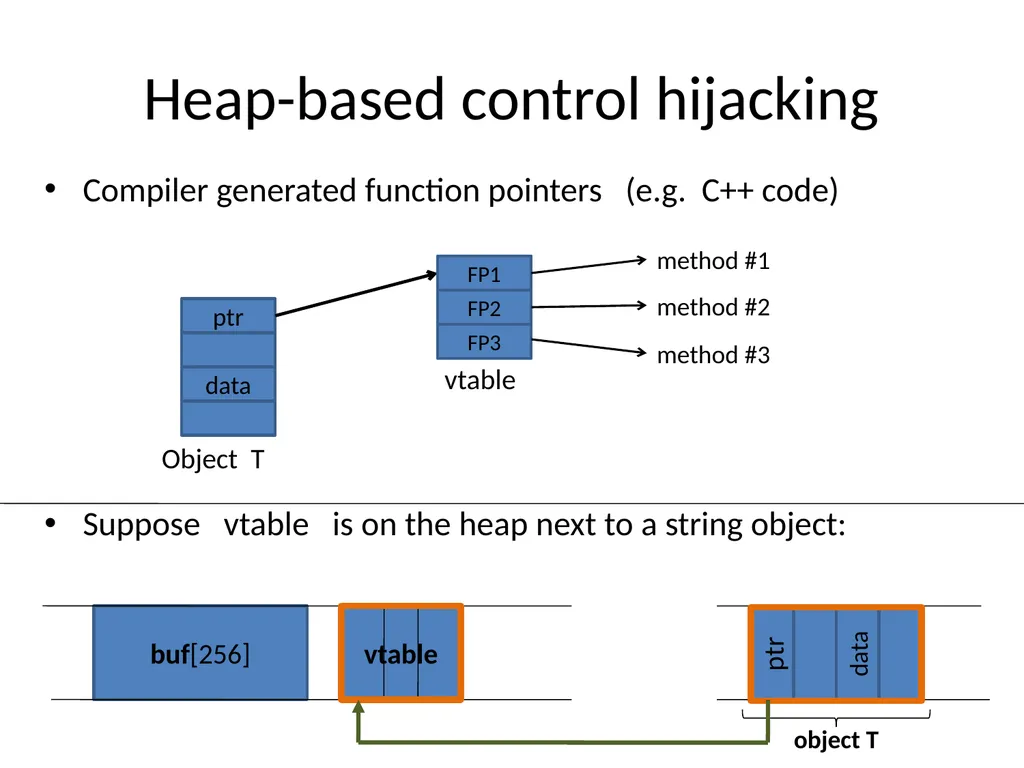
slide11. Heap-based control hijacking Compiler generated function pointers (e.g. C++ code)
Suppose vtable is on the heap next to a string object: ptr data Object T FP1 FP2 FP3 vtable method #1 method #2 method #3 ptr buf[256] data vtable<br>
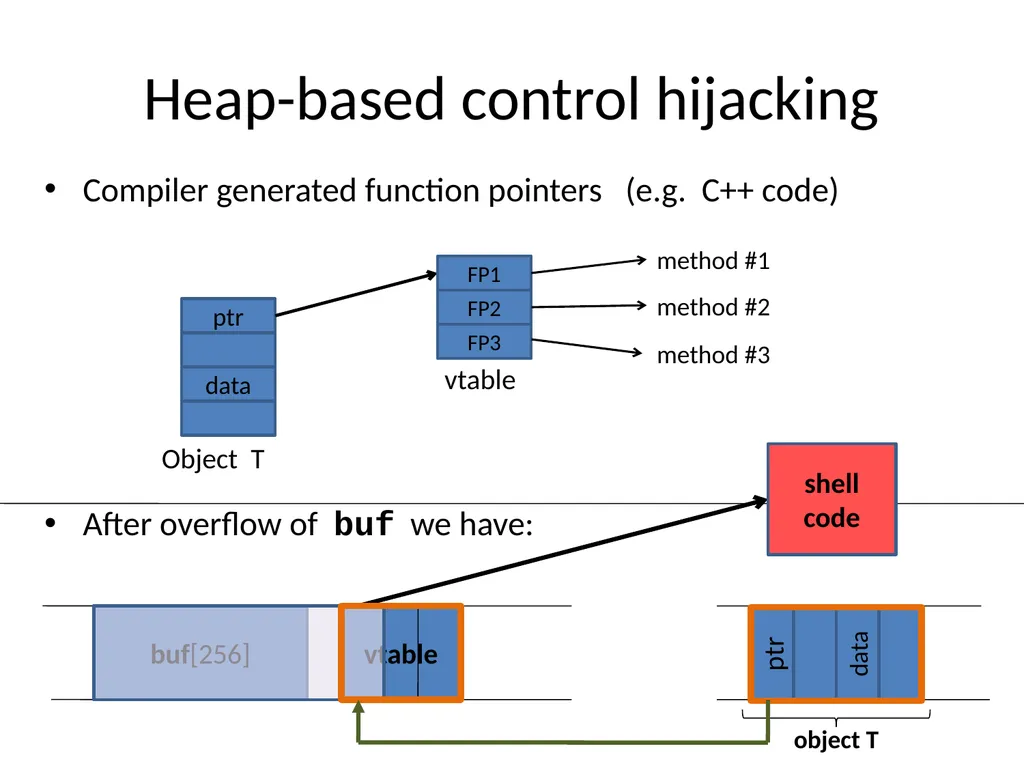
slide12. Heap-based control hijacking Compiler generated function pointers (e.g. C++ code)
After overflow of buf we have: ptr data Object T FP1 FP2 FP3 vtable method #1 method #2 method #3 ptr buf[256] data vtable shellcode<br>
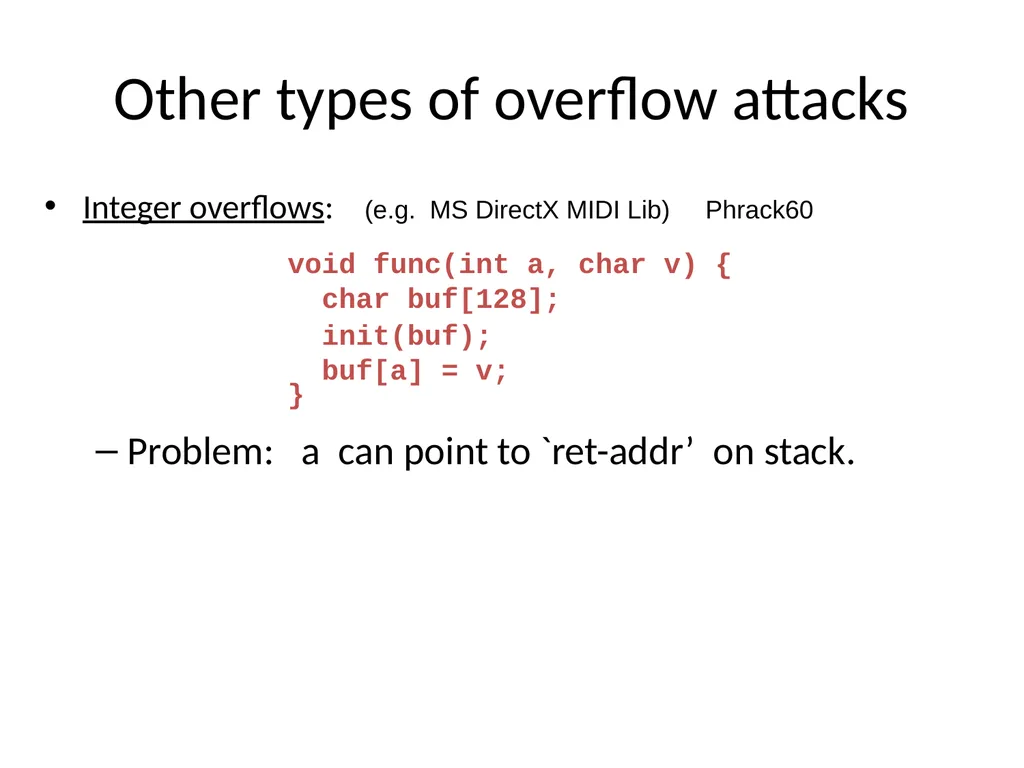
slide13. Other types of overflow attacks Integer overflows: (e.g. MS DirectX MIDI Lib) Phrack60
void func(int a, char v) { char buf[128];
init(buf);
buf[a] = v; }
Problem: a can point to `ret-addr’ on stack.<br>
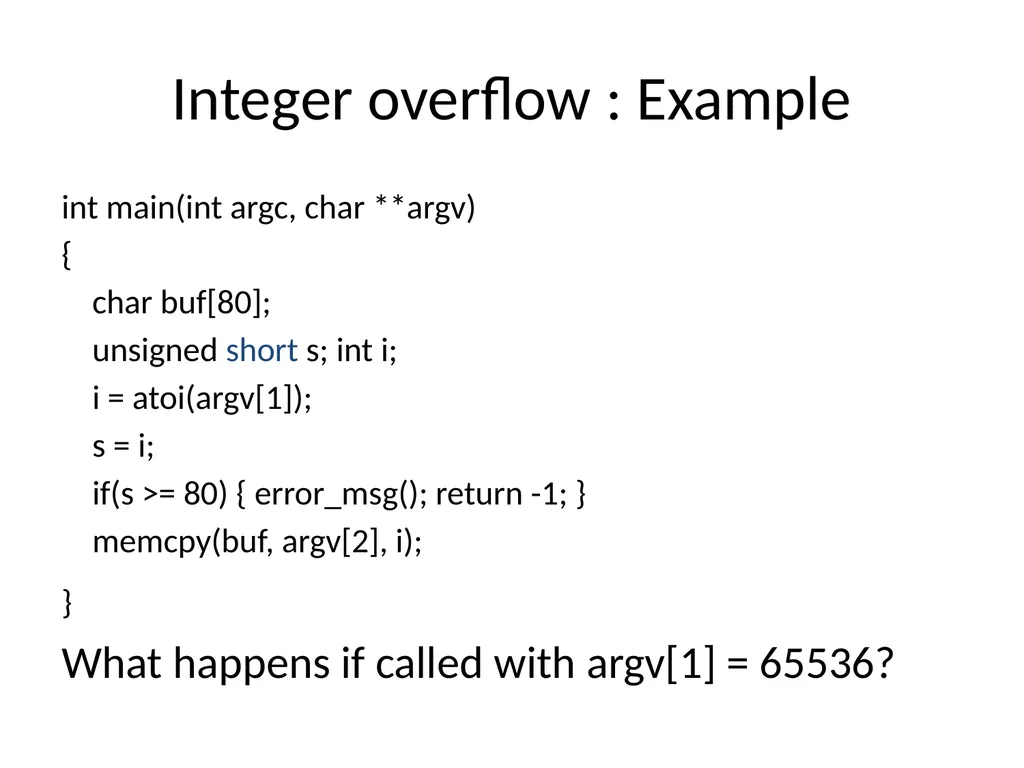
slide14. Integer overflow : Example int main(int argc, char **argv)
{
char buf[80];
unsigned short s; int i;
i = atoi(argv[1]);
s = i;
if(s >= 80) { error_msg(); return -1; }
memcpy(buf, argv[2], i);
}
What happens if called with argv[1] = 65536?<br>
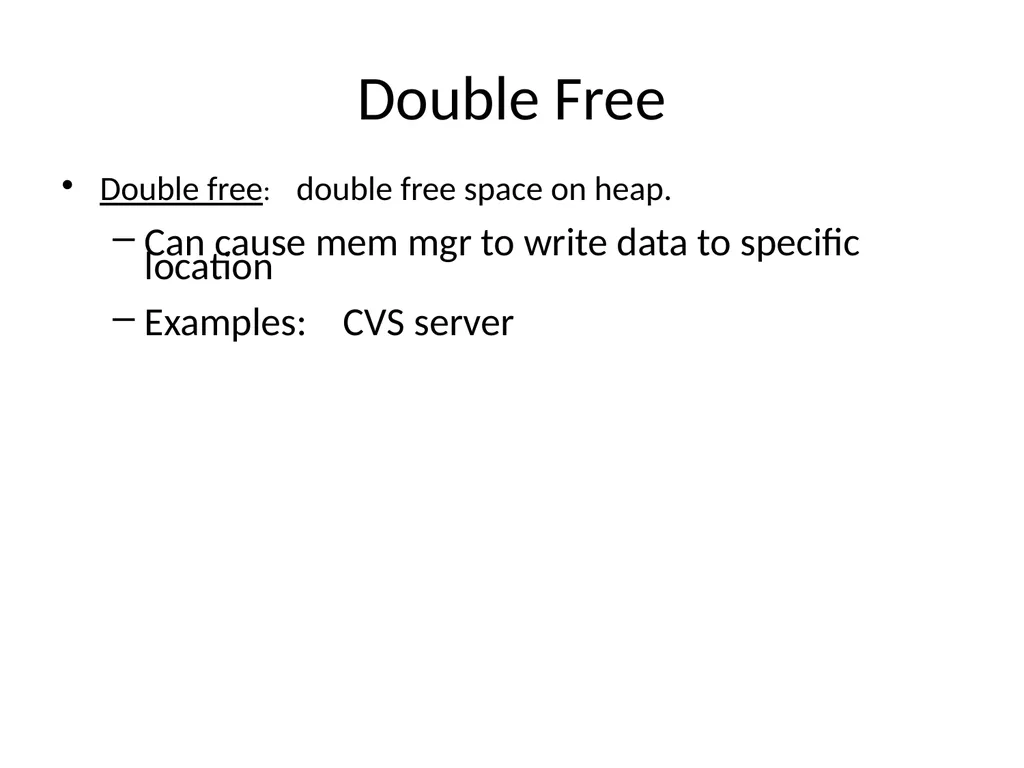
slide15. Double Free Double free: double free space on heap.
Can cause mem mgr to write data to specific location
Examples: CVS server<br>
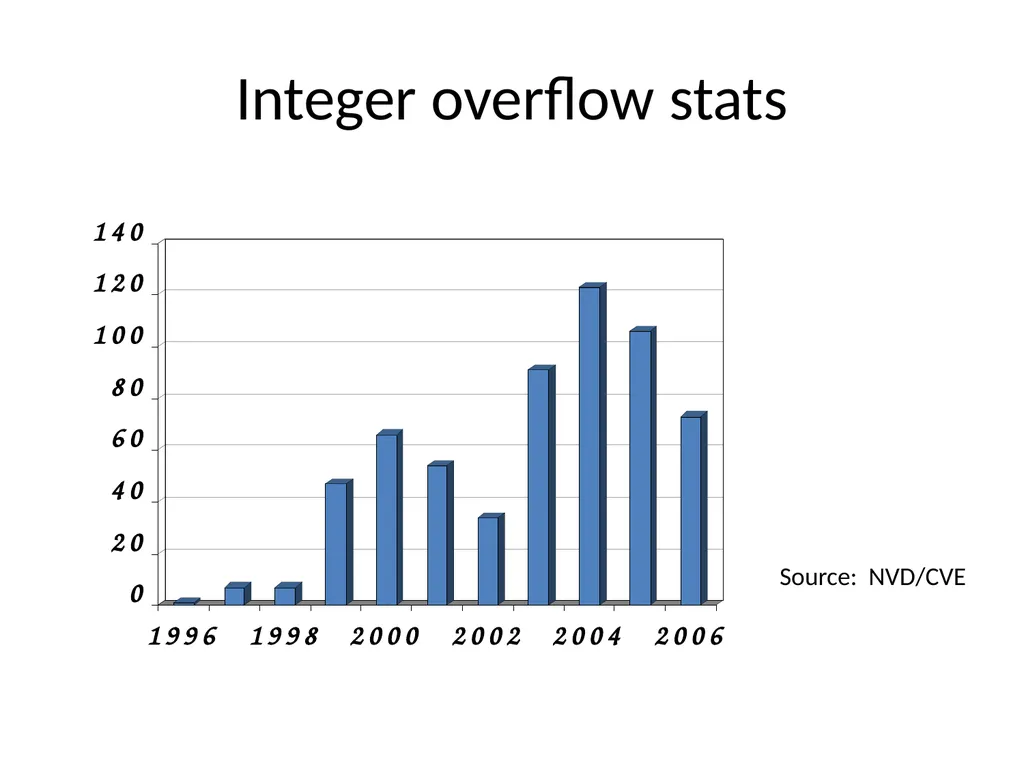
slide16. Source: NVD/CVE Integer overflow stats<br>
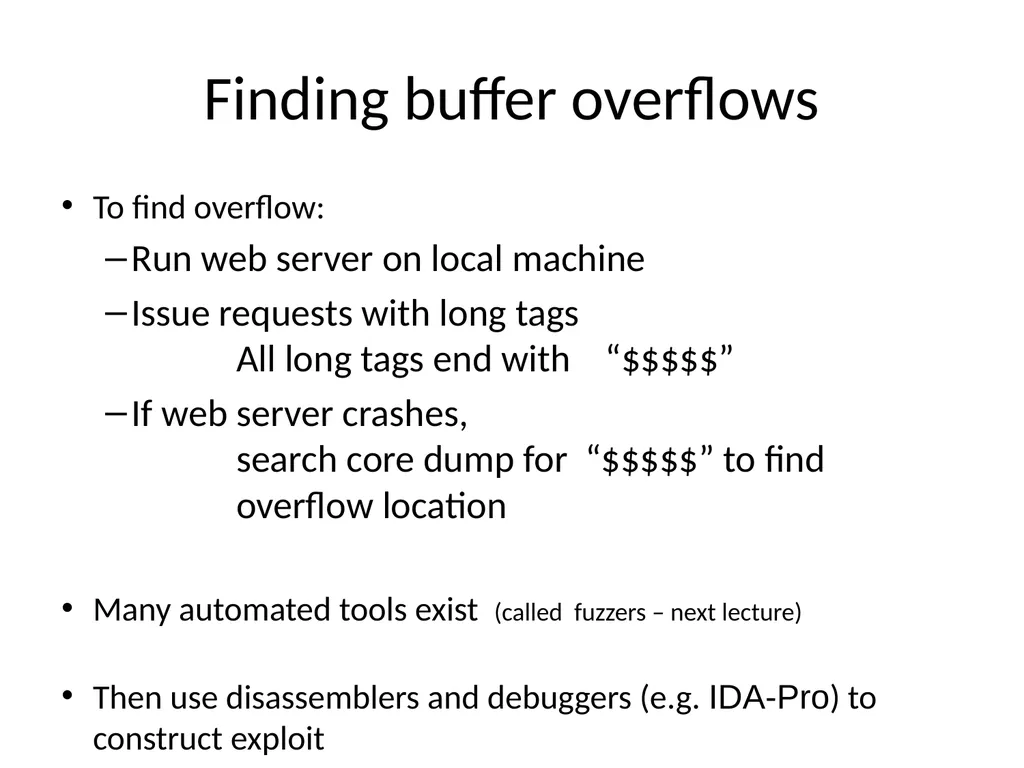
slide17. Finding buffer overflows To find overflow:
Run web server on local machine
Issue requests with long tags All long tags end with “$$$$$”
If web server crashes, search core dump for “$$$$$” to find overflow location
Many automated tools exist (called fuzzers – next lecture)
Then use disassemblers and debuggers (e.g. IDA-Pro) to construct exploit<br>
slide18. Format string bugs<br>
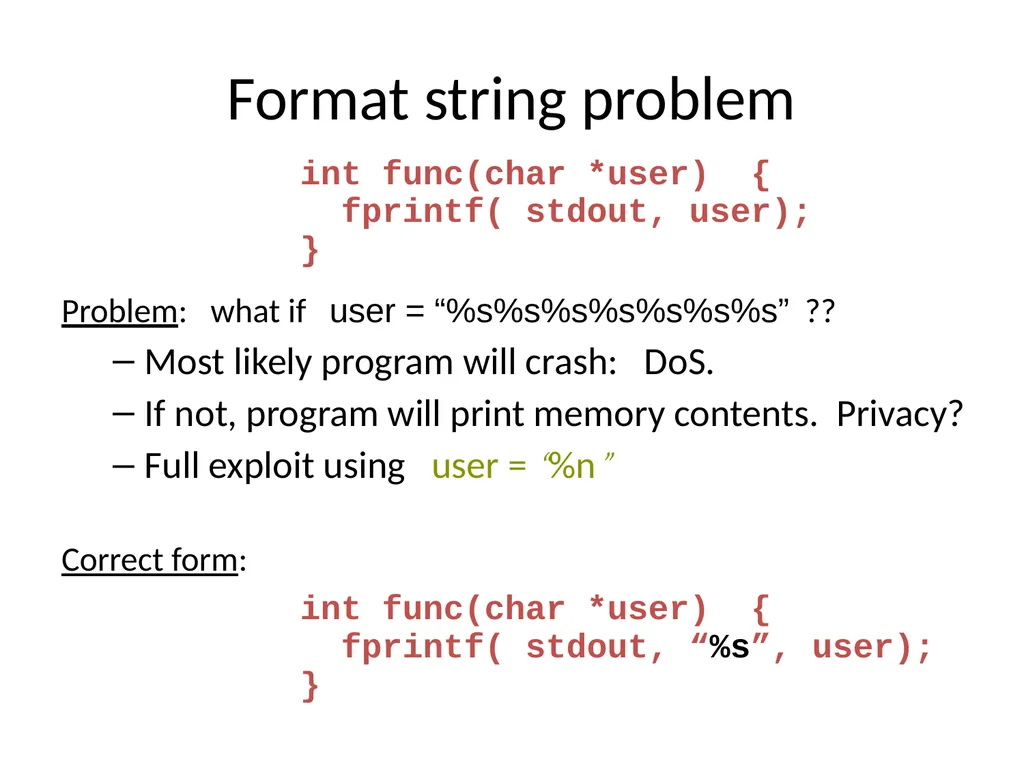
slide19. Format string problem int func(char *user) {
fprintf( stdout, user);
}
Problem: what if user = “%s%s%s%s%s%s%s” ??
Most likely program will crash: DoS.
If not, program will print memory contents. Privacy?
Full exploit using user = “%n”
Correct form:
int func(char *user) {
fprintf( stdout, “%s”, user);
}<br>
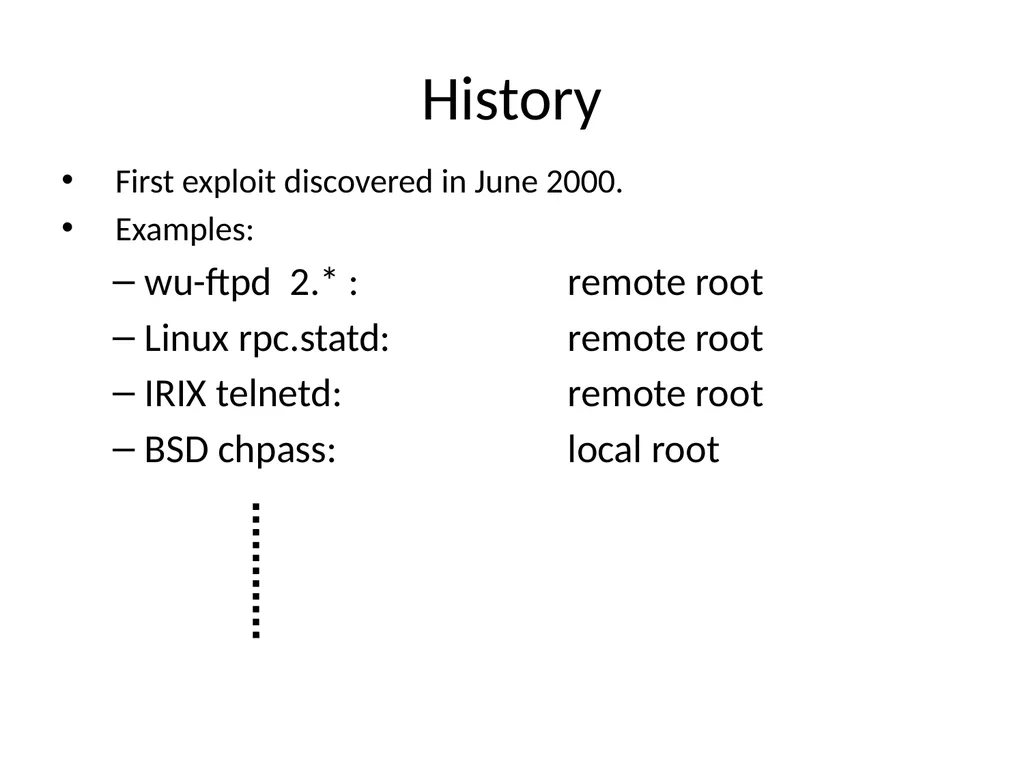
slide20. History First exploit discovered in June 2000.
Examples:
wu-ftpd 2.* : remote root
Linux rpc.statd: remote root
IRIX telnetd: remote root
BSD chpass: local root<br>
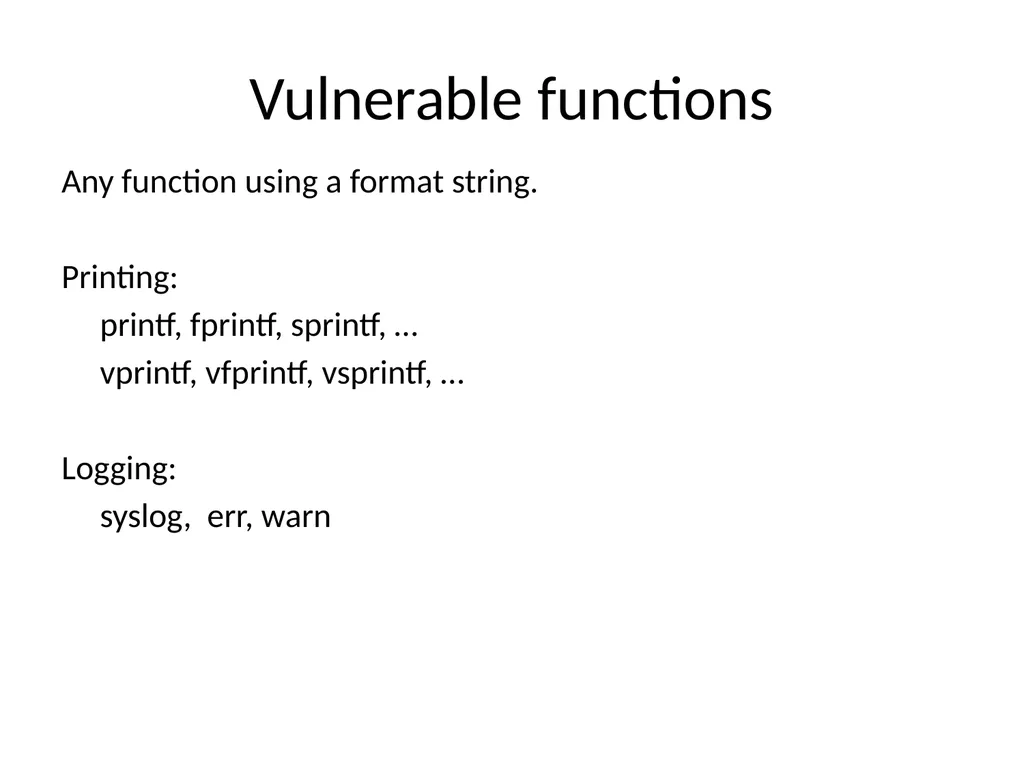
slide21. Vulnerable functions Any function using a format string.

Printing:
printf, fprintf, sprintf, …
vprintf, vfprintf, vsprintf, …
Logging:
syslog, err, warn<br>
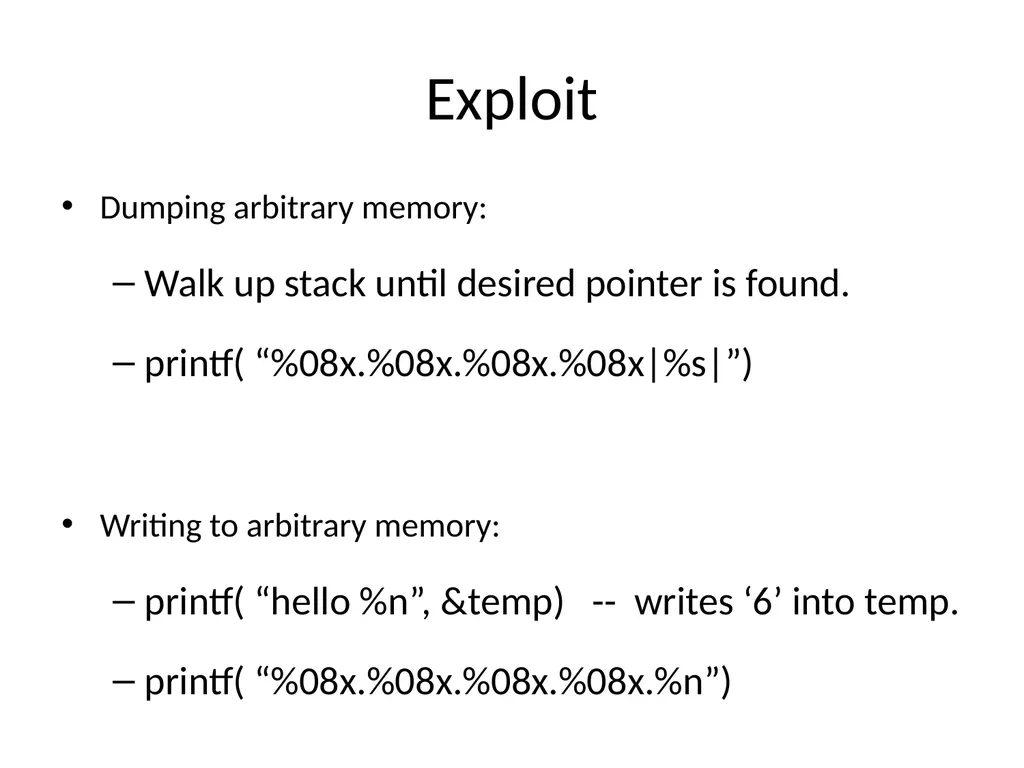
slide22. Exploit Dumping arbitrary memory:
Walk up stack until desired pointer is found.
printf( “%08x.%08x.%08x.%08x|%s|”)
Writing to arbitrary memory:
printf( “hello %n”, &temp) -- writes ‘6’ into temp.
printf( “%08x.%08x.%08x.%08x.%n”)<br>
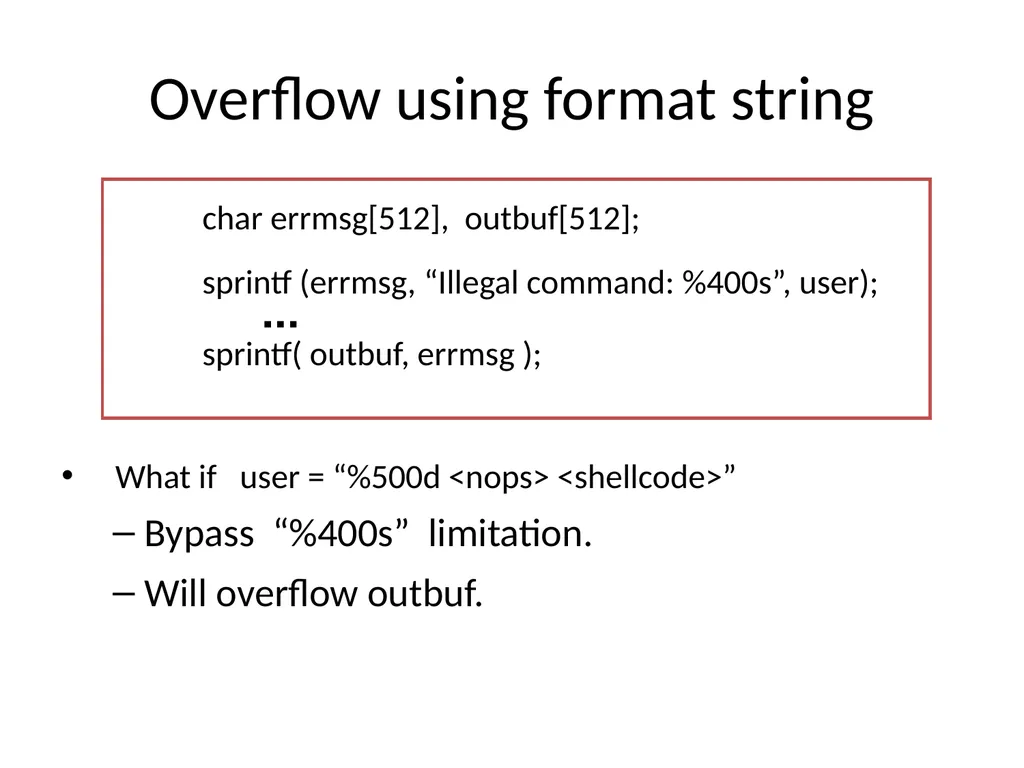
slide23. Overflow using format string char errmsg[512], outbuf[512];
sprintf (errmsg, “Illegal command: %400s”, user);
sprintf( outbuf, errmsg );
What if user = “%500d <nops> <shellcode>”
Bypass “%400s” limitation.
Will overflow outbuf.<br>
Take over target machine (e.g. web server)
Execute arbitrary code on target by hijacking application control flow
This lecture: three examples.
Buffer overflow attacks
Integer overflow attacks
Format string vulnerabilities<br>
slide2. 1. Buffer overflows Extremely common bug.
First major exploit: 1988 Internet Worm. fingerd.
Developing buffer overflow attacks:
Locate buffer overflow within an application.
Design an exploit. Source: NVD/CVE 20% of all vuln.
2005-2007: 10%<br>
slide3. What is needed Understanding C functions and the stack
Some familiarity with machine code
Know how systems calls are made
The exec() system call
Attacker needs to know which CPU and OS are running on the target machine:
Our examples are for x86 running Linux
Details vary slightly between CPUs and OSs:
Little endian vs. big endian (x86 vs. Motorola)
Stack Frame structure (Unix vs. Windows)
Stack growth direction<br>
slide4. Linux process memory layout unused 0x08048000 run time heap shared libraries user stack 0x40000000 0xC0000000 %esp brk Loaded from exec 0<br>
slide5. Stack Frame Parameters Return address Stack Frame Pointer Local variables SP Stack
Growth<br>
slide6. What are buffer overflows? Suppose a web server contains a function: void func(char *str) { char buf[128];
strcpy(buf, str); do-something(buf); }
When the function is invoked the stack looks like:
What if *str is 136 bytes long? After strcpy:<br>
slide7. Basic stack exploit Problem: no range checking in strcpy().
Suppose *str is such that after strcpy stack looks like:
When func() exits, the user will be given a shell !
Note: attack code runs in stack.
To determine ret guess position of stack when func() is called (exact shell code by Aleph One)<br>
slide8. Many unsafe C lib functions strcpy (char *dest, const char *src)
strcat (char *dest, const char *src)
gets (char *s)
scanf ( const char *format, … )
“Safe” versions strncpy(), strncat() are misleading
strncpy() may leave buffer unterminated.
strncpy(), strncat() encourage off by 1 bugs.<br>
slide9. Exploiting buffer overflows Suppose web server calls func() with given URL.
Attacker sends a 200 byte URL. Gets shell on web server
Some complications:
Program P should not contain the ‘\0’ character.
Overflow should not crash program before func() exists.
Sample remote buffer overflows of this type:
(2005) Overflow in MIME type field in MS Outlook.
(2005) Overflow in Symantec Virus Detection
Set test = CreateObject("Symantec.SymVAFileQuery.1") test.GetPrivateProfileString "file", [long string]<br>
slide10. Control hijacking opportunities Stack smashing attack:
Override return address in stack activation record by overflowing a local buffer variable.
Function pointers: (e.g. PHP 4.0.2, MS MediaPlayer Bitmaps)
Overflowing buf will override function pointer.
Longjmp buffers: longjmp(pos) (e.g. Perl 5.003)
Overflowing buf next to pos overrides value of pos.<br>
slide11. Heap-based control hijacking Compiler generated function pointers (e.g. C++ code)
Suppose vtable is on the heap next to a string object: ptr data Object T FP1 FP2 FP3 vtable method #1 method #2 method #3 ptr buf[256] data vtable<br>
slide12. Heap-based control hijacking Compiler generated function pointers (e.g. C++ code)
After overflow of buf we have: ptr data Object T FP1 FP2 FP3 vtable method #1 method #2 method #3 ptr buf[256] data vtable shellcode<br>
slide13. Other types of overflow attacks Integer overflows: (e.g. MS DirectX MIDI Lib) Phrack60
void func(int a, char v) { char buf[128];
init(buf);
buf[a] = v; }
Problem: a can point to `ret-addr’ on stack.<br>
slide14. Integer overflow : Example int main(int argc, char **argv)
{
char buf[80];
unsigned short s; int i;
i = atoi(argv[1]);
s = i;
if(s >= 80) { error_msg(); return -1; }
memcpy(buf, argv[2], i);
}
What happens if called with argv[1] = 65536?<br>
slide15. Double Free Double free: double free space on heap.
Can cause mem mgr to write data to specific location
Examples: CVS server<br>
slide16. Source: NVD/CVE Integer overflow stats<br>
slide17. Finding buffer overflows To find overflow:
Run web server on local machine
Issue requests with long tags All long tags end with “$$$$$”
If web server crashes, search core dump for “$$$$$” to find overflow location
Many automated tools exist (called fuzzers – next lecture)
Then use disassemblers and debuggers (e.g. IDA-Pro) to construct exploit<br>
slide18. Format string bugs<br>
slide19. Format string problem int func(char *user) {
fprintf( stdout, user);
}
Problem: what if user = “%s%s%s%s%s%s%s” ??
Most likely program will crash: DoS.
If not, program will print memory contents. Privacy?
Full exploit using user = “%n”
Correct form:
int func(char *user) {
fprintf( stdout, “%s”, user);
}<br>
slide20. History First exploit discovered in June 2000.
Examples:
wu-ftpd 2.* : remote root
Linux rpc.statd: remote root
IRIX telnetd: remote root
BSD chpass: local root<br>
slide21. Vulnerable functions Any function using a format string.
Printing:
printf, fprintf, sprintf, …
vprintf, vfprintf, vsprintf, …
Logging:
syslog, err, warn<br>
slide22. Exploit Dumping arbitrary memory:
Walk up stack until desired pointer is found.
printf( “%08x.%08x.%08x.%08x|%s|”)
Writing to arbitrary memory:
printf( “hello %n”, &temp) -- writes ‘6’ into temp.
printf( “%08x.%08x.%08x.%08x.%n”)<br>
slide23. Overflow using format string char errmsg[512], outbuf[512];
sprintf (errmsg, “Illegal command: %400s”, user);
sprintf( outbuf, errmsg );
What if user = “%500d <nops> <shellcode>”
Bypass “%400s” limitation.
Will overflow outbuf.<br>