
Control of Full Body Humanoid Push Recovery Using
TD
Published · 64 slides · 0 views

1 / 1
Description
Control of Full Body Humanoid Push Recovery Using Simple Models Benjamin Stephens Thesis Proposal Carnegie Mellon, Robotics Institute November 23, 2009 Committee: Chris Atkeson (chair) Jessica Hodgins Hartmut Geyer Jerry Pratt (IHMC) 2
Related Topics
Share
Embed code
Download this presentation From Below
"Control of Full Body Humanoid Push Recovery Using" is the property of its rightful owner. Permission is granted to download and print the materials on this website for personal, non-commercial use only, and to display it on your personal computer provided you do not modify the materials and that you retain all copyright notices contained in the materials. By downloading content from our website, you accept the terms of this agreement.
Presentation Transcript
01
Control of Full Body Humanoid Push Recovery Using Simple Models Benjamin Stephens
Thesis Proposal
Carnegie Mellon, Robotics Institute
November 23, 2009 Committee:
Chris Atkeson (chair) Jessica Hodgins
Hartmut Geyer Jerry Pratt (IHMC)<br>
Thesis Proposal
Carnegie Mellon, Robotics Institute
November 23, 2009 Committee:
Chris Atkeson (chair) Jessica Hodgins
Hartmut Geyer Jerry Pratt (IHMC)<br>
02
2<br>
03
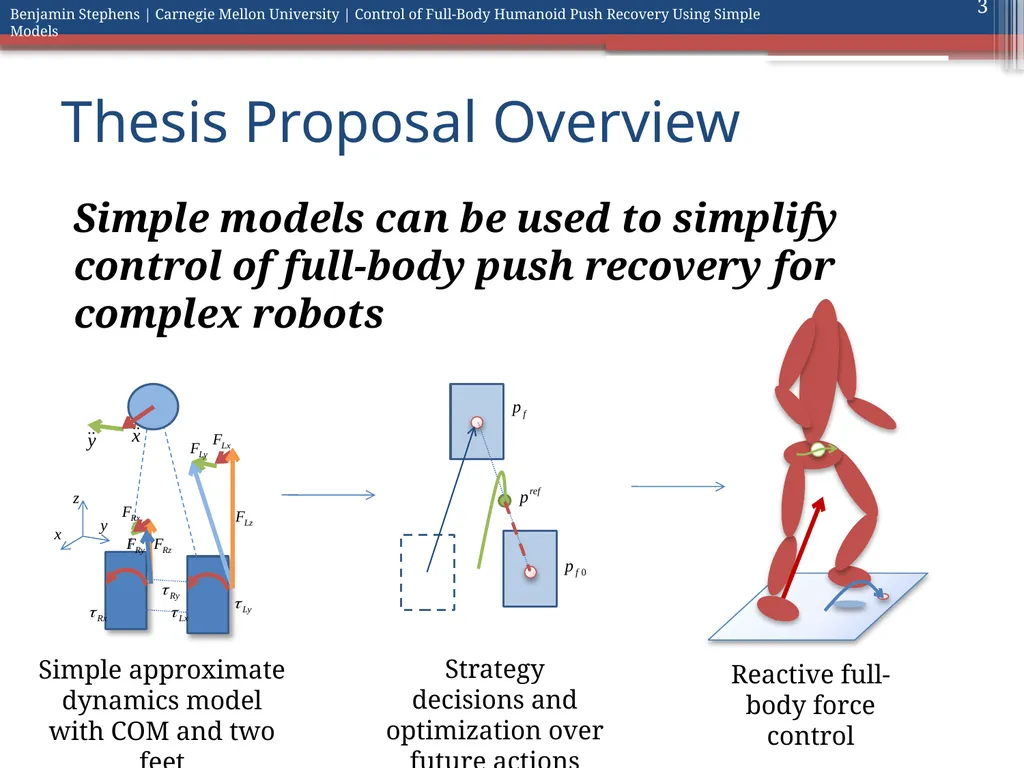
Thesis Proposal Overview Simple models can be used to simplify control of full-body push recovery for complex robots 3 Strategy decisions and optimization over future actions Simple approximate dynamics model with COM and two feet Reactive full-body force control<br>
04
Motivations Improve the performance and usefulness of complex robots, simplifying controller design by focusing on simpler models that capture important features of the desired behavior
Enabling dynamic robots to interact safely with people in everyday uncertain environments
Modeling human balance sensing, planning and motor control to help people with balance disabilities 4<br>
Enabling dynamic robots to interact safely with people in everyday uncertain environments
Modeling human balance sensing, planning and motor control to help people with balance disabilities 4<br>
05
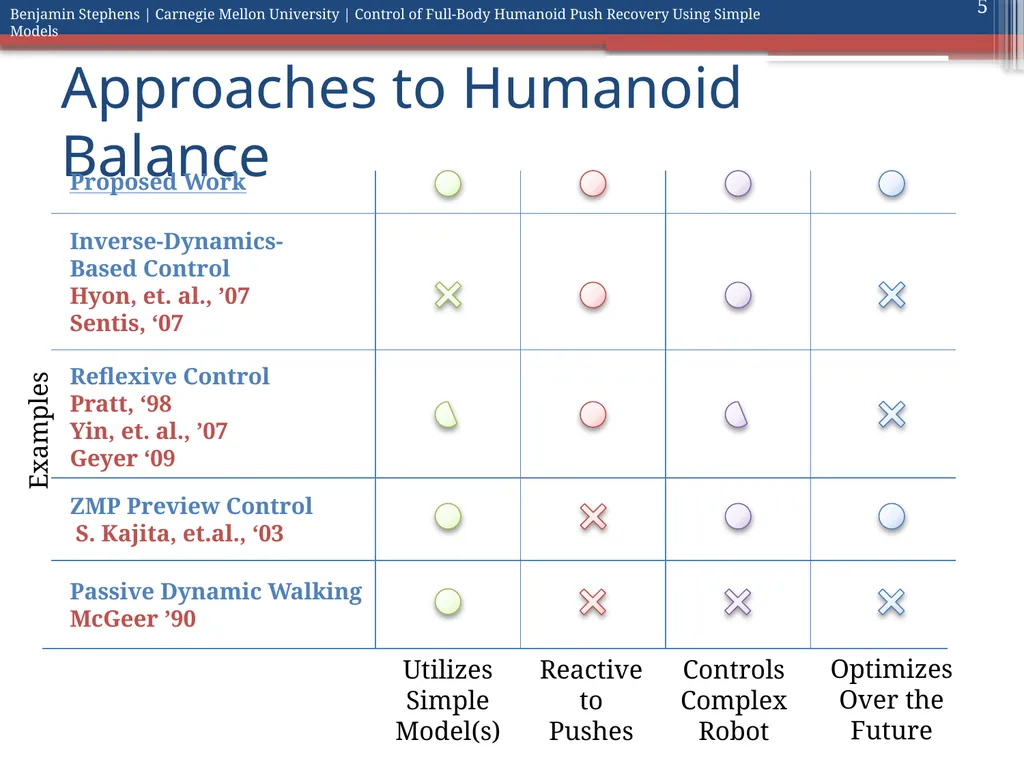
Approaches to Humanoid Balance 5 Controls Complex Robot Utilizes Simple Model(s) Reactive to Pushes Optimizes Over the Future ZMP Preview Control
S. Kajita, et.al., ‘03 Reflexive Control
Pratt, ‘98
Yin, et. al., ’07
Geyer ‘09 Passive Dynamic Walking McGeer ’90 Inverse-Dynamics-Based Control
Hyon, et. al., ’07
Sentis, ‘07 Proposed Work Examples<br>
Pratt, ‘98
Yin, et. al., ’07
Geyer ‘09 Passive Dynamic Walking McGeer ’90 Inverse-Dynamics-Based Control
Hyon, et. al., ’07
Sentis, ‘07 Proposed Work Examples<br>
06
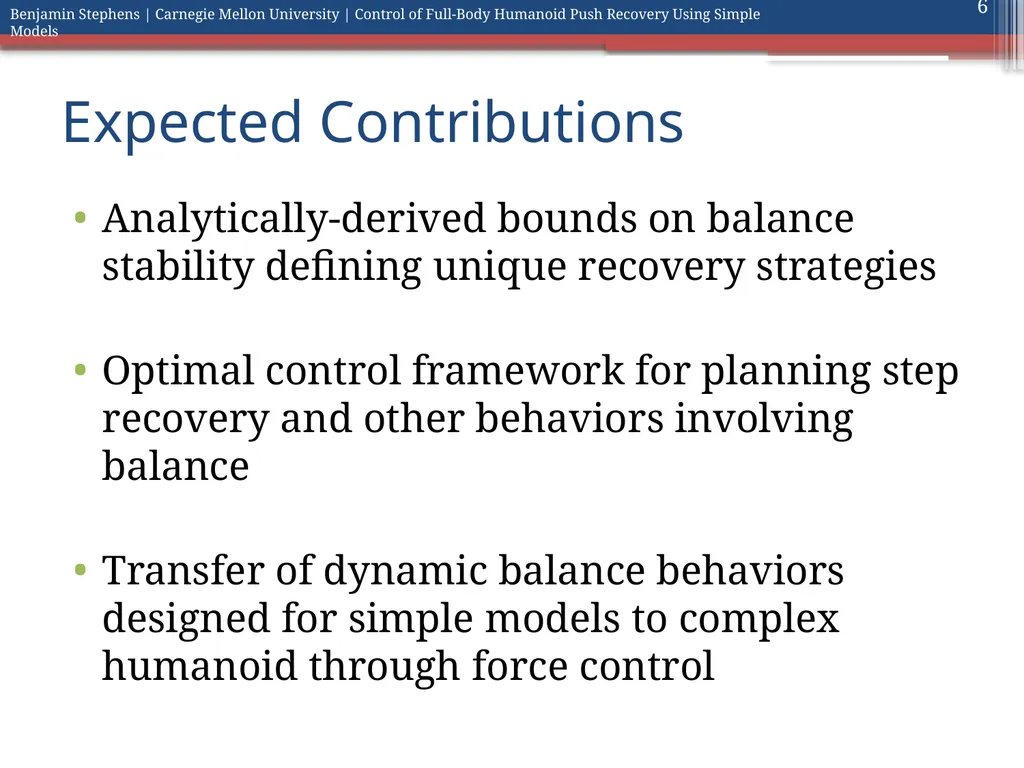
Expected Contributions Analytically-derived bounds on balance stability defining unique recovery strategies
Optimal control framework for planning step recovery and other behaviors involving balance
Transfer of dynamic balance behaviors designed for simple models to complex humanoid through force control 6<br>
Optimal control framework for planning step recovery and other behaviors involving balance
Transfer of dynamic balance behaviors designed for simple models to complex humanoid through force control 6<br>
07
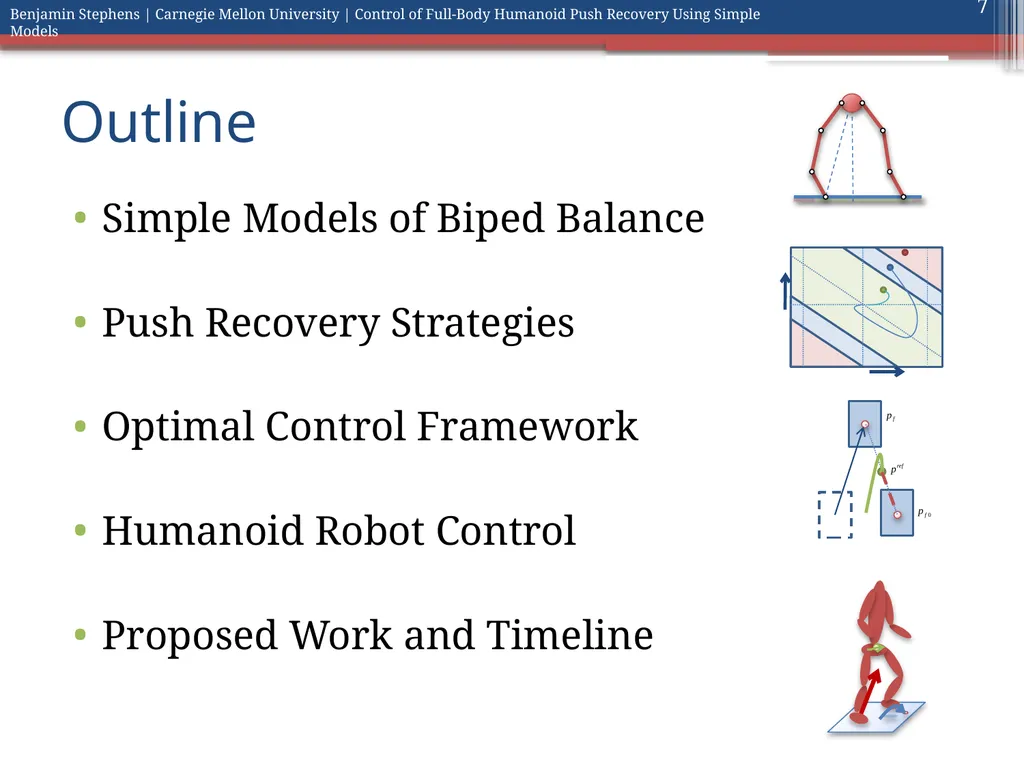
Outline Simple Models of Biped Balance
Push Recovery Strategies
Optimal Control Framework
Humanoid Robot Control
Proposed Work and Timeline 7<br>
Push Recovery Strategies
Optimal Control Framework
Humanoid Robot Control
Proposed Work and Timeline 7<br>
08
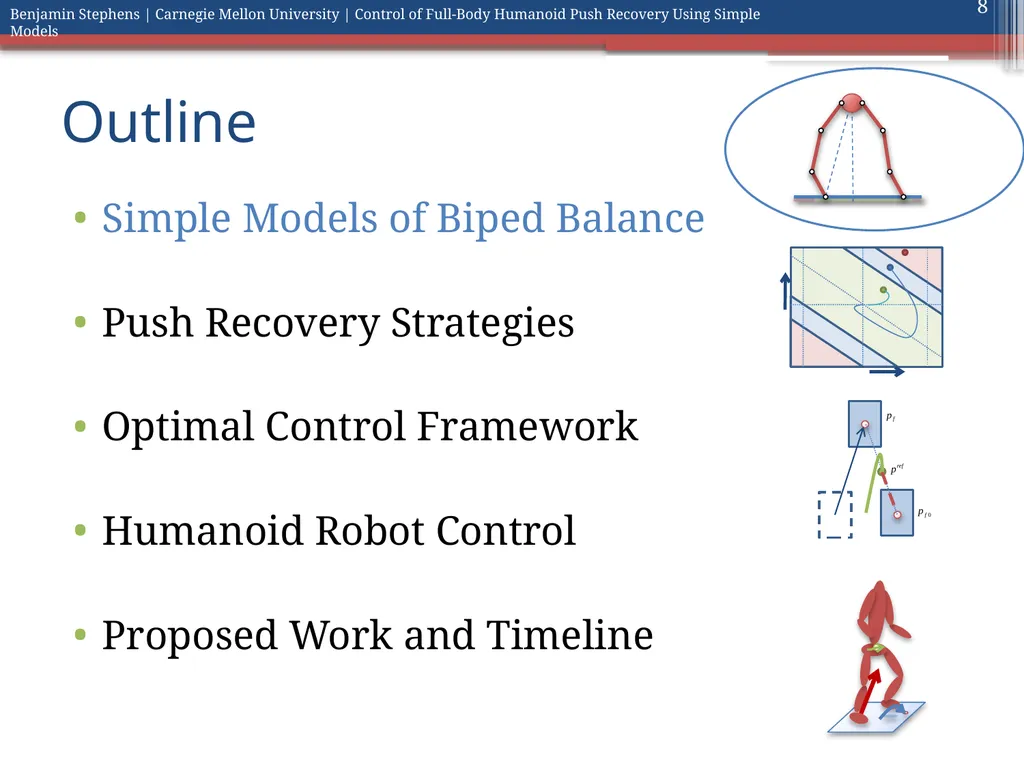
Outline Simple Models of Biped Balance
Push Recovery Strategies
Optimal Control Framework
Humanoid Robot Control
Proposed Work and Timeline 8<br>
Push Recovery Strategies
Optimal Control Framework
Humanoid Robot Control
Proposed Work and Timeline 8<br>
09
Outline Simple Models of Biped Balance
Push Recovery Strategies
Optimal Control Framework
Humanoid Robot Control
Proposed Work and Timeline 9<br>
Push Recovery Strategies
Optimal Control Framework
Humanoid Robot Control
Proposed Work and Timeline 9<br>
10
Outline Simple Models of Biped Balance
Push Recovery Strategies
Optimal Control Framework
Humanoid Robot Control
Proposed Work and Timeline 10<br>
Push Recovery Strategies
Optimal Control Framework
Humanoid Robot Control
Proposed Work and Timeline 10<br>
11
Outline Simple Models of Biped Balance
Push Recovery Strategies
Optimal Control Framework
Humanoid Robot Control
Proposed Work and Timeline 11<br>
Push Recovery Strategies
Optimal Control Framework
Humanoid Robot Control
Proposed Work and Timeline 11<br>
12
Outline Simple Models of Biped Balance
Push Recovery Strategies
Optimal Control Framework
Humanoid Robot Control
Proposed Work and Timeline 12<br>
Push Recovery Strategies
Optimal Control Framework
Humanoid Robot Control
Proposed Work and Timeline 12<br>
13
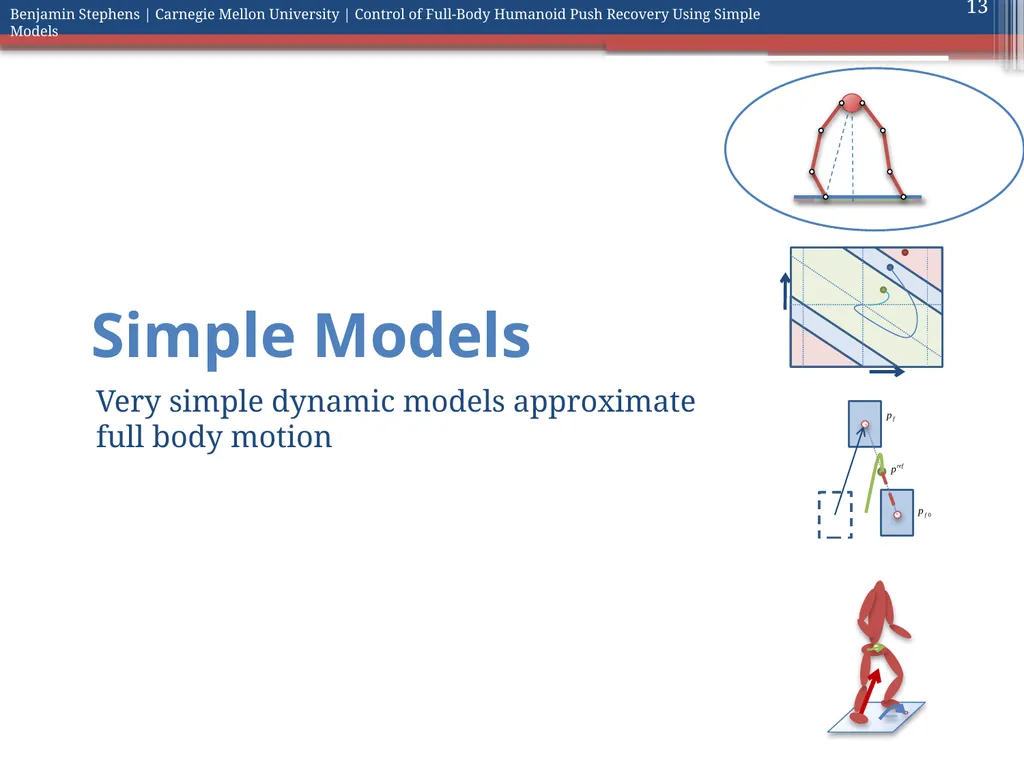
Simple Models Very simple dynamic models approximate full body motion 13<br>
14
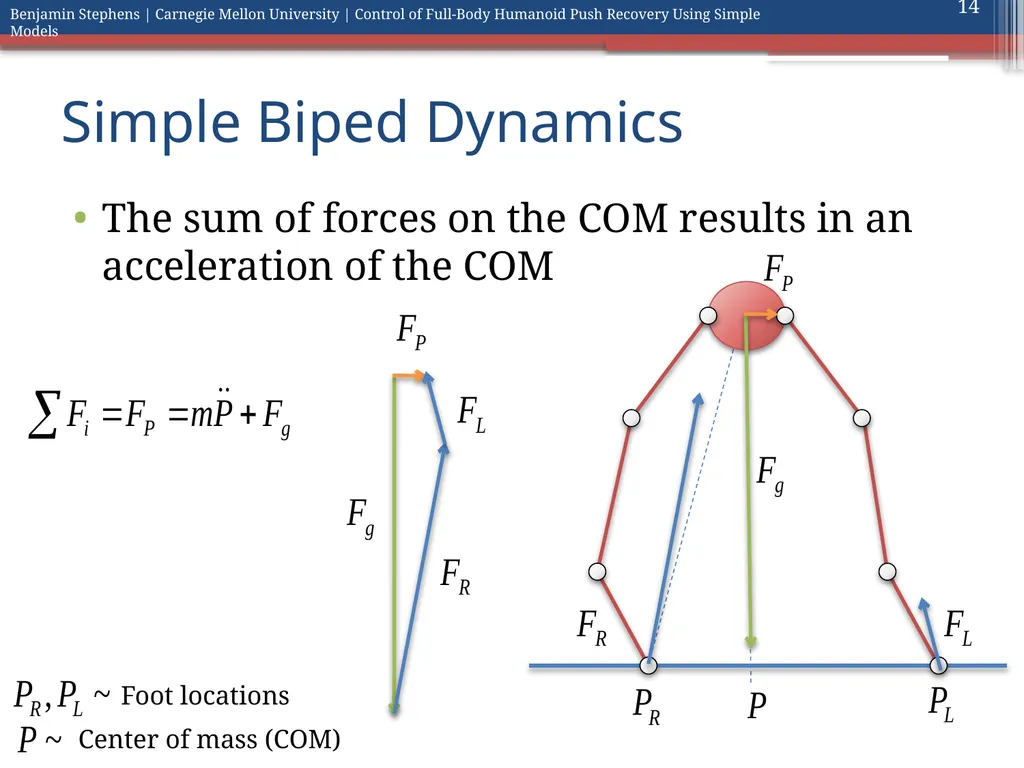
The sum of forces on the COM results in an acceleration of the COM Simple Biped Dynamics 14 Center of mass (COM) Foot locations<br>
15
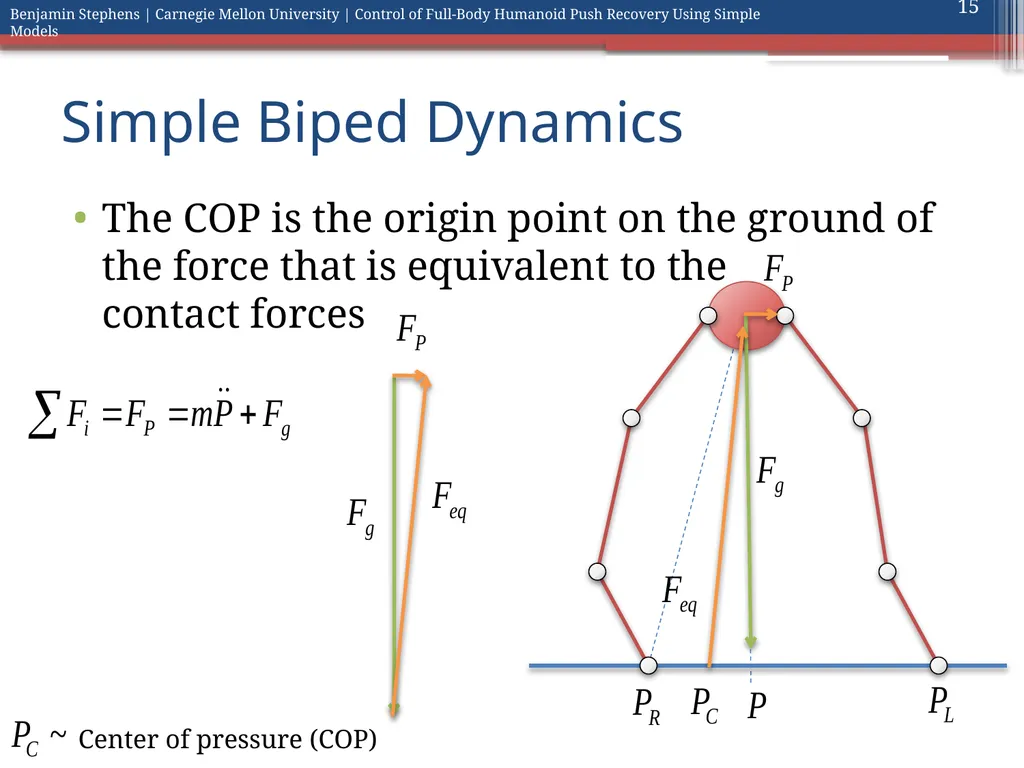
The COP is the origin point on the ground of the force that is equivalent to the
contact forces Simple Biped Dynamics 15 Center of pressure (COP)<br>
16
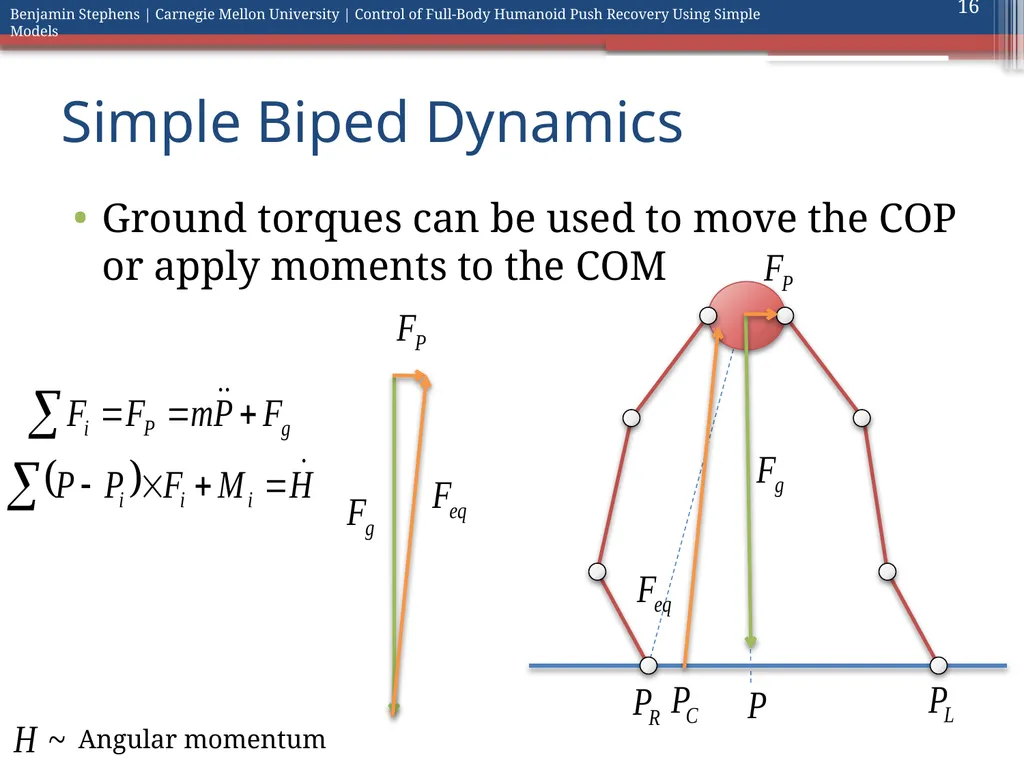
Ground torques can be used to move the COP or apply moments to the COM Simple Biped Dynamics 16 Angular momentum<br>
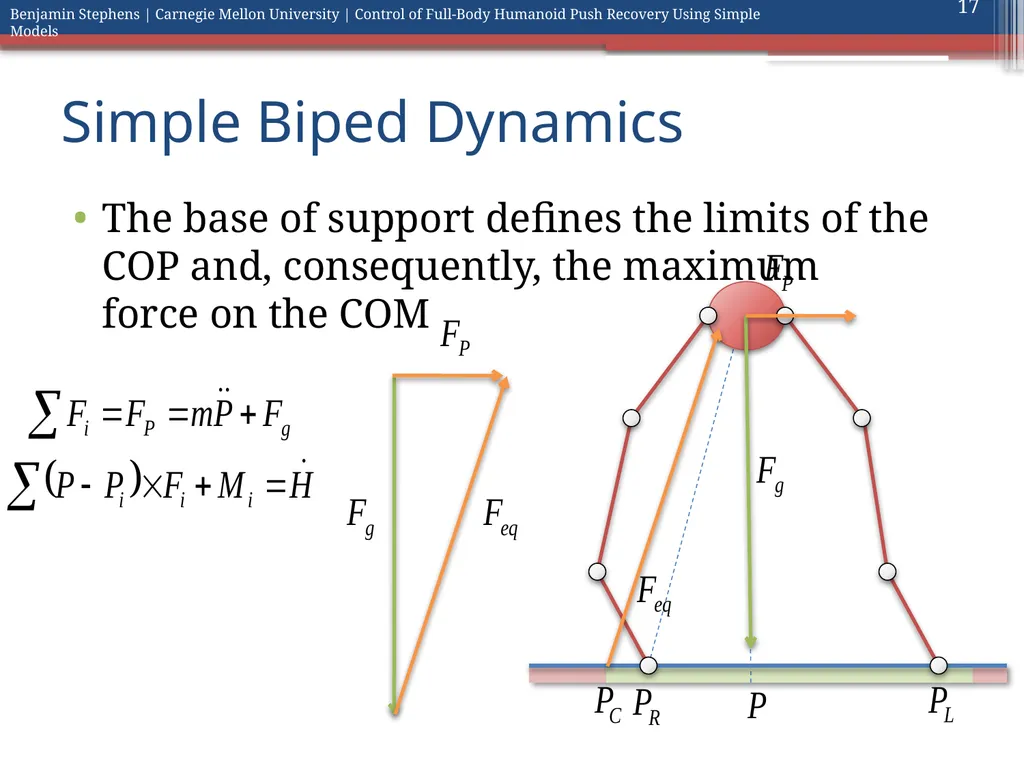
17
The base of support defines the limits of the COP and, consequently, the maximum
force on the COM Simple Biped Dynamics 17<br>
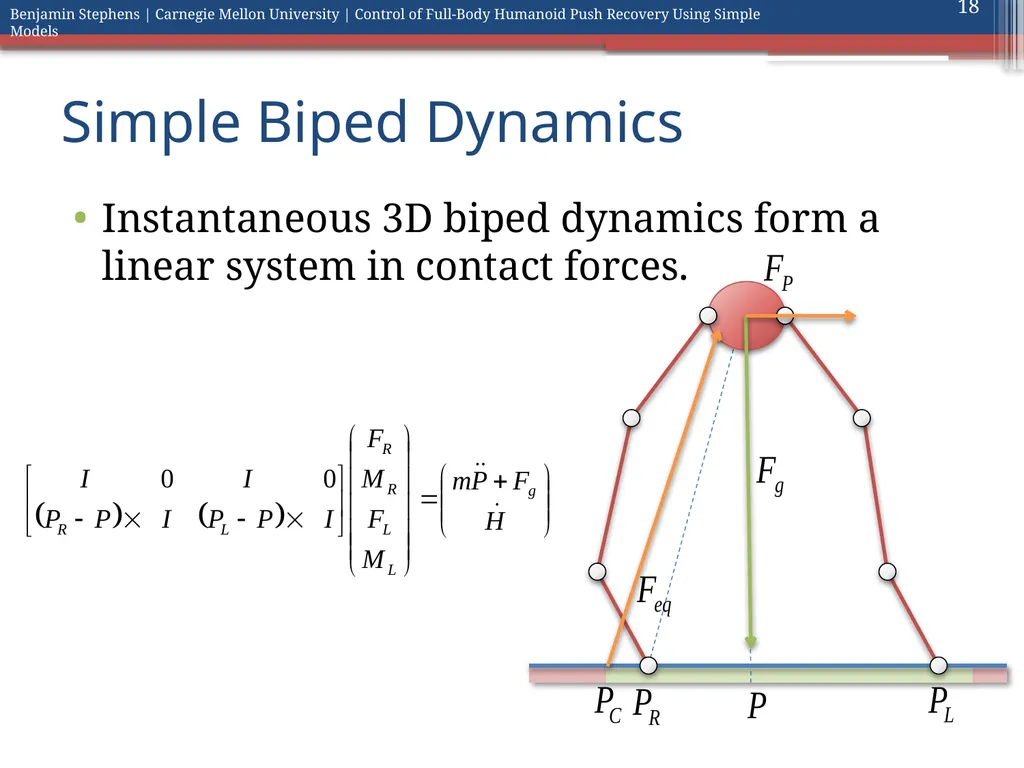
18
Instantaneous 3D biped dynamics form a linear system in contact forces. Simple Biped Dynamics 18<br>
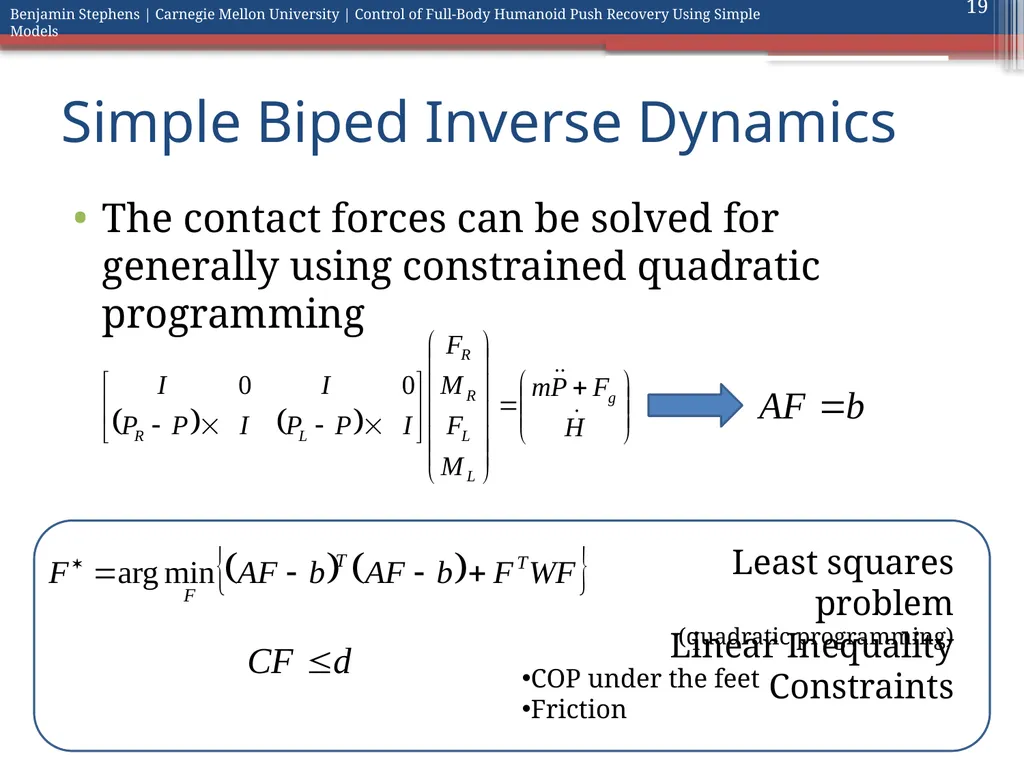
19
Simple Biped Inverse Dynamics The contact forces can be solved for generally using constrained quadratic programming 19<br>
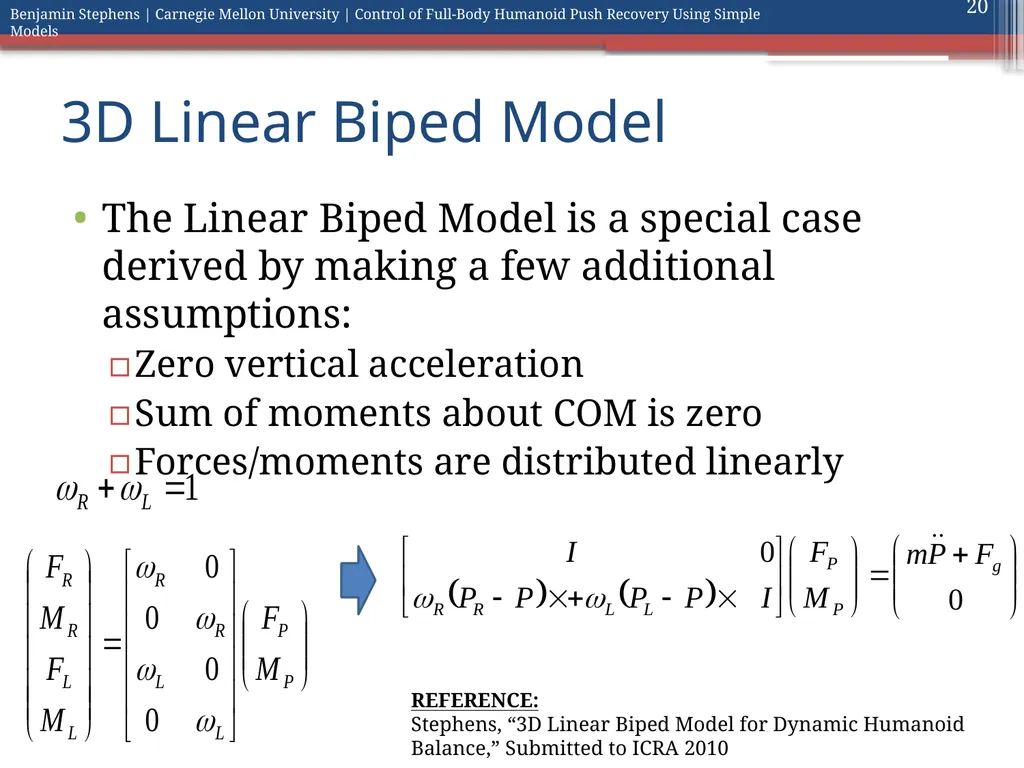
20
3D Linear Biped Model The Linear Biped Model is a special case derived by making a few additional assumptions:
Zero vertical acceleration
Sum of moments about COM is zero
Forces/moments are distributed linearly 20 REFERENCE:
Stephens, “3D Linear Biped Model for Dynamic Humanoid Balance,” Submitted to ICRA 2010<br>
Zero vertical acceleration
Sum of moments about COM is zero
Forces/moments are distributed linearly 20 REFERENCE:
Stephens, “3D Linear Biped Model for Dynamic Humanoid Balance,” Submitted to ICRA 2010<br>
21
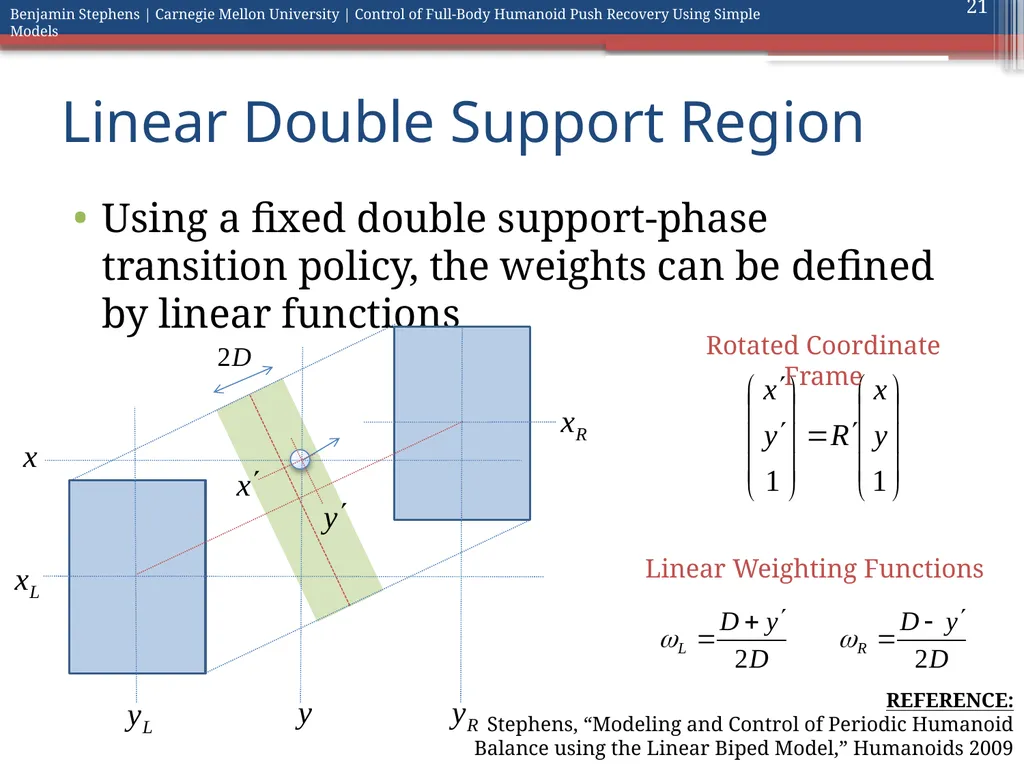
Linear Double Support Region Using a fixed double support-phase transition policy, the weights can be defined by linear functions 21 Rotated Coordinate Frame Linear Weighting Functions REFERENCE:
Stephens, “Modeling and Control of Periodic Humanoid
Balance using the Linear Biped Model,” Humanoids 2009<br>
Stephens, “Modeling and Control of Periodic Humanoid
Balance using the Linear Biped Model,” Humanoids 2009<br>
22
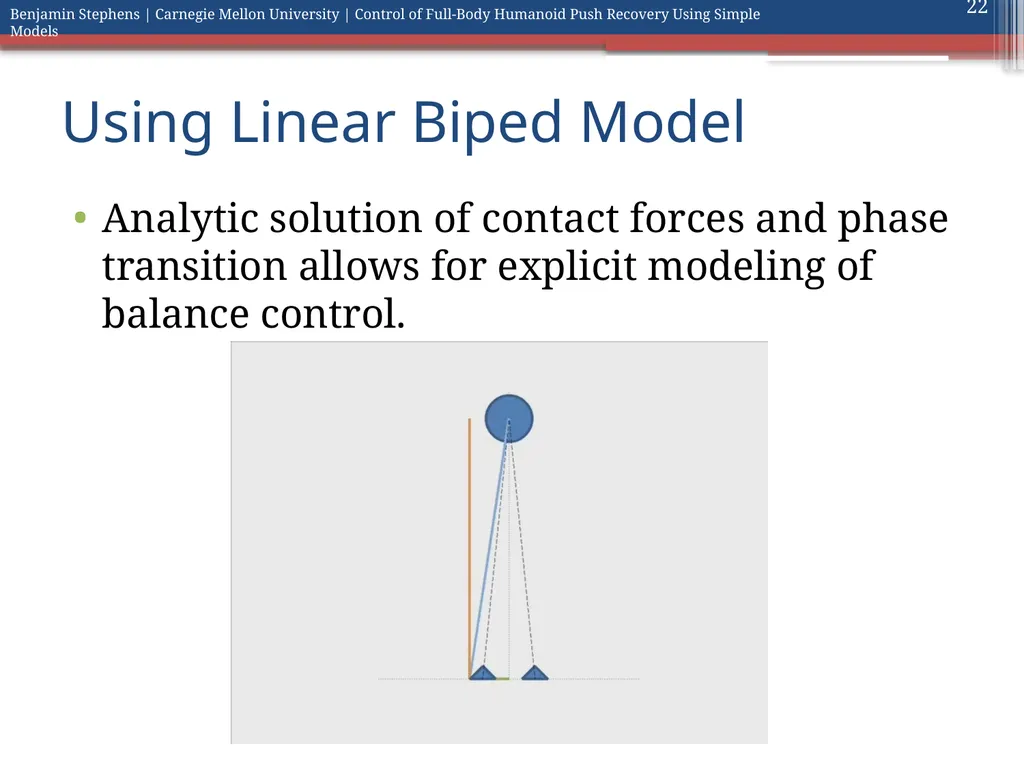
Using Linear Biped Model Analytic solution of contact forces and phase transition allows for explicit modeling of balance control. 22<br>
23
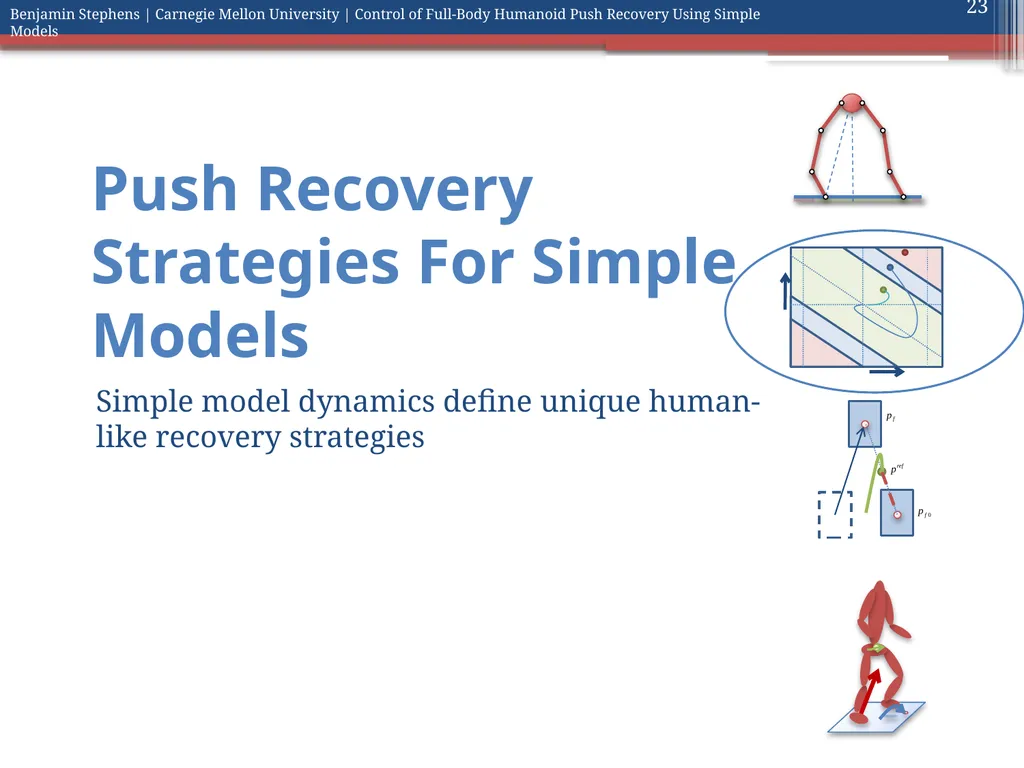
Push Recovery Strategies For Simple Models Simple model dynamics define unique human-like recovery strategies 23<br>
24
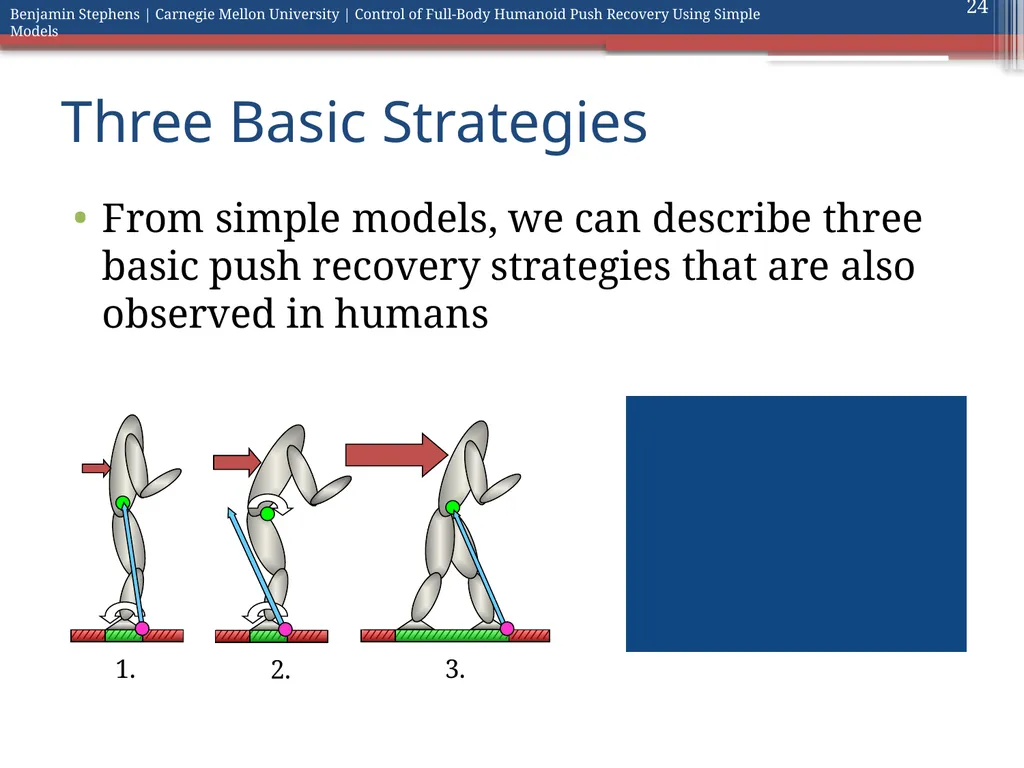
Three Basic Strategies From simple models, we can describe three basic push recovery strategies that are also observed in humans 24<br>
25
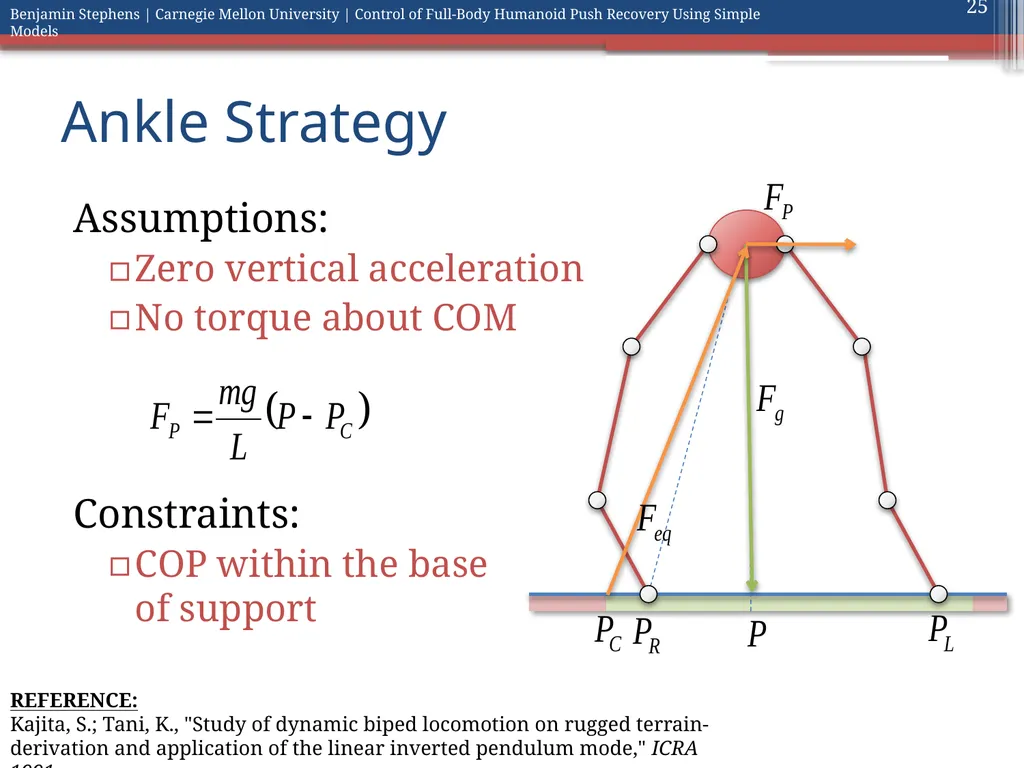
Ankle Strategy Assumptions:
Zero vertical acceleration
No torque about COM
Constraints:
COP within the base of support 25 REFERENCE:
Kajita, S.; Tani, K., "Study of dynamic biped locomotion on rugged terrain-derivation and application of the linear inverted pendulum mode," ICRA 1991<br>
Zero vertical acceleration
No torque about COM
Constraints:
COP within the base of support 25 REFERENCE:
Kajita, S.; Tani, K., "Study of dynamic biped locomotion on rugged terrain-derivation and application of the linear inverted pendulum mode," ICRA 1991<br>
26
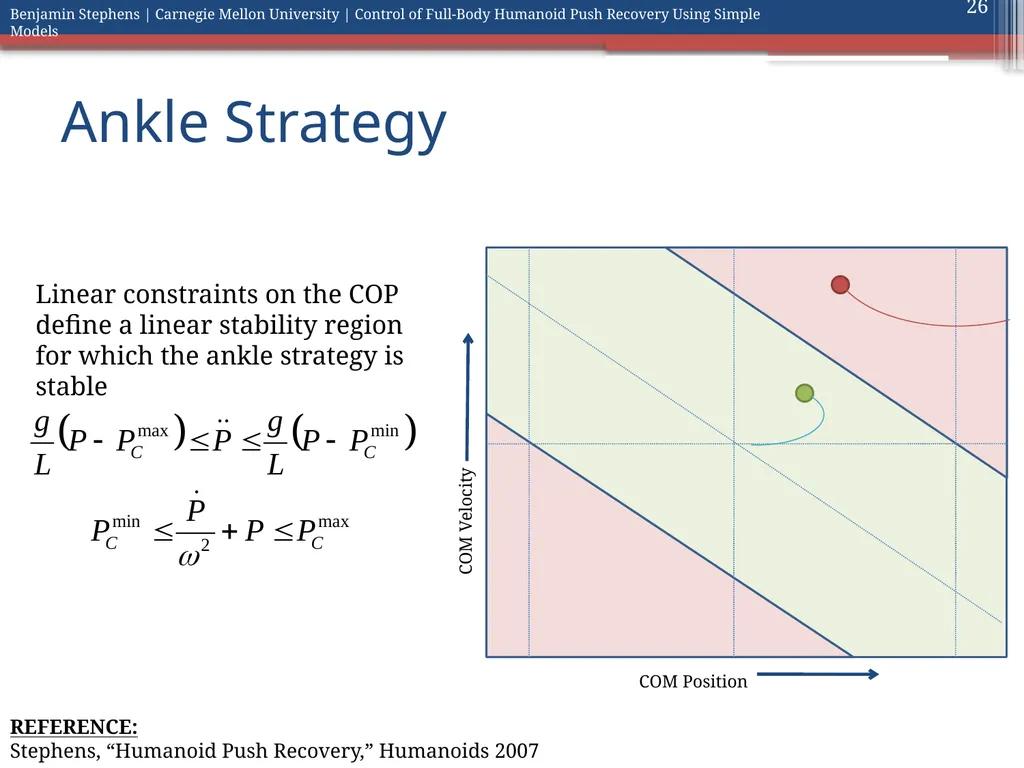
Ankle Strategy 26 COM Position COM Velocity Linear constraints on the COP define a linear stability region for which the ankle strategy is stable REFERENCE:
Stephens, “Humanoid Push Recovery,” Humanoids 2007<br>
Stephens, “Humanoid Push Recovery,” Humanoids 2007<br>
27
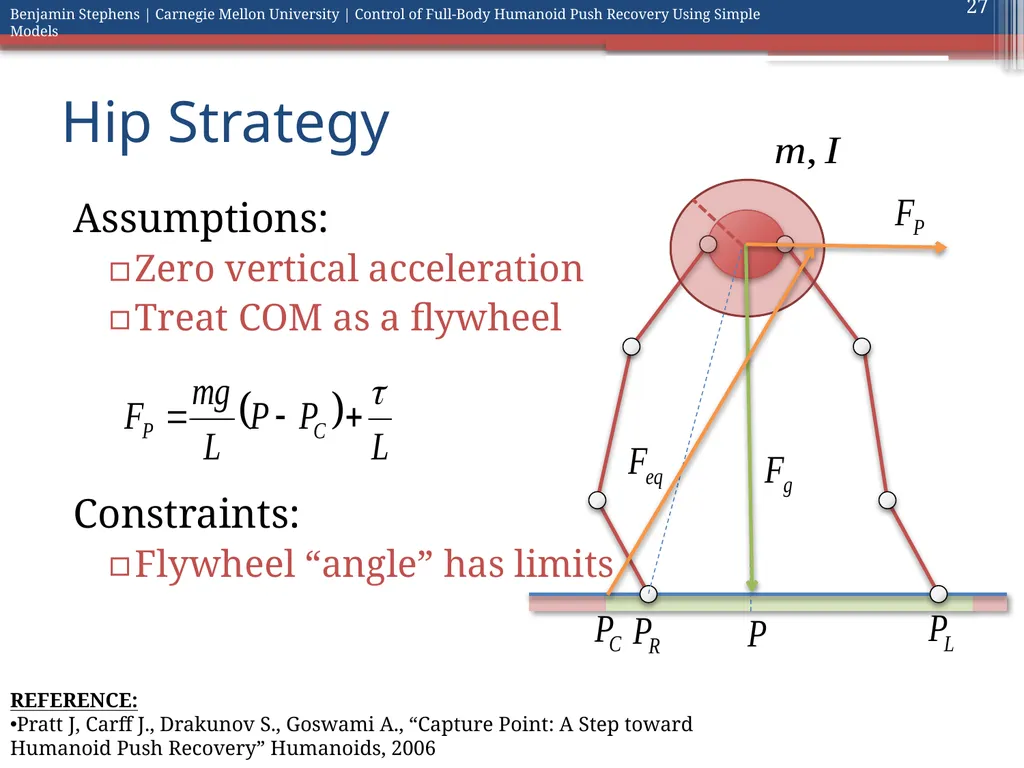
Hip Strategy Assumptions:
Zero vertical acceleration
Treat COM as a flywheel
Constraints:
Flywheel “angle” has limits 27 REFERENCE:
Pratt J, Carff J., Drakunov S., Goswami A., “Capture Point: A Step toward Humanoid Push Recovery” Humanoids, 2006<br>
Zero vertical acceleration
Treat COM as a flywheel
Constraints:
Flywheel “angle” has limits 27 REFERENCE:
Pratt J, Carff J., Drakunov S., Goswami A., “Capture Point: A Step toward Humanoid Push Recovery” Humanoids, 2006<br>
28
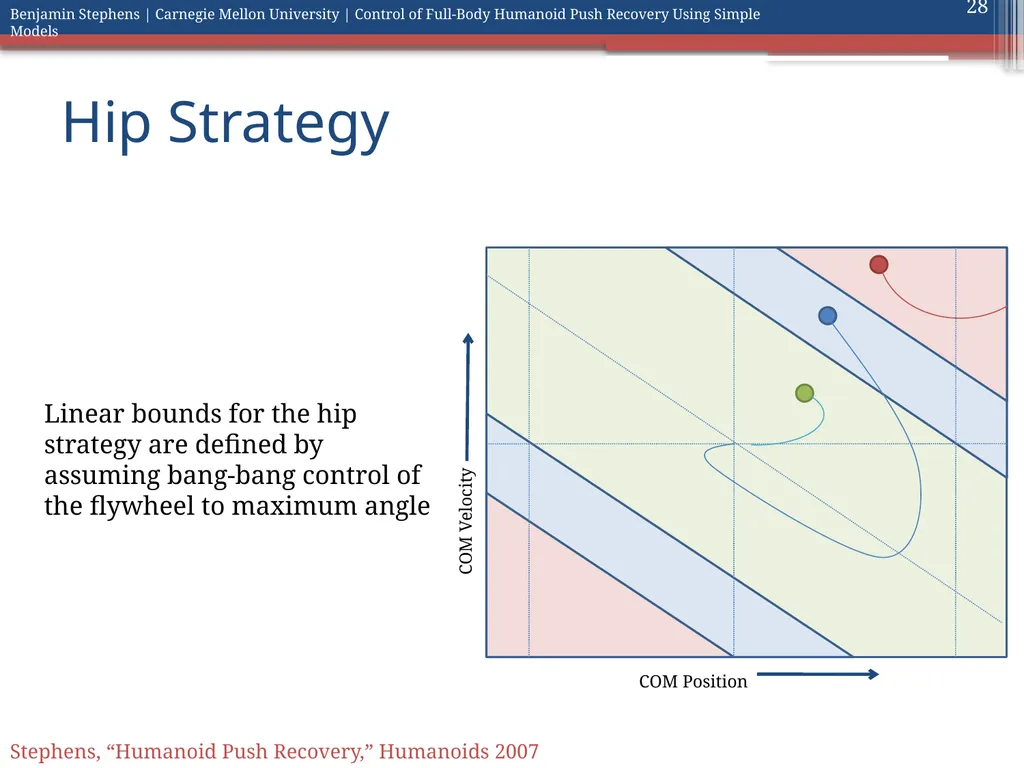
Hip Strategy 28 COM Position COM Velocity Linear bounds for the hip strategy are defined by assuming bang-bang control of the flywheel to maximum angle Stephens, “Humanoid Push Recovery,” Humanoids 2007<br>
29
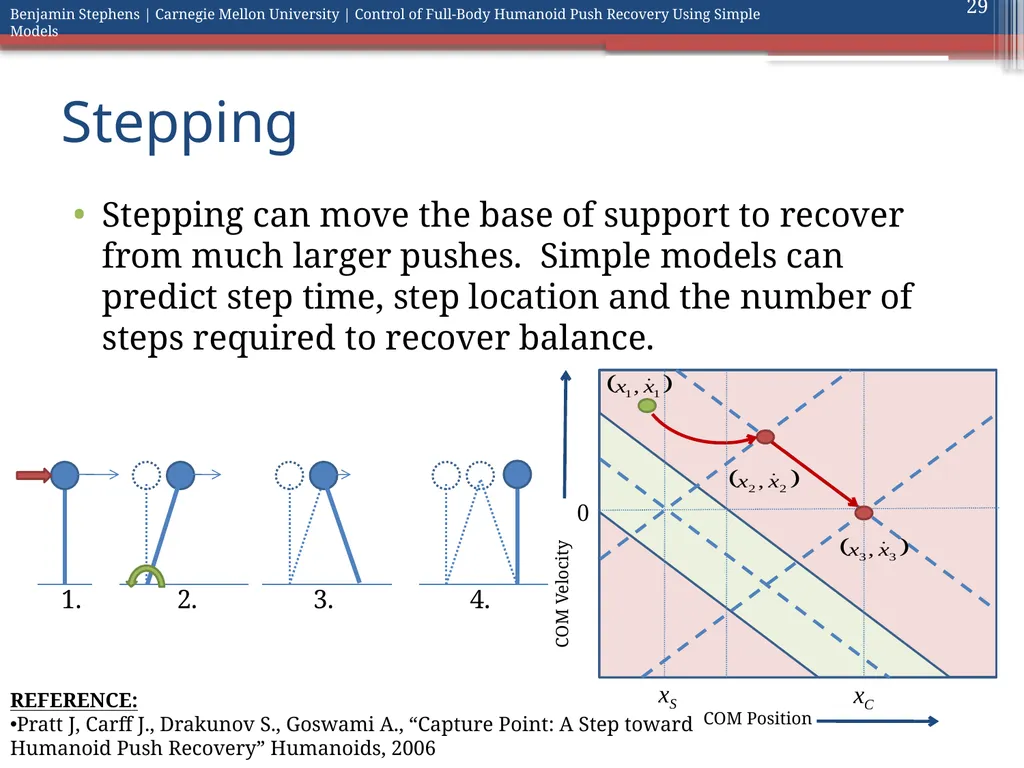
Stepping Stepping can move the base of support to recover from much larger pushes. Simple models can predict step time, step location and the number of steps required to recover balance. COM Position COM Velocity 29 REFERENCE:
Pratt J, Carff J., Drakunov S., Goswami A., “Capture Point: A Step toward Humanoid Push Recovery” Humanoids, 2006<br>
Pratt J, Carff J., Drakunov S., Goswami A., “Capture Point: A Step toward Humanoid Push Recovery” Humanoids, 2006<br>
30
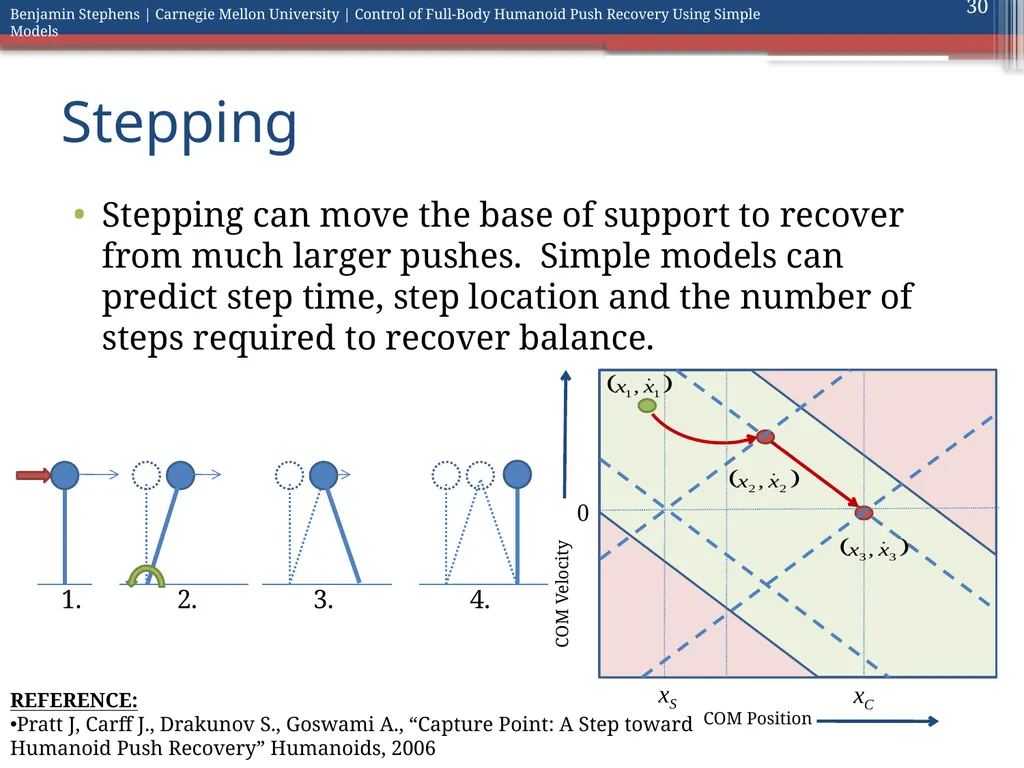
Stepping Stepping can move the base of support to recover from much larger pushes. Simple models can predict step time, step location and the number of steps required to recover balance. COM Position COM Velocity 30 REFERENCE:
Pratt J, Carff J., Drakunov S., Goswami A., “Capture Point: A Step toward Humanoid Push Recovery” Humanoids, 2006<br>
Pratt J, Carff J., Drakunov S., Goswami A., “Capture Point: A Step toward Humanoid Push Recovery” Humanoids, 2006<br>
31
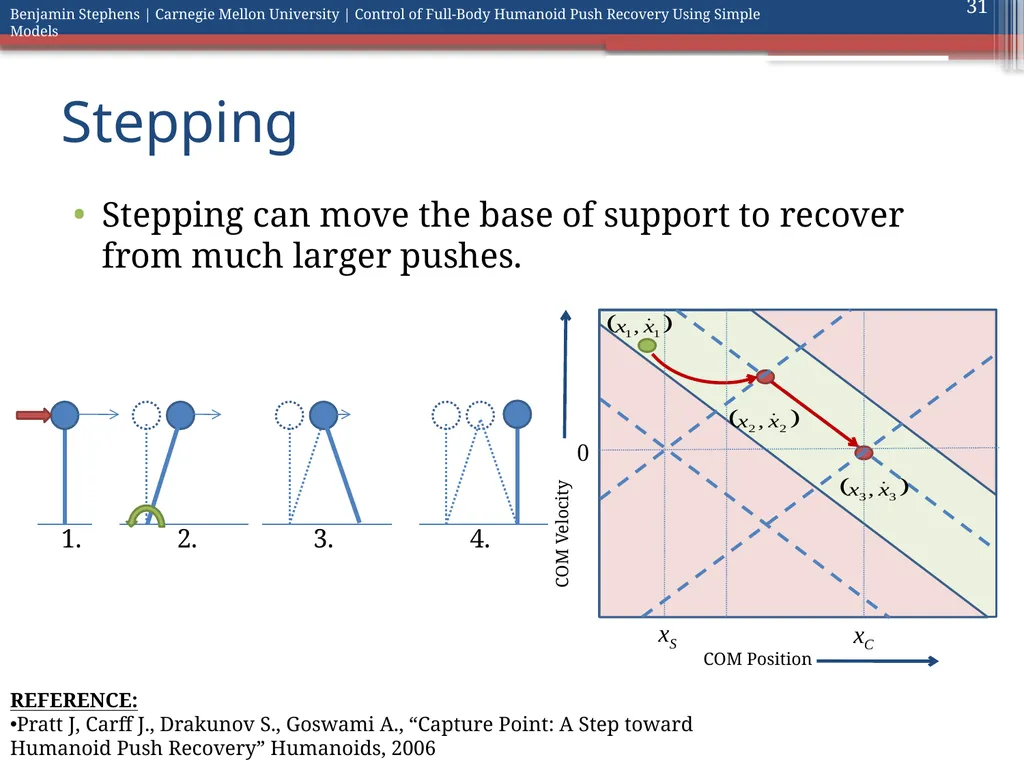
Stepping Stepping can move the base of support to recover from much larger pushes. COM Position COM Velocity 31 REFERENCE:
Pratt J, Carff J., Drakunov S., Goswami A., “Capture Point: A Step toward Humanoid Push Recovery” Humanoids, 2006<br>
Pratt J, Carff J., Drakunov S., Goswami A., “Capture Point: A Step toward Humanoid Push Recovery” Humanoids, 2006<br>
32
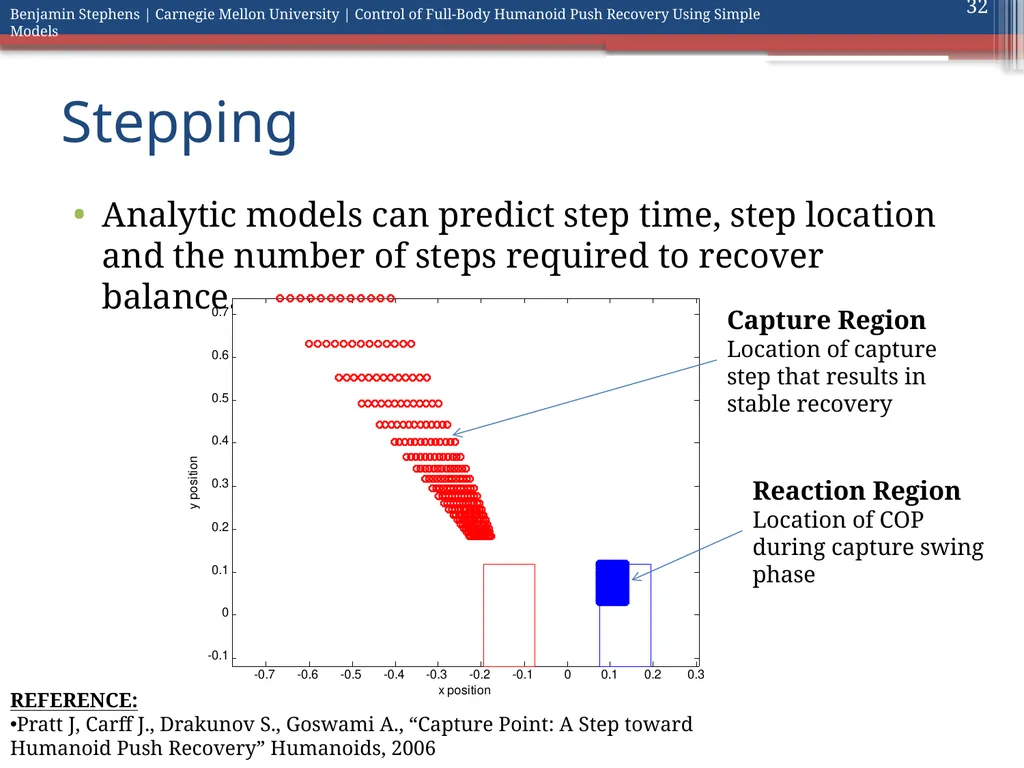
Stepping Analytic models can predict step time, step location and the number of steps required to recover balance. 32 Reaction Region
Location of COP during capture swing phase Capture Region
Location of capture step that results in stable recovery REFERENCE:
Pratt J, Carff J., Drakunov S., Goswami A., “Capture Point: A Step toward Humanoid Push Recovery” Humanoids, 2006<br>
Pratt J, Carff J., Drakunov S., Goswami A., “Capture Point: A Step toward Humanoid Push Recovery” Humanoids, 2006<br>
33
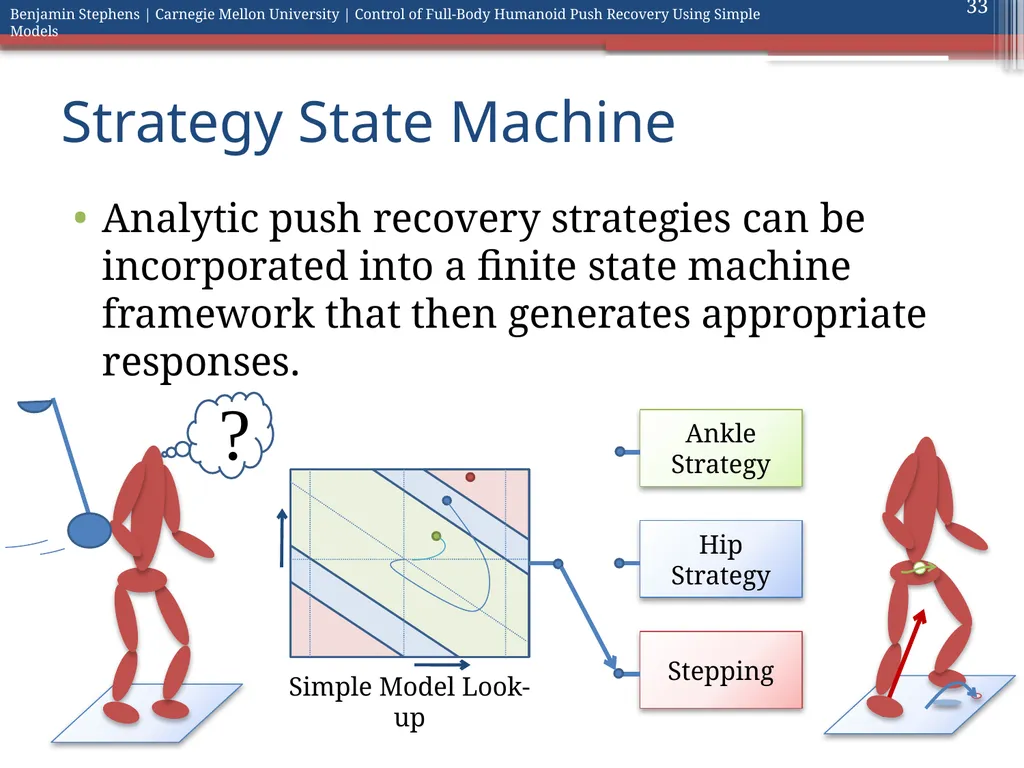
Strategy State Machine Analytic push recovery strategies can be incorporated into a finite state machine framework that then generates appropriate responses. 33 Ankle Strategy Hip
Strategy Stepping Simple Model Look-up<br>
Strategy Stepping Simple Model Look-up<br>
34
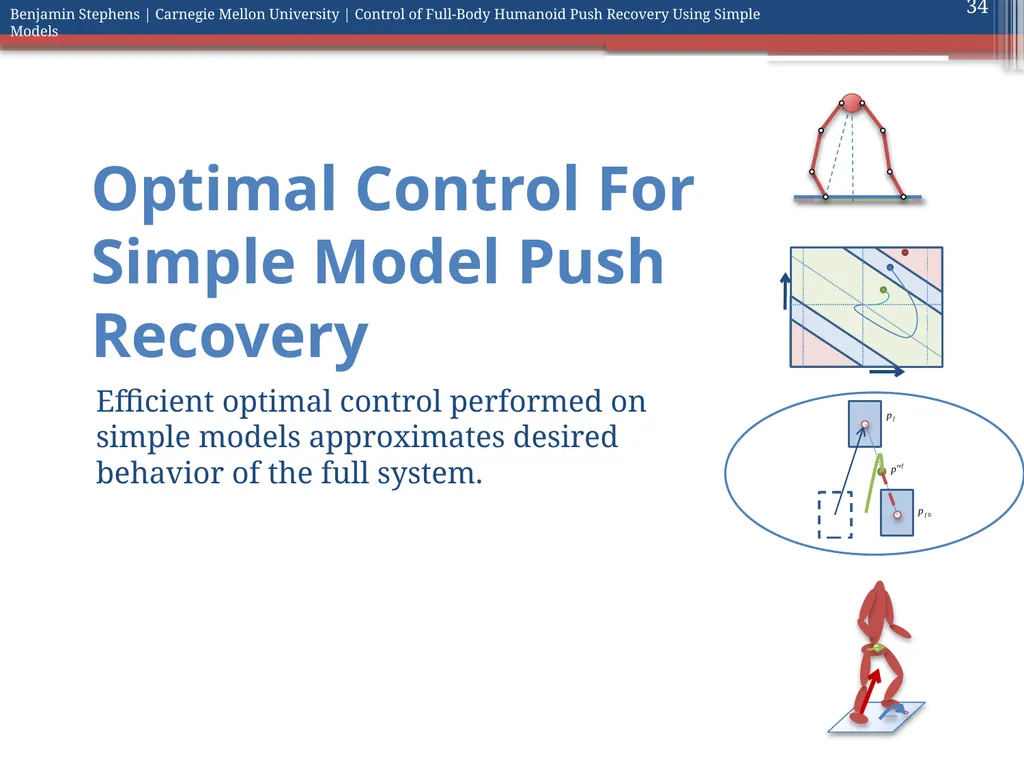
Optimal Control For Simple Model Push Recovery Efficient optimal control performed on simple models approximates desired behavior of the full system. 34<br>
35
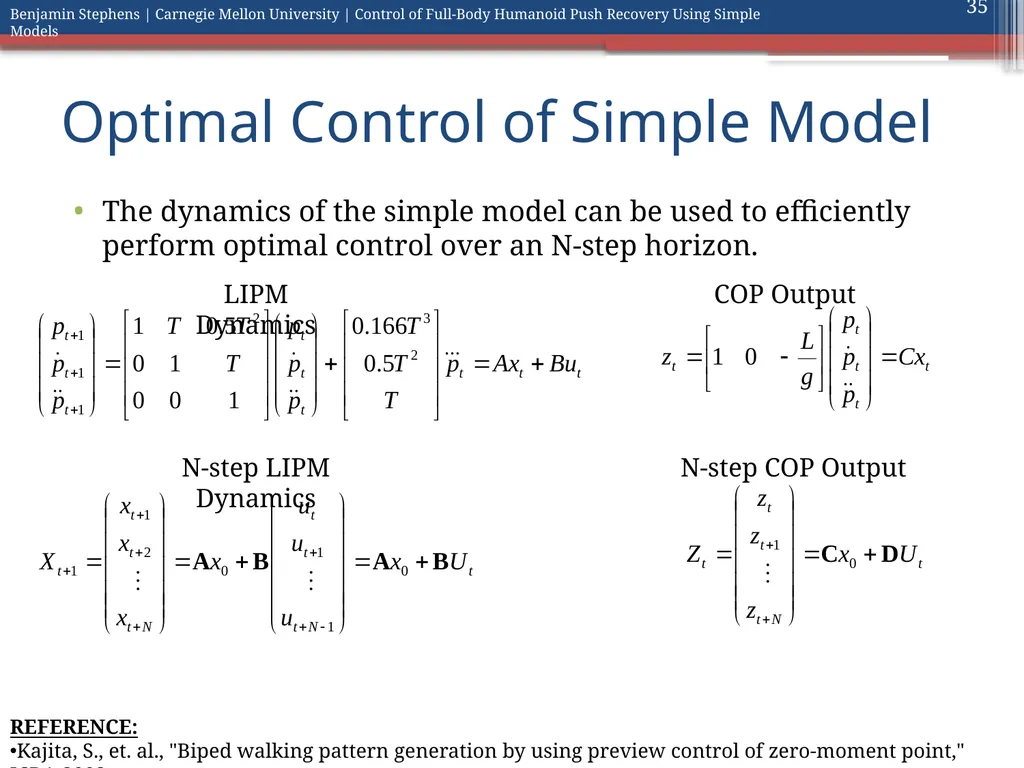
Optimal Control of Simple Model The dynamics of the simple model can be used to efficiently perform optimal control over an N-step horizon. N-step LIPM Dynamics N-step COP Output LIPM Dynamics COP Output 35 REFERENCE:
Kajita, S., et. al., "Biped walking pattern generation by using preview control of zero-moment point," ICRA 2003<br>
Kajita, S., et. al., "Biped walking pattern generation by using preview control of zero-moment point," ICRA 2003<br>
36
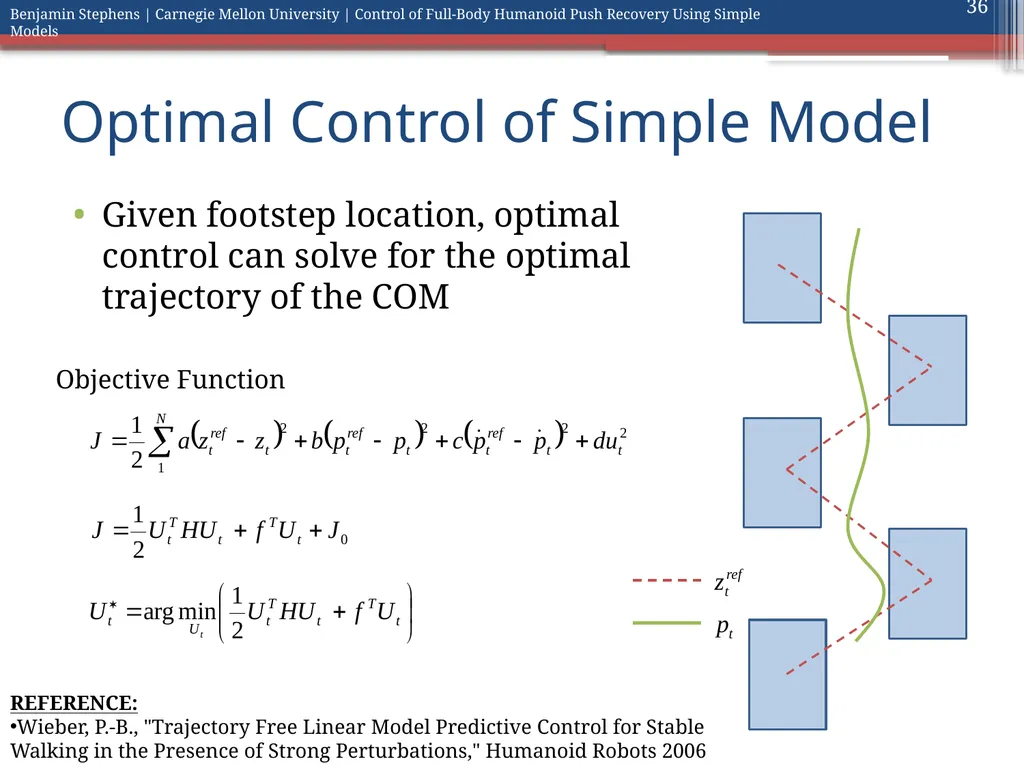
Optimal Control of Simple Model Given footstep location, optimal control can solve for the optimal trajectory of the COM 36 Objective Function REFERENCE:
Wieber, P.-B., "Trajectory Free Linear Model Predictive Control for Stable Walking in the Presence of Strong Perturbations," Humanoid Robots 2006<br>
Wieber, P.-B., "Trajectory Free Linear Model Predictive Control for Stable Walking in the Presence of Strong Perturbations," Humanoid Robots 2006<br>
37
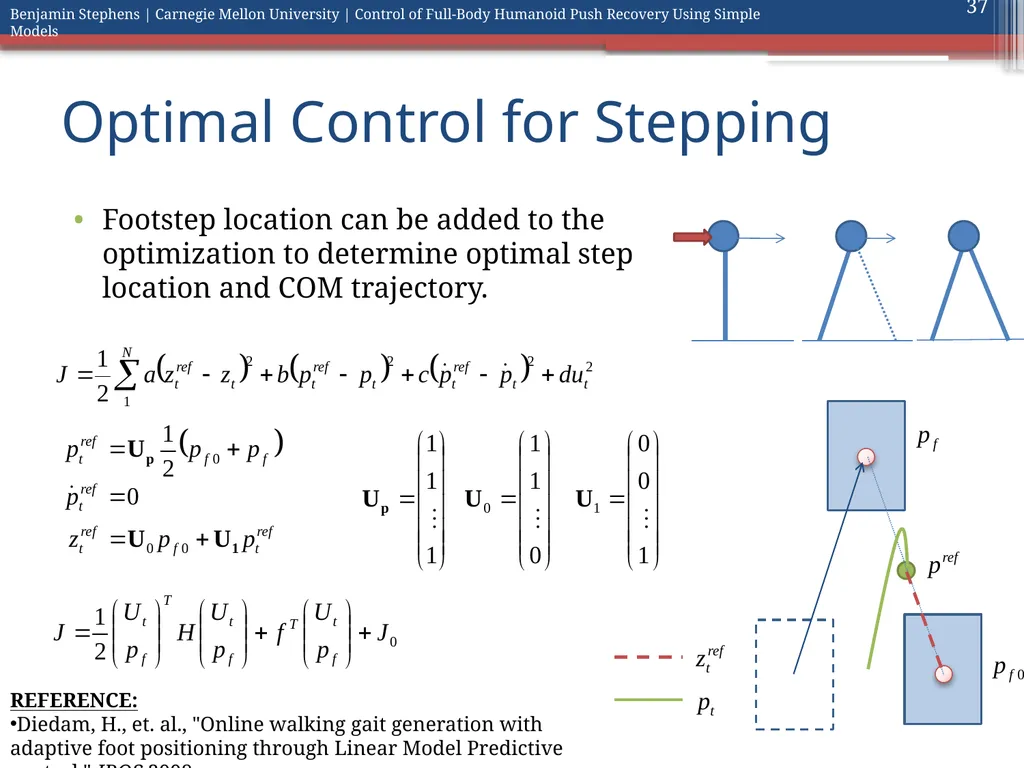
Optimal Control for Stepping Footstep location can be added to the optimization to determine optimal step location and COM trajectory. 37 REFERENCE:
Diedam, H., et. al., "Online walking gait generation with adaptive foot positioning through Linear Model Predictive control," IROS 2008<br>
Diedam, H., et. al., "Online walking gait generation with adaptive foot positioning through Linear Model Predictive control," IROS 2008<br>
38
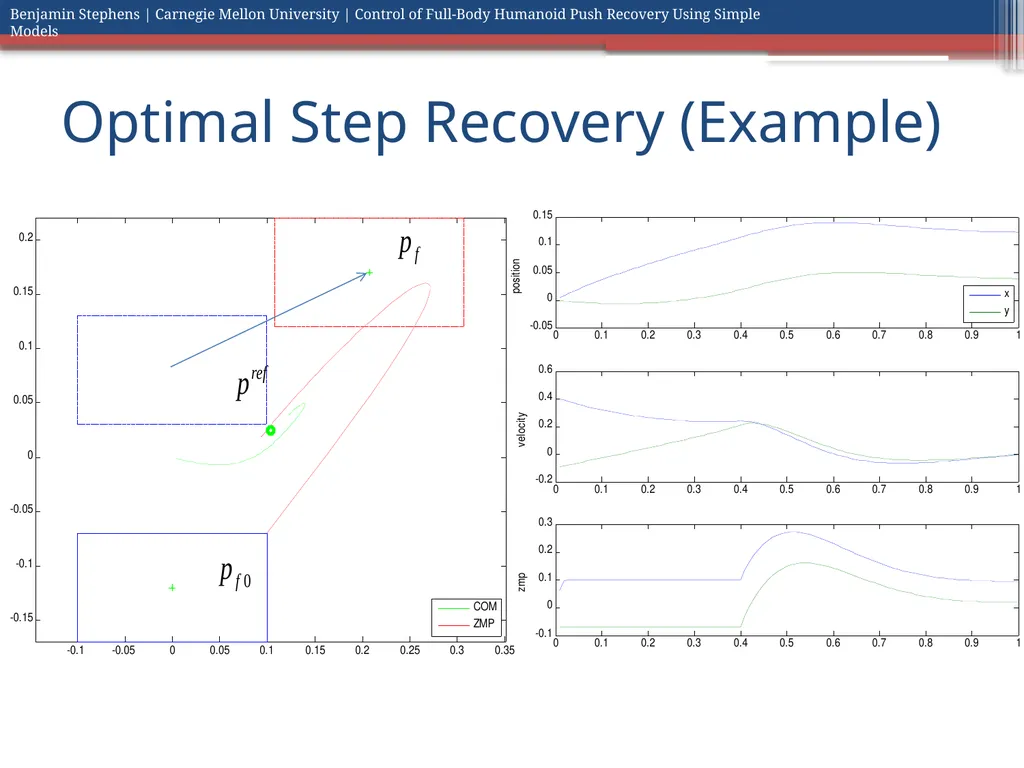
Optimal Step Recovery (Example)<br>
39
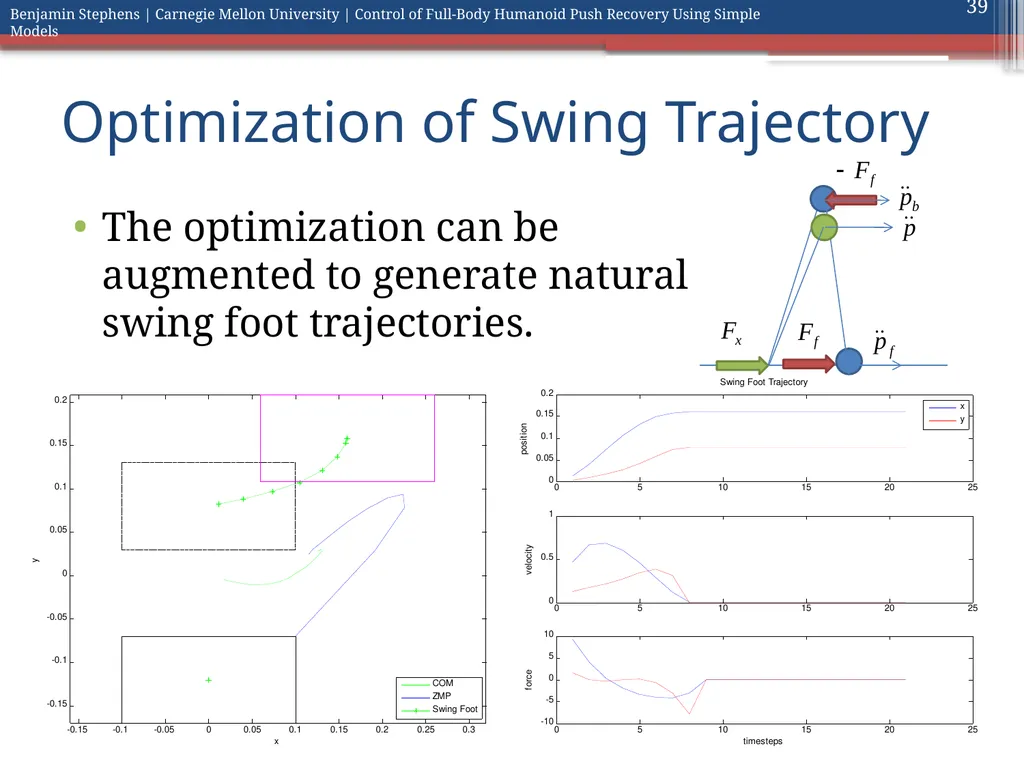
Optimization of Swing Trajectory The optimization can be augmented to generate natural swing foot trajectories. 39<br>
40
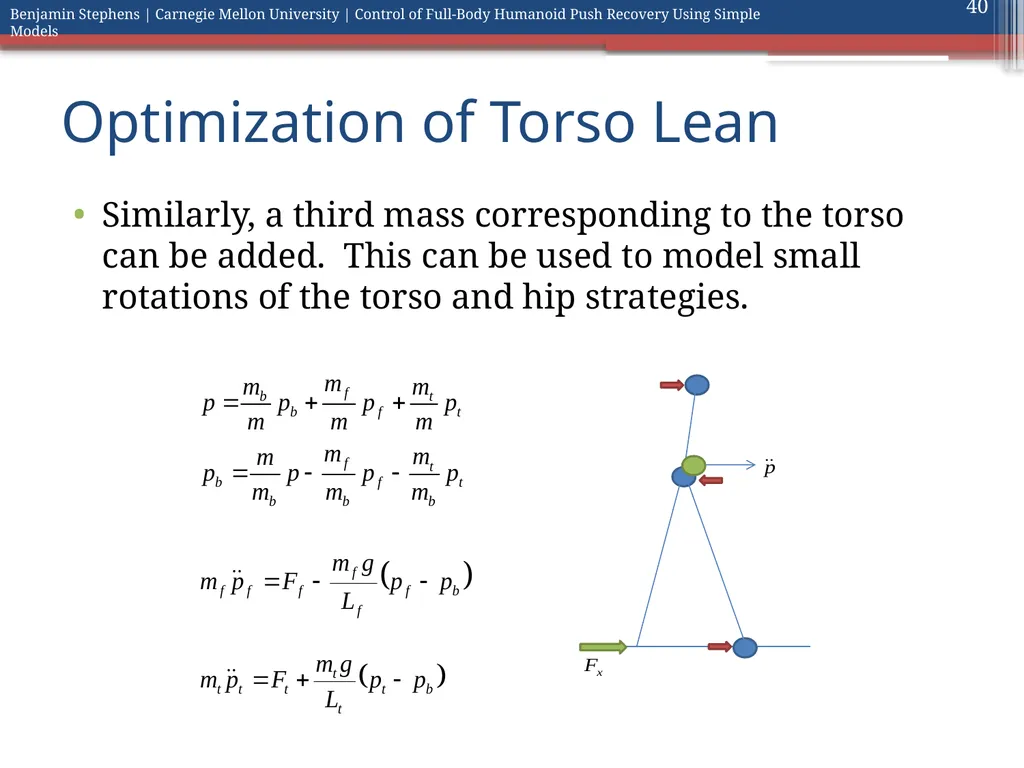
Optimization of Torso Lean Similarly, a third mass corresponding to the torso can be added. This can be used to model small rotations of the torso and hip strategies. 40<br>
41
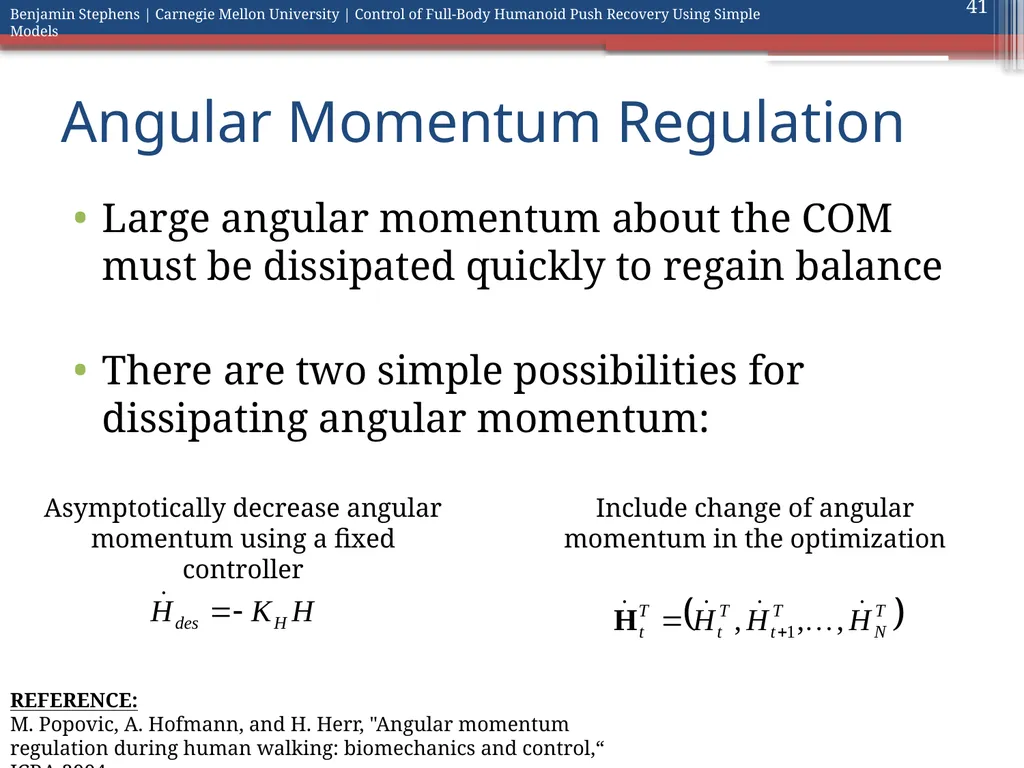
Angular Momentum Regulation Large angular momentum about the COM must be dissipated quickly to regain balance
There are two simple possibilities for dissipating angular momentum: 41 Asymptotically decrease angular momentum using a fixed controller Include change of angular momentum in the optimization REFERENCE:
M. Popovic, A. Hofmann, and H. Herr, "Angular momentum regulation during human walking: biomechanics and control,“ ICRA 2004<br>
There are two simple possibilities for dissipating angular momentum: 41 Asymptotically decrease angular momentum using a fixed controller Include change of angular momentum in the optimization REFERENCE:
M. Popovic, A. Hofmann, and H. Herr, "Angular momentum regulation during human walking: biomechanics and control,“ ICRA 2004<br>
42
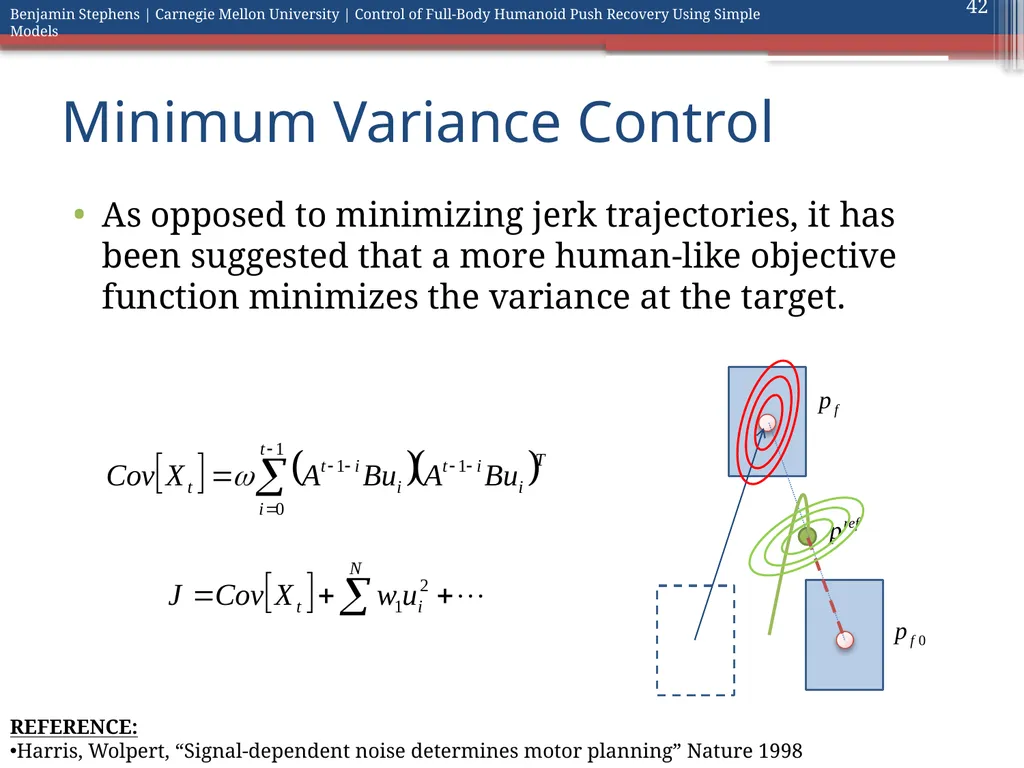
Minimum Variance Control As opposed to minimizing jerk trajectories, it has been suggested that a more human-like objective function minimizes the variance at the target. 42 REFERENCE:
Harris, Wolpert, “Signal-dependent noise determines motor planning” Nature 1998<br>
Harris, Wolpert, “Signal-dependent noise determines motor planning” Nature 1998<br>
43
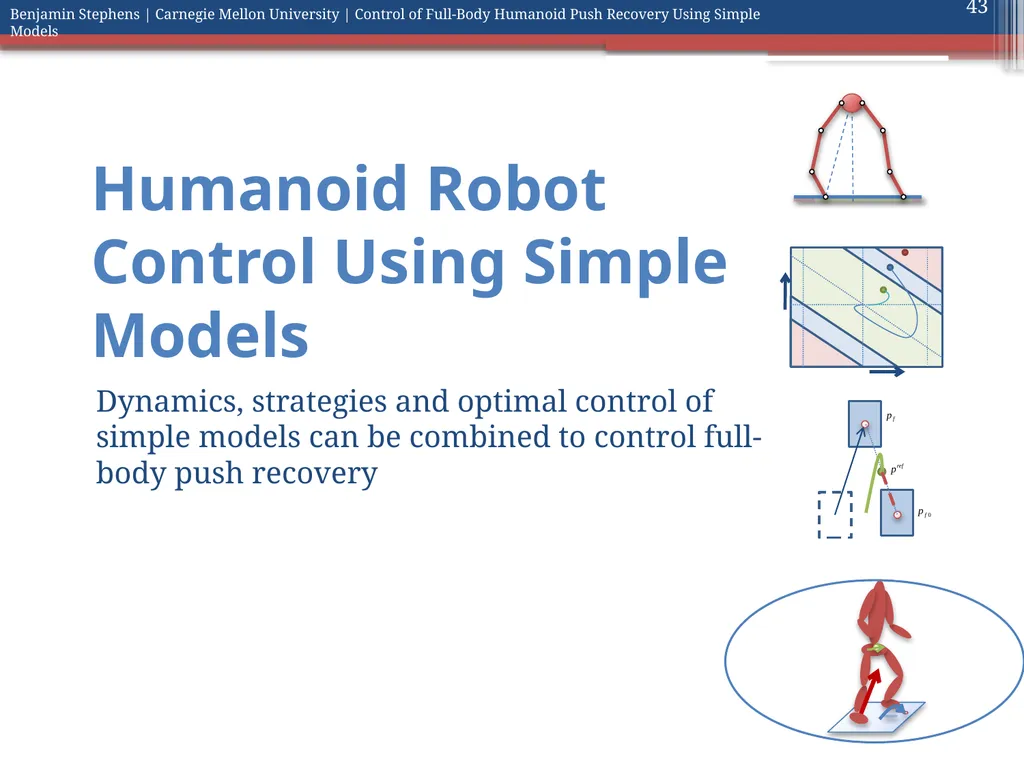
Humanoid Robot Control Using Simple Models Dynamics, strategies and optimal control of simple models can be combined to control full-body push recovery 43<br>
44
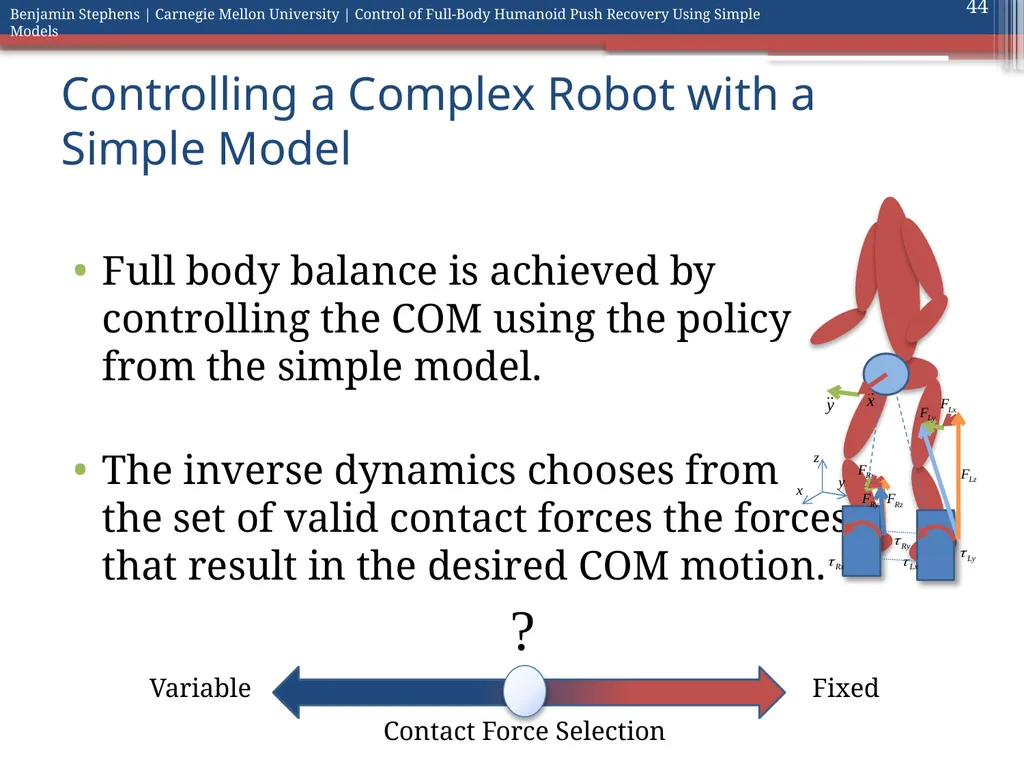
Controlling a Complex Robot with a Simple Model Full body balance is achieved by
controlling the COM using the policy
from the simple model.
The inverse dynamics chooses from the set of valid contact forces the forces that result in the desired COM motion. 44<br>
The inverse dynamics chooses from the set of valid contact forces the forces that result in the desired COM motion. 44<br>
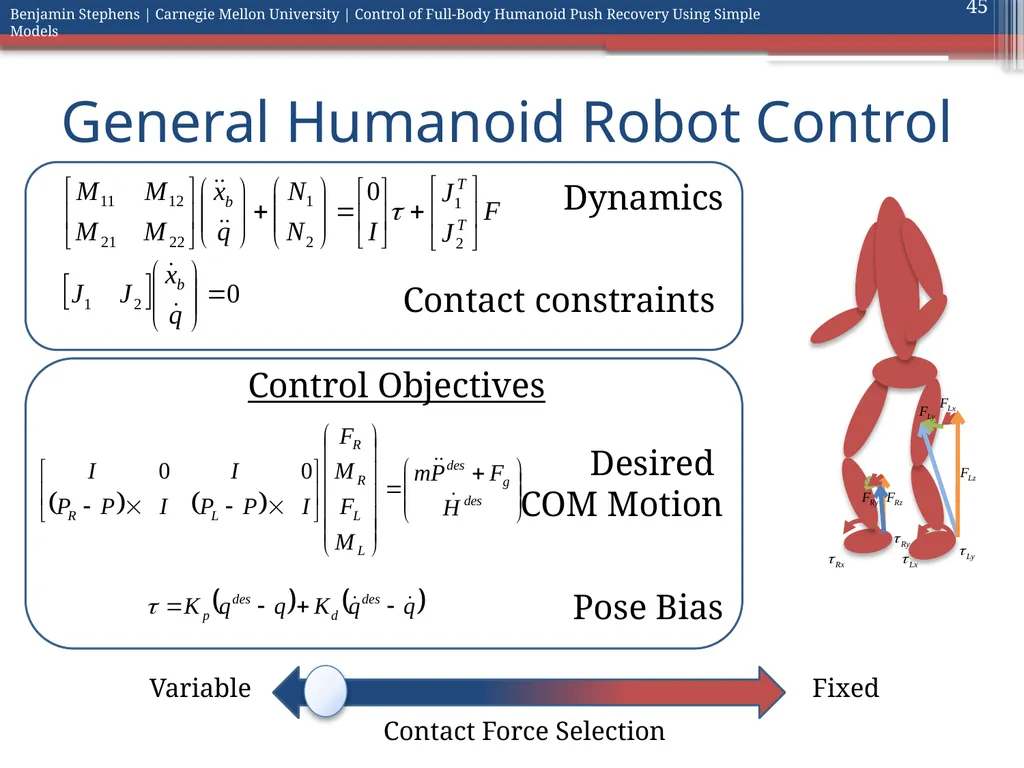
45
General Humanoid Robot Control 45 Dynamics Contact constraints Desired
COM Motion Control Objectives Pose Bias Variable Fixed Contact Force Selection<br>
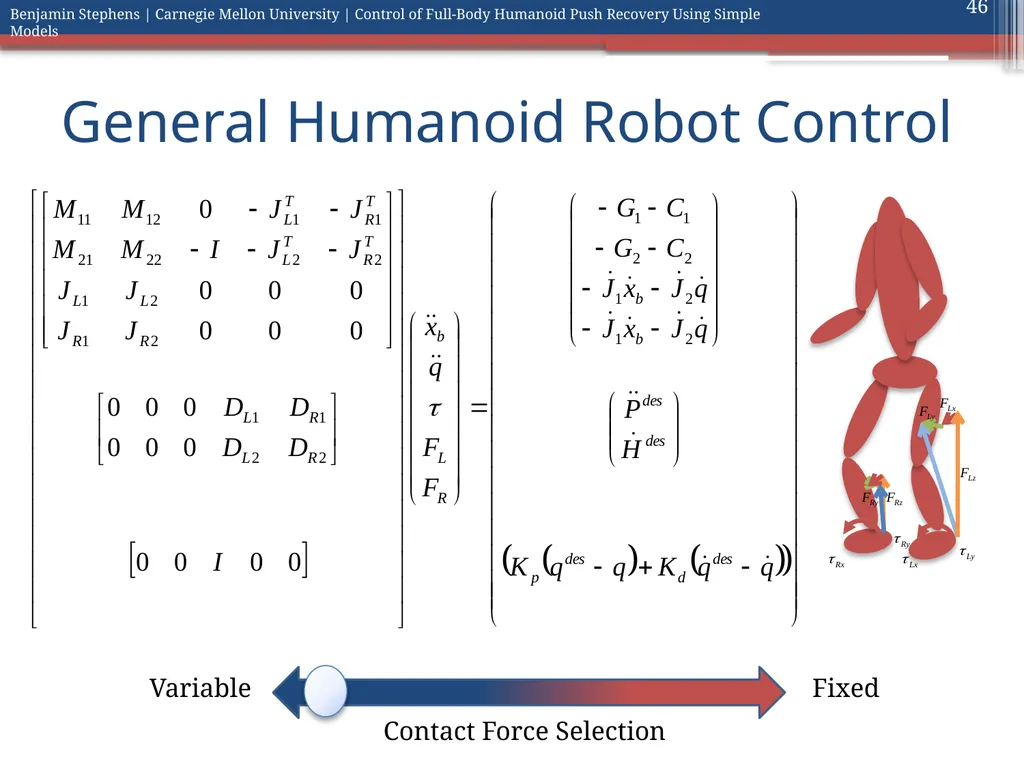
46
General Humanoid Robot Control 46 Variable Fixed Contact Force Selection<br>
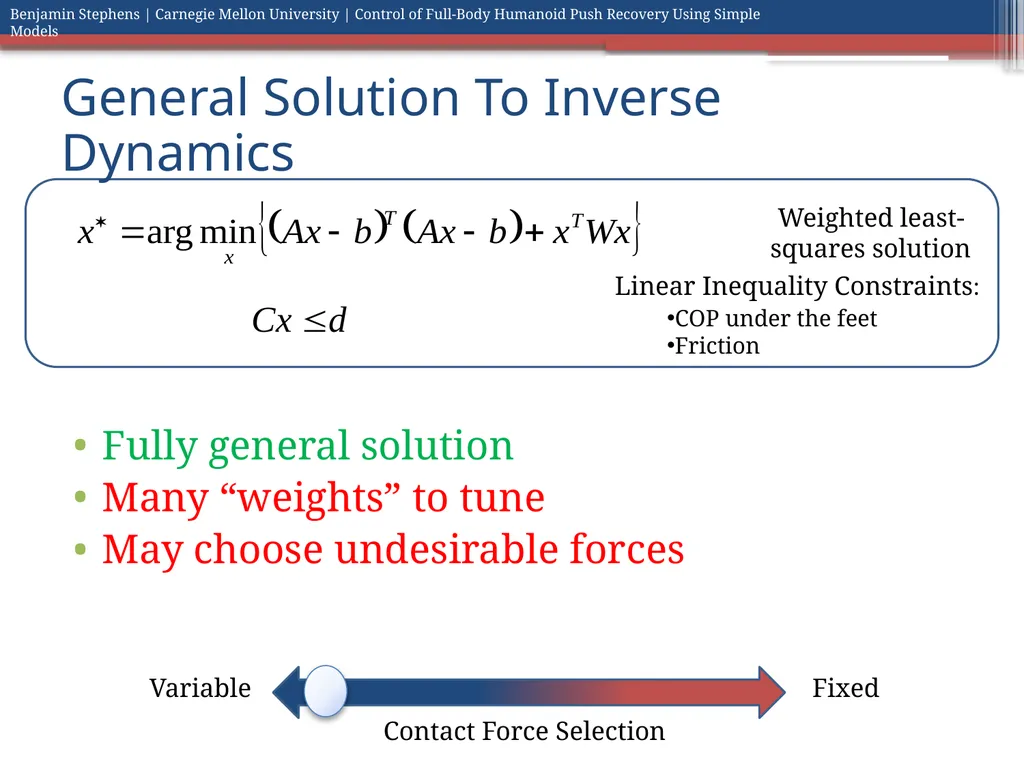
47
General Solution To Inverse Dynamics Fully general solution
Many “weights” to tune
May choose undesirable forces Weighted least- squares solution Linear Inequality Constraints: COP under the feet
Friction Variable Fixed Contact Force Selection<br>
Many “weights” to tune
May choose undesirable forces Weighted least- squares solution Linear Inequality Constraints: COP under the feet
Friction Variable Fixed Contact Force Selection<br>
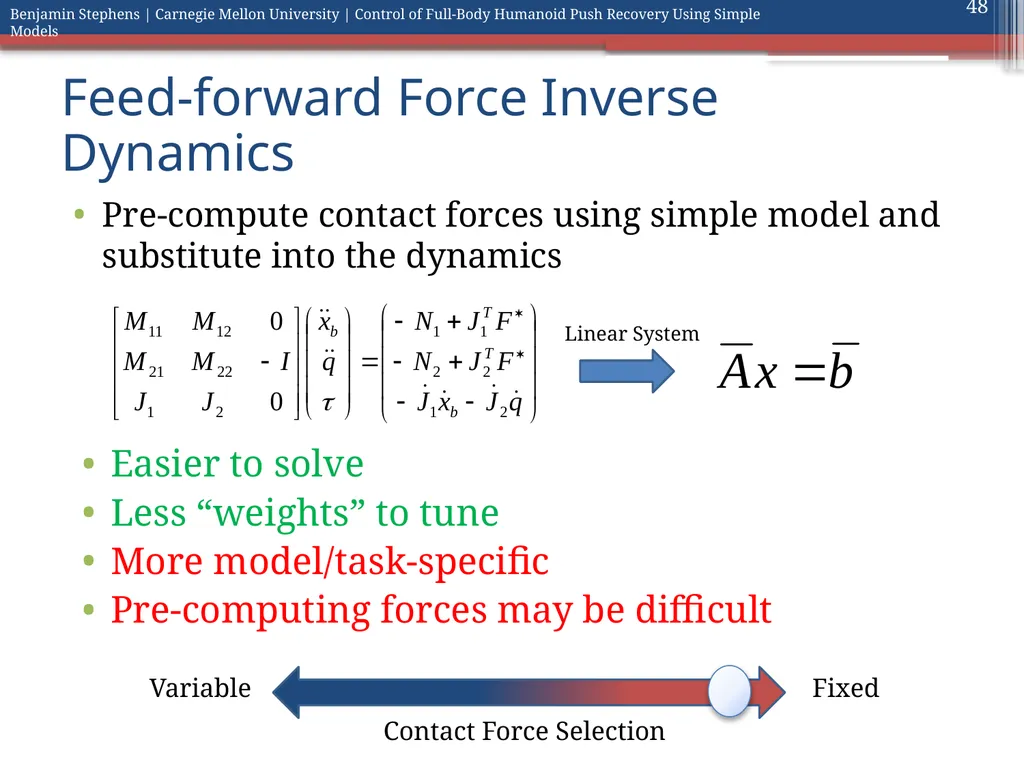
48
Feed-forward Force Inverse Dynamics Pre-compute contact forces using simple model and substitute into the dynamics 48 Linear System Easier to solve
Less “weights” to tune
More model/task-specific
Pre-computing forces may be difficult Variable Fixed Contact Force Selection<br>
Less “weights” to tune
More model/task-specific
Pre-computing forces may be difficult Variable Fixed Contact Force Selection<br>
49
Simple Model Policy-Weighted
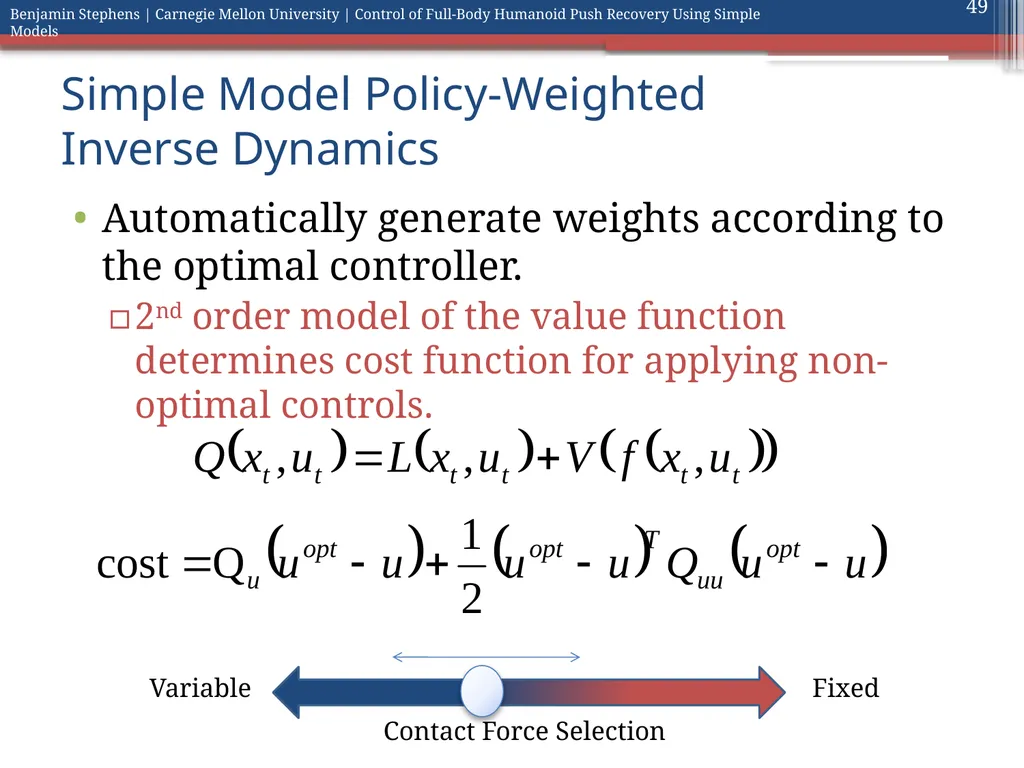
Inverse Dynamics Automatically generate weights according to the optimal controller.
2nd order model of the value function determines cost function for applying non-optimal controls. 49 Variable Fixed Contact Force Selection<br>
2nd order model of the value function determines cost function for applying non-optimal controls. 49 Variable Fixed Contact Force Selection<br>
50
Simple Model Policy-Weighted
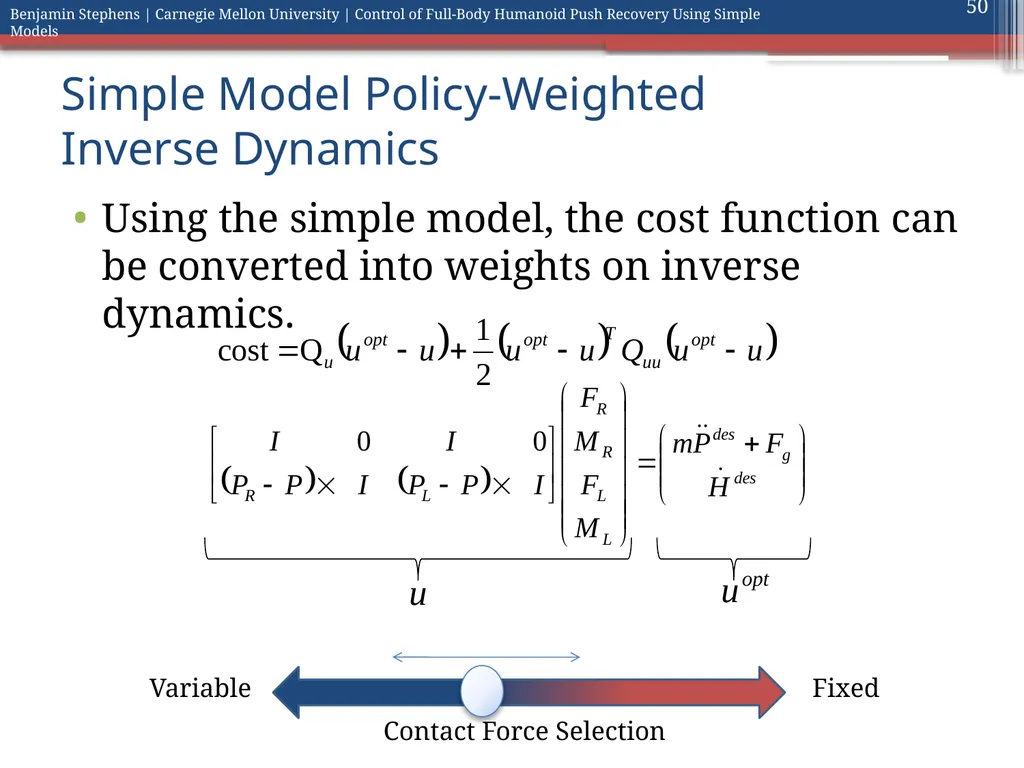
Inverse Dynamics Using the simple model, the cost function can be converted into weights on inverse dynamics. 50 Variable Fixed Contact Force Selection<br>
51
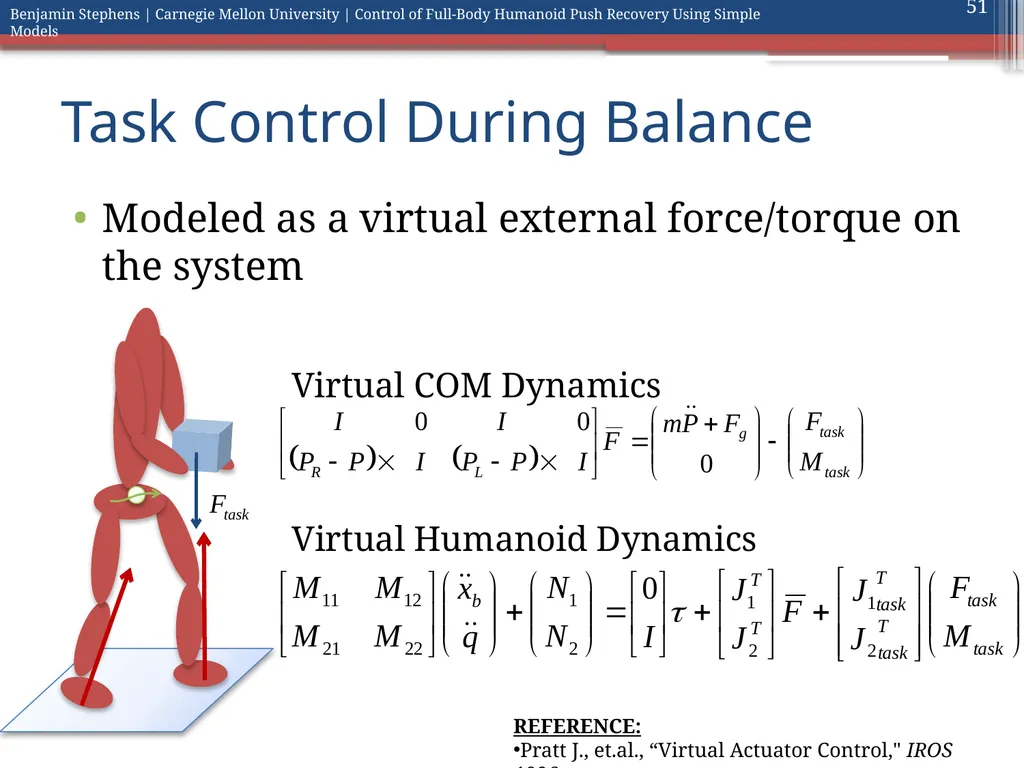
Task Control During Balance Modeled as a virtual external force/torque on the system Virtual COM Dynamics Virtual Humanoid Dynamics 51 REFERENCE:
Pratt J., et.al., “Virtual Actuator Control," IROS 1996<br>
Pratt J., et.al., “Virtual Actuator Control," IROS 1996<br>
52
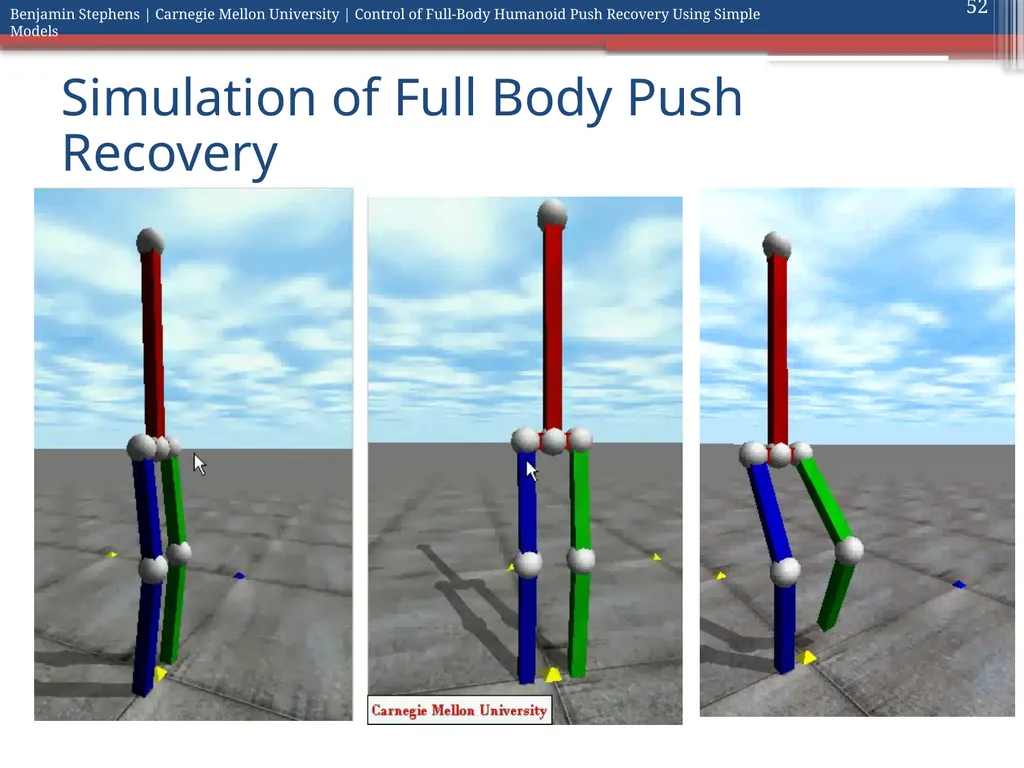
Simulation of Full Body Push Recovery 52<br>
53
Robot Push Recovery Experiments 53<br>
54
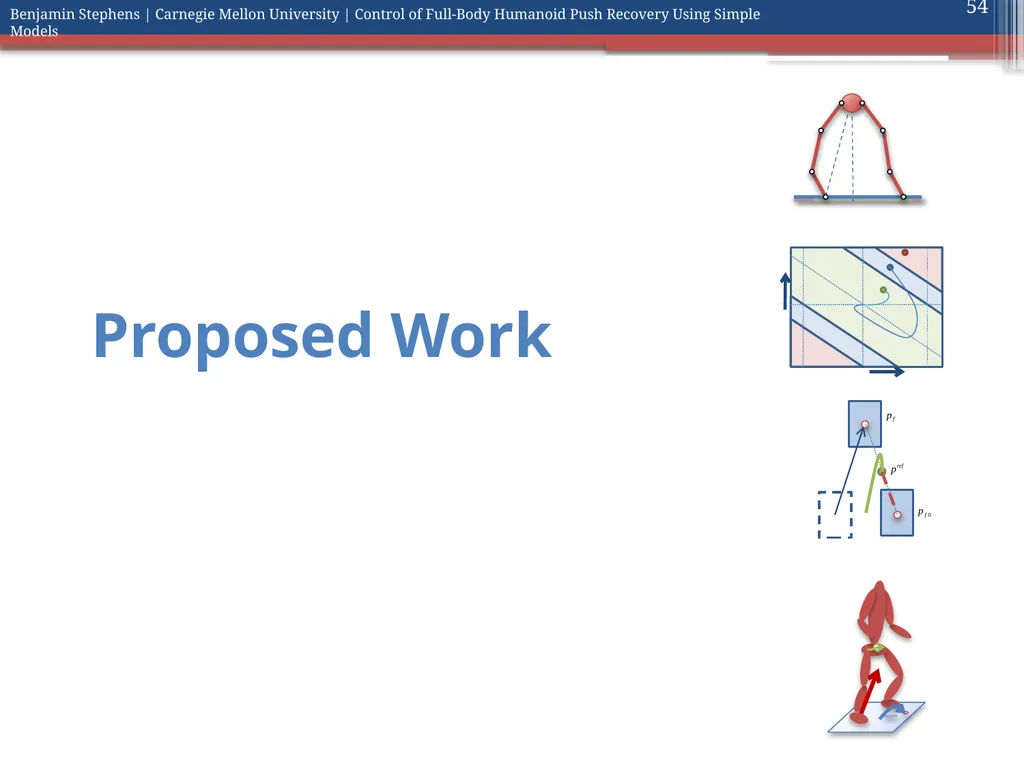
Proposed Work 54<br>
55
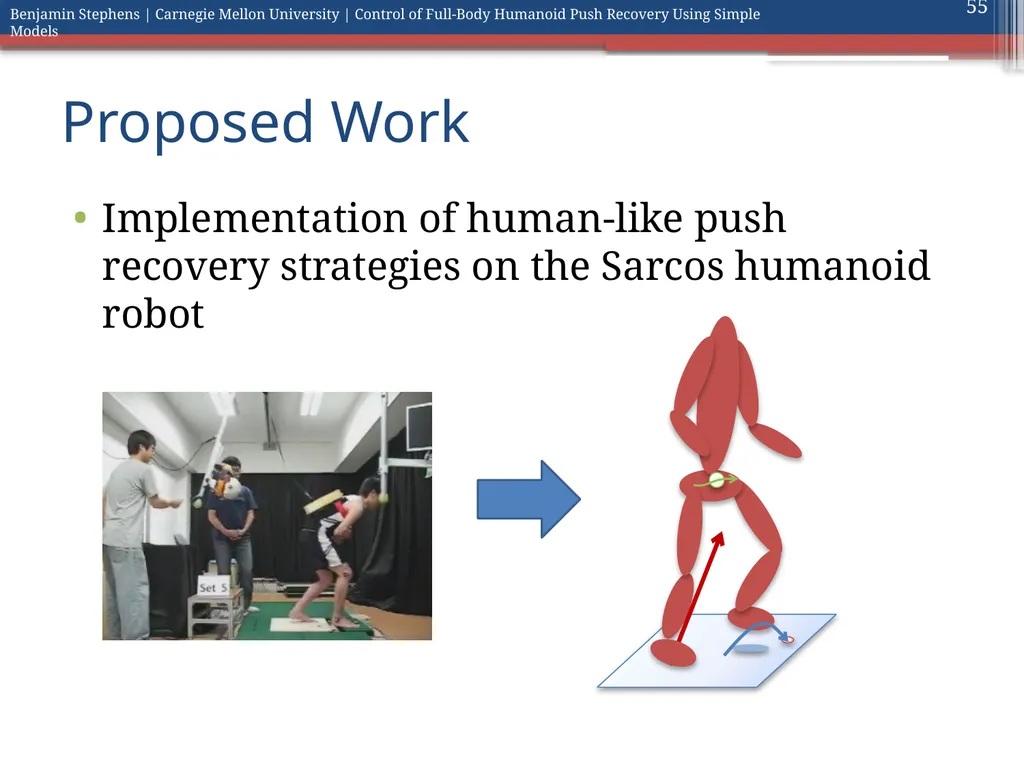
Proposed Work Implementation of human-like push recovery strategies on the Sarcos humanoid robot 55<br>
56
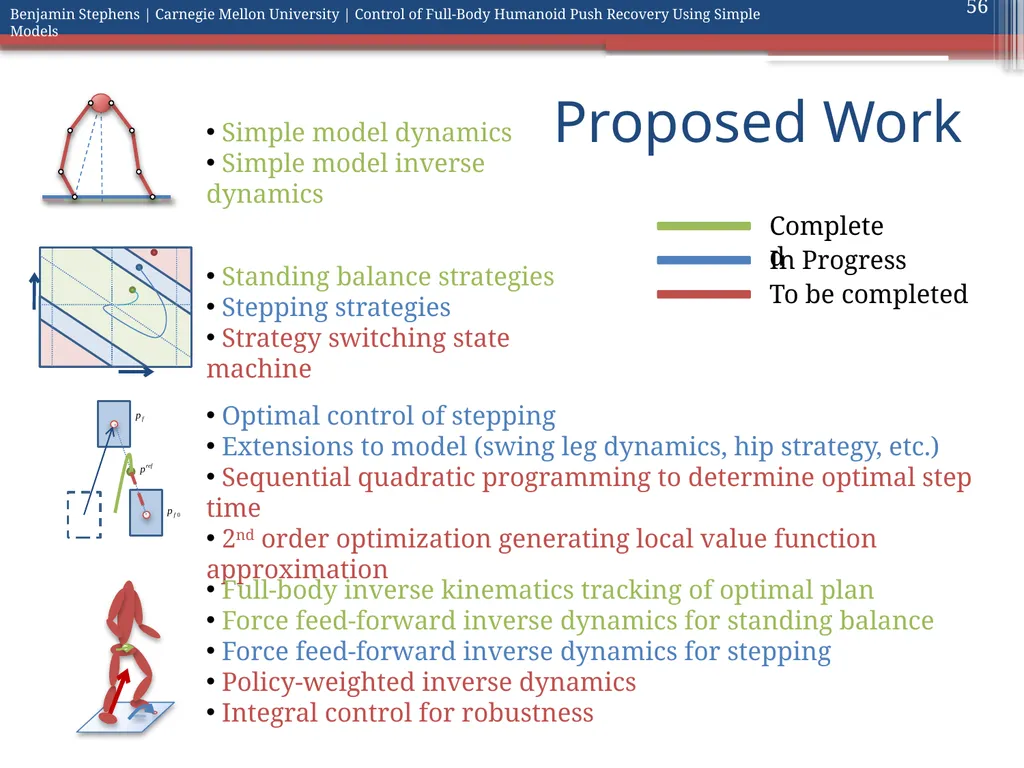
Proposed Work 56 Simple model dynamics
Simple model inverse dynamics Standing balance strategies
Stepping strategies
Strategy switching state machine Optimal control of stepping
Extensions to model (swing leg dynamics, hip strategy, etc.)
Sequential quadratic programming to determine optimal step time
2nd order optimization generating local value function approximation Full-body inverse kinematics tracking of optimal plan
Force feed-forward inverse dynamics for standing balance
Force feed-forward inverse dynamics for stepping
Policy-weighted inverse dynamics
Integral control for robustness Completed In Progress To be completed<br>
Simple model inverse dynamics Standing balance strategies
Stepping strategies
Strategy switching state machine Optimal control of stepping
Extensions to model (swing leg dynamics, hip strategy, etc.)
Sequential quadratic programming to determine optimal step time
2nd order optimization generating local value function approximation Full-body inverse kinematics tracking of optimal plan
Force feed-forward inverse dynamics for standing balance
Force feed-forward inverse dynamics for stepping
Policy-weighted inverse dynamics
Integral control for robustness Completed In Progress To be completed<br>
57
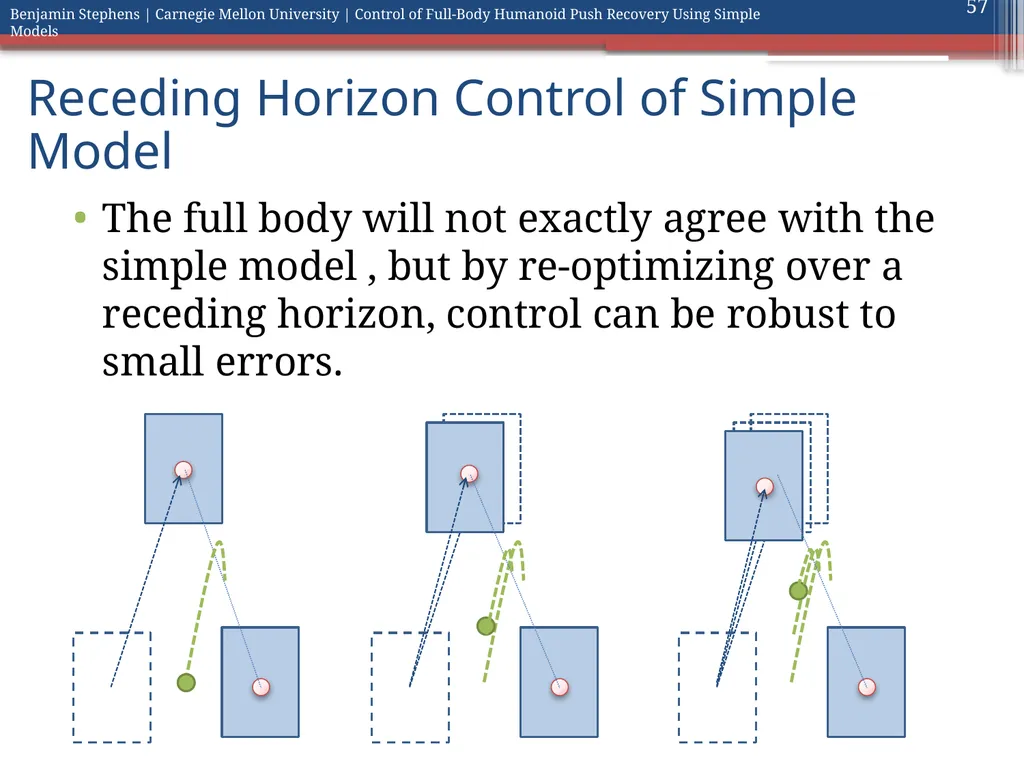
Receding Horizon Control of Simple Model The full body will not exactly agree with the simple model , but by re-optimizing over a receding horizon, control can be robust to small errors. 57<br>
58
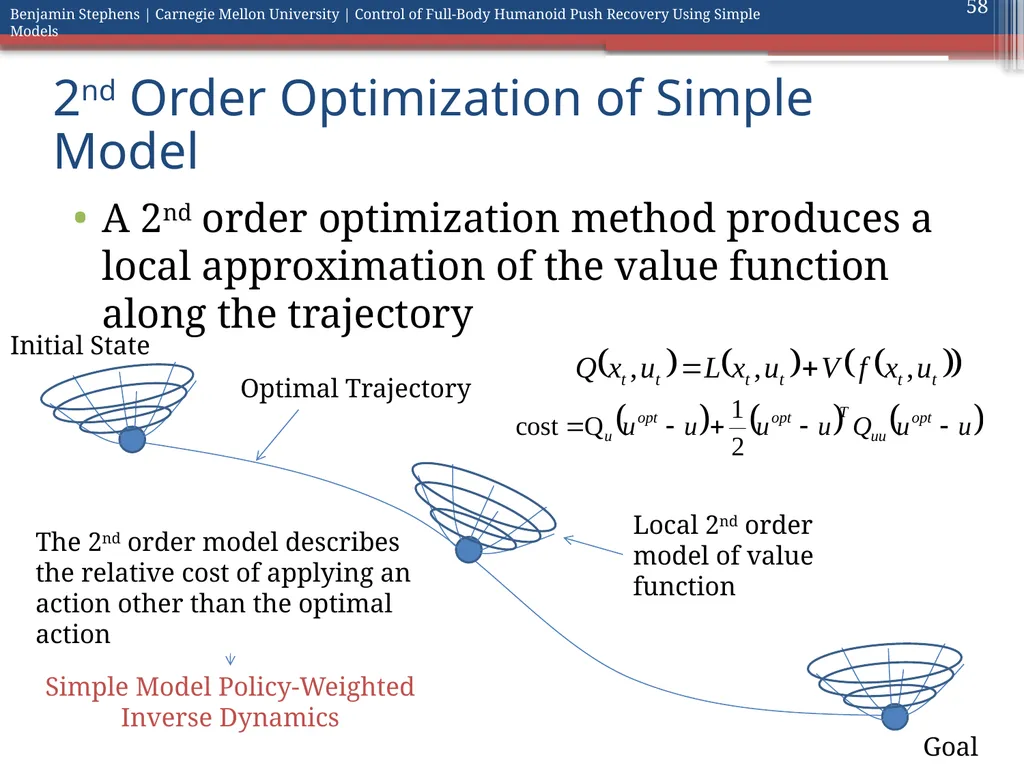
2nd Order Optimization of Simple Model A 2nd order optimization method produces a local approximation of the value function along the trajectory 58 Goal Initial State Local 2nd order model of value function Optimal Trajectory The 2nd order model describes the relative cost of applying an action other than the optimal action Simple Model Policy-Weighted Inverse Dynamics<br>
59
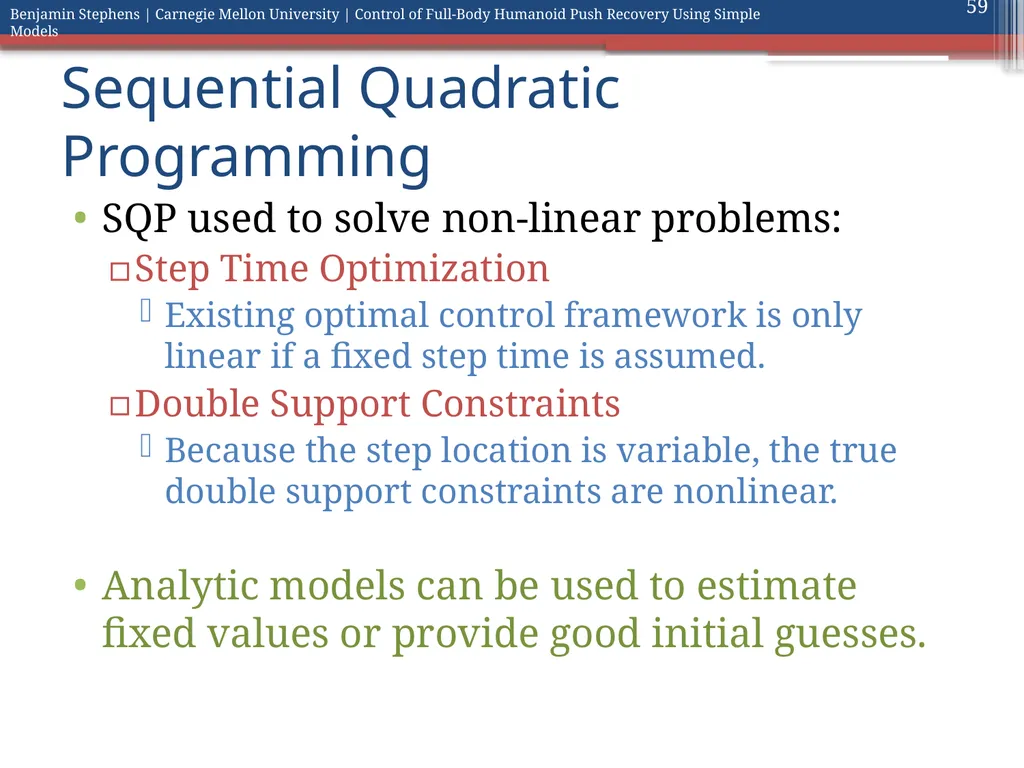
Sequential Quadratic Programming SQP used to solve non-linear problems:
Step Time Optimization
Existing optimal control framework is only linear if a fixed step time is assumed.
Double Support Constraints
Because the step location is variable, the true double support constraints are nonlinear.
Analytic models can be used to estimate fixed values or provide good initial guesses. 59<br>
Step Time Optimization
Existing optimal control framework is only linear if a fixed step time is assumed.
Double Support Constraints
Because the step location is variable, the true double support constraints are nonlinear.
Analytic models can be used to estimate fixed values or provide good initial guesses. 59<br>
60
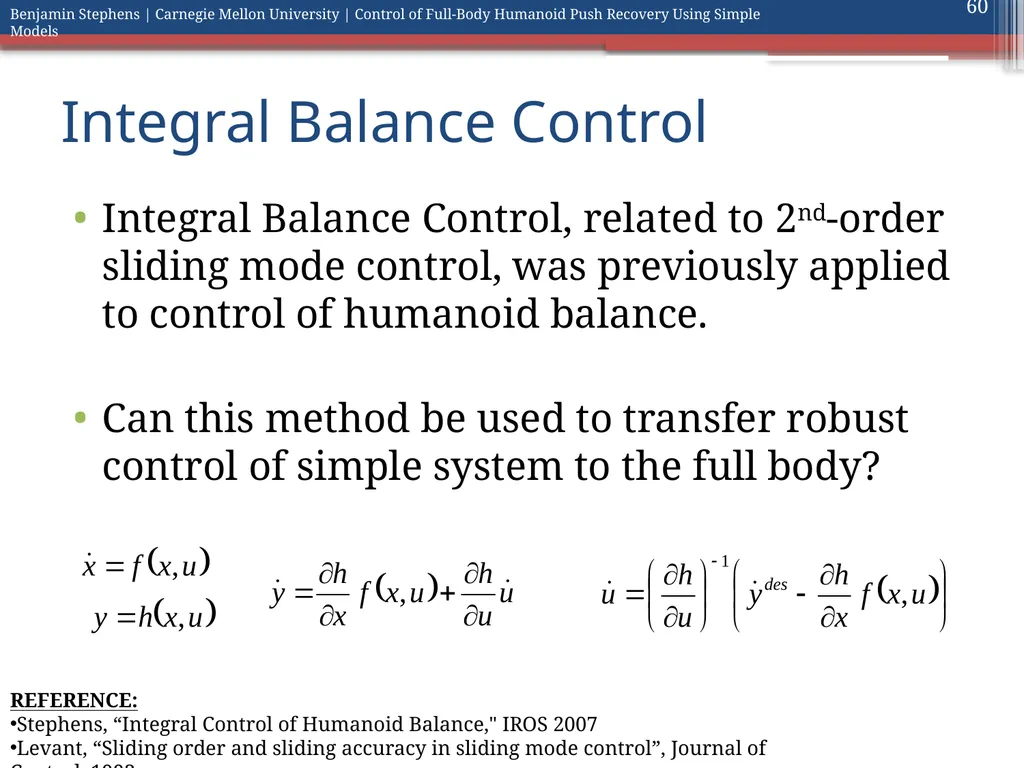
Integral Balance Control Integral Balance Control, related to 2nd-order sliding mode control, was previously applied to control of humanoid balance.
Can this method be used to transfer robust control of simple system to the full body? 60 REFERENCE:
Stephens, “Integral Control of Humanoid Balance," IROS 2007
Levant, “Sliding order and sliding accuracy in sliding mode control”, Journal of Control, 1993<br>
Can this method be used to transfer robust control of simple system to the full body? 60 REFERENCE:
Stephens, “Integral Control of Humanoid Balance," IROS 2007
Levant, “Sliding order and sliding accuracy in sliding mode control”, Journal of Control, 1993<br>
61
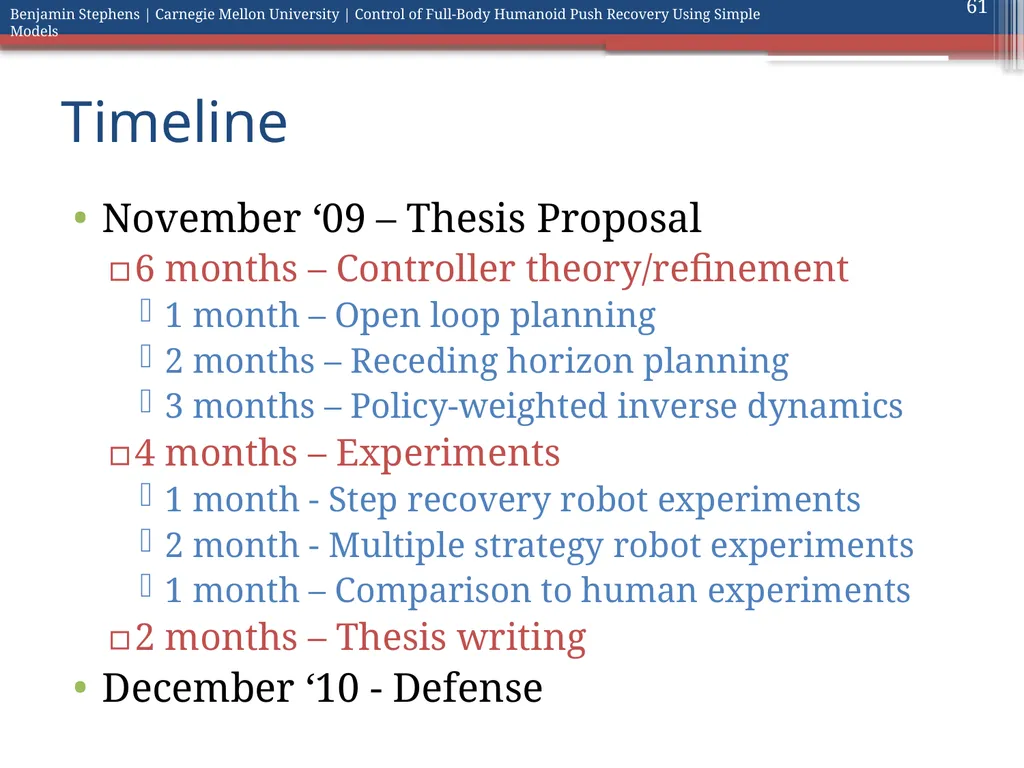
Timeline November ‘09 – Thesis Proposal
6 months – Controller theory/refinement
1 month – Open loop planning
2 months – Receding horizon planning
3 months – Policy-weighted inverse dynamics
4 months – Experiments
1 month - Step recovery robot experiments
2 month - Multiple strategy robot experiments
1 month – Comparison to human experiments
2 months – Thesis writing
December ‘10 - Defense 61<br>
6 months – Controller theory/refinement
1 month – Open loop planning
2 months – Receding horizon planning
3 months – Policy-weighted inverse dynamics
4 months – Experiments
1 month - Step recovery robot experiments
2 month - Multiple strategy robot experiments
1 month – Comparison to human experiments
2 months – Thesis writing
December ‘10 - Defense 61<br>
62
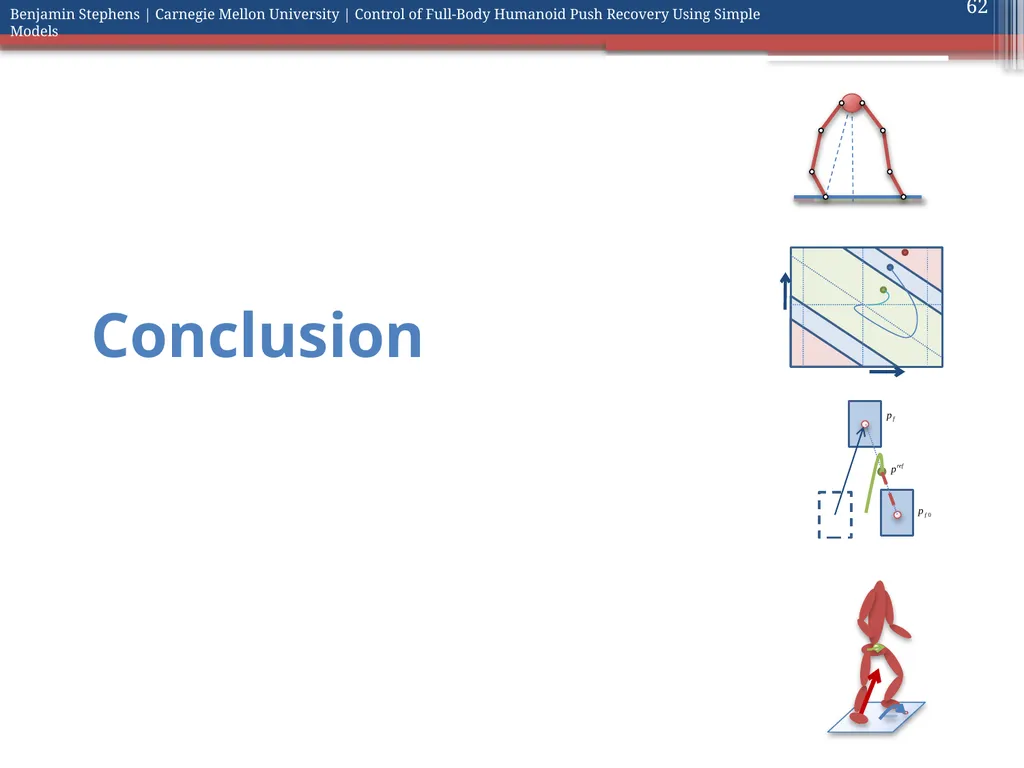
Conclusion 62<br>
63
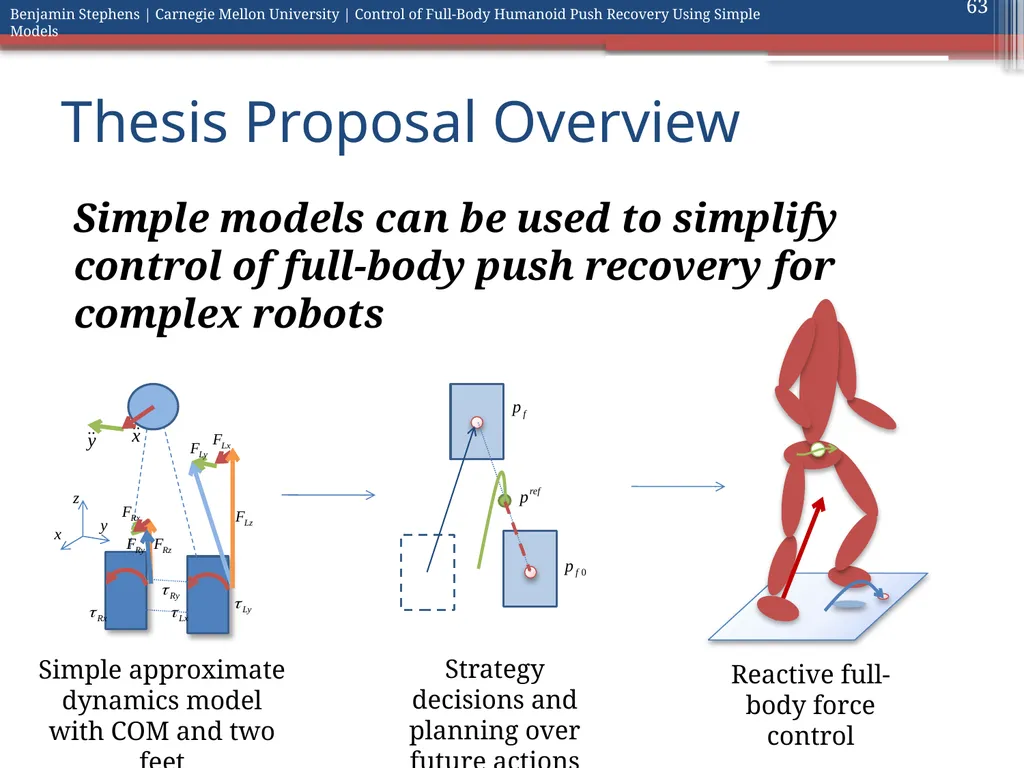
Thesis Proposal Overview Simple models can be used to simplify control of full-body push recovery for complex robots 63 Strategy decisions and planning over future actions Simple approximate dynamics model with COM and two feet Reactive full-body force control<br>
64
Acknowledgements Committee:
Chris Atkeson (Advisor/Chair)
Jessica Hodgins
Hartmut Geyer
Jerry Pratt (IHMC/External)
Stuart Anderson
People who helped with practice talk 64 Questions?<br>
Chris Atkeson (Advisor/Chair)
Jessica Hodgins
Hartmut Geyer
Jerry Pratt (IHMC/External)
Stuart Anderson
People who helped with practice talk 64 Questions?<br>