
Conversations to build trust in vaccination A
FD
Published · 44 slides · 0 views

1 / 1









Description
Conversations to build trust in vaccination A training module for health workers May 2017 1 How to use this training module? The content in this training module is intended to be practical and adaptable for almost any setting. Prior to the
Related Topics
Share
Embed code
Download this presentation From Below
"Conversations to build trust in vaccination A" is the property of its rightful owner. Permission is granted to download and print the materials on this website for personal, non-commercial use only, and to display it on your personal computer provided you do not modify the materials and that you retain all copyright notices contained in the materials. By downloading content from our website, you accept the terms of this agreement.
Presentation Transcript
01
Conversations to build trust in vaccination
A training module
for health workers May 2017 1<br>
02
How to use this training module? The content in this training module is intended to be practical and adaptable for almost any setting.
Prior to the training, we recommend that the programme manager/trainer adjust the content to allow for any local considerations. 2<br>
Prior to the training, we recommend that the programme manager/trainer adjust the content to allow for any local considerations. 2<br>
03
Introduction In almost every community, there may be individuals who have lower levels of trust in vaccines, or may doubt or be indecisive about vaccination.
These individuals may be considered to be ‘hesitant’.
How do we identify them?
How do we listen to and understand their concerns?
How do we respond to their concerns in a helpful way?
How do we help move them towards vaccination? 3<br>
These individuals may be considered to be ‘hesitant’.
How do we identify them?
How do we listen to and understand their concerns?
How do we respond to their concerns in a helpful way?
How do we help move them towards vaccination? 3<br>
04
Learning objectives At the end of this training module, the participant will:
Understand the key principles on communicating with vaccine hesitant individuals
Learn skills to listen and engage in conversations aimed at building trust in vaccines
Be able to respond to parental concerns regarding vaccine safety and effectiveness using motivational interviewing strategies
Duration: 2 hours approximately 4<br>
Understand the key principles on communicating with vaccine hesitant individuals
Learn skills to listen and engage in conversations aimed at building trust in vaccines
Be able to respond to parental concerns regarding vaccine safety and effectiveness using motivational interviewing strategies
Duration: 2 hours approximately 4<br>
05
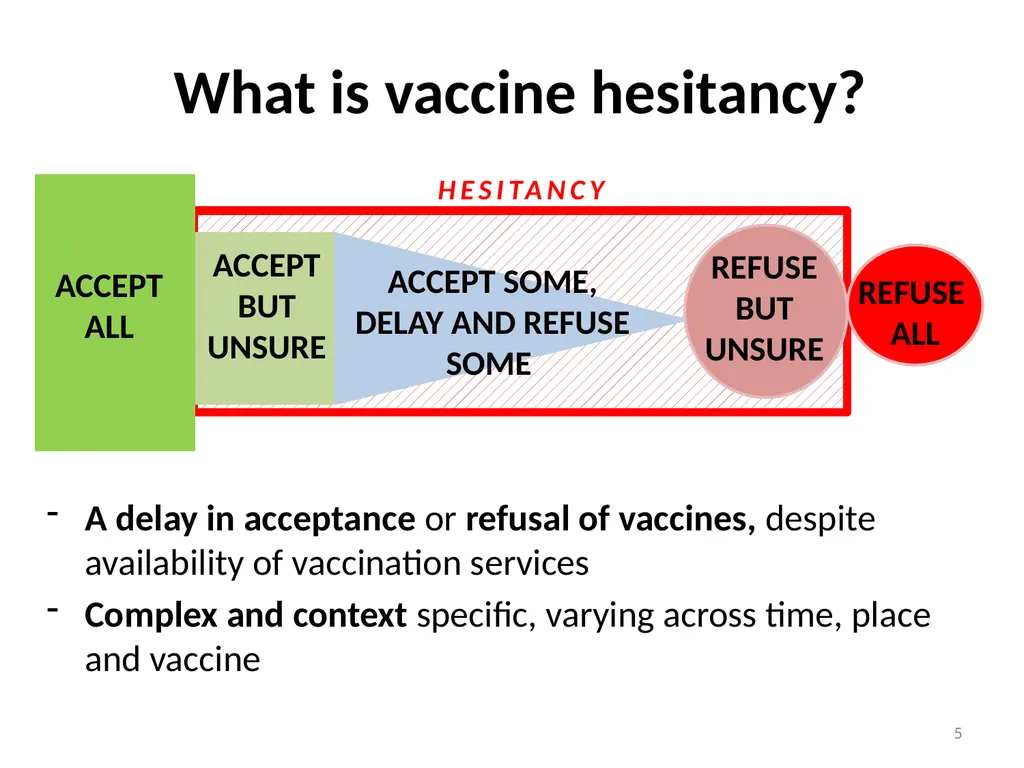
What is vaccine hesitancy? A delay in acceptance or refusal of vaccines, despite availability of vaccination services
Complex and context specific, varying across time, place and vaccine 5 HESITANCY<br>
Complex and context specific, varying across time, place and vaccine 5 HESITANCY<br>
06
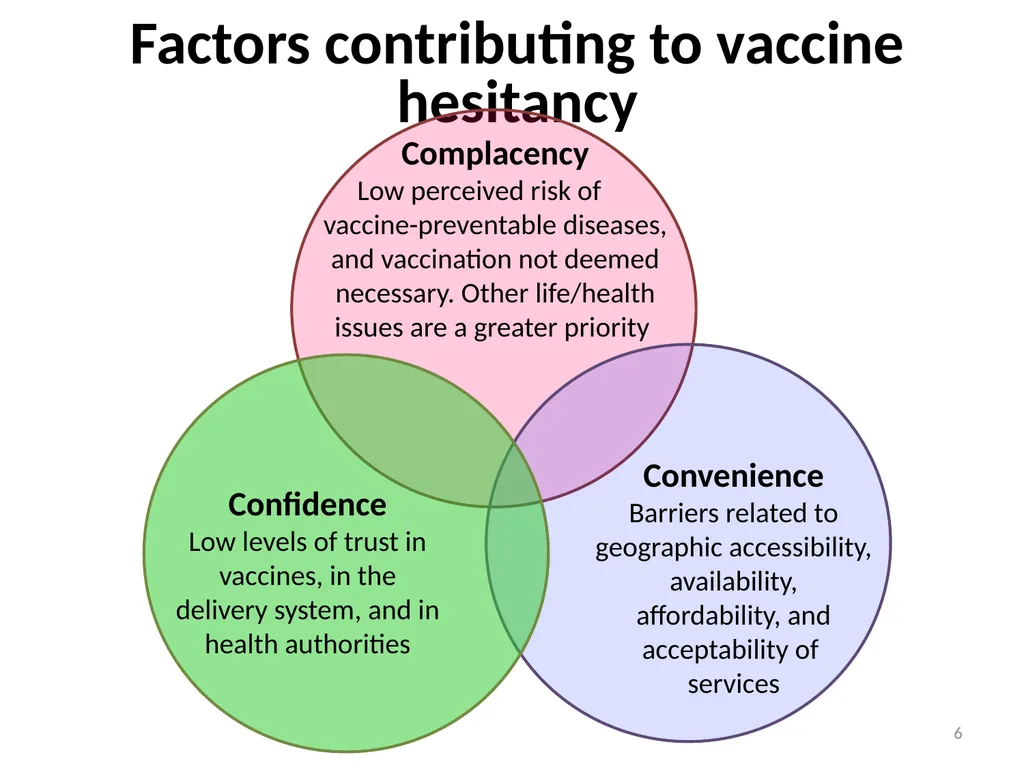
Factors contributing to vaccine hesitancy 6<br>
07
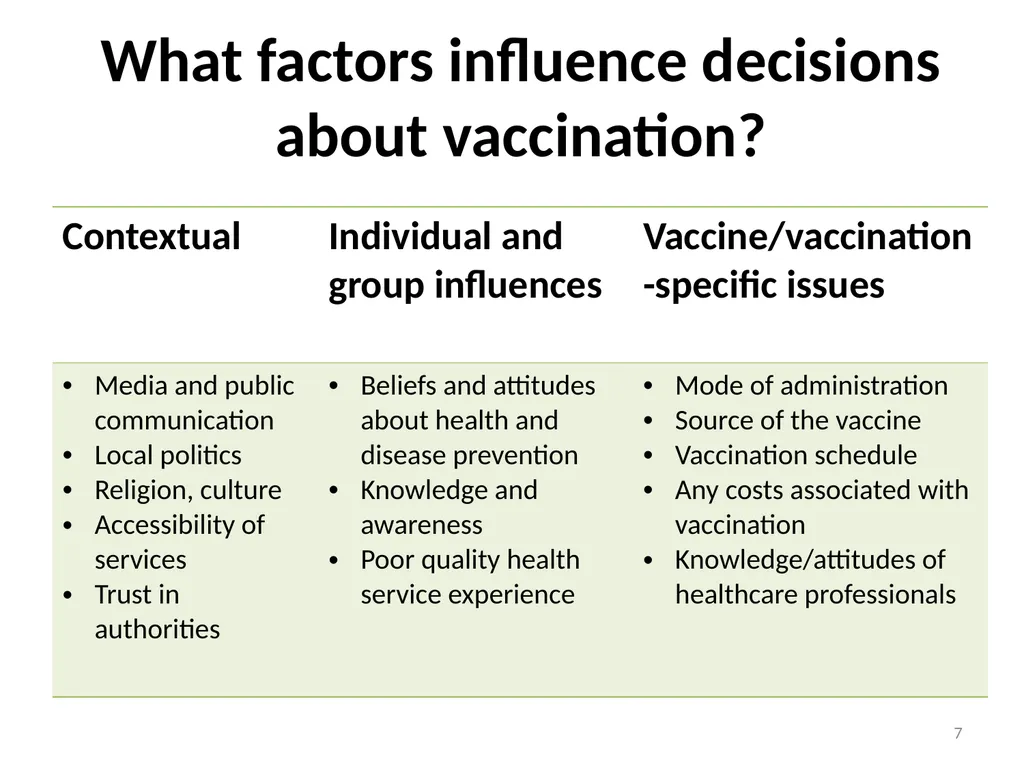
What factors influence decisions about vaccination? 7<br>
08
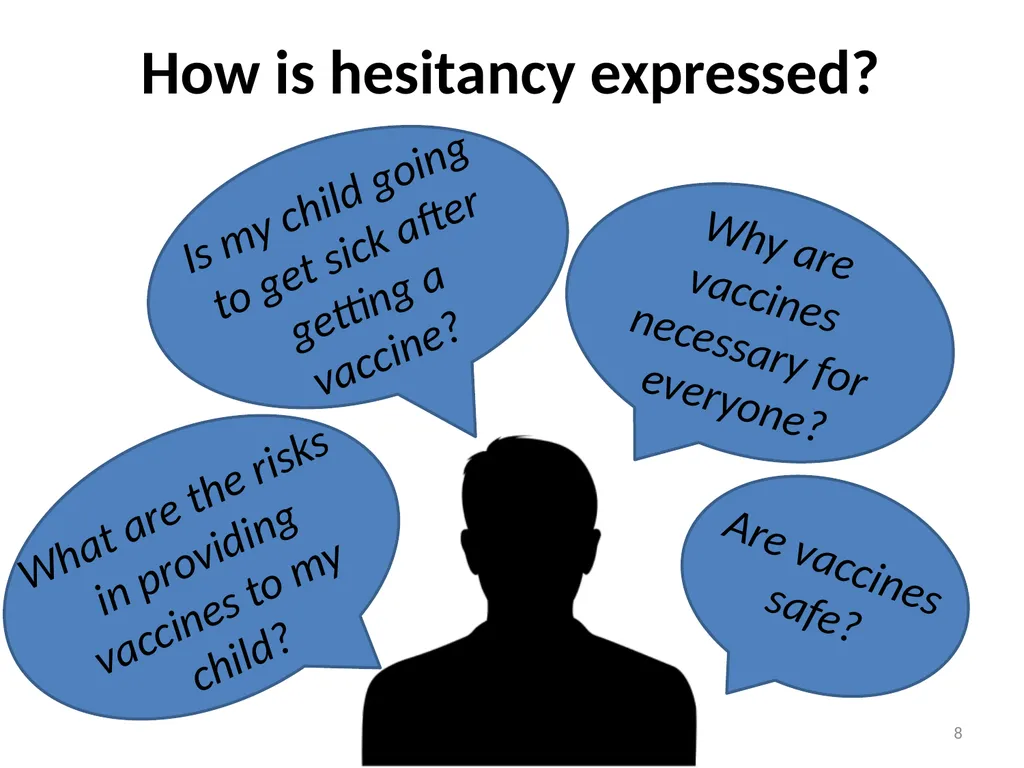
How is hesitancy expressed? Is my child going to get sick after getting a vaccine? 8<br>
09
Group discussion (5 minutes) Provide some SPECIFIC examples of vaccine hesitancy you may have come across in your community. 9<br>
10
Addressing vaccine hesitancy No single strategy can address all of the different dimensions of hesitancy
What health workers (HW) say and how they interact with the patient/caregiver can strongly influence vaccine acceptance This module focuses on evidence-informed best practices for HWs to increase vaccine acceptance through skilled conversation about vaccination. 10<br>
What health workers (HW) say and how they interact with the patient/caregiver can strongly influence vaccine acceptance This module focuses on evidence-informed best practices for HWs to increase vaccine acceptance through skilled conversation about vaccination. 10<br>
11
Who might express vaccine hesitancy? It can be anyone, including but not limited to… Caregivers Pregnant
Women Adults Elderly And others, e.g. religious leaders, media, health workers, etc. 11 Adolescents<br>
Women Adults Elderly And others, e.g. religious leaders, media, health workers, etc. 11 Adolescents<br>
12
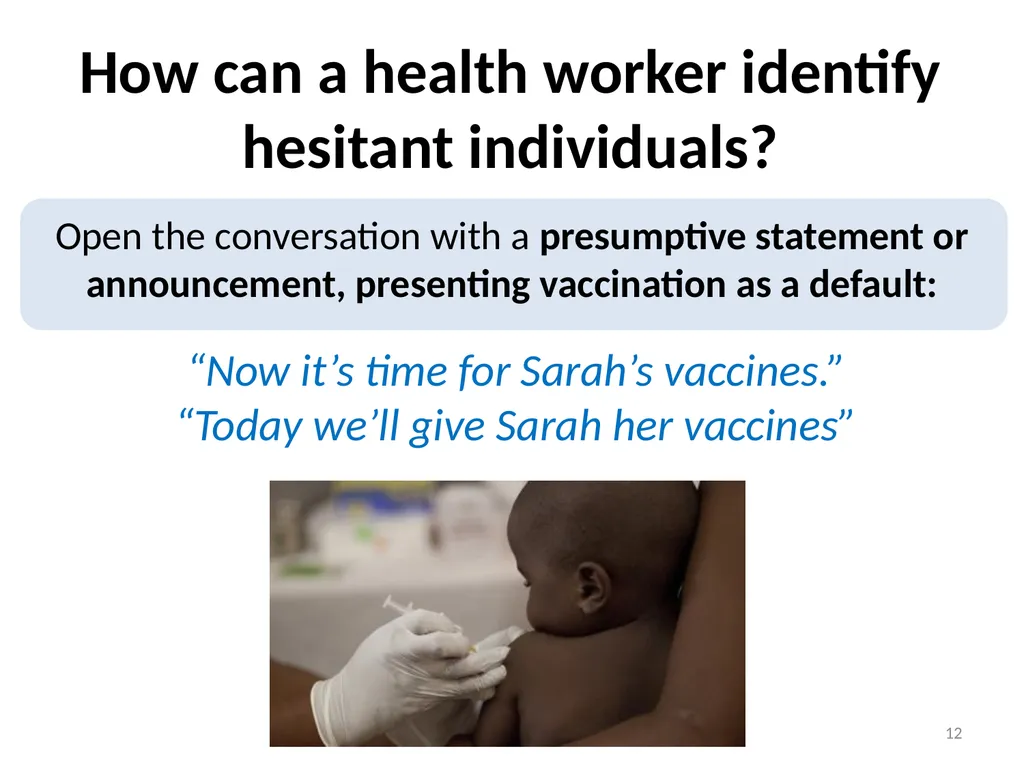
How can a health worker identify hesitant individuals? Open the conversation with a presumptive statement or announcement, presenting vaccination as a default: “Now it’s time for Sarah’s vaccines.”
“Today we’ll give Sarah her vaccines” 12<br>
“Today we’ll give Sarah her vaccines” 12<br>
13
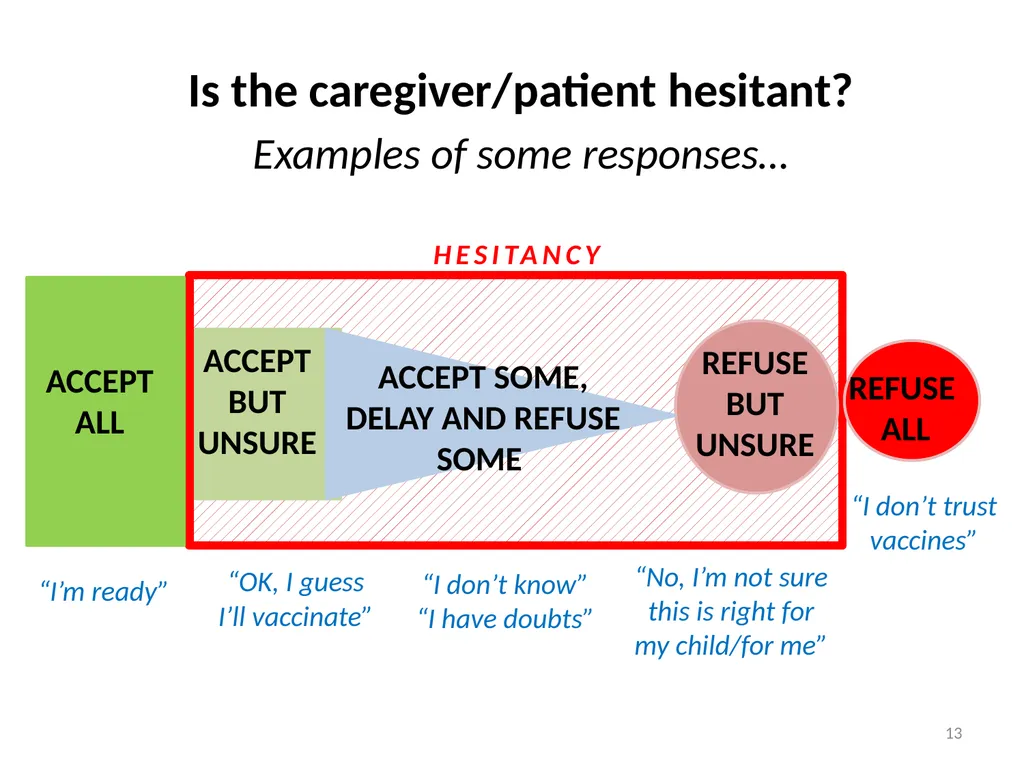
HESITANCY Is the caregiver/patient hesitant?
Examples of some responses… 13<br>
14
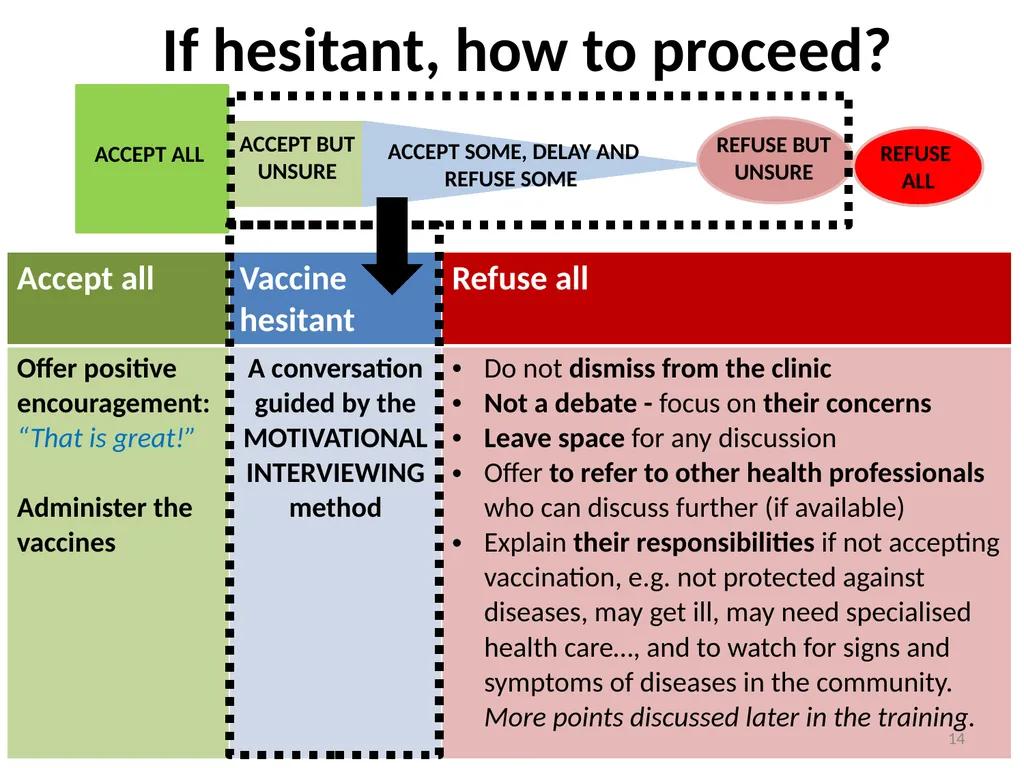
If hesitant, how to proceed? 14<br>
15
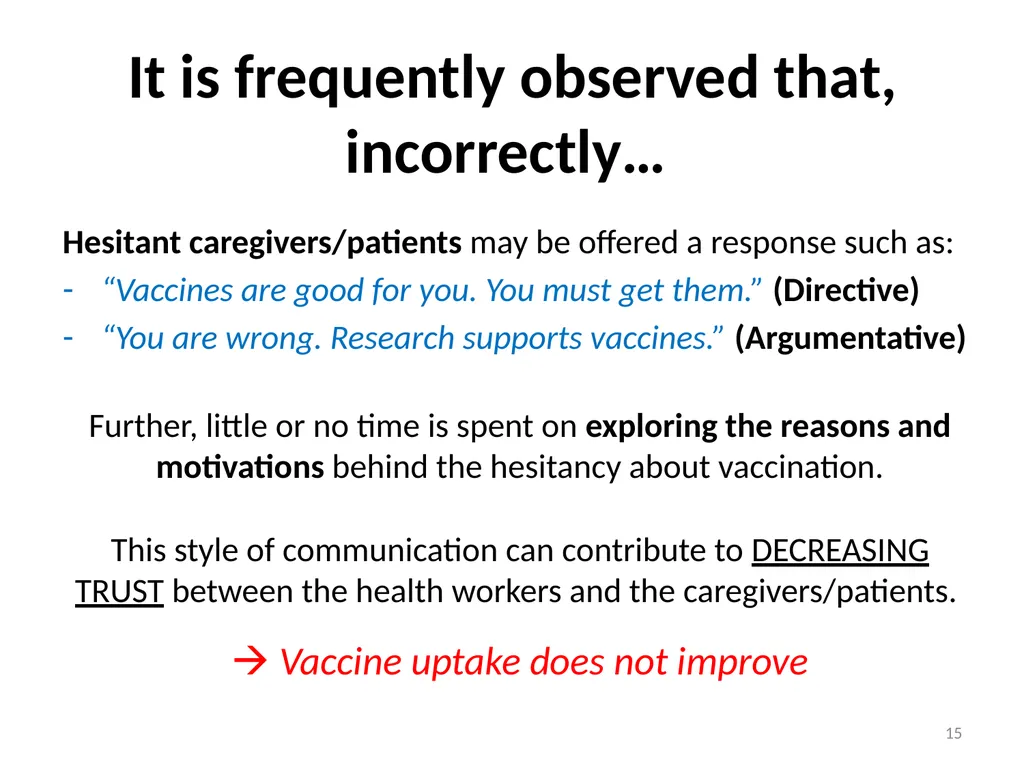
It is frequently observed that, incorrectly… Hesitant caregivers/patients may be offered a response such as:
“Vaccines are good for you. You must get them.” (Directive)
“You are wrong. Research supports vaccines.” (Argumentative)
Further, little or no time is spent on exploring the reasons and motivations behind the hesitancy about vaccination.
This style of communication can contribute to DECREASING TRUST between the health workers and the caregivers/patients.
Vaccine uptake does not improve 15<br>
“Vaccines are good for you. You must get them.” (Directive)
“You are wrong. Research supports vaccines.” (Argumentative)
Further, little or no time is spent on exploring the reasons and motivations behind the hesitancy about vaccination.
This style of communication can contribute to DECREASING TRUST between the health workers and the caregivers/patients.
Vaccine uptake does not improve 15<br>
16
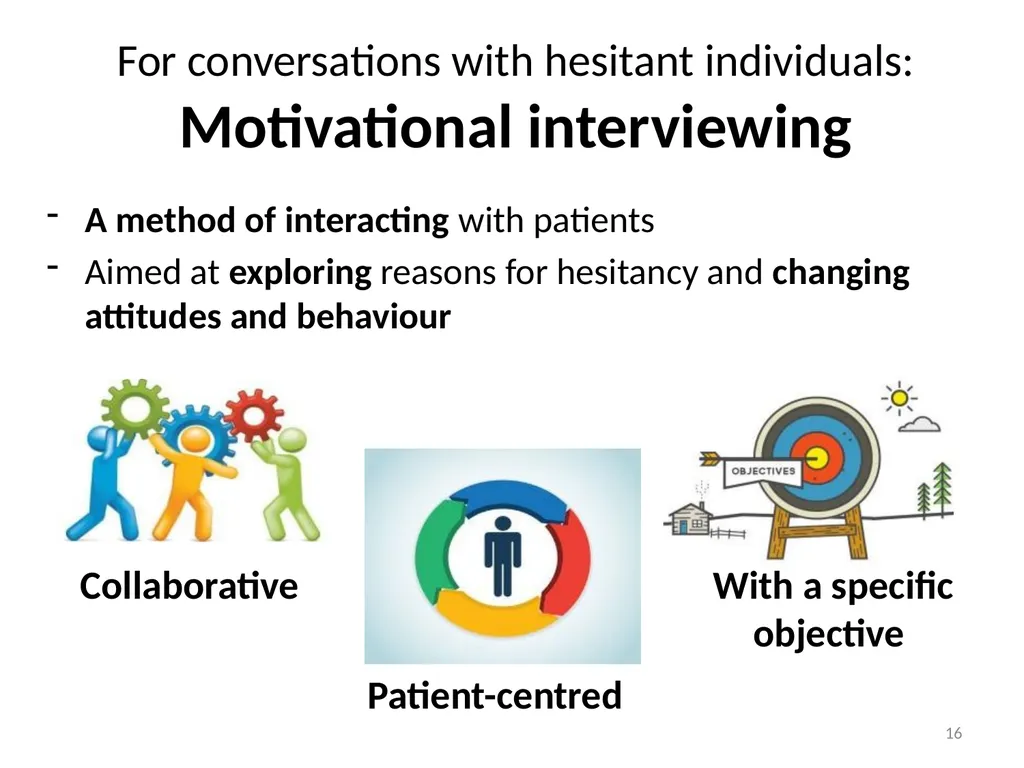
For conversations with hesitant individuals:
Motivational interviewing A method of interacting with patients
Aimed at exploring reasons for hesitancy and changing attitudes and behaviour 16<br>
Aimed at exploring reasons for hesitancy and changing attitudes and behaviour 16<br>
17
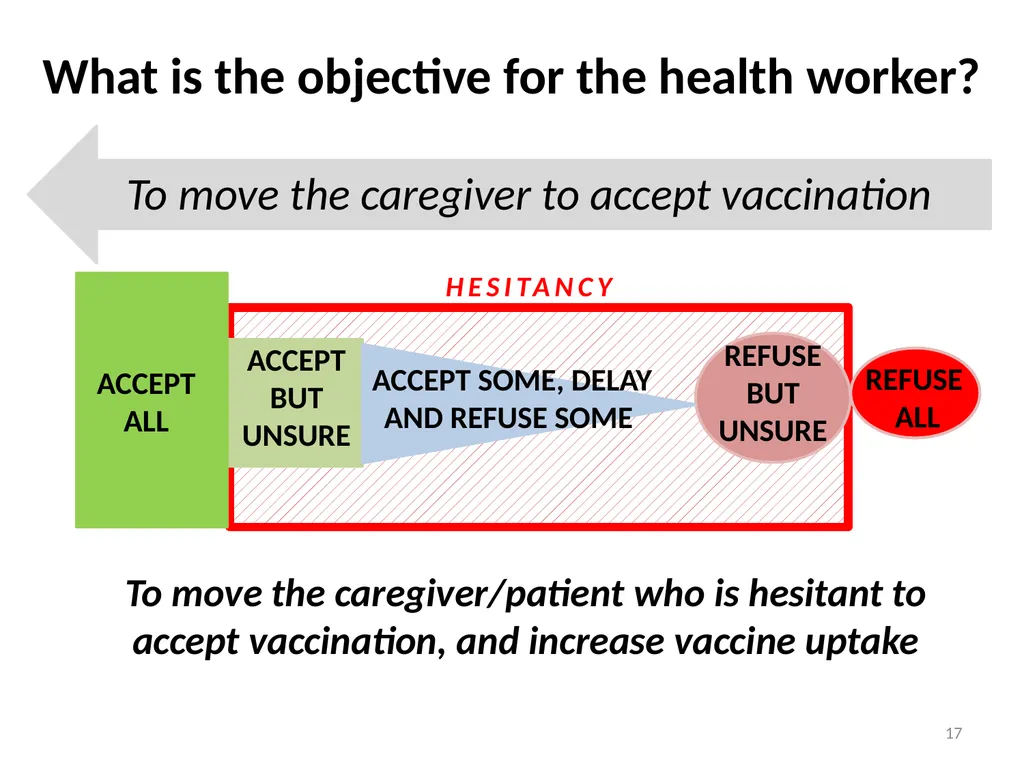
What is the objective for the health worker? To move the caregiver/patient who is hesitant to accept vaccination, and increase vaccine uptake To move the caregiver to accept vaccination 17 HESITANCY<br>
18
If the individual is hesitant, proceed with the following 5 steps
for a more effective conversation
USING MOTIVATIONAL INTERVIEWING: Motivational interviewing has been used widely and proven to be an effective tool in producing behaviour change in other areas of health, e.g. physical illness.
This training presents motivational interviewing methods adapted for the context of vaccination. 18<br>
This training presents motivational interviewing methods adapted for the context of vaccination. 18<br>
19
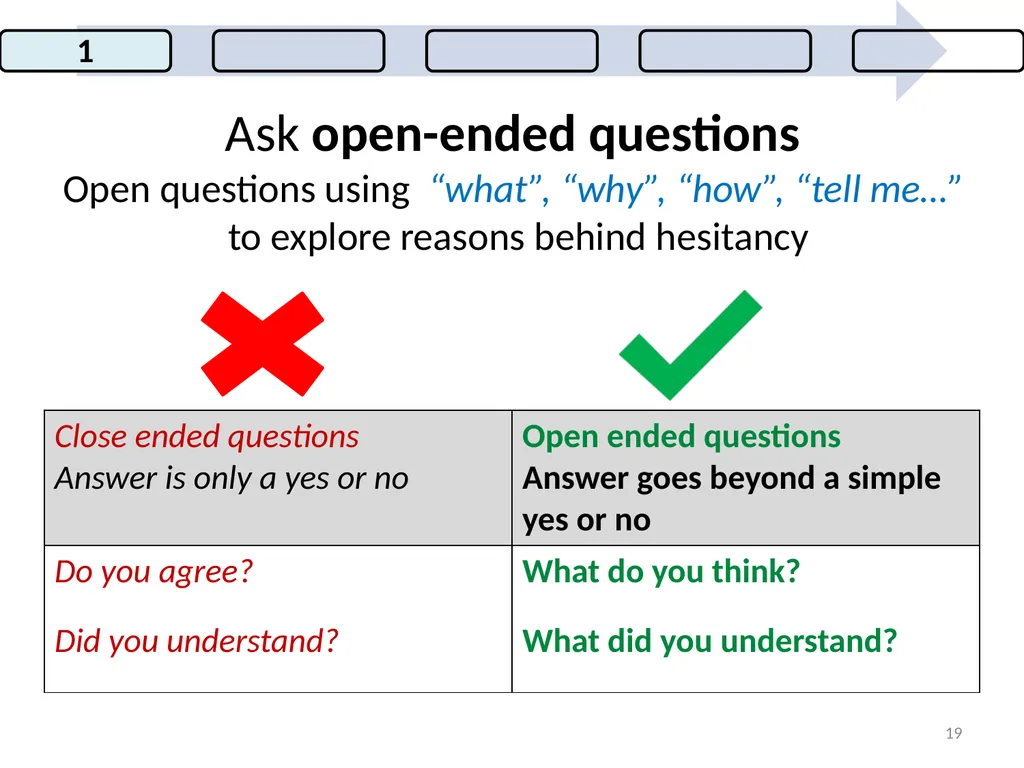
Ask open-ended questions Open questions using “what”, “why”, “how”, “tell me…”
to explore reasons behind hesitancy 19<br>
to explore reasons behind hesitancy 19<br>
20
Discussion (5 minutes)
In pairs or groups of three Provide examples of other open-ended questions you could use. 20<br>
21
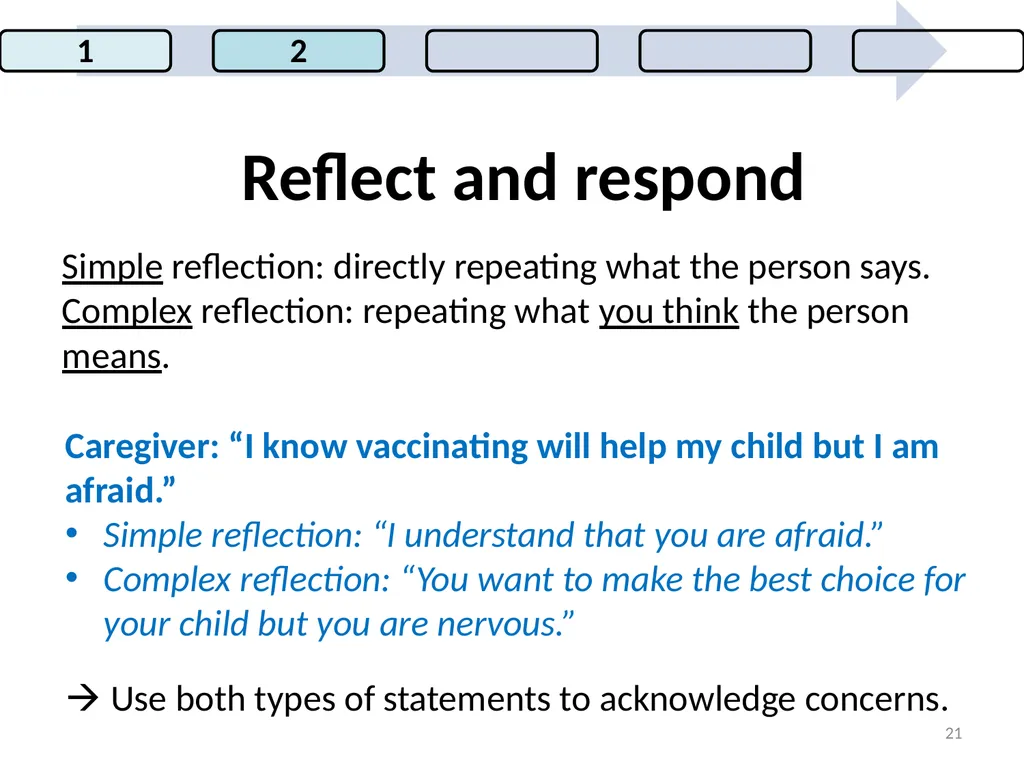
Reflect and respond
Simple reflection: directly repeating what the person says.
Complex reflection: repeating what you think the person means. Caregiver: “I know vaccinating will help my child but I am afraid.”
Simple reflection: “I understand that you are afraid.”
Complex reflection: “You want to make the best choice for your child but you are nervous.”
Use both types of statements to acknowledge concerns. 21<br>
Simple reflection: directly repeating what the person says.
Complex reflection: repeating what you think the person means. Caregiver: “I know vaccinating will help my child but I am afraid.”
Simple reflection: “I understand that you are afraid.”
Complex reflection: “You want to make the best choice for your child but you are nervous.”
Use both types of statements to acknowledge concerns. 21<br>
22
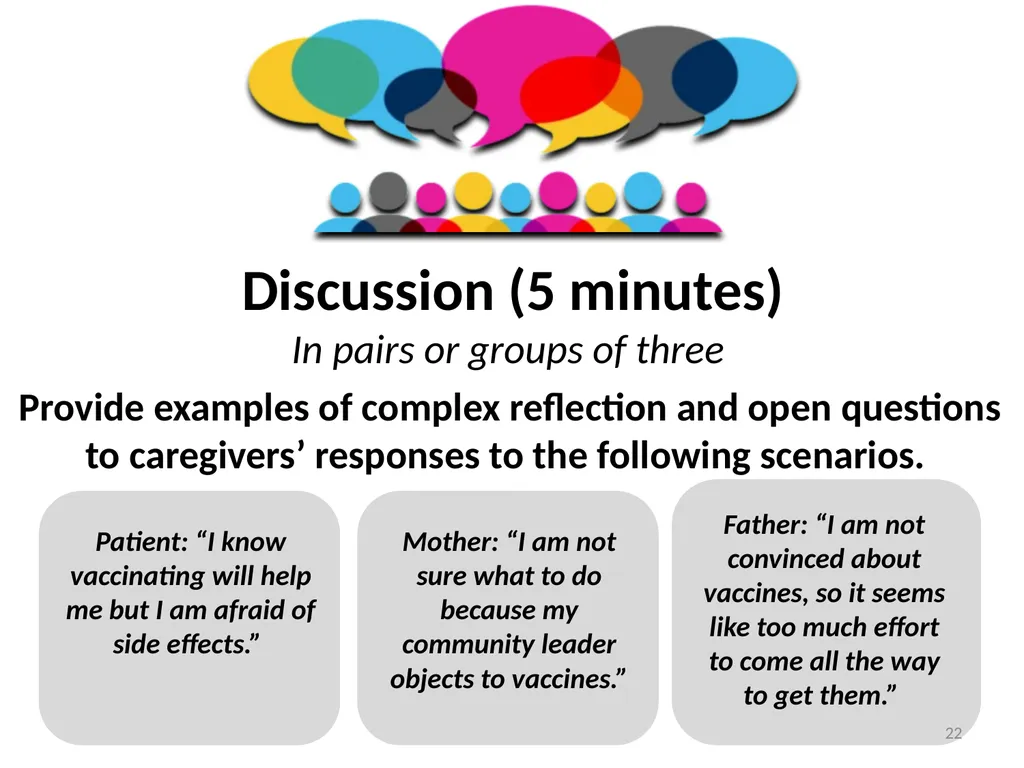
Discussion (5 minutes)
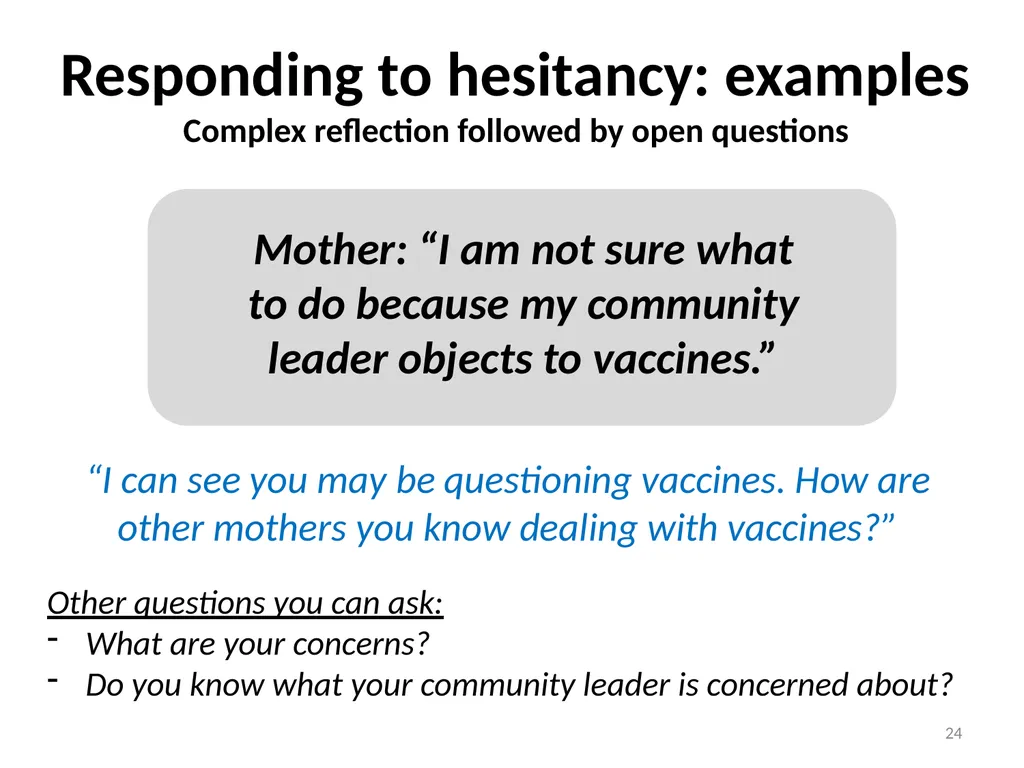
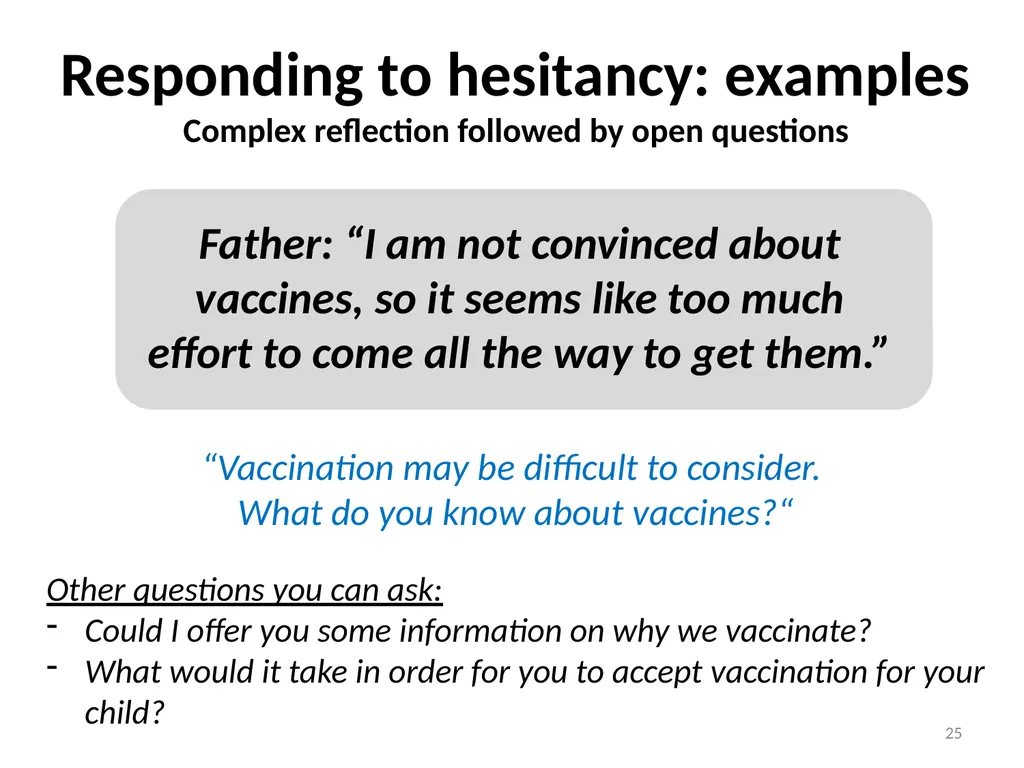
In pairs or groups of three Provide examples of complex reflection and open questions to caregivers’ responses to the following scenarios. Patient: “I know vaccinating will help me but I am afraid of side effects.” Mother: “I am not sure what to do because my community leader objects to vaccines.” Father: “I am not convinced about vaccines, so it seems like too much effort to come all the way to get them.” 22<br>
23
“I understand that you want to make the best choice for yourself. What side effects are you concerned about?” Responding to hesitancy: examples
Complex reflection followed by open questions 23<br>
Complex reflection followed by open questions 23<br>
24
“I can see you may be questioning vaccines. How are other mothers you know dealing with vaccines?”
Other questions you can ask:
What are your concerns?
Do you know what your community leader is concerned about? 24 Responding to hesitancy: examples
Complex reflection followed by open questions<br>
Other questions you can ask:
What are your concerns?
Do you know what your community leader is concerned about? 24 Responding to hesitancy: examples
Complex reflection followed by open questions<br>
25
Father: “I am not convinced about vaccines, so it seems like too much effort to come all the way to get them.” “Vaccination may be difficult to consider.
What do you know about vaccines?“
Other questions you can ask:
Could I offer you some information on why we vaccinate?
What would it take in order for you to accept vaccination for your child? 25 Responding to hesitancy: examples
Complex reflection followed by open questions<br>
What do you know about vaccines?“
Other questions you can ask:
Could I offer you some information on why we vaccinate?
What would it take in order for you to accept vaccination for your child? 25 Responding to hesitancy: examples
Complex reflection followed by open questions<br>
26
Affirm the strengths
“It is great that you are starting to think about vaccines.”
Validate concerns
“The health of your children is important to you.”
“Protecting yourself from illness is important for you and the health of your community.” 26<br>
“It is great that you are starting to think about vaccines.”
Validate concerns
“The health of your children is important to you.”
“Protecting yourself from illness is important for you and the health of your community.” 26<br>
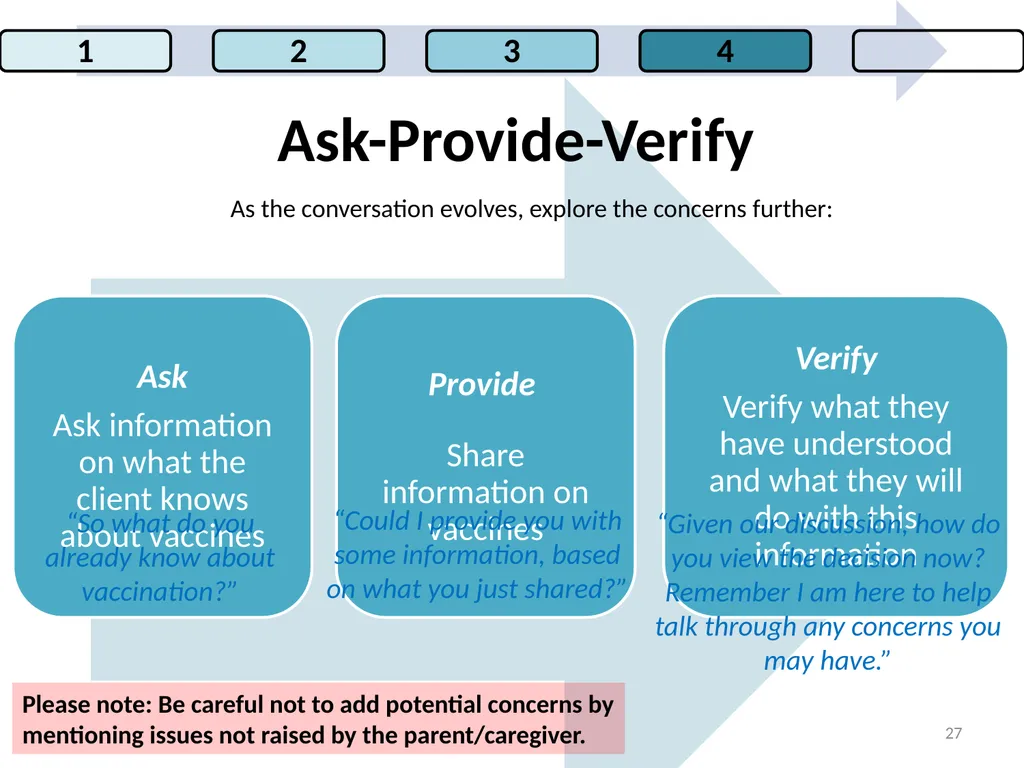
27
Ask-Provide-Verify Please note: Be careful not to add potential concerns by mentioning issues not raised by the parent/caregiver. 27 As the conversation evolves, explore the concerns further:<br>
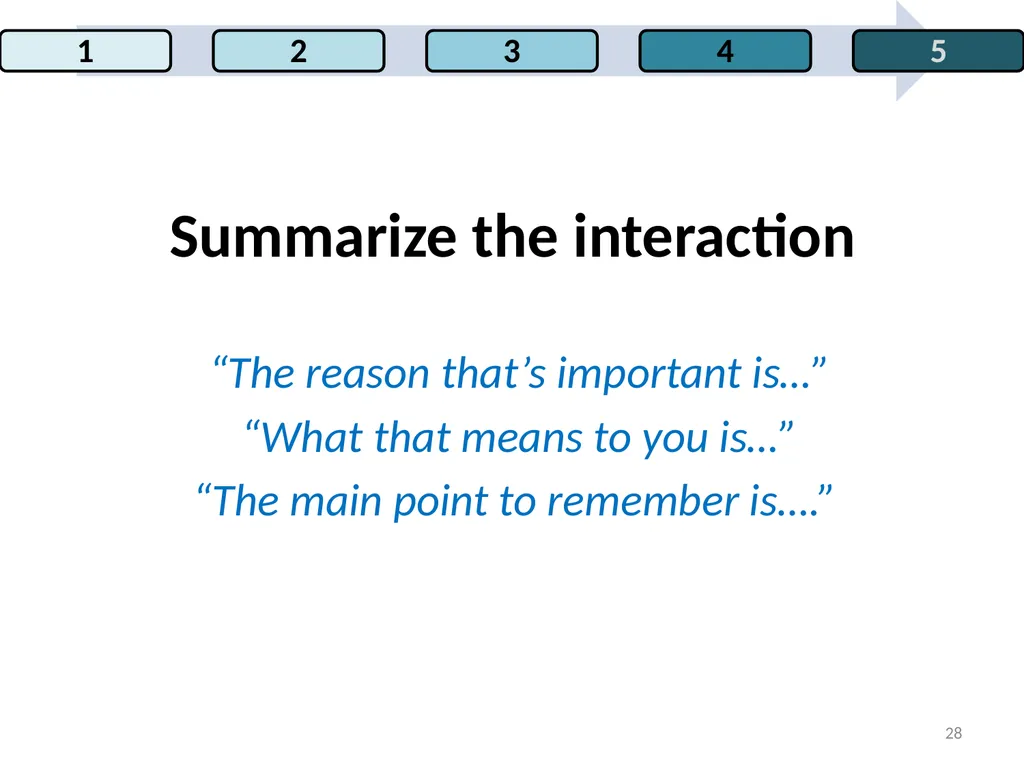
28
Summarize the interaction
“The reason that’s important is…”
“What that means to you is…”
“The main point to remember is….” 28<br>
“The reason that’s important is…”
“What that means to you is…”
“The main point to remember is….” 28<br>
29
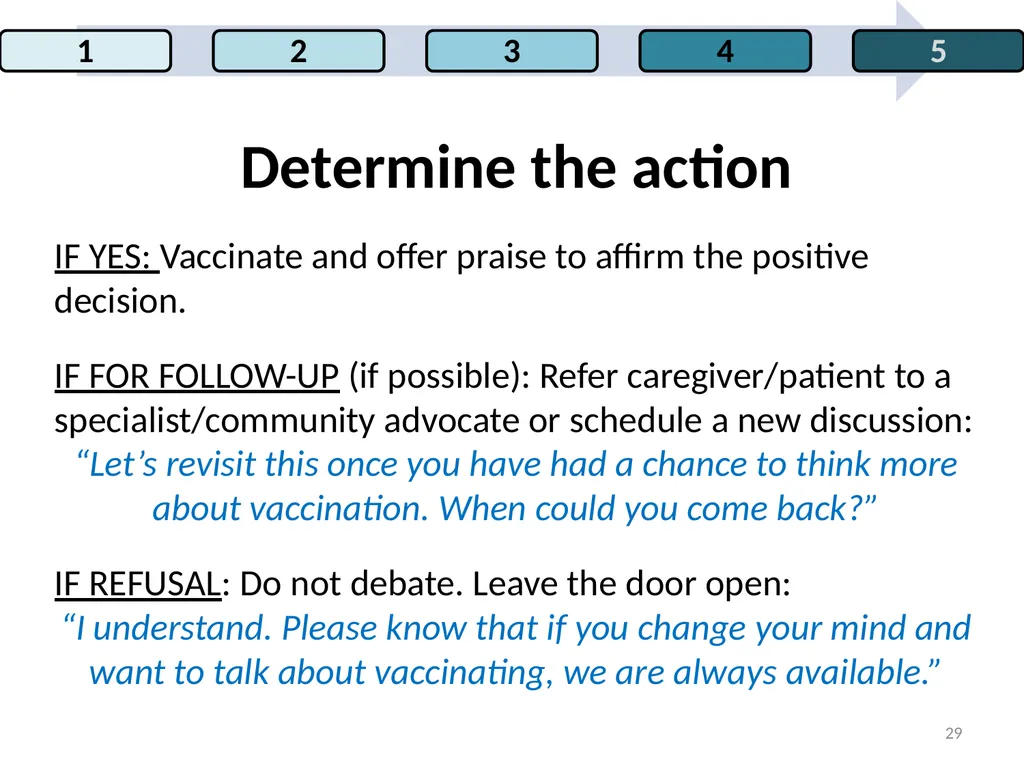
Determine the action
IF YES: Vaccinate and offer praise to affirm the positive decision.
IF FOR FOLLOW-UP (if possible): Refer caregiver/patient to a specialist/community advocate or schedule a new discussion:
“Let’s revisit this once you have had a chance to think more about vaccination. When could you come back?”
IF REFUSAL: Do not debate. Leave the door open:
“I understand. Please know that if you change your mind and want to talk about vaccinating, we are always available.” 29<br>
IF YES: Vaccinate and offer praise to affirm the positive decision.
IF FOR FOLLOW-UP (if possible): Refer caregiver/patient to a specialist/community advocate or schedule a new discussion:
“Let’s revisit this once you have had a chance to think more about vaccination. When could you come back?”
IF REFUSAL: Do not debate. Leave the door open:
“I understand. Please know that if you change your mind and want to talk about vaccinating, we are always available.” 29<br>
30
If the caregiver/patient’s wishes are NOT to vaccinate, ensure they understand their decision, and explain their responsibilities for protecting the health of their child/themselves.
“I understand that you have decided not to vaccinate today. Please know you are taking an important responsibility. What this means is…
If your child/you are ill, you must seek medical assistance
When talking to medical/clinic staff, you must tell them that you/your child has not received all the vaccines recommended.
You must learn about the signs and symptoms of vaccine preventable diseases.”
Reference reading on caregiver roles and responsibilities for not accepting vaccines: http://www.euro.who.int/__data/assets/pdf_file/0004/160753/If-you-choose_EN_WHO_WEB.pdf?ua=1 (in English) 30<br>
“I understand that you have decided not to vaccinate today. Please know you are taking an important responsibility. What this means is…
If your child/you are ill, you must seek medical assistance
When talking to medical/clinic staff, you must tell them that you/your child has not received all the vaccines recommended.
You must learn about the signs and symptoms of vaccine preventable diseases.”
Reference reading on caregiver roles and responsibilities for not accepting vaccines: http://www.euro.who.int/__data/assets/pdf_file/0004/160753/If-you-choose_EN_WHO_WEB.pdf?ua=1 (in English) 30<br>
31
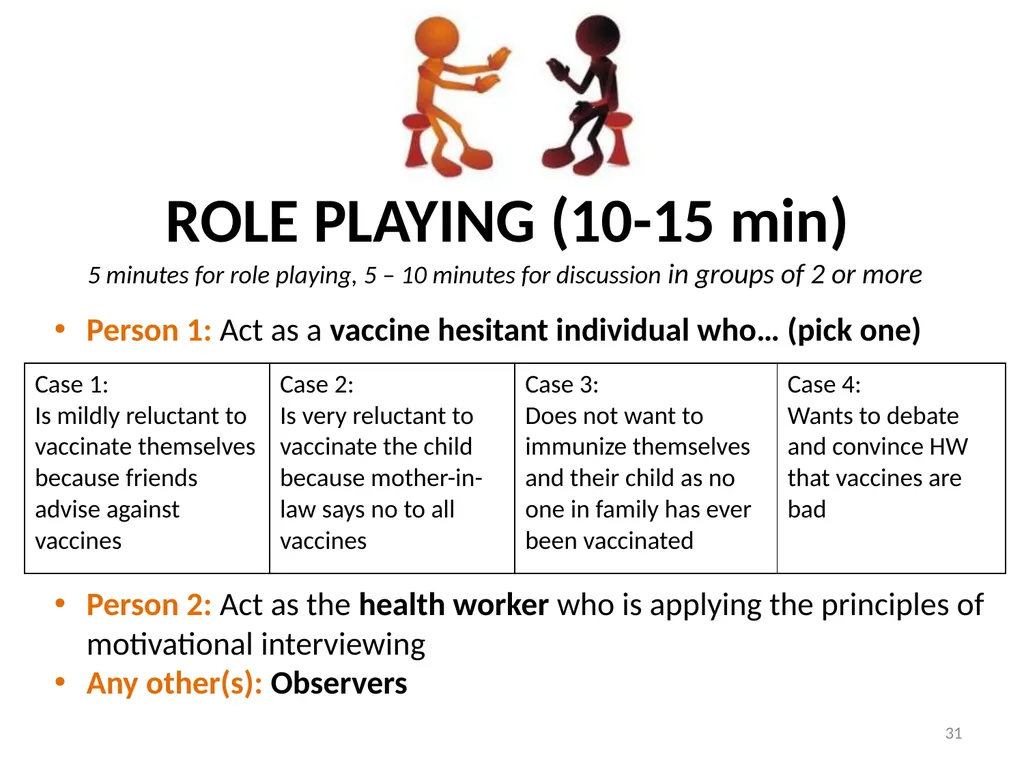
ROLE PLAYING (10-15 min) Person 1: Act as a vaccine hesitant individual who… (pick one)
Person 2: Act as the health worker who is applying the principles of motivational interviewing
Any other(s): Observers 5 minutes for role playing, 5 – 10 minutes for discussion in groups of 2 or more 31<br>
Person 2: Act as the health worker who is applying the principles of motivational interviewing
Any other(s): Observers 5 minutes for role playing, 5 – 10 minutes for discussion in groups of 2 or more 31<br>
32
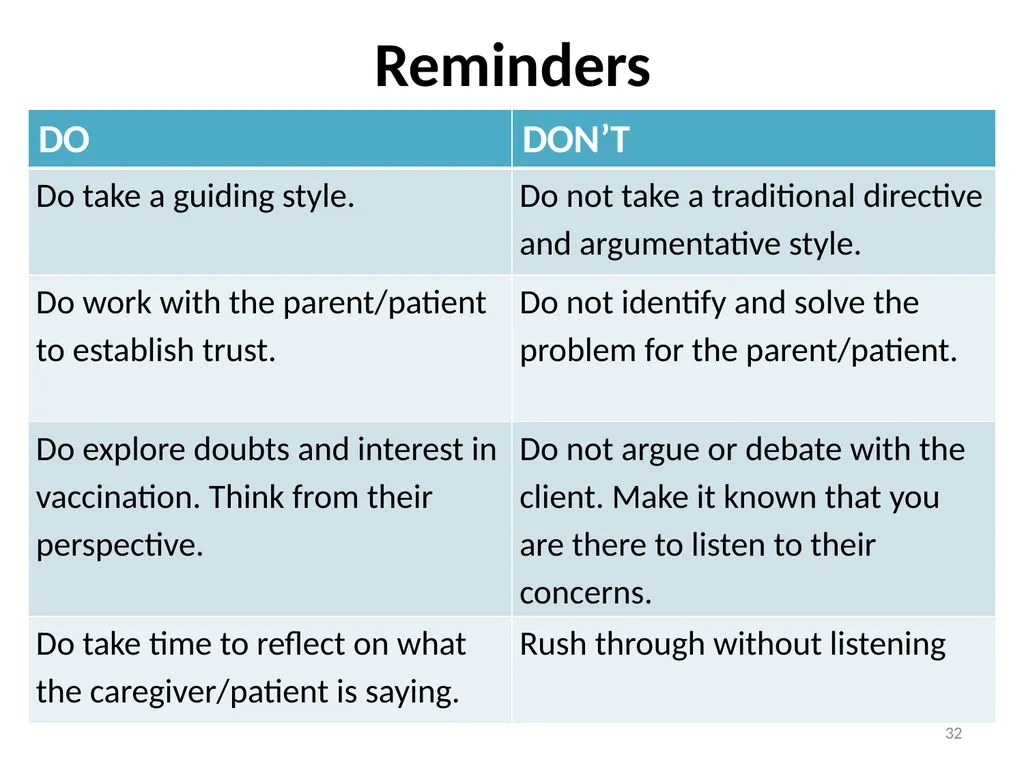
Reminders 32<br>
33
What do you think about vaccines?
What is your major concern?
What would it take to move you to a “yes” to vaccinate?
What could make it easier for you to get vaccines (on time) for yourself and/or your children? As you apply these skills, examples of questions to ask: 33<br>
What is your major concern?
What would it take to move you to a “yes” to vaccinate?
What could make it easier for you to get vaccines (on time) for yourself and/or your children? As you apply these skills, examples of questions to ask: 33<br>
34
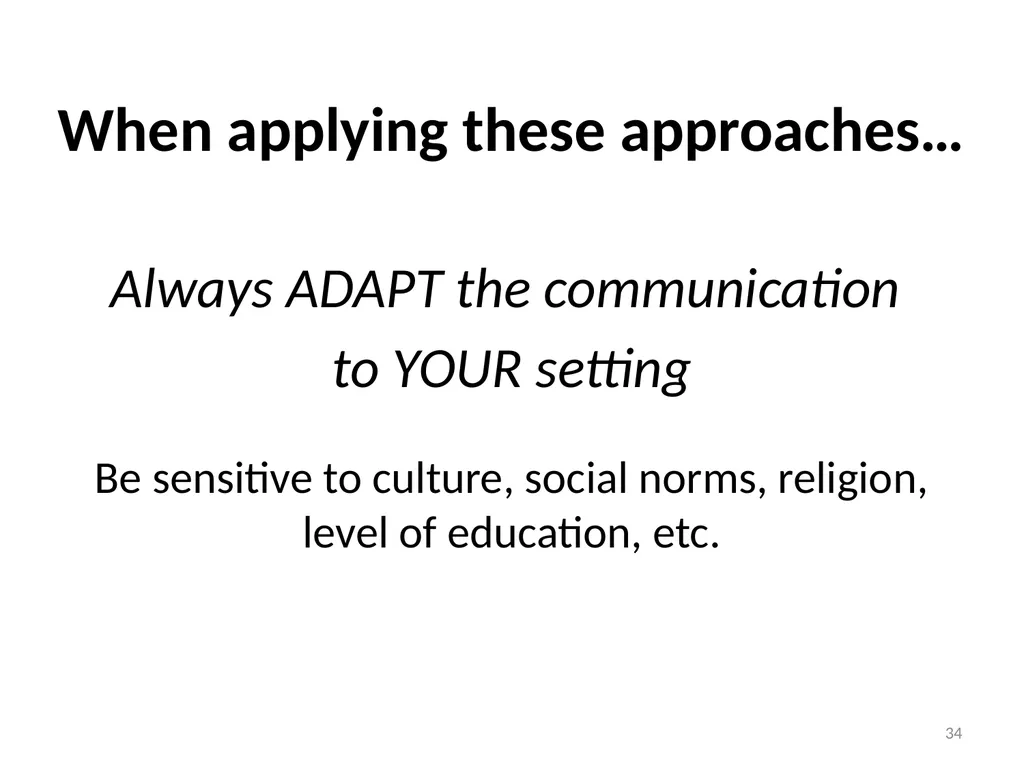
When applying these approaches… Always ADAPT the communication
to YOUR setting
Be sensitive to culture, social norms, religion, level of education, etc. 34<br>
to YOUR setting
Be sensitive to culture, social norms, religion, level of education, etc. 34<br>
35
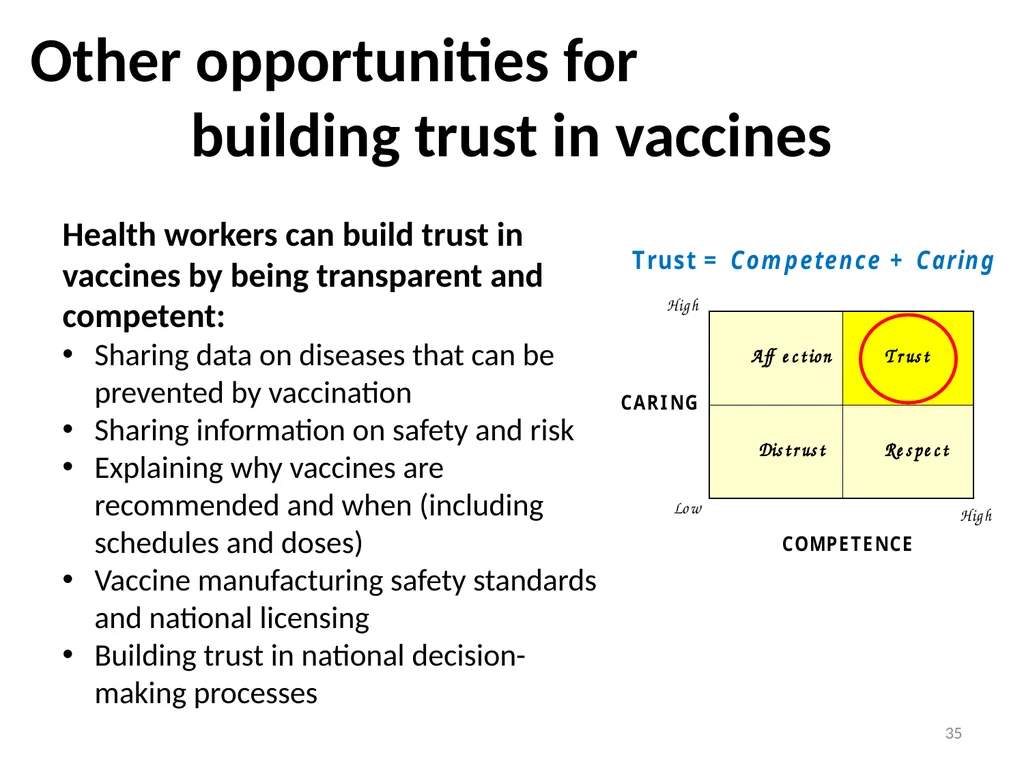
Other opportunities for building trust in vaccines 35 Health workers can build trust in vaccines by being transparent and competent:
Sharing data on diseases that can be prevented by vaccination
Sharing information on safety and risk
Explaining why vaccines are recommended and when (including schedules and doses)
Vaccine manufacturing safety standards and national licensing
Building trust in national decision-making processes<br>
Sharing data on diseases that can be prevented by vaccination
Sharing information on safety and risk
Explaining why vaccines are recommended and when (including schedules and doses)
Vaccine manufacturing safety standards and national licensing
Building trust in national decision-making processes<br>
36
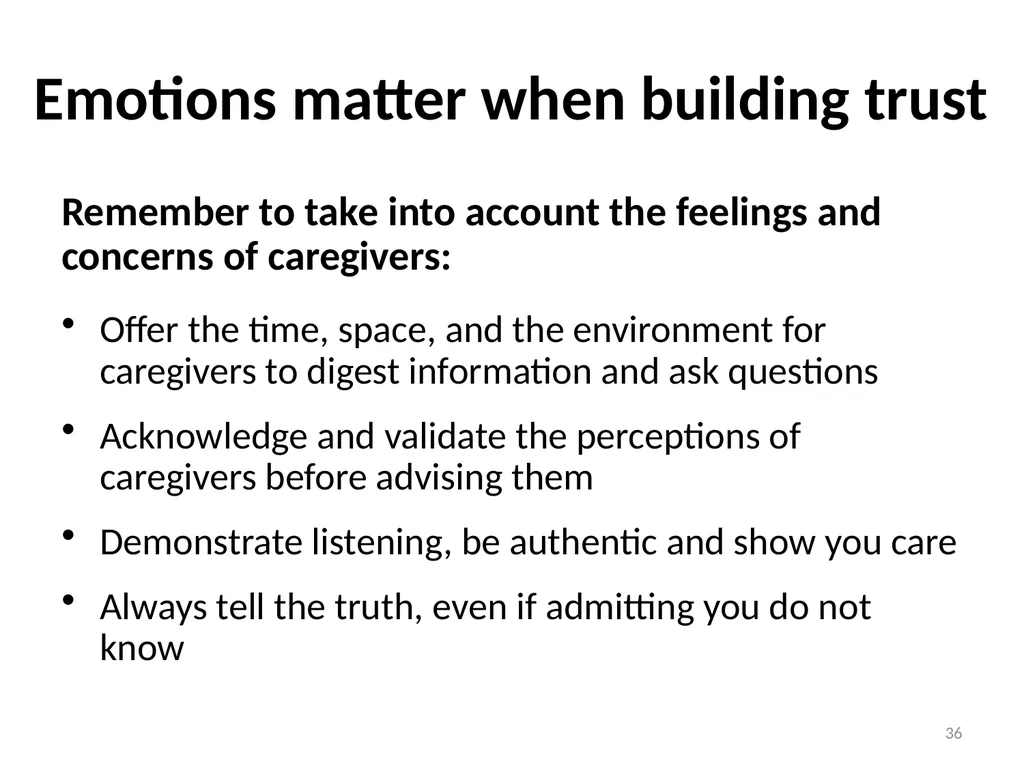
Emotions matter when building trust Remember to take into account the feelings and concerns of caregivers:
Offer the time, space, and the environment for caregivers to digest information and ask questions
Acknowledge and validate the perceptions of caregivers before advising them
Demonstrate listening, be authentic and show you care
Always tell the truth, even if admitting you do not know 36<br>
Offer the time, space, and the environment for caregivers to digest information and ask questions
Acknowledge and validate the perceptions of caregivers before advising them
Demonstrate listening, be authentic and show you care
Always tell the truth, even if admitting you do not know 36<br>
37
Frequently asked questions
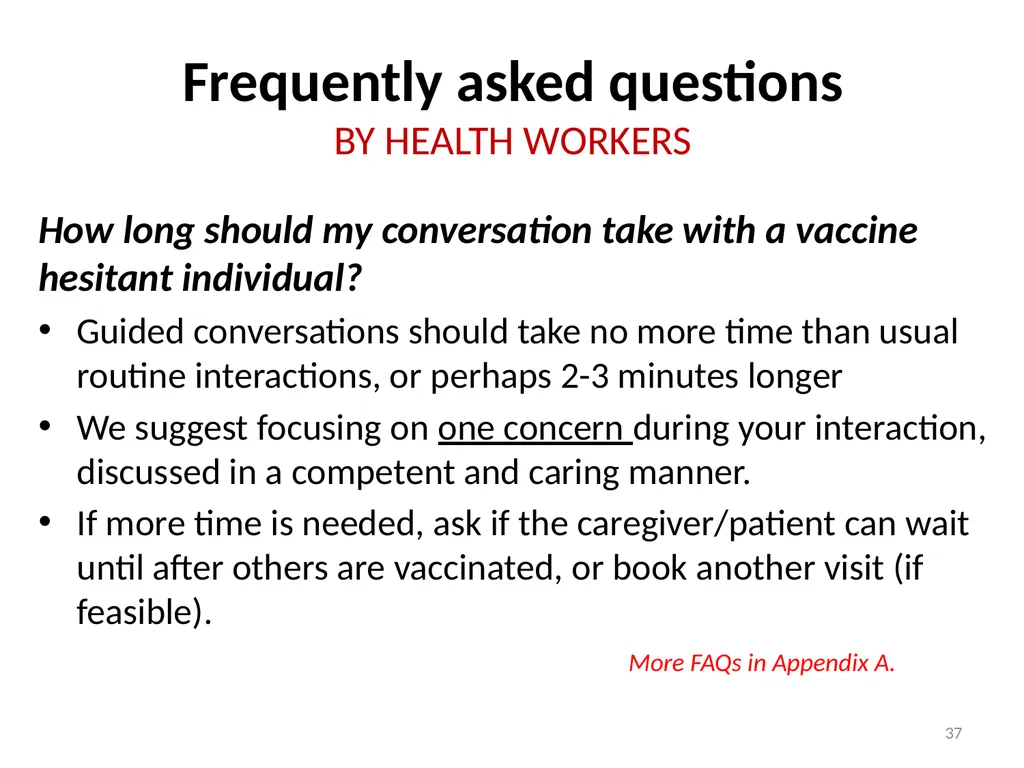
BY HEALTH WORKERS How long should my conversation take with a vaccine hesitant individual?
Guided conversations should take no more time than usual routine interactions, or perhaps 2-3 minutes longer
We suggest focusing on one concern during your interaction, discussed in a competent and caring manner.
If more time is needed, ask if the caregiver/patient can wait until after others are vaccinated, or book another visit (if feasible). 37 More FAQs in Appendix A.<br>
Guided conversations should take no more time than usual routine interactions, or perhaps 2-3 minutes longer
We suggest focusing on one concern during your interaction, discussed in a competent and caring manner.
If more time is needed, ask if the caregiver/patient can wait until after others are vaccinated, or book another visit (if feasible). 37 More FAQs in Appendix A.<br>
38
SAFETY OF VACCINES
Can vaccinations lead to infertility?
No, vaccinations cannot lead to infertility. In fact, medical experts suggest that some vaccines actually protect fertility indirectly by preventing the need for treatment.
Can vaccines cause harmful side effects, illness and even death?
No, vaccines are very safe. Most side effects from vaccines are minor and temporary, such as a sore arm or mild fever. Serious adverse events or death are VERY rare (e.g. 1 per millions of doses) for most vaccines.
Can needles used for immunization cause infection?
For every vaccine, we always use one-time or auto-disable syringes that cannot be reused, which eliminates the risk of transmitting infections from needles.
TIMING OF VACCINES
Isn’t giving three needles too many in one visit?
No, receiving multiple vaccines in one visit is completely safe as you/your child’s immune system is strong enough to handle them. Frequently asked questions BY PATIENTS/CAREGIVERS 38 More FAQs in Appendix A.<br>
Can vaccinations lead to infertility?
No, vaccinations cannot lead to infertility. In fact, medical experts suggest that some vaccines actually protect fertility indirectly by preventing the need for treatment.
Can vaccines cause harmful side effects, illness and even death?
No, vaccines are very safe. Most side effects from vaccines are minor and temporary, such as a sore arm or mild fever. Serious adverse events or death are VERY rare (e.g. 1 per millions of doses) for most vaccines.
Can needles used for immunization cause infection?
For every vaccine, we always use one-time or auto-disable syringes that cannot be reused, which eliminates the risk of transmitting infections from needles.
TIMING OF VACCINES
Isn’t giving three needles too many in one visit?
No, receiving multiple vaccines in one visit is completely safe as you/your child’s immune system is strong enough to handle them. Frequently asked questions BY PATIENTS/CAREGIVERS 38 More FAQs in Appendix A.<br>
39
Summary Conversations that guide the caregiver/patient to explore their reasons for hesitancy can help increase confidence and trust in vaccines and the vaccination programme.
The goal of these conversations is to move someone towards a “yes” for acceptance. It may take more than one visit.
Adequate training and practice can help lead to positive outcomes. 39<br>
The goal of these conversations is to move someone towards a “yes” for acceptance. It may take more than one visit.
Adequate training and practice can help lead to positive outcomes. 39<br>
40
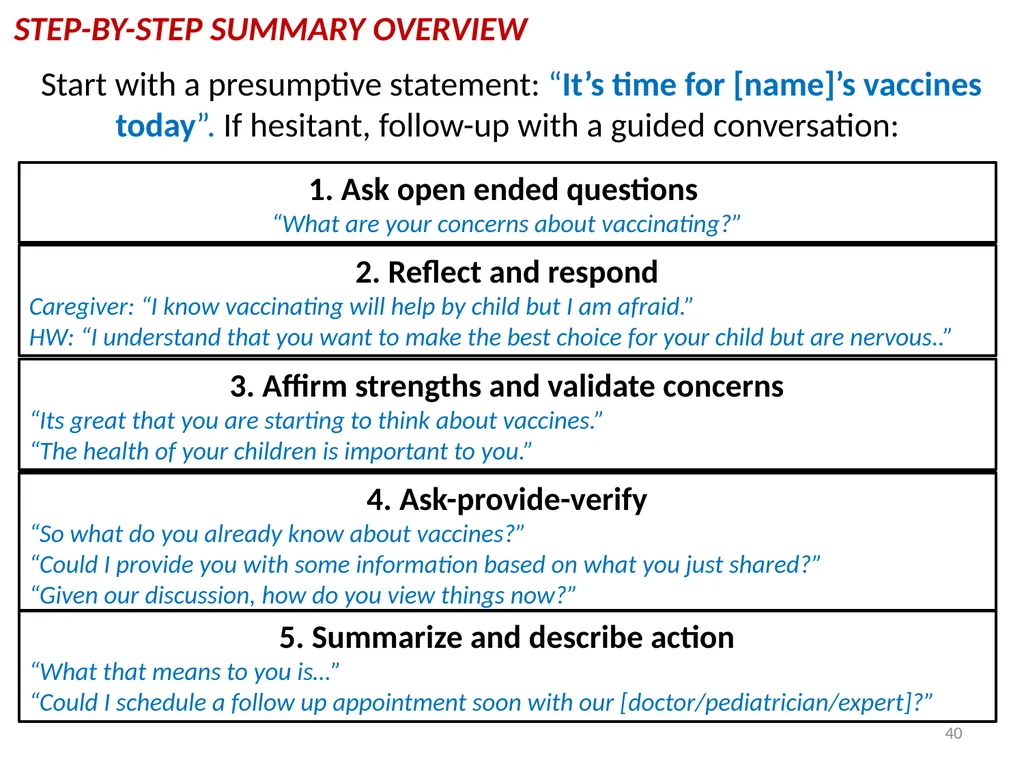
40 Start with a presumptive statement: “It’s time for [name]’s vaccines today”. If hesitant, follow-up with a guided conversation: 1. Ask open ended questions
“What are your concerns about vaccinating?” 2. Reflect and respond
Caregiver: “I know vaccinating will help by child but I am afraid.”
HW: “I understand that you want to make the best choice for your child but are nervous..” 3. Affirm strengths and validate concerns
“Its great that you are starting to think about vaccines.”
“The health of your children is important to you.” 4. Ask-provide-verify
“So what do you already know about vaccines?”
“Could I provide you with some information based on what you just shared?”
“Given our discussion, how do you view things now?” 5. Summarize and describe action
“What that means to you is…”
“Could I schedule a follow up appointment soon with our [doctor/pediatrician/expert]?” STEP-BY-STEP SUMMARY OVERVIEW<br>
“What are your concerns about vaccinating?” 2. Reflect and respond
Caregiver: “I know vaccinating will help by child but I am afraid.”
HW: “I understand that you want to make the best choice for your child but are nervous..” 3. Affirm strengths and validate concerns
“Its great that you are starting to think about vaccines.”
“The health of your children is important to you.” 4. Ask-provide-verify
“So what do you already know about vaccines?”
“Could I provide you with some information based on what you just shared?”
“Given our discussion, how do you view things now?” 5. Summarize and describe action
“What that means to you is…”
“Could I schedule a follow up appointment soon with our [doctor/pediatrician/expert]?” STEP-BY-STEP SUMMARY OVERVIEW<br>
41
Thank you for your attention! 41<br>
42
Appendix A
COMMONLY ASKED QUESTIONS BY VACCINE HESITANT INDIVIDUALS 42<br>
43
“Won’t breast feeding protect babies from infection?”
Yes, breast milk will give some protection against some infection, but it does not have the direct ability to prevent infection like vaccines. Vaccines are very specific to the given infection and their prevention capacity is very high.
“Can vaccines cause the infection they are supposed to prevent?”
Inactivated vaccines do not have live germs and cannot cause infections. Live vaccines have weakened germs that are unable to cause disease in healthy people. Rarely a mild form of infection may occur. 43<br>
Yes, breast milk will give some protection against some infection, but it does not have the direct ability to prevent infection like vaccines. Vaccines are very specific to the given infection and their prevention capacity is very high.
“Can vaccines cause the infection they are supposed to prevent?”
Inactivated vaccines do not have live germs and cannot cause infections. Live vaccines have weakened germs that are unable to cause disease in healthy people. Rarely a mild form of infection may occur. 43<br>
44
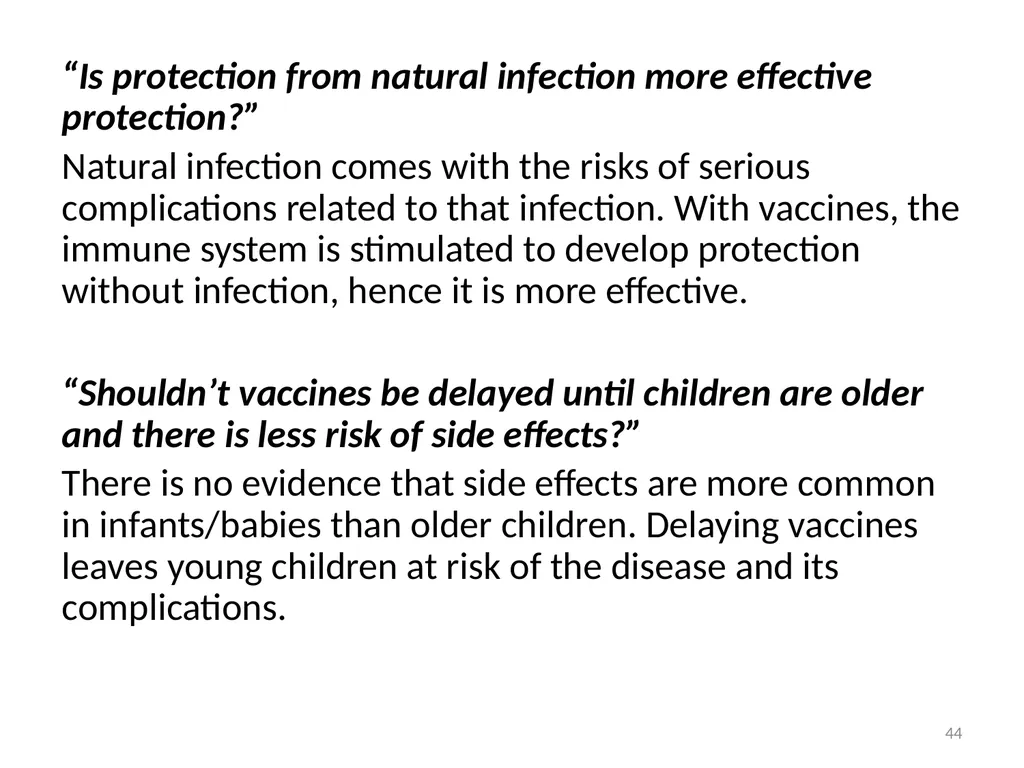
“Is protection from natural infection more effective protection?”
Natural infection comes with the risks of serious complications related to that infection. With vaccines, the immune system is stimulated to develop protection without infection, hence it is more effective.
“Shouldn’t vaccines be delayed until children are older and there is less risk of side effects?”
There is no evidence that side effects are more common in infants/babies than older children. Delaying vaccines leaves young children at risk of the disease and its complications. 44<br>
Natural infection comes with the risks of serious complications related to that infection. With vaccines, the immune system is stimulated to develop protection without infection, hence it is more effective.
“Shouldn’t vaccines be delayed until children are older and there is less risk of side effects?”
There is no evidence that side effects are more common in infants/babies than older children. Delaying vaccines leaves young children at risk of the disease and its complications. 44<br>