
Copper Mining and Processing Learning Objectives
LD
Published · 87 slides · 0 views
1 / 1


Description
Copper Mining and Processing Learning Objectives Describe basic information about copper, its occurrence, and its use Articulate the history and current status of copper mining in Arizona and tribal lands Detail the stages in the life cycle
Related Topics
Download this presentation From Below
"Copper Mining and Processing Learning Objectives" is the property of its rightful owner. Permission is granted to download and print the materials on this website for personal, non-commercial use only, and to display it on your personal computer provided you do not modify the materials and that you retain all copyright notices contained in the materials. By downloading content from our website, you accept the terms of this agreement.
Share
Embed code
Presentation Transcript
01
Copper Mining and Processing<br>
02
Learning Objectives Describe basic information about copper, its occurrence, and its use
Articulate the history and current status of copper mining in Arizona and tribal lands
Detail the stages in the life cycle of a mine
Describe copper processing for oxide and sulfide ores<br>
Articulate the history and current status of copper mining in Arizona and tribal lands
Detail the stages in the life cycle of a mine
Describe copper processing for oxide and sulfide ores<br>
03
Copper, its Occurrence, and Use What is Copper?<br>
04
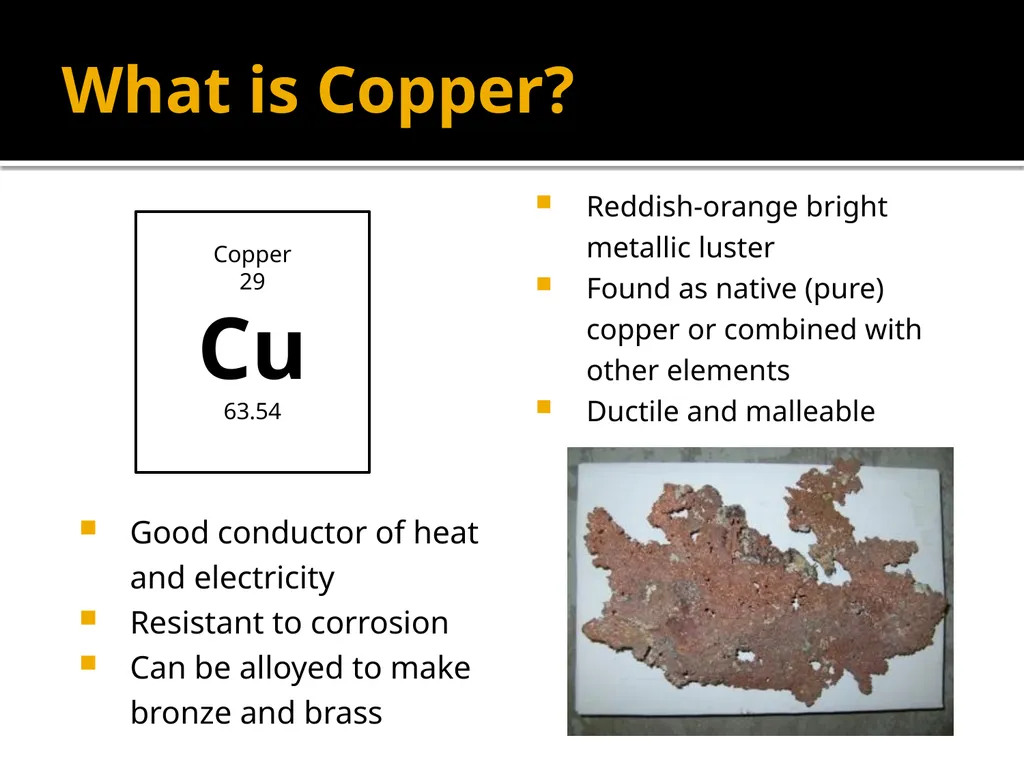
What is Copper? Reddish-orange bright metallic luster
Found as native (pure) copper or combined with other elements
Ductile and malleable Good conductor of heat and electricity
Resistant to corrosion
Can be alloyed to make bronze and brass Copper
29
Cu
63.54<br>
Found as native (pure) copper or combined with other elements
Ductile and malleable Good conductor of heat and electricity
Resistant to corrosion
Can be alloyed to make bronze and brass Copper
29
Cu
63.54<br>
05
Copper, its Occurrence, and Use Naturally Occurring Forms of Copper<br>
06
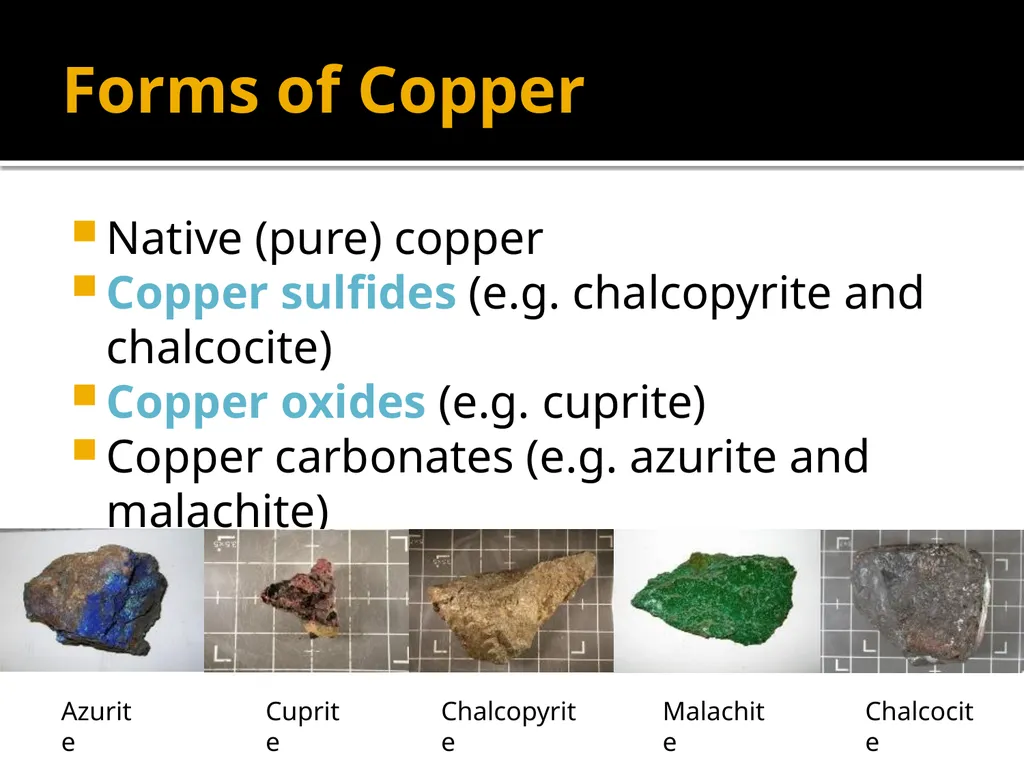
Forms of Copper Native (pure) copper
Copper sulfides (e.g. chalcopyrite and chalcocite)
Copper oxides (e.g. cuprite)
Copper carbonates (e.g. azurite and malachite)<br>
Copper sulfides (e.g. chalcopyrite and chalcocite)
Copper oxides (e.g. cuprite)
Copper carbonates (e.g. azurite and malachite)<br>
07
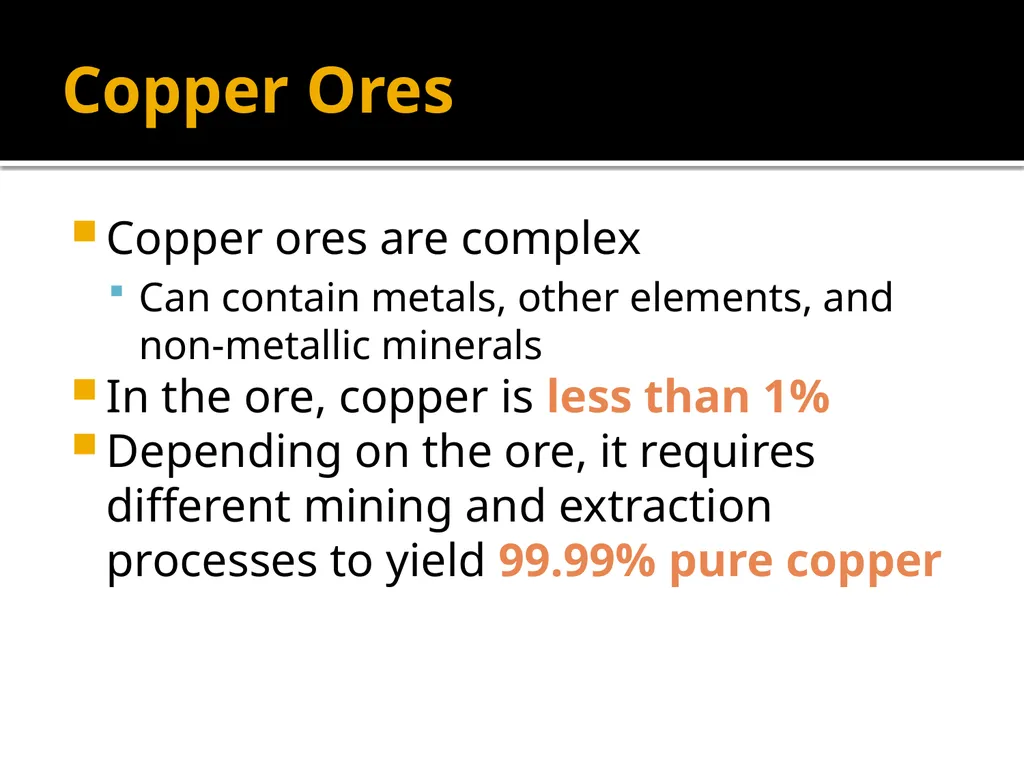
Copper Ores Copper ores are complex
Can contain metals, other elements, and non-metallic minerals
In the ore, copper is less than 1%
Depending on the ore, it requires different mining and extraction processes to yield 99.99% pure copper<br>
Can contain metals, other elements, and non-metallic minerals
In the ore, copper is less than 1%
Depending on the ore, it requires different mining and extraction processes to yield 99.99% pure copper<br>
08
Copper, its Occurrence, and Use Historical and Modern Copper Use<br>
09
Historical Copper Use Discovered: early 9000 BC in Middle East
Early artifacts used native (pure) copper
Utensils, tools, weapons, piping, ornaments, and jewelry
Chalcolithic period: ~3500-2500 BC
Rise in the use and smelting of copper
Discovery of bronze alloy
Early Romans discovered brass alloy
Copper and brass as currency<br>
Early artifacts used native (pure) copper
Utensils, tools, weapons, piping, ornaments, and jewelry
Chalcolithic period: ~3500-2500 BC
Rise in the use and smelting of copper
Discovery of bronze alloy
Early Romans discovered brass alloy
Copper and brass as currency<br>
10
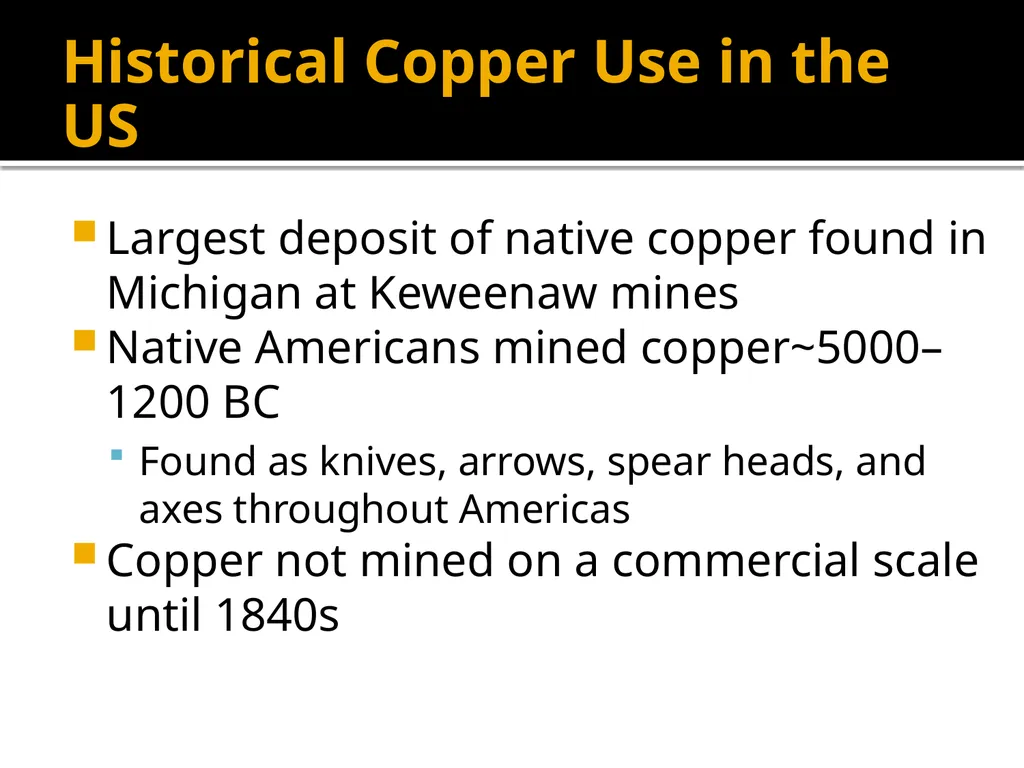
Historical Copper Use in the US Largest deposit of native copper found in Michigan at Keweenaw mines
Native Americans mined copper~5000–1200 BC
Found as knives, arrows, spear heads, and axes throughout Americas
Copper not mined on a commercial scale until 1840s<br>
Native Americans mined copper~5000–1200 BC
Found as knives, arrows, spear heads, and axes throughout Americas
Copper not mined on a commercial scale until 1840s<br>
11
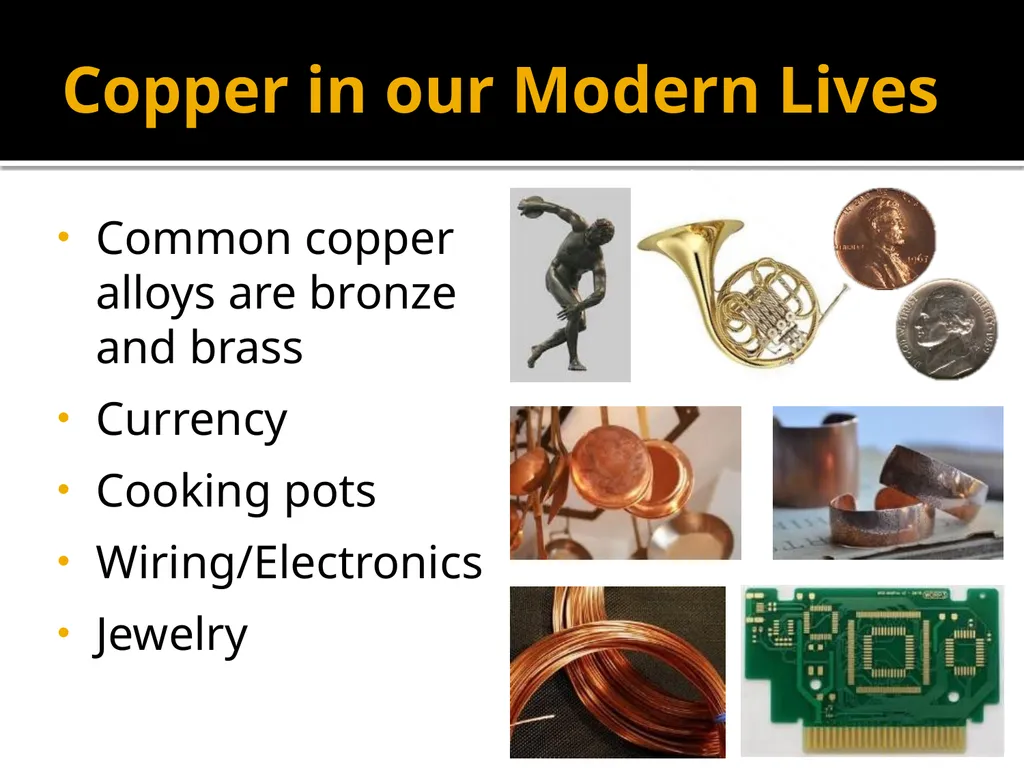
Copper in our Modern Lives Common copper alloys are bronze and brass
Currency
Cooking pots
Wiring/Electronics
Jewelry<br>
Currency
Cooking pots
Wiring/Electronics
Jewelry<br>
12
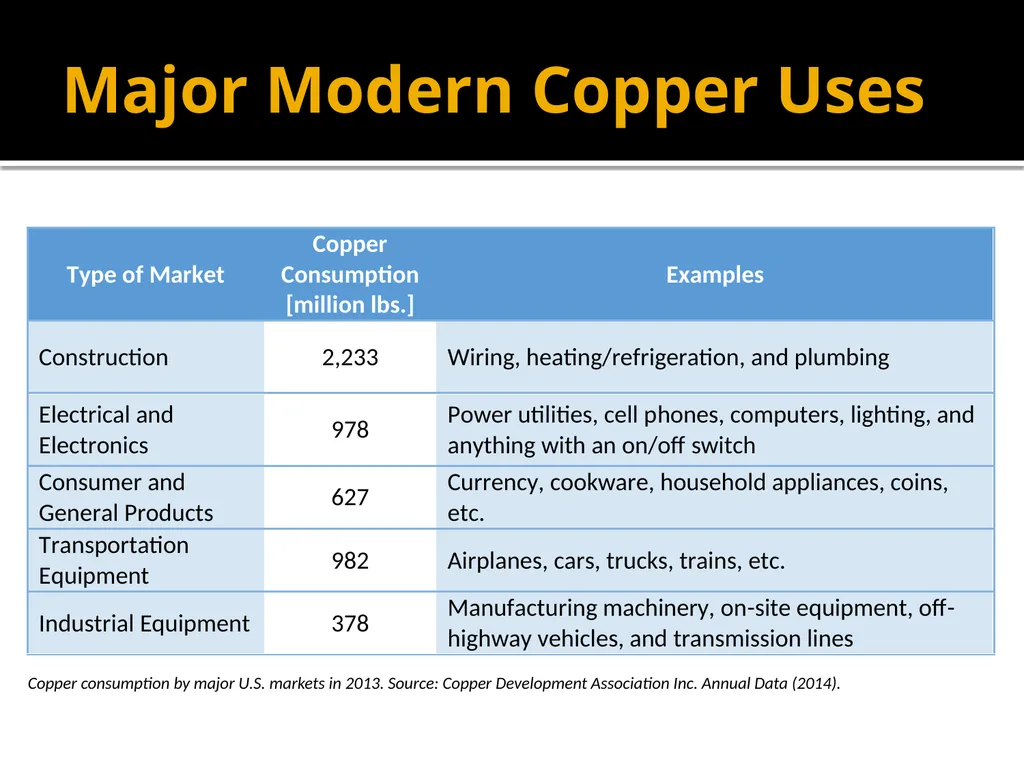
Major Modern Copper Uses Copper consumption by major U.S. markets in 2013. Source: Copper Development Association Inc. Annual Data (2014).<br>
13
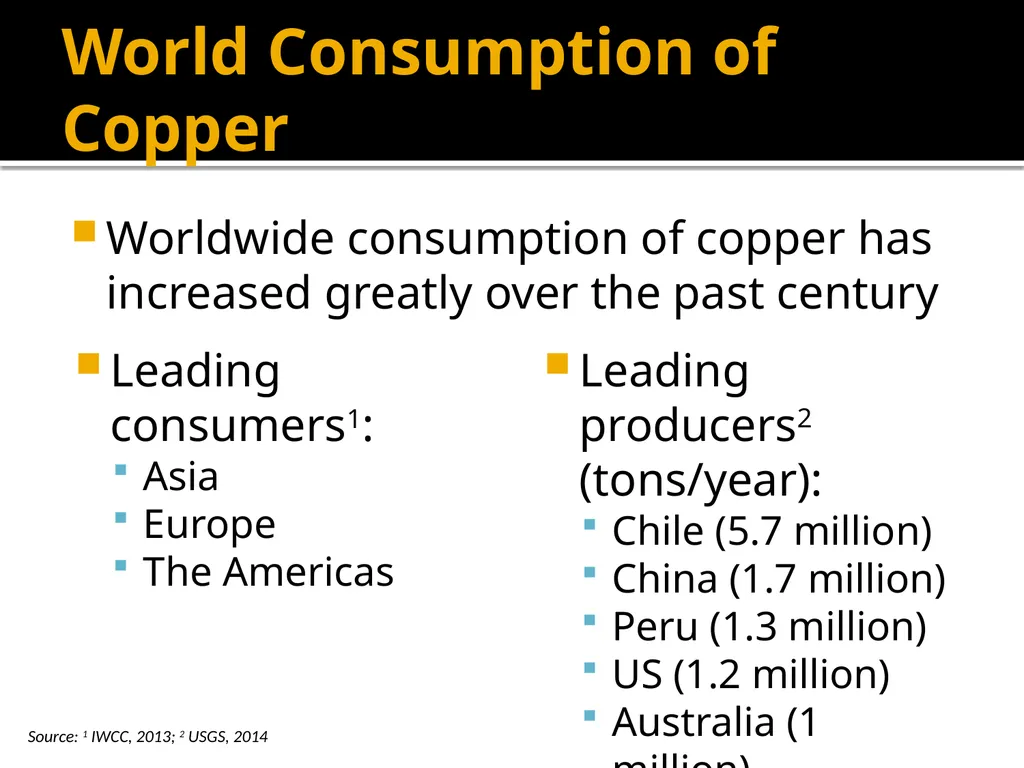
World Consumption of Copper Worldwide consumption of copper has increased greatly over the past century Leading consumers1:
Asia
Europe
The Americas Leading producers2 (tons/year):
Chile (5.7 million)
China (1.7 million)
Peru (1.3 million)
US (1.2 million)
Australia (1 million) Source: 1 IWCC, 2013; 2 USGS, 2014<br>
Asia
Europe
The Americas Leading producers2 (tons/year):
Chile (5.7 million)
China (1.7 million)
Peru (1.3 million)
US (1.2 million)
Australia (1 million) Source: 1 IWCC, 2013; 2 USGS, 2014<br>
14
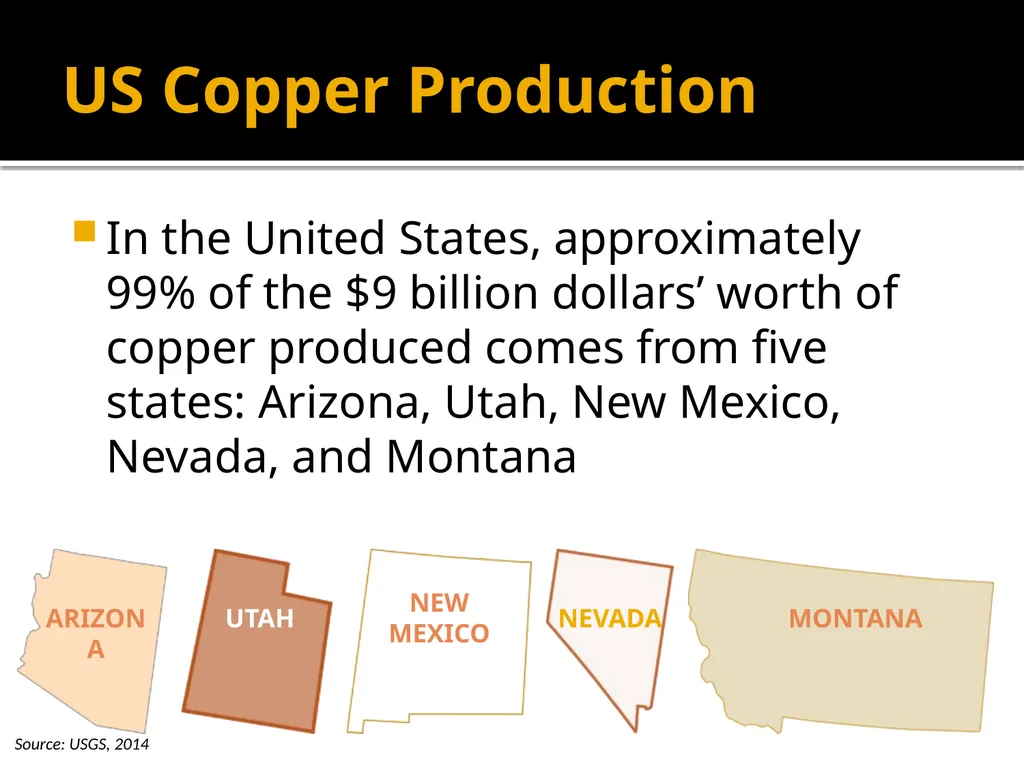
US Copper Production In the United States, approximately 99% of the $9 billion dollars’ worth of copper produced comes from five states: Arizona, Utah, New Mexico, Nevada, and Montana Source: USGS, 2014<br>
15
Copper Mining in Arizona Arizona Copper Production<br>
16
Arizona: The “Five C’s”<br>
17
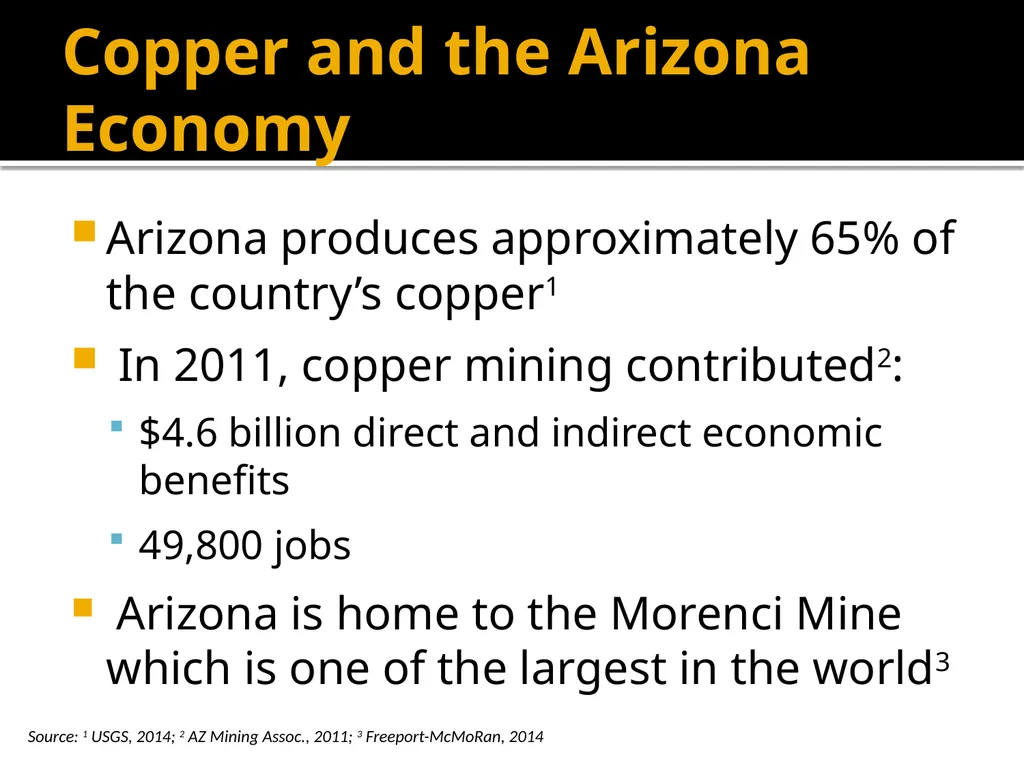
Copper and the Arizona Economy Arizona produces approximately 65% of the country’s copper1
In 2011, copper mining contributed2:
$4.6 billion direct and indirect economic benefits
49,800 jobs
Arizona is home to the Morenci Mine which is one of the largest in the world3 Source: 1 USGS, 2014; 2 AZ Mining Assoc., 2011; 3 Freeport-McMoRan, 2014<br>
In 2011, copper mining contributed2:
$4.6 billion direct and indirect economic benefits
49,800 jobs
Arizona is home to the Morenci Mine which is one of the largest in the world3 Source: 1 USGS, 2014; 2 AZ Mining Assoc., 2011; 3 Freeport-McMoRan, 2014<br>
18
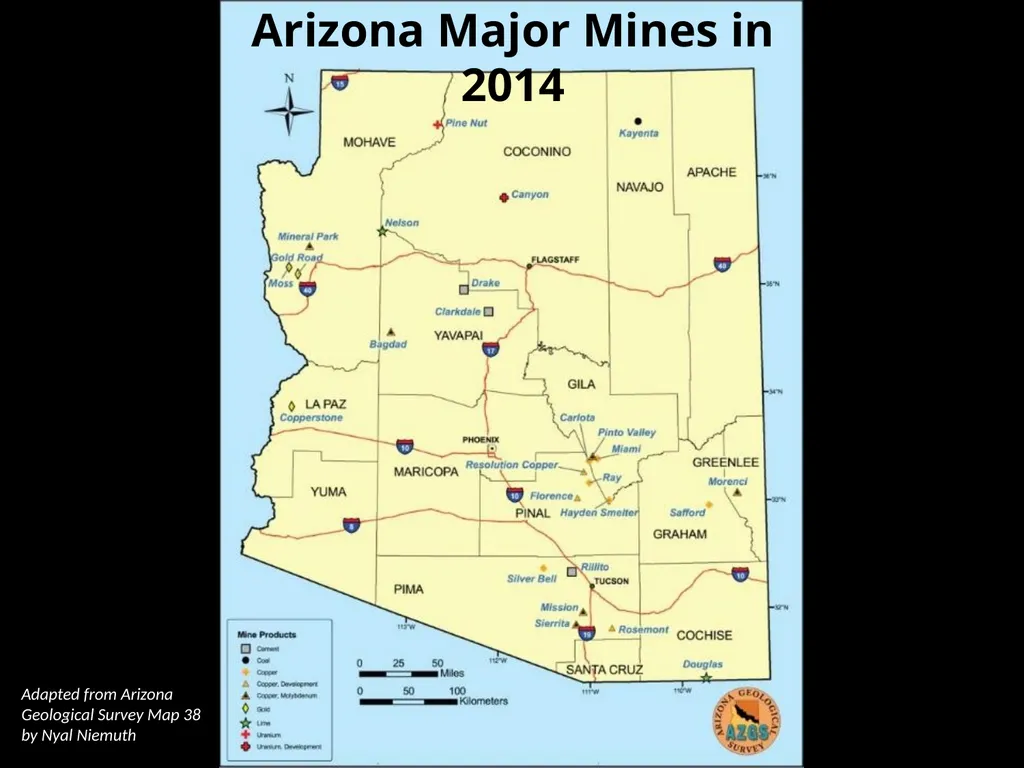
Arizona Major Mines in 2014 Adapted from Arizona Geological Survey Map 38 by Nyal Niemuth<br>
19
Copper Mining in Arizona Environmental Regulation<br>
20
Environmental Regulation Regulatory agencies ensure that mines do not release hazardous materials outside of mine site
US Environmental Protection Agency
AZ Department of Environmental Quality
County Department of Environmental Quality
Tribal Environmental Protection Agency
Mining companies have personnel in place to interact with the regulatory agencies<br>
US Environmental Protection Agency
AZ Department of Environmental Quality
County Department of Environmental Quality
Tribal Environmental Protection Agency
Mining companies have personnel in place to interact with the regulatory agencies<br>
21
Copper Mining on Tribal Lands Arizona<br>
22
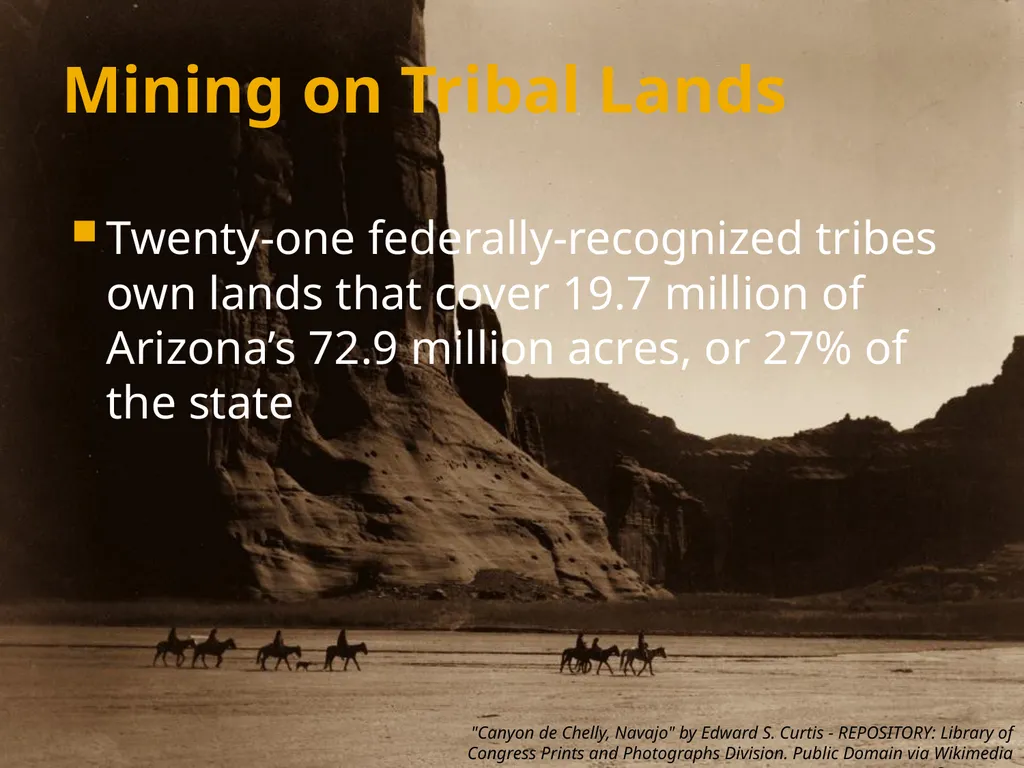
Mining on Tribal Lands Twenty-one federally-recognized tribes own lands that cover 19.7 million of Arizona’s 72.9 million acres, or 27% of the state "Canyon de Chelly, Navajo" by Edward S. Curtis - REPOSITORY: Library of Congress Prints and Photographs Division. Public Domain via Wikimedia Commons.<br>
23
Major Mines and Tribal Lands<br>
24
Copper Mining on Tribal Lands Tohono O’odham Nation<br>
25
Tohono O’odham Nation Owns 2.7 million acres, or 3.7% of the state
Metallic minerals mined throughout history:
Copper, gold, silver, lead, zinc, iron, mercury, manganese, uranium, and tungsten
Within Pima County portion of the Nation:
~210 metallic mineral deposits, mines, prospects, and quarries
Many smaller mines are results of small-time prospectors and now abandoned Mission Cu Mine<br>
Metallic minerals mined throughout history:
Copper, gold, silver, lead, zinc, iron, mercury, manganese, uranium, and tungsten
Within Pima County portion of the Nation:
~210 metallic mineral deposits, mines, prospects, and quarries
Many smaller mines are results of small-time prospectors and now abandoned Mission Cu Mine<br>
26
Copper Mining on Tribal Lands Case Study #1: Mission Mine<br>
27
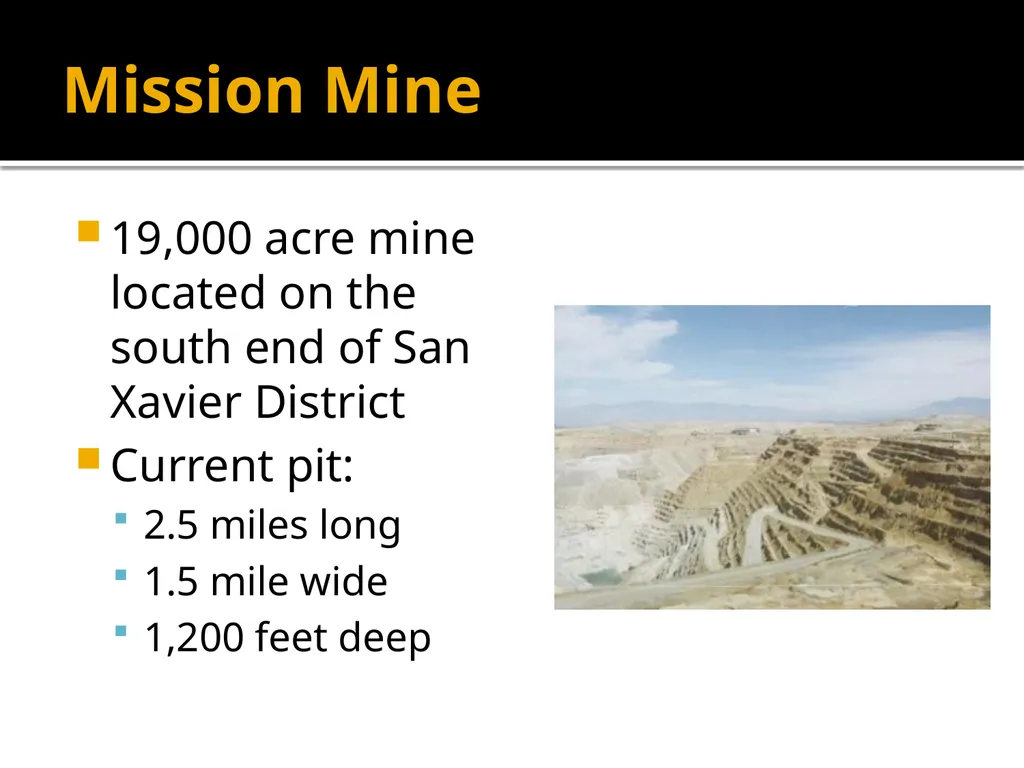
Mission Mine 19,000 acre mine located on the south end of San Xavier District
Current pit:
2.5 miles long
1.5 mile wide
1,200 feet deep<br>
Current pit:
2.5 miles long
1.5 mile wide
1,200 feet deep<br>
28
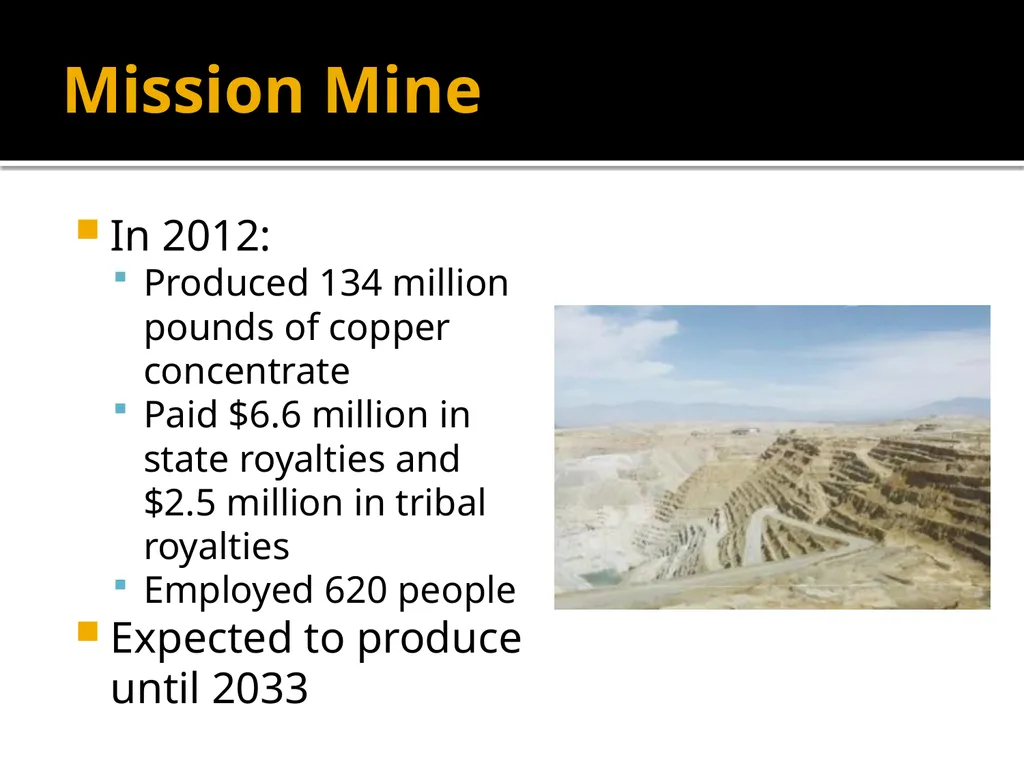
Mission Mine In 2012:
Produced 134 million pounds of copper concentrate
Paid $6.6 million in state royalties and $2.5 million in tribal royalties
Employed 620 people
Expected to produce until 2033<br>
Produced 134 million pounds of copper concentrate
Paid $6.6 million in state royalties and $2.5 million in tribal royalties
Employed 620 people
Expected to produce until 2033<br>
29
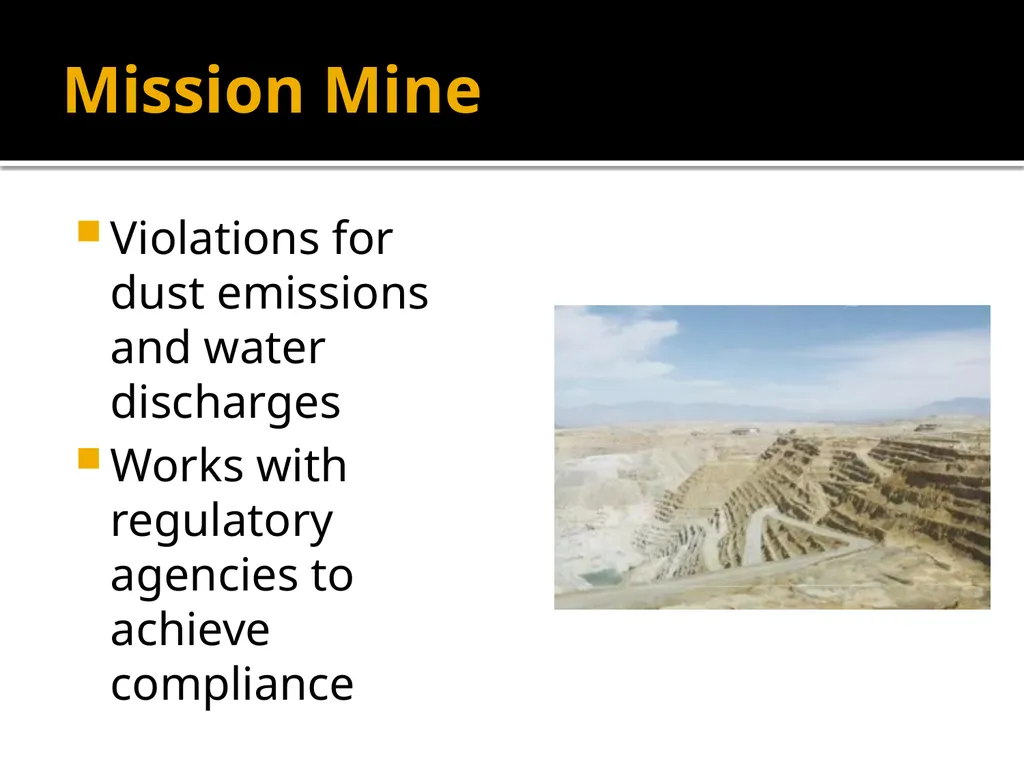
Mission Mine Violations for dust emissions and water discharges
Works with regulatory agencies to achieve compliance<br>
Works with regulatory agencies to achieve compliance<br>
30
Copper Mining on Tribal Lands Case Study #2: Cyprus Tohono Mine<br>
31
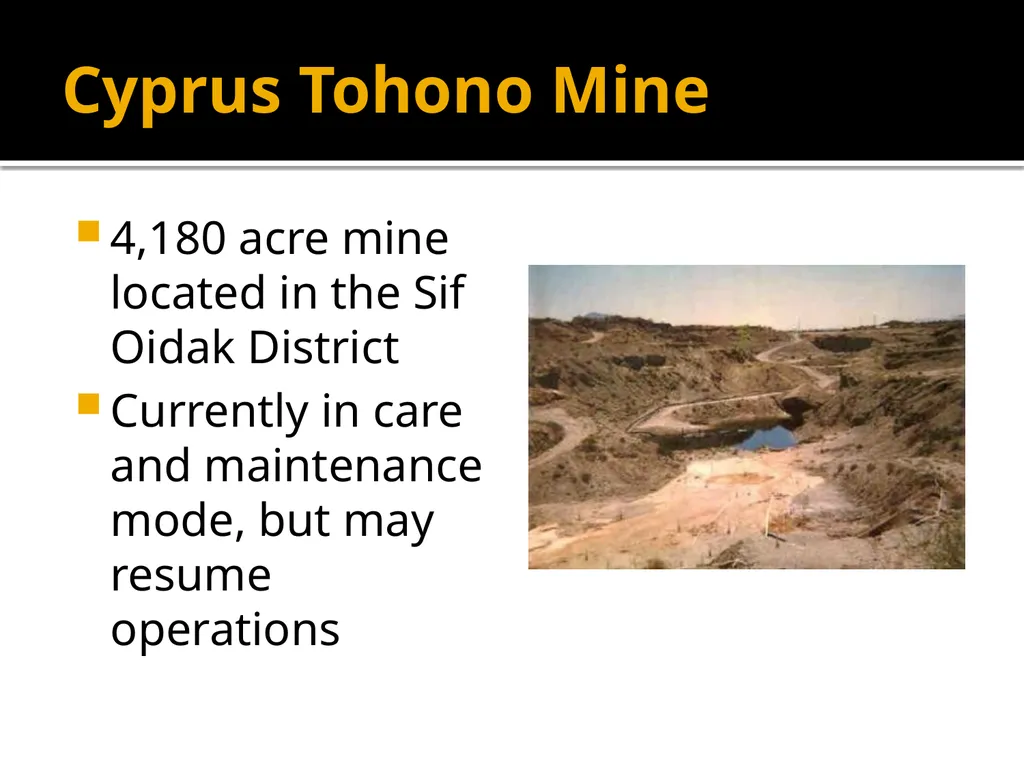
4,180 acre mine located in the Sif Oidak District
Currently in care and maintenance mode, but may resume operations Cyprus Tohono Mine<br>
Currently in care and maintenance mode, but may resume operations Cyprus Tohono Mine<br>
32
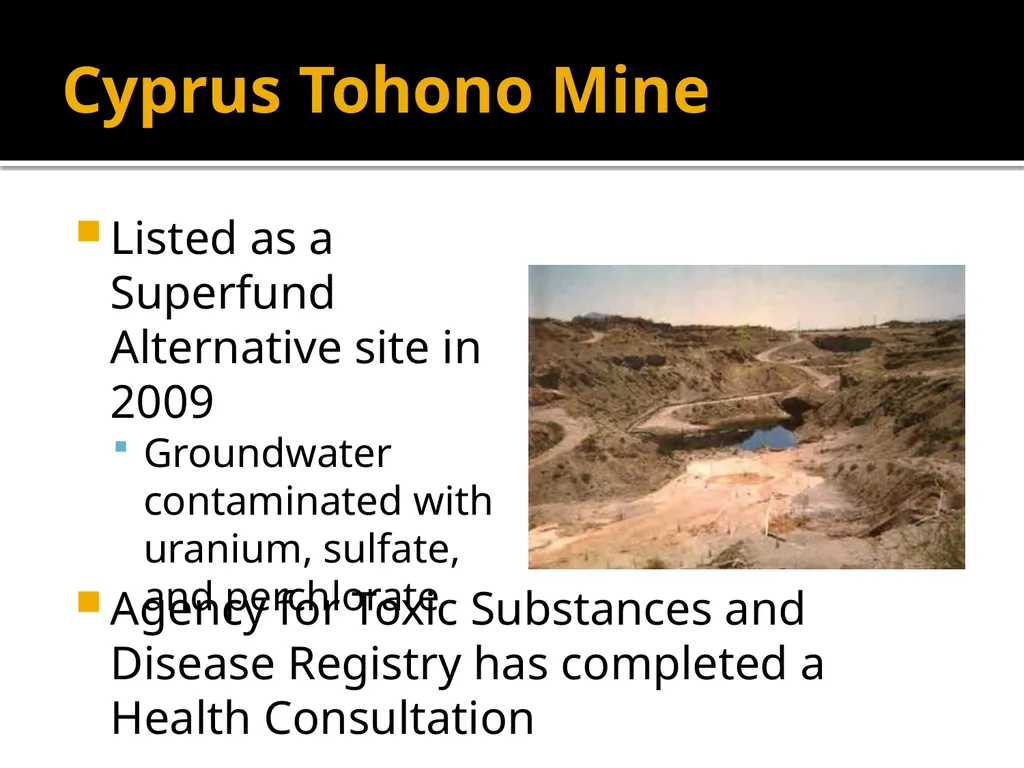
Cyprus Tohono Mine Listed as a Superfund Alternative site in 2009
Groundwater contaminated with uranium, sulfate, and perchlorate Agency for Toxic Substances and Disease Registry has completed a Health Consultation<br>
Groundwater contaminated with uranium, sulfate, and perchlorate Agency for Toxic Substances and Disease Registry has completed a Health Consultation<br>
33
Tribal Concerns with Mining<br>
34
Tribal Concerns Tribes have faced displacement, discrimination, and marginalization due to mining
Mining can be a source of contamination that impacts the health of neighboring communities and the environment<br>
Mining can be a source of contamination that impacts the health of neighboring communities and the environment<br>
35
Tribal Concerns Concerns may include:
Poor air quality
Contaminated water
Occupational hazards which can be a result of direct exposure to dust during metal/mineral extraction
Enforcement of mine safety issues is regulated by the Mine Safety and Health Administration, a division of the US Department of Labor<br>
Poor air quality
Contaminated water
Occupational hazards which can be a result of direct exposure to dust during metal/mineral extraction
Enforcement of mine safety issues is regulated by the Mine Safety and Health Administration, a division of the US Department of Labor<br>
36
Tribal Concerns Mining can have impacts on sacred lands and artifacts as well as natural resources
On the Navajo Nation people used uranium mill tailings to build their traditional earthen homes (hogan), many of which remain in use today
100 sacred and cultural sites of the Tohono O’odham Nation may be impacted by the proposed Rosemont Copper Mine
Lands sacred to the San Carlos Apache may be impacted by the proposed Resolution Copper Mine<br>
On the Navajo Nation people used uranium mill tailings to build their traditional earthen homes (hogan), many of which remain in use today
100 sacred and cultural sites of the Tohono O’odham Nation may be impacted by the proposed Rosemont Copper Mine
Lands sacred to the San Carlos Apache may be impacted by the proposed Resolution Copper Mine<br>
37
Life Cycle of a Mine<br>
38
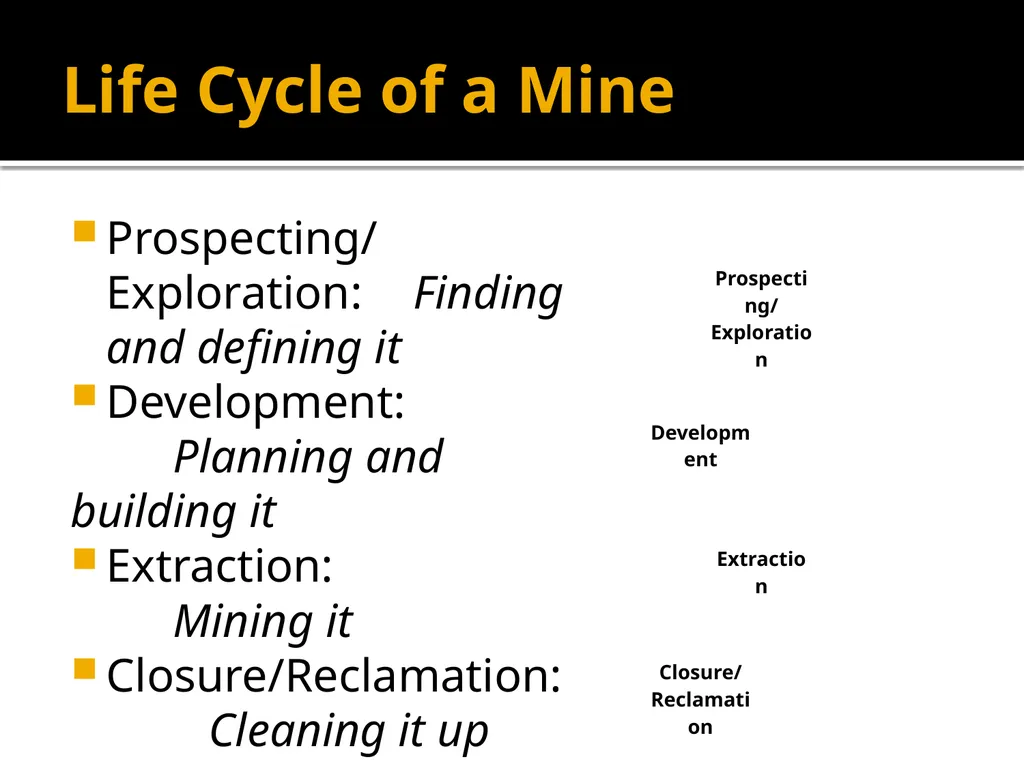
Life Cycle of a Mine Prospecting/Exploration: Finding and defining it
Development:
Planning and building it
Extraction:
Mining it
Closure/Reclamation: Cleaning it up<br>
Development:
Planning and building it
Extraction:
Mining it
Closure/Reclamation: Cleaning it up<br>
39
Life Cycle of a Mine Prospecting/Exploration (Finding and Defining it)<br>
40
Prospecting/Exploration Precursor to mining
Overlapping stages
~2-8 years total
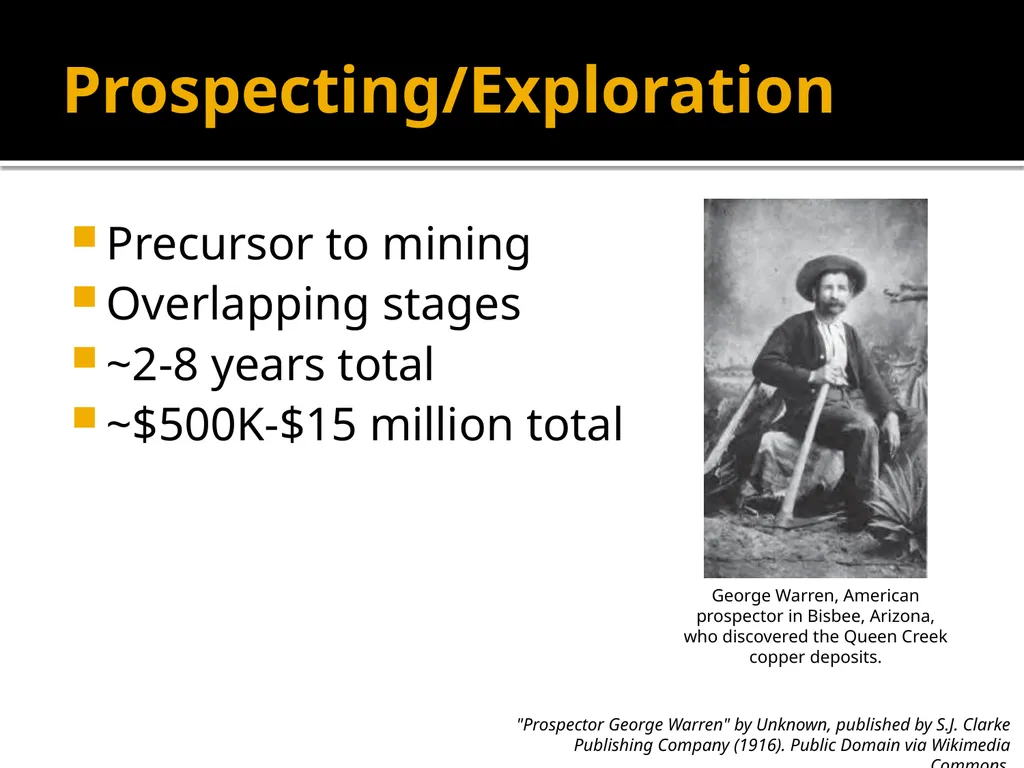
~$500K-$15 million total "Prospector George Warren" by Unknown, published by S.J. Clarke Publishing Company (1916). Public Domain via Wikimedia Commons. George Warren, American prospector in Bisbee, Arizona, who discovered the Queen Creek copper deposits.<br>
Overlapping stages
~2-8 years total
~$500K-$15 million total "Prospector George Warren" by Unknown, published by S.J. Clarke Publishing Company (1916). Public Domain via Wikimedia Commons. George Warren, American prospector in Bisbee, Arizona, who discovered the Queen Creek copper deposits.<br>
41
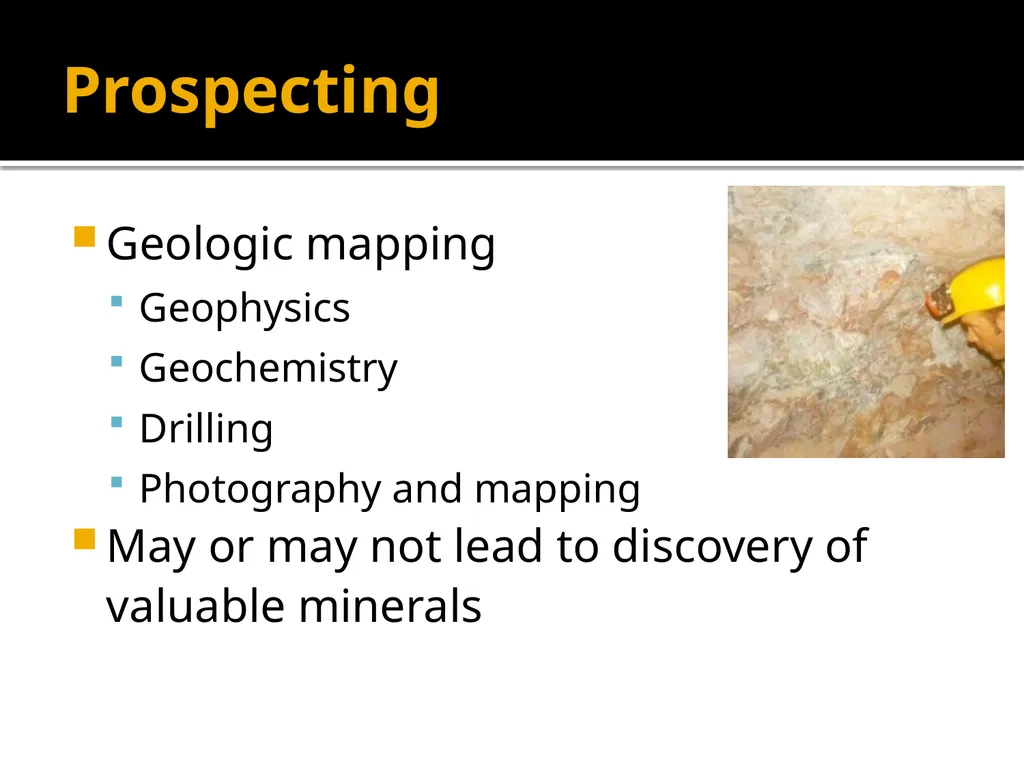
Prospecting Geologic mapping
Geophysics
Geochemistry
Drilling
Photography and mapping
May or may not lead to discovery of valuable minerals<br>
Geophysics
Geochemistry
Drilling
Photography and mapping
May or may not lead to discovery of valuable minerals<br>
42
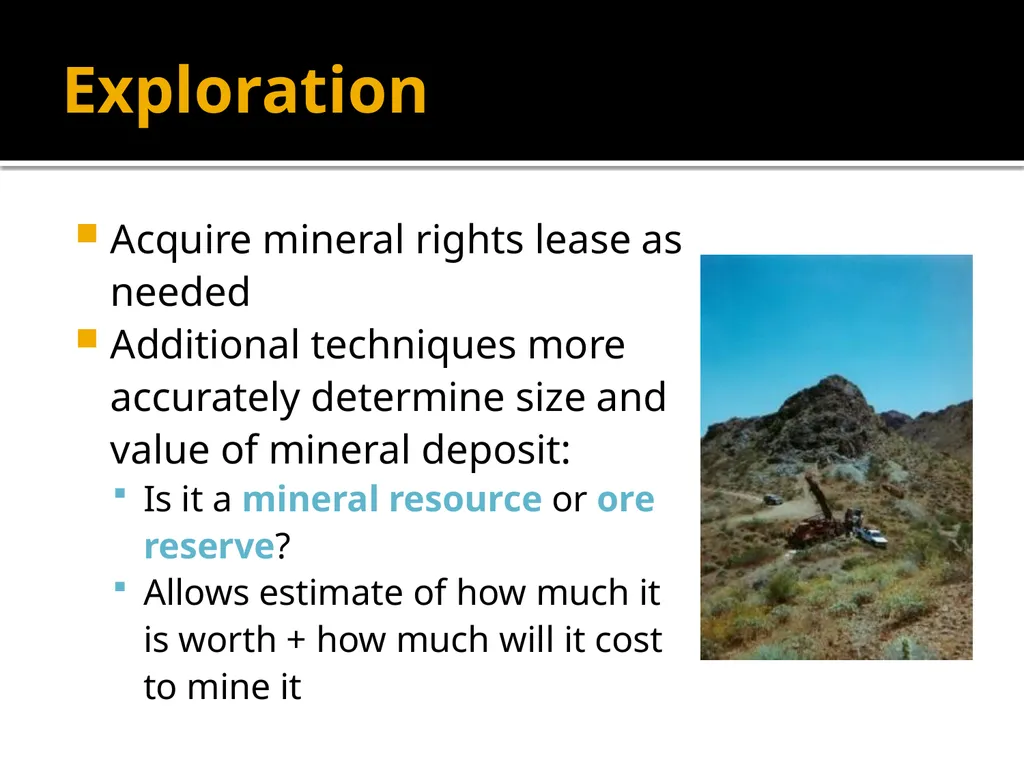
Exploration Acquire mineral rights lease as needed
Additional techniques more accurately determine size and value of mineral deposit:
Is it a mineral resource or ore reserve?
Allows estimate of how much it is worth + how much will it cost to mine it<br>
Additional techniques more accurately determine size and value of mineral deposit:
Is it a mineral resource or ore reserve?
Allows estimate of how much it is worth + how much will it cost to mine it<br>
43
Mineral Resource Concentrated, potentially valuable material that can be mined for economic profit
Whether it is worth mining may depend on:
Amount, form, location, and quality of the material (i.e., geological confidence) Source: JORC, 2012<br>
Whether it is worth mining may depend on:
Amount, form, location, and quality of the material (i.e., geological confidence) Source: JORC, 2012<br>
44
Mineral Resource Geological methods classify a mineral resource according to geological confidence:
Inferred
Limited sampling, low confidence ore is there
Indicated
More sampling, some confidence ore is there, but still just an estimate
Measured
More sampling, high confidence ore is there and that estimate is accurate Source: JORC, 2012<br>
Inferred
Limited sampling, low confidence ore is there
Indicated
More sampling, some confidence ore is there, but still just an estimate
Measured
More sampling, high confidence ore is there and that estimate is accurate Source: JORC, 2012<br>
45
Ore Reserve The part of the mineral resource that can be economically profitable to mine
I.e., there is enough valuable metal to be worth extracting it from the surrounding rock Source: JORC, 2012<br>
I.e., there is enough valuable metal to be worth extracting it from the surrounding rock Source: JORC, 2012<br>
46
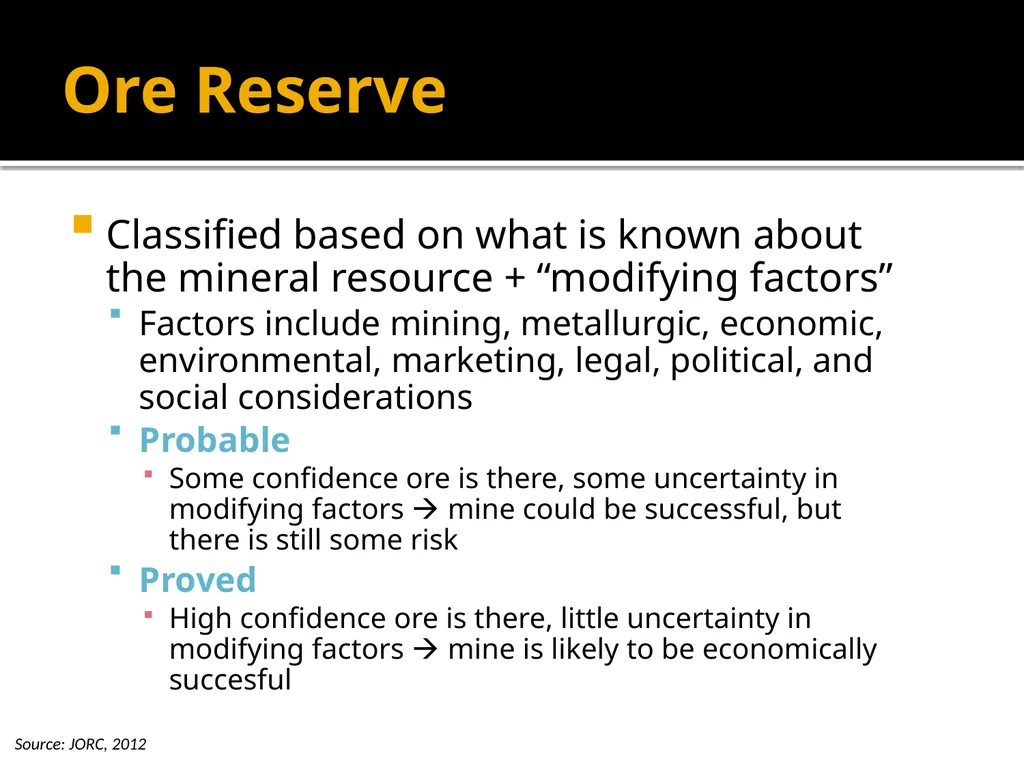
Ore Reserve Classified based on what is known about the mineral resource + “modifying factors”
Factors include mining, metallurgic, economic, environmental, marketing, legal, political, and social considerations
Probable
Some confidence ore is there, some uncertainty in modifying factors mine could be successful, but there is still some risk
Proved
High confidence ore is there, little uncertainty in modifying factors mine is likely to be economically succesful Source: JORC, 2012<br>
Factors include mining, metallurgic, economic, environmental, marketing, legal, political, and social considerations
Probable
Some confidence ore is there, some uncertainty in modifying factors mine could be successful, but there is still some risk
Proved
High confidence ore is there, little uncertainty in modifying factors mine is likely to be economically succesful Source: JORC, 2012<br>
47
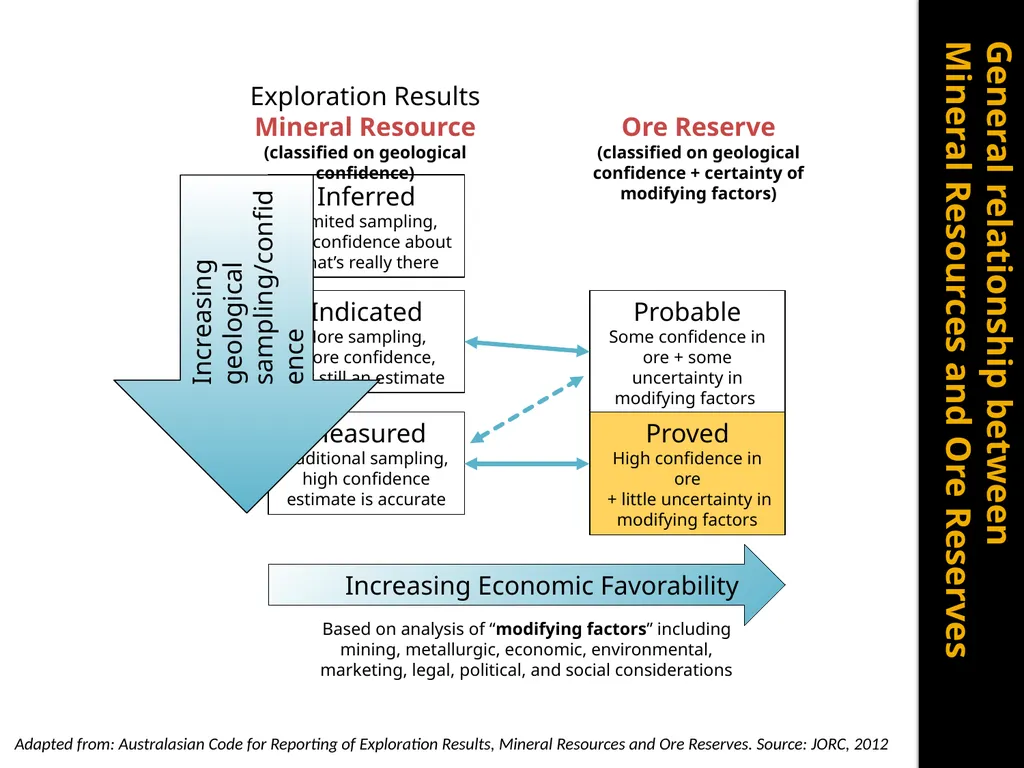
Adapted from: Australasian Code for Reporting of Exploration Results, Mineral Resources and Ore Reserves. Source: JORC, 2012 General relationship between Mineral Resources and Ore Reserves<br>
48
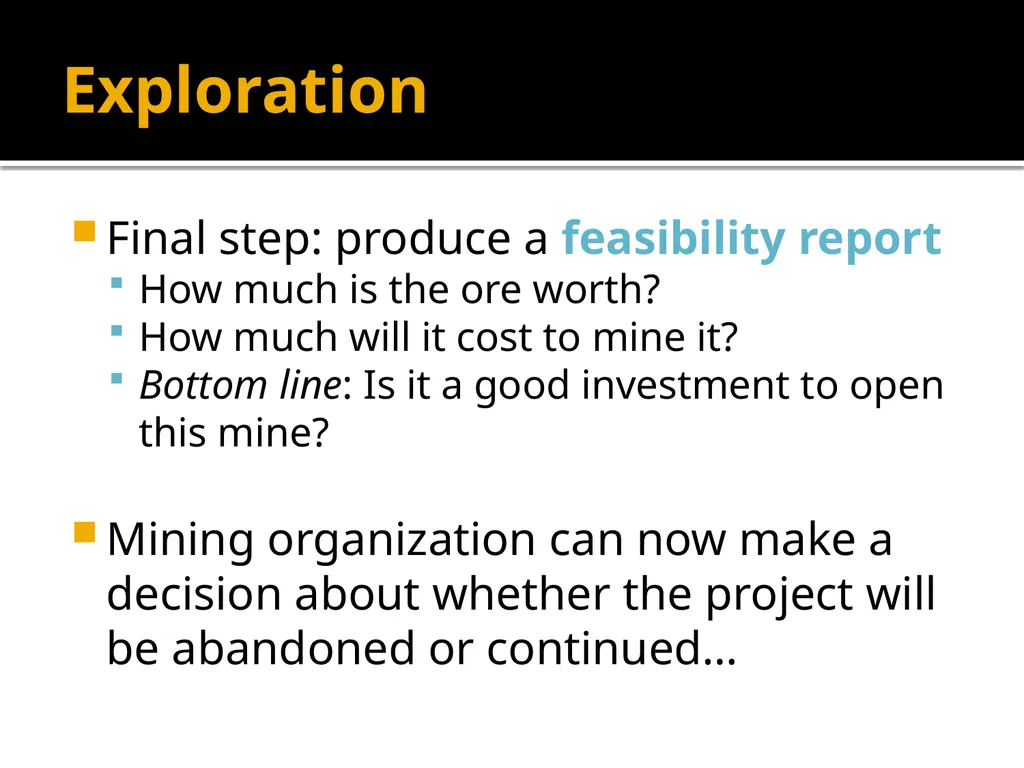
Exploration Final step: produce a feasibility report
How much is the ore worth?
How much will it cost to mine it?
Bottom line: Is it a good investment to open this mine?
Mining organization can now make a decision about whether the project will be abandoned or continued…<br>
How much is the ore worth?
How much will it cost to mine it?
Bottom line: Is it a good investment to open this mine?
Mining organization can now make a decision about whether the project will be abandoned or continued…<br>
49
Life Cycle of a Mine Development (Planning and Building it)<br>
50
Development ~4-12 years total
~$1 million - $1 billion
Extensive logistical planning and paperwork:
Budget and financial reports prepared
Permits requested
Environmental and community impacts assessed<br>
~$1 million - $1 billion
Extensive logistical planning and paperwork:
Budget and financial reports prepared
Permits requested
Environmental and community impacts assessed<br>
51
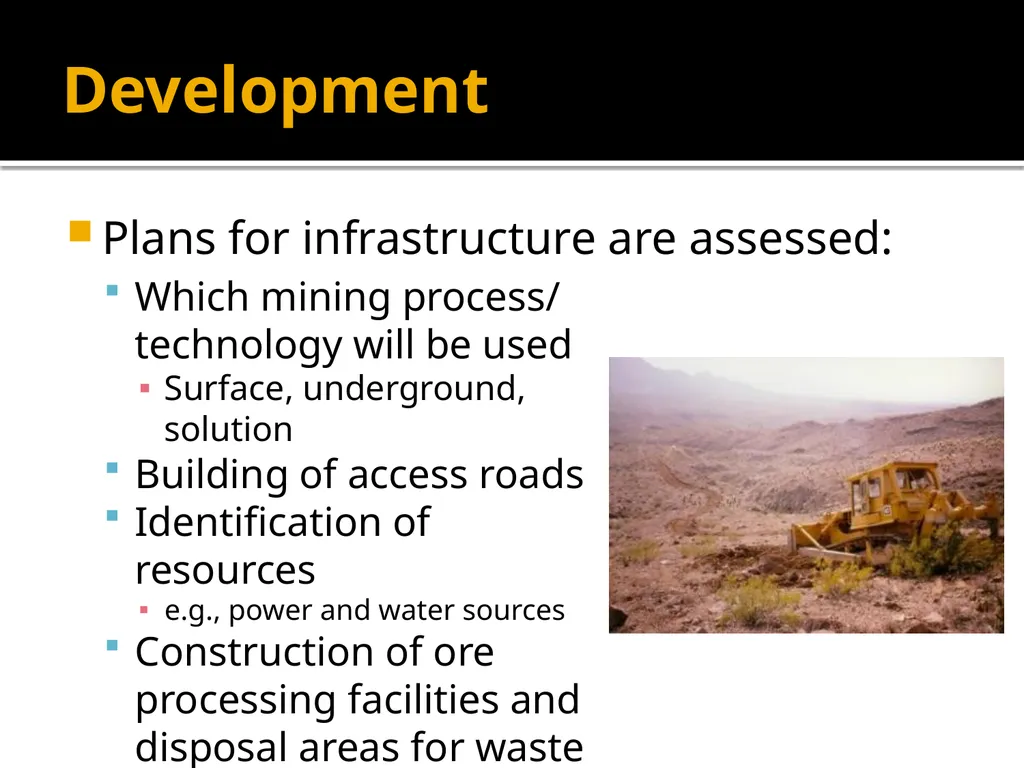
Development Which mining process/ technology will be used
Surface, underground, solution
Building of access roads
Identification of resources
e.g., power and water sources
Construction of ore processing facilities and disposal areas for waste Plans for infrastructure are assessed:<br>
Surface, underground, solution
Building of access roads
Identification of resources
e.g., power and water sources
Construction of ore processing facilities and disposal areas for waste Plans for infrastructure are assessed:<br>
52
Development Mine site is developed just enough to ensure it can be productive for the life cycle of the mine, without later interruption
By this stage, ~$10s of millions - $100s of millions may have been invested in the project
…But it may fail to open if the pre-development requirements are not met, including acceptance by the community!<br>
By this stage, ~$10s of millions - $100s of millions may have been invested in the project
…But it may fail to open if the pre-development requirements are not met, including acceptance by the community!<br>
53
Life Cycle of a Mine Extraction (Mining it)<br>
54
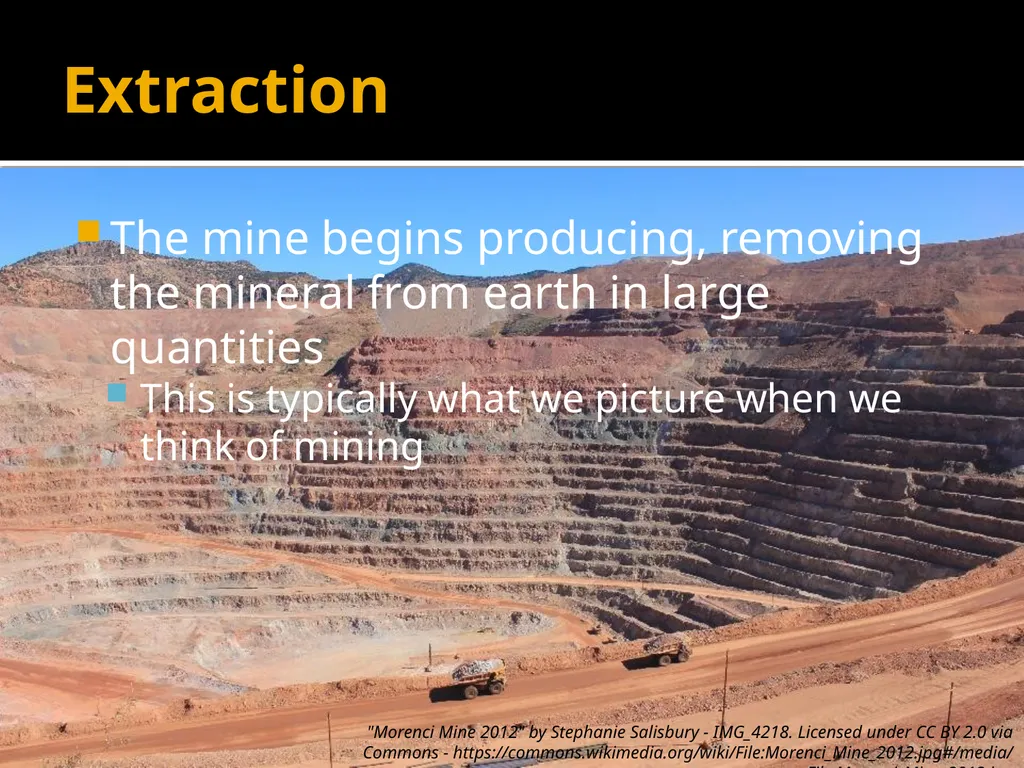
Extraction The mine begins producing, removing the mineral from earth in large quantities
This is typically what we picture when we think of mining "Morenci Mine 2012" by Stephanie Salisbury - IMG_4218. Licensed under CC BY 2.0 via Commons - https://commons.wikimedia.org/wiki/File:Morenci_Mine_2012.jpg#/media/File:Morenci_Mine_2012.jpg<br>
This is typically what we picture when we think of mining "Morenci Mine 2012" by Stephanie Salisbury - IMG_4218. Licensed under CC BY 2.0 via Commons - https://commons.wikimedia.org/wiki/File:Morenci_Mine_2012.jpg#/media/File:Morenci_Mine_2012.jpg<br>
55
Extraction Typically ~5-30 years total
But many mines are now open for 100+ years
Can cost ~$several million - $100s of millions per year
Depends on size of mine, location, etc.<br>
But many mines are now open for 100+ years
Can cost ~$several million - $100s of millions per year
Depends on size of mine, location, etc.<br>
56
Life Cycle of a Mine Closure/Reclamation (Cleaning it up)<br>
57
Closure/Reclamation ~1-5 years for closure and up to 35 years or more for reclamation
Can cost $millions - $100s of millions depending on many factors
E.g., age, location, type, and size of mine, amount of waste, geological characteristics, and type of mineral<br>
Can cost $millions - $100s of millions depending on many factors
E.g., age, location, type, and size of mine, amount of waste, geological characteristics, and type of mineral<br>
58
Closure/Reclamation Planning for mine closure and reclamation begins early on:
The mine is not allowed to open without a plan for closure in place already
Federal and state regulations require mining companies to post funding for closure prior to the mining project beginning<br>
The mine is not allowed to open without a plan for closure in place already
Federal and state regulations require mining companies to post funding for closure prior to the mining project beginning<br>
59
Closure considerations include:
Protecting public health and safety
Addressing environmental damage
Returning land to its original or accepted state
Sustaining social and economic benefits brought by mine Closure<br>
Protecting public health and safety
Addressing environmental damage
Returning land to its original or accepted state
Sustaining social and economic benefits brought by mine Closure<br>
60
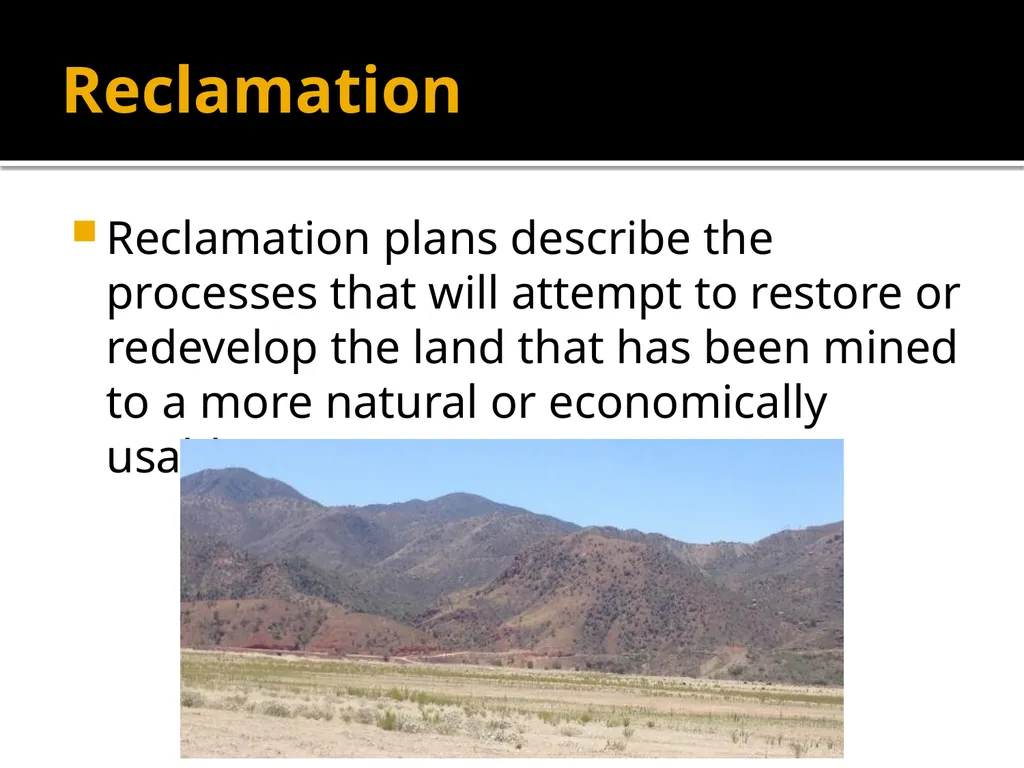
Reclamation plans describe the processes that will attempt to restore or redevelop the land that has been mined to a more natural or economically usable state Reclamation<br>
61
Processing of Copper Ores<br>
62
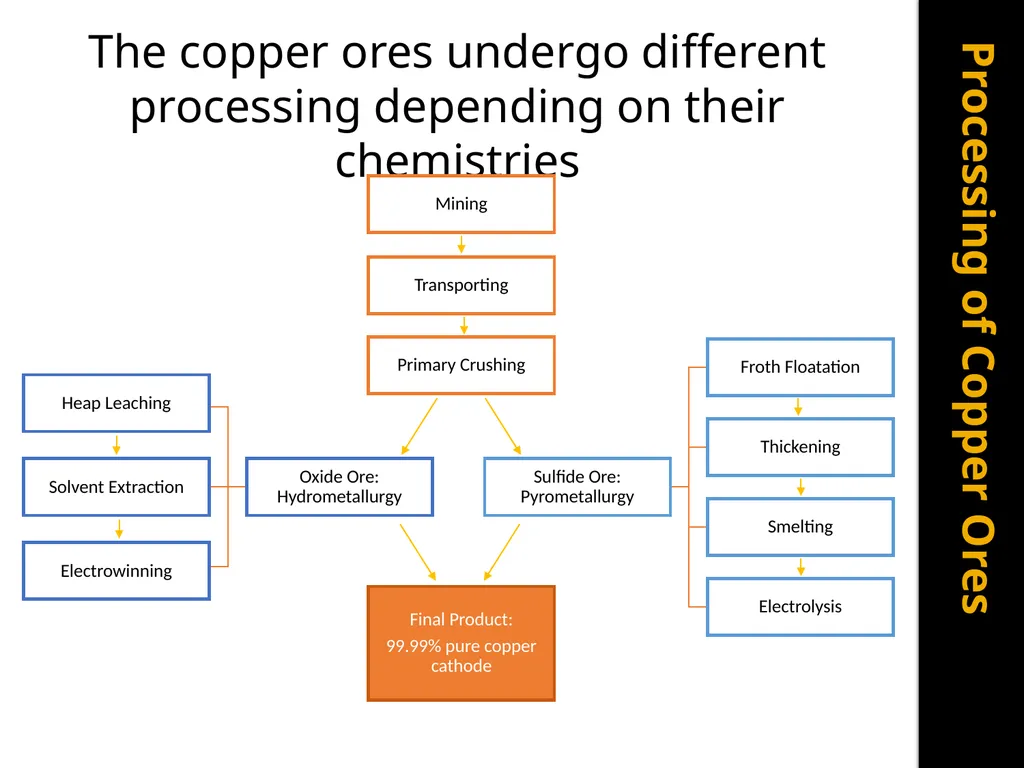
Processing of Copper Ores The copper ores undergo different processing depending on their chemistries<br>
63
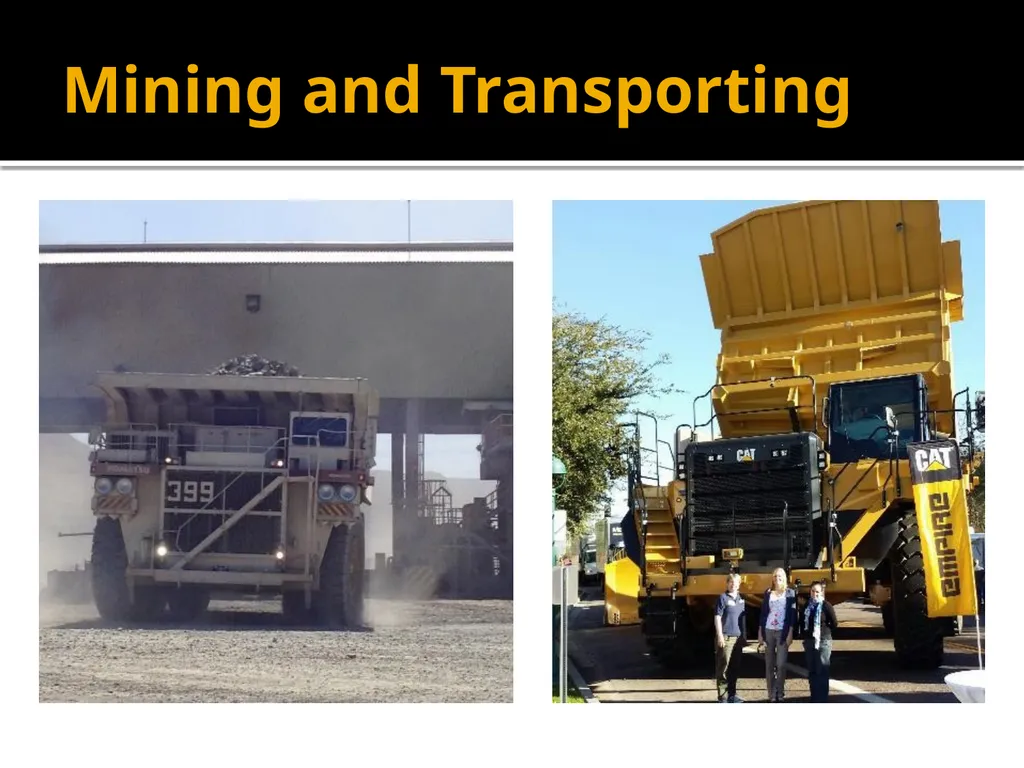
Mining and Transporting<br>
64
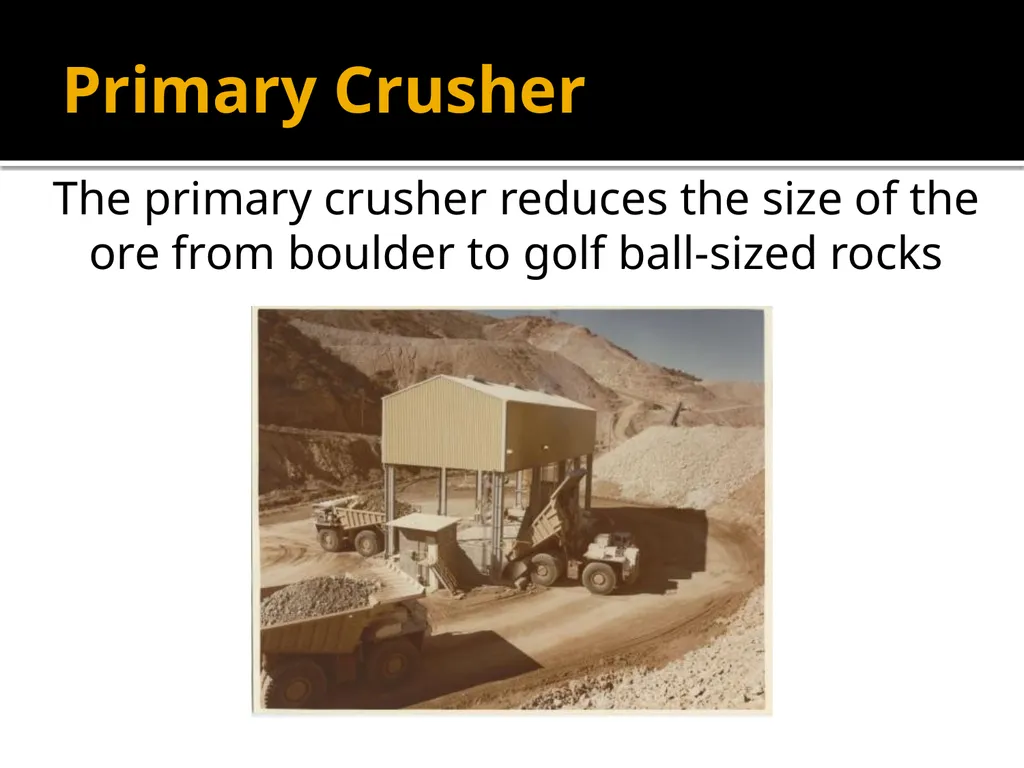
Primary Crusher The primary crusher reduces the size of the ore from boulder to golf ball-sized rocks<br>
65
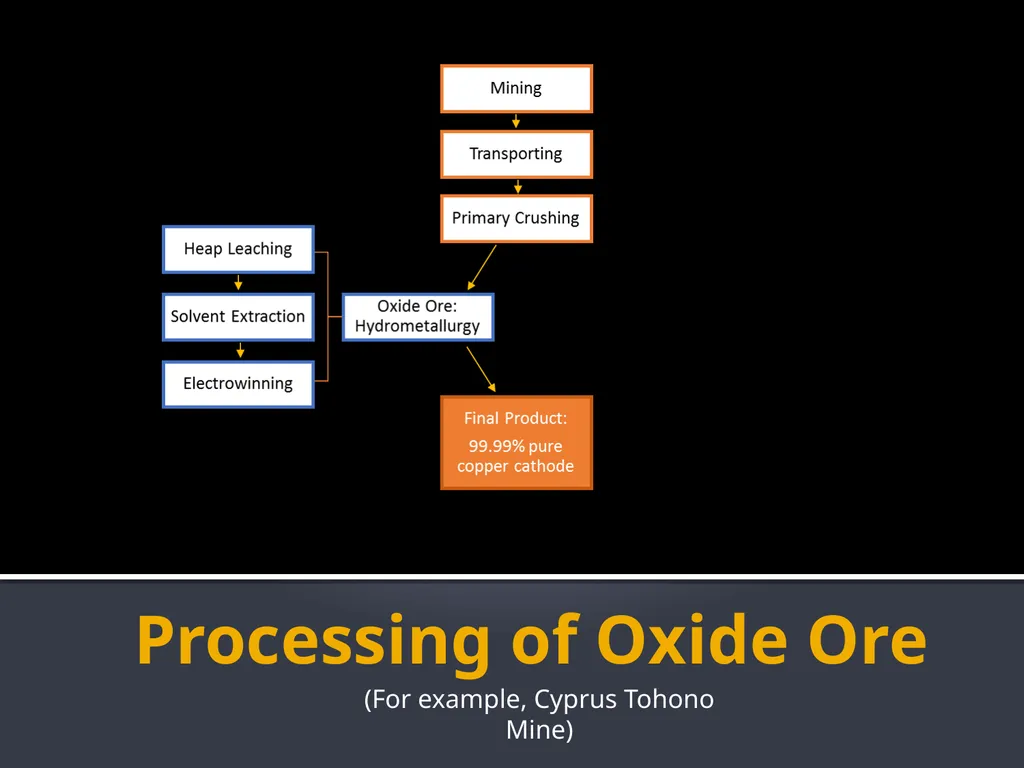
Processing of Oxide Ore (For example, Cyprus Tohono Mine)<br>
66
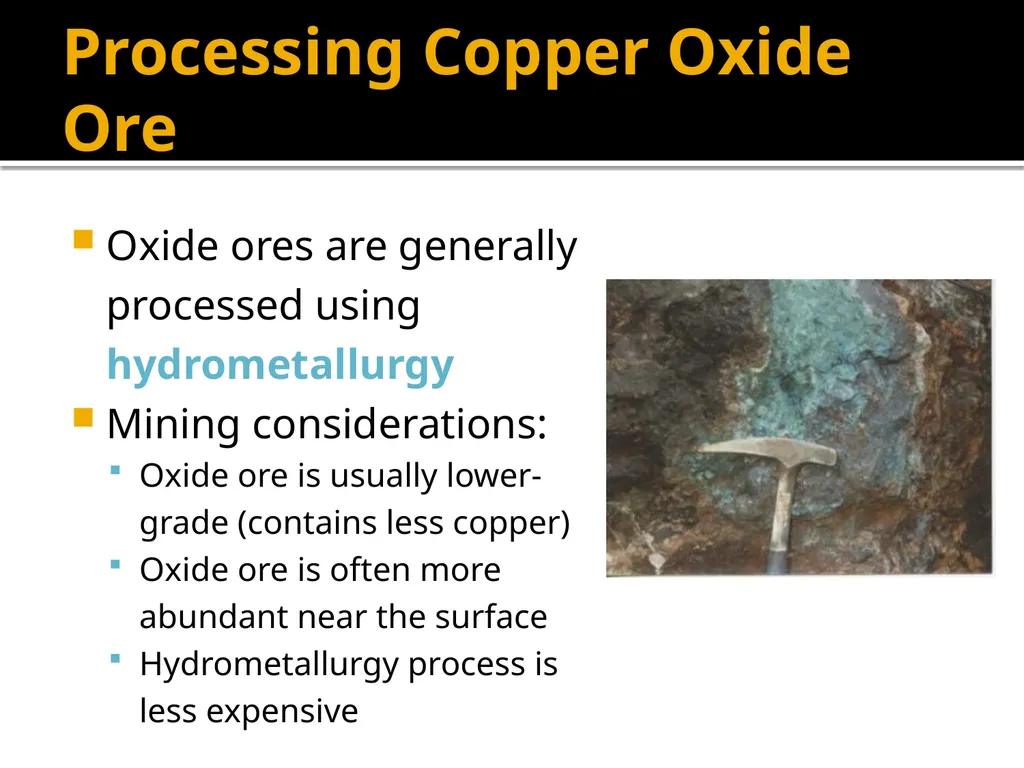
Processing Copper Oxide Ore Oxide ores are generally processed using hydrometallurgy
Mining considerations:
Oxide ore is usually lower-grade (contains less copper)
Oxide ore is often more abundant near the surface
Hydrometallurgy process is less expensive<br>
Mining considerations:
Oxide ore is usually lower-grade (contains less copper)
Oxide ore is often more abundant near the surface
Hydrometallurgy process is less expensive<br>
67
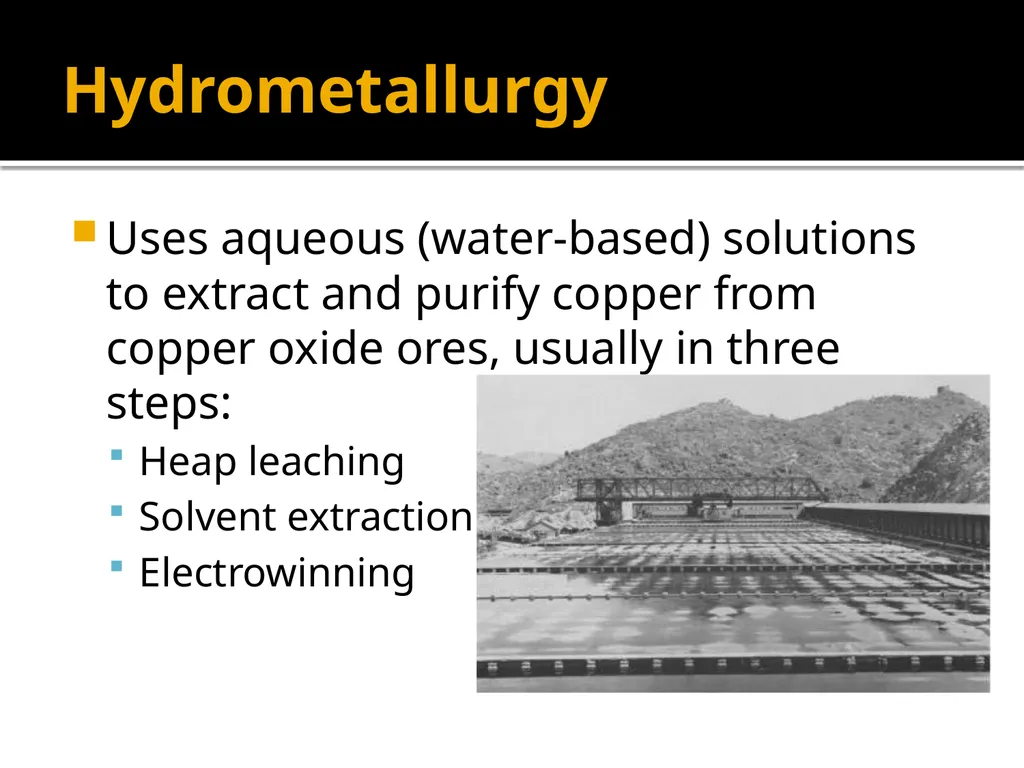
Hydrometallurgy Uses aqueous (water-based) solutions to extract and purify copper from copper oxide ores, usually in three steps:
Heap leaching
Solvent extraction
Electrowinning<br>
Heap leaching
Solvent extraction
Electrowinning<br>
68
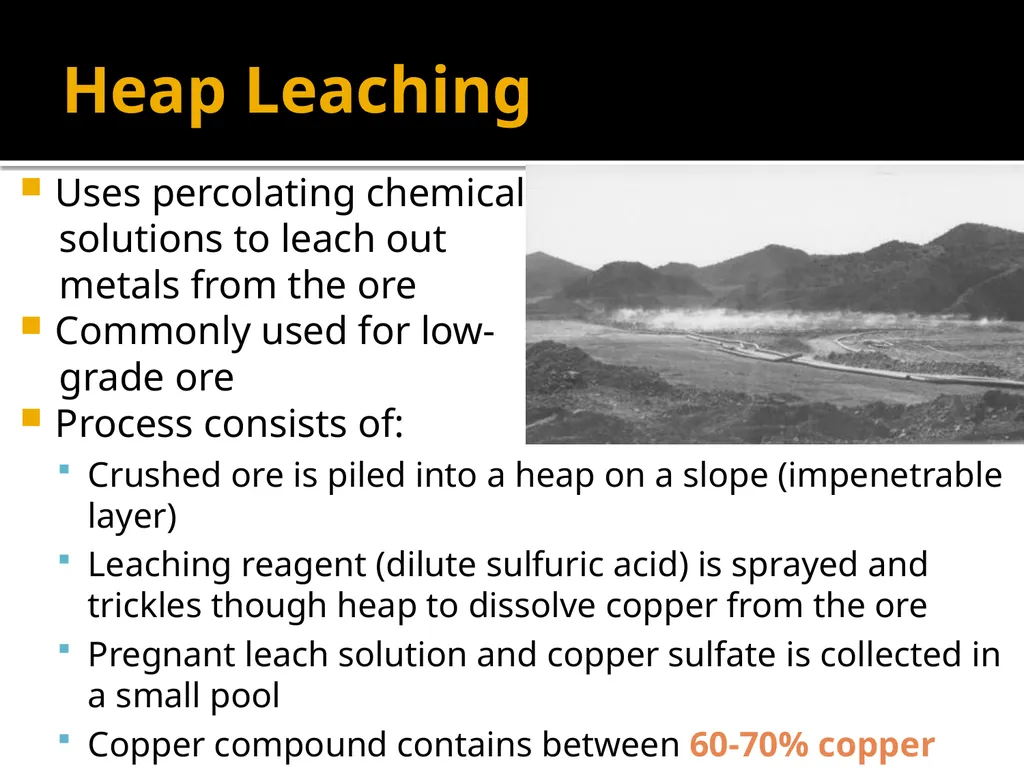
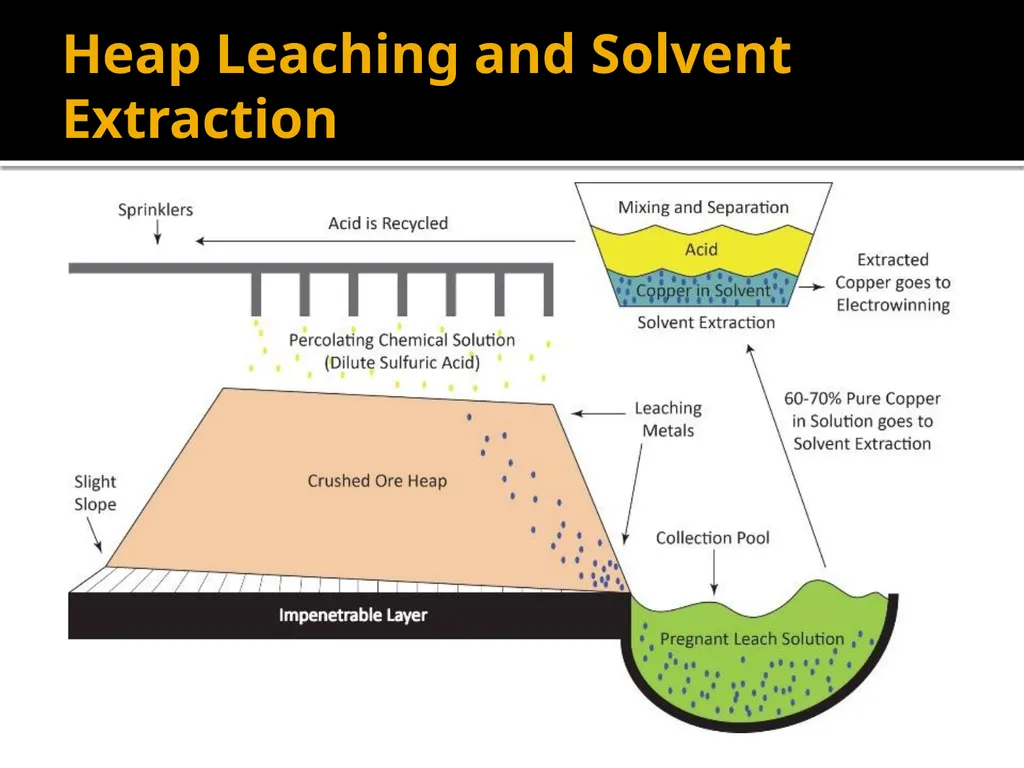
Heap Leaching Uses percolating chemical
solutions to leach out
metals from the ore
Commonly used for low-
grade ore
Process consists of:
Crushed ore is piled into a heap on a slope (impenetrable layer)
Leaching reagent (dilute sulfuric acid) is sprayed and trickles though heap to dissolve copper from the ore
Pregnant leach solution and copper sulfate is collected in a small pool
Copper compound contains between 60-70% copper<br>
solutions to leach out
metals from the ore
Commonly used for low-
grade ore
Process consists of:
Crushed ore is piled into a heap on a slope (impenetrable layer)
Leaching reagent (dilute sulfuric acid) is sprayed and trickles though heap to dissolve copper from the ore
Pregnant leach solution and copper sulfate is collected in a small pool
Copper compound contains between 60-70% copper<br>
69
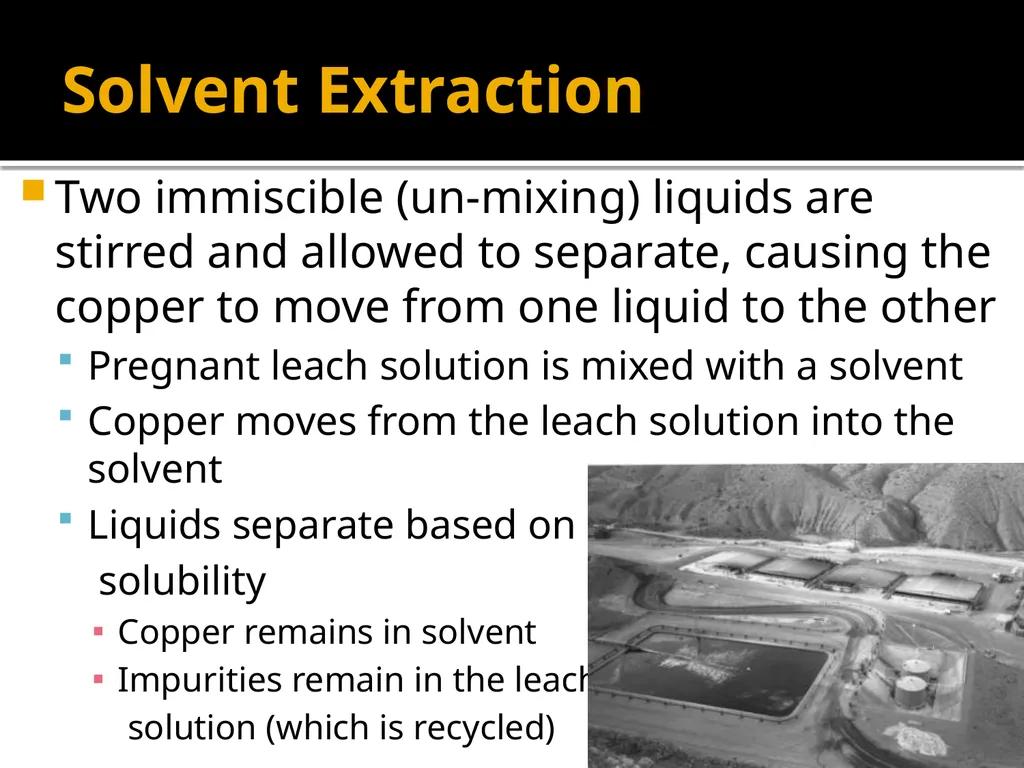
Solvent Extraction Two immiscible (un-mixing) liquids are stirred and allowed to separate, causing the copper to move from one liquid to the other
Pregnant leach solution is mixed with a solvent
Copper moves from the leach solution into the solvent
Liquids separate based on
solubility
Copper remains in solvent
Impurities remain in the leach
solution (which is recycled)<br>
Pregnant leach solution is mixed with a solvent
Copper moves from the leach solution into the solvent
Liquids separate based on
solubility
Copper remains in solvent
Impurities remain in the leach
solution (which is recycled)<br>
70
Heap Leaching and Solvent Extraction<br>
71
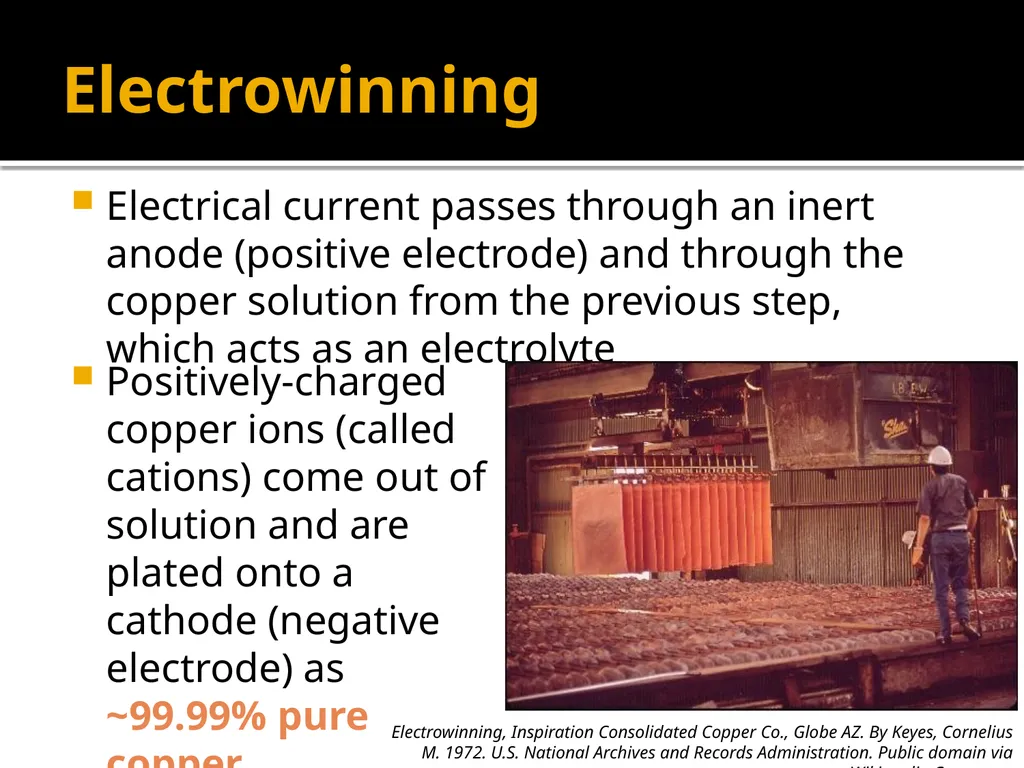
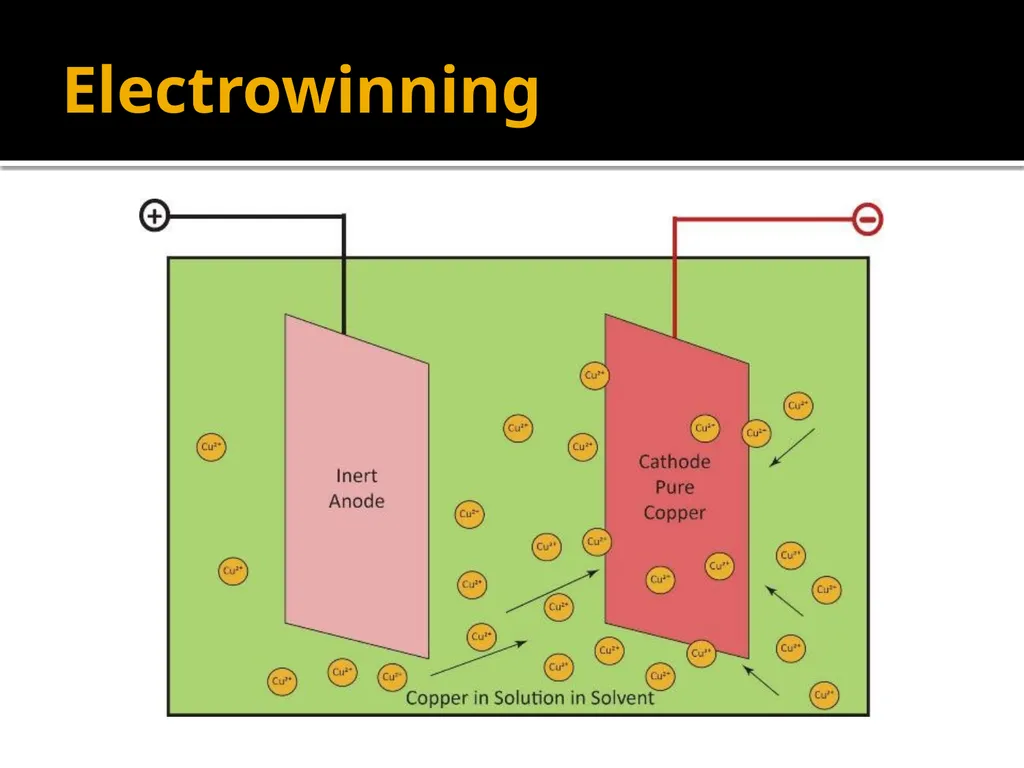
Electrowinning Electrical current passes through an inert anode (positive electrode) and through the copper solution from the previous step, which acts as an electrolyte Positively-charged copper ions (called cations) come out of solution and are plated onto a cathode (negative electrode) as ~99.99% pure copper Electrowinning, Inspiration Consolidated Copper Co., Globe AZ. By Keyes, Cornelius M. 1972. U.S. National Archives and Records Administration. Public domain via Wikimedia Commons.<br>
72
Electrowinning<br>
73
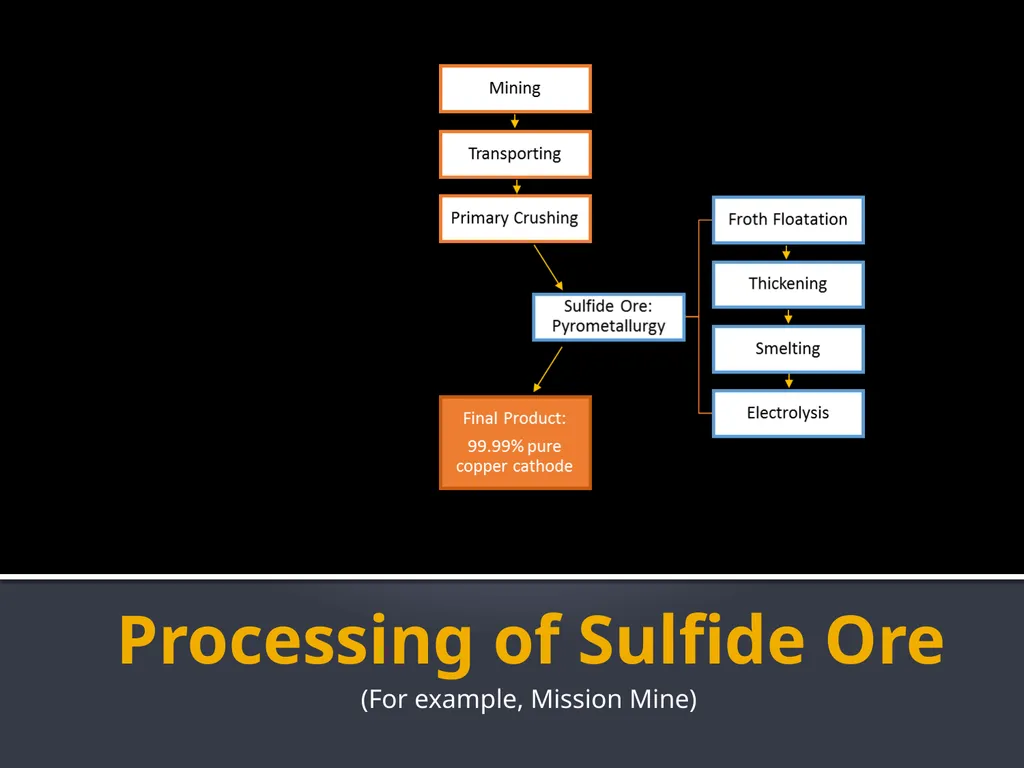
Processing of Sulfide Ore (For example, Mission Mine)<br>
74
Processing Copper Sulfide Ore Sulfide ores are generally processed using pyrometallurgy
Mining considerations:
Sulfide ore is often less abundant
Pyrometallurgy process is more expensive
Sulfide ore is often a higher-grade ore (contains more copper)
Ultimately more copper can be extracted from sulfide ore deposits<br>
Mining considerations:
Sulfide ore is often less abundant
Pyrometallurgy process is more expensive
Sulfide ore is often a higher-grade ore (contains more copper)
Ultimately more copper can be extracted from sulfide ore deposits<br>
75
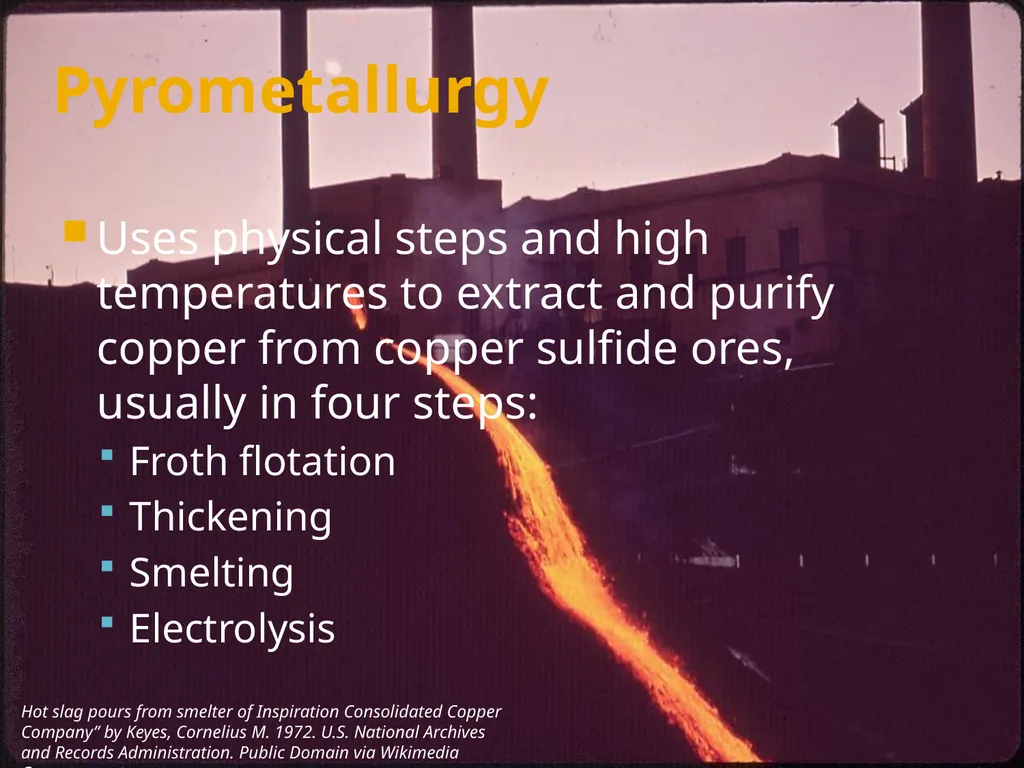
Pyrometallurgy Uses physical steps and high temperatures to extract and purify copper from copper sulfide ores, usually in four steps:
Froth flotation
Thickening
Smelting
Electrolysis Hot slag pours from smelter of Inspiration Consolidated Copper Company” by Keyes, Cornelius M. 1972. U.S. National Archives and Records Administration. Public Domain via Wikimedia Commons.<br>
Froth flotation
Thickening
Smelting
Electrolysis Hot slag pours from smelter of Inspiration Consolidated Copper Company” by Keyes, Cornelius M. 1972. U.S. National Archives and Records Administration. Public Domain via Wikimedia Commons.<br>
76
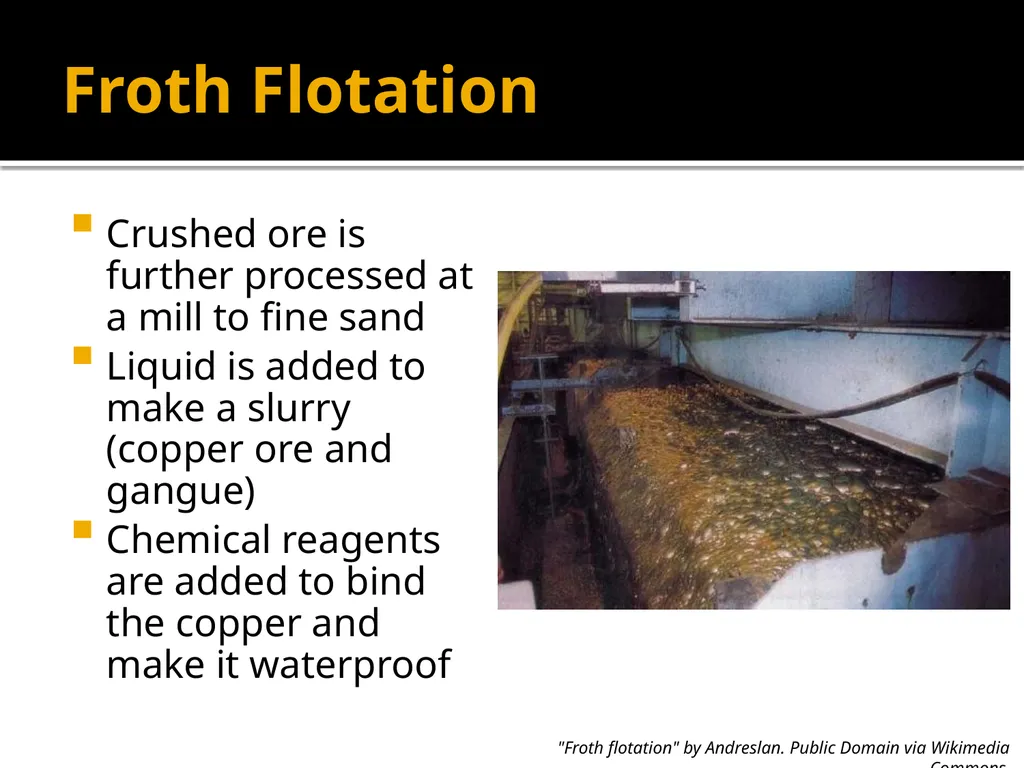
Froth Flotation Crushed ore is further processed at a mill to fine sand
Liquid is added to make a slurry (copper ore and gangue)
Chemical reagents are added to bind the copper and make it waterproof "Froth flotation" by Andreslan. Public Domain via Wikimedia Commons.<br>
Liquid is added to make a slurry (copper ore and gangue)
Chemical reagents are added to bind the copper and make it waterproof "Froth flotation" by Andreslan. Public Domain via Wikimedia Commons.<br>
77
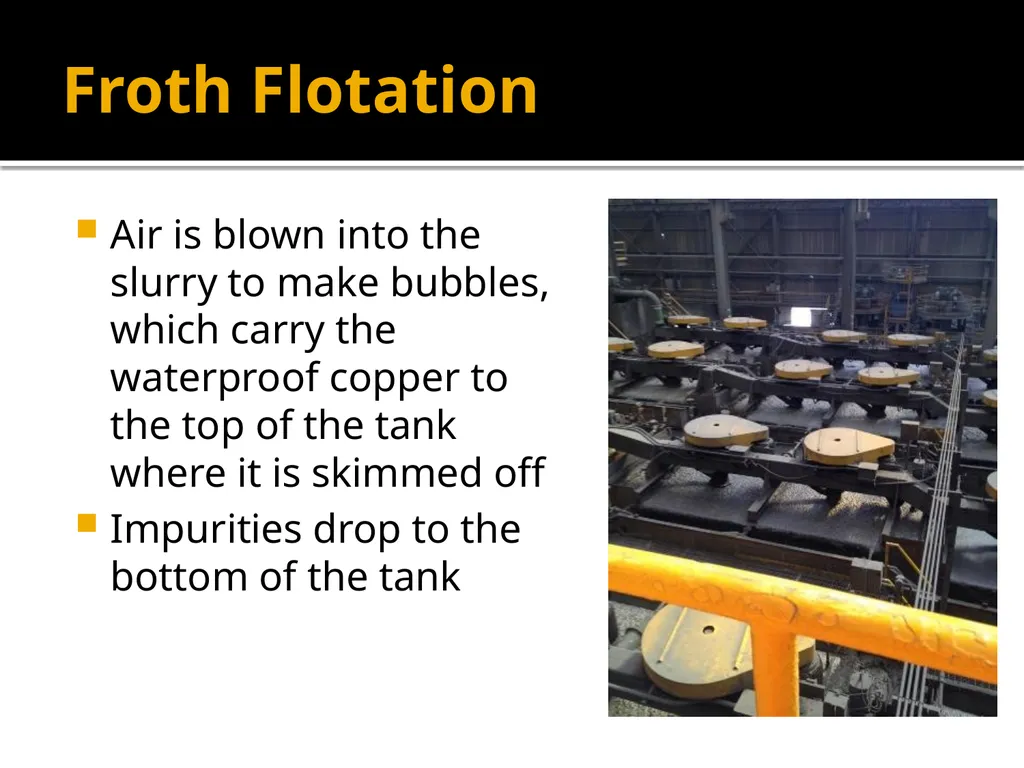
Froth Flotation Air is blown into the slurry to make bubbles, which carry the waterproof copper to the top of the tank where it is skimmed off
Impurities drop to the bottom of the tank<br>
Impurities drop to the bottom of the tank<br>
78
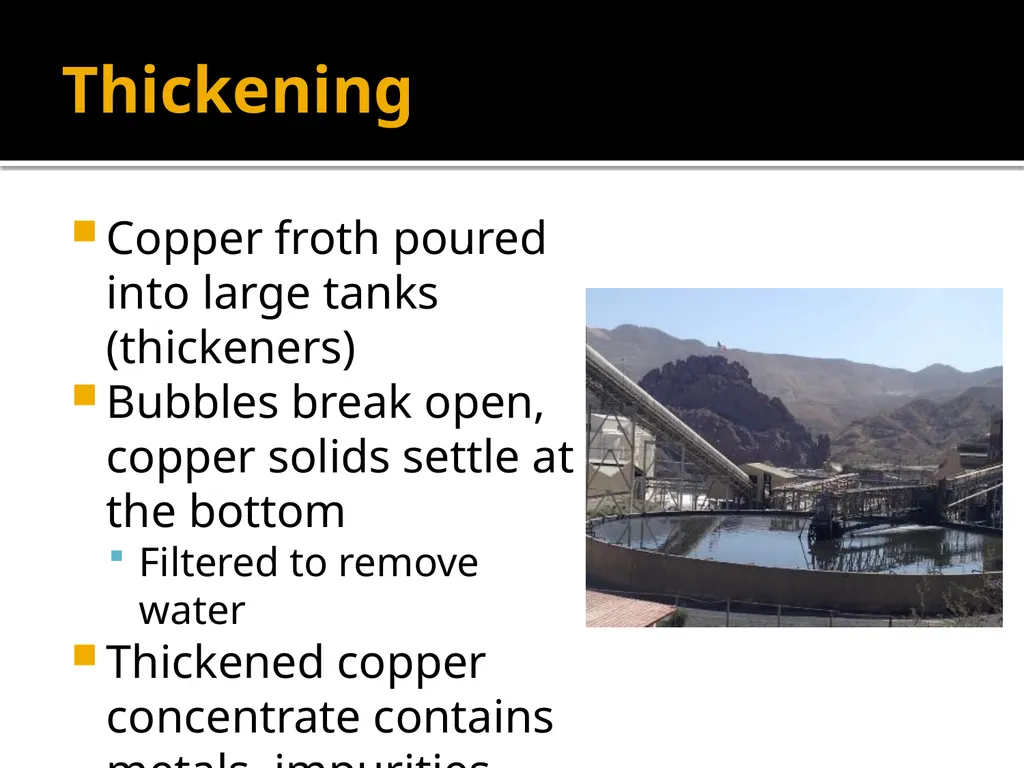
Thickening Copper froth poured into large tanks (thickeners)
Bubbles break open, copper solids settle at the bottom
Filtered to remove water
Thickened copper concentrate contains metals, impurities and ~30% copper<br>
Bubbles break open, copper solids settle at the bottom
Filtered to remove water
Thickened copper concentrate contains metals, impurities and ~30% copper<br>
79
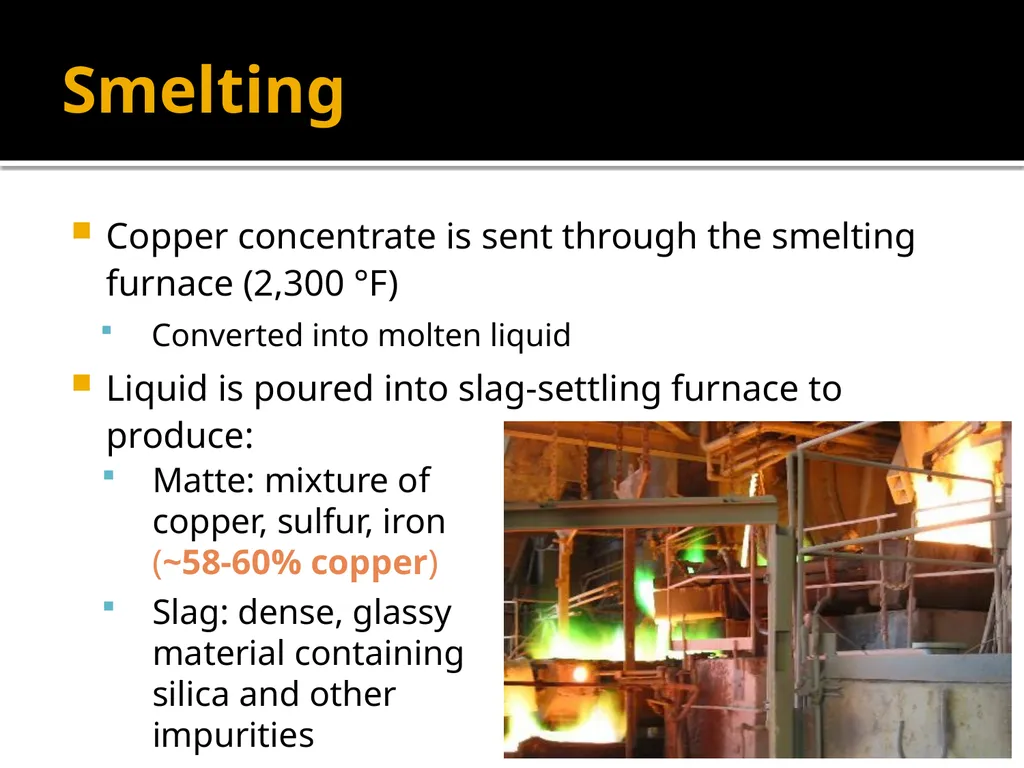
Smelting Copper concentrate is sent through the smelting furnace (2,300 °F)
Converted into molten liquid
Liquid is poured into slag-settling furnace to produce: Matte: mixture of copper, sulfur, iron (~58-60% copper)
Slag: dense, glassy material containing silica and other impurities<br>
Converted into molten liquid
Liquid is poured into slag-settling furnace to produce: Matte: mixture of copper, sulfur, iron (~58-60% copper)
Slag: dense, glassy material containing silica and other impurities<br>
80
Smelting Molten matte copper is sent to the converter furnace
Impurities are burned off
Forms yellow blister copper (98% copper)
Molten blister copper is sent to the anode smelter
Oxygen is burned off, forming blue-green anode copper<br>
Impurities are burned off
Forms yellow blister copper (98% copper)
Molten blister copper is sent to the anode smelter
Oxygen is burned off, forming blue-green anode copper<br>
81
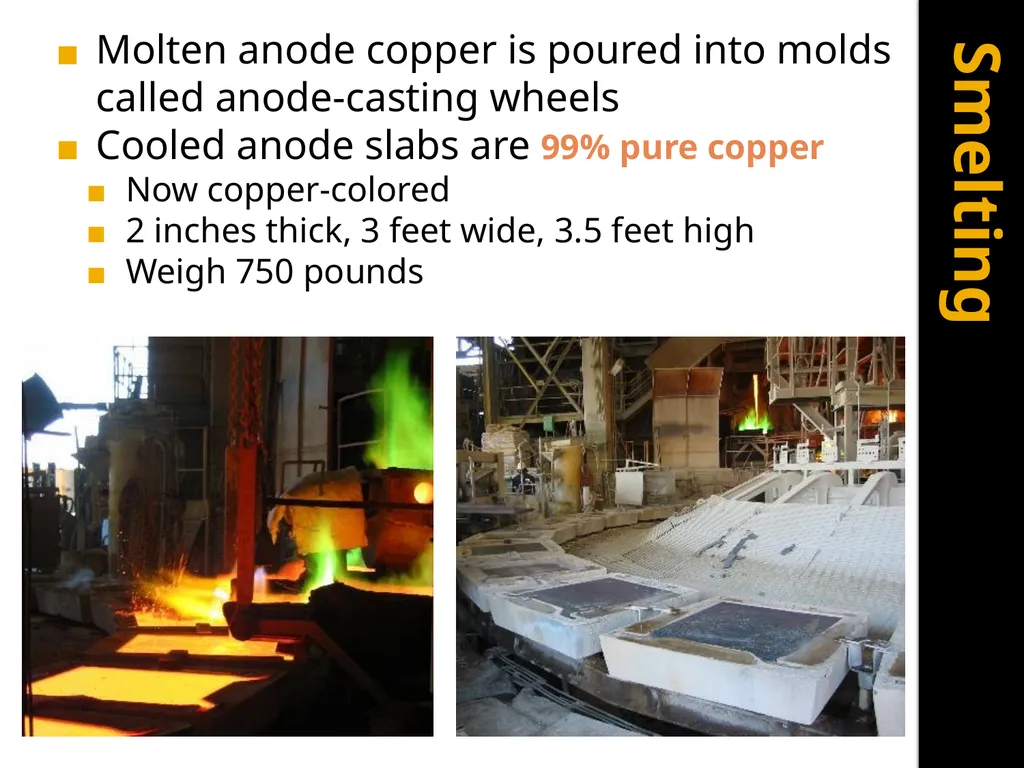
Smelting Molten anode copper is poured into molds called anode-casting wheels
Cooled anode slabs are 99% pure copper
Now copper-colored
2 inches thick, 3 feet wide, 3.5 feet high
Weigh 750 pounds<br>
Cooled anode slabs are 99% pure copper
Now copper-colored
2 inches thick, 3 feet wide, 3.5 feet high
Weigh 750 pounds<br>
82
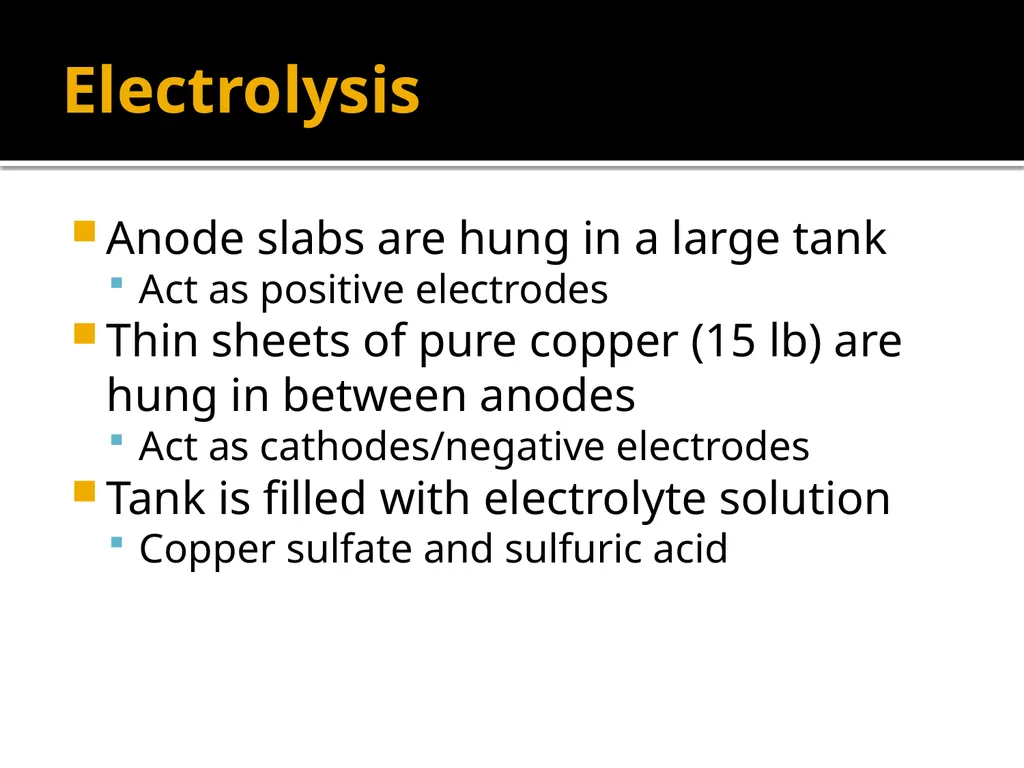
Electrolysis Anode slabs are hung in a large tank
Act as positive electrodes
Thin sheets of pure copper (15 lb) are hung in between anodes
Act as cathodes/negative electrodes
Tank is filled with electrolyte solution
Copper sulfate and sulfuric acid<br>
Act as positive electrodes
Thin sheets of pure copper (15 lb) are hung in between anodes
Act as cathodes/negative electrodes
Tank is filled with electrolyte solution
Copper sulfate and sulfuric acid<br>
83
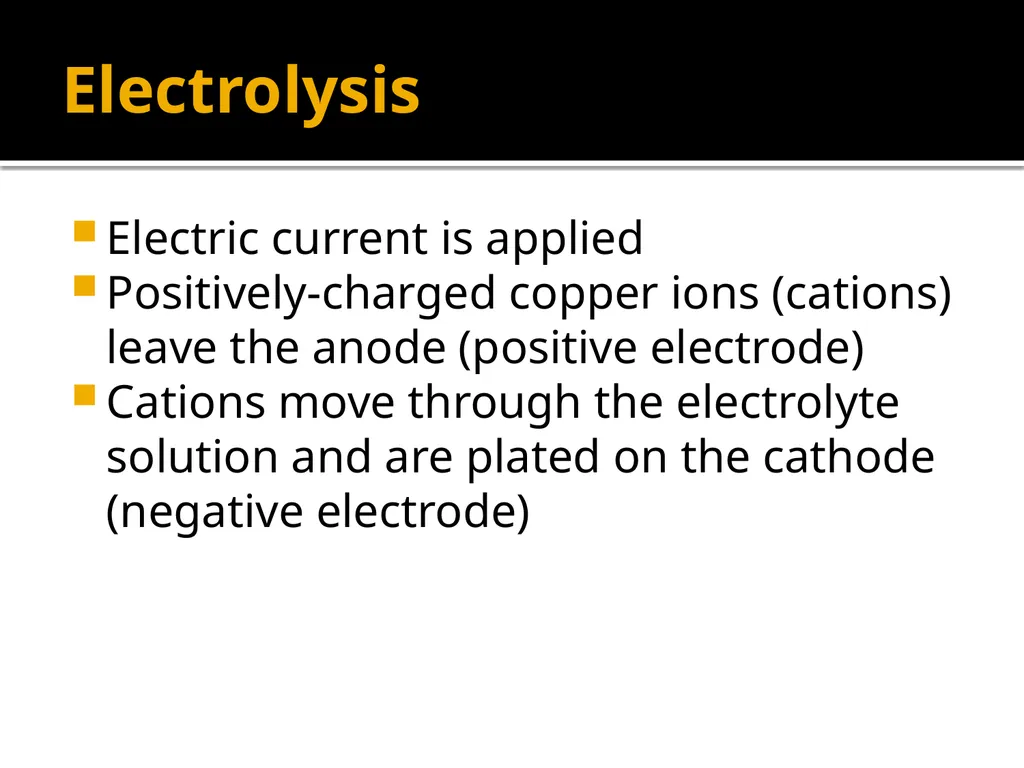
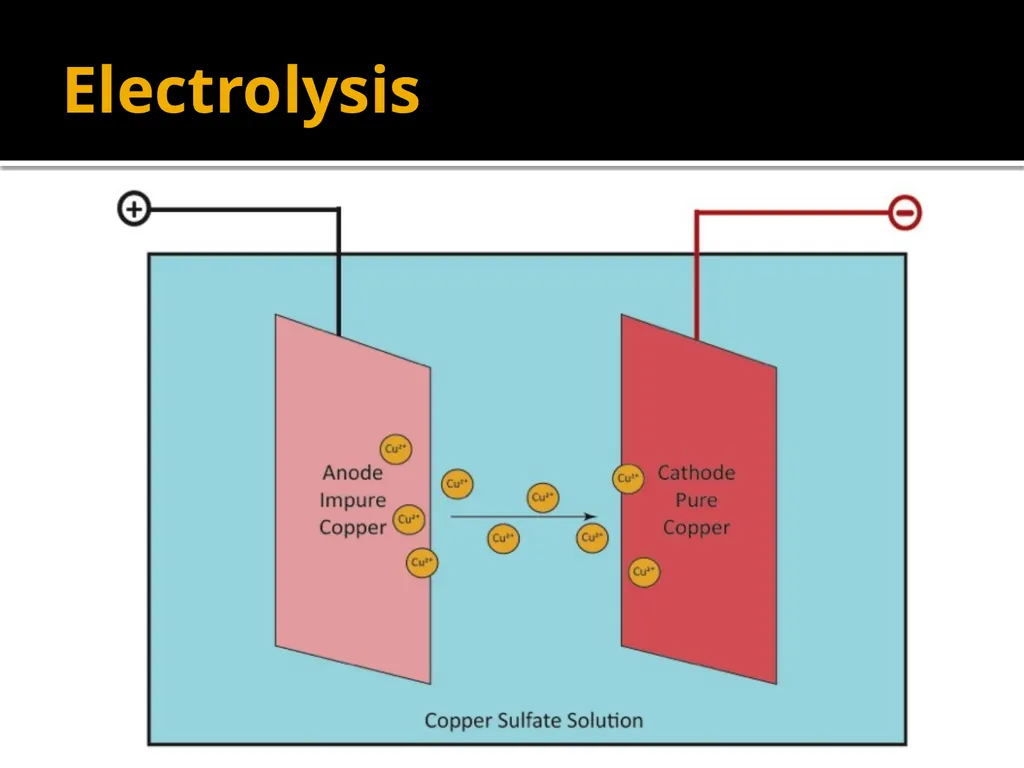
Electrolysis Electric current is applied
Positively-charged copper ions (cations) leave the anode (positive electrode)
Cations move through the electrolyte solution and are plated on the cathode (negative electrode)<br>
Positively-charged copper ions (cations) leave the anode (positive electrode)
Cations move through the electrolyte solution and are plated on the cathode (negative electrode)<br>
84
Electrolysis<br>
85
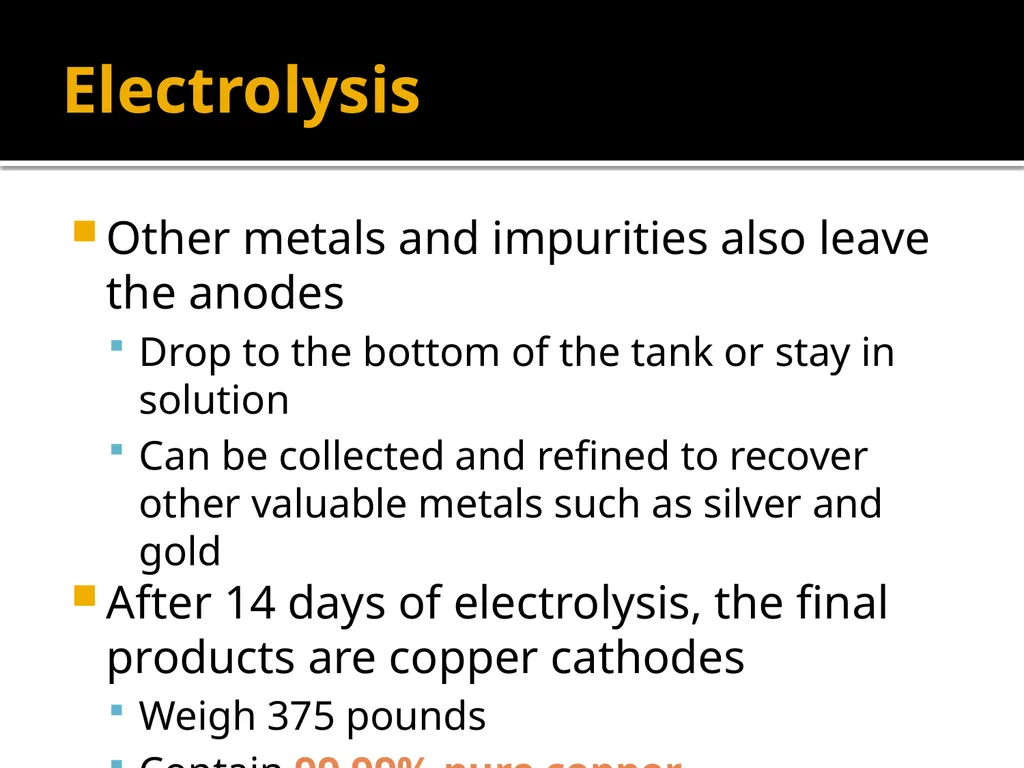
Electrolysis Other metals and impurities also leave the anodes
Drop to the bottom of the tank or stay in solution
Can be collected and refined to recover other valuable metals such as silver and gold
After 14 days of electrolysis, the final products are copper cathodes
Weigh 375 pounds
Contain 99.99% pure copper<br>
Drop to the bottom of the tank or stay in solution
Can be collected and refined to recover other valuable metals such as silver and gold
After 14 days of electrolysis, the final products are copper cathodes
Weigh 375 pounds
Contain 99.99% pure copper<br>
86
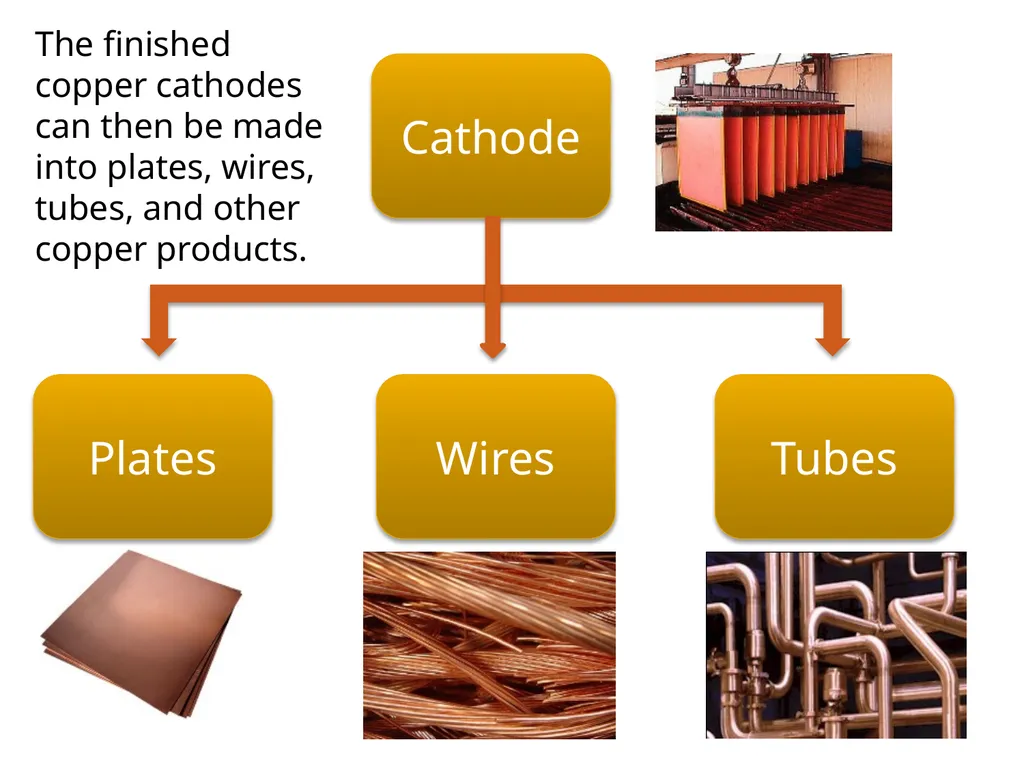
Cathode Tubes Plates Wires The finished copper cathodes can then be made into plates, wires, tubes, and other copper products.<br>
87
Recycling Copper Because copper is an element, it can be infinitely recycled
New and old copper scrap or copper alloys can be melted, re-purified, and recycled into new components
~50% of copper used in the copper industry was recycled
In 2010, 770,000 metric tons of copper were recycled, at estimated value of $6 billion<br>
New and old copper scrap or copper alloys can be melted, re-purified, and recycled into new components
~50% of copper used in the copper industry was recycled
In 2010, 770,000 metric tons of copper were recycled, at estimated value of $6 billion<br>