
Core Course Knowledge Lesson 5 The Prompts From:
LO
Published · 31 slides · 0 views
1 / 1
Description
Core Course Knowledge Lesson 5 The Prompts From: Cambridge International AS Level English General Paper Coursebook by Jill Pavich Key Terms Effective Communication: using language accurately to express your thoughts or opinions
Related Topics
Share
Embed code
Download this presentation From Below
"Core Course Knowledge Lesson 5 The Prompts From:" is the property of its rightful owner. Permission is granted to download and print the materials on this website for personal, non-commercial use only, and to display it on your personal computer provided you do not modify the materials and that you retain all copyright notices contained in the materials. By downloading content from our website, you accept the terms of this agreement.
Presentation Transcript
01
Core Course Knowledge Lesson 5 The Prompts From: Cambridge International AS Level English General Paper Coursebook by Jill Pavich ‹#›<br>
02
‹#›<br>
03
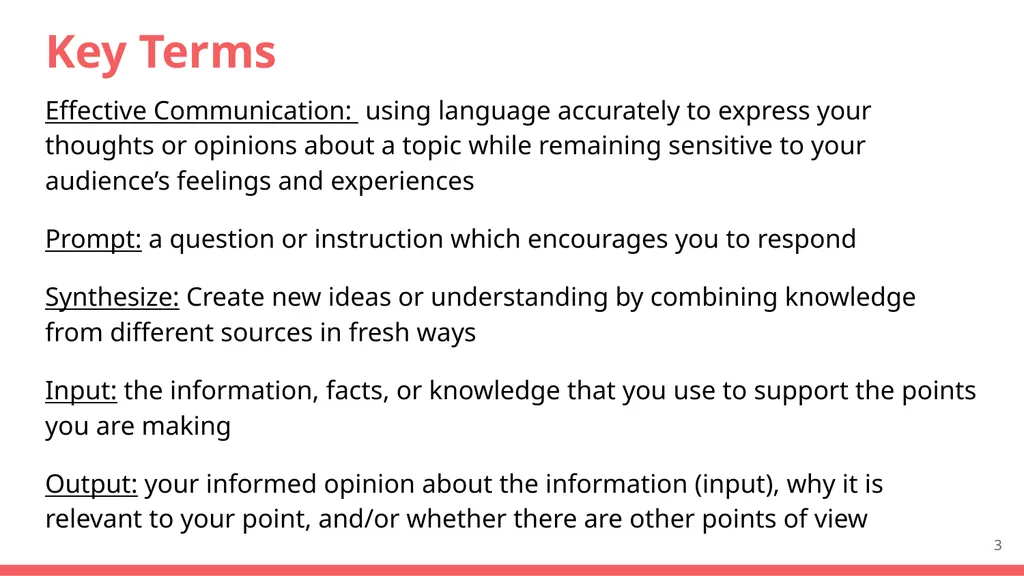
Key Terms Effective Communication: using language accurately to express your thoughts or opinions about a topic while remaining sensitive to your audience’s feelings and experiences
Prompt: a question or instruction which encourages you to respond
Synthesize: Create new ideas or understanding by combining knowledge from different sources in fresh ways
Input: the information, facts, or knowledge that you use to support the points you are making
Output: your informed opinion about the information (input), why it is relevant to your point, and/or whether there are other points of view ‹#›<br>
04
Course Benefits The skills that this course is meant to develop can be applied to any subject, as long as YOU apply yourself to learning them. You MUST be an attentive participant, and do your very best to absorb and use what you learn. The skills may also help you to:
Meet the entrance requirements for universities, since many universities place a high value on critical thinking skills
Become more aware of contemporary ‘real word’ issues
Communicate effectively with others about these issues ‹#›<br>
Meet the entrance requirements for universities, since many universities place a high value on critical thinking skills
Become more aware of contemporary ‘real word’ issues
Communicate effectively with others about these issues ‹#›<br>
05
Effective Communication This is a skill that is essential to everyone, everywhere. It is a skill that enables you to change the world around you. Communicating effectively can help you discuss issues, articulate ideas, and voice your opinions. Essentially, this course gives you the skills you need to find your own voice in an increasingly globalized world. ‹#›<br>
06
Topics During the exam, and during this course, you will be given a choice of essay questions (or prompts) which are organized by the following topics:
Economic, historical, moral, political and social
Science, including its history, philosophy, ethics, general principles and applications; environmental issues; technology and mathematics
Literature, language, the arts, crafts, and the media ‹#›<br>
Economic, historical, moral, political and social
Science, including its history, philosophy, ethics, general principles and applications; environmental issues; technology and mathematics
Literature, language, the arts, crafts, and the media ‹#›<br>
07
Demonstrating Critical Thought A good essay will show knowledge of the topic area, but it will also discuss that information on a more critical level. So as well as selecting appropriate information to include in your essay, you will need to analyze it.
It may help if you think of this as the input and output of your essay.
By sharing these thoughts with your audience, you are actively and critically interacting with the information that you present in your essay.
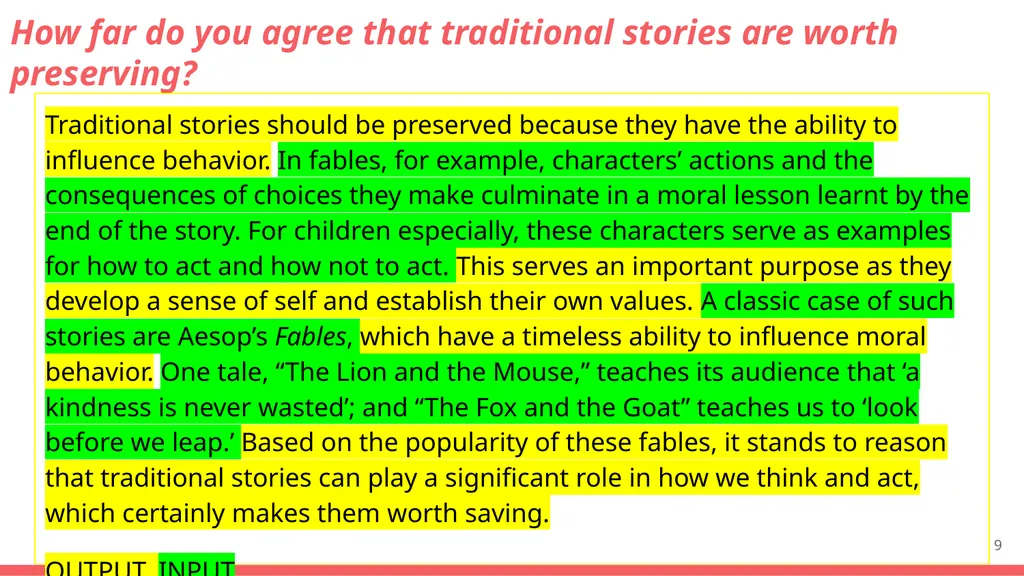
Activity: Read the following paragraph, which responds to the essay prompt How far do you agree that traditional stories are worth preserving? With a partner or independently, identify the input and output in the paragraph. Highlight each in a different color on your slide. ‹#›<br>
08
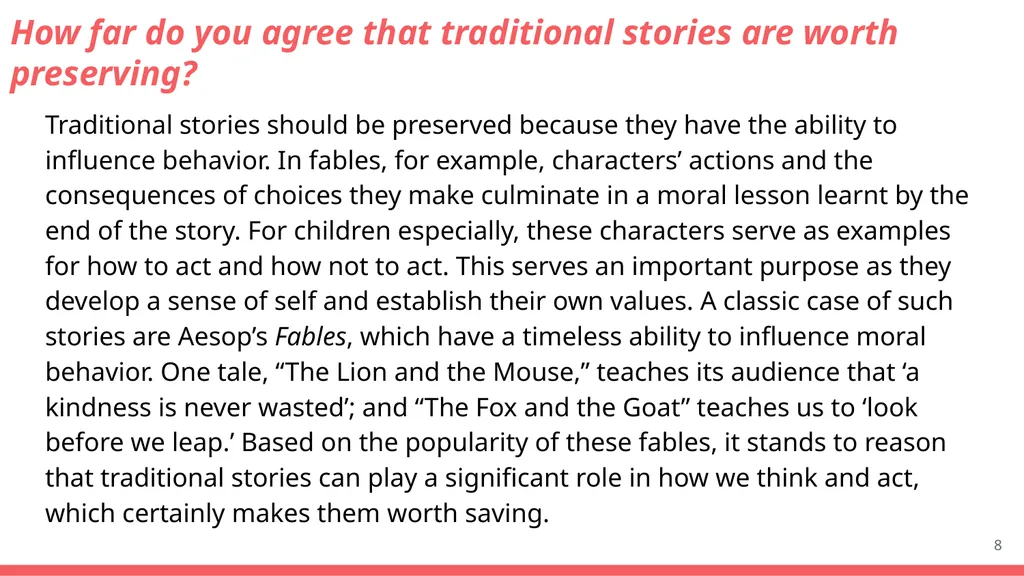
How far do you agree that traditional stories are worth preserving? Traditional stories should be preserved because they have the ability to influence behavior. In fables, for example, characters’ actions and the consequences of choices they make culminate in a moral lesson learnt by the end of the story. For children especially, these characters serve as examples for how to act and how not to act. This serves an important purpose as they develop a sense of self and establish their own values. A classic case of such stories are Aesop’s Fables, which have a timeless ability to influence moral behavior. One tale, “The Lion and the Mouse,” teaches its audience that ‘a kindness is never wasted’; and “The Fox and the Goat” teaches us to ‘look before we leap.’ Based on the popularity of these fables, it stands to reason that traditional stories can play a significant role in how we think and act, which certainly makes them worth saving. ‹#›<br>
09
How far do you agree that traditional stories are worth preserving? Traditional stories should be preserved because they have the ability to influence behavior. In fables, for example, characters’ actions and the consequences of choices they make culminate in a moral lesson learnt by the end of the story. For children especially, these characters serve as examples for how to act and how not to act. This serves an important purpose as they develop a sense of self and establish their own values. A classic case of such stories are Aesop’s Fables, which have a timeless ability to influence moral behavior. One tale, “The Lion and the Mouse,” teaches its audience that ‘a kindness is never wasted’; and “The Fox and the Goat” teaches us to ‘look before we leap.’ Based on the popularity of these fables, it stands to reason that traditional stories can play a significant role in how we think and act, which certainly makes them worth saving.
OUTPUT, INPUT ‹#›<br>
OUTPUT, INPUT ‹#›<br>
10
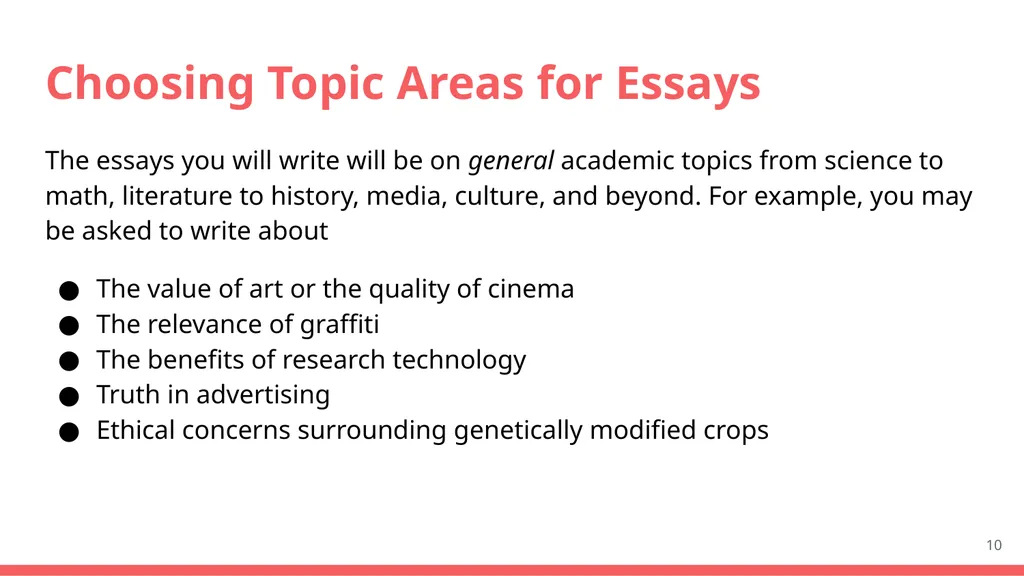
Choosing Topic Areas for Essays The essays you will write will be on general academic topics from science to math, literature to history, media, culture, and beyond. For example, you may be asked to write about
The value of art or the quality of cinema
The relevance of graffiti
The benefits of research technology
Truth in advertising
Ethical concerns surrounding genetically modified crops ‹#›<br>
The value of art or the quality of cinema
The relevance of graffiti
The benefits of research technology
Truth in advertising
Ethical concerns surrounding genetically modified crops ‹#›<br>
11
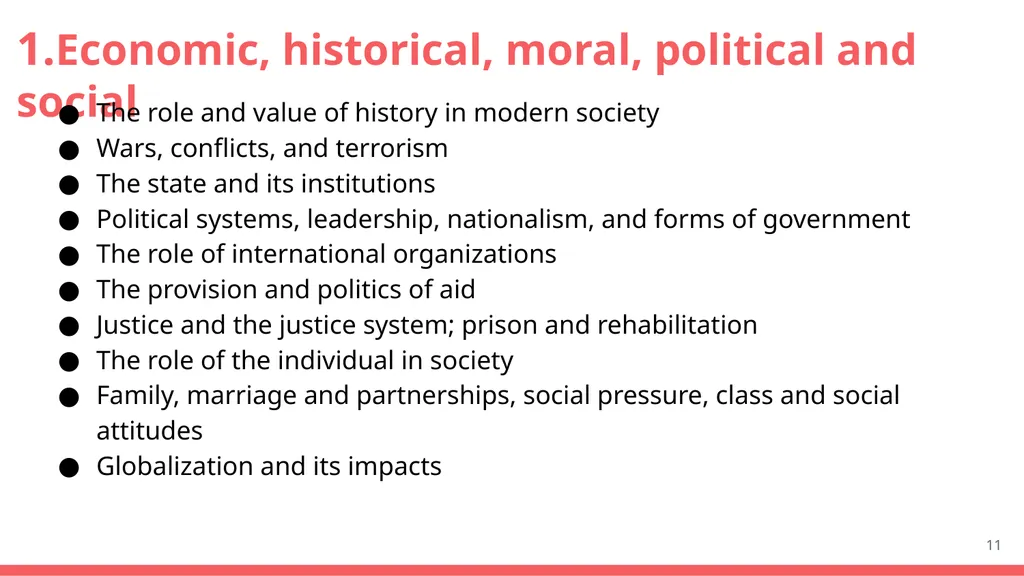
1.Economic, historical, moral, political and social The role and value of history in modern society
Wars, conflicts, and terrorism
The state and its institutions
Political systems, leadership, nationalism, and forms of government
The role of international organizations
The provision and politics of aid
Justice and the justice system; prison and rehabilitation
The role of the individual in society
Family, marriage and partnerships, social pressure, class and social attitudes
Globalization and its impacts ‹#›<br>
12
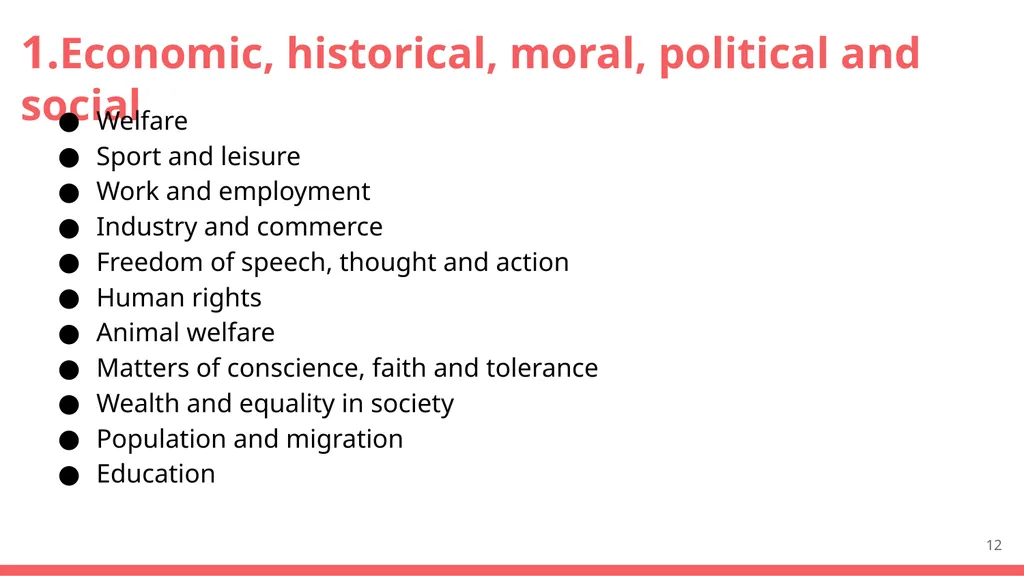
1.Economic, historical, moral, political and social Welfare
Sport and leisure
Work and employment
Industry and commerce
Freedom of speech, thought and action
Human rights
Animal welfare
Matters of conscience, faith and tolerance
Wealth and equality in society
Population and migration
Education ‹#›<br>
Sport and leisure
Work and employment
Industry and commerce
Freedom of speech, thought and action
Human rights
Animal welfare
Matters of conscience, faith and tolerance
Wealth and equality in society
Population and migration
Education ‹#›<br>
13
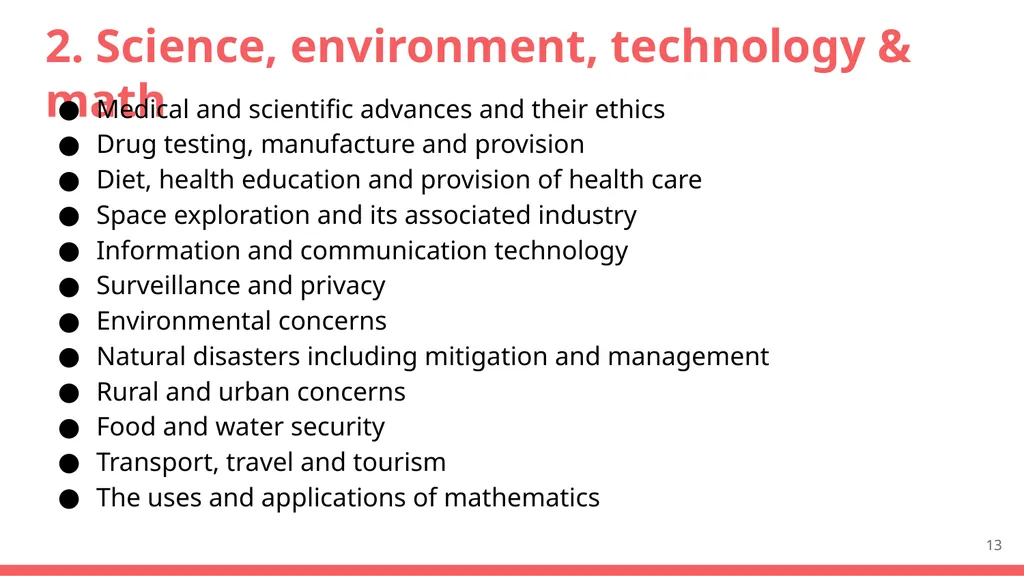
2. Science, environment, technology & math Medical and scientific advances and their ethics
Drug testing, manufacture and provision
Diet, health education and provision of health care
Space exploration and its associated industry
Information and communication technology
Surveillance and privacy
Environmental concerns
Natural disasters including mitigation and management
Rural and urban concerns
Food and water security
Transport, travel and tourism
The uses and applications of mathematics ‹#›<br>
14
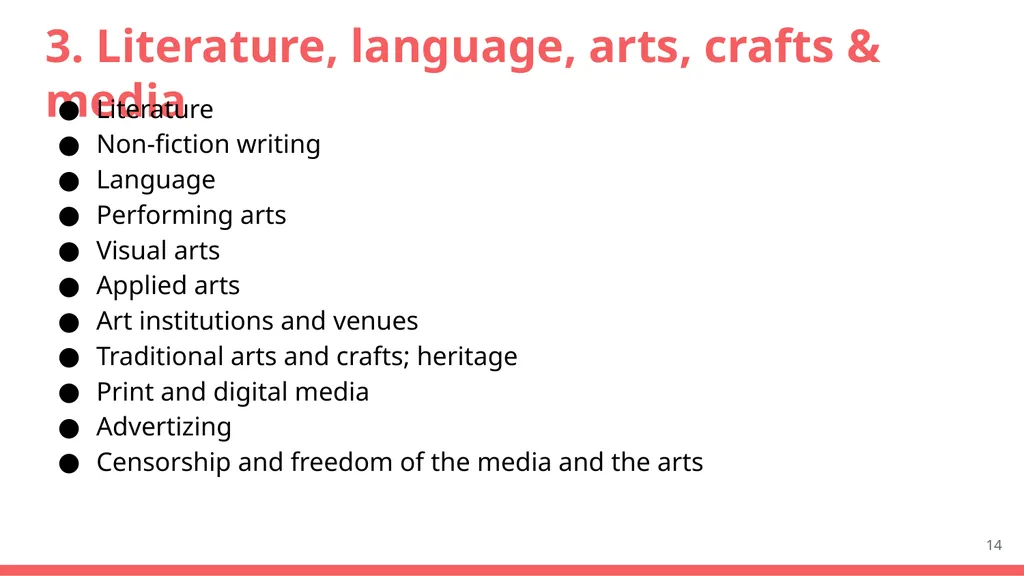
3. Literature, language, arts, crafts & media Literature
Non-fiction writing
Language
Performing arts
Visual arts
Applied arts
Art institutions and venues
Traditional arts and crafts; heritage
Print and digital media
Advertizing
Censorship and freedom of the media and the arts ‹#›<br>
Non-fiction writing
Language
Performing arts
Visual arts
Applied arts
Art institutions and venues
Traditional arts and crafts; heritage
Print and digital media
Advertizing
Censorship and freedom of the media and the arts ‹#›<br>
15
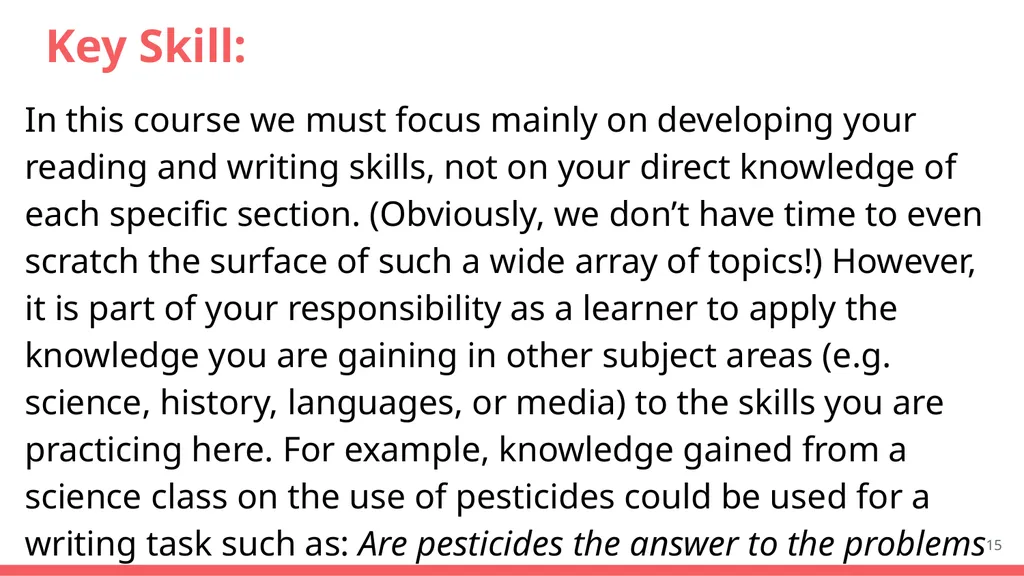
Key Skill: In this course we must focus mainly on developing your reading and writing skills, not on your direct knowledge of each specific section. (Obviously, we don’t have time to even scratch the surface of such a wide array of topics!) However, it is part of your responsibility as a learner to apply the knowledge you are gaining in other subject areas (e.g. science, history, languages, or media) to the skills you are practicing here. For example, knowledge gained from a science class on the use of pesticides could be used for a writing task such as: Are pesticides the answer to the problems facing the business of global agriculture? ‹#›<br>
16
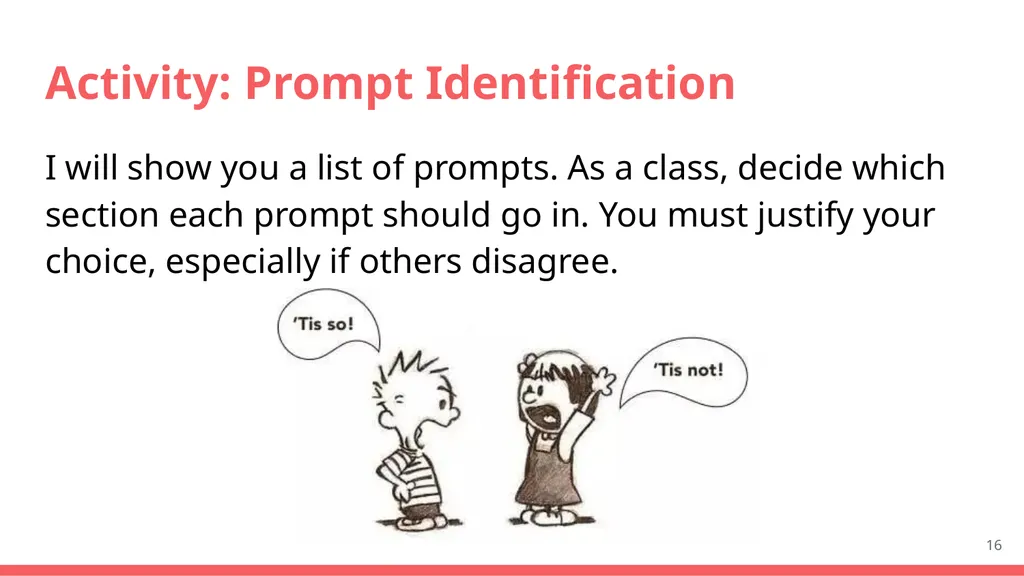
Activity: Prompt Identification I will show you a list of prompts. As a class, decide which section each prompt should go in. You must justify your choice, especially if others disagree. ‹#›<br>
17
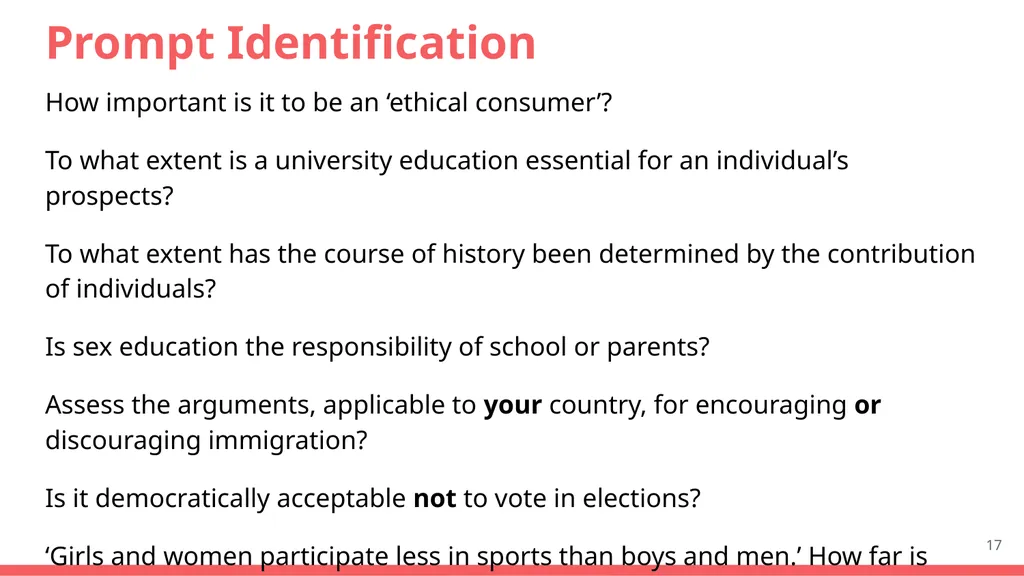
Prompt Identification How important is it to be an ‘ethical consumer’?
To what extent is a university education essential for an individual’s prospects?
To what extent has the course of history been determined by the contribution of individuals?
Is sex education the responsibility of school or parents?
Assess the arguments, applicable to your country, for encouraging or discouraging immigration?
Is it democratically acceptable not to vote in elections?
‘Girls and women participate less in sports than boys and men.’ How far is this inevitable or desirable? ‹#›<br>
18
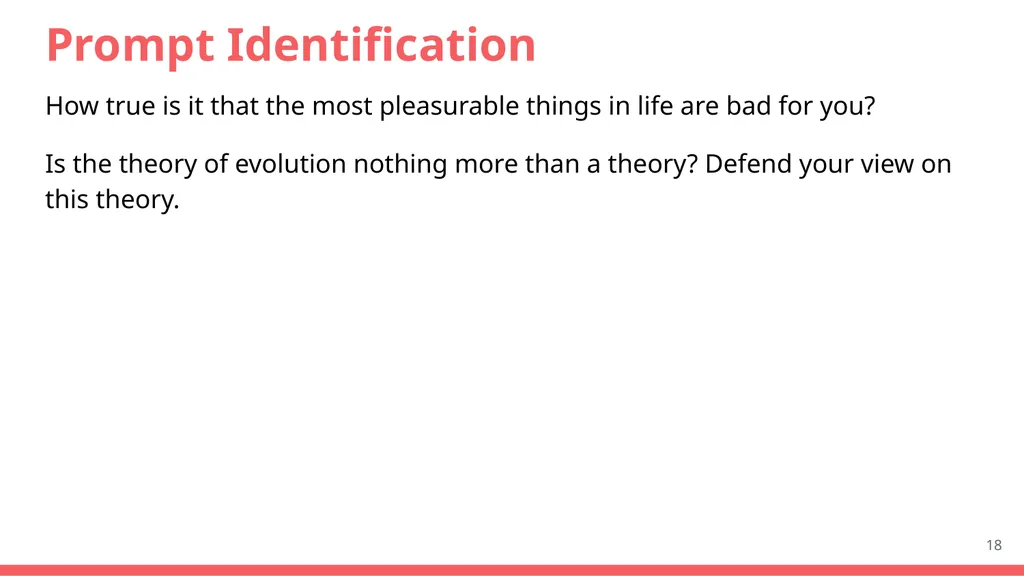
Prompt Identification How true is it that the most pleasurable things in life are bad for you?
Is the theory of evolution nothing more than a theory? Defend your view on this theory. ‹#›<br>
Is the theory of evolution nothing more than a theory? Defend your view on this theory. ‹#›<br>
19
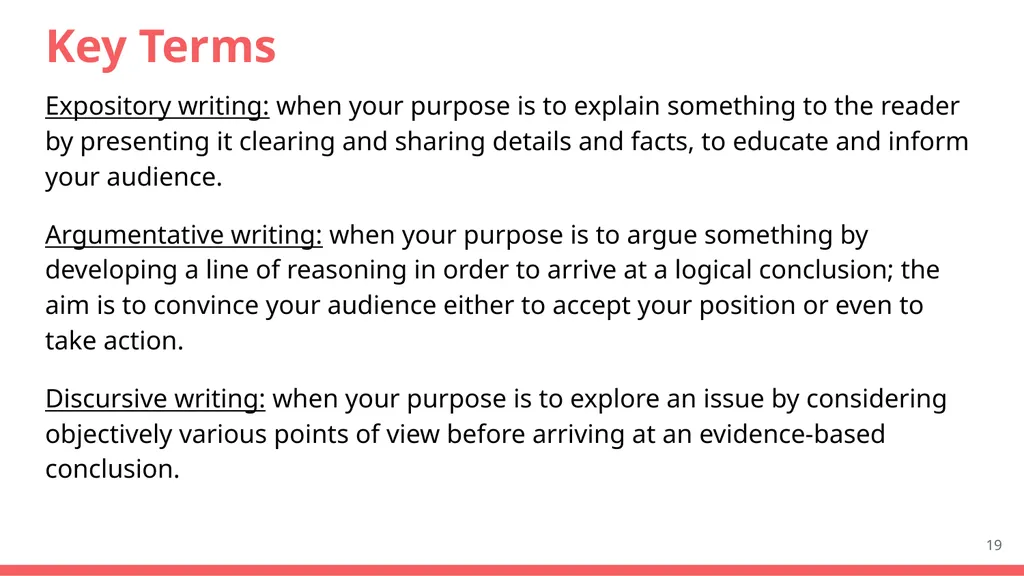
Key Terms Expository writing: when your purpose is to explain something to the reader by presenting it clearing and sharing details and facts, to educate and inform your audience.
Argumentative writing: when your purpose is to argue something by developing a line of reasoning in order to arrive at a logical conclusion; the aim is to convince your audience either to accept your position or even to take action.
Discursive writing: when your purpose is to explore an issue by considering objectively various points of view before arriving at an evidence-based conclusion. ‹#›<br>
20
Key Terms Tone: the attitude of the writer toward their subject or audience.
Biased: having a tendency to believe one aspect of an argument more than others as a result of one’s personal opinions and/or prejudice.
Objective: not influenced by personal feelings or opinions when presenting an argument.
Command words: terms that indicate how you are expected to respond to a question.
Qualifier: a word or phrase used to limit the meaning of a word; it maximizes or minimizes the value of the word. ‹#›<br>
21
Understanding Your Task As part of this course, and for the exam, you will write for a variety of different purposes. As you respond to reading comprehension questions, for example, you might write to explain your observations about a text or justify inferences you make about the material. You may also be asked to share your own logical reasoning in response to text, which would require you to write with a more argumentative purpose in mind.
In responding to essay questions, you will be assessed on your ability to develop a well-reasoned argument in response to questions concerning modern issues. This may involve arguing a distinct position or investigating the topic more objectively before passing judgement. No matter what your purpose is for writing, you will need to practice structuring ideas in order to achieve your goal. You will need to develop your expository, argumentative and discursive writing skills. ‹#›<br>
In responding to essay questions, you will be assessed on your ability to develop a well-reasoned argument in response to questions concerning modern issues. This may involve arguing a distinct position or investigating the topic more objectively before passing judgement. No matter what your purpose is for writing, you will need to practice structuring ideas in order to achieve your goal. You will need to develop your expository, argumentative and discursive writing skills. ‹#›<br>
22
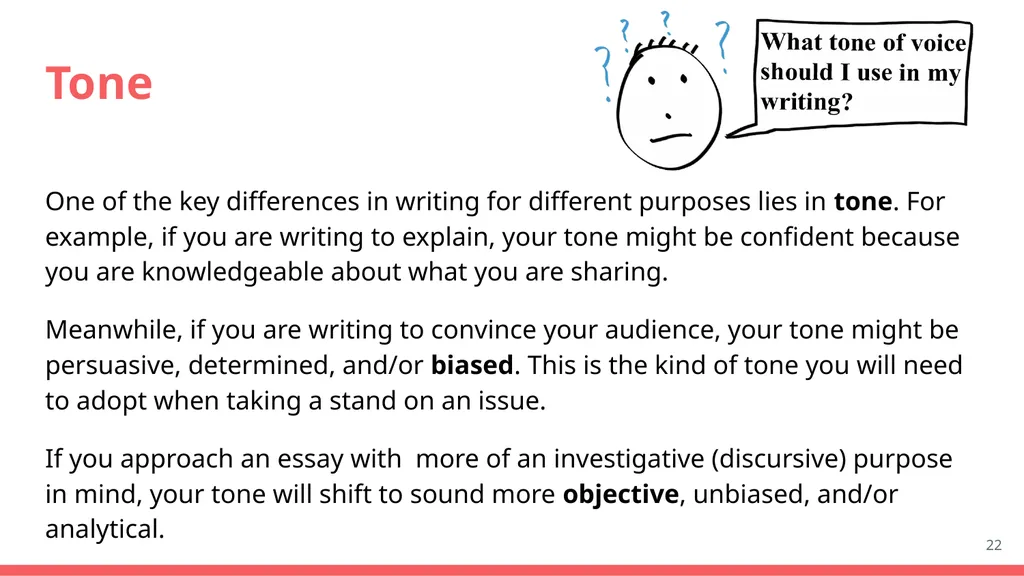
Tone One of the key differences in writing for different purposes lies in tone. For example, if you are writing to explain, your tone might be confident because you are knowledgeable about what you are sharing.
Meanwhile, if you are writing to convince your audience, your tone might be persuasive, determined, and/or biased. This is the kind of tone you will need to adopt when taking a stand on an issue.
If you approach an essay with more of an investigative (discursive) purpose in mind, your tone will shift to sound more objective, unbiased, and/or analytical. ‹#›<br>
23
Command Words There are a number of command words you should become familiar with. These words indicate how you are expected to respond to a reading comprehension or essay question. Think about how your response might change as you read through the following tasks:
Identify the importance of grammatical accuracy in today’s society.
Evaluate the importance of grammatical accuracy in today’s society.
Consider the importance of grammatical accuracy in today’s society.
What words change the nature of the question in each? Words like ‘identify,’ ‘evaluate,’ and ‘consider’ make a BIG difference in how you should respond to these tasks.
STUDY the handout of command words. There will be a quiz on these later. ‹#›<br>
24
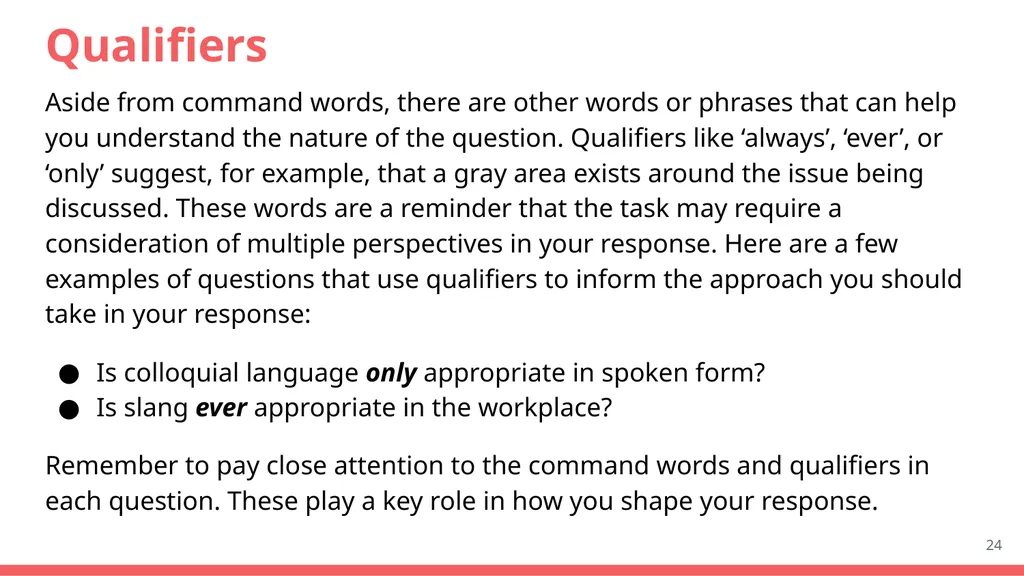
Qualifiers Aside from command words, there are other words or phrases that can help you understand the nature of the question. Qualifiers like ‘always’, ‘ever’, or ‘only’ suggest, for example, that a gray area exists around the issue being discussed. These words are a reminder that the task may require a consideration of multiple perspectives in your response. Here are a few examples of questions that use qualifiers to inform the approach you should take in your response:
Is colloquial language only appropriate in spoken form?
Is slang ever appropriate in the workplace?
Remember to pay close attention to the command words and qualifiers in each question. These play a key role in how you shape your response. ‹#›<br>
Is colloquial language only appropriate in spoken form?
Is slang ever appropriate in the workplace?
Remember to pay close attention to the command words and qualifiers in each question. These play a key role in how you shape your response. ‹#›<br>
25
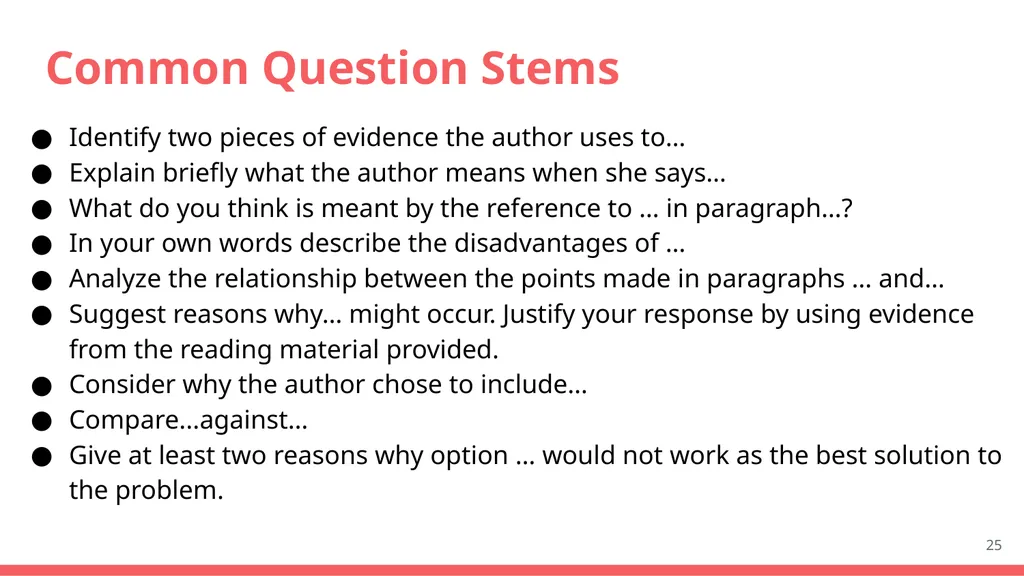
Common Question Stems Identify two pieces of evidence the author uses to…
Explain briefly what the author means when she says…
What do you think is meant by the reference to … in paragraph…?
In your own words describe the disadvantages of …
Analyze the relationship between the points made in paragraphs … and…
Suggest reasons why… might occur. Justify your response by using evidence from the reading material provided.
Consider why the author chose to include…
Compare...against…
Give at least two reasons why option … would not work as the best solution to the problem. ‹#›<br>
26
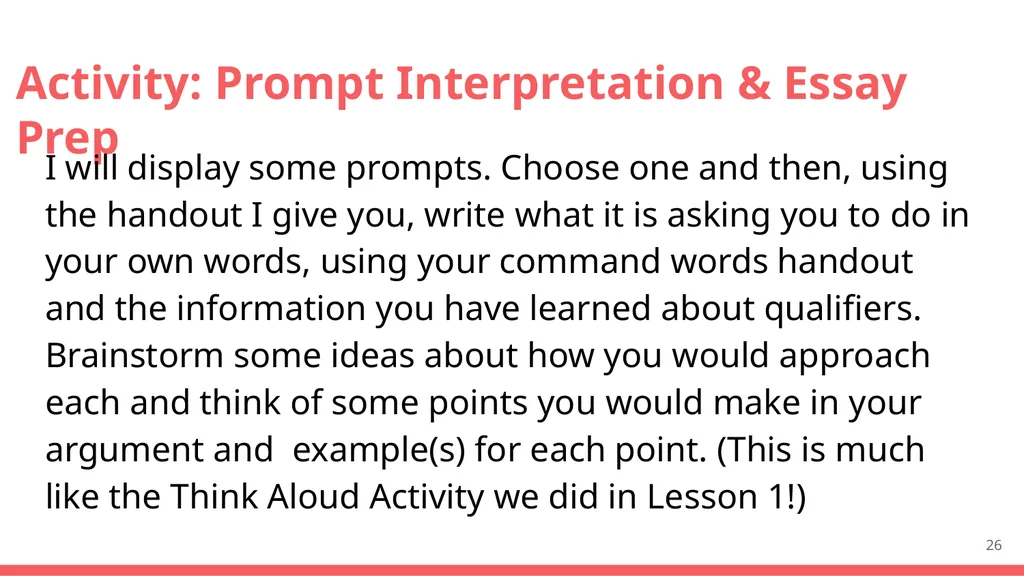
Activity: Prompt Interpretation & Essay Prep I will display some prompts. Choose one and then, using the handout I give you, write what it is asking you to do in your own words, using your command words handout and the information you have learned about qualifiers. Brainstorm some ideas about how you would approach each and think of some points you would make in your argument and example(s) for each point. (This is much like the Think Aloud Activity we did in Lesson 1!) ‹#›<br>
27
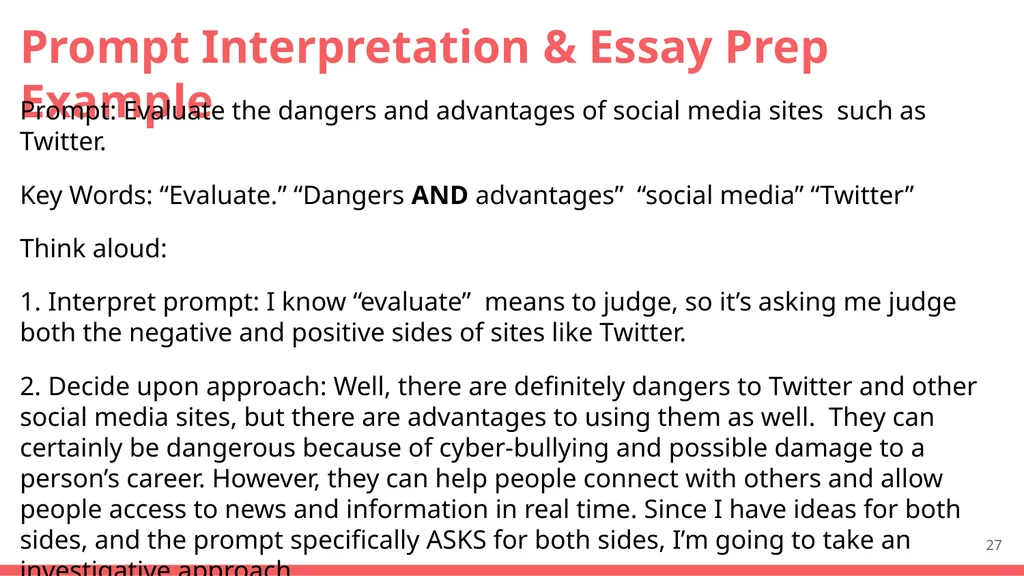
Prompt Interpretation & Essay Prep Example Prompt: Evaluate the dangers and advantages of social media sites such as Twitter.
Key Words: “Evaluate.” “Dangers AND advantages” “social media” “Twitter”
Think aloud:
1. Interpret prompt: I know “evaluate” means to judge, so it’s asking me judge both the negative and positive sides of sites like Twitter.
2. Decide upon approach: Well, there are definitely dangers to Twitter and other social media sites, but there are advantages to using them as well. They can certainly be dangerous because of cyber-bullying and possible damage to a person’s career. However, they can help people connect with others and allow people access to news and information in real time. Since I have ideas for both sides, and the prompt specifically ASKS for both sides, I’m going to take an investigative approach. ‹#›<br>
28
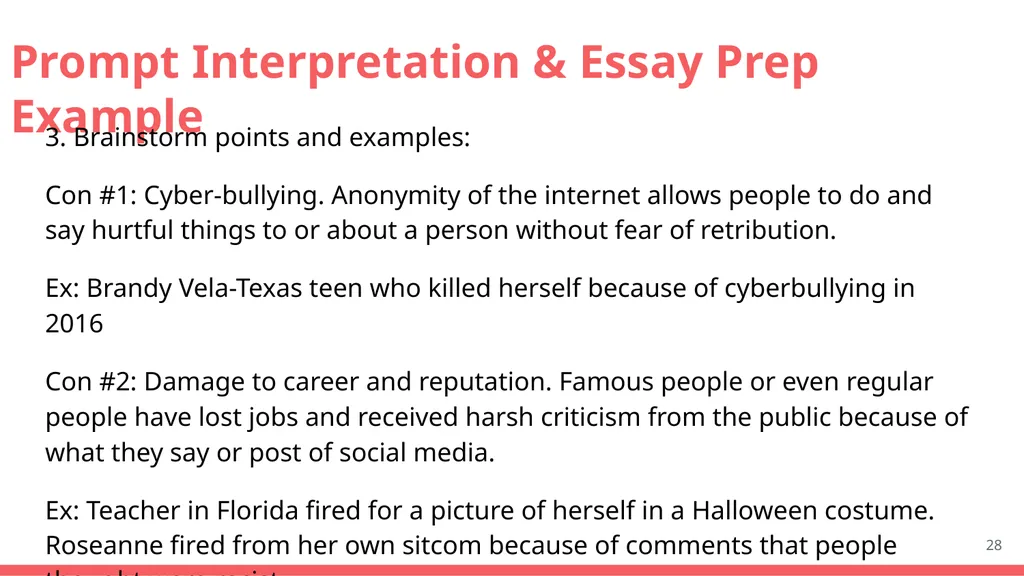
Prompt Interpretation & Essay Prep Example 3. Brainstorm points and examples:
Con #1: Cyber-bullying. Anonymity of the internet allows people to do and say hurtful things to or about a person without fear of retribution.
Ex: Brandy Vela-Texas teen who killed herself because of cyberbullying in 2016
Con #2: Damage to career and reputation. Famous people or even regular people have lost jobs and received harsh criticism from the public because of what they say or post of social media.
Ex: Teacher in Florida fired for a picture of herself in a Halloween costume. Roseanne fired from her own sitcom because of comments that people thought were racist. ‹#›<br>
29
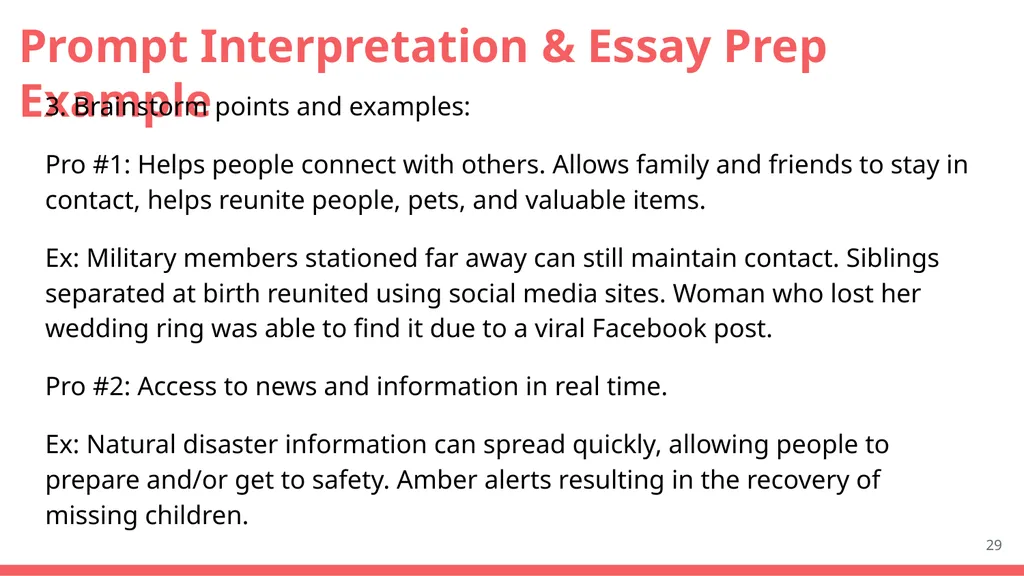
Prompt Interpretation & Essay Prep Example 3. Brainstorm points and examples:
Pro #1: Helps people connect with others. Allows family and friends to stay in contact, helps reunite people, pets, and valuable items.
Ex: Military members stationed far away can still maintain contact. Siblings separated at birth reunited using social media sites. Woman who lost her wedding ring was able to find it due to a viral Facebook post.
Pro #2: Access to news and information in real time.
Ex: Natural disaster information can spread quickly, allowing people to prepare and/or get to safety. Amber alerts resulting in the recovery of missing children. ‹#›<br>
30
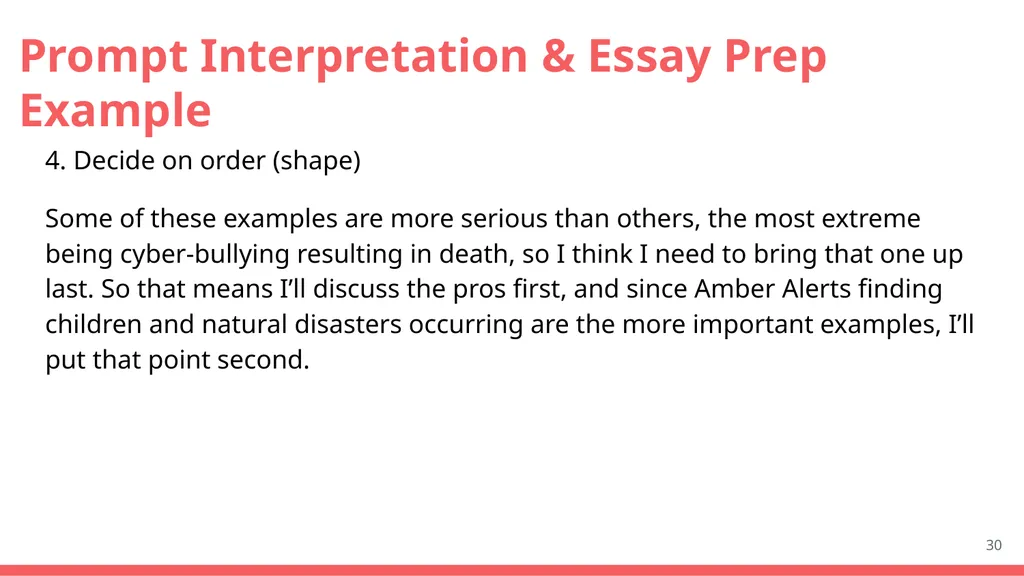
Prompt Interpretation & Essay Prep Example 4. Decide on order (shape)
Some of these examples are more serious than others, the most extreme being cyber-bullying resulting in death, so I think I need to bring that one up last. So that means I’ll discuss the pros first, and since Amber Alerts finding children and natural disasters occurring are the more important examples, I’ll put that point second. ‹#›<br>
Some of these examples are more serious than others, the most extreme being cyber-bullying resulting in death, so I think I need to bring that one up last. So that means I’ll discuss the pros first, and since Amber Alerts finding children and natural disasters occurring are the more important examples, I’ll put that point second. ‹#›<br>
31
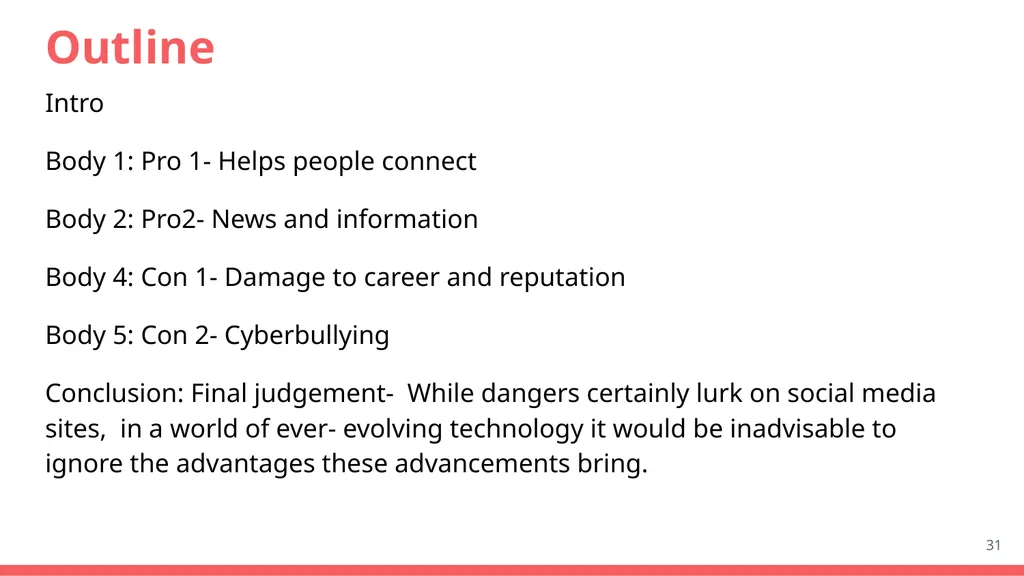
Outline Intro
Body 1: Pro 1- Helps people connect
Body 2: Pro2- News and information
Body 4: Con 1- Damage to career and reputation
Body 5: Con 2- Cyberbullying
Conclusion: Final judgement- While dangers certainly lurk on social media sites, in a world of ever- evolving technology it would be inadvisable to ignore the advantages these advancements bring. ‹#›<br>