03
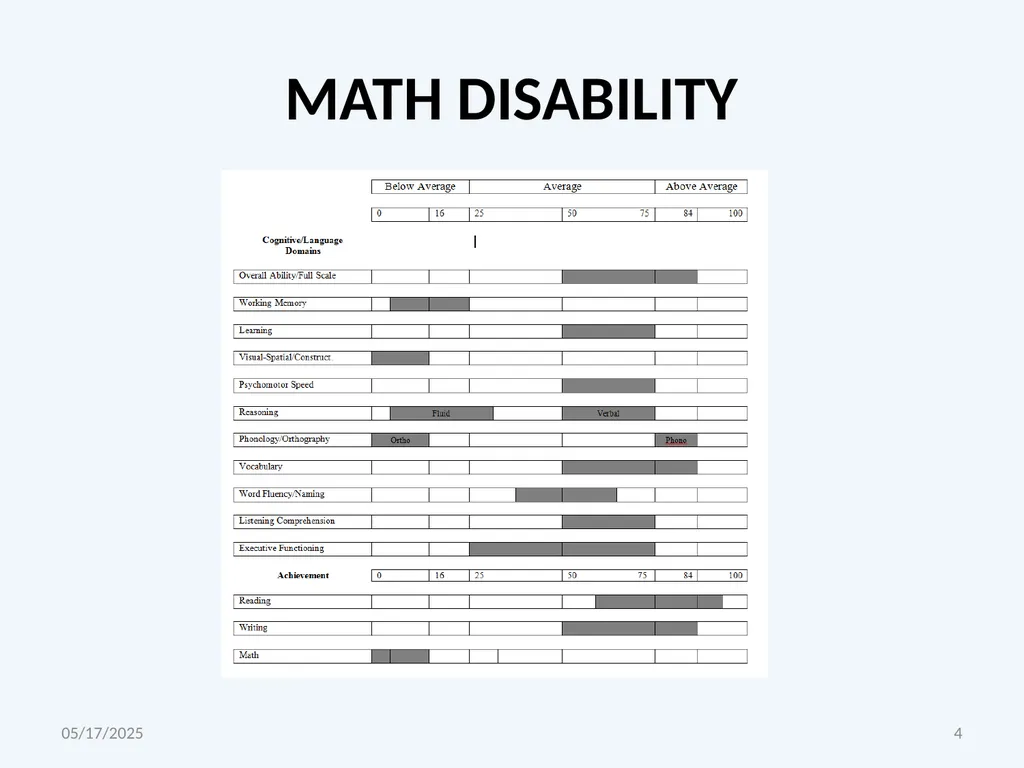
MATH DISABILITY Specific learning disorder affecting acquisition of knowledge about numbers and calculation[1-3].
DSM-IV and DSM-5 Code 315.1
ICD-9 Code F81.2
ADA [4] and Title II Regulations [5]
Not due to inadequate education, FL, low IQ [6]
Must begin in the school-age years
Persists into adulthood [6-8]
For more information, see [1, 2, 7, 9 - 24] 2/27/2014 3<br>
04
MATH DISABILITY 2/27/2014 4<br>
05
PROBLEM BARRIER
USG core math course: Learning Goal A2: Quantitative Outcomes
Most with Math LD access accommodations and succeed with good effort.
SEVERE MATH DISABILITIES
Difficulty despite accommodations and good faith effort.
Can prevent otherwise qualified student from graduating college.
College math recognized as a gatekeeper for earning a degree. [10] 2/27/2014 5<br>
06
PROPOSAL USG will establish a standard policy/procedure regarding core math course substitution requests.
who has a qualifying disability,
who determines if the core math course is essential to the program of study, and
who determines the appropriate course to substitute.
Not to force institutions to grant substitutions in all cases, but to have steps in place that institutions that decide to grant substitutions will follow. 2/27/2014 6<br>
07
WHY NEED SYSTEM-LEVEL POLICY? Ensure compliance with ADA and Section 504 of Rehabilitation Act
Ensure consistency across system
Ensure integrity of academic programs 2/27/2014 7<br>
08
COMPLIANCE WITH LAW Are course substitutions an appropriate accommodation?
“No qualified individual with a disability shall, on the basis of disability, be excluded from participation in or be denied the benefits of public services, programs, or activities” [5]
“Qualified individual with a disability" means an individual who, with or without reasonable modifications to rules, policies, or practices, … or provision of auxiliary aids and services, meets the essential eligibility requirements. [4]
“A recipient (institution) … shall make such modifications to its academic requirements as are necessary to ensure that such requirements do not discriminate … against a qualified disabled student. [40]
“Modifications may include … substitution of specific courses required for the completion of degree requirements...” [40, see 36] 2/27/2014 8<br>
09
COMPLIANCE WITH LAW Should all institutions have to grant math core substitutions?
Institutions can require individuals with disabilities to meet legitimate standards that are rationally related to the stated goals and purposes of a program. [25, 41, see 42 and 43]
“Academic requirements the recipient (institution) can demonstrate are essential to the program of instruction … will not be regarded as discriminatory.” [40, see 35]
Categorical exclusions and blanket policies are suspect because they conflict with the mandate to conduct an individualized inquiry. [41]
An individualized inquiry must be conducted and the institution must be able to demonstrate that the ultimate decision was the product of rational, professional judgment. [41] 2/27/2014 9<br>
10
CONSISTENCY ACROSS SYSTEM In the USG, some allow core math substitutions (e.g., UGA, GCSU, MGSC)
Other do not.
Some probably haven’t had to consider it.
Want to have:
A consistent process.
Reciprocity for transfers. 2/27/2014 10<br>
11
INTEGRITY OF PROGRAMS Challenges of disability determination:
Training
Diagnosing for dollars [27]
We all could have a diagnosis.
Diagnosis is not equivalent to disability.
Simulation [28-34]
Advocacy
RCLDs established to ensure accurate disability determinations
Protect the integrity of the system
Maintain rigor 2/27/2014 11<br>
12
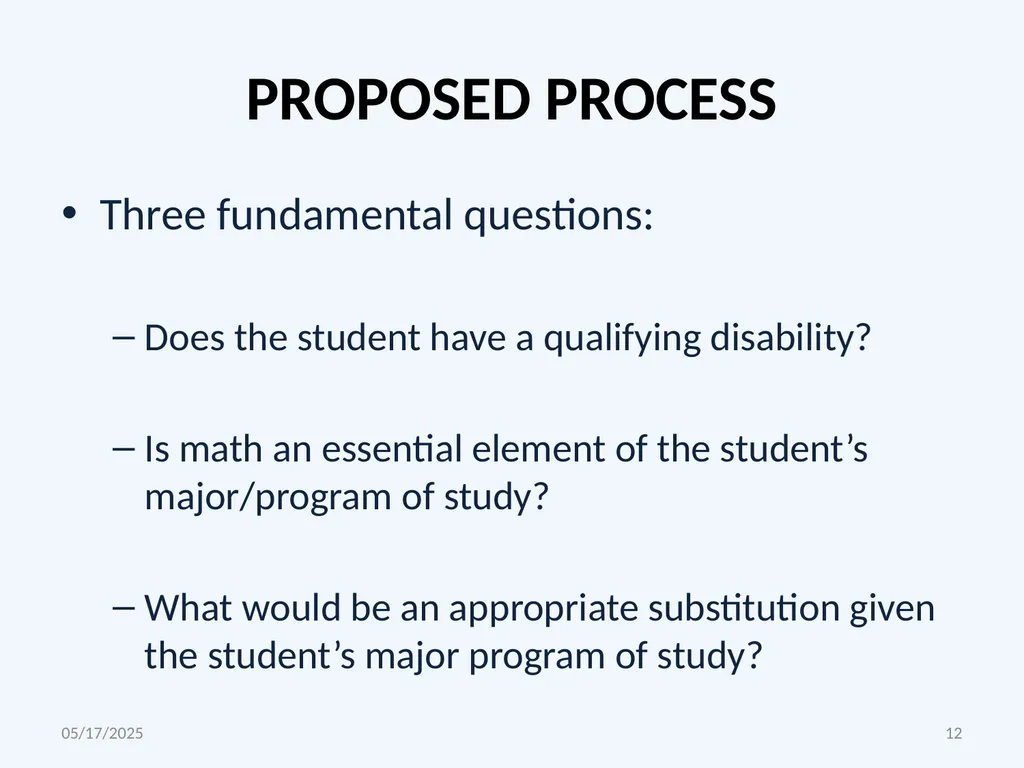
PROPOSED PROCESS Three fundamental questions:
Does the student have a qualifying disability?
Is math an essential element of the student’s major/program of study?
What would be an appropriate substitution given the student’s major program of study? 2/27/2014 12<br>
13
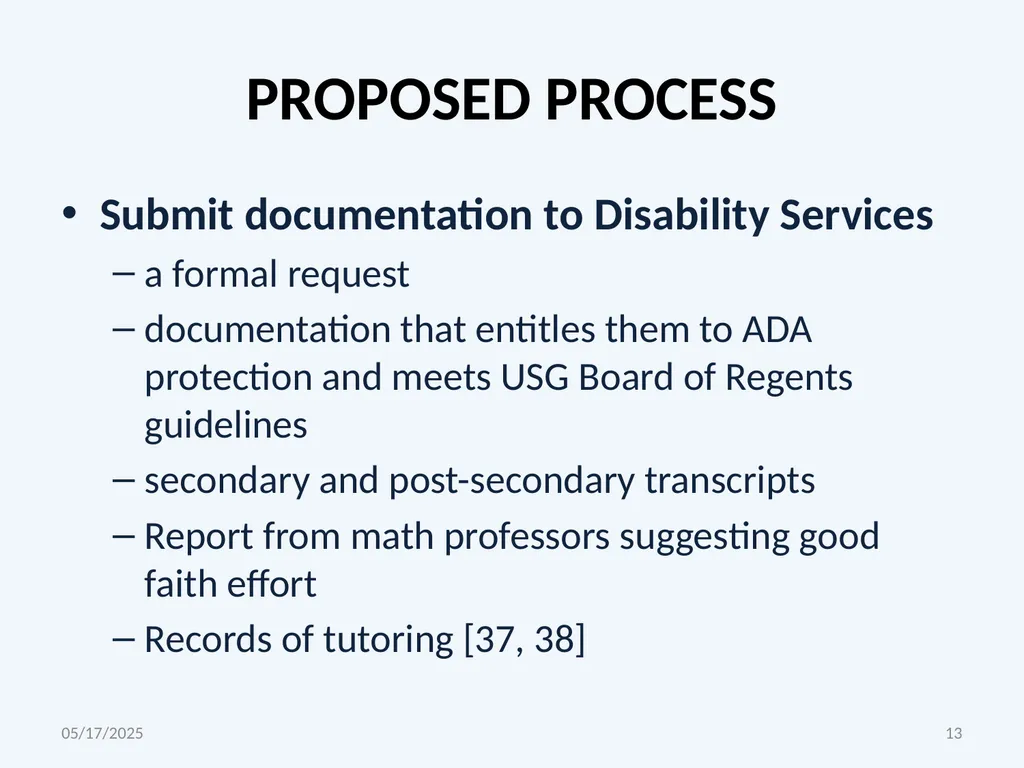
PROPOSED PROCESS Submit documentation to Disability Services
a formal request
documentation that entitles them to ADA protection and meets USG Board of Regents guidelines
secondary and post-secondary transcripts
Report from math professors suggesting good faith effort
Records of tutoring [37, 38] 2/27/2014 13<br>
14
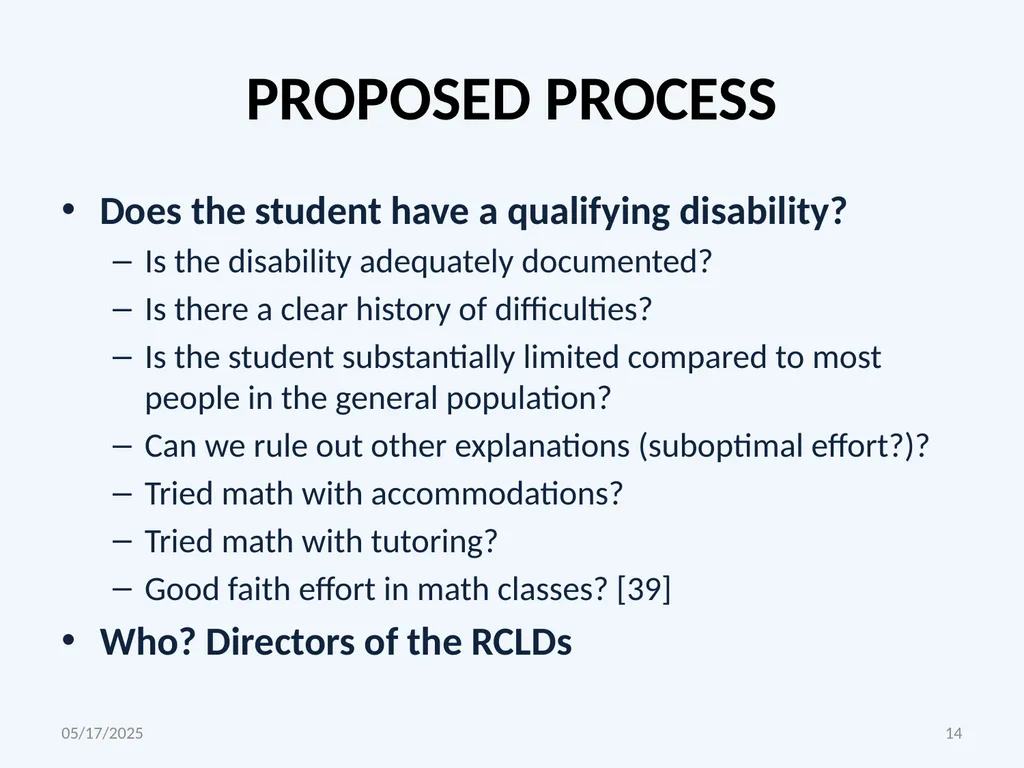
PROPOSED PROCESS Does the student have a qualifying disability?
Is the disability adequately documented?
Is there a clear history of difficulties?
Is the student substantially limited compared to most people in the general population?
Can we rule out other explanations (suboptimal effort?)?
Tried math with accommodations?
Tried math with tutoring?
Good faith effort in math classes? [39]
Who? Directors of the RCLDs 2/27/2014 14<br>
15
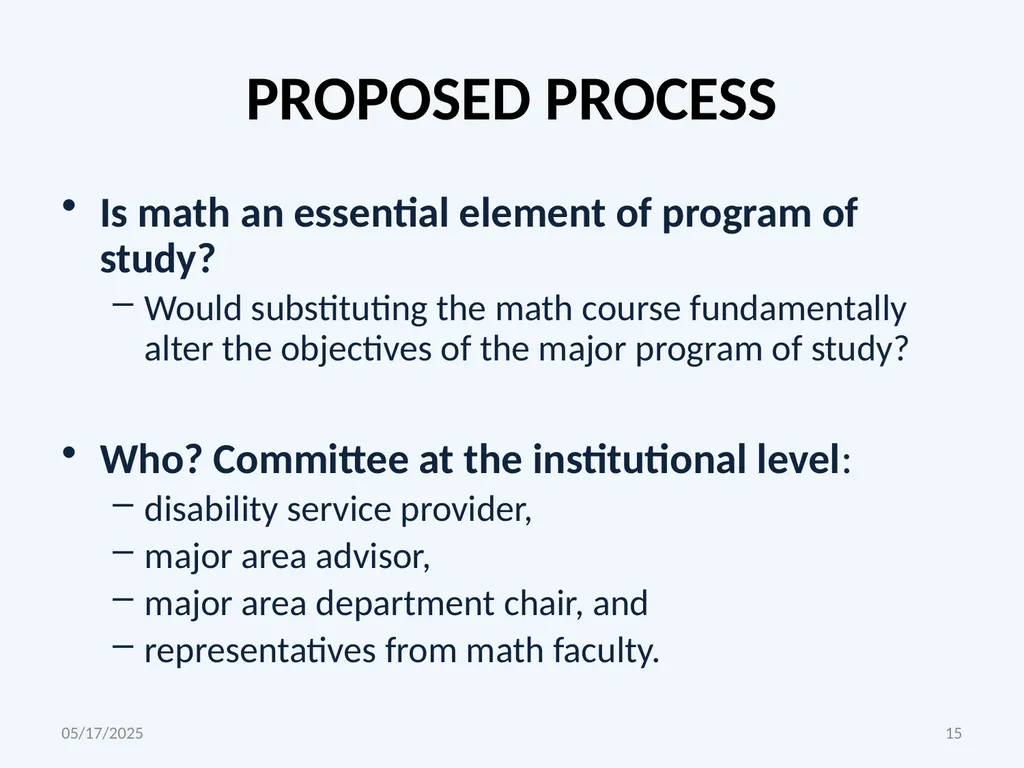
PROPOSED PROCESS Is math an essential element of program of study?
Would substituting the math course fundamentally alter the objectives of the major program of study?
Who? Committee at the institutional level:
disability service provider,
major area advisor,
major area department chair, and
representatives from math faculty. 2/27/2014 15<br>
16
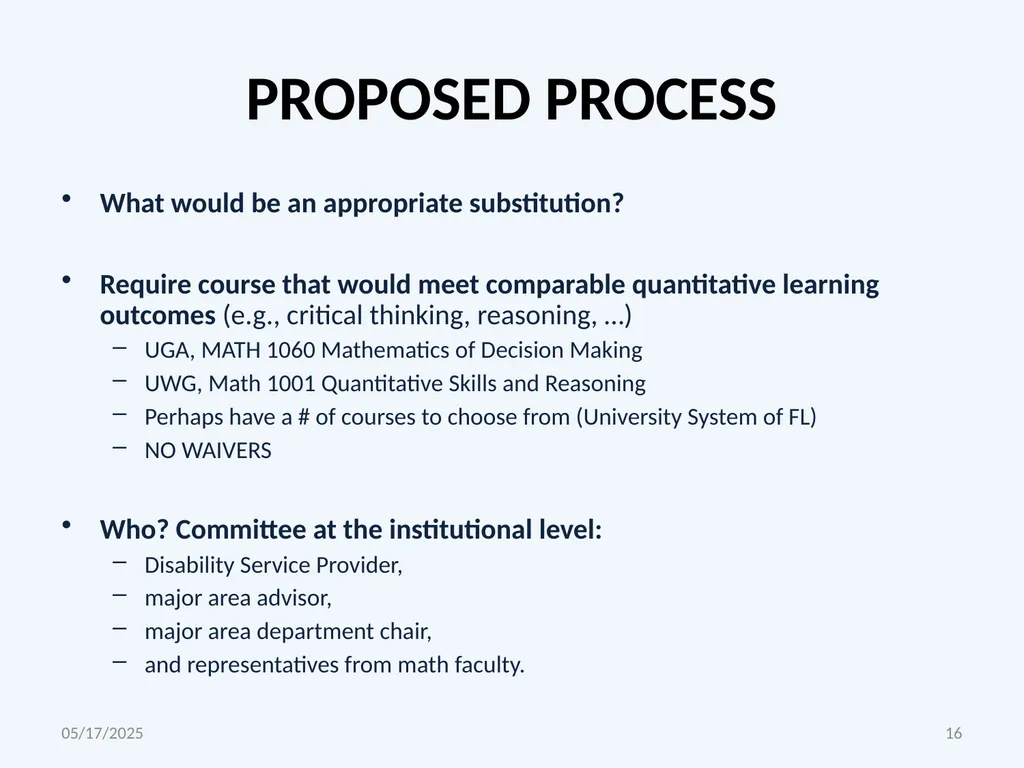
PROPOSED PROCESS What would be an appropriate substitution?
Require course that would meet comparable quantitative learning outcomes (e.g., critical thinking, reasoning, …)
UGA, MATH 1060 Mathematics of Decision Making
UWG, Math 1001 Quantitative Skills and Reasoning
Perhaps have a # of courses to choose from (University System of FL)
NO WAIVERS
Who? Committee at the institutional level:
Disability Service Provider,
major area advisor,
major area department chair,
and representatives from math faculty. 2/27/2014 16<br>
17
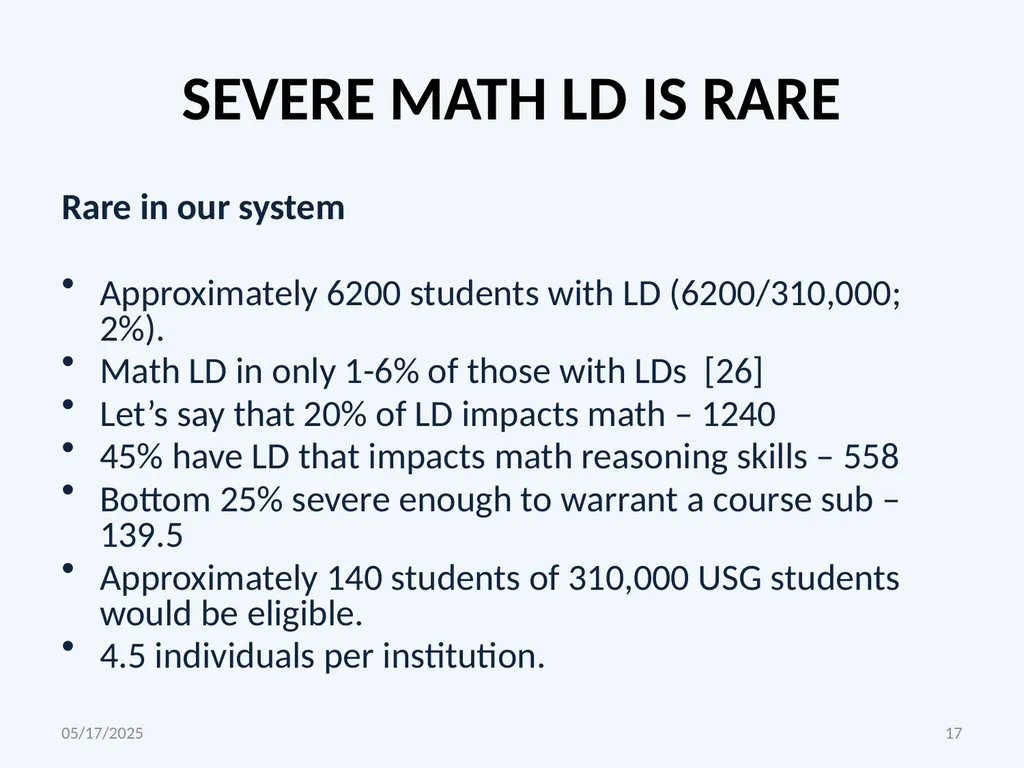
SEVERE MATH LD IS RARE Rare in our system
Approximately 6200 students with LD (6200/310,000; 2%).
Math LD in only 1-6% of those with LDs [26]
Let’s say that 20% of LD impacts math – 1240
45% have LD that impacts math reasoning skills – 558
Bottom 25% severe enough to warrant a course sub – 139.5
Approximately 140 students of 310,000 USG students would be eligible.
4.5 individuals per institution. 2/27/2014 17<br>
18
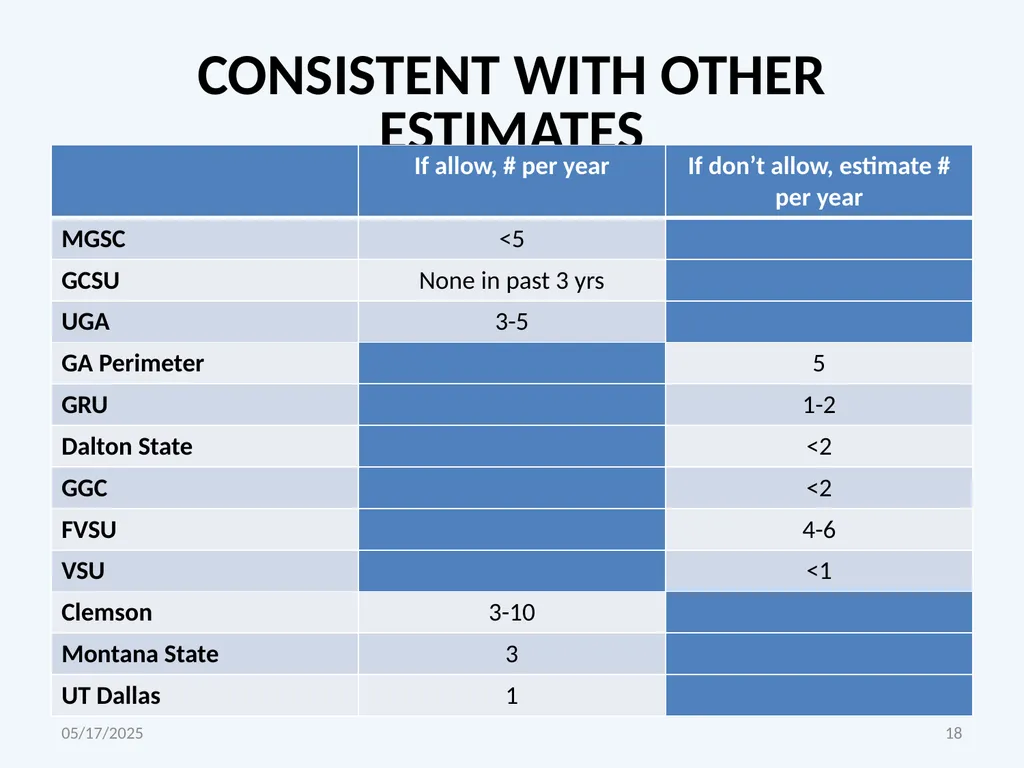
CONSISTENT WITH OTHER ESTIMATES 2/27/2014 18<br>
19
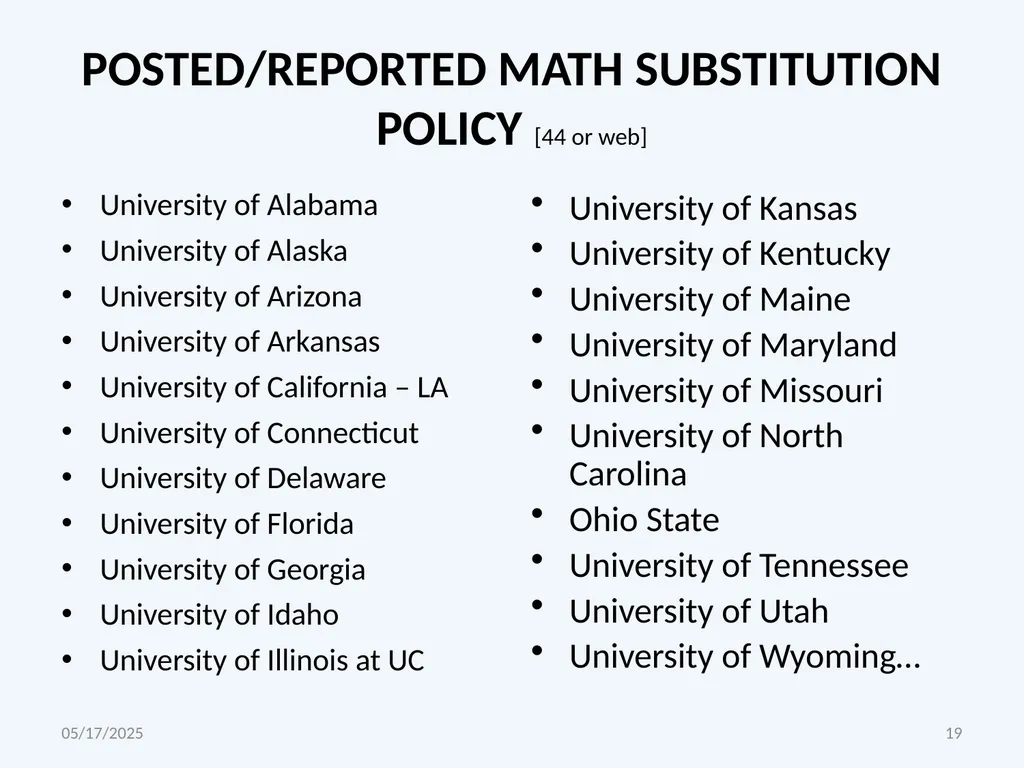
POSTED/REPORTED MATH SUBSTITUTION POLICY [44 or web] University of Alabama
University of Alaska
University of Arizona
University of Arkansas
University of California – LA
University of Connecticut
University of Delaware
University of Florida
University of Georgia
University of Idaho
University of Illinois at UC University of Kansas
University of Kentucky
University of Maine
University of Maryland
University of Missouri
University of North Carolina
Ohio State
University of Tennessee
University of Utah
University of Wyoming… 2/27/2014 19<br>
20
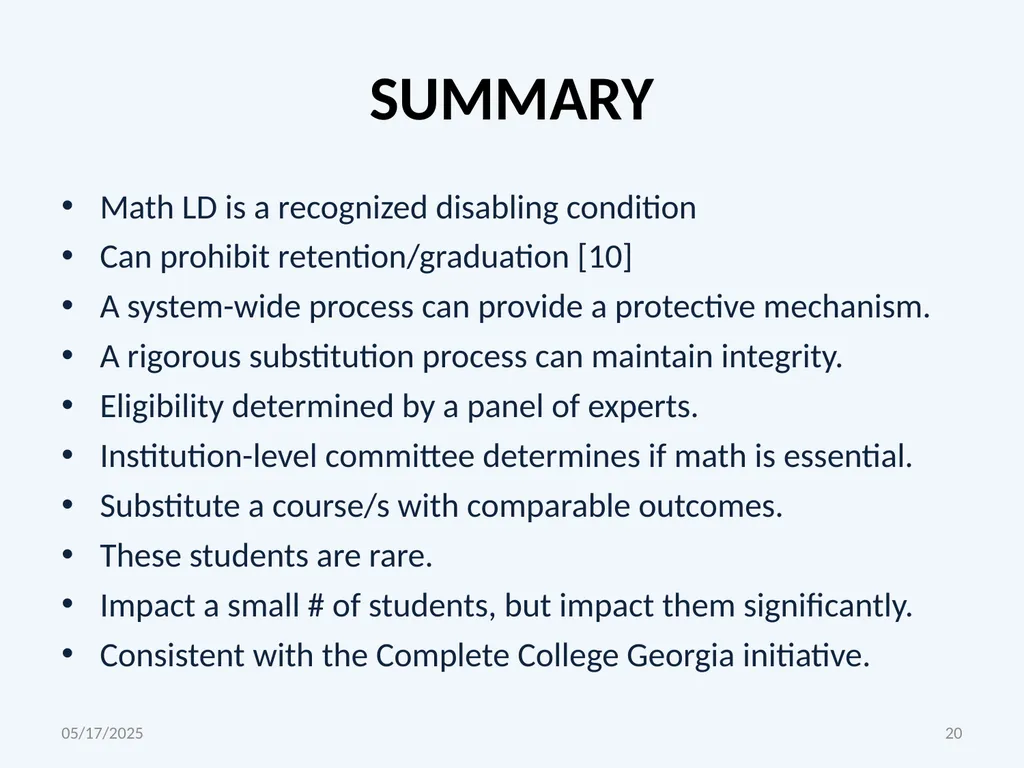
SUMMARY Math LD is a recognized disabling condition
Can prohibit retention/graduation [10]
A system-wide process can provide a protective mechanism.
A rigorous substitution process can maintain integrity.
Eligibility determined by a panel of experts.
Institution-level committee determines if math is essential.
Substitute a course/s with comparable outcomes.
These students are rare.
Impact a small # of students, but impact them significantly.
Consistent with the Complete College Georgia initiative. 2/27/2014 20<br>
21
Will Lindstrom, Ph.D.
Director
Regents’ Center for Learning Disorders
University of Georgia
wlindstr@uga.edu
706-542-4589 2/27/2014 21<br>