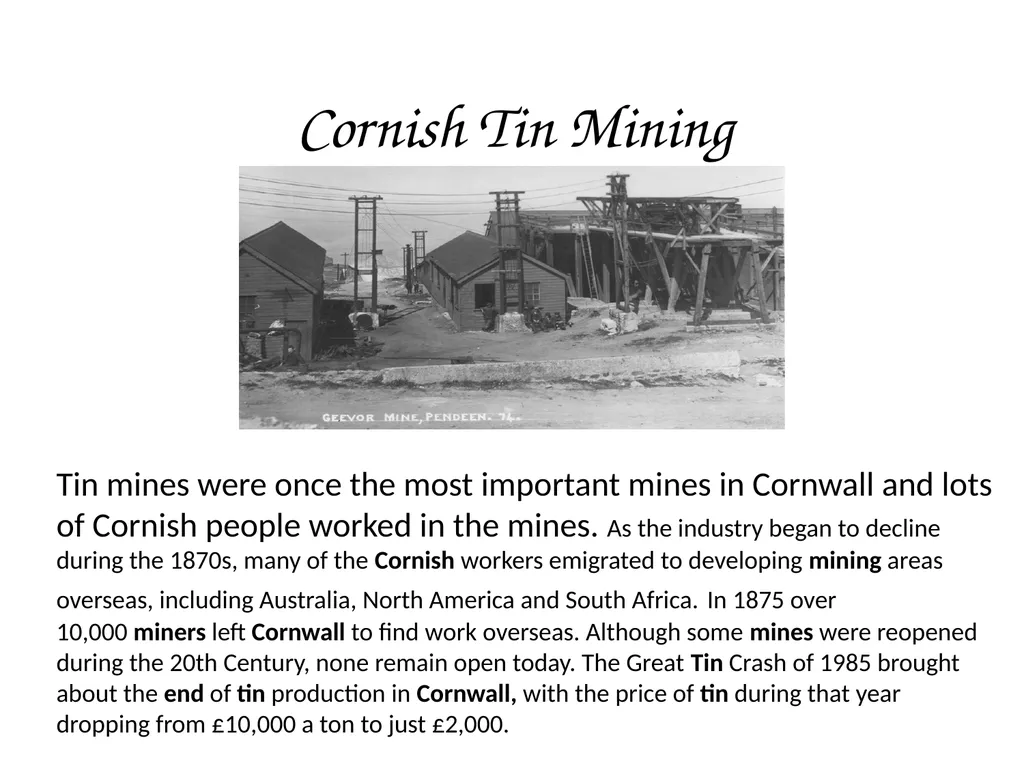
Cornish Tin Mining Tin mines were once the most important mines in Cornwall and lots of Cornish people worked in the mines. As the industry began to decline during the 1870s, many of the Cornish workers emigrated to developing mining areas
"Cornish Tin Mining Tin mines were once the most" is the property of its rightful owner. Permission is granted to
download and print the materials on this website for personal, non-commercial use only, and to display it
on your personal computer provided you do not modify the materials and that you retain all copyright
notices contained in the materials. By downloading content from our website, you accept the terms of this
agreement.
Presentation Transcript
01
Cornish Tin Mining Tin mines were once the most important mines in Cornwall and lots of Cornish people worked in the mines. As the industry began to decline during the 1870s, many of the Cornish workers emigrated to developing mining areas overseas, including Australia, North America and South Africa. In 1875 over 10,000 miners left Cornwall to find work overseas. Although some mines were reopened during the 20th Century, none remain open today. The Great Tin Crash of 1985 brought about the end of tin production in Cornwall, with the price of tin during that year dropping from £10,000 a ton to just £2,000.<br>
02
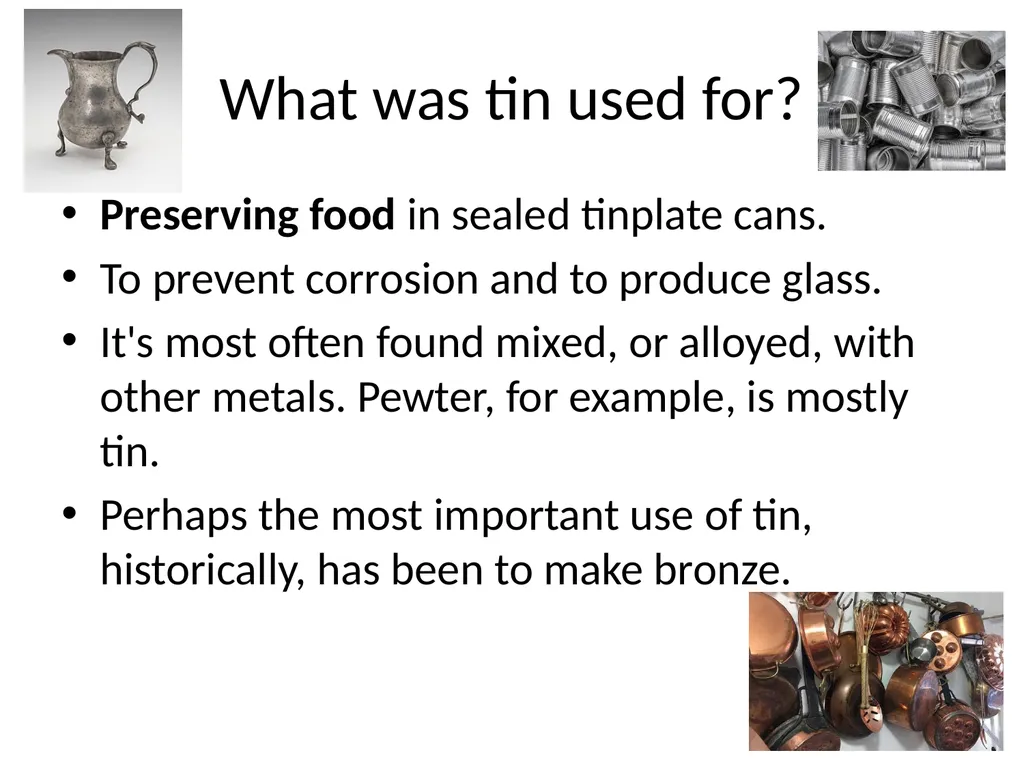
What was tin used for? Preserving food in sealed tinplate cans.
To prevent corrosion and to produce glass.
It's most often found mixed, or alloyed, with other metals. Pewter, for example, is mostly tin.
Perhaps the most important use of tin, historically, has been to make bronze.<br>
03
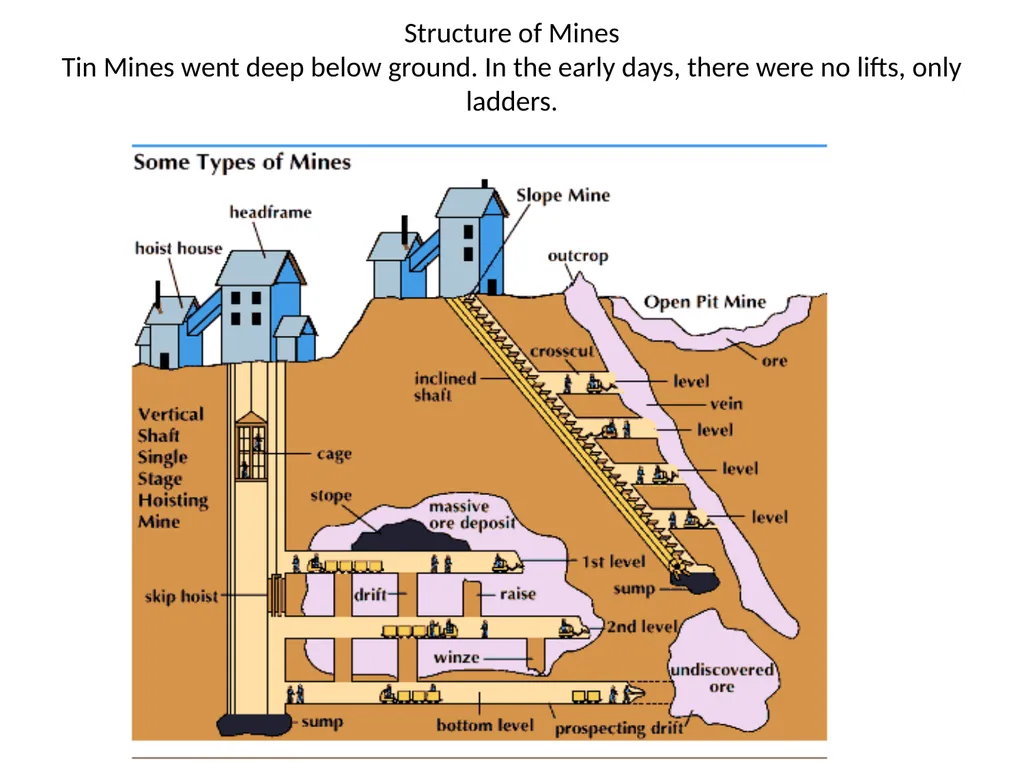
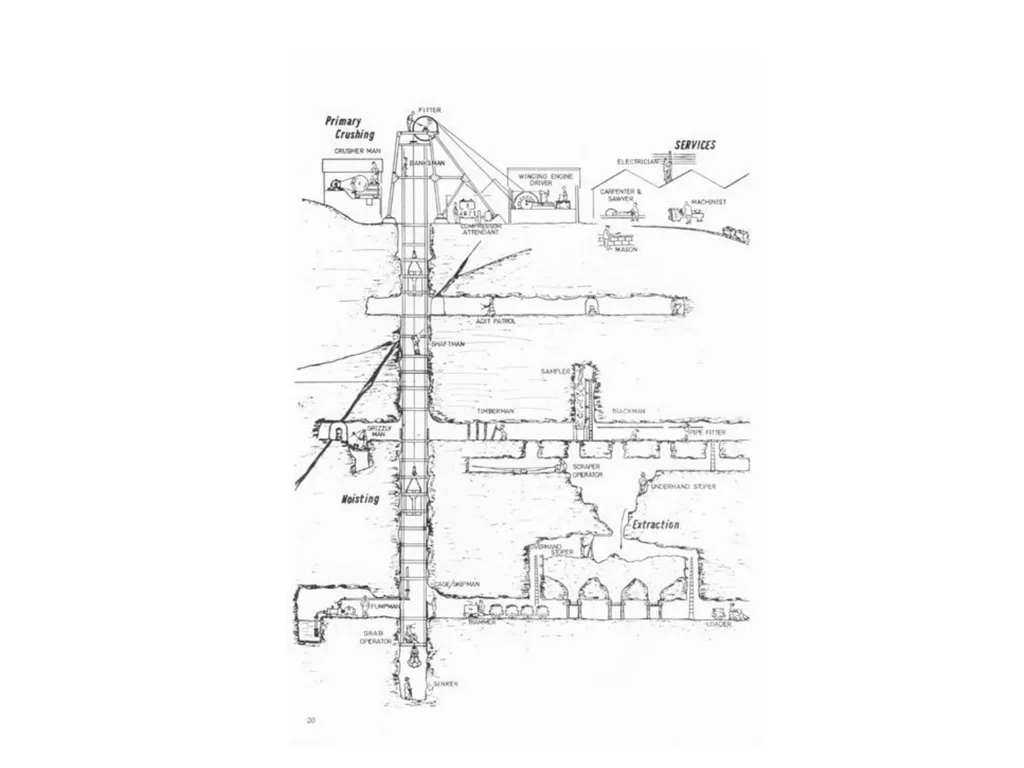
Structure of Mines Tin Mines went deep below ground. In the early days, there were no lifts, only ladders.<br>
04
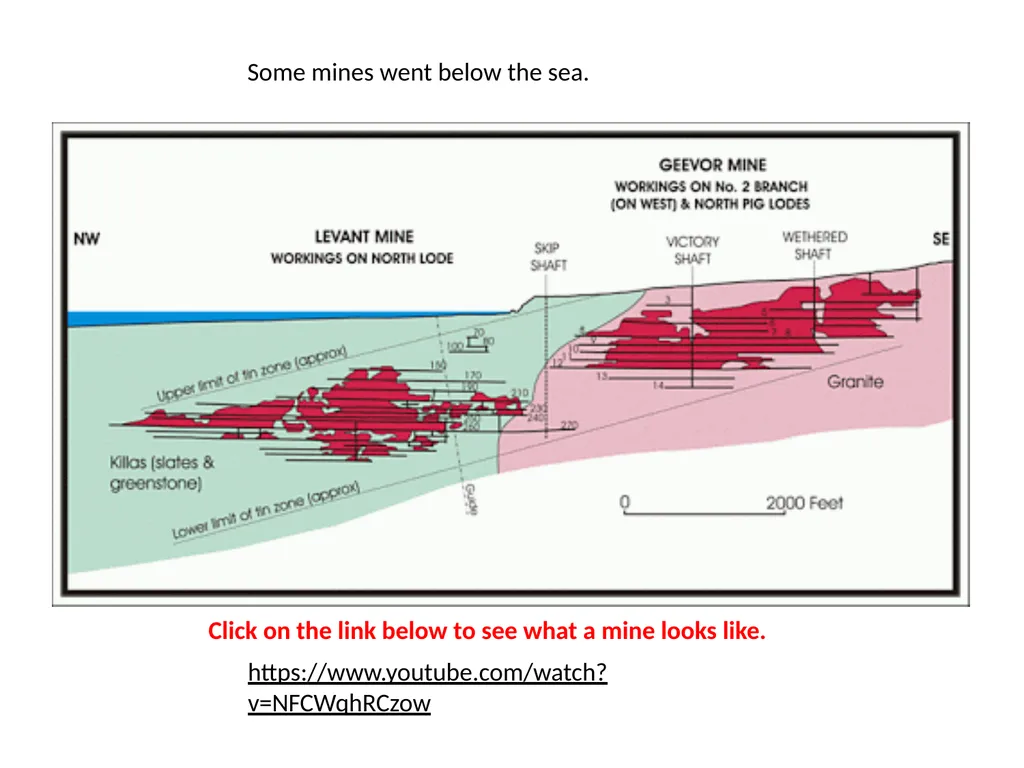
https://www.youtube.com/watch?v=NFCWqhRCzow Click on the link below to see what a mine looks like. Some mines went below the sea.<br>
05
Miners were responsible for buying their own tools, candles, and dynamite; an added strain on an already meagre wage.
There were no cages to haul miners up and down the shaft in the early days.
Instead mines were reached by ladders - sometimes stretching down for 100 feet. Not surprisingly, falls were commonplace.
Until the age of 12, young boys worked largely above ground, breaking up rock as it was brought to the surface.
Women, known in the trade as 'Bal Maidens', were also employed to perform similar duties.
Using small hammers, the women and children would break the ore down to manageable sizes before loading it into trolleys and pushing it to the ore crushing machine.
At South Crofty Mine, in the 1890s, men were issued with six candles every day.
All miners, including the women and children on the surface, would work a ten hour day, six days a week, in the 19th century.
Although many miners and their families lived in cottages rented from the mining company, many would still have to walk several miles to and from work, in clothes wet with sweat from hours of underground toil.
Click the link to read more https://www.cornwall.gov.uk/environment-and-planning/conservation/world-heritage-site/delving-deeper/mining-processes/ MINERS<br>
06
MINERS’ TOOLS A miner’s job was to extract the ore that contained valuable metals from deep underground. To get to the lodes containing the ore, they first had to dig shafts or tunnels to reach it. But how did they manage to break the ore from the hard rock and what tools did they use to do it?
Getting the valuable copper or tin ore of the rock was a difficult and often hazardous process. The rock had to be broken, either by hand, gunpowder, or later with dynamite or other high explosive. As Cornish mines became deeper, the mine workers’ job became more dangerous – with an increased risk of falling from the many ladders in use, collapsing rock, or flooding.
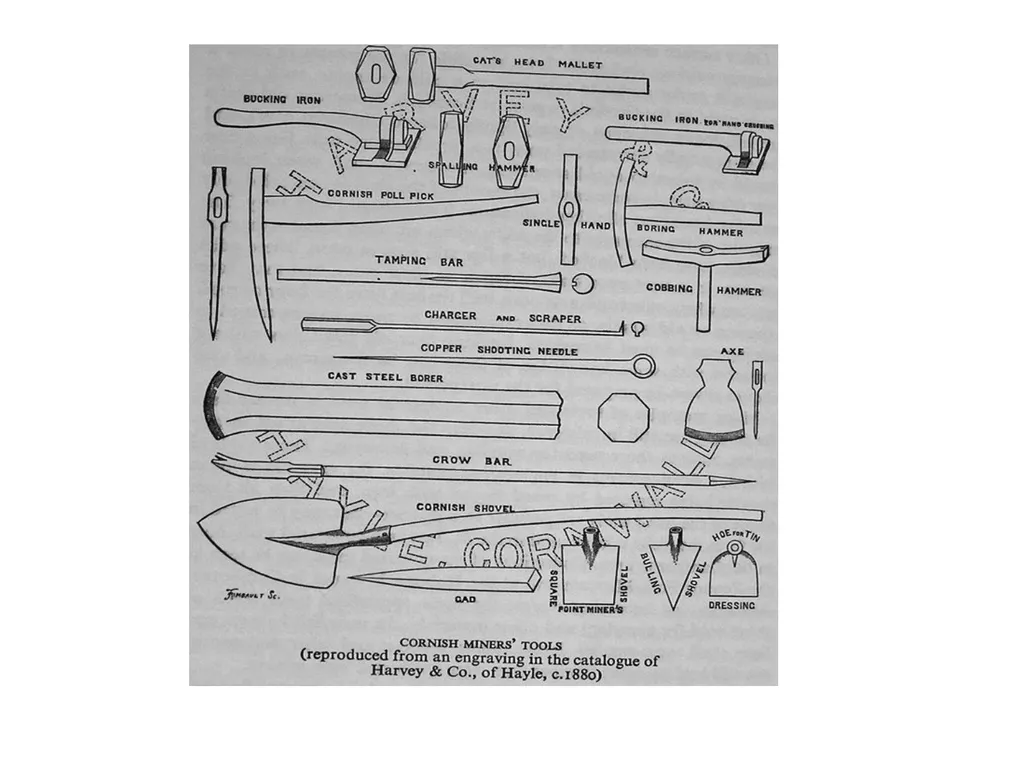
Miners used a variety of tools to extract the ore, including hammers, borers (chisels) and gads (wedges). From the 1880s, they also used air-powered rock drills to increasing effect.
The most effective way of extracting the ore was to drill holes, called ‘shot holes’, into the rock and introduce gunpowder into the hole. When suitably stemmed (packed) a safety fuse would be inserted then lit, and the resulting explosion would break the rock apart.
Blasting was usually done at the end of a shift, so that the fumes had chance to clear before the next gang arrived to load the ore ready for hoisting to surface.<br>
07
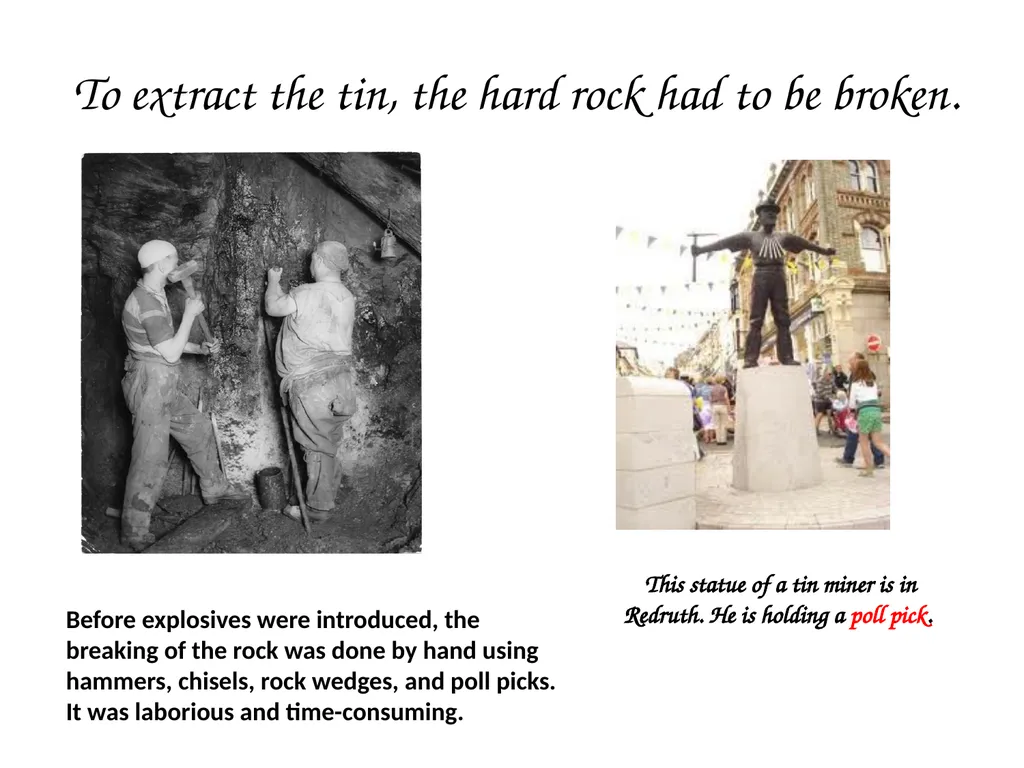
To extract the tin, the hard rock had to be broken. This statue of a tin miner is in Redruth. He is holding a poll pick. Before explosives were introduced, the breaking of the rock was done by hand using hammers, chisels, rock wedges, and poll picks. It was laborious and time-consuming.<br>
08
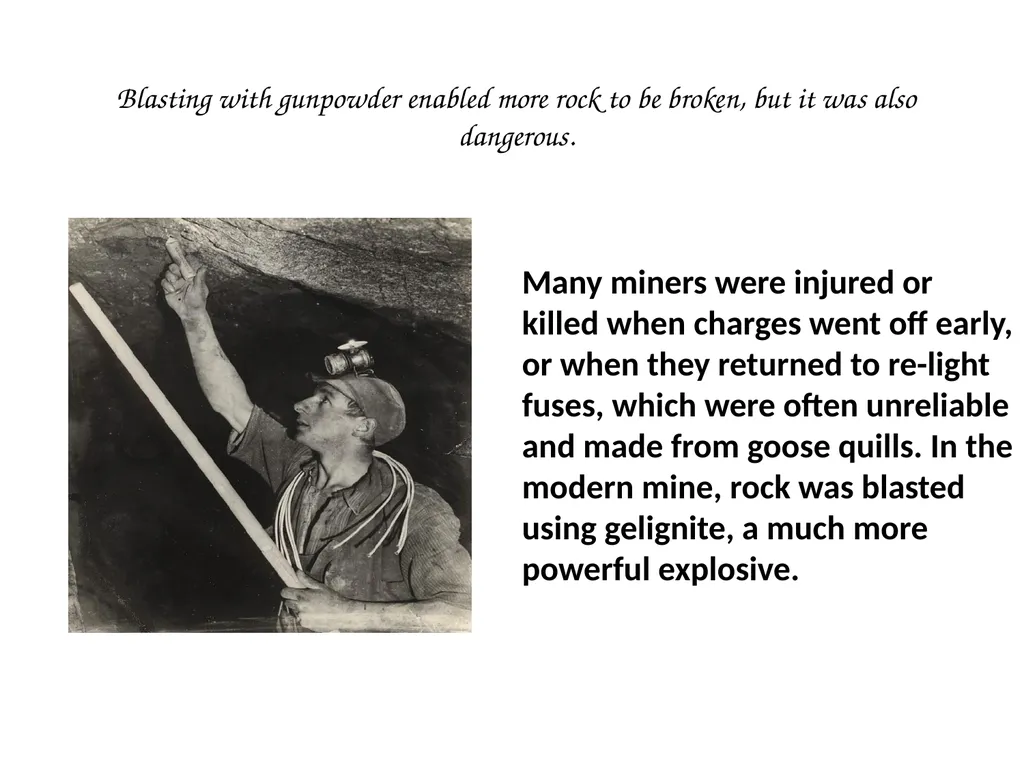
Blasting with gunpowder enabled more rock to be broken, but it was also dangerous. Many miners were injured or killed when charges went off early, or when they returned to re-light fuses, which were often unreliable and made from goose quills. In the modern mine, rock was blasted using gelignite, a much more powerful explosive.<br>
09
Hard hats and steel toe capped boots protected the miners. The hats were called tulls
Learn more about their lives in the mines by clicking the link below https://www.nationaltrust.org.uk/levant-mine-and-beam-engine/features/the-life-of-a-cornish-miner<br>
10
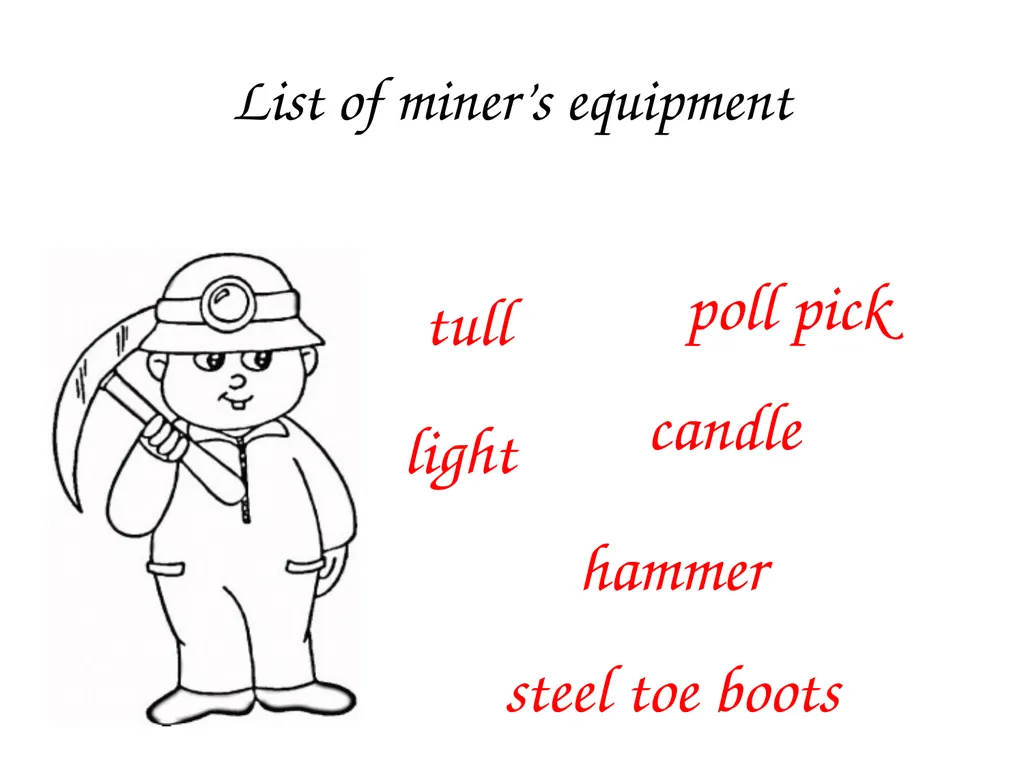
List of miner’s equipment tull poll pick steel toe boots light candle hammer<br>