CORPORATE GOVERNANCE Corporate Governance
Description: CORPORATE GOVERNANCE Corporate Governance Corporate Governance is the application of best management practices, compliance of law in true letter and spirit and adherence to ethical standards for effective management and distribution of
Related Topics
Download Presentation
"CORPORATE GOVERNANCE Corporate Governance" is the property of its rightful owner. Permission is granted to download and print the materials on this website for personal, non-commercial use only, and to display it on your personal computer provided you do not modify the materials and that you retain all copyright notices contained in the materials. By downloading content from our website, you accept the terms of this agreement.
Presentation Transcript
slide1. CORPORATE GOVERNANCE<br>
slide2. Corporate Governance Corporate Governance is the application of best management practices, compliance of law in true letter and spirit and adherence to ethical standards for effective management and distribution of wealth and discharge of social responsibility for sustainable development of all stakeholders.
Conduct of business in accordance with shareholder desires ( maximising wealth) while confirming to the basic rules of the society embodied in the law and local customs.<br>
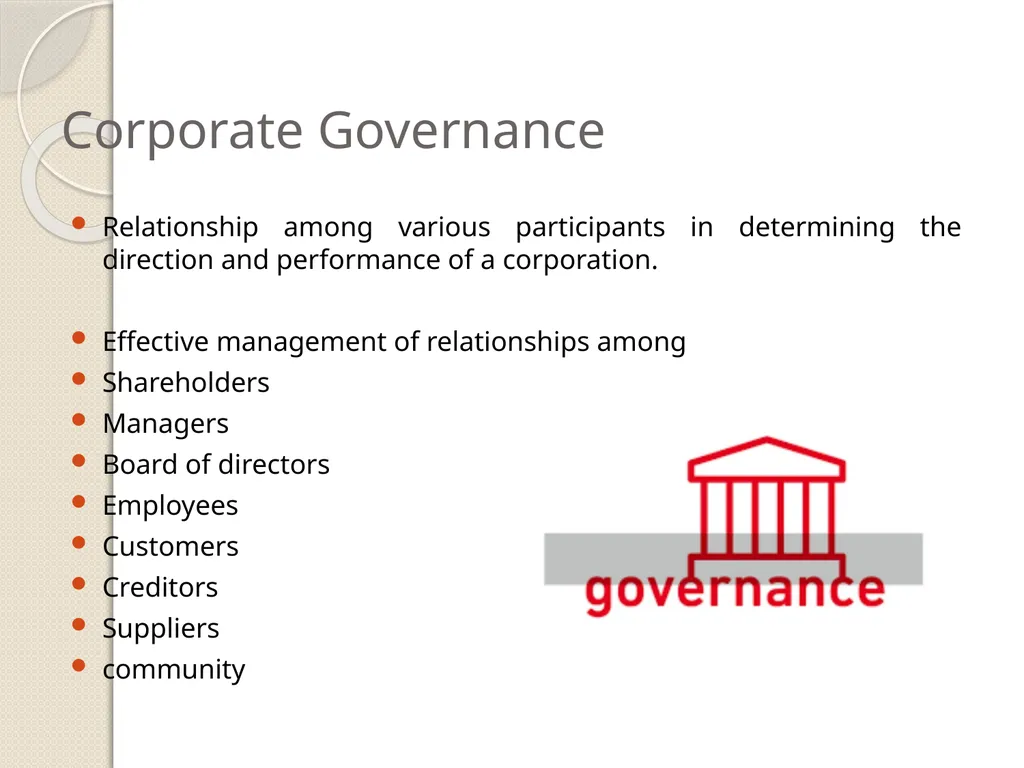
slide3. Corporate Governance Relationship among various participants in determining the direction and performance of a corporation.
Effective management of relationships among
Shareholders
Managers
Board of directors
Employees
Customers
Creditors
Suppliers
community<br>
slide4. Why corporate Governance? Better access to external finance
Lower costs of capital – interest rate on loans
Improved company performance sustainability
Higher firm valuation and share performance
Reduced risk of corporate crisis and scandals<br>
slide5. Principals of Corporate Governance Sustainable development of al stake holders- to ensure growth of all individuals associated with or effected by the enterprise on sustainable basis
Effective management and distribution of wealth – to ensue that enterprise creates maximum wealth and judiciously uses the benefits to all stake holders and enhancing its wealth creations capabilities to maintain sustainability.<br>
slide6. Discharge of social responsibility- To ensure that enterprise is acceptable to the society in which it is functioning.
Application of best management practices – to ensure excellence in functioning of enterprise and optimum creation of wealth on sustainable basis.
Compliance of law in letter & spirit – to ensure value enhancement for all stakeholder guaranteed by the low of maintaining socio –economic balance.
Adherence to ethical standard- to ensure integrity, transparency, independence and accountability with all stakeholders.<br>
slide7. Four Pillars of Corporate Governance Accountability
Fairness
Transparency
Independence<br>
slide8. Accountability Ensure that management is accountable to the Board
Ensure that the Board is accountable to shareholders<br>
slide9. Fairness Protect Shareholders rights
Treat all shareholders including
Minorities, equitably
Provide effective redress for for violations<br>
slide10. Transparency Ensure timely, accurate disclosure on all material matters, including the financial situation, performance, ownership and corporate governance.<br>
slide11. Independence Procedures and structures are in place so as to minimize , or avoid completely of interest.
Independent Directors and Advisers i.e. free from the influence of others<br>
slide12. Elements of corporate Governance Good Board practices
Control Environment
Transparent disclosure
Well-defined shareholder right
Board commitment<br>
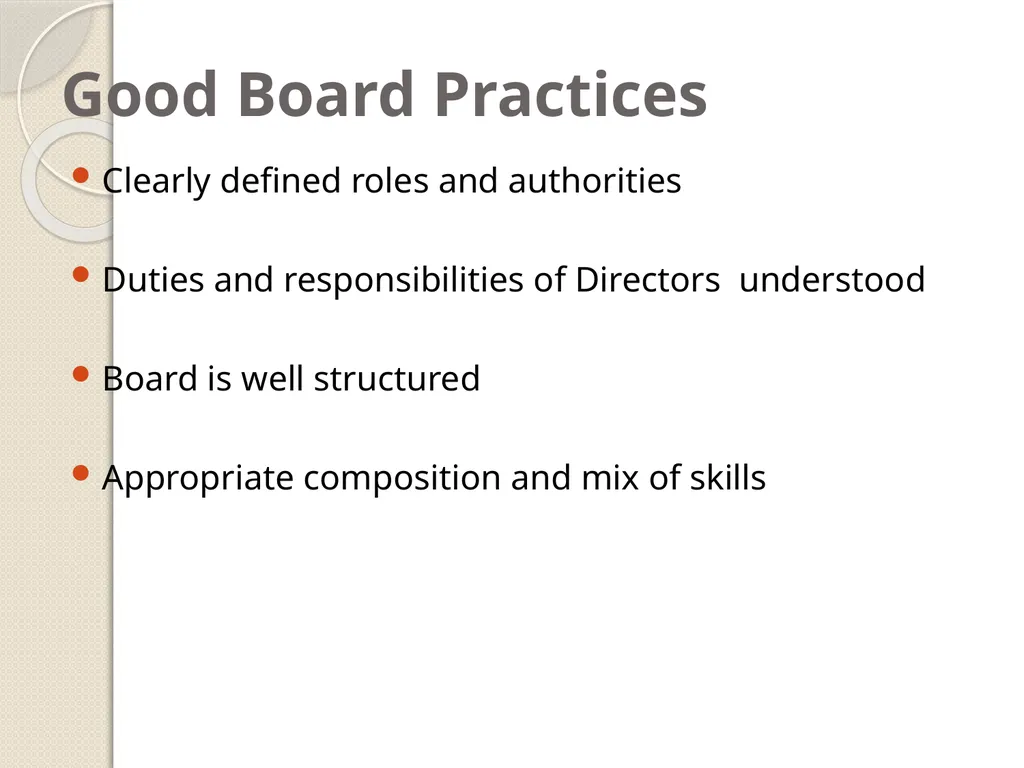
slide13. Good Board Practices Clearly defined roles and authorities
Duties and responsibilities of Directors understood
Board is well structured
Appropriate composition and mix of skills<br>
slide14. Good Board Procedures Appropriate Board procedures
Director Remuneration in line with best practice
Board self-evaluation and training conducted<br>
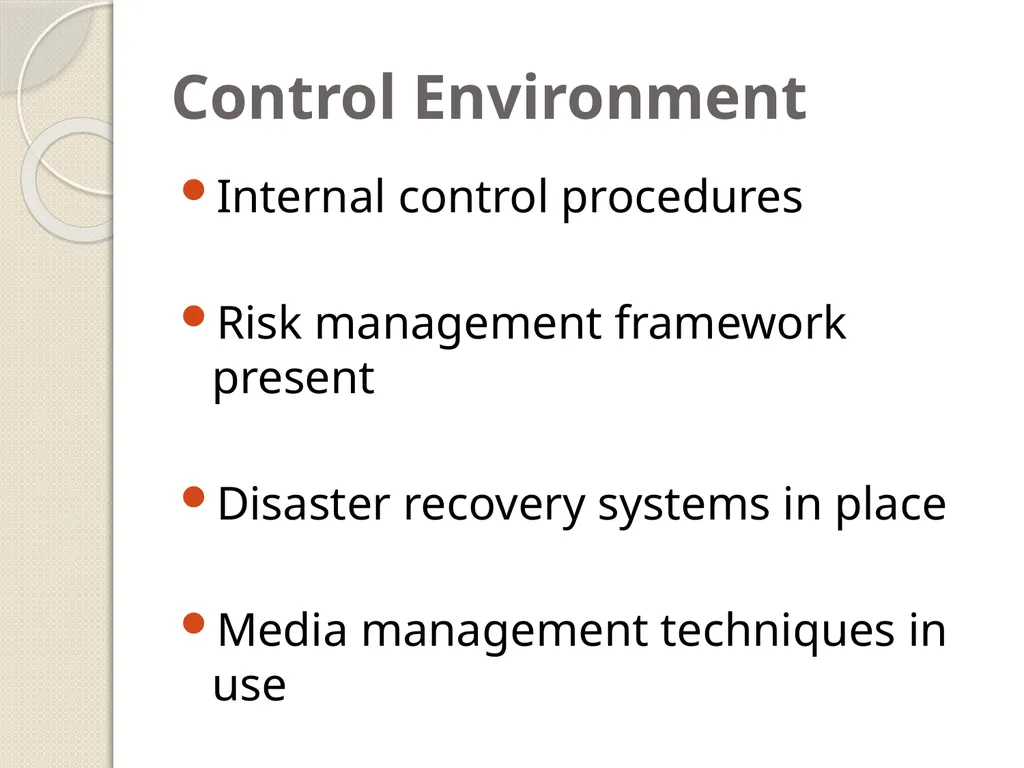
slide15. Control Environment Internal control procedures
Risk management framework present
Disaster recovery systems in place
Media management techniques in use<br>
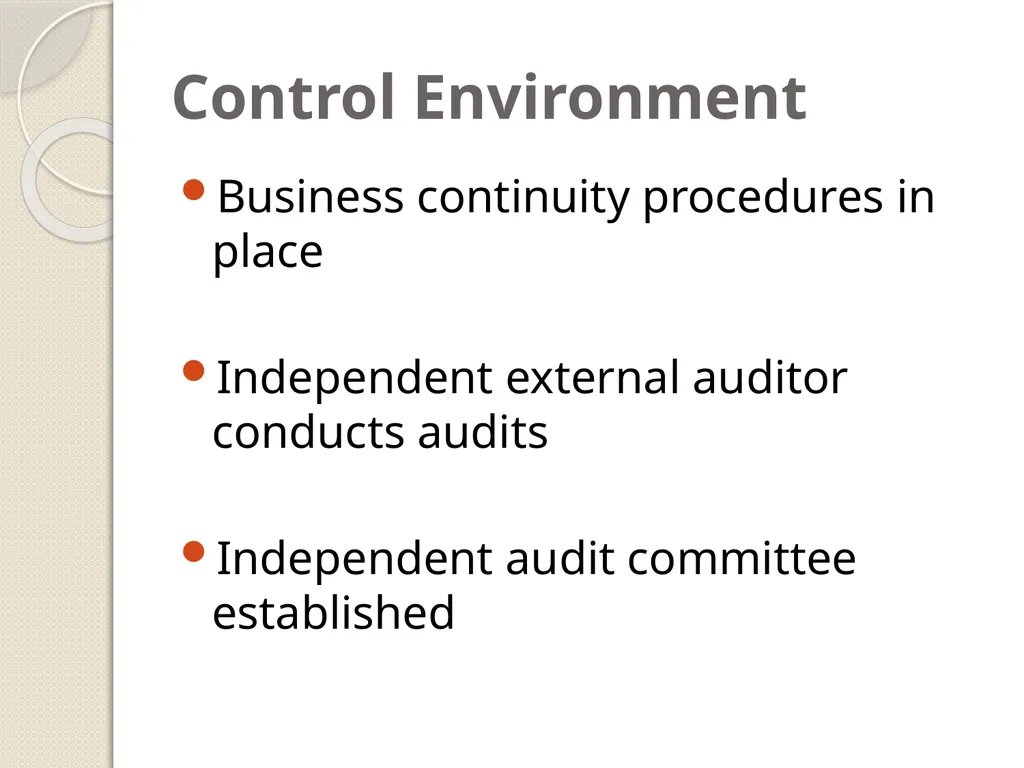
slide16. Control Environment Business continuity procedures in place
Independent external auditor conducts audits
Independent audit committee established<br>
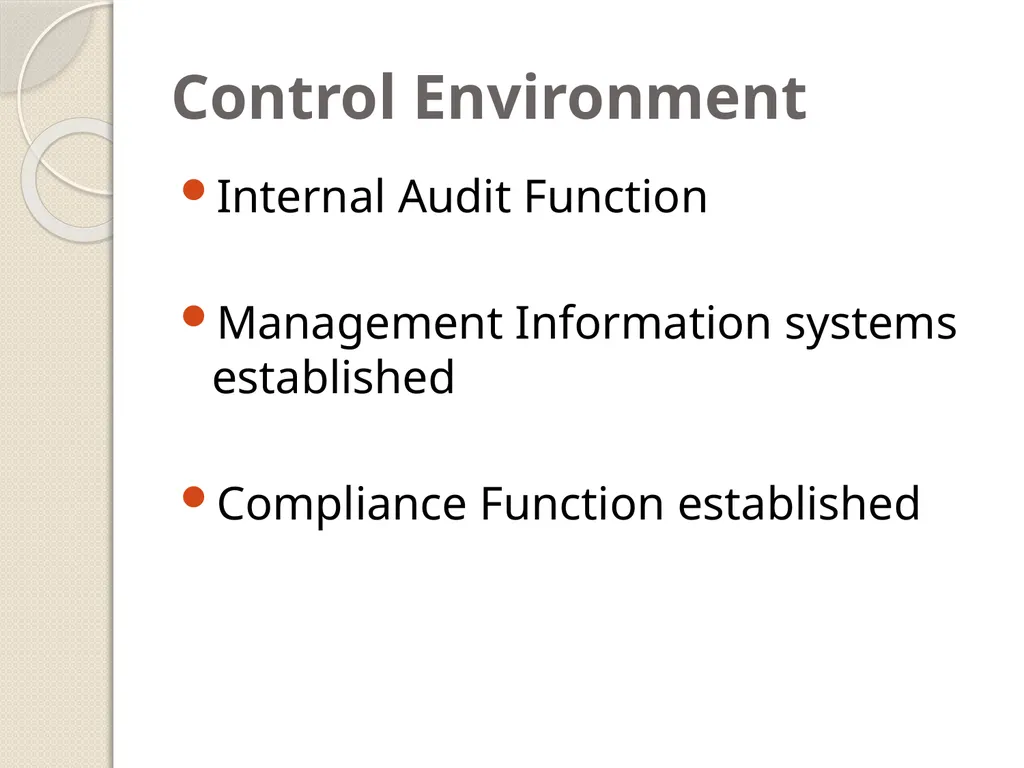
slide17. Control Environment Internal Audit Function
Management Information systems established
Compliance Function established<br>
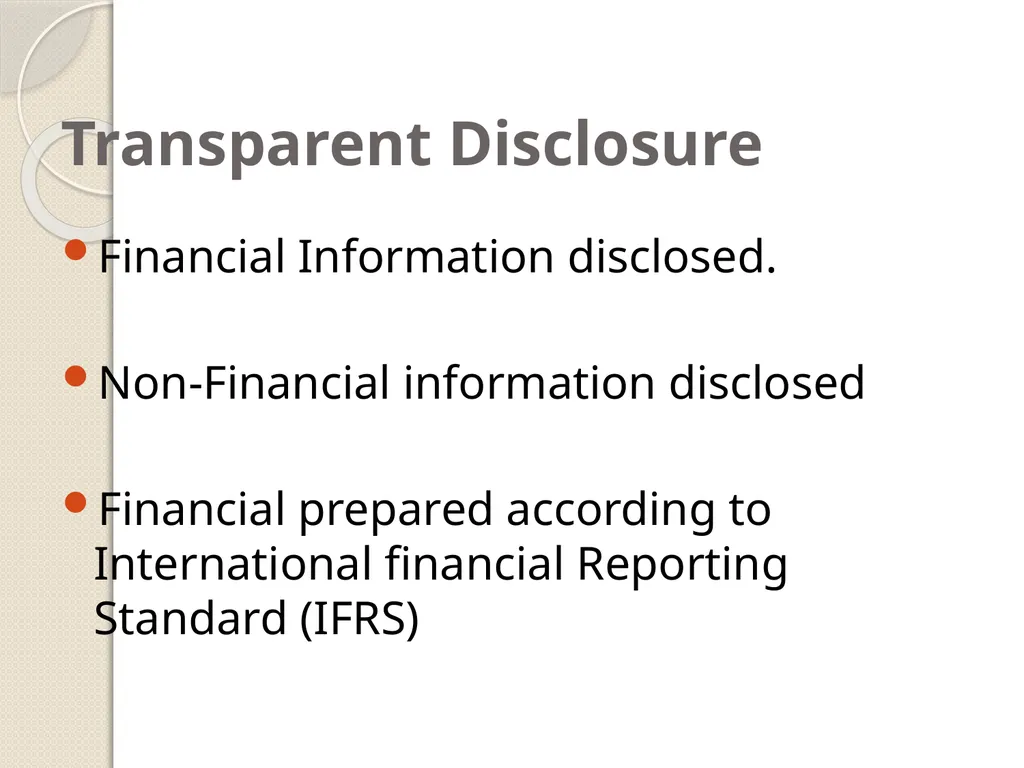
slide18. Transparent Disclosure Financial Information disclosed.
Non-Financial information disclosed
Financial prepared according to International financial Reporting Standard (IFRS)<br>
slide19. Transparent Disclosure Companies Registry Fillings up to date
High Quality annual report published
Web-based disclosure<br>
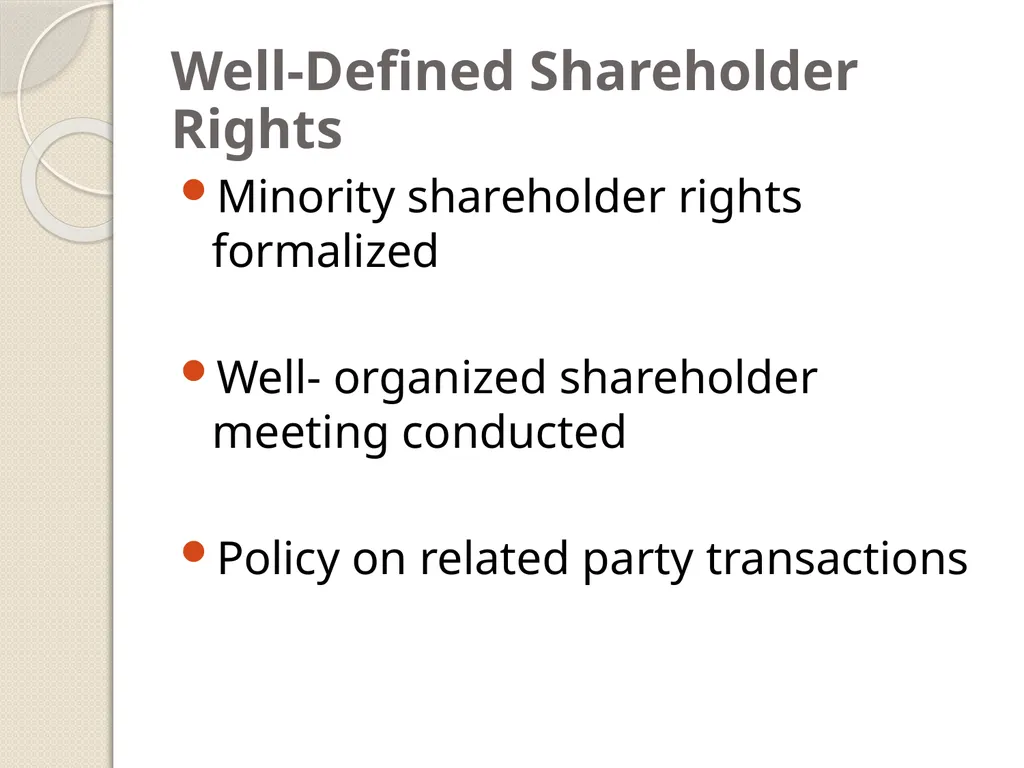
slide20. Well-Defined Shareholder Rights Minority shareholder rights formalized
Well- organized shareholder meeting conducted
Policy on related party transactions<br>
slide21. Well-Defined Shareholder Rights Policy on extraordinary transactions.
Clearly defined and explicit dividend policy<br>
slide22. Board Commitment The Board discusses corporate governance issue and has created a corporate governance committee
The company has a corporate governance champion
A corporate governance improvement plan has been created.
Appropriate resources are committed to corporate governance initiatives<br>
slide23. Board Commitment Policies and procedures have been formalized and distributed to relevant staff
A corporate governance code has been developed.
A Code of ethics has been developed
The company is recognized as a corporate governance leader<br>
slide24. Other Entities Corporate Governance applies all types of organisation not just companies in the private sector but also in the not for profit and public sectors
Examples are
NGOs, schools, hospital, pension, funds, state-owned enterprises<br>
slide25. Corporate governance in India The Indian corporate scenario was more or less stagnant till the early 90.s
The position and goals of the Indian corporate Sector has been changed a lot after the liberalization of 90s
Indian`s economic reform programmed made a steady progress in 1994.
India with its 20 million shareholders, is one of the largest emerging markets in terms of the market capitalalization.<br>
slide26. Securities and Exchange Board Of India The government of India`s securities watchdog` the securities Board of India, announced strict corporate governance norms for publicly listed companies in India.
The Indian Economy was liberalized in 1991. in order to archive the full potential of liberalization and enable the Indian stock market to attract hugs investments from foreign institution investors . It was necessary a series of stock market reforms.<br>
slide27. SEBI On April 12, 1988, the securities and exchange Board of India (SEBI) was established with a dual objective of projecting the rights of small investor and regulating and developing the stock market in India .
In 1992 the `BSE` the leading stock exchange in India, witnessed the first major scam masterminded by Hashed Mehta.
Analysts fell that if more powers had been given to SEBI, the scam would not be happened.
As a result to `GOL` brought in a separate legislation by the name of SEBI act 1992 and conferred statutory power to it.<br>
slide28. SEBI and Clause 49 SEBI asked Indian firms above a certain size to implement Clause 49 a regulation that strengthens the role of independent directors serving on corporate boards.
On august 26 2003 SEBI announced an amended Clause 49 of the listing agreement which every public company listed on an Indian stock exchange is required to sign The amended clauses come into immediate effects for companies seeking a new listing.<br>
slide29. Conclusion As Indian companies complete globally for access to capital markets many are finding that the ability to benchmark against world-class organization is essential.
For a long time, India was a managed protected economy wit the corporate sector operating in an insular fashion.
But as restriction have eased, Indian corporations are emerging on the world stage and discovering that the old way of doing business are no longer sufficient in such a fast paced global environment.<br>
slide30. THANK YOU !
Presented by
Taranpreet kaur
3548<br>

slide2. Corporate Governance Corporate Governance is the application of best management practices, compliance of law in true letter and spirit and adherence to ethical standards for effective management and distribution of wealth and discharge of social responsibility for sustainable development of all stakeholders.
Conduct of business in accordance with shareholder desires ( maximising wealth) while confirming to the basic rules of the society embodied in the law and local customs.<br>
slide3. Corporate Governance Relationship among various participants in determining the direction and performance of a corporation.
Effective management of relationships among
Shareholders
Managers
Board of directors
Employees
Customers
Creditors
Suppliers
community<br>
slide4. Why corporate Governance? Better access to external finance
Lower costs of capital – interest rate on loans
Improved company performance sustainability
Higher firm valuation and share performance
Reduced risk of corporate crisis and scandals<br>
slide5. Principals of Corporate Governance Sustainable development of al stake holders- to ensure growth of all individuals associated with or effected by the enterprise on sustainable basis
Effective management and distribution of wealth – to ensue that enterprise creates maximum wealth and judiciously uses the benefits to all stake holders and enhancing its wealth creations capabilities to maintain sustainability.<br>
slide6. Discharge of social responsibility- To ensure that enterprise is acceptable to the society in which it is functioning.
Application of best management practices – to ensure excellence in functioning of enterprise and optimum creation of wealth on sustainable basis.
Compliance of law in letter & spirit – to ensure value enhancement for all stakeholder guaranteed by the low of maintaining socio –economic balance.
Adherence to ethical standard- to ensure integrity, transparency, independence and accountability with all stakeholders.<br>
slide7. Four Pillars of Corporate Governance Accountability
Fairness
Transparency
Independence<br>
slide8. Accountability Ensure that management is accountable to the Board
Ensure that the Board is accountable to shareholders<br>
slide9. Fairness Protect Shareholders rights
Treat all shareholders including
Minorities, equitably
Provide effective redress for for violations<br>
slide10. Transparency Ensure timely, accurate disclosure on all material matters, including the financial situation, performance, ownership and corporate governance.<br>
slide11. Independence Procedures and structures are in place so as to minimize , or avoid completely of interest.
Independent Directors and Advisers i.e. free from the influence of others<br>
slide12. Elements of corporate Governance Good Board practices
Control Environment
Transparent disclosure
Well-defined shareholder right
Board commitment<br>
slide13. Good Board Practices Clearly defined roles and authorities
Duties and responsibilities of Directors understood
Board is well structured
Appropriate composition and mix of skills<br>
slide14. Good Board Procedures Appropriate Board procedures
Director Remuneration in line with best practice
Board self-evaluation and training conducted<br>
slide15. Control Environment Internal control procedures
Risk management framework present
Disaster recovery systems in place
Media management techniques in use<br>
slide16. Control Environment Business continuity procedures in place
Independent external auditor conducts audits
Independent audit committee established<br>
slide17. Control Environment Internal Audit Function
Management Information systems established
Compliance Function established<br>
slide18. Transparent Disclosure Financial Information disclosed.
Non-Financial information disclosed
Financial prepared according to International financial Reporting Standard (IFRS)<br>
slide19. Transparent Disclosure Companies Registry Fillings up to date
High Quality annual report published
Web-based disclosure<br>
slide20. Well-Defined Shareholder Rights Minority shareholder rights formalized
Well- organized shareholder meeting conducted
Policy on related party transactions<br>
slide21. Well-Defined Shareholder Rights Policy on extraordinary transactions.
Clearly defined and explicit dividend policy<br>
slide22. Board Commitment The Board discusses corporate governance issue and has created a corporate governance committee
The company has a corporate governance champion
A corporate governance improvement plan has been created.
Appropriate resources are committed to corporate governance initiatives<br>
slide23. Board Commitment Policies and procedures have been formalized and distributed to relevant staff
A corporate governance code has been developed.
A Code of ethics has been developed
The company is recognized as a corporate governance leader<br>
slide24. Other Entities Corporate Governance applies all types of organisation not just companies in the private sector but also in the not for profit and public sectors
Examples are
NGOs, schools, hospital, pension, funds, state-owned enterprises<br>
slide25. Corporate governance in India The Indian corporate scenario was more or less stagnant till the early 90.s
The position and goals of the Indian corporate Sector has been changed a lot after the liberalization of 90s
Indian`s economic reform programmed made a steady progress in 1994.
India with its 20 million shareholders, is one of the largest emerging markets in terms of the market capitalalization.<br>
slide26. Securities and Exchange Board Of India The government of India`s securities watchdog` the securities Board of India, announced strict corporate governance norms for publicly listed companies in India.
The Indian Economy was liberalized in 1991. in order to archive the full potential of liberalization and enable the Indian stock market to attract hugs investments from foreign institution investors . It was necessary a series of stock market reforms.<br>
slide27. SEBI On April 12, 1988, the securities and exchange Board of India (SEBI) was established with a dual objective of projecting the rights of small investor and regulating and developing the stock market in India .
In 1992 the `BSE` the leading stock exchange in India, witnessed the first major scam masterminded by Hashed Mehta.
Analysts fell that if more powers had been given to SEBI, the scam would not be happened.
As a result to `GOL` brought in a separate legislation by the name of SEBI act 1992 and conferred statutory power to it.<br>
slide28. SEBI and Clause 49 SEBI asked Indian firms above a certain size to implement Clause 49 a regulation that strengthens the role of independent directors serving on corporate boards.
On august 26 2003 SEBI announced an amended Clause 49 of the listing agreement which every public company listed on an Indian stock exchange is required to sign The amended clauses come into immediate effects for companies seeking a new listing.<br>
slide29. Conclusion As Indian companies complete globally for access to capital markets many are finding that the ability to benchmark against world-class organization is essential.
For a long time, India was a managed protected economy wit the corporate sector operating in an insular fashion.
But as restriction have eased, Indian corporations are emerging on the world stage and discovering that the old way of doing business are no longer sufficient in such a fast paced global environment.<br>
slide30. THANK YOU !
Presented by
Taranpreet kaur
3548<br>