
Corruption as a Self-Reinforcing “Trap”:

Description: Corruption as a Self-Reinforcing Trap: Implications for Reform Strategy Matthew C. Stephenson Harvard Law School Self-Reinforcing Corruption (and VirtuousVicious Cycles) Self-Reinforcing Corruption (and VirtuousVicious Cycles)
Related Topics
Download Presentation
"Corruption as a Self-Reinforcing “Trap”:" is the property of its rightful owner. Permission is granted to download and print the materials on this website for personal, non-commercial use only, and to display it on your personal computer provided you do not modify the materials and that you retain all copyright notices contained in the materials. By downloading content from our website, you accept the terms of this agreement.
Presentation Transcript
slide1. Corruption as a Self-Reinforcing “Trap”:
Implications for Reform Strategy Matthew C. Stephenson
Harvard Law School<br>
slide2. Self-Reinforcing Corruption (and Virtuous/Vicious Cycles)<br>
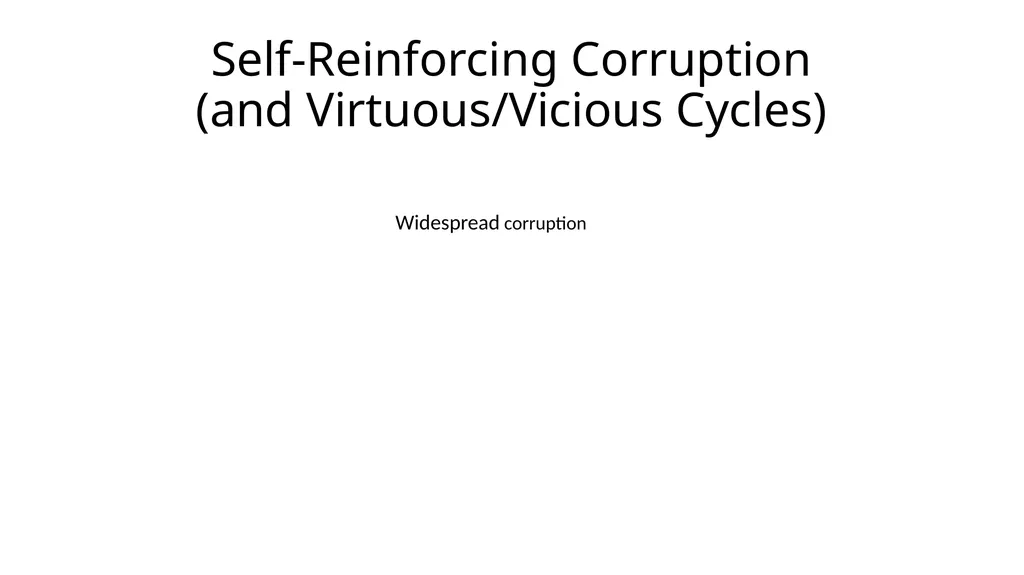
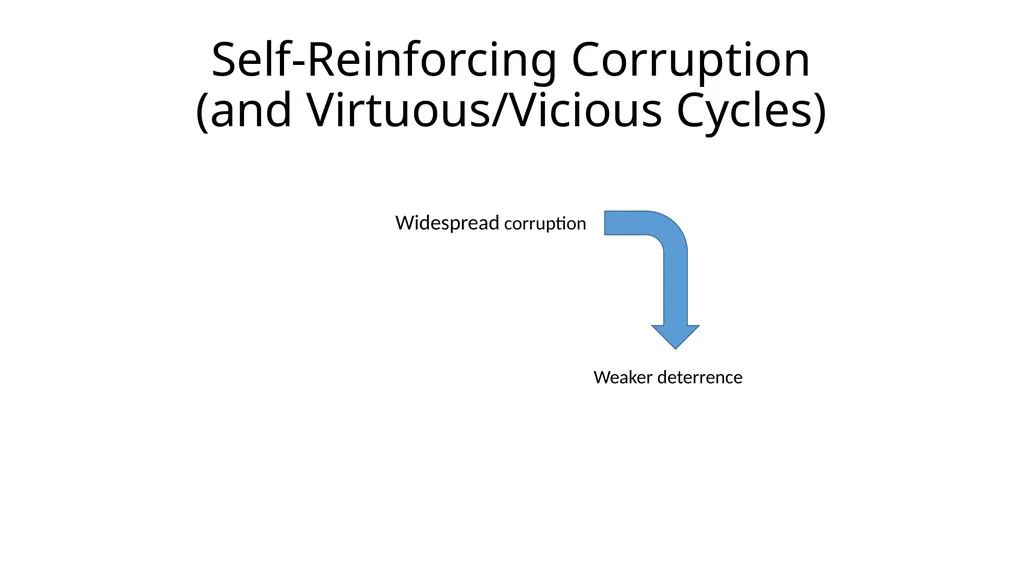
slide3. Self-Reinforcing Corruption (and Virtuous/Vicious Cycles) Widespread corruption<br>
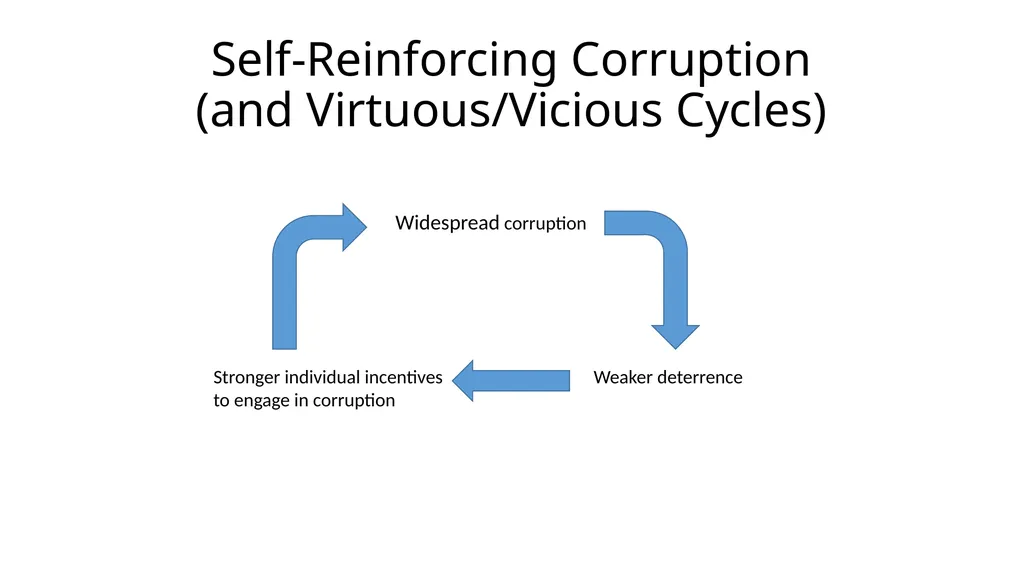
slide4. Self-Reinforcing Corruption (and Virtuous/Vicious Cycles) Widespread corruption Weaker deterrence<br>
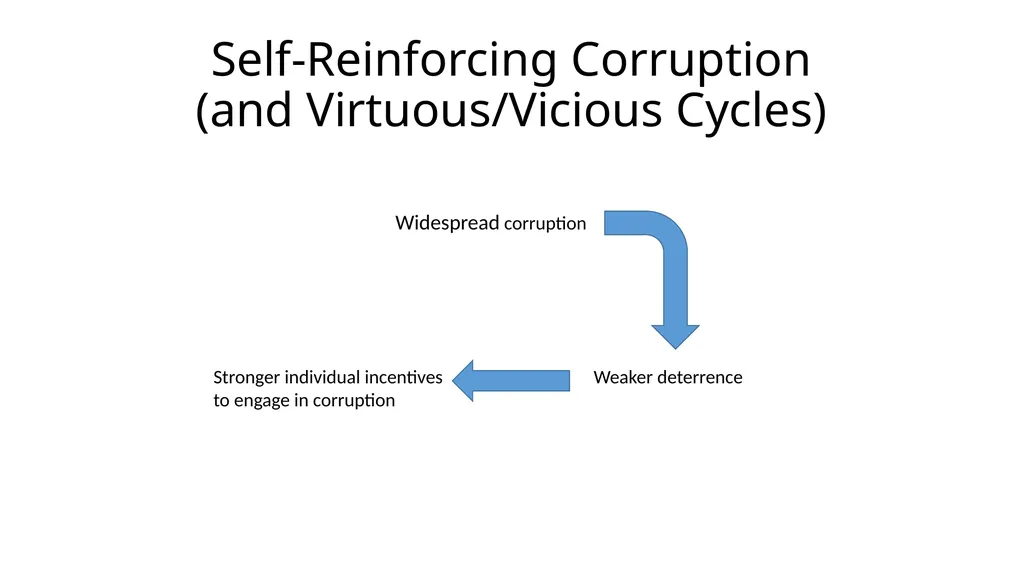
slide5. Self-Reinforcing Corruption (and Virtuous/Vicious Cycles) Widespread corruption Weaker deterrence Stronger individual incentives
to engage in corruption<br>
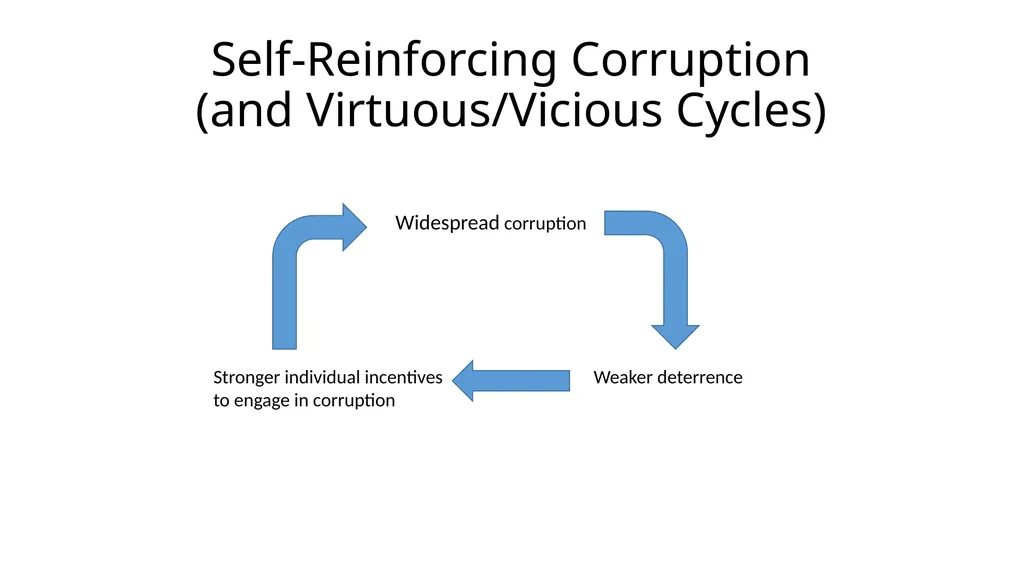
slide6. Self-Reinforcing Corruption (and Virtuous/Vicious Cycles) Widespread corruption Weaker deterrence Stronger individual incentives
to engage in corruption<br>
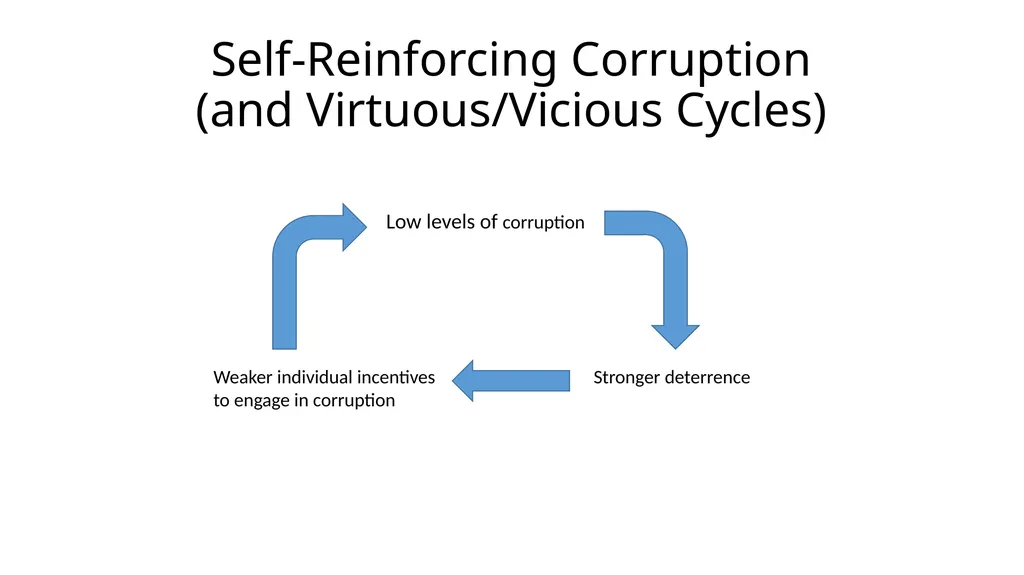
slide7. Self-Reinforcing Corruption (and Virtuous/Vicious Cycles) Low levels of corruption Stronger deterrence Weaker individual incentives
to engage in corruption<br>
slide8. Self-Reinforcing Corruption (and Virtuous/Vicious Cycles) Widespread corruption Weaker deterrence Stronger individual incentives
to engage in corruption<br>
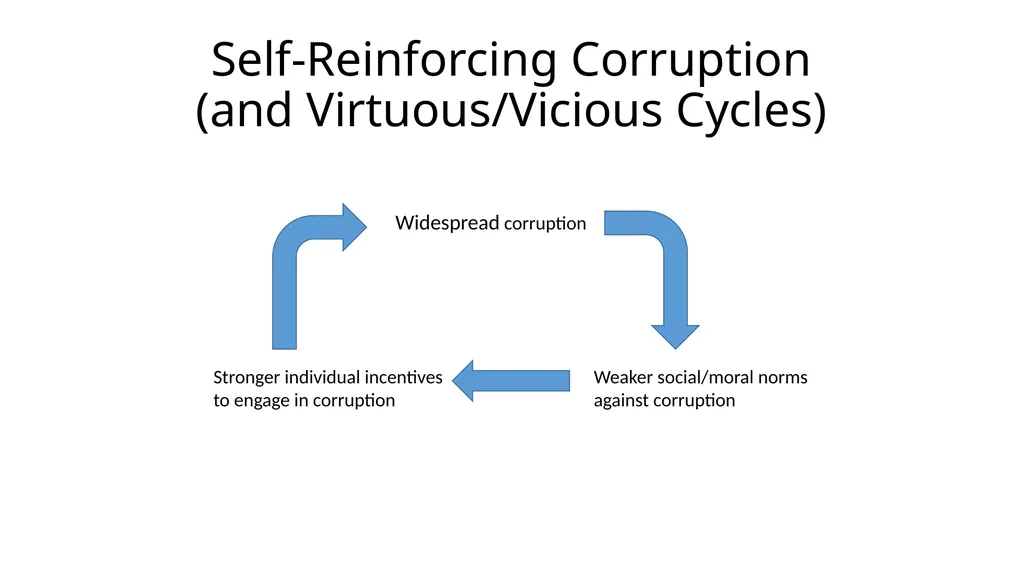
slide9. Self-Reinforcing Corruption (and Virtuous/Vicious Cycles) Widespread corruption Weaker social/moral norms
against corruption Stronger individual incentives
to engage in corruption<br>
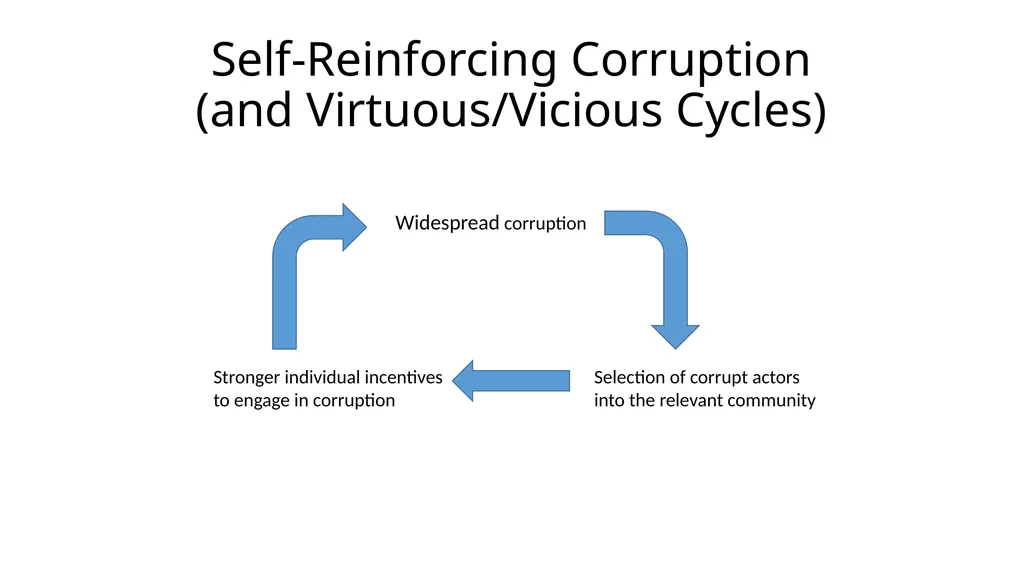
slide10. Self-Reinforcing Corruption (and Virtuous/Vicious Cycles) Widespread corruption Selection of corrupt actors
into the relevant community Stronger individual incentives
to engage in corruption<br>
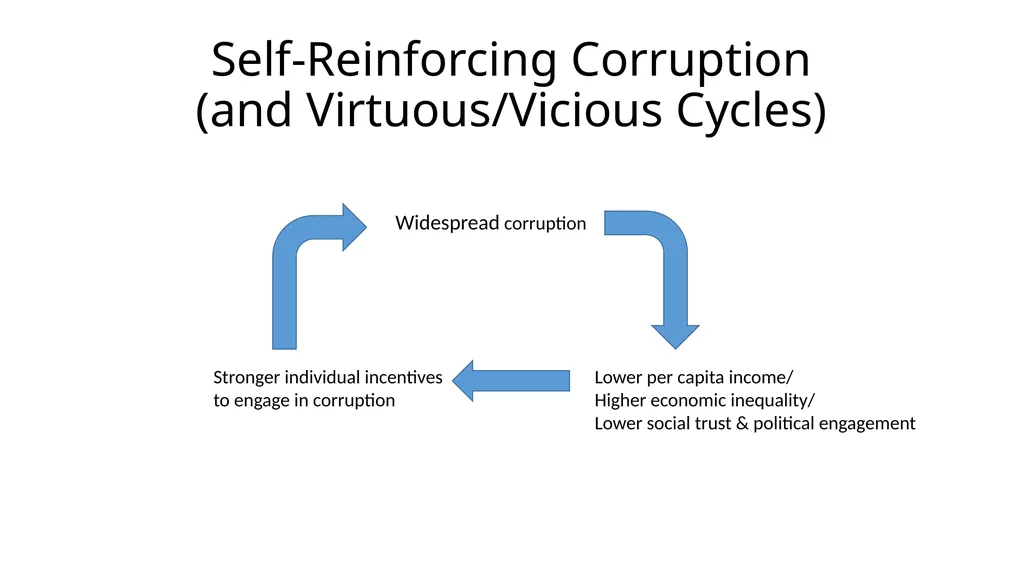
slide11. Self-Reinforcing Corruption (and Virtuous/Vicious Cycles) Widespread corruption Lower per capita income/
Higher economic inequality/
Lower social trust & political engagement Stronger individual incentives
to engage in corruption<br>
slide12. What follows from this? What are the implications for anticorruption strategy?<br>
slide13. An influential view:<br>
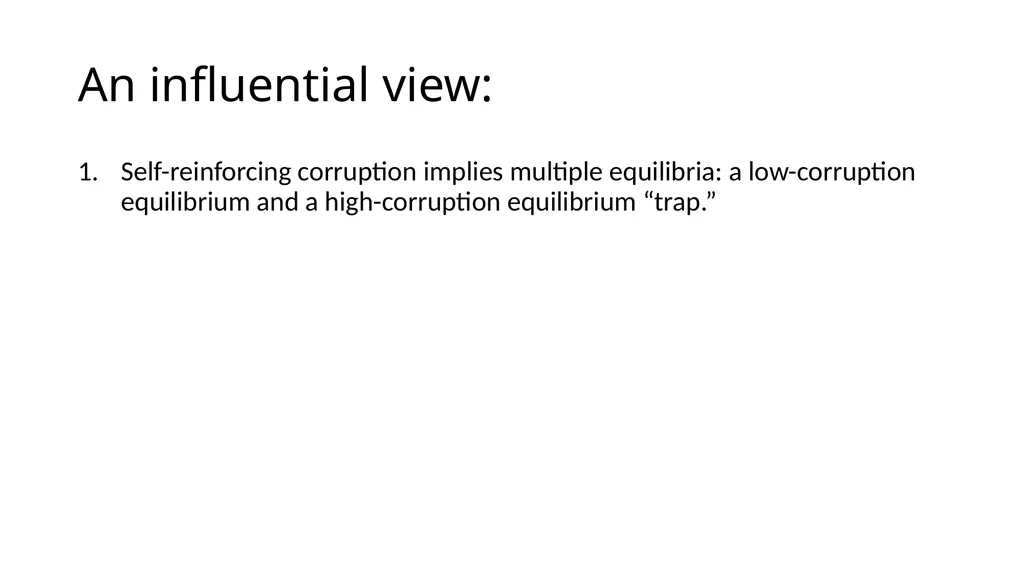
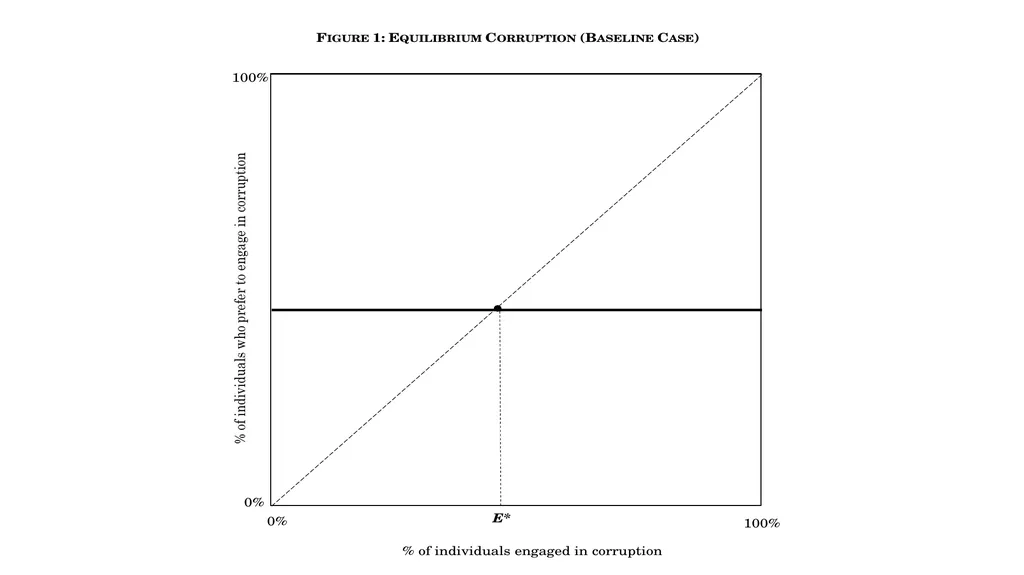
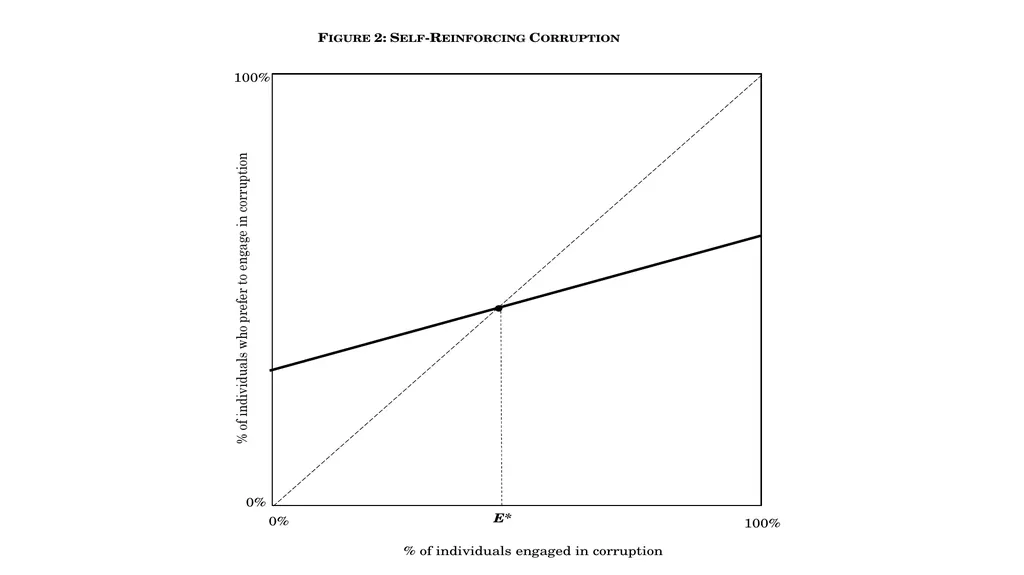
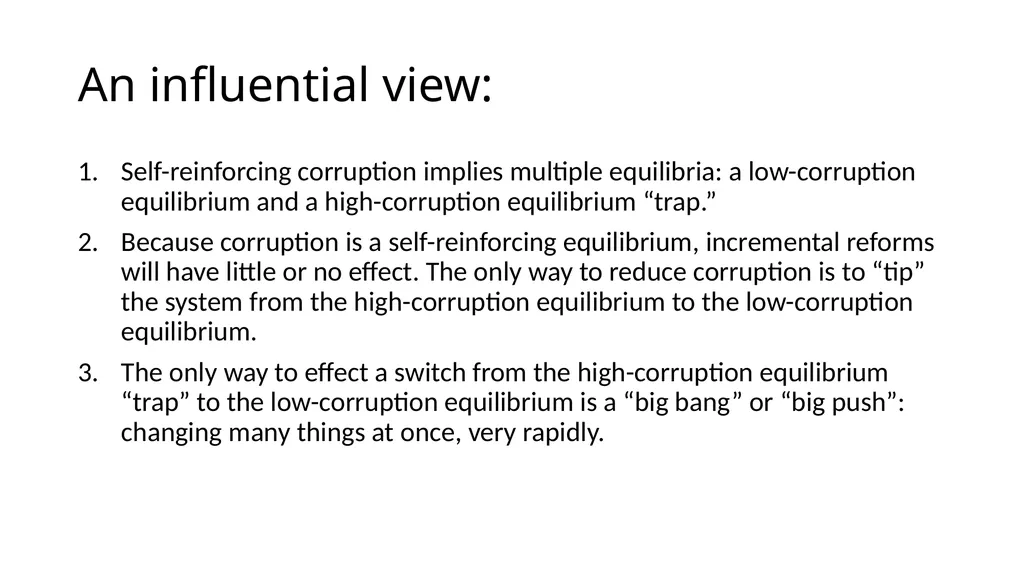
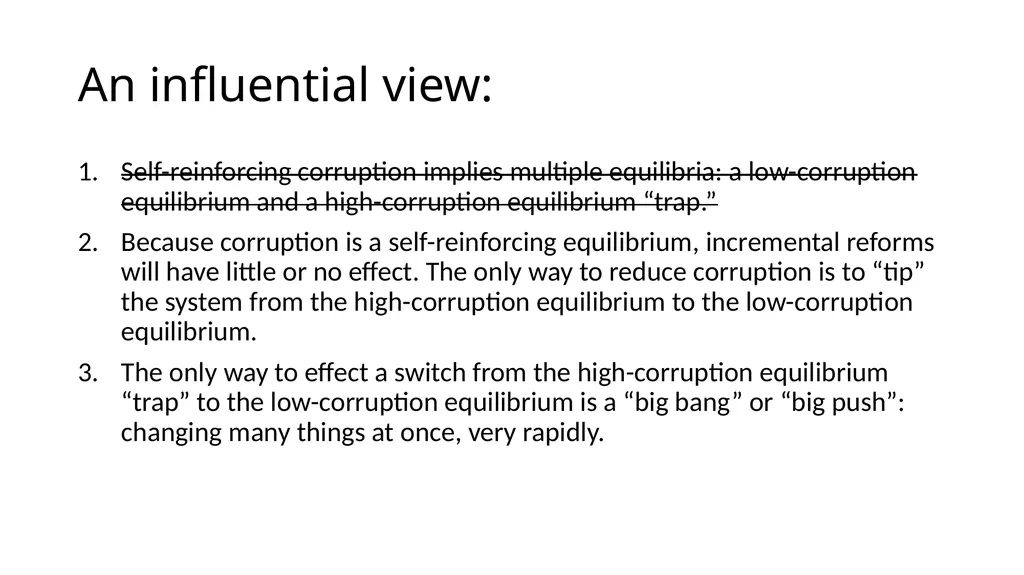
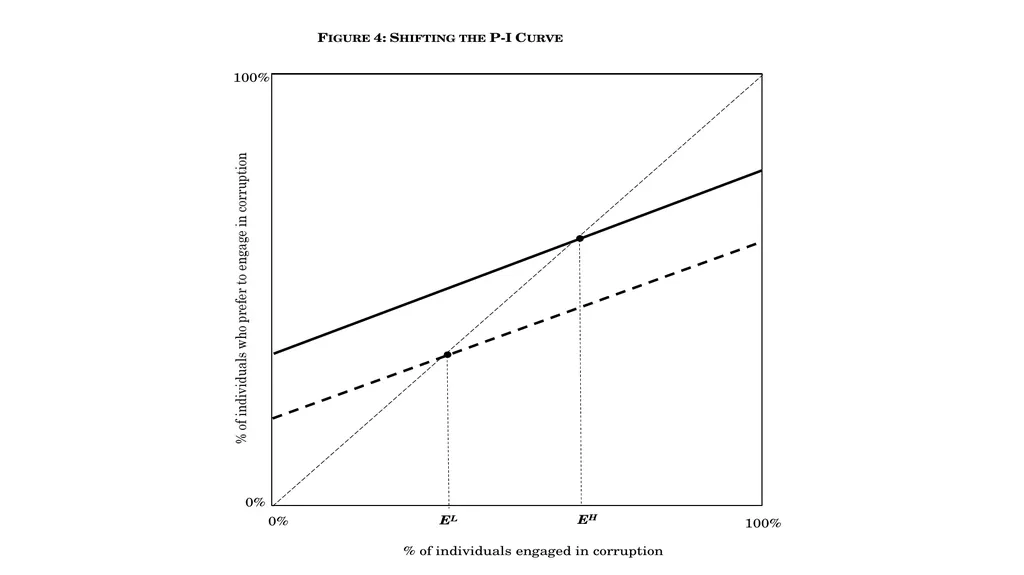
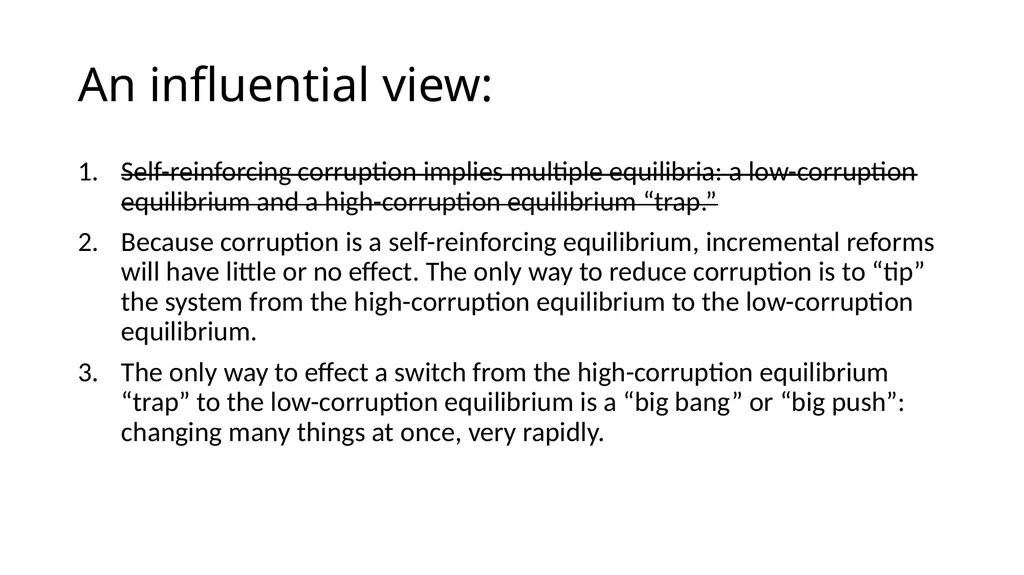
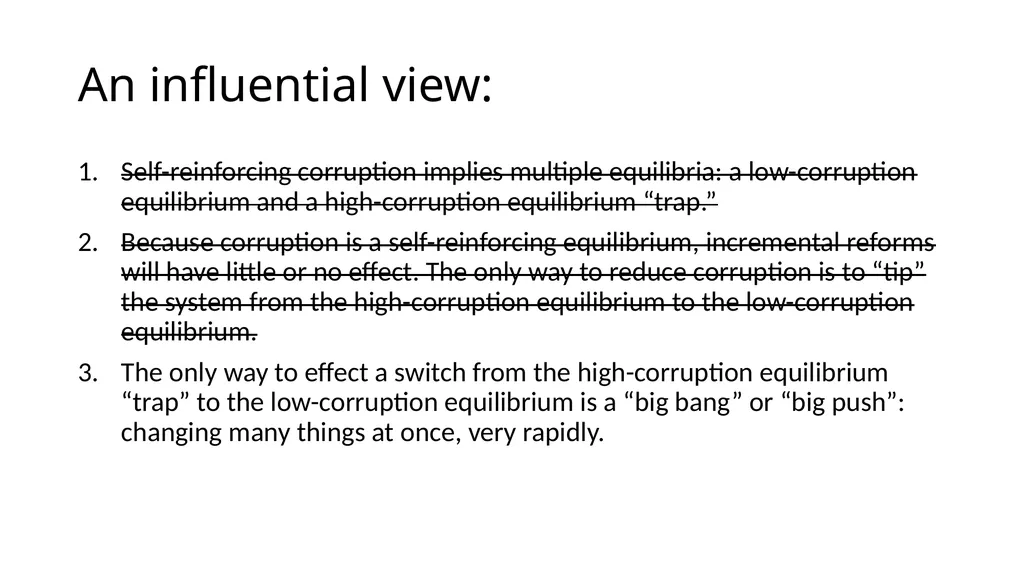
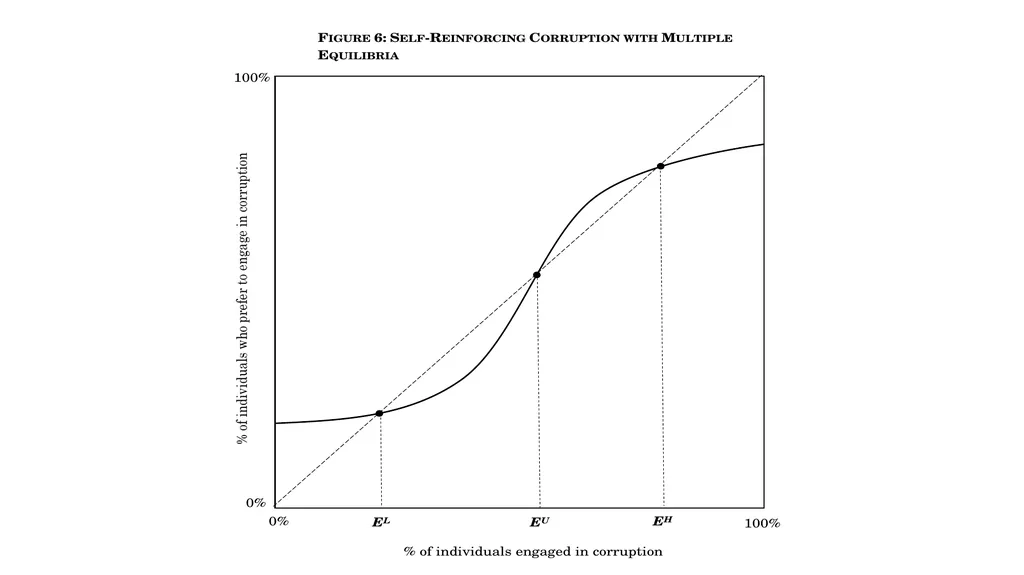
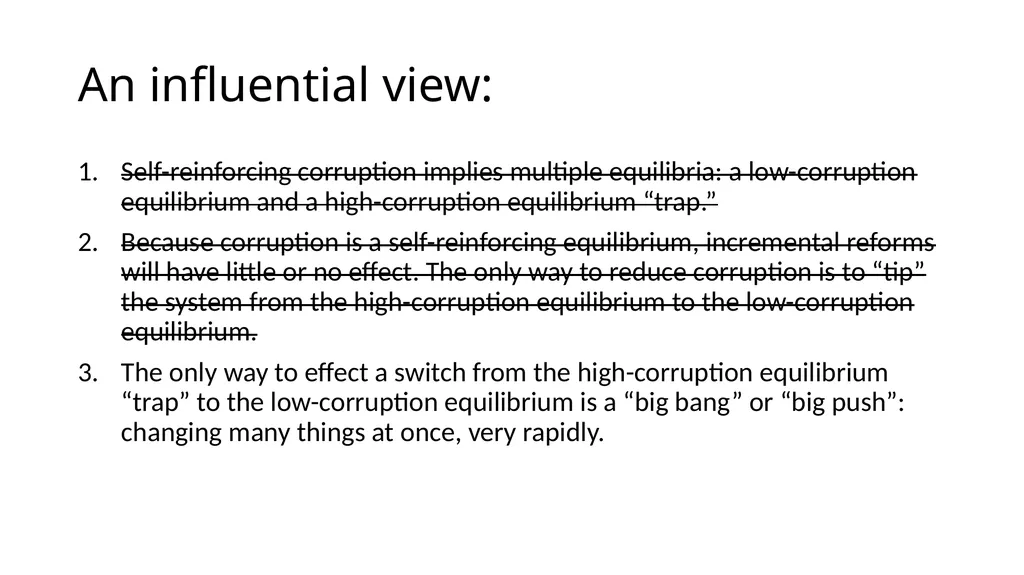
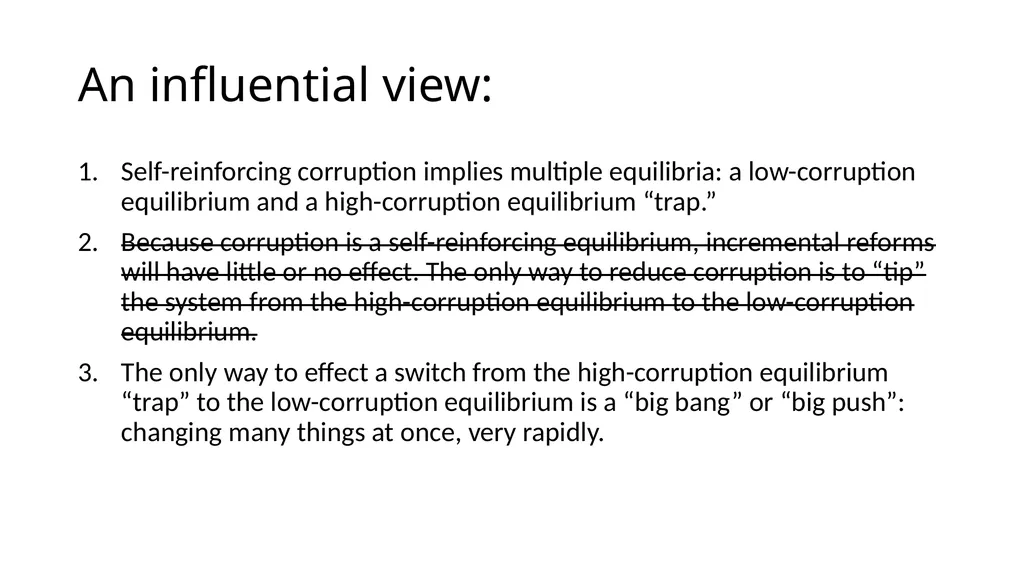
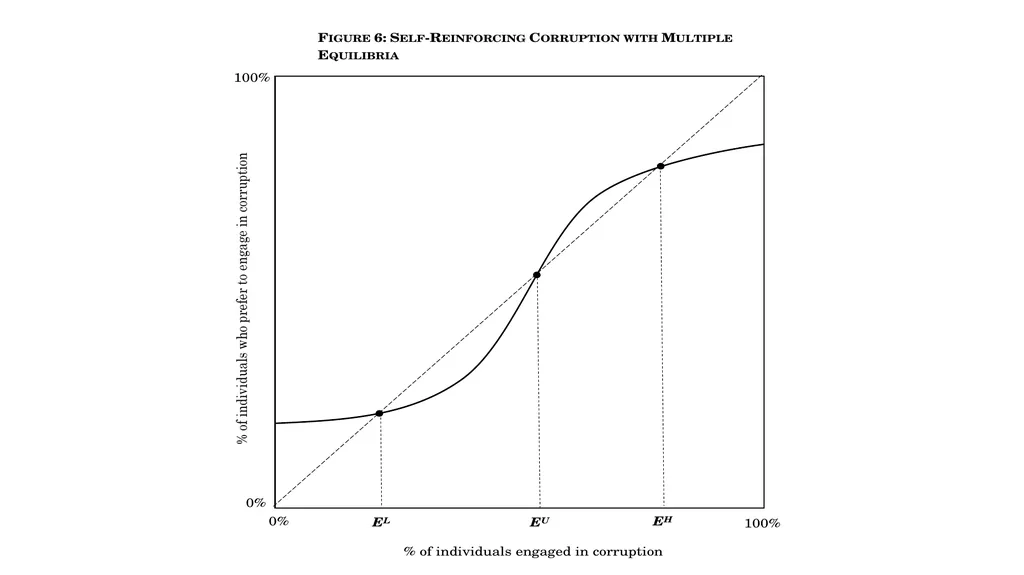
slide14. An influential view: Self-reinforcing corruption implies multiple equilibria: a low-corruption equilibrium and a high-corruption equilibrium “trap.”<br>
slide15. An influential view: Self-reinforcing corruption implies multiple equilibria: a low-corruption equilibrium and a high-corruption equilibrium “trap.”
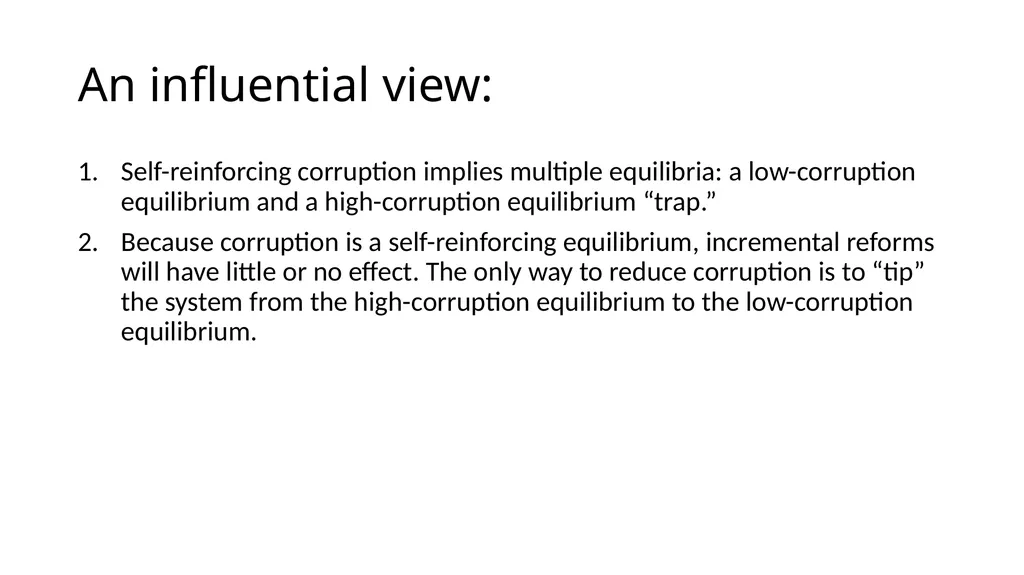
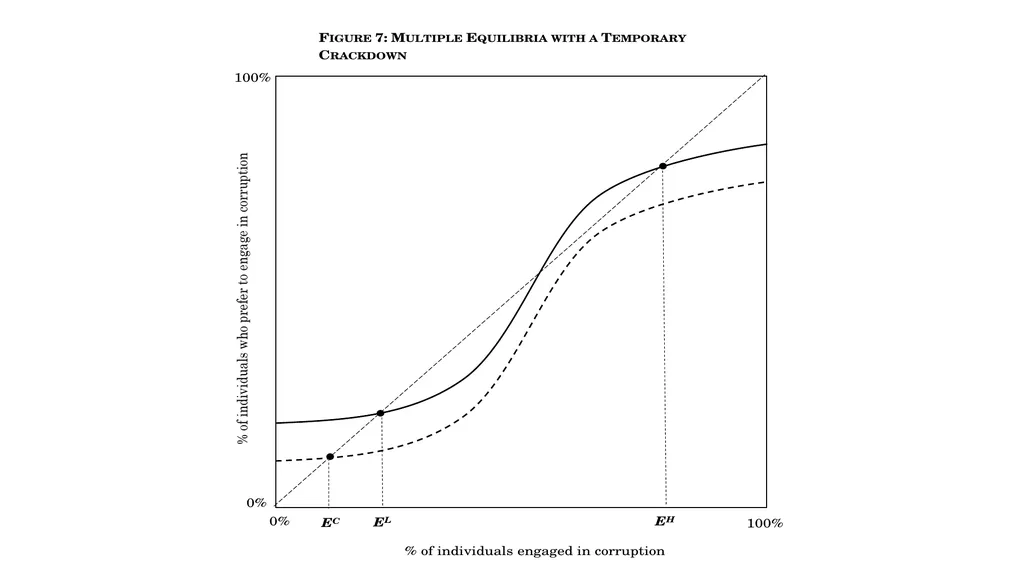
Because corruption is a self-reinforcing equilibrium, incremental reforms will have little or no effect. The only way to reduce corruption is to “tip” the system from the high-corruption equilibrium to the low-corruption equilibrium.<br>
slide16. An influential view: Self-reinforcing corruption implies multiple equilibria: a low-corruption equilibrium and a high-corruption equilibrium “trap.”
Because corruption is a self-reinforcing equilibrium, incremental reforms will have little or no effect. The only way to reduce corruption is to “tip” the system from the high-corruption equilibrium to the low-corruption equilibrium.
The only way to effect a switch from the high-corruption equilibrium “trap” to the low-corruption equilibrium is a “big bang” or “big push”: changing many things at once, very rapidly.<br>
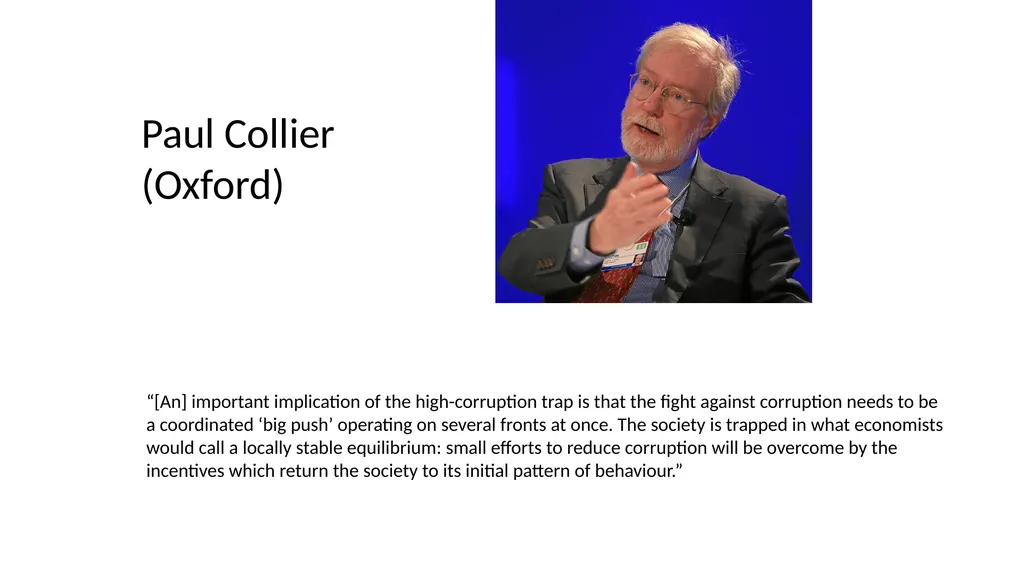
slide17. “[An] important implication of the high-corruption trap is that the fight against corruption needs to be
a coordinated ‘big push’ operating on several fronts at once. The society is trapped in what economists
would call a locally stable equilibrium: small efforts to reduce corruption will be overcome by the
incentives which return the society to its initial pattern of behaviour.” Paul Collier
(Oxford)<br>
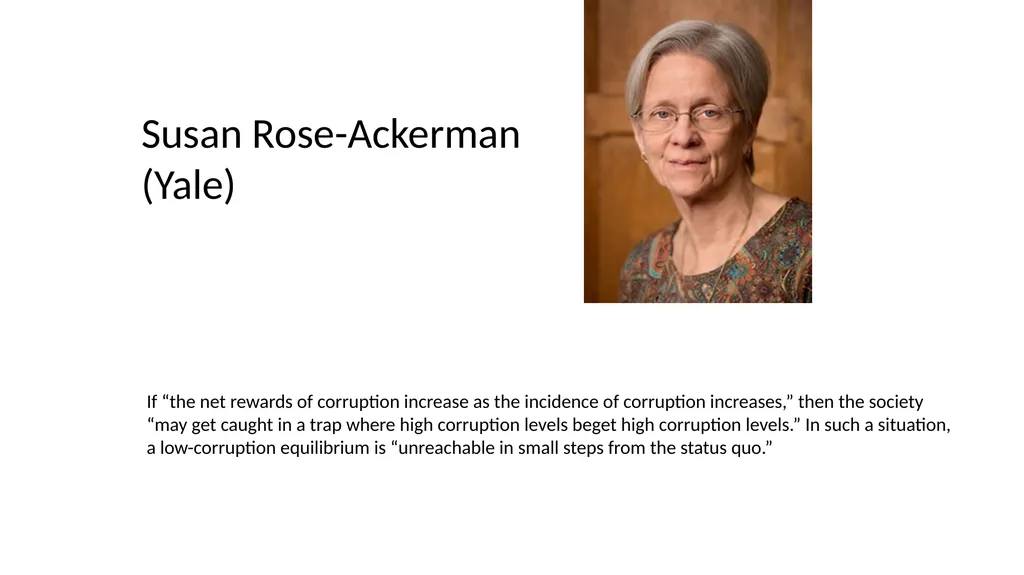
slide18. If “the net rewards of corruption increase as the incidence of corruption increases,” then the society
“may get caught in a trap where high corruption levels beget high corruption levels.” In such a situation,
a low-corruption equilibrium is “unreachable in small steps from the status quo.” Susan Rose-Ackerman
(Yale)<br>
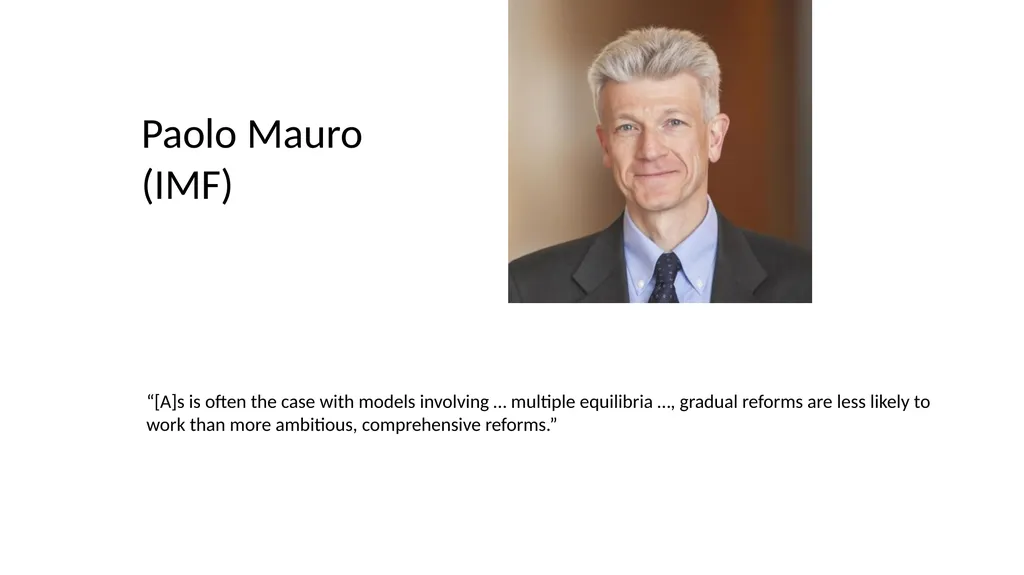
slide19. “[A]s is often the case with models involving … multiple equilibria …, gradual reforms are less likely to
work than more ambitious, comprehensive reforms.” Paolo Mauro
(IMF)<br>
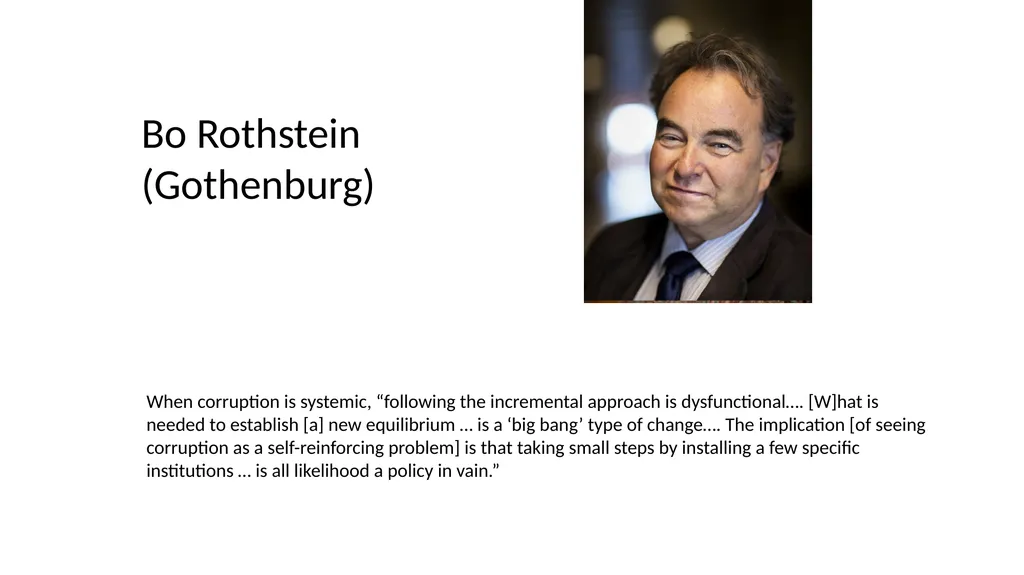
slide20. When corruption is systemic, “following the incremental approach is dysfunctional…. [W]hat is
needed to establish [a] new equilibrium … is a ‘big bang’ type of change…. The implication [of seeing
corruption as a self-reinforcing problem] is that taking small steps by installing a few specific
institutions … is all likelihood a policy in vain.” Bo Rothstein
(Gothenburg)<br>
slide24. An influential view: Self-reinforcing corruption implies multiple equilibria: a low-corruption equilibrium and a high-corruption equilibrium “trap.”
Because corruption is a self-reinforcing equilibrium, incremental reforms will have little or no effect. The only way to reduce corruption is to “tip” the system from the high-corruption equilibrium to the low-corruption equilibrium.
The only way to effect a switch from the high-corruption equilibrium “trap” to the low-corruption equilibrium is a “big bang” or “big push”: changing many things at once, very rapidly.<br>
slide25. An influential view: Self-reinforcing corruption implies multiple equilibria: a low-corruption equilibrium and a high-corruption equilibrium “trap.”
Because corruption is a self-reinforcing equilibrium, incremental reforms will have little or no effect. The only way to reduce corruption is to “tip” the system from the high-corruption equilibrium to the low-corruption equilibrium.
The only way to effect a switch from the high-corruption equilibrium “trap” to the low-corruption equilibrium is a “big bang” or “big push”: changing many things at once, very rapidly.<br>
slide28. An influential view: Self-reinforcing corruption implies multiple equilibria: a low-corruption equilibrium and a high-corruption equilibrium “trap.”
Because corruption is a self-reinforcing equilibrium, incremental reforms will have little or no effect. The only way to reduce corruption is to “tip” the system from the high-corruption equilibrium to the low-corruption equilibrium.
The only way to effect a switch from the high-corruption equilibrium “trap” to the low-corruption equilibrium is a “big bang” or “big push”: changing many things at once, very rapidly.<br>
slide29. An influential view: Self-reinforcing corruption implies multiple equilibria: a low-corruption equilibrium and a high-corruption equilibrium “trap.”
Because corruption is a self-reinforcing equilibrium, incremental reforms will have little or no effect. The only way to reduce corruption is to “tip” the system from the high-corruption equilibrium to the low-corruption equilibrium.
The only way to effect a switch from the high-corruption equilibrium “trap” to the low-corruption equilibrium is a “big bang” or “big push”: changing many things at once, very rapidly.<br>
slide31. An influential view: Self-reinforcing corruption implies multiple equilibria: a low-corruption equilibrium and a high-corruption equilibrium “trap.”
Because corruption is a self-reinforcing equilibrium, incremental reforms will have little or no effect. The only way to reduce corruption is to “tip” the system from the high-corruption equilibrium to the low-corruption equilibrium.
The only way to effect a switch from the high-corruption equilibrium “trap” to the low-corruption equilibrium is a “big bang” or “big push”: changing many things at once, very rapidly.<br>
slide32. An influential view: Self-reinforcing corruption implies multiple equilibria: a low-corruption equilibrium and a high-corruption equilibrium “trap.”
Because corruption is a self-reinforcing equilibrium, incremental reforms will have little or no effect. The only way to reduce corruption is to “tip” the system from the high-corruption equilibrium to the low-corruption equilibrium.
The only way to effect a switch from the high-corruption equilibrium “trap” to the low-corruption equilibrium is a “big bang” or “big push”: changing many things at once, very rapidly.<br>
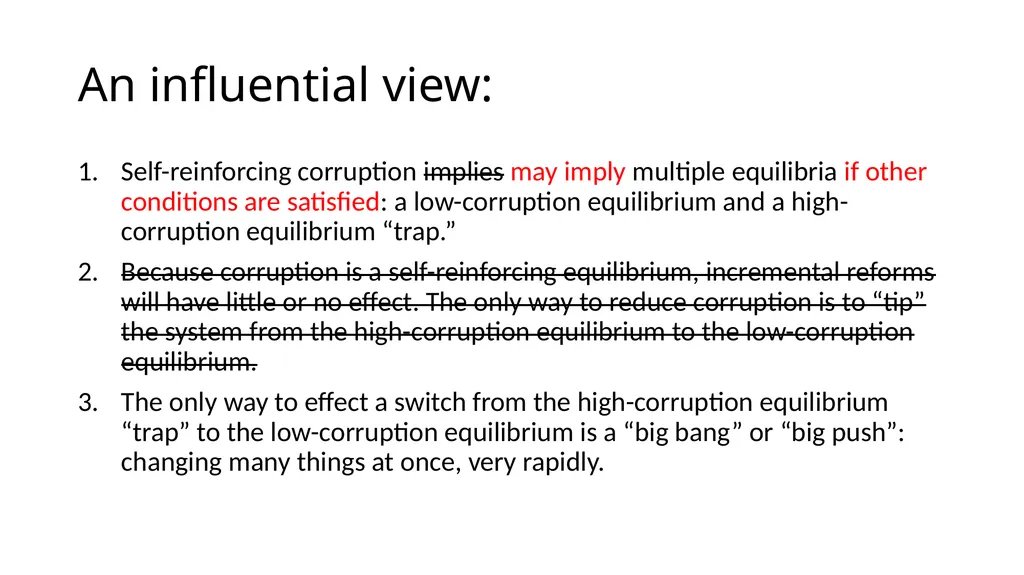
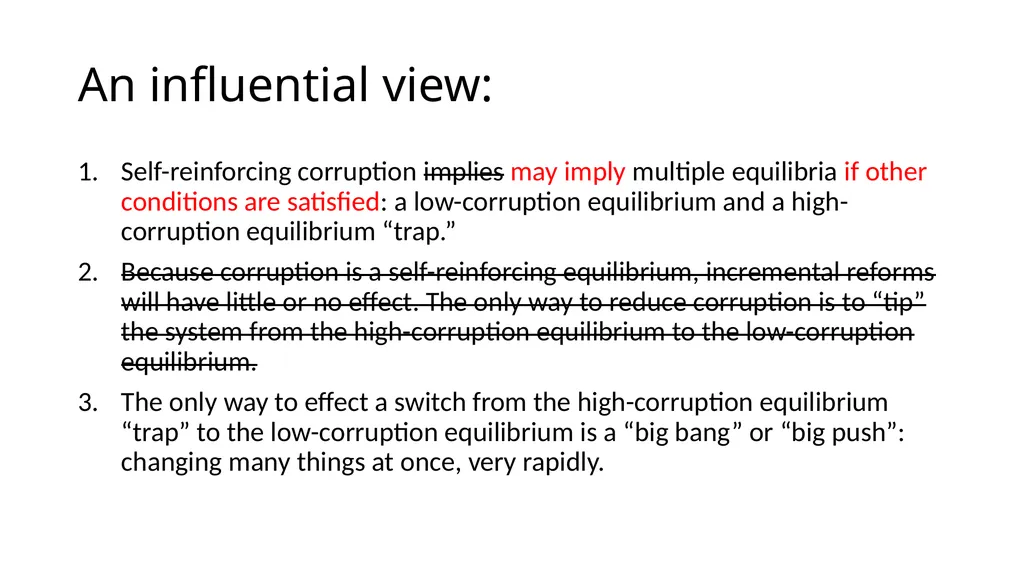
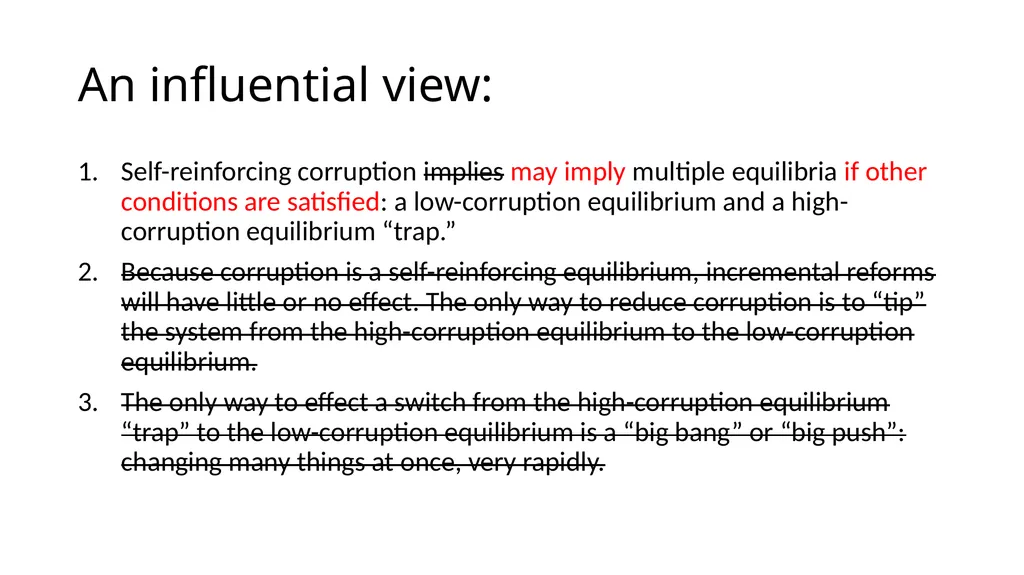
slide33. An influential view: Self-reinforcing corruption implies may imply multiple equilibria if other conditions are satisfied: a low-corruption equilibrium and a high-corruption equilibrium “trap.”
Because corruption is a self-reinforcing equilibrium, incremental reforms will have little or no effect. The only way to reduce corruption is to “tip” the system from the high-corruption equilibrium to the low-corruption equilibrium.
The only way to effect a switch from the high-corruption equilibrium “trap” to the low-corruption equilibrium is a “big bang” or “big push”: changing many things at once, very rapidly.<br>
slide37. An influential view: Self-reinforcing corruption implies may imply multiple equilibria if other conditions are satisfied: a low-corruption equilibrium and a high-corruption equilibrium “trap.”
Because corruption is a self-reinforcing equilibrium, incremental reforms will have little or no effect. The only way to reduce corruption is to “tip” the system from the high-corruption equilibrium to the low-corruption equilibrium.
The only way to effect a switch from the high-corruption equilibrium “trap” to the low-corruption equilibrium is a “big bang” or “big push”: changing many things at once, very rapidly.<br>
slide38. An influential view: Self-reinforcing corruption implies may imply multiple equilibria if other conditions are satisfied: a low-corruption equilibrium and a high-corruption equilibrium “trap.”
Because corruption is a self-reinforcing equilibrium, incremental reforms will have little or no effect. The only way to reduce corruption is to “tip” the system from the high-corruption equilibrium to the low-corruption equilibrium.
The only way to effect a switch from the high-corruption equilibrium “trap” to the low-corruption equilibrium is a “big bang” or “big push”: changing many things at once, very rapidly.<br>
slide39. An influential view: Self-reinforcing corruption implies may imply multiple equilibria if other conditions are satisfied: a low-corruption equilibrium and a high-corruption equilibrium “trap.”
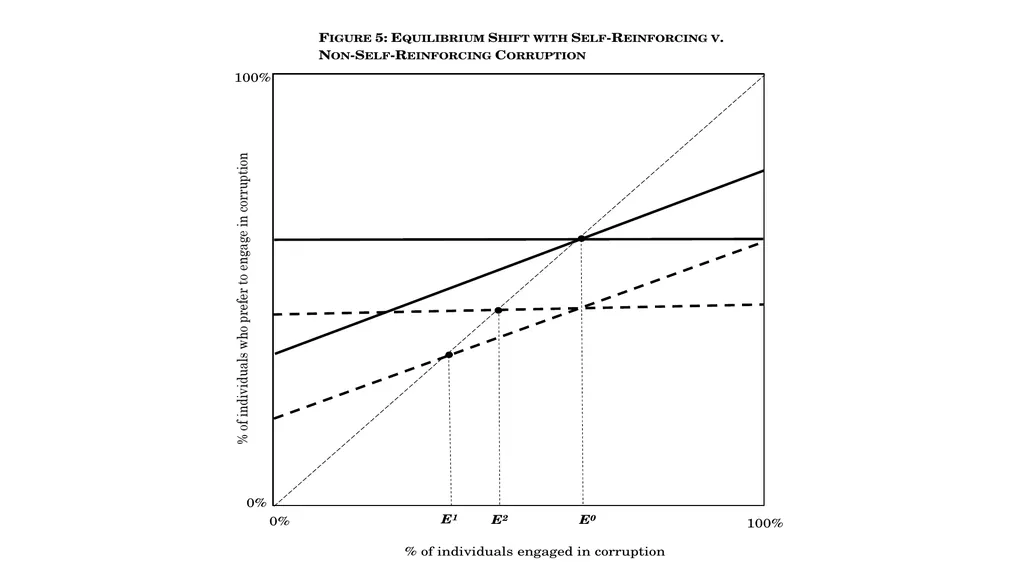
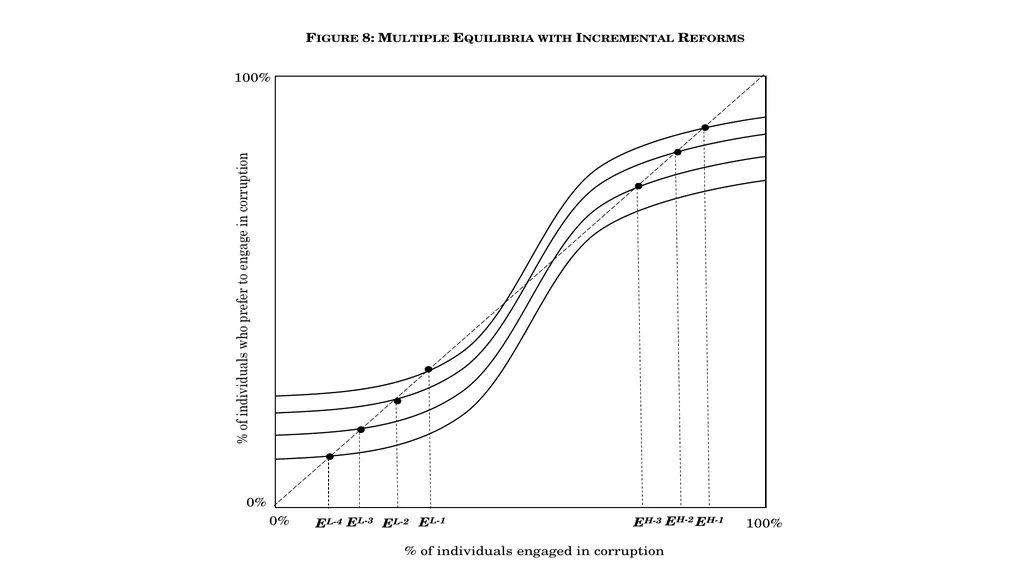
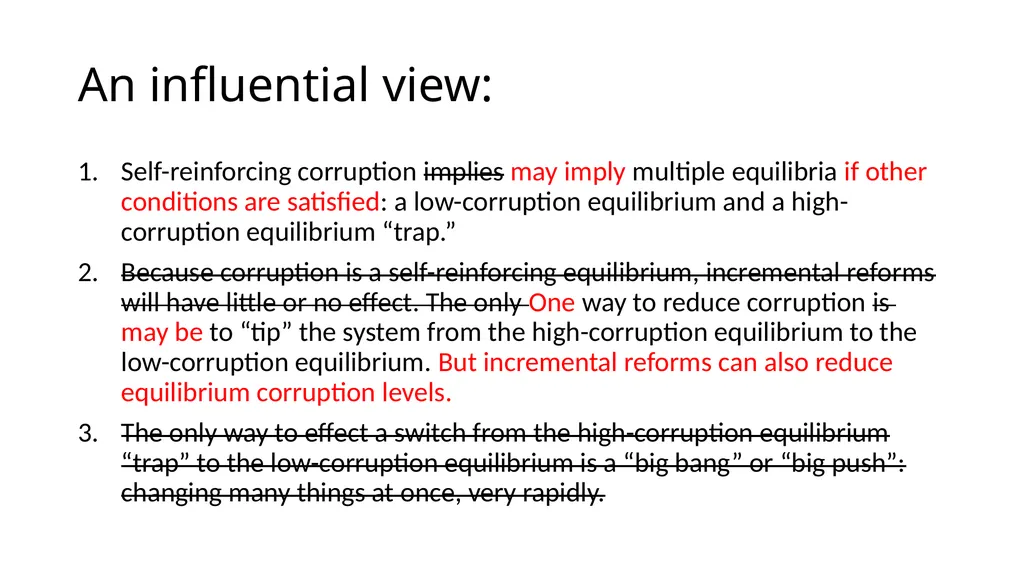
Because corruption is a self-reinforcing equilibrium, incremental reforms will have little or no effect. The only One way to reduce corruption is may be to “tip” the system from the high-corruption equilibrium to the low-corruption equilibrium. But incremental reforms can also reduce equilibrium corruption levels.
The only way to effect a switch from the high-corruption equilibrium “trap” to the low-corruption equilibrium is a “big bang” or “big push”: changing many things at once, very rapidly.<br>
slide40. An influential view: Self-reinforcing corruption implies may imply multiple equilibria if other conditions are satisfied: a low-corruption equilibrium and a high-corruption equilibrium “trap.”
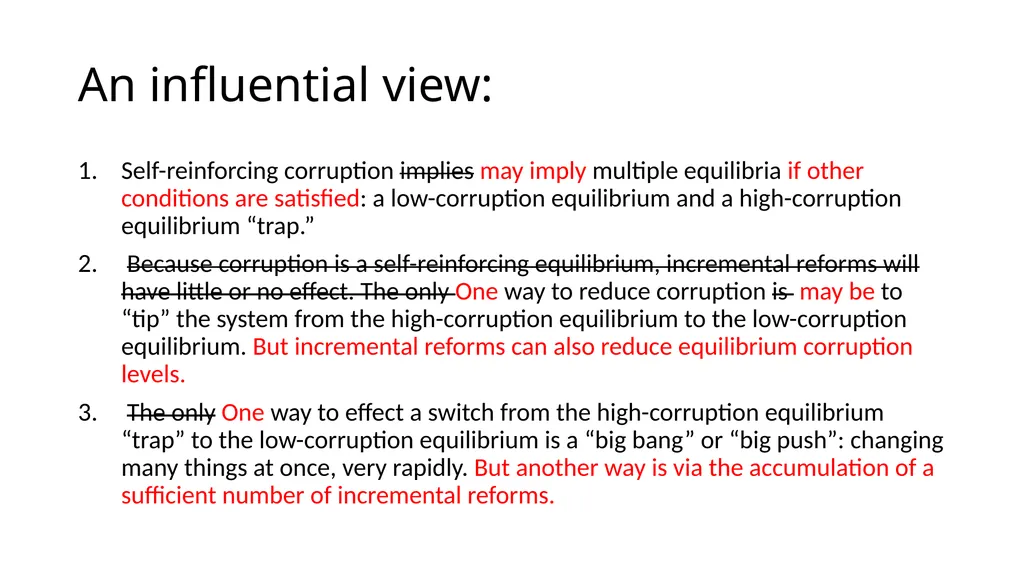
Because corruption is a self-reinforcing equilibrium, incremental reforms will have little or no effect. The only One way to reduce corruption is may be to “tip” the system from the high-corruption equilibrium to the low-corruption equilibrium. But incremental reforms can also reduce equilibrium corruption levels.
The only One way to effect a switch from the high-corruption equilibrium “trap” to the low-corruption equilibrium is a “big bang” or “big push”: changing many things at once, very rapidly. But another way is via the accumulation of a sufficient number of incremental reforms.<br>
slide41. Why Should Anyone Care?<br>
slide42. Why Should Anyone Care? Sloppy analysis<br>
slide43. Why Should Anyone Care? Sloppy analysis
Privileging magnitude over sustainability<br>
slide44. Why Should Anyone Care? Sloppy analysis
Privileging magnitude over sustainability
Fatalism/cynicism/complacency<br>
slide45. Why Should Anyone Care? Sloppy analysis
Privileging magnitude over sustainability
Fatalism/cynicism/complacency
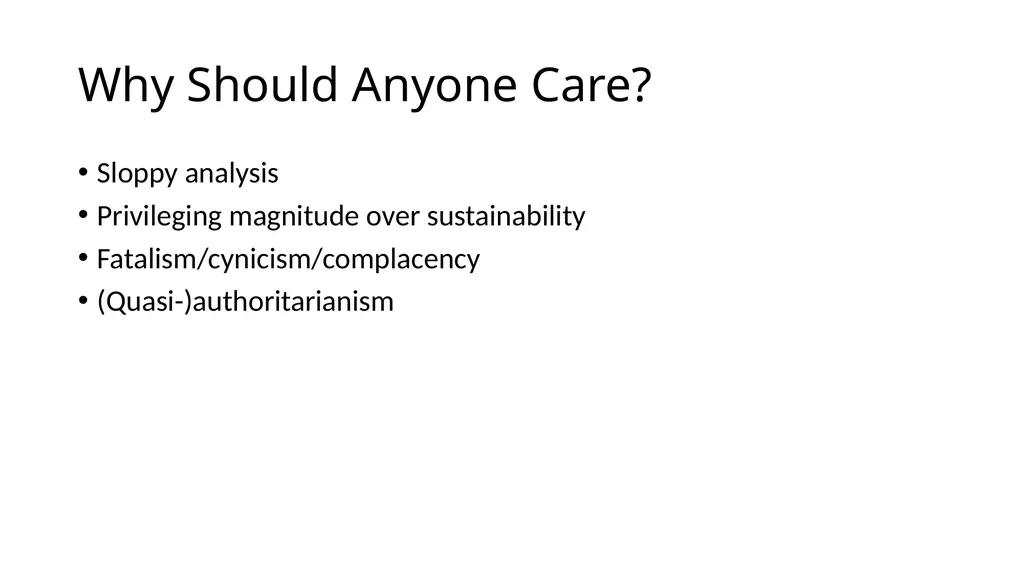
(Quasi-)authoritarianism<br>
Harvard Law School<br>
slide2. Self-Reinforcing Corruption (and Virtuous/Vicious Cycles)<br>
slide3. Self-Reinforcing Corruption (and Virtuous/Vicious Cycles) Widespread corruption<br>
slide4. Self-Reinforcing Corruption (and Virtuous/Vicious Cycles) Widespread corruption Weaker deterrence<br>
slide5. Self-Reinforcing Corruption (and Virtuous/Vicious Cycles) Widespread corruption Weaker deterrence Stronger individual incentives
to engage in corruption<br>
slide6. Self-Reinforcing Corruption (and Virtuous/Vicious Cycles) Widespread corruption Weaker deterrence Stronger individual incentives
to engage in corruption<br>
slide7. Self-Reinforcing Corruption (and Virtuous/Vicious Cycles) Low levels of corruption Stronger deterrence Weaker individual incentives
to engage in corruption<br>
slide8. Self-Reinforcing Corruption (and Virtuous/Vicious Cycles) Widespread corruption Weaker deterrence Stronger individual incentives
to engage in corruption<br>
slide9. Self-Reinforcing Corruption (and Virtuous/Vicious Cycles) Widespread corruption Weaker social/moral norms
against corruption Stronger individual incentives
to engage in corruption<br>
slide10. Self-Reinforcing Corruption (and Virtuous/Vicious Cycles) Widespread corruption Selection of corrupt actors
into the relevant community Stronger individual incentives
to engage in corruption<br>
slide11. Self-Reinforcing Corruption (and Virtuous/Vicious Cycles) Widespread corruption Lower per capita income/
Higher economic inequality/
Lower social trust & political engagement Stronger individual incentives
to engage in corruption<br>
slide12. What follows from this? What are the implications for anticorruption strategy?<br>
slide13. An influential view:<br>
slide14. An influential view: Self-reinforcing corruption implies multiple equilibria: a low-corruption equilibrium and a high-corruption equilibrium “trap.”<br>
slide15. An influential view: Self-reinforcing corruption implies multiple equilibria: a low-corruption equilibrium and a high-corruption equilibrium “trap.”
Because corruption is a self-reinforcing equilibrium, incremental reforms will have little or no effect. The only way to reduce corruption is to “tip” the system from the high-corruption equilibrium to the low-corruption equilibrium.<br>
slide16. An influential view: Self-reinforcing corruption implies multiple equilibria: a low-corruption equilibrium and a high-corruption equilibrium “trap.”
Because corruption is a self-reinforcing equilibrium, incremental reforms will have little or no effect. The only way to reduce corruption is to “tip” the system from the high-corruption equilibrium to the low-corruption equilibrium.
The only way to effect a switch from the high-corruption equilibrium “trap” to the low-corruption equilibrium is a “big bang” or “big push”: changing many things at once, very rapidly.<br>
slide17. “[An] important implication of the high-corruption trap is that the fight against corruption needs to be
a coordinated ‘big push’ operating on several fronts at once. The society is trapped in what economists
would call a locally stable equilibrium: small efforts to reduce corruption will be overcome by the
incentives which return the society to its initial pattern of behaviour.” Paul Collier
(Oxford)<br>
slide18. If “the net rewards of corruption increase as the incidence of corruption increases,” then the society
“may get caught in a trap where high corruption levels beget high corruption levels.” In such a situation,
a low-corruption equilibrium is “unreachable in small steps from the status quo.” Susan Rose-Ackerman
(Yale)<br>
slide19. “[A]s is often the case with models involving … multiple equilibria …, gradual reforms are less likely to
work than more ambitious, comprehensive reforms.” Paolo Mauro
(IMF)<br>
slide20. When corruption is systemic, “following the incremental approach is dysfunctional…. [W]hat is
needed to establish [a] new equilibrium … is a ‘big bang’ type of change…. The implication [of seeing
corruption as a self-reinforcing problem] is that taking small steps by installing a few specific
institutions … is all likelihood a policy in vain.” Bo Rothstein
(Gothenburg)<br>
slide24. An influential view: Self-reinforcing corruption implies multiple equilibria: a low-corruption equilibrium and a high-corruption equilibrium “trap.”
Because corruption is a self-reinforcing equilibrium, incremental reforms will have little or no effect. The only way to reduce corruption is to “tip” the system from the high-corruption equilibrium to the low-corruption equilibrium.
The only way to effect a switch from the high-corruption equilibrium “trap” to the low-corruption equilibrium is a “big bang” or “big push”: changing many things at once, very rapidly.<br>
slide25. An influential view: Self-reinforcing corruption implies multiple equilibria: a low-corruption equilibrium and a high-corruption equilibrium “trap.”
Because corruption is a self-reinforcing equilibrium, incremental reforms will have little or no effect. The only way to reduce corruption is to “tip” the system from the high-corruption equilibrium to the low-corruption equilibrium.
The only way to effect a switch from the high-corruption equilibrium “trap” to the low-corruption equilibrium is a “big bang” or “big push”: changing many things at once, very rapidly.<br>
slide28. An influential view: Self-reinforcing corruption implies multiple equilibria: a low-corruption equilibrium and a high-corruption equilibrium “trap.”
Because corruption is a self-reinforcing equilibrium, incremental reforms will have little or no effect. The only way to reduce corruption is to “tip” the system from the high-corruption equilibrium to the low-corruption equilibrium.
The only way to effect a switch from the high-corruption equilibrium “trap” to the low-corruption equilibrium is a “big bang” or “big push”: changing many things at once, very rapidly.<br>
slide29. An influential view: Self-reinforcing corruption implies multiple equilibria: a low-corruption equilibrium and a high-corruption equilibrium “trap.”
Because corruption is a self-reinforcing equilibrium, incremental reforms will have little or no effect. The only way to reduce corruption is to “tip” the system from the high-corruption equilibrium to the low-corruption equilibrium.
The only way to effect a switch from the high-corruption equilibrium “trap” to the low-corruption equilibrium is a “big bang” or “big push”: changing many things at once, very rapidly.<br>
slide31. An influential view: Self-reinforcing corruption implies multiple equilibria: a low-corruption equilibrium and a high-corruption equilibrium “trap.”
Because corruption is a self-reinforcing equilibrium, incremental reforms will have little or no effect. The only way to reduce corruption is to “tip” the system from the high-corruption equilibrium to the low-corruption equilibrium.
The only way to effect a switch from the high-corruption equilibrium “trap” to the low-corruption equilibrium is a “big bang” or “big push”: changing many things at once, very rapidly.<br>
slide32. An influential view: Self-reinforcing corruption implies multiple equilibria: a low-corruption equilibrium and a high-corruption equilibrium “trap.”
Because corruption is a self-reinforcing equilibrium, incremental reforms will have little or no effect. The only way to reduce corruption is to “tip” the system from the high-corruption equilibrium to the low-corruption equilibrium.
The only way to effect a switch from the high-corruption equilibrium “trap” to the low-corruption equilibrium is a “big bang” or “big push”: changing many things at once, very rapidly.<br>
slide33. An influential view: Self-reinforcing corruption implies may imply multiple equilibria if other conditions are satisfied: a low-corruption equilibrium and a high-corruption equilibrium “trap.”
Because corruption is a self-reinforcing equilibrium, incremental reforms will have little or no effect. The only way to reduce corruption is to “tip” the system from the high-corruption equilibrium to the low-corruption equilibrium.
The only way to effect a switch from the high-corruption equilibrium “trap” to the low-corruption equilibrium is a “big bang” or “big push”: changing many things at once, very rapidly.<br>
slide37. An influential view: Self-reinforcing corruption implies may imply multiple equilibria if other conditions are satisfied: a low-corruption equilibrium and a high-corruption equilibrium “trap.”
Because corruption is a self-reinforcing equilibrium, incremental reforms will have little or no effect. The only way to reduce corruption is to “tip” the system from the high-corruption equilibrium to the low-corruption equilibrium.
The only way to effect a switch from the high-corruption equilibrium “trap” to the low-corruption equilibrium is a “big bang” or “big push”: changing many things at once, very rapidly.<br>
slide38. An influential view: Self-reinforcing corruption implies may imply multiple equilibria if other conditions are satisfied: a low-corruption equilibrium and a high-corruption equilibrium “trap.”
Because corruption is a self-reinforcing equilibrium, incremental reforms will have little or no effect. The only way to reduce corruption is to “tip” the system from the high-corruption equilibrium to the low-corruption equilibrium.
The only way to effect a switch from the high-corruption equilibrium “trap” to the low-corruption equilibrium is a “big bang” or “big push”: changing many things at once, very rapidly.<br>
slide39. An influential view: Self-reinforcing corruption implies may imply multiple equilibria if other conditions are satisfied: a low-corruption equilibrium and a high-corruption equilibrium “trap.”
Because corruption is a self-reinforcing equilibrium, incremental reforms will have little or no effect. The only One way to reduce corruption is may be to “tip” the system from the high-corruption equilibrium to the low-corruption equilibrium. But incremental reforms can also reduce equilibrium corruption levels.
The only way to effect a switch from the high-corruption equilibrium “trap” to the low-corruption equilibrium is a “big bang” or “big push”: changing many things at once, very rapidly.<br>
slide40. An influential view: Self-reinforcing corruption implies may imply multiple equilibria if other conditions are satisfied: a low-corruption equilibrium and a high-corruption equilibrium “trap.”
Because corruption is a self-reinforcing equilibrium, incremental reforms will have little or no effect. The only One way to reduce corruption is may be to “tip” the system from the high-corruption equilibrium to the low-corruption equilibrium. But incremental reforms can also reduce equilibrium corruption levels.
The only One way to effect a switch from the high-corruption equilibrium “trap” to the low-corruption equilibrium is a “big bang” or “big push”: changing many things at once, very rapidly. But another way is via the accumulation of a sufficient number of incremental reforms.<br>
slide41. Why Should Anyone Care?<br>
slide42. Why Should Anyone Care? Sloppy analysis<br>
slide43. Why Should Anyone Care? Sloppy analysis
Privileging magnitude over sustainability<br>
slide44. Why Should Anyone Care? Sloppy analysis
Privileging magnitude over sustainability
Fatalism/cynicism/complacency<br>
slide45. Why Should Anyone Care? Sloppy analysis
Privileging magnitude over sustainability
Fatalism/cynicism/complacency
(Quasi-)authoritarianism<br>