
COSATU 35 year Gender Review PRESENTATION FOR











Description: COSATU 35 year Gender Review PRESENTATION FOR COSATU PROVINCIAL GENDER CONFERENCES Overview of Presentation Introduction: COSATU Gender Review objectives, methods and key focus areas Outstanding data needed for completion This presentation
Related Topics
Download Presentation
"COSATU 35 year Gender Review PRESENTATION FOR" is the property of its rightful owner. Permission is granted to download and print the materials on this website for personal, non-commercial use only, and to display it on your personal computer provided you do not modify the materials and that you retain all copyright notices contained in the materials. By downloading content from our website, you accept the terms of this agreement.
Presentation Transcript
slide1. COSATU 35 year Gender Review PRESENTATION FOR COSATU PROVINCIAL GENDER CONFERENCES<br>
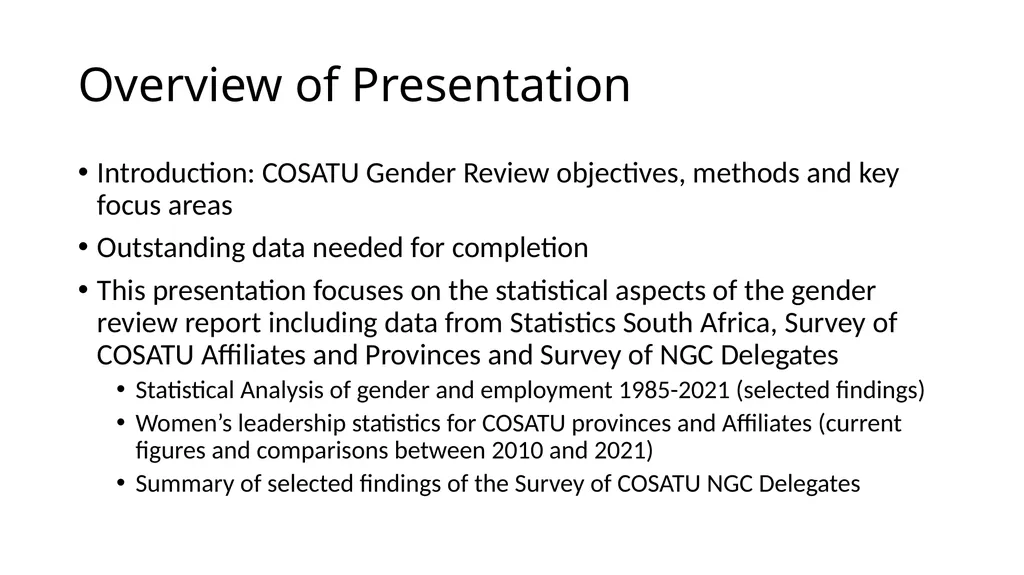
slide2. Overview of Presentation Introduction: COSATU Gender Review objectives, methods and key focus areas
Outstanding data needed for completion
This presentation focuses on the statistical aspects of the gender review report including data from Statistics South Africa, Survey of COSATU Affiliates and Provinces and Survey of NGC Delegates
Statistical Analysis of gender and employment 1985-2021 (selected findings)
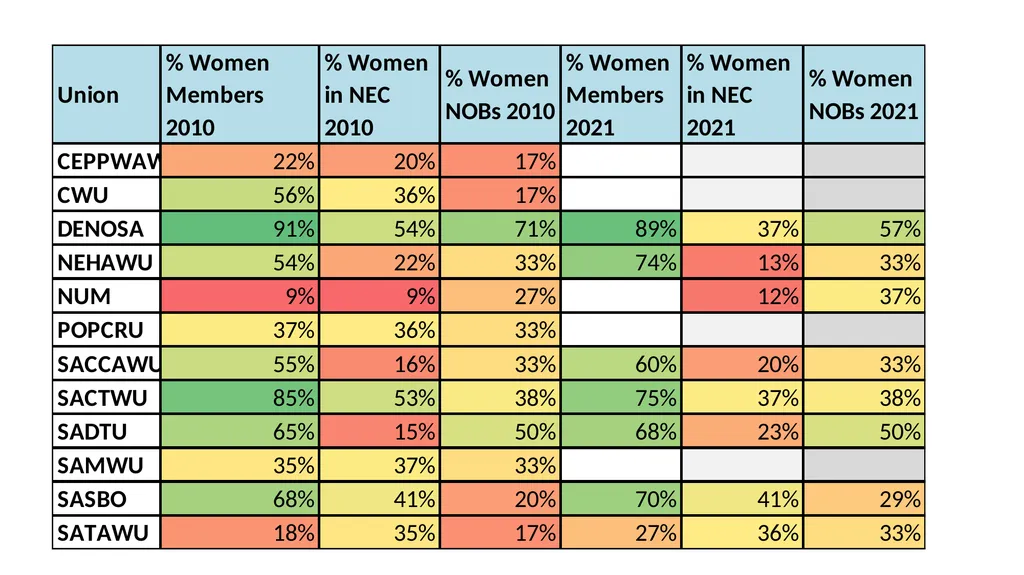
Women’s leadership statistics for COSATU provinces and Affiliates (current figures and comparisons between 2010 and 2021)
Summary of selected findings of the Survey of COSATU NGC Delegates<br>
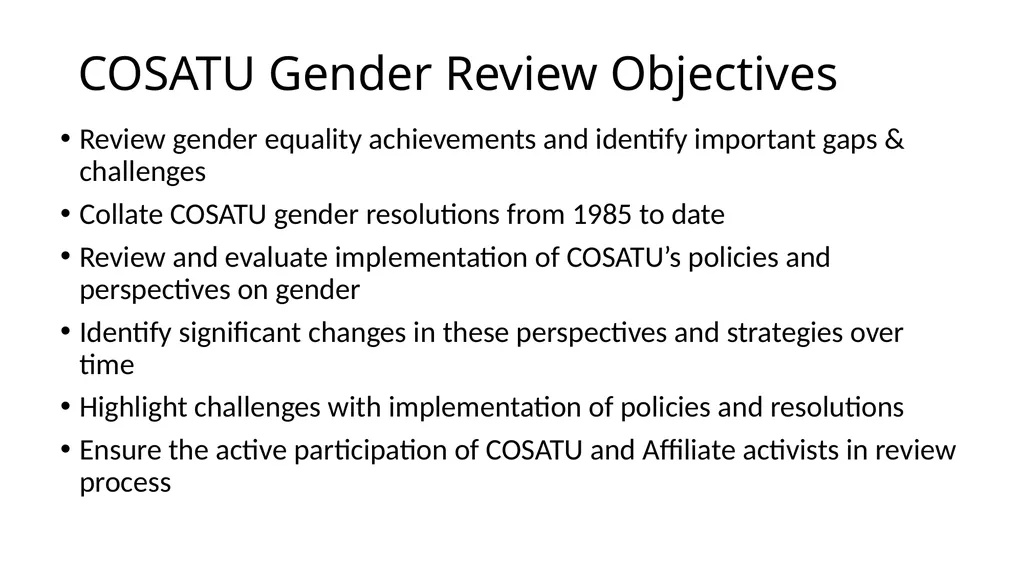
slide3. COSATU Gender Review Objectives Review gender equality achievements and identify important gaps & challenges
Collate COSATU gender resolutions from 1985 to date
Review and evaluate implementation of COSATU’s policies and perspectives on gender
Identify significant changes in these perspectives and strategies over time
Highlight challenges with implementation of policies and resolutions
Ensure the active participation of COSATU and Affiliate activists in review process<br>
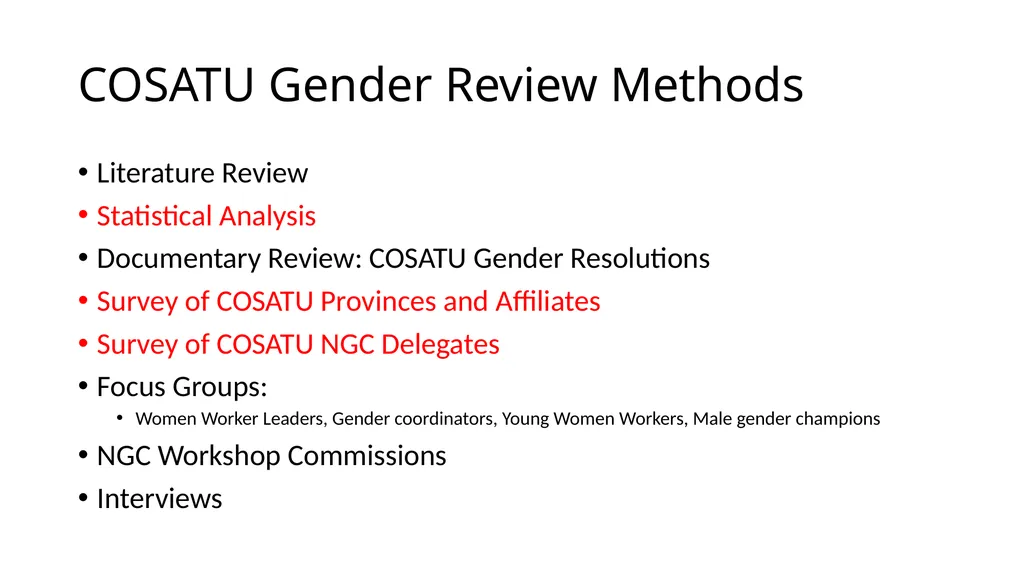
slide4. COSATU Gender Review Methods Literature Review
Statistical Analysis
Documentary Review: COSATU Gender Resolutions
Survey of COSATU Provinces and Affiliates
Survey of COSATU NGC Delegates
Focus Groups:
Women Worker Leaders, Gender coordinators, Young Women Workers, Male gender champions
NGC Workshop Commissions
Interviews<br>
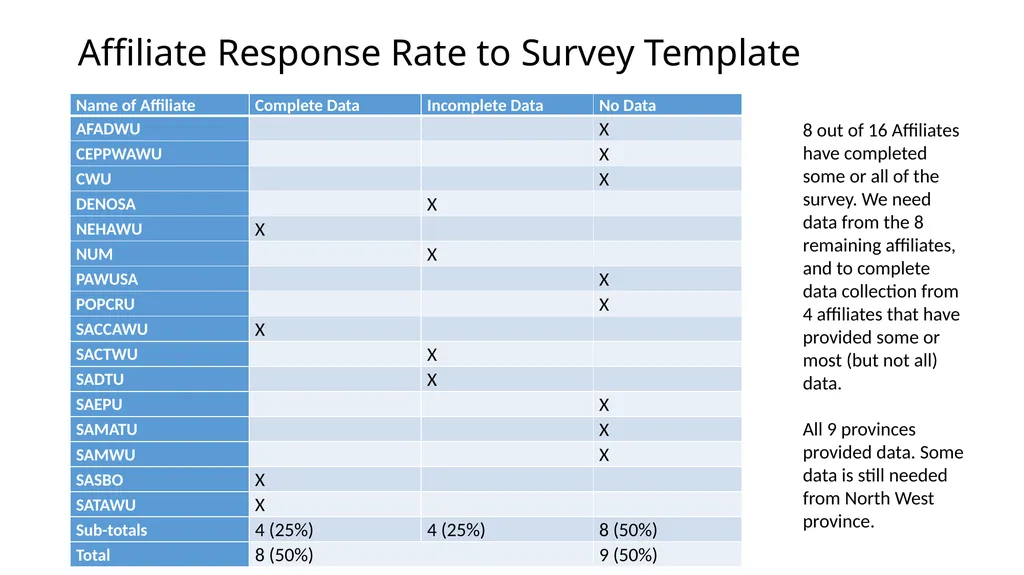
slide5. Affiliate Response Rate to Survey Template 8 out of 16 Affiliates have completed some or all of the survey. We need data from the 8 remaining affiliates, and to complete data collection from 4 affiliates that have provided some or most (but not all) data.
All 9 provinces provided data. Some data is still needed from North West province.<br>
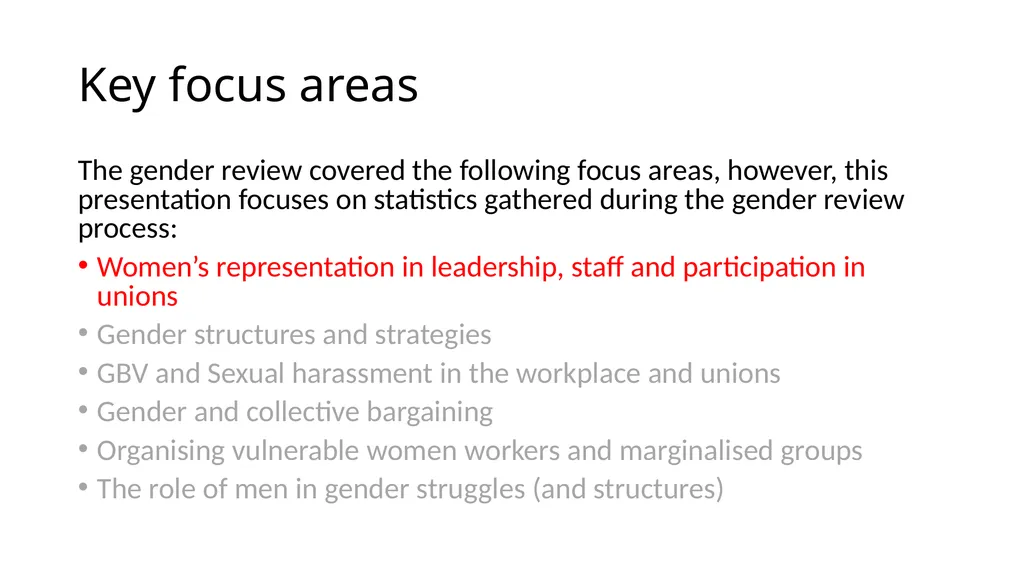
slide6. Key focus areas The gender review covered the following focus areas, however, this presentation focuses on statistics gathered during the gender review process:
Women’s representation in leadership, staff and participation in unions
Gender structures and strategies
GBV and Sexual harassment in the workplace and unions
Gender and collective bargaining
Organising vulnerable women workers and marginalised groups
The role of men in gender struggles (and structures)<br>
slide7. Brief Statistical Analysis of Gender and Employment 1985-2021<br>
slide8. Women per 100 men in main labour market indicators shows the number of women per 100 men across different labour market indicators. For instance there were 53 women employed to every 100 men in 1985 and by Q2 2021 this has risen to 77 women for every 100 men.
The general lowering of the number of women to men in categories other than employment does suggest a general improvement in equity between sexes however more specific investigations of the nature of employment and unemployment underline that inequality remains ingrained in the labour market.<br>
slide9. Youth unemployment<br>
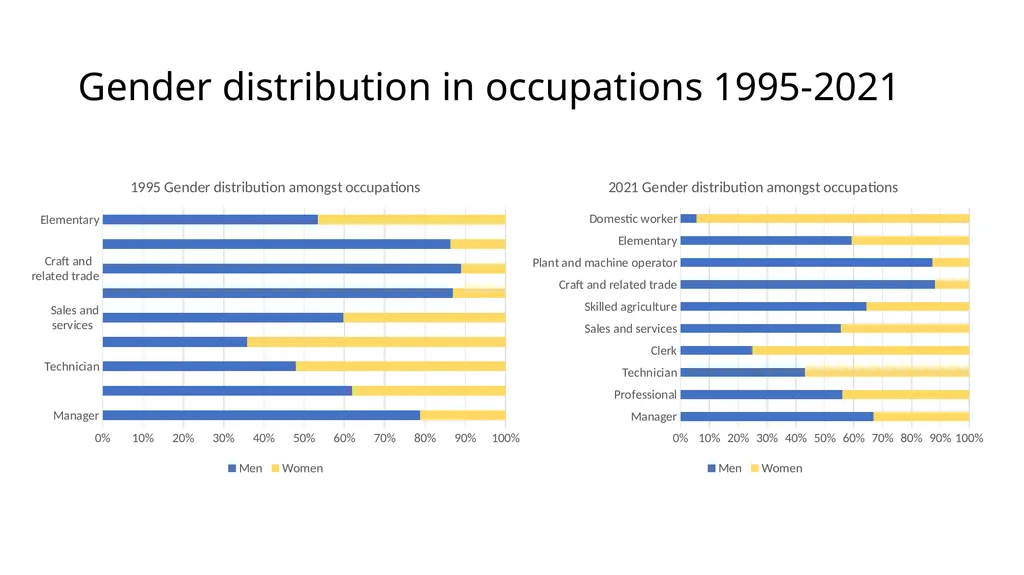
slide10. Gender distribution in occupations 1995-2021<br>
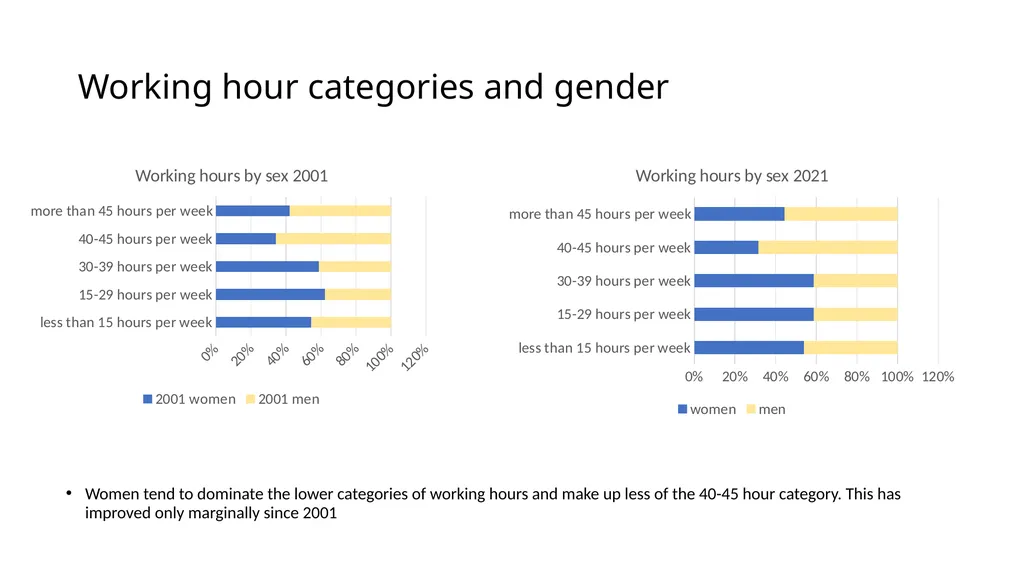
slide11. Working hour categories and gender Women tend to dominate the lower categories of working hours and make up less of the 40-45 hour category. This has improved only marginally since 2001<br>
slide12. Women's earnings as a % of men's earnings 1994-2019<br>
slide13. Female and male union density (% of employed women and % of employed men that are union members)<br>
slide14. Women as a proportion of workers and members 1998-2021 compared in COSATU organising areas<br>
slide15. Women in employment and unions The slide above shows the proportionality of women in employment and membership in industries grouped by Union scope. The proportion of membership is for all unions not just COSATU
There are relatively small changes in overall employment in most industries and where there are large changes such as in mining and construction these industries are nominally still small employers of women. Government administration and local authority employment however reflect large proportional and nominal changes. In most areas gender composition of membership matches or exceeds employment composition proportional changes with the exception of agriculture and construction.<br>
slide16. Union density for women and men 2001-2021 The new Labour force Survey was instituted in 2000 and extended the focus sampling and questionnaire from the October Household surveys.
Trade union density amongst employed women rose from 27,1% in 2001 to 28,2% by the Q3 2019 and then to 31,5% in Q2 2021. The last increase is due to the number of nonunion women losing work during the pandemic. For men there was a decline from 35,6% to 30,3% in the same period. This reflected an overall decline in union density over the period that can largely be attributed to rising proportions of more vulnerably employed workers during this time. Again an uptick in density to 34,4% is pandemic related to nonunionized workers relatively larger job losses than for unionized workers concentrated in permanent jobs.
A closing of the gap does suggest some progress in terms of organising amongst women workers<br>
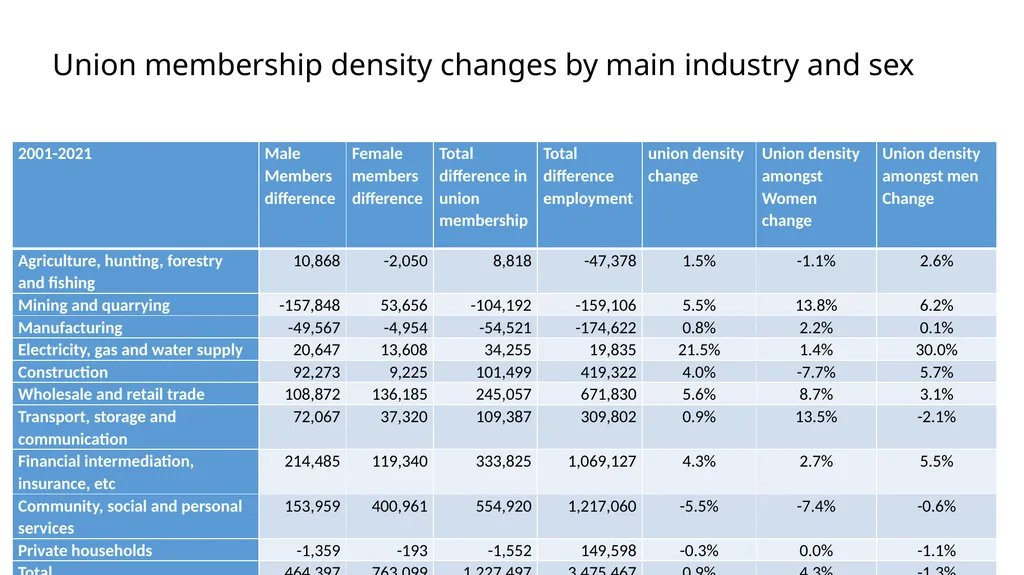
slide17. Union membership density changes by main industry and sex<br>
slide18. In the 20 year period the number of workers employed across different formal industries increased by approximately 3,5 million employees or a 38% increase and union membership increased by 1,2 million members leading to a rise in union density of 0.9%. Density amongst women members increased by 4,3% while men declined by 1.3%.
The most significant growth in union membership, nominally was amongst women during the 20 years from 2001 to 2021. Union membership grew by 42% over the period. Of the total growth in membership women made up 62%. This should be significant when assessing the change in representational presence of women in trade unions
Most of the growth of women membership was in the community and social services industry, which is mostly government. Despite the number of women members increasing by over 400 000 in this sector, the density amongst female workers in fact declined by 7.4% which relates to the number of women increasing substantially as a proportion of workers in the industry.
More than half of the women’s membership growth is accounted for by the government sector. Union membership density changes by main industry and sex<br>
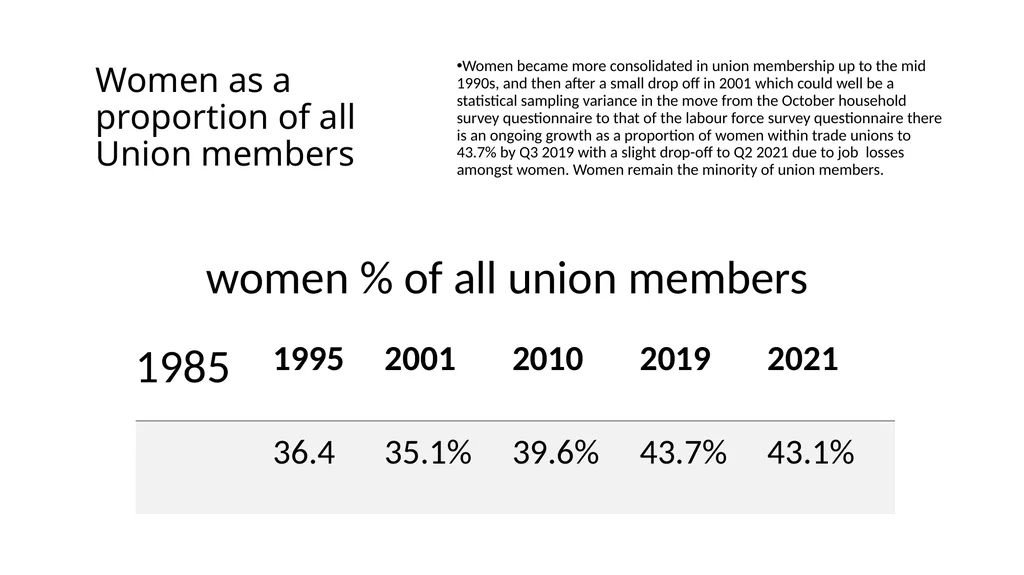
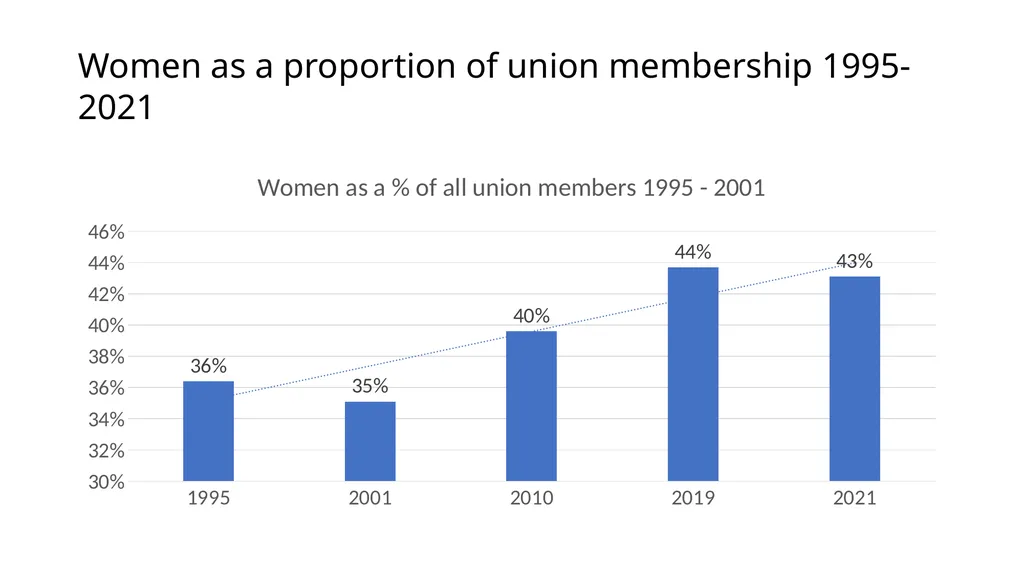
slide19. Women as a proportion of all Union members Women became more consolidated in union membership up to the mid 1990s, and then after a small drop off in 2001 which could well be a statistical sampling variance in the move from the October household survey questionnaire to that of the labour force survey questionnaire there is an ongoing growth as a proportion of women within trade unions to 43.7% by Q3 2019 with a slight drop-off to Q2 2021 due to job losses amongst women. Women remain the minority of union members. Women as a % of all union members 1985-2021<br>
slide20. Women as a proportion of union membership 1995-2021<br>
slide21. Women union density and proportion of employment 2001-2021<br>
slide22. Work status sex and union membership 2001-2021<br>
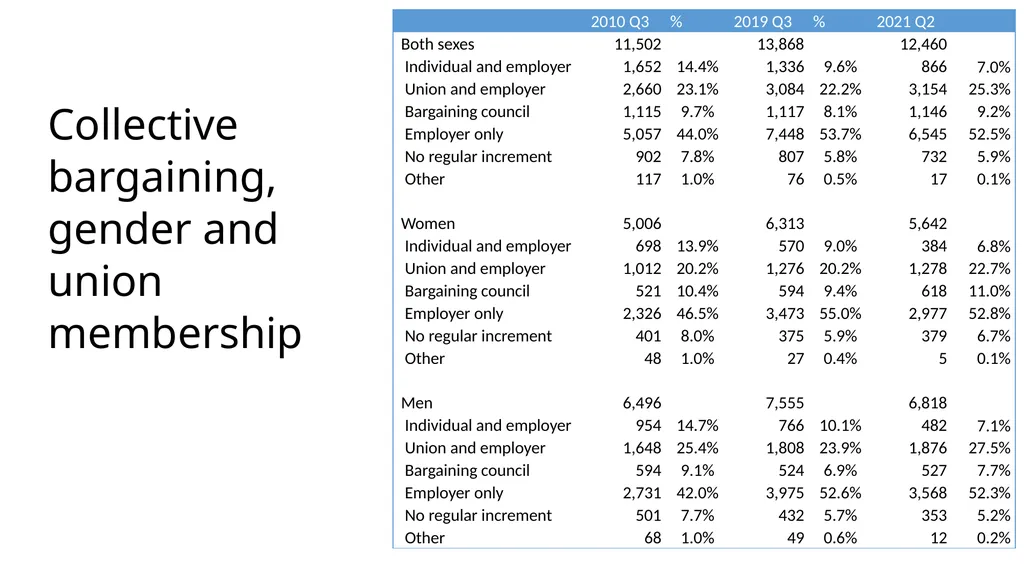
slide23. Collective bargaining, gender and union membership<br>
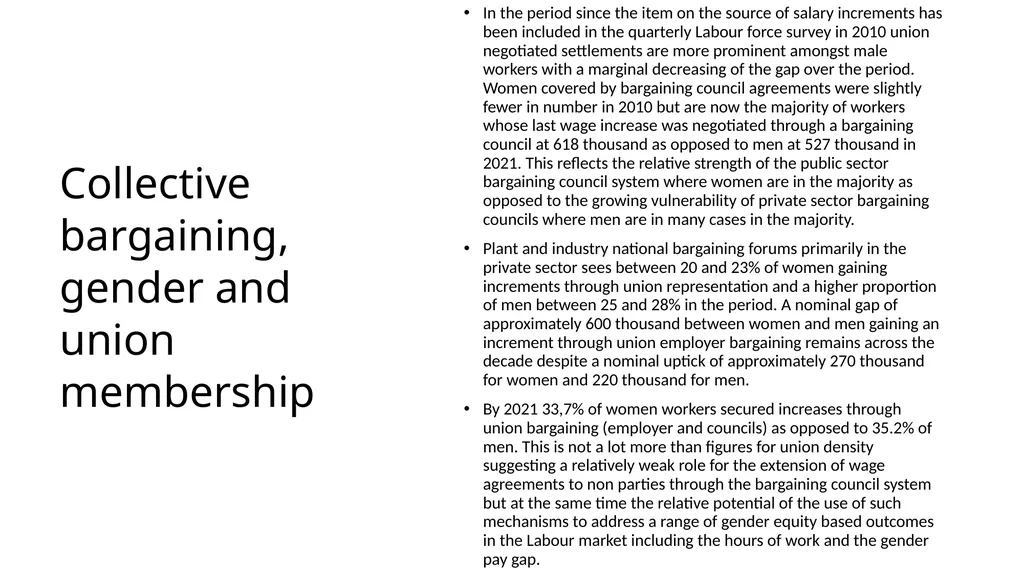
slide24. Collective bargaining, gender and union membership In the period since the item on the source of salary increments has been included in the quarterly Labour force survey in 2010 union negotiated settlements are more prominent amongst male workers with a marginal decreasing of the gap over the period. Women covered by bargaining council agreements were slightly fewer in number in 2010 but are now the majority of workers whose last wage increase was negotiated through a bargaining council at 618 thousand as opposed to men at 527 thousand in 2021. This reflects the relative strength of the public sector bargaining council system where women are in the majority as opposed to the growing vulnerability of private sector bargaining councils where men are in many cases in the majority.
Plant and industry national bargaining forums primarily in the private sector sees between 20 and 23% of women gaining increments through union representation and a higher proportion of men between 25 and 28% in the period. A nominal gap of approximately 600 thousand between women and men gaining an increment through union employer bargaining remains across the decade despite a nominal uptick of approximately 270 thousand for women and 220 thousand for men.
By 2021 33,7% of women workers secured increases through union bargaining (employer and councils) as opposed to 35.2% of men. This is not a lot more than figures for union density suggesting a relatively weak role for the extension of wage agreements to non parties through the bargaining council system but at the same time the relative potential of the use of such mechanisms to address a range of gender equity based outcomes in the Labour market including the hours of work and the gender pay gap.<br>
slide25. Non-wage conditions of employment 2001-2021<br>
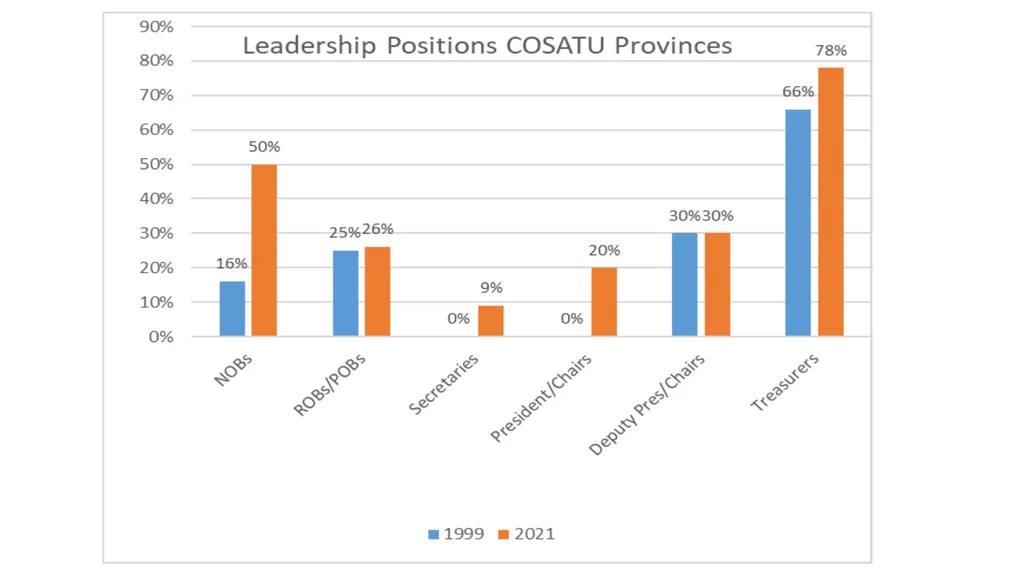
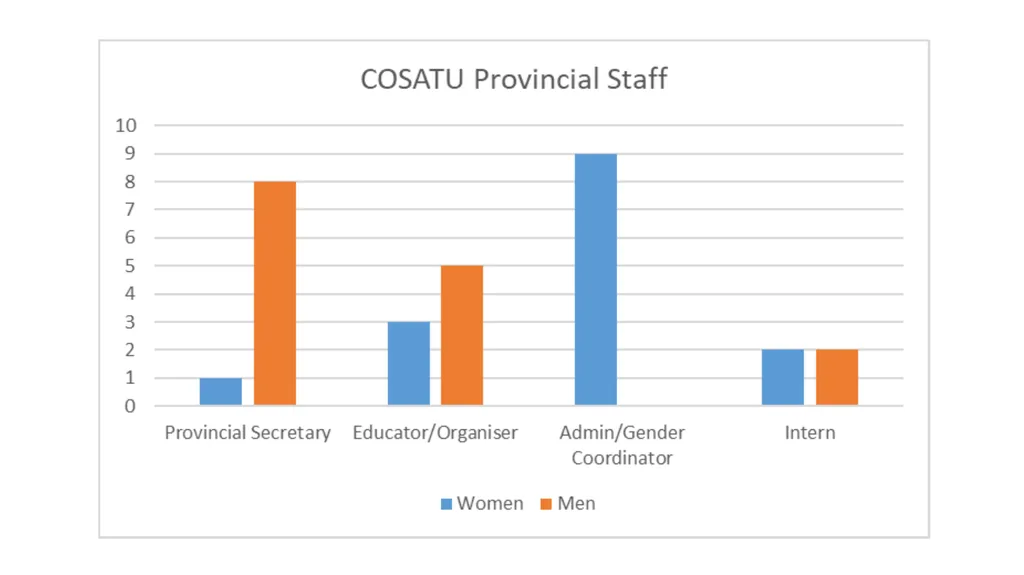
slide26. COSATU Women’s Leadership Survey of COSATU Affiliates and Provinces<br>
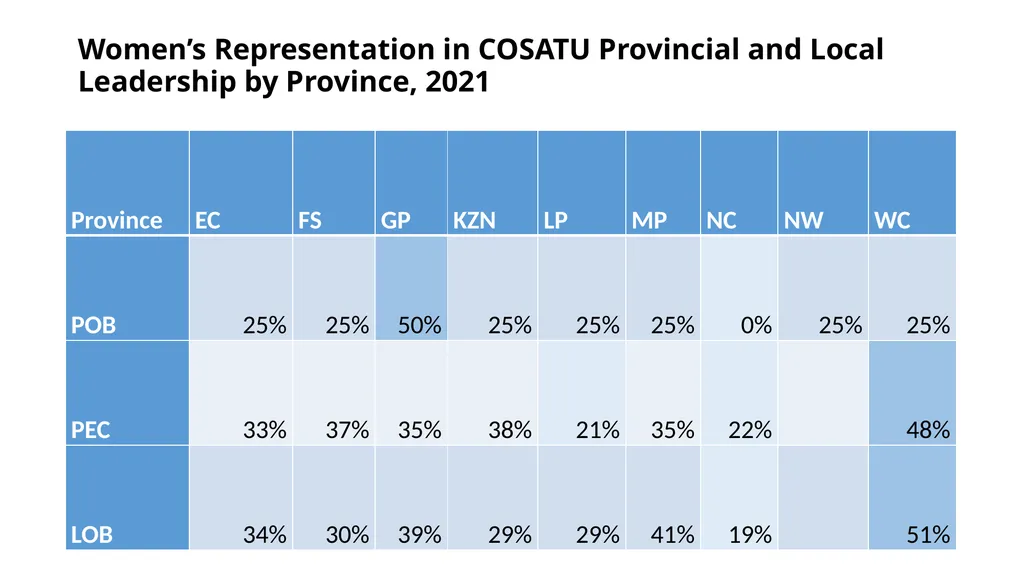
slide29. Women’s Representation in COSATU Provincial and Local Leadership by Province, 2021<br>
slide31. Women Organisers – local to provincial level<br>
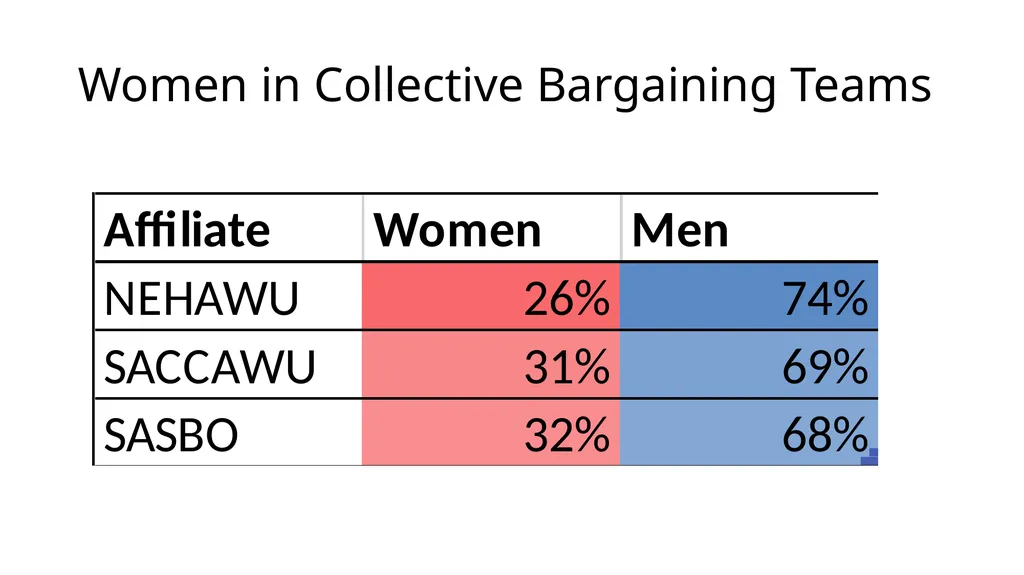
slide32. Women in Collective Bargaining Teams<br>
slide33. Selected Findings: Survey of COSATU National Gender Committee Delegates October 2021<br>
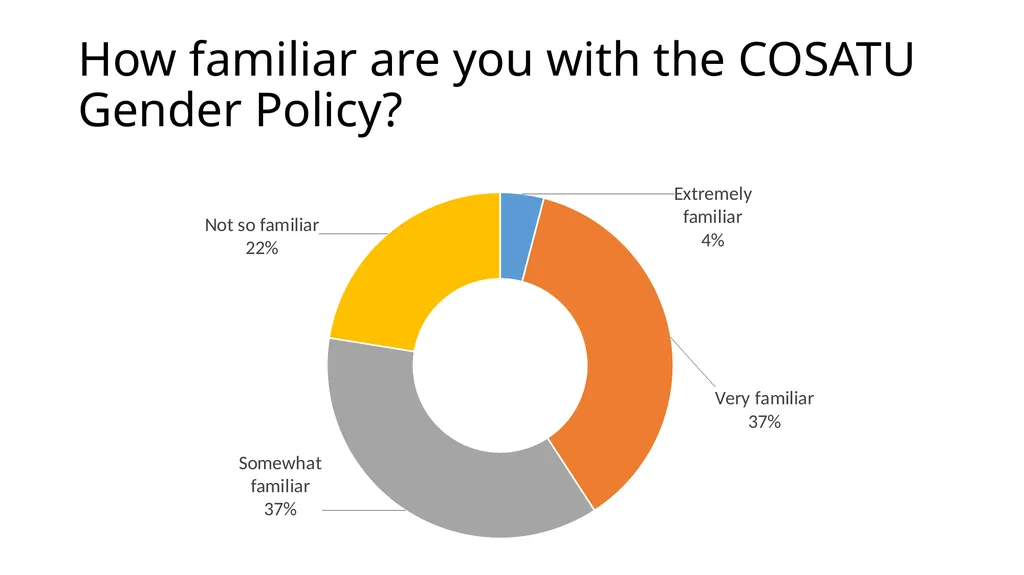
slide34. How familiar are you with the COSATU Gender Policy?<br>
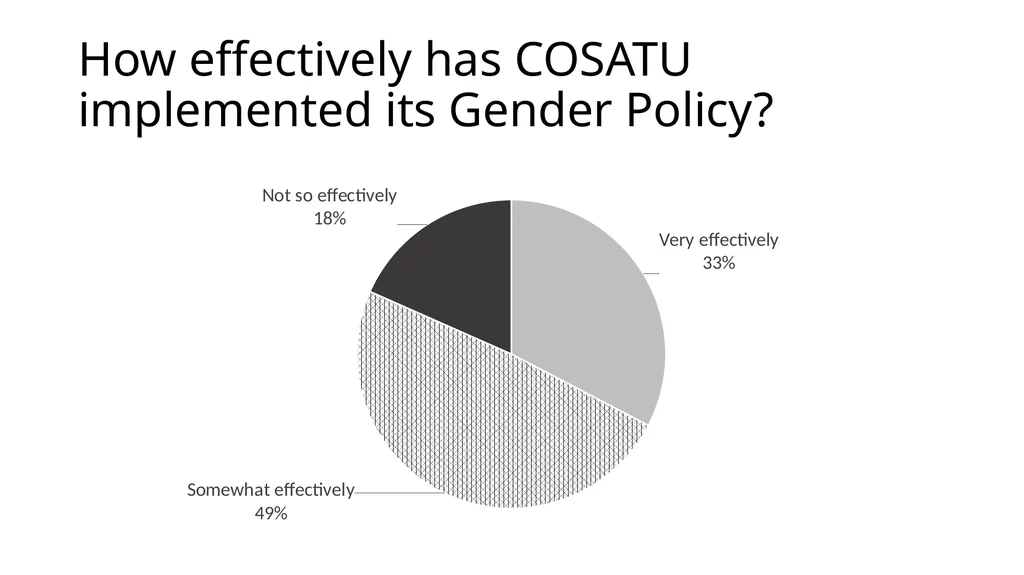
slide35. How effectively has COSATU implemented its Gender Policy?<br>
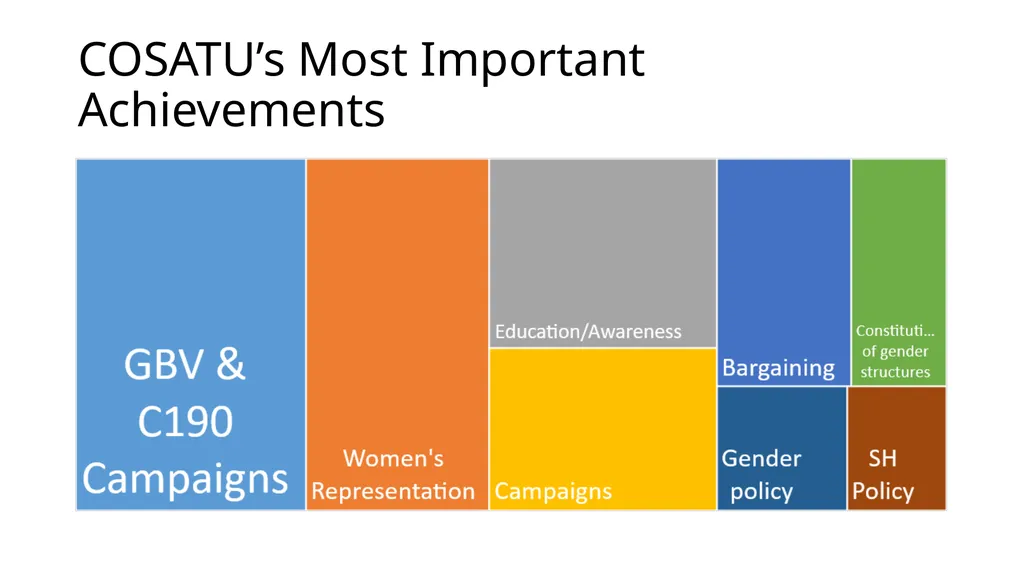
slide36. COSATU’s Most Important Achievements<br>
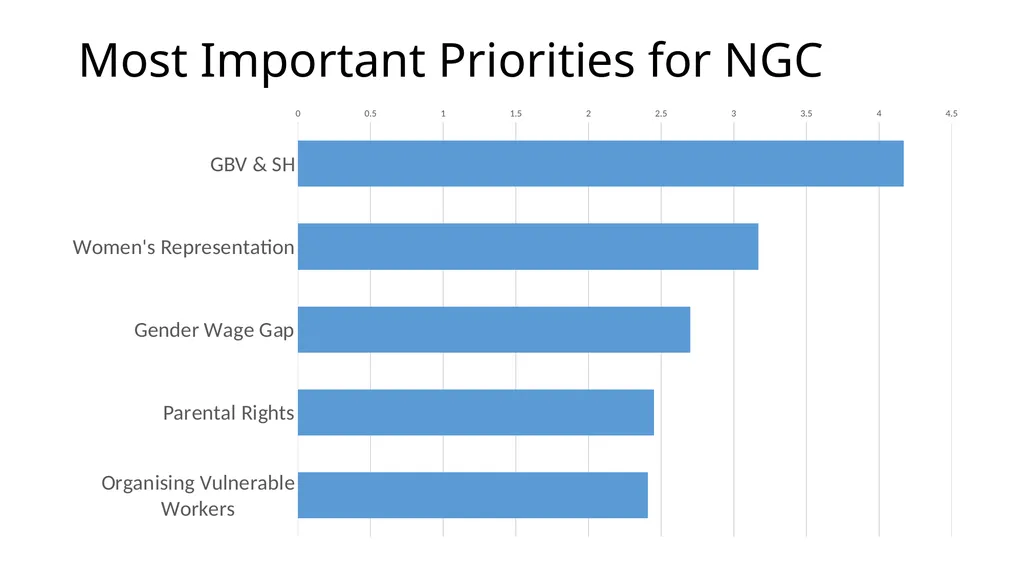
slide37. Most Important Priorities for NGC<br>
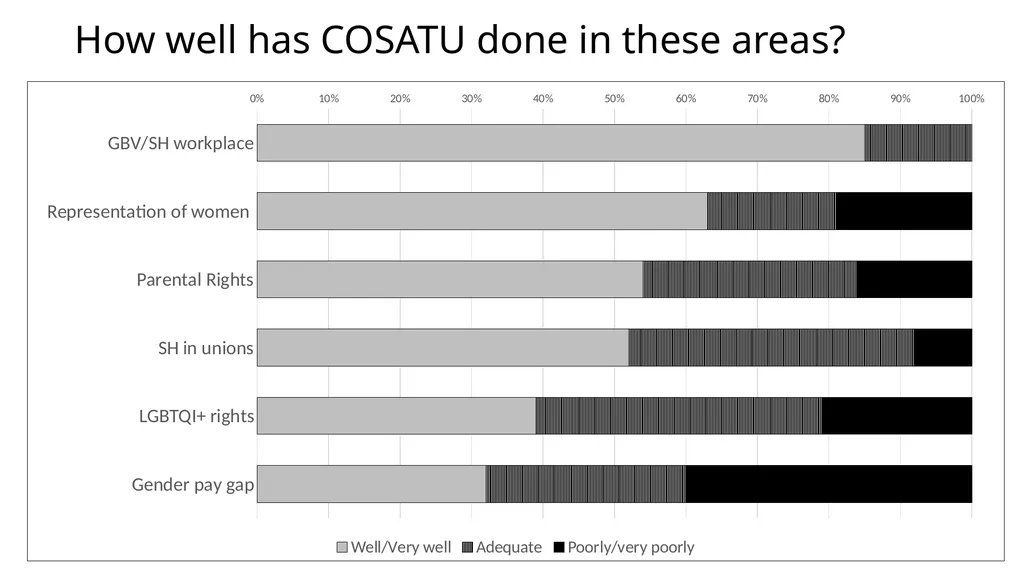
slide38. How well has COSATU done in these areas?<br>
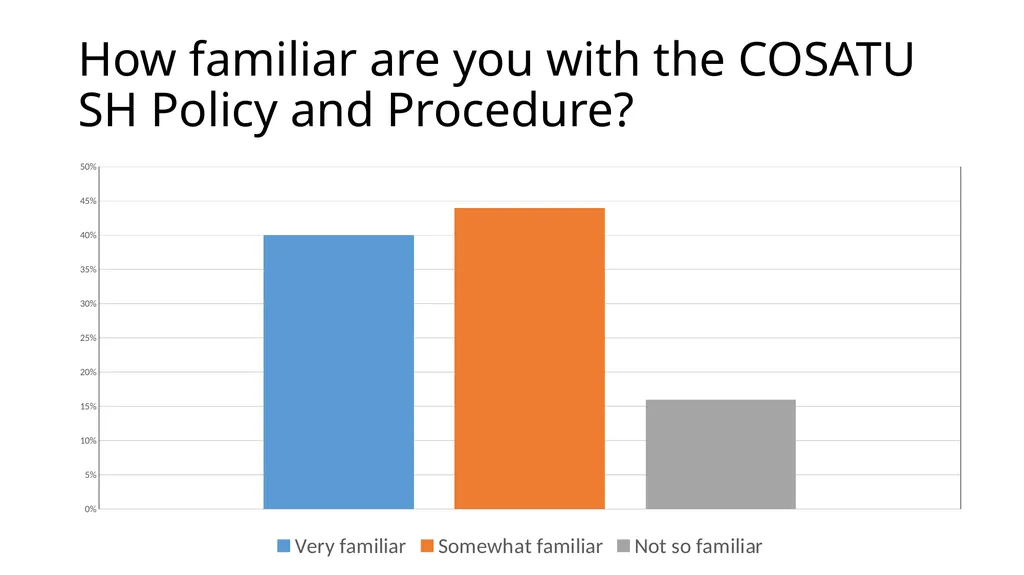
slide39. How familiar are you with the COSATU SH Policy and Procedure?<br>
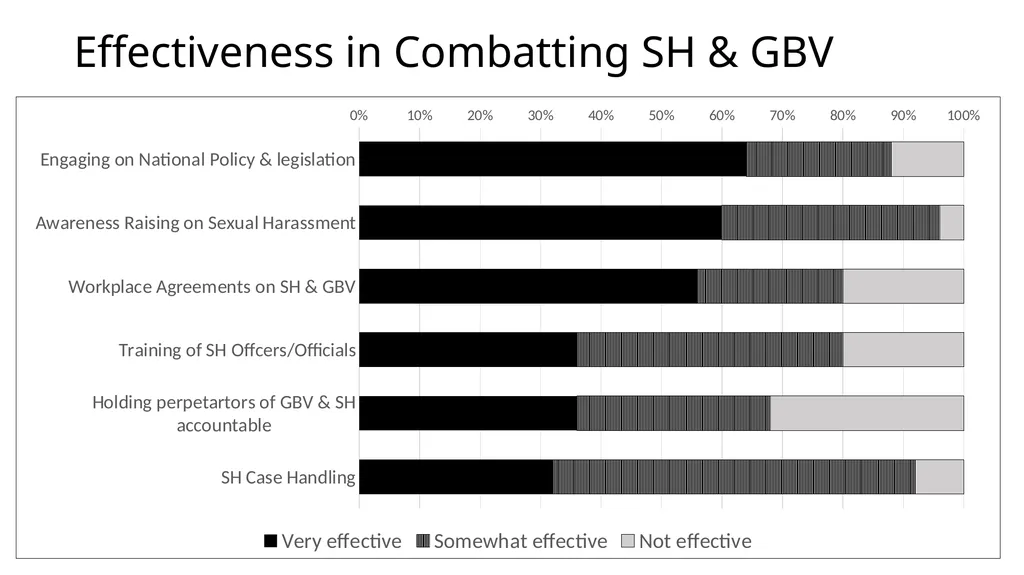
slide40. Effectiveness in Combatting SH & GBV<br>
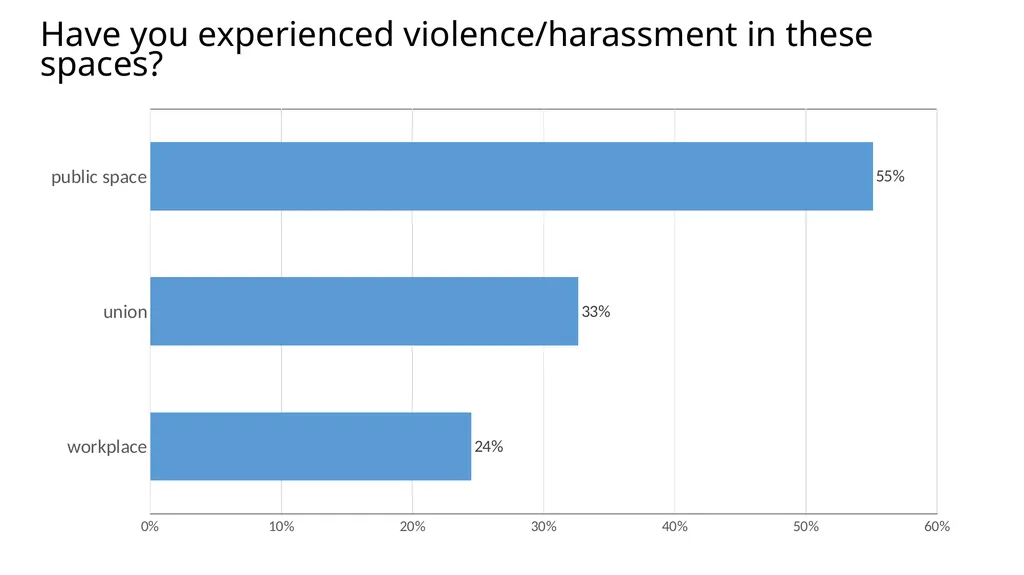
slide41. Have you experienced violence/harassment in these spaces?<br>
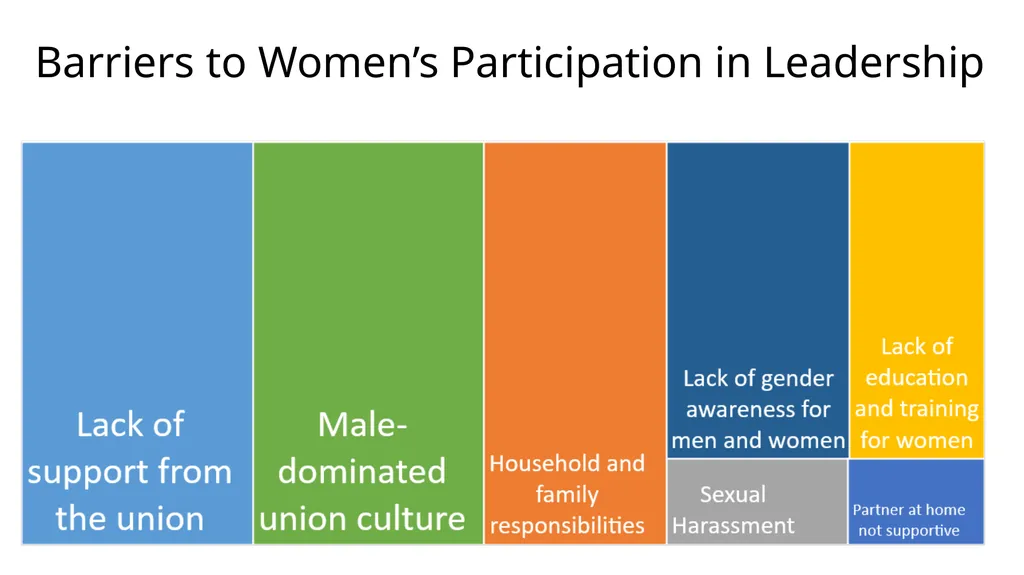
slide42. Barriers to Women’s Participation in Leadership<br>
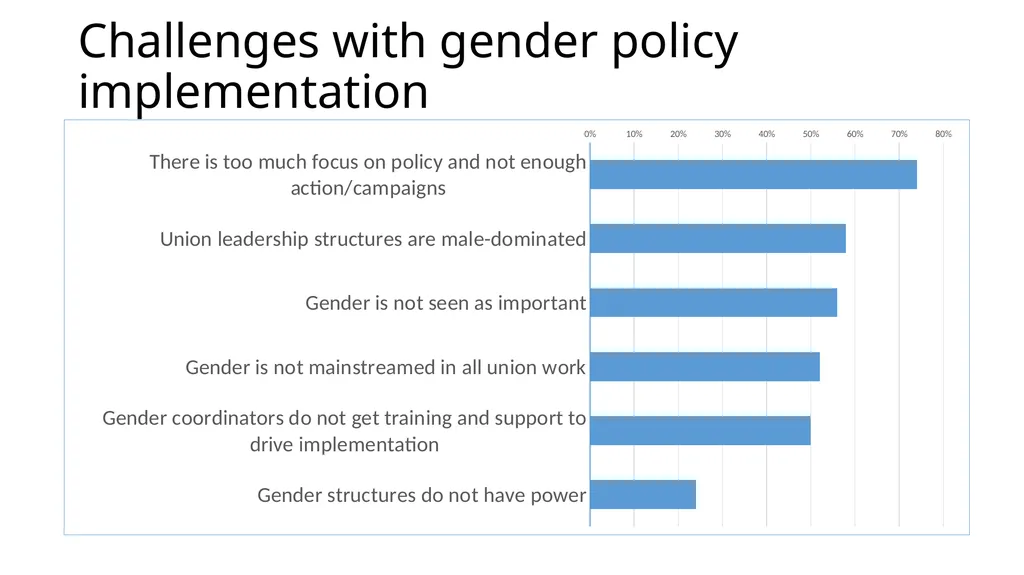
slide43. Challenges with gender policy implementation<br>
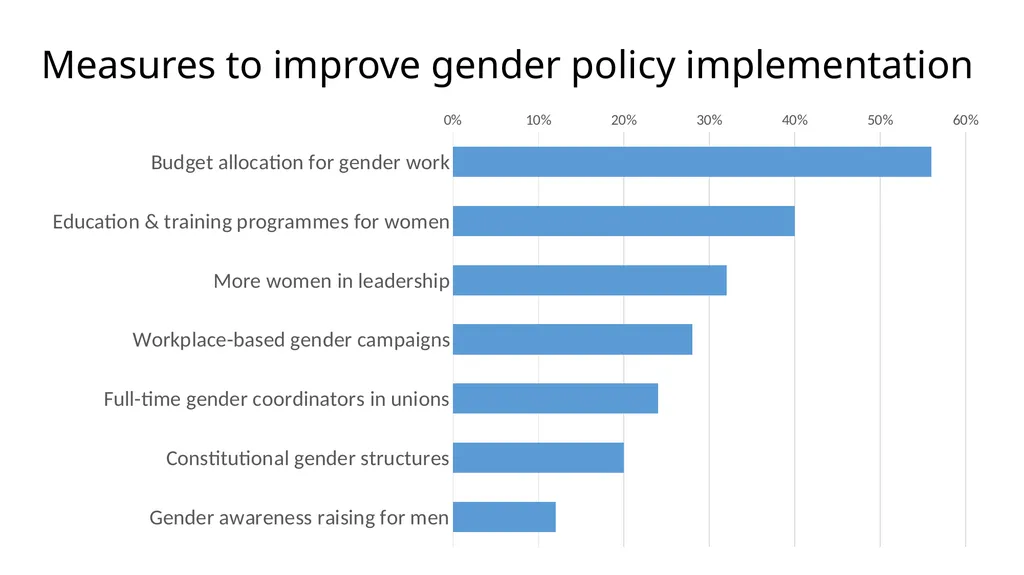
slide44. Measures to improve gender policy implementation<br>
slide45. Building Women’s participation and representation in unions Key overall strategies to enhance women’s participation and representation include the following:
Organising women workers to increase women’s trade union membership
Increasing women’s participation at all levels of the union from organising women workers, to election of women shop stewards to electing women local, provincial and national levels
Creating specific structures for women, to promote gender activism and ensure the mainstreaming of gender
COSATU has implemented all of these strategies with significant advances, however gender inequalities remain pervasive in employment, pay and leadership, as well as unrelenting sexual harassment and gender-based violence.
“The advancement of the demand for increased representation of women in leadership without corresponding organisational change often leads to the inclusion of women in unchanged structures.”<br>
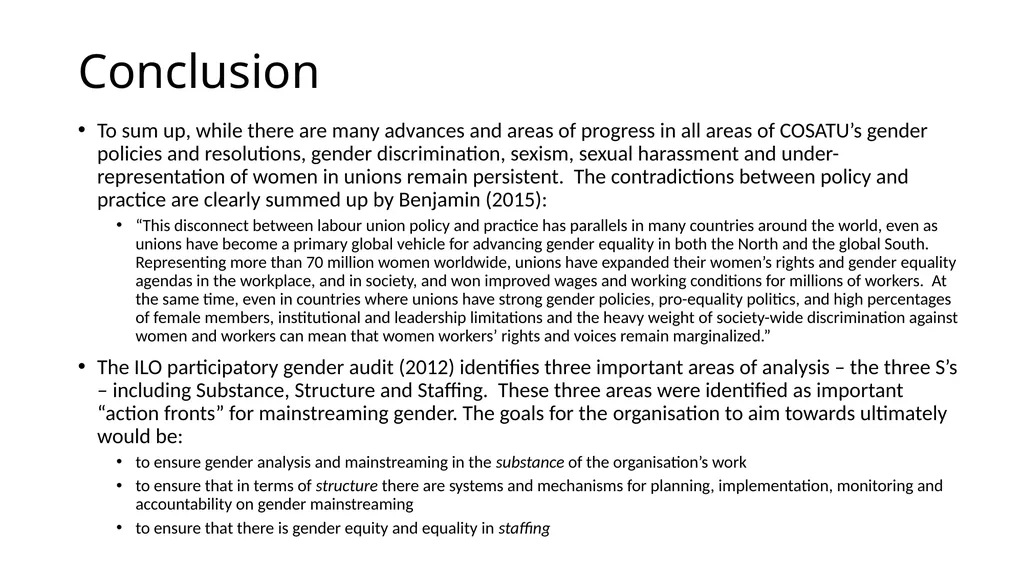
slide46. Conclusion To sum up, while there are many advances and areas of progress in all areas of COSATU’s gender policies and resolutions, gender discrimination, sexism, sexual harassment and under-representation of women in unions remain persistent. The contradictions between policy and practice are clearly summed up by Benjamin (2015):
“This disconnect between labour union policy and practice has parallels in many countries around the world, even as unions have become a primary global vehicle for advancing gender equality in both the North and the global South. Representing more than 70 million women worldwide, unions have expanded their women’s rights and gender equality agendas in the workplace, and in society, and won improved wages and working conditions for millions of workers. At the same time, even in countries where unions have strong gender policies, pro-equality politics, and high percentages of female members, institutional and leadership limitations and the heavy weight of society-wide discrimination against women and workers can mean that women workers’ rights and voices remain marginalized.”
The ILO participatory gender audit (2012) identifies three important areas of analysis – the three S’s – including Substance, Structure and Staffing. These three areas were identified as important “action fronts” for mainstreaming gender. The goals for the organisation to aim towards ultimately would be:
to ensure gender analysis and mainstreaming in the substance of the organisation’s work
to ensure that in terms of structure there are systems and mechanisms for planning, implementation, monitoring and accountability on gender mainstreaming
to ensure that there is gender equity and equality in staffing<br>
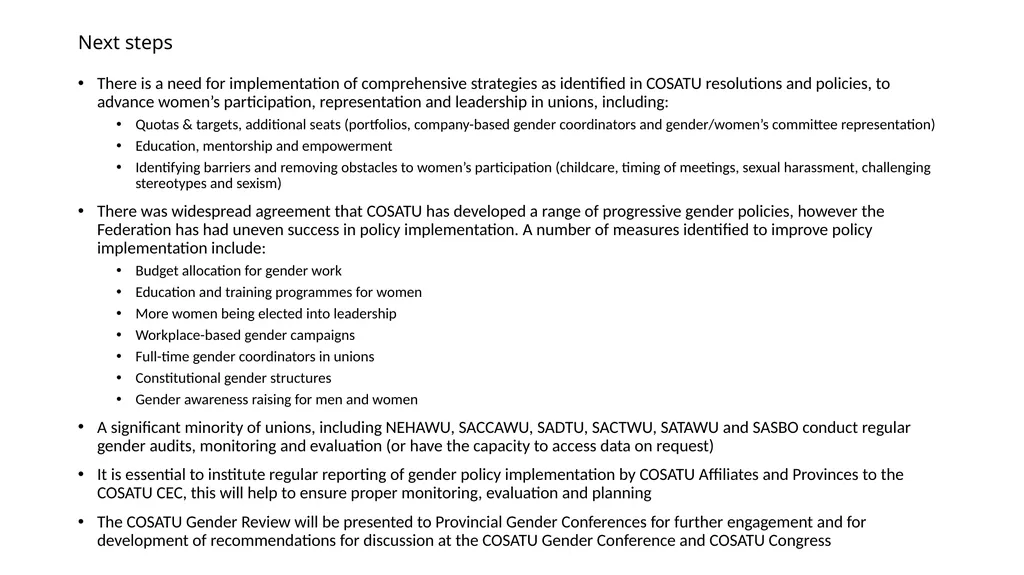
slide47. Next steps There is a need for implementation of comprehensive strategies as identified in COSATU resolutions and policies, to advance women’s participation, representation and leadership in unions, including:
Quotas & targets, additional seats (portfolios, company-based gender coordinators and gender/women’s committee representation)
Education, mentorship and empowerment
Identifying barriers and removing obstacles to women’s participation (childcare, timing of meetings, sexual harassment, challenging stereotypes and sexism)
There was widespread agreement that COSATU has developed a range of progressive gender policies, however the Federation has had uneven success in policy implementation. A number of measures identified to improve policy implementation include:
Budget allocation for gender work
Education and training programmes for women
More women being elected into leadership
Workplace-based gender campaigns
Full-time gender coordinators in unions
Constitutional gender structures
Gender awareness raising for men and women
A significant minority of unions, including NEHAWU, SACCAWU, SADTU, SACTWU, SATAWU and SASBO conduct regular gender audits, monitoring and evaluation (or have the capacity to access data on request)
It is essential to institute regular reporting of gender policy implementation by COSATU Affiliates and Provinces to the COSATU CEC, this will help to ensure proper monitoring, evaluation and planning
The COSATU Gender Review will be presented to Provincial Gender Conferences for further engagement and for development of recommendations for discussion at the COSATU Gender Conference and COSATU Congress<br>
slide2. Overview of Presentation Introduction: COSATU Gender Review objectives, methods and key focus areas
Outstanding data needed for completion
This presentation focuses on the statistical aspects of the gender review report including data from Statistics South Africa, Survey of COSATU Affiliates and Provinces and Survey of NGC Delegates
Statistical Analysis of gender and employment 1985-2021 (selected findings)
Women’s leadership statistics for COSATU provinces and Affiliates (current figures and comparisons between 2010 and 2021)
Summary of selected findings of the Survey of COSATU NGC Delegates<br>
slide3. COSATU Gender Review Objectives Review gender equality achievements and identify important gaps & challenges
Collate COSATU gender resolutions from 1985 to date
Review and evaluate implementation of COSATU’s policies and perspectives on gender
Identify significant changes in these perspectives and strategies over time
Highlight challenges with implementation of policies and resolutions
Ensure the active participation of COSATU and Affiliate activists in review process<br>
slide4. COSATU Gender Review Methods Literature Review
Statistical Analysis
Documentary Review: COSATU Gender Resolutions
Survey of COSATU Provinces and Affiliates
Survey of COSATU NGC Delegates
Focus Groups:
Women Worker Leaders, Gender coordinators, Young Women Workers, Male gender champions
NGC Workshop Commissions
Interviews<br>
slide5. Affiliate Response Rate to Survey Template 8 out of 16 Affiliates have completed some or all of the survey. We need data from the 8 remaining affiliates, and to complete data collection from 4 affiliates that have provided some or most (but not all) data.
All 9 provinces provided data. Some data is still needed from North West province.<br>
slide6. Key focus areas The gender review covered the following focus areas, however, this presentation focuses on statistics gathered during the gender review process:
Women’s representation in leadership, staff and participation in unions
Gender structures and strategies
GBV and Sexual harassment in the workplace and unions
Gender and collective bargaining
Organising vulnerable women workers and marginalised groups
The role of men in gender struggles (and structures)<br>
slide7. Brief Statistical Analysis of Gender and Employment 1985-2021<br>
slide8. Women per 100 men in main labour market indicators shows the number of women per 100 men across different labour market indicators. For instance there were 53 women employed to every 100 men in 1985 and by Q2 2021 this has risen to 77 women for every 100 men.
The general lowering of the number of women to men in categories other than employment does suggest a general improvement in equity between sexes however more specific investigations of the nature of employment and unemployment underline that inequality remains ingrained in the labour market.<br>
slide9. Youth unemployment<br>
slide10. Gender distribution in occupations 1995-2021<br>
slide11. Working hour categories and gender Women tend to dominate the lower categories of working hours and make up less of the 40-45 hour category. This has improved only marginally since 2001<br>
slide12. Women's earnings as a % of men's earnings 1994-2019<br>
slide13. Female and male union density (% of employed women and % of employed men that are union members)<br>
slide14. Women as a proportion of workers and members 1998-2021 compared in COSATU organising areas<br>
slide15. Women in employment and unions The slide above shows the proportionality of women in employment and membership in industries grouped by Union scope. The proportion of membership is for all unions not just COSATU
There are relatively small changes in overall employment in most industries and where there are large changes such as in mining and construction these industries are nominally still small employers of women. Government administration and local authority employment however reflect large proportional and nominal changes. In most areas gender composition of membership matches or exceeds employment composition proportional changes with the exception of agriculture and construction.<br>
slide16. Union density for women and men 2001-2021 The new Labour force Survey was instituted in 2000 and extended the focus sampling and questionnaire from the October Household surveys.
Trade union density amongst employed women rose from 27,1% in 2001 to 28,2% by the Q3 2019 and then to 31,5% in Q2 2021. The last increase is due to the number of nonunion women losing work during the pandemic. For men there was a decline from 35,6% to 30,3% in the same period. This reflected an overall decline in union density over the period that can largely be attributed to rising proportions of more vulnerably employed workers during this time. Again an uptick in density to 34,4% is pandemic related to nonunionized workers relatively larger job losses than for unionized workers concentrated in permanent jobs.
A closing of the gap does suggest some progress in terms of organising amongst women workers<br>
slide17. Union membership density changes by main industry and sex<br>
slide18. In the 20 year period the number of workers employed across different formal industries increased by approximately 3,5 million employees or a 38% increase and union membership increased by 1,2 million members leading to a rise in union density of 0.9%. Density amongst women members increased by 4,3% while men declined by 1.3%.
The most significant growth in union membership, nominally was amongst women during the 20 years from 2001 to 2021. Union membership grew by 42% over the period. Of the total growth in membership women made up 62%. This should be significant when assessing the change in representational presence of women in trade unions
Most of the growth of women membership was in the community and social services industry, which is mostly government. Despite the number of women members increasing by over 400 000 in this sector, the density amongst female workers in fact declined by 7.4% which relates to the number of women increasing substantially as a proportion of workers in the industry.
More than half of the women’s membership growth is accounted for by the government sector. Union membership density changes by main industry and sex<br>
slide19. Women as a proportion of all Union members Women became more consolidated in union membership up to the mid 1990s, and then after a small drop off in 2001 which could well be a statistical sampling variance in the move from the October household survey questionnaire to that of the labour force survey questionnaire there is an ongoing growth as a proportion of women within trade unions to 43.7% by Q3 2019 with a slight drop-off to Q2 2021 due to job losses amongst women. Women remain the minority of union members. Women as a % of all union members 1985-2021<br>
slide20. Women as a proportion of union membership 1995-2021<br>
slide21. Women union density and proportion of employment 2001-2021<br>
slide22. Work status sex and union membership 2001-2021<br>
slide23. Collective bargaining, gender and union membership<br>
slide24. Collective bargaining, gender and union membership In the period since the item on the source of salary increments has been included in the quarterly Labour force survey in 2010 union negotiated settlements are more prominent amongst male workers with a marginal decreasing of the gap over the period. Women covered by bargaining council agreements were slightly fewer in number in 2010 but are now the majority of workers whose last wage increase was negotiated through a bargaining council at 618 thousand as opposed to men at 527 thousand in 2021. This reflects the relative strength of the public sector bargaining council system where women are in the majority as opposed to the growing vulnerability of private sector bargaining councils where men are in many cases in the majority.
Plant and industry national bargaining forums primarily in the private sector sees between 20 and 23% of women gaining increments through union representation and a higher proportion of men between 25 and 28% in the period. A nominal gap of approximately 600 thousand between women and men gaining an increment through union employer bargaining remains across the decade despite a nominal uptick of approximately 270 thousand for women and 220 thousand for men.
By 2021 33,7% of women workers secured increases through union bargaining (employer and councils) as opposed to 35.2% of men. This is not a lot more than figures for union density suggesting a relatively weak role for the extension of wage agreements to non parties through the bargaining council system but at the same time the relative potential of the use of such mechanisms to address a range of gender equity based outcomes in the Labour market including the hours of work and the gender pay gap.<br>
slide25. Non-wage conditions of employment 2001-2021<br>
slide26. COSATU Women’s Leadership Survey of COSATU Affiliates and Provinces<br>
slide29. Women’s Representation in COSATU Provincial and Local Leadership by Province, 2021<br>
slide31. Women Organisers – local to provincial level<br>
slide32. Women in Collective Bargaining Teams<br>
slide33. Selected Findings: Survey of COSATU National Gender Committee Delegates October 2021<br>
slide34. How familiar are you with the COSATU Gender Policy?<br>
slide35. How effectively has COSATU implemented its Gender Policy?<br>
slide36. COSATU’s Most Important Achievements<br>
slide37. Most Important Priorities for NGC<br>
slide38. How well has COSATU done in these areas?<br>
slide39. How familiar are you with the COSATU SH Policy and Procedure?<br>
slide40. Effectiveness in Combatting SH & GBV<br>
slide41. Have you experienced violence/harassment in these spaces?<br>
slide42. Barriers to Women’s Participation in Leadership<br>
slide43. Challenges with gender policy implementation<br>
slide44. Measures to improve gender policy implementation<br>
slide45. Building Women’s participation and representation in unions Key overall strategies to enhance women’s participation and representation include the following:
Organising women workers to increase women’s trade union membership
Increasing women’s participation at all levels of the union from organising women workers, to election of women shop stewards to electing women local, provincial and national levels
Creating specific structures for women, to promote gender activism and ensure the mainstreaming of gender
COSATU has implemented all of these strategies with significant advances, however gender inequalities remain pervasive in employment, pay and leadership, as well as unrelenting sexual harassment and gender-based violence.
“The advancement of the demand for increased representation of women in leadership without corresponding organisational change often leads to the inclusion of women in unchanged structures.”<br>
slide46. Conclusion To sum up, while there are many advances and areas of progress in all areas of COSATU’s gender policies and resolutions, gender discrimination, sexism, sexual harassment and under-representation of women in unions remain persistent. The contradictions between policy and practice are clearly summed up by Benjamin (2015):
“This disconnect between labour union policy and practice has parallels in many countries around the world, even as unions have become a primary global vehicle for advancing gender equality in both the North and the global South. Representing more than 70 million women worldwide, unions have expanded their women’s rights and gender equality agendas in the workplace, and in society, and won improved wages and working conditions for millions of workers. At the same time, even in countries where unions have strong gender policies, pro-equality politics, and high percentages of female members, institutional and leadership limitations and the heavy weight of society-wide discrimination against women and workers can mean that women workers’ rights and voices remain marginalized.”
The ILO participatory gender audit (2012) identifies three important areas of analysis – the three S’s – including Substance, Structure and Staffing. These three areas were identified as important “action fronts” for mainstreaming gender. The goals for the organisation to aim towards ultimately would be:
to ensure gender analysis and mainstreaming in the substance of the organisation’s work
to ensure that in terms of structure there are systems and mechanisms for planning, implementation, monitoring and accountability on gender mainstreaming
to ensure that there is gender equity and equality in staffing<br>
slide47. Next steps There is a need for implementation of comprehensive strategies as identified in COSATU resolutions and policies, to advance women’s participation, representation and leadership in unions, including:
Quotas & targets, additional seats (portfolios, company-based gender coordinators and gender/women’s committee representation)
Education, mentorship and empowerment
Identifying barriers and removing obstacles to women’s participation (childcare, timing of meetings, sexual harassment, challenging stereotypes and sexism)
There was widespread agreement that COSATU has developed a range of progressive gender policies, however the Federation has had uneven success in policy implementation. A number of measures identified to improve policy implementation include:
Budget allocation for gender work
Education and training programmes for women
More women being elected into leadership
Workplace-based gender campaigns
Full-time gender coordinators in unions
Constitutional gender structures
Gender awareness raising for men and women
A significant minority of unions, including NEHAWU, SACCAWU, SADTU, SACTWU, SATAWU and SASBO conduct regular gender audits, monitoring and evaluation (or have the capacity to access data on request)
It is essential to institute regular reporting of gender policy implementation by COSATU Affiliates and Provinces to the COSATU CEC, this will help to ensure proper monitoring, evaluation and planning
The COSATU Gender Review will be presented to Provincial Gender Conferences for further engagement and for development of recommendations for discussion at the COSATU Gender Conference and COSATU Congress<br>