
Cost and Management Accounting N6
AS
Published · 31 slides · 0 views

1 / 1
Description
Cost and Management Accounting N6 www.futuremanagers.com INTRODUCTION Cost systems provide management with useful information to help with decision making. Managers are then able to more efficiently allocate resources and measure and
Related Topics
Share
Embed code
Download this presentation From Below
"Cost and Management Accounting N6" is the property of its rightful owner. Permission is granted to download and print the materials on this website for personal, non-commercial use only, and to display it on your personal computer provided you do not modify the materials and that you retain all copyright notices contained in the materials. By downloading content from our website, you accept the terms of this agreement.
Presentation Transcript
01
Cost and Management Accounting
N6<br>
N6<br>
02
www.futuremanagers.com INTRODUCTION
Cost systems provide management with useful information to help with decision making. Managers are then able to more efficiently allocate resources and measure and control operations. With good cost management systems in place, a company can become more profitable. Module 1 – Job costing<br>
Cost systems provide management with useful information to help with decision making. Managers are then able to more efficiently allocate resources and measure and control operations. With good cost management systems in place, a company can become more profitable. Module 1 – Job costing<br>
03
www.futuremanagers.com Module 1 – Job costing (continued) UNIT COST
Importance of unit cost:
To calculate a selling price after mark up.
To help management make decisions e.g. stop producing a certain line, initiate new products, accept or reject special orders.
To calculate the value of the unsold stock.<br>
Importance of unit cost:
To calculate a selling price after mark up.
To help management make decisions e.g. stop producing a certain line, initiate new products, accept or reject special orders.
To calculate the value of the unsold stock.<br>
04
www.futuremanagers.com Module 1 – Job costing (continued) COSTING SYSTEMS
A cost system is a specific method whereby costs for a product or a process are collected, edited and disclosed. Companies use either:
A process costing system;
A product costing system which is also called job-order costing; or
A combination of the two (called operation costing).<br>
A cost system is a specific method whereby costs for a product or a process are collected, edited and disclosed. Companies use either:
A process costing system;
A product costing system which is also called job-order costing; or
A combination of the two (called operation costing).<br>
05
www.futuremanagers.com Module 1 – Job costing (continued) RECORDING TRANSACTIONS
All costs related to a job must be recorded on a job cost sheet, which can be on paper or in electronic form. On the job cost sheet the direct material, labour costs and the overhead costs will be recorded. The job cost sheets may differ from business to business, to suit their own requirements.<br>
All costs related to a job must be recorded on a job cost sheet, which can be on paper or in electronic form. On the job cost sheet the direct material, labour costs and the overhead costs will be recorded. The job cost sheets may differ from business to business, to suit their own requirements.<br>
06
www.futuremanagers.com Module 1 – Job costing (continued) JOB COSTING STATEMENT
A job costing statement is a summary of all the production costs of a job (it can also show an amount for sales and marketing costs.) If the job is completed it includes the selling price and the profit on the job.<br>
A job costing statement is a summary of all the production costs of a job (it can also show an amount for sales and marketing costs.) If the job is completed it includes the selling price and the profit on the job.<br>
07
www.futuremanagers.com Module 1 – Job costing (continued) JOB ORDER COSTING IN SERVICE BUSINESSES
Job order costing can be used in both manufacturing and service businesses. In service businesses where jobs differ from one another and there is a need for cost information for separate jobs, several varieties of job order costing are used. These could be in industries such as laundries, tailors, garden services, repairs as well as professional services such as legal,
accounting, architectural and consulting services.<br>
Job order costing can be used in both manufacturing and service businesses. In service businesses where jobs differ from one another and there is a need for cost information for separate jobs, several varieties of job order costing are used. These could be in industries such as laundries, tailors, garden services, repairs as well as professional services such as legal,
accounting, architectural and consulting services.<br>
08
www.futuremanagers.com Module 1 – Job costing (continued) COMPARING PRODUCT AND PROCESS COSTING – SIMILARITIES
Both systems use the same ledger accounts for recording transactions regarding manufacturing, material control, production control, finished goods control and so forth.
Costs flow through these accounts in the same way in both systems.
The purpose of both systems is the same; to apply material, labour and overhead costs to products and to calculate unit cost.<br>
Both systems use the same ledger accounts for recording transactions regarding manufacturing, material control, production control, finished goods control and so forth.
Costs flow through these accounts in the same way in both systems.
The purpose of both systems is the same; to apply material, labour and overhead costs to products and to calculate unit cost.<br>
09
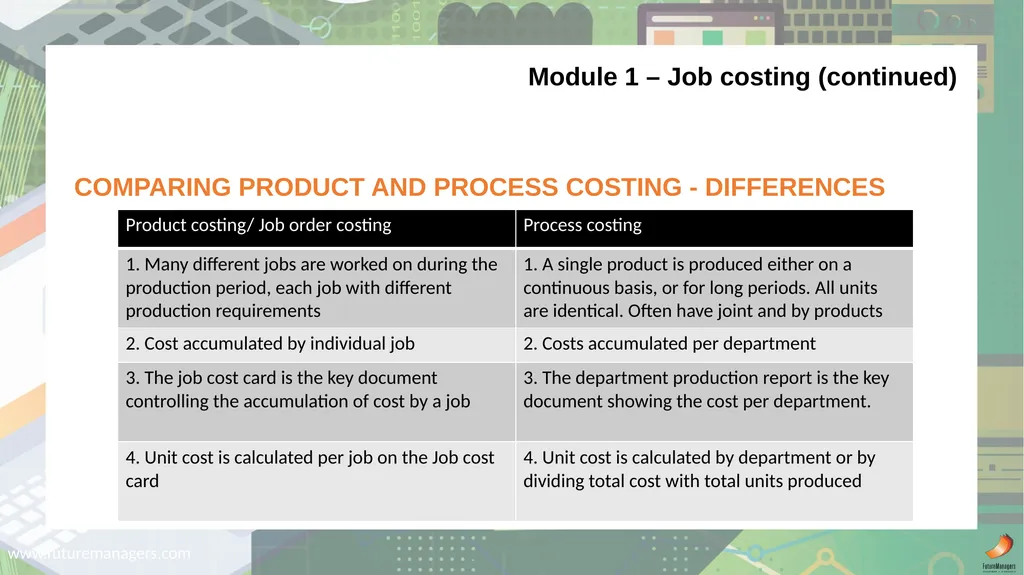
www.futuremanagers.com Module 1 – Job costing (continued) COMPARING PRODUCT AND PROCESS COSTING - DIFFERENCES<br>
10
www.futuremanagers.com INTRODUCTION
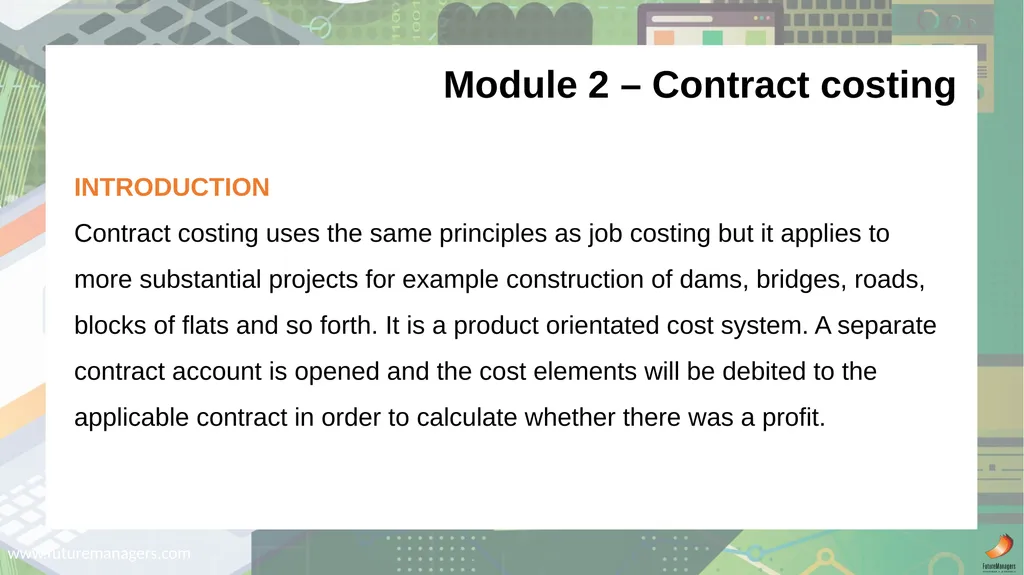
Contract costing uses the same principles as job costing but it applies to more substantial projects for example construction of dams, bridges, roads, blocks of flats and so forth. It is a product orientated cost system. A separate contract account is opened and the cost elements will be debited to the applicable contract in order to calculate whether there was a profit. Module 2 – Contract costing<br>
Contract costing uses the same principles as job costing but it applies to more substantial projects for example construction of dams, bridges, roads, blocks of flats and so forth. It is a product orientated cost system. A separate contract account is opened and the cost elements will be debited to the applicable contract in order to calculate whether there was a profit. Module 2 – Contract costing<br>
11
www.futuremanagers.com Module 2 – Contract costing (continued) CONTRACT COST
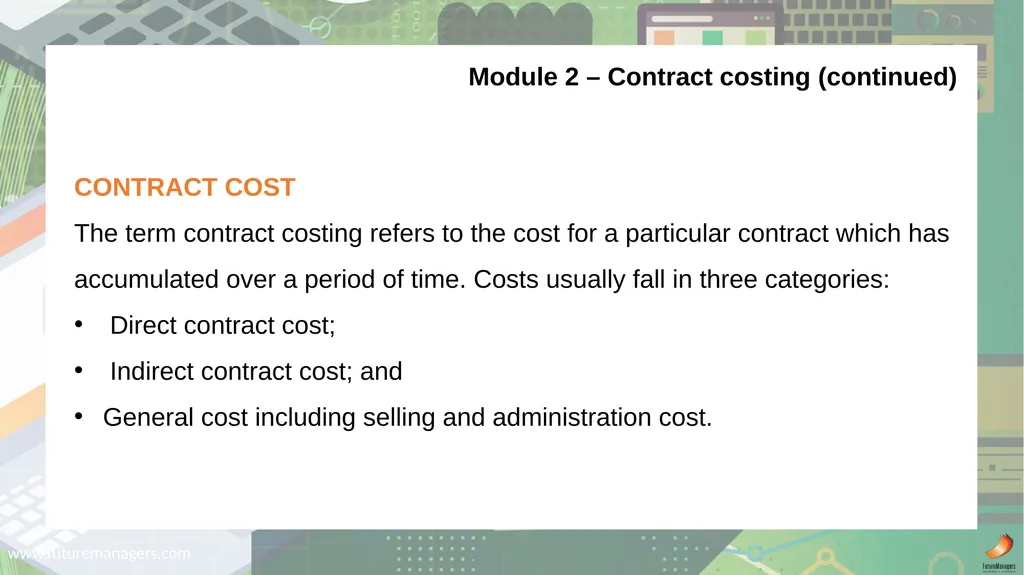
The term contract costing refers to the cost for a particular contract which has accumulated over a period of time. Costs usually fall in three categories:
Direct contract cost;
Indirect contract cost; and
General cost including selling and administration cost.<br>
The term contract costing refers to the cost for a particular contract which has accumulated over a period of time. Costs usually fall in three categories:
Direct contract cost;
Indirect contract cost; and
General cost including selling and administration cost.<br>
12
www.futuremanagers.com Module 2 – Contract costing (continued) TYPES OF CONTRACTS
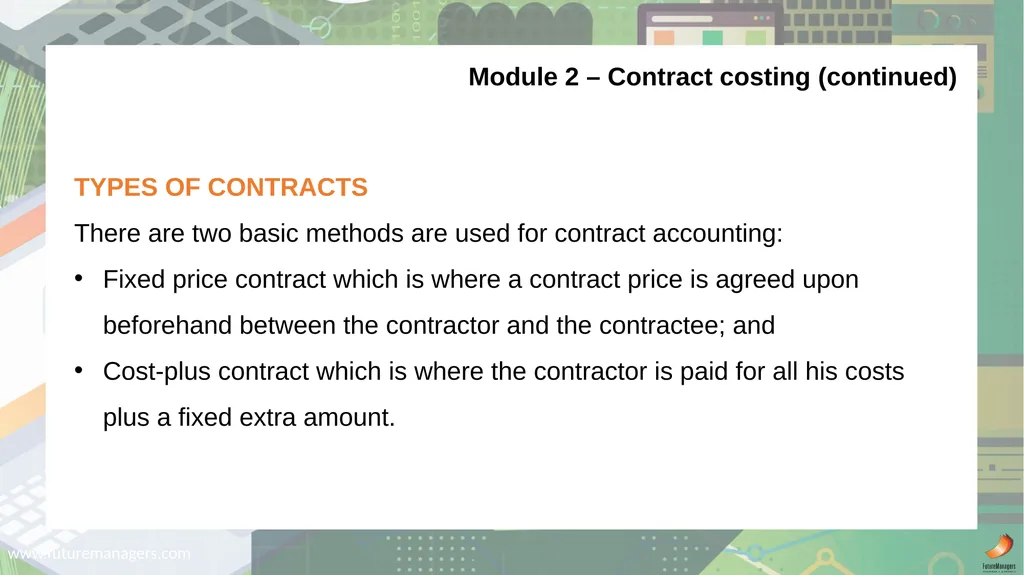
There are two basic methods are used for contract accounting:
Fixed price contract which is where a contract price is agreed upon beforehand between the contractor and the contractee; and
Cost-plus contract which is where the contractor is paid for all his costs plus a fixed extra amount.<br>
There are two basic methods are used for contract accounting:
Fixed price contract which is where a contract price is agreed upon beforehand between the contractor and the contractee; and
Cost-plus contract which is where the contractor is paid for all his costs plus a fixed extra amount.<br>
13
www.futuremanagers.com Module 2 – Contract costing (continued) CALCULATIONS OF PROFIT
At the end of the financial period some contracts will be unfinished. Profits or losses on these unfinished contracts must be estimated. There are methods which can work towards calculating uncompleted projects such as:
Completed contract methods – the profit can only be calculated when the contract is completed.
Percentage of completion method – the profit is calculated according to how much work has been completed.<br>
At the end of the financial period some contracts will be unfinished. Profits or losses on these unfinished contracts must be estimated. There are methods which can work towards calculating uncompleted projects such as:
Completed contract methods – the profit can only be calculated when the contract is completed.
Percentage of completion method – the profit is calculated according to how much work has been completed.<br>
14
www.futuremanagers.com Module 2 – Contract costing (continued) PROVISIONS
There is still a possibility of only realising profit (such as in the case of non-payment by a debtor or other unforeseen circumstances) and so a figure can be further qualified by taking into account only the profit realised on the money received. This amount is recorded as a provision in the contract account.<br>
There is still a possibility of only realising profit (such as in the case of non-payment by a debtor or other unforeseen circumstances) and so a figure can be further qualified by taking into account only the profit realised on the money received. This amount is recorded as a provision in the contract account.<br>
15
www.futuremanagers.com Module 2 – Contract costing (continued) CONCLUSION
Contractors estimating contract costs without a complete understanding of the cost components, especially the indirect costs, are unnecessarily increasing the risk and exposure to losses. An understanding of the relationship of indirect costs to the particular contract is very important.<br>
Contractors estimating contract costs without a complete understanding of the cost components, especially the indirect costs, are unnecessarily increasing the risk and exposure to losses. An understanding of the relationship of indirect costs to the particular contract is very important.<br>
16
www.futuremanagers.com INTRODUCTION
A standard cost is the predetermined cost of manufacturing a single unit or a specific quantity during a specific period under current or anticipated operating conditions. Module 3 – Standard costing<br>
A standard cost is the predetermined cost of manufacturing a single unit or a specific quantity during a specific period under current or anticipated operating conditions. Module 3 – Standard costing<br>
17
www.futuremanagers.com Module 3 – Standard costing (continued) THE AIM OF STANDARD COSTING
The purpose of standard costing is to furnish relevant information to management for them to make the right decisions. This goes through the following procedure:
Establish standards.
Determine actual costs.
Compare actual with standard costs and calculate the variance.
Analyse the variance and introduce measures to correct them.<br>
The purpose of standard costing is to furnish relevant information to management for them to make the right decisions. This goes through the following procedure:
Establish standards.
Determine actual costs.
Compare actual with standard costs and calculate the variance.
Analyse the variance and introduce measures to correct them.<br>
18
www.futuremanagers.com Module 3 – Standard costing (continued) USE OF STANDARD COSTING
Standard cost systems help management with:
Planning;
Cost control;
Establishing budgets;
Establishing contract bids and for setting selling prices;
Stock valuation; and
The keeping of records.<br>
Standard cost systems help management with:
Planning;
Cost control;
Establishing budgets;
Establishing contract bids and for setting selling prices;
Stock valuation; and
The keeping of records.<br>
19
www.futuremanagers.com Module 3 – Standard costing (continued) ADVANTAGES OF STANDARD COSTING
Actual costs can be measured against the standard costs.
Analysing variances will indicate problem areas, which often leads to improvement of operations.
The firm becomes more cost conscious.
Because it simplifies costing, it reduces clerical work.
Workers know what is expected of them.
It may stimulate further planning which will lead to greater efficiency.<br>
Actual costs can be measured against the standard costs.
Analysing variances will indicate problem areas, which often leads to improvement of operations.
The firm becomes more cost conscious.
Because it simplifies costing, it reduces clerical work.
Workers know what is expected of them.
It may stimulate further planning which will lead to greater efficiency.<br>
20
www.futuremanagers.com Module 3 – Standard costing (continued) SETTING OF STANDARDS
Under ideal conditions employees accept standards as personal production goals. Once standards are set, a standard cost card should be prepared for each product manufactured or service rendered. This will include:
Standard quantities and standard prices of each raw material.
Standard labour rate and standard hours.
Standard manufacturing overheads.
Total standard cost allowed to manufacture a completed product.<br>
Under ideal conditions employees accept standards as personal production goals. Once standards are set, a standard cost card should be prepared for each product manufactured or service rendered. This will include:
Standard quantities and standard prices of each raw material.
Standard labour rate and standard hours.
Standard manufacturing overheads.
Total standard cost allowed to manufacture a completed product.<br>
21
www.futuremanagers.com Module 3 – Standard costing (continued) VARIANCES
The difference between the actual costs for material, labour and overheads and the standard costs is called a variance. This figure can either be favourable (when the actual cost is less than the standard cost) or unfavourable (when the actual cost is more than the standard cost).<br>
The difference between the actual costs for material, labour and overheads and the standard costs is called a variance. This figure can either be favourable (when the actual cost is less than the standard cost) or unfavourable (when the actual cost is more than the standard cost).<br>
22
www.futuremanagers.com INTRODUCTION
These are two different methods used to recover fixed manufacturing costs. Management can decide to use the direct costing or the absorption costing method. The two methods treat fixed manufacturing costs differently. Module 4 – Cost control<br>
These are two different methods used to recover fixed manufacturing costs. Management can decide to use the direct costing or the absorption costing method. The two methods treat fixed manufacturing costs differently. Module 4 – Cost control<br>
23
www.futuremanagers.com Module 4 – Cost control (continued) DIRECT COSTING
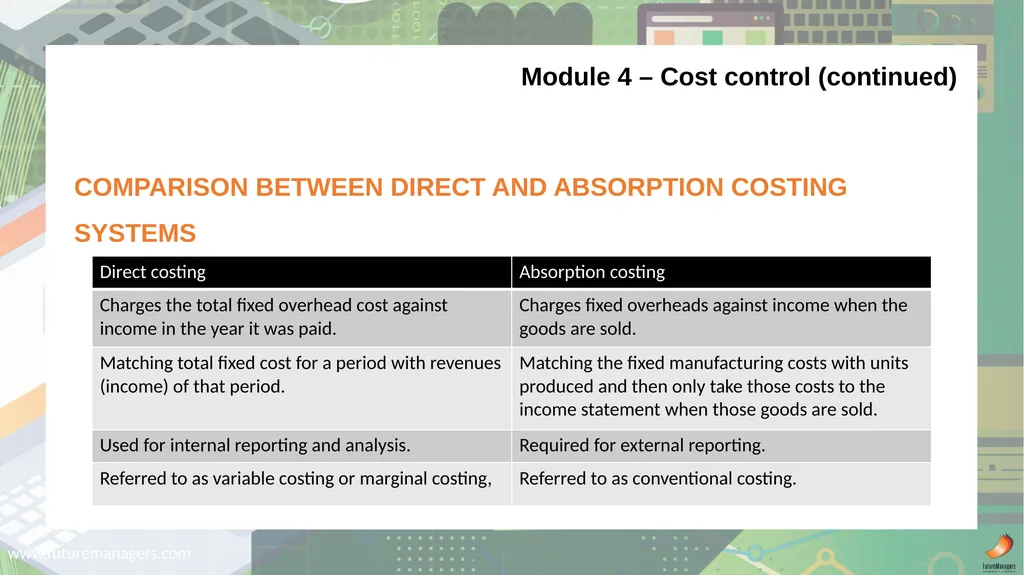
With direct costing, the fixed overheads total are charged against income when the cost is incurred and costs are recovered on the basis of the number of units sold during a period.<br>
With direct costing, the fixed overheads total are charged against income when the cost is incurred and costs are recovered on the basis of the number of units sold during a period.<br>
24
www.futuremanagers.com Module 4 – Cost control (continued) ABSORPTION COSTING
With absorption costing fixed costs are recovered on the basis of the number of units manufactured during the period. A rate for recovery of fixed cost per unit is calculated and written off per unit produced. Absorption costing charges fixed overheads against income when the goods are sold.<br>
With absorption costing fixed costs are recovered on the basis of the number of units manufactured during the period. A rate for recovery of fixed cost per unit is calculated and written off per unit produced. Absorption costing charges fixed overheads against income when the goods are sold.<br>
25
www.futuremanagers.com Module 4 – Cost control (continued) COMPARISON BETWEEN DIRECT AND ABSORPTION COSTING SYSTEMS<br>
26
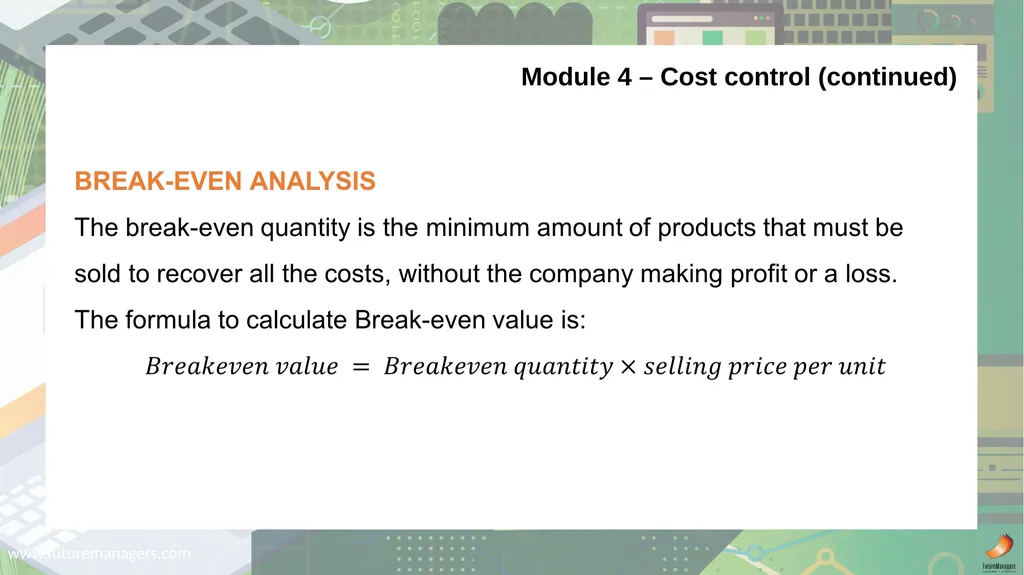
www.futuremanagers.com Module 4 – Cost control (continued)<br>
27
www.futuremanagers.com INTRODUCTION
Budgeting shows the route to be taken to achieve goals, and budget control is the comparison of the results achieved with results envisaged. Module 5 – Budgets<br>
Budgeting shows the route to be taken to achieve goals, and budget control is the comparison of the results achieved with results envisaged. Module 5 – Budgets<br>
28
www.futuremanagers.com Module 5 – Budgets (continued) BUDGET CONTROL
Budget control is monitoring performance and getting the staff to cooperate in order to achieve those goals and even, if necessary, to take corrective steps before it is too late.<br>
Budget control is monitoring performance and getting the staff to cooperate in order to achieve those goals and even, if necessary, to take corrective steps before it is too late.<br>
29
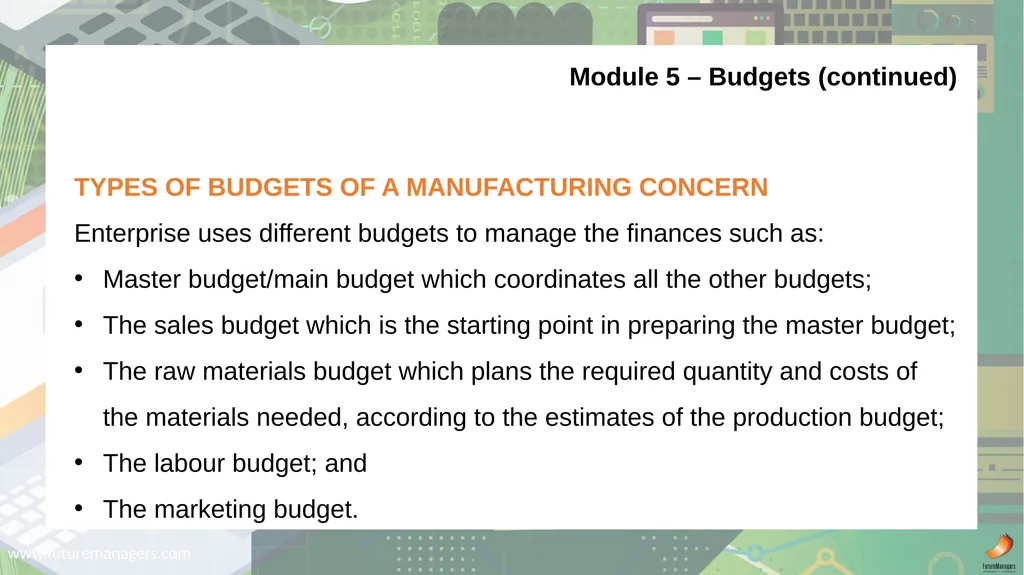
www.futuremanagers.com Module 5 – Budgets (continued) TYPES OF BUDGETS OF A MANUFACTURING CONCERN
Enterprise uses different budgets to manage the finances such as:
Master budget/main budget which coordinates all the other budgets;
The sales budget which is the starting point in preparing the master budget;
The raw materials budget which plans the required quantity and costs of the materials needed, according to the estimates of the production budget;
The labour budget; and
The marketing budget.<br>
Enterprise uses different budgets to manage the finances such as:
Master budget/main budget which coordinates all the other budgets;
The sales budget which is the starting point in preparing the master budget;
The raw materials budget which plans the required quantity and costs of the materials needed, according to the estimates of the production budget;
The labour budget; and
The marketing budget.<br>
30
www.futuremanagers.com Module 5 – Budgets (continued) BUDGETED INCOME STATEMENT
This statement summarises the budgeted sales, estimated income and expenditure. It projects net income which is the goal towards which all efforts are directed. Management can judge the accuracy of the different budgets.<br>
This statement summarises the budgeted sales, estimated income and expenditure. It projects net income which is the goal towards which all efforts are directed. Management can judge the accuracy of the different budgets.<br>
31
www.futuremanagers.com Module 5 – Budgets (continued) BUDGETED BALANCE SHEET
The balance sheet at the end of the budget period reflects all the changes in assets, liabilities and shareholder’s interest, resulting from all the budgets submitted by the various departments. It can be seen as control over the accuracy of all the other budgets.<br>
The balance sheet at the end of the budget period reflects all the changes in assets, liabilities and shareholder’s interest, resulting from all the budgets submitted by the various departments. It can be seen as control over the accuracy of all the other budgets.<br>