
Cost Records & Audit Rules CMA (Dr.) BALWINDER
KL
Published · 55 slides · 0 views

1 / 1

Description
Cost Records Audit Rules CMA (Dr.) BALWINDER SINGH Chairman, Cost Accounting Standards Board President (2019-20), The Institute of Cost Accountants of India Syllabus Coverage Companies (Cost Record Audit) Rules, 2014 Cost Accounting
Related Topics
Share
Embed code
Download this presentation From Below
"Cost Records & Audit Rules CMA (Dr.) BALWINDER" is the property of its rightful owner. Permission is granted to download and print the materials on this website for personal, non-commercial use only, and to display it on your personal computer provided you do not modify the materials and that you retain all copyright notices contained in the materials. By downloading content from our website, you accept the terms of this agreement.
Presentation Transcript
01
Cost Records & Audit Rules CMA (Dr.) BALWINDER SINGH
Chairman, Cost Accounting Standards Board
&
President (2019-20), The Institute of Cost Accountants of India<br>
Chairman, Cost Accounting Standards Board
&
President (2019-20), The Institute of Cost Accountants of India<br>
02
Syllabus Coverage Companies (Cost Record & Audit) Rules, 2014
Cost Accounting Standards
Cost Auditing and Assurance Standards<br>
Cost Accounting Standards
Cost Auditing and Assurance Standards<br>
03
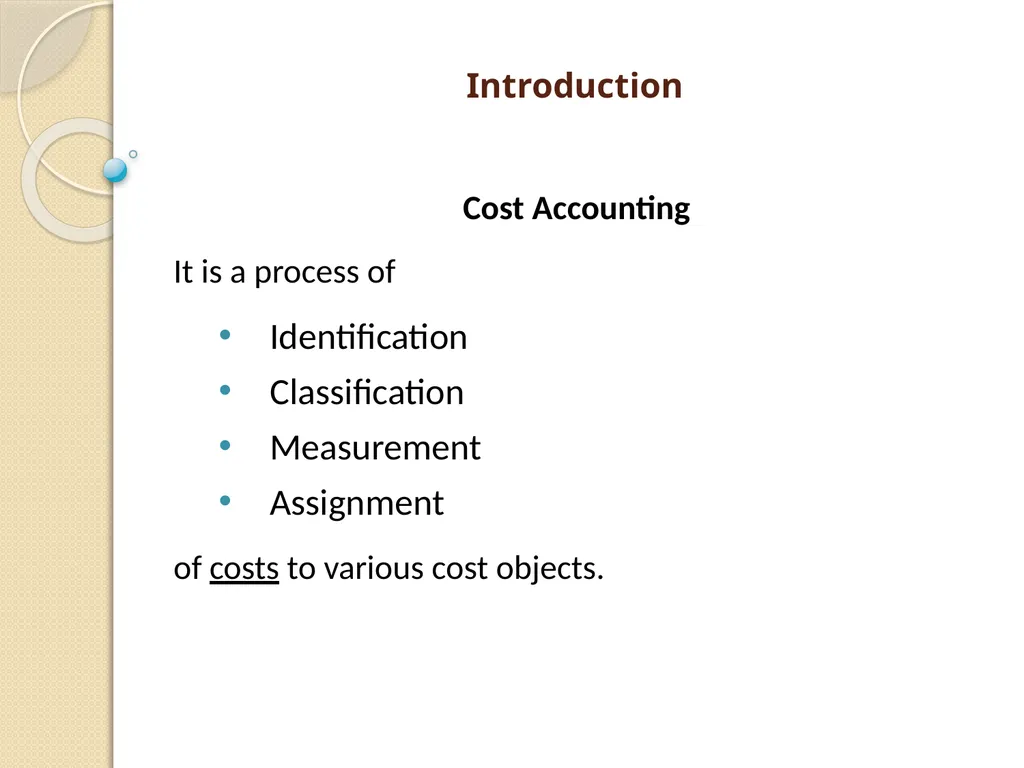
Introduction Cost Accounting
It is a process of
Identification
Classification
Measurement
Assignment
of costs to various cost objects.<br>
It is a process of
Identification
Classification
Measurement
Assignment
of costs to various cost objects.<br>
04
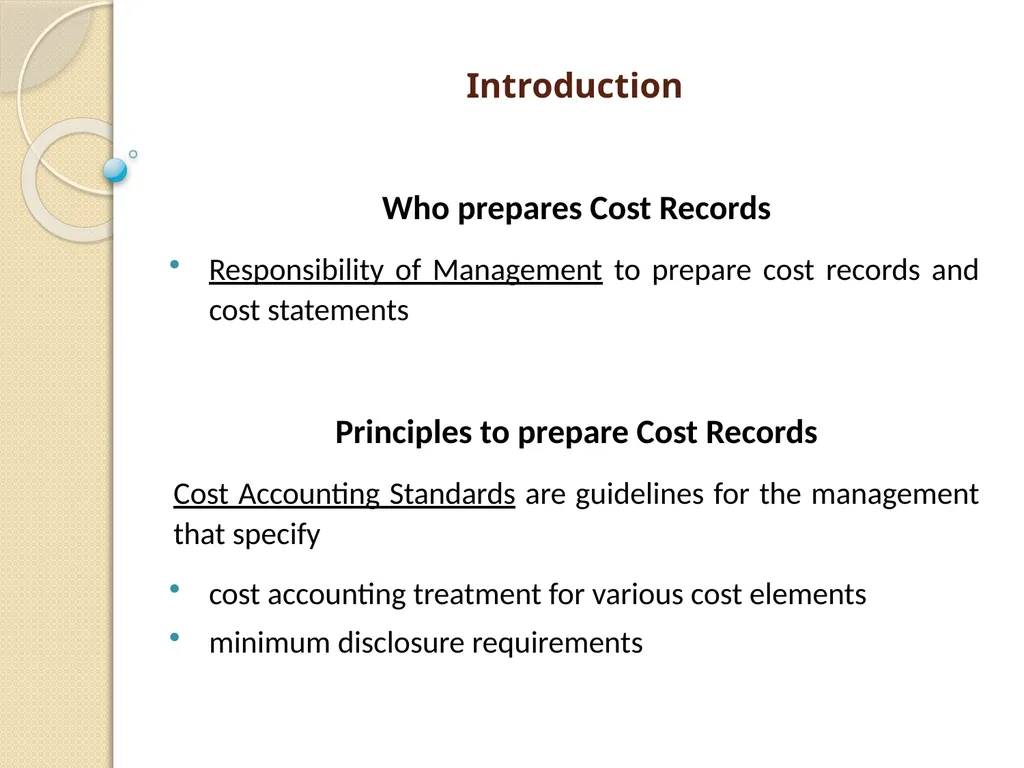
Introduction Who prepares Cost Records
Responsibility of Management to prepare cost records and cost statements
Principles to prepare Cost Records
Cost Accounting Standards are guidelines for the management that specify
cost accounting treatment for various cost elements
minimum disclosure requirements<br>
Responsibility of Management to prepare cost records and cost statements
Principles to prepare Cost Records
Cost Accounting Standards are guidelines for the management that specify
cost accounting treatment for various cost elements
minimum disclosure requirements<br>
05
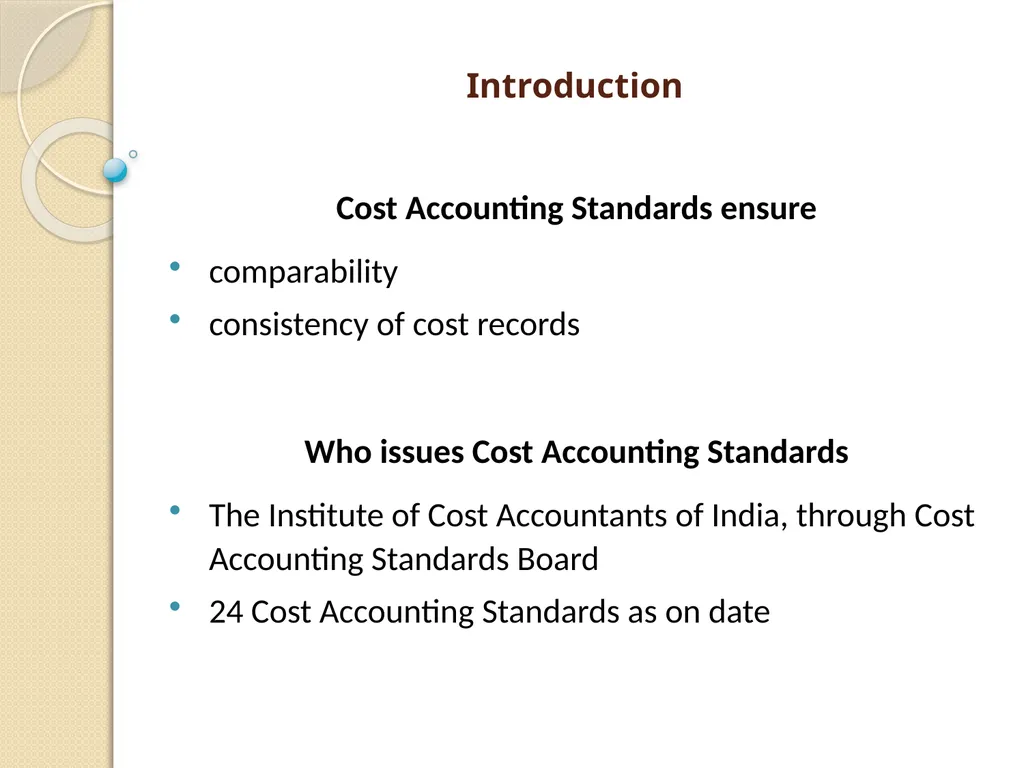
Introduction Cost Accounting Standards ensure
comparability
consistency of cost records
Who issues Cost Accounting Standards
The Institute of Cost Accountants of India, through Cost Accounting Standards Board
24 Cost Accounting Standards as on date<br>
comparability
consistency of cost records
Who issues Cost Accounting Standards
The Institute of Cost Accountants of India, through Cost Accounting Standards Board
24 Cost Accounting Standards as on date<br>
06
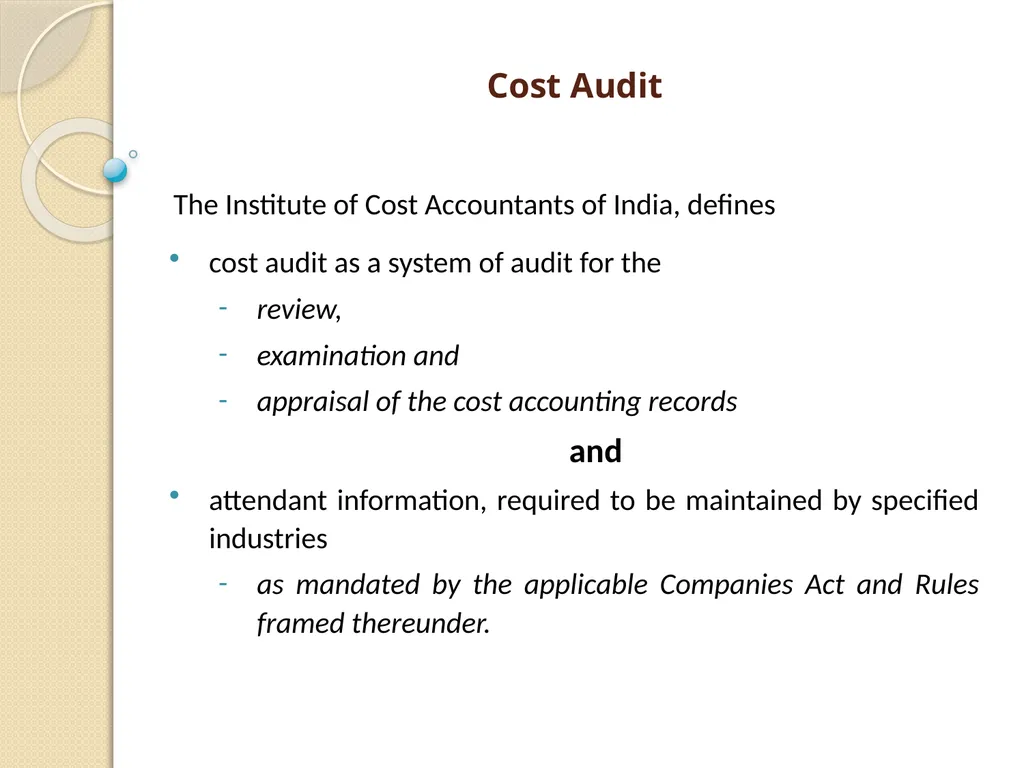
Cost Audit The Institute of Cost Accountants of India, defines
cost audit as a system of audit for the
review,
examination and
appraisal of the cost accounting records
and
attendant information, required to be maintained by specified industries
as mandated by the applicable Companies Act and Rules framed thereunder.<br>
cost audit as a system of audit for the
review,
examination and
appraisal of the cost accounting records
and
attendant information, required to be maintained by specified industries
as mandated by the applicable Companies Act and Rules framed thereunder.<br>
07
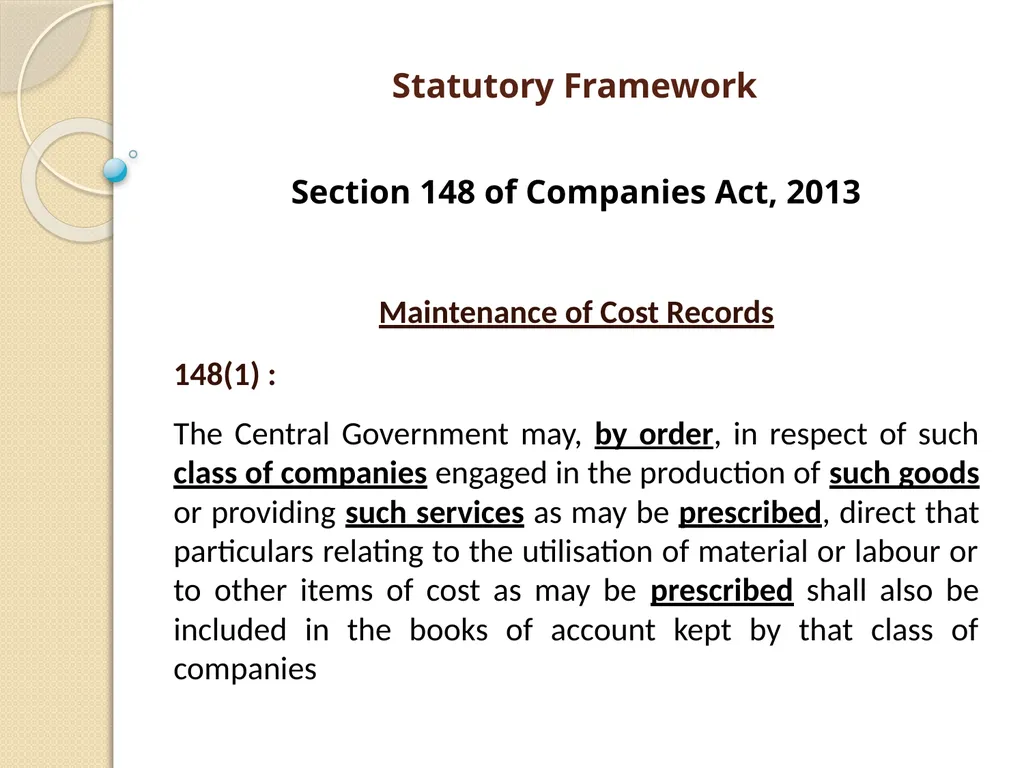
Statutory Framework Section 148 of Companies Act, 2013
Maintenance of Cost Records
148(1) :
The Central Government may, by order, in respect of such class of companies engaged in the production of such goods or providing such services as may be prescribed, direct that particulars relating to the utilisation of material or labour or to other items of cost as may be prescribed shall also be included in the books of account kept by that class of companies<br>
Maintenance of Cost Records
148(1) :
The Central Government may, by order, in respect of such class of companies engaged in the production of such goods or providing such services as may be prescribed, direct that particulars relating to the utilisation of material or labour or to other items of cost as may be prescribed shall also be included in the books of account kept by that class of companies<br>
08
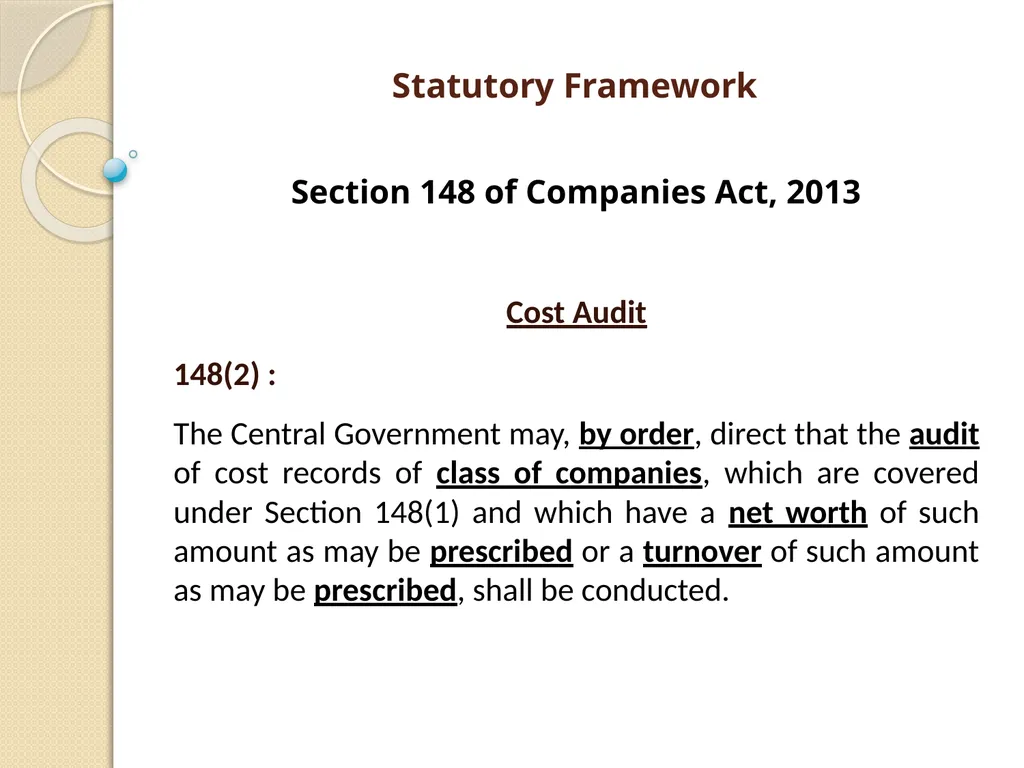
Statutory Framework Section 148 of Companies Act, 2013
Cost Audit
148(2) :
The Central Government may, by order, direct that the audit of cost records of class of companies, which are covered under Section 148(1) and which have a net worth of such amount as may be prescribed or a turnover of such amount as may be prescribed, shall be conducted.<br>
Cost Audit
148(2) :
The Central Government may, by order, direct that the audit of cost records of class of companies, which are covered under Section 148(1) and which have a net worth of such amount as may be prescribed or a turnover of such amount as may be prescribed, shall be conducted.<br>
09
Prescription G.S.R.425(E)– In exercise of the powers conferred by
subsections (1) and (2) of section 469 and Section 148 of
the Companies Act, 2013,
the Central Government hereby makes the following rules,
namely:
Cost Records and Audit Rules, 2014
List of Products / Services
Turnover criteria
Exemptions<br>
subsections (1) and (2) of section 469 and Section 148 of
the Companies Act, 2013,
the Central Government hereby makes the following rules,
namely:
Cost Records and Audit Rules, 2014
List of Products / Services
Turnover criteria
Exemptions<br>
10
Objectives of Cost Audit Cost Audit has both general and social objectives.
The general objectives include :
To verify cost accounts with a view to ascertaining that these have been properly maintained and compiled according to the cost accounting system followed by the enterprise
To ensure that the prescribed procedures of cost accounting records rules are duly adhered to<br>
The general objectives include :
To verify cost accounts with a view to ascertaining that these have been properly maintained and compiled according to the cost accounting system followed by the enterprise
To ensure that the prescribed procedures of cost accounting records rules are duly adhered to<br>
11
Utility / Advantage of Cost Audit Initial
The main objective of Cost Audit when statutorily introduced under the provisions of the Companies Act was to meet the Government requirements for regulating the administered price mechanism in some core industries.
tool for price control mechanism for consumer
The objective was to provide an authentic data to the Government to regulate the demand and supply in the country through a price control mechanism.<br>
The main objective of Cost Audit when statutorily introduced under the provisions of the Companies Act was to meet the Government requirements for regulating the administered price mechanism in some core industries.
tool for price control mechanism for consumer
The objective was to provide an authentic data to the Government to regulate the demand and supply in the country through a price control mechanism.<br>
12
Utility / Advantage of Cost Audit (a) Cost information enables the organization to structure the cost, understand it and use it for communicating with the stakeholders.
(b) Costing is an important tool in assessing organizational performance in.
It informs how profits and value are created, and how efficiently and effectively operational processes transform input into output.
It contributes to the data input on economy level parameters like resources efficiency, waste management, resources allocation policies etc.<br>
(b) Costing is an important tool in assessing organizational performance in.
It informs how profits and value are created, and how efficiently and effectively operational processes transform input into output.
It contributes to the data input on economy level parameters like resources efficiency, waste management, resources allocation policies etc.<br>
13
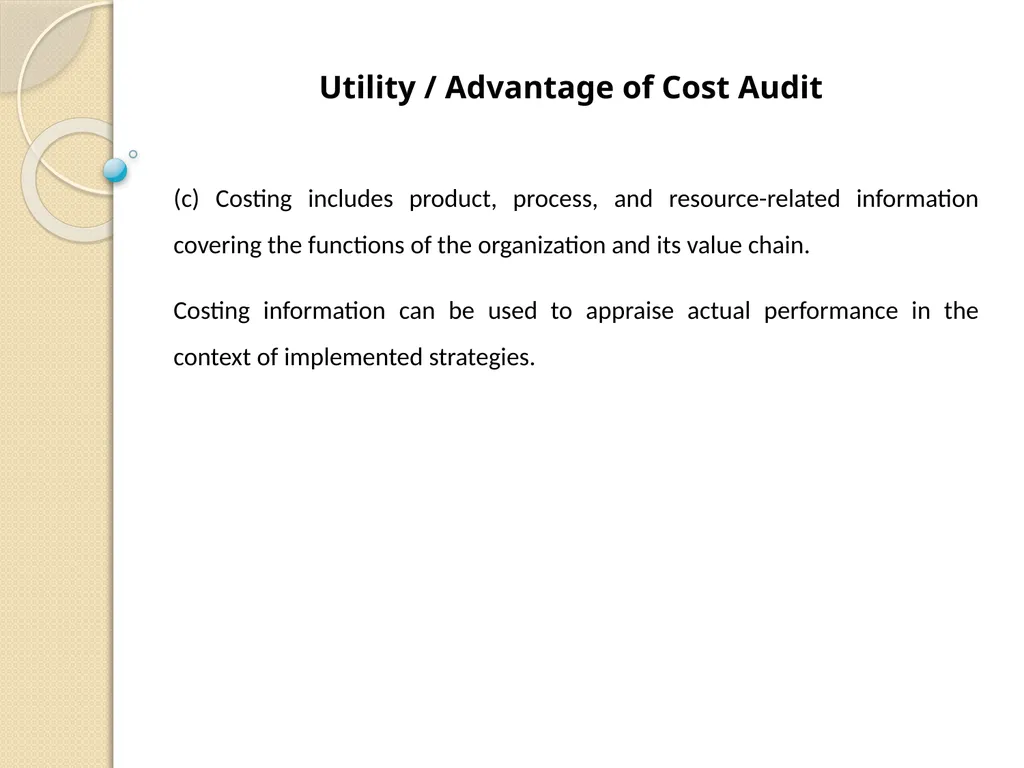
Utility / Advantage of Cost Audit (c) Costing includes product, process, and resource-related information covering the functions of the organization and its value chain.
Costing information can be used to appraise actual performance in the context of implemented strategies.<br>
Costing information can be used to appraise actual performance in the context of implemented strategies.<br>
14
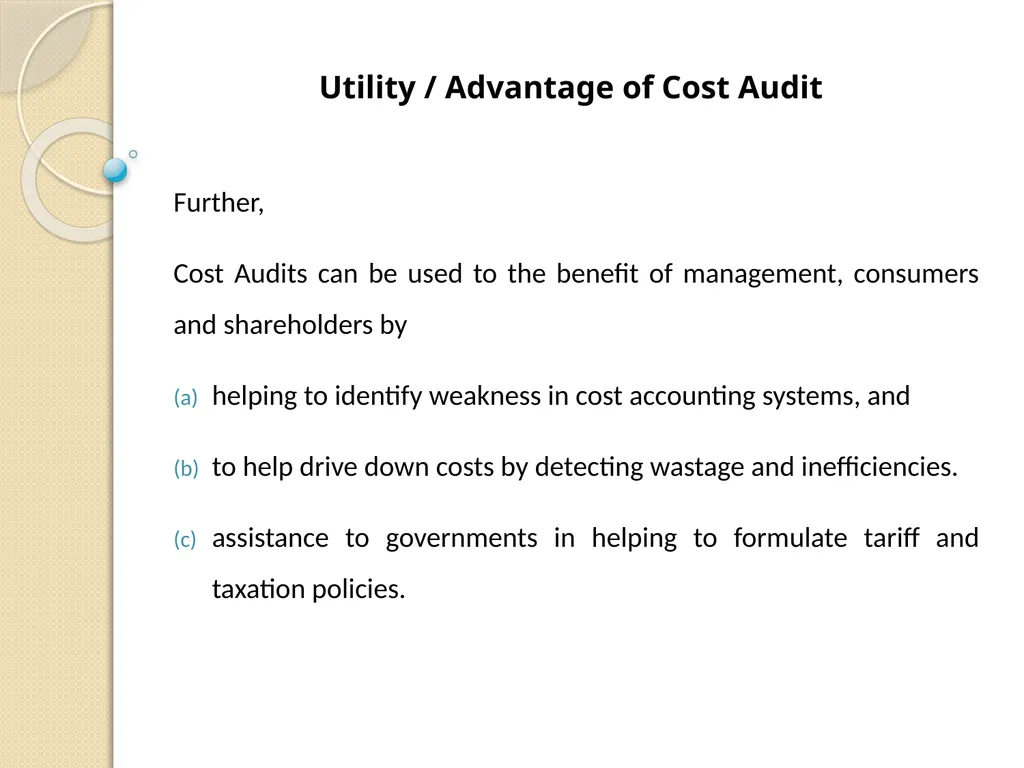
Utility / Advantage of Cost Audit Further,
Cost Audits can be used to the benefit of management, consumers and shareholders by
helping to identify weakness in cost accounting systems, and
to help drive down costs by detecting wastage and inefficiencies.
assistance to governments in helping to formulate tariff and taxation policies.<br>
Cost Audits can be used to the benefit of management, consumers and shareholders by
helping to identify weakness in cost accounting systems, and
to help drive down costs by detecting wastage and inefficiencies.
assistance to governments in helping to formulate tariff and taxation policies.<br>
15
Applicability
of
Cost Records maintenance & Cost Audit
Regulated Sectors<br>
16
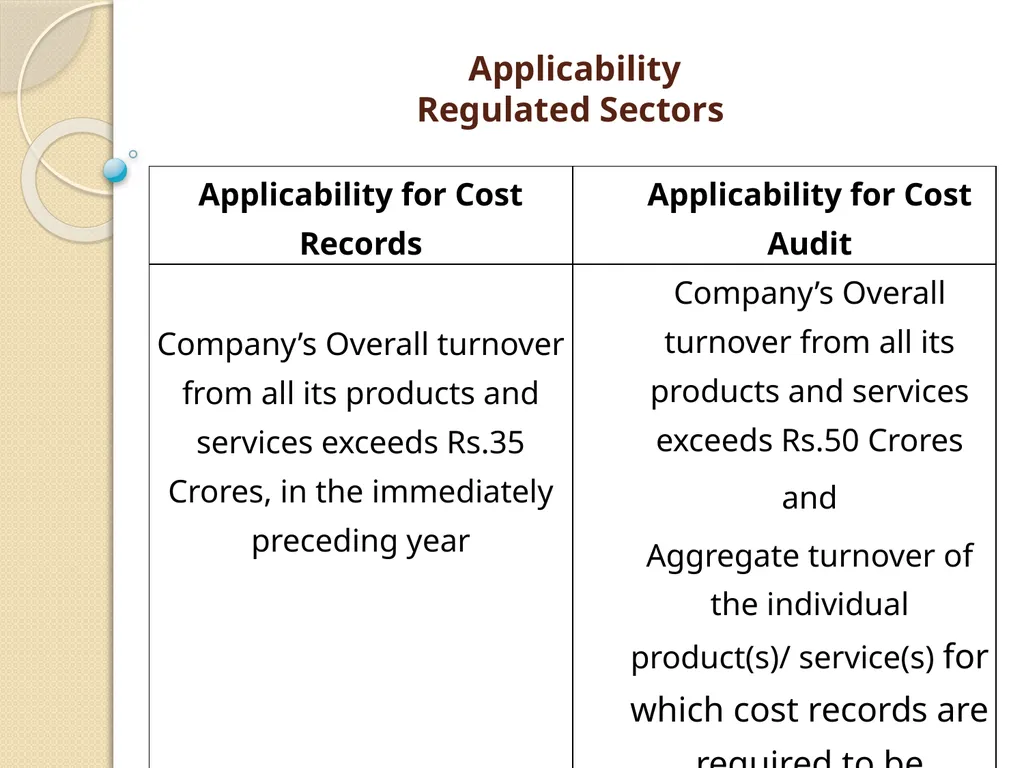
Applicability
Regulated Sectors<br>
17
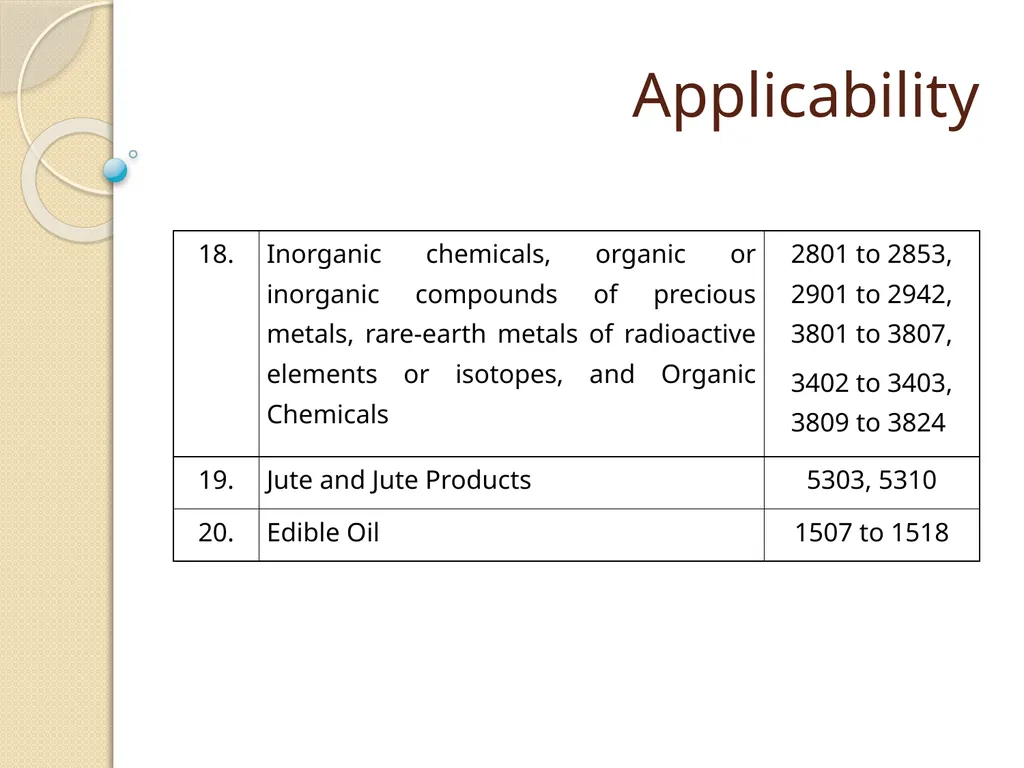
Applicability
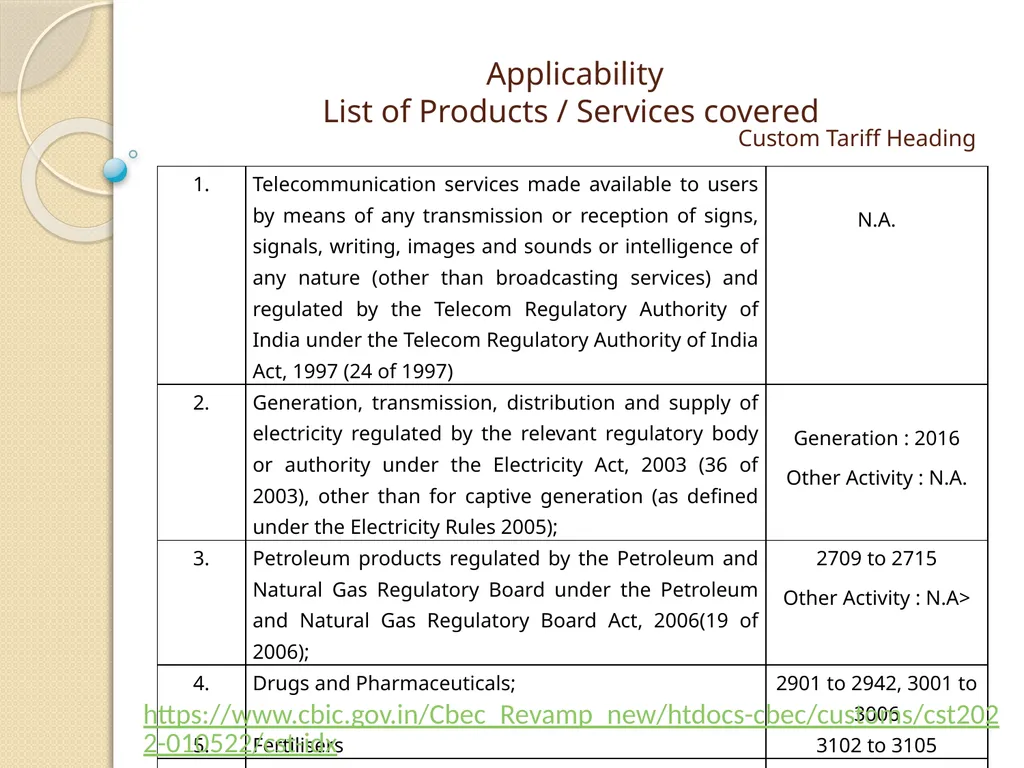
List of Products / Services covered Custom Tariff Heading https://www.cbic.gov.in/Cbec_Revamp_new/htdocs-cbec/customs/cst2022-010522/cst-idx<br>
18
Applicability
of
Cost Records maintenance & Cost Audit
Non-Regulated Sectors<br>
19
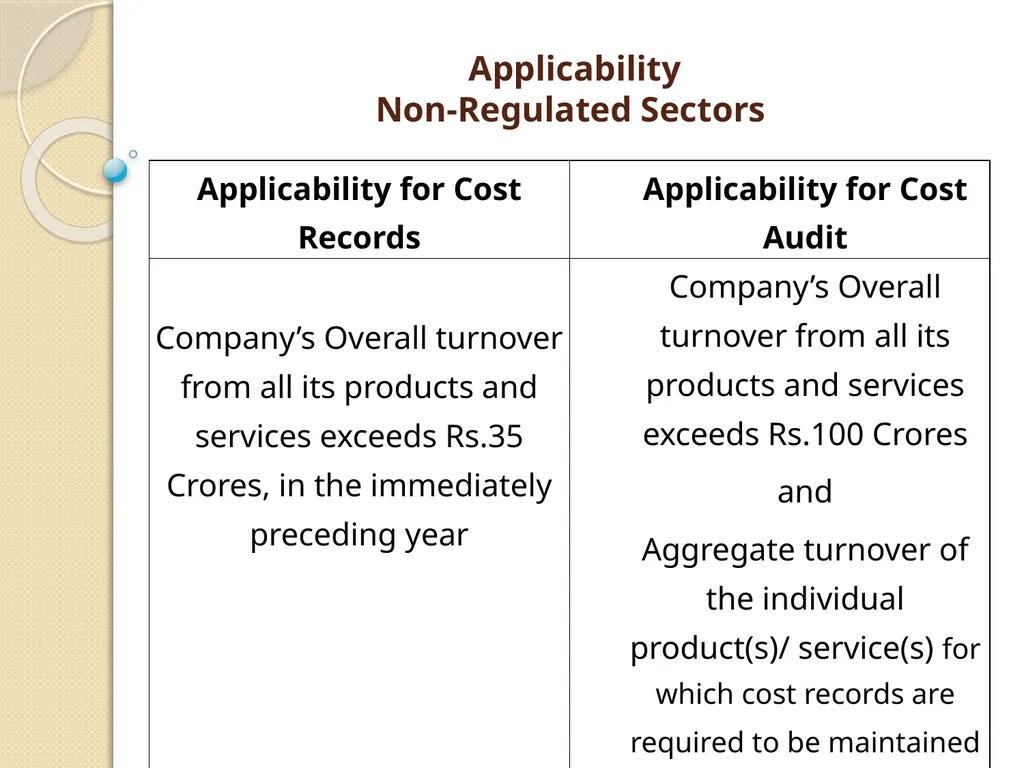
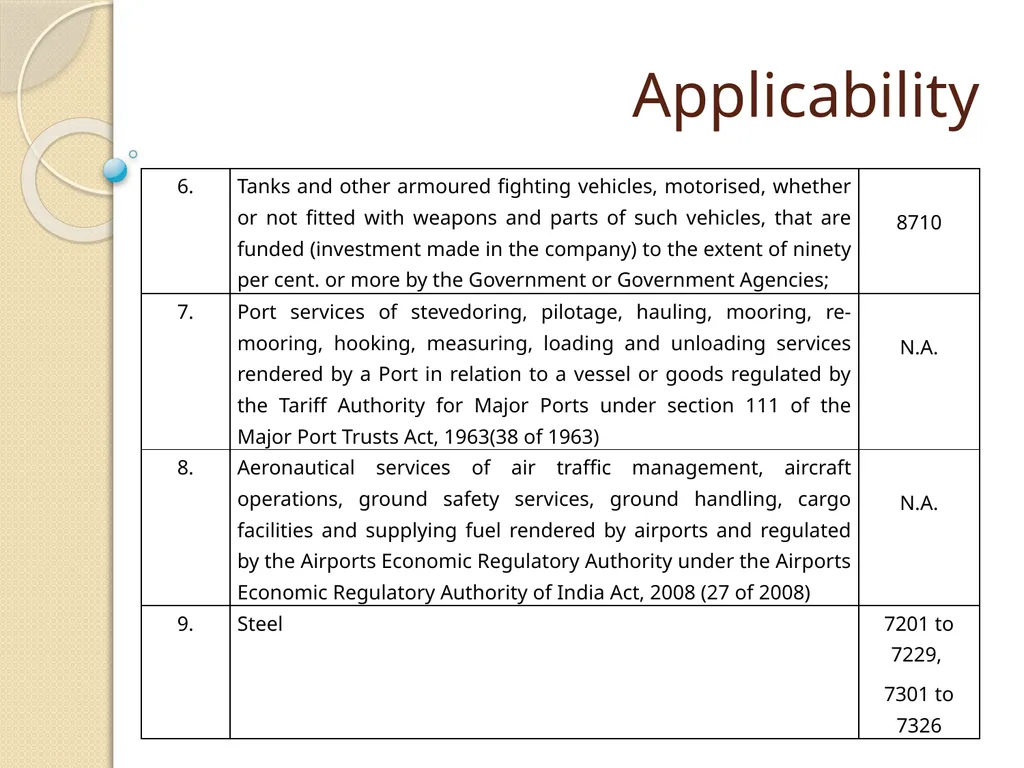
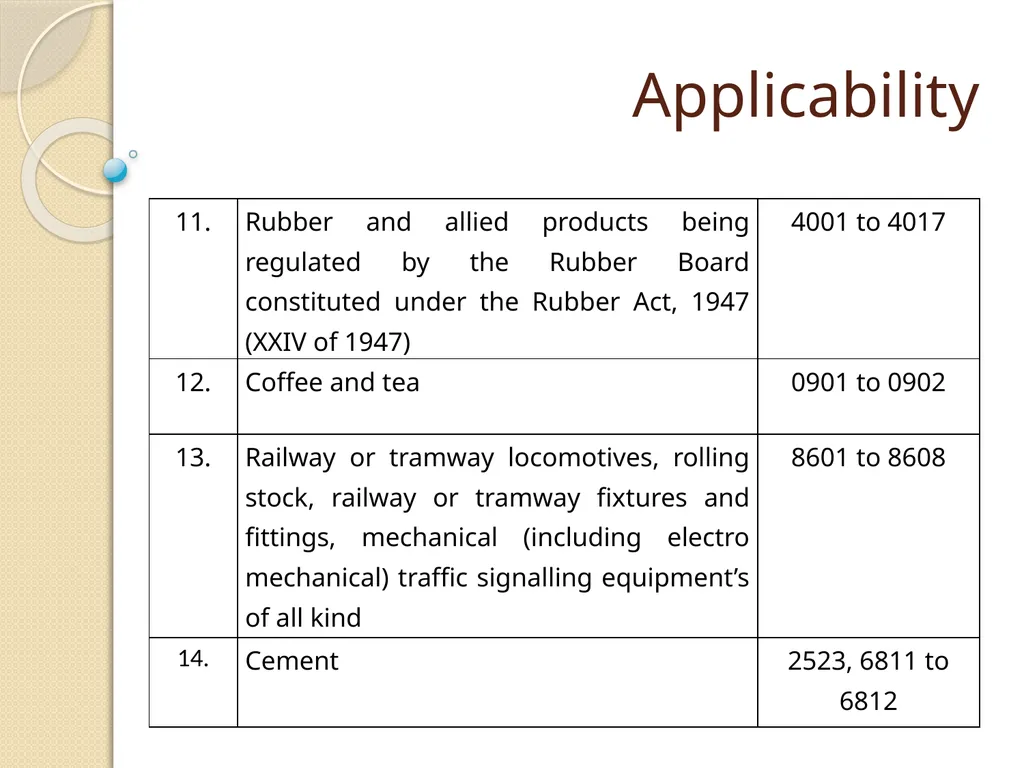
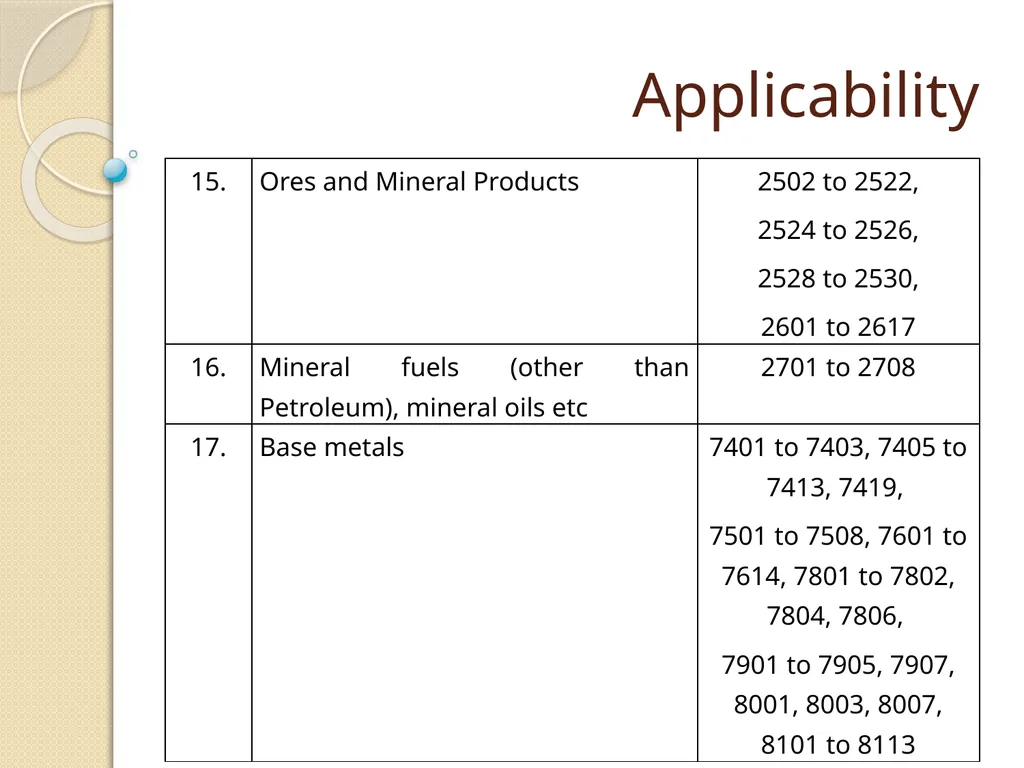
Applicability
Non-Regulated Sectors<br>
20
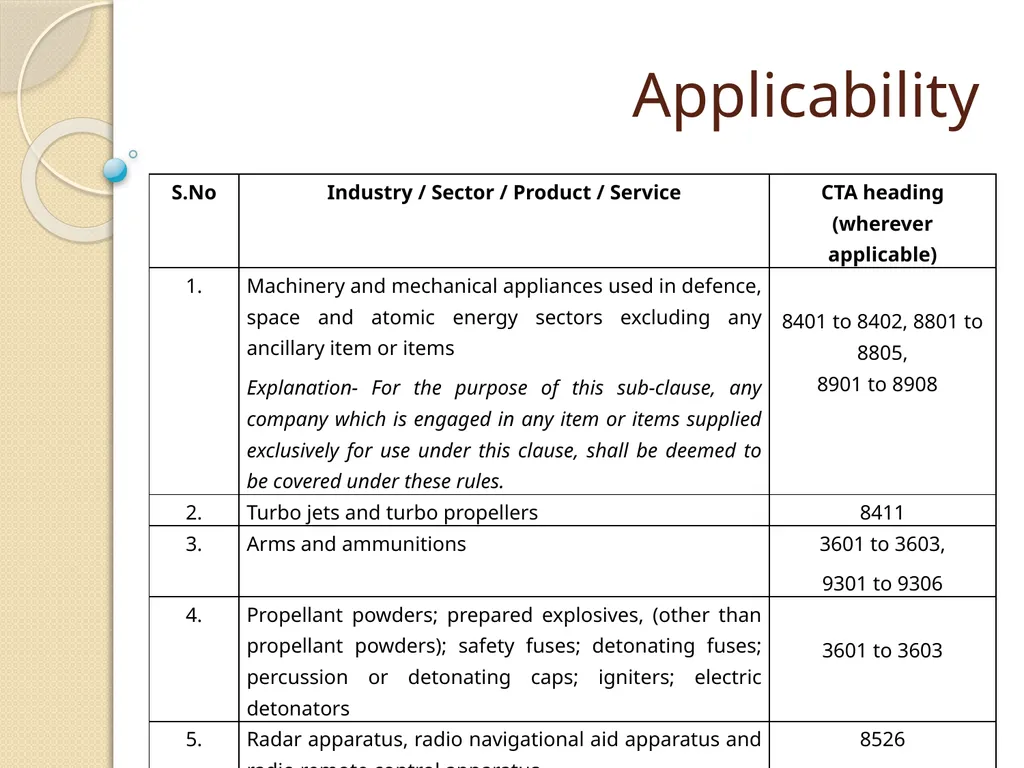
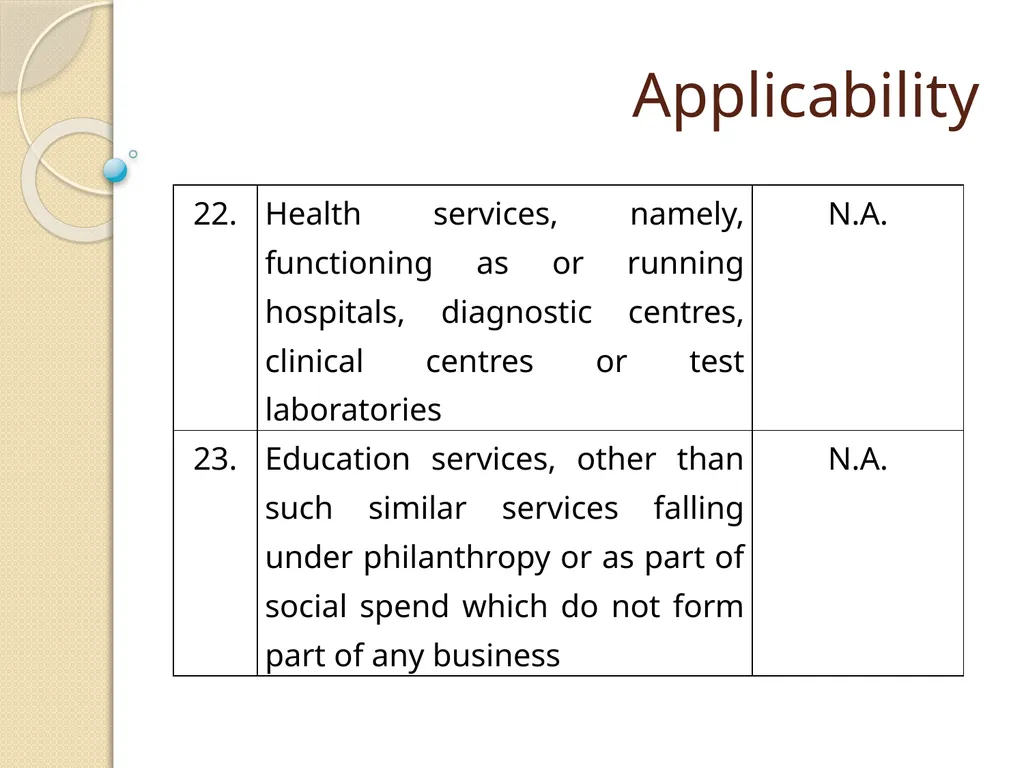
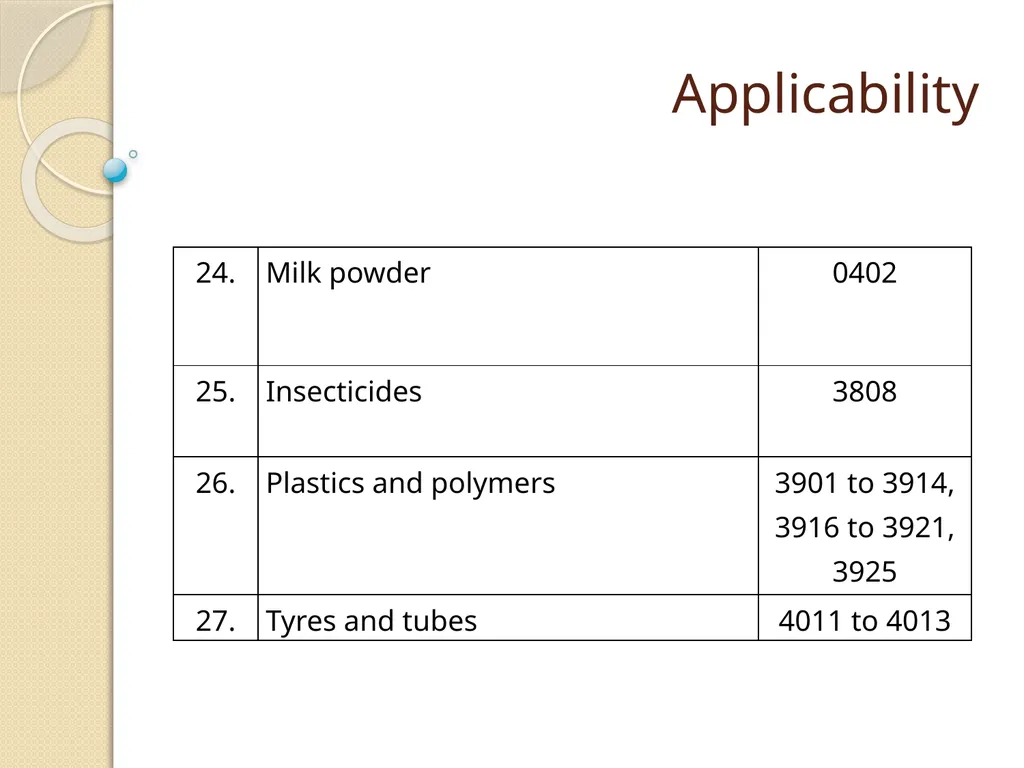
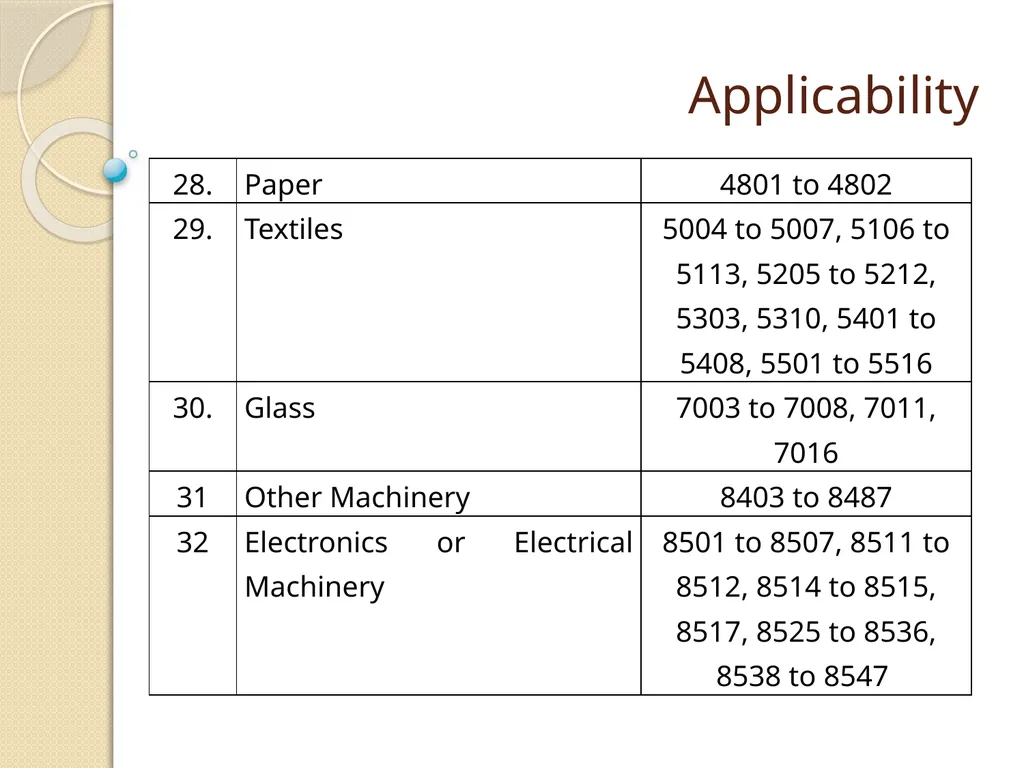
Applicability<br>
21
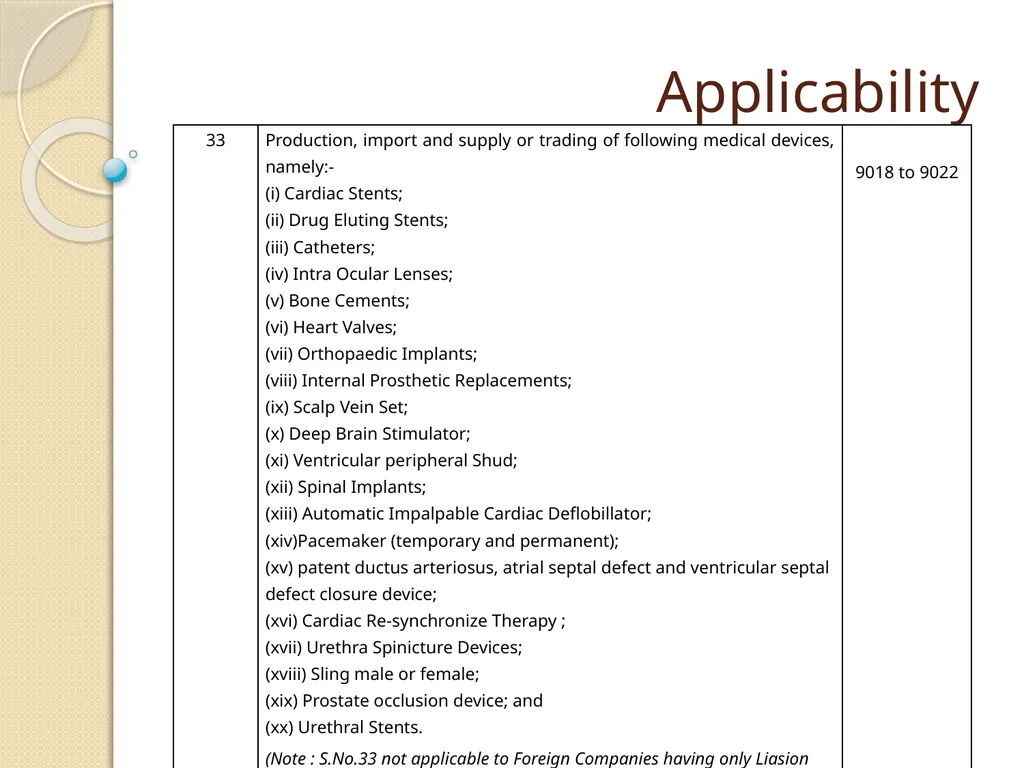
Applicability<br>
22
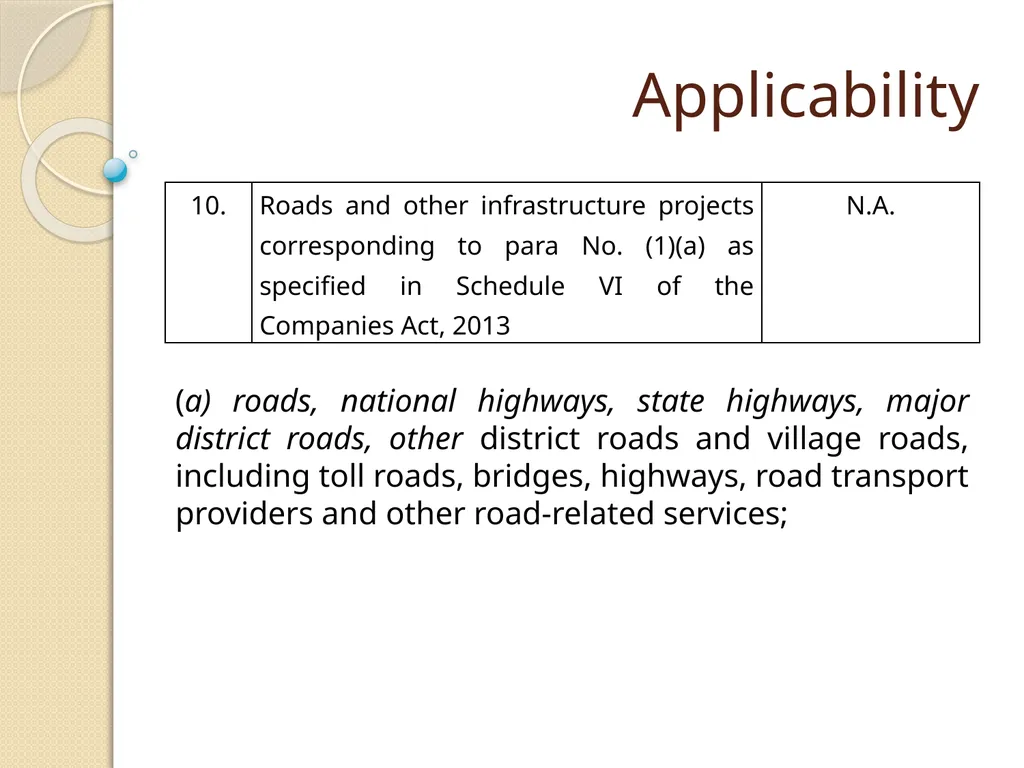
Applicability (a) roads, national highways, state highways, major district roads, other district roads and village roads, including toll roads, bridges, highways, road transport providers and other road-related services;<br>
23
Applicability<br>
24
Applicability<br>
25
Applicability<br>
26
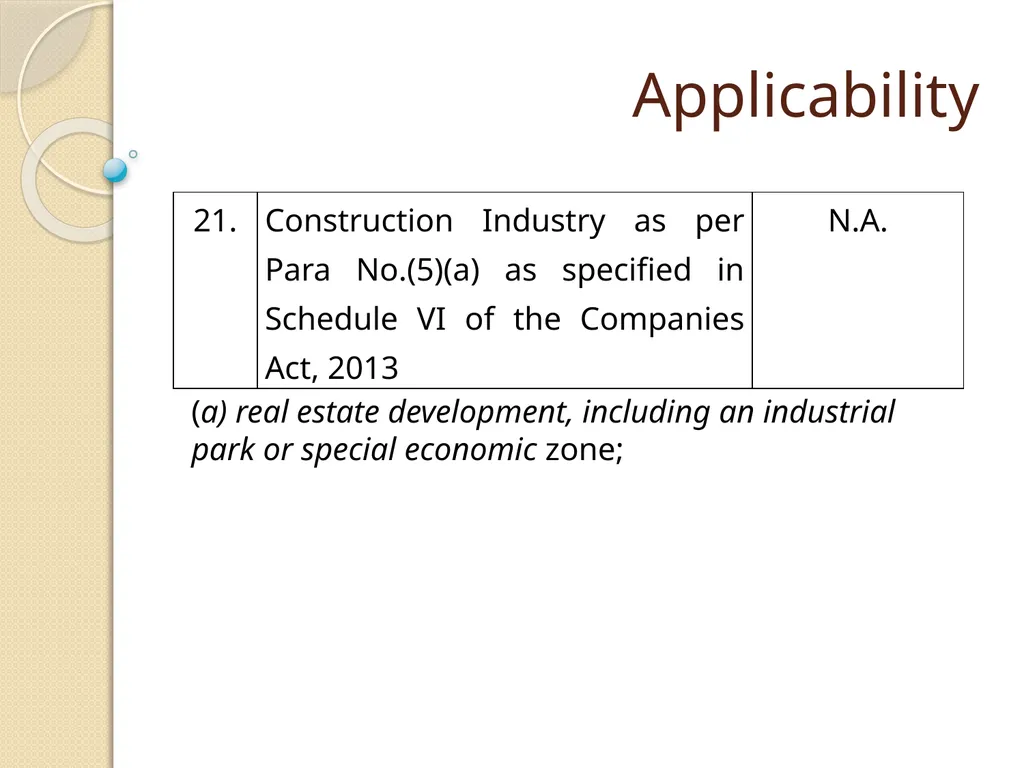
Applicability (a) real estate development, including an industrial park or special economic zone;<br>
27
Applicability<br>
28
Applicability<br>
29
Applicability<br>
30
Applicability<br>
31
Exemption from Cost Audit
(Not from Cost Records maintenance) Rule 4(3)
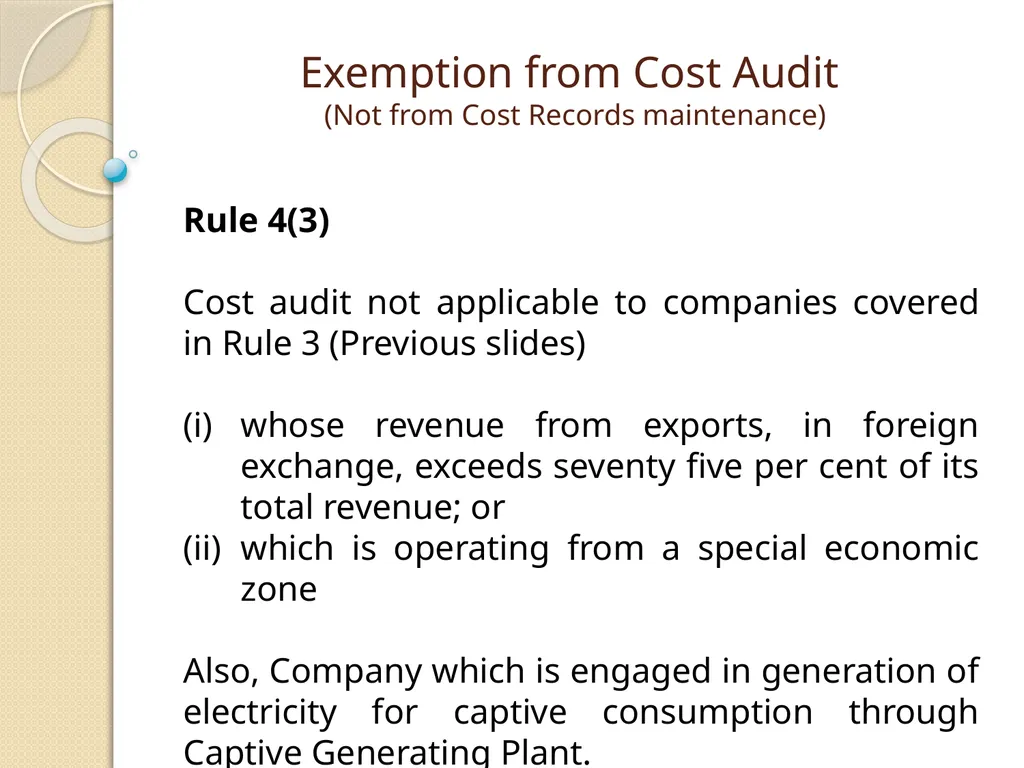
Cost audit not applicable to companies covered in Rule 3 (Previous slides)
whose revenue from exports, in foreign exchange, exceeds seventy five per cent of its total revenue; or
which is operating from a special economic zone
Also, Company which is engaged in generation of electricity for captive consumption through Captive Generating Plant.<br>
Cost audit not applicable to companies covered in Rule 3 (Previous slides)
whose revenue from exports, in foreign exchange, exceeds seventy five per cent of its total revenue; or
which is operating from a special economic zone
Also, Company which is engaged in generation of electricity for captive consumption through Captive Generating Plant.<br>
32
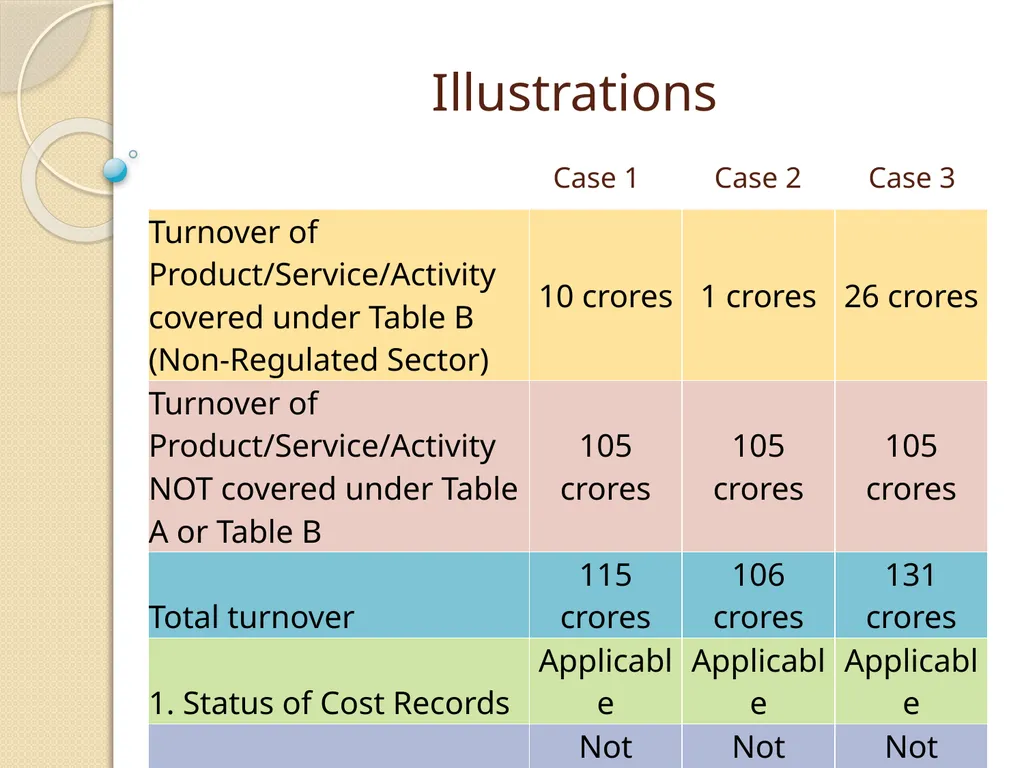
Illustrations Case 1 Case 2 Case 3<br>
33
Meaning of turnover of a product<br>
34
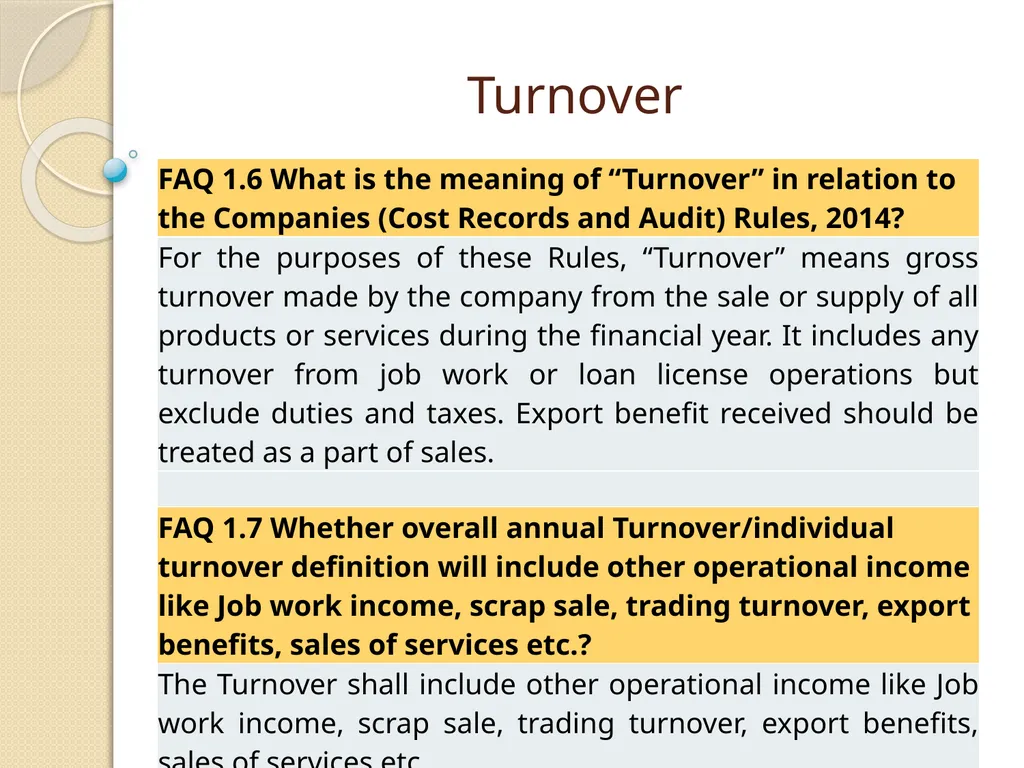
Turnover<br>
35
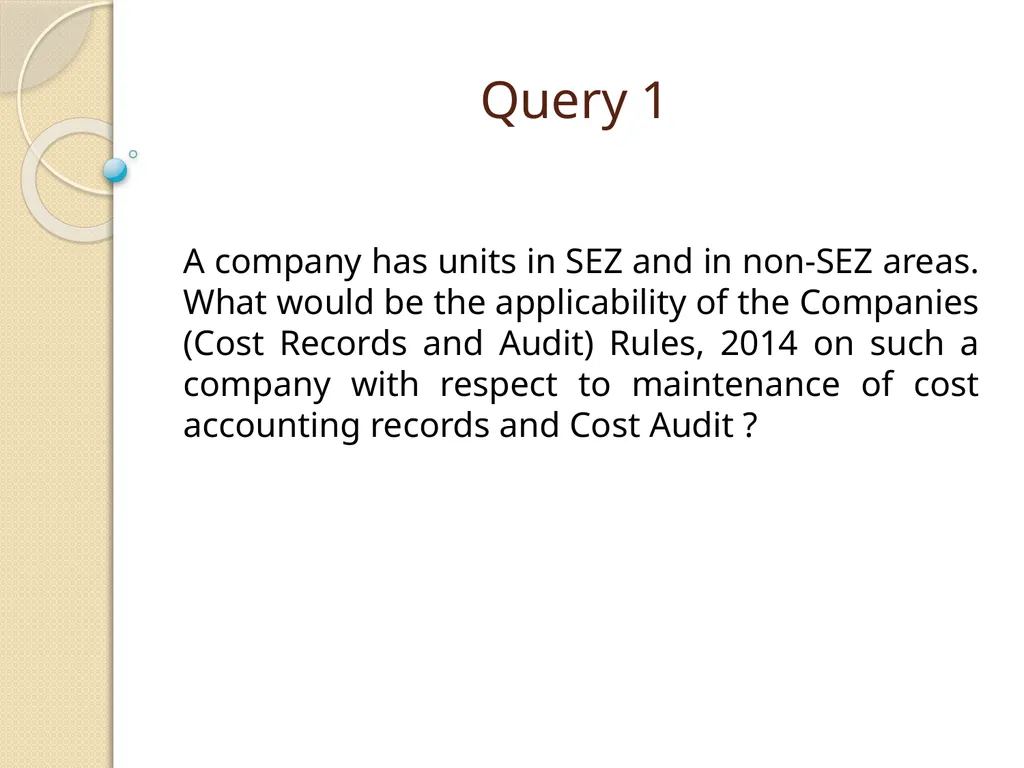
Query 1 A company has units in SEZ and in non-SEZ areas. What would be the applicability of the Companies (Cost Records and Audit) Rules, 2014 on such a company with respect to maintenance of cost accounting records and Cost Audit ?<br>
36
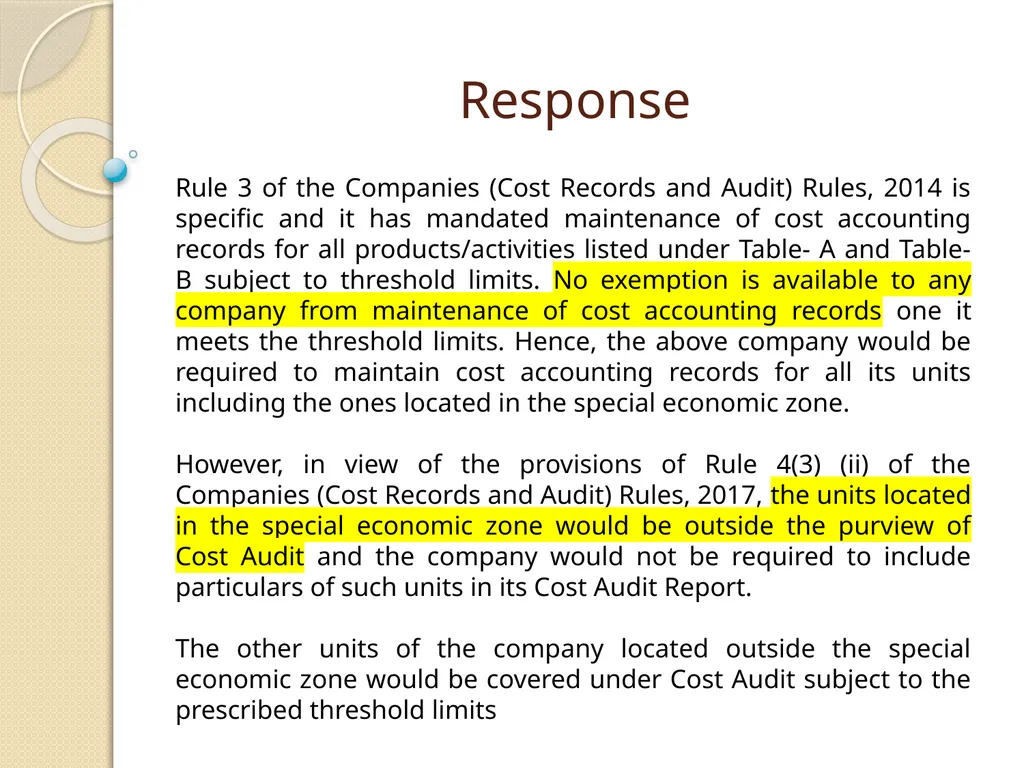
Response Rule 3 of the Companies (Cost Records and Audit) Rules, 2014 is specific and it has mandated maintenance of cost accounting records for all products/activities listed under Table- A and Table- B subject to threshold limits. No exemption is available to any company from maintenance of cost accounting records one it meets the threshold limits. Hence, the above company would be required to maintain cost accounting records for all its units including the ones located in the special economic zone.
However, in view of the provisions of Rule 4(3) (ii) of the Companies (Cost Records and Audit) Rules, 2017, the units located in the special economic zone would be outside the purview of Cost Audit and the company would not be required to include particulars of such units in its Cost Audit Report.
The other units of the company located outside the special economic zone would be covered under Cost Audit subject to the prescribed threshold limits<br>
However, in view of the provisions of Rule 4(3) (ii) of the Companies (Cost Records and Audit) Rules, 2017, the units located in the special economic zone would be outside the purview of Cost Audit and the company would not be required to include particulars of such units in its Cost Audit Report.
The other units of the company located outside the special economic zone would be covered under Cost Audit subject to the prescribed threshold limits<br>
37
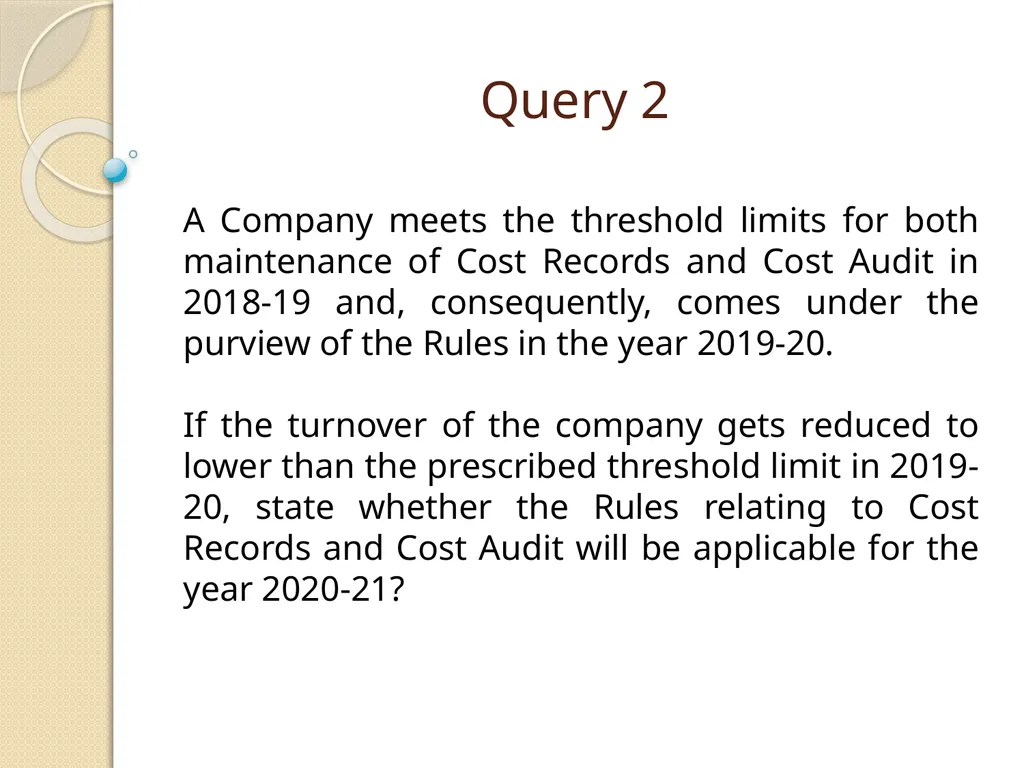
Query 2 A Company meets the threshold limits for both maintenance of Cost Records and Cost Audit in 2018-19 and, consequently, comes under the purview of the Rules in the year 2019-20.
If the turnover of the company gets reduced to lower than the prescribed threshold limit in 2019-20, state whether the Rules relating to Cost Records and Cost Audit will be applicable for the year 2020-21?<br>
If the turnover of the company gets reduced to lower than the prescribed threshold limit in 2019-20, state whether the Rules relating to Cost Records and Cost Audit will be applicable for the year 2020-21?<br>
38
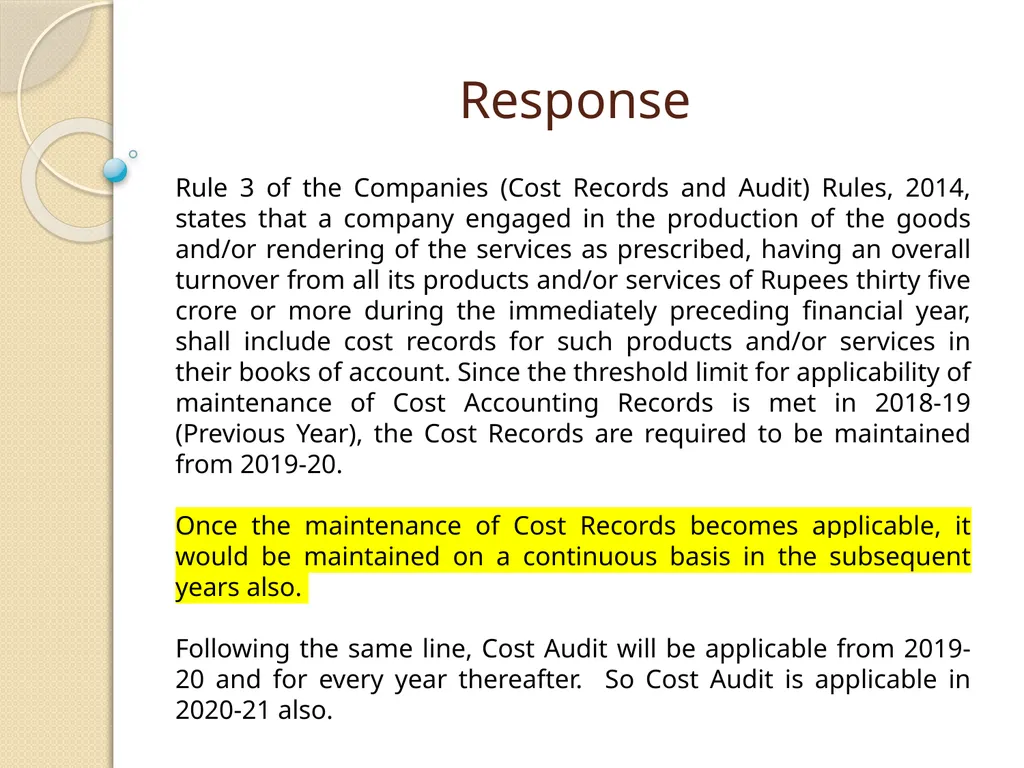
Response Rule 3 of the Companies (Cost Records and Audit) Rules, 2014, states that a company engaged in the production of the goods and/or rendering of the services as prescribed, having an overall turnover from all its products and/or services of Rupees thirty five crore or more during the immediately preceding financial year, shall include cost records for such products and/or services in their books of account. Since the threshold limit for applicability of maintenance of Cost Accounting Records is met in 2018-19 (Previous Year), the Cost Records are required to be maintained from 2019-20.
Once the maintenance of Cost Records becomes applicable, it would be maintained on a continuous basis in the subsequent years also.
Following the same line, Cost Audit will be applicable from 2019-20 and for every year thereafter. So Cost Audit is applicable in 2020-21 also.<br>
Once the maintenance of Cost Records becomes applicable, it would be maintained on a continuous basis in the subsequent years also.
Following the same line, Cost Audit will be applicable from 2019-20 and for every year thereafter. So Cost Audit is applicable in 2020-21 also.<br>
39
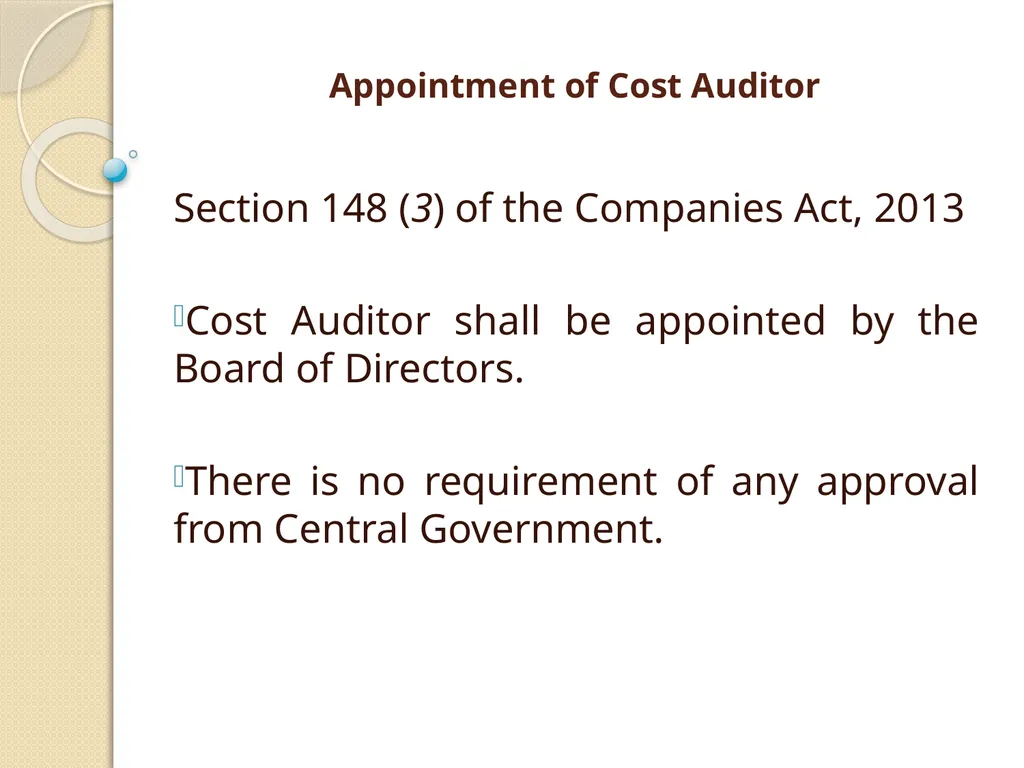
Appointment of Cost Auditor Section 148 (3) of the Companies Act, 2013
Cost Auditor shall be appointed by the Board of Directors.
There is no requirement of any approval from Central Government.<br>
Cost Auditor shall be appointed by the Board of Directors.
There is no requirement of any approval from Central Government.<br>
40
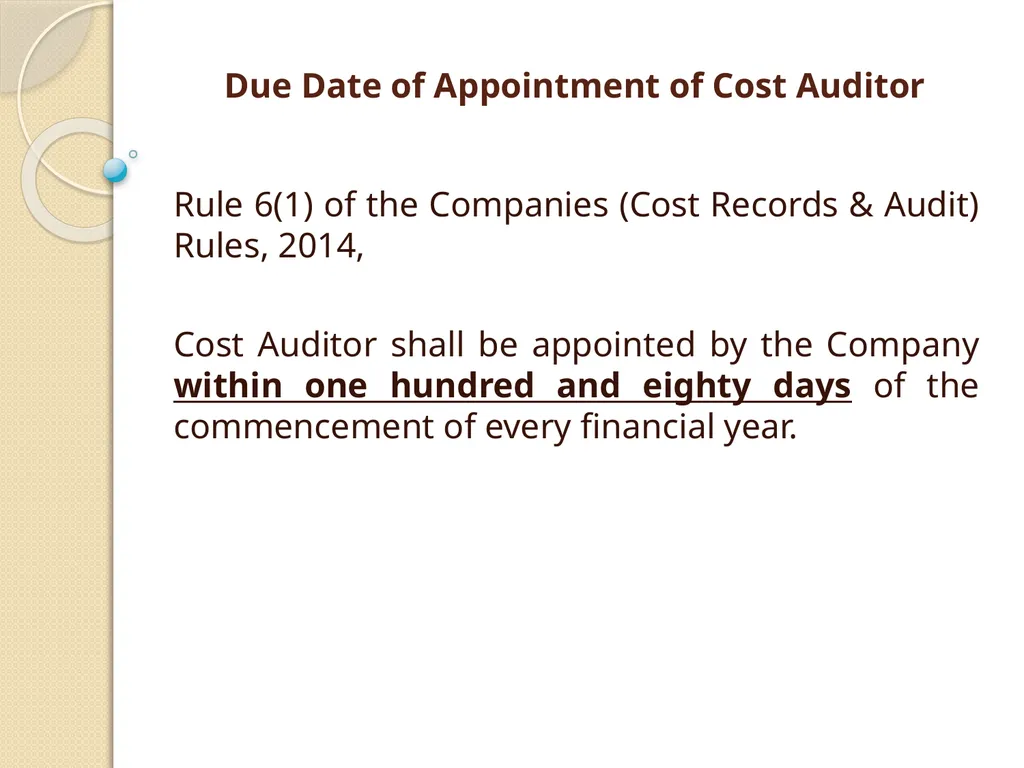
Due Date of Appointment of Cost Auditor Rule 6(1) of the Companies (Cost Records & Audit) Rules, 2014,
Cost Auditor shall be appointed by the Company within one hundred and eighty days of the commencement of every financial year.<br>
Cost Auditor shall be appointed by the Company within one hundred and eighty days of the commencement of every financial year.<br>
41
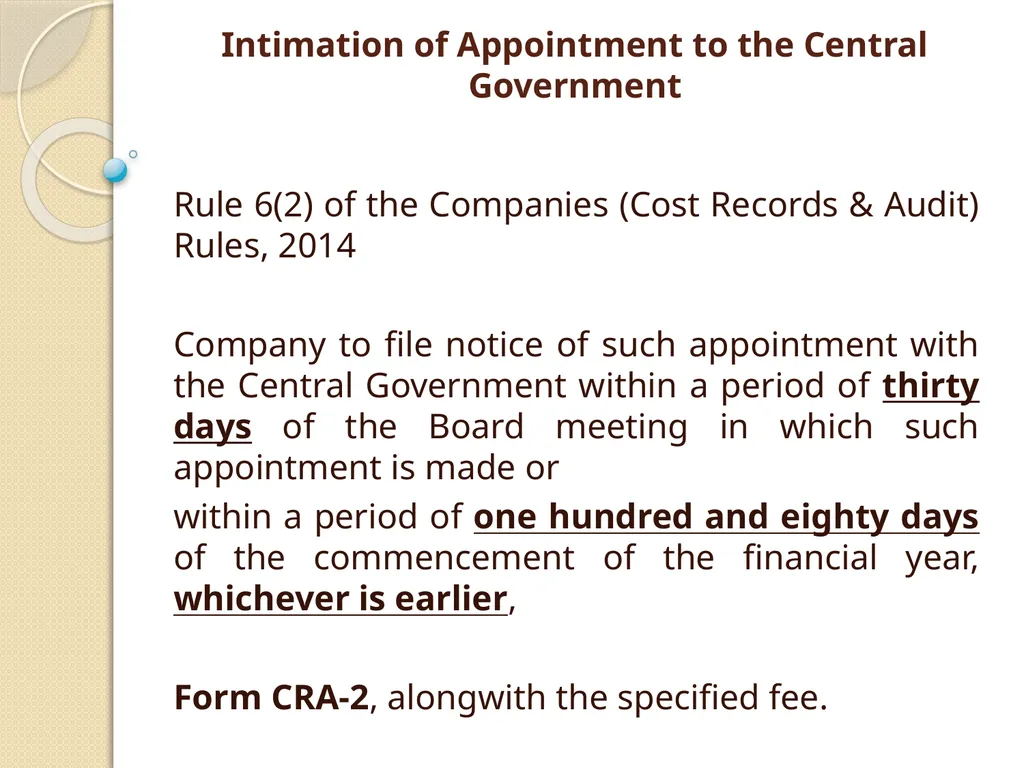
Intimation of Appointment to the Central Government Rule 6(2) of the Companies (Cost Records & Audit) Rules, 2014
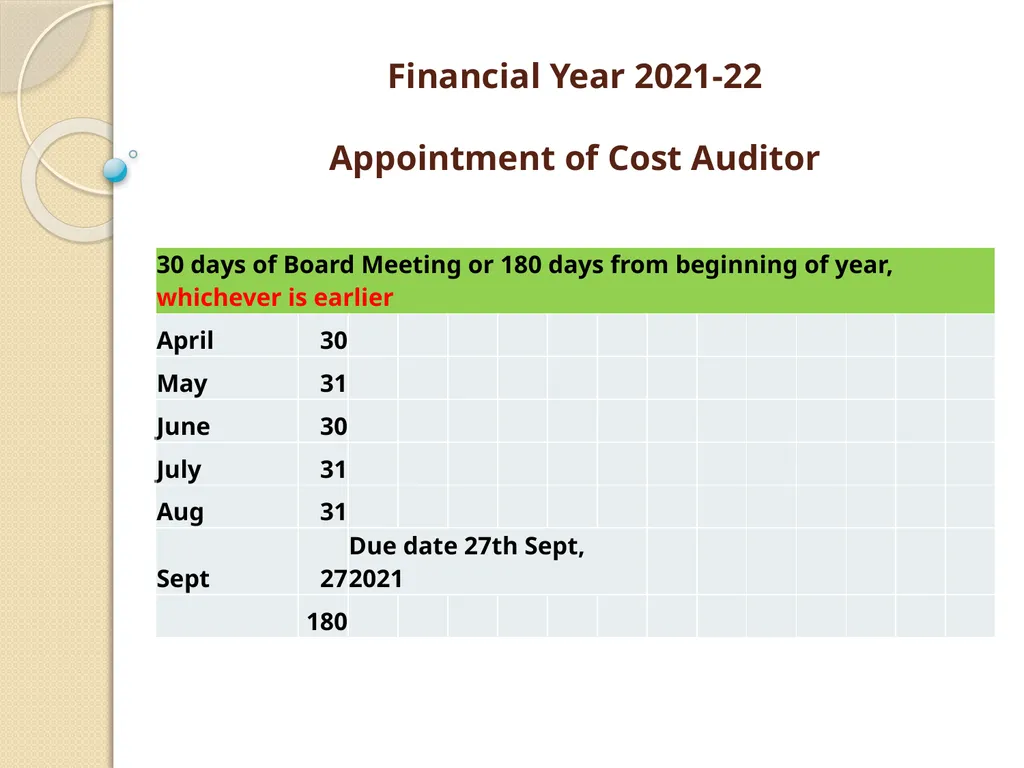
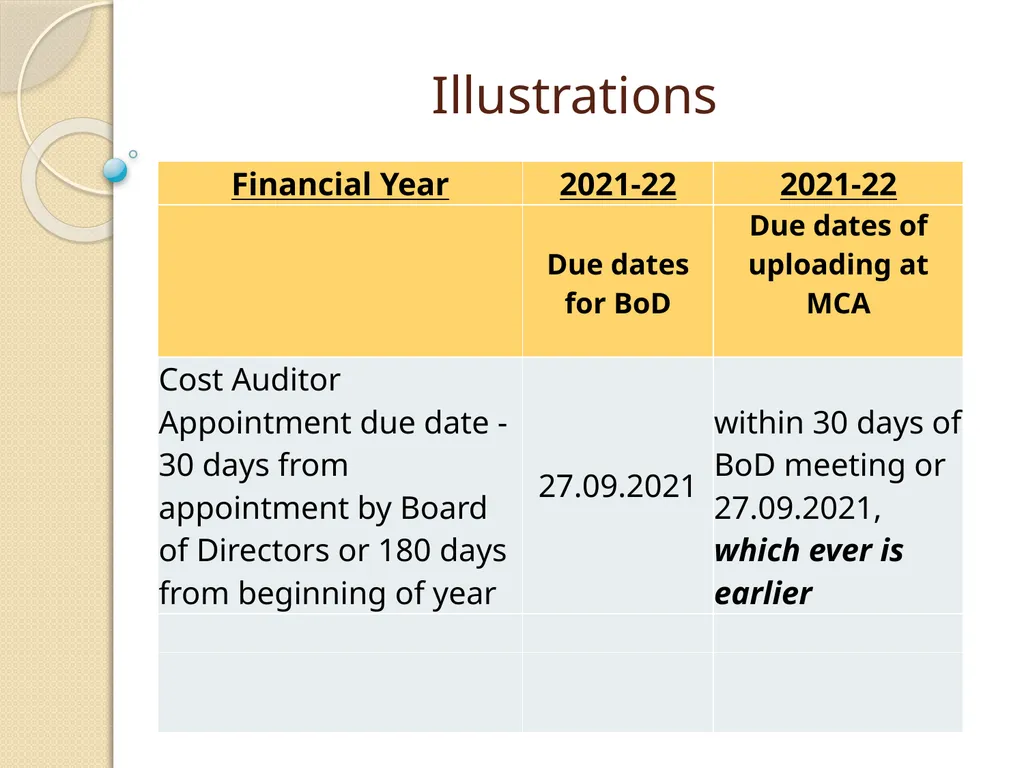
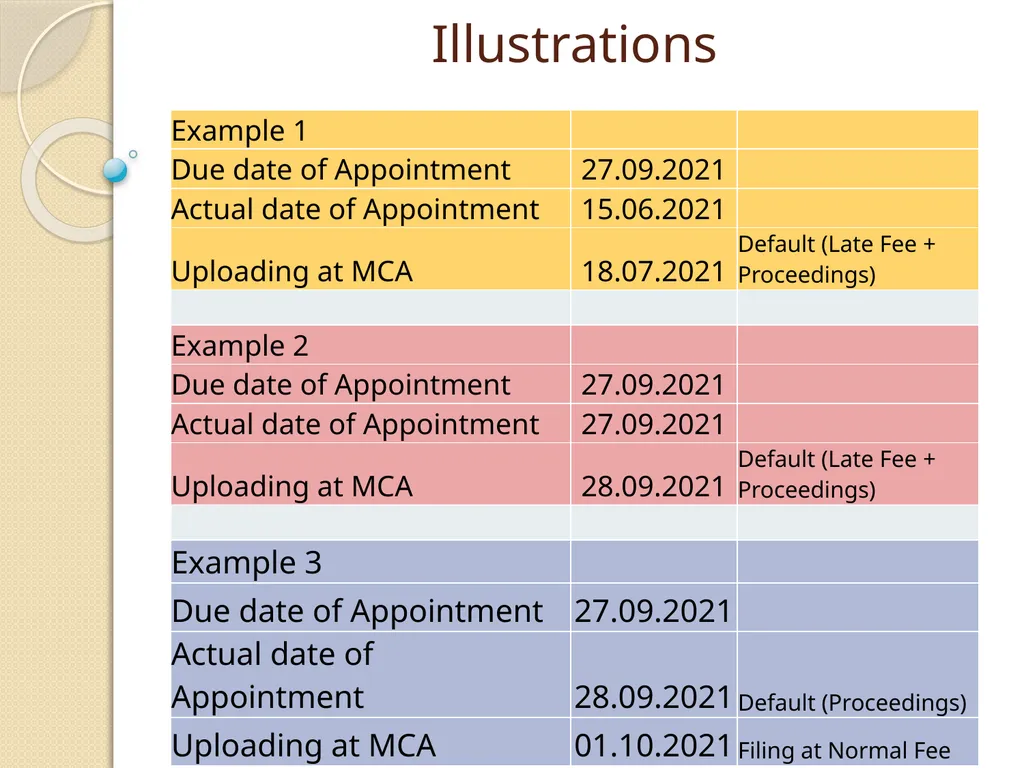
Company to file notice of such appointment with the Central Government within a period of thirty days of the Board meeting in which such appointment is made or
within a period of one hundred and eighty days of the commencement of the financial year, whichever is earlier,
Form CRA-2, alongwith the specified fee.<br>
Company to file notice of such appointment with the Central Government within a period of thirty days of the Board meeting in which such appointment is made or
within a period of one hundred and eighty days of the commencement of the financial year, whichever is earlier,
Form CRA-2, alongwith the specified fee.<br>
42
Financial Year 2021-22
Appointment of Cost Auditor<br>
43
Illustrations<br>
44
Illustrations<br>
45
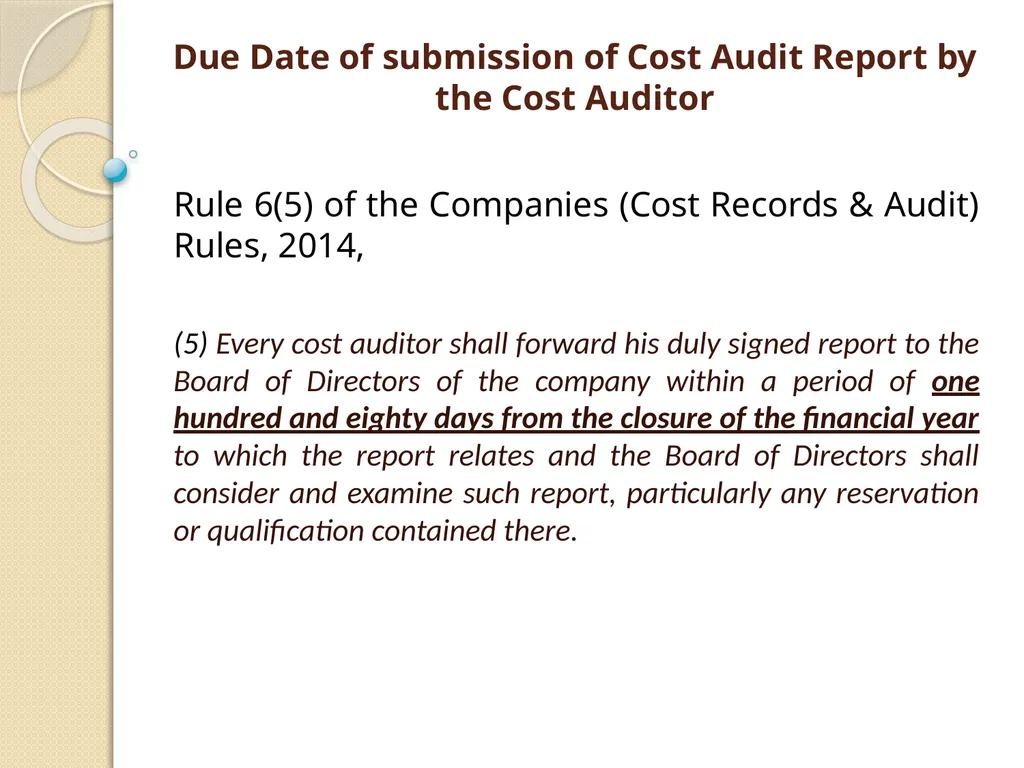
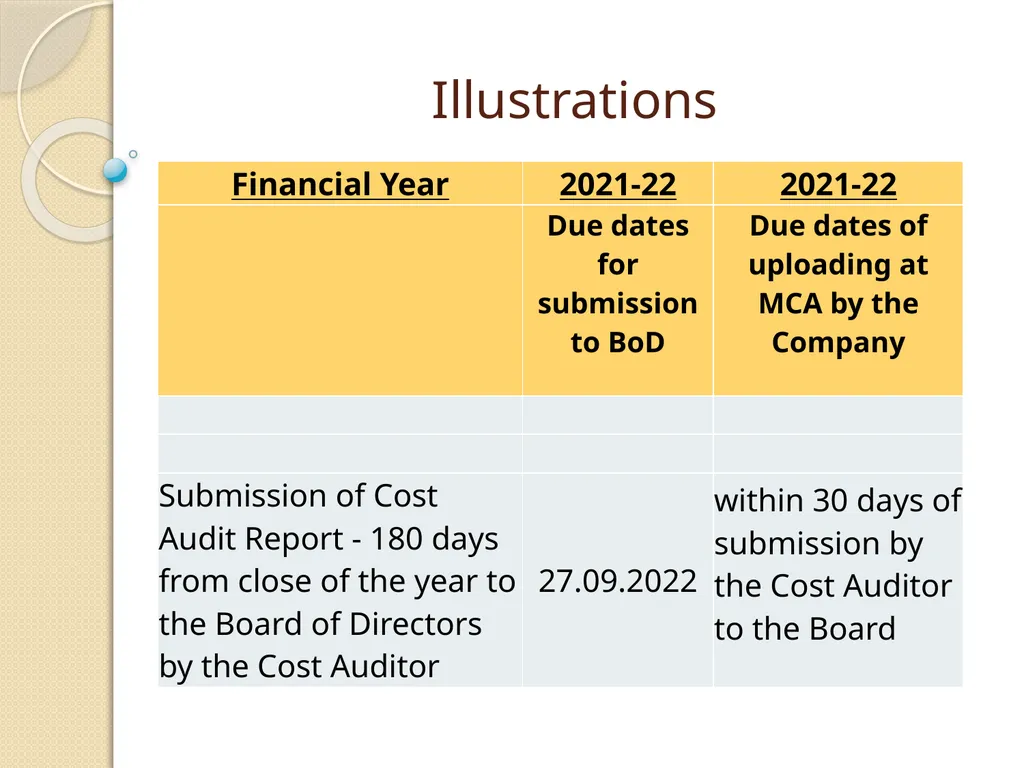
Due Date of submission of Cost Audit Report by the Cost Auditor Rule 6(5) of the Companies (Cost Records & Audit) Rules, 2014,
(5) Every cost auditor shall forward his duly signed report to the Board of Directors of the company within a period of one hundred and eighty days from the closure of the financial year to which the report relates and the Board of Directors shall consider and examine such report, particularly any reservation or qualification contained there.<br>
(5) Every cost auditor shall forward his duly signed report to the Board of Directors of the company within a period of one hundred and eighty days from the closure of the financial year to which the report relates and the Board of Directors shall consider and examine such report, particularly any reservation or qualification contained there.<br>
46
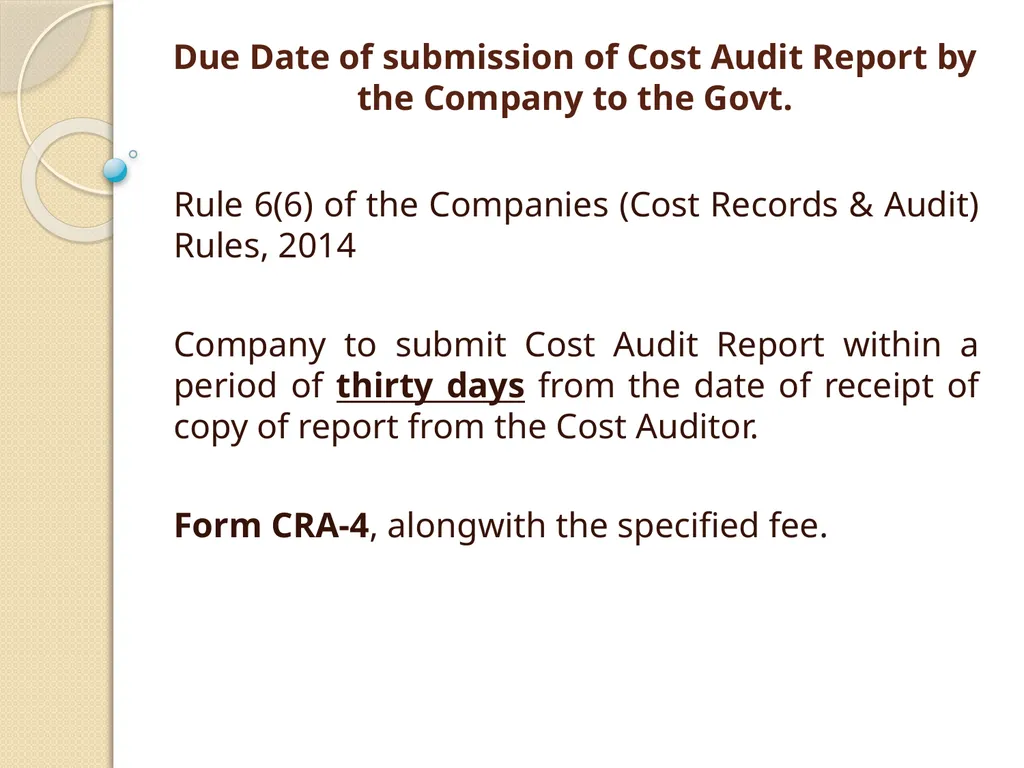
Due Date of submission of Cost Audit Report by the Company to the Govt. Rule 6(6) of the Companies (Cost Records & Audit) Rules, 2014
Company to submit Cost Audit Report within a period of thirty days from the date of receipt of copy of report from the Cost Auditor.
Form CRA-4, alongwith the specified fee.<br>
Company to submit Cost Audit Report within a period of thirty days from the date of receipt of copy of report from the Cost Auditor.
Form CRA-4, alongwith the specified fee.<br>
47
Illustrations<br>
48
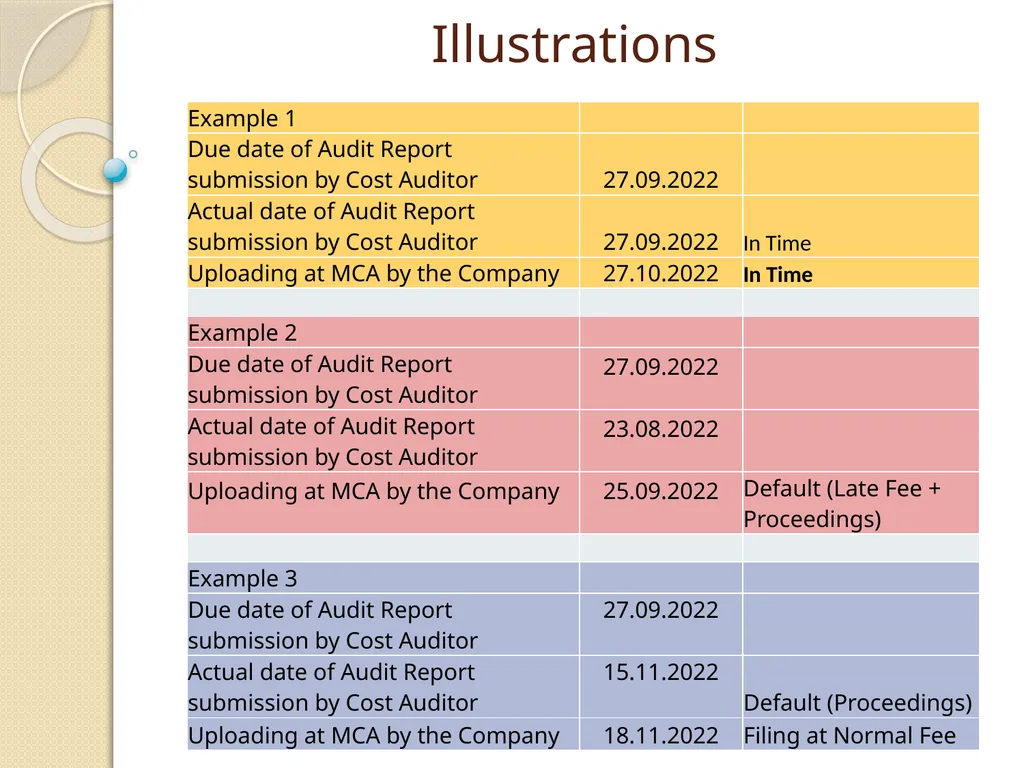
Illustrations<br>
49
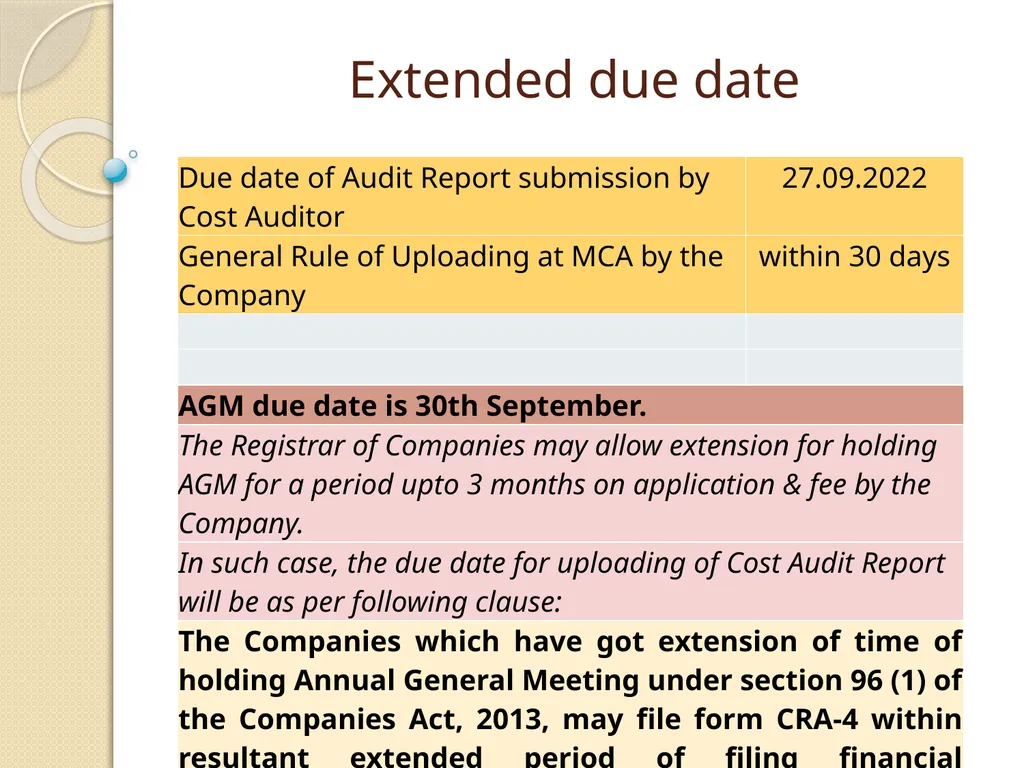
Extended due date<br>
50
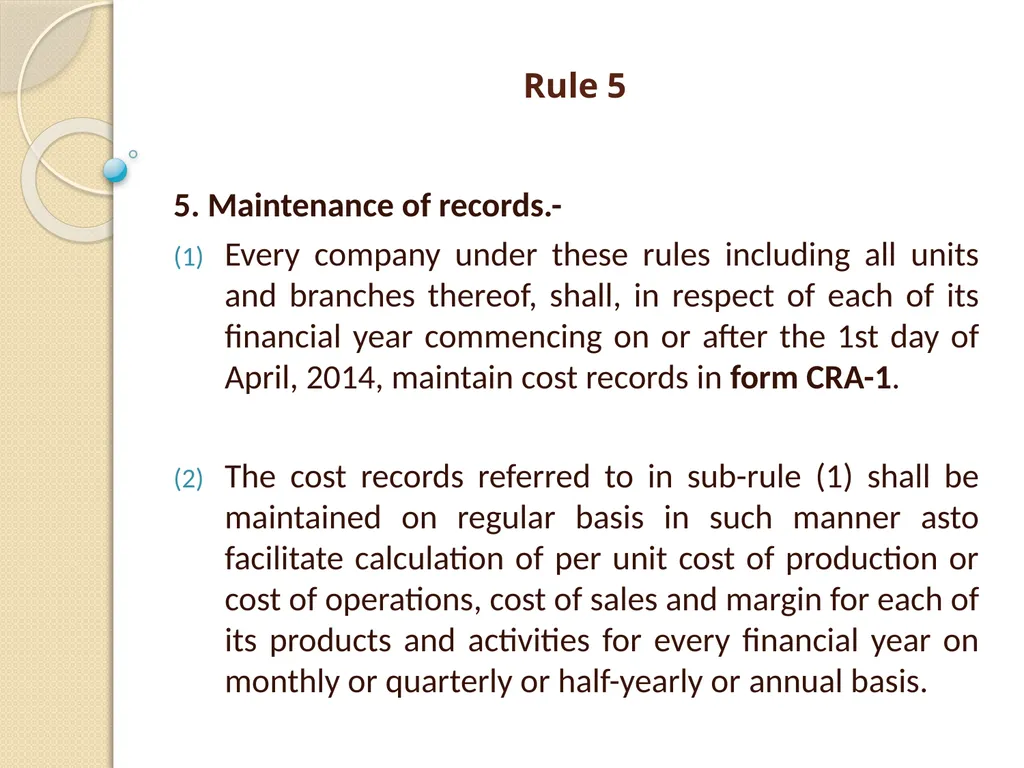
Rule 5 5. Maintenance of records.-
Every company under these rules including all units and branches thereof, shall, in respect of each of its financial year commencing on or after the 1st day of April, 2014, maintain cost records in form CRA-1.
The cost records referred to in sub-rule (1) shall be maintained on regular basis in such manner asto facilitate calculation of per unit cost of production or cost of operations, cost of sales and margin for each of its products and activities for every financial year on monthly or quarterly or half-yearly or annual basis.<br>
Every company under these rules including all units and branches thereof, shall, in respect of each of its financial year commencing on or after the 1st day of April, 2014, maintain cost records in form CRA-1.
The cost records referred to in sub-rule (1) shall be maintained on regular basis in such manner asto facilitate calculation of per unit cost of production or cost of operations, cost of sales and margin for each of its products and activities for every financial year on monthly or quarterly or half-yearly or annual basis.<br>
51
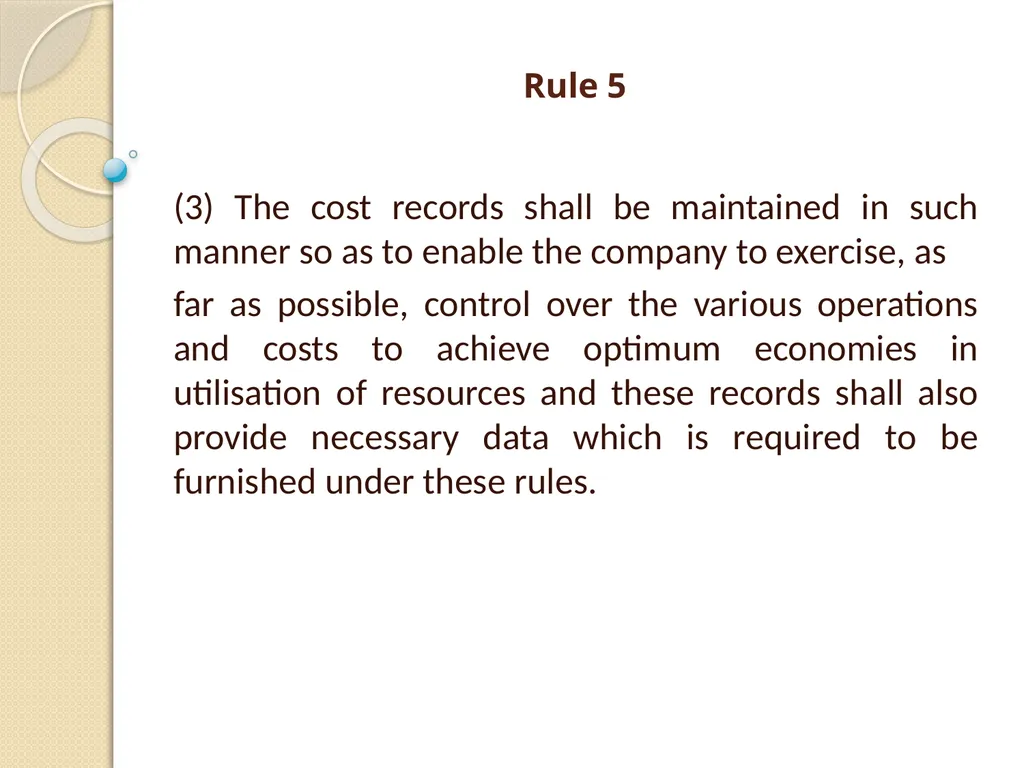
Rule 5 (3) The cost records shall be maintained in such manner so as to enable the company to exercise, as
far as possible, control over the various operations and costs to achieve optimum economies in utilisation of resources and these records shall also provide necessary data which is required to be furnished under these rules.<br>
far as possible, control over the various operations and costs to achieve optimum economies in utilisation of resources and these records shall also provide necessary data which is required to be furnished under these rules.<br>
52
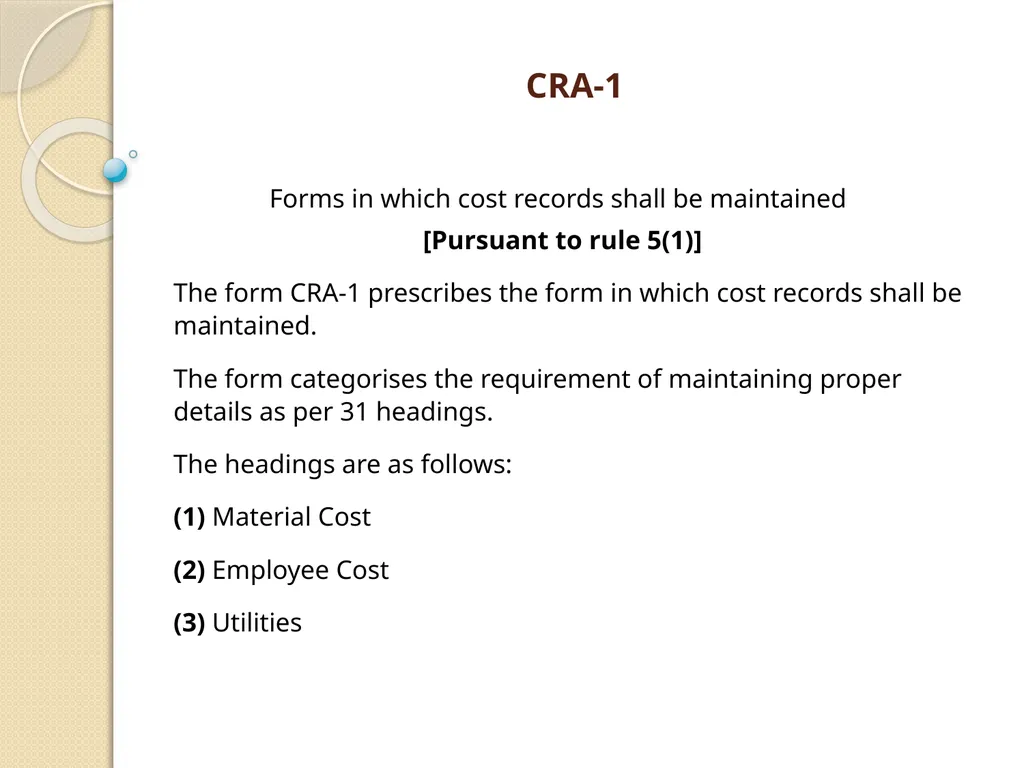
CRA-1 Forms in which cost records shall be maintained
[Pursuant to rule 5(1)]
The form CRA-1 prescribes the form in which cost records shall be maintained.
The form categorises the requirement of maintaining proper details as per 31 headings.
The headings are as follows:
(1) Material Cost
(2) Employee Cost
(3) Utilities<br>
[Pursuant to rule 5(1)]
The form CRA-1 prescribes the form in which cost records shall be maintained.
The form categorises the requirement of maintaining proper details as per 31 headings.
The headings are as follows:
(1) Material Cost
(2) Employee Cost
(3) Utilities<br>
53
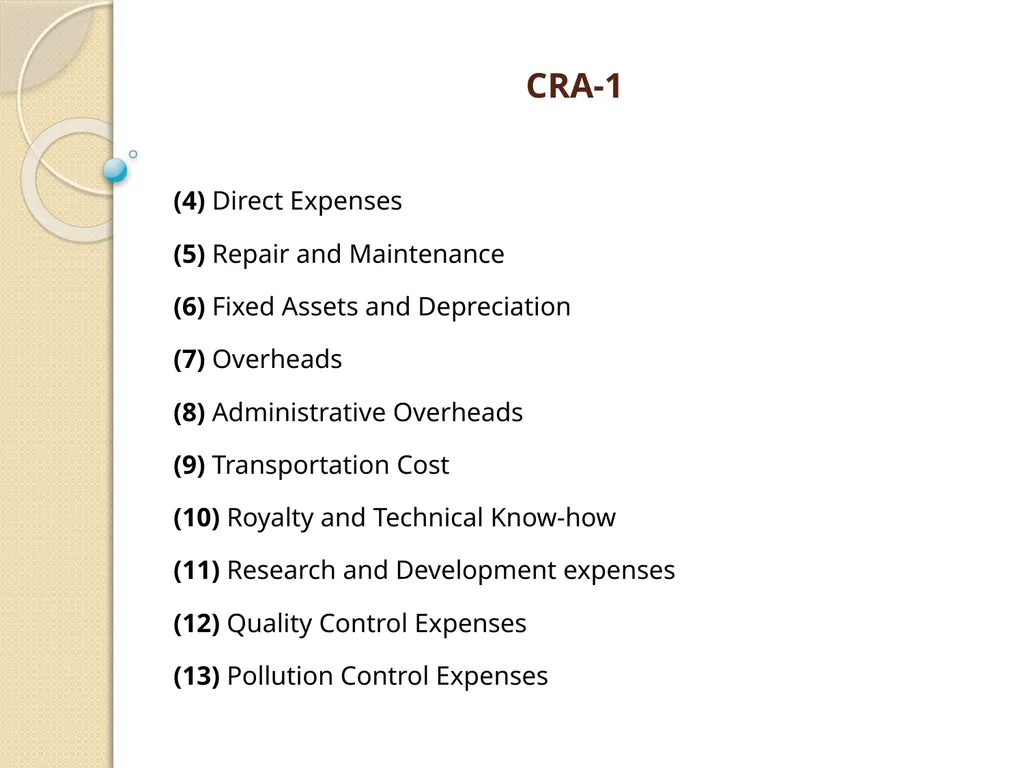
CRA-1 (4) Direct Expenses
(5) Repair and Maintenance
(6) Fixed Assets and Depreciation
(7) Overheads
(8) Administrative Overheads
(9) Transportation Cost
(10) Royalty and Technical Know-how
(11) Research and Development expenses
(12) Quality Control Expenses
(13) Pollution Control Expenses<br>
(5) Repair and Maintenance
(6) Fixed Assets and Depreciation
(7) Overheads
(8) Administrative Overheads
(9) Transportation Cost
(10) Royalty and Technical Know-how
(11) Research and Development expenses
(12) Quality Control Expenses
(13) Pollution Control Expenses<br>
54
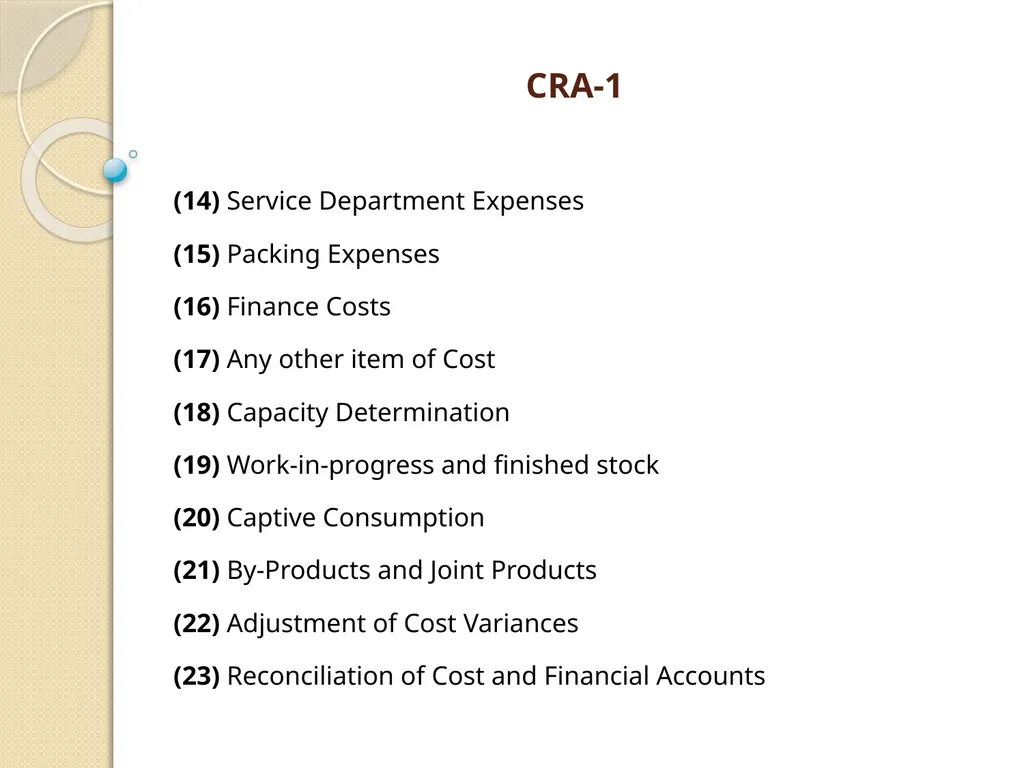
CRA-1 (14) Service Department Expenses
(15) Packing Expenses
(16) Finance Costs
(17) Any other item of Cost
(18) Capacity Determination
(19) Work-in-progress and finished stock
(20) Captive Consumption
(21) By-Products and Joint Products
(22) Adjustment of Cost Variances
(23) Reconciliation of Cost and Financial Accounts<br>
(15) Packing Expenses
(16) Finance Costs
(17) Any other item of Cost
(18) Capacity Determination
(19) Work-in-progress and finished stock
(20) Captive Consumption
(21) By-Products and Joint Products
(22) Adjustment of Cost Variances
(23) Reconciliation of Cost and Financial Accounts<br>
55
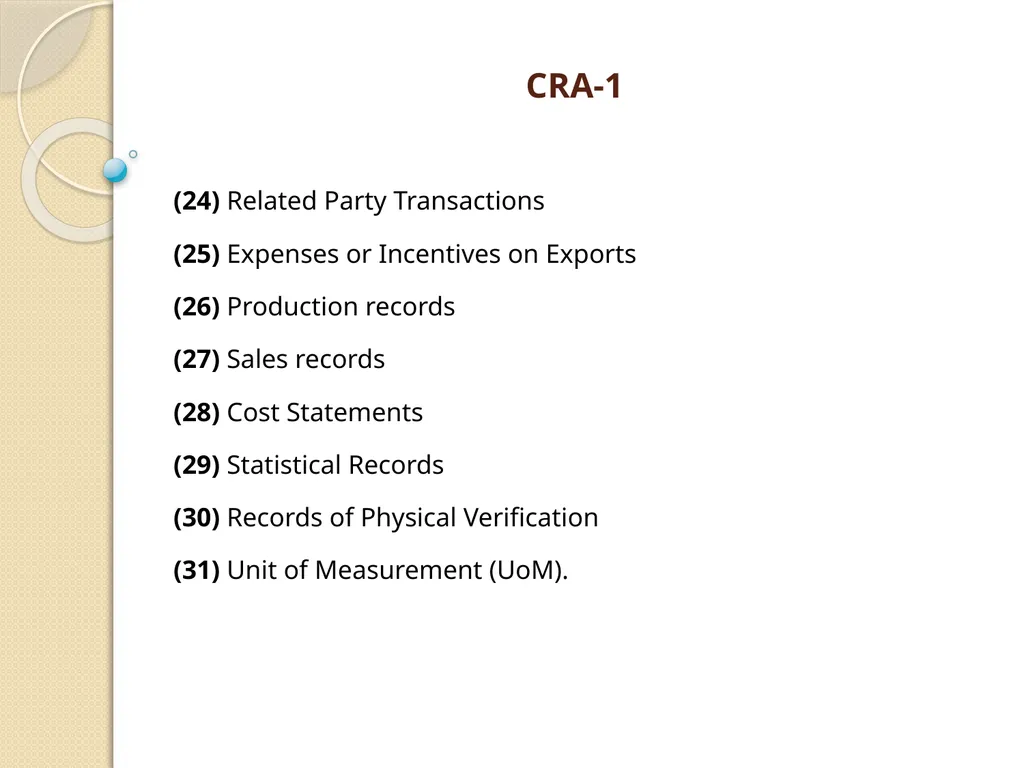
CRA-1 (24) Related Party Transactions
(25) Expenses or Incentives on Exports
(26) Production records
(27) Sales records
(28) Cost Statements
(29) Statistical Records
(30) Records of Physical Verification
(31) Unit of Measurement (UoM).<br>
(25) Expenses or Incentives on Exports
(26) Production records
(27) Sales records
(28) Cost Statements
(29) Statistical Records
(30) Records of Physical Verification
(31) Unit of Measurement (UoM).<br>