
COURSE: MEASUREMENT AND CONTROL (17528) Subject





Description: COURSE: MEASUREMENT AND CONTROL (17528) Subject Teacher: Ms. Nilesha U. Patil Pimpri Chinchwad polytechnics FHH Chapter No.-03 Temperature Measurement Co-Know the different temperature measuring instrument with their construction and
Related Topics
Download Presentation
"COURSE: MEASUREMENT AND CONTROL (17528) Subject" is the property of its rightful owner. Permission is granted to download and print the materials on this website for personal, non-commercial use only, and to display it on your personal computer provided you do not modify the materials and that you retain all copyright notices contained in the materials. By downloading content from our website, you accept the terms of this agreement.
Presentation Transcript
slide1. COURSE: MEASUREMENT AND CONTROL (17528)
Subject Teacher: Ms. Nilesha U. Patil Pimpri Chinchwad polytechnics<br>
slide2. FHH Chapter No.-03 Temperature Measurement Co-Know the different temperature measuring instrument with their construction and working<br>
slide3. Temperature measurement Temperature is measure of thermal energy in a body.
It is the hotness or coldness of a medium
Hotness or coldness is indication of heat and is compared by giving some reference of unit<br>
slide4. Temperature scale A) Fahrenheit scale:
Abbreviated as (°F)
First to gain acceptance
Proposed in the early 1700s by Fahrenheit (Dutch)
Freezing point- 32 °C, Boiling point- 212 °C<br>
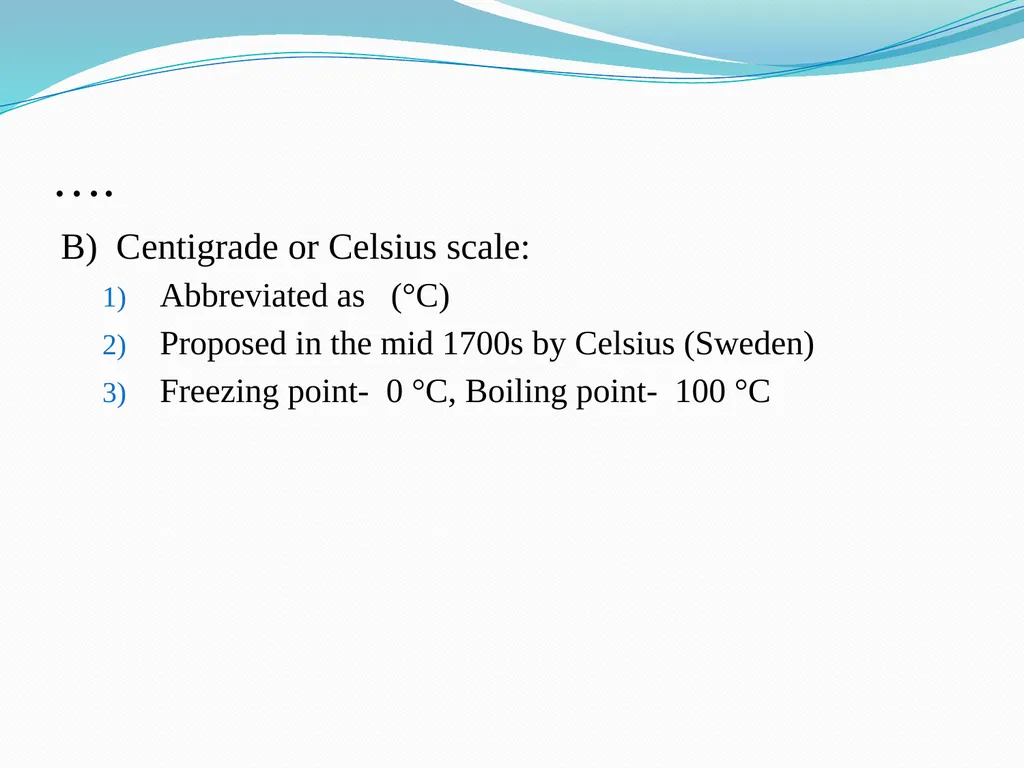
slide5. …. B) Centigrade or Celsius scale:
Abbreviated as (°C)
Proposed in the mid 1700s by Celsius (Sweden)
Freezing point- 0 °C, Boiling point- 100 °C<br>
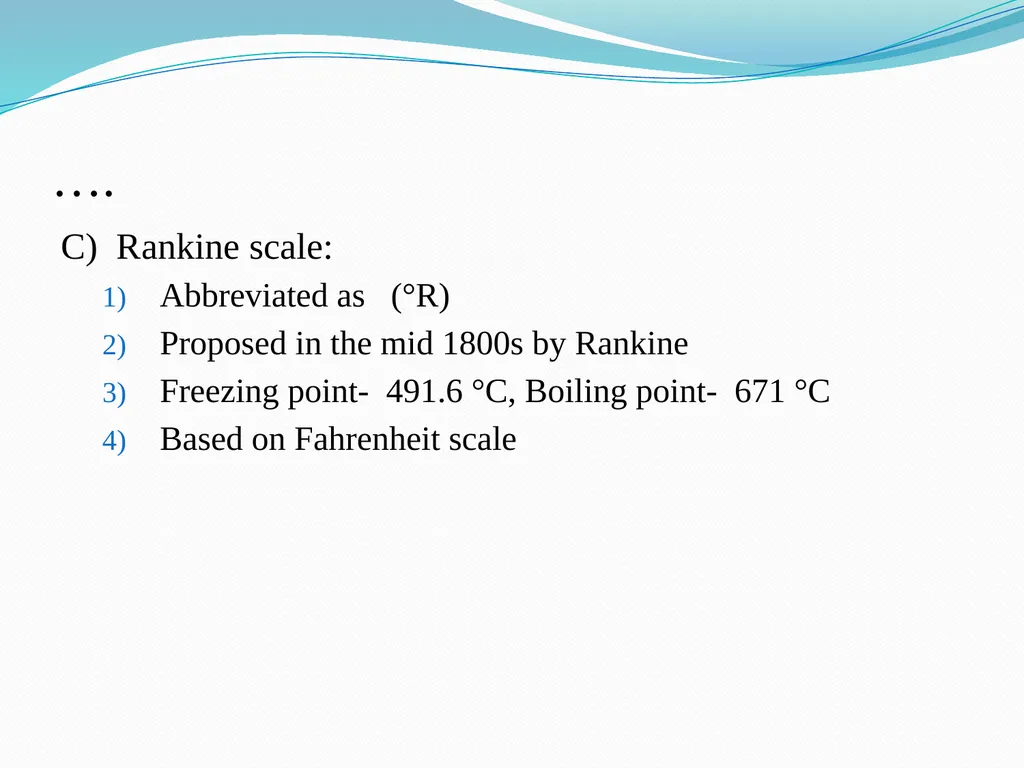
slide6. …. C) Rankine scale:
Abbreviated as (°R)
Proposed in the mid 1800s by Rankine
Freezing point- 491.6 °C, Boiling point- 671 °C
Based on Fahrenheit scale<br>
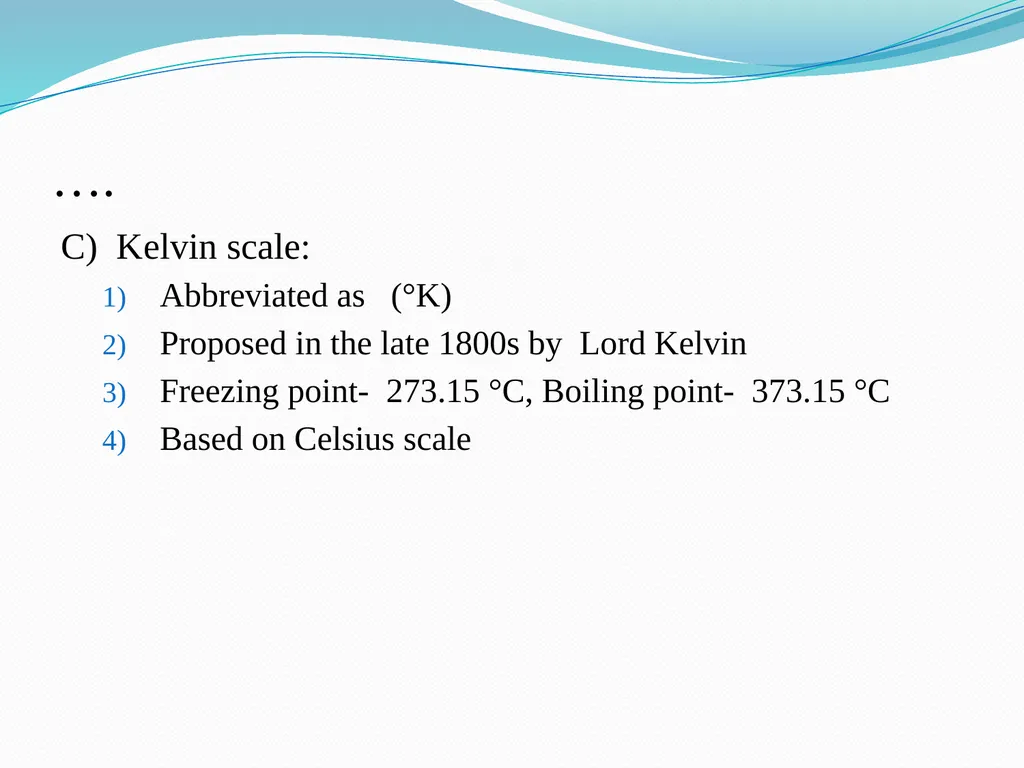
slide7. …. C) Kelvin scale:
Abbreviated as (°K)
Proposed in the late 1800s by Lord Kelvin
Freezing point- 273.15 °C, Boiling point- 373.15 °C
Based on Celsius scale<br>
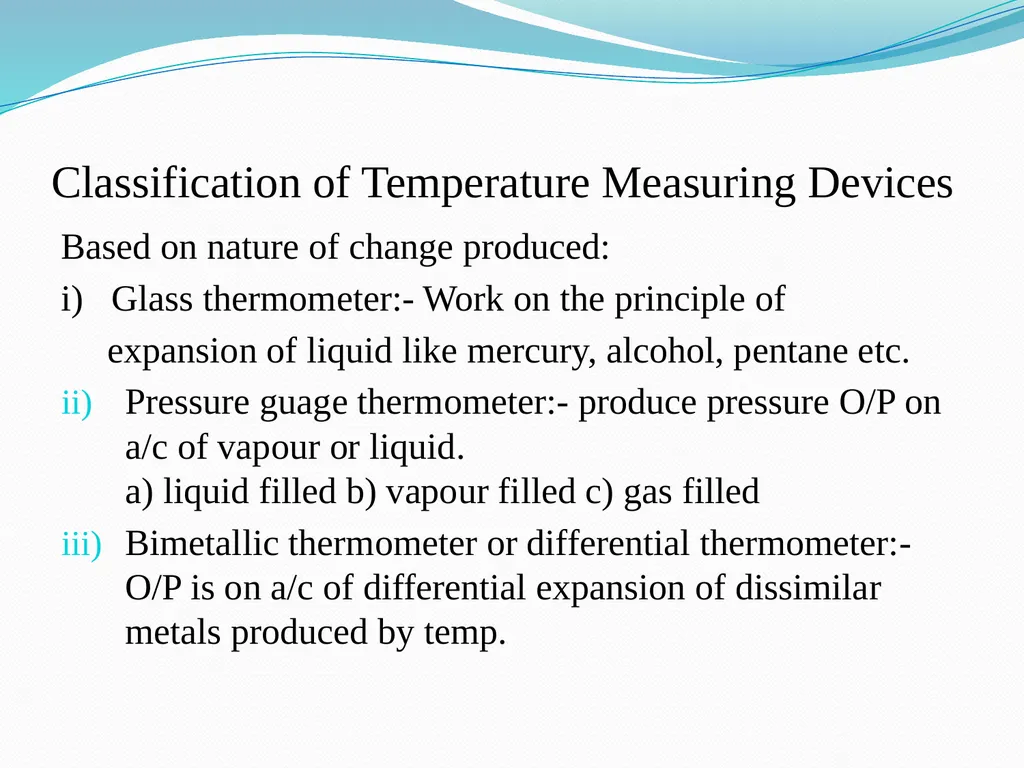
slide8. Classification of Temperature Measuring Devices Based on nature of change produced:
i) Glass thermometer:- Work on the principle of
expansion of liquid like mercury, alcohol, pentane etc.
Pressure guage thermometer:- produce pressure O/P on a/c of vapour or liquid. a) liquid filled b) vapour filled c) gas filled
Bimetallic thermometer or differential thermometer:- O/P is on a/c of differential expansion of dissimilar metals produced by temp.<br>
slide9. …. Electrical resistance thermometer:- temperature is measured by resistance o electrical wire
Thermocouples:- Temperature is indicated by production of emf
Optical pyrometer:- Temperature is determined by luminosity of hot body that of a calibrated source
Radiation Pyrometer:- Measures temp by absorbing radiation
Fusion pyrometer :- Temp. is determined by which of a series of material with graduated fusion material melt or soften due to temp.<br>
slide10. …. ix) Calorimetric pyrometer:- Temp. is determined by measuring quantity of heat removed when temp. of body brought from unknown to known level.
x) Electrical and non electrical type:- Those which are electrical or electronic in nature and those which are not.
xi) Temperature range:- Range for which different types of temp measuring devices are used along with their accuracies.
xii) Thermister:- It measures temp by relating change in resistance with change in temp<br>
slide11. Non electrical methods Expansion thermometer
a) Expansion of solid
Bimetallic thermometer
b) Expansion of liquid
Liquid in gas thermometer
Liquid in metal thermometer
c) Expansion of gas
Filled system thermometer
Gas filled thermometer
Liquid filled thermometer
Mercury filled thermometer
Vapour filled thermometer
Pyrometer<br>
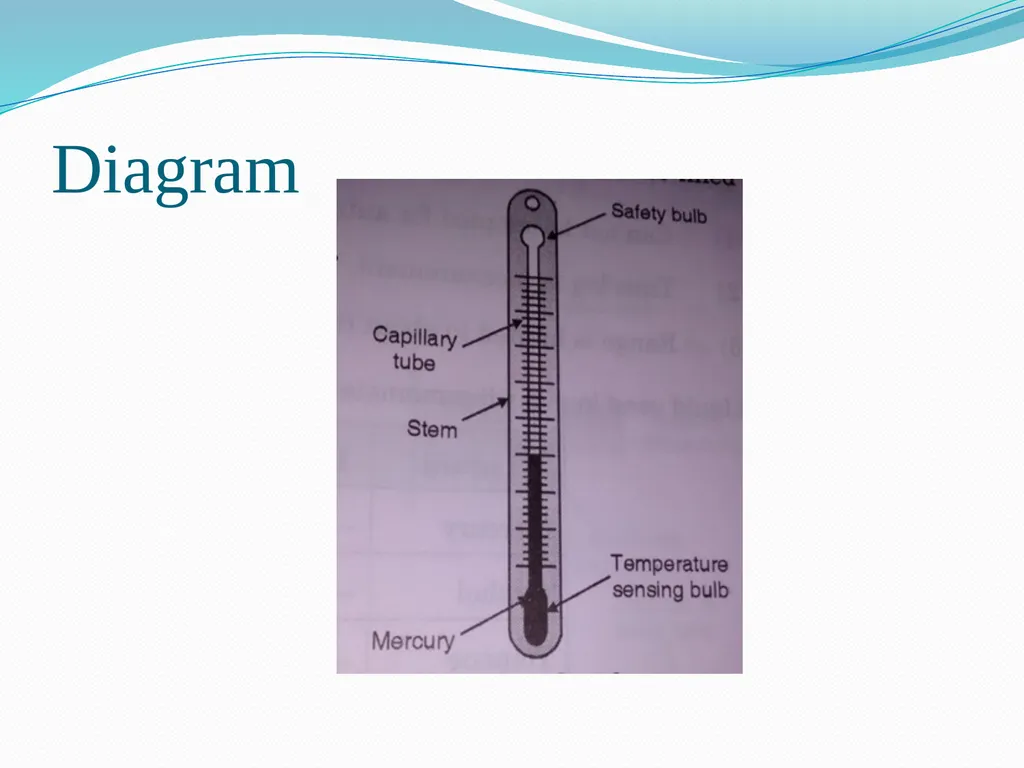
slide12. LIQUID IN GLASS THERMOMETER Construction
The unit consists of glass envelope, a responsive liquid and an indicating scale
The envelope comprises a thick walled glass tube with capillary bore and cylindrical bulb filled with liquid
Size of capillary depends on the sensing bulb, responsive liquid and desired temp range.<br>
slide13. Diagram<br>
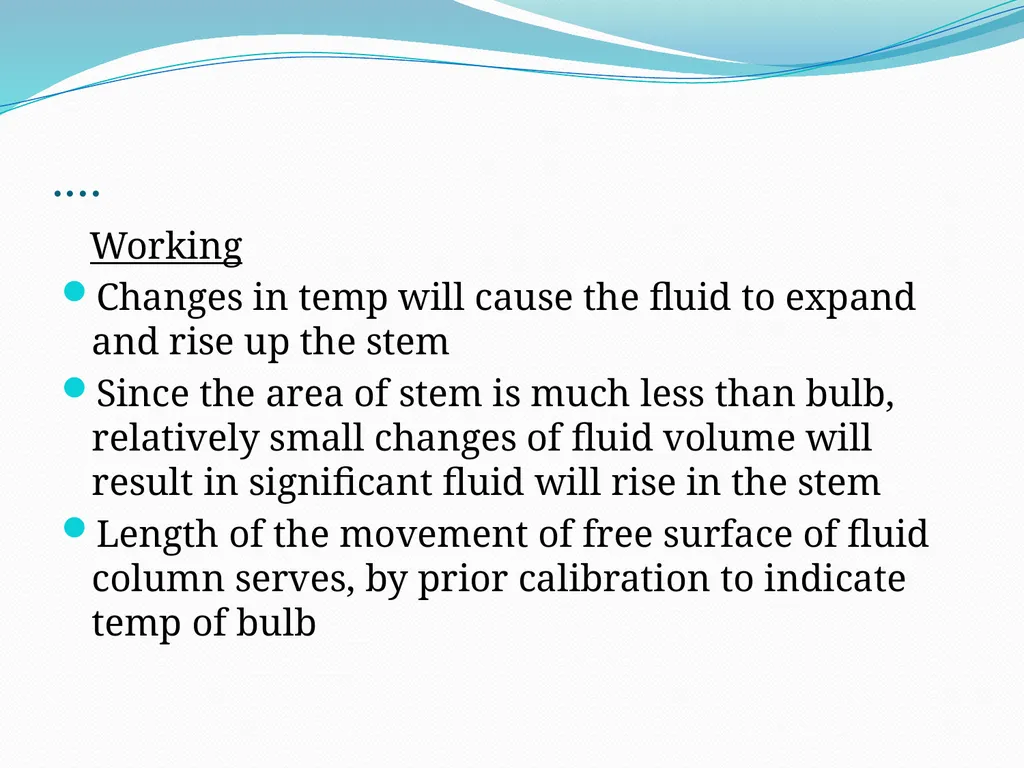
slide14. .... Working
Changes in temp will cause the fluid to expand and rise up the stem
Since the area of stem is much less than bulb, relatively small changes of fluid volume will result in significant fluid will rise in the stem
Length of the movement of free surface of fluid column serves, by prior calibration to indicate temp of bulb<br>
slide15. Advantages Simple to use
Low cost
Easily portable
Ease of checking for physical damage
No need of auxiliary power
No need of additional indicating instruments
Good accuracy<br>
slide16. Disadvantages Fragile construction
Can not be adopted for remote reading
Time lag
Limited range (about 600 °C)<br>
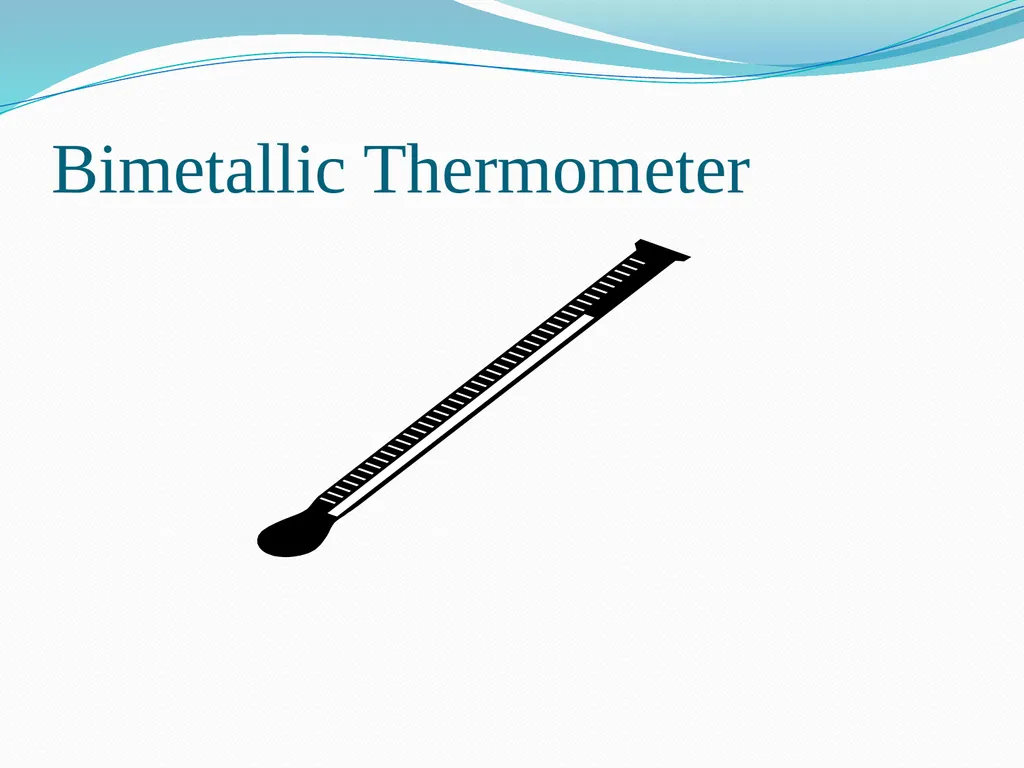
slide17. Bimetallic Thermometer<br>
slide18. Bimetallic thermometer Construction
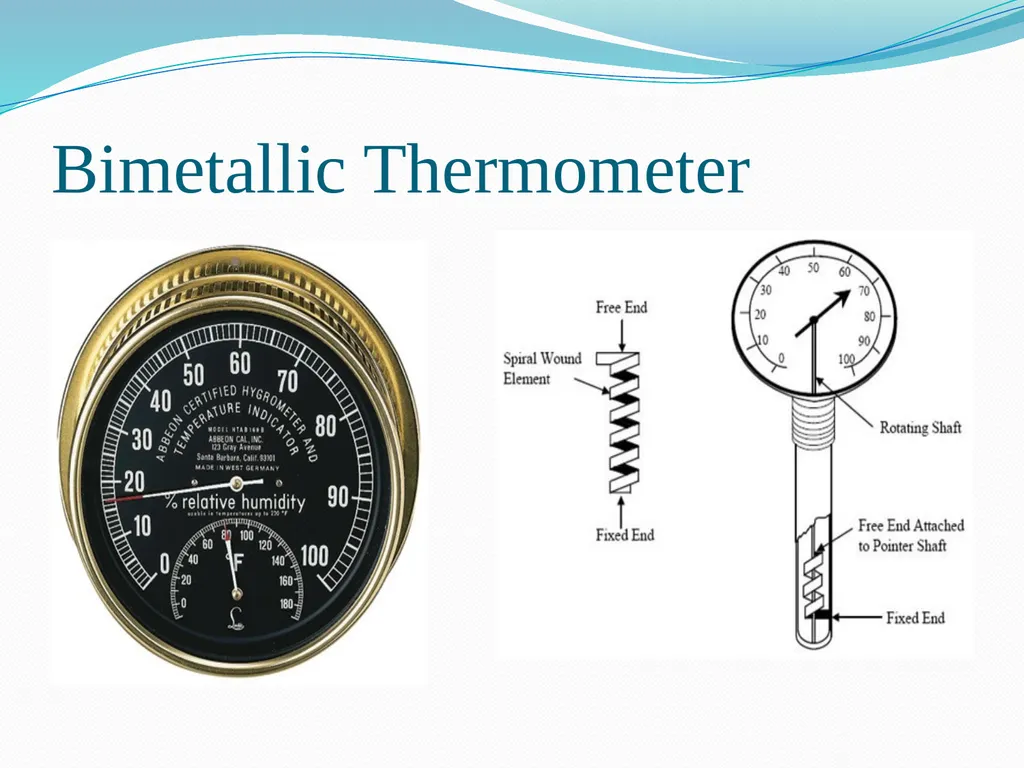
A metallic thermometer consists of two pieces of different pieces of different metals having different coefficient expansion firmly bonded together by welding
Bimetallic elements can be arranged in the flat, spiral, single helix configuration
One end of helix is anchored permanently to the casing and the other end is secured to the pointer<br>
slide19. Bimetallic Thermometer<br>
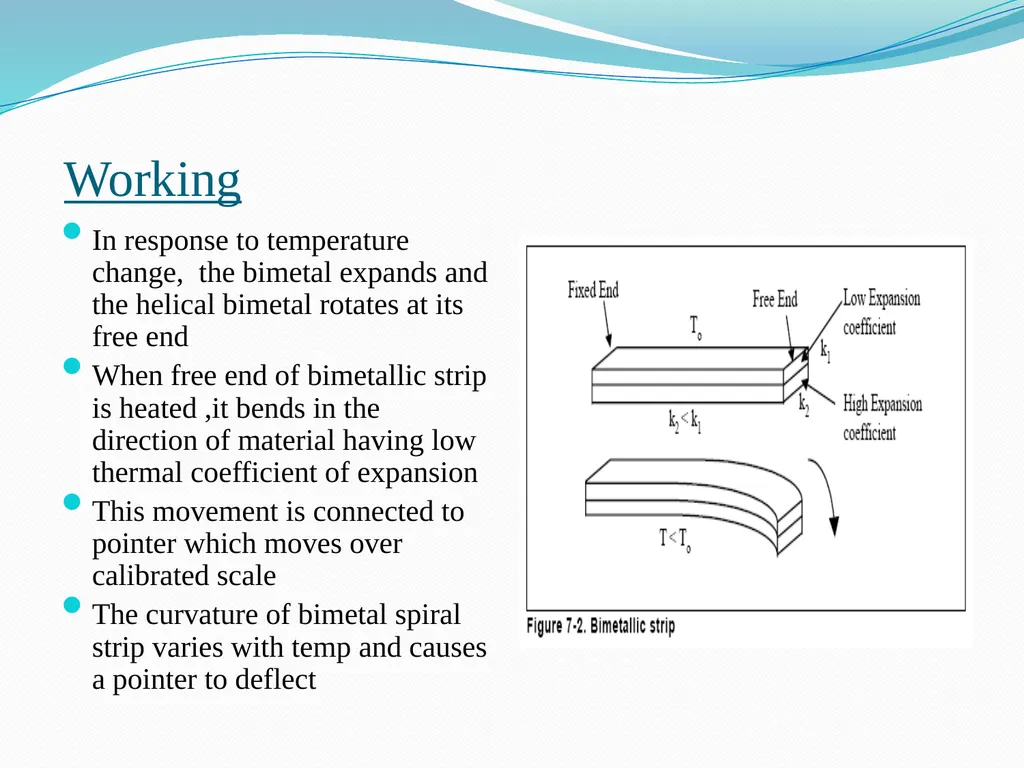
slide20. Working In response to temperature change, the bimetal expands and the helical bimetal rotates at its free end
When free end of bimetallic strip is heated ,it bends in the direction of material having low thermal coefficient of expansion
This movement is connected to pointer which moves over calibrated scale
The curvature of bimetal spiral strip varies with temp and causes a pointer to deflect<br>
slide21. Advantages Low cost
Simple in design
Compact and robust in construction
No maintenance is required
Overloading can be tolerated<br>
slide22. Disadvantages Low speed of response
Creep at high temperature<br>
slide23. Pressure Thermometer A pressure thermometer operates by expansion of gas or liquid.
A pressure thermometer measures temperature indirectly by measuring pressure.
The gauge is a pressure gauge, but is typically calibrated in units of temperature instead.<br>
slide24. Pressure Thermometer Construction
A thermal system partially filled with a volatile liquid and operating on vapour pressure that depends on temperature at the free surface of liquid.
The bulb is partially filled with a volatile liquid and rest of system contains vapour<br>
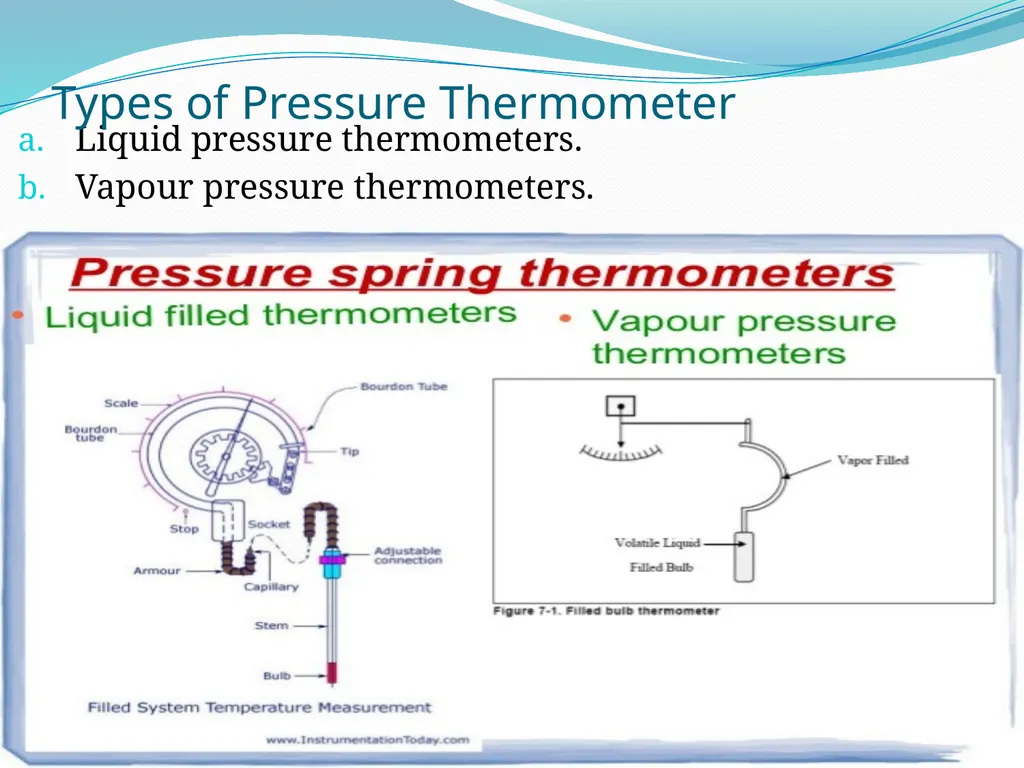
slide25. Liquid pressure thermometers.
Vapour pressure thermometers. Pressure Gauge Thermometer. 25 Types of Pressure Thermometer<br>
slide26. LIQUID PRESSURE THERMOMETER It is temperature measuring device whose operation is based on thermal expansion of a liquid.
These are also called as fluid-expansion thermometers.
Liquid filled thermometers have range from -30° C to 250° C.
The measurement accuracy depends on the depth of immersion of the thermometer in the medium to be measured.<br>
slide27. …. Working
An increase in the temp. at the bulb causes vapourization of volatile liquid
The resulting increase in vapour pressure is measured by a pressure spring and instrument is calibrated in terms of temp.
For cross ambient temp. measurement ,dual fill system is used. In this two different liquids vapourizing and non vapourizing are used<br>
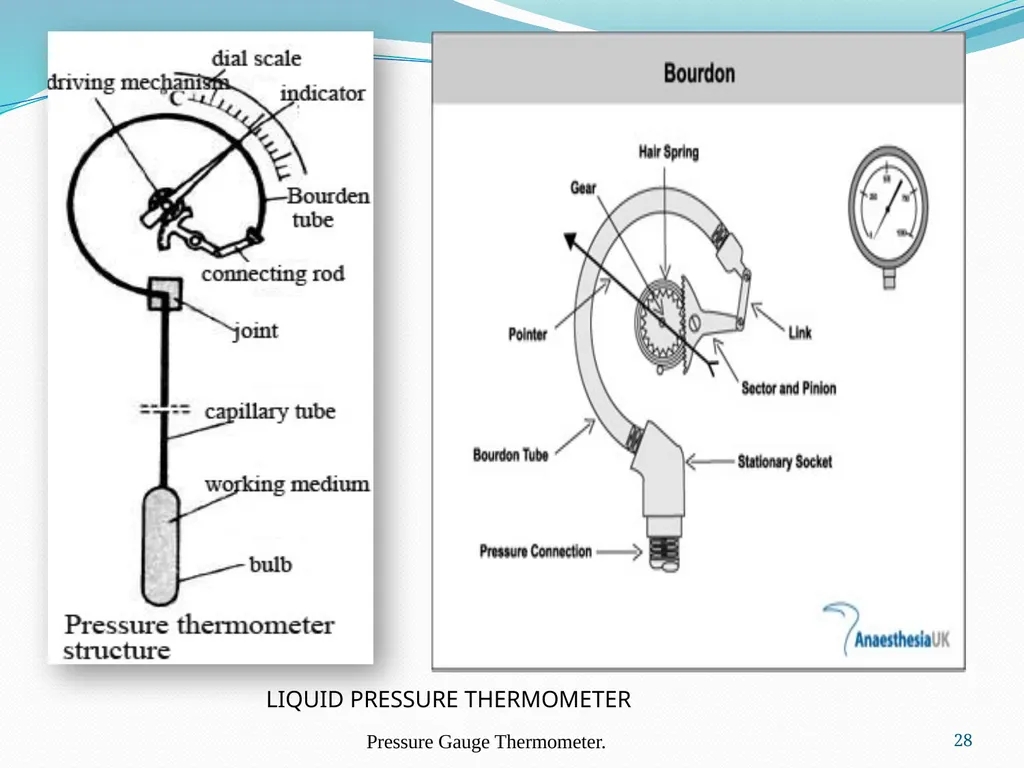
slide28. LIQUID PRESSURE THERMOMETER Pressure Gauge Thermometer. 28<br>
slide29. A bulb containing a liquid is immersed in the environment.
The bulb is connected by means of capillary tube to a pressure measuring device, like a bourdon tube pressure gauge.
An increase in temperature causes the liquid to expand, which causes increase in pressure on gauge.
The liquid filled tube are also temperature sensitive so it may cause error.
Error can be reduced by increasing bulb size, but it may increase the response time of system.
The system with bulb, tube, and a pressure gauge can be calibrated directly. Pressure Gauge Thermometer. 29 Construction and Working :<br>
slide30. These are similar to liquid filled thermometers, but contain only partially filled bulbs.
Vapour pressure thermometer have range of 20°C to 350°C.
The saturated vapour pressure of volatile liquid is used as a measure of temperature. Pressure Gauge Thermometer. 30 VAPOUR PRESSURE THERMOMETER<br>
slide31. Pressure Gauge Thermometer. 31<br>
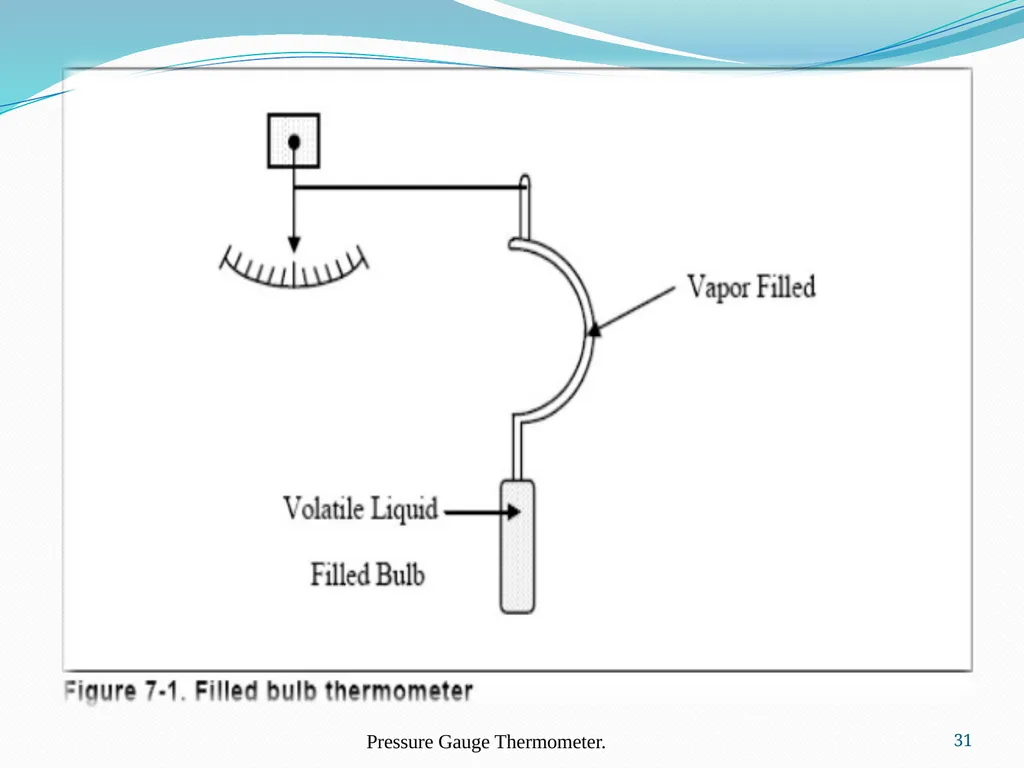
slide32. They use the principle that the vapour pressure of a liquid depends on the temperature, and most fluids partially filled in an enclosed chamber will create a definite vapour pressure.
When the fluid reach the boiling point, the vapour pressure will be equal to the total pressure above the liquid surface and can be used as the measure of temperature.
Further when the partially filled bulb senses the temperature vapour will be formed in the remaining space of the bulb and is passed through a capillary tube to the indicator with a bourdon tube. Pressure Gauge Thermometer. 32 Construction and Working:<br>
slide33. Advantages Simple and inexpensive
Rugged construction
Ease of installation and use
Fairly good response, accuracy and sensitive
Self operated system
Remote indication (upto 100 m)<br>
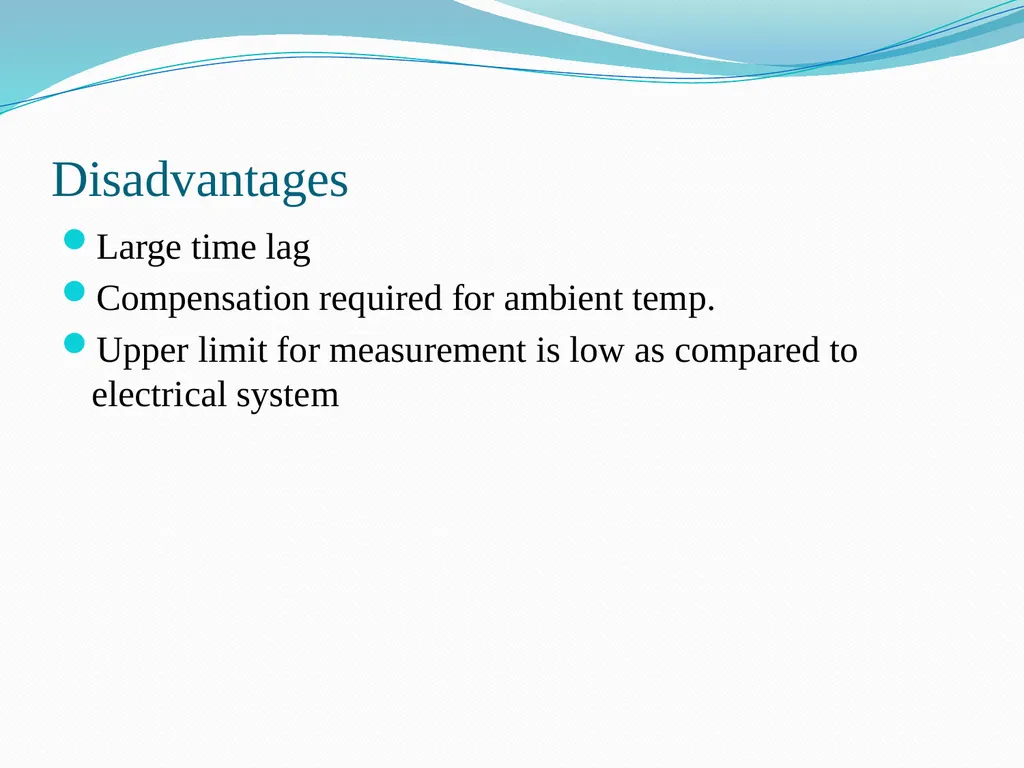
slide34. Disadvantages Large time lag
Compensation required for ambient temp.
Upper limit for measurement is low as compared to electrical system<br>
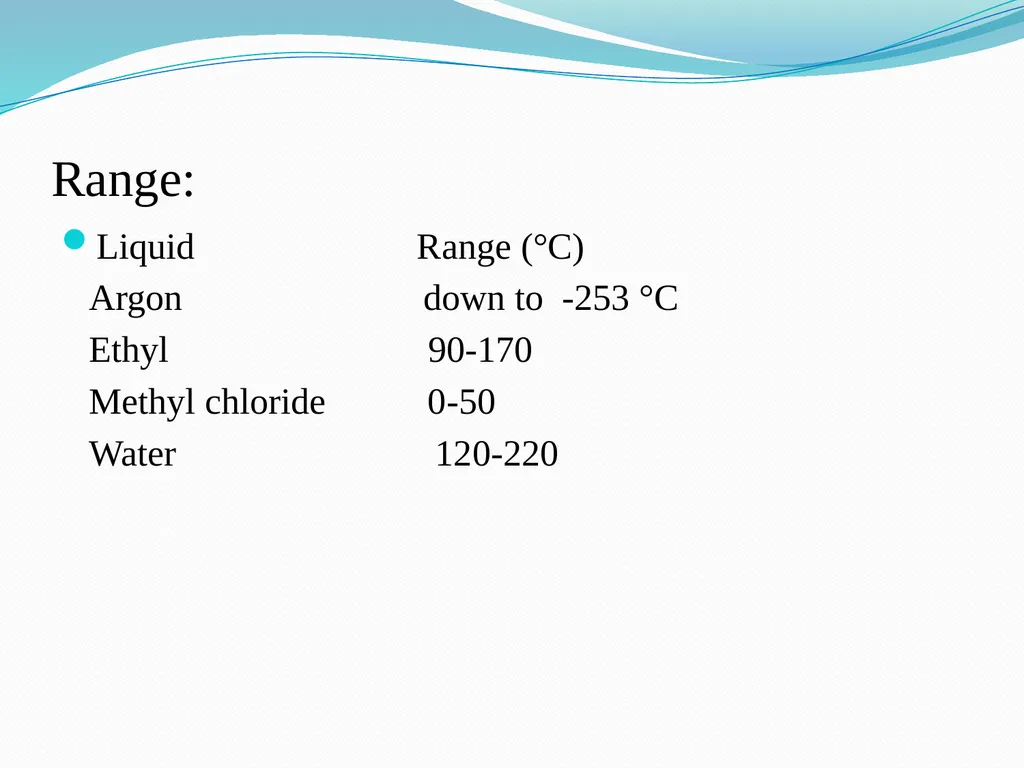
slide35. Range: Liquid Range (°C)
Argon down to -253 °C
Ethyl 90-170
Methyl chloride 0-50
Water 120-220<br>
slide36. Dairy and Food Industries.
Suitable for Heating and Ventilation application. Pressure Gauge Thermometer. 36 Applications :<br>
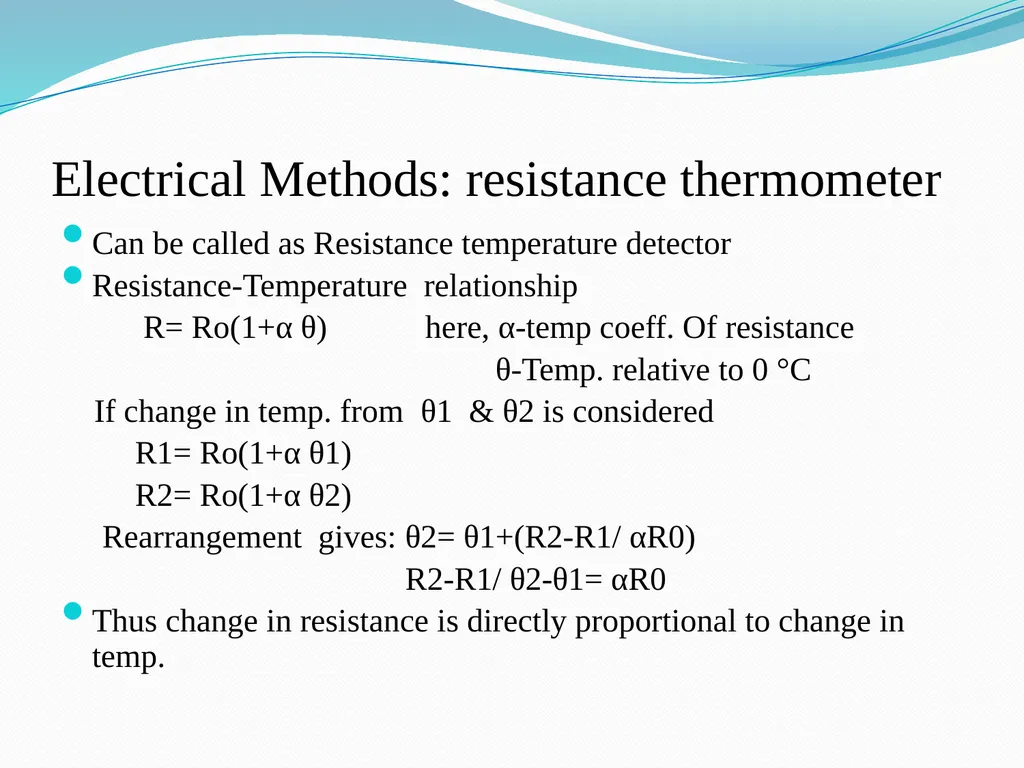
slide37. Electrical Methods: resistance thermometer Can be called as Resistance temperature detector
Resistance-Temperature relationship
R= Ro(1+α θ) here, α-temp coeff. Of resistance
θ-Temp. relative to 0 °C
If change in temp. from θ1 & θ2 is considered
R1= Ro(1+α θ1)
R2= Ro(1+α θ2)
Rearrangement gives: θ2= θ1+(R2-R1/ αR0)
R2-R1/ θ2-θ1= αR0
Thus change in resistance is directly proportional to change in temp.<br>
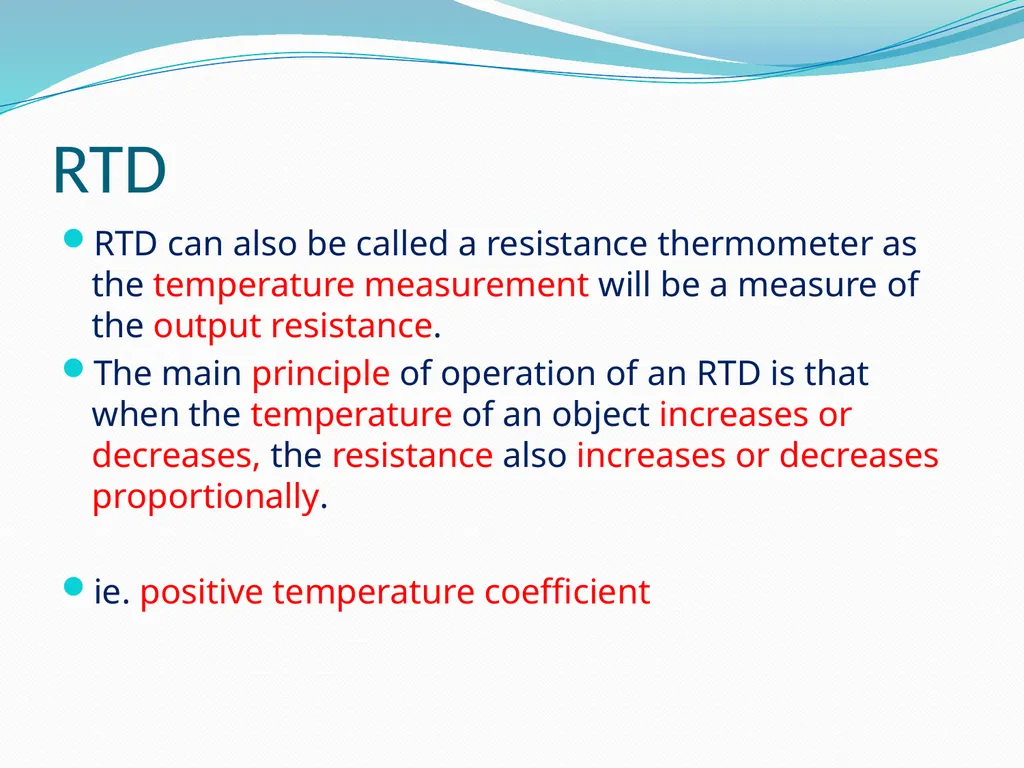
slide38. RTD can also be called a resistance thermometer as the temperature measurement will be a measure of the output resistance.
The main principle of operation of an RTD is that when the temperature of an object increases or decreases, the resistance also increases or decreases proportionally.
ie. positive temperature coefficient RTD<br>
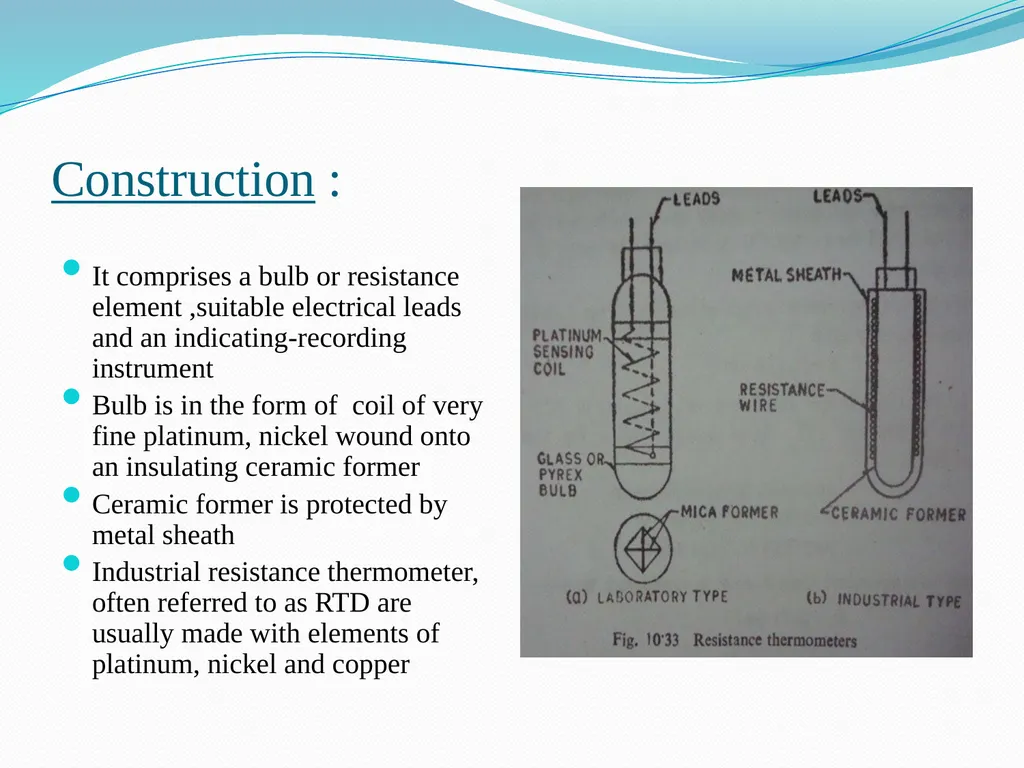
slide39. Construction : It comprises a bulb or resistance element ,suitable electrical leads and an indicating-recording instrument
Bulb is in the form of coil of very fine platinum, nickel wound onto an insulating ceramic former
Ceramic former is protected by metal sheath
Industrial resistance thermometer, often referred to as RTD are usually made with elements of platinum, nickel and copper<br>
slide40. …. Working:
Change in temp will cause change in resistance of the coil
Leads are taken out of the thermometer for the measurement of changes in resistance
Range:
Upto 1200 °C<br>
slide41. Advantages: Simplicity in operation
Easy installation
Replacement of sensitive bulb
Average temp can be measured
Very high accuracy
Excellent stability and reproducibility
Ability to be matched to close tolerances for temperature difference measurements.
Ability to measure narrow spans
Suitability for remote measurement<br>
slide42. Disadvantages: More time lag due to protective sheath
Possibility of current leakage
Susceptibility to mechanical damage
Need for lead wire resistance compensation
Sometimes expensive
Susceptibility to self-heating error
Susceptibility to signal noise
Unsuitability for bare use in electrically conducting substance
Generally not repairable
Need for power supply<br>
slide43. Thermistor Principle:
Thermistors are semiconductor having negative temp coeff.
As temp increases, resistance goes down and as the temp decreases ,resistance goes up
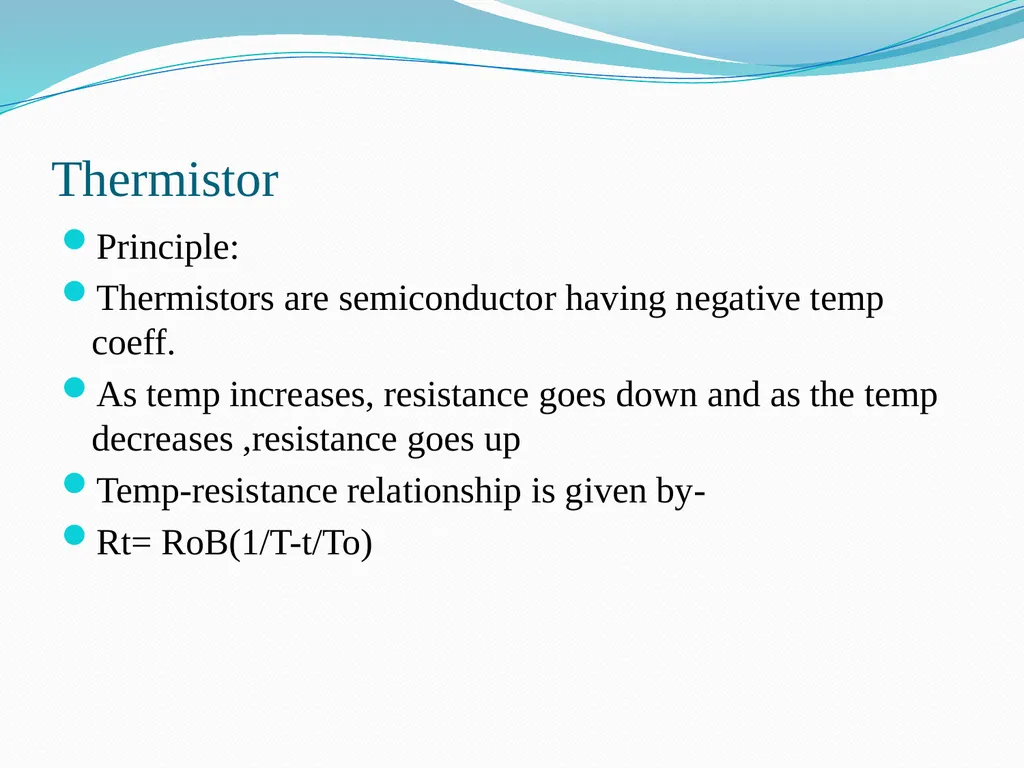
Temp-resistance relationship is given by-
Rt= RoB(1/T-t/To)<br>
slide44. …. Construction
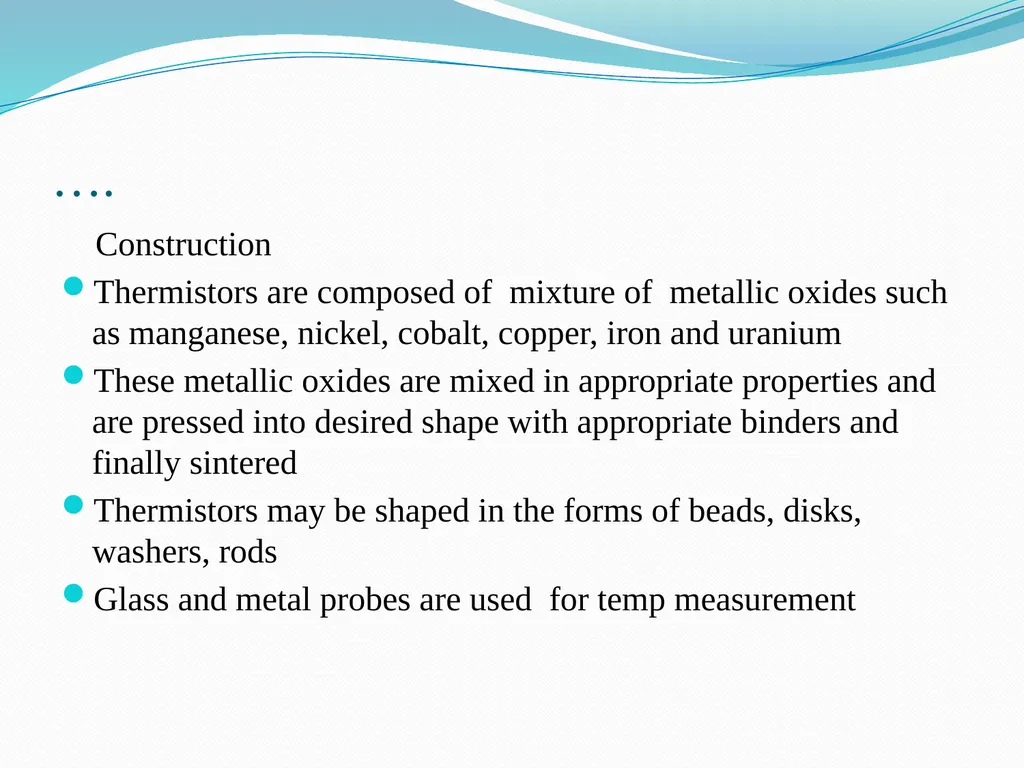
Thermistors are composed of mixture of metallic oxides such as manganese, nickel, cobalt, copper, iron and uranium
These metallic oxides are mixed in appropriate properties and are pressed into desired shape with appropriate binders and finally sintered
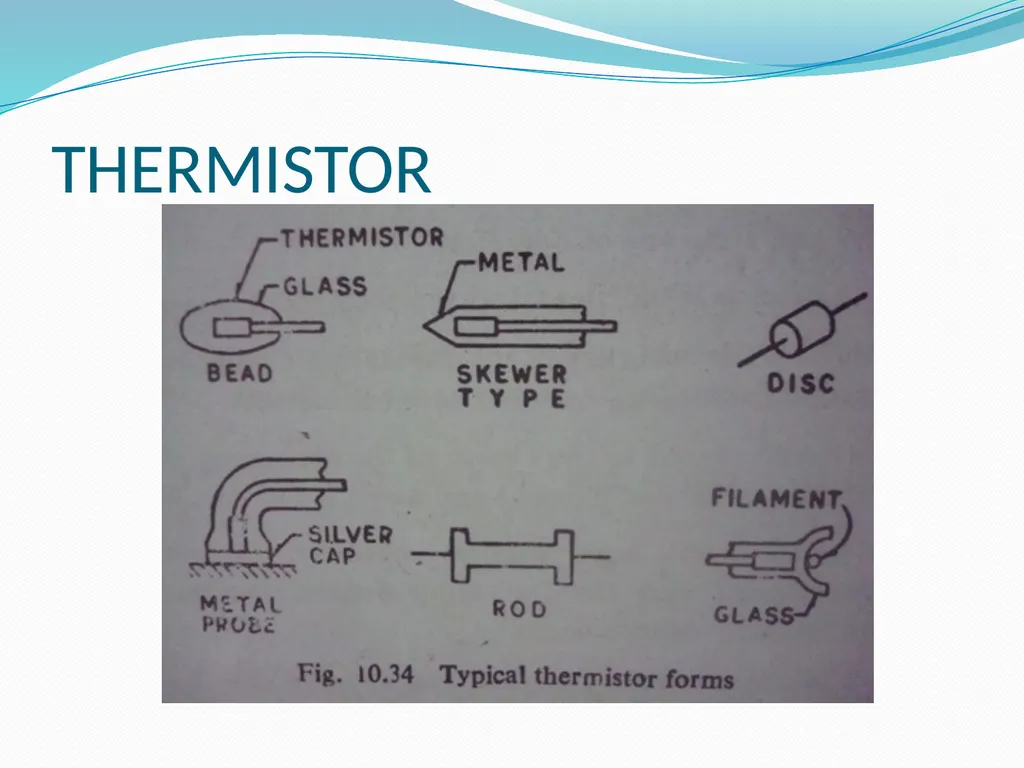
Thermistors may be shaped in the forms of beads, disks, washers, rods
Glass and metal probes are used for temp measurement<br>
slide45. THERMISTOR<br>
slide46. …. Working:
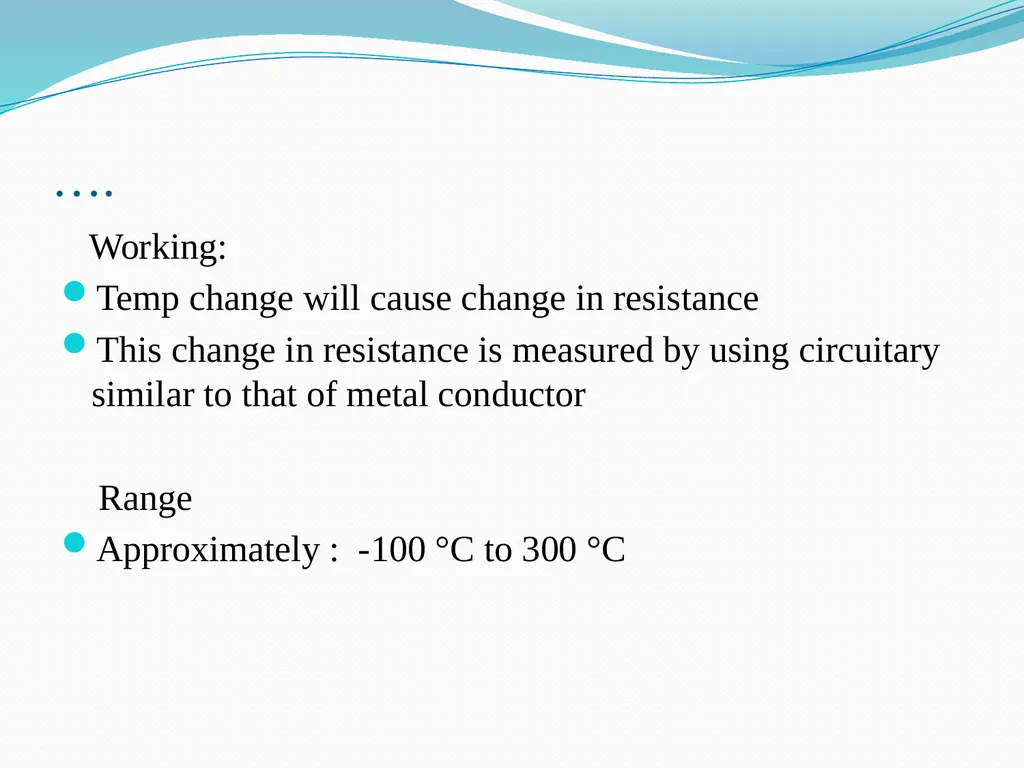
Temp change will cause change in resistance
This change in resistance is measured by using circuitary similar to that of metal conductor
Range
Approximately : -100 °C to 300 °C<br>
slide47. …. Advantages :
High sensitivity
Availability in very small size
Fast thermal response
Low cost<br>
slide48. Thermoelectric measurement Thermocouple
Radiation pyrometer
Optical pyrometer<br>
slide49. Definition- -Pyro is a greak word which means fire.
-Pyrometer is a non contact type instrument
Which is used to measure temperature.<br>
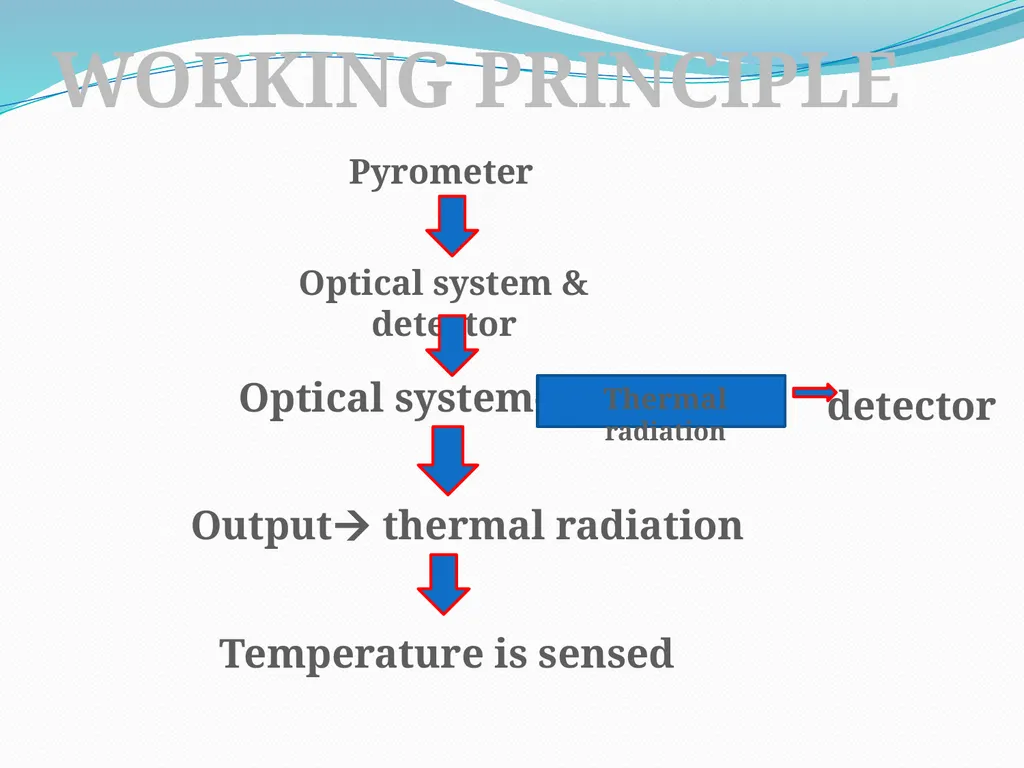
slide50. WORKING PRINCIPLE Pyrometer Optical system & detector Optical system- Thermal radiation detector Output thermal radiation Temperature is sensed<br>
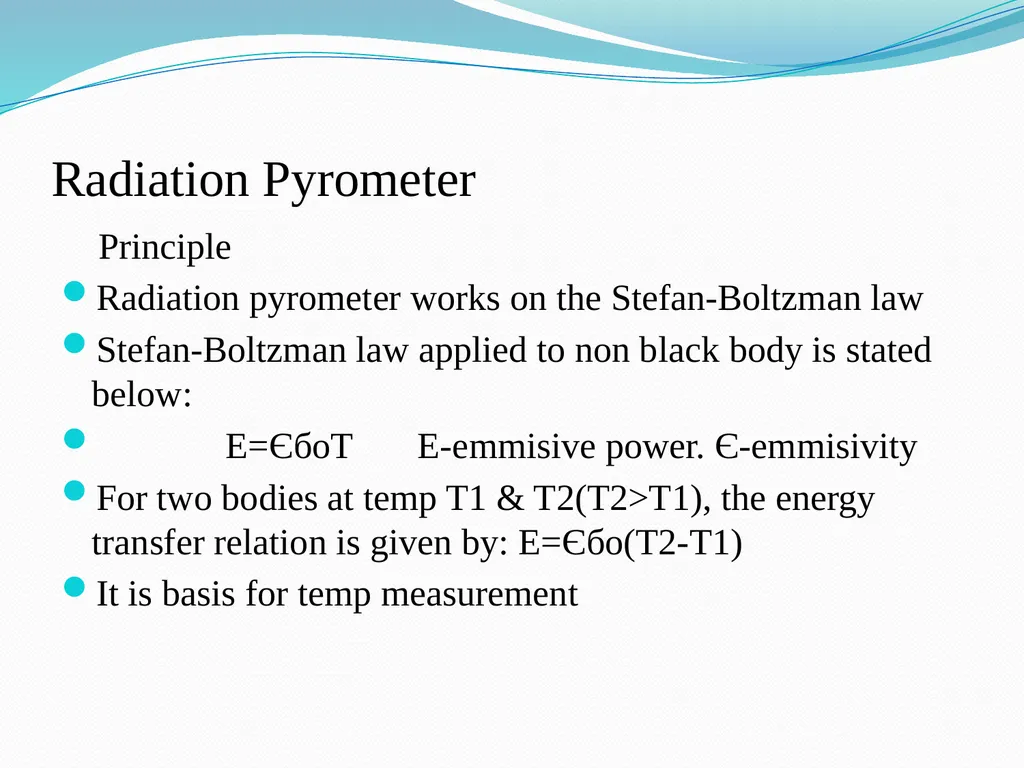
slide51. Radiation Pyrometer Principle
Radiation pyrometer works on the Stefan-Boltzman law
Stefan-Boltzman law applied to non black body is stated below:
E=ЄбoT E-emmisive power. Є-emmisivity
For two bodies at temp T1 & T2(T2>T1), the energy transfer relation is given by: E=Єбo(T2-T1)
It is basis for temp measurement<br>
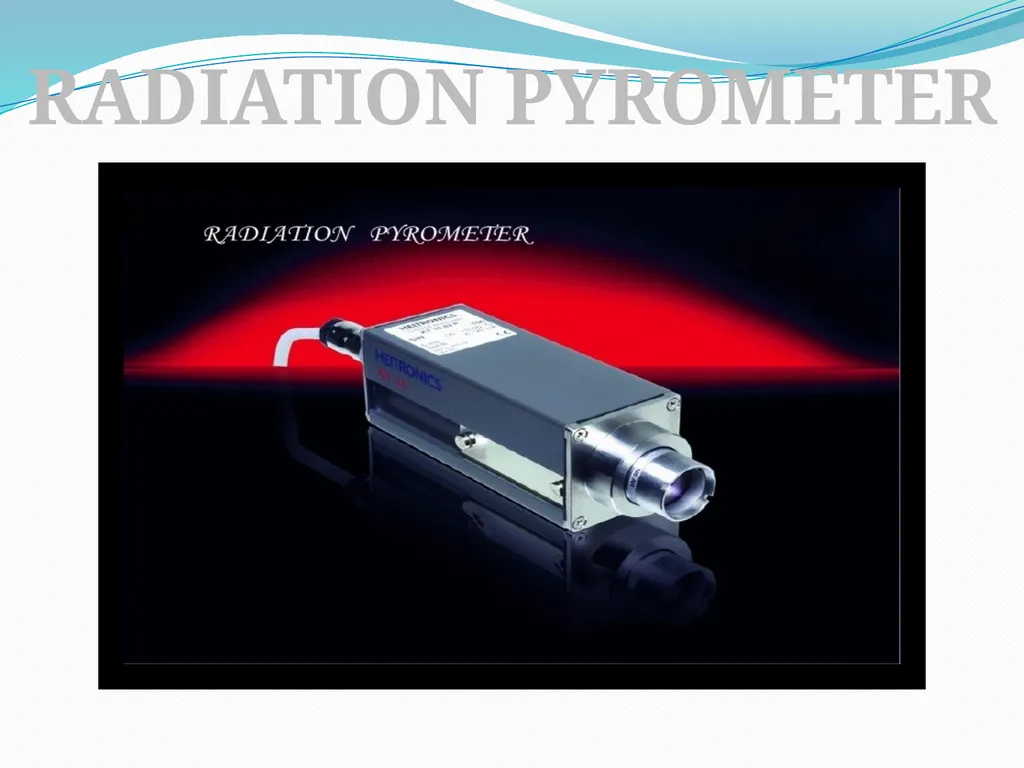
slide52. RADIATION PYROMETER<br>
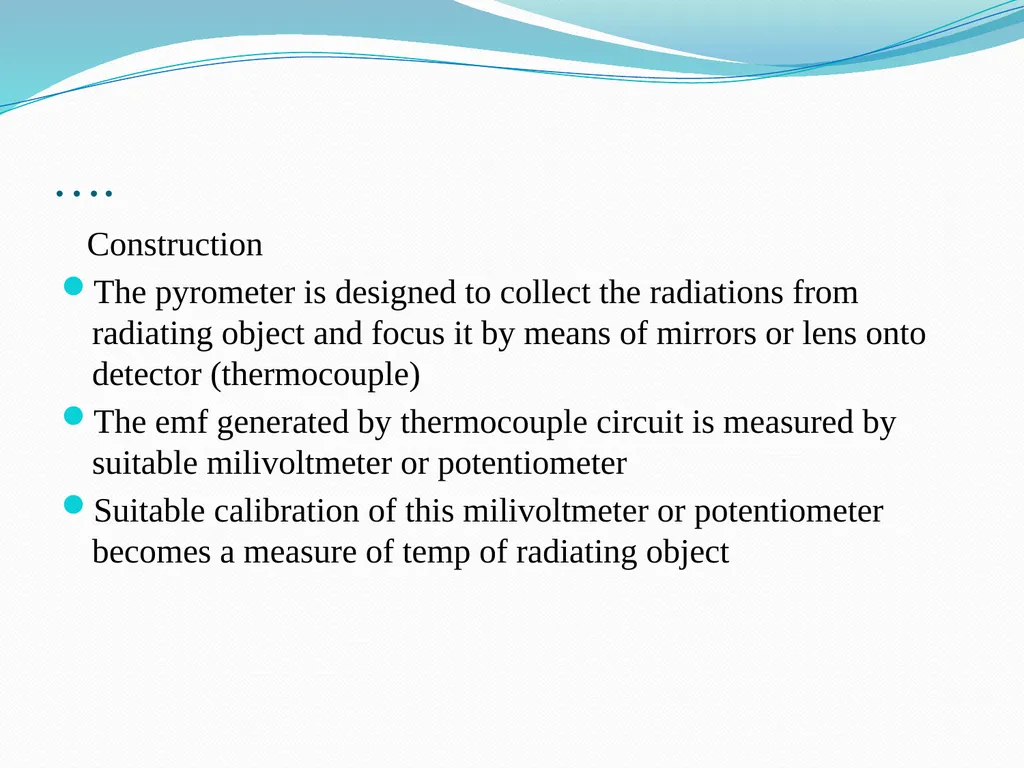
slide53. …. Construction
The pyrometer is designed to collect the radiations from radiating object and focus it by means of mirrors or lens onto detector (thermocouple)
The emf generated by thermocouple circuit is measured by suitable milivoltmeter or potentiometer
Suitable calibration of this milivoltmeter or potentiometer becomes a measure of temp of radiating object<br>
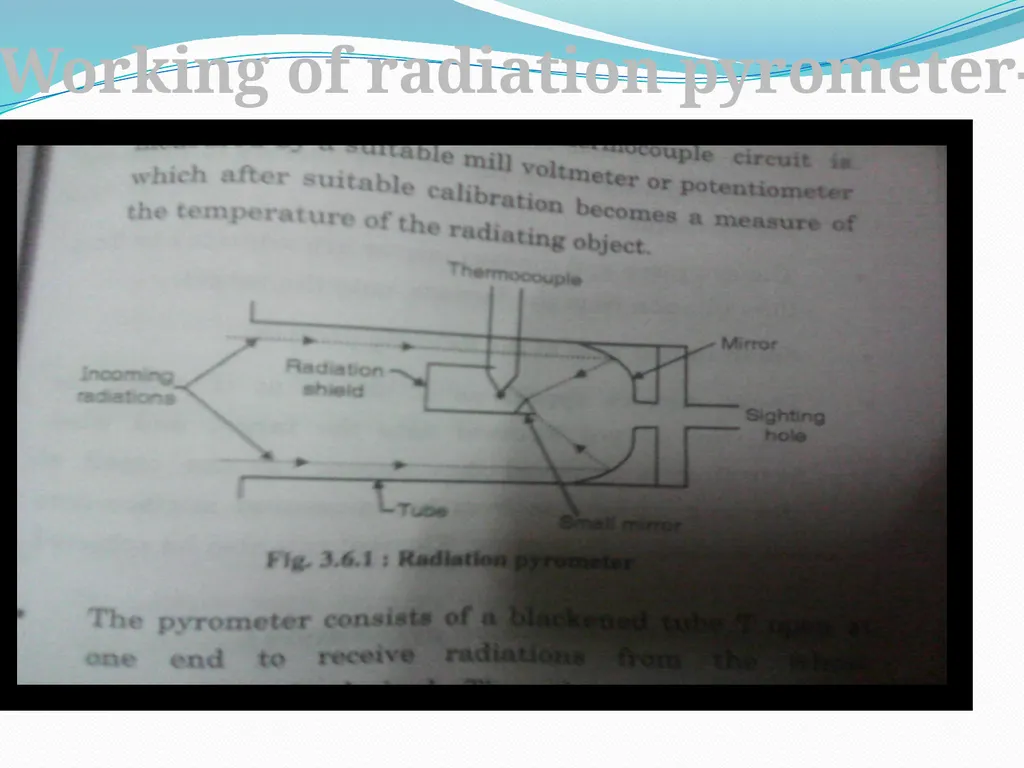
slide54. Working of radiation pyrometer-<br>
slide55. …. Working:
The eye piece and concave mirror are adjusted to focus the radiation from furnace onto the target i.e. thermocouple hot junction
This will generate emf ,which is used to measure the temp of radiation
Range:700-2000 ºC<br>
slide56. …. Advantages:
High speed of response
No direct contact with object
Can be used to measure the temp of moving object
Can be used for sensing the temp at long distance<br>
slide57. …. Disadvantage
The effect of dust and dirt on mirror is cause the instrument to read too low
Cooling is required<br>
slide58. Optical pyrometer Principle
When the surface is heated, it emits radiations of different wavelength. By measuring this wavelength we can measure the temp.
Optical pyrometer compare the energy emitted by body at a given wavelength with that of black body calibrated lamp<br>
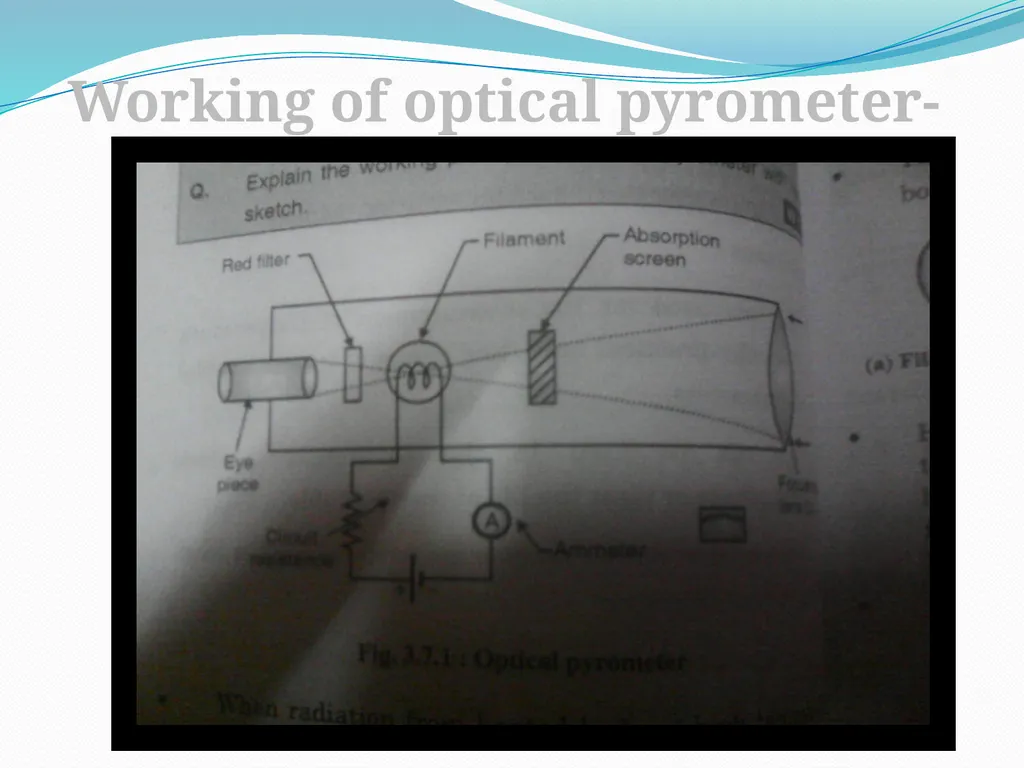
slide59. Working of optical pyrometer-<br>
slide60. …. Construction
Radiation from the target surface are focused by an objective lens upon the plane filament of an electric light bulb
Red filter is placed between the eyepiece and filament
Eyepiece is provided to observe the filament
Brightness of lamp filament can be varied by adjusting current through standard lamp<br>
slide61. …. Working:
When the filament is different in terms of brightness from target surface, then it is radiating at same intensity as the target surface
When filament is colder than the target surface it appears as a wire
When filament is hotter than the object it appears brighter than target surface
The current through the filament is then reduced provide correct merging of filament & object
Thus current through filament will be basis for temp measurement
Range: 700-3000 ºC<br>
slide62. …. Advantages:
No direct contact required
Excellent accuracy
Measurement is independent of distance between target and instrument
Has been accepted as standard means for determining temp on international temp scale<br>
slide63. …. Disadvantages:
Require operator, hence not suitable for automatic control applications
Lower measuring temp is limited to 700 ºC<br>
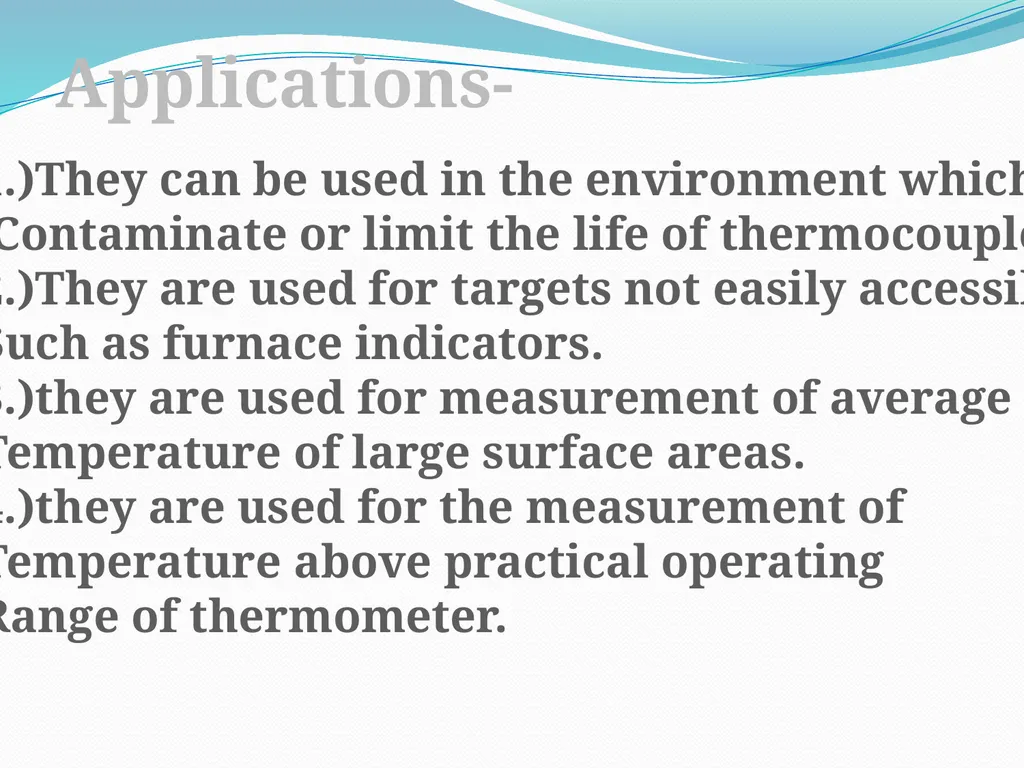
slide64. Applications- 1.)They can be used in the environment which
Contaminate or limit the life of thermocouple.
2.)They are used for targets not easily accessible
Such as furnace indicators.
3.)they are used for measurement of average
Temperature of large surface areas.
4.)they are used for the measurement of
Temperature above practical operating
Range of thermometer.<br>
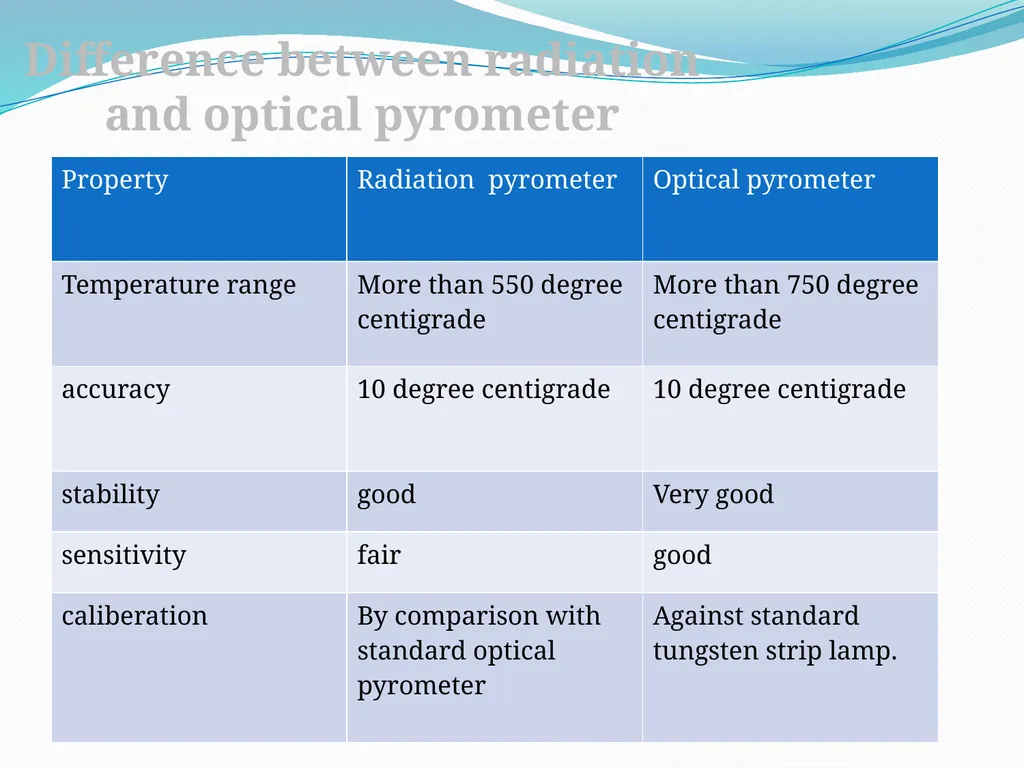
slide65. Difference between radiation and optical pyrometer<br>
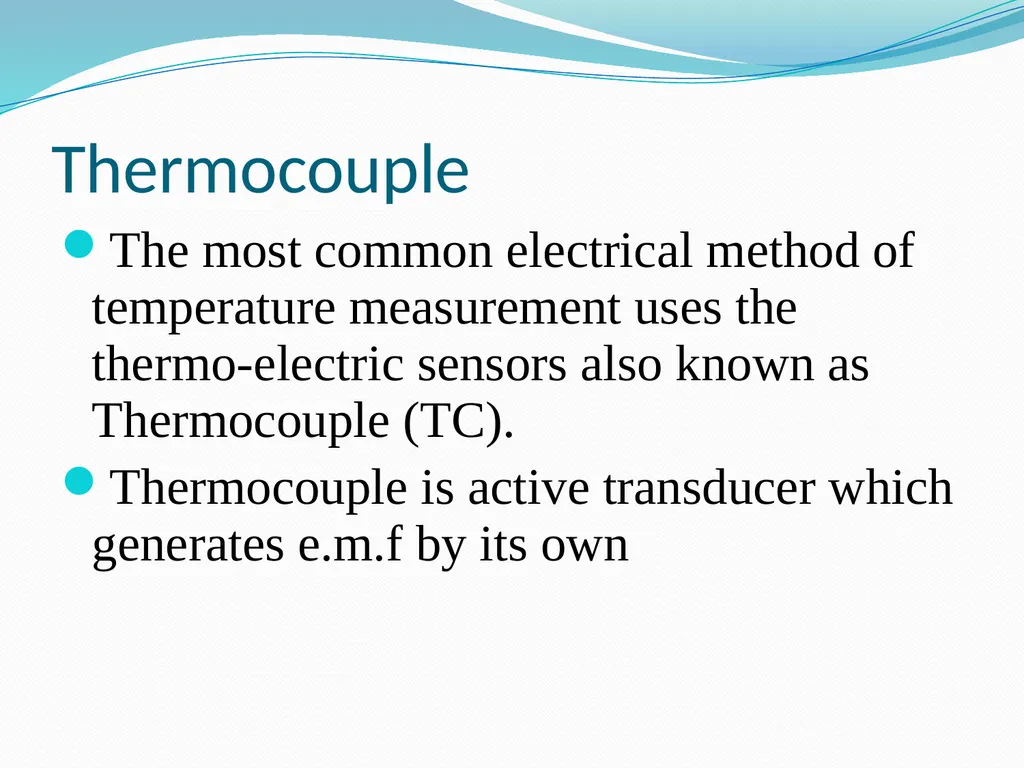
slide66. The most common electrical method of temperature measurement uses the thermo-electric sensors also known as Thermocouple (TC).
Thermocouple is active transducer which generates e.m.f by its own Thermocouple<br>
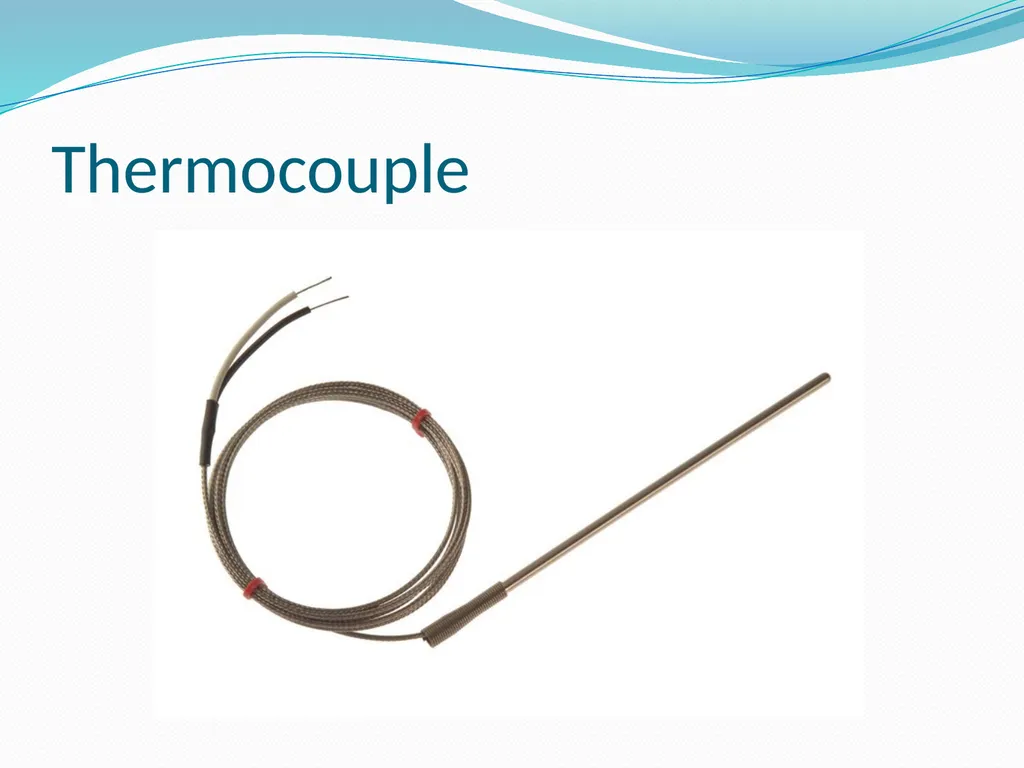
slide67. Thermocouple<br>
slide68. Thermocouples operate under the principle that a circuit made by connecting two dissimilar metals produces a measurable voltage (emf-electromotive force) when a temperature gradient is imposed between one end and the other. What are thermocouples?<br>
slide69. The thermocouple conductors must be insulated from the hot junction to the indicating instrument.
The two wires also should not touch each other except hot junction.
Therefore suitable insulating materials should be used according to temperature ranges. Construction of Thermocouple<br>
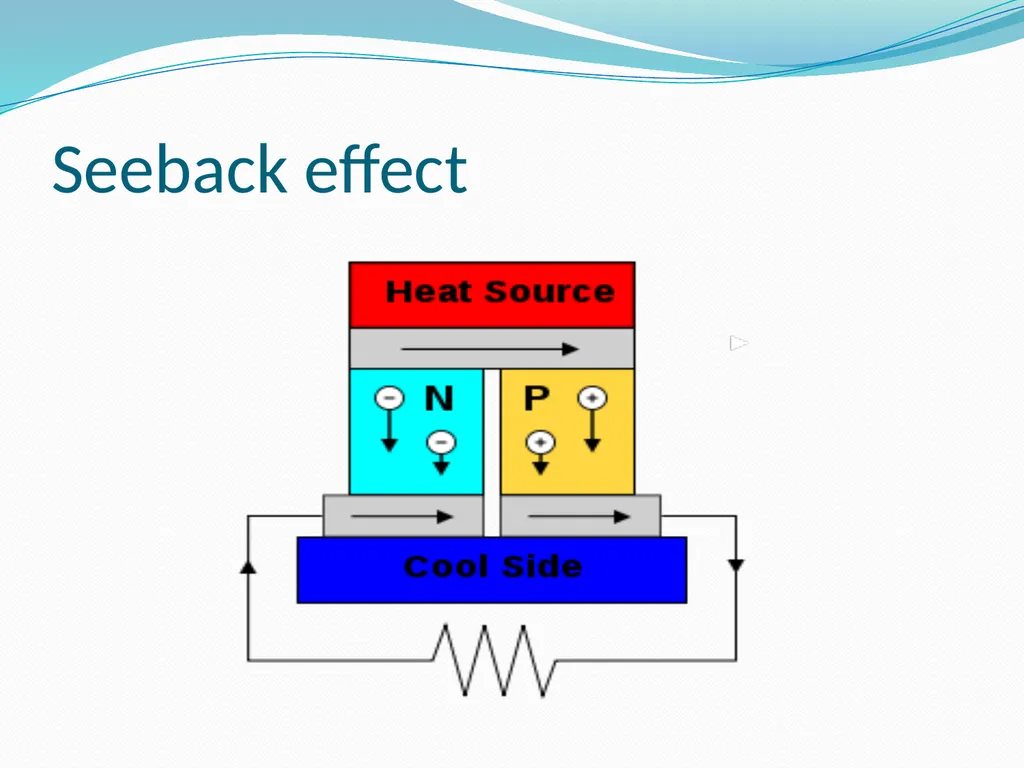
slide70. The Seebeck effect is a phenomenon in which a temperature difference between two dissimilar electrical conductors or semiconductors produces a voltage difference between the two substances.
An electric current flows from hot junction to cold junction, this produces voltage proportional to temperature at the junction. Seeback effect<br>
slide71. Seeback effect<br>
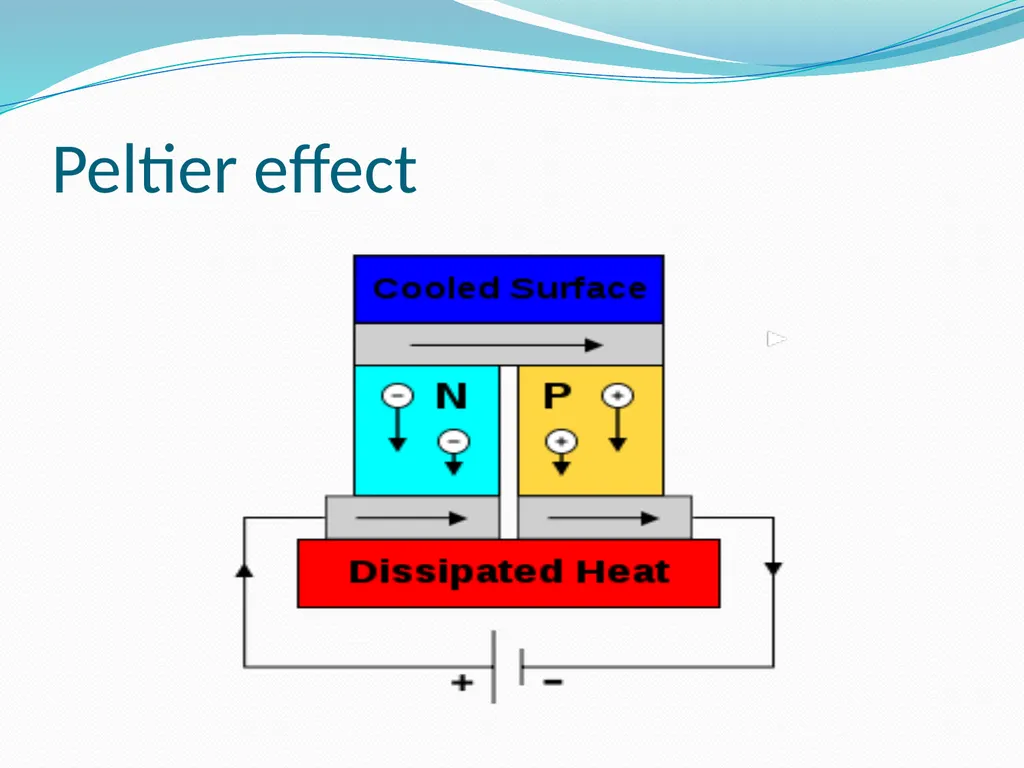
slide72. When a loop is formed of two dissimilar metals and if externally current is forced to flow through the circuit, one of the junction is heated while the other is cooled.
The Peltier effect is a temperature difference created by applying a voltage between two electrodes connected to a sample of semiconductor material. This phenomenon can be useful when it is necessary to transfer heat from one medium to another on a small scale.
Amount of heat absorbed when unit current passes from a unit time is called peltier effect Peltiers effect<br>
slide73. Peltier effect<br>
slide74. When current flows along a wire whose temperature varies from point to point , heat is liberated at any point P when current at P is in same direction as heat flow. Heat is absorbed at P if current is in opposite direction to heat flow. Thomson effect<br>
slide75. Thermocouple Principle
Seeback effect :when two conductor of dissimilar metals M1 & M2 are joined together to form a loop and two unequal temp T1 & T2 are imposed at two interface connection. An electric current flows through the loop
Laws of thermocouple
1. Law of homogeneous circuit:
An electric current cannot be sustained in a circuit of a homogenous metal by application of heat alone<br>
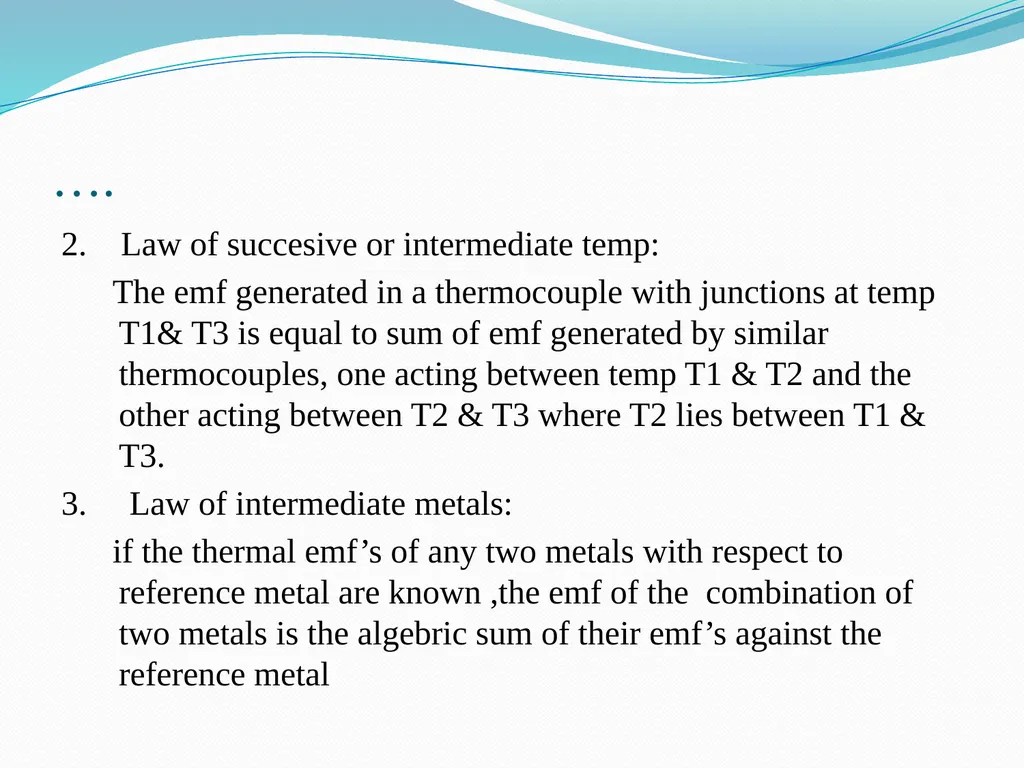
slide76. …. 2. Law of succesive or intermediate temp:
The emf generated in a thermocouple with junctions at temp T1& T3 is equal to sum of emf generated by similar thermocouples, one acting between temp T1 & T2 and the other acting between T2 & T3 where T2 lies between T1 & T3.
3. Law of intermediate metals:
if the thermal emf’s of any two metals with respect to reference metal are known ,the emf of the combination of two metals is the algebric sum of their emf’s against the reference metal<br>
slide77. …. Construction:
Two dissimilar conductors eletrically insulated except at the hot junction ,where conductors may be either be welded together.
A refractory and a metal sheath is provided to protect the thermocouple
Compensating leads are taken for measuring the temp<br>
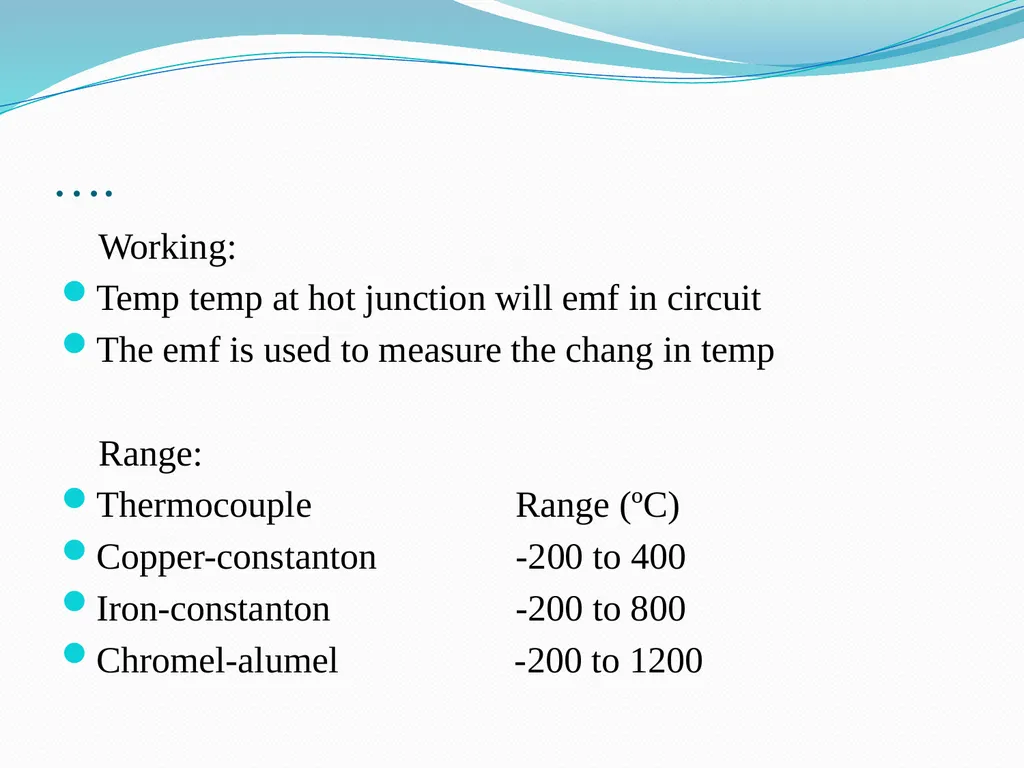
slide78. …. Working:
Temp temp at hot junction will emf in circuit
The emf is used to measure the chang in temp
Range:
Thermocouple Range (ºC)
Copper-constanton -200 to 400
Iron-constanton -200 to 800
Chromel-alumel -200 to 1200<br>
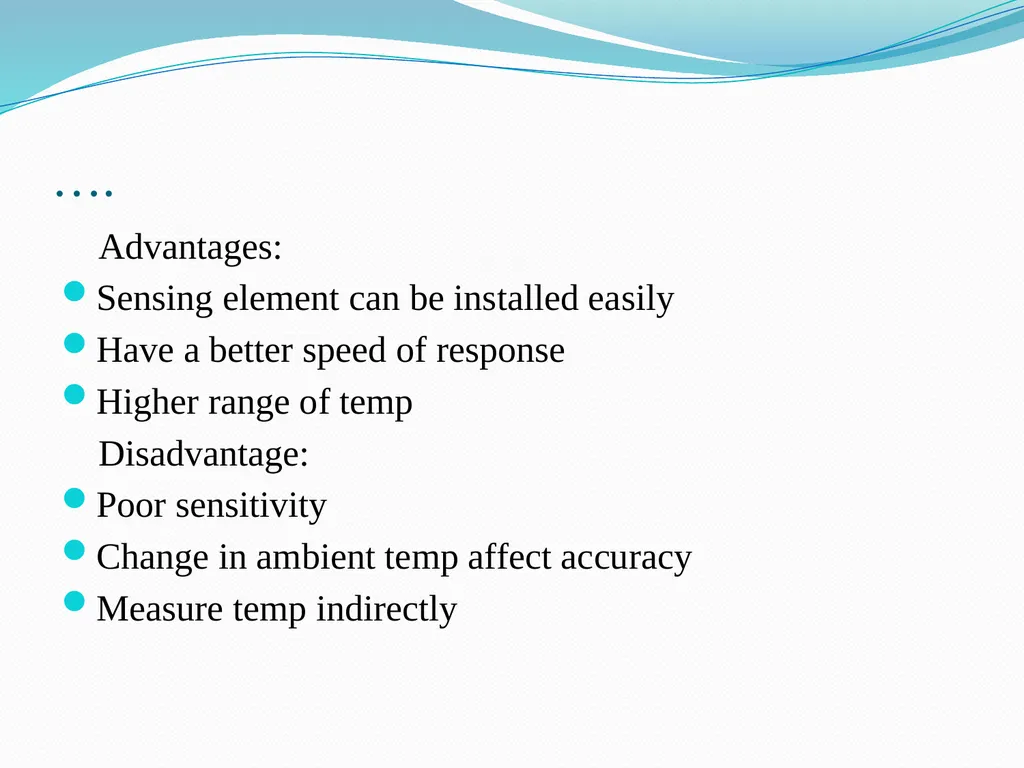
slide79. …. Advantages:
Sensing element can be installed easily
Have a better speed of response
Higher range of temp
Disadvantage:
Poor sensitivity
Change in ambient temp affect accuracy
Measure temp indirectly<br>
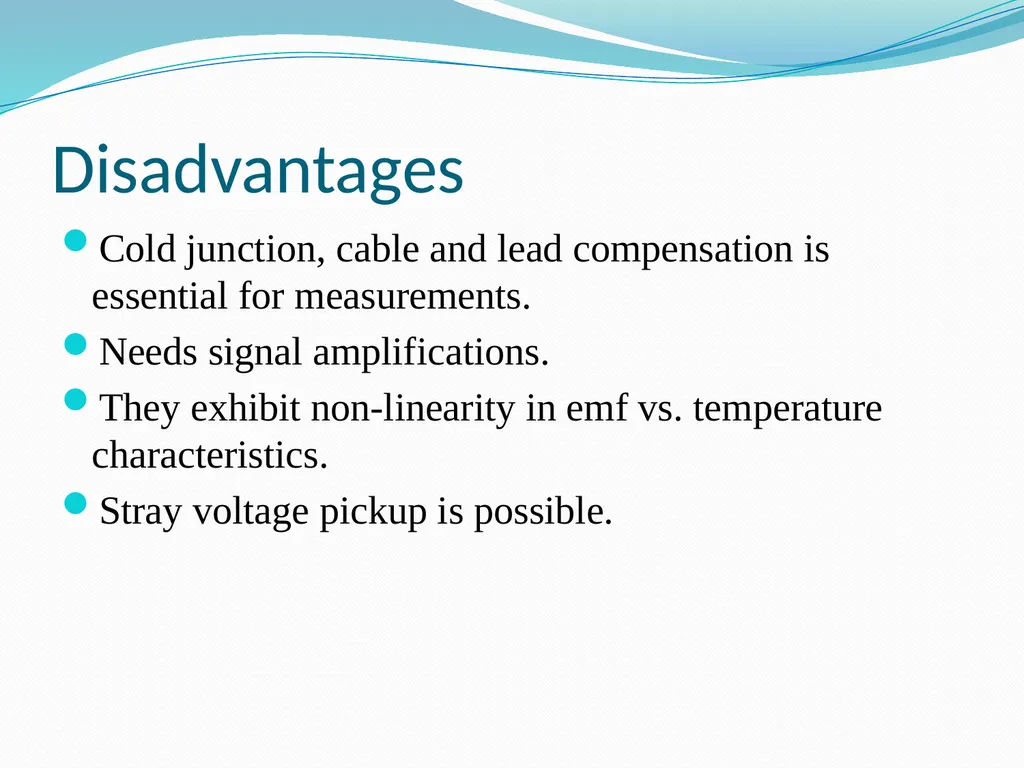
slide80. Cold junction, cable and lead compensation is essential for measurements.
Needs signal amplifications.
They exhibit non-linearity in emf vs. temperature characteristics.
Stray voltage pickup is possible. Disadvantages<br>
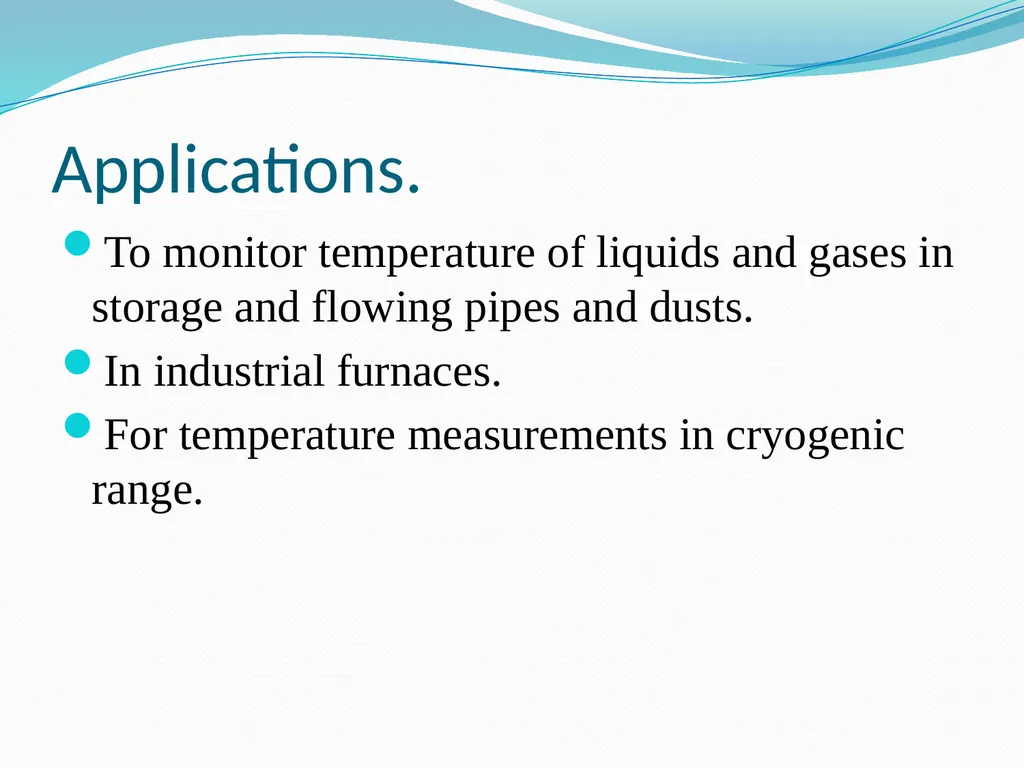
slide81. To monitor temperature of liquids and gases in storage and flowing pipes and dusts.
In industrial furnaces.
For temperature measurements in cryogenic range. Applications.<br>
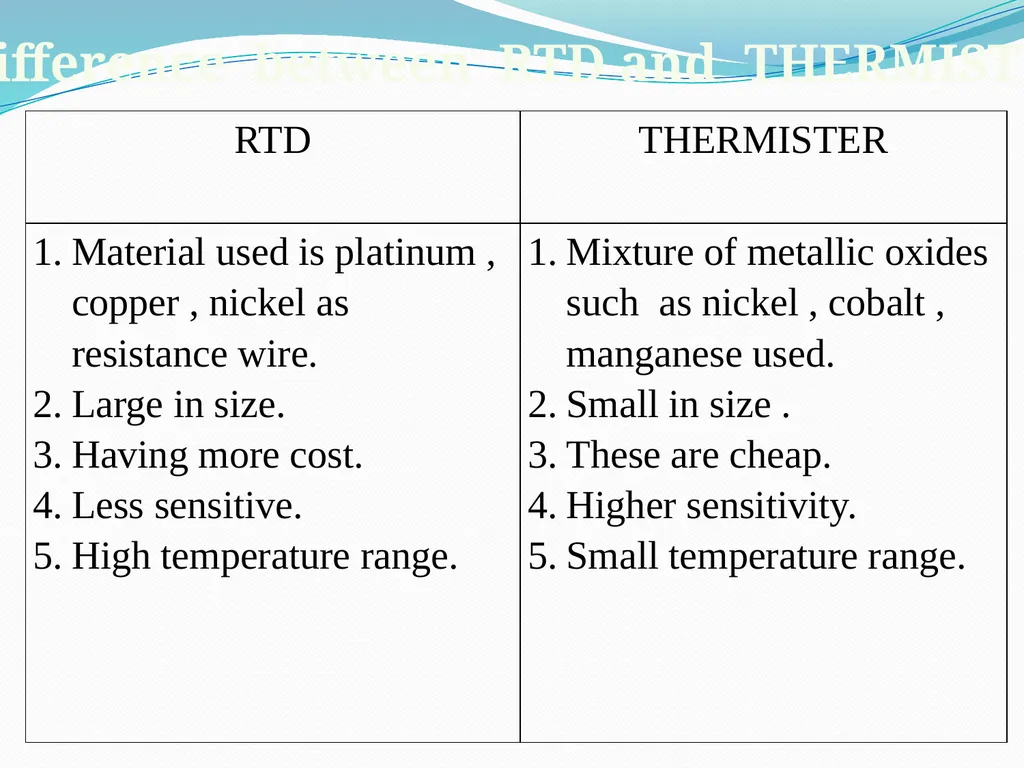
slide82. Difference between RTD and THERMISTER.<br>
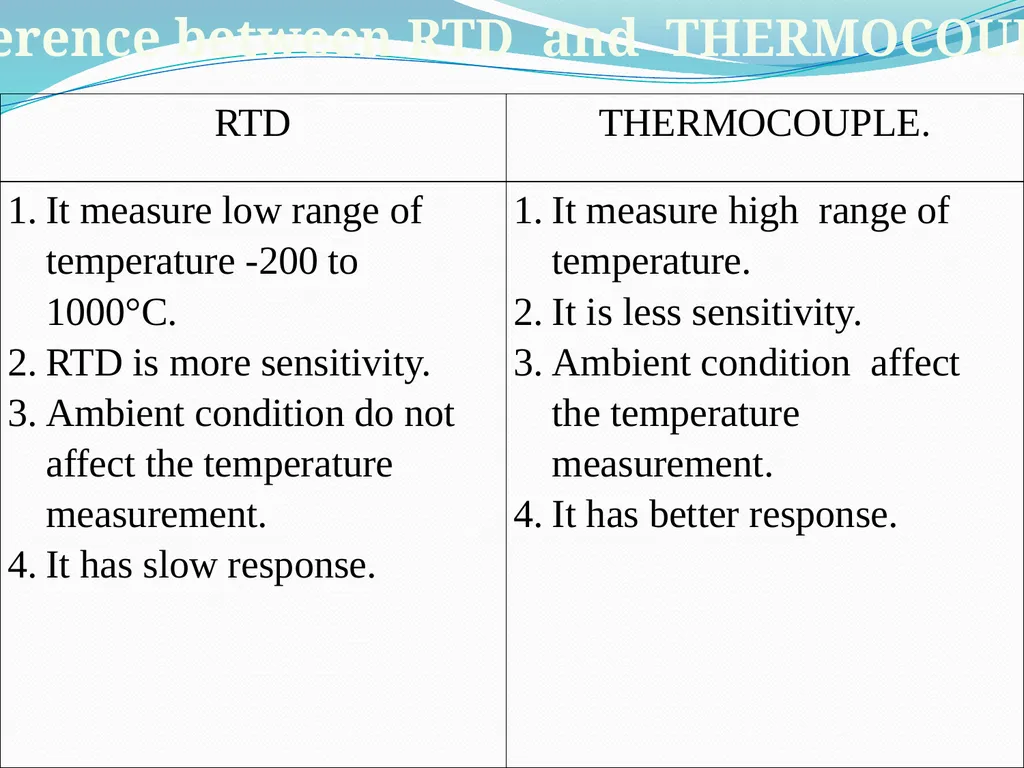
slide83. Difference between RTD and THERMOCOUPLE.<br>
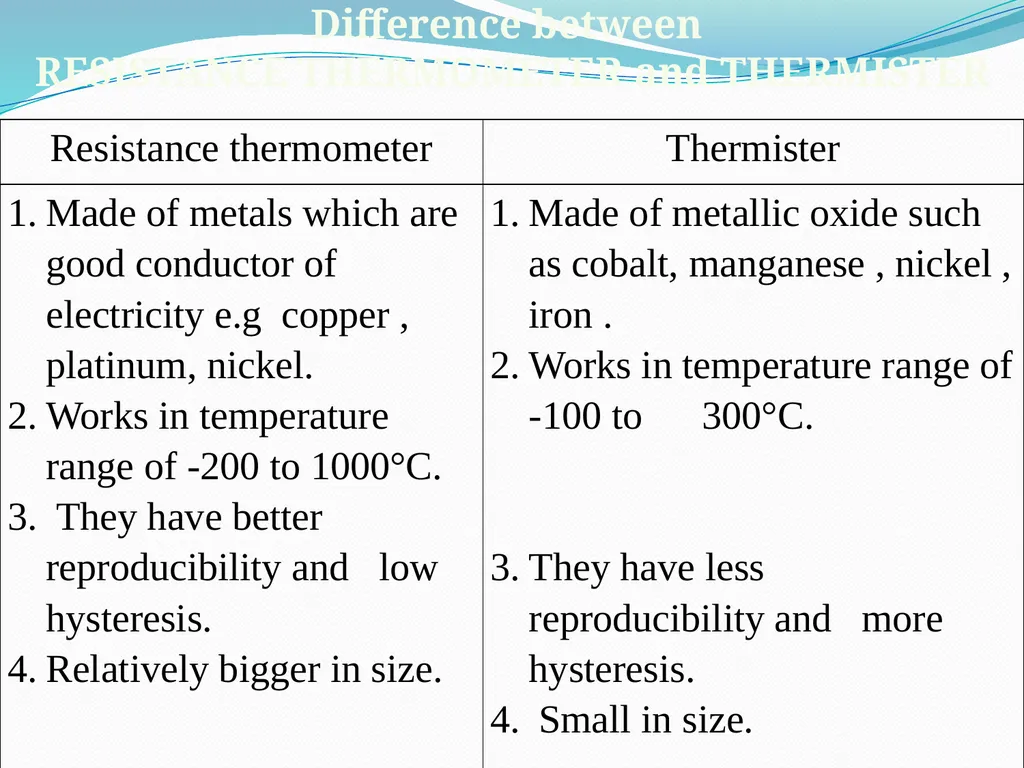
slide84. Difference between
RESISTANCE THERMOMETER and THERMISTER<br>
slide85. THANK YOU..<br>
slide2. FHH Chapter No.-03 Temperature Measurement Co-Know the different temperature measuring instrument with their construction and working<br>
slide3. Temperature measurement Temperature is measure of thermal energy in a body.
It is the hotness or coldness of a medium
Hotness or coldness is indication of heat and is compared by giving some reference of unit<br>
slide4. Temperature scale A) Fahrenheit scale:
Abbreviated as (°F)
First to gain acceptance
Proposed in the early 1700s by Fahrenheit (Dutch)
Freezing point- 32 °C, Boiling point- 212 °C<br>
slide5. …. B) Centigrade or Celsius scale:
Abbreviated as (°C)
Proposed in the mid 1700s by Celsius (Sweden)
Freezing point- 0 °C, Boiling point- 100 °C<br>
slide6. …. C) Rankine scale:
Abbreviated as (°R)
Proposed in the mid 1800s by Rankine
Freezing point- 491.6 °C, Boiling point- 671 °C
Based on Fahrenheit scale<br>
slide7. …. C) Kelvin scale:
Abbreviated as (°K)
Proposed in the late 1800s by Lord Kelvin
Freezing point- 273.15 °C, Boiling point- 373.15 °C
Based on Celsius scale<br>
slide8. Classification of Temperature Measuring Devices Based on nature of change produced:
i) Glass thermometer:- Work on the principle of
expansion of liquid like mercury, alcohol, pentane etc.
Pressure guage thermometer:- produce pressure O/P on a/c of vapour or liquid. a) liquid filled b) vapour filled c) gas filled
Bimetallic thermometer or differential thermometer:- O/P is on a/c of differential expansion of dissimilar metals produced by temp.<br>
slide9. …. Electrical resistance thermometer:- temperature is measured by resistance o electrical wire
Thermocouples:- Temperature is indicated by production of emf
Optical pyrometer:- Temperature is determined by luminosity of hot body that of a calibrated source
Radiation Pyrometer:- Measures temp by absorbing radiation
Fusion pyrometer :- Temp. is determined by which of a series of material with graduated fusion material melt or soften due to temp.<br>
slide10. …. ix) Calorimetric pyrometer:- Temp. is determined by measuring quantity of heat removed when temp. of body brought from unknown to known level.
x) Electrical and non electrical type:- Those which are electrical or electronic in nature and those which are not.
xi) Temperature range:- Range for which different types of temp measuring devices are used along with their accuracies.
xii) Thermister:- It measures temp by relating change in resistance with change in temp<br>
slide11. Non electrical methods Expansion thermometer
a) Expansion of solid
Bimetallic thermometer
b) Expansion of liquid
Liquid in gas thermometer
Liquid in metal thermometer
c) Expansion of gas
Filled system thermometer
Gas filled thermometer
Liquid filled thermometer
Mercury filled thermometer
Vapour filled thermometer
Pyrometer<br>
slide12. LIQUID IN GLASS THERMOMETER Construction
The unit consists of glass envelope, a responsive liquid and an indicating scale
The envelope comprises a thick walled glass tube with capillary bore and cylindrical bulb filled with liquid
Size of capillary depends on the sensing bulb, responsive liquid and desired temp range.<br>
slide13. Diagram<br>
slide14. .... Working
Changes in temp will cause the fluid to expand and rise up the stem
Since the area of stem is much less than bulb, relatively small changes of fluid volume will result in significant fluid will rise in the stem
Length of the movement of free surface of fluid column serves, by prior calibration to indicate temp of bulb<br>
slide15. Advantages Simple to use
Low cost
Easily portable
Ease of checking for physical damage
No need of auxiliary power
No need of additional indicating instruments
Good accuracy<br>
slide16. Disadvantages Fragile construction
Can not be adopted for remote reading
Time lag
Limited range (about 600 °C)<br>
slide17. Bimetallic Thermometer<br>
slide18. Bimetallic thermometer Construction
A metallic thermometer consists of two pieces of different pieces of different metals having different coefficient expansion firmly bonded together by welding
Bimetallic elements can be arranged in the flat, spiral, single helix configuration
One end of helix is anchored permanently to the casing and the other end is secured to the pointer<br>
slide19. Bimetallic Thermometer<br>
slide20. Working In response to temperature change, the bimetal expands and the helical bimetal rotates at its free end
When free end of bimetallic strip is heated ,it bends in the direction of material having low thermal coefficient of expansion
This movement is connected to pointer which moves over calibrated scale
The curvature of bimetal spiral strip varies with temp and causes a pointer to deflect<br>
slide21. Advantages Low cost
Simple in design
Compact and robust in construction
No maintenance is required
Overloading can be tolerated<br>
slide22. Disadvantages Low speed of response
Creep at high temperature<br>
slide23. Pressure Thermometer A pressure thermometer operates by expansion of gas or liquid.
A pressure thermometer measures temperature indirectly by measuring pressure.
The gauge is a pressure gauge, but is typically calibrated in units of temperature instead.<br>
slide24. Pressure Thermometer Construction
A thermal system partially filled with a volatile liquid and operating on vapour pressure that depends on temperature at the free surface of liquid.
The bulb is partially filled with a volatile liquid and rest of system contains vapour<br>
slide25. Liquid pressure thermometers.
Vapour pressure thermometers. Pressure Gauge Thermometer. 25 Types of Pressure Thermometer<br>
slide26. LIQUID PRESSURE THERMOMETER It is temperature measuring device whose operation is based on thermal expansion of a liquid.
These are also called as fluid-expansion thermometers.
Liquid filled thermometers have range from -30° C to 250° C.
The measurement accuracy depends on the depth of immersion of the thermometer in the medium to be measured.<br>
slide27. …. Working
An increase in the temp. at the bulb causes vapourization of volatile liquid
The resulting increase in vapour pressure is measured by a pressure spring and instrument is calibrated in terms of temp.
For cross ambient temp. measurement ,dual fill system is used. In this two different liquids vapourizing and non vapourizing are used<br>
slide28. LIQUID PRESSURE THERMOMETER Pressure Gauge Thermometer. 28<br>
slide29. A bulb containing a liquid is immersed in the environment.
The bulb is connected by means of capillary tube to a pressure measuring device, like a bourdon tube pressure gauge.
An increase in temperature causes the liquid to expand, which causes increase in pressure on gauge.
The liquid filled tube are also temperature sensitive so it may cause error.
Error can be reduced by increasing bulb size, but it may increase the response time of system.
The system with bulb, tube, and a pressure gauge can be calibrated directly. Pressure Gauge Thermometer. 29 Construction and Working :<br>
slide30. These are similar to liquid filled thermometers, but contain only partially filled bulbs.
Vapour pressure thermometer have range of 20°C to 350°C.
The saturated vapour pressure of volatile liquid is used as a measure of temperature. Pressure Gauge Thermometer. 30 VAPOUR PRESSURE THERMOMETER<br>
slide31. Pressure Gauge Thermometer. 31<br>
slide32. They use the principle that the vapour pressure of a liquid depends on the temperature, and most fluids partially filled in an enclosed chamber will create a definite vapour pressure.
When the fluid reach the boiling point, the vapour pressure will be equal to the total pressure above the liquid surface and can be used as the measure of temperature.
Further when the partially filled bulb senses the temperature vapour will be formed in the remaining space of the bulb and is passed through a capillary tube to the indicator with a bourdon tube. Pressure Gauge Thermometer. 32 Construction and Working:<br>
slide33. Advantages Simple and inexpensive
Rugged construction
Ease of installation and use
Fairly good response, accuracy and sensitive
Self operated system
Remote indication (upto 100 m)<br>
slide34. Disadvantages Large time lag
Compensation required for ambient temp.
Upper limit for measurement is low as compared to electrical system<br>
slide35. Range: Liquid Range (°C)
Argon down to -253 °C
Ethyl 90-170
Methyl chloride 0-50
Water 120-220<br>
slide36. Dairy and Food Industries.
Suitable for Heating and Ventilation application. Pressure Gauge Thermometer. 36 Applications :<br>
slide37. Electrical Methods: resistance thermometer Can be called as Resistance temperature detector
Resistance-Temperature relationship
R= Ro(1+α θ) here, α-temp coeff. Of resistance
θ-Temp. relative to 0 °C
If change in temp. from θ1 & θ2 is considered
R1= Ro(1+α θ1)
R2= Ro(1+α θ2)
Rearrangement gives: θ2= θ1+(R2-R1/ αR0)
R2-R1/ θ2-θ1= αR0
Thus change in resistance is directly proportional to change in temp.<br>
slide38. RTD can also be called a resistance thermometer as the temperature measurement will be a measure of the output resistance.
The main principle of operation of an RTD is that when the temperature of an object increases or decreases, the resistance also increases or decreases proportionally.
ie. positive temperature coefficient RTD<br>
slide39. Construction : It comprises a bulb or resistance element ,suitable electrical leads and an indicating-recording instrument
Bulb is in the form of coil of very fine platinum, nickel wound onto an insulating ceramic former
Ceramic former is protected by metal sheath
Industrial resistance thermometer, often referred to as RTD are usually made with elements of platinum, nickel and copper<br>
slide40. …. Working:
Change in temp will cause change in resistance of the coil
Leads are taken out of the thermometer for the measurement of changes in resistance
Range:
Upto 1200 °C<br>
slide41. Advantages: Simplicity in operation
Easy installation
Replacement of sensitive bulb
Average temp can be measured
Very high accuracy
Excellent stability and reproducibility
Ability to be matched to close tolerances for temperature difference measurements.
Ability to measure narrow spans
Suitability for remote measurement<br>
slide42. Disadvantages: More time lag due to protective sheath
Possibility of current leakage
Susceptibility to mechanical damage
Need for lead wire resistance compensation
Sometimes expensive
Susceptibility to self-heating error
Susceptibility to signal noise
Unsuitability for bare use in electrically conducting substance
Generally not repairable
Need for power supply<br>
slide43. Thermistor Principle:
Thermistors are semiconductor having negative temp coeff.
As temp increases, resistance goes down and as the temp decreases ,resistance goes up
Temp-resistance relationship is given by-
Rt= RoB(1/T-t/To)<br>
slide44. …. Construction
Thermistors are composed of mixture of metallic oxides such as manganese, nickel, cobalt, copper, iron and uranium
These metallic oxides are mixed in appropriate properties and are pressed into desired shape with appropriate binders and finally sintered
Thermistors may be shaped in the forms of beads, disks, washers, rods
Glass and metal probes are used for temp measurement<br>
slide45. THERMISTOR<br>
slide46. …. Working:
Temp change will cause change in resistance
This change in resistance is measured by using circuitary similar to that of metal conductor
Range
Approximately : -100 °C to 300 °C<br>
slide47. …. Advantages :
High sensitivity
Availability in very small size
Fast thermal response
Low cost<br>
slide48. Thermoelectric measurement Thermocouple
Radiation pyrometer
Optical pyrometer<br>
slide49. Definition- -Pyro is a greak word which means fire.
-Pyrometer is a non contact type instrument
Which is used to measure temperature.<br>
slide50. WORKING PRINCIPLE Pyrometer Optical system & detector Optical system- Thermal radiation detector Output thermal radiation Temperature is sensed<br>
slide51. Radiation Pyrometer Principle
Radiation pyrometer works on the Stefan-Boltzman law
Stefan-Boltzman law applied to non black body is stated below:
E=ЄбoT E-emmisive power. Є-emmisivity
For two bodies at temp T1 & T2(T2>T1), the energy transfer relation is given by: E=Єбo(T2-T1)
It is basis for temp measurement<br>
slide52. RADIATION PYROMETER<br>
slide53. …. Construction
The pyrometer is designed to collect the radiations from radiating object and focus it by means of mirrors or lens onto detector (thermocouple)
The emf generated by thermocouple circuit is measured by suitable milivoltmeter or potentiometer
Suitable calibration of this milivoltmeter or potentiometer becomes a measure of temp of radiating object<br>
slide54. Working of radiation pyrometer-<br>
slide55. …. Working:
The eye piece and concave mirror are adjusted to focus the radiation from furnace onto the target i.e. thermocouple hot junction
This will generate emf ,which is used to measure the temp of radiation
Range:700-2000 ºC<br>
slide56. …. Advantages:
High speed of response
No direct contact with object
Can be used to measure the temp of moving object
Can be used for sensing the temp at long distance<br>
slide57. …. Disadvantage
The effect of dust and dirt on mirror is cause the instrument to read too low
Cooling is required<br>
slide58. Optical pyrometer Principle
When the surface is heated, it emits radiations of different wavelength. By measuring this wavelength we can measure the temp.
Optical pyrometer compare the energy emitted by body at a given wavelength with that of black body calibrated lamp<br>
slide59. Working of optical pyrometer-<br>
slide60. …. Construction
Radiation from the target surface are focused by an objective lens upon the plane filament of an electric light bulb
Red filter is placed between the eyepiece and filament
Eyepiece is provided to observe the filament
Brightness of lamp filament can be varied by adjusting current through standard lamp<br>
slide61. …. Working:
When the filament is different in terms of brightness from target surface, then it is radiating at same intensity as the target surface
When filament is colder than the target surface it appears as a wire
When filament is hotter than the object it appears brighter than target surface
The current through the filament is then reduced provide correct merging of filament & object
Thus current through filament will be basis for temp measurement
Range: 700-3000 ºC<br>
slide62. …. Advantages:
No direct contact required
Excellent accuracy
Measurement is independent of distance between target and instrument
Has been accepted as standard means for determining temp on international temp scale<br>
slide63. …. Disadvantages:
Require operator, hence not suitable for automatic control applications
Lower measuring temp is limited to 700 ºC<br>
slide64. Applications- 1.)They can be used in the environment which
Contaminate or limit the life of thermocouple.
2.)They are used for targets not easily accessible
Such as furnace indicators.
3.)they are used for measurement of average
Temperature of large surface areas.
4.)they are used for the measurement of
Temperature above practical operating
Range of thermometer.<br>
slide65. Difference between radiation and optical pyrometer<br>
slide66. The most common electrical method of temperature measurement uses the thermo-electric sensors also known as Thermocouple (TC).
Thermocouple is active transducer which generates e.m.f by its own Thermocouple<br>
slide67. Thermocouple<br>
slide68. Thermocouples operate under the principle that a circuit made by connecting two dissimilar metals produces a measurable voltage (emf-electromotive force) when a temperature gradient is imposed between one end and the other. What are thermocouples?<br>
slide69. The thermocouple conductors must be insulated from the hot junction to the indicating instrument.
The two wires also should not touch each other except hot junction.
Therefore suitable insulating materials should be used according to temperature ranges. Construction of Thermocouple<br>
slide70. The Seebeck effect is a phenomenon in which a temperature difference between two dissimilar electrical conductors or semiconductors produces a voltage difference between the two substances.
An electric current flows from hot junction to cold junction, this produces voltage proportional to temperature at the junction. Seeback effect<br>
slide71. Seeback effect<br>
slide72. When a loop is formed of two dissimilar metals and if externally current is forced to flow through the circuit, one of the junction is heated while the other is cooled.
The Peltier effect is a temperature difference created by applying a voltage between two electrodes connected to a sample of semiconductor material. This phenomenon can be useful when it is necessary to transfer heat from one medium to another on a small scale.
Amount of heat absorbed when unit current passes from a unit time is called peltier effect Peltiers effect<br>
slide73. Peltier effect<br>
slide74. When current flows along a wire whose temperature varies from point to point , heat is liberated at any point P when current at P is in same direction as heat flow. Heat is absorbed at P if current is in opposite direction to heat flow. Thomson effect<br>
slide75. Thermocouple Principle
Seeback effect :when two conductor of dissimilar metals M1 & M2 are joined together to form a loop and two unequal temp T1 & T2 are imposed at two interface connection. An electric current flows through the loop
Laws of thermocouple
1. Law of homogeneous circuit:
An electric current cannot be sustained in a circuit of a homogenous metal by application of heat alone<br>
slide76. …. 2. Law of succesive or intermediate temp:
The emf generated in a thermocouple with junctions at temp T1& T3 is equal to sum of emf generated by similar thermocouples, one acting between temp T1 & T2 and the other acting between T2 & T3 where T2 lies between T1 & T3.
3. Law of intermediate metals:
if the thermal emf’s of any two metals with respect to reference metal are known ,the emf of the combination of two metals is the algebric sum of their emf’s against the reference metal<br>
slide77. …. Construction:
Two dissimilar conductors eletrically insulated except at the hot junction ,where conductors may be either be welded together.
A refractory and a metal sheath is provided to protect the thermocouple
Compensating leads are taken for measuring the temp<br>
slide78. …. Working:
Temp temp at hot junction will emf in circuit
The emf is used to measure the chang in temp
Range:
Thermocouple Range (ºC)
Copper-constanton -200 to 400
Iron-constanton -200 to 800
Chromel-alumel -200 to 1200<br>
slide79. …. Advantages:
Sensing element can be installed easily
Have a better speed of response
Higher range of temp
Disadvantage:
Poor sensitivity
Change in ambient temp affect accuracy
Measure temp indirectly<br>
slide80. Cold junction, cable and lead compensation is essential for measurements.
Needs signal amplifications.
They exhibit non-linearity in emf vs. temperature characteristics.
Stray voltage pickup is possible. Disadvantages<br>
slide81. To monitor temperature of liquids and gases in storage and flowing pipes and dusts.
In industrial furnaces.
For temperature measurements in cryogenic range. Applications.<br>
slide82. Difference between RTD and THERMISTER.<br>
slide83. Difference between RTD and THERMOCOUPLE.<br>
slide84. Difference between
RESISTANCE THERMOMETER and THERMISTER<br>
slide85. THANK YOU..<br>