
Course Name- Production Technology for Ornamental


Description: Course Name- Production Technology for Ornamental Crops, MAP and Landscaping Course Code- 20014400 B.Sc. (Ag.) IV Sem. (Production Technology for Ornamental Crops, MAP and Landscaping) Presented By- Dr. Mahendra Kr. Yadav Identify different
Related Topics
Download Presentation
"Course Name- Production Technology for Ornamental" is the property of its rightful owner. Permission is granted to download and print the materials on this website for personal, non-commercial use only, and to display it on your personal computer provided you do not modify the materials and that you retain all copyright notices contained in the materials. By downloading content from our website, you accept the terms of this agreement.
Presentation Transcript
slide1. Course Name- Production Technology for Ornamental Crops, MAP and Landscaping
Course Code- 20014400 B.Sc. (Ag.) IV Sem. (Production Technology for Ornamental Crops, MAP and Landscaping) Presented By- Dr. Mahendra Kr. Yadav<br>
slide2. Identify different types of ornamental and medicinal crops.
Examine various principles of landscaping, uses of landscape trees, shrubs and climbers, production technology of important ornamental crops, etc.
Determine about Demonstrate various Package of practices for loose flowers and their transportation, storage house and required condition for cut and loose flower.
Construct about the various problems with the production technology of medicinal and aromatic plants.
Importance of Processing and value addition in ornamental crops and MAPs produce. Course Objectives B.Sc. (Ag.) IV Sem. (Production Technology for Ornamental Crops, MAP and Landscaping)<br>
slide3. Gladiolus belongs to the family lridaceae.
The name gladinlus was originated ko rn the latin word 9ladius,
meaning a sword, on account of the sword-like shape of the foliage.
The cnmmon name of giadiolus is ‘sword lily’ because nf its sword
shaped foliage.
Gladiolus is popularly known as green of bulbous ornamental plants
and is native to mediterranean region & tropical South Asia.
Gtadiolus are gi-oivn in all parts of the world. In temperate countries the
most important period is summer, in tropical and subtropical climate
,it is grown in winter and spring. B.Sc. (Ag.) IV Sem. (Production Technology for Ornamental Crops, MAP and Landscaping) Production technology of gladiolus under protected condition<br>
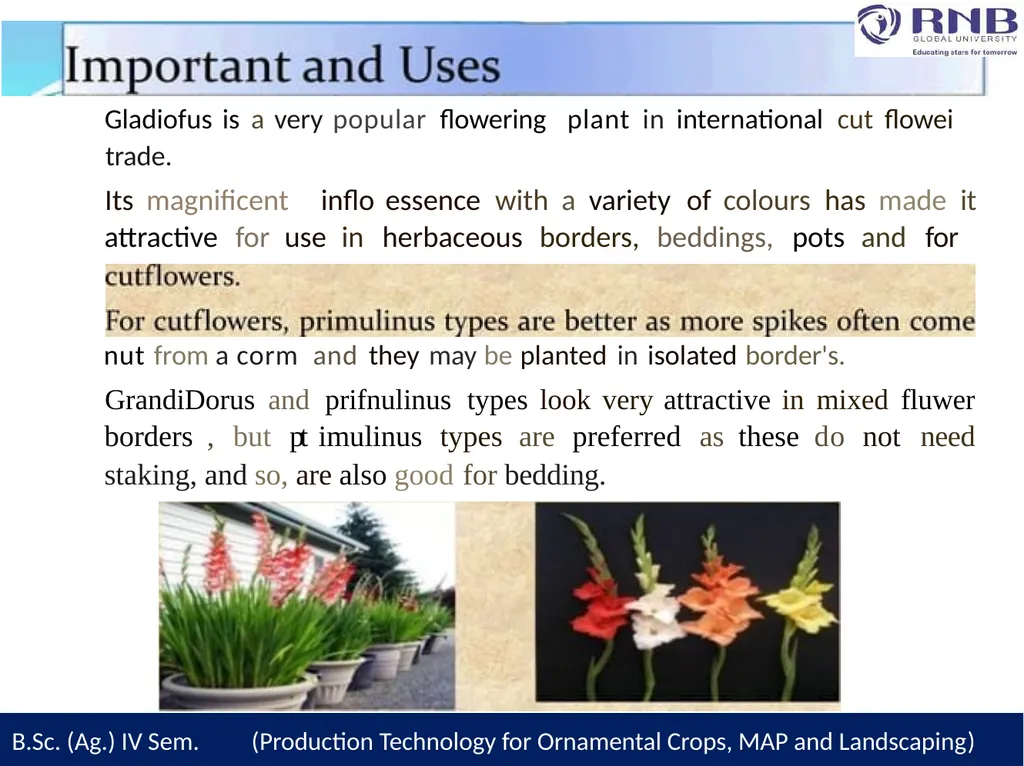
slide4. Gladiofus is a very popular flowering plant in international cut flowei trade. Its magnificent inflo essence with a variety of colours has made it attractive for use in herbaceous borders, beddings, pots and for
nut from a corm and they may be planted in isolated border's.
GrandiDorus and prifnulinus types look very attractive in mixed fluwer borders , but pt imulinus types are preferred as these do not need staking, and so, are also good for bedding. B.Sc. (Ag.) IV Sem. (Production Technology for Ornamental Crops, MAP and Landscaping)<br>
slide5. Types and Classification A total z3 species have so far been used in the development nf
modern gladiolus cultivers.
Classification:
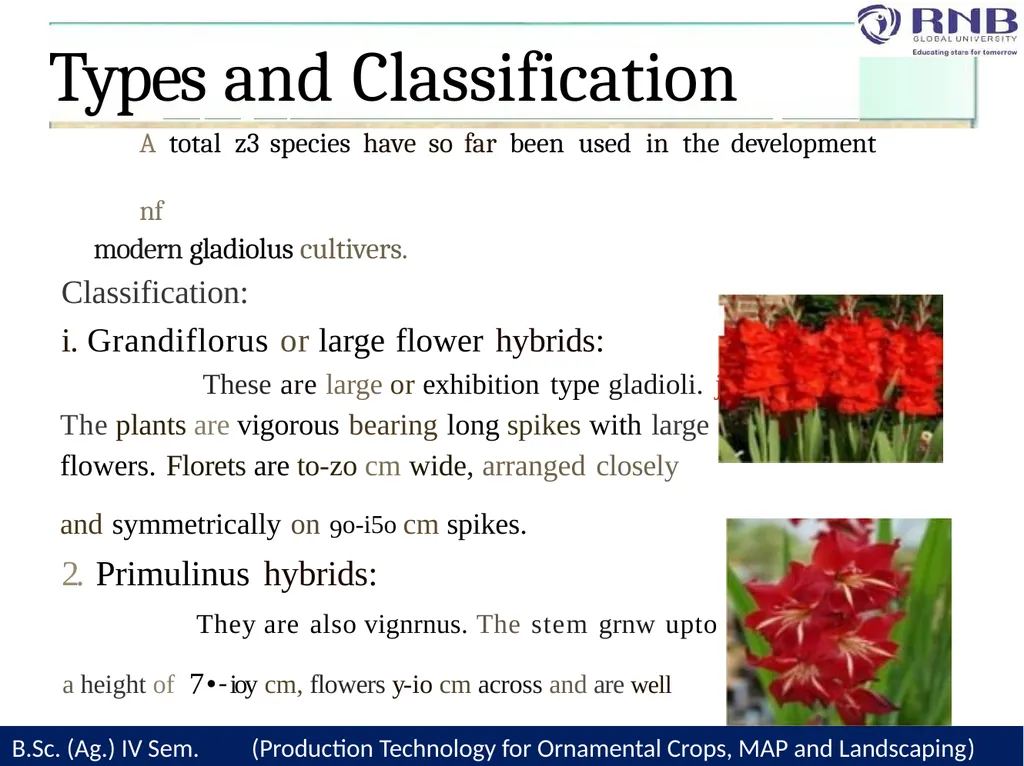
i. Grandiflorus or large flower hybrids:
These are large or exhibition type gladioli. j The plants are vigorous bearing long spikes with large flowers. Florets are to-zo cm wide, arranged closely and symmetrically on 9o-i5o cm spikes.
2. Primulinus hybrids:
They are also vignrnus. The stem grnw upto a height of 7•-ioy cm, flowers y-io cm across and are well spaced on q•-4s • •ng spikes. The upper must inner petals are attractive ,anthers& stigma appear above the petals. B.Sc. (Ag.) IV Sem. (Production Technology for Ornamental Crops, MAP and Landscaping)<br>
slide6. B.Sc. (Ag.) IV Sem. (Production Technology for Ornamental Crops, MAP and Landscaping)<br>
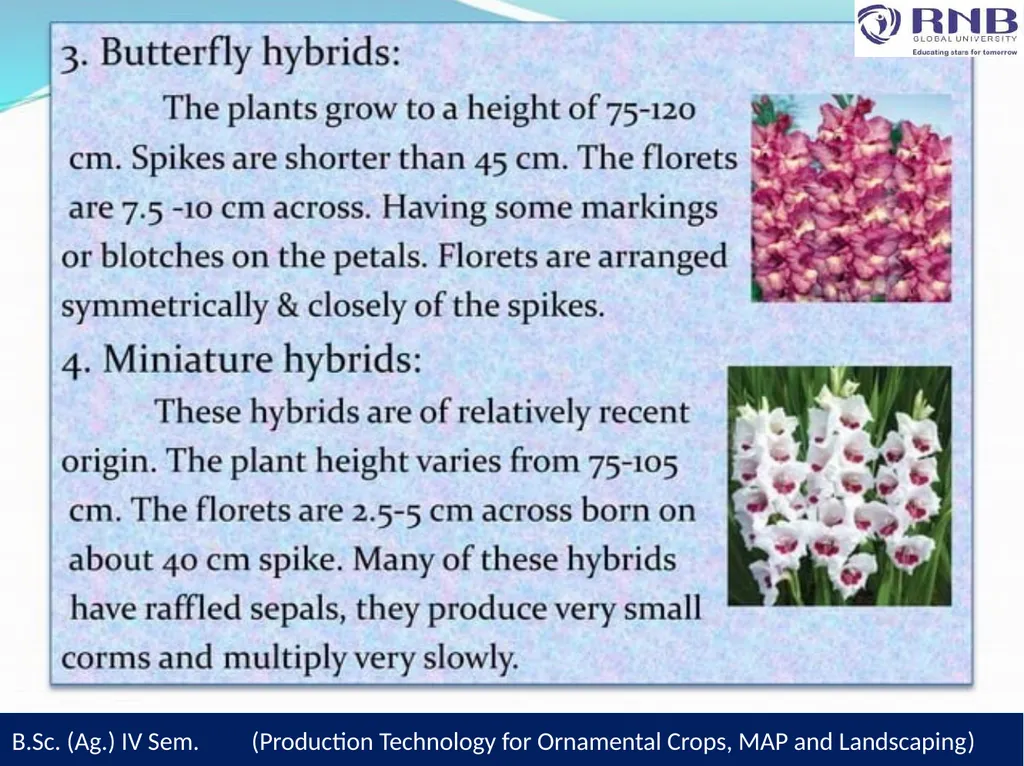
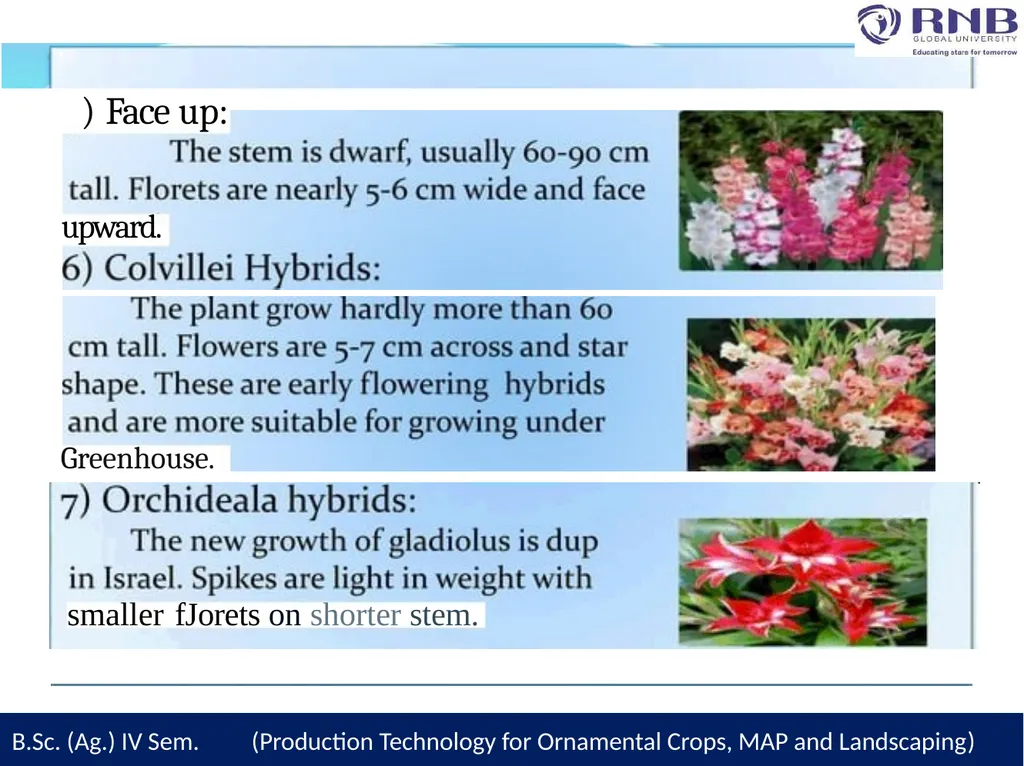
slide7. ) Face up: upward. Greenhouse. smaller fJorets on shorter stem. B.Sc. (Ag.) IV Sem. (Production Technology for Ornamental Crops, MAP and Landscaping)<br>
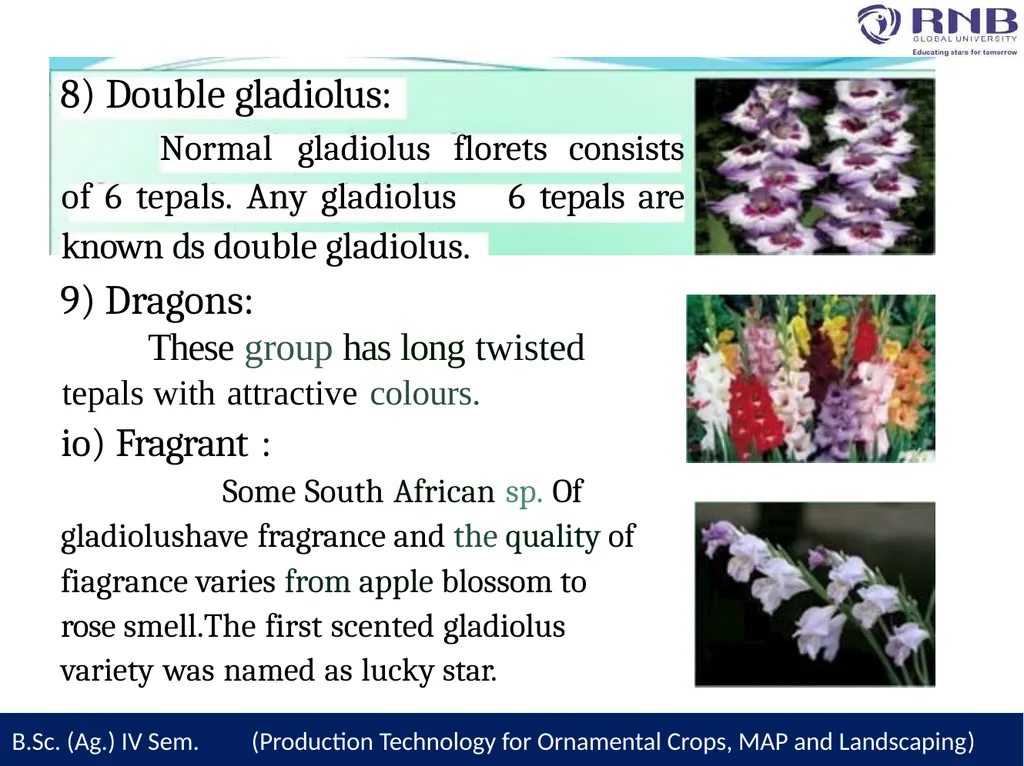
slide8. 8) Double gladiolus: Normal gladiolus florets consists of 6 tepals. Any gladiolus 6 tepals are known ds double gladiolus.
9) Dragons:
These group has long twisted
tepals with attractive colours.
io) Fragrant :
Some South African sp. Of gladiolushave fragrance and the quality of fiagrance varies from apple blossom to rose smell.The first scented gladiolus variety was named as lucky star. B.Sc. (Ag.) IV Sem. (Production Technology for Ornamental Crops, MAP and Landscaping)<br>
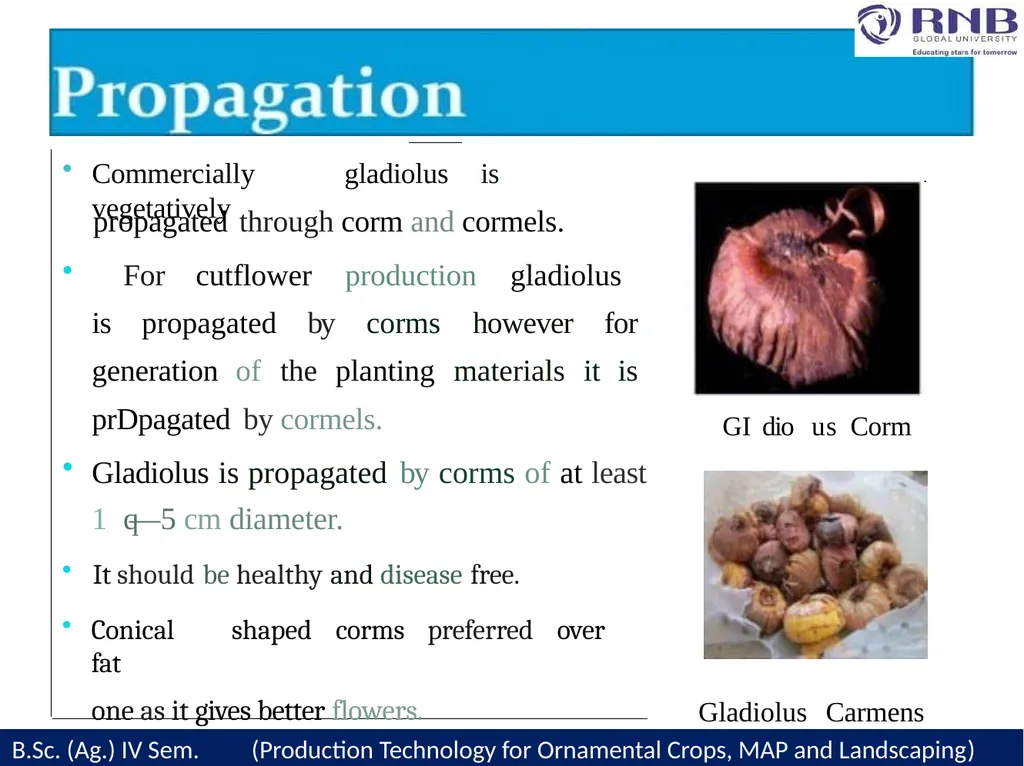
slide9. The most are.... promising varieties of gladiolus American Beaury( Red), Friendship (pink), Novalux (yellow) , Peterpears (orange), Pricilla ( white & light pink), Spic & Span (orange ), Oscar (red), White Prosperity (white), Her Majesty ( purple) ,Red candyman ( rani colour) , Dhannawanti (purple), Sunny Boy (purple). B.Sc. (Ag.) IV Sem. (Production Technology for Ornamental Crops, MAP and Landscaping)<br>
slide10. Commercially gladiolus is vegetatively propagated through corm and cormels. For cutflower production gladiolus is propagated by corms however for generation of the planting materials it is prDpagated by cormels.
Gladiolus is propagated by corms of at least 1 q—5 cm diameter.
It should be healthy and disease free.
Conical shaped corms preferred over fat
one as it gives better flowers. GI dio us Corm Gladiolus Carmens B.Sc. (Ag.) IV Sem. (Production Technology for Ornamental Crops, MAP and Landscaping)<br>
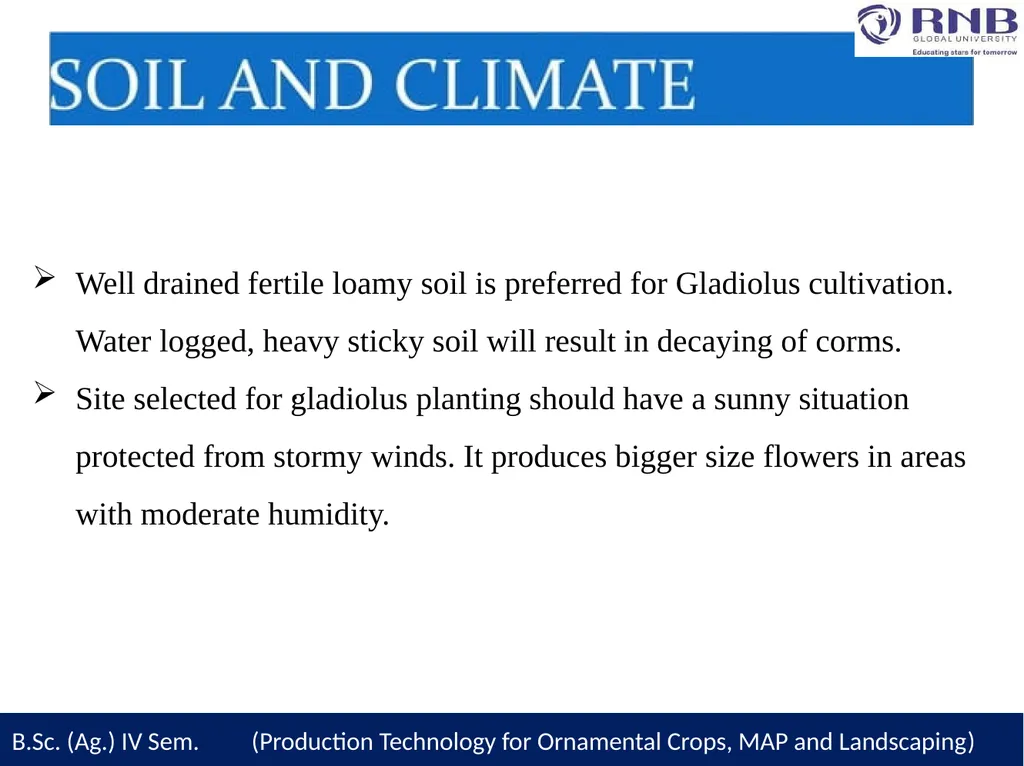
slide11. . Well drained fertile loamy soil is preferred for Gladiolus cultivation. Water logged, heavy sticky soil will result in decaying of corms.
Site selected for gladiolus planting should have a sunny situation protected from stormy winds. It produces bigger size flowers in areas with moderate humidity. B.Sc. (Ag.) IV Sem. (Production Technology for Ornamental Crops, MAP and Landscaping)<br>
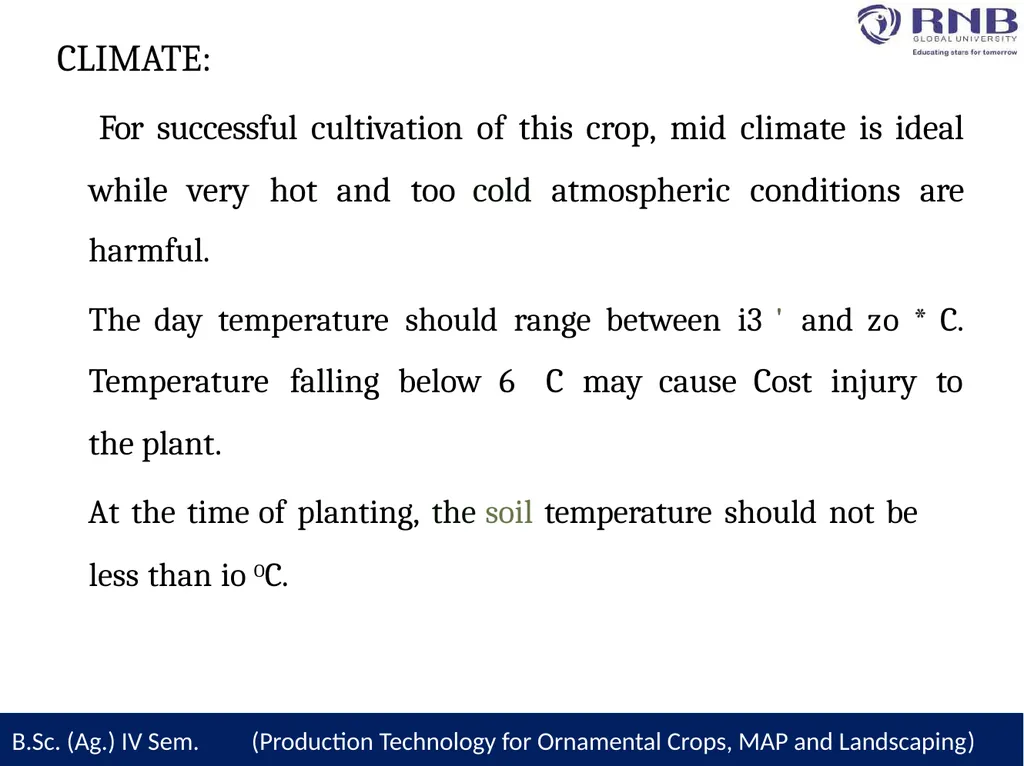
slide12. CLIMATE: For successful cultivation of this crop, mid climate is ideal while very hot and too cold atmospheric conditions are harmful.
The day temperature should range between i3 ' and zo * C. Temperature falling below 6 C may cause Cost injury to the plant.
At the time of planting, the soil temperature should not be
less than io OC. B.Sc. (Ag.) IV Sem. (Production Technology for Ornamental Crops, MAP and Landscaping)<br>
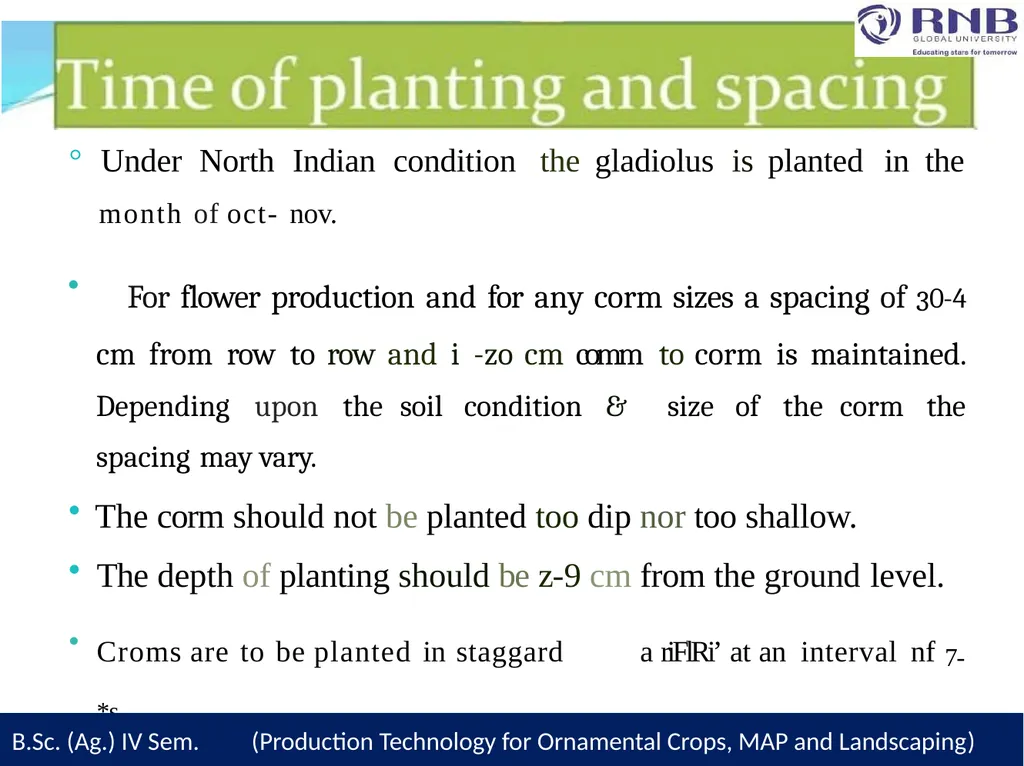
slide13. ° Under North Indian condition the gladiolus is planted in the month of oct- nov.
For flower production and for any corm sizes a spacing of 30-4 cm from row to row and i -zo cm comm to corm is maintained. Depending upon the soil condition & size of the corm the spacing may vary.
The corm should not be planted too dip nor too shallow.
The depth of planting should be z-9 cm from the ground level.
Croms are to be planted in staggard a riFlRi’ at an interval nf 7-*s
days to get continuous flower for a long period . B.Sc. (Ag.) IV Sem. (Production Technology for Ornamental Crops, MAP and Landscaping)<br>
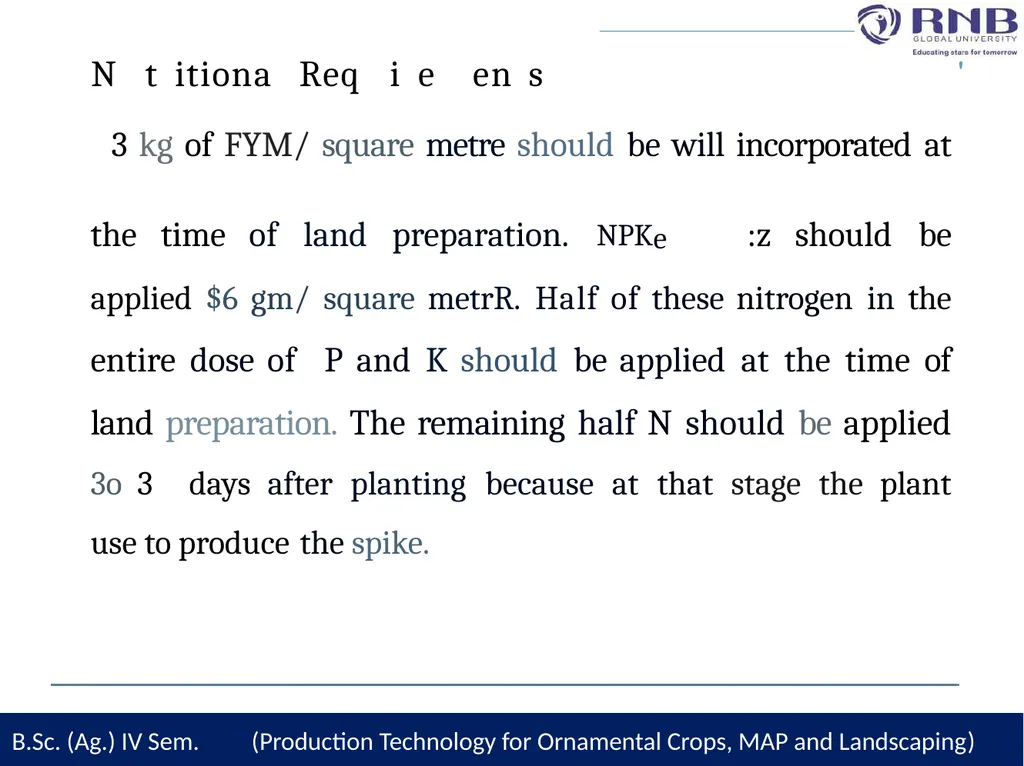
slide14. N t itiona Req i e en s ' 3 kg of FYM/ square metre should be will incorporated at the time of land preparation. NPKe :z should be applied $6 gm/ square metrR. Half of these nitrogen in the entire dose of P and K should be applied at the time of land preparation. The remaining half N should be applied 3o 3 days after planting because at that stage the plant use to produce the spike. B.Sc. (Ag.) IV Sem. (Production Technology for Ornamental Crops, MAP and Landscaping)<br>
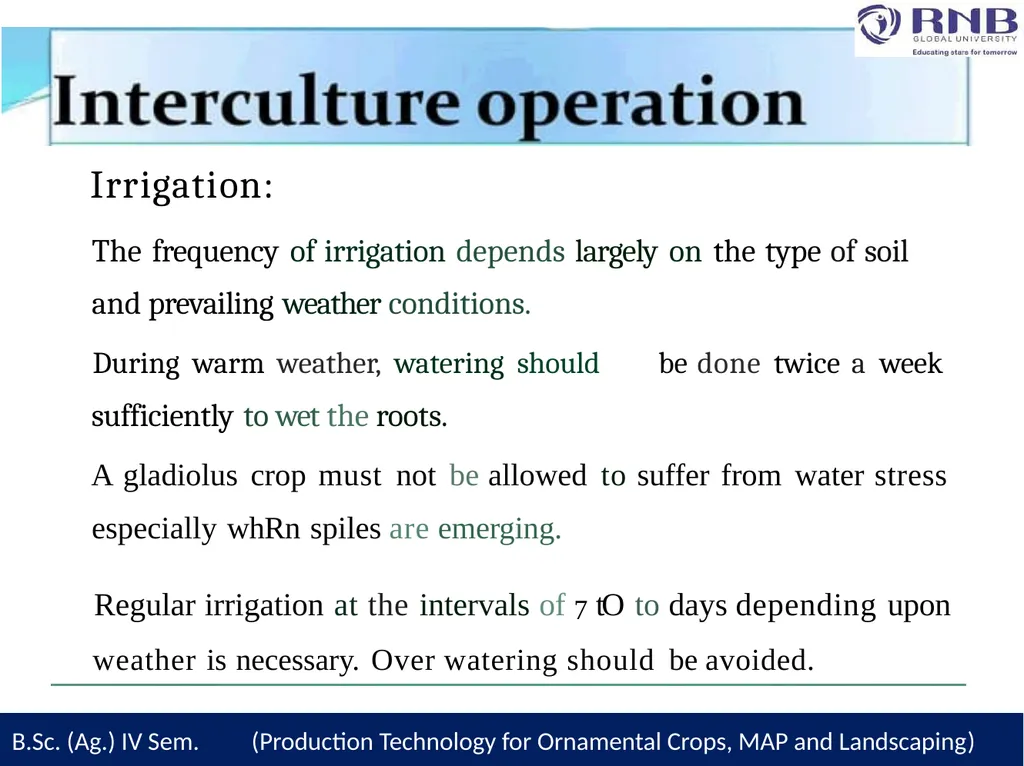
slide15. Irrigation: The frequency of irrigation depends largely on the type of soil and prevailing weather conditions.
During warm weather, watering should be done twice a week
sufficiently to wet the roots.
A gladiolus crop must not be allowed to suffer from water stress especially whRn spiles are emerging.
Regular irrigation at the intervals of 7 tO to days depending upon
weather is necessary. Over watering should be avoided. B.Sc. (Ag.) IV Sem. (Production Technology for Ornamental Crops, MAP and Landscaping)<br>
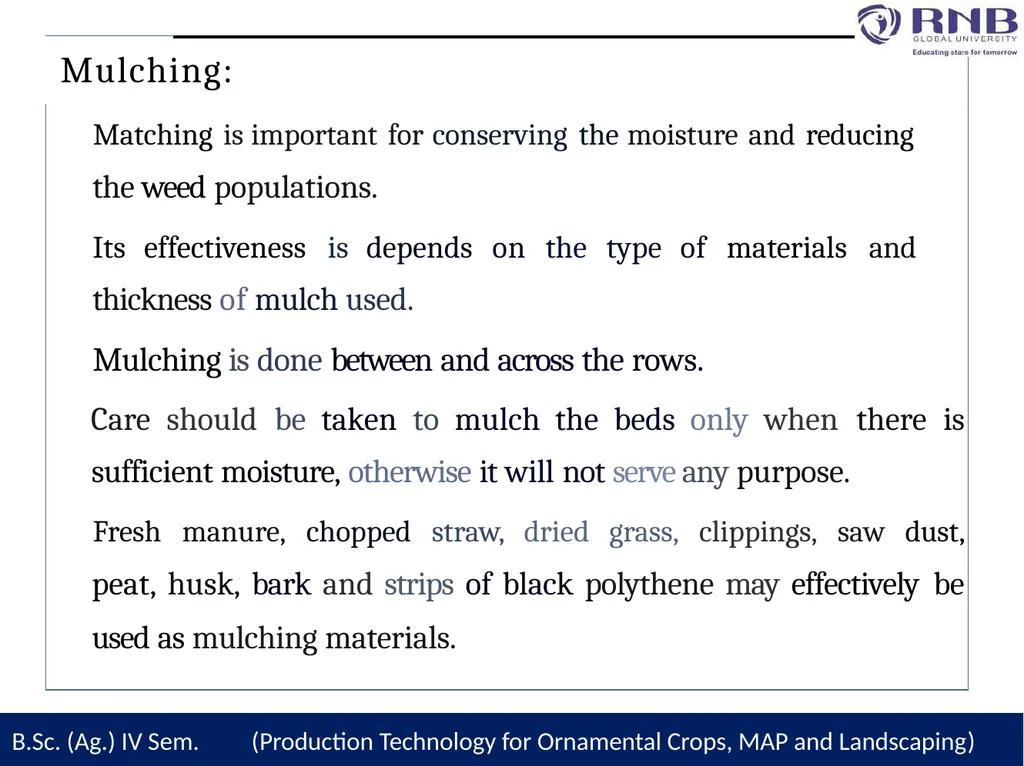
slide16. Mulching: Matching is important for conserving the moisture and reducing
the weed populations.
Its effectiveness is depends on the type of materials and
thickness of mulch used.
Mulching is done between and across the rows.
Care should be taken to mulch the beds only when there is sufficient moisture, otherwise it will not serve any purpose.
Fresh manure, chopped straw, dried grass, clippings, saw dust, peat, husk, bark and strips of black polythene may effectively be used as mulching materials. B.Sc. (Ag.) IV Sem. (Production Technology for Ornamental Crops, MAP and Landscaping)<br>
slide17. Earthing up: Usually gladio1us corm need iz-i$ days for sprouting .Initial New days the corm should not be disturbed except the removal of the initial weeds.
Once the plant attain to a height or' about u-2O Cm a light earthing up should be provided from both side of the row.
At this stage if the weather is dry amount of water to be applied. Occasionally the weeds should be removed and the soil should be lnnsened with the help of a fork.
When the plant will be a 5-6 leaf stage the second earthing up should
be done.
Staking:
At 5-6 leaf stage, the plant should be snake with the help of a bambno
During staking care shnuld be taken to avoid any damage tn the underground corm and cormels. B.Sc. (Ag.) IV Sem. (Production Technology for Ornamental Crops, MAP and Landscaping)<br>
slide18. Diseases:
Fusarium rat and yellow: Commonly known as *vascular clisease! ‘clry rot* or 'core rot' is caused by Fusarium spp.
Roots may show discrete brown lesions oi a general iotring, leaf infection is basal and associated with corm rot. Leaf storage.
z. Use disease free corm stuck ement B.Sc. (Ag.) IV Sem. (Production Technology for Ornamental Crops, MAP and Landscaping)<br>
slide19. B.Sc. (Ag.) IV Sem. (Production Technology for Ornamental Crops, MAP and Landscaping)<br>
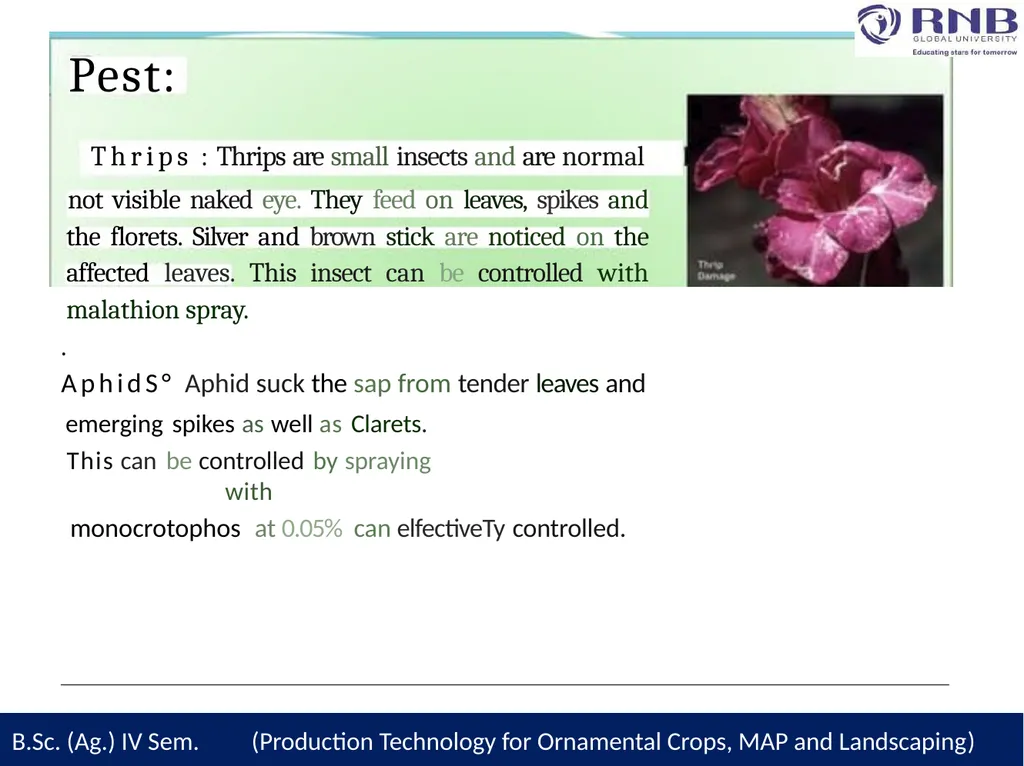
slide20. Pest: Thrips : Thrips are small insects and are normal
not visible naked eye. They feed on leaves, spikes and the florets. Silver and brown stick are noticed on the affected leaves. This insect can be controlled with malathion spray.
.
AphidS° Aphid suck the sap from tender leaves and
emerging spikes as well as Clarets.
This can be controlled by spraying with
monocrotophos at 0.05% can elfectiveTy controlled. B.Sc. (Ag.) IV Sem. (Production Technology for Ornamental Crops, MAP and Landscaping)<br>
slide21. 3. Mites : Mites also present in soil and attack the corms. They occur in hot season and damage leaves and buds which gave a pale appearance. Mites can be controlled by application of
kathane o•s%•
4• Caterpillars and various cut worms: These
ocassionally feed on foliage at spikes.
Manual collection & destruction in early stages can check the infestation . B.Sc. (Ag.) IV Sem. (Production Technology for Ornamental Crops, MAP and Landscaping)<br>
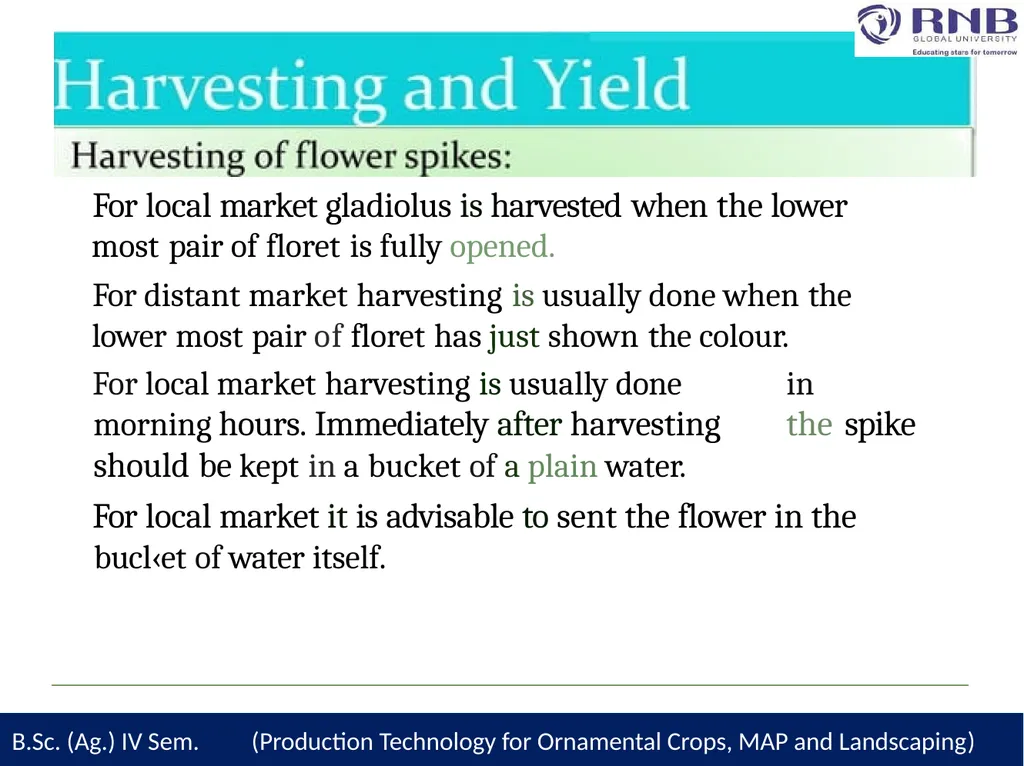
slide22. For local market gladiolus is harvested when the lower most pair of floret is fully opened.
For distant market harvesting is usually done when the lower most pair of floret has just shown the colour.
For local market harvesting is usually done in morning hours. Immediately after harvesting the spike should be kept in a bucket of a plain water.
For local market it is advisable to sent the flower in the
bucl‹et of water itself. B.Sc. (Ag.) IV Sem. (Production Technology for Ornamental Crops, MAP and Landscaping)<br>
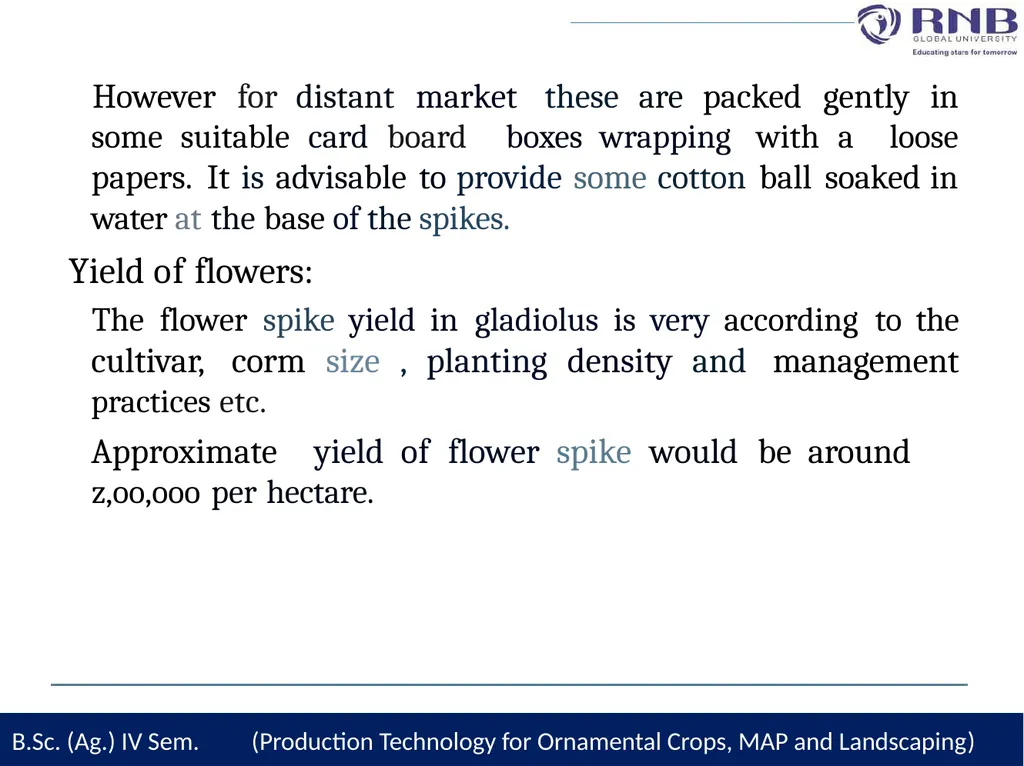
slide23. However for distant market these are packed gently in some suitable card board boxes wrapping with a loose papers. It is advisable to provide some cotton ball soaked in water at the base of the spikes.
Yield of flowers:
The flower spike yield in gladiolus is very according to the cultivar, corm size , planting density and management practices etc.
Approximate yield of flower spike would be around
z,oo,ooo per hectare. B.Sc. (Ag.) IV Sem. (Production Technology for Ornamental Crops, MAP and Landscaping)<br>
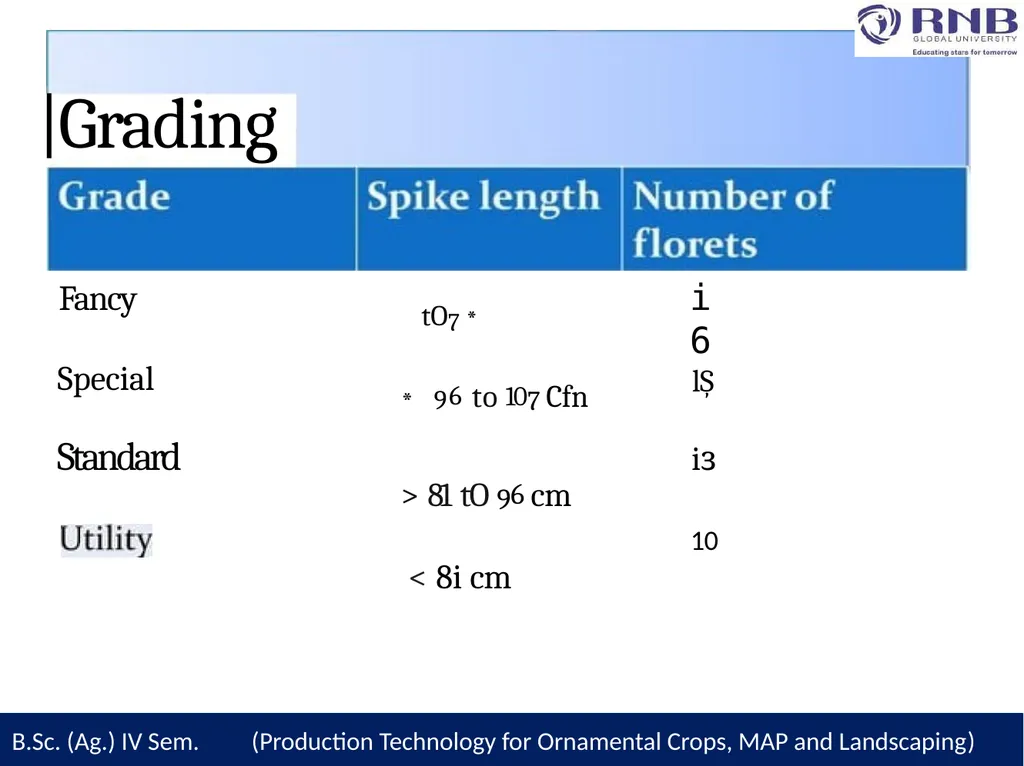
slide24. |Grading Fancy Special
Standard tO7 * i6 * 96 to 107 Cfn
> 81 tO 96 cm
< 8i cm lȘ iз 10 B.Sc. (Ag.) IV Sem. (Production Technology for Ornamental Crops, MAP and Landscaping)<br>
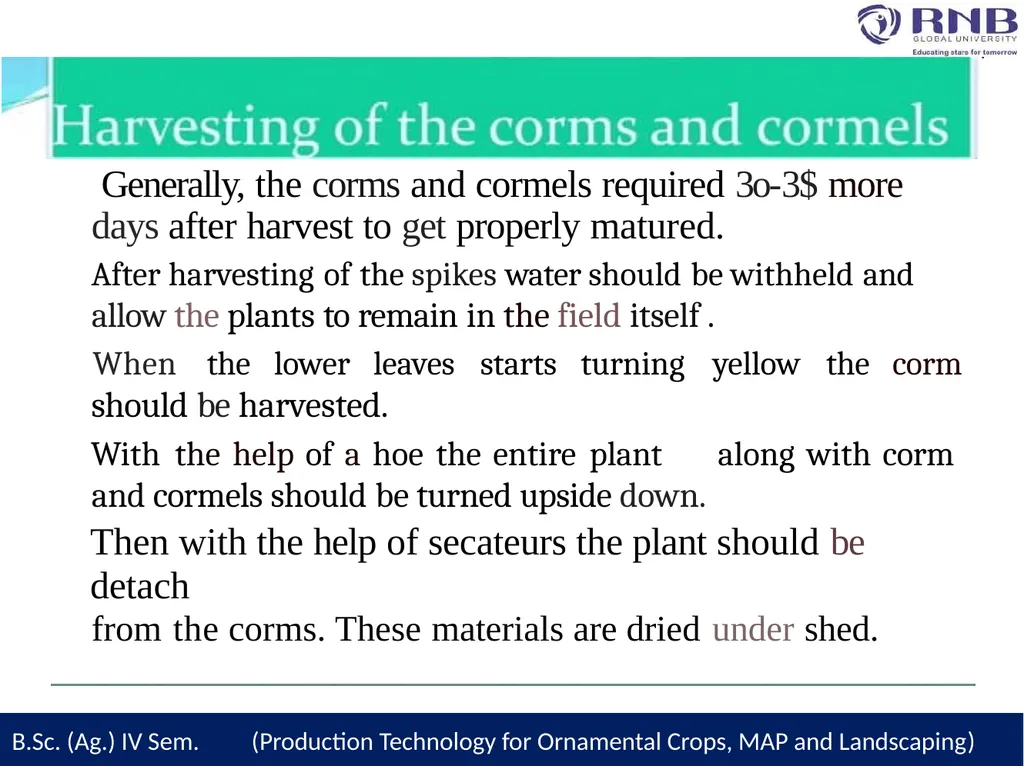
slide25. Generally, the corms and cormels required 3o-3$ more days after harvest to get properly matured. After harvesting of the spikes water should be withheld and
allow the plants to remain in the field itself .
When the lower leaves starts turning yellow the corm
should be harvested.
With the help of a hoe the entire plant along with corm
and cormels should be turned upside down.
Then with the help of secateurs the plant should be detach
from the corms. These materials are dried under shed. B.Sc. (Ag.) IV Sem. (Production Technology for Ornamental Crops, MAP and Landscaping)<br>
slide26. After that they are completely cleaned, graded at the size and packed in marketing bags after mixed with bavistin powder. Yield of corm and cormals:
The yield of gladiolus corm and cormals is influenced by
cultivars, corm size and other factors.
Approximately 4• 3 /ha. B.Sc. (Ag.) IV Sem. (Production Technology for Ornamental Crops, MAP and Landscaping)<br>
slide27. Pioper storage of corm and cormels are very important , os
otherwise storage rot of corm may occur due to fungal infection.
Corms are stored in single iayers in wooden trays having a wire bottom.
The scales over the croms are not removed during storage.
Before storage corm/cormals should be treated with Rngicides,
than air dried and stored.
For gladiolUS 4-io 0C COld temperature are required. B.Sc. (Ag.) IV Sem. (Production Technology for Ornamental Crops, MAP and Landscaping)<br>
slide28. B.Sc. (Ag.) IV Sem. (Production Technology for Ornamental Crops, MAP and Landscaping)<br>
Course Code- 20014400 B.Sc. (Ag.) IV Sem. (Production Technology for Ornamental Crops, MAP and Landscaping) Presented By- Dr. Mahendra Kr. Yadav<br>
slide2. Identify different types of ornamental and medicinal crops.
Examine various principles of landscaping, uses of landscape trees, shrubs and climbers, production technology of important ornamental crops, etc.
Determine about Demonstrate various Package of practices for loose flowers and their transportation, storage house and required condition for cut and loose flower.
Construct about the various problems with the production technology of medicinal and aromatic plants.
Importance of Processing and value addition in ornamental crops and MAPs produce. Course Objectives B.Sc. (Ag.) IV Sem. (Production Technology for Ornamental Crops, MAP and Landscaping)<br>
slide3. Gladiolus belongs to the family lridaceae.
The name gladinlus was originated ko rn the latin word 9ladius,
meaning a sword, on account of the sword-like shape of the foliage.
The cnmmon name of giadiolus is ‘sword lily’ because nf its sword
shaped foliage.
Gladiolus is popularly known as green of bulbous ornamental plants
and is native to mediterranean region & tropical South Asia.
Gtadiolus are gi-oivn in all parts of the world. In temperate countries the
most important period is summer, in tropical and subtropical climate
,it is grown in winter and spring. B.Sc. (Ag.) IV Sem. (Production Technology for Ornamental Crops, MAP and Landscaping) Production technology of gladiolus under protected condition<br>
slide4. Gladiofus is a very popular flowering plant in international cut flowei trade. Its magnificent inflo essence with a variety of colours has made it attractive for use in herbaceous borders, beddings, pots and for
nut from a corm and they may be planted in isolated border's.
GrandiDorus and prifnulinus types look very attractive in mixed fluwer borders , but pt imulinus types are preferred as these do not need staking, and so, are also good for bedding. B.Sc. (Ag.) IV Sem. (Production Technology for Ornamental Crops, MAP and Landscaping)<br>
slide5. Types and Classification A total z3 species have so far been used in the development nf
modern gladiolus cultivers.
Classification:
i. Grandiflorus or large flower hybrids:
These are large or exhibition type gladioli. j The plants are vigorous bearing long spikes with large flowers. Florets are to-zo cm wide, arranged closely and symmetrically on 9o-i5o cm spikes.
2. Primulinus hybrids:
They are also vignrnus. The stem grnw upto a height of 7•-ioy cm, flowers y-io cm across and are well spaced on q•-4s • •ng spikes. The upper must inner petals are attractive ,anthers& stigma appear above the petals. B.Sc. (Ag.) IV Sem. (Production Technology for Ornamental Crops, MAP and Landscaping)<br>
slide6. B.Sc. (Ag.) IV Sem. (Production Technology for Ornamental Crops, MAP and Landscaping)<br>
slide7. ) Face up: upward. Greenhouse. smaller fJorets on shorter stem. B.Sc. (Ag.) IV Sem. (Production Technology for Ornamental Crops, MAP and Landscaping)<br>
slide8. 8) Double gladiolus: Normal gladiolus florets consists of 6 tepals. Any gladiolus 6 tepals are known ds double gladiolus.
9) Dragons:
These group has long twisted
tepals with attractive colours.
io) Fragrant :
Some South African sp. Of gladiolushave fragrance and the quality of fiagrance varies from apple blossom to rose smell.The first scented gladiolus variety was named as lucky star. B.Sc. (Ag.) IV Sem. (Production Technology for Ornamental Crops, MAP and Landscaping)<br>
slide9. The most are.... promising varieties of gladiolus American Beaury( Red), Friendship (pink), Novalux (yellow) , Peterpears (orange), Pricilla ( white & light pink), Spic & Span (orange ), Oscar (red), White Prosperity (white), Her Majesty ( purple) ,Red candyman ( rani colour) , Dhannawanti (purple), Sunny Boy (purple). B.Sc. (Ag.) IV Sem. (Production Technology for Ornamental Crops, MAP and Landscaping)<br>
slide10. Commercially gladiolus is vegetatively propagated through corm and cormels. For cutflower production gladiolus is propagated by corms however for generation of the planting materials it is prDpagated by cormels.
Gladiolus is propagated by corms of at least 1 q—5 cm diameter.
It should be healthy and disease free.
Conical shaped corms preferred over fat
one as it gives better flowers. GI dio us Corm Gladiolus Carmens B.Sc. (Ag.) IV Sem. (Production Technology for Ornamental Crops, MAP and Landscaping)<br>
slide11. . Well drained fertile loamy soil is preferred for Gladiolus cultivation. Water logged, heavy sticky soil will result in decaying of corms.
Site selected for gladiolus planting should have a sunny situation protected from stormy winds. It produces bigger size flowers in areas with moderate humidity. B.Sc. (Ag.) IV Sem. (Production Technology for Ornamental Crops, MAP and Landscaping)<br>
slide12. CLIMATE: For successful cultivation of this crop, mid climate is ideal while very hot and too cold atmospheric conditions are harmful.
The day temperature should range between i3 ' and zo * C. Temperature falling below 6 C may cause Cost injury to the plant.
At the time of planting, the soil temperature should not be
less than io OC. B.Sc. (Ag.) IV Sem. (Production Technology for Ornamental Crops, MAP and Landscaping)<br>
slide13. ° Under North Indian condition the gladiolus is planted in the month of oct- nov.
For flower production and for any corm sizes a spacing of 30-4 cm from row to row and i -zo cm comm to corm is maintained. Depending upon the soil condition & size of the corm the spacing may vary.
The corm should not be planted too dip nor too shallow.
The depth of planting should be z-9 cm from the ground level.
Croms are to be planted in staggard a riFlRi’ at an interval nf 7-*s
days to get continuous flower for a long period . B.Sc. (Ag.) IV Sem. (Production Technology for Ornamental Crops, MAP and Landscaping)<br>
slide14. N t itiona Req i e en s ' 3 kg of FYM/ square metre should be will incorporated at the time of land preparation. NPKe :z should be applied $6 gm/ square metrR. Half of these nitrogen in the entire dose of P and K should be applied at the time of land preparation. The remaining half N should be applied 3o 3 days after planting because at that stage the plant use to produce the spike. B.Sc. (Ag.) IV Sem. (Production Technology for Ornamental Crops, MAP and Landscaping)<br>
slide15. Irrigation: The frequency of irrigation depends largely on the type of soil and prevailing weather conditions.
During warm weather, watering should be done twice a week
sufficiently to wet the roots.
A gladiolus crop must not be allowed to suffer from water stress especially whRn spiles are emerging.
Regular irrigation at the intervals of 7 tO to days depending upon
weather is necessary. Over watering should be avoided. B.Sc. (Ag.) IV Sem. (Production Technology for Ornamental Crops, MAP and Landscaping)<br>
slide16. Mulching: Matching is important for conserving the moisture and reducing
the weed populations.
Its effectiveness is depends on the type of materials and
thickness of mulch used.
Mulching is done between and across the rows.
Care should be taken to mulch the beds only when there is sufficient moisture, otherwise it will not serve any purpose.
Fresh manure, chopped straw, dried grass, clippings, saw dust, peat, husk, bark and strips of black polythene may effectively be used as mulching materials. B.Sc. (Ag.) IV Sem. (Production Technology for Ornamental Crops, MAP and Landscaping)<br>
slide17. Earthing up: Usually gladio1us corm need iz-i$ days for sprouting .Initial New days the corm should not be disturbed except the removal of the initial weeds.
Once the plant attain to a height or' about u-2O Cm a light earthing up should be provided from both side of the row.
At this stage if the weather is dry amount of water to be applied. Occasionally the weeds should be removed and the soil should be lnnsened with the help of a fork.
When the plant will be a 5-6 leaf stage the second earthing up should
be done.
Staking:
At 5-6 leaf stage, the plant should be snake with the help of a bambno
During staking care shnuld be taken to avoid any damage tn the underground corm and cormels. B.Sc. (Ag.) IV Sem. (Production Technology for Ornamental Crops, MAP and Landscaping)<br>
slide18. Diseases:
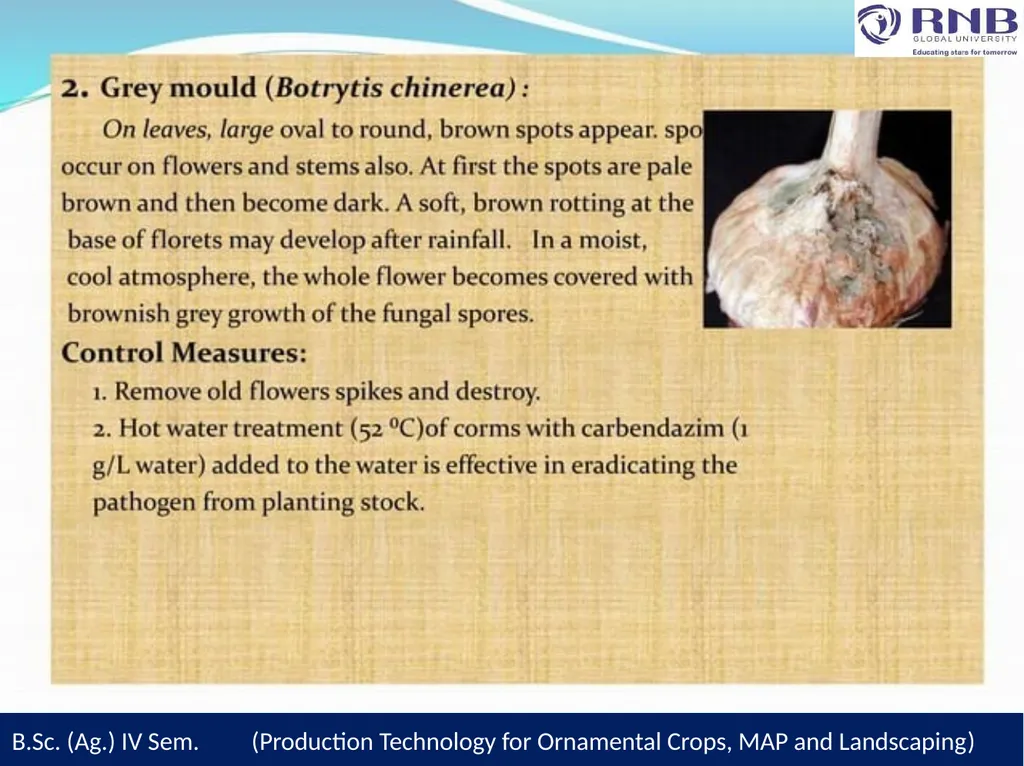
Fusarium rat and yellow: Commonly known as *vascular clisease! ‘clry rot* or 'core rot' is caused by Fusarium spp.
Roots may show discrete brown lesions oi a general iotring, leaf infection is basal and associated with corm rot. Leaf storage.
z. Use disease free corm stuck ement B.Sc. (Ag.) IV Sem. (Production Technology for Ornamental Crops, MAP and Landscaping)<br>
slide19. B.Sc. (Ag.) IV Sem. (Production Technology for Ornamental Crops, MAP and Landscaping)<br>
slide20. Pest: Thrips : Thrips are small insects and are normal
not visible naked eye. They feed on leaves, spikes and the florets. Silver and brown stick are noticed on the affected leaves. This insect can be controlled with malathion spray.
.
AphidS° Aphid suck the sap from tender leaves and
emerging spikes as well as Clarets.
This can be controlled by spraying with
monocrotophos at 0.05% can elfectiveTy controlled. B.Sc. (Ag.) IV Sem. (Production Technology for Ornamental Crops, MAP and Landscaping)<br>
slide21. 3. Mites : Mites also present in soil and attack the corms. They occur in hot season and damage leaves and buds which gave a pale appearance. Mites can be controlled by application of
kathane o•s%•
4• Caterpillars and various cut worms: These
ocassionally feed on foliage at spikes.
Manual collection & destruction in early stages can check the infestation . B.Sc. (Ag.) IV Sem. (Production Technology for Ornamental Crops, MAP and Landscaping)<br>
slide22. For local market gladiolus is harvested when the lower most pair of floret is fully opened.
For distant market harvesting is usually done when the lower most pair of floret has just shown the colour.
For local market harvesting is usually done in morning hours. Immediately after harvesting the spike should be kept in a bucket of a plain water.
For local market it is advisable to sent the flower in the
bucl‹et of water itself. B.Sc. (Ag.) IV Sem. (Production Technology for Ornamental Crops, MAP and Landscaping)<br>
slide23. However for distant market these are packed gently in some suitable card board boxes wrapping with a loose papers. It is advisable to provide some cotton ball soaked in water at the base of the spikes.
Yield of flowers:
The flower spike yield in gladiolus is very according to the cultivar, corm size , planting density and management practices etc.
Approximate yield of flower spike would be around
z,oo,ooo per hectare. B.Sc. (Ag.) IV Sem. (Production Technology for Ornamental Crops, MAP and Landscaping)<br>
slide24. |Grading Fancy Special
Standard tO7 * i6 * 96 to 107 Cfn
> 81 tO 96 cm
< 8i cm lȘ iз 10 B.Sc. (Ag.) IV Sem. (Production Technology for Ornamental Crops, MAP and Landscaping)<br>
slide25. Generally, the corms and cormels required 3o-3$ more days after harvest to get properly matured. After harvesting of the spikes water should be withheld and
allow the plants to remain in the field itself .
When the lower leaves starts turning yellow the corm
should be harvested.
With the help of a hoe the entire plant along with corm
and cormels should be turned upside down.
Then with the help of secateurs the plant should be detach
from the corms. These materials are dried under shed. B.Sc. (Ag.) IV Sem. (Production Technology for Ornamental Crops, MAP and Landscaping)<br>
slide26. After that they are completely cleaned, graded at the size and packed in marketing bags after mixed with bavistin powder. Yield of corm and cormals:
The yield of gladiolus corm and cormals is influenced by
cultivars, corm size and other factors.
Approximately 4• 3 /ha. B.Sc. (Ag.) IV Sem. (Production Technology for Ornamental Crops, MAP and Landscaping)<br>
slide27. Pioper storage of corm and cormels are very important , os
otherwise storage rot of corm may occur due to fungal infection.
Corms are stored in single iayers in wooden trays having a wire bottom.
The scales over the croms are not removed during storage.
Before storage corm/cormals should be treated with Rngicides,
than air dried and stored.
For gladiolUS 4-io 0C COld temperature are required. B.Sc. (Ag.) IV Sem. (Production Technology for Ornamental Crops, MAP and Landscaping)<br>
slide28. B.Sc. (Ag.) IV Sem. (Production Technology for Ornamental Crops, MAP and Landscaping)<br>