04
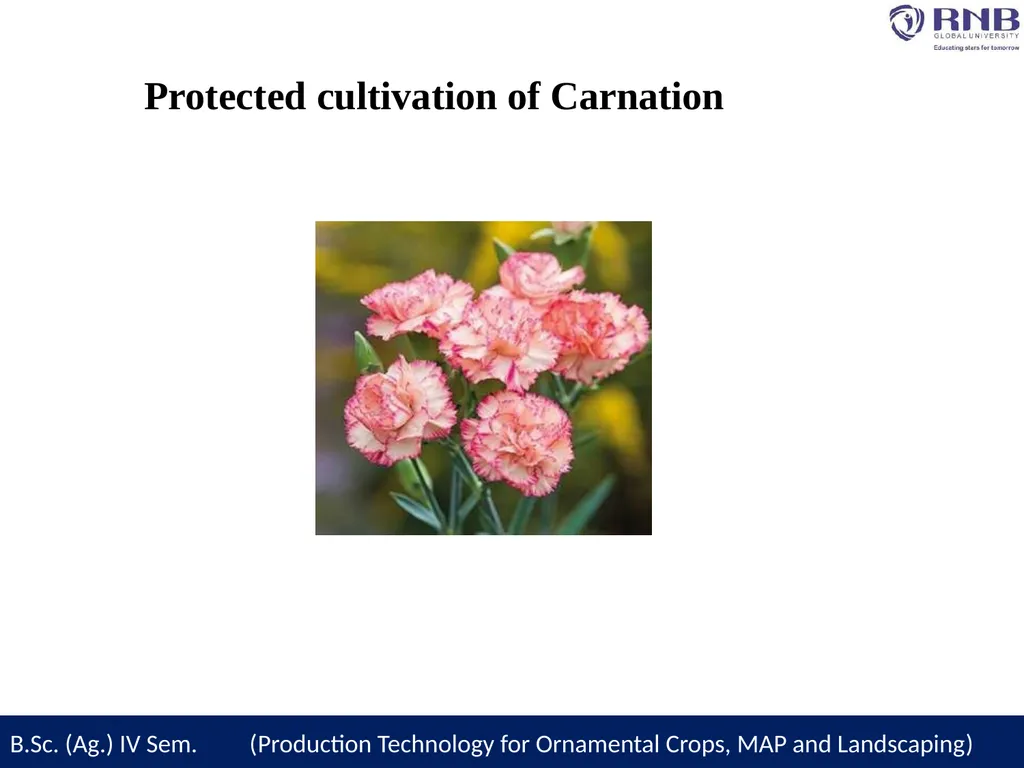
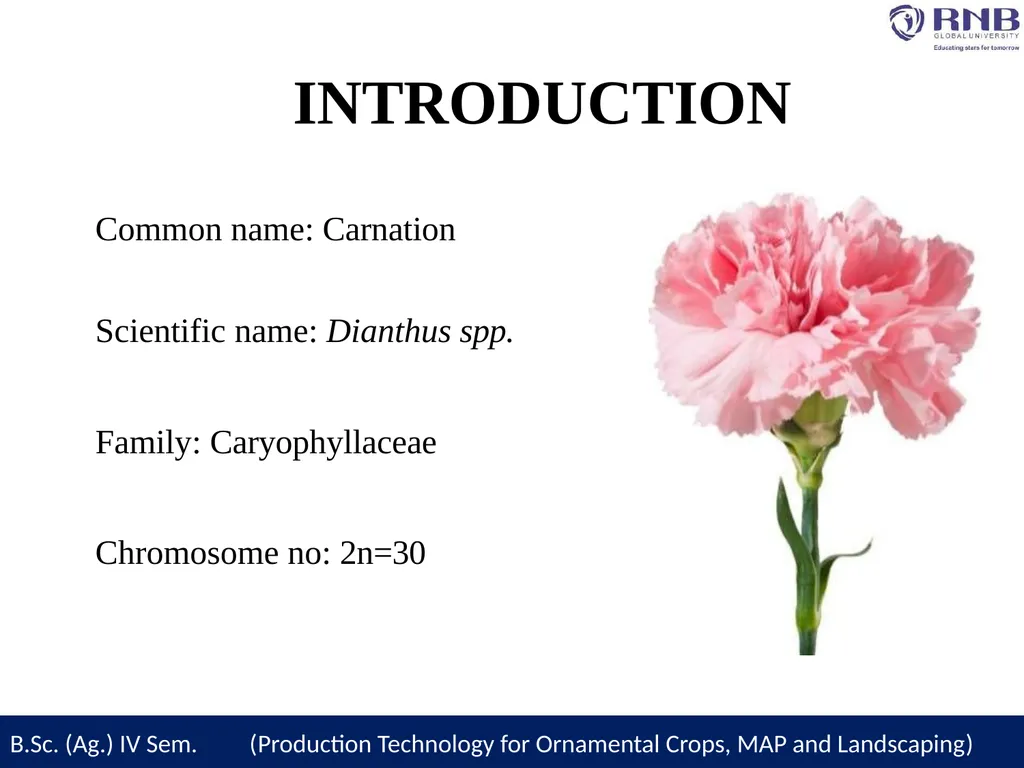
Common name: Carnation
Scientific name: Dianthus spp.
Family: Caryophyllaceae
Chromosome no: 2n=30 INTRODUCTION B.Sc. (Ag.) IV Sem. (Production Technology for Ornamental Crops, MAP and Landscaping)<br>
05
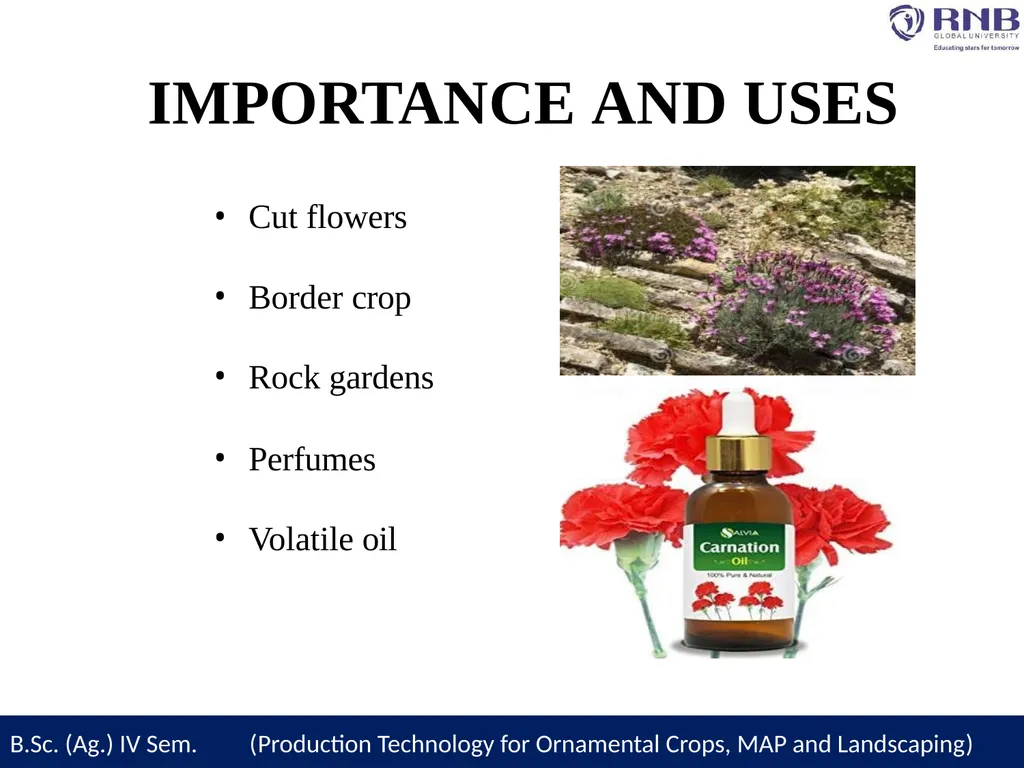
IMPORTANCE AND USES Cut flowers
Border crop
Rock gardens
Perfumes
Volatile oil B.Sc. (Ag.) IV Sem. (Production Technology for Ornamental Crops, MAP and Landscaping)<br>
06
POPULAR CARNATION CULTIVARS Dona, Pink Dona, Malaga, White Dona, Rony,
Rhodos, Lipstick, Empire, Romana, White Tendra, Corleone, Design, Natila, Dark Tempo, Bagatel silvery pink, Solar, Cobra, Pendy, Lorella, Cabaret, Tanga, Sonsara, Dakar, Liberty, Solar, Green Lady, Tempo, Varna, Sun Shine and Charment B.Sc. (Ag.) IV Sem. (Production Technology for Ornamental Crops, MAP and Landscaping)<br>
07
ENVIRONMENTAL FACTORS Light: Photoperiod (long days over 16 hours)
Intensity: (100 watts bulb spaced at 10.5 m at 1.5 m height)
TEMPERATURE
Night (winter: 10-110C, spring: 12.70C and summer: 13-15.40C) and day ( 18-230C)
Ventilation: Free circulation of air
Relative humidity: 50-60%.
CO2: 500-1500 ppm B.Sc. (Ag.) IV Sem. (Production Technology for Ornamental Crops, MAP and Landscaping)<br>
08
SOIL AND GROWING MEDIUM
Light texture loam or sandy loam soil which is well
drained and aerated.
Soil pH: 6-7.
PLANTING TIME: N.I. plains: Sep.-Oct.
Low hills: Sep.-Nov.
Mid hills: Jan.-Feb.
High hills: Mar.-April
Staggered planting at 15 days interval ensure regular supply of cut flowers. B.Sc. (Ag.) IV Sem. (Production Technology for Ornamental Crops, MAP and Landscaping)<br>
09
PROPAGATION
Terminal stem cuttings (8-10 cm long with 4-6 leaf pairs)
Micro-propagation PLANTING DENSITY AND SPACING
Ordinary: 25-32 plants/m2
High : 40 plants/m2
Standards: 20 x 20 cm B.Sc. (Ag.) IV Sem. (Production Technology for Ornamental Crops, MAP and Landscaping)<br>
10
SPRAY OPTIMUM NUTRITION N: 5.4%, P: 0.31%, K: 3.8%.
For Standards: FYM: 5 kg, N: 30g, P: 20g, K: 10g/m2
For Spray: FYM: 5 kg, N: 40g, P: 20g, K: 10g/m2
Now commercially nutrition is given through fertigation. B.Sc. (Ag.) IV Sem. (Production Technology for Ornamental Crops, MAP and Landscaping)<br>
11
Soil moisture and irrigation:
Optimum soil moisture is 300-500 cm tension.
Irrigation is done through drip irrigation with three lines in five rows in a bed.
Daily water requirement varies with the outside temperature from 2 to 3 litres/m2.
Water soluble fertilizers are also given along with irrigation.
During vegetative phase irrigation through sprinkler/ mister/ fogger is beneficial. B.Sc. (Ag.) IV Sem. (Production Technology for Ornamental Crops, MAP and Landscaping)<br>
12
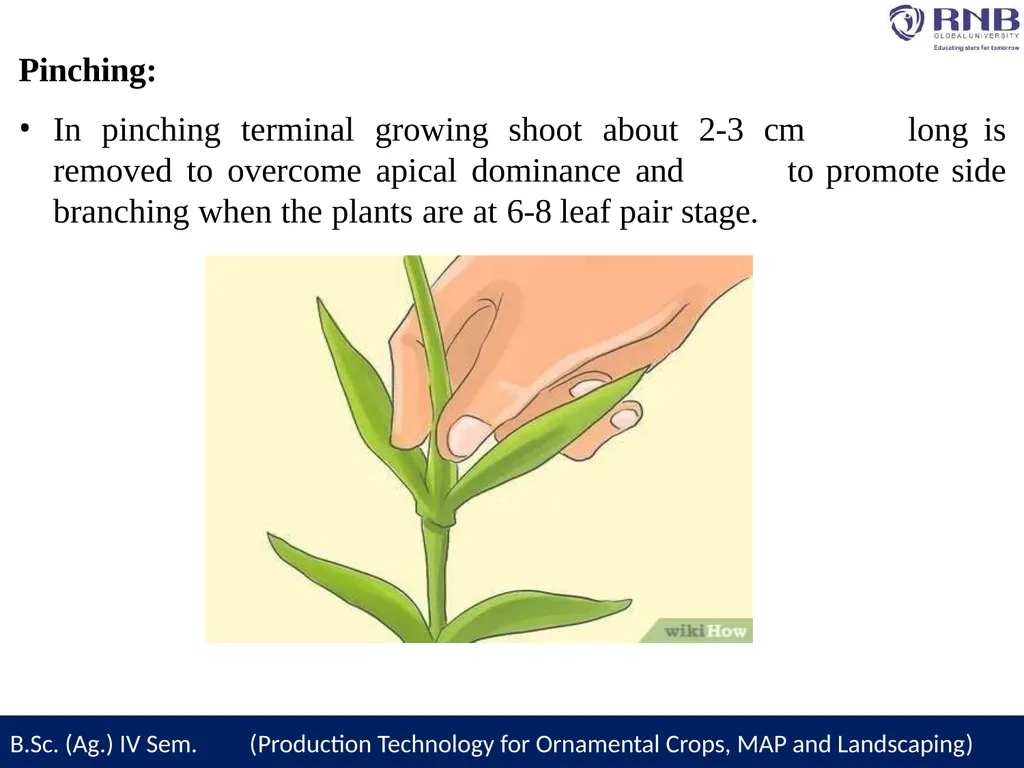
Pinching:
In pinching terminal growing shoot about 2-3 cm long is removed to overcome apical dominance and to promote side branching when the plants are at 6-8 leaf pair stage. B.Sc. (Ag.) IV Sem. (Production Technology for Ornamental Crops, MAP and Landscaping)<br>
13
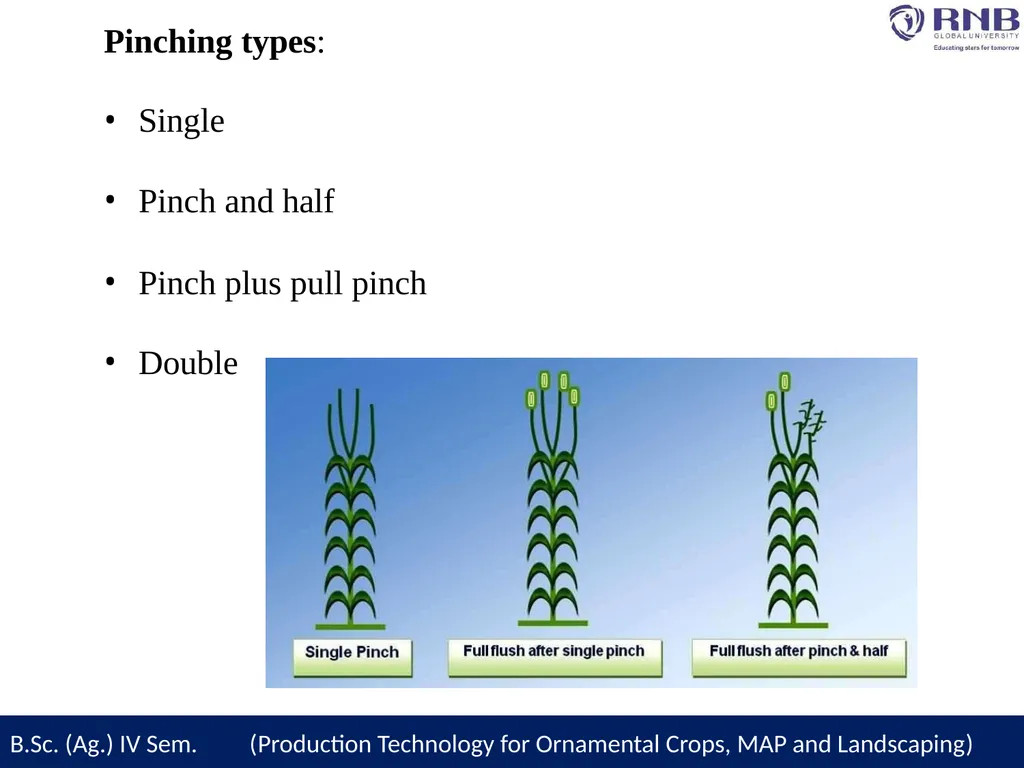
Pinching types:
Single
Pinch and half
Pinch plus pull pinch
Double B.Sc. (Ag.) IV Sem. (Production Technology for Ornamental Crops, MAP and Landscaping)<br>
14
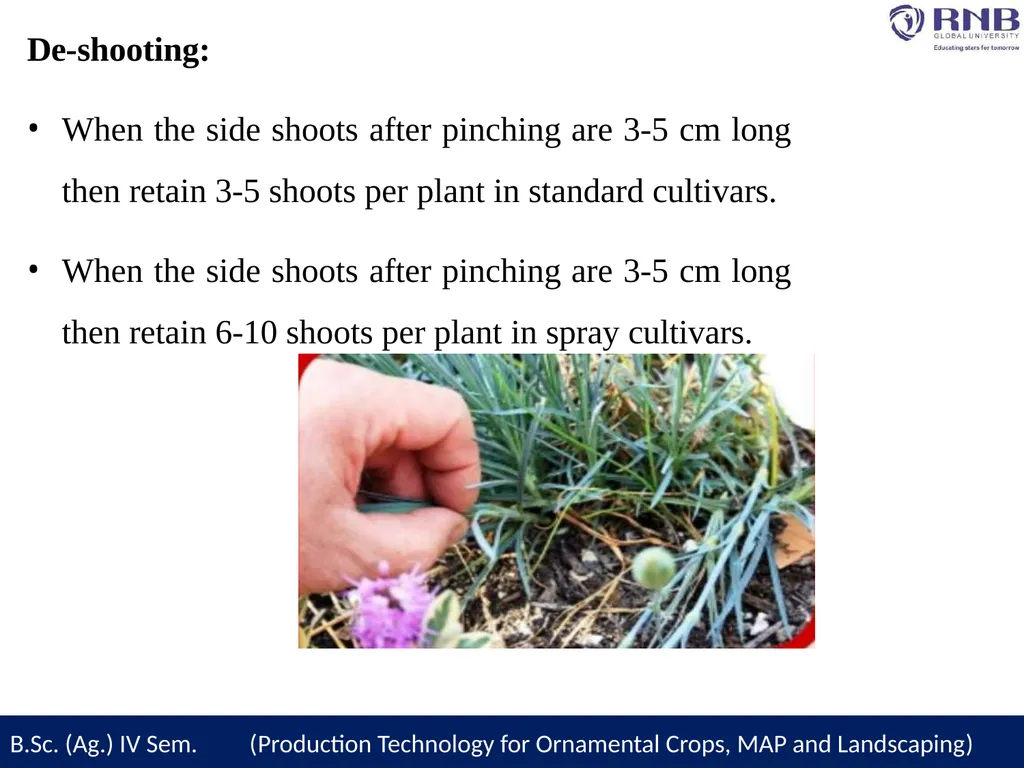
De-shooting:
When the side shoots after pinching are 3-5 cm long then retain 3-5 shoots per plant in standard cultivars.
When the side shoots after pinching are 3-5 cm long then retain 6-10 shoots per plant in spray cultivars. B.Sc. (Ag.) IV Sem. (Production Technology for Ornamental Crops, MAP and Landscaping)<br>
15
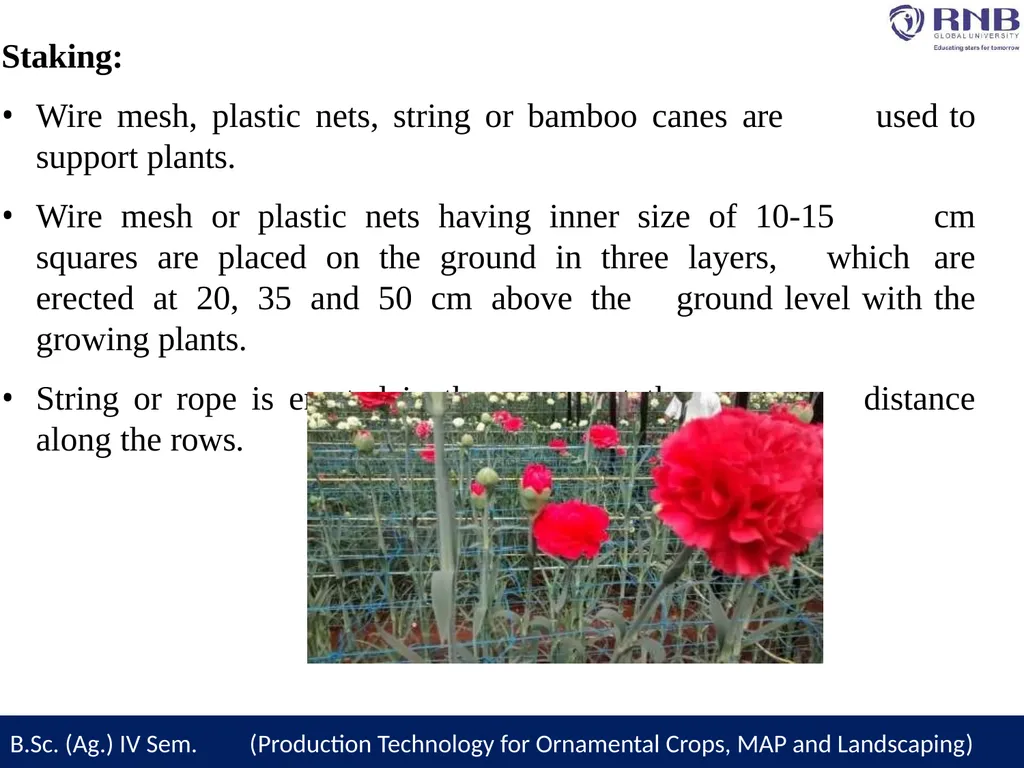
Staking:
Wire mesh, plastic nets, string or bamboo canes are used to support plants.
Wire mesh or plastic nets having inner size of 10-15 cm squares are placed on the ground in three layers, which are erected at 20, 35 and 50 cm above the ground level with the growing plants.
String or rope is erected in three rows at the same distance along the rows. B.Sc. (Ag.) IV Sem. (Production Technology for Ornamental Crops, MAP and Landscaping)<br>
16
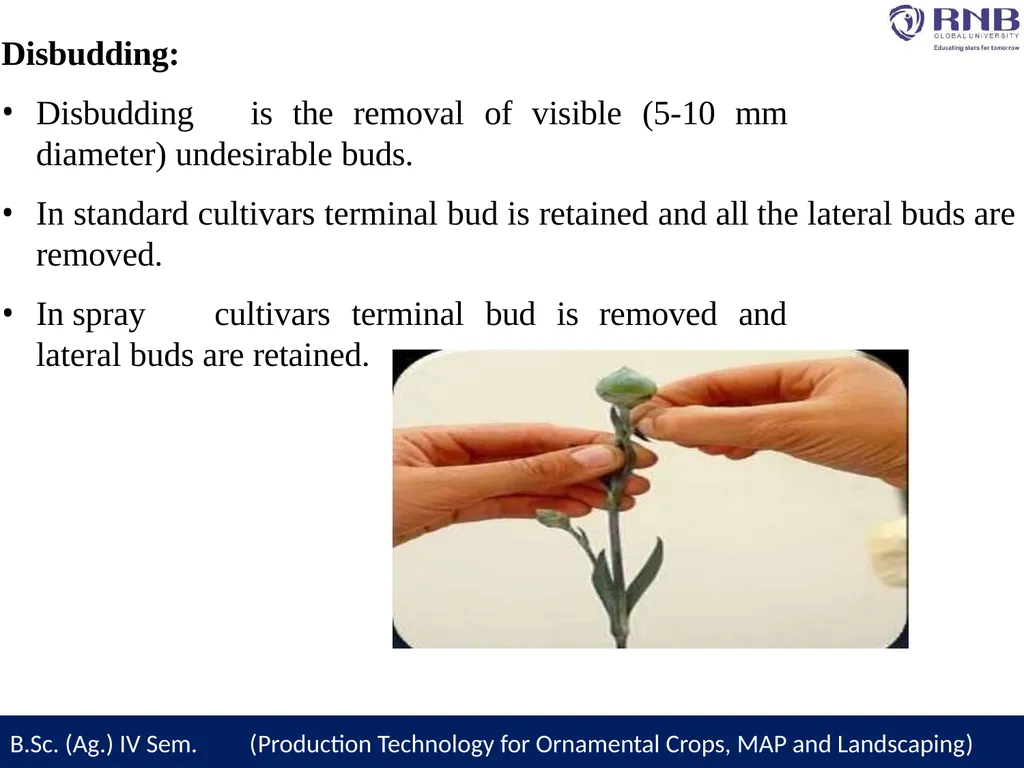
Disbudding:
Disbudding is the removal of visible (5-10 mm
diameter) undesirable buds.
In standard cultivars terminal bud is retained and all the lateral buds are removed.
In spray cultivars terminal bud is removed and
lateral buds are retained. B.Sc. (Ag.) IV Sem. (Production Technology for Ornamental Crops, MAP and Landscaping)<br>
17
Three-four hand weeding.
Chemicals viz., oxidiazon and napropamide @ 2.2 and 4.5 kg a.i. per hectare are good in greenhouse.
In open fluchloralin (basalin) and pendimethalin (stomp) @ 1.0 a.i. per hectare each are effective. WEEDING B.Sc. (Ag.) IV Sem. (Production Technology for Ornamental Crops, MAP and Landscaping)<br>
18
Stages of flower harvesting:
Standard cultivars- for local market are harvested when flowers are half opened or at painting brush or outer petal is perpendicular to stem.
while for distant market cross is developed on buds and colour is visible.
Spray cultivars are harvested for local market when two flowers have opened and others have shown colour, while for distant market when 50% flowers have shown colour. B.Sc. (Ag.) IV Sem. (Production Technology for Ornamental Crops, MAP and Landscaping)<br>
19
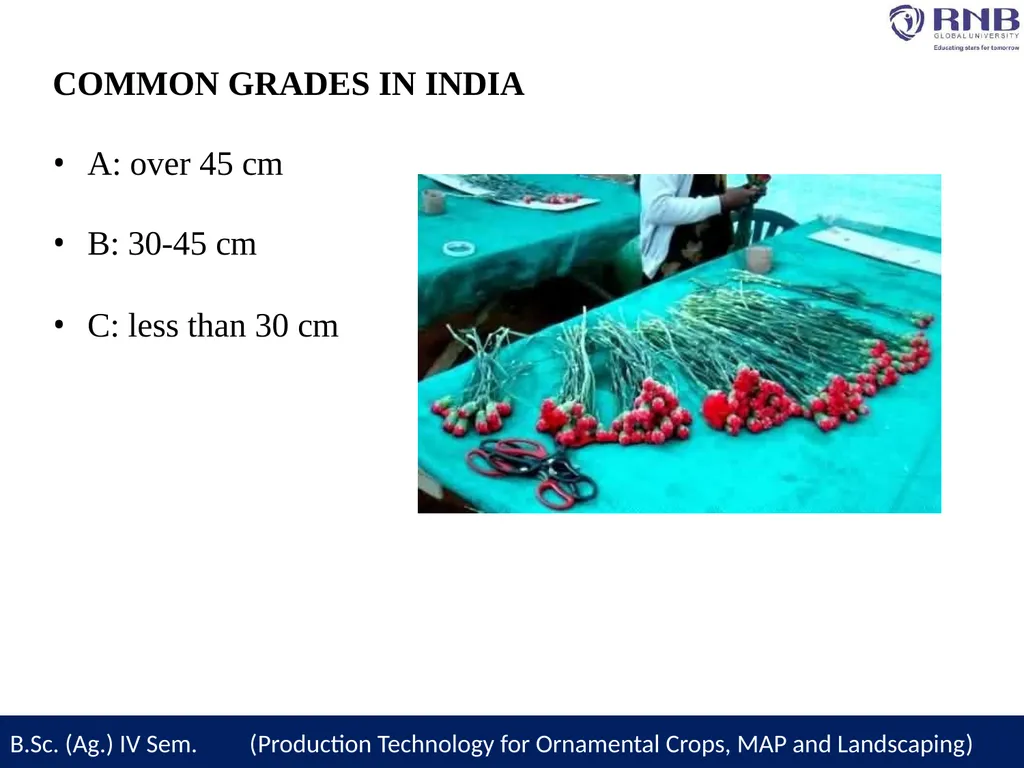
COMMON GRADES IN INDIA
A: over 45 cm
B: 30-45 cm
C: less than 30 cm B.Sc. (Ag.) IV Sem. (Production Technology for Ornamental Crops, MAP and Landscaping)<br>
20
PACKAGING
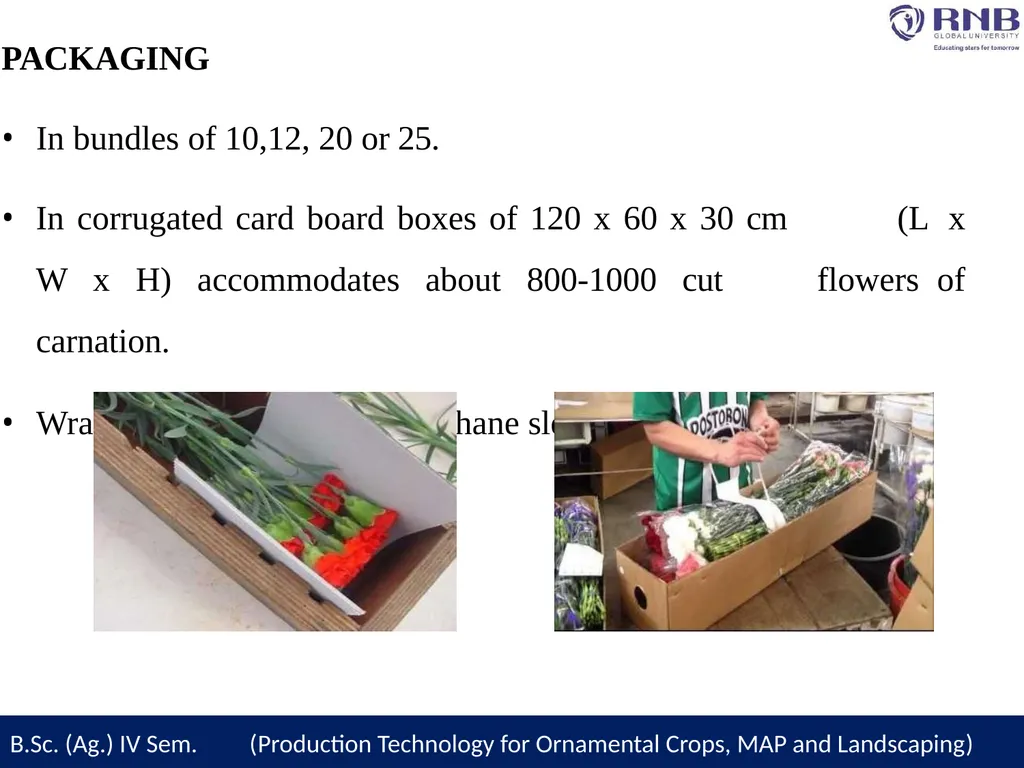
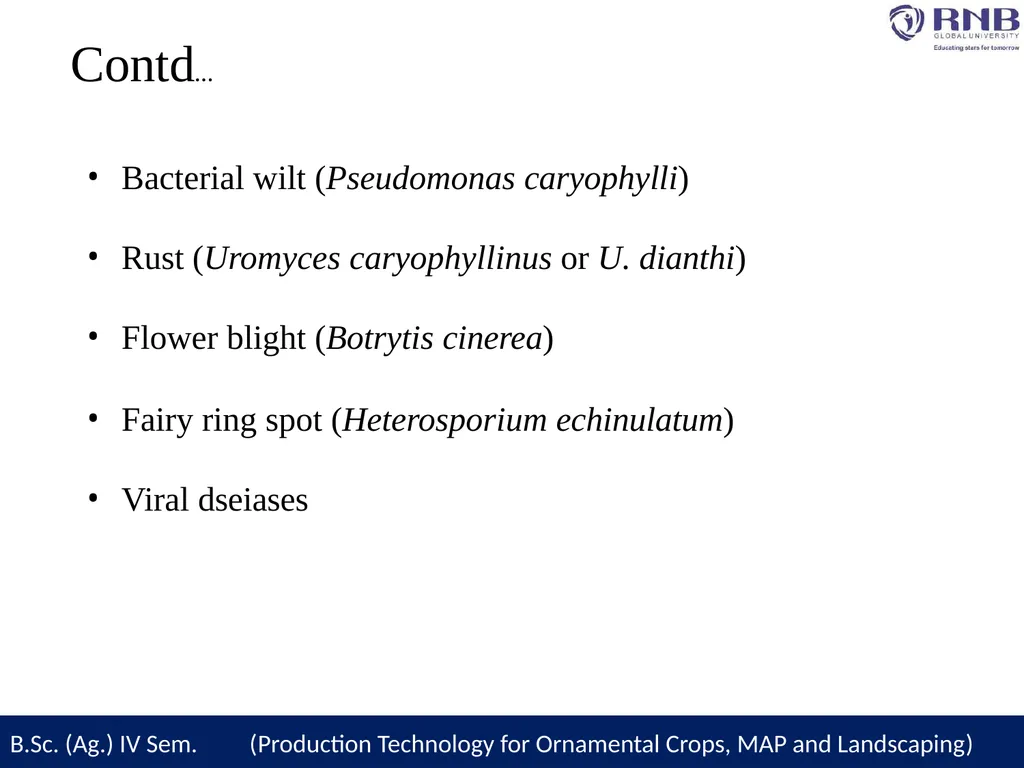
In bundles of 10,12, 20 or 25.
In corrugated card board boxes of 120 x 60 x 30 cm (L x W x H) accommodates about 800-1000 cut flowers of carnation.
Wrap flower bunches in cellophane sleeves. B.Sc. (Ag.) IV Sem. (Production Technology for Ornamental Crops, MAP and Landscaping)<br>
21
Wilt (Fusarium oxysporum f. sp. dianthi)
Foot- rot (Phytophthora, Pythium, Rhizoctonia solani, Sclerotinia sclerotiarum)
Stem rot (Fusarium roseum)
Flower bud rot (Alternaria dianthi) DISEASES B.Sc. (Ag.) IV Sem. (Production Technology for Ornamental Crops, MAP and Landscaping)<br>
22
Bacterial wilt (Pseudomonas caryophylli)
Rust (Uromyces caryophyllinus or U. dianthi)
Flower blight (Botrytis cinerea)
Fairy ring spot (Heterosporium echinulatum)
Viral dseiases Contd… B.Sc. (Ag.) IV Sem. (Production Technology for Ornamental Crops, MAP and Landscaping)<br>
23
INSECT-PESTS
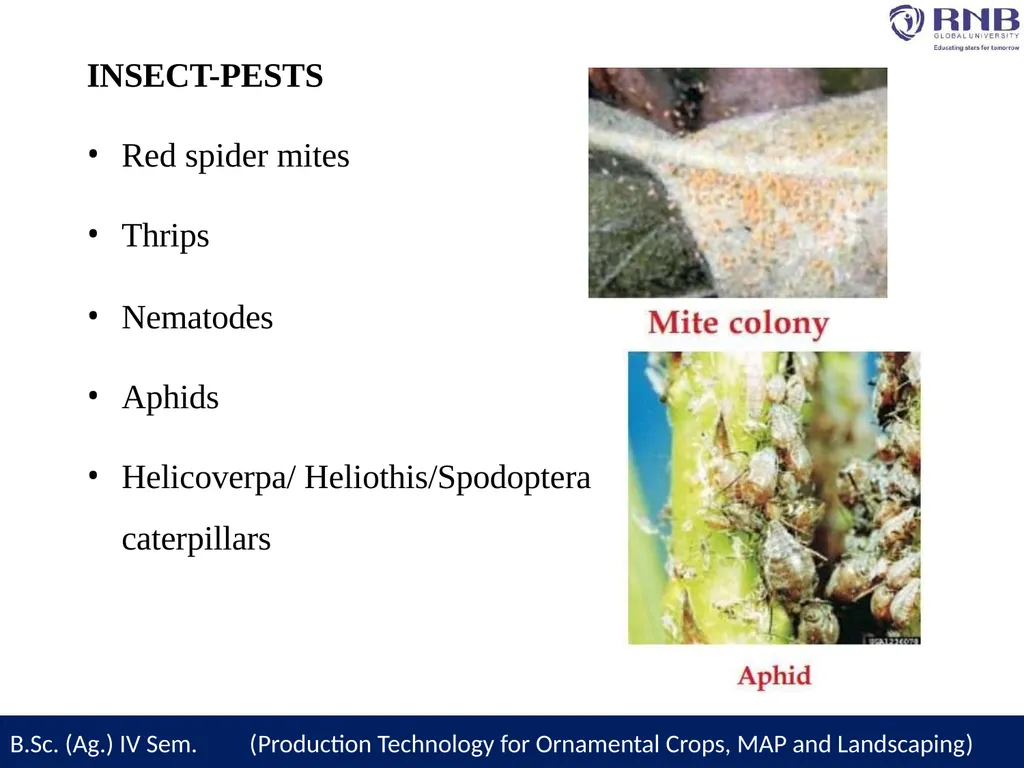
Red spider mites
Thrips
Nematodes
Aphids
Helicoverpa/ Heliothis/Spodoptera caterpillars B.Sc. (Ag.) IV Sem. (Production Technology for Ornamental Crops, MAP and Landscaping)<br>
24
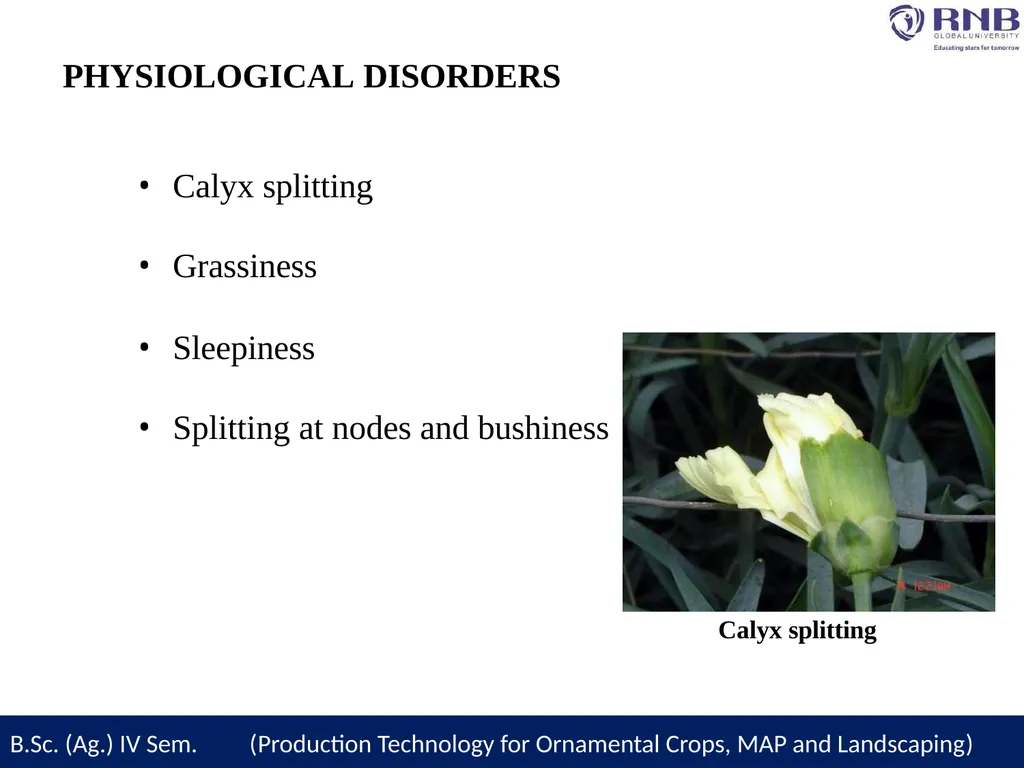
PHYSIOLOGICAL DISORDERS Calyx splitting
Grassiness
Sleepiness
Splitting at nodes and bushiness Calyx splitting B.Sc. (Ag.) IV Sem. (Production Technology for Ornamental Crops, MAP and Landscaping)<br>
25
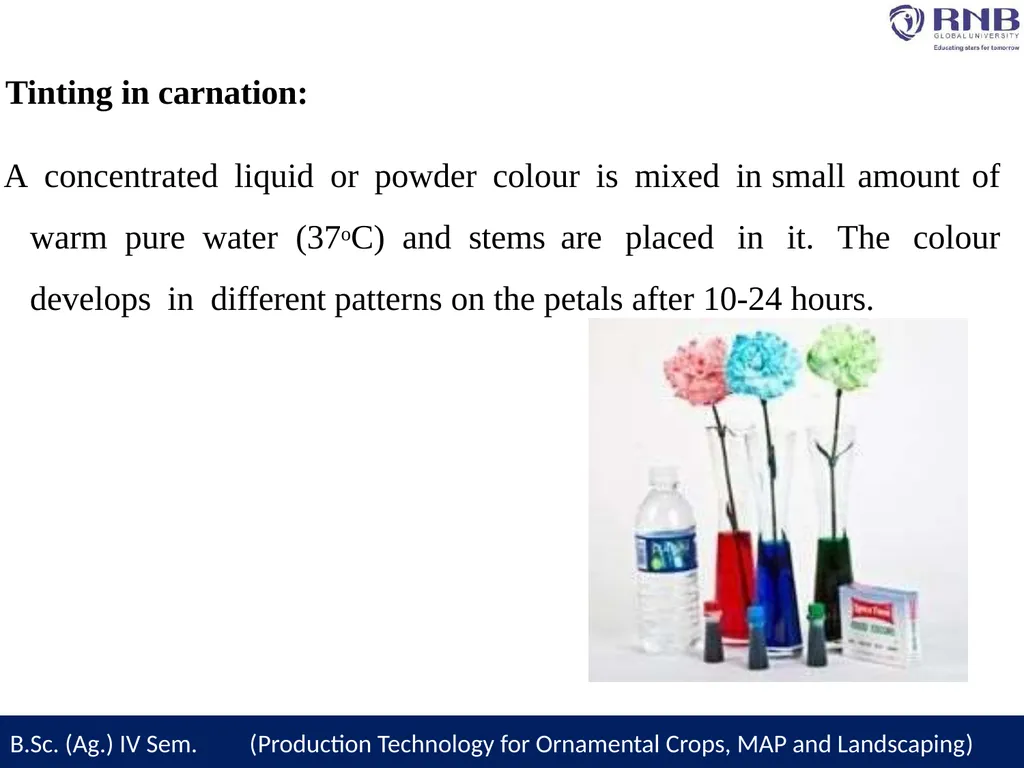
Tinting in carnation:
A concentrated liquid or powder colour is mixed in small amount of warm pure water (37oC) and stems are placed in it. The colour develops in different patterns on the petals after 10-24 hours. B.Sc. (Ag.) IV Sem. (Production Technology for Ornamental Crops, MAP and Landscaping)<br>
26
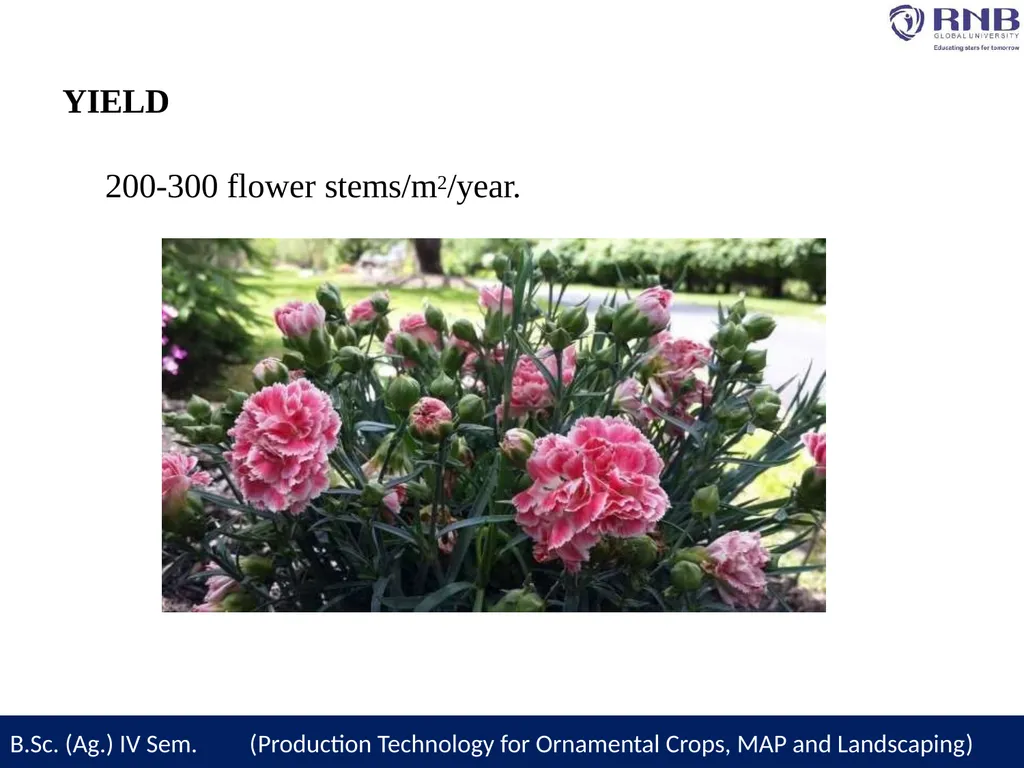
YIELD 200-300 flower stems/m2/year. B.Sc. (Ag.) IV Sem. (Production Technology for Ornamental Crops, MAP and Landscaping)<br>
27
B.Sc. (Ag.) IV Sem. (Production Technology for Ornamental Crops, MAP and Landscaping)<br>