Course No. CHMDSC101CHMGEC101 UNIT-2 Lattice Energy and Born-Haber Cycle Dr. Sankar Neogi Associate Professor Head Department of Chemistry Haflong Govt. College, Haflong Overview Chemical Bond Ionic Bond Crystal Ionic Crystal Types of
"Course No. CHMDSC101/CHMGEC101 UNIT-2 Lattice" is the property of its rightful owner. Permission is granted to
download and print the materials on this website for personal, non-commercial use only, and to display it
on your personal computer provided you do not modify the materials and that you retain all copyright
notices contained in the materials. By downloading content from our website, you accept the terms of this
agreement.
Presentation Transcript
01
Course No. CHMDSC101/CHMGEC101 UNIT-2 Lattice Energy and Born-Haber Cycle Dr. Sankar Neogi
Associate Professor & Head
Department of Chemistry
Haflong Govt. College, Haflong<br>
02
Overview Chemical Bond
Ionic Bond
Crystal
Ionic Crystal
Types of Ionic Crystal
Lattice Energy
Born-Haber Cycle<br>
03
Chemical Bond A CHEMICAL BOND IS DEFINED AS A FORCE OF ATTRACTRATION WHICH HOLDS TOGETHER THE CONSTITUTENT ATOMS IN A MOLECULE<br>
04
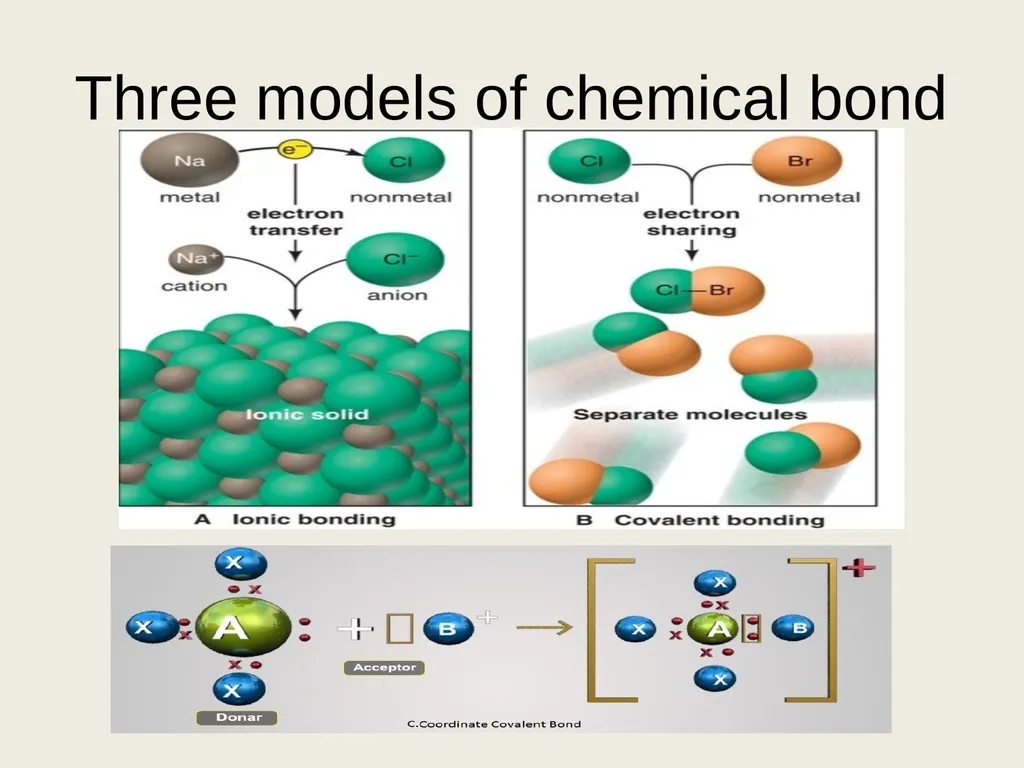
Three main types of Chemical bonds.
Electrovalent bond or Ionic bond involves the transfer of electrons and is usually observed when a metal bonds to a nonmetal. Types of Chemical Bond<br>
05
Contn….. Covalent bond involves the sharing of electrons and is usually observed when a nonmetal bonds to a nonmetal.
Coordinate bond or Dative bond involves the transfer of electrons and occurs when a nonmetal bonds to another nonmetal.<br>
06
Three models of chemical bond<br>
07
An ionic bond is formed when a metal transfers electrons to a nonmetal to form ions, which attract each other to give a solid compound.
The total number of electrons lost by the metal atom(s) equals the total number of electrons gained by the nonmetal atoms. The Ionic Bonding Model<br>
08
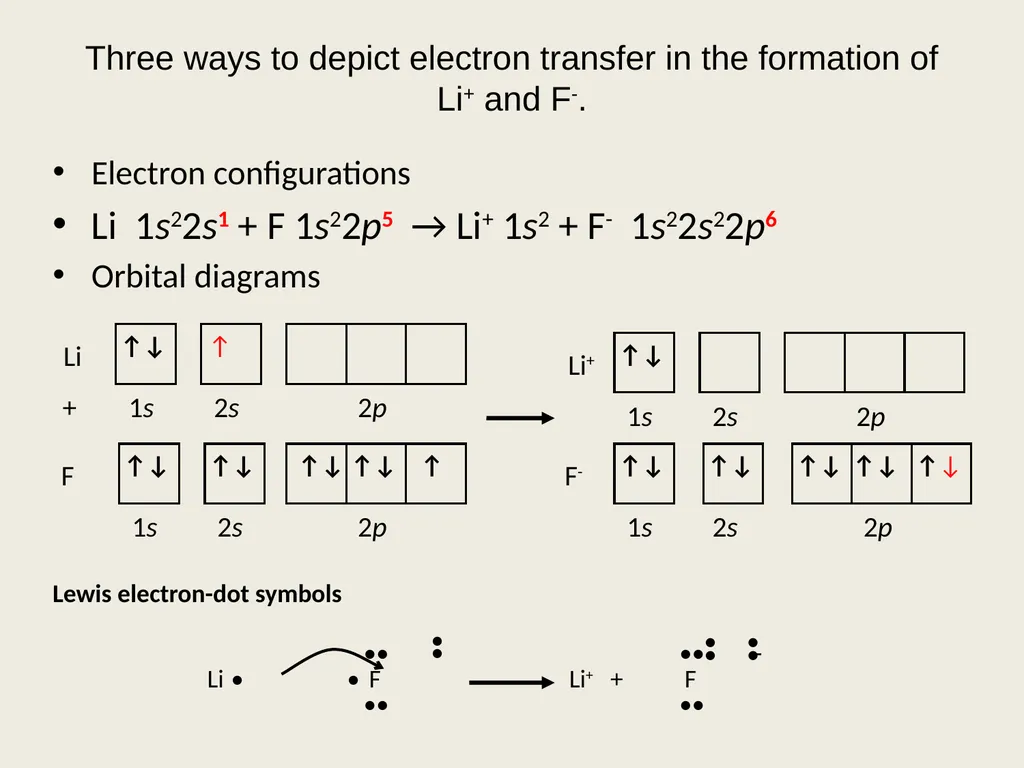
Electron configurations
Li 1s22s1 + F 1s22p5 → Li+ 1s2 + F- 1s22s22p6
Orbital diagrams Three ways to depict electron transfer in the formation of Li+ and F-. Lewis electron-dot symbols<br>
09
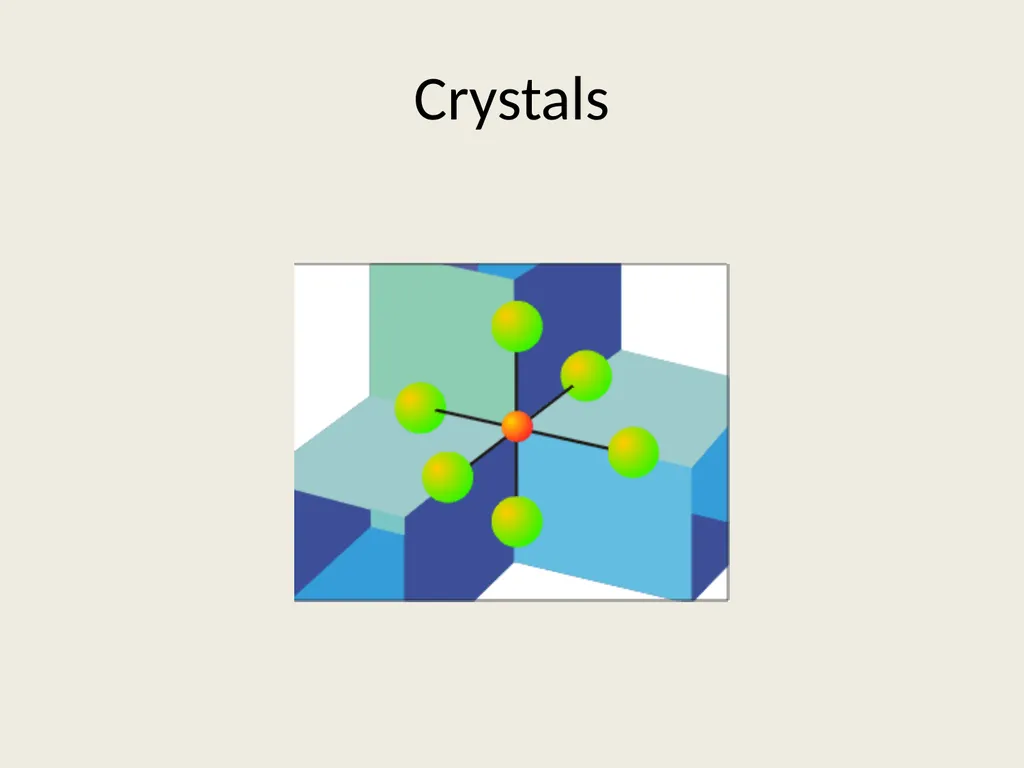
Crystals<br>
10
Crystal Structures Atoms (and later ions) will be viewed as hard spheres. In the case of pure metals, the packing pattern often provides the greatest spatial efficiency (closest packing).
Ionic crystals can often be viewed as a close-packed arrangement of the larger ion, with the smaller ion placed in the “holes” of the structure.<br>
11
Unit Cells A unit cell of the crystal is an imaginary parallel-sided region from which the entire crystal can be built up.
Usually the smallest unit cell which exhibits the greatest symmetry is chosen. If repeated (translated) in 3 dimensions, the entire crystal is recreated.<br>
12
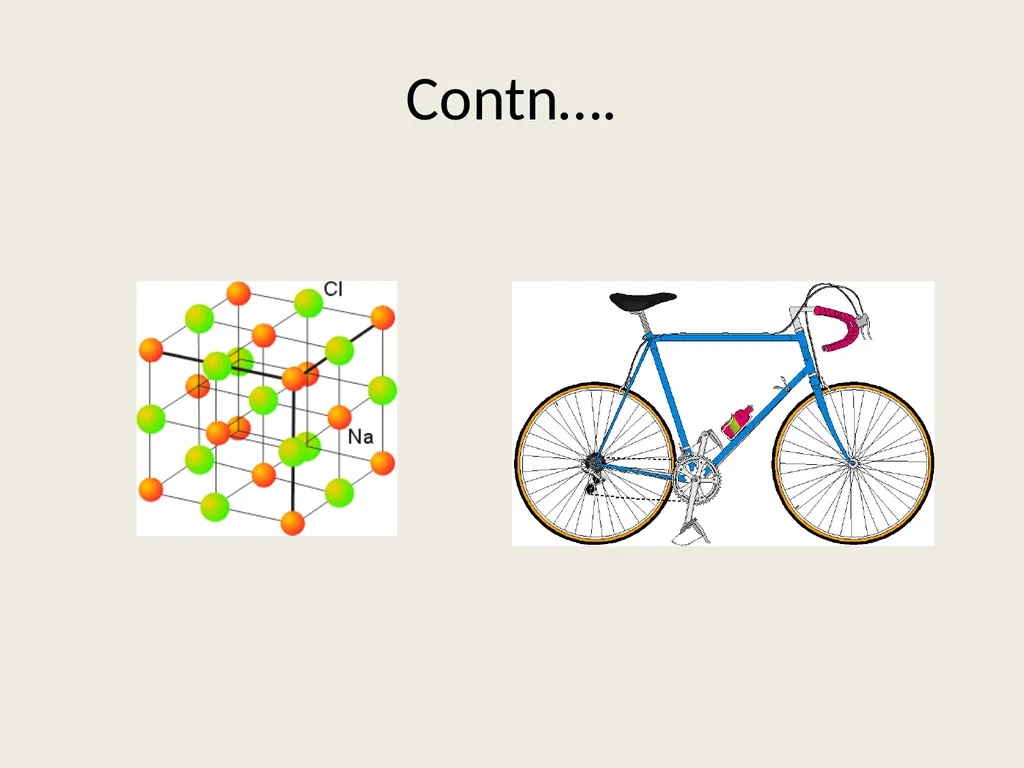
Ionic Crystals Ionic Crystals in which the units are positively and negatively charged ions occupy the lattice points. Ionic Crystals are of the type AX (e.g NaCl, LiF, etc.), AX2(CaCl2) or A2X (Na2S)<br>
13
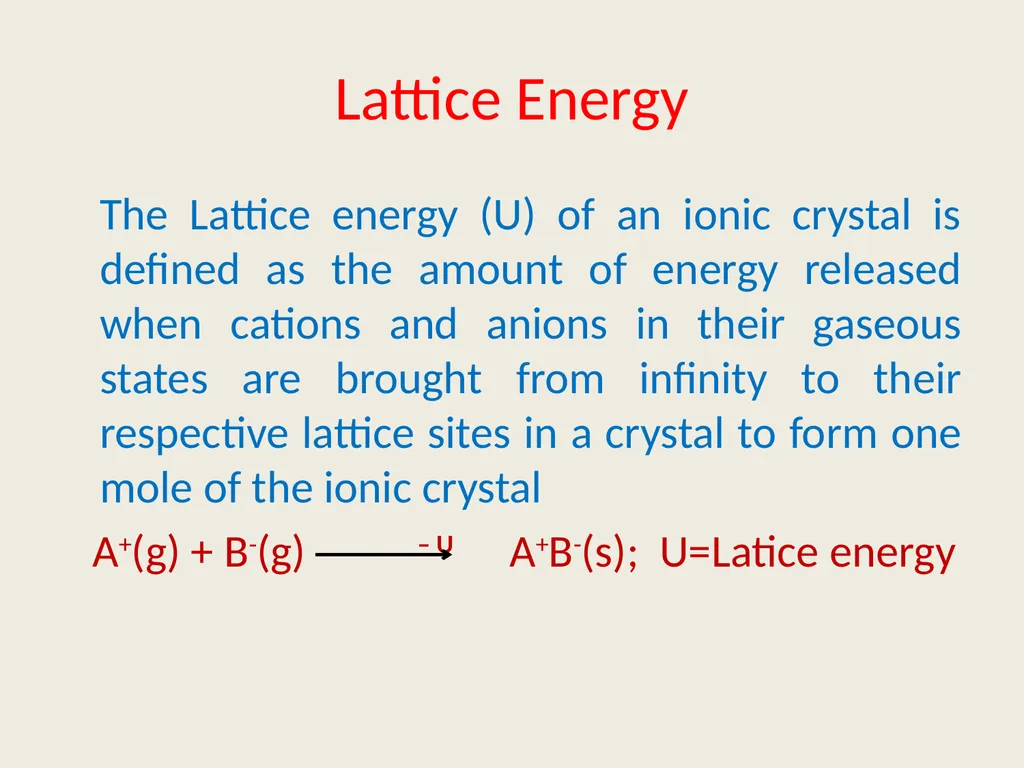
Lattice Energy The Lattice energy (U) of an ionic crystal is defined as the amount of energy released when cations and anions in their gaseous states are brought from infinity to their respective lattice sites in a crystal to form one mole of the ionic crystal
A+(g) + B-(g) – U A+B-(s); U=Latice energy<br>
14
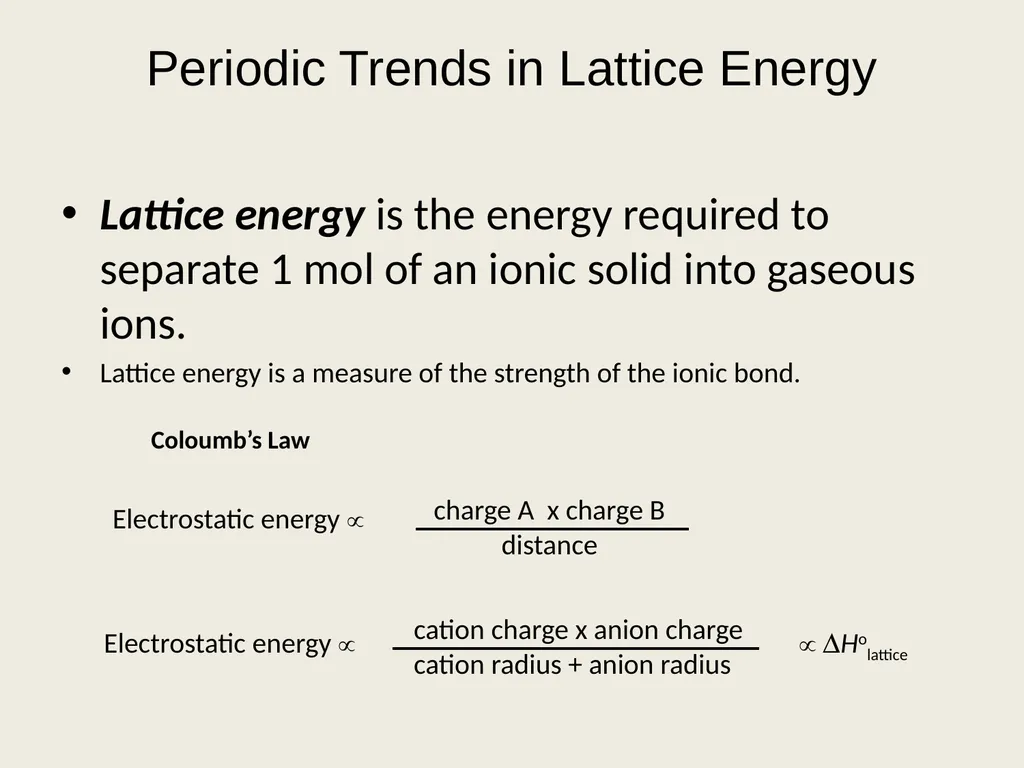
Periodic Trends in Lattice Energy Lattice energy is the energy required to separate 1 mol of an ionic solid into gaseous ions.
Lattice energy is a measure of the strength of the ionic bond. Coloumb’s Law<br>
15
Lattice energy is affected by ionic size and ionic charge.
As ionic size increases, lattice energy decreases. Lattice energy therefore decreases down a group on the periodic table.
As ionic charge increases, lattice energy increases. Periodic Trends in Lattice Energy<br>
16
Born-Haber Cycle Direct experimental determination of lattice energies is not so easy
Lattice energies are determined indirectly with the help of a thermo-chemical cyclic process known as Born-Haber cycle<br>
17
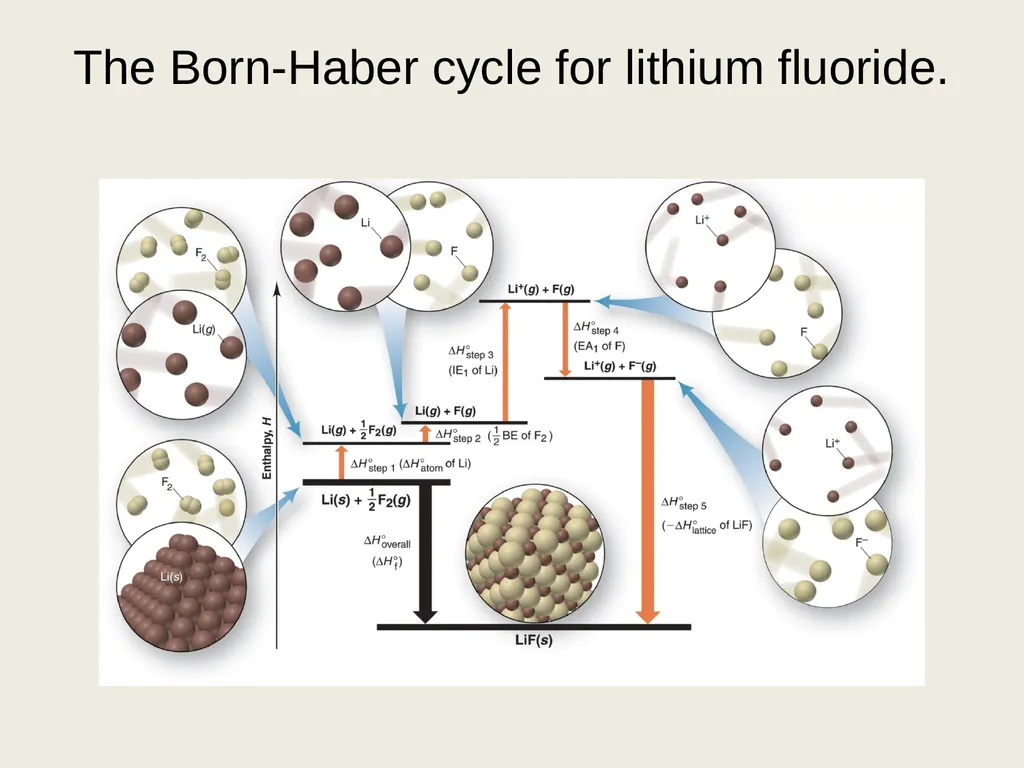
The Born-Haber cycle for lithium fluoride.<br>
18
Contn….<br>
19
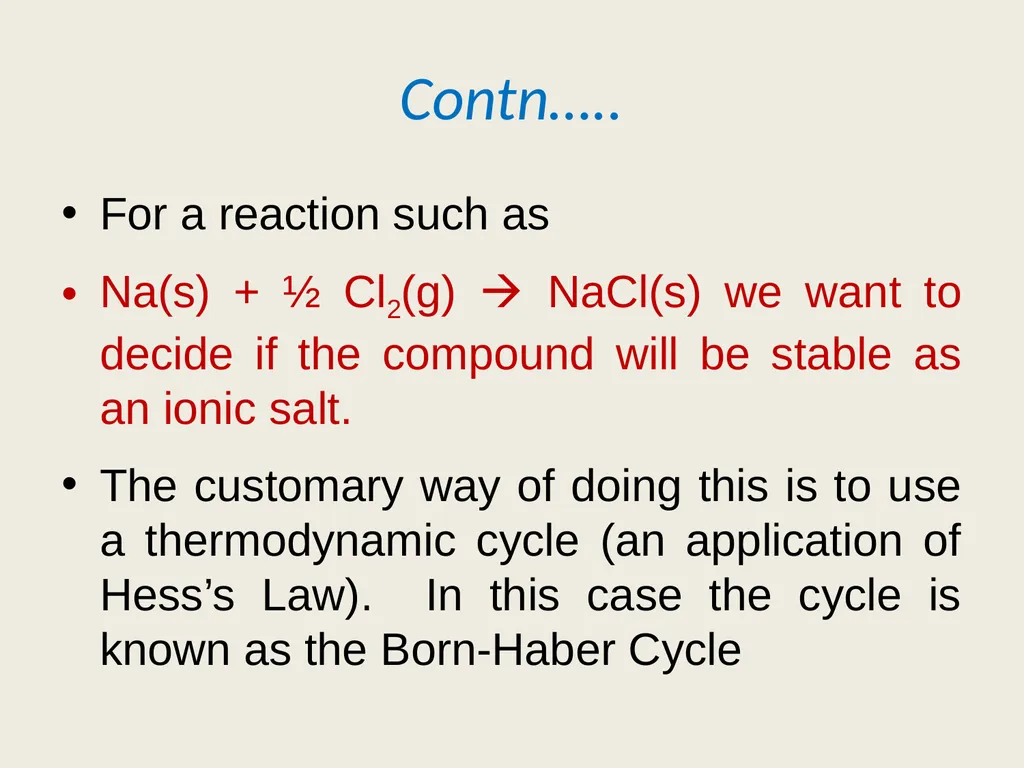
Contn….. For a reaction such as
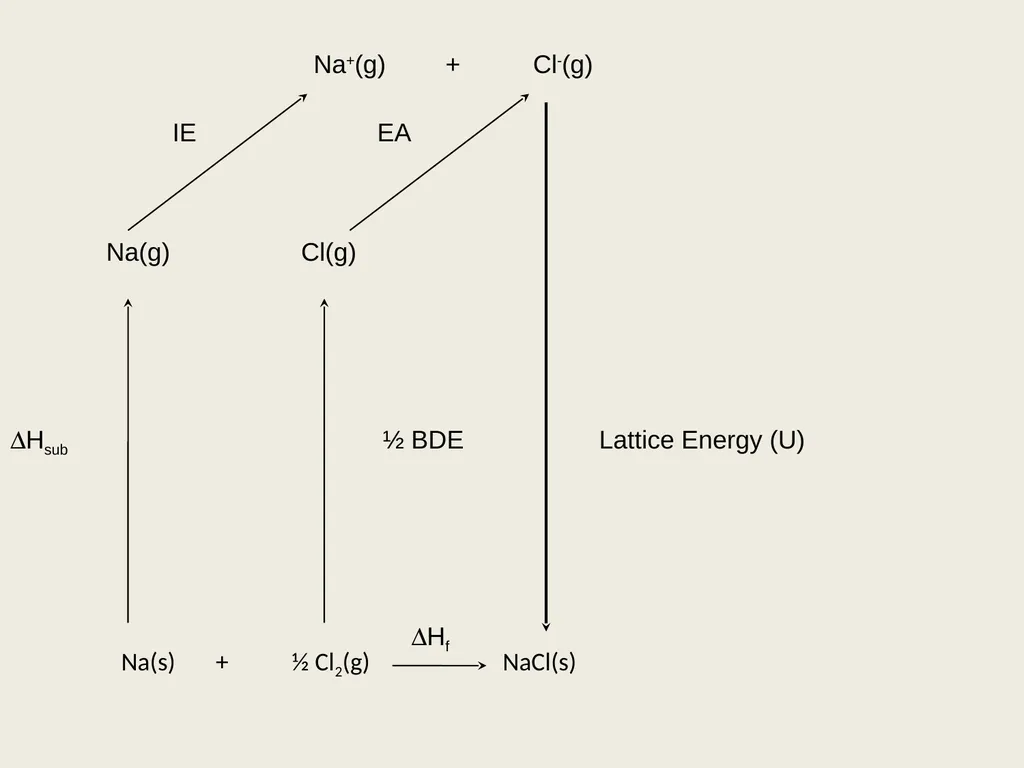
Na(s) + ½ Cl2(g) NaCl(s) we want to decide if the compound will be stable as an ionic salt.
The customary way of doing this is to use a thermodynamic cycle (an application of Hess’s Law). In this case the cycle is known as the Born-Haber Cycle<br>
20
DHsub ½ BDE IE EA DHf Lattice Energy (U) Na(s) + ½ Cl2(g) NaCl(s)<br>
21
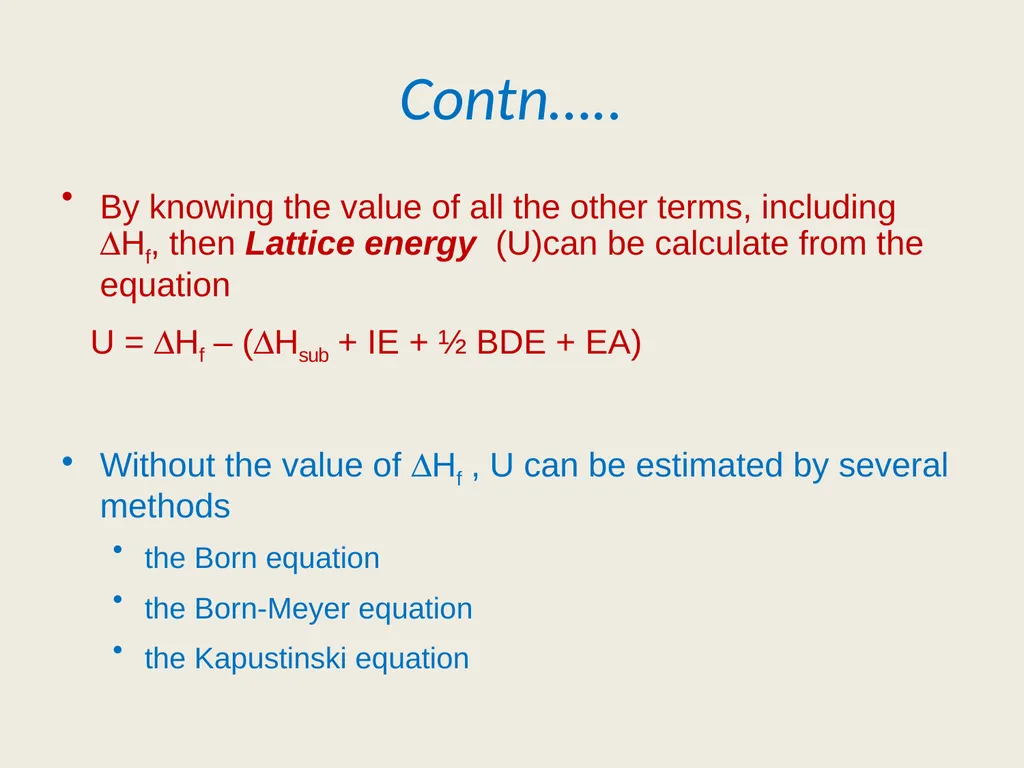
Contn….. By knowing the value of all the other terms, including DHf, then Lattice energy (U)can be calculate from the equation
U = DHf – (DHsub + IE + ½ BDE + EA)
Without the value of DHf , U can be estimated by several methods
the Born equation
the Born-Meyer equation
the Kapustinski equation<br>