
Course Title: Active Learning Pedagogies in Early
TG
Published · 45 slides · 0 views

1 / 1




Description
Course Title: Active Learning Pedagogies in Early Childhood Education Name: Christine Russell ID: UD84012EA93230 Date: February 15, 2024 Introduction This course explains and outlines some examples of Active Learning Pedagogies in Early
Related Topics
Share
Embed code
Download this presentation From Below
"Course Title: Active Learning Pedagogies in Early" is the property of its rightful owner. Permission is granted to download and print the materials on this website for personal, non-commercial use only, and to display it on your personal computer provided you do not modify the materials and that you retain all copyright notices contained in the materials. By downloading content from our website, you accept the terms of this agreement.
Presentation Transcript
01
Course Title: Active Learning Pedagogies in
Early Childhood Education
Name: Christine Russell
ID#: UD84012EA93230
Date: February 15, 2024<br>
Early Childhood Education
Name: Christine Russell
ID#: UD84012EA93230
Date: February 15, 2024<br>
02
Introduction This course explains and outlines some examples of Active Learning Pedagogies in Early Childhood
Education that can help to enhance teaching and learning in the 21st century classroom. Based on
research as it relates to active learning – into how we learn. This is illustrated by Phil Race’s (2005)
‘Ripples on a pond model’, In which he argues that quality learning is underpinned by five factors
In which he argues motivation, needing, doing, digesting, and feedback factors (Race 2014) (Fig .1).
Active learning is seen as the opposite of passive learning.
An approach where the learning is generated from the teacher and absorbed by the learner. In the
simplest terms active learning ask students to think, discuss, challenge and analyze information,
while passive learning requires absorption, assimilation, consideration, and transfer of information
this is not to say that passive learning is less useful than active learning, but passive learning is
more useful with more mature adults like high school, college and university students. Where as
Active learning is typically better suited to an early childhood context.<br>
Education that can help to enhance teaching and learning in the 21st century classroom. Based on
research as it relates to active learning – into how we learn. This is illustrated by Phil Race’s (2005)
‘Ripples on a pond model’, In which he argues that quality learning is underpinned by five factors
In which he argues motivation, needing, doing, digesting, and feedback factors (Race 2014) (Fig .1).
Active learning is seen as the opposite of passive learning.
An approach where the learning is generated from the teacher and absorbed by the learner. In the
simplest terms active learning ask students to think, discuss, challenge and analyze information,
while passive learning requires absorption, assimilation, consideration, and transfer of information
this is not to say that passive learning is less useful than active learning, but passive learning is
more useful with more mature adults like high school, college and university students. Where as
Active learning is typically better suited to an early childhood context.<br>
03
Question 1:
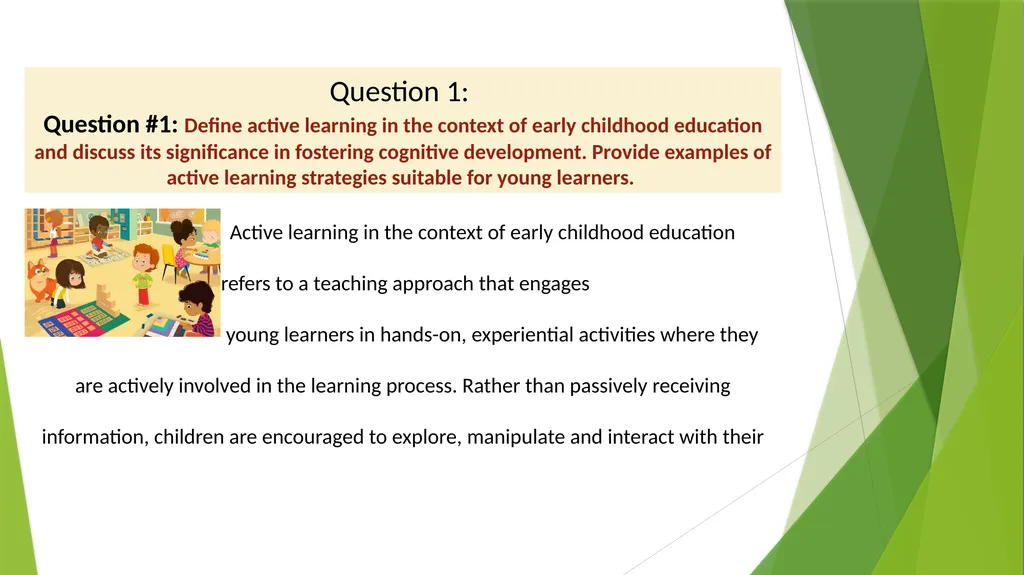
Question #1: Define active learning in the context of early childhood education and discuss its significance in fostering cognitive development. Provide examples of active learning strategies suitable for young learners. Active learning in the context of early childhood education
refers to a teaching approach that engages
young learners in hands-on, experiential activities where they
are actively involved in the learning process. Rather than passively receiving
information, children are encouraged to explore, manipulate and interact with their<br>
Question #1: Define active learning in the context of early childhood education and discuss its significance in fostering cognitive development. Provide examples of active learning strategies suitable for young learners. Active learning in the context of early childhood education
refers to a teaching approach that engages
young learners in hands-on, experiential activities where they
are actively involved in the learning process. Rather than passively receiving
information, children are encouraged to explore, manipulate and interact with their<br>
04
Environment to construct knowledge and understanding. This approach
recognizes that children learn best when they are actively engaged.
And have opportunities to make connections between their experiences
and new information. But, as Paul Ramsden (2003,113) reminds us:
“students activity does not itself imply that learning will take place.” There
are plenty of examples of students busily undertaking tasks but with little
learning resulting. The key to effective learning is well designed active
learning.<br>
recognizes that children learn best when they are actively engaged.
And have opportunities to make connections between their experiences
and new information. But, as Paul Ramsden (2003,113) reminds us:
“students activity does not itself imply that learning will take place.” There
are plenty of examples of students busily undertaking tasks but with little
learning resulting. The key to effective learning is well designed active
learning.<br>
05
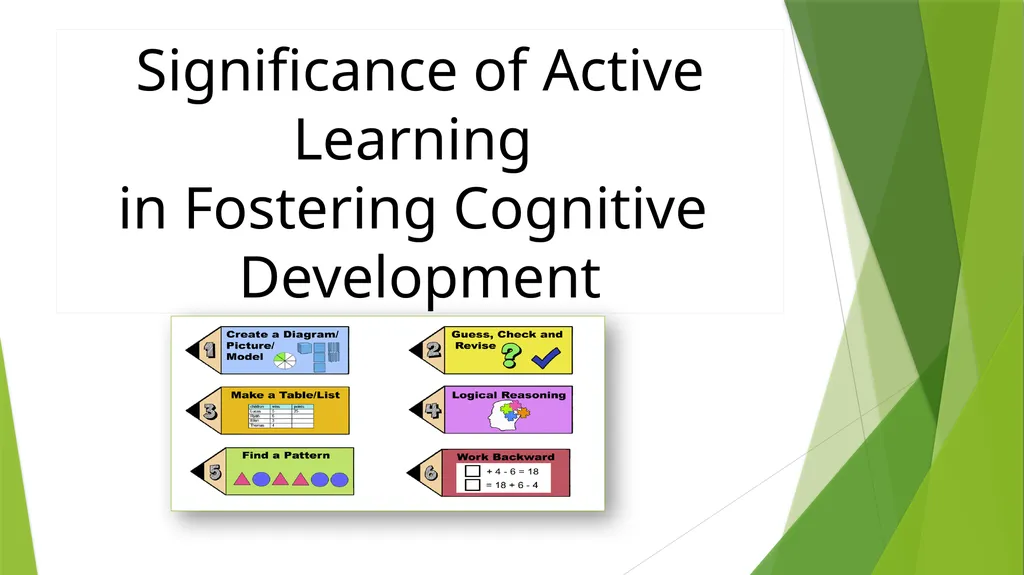
Significance of Active
Learning
in Fostering Cognitive
Development<br>
Learning
in Fostering Cognitive
Development<br>
06
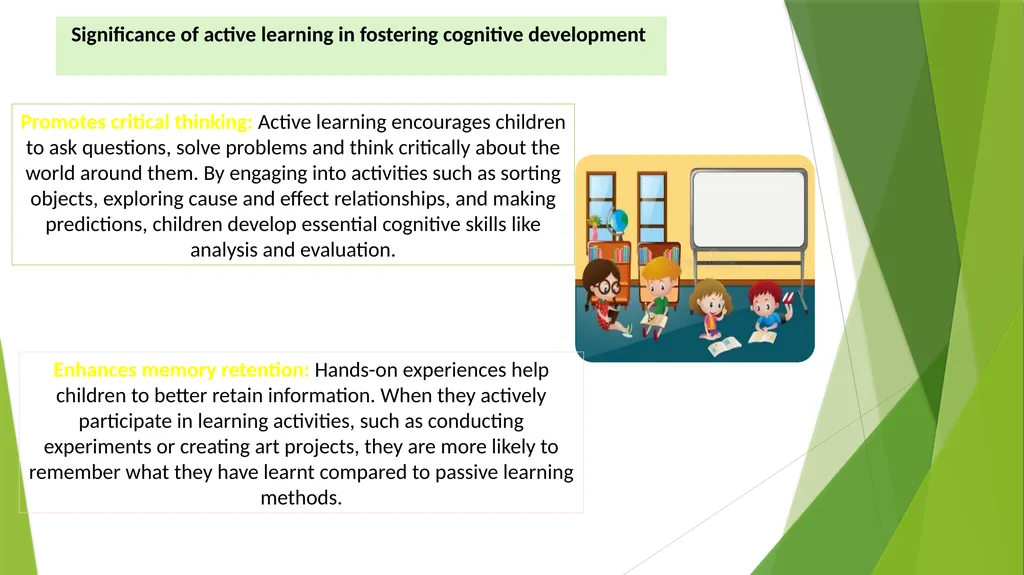
Significance of active learning in fostering cognitive development Promotes critical thinking: Active learning encourages children to ask questions, solve problems and think critically about the world around them. By engaging into activities such as sorting objects, exploring cause and effect relationships, and making predictions, children develop essential cognitive skills like analysis and evaluation. Enhances memory retention: Hands-on experiences help children to better retain information. When they actively participate in learning activities, such as conducting experiments or creating art projects, they are more likely to remember what they have learnt compared to passive learning methods.<br>
07
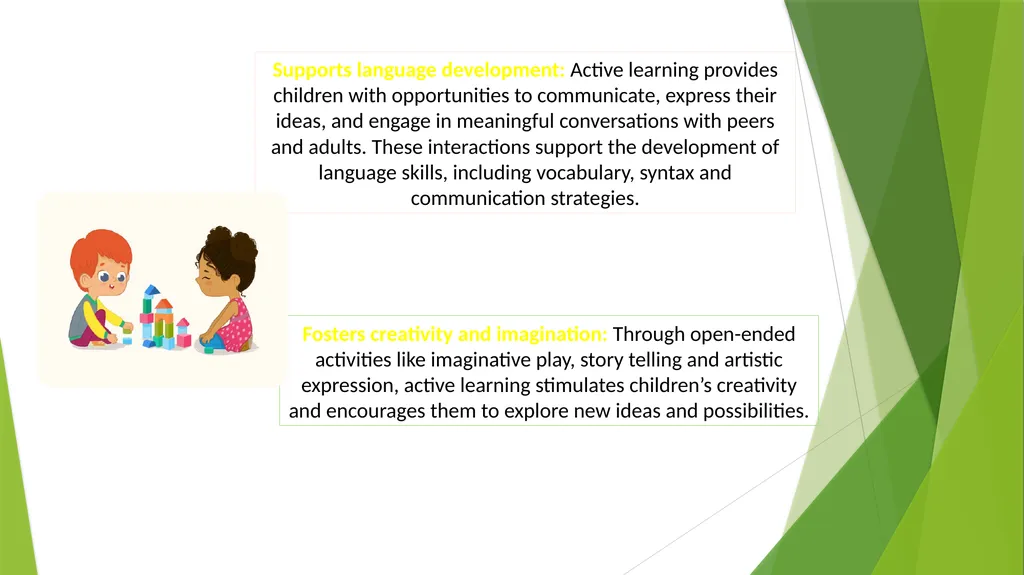
Supports language development: Active learning provides children with opportunities to communicate, express their ideas, and engage in meaningful conversations with peers and adults. These interactions support the development of language skills, including vocabulary, syntax and communication strategies. Fosters creativity and imagination: Through open-ended activities like imaginative play, story telling and artistic expression, active learning stimulates children’s creativity and encourages them to explore new ideas and possibilities.<br>
08
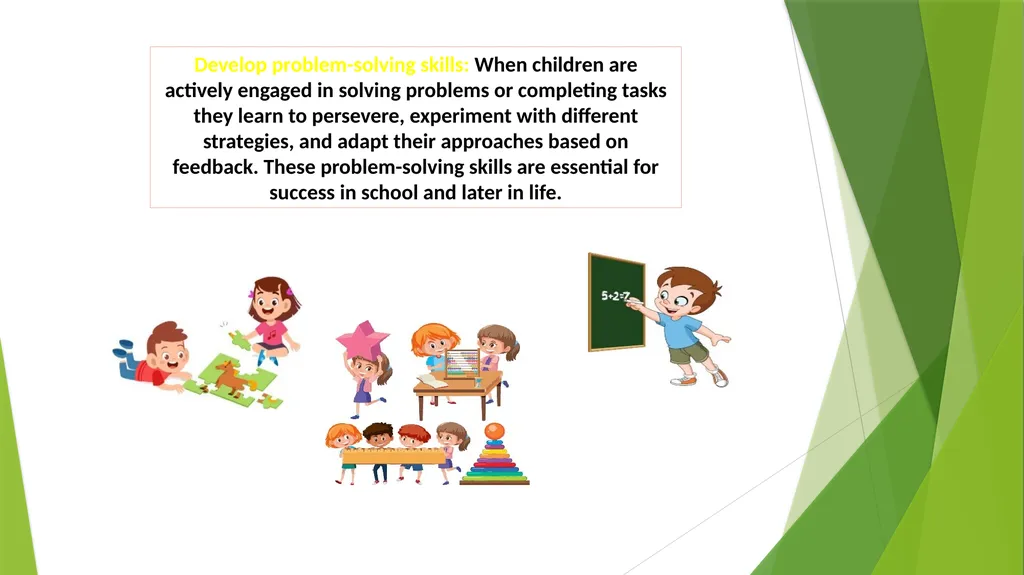
Develop problem-solving skills: When children are actively engaged in solving problems or completing tasks they learn to persevere, experiment with different strategies, and adapt their approaches based on feedback. These problem-solving skills are essential for success in school and later in life.<br>
09
Examples of Active Learning
Strategies suitable for young
learners<br>
Strategies suitable for young
learners<br>
10
Examples of active learning strategies suitable for young learners Hands-on experiments: Providing children with opportunities to conduct simple science experiments, such as mixing colors, observing changes in materials, or exploring the properties of water, promotes active exploration and scientific enquiry. Sensory play: Activities that engage the senses, such as playing with sand, water, play dough or sensory bins filled with various materials, allow children to explore different textures, shapes and sensations while promoting fine motor skills and creativity.<br>
11
Outdoor exploration: Outdoor play and nature walks offer
rich opportunities for active learning as children observe
and interact with the natural world, discover plants
and animals, and engage in physical activities that support
their gross motor development. Dramatic play: Setting up pretend play areas such as kitchen,
doctor’s office, or construction site, encourage children to
role-play, use their imagination and engage in social
Interactions while developing language and problem solving
skills.<br>
rich opportunities for active learning as children observe
and interact with the natural world, discover plants
and animals, and engage in physical activities that support
their gross motor development. Dramatic play: Setting up pretend play areas such as kitchen,
doctor’s office, or construction site, encourage children to
role-play, use their imagination and engage in social
Interactions while developing language and problem solving
skills.<br>
12
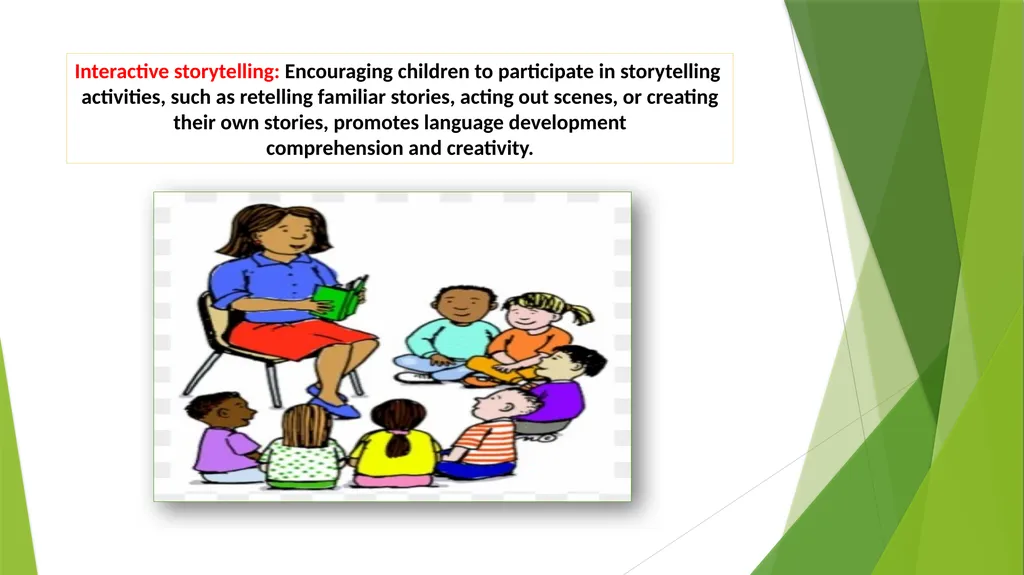
Interactive storytelling: Encouraging children to participate in storytelling
activities, such as retelling familiar stories, acting out scenes, or creating
their own stories, promotes language development
comprehension and creativity.<br>
activities, such as retelling familiar stories, acting out scenes, or creating
their own stories, promotes language development
comprehension and creativity.<br>
13
Summary The potential of active learning lies in the key concept that defines it. These concepts
include: the knowledge that learning involves the active composition of meaning,
where the learner links new information with what they already know. There is a
difference between how a task is being carried out. This in itself will help educators
to understand why a student may know a set of facts but not knowing how to
apply them to a problem. Some active learners are more context-specific
while others can multi-task within a certain skill set. We also recognize that many
children learn more with others than when they are alone. Active learning – be it to
themselves, their peers or their teachers – helps individuals facilitate meaningful
learning.<br>
include: the knowledge that learning involves the active composition of meaning,
where the learner links new information with what they already know. There is a
difference between how a task is being carried out. This in itself will help educators
to understand why a student may know a set of facts but not knowing how to
apply them to a problem. Some active learners are more context-specific
while others can multi-task within a certain skill set. We also recognize that many
children learn more with others than when they are alone. Active learning – be it to
themselves, their peers or their teachers – helps individuals facilitate meaningful
learning.<br>
14
Conclusion During the research and answering the questions to this examination I have garnered
a wealth of knowledge the impact active learning pedagogies in early childhood
education course has on the student outcomes. Through this examination course I
am empowered and equipped with information that I can disseminate to my
students in a lecture forum or a presentation at a function to colleagues,
parents and friends. These examination questions can also be used for group
discussions, study guide questions and researched based questions for student
teachers. In a study conducted by, George Kuh (2008) analysed data from the<br>
a wealth of knowledge the impact active learning pedagogies in early childhood
education course has on the student outcomes. Through this examination course I
am empowered and equipped with information that I can disseminate to my
students in a lecture forum or a presentation at a function to colleagues,
parents and friends. These examination questions can also be used for group
discussions, study guide questions and researched based questions for student
teachers. In a study conducted by, George Kuh (2008) analysed data from the<br>
15
National Survey of Student Engagement. He was able to identify a set of active
learning practices that have high impact, in that engagement in these practices
increase rates of student retention and student engagement. In light of
these and other findings, Dirks (cited in Waldrop, 2015) suggest that:
“At this point, it is unethical to teach any other way.”
Overall, active learning is essential in early childhood education
as it fosters cognitive development, supports academic skills, and nurtures
a lifelong love of learning.<br>
learning practices that have high impact, in that engagement in these practices
increase rates of student retention and student engagement. In light of
these and other findings, Dirks (cited in Waldrop, 2015) suggest that:
“At this point, it is unethical to teach any other way.”
Overall, active learning is essential in early childhood education
as it fosters cognitive development, supports academic skills, and nurtures
a lifelong love of learning.<br>
16
Bibliography Race, P. (2005,2014) Making learning happen. London Routledge. (1st ed, 3rd edition).
See slides at: https://phil-race.co.uk/2016/04/updated-powerpoint-ripples-model/ Ramsden, P. (2003) Learning to teach in higher education. London: RouteledgeFalmer
(2nd edition). Kuh,G. D. (2008). High impact educational practices, what they are, who has access to them,
and why they matter. Washington DC.: Association of American Colleges and Universities. Waldrop, M. M. (2015). Why are we teaching science wrong, and how to make it right.
Nature 523, 272-274. http://www.nature.com/news/why-we-are-teaching-science-
Wrong-and-how-to-make-it-right-1 . 17963<br>
See slides at: https://phil-race.co.uk/2016/04/updated-powerpoint-ripples-model/ Ramsden, P. (2003) Learning to teach in higher education. London: RouteledgeFalmer
(2nd edition). Kuh,G. D. (2008). High impact educational practices, what they are, who has access to them,
and why they matter. Washington DC.: Association of American Colleges and Universities. Waldrop, M. M. (2015). Why are we teaching science wrong, and how to make it right.
Nature 523, 272-274. http://www.nature.com/news/why-we-are-teaching-science-
Wrong-and-how-to-make-it-right-1 . 17963<br>
17
Question #2: How does play based learning contribute to the acquisition of
essential skills and knowledge in early childhood education? Provide evidence based examples of how play-based activities can be integrated into the
curriculum to enhance learning outcomes. Introduction ‘Learning through play’ or ‘playful learning,’ is a key element of a quality education
program for young children. Which is one of the main source of quality early
childhood pedagogy and education. This presentation will help pre-primary
stakeholders champion the cause for making play-based learning the<br>
essential skills and knowledge in early childhood education? Provide evidence based examples of how play-based activities can be integrated into the
curriculum to enhance learning outcomes. Introduction ‘Learning through play’ or ‘playful learning,’ is a key element of a quality education
program for young children. Which is one of the main source of quality early
childhood pedagogy and education. This presentation will help pre-primary
stakeholders champion the cause for making play-based learning the<br>
18
the main aspect of expanding and strengthening the pre-primary curriculum. Play-
based learning opens the door for the development of cognitive skills. Through play
children engage in activities that stimulate their curiosity, problem-solving abilities
and creative thinking. For example, in a pretend play scenario where children enact
roles such as nurse or chefs they are required to use imagination, language and
symbolic representation, thus fostering cognitive development. Research conducted
By Hirsh-Pasek et al. (2009) demonstrates that play-based activities, such as building
blocks, or puzzles enhance spatial reasoning skills and mathematical concepts.<br>
based learning opens the door for the development of cognitive skills. Through play
children engage in activities that stimulate their curiosity, problem-solving abilities
and creative thinking. For example, in a pretend play scenario where children enact
roles such as nurse or chefs they are required to use imagination, language and
symbolic representation, thus fostering cognitive development. Research conducted
By Hirsh-Pasek et al. (2009) demonstrates that play-based activities, such as building
blocks, or puzzles enhance spatial reasoning skills and mathematical concepts.<br>
19
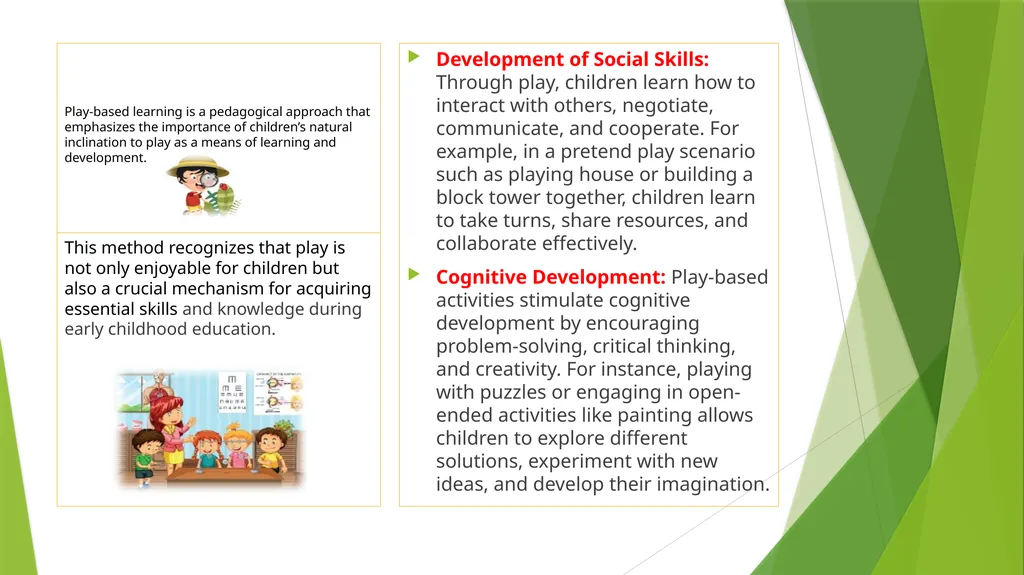
Play-based learning is a pedagogical approach that emphasizes the importance of children’s natural inclination to play as a means of learning and development. Development of Social Skills: Through play, children learn how to interact with others, negotiate, communicate, and cooperate. For example, in a pretend play scenario such as playing house or building a block tower together, children learn to take turns, share resources, and collaborate effectively.
Cognitive Development: Play-based activities stimulate cognitive development by encouraging problem-solving, critical thinking, and creativity. For instance, playing with puzzles or engaging in open-ended activities like painting allows children to explore different solutions, experiment with new ideas, and develop their imagination. This method recognizes that play is not only enjoyable for children but also a crucial mechanism for acquiring essential skills and knowledge during early childhood education.<br>
Cognitive Development: Play-based activities stimulate cognitive development by encouraging problem-solving, critical thinking, and creativity. For instance, playing with puzzles or engaging in open-ended activities like painting allows children to explore different solutions, experiment with new ideas, and develop their imagination. This method recognizes that play is not only enjoyable for children but also a crucial mechanism for acquiring essential skills and knowledge during early childhood education.<br>
20
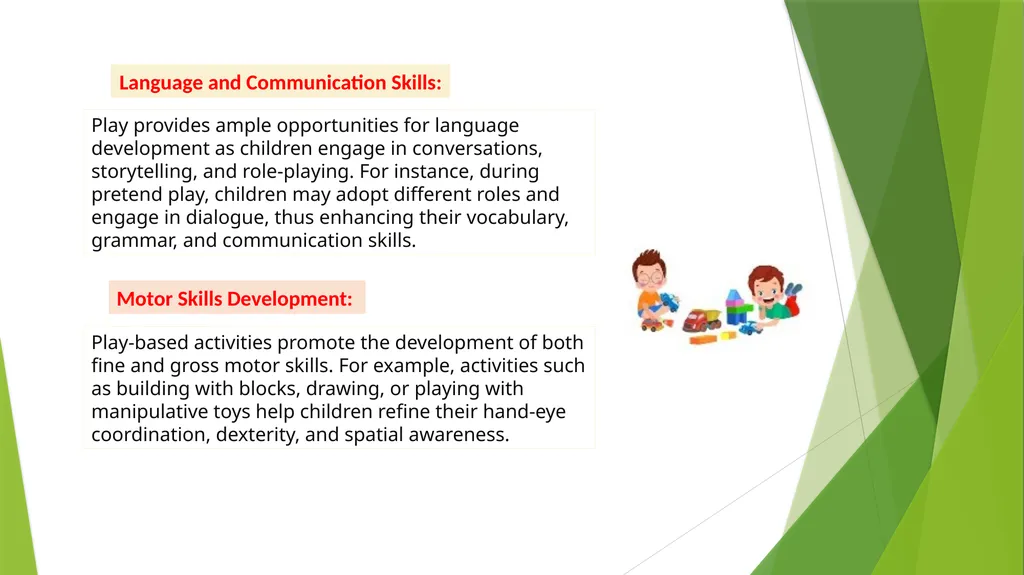
Language and Communication Skills: Play provides ample opportunities for language development as children engage in conversations, storytelling, and role-playing. For instance, during pretend play, children may adopt different roles and engage in dialogue, thus enhancing their vocabulary, grammar, and communication skills. Motor Skills Development: Play-based activities promote the development of both fine and gross motor skills. For example, activities such as building with blocks, drawing, or playing with manipulative toys help children refine their hand-eye coordination, dexterity, and spatial awareness.<br>
21
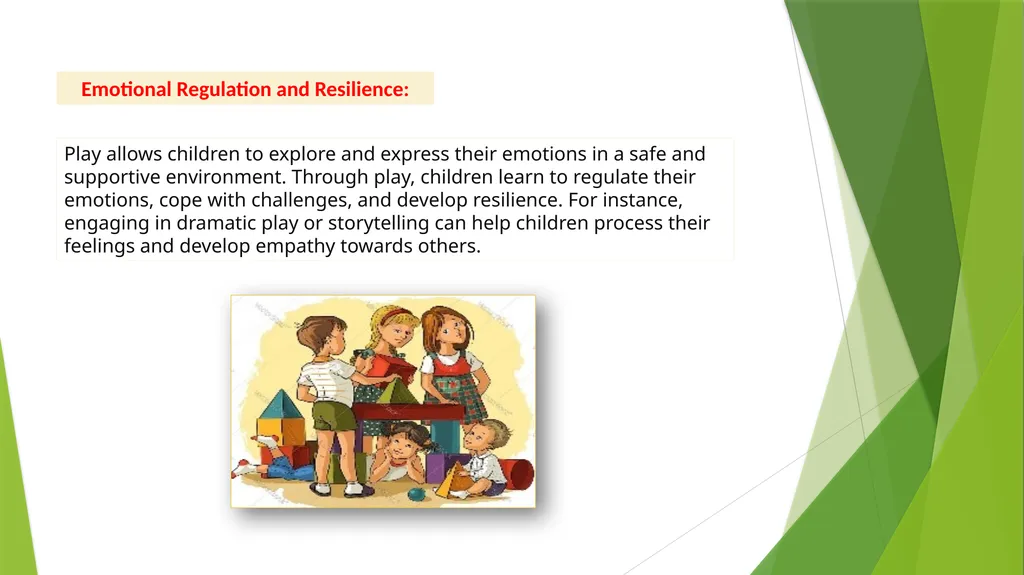
Emotional Regulation and Resilience: Play allows children to explore and express their emotions in a safe and supportive environment. Through play, children learn to regulate their emotions, cope with challenges, and develop resilience. For instance, engaging in dramatic play or storytelling can help children process their feelings and develop empathy towards others.<br>
22
Evidenced-based examples of
integrating play-based activities into the curriculum. Integrating play-based activities into the curriculum requires thoughtful planning and intentional design.
Educators can immerse play opportunities across various learning domains, such as literacy, numeracy, science and the arts.
For example, a literacy focused-play activity may involve a storytelling corner where children enact narratives, retell stories, or create their own tales.
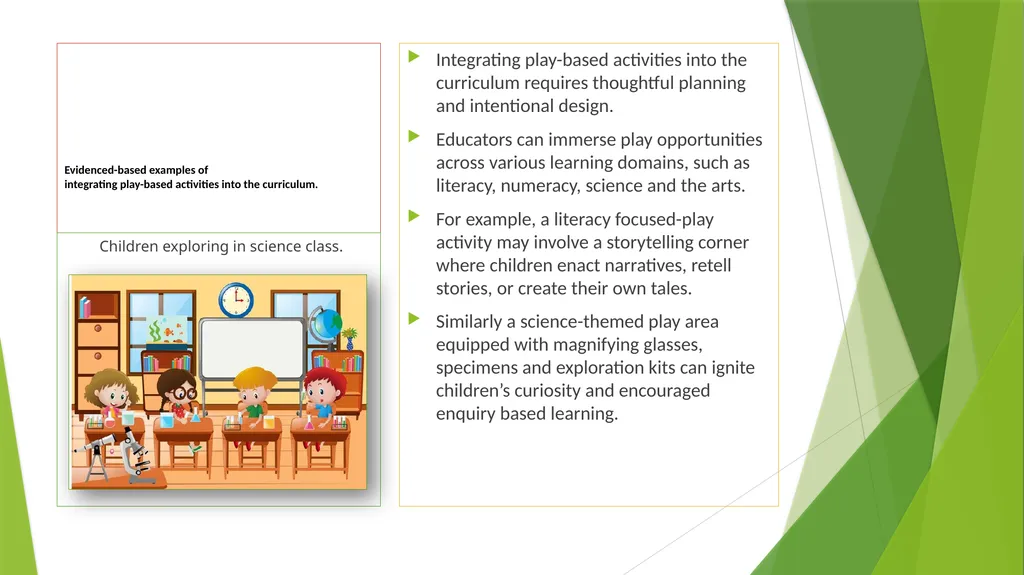
Similarly a science-themed play area equipped with magnifying glasses, specimens and exploration kits can ignite children’s curiosity and encouraged enquiry based learning. Children exploring in science class.<br>
Educators can immerse play opportunities across various learning domains, such as literacy, numeracy, science and the arts.
For example, a literacy focused-play activity may involve a storytelling corner where children enact narratives, retell stories, or create their own tales.
Similarly a science-themed play area equipped with magnifying glasses, specimens and exploration kits can ignite children’s curiosity and encouraged enquiry based learning. Children exploring in science class.<br>
23
Sensory Play: Incorporating sensory materials such as sand, water, playdough, or sensory bins into the curriculum provides children with opportunities to explore different textures, smells, and tactile sensations. Research has shown that sensory play supports cognitive development, language acquisition, and sensory integration skills. Outdoor Play: Outdoor play offers numerous benefits for children's physical, social, and emotional well-being. Integrating outdoor play into the curriculum allows children to engage in activities such as running, jumping, climbing, and exploring nature. Studies have shown that outdoor play enhances children's physical fitness, problem-solving abilities, creativity, and social skills.<br>
24
Dramatic Play: Creating dramatic play areas such as a kitchen, doctor's office, or grocery store within the classroom encourages imaginative play and role-playing. Providing props and costumes allows children to engage in pretend play scenarios, fostering creativity, language development, and social skills. Constructive Play: Building activities using blocks, LEGO bricks, or other construction materials promote spatial awareness, problem-solving, and fine motor skills. Allowing children to freely explore and manipulate these materials encourages creativity and experimentation.<br>
25
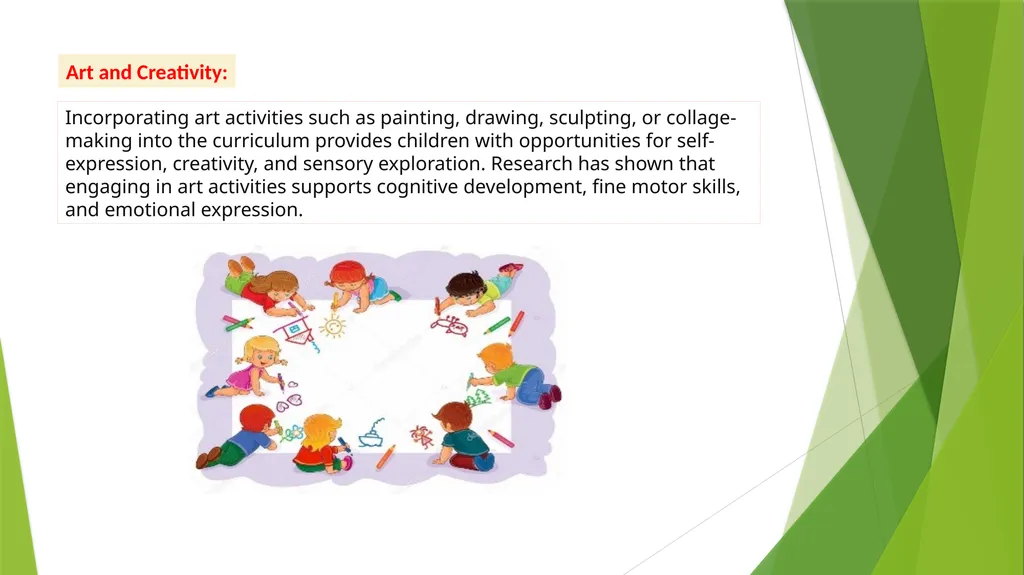
Art and Creativity: Incorporating art activities such as painting, drawing, sculpting, or collage-making into the curriculum provides children with opportunities for self-expression, creativity, and sensory exploration. Research has shown that engaging in art activities supports cognitive development, fine motor skills, and emotional expression.<br>
26
Summary Play-based learning nurtures social and emotional competencies. As children engage
in play, they learn to negotiate, collaborate and communicate with peers, thereby
honing their social skills. Additionally, play offer opportunities for children to regulate
their emotions, manage conflicts and develop empathy. For instance, cooperative
games and group activities promote team work and perspective-taking. Evidence
from studies by Pelligrini and Holmes (2006) underscores the positive correlation
between play and the development of social skills including empathy and
perspective-taking. For pre-primary children, a curriculum that<br>
in play, they learn to negotiate, collaborate and communicate with peers, thereby
honing their social skills. Additionally, play offer opportunities for children to regulate
their emotions, manage conflicts and develop empathy. For instance, cooperative
games and group activities promote team work and perspective-taking. Evidence
from studies by Pelligrini and Holmes (2006) underscores the positive correlation
between play and the development of social skills including empathy and
perspective-taking. For pre-primary children, a curriculum that<br>
27
that emphasizes exploration and intentional teaching of key content through
stimulating interactions and active, playful learning experiences is likely to
promote across all areas of development and learning. Some written curriculum
describe outcomes and child competencies but do not specify the methods
or pedagogies that should be used to achieve them. For example, a national
curriculum may state that a literacy goal for pre-primary children is knowing
the alphabet, or that a math goal is knowing the names of geometric shapes.
These goals maybe valuable and appropriate if the primary approach is learning
through play; if the method is rote teaching (simply reciting letters or naming
shapes from flash cards),<br>
stimulating interactions and active, playful learning experiences is likely to
promote across all areas of development and learning. Some written curriculum
describe outcomes and child competencies but do not specify the methods
or pedagogies that should be used to achieve them. For example, a national
curriculum may state that a literacy goal for pre-primary children is knowing
the alphabet, or that a math goal is knowing the names of geometric shapes.
These goals maybe valuable and appropriate if the primary approach is learning
through play; if the method is rote teaching (simply reciting letters or naming
shapes from flash cards),<br>
28
however, children will learn less effectively and their engagement in learning
is likely to be undermined. To implement learning through play, service providers
and teachers require user-friendly curriculum guides that describes what to do
and why. They also need training to use these materials.<br>
is likely to be undermined. To implement learning through play, service providers
and teachers require user-friendly curriculum guides that describes what to do
and why. They also need training to use these materials.<br>
29
Conclusion In conclusion, play based learning serves a corner of early childhood education,
fostering holistic development across cognitive, social, emotional, and physical
domains. By embracing play as a pedagogical tool, educators empower
children to actively construct knowledge, cultivate essential skills, and lay
the foundation for lifelong learning. By integrating play-based learning into
the curriculum, educators can create rich learning environments that cater
to the diverse needs and interest of young children, fostering holistic
development across various domain.<br>
fostering holistic development across cognitive, social, emotional, and physical
domains. By embracing play as a pedagogical tool, educators empower
children to actively construct knowledge, cultivate essential skills, and lay
the foundation for lifelong learning. By integrating play-based learning into
the curriculum, educators can create rich learning environments that cater
to the diverse needs and interest of young children, fostering holistic
development across various domain.<br>
30
Bibliography Hirsh-Pasek, K., Golinkoff, R. M., Berk, L. E., & Singer, D. G. (2009). The case for play: How a handful of researchers are trying to save childhood. Oxford University Press. Pellegrini, A. D., & Holmes, R. M. (2006). The Role of Recess in Primary School. In D. G. Singer, R. M. Golinkoff, & K. Hirsh-Pasek (Eds.), Play = learning: How play motivates and enhances children's cognitive and social-emotional growth (pp. 36–53). Oxford University Press. https://doi.org/10.1093/acprof:oso/9780195304381.003.0003<br>
31
Question #3: Compare and contrast the effectiveness of hands-on activities
versus traditional didactic approaches in promoting engagement and retention among young learners. Support your answer with relevant research findings in the field of early childhood education.<br>
versus traditional didactic approaches in promoting engagement and retention among young learners. Support your answer with relevant research findings in the field of early childhood education.<br>
32
Introduction Hands-on activities and traditional didactic approaches both play crucial roles
in promoting engagement and retention among young learners in early child-
hood education. However, they differ in their methodologies and impacts on
learning outcomes. While there are many learning methods, hands-on learning
is an important part of any student’s educational experience. Hands-on learning
is also known as kinesthetic learning. Through hands-on learning, kindergarten
students can develop new skills, make memories and make connections in their
early education. The nature of hands-on learning lends itself to better<br>
in promoting engagement and retention among young learners in early child-
hood education. However, they differ in their methodologies and impacts on
learning outcomes. While there are many learning methods, hands-on learning
is an important part of any student’s educational experience. Hands-on learning
is also known as kinesthetic learning. Through hands-on learning, kindergarten
students can develop new skills, make memories and make connections in their
early education. The nature of hands-on learning lends itself to better<br>
33
Learning outcomes, such as student engagement and problem solving. These are
essential skills for early childhood and beyond when in the real world. Where as,
traditional didactic approach to teaching primarily involves lecturing and is
essentially teacher-centered (Entwistle, 1997). Kettridge & Marshall (2003)
reminds us that although the lecture remains a major method of teaching
in adult and continuing education, and his still recognized “as a useful
teaching tool” as it can provide a framework of ideas and theories but it
needs to be complemented by interaction and adult-oriented strategies
due to attention span and lack of participation. Brookfield, (1996)<br>
essential skills for early childhood and beyond when in the real world. Where as,
traditional didactic approach to teaching primarily involves lecturing and is
essentially teacher-centered (Entwistle, 1997). Kettridge & Marshall (2003)
reminds us that although the lecture remains a major method of teaching
in adult and continuing education, and his still recognized “as a useful
teaching tool” as it can provide a framework of ideas and theories but it
needs to be complemented by interaction and adult-oriented strategies
due to attention span and lack of participation. Brookfield, (1996)<br>
34
Suggest that students learning needs can be met when teaching is facilitative
rather than didactic and when the teacher acknowledges the learning needs,
past experiences, relevant application and individual styles of learning of students
when designing learning activities.<br>
rather than didactic and when the teacher acknowledges the learning needs,
past experiences, relevant application and individual styles of learning of students
when designing learning activities.<br>
35
Engagement Compare Hands-on activities typically involve interactive and experiential learning, which often lead to higher levels of engagement among young learners. Research by Mayer et al. (2009) suggests that interactive and multisensory experiences facilitate deeper understanding and engagement in learning. Contrast While traditional didactic approaches, often involve passive learning through lectures or teacher-led instruction, which may result in lower levels of engagement, especially among younger children who have shorter attention spans.<br>
36
Retention Compare Hands-on activities are known to promote better retention of concepts and skill due to the active involvement of learners. Research by Piaget (1964) supports the idea that children construct knowledge through hands-on experiences, leading to better retention. Contrast Unlike traditional didactic approaches may be effective in delivering content efficiently, but retention rates may vary depending on the learners’ ability to actively engage with and internalize the information presented.<br>
37
Cognitive Development Compare Hands-on activities stimulate cognitive development by encouraging exploration, problem solving, and critical thinking skills. According to Vygotsky’s sociocultural theory (1978), hands-on experiences provide opportunities for children to scaffold their learning through interaction with materials and peers. Contrast Unlike traditional didactic approach may focus more on transmitting information rather than fostering cognitive development, although they can still be valuable for building foundational knowledge.<br>
38
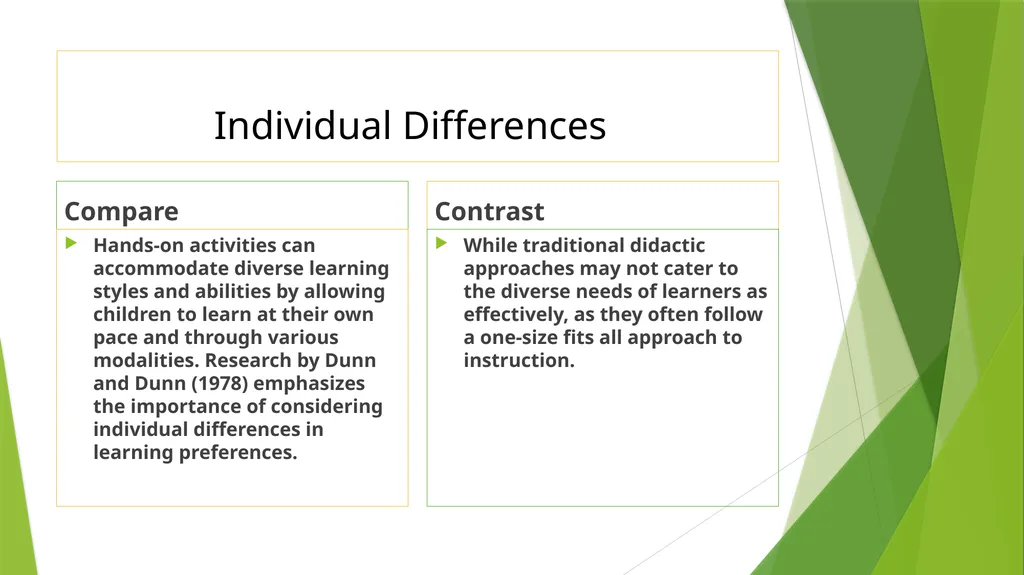
Individual Differences Compare Hands-on activities can accommodate diverse learning styles and abilities by allowing children to learn at their own pace and through various modalities. Research by Dunn and Dunn (1978) emphasizes the importance of considering individual differences in learning preferences. Contrast While traditional didactic approaches may not cater to the diverse needs of learners as effectively, as they often follow a one-size fits all approach to instruction.<br>
39
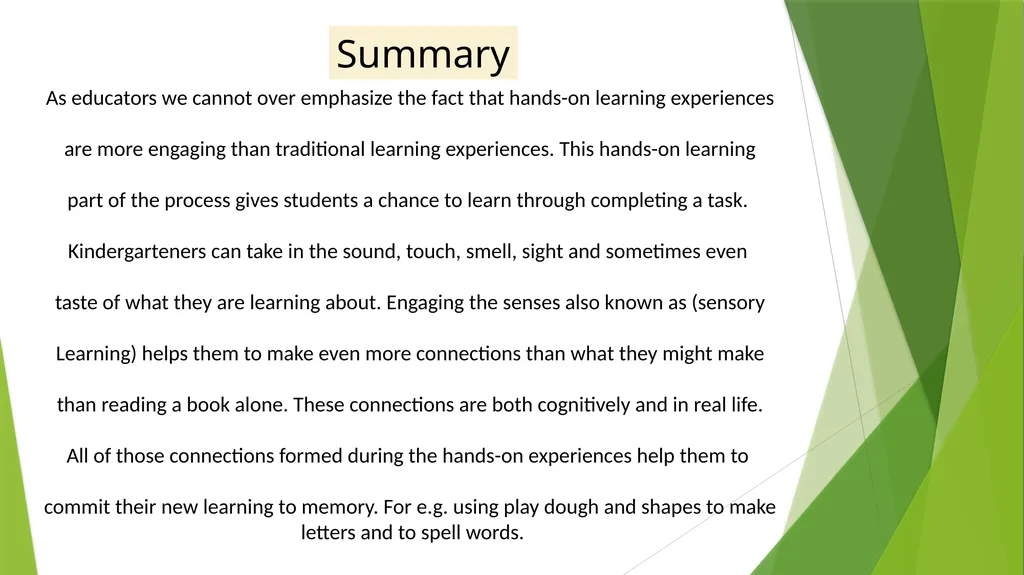
Summary As educators we cannot over emphasize the fact that hands-on learning experiences
are more engaging than traditional learning experiences. This hands-on learning
part of the process gives students a chance to learn through completing a task.
Kindergarteners can take in the sound, touch, smell, sight and sometimes even
taste of what they are learning about. Engaging the senses also known as (sensory
Learning) helps them to make even more connections than what they might make
than reading a book alone. These connections are both cognitively and in real life.
All of those connections formed during the hands-on experiences help them to
commit their new learning to memory. For e.g. using play dough and shapes to make
letters and to spell words.<br>
are more engaging than traditional learning experiences. This hands-on learning
part of the process gives students a chance to learn through completing a task.
Kindergarteners can take in the sound, touch, smell, sight and sometimes even
taste of what they are learning about. Engaging the senses also known as (sensory
Learning) helps them to make even more connections than what they might make
than reading a book alone. These connections are both cognitively and in real life.
All of those connections formed during the hands-on experiences help them to
commit their new learning to memory. For e.g. using play dough and shapes to make
letters and to spell words.<br>
40
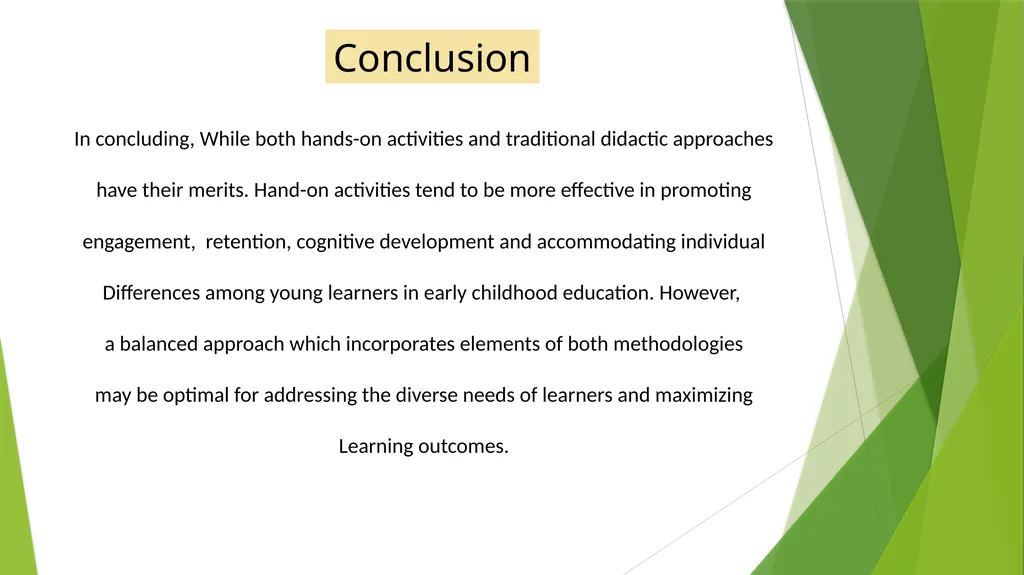
Conclusion In concluding, While both hands-on activities and traditional didactic approaches
have their merits. Hand-on activities tend to be more effective in promoting
engagement, retention, cognitive development and accommodating individual
Differences among young learners in early childhood education. However,
a balanced approach which incorporates elements of both methodologies
may be optimal for addressing the diverse needs of learners and maximizing
Learning outcomes.<br>
have their merits. Hand-on activities tend to be more effective in promoting
engagement, retention, cognitive development and accommodating individual
Differences among young learners in early childhood education. However,
a balanced approach which incorporates elements of both methodologies
may be optimal for addressing the diverse needs of learners and maximizing
Learning outcomes.<br>
41
Bibliography Entwistle, N. (1997). Contrasting Perspectives on Learning. In The Experience of Learning. Implications for Teaching and Studying in Higher Education. Marton, F., Hounsell, D. & Entwistle, W.J. (ed). 2nd Edition. Edinburgh: Scottish Academic Press. pp 3-22. Fry, H., Ketteridge, S. & Marshall, S. (2003) (Eds). A Handbook for Teaching & Learning in Higher Education. Enhancing Academic Practice. 2nd Edition, London: Kogan Page. pp. 9-26. Brook field, S.D. (1987). Developing Critical Thinkers Challenging Adults to Explore Alternative
Ways of Thinking and Acting. California Open University Press, pp. 1-51 Mayer F. S., Frantz C. M., Bruehlman-Senecal E., Dolliver K. (2009). Why is nature beneficial? The role of connectedness to nature. Environment and Behavior, 41(5), 607–643. https://doi.org/10.1177/0013916508319745<br>
Ways of Thinking and Acting. California Open University Press, pp. 1-51 Mayer F. S., Frantz C. M., Bruehlman-Senecal E., Dolliver K. (2009). Why is nature beneficial? The role of connectedness to nature. Environment and Behavior, 41(5), 607–643. https://doi.org/10.1177/0013916508319745<br>
42
Piaget, J. (1964). Development and learning. In R. E. Ripple & V. N. Rockcastle (Eds.), Piaget rediscovered: A report of the conference on cognitive studies and curriculum development (pp. 7-20). Ithaca, NY: Cornell University Press. Vygotsky, L. S. (1978). Mind in Society: The Development of Higher Psychological Processes. Harvard University Press. (Original work published in 1930s and posthumously translated and compiled) Dunn, R., & Dunn, K. (1978). On individual differences. Journal of Educational Psychology, 70(1), 33-39.<br>
43
Thank You!<br>