
Course Title: PGC 601 Research Methodology In
LD
Published · 64 slides · 0 views

1 / 1




Description
Course Title: PGC 601 Research Methodology In Medical Environmental Sciences Lecturer: Professor F.E. Ejezie PhD Dept. of Medical Biochemistry Faculty of Basic Medical Sciences College of Medicine Introduction Search: To search is to
Related Topics
Share
Embed code
Download this presentation From Below
"Course Title: PGC 601 Research Methodology In" is the property of its rightful owner. Permission is granted to download and print the materials on this website for personal, non-commercial use only, and to display it on your personal computer provided you do not modify the materials and that you retain all copyright notices contained in the materials. By downloading content from our website, you accept the terms of this agreement.
Presentation Transcript
01
Course Title: PGC 601 Research Methodology In Medical & Environmental Sciences
Lecturer: Professor F.E. Ejezie PhD
Dept. of Medical Biochemistry
Faculty of Basic Medical Sciences
College of Medicine<br>
Lecturer: Professor F.E. Ejezie PhD
Dept. of Medical Biochemistry
Faculty of Basic Medical Sciences
College of Medicine<br>
02
Introduction Search: To search is to examine something thoroughly; to look into or over something carefully – to look for information
Research: To research is to search again; to examine further – to look for further information
Research: A methodical investigation into a subject in order to discover/establish more facts or information<br>
Research: To research is to search again; to examine further – to look for further information
Research: A methodical investigation into a subject in order to discover/establish more facts or information<br>
03
What is Research? There has been a continuous search for knowledge by man
But gaps still remain;
many questions still remain unanswered;
many problems remain unsolved
Definition: Research may be defined as a systematic search for new facts, new knowledge and getting additional information. It involves the identification of a problem and proffering solutions through planned and systematic collection, analysis and interpretation of data.<br>
But gaps still remain;
many questions still remain unanswered;
many problems remain unsolved
Definition: Research may be defined as a systematic search for new facts, new knowledge and getting additional information. It involves the identification of a problem and proffering solutions through planned and systematic collection, analysis and interpretation of data.<br>
04
Research Areas Research is obtained in ALL disciplines
Health research/Medical research
Research in the Environmental Sciences
Research in the Social Sciences
Research in the Natural Sciences
Arts
Engineering
Agriculture
Multi-disciplinary research etc<br>
Health research/Medical research
Research in the Environmental Sciences
Research in the Social Sciences
Research in the Natural Sciences
Arts
Engineering
Agriculture
Multi-disciplinary research etc<br>
05
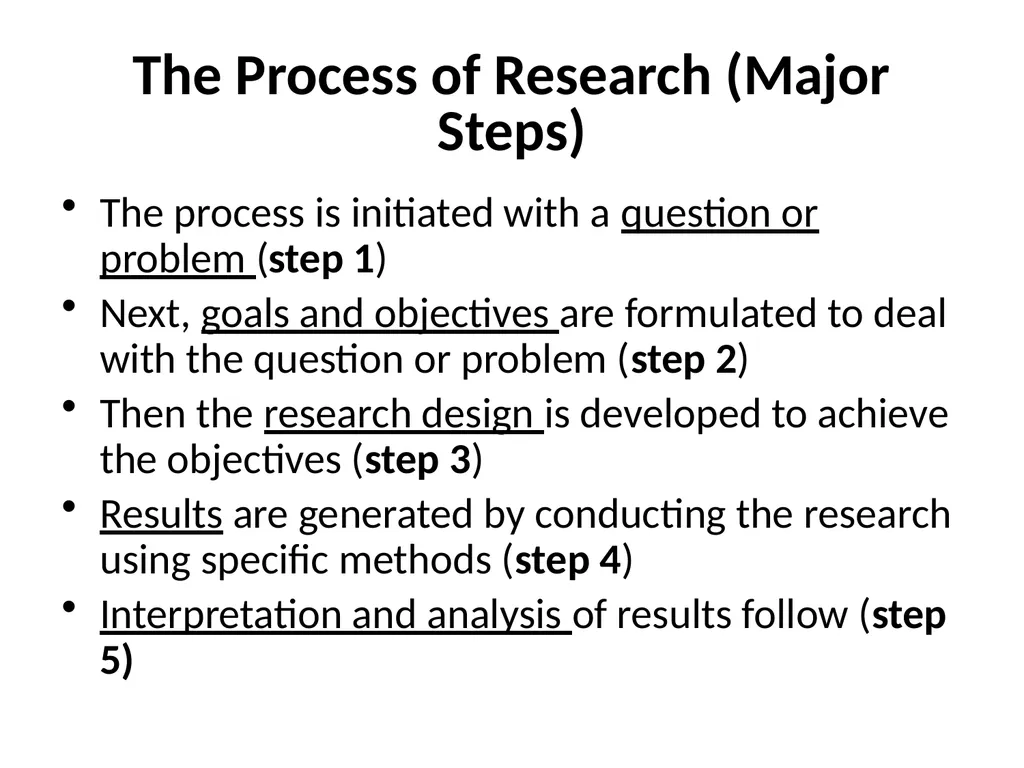
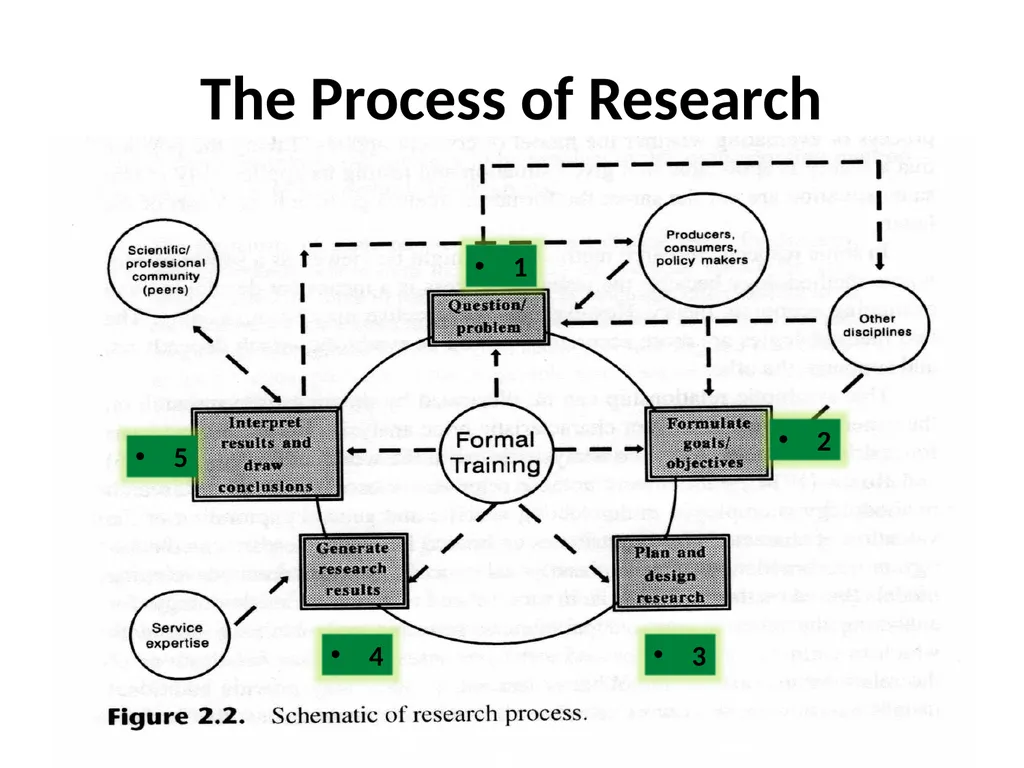
The Process of Research (Major Steps) The process is initiated with a question or problem (step 1)
Next, goals and objectives are formulated to deal with the question or problem (step 2)
Then the research design is developed to achieve the objectives (step 3)
Results are generated by conducting the research using specific methods (step 4)
Interpretation and analysis of results follow (step 5)<br>
Next, goals and objectives are formulated to deal with the question or problem (step 2)
Then the research design is developed to achieve the objectives (step 3)
Results are generated by conducting the research using specific methods (step 4)
Interpretation and analysis of results follow (step 5)<br>
06
The Process of Research<br>
07
Biomedical Research This refers to health related research
What is health? – Health is a state of complete physical, mental and social well being and not just the absence of diseases or infirmitities.
Objectives of health-related research
-To promote and protect well being of man so as to attain and sustain an optimal quality of life
-To prevent diseases at all levels –1o, 2o, 3o levels<br>
What is health? – Health is a state of complete physical, mental and social well being and not just the absence of diseases or infirmitities.
Objectives of health-related research
-To promote and protect well being of man so as to attain and sustain an optimal quality of life
-To prevent diseases at all levels –1o, 2o, 3o levels<br>
08
Environmental Research Environmental science is the academic field that takes physical, biological and chemical sciences to study the environment and discover solutions to environmental problems.
Objectives of environmental research :
To recognize that environmental problems such as climate change, global warming, ozone layer depletion, acid rains, and impacts on biodiversity and marine life
To protect the environment and human health through improved sanitation, hygiene, health education, and reduce the burden of infectious diseases<br>
Objectives of environmental research :
To recognize that environmental problems such as climate change, global warming, ozone layer depletion, acid rains, and impacts on biodiversity and marine life
To protect the environment and human health through improved sanitation, hygiene, health education, and reduce the burden of infectious diseases<br>
09
Environmental Research (objectives contd) To study of interaction between human systems (the population) and natural systems (the earth and life)
To understand the impacts of development on environment
To discover sustainable ways of living
To utilize natural resources efficiently
to help protect and preserve the environment<br>
To understand the impacts of development on environment
To discover sustainable ways of living
To utilize natural resources efficiently
to help protect and preserve the environment<br>
10
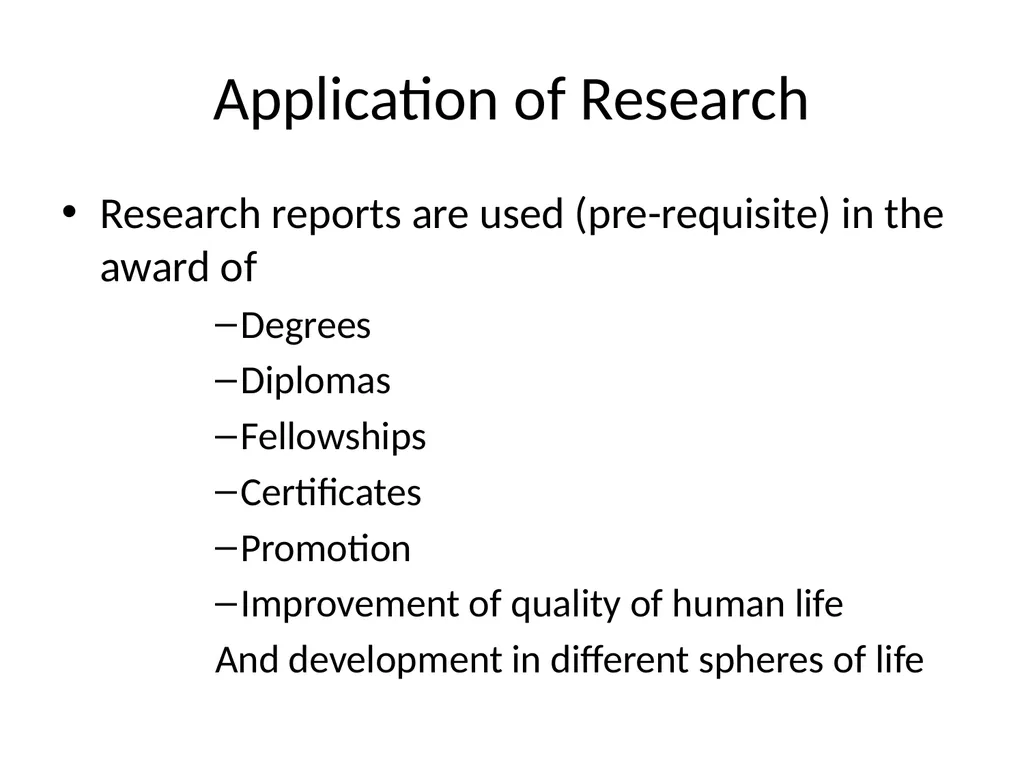
Application of Research Research reports are used (pre-requisite) in the award of
Degrees
Diplomas
Fellowships
Certificates
Promotion
Improvement of quality of human life
And development in different spheres of life<br>
Degrees
Diplomas
Fellowships
Certificates
Promotion
Improvement of quality of human life
And development in different spheres of life<br>
11
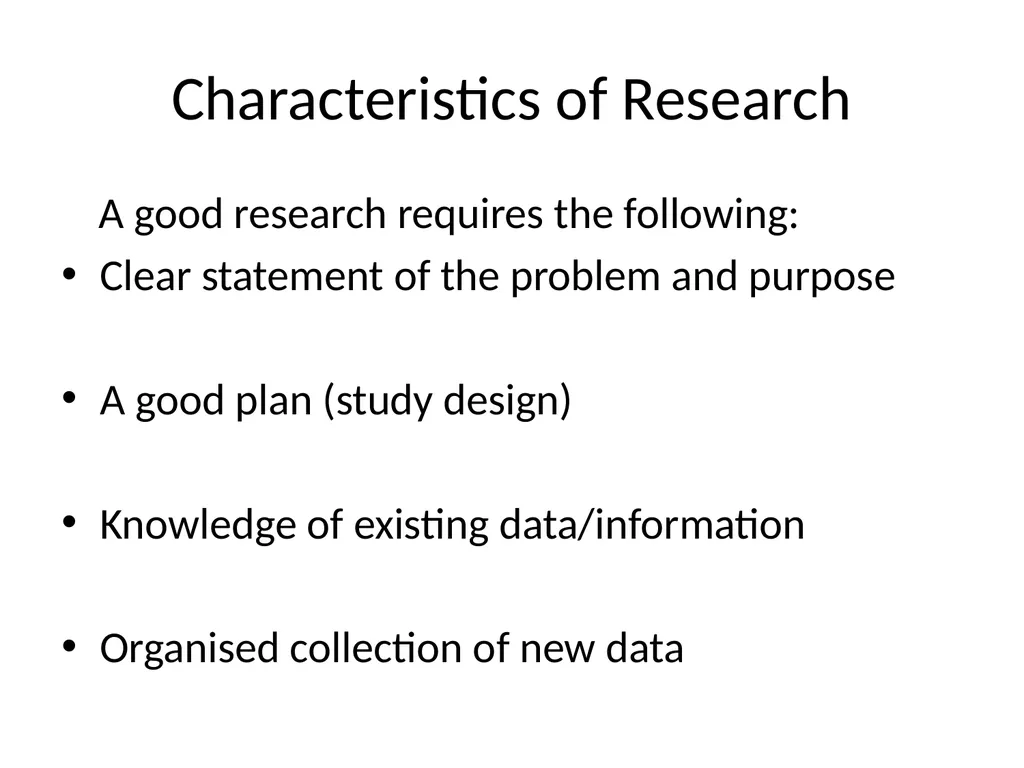
Characteristics of Research A good research requires the following:
Clear statement of the problem and purpose
A good plan (study design)
Knowledge of existing data/information
Organised collection of new data<br>
Clear statement of the problem and purpose
A good plan (study design)
Knowledge of existing data/information
Organised collection of new data<br>
12
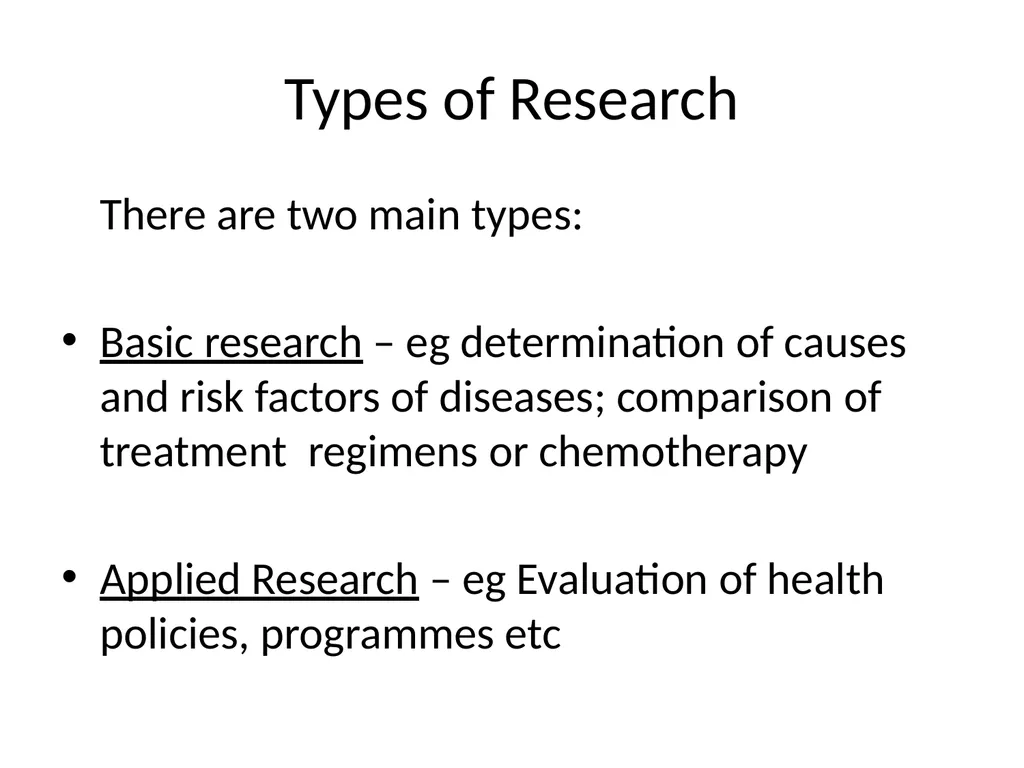
Types of Research There are two main types:
Basic research – eg determination of causes and risk factors of diseases; comparison of treatment regimens or chemotherapy
Applied Research – eg Evaluation of health policies, programmes etc<br>
Basic research – eg determination of causes and risk factors of diseases; comparison of treatment regimens or chemotherapy
Applied Research – eg Evaluation of health policies, programmes etc<br>
13
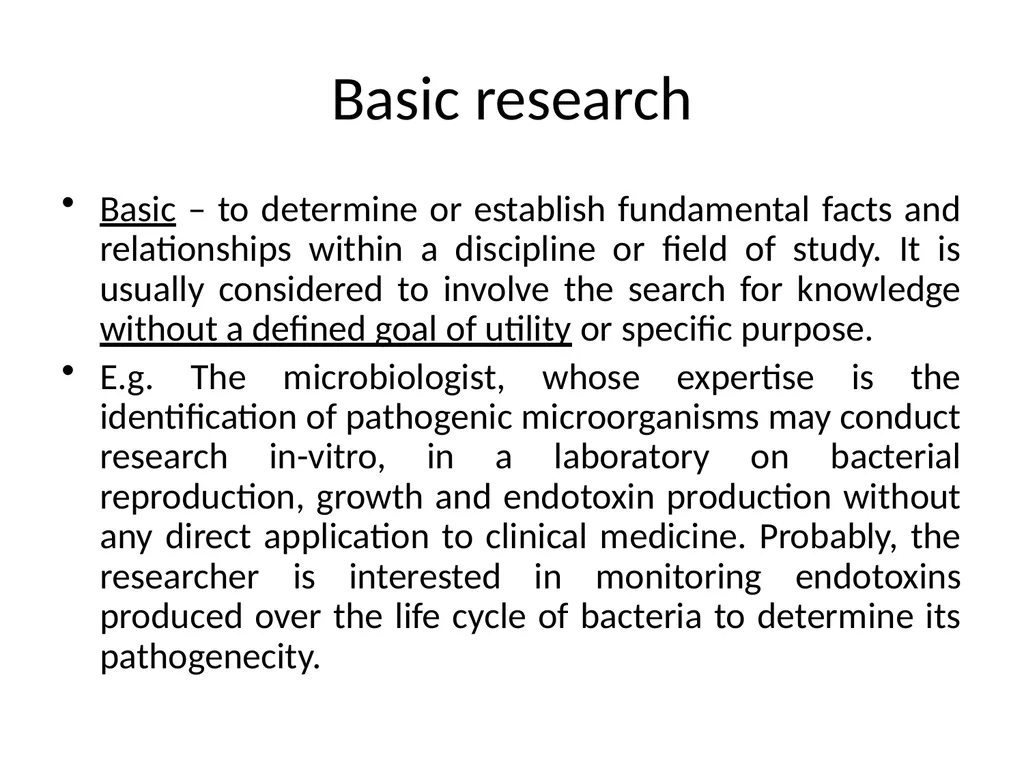
Basic research Basic – to determine or establish fundamental facts and relationships within a discipline or field of study. It is usually considered to involve the search for knowledge without a defined goal of utility or specific purpose.
E.g. The microbiologist, whose expertise is the identification of pathogenic microorganisms may conduct research in-vitro, in a laboratory on bacterial reproduction, growth and endotoxin production without any direct application to clinical medicine. Probably, the researcher is interested in monitoring endotoxins produced over the life cycle of bacteria to determine its pathogenecity.<br>
E.g. The microbiologist, whose expertise is the identification of pathogenic microorganisms may conduct research in-vitro, in a laboratory on bacterial reproduction, growth and endotoxin production without any direct application to clinical medicine. Probably, the researcher is interested in monitoring endotoxins produced over the life cycle of bacteria to determine its pathogenecity.<br>
14
Applied Research Applied – undertaken specifically for the purpose of obtaining information to help resolve a particular problem
It is problem oriented and is directed towards a defined and purposeful end.
Eg. An oral health researcher investigating the relationship between periodontal disease and myocardial infarction may use the findings of the microbiologist as a theoretical framework to test the relationship between bacterial endotoxins, periodontal disease and myocardial infarction in animal and then in human subjects<br>
It is problem oriented and is directed towards a defined and purposeful end.
Eg. An oral health researcher investigating the relationship between periodontal disease and myocardial infarction may use the findings of the microbiologist as a theoretical framework to test the relationship between bacterial endotoxins, periodontal disease and myocardial infarction in animal and then in human subjects<br>
15
Distinction between Basic and Applied Research The distinction between them is in the application
- Basic has little application to real world policy and management but could be done to guide applied research
- Basic research is usually considered to involve the search for knowledge without a defined goal of utility or specific purpose - unlike applied research.<br>
- Basic has little application to real world policy and management but could be done to guide applied research
- Basic research is usually considered to involve the search for knowledge without a defined goal of utility or specific purpose - unlike applied research.<br>
16
Research Project This is a well structured process with set rules for carrying it out, which all researchers must be conversant with and adhere to.
It is conducted in a logical manner with relevant references.
Benefits of Research Project include the provision of necessary information to improve the quality of human life generally<br>
It is conducted in a logical manner with relevant references.
Benefits of Research Project include the provision of necessary information to improve the quality of human life generally<br>
17
Stages of a Research Project Problem identification
Prioritization
Development of a project title
Statement of the problem
Review of existing literature
Formulation of research objectives
Hypothesis framing
Selection of research method (s)<br>
Prioritization
Development of a project title
Statement of the problem
Review of existing literature
Formulation of research objectives
Hypothesis framing
Selection of research method (s)<br>
18
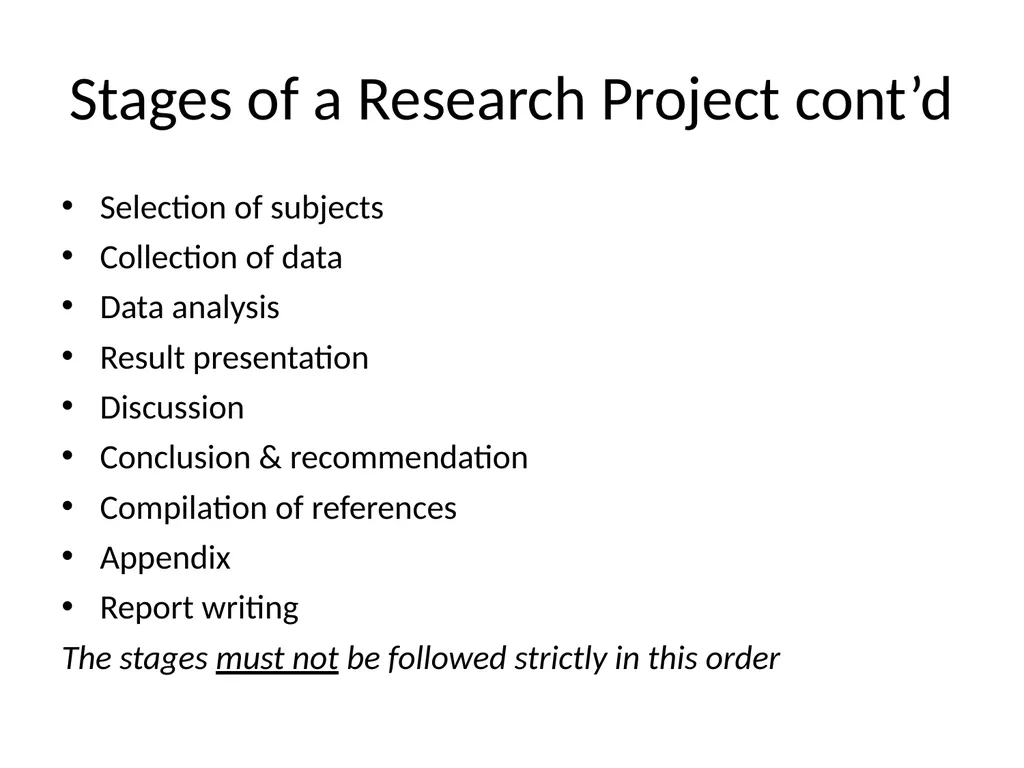
Stages of a Research Project cont’d Selection of subjects
Collection of data
Data analysis
Result presentation
Discussion
Conclusion & recommendation
Compilation of references
Appendix
Report writing
The stages must not be followed strictly in this order<br>
Collection of data
Data analysis
Result presentation
Discussion
Conclusion & recommendation
Compilation of references
Appendix
Report writing
The stages must not be followed strictly in this order<br>
19
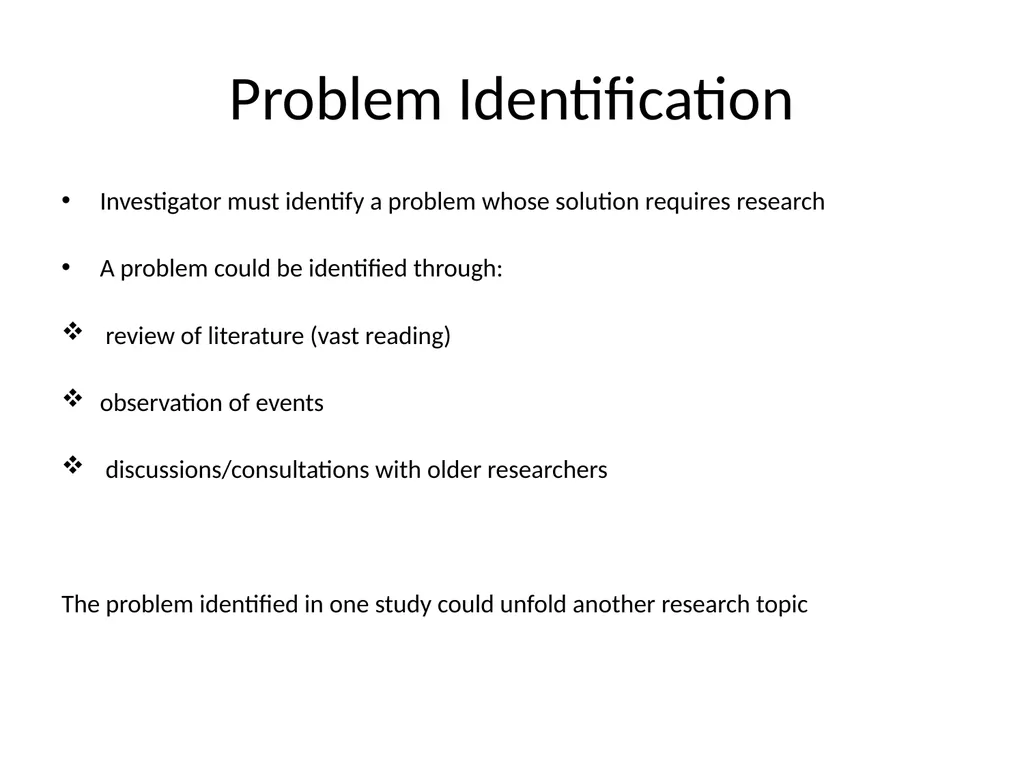
Problem Identification Investigator must identify a problem whose solution requires research
A problem could be identified through:
review of literature (vast reading)
observation of events
discussions/consultations with older researchers
The problem identified in one study could unfold another research topic<br>
A problem could be identified through:
review of literature (vast reading)
observation of events
discussions/consultations with older researchers
The problem identified in one study could unfold another research topic<br>
20
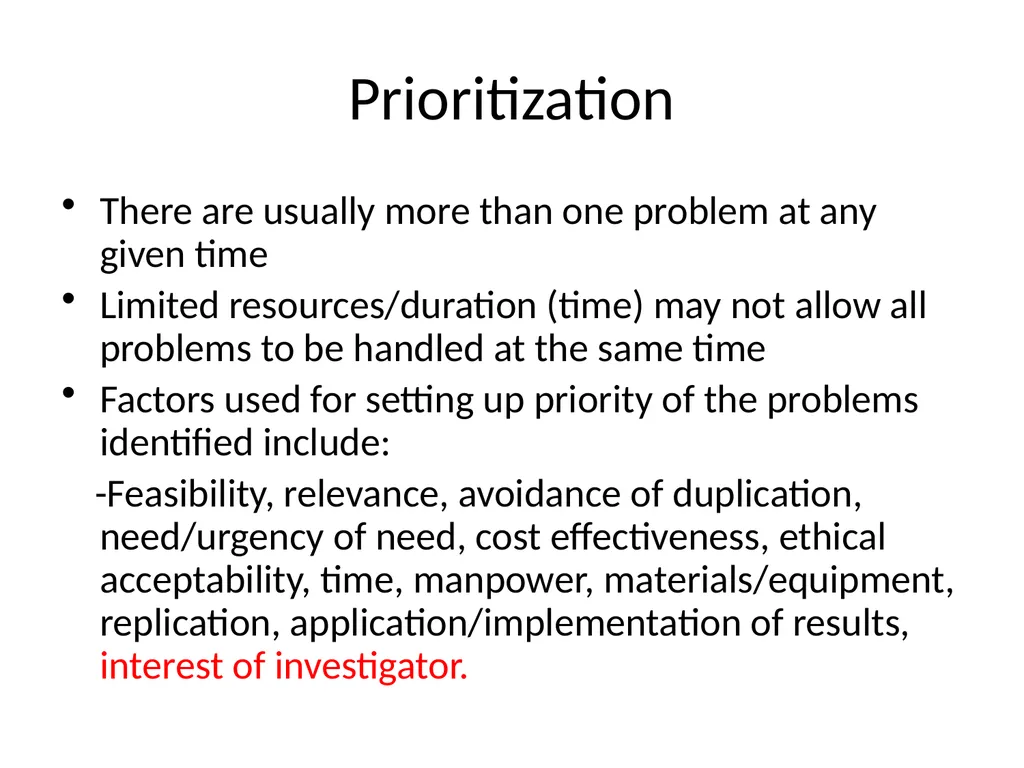
Prioritization There are usually more than one problem at any given time
Limited resources/duration (time) may not allow all problems to be handled at the same time
Factors used for setting up priority of the problems identified include:
-Feasibility, relevance, avoidance of duplication, need/urgency of need, cost effectiveness, ethical acceptability, time, manpower, materials/equipment, replication, application/implementation of results, interest of investigator.<br>
Limited resources/duration (time) may not allow all problems to be handled at the same time
Factors used for setting up priority of the problems identified include:
-Feasibility, relevance, avoidance of duplication, need/urgency of need, cost effectiveness, ethical acceptability, time, manpower, materials/equipment, replication, application/implementation of results, interest of investigator.<br>
21
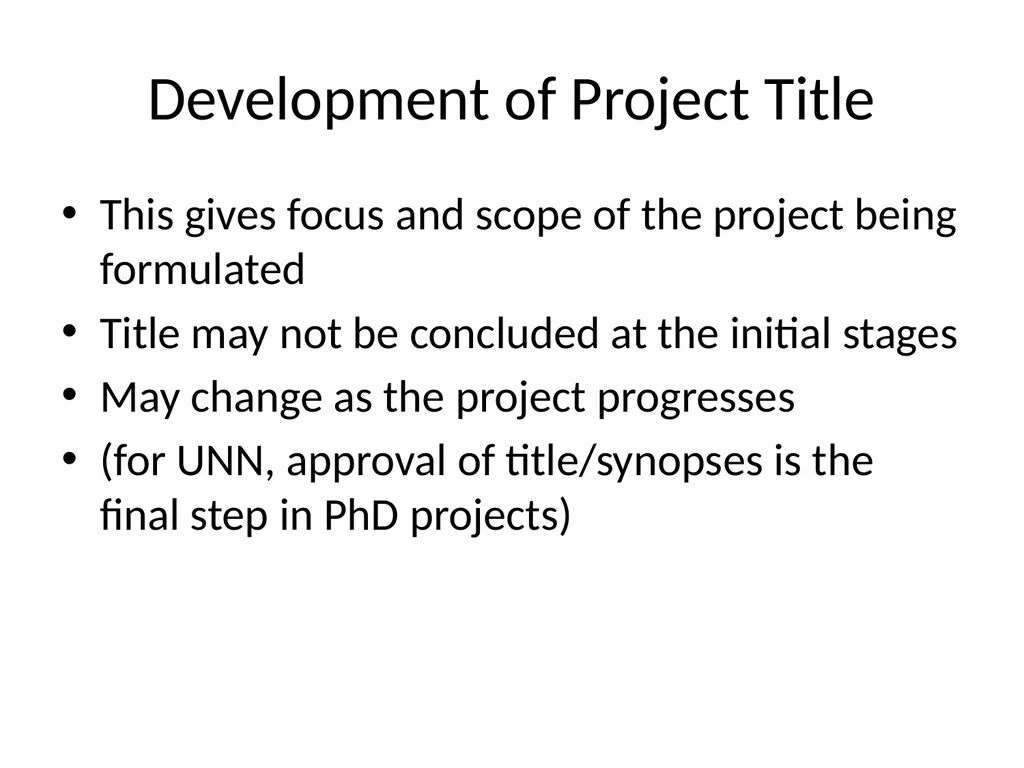
Development of Project Title This gives focus and scope of the project being formulated
Title may not be concluded at the initial stages
May change as the project progresses
(for UNN, approval of title/synopses is the final step in PhD projects)<br>
Title may not be concluded at the initial stages
May change as the project progresses
(for UNN, approval of title/synopses is the final step in PhD projects)<br>
22
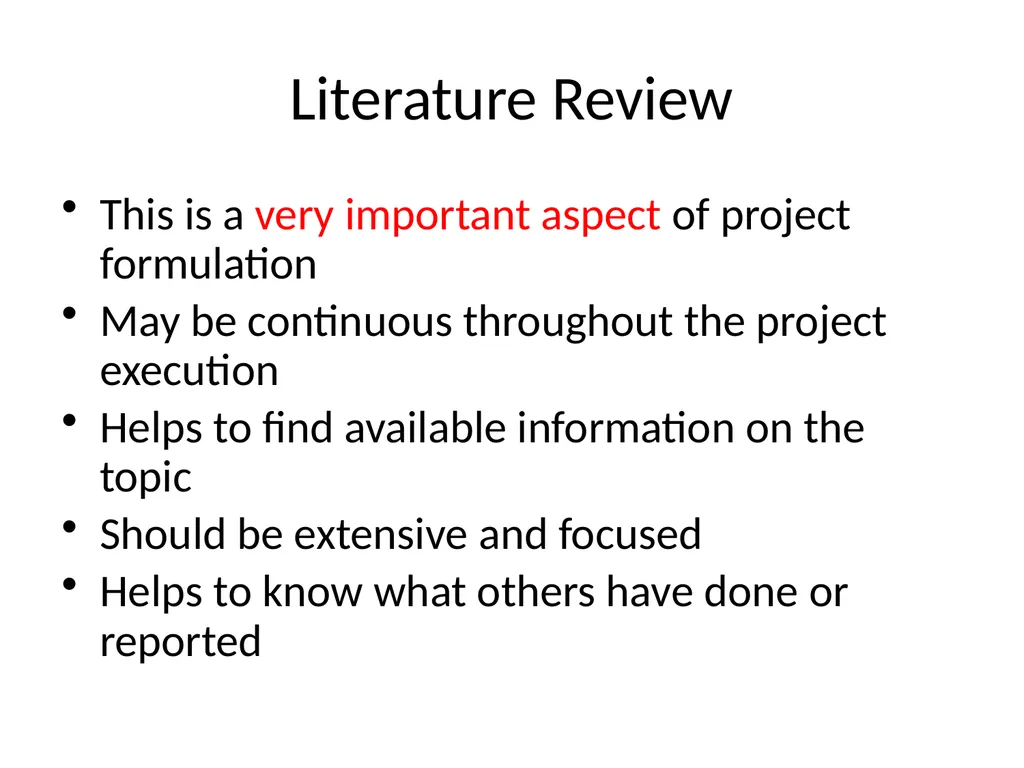
Literature Review This is a very important aspect of project formulation
May be continuous throughout the project execution
Helps to find available information on the topic
Should be extensive and focused
Helps to know what others have done or reported<br>
May be continuous throughout the project execution
Helps to find available information on the topic
Should be extensive and focused
Helps to know what others have done or reported<br>
23
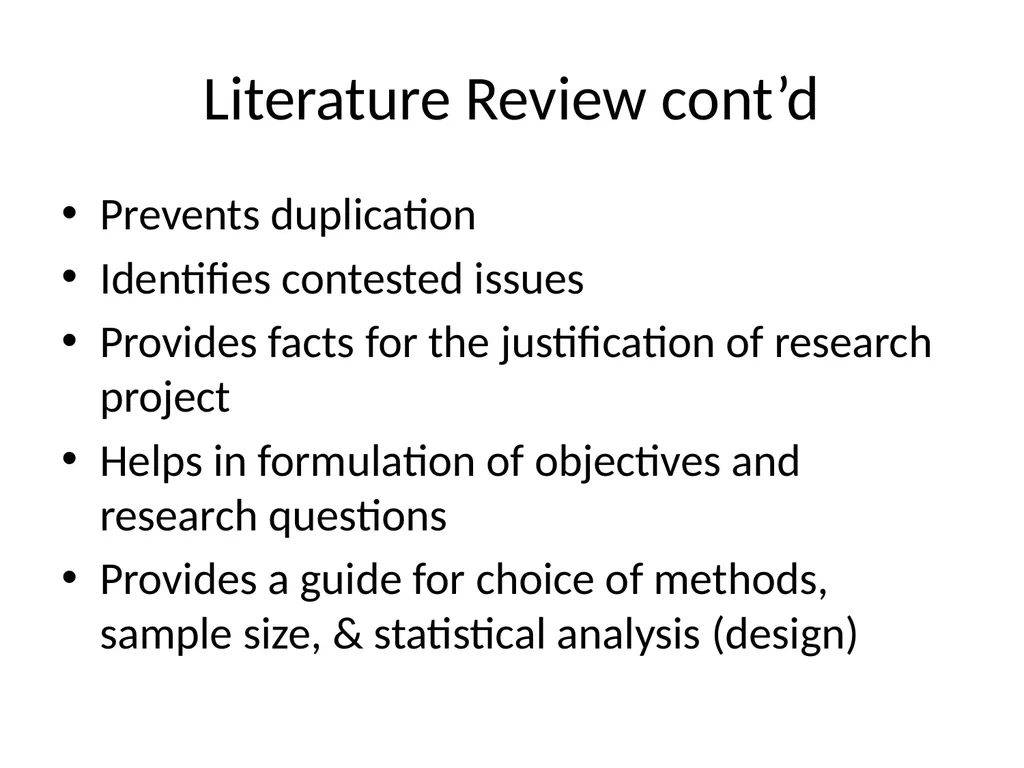
Literature Review cont’d Prevents duplication
Identifies contested issues
Provides facts for the justification of research project
Helps in formulation of objectives and research questions
Provides a guide for choice of methods, sample size, & statistical analysis (design)<br>
Identifies contested issues
Provides facts for the justification of research project
Helps in formulation of objectives and research questions
Provides a guide for choice of methods, sample size, & statistical analysis (design)<br>
24
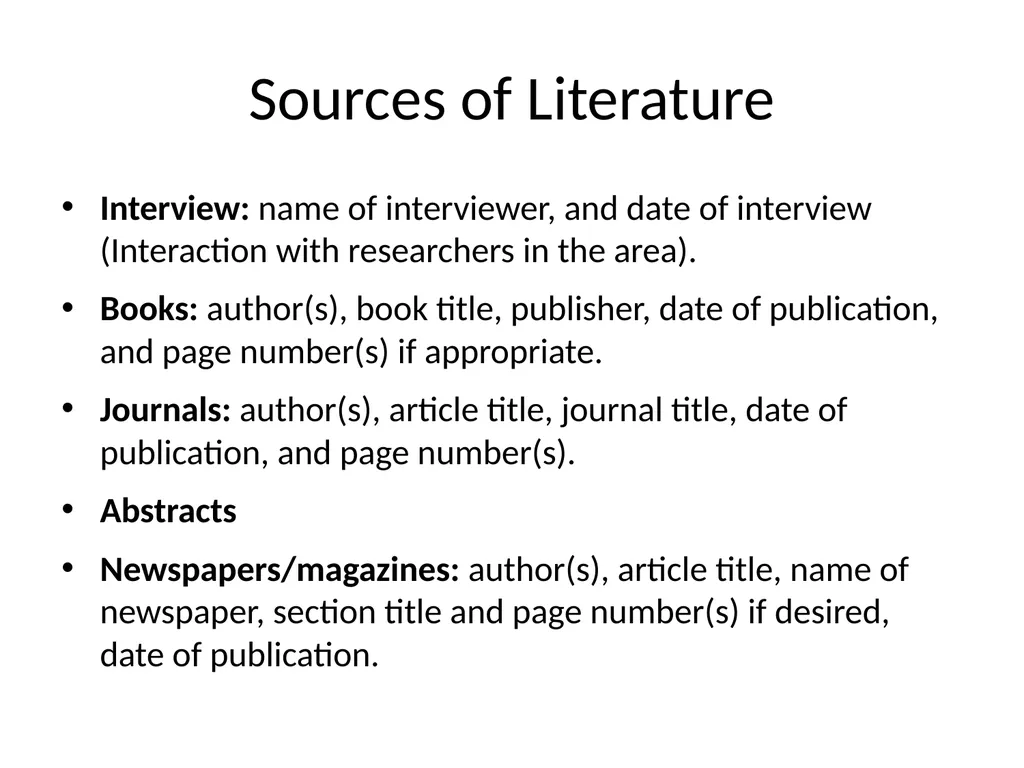
Sources of Literature Interview: name of interviewer, and date of interview (Interaction with researchers in the area).
Books: author(s), book title, publisher, date of publication, and page number(s) if appropriate.
Journals: author(s), article title, journal title, date of publication, and page number(s).
Abstracts
Newspapers/magazines: author(s), article title, name of newspaper, section title and page number(s) if desired, date of publication.<br>
Books: author(s), book title, publisher, date of publication, and page number(s) if appropriate.
Journals: author(s), article title, journal title, date of publication, and page number(s).
Abstracts
Newspapers/magazines: author(s), article title, name of newspaper, section title and page number(s) if desired, date of publication.<br>
25
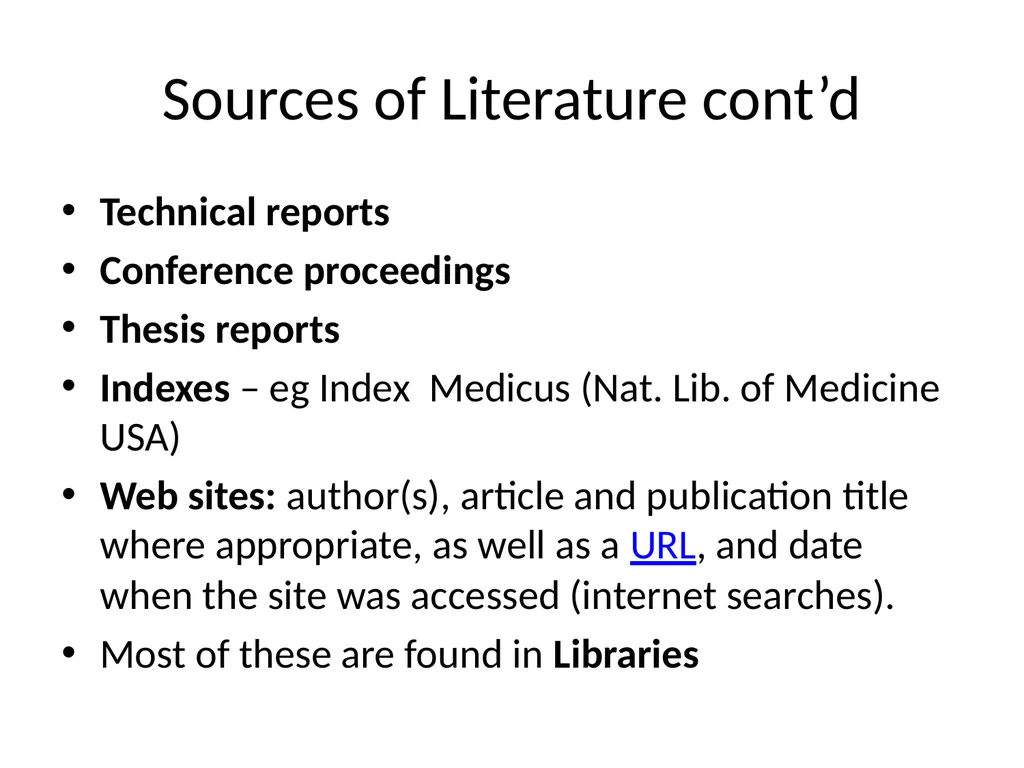
Sources of Literature cont’d Technical reports
Conference proceedings
Thesis reports
Indexes – eg Index Medicus (Nat. Lib. of Medicine USA)
Web sites: author(s), article and publication title where appropriate, as well as a URL, and date when the site was accessed (internet searches).
Most of these are found in Libraries<br>
Conference proceedings
Thesis reports
Indexes – eg Index Medicus (Nat. Lib. of Medicine USA)
Web sites: author(s), article and publication title where appropriate, as well as a URL, and date when the site was accessed (internet searches).
Most of these are found in Libraries<br>
26
Statement of Problem(Justification) Enables researcher to systematically point out what the problem is
Why the problem should be solved
What is to be achieved by doing so
It justifies the study.
A good literature search is very useful in the statement of problem.<br>
Why the problem should be solved
What is to be achieved by doing so
It justifies the study.
A good literature search is very useful in the statement of problem.<br>
27
Research Objectives(Aims) Means what the research/researcher wishes to achieve/accomplish
Should facilitate the development of methods
Should be specific- action verbs are to be used eg to determine, identify, verify, calculate, describe, reduce, identify, compare, measure .......etc (no ambiguity)<br>
Should facilitate the development of methods
Should be specific- action verbs are to be used eg to determine, identify, verify, calculate, describe, reduce, identify, compare, measure .......etc (no ambiguity)<br>
28
Research Objectives(Aims) cont’d Should be measurable- avoid such verbs as : to appreciate, understand ,believe, realise ........etc
Should be achievable/practicable
Should be realistic
Should be time-bound
May be put into: general and specific objectives<br>
Should be achievable/practicable
Should be realistic
Should be time-bound
May be put into: general and specific objectives<br>
29
Hypothesis Is a prediction of a relationship between two or more variables and the problem under study
Data analysis tests this supposition
Interpretation of data will either disprove (reject) or support (uphold) the hypothesis
Hypothesis translates the problem statement into a precise, unambiguous prediction of expected outcomes<br>
Data analysis tests this supposition
Interpretation of data will either disprove (reject) or support (uphold) the hypothesis
Hypothesis translates the problem statement into a precise, unambiguous prediction of expected outcomes<br>
30
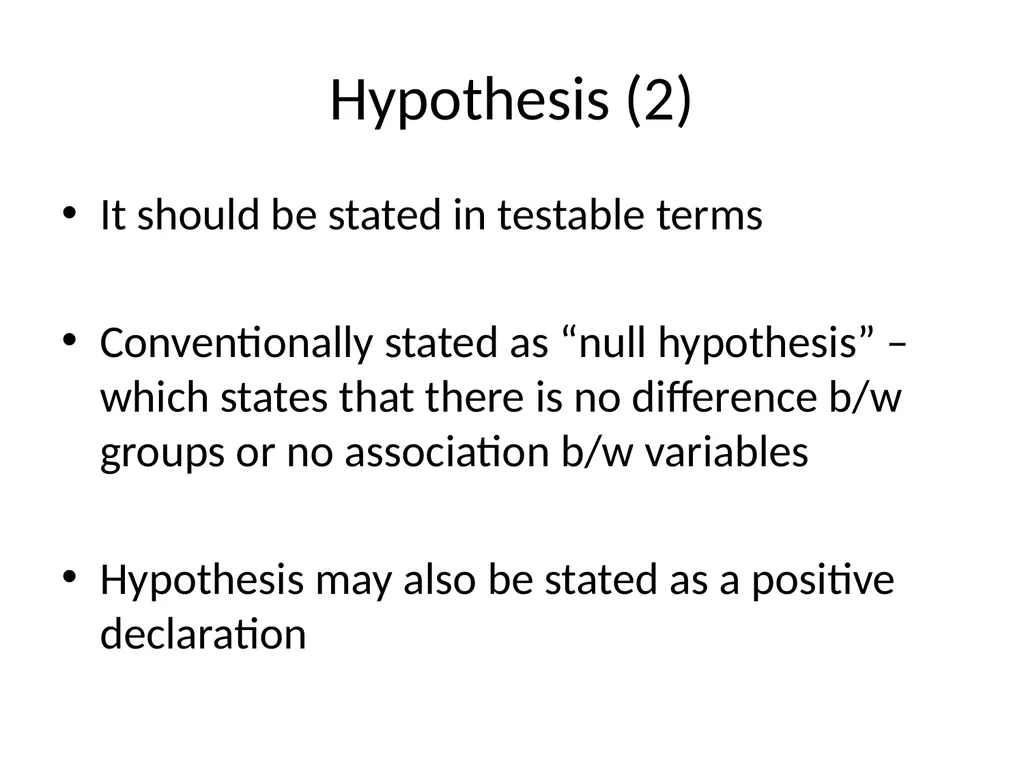
Hypothesis (2) It should be stated in testable terms
Conventionally stated as “null hypothesis” – which states that there is no difference b/w groups or no association b/w variables
Hypothesis may also be stated as a positive declaration<br>
Conventionally stated as “null hypothesis” – which states that there is no difference b/w groups or no association b/w variables
Hypothesis may also be stated as a positive declaration<br>
31
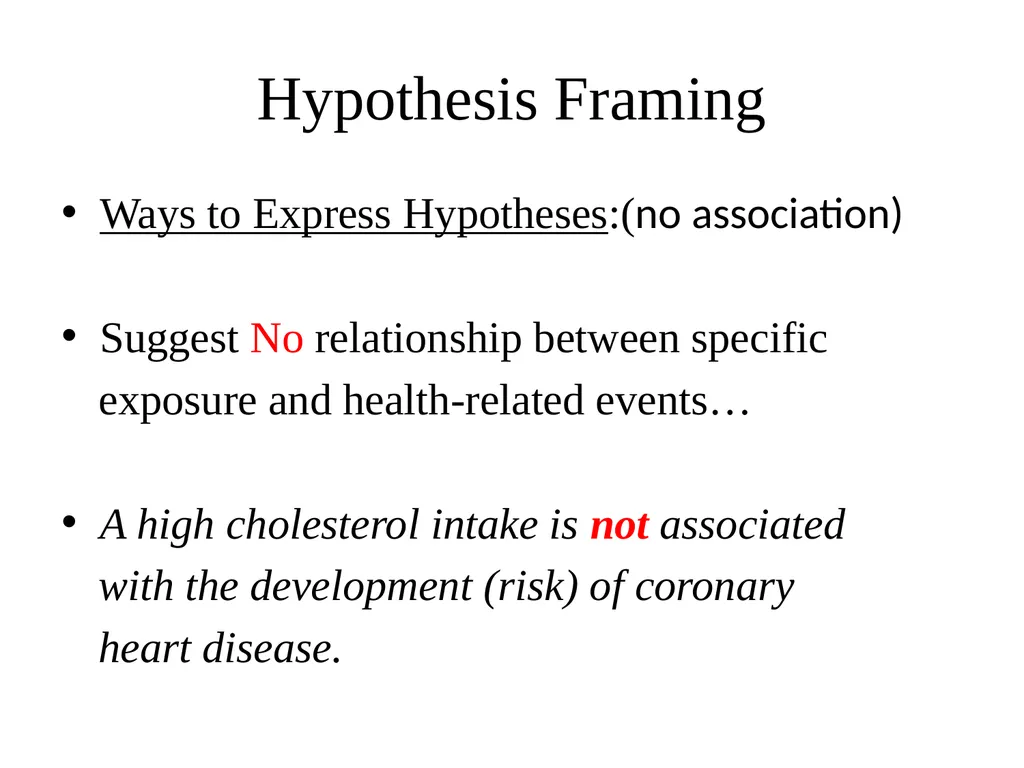
Hypothesis Framing Ways to Express Hypotheses:(no association)
Suggest No relationship between specific
exposure and health-related events…
A high cholesterol intake is not associated
with the development (risk) of coronary
heart disease.<br>
Suggest No relationship between specific
exposure and health-related events…
A high cholesterol intake is not associated
with the development (risk) of coronary
heart disease.<br>
32
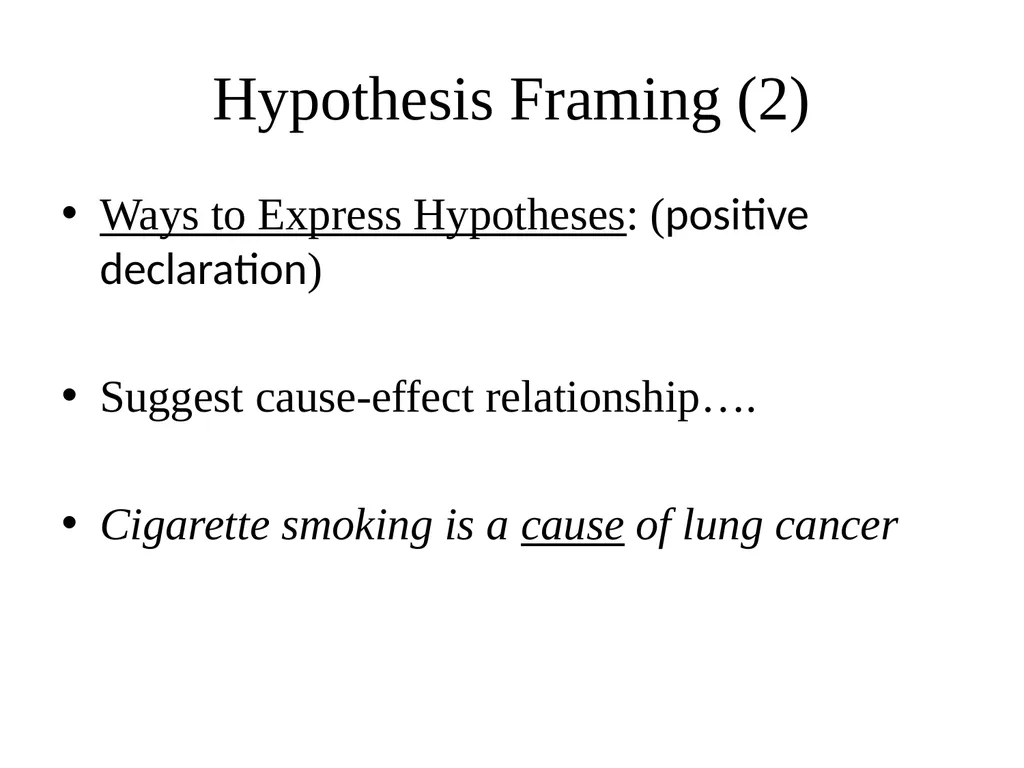
Hypothesis Framing (2) Ways to Express Hypotheses: (positive declaration)
Suggest cause-effect relationship….
Cigarette smoking is a cause of lung cancer<br>
Suggest cause-effect relationship….
Cigarette smoking is a cause of lung cancer<br>
33
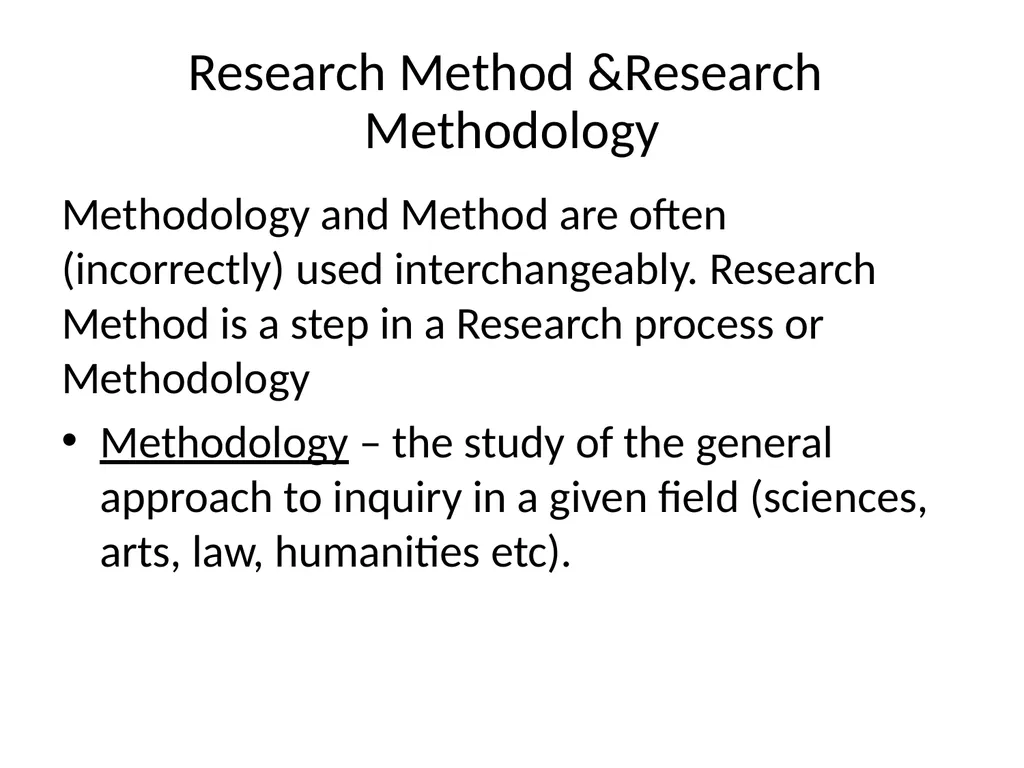
Research Method &Research Methodology Methodology and Method are often (incorrectly) used interchangeably. Research Method is a step in a Research process or Methodology
Methodology – the study of the general approach to inquiry in a given field (sciences, arts, law, humanities etc).<br>
Methodology – the study of the general approach to inquiry in a given field (sciences, arts, law, humanities etc).<br>
34
Research Methods (1) Method s– the specific techniques, tools or procedures applied to achieve a given objective. Here the research or study design is laid out.
- Science – involves the Lab, equipment, animals, humans, chemicals, other tools. (Materials/patients and methods)
Research methods in economics include regression analysis, mathematical analysis, operations research, surveys, data gathering, etc.<br>
- Science – involves the Lab, equipment, animals, humans, chemicals, other tools. (Materials/patients and methods)
Research methods in economics include regression analysis, mathematical analysis, operations research, surveys, data gathering, etc.<br>
35
Research Methods (2) The choice of a research method depends on:
Research Questions
Research Goals
Researcher Beliefs and Values
Researcher Skills
Time and Funds
A research method shows how the study is designed<br>
Research Questions
Research Goals
Researcher Beliefs and Values
Researcher Skills
Time and Funds
A research method shows how the study is designed<br>
36
Research Methods (3) The method to be used in a study may be
Qualitative – descriptive in nature eg Case study, participatory action research , data gathering etc
Quantitative – involves experiments/measurements, observations or surveys
Mixed Methods - draw from qualitative and quantitative methods<br>
Qualitative – descriptive in nature eg Case study, participatory action research , data gathering etc
Quantitative – involves experiments/measurements, observations or surveys
Mixed Methods - draw from qualitative and quantitative methods<br>
37
Ethical Considerations In Health Research To protect humans and animals from possible abuses
Involves use of humans subjects/animals in research and clinical trials
Use of human subjects makes animal studies clinically useful
Risk is justified in terms of benefits and contribution to human knowledge
Aims to improve quality of life
To prolong life of human<br>
Involves use of humans subjects/animals in research and clinical trials
Use of human subjects makes animal studies clinically useful
Risk is justified in terms of benefits and contribution to human knowledge
Aims to improve quality of life
To prolong life of human<br>
38
General Ethical Principles Respect for the human person
Ensure no harm to human subjects used
Maximum benefits and minimum harm
Ensure justice – equal treatment to all
Ensure respect for privacy and human dignity
Informed consent (verbal or written) must be obtained – parents for minors/pregnancy
Qualified personnel is involved
Ethical Committee Certificate must be obtained<br>
Ensure no harm to human subjects used
Maximum benefits and minimum harm
Ensure justice – equal treatment to all
Ensure respect for privacy and human dignity
Informed consent (verbal or written) must be obtained – parents for minors/pregnancy
Qualified personnel is involved
Ethical Committee Certificate must be obtained<br>
39
Subject Selection (1) This is dependent on some factors:
Level of precision desired
Type of study design
Prevalence of condition from previous studies
Available time and funds
Personnel
Inclusion & exclusion criteria stated<br>
Level of precision desired
Type of study design
Prevalence of condition from previous studies
Available time and funds
Personnel
Inclusion & exclusion criteria stated<br>
40
Sampling techniques Simple random - eg lucky dip
Systematic random - eg even nos, odd nos etc
Stratified random
Cluster
Multi-stage etc<br>
Systematic random - eg even nos, odd nos etc
Stratified random
Cluster
Multi-stage etc<br>
41
Sample Size Estimation Sample size should be large enough for
-appropriate analysis
- desired level of accuracy
- validity of significant tests
- confidence level
On the basis of the above considerations, the researcher can calculate the sample size needed
Different formulae are given/used on different settings<br>
-appropriate analysis
- desired level of accuracy
- validity of significant tests
- confidence level
On the basis of the above considerations, the researcher can calculate the sample size needed
Different formulae are given/used on different settings<br>
42
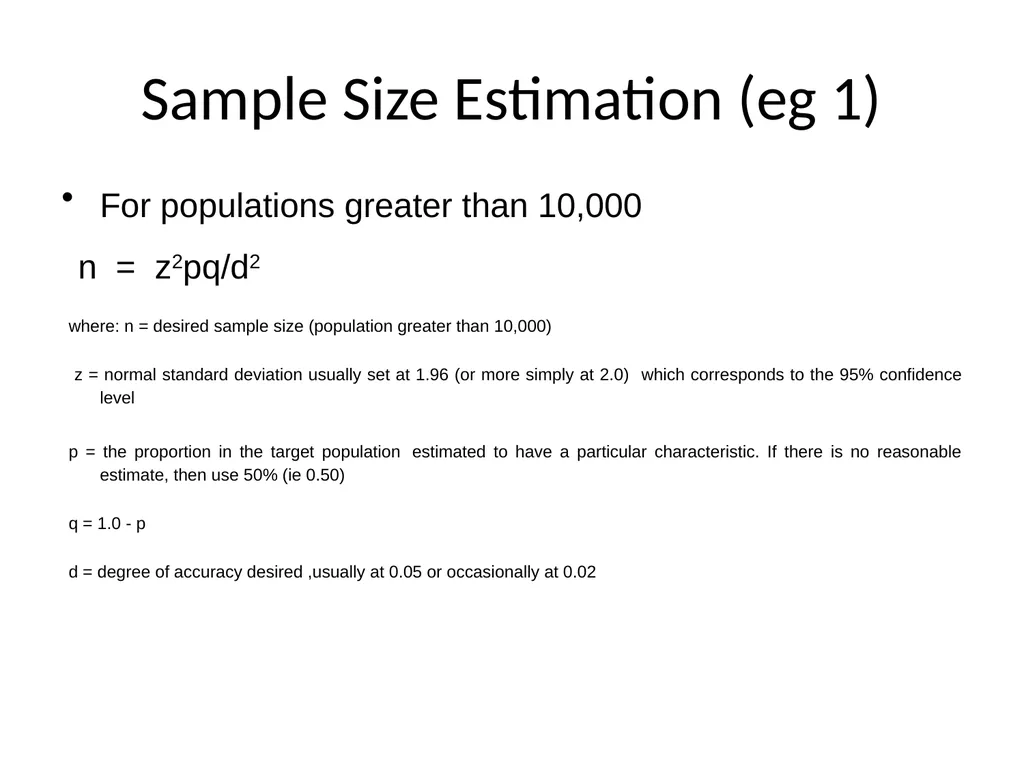
Sample Size Estimation (eg 1) For populations greater than 10,000
n = z2pq/d2
where: n = desired sample size (population greater than 10,000)
z = normal standard deviation usually set at 1.96 (or more simply at 2.0) which corresponds to the 95% confidence level
p = the proportion in the target population estimated to have a particular characteristic. If there is no reasonable estimate, then use 50% (ie 0.50)
q = 1.0 - p
d = degree of accuracy desired ,usually at 0.05 or occasionally at 0.02<br>
n = z2pq/d2
where: n = desired sample size (population greater than 10,000)
z = normal standard deviation usually set at 1.96 (or more simply at 2.0) which corresponds to the 95% confidence level
p = the proportion in the target population estimated to have a particular characteristic. If there is no reasonable estimate, then use 50% (ie 0.50)
q = 1.0 - p
d = degree of accuracy desired ,usually at 0.05 or occasionally at 0.02<br>
43
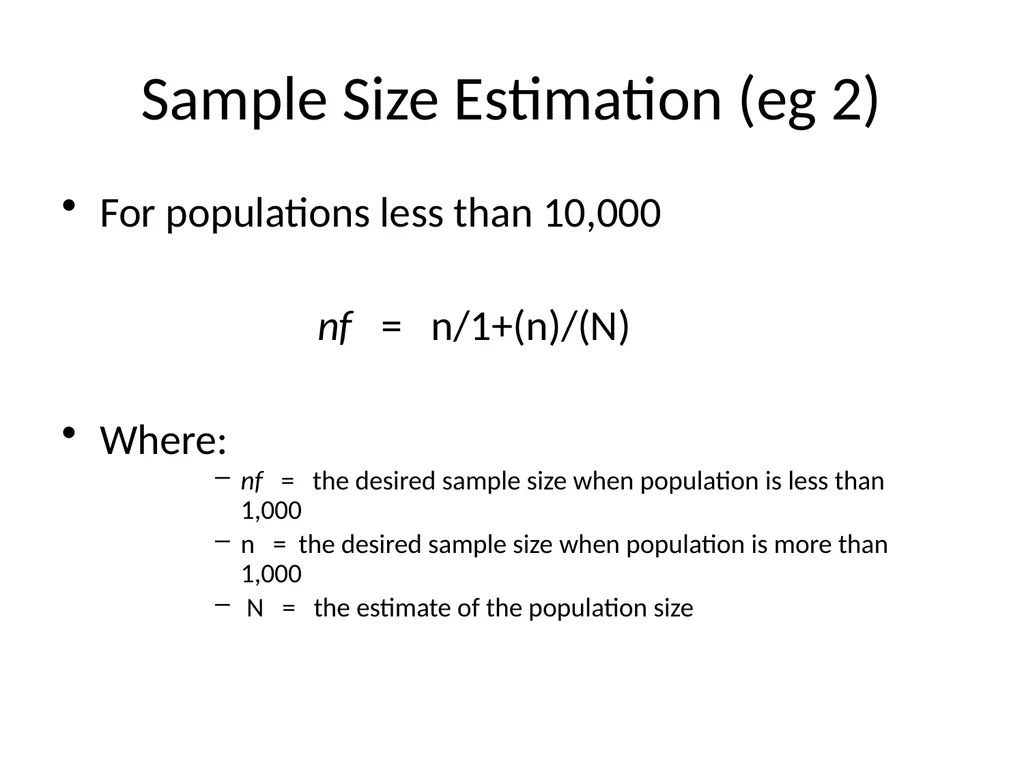
Sample Size Estimation (eg 2) For populations less than 10,000
nf = n/1+(n)/(N)
Where:
nf = the desired sample size when population is less than 1,000
n = the desired sample size when population is more than 1,000
N = the estimate of the population size<br>
nf = n/1+(n)/(N)
Where:
nf = the desired sample size when population is less than 1,000
n = the desired sample size when population is more than 1,000
N = the estimate of the population size<br>
44
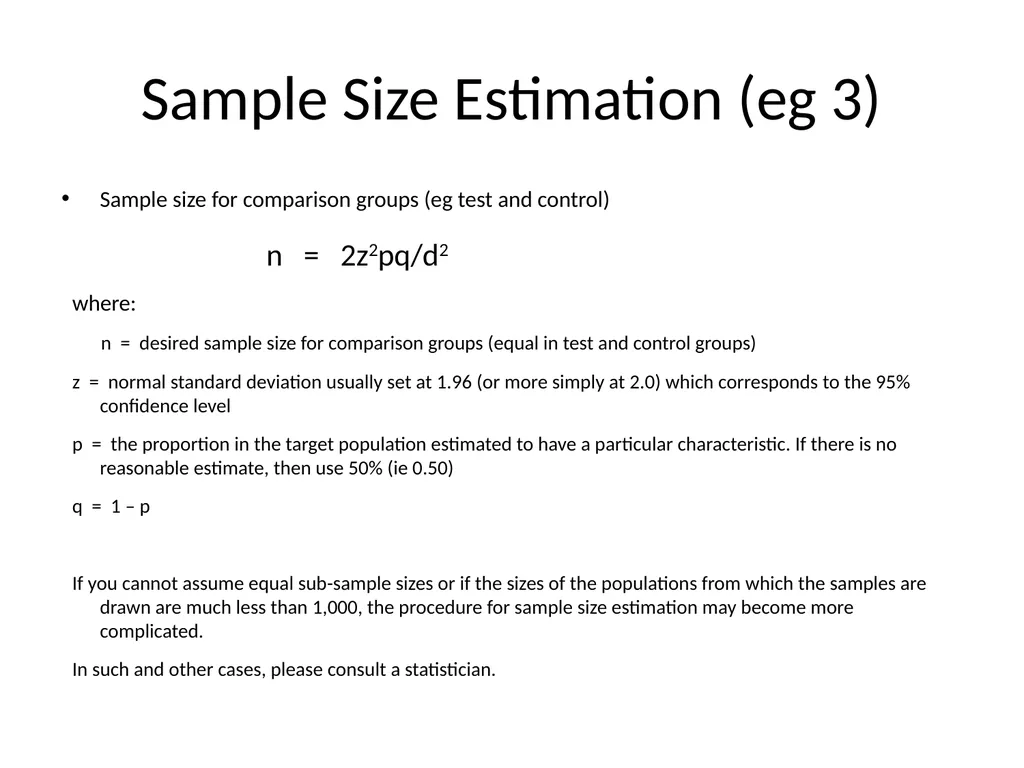
Sample Size Estimation (eg 3) Sample size for comparison groups (eg test and control)
n = 2z2pq/d2
where:
n = desired sample size for comparison groups (equal in test and control groups)
z = normal standard deviation usually set at 1.96 (or more simply at 2.0) which corresponds to the 95% confidence level
p = the proportion in the target population estimated to have a particular characteristic. If there is no reasonable estimate, then use 50% (ie 0.50)
q = 1 – p
If you cannot assume equal sub-sample sizes or if the sizes of the populations from which the samples are drawn are much less than 1,000, the procedure for sample size estimation may become more complicated.
In such and other cases, please consult a statistician.<br>
n = 2z2pq/d2
where:
n = desired sample size for comparison groups (equal in test and control groups)
z = normal standard deviation usually set at 1.96 (or more simply at 2.0) which corresponds to the 95% confidence level
p = the proportion in the target population estimated to have a particular characteristic. If there is no reasonable estimate, then use 50% (ie 0.50)
q = 1 – p
If you cannot assume equal sub-sample sizes or if the sizes of the populations from which the samples are drawn are much less than 1,000, the procedure for sample size estimation may become more complicated.
In such and other cases, please consult a statistician.<br>
45
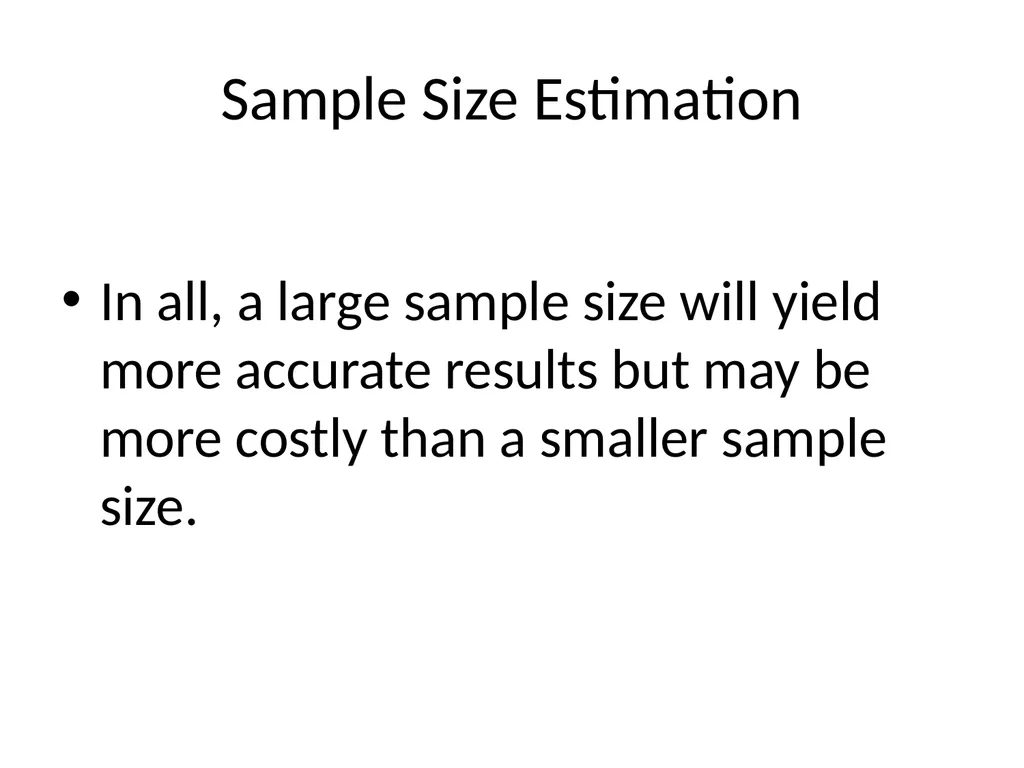
Sample Size Estimation In all, a large sample size will yield more accurate results but may be more costly than a smaller sample size.<br>
46
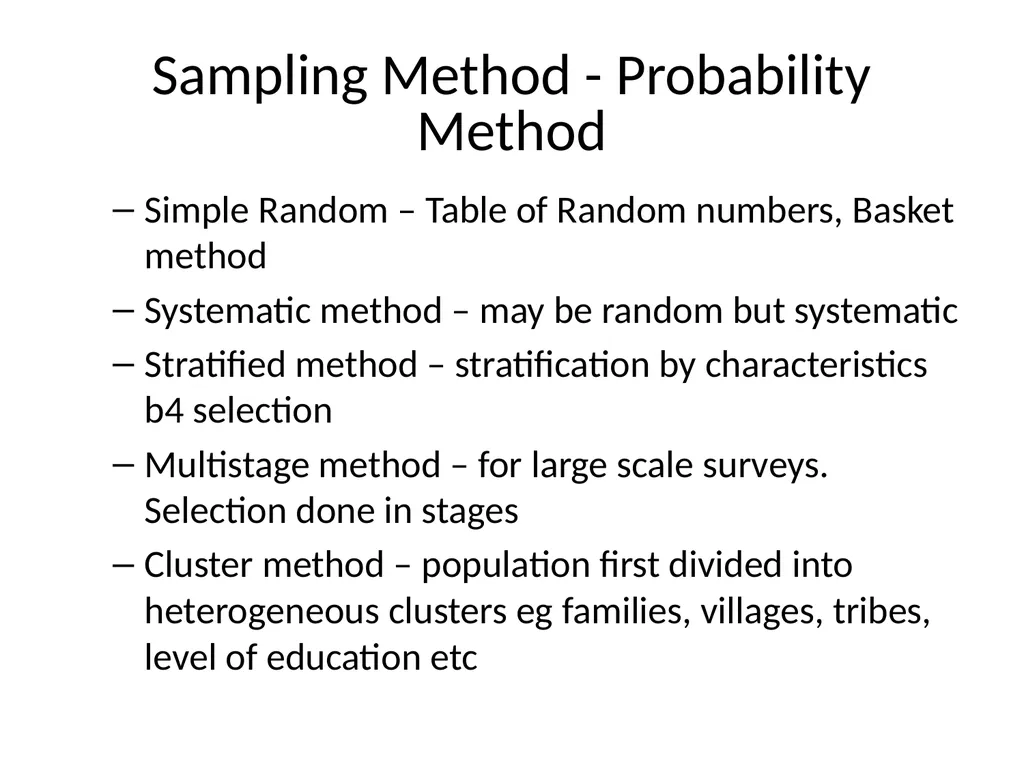
Sampling Method - Probability Method Simple Random – Table of Random numbers, Basket method
Systematic method – may be random but systematic
Stratified method – stratification by characteristics b4 selection
Multistage method – for large scale surveys. Selection done in stages
Cluster method – population first divided into heterogeneous clusters eg families, villages, tribes, level of education etc<br>
Systematic method – may be random but systematic
Stratified method – stratification by characteristics b4 selection
Multistage method – for large scale surveys. Selection done in stages
Cluster method – population first divided into heterogeneous clusters eg families, villages, tribes, level of education etc<br>
47
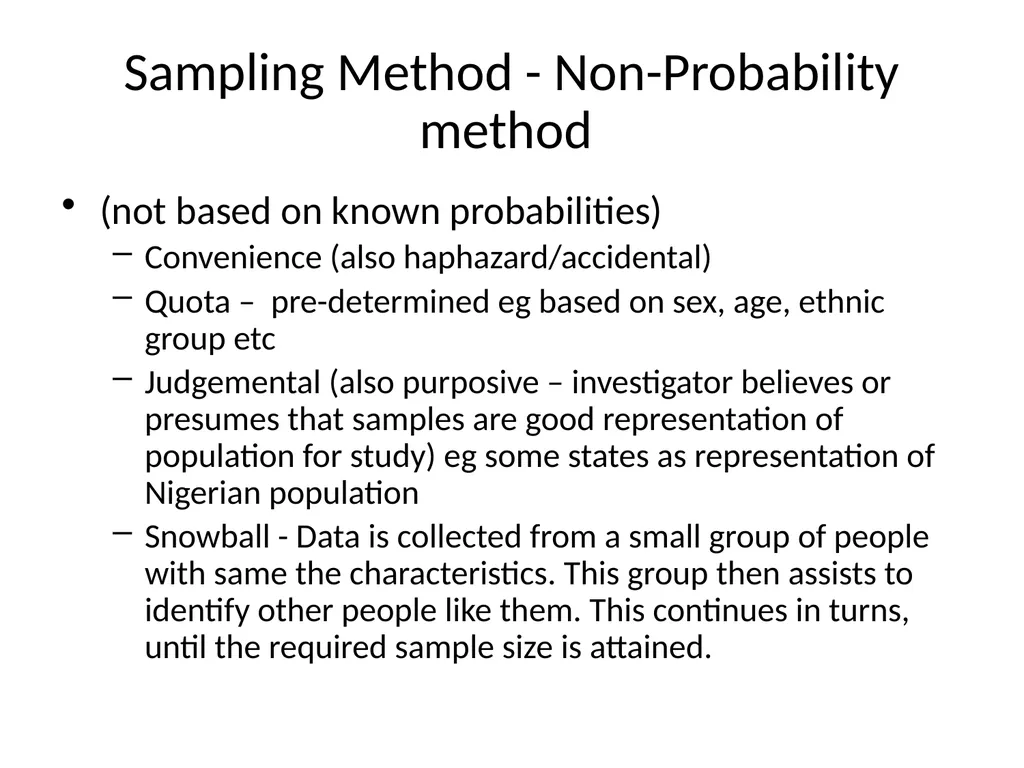
Sampling Method - Non-Probability method (not based on known probabilities)
Convenience (also haphazard/accidental)
Quota – pre-determined eg based on sex, age, ethnic group etc
Judgemental (also purposive – investigator believes or presumes that samples are good representation of population for study) eg some states as representation of Nigerian population
Snowball - Data is collected from a small group of people with same the characteristics. This group then assists to identify other people like them. This continues in turns, until the required sample size is attained.<br>
Convenience (also haphazard/accidental)
Quota – pre-determined eg based on sex, age, ethnic group etc
Judgemental (also purposive – investigator believes or presumes that samples are good representation of population for study) eg some states as representation of Nigerian population
Snowball - Data is collected from a small group of people with same the characteristics. This group then assists to identify other people like them. This continues in turns, until the required sample size is attained.<br>
48
Data Collection There are 2 major types
Quantitative data
Qualitative data
study design determines mode of data collection
based on variables to be measured<br>
Quantitative data
Qualitative data
study design determines mode of data collection
based on variables to be measured<br>
49
Quantitative data Obtained from measures of quantity or frequency
Obtainable from:
questionnaires
interviews
experimental results
observations,
diaries etc<br>
Obtainable from:
questionnaires
interviews
experimental results
observations,
diaries etc<br>
50
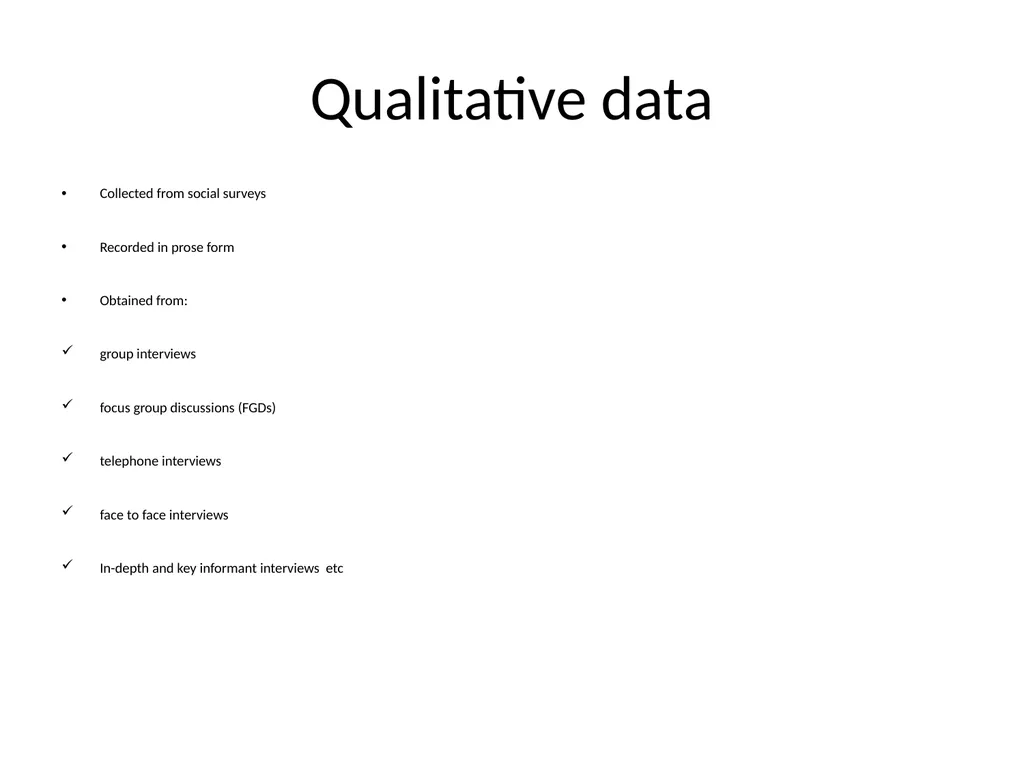
Qualitative data Collected from social surveys
Recorded in prose form
Obtained from:
group interviews
focus group discussions (FGDs)
telephone interviews
face to face interviews
In-depth and key informant interviews etc<br>
Recorded in prose form
Obtained from:
group interviews
focus group discussions (FGDs)
telephone interviews
face to face interviews
In-depth and key informant interviews etc<br>
51
Data Processing PROFESSOR AGUWA E.<br>
52
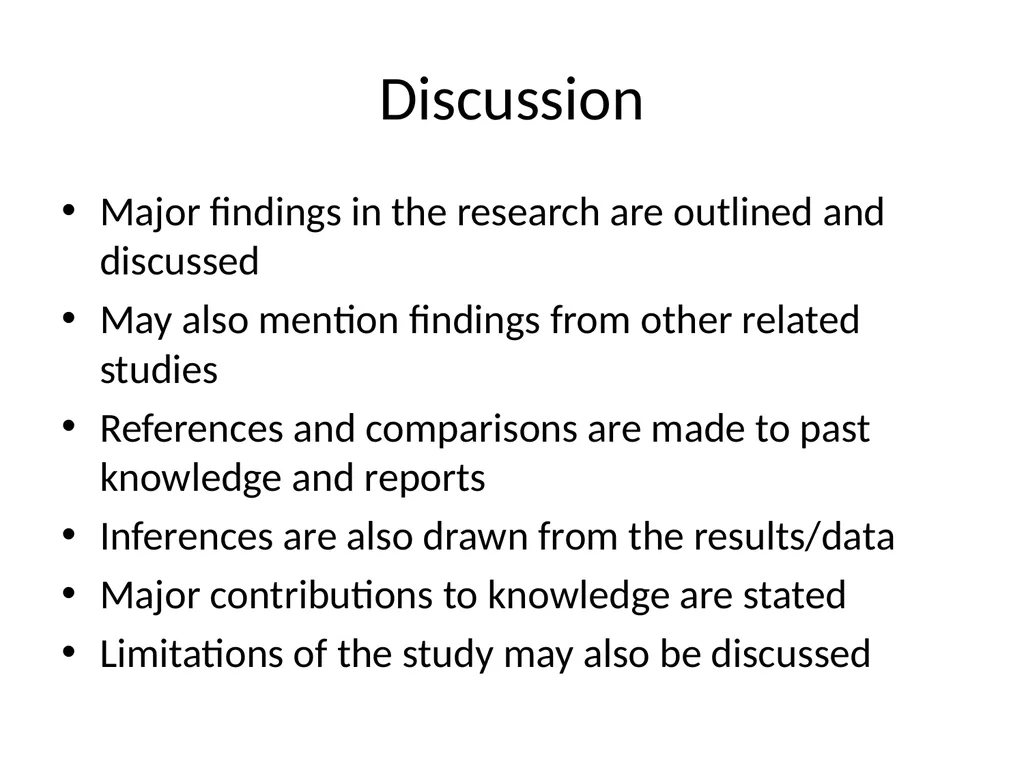
Discussion Major findings in the research are outlined and discussed
May also mention findings from other related studies
References and comparisons are made to past knowledge and reports
Inferences are also drawn from the results/data
Major contributions to knowledge are stated
Limitations of the study may also be discussed<br>
May also mention findings from other related studies
References and comparisons are made to past knowledge and reports
Inferences are also drawn from the results/data
Major contributions to knowledge are stated
Limitations of the study may also be discussed<br>
53
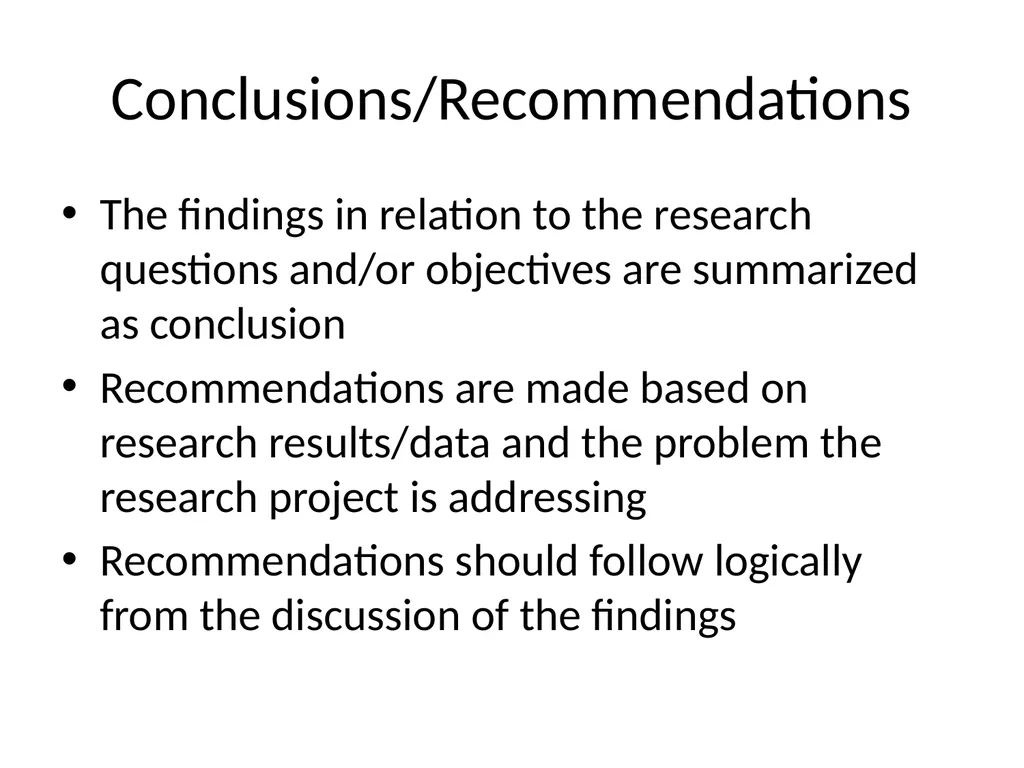
Conclusions/Recommendations The findings in relation to the research questions and/or objectives are summarized as conclusion
Recommendations are made based on research results/data and the problem the research project is addressing
Recommendations should follow logically from the discussion of the findings<br>
Recommendations are made based on research results/data and the problem the research project is addressing
Recommendations should follow logically from the discussion of the findings<br>
54
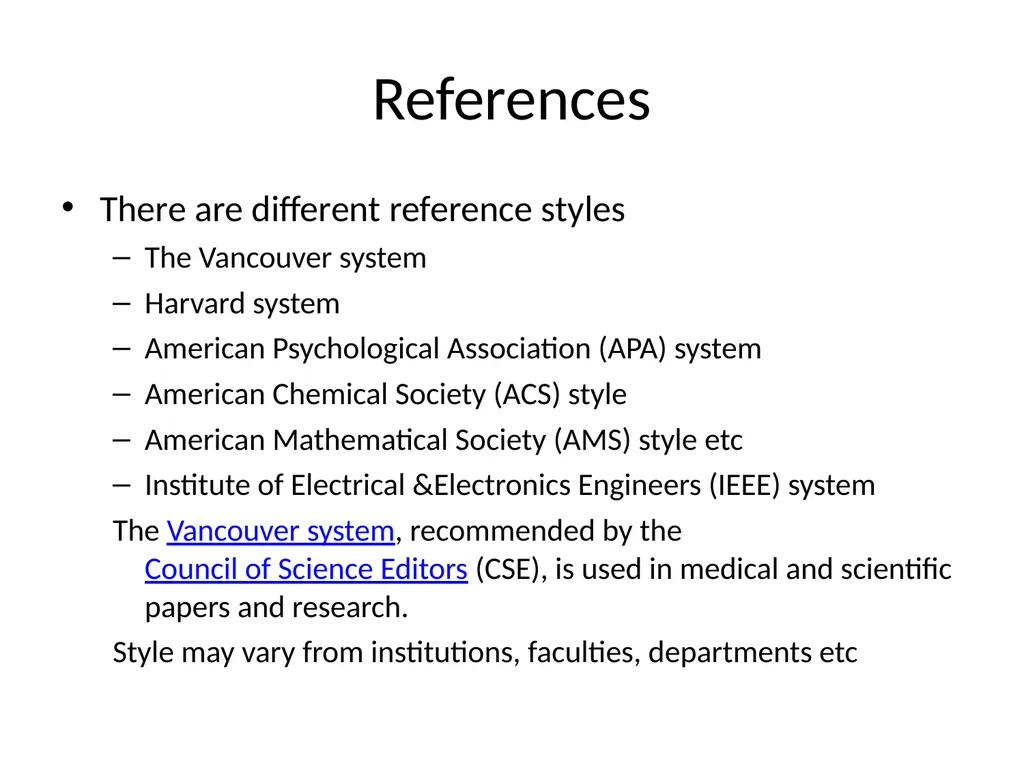
References There are different reference styles
The Vancouver system
Harvard system
American Psychological Association (APA) system
American Chemical Society (ACS) style
American Mathematical Society (AMS) style etc
Institute of Electrical &Electronics Engineers (IEEE) system
The Vancouver system, recommended by the Council of Science Editors (CSE), is used in medical and scientific papers and research.
Style may vary from institutions, faculties, departments etc<br>
The Vancouver system
Harvard system
American Psychological Association (APA) system
American Chemical Society (ACS) style
American Mathematical Society (AMS) style etc
Institute of Electrical &Electronics Engineers (IEEE) system
The Vancouver system, recommended by the Council of Science Editors (CSE), is used in medical and scientific papers and research.
Style may vary from institutions, faculties, departments etc<br>
55
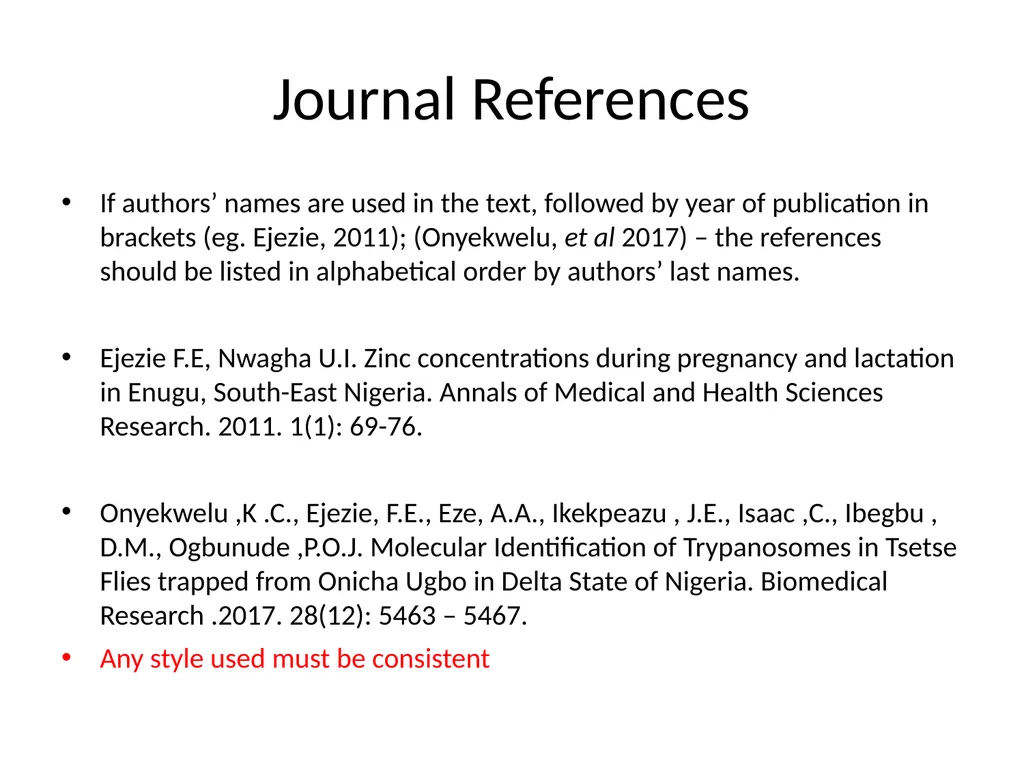
Journal References If authors’ names are used in the text, followed by year of publication in brackets (eg. Ejezie, 2011); (Onyekwelu, et al 2017) – the references should be listed in alphabetical order by authors’ last names.
Ejezie F.E, Nwagha U.I. Zinc concentrations during pregnancy and lactation in Enugu, South-East Nigeria. Annals of Medical and Health Sciences Research. 2011. 1(1): 69-76.
Onyekwelu ,K .C., Ejezie, F.E., Eze, A.A., Ikekpeazu , J.E., Isaac ,C., Ibegbu , D.M., Ogbunude ,P.O.J. Molecular Identification of Trypanosomes in Tsetse Flies trapped from Onicha Ugbo in Delta State of Nigeria. Biomedical Research .2017. 28(12): 5463 – 5467.
Any style used must be consistent<br>
Ejezie F.E, Nwagha U.I. Zinc concentrations during pregnancy and lactation in Enugu, South-East Nigeria. Annals of Medical and Health Sciences Research. 2011. 1(1): 69-76.
Onyekwelu ,K .C., Ejezie, F.E., Eze, A.A., Ikekpeazu , J.E., Isaac ,C., Ibegbu , D.M., Ogbunude ,P.O.J. Molecular Identification of Trypanosomes in Tsetse Flies trapped from Onicha Ugbo in Delta State of Nigeria. Biomedical Research .2017. 28(12): 5463 – 5467.
Any style used must be consistent<br>
56
Book References Ejezie, F.E. & Ikekpeazu, J.E. (2017). Fundamentals of Metabolism. (2nd edition). Enugu. Ezu Books Ltd. pp 150-163.
Pegrum, M. (2009).From blogs to bombs: The future of electronic technologies in education. Crawley, W.A: UWA Publishing. pp 78 – 82.<br>
Pegrum, M. (2009).From blogs to bombs: The future of electronic technologies in education. Crawley, W.A: UWA Publishing. pp 78 – 82.<br>
57
Online (Website) Reference Citing a general website article with an author
Author, A. (Year of Publication). Article title. Retrieved from URL, date retrieved.
Australian Environmental Society (2007). Improve indigenous housing now, government told.. http://www.architecture.com.au/i-cms?page=10220 (retrieved 20th Sept. 2007).<br>
Author, A. (Year of Publication). Article title. Retrieved from URL, date retrieved.
Australian Environmental Society (2007). Improve indigenous housing now, government told.. http://www.architecture.com.au/i-cms?page=10220 (retrieved 20th Sept. 2007).<br>
58
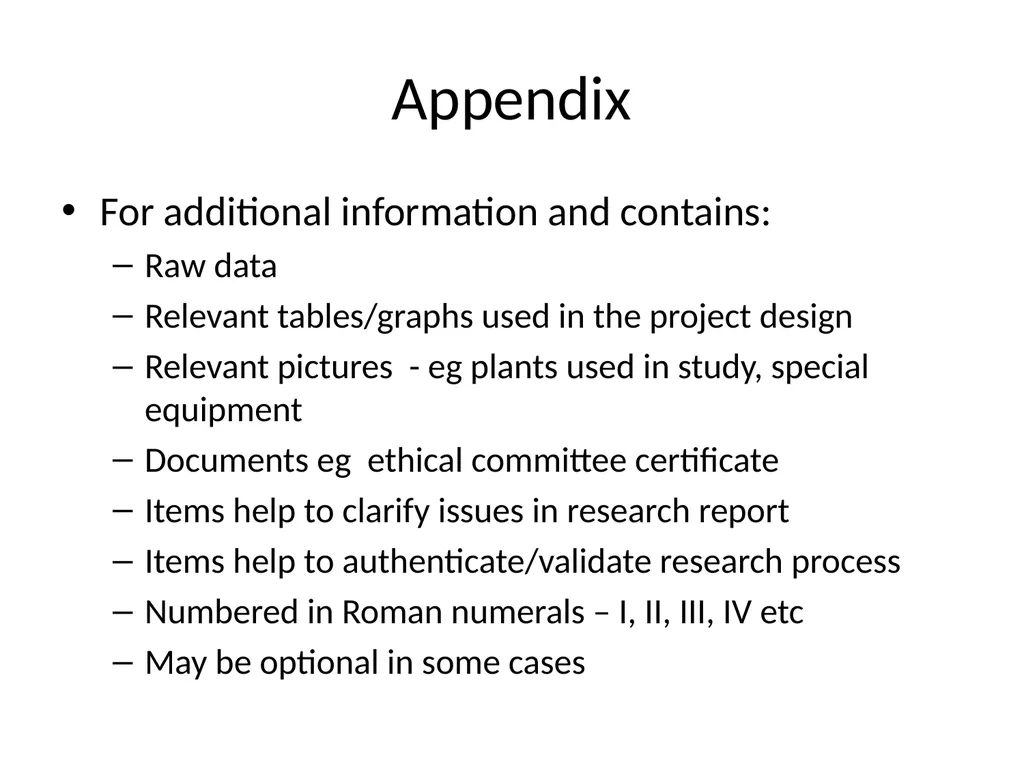
Appendix For additional information and contains:
Raw data
Relevant tables/graphs used in the project design
Relevant pictures - eg plants used in study, special equipment
Documents eg ethical committee certificate
Items help to clarify issues in research report
Items help to authenticate/validate research process
Numbered in Roman numerals – I, II, III, IV etc
May be optional in some cases<br>
Raw data
Relevant tables/graphs used in the project design
Relevant pictures - eg plants used in study, special equipment
Documents eg ethical committee certificate
Items help to clarify issues in research report
Items help to authenticate/validate research process
Numbered in Roman numerals – I, II, III, IV etc
May be optional in some cases<br>
59
Dissemination Research report is written for:
Presentation/examination
Publication in peer-reviewed journals<br>
Presentation/examination
Publication in peer-reviewed journals<br>
60
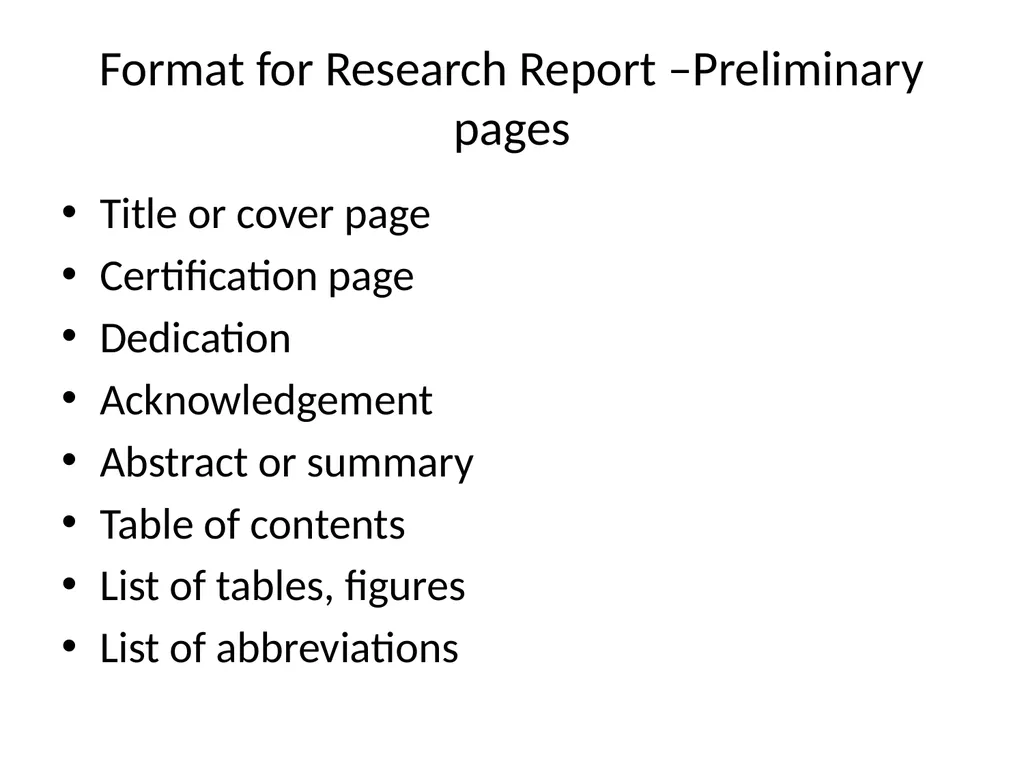
Format for Research Report –Preliminary pages Title or cover page
Certification page
Dedication
Acknowledgement
Abstract or summary
Table of contents
List of tables, figures
List of abbreviations<br>
Certification page
Dedication
Acknowledgement
Abstract or summary
Table of contents
List of tables, figures
List of abbreviations<br>
61
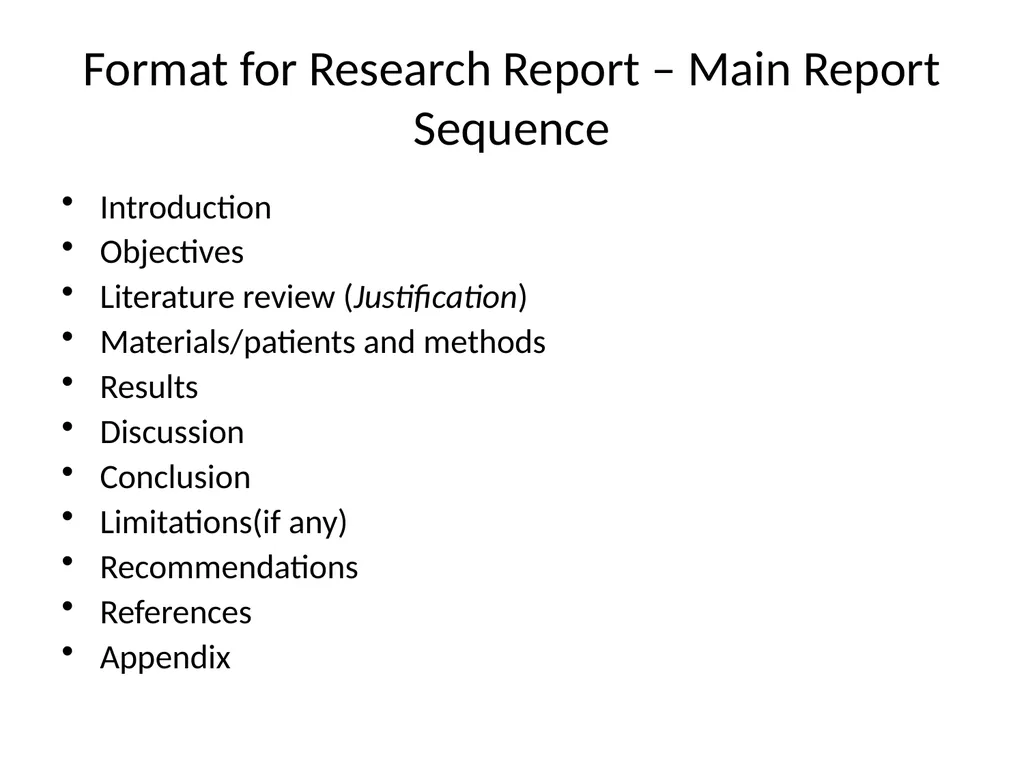
Format for Research Report – Main Report Sequence Introduction
Objectives
Literature review (Justification)
Materials/patients and methods
Results
Discussion
Conclusion
Limitations(if any)
Recommendations
References
Appendix<br>
Objectives
Literature review (Justification)
Materials/patients and methods
Results
Discussion
Conclusion
Limitations(if any)
Recommendations
References
Appendix<br>
62
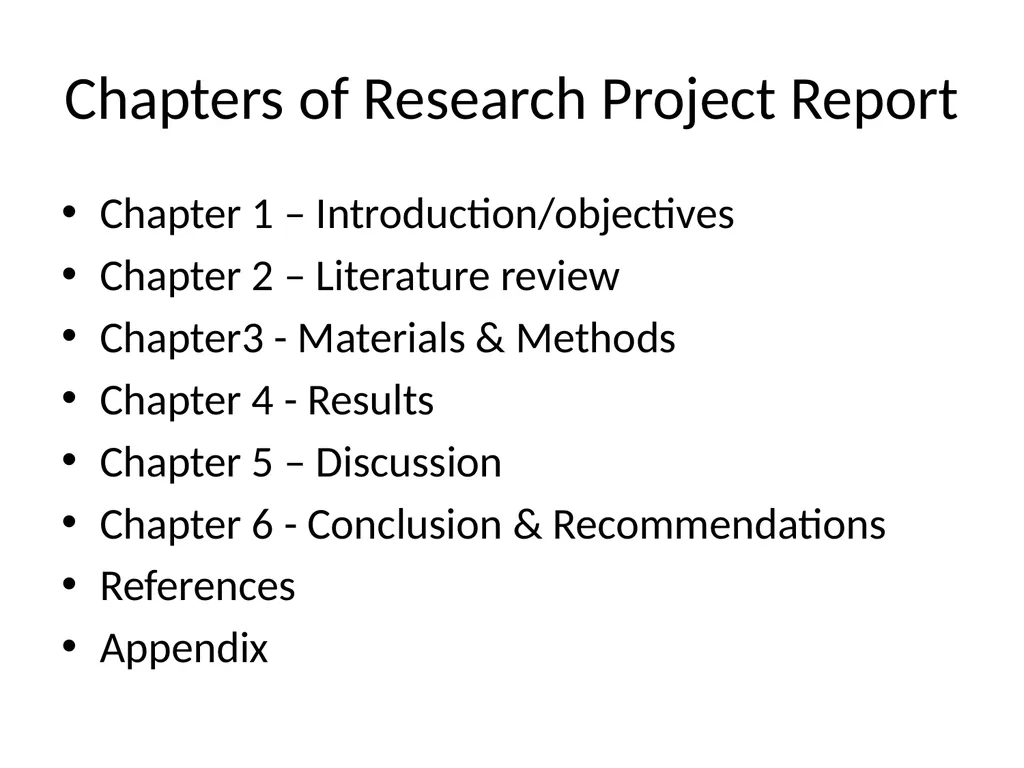
Chapters of Research Project Report Chapter 1 – Introduction/objectives
Chapter 2 – Literature review
Chapter3 - Materials & Methods
Chapter 4 - Results
Chapter 5 – Discussion
Chapter 6 - Conclusion & Recommendations
References
Appendix<br>
Chapter 2 – Literature review
Chapter3 - Materials & Methods
Chapter 4 - Results
Chapter 5 – Discussion
Chapter 6 - Conclusion & Recommendations
References
Appendix<br>
63
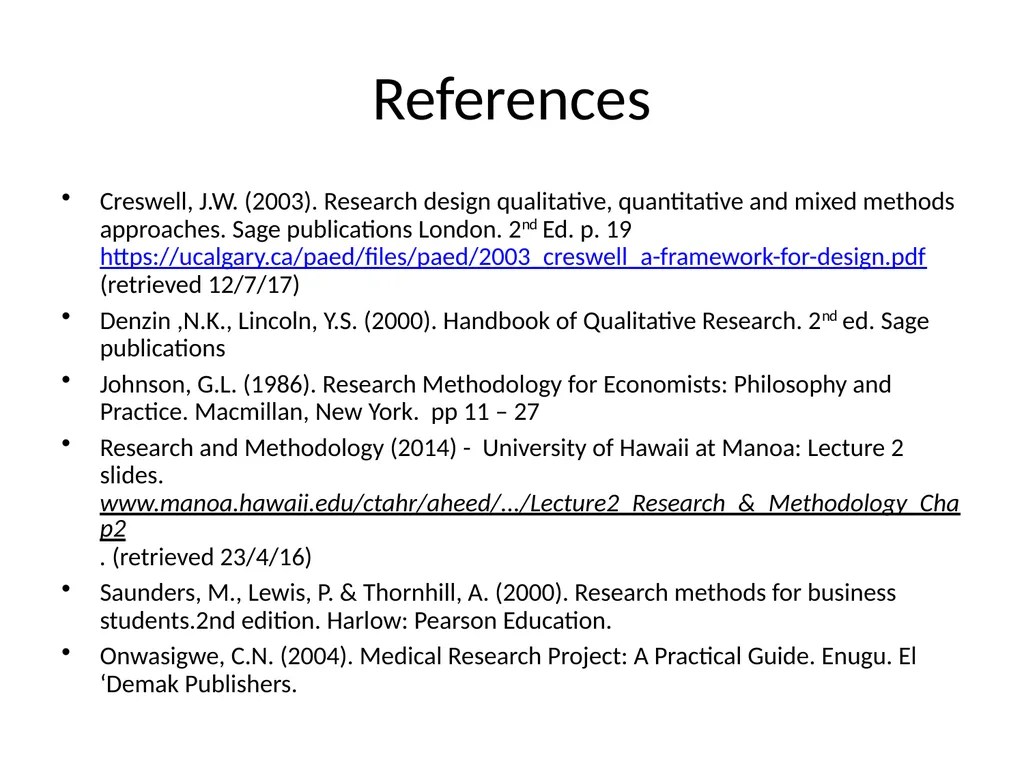
References Creswell, J.W. (2003). Research design qualitative, quantitative and mixed methods approaches. Sage publications London. 2nd Ed. p. 19 https://ucalgary.ca/paed/files/paed/2003_creswell_a-framework-for-design.pdf (retrieved 12/7/17)
Denzin ,N.K., Lincoln, Y.S. (2000). Handbook of Qualitative Research. 2nd ed. Sage publications
Johnson, G.L. (1986). Research Methodology for Economists: Philosophy and Practice. Macmillan, New York. pp 11 – 27
Research and Methodology (2014) - University of Hawaii at Manoa: Lecture 2 slides. www.manoa.hawaii.edu/ctahr/aheed/.../Lecture2_Research_&_Methodology_Chap2. (retrieved 23/4/16)
Saunders, M., Lewis, P. & Thornhill, A. (2000). Research methods for business students.2nd edition. Harlow: Pearson Education.
Onwasigwe, C.N. (2004). Medical Research Project: A Practical Guide. Enugu. El ‘Demak Publishers.<br>
Denzin ,N.K., Lincoln, Y.S. (2000). Handbook of Qualitative Research. 2nd ed. Sage publications
Johnson, G.L. (1986). Research Methodology for Economists: Philosophy and Practice. Macmillan, New York. pp 11 – 27
Research and Methodology (2014) - University of Hawaii at Manoa: Lecture 2 slides. www.manoa.hawaii.edu/ctahr/aheed/.../Lecture2_Research_&_Methodology_Chap2. (retrieved 23/4/16)
Saunders, M., Lewis, P. & Thornhill, A. (2000). Research methods for business students.2nd edition. Harlow: Pearson Education.
Onwasigwe, C.N. (2004). Medical Research Project: A Practical Guide. Enugu. El ‘Demak Publishers.<br>
64
Thank You<br>