
Course-VIII-(A) (1.2.8A) KNOWLEDGE AND

Description: Course-VIII-(A) (1.2.8A) KNOWLEDGE AND CURRICULUM-Part-I (12) Unit III : Sociological bases of education: POVERTY Dr. JAYASHRI ROY Asst Prof. of Geography in Vidyasagar Teachers Training College, Midnapur, Paschim Medinipur, WB
Related Topics
Download Presentation
"Course-VIII-(A) (1.2.8A) KNOWLEDGE AND" is the property of its rightful owner. Permission is granted to download and print the materials on this website for personal, non-commercial use only, and to display it on your personal computer provided you do not modify the materials and that you retain all copyright notices contained in the materials. By downloading content from our website, you accept the terms of this agreement.
Presentation Transcript
slide1. Course-VIII-(A) (1.2.8A)
KNOWLEDGE AND CURRICULUM-Part-I (1/2)
Unit III : Sociological bases of education: POVERTY Dr. JAYASHRI ROY
Asst Prof. of Geography in Vidyasagar Teachers’ Training College, Midnapur, Paschim Medinipur, WB<br>
slide2. INTRODUCTION Poverty is not new word to Indian ears. The problem of poverty and education is considered as the biggest challenge to development planning in India. High poverty levels are synonymous with poor quality of life, deprivation, malnutrition, illiteracy and low human resource development. The problem of poverty has continued to remain the central challenge of development at the global level. Poverty is a state of an individual, a family or a society where people are unable to fulfill even their basic necessities of life. When a substantial segment of a society is deprived of the minimum level of living and continues at a bare subsistence level, that society is said to be plagued with mass poverty. Poverty is a stark reality in India, and therefore poverty reduction was always given a top priority by the Government right from the beginning of the plan period. The Present topic is related with Poverty. It elaborates the concept of Poverty. This topic also focuses on various Programmes on Poverty Alleviation.<br>
slide3. What is poverty ? .
AMARTY SEN: “Poverty as consisting of a deprivation of a capabilities”, So that the poor have inadequate resources (financial, information, and so on) to participate fully in society in short, they are socially excluded.<br>
slide4. What does poverty mean ? Poverty is hunger
Poverty is lack of shelter
Poverty is being sick and not able to see a doctor
Poverty is not having access to school and know how to read
Poverty is powerlessness, lack of representation and freedom
Lack of basic transportation
Lack of good health and medical infrastructure<br>
slide5. CONCEPT OF POVERTY: The Concept of poverty is multi-dimensional (viz. income poverty and nonincome poverty). It covers not only the levels of income and consumption, but also health and education, vulnerability and risk, and marginalization and exclusion of the poor from the mainstream of the poverty. To quote Prof. Chelliah, "There has been much debate about how exactly poverty should be defined. In popular understanding, poverty is identified with lowness of income, which prevents a family from obtaining and enjoying the basic necessities of life, including a minimum of food, clothing, and shelter water. This concept is defined as income poverty”. For a comprehensive picture of poverty those other deprivations, such as in relation to health, education, sanitation and insurance against mishaps, must be taken into account. Poverty is a relative concept. No individual or country is absolutely poor or rich. A man is poor or rich in comparison to the others. As Adam smith says, “Man is poor or rich according to the degree in which he can afford to enjoy the necessaries, conveniences and amusements of life.” The form of these minimum necessities however changes, with variation in place and time. There is no uniform standard to define poverty throughout the world. There are two types of poverty such as Absolute poverty and Relative Poverty.<br>
slide6. . ABSOLUTE POVERTY: An absolute poverty line is fixed in terms of the standard indicator being used and fixed over the entire domain of the poverty comparison. An absolute poverty line is essential if one is trying to judge the effect of anti-poverty policies over time or to estimate impact of a project (for example, microcredit) on poverty. In the absolute standard minimum physical quantities of serials, pules, milk, butter etc. are determined for a substance level and then the price quotation convert into monetary terms the physical quantities.
RELATIVE POVERTY Relative Poverty views poverty as socially defined and dependent on social context, hence relative poverty is a measure of income inequality. Usually, relative poverty is measured as the percentage of population with income less than some fixed proportion of median income. According to the relative standard, income distribution of the population in different fractile groups is estimated and a comparison of the levels of living of the top 5 to10 percent with the bottom 5 to10 percent of the population reflects the relative standards of poverty. The defect of the latter approach is that it indicates the relative position of different segments of the population in the income hierarchy. Even in affluent societies, such pockets of poverty exist. But for underdeveloped countries, it is the existence of mass poverty that is the cause for concern.<br>
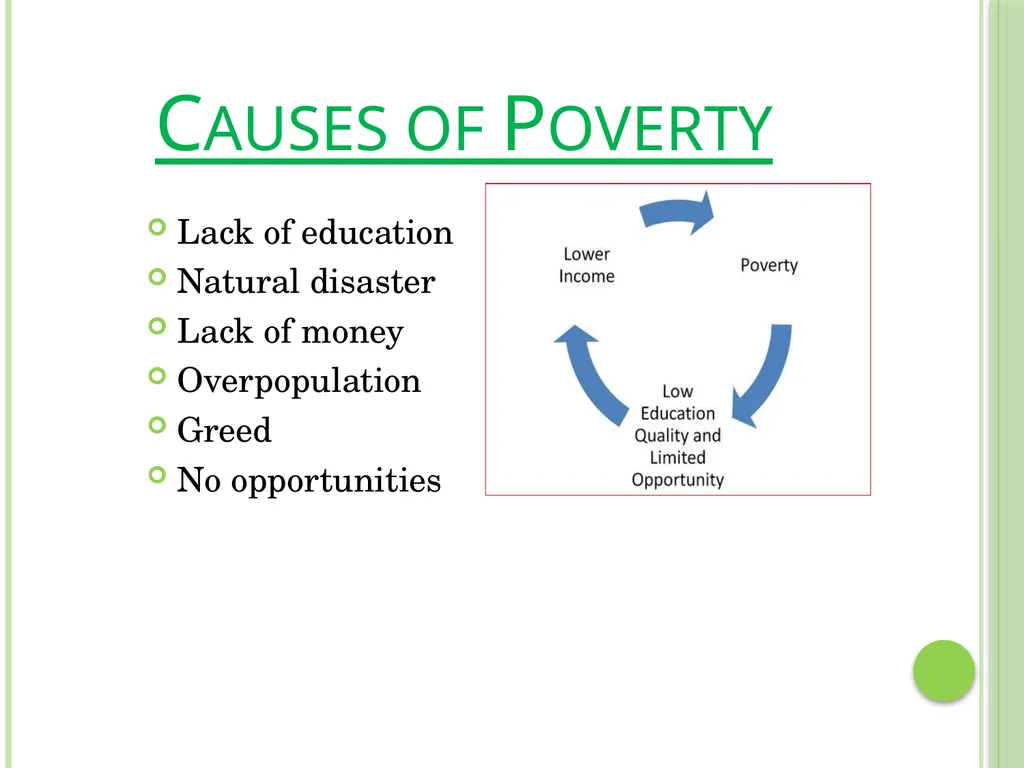
slide7. Causes of Poverty Lack of education
Natural disaster
Lack of money
Overpopulation
Greed
No opportunities<br>
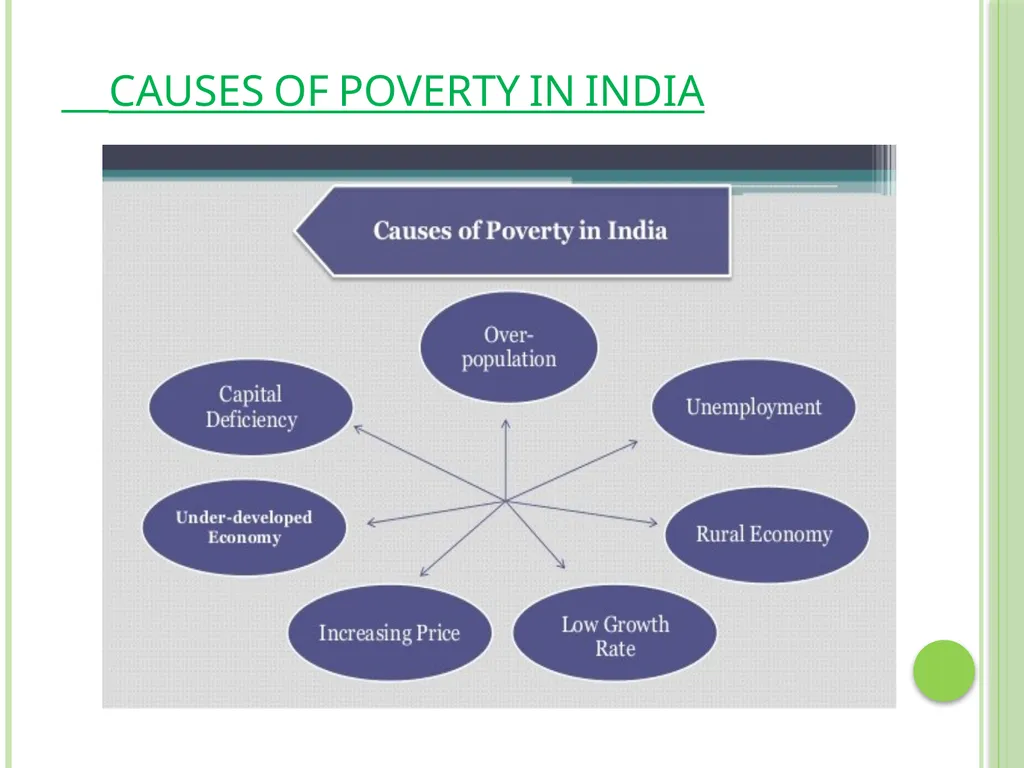
slide8. CAUSES OF POVERTY IN INDIA<br>
slide9. CAUSES OF POVERTY Heavy pressure of population: Population has been rising in India at a rapid speed. This rise is mainly due to fall in death and more birth rate.
Unemployment: Due to continuous rise in population ,there is chronic unemployment .Poverty is just the reflection of unemployment.
Capital Deficiency: Capital is needed for setting up industry ,transport, and other projects. Shortage of capital creates unemployment.
Under develop Economy: The Indian Economy is under developed due to low rate of growth. It is the main cause of poverty.
Education and illiteracy – Education, rather its lack thereof and poverty form a vicious cycle that plagues the nation. Not having enough resources to feed their children, the poor consider education to be frivolous, preferring children to start contributing to the family’s income rather than draining them. On the other hand, lack of education and illiteracy prevent individuals from getting better paying jobs and they get stuck at jobs offering minimum wages. Improvement of quality of life gets hindered and the cycle once again comes into action.<br>
slide10. CAUSES OF POVERTY Rural Economy : Indian economy is rural economy. Indian agriculture is backward, and income in agriculture is very low
Lack of proper Industrialization: Industrially ,India is a backward country. 3% of total population is engaged in Industry. So industrial backwardness is major cause of poverty.
Increase in Price: The steep rise in prices has affected the poor badly. They have become more and more .
Overpopulation: Overpopulation, the situation of having large numbers of people with too few resources in the world economy
Inadequate education and employment: Illiteracy and lack of education are common in poor countries. Government of developing countries often cannot afford to provide for good public schools, especially in rural areas.
Poor Agricultural Infrastructure –Agriculture is the backbone of Indian economy. But outdated farming practices, lack of proper irrigation infrastructure and even lack of formal knowledge of crop handling has affected the productivity in this sector tremendously. As a consequence there is redundancy and sometimes complete lack of work leading to decreased wages that is insufficient for meeting daily needs of a labourer’s family plunging them into poverty.<br>
slide11. REMEDIAL MEASURES OF POVERTY Economic Development
Population Control
Development Of Education
Education of Girls
Gender Equality
Development of Agriculture:
Stability in Price Level:<br>
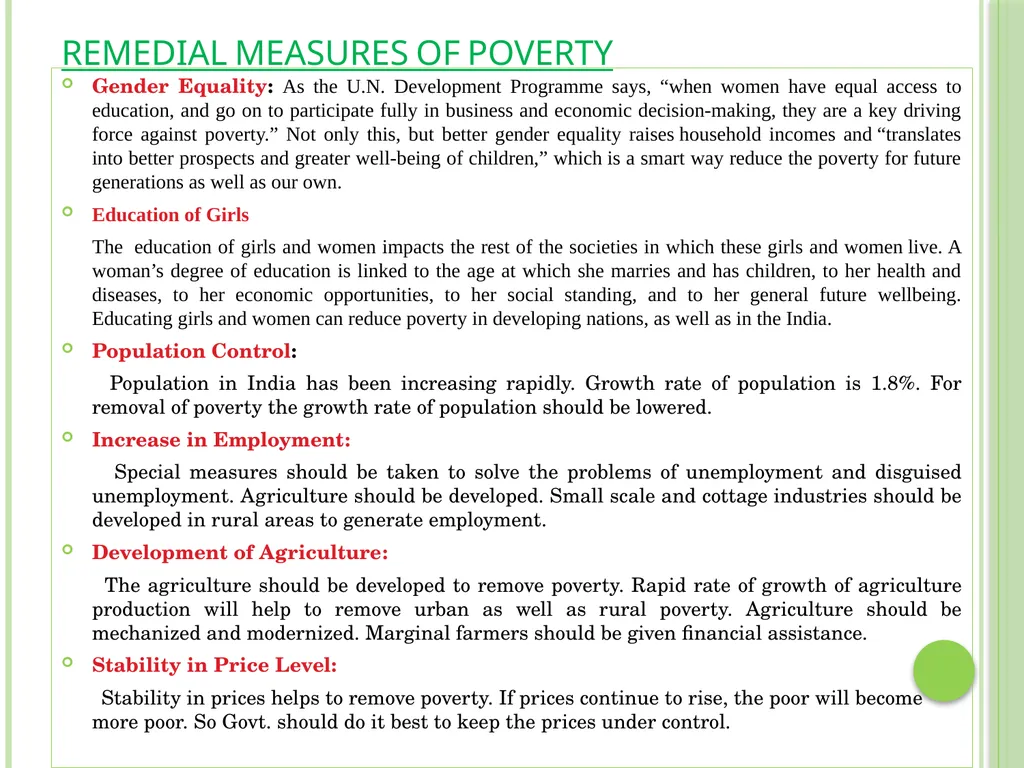
slide12. REMEDIAL MEASURES OF POVERTY Gender Equality: As the U.N. Development Programme says, “when women have equal access to education, and go on to participate fully in business and economic decision-making, they are a key driving force against poverty.” Not only this, but better gender equality raises household incomes and “translates into better prospects and greater well-being of children,” which is a smart way reduce the poverty for future generations as well as our own.
Education of Girls
The education of girls and women impacts the rest of the societies in which these girls and women live. A woman’s degree of education is linked to the age at which she marries and has children, to her health and diseases, to her economic opportunities, to her social standing, and to her general future wellbeing. Educating girls and women can reduce poverty in developing nations, as well as in the India.
Population Control:
Population in India has been increasing rapidly. Growth rate of population is 1.8%. For removal of poverty the growth rate of population should be lowered.
Increase in Employment:
Special measures should be taken to solve the problems of unemployment and disguised unemployment. Agriculture should be developed. Small scale and cottage industries should be developed in rural areas to generate employment.
Development of Agriculture:
The agriculture should be developed to remove poverty. Rapid rate of growth of agriculture production will help to remove urban as well as rural poverty. Agriculture should be mechanized and modernized. Marginal farmers should be given financial assistance.
Stability in Price Level:
Stability in prices helps to remove poverty. If prices continue to rise, the poor will become more poor. So Govt. should do it best to keep the prices under control.<br>
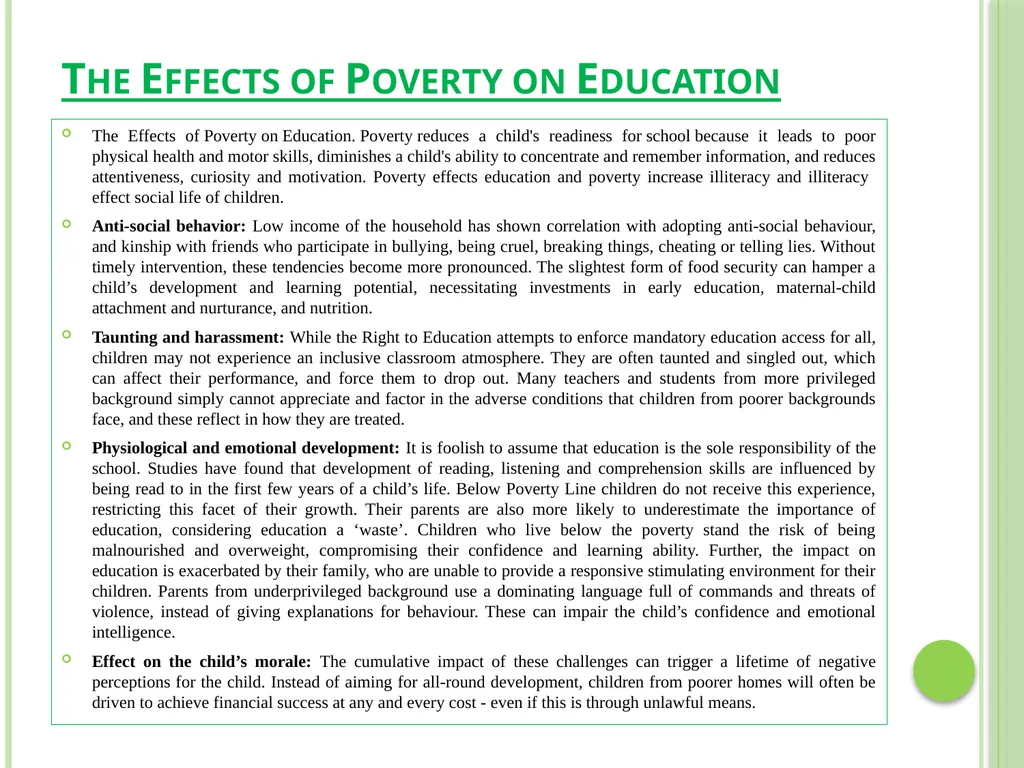
slide13. The Effects of Poverty on Education The Effects of Poverty on Education. Poverty reduces a child's readiness for school because it leads to poor physical health and motor skills, diminishes a child's ability to concentrate and remember information, and reduces attentiveness, curiosity and motivation. Poverty effects education and poverty increase illiteracy and illiteracy effect social life of children.
Anti-social behavior: Low income of the household has shown correlation with adopting anti-social behaviour, and kinship with friends who participate in bullying, being cruel, breaking things, cheating or telling lies. Without timely intervention, these tendencies become more pronounced. The slightest form of food security can hamper a child’s development and learning potential, necessitating investments in early education, maternal-child attachment and nurturance, and nutrition.
Taunting and harassment: While the Right to Education attempts to enforce mandatory education access for all, children may not experience an inclusive classroom atmosphere. They are often taunted and singled out, which can affect their performance, and force them to drop out. Many teachers and students from more privileged background simply cannot appreciate and factor in the adverse conditions that children from poorer backgrounds face, and these reflect in how they are treated.
Physiological and emotional development: It is foolish to assume that education is the sole responsibility of the school. Studies have found that development of reading, listening and comprehension skills are influenced by being read to in the first few years of a child’s life. Below Poverty Line children do not receive this experience, restricting this facet of their growth. Their parents are also more likely to underestimate the importance of education, considering education a ‘waste’. Children who live below the poverty stand the risk of being malnourished and overweight, compromising their confidence and learning ability. Further, the impact on education is exacerbated by their family, who are unable to provide a responsive stimulating environment for their children. Parents from underprivileged background use a dominating language full of commands and threats of violence, instead of giving explanations for behaviour. These can impair the child’s confidence and emotional intelligence.
Effect on the child’s morale: The cumulative impact of these challenges can trigger a lifetime of negative perceptions for the child. Instead of aiming for all-round development, children from poorer homes will often be driven to achieve financial success at any and every cost - even if this is through unlawful means.<br>
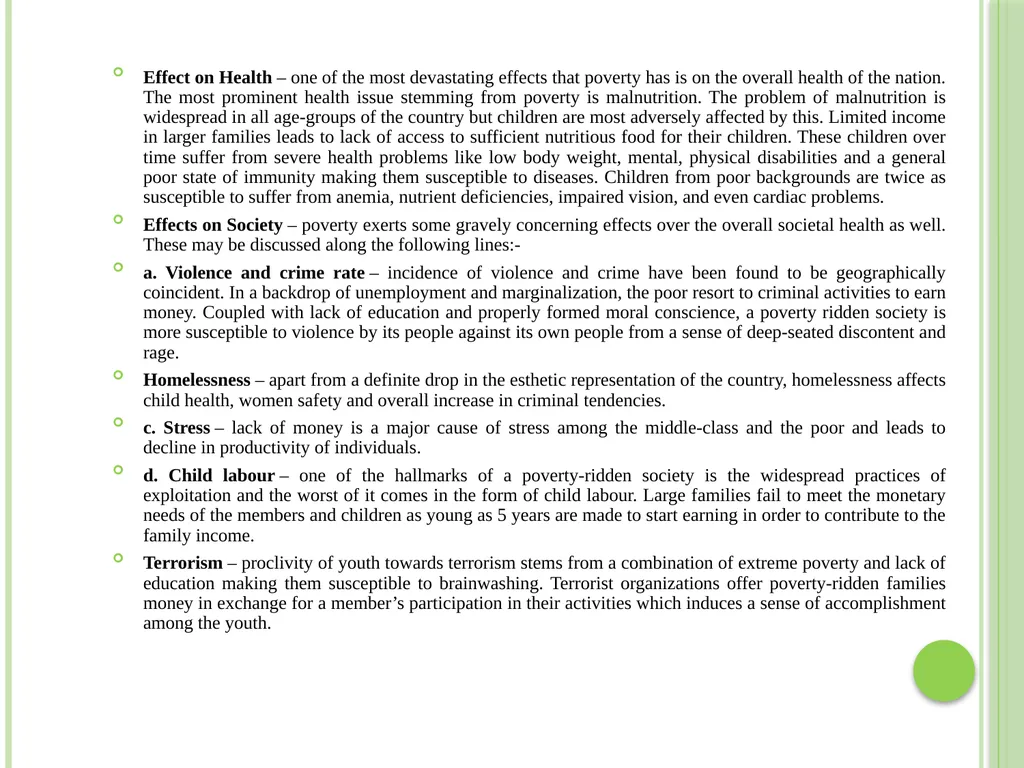
slide14. Effect on Health – one of the most devastating effects that poverty has is on the overall health of the nation. The most prominent health issue stemming from poverty is malnutrition. The problem of malnutrition is widespread in all age-groups of the country but children are most adversely affected by this. Limited income in larger families leads to lack of access to sufficient nutritious food for their children. These children over time suffer from severe health problems like low body weight, mental, physical disabilities and a general poor state of immunity making them susceptible to diseases. Children from poor backgrounds are twice as susceptible to suffer from anemia, nutrient deficiencies, impaired vision, and even cardiac problems.
Effects on Society – poverty exerts some gravely concerning effects over the overall societal health as well. These may be discussed along the following lines:-
a. Violence and crime rate – incidence of violence and crime have been found to be geographically coincident. In a backdrop of unemployment and marginalization, the poor resort to criminal activities to earn money. Coupled with lack of education and properly formed moral conscience, a poverty ridden society is more susceptible to violence by its people against its own people from a sense of deep-seated discontent and rage.
Homelessness – apart from a definite drop in the esthetic representation of the country, homelessness affects child health, women safety and overall increase in criminal tendencies.
c. Stress – lack of money is a major cause of stress among the middle-class and the poor and leads to decline in productivity of individuals.
d. Child labour – one of the hallmarks of a poverty-ridden society is the widespread practices of exploitation and the worst of it comes in the form of child labour. Large families fail to meet the monetary needs of the members and children as young as 5 years are made to start earning in order to contribute to the family income.
Terrorism – proclivity of youth towards terrorism stems from a combination of extreme poverty and lack of education making them susceptible to brainwashing. Terrorist organizations offer poverty-ridden families money in exchange for a member’s participation in their activities which induces a sense of accomplishment among the youth.<br>
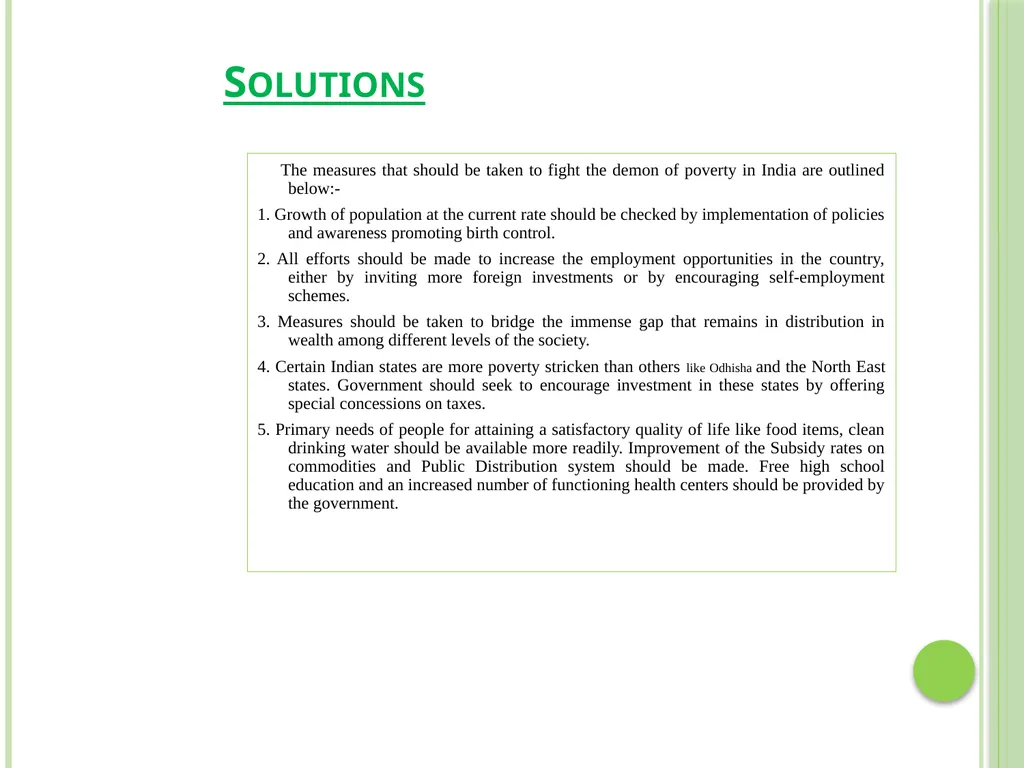
slide15. Solutions The measures that should be taken to fight the demon of poverty in India are outlined below:-
1. Growth of population at the current rate should be checked by implementation of policies and awareness promoting birth control.
2. All efforts should be made to increase the employment opportunities in the country, either by inviting more foreign investments or by encouraging self-employment schemes.
3. Measures should be taken to bridge the immense gap that remains in distribution in wealth among different levels of the society.
4. Certain Indian states are more poverty stricken than others like Odhisha and the North East states. Government should seek to encourage investment in these states by offering special concessions on taxes.
5. Primary needs of people for attaining a satisfactory quality of life like food items, clean drinking water should be available more readily. Improvement of the Subsidy rates on commodities and Public Distribution system should be made. Free high school education and an increased number of functioning health centers should be provided by the government.<br>
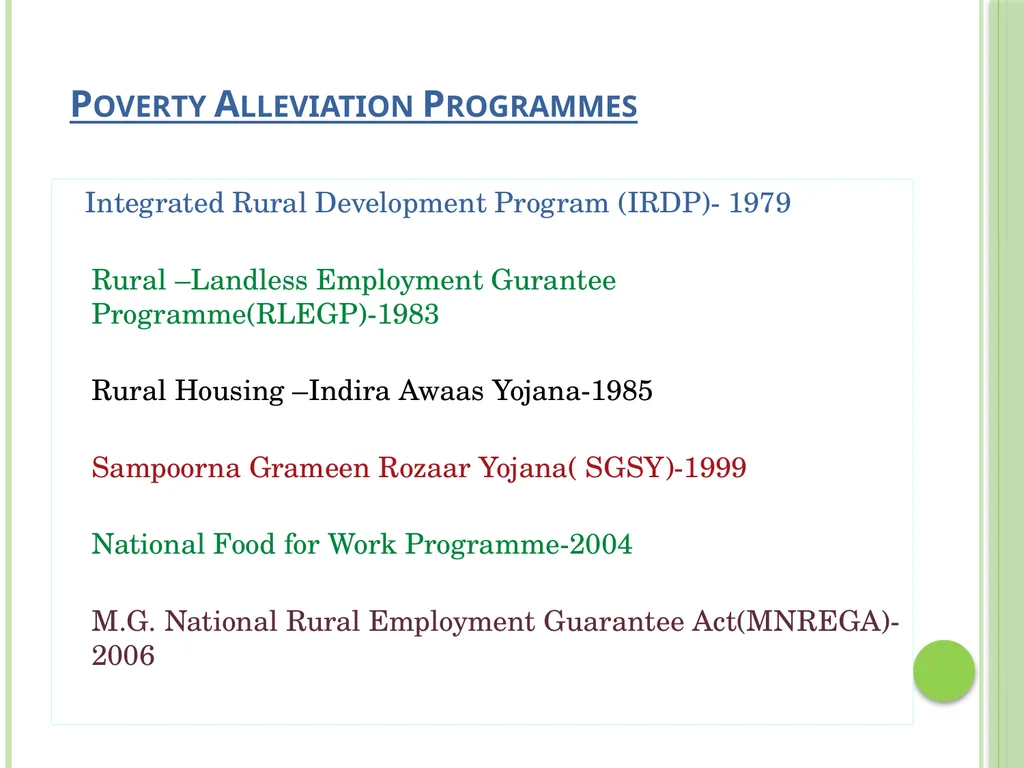
slide16. Poverty Alleviation Programmes Integrated Rural Development Program (IRDP)- 1979
Rural –Landless Employment Gurantee Programme(RLEGP)-1983
Rural Housing –Indira Awaas Yojana-1985
Sampoorna Grameen Rozaar Yojana( SGSY)-1999
National Food for Work Programme-2004
M.G. National Rural Employment Guarantee Act(MNREGA)- 2006<br>
slide17. CONCLUSION Poverty has always been a major constraint on the path of India’s development of education, which is a fact never to be ignored. The only way to fight with this deep and chronic poverty is to eliminate it, though easier said than done. But the country has been witnessing constant growth in poverty reduction scenario post 2011 era with several financial and social inclusion policies being designed and dedicated towards serving this purpose leading to upliftment of the poor section of the society. Innovative poverty alleviation programmes and effective implementation of existing programmes are the needs of the hour. Challenges are still enormous. All we need at this hour is wholehearted efforts and commitment to achieve The development of child education growth in which the people from under-privileged sections will be having equal share. The country should be vouching for a better standard of living and an all inclusive society for one and all.<br>
slide18. REFERENCES Ahluwalia M.(1977), ‘Rural Poverty and Agricultural Performance in India’, Journal of Development Studies.
Eleventh Five Year Plan-Volume lll 2007-16 Planning Commission Gov. of India (2018) Oxford University Press, New Delhi.
Government of India, Economic Survey, 2008-2009
Halder .T (2018), Knowledge and Curriculum Course viii(A) (1.2.8A), Aheli publishers, Kolkata
Datt .R., (2008) Growth, Poverty and Equity, Deep & Deep Publications, New Delhi.
Report of Census, (2001,2011): Government of India.
Sen ,A. (1999) Poverty and Famines ‘Oxford University, Press New York.
World Bank (2009), Global Economic Prospects and the Developing Countries 2000.
http://www.preservarticles.com
http://en.wikipedia.org/wiki/poverty
http://en.wikipedia.org/wikipedia/poverty,causes
http://en.wikipedia.org/wiki/ ruralpoverty
www.planningcommission.com<br>
slide19. THANK YOU<br>
Asst Prof. of Geography in Vidyasagar Teachers’ Training College, Midnapur, Paschim Medinipur, WB<br>
slide2. INTRODUCTION Poverty is not new word to Indian ears. The problem of poverty and education is considered as the biggest challenge to development planning in India. High poverty levels are synonymous with poor quality of life, deprivation, malnutrition, illiteracy and low human resource development. The problem of poverty has continued to remain the central challenge of development at the global level. Poverty is a state of an individual, a family or a society where people are unable to fulfill even their basic necessities of life. When a substantial segment of a society is deprived of the minimum level of living and continues at a bare subsistence level, that society is said to be plagued with mass poverty. Poverty is a stark reality in India, and therefore poverty reduction was always given a top priority by the Government right from the beginning of the plan period. The Present topic is related with Poverty. It elaborates the concept of Poverty. This topic also focuses on various Programmes on Poverty Alleviation.<br>
slide3. What is poverty ? .
AMARTY SEN: “Poverty as consisting of a deprivation of a capabilities”, So that the poor have inadequate resources (financial, information, and so on) to participate fully in society in short, they are socially excluded.<br>
slide4. What does poverty mean ? Poverty is hunger
Poverty is lack of shelter
Poverty is being sick and not able to see a doctor
Poverty is not having access to school and know how to read
Poverty is powerlessness, lack of representation and freedom
Lack of basic transportation
Lack of good health and medical infrastructure<br>
slide5. CONCEPT OF POVERTY: The Concept of poverty is multi-dimensional (viz. income poverty and nonincome poverty). It covers not only the levels of income and consumption, but also health and education, vulnerability and risk, and marginalization and exclusion of the poor from the mainstream of the poverty. To quote Prof. Chelliah, "There has been much debate about how exactly poverty should be defined. In popular understanding, poverty is identified with lowness of income, which prevents a family from obtaining and enjoying the basic necessities of life, including a minimum of food, clothing, and shelter water. This concept is defined as income poverty”. For a comprehensive picture of poverty those other deprivations, such as in relation to health, education, sanitation and insurance against mishaps, must be taken into account. Poverty is a relative concept. No individual or country is absolutely poor or rich. A man is poor or rich in comparison to the others. As Adam smith says, “Man is poor or rich according to the degree in which he can afford to enjoy the necessaries, conveniences and amusements of life.” The form of these minimum necessities however changes, with variation in place and time. There is no uniform standard to define poverty throughout the world. There are two types of poverty such as Absolute poverty and Relative Poverty.<br>
slide6. . ABSOLUTE POVERTY: An absolute poverty line is fixed in terms of the standard indicator being used and fixed over the entire domain of the poverty comparison. An absolute poverty line is essential if one is trying to judge the effect of anti-poverty policies over time or to estimate impact of a project (for example, microcredit) on poverty. In the absolute standard minimum physical quantities of serials, pules, milk, butter etc. are determined for a substance level and then the price quotation convert into monetary terms the physical quantities.
RELATIVE POVERTY Relative Poverty views poverty as socially defined and dependent on social context, hence relative poverty is a measure of income inequality. Usually, relative poverty is measured as the percentage of population with income less than some fixed proportion of median income. According to the relative standard, income distribution of the population in different fractile groups is estimated and a comparison of the levels of living of the top 5 to10 percent with the bottom 5 to10 percent of the population reflects the relative standards of poverty. The defect of the latter approach is that it indicates the relative position of different segments of the population in the income hierarchy. Even in affluent societies, such pockets of poverty exist. But for underdeveloped countries, it is the existence of mass poverty that is the cause for concern.<br>
slide7. Causes of Poverty Lack of education
Natural disaster
Lack of money
Overpopulation
Greed
No opportunities<br>
slide8. CAUSES OF POVERTY IN INDIA<br>
slide9. CAUSES OF POVERTY Heavy pressure of population: Population has been rising in India at a rapid speed. This rise is mainly due to fall in death and more birth rate.
Unemployment: Due to continuous rise in population ,there is chronic unemployment .Poverty is just the reflection of unemployment.
Capital Deficiency: Capital is needed for setting up industry ,transport, and other projects. Shortage of capital creates unemployment.
Under develop Economy: The Indian Economy is under developed due to low rate of growth. It is the main cause of poverty.
Education and illiteracy – Education, rather its lack thereof and poverty form a vicious cycle that plagues the nation. Not having enough resources to feed their children, the poor consider education to be frivolous, preferring children to start contributing to the family’s income rather than draining them. On the other hand, lack of education and illiteracy prevent individuals from getting better paying jobs and they get stuck at jobs offering minimum wages. Improvement of quality of life gets hindered and the cycle once again comes into action.<br>
slide10. CAUSES OF POVERTY Rural Economy : Indian economy is rural economy. Indian agriculture is backward, and income in agriculture is very low
Lack of proper Industrialization: Industrially ,India is a backward country. 3% of total population is engaged in Industry. So industrial backwardness is major cause of poverty.
Increase in Price: The steep rise in prices has affected the poor badly. They have become more and more .
Overpopulation: Overpopulation, the situation of having large numbers of people with too few resources in the world economy
Inadequate education and employment: Illiteracy and lack of education are common in poor countries. Government of developing countries often cannot afford to provide for good public schools, especially in rural areas.
Poor Agricultural Infrastructure –Agriculture is the backbone of Indian economy. But outdated farming practices, lack of proper irrigation infrastructure and even lack of formal knowledge of crop handling has affected the productivity in this sector tremendously. As a consequence there is redundancy and sometimes complete lack of work leading to decreased wages that is insufficient for meeting daily needs of a labourer’s family plunging them into poverty.<br>
slide11. REMEDIAL MEASURES OF POVERTY Economic Development
Population Control
Development Of Education
Education of Girls
Gender Equality
Development of Agriculture:
Stability in Price Level:<br>
slide12. REMEDIAL MEASURES OF POVERTY Gender Equality: As the U.N. Development Programme says, “when women have equal access to education, and go on to participate fully in business and economic decision-making, they are a key driving force against poverty.” Not only this, but better gender equality raises household incomes and “translates into better prospects and greater well-being of children,” which is a smart way reduce the poverty for future generations as well as our own.
Education of Girls
The education of girls and women impacts the rest of the societies in which these girls and women live. A woman’s degree of education is linked to the age at which she marries and has children, to her health and diseases, to her economic opportunities, to her social standing, and to her general future wellbeing. Educating girls and women can reduce poverty in developing nations, as well as in the India.
Population Control:
Population in India has been increasing rapidly. Growth rate of population is 1.8%. For removal of poverty the growth rate of population should be lowered.
Increase in Employment:
Special measures should be taken to solve the problems of unemployment and disguised unemployment. Agriculture should be developed. Small scale and cottage industries should be developed in rural areas to generate employment.
Development of Agriculture:
The agriculture should be developed to remove poverty. Rapid rate of growth of agriculture production will help to remove urban as well as rural poverty. Agriculture should be mechanized and modernized. Marginal farmers should be given financial assistance.
Stability in Price Level:
Stability in prices helps to remove poverty. If prices continue to rise, the poor will become more poor. So Govt. should do it best to keep the prices under control.<br>
slide13. The Effects of Poverty on Education The Effects of Poverty on Education. Poverty reduces a child's readiness for school because it leads to poor physical health and motor skills, diminishes a child's ability to concentrate and remember information, and reduces attentiveness, curiosity and motivation. Poverty effects education and poverty increase illiteracy and illiteracy effect social life of children.
Anti-social behavior: Low income of the household has shown correlation with adopting anti-social behaviour, and kinship with friends who participate in bullying, being cruel, breaking things, cheating or telling lies. Without timely intervention, these tendencies become more pronounced. The slightest form of food security can hamper a child’s development and learning potential, necessitating investments in early education, maternal-child attachment and nurturance, and nutrition.
Taunting and harassment: While the Right to Education attempts to enforce mandatory education access for all, children may not experience an inclusive classroom atmosphere. They are often taunted and singled out, which can affect their performance, and force them to drop out. Many teachers and students from more privileged background simply cannot appreciate and factor in the adverse conditions that children from poorer backgrounds face, and these reflect in how they are treated.
Physiological and emotional development: It is foolish to assume that education is the sole responsibility of the school. Studies have found that development of reading, listening and comprehension skills are influenced by being read to in the first few years of a child’s life. Below Poverty Line children do not receive this experience, restricting this facet of their growth. Their parents are also more likely to underestimate the importance of education, considering education a ‘waste’. Children who live below the poverty stand the risk of being malnourished and overweight, compromising their confidence and learning ability. Further, the impact on education is exacerbated by their family, who are unable to provide a responsive stimulating environment for their children. Parents from underprivileged background use a dominating language full of commands and threats of violence, instead of giving explanations for behaviour. These can impair the child’s confidence and emotional intelligence.
Effect on the child’s morale: The cumulative impact of these challenges can trigger a lifetime of negative perceptions for the child. Instead of aiming for all-round development, children from poorer homes will often be driven to achieve financial success at any and every cost - even if this is through unlawful means.<br>
slide14. Effect on Health – one of the most devastating effects that poverty has is on the overall health of the nation. The most prominent health issue stemming from poverty is malnutrition. The problem of malnutrition is widespread in all age-groups of the country but children are most adversely affected by this. Limited income in larger families leads to lack of access to sufficient nutritious food for their children. These children over time suffer from severe health problems like low body weight, mental, physical disabilities and a general poor state of immunity making them susceptible to diseases. Children from poor backgrounds are twice as susceptible to suffer from anemia, nutrient deficiencies, impaired vision, and even cardiac problems.
Effects on Society – poverty exerts some gravely concerning effects over the overall societal health as well. These may be discussed along the following lines:-
a. Violence and crime rate – incidence of violence and crime have been found to be geographically coincident. In a backdrop of unemployment and marginalization, the poor resort to criminal activities to earn money. Coupled with lack of education and properly formed moral conscience, a poverty ridden society is more susceptible to violence by its people against its own people from a sense of deep-seated discontent and rage.
Homelessness – apart from a definite drop in the esthetic representation of the country, homelessness affects child health, women safety and overall increase in criminal tendencies.
c. Stress – lack of money is a major cause of stress among the middle-class and the poor and leads to decline in productivity of individuals.
d. Child labour – one of the hallmarks of a poverty-ridden society is the widespread practices of exploitation and the worst of it comes in the form of child labour. Large families fail to meet the monetary needs of the members and children as young as 5 years are made to start earning in order to contribute to the family income.
Terrorism – proclivity of youth towards terrorism stems from a combination of extreme poverty and lack of education making them susceptible to brainwashing. Terrorist organizations offer poverty-ridden families money in exchange for a member’s participation in their activities which induces a sense of accomplishment among the youth.<br>
slide15. Solutions The measures that should be taken to fight the demon of poverty in India are outlined below:-
1. Growth of population at the current rate should be checked by implementation of policies and awareness promoting birth control.
2. All efforts should be made to increase the employment opportunities in the country, either by inviting more foreign investments or by encouraging self-employment schemes.
3. Measures should be taken to bridge the immense gap that remains in distribution in wealth among different levels of the society.
4. Certain Indian states are more poverty stricken than others like Odhisha and the North East states. Government should seek to encourage investment in these states by offering special concessions on taxes.
5. Primary needs of people for attaining a satisfactory quality of life like food items, clean drinking water should be available more readily. Improvement of the Subsidy rates on commodities and Public Distribution system should be made. Free high school education and an increased number of functioning health centers should be provided by the government.<br>
slide16. Poverty Alleviation Programmes Integrated Rural Development Program (IRDP)- 1979
Rural –Landless Employment Gurantee Programme(RLEGP)-1983
Rural Housing –Indira Awaas Yojana-1985
Sampoorna Grameen Rozaar Yojana( SGSY)-1999
National Food for Work Programme-2004
M.G. National Rural Employment Guarantee Act(MNREGA)- 2006<br>
slide17. CONCLUSION Poverty has always been a major constraint on the path of India’s development of education, which is a fact never to be ignored. The only way to fight with this deep and chronic poverty is to eliminate it, though easier said than done. But the country has been witnessing constant growth in poverty reduction scenario post 2011 era with several financial and social inclusion policies being designed and dedicated towards serving this purpose leading to upliftment of the poor section of the society. Innovative poverty alleviation programmes and effective implementation of existing programmes are the needs of the hour. Challenges are still enormous. All we need at this hour is wholehearted efforts and commitment to achieve The development of child education growth in which the people from under-privileged sections will be having equal share. The country should be vouching for a better standard of living and an all inclusive society for one and all.<br>
slide18. REFERENCES Ahluwalia M.(1977), ‘Rural Poverty and Agricultural Performance in India’, Journal of Development Studies.
Eleventh Five Year Plan-Volume lll 2007-16 Planning Commission Gov. of India (2018) Oxford University Press, New Delhi.
Government of India, Economic Survey, 2008-2009
Halder .T (2018), Knowledge and Curriculum Course viii(A) (1.2.8A), Aheli publishers, Kolkata
Datt .R., (2008) Growth, Poverty and Equity, Deep & Deep Publications, New Delhi.
Report of Census, (2001,2011): Government of India.
Sen ,A. (1999) Poverty and Famines ‘Oxford University, Press New York.
World Bank (2009), Global Economic Prospects and the Developing Countries 2000.
http://www.preservarticles.com
http://en.wikipedia.org/wiki/poverty
http://en.wikipedia.org/wikipedia/poverty,causes
http://en.wikipedia.org/wiki/ ruralpoverty
www.planningcommission.com<br>
slide19. THANK YOU<br>