
Covalent Bonding …electrons are shared Episode 9 –
TG
Published · 76 slides · 0 views
1 / 1

Description
Covalent Bonding electrons are shared Episode 9 Molecular Architecture Episode 8 Chemical Bonds VIDEO ON DEMAND Elements bond to form compounds by giving, taking, or sharing electrons. The differences between ionic and covalent bonds
Related Topics
Download this presentation From Below
"Covalent Bonding …electrons are shared Episode 9 –" is the property of its rightful owner. Permission is granted to download and print the materials on this website for personal, non-commercial use only, and to display it on your personal computer provided you do not modify the materials and that you retain all copyright notices contained in the materials. By downloading content from our website, you accept the terms of this agreement.
Share
Embed code
Presentation Transcript
01
Covalent Bonding …electrons are shared<br>
02
Episode 9 – Molecular Architecture Episode 8 – Chemical Bonds VIDEO ON DEMAND Elements bond to form compounds by giving, taking, or sharing electrons. The differences between ionic and covalent bonds are
explained by the use of scientific models and examples from nature. World of Chemistry The Annenberg Film Series VIDEO ON DEMAND The shape and physical properties of a molecule are determined by the electronic structure of its elements and their bonds.
How living organisms distinguish between similar molecules (isomers) is revealed.<br>
explained by the use of scientific models and examples from nature. World of Chemistry The Annenberg Film Series VIDEO ON DEMAND The shape and physical properties of a molecule are determined by the electronic structure of its elements and their bonds.
How living organisms distinguish between similar molecules (isomers) is revealed.<br>
03
Guiding Questions? Why are some thing liquids at room temperature
and other things gases or solids?
How are shapes of molecules determined?
How do Splenda and other artificial sweeteners
work?
How do bees tell the difference between a worker
and the queen?
How do intermolecular forces affect the structure
of proteins and DNA?<br>
and other things gases or solids?
How are shapes of molecules determined?
How do Splenda and other artificial sweeteners
work?
How do bees tell the difference between a worker
and the queen?
How do intermolecular forces affect the structure
of proteins and DNA?<br>
04
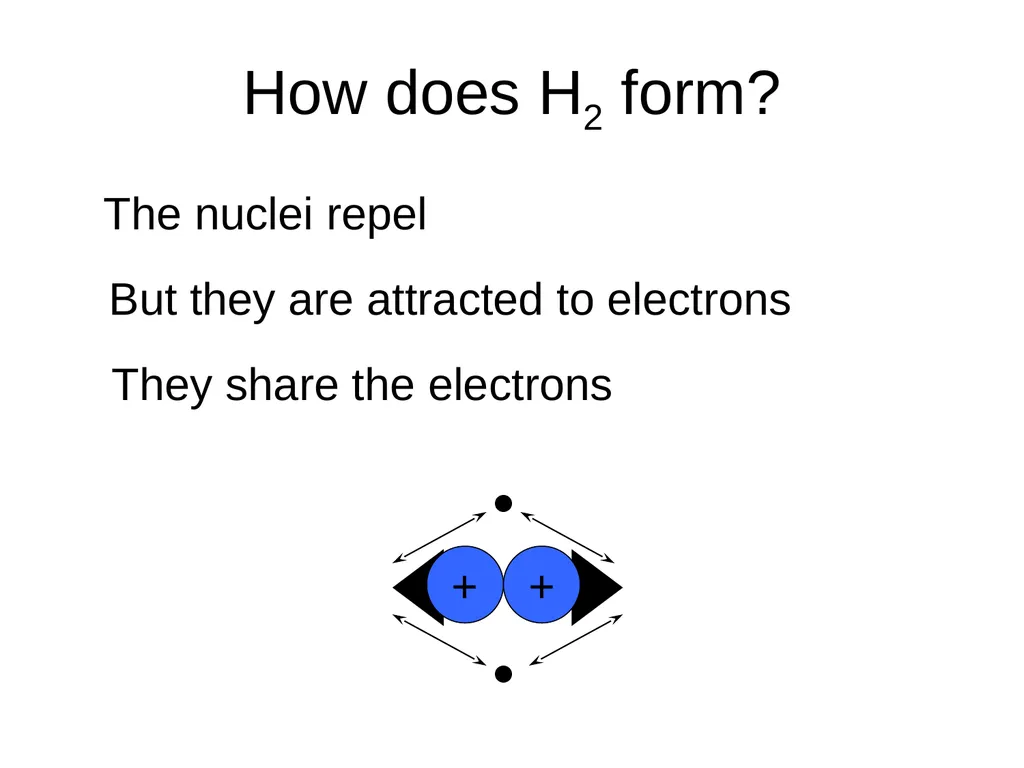
How does H2 form? + + The nuclei repel But they are attracted to electrons They share the electrons<br>
05
Covalent bonds Nonmetals hold onto their valence electrons.
They can’t give away electrons to bond.
Still want noble gas configuration.
Get it by sharing valence electrons with each other.
By sharing both atoms get to count the electrons toward noble gas configuration. 1s22s22p63s23p6…eight valence electrons (stable octet)<br>
They can’t give away electrons to bond.
Still want noble gas configuration.
Get it by sharing valence electrons with each other.
By sharing both atoms get to count the electrons toward noble gas configuration. 1s22s22p63s23p6…eight valence electrons (stable octet)<br>
06
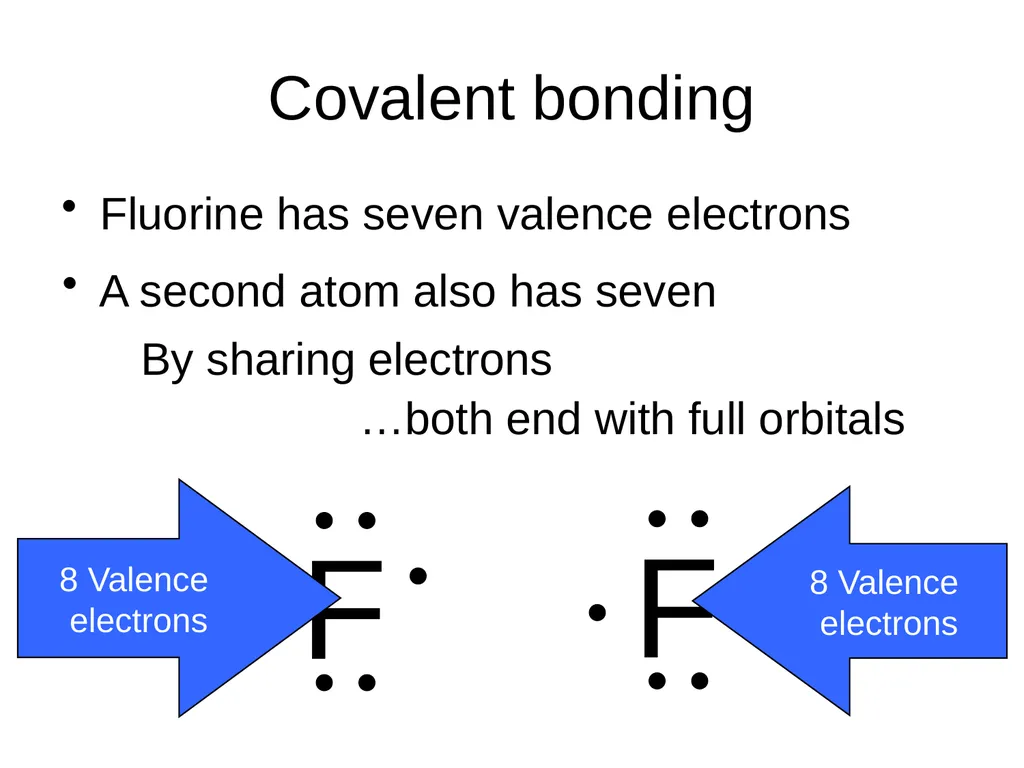
Covalent bonding Fluorine has seven valence electrons A second atom also has seven By sharing electrons …both end with full orbitals 8 Valence
electrons 8 Valence
electrons<br>
electrons 8 Valence
electrons<br>
07
Single Covalent Bond A sharing of two valence electrons.
Only nonmetals and Hydrogen.
Different from an ionic bond because they actually form molecules.
Two specific atoms are joined.
In an ionic solid you can’t tell which atom the electrons moved from or to.<br>
Only nonmetals and Hydrogen.
Different from an ionic bond because they actually form molecules.
Two specific atoms are joined.
In an ionic solid you can’t tell which atom the electrons moved from or to.<br>
08
How to show how they formed It’s like a jigsaw puzzle.
I have to tell you what the final formula is.
You put the pieces together to end up with the right formula.
For example- show how water is formed with covalent bonds.<br>
I have to tell you what the final formula is.
You put the pieces together to end up with the right formula.
For example- show how water is formed with covalent bonds.<br>
09
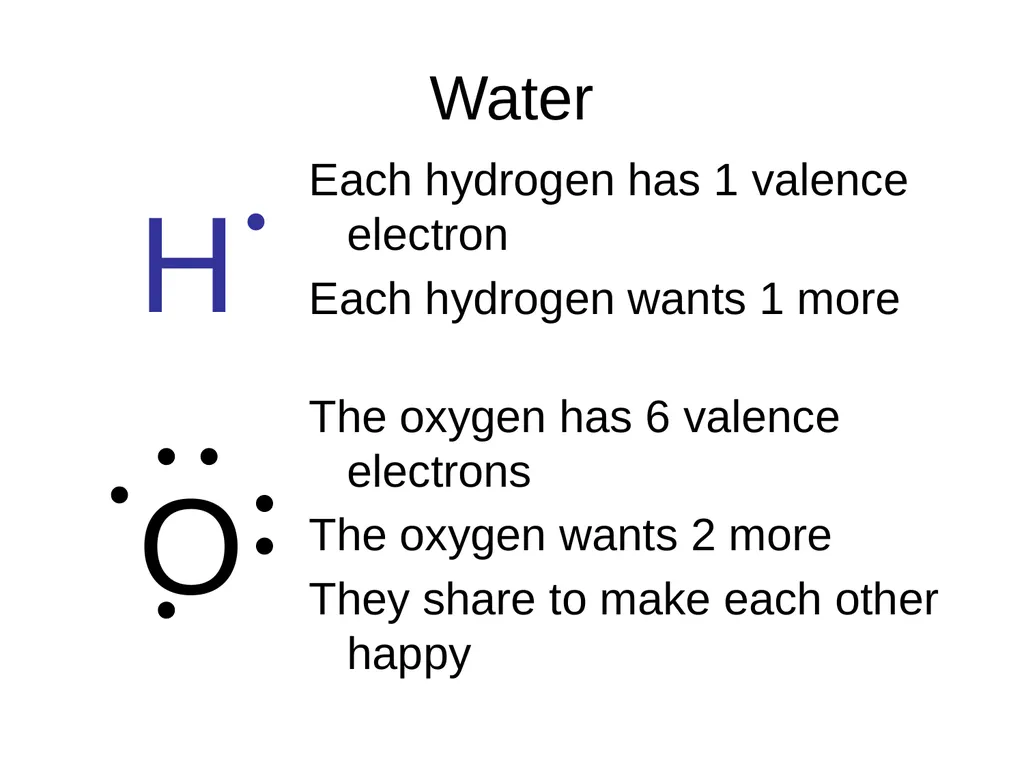
Water Each hydrogen has 1 valence electron
Each hydrogen wants 1 more
The oxygen has 6 valence electrons
The oxygen wants 2 more
They share to make each other happy<br>
Each hydrogen wants 1 more
The oxygen has 6 valence electrons
The oxygen wants 2 more
They share to make each other happy<br>
10
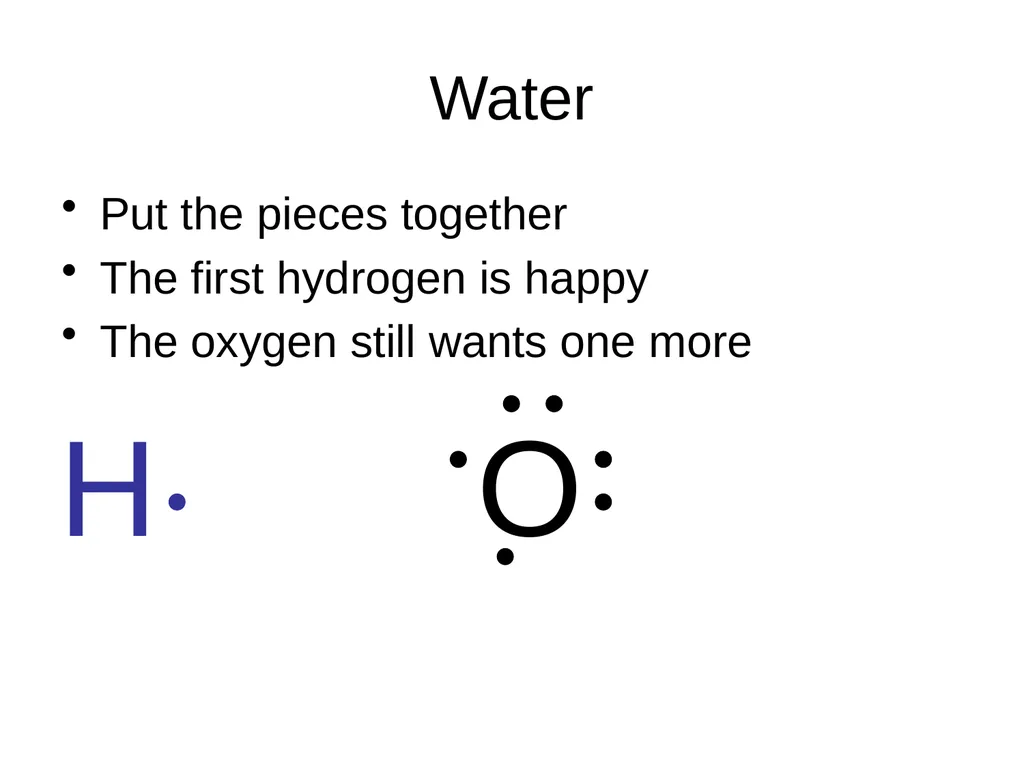
Water Put the pieces together
The first hydrogen is happy
The oxygen still wants one more<br>
The first hydrogen is happy
The oxygen still wants one more<br>
11
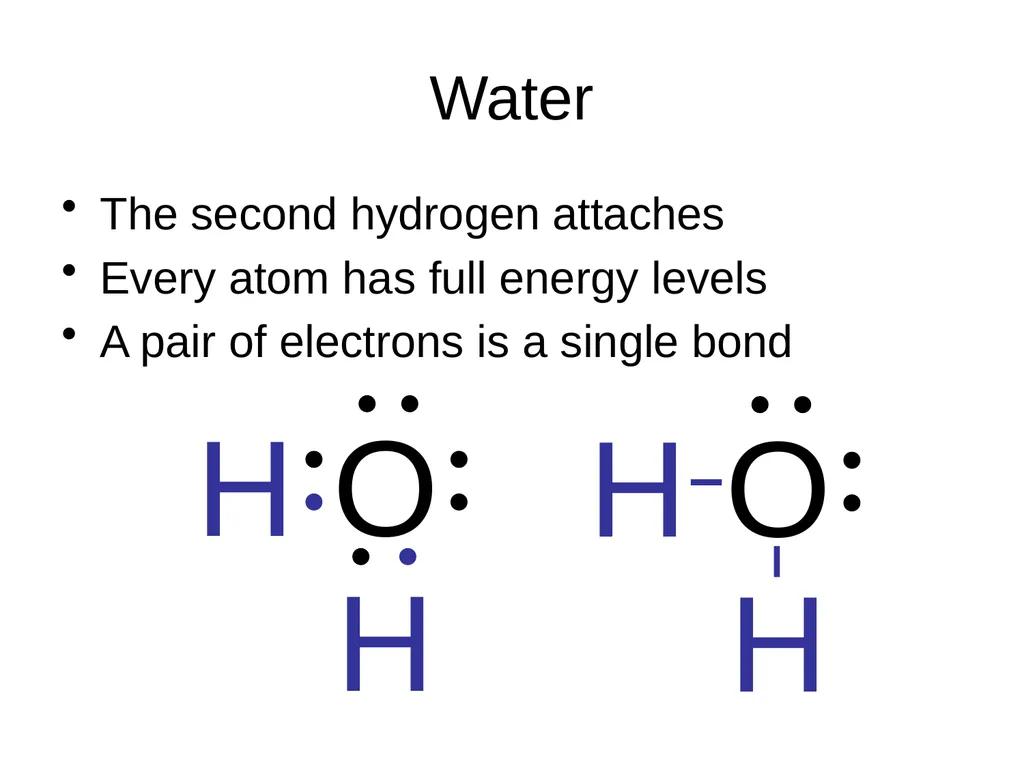
Water The second hydrogen attaches
Every atom has full energy levels
A pair of electrons is a single bond<br>
Every atom has full energy levels
A pair of electrons is a single bond<br>
12
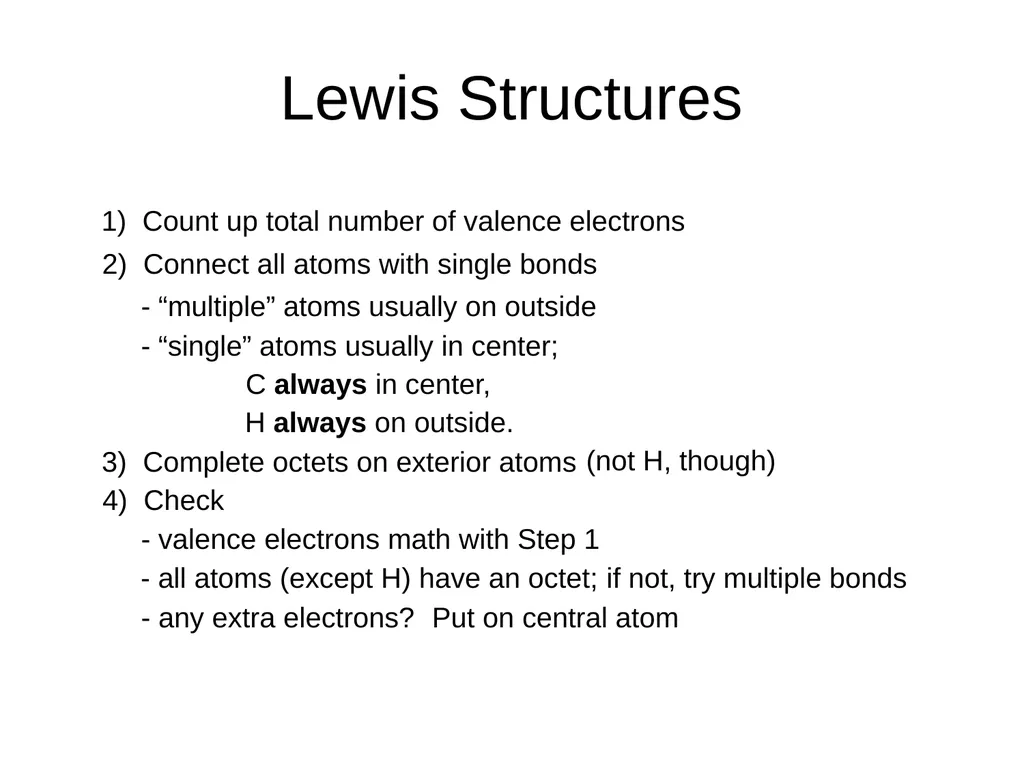
Lewis Structures 1) Count up total number of valence electrons 2) Connect all atoms with single bonds - “multiple” atoms usually on outside - “single” atoms usually in center; C always in center, H always on outside. 3) Complete octets on exterior atoms (not H, though) 4) Check - valence electrons math with Step 1 - all atoms (except H) have an octet; if not, try multiple bonds - any extra electrons? Put on central atom<br>
13
Multiple Bonds Sometimes atoms share more than one pair of valence electrons.
A double bond is when atoms share two pair (4) of electrons.
A triple bond is when atoms share three pair (6) of electrons.<br>
A double bond is when atoms share two pair (4) of electrons.
A triple bond is when atoms share three pair (6) of electrons.<br>
14
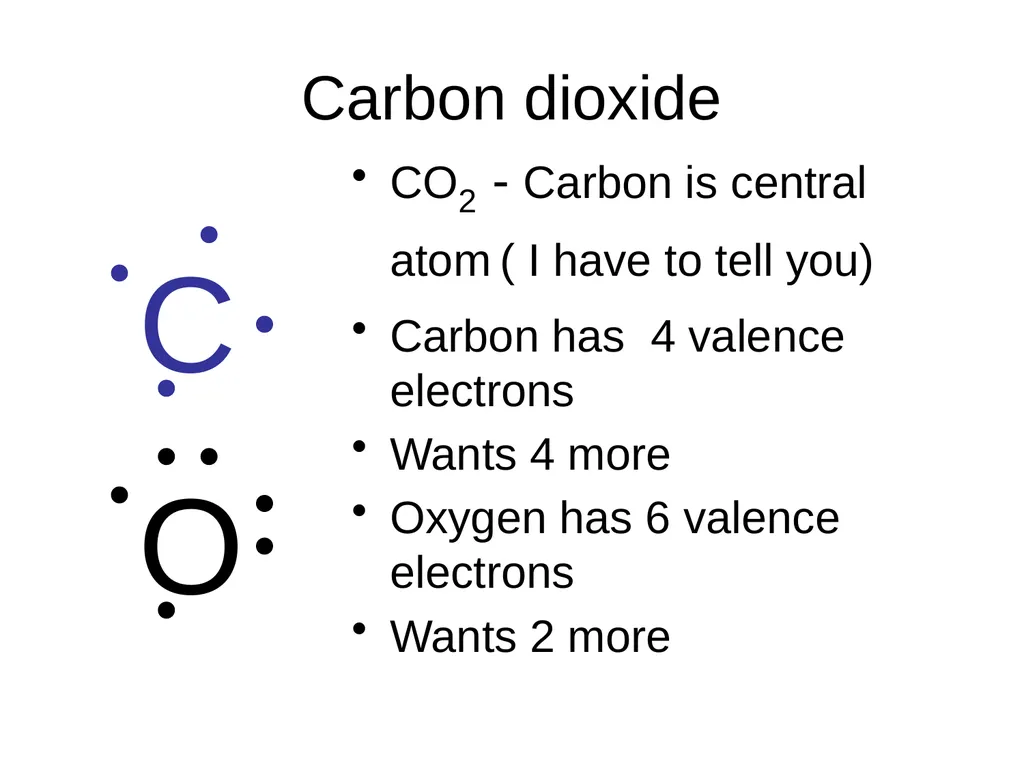
Carbon dioxide CO2 - Carbon is central atom ( I have to tell you)
Carbon has 4 valence electrons
Wants 4 more
Oxygen has 6 valence electrons
Wants 2 more<br>
Carbon has 4 valence electrons
Wants 4 more
Oxygen has 6 valence electrons
Wants 2 more<br>
15
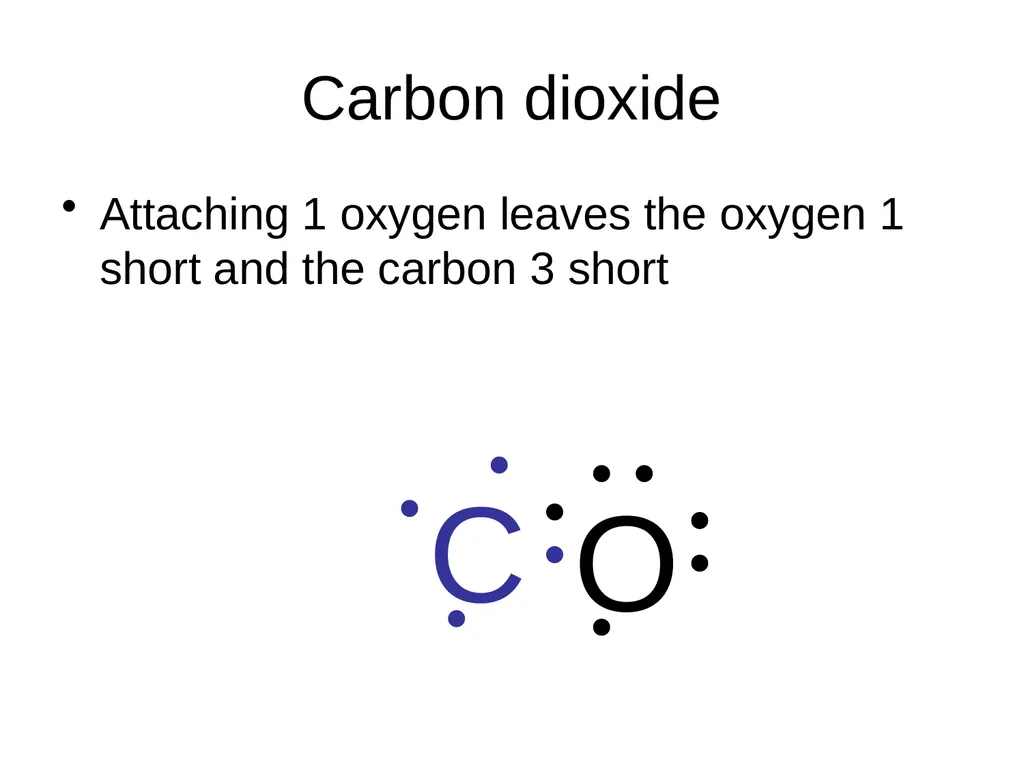
Carbon dioxide Attaching 1 oxygen leaves the oxygen 1 short and the carbon 3 short C<br>
16
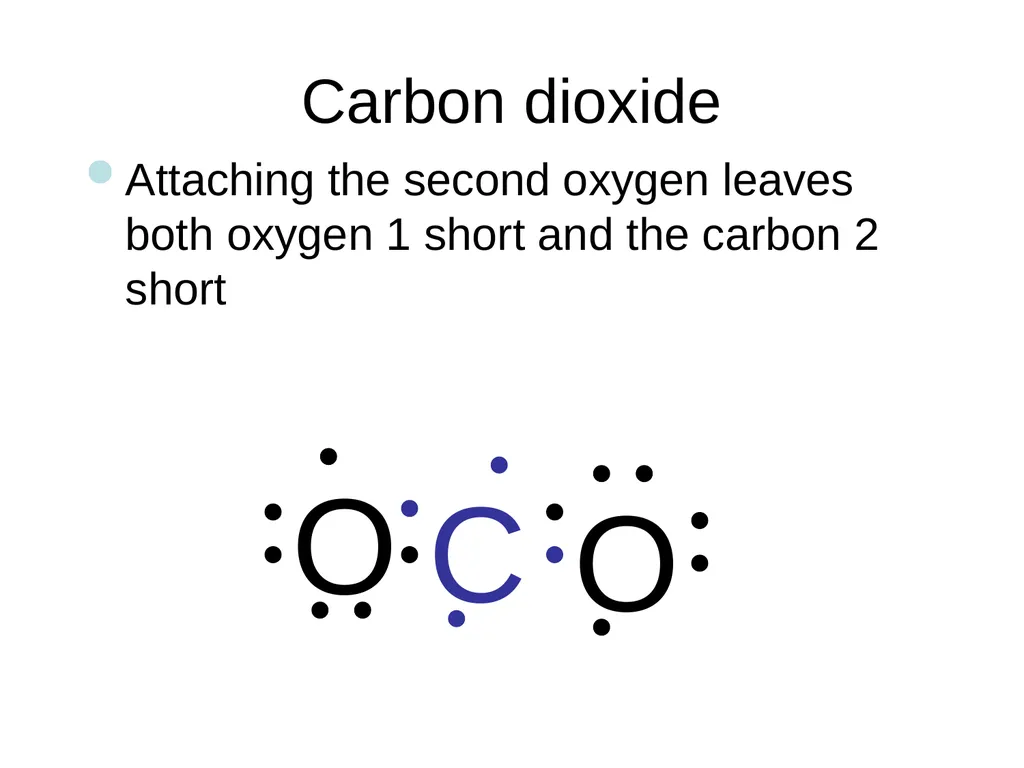
Carbon dioxide Attaching the second oxygen leaves both oxygen 1 short and the carbon 2 short C<br>
17
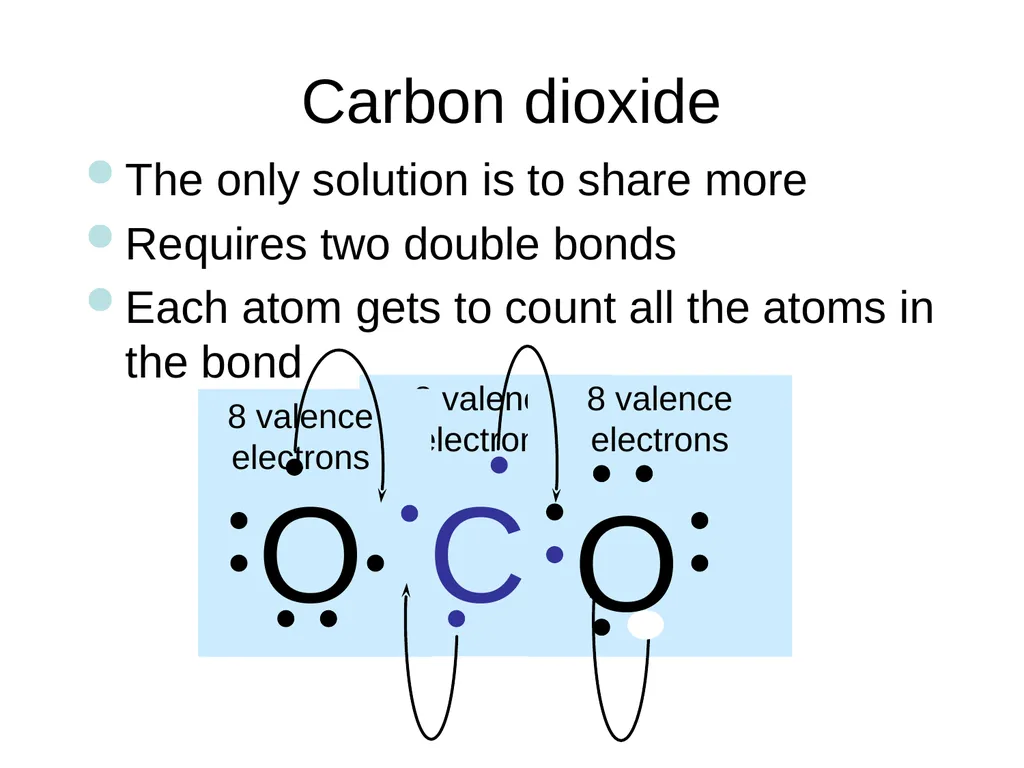
The only solution is to share more
Requires two double bonds
Each atom gets to count all the atoms in the bond Carbon dioxide C O<br>
Requires two double bonds
Each atom gets to count all the atoms in the bond Carbon dioxide C O<br>
18
How to draw them Add up all the valence electrons.
Count up the total number of electrons to make all atoms happy.
Subtract.
Divide by 2
Tells you how many bonds - draw them.
Fill in the rest of the valence electrons to fill atoms up.<br>
Count up the total number of electrons to make all atoms happy.
Subtract.
Divide by 2
Tells you how many bonds - draw them.
Fill in the rest of the valence electrons to fill atoms up.<br>
19
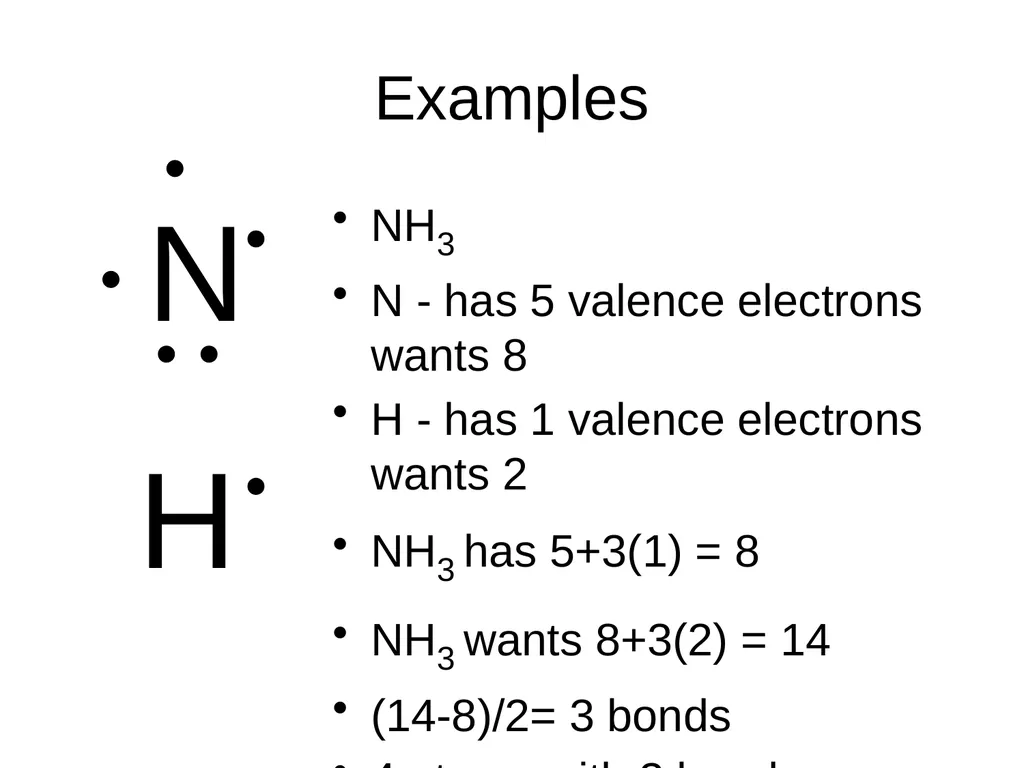
Examples NH3
N - has 5 valence electrons wants 8
H - has 1 valence electrons wants 2
NH3 has 5+3(1) = 8
NH3 wants 8+3(2) = 14
(14-8)/2= 3 bonds
4 atoms with 3 bonds N H<br>
N - has 5 valence electrons wants 8
H - has 1 valence electrons wants 2
NH3 has 5+3(1) = 8
NH3 wants 8+3(2) = 14
(14-8)/2= 3 bonds
4 atoms with 3 bonds N H<br>
20
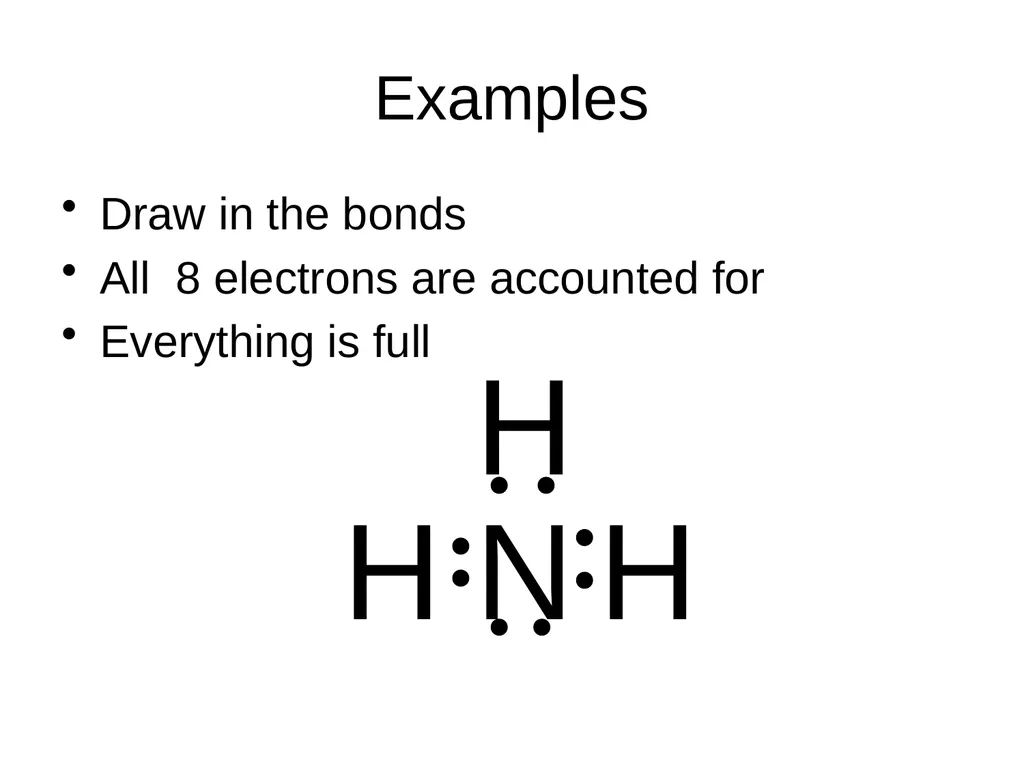
N H H H Examples Draw in the bonds
All 8 electrons are accounted for
Everything is full<br>
All 8 electrons are accounted for
Everything is full<br>
21
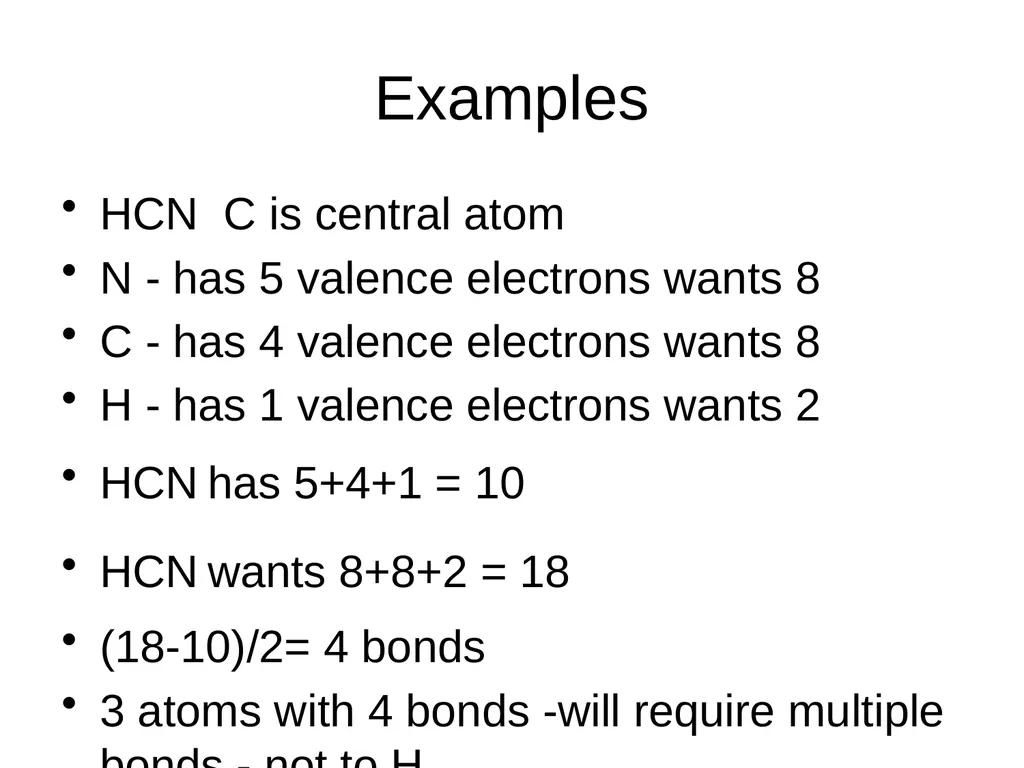
Examples HCN C is central atom
N - has 5 valence electrons wants 8
C - has 4 valence electrons wants 8
H - has 1 valence electrons wants 2
HCN has 5+4+1 = 10
HCN wants 8+8+2 = 18
(18-10)/2= 4 bonds
3 atoms with 4 bonds -will require multiple bonds - not to H<br>
N - has 5 valence electrons wants 8
C - has 4 valence electrons wants 8
H - has 1 valence electrons wants 2
HCN has 5+4+1 = 10
HCN wants 8+8+2 = 18
(18-10)/2= 4 bonds
3 atoms with 4 bonds -will require multiple bonds - not to H<br>
22
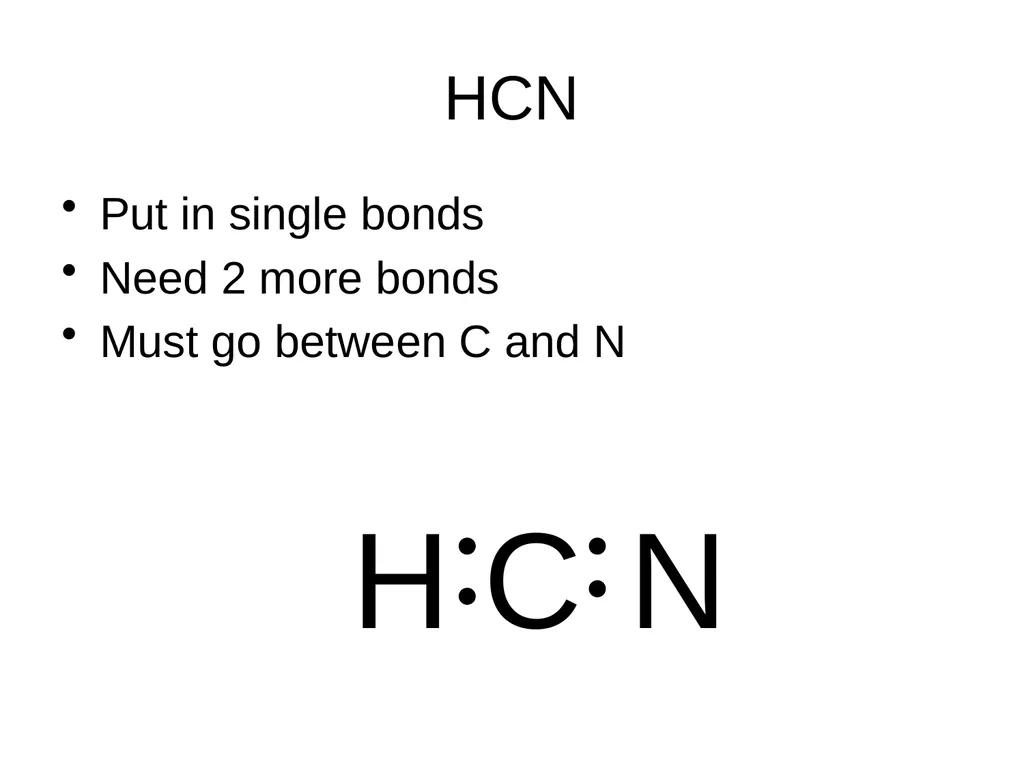
HCN Put in single bonds
Need 2 more bonds
Must go between C and N N H C<br>
Need 2 more bonds
Must go between C and N N H C<br>
23
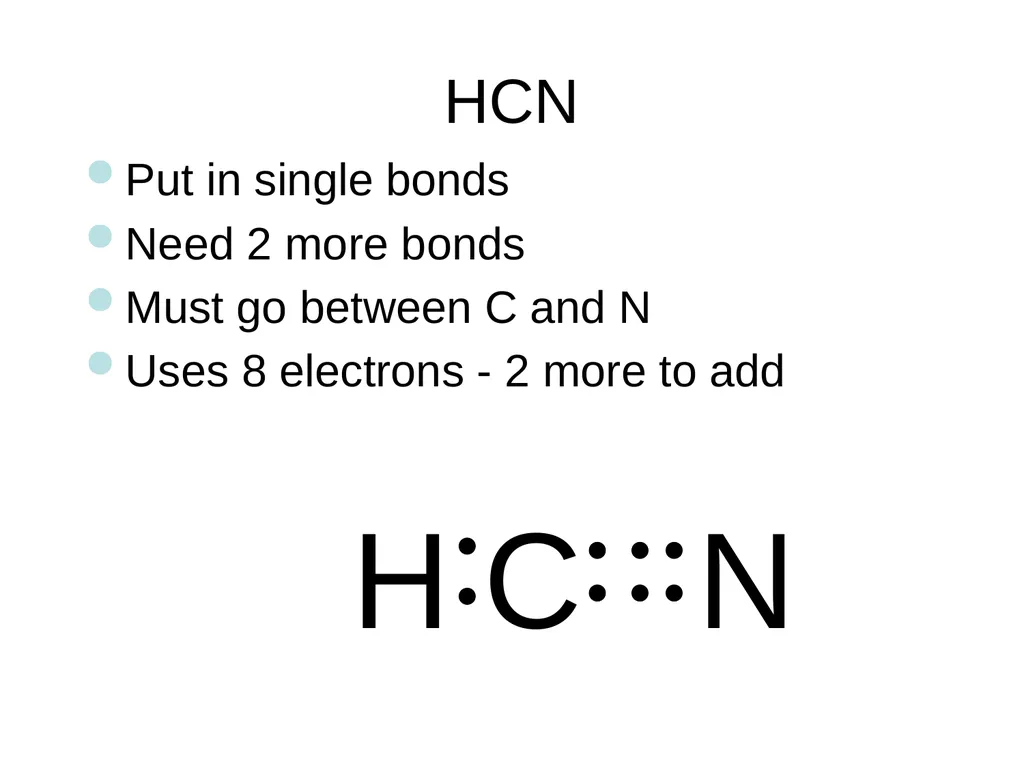
HCN Put in single bonds
Need 2 more bonds
Must go between C and N
Uses 8 electrons - 2 more to add N H C<br>
Need 2 more bonds
Must go between C and N
Uses 8 electrons - 2 more to add N H C<br>
24
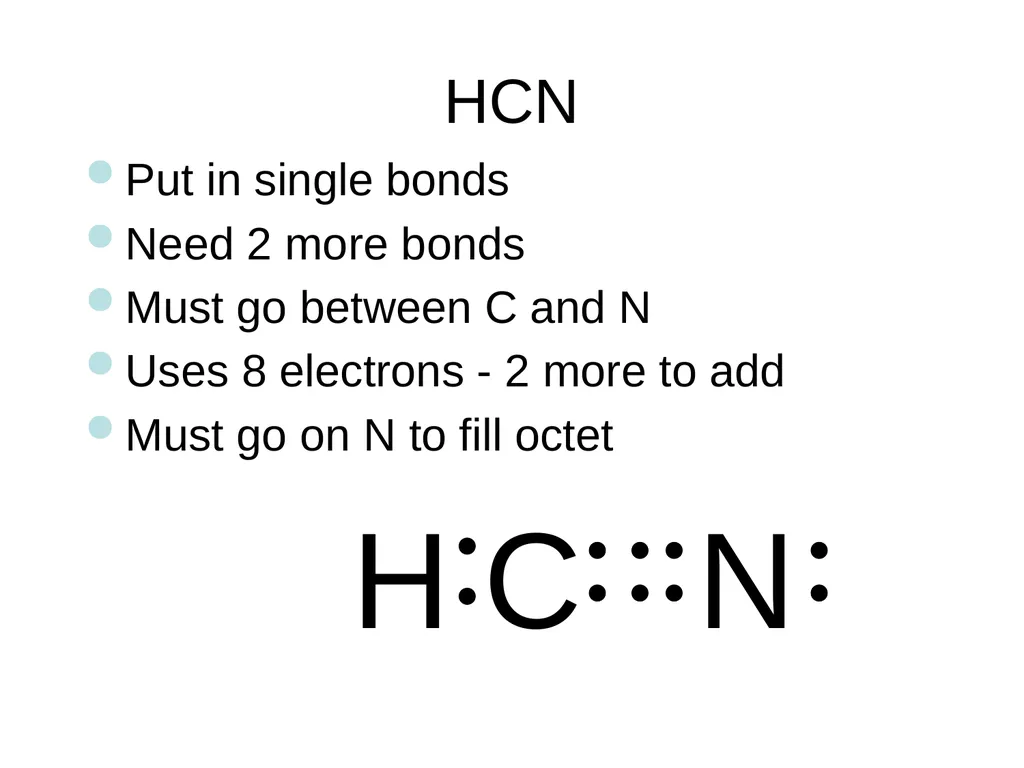
HCN Put in single bonds
Need 2 more bonds
Must go between C and N
Uses 8 electrons - 2 more to add
Must go on N to fill octet N H C<br>
Need 2 more bonds
Must go between C and N
Uses 8 electrons - 2 more to add
Must go on N to fill octet N H C<br>
25
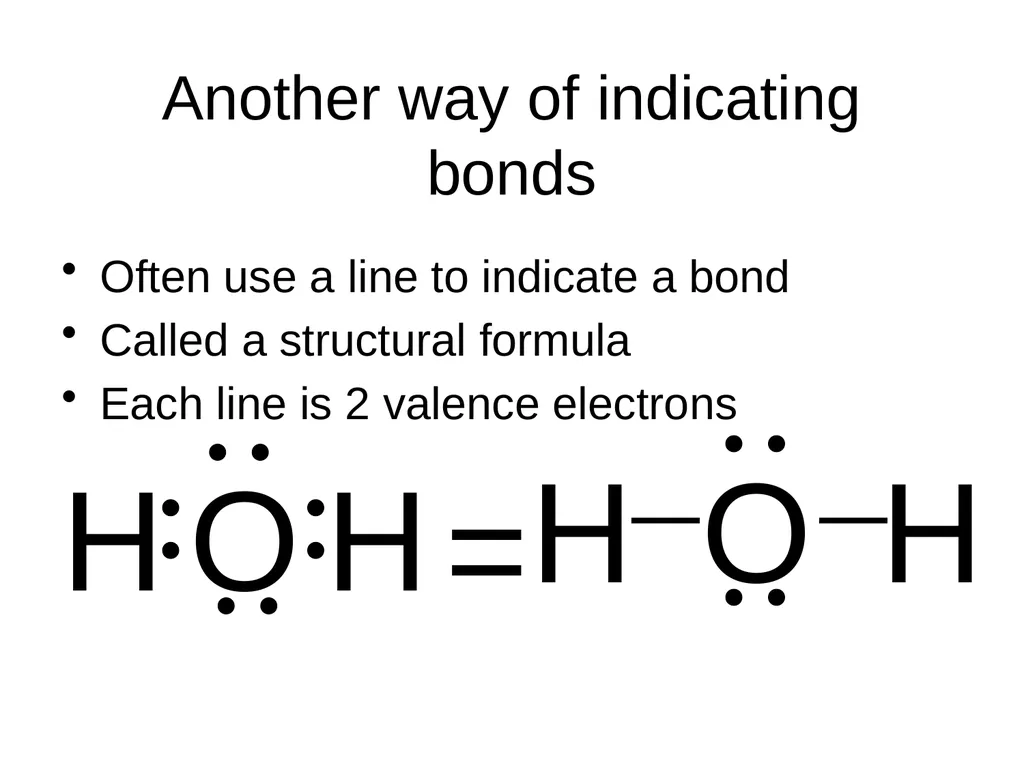
Another way of indicating bonds Often use a line to indicate a bond
Called a structural formula
Each line is 2 valence electrons H H O = H H O<br>
Called a structural formula
Each line is 2 valence electrons H H O = H H O<br>
26
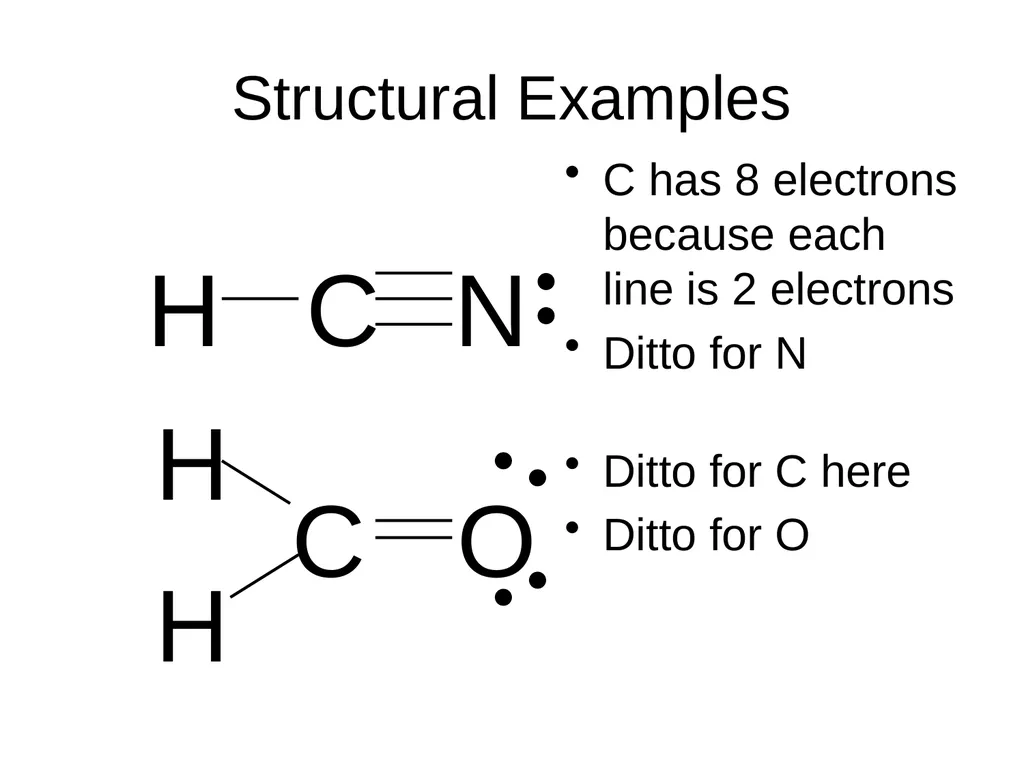
Structural Examples H C N C O H H C has 8 electrons because each line is 2 electrons
Ditto for N
Ditto for C here
Ditto for O<br>
Ditto for N
Ditto for C here
Ditto for O<br>
27
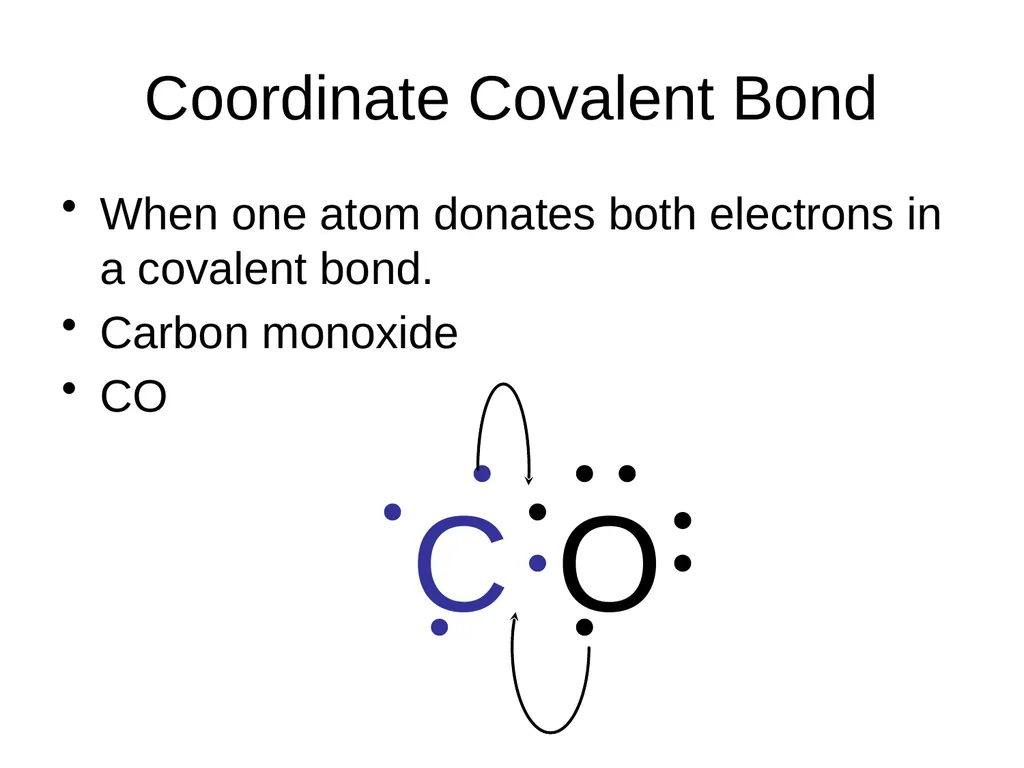
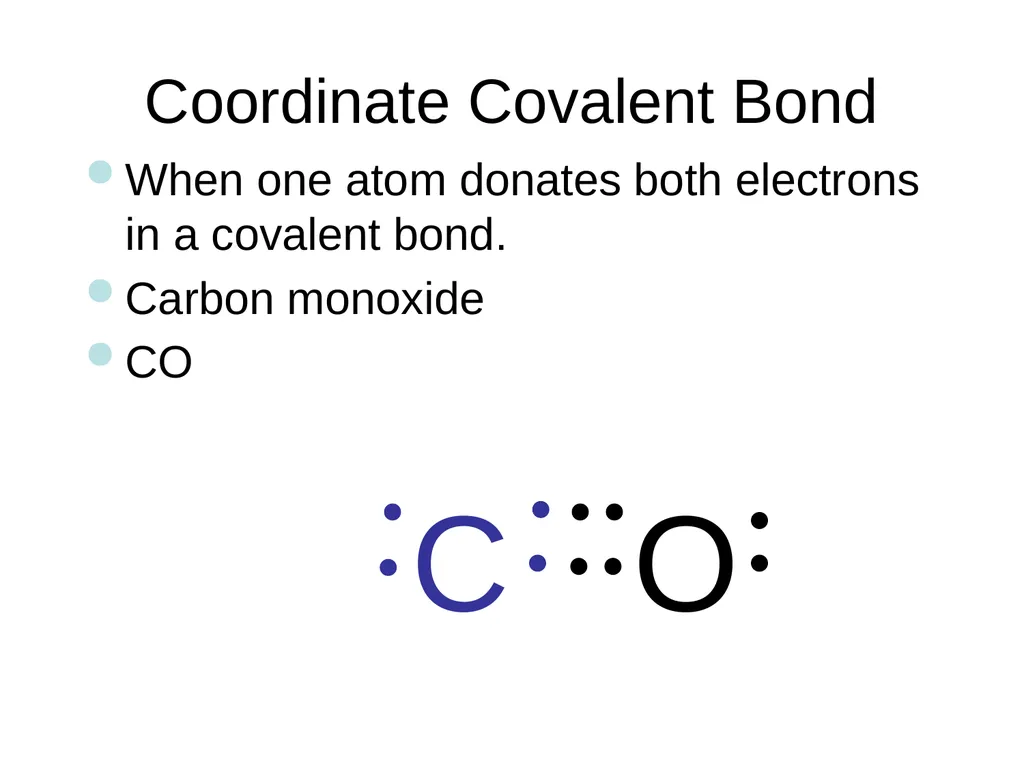
Coordinate Covalent Bond When one atom donates both electrons in a covalent bond.
Carbon monoxide
CO<br>
Carbon monoxide
CO<br>
28
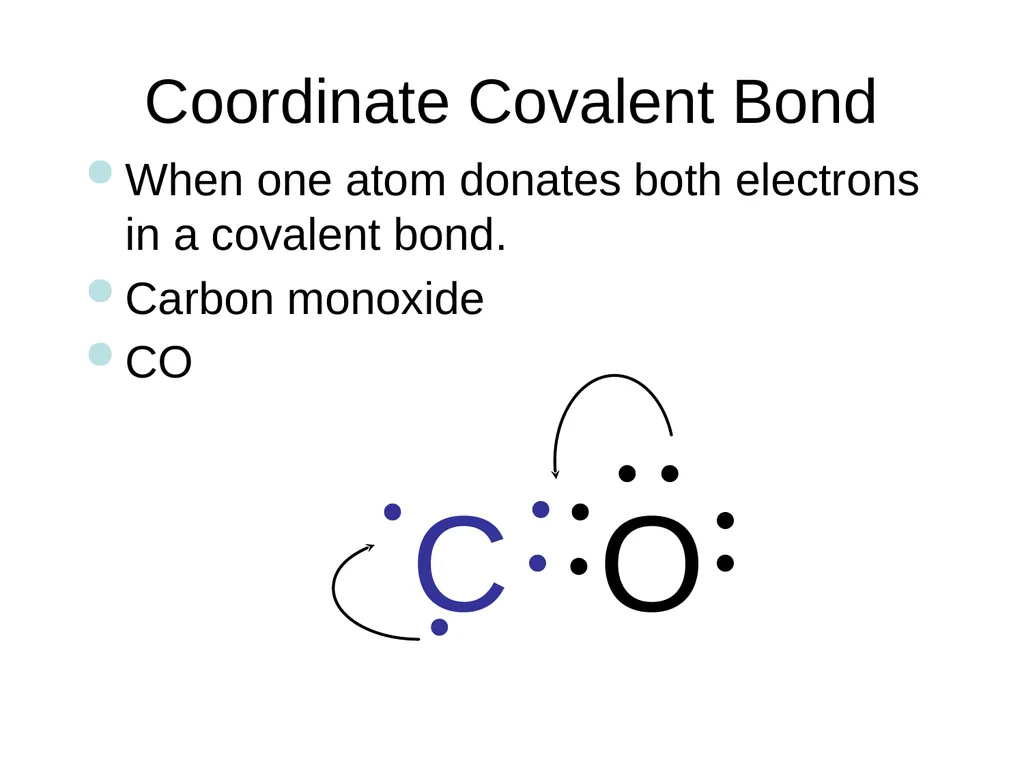
Coordinate Covalent Bond When one atom donates both electrons in a covalent bond.
Carbon monoxide
CO O C<br>
Carbon monoxide
CO O C<br>
29
Coordinate Covalent Bond When one atom donates both electrons in a covalent bond.
Carbon monoxide
CO O C<br>
Carbon monoxide
CO O C<br>
30
How do we know if Have to draw the diagram and see what happens.
Often happens with polyatomic ions and acids.<br>
Often happens with polyatomic ions and acids.<br>
31
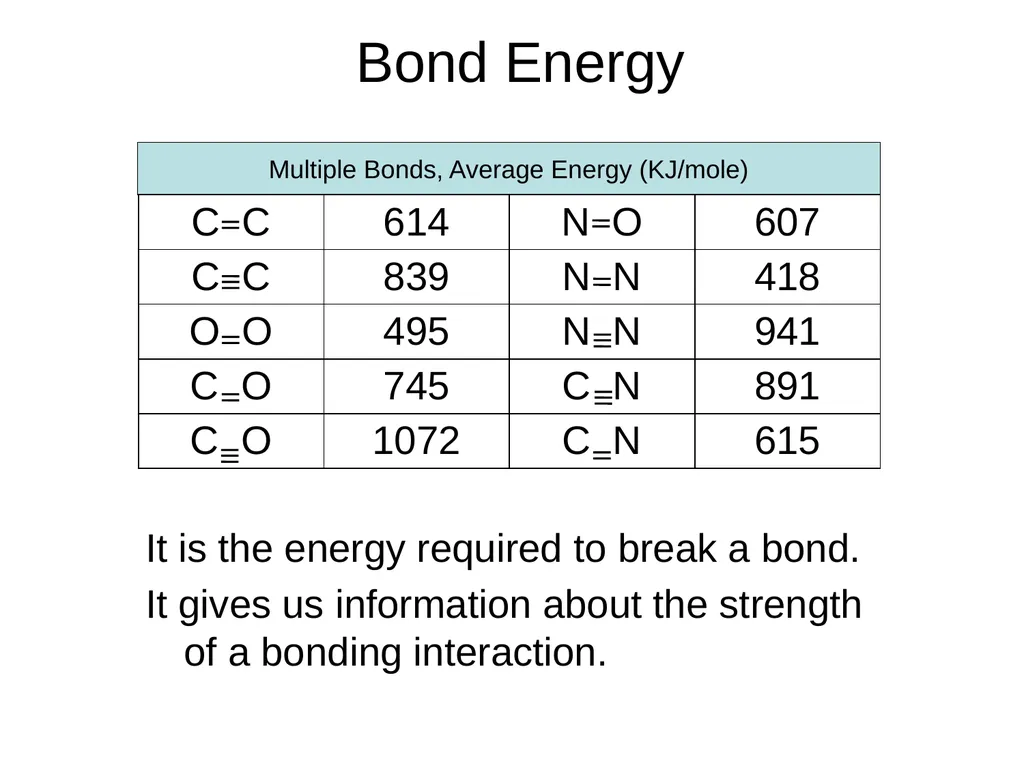
Bond Energy It is the energy required to break a bond.
It gives us information about the strength of a bonding interaction. Multiple Bonds, Average Energy (KJ/mole)<br>
It gives us information about the strength of a bonding interaction. Multiple Bonds, Average Energy (KJ/mole)<br>
32
Resonance When more than one dot diagram with the same connections are possible.
NO2-
Which one is it?
Does it go back and forth.
It is a mixture of both, like a mule.
NO3-<br>
NO2-
Which one is it?
Does it go back and forth.
It is a mixture of both, like a mule.
NO3-<br>
33
VSEPR Valence Shell Electron Pair Repulsion.
Predicts three dimensional geometry of molecules.
Name tells you the theory.
Valence shell - outside electrons.
Electron Pair repulsion - electron pairs try to get as far away as possible.
Can determine the angles of bonds.<br>
Predicts three dimensional geometry of molecules.
Name tells you the theory.
Valence shell - outside electrons.
Electron Pair repulsion - electron pairs try to get as far away as possible.
Can determine the angles of bonds.<br>
34
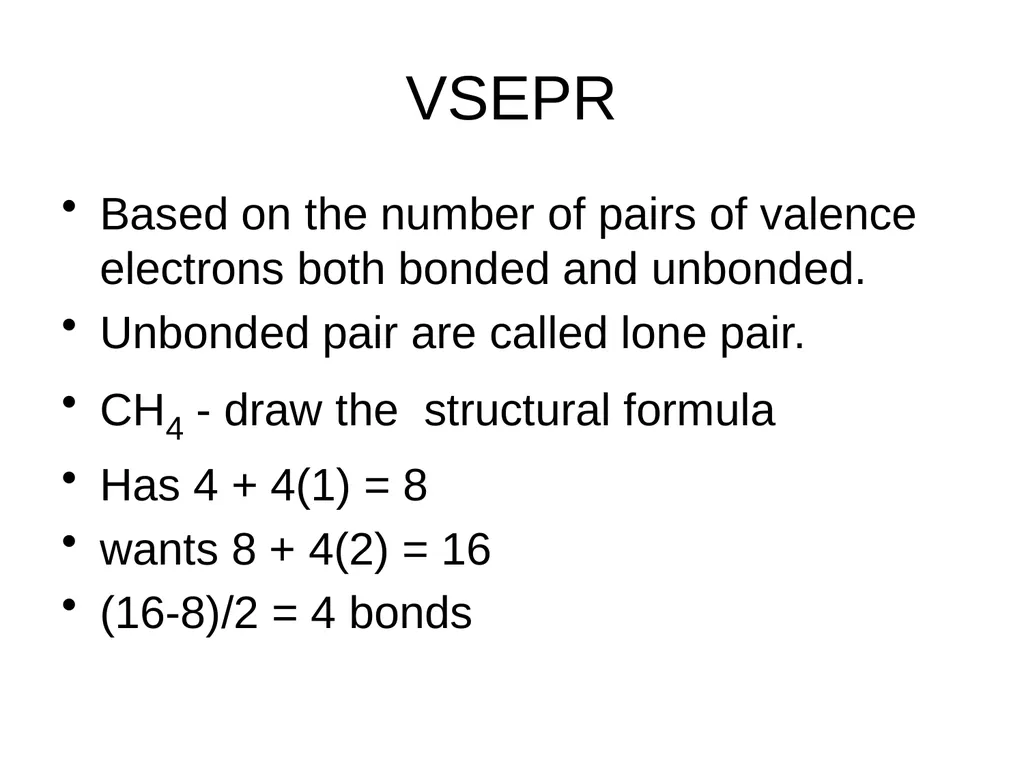
VSEPR Based on the number of pairs of valence electrons both bonded and unbonded.
Unbonded pair are called lone pair.
CH4 - draw the structural formula
Has 4 + 4(1) = 8
wants 8 + 4(2) = 16
(16-8)/2 = 4 bonds<br>
Unbonded pair are called lone pair.
CH4 - draw the structural formula
Has 4 + 4(1) = 8
wants 8 + 4(2) = 16
(16-8)/2 = 4 bonds<br>
35
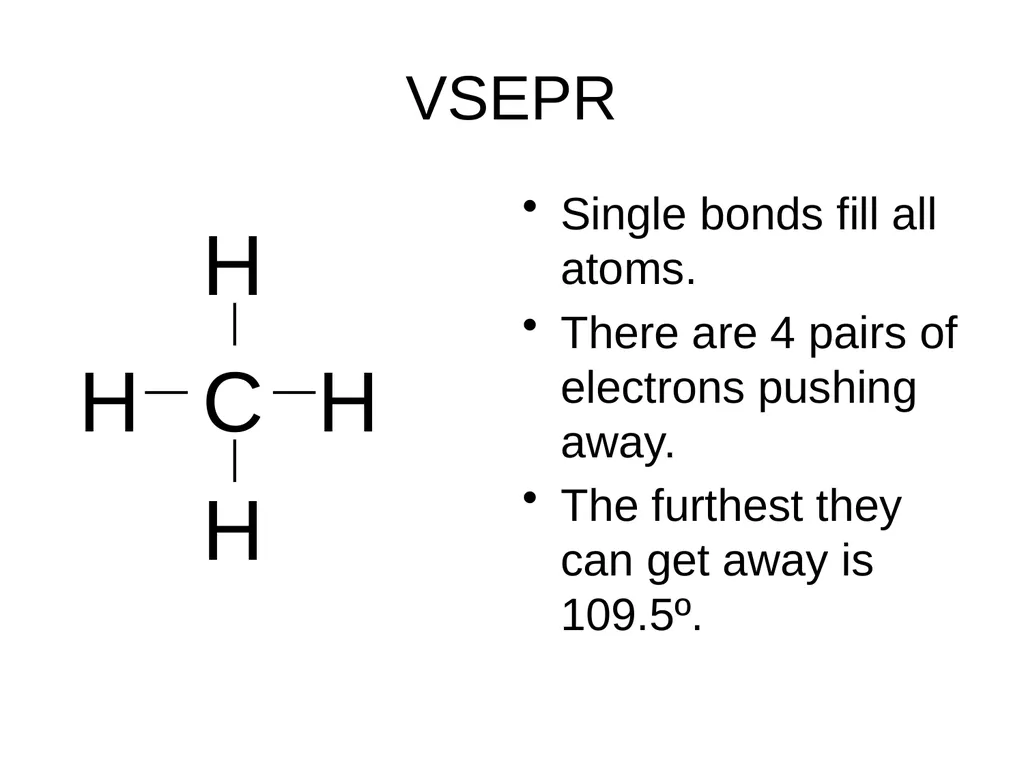
VSEPR Single bonds fill all atoms.
There are 4 pairs of electrons pushing away.
The furthest they can get away is 109.5º. C H H H H<br>
There are 4 pairs of electrons pushing away.
The furthest they can get away is 109.5º. C H H H H<br>
36
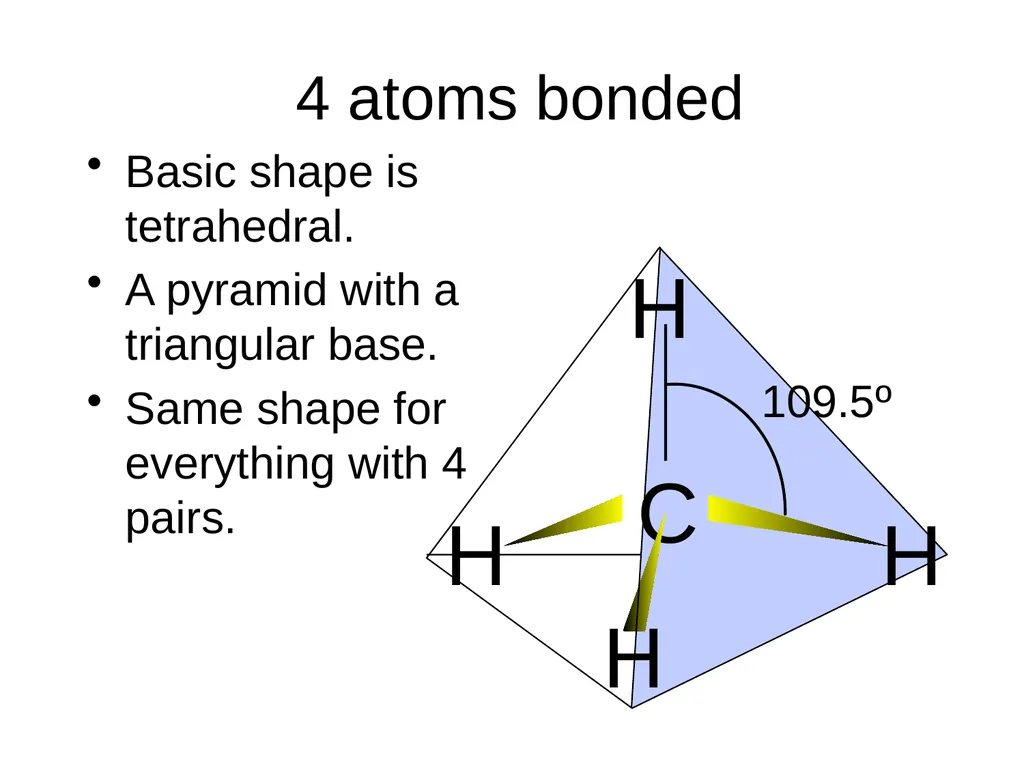
4 atoms bonded Basic shape is tetrahedral.
A pyramid with a triangular base.
Same shape for everything with 4 pairs. C H H H H 109.5º<br>
A pyramid with a triangular base.
Same shape for everything with 4 pairs. C H H H H 109.5º<br>
37
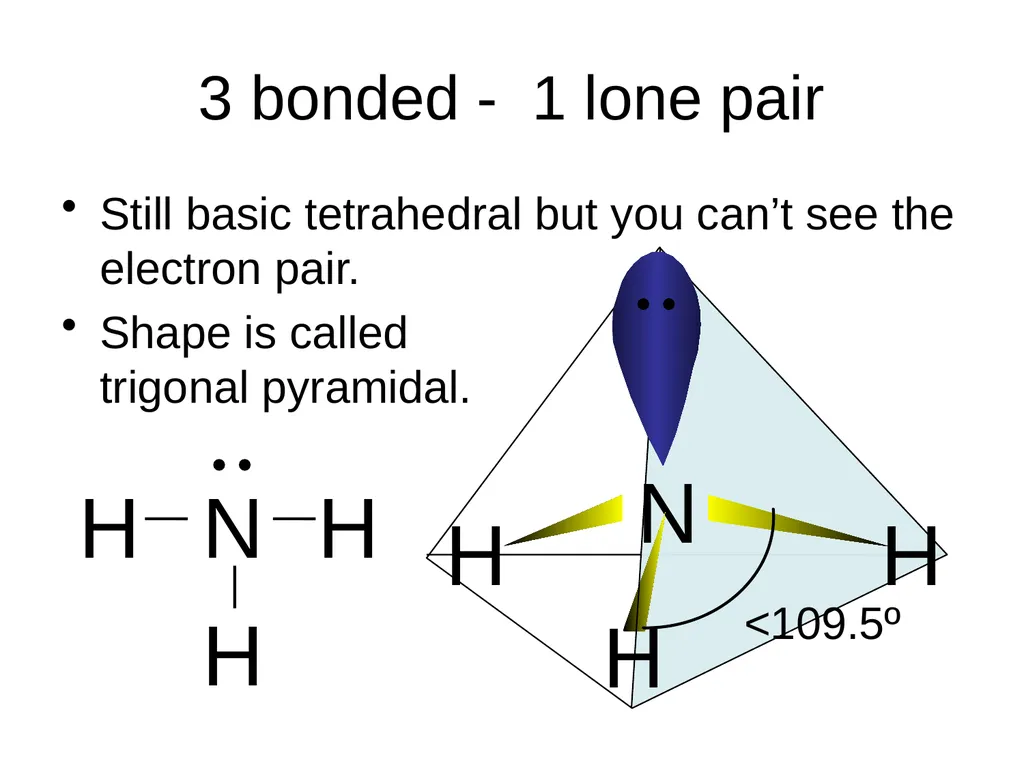
Still basic tetrahedral but you can’t see the electron pair.
Shape is called trigonal pyramidal. 3 bonded - 1 lone pair N H H H N H H H <109.5º<br>
Shape is called trigonal pyramidal. 3 bonded - 1 lone pair N H H H N H H H <109.5º<br>
38
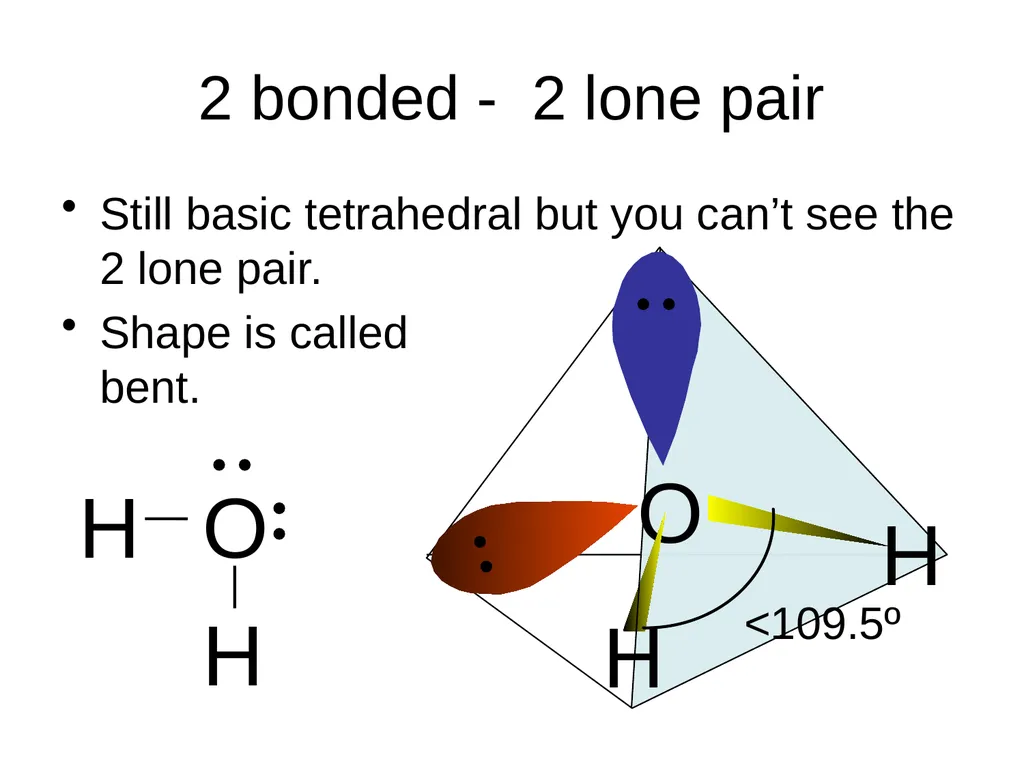
2 bonded - 2 lone pair O H H O H H <109.5º Still basic tetrahedral but you can’t see the 2 lone pair.
Shape is called bent.<br>
Shape is called bent.<br>
39
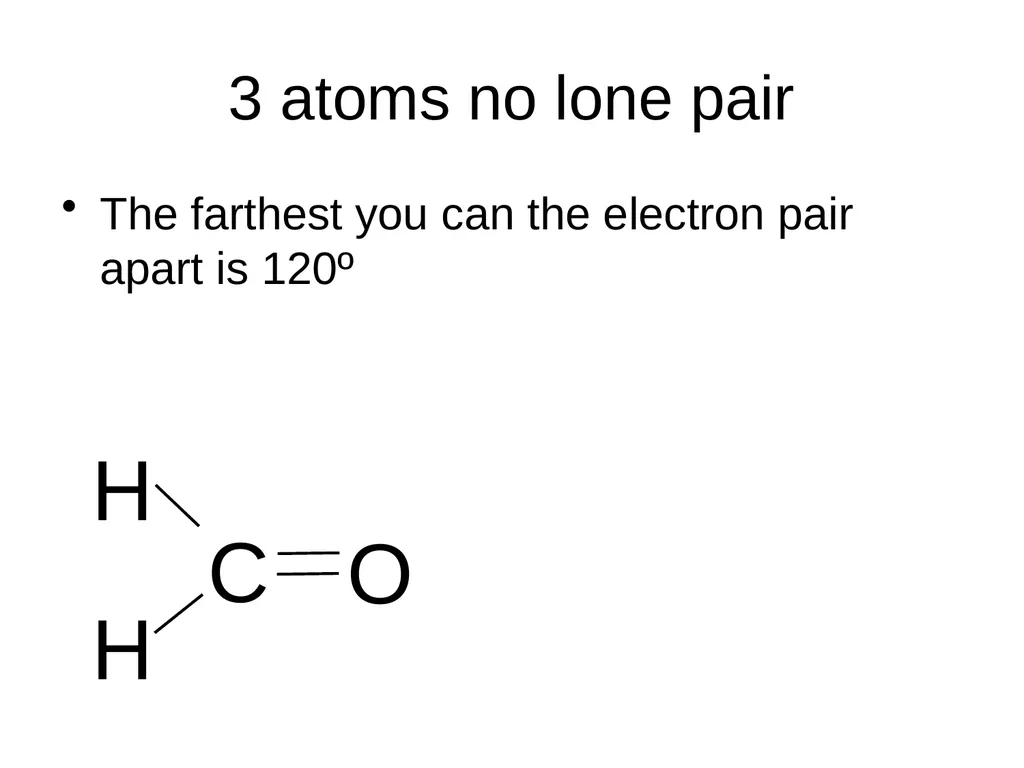
3 atoms no lone pair C H H O The farthest you can the electron pair apart is 120º<br>
40
3 atoms no lone pair C H H O The farthest you can the electron pair apart is 120º.
Shape is flat and called trigonal planar. C H 120º<br>
Shape is flat and called trigonal planar. C H 120º<br>
41
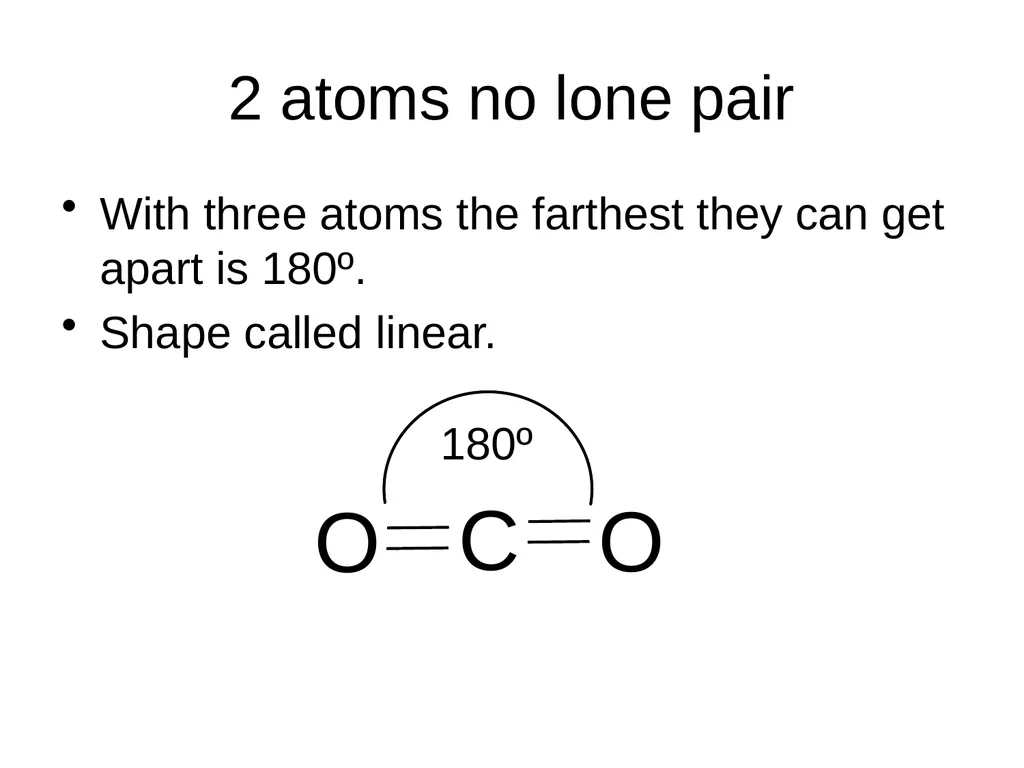
2 atoms no lone pair With three atoms the farthest they can get apart is 180º.
Shape called linear. C O O 180º<br>
Shape called linear. C O O 180º<br>
42
Hybrid Orbitals Combines bonding with geometry<br>
43
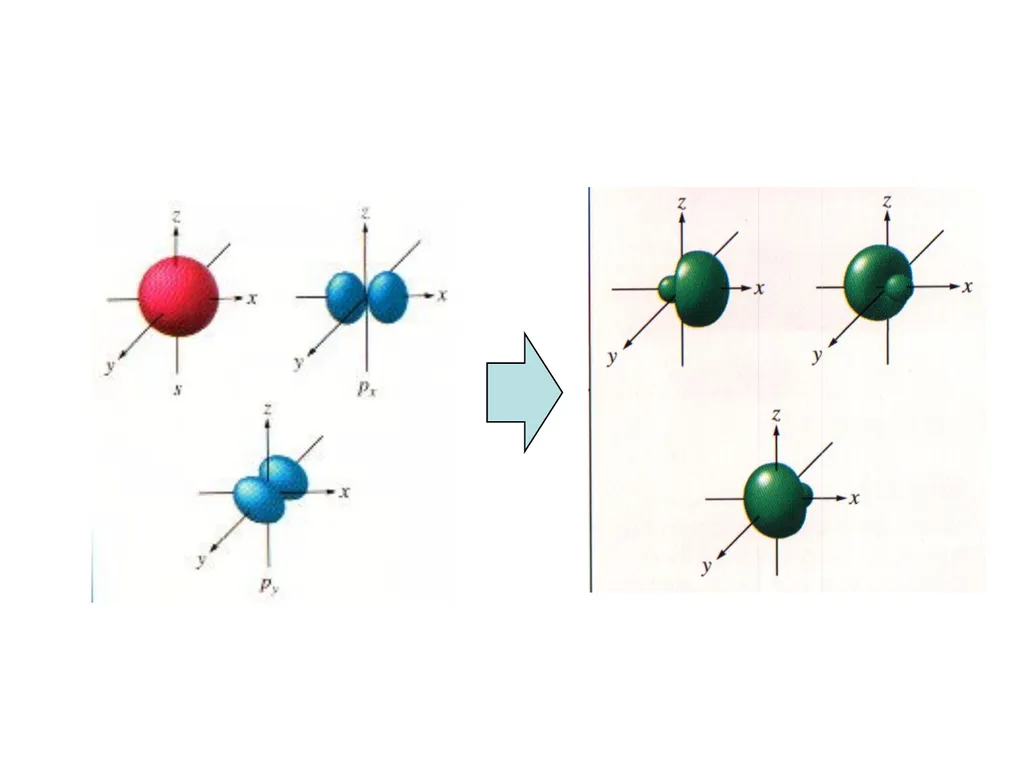
Hybridization The mixing of several atomic orbitals to form the same number of hybrid orbitals.
All the hybrid orbitals that form are the same.
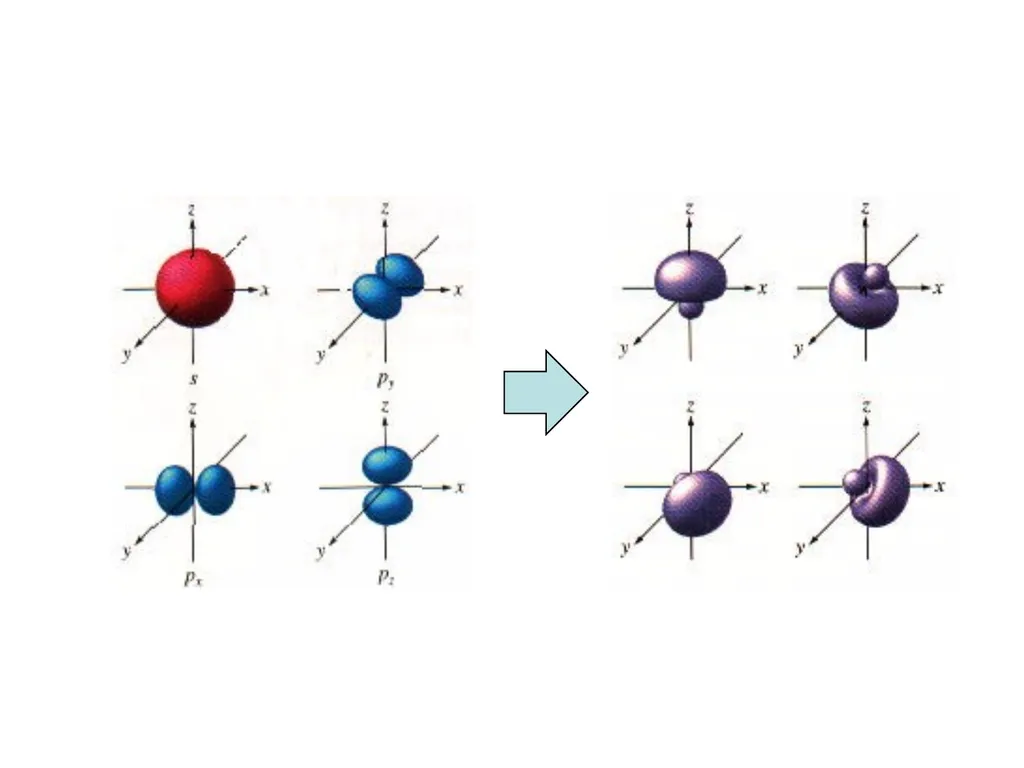
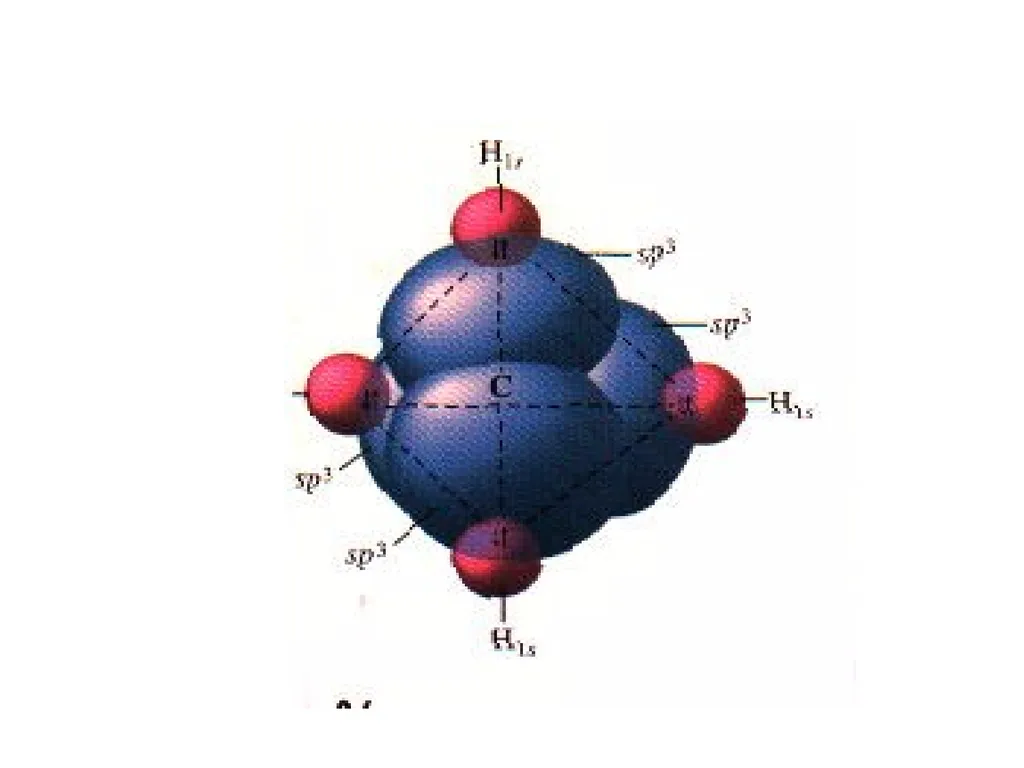
sp3 -1 s and 3 p orbitals mix to form 4 sp3 orbitals.
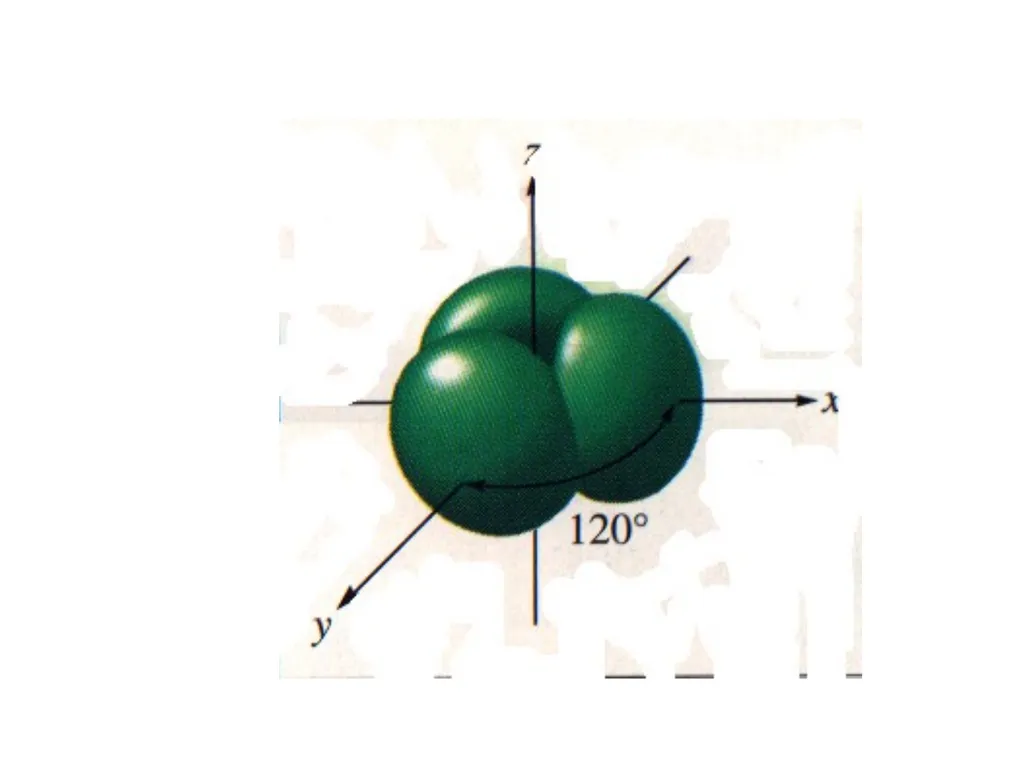
sp2 -1 s and 2 p orbitals mix to form 3 sp2 orbitals leaving 1 p orbital.
sp -1 s and 1 p orbitals mix to form 4 sp orbitals leaving 2 p orbitals.<br>
All the hybrid orbitals that form are the same.
sp3 -1 s and 3 p orbitals mix to form 4 sp3 orbitals.
sp2 -1 s and 2 p orbitals mix to form 3 sp2 orbitals leaving 1 p orbital.
sp -1 s and 1 p orbitals mix to form 4 sp orbitals leaving 2 p orbitals.<br>
44
Hybridization We blend the s and p orbitals of the valence electrons and end up with the tetrahedral geometry.We combine one s orbital and 3 p orbitals. sp3 hybridization has tetrahedral geometry.<br>
45
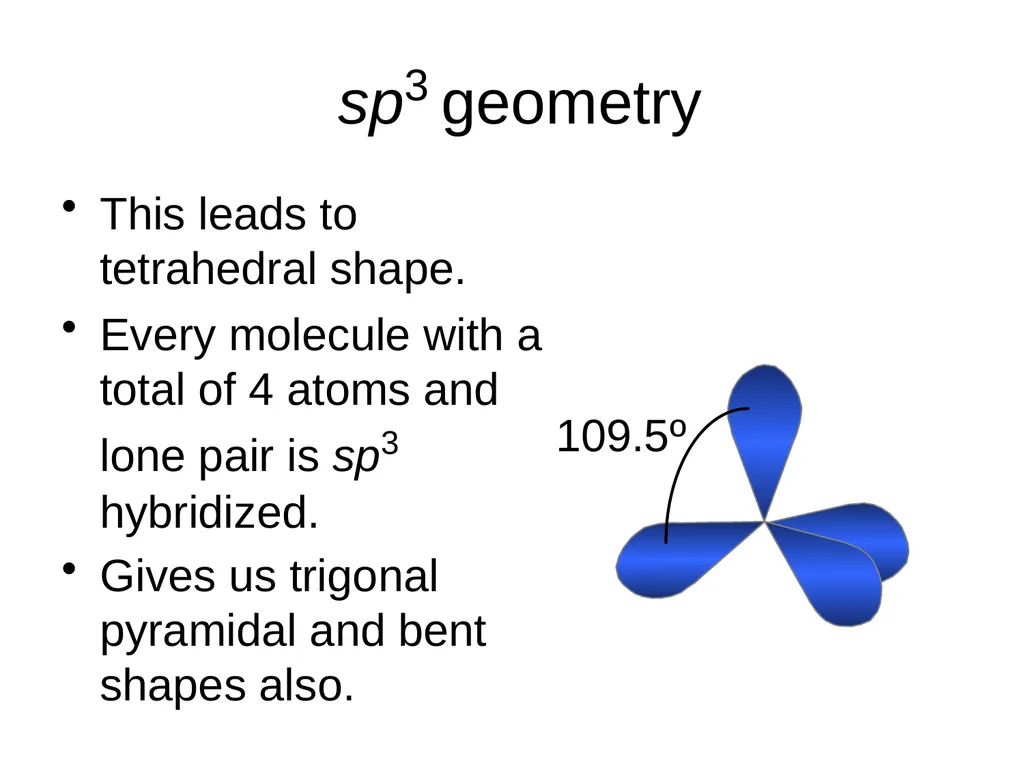
sp3 geometry 109.5º This leads to tetrahedral shape.
Every molecule with a total of 4 atoms and lone pair is sp3 hybridized.
Gives us trigonal pyramidal and bent shapes also.<br>
Every molecule with a total of 4 atoms and lone pair is sp3 hybridized.
Gives us trigonal pyramidal and bent shapes also.<br>
46
How we get to hybridization We know the geometry from experiment.
We know the orbitals of the atom hybridizing atomic orbitals can explain the geometry. So if the geometry requires a tetrahedral shape, it is sp3 hybridized. This includes bent and trigonal pyramidal molecules because one of the sp3 lobes holds the lone pair.<br>
We know the orbitals of the atom hybridizing atomic orbitals can explain the geometry. So if the geometry requires a tetrahedral shape, it is sp3 hybridized. This includes bent and trigonal pyramidal molecules because one of the sp3 lobes holds the lone pair.<br>
47
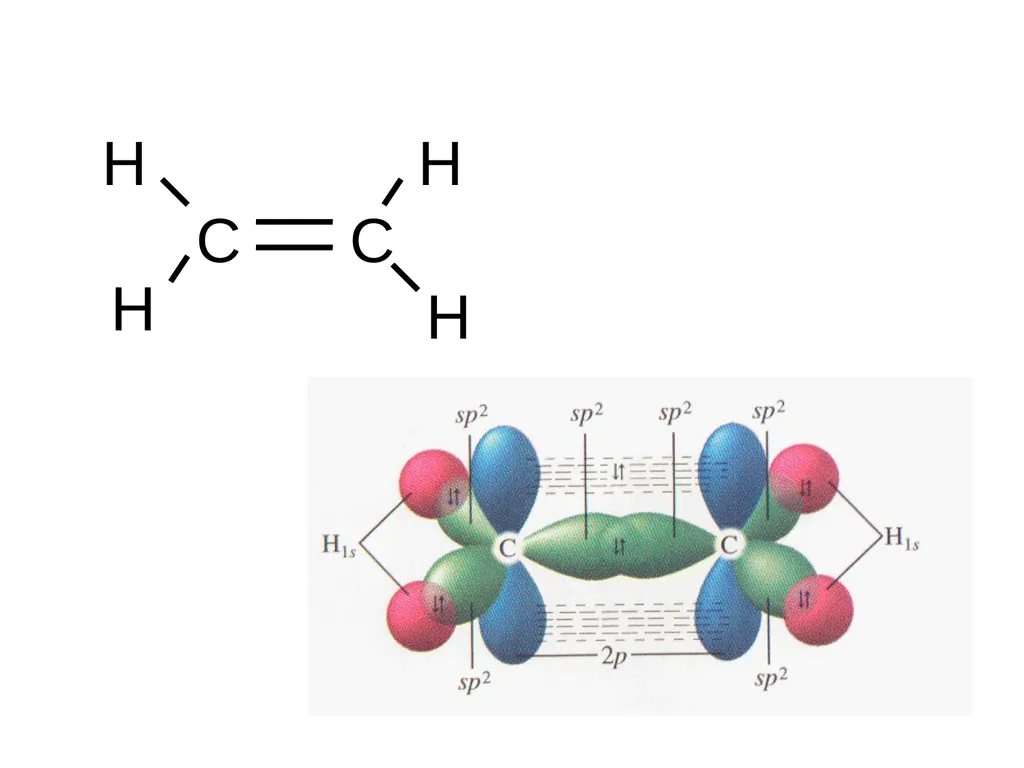
sp2 hybridization C2H4
double bond acts as one pair
trigonal planar
Have to end up with three blended orbitals use one s and two p orbitals to make sp2 orbitals.
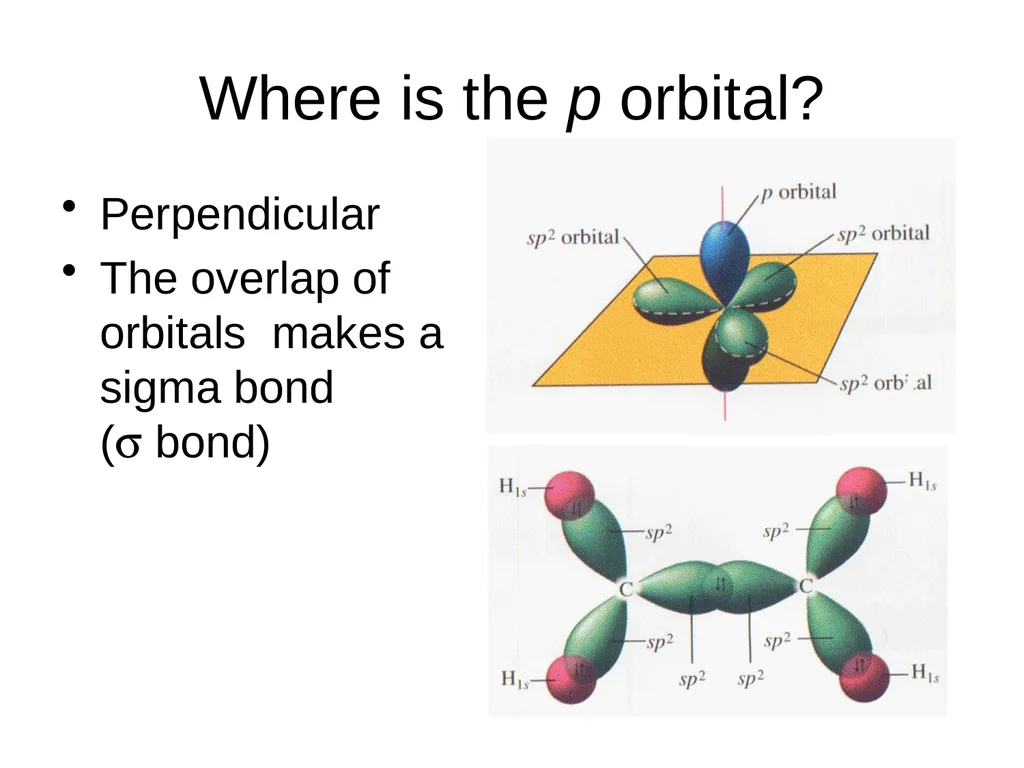
leaves one p orbital perpendicular<br>
double bond acts as one pair
trigonal planar
Have to end up with three blended orbitals use one s and two p orbitals to make sp2 orbitals.
leaves one p orbital perpendicular<br>
48
Where is the p orbital? Perpendicular
The overlap of orbitals makes a sigma bond (s bond)<br>
The overlap of orbitals makes a sigma bond (s bond)<br>
49
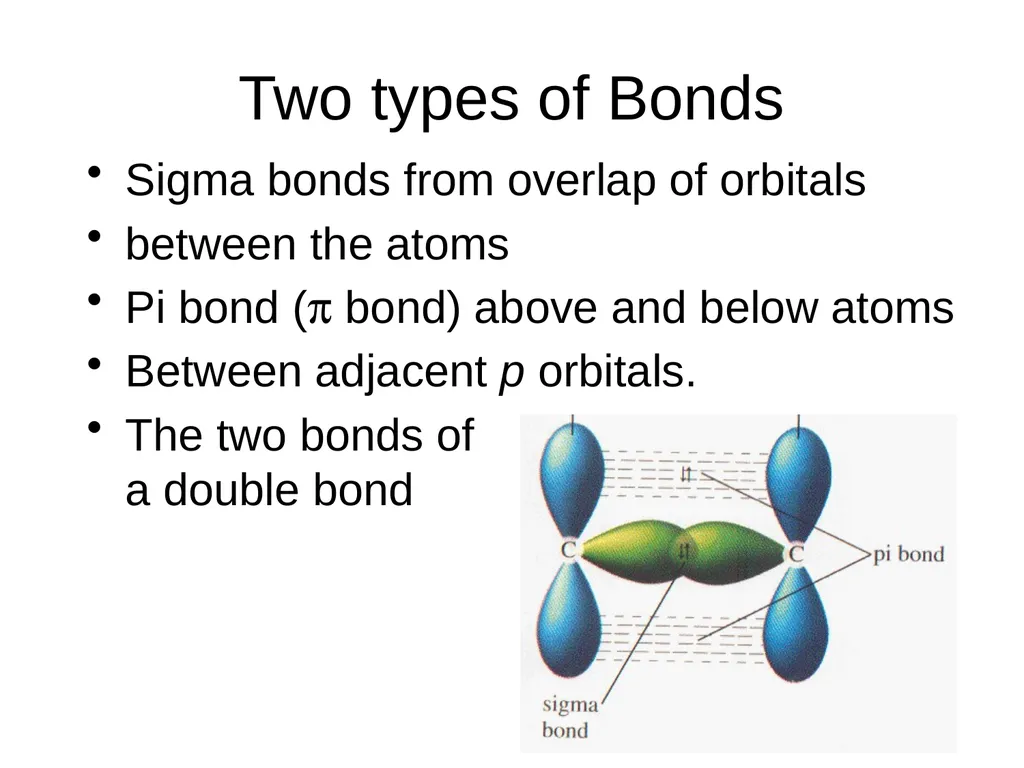
Two types of Bonds Sigma bonds from overlap of orbitals
between the atoms
Pi bond (p bond) above and below atoms
Between adjacent p orbitals.
The two bonds of a double bond<br>
between the atoms
Pi bond (p bond) above and below atoms
Between adjacent p orbitals.
The two bonds of a double bond<br>
50
C C H H H H<br>
51
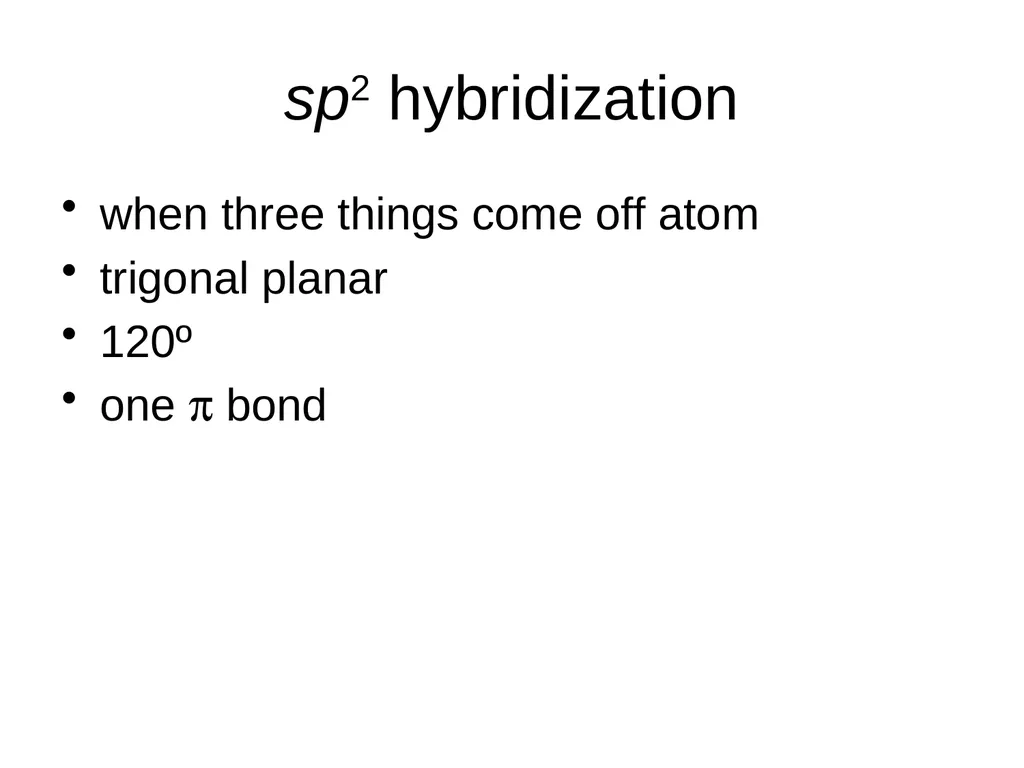
sp2 hybridization when three things come off atom
trigonal planar
120º
one p bond<br>
trigonal planar
120º
one p bond<br>
52
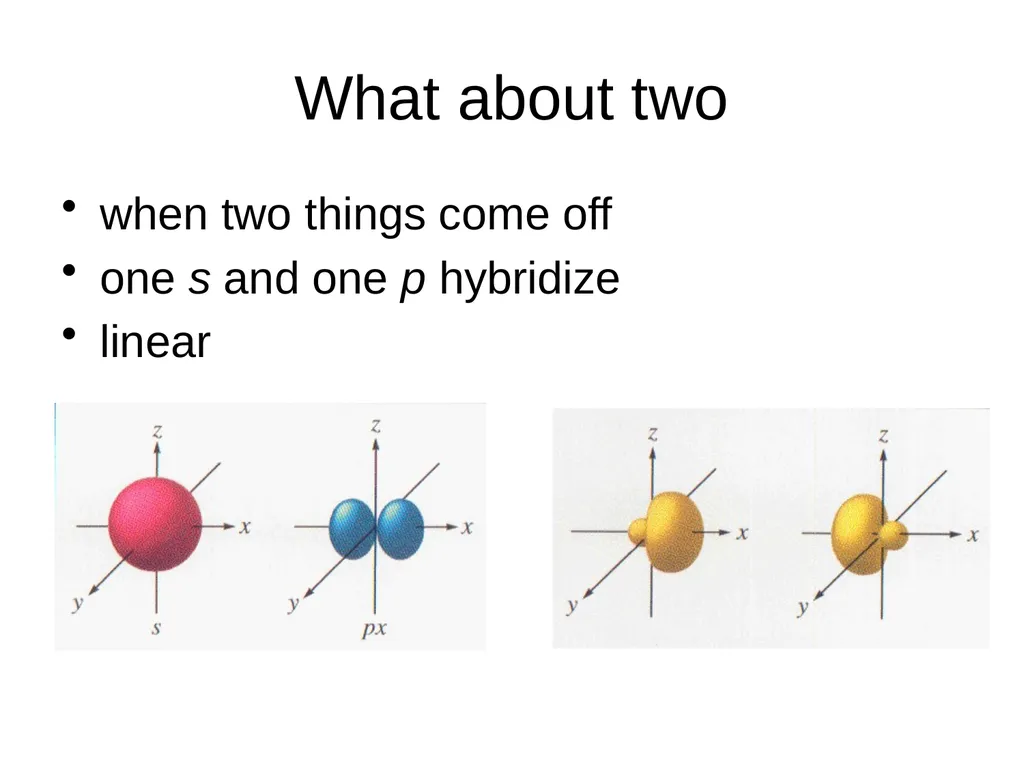
What about two when two things come off
one s and one p hybridize
linear<br>
one s and one p hybridize
linear<br>
53
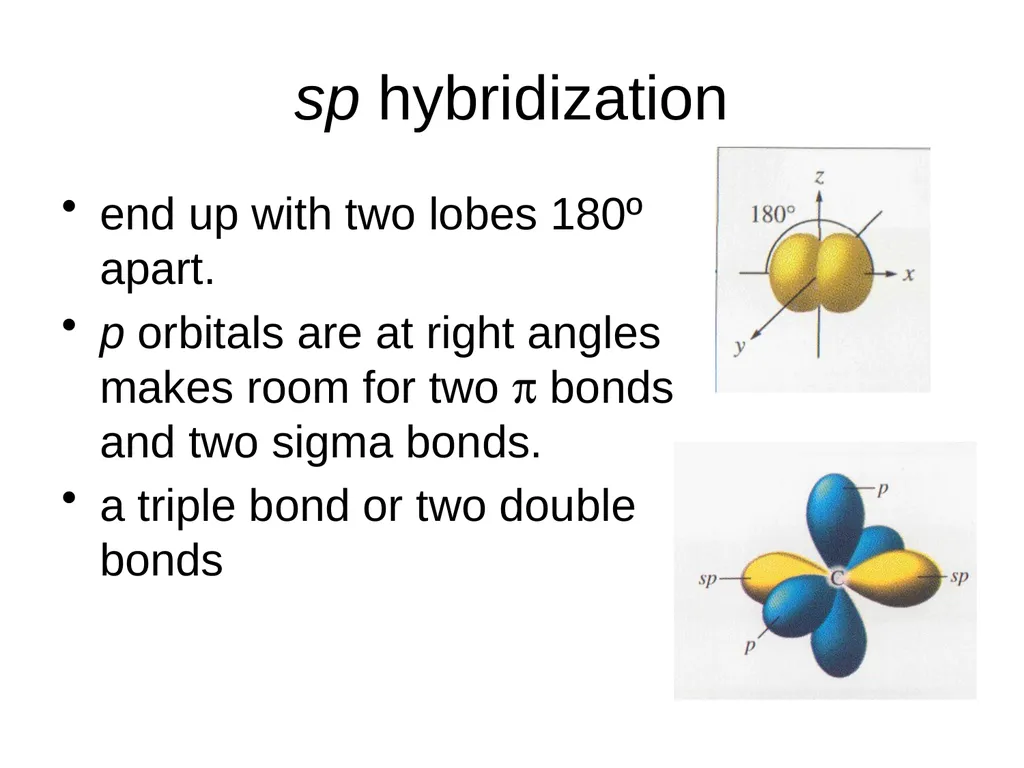
sp hybridization end up with two lobes 180º apart.
p orbitals are at right angles makes room for two p bonds and two sigma bonds.
a triple bond or two double bonds<br>
p orbitals are at right angles makes room for two p bonds and two sigma bonds.
a triple bond or two double bonds<br>
54
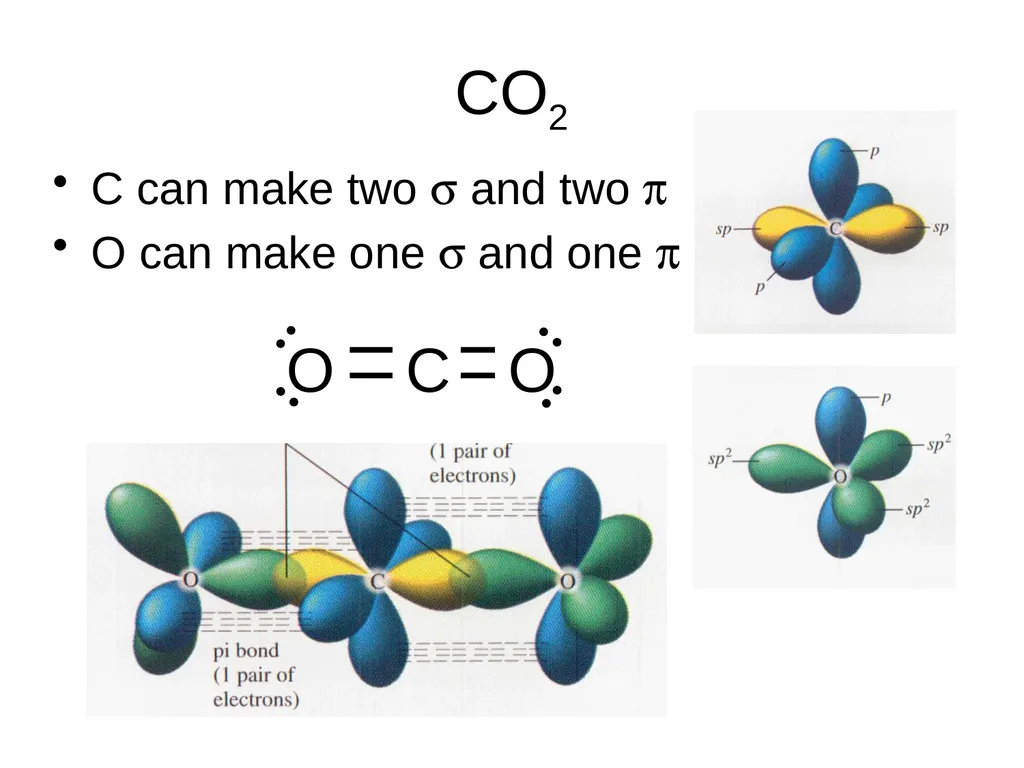
CO2 C can make two s and two p
O can make one s and one p C O O<br>
O can make one s and one p C O O<br>
55
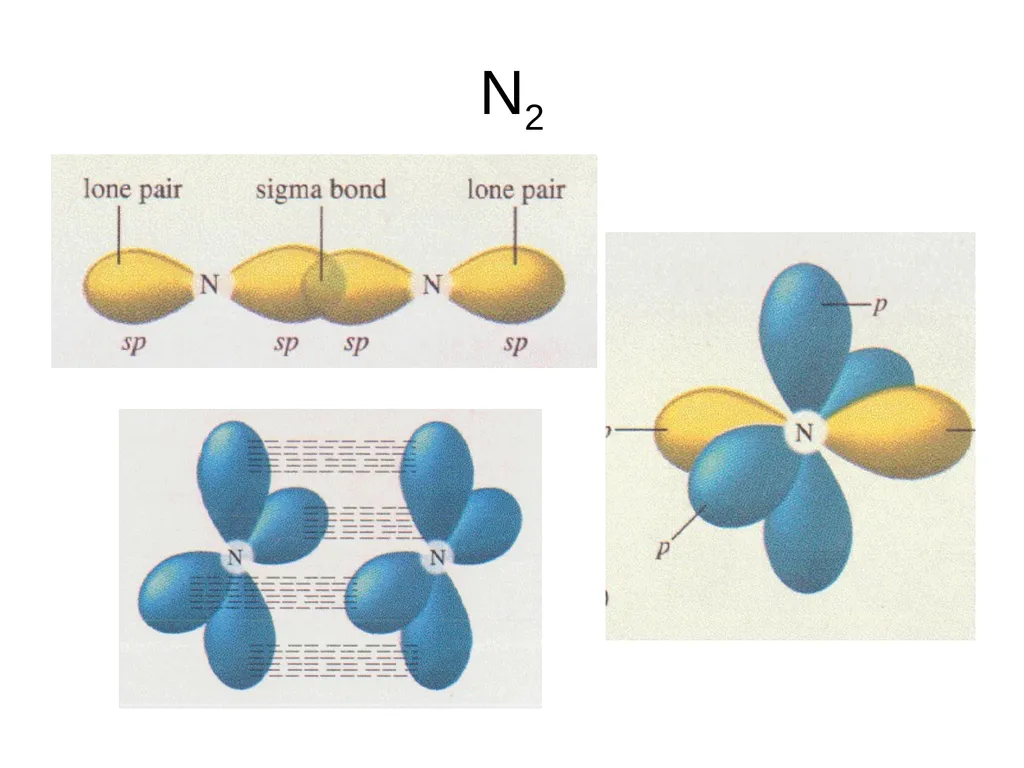
N2<br>
56
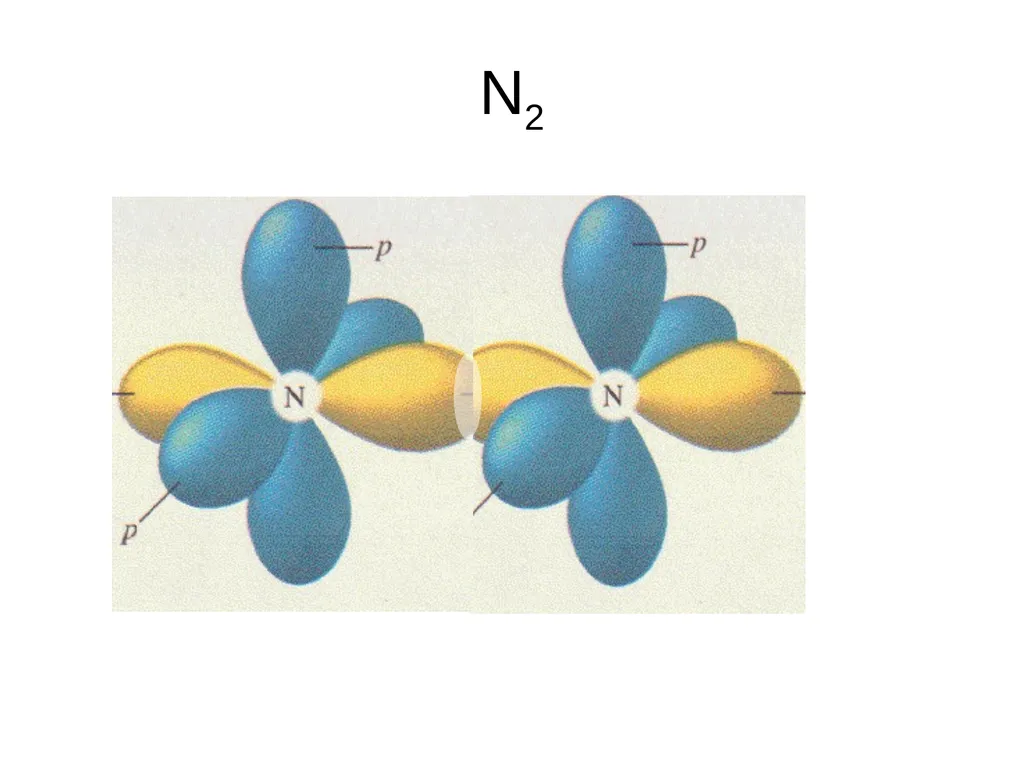
N2<br>
57
Polar Bonds When the atoms in a bond are the same, the electrons are shared equally.
This is a nonpolar covalent bond.
When two different atoms are connected, the atoms may not be shared equally.
This is a polar covalent bond.
How do we measure how strong the atoms pull on electrons?<br>
This is a nonpolar covalent bond.
When two different atoms are connected, the atoms may not be shared equally.
This is a polar covalent bond.
How do we measure how strong the atoms pull on electrons?<br>
58
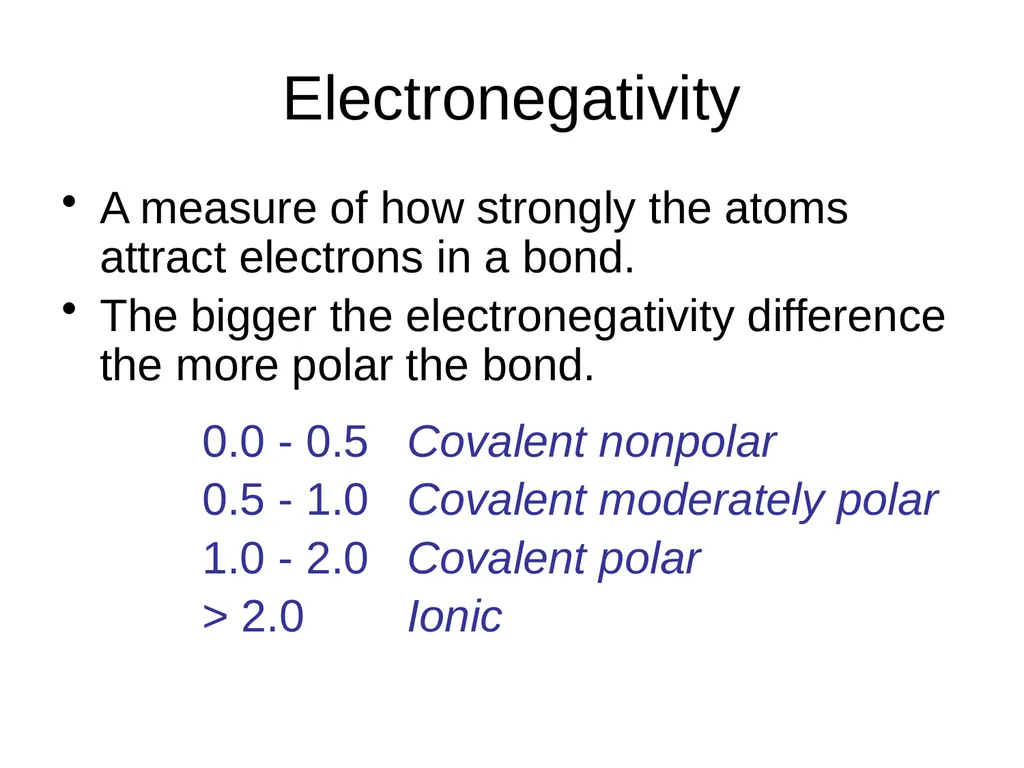
Electronegativity A measure of how strongly the atoms attract electrons in a bond.
The bigger the electronegativity difference the more polar the bond.
0.0 - 0.5 Covalent nonpolar
0.5 - 1.0 Covalent moderately polar
1.0 - 2.0 Covalent polar
> 2.0 Ionic<br>
The bigger the electronegativity difference the more polar the bond.
0.0 - 0.5 Covalent nonpolar
0.5 - 1.0 Covalent moderately polar
1.0 - 2.0 Covalent polar
> 2.0 Ionic<br>
59
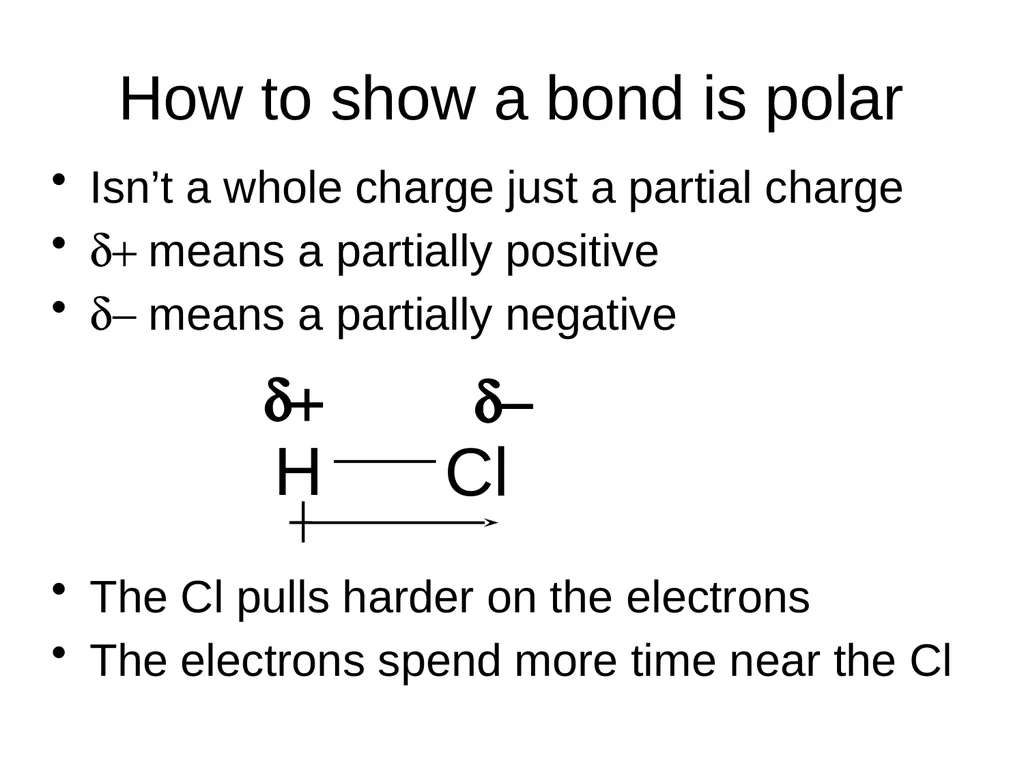
How to show a bond is polar Isn’t a whole charge just a partial charge
d+ means a partially positive
d- means a partially negative
The Cl pulls harder on the electrons
The electrons spend more time near the Cl H Cl d+ d-<br>
d+ means a partially positive
d- means a partially negative
The Cl pulls harder on the electrons
The electrons spend more time near the Cl H Cl d+ d-<br>
60
Polar Molecules Molecules with ends<br>
61
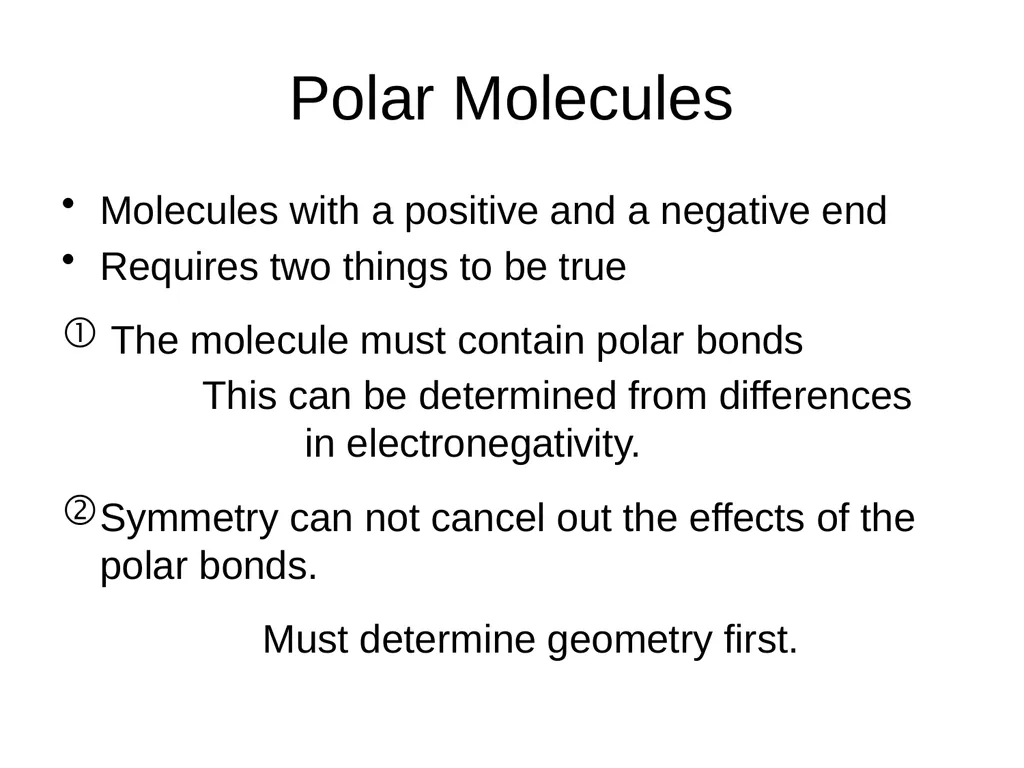
Polar Molecules Molecules with a positive and a negative end
Requires two things to be true
The molecule must contain polar bonds
This can be determined from differences in electronegativity.
Symmetry can not cancel out the effects of the polar bonds.
Must determine geometry first.<br>
Requires two things to be true
The molecule must contain polar bonds
This can be determined from differences in electronegativity.
Symmetry can not cancel out the effects of the polar bonds.
Must determine geometry first.<br>
62
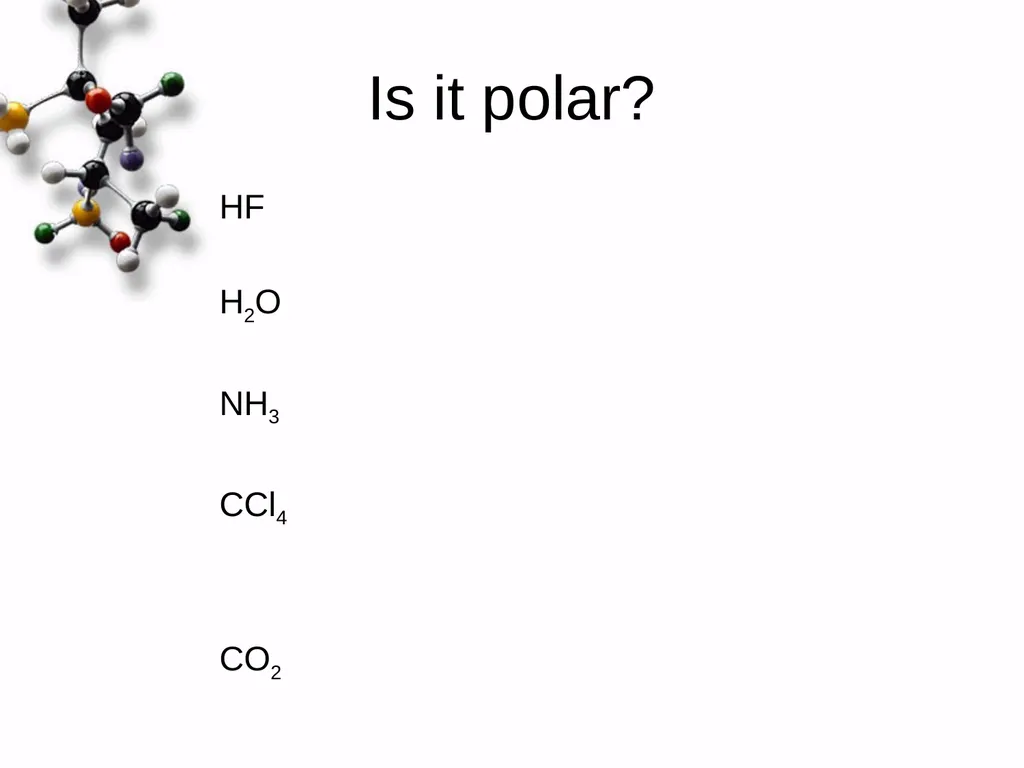
Is it polar? HF
H2O
NH3
CCl4
CO2<br>
H2O
NH3
CCl4
CO2<br>
63
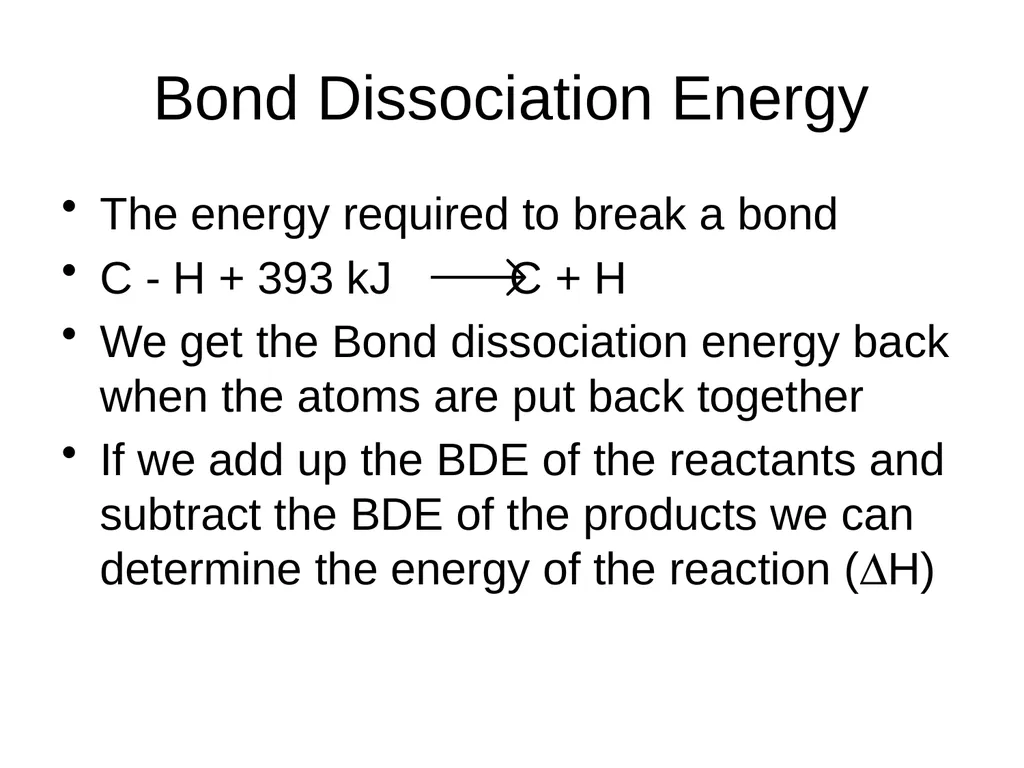
Bond Dissociation Energy The energy required to break a bond
C - H + 393 kJ C + H
We get the Bond dissociation energy back when the atoms are put back together
If we add up the BDE of the reactants and subtract the BDE of the products we can determine the energy of the reaction (DH)<br>
C - H + 393 kJ C + H
We get the Bond dissociation energy back when the atoms are put back together
If we add up the BDE of the reactants and subtract the BDE of the products we can determine the energy of the reaction (DH)<br>
64
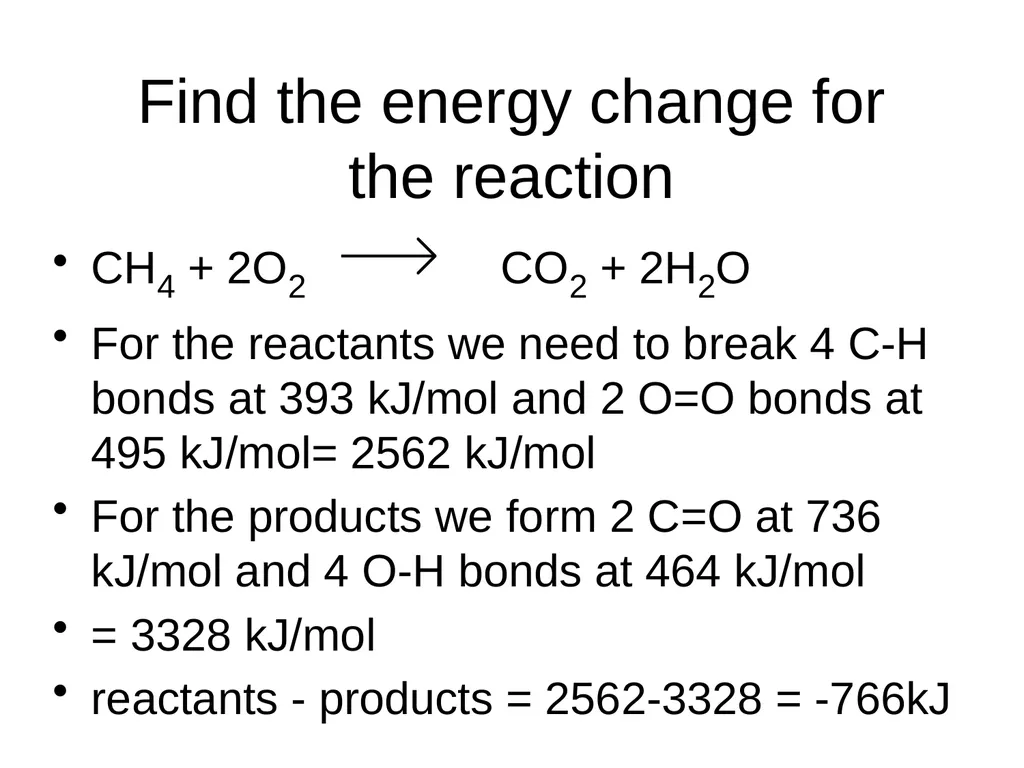
Find the energy change for the reaction CH4 + 2O2 CO2 + 2H2O
For the reactants we need to break 4 C-H bonds at 393 kJ/mol and 2 O=O bonds at 495 kJ/mol= 2562 kJ/mol
For the products we form 2 C=O at 736 kJ/mol and 4 O-H bonds at 464 kJ/mol
= 3328 kJ/mol
reactants - products = 2562-3328 = -766kJ<br>
For the reactants we need to break 4 C-H bonds at 393 kJ/mol and 2 O=O bonds at 495 kJ/mol= 2562 kJ/mol
For the products we form 2 C=O at 736 kJ/mol and 4 O-H bonds at 464 kJ/mol
= 3328 kJ/mol
reactants - products = 2562-3328 = -766kJ<br>
65
Intermolecular Forces What holds molecules to each other<br>
66
Intermolecular Forces They are what make solid and liquid molecular compounds possible.
The weakest are called van derWaal’s forces - there are two kinds
Dispersion forces
Dipole Interactions
depend on the number of electrons
more electrons stronger forces
Bigger molecules<br>
The weakest are called van derWaal’s forces - there are two kinds
Dispersion forces
Dipole Interactions
depend on the number of electrons
more electrons stronger forces
Bigger molecules<br>
67
Dipole interactions Depend on the number of electrons
More electrons stronger forces
Bigger molecules more electrons
Fluorine is a gas
Bromine is a liquid
Iodine is a solid<br>
More electrons stronger forces
Bigger molecules more electrons
Fluorine is a gas
Bromine is a liquid
Iodine is a solid<br>
68
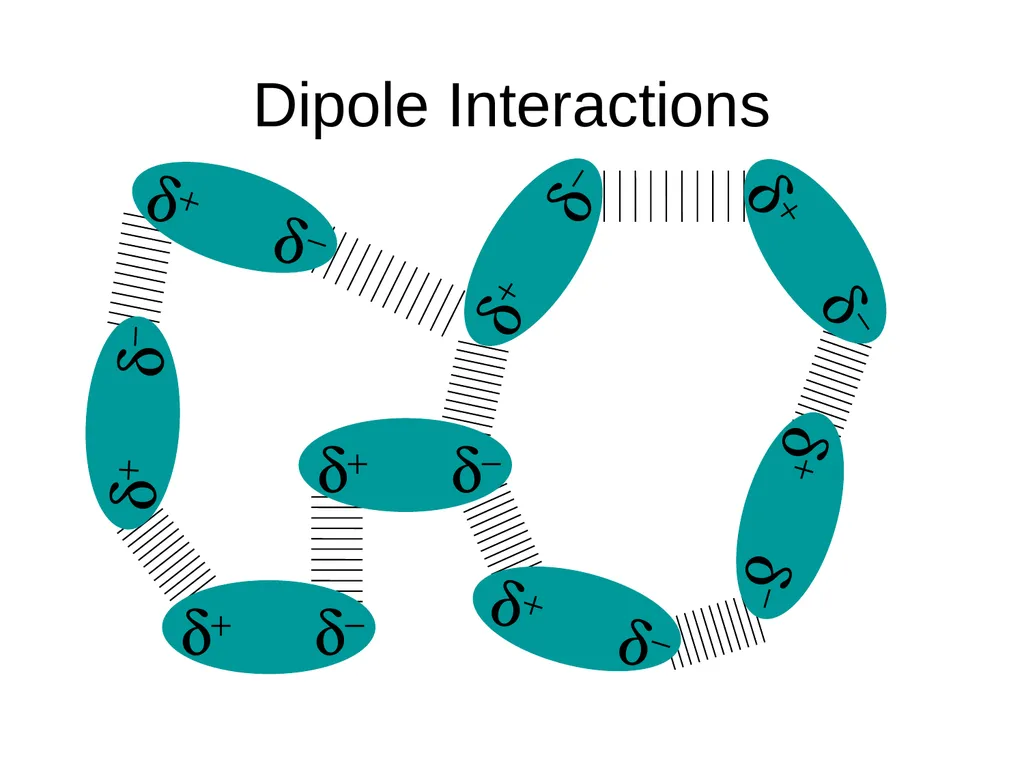
Dipole interactions Occur when polar molecules are attracted to each other.
Slightly stronger than dispersion forces.
Opposites attract but not completely hooked like in ionic solids.<br>
Slightly stronger than dispersion forces.
Opposites attract but not completely hooked like in ionic solids.<br>
69
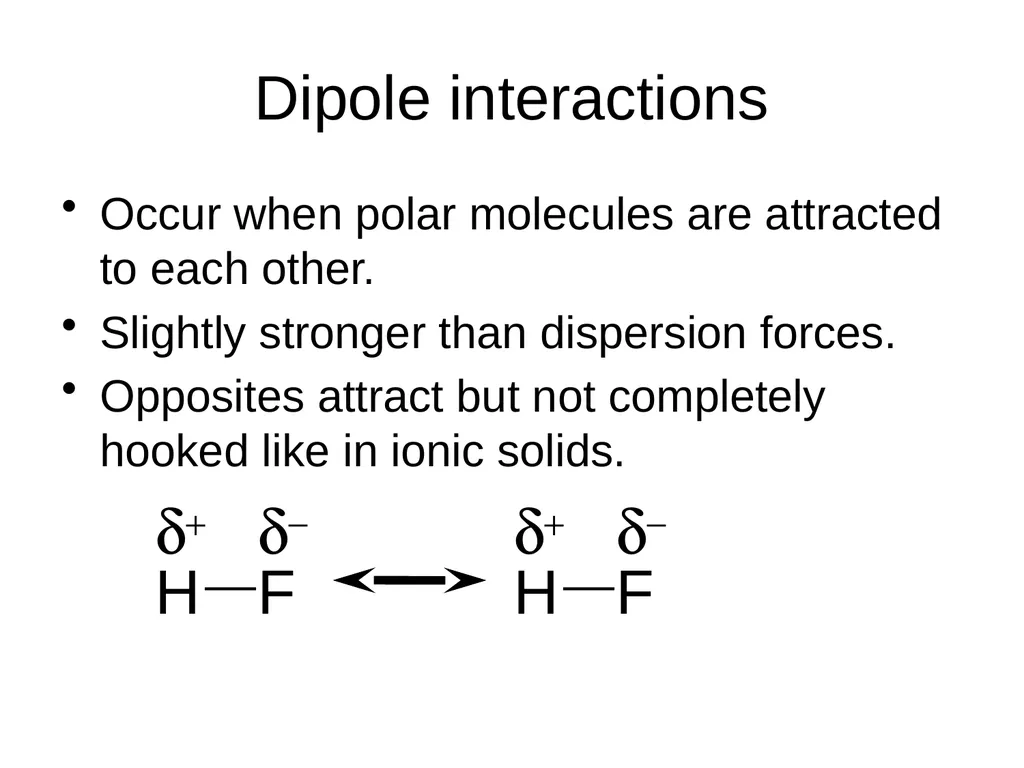
Dipole interactions Occur when polar molecules are attracted to each other.
Slightly stronger than dispersion forces.
Opposites attract but not completely hooked like in ionic solids.<br>
Slightly stronger than dispersion forces.
Opposites attract but not completely hooked like in ionic solids.<br>
70
Dipole Interactions d+ d-<br>
71
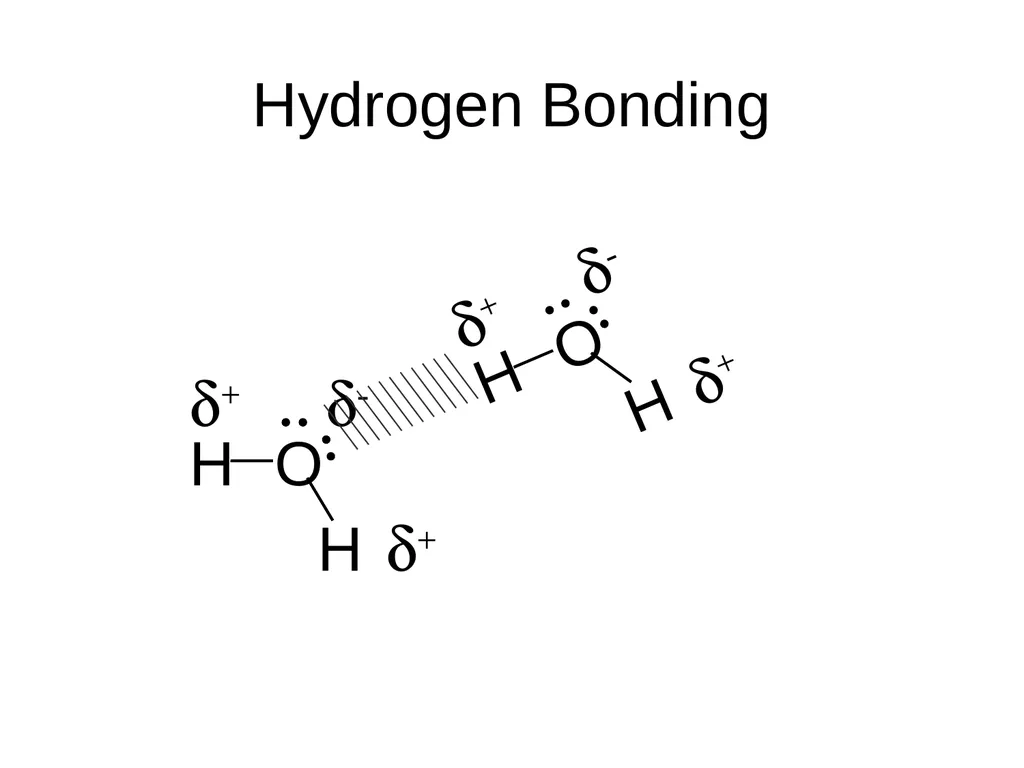
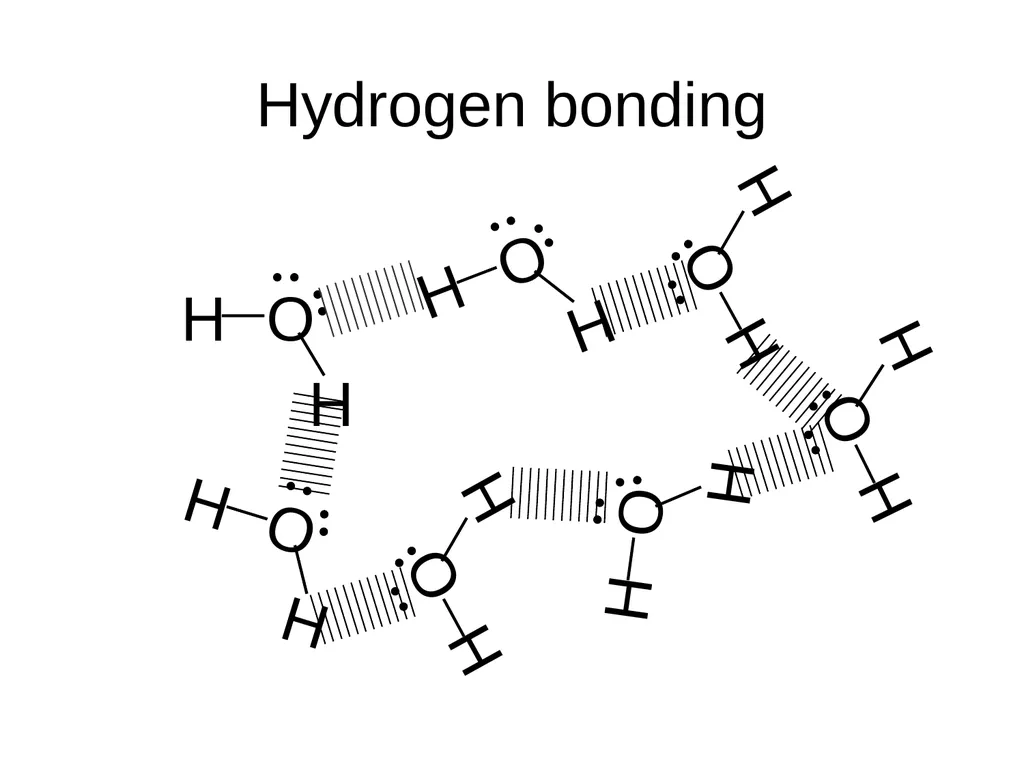
Hydrogen bonding Are the attractive force caused by hydrogen bonded to F, O, or N.
F, O, and N are very electronegative so it is a very strong dipole.
The hydrogen partially share with the lone pair in the molecule next to it.
The strongest of the intermolecular forces.<br>
F, O, and N are very electronegative so it is a very strong dipole.
The hydrogen partially share with the lone pair in the molecule next to it.
The strongest of the intermolecular forces.<br>
72
Hydrogen Bonding<br>
73
Hydrogen bonding<br>