CPAEA candidate or student, visit: www.farhatlectures.com Sources of income Income sources include, but are not limited to, the following: Compensation for services provided Business Income Gains on the disposition of properties Royalty
"CPA/EA candidate or student, visit:" is the property of its rightful owner. Permission is granted to
download and print the materials on this website for personal, non-commercial use only, and to display it
on your personal computer provided you do not modify the materials and that you retain all copyright
notices contained in the materials. By downloading content from our website, you accept the terms of this
agreement.
Presentation Transcript
01
CPA/EA candidate or student, visit:
www.farhatlectures.com<br>
02
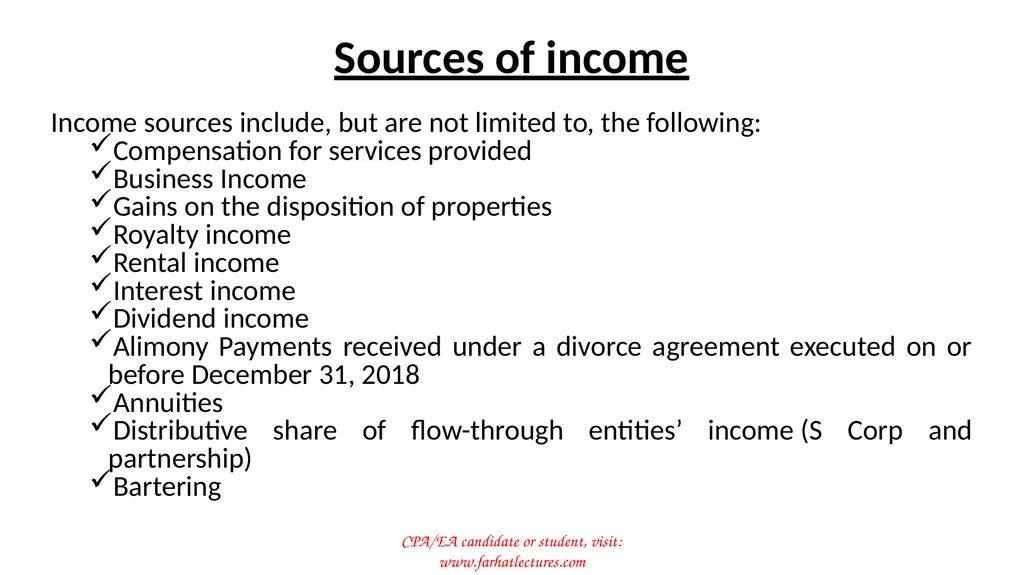
Sources of income Income sources include, but are not limited to, the following:
Compensation for services provided
Business Income
Gains on the disposition of properties
Royalty income
Rental income
Interest income
Dividend income
Alimony Payments received under a divorce agreement executed on or before December 31, 2018
Annuities
Distributive share of flow-through entities’ income (S Corp and partnership)
Bartering CPA/EA candidate or student, visit:
www.farhatlectures.com<br>
03
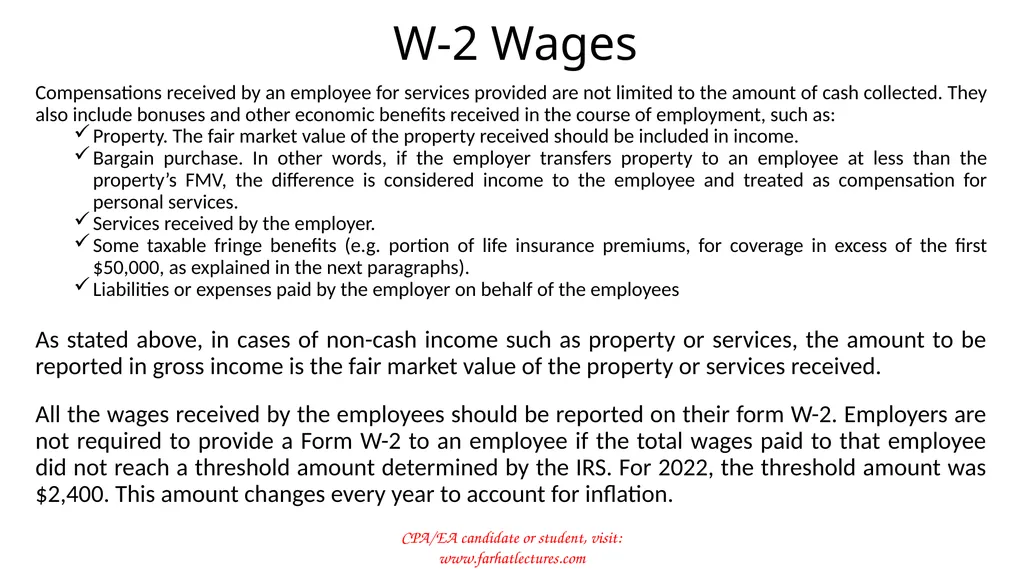
W-2 Wages Compensations received by an employee for services provided are not limited to the amount of cash collected. They also include bonuses and other economic benefits received in the course of employment, such as:
Property. The fair market value of the property received should be included in income.
Bargain purchase. In other words, if the employer transfers property to an employee at less than the property’s FMV, the difference is considered income to the employee and treated as compensation for personal services.
Services received by the employer.
Some taxable fringe benefits (e.g. portion of life insurance premiums, for coverage in excess of the first $50,000, as explained in the next paragraphs).
Liabilities or expenses paid by the employer on behalf of the employees
As stated above, in cases of non-cash income such as property or services, the amount to be reported in gross income is the fair market value of the property or services received.
All the wages received by the employees should be reported on their form W-2. Employers are not required to provide a Form W-2 to an employee if the total wages paid to that employee did not reach a threshold amount determined by the IRS. For 2022, the threshold amount was $2,400. This amount changes every year to account for inflation. CPA/EA candidate or student, visit:
www.farhatlectures.com<br>
04
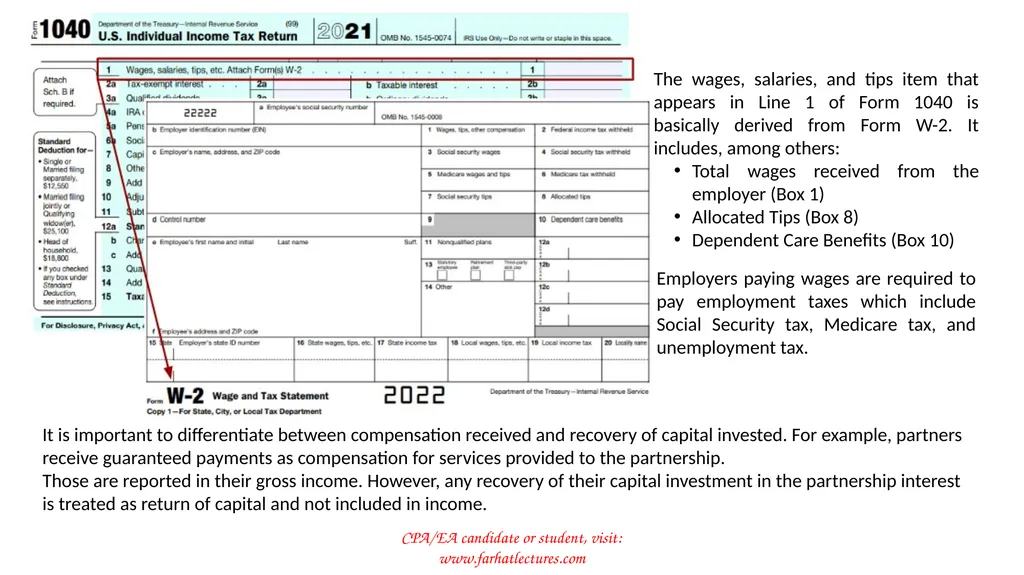
The wages, salaries, and tips item that appears in Line 1 of Form 1040 is basically derived from Form W-2. It includes, among others:
Total wages received from the employer (Box 1)
Allocated Tips (Box 8)
Dependent Care Benefits (Box 10) Employers paying wages are required to pay employment taxes which include Social Security tax, Medicare tax, and unemployment tax. It is important to differentiate between compensation received and recovery of capital invested. For example, partners receive guaranteed payments as compensation for services provided to the partnership.
Those are reported in their gross income. However, any recovery of their capital investment in the partnership interest is treated as return of capital and not included in income. CPA/EA candidate or student, visit:
www.farhatlectures.com<br>
05
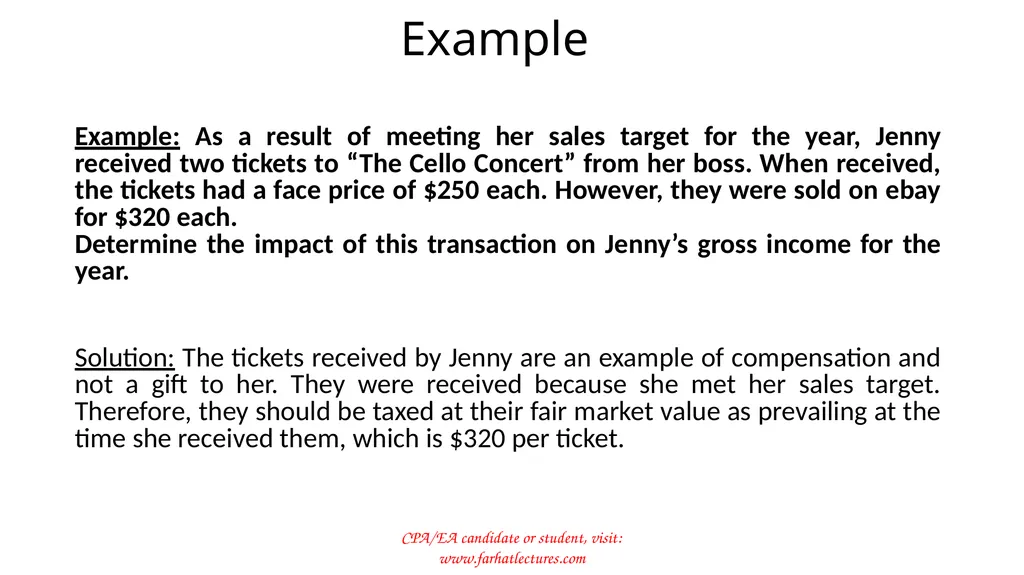
Example Example: As a result of meeting her sales target for the year, Jenny received two tickets to “The Cello Concert” from her boss. When received, the tickets had a face price of $250 each. However, they were sold on ebay for $320 each.
Determine the impact of this transaction on Jenny’s gross income for the year.
Solution: The tickets received by Jenny are an example of compensation and not a gift to her. They were received because she met her sales target. Therefore, they should be taxed at their fair market value as prevailing at the time she received them, which is $320 per ticket. CPA/EA candidate or student, visit:
www.farhatlectures.com<br>
06
Group Life Insurance - W-2 The life-insurance premium, offered by an employer to his employees, under a group term life insurance policy is excluded from the employees’ gross income for up to the first 50,000 of coverage. Any premium paid on coverage that exceeds $50,000 is included in gross income and reported on Form W-2.
The premium exclusion applies only for employees not owners or partners. If owners or partners are paying a premium for group life insurance on their behalf, the total premium is taxable to them. CPA/EA candidate or student, visit:
www.farhatlectures.com<br>
07
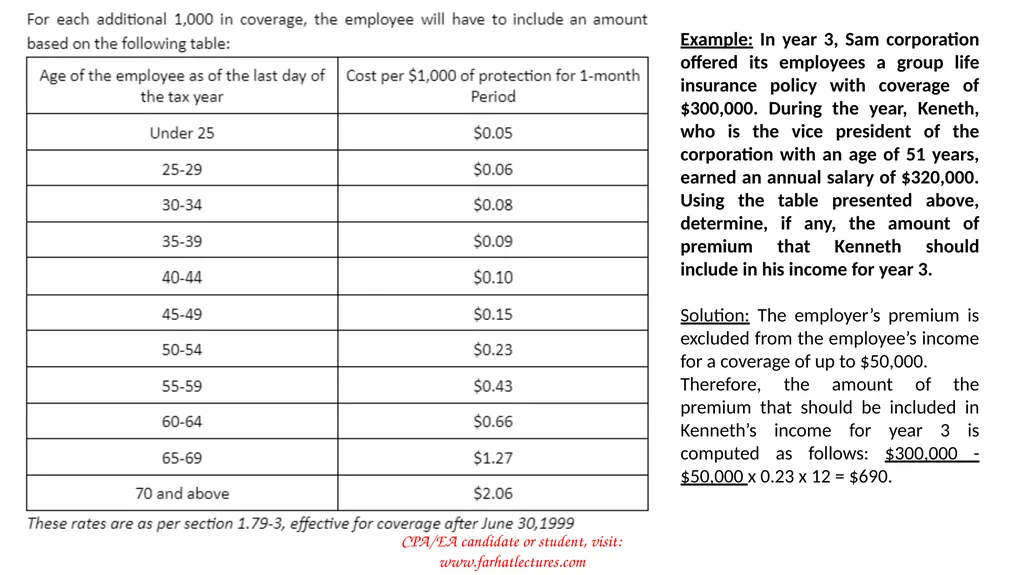
Example: In year 3, Sam corporation offered its employees a group life insurance policy with coverage of $300,000. During the year, Keneth, who is the vice president of the corporation with an age of 51 years, earned an annual salary of $320,000. Using the table presented above, determine, if any, the amount of premium that Kenneth should include in his income for year 3.
Solution: The employer’s premium is excluded from the employee’s income for a coverage of up to $50,000.
Therefore, the amount of the premium that should be included in Kenneth’s income for year 3 is computed as follows: $300,000 - $50,000 x 0.23 x 12 = $690. CPA/EA candidate or student, visit:
www.farhatlectures.com<br>