
CPD Lunchtime Meeting Complaints Implementation of
PM
Published · 17 slides · 0 views
1 / 1
Description
CPD Lunchtime Meeting Complaints Implementation of PS1519 9th February 2016 Roger Binks UK Complaints Manager, RSA February 2016 Learning Objectives 2 By the end of this session you will.. Have an understanding of the main complaint
Related Topics
Share
Embed code
Download this presentation From Below
"CPD Lunchtime Meeting Complaints Implementation of" is the property of its rightful owner. Permission is granted to download and print the materials on this website for personal, non-commercial use only, and to display it on your personal computer provided you do not modify the materials and that you retain all copyright notices contained in the materials. By downloading content from our website, you accept the terms of this agreement.
Presentation Transcript
01
CPD Lunchtime Meeting
Complaints Implementation of PS15/19
9th February 2016
Roger Binks
UK Complaints Manager, RSA
February 2016<br>
Complaints Implementation of PS15/19
9th February 2016
Roger Binks
UK Complaints Manager, RSA
February 2016<br>
02
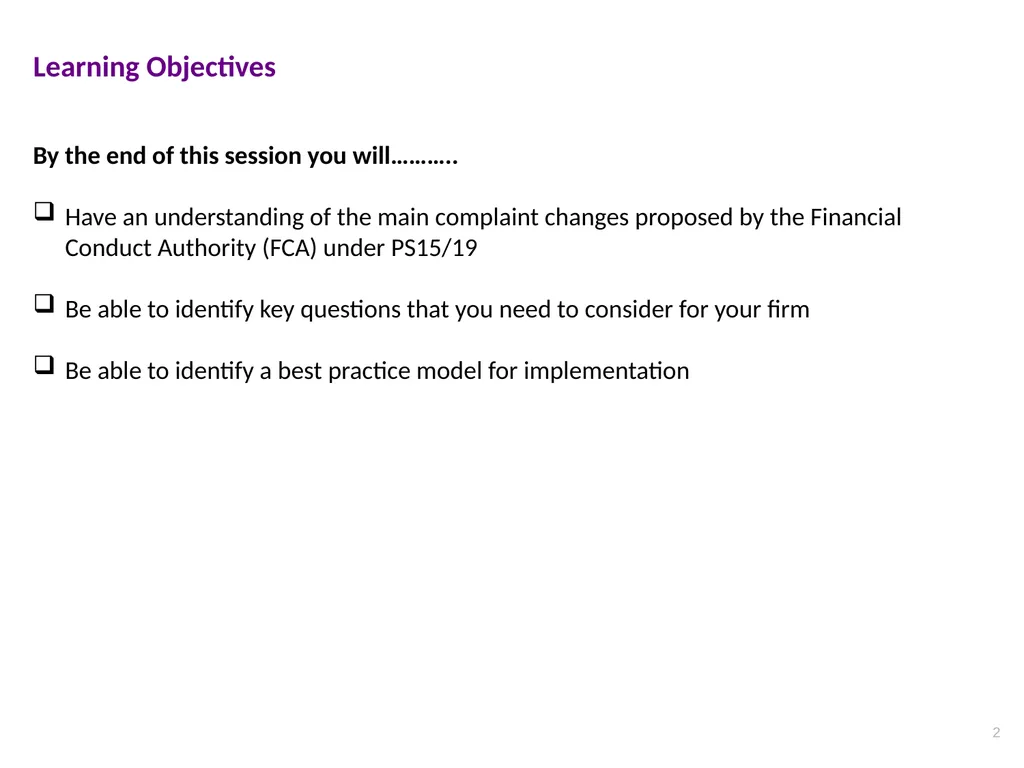
Learning Objectives 2 By the end of this session you will………..
Have an understanding of the main complaint changes proposed by the Financial Conduct Authority (FCA) under PS15/19
Be able to identify key questions that you need to consider for your firm
Be able to identify a best practice model for implementation<br>
Have an understanding of the main complaint changes proposed by the Financial Conduct Authority (FCA) under PS15/19
Be able to identify key questions that you need to consider for your firm
Be able to identify a best practice model for implementation<br>
03
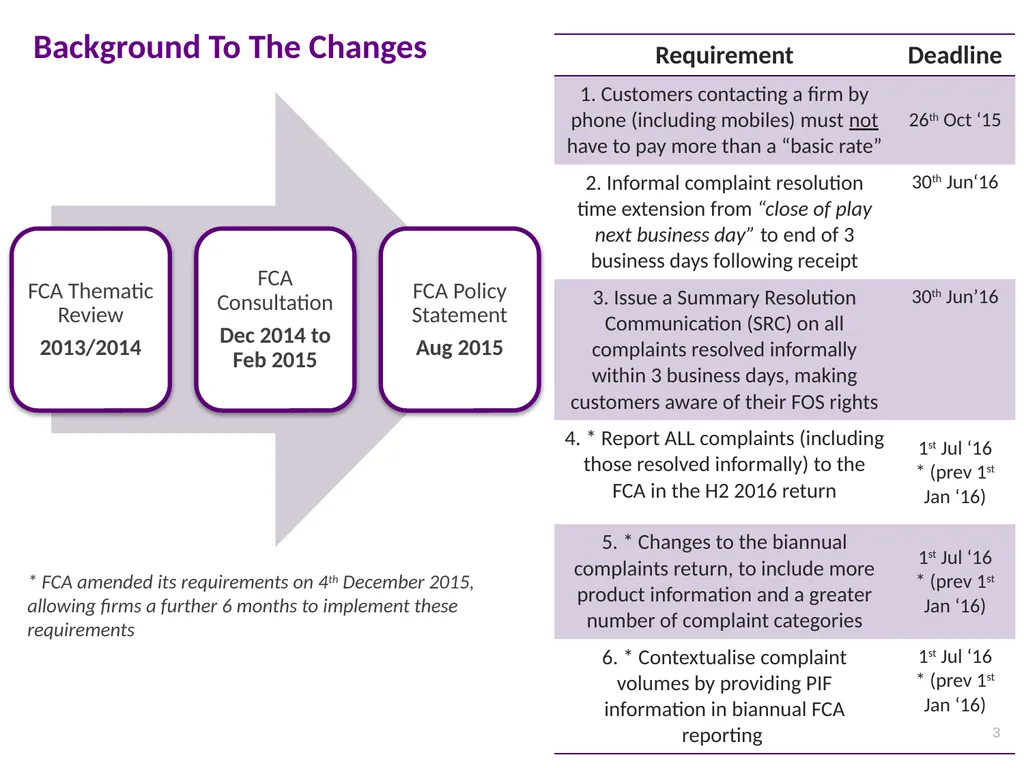
Background To The Changes 3 * FCA amended its requirements on 4th December 2015, allowing firms a further 6 months to implement these requirements<br>
04
Basic Rate Call Charges – 26th Oct 2015 Customers contacting a firm by telephone regarding contracts already entered into with that firm, must not have to pay more than a “basic rate” (including mobile phone numbers)
For insurers, this includes calls from customers in relation to complaints, claims and other servicing queries
It brings financial services in line with provisions of the EU Consumer Rights Directive 4<br>
For insurers, this includes calls from customers in relation to complaints, claims and other servicing queries
It brings financial services in line with provisions of the EU Consumer Rights Directive 4<br>
05
Informal Complaints Time Extension – 30th June 2016 Extends the time for firms to resolve complaints informally from “close of next business day” to the end of 3 business days after receiving the complaint
Allows firms a longer time to handle complaints less formally, without sending a final response letter
“Close of business day” is the end of the ordinary business hours within which that firm operates
Caveat is that firms have to issue a written Summary Resolution Communication (SRC) giving FOS rights. The SRC can be letter, email or text 5<br>
Allows firms a longer time to handle complaints less formally, without sending a final response letter
“Close of business day” is the end of the ordinary business hours within which that firm operates
Caveat is that firms have to issue a written Summary Resolution Communication (SRC) giving FOS rights. The SRC can be letter, email or text 5<br>
06
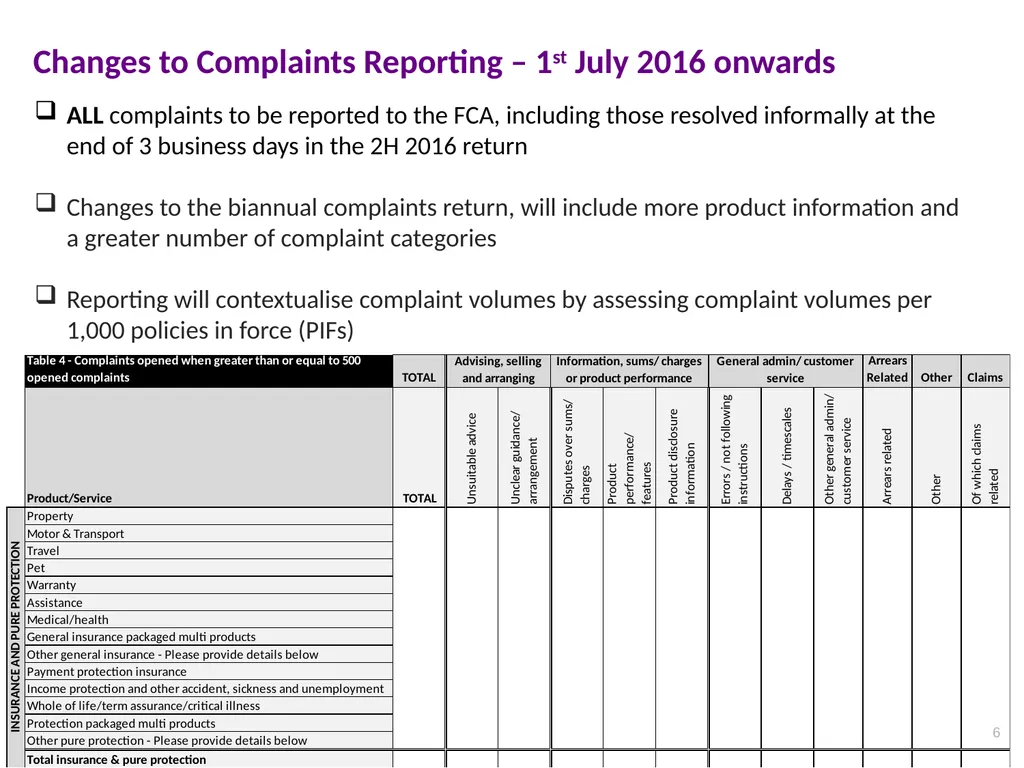
Changes to Complaints Reporting – 1st July 2016 onwards ALL complaints to be reported to the FCA, including those resolved informally at the end of 3 business days in the 2H 2016 return
Changes to the biannual complaints return, will include more product information and a greater number of complaint categories
Reporting will contextualise complaint volumes by assessing complaint volumes per 1,000 policies in force (PIFs) 6<br>
Changes to the biannual complaints return, will include more product information and a greater number of complaint categories
Reporting will contextualise complaint volumes by assessing complaint volumes per 1,000 policies in force (PIFs) 6<br>
07
Key Questions to Consider
1. Applying the Complaints Definition Throughout the Thematic Review and Consultation period, the industry lobbied the FCA to change the complaints definition, or to provide further guidance on materiality
FCA Complaint Definition
“Any oral or written expression of dissatisfaction, whether justified or not, from, or on behalf of, an eligible complainant about the provision of, or failure to provide, a financial service which alleges that the complainant has suffered (or may suffer) financial loss, material distress or material inconvenience”
Many firms simplify this to “any expression of dissatisfaction”
Most “non-material” complaints drop out in the informal process
Reporting ALL complaints irrespective of materiality could make firms look worse against industry peers. How will the public and Press react? 7<br>
1. Applying the Complaints Definition Throughout the Thematic Review and Consultation period, the industry lobbied the FCA to change the complaints definition, or to provide further guidance on materiality
FCA Complaint Definition
“Any oral or written expression of dissatisfaction, whether justified or not, from, or on behalf of, an eligible complainant about the provision of, or failure to provide, a financial service which alleges that the complainant has suffered (or may suffer) financial loss, material distress or material inconvenience”
Many firms simplify this to “any expression of dissatisfaction”
Most “non-material” complaints drop out in the informal process
Reporting ALL complaints irrespective of materiality could make firms look worse against industry peers. How will the public and Press react? 7<br>
08
Key Questions to Consider
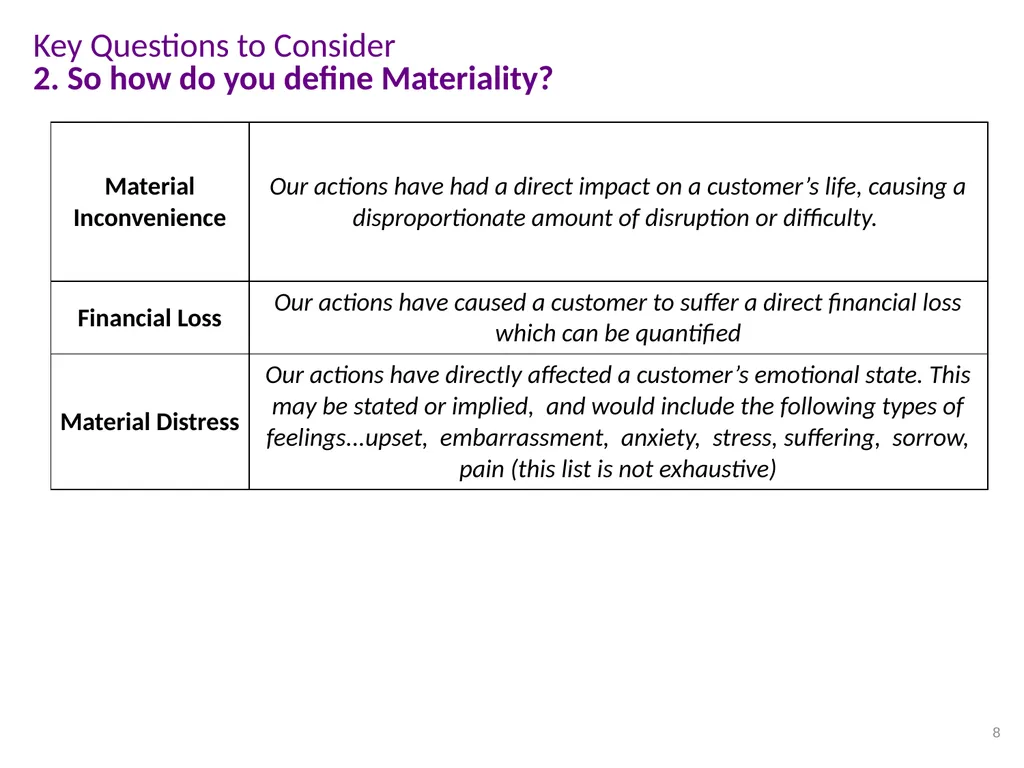
2. So how do you define Materiality? 8<br>
2. So how do you define Materiality? 8<br>
09
Key Questions to Consider
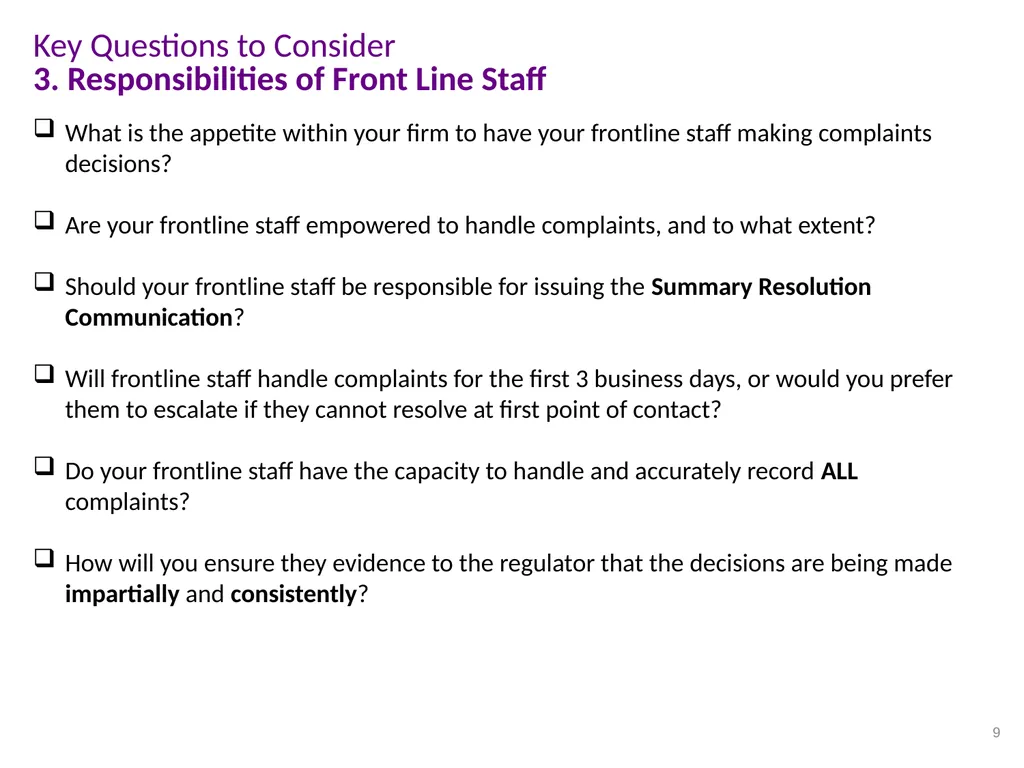
3. Responsibilities of Front Line Staff 9 What is the appetite within your firm to have your frontline staff making complaints decisions?
Are your frontline staff empowered to handle complaints, and to what extent?
Should your frontline staff be responsible for issuing the Summary Resolution Communication?
Will frontline staff handle complaints for the first 3 business days, or would you prefer them to escalate if they cannot resolve at first point of contact?
Do your frontline staff have the capacity to handle and accurately record ALL complaints?
How will you ensure they evidence to the regulator that the decisions are being made impartially and consistently?<br>
3. Responsibilities of Front Line Staff 9 What is the appetite within your firm to have your frontline staff making complaints decisions?
Are your frontline staff empowered to handle complaints, and to what extent?
Should your frontline staff be responsible for issuing the Summary Resolution Communication?
Will frontline staff handle complaints for the first 3 business days, or would you prefer them to escalate if they cannot resolve at first point of contact?
Do your frontline staff have the capacity to handle and accurately record ALL complaints?
How will you ensure they evidence to the regulator that the decisions are being made impartially and consistently?<br>
10
Key Questions to Consider
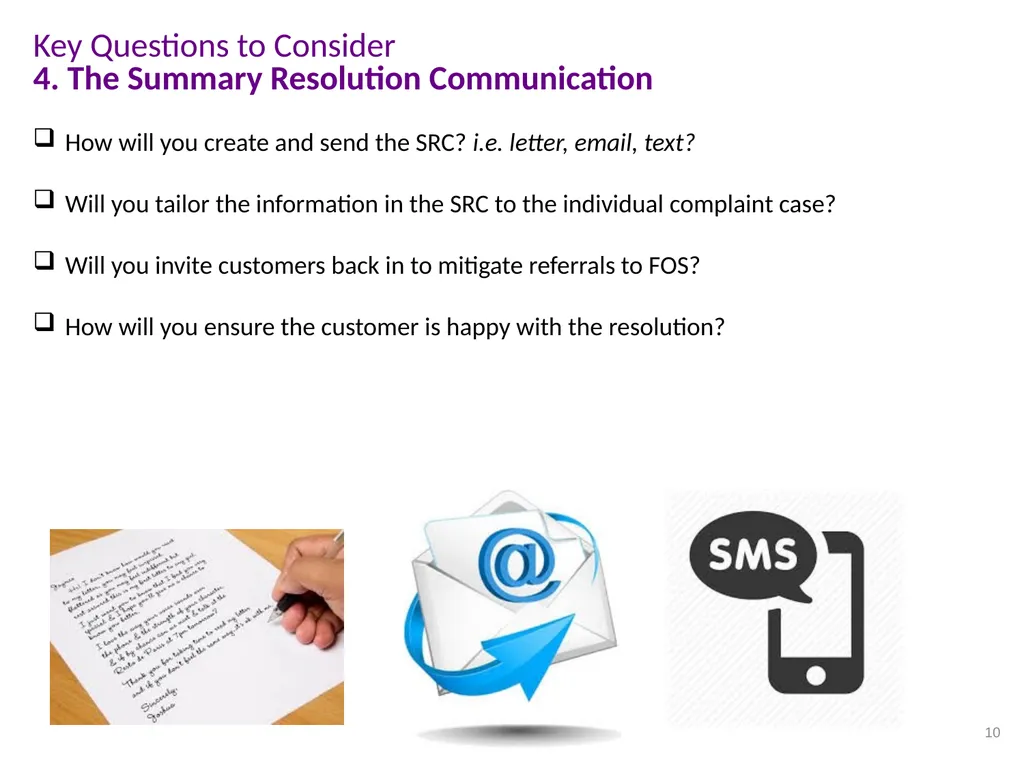
4. The Summary Resolution Communication 10 How will you create and send the SRC? i.e. letter, email, text?
Will you tailor the information in the SRC to the individual complaint case?
Will you invite customers back in to mitigate referrals to FOS?
How will you ensure the customer is happy with the resolution?<br>
4. The Summary Resolution Communication 10 How will you create and send the SRC? i.e. letter, email, text?
Will you tailor the information in the SRC to the individual complaint case?
Will you invite customers back in to mitigate referrals to FOS?
How will you ensure the customer is happy with the resolution?<br>
11
Key Questions to Consider
5. Systems! 11 Do you use an in-house solution for capturing complaints or a software provider?
How will you ensure your systems capture the new reporting requirements?
Is this the right time to review your complaint system requirements?<br>
5. Systems! 11 Do you use an in-house solution for capturing complaints or a software provider?
How will you ensure your systems capture the new reporting requirements?
Is this the right time to review your complaint system requirements?<br>
12
Key Questions to Consider
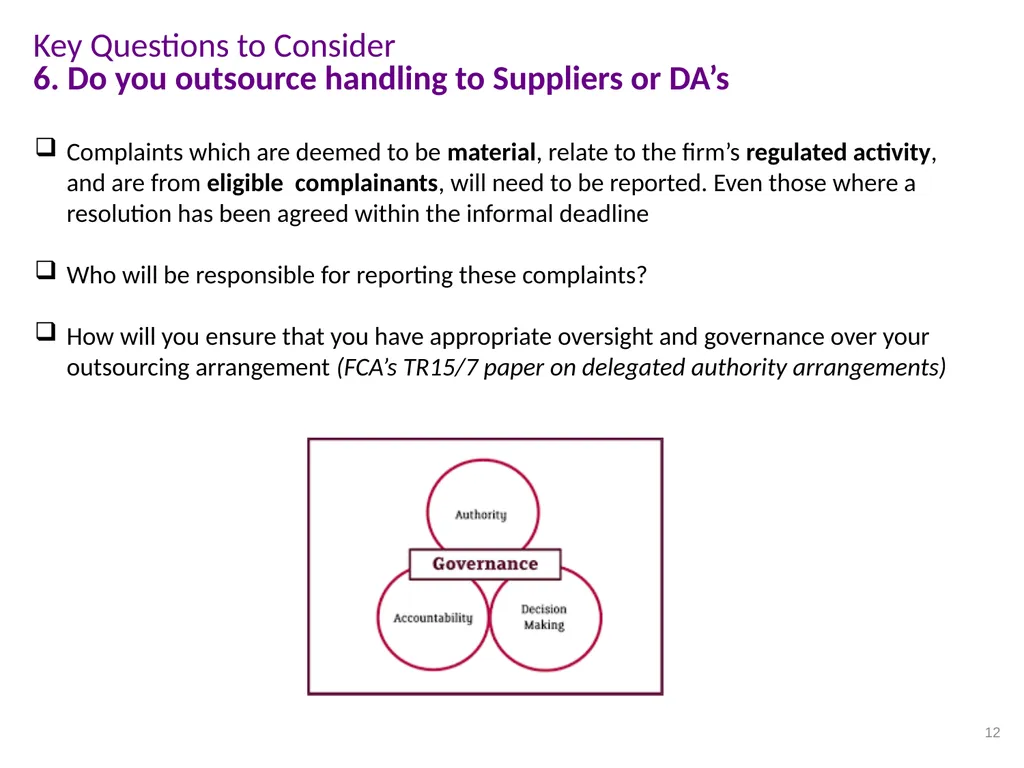
6. Do you outsource handling to Suppliers or DA’s 12 Complaints which are deemed to be material, relate to the firm’s regulated activity, and are from eligible complainants, will need to be reported. Even those where a resolution has been agreed within the informal deadline
Who will be responsible for reporting these complaints?
How will you ensure that you have appropriate oversight and governance over your outsourcing arrangement (FCA’s TR15/7 paper on delegated authority arrangements)<br>
6. Do you outsource handling to Suppliers or DA’s 12 Complaints which are deemed to be material, relate to the firm’s regulated activity, and are from eligible complainants, will need to be reported. Even those where a resolution has been agreed within the informal deadline
Who will be responsible for reporting these complaints?
How will you ensure that you have appropriate oversight and governance over your outsourcing arrangement (FCA’s TR15/7 paper on delegated authority arrangements)<br>
13
Key Questions to Consider
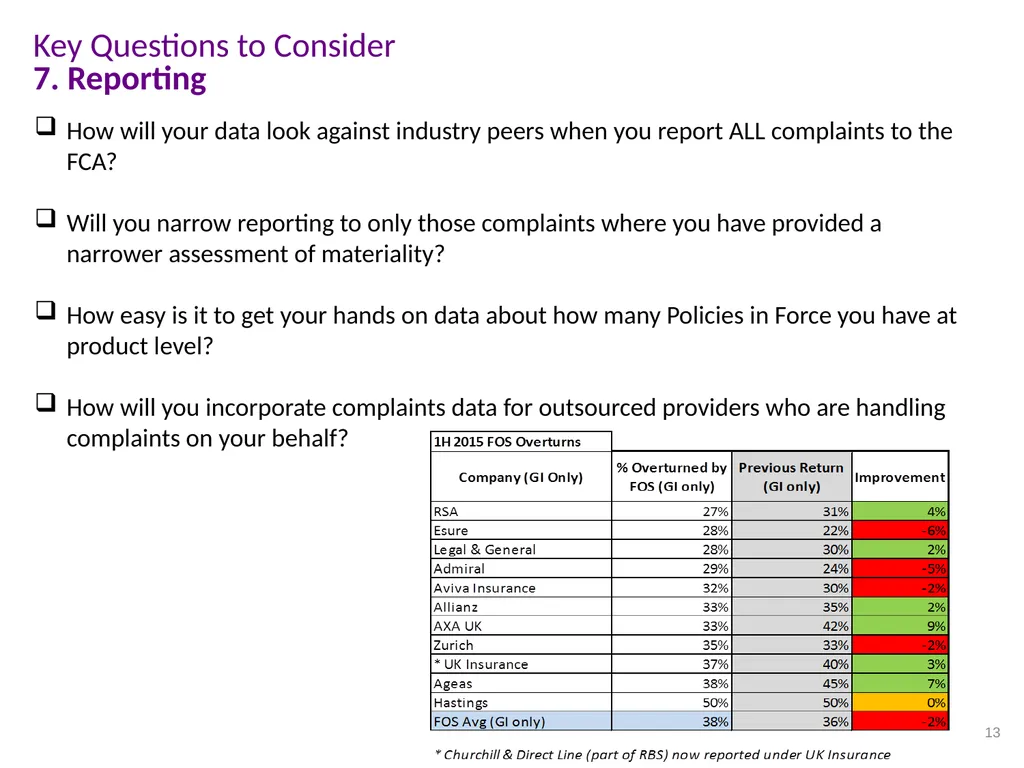
7. Reporting 13 How will your data look against industry peers when you report ALL complaints to the FCA?
Will you narrow reporting to only those complaints where you have provided a narrower assessment of materiality?
How easy is it to get your hands on data about how many Policies in Force you have at product level?
How will you incorporate complaints data for outsourced providers who are handling complaints on your behalf?<br>
7. Reporting 13 How will your data look against industry peers when you report ALL complaints to the FCA?
Will you narrow reporting to only those complaints where you have provided a narrower assessment of materiality?
How easy is it to get your hands on data about how many Policies in Force you have at product level?
How will you incorporate complaints data for outsourced providers who are handling complaints on your behalf?<br>
14
Best Practice Model
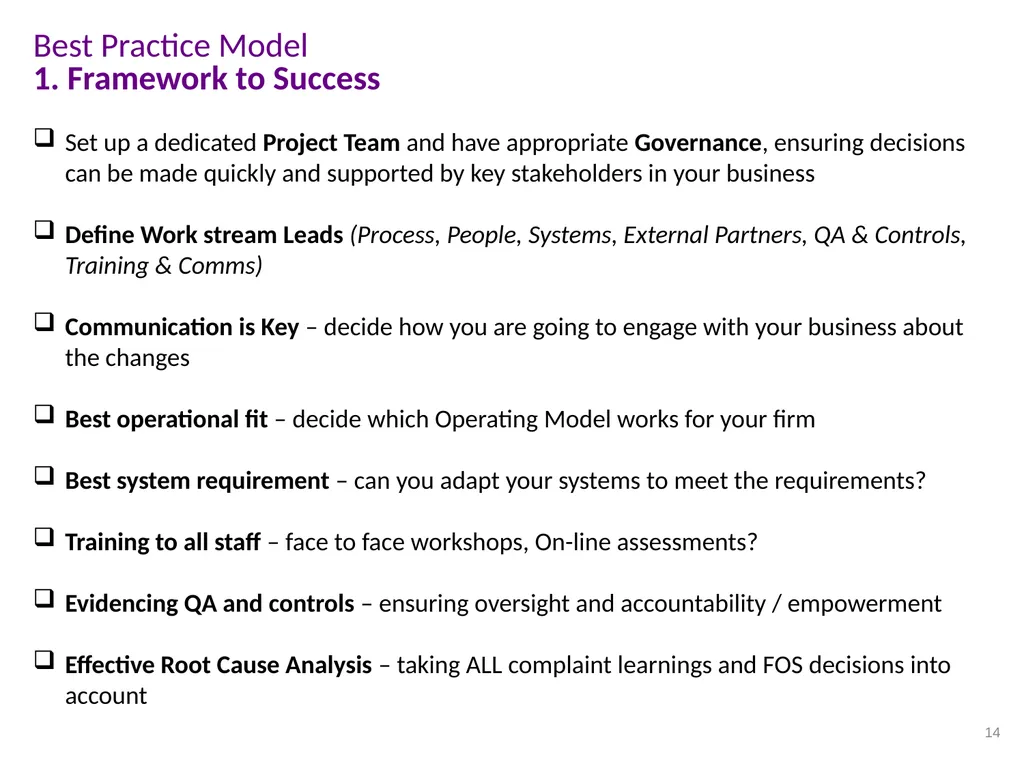
1. Framework to Success 14 Set up a dedicated Project Team and have appropriate Governance, ensuring decisions can be made quickly and supported by key stakeholders in your business
Define Work stream Leads (Process, People, Systems, External Partners, QA & Controls, Training & Comms)
Communication is Key – decide how you are going to engage with your business about the changes
Best operational fit – decide which Operating Model works for your firm
Best system requirement – can you adapt your systems to meet the requirements?
Training to all staff – face to face workshops, On-line assessments?
Evidencing QA and controls – ensuring oversight and accountability / empowerment
Effective Root Cause Analysis – taking ALL complaint learnings and FOS decisions into account<br>
1. Framework to Success 14 Set up a dedicated Project Team and have appropriate Governance, ensuring decisions can be made quickly and supported by key stakeholders in your business
Define Work stream Leads (Process, People, Systems, External Partners, QA & Controls, Training & Comms)
Communication is Key – decide how you are going to engage with your business about the changes
Best operational fit – decide which Operating Model works for your firm
Best system requirement – can you adapt your systems to meet the requirements?
Training to all staff – face to face workshops, On-line assessments?
Evidencing QA and controls – ensuring oversight and accountability / empowerment
Effective Root Cause Analysis – taking ALL complaint learnings and FOS decisions into account<br>
15
Best Practice Model
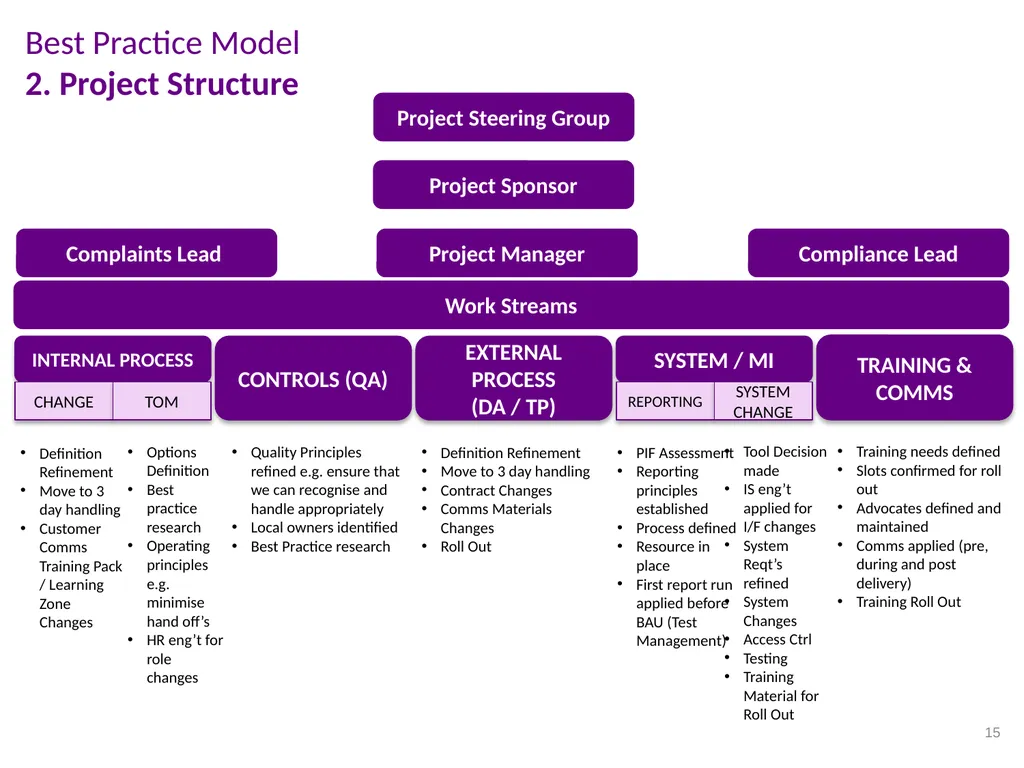
2. Project Structure 15 Project Manager INTERNAL PROCESS CONTROLS (QA) EXTERNAL PROCESS
(DA / TP) SYSTEM / MI TRAINING & COMMS CHANGE TOM REPORTING SYSTEM CHANGE Definition Refinement
Move to 3 day handling
Customer Comms Training Pack / Learning Zone Changes Options Definition
Best practice research
Operating principles e.g. minimise hand off’s
HR eng’t for role changes Quality Principles refined e.g. ensure that we can recognise and handle appropriately
Local owners identified
Best Practice research Definition Refinement
Move to 3 day handling
Contract Changes
Comms Materials Changes
Roll Out PIF Assessment
Reporting principles established
Process defined
Resource in place
First report run applied before BAU (Test Management) Tool Decision made
IS eng’t applied for I/F changes
System Reqt’s refined
System Changes
Access Ctrl
Testing
Training Material for Roll Out Training needs defined
Slots confirmed for roll out
Advocates defined and maintained
Comms applied (pre, during and post delivery)
Training Roll Out Complaints Lead Compliance Lead Project Sponsor Project Steering Group Work Streams<br>
2. Project Structure 15 Project Manager INTERNAL PROCESS CONTROLS (QA) EXTERNAL PROCESS
(DA / TP) SYSTEM / MI TRAINING & COMMS CHANGE TOM REPORTING SYSTEM CHANGE Definition Refinement
Move to 3 day handling
Customer Comms Training Pack / Learning Zone Changes Options Definition
Best practice research
Operating principles e.g. minimise hand off’s
HR eng’t for role changes Quality Principles refined e.g. ensure that we can recognise and handle appropriately
Local owners identified
Best Practice research Definition Refinement
Move to 3 day handling
Contract Changes
Comms Materials Changes
Roll Out PIF Assessment
Reporting principles established
Process defined
Resource in place
First report run applied before BAU (Test Management) Tool Decision made
IS eng’t applied for I/F changes
System Reqt’s refined
System Changes
Access Ctrl
Testing
Training Material for Roll Out Training needs defined
Slots confirmed for roll out
Advocates defined and maintained
Comms applied (pre, during and post delivery)
Training Roll Out Complaints Lead Compliance Lead Project Sponsor Project Steering Group Work Streams<br>
16
Have the Learning Objectives been met? 16 At the end of this session you will………..
Have an understanding of the main complaint changes proposed by the Financial Conduct Authority (FCA) under PS15/19
Be able to identify key questions that you need to consider for your firm
Be able to identify a best practice model for implementation<br>
Have an understanding of the main complaint changes proposed by the Financial Conduct Authority (FCA) under PS15/19
Be able to identify key questions that you need to consider for your firm
Be able to identify a best practice model for implementation<br>
17
17 Appendix - Key FCA Requirements & Industry Opinion The FCA Expects firms to have…
Appropriate management controls in place to identify and rectify any recurring or systemic problems
An appropriate root cause analysis framework in place which involves the collation of data which informs senior personnel about the volume of complaints received, the reasons behind them, and any remedial activity required
Processes in place to allow the firm to investigate all complaints competently, diligently and impartially
Processes in place to allow a fair, consistent and prompt assessment of the complaint
Personnel with the authority and ability to determine whether or not the complaint should be upheld and if any remedial action or redress is appropriate
Personnel with a sound awareness of outcomes on similar complaints, and relevant FCA and FOS guidance and/or philosophies
Processes in place to allow for complaints to be resolved promptly, minimising the number of referrals to the FOS The Industry Expert View of Complaints…
The majority of customers who have an issue do not complain – to reduce the number of non-complainants firms must have a transparent and simple complaint process
Effective RCA is a key principle to success and with senior management support. Compiling meaningful complaints MI is critical to enabling a firms management to make balanced and informed decisions to drive positive customer change
The vast majority of complainants changed their overall impression of the provider based upon their complaints experience
85% of customers expect firms to acknowledge their complaint within 48 hours and 82% of complainants resolved within 1 week
Complaint Ownership, Complaint Culture, Staff Capability and Communication are key components of good complaints best practice
Firms have more to do to define & monitor competence in their complaint teams
Timeliness plays a key role in many of the negative aspects experienced by customers<br>
Appropriate management controls in place to identify and rectify any recurring or systemic problems
An appropriate root cause analysis framework in place which involves the collation of data which informs senior personnel about the volume of complaints received, the reasons behind them, and any remedial activity required
Processes in place to allow the firm to investigate all complaints competently, diligently and impartially
Processes in place to allow a fair, consistent and prompt assessment of the complaint
Personnel with the authority and ability to determine whether or not the complaint should be upheld and if any remedial action or redress is appropriate
Personnel with a sound awareness of outcomes on similar complaints, and relevant FCA and FOS guidance and/or philosophies
Processes in place to allow for complaints to be resolved promptly, minimising the number of referrals to the FOS The Industry Expert View of Complaints…
The majority of customers who have an issue do not complain – to reduce the number of non-complainants firms must have a transparent and simple complaint process
Effective RCA is a key principle to success and with senior management support. Compiling meaningful complaints MI is critical to enabling a firms management to make balanced and informed decisions to drive positive customer change
The vast majority of complainants changed their overall impression of the provider based upon their complaints experience
85% of customers expect firms to acknowledge their complaint within 48 hours and 82% of complainants resolved within 1 week
Complaint Ownership, Complaint Culture, Staff Capability and Communication are key components of good complaints best practice
Firms have more to do to define & monitor competence in their complaint teams
Timeliness plays a key role in many of the negative aspects experienced by customers<br>