
CPE SEMINAR ON Standards on Auditing –
TD
Published · 45 slides · 0 views
1 / 1
Description
CPE SEMINAR ON Standards on Auditing Documentation a practical approach (10th August 2022) Hosted by Ernakulam branch of SIRC of ICAI GOVIND P. FCA Independence Audit Quality Hallmarks of the Profession HOW TO PROVE? ASSURANCE
Related Topics
Share
Embed code
Download this presentation From Below
"CPE SEMINAR ON Standards on Auditing –" is the property of its rightful owner. Permission is granted to download and print the materials on this website for personal, non-commercial use only, and to display it on your personal computer provided you do not modify the materials and that you retain all copyright notices contained in the materials. By downloading content from our website, you accept the terms of this agreement.
Presentation Transcript
01
CPE SEMINAR ON
Standards on Auditing – Documentation a practical approach
(10th August 2022) Hosted by – Ernakulam branch of SIRC of ICAI GOVIND P. FCA<br>
02
Independence & Audit Quality –
Hallmarks of the Profession HOW TO PROVE?<br>
03
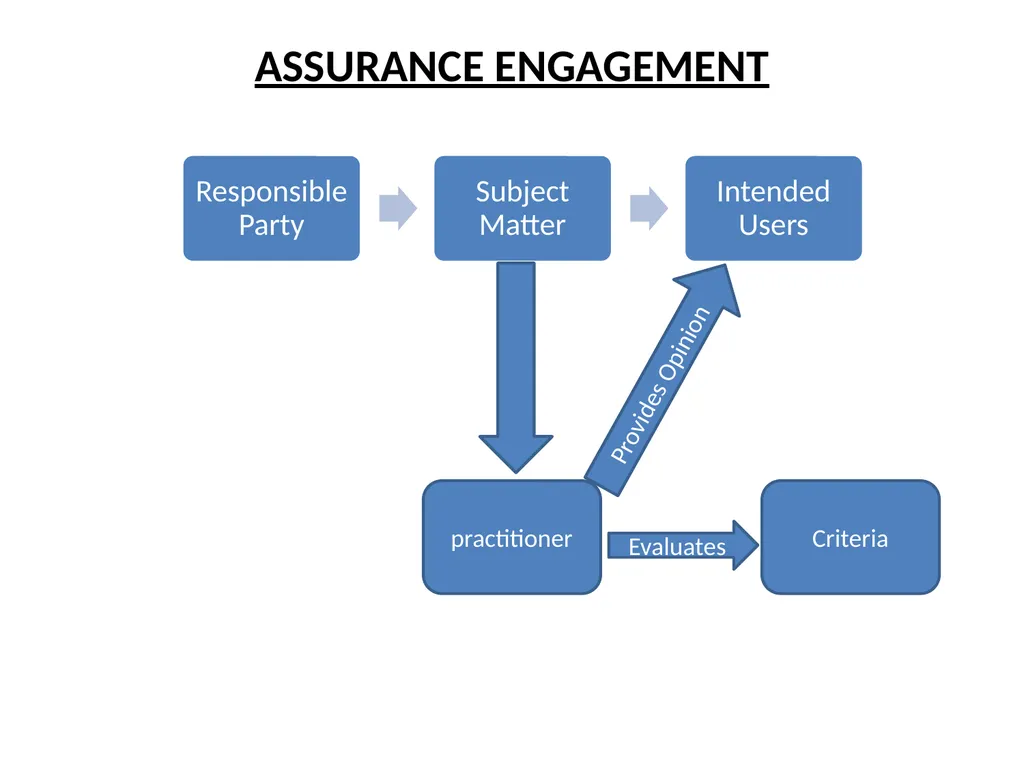
ASSURANCE ENGAGEMENT practitioner Provides Opinion Evaluates Criteria<br>
04
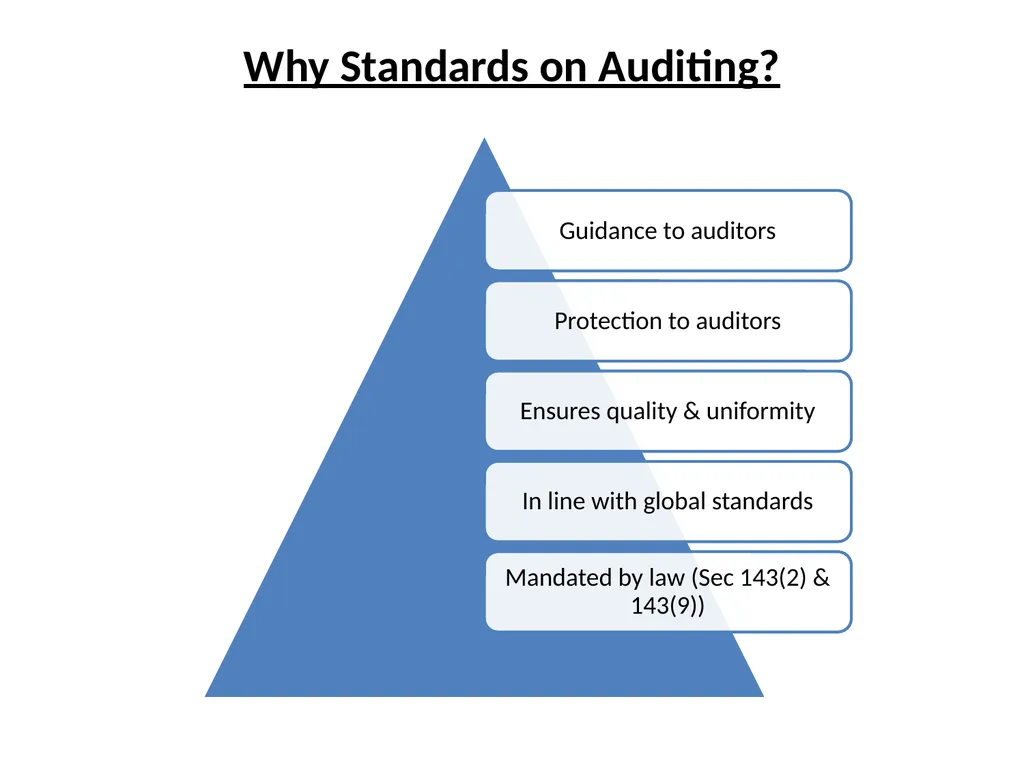
Why Standards on Auditing?<br>
05
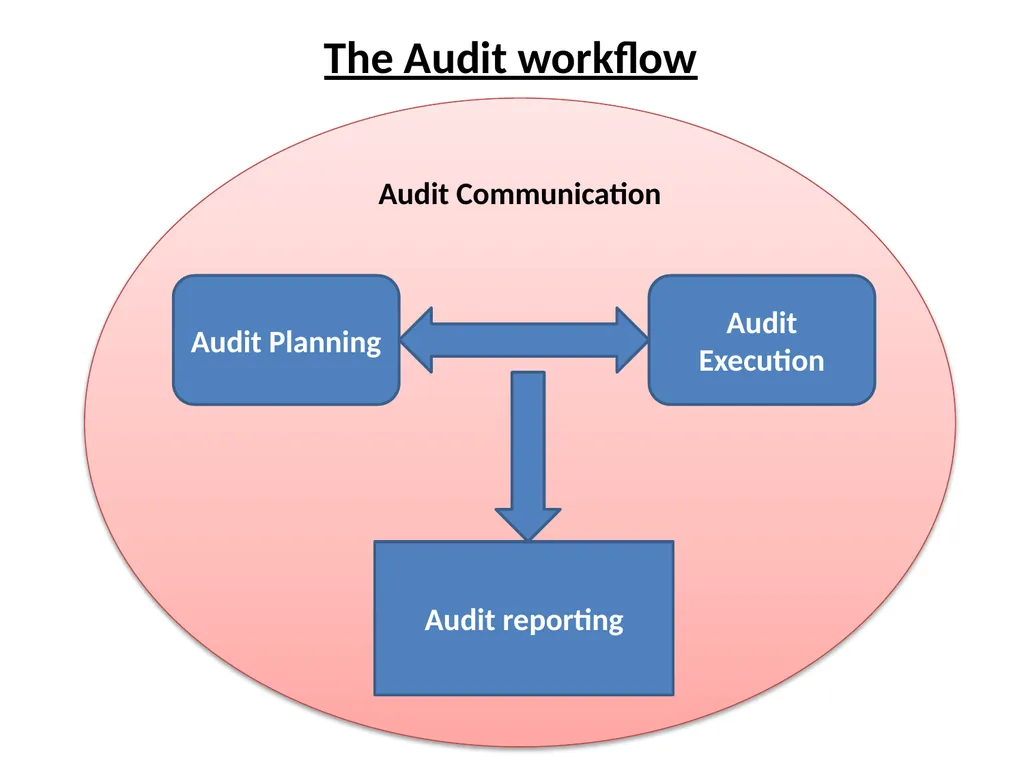
Audit Communication Audit Planning Audit Execution Audit reporting The Audit workflow<br>
06
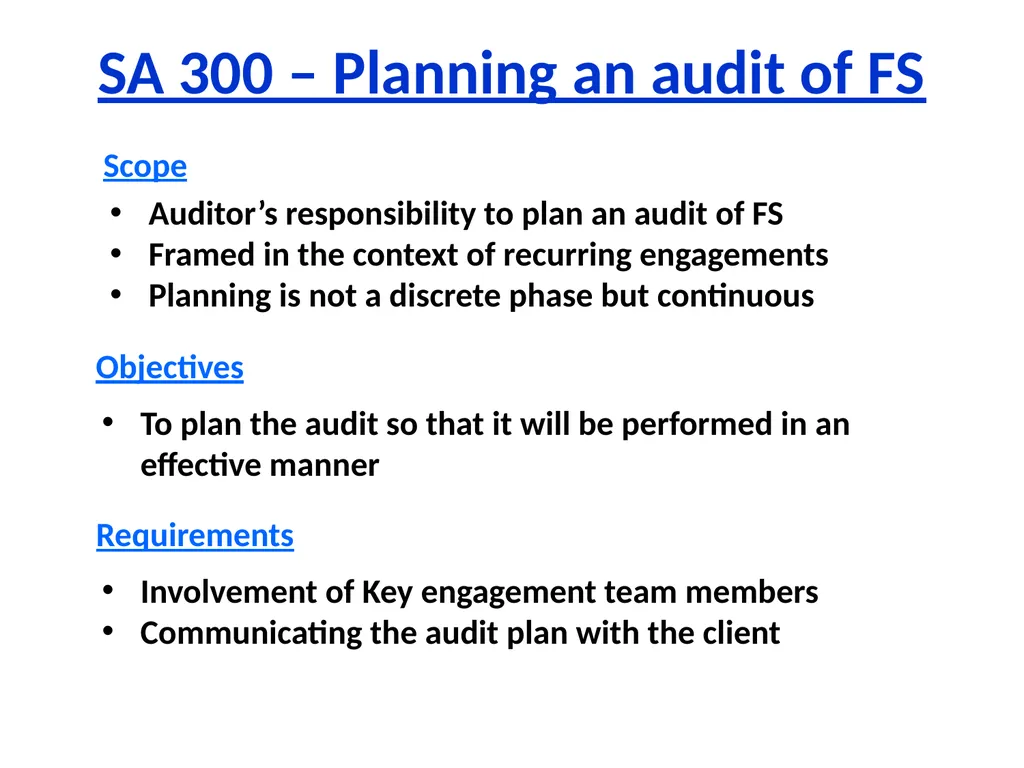
SA 300 – Planning an audit of FS Scope Auditor’s responsibility to plan an audit of FS
Framed in the context of recurring engagements
Planning is not a discrete phase but continuous Objectives To plan the audit so that it will be performed in an effective manner Requirements Involvement of Key engagement team members
Communicating the audit plan with the client<br>
Framed in the context of recurring engagements
Planning is not a discrete phase but continuous Objectives To plan the audit so that it will be performed in an effective manner Requirements Involvement of Key engagement team members
Communicating the audit plan with the client<br>
07
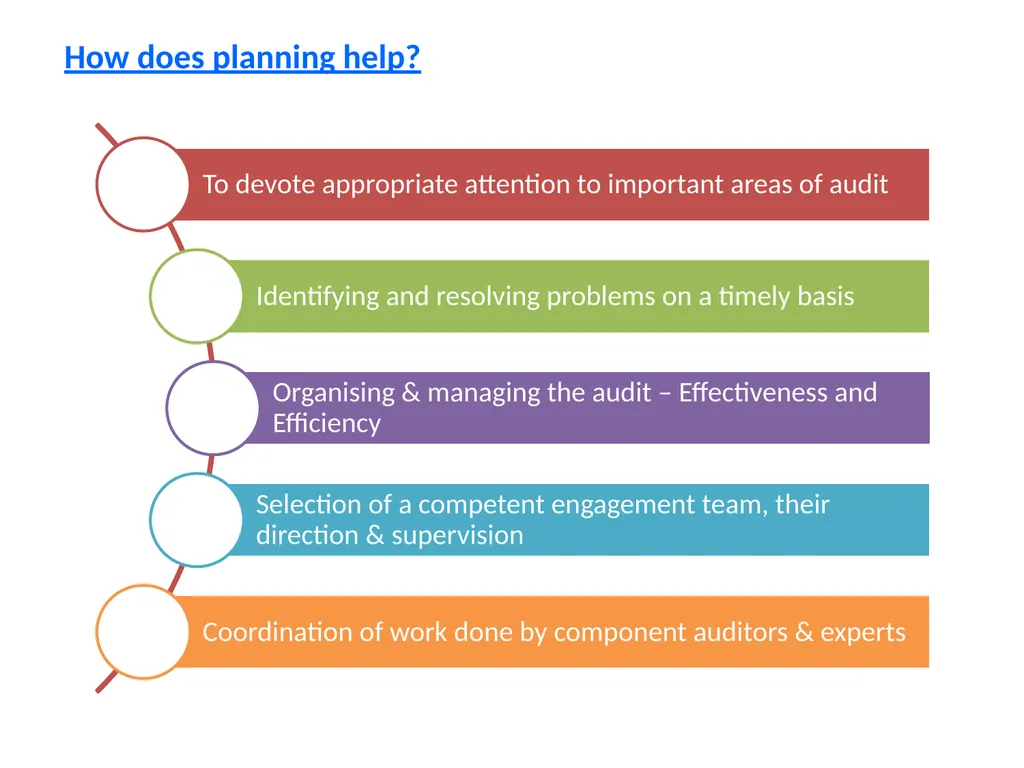
How does planning help?<br>
08
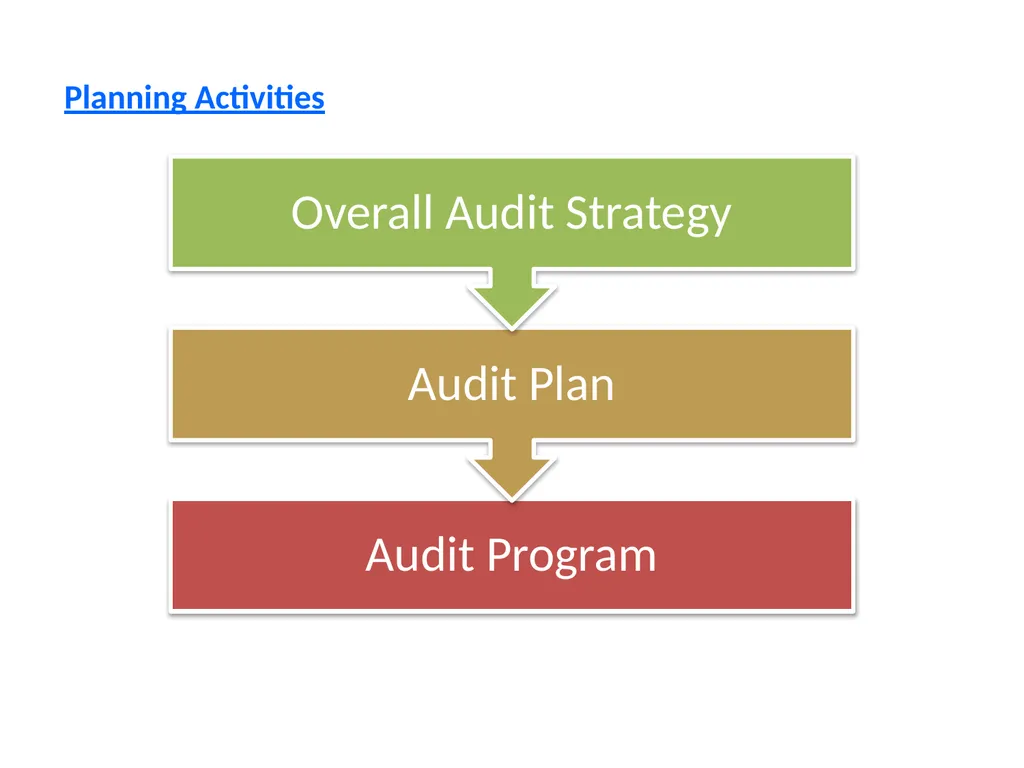
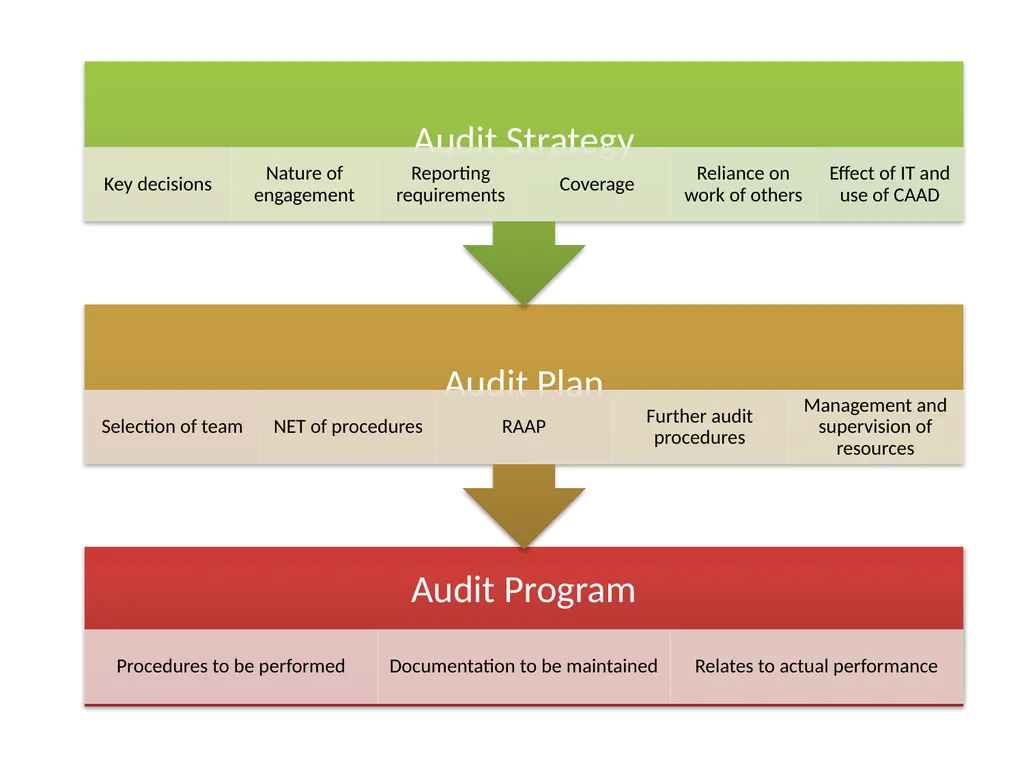
Planning Activities<br>
09
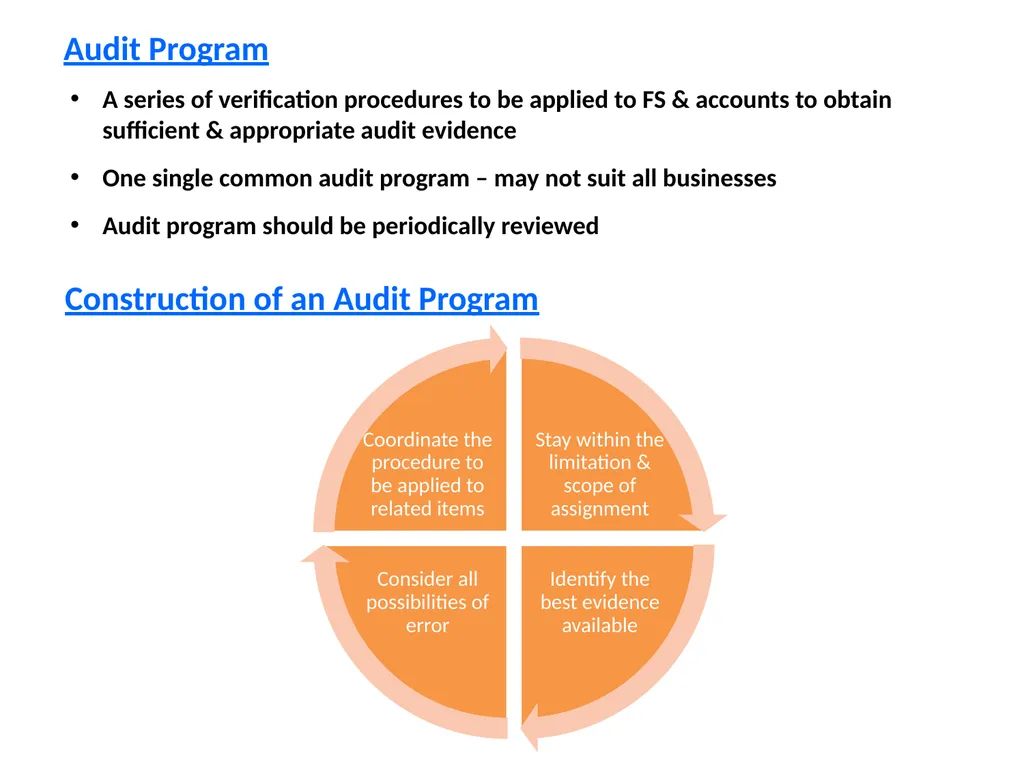
Audit Program A series of verification procedures to be applied to FS & accounts to obtain sufficient & appropriate audit evidence
One single common audit program – may not suit all businesses
Audit program should be periodically reviewed Construction of an Audit Program<br>
One single common audit program – may not suit all businesses
Audit program should be periodically reviewed Construction of an Audit Program<br>
10
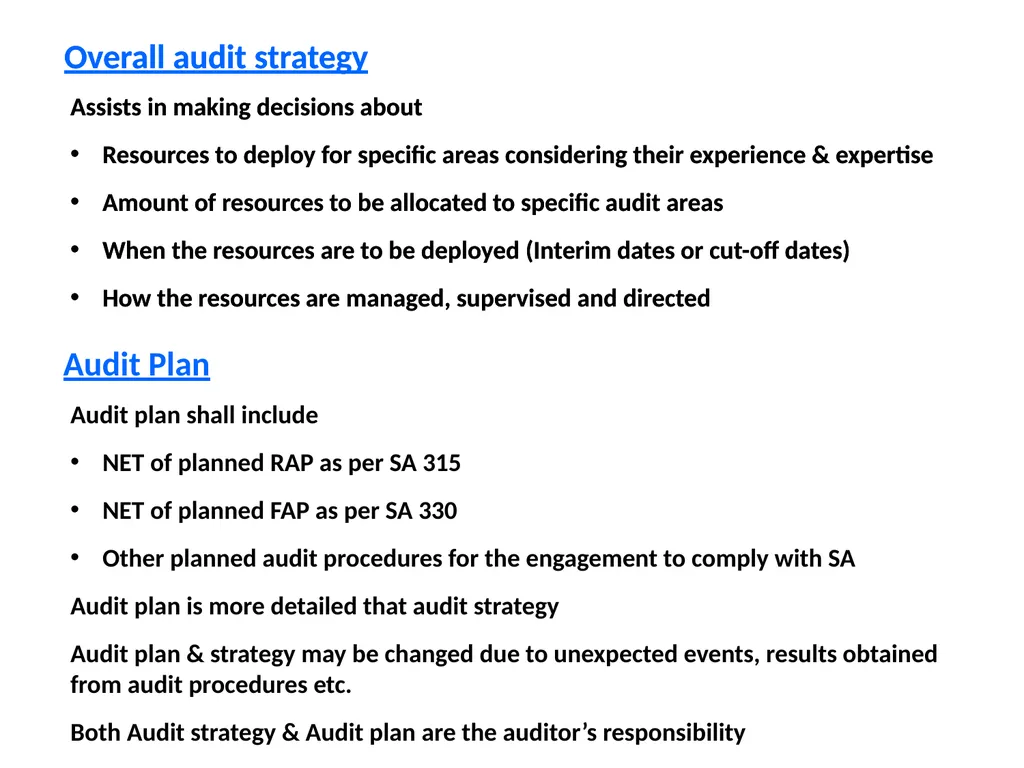
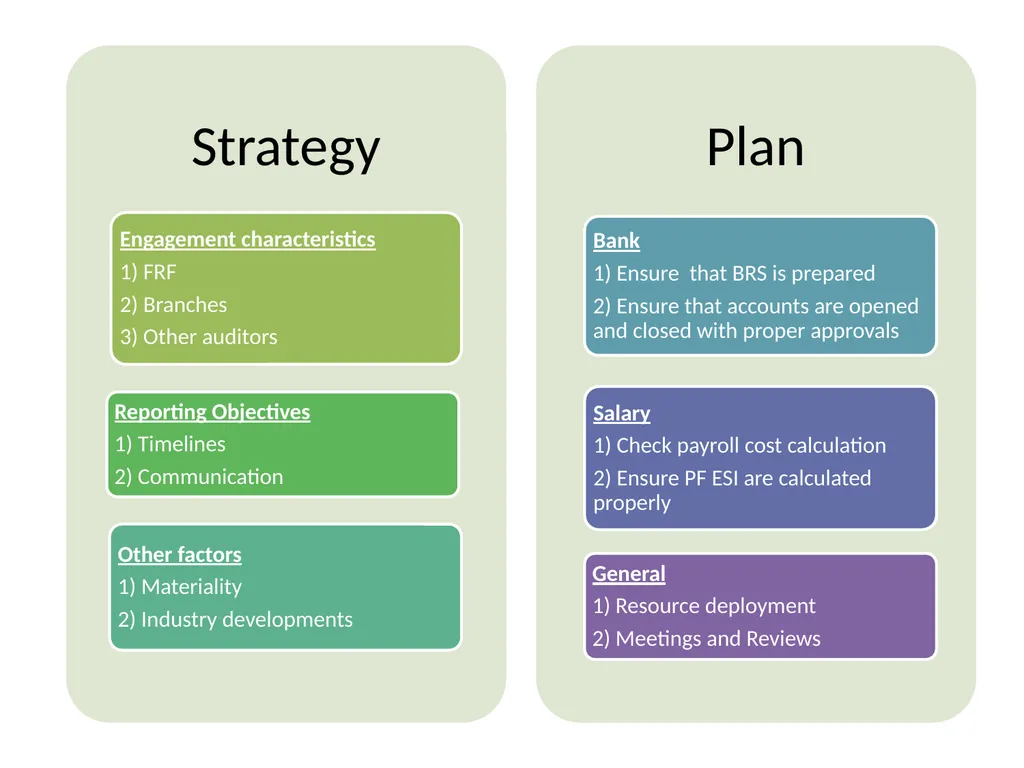
Overall audit strategy Assists in making decisions about
Resources to deploy for specific areas considering their experience & expertise
Amount of resources to be allocated to specific audit areas
When the resources are to be deployed (Interim dates or cut-off dates)
How the resources are managed, supervised and directed Audit Plan Audit plan shall include
NET of planned RAP as per SA 315
NET of planned FAP as per SA 330
Other planned audit procedures for the engagement to comply with SA
Audit plan is more detailed that audit strategy
Audit plan & strategy may be changed due to unexpected events, results obtained from audit procedures etc.
Both Audit strategy & Audit plan are the auditor’s responsibility Overall audit strategy Assists in making decisions about
Resources to deploy for specific areas considering their experience & expertise
Amount of resources to be allocated to specific audit areas
When the resources are to be deployed (Interim dates or cut-off dates)
How the resources are managed, supervised and directed<br>
Resources to deploy for specific areas considering their experience & expertise
Amount of resources to be allocated to specific audit areas
When the resources are to be deployed (Interim dates or cut-off dates)
How the resources are managed, supervised and directed Audit Plan Audit plan shall include
NET of planned RAP as per SA 315
NET of planned FAP as per SA 330
Other planned audit procedures for the engagement to comply with SA
Audit plan is more detailed that audit strategy
Audit plan & strategy may be changed due to unexpected events, results obtained from audit procedures etc.
Both Audit strategy & Audit plan are the auditor’s responsibility Overall audit strategy Assists in making decisions about
Resources to deploy for specific areas considering their experience & expertise
Amount of resources to be allocated to specific audit areas
When the resources are to be deployed (Interim dates or cut-off dates)
How the resources are managed, supervised and directed<br>
11
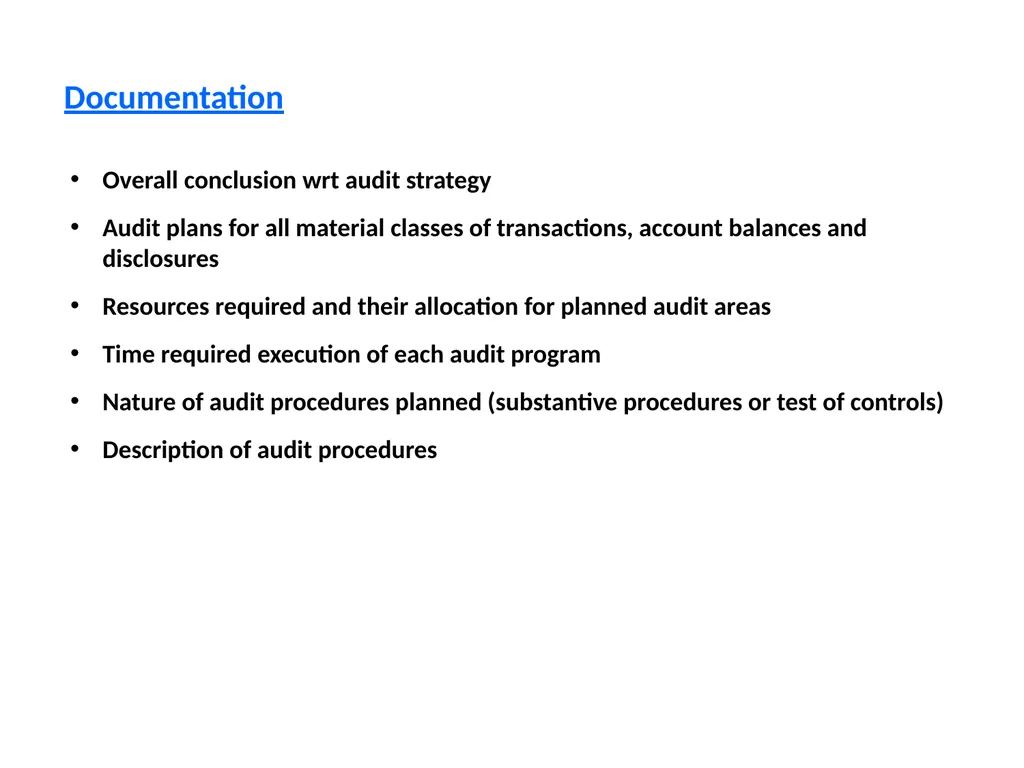
Documentation Overall conclusion wrt audit strategy
Audit plans for all material classes of transactions, account balances and disclosures
Resources required and their allocation for planned audit areas
Time required execution of each audit program
Nature of audit procedures planned (substantive procedures or test of controls)
Description of audit procedures<br>
Audit plans for all material classes of transactions, account balances and disclosures
Resources required and their allocation for planned audit areas
Time required execution of each audit program
Nature of audit procedures planned (substantive procedures or test of controls)
Description of audit procedures<br>
12
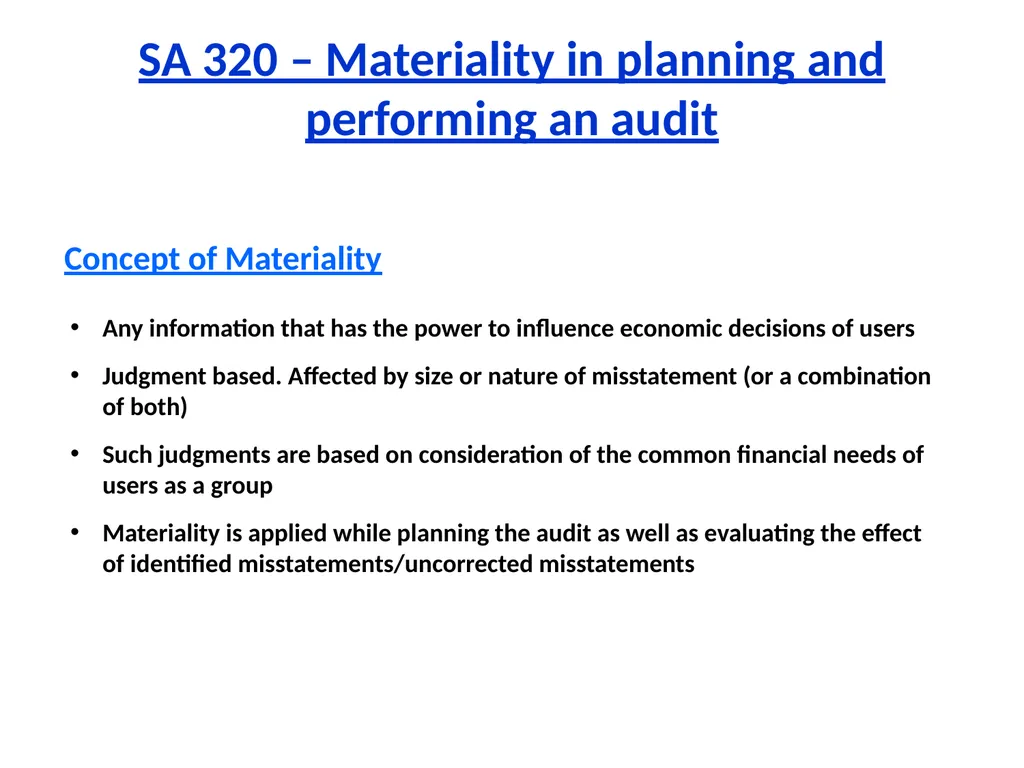
SA 320 – Materiality in planning and performing an audit Concept of Materiality Any information that has the power to influence economic decisions of users
Judgment based. Affected by size or nature of misstatement (or a combination of both)
Such judgments are based on consideration of the common financial needs of users as a group
Materiality is applied while planning the audit as well as evaluating the effect of identified misstatements/uncorrected misstatements<br>
Judgment based. Affected by size or nature of misstatement (or a combination of both)
Such judgments are based on consideration of the common financial needs of users as a group
Materiality is applied while planning the audit as well as evaluating the effect of identified misstatements/uncorrected misstatements<br>
13
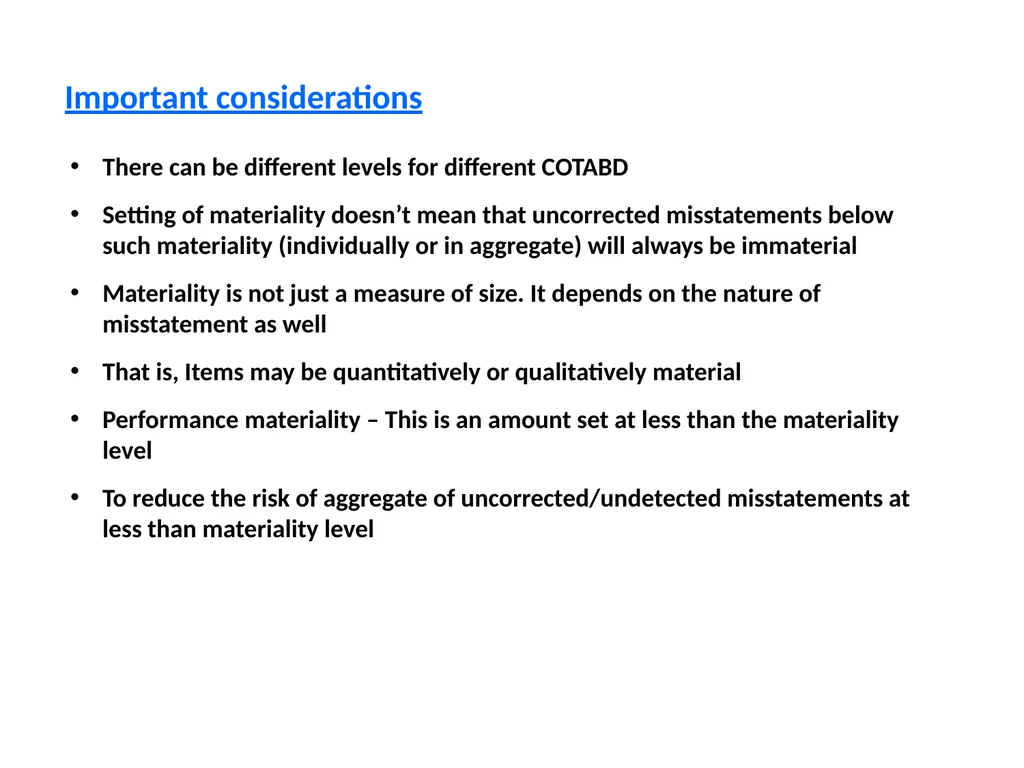
Important considerations There can be different levels for different COTABD
Setting of materiality doesn’t mean that uncorrected misstatements below such materiality (individually or in aggregate) will always be immaterial
Materiality is not just a measure of size. It depends on the nature of misstatement as well
That is, Items may be quantitatively or qualitatively material
Performance materiality – This is an amount set at less than the materiality level
To reduce the risk of aggregate of uncorrected/undetected misstatements at less than materiality level<br>
Setting of materiality doesn’t mean that uncorrected misstatements below such materiality (individually or in aggregate) will always be immaterial
Materiality is not just a measure of size. It depends on the nature of misstatement as well
That is, Items may be quantitatively or qualitatively material
Performance materiality – This is an amount set at less than the materiality level
To reduce the risk of aggregate of uncorrected/undetected misstatements at less than materiality level<br>
14
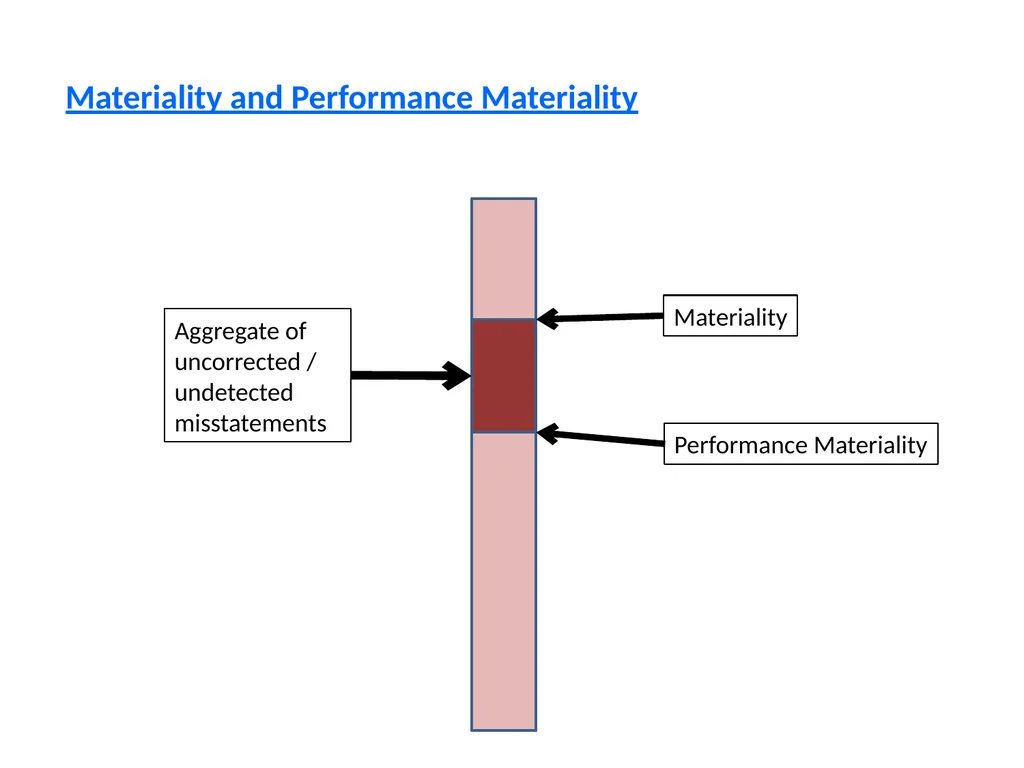
Materiality Performance Materiality Aggregate of uncorrected / undetected misstatements Materiality and Performance Materiality<br>
15
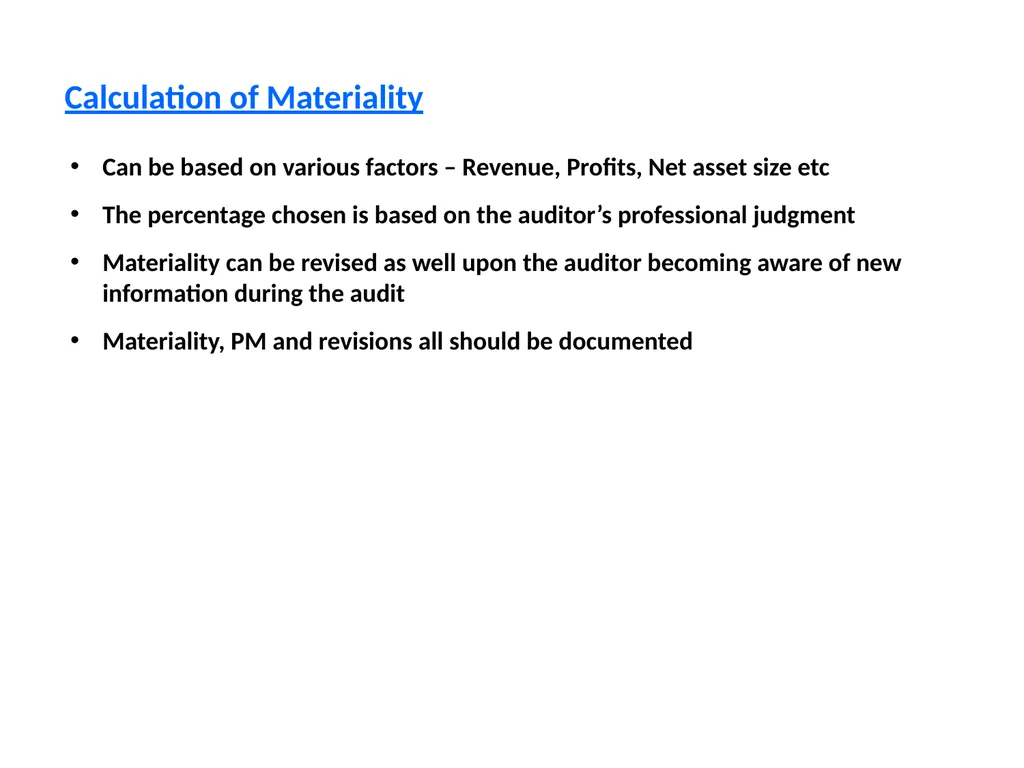
Calculation of Materiality Can be based on various factors – Revenue, Profits, Net asset size etc
The percentage chosen is based on the auditor’s professional judgment
Materiality can be revised as well upon the auditor becoming aware of new information during the audit
Materiality, PM and revisions all should be documented<br>
The percentage chosen is based on the auditor’s professional judgment
Materiality can be revised as well upon the auditor becoming aware of new information during the audit
Materiality, PM and revisions all should be documented<br>
16
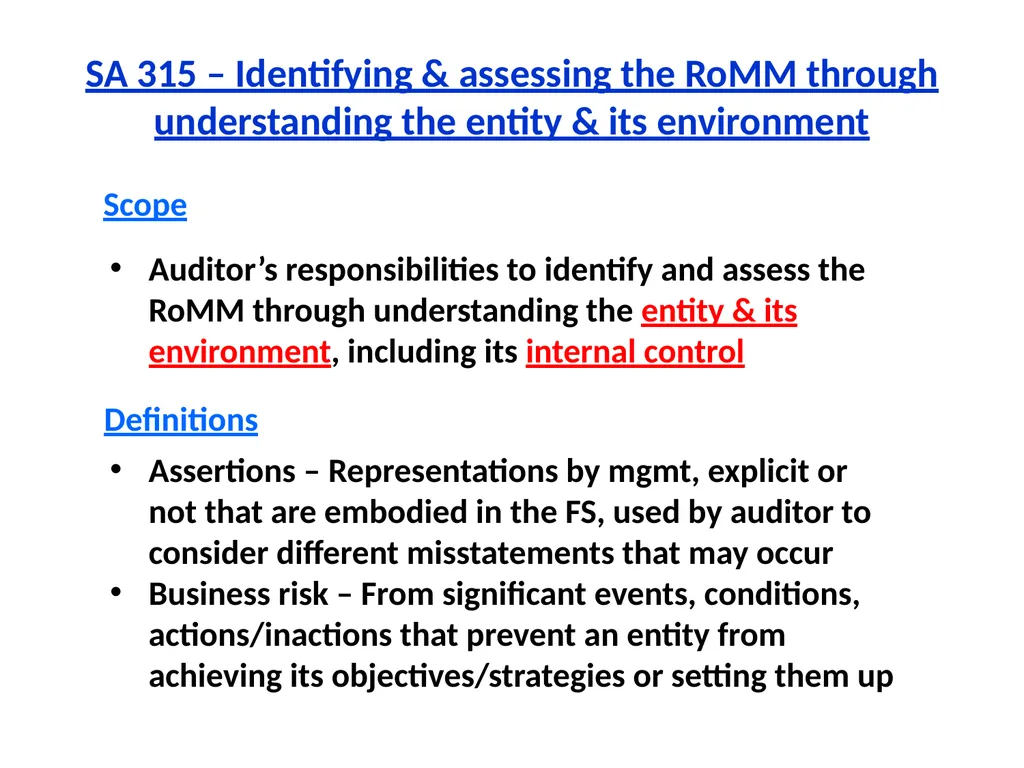
SA 315 – Identifying & assessing the RoMM through understanding the entity & its environment Scope Auditor’s responsibilities to identify and assess the RoMM through understanding the entity & its environment, including its internal control Definitions Assertions – Representations by mgmt, explicit or not that are embodied in the FS, used by auditor to consider different misstatements that may occur
Business risk – From significant events, conditions, actions/inactions that prevent an entity from achieving its objectives/strategies or setting them up<br>
Business risk – From significant events, conditions, actions/inactions that prevent an entity from achieving its objectives/strategies or setting them up<br>
17
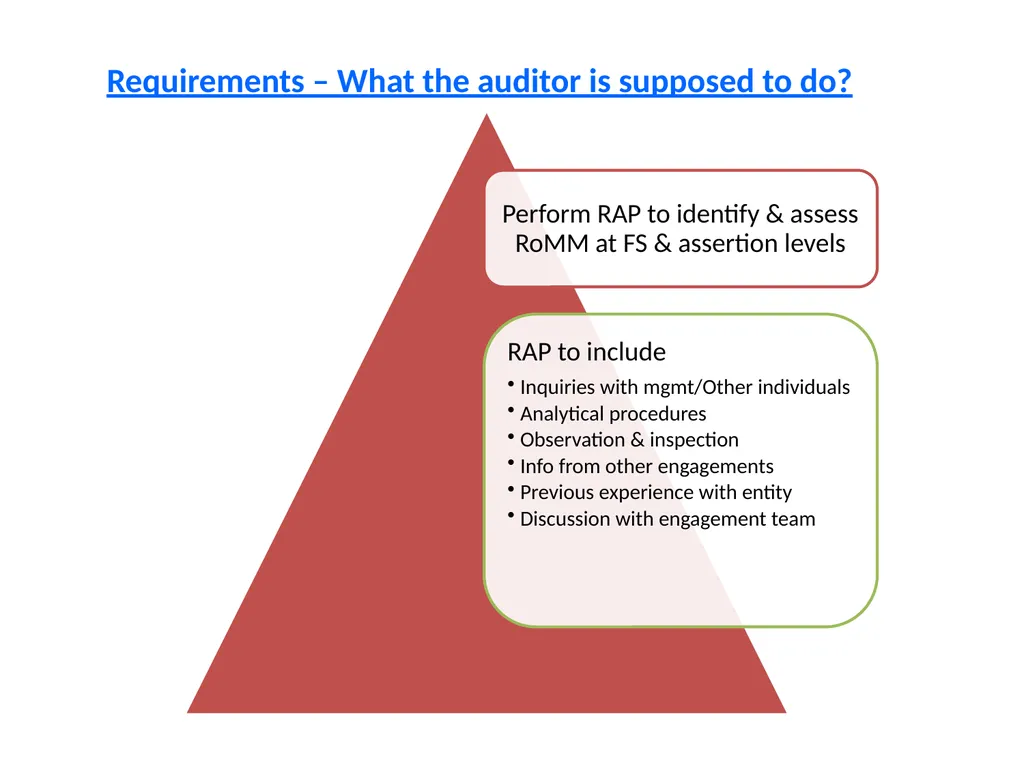
Requirements – What the auditor is supposed to do?<br>
18
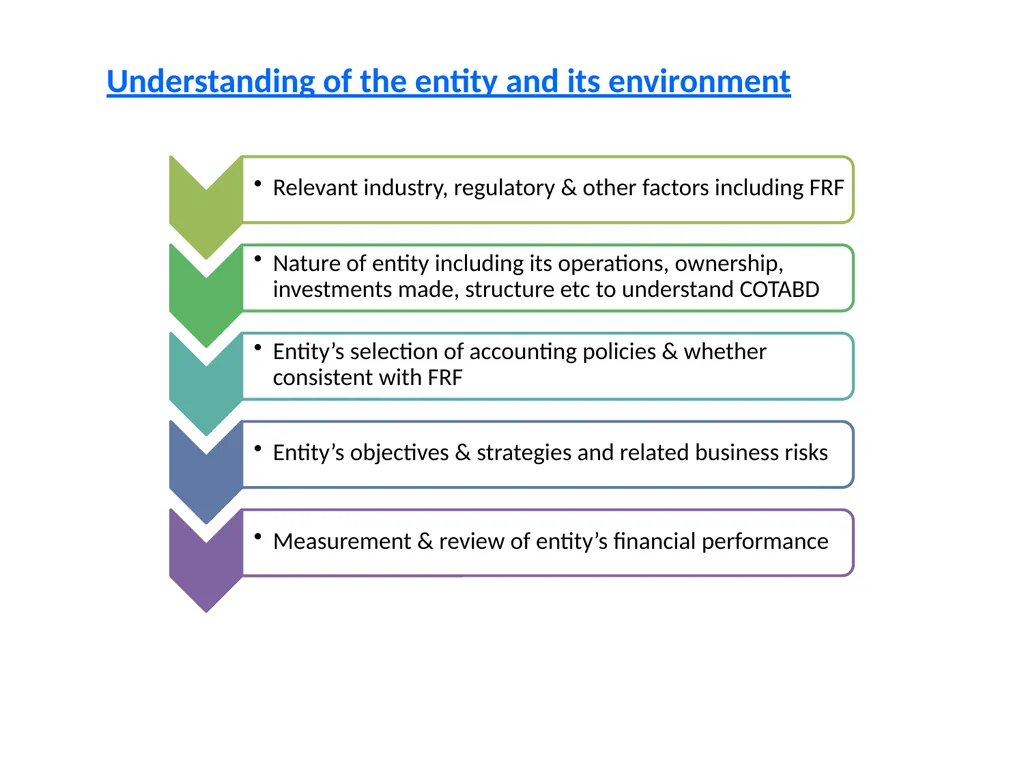
Understanding of the entity and its environment<br>
19
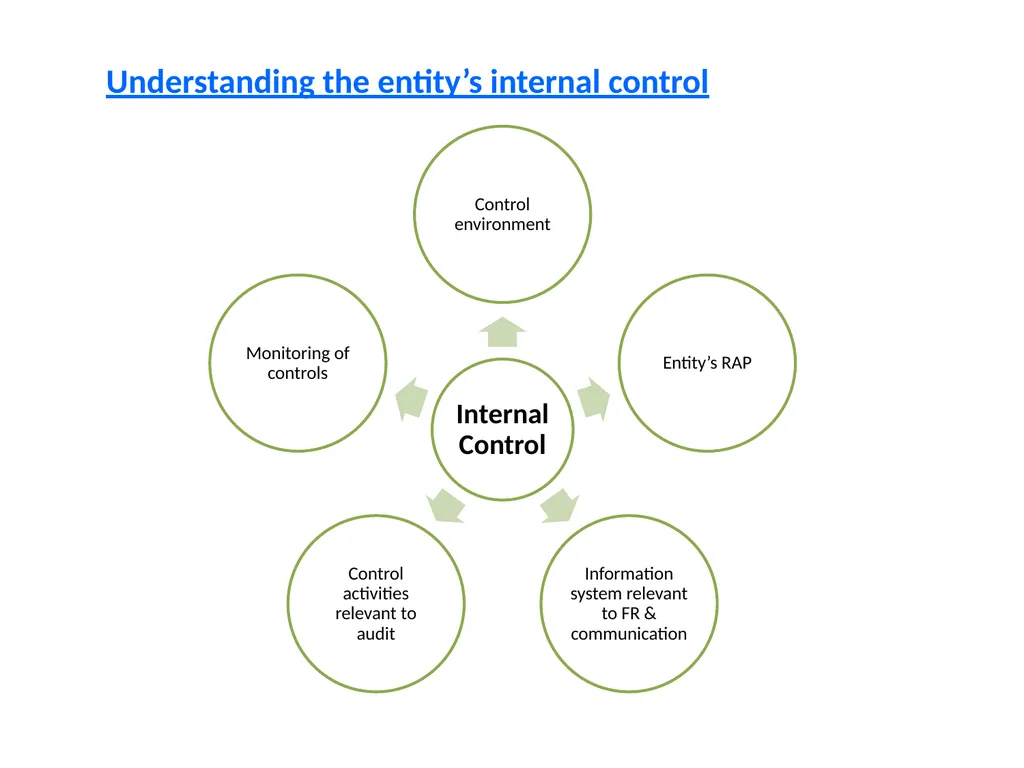
Understanding the entity’s internal control<br>
20
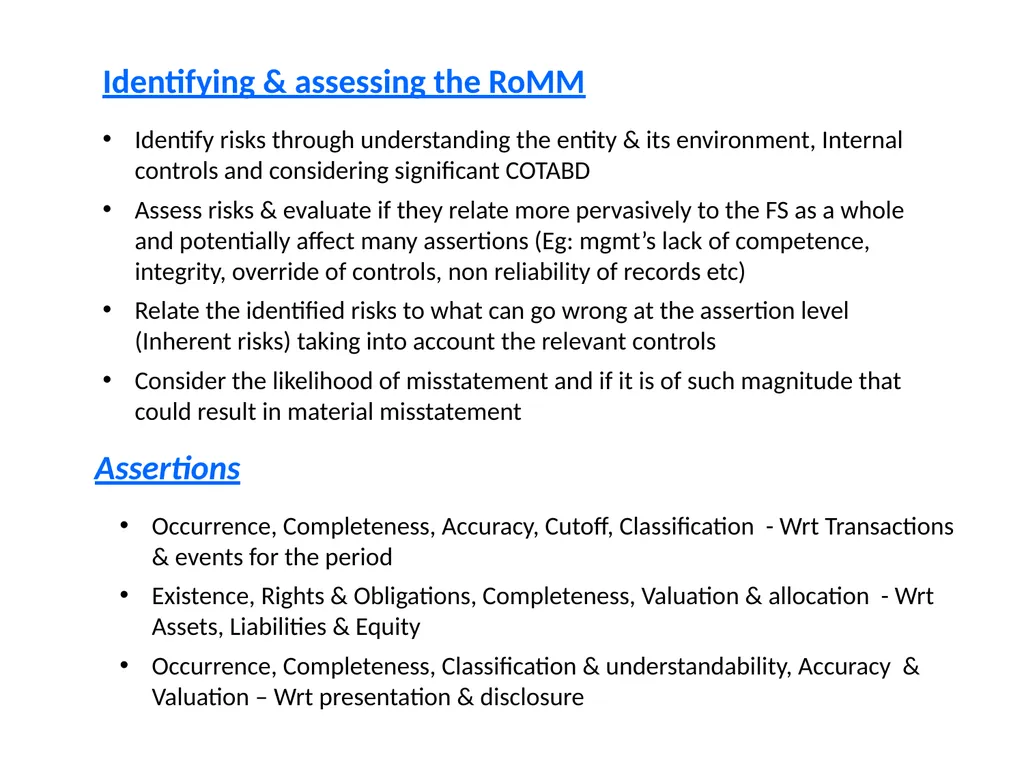
Identifying & assessing the RoMM Identify risks through understanding the entity & its environment, Internal controls and considering significant COTABD
Assess risks & evaluate if they relate more pervasively to the FS as a whole and potentially affect many assertions (Eg: mgmt’s lack of competence, integrity, override of controls, non reliability of records etc)
Relate the identified risks to what can go wrong at the assertion level (Inherent risks) taking into account the relevant controls
Consider the likelihood of misstatement and if it is of such magnitude that could result in material misstatement Assertions Occurrence, Completeness, Accuracy, Cutoff, Classification - Wrt Transactions & events for the period
Existence, Rights & Obligations, Completeness, Valuation & allocation - Wrt Assets, Liabilities & Equity
Occurrence, Completeness, Classification & understandability, Accuracy & Valuation – Wrt presentation & disclosure<br>
Assess risks & evaluate if they relate more pervasively to the FS as a whole and potentially affect many assertions (Eg: mgmt’s lack of competence, integrity, override of controls, non reliability of records etc)
Relate the identified risks to what can go wrong at the assertion level (Inherent risks) taking into account the relevant controls
Consider the likelihood of misstatement and if it is of such magnitude that could result in material misstatement Assertions Occurrence, Completeness, Accuracy, Cutoff, Classification - Wrt Transactions & events for the period
Existence, Rights & Obligations, Completeness, Valuation & allocation - Wrt Assets, Liabilities & Equity
Occurrence, Completeness, Classification & understandability, Accuracy & Valuation – Wrt presentation & disclosure<br>
21
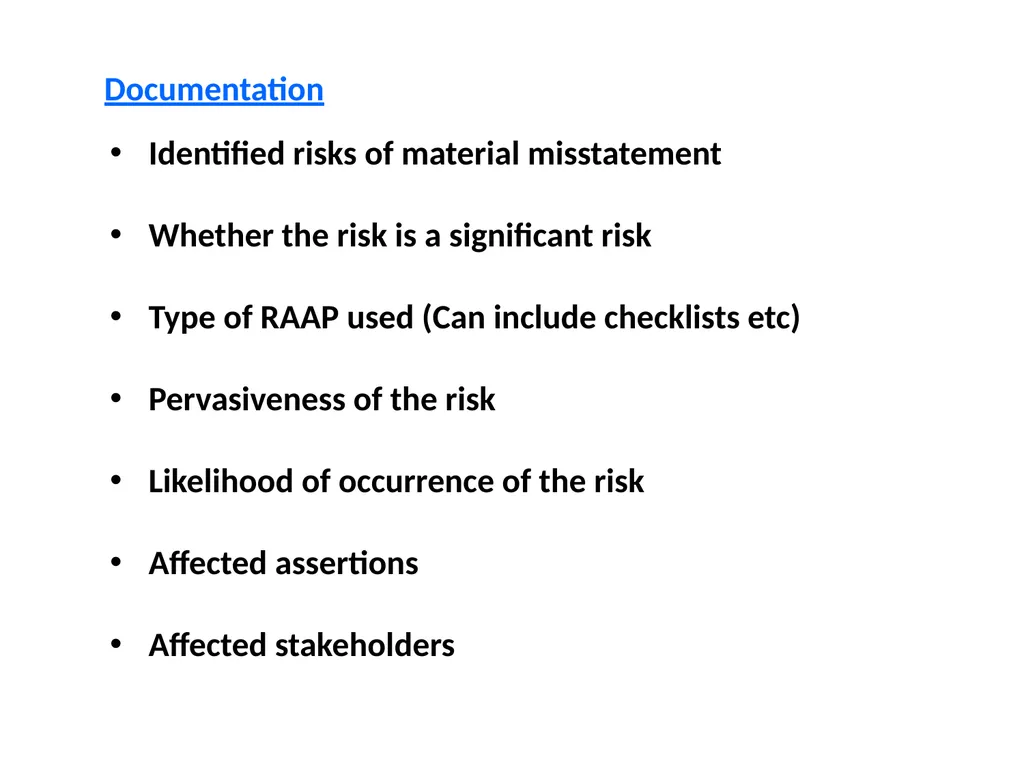
Documentation Identified risks of material misstatement
Whether the risk is a significant risk
Type of RAAP used (Can include checklists etc)
Pervasiveness of the risk
Likelihood of occurrence of the risk
Affected assertions
Affected stakeholders<br>
Whether the risk is a significant risk
Type of RAAP used (Can include checklists etc)
Pervasiveness of the risk
Likelihood of occurrence of the risk
Affected assertions
Affected stakeholders<br>
22
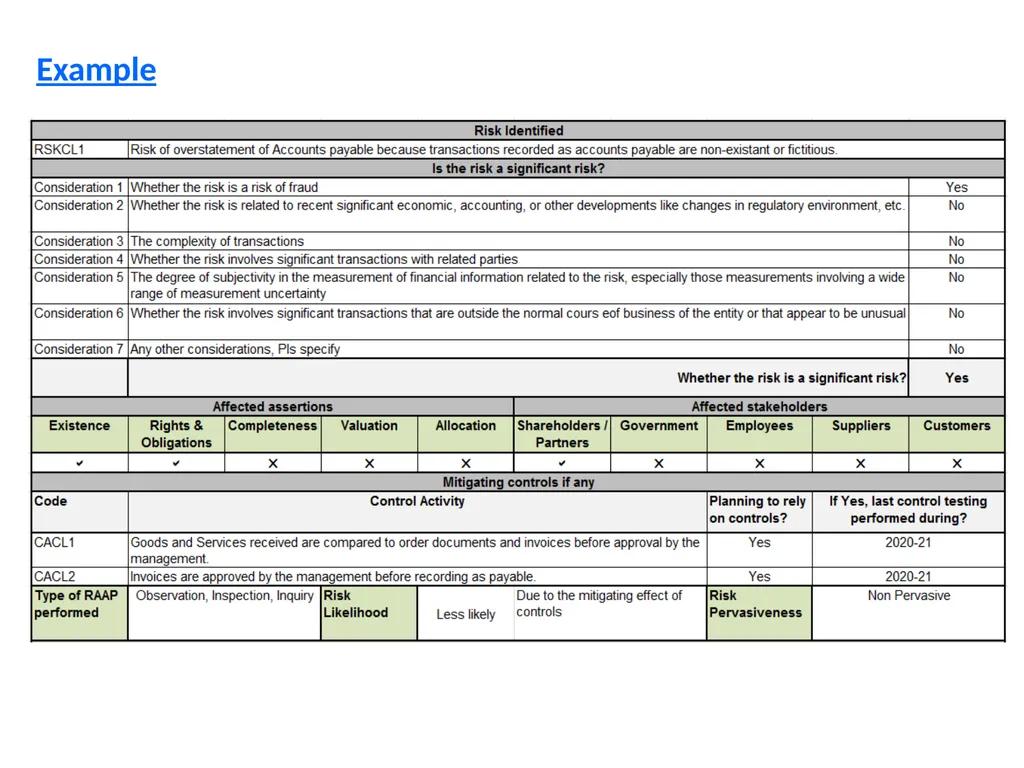
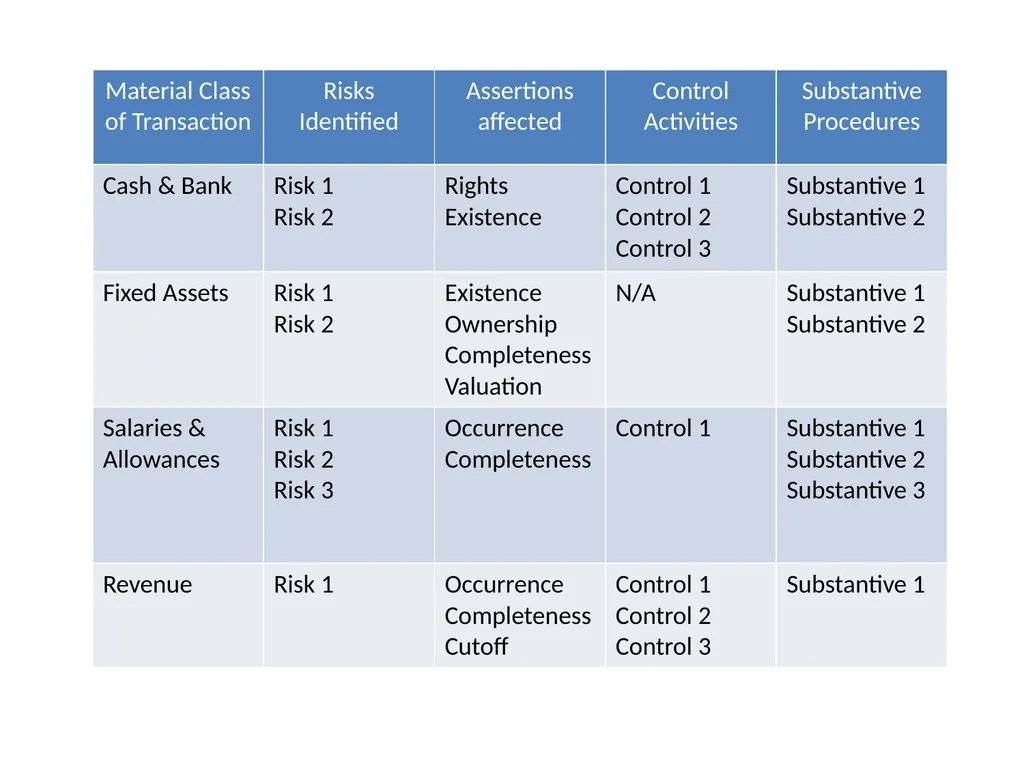
Example<br>
23
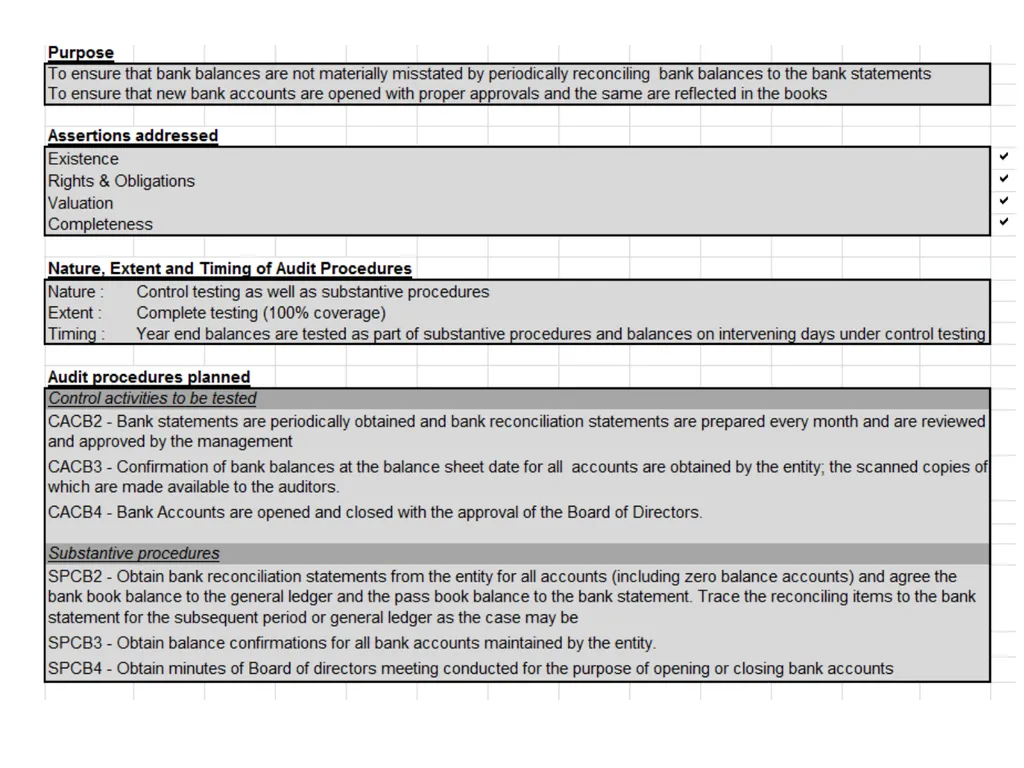
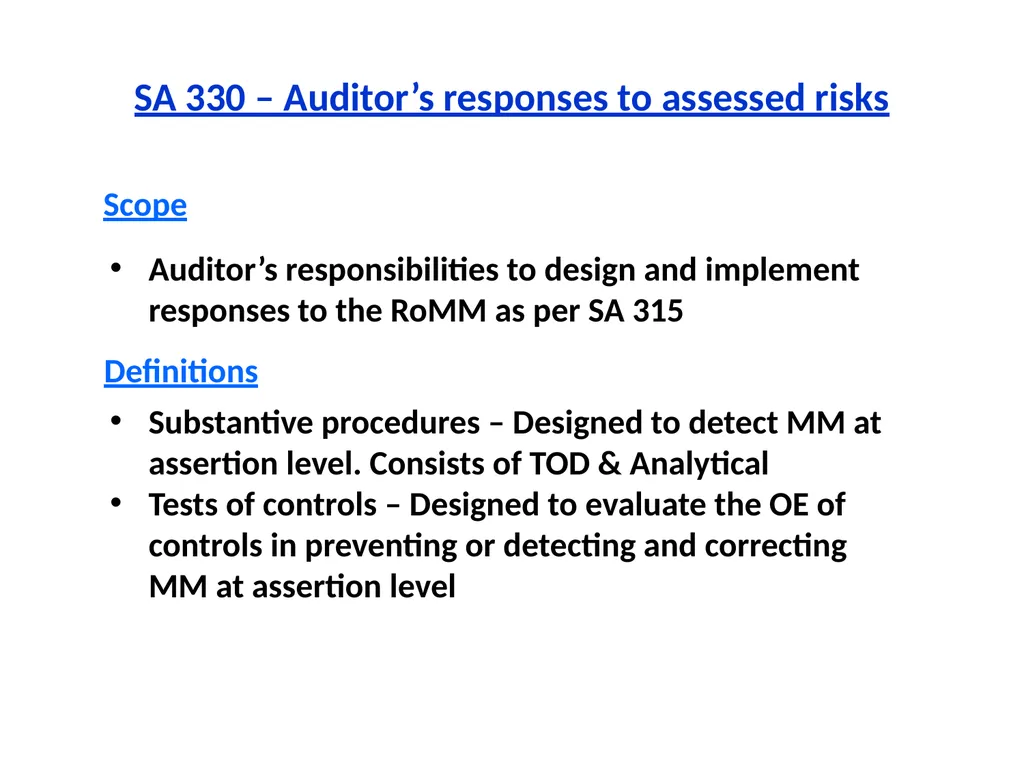
SA 330 – Auditor’s responses to assessed risks Scope Auditor’s responsibilities to design and implement responses to the RoMM as per SA 315 Definitions Substantive procedures – Designed to detect MM at assertion level. Consists of TOD & Analytical
Tests of controls – Designed to evaluate the OE of controls in preventing or detecting and correcting MM at assertion level<br>
Tests of controls – Designed to evaluate the OE of controls in preventing or detecting and correcting MM at assertion level<br>
24
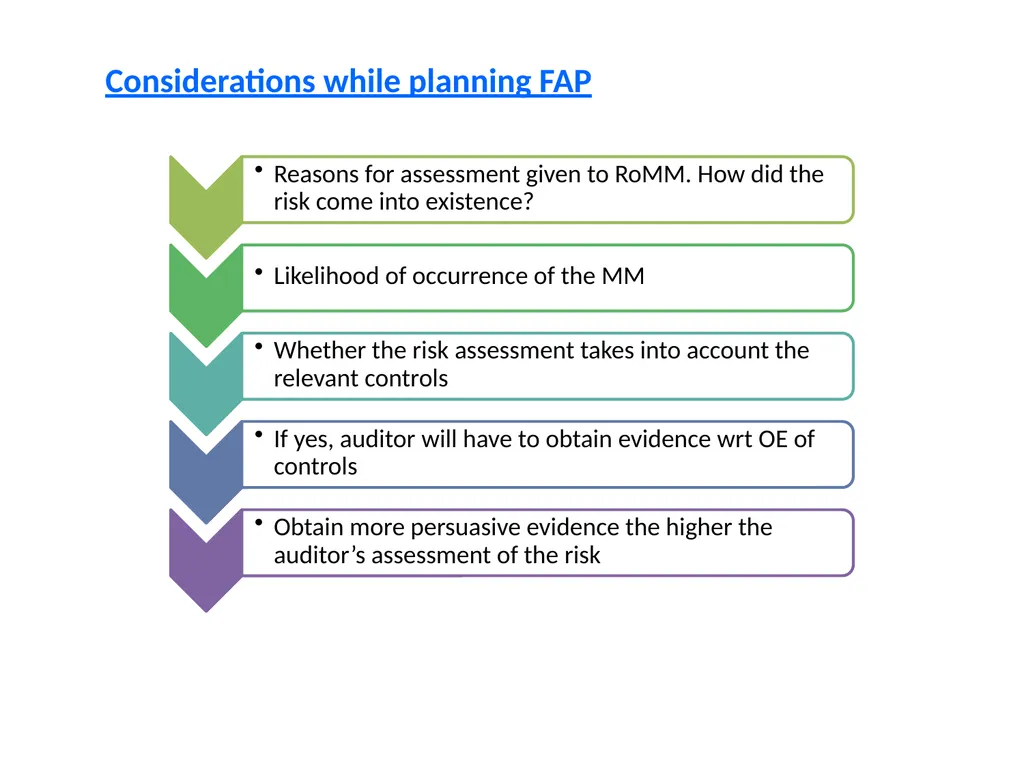
Considerations while planning FAP<br>
25
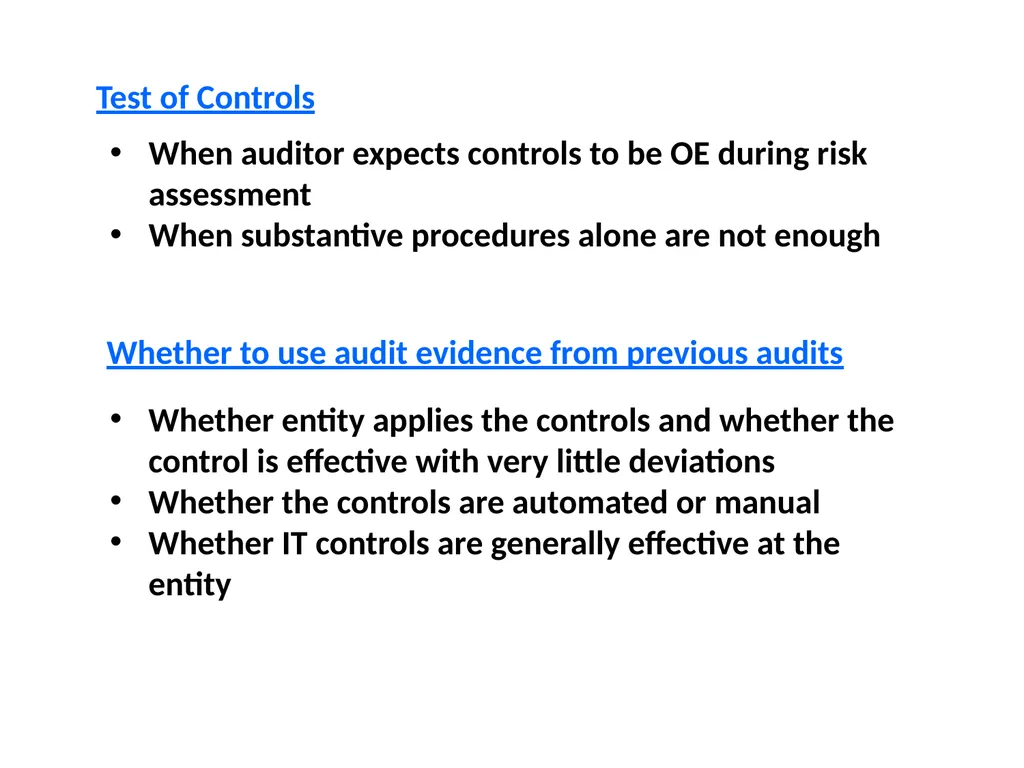
Test of Controls When auditor expects controls to be OE during risk assessment
When substantive procedures alone are not enough Whether to use audit evidence from previous audits Whether entity applies the controls and whether the control is effective with very little deviations
Whether the controls are automated or manual
Whether IT controls are generally effective at the entity<br>
When substantive procedures alone are not enough Whether to use audit evidence from previous audits Whether entity applies the controls and whether the control is effective with very little deviations
Whether the controls are automated or manual
Whether IT controls are generally effective at the entity<br>
26
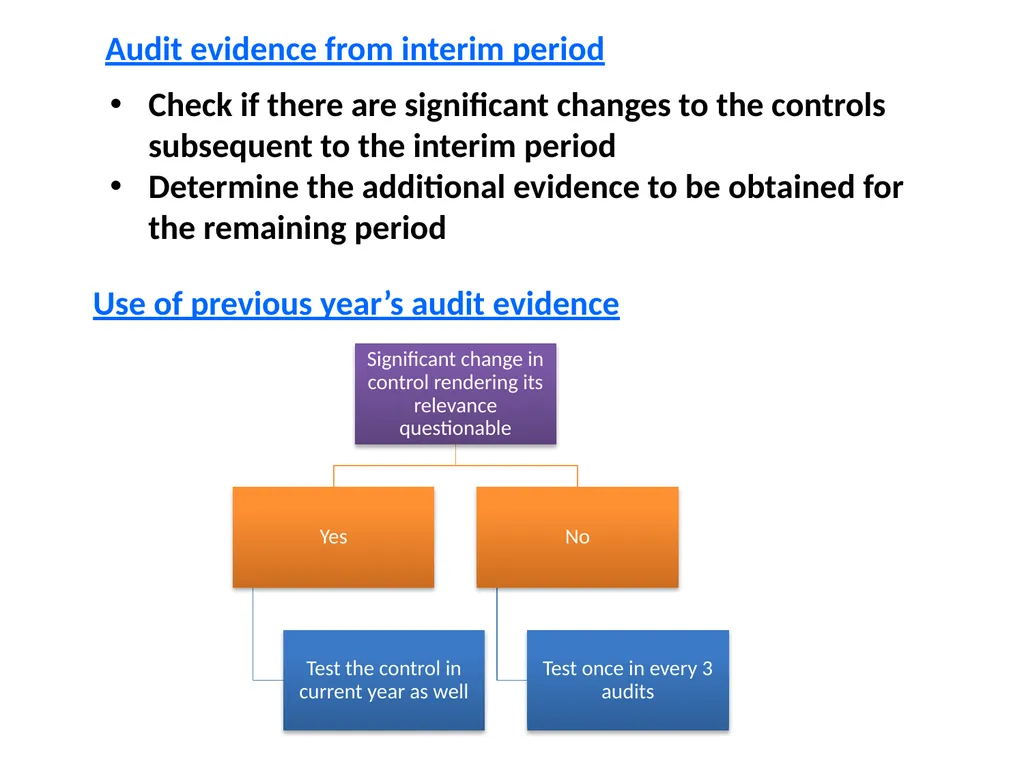
Audit evidence from interim period Check if there are significant changes to the controls subsequent to the interim period
Determine the additional evidence to be obtained for the remaining period Use of previous year’s audit evidence<br>
Determine the additional evidence to be obtained for the remaining period Use of previous year’s audit evidence<br>
27
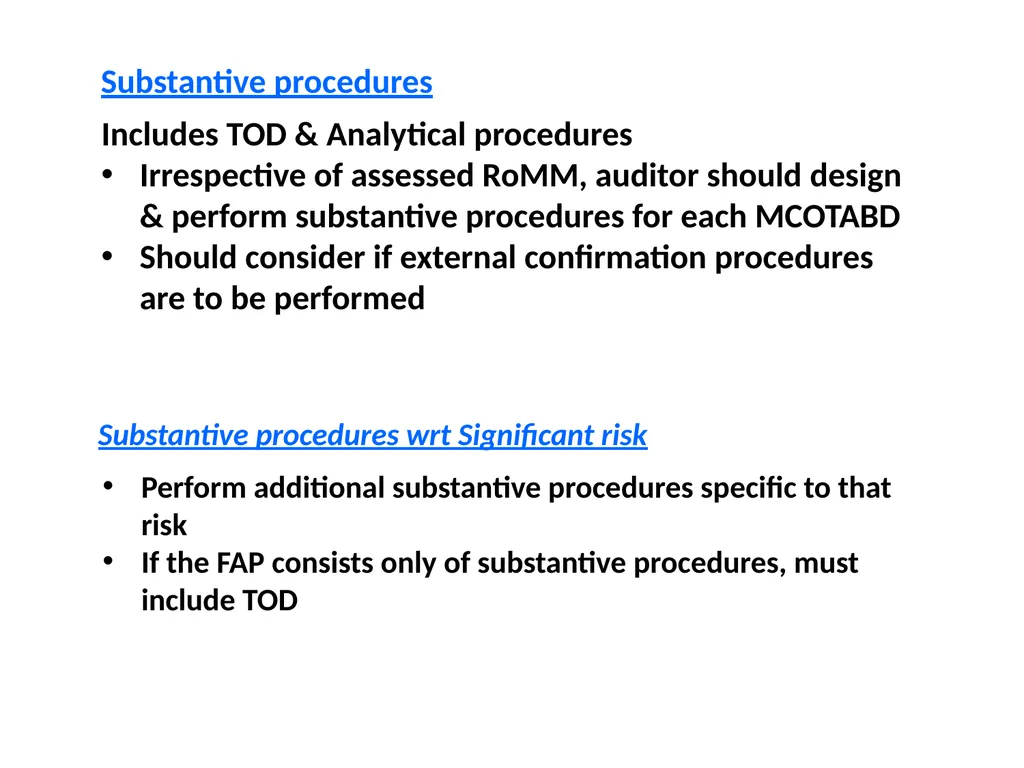
Substantive procedures Includes TOD & Analytical procedures
Irrespective of assessed RoMM, auditor should design & perform substantive procedures for each MCOTABD
Should consider if external confirmation procedures are to be performed Substantive procedures wrt Significant risk Perform additional substantive procedures specific to that risk
If the FAP consists only of substantive procedures, must include TOD<br>
Irrespective of assessed RoMM, auditor should design & perform substantive procedures for each MCOTABD
Should consider if external confirmation procedures are to be performed Substantive procedures wrt Significant risk Perform additional substantive procedures specific to that risk
If the FAP consists only of substantive procedures, must include TOD<br>
28
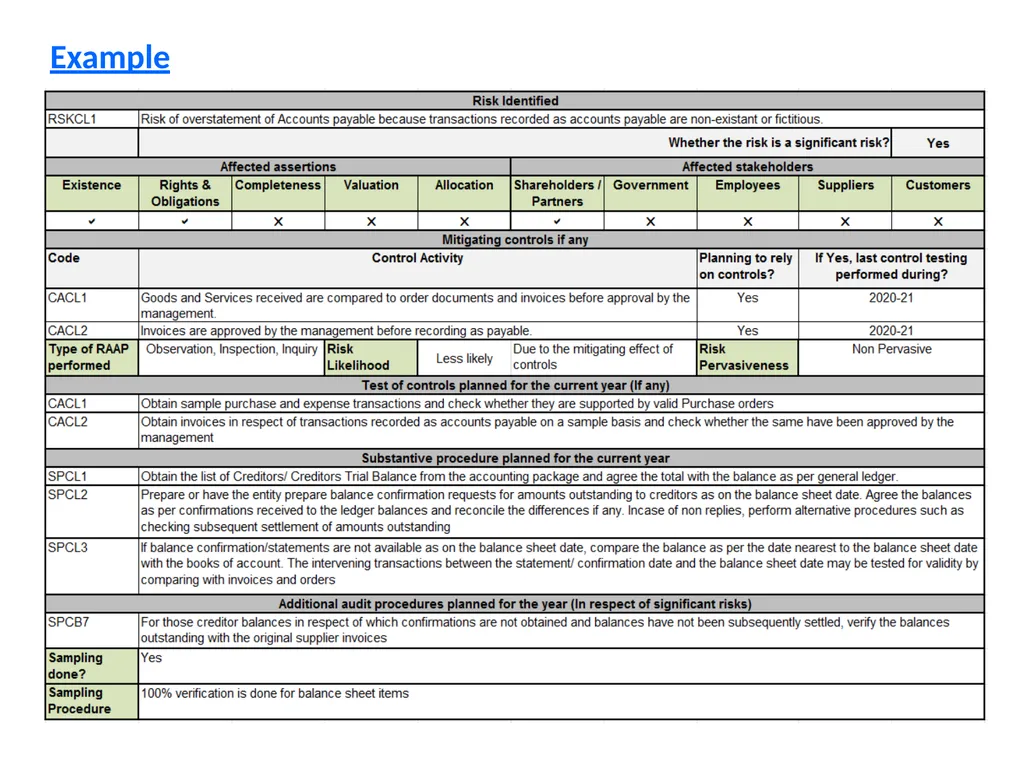
Example<br>
29
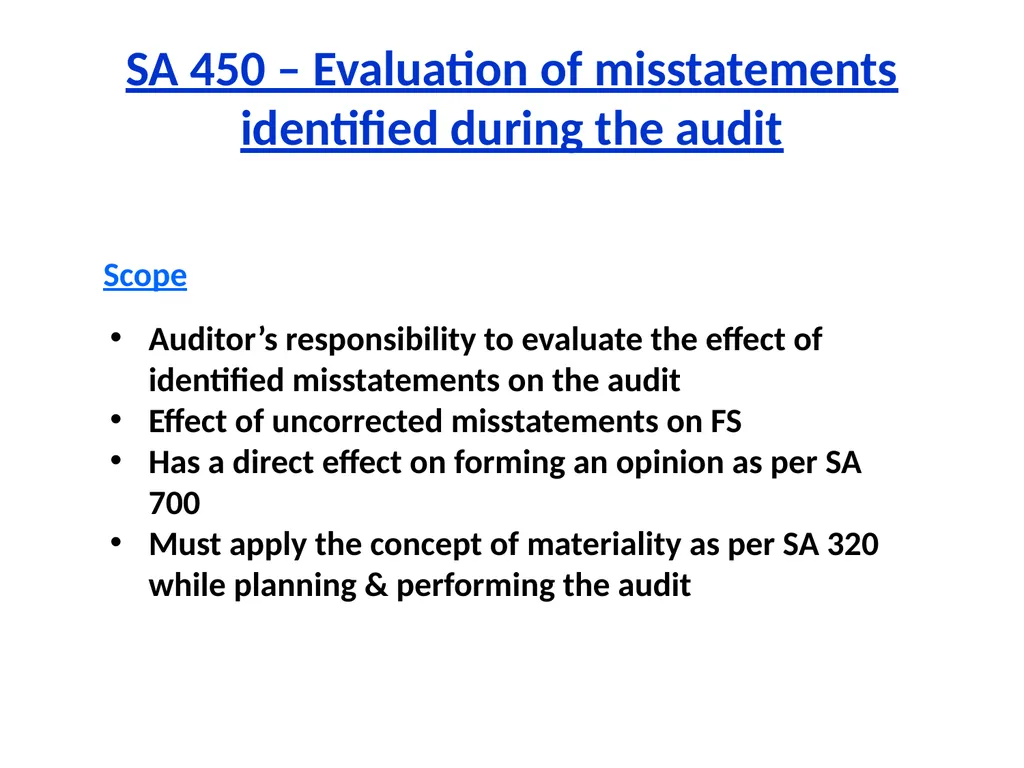
SA 450 – Evaluation of misstatements identified during the audit Scope Auditor’s responsibility to evaluate the effect of identified misstatements on the audit
Effect of uncorrected misstatements on FS
Has a direct effect on forming an opinion as per SA 700
Must apply the concept of materiality as per SA 320 while planning & performing the audit<br>
Effect of uncorrected misstatements on FS
Has a direct effect on forming an opinion as per SA 700
Must apply the concept of materiality as per SA 320 while planning & performing the audit<br>
30
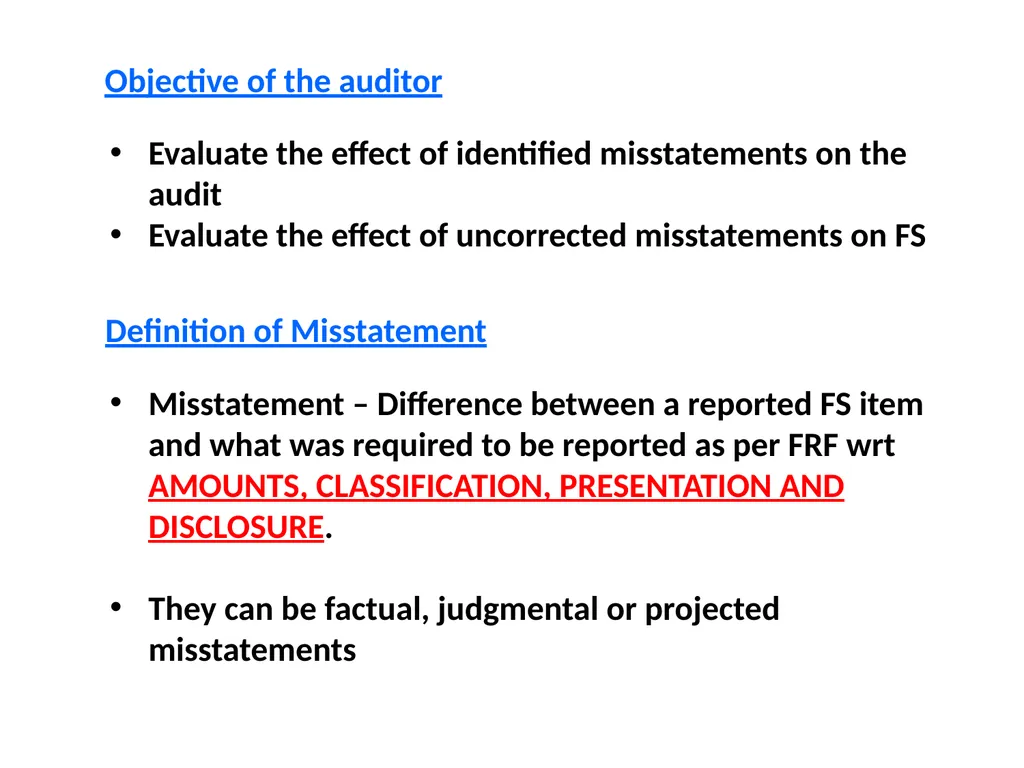
Objective of the auditor Evaluate the effect of identified misstatements on the audit
Evaluate the effect of uncorrected misstatements on FS Definition of Misstatement Misstatement – Difference between a reported FS item and what was required to be reported as per FRF wrt AMOUNTS, CLASSIFICATION, PRESENTATION AND DISCLOSURE.
They can be factual, judgmental or projected misstatements<br>
Evaluate the effect of uncorrected misstatements on FS Definition of Misstatement Misstatement – Difference between a reported FS item and what was required to be reported as per FRF wrt AMOUNTS, CLASSIFICATION, PRESENTATION AND DISCLOSURE.
They can be factual, judgmental or projected misstatements<br>
31
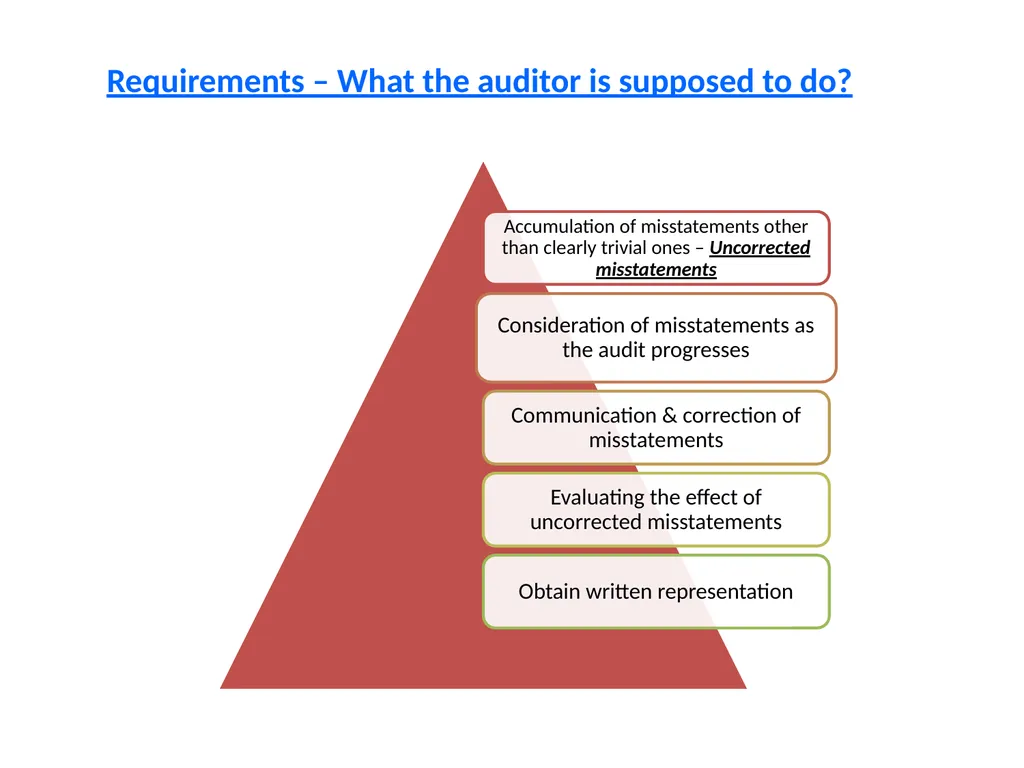
Requirements – What the auditor is supposed to do?<br>
32
Important points to note It may not be appropriate to offset an individual material misstatement with another one. Eg: Overstatement of revenue with overstatement of expenses
Offsetting within the same account or COT may be appropriate
Cumulative effects of misstatements of prior years may have a material impact on CY FS.
Written representation from mgmt/TCWG whether they believe the uncorrected misstatements are immaterial to the FS as a whole. A summary of such misstatements to be attached to the representation<br>
Offsetting within the same account or COT may be appropriate
Cumulative effects of misstatements of prior years may have a material impact on CY FS.
Written representation from mgmt/TCWG whether they believe the uncorrected misstatements are immaterial to the FS as a whole. A summary of such misstatements to be attached to the representation<br>
33
Documentation List out all major observations related to MCOTABD
Give appropriate link to the respective WPs
Comment on whether the observations are material
If material, mention how they have been addressed in the audit report/other communications
Give links to the respective reports/communications<br>
Give appropriate link to the respective WPs
Comment on whether the observations are material
If material, mention how they have been addressed in the audit report/other communications
Give links to the respective reports/communications<br>
34
SA 230 Audit Documentation Procedural Standard
It is the auditor’s responsibility to prepare audit documentation<br>
It is the auditor’s responsibility to prepare audit documentation<br>
35
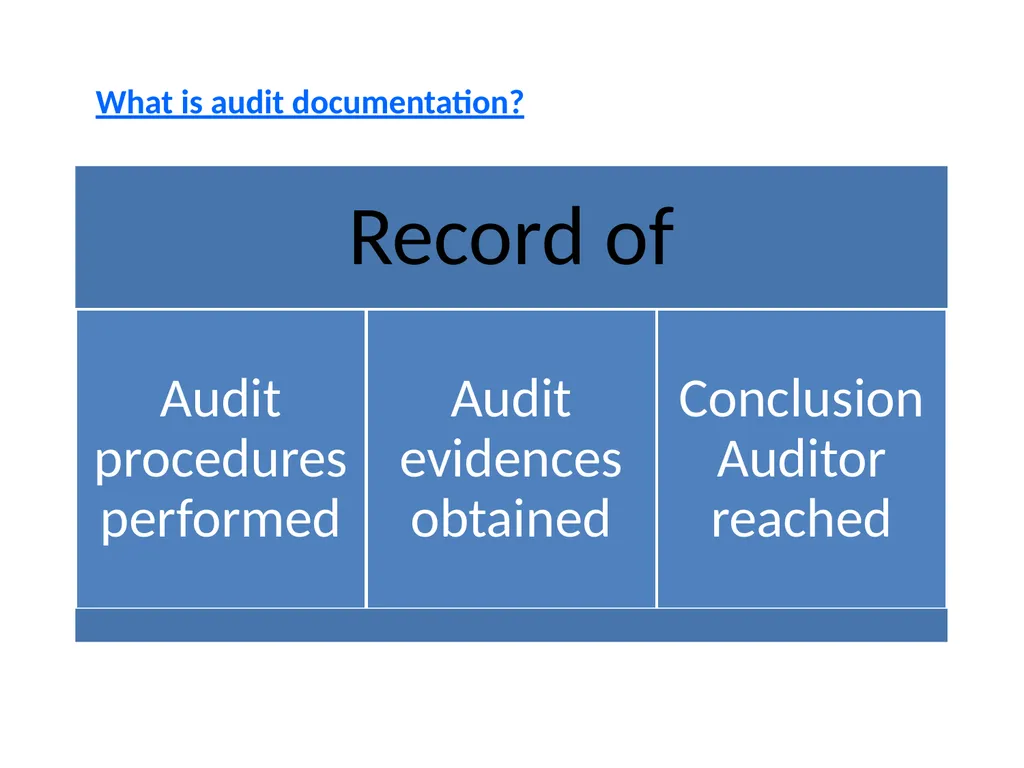
What is audit documentation?<br>
36
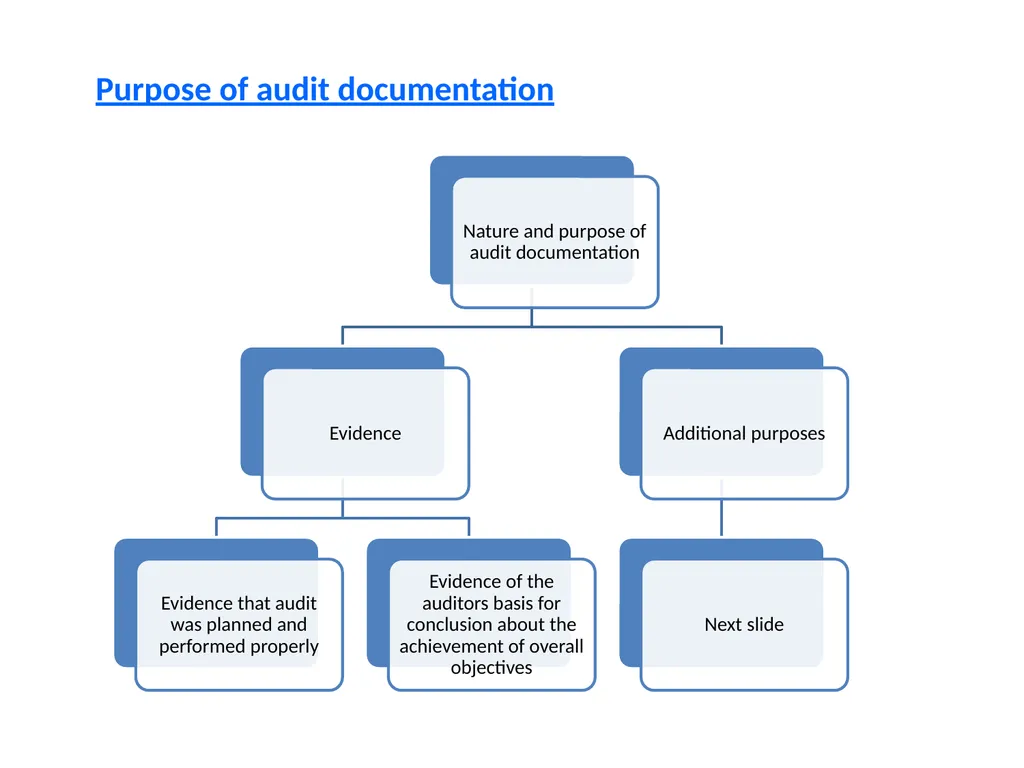
Purpose of audit documentation<br>
37
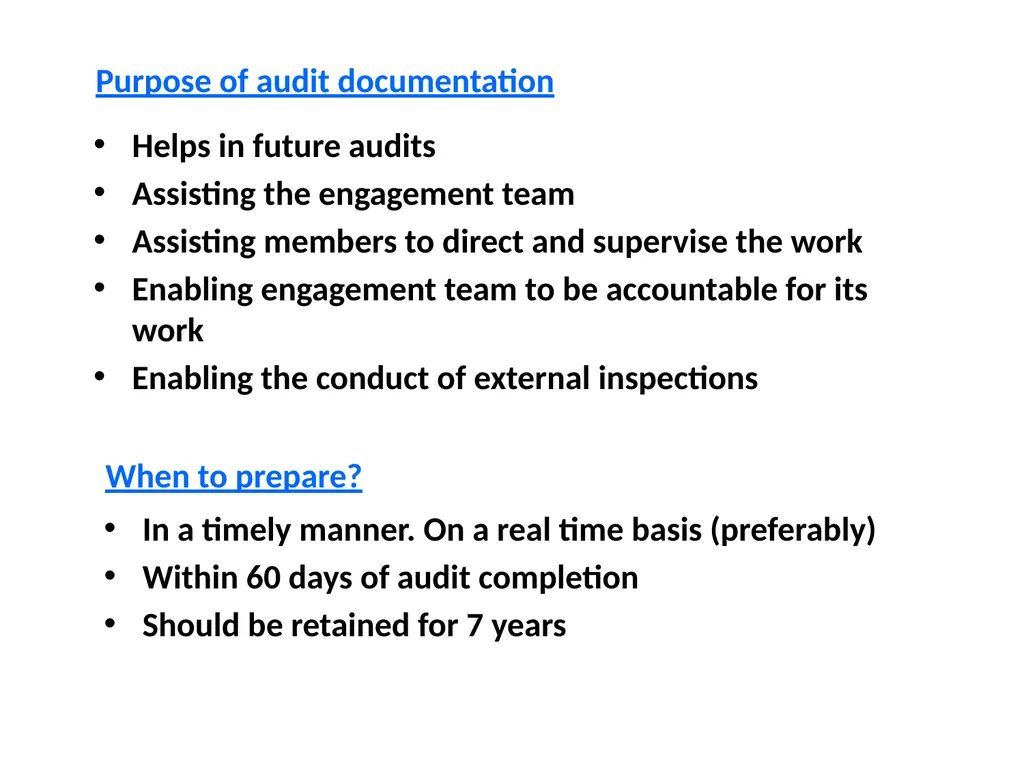
Purpose of audit documentation Helps in future audits
Assisting the engagement team
Assisting members to direct and supervise the work
Enabling engagement team to be accountable for its work
Enabling the conduct of external inspections When to prepare? In a timely manner. On a real time basis (preferably)
Within 60 days of audit completion
Should be retained for 7 years<br>
Assisting the engagement team
Assisting members to direct and supervise the work
Enabling engagement team to be accountable for its work
Enabling the conduct of external inspections When to prepare? In a timely manner. On a real time basis (preferably)
Within 60 days of audit completion
Should be retained for 7 years<br>
38
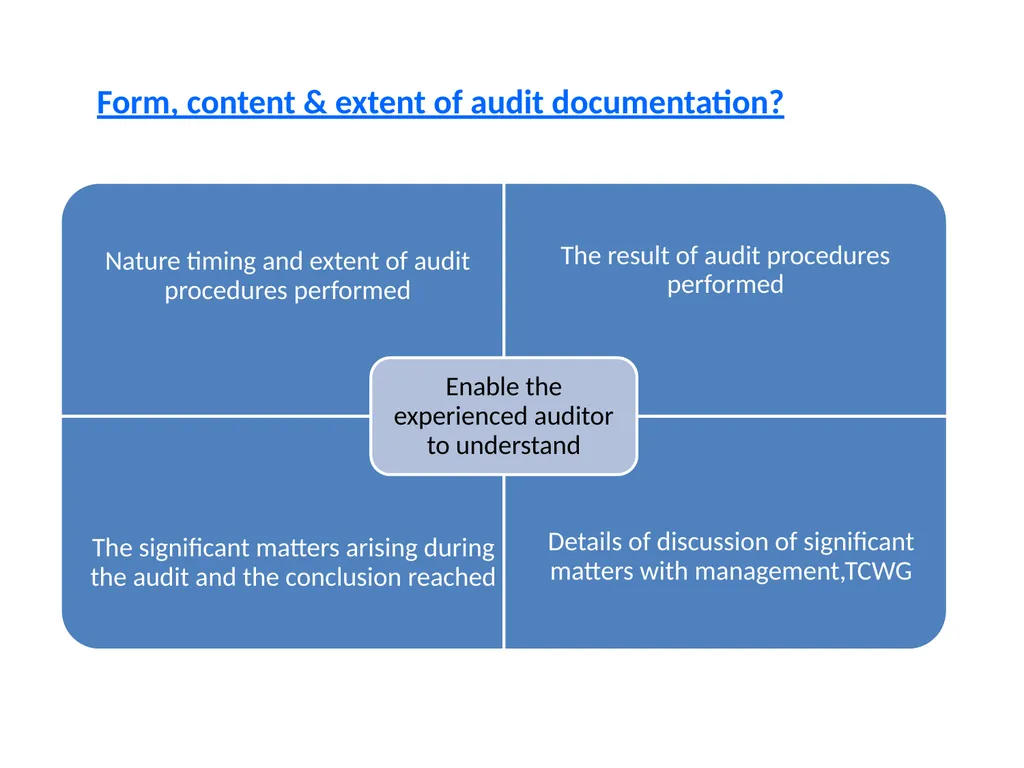
Form, content & extent of audit documentation?<br>
39
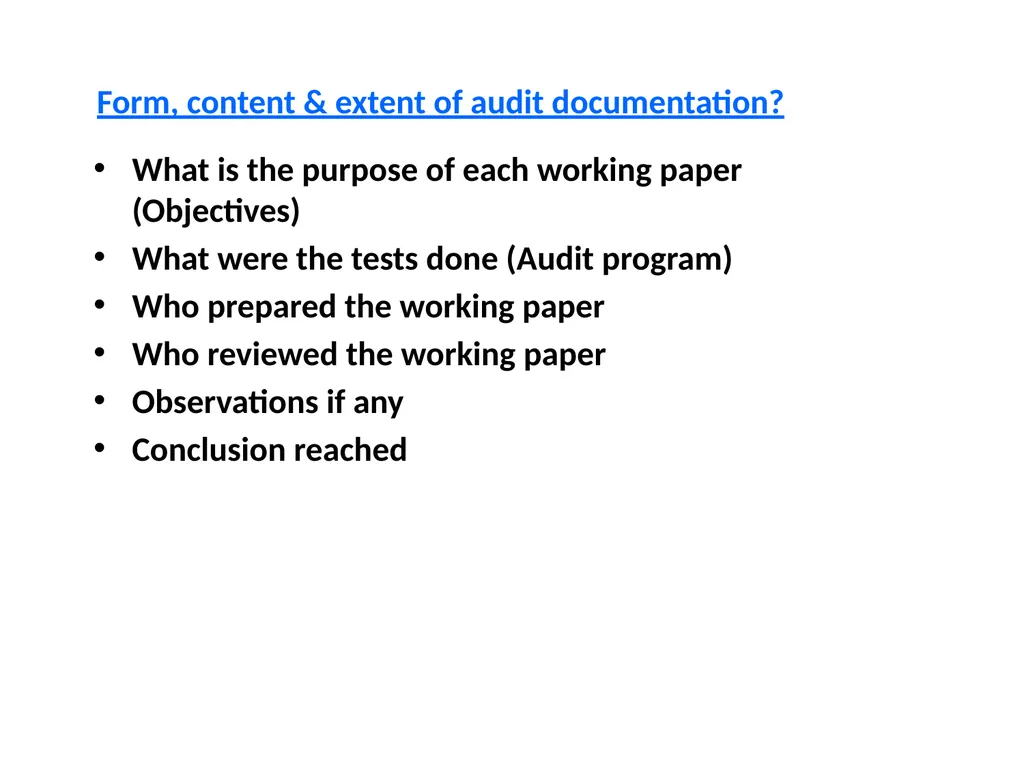
Form, content & extent of audit documentation? What is the purpose of each working paper (Objectives)
What were the tests done (Audit program)
Who prepared the working paper
Who reviewed the working paper
Observations if any
Conclusion reached<br>
What were the tests done (Audit program)
Who prepared the working paper
Who reviewed the working paper
Observations if any
Conclusion reached<br>
40
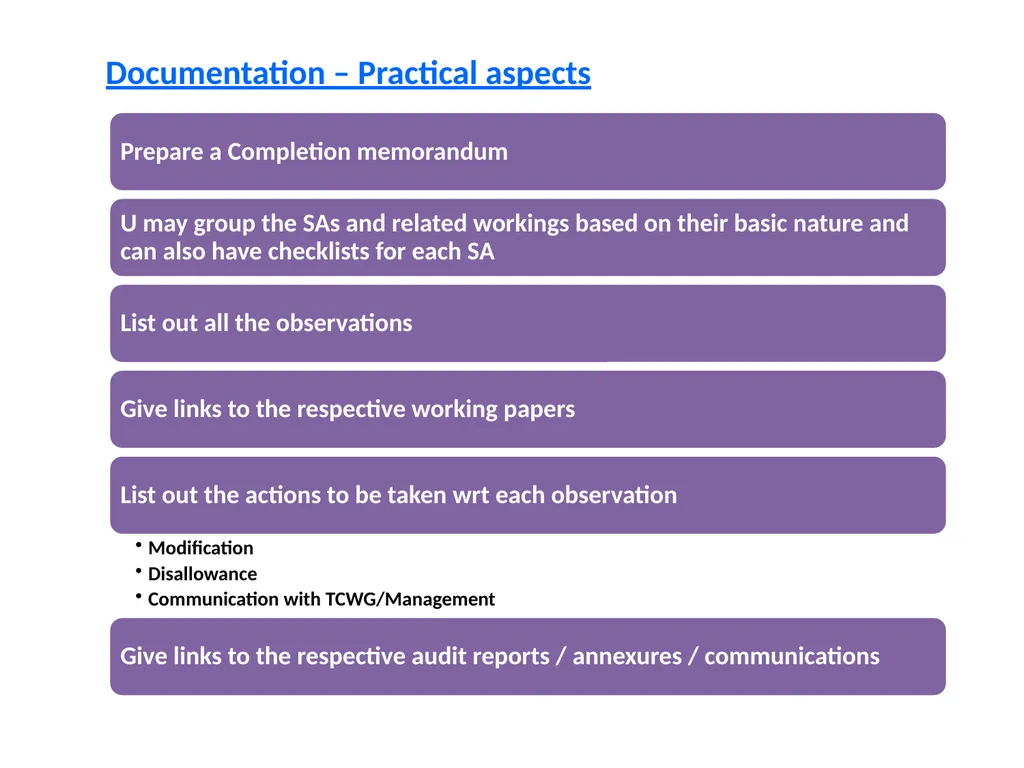
Documentation – Practical aspects<br>
41
Thank You!! GOVIND P. FCA
Partner
Rajasekharan & Mathew Chartered Accountants
Vyttila, Kochi
Mob: 9037102693<br>
Partner
Rajasekharan & Mathew Chartered Accountants
Vyttila, Kochi
Mob: 9037102693<br>