
Creating Better Relationships with Clients By:




Description: Creating Better Relationships with Clients By: Rudy Rivera, Esq. May 4, 2020 About the Speakers About the Speakers Rodolfo (Rudy) Rivera Fidelity National Financial Jacksonville, Florida Rudy.Riverafnf.com 904.854.8849 Darryl Horowitt
Related Topics
Download Presentation
"Creating Better Relationships with Clients By:" is the property of its rightful owner. Permission is granted to download and print the materials on this website for personal, non-commercial use only, and to display it on your personal computer provided you do not modify the materials and that you retain all copyright notices contained in the materials. By downloading content from our website, you accept the terms of this agreement.
Presentation Transcript
slide1. Creating Better Relationships with Clients By: Rudy Rivera, Esq.
May 4, 2020<br>
slide2. About the Speakers About the Speakers Rodolfo (Rudy) Rivera
Fidelity National Financial
Jacksonville, Florida
Rudy.Rivera@fnf.com
904.854.8849 Darryl Horowitt
Coleman & Horowitt, LLP
Fresno, California
dhorowitt@ch-law.com 559.248.4820<br>
slide3. SETTING EXPECTATIONS AT THE BEGINNING When You Are Retained:
Remember:
Not every case should be tried; and
Not every case should be settled
Have a conversation as to expectations
Learn about the Company
Ask how (if at all) the case could impact the Company
Obtain a point of contact for obtaining documents
Set parameters for communication
Let the client know which lawyers will be working
the matter.<br>
slide4. Communication Method of Communications:
Letters
Memorandums
Emails
Teleconference
Videoconferencing
Face-to-Face:
Visit with your client once per year
If working on active matters, bring those attorneys to the meeting
Don’t spend time telling them how great you are.<br>
slide5. Communication Remember to:
Provide updates to memorandums
Provide copies of pleading well in advance and not the day before
Depending on the sophistication of the client, provide executive summary with lengthy pleadings
Respond in a timely manner; 24 to 48 hours
Keep your communications accurate, concise and on point
If a client fails to follow the advice you provide, inquire as to why. Was it a business decision?
Try not to be condescending with speaking with non-attorneys.<br>
slide6. Billing When billing a client:
Review the bill before sending to the client
Be transparent
Advise when bills will be high
Be aware of partners charges for research
Never say: “I did not bill for all of my time.”
Have conversations with your client about the bills
Address any rejections
Deleting unnecessary time charges shows the client that it is not just about the money.
Do not have multiple lawyers billing on a matter unless they add some type of expertise.
Communicate to client prior to sending large bills; provide advance notice of increased billing time
Ask for increase in budget before the budget is met
SEND BILLS MONTHLY<br>
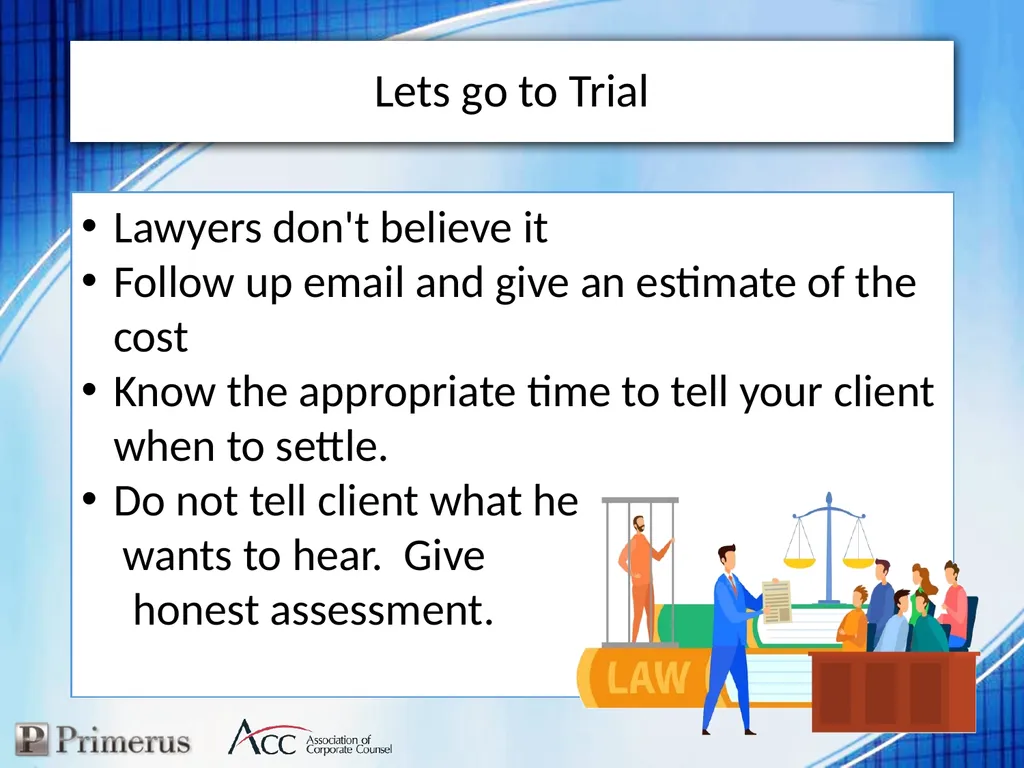
slide7. Lets go to Trial Lawyers don't believe it
Follow up email and give an estimate of the cost
Know the appropriate time to tell your client when to settle.
Do not tell client what he
wants to hear. Give
honest assessment.<br>
slide8. Firing a Client Do an analysis every year to determine if the relationship should be continued.
Don’t ever get too comfortable with a relationship.
Reach out to them by phone and say “how are you?”<br>
slide9. QUESTIONS?<br>
May 4, 2020<br>
slide2. About the Speakers About the Speakers Rodolfo (Rudy) Rivera
Fidelity National Financial
Jacksonville, Florida
Rudy.Rivera@fnf.com
904.854.8849 Darryl Horowitt
Coleman & Horowitt, LLP
Fresno, California
dhorowitt@ch-law.com 559.248.4820<br>
slide3. SETTING EXPECTATIONS AT THE BEGINNING When You Are Retained:
Remember:
Not every case should be tried; and
Not every case should be settled
Have a conversation as to expectations
Learn about the Company
Ask how (if at all) the case could impact the Company
Obtain a point of contact for obtaining documents
Set parameters for communication
Let the client know which lawyers will be working
the matter.<br>
slide4. Communication Method of Communications:
Letters
Memorandums
Emails
Teleconference
Videoconferencing
Face-to-Face:
Visit with your client once per year
If working on active matters, bring those attorneys to the meeting
Don’t spend time telling them how great you are.<br>
slide5. Communication Remember to:
Provide updates to memorandums
Provide copies of pleading well in advance and not the day before
Depending on the sophistication of the client, provide executive summary with lengthy pleadings
Respond in a timely manner; 24 to 48 hours
Keep your communications accurate, concise and on point
If a client fails to follow the advice you provide, inquire as to why. Was it a business decision?
Try not to be condescending with speaking with non-attorneys.<br>
slide6. Billing When billing a client:
Review the bill before sending to the client
Be transparent
Advise when bills will be high
Be aware of partners charges for research
Never say: “I did not bill for all of my time.”
Have conversations with your client about the bills
Address any rejections
Deleting unnecessary time charges shows the client that it is not just about the money.
Do not have multiple lawyers billing on a matter unless they add some type of expertise.
Communicate to client prior to sending large bills; provide advance notice of increased billing time
Ask for increase in budget before the budget is met
SEND BILLS MONTHLY<br>
slide7. Lets go to Trial Lawyers don't believe it
Follow up email and give an estimate of the cost
Know the appropriate time to tell your client when to settle.
Do not tell client what he
wants to hear. Give
honest assessment.<br>
slide8. Firing a Client Do an analysis every year to determine if the relationship should be continued.
Don’t ever get too comfortable with a relationship.
Reach out to them by phone and say “how are you?”<br>
slide9. QUESTIONS?<br>