
Credit and Counterparty Risk Systems That Read Dan
KL
Published · 33 slides · 0 views

1 / 1



Description
Credit and Counterparty Risk Systems That Read Dan diBartolomeo QWAFAFEW Boston June 2015 Introduction This presentation will illustrate potential use of news flow and sentiment statistics from quantified news to calibrate and update the
Related Topics
Share
Embed code
Download this presentation From Below
"Credit and Counterparty Risk Systems That Read Dan" is the property of its rightful owner. Permission is granted to download and print the materials on this website for personal, non-commercial use only, and to display it on your personal computer provided you do not modify the materials and that you retain all copyright notices contained in the materials. By downloading content from our website, you accept the terms of this agreement.
Presentation Transcript
01
Credit and Counterparty Risk Systems That Read Dan diBartolomeo QWAFAFEW Boston
June 2015<br>
02
Introduction This presentation will illustrate potential use of news flow and sentiment statistics from quantified news to calibrate and update the credit risk of corporations and financial institutions in real time
A modified version of the Merton (1974) contingent claims model from diBartolomeo (2010,2012) is used to break each corporate debt into two pieces, the first considered riskless debt and the second equity in the issuer.
We utilize news flow statistics to calibrate the expected volatility and bankruptcy risk of the equity portion and hence the credit risk of the debt in terms of both the probability of default and loss given default
Unlike use of sentiment statistics in the search for alpha within equity strategies, where “good” or “bad” news may already have been acted upon by other market participants, use of sentiment for credit risk has the advantage that it is largely unambiguous: “good” news is good and “bad news” is bad for creditors.<br>
03
Motivation There is a lot information about financial market conditions and the circumstances of specific firms in the form of “quantified news” and “sentiment” scores.
To date most efforts by financial participants to use news flow information has been in an effort to obtain alpha (superior risk adjusted returns) in trading equity markets.
There is a small but growing literature that strongly links news flows and sentiment into risk forecasting for equities (e.g. Mitra, Mitra and diBartolomeo (2009).
We needed to link the process of risk forecasting for equities into credit risk forecasting for corporate bonds and counter-party risk of large financial institutions.<br>
04
Keys to Using Quantified News Financial markets are driven by the arrival of information in the form of “news” (truly unanticipated) and the form of “announcements” that are anticipated with respect to time but not with respect to content.
The time intervals it takes markets to absorb and adjust to new information ranges from minutes to days. Generally much smaller than a month, but up to and often larger than a day. That’s why US markets were closed for a week at September 11th.
GARCH and other trend related models don’t work well on announcements
Market participants anticipate announcements
Volume and volatility dry up as investors wait for outcomes
Reduce volatility into the announcement and boost it after the announcement, so they are wrong twice<br>
05
Interpreting the Content of News Several papers have examined the relative market response to “news” and “announcements”
Ederington and Lee (1996), Kwag Shrieves and Wansley(2000)
Abraham and Taylor (1993)
Jones, Lamont and Lumsdaine (1998) show a remarkable result for the US bond market
Total returns for long bonds and Treasury bills are not different if announcement days are removed from the data set
Brown, Harlow and Tinic (1988) provide a framework for asymmetrical response to “good” and “bad” news
Good news increases projected cash flows, bad news decreases
All new information is a “surprise”, decreasing investor confidence and increasing discount rates
Upward price movements are muted, while downward movements are accentuated
For bond investors cash flows can’t increase so all news is bad<br>
06
Basic Contingent Claims Literature Merton (1974) poses the equity of a firm as a European call option on the firm’s assets, with a strike price equal to the face value of the firm’s debt
Alternatively, lenders are short a put on the firm assets
Default can occur only at debt maturity
Black and Cox (1976) provide a “first passage” model
Default can occur before debt maturity
Firm extinction is assumed if asset values hit a boundary value (i.e. specified by bond covenants)
Leland (1994) and Leland and Toft (1996)
Account for the tax deductibility of interest payments and costs of bankruptcy
Estimate boundary value as where equity value is maximized subject to bankruptcy<br>
07
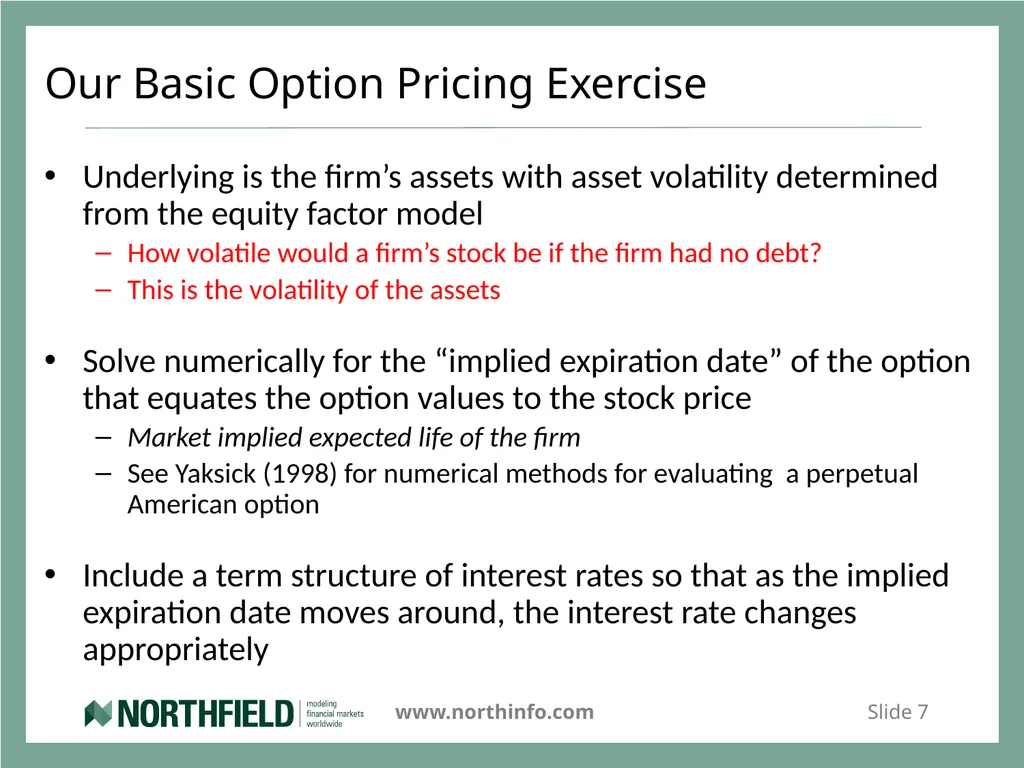
Our Basic Option Pricing Exercise Underlying is the firm’s assets with asset volatility determined from the equity factor model
How volatile would a firm’s stock be if the firm had no debt?
This is the volatility of the assets
Solve numerically for the “implied expiration date” of the option that equates the option values to the stock price
Market implied expected life of the firm
See Yaksick (1998) for numerical methods for evaluating a perpetual American option
Include a term structure of interest rates so that as the implied expiration date moves around, the interest rate changes appropriately<br>
08
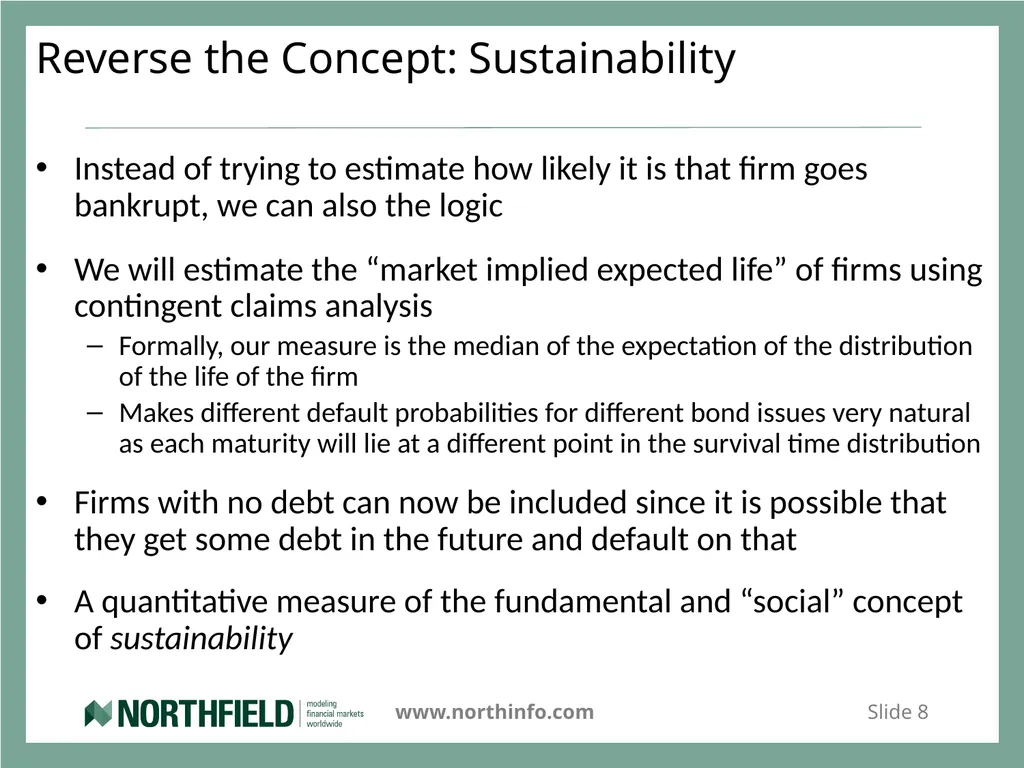
Reverse the Concept: Sustainability Instead of trying to estimate how likely it is that firm goes bankrupt, we can also the logic
We will estimate the “market implied expected life” of firms using contingent claims analysis
Formally, our measure is the median of the expectation of the distribution of the life of the firm
Makes different default probabilities for different bond issues very natural as each maturity will lie at a different point in the survival time distribution
Firms with no debt can now be included since it is possible that they get some debt in the future and default on that
A quantitative measure of the fundamental and “social” concept of sustainability<br>
09
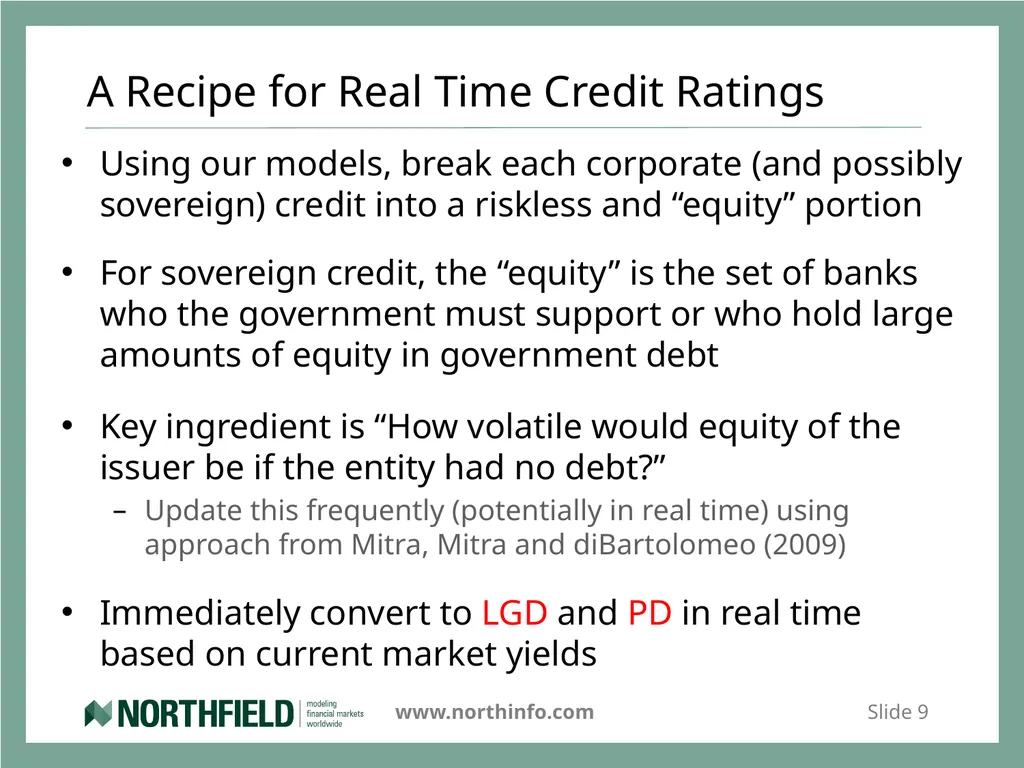
A Recipe for Real Time Credit Ratings Using our models, break each corporate (and possibly sovereign) credit into a riskless and “equity” portion
For sovereign credit, the “equity” is the set of banks who the government must support or who hold large amounts of equity in government debt
Key ingredient is “How volatile would equity of the issuer be if the entity had no debt?”
Update this frequently (potentially in real time) using approach from Mitra, Mitra and diBartolomeo (2009)
Immediately convert to LGD and PD in real time based on current market yields<br>
10
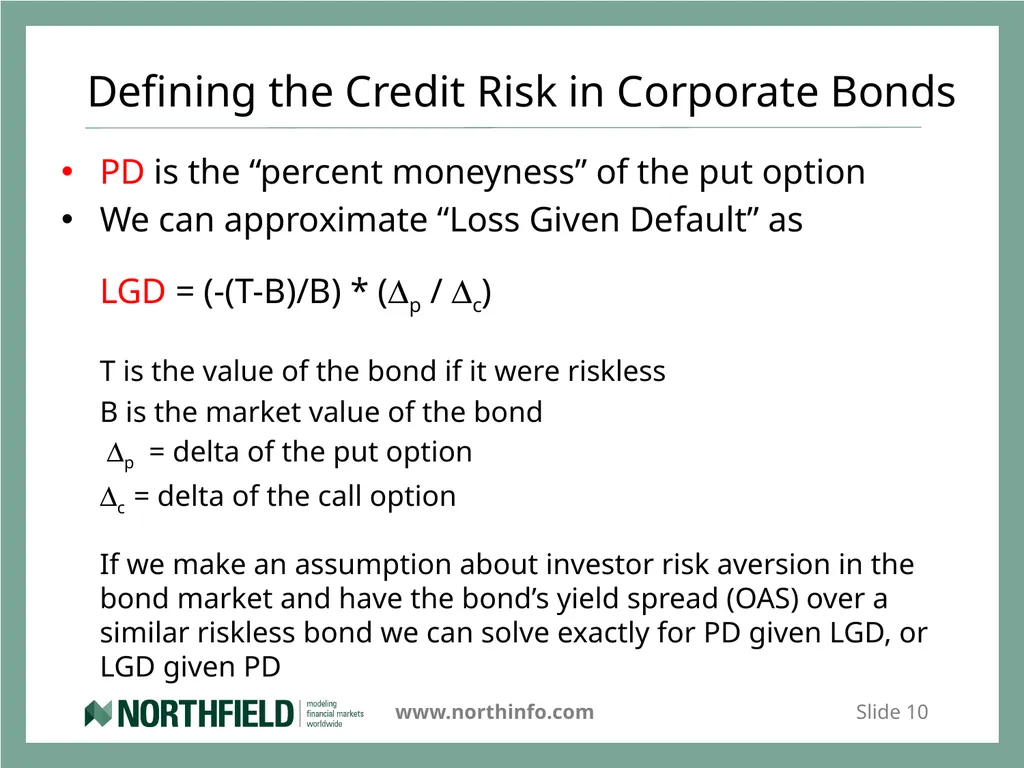
Defining the Credit Risk in Corporate Bonds PD is the “percent moneyness” of the put option
We can approximate “Loss Given Default” as
LGD = (-(T-B)/B) * (Dp / Dc)
T is the value of the bond if it were riskless
B is the market value of the bond
Dp = delta of the put option
Dc = delta of the call option
If we make an assumption about investor risk aversion in the bond market and have the bond’s yield spread (OAS) over a similar riskless bond we can solve exactly for PD given LGD, or LGD given PD<br>
11
Analyzing Sovereign Debt and Banking Stability Bodie, Gray, Merton (2005, 2007)
The paper provides a complex system of theoretical balance sheet relationships among three types of entities: the Corporate Sector, the Financial Sector including Central Banks, and Sovereign Governments
The interrelationships between sectors are modeled as a set of put and call options among the players
The government has a call on corporate assets (taxes)
The banks have a call on the government (bailouts)
A key attribute (asset) of some but not all governments is a monopoly authority on the printing of money
Belev and diBartolomeo (2013) extends the model to include joint default risk of governments and banking systems
Winner of the PRMIA 2013 Award for “New Frontiers in Risk Management”<br>
12
Conditional Models of Asset Volatility Almost all financial models are “unconditional”.
They are based on a sample of past history that deemed relevant, possibly giving more weight to recent observations, or assuming a simple trend in volatility (e.g. GARCH)
Sample periods range from 60 days to more than 20 years.
Once the sample period is determined, the heroic assumption is made that the future will be like the past.
This process omits everything we know about the present, and how the present is different from the past average conditions of the sample period.
Using the information about the present to adjust the risk estimates has been standard in some Northfield models since 1997, and in all models since 2009<br>
13
A Definition of News For our purposes, “News” is the set of information coming to investors that tell us how the present is different from the past.
This definition implies that routine information affirming the “status quo” is not news irrespective of how it is delivered.
Only a minority of large asset price moves are a direct response to investors responding to news. There are a lot of “information-less” trades (see Livnat, et. al. 2013). We need to be selective.
It should be very intuitive that risk assessments should also respond to news<br>
14
Review of Previous Literature and Research diBartolomeo and Warrick (2005)
Uses percentage changes in option implied volatility to adjust volatility estimate of individual stocks daily since 1997
Uses a regression method to separate adjustments to security level volatility into adjustments factor volatility and security specific risks. Allows for partial adjustment of risk for non-optional stocks.
If there is a big jump in the implied volatility of one stock it is assumed to security specific but if most stocks in an industry see a jump in implied volatility most of the change applied to the industry factor.
Very intuitive results when markets reopened after September 11th, 2001.<br>
15
Review of Previous Literature and Research diBartolomeo, G. Mitra, L. Mitra (2009)
Followed the analytical structure of diBartolomeo and Warrick (2005)
Replaced option implied volatility with measures of quantified news flow and sentiment
Empirical tests on high liquidity stocks (Dow Jones 30 and EuroStoxx 50 names) for next day intra-day volatility
Findings were that news driven metrics were more efficient predictors of changes in volatility than metrics based on changes in option implied volatility
We believe that news metrics work better than implied volatility because option markets have trading costs so the changes in implied volatility are muted compared changes in the beliefs of investors<br>
16
Review of Previous Literature and Research We had two separate teams of MIT graduate students conduct their own research projects over two years
Changes in one day security volatility was highly statistically significantly associated with changes in news flows at the individual stock level
More than a dozen functional forms of the relationship were tested on a large samples of hundreds of stocks over several hundred trading days
Intuitively, the predictive power of news flow changes decayed rapidly for the most liquid stocks and more slowly for less liquid names.
The impact of news also decayed more quickly for firms with more public recognition (e.g. Apple or Google).<br>
17
Review of Previous Literature and Research Kyle, Obizhaeva, Sinha and Tuzun (2012)
Shows that a theoretically predicted relationship between the frequency of news articles on companies, and the volatility of their stocks was fit almost perfectly by the empirical data over hundreds of companies and many years.
Clever construct suggesting that a function of stock volatility and trading volume across stocks is constant when the rate of time passage is defined in “numbers of articles” which they call “business time”
Prescribed functional form is a power function that also includes a “expected changes in trading volume” component
Related papers show how this structure can be used to predict bid/asked spreads and more generally trading costs<br>
18
News Flow as Additive to Volatility Northfield internal research (2013-2014)
All of the previous research suggests a multiplicative relationship between news flow and security volatility
Tested an additive functional form (H1: tomorrow’s volatility goes up when a threshold value of news flow is hit today)
This is an easy structure to fit in an existing factor model as a dummy variable. The factor exposure is 1 if there was “enough” news today and zero otherwise.
Main data set had 1.7 million data points (stocks * days)
We tested multiple providers of news flow analytics. They all worked to a statistically significant degree. T stats ranged from 7 to 9 in a Heston (1993) estimation structure with sample periods as short as 22 trading days<br>
19
Is News Just Another Risk Factor? No! The additive construct is somewhat close to the idea of using news flow (or some metric thereof such as “sentiment”) as one of the factors in the risk model.
We reject this formulation for a number of reasons. The first and most important is that is misses the profound basis of the entire process.
We agree with Kyle, et. al. that one can alternatively describe changes in asset volatility over time as time itself speeding up and slowing down.
When there is a lot of news time is passing quickly, so volatility seems high when measured in clock time. When there is very little information coming to investors, time is passing slowly when measured in clock time. This concept was previously explored in Haug (2004).<br>
20
Ingredients to the Conditioning Process We are using Dow-Jones news feeds as summarized by Alexandria Investment Research
Coverage of many thousands of stocks and several thousand “topics” such as sectors and countries. Quantitative summarization of each article takes no more than 30 milliseconds. Alexandria “reads” both English and Japanese.
Each article summary provides numerous metrics including the “sentiment of the article” (good news/bad news), “relevance” “confidence”, “novelty” (has similar news been previously reported recently) and “event type” (a merger is probably more important than a routine dividend)
Northfield then compiles “today to date” aggregations of the article count on each subject. Alexandria metrics are used to weight the importance of individual articles in the overall count.<br>
21
Functional Form I’m not going to provide the exact functional form of our process just yet.
What I will say is:
The functional form is multiplicative so our conditional forward estimate of risk is our unconditional forward estimate of risk times some scalar (with default value one).
The scalar is derived from the average amount of news flow in recent days (as weighted by the Alexandria metrics) in comparison to a long term average of news flows on the same company. Scalars can be above or below one with prescribed upper and lower bounds<br>
22
Functional Form Part 2 The conditioning captures multiple aspects of time decay
How long ago did the news take place? For example, there may have been a spike in news volume three days ago which will still be important, but less important than if the spike in news volume occurred today.
How fast will investors notice the events? For high volume, US liquid names the impact of news events will decay a lot faster for an obscure firm with no analyst coverage.
Separately we consider the impact of time decay based on the forward risk horizon. For example, if we are trying to forecast intra-day volatility for tomorrow, an increase in news volume will have more impact than if we are trying to forecast average daily volatility over the next ten trading days.<br>
23
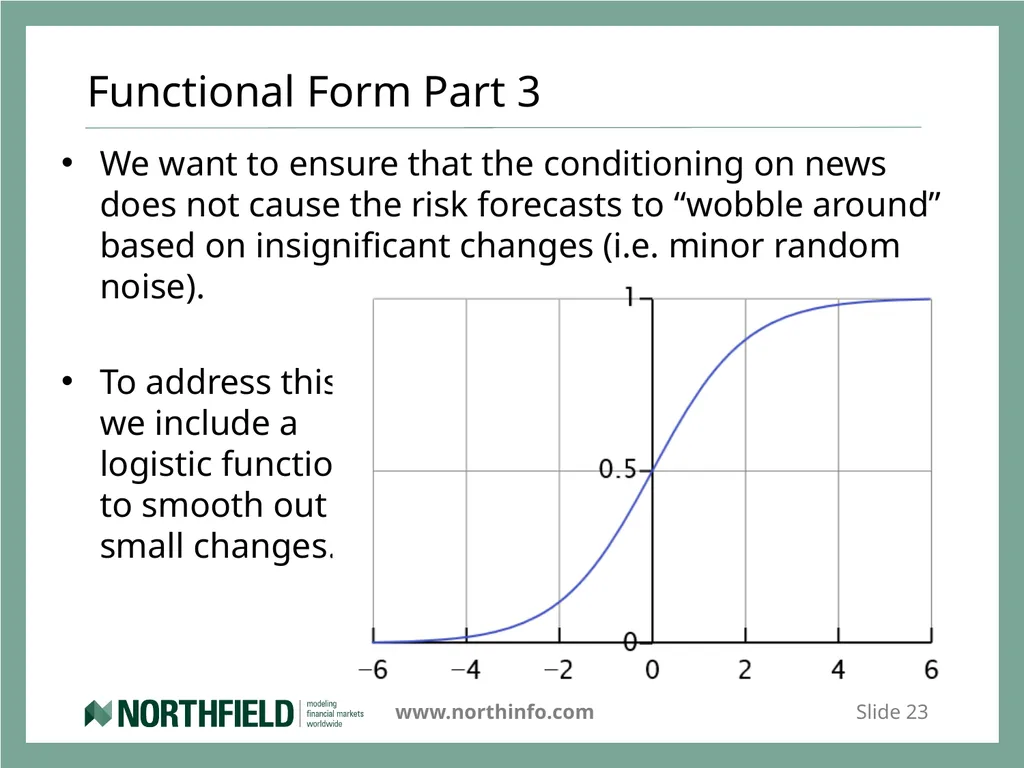
Functional Form Part 3 We want to ensure that the conditioning on news does not cause the risk forecasts to “wobble around” based on insignificant changes (i.e. minor random noise).
To address this we include a logistic function to smooth out small changes.<br>
24
Separation of Factor and Specific Risk diBartolomeo and Warrick (2005) shows how adjustments to the security volatilities can be “fed back” into the model to adjust factor variances and volatility estimates for assets on which no options are traded
See equations 7 through 9
Same process for news flow in diBartolomeo, Mitra, Mitra (2009)
If the factors are orthogonal this process can be reliably estimated with a simple OLS regression
If the model factors are not orthogonal you either use a non-linear optimization process (used in Northfield models since 2009) or generate an orthogonal transform of the factors, estimate using OLS, and then translate the factors back to the original basis.
This process updates the implicit full covariance matrix<br>
25
An Example Study With Full Data Universe is all US corporate bonds in the Northfield “Everything Everywhere” model
Typical size around 20,000 bond issues
Study period from December 31, 2005 to June 30, 2011
Minimum maturity one year
Each bond is matched to contemporaneous expected life of issuer
Assignments are updated annually for mergers, acquisitions
Expected life values are updated monthly
Return performance calculations exclude bonds with price outliers at the start of the period<br>
26
Things Go “Pear Shaped” In The GFC It should be intuitive that bonds with higher ratings should be associated with issuers with longer expected lives
Break all bonds into 20 rating categories (including “+” and “-”)
Calculate average expected life for all bonds in each rating category
Correlate the average expected life and our simple numeric rating
At 12/31/2005, the correlation across categories was +.68
Sample size of 17445 issues
At 12/31/2007 (pre bailouts), the correlation was -.35
Sample size of 22069 issues
By 12/31/2008, (post bailouts) the correlation was +.27
Sample size of 20043 issues<br>
27
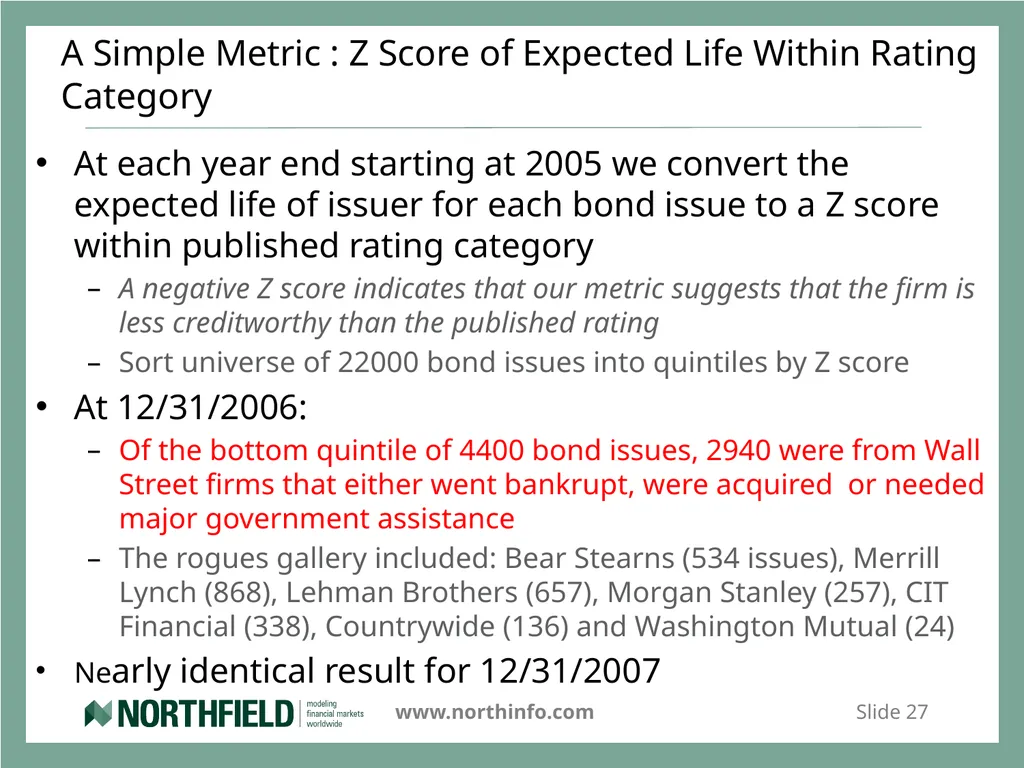
A Simple Metric : Z Score of Expected Life Within Rating Category At each year end starting at 2005 we convert the expected life of issuer for each bond issue to a Z score within published rating category
A negative Z score indicates that our metric suggests that the firm is less creditworthy than the published rating
Sort universe of 22000 bond issues into quintiles by Z score
At 12/31/2006:
Of the bottom quintile of 4400 bond issues, 2940 were from Wall Street firms that either went bankrupt, were acquired or needed major government assistance
The rogues gallery included: Bear Stearns (534 issues), Merrill Lynch (868), Lehman Brothers (657), Morgan Stanley (257), CIT Financial (338), Countrywide (136) and Washington Mutual (24)
Nearly identical result for 12/31/2007<br>
28
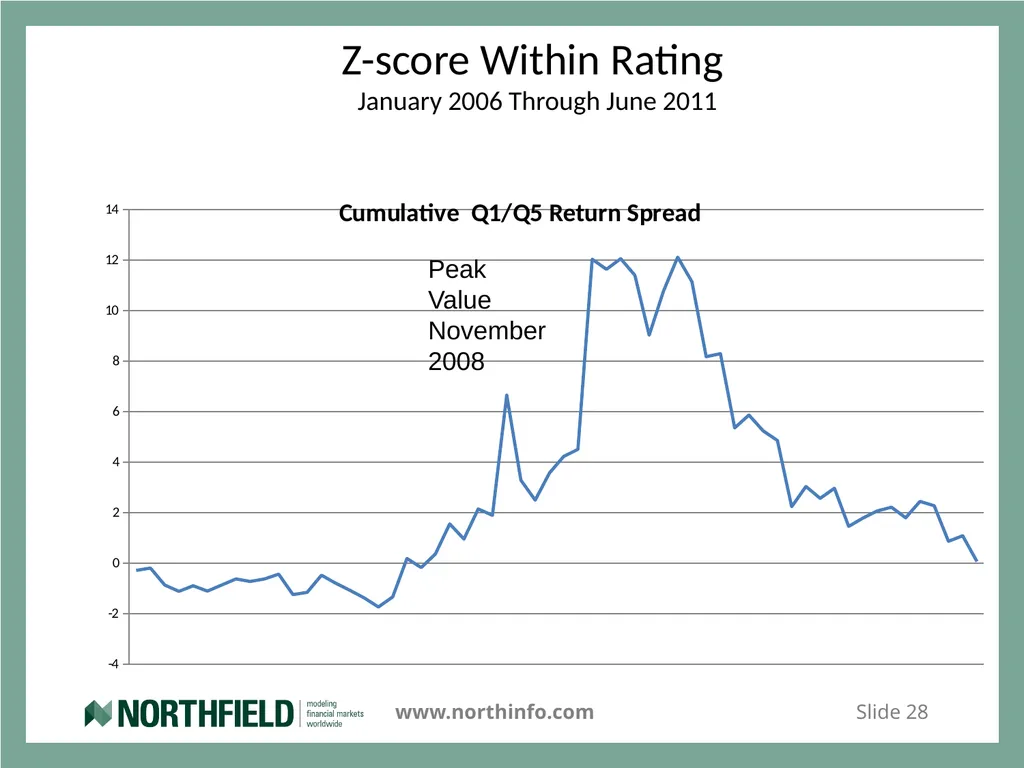
Z-score Within Rating
January 2006 Through June 2011 Peak Value November
2008<br>
29
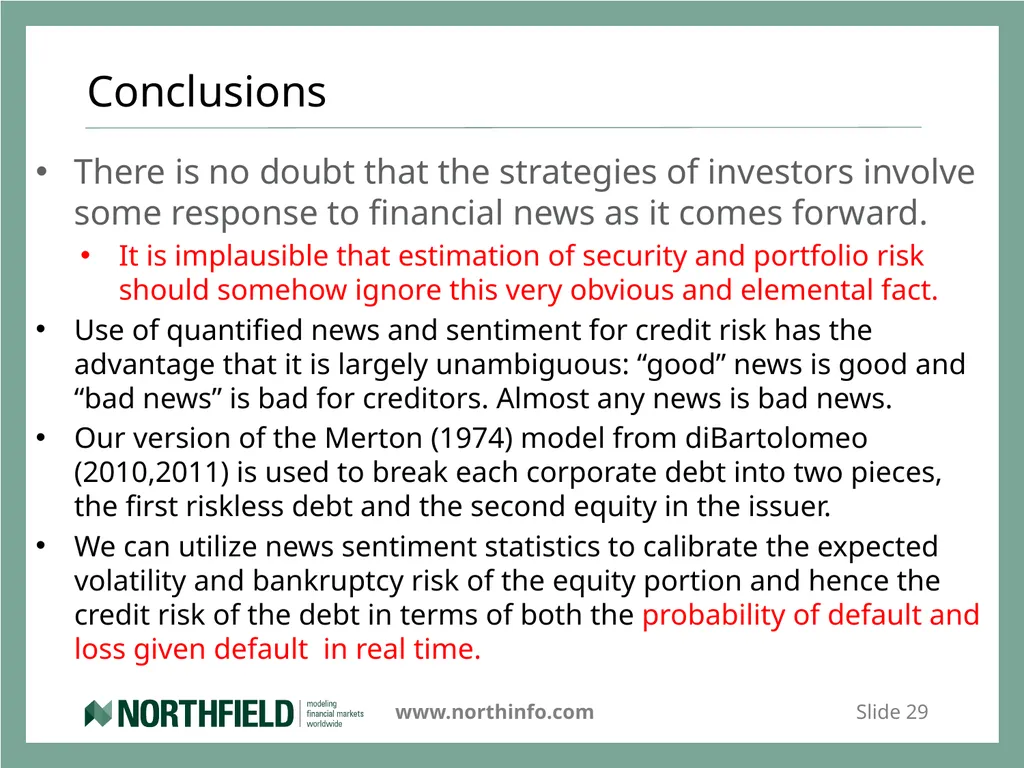
Conclusions There is no doubt that the strategies of investors involve some response to financial news as it comes forward.
It is implausible that estimation of security and portfolio risk should somehow ignore this very obvious and elemental fact.
Use of quantified news and sentiment for credit risk has the advantage that it is largely unambiguous: “good” news is good and “bad news” is bad for creditors. Almost any news is bad news.
Our version of the Merton (1974) model from diBartolomeo (2010,2011) is used to break each corporate debt into two pieces, the first riskless debt and the second equity in the issuer.
We can utilize news sentiment statistics to calibrate the expected volatility and bankruptcy risk of the equity portion and hence the credit risk of the debt in terms of both the probability of default and loss given default in real time.<br>
30
References diBartolomeo, D. and Warrick, S. 2005 “Making covariance-based portfolio risk models sensitive to the rate at which markets react to new information " Ch. 12 in Linear Factor Models Edited. Knight, J. and Satchell, S. Elsevier Finance.
diBartolomeo, D., Gautam Mitra and Leela Mitra “Equity portfolio risk (volatility) estimation using market information and sentiment. Quantitative Finance, Autumn, 2009.
diBartolomeo, D. 2011, “Use of News As a State Variable in Assessment of Financial Market Risk”, Ch. 10 in Handbook of News Analytics in Finance, Edited. Mitra, G. and Mitra, L.
diBartolomeo D. 2011, “News Analytics in a Risk Management Framework for Asset Managers” Ch. 16 in Handbook of News Analytics in Finance, Edited. Mitra, G. and Mitra, L.
Belev, Emilian and Dan diBartolomeo, “A Structural Model of Sovereign Credit and Bank Risk”, Proceedings of the Society of Actuaries/PRMIA Annual Meeting, 2013.<br>
31
References diBartolomeo, Dan, “Equity Risk, Credit Risk, Default Correlation, and Corporate Sustainability”, The Journal of Investing, Winter 2010, Vol. 19, No. 4: pp. 128-133
Merton, R.C., “On the Pricing of Corporate Debt: The Risk Structure of Interest Rates”, Journal of Finance, 29 (1974), pp. 449-470
Leland, Hayne, and Klaus Bjerre Toft, “Optimal Capital Structure, Endogenous Bankruptcy, and the Term Structure of Credit Spreads”, Journal of Finance, 51 (1996), pp 987-1019
Gray, Dale F., Robert C. Merton and Zvi Bodie, "Contingent Claims Approach to Measuring and Managing Sovereign Credit Risk", July 3, 2007
diBartolomeo, Dan. 2012. “Equity Factor Models: Estimation and Extensions”, In: B. Scherer and K. Winston, Editors, “The Oxford Handbook of Quantitative Asset Management”, Oxford University Press.
Ederington, L., and Lee, J.. 1993 \How Markets Process Information: News Releases and Volatility“ Journal of Finance, 48 p.11611161<br>
32
References Kwag, Austin, Ronald Shrieves and James Wansley, “Partially Anticipated Events: An Application to Dividend Announcements,” University of Tennessee Working Paper, March 2000.
Abraham, Abraham and William M. Taylor, “Pricing Currency Options With Scheduled And Unscheduled Announcement Effects On Volatility,” Managerial and Decision Economics, 1993, v14(4), 311-326.
Jones, Charles M., Owen Lamont and Robin L. Lumsdaine. "Macroeconomic News And Bond Market Volatility," Journal of Financial Economics, 1998, v47(3,Mar), 315-337.
Brown, Keith C., W. V. Harlow and Seha M. Tinic. "Risk Aversion, Uncertain Information, And Market Efficiency," Journal of Financial Economics, 1988, v22(2), 355-386.
Shah, Anish. “Short Term Risk from Long Term Models”, Northfield News, October 2008.
diBartolomeo, Dan. “Optimization of Composite Assets using Implied Covariance Matrices”, Northfield Working Paper, 1999.<br>
33
References Black, Fisher and John C. Cox, 1976, “Valuing Corporate Securities: Some Effects of Bond Indenture Provisions”, Journal of Finance, Volume 31, 351-367.
Leland, Hayne, 1994, “Corporate Debt Values, Bond Covenants and Optimal Capital Structure, Journal of Finance, Volume 49, 1213-1252.
Yaksick, Rudy, 1998, “Expected Optimal Exercise Time of a Perpetual American Option: A Closed Form Solution”, Journal of Financial Engineering, Volume 4 Number 1.
Black, Fischer, Emanuel Derman and William Toy “A One-Factor Model of Interest Rates and Its Application to Treasury Bond Options”, Financial Analysts Journal, Jan-Feb 1990, pp.33-39.
Dattatreya, Ravi and Frank Fabozzi. “A Simplified Model for Valuing Debt Options”. Journal of Portfolio Management, 1989.<br>