
Crime Statistics Classifying and Counting Clery
TD
Published · 146 slides · 0 views

1 / 1





Description
Crime Statistics Classifying and Counting Clery Act Crimes Mark Bailey Jefferson State Community College Four General Categories of Crime Statistics Criminal Offenses Hate Crimes VAWA Offenses Arrest and Referrals for Disciplinary Actions
Related Topics
Share
Embed code
Download this presentation From Below
"Crime Statistics Classifying and Counting Clery" is the property of its rightful owner. Permission is granted to download and print the materials on this website for personal, non-commercial use only, and to display it on your personal computer provided you do not modify the materials and that you retain all copyright notices contained in the materials. By downloading content from our website, you accept the terms of this agreement.
Presentation Transcript
01
Crime Statistics
Classifying and Counting
Clery Act Crimes Mark Bailey
Jefferson State Community College<br>
Jefferson State Community College<br>
02
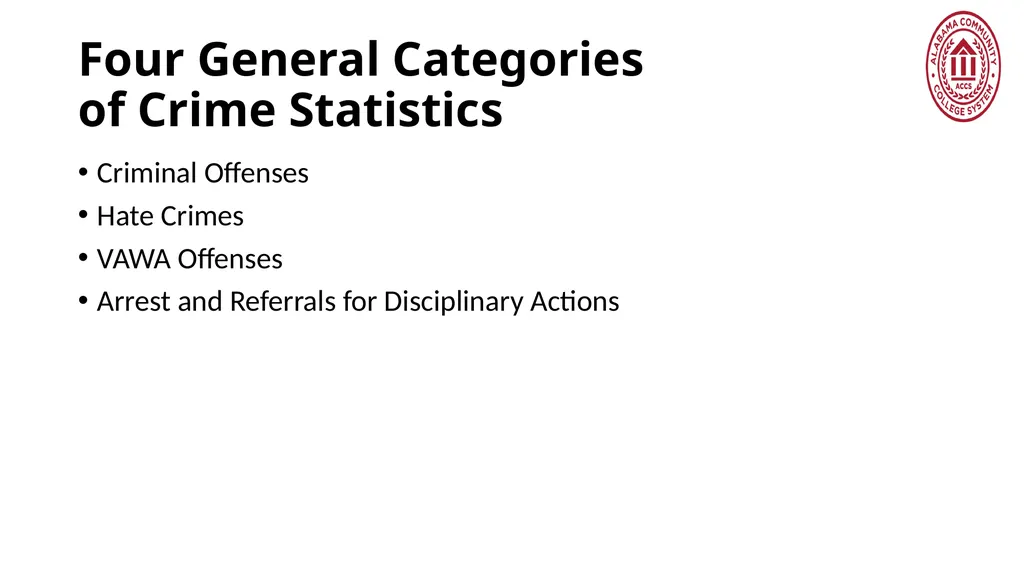
Four General Categories of Crime Statistics Criminal Offenses
Hate Crimes
VAWA Offenses
Arrest and Referrals for Disciplinary Actions<br>
Hate Crimes
VAWA Offenses
Arrest and Referrals for Disciplinary Actions<br>
03
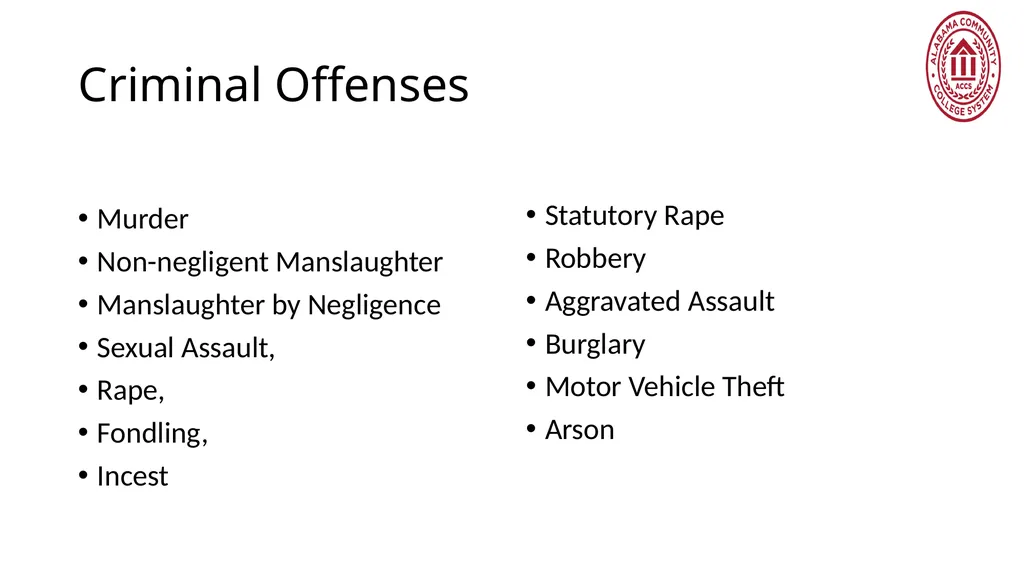
Criminal Offenses Murder
Non-negligent Manslaughter
Manslaughter by Negligence
Sexual Assault,
Rape,
Fondling,
Incest Statutory Rape
Robbery
Aggravated Assault
Burglary
Motor Vehicle Theft
Arson<br>
Non-negligent Manslaughter
Manslaughter by Negligence
Sexual Assault,
Rape,
Fondling,
Incest Statutory Rape
Robbery
Aggravated Assault
Burglary
Motor Vehicle Theft
Arson<br>
04
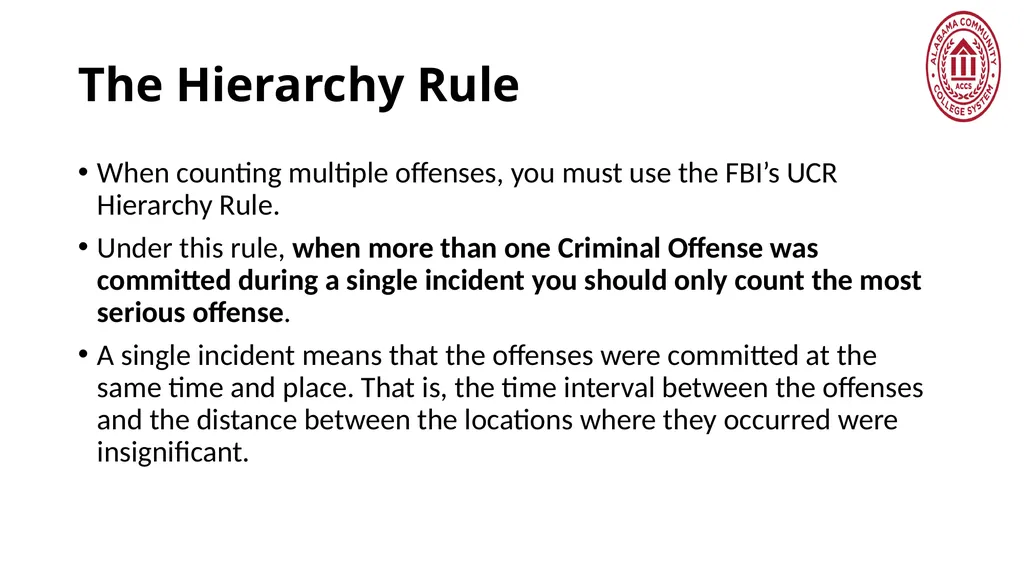
The Hierarchy Rule When counting multiple offenses, you must use the FBI’s UCR Hierarchy Rule.
Under this rule, when more than one Criminal Offense was committed during a single incident you should only count the most serious offense.
A single incident means that the offenses were committed at the same time and place. That is, the time interval between the offenses and the distance between the locations where they occurred were insignificant.<br>
Under this rule, when more than one Criminal Offense was committed during a single incident you should only count the most serious offense.
A single incident means that the offenses were committed at the same time and place. That is, the time interval between the offenses and the distance between the locations where they occurred were insignificant.<br>
05
Hierarchy Rule Example A student is both raped and robbed during a single incident.
In this case, include only the Rape in the statistics, because it is classified as the more serious crime in the hierarchy.<br>
In this case, include only the Rape in the statistics, because it is classified as the more serious crime in the hierarchy.<br>
06
Exceptions There are exceptions to using the Hierarchy Rule when counting offenses.
They apply to Arson, Sexual Assaults, Hate Crimes and VAWA Offenses.<br>
They apply to Arson, Sexual Assaults, Hate Crimes and VAWA Offenses.<br>
07
The Rules for Counting Arson are: Always count Arson regardless of the nature of any other offenses that were committed during the same incident.
When multiple offenses are committed during the same distinct operation as the Arson offense, report the most serious offense along with the Arson.
Include incidents in which persons are killed as a direct result of Arson as Murder and Non-negligent Manslaughter and Arson<br>
When multiple offenses are committed during the same distinct operation as the Arson offense, report the most serious offense along with the Arson.
Include incidents in which persons are killed as a direct result of Arson as Murder and Non-negligent Manslaughter and Arson<br>
08
The Rules for Counting Sexual Assaults are: If Rape, Fondling, Incest or Statutory Rape occurs in the same incident as Murder, count both the sexual assault and the Murder.
Fondling is recognized as an element of the other Sexual Assaults. Include a Sexual Assault as Fondling only if it is the only Sexual Assault. If Fondling occurs in the same incident as Murder, count both the Fondling and the Murder.<br>
Fondling is recognized as an element of the other Sexual Assaults. Include a Sexual Assault as Fondling only if it is the only Sexual Assault. If Fondling occurs in the same incident as Murder, count both the Fondling and the Murder.<br>
09
Hate Crimes— Includes all of the Criminal Offenses from previous slide
Larceny – Theft
Simple Assault
Intimidation
Destruction / Damage to Property<br>
Larceny – Theft
Simple Assault
Intimidation
Destruction / Damage to Property<br>
10
VAWA Offenses— Domestic Violence,
Dating Violence
Stalking.<br>
Dating Violence
Stalking.<br>
11
Arrests and Referrals for Disciplinary Action Weapons
Carrying
Possessing
Any Weapon Law Violation
Drug Abuse
Liquor Law Violations<br>
Carrying
Possessing
Any Weapon Law Violation
Drug Abuse
Liquor Law Violations<br>
12
Common Mistake Statistics must be disclosed separately for each of these four general categories. This means that when an incident meets definitions in more than one of these categories, it must be reported in each category.
Under the Clery Act, for the purposes of counting and disclosing Criminal Offense, Hate Crime, arrest and disciplinary referral statistics you must do so based on definitions provided by the Federal Bureau of Investigation’s (FBI’s) Uniform Crime Reporting (UCR) Program.<br>
Under the Clery Act, for the purposes of counting and disclosing Criminal Offense, Hate Crime, arrest and disciplinary referral statistics you must do so based on definitions provided by the Federal Bureau of Investigation’s (FBI’s) Uniform Crime Reporting (UCR) Program.<br>
13
Common Error It is possible that institutions may be asked to code incidents using different definitions for purposes other than Clery Act reporting. However, for Clery Act purposes, it is essential that institutions classify and count reported incidents based on the definitions specified by the Clery Act.
You must include in your crime statistics the number of all reported offenses, without regard to the findings of a court, coroner or jury, or the decision of a prosecutor.<br>
You must include in your crime statistics the number of all reported offenses, without regard to the findings of a court, coroner or jury, or the decision of a prosecutor.<br>
14
Common Mistake Classify and count crimes from the records of calls for service, complaints and investigations.
During an audit, you will be asked for items like the case number book, and records from dispatch logs.<br>
During an audit, you will be asked for items like the case number book, and records from dispatch logs.<br>
15
Types of Criminal Offenses Criminal Homicide. These offenses are separated into two categories:
Murder and Non-negligent Manslaughter,
Manslaughter by Negligence.<br>
Murder and Non-negligent Manslaughter,
Manslaughter by Negligence.<br>
16
Murder and Non-negligent Manslaughter Defined as the willful (non-negligent) killing of one human being by another. Count one offense per victim.
Include as Murder and Non-negligent Manslaughter:
Any death caused by injuries received in a fight, argument, quarrel, assault or the commission of a crime.<br>
Include as Murder and Non-negligent Manslaughter:
Any death caused by injuries received in a fight, argument, quarrel, assault or the commission of a crime.<br>
17
Do not include as Murder and Non-negligent Manslaughter: Suicides
Fetal deaths
Traffic fatalities
Accidental deaths Assaults with intent to Murder and attempts to Murder. (Classify assaults and attempts to Murder as Aggravated Assaults.)
Situations in which a victim dies of a heart attack as the result of a crime, even in instances where an individual is known to have a weak heart.
Justifiable homicide (which is defined as and limited to the killing of a felon by a peace officer in the line of duty, or the killing of a felon during the commission of a felony, by a private citizen).<br>
Fetal deaths
Traffic fatalities
Accidental deaths Assaults with intent to Murder and attempts to Murder. (Classify assaults and attempts to Murder as Aggravated Assaults.)
Situations in which a victim dies of a heart attack as the result of a crime, even in instances where an individual is known to have a weak heart.
Justifiable homicide (which is defined as and limited to the killing of a felon by a peace officer in the line of duty, or the killing of a felon during the commission of a felony, by a private citizen).<br>
18
Manslaughter by Negligence defined as the killing of another person through gross negligence.
Count one offense per victim.
Include as Manslaughter by Negligence:
Any death caused by the gross negligence of another. In other words, it’s something that a reasonable and prudent person would not do.<br>
Count one offense per victim.
Include as Manslaughter by Negligence:
Any death caused by the gross negligence of another. In other words, it’s something that a reasonable and prudent person would not do.<br>
19
Do not include as Manslaughter by Negligence Deaths of persons due to their own negligence.
Accidental deaths not resulting from gross negligence.
Traffic fatalities.
Remember that the findings of a court, coroner’s inquest, etc., do not affect classifying or counting criminal incidents.<br>
Accidental deaths not resulting from gross negligence.
Traffic fatalities.
Remember that the findings of a court, coroner’s inquest, etc., do not affect classifying or counting criminal incidents.<br>
20
Sexual Assault (Sex Offenses). Do not include in your Clery Act statistics any Sexual Assaults other than the four types of Sexual Assaults:
Rape
Fondling
Incest
Statutory Rape<br>
Rape
Fondling
Incest
Statutory Rape<br>
21
Rape Defined : is the penetration, no matter how slight, of the vagina or anus, with any body part or object, or oral penetration by a sex organ of another person, without the consent of the victim. This offense includes the rape of both males and females.
Count one offense per victim.<br>
Count one offense per victim.<br>
22
Rape Include the crime as Rape:
regardless of the age of the victim,
if the victim did not consent or
if the victim was incapable of giving consent.
If the victim consented, the offender did not force or threaten the victim, and the victim was under the statutory age of consent, include the crime as Statutory Rape.<br>
regardless of the age of the victim,
if the victim did not consent or
if the victim was incapable of giving consent.
If the victim consented, the offender did not force or threaten the victim, and the victim was under the statutory age of consent, include the crime as Statutory Rape.<br>
23
Fondling Defined: is the touching of the private body parts of another person for the purpose of sexual gratification, without the consent of the victim, including instances where the victim is incapable of giving consent because of his/her age or because of his/her temporary or permanent mental incapacity.
Count one offense per victim.
Fondling is recognized as an element of the other sex offenses. Therefore, count Fondling only if it is the only sex offense.<br>
Count one offense per victim.
Fondling is recognized as an element of the other sex offenses. Therefore, count Fondling only if it is the only sex offense.<br>
24
Incest is sexual intercourse between persons who are related to each other within the degrees wherein marriage is prohibited by law.
Count one offense per victim.<br>
Count one offense per victim.<br>
25
Statutory Rape Defined: is sexual intercourse with a person who is under the statutory age of consent.
He or she, being 16 years or older, engages in sexual intercourse with a member of the opposite sex who is less than 12 years old. (13A-6-61)
being 16 years old or older, he or she engages in sexual intercourse with another person who is 12 years old or older, but less than 16 years old; provided, however, the actor is at least two years older than the other person (13A-6-62)<br>
He or she, being 16 years or older, engages in sexual intercourse with a member of the opposite sex who is less than 12 years old. (13A-6-61)
being 16 years old or older, he or she engages in sexual intercourse with another person who is 12 years old or older, but less than 16 years old; provided, however, the actor is at least two years older than the other person (13A-6-62)<br>
26
Statutory Rape Remember, if force was used or threatened, or the victim was incapable of giving consent because of his/her age or temporary or permanent mental impairment, the offense is Rape, not Statutory Rape.
The ability of the victim to give consent must be a professional determination by a law enforcement agency.
Count one offense per victim.<br>
The ability of the victim to give consent must be a professional determination by a law enforcement agency.
Count one offense per victim.<br>
27
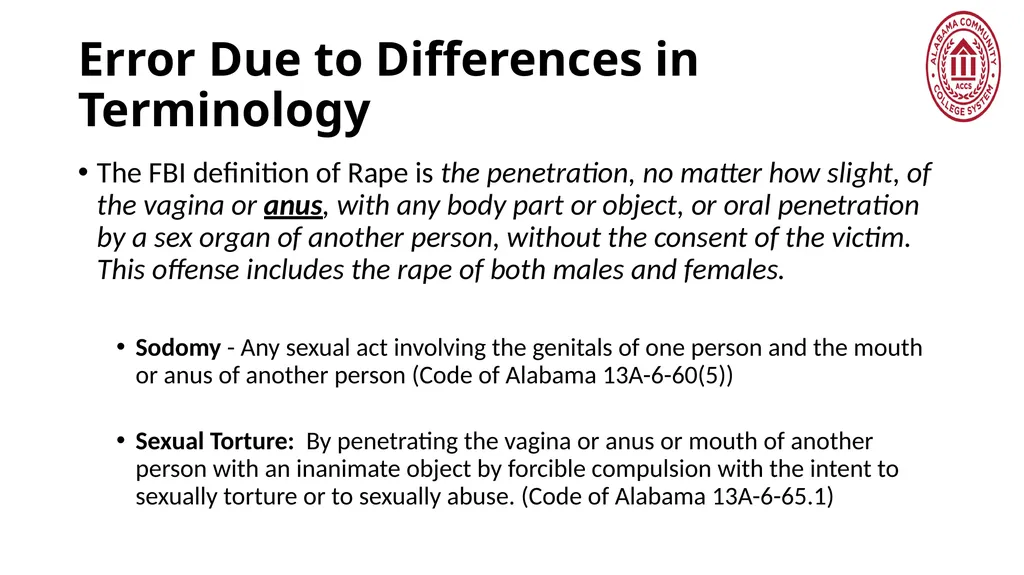
Error Due to Differences in Terminology The FBI definition of Rape is the penetration, no matter how slight, of the vagina or anus, with any body part or object, or oral penetration by a sex organ of another person, without the consent of the victim. This offense includes the rape of both males and females.
Sodomy - Any sexual act involving the genitals of one person and the mouth or anus of another person (Code of Alabama 13A-6-60(5))
Sexual Torture: By penetrating the vagina or anus or mouth of another person with an inanimate object by forcible compulsion with the intent to sexually torture or to sexually abuse. (Code of Alabama 13A-6-65.1)<br>
Sodomy - Any sexual act involving the genitals of one person and the mouth or anus of another person (Code of Alabama 13A-6-60(5))
Sexual Torture: By penetrating the vagina or anus or mouth of another person with an inanimate object by forcible compulsion with the intent to sexually torture or to sexually abuse. (Code of Alabama 13A-6-65.1)<br>
28
Reporting Standard The definitions of Sexual Assault include lack of consent as an element of the offense, for the purposes of including a reported Sexual Assault in Clery Act statistics, no determination as to whether that element has been met is required.
All Sexual Assaults that are reported to a campus security authority must be included in your Clery Act statistics and also included in your crime log (if you are required to have one), regardless of the issue of consent.<br>
All Sexual Assaults that are reported to a campus security authority must be included in your Clery Act statistics and also included in your crime log (if you are required to have one), regardless of the issue of consent.<br>
29
Robbery Defined: is the taking or attempting to take anything of value from the care, custody, or control of a person or persons by force or threat of force or violence and/or by putting the victim in fear.
count one offense for each distinct operation (i.e., incident), including attempts
Do not count the number of victims robbed, the number of those present at the Robbery or the number of offenders.<br>
count one offense for each distinct operation (i.e., incident), including attempts
Do not count the number of victims robbed, the number of those present at the Robbery or the number of offenders.<br>
30
Essential Elements of a Robbery Committed in the presence of a victim (usually the owner or person having custody of the property).
Victim is directly confronted by the perpetrator.
Victim is threatened with force or put in fear that force will be used.
Involves a Theft or Larceny.<br>
Victim is directly confronted by the perpetrator.
Victim is threatened with force or put in fear that force will be used.
Involves a Theft or Larceny.<br>
31
Robbery Because some type of assault is an element of Robbery, do not report an assault as a separate crime as long as it was performed in furtherance of the Robbery.
However, if the injury results in death, classify the incident as Murder and Non-negligent Manslaughter.<br>
However, if the injury results in death, classify the incident as Murder and Non-negligent Manslaughter.<br>
32
Common Terminology Armed robbery includes incidents commonly referred to as stickups, hijackings, holdups, heists, carjackings, etc.
Robberies in which only personal weapons, such as hands, arms, fists, feet and teeth, are used or threatened to be used may be referred to as “strong-arms” or “muggings.”
Carjacking is a Robbery offense in which a motor vehicle is taken through force or threat of force. In such case, following the Hierarchy Rule, report only a Robbery, not a Motor Vehicle Theft.<br>
Robberies in which only personal weapons, such as hands, arms, fists, feet and teeth, are used or threatened to be used may be referred to as “strong-arms” or “muggings.”
Carjacking is a Robbery offense in which a motor vehicle is taken through force or threat of force. In such case, following the Hierarchy Rule, report only a Robbery, not a Motor Vehicle Theft.<br>
33
Robbery The UCR considers a weapon to be a commonly known weapon (a gun, knife, club, etc.) or any other item that, although not usually thought of as a weapon, becomes one in the commission of a crime.
Robbery also includes crimes involving pretend weapons or those in which the weapon is not seen by the victim, but the robber claims to possess one.<br>
Robbery also includes crimes involving pretend weapons or those in which the weapon is not seen by the victim, but the robber claims to possess one.<br>
34
Common Mistake Victims often refer to other crimes a robbery:
Burglaries
Pick-pocketing
Unauthorized Breaking and Entering of a Vehicle
Theft<br>
Burglaries
Pick-pocketing
Unauthorized Breaking and Entering of a Vehicle
Theft<br>
35
Aggravated Assault Aggravated Assault is an unlawful attack by one person upon another for the purpose of inflicting severe or aggravated bodily injury. This type of assault usually is accompanied by the use of a weapon or by means likely to produce death or great bodily harm.
Count one offense per victim.
If a number of persons are involved in a dispute or disturbance, and the aggressors cannot be distinguished from the victims, count the number of persons assaulted as the number of offenses.<br>
Count one offense per victim.
If a number of persons are involved in a dispute or disturbance, and the aggressors cannot be distinguished from the victims, count the number of persons assaulted as the number of offenses.<br>
36
Include as Aggravated Assaults: Assaults or attempts to kill or Murder.
Poisoning (including the use of date rape drugs).
Assault with a dangerous or deadly weapon.
Maiming.
Mayhem.
Assault with explosives.
Assault with disease (as in cases when the offender is aware that he or she is infected with a deadly disease and deliberately attempts to inflict the disease by biting, spitting, etc.).<br>
Poisoning (including the use of date rape drugs).
Assault with a dangerous or deadly weapon.
Maiming.
Mayhem.
Assault with explosives.
Assault with disease (as in cases when the offender is aware that he or she is infected with a deadly disease and deliberately attempts to inflict the disease by biting, spitting, etc.).<br>
37
Aggravated Assault It is not necessary that injury result from an Aggravated Assault when a gun, knife or other weapon that could cause serious personal injury is used.
Count attacks using personal weapons, such as hands, arms, feet, fists and teeth that result in serious or aggravated injury.
Consider not only the intent of the attacker but also the extent of the injuries
If an attack results in broken bones, a loss of consciousness or significant blood loss, or requires medical treatment or hospitalization, such as stitches or casting (regardless of whether or not the victim accepts such assistance), the incident must be classified as an Aggravated Assault.<br>
Count attacks using personal weapons, such as hands, arms, feet, fists and teeth that result in serious or aggravated injury.
Consider not only the intent of the attacker but also the extent of the injuries
If an attack results in broken bones, a loss of consciousness or significant blood loss, or requires medical treatment or hospitalization, such as stitches or casting (regardless of whether or not the victim accepts such assistance), the incident must be classified as an Aggravated Assault.<br>
38
Aggravated Assault The use of drugs to subdue a victim, such as the use of date rape drugs, should be counted as Aggravated Assault because it can be assumed that the intent was to inflict aggravated bodily harm.
However, if the use of the drugs results in Rape or Murder within the same incident, follow the Hierarchy Rule, and count the more serious offenses.<br>
However, if the use of the drugs results in Rape or Murder within the same incident, follow the Hierarchy Rule, and count the more serious offenses.<br>
39
Aggravated Assault Be aware that assault cases might be categorized as:
Disorderly Conduct
Domestic Violence
Assault Do not classify an incident as an Aggravated Assault based solely on prosecutorial policy in a jurisdiction. Examine and count assaults according to the standard UCR definitions, regardless of whether they are labeled “misdemeanors” or “felonies” by local definitions.<br>
Disorderly Conduct
Domestic Violence
Assault Do not classify an incident as an Aggravated Assault based solely on prosecutorial policy in a jurisdiction. Examine and count assaults according to the standard UCR definitions, regardless of whether they are labeled “misdemeanors” or “felonies” by local definitions.<br>
40
Aid for Classifying Assaults Carefully consider the following factors in classifying assaults:
The type of weapon used or the use of an object as a weapon;
The seriousness of the injury; and
The intent of the assailant to cause serious injury.
The intent to cause death or severe bodily harm can arise after the parties to an incident have already engaged in some consensual contact.<br>
The type of weapon used or the use of an object as a weapon;
The seriousness of the injury; and
The intent of the assailant to cause serious injury.
The intent to cause death or severe bodily harm can arise after the parties to an incident have already engaged in some consensual contact.<br>
41
Burglary Burglary is the unlawful entry of a structure to commit a felony or a theft.
Count one offense per each distinct operation.
It is imperative that institutions carefully evaluate the operative facts of each reported incident to determine if it fits into any subpart of this definition.<br>
Count one offense per each distinct operation.
It is imperative that institutions carefully evaluate the operative facts of each reported incident to determine if it fits into any subpart of this definition.<br>
42
Burglary Unlawful entry with intent to commit a larceny or felony
Breaking and entering with intent to commit a larceny<br>
Breaking and entering with intent to commit a larceny<br>
43
Burglary Forcible Entry - All offenses where force of any kind is used to unlawfully enter a structure for the purpose of committing a theft or felony.
Breaking windows
Forcing windows, doors, transoms or ventilators
Cutting screens, walls or roofs
Using master keys, picks, unauthorized keys
Burglary by concealment inside a building followed by exiting the structure.<br>
Breaking windows
Forcing windows, doors, transoms or ventilators
Cutting screens, walls or roofs
Using master keys, picks, unauthorized keys
Burglary by concealment inside a building followed by exiting the structure.<br>
44
Burglary Unlawful Entry–No Force:
The entry of a structure in this situation is achieved by use of an unlocked door or window. The element of trespass to the structure is essential in this category, which includes thefts from open garages, open warehouses, open or unlocked dwellings (such as dorm rooms) and open or unlocked common basement areas in apartment houses where entry is achieved by someone other than the tenant who has lawful access, or others whom the tenant allows to have free and regular access to the structure.<br>
The entry of a structure in this situation is achieved by use of an unlocked door or window. The element of trespass to the structure is essential in this category, which includes thefts from open garages, open warehouses, open or unlocked dwellings (such as dorm rooms) and open or unlocked common basement areas in apartment houses where entry is achieved by someone other than the tenant who has lawful access, or others whom the tenant allows to have free and regular access to the structure.<br>
45
Burglary If an item was taken from an unlocked dorm room and you can establish that neither the tenant nor those friends with free and regular access to the room have taken the item, then unlawful access has occurred.
In this context, it is important to note that a “breaking” occurs when a perpetrator crosses the threshold of a boundary that results in a trespass.
As such it is possible for a burglar to “break” an open doorway or window.
There is no requirement that entry be forced in any way or that damage to a door, window or frame be evident.<br>
In this context, it is important to note that a “breaking” occurs when a perpetrator crosses the threshold of a boundary that results in a trespass.
As such it is possible for a burglar to “break” an open doorway or window.
There is no requirement that entry be forced in any way or that damage to a door, window or frame be evident.<br>
46
Burglary Attempted Forcible Entry: a situation where a forcible entry into a locked structure is attempted but not completed.
Such incidents must not be classified merely as “suspicious activity” or “vandalism” where the totality of facts indicates that a Burglary was in fact attempted.
Possible indicators of an attempted Burglary may include, but are not limited to, damage to a door or window, the presence of Burglary tools, a recurring or similar modus operandi or “signature” that ties an incident to other similar offenses (sometimes referred to as “common plan and scheme”), and/or proximity in time and place to a pattern of other similar crimes.<br>
Such incidents must not be classified merely as “suspicious activity” or “vandalism” where the totality of facts indicates that a Burglary was in fact attempted.
Possible indicators of an attempted Burglary may include, but are not limited to, damage to a door or window, the presence of Burglary tools, a recurring or similar modus operandi or “signature” that ties an incident to other similar offenses (sometimes referred to as “common plan and scheme”), and/or proximity in time and place to a pattern of other similar crimes.<br>
47
Do not classify as Burglary Thefts from automobiles, whether locked or not.
Shoplifting from commercial establishments.
Thefts from coin boxes or coin-operated machines.
Thefts from areas of open access
A forcible entry or unlawful entry in which no theft or felony occurs, but acts of vandalism, malicious mischief, etc., are committed, provided investigation clearly established that the unlawful entry was for a purpose other than to commit a felony or theft.<br>
Shoplifting from commercial establishments.
Thefts from coin boxes or coin-operated machines.
Thefts from areas of open access
A forcible entry or unlawful entry in which no theft or felony occurs, but acts of vandalism, malicious mischief, etc., are committed, provided investigation clearly established that the unlawful entry was for a purpose other than to commit a felony or theft.<br>
48
An incident must meet three conditions to be classified as a Burglary There must be evidence of unlawful entry (trespass). This means that the person did not have the right to be in the structure at the time the incident occurred.
The unlawful entry must occur within a structure, which is defined as having four walls, a roof, and a door.
The structure was unlawfully entered to commit a felony or a theft.<br>
The unlawful entry must occur within a structure, which is defined as having four walls, a roof, and a door.
The structure was unlawfully entered to commit a felony or a theft.<br>
49
The UCR definition of a structure includes: Apartment, barn, cabin, church, condominium, dwelling house, factory, garage, house trailer or houseboat (if used as a permanent dwelling), mill, office, other building, outbuilding, public building, railroad car, room, school, stable, storage facility, vessel (ship) and warehouse.
Any house trailer or other mobile unit that is permanently fixed as an office, residence or storehouse.<br>
Any house trailer or other mobile unit that is permanently fixed as an office, residence or storehouse.<br>
50
The UCR definition of a structure does not include: Motor vehicles.
Tents, tent trailers, motor homes, house trailers or other mobile units that are being used for recreational purposes.
A telephone booth.
A gym locker or cubby.<br>
Tents, tent trailers, motor homes, house trailers or other mobile units that are being used for recreational purposes.
A telephone booth.
A gym locker or cubby.<br>
51
Burglaries in individual student rooms: Because residents of rooms in student housing facilities are not considered transient, the Burglary of each room is a separate offense.
This means that if an offender unlawfully enters five dorm rooms on one floor of a student housing facility for the purpose of taking something, you should count this as five Burglaries.<br>
This means that if an offender unlawfully enters five dorm rooms on one floor of a student housing facility for the purpose of taking something, you should count this as five Burglaries.<br>
52
Burglaries in suites: Each bedroom in a student housing facility suite is considered a separate dwelling.
Count the Burglary of four bedrooms and the common room in a suite during a single incident as five Burglaries.<br>
Count the Burglary of four bedrooms and the common room in a suite during a single incident as five Burglaries.<br>
53
Burglaries in private academic offices: Count the Burglary of an academic structure as one offense, regardless of the number of interior rooms entered or items stolen if the rooms were all burglarized during the same time frame.<br>
54
Motor Vehicle Theft. Motor Vehicle Theft is the theft or attempted theft of a motor vehicle.
Count one offense for each stolen vehicle.<br>
Count one offense for each stolen vehicle.<br>
55
Classify as Motor Vehicle Theft: Theft of any self-propelled vehicle that runs on land surface and not on rails, such as sport utility vehicles, automobiles, trucks, buses, motorcycles, motor scooters, trail bikes, mopeds, all-terrain vehicles, self-propelled motor homes, snowmobiles, golf carts and motorized wheelchairs.
All incidents where automobiles are taken by persons not having lawful access even though the vehicles are later abandoned. Include joyriding in this category.<br>
All incidents where automobiles are taken by persons not having lawful access even though the vehicles are later abandoned. Include joyriding in this category.<br>
56
Do not classify as Motor Vehicle Theft: Theft of any of the following: Farm equipment, bulldozers, airplanes, construction equipment, water craft (motorboats, sailboats, houseboats or jet skis).
Taking a vehicle for temporary use when prior authority has been granted or can be assumed, such as in family situations, rental car agreements, or unauthorized use by chauffeurs and others having lawful access to the vehicle.
A forcible or unlawful entry of a building to steal a motor vehicle. Include this offense as a Burglary.
Thefts from motor vehicles. Theft from a motor vehicle is Larceny, which is not a Clery Act crime unless it’s motivated by bias<br>
Taking a vehicle for temporary use when prior authority has been granted or can be assumed, such as in family situations, rental car agreements, or unauthorized use by chauffeurs and others having lawful access to the vehicle.
A forcible or unlawful entry of a building to steal a motor vehicle. Include this offense as a Burglary.
Thefts from motor vehicles. Theft from a motor vehicle is Larceny, which is not a Clery Act crime unless it’s motivated by bias<br>
57
Arson. Arson is any willful or malicious burning or attempt to burn, with or without intent to defraud, a dwelling house, public building, motor vehicle or aircraft, personal property of another, etc.
Count one offense for each distinct incident of Arson occurring on your Clery Act geography<br>
Count one offense for each distinct incident of Arson occurring on your Clery Act geography<br>
58
Classify as Arson: Only fires determined to have been willfully or maliciously set.
Attempts to burn.
Any fire that investigation determines to meet the UCR definition of Arson regardless of the value of any property damage.
Incidents where an individual willfully or maliciously burns his or her own property.<br>
Attempts to burn.
Any fire that investigation determines to meet the UCR definition of Arson regardless of the value of any property damage.
Incidents where an individual willfully or maliciously burns his or her own property.<br>
59
Don’t Forget The Clery Act requires institutions to disclose all Arsons that occur on their Clery Act geography.
This includes seemingly minor fires such as burning wastebaskets or bulletin boards, regardless of whether they are discovered while burning or after being extinguished.
All of the evidence for any fire not known to be accidental (such as a cooking fire) must be considered by the institutional official designated to make such determinations.
The Clery Act’s Arson definition does not require that any findings be made by a fire official before classifying an incident.<br>
This includes seemingly minor fires such as burning wastebaskets or bulletin boards, regardless of whether they are discovered while burning or after being extinguished.
All of the evidence for any fire not known to be accidental (such as a cooking fire) must be considered by the institutional official designated to make such determinations.
The Clery Act’s Arson definition does not require that any findings be made by a fire official before classifying an incident.<br>
60
Do not classify as Arson: Fires of suspicious origin.
Fires of unknown origin.<br>
Fires of unknown origin.<br>
61
Cautions in Disclosing Arson statistics If a fire (determined to be Arson) starts in a privately owned house located next to your campus and spreads to a building on your campus, you are not required to include the fire in your Arson statistics because the point of origin for
If the private home and the on-campus building are burning, and investigators later determine that the cause was Arson, but the point of origin could not definitively be determined, your school is responsible for including the Arson in your statistics for the on-campus building.<br>
If the private home and the on-campus building are burning, and investigators later determine that the cause was Arson, but the point of origin could not definitively be determined, your school is responsible for including the Arson in your statistics for the on-campus building.<br>
62
Cautions in Disclosing Arson statistics Count incidents in which persons are killed as a direct result of Arson as both Criminal Homicides and Arson.
Similarly, report the number of persons severely injured during an Arson as Aggravated Assaults along with the Arson.
When other reportable offenses are committed during the same distinct operation as the Arson offense, report the most serious offense along with the Arson.
An important note for institutions that have on-campus student housing facilities: Arsons in on-campus student housing facilities must also be included in your fire statistics.<br>
Similarly, report the number of persons severely injured during an Arson as Aggravated Assaults along with the Arson.
When other reportable offenses are committed during the same distinct operation as the Arson offense, report the most serious offense along with the Arson.
An important note for institutions that have on-campus student housing facilities: Arsons in on-campus student housing facilities must also be included in your fire statistics.<br>
63
Hate Crimes A Hate Crime is a criminal offense that manifests evidence that the victim was intentionally selected because of the perpetrator’s bias against the victim<br>
64
Eight Categories of Bias Race. A preformed negative attitude toward a group of persons who possess common physical characteristics, e.g., color of skin, eyes, and/or hair; facial features, etc., genetically transmitted by descent and heredity which distinguish them as a distinct division of humankind, e.g., Asians, blacks or African Americans, whites<br>
65
Eight Categories of Bias Religion. A preformed negative opinion or attitude toward a group of persons who share the same religious beliefs regarding the origin and purpose of the universe and the existence or nonexistence of a supreme being, e.g., Catholics, Jews, Protestants, atheists.<br>
66
Eight Categories of Bias Sexual Orientation. A preformed negative opinion or attitude toward a group of persons based on their actual or perceived sexual orientation. Sexual Orientation is the term for a person’s physical, romantic, and/or emotional attraction to members of the same and/or opposite sex, including lesbian, gay, bisexual, and heterosexual (straight) individuals.<br>
67
Eight Categories of Bias Gender. A preformed negative opinion or attitude toward a person or group of persons based on their actual or perceived gender, e.g., male or female.<br>
68
Eight Categories of Bias Gender Identity. A preformed negative opinion or attitude toward a person or group of persons based on their actual or perceived gender identity, e.g., bias against transgender or gender non-conforming individuals. Gender non-conforming describes a person who does not conform to the gender-based expectations of society, e.g., a woman dressed in traditionally male clothing or a man wearing makeup. A gender non-conforming person may or may not be a lesbian, gay, bisexual, or transgender person but may be perceived as such.<br>
69
Eight Categories of Bias Ethnicity. A preformed negative opinion or attitude toward a group of people whose members identify with each other, through a common heritage, often consisting of a common language, common culture (often including a shared religion) and/or ideology that stresses common ancestry. The concept of ethnicity differs from the closely related term “race” in that “race” refers to a grouping based mostly upon biological criteria, while “ethnicity” also encompasses additional cultural factors.<br>
70
Eight Categories of Bias National Origin. A preformed negative opinion or attitude toward a group of people based on their actual or perceived country of birth. This bias may be against people that have a name or accent associated with a national origin group, participate in
certain customs associated with a national origin group, or because they are married to or associate with people of a certain national origin.<br>
certain customs associated with a national origin group, or because they are married to or associate with people of a certain national origin.<br>
71
Eight Categories of Bias Disability. A preformed negative opinion or attitude toward a group of persons based on their physical or mental impairments, whether such disability is temporary or permanent, congenital or acquired by heredity, accident, injury, advanced age or illness.<br>
72
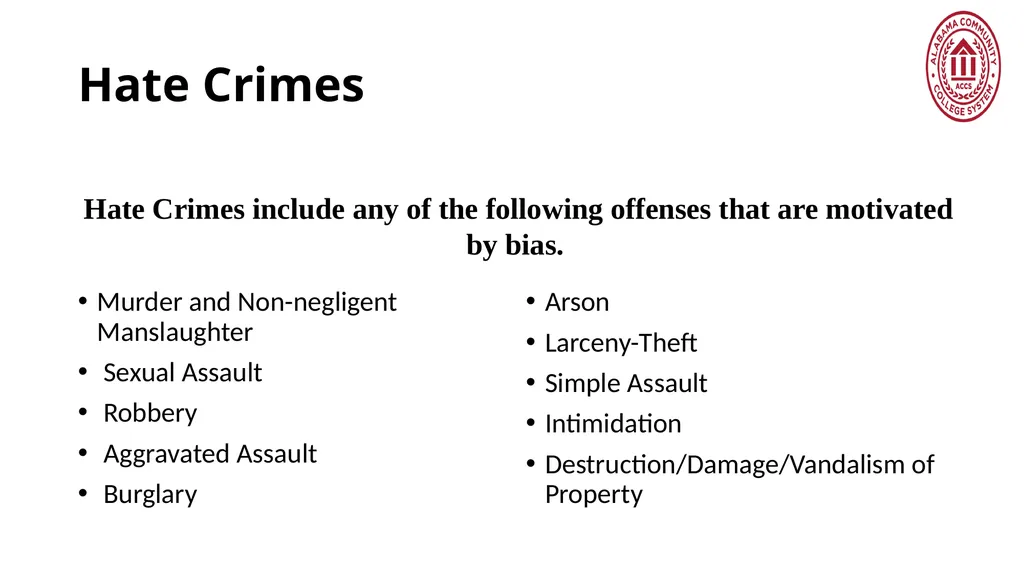
Hate Crimes Murder and Non-negligent Manslaughter
Sexual Assault
Robbery
Aggravated Assault
Burglary Arson
Larceny-Theft
Simple Assault
Intimidation
Destruction/Damage/Vandalism of Property Hate Crimes include any of the following offenses that are motivated by bias.<br>
Sexual Assault
Robbery
Aggravated Assault
Burglary Arson
Larceny-Theft
Simple Assault
Intimidation
Destruction/Damage/Vandalism of Property Hate Crimes include any of the following offenses that are motivated by bias.<br>
73
Additional Hate Crime Offenses Larceny-Theft,
Simple Assault, (Could be labeled as Harassment)
Intimidation, (Could be labeled as Harassment)
Destruction/Damage/Vandalism of Property (Could be labeled as Criminal Mischief)<br>
Simple Assault, (Could be labeled as Harassment)
Intimidation, (Could be labeled as Harassment)
Destruction/Damage/Vandalism of Property (Could be labeled as Criminal Mischief)<br>
74
Larceny-Theft Defined: is the unlawful taking, carrying, leading or riding away of property from the possession or constructive possession of another.
Constructive possession is the condition in which a person does not have physical custody or possession, but is in a position to exercise dominion or control over a thing.<br>
Constructive possession is the condition in which a person does not have physical custody or possession, but is in a position to exercise dominion or control over a thing.<br>
75
Classify as Larceny: Thefts of bicycles or automobile accessories.
Shoplifting.
Pocket-picking.
The stealing of any property or article that is not taken by force and violence or by fraud.
Any of the above regardless of the value of the item or items taken (For example, include the unlawful taking of a parking sticker that is peeled off a car windshield.)
Attempted larcenies.<br>
Shoplifting.
Pocket-picking.
The stealing of any property or article that is not taken by force and violence or by fraud.
Any of the above regardless of the value of the item or items taken (For example, include the unlawful taking of a parking sticker that is peeled off a car windshield.)
Attempted larcenies.<br>
76
Do not classify as Larceny: Motor Vehicle Theft.
Attempted Motor Vehicle Theft.
Embezzlement.
Confidence games.
Forgery.
Worthless checks.<br>
Attempted Motor Vehicle Theft.
Embezzlement.
Confidence games.
Forgery.
Worthless checks.<br>
77
Simple Assault Defined: is an unlawful physical attack by one person upon another where neither the offender displays a weapon, nor the victim suffers obvious severe or aggravated bodily injury involving apparent broken bones, loss of teeth, possible internal injury, severe laceration, or loss of consciousness.
Include all assaults that do not involve the use of a firearm, knife, cutting instrument or other dangerous weapon, and in which the victim did not sustain serious or aggravated injuries.<br>
Include all assaults that do not involve the use of a firearm, knife, cutting instrument or other dangerous weapon, and in which the victim did not sustain serious or aggravated injuries.<br>
78
Simple Assault Include all assaults that do not involve the use of a firearm, knife, cutting instrument or other dangerous weapon, and in which the victim did not sustain serious or aggravated injuries.<br>
79
Intimidation Defined: is to unlawfully place another person in reasonable fear of bodily harm through the use of threatening words and/or other conduct, but without displaying a weapon or subjecting the victim to actual physical attack. Remember – These reports are generally labeled as Harassment or Harassing Communication by law enforcement<br>
80
Destruction/Damage/Vandalism of Property Defined: is to willfully or maliciously destroy, damage, deface, or otherwise injure real or personal property without the consent of the owner or the person having custody or control of it.<br>
81
Classify as Destruction/Damage/Vandalism of Property Cutting auto tires.
Drawing obscene pictures on restroom walls.
Smashing windows.
Destroying school records.
Defacing library books.<br>
Drawing obscene pictures on restroom walls.
Smashing windows.
Destroying school records.
Defacing library books.<br>
82
Let’s Take A Break! See you in 10 minutes<br>
83
Classifying Crimes as Hate Crimes The offender and the victim were of a different race, religion, disability, sexual orientation, ethnicity, national origin, gender or gender identity.
Bias-related oral comments, written statements or gestures were made by the offender, that indicate the offender’s bias. For example, the offender shouted a racial epithet at the victim.<br>
Bias-related oral comments, written statements or gestures were made by the offender, that indicate the offender’s bias. For example, the offender shouted a racial epithet at the victim.<br>
84
Classifying Crimes as Hate Crimes Bias-related drawings, markings, symbols or graffiti were left at the crime scene. For example, a swastika was painted on the door of a synagogue, anti-Islamic statements on the wall of a mosque, or anti-gay graffiti on the door of an LGBTQ center.
Certain objects, items or things which indicate bias were used. For example, the offenders taped a photo of a burning cross to the door of an African American student’s dorm room.<br>
Certain objects, items or things which indicate bias were used. For example, the offenders taped a photo of a burning cross to the door of an African American student’s dorm room.<br>
85
Classifying Crimes as Hate Crimes The victim is a member of a racial, religious, disability, sexual orientation, ethnicity, national origin, gender or gender identity group that is overwhelmingly outnumbered by other residents in the student housing facility where the victim lives and the incident took place. This factor loses significance with the passage of time (i.e., it is most significant when the victim first moved into the facility, and becomes less and less significant as time passes without incident).<br>
86
Classifying Crimes as Hate Crimes Several incidents occurred in the same location at or about the same time, and the victims were all of the same race, religion, disability, sexual orientation, ethnicity, national origin, gender or gender identity.
A substantial portion of the campus community where the crime occurred perceived that the incident was motivated by bias.<br>
A substantial portion of the campus community where the crime occurred perceived that the incident was motivated by bias.<br>
87
Classifying Crimes as Hate Crimes The victim was engaged in activities related to his or her race, religion, disability, sexual orientation, ethnicity, national origin, gender or gender identity. For example, the victim was a member of the National Association for the Advancement of Colored People (NAACP) or participated in an LGBTQ Pride celebration.
The incident coincided with a holiday or a date of particular significance relating to a race, religion, disability, sexual orientation, ethnicity, national origin, gender or gender identity, e.g., Martin Luther King Day, Rosh Hashanah or the Transgender Day of Remembrance.<br>
The incident coincided with a holiday or a date of particular significance relating to a race, religion, disability, sexual orientation, ethnicity, national origin, gender or gender identity, e.g., Martin Luther King Day, Rosh Hashanah or the Transgender Day of Remembrance.<br>
88
Classifying Crimes as Hate Crimes The offender was previously involved in a similar Hate Crime or is a hate group member.
There were indications that a hate group was involved. For example, a hate group claimed responsibility for the crime or was active on the campus.
A historically established animosity existed between the victim’s and the offender’s groups.<br>
There were indications that a hate group was involved. For example, a hate group claimed responsibility for the crime or was active on the campus.
A historically established animosity existed between the victim’s and the offender’s groups.<br>
89
Classifying Crimes as Hate Crimes The victim, although not a member of the targeted racial, religious, disability, sexual-orientation, ethnic, national origin, gender or gender identity group, was a member of an advocacy group supporting the precepts of the victim group.<br>
90
Classifying Crimes as Hate Crimes Need for a case-by-case assessment of the facts. The aforementioned factors are not all-inclusive of the types of objective facts that evidence bias motivation. Therefore, examine each case for facts that clearly provide evidence that the offender’s bias motivated him or her to commit the crime.<br>
91
Classifying Crimes as Hate Crimes Misleading facts. Be alert to misleading facts. For example, the offender used an epithet to refer to the victim’s race, but the offender and victim were of the same race.
Feigned facts. Be alert to evidence left by the offenders that is meant to give the false impression that the incident was motivated by bias. For example, students of a religious school vandalize their own school, leaving anti-religious statements and symbols on its walls in the hope that they will be excused from attending class.<br>
Feigned facts. Be alert to evidence left by the offenders that is meant to give the false impression that the incident was motivated by bias. For example, students of a religious school vandalize their own school, leaving anti-religious statements and symbols on its walls in the hope that they will be excused from attending class.<br>
92
Classifying Crimes as Hate Crimes Offender’s mistaken perception. Even if the offender was mistaken about the victim’s race, religion, disability, sexual-orientation, ethnicity, national origin, gender or gender identity, the offense is still a Hate Crime as long as the offender was motivated by bias against that group. For example, a non-gay student leaving a publicized LGBTQ meeting in a noncampus fraternity house is followed back to campus and attacked behind a dorm by six teenagers who mistakenly believed the victim is gay. Although the offenders were mistaken, the offense is a Hate Crime because it was motivated by the offenders’ anti-gay bias.<br>
93
Classifying Crimes as Hate Crimes Remember, it is the perception of the offender, not the perception of the victim that determines whether a crime is classified as a Hate Crime. Also, knowing that an offender is prejudiced is not enough to classify a crime as a Hate Crime. There must be evidence that the offender was motivated by that prejudice to commit the crime.<br>
94
Rules for Counting Hate Crimes You must count all of the offenses committed in a multiple offense incident that are bias-motivated. For example, there is a single reported incident involving an Aggravated Assault and a Motor Vehicle Theft that were both motivated by bias. Include the incident in the statistics for both crimes.<br>
95
Rules for Counting Hate Crimes In reporting the number of Hate Crimes, you must include only the crimes that are bias-motivated as Hate Crimes in a multiple-offense incident. For example, three armed men commit a Robbery on the porch of a fraternity house. Two of the offenders go inside the house intending to rob more students. One of them spots a Hispanic woman, grabs her, and rapes her. The two offenders were later arrested and the investigation showed that although the Robbery was not bias-motivated, the Rape was. Include only the Sexual Assault as a Hate Crime.<br>
96
Rules for Counting Hate Crimes For any Criminal Offense that is also a Hate Crime, your statistics should indicate the offense and also the offense with the category of bias. For example, if an Aggravated Assault is a Hate Crime, include one Aggravated Assault in the statistics in the Criminal Offenses category and one Aggravated Assault motivated by (category of bias) in the Hate Crime category.<br>
97
Rules for Counting Hate Crimes The exception is when the Aggravated Assault is not included in the Criminal Offenses category because of the hierarchy rule. For example, for a single incident involving both a Rape and an Aggravated Assault that were both Hate Crimes, include only the Rape in the Criminal Offenses category and both the Rape and the Aggravated Assault in the Hate Crimes category.<br>
98
VAWA Offenses Dating Violence
Domestic Violence
Sexual Assault
Stalking<br>
Domestic Violence
Sexual Assault
Stalking<br>
99
Dating Violence Defined: as violence committed by a person who is or has been in a social relationship of a romantic or intimate nature with the victim. The existence of such a relationship shall be determined based on the reporting party’s statement and with consideration of the length of the relationship, the type of relationship, and the frequency of interaction between the persons involved in the relationship.<br>
100
Dating Violence For the purposes of this definition—
Dating violence includes, but is not limited to, sexual or physical abuse or the threat of such abuse.
Dating violence does not include acts covered under the definition of domestic violence.
Law Enforcement may list the offense as harassment<br>
Dating violence includes, but is not limited to, sexual or physical abuse or the threat of such abuse.
Dating violence does not include acts covered under the definition of domestic violence.
Law Enforcement may list the offense as harassment<br>
101
Dating Violence Common Terms
Hanging Out
Hooking Up
Whether or not the relationship is described as “monogamous” or “serious” should not be the determining factor.
No matter who reports the incident, whether it is the victim or a third party, it is the responsibility of the institution to determine whether the incident should be included as Dating Violence.<br>
Hanging Out
Hooking Up
Whether or not the relationship is described as “monogamous” or “serious” should not be the determining factor.
No matter who reports the incident, whether it is the victim or a third party, it is the responsibility of the institution to determine whether the incident should be included as Dating Violence.<br>
102
Domestic Violence Defined: as a felony or misdemeanor crime of violence committed
By a current or former spouse or intimate partner of the victim;
By a person with whom the victim shares a child in common;
By a person who is cohabitating with, or has cohabitated with, the victim as a spouse or intimate partner;
By a person similarly situated to a spouse of the victim under the domestic or family violence laws of the jurisdiction in which the crime of violence occurred;
By any other person against an adult or youth victim who is protected from that person’s acts under the domestic or family violence laws of the jurisdiction in which the crime of violence occurred.<br>
By a current or former spouse or intimate partner of the victim;
By a person with whom the victim shares a child in common;
By a person who is cohabitating with, or has cohabitated with, the victim as a spouse or intimate partner;
By a person similarly situated to a spouse of the victim under the domestic or family violence laws of the jurisdiction in which the crime of violence occurred;
By any other person against an adult or youth victim who is protected from that person’s acts under the domestic or family violence laws of the jurisdiction in which the crime of violence occurred.<br>
103
Domestic Violence To categorize an incident as Domestic Violence, the relationship between the perpetrator and the victim must be more than just two people living together as roommates. The people cohabitating must be current or former spouses or have an intimate relationship.<br>
104
Stalking Defined: as engaging in a course of conduct directed at a specific person that would cause a reasonable person to—
Fear for the person’s safety or the safety of others; or
Suffer substantial emotional distress.<br>
Fear for the person’s safety or the safety of others; or
Suffer substantial emotional distress.<br>
105
Stalking Terms Course of conduct means two or more acts, including, but not limited to, acts in which the stalker directly, indirectly, or through third parties, by any action, method, device, or means, follows, monitors, observes, surveils, threatens, or communicates to or about a person, or interferes with a person’s property.
Reasonable person means a reasonable person under similar circumstances and with similar identities to the victim.
Substantial emotional distress means significant mental suffering or anguish that may, but does not necessarily require medical or other professional treatment or counseling.<br>
Reasonable person means a reasonable person under similar circumstances and with similar identities to the victim.
Substantial emotional distress means significant mental suffering or anguish that may, but does not necessarily require medical or other professional treatment or counseling.<br>
106
Additional Guidance for Counting Stalking Record each report of Stalking as occurring at only the first location within the institution’s Clery Act geography in which either the perpetrator engaged in the Stalking course of conduct or the victim first became aware of the Stalking.
It is not necessary for all activities in the course of conduct to occur on Clery Act geography in order to count the incident.<br>
It is not necessary for all activities in the course of conduct to occur on Clery Act geography in order to count the incident.<br>
107
Additional Guidance for Counting Stalking A single course of conduct may include varying Stalking activities and may include acts committed over electronic communication (e.g., emails, texts or social media).
When recording reports of Stalking that include activities in more than one calendar year, an institution must record a crime statistic for each and every year in which the course of conduct is reported to a local police agency or to a campus security authority.<br>
When recording reports of Stalking that include activities in more than one calendar year, an institution must record a crime statistic for each and every year in which the course of conduct is reported to a local police agency or to a campus security authority.<br>
108
Additional Guidance for Counting Stalking If Stalking occurs on more than one institution’s Clery Act geography and is reported to a campus security authority at each institution, both institutions must include the Stalking in their statistics. Although the Clery Act does not require an institution that learns of Stalking occurring on another campus to alert the other campus, other laws may require such an alert and we strongly encourage an institution in this situation to do so.<br>
109
Rules for Counting VAWA Offenses The Hierarchy Rule does not apply to VAWA Offenses. Therefore, for any Criminal Offense, Hate Crime, or arrest for Weapons, Drug or Liquor Law Violations that is also a VAWA Offense, your statistics must reflect the original offense and the VAWA Offense. For example, if an Aggravated Assault is also Domestic Violence, include the incident as one Aggravated Assault in the Criminal Offenses category and as an incident of Domestic Violence in the VAWA Offenses category.<br>
110
Arrests and Disciplinary Referrals for Violation of Weapons, Drug Abuse and Liquor Laws Weapons: Carrying, Possessing, Etc.;
Drug Abuse Violations; and
Liquor Law Violations.
You must report statistics for violations of the law that occur on your Clery Act geography and result in arrests or persons being referred for disciplinary action.
Do not include violations of your institution’s policies that resulted in persons being referred for disciplinary action if there was no violation of the law.<br>
Drug Abuse Violations; and
Liquor Law Violations.
You must report statistics for violations of the law that occur on your Clery Act geography and result in arrests or persons being referred for disciplinary action.
Do not include violations of your institution’s policies that resulted in persons being referred for disciplinary action if there was no violation of the law.<br>
111
Arrests and Disciplinary Referrals for Violation of Weapons, Drug Abuse and Liquor Laws If an individual is both arrested and referred for disciplinary action for an offense, include only the arrest in your statistics.
Note that arrests and referrals for these law violations are not covered by the Hierarchy Rule used to count Criminal Offenses. Therefore, you must count arrests for Weapons, Drug Abuse and Liquor Law Violations in addition to the most serious Criminal Offense when occurring in a single incident.<br>
Note that arrests and referrals for these law violations are not covered by the Hierarchy Rule used to count Criminal Offenses. Therefore, you must count arrests for Weapons, Drug Abuse and Liquor Law Violations in addition to the most serious Criminal Offense when occurring in a single incident.<br>
112
Classify As Arrests: Arrest for Clery Act purposes is defined as persons processed by arrest, citation or summons.
Those persons arrested and released without a formal charge being placed against them. (An arrest has occurred when a law enforcement officer detains an adult with the intention of seeking charges against the individual for a specific offense(s) and a record is made of the detention.)<br>
Those persons arrested and released without a formal charge being placed against them. (An arrest has occurred when a law enforcement officer detains an adult with the intention of seeking charges against the individual for a specific offense(s) and a record is made of the detention.)<br>
113
Classify As Arrests: Juveniles taken into custody or arrested but merely warned and released without being charged. A juvenile should be counted as “arrested” when the circumstances are such that if the individual were an adult, an arrest would have been counted.
Any situation where a young person, in lieu of actual arrest, is summoned, cited or notified to appear before the juvenile or youth court, or similar official for a violation of the law.<br>
Any situation where a young person, in lieu of actual arrest, is summoned, cited or notified to appear before the juvenile or youth court, or similar official for a violation of the law.<br>
114
Do not classify as arrests incidents in which: Police contact a juvenile who has not committed an offense.
Police take a juvenile into custody for his or her own protection, but the juvenile did not commit a crime.
The arrest was for something other than a violation of a weapons, drug abuse or liquor law (e.g., an arrest for an Aggravated Assault).<br>
Police take a juvenile into custody for his or her own protection, but the juvenile did not commit a crime.
The arrest was for something other than a violation of a weapons, drug abuse or liquor law (e.g., an arrest for an Aggravated Assault).<br>
115
Rules for Counting Arrests for Weapons: Carrying, Possessing, Etc., Drug Abuse Violations; and Liquor Law Violations Count the number of arrests for Weapons: Carrying, Possessing, Etc., the number of arrests for Drug Abuse Violations and the number of arrests for Liquor Law Violations.
If a single incident involving a Liquor Law Violation resulted in the arrest of 10 students, count this as 10 arrests.
If the same person is arrested for multiple incidents in the same calendar year (e.g., one arrest in February and one arrest in March), count this as two arrests. Count this as two arrests even when both arrests are for the same type of violation (e.g., both were Drug Abuse Violations).<br>
If a single incident involving a Liquor Law Violation resulted in the arrest of 10 students, count this as 10 arrests.
If the same person is arrested for multiple incidents in the same calendar year (e.g., one arrest in February and one arrest in March), count this as two arrests. Count this as two arrests even when both arrests are for the same type of violation (e.g., both were Drug Abuse Violations).<br>
116
Rules for Counting Arrests for Weapons: Carrying, Possessing, Etc., Drug Abuse Violations; and Liquor Law Violations If an individual is arrested for one type of law violation and referred for disciplinary action for a different type of law violation during a single incident (e.g., arrested for a Drug Abuse Violation and referred for a Liquor Law Violation), count only the arrest.
If a person is both arrested and referred for disciplinary action for a single incident involving a law violation (e.g., a Drug Abuse Violation), count only the arrest.<br>
If a person is both arrested and referred for disciplinary action for a single incident involving a law violation (e.g., a Drug Abuse Violation), count only the arrest.<br>
117
Rules for Counting Arrests for Weapons: Carrying, Possessing, Etc., Drug Abuse Violations; and Liquor Law Violations If a person is arrested for multiple violations during a single incident (e.g., violations of both drug abuse and liquor laws), law enforcement or security officer discretion should be used to determine which violation to count. We recommend that you document the justification for this determination. Officer discretion is allowed only for Weapons, Drug Abuse and Liquor Law Violation arrests resulting from a single incident.
Do not combine statistics for arrests and persons referred for disciplinary action.<br>
Do not combine statistics for arrests and persons referred for disciplinary action.<br>
118
Rules for Counting Arrests for Weapons: Carrying, Possessing, Etc., Drug Abuse Violations; and Liquor Law Violations Documentation of the arrest must be maintained for purposes of Clery Act compliance for three years from the latest publication of the annual security report to which they apply, even if the record is expunged by the court.<br>
119
Referred for disciplinary action Defined as the referral of any person to any official who initiates a disciplinary action of which a record is established and which may result in the imposition of a sa
Criteria
The official receiving the referral must initiate a disciplinary action,
A record of the action must be established, and
The action may, but does not have to, result in a sanction.
Note that a disciplinary action can be initiated in an informal as well as a formal manner.<br>
Criteria
The official receiving the referral must initiate a disciplinary action,
A record of the action must be established, and
The action may, but does not have to, result in a sanction.
Note that a disciplinary action can be initiated in an informal as well as a formal manner.<br>
120
Referred for disciplinary action Documentation of the referral must be maintained for purposes of Clery Act compliance for three years from the latest publication of the annual security report to which they apply.<br>
121
Rules for Counting Referrals for Disciplinary Action for Weapons: Carrying, Possessing, Etc., Drug Abuse Violations; and Liquor Law Violations Count the number of persons who were referred for Weapons: Carrying, Possessing, Etc., the number referred for Drug Abuse Violations and the number referred for Liquor Law Violations.
Do not count the number of persons who were referred for disciplinary action solely for violation of institutional policy. Only count the number of persons referred for violations of the law.<br>
Do not count the number of persons who were referred for disciplinary action solely for violation of institutional policy. Only count the number of persons referred for violations of the law.<br>
122
Rules for Counting Referrals for Disciplinary Action for Weapons: Carrying, Possessing, Etc., Drug Abuse Violations; and Liquor Law Violations If a person is referred for disciplinary action for multiple incidents in the same calendar year (e.g., one referral in February and one referral in March), count this as two referrals for disciplinary action. It is counted as two referrals even if both referrals are for the same type of violation (e.g., both were Drug Abuse Violations).<br>
123
Rules for Counting Referrals for Disciplinary Action for Weapons: Carrying, Possessing, Etc., Drug Abuse Violations; and Liquor Law Violations If an individual is arrested for one type of law violation and referred for disciplinary action for a different type of law violation during a single incident (e.g., arrested for a Drug Abuse Violation and referred for a Liquor Law Violation), count only the arrest.<br>
124
Rules for Counting Referrals for Disciplinary Action for Weapons: Carrying, Possessing, Etc., Drug Abuse Violations; and Liquor Law Violations If a person is referred for disciplinary action for multiple violations during a single incident (e.g., violations of both drug abuse and liquor laws), law enforcement or security officer discretion should be used to determine which violation to count. We recommend that you document justification for this determination. Officer discretion is allowed only for Weapons, Drug Abuse and Liquor Law Violation referrals resulting from a single incident.<br>
125
How to Classify the Law Violations Weapons: Carrying, Possessing, Etc., is defined as the violation of laws or ordinances prohibiting the manufacture, sale, purchase, transportation, possession, concealment, or use of firearms, cutting instruments, explosives, incendiary devices or other deadly weapons. This classification encompasses weapons offenses that are regulatory in nature.<br>
126
Classify as a Weapons: Carrying, Possessing, Etc., Violation: Manufacture, sale, or possession of deadly weapons.
Carrying deadly weapons, concealed or openly.
Using, manufacturing, etc., of silencers.
Furnishing deadly weapons to minors.
Aliens possessing deadly weapons.
Attempts to commit any of the above.<br>
Carrying deadly weapons, concealed or openly.
Using, manufacturing, etc., of silencers.
Furnishing deadly weapons to minors.
Aliens possessing deadly weapons.
Attempts to commit any of the above.<br>
127
Classify as a Weapons: Carrying, Possessing, Etc., Violation: This type of violation is not limited to “deadly” weapons; it also applies to weapons used in a deadly manner. For example, if there is a local or state law prohibiting the possession of brass knuckles, and an individual is arrested for possessing them on your Clery Act geography, the arrest must be included in your Clery Act statistics.<br>
128
Drug Abuse Violations Drug Abuse Violations are defined as the violation of laws prohibiting the production, distribution and/or use of certain controlled substances and the equipment or devices utilized in their preparation and/or use. The unlawful cultivation, manufacture, distribution, sale, purchase, use, possession, transportation or importation of any controlled drug or narcotic substance. Arrests for violations of state and local laws, specifically those relating to the unlawful possession, sale, use, growing, manufacturing and making of narcotic drugs.<br>
129
Classify as a Drug Abuse Violation: All drugs, without exception, that are illegal under local or state law where your institution is located. This means that if you have campuses in different states, the laws may differ for each of them.
All illegally obtained prescription drugs.<br>
All illegally obtained prescription drugs.<br>
130
Do not classify as a Drug Abuse Violation: Possession of a small amount of marijuana in states that have decriminalized this conduct, meaning that the conduct is no longer a criminal offense. Referrals that occur for this decriminalized conduct should not be counted for Clery Act reporting purposes.
Use of legally obtained, personal prescription drugs used by the owner in a manner not consistent with the instructions provided by the physician.<br>
Use of legally obtained, personal prescription drugs used by the owner in a manner not consistent with the instructions provided by the physician.<br>
131
Liquor Law Violations Liquor Law Violations are defined as the violation of state or local laws or ordinances prohibiting the manufacture, sale, purchase, transportation, possession or use of alcoholic beverages, not including driving under the influence and drunkenness.<br>
132
Classify as a Liquor Law Violation: The manufacture, sale, transporting, furnishing, possessing, etc., of intoxicating liquor.
Maintaining unlawful drinking places.
Bootlegging.
Operating a still.
Furnishing liquor to a minor or intemperate person.
Underage possession.
Using a vehicle for illegal transportation of liquor.
Drinking on a train or public conveyance.
Attempts to commit any of the above.<br>
Maintaining unlawful drinking places.
Bootlegging.
Operating a still.
Furnishing liquor to a minor or intemperate person.
Underage possession.
Using a vehicle for illegal transportation of liquor.
Drinking on a train or public conveyance.
Attempts to commit any of the above.<br>
133
Do not classify as a Liquor Law Violation: Drunkenness (unless state law classifies drunkenness as internal possession and a violation of possession laws).
Driving under the influence.<br>
Driving under the influence.<br>
134
Unfounded Crimes Beginning with the reports due in 2015, institutions have been required to include in the Web-based survey and the annual security report statistics for the total number of crime reports that were ‘‘unfounded’’ and subsequently withheld from crime statistics during each of the three most recent calendar years.
A crime is considered unfounded for Clery Act purposes only if sworn or commissioned law enforcement personnel make a formal determination that the report is false or baseless.<br>
A crime is considered unfounded for Clery Act purposes only if sworn or commissioned law enforcement personnel make a formal determination that the report is false or baseless.<br>
135
Unfounded Crimes A reported crime cannot be designated ‘‘unfounded’’ if no investigation was conducted or the investigation was not completed. Nor can a crime report be designated unfounded merely because the investigation failed to prove that the crime occurred; this would be an inconclusive or unsubstantiated investigation.
The determination to unfound a crime can be made only when the totality of available information specifically indicates that the report was false or baseless.<br>
The determination to unfound a crime can be made only when the totality of available information specifically indicates that the report was false or baseless.<br>
136
Unfounded Crimes The recovery of stolen property or the low valuation of stolen property is not adequate grounds for unfounding a reported Robbery, Burglary, or Larceny-Theft.
With regard to sex offenses, subsequent acts or inactions on the part of a victim, a witness, or a third party are not an independent ground for unfounding a reported crime.<br>
With regard to sex offenses, subsequent acts or inactions on the part of a victim, a witness, or a third party are not an independent ground for unfounding a reported crime.<br>
137
Unfounded Crimes A reported crime may not be unfounded solely because a victim or witness fails to follow an institution’s rules for filing a complaint or is unwilling to provide additional information or evidence, or to otherwise assist in an investigation or prosecution.
A crime may not be unfounded simply because a complainant agrees to execute a “Declination to Prosecute” form or because a prosecutor subsequently decides not to pursue criminal charges.
The mere lack of sufficient evidence to make an arrest is not adequate grounds to unfound a crime report<br>
A crime may not be unfounded simply because a complainant agrees to execute a “Declination to Prosecute” form or because a prosecutor subsequently decides not to pursue criminal charges.
The mere lack of sufficient evidence to make an arrest is not adequate grounds to unfound a crime report<br>
138
Aid for Counting Unfounded Crimes To count a crime as unfounded for Clery Act purposes, the reported crime must have been
a Clery Act crime;
reported to have occurred on Clery Act geography;
thoroughly investigated by sworn or commissioned law enforcement personnel; and
found through investigation to be false or baseless, meaning that the crime did not occur and was never attempted.<br>
a Clery Act crime;
reported to have occurred on Clery Act geography;
thoroughly investigated by sworn or commissioned law enforcement personnel; and
found through investigation to be false or baseless, meaning that the crime did not occur and was never attempted.<br>
139
Do not count as unfounded crimes: Crimes that were initially misclassified. Do not count a crime as unfounded if investigation shows that a crime has occurred but the initial description of the crime was inaccurate.
Crimes that were initially reported as occurring on Clery Act geography but determined through investigation to have occurred outside of Clery Act geography.<br>
Crimes that were initially reported as occurring on Clery Act geography but determined through investigation to have occurred outside of Clery Act geography.<br>
140
Do not count as unfounded crimes: Burglary, Robbery, or Larceny-Theft incidents in which the property was returned. The crimes still occurred. (Unfounded Larceny-Theft would be included only if it was reported as a Hate Crime.)
Reports of Weapons: Carrying, Possessing, Etc. Violations, Drug Abuse Violations, or Liquor Law Violations in which officers were unable to substantiate the report and no arrests were made. For example, if an officer investigates a report of marijuana smoke and does not find any Drug Abuse Violation, the report is unsubstantiated, not unfounded. There is no crime to unfound.<br>
Reports of Weapons: Carrying, Possessing, Etc. Violations, Drug Abuse Violations, or Liquor Law Violations in which officers were unable to substantiate the report and no arrests were made. For example, if an officer investigates a report of marijuana smoke and does not find any Drug Abuse Violation, the report is unsubstantiated, not unfounded. There is no crime to unfound.<br>
141
Do not count as unfounded crimes: Reports from local law enforcement of unfounded arrests. Arrests cannot be unfounded.
Disciplinary referrals in which it is determined through the disciplinary process that no law violation occurred or no sanction is imposed. Once a student has been referred for disciplinary action, a record has been initiated and the referral must be counted. Disciplinary referrals cannot be unfounded.<br>
Disciplinary referrals in which it is determined through the disciplinary process that no law violation occurred or no sanction is imposed. Once a student has been referred for disciplinary action, a record has been initiated and the referral must be counted. Disciplinary referrals cannot be unfounded.<br>
142
Do not count as unfounded crimes: Reports from local law enforcement of crimes that were unfounded because the victim refused to cooperate with authorities or there was not enough evidence to press charges. To be unfounded, investigation must prove that the crime did not occur and was never attempted.
Findings of a judge, jury, disciplinary committee or any other person or entity that is not a sworn or commissioned law enforcement officer. A district attorney may unfound a crime only if he or she is also a sworn or commissioned law enforcement officer.<br>
Findings of a judge, jury, disciplinary committee or any other person or entity that is not a sworn or commissioned law enforcement officer. A district attorney may unfound a crime only if he or she is also a sworn or commissioned law enforcement officer.<br>
143
Do not count as unfounded crimes: Reports of crimes where the victim later retracts his or her statement, or withdraws a complaint, unless a thorough investigation proves that the crime did not occur and was never attempted. A victim might retract his or her statement because he or she does not want to continue to answer questions or is being pressured by the perpetrator or other parties. A retracted statement or withdrawal of a complaint alone is not sufficient evidence to prove that the crime did not occur.<br>
144
Do not count as unfounded crimes: Motor Vehicle Thefts where investigation determined that the car was misplaced by the owner and a Motor Vehicle Theft did not occur and was never attempted.
Burglaries where investigation determined that the items were misplaced by the owner and Burglary did not occur and was not attempted.<br>
Burglaries where investigation determined that the items were misplaced by the owner and Burglary did not occur and was not attempted.<br>
145
Do not count as unfounded crimes: If a crime is unfounded, it should not be included in the Clery Act statistics for the associated crime category, and should be removed from any previously reported statistics for that crime category. The unfounded crime should be included in the total count of unfounded crimes for the year in which the crime was originally reported.<br>
146
Excluded Crimes Non-Clery Act crimes. If you disclose statistics for non-Clery Act crimes, disclose them in a manner separate from your Clery Act statistics.
Crimes not committed in geographic locations specified by the Clery Act. For example, although Rape is a Clery Act crime, where it was committed is important in determining if the crime must be included in the annual security report and the Web-based data collection. If a student reports being raped over spring break, the statistic for the Rape must be included if it occurred on campus, in or on a noncampus building or property, or on public property as defined by Clery Act regulations. If the Rape did not occur in one of these locations, do not include it in your Clery Act statistics.<br>
Crimes not committed in geographic locations specified by the Clery Act. For example, although Rape is a Clery Act crime, where it was committed is important in determining if the crime must be included in the annual security report and the Web-based data collection. If a student reports being raped over spring break, the statistic for the Rape must be included if it occurred on campus, in or on a noncampus building or property, or on public property as defined by Clery Act regulations. If the Rape did not occur in one of these locations, do not include it in your Clery Act statistics.<br>