
Crime Victims’ Compensation Conference Advanced
TD
Published · 92 slides · 0 views

1 / 1








Description
Crime Victims Compensation Conference Advanced Track Tracy Morales Ricky Sanchez Crime Victim Services Division Views expressed are those of the presenters, do not constitute legal advice, and are not official opinions of the Office of the
Related Topics
Share
Embed code
Download this presentation From Below
"Crime Victims’ Compensation Conference Advanced" is the property of its rightful owner. Permission is granted to download and print the materials on this website for personal, non-commercial use only, and to display it on your personal computer provided you do not modify the materials and that you retain all copyright notices contained in the materials. By downloading content from our website, you accept the terms of this agreement.
Presentation Transcript
01
Crime Victims’ Compensation
Conference Advanced Track Tracy Morales
Ricky Sanchez
Crime Victim Services Division Views expressed are those of the presenters, do not constitute legal advice, and are not official opinions of the Office of the Texas Attorney General.<br>
Ricky Sanchez
Crime Victim Services Division Views expressed are those of the presenters, do not constitute legal advice, and are not official opinions of the Office of the Texas Attorney General.<br>
02
Housekeeping Please turn off cell phones and pagers or place in a silent mode.
Questions can be answered in the presentation<br>
Questions can be answered in the presentation<br>
03
Crime Victim Services
Mission Statement To assist in the compassionate and effective delivery of crime victim services by offering information resources, and financial assistance to crime victims and the organizations
assisting them.<br>
04
Texas Code of Criminal Procedure
Article 56 subchapter B
Article 56.31 through 56.64
Crime Victims’ Compensation Act Enabling Legislation<br>
Article 56 subchapter B
Article 56.31 through 56.64
Crime Victims’ Compensation Act Enabling Legislation<br>
05
Crime Victims’ Compensation Office of the Attorney General (OAG) administers Crime Victims’ Compensation Program (CVC)
Dedicated to ensuring that victims of violent crime are provided financial assistance for crime related expenses
Statutorily defined reimbursement
State law requires reimbursement first be sought from other sources<br>
Dedicated to ensuring that victims of violent crime are provided financial assistance for crime related expenses
Statutorily defined reimbursement
State law requires reimbursement first be sought from other sources<br>
06
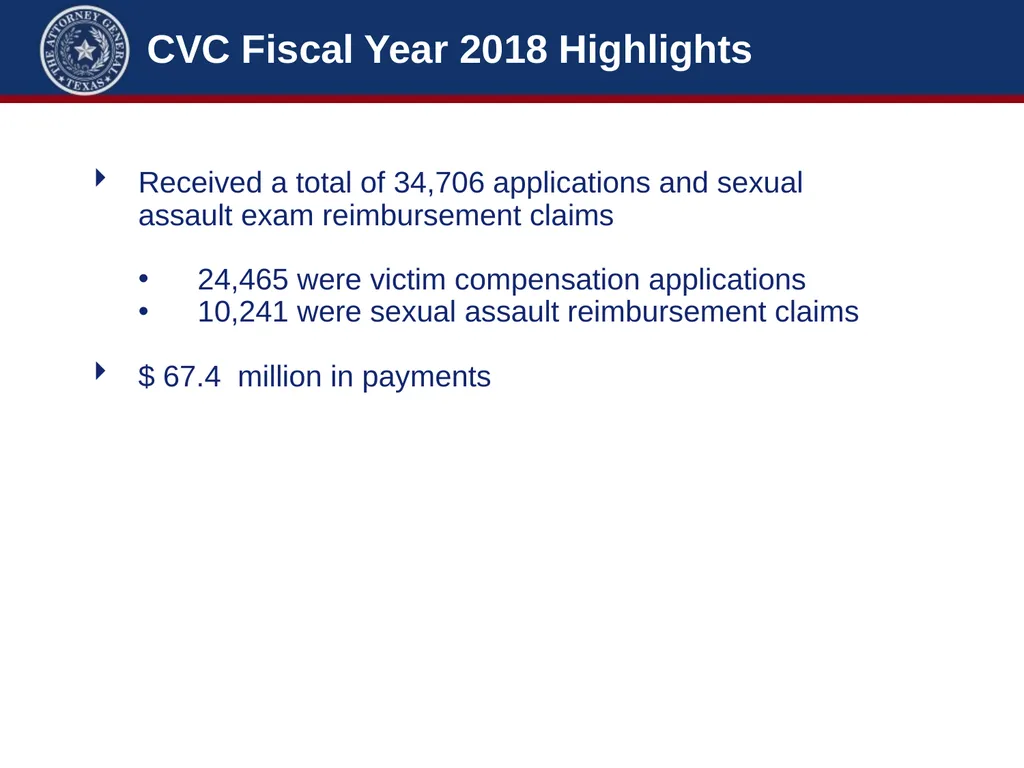
CVC Fiscal Year 2018 Highlights Received a total of 34,706 applications and sexual
assault exam reimbursement claims
24,465 were victim compensation applications
10,241 were sexual assault reimbursement claims
$ 67.4 million in payments<br>
assault exam reimbursement claims
24,465 were victim compensation applications
10,241 were sexual assault reimbursement claims
$ 67.4 million in payments<br>
07
CVC Funding It is not a tax based or general revenue-funded program.
No tax dollars are used.
Sources of funding in FY 2018 were:
Court fees
Federal VOCA grant
Restitution
Subrogation
Other receipts
Gifts<br>
No tax dollars are used.
Sources of funding in FY 2018 were:
Court fees
Federal VOCA grant
Restitution
Subrogation
Other receipts
Gifts<br>
08
CVC Goal The goal of CVC is to reimburse victims of crime for certain out of pocket expenses not reimbursed by other sources.
The Attorney General shall award to victims and claimants compensation for pecuniary loss arising from criminally injurious conduct.<br>
The Attorney General shall award to victims and claimants compensation for pecuniary loss arising from criminally injurious conduct.<br>
09
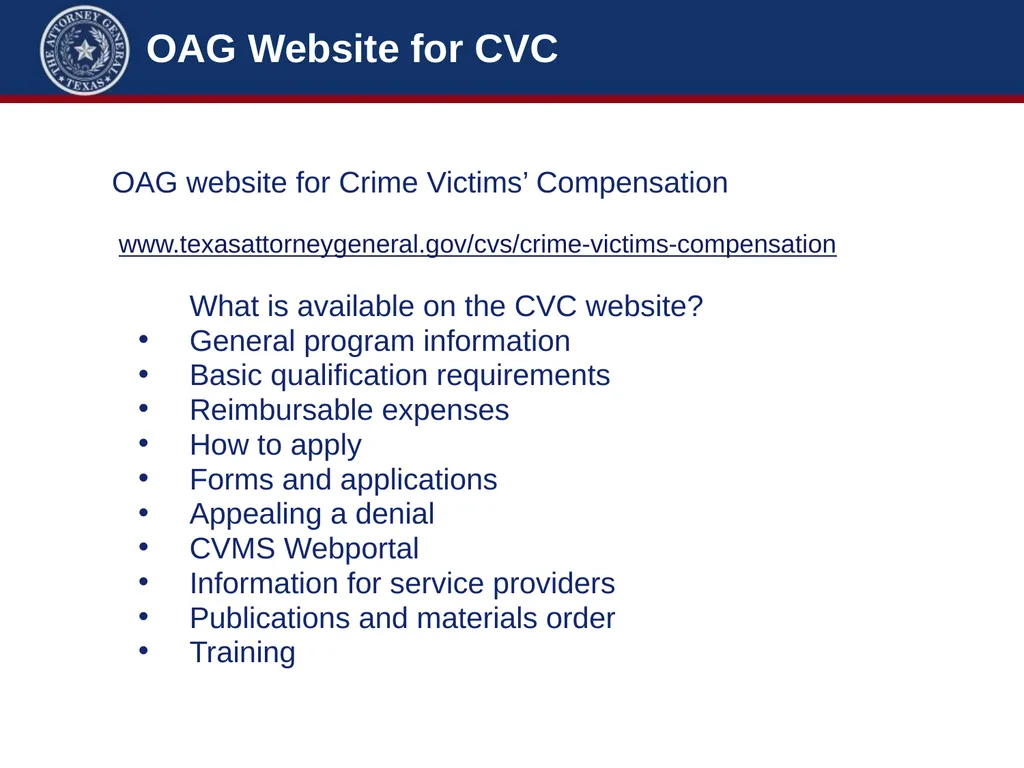
OAG website for Crime Victims’ Compensation
www.texasattorneygeneral.gov/cvs/crime-victims-compensation
What is available on the CVC website?
General program information
Basic qualification requirements
Reimbursable expenses
How to apply
Forms and applications
Appealing a denial
CVMS Webportal
Information for service providers
Publications and materials order
Training OAG Website for CVC<br>
www.texasattorneygeneral.gov/cvs/crime-victims-compensation
What is available on the CVC website?
General program information
Basic qualification requirements
Reimbursable expenses
How to apply
Forms and applications
Appealing a denial
CVMS Webportal
Information for service providers
Publications and materials order
Training OAG Website for CVC<br>
10
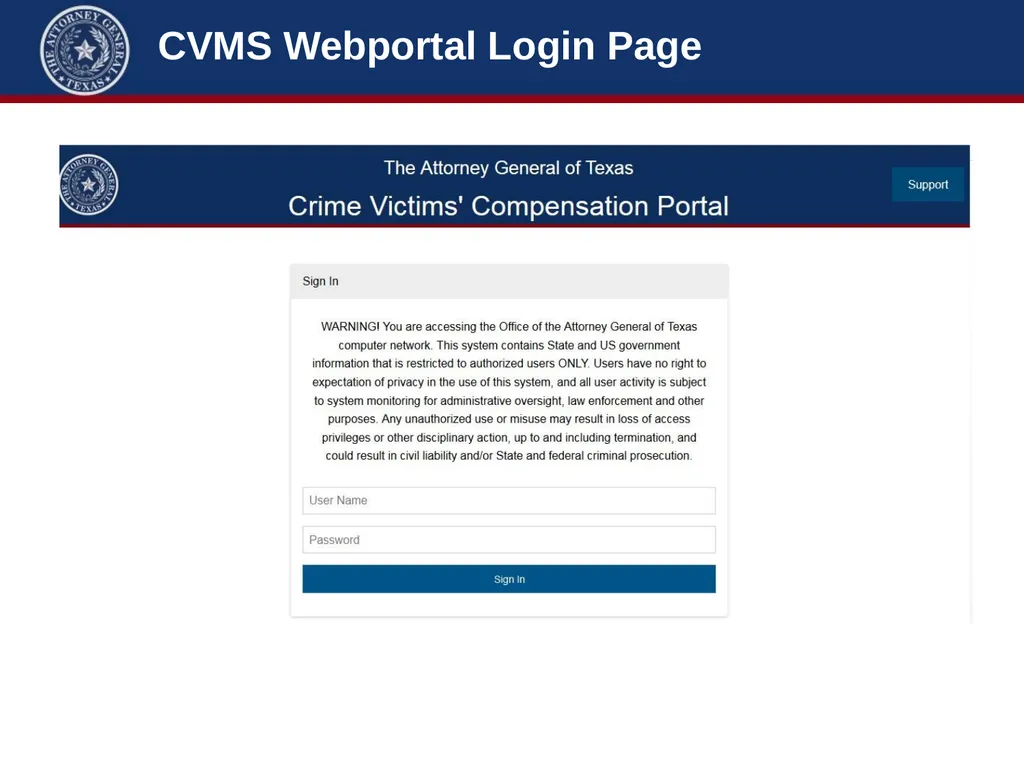
CVMS Webportal Login Page<br>
11
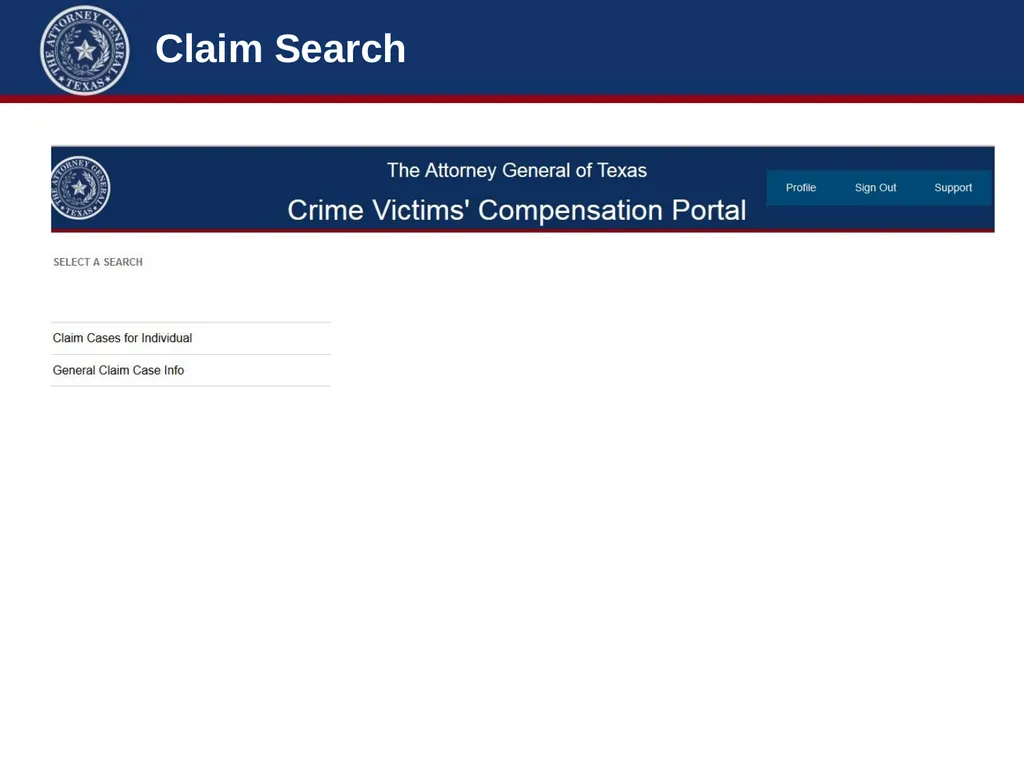
Claim Search<br>
12
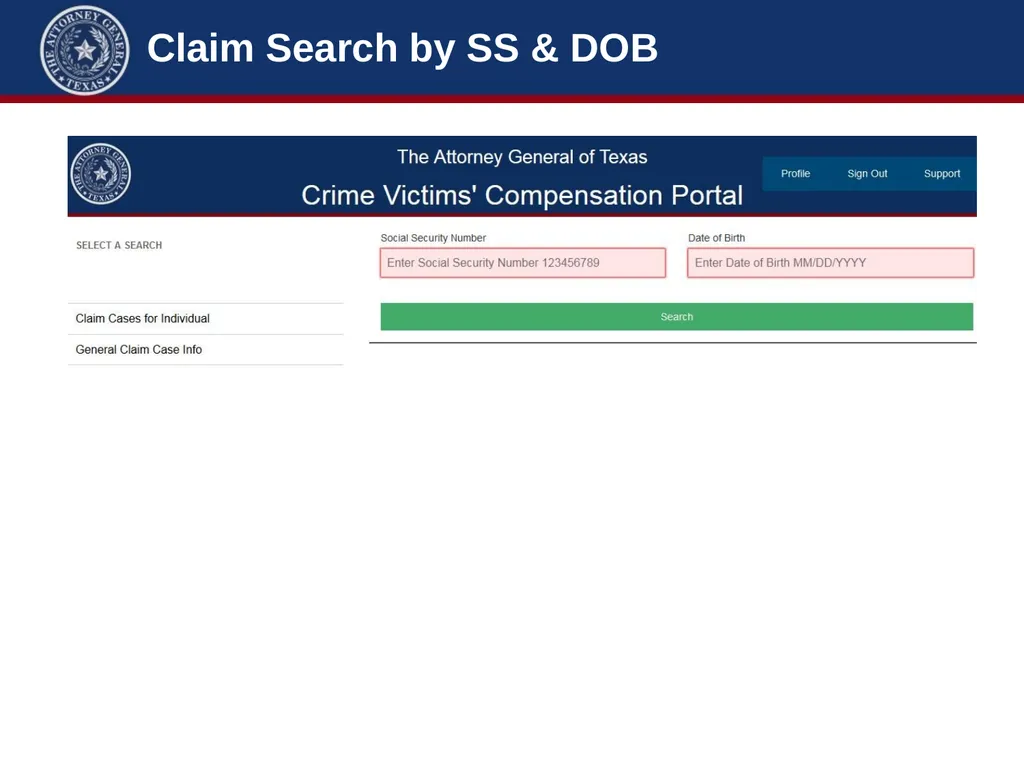
Claim Search by SS & DOB<br>
13
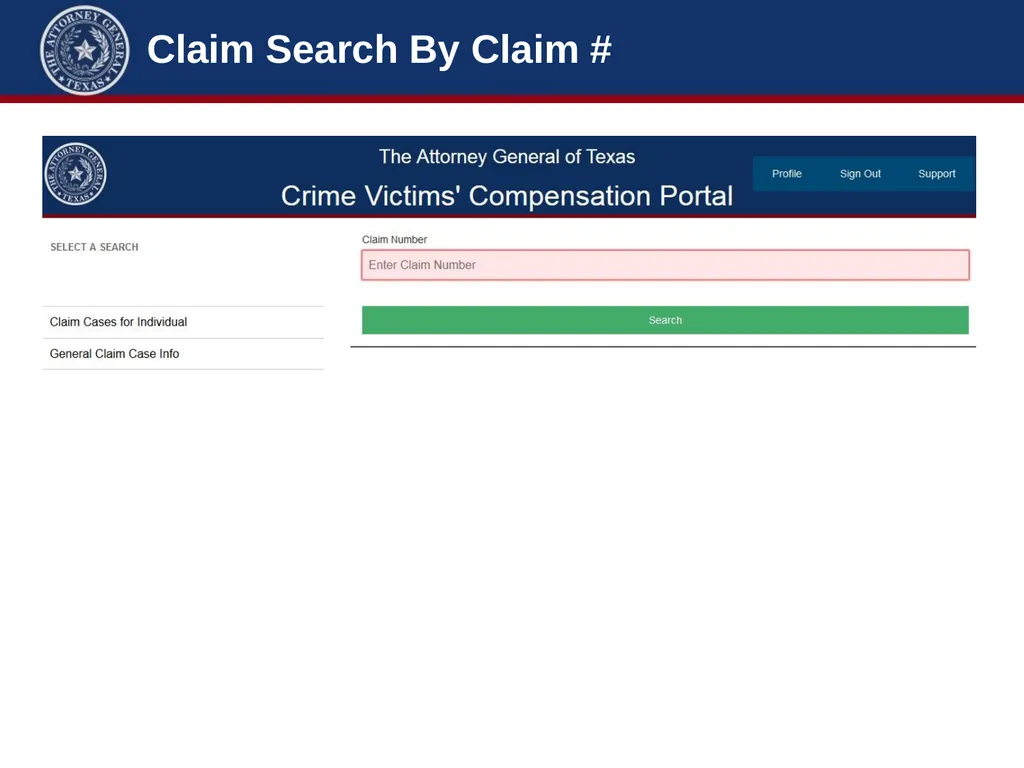
Claim Search By Claim #<br>
14
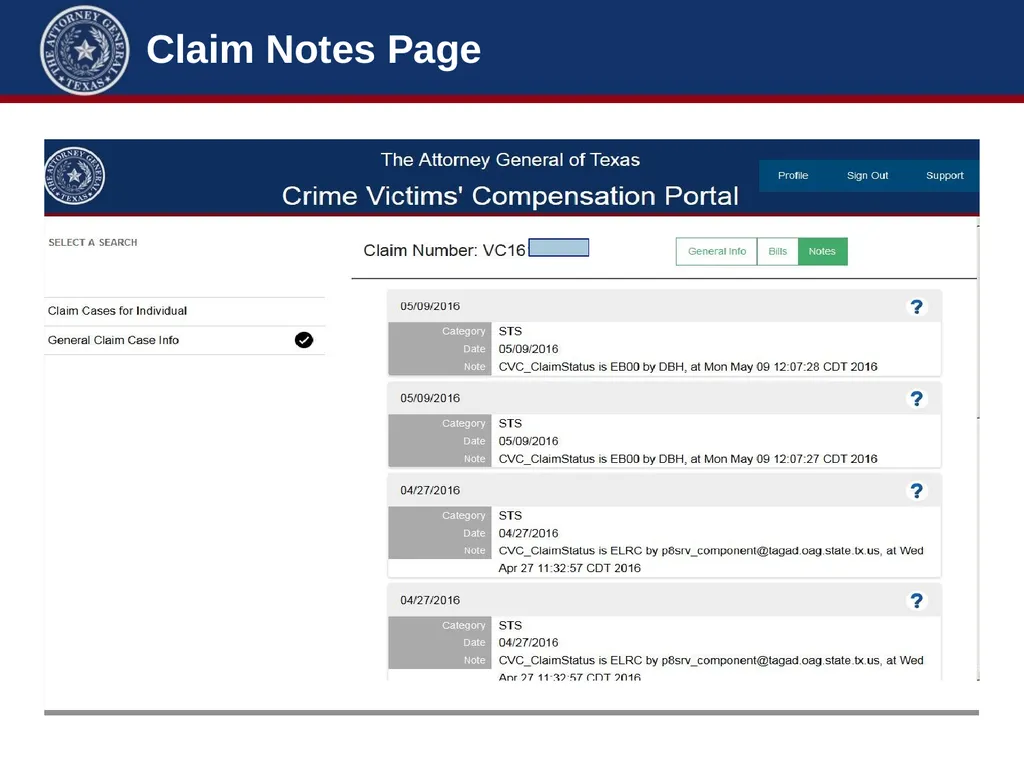
Claim Notes Page<br>
15
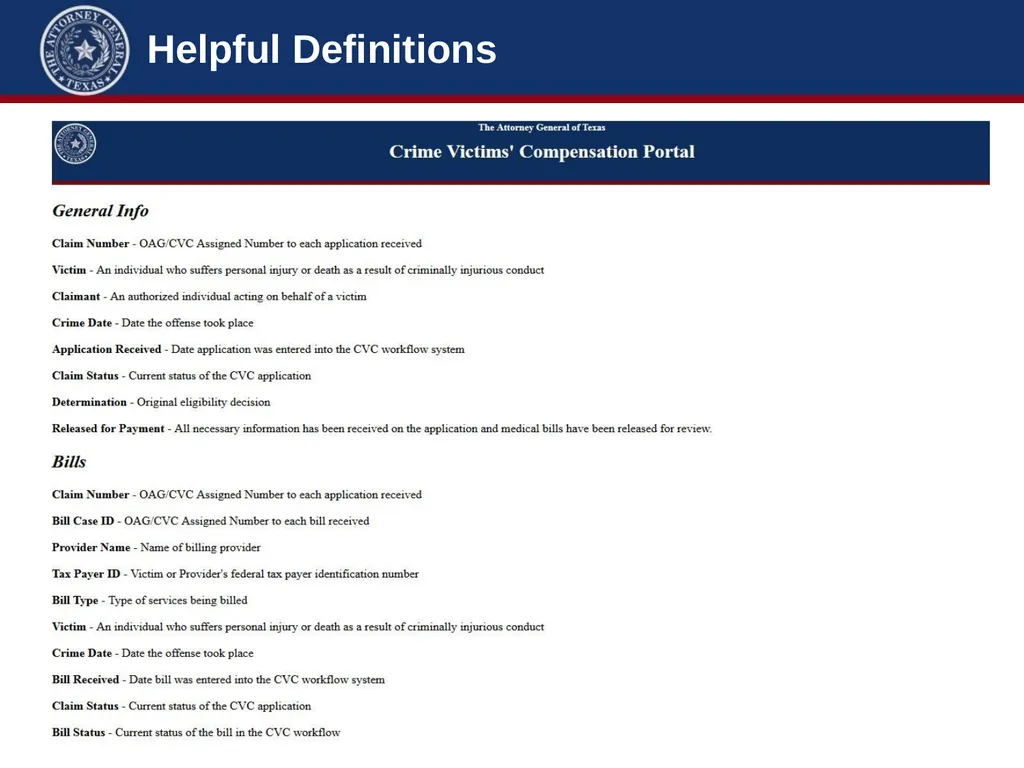
Helpful Definitions<br>
16
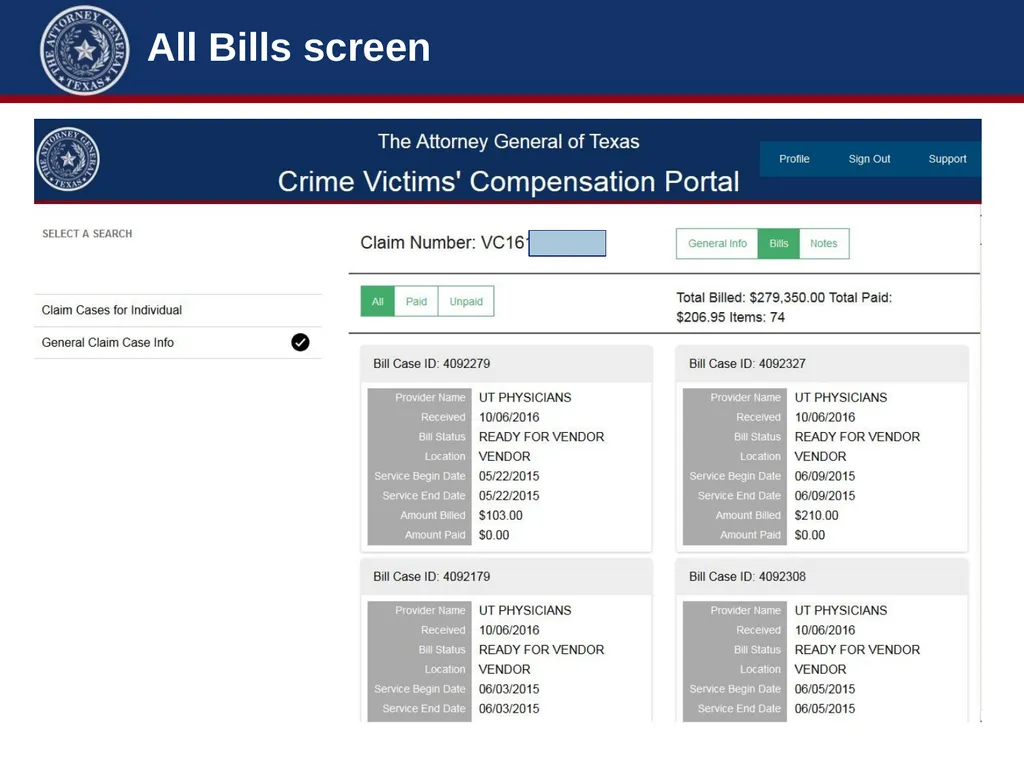
All Bills screen<br>
17
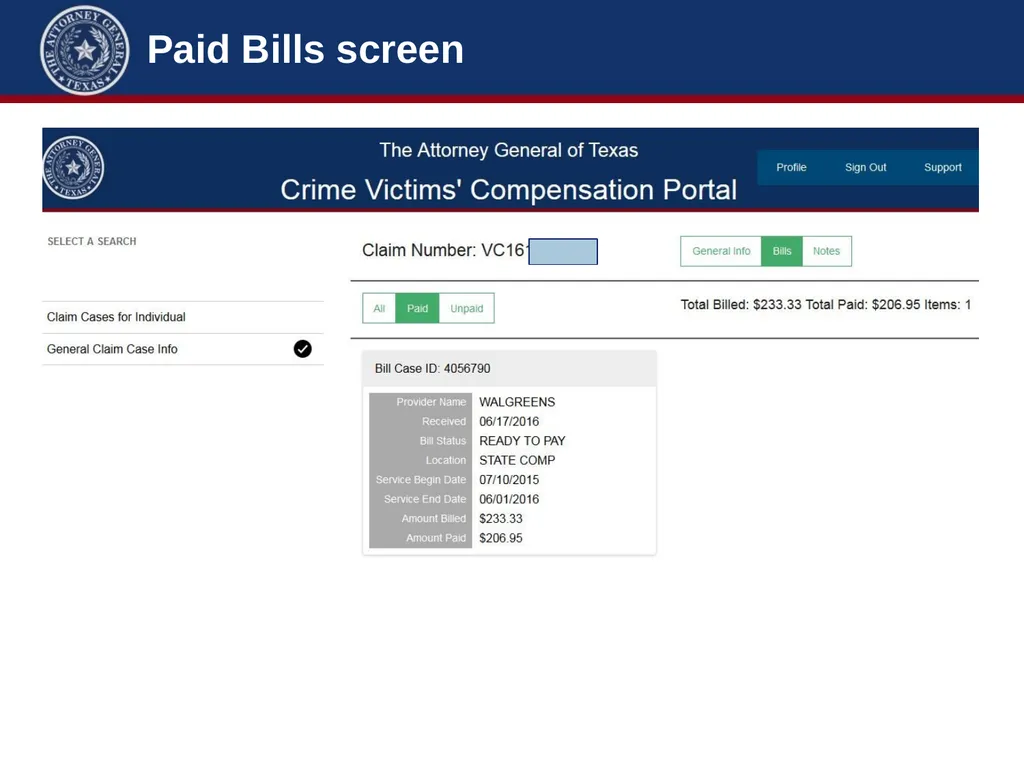
Paid Bills screen<br>
18
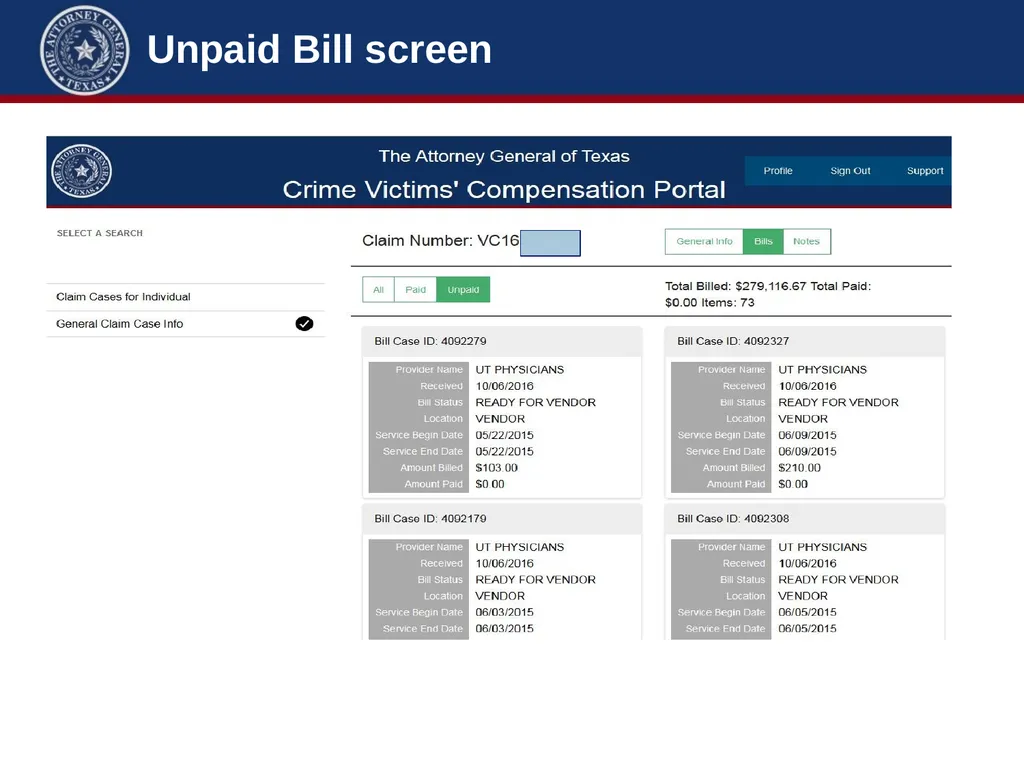
Unpaid Bill screen<br>
19
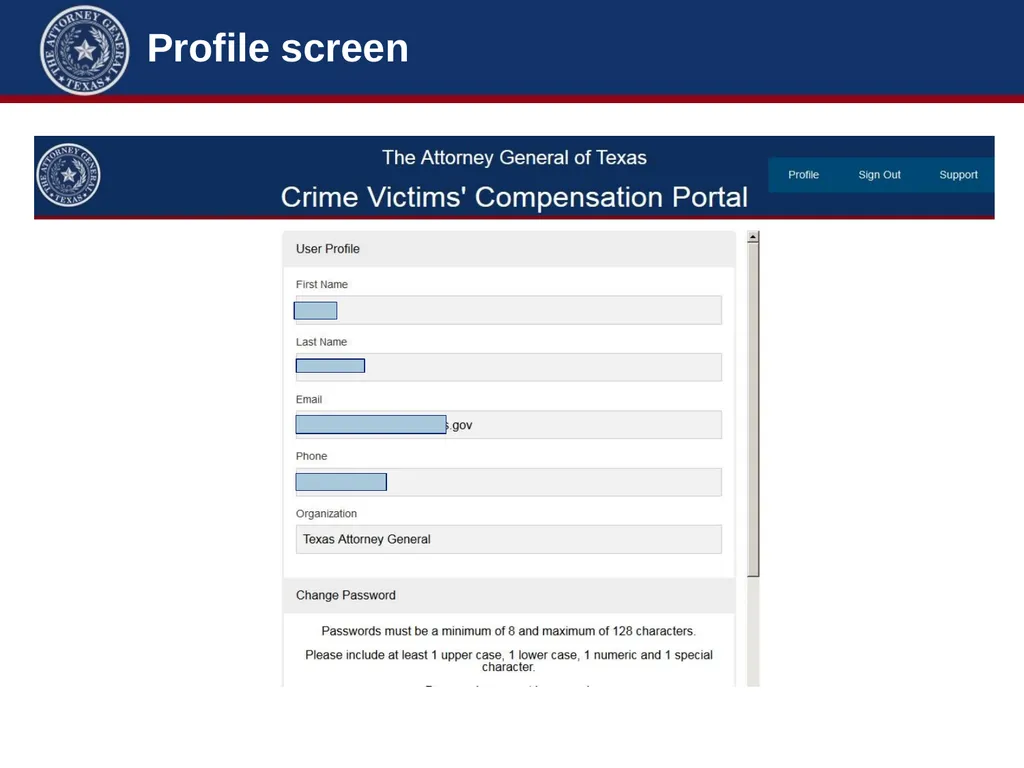
Profile screen<br>
20
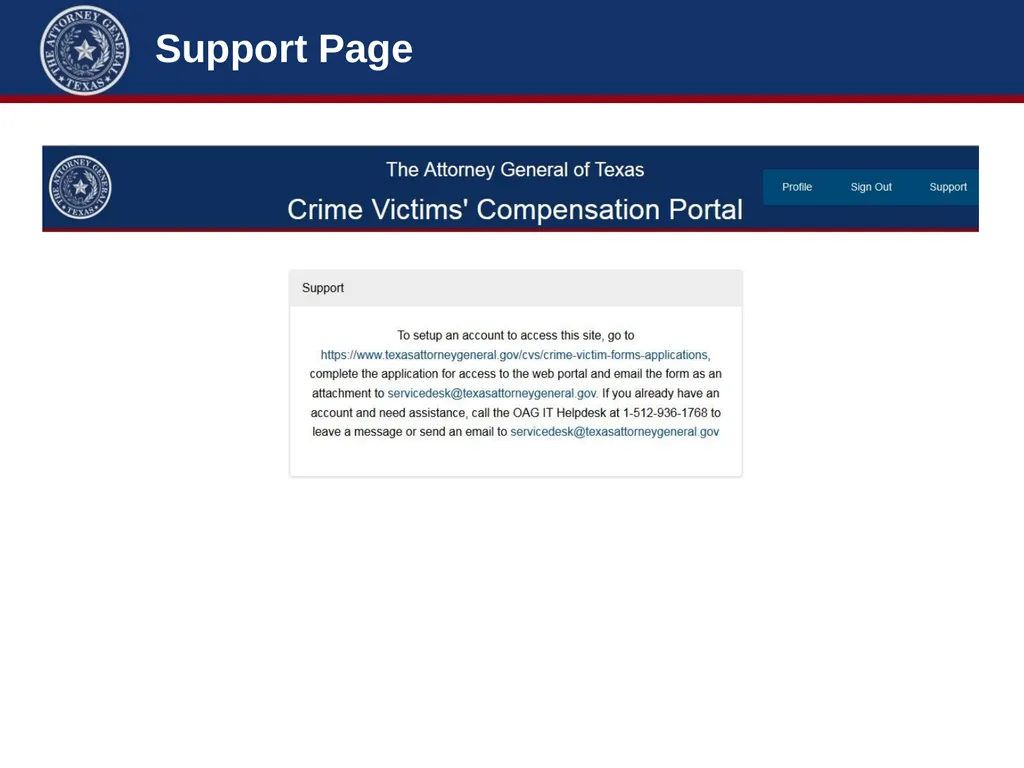
Support Page<br>
21
CVC Application
(Slide 1 of 3) The CVC application (English and Spanish) is available on our web page.
The application is always reviewed after a legislative session to assure it meets statutory requirements.<br>
The application is always reviewed after a legislative session to assure it meets statutory requirements.<br>
22
CVC Application
(Slide 2 of 3) An application is considered complete and will be processed when it:
Is filled out in its entirety
Is signed by a victim or a valid adult claimant
Provides law enforcement information
Provides any other information requested by the OAG<br>
Is filled out in its entirety
Is signed by a victim or a valid adult claimant
Provides law enforcement information
Provides any other information requested by the OAG<br>
23
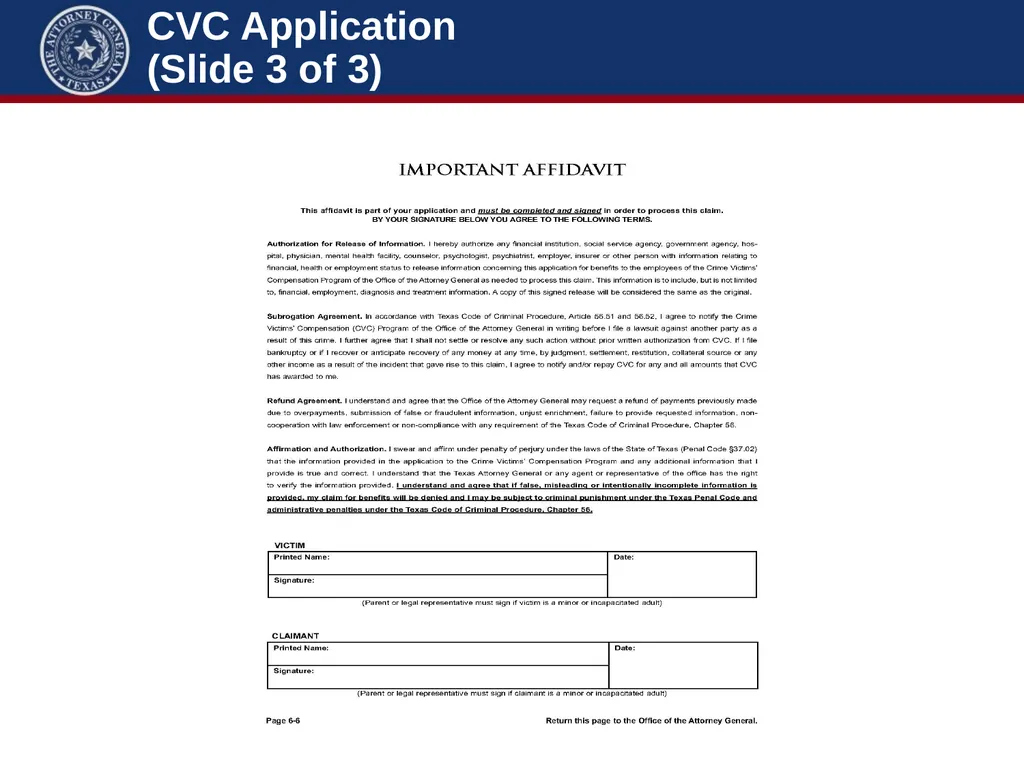
CVC Application
(Slide 3 of 3)<br>
24
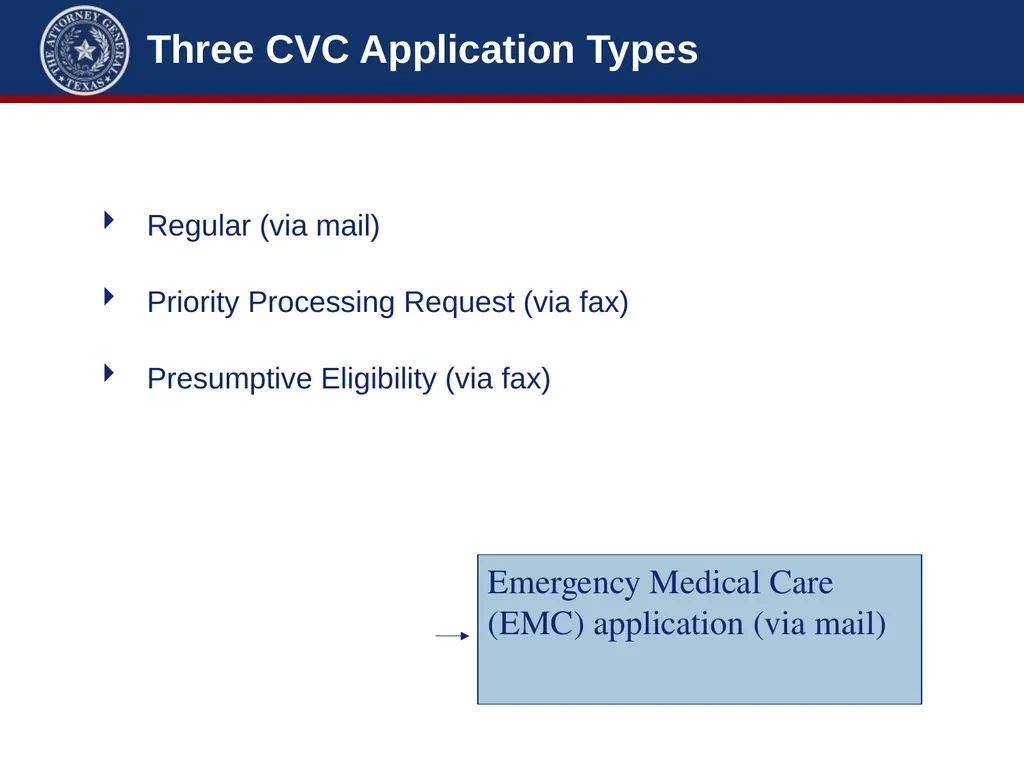
Three CVC Application Types Regular (via mail)
Priority Processing Request (via fax)
Presumptive Eligibility (via fax) Emergency Medical Care (EMC) application (via mail)<br>
Priority Processing Request (via fax)
Presumptive Eligibility (via fax) Emergency Medical Care (EMC) application (via mail)<br>
25
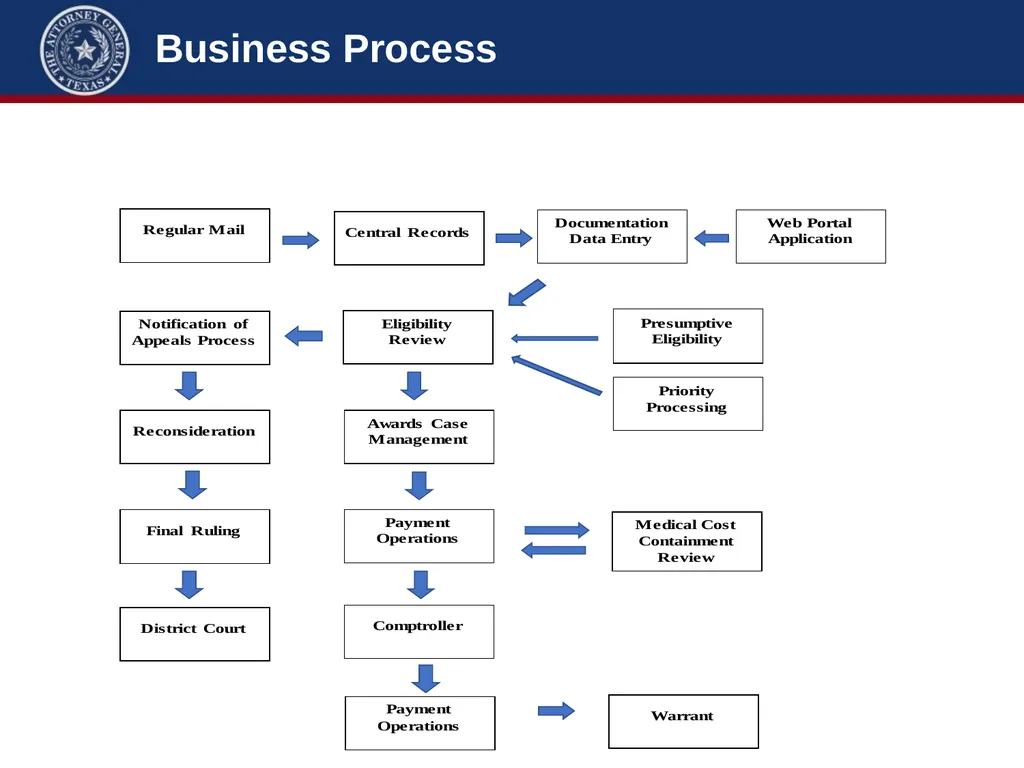
Business Process<br>
26
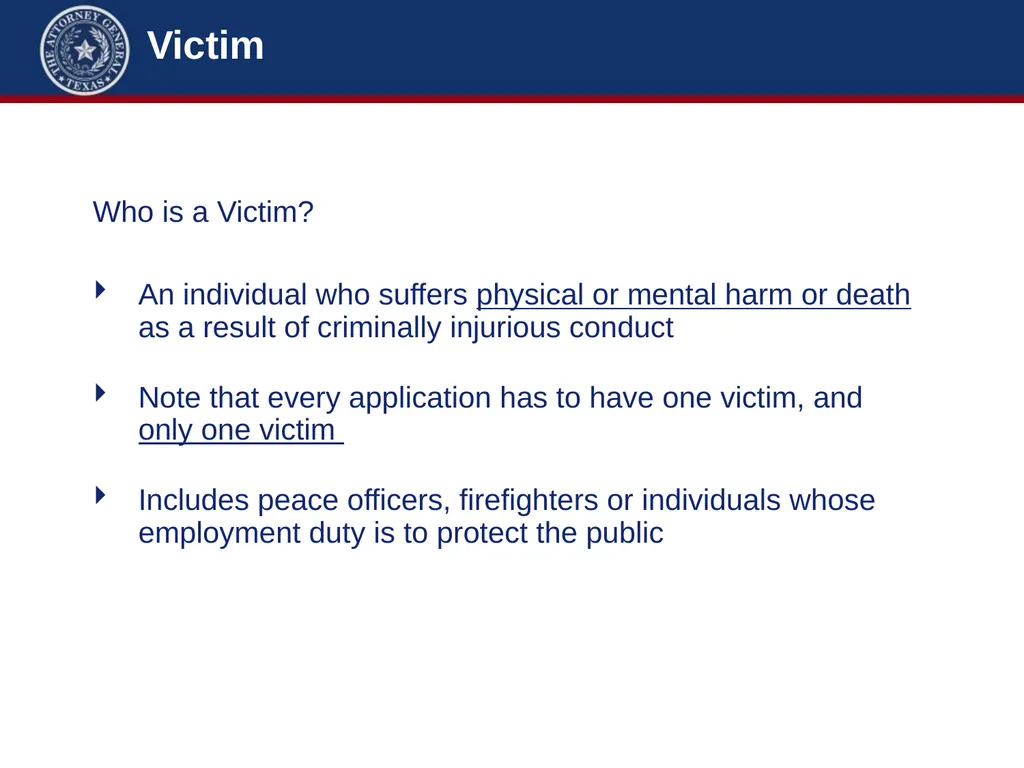
Victim Who is a Victim?
An individual who suffers physical or mental harm or death as a result of criminally injurious conduct
Note that every application has to have one victim, and only one victim
Includes peace officers, firefighters or individuals whose employment duty is to protect the public<br>
An individual who suffers physical or mental harm or death as a result of criminally injurious conduct
Note that every application has to have one victim, and only one victim
Includes peace officers, firefighters or individuals whose employment duty is to protect the public<br>
27
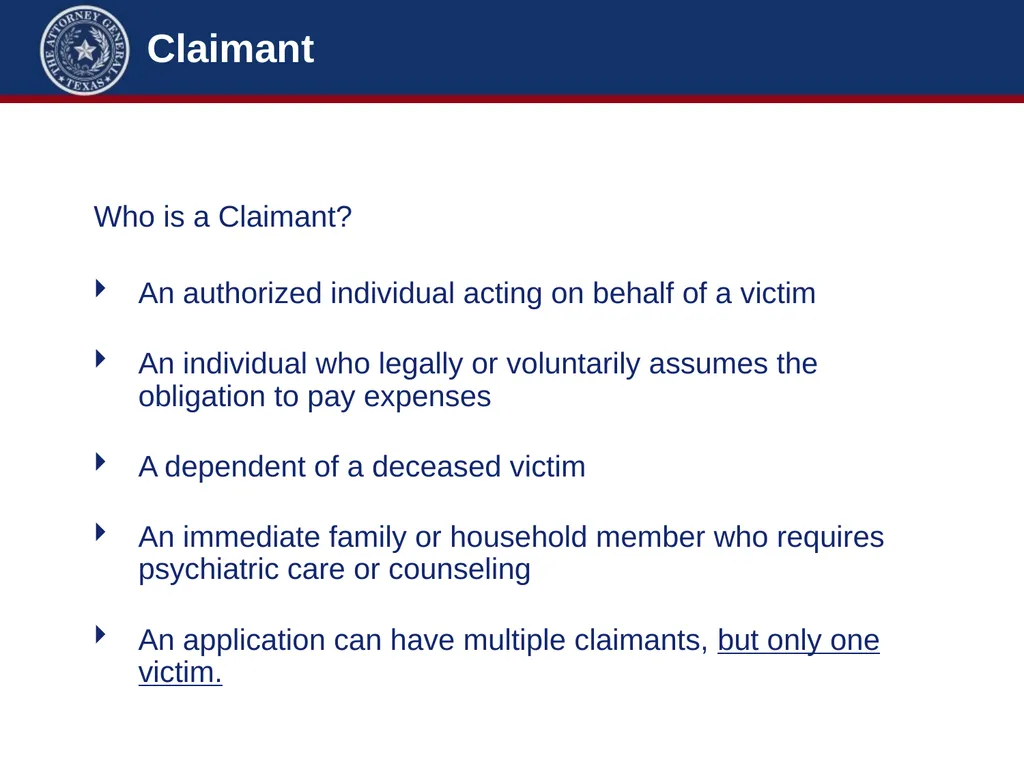
Claimant Who is a Claimant?
An authorized individual acting on behalf of a victim
An individual who legally or voluntarily assumes the obligation to pay expenses
A dependent of a deceased victim
An immediate family or household member who requires psychiatric care or counseling
An application can have multiple claimants, but only one victim.<br>
An authorized individual acting on behalf of a victim
An individual who legally or voluntarily assumes the obligation to pay expenses
A dependent of a deceased victim
An immediate family or household member who requires psychiatric care or counseling
An application can have multiple claimants, but only one victim.<br>
28
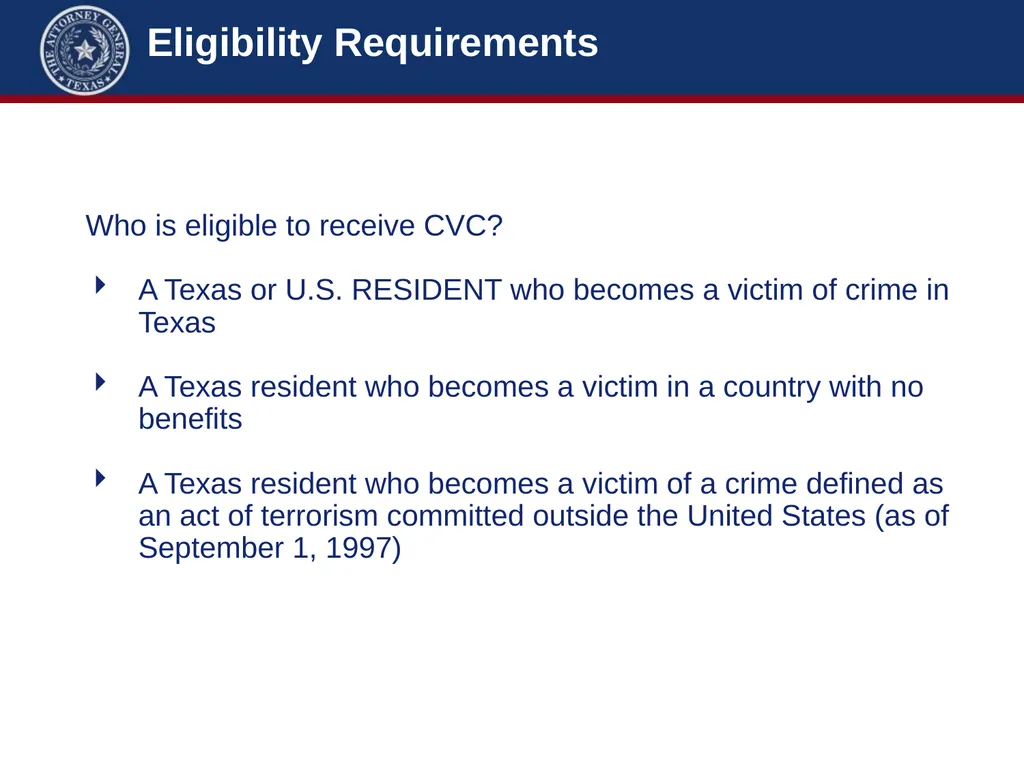
Eligibility Requirements Who is eligible to receive CVC?
A Texas or U.S. RESIDENT who becomes a victim of crime in Texas
A Texas resident who becomes a victim in a country with no benefits
A Texas resident who becomes a victim of a crime defined as an act of terrorism committed outside the United States (as of September 1, 1997)<br>
A Texas or U.S. RESIDENT who becomes a victim of crime in Texas
A Texas resident who becomes a victim in a country with no benefits
A Texas resident who becomes a victim of a crime defined as an act of terrorism committed outside the United States (as of September 1, 1997)<br>
29
Eligibility
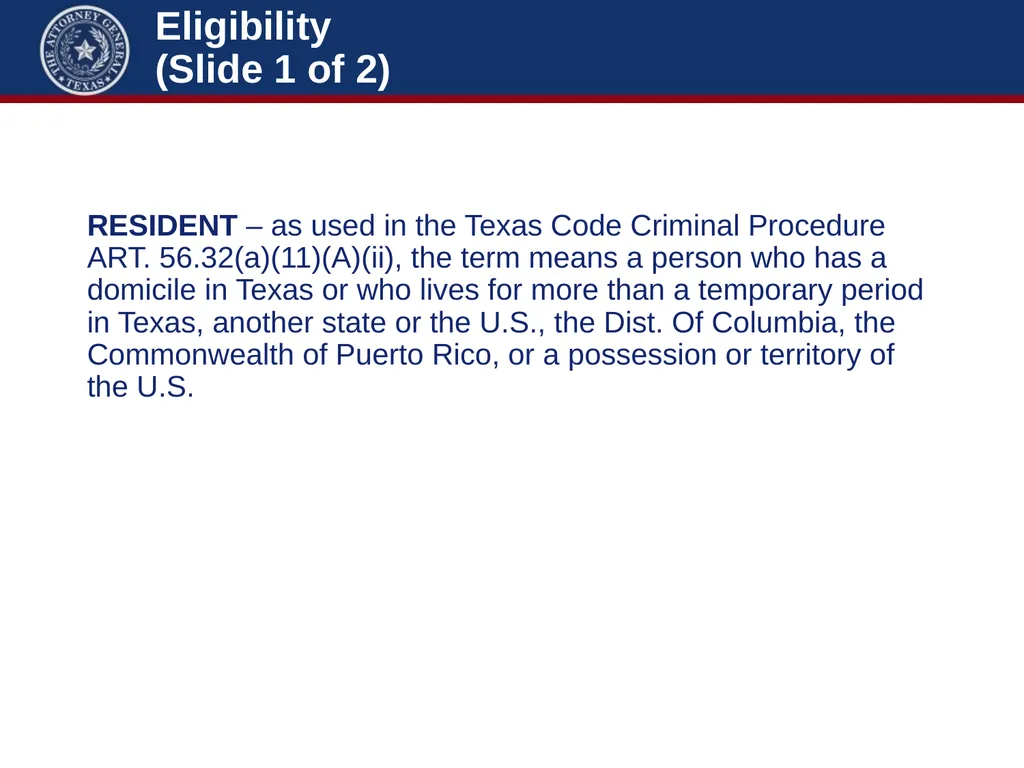
(Slide 1 of 2) RESIDENT – as used in the Texas Code Criminal Procedure ART. 56.32(a)(11)(A)(ii), the term means a person who has a domicile in Texas or who lives for more than a temporary period in Texas, another state or the U.S., the Dist. Of Columbia, the Commonwealth of Puerto Rico, or a possession or territory of the U.S.<br>
30
Eligibility
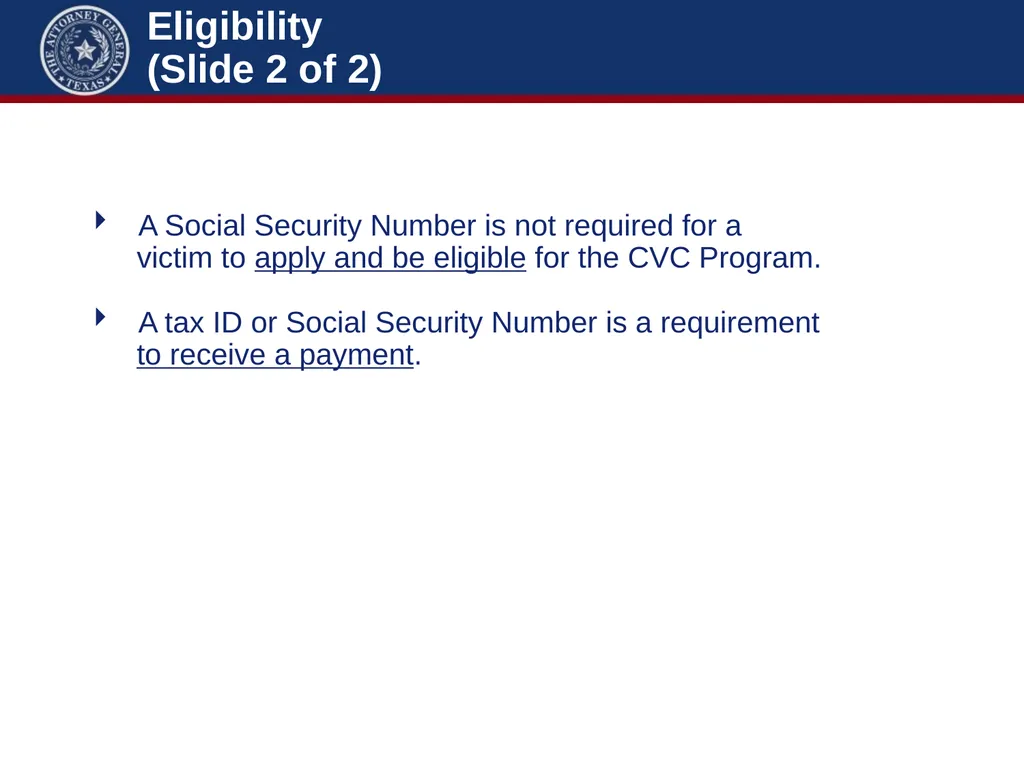
(Slide 2 of 2) A Social Security Number is not required for a
victim to apply and be eligible for the CVC Program.
A tax ID or Social Security Number is a requirement
to receive a payment.<br>
victim to apply and be eligible for the CVC Program.
A tax ID or Social Security Number is a requirement
to receive a payment.<br>
31
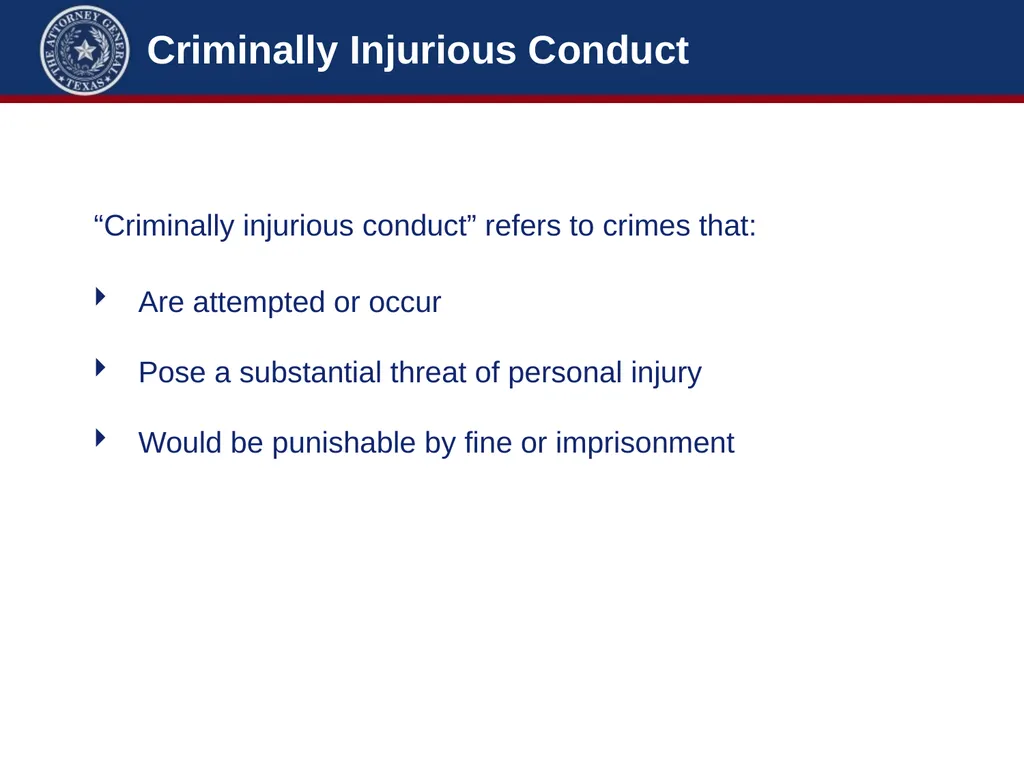
Criminally Injurious Conduct “Criminally injurious conduct” refers to crimes that:
Are attempted or occur
Pose a substantial threat of personal injury
Would be punishable by fine or imprisonment<br>
Are attempted or occur
Pose a substantial threat of personal injury
Would be punishable by fine or imprisonment<br>
32
CIC Crimes
Eligible for Reimbursement Criminal injurious conduct (CIC) crimes are violent crimes against persons.
CIC crimes range from simple assault to homicide, and include such crimes as family violence and child sexual assault.
CIC vehicular-related crimes are:
Crimes of intentional injury with an automobile, boat, or plane
Failure to stop and render aid (Hit and Run)
Vehicular crimes involving drugs or alcohol
Intoxication-related crimes (assault, manslaughter, or criminally negligent homicide)<br>
CIC crimes range from simple assault to homicide, and include such crimes as family violence and child sexual assault.
CIC vehicular-related crimes are:
Crimes of intentional injury with an automobile, boat, or plane
Failure to stop and render aid (Hit and Run)
Vehicular crimes involving drugs or alcohol
Intoxication-related crimes (assault, manslaughter, or criminally negligent homicide)<br>
33
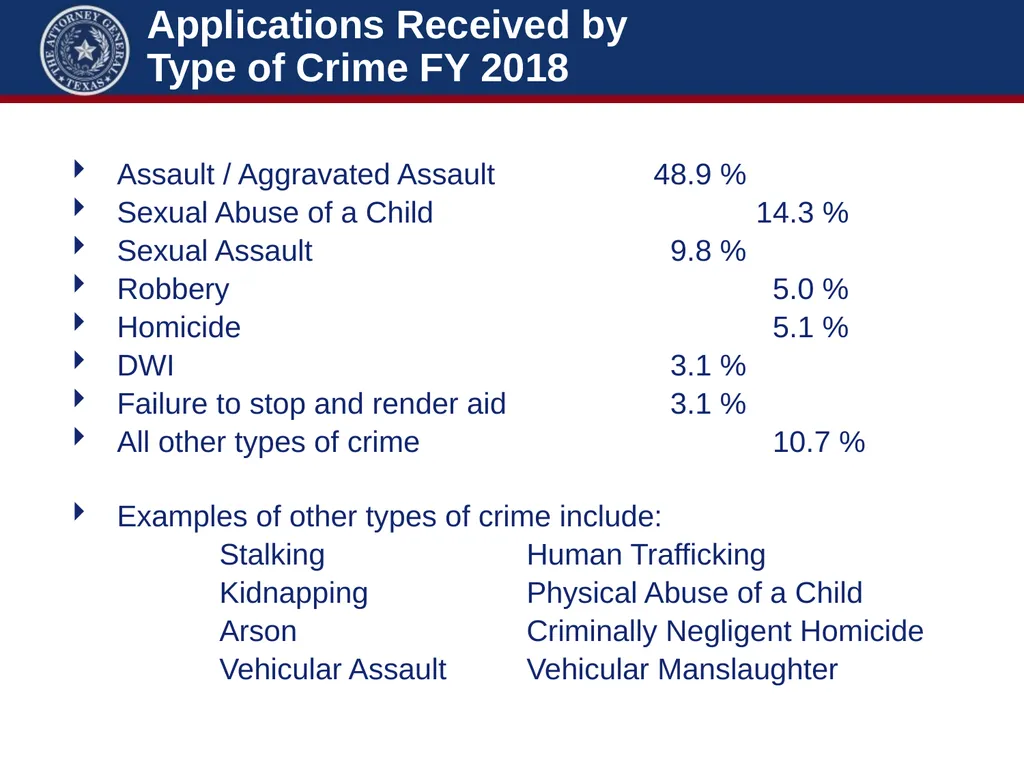
Applications Received by
Type of Crime FY 2018 Assault / Aggravated Assault 48.9 %
Sexual Abuse of a Child 14.3 %
Sexual Assault 9.8 %
Robbery 5.0 %
Homicide 5.1 %
DWI 3.1 %
Failure to stop and render aid 3.1 %
All other types of crime 10.7 %
Examples of other types of crime include:
Stalking Human Trafficking
Kidnapping Physical Abuse of a Child
Arson Criminally Negligent Homicide
Vehicular Assault Vehicular Manslaughter<br>
Sexual Abuse of a Child 14.3 %
Sexual Assault 9.8 %
Robbery 5.0 %
Homicide 5.1 %
DWI 3.1 %
Failure to stop and render aid 3.1 %
All other types of crime 10.7 %
Examples of other types of crime include:
Stalking Human Trafficking
Kidnapping Physical Abuse of a Child
Arson Criminally Negligent Homicide
Vehicular Assault Vehicular Manslaughter<br>
34
Denial or Reduction
Behavior Factors If the person
Was engaged in illegal activity (deny or reduce)
Shares in the responsibility for the crime (deny or reduce)
Fails to cooperate with law enforcement and prosecution efforts (deny)
Possible factors
Entire situation is reviewed<br>
Was engaged in illegal activity (deny or reduce)
Shares in the responsibility for the crime (deny or reduce)
Fails to cooperate with law enforcement and prosecution efforts (deny)
Possible factors
Entire situation is reviewed<br>
35
CVC Requirements There is no requirement that a suspect be
Identified
Apprehended
Charged
Convicted
…for a victim to apply for and be awarded compensation.
There is a requirement for the victim to cooperate throughout the criminal justice process.<br>
Identified
Apprehended
Charged
Convicted
…for a victim to apply for and be awarded compensation.
There is a requirement for the victim to cooperate throughout the criminal justice process.<br>
36
CVC Reporting Requirements Reporting the crime to law enforcement
72 hours prior to September 1, 1997
On or after September 1, 1997, a reasonable period of time but not so late as to interfere with or hamper the investigation
and prosecution
The program has the discretion
The victim is a child.
Extraordinary circumstances hampered the reporting<br>
72 hours prior to September 1, 1997
On or after September 1, 1997, a reasonable period of time but not so late as to interfere with or hamper the investigation
and prosecution
The program has the discretion
The victim is a child.
Extraordinary circumstances hampered the reporting<br>
37
CVC Filing Requirements Filing requirements to CVC Program
Prior to September 1, 1997, one year
On or after September 1,1997, three years
Exceptions
Good cause
Child victim through age 18 (pre-1997)
Child victim age 18 to 21 (1997-present)
Victim physically incapacitated<br>
Prior to September 1, 1997, one year
On or after September 1,1997, three years
Exceptions
Good cause
Child victim through age 18 (pre-1997)
Child victim age 18 to 21 (1997-present)
Victim physically incapacitated<br>
38
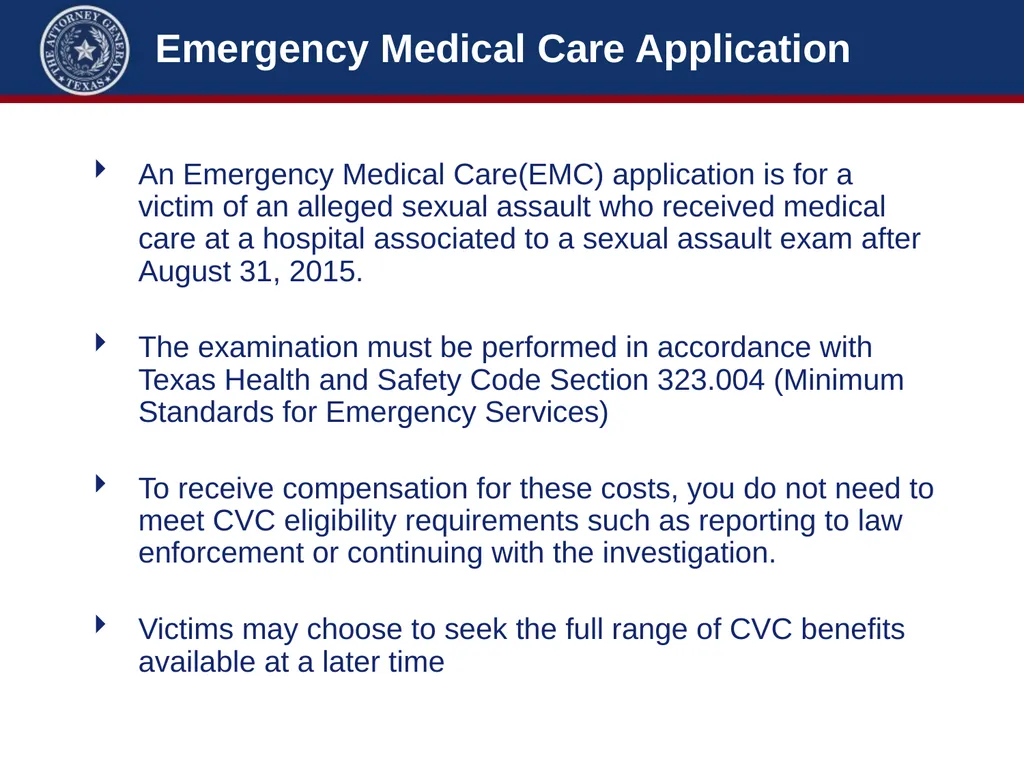
An Emergency Medical Care(EMC) application is for a victim of an alleged sexual assault who received medical care at a hospital associated to a sexual assault exam after August 31, 2015.
The examination must be performed in accordance with Texas Health and Safety Code Section 323.004 (Minimum Standards for Emergency Services)
To receive compensation for these costs, you do not need to meet CVC eligibility requirements such as reporting to law enforcement or continuing with the investigation.
Victims may choose to seek the full range of CVC benefits available at a later time Emergency Medical Care Application<br>
The examination must be performed in accordance with Texas Health and Safety Code Section 323.004 (Minimum Standards for Emergency Services)
To receive compensation for these costs, you do not need to meet CVC eligibility requirements such as reporting to law enforcement or continuing with the investigation.
Victims may choose to seek the full range of CVC benefits available at a later time Emergency Medical Care Application<br>
39
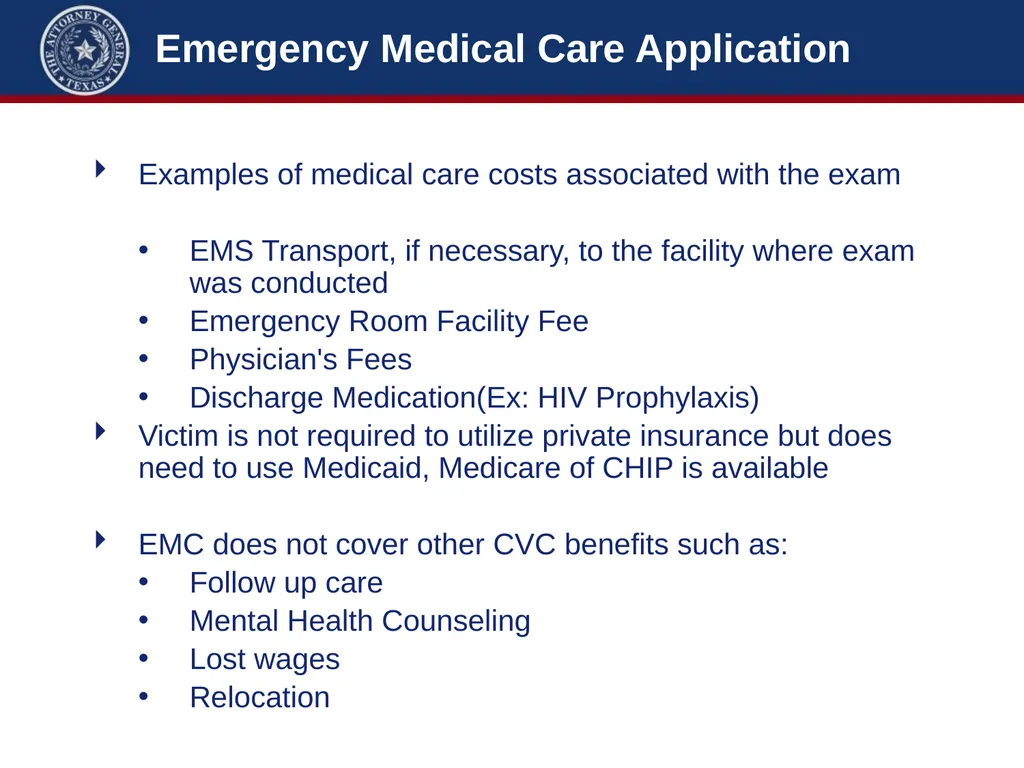
Examples of medical care costs associated with the exam
EMS Transport, if necessary, to the facility where exam was conducted
Emergency Room Facility Fee
Physician's Fees
Discharge Medication(Ex: HIV Prophylaxis)
Victim is not required to utilize private insurance but does need to use Medicaid, Medicare of CHIP is available
EMC does not cover other CVC benefits such as:
Follow up care
Mental Health Counseling
Lost wages
Relocation Emergency Medical Care Application<br>
EMS Transport, if necessary, to the facility where exam was conducted
Emergency Room Facility Fee
Physician's Fees
Discharge Medication(Ex: HIV Prophylaxis)
Victim is not required to utilize private insurance but does need to use Medicaid, Medicare of CHIP is available
EMC does not cover other CVC benefits such as:
Follow up care
Mental Health Counseling
Lost wages
Relocation Emergency Medical Care Application<br>
40
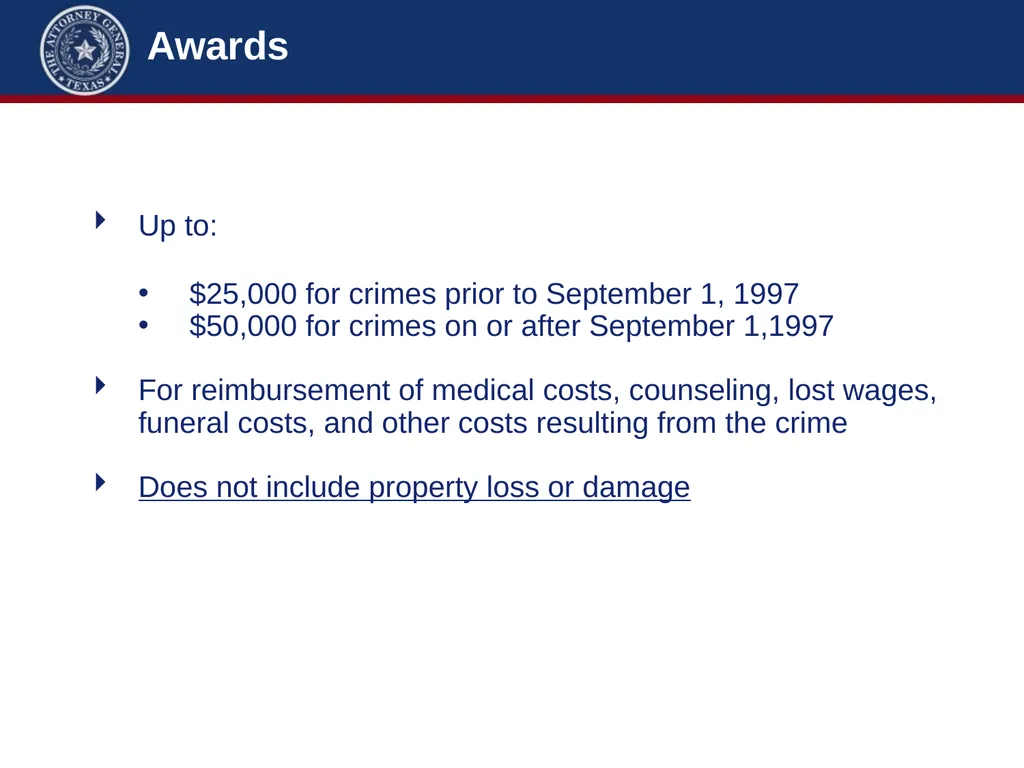
Awards Up to:
$25,000 for crimes prior to September 1, 1997
$50,000 for crimes on or after September 1,1997
For reimbursement of medical costs, counseling, lost wages, funeral costs, and other costs resulting from the crime
Does not include property loss or damage<br>
$25,000 for crimes prior to September 1, 1997
$50,000 for crimes on or after September 1,1997
For reimbursement of medical costs, counseling, lost wages, funeral costs, and other costs resulting from the crime
Does not include property loss or damage<br>
41
Applications Paid
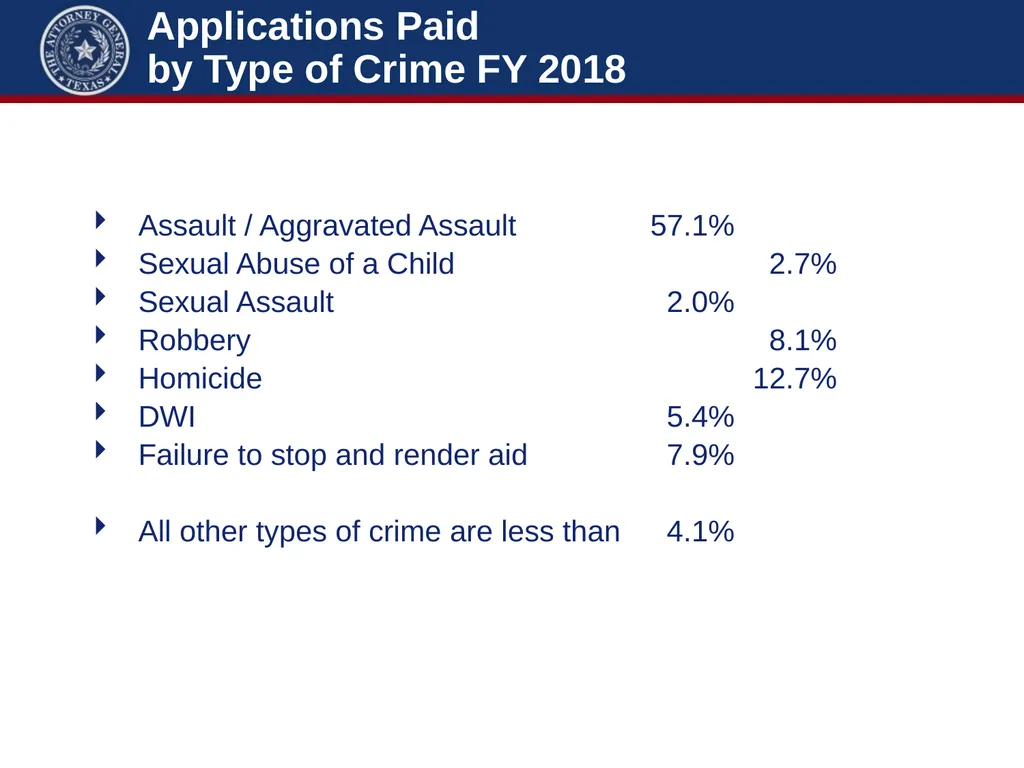
by Type of Crime FY 2018 Assault / Aggravated Assault 57.1%
Sexual Abuse of a Child 2.7%
Sexual Assault 2.0%
Robbery 8.1%
Homicide 12.7%
DWI 5.4%
Failure to stop and render aid 7.9%
All other types of crime are less than 4.1%<br>
Sexual Abuse of a Child 2.7%
Sexual Assault 2.0%
Robbery 8.1%
Homicide 12.7%
DWI 5.4%
Failure to stop and render aid 7.9%
All other types of crime are less than 4.1%<br>
42
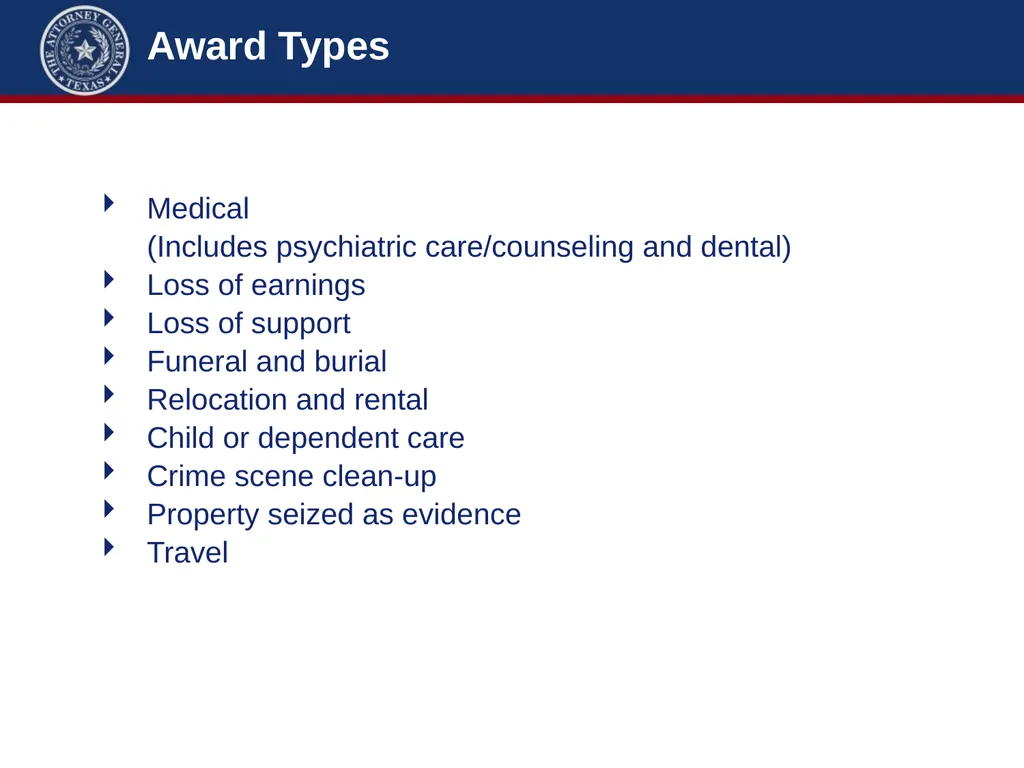
Award Types Medical
(Includes psychiatric care/counseling and dental)
Loss of earnings
Loss of support
Funeral and burial
Relocation and rental
Child or dependent care
Crime scene clean-up
Property seized as evidence
Travel<br>
(Includes psychiatric care/counseling and dental)
Loss of earnings
Loss of support
Funeral and burial
Relocation and rental
Child or dependent care
Crime scene clean-up
Property seized as evidence
Travel<br>
43
By law, CVC is considered the payor of last resort, and all available collateral resources must be utilized first
Examples of collateral resources include:
Medicaid and Medicare
Health insurance
Texas Workers’ Compensation
Auto insurance
Civil Settlements Collateral Sources<br>
Examples of collateral resources include:
Medicaid and Medicare
Health insurance
Texas Workers’ Compensation
Auto insurance
Civil Settlements Collateral Sources<br>
44
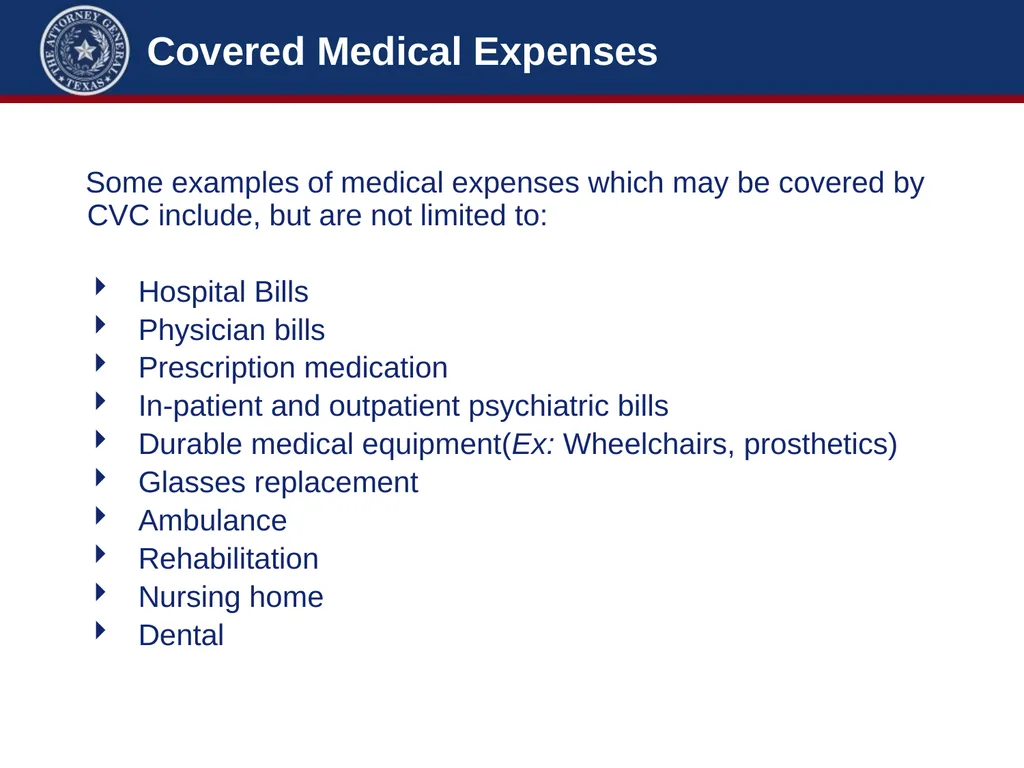
Covered Medical Expenses Some examples of medical expenses which may be covered by CVC include, but are not limited to:
Hospital Bills
Physician bills
Prescription medication
In-patient and outpatient psychiatric bills
Durable medical equipment(Ex: Wheelchairs, prosthetics)
Glasses replacement
Ambulance
Rehabilitation
Nursing home
Dental<br>
Hospital Bills
Physician bills
Prescription medication
In-patient and outpatient psychiatric bills
Durable medical equipment(Ex: Wheelchairs, prosthetics)
Glasses replacement
Ambulance
Rehabilitation
Nursing home
Dental<br>
45
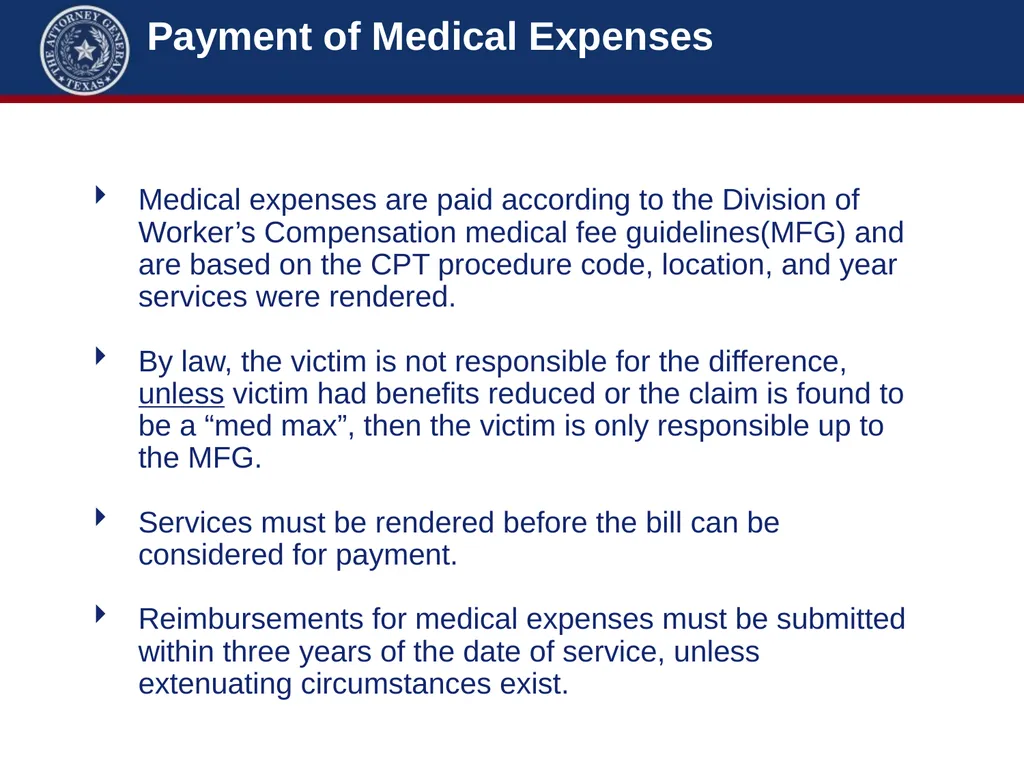
Payment of Medical Expenses Medical expenses are paid according to the Division of Worker’s Compensation medical fee guidelines(MFG) and are based on the CPT procedure code, location, and year services were rendered.
By law, the victim is not responsible for the difference, unless victim had benefits reduced or the claim is found to be a “med max”, then the victim is only responsible up to the MFG.
Services must be rendered before the bill can be considered for payment.
Reimbursements for medical expenses must be submitted within three years of the date of service, unless extenuating circumstances exist.<br>
By law, the victim is not responsible for the difference, unless victim had benefits reduced or the claim is found to be a “med max”, then the victim is only responsible up to the MFG.
Services must be rendered before the bill can be considered for payment.
Reimbursements for medical expenses must be submitted within three years of the date of service, unless extenuating circumstances exist.<br>
46
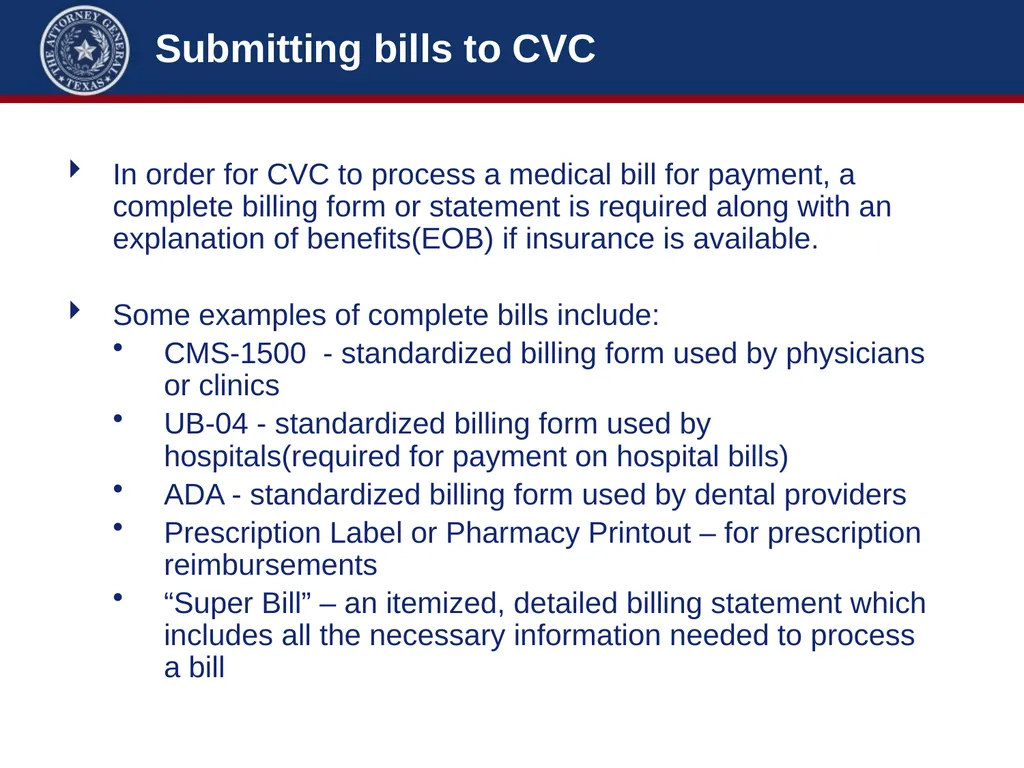
In order for CVC to process a medical bill for payment, a complete billing form or statement is required along with an explanation of benefits(EOB) if insurance is available.
Some examples of complete bills include:
CMS-1500 - standardized billing form used by physicians or clinics
UB-04 - standardized billing form used by hospitals(required for payment on hospital bills)
ADA - standardized billing form used by dental providers
Prescription Label or Pharmacy Printout – for prescription reimbursements
“Super Bill” – an itemized, detailed billing statement which includes all the necessary information needed to process a bill Submitting bills to CVC<br>
Some examples of complete bills include:
CMS-1500 - standardized billing form used by physicians or clinics
UB-04 - standardized billing form used by hospitals(required for payment on hospital bills)
ADA - standardized billing form used by dental providers
Prescription Label or Pharmacy Printout – for prescription reimbursements
“Super Bill” – an itemized, detailed billing statement which includes all the necessary information needed to process a bill Submitting bills to CVC<br>
47
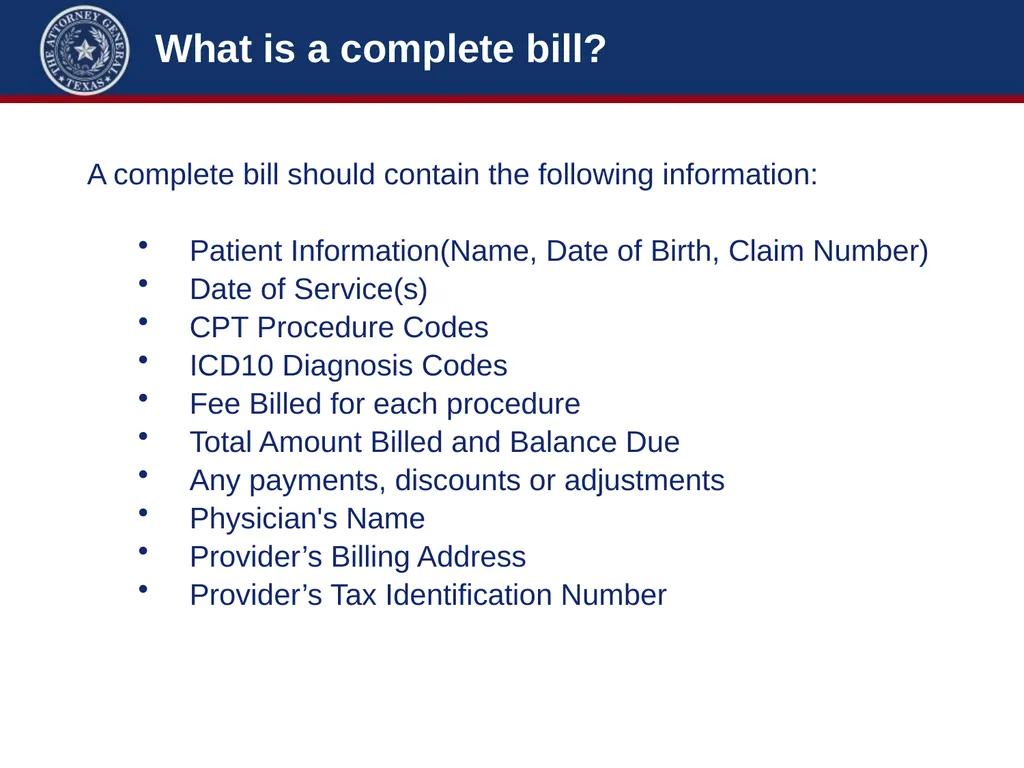
A complete bill should contain the following information:
Patient Information(Name, Date of Birth, Claim Number)
Date of Service(s)
CPT Procedure Codes
ICD10 Diagnosis Codes
Fee Billed for each procedure
Total Amount Billed and Balance Due
Any payments, discounts or adjustments
Physician's Name
Provider’s Billing Address
Provider’s Tax Identification Number What is a complete bill?<br>
Patient Information(Name, Date of Birth, Claim Number)
Date of Service(s)
CPT Procedure Codes
ICD10 Diagnosis Codes
Fee Billed for each procedure
Total Amount Billed and Balance Due
Any payments, discounts or adjustments
Physician's Name
Provider’s Billing Address
Provider’s Tax Identification Number What is a complete bill?<br>
48
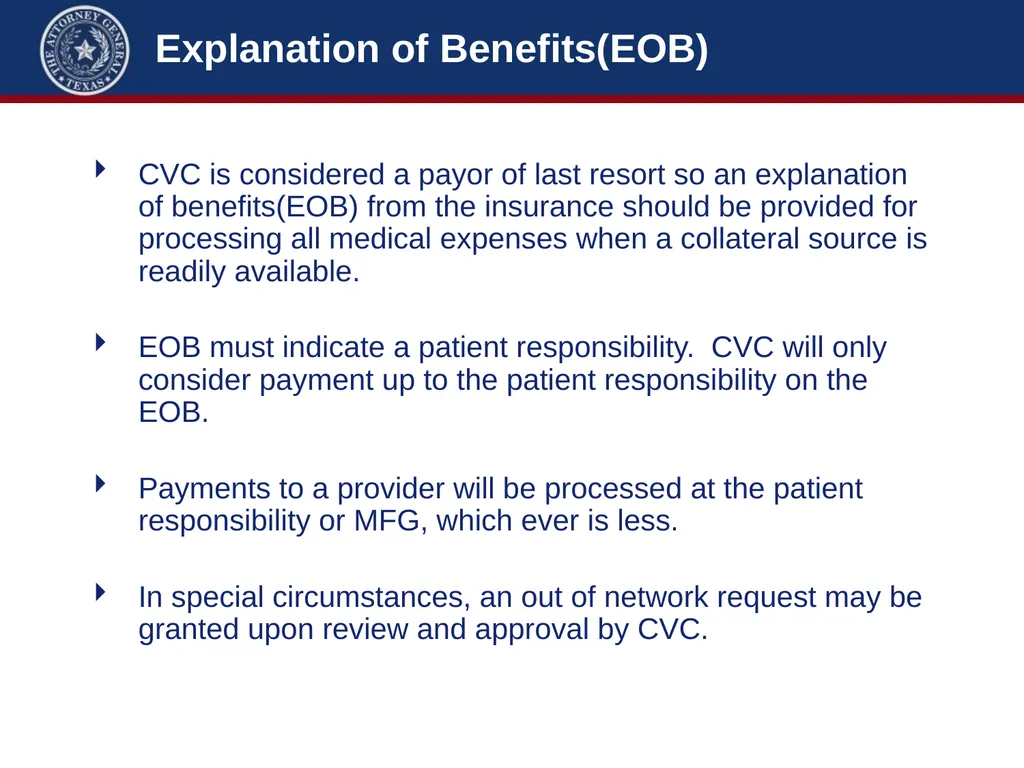
CVC is considered a payor of last resort so an explanation of benefits(EOB) from the insurance should be provided for processing all medical expenses when a collateral source is readily available.
EOB must indicate a patient responsibility. CVC will only consider payment up to the patient responsibility on the EOB.
Payments to a provider will be processed at the patient responsibility or MFG, which ever is less.
In special circumstances, an out of network request may be granted upon review and approval by CVC. Explanation of Benefits(EOB)<br>
EOB must indicate a patient responsibility. CVC will only consider payment up to the patient responsibility on the EOB.
Payments to a provider will be processed at the patient responsibility or MFG, which ever is less.
In special circumstances, an out of network request may be granted upon review and approval by CVC. Explanation of Benefits(EOB)<br>
49
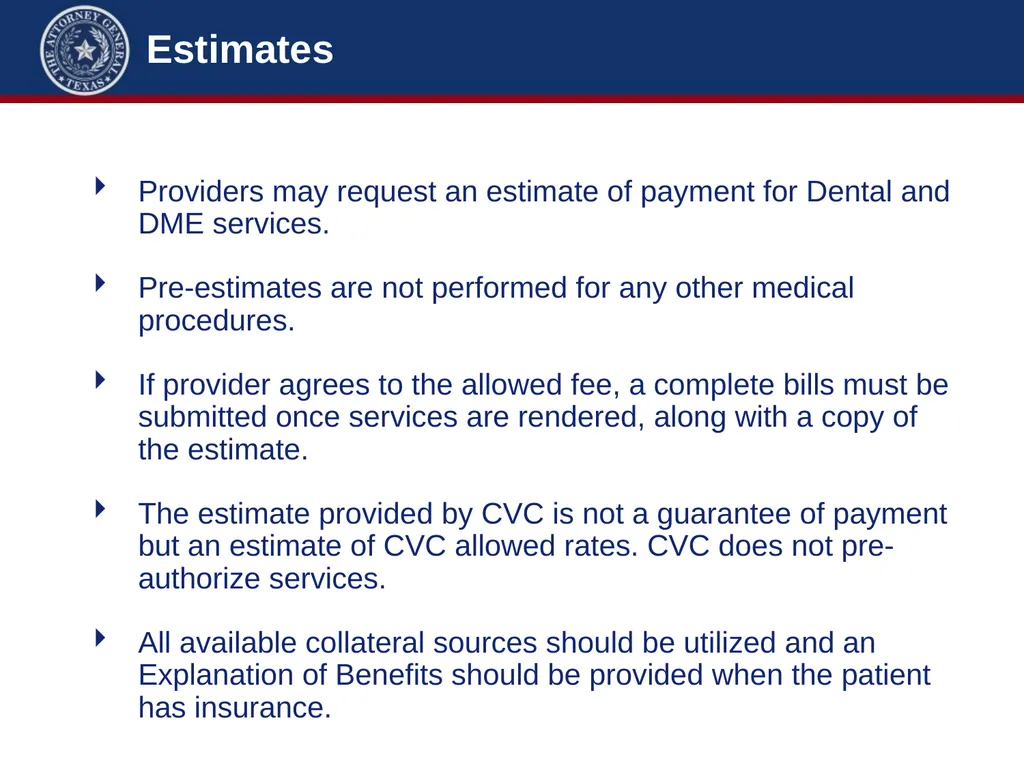
Providers may request an estimate of payment for Dental and DME services.
Pre-estimates are not performed for any other medical procedures.
If provider agrees to the allowed fee, a complete bills must be submitted once services are rendered, along with a copy of the estimate.
The estimate provided by CVC is not a guarantee of payment but an estimate of CVC allowed rates. CVC does not pre-authorize services.
All available collateral sources should be utilized and an Explanation of Benefits should be provided when the patient has insurance. Estimates<br>
Pre-estimates are not performed for any other medical procedures.
If provider agrees to the allowed fee, a complete bills must be submitted once services are rendered, along with a copy of the estimate.
The estimate provided by CVC is not a guarantee of payment but an estimate of CVC allowed rates. CVC does not pre-authorize services.
All available collateral sources should be utilized and an Explanation of Benefits should be provided when the patient has insurance. Estimates<br>
50
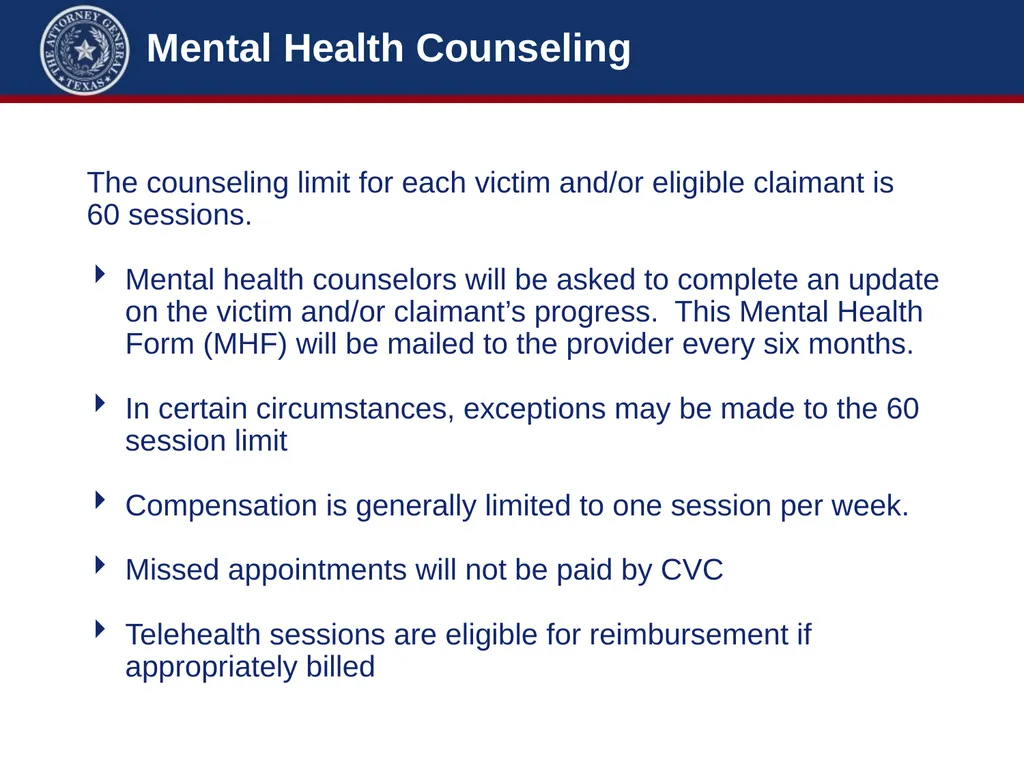
The counseling limit for each victim and/or eligible claimant is
60 sessions.
Mental health counselors will be asked to complete an update on the victim and/or claimant’s progress. This Mental Health Form (MHF) will be mailed to the provider every six months.
In certain circumstances, exceptions may be made to the 60 session limit
Compensation is generally limited to one session per week.
Missed appointments will not be paid by CVC
Telehealth sessions are eligible for reimbursement if appropriately billed Mental Health Counseling<br>
60 sessions.
Mental health counselors will be asked to complete an update on the victim and/or claimant’s progress. This Mental Health Form (MHF) will be mailed to the provider every six months.
In certain circumstances, exceptions may be made to the 60 session limit
Compensation is generally limited to one session per week.
Missed appointments will not be paid by CVC
Telehealth sessions are eligible for reimbursement if appropriately billed Mental Health Counseling<br>
51
CVC Eligible
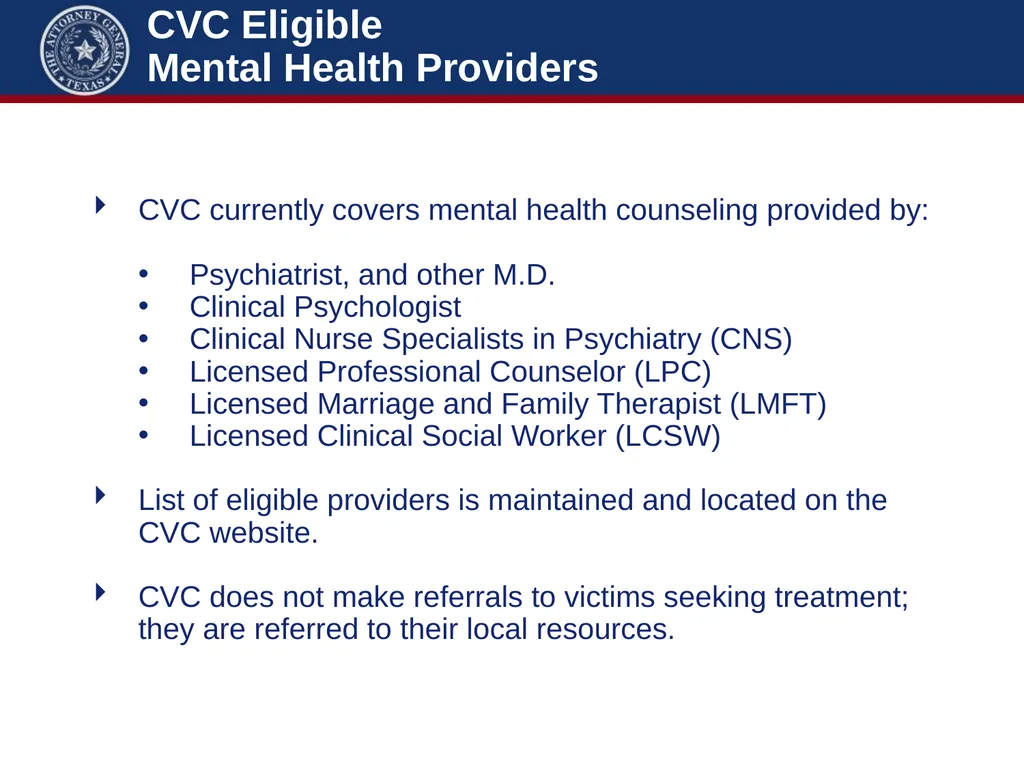
Mental Health Providers CVC currently covers mental health counseling provided by:
Psychiatrist, and other M.D.
Clinical Psychologist
Clinical Nurse Specialists in Psychiatry (CNS)
Licensed Professional Counselor (LPC)
Licensed Marriage and Family Therapist (LMFT)
Licensed Clinical Social Worker (LCSW)
List of eligible providers is maintained and located on the CVC website.
CVC does not make referrals to victims seeking treatment; they are referred to their local resources.<br>
Psychiatrist, and other M.D.
Clinical Psychologist
Clinical Nurse Specialists in Psychiatry (CNS)
Licensed Professional Counselor (LPC)
Licensed Marriage and Family Therapist (LMFT)
Licensed Clinical Social Worker (LCSW)
List of eligible providers is maintained and located on the CVC website.
CVC does not make referrals to victims seeking treatment; they are referred to their local resources.<br>
52
In-patient hospital treatment, residential treatment center care, including partial day programs or intensive outpatient programs are available only for victims and for a maximum of 30 days, unless good cause is shown.
Inpatient and Intensive Psychiatric Care expenses are paid according to the Division of Worker’s Compensation medical fee guidelines(MFG) Inpatient and Intensive Psychiatric Care<br>
Inpatient and Intensive Psychiatric Care expenses are paid according to the Division of Worker’s Compensation medical fee guidelines(MFG) Inpatient and Intensive Psychiatric Care<br>
53
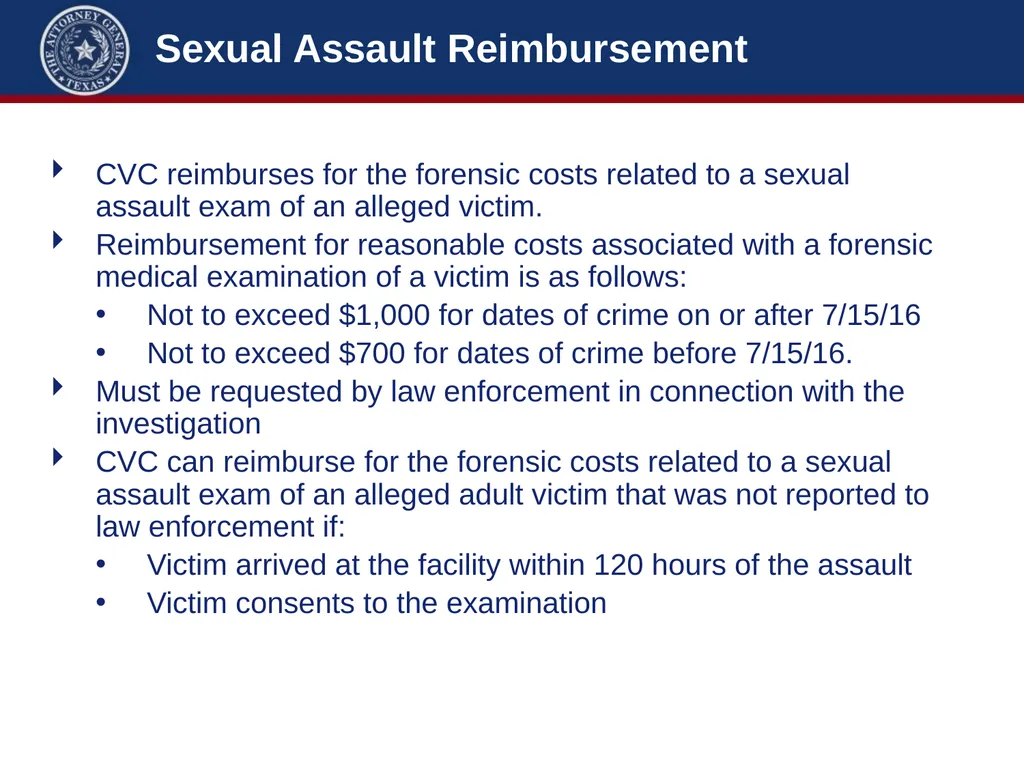
CVC reimburses for the forensic costs related to a sexual assault exam of an alleged victim.
Reimbursement for reasonable costs associated with a forensic medical examination of a victim is as follows:
Not to exceed $1,000 for dates of crime on or after 7/15/16
Not to exceed $700 for dates of crime before 7/15/16.
Must be requested by law enforcement in connection with the investigation
CVC can reimburse for the forensic costs related to a sexual assault exam of an alleged adult victim that was not reported to law enforcement if:
Victim arrived at the facility within 120 hours of the assault
Victim consents to the examination Sexual Assault Reimbursement<br>
Reimbursement for reasonable costs associated with a forensic medical examination of a victim is as follows:
Not to exceed $1,000 for dates of crime on or after 7/15/16
Not to exceed $700 for dates of crime before 7/15/16.
Must be requested by law enforcement in connection with the investigation
CVC can reimburse for the forensic costs related to a sexual assault exam of an alleged adult victim that was not reported to law enforcement if:
Victim arrived at the facility within 120 hours of the assault
Victim consents to the examination Sexual Assault Reimbursement<br>
54
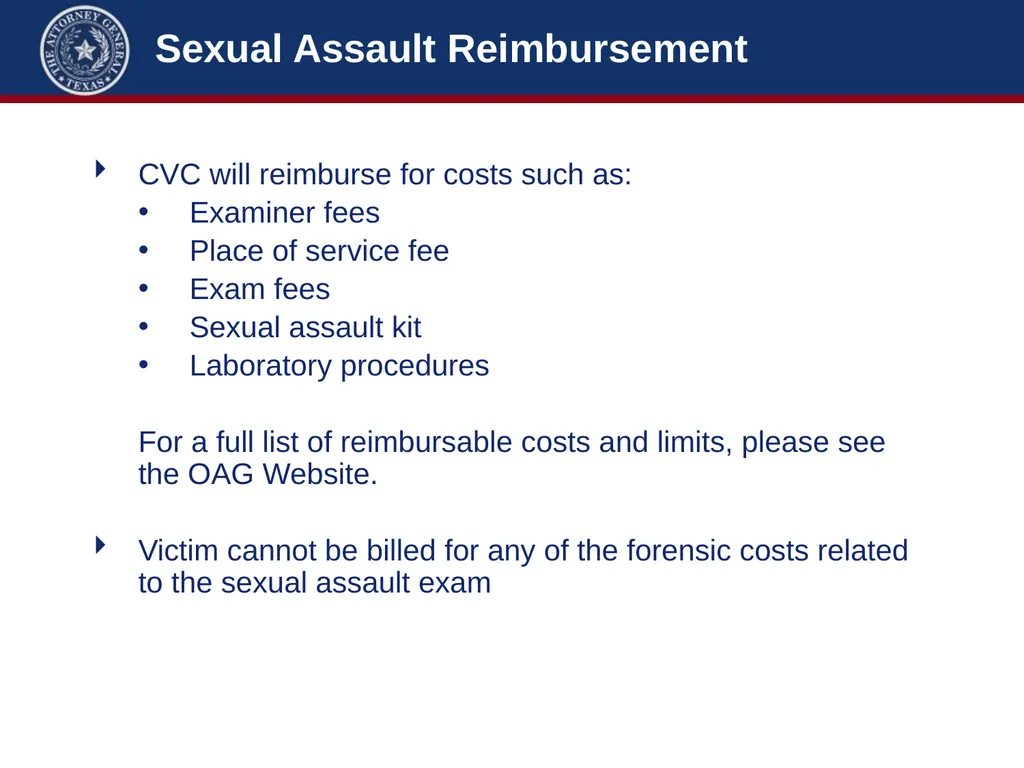
CVC will reimburse for costs such as:
Examiner fees
Place of service fee
Exam fees
Sexual assault kit
Laboratory procedures
For a full list of reimbursable costs and limits, please see the OAG Website.
Victim cannot be billed for any of the forensic costs related to the sexual assault exam Sexual Assault Reimbursement<br>
Examiner fees
Place of service fee
Exam fees
Sexual assault kit
Laboratory procedures
For a full list of reimbursable costs and limits, please see the OAG Website.
Victim cannot be billed for any of the forensic costs related to the sexual assault exam Sexual Assault Reimbursement<br>
55
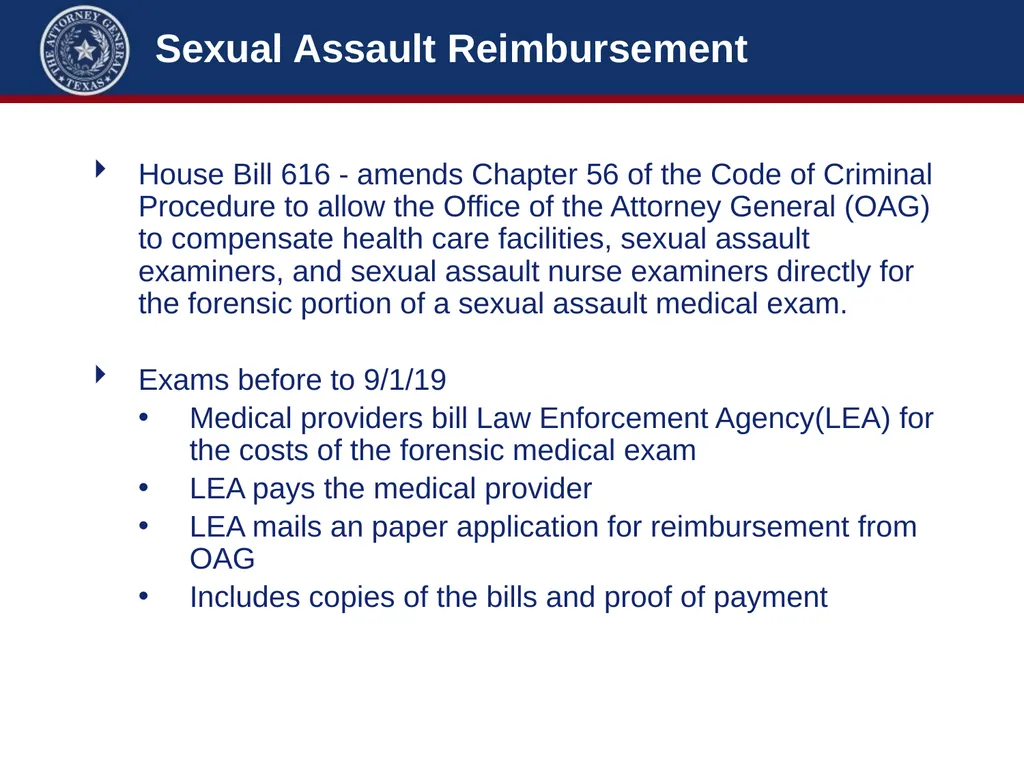
House Bill 616 - amends Chapter 56 of the Code of Criminal Procedure to allow the Office of the Attorney General (OAG) to compensate health care facilities, sexual assault examiners, and sexual assault nurse examiners directly for the forensic portion of a sexual assault medical exam.
Exams before to 9/1/19
Medical providers bill Law Enforcement Agency(LEA) for the costs of the forensic medical exam
LEA pays the medical provider
LEA mails an paper application for reimbursement from OAG
Includes copies of the bills and proof of payment Sexual Assault Reimbursement<br>
Exams before to 9/1/19
Medical providers bill Law Enforcement Agency(LEA) for the costs of the forensic medical exam
LEA pays the medical provider
LEA mails an paper application for reimbursement from OAG
Includes copies of the bills and proof of payment Sexual Assault Reimbursement<br>
56
Exams after 8/31/19
Medical provider bills OAG for the costs of the forensic medical exam and the OAG reimburses provider directly
Provider submits an online application via CVC online portal.
Requests for reimbursement must include the forensic bill(s) and copy of the LEA Request for Sexual Assault Exam form
Does not cover medical costs. Expenses other than the forensic costs such as medical treatment are not reimbursed under this program but may eligible under CVC or Emergency Medical application. Sexual Assault Reimbursement<br>
Medical provider bills OAG for the costs of the forensic medical exam and the OAG reimburses provider directly
Provider submits an online application via CVC online portal.
Requests for reimbursement must include the forensic bill(s) and copy of the LEA Request for Sexual Assault Exam form
Does not cover medical costs. Expenses other than the forensic costs such as medical treatment are not reimbursed under this program but may eligible under CVC or Emergency Medical application. Sexual Assault Reimbursement<br>
57
Loss of earnings related to medical
Physical or emotional disability
While seeking medical treatment for crime-related injury
Care for a medically incapacitated adult/minor child by claimant
Loss of earnings related to the criminal justice system
Police investigation appointments
Protective order court appointment
Criminal proceedings
Post-convictions
Post-adjudication proceedings (executions)
Loss of earnings related to victim’s funeral Loss of Earnings
(Slide 1 of 2)<br>
Physical or emotional disability
While seeking medical treatment for crime-related injury
Care for a medically incapacitated adult/minor child by claimant
Loss of earnings related to the criminal justice system
Police investigation appointments
Protective order court appointment
Criminal proceedings
Post-convictions
Post-adjudication proceedings (executions)
Loss of earnings related to victim’s funeral Loss of Earnings
(Slide 1 of 2)<br>
58
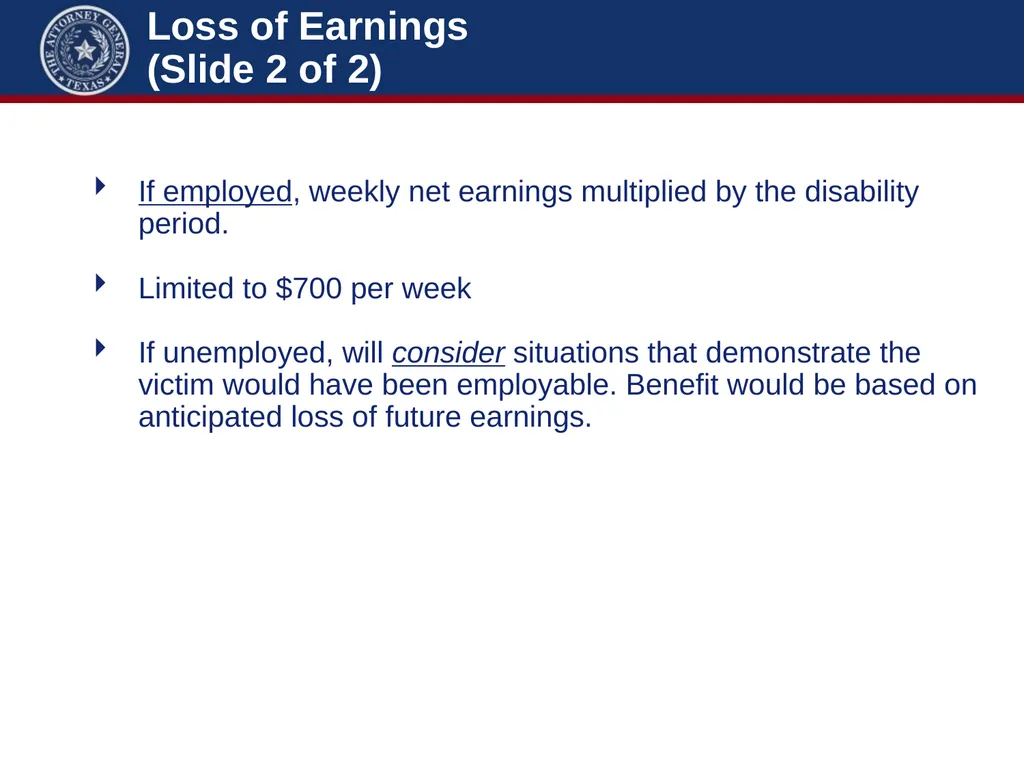
Loss of Earnings
(Slide 2 of 2) If employed, weekly net earnings multiplied by the disability period.
Limited to $700 per week
If unemployed, will consider situations that demonstrate the victim would have been employable. Benefit would be based on anticipated loss of future earnings.<br>
Limited to $700 per week
If unemployed, will consider situations that demonstrate the victim would have been employable. Benefit would be based on anticipated loss of future earnings.<br>
59
Name and address of employer
Printout of federal income tax return directly from IRS for all self-employed victims
Name and address of treating physician
If for time off work for medical/criminal justice appointments, a completely Travel / Appointment Verification Form
Verification of all collateral sources:
Social Security, workers’ compensation, short/long-term disability benefits, settlements Loss of Earnings Requirements<br>
Printout of federal income tax return directly from IRS for all self-employed victims
Name and address of treating physician
If for time off work for medical/criminal justice appointments, a completely Travel / Appointment Verification Form
Verification of all collateral sources:
Social Security, workers’ compensation, short/long-term disability benefits, settlements Loss of Earnings Requirements<br>
60
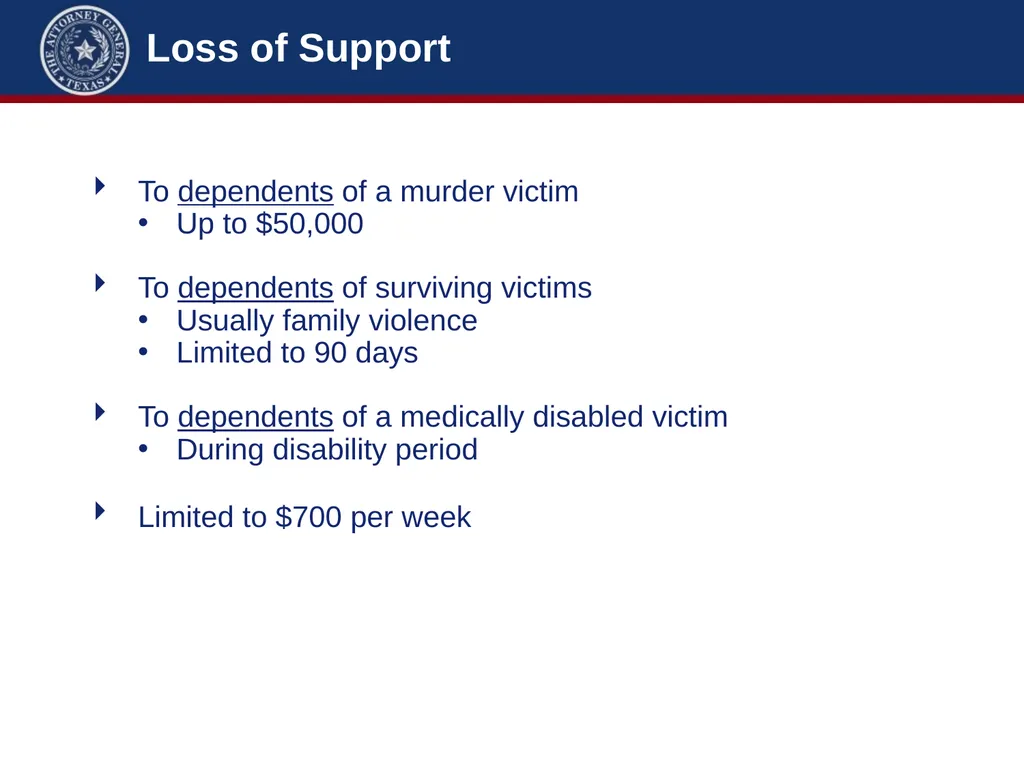
To dependents of a murder victim
Up to $50,000
To dependents of surviving victims
Usually family violence
Limited to 90 days
To dependents of a medically disabled victim
During disability period
Limited to $700 per week Loss of Support<br>
Up to $50,000
To dependents of surviving victims
Usually family violence
Limited to 90 days
To dependents of a medically disabled victim
During disability period
Limited to $700 per week Loss of Support<br>
61
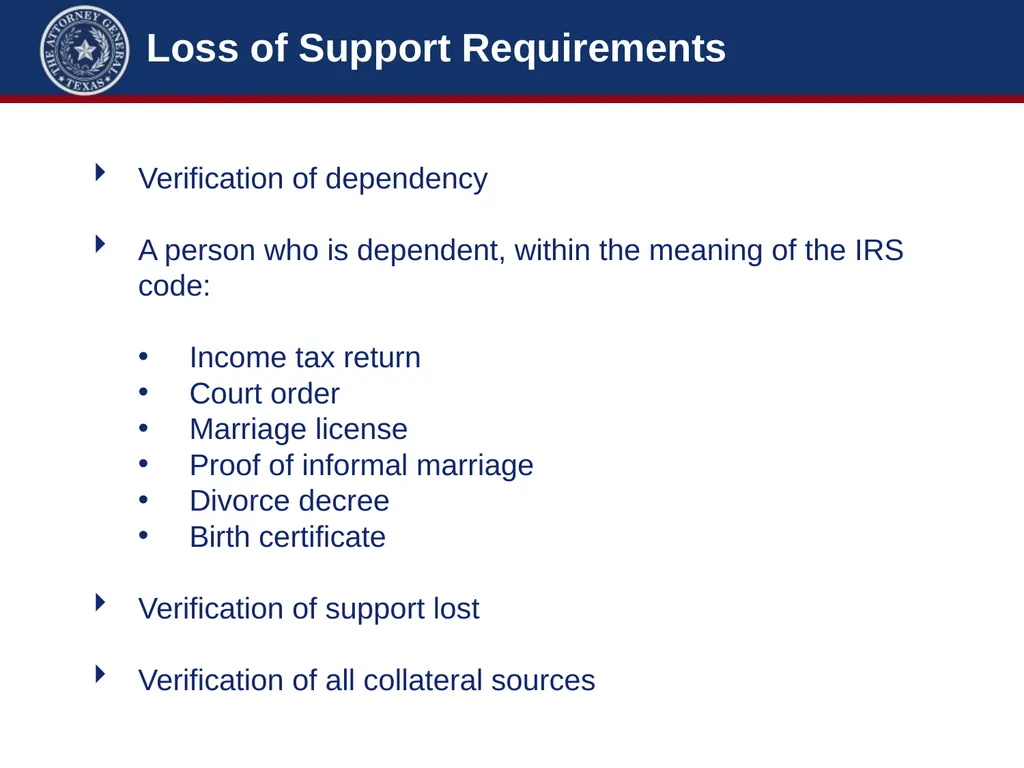
Verification of dependency
A person who is dependent, within the meaning of the IRS code:
Income tax return
Court order
Marriage license
Proof of informal marriage
Divorce decree
Birth certificate
Verification of support lost
Verification of all collateral sources Loss of Support Requirements<br>
A person who is dependent, within the meaning of the IRS code:
Income tax return
Court order
Marriage license
Proof of informal marriage
Divorce decree
Birth certificate
Verification of support lost
Verification of all collateral sources Loss of Support Requirements<br>
62
Funeral and Burial
(Slide 1 of 2) Funeral and burial expenses maximum of $6,500
Additional funds available to transport the body
Burial transit permit / apostille issued by the Texas Secretary of State
Air bill
Copies of bills for services paid to other funeral homes for transporting the body<br>
Additional funds available to transport the body
Burial transit permit / apostille issued by the Texas Secretary of State
Air bill
Copies of bills for services paid to other funeral homes for transporting the body<br>
63
Funeral and Burial
(Slide 2 of 2) What is covered:
Funeral services
Casket, urn
Graveside services
Cemetery expenses
Marker/headstone
Cremation charges
Additional costs: flowers, musician fees, burial
clothing for the deceased victim, exhumation
and reburial<br>
Funeral services
Casket, urn
Graveside services
Cemetery expenses
Marker/headstone
Cremation charges
Additional costs: flowers, musician fees, burial
clothing for the deceased victim, exhumation
and reburial<br>
64
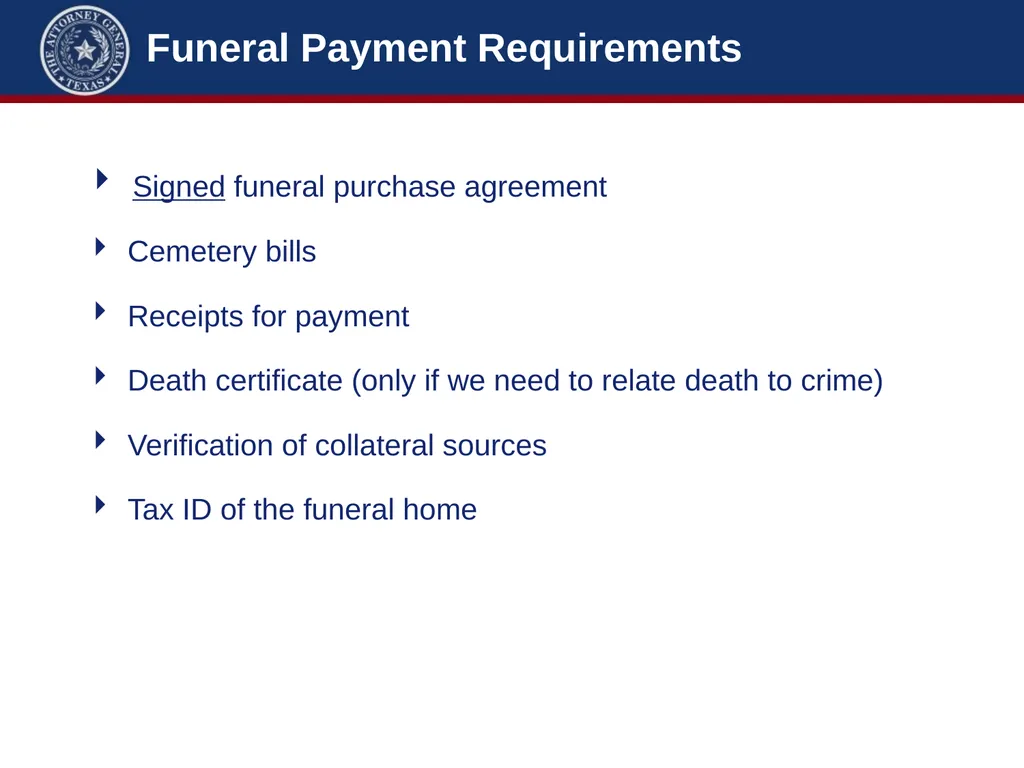
Signed funeral purchase agreement
Cemetery bills
Receipts for payment
Death certificate (only if we need to relate death to crime)
Verification of collateral sources
Tax ID of the funeral home Funeral Payment Requirements<br>
Cemetery bills
Receipts for payment
Death certificate (only if we need to relate death to crime)
Verification of collateral sources
Tax ID of the funeral home Funeral Payment Requirements<br>
65
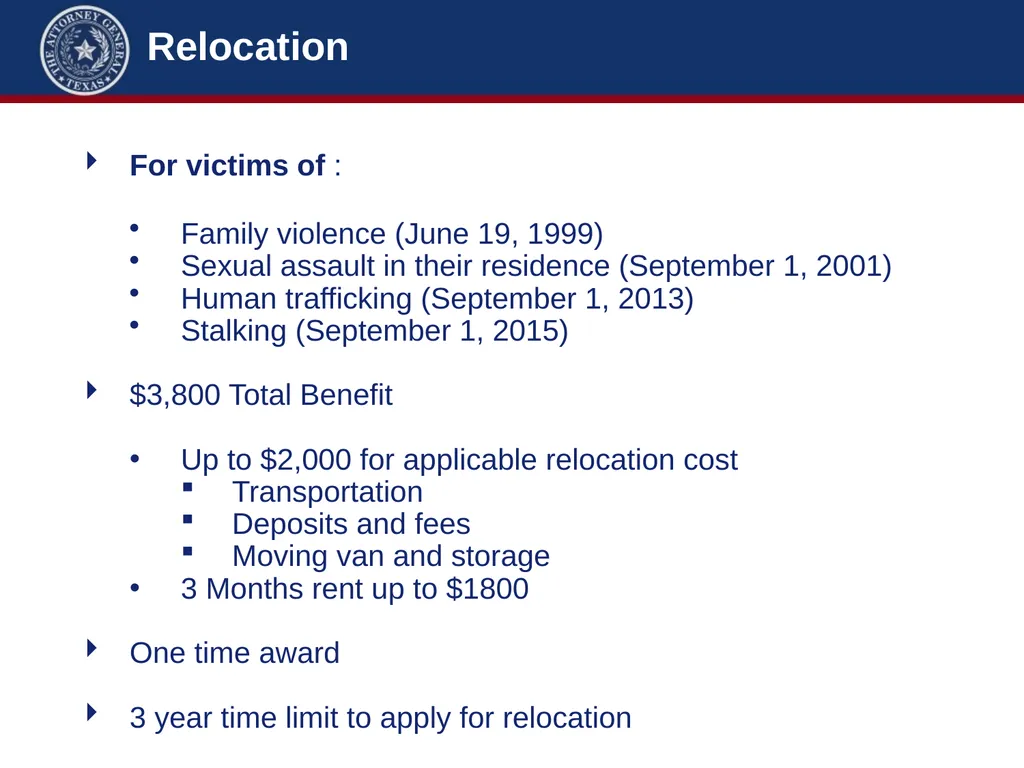
Relocation For victims of :
Family violence (June 19, 1999)
Sexual assault in their residence (September 1, 2001)
Human trafficking (September 1, 2013)
Stalking (September 1, 2015)
$3,800 Total Benefit
Up to $2,000 for applicable relocation cost
Transportation
Deposits and fees
Moving van and storage
3 Months rent up to $1800
One time award
3 year time limit to apply for relocation<br>
Family violence (June 19, 1999)
Sexual assault in their residence (September 1, 2001)
Human trafficking (September 1, 2013)
Stalking (September 1, 2015)
$3,800 Total Benefit
Up to $2,000 for applicable relocation cost
Transportation
Deposits and fees
Moving van and storage
3 Months rent up to $1800
One time award
3 year time limit to apply for relocation<br>
66
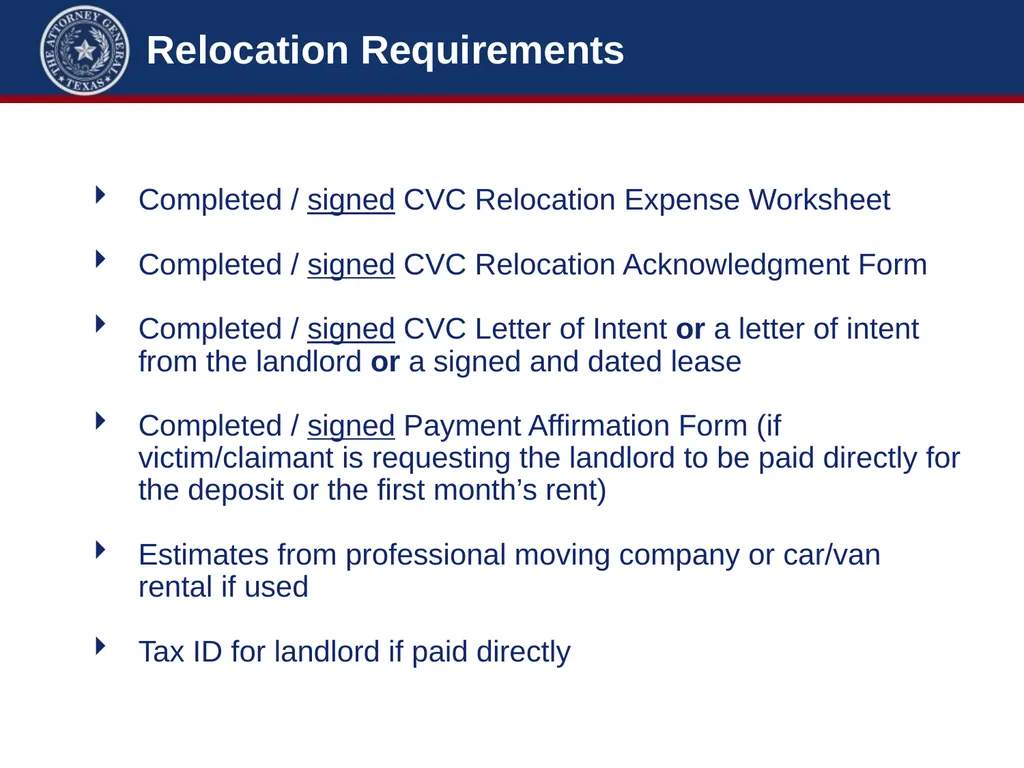
Completed / signed CVC Relocation Expense Worksheet
Completed / signed CVC Relocation Acknowledgment Form
Completed / signed CVC Letter of Intent or a letter of intent from the landlord or a signed and dated lease
Completed / signed Payment Affirmation Form (if victim/claimant is requesting the landlord to be paid directly for the deposit or the first month’s rent)
Estimates from professional moving company or car/van rental if used
Tax ID for landlord if paid directly Relocation Requirements<br>
Completed / signed CVC Relocation Acknowledgment Form
Completed / signed CVC Letter of Intent or a letter of intent from the landlord or a signed and dated lease
Completed / signed Payment Affirmation Form (if victim/claimant is requesting the landlord to be paid directly for the deposit or the first month’s rent)
Estimates from professional moving company or car/van rental if used
Tax ID for landlord if paid directly Relocation Requirements<br>
67
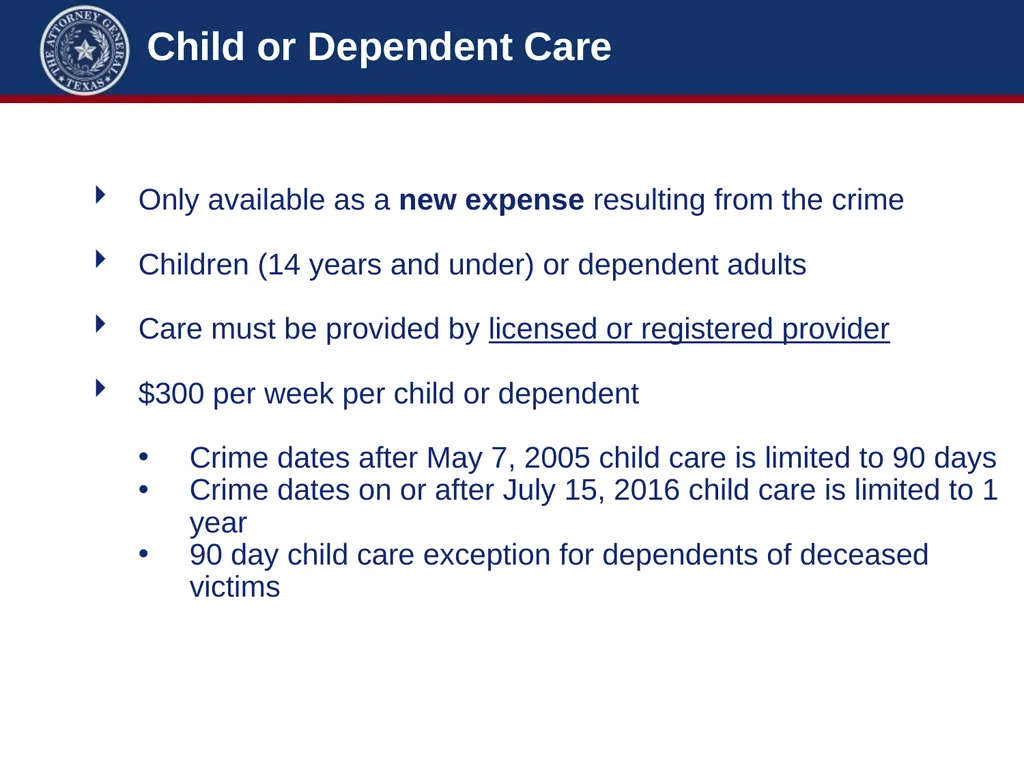
Child or Dependent Care Only available as a new expense resulting from the crime
Children (14 years and under) or dependent adults
Care must be provided by licensed or registered provider
$300 per week per child or dependent
Crime dates after May 7, 2005 child care is limited to 90 days
Crime dates on or after July 15, 2016 child care is limited to 1 year
90 day child care exception for dependents of deceased victims<br>
Children (14 years and under) or dependent adults
Care must be provided by licensed or registered provider
$300 per week per child or dependent
Crime dates after May 7, 2005 child care is limited to 90 days
Crime dates on or after July 15, 2016 child care is limited to 1 year
90 day child care exception for dependents of deceased victims<br>
68
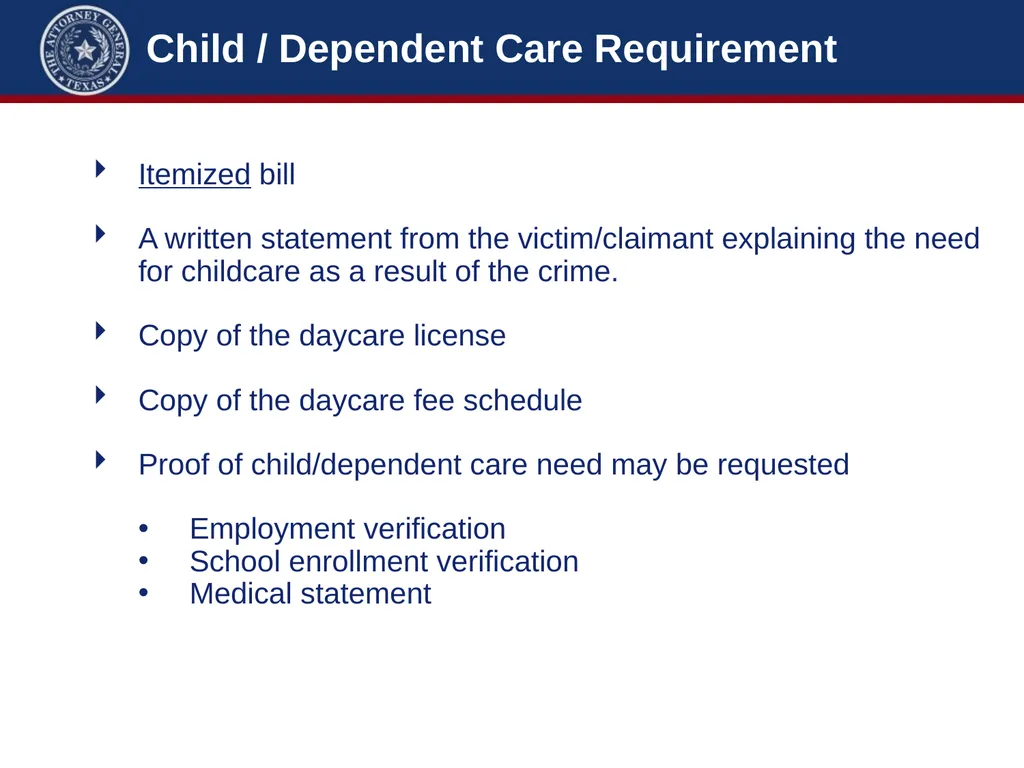
Itemized bill
A written statement from the victim/claimant explaining the need for childcare as a result of the crime.
Copy of the daycare license
Copy of the daycare fee schedule
Proof of child/dependent care need may be requested
Employment verification
School enrollment verification
Medical statement Child / Dependent Care Requirement<br>
A written statement from the victim/claimant explaining the need for childcare as a result of the crime.
Copy of the daycare license
Copy of the daycare fee schedule
Proof of child/dependent care need may be requested
Employment verification
School enrollment verification
Medical statement Child / Dependent Care Requirement<br>
69
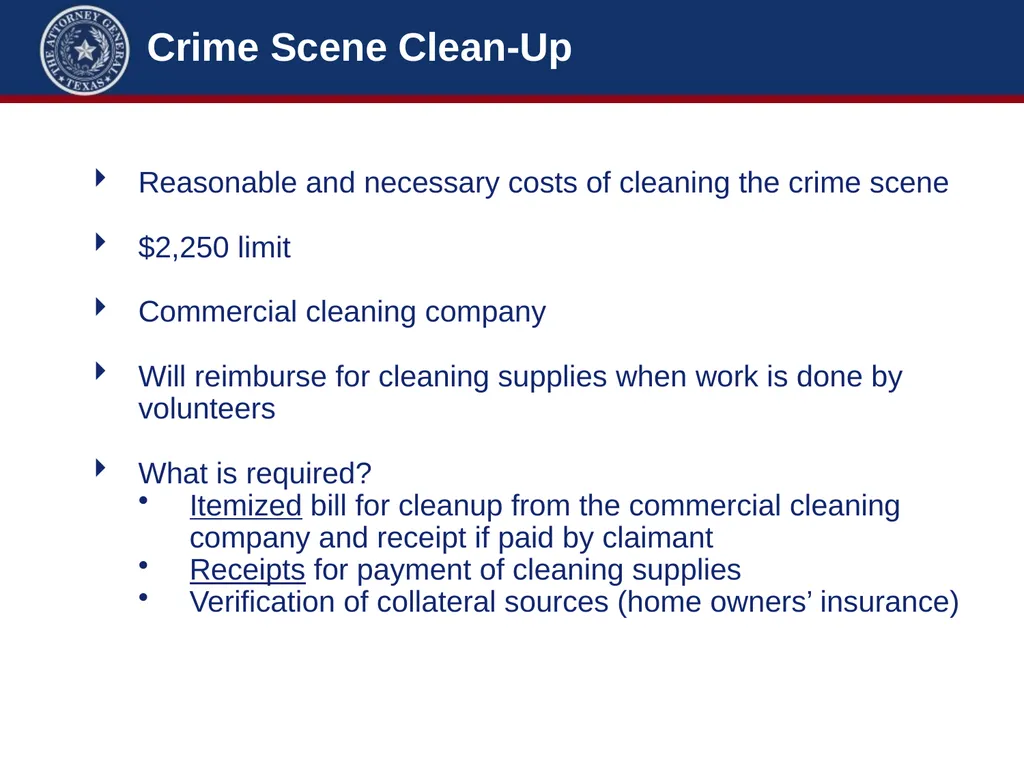
Crime Scene Clean-Up Reasonable and necessary costs of cleaning the crime scene
$2,250 limit
Commercial cleaning company
Will reimburse for cleaning supplies when work is done by volunteers
What is required?
Itemized bill for cleanup from the commercial cleaning company and receipt if paid by claimant
Receipts for payment of cleaning supplies
Verification of collateral sources (home owners’ insurance)<br>
$2,250 limit
Commercial cleaning company
Will reimburse for cleaning supplies when work is done by volunteers
What is required?
Itemized bill for cleanup from the commercial cleaning company and receipt if paid by claimant
Receipts for payment of cleaning supplies
Verification of collateral sources (home owners’ insurance)<br>
70
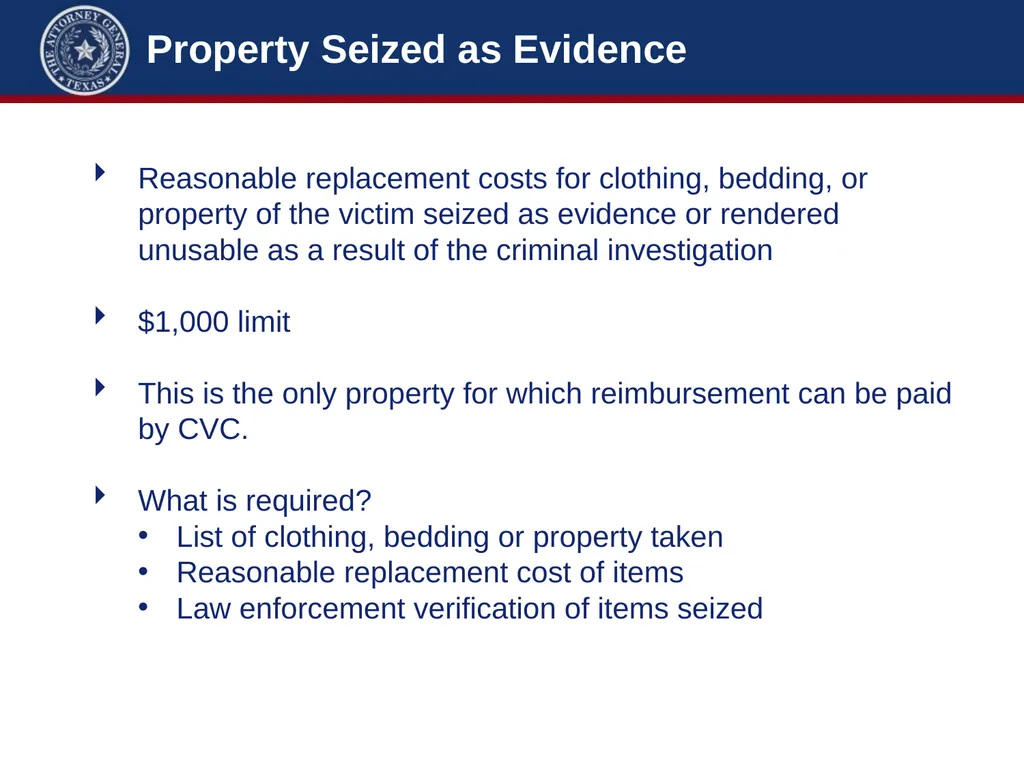
Property Seized as Evidence Reasonable replacement costs for clothing, bedding, or property of the victim seized as evidence or rendered unusable as a result of the criminal investigation
$1,000 limit
This is the only property for which reimbursement can be paid by CVC.
What is required?
List of clothing, bedding or property taken
Reasonable replacement cost of items
Law enforcement verification of items seized<br>
$1,000 limit
This is the only property for which reimbursement can be paid by CVC.
What is required?
List of clothing, bedding or property taken
Reasonable replacement cost of items
Law enforcement verification of items seized<br>
71
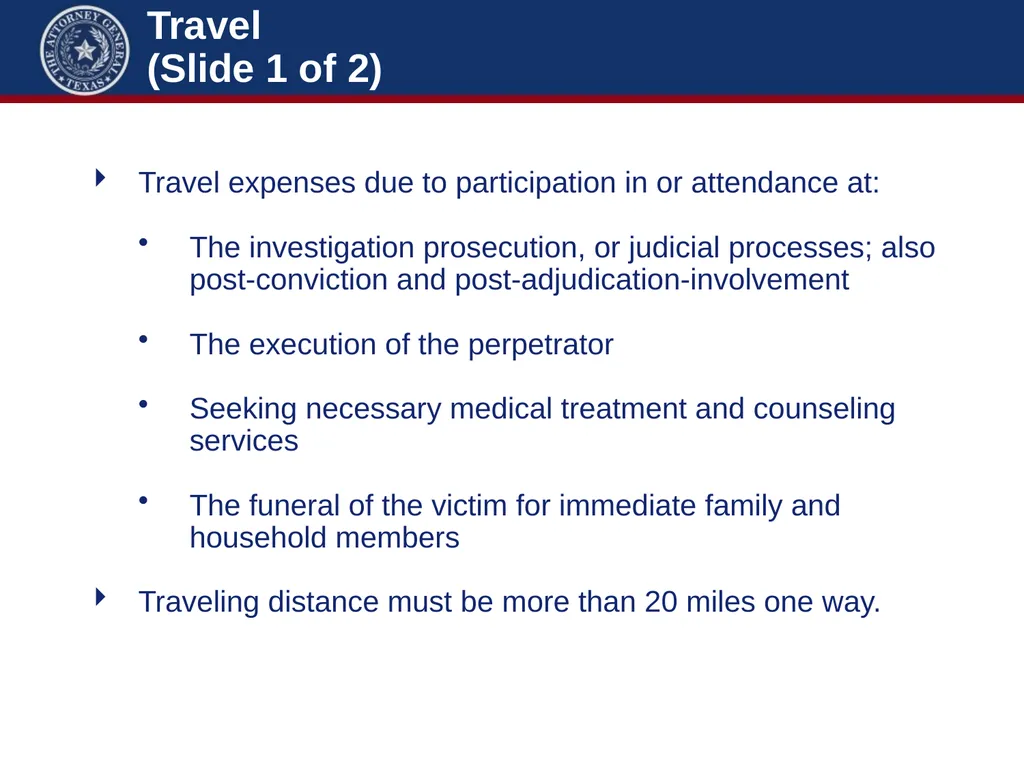
Travel
(Slide 1 of 2) Travel expenses due to participation in or attendance at:
The investigation prosecution, or judicial processes; also post-conviction and post-adjudication-involvement
The execution of the perpetrator
Seeking necessary medical treatment and counseling services
The funeral of the victim for immediate family and household members
Traveling distance must be more than 20 miles one way.<br>
The investigation prosecution, or judicial processes; also post-conviction and post-adjudication-involvement
The execution of the perpetrator
Seeking necessary medical treatment and counseling services
The funeral of the victim for immediate family and household members
Traveling distance must be more than 20 miles one way.<br>
72
Travel
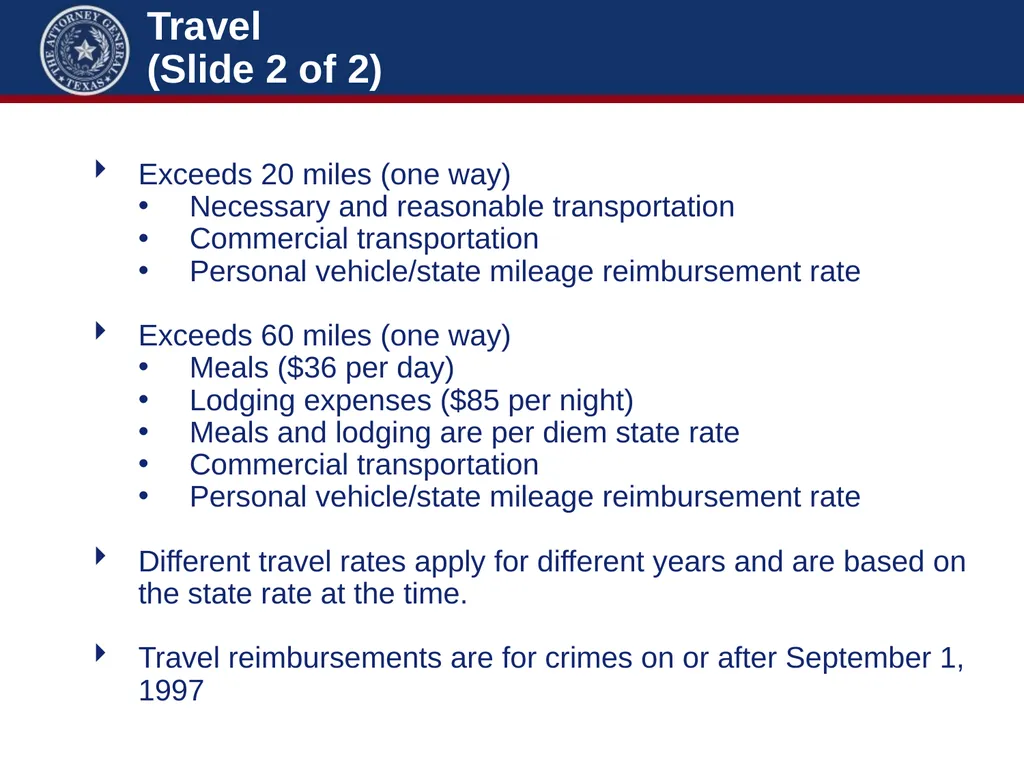
(Slide 2 of 2) Exceeds 20 miles (one way)
Necessary and reasonable transportation
Commercial transportation
Personal vehicle/state mileage reimbursement rate
Exceeds 60 miles (one way)
Meals ($36 per day)
Lodging expenses ($85 per night)
Meals and lodging are per diem state rate
Commercial transportation
Personal vehicle/state mileage reimbursement rate
Different travel rates apply for different years and are based on the state rate at the time.
Travel reimbursements are for crimes on or after September 1, 1997<br>
Necessary and reasonable transportation
Commercial transportation
Personal vehicle/state mileage reimbursement rate
Exceeds 60 miles (one way)
Meals ($36 per day)
Lodging expenses ($85 per night)
Meals and lodging are per diem state rate
Commercial transportation
Personal vehicle/state mileage reimbursement rate
Different travel rates apply for different years and are based on the state rate at the time.
Travel reimbursements are for crimes on or after September 1, 1997<br>
73
A completed/signed CVC Travel/Appointment Verification Form
Receipts for lodging/airfare (if 60 miles or more one way) Travel Requirements<br>
Receipts for lodging/airfare (if 60 miles or more one way) Travel Requirements<br>
74
Applications with medical bills greater than $50,000
Identified in system as “Med Max”
60 days to submit bills from initial request (checklist)
30-day letter requesting all bills
Long timeline to process these payments as CVC awaits receipt of all bills from all service providers Medical Max Applications
(Slide 1 of 2)<br>
Identified in system as “Med Max”
60 days to submit bills from initial request (checklist)
30-day letter requesting all bills
Long timeline to process these payments as CVC awaits receipt of all bills from all service providers Medical Max Applications
(Slide 1 of 2)<br>
75
Medical Max Applications
(Slide 2 of 2) Bills are or pro-rated based on their share of the total CVC money available in the claim.
Since bills have not been paid at full fee guideline amount, victim does owe balance up to the medical fee guideline (MFG).<br>
Since bills have not been paid at full fee guideline amount, victim does owe balance up to the medical fee guideline (MFG).<br>
76
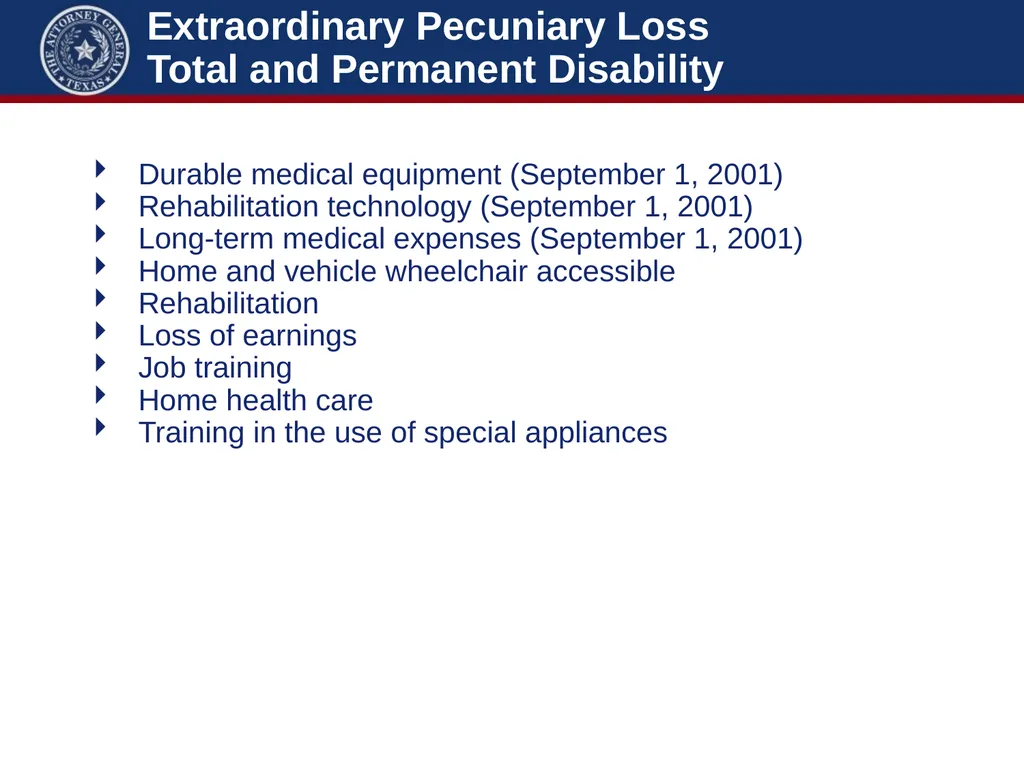
Extraordinary Pecuniary Loss Injury is a total and permanent disability.
Above the base award, Extraordinary Pecuniary Loss benefits are:
Additional $25,000 (for crimes occurring September 1995-97)
Additional $50,000 (for crimes on or after September 1, 1997 to August 31, 2001)
Additional $75,000 (for crimes occurring on or after September 1, 2001)<br>
Above the base award, Extraordinary Pecuniary Loss benefits are:
Additional $25,000 (for crimes occurring September 1995-97)
Additional $50,000 (for crimes on or after September 1, 1997 to August 31, 2001)
Additional $75,000 (for crimes occurring on or after September 1, 2001)<br>
77
Extraordinary Pecuniary Loss
Total and Permanent Disability Durable medical equipment (September 1, 2001)
Rehabilitation technology (September 1, 2001)
Long-term medical expenses (September 1, 2001)
Home and vehicle wheelchair accessible
Rehabilitation
Loss of earnings
Job training
Home health care
Training in the use of special appliances<br>
Rehabilitation technology (September 1, 2001)
Long-term medical expenses (September 1, 2001)
Home and vehicle wheelchair accessible
Rehabilitation
Loss of earnings
Job training
Home health care
Training in the use of special appliances<br>
78
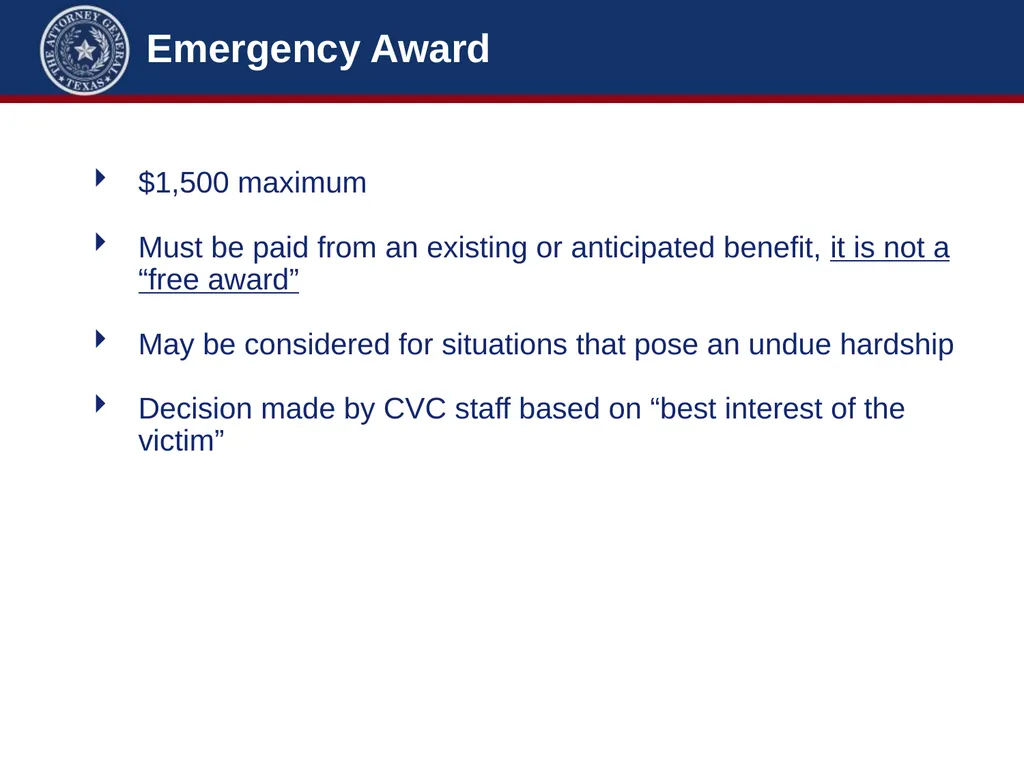
$1,500 maximum
Must be paid from an existing or anticipated benefit, it is not a “free award”
May be considered for situations that pose an undue hardship
Decision made by CVC staff based on “best interest of the victim” Emergency Award<br>
Must be paid from an existing or anticipated benefit, it is not a “free award”
May be considered for situations that pose an undue hardship
Decision made by CVC staff based on “best interest of the victim” Emergency Award<br>
79
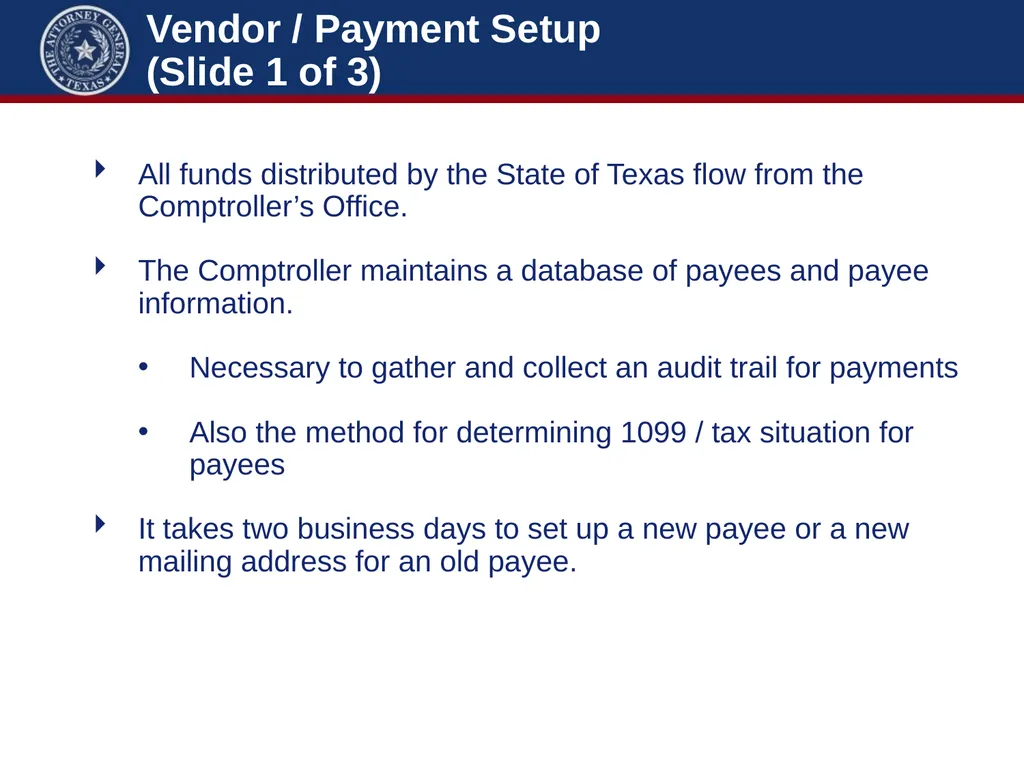
All funds distributed by the State of Texas flow from the Comptroller’s Office.
The Comptroller maintains a database of payees and payee information.
Necessary to gather and collect an audit trail for payments
Also the method for determining 1099 / tax situation for payees
It takes two business days to set up a new payee or a new mailing address for an old payee. Vendor / Payment Setup
(Slide 1 of 3)<br>
The Comptroller maintains a database of payees and payee information.
Necessary to gather and collect an audit trail for payments
Also the method for determining 1099 / tax situation for payees
It takes two business days to set up a new payee or a new mailing address for an old payee. Vendor / Payment Setup
(Slide 1 of 3)<br>
80
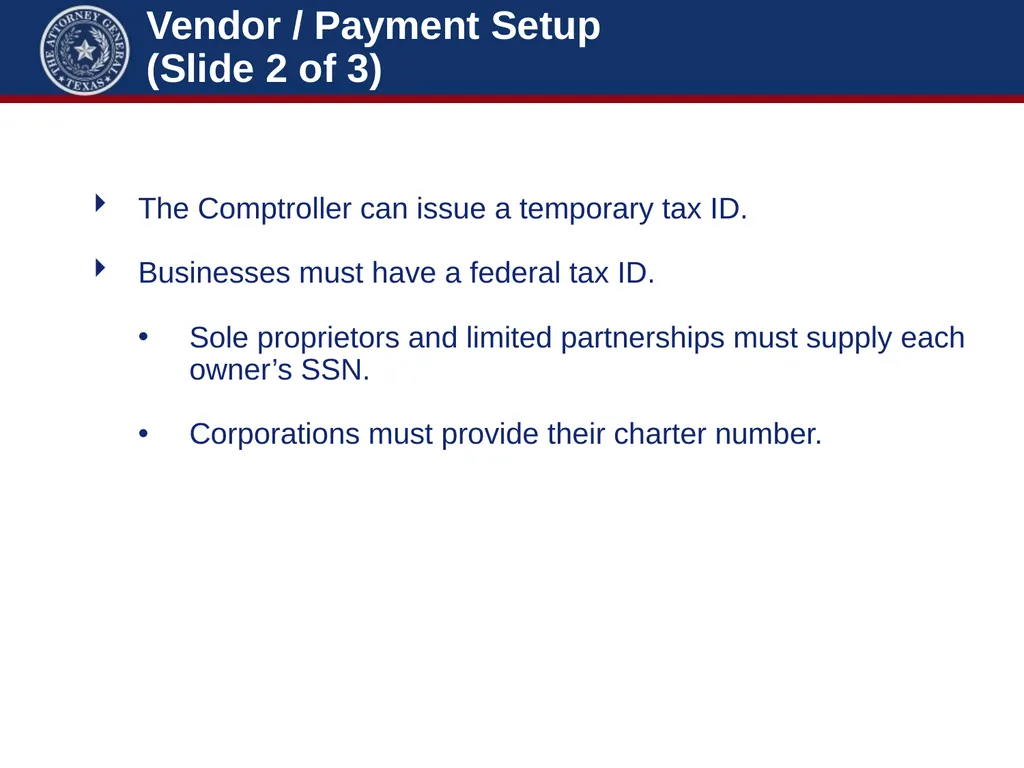
The Comptroller can issue a temporary tax ID.
Businesses must have a federal tax ID.
Sole proprietors and limited partnerships must supply each owner’s SSN.
Corporations must provide their charter number. Vendor / Payment Setup
(Slide 2 of 3)<br>
Businesses must have a federal tax ID.
Sole proprietors and limited partnerships must supply each owner’s SSN.
Corporations must provide their charter number. Vendor / Payment Setup
(Slide 2 of 3)<br>
81
Once a payee account is set up, a warrant (check) request is made.
It takes two business days to receive a warrant (check) once a request is made if no holds are present. After that, it takes two to three business days to be mailed. Vendor / Payment Setup
(Slide 3 of 3)<br>
It takes two business days to receive a warrant (check) once a request is made if no holds are present. After that, it takes two to three business days to be mailed. Vendor / Payment Setup
(Slide 3 of 3)<br>
82
The Comptroller’s warrant (check) hold program is a tool that allows all state agencies to collect outstanding debts.
52 agencies currently participate.
An agency sends the Comptroller’s office a request to participate in the program.
The Comptroller’s Claim Division requests the agency to identify the source of debt owed to the State and sets the hold.
As the Comptroller’s office prepares warrants (checks), the debtors’ identification numbers are electronically checked against the prepared warrants (checks). Holds
(Slide 1 of 3)<br>
52 agencies currently participate.
An agency sends the Comptroller’s office a request to participate in the program.
The Comptroller’s Claim Division requests the agency to identify the source of debt owed to the State and sets the hold.
As the Comptroller’s office prepares warrants (checks), the debtors’ identification numbers are electronically checked against the prepared warrants (checks). Holds
(Slide 1 of 3)<br>
83
The OAG has no control over the hold process – it is completely managed by the Comptroller and the agency to which the state debt is owed.
Frequent reasons for hold:
Delinquent child support
Delinquent student loans
Overpayment of unemployment compensation benefits
Sales tax due from a business owner
Unemployment insurance taxes due Holds
(Slide 2 of 3)<br>
Frequent reasons for hold:
Delinquent child support
Delinquent student loans
Overpayment of unemployment compensation benefits
Sales tax due from a business owner
Unemployment insurance taxes due Holds
(Slide 2 of 3)<br>
84
Victims and claimants can contact the agency that requested the hold to make arrangements.
Usually a resolution can be reached that will allow the warrant (check) to go through, but it must be worked out by the victim or claimant.
CVC will provide the payee with appropriate phone numbers to contact the debt-holding agency. Holds
(Slide 3 of 3)<br>
Usually a resolution can be reached that will allow the warrant (check) to go through, but it must be worked out by the victim or claimant.
CVC will provide the payee with appropriate phone numbers to contact the debt-holding agency. Holds
(Slide 3 of 3)<br>
85
Appeals Process
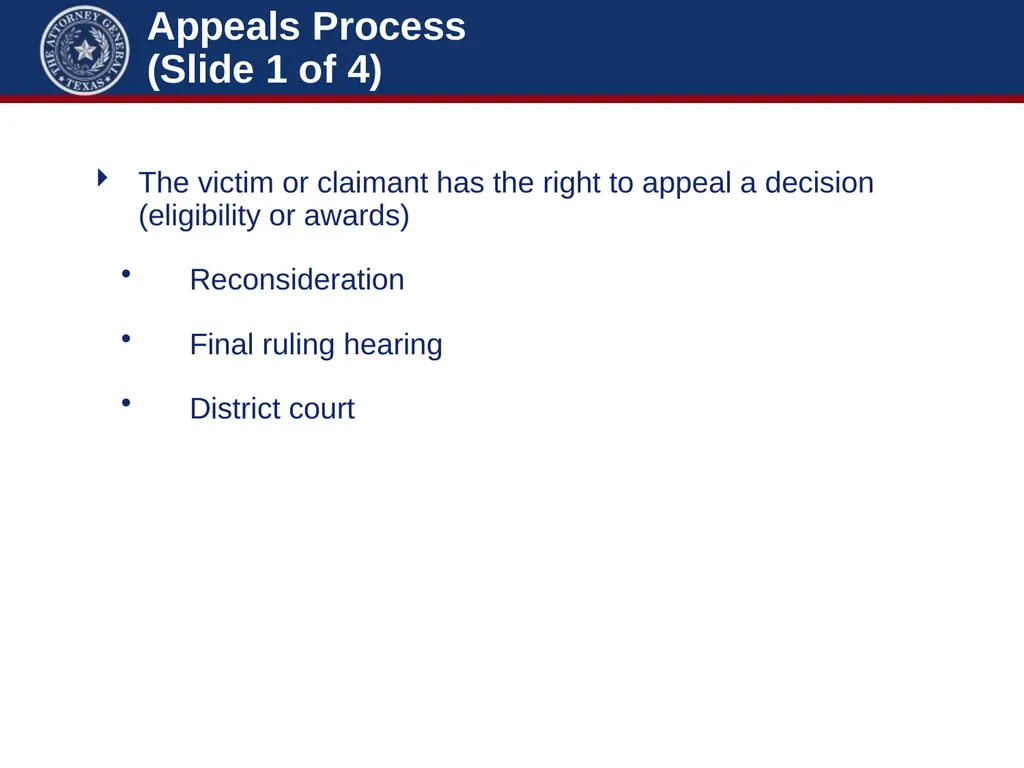
(Slide 1 of 4) The victim or claimant has the right to appeal a decision (eligibility or awards)
Reconsideration
Final ruling hearing
District court<br>
Reconsideration
Final ruling hearing
District court<br>
86
Appeals Process
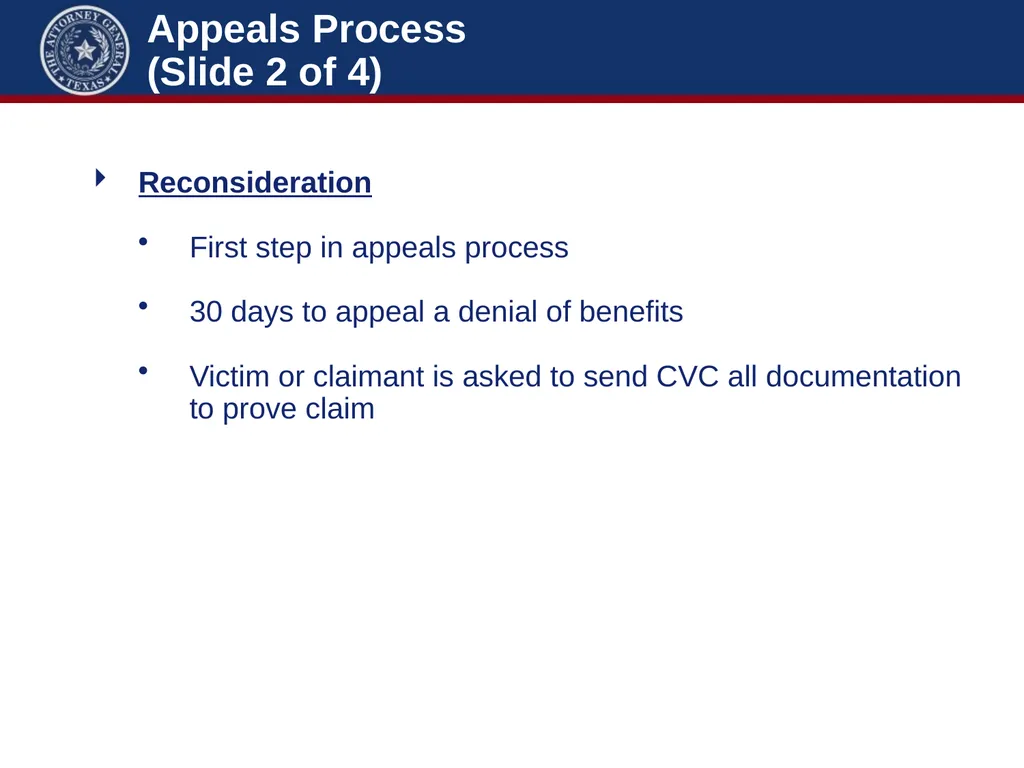
(Slide 2 of 4) Reconsideration
First step in appeals process
30 days to appeal a denial of benefits
Victim or claimant is asked to send CVC all documentation to prove claim<br>
First step in appeals process
30 days to appeal a denial of benefits
Victim or claimant is asked to send CVC all documentation to prove claim<br>
87
Appeals Process
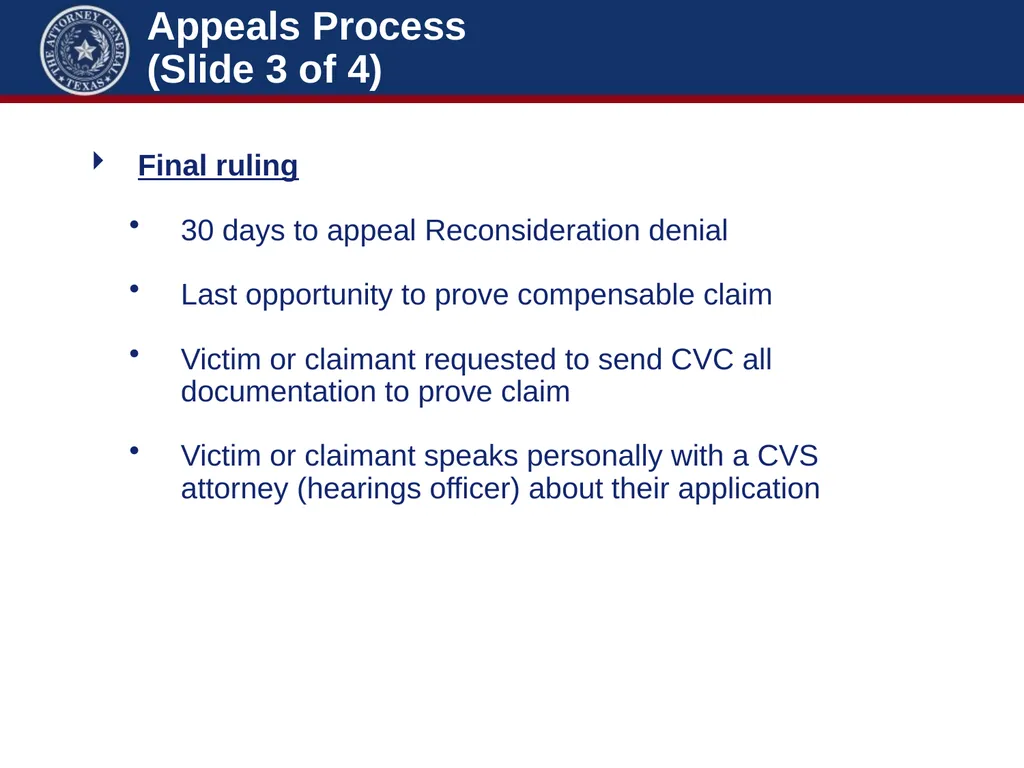
(Slide 3 of 4) Final ruling
30 days to appeal Reconsideration denial
Last opportunity to prove compensable claim
Victim or claimant requested to send CVC all documentation to prove claim
Victim or claimant speaks personally with a CVS attorney (hearings officer) about their application<br>
30 days to appeal Reconsideration denial
Last opportunity to prove compensable claim
Victim or claimant requested to send CVC all documentation to prove claim
Victim or claimant speaks personally with a CVS attorney (hearings officer) about their application<br>
88
Appeals Process
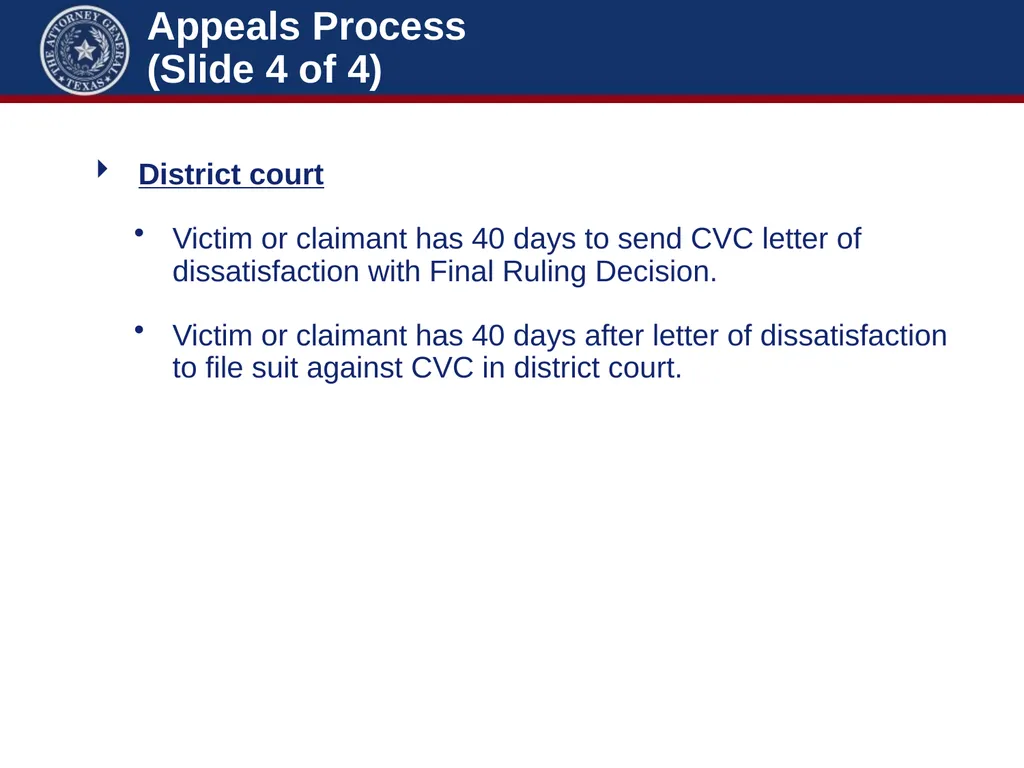
(Slide 4 of 4) District court
Victim or claimant has 40 days to send CVC letter of dissatisfaction with Final Ruling Decision.
Victim or claimant has 40 days after letter of dissatisfaction to file suit against CVC in district court.<br>
Victim or claimant has 40 days to send CVC letter of dissatisfaction with Final Ruling Decision.
Victim or claimant has 40 days after letter of dissatisfaction to file suit against CVC in district court.<br>
89
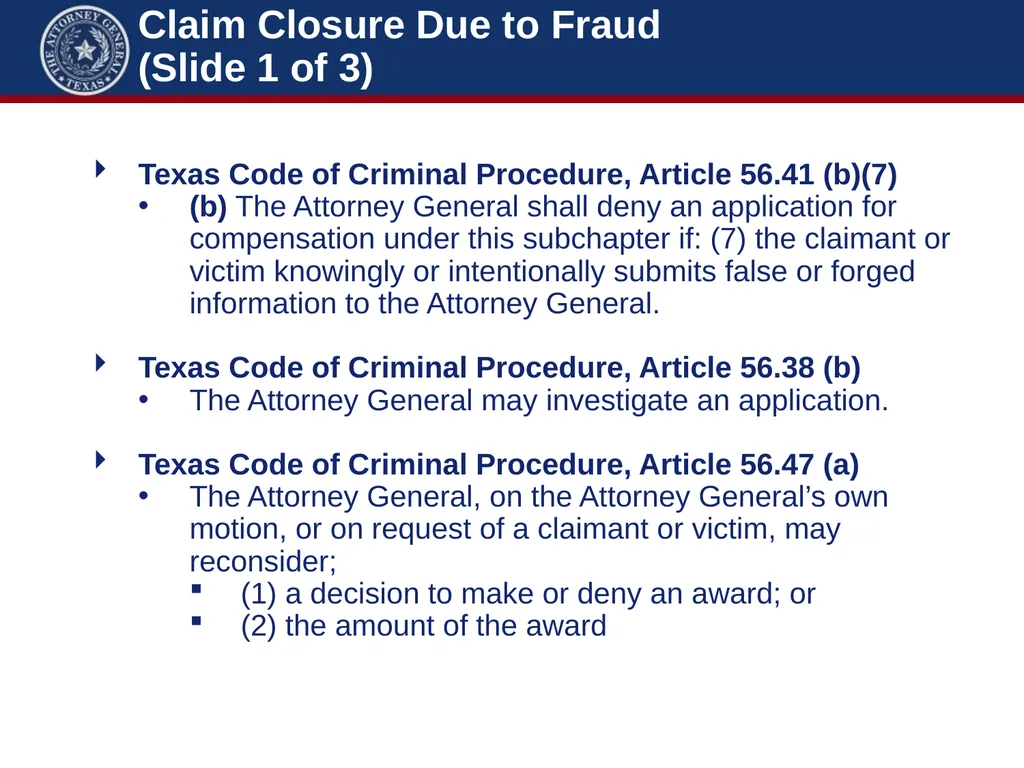
Claim Closure Due to Fraud
(Slide 1 of 3) Texas Code of Criminal Procedure, Article 56.41 (b)(7)
(b) The Attorney General shall deny an application for compensation under this subchapter if: (7) the claimant or victim knowingly or intentionally submits false or forged information to the Attorney General.
Texas Code of Criminal Procedure, Article 56.38 (b)
The Attorney General may investigate an application.
Texas Code of Criminal Procedure, Article 56.47 (a)
The Attorney General, on the Attorney General’s own motion, or on request of a claimant or victim, may reconsider;
(1) a decision to make or deny an award; or
(2) the amount of the award<br>
(b) The Attorney General shall deny an application for compensation under this subchapter if: (7) the claimant or victim knowingly or intentionally submits false or forged information to the Attorney General.
Texas Code of Criminal Procedure, Article 56.38 (b)
The Attorney General may investigate an application.
Texas Code of Criminal Procedure, Article 56.47 (a)
The Attorney General, on the Attorney General’s own motion, or on request of a claimant or victim, may reconsider;
(1) a decision to make or deny an award; or
(2) the amount of the award<br>
90
Claim Closure Due to Fraud
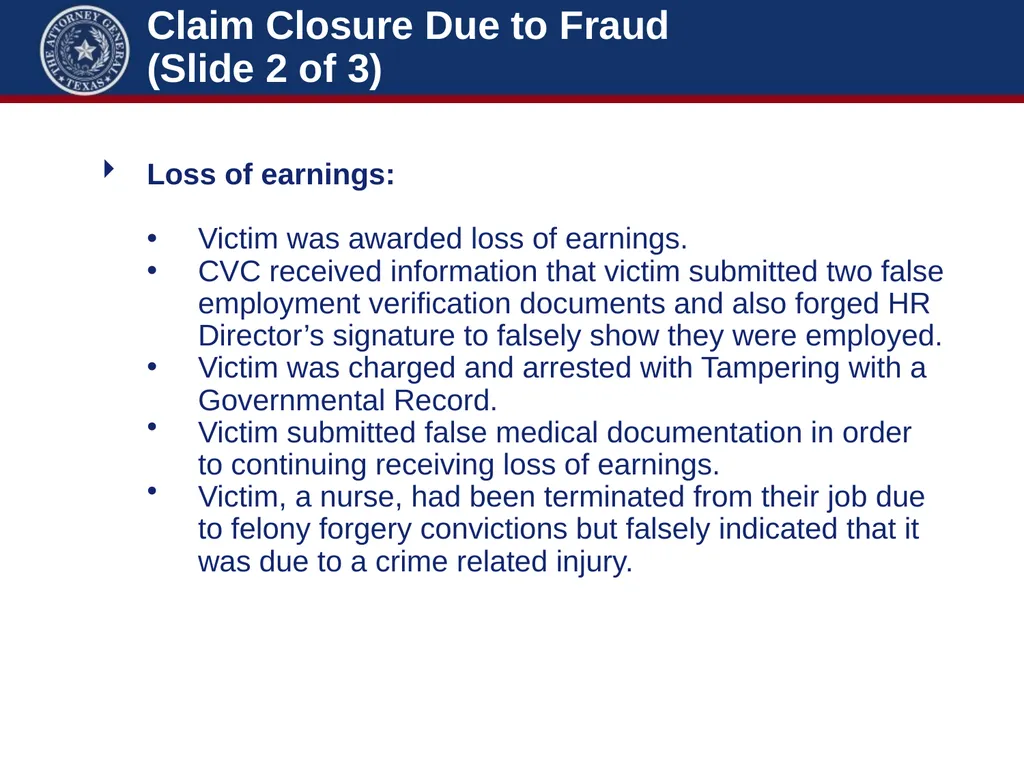
(Slide 2 of 3) Loss of earnings:
Victim was awarded loss of earnings.
CVC received information that victim submitted two false employment verification documents and also forged HR Director’s signature to falsely show they were employed.
Victim was charged and arrested with Tampering with a Governmental Record.
Victim submitted false medical documentation in order to continuing receiving loss of earnings.
Victim, a nurse, had been terminated from their job due to felony forgery convictions but falsely indicated that it was due to a crime related injury.<br>
Victim was awarded loss of earnings.
CVC received information that victim submitted two false employment verification documents and also forged HR Director’s signature to falsely show they were employed.
Victim was charged and arrested with Tampering with a Governmental Record.
Victim submitted false medical documentation in order to continuing receiving loss of earnings.
Victim, a nurse, had been terminated from their job due to felony forgery convictions but falsely indicated that it was due to a crime related injury.<br>
91
Claim Closure Due to Fraud
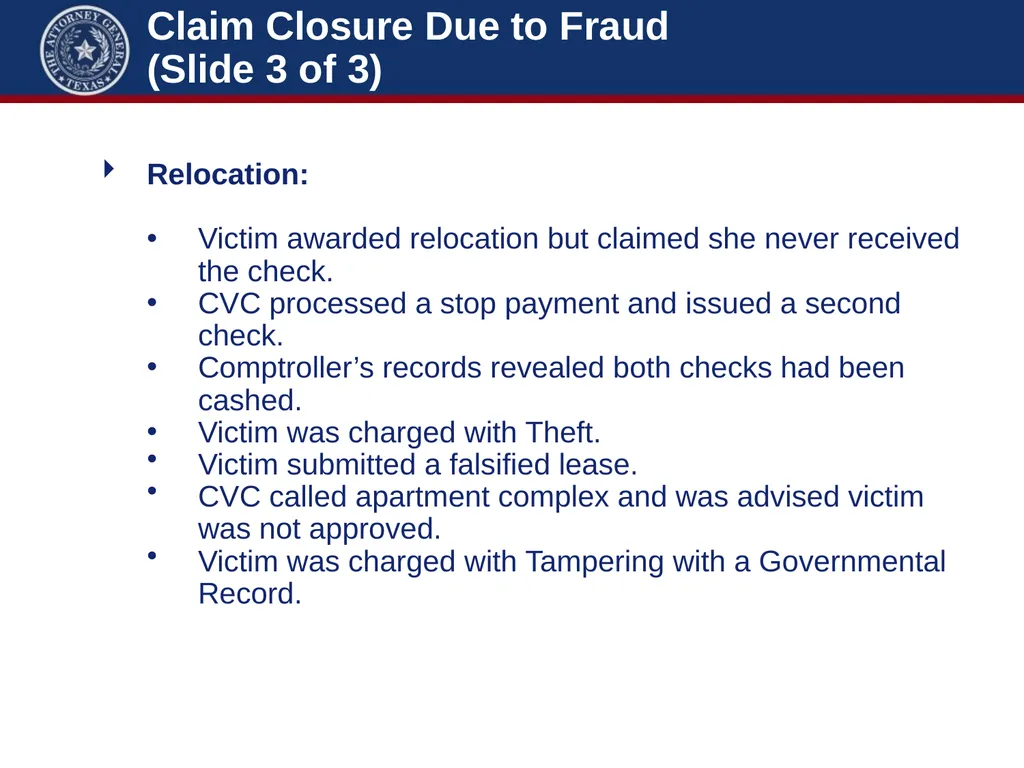
(Slide 3 of 3) Relocation:
Victim awarded relocation but claimed she never received the check.
CVC processed a stop payment and issued a second check.
Comptroller’s records revealed both checks had been cashed.
Victim was charged with Theft.
Victim submitted a falsified lease.
CVC called apartment complex and was advised victim was not approved.
Victim was charged with Tampering with a Governmental Record.<br>
Victim awarded relocation but claimed she never received the check.
CVC processed a stop payment and issued a second check.
Comptroller’s records revealed both checks had been cashed.
Victim was charged with Theft.
Victim submitted a falsified lease.
CVC called apartment complex and was advised victim was not approved.
Victim was charged with Tampering with a Governmental Record.<br>
92
Office of the Attorney General
Crime Victim Services Division
CVC Program
P.O. Box 12198
Austin, TX 78711-2198
Main Number: (512) 936-1200 or (800) 983-9933
Priority Application Fax: (512) 370-9837
Presumptive Eligibility Fax: (512) 370-9995
www.texasattorneygeneral.gov
ITServices@oag.texas.gov
Voice: (512) 936-1768
Fax: (512) 370-3959 Contact Information<br>
Crime Victim Services Division
CVC Program
P.O. Box 12198
Austin, TX 78711-2198
Main Number: (512) 936-1200 or (800) 983-9933
Priority Application Fax: (512) 370-9837
Presumptive Eligibility Fax: (512) 370-9995
www.texasattorneygeneral.gov
ITServices@oag.texas.gov
Voice: (512) 936-1768
Fax: (512) 370-3959 Contact Information<br>