
Crime Victims’ Compensation Program General
CP
Published · 61 slides · 0 views
1 / 1



Description
Crime Victims Compensation Program General Overview To assist in the compassionate and effective delivery of crime victim services by offering information, resources, financial assistance, and education to crime victims and the
Related Topics
Share
Embed code
Download this presentation From Below
"Crime Victims’ Compensation Program General" is the property of its rightful owner. Permission is granted to download and print the materials on this website for personal, non-commercial use only, and to display it on your personal computer provided you do not modify the materials and that you retain all copyright notices contained in the materials. By downloading content from our website, you accept the terms of this agreement.
Presentation Transcript
01
Crime Victims’ Compensation Program
General Overview<br>
02
To assist in the compassionate and effective delivery of crime victim services by offering information, resources, financial assistance, and education to crime victims and the organizations assisting them. Crime Victim Services Division
Mission Statement<br>
03
CVC Program Goals The goal of CVC is to reimburse victims of crime for certain out-of-pocket expenses not reimbursed by other sources.
The Office of the Attorney General shall award to victims and claimants compensation for pecuniary loss arising from criminally injurious conduct.<br>
The Office of the Attorney General shall award to victims and claimants compensation for pecuniary loss arising from criminally injurious conduct.<br>
04
Enabling Legislation Crime Victims’ Compensation Act
Texas Code of Criminal Procedure
Chapter 56B (recodifies ch.56, subch. B) (2021)
CVC began January 1, 1980<br>
Texas Code of Criminal Procedure
Chapter 56B (recodifies ch.56, subch. B) (2021)
CVC began January 1, 1980<br>
05
Legislative Mandates A victim has the RIGHT to request and receive
information about the Crime Victims’ Compensation Program.
Texas Code of Criminal Procedure, Article 56A.051(a)(6)(recodifies art. 56.02(a)(6)) (2021)<br>
information about the Crime Victims’ Compensation Program.
Texas Code of Criminal Procedure, Article 56A.051(a)(6)(recodifies art. 56.02(a)(6)) (2021)<br>
06
CVC Mandates Tex. Code Crim. Proc. art. 56A.401 (recodifies art. 56.07) (2021) Law Enforcement Agencies
Initial contact with victim
Written notice
Tex. Code Crim. Proc. art. 56A.451 (recodifies art. 56.08) (2021) District and County Attorneys
10-day written notice
Assistance with application
Tex. Code Crim. Proc. art. 56B.007 (recodifies art. 56.60) (2021) Public Notice
Posters in hospital emergency rooms<br>
Initial contact with victim
Written notice
Tex. Code Crim. Proc. art. 56A.451 (recodifies art. 56.08) (2021) District and County Attorneys
10-day written notice
Assistance with application
Tex. Code Crim. Proc. art. 56B.007 (recodifies art. 56.60) (2021) Public Notice
Posters in hospital emergency rooms<br>
07
CVC Funding It is not a tax-based or general-revenue-funded program.
No tax dollars are used.
Sources of funding in FY 2020 were:
Court fees
Federal VOCA grant
Restitution
Subrogation
Other receipts
Gifts<br>
No tax dollars are used.
Sources of funding in FY 2020 were:
Court fees
Federal VOCA grant
Restitution
Subrogation
Other receipts
Gifts<br>
08
Restitution The CVC Program pays benefits to an eligible victim.
At some point, an offender is apprehended and convicted.
At sentencing, the judge can order the defendant to pay restitution to the CVC Fund for what the victim was paid in eligible benefits.<br>
At some point, an offender is apprehended and convicted.
At sentencing, the judge can order the defendant to pay restitution to the CVC Fund for what the victim was paid in eligible benefits.<br>
09
Subrogation The CVC Program makes compensation to, or on behalf of, a victim.
Victim files and wins a civil lawsuit for damages or receives a settlement from perpetrator.
Victim reimburses funds to CVC for lawsuits and settlements related to the crime.
Victim and his/her attorney are subject to prosecution for failure to notify CVC.<br>
Victim files and wins a civil lawsuit for damages or receives a settlement from perpetrator.
Victim reimburses funds to CVC for lawsuits and settlements related to the crime.
Victim and his/her attorney are subject to prosecution for failure to notify CVC.<br>
10
Payer of Last Resort All collateral sources must pay first:
Medicaid
Health insurance
Medicare
Texas Workers’ Compensation
Auto insurance<br>
Medicaid
Health insurance
Medicare
Texas Workers’ Compensation
Auto insurance<br>
11
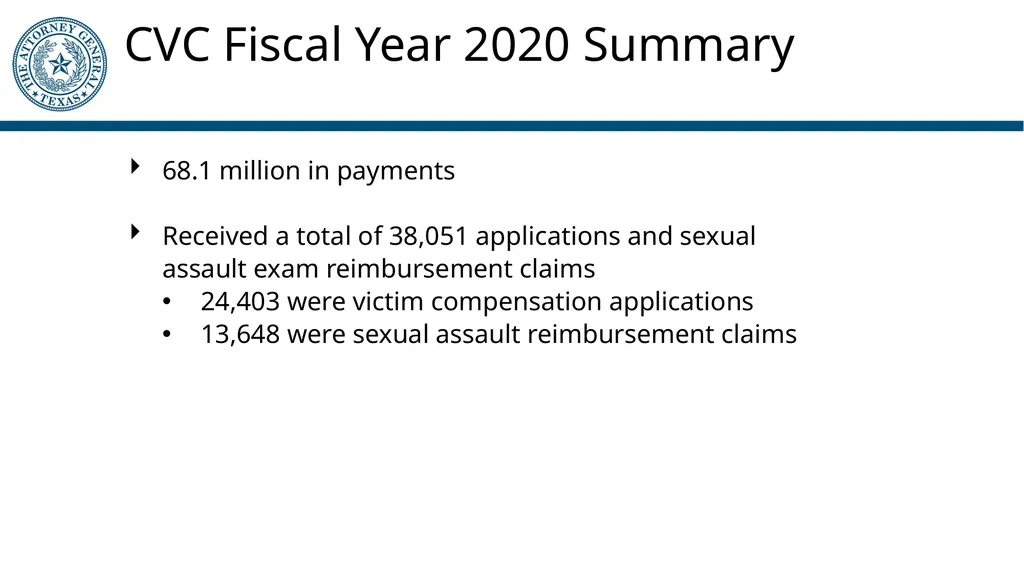
CVC Fiscal Year 2020 Summary 68.1 million in payments
Received a total of 38,051 applications and sexual
assault exam reimbursement claims
24,403 were victim compensation applications
13,648 were sexual assault reimbursement claims<br>
Received a total of 38,051 applications and sexual
assault exam reimbursement claims
24,403 were victim compensation applications
13,648 were sexual assault reimbursement claims<br>
12
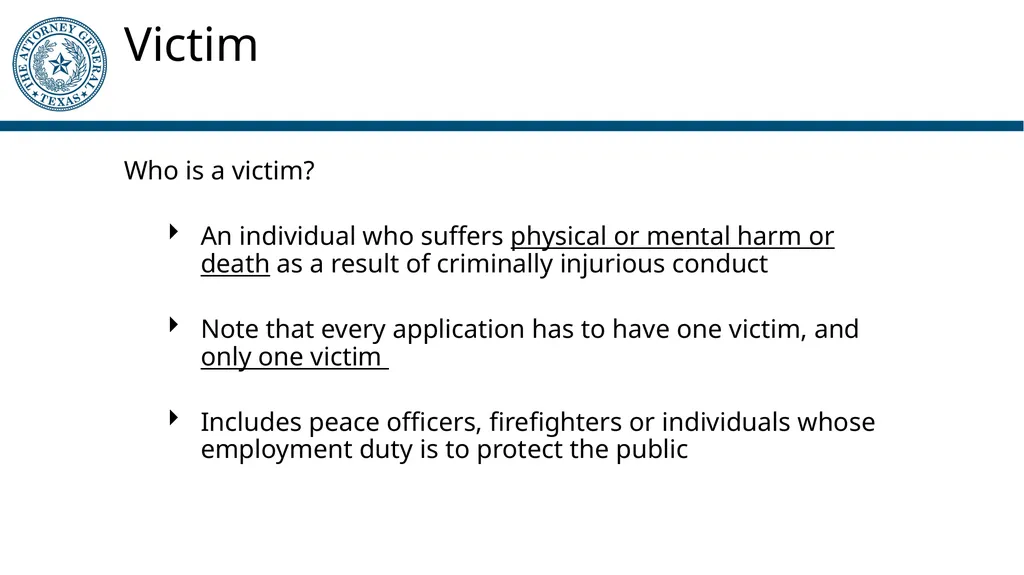
Victim Who is a victim?
An individual who suffers physical or mental harm or death as a result of criminally injurious conduct
Note that every application has to have one victim, and only one victim
Includes peace officers, firefighters or individuals whose employment duty is to protect the public<br>
An individual who suffers physical or mental harm or death as a result of criminally injurious conduct
Note that every application has to have one victim, and only one victim
Includes peace officers, firefighters or individuals whose employment duty is to protect the public<br>
13
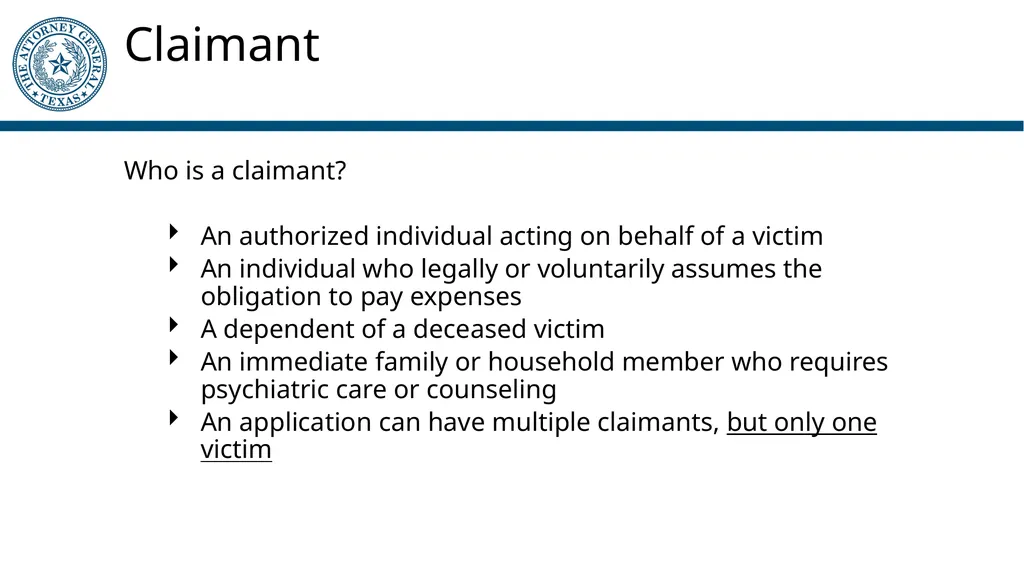
Claimant Who is a claimant?
An authorized individual acting on behalf of a victim
An individual who legally or voluntarily assumes the obligation to pay expenses
A dependent of a deceased victim
An immediate family or household member who requires psychiatric care or counseling
An application can have multiple claimants, but only one victim<br>
An authorized individual acting on behalf of a victim
An individual who legally or voluntarily assumes the obligation to pay expenses
A dependent of a deceased victim
An immediate family or household member who requires psychiatric care or counseling
An application can have multiple claimants, but only one victim<br>
14
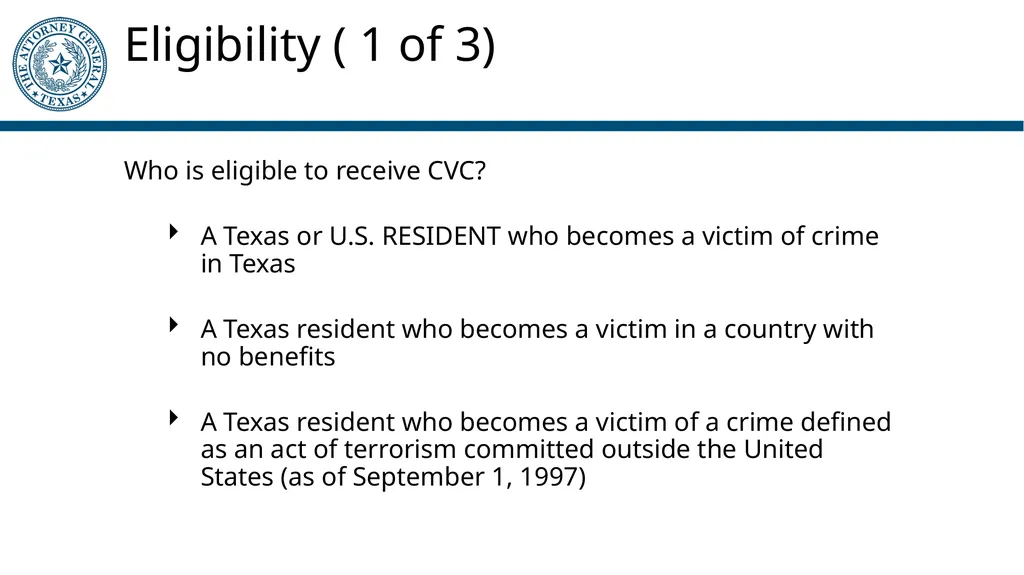
Eligibility ( 1 of 3) Who is eligible to receive CVC?
A Texas or U.S. RESIDENT who becomes a victim of crime in Texas
A Texas resident who becomes a victim in a country with no benefits
A Texas resident who becomes a victim of a crime defined as an act of terrorism committed outside the United States (as of September 1, 1997)<br>
A Texas or U.S. RESIDENT who becomes a victim of crime in Texas
A Texas resident who becomes a victim in a country with no benefits
A Texas resident who becomes a victim of a crime defined as an act of terrorism committed outside the United States (as of September 1, 1997)<br>
15
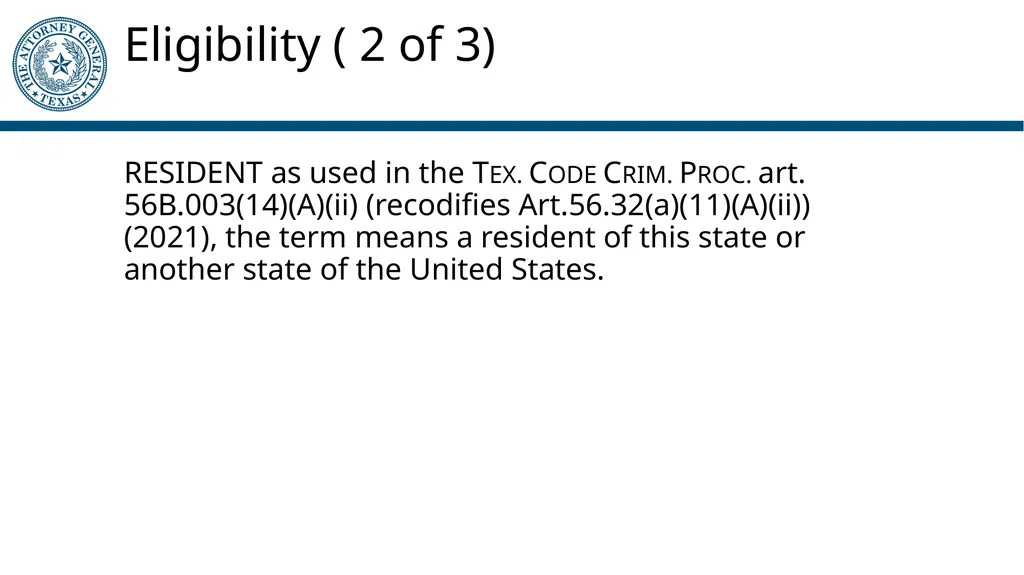
Eligibility ( 2 of 3) RESIDENT as used in the Tex. Code Crim. Proc. art. 56B.003(14)(A)(ii) (recodifies Art.56.32(a)(11)(A)(ii)) (2021), the term means a resident of this state or another state of the United States.<br>
16
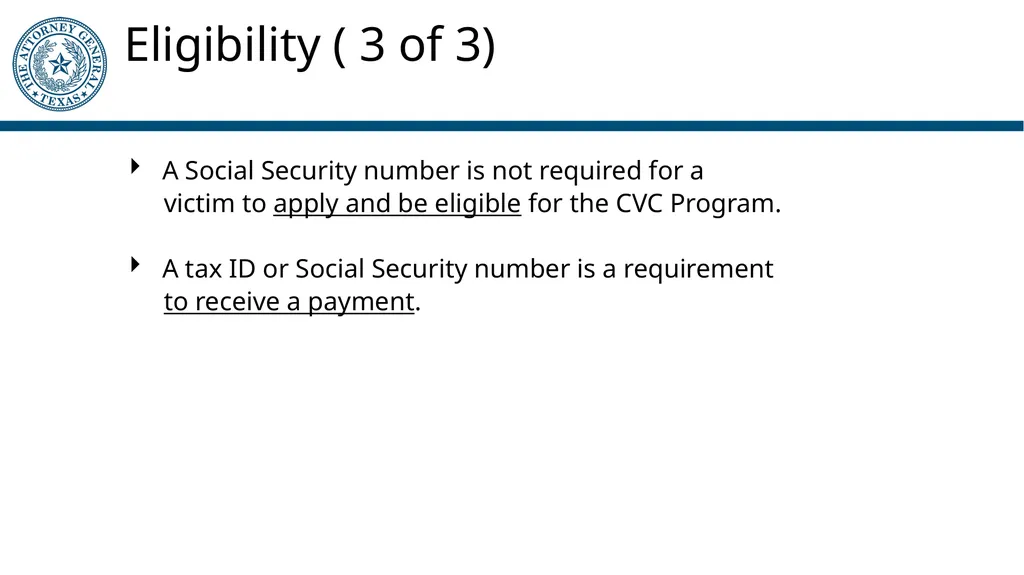
Eligibility ( 3 of 3) A Social Security number is not required for a
victim to apply and be eligible for the CVC Program.
A tax ID or Social Security number is a requirement
to receive a payment.<br>
victim to apply and be eligible for the CVC Program.
A tax ID or Social Security number is a requirement
to receive a payment.<br>
17
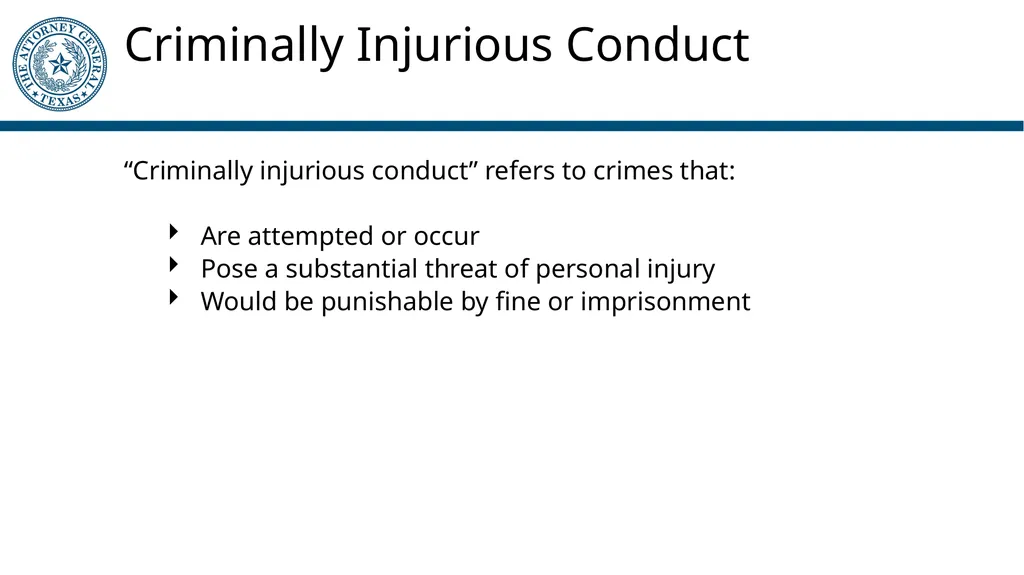
Criminally Injurious Conduct “Criminally injurious conduct” refers to crimes that:
Are attempted or occur
Pose a substantial threat of personal injury
Would be punishable by fine or imprisonment<br>
Are attempted or occur
Pose a substantial threat of personal injury
Would be punishable by fine or imprisonment<br>
18
CIC Crimes Eligible for Reimbursement (1 of 2) Criminal injurious conduct (CIC) crimes are violent crimes against persons.
CIC crimes range from simple assault to homicide and include such crimes as family violence, child sexual assault, kidnapping, arson, robbery and carjacking.<br>
CIC crimes range from simple assault to homicide and include such crimes as family violence, child sexual assault, kidnapping, arson, robbery and carjacking.<br>
19
CIC Crimes Eligible for Reimbursement (2 of 2) CIC vehicular related crimes are:
Crimes of intentional injury with an automobile, boat, or plane
Failure to stop and render aid (hit and run)
Vehicular crimes involving drugs or alcohol
Intoxication-related crimes (assault, manslaughter or criminally negligent homicide)<br>
Crimes of intentional injury with an automobile, boat, or plane
Failure to stop and render aid (hit and run)
Vehicular crimes involving drugs or alcohol
Intoxication-related crimes (assault, manslaughter or criminally negligent homicide)<br>
20
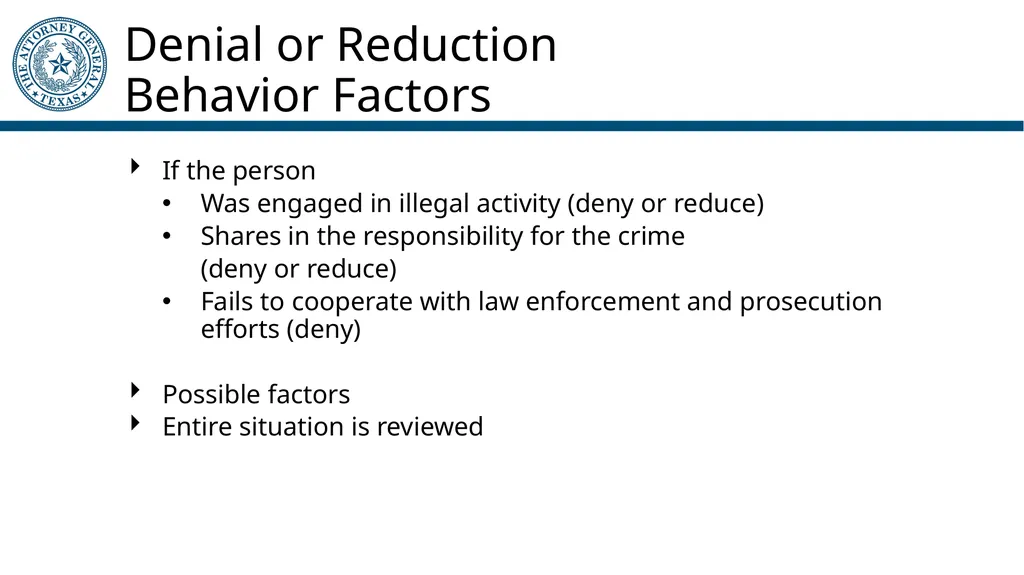
Denial or Reduction
Behavior Factors If the person
Was engaged in illegal activity (deny or reduce)
Shares in the responsibility for the crime
(deny or reduce)
Fails to cooperate with law enforcement and prosecution efforts (deny)
Possible factors
Entire situation is reviewed<br>
Was engaged in illegal activity (deny or reduce)
Shares in the responsibility for the crime
(deny or reduce)
Fails to cooperate with law enforcement and prosecution efforts (deny)
Possible factors
Entire situation is reviewed<br>
21
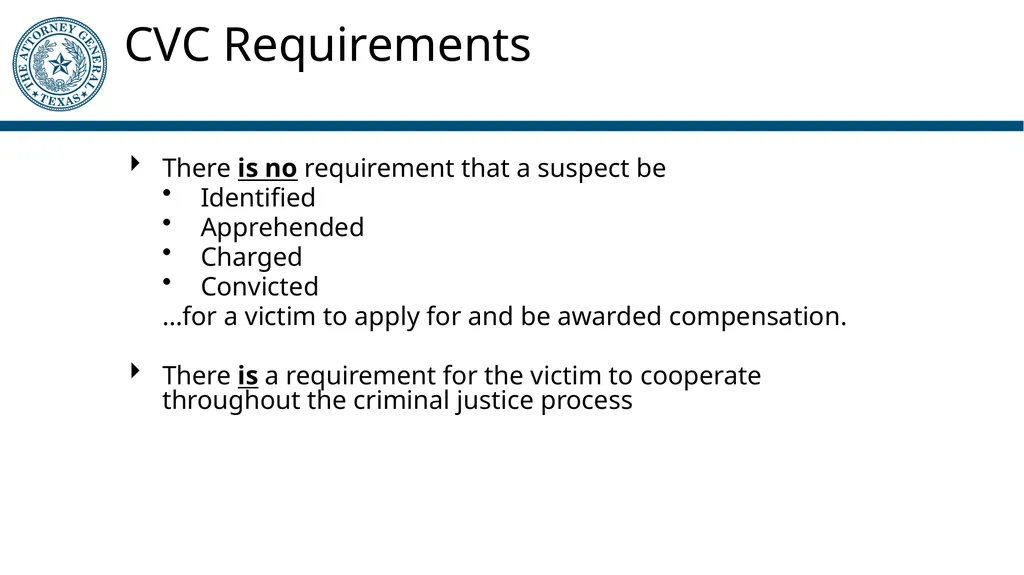
CVC Requirements There is no requirement that a suspect be
Identified
Apprehended
Charged
Convicted
…for a victim to apply for and be awarded compensation.
There is a requirement for the victim to cooperate throughout the criminal justice process<br>
Identified
Apprehended
Charged
Convicted
…for a victim to apply for and be awarded compensation.
There is a requirement for the victim to cooperate throughout the criminal justice process<br>
22
CVC Reporting Requirements Reporting the crime to law enforcement
72 hours prior to September 1, 1997
On or after September 1, 1997, a reasonable period of time, but not so late as to interfere with or hamper the investigation and prosecution
The program has the discretion.
The victim is a child.
Extraordinary circumstances hampered the reporting<br>
72 hours prior to September 1, 1997
On or after September 1, 1997, a reasonable period of time, but not so late as to interfere with or hamper the investigation and prosecution
The program has the discretion.
The victim is a child.
Extraordinary circumstances hampered the reporting<br>
23
CVC Filing Requirements Filing requirements to CVC program
Prior to September 1, 1997, one year
On or after September 1, 1997, three years
Exceptions
Good cause
Child victim through age 18 (pre-1997)
Child victim age 18 to 21 (1997-present)
Victim physically incapacitated<br>
Prior to September 1, 1997, one year
On or after September 1, 1997, three years
Exceptions
Good cause
Child victim through age 18 (pre-1997)
Child victim age 18 to 21 (1997-present)
Victim physically incapacitated<br>
24
Application (1 of 2) The CVC application (English and Spanish) is available on our web page. There is a fillable PDF application or on-line application.
The application is always reviewed after a legislative session to assure it meets statutory requirements.
An application is considered complete and will be
processed when it:
Is filled out in its entirety
Is signed by a victim or a valid adult claimant
Provides law enforcement information
Provides any other information requested by the OAG<br>
The application is always reviewed after a legislative session to assure it meets statutory requirements.
An application is considered complete and will be
processed when it:
Is filled out in its entirety
Is signed by a victim or a valid adult claimant
Provides law enforcement information
Provides any other information requested by the OAG<br>
25
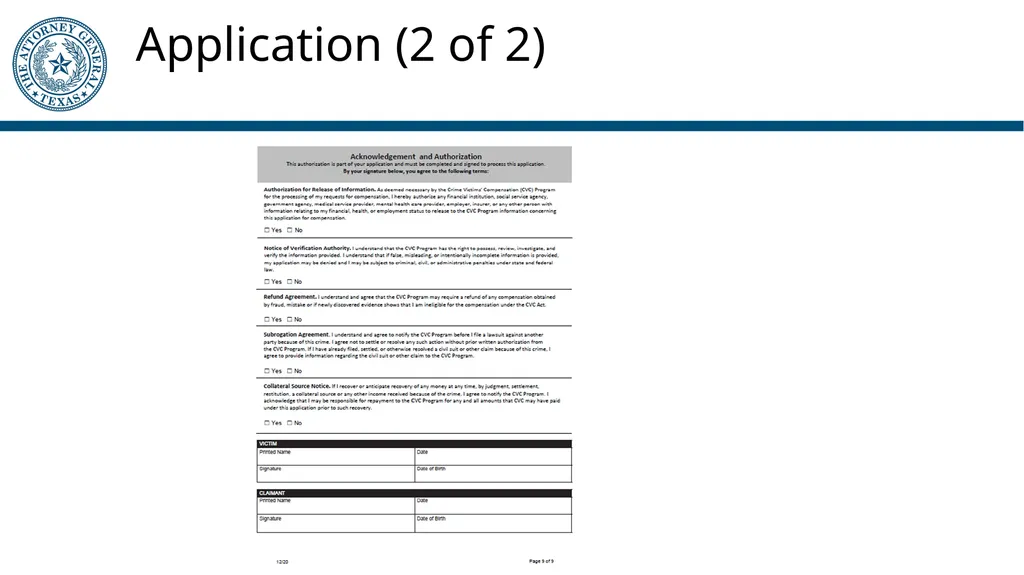
Application (2 of 2)<br>
26
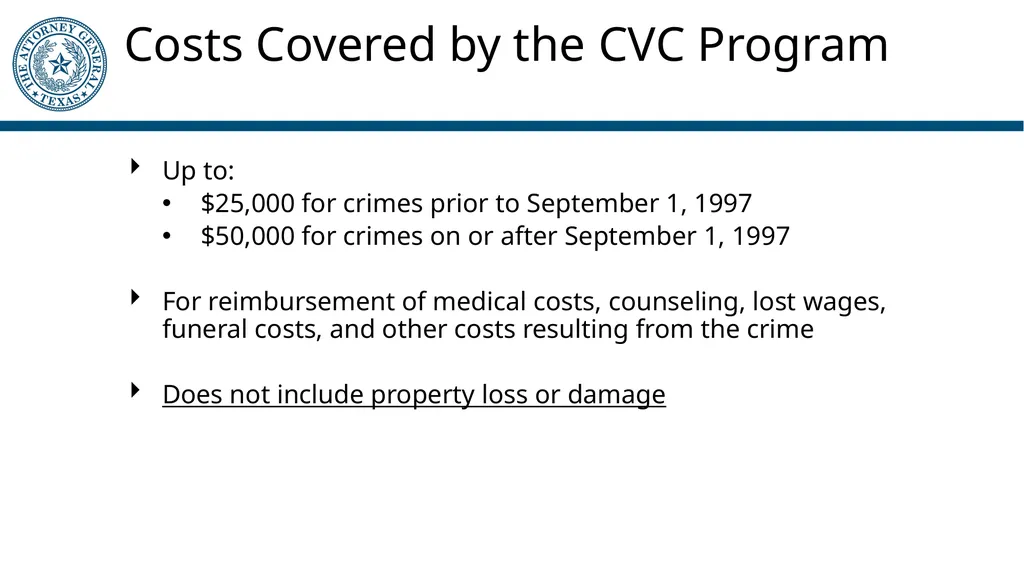
Costs Covered by the CVC Program Up to:
$25,000 for crimes prior to September 1, 1997
$50,000 for crimes on or after September 1, 1997
For reimbursement of medical costs, counseling, lost wages, funeral costs, and other costs resulting from the crime
Does not include property loss or damage<br>
$25,000 for crimes prior to September 1, 1997
$50,000 for crimes on or after September 1, 1997
For reimbursement of medical costs, counseling, lost wages, funeral costs, and other costs resulting from the crime
Does not include property loss or damage<br>
27
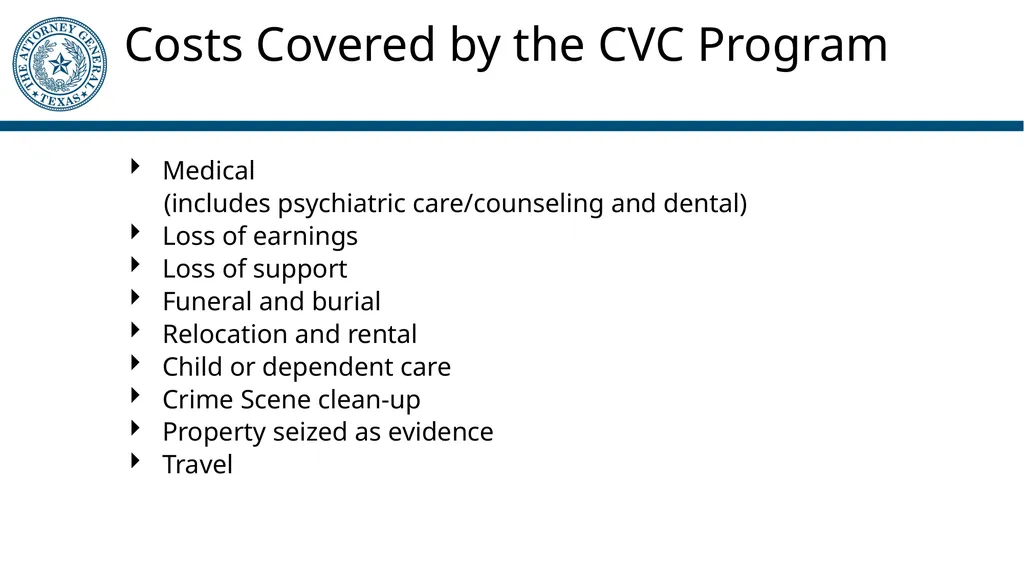
Costs Covered by the CVC Program Medical
(includes psychiatric care/counseling and dental)
Loss of earnings
Loss of support
Funeral and burial
Relocation and rental
Child or dependent care
Crime Scene clean-up
Property seized as evidence
Travel<br>
(includes psychiatric care/counseling and dental)
Loss of earnings
Loss of support
Funeral and burial
Relocation and rental
Child or dependent care
Crime Scene clean-up
Property seized as evidence
Travel<br>
28
Medical Expenses Includes:
Hospital expenses
Doctors’ fees
Prescriptions
Emergency room
Ambulance
X-rays
Rehabilitation
Nursing home
Dental<br>
Hospital expenses
Doctors’ fees
Prescriptions
Emergency room
Ambulance
X-rays
Rehabilitation
Nursing home
Dental<br>
29
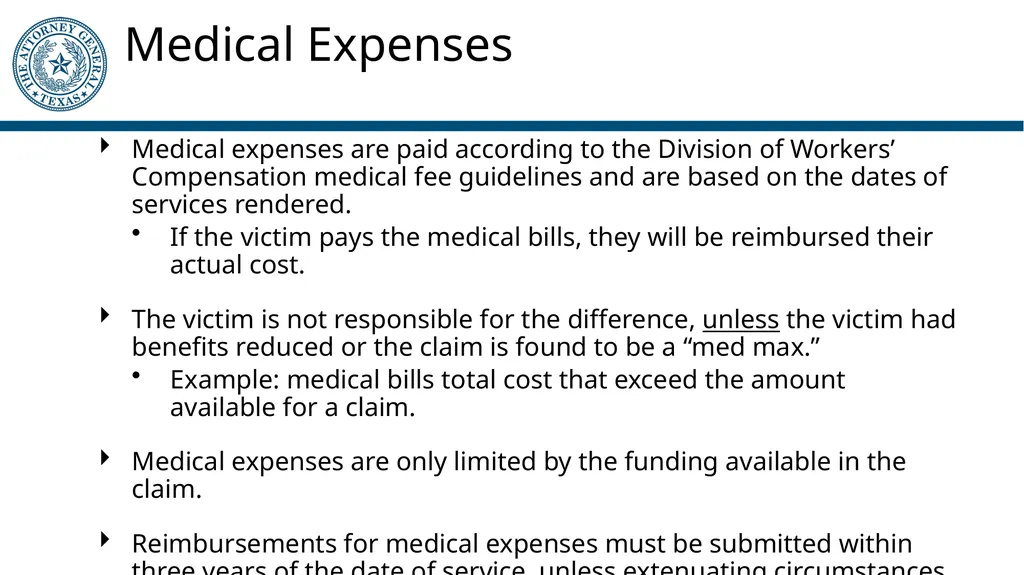
Medical Expenses Medical expenses are paid according to the Division of Workers’ Compensation medical fee guidelines and are based on the dates of services rendered.
If the victim pays the medical bills, they will be reimbursed their actual cost.
The victim is not responsible for the difference, unless the victim had benefits reduced or the claim is found to be a “med max.”
Example: medical bills total cost that exceed the amount available for a claim.
Medical expenses are only limited by the funding available in the claim.
Reimbursements for medical expenses must be submitted within three years of the date of service, unless extenuating circumstances exist.<br>
If the victim pays the medical bills, they will be reimbursed their actual cost.
The victim is not responsible for the difference, unless the victim had benefits reduced or the claim is found to be a “med max.”
Example: medical bills total cost that exceed the amount available for a claim.
Medical expenses are only limited by the funding available in the claim.
Reimbursements for medical expenses must be submitted within three years of the date of service, unless extenuating circumstances exist.<br>
30
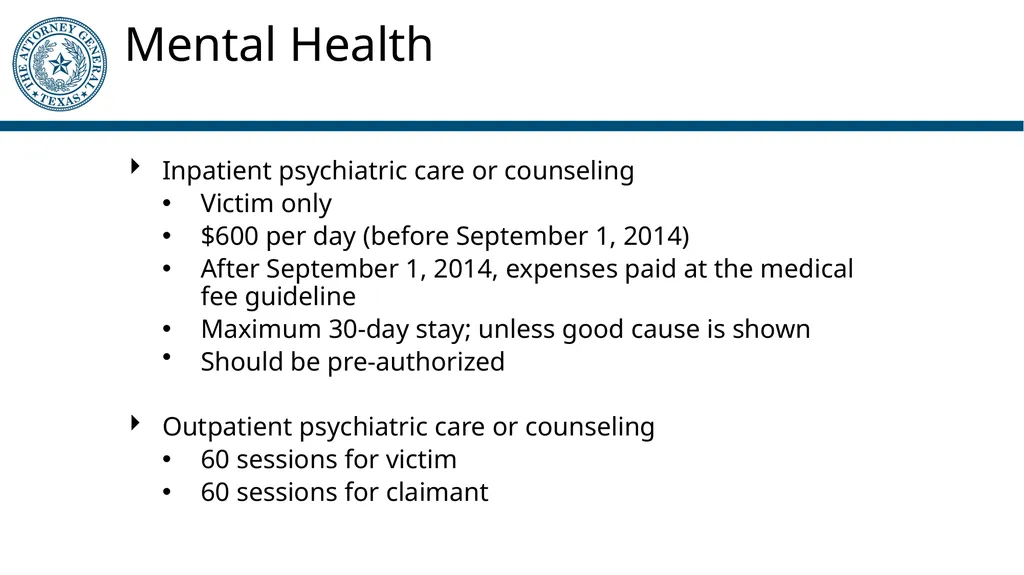
Mental Health Inpatient psychiatric care or counseling
Victim only
$600 per day (before September 1, 2014)
After September 1, 2014, expenses paid at the medical fee guideline
Maximum 30-day stay; unless good cause is shown
Should be pre-authorized
Outpatient psychiatric care or counseling
60 sessions for victim
60 sessions for claimant<br>
Victim only
$600 per day (before September 1, 2014)
After September 1, 2014, expenses paid at the medical fee guideline
Maximum 30-day stay; unless good cause is shown
Should be pre-authorized
Outpatient psychiatric care or counseling
60 sessions for victim
60 sessions for claimant<br>
31
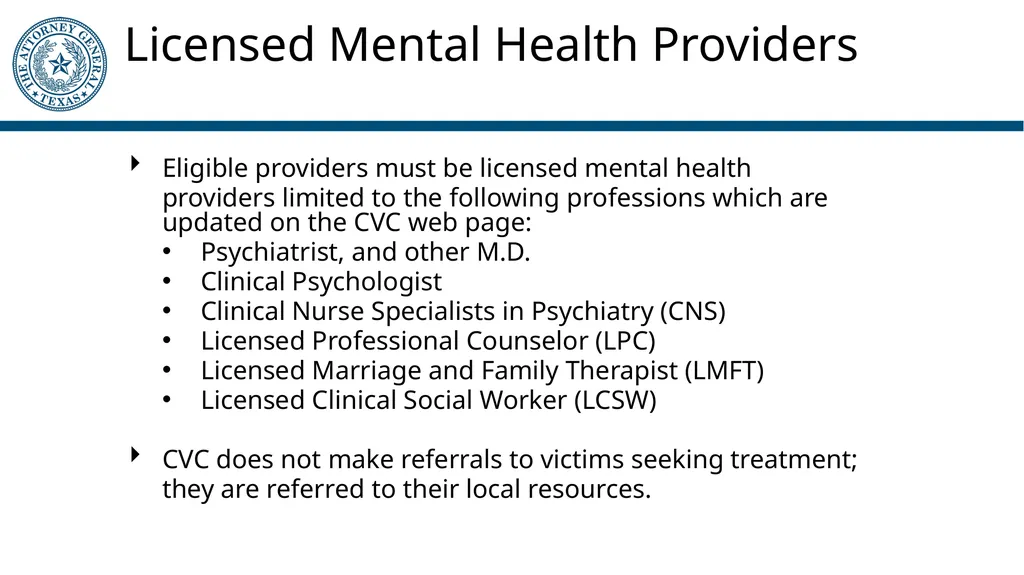
Licensed Mental Health Providers Eligible providers must be licensed mental health
providers limited to the following professions which are updated on the CVC web page:
Psychiatrist, and other M.D.
Clinical Psychologist
Clinical Nurse Specialists in Psychiatry (CNS)
Licensed Professional Counselor (LPC)
Licensed Marriage and Family Therapist (LMFT)
Licensed Clinical Social Worker (LCSW)
CVC does not make referrals to victims seeking treatment;
they are referred to their local resources.<br>
providers limited to the following professions which are updated on the CVC web page:
Psychiatrist, and other M.D.
Clinical Psychologist
Clinical Nurse Specialists in Psychiatry (CNS)
Licensed Professional Counselor (LPC)
Licensed Marriage and Family Therapist (LMFT)
Licensed Clinical Social Worker (LCSW)
CVC does not make referrals to victims seeking treatment;
they are referred to their local resources.<br>
32
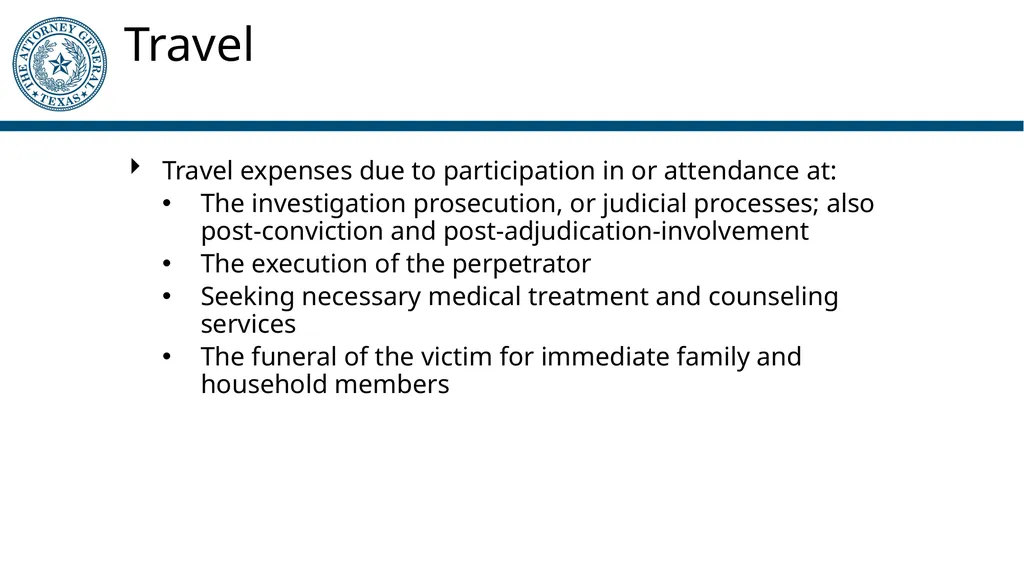
Travel Travel expenses due to participation in or attendance at:
The investigation prosecution, or judicial processes; also post-conviction and post-adjudication-involvement
The execution of the perpetrator
Seeking necessary medical treatment and counseling services
The funeral of the victim for immediate family and household members<br>
The investigation prosecution, or judicial processes; also post-conviction and post-adjudication-involvement
The execution of the perpetrator
Seeking necessary medical treatment and counseling services
The funeral of the victim for immediate family and household members<br>
33
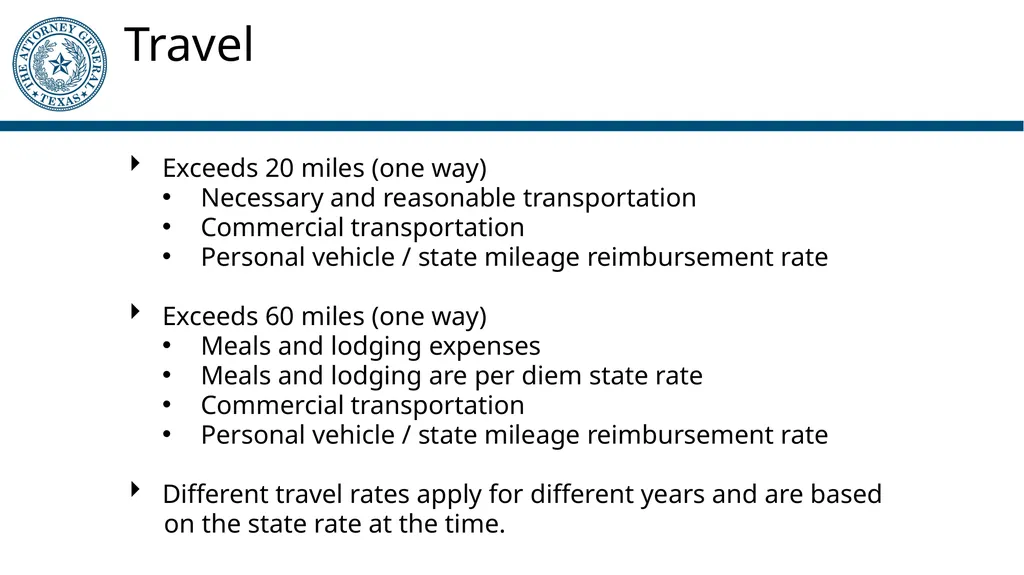
Travel Exceeds 20 miles (one way)
Necessary and reasonable transportation
Commercial transportation
Personal vehicle / state mileage reimbursement rate
Exceeds 60 miles (one way)
Meals and lodging expenses
Meals and lodging are per diem state rate
Commercial transportation
Personal vehicle / state mileage reimbursement rate
Different travel rates apply for different years and are based
on the state rate at the time.<br>
Necessary and reasonable transportation
Commercial transportation
Personal vehicle / state mileage reimbursement rate
Exceeds 60 miles (one way)
Meals and lodging expenses
Meals and lodging are per diem state rate
Commercial transportation
Personal vehicle / state mileage reimbursement rate
Different travel rates apply for different years and are based
on the state rate at the time.<br>
34
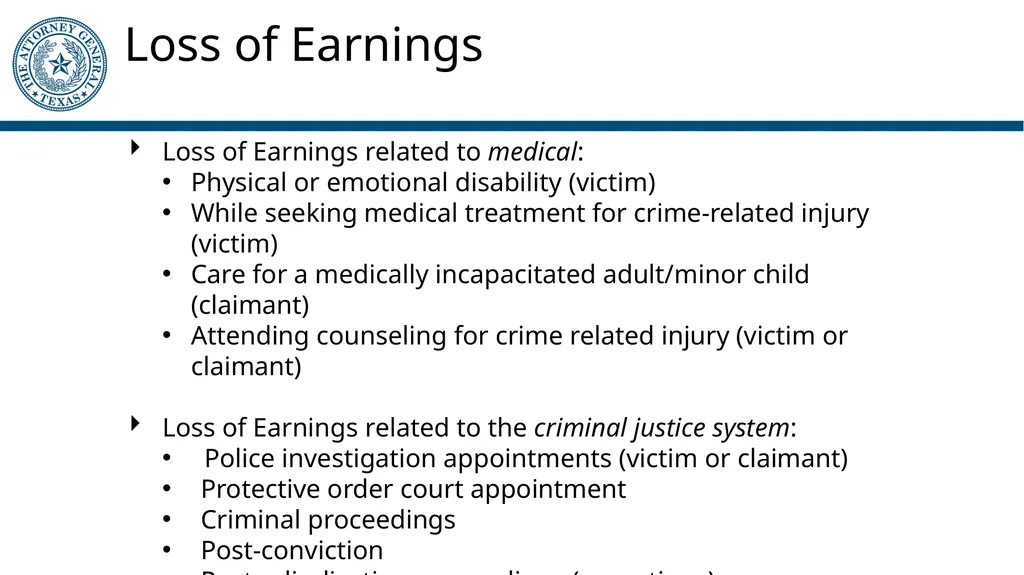
Loss of Earnings Loss of Earnings related to medical:
Physical or emotional disability (victim)
While seeking medical treatment for crime-related injury (victim)
Care for a medically incapacitated adult/minor child (claimant)
Attending counseling for crime related injury (victim or claimant)
Loss of Earnings related to the criminal justice system:
Police investigation appointments (victim or claimant)
Protective order court appointment
Criminal proceedings
Post-conviction
Post-adjudication proceedings (executions)
Loss of Earnings related to victim’s funeral<br>
Physical or emotional disability (victim)
While seeking medical treatment for crime-related injury (victim)
Care for a medically incapacitated adult/minor child (claimant)
Attending counseling for crime related injury (victim or claimant)
Loss of Earnings related to the criminal justice system:
Police investigation appointments (victim or claimant)
Protective order court appointment
Criminal proceedings
Post-conviction
Post-adjudication proceedings (executions)
Loss of Earnings related to victim’s funeral<br>
35
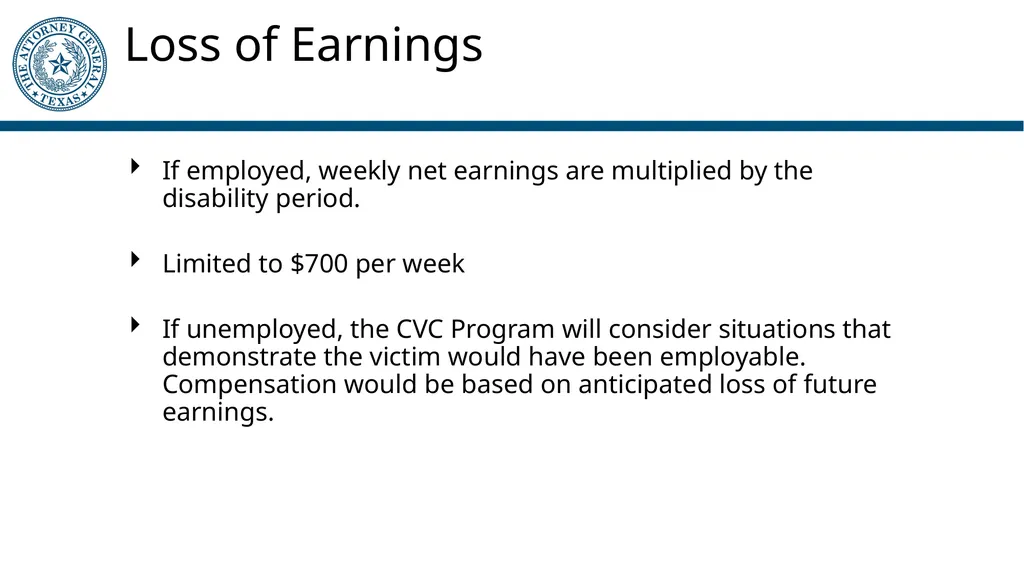
Loss of Earnings If employed, weekly net earnings are multiplied by the disability period.
Limited to $700 per week
If unemployed, the CVC Program will consider situations that demonstrate the victim would have been employable. Compensation would be based on anticipated loss of future earnings.<br>
Limited to $700 per week
If unemployed, the CVC Program will consider situations that demonstrate the victim would have been employable. Compensation would be based on anticipated loss of future earnings.<br>
36
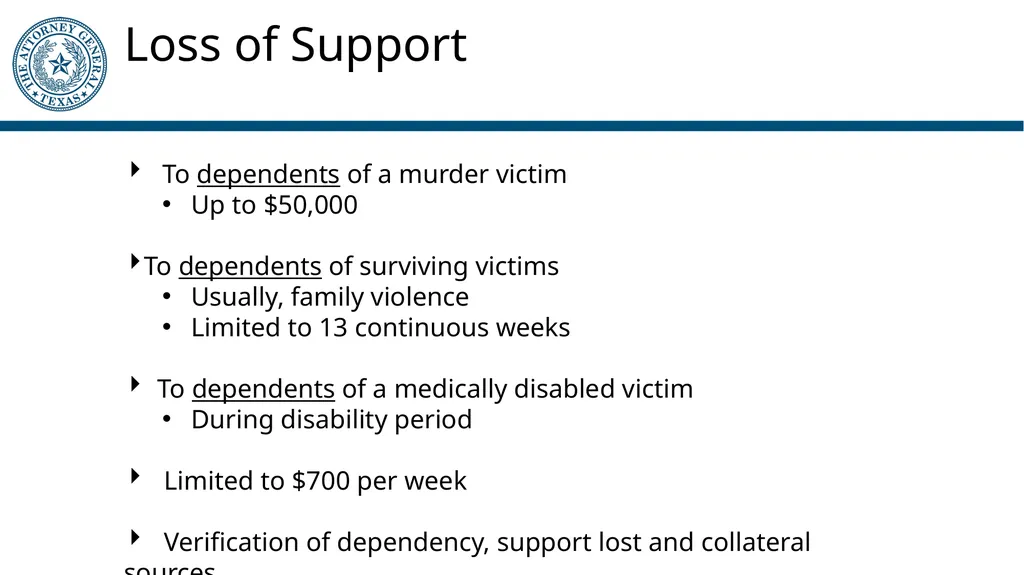
Loss of Support To dependents of a murder victim
Up to $50,000
To dependents of surviving victims
Usually, family violence
Limited to 13 continuous weeks
To dependents of a medically disabled victim
During disability period
Limited to $700 per week
Verification of dependency, support lost and collateral sources<br>
Up to $50,000
To dependents of surviving victims
Usually, family violence
Limited to 13 continuous weeks
To dependents of a medically disabled victim
During disability period
Limited to $700 per week
Verification of dependency, support lost and collateral sources<br>
37
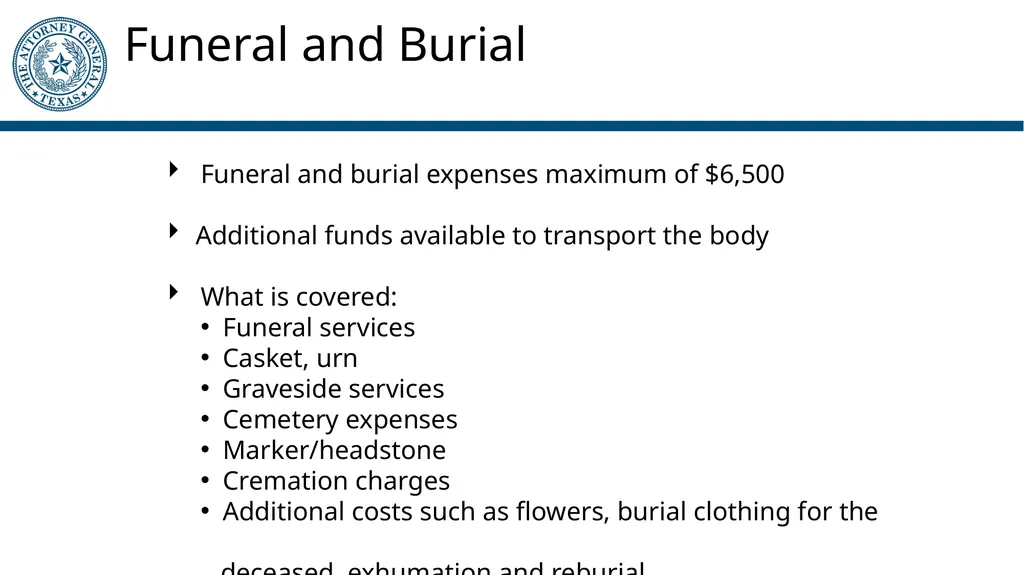
Funeral and Burial Funeral and burial expenses maximum of $6,500
Additional funds available to transport the body
What is covered:
Funeral services
Casket, urn
Graveside services
Cemetery expenses
Marker/headstone
Cremation charges
Additional costs such as flowers, burial clothing for the
deceased, exhumation and reburial<br>
Additional funds available to transport the body
What is covered:
Funeral services
Casket, urn
Graveside services
Cemetery expenses
Marker/headstone
Cremation charges
Additional costs such as flowers, burial clothing for the
deceased, exhumation and reburial<br>
38
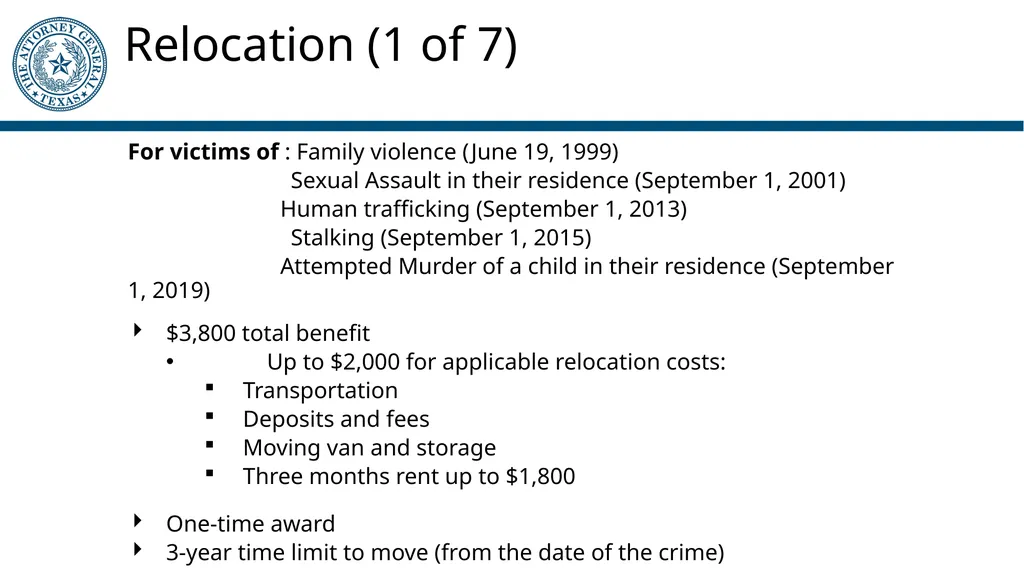
Relocation (1 of 7) For victims of : Family violence (June 19, 1999)
Sexual Assault in their residence (September 1, 2001)
Human trafficking (September 1, 2013)
Stalking (September 1, 2015)
Attempted Murder of a child in their residence (September 1, 2019)
$3,800 total benefit
Up to $2,000 for applicable relocation costs:
Transportation
Deposits and fees
Moving van and storage
Three months rent up to $1,800
One-time award
3-year time limit to move (from the date of the crime)<br>
Sexual Assault in their residence (September 1, 2001)
Human trafficking (September 1, 2013)
Stalking (September 1, 2015)
Attempted Murder of a child in their residence (September 1, 2019)
$3,800 total benefit
Up to $2,000 for applicable relocation costs:
Transportation
Deposits and fees
Moving van and storage
Three months rent up to $1,800
One-time award
3-year time limit to move (from the date of the crime)<br>
39
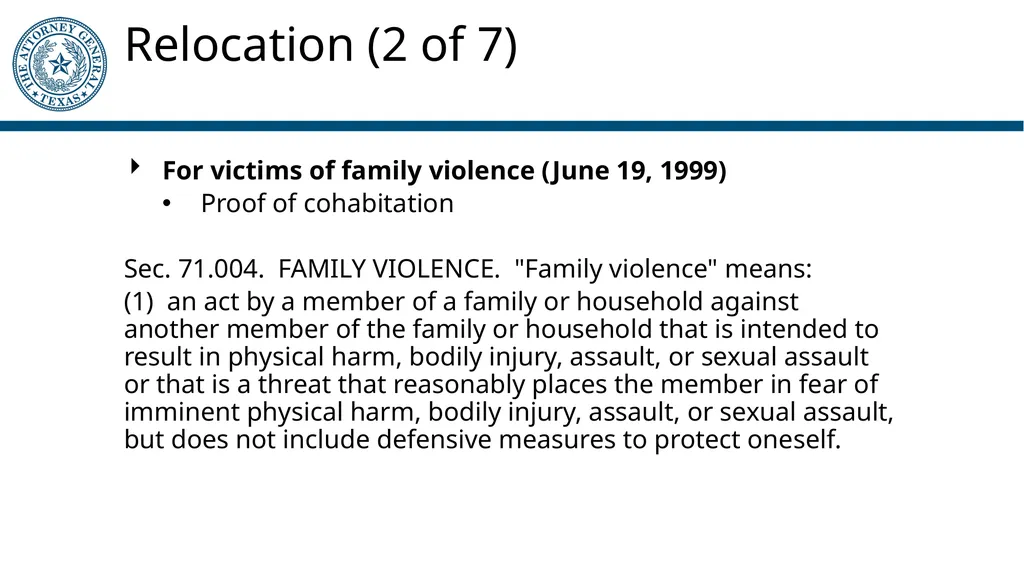
Relocation (2 of 7) For victims of family violence (June 19, 1999)
Proof of cohabitation
Sec. 71.004. FAMILY VIOLENCE. "Family violence" means:
(1) an act by a member of a family or household against another member of the family or household that is intended to result in physical harm, bodily injury, assault, or sexual assault or that is a threat that reasonably places the member in fear of imminent physical harm, bodily injury, assault, or sexual assault, but does not include defensive measures to protect oneself.<br>
Proof of cohabitation
Sec. 71.004. FAMILY VIOLENCE. "Family violence" means:
(1) an act by a member of a family or household against another member of the family or household that is intended to result in physical harm, bodily injury, assault, or sexual assault or that is a threat that reasonably places the member in fear of imminent physical harm, bodily injury, assault, or sexual assault, but does not include defensive measures to protect oneself.<br>
40
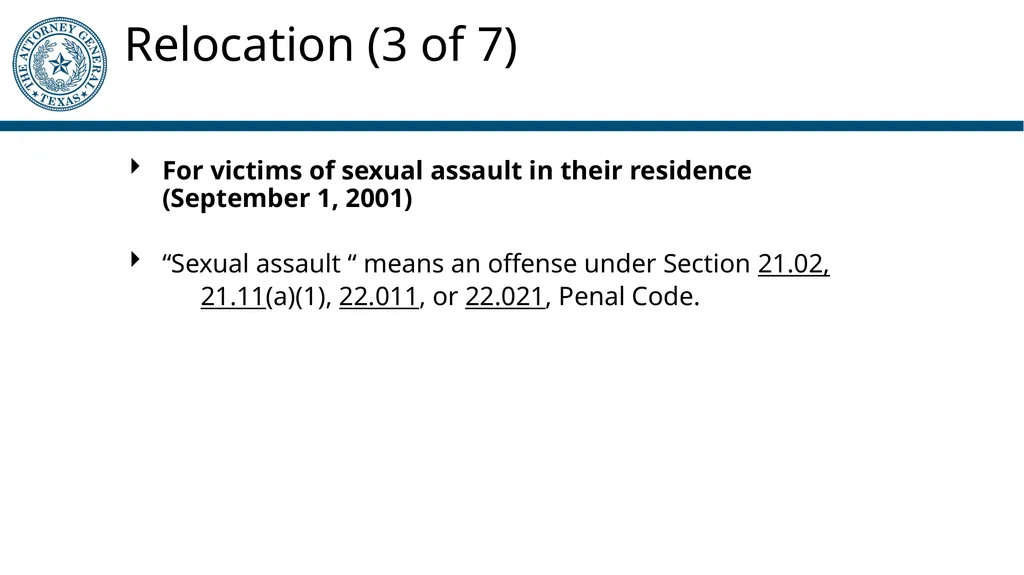
Relocation (3 of 7) For victims of sexual assault in their residence (September 1, 2001)
“Sexual assault “ means an offense under Section 21.02,
21.11(a)(1), 22.011, or 22.021, Penal Code.<br>
“Sexual assault “ means an offense under Section 21.02,
21.11(a)(1), 22.011, or 22.021, Penal Code.<br>
41
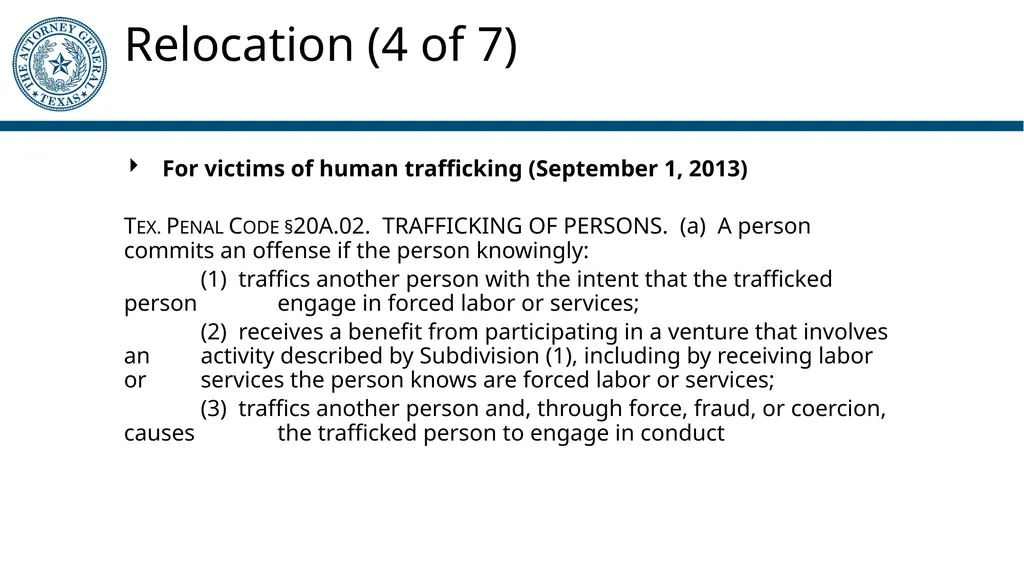
Relocation (4 of 7) For victims of human trafficking (September 1, 2013)
Tex. Penal Code §20A.02. TRAFFICKING OF PERSONS. (a) A person commits an offense if the person knowingly:
(1) traffics another person with the intent that the trafficked person engage in forced labor or services;
(2) receives a benefit from participating in a venture that involves an activity described by Subdivision (1), including by receiving labor or services the person knows are forced labor or services;
(3) traffics another person and, through force, fraud, or coercion, causes the trafficked person to engage in conduct<br>
Tex. Penal Code §20A.02. TRAFFICKING OF PERSONS. (a) A person commits an offense if the person knowingly:
(1) traffics another person with the intent that the trafficked person engage in forced labor or services;
(2) receives a benefit from participating in a venture that involves an activity described by Subdivision (1), including by receiving labor or services the person knows are forced labor or services;
(3) traffics another person and, through force, fraud, or coercion, causes the trafficked person to engage in conduct<br>
42
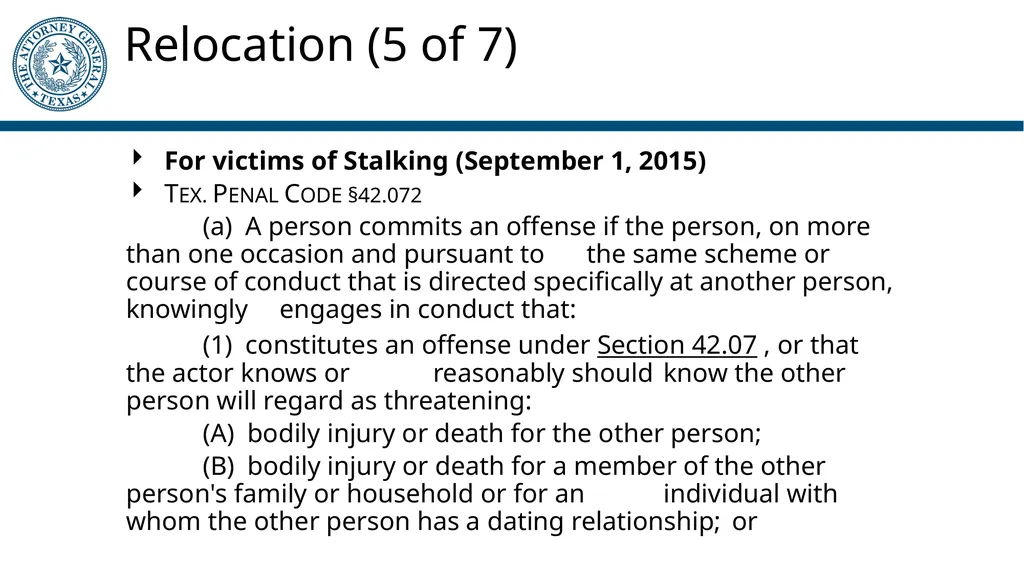
Relocation (5 of 7) For victims of Stalking (September 1, 2015)
Tex. Penal Code §42.072
(a) A person commits an offense if the person, on more than one occasion and pursuant to the same scheme or course of conduct that is directed specifically at another person, knowingly engages in conduct that:
(1) constitutes an offense under Section 42.07 , or that the actor knows or reasonably should know the other person will regard as threatening:
(A) bodily injury or death for the other person;
(B) bodily injury or death for a member of the other person's family or household or for an individual with whom the other person has a dating relationship; or<br>
Tex. Penal Code §42.072
(a) A person commits an offense if the person, on more than one occasion and pursuant to the same scheme or course of conduct that is directed specifically at another person, knowingly engages in conduct that:
(1) constitutes an offense under Section 42.07 , or that the actor knows or reasonably should know the other person will regard as threatening:
(A) bodily injury or death for the other person;
(B) bodily injury or death for a member of the other person's family or household or for an individual with whom the other person has a dating relationship; or<br>
43
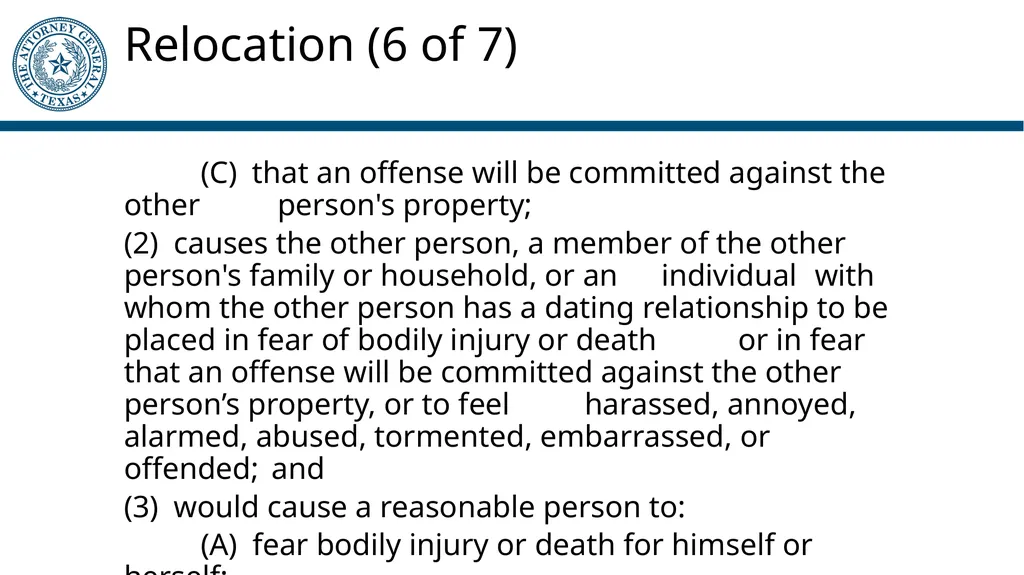
Relocation (6 of 7) (C) that an offense will be committed against the other person's property;
(2) causes the other person, a member of the other person's family or household, or an individual with whom the other person has a dating relationship to be placed in fear of bodily injury or death or in fear that an offense will be committed against the other person’s property, or to feel harassed, annoyed, alarmed, abused, tormented, embarrassed, or offended; and
(3) would cause a reasonable person to:
(A) fear bodily injury or death for himself or herself;<br>
(2) causes the other person, a member of the other person's family or household, or an individual with whom the other person has a dating relationship to be placed in fear of bodily injury or death or in fear that an offense will be committed against the other person’s property, or to feel harassed, annoyed, alarmed, abused, tormented, embarrassed, or offended; and
(3) would cause a reasonable person to:
(A) fear bodily injury or death for himself or herself;<br>
44
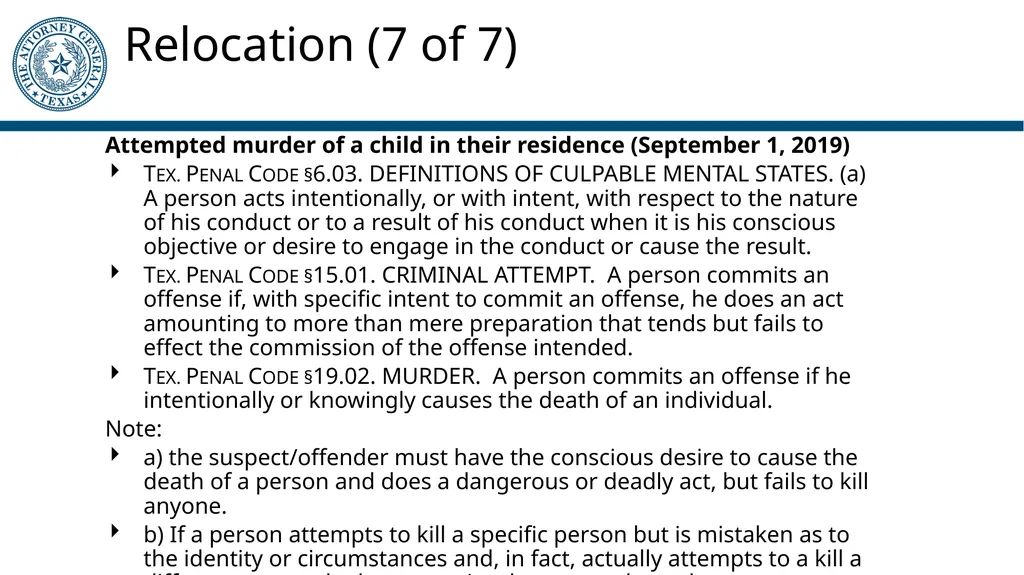
Relocation (7 of 7) Attempted murder of a child in their residence (September 1, 2019)
Tex. Penal Code §6.03. DEFINITIONS OF CULPABLE MENTAL STATES. (a) A person acts intentionally, or with intent, with respect to the nature of his conduct or to a result of his conduct when it is his conscious objective or desire to engage in the conduct or cause the result.
Tex. Penal Code §15.01. CRIMINAL ATTEMPT. A person commits an offense if, with specific intent to commit an offense, he does an act amounting to more than mere preparation that tends but fails to effect the commission of the offense intended.
Tex. Penal Code §19.02. MURDER. A person commits an offense if he intentionally or knowingly causes the death of an individual.
Note:
a) the suspect/offender must have the conscious desire to cause the death of a person and does a dangerous or deadly act, but fails to kill anyone.
b) If a person attempts to kill a specific person but is mistaken as to the identity or circumstances and, in fact, actually attempts to a kill a different person, he has committed attempted murder.<br>
Tex. Penal Code §6.03. DEFINITIONS OF CULPABLE MENTAL STATES. (a) A person acts intentionally, or with intent, with respect to the nature of his conduct or to a result of his conduct when it is his conscious objective or desire to engage in the conduct or cause the result.
Tex. Penal Code §15.01. CRIMINAL ATTEMPT. A person commits an offense if, with specific intent to commit an offense, he does an act amounting to more than mere preparation that tends but fails to effect the commission of the offense intended.
Tex. Penal Code §19.02. MURDER. A person commits an offense if he intentionally or knowingly causes the death of an individual.
Note:
a) the suspect/offender must have the conscious desire to cause the death of a person and does a dangerous or deadly act, but fails to kill anyone.
b) If a person attempts to kill a specific person but is mistaken as to the identity or circumstances and, in fact, actually attempts to a kill a different person, he has committed attempted murder.<br>
45
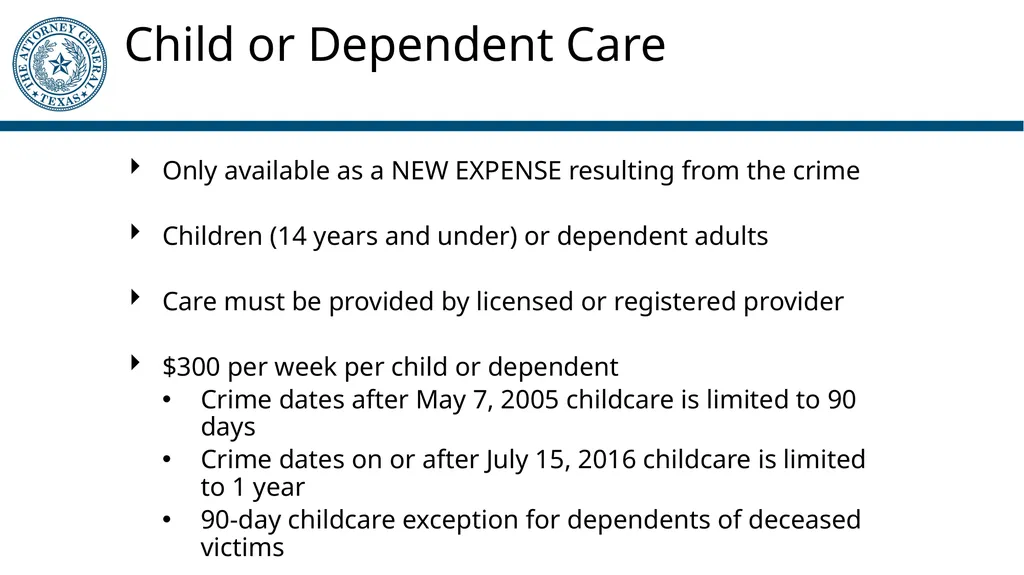
Child or Dependent Care Only available as a NEW EXPENSE resulting from the crime
Children (14 years and under) or dependent adults
Care must be provided by licensed or registered provider
$300 per week per child or dependent
Crime dates after May 7, 2005 childcare is limited to 90 days
Crime dates on or after July 15, 2016 childcare is limited to 1 year
90-day childcare exception for dependents of deceased victims<br>
Children (14 years and under) or dependent adults
Care must be provided by licensed or registered provider
$300 per week per child or dependent
Crime dates after May 7, 2005 childcare is limited to 90 days
Crime dates on or after July 15, 2016 childcare is limited to 1 year
90-day childcare exception for dependents of deceased victims<br>
46
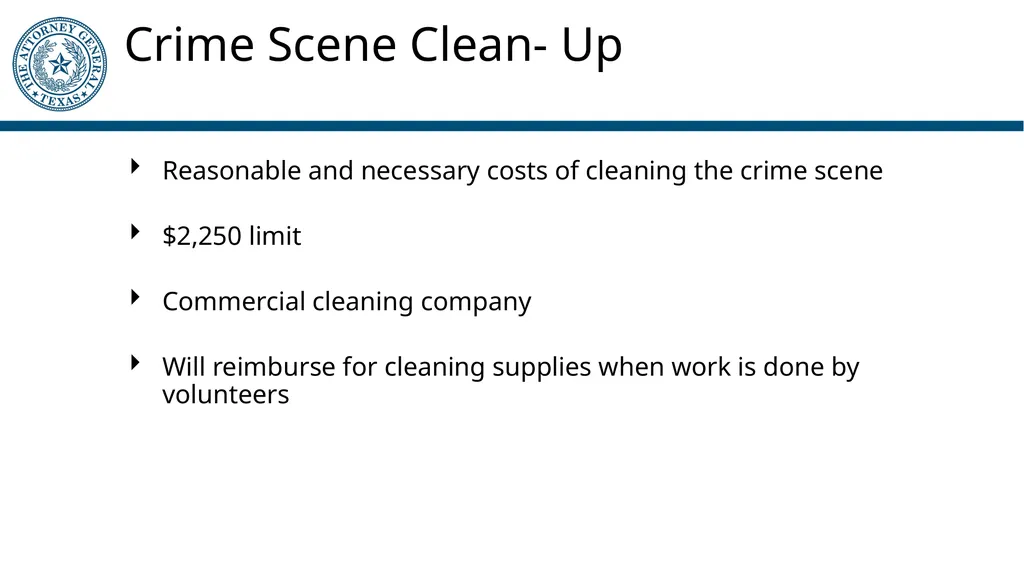
Crime Scene Clean- Up Reasonable and necessary costs of cleaning the crime scene
$2,250 limit
Commercial cleaning company
Will reimburse for cleaning supplies when work is done by volunteers<br>
$2,250 limit
Commercial cleaning company
Will reimburse for cleaning supplies when work is done by volunteers<br>
47
Property Seized as Evidence Reasonable replacement costs for clothing, bedding, or property of the victim seized as evidence or rendered unusable as a result of the criminal investigation
$1,000 limit
This is the only property for which reimbursement can be
paid by CVC.<br>
$1,000 limit
This is the only property for which reimbursement can be
paid by CVC.<br>
48
Extraordinary Pecuniary Loss Extraordinary pecuniary loss is a total and permanent disability.
Above the base award the EPL benefit is
Additional $25,000
(for crimes occurring September 1995-97)
Additional $50,000
(for crimes occurring on or after
September 1, 1997 to August 31, 2001)
Additional $75,000
(for crimes occurring on or after September 1, 2001)<br>
Above the base award the EPL benefit is
Additional $25,000
(for crimes occurring September 1995-97)
Additional $50,000
(for crimes occurring on or after
September 1, 1997 to August 31, 2001)
Additional $75,000
(for crimes occurring on or after September 1, 2001)<br>
49
Extraordinary Pecuniary Loss Total and Permanent Disability Durable medical equipment
Rehabilitation technology
Nursing home care
Home and Auto adaptions
Vocational Rehabilitation
Home health care
Training in the use of special appliances
Loss of earnings
Job training<br>
Rehabilitation technology
Nursing home care
Home and Auto adaptions
Vocational Rehabilitation
Home health care
Training in the use of special appliances
Loss of earnings
Job training<br>
50
Appeals Process The victim or claimant has the right to appeal a decision (eligibility or awards)
Reconsideration
Final ruling hearing
Texas district court<br>
Reconsideration
Final ruling hearing
Texas district court<br>
51
Claim Closure Due to Fraud Tex. Code Crim. Proc. art. 56B.057(b)(7)
The attorney general shall deny an application for
compensation under this subchapter if the claimant or
victim knowingly or intentionally submits false or forged
information to the attorney general.
Tex. Code Crim. Proc. art. 56B.054(d)
The attorney general may investigate an application.
Tex. Code Crim. Proc. art. 56B.108(a)
The attorney general, on the attorney general’s own motion,
or on request of a claimant or victim, may reconsider;
(1) a decision to make or deny an awards; or
(2) the amount of the award<br>
The attorney general shall deny an application for
compensation under this subchapter if the claimant or
victim knowingly or intentionally submits false or forged
information to the attorney general.
Tex. Code Crim. Proc. art. 56B.054(d)
The attorney general may investigate an application.
Tex. Code Crim. Proc. art. 56B.108(a)
The attorney general, on the attorney general’s own motion,
or on request of a claimant or victim, may reconsider;
(1) a decision to make or deny an awards; or
(2) the amount of the award<br>
52
Claim Closure Due to Fraud Loss of earnings
Scenario 1
Victim was awarded loss of earnings.
CVC received information that victim submitted two false employment verification documents and also forged HR Director’s signature to falsely show they were employed.
Victim was charged and arrested for tampering with a governmental record.
Scenario 2
Victim submitted false medical documentation in order to continuing receiving loss of Earnings.
Victim, a nurse, had been terminated from his/her job due to felony forgery convictions, but falsely indicated that it was due to a crime-related injury.<br>
Scenario 1
Victim was awarded loss of earnings.
CVC received information that victim submitted two false employment verification documents and also forged HR Director’s signature to falsely show they were employed.
Victim was charged and arrested for tampering with a governmental record.
Scenario 2
Victim submitted false medical documentation in order to continuing receiving loss of Earnings.
Victim, a nurse, had been terminated from his/her job due to felony forgery convictions, but falsely indicated that it was due to a crime-related injury.<br>
53
Claim Closure Due to Fraud Relocation
Scenario 1
Victim awarded relocation, but claimed she never received the check.
CVC processed a stop payment and issued a 2nd check.
Comptroller’s records revealed both checks had been cashed.
Victim was charged with theft.
Scenario 2
Victim submitted a falsified lease.
CVC called apartment complex and was advised victim was not approved.
Victim was charged with tampering with a governmental record.<br>
Scenario 1
Victim awarded relocation, but claimed she never received the check.
CVC processed a stop payment and issued a 2nd check.
Comptroller’s records revealed both checks had been cashed.
Victim was charged with theft.
Scenario 2
Victim submitted a falsified lease.
CVC called apartment complex and was advised victim was not approved.
Victim was charged with tampering with a governmental record.<br>
54
CVC Claims Management System CVC Secure Web portal is a tool applicable users can access
to view basic CVC claim information via the Internet.
There are two levels of security access to CMS:
Service Providers
Law Enforcement/ Victim advocates<br>
to view basic CVC claim information via the Internet.
There are two levels of security access to CMS:
Service Providers
Law Enforcement/ Victim advocates<br>
55
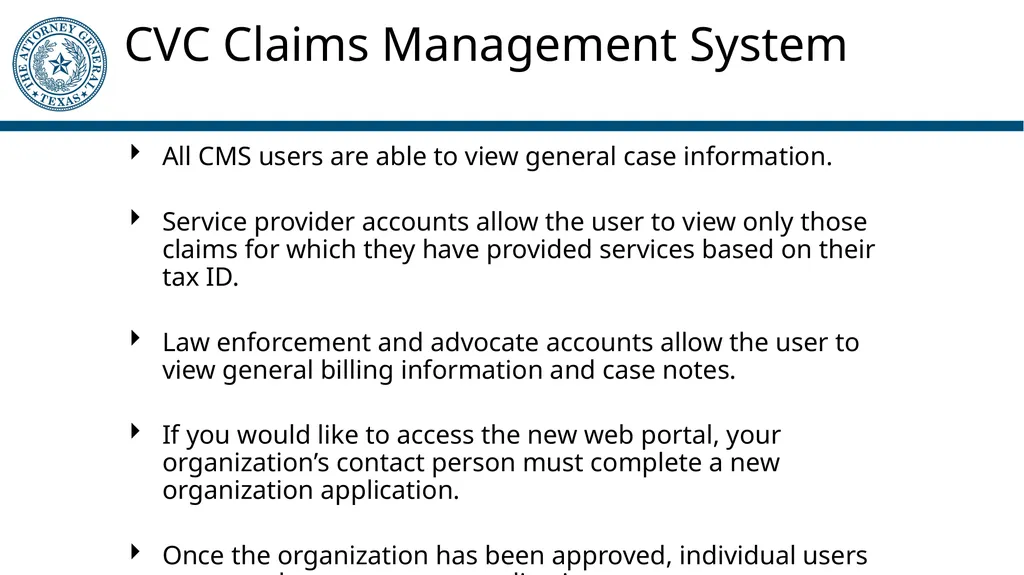
CVC Claims Management System All CMS users are able to view general case information.
Service provider accounts allow the user to view only those claims for which they have provided services based on their tax ID.
Law enforcement and advocate accounts allow the user to view general billing information and case notes.
If you would like to access the new web portal, your organization’s contact person must complete a new organization application.
Once the organization has been approved, individual users can complete a new user application.<br>
Service provider accounts allow the user to view only those claims for which they have provided services based on their tax ID.
Law enforcement and advocate accounts allow the user to view general billing information and case notes.
If you would like to access the new web portal, your organization’s contact person must complete a new organization application.
Once the organization has been approved, individual users can complete a new user application.<br>
56
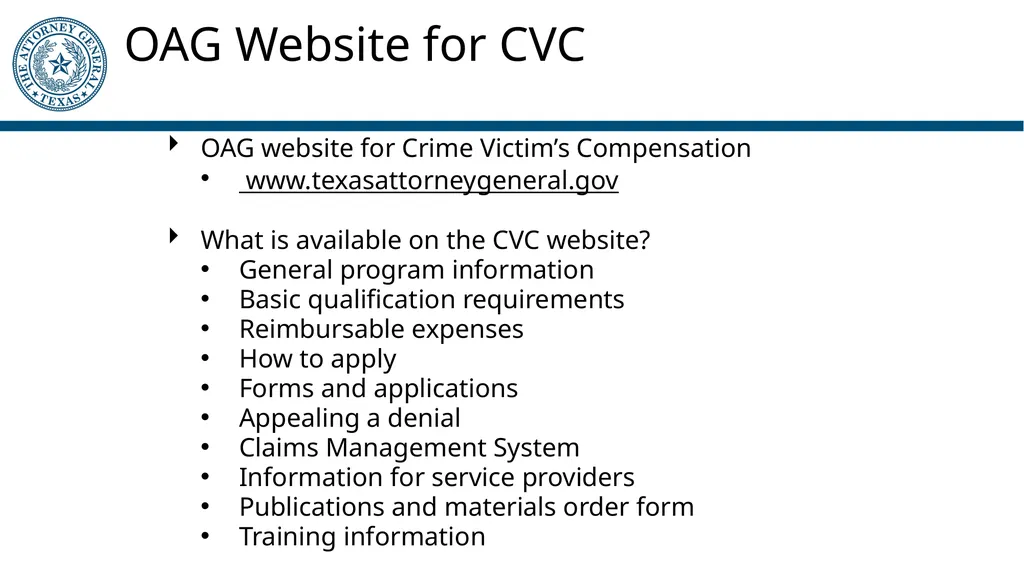
OAG Website for CVC OAG website for Crime Victim’s Compensation
www.texasattorneygeneral.gov
What is available on the CVC website?
General program information
Basic qualification requirements
Reimbursable expenses
How to apply
Forms and applications
Appealing a denial
Claims Management System
Information for service providers
Publications and materials order form
Training information<br>
www.texasattorneygeneral.gov
What is available on the CVC website?
General program information
Basic qualification requirements
Reimbursable expenses
How to apply
Forms and applications
Appealing a denial
Claims Management System
Information for service providers
Publications and materials order form
Training information<br>
57
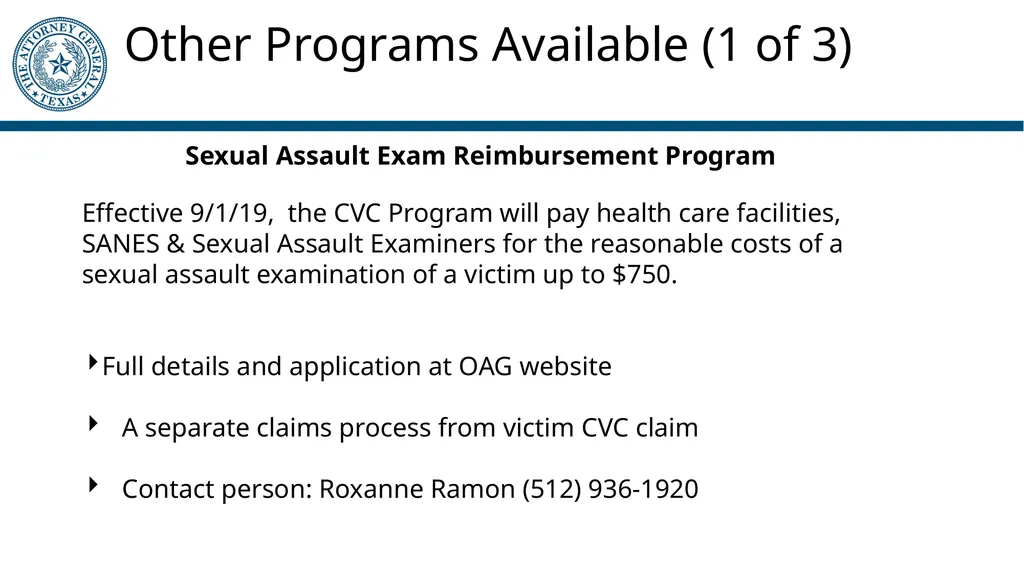
Other Programs Available (1 of 3) Sexual Assault Exam Reimbursement Program
Effective 9/1/19, the CVC Program will pay health care facilities, SANES & Sexual Assault Examiners for the reasonable costs of a sexual assault examination of a victim up to $750.
Full details and application at OAG website
A separate claims process from victim CVC claim
Contact person: Roxanne Ramon (512) 936-1920<br>
Effective 9/1/19, the CVC Program will pay health care facilities, SANES & Sexual Assault Examiners for the reasonable costs of a sexual assault examination of a victim up to $750.
Full details and application at OAG website
A separate claims process from victim CVC claim
Contact person: Roxanne Ramon (512) 936-1920<br>
58
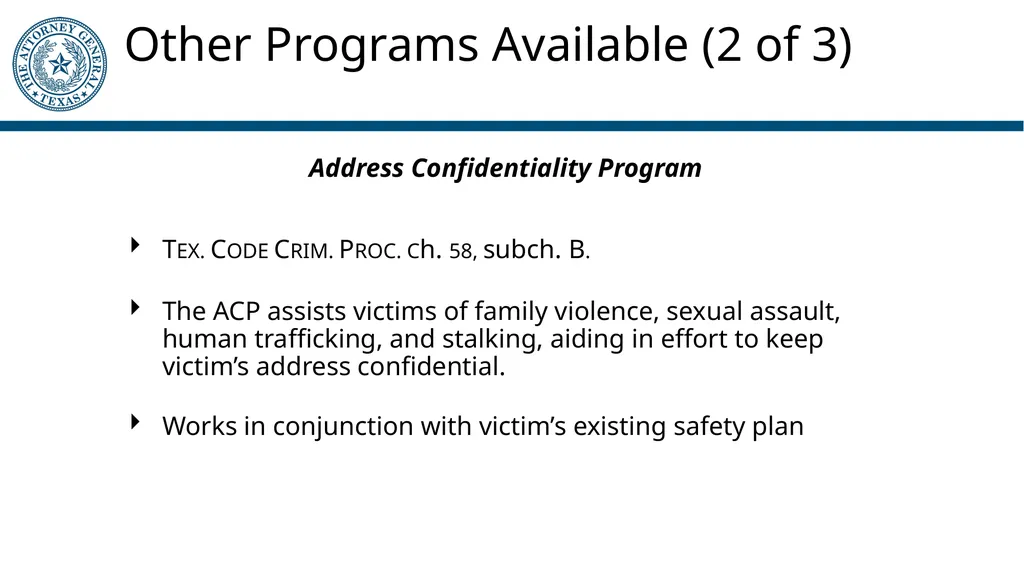
Other Programs Available (2 of 3) Address Confidentiality Program
Tex. Code Crim. Proc. ch. 58, subch. B.
The ACP assists victims of family violence, sexual assault, human trafficking, and stalking, aiding in effort to keep victim’s address confidential.
Works in conjunction with victim’s existing safety plan<br>
Tex. Code Crim. Proc. ch. 58, subch. B.
The ACP assists victims of family violence, sexual assault, human trafficking, and stalking, aiding in effort to keep victim’s address confidential.
Works in conjunction with victim’s existing safety plan<br>
59
Other Programs Available (3 of 3) Address Confidentiality Program
For more information contact:
Office of the Attorney General
Address Confidentiality Program (ACP)
P.O. Box 12199 MC Program
Austin, Texas 78711-2199
crimevictims@oag.texas.gov
(512) 936-1750
(888) 832-2322<br>
For more information contact:
Office of the Attorney General
Address Confidentiality Program (ACP)
P.O. Box 12199 MC Program
Austin, Texas 78711-2199
crimevictims@oag.texas.gov
(512) 936-1750
(888) 832-2322<br>
60
For More Information Office of the Attorney General
Crime Victim Services Division
CVC Program
P.O. Box 12198
Austin, TX 78711-2198
www.texasattorneygeneral.gov
(512) 936-1200 or (800) 983-9933 Main Number
National Association of Crime Victim Compensation Board website has links to each state’s CVC program
www.nacvcb.org<br>
Crime Victim Services Division
CVC Program
P.O. Box 12198
Austin, TX 78711-2198
www.texasattorneygeneral.gov
(512) 936-1200 or (800) 983-9933 Main Number
National Association of Crime Victim Compensation Board website has links to each state’s CVC program
www.nacvcb.org<br>
61
Certificate of Participation The Office of the Attorney General presents this certificate to:
_________________________________________________
(print your name)
with sincere appreciation for your on-line training
of the
CVC General Overview
on this ______ day of __________, 20__
_________________________________________________________ Mail a copy of your certificate to:
(your signature) Crime Victim Services Division
Attention: Training & Outreach Coordinator
P O Box 12198
Austin, Tx 78711-2198<br>
_________________________________________________
(print your name)
with sincere appreciation for your on-line training
of the
CVC General Overview
on this ______ day of __________, 20__
_________________________________________________________ Mail a copy of your certificate to:
(your signature) Crime Victim Services Division
Attention: Training & Outreach Coordinator
P O Box 12198
Austin, Tx 78711-2198<br>