Crowd Management Tracy Stark What is a Crowd Manager? Crowd management is defined as the planned movement and assembly of people. Involves the systematic assessment of all aspects of venue occupancy prior to use. It can be considered an
"Crowd Management Tracy Stark What is a Crowd" is the property of its rightful owner. Permission is granted to
download and print the materials on this website for personal, non-commercial use only, and to display it
on your personal computer provided you do not modify the materials and that you retain all copyright
notices contained in the materials. By downloading content from our website, you accept the terms of this
agreement.
Presentation Transcript
01
Crowd Management Tracy Stark<br>
02
What is a Crowd Manager? "Crowd management is defined as the planned movement and assembly of people.
Involves the systematic assessment of all aspects of venue occupancy prior to use.
It can be considered an adjunct to the life safety evaluation process, with greater concentration on the possibilities for extreme crowding and its potentially fatal consequences.
Crowd management planning includes determination of expected number of occupants of a space, anticipated group behavior, assessment of the adequacy of assembly areas, means of both ingress and egress, processing procedures such as ticket collection and security screening, staffing requirements, and means of communication. "
SOURCE: 2008 NFPA Fire Protection handbook<br>
03
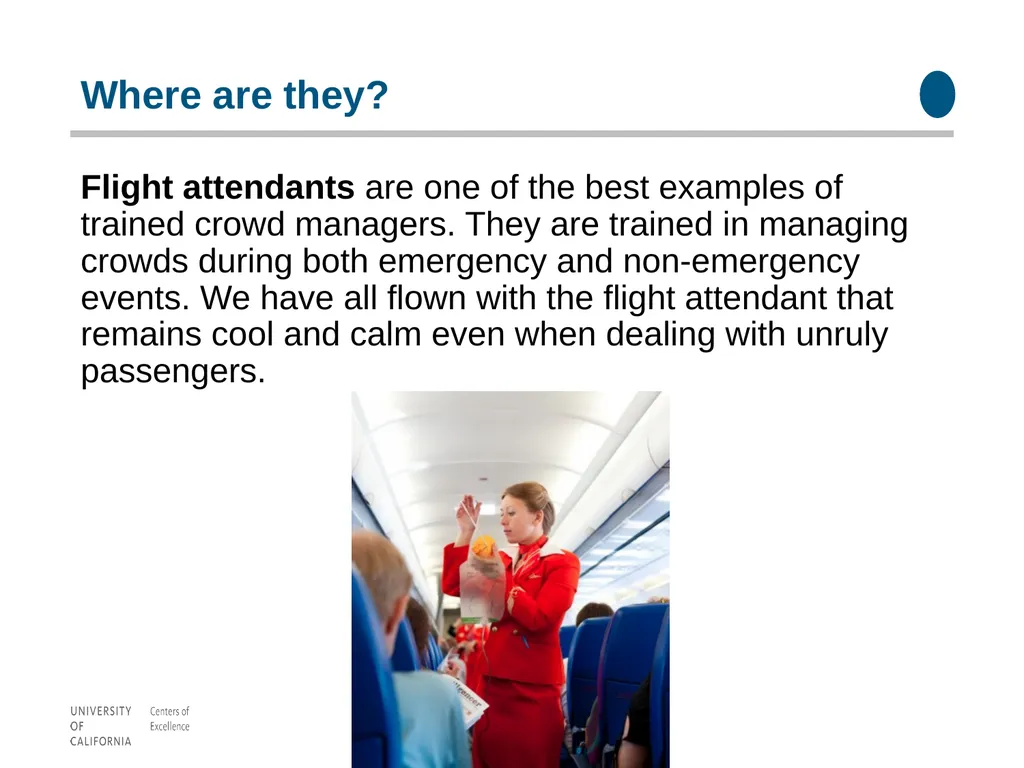
Where are they? Flight attendants are one of the best examples of trained crowd managers. They are trained in managing crowds during both emergency and non-emergency events. We have all flown with the flight attendant that remains cool and calm even when dealing with unruly passengers.<br>
04
Similarities Both you and the flight attendant are providing other services as well as managing crowds.
Both of you prepare for emergencies and make sure your attendees (or passengers) are prepared for emergencies as well.
Both of you have a calming effect partly because you are trained and a recognized authority figure.
Both you and the flight attendant work under a recognized set of rules and laws. Your rule is based the NFPA and local "Authority Having Jurisdiction" or "AHJ."<br>
05
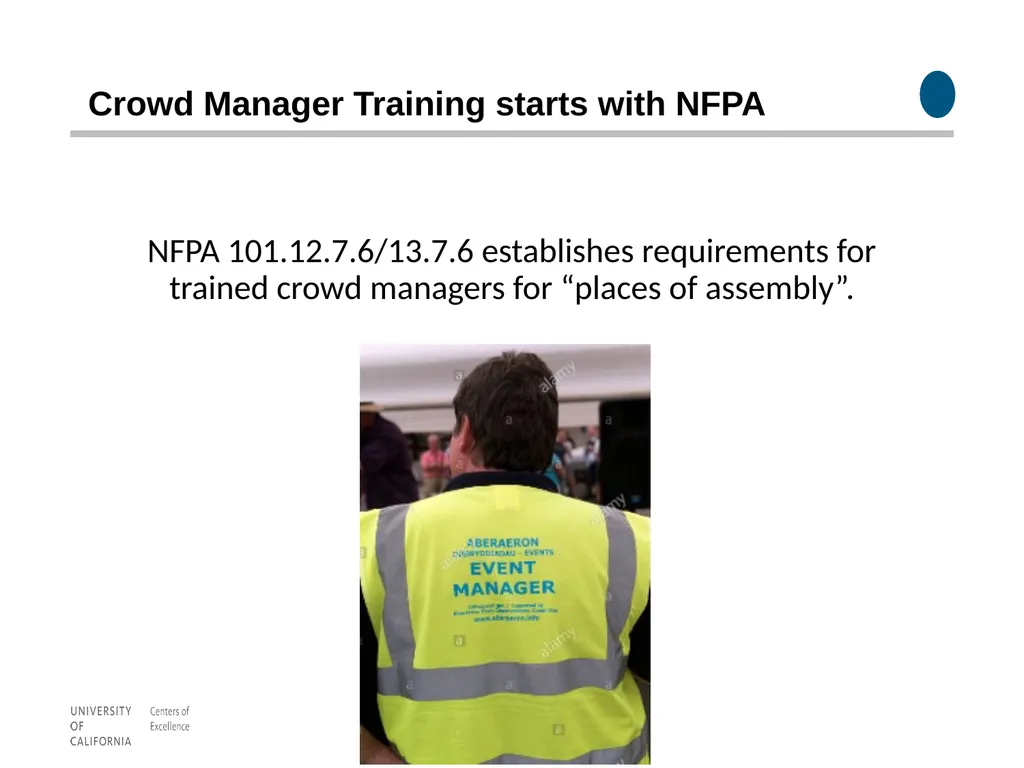
Crowd Manager Training starts with NFPA NFPA 101.12.7.6/13.7.6 establishes requirements for trained crowd managers for “places of assembly”.<br>
06
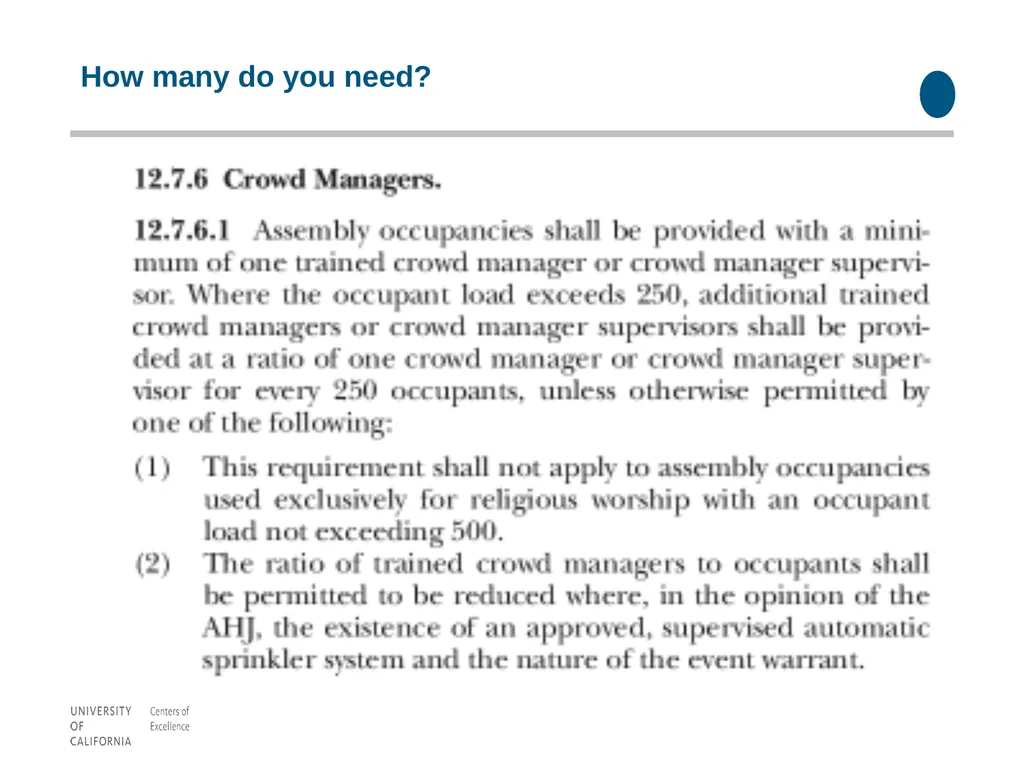
How many do you need?<br>
07
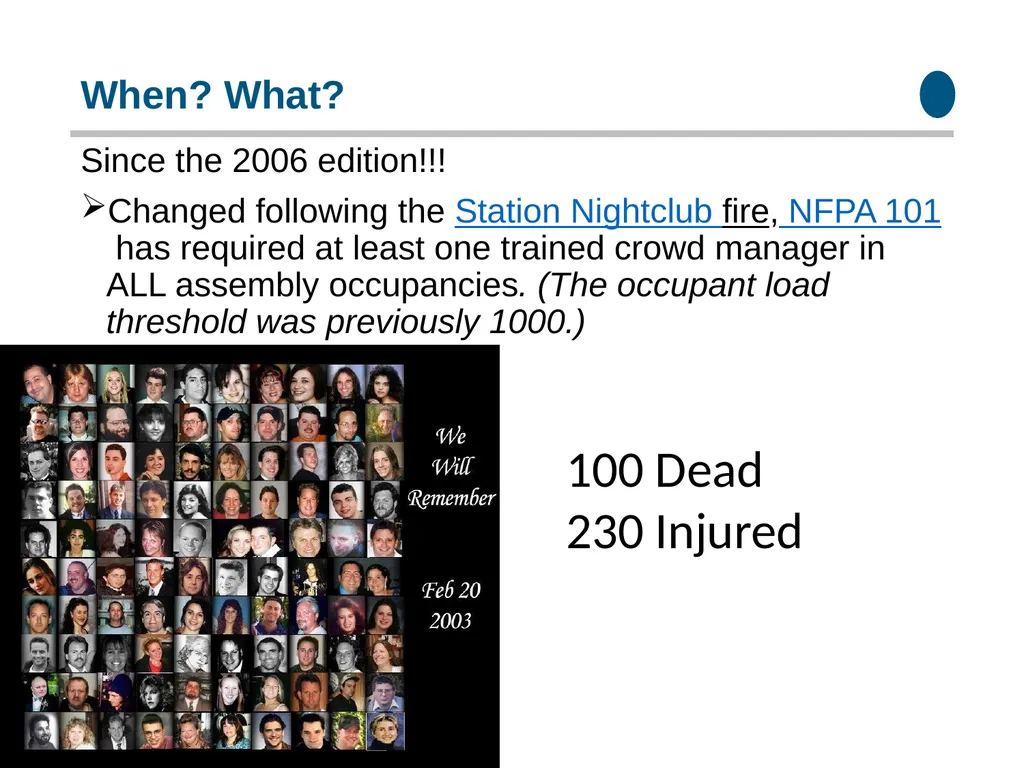
When? What? Since the 2006 edition!!!
Changed following the Station Nightclub fire, NFPA 101 has required at least one trained crowd manager in ALL assembly occupancies. (The occupant load threshold was previously 1000.) 100 Dead
230 Injured<br>
08
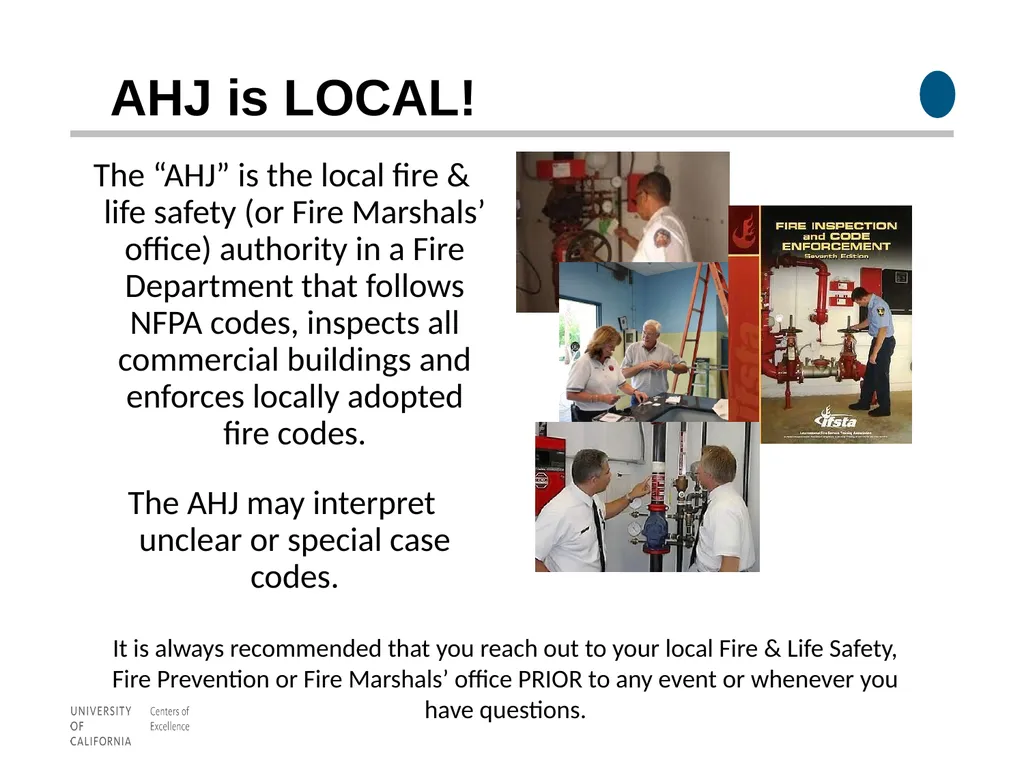
AHJ is LOCAL! The “AHJ” is the local fire & life safety (or Fire Marshals’ office) authority in a Fire Department that follows NFPA codes, inspects all commercial buildings and enforces locally adopted fire codes.
The AHJ may interpret unclear or special case codes. It is always recommended that you reach out to your local Fire & Life Safety, Fire Prevention or Fire Marshals’ office PRIOR to any event or whenever you have questions.<br>
09
AHJ enforces NFPA code So NFPA created national fire codes that were adopted by the State of Florida and then by your local city or county fire prevention office.
That NFPA code is required for training you as a crowd manager.
The full name is NFPA 101.12.7.6 for New Places of Assembly and NFPA 101.13.7.6
for Existing Places of Assembly.
If you have any questions, contact your local fire department.<br>
10
What exactly does a crowd manager do? assess the venue for dangers and hazards that may impede evacuation
base crowd management techniques with the venue emergency plan in mind
inform other employees of proper management techniques
practice crowd management techniques at least once each year
inform management of any serious issues that impact the crowd manager
assess the situation during the event so that they may be proactive
be familiar with the written emergency plan
be clearly identified to the public
stay calm, take charge and lead people to safety during an emergency
complete a report documenting action taken as required by the event operator
be able to describe the paths of travel and exits, facility evacuation and emergency response procedures and, where provided, facility shelter-in-place procedures.
treat patrons respectfully and provide them with direct and clear instructions<br>
11
Crowd Manager Supervisor Someone with advanced training
Incident Command System training
Supervise and assign crowd managers
Respond to issues that arise to support crowd managers
Birds eye view of event management in progress
Emergency response and evacuation leadership role
Create event plan and communicate
After event review<br>
12
Where to find training Local AHJ
International Association of Venue Managers - $15 online - http://www.iaamtraining.com/index.html
National Association of State Fire Marshals $19.95 - https://www.crowdmanagers.com/registration/
Udemy - Large Gatherings/Dangerous Crowds! - Become a Crowd Manager $10-$40 (price changes) - https://www.udemy.com/share/100kIgBEEbdlxbQno=/
Event Safety Alliance – Crowd Safety Symposium $260 http://eventsafetyalliance.org/esa-crowd-safety-workshops/<br>
13
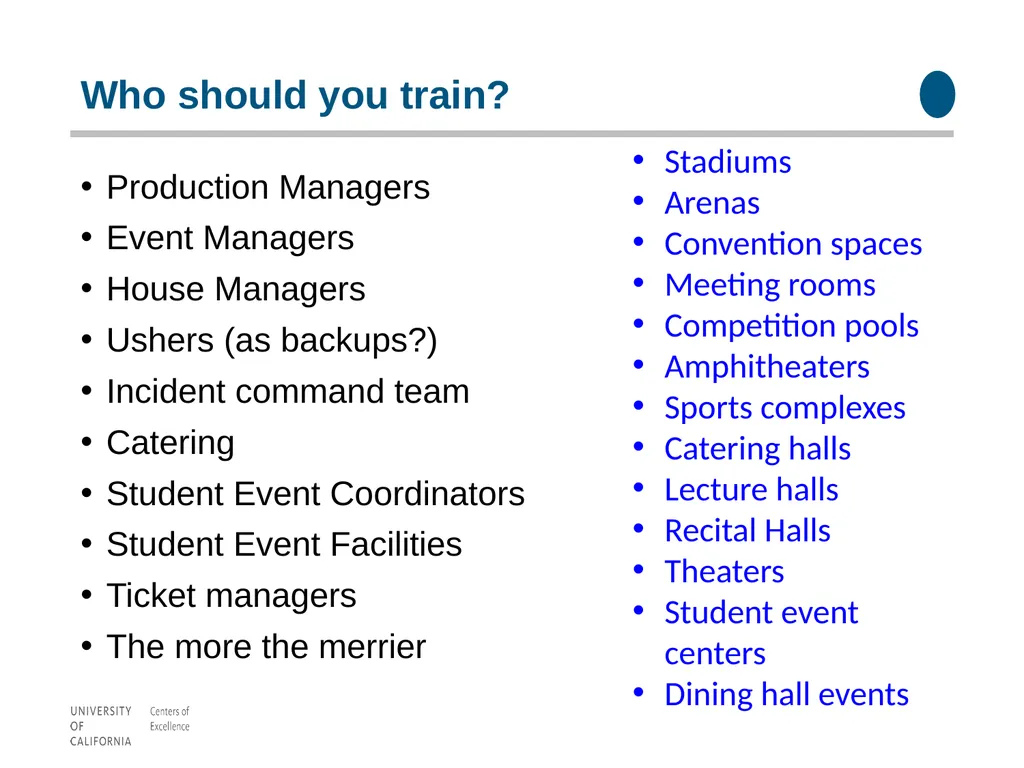
Who should you train? Production Managers
Event Managers
House Managers
Ushers (as backups?)
Incident command team
Catering
Student Event Coordinators
Student Event Facilities
Ticket managers
The more the merrier Stadiums
Arenas
Convention spaces
Meeting rooms
Competition pools
Amphitheaters
Sports complexes
Catering halls
Lecture halls
Recital Halls
Theaters
Student event centers
Dining hall events<br>