
Cryptocurrencies as Payment: An Overview and




Description: Cryptocurrencies as Payment: An Overview and Analysis of Factors Driving Adoption Florian Knöchel April 22, 2022 Results and Main Findings V1 Master Thesis Executive Summary Source of Image: Starline from freepik Cryptocurrencies and
Related Topics
Download Presentation
"Cryptocurrencies as Payment: An Overview and" is the property of its rightful owner. Permission is granted to download and print the materials on this website for personal, non-commercial use only, and to display it on your personal computer provided you do not modify the materials and that you retain all copyright notices contained in the materials. By downloading content from our website, you accept the terms of this agreement.
Presentation Transcript
slide1. Cryptocurrencies as Payment: An Overview and Analysis of Factors Driving Adoption Florian Knöchel April 22, 2022 Results and Main Findings V1 Master Thesis<br>
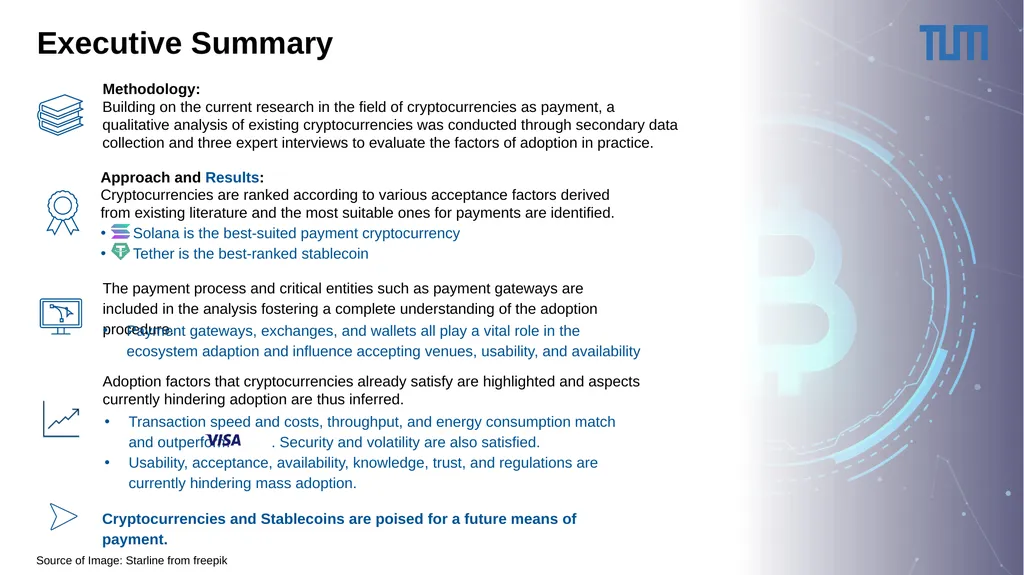
slide2. Executive Summary Source of Image: Starline from freepik Cryptocurrencies and Stablecoins are poised for a future means of payment.<br>
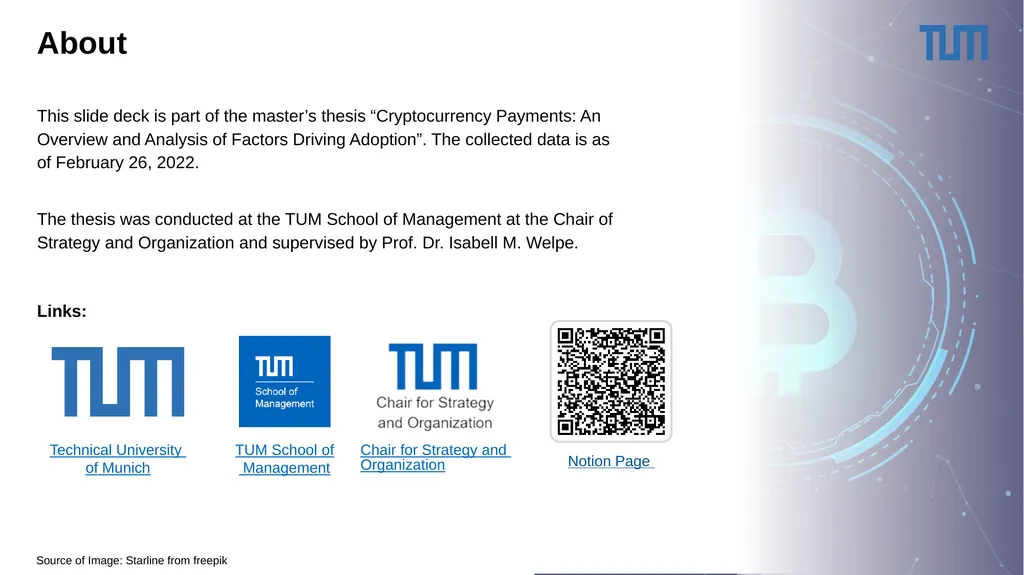
slide3. About Source of Image: Starline from freepik This slide deck is part of the master’s thesis “Cryptocurrency Payments: An Overview and Analysis of Factors Driving Adoption”. The collected data is as of February 26, 2022. The thesis was conducted at the TUM School of Management at the Chair of Strategy and Organization and supervised by Prof. Dr. Isabell M. Welpe. Links: Chair for Strategy and Organization Notion Page<br>
slide4. Contents Source of Image: unsplash.com Outline of the Thesis and Main Topics
Need for Research and Main Research Question
Important Theoretical Concepts
Cryptocurrency Basics
Payment Process
Payment Gateway, Wallets, and Exchanges
Factors for Adoption
Cryptocurrency Ranking
Future Outlook and Current Roadblocks
Contributions and Further Research
Sources<br>
slide5. Theory and Outline Source of Image: unsplash.com Sources in the following.<br>
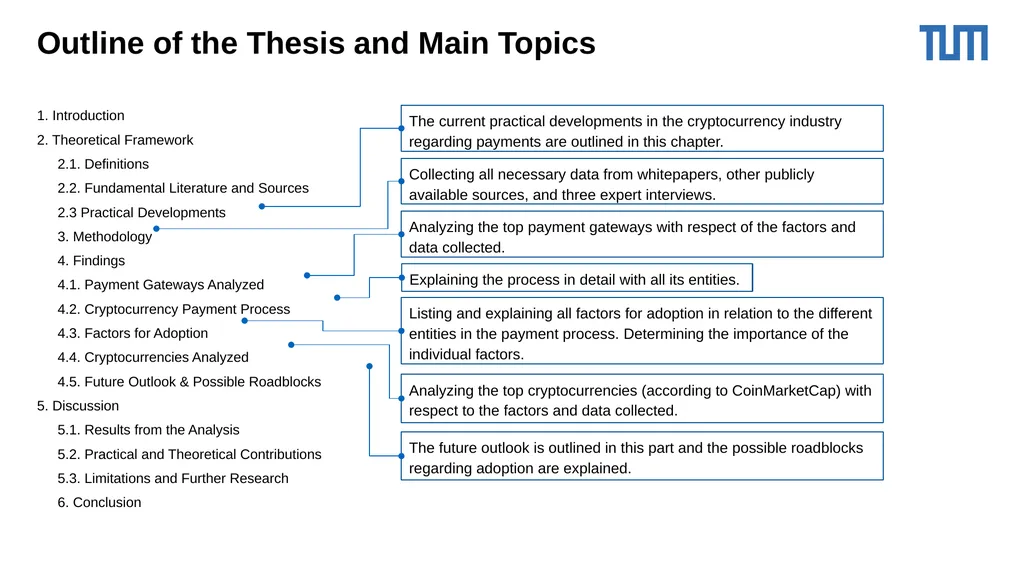
slide6. Outline of the Thesis and Main Topics 1. Introduction
2. Theoretical Framework
2.1. Definitions
2.2. Fundamental Literature and Sources
2.3 Practical Developments
3. Methodology
4. Findings
4.1. Payment Gateways Analyzed
4.2. Cryptocurrency Payment Process
4.3. Factors for Adoption
4.4. Cryptocurrencies Analyzed
4.5. Future Outlook & Possible Roadblocks
5. Discussion
5.1. Results from the Analysis
5.2. Practical and Theoretical Contributions
5.3. Limitations and Further Research
6. Conclusion Collecting all necessary data from whitepapers, other publicly available sources, and three expert interviews. Explaining the process in detail with all its entities. Listing and explaining all factors for adoption in relation to the different entities in the payment process. Determining the importance of the individual factors. Analyzing the top cryptocurrencies (according to CoinMarketCap) with respect to the factors and data collected. Analyzing the top payment gateways with respect of the factors and data collected. The current practical developments in the cryptocurrency industry regarding payments are outlined in this chapter. The future outlook is outlined in this part and the possible roadblocks regarding adoption are explained.<br>
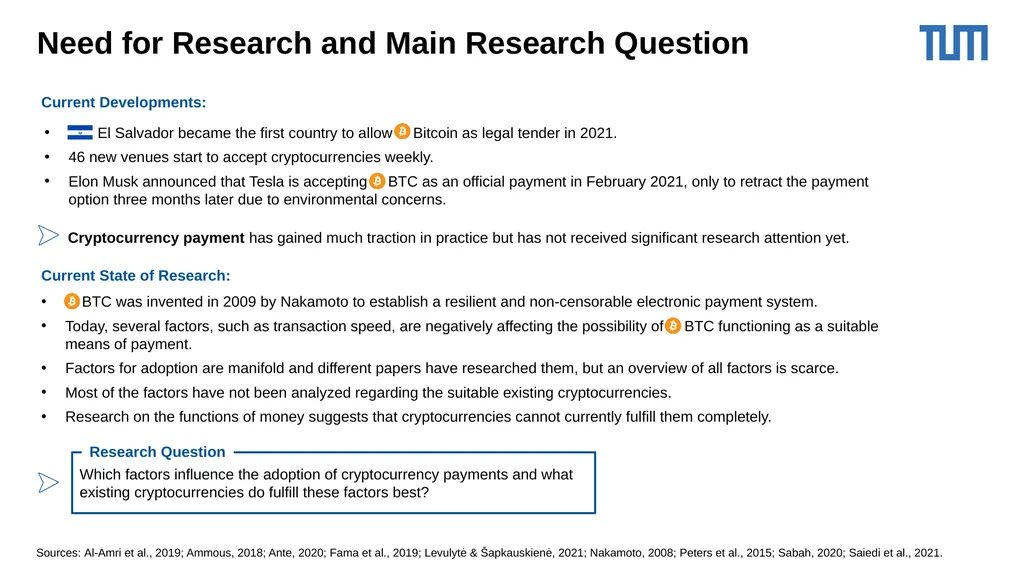
slide7. Need for Research and Main Research Question Sources: Al-Amri et al., 2019; Ammous, 2018; Ante, 2020; Fama et al., 2019; Levulytė & Šapkauskienė, 2021; Nakamoto, 2008; Peters et al., 2015; Sabah, 2020; Saiedi et al., 2021. BTC was invented in 2009 by Nakamoto to establish a resilient and non-censorable electronic payment system.
Today, several factors, such as transaction speed, are negatively affecting the possibility of BTC functioning as a suitable means of payment.
Factors for adoption are manifold and different papers have researched them, but an overview of all factors is scarce.
Most of the factors have not been analyzed regarding the suitable existing cryptocurrencies.
Research on the functions of money suggests that cryptocurrencies cannot currently fulfill them completely. Current Developments: Cryptocurrency payment has gained much traction in practice but has not received significant research attention yet. Current State of Research:<br>
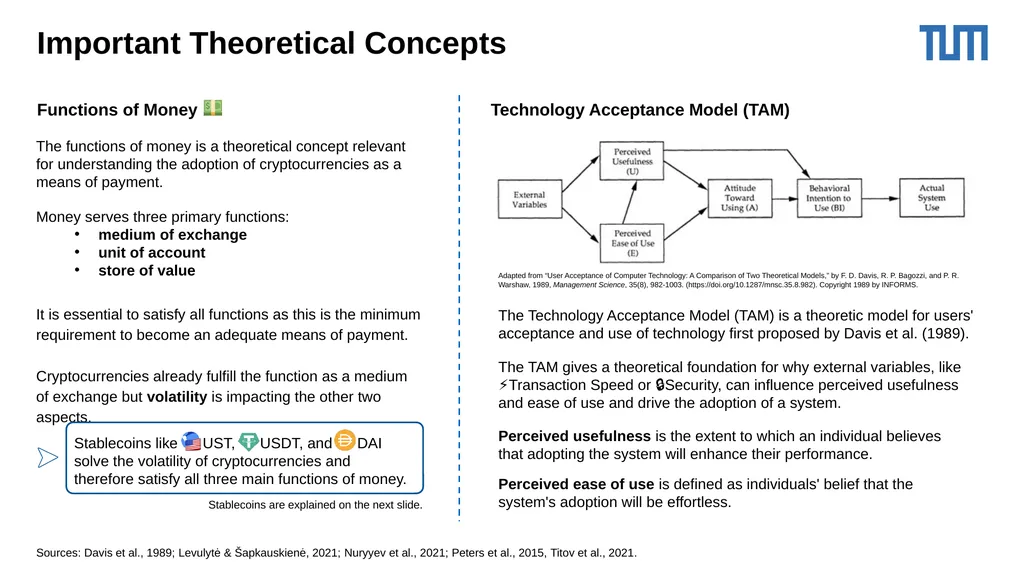
slide8. Important Theoretical Concepts Sources: Davis et al., 1989; Levulytė & Šapkauskienė, 2021; Nuryyev et al., 2021; Peters et al., 2015, Titov et al., 2021. Functions of Money Technology Acceptance Model (TAM) The Technology Acceptance Model (TAM) is a theoretic model for users' acceptance and use of technology first proposed by Davis et al. (1989). The TAM gives a theoretical foundation for why external variables, like ⚡Transaction Speed or 🔒Security, can influence perceived usefulness and ease of use and drive the adoption of a system. Perceived usefulness is the extent to which an individual believes that adopting the system will enhance their performance. Perceived ease of use is defined as individuals' belief that the system's adoption will be effortless. The functions of money is a theoretical concept relevant for understanding the adoption of cryptocurrencies as a means of payment. Money serves three primary functions:
medium of exchange
unit of account
store of value Cryptocurrencies already fulfill the function as a medium of exchange but volatility is impacting the other two aspects. It is essential to satisfy all functions as this is the minimum requirement to become an adequate means of payment.<br>
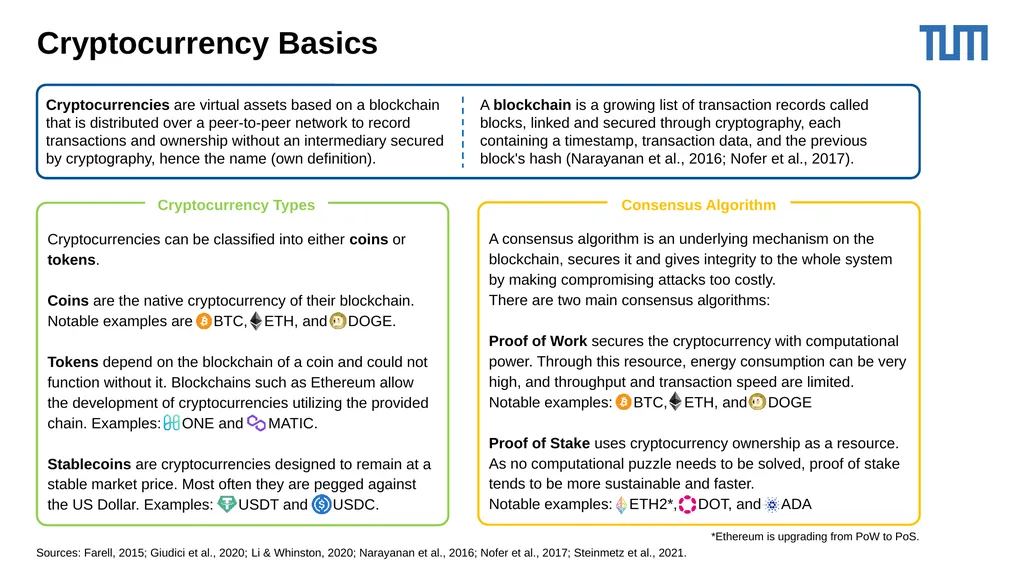
slide9. Cryptocurrencies can be classified into either coins or tokens.
Coins are the native cryptocurrency of their blockchain. Notable examples are BTC, ETH, and DOGE.
Tokens depend on the blockchain of a coin and could not function without it. Blockchains such as Ethereum allow the development of cryptocurrencies utilizing the provided chain. Examples: ONE and MATIC.
Stablecoins are cryptocurrencies designed to remain at a stable market price. Most often they are pegged against the US Dollar. Examples: USDT and USDC. Cryptocurrency Basics Sources: Farell, 2015; Giudici et al., 2020; Li & Whinston, 2020; Narayanan et al., 2016; Nofer et al., 2017; Steinmetz et al., 2021. Cryptocurrency Types A consensus algorithm is an underlying mechanism on the blockchain, secures it and gives integrity to the whole system by making compromising attacks too costly.
There are two main consensus algorithms:
Proof of Work secures the cryptocurrency with computational power. Through this resource, energy consumption can be very high, and throughput and transaction speed are limited.
Notable examples: BTC, ETH, and DOGE
Proof of Stake uses cryptocurrency ownership as a resource. As no computational puzzle needs to be solved, proof of stake tends to be more sustainable and faster.
Notable examples: ETH2*, DOT, and ADA *Ethereum is upgrading from PoW to PoS. Consensus Algorithm<br>
slide10. Results Source of Image: unsplash.com Sources in the following.<br>
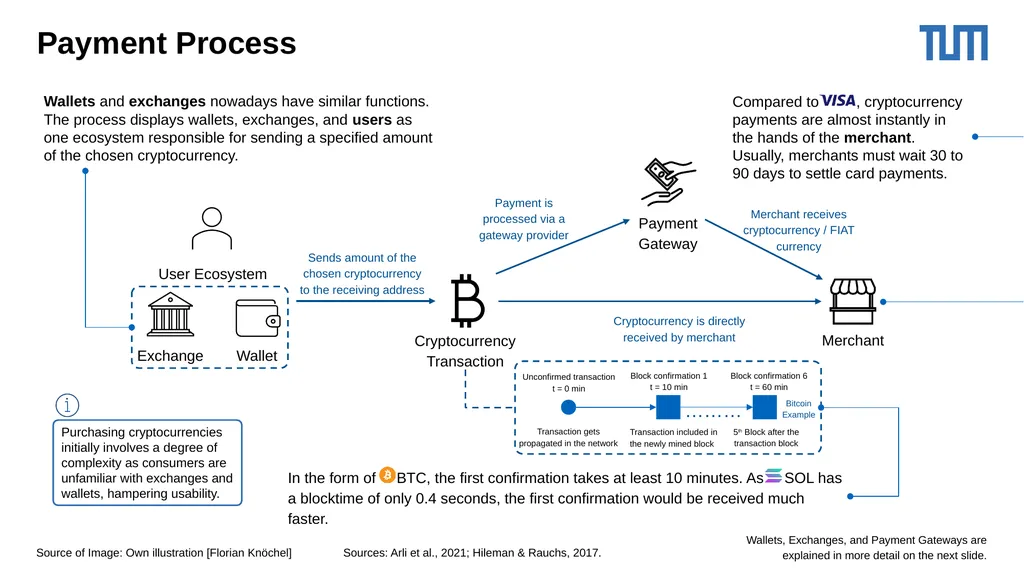
slide11. Payment Process Source of Image: Own illustration [Florian Knöchel] Sources: Arli et al., 2021; Hileman & Rauchs, 2017. Wallets and exchanges nowadays have similar functions. The process displays wallets, exchanges, and users as one ecosystem responsible for sending a specified amount of the chosen cryptocurrency. Wallets, Exchanges, and Payment Gateways are explained in more detail on the next slide. Compared to , cryptocurrency payments are almost instantly in the hands of the merchant. Usually, merchants must wait 30 to 90 days to settle card payments.<br>
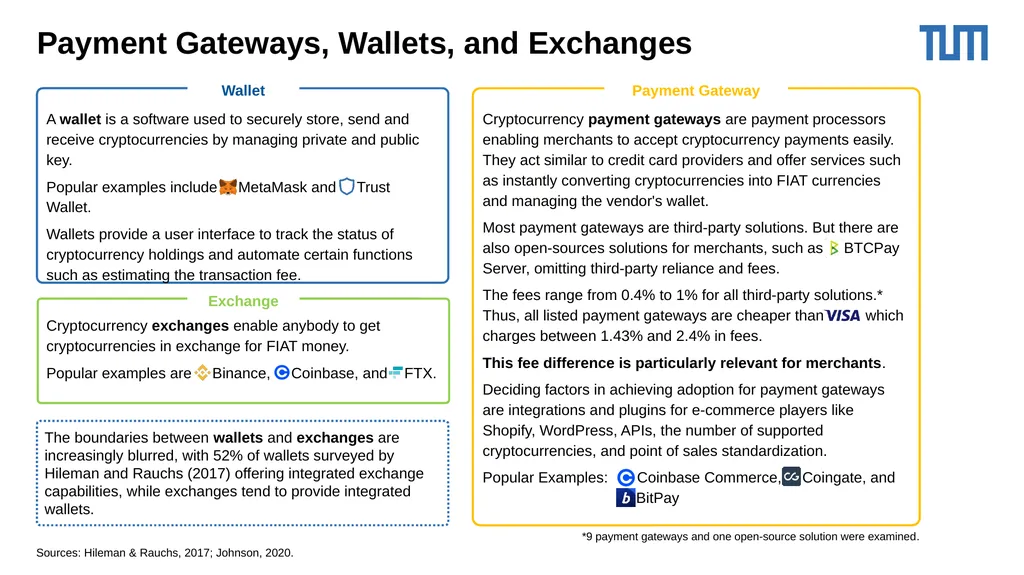
slide12. Payment Gateways, Wallets, and Exchanges Sources: Hileman & Rauchs, 2017; Johnson, 2020. Cryptocurrency payment gateways are payment processors enabling merchants to accept cryptocurrency payments easily. They act similar to credit card providers and offer services such as instantly converting cryptocurrencies into FIAT currencies and managing the vendor's wallet.
Most payment gateways are third-party solutions. But there are also open-sources solutions for merchants, such as BTCPay Server, omitting third-party reliance and fees.
The fees range from 0.4% to 1% for all third-party solutions.* Thus, all listed payment gateways are cheaper than which charges between 1.43% and 2.4% in fees.
This fee difference is particularly relevant for merchants.
Deciding factors in achieving adoption for payment gateways are integrations and plugins for e-commerce players like Shopify, WordPress, APIs, the number of supported cryptocurrencies, and point of sales standardization.
Popular Examples: Coinbase Commerce, Coingate, and BitPay A wallet is a software used to securely store, send and receive cryptocurrencies by managing private and public key.
Popular examples include MetaMask and Trust Wallet.
Wallets provide a user interface to track the status of cryptocurrency holdings and automate certain functions such as estimating the transaction fee. Wallet Payment Gateway *9 payment gateways and one open-source solution were examined.<br>
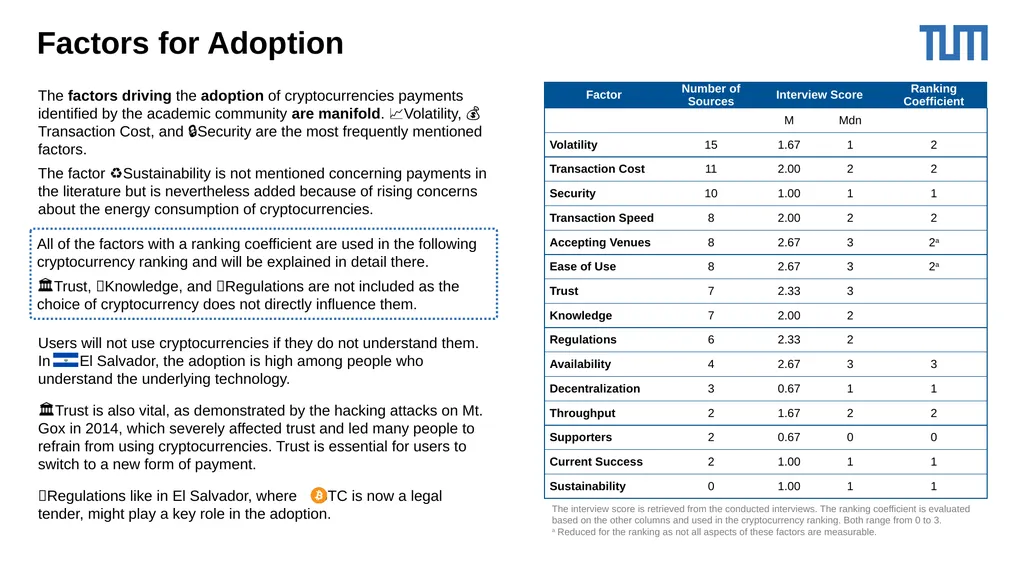
slide13. Factors for Adoption The interview score is retrieved from the conducted interviews. The ranking coefficient is evaluated based on the other columns and used in the cryptocurrency ranking. Both range from 0 to 3.
a Reduced for the ranking as not all aspects of these factors are measurable. The factors driving the adoption of cryptocurrencies payments identified by the academic community are manifold. 📈Volatility, 💰Transaction Cost, and 🔒Security are the most frequently mentioned factors.
The factor ♻️Sustainability is not mentioned concerning payments in the literature but is nevertheless added because of rising concerns about the energy consumption of cryptocurrencies. Users will not use cryptocurrencies if they do not understand them. In El Salvador, the adoption is high among people who understand the underlying technology. 🏛️Trust is also vital, as demonstrated by the hacking attacks on Mt. Gox in 2014, which severely affected trust and led many people to refrain from using cryptocurrencies. Trust is essential for users to switch to a new form of payment. 💼Regulations like in El Salvador, where BTC is now a legal tender, might play a key role in the adoption.<br>
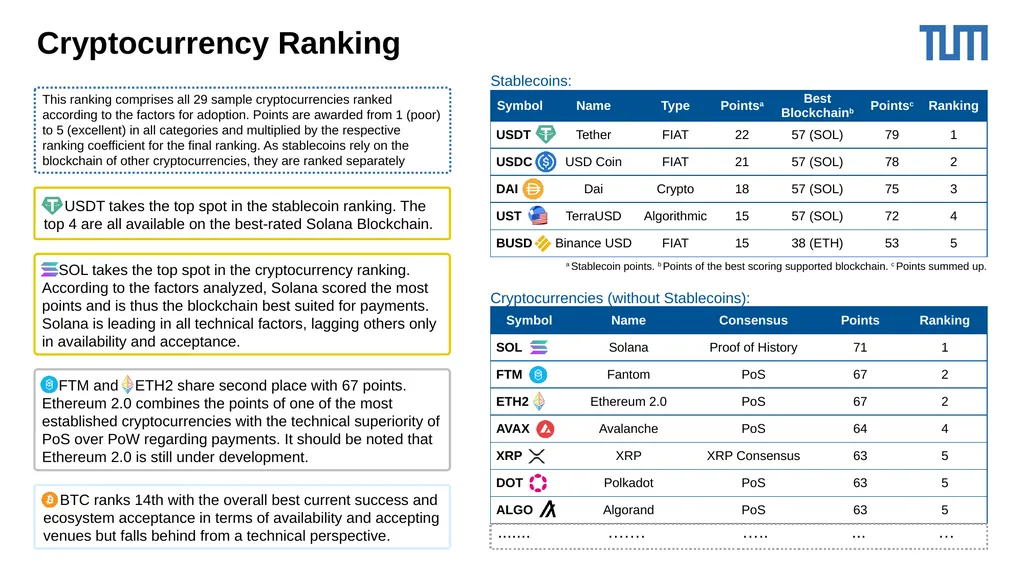
slide14. Cryptocurrency Ranking This ranking comprises all 29 sample cryptocurrencies ranked according to the factors for adoption. Points are awarded from 1 (poor) to 5 (excellent) in all categories and multiplied by the respective ranking coefficient for the final ranking. As stablecoins rely on the blockchain of other cryptocurrencies, they are ranked separately Stablecoins: Cryptocurrencies (without Stablecoins): a Stablecoin points. b Points of the best scoring supported blockchain. c Points summed up. ....... ….… ….. ... …<br>
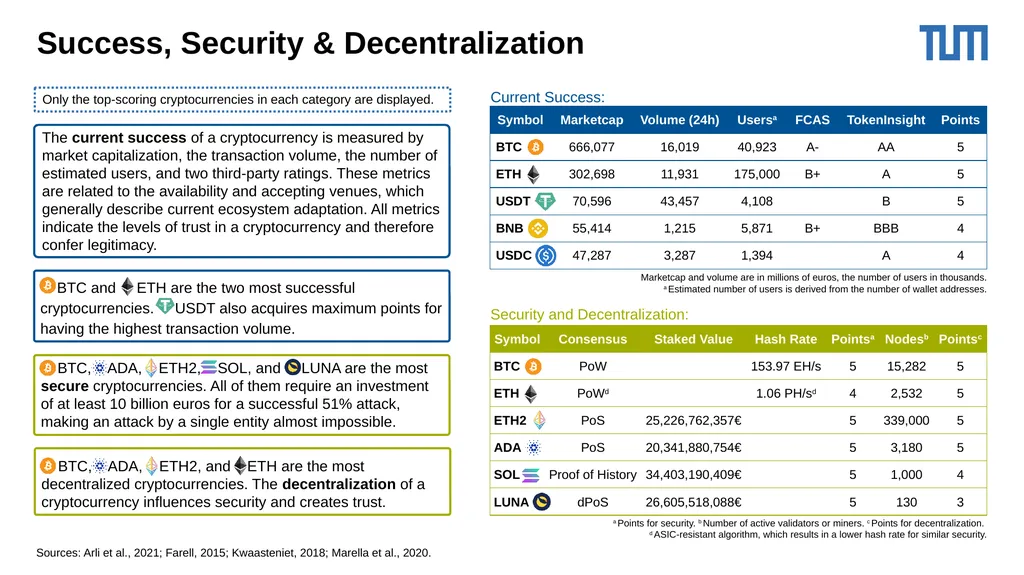
slide15. Success, Security & Decentralization Only the top-scoring cryptocurrencies in each category are displayed. Current Success: Security and Decentralization: Marketcap and volume are in millions of euros, the number of users in thousands.
a Estimated number of users is derived from the number of wallet addresses. a Points for security. b Number of active validators or miners. c Points for decentralization.
d ASIC-resistant algorithm, which results in a lower hash rate for similar security. The current success of a cryptocurrency is measured by market capitalization, the transaction volume, the number of estimated users, and two third-party ratings. These metrics are related to the availability and accepting venues, which generally describe current ecosystem adaptation. All metrics indicate the levels of trust in a cryptocurrency and therefore confer legitimacy. Sources: Arli et al., 2021; Farell, 2015; Kwaasteniet, 2018; Marella et al., 2020.<br>
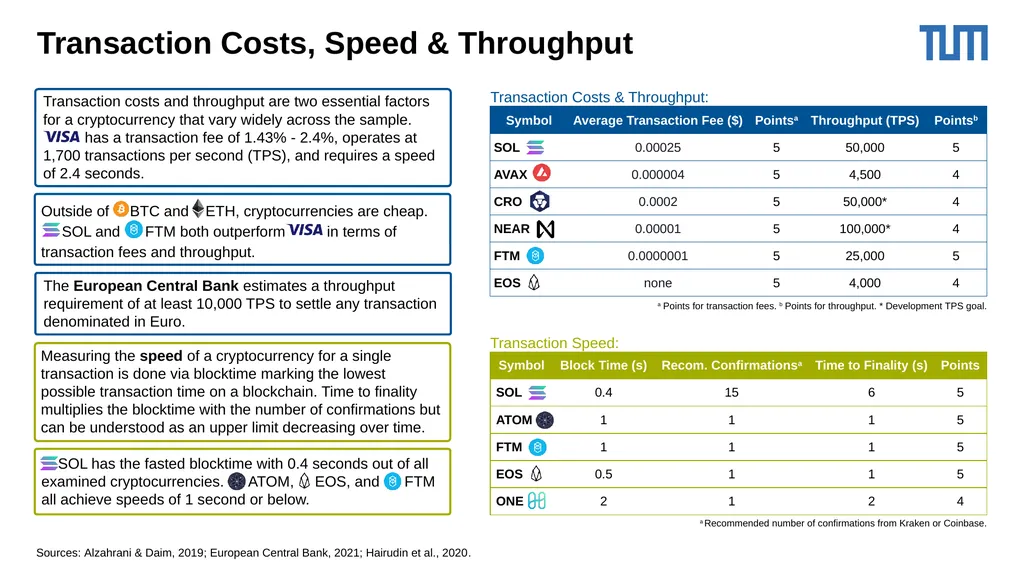
slide16. Transaction Costs, Speed & Throughput Transaction Costs & Throughput: Transaction Speed: a Points for transaction fees. b Points for throughput. * Development TPS goal. a Recommended number of confirmations from Kraken or Coinbase. Sources: Alzahrani & Daim, 2019; European Central Bank, 2021; Hairudin et al., 2020.<br>
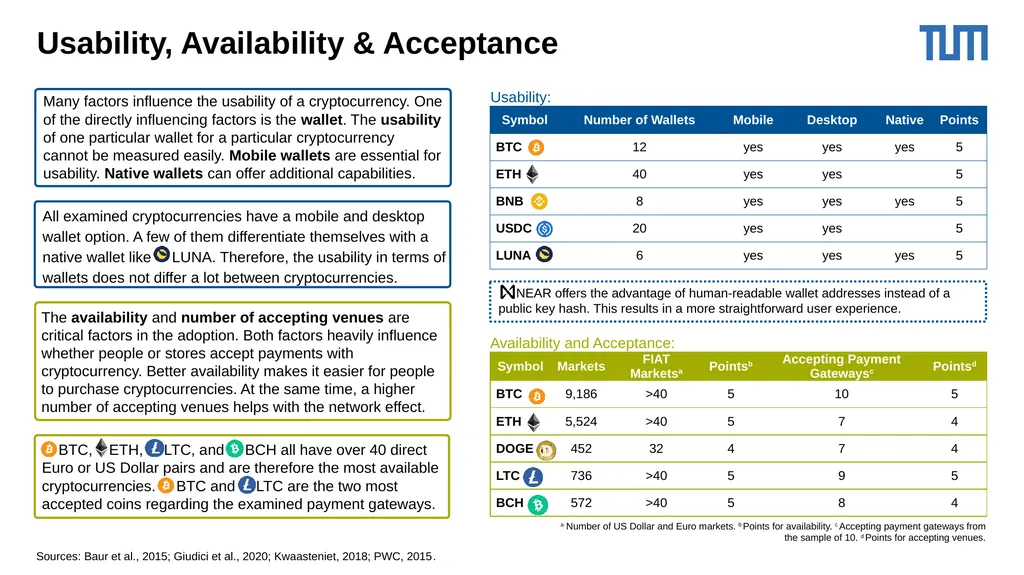
slide17. Usability, Availability & Acceptance Usability: Availability and Acceptance: a Number of US Dollar and Euro markets. b Points for availability. c Accepting payment gateways from the sample of 10. d Points for accepting venues. Sources: Baur et al., 2015; Giudici et al., 2020; Kwaasteniet, 2018; PWC, 2015.<br>
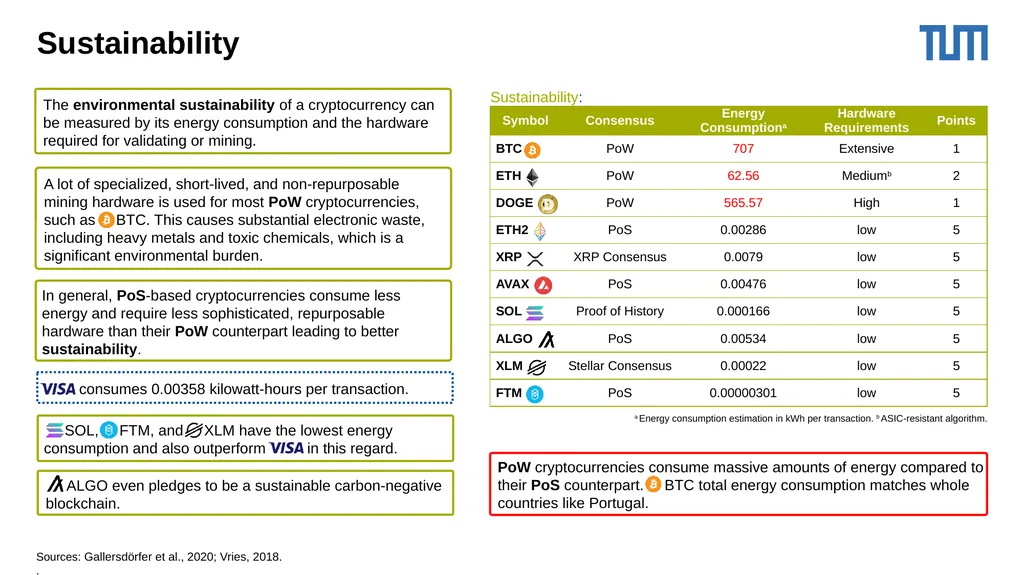
slide18. Sustainability Sustainability: a Energy consumption estimation in kWh per transaction. b ASIC-resistant algorithm. Sources: Gallersdörfer et al., 2020; Vries, 2018.
.<br>
slide19. Outlook and Conclusions Source of Image: unsplash.com Sources in the following.<br>
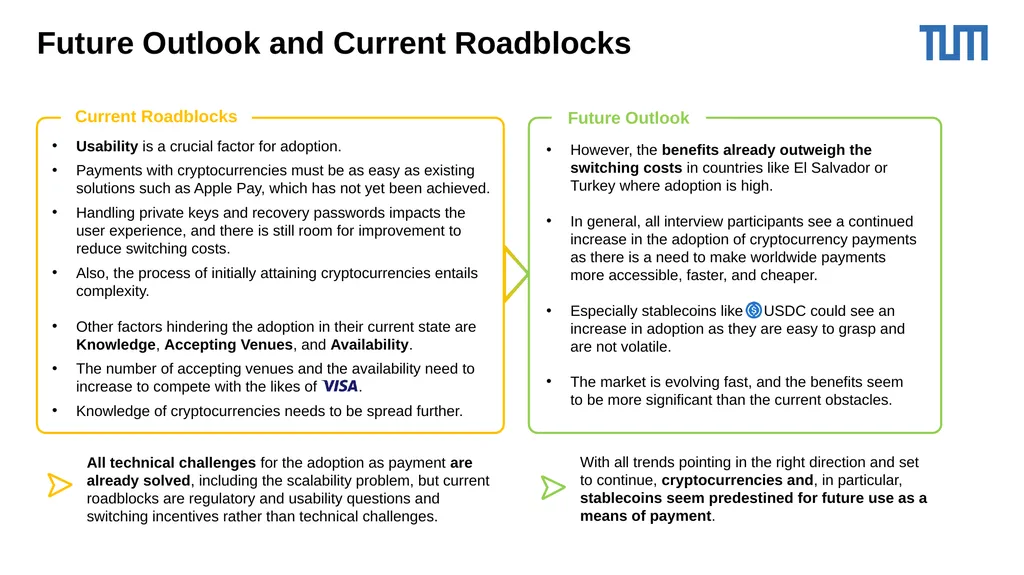
slide20. Future Outlook and Current Roadblocks In general, all interview participants see a continued increase in the adoption of cryptocurrency payments as there is a need to make worldwide payments more accessible, faster, and cheaper. Especially stablecoins like USDC could see an increase in adoption as they are easy to grasp and are not volatile. With all trends pointing in the right direction and set to continue, cryptocurrencies and, in particular, stablecoins seem predestined for future use as a means of payment. However, the benefits already outweigh the switching costs in countries like El Salvador or Turkey where adoption is high. Usability is a crucial factor for adoption.
Payments with cryptocurrencies must be as easy as existing solutions such as Apple Pay, which has not yet been achieved.
Handling private keys and recovery passwords impacts the user experience, and there is still room for improvement to reduce switching costs.
Also, the process of initially attaining cryptocurrencies entails complexity. Other factors hindering the adoption in their current state are Knowledge, Accepting Venues, and Availability.
The number of accepting venues and the availability need to increase to compete with the likes of .
Knowledge of cryptocurrencies needs to be spread further. All technical challenges for the adoption as payment are already solved, including the scalability problem, but current roadblocks are regulatory and usability questions and switching incentives rather than technical challenges. The market is evolving fast, and the benefits seem to be more significant than the current obstacles. Current Roadblocks Future Outlook<br>
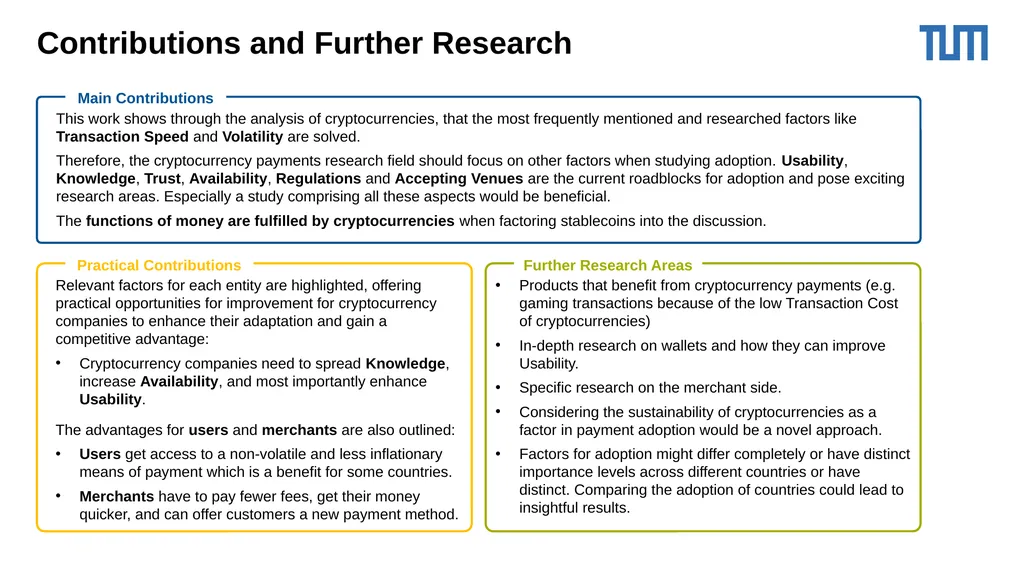
slide21. Contributions and Further Research Products that benefit from cryptocurrency payments (e.g. gaming transactions because of the low Transaction Cost of cryptocurrencies)
In-depth research on wallets and how they can improve Usability.
Specific research on the merchant side.
Considering the sustainability of cryptocurrencies as a factor in payment adoption would be a novel approach.
Factors for adoption might differ completely or have distinct importance levels across different countries or have distinct. Comparing the adoption of countries could lead to insightful results. Relevant factors for each entity are highlighted, offering practical opportunities for improvement for cryptocurrency companies to enhance their adaptation and gain a competitive advantage:
Cryptocurrency companies need to spread Knowledge, increase Availability, and most importantly enhance Usability.
The advantages for users and merchants are also outlined:
Users get access to a non-volatile and less inflationary means of payment which is a benefit for some countries.
Merchants have to pay fewer fees, get their money quicker, and can offer customers a new payment method. Practical Contributions Further Research Areas<br>
slide22. End Source of Image: unsplash.com Sources in the following.<br>
slide23. Source of Image: unsplash.com Sources Al-Amri, R., Zakaria, N. H., Habbal, A., & Hassan, S. (2019). Cryptocurrency adoption: current stage, opportunities, and open challenges. International Journal of Advanced Computer Research, 9(44), 293–307. https://doi.org/10.19101/IJACR.PID43
Alzahrani, S., & Daim, T. U. (2019). Analysis of the Cryptocurrency Adoption Decision: Literature Review. In 2019 Portland International Conference on Management of Engineering and Technology (PICMET) (pp. 1–11). IEEE. https://doi.org/10.23919/PICMET.2019.8893819
Ammous, S. (2018). Can cryptocurrencies fulfil the functions of money? The Quarterly Review of Economics and Finance, 70, 38–51. https://doi.org/10.1016/j.qref.2018.05.010
Ante, L. (2020). A place next to Satoshi: foundations of blockchain and cryptocurrency research in business and economics. Scientometrics, 124(2), 1305–1333. https://doi.org/10.1007/s11192-020-03492-8
Arli, D., van Esch, P., Bakpayev, M., & Laurence, A. (2021). Do consumers really trust cryptocurrencies? Marketing Intelligence & Planning, 39(1), 74–90. https://doi.org/10.1108/MIP-01-2020-0036
Baur, A. W., Bühler, J., Bick, M., & Bonorden, C. S. (2015). Cryptocurrencies as a Disruption? Empirical Findings on User Adoption and Future Potential of Bitcoin and Co. In Conference on e-Business, e-Services and e-Society (pp. 63–80). Springer, Cham. https://doi.org/10.1007/978-3-319-25013-7_6
Davis, F. D., Bagozzi, R. P., & Warshaw, P. R. (1989). User Acceptance of Computer Technology: A Comparison of Two Theoretical Models. Management Science, 35(8), 982–1003. https://doi.org/10.1287/mnsc.35.8.982
European Central Bank (2021). Digital euro experimentation scope and key learnings. https://www.ecb.europa.eu/pub/pdf/other/ecb.digitaleuroscopekeylearnings202107~564d89045e.en.pdf
Fama, M., Fumagalli, A., & Lucarelli, S. (2019). Cryptocurrencies, Monetary Policy, and New Forms of Monetary Sovereignty. International Journal of Political Economy, 48(2), 174–194. https://doi.org/10.1080/08911916.2019.1624318
Farell, R. (2015). An Analysis of the Cryptocurrency Industry. Wharton Research Scholars, 130. https://repository.upenn.edu/cgi/viewcontent.cgi?article=1133&context=wharton_research_scholars
Gallersdörfer, U., Klaaßen, L., & Stoll, C. (2020). Energy Consumption of Cryptocurrencies Beyond Bitcoin. Joule, 4(9), 1843–1846. https://doi.org/10.1016/j.joule.2020.07.013
Giudici, G., Milne, A., & Vinogradov, D. (2020). Cryptocurrencies: market analysis and perspectives. Journal of Industrial and Business Economics, 47(1), 1–18. https://doi.org/10.1007/s40812-019-00138-6
Hairudin, A., Sifat, I. M., Mohamad, A., & Yusof, Y. (2020). Cryptocurrencies: A survey on acceptance, governance and market dynamics. International Journal of Finance & Economics. Advance online publication. https://doi.org/10.1002/ijfe.2392
Hileman, G., & Rauchs, M. (2017). Global Cryptocurrency Benchmarking-Study. University of Cambridge Judge Business School. https://www.crowdfundinsider.com/wp-content/uploads/2017/04/Global-Cryptocurrency-Benchmarking-Study.pdf
Johnson, H. D. (2020). Average Credit Card Processing Fees In 2020 | Bankrate. https://www.bankrate.com/finance/credit-cards/merchants-guide-to-credit-card-processing-fees/
Kwaasteniet, A. de. (2018). Which crypto currency becomes the future payment system. https://medium.com/coinmonks/which-crypto-becomes-the-new-payment-system-69f95b2d2ec3
Levulytė, L., & Šapkauskienė, A. (2021). Cryptocurrency in context of fiat money functions. The Quarterly Review of Economics and Finance, 82, 44–54. https://doi.org/10.1016/j.qref.2021.07.003
Li, X., & Whinston, A. B. (2020). Analyzing Cryptocurrencies. Information Systems Frontiers, 22(1), 17–22. https://doi.org/10.1007/s10796-019-09966-2
Marella, V., Upreti, B., Merikivi, J., & Tuunainen, V. K. (2020). Understanding the creation of trust in cryptocurrencies: The case of Bitcoin. Electronic Markets, 30(2), 259–271. https://doi.org/10.1007/s12525-019-00392-5
Nakamoto, S. (2008). Bitcoin: A Peer-to-Peer Electronic Cash System. Decentralized Business Review, 21260.
Narayanan, A., Bonneau, J., Felten, E., Miller, A., & Goldfeder, S. (2016). Bitcoin and cryptocurrency technologies: A comprehensive introduction. Princeton University Press.
Nofer, M., Gomber, P., Hinz, O., & Schiereck, D. (2017). Blockchain. Business & Information Systems Engineering, 59(3), 183–187. https://doi.org/10.1007/s12599-017-0467-3
Nuryyev, G., Spyridou, A., Yeh, S., & Lo, C.‑C. (2021). Factors of digital payment adoption in hospitality businesses: A conceptual approach. European Journal of Tourism Research, 29, 2905. https://ejtr.vumk.eu/index.php/about/article/view/2416
Peters, G. W., Panayi, E., & Chapelle, A. (2015). Trends in Crypto-Currencies and Blockchain Technologies: A Monetary Theory and Regulation Perspective. SSRN Electronic Journal. Advance online publication. https://doi.org/10.2139/ssrn.2646618
PWC. (2015). Money is no object: Understanding the evolving cryptocurrency market. https://www.pwc.com/us/en/financial-services/publications/assets/pwc-cryptocurrency-evolution.pdf
Sabah, N. (2020). Cryptocurrency accepting venues, investor attention, and volatility. Finance Research Letters, 36, 101339. https://doi.org/10.1016/j.frl.2019.101339
Saiedi, E., Broström, A., & Ruiz, F. (2021). Global drivers of cryptocurrency infrastructure adoption. Small Business Economics, 57(1), 353–406. https://doi.org/10.1007/s11187-019-00309-8
Steinmetz, F., Meduna, M. von, Ante, L., & Fiedler, I. (2021). Ownership, uses and perceptions of cryptocurrency: Results from a population survey. Technological Forecasting and Social Change, 173, 121073. https://doi.org/10.1016/j.techfore.2021.121073
Titov, V., Uandykova, M., Litvishko, O., Kalmykova, T., Prosekov, S., & Senjyu, T. (2021). Cryptocurrency Open Innovation Payment System: Comparative Analysis of Existing Cryptocurrencies. Journal of Open Innovation: Technology, Market, and Complexity, 7(1), 102. https://doi.org/10.3390/joitmc7010102
Vries, A. de (2018). Bitcoin's Growing Energy Problem. Joule, 2(5), 801–805. https://doi.org/10.1016/j.joule.2018.04.016<br>
slide2. Executive Summary Source of Image: Starline from freepik Cryptocurrencies and Stablecoins are poised for a future means of payment.<br>
slide3. About Source of Image: Starline from freepik This slide deck is part of the master’s thesis “Cryptocurrency Payments: An Overview and Analysis of Factors Driving Adoption”. The collected data is as of February 26, 2022. The thesis was conducted at the TUM School of Management at the Chair of Strategy and Organization and supervised by Prof. Dr. Isabell M. Welpe. Links: Chair for Strategy and Organization Notion Page<br>
slide4. Contents Source of Image: unsplash.com Outline of the Thesis and Main Topics
Need for Research and Main Research Question
Important Theoretical Concepts
Cryptocurrency Basics
Payment Process
Payment Gateway, Wallets, and Exchanges
Factors for Adoption
Cryptocurrency Ranking
Future Outlook and Current Roadblocks
Contributions and Further Research
Sources<br>
slide5. Theory and Outline Source of Image: unsplash.com Sources in the following.<br>
slide6. Outline of the Thesis and Main Topics 1. Introduction
2. Theoretical Framework
2.1. Definitions
2.2. Fundamental Literature and Sources
2.3 Practical Developments
3. Methodology
4. Findings
4.1. Payment Gateways Analyzed
4.2. Cryptocurrency Payment Process
4.3. Factors for Adoption
4.4. Cryptocurrencies Analyzed
4.5. Future Outlook & Possible Roadblocks
5. Discussion
5.1. Results from the Analysis
5.2. Practical and Theoretical Contributions
5.3. Limitations and Further Research
6. Conclusion Collecting all necessary data from whitepapers, other publicly available sources, and three expert interviews. Explaining the process in detail with all its entities. Listing and explaining all factors for adoption in relation to the different entities in the payment process. Determining the importance of the individual factors. Analyzing the top cryptocurrencies (according to CoinMarketCap) with respect to the factors and data collected. Analyzing the top payment gateways with respect of the factors and data collected. The current practical developments in the cryptocurrency industry regarding payments are outlined in this chapter. The future outlook is outlined in this part and the possible roadblocks regarding adoption are explained.<br>
slide7. Need for Research and Main Research Question Sources: Al-Amri et al., 2019; Ammous, 2018; Ante, 2020; Fama et al., 2019; Levulytė & Šapkauskienė, 2021; Nakamoto, 2008; Peters et al., 2015; Sabah, 2020; Saiedi et al., 2021. BTC was invented in 2009 by Nakamoto to establish a resilient and non-censorable electronic payment system.
Today, several factors, such as transaction speed, are negatively affecting the possibility of BTC functioning as a suitable means of payment.
Factors for adoption are manifold and different papers have researched them, but an overview of all factors is scarce.
Most of the factors have not been analyzed regarding the suitable existing cryptocurrencies.
Research on the functions of money suggests that cryptocurrencies cannot currently fulfill them completely. Current Developments: Cryptocurrency payment has gained much traction in practice but has not received significant research attention yet. Current State of Research:<br>
slide8. Important Theoretical Concepts Sources: Davis et al., 1989; Levulytė & Šapkauskienė, 2021; Nuryyev et al., 2021; Peters et al., 2015, Titov et al., 2021. Functions of Money Technology Acceptance Model (TAM) The Technology Acceptance Model (TAM) is a theoretic model for users' acceptance and use of technology first proposed by Davis et al. (1989). The TAM gives a theoretical foundation for why external variables, like ⚡Transaction Speed or 🔒Security, can influence perceived usefulness and ease of use and drive the adoption of a system. Perceived usefulness is the extent to which an individual believes that adopting the system will enhance their performance. Perceived ease of use is defined as individuals' belief that the system's adoption will be effortless. The functions of money is a theoretical concept relevant for understanding the adoption of cryptocurrencies as a means of payment. Money serves three primary functions:
medium of exchange
unit of account
store of value Cryptocurrencies already fulfill the function as a medium of exchange but volatility is impacting the other two aspects. It is essential to satisfy all functions as this is the minimum requirement to become an adequate means of payment.<br>
slide9. Cryptocurrencies can be classified into either coins or tokens.
Coins are the native cryptocurrency of their blockchain. Notable examples are BTC, ETH, and DOGE.
Tokens depend on the blockchain of a coin and could not function without it. Blockchains such as Ethereum allow the development of cryptocurrencies utilizing the provided chain. Examples: ONE and MATIC.
Stablecoins are cryptocurrencies designed to remain at a stable market price. Most often they are pegged against the US Dollar. Examples: USDT and USDC. Cryptocurrency Basics Sources: Farell, 2015; Giudici et al., 2020; Li & Whinston, 2020; Narayanan et al., 2016; Nofer et al., 2017; Steinmetz et al., 2021. Cryptocurrency Types A consensus algorithm is an underlying mechanism on the blockchain, secures it and gives integrity to the whole system by making compromising attacks too costly.
There are two main consensus algorithms:
Proof of Work secures the cryptocurrency with computational power. Through this resource, energy consumption can be very high, and throughput and transaction speed are limited.
Notable examples: BTC, ETH, and DOGE
Proof of Stake uses cryptocurrency ownership as a resource. As no computational puzzle needs to be solved, proof of stake tends to be more sustainable and faster.
Notable examples: ETH2*, DOT, and ADA *Ethereum is upgrading from PoW to PoS. Consensus Algorithm<br>
slide10. Results Source of Image: unsplash.com Sources in the following.<br>
slide11. Payment Process Source of Image: Own illustration [Florian Knöchel] Sources: Arli et al., 2021; Hileman & Rauchs, 2017. Wallets and exchanges nowadays have similar functions. The process displays wallets, exchanges, and users as one ecosystem responsible for sending a specified amount of the chosen cryptocurrency. Wallets, Exchanges, and Payment Gateways are explained in more detail on the next slide. Compared to , cryptocurrency payments are almost instantly in the hands of the merchant. Usually, merchants must wait 30 to 90 days to settle card payments.<br>
slide12. Payment Gateways, Wallets, and Exchanges Sources: Hileman & Rauchs, 2017; Johnson, 2020. Cryptocurrency payment gateways are payment processors enabling merchants to accept cryptocurrency payments easily. They act similar to credit card providers and offer services such as instantly converting cryptocurrencies into FIAT currencies and managing the vendor's wallet.
Most payment gateways are third-party solutions. But there are also open-sources solutions for merchants, such as BTCPay Server, omitting third-party reliance and fees.
The fees range from 0.4% to 1% for all third-party solutions.* Thus, all listed payment gateways are cheaper than which charges between 1.43% and 2.4% in fees.
This fee difference is particularly relevant for merchants.
Deciding factors in achieving adoption for payment gateways are integrations and plugins for e-commerce players like Shopify, WordPress, APIs, the number of supported cryptocurrencies, and point of sales standardization.
Popular Examples: Coinbase Commerce, Coingate, and BitPay A wallet is a software used to securely store, send and receive cryptocurrencies by managing private and public key.
Popular examples include MetaMask and Trust Wallet.
Wallets provide a user interface to track the status of cryptocurrency holdings and automate certain functions such as estimating the transaction fee. Wallet Payment Gateway *9 payment gateways and one open-source solution were examined.<br>
slide13. Factors for Adoption The interview score is retrieved from the conducted interviews. The ranking coefficient is evaluated based on the other columns and used in the cryptocurrency ranking. Both range from 0 to 3.
a Reduced for the ranking as not all aspects of these factors are measurable. The factors driving the adoption of cryptocurrencies payments identified by the academic community are manifold. 📈Volatility, 💰Transaction Cost, and 🔒Security are the most frequently mentioned factors.
The factor ♻️Sustainability is not mentioned concerning payments in the literature but is nevertheless added because of rising concerns about the energy consumption of cryptocurrencies. Users will not use cryptocurrencies if they do not understand them. In El Salvador, the adoption is high among people who understand the underlying technology. 🏛️Trust is also vital, as demonstrated by the hacking attacks on Mt. Gox in 2014, which severely affected trust and led many people to refrain from using cryptocurrencies. Trust is essential for users to switch to a new form of payment. 💼Regulations like in El Salvador, where BTC is now a legal tender, might play a key role in the adoption.<br>
slide14. Cryptocurrency Ranking This ranking comprises all 29 sample cryptocurrencies ranked according to the factors for adoption. Points are awarded from 1 (poor) to 5 (excellent) in all categories and multiplied by the respective ranking coefficient for the final ranking. As stablecoins rely on the blockchain of other cryptocurrencies, they are ranked separately Stablecoins: Cryptocurrencies (without Stablecoins): a Stablecoin points. b Points of the best scoring supported blockchain. c Points summed up. ....... ….… ….. ... …<br>
slide15. Success, Security & Decentralization Only the top-scoring cryptocurrencies in each category are displayed. Current Success: Security and Decentralization: Marketcap and volume are in millions of euros, the number of users in thousands.
a Estimated number of users is derived from the number of wallet addresses. a Points for security. b Number of active validators or miners. c Points for decentralization.
d ASIC-resistant algorithm, which results in a lower hash rate for similar security. The current success of a cryptocurrency is measured by market capitalization, the transaction volume, the number of estimated users, and two third-party ratings. These metrics are related to the availability and accepting venues, which generally describe current ecosystem adaptation. All metrics indicate the levels of trust in a cryptocurrency and therefore confer legitimacy. Sources: Arli et al., 2021; Farell, 2015; Kwaasteniet, 2018; Marella et al., 2020.<br>
slide16. Transaction Costs, Speed & Throughput Transaction Costs & Throughput: Transaction Speed: a Points for transaction fees. b Points for throughput. * Development TPS goal. a Recommended number of confirmations from Kraken or Coinbase. Sources: Alzahrani & Daim, 2019; European Central Bank, 2021; Hairudin et al., 2020.<br>
slide17. Usability, Availability & Acceptance Usability: Availability and Acceptance: a Number of US Dollar and Euro markets. b Points for availability. c Accepting payment gateways from the sample of 10. d Points for accepting venues. Sources: Baur et al., 2015; Giudici et al., 2020; Kwaasteniet, 2018; PWC, 2015.<br>
slide18. Sustainability Sustainability: a Energy consumption estimation in kWh per transaction. b ASIC-resistant algorithm. Sources: Gallersdörfer et al., 2020; Vries, 2018.
.<br>
slide19. Outlook and Conclusions Source of Image: unsplash.com Sources in the following.<br>
slide20. Future Outlook and Current Roadblocks In general, all interview participants see a continued increase in the adoption of cryptocurrency payments as there is a need to make worldwide payments more accessible, faster, and cheaper. Especially stablecoins like USDC could see an increase in adoption as they are easy to grasp and are not volatile. With all trends pointing in the right direction and set to continue, cryptocurrencies and, in particular, stablecoins seem predestined for future use as a means of payment. However, the benefits already outweigh the switching costs in countries like El Salvador or Turkey where adoption is high. Usability is a crucial factor for adoption.
Payments with cryptocurrencies must be as easy as existing solutions such as Apple Pay, which has not yet been achieved.
Handling private keys and recovery passwords impacts the user experience, and there is still room for improvement to reduce switching costs.
Also, the process of initially attaining cryptocurrencies entails complexity. Other factors hindering the adoption in their current state are Knowledge, Accepting Venues, and Availability.
The number of accepting venues and the availability need to increase to compete with the likes of .
Knowledge of cryptocurrencies needs to be spread further. All technical challenges for the adoption as payment are already solved, including the scalability problem, but current roadblocks are regulatory and usability questions and switching incentives rather than technical challenges. The market is evolving fast, and the benefits seem to be more significant than the current obstacles. Current Roadblocks Future Outlook<br>
slide21. Contributions and Further Research Products that benefit from cryptocurrency payments (e.g. gaming transactions because of the low Transaction Cost of cryptocurrencies)
In-depth research on wallets and how they can improve Usability.
Specific research on the merchant side.
Considering the sustainability of cryptocurrencies as a factor in payment adoption would be a novel approach.
Factors for adoption might differ completely or have distinct importance levels across different countries or have distinct. Comparing the adoption of countries could lead to insightful results. Relevant factors for each entity are highlighted, offering practical opportunities for improvement for cryptocurrency companies to enhance their adaptation and gain a competitive advantage:
Cryptocurrency companies need to spread Knowledge, increase Availability, and most importantly enhance Usability.
The advantages for users and merchants are also outlined:
Users get access to a non-volatile and less inflationary means of payment which is a benefit for some countries.
Merchants have to pay fewer fees, get their money quicker, and can offer customers a new payment method. Practical Contributions Further Research Areas<br>
slide22. End Source of Image: unsplash.com Sources in the following.<br>
slide23. Source of Image: unsplash.com Sources Al-Amri, R., Zakaria, N. H., Habbal, A., & Hassan, S. (2019). Cryptocurrency adoption: current stage, opportunities, and open challenges. International Journal of Advanced Computer Research, 9(44), 293–307. https://doi.org/10.19101/IJACR.PID43
Alzahrani, S., & Daim, T. U. (2019). Analysis of the Cryptocurrency Adoption Decision: Literature Review. In 2019 Portland International Conference on Management of Engineering and Technology (PICMET) (pp. 1–11). IEEE. https://doi.org/10.23919/PICMET.2019.8893819
Ammous, S. (2018). Can cryptocurrencies fulfil the functions of money? The Quarterly Review of Economics and Finance, 70, 38–51. https://doi.org/10.1016/j.qref.2018.05.010
Ante, L. (2020). A place next to Satoshi: foundations of blockchain and cryptocurrency research in business and economics. Scientometrics, 124(2), 1305–1333. https://doi.org/10.1007/s11192-020-03492-8
Arli, D., van Esch, P., Bakpayev, M., & Laurence, A. (2021). Do consumers really trust cryptocurrencies? Marketing Intelligence & Planning, 39(1), 74–90. https://doi.org/10.1108/MIP-01-2020-0036
Baur, A. W., Bühler, J., Bick, M., & Bonorden, C. S. (2015). Cryptocurrencies as a Disruption? Empirical Findings on User Adoption and Future Potential of Bitcoin and Co. In Conference on e-Business, e-Services and e-Society (pp. 63–80). Springer, Cham. https://doi.org/10.1007/978-3-319-25013-7_6
Davis, F. D., Bagozzi, R. P., & Warshaw, P. R. (1989). User Acceptance of Computer Technology: A Comparison of Two Theoretical Models. Management Science, 35(8), 982–1003. https://doi.org/10.1287/mnsc.35.8.982
European Central Bank (2021). Digital euro experimentation scope and key learnings. https://www.ecb.europa.eu/pub/pdf/other/ecb.digitaleuroscopekeylearnings202107~564d89045e.en.pdf
Fama, M., Fumagalli, A., & Lucarelli, S. (2019). Cryptocurrencies, Monetary Policy, and New Forms of Monetary Sovereignty. International Journal of Political Economy, 48(2), 174–194. https://doi.org/10.1080/08911916.2019.1624318
Farell, R. (2015). An Analysis of the Cryptocurrency Industry. Wharton Research Scholars, 130. https://repository.upenn.edu/cgi/viewcontent.cgi?article=1133&context=wharton_research_scholars
Gallersdörfer, U., Klaaßen, L., & Stoll, C. (2020). Energy Consumption of Cryptocurrencies Beyond Bitcoin. Joule, 4(9), 1843–1846. https://doi.org/10.1016/j.joule.2020.07.013
Giudici, G., Milne, A., & Vinogradov, D. (2020). Cryptocurrencies: market analysis and perspectives. Journal of Industrial and Business Economics, 47(1), 1–18. https://doi.org/10.1007/s40812-019-00138-6
Hairudin, A., Sifat, I. M., Mohamad, A., & Yusof, Y. (2020). Cryptocurrencies: A survey on acceptance, governance and market dynamics. International Journal of Finance & Economics. Advance online publication. https://doi.org/10.1002/ijfe.2392
Hileman, G., & Rauchs, M. (2017). Global Cryptocurrency Benchmarking-Study. University of Cambridge Judge Business School. https://www.crowdfundinsider.com/wp-content/uploads/2017/04/Global-Cryptocurrency-Benchmarking-Study.pdf
Johnson, H. D. (2020). Average Credit Card Processing Fees In 2020 | Bankrate. https://www.bankrate.com/finance/credit-cards/merchants-guide-to-credit-card-processing-fees/
Kwaasteniet, A. de. (2018). Which crypto currency becomes the future payment system. https://medium.com/coinmonks/which-crypto-becomes-the-new-payment-system-69f95b2d2ec3
Levulytė, L., & Šapkauskienė, A. (2021). Cryptocurrency in context of fiat money functions. The Quarterly Review of Economics and Finance, 82, 44–54. https://doi.org/10.1016/j.qref.2021.07.003
Li, X., & Whinston, A. B. (2020). Analyzing Cryptocurrencies. Information Systems Frontiers, 22(1), 17–22. https://doi.org/10.1007/s10796-019-09966-2
Marella, V., Upreti, B., Merikivi, J., & Tuunainen, V. K. (2020). Understanding the creation of trust in cryptocurrencies: The case of Bitcoin. Electronic Markets, 30(2), 259–271. https://doi.org/10.1007/s12525-019-00392-5
Nakamoto, S. (2008). Bitcoin: A Peer-to-Peer Electronic Cash System. Decentralized Business Review, 21260.
Narayanan, A., Bonneau, J., Felten, E., Miller, A., & Goldfeder, S. (2016). Bitcoin and cryptocurrency technologies: A comprehensive introduction. Princeton University Press.
Nofer, M., Gomber, P., Hinz, O., & Schiereck, D. (2017). Blockchain. Business & Information Systems Engineering, 59(3), 183–187. https://doi.org/10.1007/s12599-017-0467-3
Nuryyev, G., Spyridou, A., Yeh, S., & Lo, C.‑C. (2021). Factors of digital payment adoption in hospitality businesses: A conceptual approach. European Journal of Tourism Research, 29, 2905. https://ejtr.vumk.eu/index.php/about/article/view/2416
Peters, G. W., Panayi, E., & Chapelle, A. (2015). Trends in Crypto-Currencies and Blockchain Technologies: A Monetary Theory and Regulation Perspective. SSRN Electronic Journal. Advance online publication. https://doi.org/10.2139/ssrn.2646618
PWC. (2015). Money is no object: Understanding the evolving cryptocurrency market. https://www.pwc.com/us/en/financial-services/publications/assets/pwc-cryptocurrency-evolution.pdf
Sabah, N. (2020). Cryptocurrency accepting venues, investor attention, and volatility. Finance Research Letters, 36, 101339. https://doi.org/10.1016/j.frl.2019.101339
Saiedi, E., Broström, A., & Ruiz, F. (2021). Global drivers of cryptocurrency infrastructure adoption. Small Business Economics, 57(1), 353–406. https://doi.org/10.1007/s11187-019-00309-8
Steinmetz, F., Meduna, M. von, Ante, L., & Fiedler, I. (2021). Ownership, uses and perceptions of cryptocurrency: Results from a population survey. Technological Forecasting and Social Change, 173, 121073. https://doi.org/10.1016/j.techfore.2021.121073
Titov, V., Uandykova, M., Litvishko, O., Kalmykova, T., Prosekov, S., & Senjyu, T. (2021). Cryptocurrency Open Innovation Payment System: Comparative Analysis of Existing Cryptocurrencies. Journal of Open Innovation: Technology, Market, and Complexity, 7(1), 102. https://doi.org/10.3390/joitmc7010102
Vries, A. de (2018). Bitcoin's Growing Energy Problem. Joule, 2(5), 801–805. https://doi.org/10.1016/j.joule.2018.04.016<br>