04
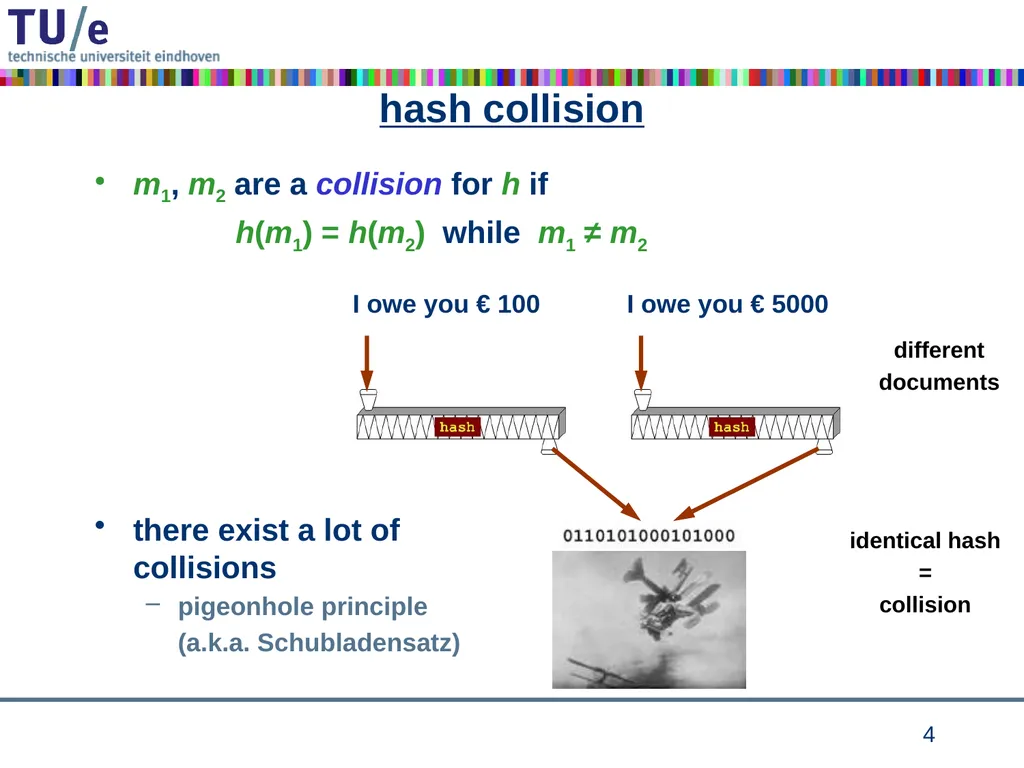
3 hash collision m1, m2 are a collision for h if
h(m1) = h(m2) while m1 ≠ m2 I owe you € 100 identical hash
=
collision I owe you € 5000 different
documents there exist a lot of collisions
pigeonhole principle
(a.k.a. Schubladensatz)<br>
05
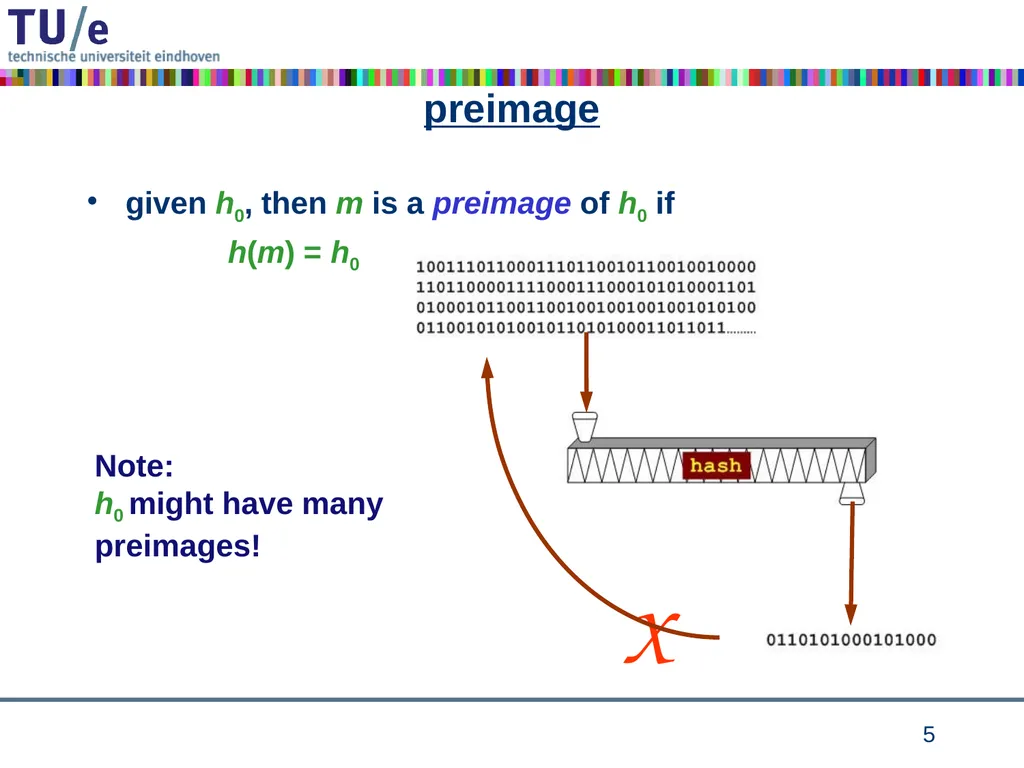
4 preimage given h0, then m is a preimage of h0 if
h(m) = h0 X Note:
h0 might have many preimages!<br>
06
5 second preimage given m0, then m is a second preimage of m0 if
h(m) = h(m0 ) while m ≠ m0 X ?<br>
07
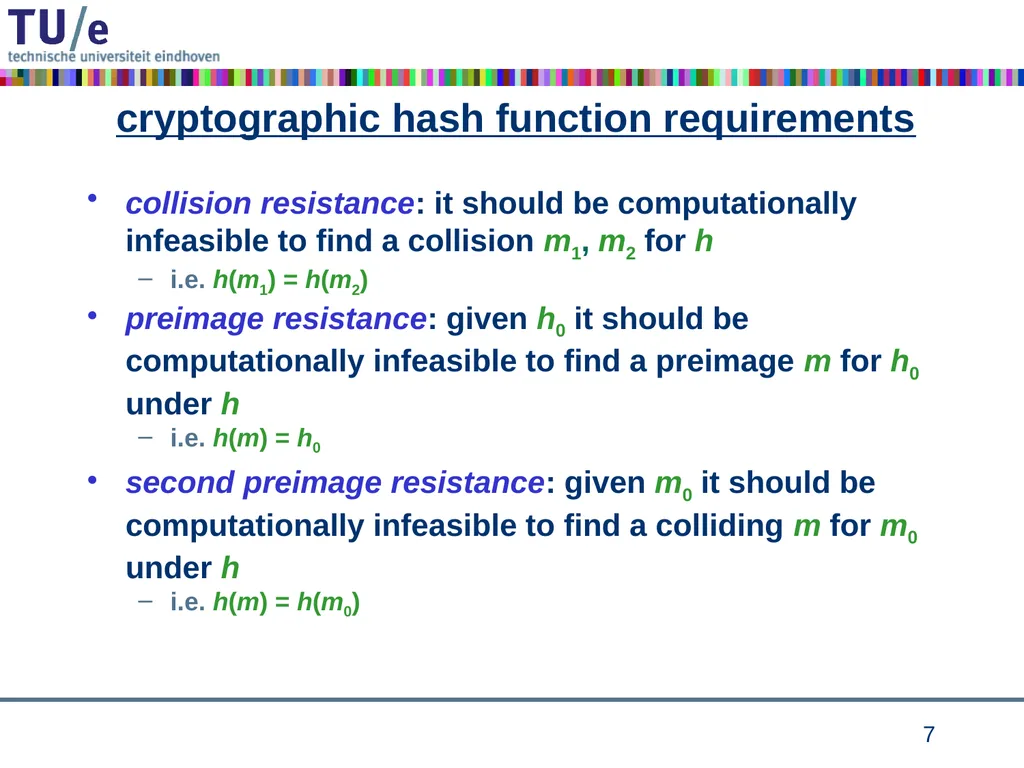
6 cryptographic hash function requirements collision resistance: it should be computationally infeasible to find a collision m1, m2 for h
i.e. h(m1) = h(m2)
preimage resistance: given h0 it should be computationally infeasible to find a preimage m for h0 under h
i.e. h(m) = h0
second preimage resistance: given m0 it should be computationally infeasible to find a colliding m for m0 under h
i.e. h(m) = h(m0)<br>
08
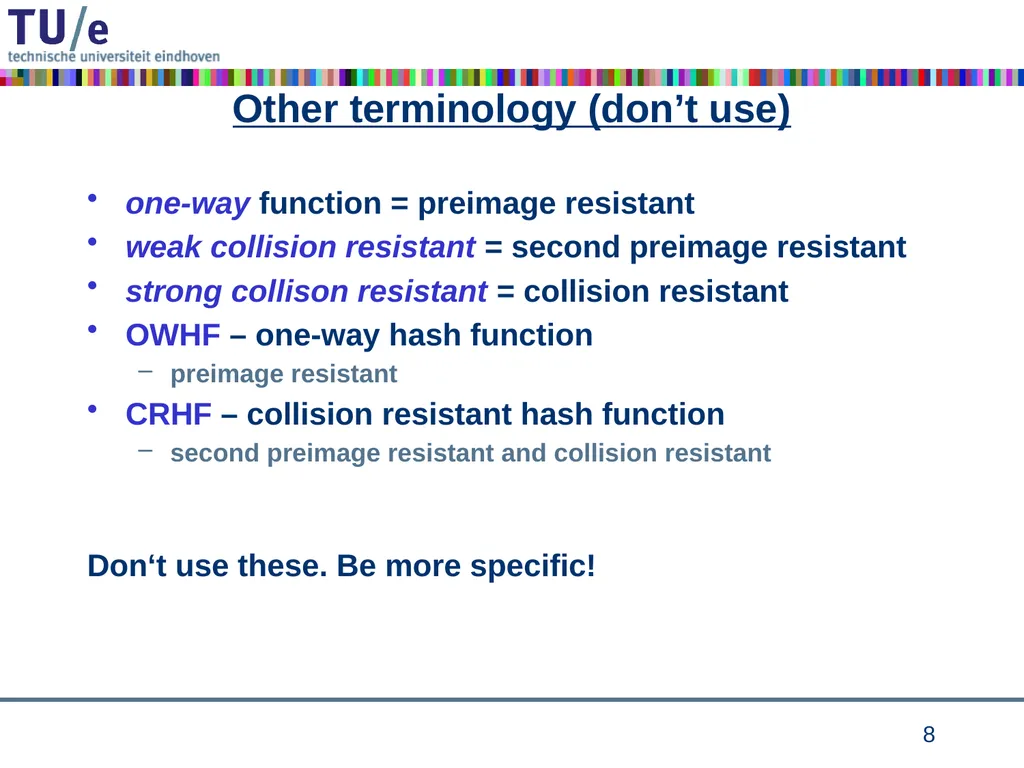
7 Other terminology (don’t use) one-way function = preimage resistant
weak collision resistant = second preimage resistant
strong collison resistant = collision resistant
OWHF – one-way hash function
preimage resistant
CRHF – collision resistant hash function
second preimage resistant and collision resistant
Don‘t use these. Be more specific!<br>
09
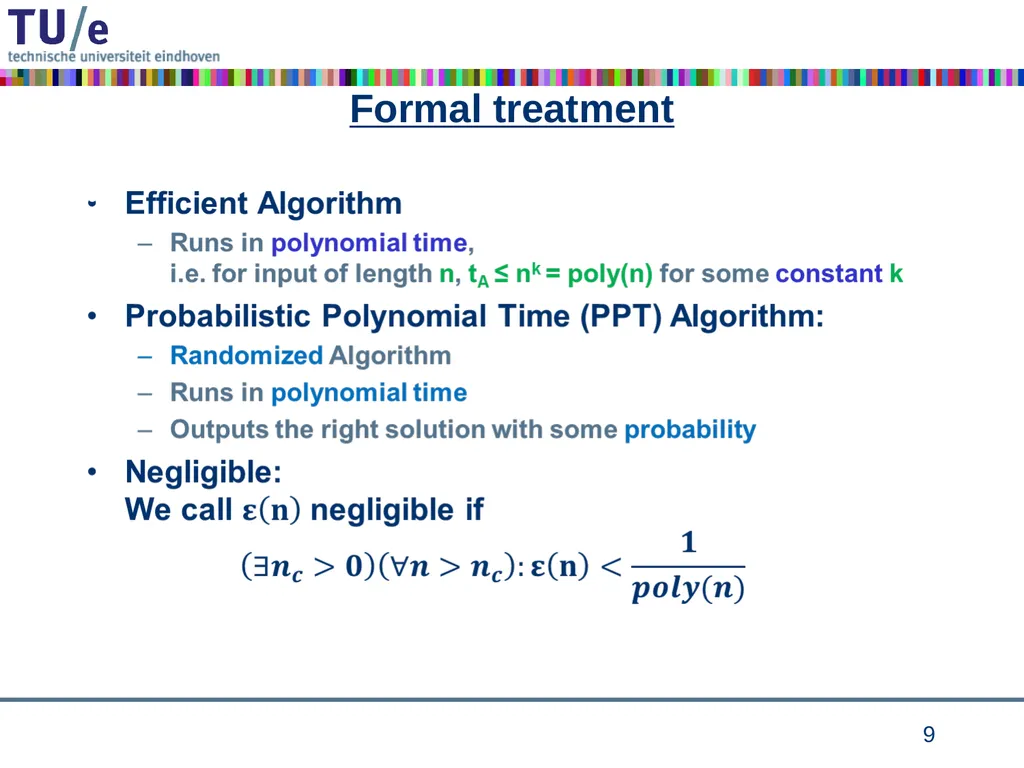
Formal treatment 8<br>
10
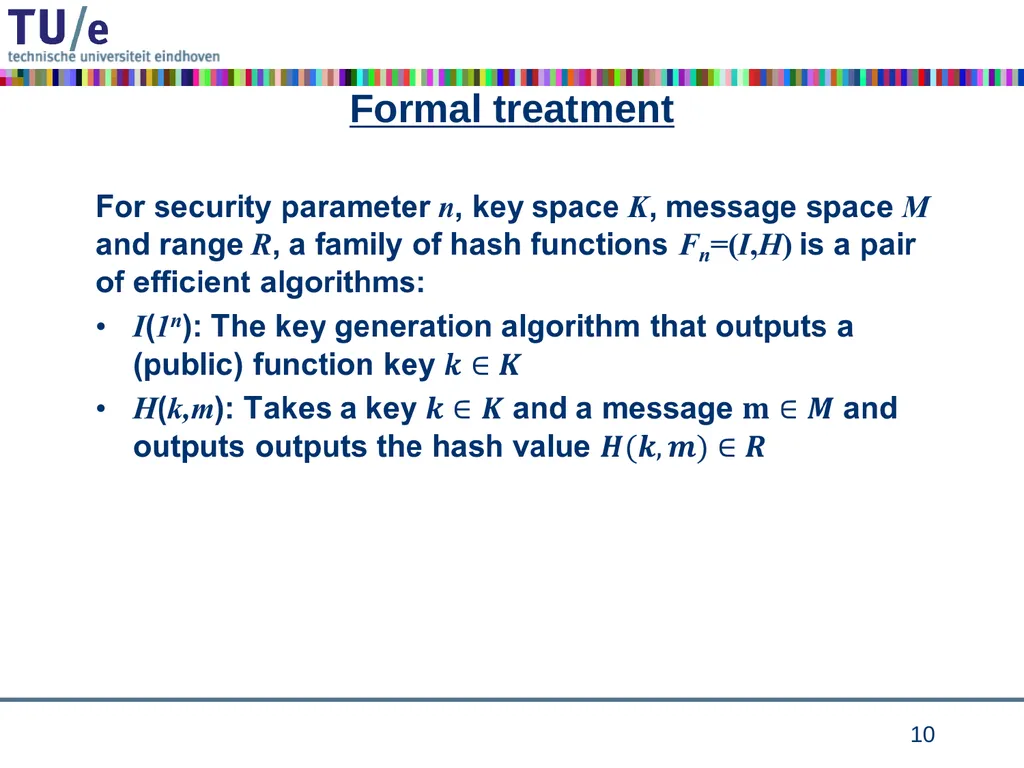
Formal treatment 9<br>
11
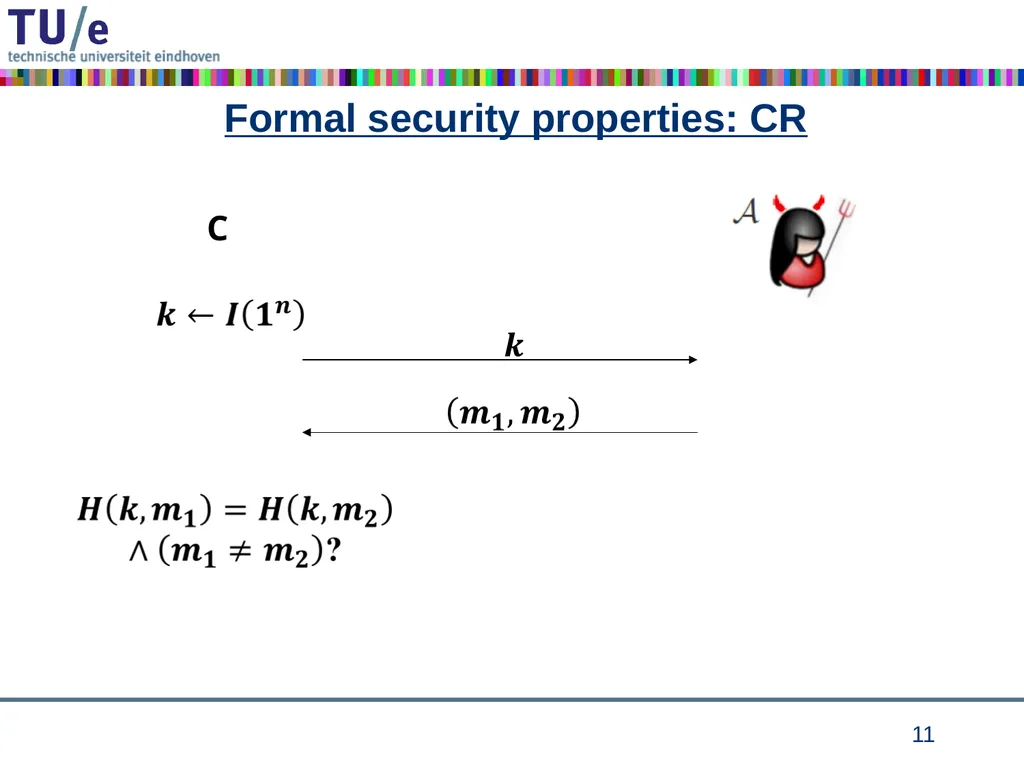
10 Formal security properties: CR C<br>
12
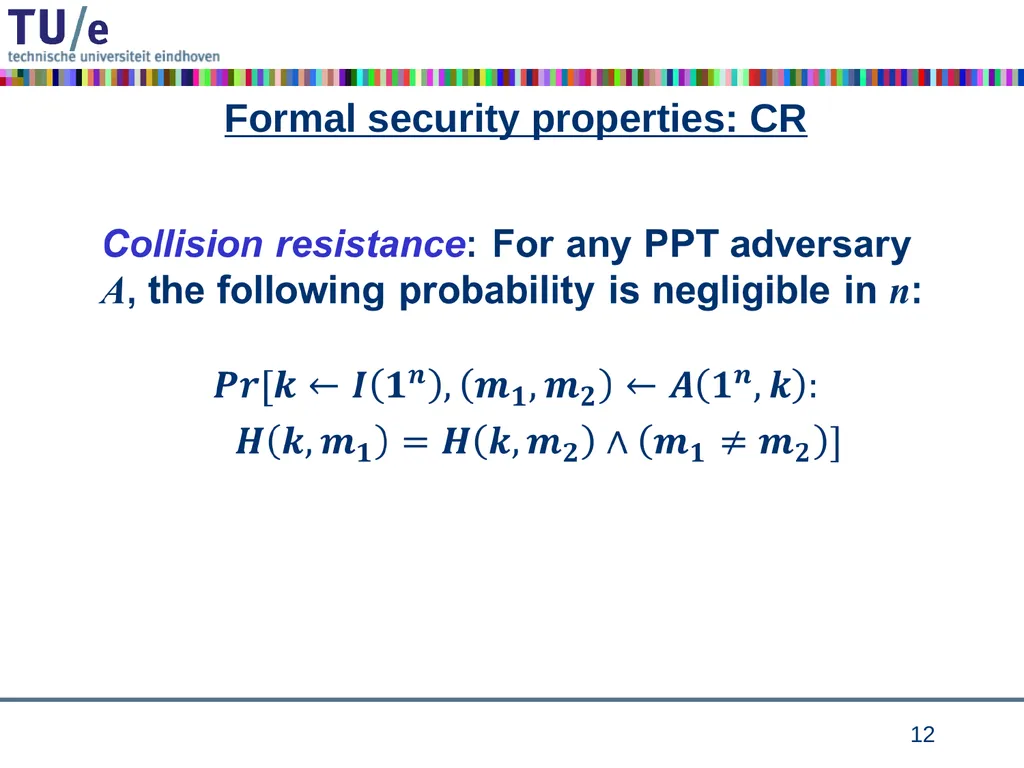
11 Formal security properties: CR<br>
13
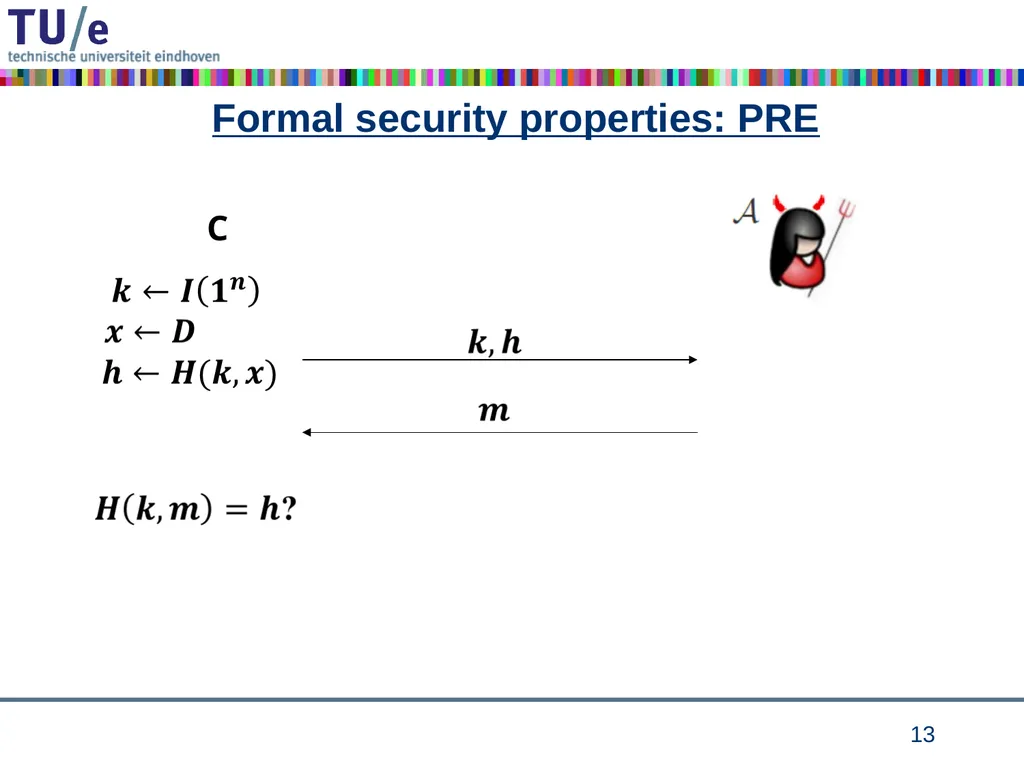
12 Formal security properties: PRE C<br>
14
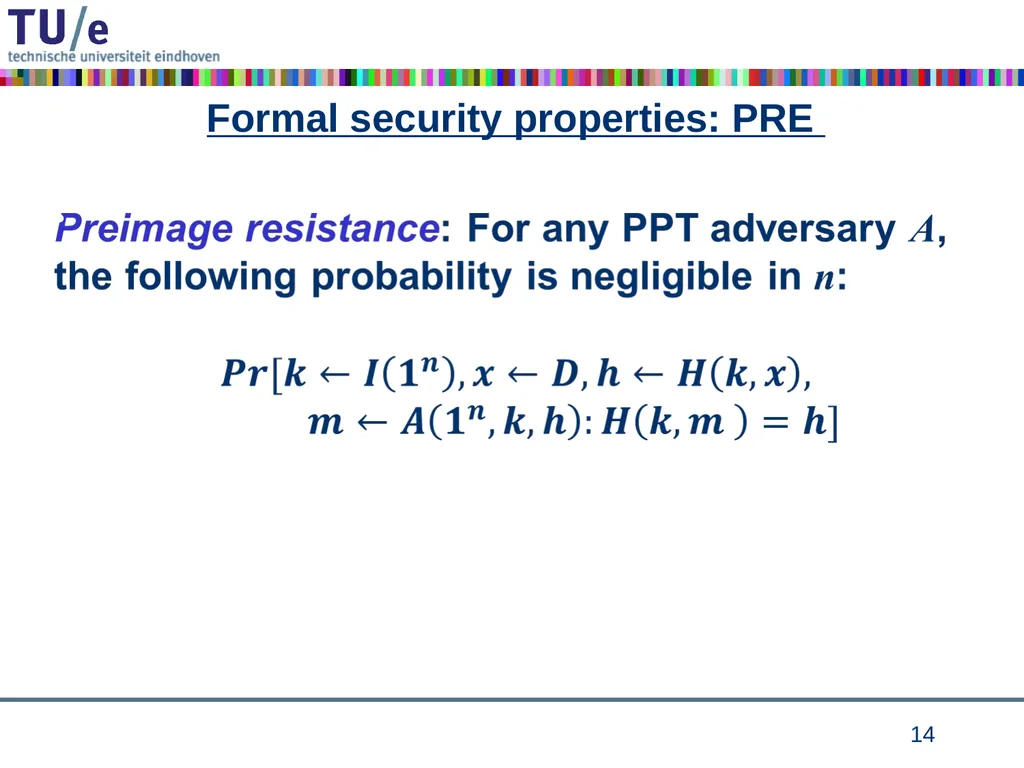
13 Formal security properties: PRE<br>
15
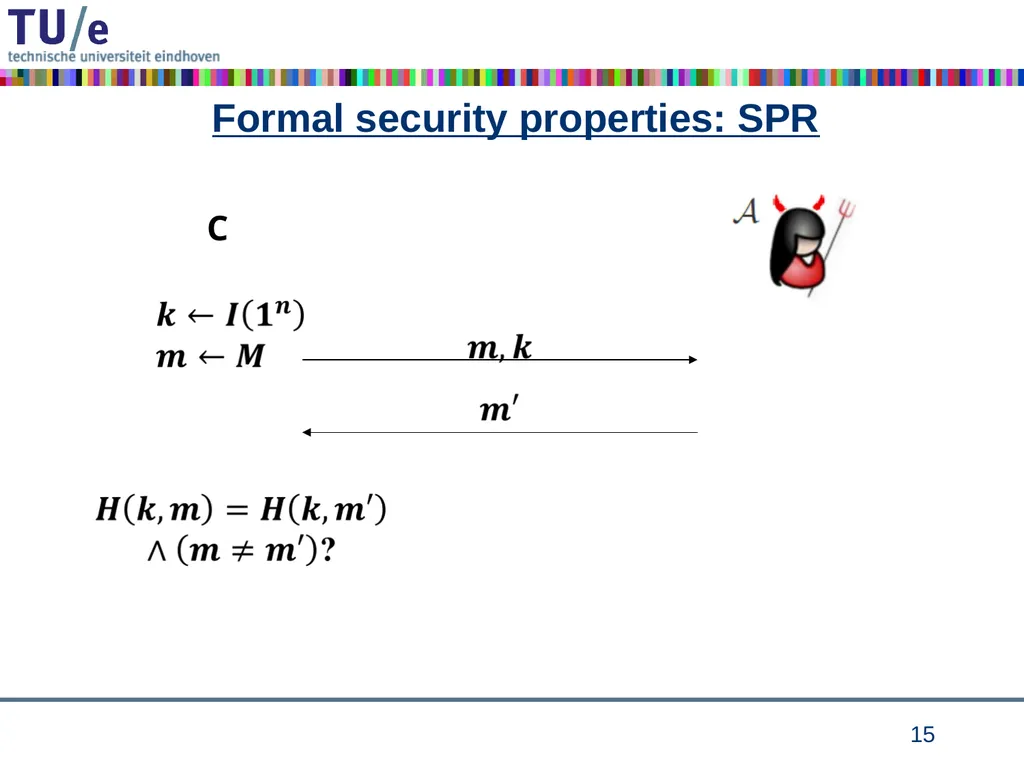
14 Formal security properties: SPR C<br>
16
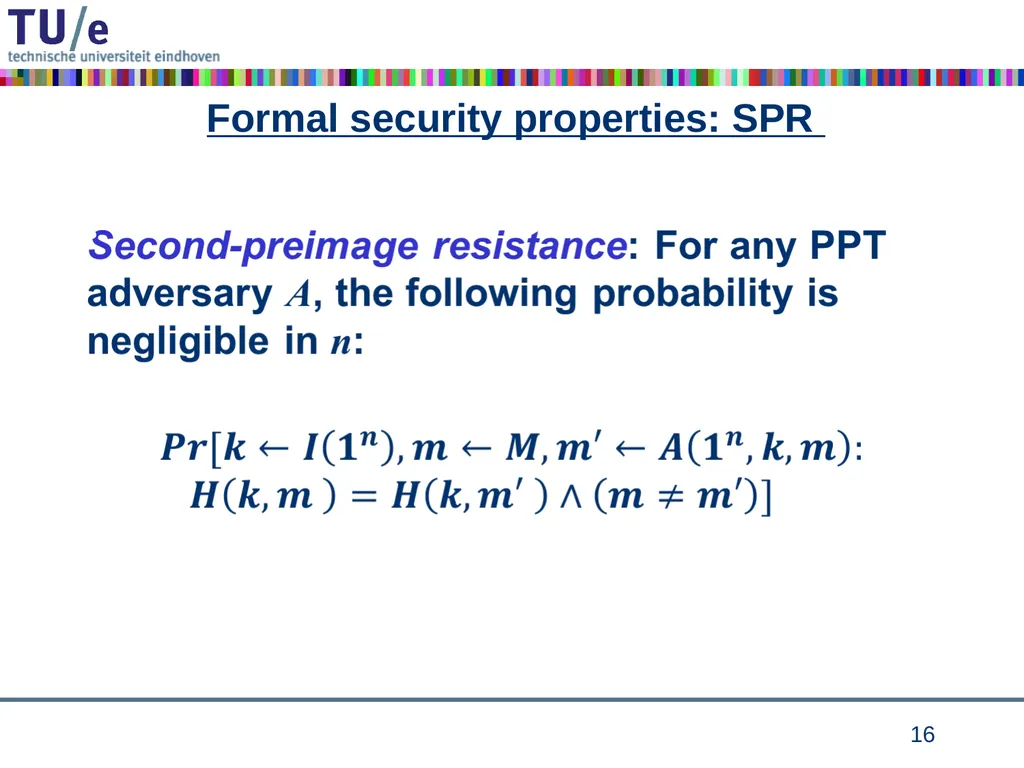
15 Formal security properties: SPR<br>
17
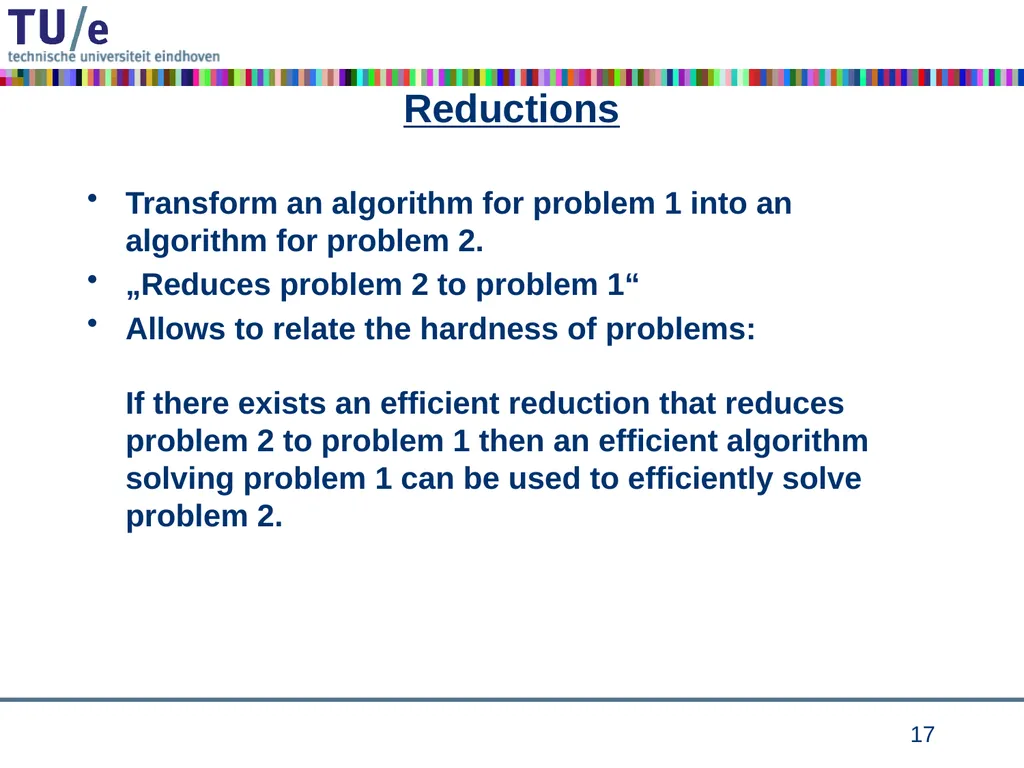
Reductions Transform an algorithm for problem 1 into an algorithm for problem 2.
„Reduces problem 2 to problem 1“
Allows to relate the hardness of problems:��If there exists an efficient reduction that reduces problem 2 to problem 1 then an efficient algorithm solving problem 1 can be used to efficiently solve problem 2. 16<br>
18
Reductions II Use in cryptography:
Relate security properties
„Provable Security“: Reduce an assumed to be hard problem to breaking the security of your scheme.
Actually this does not proof security! Only shows that scheme is secure IF the problem is hard. 17<br>
19
Relations between hash function security properties 18<br>
20
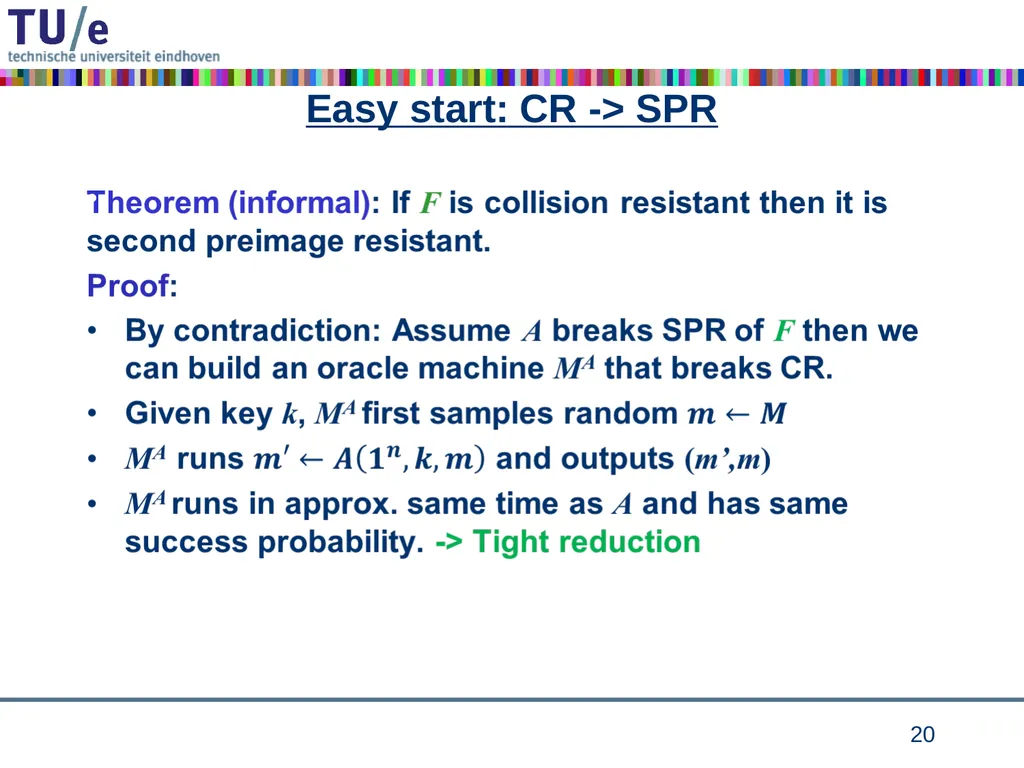
Easy start: CR -> SPR 19<br>
21
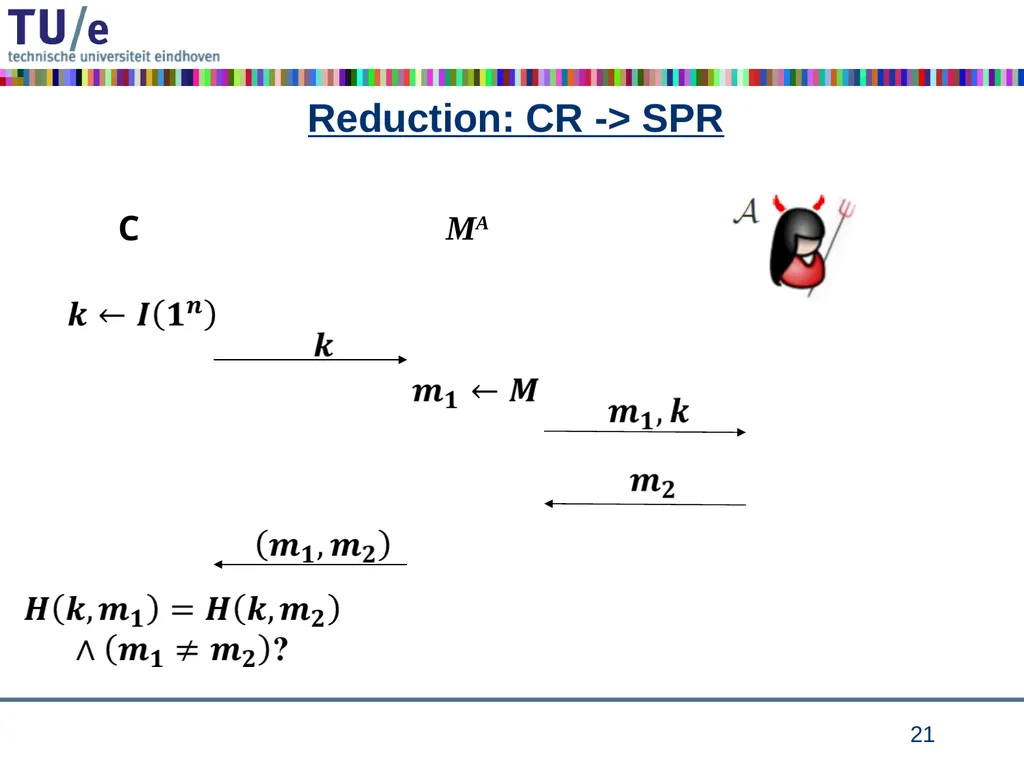
20 Reduction: CR -> SPR C MA<br>
22
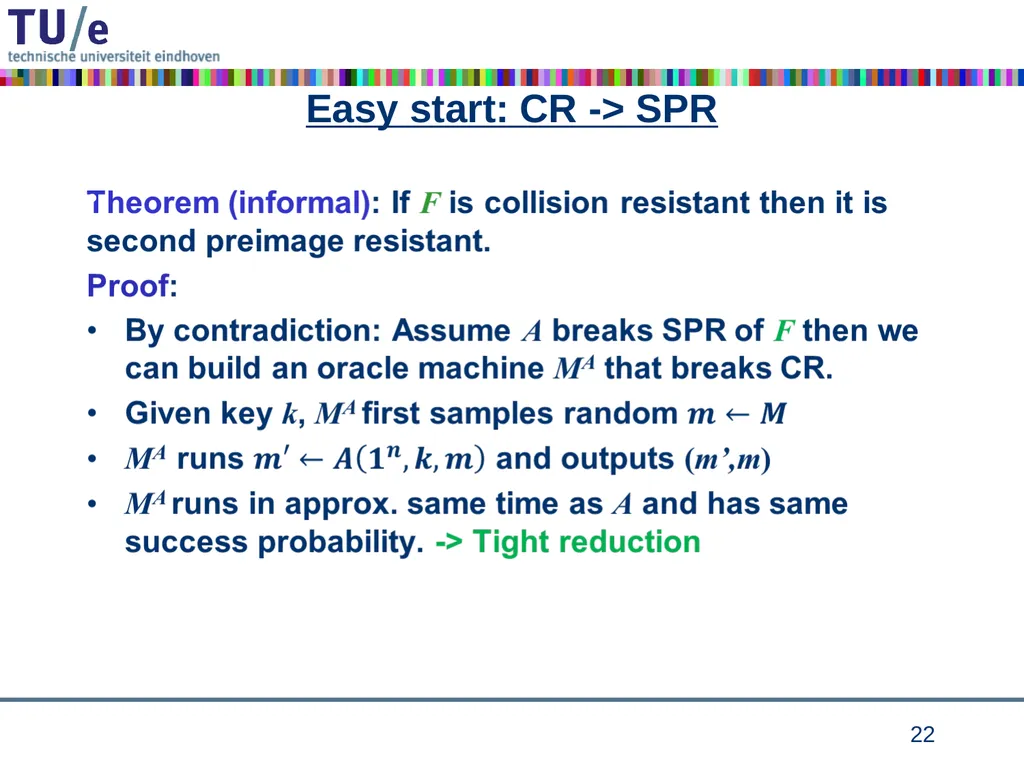
Easy start: CR -> SPR 21<br>
24
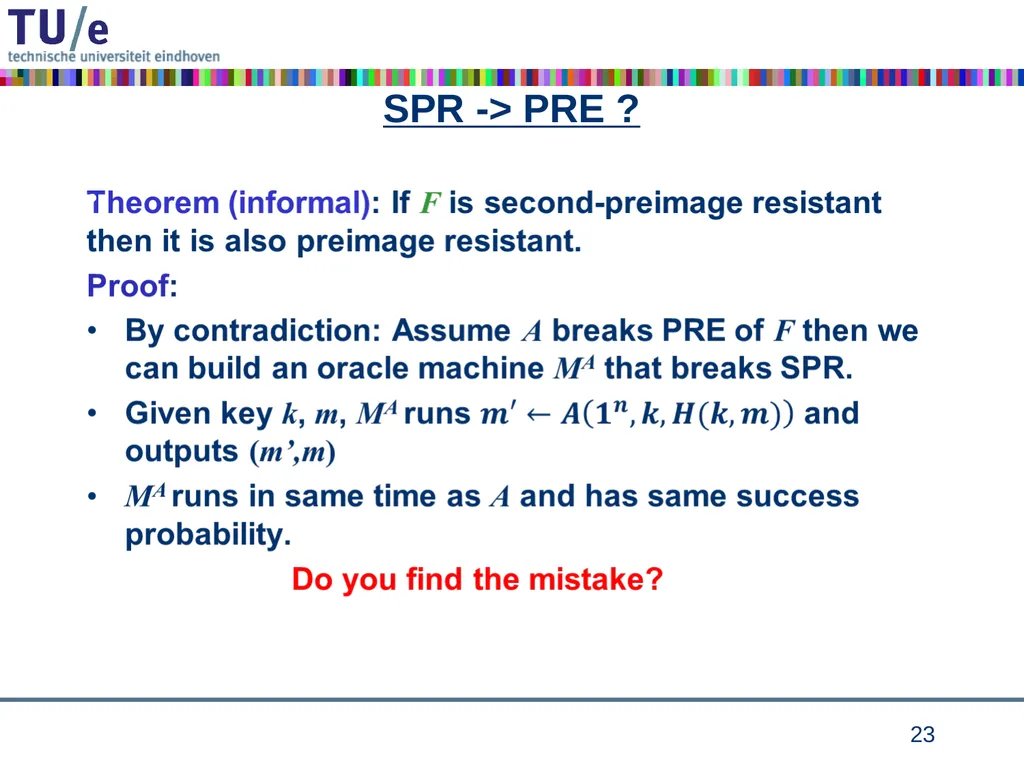
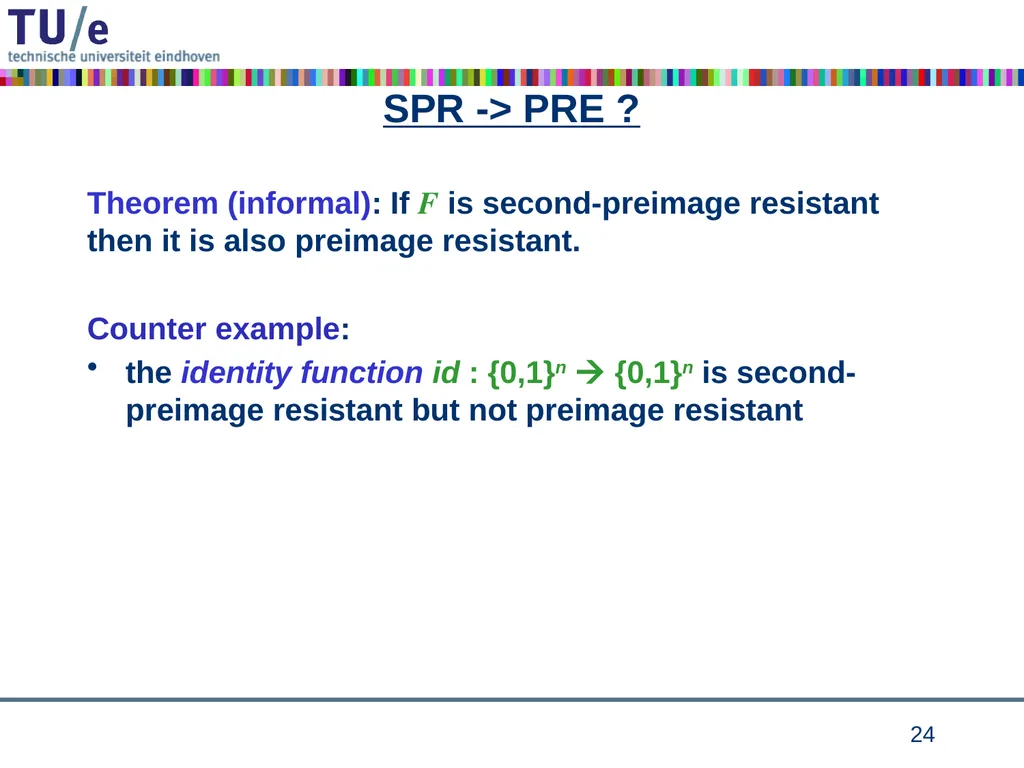
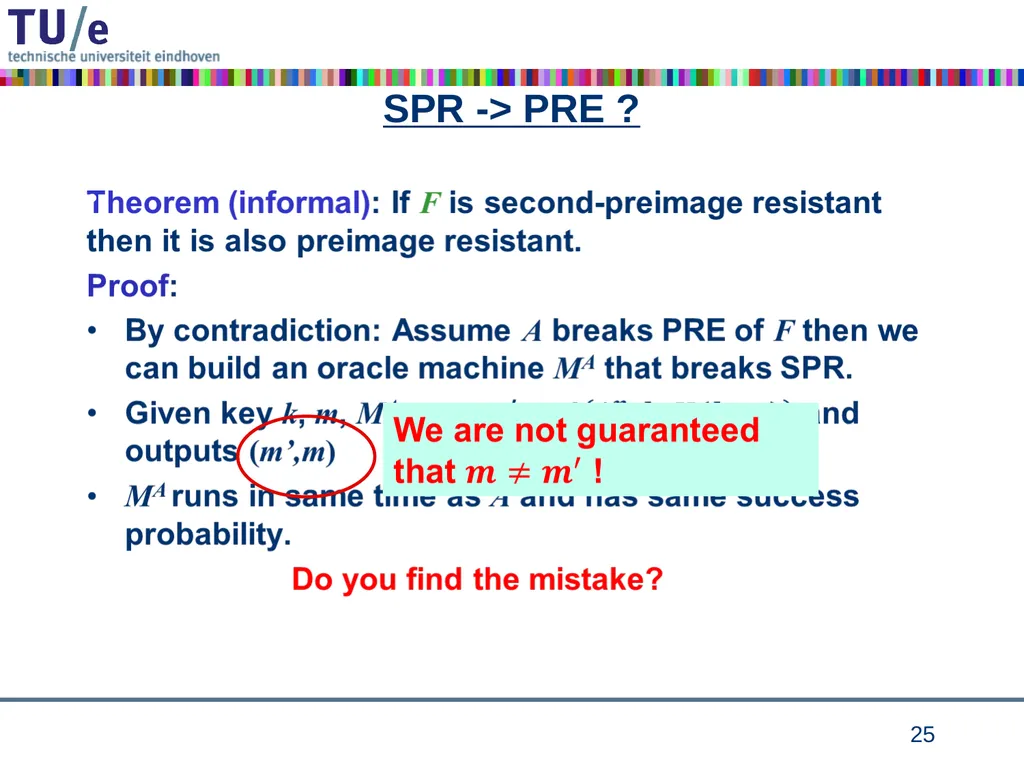
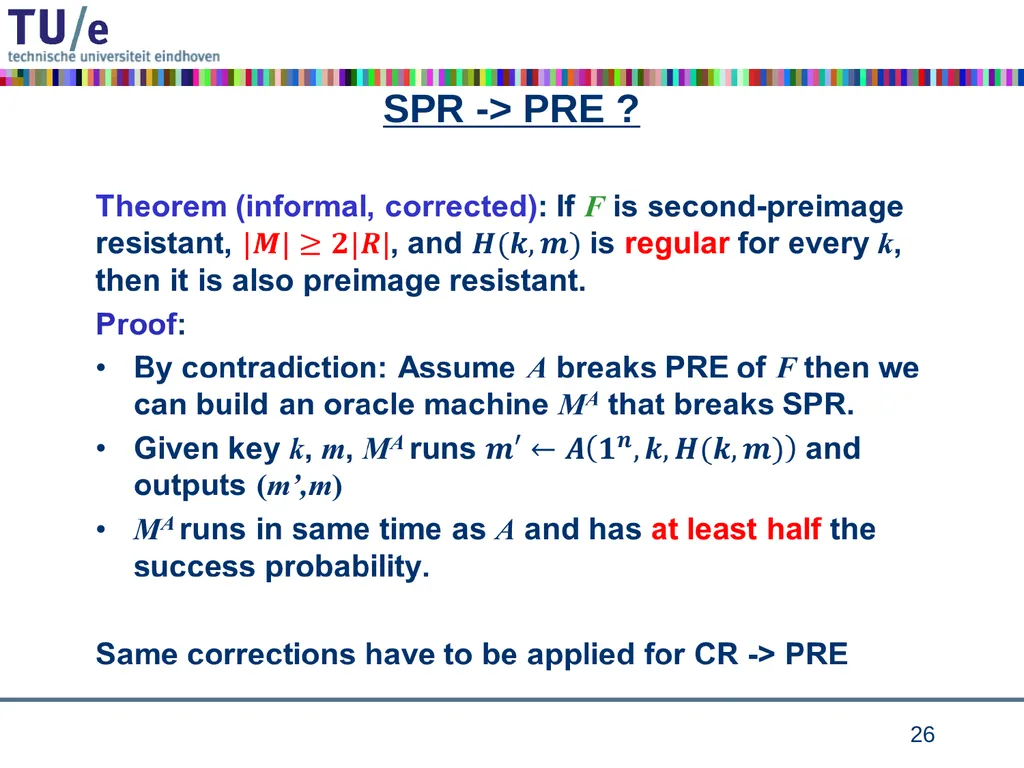
SPR -> PRE ? Theorem (informal): If F is second-preimage resistant then it is also preimage resistant.
Counter example:
the identity function id : {0,1}n {0,1}n is second-preimage resistant but not preimage resistant 23<br>
27
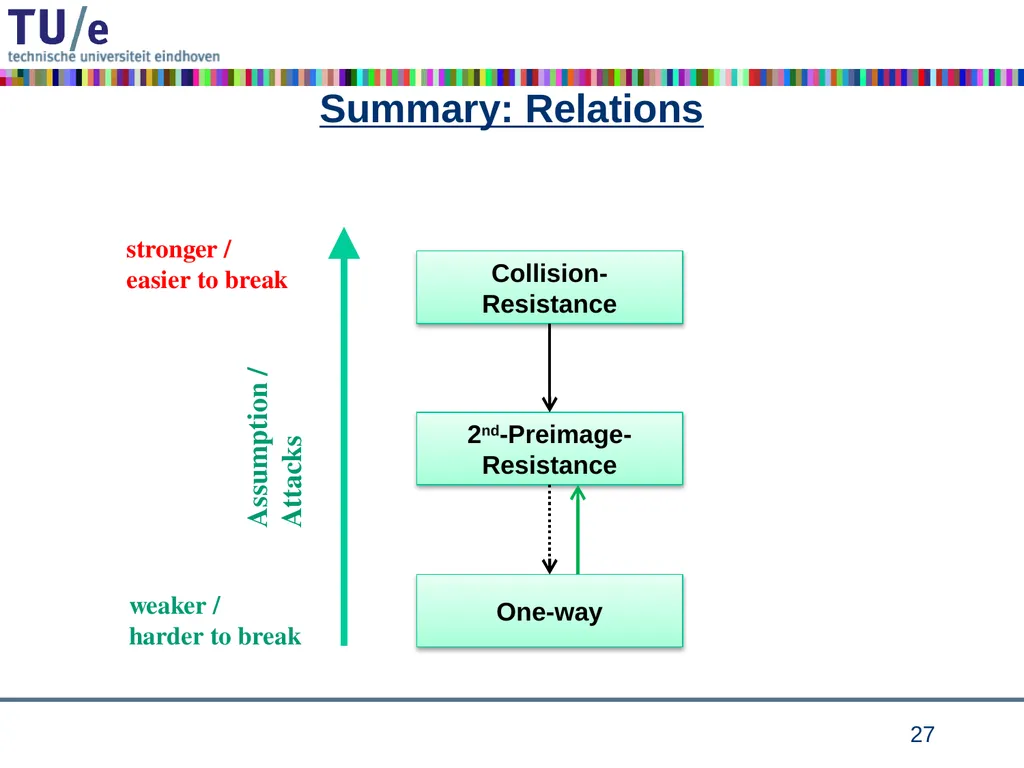
Summary: Relations 26 Collision-Resistance 2nd-Preimage-Resistance One-way Assumption / Attacks stronger / easier to break weaker /
harder to break<br>
28
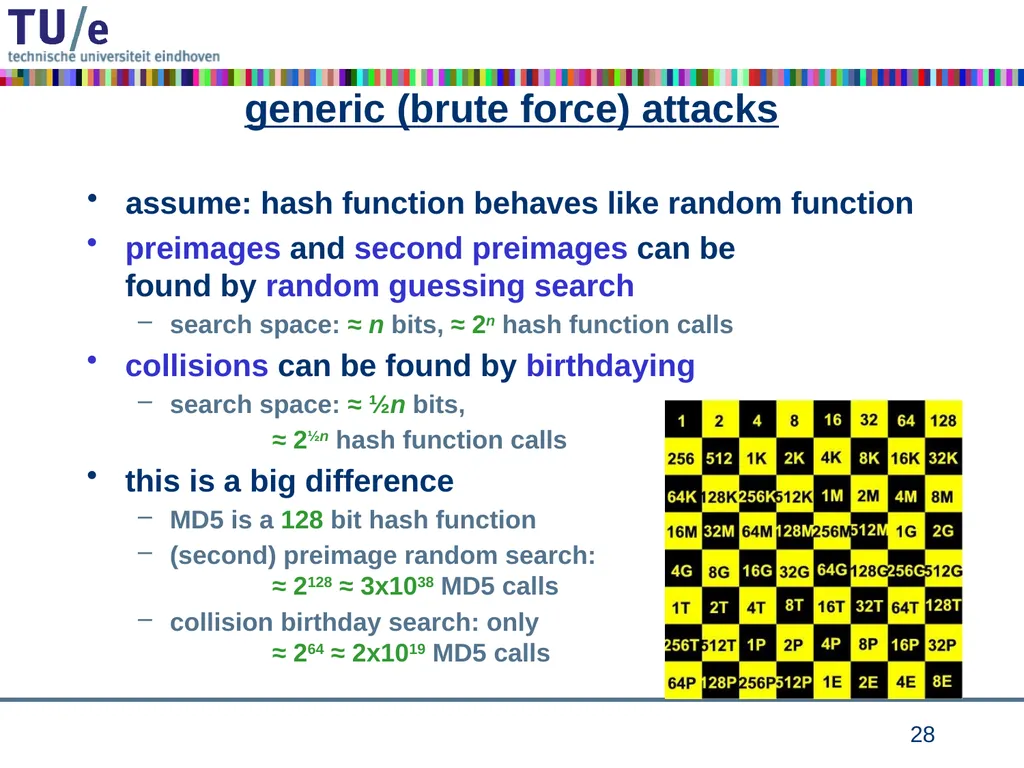
27 generic (brute force) attacks assume: hash function behaves like random function preimages and second preimages can be found by random guessing search
search space: ≈ n bits, ≈ 2n hash function calls
collisions can be found by birthdaying
search space: ≈ ½n bits,
≈ 2½n hash function calls
this is a big difference
MD5 is a 128 bit hash function
(second) preimage random search: ≈ 2128 ≈ 3x1038 MD5 calls
collision birthday search: only ≈ 264 ≈ 2x10¹⁹ MD5 calls<br>
29
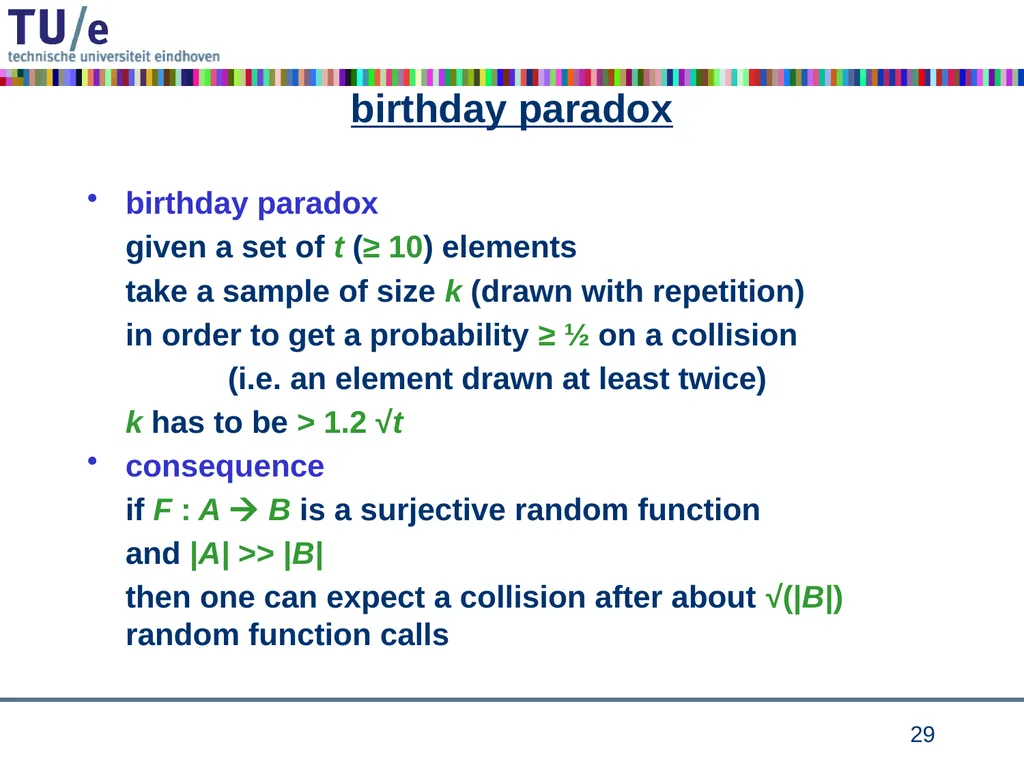
28 birthday paradox birthday paradox
given a set of t (≥ 10) elements
take a sample of size k (drawn with repetition)
in order to get a probability ≥ ½ on a collision
(i.e. an element drawn at least twice)
k has to be > 1.2 √t
consequence
if F : A B is a surjective random function
and |A| >> |B|
then one can expect a collision after about √(|B|) random function calls<br>
30
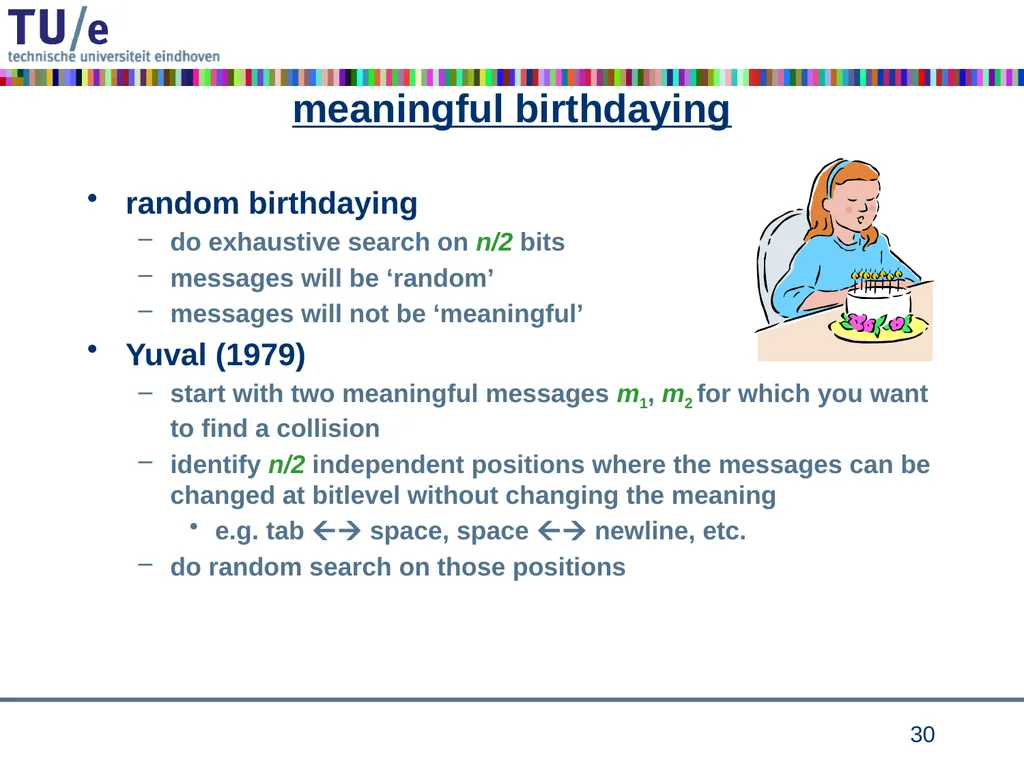
29 meaningful birthdaying random birthdaying
do exhaustive search on n/2 bits
messages will be ‘random’
messages will not be ‘meaningful’
Yuval (1979)
start with two meaningful messages m1, m2 for which you want to find a collision
identify n/2 independent positions where the messages can be changed at bitlevel without changing the meaning
e.g. tab space, space newline, etc.
do random search on those positions<br>
31
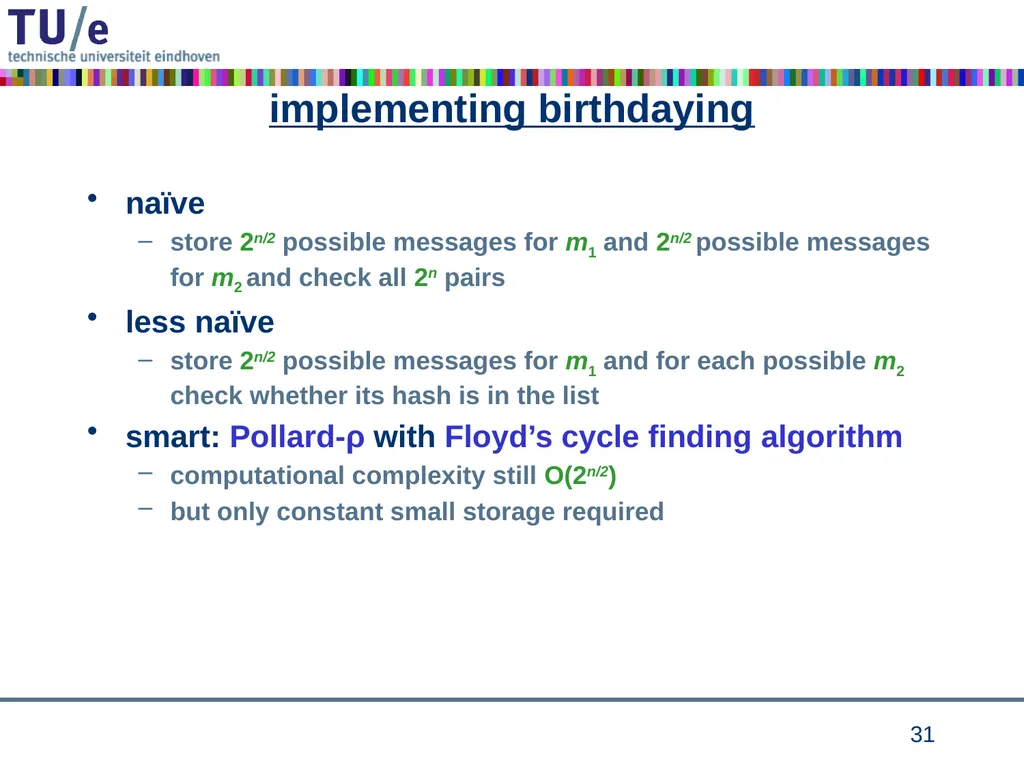
30 implementing birthdaying naïve
store 2n/2 possible messages for m1 and 2n/2 possible messages for m2 and check all 2n pairs
less naïve
store 2n/2 possible messages for m1 and for each possible m2 check whether its hash is in the list
smart: Pollard-ρ with Floyd’s cycle finding algorithm
computational complexity still O(2n/2)
but only constant small storage required<br>
32
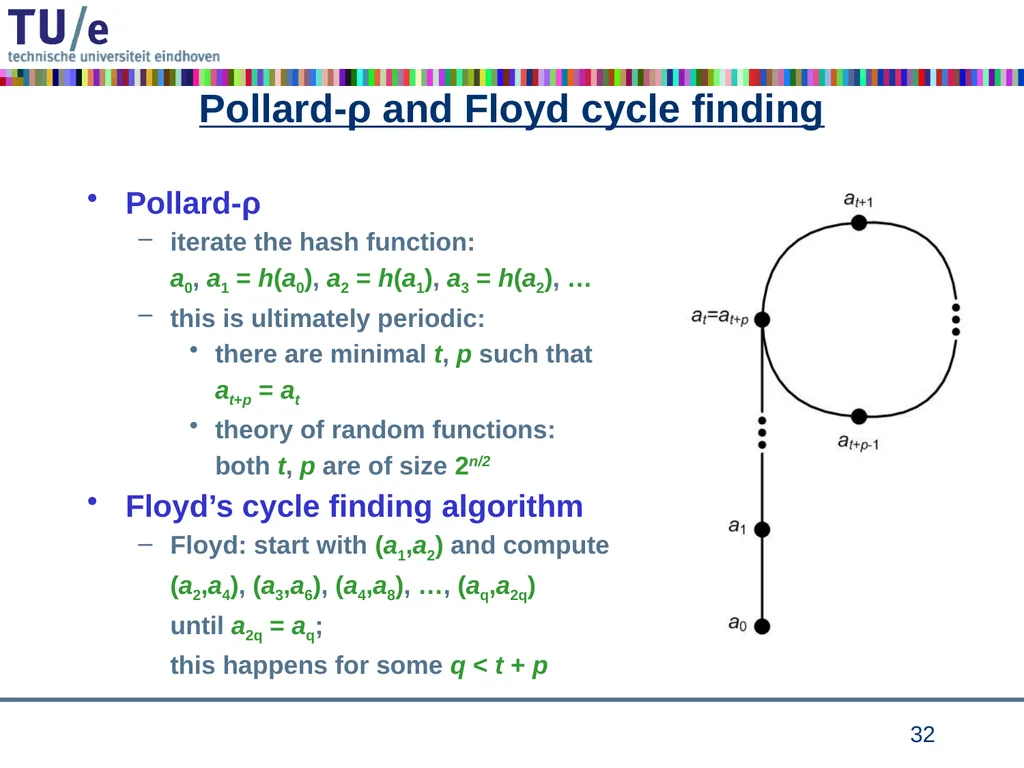
31 Pollard-ρ and Floyd cycle finding Pollard-ρ
iterate the hash function:
a0, a1 = h(a0), a2 = h(a1), a3 = h(a2), …
this is ultimately periodic:
there are minimal t, p such that
at+p = at
theory of random functions:
both t, p are of size 2n/2
Floyd’s cycle finding algorithm
Floyd: start with (a1,a2) and compute
(a2,a4), (a3,a6), (a4,a8), …, (aq,a2q)
until a2q = aq;
this happens for some q < t + p<br>
33
32 security parameter security parameter n: resistant against (brute force / random guessing) attack with search space of size 2n
complexity of an n-bit exhaustive search
n-bit security level
nowadays 280 computations deemed impractical
but 264 computations are possible
security parameter 64 now seen as insufficient
to have some security margin:�security parameter 128 is required
for collision resistance hash length should be 2n to reach security with parameter n
-> Use at least 256 bit hash functions like SHA2-256<br>